* A Distributed Proofreaders Canada eBook *
This eBook is made available at no cost and with very few restrictions. These restrictions apply only if (1) you make a change in the eBook (other than alteration for different display devices), or (2) you are making commercial use of the eBook. If either of these conditions applies, please contact a https://www.fadedpage.com administrator before proceeding. Thousands more FREE eBooks are available at https://www.fadedpage.com.
This work is in the Canadian public domain, but may be under copyright in some countries. If you live outside Canada, check your country's copyright laws. IF THE BOOK IS UNDER COPYRIGHT IN YOUR COUNTRY, DO NOT DOWNLOAD OR REDISTRIBUTE THIS FILE.
Title: Marlborough His Life and Times--Volume VI
Date of first publication: 1937
Author: Winston Spencer Churchill (1874-1965)
Date first posted: August 19, 2025
Date last updated: August 19, 2025
Faded Page eBook #20250825
This eBook was produced by: Al Haines, Howard Ross & the online Distributed Proofreaders Canada team at https://www.pgdpcanada.net
MARLBOROUGH
HIS LIFE AND TIMES
VOLUME VI
1708-1722
BY WINSTON S. CHURCHILL
THE WORLD CRISIS, 1911-1914
THE WORLD CRISIS, 1915
THE WORLD CRISIS, 1916-1918
THE WORLD CRISIS, 1911-1918 (Abridged, in one volume)
THE AFTERMATH
A ROVING COMMISSION
THE UNKNOWN WAR
AMID THESE STORMS
THE RIVER WAR
MARLBOROUGH
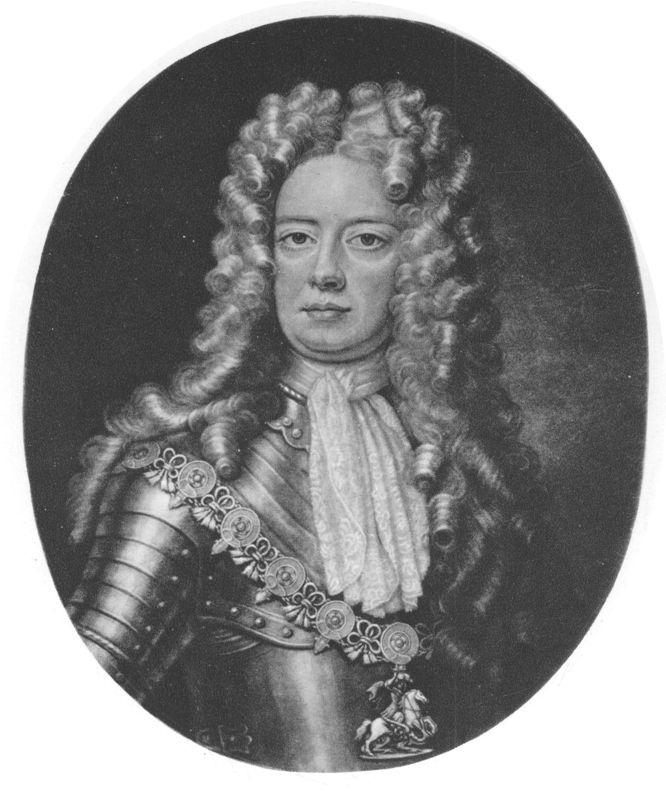
MARLBOROUGH
From an engraving after a painting by Sir Godfrey Kneller
MARLBOROUGH
HIS LIFE AND TIMES
By
The Right Honourable
WINSTON S. CHURCHILL, C.H. M.P.
VOLUME VI
1708-1722
NEW YORK
CHARLES SCRIBNER’S SONS
Copyright, 1938, by
CHARLES SCRIBNER’S SONS
Printed in the United States of America
All rights reserved. No part of this book
may be reproduced in any form without
the permission of Charles Scribner’s Sons
This volume upon the fall of Marlborough completes the story of his life which I began nearly ten years ago. It exposes and explains the lamentable desertion by England of her leadership of the Grand Alliance, or League of Nations, which had triumphantly broken the military power of Louis XIV. It shows how when victory has been won across measureless hazards it can be cast away by the pride of a victorious War Party and the intrigues of a pacifist reaction.
In the spring of 1709 we see England, or Great Britain, as she had recently become, at the summit of power and achievement. Queen Anne, seated securely upon her throne, was the centre of the affairs of the then known world. The smallest incident at her Court was studied with profound respect or attention by all civilized countries. Louis XIV, old, broken, bereaved, brooded disconsolately amid the stricken splendours of Versailles. The tyrant of Europe, who had let loose a quarter of a century of war upon his neighbours, had become a suppliant. The Whig Party in England, possessed of majorities in the Lords and Commons, had forced themselves into power. They no longer sought the liberation of Europe, but the destruction of France. They lost the victorious peace which might have closed the struggle. In France they roused the patriotism with which Frenchmen have always defended their soil, and in England they fell a prey to the designs of their party foes. The terrible battle of Malplaquet, the bloodiest and best contested for a hundred years, marked the climax of their efforts. Thereafter all became shameful and confused. Queen Anne abandoned the purposes of her reign. Abigail led Harley up the backstairs. The Queen devoted her great power to driving out the Whigs. England was dominated by party politics and the jealous emulation of great nobles. Marlborough and Godolphin were undermined. The Whigs were ejected and chased from office, and a Ministry was installed resolved upon peace at any cost. But by these very facts the French were incited to continue their resistance, and after three more years of conflict they found themselves, though exhausted, still erect.
This process depended upon the political drama in London, which in its various acts and scenes illustrates vividly the life of a Parliamentary nation, and reveals at many points the foundations of our Constitution. Marlborough was hunted down. His wife was driven from the Court. He himself, though he served the Tories faithfully in the field, was subjected to the cruellest humiliations and vile, undeserved reproach. The British army was forced to abandon its comrades in the field, and a peace was made contrary to every canon of international good faith. All Europe, friend and foe, was staggered by the perfidy of the Tory Ministers; but while the Queen lived they ruled with unchallengeable authority. Marlborough chose exile rather than the ill-usage he must receive in his native land. The name of England became a byword on the Continent, and at the moment of Queen Anne’s death the Protestant Succession itself was in danger, and our island on the verge of a second Civil War. This supreme disaster was averted, but when Marlborough returned to his native land and to a great position, time and age, which cast their veils over the fierce impulses and scenes of action, had led him to the dusk of his life.
I have tried to show Marlborough in his wonderful strength, without concealing his faults. I am not aware of any charge brought against him that has not been fully exposed and discussed. My impression of his size and power has grown with study. His genius in war, his statecraft, his virtues as a man, may be judged by these pages; nor is it necessary to dwell further upon them here. Happy the State or sovereign who finds such a servant in years of danger!
I have followed the method used in earlier volumes of always endeavouring to make Marlborough speak whenever possible. I have drawn upon the admirable foreign histories of this period—Klopp, Salomon, Von Noorden—and have been guided by them to the vivid reports of Hoffmann, Gallas, and other ambassadors and envoys to the English Court. From these sources a more intimate picture can be obtained of the political life of our country than in any of our domestic records.
The Blenheim archives have been found more fertile than in the preceding volume; in particular the reports of the British spy in Paris seem of high interest.
I must express my acknowledgments to the authorities of the Rijksarchief at The Hague for the courtesy with which they have laid their archives open to me; and also to the Huntington Library in California, to the Hon. Edward Cadogan, Lieutenant-Colonel Gordon Halswell, and others who have contributed original material.
I have been greatly assisted in the necessary researches by Mr F. W. Deakin, of Wadham College, Oxford, and again by Brigadier R. P. Pakenham-Walsh and Commander J. H. Owen, R.N., in technical matters. I accord my thanks to all those who so kindly allowed me to reproduce pictures and portraits in their possession, and to the present Duke of Marlborough for continuing to give me the freedom of the Blenheim archives.
WINSTON SPENCER CHURCHILL
Chartwell
Westerham
August 13, 1938
| CHAPTER | PAGE | |
| I. | “00” | 17 |
| II. | The Whigs and Peace | 30 |
| III. | The Great Frost | 46 |
| IV. | The Fatal Article | 62 |
| V. | The Lost Peace | 80 |
| VI. | Darker War | 93 |
| VII. | Tournai | 110 |
| VIII. | The Investment of Mons | 127 |
| IX. | The Battle of Malplaquet | 142 |
| X. | The Ebb-tide | 172 |
| XI. | The Queen’s Revenge | 196 |
| XII. | Mortifications | 209 |
| XIII. | Sacheverell and Shrewsbury | 222 |
| XIV. | The Ninth Campaign | 234 |
| XV. | Sunderland’s Dismissal | 259 |
| XVI. | The Alarm of the Allies | 282 |
| XVII. | The Fall of Godolphin | 295 |
| XVIII. | Marlborough and Hanover | 308 |
| XIX. | Dissolution | 320 |
| XX. | The New Régime | 333 |
| XXI. | The Gold Key | 352 |
| XXII. | The Death of the Emperor | 371 |
| XXIII. | Harley and St John | 384 |
| XXIV. | General Only | 405 |
| XXV. | Ne Plus Ultra | 421 |
| XXVI. | Bouchain | 440 |
| XXVII. | The Secret Negotiations | 458 |
| XXVIII. | Hanover Intervenes | 472 |
| XXIX. | The Political Climax | 489 |
| XXX. | The Visit of Prince Eugene | 506 |
| XXXI. | The Peculation Charge | 521 |
| XXXII. | The Restraining Orders | 535 |
| XXXIII. | The British Desertion | 551 |
| XXXIV. | Marlborough leaves England | 567 |
| XXXV. | Exile | 578 |
| XXXVI. | Utrecht and the Succession | 594 |
| XXXVII. | The Death of the Queen | 612 |
| XXXVIII. | Marlborough in the New Reign | 623 |
| XXXIX. | At Blenheim Palace | 639 |
| Bibliography | 653 | |
| Index | 657 |
| PLATES | |
| PAGE | |
| Marlborough | Frontispiece |
| The Old Pretender | 28 |
| John, Lord Somers | 32 |
| Charles, Second Viscount Townshend | 66 |
| Tapestry of the Battle of Malplaquet | 150 |
| James Craggs the Younger | 186 |
| John Campbell, Second Duke of Argyll | 190 |
| Charles Seymour, Sixth Duke of Somerset | 204 |
| Henry Sacheverell | 224 |
| Charles Boyle, Fourth Earl of Orrery | 252 |
| Robert Walpole | 270 |
| William, First Earl Cowper | 324 |
| Sir John Vanbrugh | 338 |
| The Emperor Charles VI | 374 |
| John Dalrymple, Second Earl of Stair | 414 |
| The Duke of Marlborough and Colonel Armstrong | 444 |
| Tapestry of the Capture of Bouchain | 448 |
| Tapestry showing Marlborough at Bouchain | 454 |
| Thomas Wentworth, Third Earl of Strafford | 514 |
| James Brydges, First Duke of Chandos | 530 |
| James Butler, Second Duke of Ormonde | 538 |
| John Sheffield, First Duke of Buckingham and Normanby | 614 |
| Blenheim Palace | 642 |
| Marlborough as a Young Officer in the French Army | 652 |
| FACSIMILES OF LETTERS | |
| PAGE | |
| John to Sarah after Malplaquet | 171 |
| MAPS AND PLANS | |
| PAGE | |
| The Situation Early in 1709 | 103 |
| The Feint before Tournai | 111 |
| Fortresses after the Fall of Tournai | 129 |
| The March from Tournai to Mons | 131 |
| Evening of September 7, 1709 | 133 |
| Evening of September 8 | 135 |
| Marlborough’s Plan of Attack | 143 |
| The Attack on the Wood of Taisnières | 147 |
| The Dutch Attack | 149 |
| The Allied Right in the Woods | 157 |
| The Allies reach the Edge of the Woods | 158 |
| Orkney’s Attack | 162 |
| The Cavalry Attack | 165 |
| The Battle of Malplaquet | 166 |
| Artillery Fire at Malplaquet | 168 |
| The French Retreat | 170 |
| The Siege of Mons | 180 |
| The Choice in 1710 | 239 |
| The Situation in April 1710 | 241 |
| The Advance: April 19-22, 1710 | 242 |
| The Siege of Douai | 244 |
| Villars’s Choice of Action (May 1710) | 246 |
| May 27-30, 1710 | 248 |
| July 12, 1710 | 254 |
| Sieges of Aire and Saint-Venant | 257 |
| Almenara and Saragossa | 347 |
| Brihuega and Villa Viciosa | 350 |
| May 1711 | 411 |
| The Ne Plus Ultra Lines | 416-417 |
| July 26, 1711 | 424 |
| The March to Arleux | 428-429, 430-431 |
| August 6, 1711 | 438 |
| August 9, 1711 | 441 |
| The Siege of Bouchain | 447 |
| May 1712 | 540 |
| The Surprise of Denain | 559 |
| The Western Netherlands | 656 |
| General Map of Spain | 656 |
B.M. = British Museum Library.
H.M.C. = Report of the Royal Historical Manuscripts Commission.
P.R.O. = Public Record Office.
S.P. = State Papers at the Public Record Office, London.
Documents never before made public are distinguished by an asterisk (*).
All italics are the Author’s, unless the contrary is stated.
In the diagrams, except where otherwise stated, fortresses held by the Allies are shown as black stars and those occupied by the French as white stars.
Until 1752 dates in England and on the Continent differed owing to our delay in adopting the Reformed Calendar of Gregory XIII. The dates which prevailed in England were known as Old Style, those abroad as New Style. In the seventeenth century the difference was ten days, in the eighteenth century eleven days. For example, January 1, 1601 (O.S.), was January 11, 1601 (N.S.), and January 1, 1701 (O.S.), was January 12, 1701 (N.S.).
The method used has been to give all dates of events that occurred in England in the Old Style, and of events that occurred abroad in New Style. Letters and papers are dated in the New Style unless they were actually written in England. In sea battles and a few other convenient cases the dates are given in both styles.
It was also customary at this time—at any rate, in English official documents—to date the year as beginning on Lady Day, March 25. What we should call January 1, 1700, was then called January 1, 1699, and so on for all days up to March 25, when 1700 began. This has been a fertile source of confusion. In this book all dates between January 1 and March 25 have been made to conform to the modern practice.
The whole of Europe was now weary of the almost unceasing wars which had ravaged its peoples for twenty years. Peace was desired by all the warring states. It was in all men’s minds. The Allies wished to reap the fruits of victory. Louis XIV, resigned to the decision of arms, sought only a favourable or even a tolerable escape. The enormous quarrel had been fought out, and the exorbitant power of France was broken. Not one of the original objects of the war was not already gained. Many further advantages were open. Why then was this peace not achieved in the winter of 1708 or the spring of 1709? Upon Marlborough has been cast the responsibility for this lamentable breakdown in human affairs. How far is this censure just? The issue is decisive for his fame. Before it can be judged his authority and the foundations on which it stood in Holland and in Britain must be measured.
From the day in 1706 on which the Emperor had first offered him the Viceroyalty of the Netherlands a sense of divergent interest had arisen between the Dutch leaders and their Deputy Captain-General. Although Marlborough had at a very early stage refused the offer, the Dutch could not help suspecting first that he owed them a grudge for having been the obstacle, and secondly that he still hoped to obtain the prize. It was known in Holland that both the Hapsburg brothers were intent upon this plan. After Oudenarde Marlborough had been sent a patent for life of the Governorship of the Netherlands. In August 1708 King Charles had written, “I do not doubt but that you will never allow the Netherlands, under the pretext of that pretended Barrier, to suffer any diminution either in their area or as regards my royal authority in them, which authority I wish to place in your hands.”[1]
In reporting the arrival of the patent to Godolphin Marlborough had written, “This must be known to nobody but the Queen; for should it be known before the peace, it would create inconveniences in Holland.” But, he had added, if when the time came Anne “should not think it for her honour and interest that I accept of this great offer, I will decline it with all the submission imaginable.”[2]
Nothing, indeed, could be more correct than his conduct. But the Dutch increasingly regarded him as the interested supporter of Hapsburg and Imperial claims rather than of their own. Rumours of the arrival of the patent were rife in The Hague in December. There is a report in the Heinsius Archives of an interview in December 1708 between Marlborough and the Dutch Intendant at Brussels, a certain Pesters, with whom he was particularly friendly and from whom he gained much information. Marlborough spoke with vehemence.
“In God’s name, what have I to expect from King Charles? He has more than once bestowed on me the government of the Low Countries. I have the patent” (pointing to his strong-box). “No, I have left it in England. But when I learned that it was displeasing to your Republic I renounced the idea, and I renounce it for ever. No, in truth, Pesters” (he always calls me “Pesters” when he wishes to speak with sincerity), “if they offered me in Holland the office of Stadtholder, I swear by God and by my own damnation I would not accept it. I am greatly misjudged. I know of what I am suspected; but my sole thought, after I shall have done my utmost to secure a good and durable peace, is to retire into private life. Nevertheless, if a Governor were required for the Low Countries I do not know why I should be less agreeable to the Republic than another, but I assure you that I have no thoughts of it.”[3]
During the summer of 1708 a correspondence sprang up between Heinsius and Torcy, the French Foreign Minister, the tendency of which was a separate understanding between Holland and France which might well bring about a general peace conference. This was irregular, but not necessarily disloyal. The preliminaries of the Treaty of Ryswick, in spite of the passionate resentment of England, had been arranged for the whole coalition by Holland, and the Dutch Republic conceived itself upon this precedent practically entitled by custom to test for itself, without consulting its allies, the readiness of the enemy to make peace. Louis XIV also was obstinately convinced that the path to peace lay through an initial and separate understanding with The Hague. A means of communication had long existed in the person of Herman von Petkum. Petkum, “Petithomme,” as Marlborough once, perhaps accidentally, spelt his name, was officially the agent at The Hague of the Duke of Holstein-Gottorp, but he was in fact the Pensionary’s servant, reserved for just this kind of work. Although he was paid not only by Heinsius and Vienna, but by Torcy,[4] his faithful and skilful labours for peace none the less deserve respect. At the end of May 1708, even before the battle of Oudenarde, Torcy had invited Petkum secretly to Paris, and in August, with the knowledge and approval of Heinsius,[5] he had conversations with Torcy at Fontainebleau. Torcy complained of the obduracy of the Allies. Petkum said this was due to the shifting propositions of France through different channels, and insisted that France must as preliminaries agree to yield Spain and the Indies, and all allied conquests in Brabant, Flanders, and Alsace; must recognize Queen Anne and undertake not to interfere with her or with the order of succession established by Parliament; must restore English trade in France to its former footing, and accord to Holland the tariff of 1664 and a satisfactory Barrier.
Torcy said that France would hazard everything sooner than submit to these excessive demands. On the other hand, he contemplated the partition of the Spanish Empire, was prepared to yield the bulk of it, and also declared that “the maritime Powers should receive security for their trade, and the Low Countries their tariff and their Barrier.”[6]
Having remained at Fontainebleau for five or six days, Petkum returned to Holland and reported everything to the Pensionary. But Heinsius told Marlborough nothing.[7]
It was not proper nor did it prove possible to keep all this from the vigilant Captain-General. During August the news of Petkum’s Paris visit leaked out in high circles at The Hague, and it cannot be doubted that it soon reached Marlborough. In fact, at the beginning of 1709 his Secret Service obtained the whole file of the current Torcy-Petkum correspondence. It was in cipher; but one of his agents, Blencowe,[8] a gentleman from Northampton, succeeded in penetrating the code, and translations of eleven letters are now in the Public Record Office.[9] In the autumn of 1708, however, Marlborough was dependent mainly on oral accounts. He was conscious that his relations with Heinsius were far from sure. He was not willing that Heinsius should pursue separate negotiations behind his back or that of the British Government, and in his turn he sought contact with France.
Throughout the long campaigns Marlborough had maintained correspondence, written in English and under his secret sign “00,” with his illustrious nephew Berwick. In the main this had been concerned with the courtesies of war, and cherished kinship amid national quarrels. It also served to keep alive that link with the exiled family at Saint-Germain which had persisted for so many years. But Marlborough’s civilities, although they always excited tremors of hope, had long ceased seriously to deceive the Shadow Court. It was not till 1708 that the correspondence touched any serious matter. Communication was easy, for Berwick at Château l’Abbaye was but a day’s ride from Marlborough’s headquarters at Helchin, and there was much traffic between the hostile commanders upon the exchange of prisoners, safeguards, and complaints of various kinds. To and fro went the messengers with their trumpets and flags of truce, bearing letters of routine, and other letters also, in their sabretaches. Marlborough took every possible precaution. He enjoined secrecy. He requested Berwick to return each of his letters with the answer. He seems to have trusted him absolutely, and as it proved rightly. Nevertheless, he ran a very high degree of risk in confiding himself to those upon whom he was inflicting such grievous injuries when, without consulting the Queen or the Cabinet, Sarah or Godolphin, Heinsius or Eugene, he at last, in mid-August 1708, definitely set on foot a peace negotiation.
Marlborough to Berwick
August 24
00. I had not had time when I returned your trumpet to answer your last letter. You have no doubt heard of the commotion caused by the respite accorded to mylord Griffin, and that the malcontents say that they will raise the matter when Parliament meets. However, you may be sure that at the first opportunity I shall render a similar service to my lord Middleton’s sons.[10] I would also assure you that no one in the world wishes for peace with more sincerity than I. But it must be stable and lasting, and in conformity with the interests of my country. Circumstanced as I am, I am inclined to think that the best way to set on foot a treaty of peace would be for the proposal to be first made in Holland, whence it will be communicated to me, and then I shall be in a better position to help, of which you may assure the King of France. And if there is anything which he wishes me to know upon this, I beg him that it may not be by other hands than yours, for then you may rest assured that I will tell you my opinion frankly. 00.[11]
It will be seen that Marlborough’s intervention took the form, not of superseding any negotiations already in progress between France and Holland, but rather of broadening their basis, and bringing himself and Britain into them. Berwick replied cordially to this letter, and sent it to the King. Louis and his advisers Chamillart and Torcy were all set on dealing with the Dutch alone. They did not welcome the intervention at this stage of Marlborough, and still less of Britain. They also inclined to regard Marlborough’s letter as only another of his innumerable traps and stratagems. Chamillart thought that it confessed a precarious military position. The answer which Berwick was at length directed to send reflected these views. “It is not now for his Majesty to make such overtures, but for the Dutch.”[12] He invited Marlborough to continue to use him as a channel, and thanked him for his efforts to save the lives of Lord Griffin and Middleton’s sons. Marlborough could only reply, “The King is alone the judge of what is best for his honour and his interest. . . . If ever the King wishes to let me know his intentions about peace, I desire that it should be by your agency, for I shall have no reserve with you, being sure of the care you will have for my safety and my honour.”[13] And a day or two later: “I beg you to believe that I have no other reason for asking you for the return of my letters than the fear of accidents, for I will always trust you willingly with my life and my honour. So pray return me in your first letter that which I wrote you on the 14th.”[14]
During the next two months Petkum continued his activities: “I have promised Heinsius,” he wrote to Torcy (September 11), “to treat with him alone and let him communicate to Marlborough no more than he thinks fit.” But Marlborough had already heard many things. Petkum wrote (September 25), “Marlborough suspects some secret negotiation, and will do what he can to thwart it.”[15] By the end of October the Duke feared that the Dutch were about to quit the Alliance.[16] No answer had been returned to his urgent request for an augmentation of their army for the campaign of 1709, and he saw that the fall of Lille would encourage the Dutch to a quick separate negotiation. Boufflers[17] beat the chamade on October 25, and on the 29th Marlborough received an unsatisfactory reply from Heinsius about the augmentation. Confronted with a grave menace to the Alliance and to British interests, he made a renewed and far more direct effort to gain control of the peace negotiations, and to bring London and Vienna into them.
On October 30, the night that the capitulation terms of Lille were finally agreed, and the day after receiving Heinsius’s refusal to increase the Dutch army, he wrote again to Berwick. This time he proposed that France, counting on his aid, should ask for an armistice and openly seek a peace.
Marlborough to Berwick
October 30
. . . You know that I have formerly assured you of my desire to contribute to peace whenever a favourable occasion should present itself. In my view it is at this moment in our power to take such a step as will produce peace before the next campaign. . . .
My opinion is therefore that if the Duke of Burgundy had the King’s permission to make proposals by means of letters to the deputies, to Prince Eugene, and to me, requesting us to communicate them to our masters, which we should be bound to do, that would have such an effect in Holland that peace would certainly ensue.
There follows this remarkable passage:
You may be assured that I shall be wholeheartedly for peace, not doubting that I shall find the goodwill [amitié] which was promised me two years ago by the Marquis d’Alègre [i.e., the douceur of two million livres]. If the King and the Duke of Burgundy do not feel that this time is suitable for peace proposals, I beg you to have the friendship and justice to believe that I have no other object than to end speedily a wearisome war.
As I trust you without reserve I conjure you never to part with this letter except to return it to me.[18]
It is indeed amazing that any man should have the hardihood to write such a letter to those who regarded him as their most terrible foe—indeed, their only foe. Marlborough is justified before history in pursuing these unauthorized negotiations. In his supreme position, both military and political, he was entitled, on his own judgment and at his own peril, to act for the best for his country, for the Alliance, and for Europe, all bleeding and ravaged by interminable war. It is often inevitable that the first overtures of peace should be made by secret and informal means. Marlborough, for his part, combined all the qualities both of the military and the civil power; he was the soul of the war, and if he thought it was time to make peace he was right before God and man to do so. But to introduce into this grave and delicate transaction a question of private gain, a personal reward of an enormous sum of money, however related to the standards of those times, was, apart from moral considerations, imprudent in the last degree. Yet this conduct has a palliative feature curiously characteristic of several of Marlborough’s most questionable acts. It served interests national, European, and personal at once and equally. It was the one thing capable of convincing the French King and Cabinet of his sincerity. It affected Berwick in this sense immediately. “Although naturally,” he wrote to Torcy on November 2, “I am not taken in by all he says, nevertheless I am inclined to believe in his good faith on this occasion, all the more because he speaks in it of a certain matter by which you know he sets great store.”[19]
It certainly shook the advisers of Louis XIV. “If he is sincere,” wrote Chamillart to Torcy (November 2), “use should be made of his goodwill, which would not be bought too dearly at Monsieur d’Alègre’s figure.”[20] The dreaded conqueror placing himself in their hands in this way, and revealing his personal weakness so nakedly, went far to sweep away their inveterate suspicions. They addressed themselves with renewed concern to his proposal. In the course of their anxious confabulations a memorandum was written, assembling all the arguments for and against the project, which throws a revealing light upon the inmost thoughts of the hard-pressed yet mighty monarchy.
The Duke of Marlborough must amidst all his prosperity fear the envy and antagonism of his own class, the general hatred of his countrymen, whose favour is more inconstant than that of any other people, the fickleness of his mistress and the credit of new favourites, perhaps the death of the Princess [Queen Anne] herself, the resentment of the Duke of Hanover[21] and the residence of his son in England, and lastly the breaking up of the Alliance. . . . If the war could last for ever, a man like Marlborough, who rules absolutely the councils of the principal European Powers and who conducts their armies, might have to make up his mind whether the fear of the future should induce him to abandon so fine a personal position. But in one way or another the war is drawing towards its end. . . .
He might well be satisfied with his glory if he could win peace for his country. . . . He will be no less satisfied upon the point of possessions, which the war has procured him in plenty. It is not just that peace should deprive him of all the advantages which the command of the armies brings him. We might well, therefore, give him to understand, and that without undue circumlocution—scarcely necessary, indeed, with him—that if he worked sincerely for peace he would be rewarded on its conclusion with a sum of two or even up to three million livres, payable at the earliest date, which would be a matter of arrangement.
The influence which Cardonnel has upon his mind is such that it is absolutely necessary to persuade the secretary in order to succeed with the master. The sum of three hundred thousand livres would be usefully employed to this end, and the King agrees to the Duke of Berwick proposing this by the person whom he chooses to speak to the Duke of Marlborough.[22]
In the end, however, King Louis and his councillors could not bring themselves to take the momentous step which Marlborough required. They still saw plainly the shattering effects upon French prestige and French means of resistance which were involved in suing for an armistice or initiating a peace proposal to Holland on the morrow of the fall of the city of Lille. It spelt defeat, acknowledged for all time in letters of fire. Well might they believe that Marlborough was sincere; for what better conclusion could the war hold for him? His sword would have struck the final blow. They would have surrendered beneath its impact, and he would quit the field of war loaded alike with glory and booty. More grievous distresses were needed to bring them to their knees. So, hearkening principally to Chamillart and his false ideas about the immediate military situation, clinging to the hope that the French armies could winter on the Scheldt and that Lille could be regained in the spring, the King directed Berwick to say in reply:
November 5, 1708
You know that the Kings of France and Spain desire peace. . . . You are aware that so far [the Allies] have made no response indicating a genuine desire for a settlement. Their situation, although most brilliant in appearance, cannot prevent those who have experience of war from perceiving that it is strained in all sorts of ways, and may at any moment be so transformed that even if you took the citadel of Lille you might be thrown into extremities which would destroy your armies and put it out of your power to supply with munitions and food the strong places you occupy beyond [depuis] the Scheldt, to recruit and re-establish your forces, and to put your armies in a state to resume the war in the next campaign.
I cannot but think that these reflections, joined to the desire which you have always shown me to contribute to a peace, have led you to write me the letter which I have received from you, which I will send you back if it has no happy results, and which I would return with great pleasure if it proved to have hastened the moment for me to thank you for the part you have allowed me to play in this important negotiation. . . .
If you think it would help the negotiation that the proposals for an armistice should come rather from the Duke of Burgundy than from the Allies, but without any mention of peace proposals, it is for you to bring us to that step in the best way. But in my opinion the conditions under which a suspension of arms could be arranged with your armies still in the midst of territories in his Majesty’s rule, and Prince Eugene besieging the citadel of Lille, will be more difficult to settle than those of a general peace, and it is in this last case that you would receive all the marks of friendship of which the Marquis d’Alègre has given you assurances on behalf of the King.[23]
Berwick was sorry to have to send such an answer. He had arrived by very different paths at the same estimate of the war facts as Marlborough. “Nothing,” wrote Berwick,
could have been better for all than this idea of the Duke of Marlborough’s. It opened to us an honourable doorway to finish a burdensome war. . . . Monsieur de Chamillart from political excess made himself believe that this proposal of Marlborough’s was extorted only by the plight in which the allied armies stood. I confess that this reasoning was beyond me; and from the manner in which Marlborough had written to me I was sure that fear had no part in his action, but only his wish to end a war of which all Europe began to weary. There was no sign of bad faith in all that he said to me, and he only addressed himself to me so as to make the negotiation pass through my hands, believing that this would be helpful to me. Monsieur de Chamillart prescribed the answer for me to make, and I thought it so extraordinary that I sent it in French in order that the Duke of Marlborough might see that it did not come from me. He was, in fact, so affronted by it that nothing fruitful for peace could be gathered from this overture. I even believe that this was the main cause of the aversion which the Duke of Marlborough always showed afterwards to a friendly settlement.[24]
That Berwick was right upon the personal and military issues cannot be disputed. Marlborough felt himself violently rebuffed. He does not seem to have minded at all asking the King of France to give him a fortune if he brought all things to a happy conclusion. He had no consciousness of how disdainfully posterity would view this incident. But he was deeply angered that the other side should dispute his opinion upon the military situation. He was sure he could beat their armies wherever they chose to stand. His peace proposals had been sincere. He had made the French what he deemed a fair offer. They had rejected it. Let them, then, since they were so proud, learn the consequences. In a few weeks he had broken their lines along the Scheldt, recaptured Ghent and Bruges, and driven Burgundy and Vendôme helter-skelter into France. “I am much mortified,” he wrote to Berwick,
to see that you believe I had any other motive for my letter except a wish for peace and the promise which I had given to let you know when I thought the proper time had come to take the steps necessary to secure it. . . . If the King and the Duke of Burgundy feel that secret conferences would be a surer and quicker path, they can propose this to the Pensionary and to some of the States at The Hague, so that when the campaign is finished and I arrive there, I can be informed of what has passed.[25]
He would, he added, continue to do his best to reach a just and lasting peace before the next campaign, “and meanwhile the two armies will be free to make the best use of the advantages which they each suppose they possess. Please send me back my letters with your next.” Marlborough’s request for the return of his letters was evidently complied with by Berwick. The French archives contain only unsigned, undated translations from Marlborough’s English in Middleton’s[26] hand, with comments by Berwick.[27] This fact has a bearing on a future transaction.
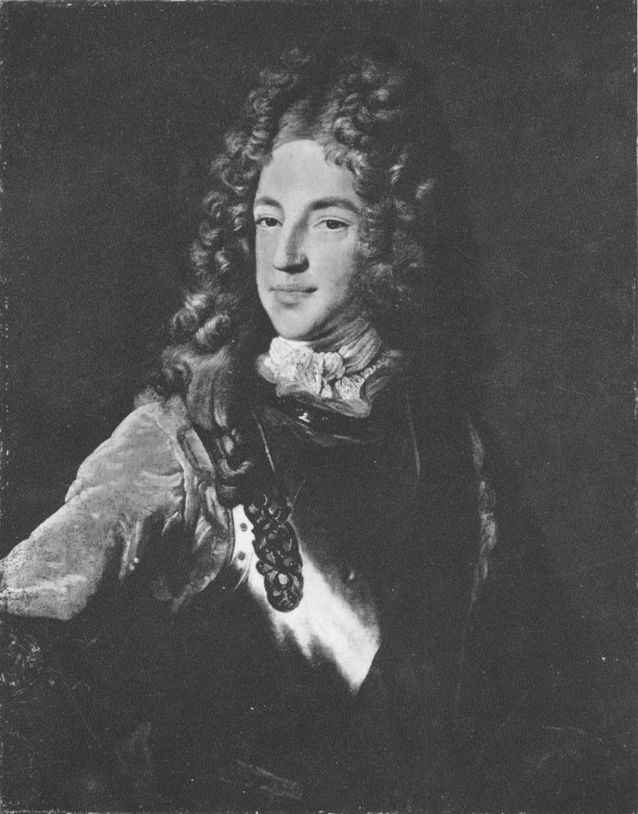
THE OLD PRETENDER
A. S. Belle
National Portrait Gallery
So failed Marlborough’s personal effort for peace. That it was wisely and justly founded at the time few can doubt. It is tarnished for us by the alloy of a sordid pecuniary interest. But this, indeed, in that age added to its chances of success. Some writers have actually maintained that Marlborough only inserted this suggestion in order to convince the French Court of his sincerity; and they point to his refusals, to the astonishment of Torcy, of all bribes when these were eventually offered. But the suspicion remains. It reflects more upon Marlborough as a man than upon Marlborough as a worker. He was a greater worker than man. No personal interest or failing turned him from his work. He toiled and schemed with all his power for a reconciled and tolerant Europe, a chastened France, and a glorious England to inherit the New World. As a part in these purposes he delighted in military success. All these conditions being satisfied, and without prejudice to their achievement, he would take pains and stoop for a commission. Supreme sanity, profound comprehension, valiant, faithful action, and if all went well large and punctual money payments!
|
Charles to Marlborough, August 8, 1708; Brussels Archives, quoted in L. P. Gachard, Histoire de la Belgique, p. 337. |
|
W. C. Coxe, Memoirs of John, Duke of Marlborough (second edition, 1820), iv, 246. |
|
H. Pesters to Heinsius, December 17, 1708; Heinsius Archives. See also R. Geikie and I. Montgomery, The Dutch Barrier (1705-19), pp. 93, 373. |
|
Eugene’s report to Vienna, Vienna Archives; W. Reese, Das Ringen um Frieden und Sicherheit (1708-9) (1933), p. 16. See also O. Klopp, Der Fall des Hauses Stuart, xiii, 217. See also Recueil des instructions données aux Ambassadeurs de France, tome xxiii. Petkum received from France 3000 livres a year after 1703; on October 6, 1709, 4000 livres, on March 6, 1720, 3000 livres (French Foreign Office Archives, “Correspondance de Hollande,” tome 200, ii, 117). |
|
Klopp, xiii, 219. |
|
Round Papers, H.M.C., p. 329. |
|
Marlborough to Heinsius, November 6/17, 1708 (Heinsius Archives); Marlborough to Wratislaw, September 25, 1708 (Vienna Archives); Reese, pp. 27-28. |
|
William Blencowe was a Fellow of All Souls and barrister-at-law. He received two hundred pounds a year from the Secret Service fund for his decoding work. Hearne, the Oxford antiquary, calls him “a proud fanatical Whig.” He lost his employment on the arrival of the Tories in office, and shot himself in August 1712. See Remarks and Collections of Thomas Hearne (edited by C. E. Doble, 1889), iii, 439. |
|
B.M., Add. MSS. 32306, 34518. |
|
Lord Griffin and Middleton’s sons were among those captured in the Jacobite descent of 1708. Marlborough had exerted himself to save the aged Lord Griffin from the scaffold. See Vol. V, p. 363. |
|
French Foreign Office Archives, “Angleterre,” tome 226, f. 121; A. Legrelle, La Diplomatie française et la succession d’Espagne, v, 381. |
|
Loc. cit. |
|
Dépôt de la Guerre, tome 2083, p. 68. |
|
Loc. cit. |
|
Round Papers, H.M.C., p. 330. |
|
Marlborough to Heinsius, October 6, 1708; Hague Archives; Reese, p. 28 n. |
|
The governor of Lille. |
|
Legrelle, v, 385. |
|
Ibid., 387. |
|
Legrelle, v, 386. |
|
The Duke, or Elector, of Hanover was offended at not having been fully consulted in the Oudenarde operations. |
|
Legrelle, v, 674 et seq. |
|
Legrelle, v, 390-391. |
|
Memoirs, ii, 51-53. |
|
Legrelle, v, 392. |
|
Secretary of State to the Pretender. |
|
Legrelle, v, 664-665. |
The Lords of the Junto had held together through many baffling years. They now formed the core of a party Cabinet which controlled ample majorities in both Houses. We must not underrate their contribution to the course of public affairs. For years in their splendid country houses, in their clubs, in their party groupings and assemblies, they had examined and discussed every aspect of British politics and of the European war. They conceived themselves the heirs to the majestic estate which Marlborough’s sword and their policy had raised for Britain. They proposed to manage it in their own way, and in accordance with the matured and defined principles of their party, and, above all, in accordance with its interest. On no point did the Whigs ever consciously diverge from that.
The arid, pedantic Sunderland was no longer their chief representative in the Cabinet. Somers had become Lord President of the Council. His outstanding ability, his experience, his learning, his eloquence and aptitude in speech and writing, once joined to a great office, ensured him leadership in the political world. Godolphin, divorced from the Tories, evidently weakened with the Queen, was, in spite of his Treasurership, eclipsed at the council board. His political authority, apart from his long fame, amounted to no more than his unbreakable association with Marlborough.
On the other hand, the fact that the Whigs were now effectively in power, and for the first time satisfied with their treatment by the Crown, removed for the moment all Parliamentary difficulties. For the first time in Anne’s reign the organized dominant forces in the Cabinet and in Parliament had a clear-cut, coherent policy upon the war, upon peace negotiations, and in domestic affairs. The Whig leaders regarded Marlborough as their most valuable instrument. They were at last also contented with Godolphin. Few scruples had governed the pressures they had exerted upon the Crown or upon the Captain-General and Treasurer in order to gain office; but it must be admitted that, once installed, they showed themselves resolute, efficient, and helpful in all the processes of government. They managed the Parliamentary machine with deft and sure touch. Queen Anne had hoped that in practice the Whig Party would be split between the Junto and its moderate elements; but the Junto showed themselves too clever for this. They withdrew their own nominee for the Speakership in favour of the candidate of the moderates, and carried him with a solid party vote. The Royal Speech in November breathed inflexible resolution to continue the war with the utmost vigour. The addresses in reply from both Houses praised the Queen’s conduct of affairs in glowing terms. The successes of the campaign were extolled, and the thanks of Parliament were once again voted unanimously to the Duke of Marlborough for his latest successes and for the energy which he was displaying in the national service. Since he was still abroad, a delegation was sent to present these tributes to him. Without waiting for any similar decision by the Dutch, an augmentation of ten thousand men was voted for the army in Flanders.
Finance was the field in which the Whig mastery was greatest. The whole force of the City, of the Bank of England, of the moneyed classes, obeyed the Ministerial requirements with the enthusiasm of confidence and interest. The largest estimates yet presented were cheerfully accepted by the House of Commons. All Europe marvelled that in the seventh year of so great and costly a war, when every other state was almost beggared, if not bankrupt, the wealth of England proved inexhaustible. Indeed, it seemed that the Government held a magic purse. The yield of high taxation was reinforced by internal borrowing upon the largest scale yet known. The Bank, in exchange for a twenty-one years’ extension of their charter, bound themselves to provide four hundred thousand in cash and issue two and a quarter millions of bank-bills. The lists were opened on February 11. Within four hours of nine o’clock the whole amount was subscribed, and eager would-be lenders were turned away in crowds.[28] Hoffmann dilated to the Emperor upon these prodigies, as they then seemed to the world. “Outside England,” he wrote,
it would appear incredible for this nation, after it has provided four hundred million Reichsthaler during nearly twenty years of war, to be able to produce a further ten millions in a few hours at the low rate of interest of 6 per cent. It must be observed that this has not been done in cash, which is now difficult to obtain, but in paper, particularly banknotes. Indeed, not a penny of these ten millions was paid in cash, but all in banknotes. These banknotes circulate so readily here that they are better than hard coin. So the whole of this wealth appears to be based almost entirely upon the credit of the paper money and the punctual payment of the interest.[29]
In the ordinary tactics of party also the Whigs easily out-manœuvred the Tory Opposition. They freed Marlborough and Godolphin from the minor annoyances which they had so long endured while unprovided with a disciplined majority. If there were losses and arrears in the yield of the Land Tax they would allow no censure to fall upon the Treasurer. Godolphin’s name was deleted from the hostile motion by 231 votes to 97. If there were reproaches that the measures to defend Scotland at the time of the invasion had been inadequate, these were converted into votes of confidence and thanks to the Queen’s Government for the great and effectual precautions they had taken and for their success. If “warm speeches were made against him, and he was roasted, as they call it,”[30] the Whigs hastened to his aid. There was another little matter in which the Whigs made themselves obliging to the two non-party or super-Ministers. An act of general pardon was passed for all correspondence with the Court of Saint-Germain, and, indeed, for all past treasonable actions of any kind except treason upon the high seas. This last provision was designed to exclude the Jacobites who had actually sailed in the invading fleet the year before. Thus the slate was cleaned, and a very large number of Tories and Jacobites both in England and Scotland, who lay under anxieties for what they had done or planned to do if the Pretender landed, were generously released by those who might have been expected to be their chief prosecutors. Gratitude from this quarter was neither expected nor received.[31]
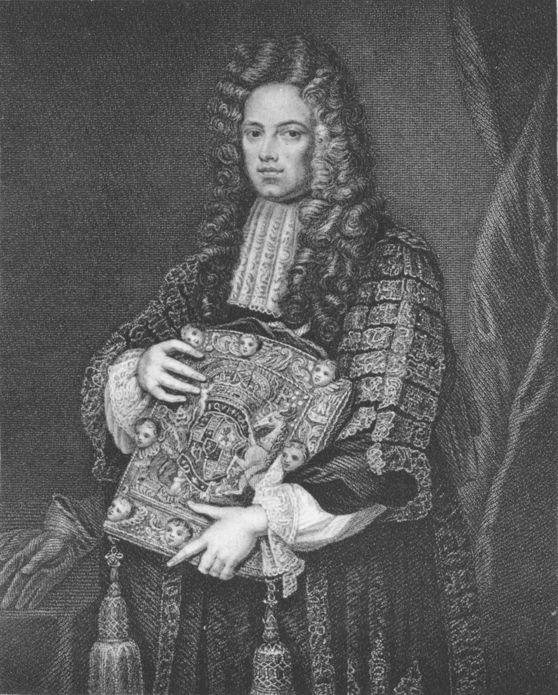
JOHN, LORD SOMERS
From an engraving after a painting by Sir Godfrey Kneller
Marlborough had always pursued his devious way serene and imperturbable. He did not concern himself with the Amnesty Bill. But Godolphin, whom Wharton had recently confronted with one of those customary sentimental letters to Mary of Modena which the Treasurer persisted in writing, was certainly well pleased to have an Act of Parliament between him and future reprisals by his enemies. It is perhaps of significance that the Queen gave consent to the Bill on the very day of its passage. To have the Whigs showing themselves so accommodating to her Tory and Jacobite friends and to Mr Harley, lately harried again over the Greg affair, was at any rate some compensation for their presence at her Council.
But the incident most illustrative of these times concerned the Queen herself. A number of young Whig Members moved an address to the Queen urging her to marry again. This striking proposal was not only supported by the House of Commons, but endorsed by the Lords. At this time Queen Anne was in the depths of mourning for her husband. She had already been eighteen times disappointed of an heir by death or miscarriage; she was within a few days of her forty-fifth birthday. It had, in fact, been decided to omit from the accession service the prayer that the Queen might be “an happy mother of children, who, being educated in Thy true faith and fear, may happily succeed her in the Government of these kingdoms.” What wonder then that many regarded such a suggestion to the Queen as ill-timed and indecorous? Indeed, Mordaunt, Peterborough’s younger brother, who sat in the Commons, raised a general laugh when he suggested impudently that the address should be presented only by Members who had not yet reached their thirtieth year. The explanation was, however, simple to those who were behind the scenes. The bitterness which the Whig triumph aroused in the Tory Opposition had led them once again to bait the Queen with the prospect of bringing over the Electress of Hanover or her son to visit or, perhaps, to reside in England. The Whig counter-move was to urge the Queen to marry again, for she could hardly be urged to do this one day and to bring over the existing heir the next. It seems certain that the Queen fully understood the tactics of both the attackers and the defenders. She replied by message sedately the next day: “The subject of the address is of such a nature that I am persuaded you do not expect a particular answer.”[32] But if the Queen, weighed down by her grief and increasing infirmities, was thus quaintly protected by the Whigs from a Hanoverian intrusion, and might even recognize their Parliamentary dexterity, she nevertheless sought their expulsion from office as her chief desire.
At this time one would suppose Marlborough and Godolphin had all they could ask in Britain for themselves or for their policy. Yet their intimate letters reveal their profound misgivings and discouragement. Godolphin harps again on vexations to which “the life of a slave in the galley is paradise in comparison.”[33] Marlborough replies that nothing but his loyalty to his colleagues and his duty to the Queen would make him endure the burden and hazards of his command. There is so much bewailing in the Marlborough-Godolphin correspondence, written for no eye but their own, that many writers have questioned the sincerity of these tough, untiring personalities who, in the upshot, held on with extreme tenacity and to the last minute to every scrap of power. It was surely, then, no mere desire to keep up appearances before each other, but rather to fortify their own minds for action by asseverating their own disinterestedness, that made it worth while to set all this on paper? It is certain that neither was deceived by the favourable surface which British politics had assumed. Both knew too much of what was hidden from Parliament and even from the foreign envoys in London. They knew Queen Anne with the knowledge of a lifetime. They knew the Tory Party to its roots. They had enjoyed the best opportunities of measuring ex-Secretary of State Harley. Thus their eyes were necessarily fixed upon Abigail and the visitors she brought to the Queen by the backstairs.
Party government in time of war might show management and efficiency, but it lacked the deep-seated, massive strength of a national combination. This was revealed only too clearly upon the question of conscription. The fighting had lasted so long in 1708 that the regimental officers concerned in recruiting not only for reinforcements, but even for drafts, were very late in coming over. Parliament had voted an extra ten thousand men for the coming campaign, but had not yet faced the difficulties of recruiting them. Several proposals had been put forward in Ministerial circles. One was the Swedish plan that owners of houses and land should be organized in groups, each group being responsible for the maintenance of a recruit. Walpole, the Secretary-at-War, proposed recruiting the English Army after the French pattern, based on the obligations of each individual parish. But the Cabinet did not feel strong enough to adopt either scheme in the face of high Tory and Whig opposition. Even the tightening up of the existing recruiting laws upon the unemployed and idle was not carried through.[34] In fact, apart from hired foreign contingents, the proportion of British soldiers in the allied ranks was smaller in 1709 than ever before.
Neither could the Whigs bring to the peace negotiations the real force of a national decision. A Whig Government might in 1707 and earlier years have been most helpful to vigorous war. In 1709 their peculiar qualities, prejudices, and formulas were a new obstacle to the peace now within reach. England had little to ask for herself. The recognition of the Protestant Succession, the expulsion of the Pretender from France, and the demolition of the harbour and fortifications of Dunkirk seemed modest requirements for the State and nation which had formed, sustained, revived, and during so many years led to victory the entire coalition. But upon the general objective of the war the London Cabinet was implacable. The whole of the original Spanish Empire—Spain, Italy, and the Indies—must be wrested from Philip V, the Duke of Anjou, and given to Charles III. As early as 1703 Rochester and the high Tories, intent upon colonial acquisition, had raised the cry “No peace without Spain.” The Whigs, while holding a different view about strategy, were for their part more than willing to associate themselves with this sweeping demand. What had become for years a Parliamentary watchword was now to be made good. This was not only an extension of the original purposes of the war; it was a perversion of them. The first aim had been to divide the Spanish inheritance; now it was to pass it in a block to the Austrian candidate, himself the direct heir to the Imperial throne of the Hapsburgs. From the rigid integrity of this policy there was not to be even the slightest concession. Nothing was to be offered to the Duke of Anjou. Nothing was to be offered to Louis XIV. In order to carry into history their English Parliamentary slogan, the British Government, with Parliament behind them, were ready to shoulder all the demands of the Empire upon the Rhine, including Strasburg, all the demands of the Duke of Savoy, and almost all the demands of the Dutch for their Barrier.
There is no doubt that responsibility for the loss of the peace in 1709 lies largely upon England, and that the cause arose unconsciously out of her Parliamentary stresses. In Parliament the Spanish theatre always commanded vivid and abnormal interest. Money for Spain; troops for Spain; ships for Spain; a base for the fleet in Spanish waters; war in the Peninsula; no peace without its entire surrender—these were phrases and ideas popular not merely for a session but year after year, and enlisting a very general measure of active support. Marlborough throughout regarded the whole of this Spanish diversion as a costly concession to wrong-headed but influential opinion. By one device or another he had contrived to reduce it to the least improvident dimensions. He scraped away troops and supplies on various pretexts. He sought his results in Flanders or at Toulon. Nevertheless, as in the famous debate of December 1707,[35] he found it necessary to his system to humour Parliament in these ideas which were so strangely cherished by them. No doubt he found it convenient to gather support for the general war by adopting and endorsing the watchword “No peace without Spain.”
Indeed, at this juncture in 1709 we find Marlborough mouthing this maxim, to which he had become accustomed, as fervently as its ill-instructed devotees. He was committed to it by the shifts to which he had been put to gain supplies from precarious majorities in former years. It had become a sort of drill, a parade movement, greatly admired by the public, of doubtful value on the battlefield, but helpful in recruiting. So now, at the culmination of the war, Marlborough marched along with the Cabinet and Parliament upon this Spanish demand; and the whole influence of England, then paramount, was used to compel the Dutch and incite the Empire and German states to conform. The Whigs in the brief morning of their power invested this demand with their own sharp precision. Upon it was placed an interpretation which certainly had not been adopted by any English party at an earlier stage. ‘Spain’ was made to include not only the Indies, but Italy. The interests of the City and of the Whig merchants in the Levant trade now found full expression in the Cabinet. “Let me tell you,” said Sunderland in April to Vryberg, the Dutch envoy, “that any Minister who gave up the Sicilies would answer for it with his head.”[36] There could be no compromise with the Whigs about Sicily and Naples.
It has been remarked as curious that each side in the great war, while remaining in deadly conflict, had in fact largely adopted the original standpoint of the other. The English, who under King William had seen their safety in the partition of the Spanish Empire, now conceived themselves only served by its transference intact to the Hapsburg candidate. The Spanish nation, which at the outset cared little who was their king so long as their inheritance was undivided, were now marshalled around their Bourbon sovereign, and were almost indifferent to what happened outside the Peninsula. The insistence by England upon her Parliamentary formula destroyed the victorious peace now actually in her grasp. The incidents of the negotiations which will presently be recounted followed inevitably from this main resolve. But although England with her wealth and Marlborough’s prowess could, as the event showed, over-persuade the Allies to her point of view, her resulting position was unsound and even absurd. Neither the Dutch nor the German states had the slightest intention of making exertions to conquer Spain after they had made a satisfactory peace with France. Austria, at once famishing and greedy, was impotent for such a purpose. Upon England alone and the troops she paid must have fallen the burden of conquering not only Spain but, as it had now become, the Spanish nation. It is certain that this was a task of which she would soon have been found incapable.
The Dutch demands were more practical, but no less serious. They had fought hard and long for their Dyke against France. It was now certain they would gain it. Exactly which fortresses, how many of them, where the flanks of the line should lie, were to be matters of sharp discussion with the French, with the English, with the Prussians, and still more with the Empire. But in all that concerned military security friend and foe were agreed that the Dutch rampart should be established. During the course of the war the Dutch trading interests had come to regard the conquest of the Barrier of fortress towns as carrying with it control over the commerce of the whole countryside between the fortresses. The Empire, the Allies, King Charles III, several of the most important German states, and also England had rights or interests which this Dutch demand affronted. In those days the wishes of the local population, with their charters and long-established customs, also counted. The Belgian people, Flemings and Walloons alike, were no friends of France. They were prepared in the circumstances to be ruled by Charles III of Spain, by the Elector of Bavaria, or, if that could be brought about, by the Duke of Marlborough. The one solution which was abhorrent to them was the intimate exploitation of their Dutch neighbours. We have seen how, as Marlborough predicted in 1706, eighteen months of Dutch rule over the Belgian cities had produced a universal disaffection, culminating in the treachery of Ghent and Bruges. A hundred and thirty years later the severance of Belgium from Holland arose from the very same antagonisms which surged within the victorious Grand Alliance and beat upon the head of Marlborough. It was not only fortresses the Dutch wanted, but the trade of Belgium. The London Cabinet was, however, in no position to read the States-General a lecture. In the summer of 1707 Stanhope had induced King Charles III to give special trading rights in the Indies—ten ships a year—to England. This was a minor, though none the less vexatious, breach of the pledge binding on all signatories of the Grand Alliance not to seek special favours at the expense of their confederates. The Dutch might claim that this liberated them from their own undertakings.
The Tories were prepared to make a stand for British trading interests in the Low Countries. But the Whig Junto dwelt upon the Dutch guarantee of the Protestant Succession which assured their ascendancy in Great Britain. Marlborough, whose outlook was European and covered at the least the whole compass of the Grand Alliance, saw from the beginning that if the Dutch had their way in the Spanish Netherlands, not only about the Dyke but about trade and government, the Empire would be fatally estranged. Charles III would be virtually stripped of his dominions in the north, Prussia would be indignant, the cohesion of the Alliance would be ruptured, and the English Tories would make the satisfaction of Dutch pretensions at the expense of British trade a mortal grievance against the Minister responsible. The argument which Marlborough used so often, that, once satisfied about their Barrier, the Dutch would desert the war, was disproved by the event. After the Barrier Treaty, which gave them their fill, had been signed by the Whig Ministers, the Dutch, so far from abandoning the war, fought all the harder for this dear prize. Indeed, it was only England who quitted the field.
Why did Marlborough not see that it would always be possible for England in conceding the Dutch demand about the Barrier to stipulate, as was in fact done, for a still more vigorous prosecution of the war by the Republic? His contention, though valid in the controversy of 1709, was stultified by the final outcome. He had, however, broad as well as particular reasons for opposing the Barrier Treaty. It seemed to him the highest unwisdom to give one of the members of the Alliance all that they desired, thus offending and unsettling the others, before the military power of the common enemy was decisively broken and it was certain the war could be ended. Moreover, his personal influence upon events must be seriously prejudiced. He saw, with his customary clarity, that if his were the hand that signed this invidious pact the wrath of all the disappointed members would be vented upon himself. His own countrymen were turning against him. The Dutch found themselves able, and preferred, to deal over his head with the Whigs. Must he then break with the Empire, with the two Hapsburg sovereigns who wished to make him almost a king, and with Eugene, his faithful comrade? Must he, by accepting the Dutch view of the Prussian claim to Guelderland, alienate that jealous Prussian Court, with whom his influence stood so high, for whose splendid troops he was in constant entreaty? Thus smitten, how could he conduct the war, if after all it had to be resumed? Whatever else a Barrier Treaty agreeable to the Dutch might mean, it was certain that Marlborough could not make it without destroying the whole system upon which he had hitherto led the Alliance through so many perils and shortcomings to what in the spring of 1709 seemed to be almost unbridled victory. For all these reasons, public and also more personal, which nevertheless on the whole corresponded to the essential needs of Europe, Marlborough, as we have seen, had hitherto delayed the Barrier Treaty and was bent on persevering in that course.
The divergence between Marlborough and Heinsius was thus inevitably serious. The Pensionary had been vexed by Marlborough’s obstruction of the Barrier negotiations in 1706. He had for months been conducting secret parleys with France on the basis that Marlborough was not to be told about them. Already in December 1708 Heinsius had gone so far as to instruct Vryberg to discuss the Barrier Treaty directly with Somers[37] and to appeal to the new Whig Ministers apart from Marlborough. In December Vryberg reported that he had done so, and had found the Whig leader very desirous of a settlement with Holland on the basis of a reciprocal guarantee about the Barrier and the Succession. Godolphin wrote to Marlborough that he agreed with Somers. The formal proposals for a Barrier Treaty which he was expected to negotiate reached Marlborough on his way from Ghent to The Hague, and on arrival he was officially told about the French peace offers through Petkum.
At this time he believed that any peace offer from France would only be an attempt to amuse and cheat the Allies. Accordingly when the Pensionary harped upon the Barrier Marlborough diverted the discussions to the Dutch quota of troops for the new campaign. As the mails from England were weatherbound, he was able to profess himself without sufficient instructions. Heinsius had, however, already threatened Godolphin that he would send Buys, the Amsterdam leader and a friend of Harley, to London to conduct the Barrier negotiations there if Marlborough proved obdurate. He appealed to the Whig Junto over Marlborough’s head, and with success. The Cabinet, and especially Godolphin, who feared Buys’ Tory contacts, was anxious to prevent a Dutch mission arriving in London. Sunderland did not hesitate to criticize Marlborough to Vryberg, the Dutch Ambassador. When he was told that Marlborough pretended to have no powers Sunderland said, “I cannot imagine what reasons my Lord Duke can have for doing so.”[38] Vryberg lost no time in telling Heinsius that Marlborough was disavowed by the Secretary of State, “who does not hesitate even to gainsay his father-in-law’s opinions when he thinks they are not right.”[39] Thus at the outset of these all-important negotiations Marlborough found himself to a large extent isolated. He was divided both from the Dutch and from his own Government upon large issues of principle and procedure.
His main wish was to convince the Dutch that he cared more for their confidence in the conduct of the war than for the Viceroyalty of the Netherlands. For this he took during the spring and summer a series of steps which were painful to him. The question of the Viceroyalty did not slumber. In February Charles pressed him further.
Charles III to Marlborough
February 2, 1709
* On the return of Mr Craggs I have received yours of October 29 in answer to that which I had entrusted to him upon his departure for England. He has given me an ample account of all you had commissioned him to say, and in particular of your zeal in working for all that can help my interests. . . . I am sure you will continue to respond in the same manner as you have always done. Indeed, you could not better employ your zeal than for a Prince whose interests are always and will ever be so tightly bound up with those of your Mistress, the Queen. . . . As to what I have written you formerly concerning my Low Countries, you will find me always ready to keep my word. I should indeed feel a keen regret [déplaisir] if by any accident or consideration you should be turned from accepting this mark [marque: this word is added in Charles’s own handwriting] of my gratitude and of the esteem which I have formed of your merit. I approve, however, the prudent dissimulation which you have used up till now in the direction of the Dutch; although it would be equally useful to the Common Cause, and necessary for the repose and comfort of my Low Countries, if the States-General would allow them at least to take the oath of fidelity. I need not desire you to uphold my interests in the present session of Parliament, because your own zeal will lead you to do that yourself, and particularly in all that can re-establish our affairs, and put us in condition to wage an offensive war in Spain. . . .[40]
Marlborough conveyed through Stanhope, with whom he had relations of close confidence and friendship, an account of the difficulties which prevented him from accepting the Viceroyalty.
King Charles replied (June 16):
I had thought to give you some evidence of my goodwill in this matter in the message which I sent you formerly by the resident Craggs, but what General Stanhope has just told me on your behalf has caused me trouble and disquiet. I hope none the less that the consideration which you wish to have for the Dutch in this juncture will soon cease to carry weight with you, and that in other circumstances you will have the pleasure of enjoying this small mark of my gratitude—to put it better, that I shall myself profit by your good government and the good order which you would bring into the Low Countries.[41]
Up to this moment Marlborough had still nourished hopes of ultimately receiving the appointment. But in the middle of 1709 he took a decisive step to exclude himself. At all costs to himself he must regain the confidence of the Dutch. A letter from Charles III to Wratislaw on June 30, 1709, shows how far he went. Not only did he three times specifically refuse this magnificent office, but he urged that it should be conferred upon Eugene. He thought that only by the substitution of another name for his could the misunderstandings between him and the Dutch be finally removed. Reluctantly he had reached the conclusion that only this sacrifice would preserve that Anglo-Dutch unity, the keystone of the whole Alliance, which was now in jeopardy.
Charles III to Wratislaw
June 30, 1709
[As to] what concerns the person of the Duke of Marlborough, to whom I alone upon the advice of Moles[42] have given the patent of the Governor in the Netherlands, which he has three times resigned and bidden me rather to name another ‘actualen’ [in order] to placate the jealousy of the Dutch. He has also written about this matter to the Emperor to ask if he does not think that it would be better to send Prince Eugene himself there, for he is very popular with the Dutch, and it is at the moment very necessary to bring order into the whole Barrier affair, and thereby to animate the Dutch further.[43]
It would no doubt have been agreeable to Marlborough, since he was resolved not to accept the Viceroyalty himself, to have it conferred upon his friend and comrade Prince Eugene. With Eugene in control of the Spanish Netherlands, he could be sure that the treatment of the Belgian inhabitants and the general course of the government would be no hindrance to the military operations. But to propose Eugene for the appointment was by no means to secure it for him. The question became a burning one as soon as Eugene reached Vienna. The Prince himself was anxious to accept. He had been baulked by internal jealousies in 1706-7 of his desire to remain Viceroy of the Milanese. Here now was the opportunity of gaining a finer kingdom, where he would be more closely knit with Marlborough for any further campaigns in the Low Countries. His enemies, however, were as persistent as ever against him. They were now reinforced by the apprehensions of his friends, who saw themselves likely to be deprived in the future of his leadership and protection in Vienna. Thus Marlborough’s proposal was never made public by the Emperor or by Charles III, and it was only after a lapse of a hundred and fifty years that the fact became known.
|
Boyle to Marlborough February 9, 1709 * . . . At a general court held this morning they [the Bank] agreed to open their banks for an additional subscription of two million two hundred thousand pounds. We shall make the way easy for them to supply the Government with any amount my Lord Treasurer proposes. P.S. February 11.—The subscription of the bank was filled to-day, not lasting for four hours. [Blenheim MSS.] Sunderland to Marlborough February 11, 1709 * This day was appointed for taking the subscriptions of the Bank, and the whole sum was subscribed by twelve o’clock; the like I believe was never known in any country. I hope it will have its weight in France. [Ibid.] |
|
Hoffmann’s dispatch, March 5, 1709; Klopp, xiii, 206-207. |
|
Peter Wentworth to Lord Raby, March 1, 1709; J. J. Cartwright, The Wentworth Papers (1705-39) (1883), p. 77. |
|
Ibid., p. 83. |
|
Parliamentary History of England (Hansard), edited by William Cobbett and J. Wright, vi (1810), 778. |
|
Coxe, iv, 356. |
|
Report of L’Hermitage, January 1 and February 1, 1709; C. von Noorden, Europäische Geschichte im achtzehnten Jahrhundert, iii, 385. |
|
Vol. V, pp. 342-345. |
|
Vryberg to Heinsius, April 26, 1709; Heinsius Archives. |
|
Heinsius to Vryberg, December 14; Hague Archives. |
|
Heinsius Archives, quoted in Geikie, p. 104. |
|
Loc. cit. |
|
Blenheim MSS. |
|
Ibid., and Geikie, p. 373. |
|
The Duke of Moles was Charles’s principal councillor and Austrian representative at Barcelona. |
|
Ritter von Arneth, Prinz Eugen von Savoyen (1864), ii, 467. |
The campaign of 1708 had ended according to Marlborough’s “heart’s desire,” and although it had been protracted beyond all custom into the depth of winter and over the end of the year, his warlike energy was entirely unabated. “This has been,” he wrote to Godolphin (January 31, 1709), “a very laborious campaign, but I am sensible the next will be more troublesome; for most certainly the enemy will venture, and do their utmost to get the better of us; but I trust in the Almighty that he will protect and give success to our just cause.”[44] Neither his own fatigues and worries nor his deep desire for peace had slackened his preparations for 1709. While peace negotiations regular or secret, now by this channel, now by that, made The Hague a whispering-gallery, Marlborough had already for two months past been concerting with Godolphin, the British Cabinet, and throughout the Grand Alliance the marshalling for 1709 of the largest armies yet seen in Europe. In order that the whole movement of the Alliance towards its goal should be unfaltering, it was planned that he and Eugene should take it in turns to remain in Holland driving forward the gathering of men, munitions, food, and forage, and making sure that no signatory state fell out of the line. Eugene’s presence in Vienna being judged at first indispensable, Marlborough stood on guard in Holland during January and February. As soon as the fall of Ghent liberated the confederate armies for what remained of the winter he repaired to his headquarters at Brussels, and thence, with occasional visits to The Hague, began to pull all the levers of the vast, complicated, creaking machine of which he was still master.[45]
He seems to have quartered himself when at The Hague upon the Prussian commissary, General Grumkow, who wrote some droll accounts to his master:
My lord Duke has obliged me to take a furnished house opposite the Orange palace and is living there himself. This costs me twenty louis d’or a month, and as I have very good Tokay, qu’il aime à la fureur, I gave his Highness a supper yesterday, which was attended by Prince Eugene, my lord Albemarle, Cadogan, and Lieutenant-General Ros. They were all in the best spirits in the world. I recommended the matter of exchanging the prisoners to my lord Duke in the most pressing manner yesterday; he was almost angry and said to me, “I will stake my fortune on what you want; you will have your people before the end of this month.” “Good,” I said; “I will wager you ten pistoles.” “Done,” replied the Duke, and soon afterwards, with a violent gesture, “Mordieu, if these people make me lose this money I will make them suffer so much that they will have cause to regret their surliness.” Prince Eugene laughed loudly over the effect which a bet of ten pistoles had upon the spirits of my lord Duke, and I cannot help assuring your Majesty that if I had foreseen that my lord Duke would take this matter so much to heart I should have offered him fifty pistoles and gladly lost them so that your Majesty should be more certain of getting back two battalions and two squadrons. The bet has at any rate resulted in the Duke’s sending precise and threatening commands to the French commissary over the matter.[46]
Marlborough lavished his flatteries and persuasions upon the King of Prussia, using exactly the kind of arguments which were most likely to appeal to a military monarchy.
Brussels
January 31
“Imagine for a moment,” said my lord Duke in the further course of the conversation, “that we make a celebrated campaign and conclude peace, would not the King of Prussia be held in greater esteem if he had had twenty thousand men in the field than if he had had fourteen thousand? And in what ultimately does the greatness of a king and his might consist except a large army and good troops—le reste n’est que chimère!”[47]
Brussels
February 17
Yesterday, while at table with My lord Albemarle, My lord Duke received letters from Berlin and told me with great joy that he was informed that your Majesty had allowed the Crown Prince to serve in the campaign; in his view, he added, your Majesty could do nothing more glorious for yourself or more advantageous to your interests than to send the Crown Prince to the school where great men are formed and princes are only esteemed so far as their valour and good conduct make them worthy of it. All good Englishmen, he added, would be enchanted, and he for his part would give a good example and exert himself to let your Majesty see by his devotion and attention to the Crown Prince the extent of his sentiments in this direction for the sacred person of your Majesty yourself. If your Majesty would permit it he would himself undertake the duties of a father from time to time, giving his Royal Highness the best advice of which he is capable in order to effect the purpose which your Majesty has laid down—that is, to make the Crown Prince ever more and more fitted for the time when he has to rule, and enable him to follow the noble examples of his father and his great and illustrious ancestors. When we had risen from table he added that he hoped his Royal Highness would arrive in good time, as in order to obtain a true picture of the war it was necessary to see how the armies were formed and how they made their first movements, for these usually determined the issue of the campaign.[48]
These attentions produced remarkable results. Frederick I was more amenable to Marlborough’s solicitations than to any other. But here is another odd illustration of Marlborough’s attitude towards money. Because of the need for reinforcements, he gave up the 2½ per cent. commission on the pay of the contingent to which he was entitled by the Queen’s warrant and which formed the fund under his unchecked control by which his Intelligence and Secret Service were maintained. How this was applied is not recorded, but it turned the scale at Berlin, and King Frederick by an addition of 6210 men raised the Prussian troops to the magnificent figure of twenty-two thousand for the coming campaign.
It was not until the Prussian negotiations were completed, and he had also made his arrangements for the Würtembergers and the Palatines, that he once again addressed himself to the Dutch. He was now in a position to display to them the powerful succours which he had obtained, and the States-General were threatened with the reproach of being the sole defaulter. Thus spurred, they in the end produced an increase of six thousand hired troops, and this, added to the ten thousand expansion sanctioned by the British Parliament, would raise the confederate army to an unprecedented strength during the currency of the peace negotiations. We must admire the dual process to which the Allies were now committed of earnestly seeking peace while at the same time preparing for war on an ever greater scale. Nearly always Governments which seek peace flag in their war efforts; and Governments which make the most vigorous war preparations take little interest in peace. The two opposite moods consort with difficulty in the human mind, yet it is only by the double and, as it might seem, contradictory exertion that a good result can usually be procured.
On February 7 Marlborough gained possession of a letter written by a Minister at the Court of Madrid to the Duke of Orleans stating that “The most Christian King is resolved to turn the brunt of the war against Flanders in order to make a new siege of Lille from the beginning of April, with 150,000 veteran troops.” “This,” he said to Henry Boyle, the Secretary of State, “agrees with the advices we have from all other parts of the great efforts the French design to make the next campaign in this country.”[49] And to Godolphin: “I am far from thinking the King of France so low as he is thought in England.”[50]
The grim winter held Spain with the rest of Europe in its grip.[51] In Barcelona, overcrowded and short of provisions, Charles and Starhemberg, the commander of his army in Catalonia, wearily composed long memorials of complaint to the English Government and plans for an offensive against Madrid in the next campaign. But while these strategic disputations followed their usual course Charles’s last fortress in Valencia was the scene of an heroic feat of arms. Major-General John Richards, with a mixed force of English, Huguenots, Spaniards, and Miquelets, about two thousand strong, still held out in the castle of Alicante. At the end of November a Bourbon army under d’Asfeld of twelve thousand men advanced down the coast to lay siege to the town, having captured Denia on the way. The town itself was quickly taken. Richards withdrew into the castle, which stood upon a rock, two hundred feet above the town. For three months the French, in spite of the fire of the defence, drove a long gallery under the western wall. This threatened annihilation. In the middle of January five men-of-war of Byng’s fleet arrived in Alicante Bay on their way from Lisbon to Barcelona, but, failing to establish communication with Richards, sailed on to Port Mahon. On February 20 the governor was summoned to surrender. Two of his officers were invited to inspect the completed mine. They went into the gallery under the castle, where 117,600 lb.[52] of gunpowder was packed. They reported to Richards that all was ready to be sprung. After two more appeals to capitulate Richards prepared himself. On the morning of March 3, surrounded by his senior officers and a small guard, he took his stand upon the parade ground immediately above the mine. Just before six o’clock puffs of smoke were seen climbing the face of the castle rock, and the corporal of the guard on the west side shouted that the train was lit. The inhabitants of the adjacent houses poured forth in panic. On the stroke of the hour a shattering explosion convulsed the castle. The parade ground gaped asunder, and the governor, three senior officers, five captains, three lieutenants, and forty-two soldiers vanished in the abyss. Undaunted by their fate and inspired by their example, the survivors held out for another six weeks. In April Stanhope and Byng sailed into the bay, signed a capitulation, and took on board the remaining six hundred men of the garrison.
The last town in Valencia had been lost to Charles.
Elsewhere the military misfortunes of France were numerous and heavy. The disastrous campaign in Flanders has been recounted. The Hungarian revolt, mortally smitten by Rakoczy’s defeat at Trentschin, was dying down. Turkish intervention against Austria was no longer likely. The Empire, freed from these distractions, must be regarded as a less feeble enemy in the future. The capture of Port Mahon confirmed upon a permanent basis the absolute English command of the Mediterranean. Nevertheless, Louis XIV prepared indomitably to meet in 1709 the onslaughts of the Allies, and from every quarter troops were gathered to face Marlborough and Eugene. Further intercepted letters in January confirmed the reports that the French Grand Army would reach a total of a hundred and fifty thousand men by the early summer, that Villars would command it, and that the objective would be Lille. At the same time by Marlborough’s exertions there were gathering over a hundred and fifty thousand men around the Allies’ standards in the Low Countries. The campaign was therefore planned by both sides upon an unexampled scale.
But now there fell upon France a new and frightful misfortune. Since the beginning of December there had been a hard and almost unbroken frost. On January 6, after a brief thaw, it set in again with a bitterness so intense that two days later the rivers of France, even the Rhône, one of the most rapid rivers in Europe, were almost completely covered with ice. All the canals of Venice were frozen, and the mouth of the Tagus at Lisbon. Masses of ice appeared in the Channel and the North Sea. Communications between England and Holland were suspended; Harwich and the Dutch ports were ice-bound. Olives and vines split asunder. Cattle and sheep perished in great numbers. The game died in the forests, the rabbits in their burrows. From January 25 to February 6 there was an interval of snow followed by a few days’ thaw, and then another month, until March 6, of extraordinary cold. Thereafter gradually the weather became less severe. Thus this almost glacial period had lasted into the fourth month. On February 4 it was known at Versailles that the seed corn was dead in the ground. The English fleet, now active in the Mediterranean and in the Baltic throughout the winter, intercepted supplies of grain from Africa, the Levant, and Scandinavia.[53] After more than sixty years of his reign, more than thirty years of which had been consumed in European war, the Great King saw his people face to face with actual famine.
Their sufferings were extreme. In Paris the death-rate doubled. Even before Christmas the market-women had marched to Versailles to proclaim their misery. In the countryside the peasantry subsisted on herbs or roots or flocked in despair into the famishing towns. Brigandage was widespread. Bands of starving men, women, and children roamed about in desperation. Châteaux and convents were attacked; the market-place of Amiens was pillaged; credit failed. From every province and from every class rose the cry for bread and peace. Meanwhile the northern horizon darkened continually with the menace of impending invasion.
The peace discussions wended onward. A secret meeting between Dutch and French agents had been arranged in February under the authority of Heinsius and Torcy. In March the burrowings of Petkum were replaced by public negotiations which originated in another quarter. Philip V had, apparently on his own impulse, in the early days of the New Year sent an agent from Spain with full powers to make peace offers on his behalf. The Dutch had replied through van der Dussen, the Pensionary of Gouda, that a minimum offer of Spain, the Indies, Milan, and Belgium, and a favourable treaty of commerce were the essential basis of conversations. Louis XIV saw in this reply the possibility of compensating and consoling his grandson with Naples and Sicily, and grasped the opportunity. In January he had been vigorously preparing for a new campaign pending negotiations. But during February, appalled by the full realization of the calamity which had befallen France, he resolved upon peace at all costs. In March[54] he sent Rouillé, one of his ambassadors, the President of the Parlement of Paris, to meet the two Dutch plenipotentiaries, Buys and van der Dussen, at Moerdyk, an obscure village within the Dutch frontier.
It was several weeks before the Allies understood this change of mind and the extent of the disaster which had enforced it. Marlborough sailed on a flying visit to England on February 25/March 8. He was still under the impression that another campaign must certainly be fought, and that it would open early in Flanders with unexampled fury. * “I think the only good step that we can make towards a peace is to get early into the field. I have given my orders for all officers to be at their commands by the end of this month, and I beg the Queen would show a dislike of any that should stay after that time.”[55]
Before he reached London on March 3/14 the Whig leaders Somers and Halifax had carried an address in the Lords defining the minimum terms of an English peace. “. . . That the French King may be obliged to own your Majesty’s title and the Protestant Succession as it is established by the laws of Great Britain; and that the Allies be engaged to become guarantees of the same. And that your Majesty would take effectual methods that the Pretender shall be removed out of the French Dominions. . . .” To this Boyle, in the Commons on the 13th, added the demolition of Dunkirk. The purpose of this address was to proclaim the main outlines of the Government policy, and to rouse and reveal its support in Parliament and the country. It was in essence a vote of confidence in Whig foreign policy, emphasizing the popular side and putting foremost the guarantee of the Protestant Succession. There was no mention of Spain. Somers and Halifax knew that the public were indifferent to this Parliamentary counter. It was better to dwell on the guarantee of the Protestant Succession, which every one understood, and in which the Whigs and the majority of the nation were one. The loud demand by the Commons for the razing of Dunkirk was a warning signal to the Dutch negotiators. “The Pensionary,” wrote Petkum, “is scarcely pleased by the latest address of the English Parliament, or the Queen’s reply. He let me know in confidence that he suspects that the Duke of Marlborough is the author of both.”[56]
Marlborough on his arrival in England was conscious of a somewhat restrained welcome, especially from his colleagues. He was expected in many circles to be the bearer of definite peace proposals. He had none. He had not sought to have any. His position was sensibly undermined. William III’s old friend Portland, who was an extremely well-informed Dutch agent in England, and Vryberg had been equally successful in convincing the Whigs of the Duke’s obstruction and the Dutch of his loss of influence. When the news of Rouillé’s apparition and the details of the first Moerdyk conversations reached London, the startled Whig leaders looked askance at Marlborough. How could this detrimental situation have arisen without his knowledge? Marlborough no doubt had realized that some one was coming from Versailles. He had not expected that a peace mission would be made public before Heinsius had even mentioned it to him. He was thus proved to the Cabinet not to be in the confidence of the Dutch. He had a just grievance against Heinsius, and their relations were never quite the same as before. The Cabinet showed itself much disturbed by the Dutch proceedings. * “It has,” wrote Marlborough to Heinsius (March 8/19), “given here a very great allarum. . . . I do believe by this proceeding of Rouillé, that the chief design of the French is to occasion a jealousy amongst the Allies.”[57] Cadogan, who was in charge at headquarters during Marlborough’s absence, was ordered at once to The Hague to assure the Pensionary that the British Government were willing to take up the Barrier negotiations.
Rouillé’s coming caused equal alarm in Vienna. It was, of course, believed that Marlborough was behind it. His disclaimers to Wratislaw,[58] although true, did not convince. “It seems almost incredible,” replied Wratislaw, “that you should not have been informed.”[59] Marlborough’s position was further prejudiced. Hitherto his influence with the Dutch had helped him with the British and the Empire, and his influence with these had helped him with the Dutch; now the British and Dutch began to talk together directly, and the Empire still held Marlborough responsible. Portland wrote from London to Heinsius, “There are jealousies here as elsewhere, and he knows that many are watching him.”[60] In the Cabinet Somers and his tightly knit group were vexed at the friction between the Pensionary and themselves. They were inclined to lay this upon Marlborough. Nevertheless, they disliked the Rouillé discussions as much as he did. Portland informed the Pensionary on March 25, “The jealousies on account of these pourparlers in Holland increase in England and will soon be growing to unkind distrust.”[61]
Meanwhile Marlborough’s Secret Service had intercepted Rouillé’s correspondence describing the conversations at Moerdyk. The Dutch seemed prepared to go very far to meet France upon the crucial issue of Naples and Sicily. The French proposal was not only that Naples and Sicily should be guaranteed to Philip V, but that the guarantee should be enforced if necessary by a Franco-Dutch (and possibly English) expedition. It is noteworthy that this is the first appearance in the negotiations of the idea of enforcing peace terms upon recalcitrants by war, and that it came from France. Clearly the French envoy was suggesting to the Dutch hostilities in the last resort against the Empire. It also appeared from Marlborough’s intercepts and decipherings that the Dutch were not prepared to go so far as that.
The new instructions, based upon the Parliamentary address of March 6, with which Marlborough reached The Hague on April 9/20 emphasized among other matters “that no negotiations for peace should be concluded with France until preliminaries were adjusted between England and the States.” This sealed the fate of the Rouillé mission. Eugene had arrived from Vienna the day before. “My lord and I are agreed,” wrote Eugene, “that we should press for the dismissal of Rouillé out of the country.”[62] Marlborough,[63] supported by Eugene, interpreted his instructions as authorizing him not to open the Barrier negotiations until the Franco-Dutch talks were cleared out of the way. If the Dutch wanted to discuss the Barrier let them first get rid of Rouillé. Heinsius realized that the only point on which the Duke was in agreement with the English Government was deep distrust of the Dutch relations with Rouillé. If these were severed, Marlborough, save for his personal contacts with Eugene, would again be isolated. Heinsius saw himself at his weakest in preserving the Rouillé mission. He saw Marlborough at his weakest if the Barrier Treaty came to the fore. He therefore resigned himself to the dismissal of Rouillé. The last formal interview took place between the Dutch and the French envoys at Bodegraven, another obscure village by the banks of a small, remote canal where the French envoy had been deposited by Heinsius. Rouillé was informed that there could be no guarantee of the use of allied force to procure the cession of Naples and Sicily to France. The very idea was impossible, and ought never to have been suggested. The French envoy then asked for an armistice. Such a request exposed the weakened will-power of France, but the Dutch delegates had no authority to grant it. This was the end of Rouillé’s mission. He brushed from his shoes the dust of the Dutch pothouses to which he had been relegated, and set off for the challenged splendours of Versailles.
Heinsius was now resolved that Marlborough should face the definite Dutch demands which he had so long staved off, but upon which he had been instructed by his own Government to negotiate. On April 19, when Eugene was away at Amsterdam, a deputation of the States waited on Marlborough and with all ceremony unfolded their claim. They opened their mouths very wide. “You will see,” reported Marlborough afterwards, “it encloses what might be thought a great kingdom.” In the course of the discussion it was plainly hinted that if Marlborough objected too much or dallied too long the rumour would be circulated that personal aims—for instance, the Viceroyalty—were his motives. The Duke listened urbanely. When at length he spoke he criticized only the two points which his instructions from the Whigs authorized him to resist. He protested against the inclusion of the coast towns, particularly Ostend, in a military Barrier against France. He drew attention to the weight of the contribution demanded from the Belgians to maintain the Dutch garrisons. He could not resist at the end asking what was to be left to King Charles III of his possessions in the north. Having thus met the attack on ground which even the Whigs must occupy, he dismissed the subject with the soothing remark, “The matter is not yet ripe for discussion.” Thus he had broken the Rouillé mission by invoking the priority of the Barrier, and now put the Barrier once again for the moment upon the shelf.[64]
During March and April the allied Governments became convinced that Louis XIV was finally defeated. The reports which poured in upon them seemed to show that France was incapable of fighting another campaign. To the lamentable tales of the frost havoc, of the widespread famine, of the desperate condition of the French troops, without bread and forage, had been added the bankruptcy of the great French banker Bernard of Lyons, whose efforts to found a French State Bank with an official paper currency had been remarkable. Whereas the Allies had previously overrated the remaining resources of their antagonist, they now set them as far beneath the truth. Marlborough was not immune from this process. Apart from his manœuvring against Heinsius, he was now sure that the French would grant the whole allied demands. All the more had it been right to drive away Rouillé! Why prolong these partial local chatterings when Louis XIV was forced to beg before all the world for armistice and peace? To drive away Rouillé was not to drive away peace. A far fuller offer was impending.
But how long would it be before France made a new proposal of peace, not secretly to Holland, but publicly to the Grand Alliance? Evidently the Duke thought it was a matter of days. But days were now very important. Heinsius was demanding the Barrier. The Whig Cabinet was set upon the Barrier and Guarantee Treaty as a preliminary to peace. But if the French opened a general peace negotiation all preliminaries between the Anglo-Dutch allies would be superseded. The discussion would be with the three great allied Powers. Marlborough’s instructions were to negotiate the Barrier, and he knew that within a few days of Rouillé’s departure Heinsius would force him to a decision. That decision must cause great dissensions among the Allies. “I tremble,” he wrote to Godolphin on April 19, “when I think that a very little impatience may ruin a sure game.”[65]
Heinsius at length felt himself certain of his preliminary Barrier treaty. Marlborough was convinced that much larger events were at hand. The question was whether Heinsius would corner him upon the Barrier before France publicly appealed for a general peace. In order to gain time he returned to London.[66] No one could stop him. While Heinsius and the Deputies were arranging their plans, their Captain-General was at sea on one of the “yahcts,” sailing for home. How could he have negotiated the Barrier Treaty? He did not agree with it. He thought the Dutch demands monstrous in themselves, ruinous to the Alliance. Besides—here he turned the argument which had damaged him against those who used it—the Dutch would never believe he was impartial after the offers of the Viceroyalty had been made to him. The Whigs must appoint a colleague to deal with the Barrier question, some one who felt as they did and commanded their entire confidence; some one who was not hampered as he was by all that had happened in the past and by all that might happen in the future. So Marlborough sailed from the Brill to Margate, leaving Heinsius to extract what consolations he could from the frosty, sepulchral glitter of Eugene.
|
Misdated January 10 by Coxe (iv, 356). |
|
Marlborough to Godolphin Brussels January 7, 1709 * I have receiv’d the favour of Yours of the 17th by which I see the Augementation is Votted. I cou’d wish it had been for 20000 Men, for the measures the ffrench take of bringing their Troupes from all parts, even from Spain, makes it very necessary that we shou’d do our utmost, for I think it is evedent their intentions are to act if possible this Winter, or so early in the Spring, as that the fatt of the Warr may be desided in this Country before our Armys can think of taking the field wither in Italie or on the Rhin. Pr. Eugene assures me that the ffrench troupes on the Rhin receiv’d such pressing orders for their march, that they left their Cloathing behind them. We see by the orders given by the Marishall de Boufflaires, that the ffrench King design’d the releiving of Gand, reconing that that town might defend itt self six weekes. I beleive Monsr. de la Mott will not be able to give good reason for what he has done. I shall be sure to follow Her Majestys Commands in pressing the Dutch to their augementations but I fear one thirde is the most we can expect, but I shall presse them to a Moittié [i.e. to pay half the cost of the extra mercenaries]. I shall also follow your directions as to the intercorse of letters, but as to the hindering all intercorse by letters from ffrance, is what Amsterdame I am afraid will never consent to, 81 [peace] being extreamly desir’d by all those people; I shall by my next send You an account of the forage and Copie of the treaty I have sign’d in Conjunction with the Deputys, for the fforage and bread for the Imperiall troupes, in this thay bare one half of the Expence. From the Hague I shall send over Major G. Palms. I hope You will send him back in ten days, so that he may do what may be thought proper at Vienna and be early enough at Turin for the pressing of the Duke of Savoye to take the field early, for if wee will have a good peace it must be by taking the field early, and acting with Vigor; I am uneasy at the litle hopes You give mee for the Recrutes, for if there be not some way taken for the getting them, we shall be at a lose, for our officers can not have time for the doing of itt. The Dutch garrison is at Ostend so that the English Redgts stay only for a Convoye. I beg orders may be given to the Comander of the Convoye, that he give notice of his arrivall to Lt. Generall Lumley at Gand, so that those which are to be sent for Recrutes maybe imediately sent to Ostend, for thay will lose to much time in going by Holland. We have now the hardest frost and coldest weather I ever felt, which will make our gitting to the Hague very troublesome, we shall not begine our Journey till after to morrow. [Blenheim MSS.] Marlborough to Heinsius Brussels January 28, 1709 * I gote safe to this place on Friday last, and we have had ever since a thaw so that I hope in a few days the rivers will be open so that we may be able to send the stores to the severale garrisons, and I beg you will take care that there be no time lost in sending from Holland the Magazines promised to Prince Eugene, on which our safety depends. . . . [Heinsius Archives.] Marlborough to Heinsius January 31, 1709 * By the extraordinary measures the enemy take in marching troupes from Spain, Dauphiné, and the Rhin notwithstanding our augmentation, they will have superiority, the consequence of which may be fatal, for should we receive an affront in this country, no success in any other parts could make amends, so that I think in prudence we should omit nothing that might strengthen us in this country, for the French do neglect all their other armies in order to make this strong, knowing very well that success in this country must decide the whole. [Ibid.] |
|
Des General Feldmarschalls Dubislav G. von Natzmer Leben und Kriegsthaten (1838), p. 303. |
|
Ibid., p. 309. |
|
Des General Feldmarschalls Dubislav G. von Natzmer Leben und Kriegsthaten, pp. 310-311. |
|
Sir G. Murray, Letters and Dispatches of John, Duke of Marlborough (1845), iv, 429. |
|
February 13; Coxe, iv, 373. |
|
Trevelyan says 17,600. This is a misprint. See A. Parnell, The War of the Succession in Spain, p. 262. Twelve hundred barrels of gunpowder, each containing a quintal (98 lb.), were used. |
|
Cabinet Council Minutes February 21, 1709 * To the Council of Trade to inquire into the scarcity of corn, and if not scarce not fit to be exported; what methods can be found to prevent its being carried to France under the cover of passes to Spain? [Blenheim MSS.] |
|
Legrelle, v, 446-448. |
|
Marlborough to Godolphin, The Hague, March 11; Blenheim MSS. |
|
Petkum to Torcy, March 21; French F.O. Archives, “Hollande,” vol. 217, f. 240. |
|
Heinsius Archives. |
|
Marlborough to Wratislaw, March 11/22; Dispatches, iv, 471. |
|
Blenheim MSS.; quoted by Geikie, p. 111. |
|
Heinsius Archives; Geikie, p. 108. |
|
Reese, p. 132. |
|
Feldzüge, Series II, ii. Appendix, 62. |
|
Marlborough to Godolphin Hague April 12, 1709 * I cant send You so much news as I thought I shou’d have been able to have done by this post, since the Messinger dispatch’d by Monsr. de Roullee to ffrance will not return til towardes the end of the next weake. Monsr. de Buys and Vanderdussen both assure me that thay have been Carefull in not making any demand, but that thay had explain’d the treatys and obligations thay lay under to their Allyes, and the ferm resolutions the States had taken of not treating without the aprobation and Concurance of their allyes, and particularly the Queen of England; I have endeavour’d to Convince the Pensioner and others of the dainger thay may run by the Jealoussy the Allyes may take to this Secrit negociation. Thay seem to be of opinion that if thay have not much more Satisfaction by the return of this Courier then thay have hethertoo had, that that must put an end to this matter; what I fear is that if ffrance gives a satisfactory answer as to their Barier, we shall find great difficulty in putting a stop to this unseasonable Negociation, but Pr. Eugene and some others whome I trust are of opinion, that we shou’d bee quiet til we see what answer ffrance makes. In the mean time I have acquaint’d the Pensioner with my Instructions, and he is of opinion that I shou’d att the first Conferences avoid speaking [of] any thing but what may Concern their Barier, and the Protestant succession, by which we shall gain time and know the answer ffrance will make by this last Courier. This whole Negociation was yesterday under greatt Secrisy Communicat’d by the Pensioner to the States of Holand, so that I fear this man cant now be sent back but by their Consent. [Blenheim MSS.] Marlborough to Godolphin Hague April 16, 1709 * . . . You will have seen by my letters that the second Conference produced nothing more then the adding of ffurnes [Furnes] to the first proposall, which inclines these people to beleive that ffrance is not in that bad Condition wee think them in. But I indeavour to perswaid them that the true reason of the Enemies offering no more proceedes from the hopes thay have given them from some of this Country that the Conditions thay offer will be accept’d by this Republick, and that I no ways doubt that as soon as the ffrench shall be Convinced of the Contrary, that thay will Consent to what ever we shall insist upon, even before the opening of the Campagne; the Pensioner and such others as are the most reasonable assure me that the States will make no farther step but in conjunction with their allyes and in particular with England, but att the same time the Pensioner tells mee in Confidence and which he desires his name may not be made use of, and that the thing it self shou’d be known to very few, as You will see the necessity for the good of the Service it shou’d be a Secritt, for if the ffrench shou’d come to know itt, we must despaire of a good Peace; that which he has told mee is that their Circomstances are such that thay shall be necessitated to take such a peace as thay can gett, for thay are not able to go on with the Warr. The Pensioner of Amsterdame has been with me this morning, and after many expressions of esteem and freindshipe to the Queen and English Nation has declar’d to mee in the name of the Burgemasters very near the same thing, as was told me by the Pensioner, who in the discourse I had with him told mee that if the Allyes and England shou’d insist upon having every thing in the Prelimenaries, the Consequences of that must be, the breaking off the Confirences which thay cou’d never bring their towns to Consent to, so that thay shou’d be oblig’d to lett the Queen see the necessity thay lay under of a Peace; after the return of the Courier from ffrance I shall be better able to make a Judgement of what maybe proper steps for the Allyes and particularly England to make in this Conjunctur; I hope Her Maty will approve of my not having writt any thing Contain’d in this letter by this post to Mr Secritary, as the letter shou’d be Communicat’d but to very few. I hope by the next post to be able to give You some account as to the Barier. You know my opinion that thay must be humour’d and pleas’d as far as it is possible, but by what I can larn their expectations and desires growes every day so that thay will not only meet with difficultys from the house of Austria, but give also Jealoussies to the King of Prussia and the rest of their Neighbours. I must not flatter my self to have the same Creditt with them in this affaire, as I may have in that of the Peace, notwithstanding the resolution You know I have taken of not accepting the offer of the King of Spain. This resolution of mine is not yett proper to be known to the house of Austria, fearing thay might name some other Governour, which wou’d make the ajusting of the Barier much more difficult; I beg I might have the Queens Commands, and the opinion of such as You Communicat this too. As to my own behaviour, I cou’d wish I might hear from You by munday or tuesday next for I beleive I shall not be acquainted with what Comes from ffrance til about that time. [Blenheim MSS.] |
|
Heinsius to Portland April 26, 1709 We have pressed my lord Duke in the conference upon the Barrier. He has asked to be given a list of the towns claimed, with the reasons why I have not found it convenient to do this. . . . I had thought that we should have been able to finish this business in a conference, because it was thought he was sufficiently empowered, but he has handled the affair differently from what I expected. [Heinsius Archives; Correspondence of William and Portland, ii, 456.] |
|
Coxe, iv, 388. |
|
Dispatches, iv, 496. |
When Louis XIV read in Rouillé’s report the “hard replies” which were the sole fruit of peace efforts he had never dreamed he would be forced to make, he broke into tears before his Ministers, and with a gesture of despair said he would give up all—yes, even Lille and the Sicilies. To this point, then, had he been reduced by Marlborough’s seven campaigns and the terrible frost. After the Council had been dismissed, Torcy loyally offered himself to carry the humiliating acceptance to Holland.[67] Upon the mood of the moment this offer was accepted.
The sending of the French Foreign Minister into Holland to sue for peace was a signal acknowledgment of defeat by France. Marshal Villars, when he heard of it, was convinced that peace was already agreed; for otherwise how could so devastating an admission have been made? It was a proof of sincerity and of stress which none could mistake. Henceforth no longer would there be merely attempts to make sectional treaties with the Dutch, but a grand negotiation for a general peace on the part of a Power which could, it was apparent, no longer continue the war. “Had not Torcy come himself,” wrote Petkum, “the Allies would never have asked for such preliminaries.”[68] On May 4 Eugene reported to the Emperor that an unknown man with the passport of an ordinary courier had passed through Brussels, where the Prince lay, and that rumour said he was Torcy.[69] Most writers suppose that Heinsius had no previous notice. It is certain, however, that when on that May night the Pensionary heard Torcy’s knock at the door he was already expecting him.[70] Thirty years before Heinsius, acting in Paris too zealously in the interests of the Dutch Republic, had been menaced by Louvois with the Bastille. The Great King had in his long reign patronized as well as maltreated the Dutch. This small Republic of the Dykes now found mighty France suppliant upon its threshold.
Heinsius received Torcy with courtesy, but informed him that he could only confer with him by the authority of the States-General; and thereafter the States-General declared “that the States did bind themselves to nothing until they knew the sentiments of the Queen of Great Britain by the return of the Duke of Marlborough.” The second stage of the parleys thus began, but on a footing entirely different. An excessive admission of weakness had been made, disastrous to France, but destined in the long swing of events to be fatal to the Allies.
Torcy’s plan was first to gain the Dutch by extreme concessions upon their Barrier, then to induce them to bring pressure upon Marlborough, and at the same time to win Marlborough’s goodwill by a colossal bribe. He believed that “at the present conjuncture Marlborough holds the key and that there are means of making him choose peace.”[71] Marlborough had just left the second time for England, and the French Minister anxiously awaited his return. In the meanwhile he received the detailed assent of the King to his proposed procedure. He was to tell Marlborough how astonished the King was that he should be making efforts to break off the negotiations after his previous overtures for peace. The King would be glad to see Marlborough receive the reward which had been promised him. A precise tariff was set up. If Philip V received Naples and Sicily, or even in extreme necessity Naples alone, two million French livres; if the fortifications and harbour of Dunkirk were spared, or Strasburg was left to France, two millions: a total, if all these objectives were obtained, of four millions. Such was the view which the French took of their conqueror. They can hardly be blamed for doing so after his letter to Berwick. However, as we shall see, Marlborough was not to be bought for money. He would accept it as a reward, but not as an inducement. There is no doubt a real distinction between the two cases; but it is not one of which the French could be aware, nor upon which posterity will bestow any large measure of respect.
But Marlborough was in England. His second visit to London taught him further how his power had declined. The Whigs had full control of the Cabinet and both Houses, while the Queen was cool with him and hot against Sarah. The Whigs, and Godolphin with them, were convinced that France was at her last gasp, and would submit to whatever terms were imposed. Marlborough, upon whom the reports of the ruin wrought in France by the frost had made their impression, did not contest the general view. He understood only too well that henceforward in all negotiations he was no longer to be executor of his own policy, but only spokesman of the Cabinet. His keen instinct and knowledge of men must have apprised him of the little goodwill which his new colleagues bore him; but whether he had any inkling of the ingratitude of his son-in-law may be doubted. He did not make a quarrel with the Whigs because he had been overruled or because he found himself in a strait-jacket. He set himself, as usual, to bring about the best results possible with the means at his disposal. But he was determined not to become responsible for the kind of Barrier Treaty which the Dutch demanded. Already on April 24 he had written to Godolphin asking for a colleague plenipotentiary representing the view of the Whigs and accountable to them.[72]
This request was not entirely welcome. Somers, Sunderland, and others would have been content to have Marlborough obey their will, and yet bear full responsibility. They would thus have been all-powerful and quite safe. But when Marlborough made a move, whether in war or politics, he had usually reasons behind it which could not be disregarded. During all these months he had been busily preparing for a new campaign. The greater part of his time was spent in extorting or enticing contingents from the Allies, in organizing the depots, in assembling the armies, and above all in gathering food and forage. In spite of the rigorous weather, it was expected that the great armies would on both sides have to take the field before the end of May. A request, therefore, by the Captain-General for relief in one branch of the peace negotiations could not be resisted.
The Whigs deferred to the logic of facts. Their first choice fell upon Halifax, who was still fuming out of office, and for whom they wished to provide. Halifax had been much concerned in the earlier peace overtures, and had made public his resentment at not having been associated with Marlborough in 1706. He refused his friends’ offer with a taunt directed at Marlborough. “If the Duke had anticipated that the treaty to be concluded with the Republic would be to the satisfaction of the English people, he would not share it with anyone else; but the fact that he is asking for a colleague shows that he wishes to push off some of the odium upon this colleague.”[73] Several writers have associated themselves with this sneer. It is hard to see how it can be justified. Marlborough would no doubt have gladly accepted the whole control and borne the whole responsibility. If he was to be merely the instrument of the Whigs, surely they should have one of their own band to share the consequences of their decisions. Moreover, his personal influence over the many states of the Grand Alliance was indispensable to the power of resuming the war effectively if the negotiations failed. Nothing could be more fatal to that influence than that he should have to drive through this hard bargain of the Dutch upon the Barrier Treaty, of which he strongly disapproved, and which was bound to be intensely unpopular with every other member of the Alliance.
The Cabinet next considered Sunderland, and all were speedily agreed that he would never do. So the choice fell upon the young Lord Townshend. He was an amiable and well-informed politician, a recent convert to the Whig Party, and a friend and protégé of Somers. He was a student of foreign affairs, and had much personal charm. “Everybody who knew Townshend loved him.”[74] This last must always be considered a dubious qualification. But Townshend was prepared to serve as Marlborough’s colleague, and the Junto were able to conceal themselves united in the background. Hoffmann said of him, “He is pliant and manageable.”[75] Marlborough announced Townshend’s appointment at once,[76] treated him with the greatest ceremony, and made him bear the responsibility for those parts of the Cabinet policy to which he himself had from the beginning been inveterately opposed.
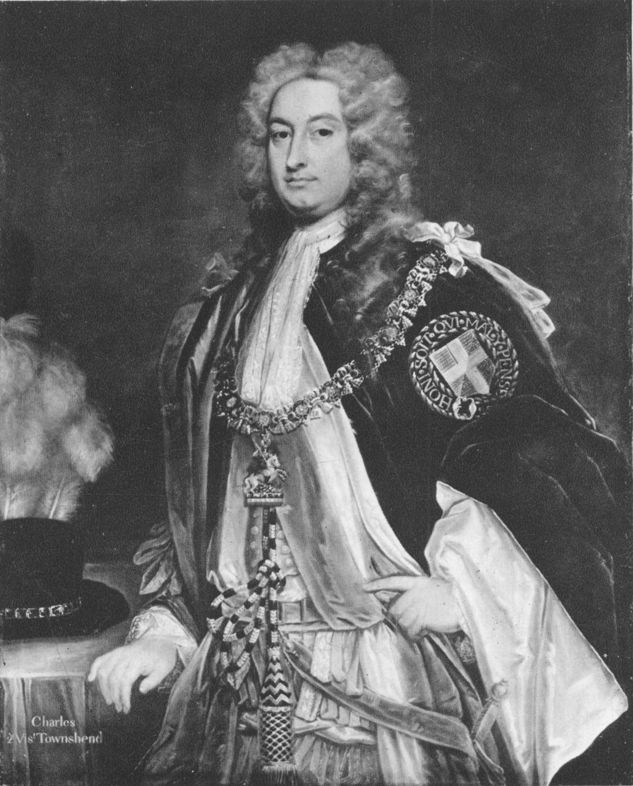
CHARLES, SECOND VISCOUNT TOWNSHEND
School of Kneller
National Portrait Gallery
The second matter to be settled was the official British attitude towards the Barrier. Marlborough had brought over with him for the Cabinet the latest Dutch project. Parliament had been prorogued before his arrival. Even the Whig Ministers felt bound to support his main objections to it, and their counter-project was framed on this basis. Ostend, which governed the sea trade of Belgium, and Dendermonde, which controlled the sluices affecting Brabant, were definitely refused. The Dutch right to place an army in the Spanish Netherlands was limited to the unique occasion in which France was the attacking Power and war had been declared. The revenues for the upkeep of the Dutch garrisons must be related only to those fortified towns which had not belonged to the Spanish monarchy before the death in November 1700 of Charles II of Spain. The clause forbidding Charles III before the general peace to take possession of Belgium was deleted. Upper Guelderland was reserved for the decision of the Queen. On the other hand, the Dutch guarantee for the Protestant Succession, the sending of the Pretender out of the French dominions, and the demolition of Dunkirk were demanded in explicit terms.
Meanwhile in Holland the negotiations had made great progress. According to his discretion, inch by inch Torcy yielded to the Dutch demands about their Barrier. Heinsius was able to announce to Eugene that the Dutch were content with the terms so far as they concerned themselves alone; they had only to consider their allies. On this they had newly given explicit assurances. Torcy was forced to recognize that there was no chance of a separate settlement with the Republic. “I believe I could deal with you more easily,” remarked Heinsius to him (May 15), “perhaps even more independently of the Dutch nation, if Marlborough and Eugene were with me.” The mood of the Pensionary had changed considerably since the early months of the year. As the desperate plight of France became every day more understood, both he and his countrymen stiffened towards the French and warmed towards the Allies.
Buys now raised the question of what guarantee the French could offer that the Spaniards would accept the terms. Torcy answered that Philip would be given three months to submit on pain of the complete withdrawal of French support. Heinsius also continued to demand, though without great enthusiasm, the entire Spanish monarchy for Charles III. Even this was no longer to be resisted by the French. But now every one hastened to put in his claim. From the Emperor, from the Diet at Ratisbon, from Victor Amadeus of Savoy, and from Portugal there arrived new demands upon the humbled monarchy. All had suffered from Louis XIV in his days of power. All hastened to reclaim with interest in this moment of his apparent prostration what they had lost. “Every sovereign prince,” wrote Torcy to the King, “assumes that he has a right to formulate his claims against France, and would even think himself dishonoured if he had extorted nothing to the injury of the French crown.”[77]
When we look back on the long years of terror and spoliation to which these princes had been subjected from the might of the Great King, it would be surprising if they had acted otherwise. Moreover, the allied armies were now gathering in the field. Contingents, in former years so tardy, were this time hurried to the front by rulers who saw the prey in their grasp, and were anxious to be in at the death and establish their rights to a handsome share. Marlborough’s exertions for five months to have large forces at his disposal during the negotiations had succeeded beyond his hopes. “All the facts,” wrote Eugene (May 17) to the Emperor, “go to show that France is quite unable to prolong the war, and we can, therefore, if we wish obtain everything we ask for. We have only to hold together and preserve a good understanding among ourselves.”[78] Even those Dutchmen who at the beginning of the year were willing to make a separate peace were now convinced that France was at their feet. Van der Dussen, the leader of the Dutch peace party, himself wrote, “The policy of this province [Holland], the largest of all, depends upon more than five hundred persons, most of whom regard France as brought to bay [aux abois], and who are so embittered by the memories of the past that they are resolved without compunction to make an end once and for all of their puissant foe.”[79] In this mood van der Dussen had advised Torcy not to hesitate or wait for the arrival of Marlborough, which would only create fresh complications. Let him now, while time remained, concede all that was demanded. But Torcy still had hopes of Marlborough, and one remarkable reason for those hopes.
On the 18th the two Englishmen arrived.
Marlborough to Godolphin
Hague
May 19th, 1709
* I had so bad a passage that I was not able to gett to this place til yesterday morning; my Lord Townshend was drove into Zealand so that he did not get hether til the afternoon. I must refer You to Mr Secretary Boyle, by which You will see that the intier Monarque [entire Monarchy], Dunkerk, the Qeens tytel, the Succession and the sending the Pretender out of ffrance will be allowed of in the Prelimenarys, and I am not out of hopes the getting of Newfoundland also in, which is in effect all that England askes; for the pretentions of Hudsons Bay must be ajuste’d by Commissions; the Cessation of Armes will be the difficult point, of which You shall have an account in our next; I can’t end this letter without assuring You that the Pensioner’s behaviour in this whole affaire has been very honest and friendly to England; the Pensioner tels me that Monsr. de Torcy is under some difficultys as to the maner of removing the pretender. Upon the whole matter, I think Monsr de Torcy has offer’d so much that there can be no doubt, but it will end in a good Peace; my head eakes extreamly, that I can write no more.[80]
The situation had simplified itself and vastly improved. The French were ready to submit; the Dutch had no thought of a separate treaty; Heinsius was content to shelve the idea of preliminaries with England. Marlborough saw all going as he had wished, and evidently thought the peace as good as made. Torcy, who was staying with Petkum, asked at once through his host to see him. Marlborough met the French envoy that very night. Torcy has given his own account of the discussion. Marlborough was all smiles and blandishments. He protested profound respect for Louis XIV, and presently mentioned Berwick. Torcy replied that he was familiar with the correspondence and that the attitude of the King had not changed. He would have enlarged upon the details, but Marlborough at once dismissed the subject.[81] So far from suggesting any mitigation, he asked, in accordance with his instructions, for the restoration of Newfoundland. This was a fresh demand, and Torcy was shocked by it. To ease the situation they talked about Saint-Germain. Torcy had spoken of the Pretender as “the King of England.” Marlborough referred to him always as “the Prince of Wales.” He expressed an earnest desire to do some service to the Prince as the son of a king for whom he would gladly have sacrificed his blood and life. Speaking of Townshend, he said, “He is here to keep watch over me [en surveillant] in person. He is a very good fellow, whom I chose myself, but he is a Whig party man. Before him I must speak as an obstinate Englishman. But I wish with all my heart it were in my power to serve the Prince of Wales, and that your good offices may give me an opportunity.” Marlborough went on to emphasize his desire for peace, and how he longed to end his days quietly. Torcy, who knew how fast the armies were gathering, was not comforted. He saw that there could be no hope of saving any part of the Spanish monarchy through Marlborough. He had that morning received permission from the King to drop Naples and Sicily if need be. He now announced this to Marlborough. The Duke, gratified, assured him that this was the only way to make peace. The interview ended. Torcy went to the Pensionary and informed him of the fresh sacrifice he had been prepared to make for the sake of peace.
The culminating phase in the negotiations was now reached. Together Marlborough and Townshend drafted their report for the Cabinet. Torcy had admitted willingness to concede not only Spain but Italy. He had, however, in telling Heinsius used a phrase which had attracted immediate attention.
. . . As far as in him lay, by which expression it seems as if he thought the King would not be able to do it of himself in the manner we expect, or that he has some further reserve. To this the Pensioner tells us he gave him a very good reply by letting him know that he did not doubt that he had already seriously weighed the matter so essential and of such great concern that it would be expected they [the French] should propose the proper expedients.[82]
Here was the first glimpse of the rock on which all was in the end to split. It was not immediately approached.
On May 20 the three leaders of the Alliance met Torcy and Rouillé in formal conference. The Dutch and English demands were discussed first. These were easily conceded by the French plenipotentiaries. But then Prince Eugene began to say that France had given way to England and Heinsius in order to gain them to her interest. He took his stand for Germany on the terms of the Treaty of Westphalia, which had ended the Thirty Years War in 1648. He must now on behalf of the Emperor ask for Strasburg and Alsace. At this Torcy appeared to lose patience. “We were practically at one with Torcy,” wrote Eugene to the Emperor, “but when mention was made of the lands of the Holy Roman Empire he began to stutter, and answered he must leave, and demanded to depart and asked for his passports, so that without any further resolution the conference broke up.”[83] Neither Eugene nor Marlborough thought that Torcy was in earnest. The Frenchman saw himself faced by united enemies. Later on in private van der Dussen warned him that the war spirit was rising in Holland, and there was no more hope from the pacifists. Torcy returned to the conference when it met again next day. He had powers to abandon Strasburg, but not Alsace. He fought for both, and no agreement was reached. There was a similar dispute over the claims of Savoy. In the end Torcy offered to dismantle Strasburg; but Eugene still continued to demand Alsace, and the Dutch and English supported the claims of Savoy. The deadlock continued.
Alone with Marlborough, Torcy made a final effort to seduce him. We have only the French Minister’s account. Marlborough, who had himself proposed the interview, urged submission. He used all his most obsequious arts. If the peace was made he would earnestly desire the favour and protection of the King. He spoke again with sympathy about the Pretender. He referred to his desire for peace, to his uprightness, to his conscience, to his honour, and frequently to God. Torcy, thinking his moment had come, renewed his offer of a vast bribe. He received at once the same rebuff. “When,” says Torcy, “I spoke about his private interests, he reddened and appeared to wish to turn the conversation.”[84] “It was in vain,” says the latest of German writers on these negotiations, “that Torcy offered the Englishman uncommonly high sums of money for the slightest concessions. He got no further than hints.”[85] It was hopeless. We are left wondering why Marlborough should have wanted to repeat this unpleasant scene. Did he wish to expose Torcy to a second rejection of his offer? Did he wish to convince Louis XIV how vain it was? Did he, perhaps, take a personal relish in being offered these immense sums of money and seeing himself reject them? No one can tell, but the fact remains that this hardy, avaricious man, who could at this juncture without the slightest injury to the interests of England have helped the French towards the peace he himself desired, and gained an immense sum thereby, proved incorruptible. There is nothing to boast of in this.
On the night of May 21, after the negotiators had separated, a letter from the King to Torcy was intercepted with news from the Spanish peninsula. Galway, advancing from Portugal, had fought an unfortunate action on the Caya. The Portuguese cavalry had fled precipitately, and it was only with loss and difficulty that the English infantry had made good their retreat across the frontier. It was deemed striking that the victorious army was for the first time composed entirely of Spanish national troops without any French contingent. This was no great encouragement to the French envoys, for the victory of a Spanish army could not relieve the desperate position of France. The importance of the news was its effect upon the Allies. For the last two days their discussions had been going on in the rather unreal atmosphere of Germanic territorial claims. Now with Spain there came to the forefront the question of security and guarantees.[86]
When the conference met on May 22 the two questions, Alsace and the claims of Savoy, were still in dispute. Torcy and Rouillé therefore—perhaps a little stiffened by the Spanish news—begged to take their leave. Heinsius replied that they had all gone too far to part without a treaty. On this appeal the French envoys remained, but only provided they could send a courier to Versailles for instructions on these two points, and could present to the conference a memorandum on those which had already been settled. As soon as this memorandum had been presented on the 23rd the new divergence came to the fore. The Allies complained of the inadequate security which was offered for the surrender of Spain. They asked that they should not have to carry on the war in Spain while France was enjoying peace. They demanded guarantees. It had been realized at Versailles for some weeks that security for the fulfilment of the peace treaty would be required.[87]
King Philip was established in Spain. His kingship was championed by the Spanish people. His armies were victorious. He had declared to his grandfather, “I will only give up my crown with my life.” He had created his one-year-old son Prince of Asturias, and the Cortes had acclaimed the infant as heir to the monarchy. Here were grave realities. Louis XIV was not necessarily able to answer for the King of Spain. He may have been aware of the strong feeling of the Dauphin against any desertion of his son, who had fought successfully at odds amid perils. All the more did the old King hope that some compensation would be secured for Philip V which, added to his own pressures, might procure compliance with the unrestrained demands of the Allies under the leadership, as must be owned, of the English Government. “There are occasions,” he wrote (April 29) to his Ambassador at Madrid, “when courage must yield to prudence; and since the people, at the moment so zealous, may well not always think the same, nor may my grandson, it would be better to reconcile oneself to reigning somewhere rather than lose at a stroke all one’s dominions.”[88] Such expressions show a sincere will to peace.
But now Torcy violently opposed the idea of any guarantee. The Pensionary on behalf of his colleagues asked as proof of good faith for three French and three Spanish fortresses actually still occupied by French troops over and above all that had been conceded. Eugene, the land animal, wanted permission to march the allied armies into Spain through France. During the conference Marlborough sat silent. But on the night of the 23rd he expressed his doubts upon the possibility of forcing Louis XIV to act against his grandson.[89] “Marlborough even suggested schemes to turn the article so as not to commit his Majesty to war against Spain.”[90]
“The French Ministers absolutely refused,” wrote Townshend,
an amendment which might, they sayd, possibly engage their master to a condition so unnatural as to make a war with his grandson; but it was sayd there are no reason[s] to aprehend so harsh a consequence from the amendment, but [it] might have the good effect of making the Spaniards readily declare for King Charles when they saw the French King was under an obligation to joyn with the allies to force them to their new alleys [sic].[91]
For two days the discussion turned around this crux, and as it became the ultimate cause of the disastrous breakdown it is necessary to realize its importance. Many writers think it monstrous that, when these immense issues were so nearly settled, all should have been wrecked on such a point. It is certain that the Allies would have been wrong and unwise to break upon it, and without doubt they did not mean to do so. None the less it was a matter of far more importance than many of the terms over which both sides haggled so long. To England, with her strident demand for the surrender of the whole Spanish Empire, it was specially important. She would be left alone in all probability to conquer Spain. Marlborough had for some time been aware of the danger. A month before he had written to the Duke of Moles on the urgent need of gaining Spanish support.
. . . It seems to me that one ought from this moment to take all possible measures to tame and win over the spirit of the Spanish nation, especially the notables who by a perversion are the most estranged from their duty, . . . so that when we come to make peace, and when France is forced to give orders for the recall of the Duke of Anjou, we shall not meet any setback in this quarter.[92]
The allied chiefs were, however, at this time convinced that King Philip would obey the orders of his grandfather if these were given to him in earnest. Torcy was evidently of the same opinion. All that was necessary, therefore, was for the King to give gages that he would issue these orders in good faith. It never occurred to anyone on either side at this moment that Louis XIV was really to be compelled to use armed force to expel his grandson from Spain. The allied leaders were surprised and shocked at a later stage that this colour could be put on their requests. The alternative for them was a new war, perhaps a very grievous war, a war of conquest and subjugation in Spain. It might impose enormous expense in blood and treasure on the Allies, already exhausted, while defeated France, whose ruler could by a word have prevented it, would rebuild her prosperity in peace.
Marlborough had his plans ready for a Spanish war. It would have been on the largest scale. The great armies would be transported to the Peninsula. One army under Marlborough would advance from Portugal, and the other under Eugene from Catalonia. They would meet in Madrid. Marlborough himself considered that a single campaign would suffice. It may well be that he greatly underrated the resisting power of a nation, and thought of it in terms merely of professional armies. He might have fallen into the same trap as was a hundred years later to ruin Napoleon. There was always the possibility which Bolingbroke, basing himself on Stanhope’s opinion, was many years later to describe: “That armies of twenty or thirty thousand men might walk about that country till Doomsday . . . without effect; that wherever they came the people would submit to Charles III out of terror, and as soon as they were gone proclaim Philip V again out of affection. That to conquer Spain required a great army, and to keep it a greater.”[93] But at least the Allies saw the conquest of Spain as an operation of the first magnitude, and if they could avoid this by merely extorting from Louis the effective exercise of his royal and family authority no one can fail to see why they pressed the point and pressed it hard. It would have been far better to concede the Sicilies as consolation for the Duke of Anjou. Here is the obstinacy for which the Allies are blameable. It is not, however, certain that even so Philip would have accepted the concession.
As no agreement could be reached on the outstanding points and no solution was forthcoming of the guarantee problem, Torcy invited the Allies in their turn to put their whole proposals in the form of a memorandum. Heinsius undertook to draw it up. The days following were occupied with the final drafting of the preliminaries. The Dutch statesmen worked throughout the nights of May 24 and 25 to frame the project. During that time the memorable Articles IV and XXXVII were drawn up.
IV. . . . But if it should happen that the said Duke of Anjou does not consent and agree to the execution of the present convention, before the expiration of the term aforesaid, the Most Christian King, and the Princes and States concerned in the present treaty, shall in concert take convenient measures to secure the full execution thereof.
XXXVII. . . . In case the King of France executes all that is above mentioned,[94] and that the whole monarchy of Spain is delivered up and yielded to King Charles III as is stipulated by these articles, within the limited time, ’tis agreed that the cessation of arms between the parties in war shall continue till the conclusion and ratification of the treaties which are to be made.[95]
No documents have come down to us showing how this wording was reached. It must be remembered that the Dutch did not feel themselves so much concerned as the British or Imperial Governments either in the recovery of Spain or in the means of enforcing it. They themselves did not mean to conquer Spain for anyone. Thus perhaps these two Articles did not receive the profound study at Dutch hands which would have been accorded to purely Dutch interests. Heinsius certainly rested upon his original assumption that, as Louis XIV would bring decisive influence to bear upon Philip V, they would never have to be put into force. The clauses were merely to be a threat of action, and the Allies were prepared to accept alternative guarantees from Torcy. In this sort of atmosphere Marlborough and Townshend sponsored the whole plan of the Forty-four Articles without demur. The Austrians raised only minor objections. It was proposed to arrange an armistice of two months from June 1 in which the final peace would be signed.
On the morning of May 27 Heinsius laid what were called the “preliminaries” before the Frenchmen. Invited to comment upon it, they made various reserves, but it is remarkable that they made no specific objection to Articles IV and XXXVII, which, read together, obliged France, under penalty of losing the cautionary towns, to procure the submission of Philip V. The document must, of course, be sent to Versailles for the King’s final decision. Would the French envoys sign it first themselves? Torcy refused point-blank. Rouillé was inclined to sign. “You knew,” he remarked to Torcy, “the state of affairs when you came to Holland. Your journey was proof of its gravity. If you leave without concluding peace, however onerous it may be, make no mistake about the disappointment of the whole of France.”[96]
Marlborough to Godolphin
May 25, 1709
* ffor Yourself
Since this business of Portugale [i.e. Galway’s defeat], the ffrench have thretned us with desiring their pasports, but I think thay are now resolved to Comply with what is reasonable, so that I hope by Munday we shall be able to send You the Project. Monsr de Torcy not having sufficient power to Conclude til he first speak with his Master, I thought it the safest way to send the Project before we signe to Her Maty, tho every thing of Moment desir’d by England is agreed too; You will see that there is so litle left to the Negotiation that it maybe worth Your Consideration whether You will [need to] ogment the number of Ambassadors, especially if You meet with difficulty in the personne to be sent; besides I beleive the humour of 4 [Halifax] is such that in order to have business and merit, he may Creat difficultys, and 14 [Townshend] heithertoo, is just the Contrary; so that if You can do itt without offence, You might save Your mony and wee not be troubled.
Since the writting of this wee think it the best way to signe, and give france a perumtary day, which I think is necessary for the preventing 110 [Dutch?] to make alterations. Monsr Torcy returns tomorrow and will have time til the 4th of the next month for the signing and sending back of the Conditions we insist upon.[97]
And on the 29th:
* Mr Walpole brings the Preliminarys signed by the Emperor the Queen and the States, and the ffrench are allow’d time till the fourth of the next month, Monsr Torcy not having powers sufficient to agree to all we insist upon, the particulars of which I must refer You to Mr Secretarys letter; the dutch were so desirous to insert their Barier into these Preliminaries, that I thought last saturday all had been undone, Pr. Eugene and Sinzendorff resolving not to Complye; You will see by the Project that we have a mind to finish all in two months, and to do it without a Mediator and as litle Cerimony as possible. If the ffrench Comply as I think thay must, I have hopes of seeing You before the end of the Summer. You will see that we have alter’d the Article Concerning the Pretender, I think it much better then what was at first insist’d upon. As soon as we have setled the Barier, we shall in the next place aplye our selves for the Treaty that all may be Garant to this Peace. Pr. Eugene goes for Bruxelles tomorrow, in order to have the Army in readyness on the fourth, so that we might lose no time if the ffrench shou’d not comply. I am to stay here til the fourth, but keep only two or three servants, for we shall open the Campagne with two Armys.[98]
The French were requested to give an answer by June 4. Thus the “memorandum” acquired the character of an ultimatum. This had not been the original intention. Into this position the Allies had been manœuvred by Torcy’s skill. The document he had obtained presented the issues to his master in such a way as to enable him to refuse, should he choose to do so, on the broadest grounds.
|
Mémoires du Marquis de Torcy (1850), edited by Michaud and Poujoulat, p. 588. |
|
Round Papers, H.M.C., p. 355. |
|
Feldzüge, Series II, ii, 84. |
|
May 6. Torcy was accompanied by the Rotterdam banker, Senserf. Reese, p. 203. |
|
Mémoires, p. 592. |
|
Marlborough to Godolphin Hague 24 April 1709 * . . . I have taken my measures with Prince Eugene that he returns to Brussels next Saturday, we having agreed upon the assembling of the army, which will be ten days later than usual by the backwardness of the season. So that if the wind is favourable I shall take the opportunity of returning to England for five or six days to give an account of the Barrier as well as my observations of the humours of these people as to the peace. In the meantime you may depend upon it that if the King of France does not recall Monsieur Rouillé, he may continue in this country all this campaign; so that there will be a necessity of having here, at the same time I shall be obliged to leave for the army, one of the lords which her Majesty shall design to be in the treaty of peace. I think it may be for the service that he shall be ready to come hither at the same time as I shall return, for at my return I shall not be able to stay here above two or three days. [Blenheim MSS.] |
|
Hoffmann’s dispatch of May 7; Geikie, p. 122. |
|
F. Taylor, The Wars of Marlborough, ii, 320. John Macky, Characters of the Court of Great Britain (Roxburgh Club, 1895), p. 89. |
|
Hoffmann’s dispatch, May 7; Klopp, xiii, 227. |
|
Marlborough to Heinsius London April the 29, 1709 * I have had the favour of yours of the 3d, and that of the eighth this morning by which I see that you have Monsr. de Torcy att the Hague; I stay only for a fair wind, and shall bring Lord Townshend with mee who will be impower’d both for the Peace and Barier. I wish for my own sake that you cou’d be here, tho but for one day or two, to see the Zeal every body has for the carrying on of the Warr til we have a safe and lasting Peace. You wou’d then think mee a very moderat man; for the Prelimenarys I acquaint’d you with in the Queen’s name, are by many not thought sufficient, for thay wou’d have had Newfoundland, and Hudson Bay, as well as our Treaty of Comerce, and some other pretentions to have been in the Prelimenarys; I hope to be with you as soon as this letter, so shall say no more till I have the happiness of being with you. [Heinsius Archives.] |
|
Mémoires, p. 605. |
|
Feldzüge, Series II, ii, Appendix, 101 ff. |
|
Torcy, Mémoires, p. 605. |
|
Blenheim MSS. |
|
Mémoires, p. 606. |
|
May 8/19, P.R.O.; quoted by Reese, p. 222. |
|
Feldzüge, Series II, ii, 108. |
|
Mémoires, p. 606. |
|
Reese, p. 208. |
|
Marlborough to Godolphin * My lord Townshend’s letter and mine having in it all that has passed since our last, joined with the spleen I have for the ill news we have received from Petkum of Lord Galway’s being beaten, will shorten my letter. I think the worst effect of this unseasonable defeat will be the disheartening of these people [the Dutch], who will not conclude this negotiation, which, if the French perceive, they will not be brought to give much more than they have already consented to. [Blenheim MSS., modernized.] |
|
Vetes to Rakoczy, end of April; Reese, p. 223. |
|
Quoted in Klopp, xiii, 227. |
|
Reese, p. 235. |
|
Torcy, quoted in Reese, p. 235. |
|
Reese, p. 235. |
|
Dispatches, iv, 478. |
|
Defence of the Treaty of Utrecht, edited by G. M. Trevelyan (1932), p. 108. |
|
Including the cession of the cautionary towns. |
|
Torcy, Mémoires, p. 619; G. de Lamberty, Mémoires pour servir à l’histoire du XVIII siècle, v, 288. |
|
Torcy, Mémoires, p. 629. |
|
Blenheim MSS. |
|
Ibid. |
“Your Majesty,” wrote Torcy on May 28 in sending the preliminaries to Versailles, “is thus entirely free to reject absolutely these conditions, as I trust the state of your affairs will permit; or to accept them if unhappily you conceive it your duty to end the war at any price.”[99] If the King decided to break, his Minister advised that the odium should be thrown upon Alsace and the claims of Savoy, rather than upon the methods of ensuring the surrender of Spain. It is thus clear that Torcy had in no way taught the allied negotiators to recognize that Article XXXVII possessed a fatal character. On the contrary, it is evident that he took it for granted that Philip V would obey his grandfather without the slightest hesitation. Indeed, he had even remarked in the conference that the King of Spain would very likely be at Versailles before him.[100] With heavy heart the unhappy Frenchman followed the woeful ultimatum he had sent forward to his master. On the journey he passed through Villars’s headquarters at Douai. He showed the terms to Villars. The Marshal, mortified, indignant, indomitable, conjured him to tell the King that he could count upon the army.
London and The Hague, as well they might, made haste to ratify the preliminaries. Vryberg reported that he had never seen Godolphin so cheerful. There was not even a Cabinet meeting. Every one was confident that peace was made. Marlborough began to arrange for the transport home of the British troops after the paying off of the foreign contingents in Flanders. “Everything goes so well here,” he wrote to Sarah, “that there is no doubt of its ending in a good peace. . . . You must have in readiness the sideboard of plate, and you must let the Lord Treasurer know that since the Queen came to the crown I have not had either a canopy or chair of state, which now of necessity I must have, so the wardrobe should have immediate orders.” And he adds—a characteristic touch—“I beg you will take care to have it made so as that it may serve for part of a bed, when I have done with it here, which I hope will be by the end of the summer.”[101] Nevertheless, he found the suspense irksome, and from time to time he had misgivings about this Article XXXVII which neither Torcy nor any of Torcy’s allied opponents thought would be a serious difficulty. It is recorded that he said privately in these trying days, “I fear Article XXXVII may spoil everything.”[102] Certainly, to be prepared for either event, he put the armies at twenty hours’ notice to march.
Torcy reached Versailles on the evening of June 1, and made his report to the King in the apartments of Madame de Maintenon. All next morning the Council sat. The highest dignitaries of France swelled the throng of courtiers in the anterooms, and although they were nourished only upon rumour, the sharpest division prevailed. Peace was the cry of the realm. But did they know what peace meant? Meanwhile behind the closed doors Louis, his son, and his councillors faced the awful alternatives. No authoritative account transpired. Torcy’s memoirs, Dangeau’s diaries, Saint-Simon’s ample pages, give no clues. It was only in 1855, says Klopp, that the publication of the memoirs of Rakoczy’s agent, the Hungarian Vetes, who might well have been in a position to know, threw a light upon this grim debate. Vetes’ report is dated lundi au soir, the Council having been held on the Sunday. He attributes the decision entirely to the action of the Dauphin. This Prince, usually so tranquil, appeared to be transported with wrath at the idea of his son, the crowned King of Spain, at that time idol of the Spanish people, being abandoned, even dragged from his throne, by Louis XIV. He bitterly reproached the Council with the shameful deed they were about to commit, and apostrophized his father the King himself in terms so little marked by respect that the listeners were petrified. Furiously he reminded the Ministers who had spoken for peace that one day he would be their master, and that if the King by their advice abandoned his son they should render a long account to him. He rose from the table and left the room. The doors closed behind him, and there was a lengthy interval; but presently Torcy emerged, and, pursuing the indignant Dauphin, told him and the whole Court that the resolve had been taken to stand by the King of Spain. Rouillé was sent post-haste to tell the Allies that their ultimatum was rejected.
Klopp, for all his research, is wrong in stating that Vetes alone left a record of the dispute in the Council. Frequent mention has been made of Marlborough’s Secret Service. One cannot tell where this begins and ends. The Blenheim Papers contain above four hundred reports from Paris dealing with the events of 1708 to 1710. Twice or three times a week a letter was written from the French capital. These reports, never yet published, are remarkable both for their accuracy and their prescience. They are all in French and, of course, unsigned. The writer must have been a man of position and intelligence, and his contacts were wide and various. Evidently he was accustomed to meet high personages at luncheon or dinner. One of his agents is mentioned who “lunches regularly with the clerks of the Foreign and War Ministries” fresh from the Council of the King. It is also probable from certain domestic details in the reports that some valet or female servant in close attendance upon Louis XIV or Madame de Maintenon gave to the British spy all he observed. They are remarkable because they show how soon and how truly Marlborough was advised. They give pictures of the private life and routine of Louis XIV sometimes more intimate than anything that Saint-Simon and Dangeau have recorded, and these pictures were swiftly, punctually, and regularly transmitted to his principal foe.[103]
Marlborough’s spy at this juncture was as well informed as Vetes; and Marlborough within a few days had knowledge of the Dauphin’s intervention which Klopp supposed to have been buried for a hundred and fifty years.
Advices from Paris
June 3, 1709
* Monsieur de Torcy arrived Saturday evening at Versailles, and found the King at Madame de Maintenon’s. The King at supper said nothing, and seemed sad and gloomy. Yesterday from eleven o’clock till half-past one the Council dealt with the peace proposals of the Allies, which were found very hard. The Dauphin opposed them with heat, and so did the Duke of Burgundy, and a general assured me on good grounds that the Council did not think fit to accept them, and letters from Versailles state that the negotiations are broken off. However, the Council meets again to-day or to-morrow on the same subject. I am told that Monsieur de Beauvillier[104] will ask for peace on behalf of all his followers.
The King after dinner yesterday went for a walk, and told Monsieur de Torcy to be at Madame de Maintenon’s about six o’clock. It is certain that one sees reigning at the Court a great agitation mixed with consternation. Many people are of opinion that the peace will be made whether the King accepts the hard conditions imposed upon him or whether he refuses them. They flatter themselves that the States-General, who wish for peace, and to whom the King has in a sort of way entrusted his interests, will put a brake upon the boldness of Prince Eugene and Milord Marlborough, and oblige them to soften upon several articles for the sake of peace. But the fate of peace or war will have been decided yesterday evening at Madame de Maintenon’s. . . .[105]
“Is there, then, no counter-proposal?” asked Marlborough, when he learned the staggering news. He was deeply shocked. For some days he nursed a project for some compromise upon Article XXXVII.[106] In much despondency he set out for the front.
He wrote to Godolphin (June 7):
The Marishall de Villars has given his advice to the King for the venturing a Battel. There is no doubt a Battel in the plains of Lens wou’d put an end to this Warr, but if that shou’d happen, and God Almighty as hethertoo bless with Success the Armes of the Allyes, I think the Queen shou’d then have the honour of insisting upon putting the ffrench Government upon their being againe govern’d by the three Estates which I think is more likely to give quiet to Christendome, then the taring provences from them for the inriching of others.[107]
This is one of the most revealing insights which we have into Marlborough’s statecraft. The idea of substituting for the despotic rule of France a Parliamentary régime had long commended itself to him. It is a strange speculation how the course of history would have been changed if he had been able to enforce his policy upon France. The French Revolution might have accomplished itself gradually and beneficently in the course of the eighteenth century, and the whole world have moved on to broader foundations without paying the awful price in war and horror. There might have been no Napoleon! To pursue such thoughts beyond their earliest suggestions is vain; but Marlborough’s words show how far in this respect he stood ahead of his times—and our own.
Petkum made a last futile effort with Heinsius for the exclusion of Article XXXVII. The Pensionary said it was too late. Marlborough and Eugene wished, however, to charge Rouillé, who had lingered in Holland, with the offer. On June 9 they made an attempt to interview him on his way through Brussels. “M. Rouillé,” wrote Marlborough to Townshend, “came to Brussels on Tuesday evening. Both the Prince and myself designed to have seen him, and ordered that no post horses should be given to anybody without our direction, but through a mistake we were disappointed.” He added in his own hand a postscript: “The Prince of Savoy is of opinion that we should have explained the XXXVIIth article, and have made it easy, thinking the French were sufficiently in our power when they had put us in possession of the towns. . . .”[108] But all was over.
The question which is capital for Marlborough is whether he strove for peace or war. The immense tangle of the negotiations and the multitudes of letters written by the principal actors baffle history by their bulk and by their contradictions. A full account from day to day of all that passed would carry little meaning. Sometimes we see Marlborough rupturing what looks like a pacific move. Often he is arguing a minor point. Sometimes he presents himself in sharp opposition to Dutch, Prussian, or Imperial desires. Sometimes he is their champion. At each of the numberless phases of the negotiations the attitudes of the various principals shift. At one moment it is the Dutch who are sincere, at another the French; and always when there is agreement between any two, friend or foe, it is because the interests of others have been put in the shade.
But there can be no doubt where Marlborough stood. To Heinsius, to Godolphin, to Torcy, he wrote a series of urgent and at times impassioned appeals, the only aim of which was peace with France, leaving Spain, if necessary, to be dealt with separately and later. These appeals and warnings began from the moment when the XXXVIIth article, or, in other words, the question of guarantees, became crucial. He was the first to state in open conference, in the presence of the enemy representatives, that Article XXXVII ought not to be pressed. Torcy bears witness to this. When, to Marlborough’s consternation, the negotiations were ruptured and the French envoys took their departure he tried to intercept them, and his first thought, in harmony with Eugene, was to condemn the obstinacy on this point which had led to disaster. His letters to Heinsius, and above all their secret postscripts “For Yourself Only,” most of which have hitherto reposed in the Dutch archives, are the pith of the whole debate and the revelation of his inward mind.
At the moment of the rupture, later as the year advanced, and up to the eve of the great battle, his exhortation to Heinsius not to let Article XXXVII become a fatal obstacle was vehement. After the demand of the Allies had shifted from cautionary towns in France, which Louis XIV could undoubtedly deliver, to a demand for cautionary towns in Spain, which he certainly could not, Marlborough solemnly warned Heinsius that the consequence of obstinacy was the continuance of the war.
“I find the Prince is of opinion,” he wrote to Heinsius (June 11), “that it will be impossible for the French to comply with the Article for the giving up of the Monarque of Spain by the last of July.”[109] And on June 19:
* For Yourself Only.
What you say as to the ffrench if thay are sincere, thay might propose some expedient for the evacuating of the Spanish Monarque is very trew; on the other side may thay not apprehend, if we shou’d not approve of their expedient, that thay expose the honour of their King and Nation.
The opinion of the Pr. of Savoye and your humble servant is, that if the ffrench had delivered the possession of the towns thay promis’d; and demolish’d Dunkerke and the places nam’d on the Rhin, thay must after that have comply’d with whatever we shou’d have thought reasonable, but as their is an end of the Negotiation, we must now do our best, to make it their intirest to renew the Negotiation.[110]
In reply to Sarah, who had reported that the talk in England was that he had obstructed peace, he wrote (July 1):
As to the good-natured turn of some of my countrymen, it is what must ever be expected as long as parties are in being; which I believe must be as long as England has a being. Notwithstanding their remarks, I am very well assured that 39 [himself] would have been very glad if 43 [Louis XIV] had consented.[111]
Again to Heinsius (July 4):
For Yourself Only.
The positive orders that my Ld Townshend has for the insisting on the three towns in Spain makes it impossible for me to express myself otherways than I do in my letter; but I call God to witness that I think it not in the power of the King of France, so that if you persist in having three towns in Spain, it is in my opinion declaring the continuation of the war. I am told that some letters from the army pretend to know my opinion. I do assure you on my word that I never speak to anybody on this subject but the Pr. of Savoye and sometimes to M. de Sinzendorf.[112]
And (July 10):
If I were in the place of the King of France I should venture the loss of my country much sooner than be obliged to join my troops for the forcing of my grandson.[113]
The Pensionary revealed his own and reflected the prevailing Dutch view when he wrote to Marlborough (August 17), “There is vehement opposition here to continuing the war in Spain, after peace has been made with France.”[114] Marlborough’s rejoinder cuts to the root:
* For your self onely.
August 22, 1709
You say that you find many that have great difficulty in continuing the Warr with Spain; thay are of the same opinion and have the same difficulty in England; but for Godsake will not this difficulty be the same two yeares hence, and Spain the more time thay have given them be the better able to defend themselves, for I think it is plain that the ffrench Ministers have it not in their powers to recal the Duke of Anjoue; and I think it is as plain that if Holand England, and the Emperor will take Vigorous resolutions the Warr in Spain maybe end’d in six months.[115]
He revealed his convictions on this point at any rate to Townshend with perfect candour.
Tournay
August 31, 1709
* . . . As I never shall have any other thought of acting in this or any publick business, but agreeable to the orders I shall receive from England, I beg as a friend you will assure everybody where you think it may do good, that my judgment is entirely guided by the orders you received from England; but to you as a friend I will own very freely, by all the observation I can make, I do not think it in the power of the French King and his ministers to recall the Duke of Anjou. On the other hand I do think it very practicable to force him out of Spain in less than six months if just and vigorous measures are taken by England and Holland. This opinion of mine I desire should be known to nobody but yourself; and be assured that I will be directed and guided in this whole matter by yourself and the Pensioner.[116]
And again, as the crisis of the campaign approached:
Tournay
September 2, 1709
* As to the three towns in Spain it is impossible for me to express myself more positively than I have done in few words to the Pensioner, by assuring him that I can never be of any other opinion than what is agreeable to the orders you have from the Queen; but to you as a friend I must repeat that my private opinion is that the King of France has it not in his power to deliver three towns of consequence in the Kingdom of Spain, so that insisting on these towns, in my opinion, is declaring that the war shall continue, but this opinion of mine is only to yourself, for you and I must obey the orders we receive; the Comte de Sinzindorff will give you the names of the towns the Prince of Savoy and I think should be insisted upon. . . .[117]
Although at the beginning of the conferences Marlborough recognized his own weakness unduly, although he affected an extreme deference to the London Cabinet and the Whig power, although his letters dutifully breathe the form and spirit of his instructions, although no doubt he made wrong estimates of the forces at work, and used many arguments which were not his own, nevertheless it can be proved that at every stage he threw the whole of his weight upon the high personages with whom he was in the most intimate relation in favour of a settlement.
The far shrewder criticism has been launched that he failed to assert his authority and his genius. This view was actually recorded at the time by his critic, Colonel Cranstoun (July 28):
It is certain the Imperial Ministers and Prince Eugene were not for breaking upon that point [Article XXXVII], and however the Duke of Marlborough went into the opinion of the Pensionary and those who were for standing to all we demanded, yet it is not believed to have been his real judgment, but, on the contrary, that he was for passing from that article, but in prudence would not take it upon him knowing what advantage his enemies at home would have made of it if any cross accident had fallen out thereafter.[118]
We are told by later writers that he had become so used to conciliating divergent interests, to finding a middle course, to avoiding awkward points, to submitting to the mistakes of others and devising new expedients to achieve his own plans, that now, at this culminating moment in his career, he gave in fact no clear, real guidance, and resigned himself with sombre complacency to the drift and sequence of events. Marlborough, say these critics, had become an institution rather than a man, a function rather than an actor. To keep the Grand Alliance united, and himself at the head of it, till final victory was secured had so long been his duty that he thought it his sole duty. In a certain degree he had become the creature of his task. He had gained so often by being patient that he had lost the quality of revolt. He had conducted so many ill-assorted, antagonistic forces through endless toils and hazards to safety and success that the Common Cause had become more to him than the rightful cause. If his countrymen and colleagues, if the States-General, if the Empire, chose to frustrate the French desire for peace, and conjured him to lead the strongest armies yet known to the invasion of France and the march to Paris, he would willingly, too willingly, be their servant and commander.
The great decline in Marlborough’s personal power must not be ignored by those who censure him. He had since 1700 woven together a Grand Alliance and carried it forward by management, tact, and great victorious battles to mastery. At every stage he had had to hold in check divergent and competing aims. The fear of being defeated and destroyed had joined the Allies together. Now his own victories had destroyed that fear. Thus at the moment when his work should have given him the greatest authority, and when that authority might have been most beneficently exercised, he found himself alone, with no party and no country at his back. In England he was the servant of a Queen with whom his favour was gone, and the agent of a Government to whom he was in one aspect the survivor of a period during which they had been excluded from office. In Holland Heinsius and the leaders of the Dutch Republic were convinced that he was no longer their advocate. The Empire and the Hapsburg brothers still hoped to bind him to their cause and to sever him from the Dutch by proffering him almost a kingdom. But otherwise they thought, with General Schulenburg, “My lord Duc est l’homme le plus fin et le plus rusé du monde.”
The circumstances of May and June 1709 were very different from those of October 1708. If Louis XIV had at that time accepted Marlborough’s offer in the spirit in which it was made, when the armistice and peace conference would have broken out, as it were, from the surrender of Lille, Marlborough would probably then have been able to gather the conduct of the affair into his own hands. The Whigs had not yet forced their way completely into the Cabinet. The Dutch were comforted by the surrender of Lille, but were still oppressed by the French positions on the Scheldt and their grip on Ghent and Bruges. The great frost had not begun. No one can say with certainty that Marlborough would have had the power to carry a good peace, and end the waste and carnage from which Europe had suffered so long. The negotiations might, however, have lain in his skilful, tolerant, comprehending, if interested, hands. Whatever the military conditions may be, peace can never be established between great civilized countries upon the brutal execution of the rights of one side over the other. Marlborough’s desire was peace; his interest was peace; perhaps he had then the power to procure peace.
This later phase shows Marlborough’s efforts to guide events without any real control of the new forces at work. He was admittedly the indispensable agent. But for that very reason he could not use the last weapon at the disposal of a public servant who is resolved to carry his point of view. He could not compel by threatening resignation. This, if accomplished, would only wreck any chances of peace. His fall would be sufficient to encourage France to a point where all hopes of an agreement would have vanished. He must continue Generalissimo and plenipotentiary of the Allies, while at the same time consciously and unconsciously he was divested of the necessary power. Whereas up to this point Marlborough has been leading forward the whole Alliance for the most part along paths which he had chosen, we now see a cluster of magnificos bearing him shoulder-high on their own courses, but in great difficulty in deciding, and still more in agreeing, what those courses shall be. We see also efforts and manœuvres by Marlborough to free himself from these ceremonious maulings and to regain independent authority.
In the process everything was lost. Marlborough did not regain his control, and the Allies did not secure their terms. Europe was long denied the peace so sorely needed. Confusion and disaster were destined to cloud the end of this triumphant war. Peace was achieved only after further years of waste and torment, and then at the price to Britain of an act of desertion and dishonour. And Marlborough, who had performed a prodigy of loyalty, skill, valour, and effort, was condemned to be the scapegoat of universal disappointment. He had won the war. Some one, somehow, had lost the peace—his peace—and lost it for ever. Between them all they had let the splendid opportunity slip through their fingers. There were too many powers and potentates engaged, and no commanding leadership was tolerated. No one can be convicted of malice. All wanted peace. At the end two great Captains were still striving for it. They all failed. They all suffered for their failure.
The disappointment of the Allies found vent in a vain and furious clamour that they had once again been tricked and fooled by Louis XIV. The drums beat in the allied camps, and the greatest armies those war-worn times had seen rolled forward to the carnage of Malplaquet.
|
Mémoires, p. 619. |
|
Resolution of the States-General of July 27, 1710; Lamberty, vi, 70. |
|
Coxe, iv, 393. |
|
Lamberty, v, 288. |
|
The series at Blenheim is found not in the Marlborough, but in the Sunderland Papers. It has therefore been ignored by those who have previously examined the archives in order to write about the Great Duke. All these reports are addressed to the Secretary of State, Sunderland, through a clerk in his office named Pringle. It is certain that they were sent direct from Paris to Marlborough’s headquarters, because we find him frequently reflecting their contents in his home letters; and, besides, to send them roundabout by Whitehall would have involved at least a fortnight’s and often, with adverse winds, a month’s delay, thus rendering military Intelligence useless. On the other hand, from some of Godolphin’s letters it seems that he was receiving them too. The spy reports cease abruptly on the dismissal of Sunderland by the Queen. One may suppose that on his son-in-law’s coming into the Cabinet Marlborough after receiving his agent’s reports sent them on to him, but that before and after the Sunderland tenure he kept them to himself and probably destroyed them. This view would appear to be confirmed by the fact that the Record Office contains no documents of this character. |
|
This Spanish grandee and French Duke, an enemy of Madame Maintenon, was tutor to the Duke of Burgundy’s sons. |
|
Blenheim MSS. |
|
Reese, p. 266. |
|
Sarah Correspondence, ii, 324. |
|
June 13; Dispatches, iv, 505. |
|
Heinsius Archives. |
|
Ibid. |
|
Sarah Correspondence, i, 182. |
|
Heinsius Archives; partly quoted in Geikie, p. 137. |
|
Geikie, p. 131. |
|
Heinsius Archives. |
|
Heinsius Archives; mentioned in Noorden, iii, 589. |
|
B.M., Add. MSS. 41178. |
|
Loc. cit. |
|
Portland Papers, H.M.C., iv, 497. |
When Torcy had declared at the peace congress that Louis XIV could not wage war upon his grandson to dethrone him Marlborough had replied at once that he agreed with that. But now the die was cast to fight it out, and for the first time in his reign of more than sixty years the Great King appealed directly to French public opinion. In a circular letter addressed to the governors of his provinces, but intended for the widest audience possible in those days, he fastened the blame of the broken negotiations upon this cruel and unnatural demand. It had not been made, but there was enough appearance of it in the excessive claims of the Allies and in the protracted discussions upon them. Many famous verbal manœuvres have been less justly founded.
From this time the character of the war was profoundly affected. Justice quite suddenly gathered up her trappings and quitted one camp for the other. What had begun as disjointed, tardy resistance of peoples, Parliaments, and Protestantism to intolerant and aggressive military power had transformed itself for some time gradually, and now flagrantly, into invasion and subjugation by a victorious coalition. From this moment France, and to a lesser degree Spain, presented national fronts against foreign inroad and overlordship. Many generations had gone since Joan of Arc had struck this gong, and three were to pass before its harsh, reverberating clang was heard again. In those days, when all the large populations were controlled and their life expressed only by a few thousand notables and educated persons, there was, of course, no conscious movement of the masses. Nevertheless the governing classes throughout France, and also in Spain, derived a strange invigoration from the national spirit. The French people reverenced and almost loved their monarch; and a strong unity reaching far beneath the official hierarchies now made itself felt. A new flood of strength, welling from depths which the early eighteenth century had not plumbed, revived and replenished an enfeebled nobility, exhausted professional armies, and a ruined treasury. The Spanish were already fighting a national war on behalf of Philip V. Now the French nation moved against foreign oppressions with some rude foretaste, even at that time formidable, of the passions of 1792.
The King’s circular letter invoked a haggard but none the less genuine surge of indignation through all the circles upon which the French Government was accustomed to rely. “I cannot express to you the wrath of this nation,” wrote Vetes, “against the Allies at the news of their stiff demands, and the general joy at the King’s resolve to sustain his grandson, the King of Spain.”[119] In Court circles there was a wave of emotion. Marshal Boufflers sent his plate to the Mint. The royal Princes and the aristocracy followed his example. Louis XIV melted down his gold dinner service and made efforts to pawn or sell the Crown Jewels. His example was followed by the Duke of Grammont and all the Ministers. No one in Paris dared to dine off silver. In the provinces the Church, the bankers, and the merchants responded to this mood. * “It is an emetic,” wrote Marlborough’s Paris spy,
which is being given to France, and I believe it is the last resource. It was said yesterday at the Duke of Albe’s that Spain would send 40 or 50 millions to the King, silver plate taken from all the churches. . . . It is not believed that the true Spaniards are deserting Philip. The Duke of Linares, with whom I found myself, told me in Spanish that never had Spain been more firm and less intimidated. . . . If the King has consented to abandon Philip and to withdraw his troops from Spain, they are quite sure here that we are maintaining an understanding to sustain Philip secretly; and to dislodge this the King would have to join his troops to those of the Allies, which it is not likely he will ever do.[120]
In France, even a foe turned ally. Famine, which had brought the realm so low, now led the strongest peasantry to the Army. “They follow the bread wagons,” remarked the King unworthily. They followed also the promptings of the French heart, of which he had so long been unconscious.
At the Court much of the exaltation was on the surface and short-lived. The King and his morganatic wife set no great store by it. “When it became known that the King refused the shameful terms of peace,” wrote Madame de Maintenon to the Duke of Noailles (June 9), “every one cheered and called for war; but this impulse did not last, and people soon fell back into that prostration which you saw and despised.” There was also a fierce temper around, of which the shrewd woman was sharply aware. “How many times,” she wrote,
have you heard it said, “Why are we left our plate? It would be a pleasure if the King took all.” Now, however, that the most zealous have set an example there is consternation; there are murmurs. They say that it is for the King to begin to economize. All his spendings are criticized. . . . Let him give up his horses, his dogs, his servants. . . . In a word, they wish to strip him the first. Where are these murmurs? At his door! From whom? From those who owe him everything. As for me, they want to stone me because it is thought that I don’t say anything to him; as if he didn’t give his own orders.[121]
In July there were serious riots at Dijon and Rouen. At Rouen the mob cried, “Vive Marlborough.”[122] In the capital bitter tongues repeated a new Lord’s Prayer. “Our Father which art at Versailles, unhallowed is thy name. Thy kingdom is no longer great. Thy will is no more done on land or sea. Give us this day our daily bread, which we are short of on all occasions. Forgive our enemies who have beaten us, but not your generals who have allowed them to do so. Do not fall into all the temptations of the Maintenon, but deliver us from Chamillart.”[123] This appeal was answered. Chamillart’s obstinacy, it was declared, had lost the chance of peace. His improvidence had neglected the preparations to resume the war. In June he was replaced by Voisin. For the eighth campaign the French armies assembled. Money drawn from every recess trickled into the military chest. Rations, though not enough, were gathered into the magazines, and in the old hero Boufflers, and even more in the ardent, indomitable Villars, the army of France found leaders worthy of the greatest nation in its greatest need.
The unfolded map of history now shows us that Louis XIV was right in rejecting the peace terms and renewing the war. He wavered long; but the outcome vindicated his final plunge, and in the after-light his grandeur amid appalling stresses shines forth. Here is another triumph for perseverance against the enemy. His decision was condemned at the time by some of the clearest minds in France. Fénelon has left his reasoned censures upon record. Moreover, the final result of the war was not determined by the fortitude of the sovereign, nor by the magnificent efforts of the French armies. It was settled by the obscure intrigues upon the backstairs and around the couch of Queen Anne and by the consequent reversal of British policy which produced and followed the fall of Marlborough. None of this was guessed or even dreamed of by Louis XIV at the time. It was unknown and unknowable. Who could foresee that in little more than a year the dominating Whigs would be hurled from power or that England, so long the implacable soul of the confederacy, would become the active agent of its destruction? All the more must the moral be drawn—“Fight on.”
Claude-Louis Hector de Villars, Marshal of France, has already played some part in this account. When Marlborough in 1705 had wished to enter France by the Moselle, Villars had confronted him; and the fact that, owing to the tardy arrival of the German contingents, the Duke had been forced to abandon the project constituted a French success. Villars’s three campaigns on the Rhine had prospered and at moments shone. His surprise of the Lines of Stollhofen in 1707 and his subsequent inroad into Germany had gained him glory and booty. He had regained in full the confidence of the King. The discrediting of Vendôme had thrown the brunt of the defence of France on Villars. Placed at the head of the main army to face the gravest attack, his buoyant assurance had sustained the spirits of Versailles, and was no doubt a factor in the decision to persevere in the war.
Villars was a being into every atom of whose texture vanity and valour entered in equal proportions. Both were serviceable to his country in those dark days. He boasted, he postured, he gesticulated, but at the same time he organized, inspired, and acted. His self-admiration was matched by his patriotism. He was a great-hearted braggart. When disasters befell the armies on other fronts he was heard to exclaim, “I can’t be everywhere.” His indomitable ardour in facing adversity and the foe was of the highest service to his country. To few of her great soldiers does France owe more. But the conditions at the front in March were shocking. “I was unable before starting to formulate a plan of campaign because I did not know whether I should find an army there. . . . In fact I found the troops in a deplorable condition, without clothes, without arms, and without bread.”[124] The soldiers starved in their camps. The officers were demoralized. Even more than when Vendôme had taken the command after Ramillies, every one was “ready to doff his hat when one mentions the name of Marlborough.” By every device of discipline and every trick of propaganda he had set himself in the face of these aching deficiencies to revive the spirit of the army.
But at this stage the facts left Villars no choice of action. He could aim at nothing more than keeping the army together behind entrenchments. He affected throughout the campaign the desire to fight a great offensive battle. But his means were never equal to this, and the King’s permission was only given intermittently. He spread the tale that before leaving Paris he had required as a condition of accepting the command that nine million livres in cash should be placed in the army chests. The famished soldiers looked upon him as a man fighting for their daily bread and trusted him as their sole champion. Here at least was stubborn material. The men driven into the ranks by famine were the best the French peasantry could breed. They had a feeling that they were fighting not only for their King but for their country. Since it was so hard to keep body and soul together, why not die fighting? Thus there were desperate troops and an indomitable chief. As he moved about among them in his ceaseless inspection of garrisons and camps he often heard the words, “The Marshal is right. There are times when one has to suffer.”[125] “Villars,” says Saint-Simon, writing in the safety of Versailles, “set to work to boast like a madman and to advocate insane proposals in his usual style. He breathed nothing but battles. He gave out that nothing but a battle could save the state, and that he would fight one in the plains of Lens at the outset of the campaign.”[126] But this is a shabby account of exertions which saved France.
Marlborough’s spy took a far truer view. * “The King has written,” he reported (June 10),
that peace is at an end. Mons. de Villars was delighted [ravi] at this letter. He read it to the whole army, and asked the soldiers and officers if they did not wish to avenge the honour of the King which his enemies were insulting. So saying, he called for cheers from them all, and when they threw their hats in the air he threw his up too. It is felt here that this General, although light and vain in his talk, inspires audacity in the soldiers and leads them well and as the French like to be led, and that he is a lucky risker. Thus all hope he will do well. Besides he foresees and provides for everything. He is the first Munitioner and Treasurer of his army. He has obtained the King’s leave not to pass things through the channel of the Minister of War, who is an imbecile. He has himself formed a body of six munitioners for the army. On the other side Mons. Desmarets sends him money direct, which he spends at his discretion. It is said that Mons. Desmarets has sufficient funds not only for the food and munitions of the army, but for its pay, up to the month of September. His assistant [second commis] said this in my hearing. . . .[127]
Of Chamillart’s successor, Voisin, the spy wrote (June 14), “He is a creature of the Lady’s, and described as a turned-coat.”[128]
The allied army was already assembled about Ghent, and Marlborough and Eugene set out thither along the causeway road on June 12 under an escort of two hundred horse. As reports had been received that French raiding parties were in the woods near Alost with intent to seize the High Commanders, considerable detachments of allied troops were drawn out in this direction. The army at Ghent was the most powerful yet known, and more numerous than Europe had seen for many centuries. The order of battle comprised 194 battalions and 320 squadrons. Of these 152 battalions and 245 squadrons[129] were already marshalled, amounting to between 110,000 and 120,000 men for active operations, apart from a much larger number in garrisons and on the communications.
The cruel winter was followed by a cold, wet spring. The fields were sodden. Even by June the grass could scarcely support the cavalry horses. The magazines which Marlborough had sought to establish at Ghent and Lille were only half filled. “The account we have concerning forage is so terrible,” he wrote to Godolphin (June 9), “that I fear that much more than the Marshal de Villars’s gasconading.”[130] Even if there had been no peace conference the campaign could not have begun sooner. Moreover, it was plain from the state of the French countryside that famine-stricken regions alone awaited the invader. Not only did the campaign open late, but it was already obvious that it would have to end early. There was no chance of repeating in 1709 the winter struggle of 1708. A mighty, well-equipped army, the best-fed community in Europe, stood at the orders of the renowned Chiefs. But the time at their disposal was short, and the fortress barrier of France after all these years of siege and battle, though worn thin, was still unbroken. If forecasts were to be made upon the military facts only, the prospect to those who had lost so good an opportunity of peace was certainly bleak. But we find at this time an overwhelming conviction among all the allied leaders, soldiers and statesmen, that the economic and internal misery of France would compel a peace. Merely leaning the weight of the great army upon the enemy would, it was believed, confront them with stresses they could in no wise sustain. The blockade was rigorously enforced.[131]
Marlborough to Heinsius
Ghent
June 13, 1709
* . . . You will know by your deputys that Pr. E. and I have had a conference with the Generals, who are all of opinion that till we have three or four days of sunshine we must not march fearing to ruin the ffoot, for there being no straw in the country, if they are obliged to lye on the wet ground the greatest part of them will fall sick.[132]
And to Godolphin:
We make use of this delay in sending up the Lys all that may be necessary for a siege; for when we shall get to the plains of Lens, we must have a battle or a siege, the greatest difficulty of the latter will be the want of forage.[133]
Marlborough to Heinsius
Ghent
June 16, 1709
* I was yesterday to see the Prussien troupes, which are in very good order. I hope we shall find the whole army in the same condition, wee being assur’d that the Marishall de Villars has orders to ventur a Battel. The same man that gave me the first notice of the resolution taken last yeare for the attacking of Bruxelles, has been with me this morning, and assures me that I may depend upon itt, that the Marishals orders are to take the first opertunity of attacking us, thay declaring that thay have nothing else to save them from the barbarity of the allyes. The same man tels me that the Marishals confidence is in his horse, great part of their foot being in ill condition, he also tels me that thay expect a body of troupes from the Rhin, which makes mee incline to think thay will not attempt any thing till thay have those troupes, and that we are devid’d in order to make a siege. Upon the whole in my opinion if we must have Warr, the most desirable thing for us wou’d be that the ffrench wou’d ventur a battelle, for we shall meet with very great difficultys as to forage and the subsistance of the army. . . .[134]
And again (June 19):
* I had the honour of writting to you yesterday, since which Monsr. de Goslinga is come which I am very glad off, for I am afraid we shall meet with some difficulty in forming the order of Battel to every bodys content, which may prove a very great Contretems. It is occasion’d by the resolution of the States concerning their own troupes; I do assure you that I shall in conjunction with your deputys do all that is in my power to make itt easy, for union is absolutely necessary if we will have the blessing of God with us.
A glance at the map reveals the strategic situation. The French front line stretched from Dunkirk to the Meuse. It had been bent back by the capture of Lille. Marlborough, with the Lys and the Scheldt up to Tournai in his control, could advance through his captured strongholds of Courtrai and Menin in several directions. The gap between Ypres and Tournai was blocked by the French army. If that army would give battle, as Villars loudly boasted, in the plains of Lens, all would be brought to a speedy issue. But nobody believed that Villars would be so foolish. All available information about his army showed it weaker in numbers than the Allies and subsisting only with extreme privation. It was already known that, far from seeking battle in the open field, he had constructed strong defensive lines running from the minor fortress of Saint-Venant through La Bassée to the great stronghold of Douai. Here, almost in the trenches in which two centuries later the descendants of the French and British troops together faced the remorseless bombardment of the descendants of the Prussian and German contingents, Villars had drawn his line. At first it was a single trench, with a parapet fifteen feet thick and a ditch deep and broad. But a second line fifty paces in front of this was in process of construction, and every use was made of all the water which the control of the headstreams of the rivers could give after a season of exceptional rains.
When Marlborough and Eugene reached Ghent several councils of war were held. The headquarters of the confederates had now become an assembly of the leading warriors of Europe after nearly thirty years of war. So many states had sent their contingents to Marlborough’s army that his own British redcoats actually in the field army were barely a seventh of the international force which now awaited his orders. The commanders of all these forces, and representatives from all the countries from which they came, made a gathering of notables and potentates at once imposing and top-heavy. Nevertheless, so nicely were the distinctions drawn and so unquestionable was the authority which flowed from Marlborough, acting with Eugene, that it was not only possible to discuss the war measures in a considerable body without leakage, but for sudden and surprise action to be taken. The councils of war surveyed the situation, and many alternatives were examined or aired, but afterwards orders were issued by Marlborough which embodied what he with Eugene decided. Only in this way can the repeated deceptions of the enemy be explained.[135]
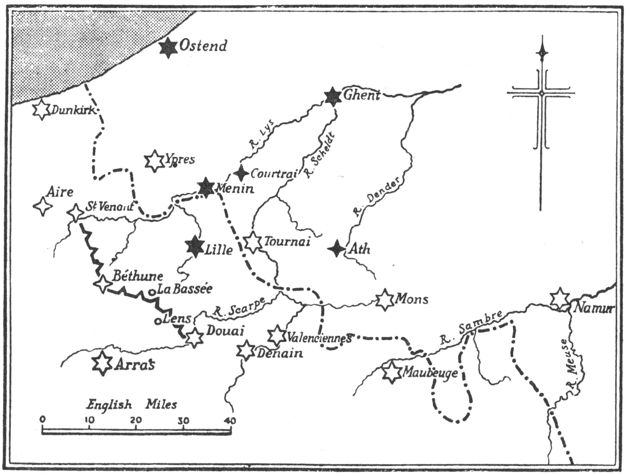
THE SITUATION EARLY IN 1709
Apparently both Marlborough and Eugene at first spoke freely of their disapproval of the way in which the negotiations had been conducted; and to such an extent that offence and some alarm were caused at The Hague. Goslinga’s secret letters to the States-General are revealing:
Ghent
June 16, 1709
* I will not repeat what Mons. Geldermalsen has written to you about the views of the two Princes on the recent negotiations. They make no bones about saying [ne font pas la petite bouche], particularly the Prince of Savoy, that we have displayed too much stubbornness. . . . The reasons that they give are known to you, . . . but it is discussed pretty openly here, [and] I entirely agree with you that this could not produce any good effects. Our enemies will be encouraged by it, and ourselves discouraged. But, since this is the case, judge for yourselves whether it is impracticable to reopen the matter.
And the next day, evidently after some remonstrance on his part:
* The Prince told me that in public he speaks in agreement with the resolution of the State, and does not express to anyone that he holds himself a different opinion. . . . Milor appears to me to have the excellent intention of cultivating the friendship of our generals: at least, he has made great protestations to me on the subject.
And from Lille on June 23:
* Regarding the behaviour of the Princes, there is no reason to complain. In public they reveal the same views as we do. I see with regret that at The Hague people are too anxious upon this subject. . . .
He adds:
The Prussians refuse absolutely to serve in the army of Prince Eugene.[136]
It is to be hoped that in the face of this and similar evidence the many historians and writers who have condemned Marlborough and his comrade for prolonging war for their own ambition or profit will no longer be credited.
Public opinion in England expected that a great battle and a victorious advance to Paris would follow the impudent rejection of the Allies’ peace terms. This was not unreasonable, considering the mood of Ministers. Godolphin was worried. * “Though,” he wrote to Marlborough (June 1/12),
there did not want a great many people here to find fault with the peace while it was thought sure, yet upon yesterday’s news of it broken off to show the general opinion which the bulk had of it the stocks fell 14 per cent. in one day. ’Tis true they had risen 20 per cent. upon the news of the peace. I own, however, that it vexes one to have them fall so much since I can see no ground to think the condition of France so better, . . . and in my opinion the insincerity in their dealing with Spain does not deserve the least endurance from our state.
I am nettled besides with the advantage they have already got by keeping us long in uncertainty whether we were to have peace or war. It has plainly stopped the dispatch of our ships and troops at least a month, and if cross-winds should come it may render them useless during the whole season. Supposing this should prove to be our case, which is not improbable, I should be glad to learn from you . . . what views you may have for this year of entering into France with any part of our army towards the sea coast, and how far we might be of any use to you from hence in furnishing and supplying provisions. I remember there were thoughts of this kind last year after the taking of Lille. . . .[137]
Tory criticism was loud and captious.
Peter Wentworth to Lord Raby
London
10 June, 1709
At our coffee-houses we are very angry that the news talks of our beseigeing Douai; for their opinion is that we ought not to amuse ourselves in taking towns, but march directly to Paris. When they are told that an army can’t march without having before provided magasins . . . they give no answere to this but—How did Prince Eugene march his army over the mountains without such a train or mony, and his march to the releif of Turin was in like manner; ’tis but to employ him and the business is done. . . . If they are told ’tis too late to provide such provision then they fall upon the credulity of those that gave so much into the faith of the French King’s sincerity to peace. . . .[138]
At the front the matter was less easy, although the strategic issues were simple. Could the confederate army pierce the lines of La Bassée? Could it defeat the French, no longer in the open field, but behind entrenchments amounting almost to fortresses? If so the march would lie forward into the heart of France. But if these lines and the troops which held them were judged too strong for frontal assault, then they must be turned on one flank or the other. The approaches to both these flanks were protected by fortresses—on the north Ypres, on the south Tournai. The reduction of either of these places would probably occupy a large part of the all too brief campaigning season which was open. It was therefore first of all necessary to decide whether a frontal attack should be made or not. Great reconnaissance was made of the whole of Villars’s front during the latter part of June. Cadogan and Dopf not only pressed at this point and at that with powerful escorts, but also it is said that the former, descending from his high position as Marlborough’s Chief of Staff and Quartermaster-General, traversed at the peril of his life, disguised as a labourer, a large section of Villars’s front. The spy in Paris reported:
June 24
* There is complete confidence in M. de Villars. It may be said that the fate of the kingdom is in his hands, and that he is playing a fine rôle, if he can keep it up, as he promises in all his letters. Two days ago 500,000 francs was sent to him for the troops. He takes great care of his men, going in detail into everything to do with the provision of the Army.
June 28
* I have seen the letters of the 29th from Flanders, which show that M. de Villars is encamped in a very favourable position, that the morale of the army is good, that Villars has withdrawn all the garrisons from Mons, Tournai, and Ypres, and has sent them to join the main army. This shows an attack is feared.
It is said that the allied plan is to pierce through on the sea flank and penetrate into Normandy, so as to support a landing from the fleet, which has spies in Cherbourg.
It is also reported that M. de Villars suspects some of his staff officers of giving the enemy information of his plans, and had thought fit to warn them that if he discovered any traitor in touch with the enemy, even if he were a prince, he would have his head off on the spot and send it to the King.[139]
On June 24, in the light of all information procurable, the question of frontal attack was put to the council. There was no doubt about the conclusion. Villars supposes that Marlborough and Eugene were overruled by the Dutch Deputies. But there is no truth in this. Marlborough’s letters show that he accepted Cadogan’s view that a frontal attack would not be justifiable. It was unanimously resolved that the French lines were too strong to be attacked. The only question in dispute was whether Ypres, on the one flank, or Tournai, on the other, should be besieged. Considering how France had begged for peace and the terms which could have been obtained, it was a poor and damaging outcome that the main effort of the Allies could compass no more than a siege. Indeed, Villars by his lines, by his forays, by his gasconades, had already gained an unfought victory when he compelled his indignant enemies to content themselves with such local and stony fare.
Which, then, should it be? The allied commanders debated in deep conclave. Marlborough still hoped to pursue his design of the previous autumn. He wished to advance along the coast by Boulogne upon Abbeville and then up the Somme to Amiens and towards Paris. As a preliminary to this it would be necessary to besiege Ypres. We know now from Villars’s memoirs that this was the movement which he dreaded most. It would be difficult for him to feed his own army in opposing it; and he saw as clearly as Marlborough that here alone could the Allies make use of their command of the sea in supplying their forces or in establishing a new base. There seems little doubt that Marlborough’s view was right. But Eugene opposed it. He advocated the attack on Tournai, and he found great support. On political grounds the whole inclination of the German states and the Dutch was to draw the British away from the sea and carry the war as far inland as possible. Goslinga, who was present at the council, says:
The Duke voted for the siege of Ypres, the Prince for that of Tournai. Our people [nous autres], as well as Count Tilly, ranged ourselves with the Prince. The principal reasons which led us to this choice were, first, the extreme weakness of the garrison [of Tournai]; second, the importance of the place; third, the convenience and security of the convoys; and, fourth, the lay of the land [around Tournai], which made the raising of the siege by a battle almost impossible; and finally the protection of Brabant, which we should cover, while making the siege.
All these reasons were no doubt just; but in war, as in peace, there is rarely any lack of good arguments for doing all sorts of things. “The Duke,” continues Goslinga,
did not set forth his reasons, except [the Goslinga touch] for mentioning the considerable revenues of the Châtelainie of Ypres. I believe, however, that his principal motive was to get nearer the sea, and once Ypres was taken to begin another siege on the coast, preferably that of Dunkerk, in order to put it into the hands of England; he took care, however, not to let this come out; on the contrary, he submitted without hesitation to the views of the Prince [Eugene].[140]
Thus we see Marlborough deferring as easily to the opinions of Eugene and the Deputies in the field as he had to those of the Whigs in council. In the one case, as in the other, he was evidently conscious of diminished authority. Besides this, it had become a habit with him to try to get everybody together and yield to majority opinion in the hope that at some moment or other a situation would be created out of which his ingenuity might draw some great event. He was ageing and worn with incessant exertions, and perhaps unduly conscious of the decline of his power in England. He could not well, when the British contingent was so modest, force the commanders of the confederate army into courses which were unwelcome to them. It was rash even to persuade them against their will. He believed at this time that the state of France was so desperate and the war so nearly over that unity among the Allies was more important than true strategy. He underrated the remaining strength of France. He perhaps still more underrated his own strength, ebbing though it now was. He thought the Grand Alliance would gain an inevitable victory if only it kept together; and this was no doubt true if it had kept together long enough. Lastly, he was in favour of a siege of Tournai if the other alternative was excluded. The rapidity and precision of the operation which follows makes it certain that there was no friction in the allied High Command.
|
J. Fiedler, Fontes Rerum Austriacum, i, 133; quoted in Klopp, xiii, 245. |
|
Advices from Paris, June 10, 1709; Blenheim MSS. |
|
Lettres de Madame de Maintenon (1758), v, 120. |
|
Advices from Paris, June 8; Blenheim MSS. |
|
M. T. Sautai, La Bataille de Malplaquet (1904), p. 2. |
|
Vie de Villars (1784), ii, 30. |
|
Vie de Villars, ii, 34. |
|
Saint-Simon, Mémoires, xiii, 95. |
|
Blenheim MSS. |
|
“C’est une créature de la Dame, et on l’appelle un justaucorps retourné.” |
|
Sarah Correspondence, ii, 328. |
|
Loc. cit. |
|
Godolphin to Marlborough June 14, 1709 * My Lre of yesterday, which you will receive at the same time with this, was so long that I shall now give you the trouble only of telling you what Care has been taken here to stopp the Corn from France. Sr John Morris is sent to the Sound, as the most proper Station to intercept it from the Baltick. Sr John Leake is going to Sea to Supply his place before Dunkirk & my Lord Dursleys squadron of 9 ships cruises in the Soundings to protect our own trade, & to lie in their way, in Case they Come north about; orders are also sent to Sr. G. Bing in the Mediterranean for Some ships to cruise betwixt the ports of Barbarie & the South of France. This seems to bee as much as is possible for us to doe here in this matter. I hope [the Dutch] will send ships also to ye Northward, and some to watch the other channell of Dunkirk, ours not being able to doe both. June 17 * All possible care is taken on our part in the Channel, in the Sound, in the Mediterranean, to intercept the corn from coming to France as the most pressing means, in case they can avoid fighting, to bring them to reason. June 20 * Our endeavours to keep the corn from France have improved so very successfully, Sir John Norris having stopped all the neuter ships laden with corn in the Sound, and Sir John Leake having taken three French privateers . . . which went on purpose to have had corn from Dantzick. [Blenheim MSS.] |
|
Heinsius Archives. |
|
Sarah Correspondence, ii, 330-331. |
|
Heinsius Archives. |
|
Marlborough to Heinsius Abby de Loos June 23, 1709 * I have had the favour of yours of the 19th and by the account you give me of Monsr. de Torcy’s letter to Pettecum, it is very plain thay do not think of proposing any expedient, this campagne. We ought on our side to think of every thing that may make it more difficult for them to continue the Warr, as that of hindering any corn going by sea to them, and if it were possible that the States wou’d consent to a prohibition of comerce which wou’d very much hearten the Allys, and discorage the Enemys, but this matter you can Judge so much better than my self, that I beg your pardon for mentioning itt. . . . [Heinsius Archives.] June 23 * I have had the favour of yours of the 19th and I am very sure that you will know from Monsr. de Goslinga that I have acted very sincerely in the endeavoring to content every body as to the forming of two Armys, so as that the troops of the States might have the left Wing, the right being to consist of the English, Prussiens, and the Hanovers, and by the assurances Monsr. de Goslinga gives me, I do noways doubt when the service shall requier our being in one army, we shall make itt very easy; the ffrench army will be all form’d to morrow behind their line near La Basse, and it is possatively said that the Elector of Bavaria is comand the whole; by the ffrench not offering any expedient I think it is very plain that thay think them selves in a Condition of making this campagne; lett me once more assure you that nothing shall be wanting on my side for the having a good Corispondance with your Generals, which I think can’t fail since I am sure of the assistance of Monsr. Goslinga; I need not repeat to you how usful it wou’d be to have Gelder-Malsen this Campagne; but I am afraid he has no mind to it. [Heinsius Archives.] |
|
Hague Archives. |
|
Blenheim MSS. |
|
The Wentworth Papers, p. 90. |
|
Advices from Paris; Blenheim MSS. |
|
Goslinga, Mémoires (1857), p. 104. |
The decision to besiege Tournai was taken on June 24. The operation was executed with masterly precision, and, according to Pelet,[141] “with such extreme secrecy that no one was able to divine the true objective.” Marlborough, in pursuance of his Ypres plan or alternatively as a feint, had brought all the siege-train down to Menin. Its position there was known to Villars, and seemed to him proof that it was his left that was about to be attacked. Dompré, one of the Ally commanders, who was marching with twelve battalions and as many squadrons from Alost, was ordered the same afternoon to rejoin the army at Tournai. Another reconnaissance in force of Villars’s lines before La Bassée was made as a blind on the 25th, and on the 26th a full council of war assembled ostensibly to take proper measures to assault them. At tattoo the allied camps were struck, the baggage loaded, and the whole army stood to arms ready to march. Once it was dark the heavy baggage started back to Lille, and the mass of Marlborough’s and Eugene’s forces moved in the opposite direction south-west towards La Bassée. By these manœuvres Marshal Villars was convinced either that he would have to face a frontal attack upon his lines at daybreak, or more probably that a feint at La Bassée was to cover the turning of his left. Accordingly, “fearing much more for his left than for his right, and above all for the neighbourhood of Saint-Venant, which was the most important and the most exposed, he sought the means of protecting it without moving his army from the La Bassée position.”[142] He reduced the garrison of Tournai, reinforced those of Saint-Venant and Aire, and proceeded himself to Béthune with five hundred men, who lighted fires along three leagues of the front as if he had moved his main army towards his left. Finally he sent a detachment towards La Gorgue with orders to spread the tale that they were the vanguard of the French army.
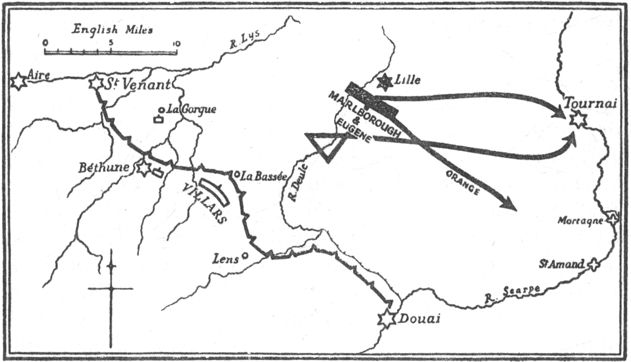
THE FEINT BEFORE TOURNAI
“This ruse,” writes Pelet, “had all the success which was hoped for. Eugene stopped short. . . . The Duke of Marlborough’s march towards Douai produced no effect.” It is surprising that so able an historian, writing long after and with much knowledge, should remain under the deceptions of the French headquarters at the moment. In fact, at eleven p.m. on June 26, after marching southward towards La Bassée for about two hours, Eugene turned north-west and later east towards Tournai. At the same time the long strings of barges carrying the siege-train and its ammunition began to float down the Lys back to Ghent, in order to be towed up the Scheldt. Marlborough’s right and centre, moving at first south through Seclin, turned simultaneously in the same direction, while his left, which had not yet quitted camp, marched due east directly upon Tournai. Agreeably with these changes, the Prince of Orange with 30 squadrons and 10 battalions moved against Mortagne and Saint-Amand, on the Scarpe before it joins the Scheldt above Tournai.
The confederate troops, whose wagons carried six days’ rations, did not know where they were going, and at first expected to be called upon for a general assault on the lines in the morning. But the turns in the darkness completely mystified them as well as the enemy, and when day broke they were astonished to see the towers of Tournai Cathedral rising at no great distance before them. Dompré, from the north, arrived simultaneously on the eastern side of the Scheldt, where he was soon joined by Lumley with 30 squadrons, including the British cavalry, and 10 battalions. Marlborough’s army deployed during the day, facing south with its right on the Lille-Douai road. Mortagne and Saint-Amand were captured without opposition by Orange; and Eugene, coming in later, filled the gap between Marlborough’s left and the Scheldt. By nightfall on the 27th Tournai was invested in force on all sides. The surprise was complete, and the fortress was caught with barely five thousand men, or half the proper number to man its defences. It was well supplied with munitions and had some bread, but the hostile apparition was so sudden that Surville, the commander who had distinguished himself at Lille, had no time even to drive in the cattle from the surrounding fields. The attempts by Villars on the 29th to throw in seven or eight hundred horse from Mons and Condé, and on the 30th by Luxembourg, who had orders to repeat his brilliant exploit at Lille with a thousand dragoons each carrying a foot soldier behind his saddle, were effectually frustrated.
John to Sarah
June 27
If it had been reasonable, this letter would have brought you the news of a battle; but Prince Eugene, myself, and all the generals, did not think it advisable to run so great a hazard, considering their camp, as well as their having strengthened it so, by their entrenchments; so that we have resolved on the siege of Tournai, and accordingly marched last night, and have invested it, when they expected our going to another place, so that they have not half the troops in the town they should have to defend themselves well, which makes us hope it will not cost us dear. I am so sleepy that I can say no more, but am entirely yours.[143]
Marlborough to Godolphin
Villemeaux
June 27, 1709
The bringing our battering cannon to Menin has had the success we wished, for the French took it for granted that we intended the siege of Ypres, and accordingly put sixteen battalions in that place, and drew ten battalions from Tournai, so that we marched last night, and this day, by twelve of the clock, the town was invested. And as they have not above half the troops in the town they ought to have for a vigorous defence, we intend to attack the town and citadel at the same time.
. . . We cannot have our cannon brought to us by the Scheldt in less than ten days, but when we have them once on our batteries, I believe it will go very quick. . . .[144]
Although the pretence of French historians that the Allies had been forced to alter their plans by Villars’s nocturnal measures cannot be maintained, the Marshal had nevertheless no serious ground for self-reproval or disappointment. It was beyond human wit to guess which way the cat would jump. It had jumped in the least dangerous direction. The siege of Tournai, begun as late as midsummer, meant, even with the favour of surprise, the indecisive consumption of the greater part of the campaigning season. Villars was relieved that the danger of operations against his left in conjunction with the naval power of the Allies might now be definitely set aside. He therefore expressed himself well content with what had happened. “It was a great relief,” he says in his memoirs. He set himself at the time to interpret the events of the preceding days in the manner most satisfactory to his reputation. Marlborough and Eugene had sought, he suggested, to lure him from his lines into a battle in the open field. He had baulked them. Fearing their movement by his left, he had purposely left Tournai weakly garrisoned as a bait. “The fortress should hold out,” he declared publicly, “at least four or five months.” His private estimate carried its defence to the beginning of October. These views commended themselves to Louis XIV. “I count for much,” he wrote on July 2, “that by your wise dispositions and the precautions which you have taken all the vast projects [of the enemy] are reduced to the single enterprise [of the siege of Tournai], and you could not at the beginning of this campaign render me more important service.”[145]
Marlborough’s letters to Godolphin speak repeatedly of the hardships of the troops and of the misery of the countryside. (June 24) “All the wheat is killed everywhere that we have seen or heard of.”[146] (July 4) “It grieves my heart to see the sad condition all the poor country people are in for want of bread; they have not the same countenances they had in other years.”[147] To Sarah (July 11): “It is not to be imagined the ill weather we have, insomuch that the poor soldiers in the trenches are up to their knees in dirt, which gives me the spleen to a degree that makes me very uneasy, and consequently makes me languish for retirement.”[148] (July 18) “If we have not peace, I shall be sooner with you this year than any of this war, for in all likelihood we shall not find forage to enable us to make a long campaign, and that is what I fear the French know as well as we.”[149] And (July 30): “The misery of all the poor people we see is such that one must be a brute not to pity them.”[150]
The strains were increasingly hard in all directions. Godolphin wrote to Marlborough (July 4):
* I am glad to find you continue to have so hopeful an opinion of the siege of Tournai; the people are a good deal prejudiced against it here, but if it succeeds . . . we shall be as sanguine as ever, which is too necessary; for unless our credit be not only supported but also augmented by successes abroad, our provision in Parliament for the expenses of the present year will fall short before the end of it by at least twelve hundred thousand pounds.[151]
Meanwhile the vessels carrying the battering-cannon had passed through Ghent and were being towed up the Scheldt. The French had blocked the fairway by sinking barges filled with stone, and it was necessary to cut a new channel. The first thirty barges passed the obstruction on the 8th, and by the 10th the whole of the siege artillery had arrived. The work of constructing the batteries and mounting the cannon absorbed the energies of the besiegers. Marlborough, with sixty battalions, undertook the siege. Eugene commanded the covering army. Thus the rôles at Lille were reversed. Three separate attacks were launched against the town: Lottum the Prussian against the citadel from the Valenciennes road; Schulenburg the Saxon against the Sainte-Fontaine gate from the left bank of the Scheldt; Fagel the Dutchman against the Manville gate. Keen rivalry existed between these commanders, and wagers were laid as to which would win the prize. The difficulties of the siege were vastly increased not only by the unseasonable rains, but by the enemy’s control of the sluices of the Upper Scheldt, which enabled them to flood the siege works suddenly in various places. The Town Ditch opposite Fagel, which was in fact a branch of the Scheldt, was filled with a deep stream running so fast that it washed away the débris as fast as the bombardment cast it down. To this was now added an intensity of mining and countermining novel and horrible in that age. “This is a siege,” wrote Schulenburg, “quite different from any hitherto made; the most embarrassing thing is that few officers even among the engineers have any exact knowledge of this kind of underground works, and even less of the way of attacking them.”[152] “The great quantity of waters,” Marlborough wrote to Godolphin (July 25), “which this garrison are masters of gives us great trouble now that we should pass the Fosse, so that our being masters of the town is retarded for some days.”[153]
On the 19th Marlborough had determined not to press Fagel’s attack, but to concentrate upon the other two. The garrison, although active and frequently successful with their mines, were clearly saving themselves for the defence of the citadel, and on the 28th, when preparations for a general storm were far advanced, Surville hung out a white flag and beat the chamade on the fronts of all three attacks. The terms of capitulation resembled those of Lille. Eight hundred French wounded and invalids were allowed to proceed to Douai. The town was yielded, and Surville after dining ceremonially with Prince Eugene withdrew into the citadel with about four thousand men. Taking the town cost the Allies over 3200 men—800 in Lottum’s, 1800 in Schulenburg’s, and 600 in Fagel’s attack.
Colonel Cranstoun was, as usual, critical of Marlborough. “All those amongst us here,” he wrote to a friend (August 5),
who are reckoned High Whigs or in with the Junto, as you call them, seem pleased at continuing war, and reason on all occasions to persuade the world that all the offers and advances made by France were a trick to impose upon us, though, indeed, I could never hear a good argument given to prove this, and I doubt that if we do no more than take Tournai this campaign there will be many in St Stephen’s Chapel next winter of opinion we were in the wrong to push things so far and refuse offers that appeared both so reasonable and sincere. It has cost us twenty-two days open trenches to take the city of Tournai and about 3000 men killed or wounded, officers and all, though I believe there are not above 1500 men can be said truly to be killed or so wounded as to be hors de combat.[154]
The hardest part was yet to come. The citadel, a five-bastion fortress of earthworks and masonry, was reputed “one of the best fortify’d Places by Art that is in the World.”[155] The garrison was sufficient for the defence of their reduced lines. Powerful as were the visible defences, the underground works were soon found by the assailants to be even more formidable. A bitter subterranean warfare began. “We have to fight with moles,” the British complained. Mining parties met each other below the surface and fought with picks and shovels, and, as the process developed, with sword and musket. The men in the batteries and trenches heard the ceaseless tapping of the miners beneath their feet. Explosions where soldiers were buried thirty or forty at a time, and one in which no fewer than four hundred men perished, made the siege terrible in the memories of veteran troops. All our diarist friends confirm this. “The siege,” wrote Blackader (August 18),
goes on slowly, and in the dark underground. . . . There is a great mortality among the boors through the country, occasioned, no doubt, by the famine, and scarcity, and unwholesome food they are forced to eat. And as pestilence often treads upon the heels of famine, so we are getting melancholy and alarming accounts of the plague being in several places in Germany, and some say in France.
The pious major had other griefs.
July 8. Involved all night in a multitude of promiscuous company. But they put the conversation on such a footing, either by swearing, profane talking, bantering, or some impiety or other, that I can take little part in it. To reprove would be needless, and to join them is sinful.[156]
Private (afterwards Corporal) Matthew Bishop, whose moving life-story is too little known,[157] writes:
I remember after our Army had completed twelve Saps, we mounted the Trenches, and sat upon the Foot Banks, when of a sudden the Enemy sprung a Mine, which made the Earth tremble under us; but it ceased in a Moment. We were surprised it had not taken us up into the Clouds; for, comparatively speaking, it ascended like unto a Cloud.
This private soldier’s diary finds exact confirmation in Schulenburg’s report to King Augustus: “They exploded several mines, which caused but little damage. In one case there was not enough powder in the mine; for those who were up above [merely] jumped a foot into the air. If it had been effective it would have killed more than eighty men.”[158] “We were prodigious hard at Work,” Bishop continues, “in sapping the Enemy, who sapped under us, and sprung several Mines, which stifled great Numbers of our Men. Then those that were above would work with all their Might, in order to give them below Air. By that Means we did save some alive.” One day he saw when out of the trenches “a prodigious Blaze, and it ascended up into the Air like unto a Cloud. We could distinguish they had sprung one of their grand mines. . . . But at our return I found there was almost a whole Regiment of the Scotch Hollanders[159] blown up. There was likewise a kind of report spread through all our Army, that it was their intention to blow us all up; but to prevent them we were continually in Motion.”[160]
Surville was prepared to make a resolute defence of the citadel, and his underground works gave him great advantages. He had, however, been guilty of the fatal neglect of not laying in sufficient provisions. His resistance was limited to little more than a month by his food. He therefore proposed to Marlborough that the citadel, unless relieved before September 5, should then be surrendered, and that in the meanwhile the siege operations should be suspended. He asked leave to send an officer through the lines to obtain the King’s approval. Marlborough was agreeable to this, “since it will save the lives of a great many men, and we cannot hope to take it much sooner.”[161]
Villars, when he heard of the shortage of food, vented his wrath upon Surville in cruel terms. He alleged that the proposal for a local armistice had come from the Allies. He advised the King to reject it. Louis XIV accepted his view. It seemed to him unwise not to compel the Allies to spend their munitions upon the siege. Surville was, therefore, sternly forbidden to go forward with his proposal, unless the allied commanders would consent to a general armistice throughout the whole of the Flanders theatre. This, of course, was in turn rejected.
Marlborough to Godolphin
Tournai
Augt. 15th, 1709
* By the Enemys dayly springing of new Mynes our Ingeniers advance so very slowly that the Pr. of Savoye and myself thought it for the Service to Come hether in order to push on the attacks, but as this is the first Siege where we have met with Myns, we find our soldiers apprehend them more then they aught, so that we must have patience for some little time, that thay may be used to them.
We have no further Confirmation as yett of the battel between the Swedes and Moscovit, but shou’d it be trew of the first being so intierly beaten as is report’d, what a mallincolly reflection is it, that after a Constant Success for ten Years, he shou’d in two hours mismanagement and ill success ruin himself and Country. . . .[162]
Marlborough’s reaction to the defeat of Charles XII at Pultawa gives us a glimpse of his own inward feelings. “Constant success for ten years; two hours’ mismanagement!” How easily in the dangerous game of war might these words find a new application! There is no doubt he liked the tremendous Swede, and, in spite of the advantage which his removal from European affairs spelt to the Allies, Marlborough was sorry for him, and fortified in his own prudence.
John to Sarah
Aug. 26
This afternoon I have received a letter from Prince Menzikoff, favourite and general of the Czar, of the entire victory over the Swedes. If this unfortunate king had been so well advised as to have made peace the beginning of this summer, he might, in a great measure, have influenced the peace between France and the Allies, and have made his kingdom happy; whereas now he is entirely in the power of his neighbours.[163]
The siege went forward in a severe and bloody style. Nothing like the mining and counter-mining had ever been known. On August 5 a hundred and fifty besiegers who had gained a footing upon the defences were blown into the air. Through the nights of the 16th and 17th there was fierce fighting in the mining galleries, ending in the expulsion of the French. On the 20th the blowing up of a wall smothered thirty or forty Ally officers and men. On the 23rd the besiegers discovered a large mine when it was about to destroy a whole Hanoverian battalion. But while they were rejoicing in this good fortune another mine below it was sprung, causing very heavy losses. On the 26th a townsman of Tournai offered to reveal one of the principal mines of the citadel on condition that he should be made head gaoler of all the prisons in Tournai. His offer was accepted, and the mine gallery was occupied by three hundred men. The French, however, again sprung a mine below this gallery, and the whole three hundred were destroyed, and a hundred more besides.
“The manner of Fighting in this Siege,” says the author of The Tatler,
discovered a Gallantry in our Men, unknown to former Ages; Their Meeting with adverse Parties under Ground, where every Step was taken with Apprehensions of being blown up with Mines below them, or crushed by the Fall of the Earth above them, and all this acted in Darkness, has something in it more terrible than was ever met with in any other Part of a Soldier’s Duty: However this was performed with great Chearfulness.[164]
In the face of grievous losses and ordeals the Allies persevered remorselessly in their attacks. On August 31 Surville, almost destitute of food and exposed to imminent storm, when no quarter would be shown, hung out the white flag of capitulation. Marlborough demanded that the garrison should be prisoners of war, and on Surville refusing another two days’ bombardment ensued. On September 3 it was agreed that the garrison should march out with the honours of war and be permitted to return to France on condition of not serving again until duly exchanged. On September 5 the Allies were masters of Tournai.
The advices from Paris were never more full of information, true and false, than during this period. The extracts which follow show the variety of contacts which the spy must have made at Versailles.
July 10, 1709
* In spite of the war people here still believe in peace and talk a lot about it. I don’t know how this campaign will end, but at Court M. de Villars is highly praised for having up till now prevented the enemy from giving battle and invading the realm.
July 12, 1709
* I tell you for certain that there is a plan to throw reinforcements into Tournai by means of inundations and flat-bottomed boats, and for this purpose they sent off three days ago a certain Galliot with the title of “Amiral des Galions du Canal de Versailles,” who has a pension of 2000 écus from the King. He is a navigation expert, and has left with all his workmen to join the Flanders army and carry out the above plan. This information is certain.
People in Paris are frightened of a revolution on account of the tax on bread.
July 15, 1709
* The terrain from Tournai to Douai is being prepared so that the inundation, caused by means of the Tournai sluices, will fill up and form a canal as far as Douai. On this they will be able to launch flat-bottomed boats each capable of holding a hundred men.
People here are quite pleased that M. de Villars has converted the enemy plan for a campaign of invasion into a campaign of bluff.
July 26, 1709
* The King has sent M. de Villars permission to attack the enemy in accordance with his plan for relieving Tournai, and Princess d’Epinoy, who has just arrived from Versailles, tells us the same. According to report, they are going to open the sluices in two or three places to create a big inundation. By this means they hope to break the bridge of communication and at the same time attack in three places—such is Court rumour. Others say it is a rumour that the Court circulates by design, and that no attempt will be made to relieve Tournai.
Two days ago a crowd of fifty poor people gathered round a dead horse at the end of the Pont Neuf, fighting over it and each one taking away a piece.
There are 15-20,000 workmen out of employment. They beg in their leather aprons. All these people added to the mob cause fears of a rising at any moment. The first thing they would do will be to pillage the Mint, the Louvre, and the customs.
July 29, 1709
* Really it is impossible to understand the idea of forbidding our generals to undertake anything—for the rumour which was spread that M. de Villars had permission to carry out the plan (a draft of which has been sent to the Court) was only to occupy people’s minds with the expectation of some event. To-day the story goes round that M. de Villars, tired of making war in this fashion, has written to the King asking to be relieved of his post, as he is forbidden to do anything.
August 2, 1709
* It is said that M. de Villars, furious at having his hands tied and not being able to undertake anything, screams like an eagle because he is held back. Nothing is clear. The Court is in complete confusion, caused by the two factions which reign there. This makes everything go wrong, and from bad to worse.
The same confusion reigns in Spain.
August 5, 1709
* In regard to Madame de Maintenon, it is certain that she still rules the King’s mind. This is how she sets about seeing that her wishes prevail and are carried out.
She never omits discussing with the King the matters which are to come up at the conseil secret held in her apartment every day. The King asks her advice, which she always seasons with something flattering to him; and sometimes she scares him, according to the circumstances—but this happens seldom. Then she sends for her creature (it used to be M. de Chamillart, and now M. Voisin) and orders him to hold such a view on such a matter, so that the King shall not suspect that she governs.
The number of those present is not fixed: sometimes it is only the King, she, and M. Voisin, and sometimes another Secretary of State, according to the business transacted; sometimes M. de Beauvilliers and M. de Bourgogne, and, rarely, Monseigneur.
This conseil secret is held in her apartment from seven till nine o’clock. The King is there an hour beforehand and works with her, and then summons those who are to attend. While the conseil is sitting she busies herself with some piece of needlework and never fails to express her views in the discussions—that is to say, to support those views with which she has inspired the King and her favourite Minister.
At nine o’clock the conseil leaves. She has supper with the King, who waits on her in almost bourgeois fashion. Then she goes to bed while the King chats to her, et souvent fait apporter par une de ses femmes une chaise percée, et pousse une selle auprès de son lit.
He then takes leave of her, embracing her. Then word is sent to Madame de Bourgogne, who is in a neighbouring apartment with her attendants, and the princesses, who are to dine with the King. All this is certain.
With regard to the conseil du matin, which is held in the King’s apartment from after Mass till one o’clock, when the King dines:
This conseil is more numerous, but the spirit of the lady reigns here too—for the King is always influenced by her. Monseigneur is often at this conseil, and the Chancellor, the Ministers, and Secretaries of State. It is here that one sees the two factions. That is to say, the princes and their puppets against M. de Bourgogne, Madame de Maintenon, and hers. The latter are entirely in favour of peace so as to bring back King Philip, and the others are opposed to this and would rather everything went to blazes.
August 10, 1709
* I don’t forecast favourably for us in a battle if one takes place. For all the letters from the Army show that our troops are very much discouraged, and the officers write home that there is no longer profit or honour in making war. It is true that the officers are very badly paid, the soldiers rather better. It is certain that this week 500,000 francs of the old coinage have been sent to our Army. As fast as they are brought to the Mint they are dispatched thither. Up till now only piastres and plate have been melted down, and the new coinage is not popular in Flanders. That is why they will have to have the old. It is also certain that 6000 sacks of flour have come in from Brittany for the Army.
The King has thus no further resources than his ordinary revenues, which have contracted by half through the universal distress, the corn monopoly, the poll tax, the taxes called aises, and finally a new tax which is to be levied of 10 per cent. on all capital and incomes of individuals and nobles of the kingdom without exception. Added to this is the profit on the coinage. It is true that the King can carry on for a short time with these exactions and by not paying his debts, but in the end everything will collapse. There is no lack of money—there is plenty of it—but it is hidden away for lack of confidence. It seems that violence and brigandage abound.
Meanwhile, in spite of all this distress, the King is amusing himself by making a waterfall which will cost 200,000 francs.
I am told further that he is nearly always humming a tune, either to give a false impression of firmness or, more likely, from dotage and the weakness of a failing mind which needs constant distraction.
August 12, 1709
* It is learned that Prince Eugene is marching towards Marchiennes and apparently intends to cross the Scarpe to catch M. de Villars. This has forced the Marshal to strike camp and get on the move in order to frustrate the plan of Prince Eugene. On the way he has picked up the Marquis de Coaquin, who was at the head of eighteen battalions. He has also with him the Duke of Guiche, with the French and Swiss and Walloon guards, and is marching in the direction of Douai.
It seems he is to join M. d’Artagnan and Count of Luxembourg. He has some artillery with him, and letters from the army lead us to expect an action near Marchiennes. We shall see how M. de Villars comes out of it. Many people have a poor opinion of him. It is believed that our troops are discouraged, discontented, and badly paid.
They say that the allied generals don’t want to pass the time in sieges and are determined to break through and fight. One of M. Voisin’s clerks assured me yesterday that affairs in Spain are in a fine muddle, and that there is a faction of grandees against Madame des Ursins, who is planning to decamp and has already sent out of Spain more than two millions’ worth of belongings. He also told us that the Archduke is ill, and that it is on the cards that King Philip and his wife might go back to France, but that the Prince of Asturias would remain as King and would be educated as a Spaniard by the Regency, without any interference by the French Ministers, who would have no finger in the pie, and that the Allies would be on the same footing in commercial matters as in the reign of the late King, and that the little Prince of Asturias, not having known his father or grandfather, would one day be entirely Spanish and perhaps our worst enemy.
In fact, the policy adopted by France in Spain is sufficient to weaken and ruin us for ever, and is putting new strength into a nation which one day will cause her a lot of trouble. Such is the ‘system’ of the Duke of Burgundy and his followers.
August 23, 1709
* There is still talk of peace being negotiated in secret. It is passionately desired here, and the conseil and the Ministers are at the end of their tether, and in the present state of public affairs I know of no further resources.
August 26, 1709
* There is still the fear of sedition in Paris, and the King has appointed M. de Boufflers to command the troops in the city. There are guards at all the gates, night and day. Last night the musketeers remained booted and spurred in their quarters ready to ride at the first order. One has the impression of being in a town in the war area, or of awaiting a surprise attack. Everywhere there are alarming posters, and the price of bread is going up, instead of down. There is complete bewilderment. The parish clergy exhort the people to pray hard for the prospering of the royal armies. There is a babel of voices in the churches crying aloud, “The Devil away with him!” . . . Marshal de Tallard’s valet arrived here a few days ago from London on his master’s business. He said that every one in England is crying for peace too, as eagerly as we are, and that makes us hope to obtain it at least some time this winter. But, whatever happens, if England and Holland make it appear that they still have the means to carry on the war, you will see our Court change its tune. It is only held back by the impression it has been given that England, and particularly Holland, have as much need of peace as we have.
August 30, 1709
Calm is being restored in Paris. Two days ago the guards and soldiers were disbanded, and M. de Boufflers has returned to Marly.
Thus did this deadly personage feed Marlborough with knowledge.
|
J. J. G. Pelet and F. E. de Vault, Mémoires militaires relatifs à la succession d’Espagne, ix, 37. |
|
Loc. cit. |
|
Coxe, v, 6. |
|
Sarah Correspondence, ii, 338-339. |
|
Louis XIV to Villars; Pelet, ix, 47. |
|
Sarah Correspondence, ii, 336. |
|
Ibid., ii, 344. |
|
Ibid., i, 187. |
|
Ibid., i, 189. |
|
Ibid., i, 193. |
|
Blenheim MSS. |
|
Leben und Denkwürdigkeiten Johann Mathias Reichsgrafen von der Schulenburg (1834), Part II, 397. |
|
Sarah Correspondence, ii, 351. |
|
Portland Papers, H.M.C., iv, 497. |
|
R. Kane, Campaigns of King William and the Duke of Marlborough (1735), p. 79. |
|
A. Crichton, The Life and Diary of Lieutenant-Colonel Blackader (1824), p. 343. |
|
A young man with some property and an insatiable desire for warlike adventure, he had served afloat till the end of 1704. When his ship was paid off he addressed his captain, with whom he had much credit, as follows: “ ‘Sir, I have a favour to beg. . . . You know, sir, my behaviour hitherto. . . . I am of a roving nature; and ever since I heard of the Action that was performed on the Danube by the Duke of Marlborough, I promised to myself, in God’s name, that if nothing prevented I would go and assist the Duke, for so noble a General cannot have too many good men; and as my inclinations are already with him, I hope your Honour will not deny me; There have been many instances that our enemies’ defeat has been owing to the success of one blow, and it may be my fortune to strike that lucky blow; and if you please to release me I am determined to stand to all events, for I find there will be nothing more done at sea, and I will go where I can be employed, for I have . . . no ambition but to carry arms, so that I may call myself a Man of War and an Arms Bearer.’ ” The captain consenting, Matthew obtained his discharge from the Navy, took to himself a wife, upon whom he settled all his property, and set forth in Flanders as a private in Webb’s regiment. Thenceforward he served in all the bloodiest fighting, and his account of his ordeal at Malplaquet is of high value. His admiration for the Duke grew with his campaigns. I must refer the reader to his own book (The Life and Adventures of Matthew Bishop, p. 80) for the tragedy which caused his neglected wife’s melancholy death. |
|
Schulenburg, Part II, 396. |
|
Scots troops in the Dutch service. |
|
In lighter vein Bishop tells the story of “another Man that was remarkable for a great Eater, his Name was John Jones, who belonged to Captain Cutler’s Company: He said he was prodigious hungry. With that the Men asked him how many Cannon Balls he had eaten for his Breakfast. Then I said to him, Thou deservest Preferment, if thou canst digest Cannon Balls. Then Sergeant Smith came up to me, and told me, He had eaten four or six twenty-four Pounders, and as many as six twelve Pounders in a Morning for his Breakfast. Now this Sergeant was not addicted to tell fabulous Stories, though it seemed incredible to any one’s Thinking. But he explained it in this Manner, that the Man often frequented the Fields in Search of those Cannon Balls; that he had used to dig them out of the Banks, and had brought a great Number in a Morning to the Artillery, in order to dispose of them for Money; and the Money he bought his Provision with. Had there been no Cannon Balls flying he certainly could not have subsisted; for he both eat and drank more than ten moderate Men; So that his daily Study was to provide for his Belly.” |
|
Letter to Sarah, August 5; Coxe, iv, 14. |
|
Blenheim MSS. The remainder of this letter, which deals with politics, will be found in the next chapter. |
|
Coxe, iv, 97. |
|
Lediard, Life of John, Duke of Marlborough (1736), ii, 482. |
The fall of Tournai was followed by an explosion of war-fury strangely out of keeping with the policy and temper in which the campaign had hitherto been conducted. Up to this moment the French had been virtually forbidden by Louis XIV to fight a battle. Villars was told that their interest enjoined a strategy of delay. On the other side, Marlborough, Eugene, and the Dutch Deputies, convinced that France must collapse under the weight of the war through economic and financial pressure, had also been wedded to caution. Repeatedly they had examined Villars’s lines, and always it had been decided that to incur the risks and costs of forcing them was not warranted in the favourable position of the allied cause. Thus the campaign seemed relegated to the sphere of manœuvre, with no more serious objective than making a further inroad upon the French fortress line.
Now suddenly, upon the capitulation of Tournai, an access of mental rage seems to have taken possession of both sides simultaneously. They discarded their cold calculations. They flung caution to the winds. The King gave Villars full freedom. The Marshal used it to court an encounter battle. Marlborough and Eugene two days later assaulted him frontally in a position already strong by nature, and now fortified by serious entrenchments and defences. The contagion of this mood swept through both armies like a fever. A terrible ardour inspired all ranks. They thirsted to be at each other’s throats, and slay their foes. The soldiers of every nation, national and mercenary alike, fell upon each other with a ferocity hitherto unknown to the age, and in the largest and bloodiest battle of the eighteenth century quarter was scarcely asked or given.
But the source of this new temper is to be found in the allied Governments even more than in their troops or their generals. A hitherto unpublished letter of Marlborough’s shows that his own instinct was against a supreme trial of strength, but that both the Empire and the Dutch were pressing him to it. In this letter is revealed for the first time the origin of Malplaquet.
Marlborough to Heinsius
August 18, 1709
* Monsr. de Heems, who staid two days with the Pr. of Savoye, has given us an account of his comissions for Vienne, and the great desire the Comte de Sinzindorff and others att the Hague that we shou’d undertake some[165] thing of consequence; I am sure you do the Pr. and myself the justice to beleive that we shall neglect no opertunity of undertaking what we can judge practicable, and as a friend I own to you that I think our affaires are in so good a postur, and that of the Enemy in so very ill condition, that I shou’d think wee aught not to ventur, but where in reason wee shou’d hope for success; but if you Judge otherways, and that the temper of your people are such, that thay will not be satisfied unless there be action, we must then take our measures agreable to that; for what ever is in my power You may comand, for I have a Confidence in your Judgement, besides you know the temper of England is always for action; but I can’t think it for the service to attempt, without hopes of success.[166]
As the fall of Tournai citadel approached the next step was considered by the Allies. It was realized that the situation would not be greatly changed by its capture. On the one hand, the course of the Scheldt would be open up to Saint-Amand; on the other, Villars’s army was better organized, his supply was less stringent, and his defences more complete. The season was far advanced, and no important invasion of France could be made that year. There remained, as it seemed, only the possibility of prolonging the pressure upon the French to renew the negotiations, or, if that failed, to secure a good start for the army in 1710. An advance in the centre between the Lys and the Scarpe would be confronted by the French prepared positions. Eyes therefore turned again to the flanks. In the west Ypres, Aire, and Saint-Venant offered themselves as costly prizes. Ypres was strong and well prepared, and Marlborough and Eugene judged the country round it bad for manœuvre late in the season. Our own experience at Passchendaele in 1917 in no way contradicts their impressions. On the other flank lay the fortresses of the Sensée—Condé, Valenciennes, the entrenched camp at Denain, or perhaps Bouchain.
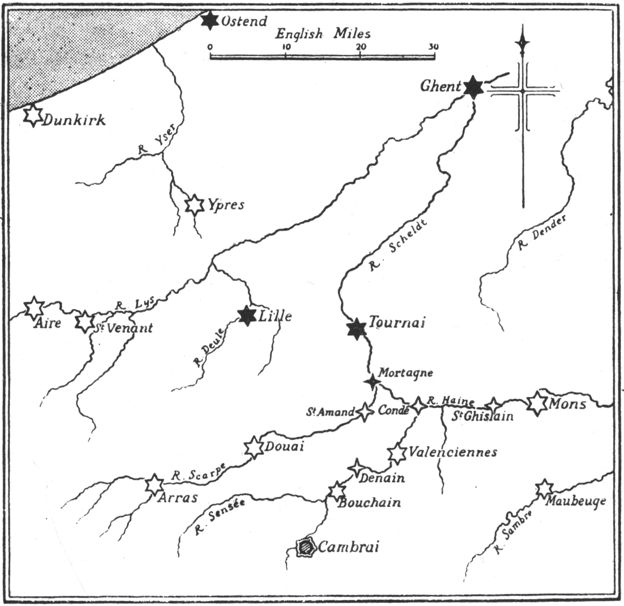
FORTRESSES AFTER THE FALL OF TOURNAI
A wider turning movement would be facilitated by the capture of Mons. But this fortress of the first order controlled no river communication. High ground stood between it and the valley of the Sambre. There is no account of the discussions which took place, though Goslinga, as usual, condemns what was actually done. Politics may well have been the deciding factor. During the peace negotiations nothing should be done to sow dissension among the Allies. Mons may have been chosen because it completed the occupation of the Barrier required by the Dutch. There was always the chance that Villars would fight a battle for the sake of Mons; but neither Marlborough nor Eugene counted upon his doing so. Actually the Marshal does not appear to have considered the likelihood of an attack on Mons. He was with reason more concerned about Valenciennes and Bouchain, and also about his lines stretching west to Aire. If Villars foresaw the allied plan, and occupied the line of the Haine and the strong position behind the Trouille stream, the siege of Mons might be prevented. Thus quick movement and surprise were necessary to Marlborough.
The first step was to seize the fort of Saint-Ghislain, on the Haine. Orkney, with the Dutch general Pallandt, twenty squadrons, and the grenadiers of the army, was entrusted with this task. There is conflicting testimony whether he started before or immediately after Surville offered to surrender.[167] The French accounts record his arrival in front of Saint-Ghislain at one A.M. on September 3. He was followed on that day by Hesse-Cassel with sixty squadrons and four thousand foot. They were to help Orkney take Saint-Ghislain, and if successful to cross the Haine and invest Mons from the south-west. If Saint-Ghislain could not be taken, both forces were to pass round the north of Mons and capture the line of the Trouille to the eastward. After dark on the same day Cadogan with forty squadrons followed Hesse-Cassel. At midnight, leaving 26 battalions and 20 squadrons to clear up at Tournai, the main army marched to Brissœil. The operation was hazardous, and Goslinga was full of misgivings. * “This is only to tell you,” he wrote to Heinsius on the 4th, “that the army marched this night [i.e. the 3rd]. They aspire to invest Mons, but, according to my humble view, it is impossible to succeed. We are going to follow to-morrow and join the army on the march. If all goes as wished, Mons will be invested to-morrow; but, as I had the honour to tell you, I doubt myself whether even our leaders are convinced that the thing is possible. . . .”[168]
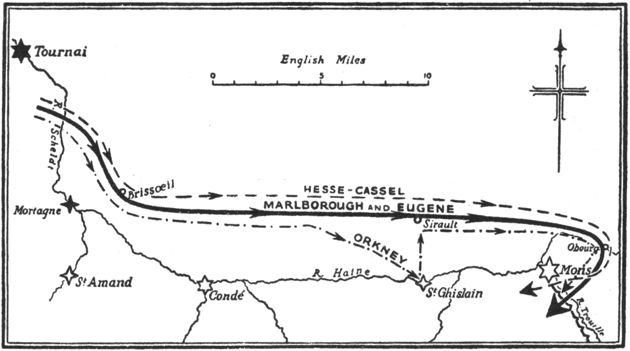
THE MARCH FROM TOURNAI TO MONS
Saint-Ghislain had been reinforced from Condé, and resisted Orkney. He therefore turned northward. On September 5 the main army marched to Sirault, where Orkney rejoined them. On the 6th, at two a.m., Hesse-Cassel crossed the Haine at Obourg, driving a small French force before him. At seven a.m. he formed his line south of Mons, and at noon crossed the French lines on the Trouille. Three French regiments of dragoons withdrew back into Mons. Luxembourg, with thirty squadrons, arriving too late for an action, retired to join Villars at Quiévrain. By nightfall Hesse-Cassel held the heights south of Mons on the line Frameries-Jemappes. That same night (the 6th) Marlborough reached Obourg, and marched south at dawn to support Hesse-Cassel. By these swift operations, which won Hesse-Cassel much praise, Mons was effectually cut off and invested.
The Paris spy sent the following decisive intelligence:
September 6, 1709
* M. de Boufflers has left for Flanders. It was thought at first that it was on matters of peace, and that M. de Rouillé was to follow him, but it isn’t so, and people of the first importance have told me that M. de Boufflers had left, in consequence of a letter written by M. de Villars to the King a week ago saying he had certain information that the plan of Prince Eugene and Lord Marlborough was to attack the army and offer battle as soon as the citadel surrendered.
M. de Villars hinted to the King that, however fine his army might be, he would prefer that so vital an action was not fought entirely on his responsibility, and asked the King to send him a general trustworthy to share the honour with him. . . .
There is talk of dividing our Army into two bodies. The reason for believing this is that M. de Boufflers has brought his cuirass and his weapons with him, and that he must have some plan on hand.[169]
The fact that this probably did not reach headquarters in time in no way detracts from the surpassing quality of the information.
Villars, awaiting at Quiévrain the arrival of part of his infantry under D’Artagnan, spent the 7th in a reconnaissance in force towards Hesse-Cassel’s position. Boufflers had, indeed, arrived, bearing with him in his person the proof of the King’s willingness for battle. During the evening Villars advanced with his army, and lay ten miles from the Allies on the front Montrœul-Athis. The fact that Boufflers had joined the French army reached Marlborough within a few hours. He therefore continued his southward march, and halted for the night on Hesse-Cassel’s left on the line Ciply-Quévy. The armies were now eight miles apart in gently undulating country. Between them lay a broad belt of forest, through which there were but two passages (trouées). The first, called the Trouée de Boussu, was between the Haine and the Forest of Warquignies. The second was the Trouée d’Aulnois, in which stood the village of Malplaquet. With the modern rifle and tactics of infiltration, these woodland tracts would be an assistance to the attack. Nothing would be worse for assailants than the open ground of a gap. But in the eighteenth century, with its firearms deadly only at close quarters and with its rigid formations, woods were considered sure barriers of defence. Flanks resting on woodlands were generally considered secure. If Villars wished to attack elsewhere than through one or the other of the gaps, he must make a long march round, and eventually attempt the river lines of the Haine and the Trouille.
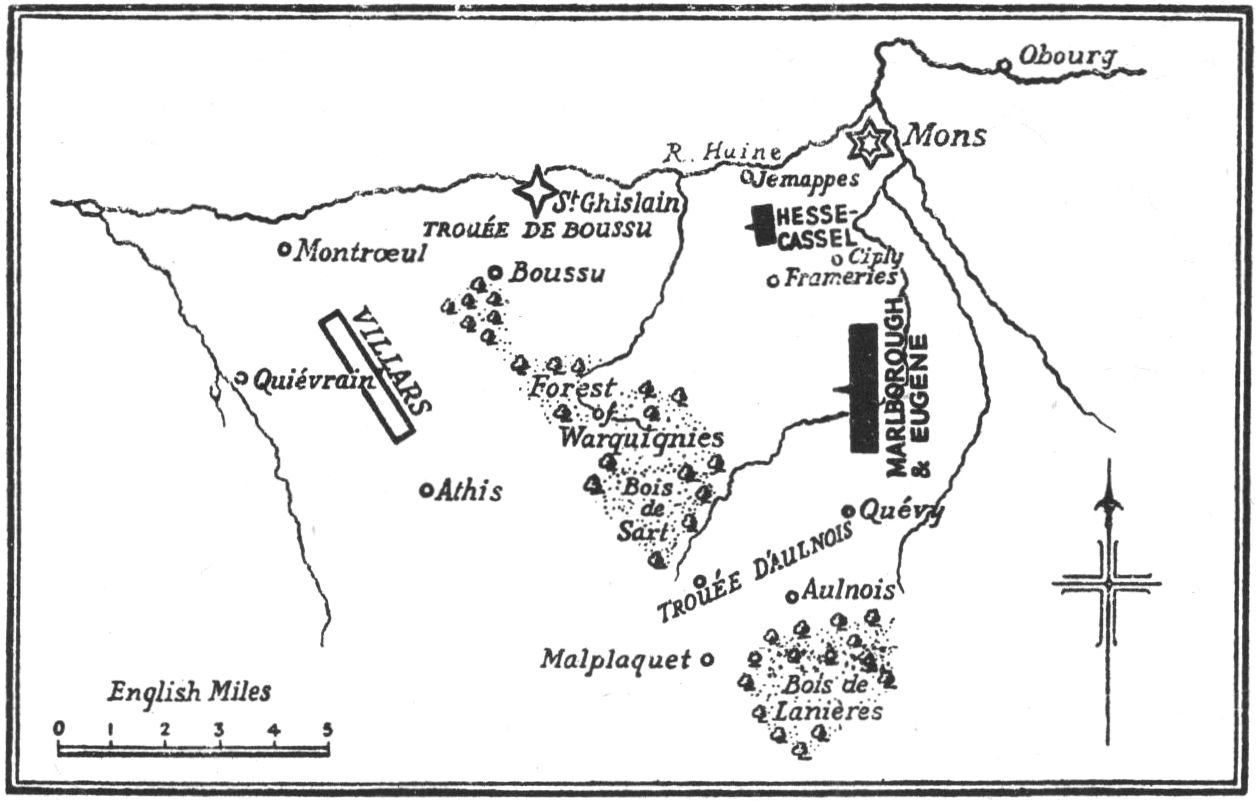
EVENING OF SEPTEMBER 7, 1709
On the morning of the 8th a Council of War was held at the allied headquarters at Quévy, in which it was decided that to cover the siege of Mons Eugene should block the exit of the Gap of Boussu, and Marlborough that of the Gap of Aulnois. As Villars on that day faced the former gap Marlborough must keep close to Eugene. Accordingly during the afternoon Eugene occupied the heights of Quaregnon, while Marlborough camped between Genly and Quévy. A French general captured by the patrols stated openly that Villars had the King’s leave to fight.
Marlborough seems to have had at this moment no fixed plan of action. His letters show no expectation of battle.[170] He and Eugene were waiting upon events. If they had been content merely to make the siege of Mons they could during the 8th and 9th have constructed a line of circumvallation either in the woods and across the gaps or behind them. But this was not their object. They wanted to bring about a battle in the open, and to hold themselves loose so as to be able to encourage and accommodate Villars, if such was his purpose. No attempt was therefore made to take up a defensive position. Such a step would have prevented a battle. They cherished the hope that Villars would advance through one or other of the gaps, and that then they could fall upon him. They did not want to do anything which would deter him from this. Still, we can hardly think they believed he would do so. The heroic Marshal, while breathing fire and slaughter and inspiring his troops with the spirit of the offensive, never had any such intention. He was only doing what he had done several times before, and was to do afterwards on notable occasions—namely, advancing to close proximity in the hopes of finding a weak body of the enemy in his clutches, or some other exceptional advantage. Marlborough and Eugene during the 8th were evidently tempting him; and for the sake of doing so they allowed him to occupy the forward edges of the woods by the Gap of Boussu—that is to say, they would let him without dispute make of this gap a gateway which he could open when he chose, and through it debouch and deploy for battle. But this was too good to be true.
Villars, who had to halt for supplies, and fed his troops with the greatest difficulty, contented himself again with a cavalry demonstration. His patrols and squadrons came in contact at many points with the cavalry of the Allies, and the numerous sharp minor collisions which took place showed the tension of the great masses now brought so close together. He had seen the Gap of Boussu left open to him on the 8th. During the night which followed he sent Luxembourg with a strong force of cavalry to seize the forward edges of both the gaps, thus securing to himself the power to debouch at either. It cannot be supposed that Marlborough and Eugene, watching the scene on horseback from hour to hour during the preceding day, permitted him to do this by negligence. Evidently they meant deliberately to leave both doors open for him to come through either into a battle arena. At dawn on the 9th Villars learned that both the gaps were in his possession. He marched forthwith to his right in four columns ready for immediate deployment, and occupied the Aulnois gap with his whole army.
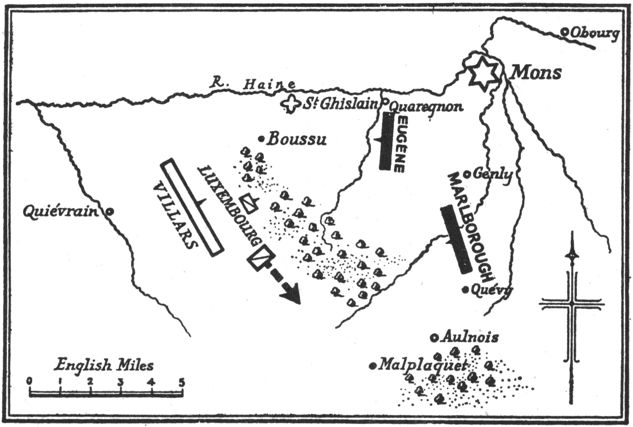
EVENING OF SEPTEMBER 8
Early on the morning of the 9th both Eugene and Marlborough were writing letters.
Eugene to the Emperor
His Imperial Majesty will have learned from other sources how the armies have remained stationary. But I am this instant about to mount my horse. . . . In fact, the enemy is near, although up to now he has hazarded nothing, and remains behind his fortresses and entrenchments. . . . From our side, since we do not know well the lie of the land, we dare even less take any risks. The terrain is very uneven, and cut up by many small brooks and ponds swollen by the bad weather, and is full of water and gullies, paths and defiles, so that one cannot march directly forward. But I am about to go off with my lord Duke under heavy escort to review the situation thoroughly, so that we can come to such a decision as will be to the benefit of the Common Cause. . . .[171]
Marlborough’s letter was to Sarah.[172] She had upbraided him for not writing to the Queen to complain of the treatment she was receiving. Apparently she had reproached him with lack of zeal for her interests.
I am obliged to you for the account you give of the building of Blenheim in yours of the 21st, and the farther account you intend me after the Duke and Duchess of Shrewsbury have seen what is done. You will see by my former letters, as well as by this, that I can take pleasure in nothing as long as you continue uneasy and think me unkind. I do assure you, upon my honour and salvation, that the only reason why I did not write was that I am very sure it would have had no other effect than that of being shown to Mrs Masham, by which she would have had an opportunity of turning it as she pleased; so that when I shall speak to the Queen of her harsh behaviour to you she would have been prepared. I beg you to be assured that if ever I see the Queen I shall speak to her just as you would have me; and all the actions of my life shall make the Queen, as well as all the world, sensible that you are dearer to me than my own life; for I am fonder of my happiness than of my life, which I cannot enjoy unless you are kind.[173]
At this moment the news that Villars was moving came in and Eugene arrived. Marlborough’s horse was brought, and, with an escort of thirty squadrons and four hundred grenadiers under the Prince of Auvergne, the two commanders rode out to the Mill of Sart to reconnoitre. They reached this point about eight o’clock. As the fringe of their cavalry patrols approached the village of Malplaquet, in the Aulnois gap, they came in contact with Luxembourg’s outposts. Auvergne with a heavier force brushed through the hostile screen and found himself confronted by strong bodies. To the westward he or his officers discerned the French army marching towards the Aulnois gap and the plateau of Malplaquet. As far as they could tell, the enemy seemed to be about to advance through the forest clearing into the open country towards Mons. Thereupon Marlborough ordered the concentration of the Allies. Only his left, composed mainly of the Dutch under Dopf, could immediately come into line. The right could not come up for several hours, and Eugene’s army lay six miles farther to the north. The concentration, according to Orkney, was delayed by “prodigious dusty rain,” through which the troops marched incessantly. At 2 p.m. the French batteries, which had now gathered in strength about Malplaquet, began to cannonade Marlborough’s left, who, as they were without artillery, could not reply.
This situation has been represented by several writers as critical for the Allies.[174] It is suggested that if Villars had advanced through the gap and deployed his forces he could have beaten the confederate army in detail; but this is nonsense. Marlborough’s left, unencumbered by artillery, could have fallen back as fast as the French could advance, and as they receded would have accelerated the concentration of the allied army. Villars himself could not have forced them to battle till they were willing. Nothing could have prevented them from reoccupying, for instance, their former position from Genly to Quévy with their whole united strength. It is certain that this was exactly the kind of situation which Marlborough and Eugene desired. They could then, at dawn on the 10th, have fought that general battle in the open which had never been offered to them since Ramillies. The whole of the allied movements on the 8th and 9th show beyond all question that Marlborough and Eugene had only one object and hope—namely, to entice Villars to go through one or other of the gaps into the plain of Mons, and then fall upon him.
But Villars was far too good a soldier to be caught in that way. He never for a moment contemplated attacking the Allies, or even the risk of an encounter battle, in the open. Under such conditions his ragged, ill-found army, however brave and trained, was no match for the perfectly equipped veteran forces of the Allies. He saw, as well as we see to-day, that the great Captains opposed to him had left these gaps open because it suited them that he should go through them. It is, indeed, surprising that Marlborough and Eugene should have even appeared to take Villars’s offensive seriously. Allowance must be made for the atmosphere of excitement which rises to explosion-point when great masses of armed, eager men are manœuvring in close contact with one another, and when the fall of the thunderbolts is expected and even longed for by all. Accordingly Villars sat down in his gap. His troops were marching up all day. His artillery continued to fire on Marlborough’s left, which stood in position against his front. During the afternoon the English and Dutch batteries came up, unlimbered, and began to reply in increasing numbers. Thus night fell.
Pelet makes the odd statement that Villars was mistaken about the width of the gap, and thus was “forced” to occupy the woods on either side with infantry. It is surprising that he should have made such an error, or that he should have regarded the occupation of the woods on either flank of the Malplaquet position as anything but a vital duty and an important advantage. During the night he began to fortify his position across the gap. He dug the deepest ditches and built the highest parapets that time allowed. The woods on either side he defended by successive lines of smaller trenches, and with abattis.[175]
Early on the morning of the 10th it was seen that Villars had already begun entrenching himself, and all prospect of his attacking faded. The allied Commanders had now to decide first whether they would themselves assault his position, and whether they should do so at once or wait until the next day. On the one hand, the French defences were growing hourly; on the other, General Withers with nineteen battalions and ten squadrons was marching from Tournai, and could not join the army until very late that night. According to some accounts, Marlborough was for attacking at once, and Eugene for awaiting Withers.[176] The matter rested between the two comrades, and neither of them has left any statement of his individual views. They worked together, and never claimed credit at each other’s expense. Whatever passed between them is therefore unknown. In the outcome, “the Princes” resolved to wait until their whole army was assembled, and to hold a council of war that night to decide the question of battle. Such a council was necessary in view of the constitution of the army and the stipulations of the Dutch. The Dutch Deputies had remained behind at Tournai, and Goslinga alone reached the army.
All through the 10th the cannonade continued in the centre of the army, and several hundred casualties were inflicted on either side. Marlborough and Eugene spent the day examining the French position. Breastworks were constructed for the attacking batteries. Towards evening the guns fell silent, and an incident occurred upon which many accounts dwell. The French general Albergotti, riding round his outposts in the Wood of Taisnières, sent an officer to tell the allied pickets that he would like to talk to one of their generals. The officer was fired upon and withdrew. But a little while later there arrived from the Allies a trumpeter with a flag of truce in due form to say that, if Albergotti desired it, the Prince of Hesse, the Electoral Prince of Brandenburg, and General Cadogan would be delighted to converse with him. The parley which followed spread far along this part of the line. Rumour ran that peace had come, and several thousand men from the two armies, who the next day were to show each other little or no quarter, came eagerly together in a strange paradox of human emotions, embracing and exchanging gifts and salutations with lively curiosity and goodwill.[177] While this fraternization was in progress it was noticed or suspected by the French that several Ally officers were making notes and sketches of the ground, its defences and defenders, and Cadogan was seen to be looking about him in all directions. As soon as Marshal Villars heard of the parley he at once sent orders to break it off, and asserted that Cadogan had only allowed it in order to have the chance of reconnoitring the French left and its incomplete entrenchments. However this may be, the prime responsibility clearly rests with Albergotti.
In the meanwhile the measures which Marlborough took had all been directed to a battle on the 11th. Instructions were sent to Withers to press his march. In order to have an uninterrupted line of retreat upon Tournai in the event of a repulse, Marlborough determined to take Saint-Ghislain by storm. About two thousand men, collected under General Dedem from the battalions blockading Mons, marched accordingly upon this post. Its garrison had been reduced by Villars to two hundred men, and about nine in the evening it was carried “sword in hand,”[178] the garrison being accorded quarter. Withers actually passed through Saint-Ghislain after its capture, and camped four miles beyond the Haine.
At the Council of War Marlborough and Eugene urged a general attack the next day. Goslinga, who represented the Republic, vigorously supported them. Such a combination of authority was not questioned by the other generals present, and the momentous resolve was taken unanimously. There was no obligation upon them to fight. They had only to sit still and let Villars watch them choke Mons into surrender. There had been half a dozen situations in the war when a great battle could have been fought on no harder terms—nay, on terms less hard—and several others were to occur afterwards. Both sides wanted to fight. Villars made the greatest contribution in his power by coming forward into the gap. Marlborough and Eugene, pressed by their Governments, were in the mood to accept his challenge. How many times of which we know nothing had they perhaps found it impossible to procure an agreement upon decisive action? Now they had the pugnacious Goslinga with them, and alone. Never might such an opportunity return. Now was the time to end the war at a single stroke. Even if conditions were not entirely favourable they believed they were strong enough to beat and ruin the last remaining army of France.
At some moment during this tense day Marlborough resumed his interrupted letter to his wife. “Having writ thus far, I have received intelligence that the French were on their march to attack us; we immediately got ourselves ready. . . . I do not yet know if I shall have an opportunity of sending this letter to-night; if not I shall add to it what may pass to-morrow.” He ended with a gesture which may seem extravagant to us, but which might well have served as his farewell to Sarah, and would have been precious to her. “In the meantime I can’t hinder saying to you, that tho’ the fate of Europe if these armies engage may depend upon the good or bad success, yet your uneasiness gives me much greater trouble.”[179]
Eugene’s diary records:
Orders to attack the enemy to-morrow in the name of God. My lord Duke of Marlborough’s armies, the Imperial Troops, and the corps from Tournai, which is to make a special attack, are to be let loose upon the enemy. . . . All attacks to begin at daybreak, when everything must be in readiness. The signal will be a salvo from the entire British artillery, which will be taken up by the Dutch cannon.[180]
|
Marlborough’s underlining. |
|
Heinsius Archives. |
|
Millner says Orkney started on August 31. Coxe and Taylor, possibly following, agree. Villars says it was on September 2, and Pelet adopts his view. It is certainly unlikely that Marlborough disclosed his intention before Surville asked for terms, which he did not do till the 2nd. A hitherto unpublished letter of Goslinga’s (Tournai, September 2) seems decisive: * “Pallandt has an enterprise against Saint-Ghislain which should be executed to-night.” (Goslinga to Heinsius; Heinsius Archives.) |
|
Goslinga to Heinsius; Heinsius Archives. |
|
Blenheim MSS. |
|
Marlborough to Godolphin, September 7; Sarah Correspondence, ii, 381. |
|
Feldzüge, ii, Series II, App., 257. |
|
This letter is dated September 10: but its contents show that the first part was written on the morning of the 9th. |
|
Coxe, v, 68-69. |
|
Even Sautai and the deeply instructed Taylor. |
|
Trees felled and stripped, and with their sharpened branches pointing towards the enemy: the wire entanglements of those days. |
|
The Austrian official account (Feldzüge, Series II, ii, App., 101) says that orders had already been issued for the attack when Marlborough countermanded them. This is clearly an error. |
|
“A cry of ‘Peace, peace—it is peace’ began on the right wing of the army, and was caught up and repeated along the whole line. Officers and soldiers ran forward from all the regiments to the enemy entrenchments, which lay a short gunshot in front of us, and began to speak to their friends and acquaintances in the French army. The French sprang joyfully upon their entrenchment, and I too rode forward with a close friend. However, when we retired the French fired a full volley, and wounded my horse high up in the buttocks, so this peace was within a hair’s breadth of costing me my life.” (From an account by Bellingk, quoted in Alexander Schwencke, Geschichte der Hannovereschen Truppen im Spanischen Erbfolgekriege 1701-14 (1862).) |
|
Hare Papers, H.M.C., p. 229. |
|
September 10 (continuation of letter quoted at p. 136); Coxe, iv, 69. |
|
Feldzüge, Series II, ii, 101. |
By the first light of dawn all the troops were already under arms and in their stations. But with the sun a dense fog rose from the fields and marshy places, shrouding the loaded woods and the two hundred thousand men who awaited the signal to fall upon one another. In the allied army of many nations the ministers and priests of almost every communion known to Christendom—Church of England, Presbyterian, Dutch Calvinist, Huguenot, Lutheran, Roman Catholic—performed their solemn offices at the heads of the regiments. So perfect was the harmony which the ascendancy of Marlborough and Eugene exercised upon all minds that these soldiers of different races, creeds, and Governments—English, Scots, Irish, Danes, Prussians, Hanoverians, Hessians, Saxons, Palatines, and Dutch—acted together as if they were the army of a single nation. Opposed to them was the greatest Power of that age, at length brought low, but finding in desperation new, unmeasured sources of strength from its valiant people. The French stood at the gateway of France—almost along the line where the frontier runs to-day—prepared to dare all to shield their land from invasion. With the French army were a few brigades of Irish exiles, and of troops driven out of the Electorates of Bavaria and Cologne, but all were united in the Catholic faith and in long military comradeship. While they ate their meagre bread, they mocked the plenty of the allied camps and the rum and brandy rations customary there on battle days. The standards of the Maison du Roi bore Louis XIV’s challenging motto, “Nec pluribus impar.” Never was it more bravely sustained than at Malplaquet.
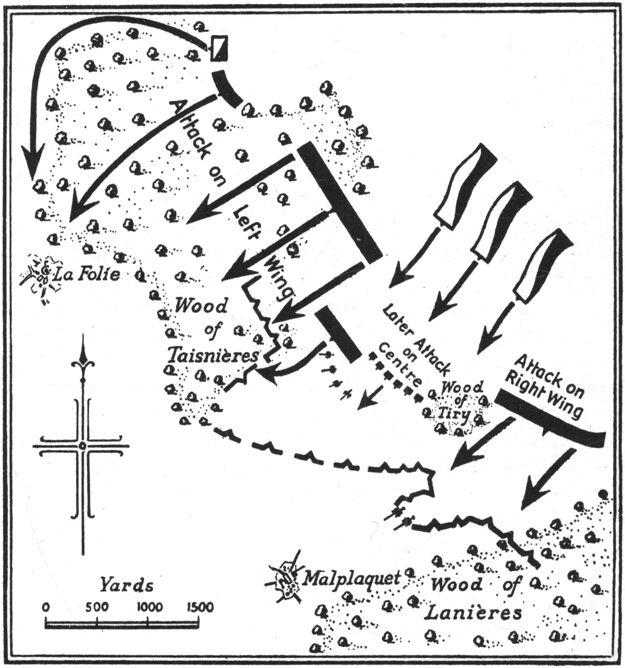
MARLBOROUGH’S PLAN OF ATTACK
During September 10 the French line had been minutely studied by “the Princes” and the allied Command. Marlborough’s conception was in principle the battle of Blenheim adapted to a new field. The enemy’s wings were to be assaulted until Villars was induced by this pressure to weaken his centre. The centre was then to be pierced by the reserve of the infantry (in this case mainly the British), and its earthworks occupied. Out of a hundred guns no fewer than thirty-seven were assigned to move and work with the attacking infantry. The enormous cavalry army, nearly thirty thousand strong, was then to pass through the gaps in the defences, and fight a sabre battle with the French cavalry in the plain beyond. If the French cavalry were routed, all their troops drawn into the two flanks would be cut off, as had happened to the French right at Blenheim. We can see the methods and experience of that day alive in the minds of Marlborough and Eugene. The line of redans which Villars had built across the gap were to Marlborough the reproduction of the obstacle of the Nebel. He proposed when the moment came to seize and hold these positions with infantry, and, covered by their fire and by artillery, to form his whole cavalry on the far side for the final stroke. At Blenheim he was suffered to do this without opposition at the passage. Now he might have to fight hard for his debouchment. Apart from this, the gambit of the battle was almost the same. But Marlborough, and still more Eugene, had behind him a vast experience of war. If they had a plan it was to be no rule. The measureless chances of action would certainly create better or worse situations with which they felt competent to deal. Whatever they may have said or written, both looked out upon the day with zest and thrill, and, casting care aside, rejoiced in the intensity of risk, will, art, and action which lay before them. Moreover, here must be the end of the long war, and rest and glory after toil. All should be staked. Nothing should be neglected, and nothing should be withheld.
The curtain of fog by all accounts was regarded as highly convenient for the drawing up of the allied troops. For the main attack of the right wing the lines of battle were three deep: for the secondary but still heavy attack by the left wing, two deep: and in the centre, where it was hoped to give the decisive stroke, only a single line. To this centre, covering a third of the front, Marlborough assigned only nineteen battalions out of a hundred and twenty-eight. But these battalions, which he kept under the strictest personal control, were thirteen English, two foreign, and four Prussian, and constituted his only infantry reserve. He himself would stand near the redcoats and use them for the culminating stroke. Behind this slender infantry line were massed over two hundred squadrons of cavalry and the main artillery of the confederate army.[181]
As the sun gained power the mist dispersed. Broad daylight lapped the field, bright with symmetrical masses of uniformed men and the sparkle of standards and blades. On both sides the famous leaders presented themselves to their soldiers. In the well-known figures of Marlborough and Eugene the confederates saw the assurance of certain victory. In Villars and in Boufflers the French army recognized the two foremost heroes of France. The artillery began to fire about half-past seven, and gradually grew far louder than on the previous days, until at nine o’clock Marlborough ordered the Grand Battery to fire the signal salvo, and the battle began.
The Wood of Taisnières points north-eastward a projecting tongue. This salient, the scene of the fraternization of the day before, held by the five brigades of Albergotti, was Marlborough’s first objective. Upon the edge of this his forty-gun battery concentrated its fire. Schulenburg, with forty battalions, three lines deep, marched against its northern face; and Lottum, with twenty-two battalions,[182] after moving as if to attack the French centre, was to change direction to his right, and assault it from the eastward. When Lottum turned to his right Orkney with his fifteen battalions would cover Lottum’s left shoulder, which might otherwise have been exposed. At the same time, beyond Schulenburg’s right, the detachment of nineteen hundred men from Mons entered an unoccupied part of the wood, and upon the extreme right Withers, with nineteen battalions and ten squadrons, began to march through the forest in the direction of the La Folie farm, with the object of turning the left of the whole French army. Thus eighty-five allied battalions were simultaneously launched upon or into Taisnières Wood, of which more than sixty attacked the comparatively small tongue-shaped salient. The allied forces outnumbered the French in the Wood of Taisnières by four to one, and Marlborough might well have expected a speedy result.
Marlborough and Eugene in their battles understood one another so well that each exercised a supervision over the entire field. But although there was no formal division of spheres, Eugene assumed the direction of this great operation upon the right, while Marlborough, with his headquarters staff, conducted the general battle from a slight eminence about half-way between the Grand Battery and the village of Blaregnies. From this dangerous but convenient spot, a little behind Orkney’s corps, he was able personally to ensure the safety of Lottum’s exposed flank, thus preserving his contact with Eugene, and at the same time to survey, or receive information from, the rest of the front.
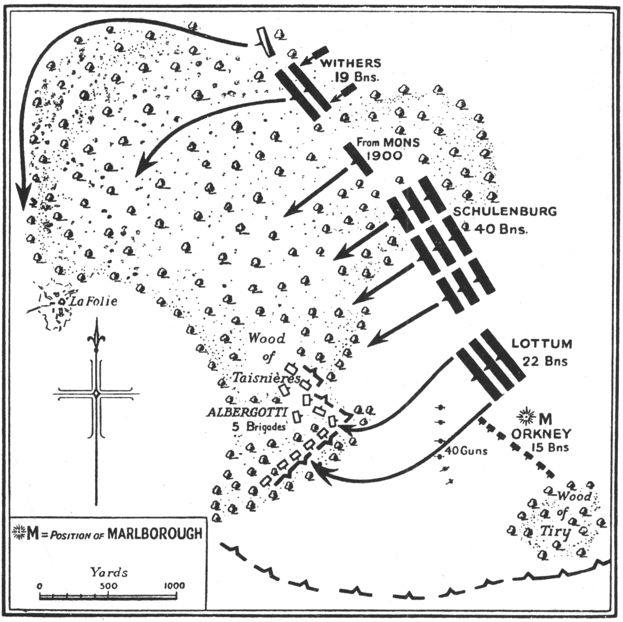
THE ATTACK ON THE WOOD OF TAISNIERES
Schulenburg’s Germans marched firmly to the assault. This oblong mass of over twenty thousand men had eight hundred paces to cross before they came to grips. The five brigades of Albergotti met them according to the tactics of their commanders and the nature of the ground. Here the French charged forward; there they stood behind their entrenchments and reserved their fire till pistol range. But, however it befell, the clash was savage and the slaughter heavy. Two of the three major-generals and all the colonels of Schulenburg’s first line were killed or wounded as they led their men inexorably forward till they were stopped by lead or steel. The opposing battalions grappled with each other. The fringe of the wood blazed with fire and smoke. The survivors of Schulenburg’s first line recoiled, rent and ragged. But the second, following at two hundred paces under Eugene’s personal direction, bore them forward in a double wave. “The Imperial grenadiers, circling the treacherous boggy ground, streamed into the wood upon the outermost flank.”[183]
La Colonie, the “Old Campaigner,” to whom we have often recurred, was posted with his Bavarian brigade behind the redans, and watched the advance of Lottum’s twenty-two battalions.
As soon as this dense column appeared in the avenue, fourteen guns were promptly brought up in front of our brigade, almost in line with the regiment of Garde Française. The fire of this battery was terrific, and hardly a shot missed its mark. The cannon-shot continued to pour forth without a break, plunged into the enemy’s infantry, and carried off whole ranks at a time; but a gap was no sooner created than it was immediately filled again, and they even continued their advance upon us without giving us any idea of the actual point determined on for their attack. At last the column, leaving the great battery on its left, changed its direction a quarter right and threw itself precipitately into the wood on our left, making an assault upon that portion which had been breached.[184]
The French under Albergotti resisted with the utmost tenacity, and the defences proved their value. Sheltered behind the breastworks, they fired steadily into the great numbers of assailants, who struggled through the abattis and tried to re-form a fire front at close quarters. To the surprise of the allied generals, the first onsets of both Schulenburg and Lottum were brought to a standstill either on the fringe of the wood or in the open ground before it. Their second and third lines bore them forward again. Generals and colonels sacrificed their lives with the highest devotion. Eugene, riding into the severity of the fire, reorganized and forced on the attack by weight of numbers, regardless of losses. On the other side Albergotti’s reserves were thrown into the struggle.
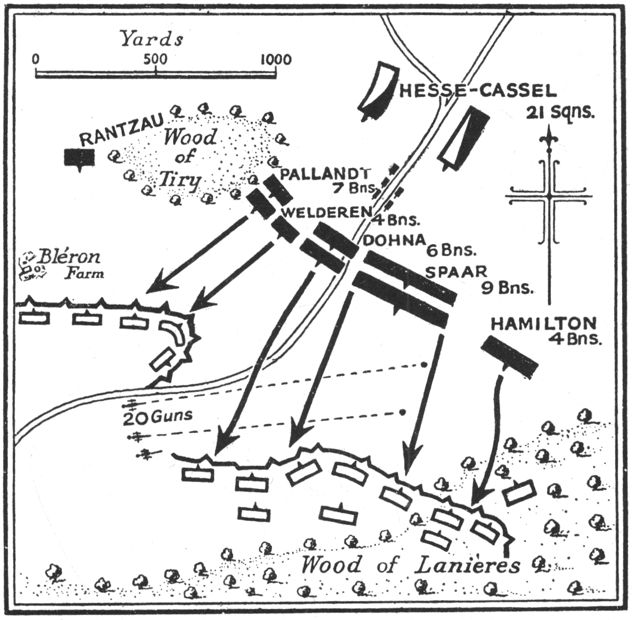
THE DUTCH ATTACK
The attack by the allied left was timed to start half an hour later than that of the right. It had originally been intended to reinforce the Dutch in this quarter by Withers’ nineteen battalions from Tournai. The fatigue of these troops after their long, rapid march from the fortress, the late hour on the 10th at which they approached the main army, and the advantage of turning the French left flank by a wide movement had induced a change of plan. Withers was to act upon the right, and the Dutch attack was to become secondary in importance. For this reason it was ordered to halt just outside the range of grapeshot for half an hour after Schulenburg and Lottum had begun. All the officers in the Dutch army looked with pride and loyalty to the gallant figure of their young Prince. Those elements in Holland which wished to keep the house of Orange in the shade were represented by the aged General Tilly. About half-past nine, therefore, the Prince of Orange, without waiting for the consent of General Tilly and accompanied by the fiery Deputy Goslinga, led forward thirty battalions of the Republic with several batteries, the Scots brigade[185] being up on the left. As the left of the attack skirted or penetrated the Wood of Lanières a withering fire burst upon them. Here, in line with the Highlanders, fought the redoubtable Dutch Blue Guards, the flower of their army. The Prince of Orange had most of his staff shot around him. General Oxenstiern fell dead at his side. The Prince’s own horse collapsed, and he advanced on foot. The entrenchments before him, three lines deep, were held by some of the finest troops in French service—men of Picardy, of Navarre, of Piedmont, and the French Royal Marines. These considerably outnumbered their assailants. In fact, on this wing the French had sixty battalions against thirty Dutch.
As the Dutch attack advanced in magnificent order it passed on its right hand the salient of the French line on the spur south-west of the Wood of Tiry. Beyond this wood there is a long, shallow trough of ground, about two hundred yards wide, which strikes obliquely across the path the Dutch took. Concealed at the head of this trough was a nest of French batteries mounting twenty cannon. From these there now burst a horrible flanking fire of cannon-balls and grape-shot which tore through the Dutch and Scottish ranks, killing or wounding thousands of men as they moved in faultless discipline towards their goal. The ground was soon heaped with blue uniforms and Highlanders, over whom the rear of the attack moved forward steadfastly, paying their toll. Nevertheless the young Prince, his surviving generals, and Deputy Goslinga arrived, with the mass of the Dutch and the Scots, before the French entrenchments, endured their volleys at close quarters, tore away the abattis, stormed the parapets, and captured the works. But they were now too few. The reserves of Navarre and Picardy charged forward in counter-attack, not only upon the front of the Dutchmen, but out of the Wood of Lanières on their left flank; while always around them the scourge of the French batteries smote upon their right and upon the troops advancing in their support.
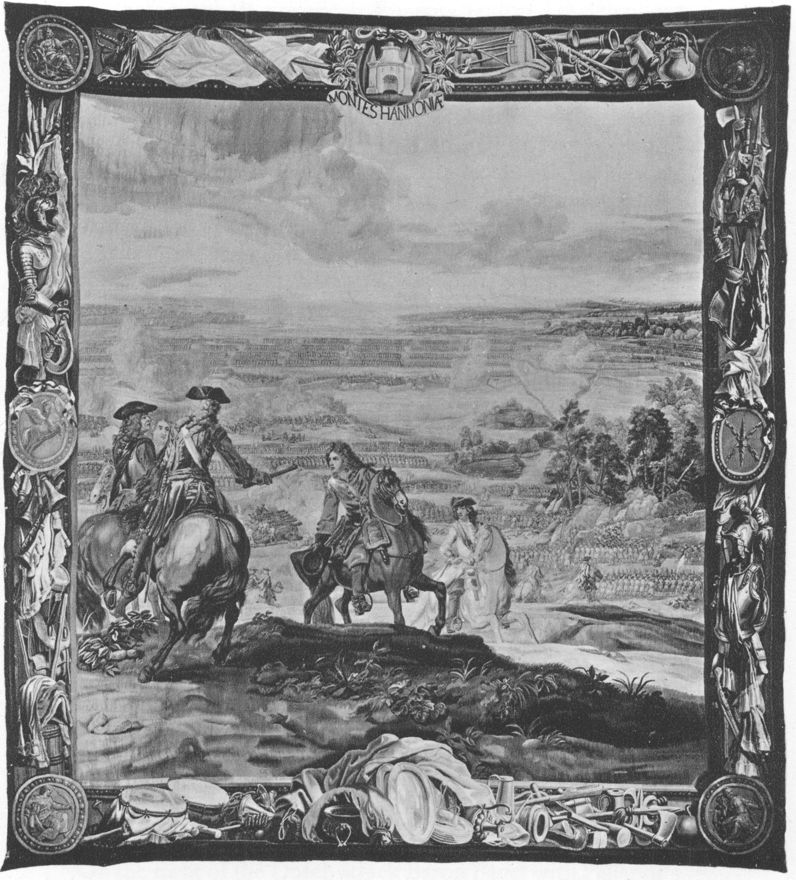
TAPESTRY OF THE BATTLE OF MALPLAQUET
By permission of the Duke of Marlborough. Photograph by permission of the Victoria and Albert Museum
A retreat in good order began. The generals set the highest example. Spaar was killed; Hamilton wounded. Tullibardine fell amid his clansmen; General Week was killed. The Swiss general Mey was hard hit. The whole allied left wing fell back slowly, receiving terrible punishment, over the ground which they had traversed, now thickly strewn with the corpses or writhing bodies of their comrades. They might have fared even worse, for the French pursued them with vigour, but for the fact that the Prince of Hesse-Cassel, with the twenty-one squadrons of cavalry assigned to this flank, was perceived by the enemy, drawn up and seeking the moment to charge. Thus covered, the Dutch halted their deliberate retreat, and faced about. They had lost in half an hour at least five thousand men. Among the Scots there was an equal carnage. But the Prince of Orange would not be denied. His second horse shot under him, he seized the standard of the wounded Mey, ordered a second attack, and led it forward in person on foot. Once again the faithful battalions ran the gauntlet of the batteries firing along the trough. Once again they reached the French entrenchments. Foremost of all their heroic prince planted his standard upon the parapet. Once again the counter-attack swept them backward, this time in grave disorder. Once again Hesse-Cassel with his cavalry checked the pursuers.
On the right of the Dutch attack Baron Fagel with Pallandt’s seven battalions stormed the defences of Bléron Farm; but they in their turn were driven out by the French counter-attack. Rantzau commanded the four Hanoverian battalions on the right of the Dutch. Although he did not belong to the left wing and was in Marlborough’s reserve, he had sent two of his battalions to assist them. They had suffered severely in the slaughter. “Monsieur de Goslinga,” he wrote when his conduct was afterwards questioned,
passing at full gallop, came to me and asked me if I did not wish to advance; I answered that he could see quite well that I was advancing, that it might please him to order the Prussians on my right to make the same movement, and to march forward like me, considering I had too little with two battalions to carry through the affair alone. Monsieur de Goslinga thereupon stopped a moment, and in his confidence of victory, or perhaps seeking to encourage the soldiers, shouted, “La bataille est gagnée, ha! Les braves gens!” After which [says Rantzau somewhat maliciously] he departed, all the more quickly since the enemy had forced our left [i.e. the left of Fagel’s assault] to abandon the entrenchment.[186]
Thus upon the left there was a complete and bloody repulse. This is the moment when the French consider that Boufflers, who was on the spot, should have ordered a general advance of their right wing, which he commanded. It was certainly not from want of spirit that he did not do so. He did not feel entitled to make so great a change in the plans of the Commander-in-Chief without consultation, and for this there was no time. The opportunity passed without being tested.
At ten o’clock, while the Dutch were in their agony, Schulenburg and Lottum renewed their onslaughts upon the Taisnières salient. This time Schulenburg broke into the north face of the wood, and his whole command vanished into it. Lottum’s corps also fell on, but were again brought to a standstill “torn and exhausted.”[187] Their position in the open, almost at right angles to the French centre, harassed by artillery fire from both their front and left flank, became critical. Orkney, who, though not himself actually engaged, was close at hand, sent two more British battalions[188] to support and extend Lottum’s left. While these troops were making their way through the marshy ground, Chemerault, the French general commanding the left of the line of redans, saw a chance. He formed a counter-attack of twelve battalions, and was about to launch it upon Lottum’s exposed left flank. But meanwhile Marlborough had himself ridden forward with the Prince of Auvergne’s thirty squadrons of Dutch cavalry, whom he placed in readiness to charge the French counter-attack. Marshal Villars, who on the other side had also reached this crucial point, seeing the redcoats extending to their right, and this large cavalry force, which Chemerault had not noticed, ready to charge, stopped the counter-stroke and ordered the twelve battalions back—but not to their redans. “I saw,” he declares, “that our infantry was losing ground in the wood, and I posted these twelve battalions to receive them when they came out of it.”[189] The denudation of the French centre had begun.
With conspicuous zeal Argyll’s brigade and Orkney’s two battalions plunged into the Wood of Taisnières at the root of its tongue.[190] “The English brigade,” says the Feldzüge account, “was in support and gathered Brandenburg’s troops to a renewed storming.”[191] Thus they drew forward with them in their movement the whole of Lottum’s corps, which, like that of Schulenburg, now disappeared among the trees and undergrowth. The conditions inside the salient were indescribable. Within a triangle, no side of which exceeded six hundred yards, there were at least seven thousand men lying killed and wounded, more than thirty thousand allied infantry in almost solid masses, and four or five thousand French survivors. More than half the superior officers had fallen. The wounded of both sides, officers and men, were bayoneted and plundered. The screams of the injured, the roar of the mob of combatants, the crash of musketry, resounded from this smoking inferno, in which half the allied foot had become engulfed.
Argyll’s brigade sustained heavy losses—in fact, Sir Richard Temple’s regiment lost more men that day than any other single British battalion. They performed prodigies; but their high spirits took a savage form. “They hewed in pieces,” wrote a German observer, “all they found before them, . . . even the dead when their fury found no more living to devour.”[192]
Such was the situation which Marlborough from his post a furlong behind the Grand Battery surveyed upon his right. Here amid the cannon-balls he sat his horse, waiting for the moment to strike at the French centre. He must for some time have felt serious concern at the numbers of his troops which were being absorbed in the Taisnières Wood, and by the carnage and chaos which reigned there. Towards half-past ten he began to feel uneasy also about his left. He knew that the first attack of the Dutch had been repulsed. He had not intended this attack to be pressed to the same extremity as that of his right. It was, however, an essential part of his plan that the fighting even on the left flank should be serious and heavy. Only by these brutal pressures would the two French Marshals be forced to denude their centre. He had not, however, prepared himself at all for the catastrophe which now broke upon him.
He had already begun to ride towards the left wing when Goslinga, indignant, excited, stained with battle, met him a little short of the Wood of Tiry, before which Rantzau and his battalions were posted. The brave, vehement Deputy told his tale. To anyone who had been through that double repulse it must have seemed that the Dutch corps was virtually destroyed. Goslinga added that the Prince of Orange was organizing a third attack. He demanded immediate reinforcements for the Dutch. Apparently he complained of the change of plan which had deprived them of Withers’ corps. It is very likely that he also reported that when he had urged Rantzau to advance with his two remaining Hanoverian battalions Rantzau had not complied. The Captain-General bore the tidings with his usual composure. He calmed the passionate Deputy, and brought him along with him. About this time Eugene, warned of what had happened on the left, overtook Marlborough. Together they reached the point where Rantzau was in action. “Presently,” writes Rantzau, “this Prince and the Duke of Marlborough passed on their way to the left wing. Monsieur de Finck, Lieutenant-General, received from them the order [for me] not to quit the post where we now were, unless my lord Duke should make us march himself.”[193]
Marlborough, Eugene, and Goslinga then rode on through the streams of Dutch wounded staggering from the battle, or returning bleeding to resume their places in the ranks, to the point where the survivors of the Dutch command gathered around the indomitable Prince. They found consternation both at the appalling losses and at the young Prince’s resolve to renew the attack. Together they forbade the further effort, and ordered the left to stand still under the protection of Hesse-Cassel’s squadrons.[194]
Then the two Chiefs returned to the centre and the right. Perhaps they galloped, for the crisis of the battle approached. Eugene hastened back to the Wood of Taisnières. Marlborough resumed his former position behind the Grand Battery. It was now half-past eleven of the clock on a fine summer’s morning.
Eugene found that progress had been made in Taisnières Wood. Weight of numbers had prevailed over both the obstacles and the French resistance. The French had been driven out of their second position behind the tongue, and the allied line was rolling forward yard by yard, extending as the wood broadened. General Withers with his separate corps, including three British battalions and the Royal Irish, who were some way behind, had entered the wood on the extreme right and encountered little resistance. Eugene had sent him ten additional squadrons, which with his own ten were making their way by a wide circle round the woods and also moving towards La Folie. This movement as it progressed tended to turn the whole hostile position.
A combination of forces was thus developing against the left of the French army which if not broken would be fatal. Marshal Villars watched this with deepening anxiety. He felt the left of his centre was about to be exposed. He responded to this dire pressure exactly as Marlborough had planned and expected. First he sent to Boufflers for reinforcements, but that Marshal, in grapple with the Dutch, could send him none. Villars then resorted to the desperate expedient of taking the remaining troops out of the redans of his centre and throwing them against the Wood of Taisnières to stem the allied advance. He, or others acting on his authority, drew first the Irish brigade, the Champagne brigade, and later La Colonie’s Bavarians, and sent them to reinforce Albergotti’s remnants. Some of these troops, as will presently be seen, ranged widely in the wood, but their main attack fell upon Lottum. Both Lottum and Schulenburg were heavily checked. The dense but much disordered allied line wavered and recoiled. Eugene was at hand. He rode forward into the front line rallying the German Imperialist troops. It was now that a bullet grazed him behind the ear. He was not disabled. He refused to withdraw. “If we are to die here,” he exclaimed, “it is not worth dressing. If we win there will be time to-night.” Step by step, with hideous losses, all the allied nations fighting in the wood resumed their advance, and shortly before noon arrived in a ragged but heavy line at the edge of the plain.
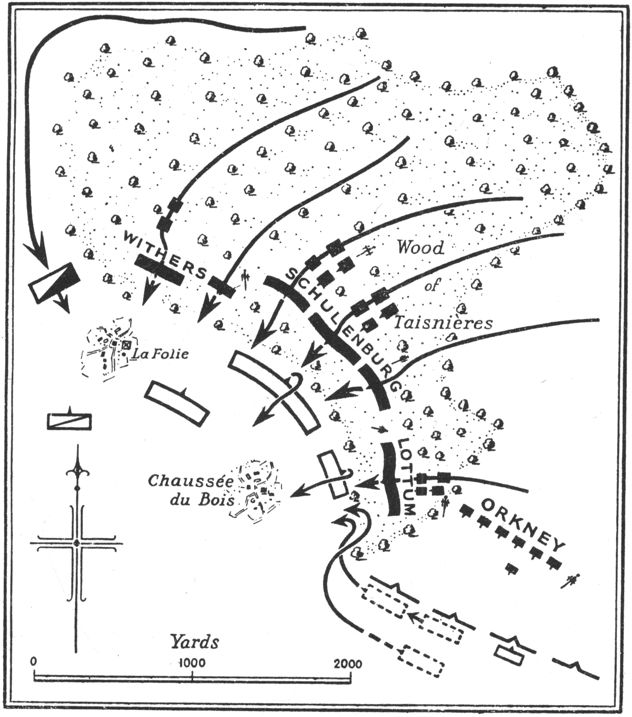
THE ALLIED RIGHT IN THE WOODS
“The wood being forced,” says Schulenburg, “I found myself on the other side towards the enemy’s lines, where I managed to bring up by a kind of miracle seven big cannon which I had with me, by which I did not fail to do great harm to the line of French cavalry.”[195] This battery began to fire with highly disconcerting effect from the southern flank of the line. At the same time the twenty squadrons of cavalry in Withers’ force were making their way round the western edge of the Taisnières Wood towards the French extreme left flank behind it. The remainder of Albergotti’s corps, driven out of the wood, formed on a prepared line and on their reserves three or four hundred paces from its farther edge. For a space of perhaps an hour all the forces on this wing were occupied in rearranging their disordered lines and preparing for a further clash.
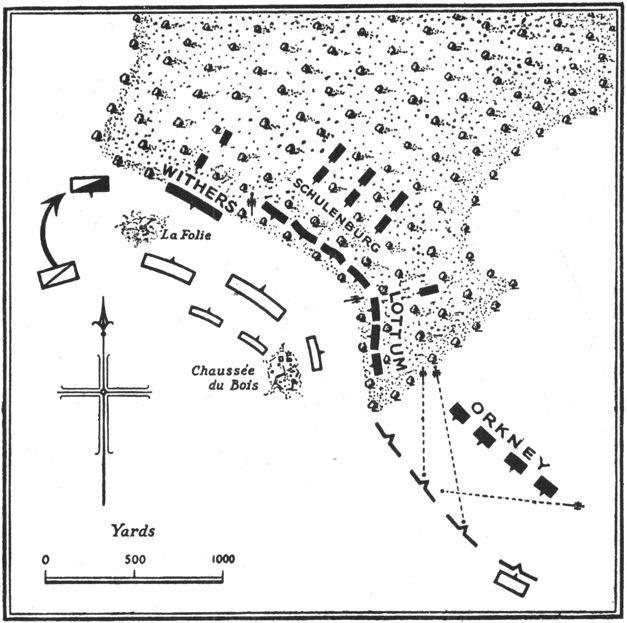
THE ALLIES REACH THE EDGE OF THE WOODS
La Colonie shows us very plainly the working of the remorseless pressures upon the French centre.
By the time the Irish Brigade had got well into the wood it was considered to be hardly sufficient as a reinforcement by itself, and an order came for us to follow it, although there was no one else to fill our place, which would be left open to the enemy. When the first order was brought to the brigade-major, who reported it to me, I refused to obey it, and pointed out the absolute necessity that existed for our maintaining the position we were holding; but a lieutenant-general then arrived on the scene, and ordered us a second time to march off, so sharply that all our remonstrances were useless.[196]
By noon Schulenburg’s troops were reassembled and drawn up beyond the wood “where one saw the open country.”[197] Their front stretched from the village Chaussée du Bois to La Folie, and the enemy’s line stood before them at a distance of two to three hundred yards. Lieutenant-General Wackerbarth, who commanded Schulenburg’s first line, is responsible for an erroneous statement which has confused some Continental accounts: “The nineteen battalions from Tournai who ought to have been on my right came out of the wood eventually on my left, so that I became the right of the whole army.”[198] In the depths of the wood, by one of the strange coincidences of history, the Royal Irish met and defeated the French Royal Irish Regiment—famous in the war as the “Wild Geese.”[199]
Marlborough was still uncertain of the position in the centre. He doubtless knew that the Wood of Taisnières was cleared of the enemy. But more than four-fifths of his infantry were either repulsed with the Dutch or so deeply committed on the right as to be beyond manœuvring control. He now resolved to ride swiftly through Taisnières Wood to where Schulenburg’s battery was heard to be firing, in order to see the condition of his right wing, and above all from this new angle the state of the enemy’s centre. As he picked his way through the terrible wood, encumbered with slain, filled with the groans and piteous cries of the wounded, he met Eugene. Schulenburg describes how the two Commanders both joined him on the inner edge of the wood at about a quarter to twelve.
A great situation disclosed itself. Beyond the wood to the southward, perhaps three hundred yards away, a strong French line of battle of apparently forty or fifty battalions had been formed to deliver the supreme counter-attack on the remaining forces of Lottum, Schulenburg, and Withers. The forces now facing each other in array at a few hundred paces in this part of the battlefield amounted to perhaps twenty-five thousand men on each side. But the vital fact lay in the centre.
“I can indeed,” says Schulenburg in his account,
describe the circumstances of this battle which I watched de haut en bas et à mon aise. . . . As soon as my lord Duke heard these cannons roar from this point, he came with Prince Eugene to see me. The Prince, coming up, said, “Truly Lottum has struck a decisive blow” [a fait un coup de partie], to which I answered there and then, “If it is a decisive blow, you owe me something for it, because not only have we made the French cavalry on our front retreat by our cannon fire, but I have also taken pains to enfilade a good part of the entrenchments of the enemy which cross the plain. Thus, Monseigneur,” said I to my lord Duke, “the French having abandoned these entrenchments, don’t delay to have them occupied—of course along the reverse—by several battalions as fast as possible, I beg you.”[200]
So once again the moment had come when, the whole of the enemy’s infantry being fully engaged and their centre naked, Marlborough still had under his hand a decisive reserve of fresh troops of the highest quality. Much is contradictory and most things uncertain in this vast, dark battle; but we know definitely that Marlborough was with Schulenburg at the edge of the wood somewhat before noon, and that a few minutes after twelve he was back at his former post behind the Grand Battery giving a series of orders which snatched victory from the jaws of defeat. He ordered Orkney to advance with the British corps and several Prussian battalions upon the line of redans. He rearranged the artillery in the centre so as to bring cross-fire to bear upon these works. He ordered Auvergne with his thirty squadrons to follow immediately behind Orkney. He summoned Hesse-Cassel from the left to keep pace with Auvergne. He ordered the whole mass of the cavalry to be ready to advance. He must now have felt, as in the afternoon at Blenheim, that in spite of all mischances and disasters victory was in his hands.
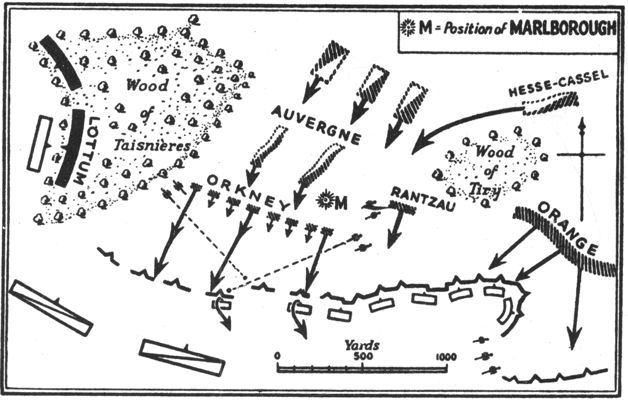
ORKNEY’S ATTACK
The British and Prussian infantry had hitherto stood in array under severe cannon fire, close to the battle-front. On Marlborough’s order Orkney led them forward in a single line of battalions upon the redans of the French centre, from which they had noticed for some time neither smoke nor fire had come. Now their Hussar patrols cantered forward, and here and there got round or into some of the works and signalled that they were empty or weakly held.
“It was about one o’clock,” says Orkney, “that my thirteen battalions[201] got up to the retrenchments, which we got very easily; for as we advanced they quitted them and inclined to their right. . . . We found nothing to oppose us, however. Not that I pretend to attribute any glory to myself (for it was the nature of our situation), yet I verily believe that these thirteen battalions gained us the day, and that without firing a shot almost.” But this advantage had not come by chance to the gallant Orkney. It was the gift of Marlborough’s genius dominating at last the confusion of the battle.[202]
Among the British battalions which now delivered the decisive stroke were the Cameronians, and we discern the sombre, stately figure of Major Blackader, inspiring his men and communing with his God, his eye fixed upon the Amalekites in another “Ebenezer” of his life.
“It was,” he writes,
the most deliberate, solemn, and well-ordered battle that ever I saw—a noble and fine disposition, and as nobly executed. Every man was at his post; and I never saw troops engage with more cheerfulness, boldness, and resolution. In all the soldiers’ faces appeared a brisk and lively gaiety which presaged victory. The Lord of Hosts went forth at our head as Captain of our host, and the army followed with a daring cheerful boldness, for we never doubted but we would beat them.
Providence ordered it so, that our regiment was no farther engaged than by being cannonaded, which was, indeed, the most severe that ever our regiment suffered, and by which we had considerable loss. But the soldiers endured it without shrinking, very patiently, and with great courage. For my own part I was nobly and richly supplied, as I have always been on such occasions, with liberal supplies of grace and strength, as the exigencies of the day called for. I never had a more pleasant day in my life. I was kept in perfect peace; my mind stayed, trusting in God. All went well with me; and not being in hurry and hot action, I had time for plying the throne of grace, sometimes by prayer, sometimes by praise, as the various turns of Providence gave occasion; sometimes for the public, sometimes for myself. I did not seek any assurance of protection for my life; I thought it enough to believe in general, to depend with resignation, and hang about His hand.[203]
But if the major had never passed a more pleasant day, it fared otherwise with his colonel. Cranstoun, whose able letters and criticisms have been several times quoted here, was at the head of his stern regiment. A round shot, about the size of a cricket-ball, such as are still picked up on this old battlefield, struck him in the left breast, coming out at his back. He fell from his horse before Blackader’s eyes without a word. The command devolved upon Blackader. “A thousand shall fall at thy side,” he murmured, “and ten thousand at thy right hand, but it shall not once come near to thee.”[204] Thus uplifted, in the temper of the Ironsides, he led forward his men.
The French Guards, resplendent in their new uniforms, who were posted some distance behind the redans, did not attempt any counter-attack, incurring thereby bitter ridicule and reproach from the French army. Only upon the British left was there any resistance; and all the entrenchments in the enemy’s centre were captured with small loss. The Dutch infantry on the left, torn by their fearful losses but with undaunted spirit, were led for the third time to the attack on the corpse-strewn triple entrenchments by their Prince and their surviving generals. All accounts speak of the ardour of these troops, who had to be restrained rather than incited. “As at the beginning of the battle, so now, the Dutch bought with their blood every step of the broad earth, and in the end the French right wing had to abandon the field to such death-defying courage.”[205] Hesse-Cassel with his twenty-one squadrons was already passing the gaps upon the left of the line of redans, and unless arrested would speedily take the hitherto victorious French right wing and their defences in flank and rear.
By a quarter-past one the British battalions held the front face of all the redans. The intervals between them became so many gateways through which the allied cavalry could debouch and endeavour to form line on the plain beyond. The cross-fire of their supporting batteries afforded them some measure of protection during this critical operation. The Prince of Auvergne, with his thirty Dutch squadrons, had followed close behind the British infantry, and began to pour through the gaps and deploy for the charge. Close behind came General Wood with the whole of the British cavalry. Rolling forward behind them again marched the heavy columns of the Prussian and Hanoverian horse under General Bülow, and the whole body of the Imperialist cavalry under the Duke of Würtemberg and Count Vehlen; in all, pressing forward at this point, more than thirty thousand horsemen, the equivalent of seven or eight modern cavalry divisions. This combination of horse, foot, and guns recalls the central attack at Blenheim. The perfect execution of these complicated manœuvres in the roar and crash of the great battle, the discipline and mutual loyalty of all these troops of different nations, justly won the admiration of their enemy, and deserve the proud glance of history.
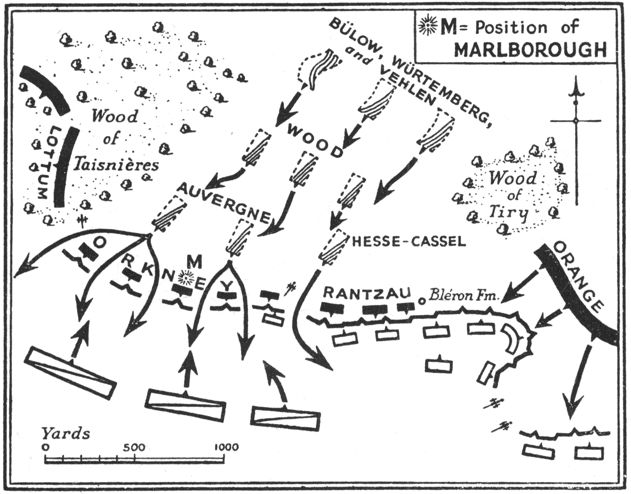
THE CAVALRY ATTACK
Marlborough with his staff had ridden forward to a point near one of the redans where he could regulate this new and decisive phase. The struggle of the infantry was mainly over, and a cavalry battle, far larger even than Ramillies, the greatest, in fact, of which there is any example, was about to begin.
While all this was in progress in the centre the much diminished and somewhat disorganized forces of Lottum, Schulenburg, and Withers, in line beyond or along the southern edge of Taisnières Wood, faced the counter-stroke which Marshal Villars had prepared at so heavy a cost to his army. The Marshal had collected upwards of fifty battalions, composed of the remains of Albergotti’s five brigades, all the troops he had withdrawn from his centre, and the French reserves which had hitherto been posted in this quarter of the field. The two lines along a mile of front faced each other, often at no more than two hundred yards’ distance. Beyond La Folie, and in full view of the greater part of the French left wing, a cavalry episode cheered the arms of France. General Miklau, with the squadrons of Withers, had at length made his way round the forest belt, and his leading squadrons were already deployed to attack the left flank of the hostile infantry. Upon him fell eight squadrons of French carabineers. They caught Miklau in flank in the act of deploying. At least six squadrons of the allied horse were cut to pieces, and the rest driven from the field, the bulk taking shelter in the woods. No mercy was shown by the victors, and the wounded were slaughtered on the spot.
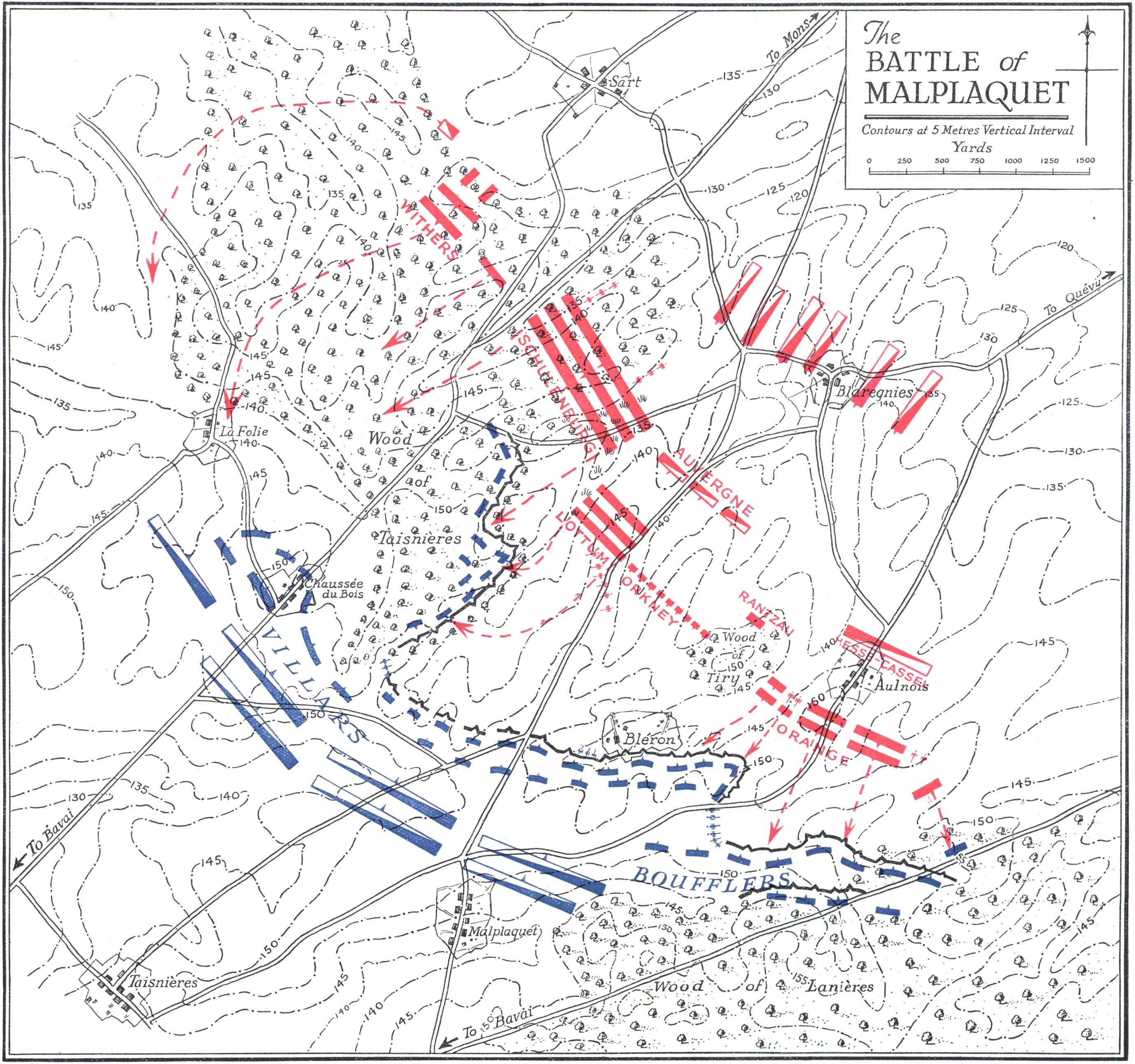
The BATTLE of MALPLAQUET
As the whole French line braced themselves to attack there arrived from the centre the veteran artillerist Saint-Hilaire. The tale he told to Villars was terrible. The redans were empty. Masses of the English were already breaking into them. He had only by minutes saved his guns from capture. The Marshal, resolute as ever, saw no remedy but to lead forward twelve battalions which were at the moment in his hands as part of his general counter-stroke. Opposite to him at the edge of the wood was Eugene, who, with all the troops he could control, prepared to meet the French in full career. The whole front came into close, intense fire action, quivering and writhing under the effect of the volleys, while the dead and wounded sank upon the ground.[206] Marshal Villars and his staff, riding forward, caught a blast of fire. His horse fell dead, and a bullet smashed his left leg below the knee. At the same moment Albergotti fell from the saddle with a broken thigh, and General Chemerault was killed. Aides-de-camp and a surgeon ran to the prostrate Marshal. He refused to quit the field. A chair was found in a cottage hard by. Seated in this, he endeavoured to conduct the battle, but the agony of his wound was overpowering. He swooned, and remained so long unconscious that they carried him away. He did not recover consciousness until he was in the hospital at Quesnoy. In his own words, “That is all I know about the end of the battle.”
There is no doubt that the fall of the illustrious Commander-in-Chief and the simultaneous loss of Albergotti and Chemerault disorganized the French command at the supreme moment of their counter-attack. It is natural that French writers, then and afterwards, should claim that but for this they would have won the battle. But the troops who stood before them were tough and bitter, certainly as numerous, infuriated by their losses, flushed by success, and with Eugene at their head. They would not easily have been driven back into the wood, certainly not through it.
After an interval of paralysis Puységur, the staff officer whose reputation after Oudenarde still stood high, assumed direction of the French left wing. He organized and ordered a methodical retirement. Some regiments marched to within twenty yards of the Allies to fire their final volley before retreating, but within a quarter of an hour of Villars’s wound the fifty battalions with their supporting cavalry had retired in good order out of all contact. The Allies, still clogged by the confusion of their passage of the wood, were in no condition to pursue. Eugene himself ordered them to remain halted, and to consolidate, and hastened to join Marlborough in the new focus of the battle.
From early morning onward the French cavalry on the plain behind the centre had suffered severely from the allied cannonade. The slopes of the ground were such that many cannon-balls which ricochetted from the crest of the redans flew onward, cutting cruel gaps in the closely formed squadrons. The allied cavalry did not suffer in this way, for the ground on which they had waited was not exposed to this glancing fire. Nevertheless, the French horse was almost as numerous as the Allies’. The French also had the advantage of being able to attack in superior strength an enemy while forming. It was indeed with relief and pent-up wrath that the brilliant squadrons, which had so long borne their punishment from the cannon, found at last a foe to strike. Marshal Boufflers, learning that the supreme command had devolved on him, placed himself at the head of the Maison du Roi, and as soon as Auvergne had formed twenty squadrons beyond the redans, charged him with these splendid troops.
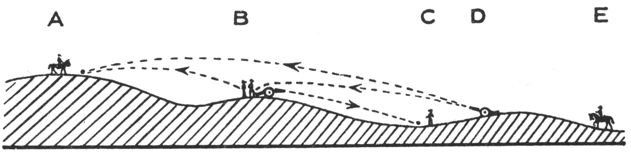
A, French cavalry; B, French infantry and guns; C, allied infantry; D, allied guns; E, allied cavalry.
From “Marlborough’s Battlefields Illustrated: Malplaquet,” by Major A. H. Burne, D.S.O., R.A., in “The Journal of the Royal Artillery,” vol. lx, p. 48.
Orkney, whose battalions now manned the whole line of redans, watched the scene at close quarters. “Before we got thirty squadrons out they came down and attacked; and there was such pelting at one another that I really never saw the like.” Auvergne’s Dutch squadrons were driven back upon the redans, and through the intervals between them. But here the pursuers were stopped by the steady fire of the British infantry and guns. As they recoiled the allied cavalry poured forward again through every gap. General Wood came up with the British cavalry. The fighting was now almost entirely with the sword. Orkney’s laconic, veteran style reveals how deeply he was stirred: “We broke through them, particularly four squadrons of English. Jemmy Campbell, at the head of the Grey Dragoons, behaved like an angell, broke through both lines. So did Panton, with little Lord Lumley at the head of one of Lumley’s and one of Wood’s.”[207] The struggle ebbed and flowed. The Maison du Roi, with Boufflers fighting sword in hand at their head, again drove back the Dutch, British, and Prussian horse, and repeatedly prevented them from deploying in sufficient numbers. But the triumphant cavaliers were brought each time to a standstill by the disciplined platoon firing of the British infantry. “I really believe,” says Orkney, “had not ye foot been there, they would have drove our horse out of the field.”[208]
Six separate times did the French charges prevent the main body of the allied cavalry from forming on the plain. Marlborough had led up in person the British and Prussian squadrons. Now Eugene arrived with the whole Imperialist cavalry. Hesse-Cassel had established himself on the left of the line. Boufflers, at last convinced of the impossibility of charging home and producing decisive results against the well-posted and well-trained infantry on the redans, withdrew the mass of the French cavalry to the heath of Malplaquet, a few hundred yards farther to the southward. Here the cavalry conflict renewed itself in continuous charges for over an hour.
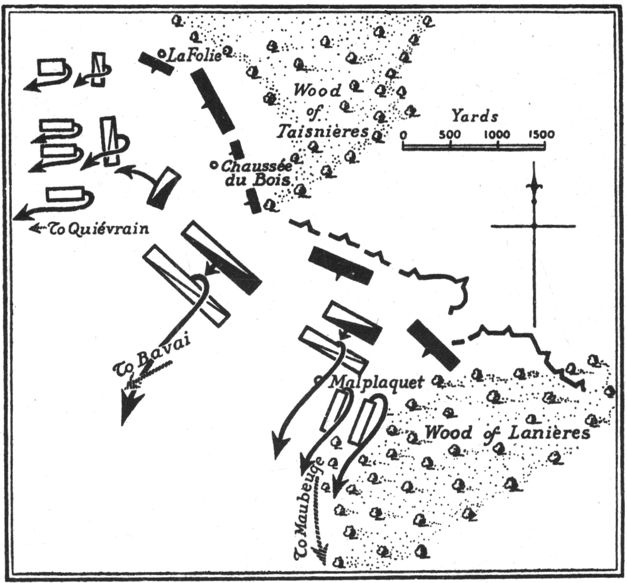
THE FRENCH RETREAT
But meanwhile the main battle had been decided. The French left was already in full retreat upon Quiévrain. On the other flank Hesse-Cassel’s squadrons now threatened the rear of the French right wing. The Prince of Orange in his final attack led his heroic fellow-countrymen over the three lines of trenches. The aged, noble Boufflers, unshaken by his prodigious exertions, did not forget his duty as Commander-in-Chief. Both his wings were in retreat. His centre was pierced, his cavalry outnumbered, pressed backwards, but still in order. He devoted himself with his cavalry to the task of covering the general retirement which was now in progress. By three o’clock the French were marching in three directions upon Quiévrain, Bavai, and Maubeuge.
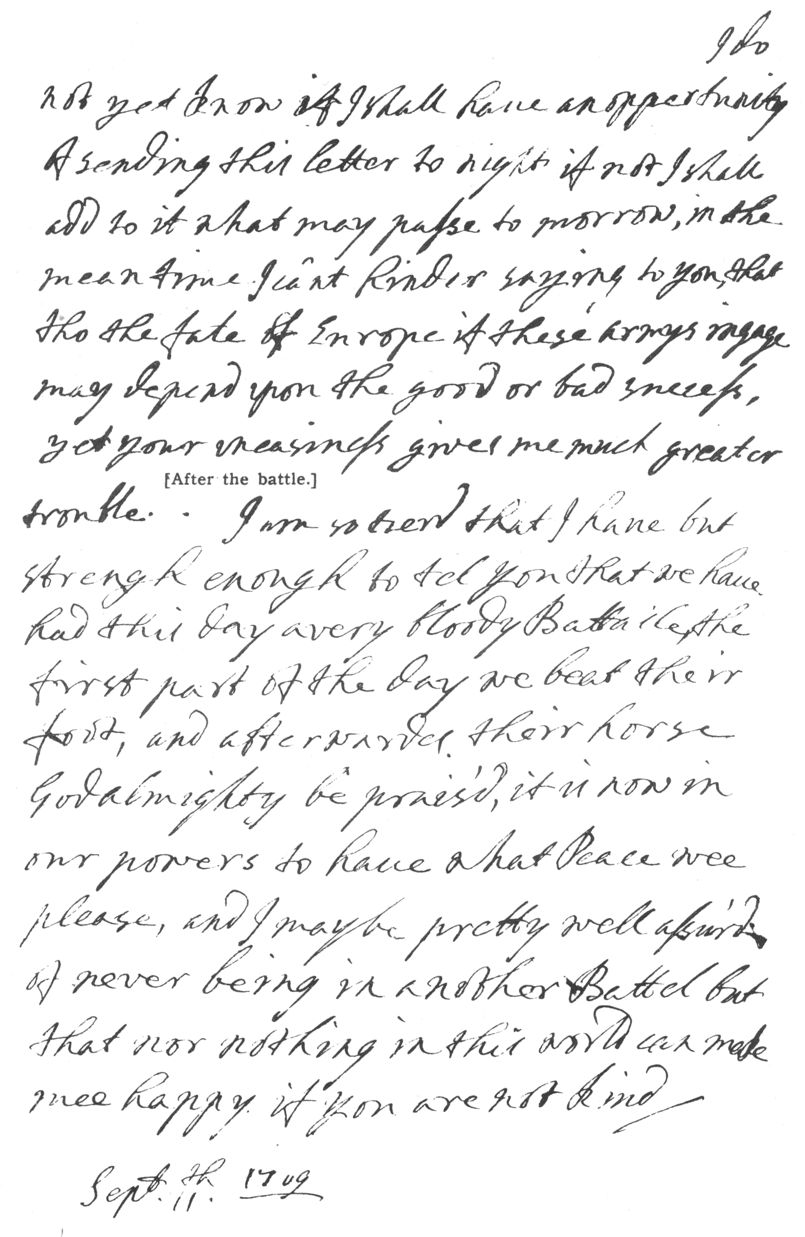
JOHN TO SARAH AFTER MALPLAQUET
Blenheim MSS.
So severe and sternly contested had been the battle that the Allies could not pursue. The infantry of both wings were fought to a standstill. The intact British battalions in the centre were the sole link between the two disorganized wings. The cavalry pursued as far as the Hognon stream, but the French had organized strong rearguards of infantry, and their cavalry, though worsted, was still formidable. Marlborough and Eugene were both convinced that they could ask no further sacrifices of their troops. The battle was won, and the victors camped upon the bloody field. Marlborough sat down in his tent near the Mill of Sart and finished the letter he had been writing to Sarah at intervals since the morning of the 9th. The facsimile opposite shows how little his careful handwriting had been affected by the ordeal through which he had just passed. The intense strain of the two days’ manœuvre and battle, the long hours at close quarters under the cannonade, the tumult and collision of the cavalry masses, the thirty or forty thousand killed and wounded men who cumbered the ground, the awful stake which had been played, left his sober poise undisturbed, his spirit calm. He reread what he had written the day before, took up his pen, and added:
Sept. 11, 1709
I am so tired that I have but strength enough to tell you that we have had this day a very bloody battle; the first part of the day we beat their foot, and afterwards their horse. God Almighty be praised, it is now in our powers to have what peace we please, and I may be pretty well assured of never being in another battle; but that nor nothing in this world can make me happy if you are not kind.[209]
|
British regiments at Malplaquet (the grouping is that for the campaign of 1709, and was altered for the battle):
The English artillery: 40 guns, about 1000 men. Total British: 15,000. [Fortescue, A History of the British Army, i, 527.] The whole army aggregated 253 squadrons, 128 battalions, and 100 cannon, or about 110,000 men on the preparatory line 6000 to 7000 yards in length. | |||||||||||||||||||||||||||||||||||||||||||||||||||||||||||||||||||||||||||||||
|
Including Argyll’s British brigade (the Buffs, the King’s Regiment, and probably Temple’s). |
|
Feldzüge, Series II, ii, 103. |
|
Chronicles of an Old Campaigner (trans. 1904), p. 338. |
|
These were the Scottish troops in the Dutch service. |
|
Rantzau to Bülow: Lamberty, v, 370. |
|
Feldzüge, Series II, ii, 104. |
|
One battalion of Guards and one of Royal Scots. |
|
Villars, Mémoires, iii, 70-71. |
|
It is unlikely that Argyll was actually in command of his own brigade. As a lieutenant-general he would have a wider authority in Lottum’s attack. |
|
Corporal Matthew Bishop has left a picturesque account: “The Enemy had the advantage of the wood, which would have rendered them capable of destroying the greatest part of us, had they not been intimidated. When we came near the wood, we threw all our tent poles away, and ran into it as bold as lions. But we were obstructed from being so expeditious as we should, by reason of their artful inventions, by cutting down trees and laying them across, and by tying the boughs together in all places. This they thought would frustrate us, and put us into disorder, and in truth there were but very few places in that station in which we could draw up our men, in any form at all; but where we did, it was in this manner. Sometimes ten deep, then we were obstructed and obliged to halt, then fifteen deep or more, and in this confused manner we went through the wood, but yet all in high spirits.” (The Life and Adventures of Matthew Bishop, p. 208.) |
|
Lichtenstein family’s archives; Feldzüge, Series II, ii, 104-106. |
|
Lamberty, v, 372. |
|
Lediard (ii, 495) asserts that Marlborough promised to send Withers to the left as a reinforcement. If so, it was to soothe the Dutch indignation, for he knew only too well that Withers was launched beyond recall into the woods nearly four miles away. |
|
Schulenburg, Part II, 417. |
|
La Colonie, p. 339. |
|
Wackerbarth’s account in Schulenburg, Part II, 416. |
|
Wackerbarth’s statement that Withers’ whole force missed their way and came into line on his left, and that he was the right of the army, is adopted by the French official historian, Sautai. It contradicts all extant British accounts. It seems incredible that Withers, with his large force of nineteen battalions, could have come right across behind Schulenburg’s line at the edge of the wood or could have found room to come into action between the corps of Schulenburg and that of Lottum. One can only conclude that Wackerbarth arrived at the edge of the wood before Withers had debouched, thought he was himself the right of the army, and that as he was soon wounded he did not witness the later developments in this quarter. It may be also that some of Withers’ battalions strayed to their left in the confusion, and that Wackerbarth mistook the part for the whole. |
|
Captain Parker has left a clear account. “We happened to be the last of the Regiments that had been left at Tournay to level our approaches, and therefore could not come up till the Lines were all formed and closed, so that there was no place for us to fall into. We were ordered therefore to draw up by ourselves on the Right of the whole Army; and when the Army advanced to attack the enemy, we also advanced into that part of the wood, which was in our Front. We continued marching slowly on, till we came to an open in the wood. It was a small plain, on the opposite side of which, we perceived a Battalion of the enemy drawn up. Upon this Colonel Kane, who was then at the head of the Regiment, having drawn us up, and formed our Platoons, advanced gently towards them, with six platoons of our first fire made ready. When we had advanced within a hundred paces of them, they gave us a fire of one of their ranks; Whereupon we halted, and returned them the fire of our six Platoons at once; and immediately made ready the six Platoons of our second fire, and advanced upon them again. They then gave us the fire of another rank, and we returned them a second fire, which made them shrink; however, they gave us the fire of a third rank after a scattering manner, and then retired into the wood in great disorder; On which we sent our third fire after them, and saw them no more. We advanced cautiously up to the ground which they had quitted, and found several of them killed and wounded; among the latter was one Lieutenant O’Sullivan, who told us the Battalion we had engaged, was the Royal Regiment of Ireland. Here, therefore, there was a fair trial of skill between the two Royal Regiments of Ireland; one in the British, the other in the French service; for we met each other upon equal terms, and there was none else to interpose. We had but four men killed, and six wounded; and found near forty of them on the spot killed and wounded. “The advantage on our side will be easily accounted for, first from the weight of our ball; for the French Arms carry bullets of 24 to the pound; Whereas our British Firelocks carry ball of 16 only to the pound, which will make a considerable difference in the execution. Again, the manner of our firing was different from theirs; the French at that time fired all by Ranks, which can never do equal execution with our Platoon-firing, especially when six Platoons are fired together. This is undoubtedly the best method that has yet been discovered for fighting a Battalion; especially when two Battalions only engage each other.” (Memoirs, pp. 138-140.) It is impossible to tell in what part of the wood this fight took place. We know that the French Irish brigade had moved from the redans into the wood on their left. They could hardly, therefore, have come into action at any time against Withers’ command, which was fighting nearly two miles away—about La Folie. In fact, General Saint-Hilaire in his account states plainly that he saw them in action on the right of the French left wing at the time when Villars was wounded, and that they were “the only troops who stood firm, and did not break” (Saint-Hilaire to the Duc du Maine (Quesnoy, September 12, 1709), cited by Sautai). It would seem, therefore, that the British Royal Irish, entering the wood separately, lost touch with the rest of Withers’ corps and, attracted by the heavy firing, made their way to the left of the wood. Here they would easily meet part of the French Irish brigade. Here also they might have been seen by General Wackerbarth, who on hearing that they were in Withers’ corps concluded mistakenly that that corps had come into line upon his left, instead of, according to their orders, upon their right, as no doubt they did. |
|
Schulenburg, Part II, 417. |
|
Eleven British and two foreign. |
|
See “Letters of the First Lord Orkney,” English Historical Review, xix (1904). |
|
A. Crichton, The Life and Diary of Lieutenant-Colonel J. Blackader (1824), p. 350. |
|
Blackader, p. 352. |
|
Feldzüge, Series II, ii, 107. |
|
Corporal Bishop tells a tale: “They returned our volley with great success. I may say it, for my right and left hand men were shot dead, and in falling had almost thrown me down, for I could scarce prevent my falling among the dead men. Then I said to the second rank: ‘Come, my boys, make good the front.’ With that they drew up. Then I said: ‘Never fear, we shall have better luck the next throw.’ But I just saved my word, for my right hand man was shot through the head, and the man that followed me was shot through the groin, and I escaped all, though nothing but the Providence of God could protect me. Then our rear man was called up to be a front; but the poor man was struck with a panic, fearing that he should share the same fate as the others did. He endeavoured to half cover himself behind me, but I put my hand behind me and pulled him up, and told him, that I could no ways screen him, for he was sensible a man behind me was shot. By strong persuasion I prevailed upon him, so that he was not in the least daunted, but stood it out as bold as a lion. We received a great many volleys after that, and one time I remember it wounded my Captain and took my left hand man, and almost swept off those that were on my right, so that it left the man that was intimidated, and myself alone. Then I said: ‘Come, Partner, there is nothing like having good courage.’ So we filled up our ranks in a regular form, and when we had so done, we fired upon them briskly and with great success.” (The Life and Adventures of Matthew Bishop, p. 211.) |
|
“Letters of the First Lord Orkney,” English Historical Review, xix (1904). |
|
Ibid. |
|
Coxe, v, 70. |
Europe was appalled at the slaughter of Malplaquet. The battle of Landen, to which its features have sometimes been compared, had not been nearly so bloody. The losses of the Allies were returned at twenty-four thousand officers and men; those of the French were not fewer than twelve thousand, and probably nearer fifteen thousand. Not until Borodino in 1812 was the carnage of this day surpassed. Our modern mass minds, brutalized by the tenfold figures of the Great War, spread over wider fronts and often weeks of fighting, measure only with some difficulty the shock which the intricate polite society of the old world sustained.[210] Upon no one was the impression of the slaughter more deeply marked than upon Marlborough. It disturbed his mind; it affected his health; it changed his sense of values. As he rode through the ghastly woods of Taisnières, or up the trough across which the Dutch had attacked, the heaps of stripped corpses affected him profoundly.
“The day,” wrote Goslinga on September 13, “was very bloody, and disputed for more than six hours with more obstinacy and uncertainty of result than I know how to describe. The Princes and generals who saw yesterday the left of the battlefield were horror-struck to see our men stretched before the entrenchment and within it in their ranks as they had fought.”[211]
A foreign writer says:
There where the Dutch Guard battalions had stood lay about twelve hundred terribly mutilated corpses, most robbed of their clothes, in rows before the French entrenchments. The bodies of those who had been foremost seemed to have been mown down, having toppled forward in their ranks against the enemy breastworks. Behind them the ditch was so thick with corpses that no inch of soil could be seen. Add to such a sight the shrieks and groans and sighs of the badly wounded, and one can get some idea of the horror of the night which followed the battle of Malplaquet.[212]
All his long years of war—almost from childhood—had not been able to impart to Marlborough that detachment from human suffering which has often frozen the hearts of great captains. Considering all the rough work he had had to do, he was astonishingly sensitive. He had none of the fanatical ruthlessness of Cromwell at Wexford and Drogheda. He could not, like Napoleon on the field of Eylau, remark unconcernedly upon the physique of the dead, “Ce sont de la petite espèce.” “It is melancholy,” he wrote, “to see so many brave men killed, with whom I have lived these last eight years, when we thought ourselves sure of a peace.”[213] He was unmanned by the plight of the wounded, of whom at least fifteen thousand of all nations and both armies were left upon his hands. “I have hardly had time to sleep, being tormented by the several nations for care to be taken of their wounded.”[214] His resources and the science of those days were hopelessly inadequate. For days the woods were crawling with shattered beings. From all sides it is testified that he did his utmost to succour them. He invited Boufflers to send wagons without formality or delay to take back all French wounded, officers or men, upon the simple promise not to serve again. He sent back the wounded Irish himself. He took all the money in his military chest and spent it on relief. His behaviour at this time was greatly respected in all countries. It was known how hard and well he had fought in the battle,[215] and also that his compassion for the wounded was sincere.
Marlborough, like his army, was morally and physically exhausted by the battle. He had fought it with all the skill and vehemence he had shown at Blenheim. His plans had proved successful. He had won at every point. The enemy had been beaten out of all their defences and driven from the field as a result of the heart-shaking struggle. But they had not been routed: they had not been destroyed. They had got off as an army, and, indeed, as a proud army. They retreated, but they cheered. They were beaten, but they boasted.
Villars has been blamed by many French writers for fighting a defensive battle; but what he did was in fact to make the best use of his forces. In particular Feuquières, the most pretentious, censorious, and misleading of military critics, has outlined fancy schemes either for a French attack beyond the woods or for a broader line of defence behind them. Modern thought may, on the contrary, regard Villars’s decision as both simple and sensible, as all great things in war should be. Unable to face the Allies in the open, he contrived to bring about the main trial of strength under conditions which were most costly to them. Resting his wings upon the woods and covering his centre with intermittent entrenchments, he presented a front which no army but that commanded by Marlborough and Eugene, with superior numbers and eight years of unbroken success behind them, would have dared to attack. He exacted from the Allies a murderous toll of life by his entrenchments and abattis; but all the time he fought a manœuvre battle around and among these created or well-selected obstacles. By a prodigy of valour, tactical skill, and bloodshed they drove him from the field. The victory was theirs; but not one of the allied generals, if he could have gone back upon the past, would have fought the battle, and none of them ever fought such a battle again.
England was inured to victory, and France to defeat. The Allies were discontented at not having gained all. The French were elated at having escaped with so much. Boufflers wrote triumphant letters to Louis XIV. A cruel ordeal beset Villars. His shattered leg and knee-joint involved him in protracted suffering, and for many days his life hung by a thread. He tells us in his memoirs with simplicity and dignity something of what he endured in the two months after he regained consciousness at Quesnoy: how he prepared himself to die, and thereafter at least to lose his leg. He tells us how one morning the surgeon, pretending he was only about to dress his wounds, suddenly ordered his assistants to seize the Marshal and hold him down upon the table, lest his movements under pain should hamper them, and how then they bared the whole bone and ascertained the exact path of the bullet. At last he turned the corner. In the meanwhile he was brought to Paris by slow stages. As his litter was carried through the war-stricken French towns he was greeted with tributes of reverence and honour, which he enjoyed and had deserved. He too wrote letters exulting in the battle-day.
The Dutch bore their losses with fortitude. The “High and Mighty Lords” wrote their acknowledgments and thanks to Marlborough in the most flattering terms. Their leaders did not play false to their own responsibility in pressing their Deputy-Captain-General for action. It is strange, when the strength of the Peace Party in Holland in earlier and easier years is remembered, that it seemed to lose its influence now. Whereas for some years it had been Marlborough’s preoccupation to keep the Dutch from making peace, we see them during the last four years of the war the most steadfast and unrelenting of all the Allies.
Still, the slaughter cast a dark shadow over the Republic. “Ye joy here,” wrote Horatio Walpole from The Hague (September 17),
doe not appear proportional to the success; for ye cries of widows, orphans and tender virgins, deprived of their husbands, fathers and Gallants prevail so much among this phlegmatic nation that I believe the beaten French will carry off their disgrace with better Countenance than ye Dutch triumphant express their Glory; but to say the truth the Dutch troops suffered extreamly: they have not a hundred men in each Battalion, one with another, left out of 30 that engaged fourscore of ye French: wth ye greatest bravery and resolution, but not being supported were cut to pieces; and the clamour here is very great against ye troops of Hanover whose turn it was (as is sayd) to sustain them; but they could not be persuaded to advance though the Prince of Nassau sent to them, upon which that young Hero once more rallyed his broken forces and taking colours in his hand advanced alone a hundred paces before them and so animated the poor soldiers that they entirely routed the ennemys great numbers.[216]
When Goslinga, visiting his friend Slingelandt, ventured to scold him for cutting down so many fine trees upon his property, Slingelandt answered pointedly that he too might have thought before he consented so lightly to allow the battle of Malplaquet, knowing as he did “the two Princes and the way they looked upon these sort of things.”
Goslinga himself was robustly impenitent. He wrote sharply to Heinsius when the latter seemed disappointed with the campaign:
* We shall be very well pleased if we finish by taking Mons. Is it in fact such a small thing to take two of the strongest places in Europe, and win one of the most obstinate and bloody battles ever fought? You appear, however, to suppose that we can march straight to Paris. In truth let me tell you: an army does not march like a traveller, finding bed and board at every stage.[217]
No one disputed that a great victory had been gained, and that nothing that the courage of soldiers and the skill and devotion of Chiefs could give had been withheld. But equally no one doubted that it had cost more than it was worth, and that it cast a lurid reproach upon the failure to make peace in the spring, when all was so near. For a month the impression of triumph was strong in London. There were loud rejoicings, and every one believed that peace was at hand. But the Tories soon recovered from their setback. They sought to represent the battle as a positive disaster. Although the British casualties were under two thousand, they made far more outcry about it than the Dutch, with four times that number. We can get an idea of their curdled venom from a letter which one of them, Sir Thomas Mansell, wrote to Harley (September 26): “When I first heard that we lay upon the field of battle, I concluded our victory could not be great, when we contented ourselves with that single honour; and could a great man have found in his heart to have parted with intelligence money, they would either have fought two days before or two days after they did.”[218] In these circumstances the Queen had little difficulty in concealing her enthusiasm for the victory. * “I do agree with You,” Marlborough wrote to Sarah (October 3), “that mrs Morley might have taken notice to You of the Victory and have shown some concern for my being safe. If I do not mistake, it was much the same behavior last Year after the Battle of Audenard . . .; I desire You will return my compliments to mr Maynering and lett him know that the Pr. of Savoye and his humble sarvant cals the late battle by the name of Taisniere.”[219] However, this last was not a matter upon which either the “Prince of Savoye” or “his humble sarvant” was found to have the final word.
When Argyll came home at the end of the campaign he attacked Marlborough in bitter terms in the House of Lords for having mismanaged operations and squandered life. But the Whigs used their party and Parliamentary power to the full. They declared Malplaquet his signal and culminating triumph. They voted him the thanks of both Houses of Parliament. They celebrated the battle with all the resources and ability of their party and all the machinery of State. The Tories, outmatched by this exuberance, could but look down their noses and mutter insults and calumnies. The Tatler made a witty parody upon the French boastings in Boufflers’s and Villars’s letters.
This is to let Your Majesty understand, that to your immortal Honour, and the destruction of the Confederates, your troops have lost another battle. Artagnan did wonders, Rohan perform’d miracles, Guiche did wonders, Gattion perform’d miracles; the whole Army distinguished themselves, and every body did wonders. And to conclude the wonders of the day, I can assure your Majesty, that tho’ you have lost the field of battle, you have not lost an inch of ground. The Enemy marched behind us with respect, and we ran away from ’em as bold as Lions.[220]
Colonel Cranstoun’s death made a vacancy to which Major Blackader had claims. The faithful officer waited upon the Duke, comporting himself with pious dignity. He knew that “promotion comes not from the east nor from the west”; nevertheless his diary and his letters to his wife show a natural anxiety. The claimants were busy and pressing, and he feared lest influence and favour should outstrip him. If so he was resigned. “Let others, whose talent it is, get places and posts by assurance and forwardness. I shall have mine by modesty or want them, for I cannot force nature. . . . This winter probably will make you either a Lieutenant-Colonel’s Lady or a Farmer’s Wife.”[221] But valour was rewarded; all was well. Merit prevailed. Providence, acting through Marlborough’s hands, guarded his interests. In October he was promoted to the command of the Cameronians, in which famous regiment his name should live.
The battle upheld the credit. * “I have agreed with the Bank,” wrote Godolphin to Marlborough (September 16), “to circulate four hundred thousand pounds more in Exchequer bills pursuant to the latitude given by the Act of Parliament to contract with them to any sum not exceeding one million two hundred thousand pounds. This is one good effect of your battle.”[222] And (September 20):
. . . I shall only add, that upon the strength of your victory, I spoke yesterday to the Bank, that pursuant to the latitude given in the last session of Parliament, they would now contract with me for the circulating of £600,000 more in Exchequer bills to the carrying on the public service. What I said seemed to be pretty well received, and I hope it will succeed; but upon that occasion Sir Gilbert Heathcote, who is Governor, said to me, “Pray, my Lord, don’t let us have a rotten peace.” “Pray tell me,” I answered, “what you call a rotten peace?” “I call any thing a rotten peace,” he said, “unless we have Spain, for without it we can have no safety, and now we have them down, let us keep them so, till we get quite out of the war.” “But, Sir Gilbert,” I said, “I want you a little to consider the circumstances of the Duke of Marlborough and me; we are railed at every day for having a mind, as they call it, to perpetuate the war, and we are told we shall be worried next winter, for refusing a good peace, and insisting upon terms which it was impossible for France to perform.” He replied very quick, “They are a company of rotten rogues that tell you so; I’ll warrant you, we’ll stand by you.”[223]
After Malplaquet the French retired behind the line of the Rhonelle, which formed a part of Villars’s defensive lines. The Allies were free to open the siege of Mons. Boufflers began to extend his defences from Valenciennes to the Sambre with a view to protecting Maubeuge. Marlborough wished to forestall him in the interests of a future campaign. He therefore, as he tells us, would have preferred to leave Mons and besiege Maubeuge. However, he convinced himself that this was impossible until Mons was taken. French writers assert that the Dutch were inclined to abandon the siege of Mons. Marlborough and Eugene insisted upon its prosecution. The battle had been offered by Villars in order to save Mons, and Mons must fall, if only to prove that Villars was beaten. Besides this, it was of real importance to maintain the pressure upon France to the end of the campaign in the interests of the peace negotiations. Accordingly it was decided to persevere. The siege-train had been ordered before the battle to descend the Scheldt from Tournai to Brussels and thence journey by road to Mons. It could not, however, arrive till September 25. Meanwhile the siege-works were completed and all preparations made for the attack.
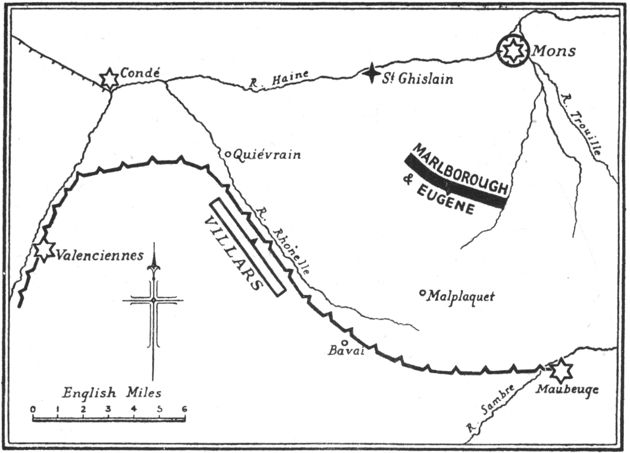
THE SIEGE OF MONS
Marlborough exchanged eighteen battalions which had suffered the most at Malplaquet for twenty-four others drawn from the various garrisons. The numerical strength of his army was thus restored. Boufflers managed to slip two battalions into Mons before the investment finally closed. He also reinforced the garrisons of Condé, Maubeuge, Charleroi, Douai, and Landrecies at the expense of Ypres and Aire, and strengthened his weakened formations with men drawn from all his garrisons. Even so his strongest battalions could muster only four hundred men each. Eventually he collected forces under Luxembourg in the neighbourhood of Charleroi to threaten the communications of the Allies with Brussels and to harry their foragers. Eugene, Orange, and Hesse undertook the siege with 31 battalions and 31 squadrons, another 27 battalions being added later. Marlborough with the covering army lay to the south and south-west. The siege-train arrived safely, and on the 25th the trenches were opened. On this day Cadogan, whose duties took him always into the most dangerous places, was wounded.
John to Sarah
Sept. 26, 1709
* After a great deal of trouble we have at last gott some part of our artillerie from Bruxelles so that we open’d last night the trenches, where poor Cadogan was wound’d in the neck. I hope he will do well, but til he recovers it will oblige me to do many things, by which I shall have but litle rest. I was with him this morning when thay drest his wound. As he is very fatt there greatest aprehension is growing feaverish. We must have patience for two or three dressings before the Surjeans can give their judgement. I hope in God he will do well, for I can intierly depend upon him. We have now very good weather one month [of] which wou’d finish this campagne, and keep the men we have in good health, which is very necessary for by the battel some of our Redgts are very weake.[224]
Marshal Boufflers wished to make an effort to break the siege, but Louis XIV was more concerned for the safety of Maubeuge. He and his military advisers agreed with Marlborough upon the importance of this place. The King told Boufflers that he might risk another battle if necessary to save it. Boufflers thought Maubeuge was strong enough to last out the campaigning season. Meanwhile the siege of Mons progressed steadily, and the breaching batteries performed their remorseless task. At the end of September Berwick, who had been sent to assist Boufflers, personally reconnoitred Marlborough’s covering position. He reported that it was too strong to be attacked. On October 20 Mons capitulated. The French army concentrated to protect Maubeuge, but Marlborough had already decided, owing to the bad weather, the hardships of the siege, and the lack of forage, to disperse the army into winter quarters. “I am glad to tel You,” careful as ever, he wrote to the Treasurer, “that we have sav’d this Yeare above one-third of the Monys given by Parl: for the additional ten thousand men.”
Perverse fortune dogged the Allies in Spain. The news of Galway’s defeat at the Caya had cast its malign influence upon the negotiations in the critical days of May 1709. At any time during the rest of the campaign a good success in the Peninsula would have brought peace to Europe. The almost unbearable strain upon France in Flanders and the course of the peace negotiations imposed a strict defensive upon the French troops in the Peninsula. As the summer wore on Louis XIV felt himself compelled, alike by war and policy, to recall all his troops to France. Thus every condition seemed favourable to the gaining of the precious and indispensable victory. Yet it was denied.
Although war had been resumed upon the greatest scale, negotiations for peace were unceasing. Torcy and Rouillé had returned to France in June, but Petkum maintained an active correspondence with both sides. The immediate object was to bring about a renewal of the conference. It must be remembered that the breaking-point had not been about the evacuation of Spain: both sides were agreed upon that; but upon the method or guarantees for procuring this evacuation. The new discussions played around various alternatives to the obnoxious Article XXXVII. In principle, the French were prepared to give some cautionary towns in France, but were neither ready nor able to give similar cautionary towns in Spain. The Whigs and the Emperor, bringing the Dutch along with them, continued to insist upon Spanish towns being yielded. A further obstacle was the French demand that there should be an immediate armistice, which the Allies would by no means entertain. Thus both before and after Malplaquet the summer and autumn passed in futile interchanges.
It is not true that, as some writers have assumed, the battle made the French more ready to yield. On the contrary, in Torcy’s correspondence we read, “The last battle has rather raised the courage of the nation than weakened it” (September 27).[225] The hopes of the French were, however, fortified by the prospect of a new Northern war, consequent upon the defeat and internment of Charles XII, which would lead to the withdrawal from the allied armies of important German contingents. With the close of the campaign and the dispersal into winter quarters the French request for an armistice virtually conceded itself, and the negotiations took a more hopeful turn.
Marlborough’s share in these transactions is plain beyond the slightest question. He did not consider himself in a position to press his own views in any formal manner. Throughout he acted in strict submission to the instructions he received from home, and in repeated letters he enjoined this course on Townshend. Secretly, behind the scenes, he did his utmost to procure such mitigations in the allied demands as would enable the Conference to reassemble. In repeated personal letters to Heinsius and to Townshend he declared that the demand for cautionary towns in Spain was beyond the power of the French King to meet, and that to insist upon it was in fact to will the continuance of the war. He was quite ready to fight a separate campaign in Spain, and foresaw no serious difficulty in driving out Philip V once peace had been made with France.[226]
It seems probable that Eugene was, as usual, in agreement with Marlborough, and if the two Captains and Heinsius could really have handled the negotiations unhampered by London and Vienna the vital result might have been won. In November these three together procured the sending of Petkum to Paris. This was the first peace initiative to come from the Allies. They could give Petkum but little latitude. Article XXXVII and its companions prescribed a time-limit of two months in which Louis XIV must take positive steps for the evacuation of Spain. Petkum was authorized to withdraw this condition. The concession was small, but the spirit in which it was offered, and the sending of Petkum, were tests of the sincerity of the French will to peace. Had Torcy and his master been in the mood to which the famine had reduced them earlier in the year the path to a general treaty would have been opened. Petkum and his proposals were, however, coolly received in Paris. All that the French Court would yield was an admission that the substance of the preliminaries might form the basis of a renewed Conference. At the same time they began to talk as if not merely the outstanding points of difference, but the whole preliminaries would be opened for rediscussion at such a Conference. Heinsius sustained the impression of a rebuff, which he roughly retorted upon the disappointed Petkum on his return.[227]
Marlborough felt convinced of the French insincerity. Both at The Hague and in London tempers rose, and declarations were made of the allied resolve to continue the war with the utmost vigour in 1710. On December 14 the Dutch sent a bellicose message to Queen Anne. In face of this attitude the French became more conciliatory. Their hopes of the Northern distraction proving effective had faded,[228] and in January they made a definite offer to agree to all the preliminaries provided that the difficulties of Article XXXVII were first of all surmounted. The allied chiefs debated this in stormy session at The Hague. The Dutch peace party, headed by Buys and van der Dussen, put extreme pressure upon Heinsius to bring about a conference, and even declared that neither the Province of Utrecht nor the city of Amsterdam would vote the supplies for the new campaign unless this was accomplished.
We have only fleeting glimpses of Marlborough’s part in these debates. It is certain, however, that while helping Heinsius to moderate the vehemence of Buys and the Dutch peace party, he also desired to give them satisfaction in the main. He, in fact, sponsored the proposal that should the conference be reached Buys and van der Dussen, the two chief advocates of peace, should themselves conduct the negotiations. This would give the greatest opportunity for obtaining a settlement if one were to be had, and if not, would satisfy the peace party that all possible had been done to procure it. This course was eventually adopted.
Whatever disputes there might be about the consequences of Malplaquet, one fact was certain: peace was no nearer than in June. A far more potent current than any that set from that battlefield was now flowing. It was becoming evident to the world that Marlborough’s authority was being undermined. The effect of this conviction upon the fortunes of the war was instant and constant. The French began to feel that they could afford to wait. Marlborough’s need was to create for himself an independent position at the head of the Alliance before his authority vanished at home. It was a grim race.
As early as May 1709 he had sent Craggs to London to make a quiet search in the Privy Seal offices. He hoped to find a precedent for a life-appointment as Captain-General. Craggs’ reply of May 20 was markedly discouraging:
* I have been endeavouring to find out General Monck’s commission and it was neither in [illegible] or Privy Seal offices, but removed to the Rolls. I find it is only during pleasure. I send your Grace the enclosed Dockett on the contents of the commission and all that I can learn from my Lord Chancellor’s opinion is that a commission during life is a new instance and liable to malicious construction, and yet I dare say there is twenty to one would think you ought to have a great deal more. . . .[229]
And a month later, in answer to the Duke’s more formal application to the Lord Chancellor, the latter wrote (June 23):
* In obedience to your Grace’s commands I have made as much search and inquiry as I could without too much observation concerning the point you last did me the honour to discourse upon, and I cannot find it was granted at any time otherwise than during pleasure. Except [unless] the office of Constable should be looked upon as precedent which since the thirteenth of Henry VIII has never been granted but on special occasions and then immediately [withdrawn] [I] do not think your Grace will think the ancient usage nor that obsolete office to be any guide in the present question.[230]
Nothing could have appeared less auspicious. Both authorities consulted, one Marlborough’s close personal adherent, the other his most friendly Cabinet colleague, were independently adverse. For some months the matter slumbered. The urgency of the European situation in the autumn led him to thrust it forward again. In October he applied directly to the Queen, and when she refused his request he made a strong protest against the adverse influences which he declared had been used against him. Continental historians have complained that Coxe has not published these letters in his voluminous Marlborough correspondence. But, in fact, no one has been able to trace them. Considering how regularly all correspondence with the Queen was preserved by the Duke or Sarah, it is a fair assumption that these records were destroyed. Certainly the request could not have been made in worse circumstances nor at a worse time. It was just the kind of demand which Marlborough’s enemies would have wished him to prefer, and which Harley could safely advise the Queen to refuse.
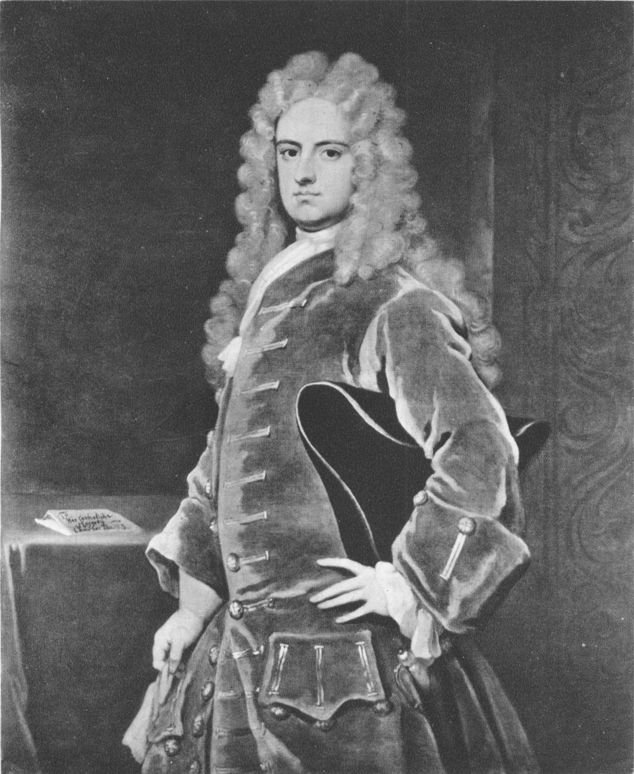
JAMES CRAGGS THE YOUNGER
From a copy of a painting by Sir Godfrey Kneller
National Portrait Gallery
The Queen to Marlborough
Windsor
October 25, 1709
I saw very plainly your uneasiness at my refusing the mark of favour you desired, and believed from another letter I had from you on that subject you fancied that advice came from Masham; but I do assure you you wrong her most extremely, for upon my word she knows nothing of it, as I told you in another letter; what I said was my own thoughts, not thinking it for your service or mine to do a thing of that nature; however, if when you come home you still continue in the same mind I will comply with your desires. You seem to be dissatisfied with my behaviour to the Duchess of Marlborough. I do not love complaining, but it is impossible to help saying on this occasion I believe nobody was ever so used by a friend as I have been by her ever since my coming to the Crown. I desire nothing but that she would leave off teasing and tormenting me, and behave herself with the decency she ought both to her friend and Queen, and this I hope you will make her do. . . . Whatever her behaviour is to me, mine shall be always as becomes me. Since I began this I have received yours by the Duke of Argyll, and have told him he shall have one of the vacant Garters, and have enjoined him secrecy.[231]
The Queen added:
* I am very sorry for ye resolution you have taken of quitting my service when ye War is ended but I hope when you have talked with your best friends here you will be prevailed with to alter it. It is not to be wondered at you should be incensed against poor Masham since the Duchss of Marlborough is soe, and has used her soe very hardly as she has don for some yeares past wch I know she does not deserve, but it is vane to go about vindicating one against whom there is so great a prejudice, onely this I must say yt I dare be answerable, she never said to Mr Harley or anybody, what you are informed she did and [I] will ask her about as soon as I see her.[232]
From the terms of this refusal it is clear that Marlborough’s request to be accorded the Captain-Generalcy for life was coupled with a declaration of his resolve to retire at the end of the war. There is no reason to doubt the sincerity of this intention, and in any case the Queen could have held him to it. There is not, nor has there ever been, power in a sovereign to make an irrevocable grant. Crown and Parliament together cannot be bound by any law. If, then, a future revocation of the grant were to turn on the question only of fair dealing, Marlborough’s expressed resolve to retire would have afforded the fullest justification to the Queen. Therefore, the request which Marlborough was making, however unseasonable, was by no means improper. It might have given him the authority which he needed to bring the war to a satisfactory end. It would have largely re-established his credit among the Allies and his prestige with the enemy. It could only conduce to national and international advantage. Yet, on the other hand, what doors it opened to malice! It not merely exposed the Duke to a direct and painful rebuff, but it afforded Harley fertile occasions of working on the Queen’s fears and of convincing her that she was losing her rights and prerogatives by needless subservience to an insatiable family.
The fact that the request had been made was judiciously imparted to hostile circles, together with its worst construction. Violent party opponents, proud nobles, disaffected officers, found it easy to believe that Marlborough harboured some prodigious design against the State. Was he not already “an overmighty subject”? Had he not power enough? Would nothing satisfy him under the Crown? The case of General Monk, already mentioned by Craggs, occurred to many minds. It was well known how Charles II had feared his power, and how his brother and eventual successor had urged him to curtail it. But other more sombre precedents might be invoked in warning. Many were alive whose youth had been spent under the rule of Oliver Cromwell and his major-generals. Never again must England sink into such military bondage. The Queen, probably by Harley’s suggestion, consulted various great men outside the Government, and especially those who would be most inflamed upon the issue. The Duke of Argyll, on leave from the Army, was one of these. This fiery soldier, in no way conciliated by Marlborough’s procuring him promotions and the Garter, replied in language whose extravagance was calculated to inspire the Queen not only with lively alarms, but also with combativeness: “Your Majesty need not be in pain, for I would undertake whenever you command to seize the Duke at the head of his troops and bring him away dead or alive.”[233]
In the Tory coffee-houses the story was spread that Marlborough sought to subvert the Throne. “General-for-life” was but the stepping-stone. He would be King. “King John II” was the latest term of abuse cast upon him.[234]
While freeing Marlborough from all the graver imputations, it is impossible not to be surprised that he should have exposed himself to such dangers. How could he not have foreseen the fate of his request? His surefooted judgment had gone for once astray. Was this a proof of his inordinate pretensions, or was it a measure of the difficulties by which he was being overcome, and of the forlorn expedients to which he was reduced to carry through his task in the dusk of his power?
The impending Barrier Treaty between England and Holland was bound to aggravate the dissensions of the Alliance. Marlborough’s opposition to it was inveterate. In all his extant letters he gives as his reason the fear that the Dutch, once satisfied, would make a separate peace. He wrote this regularly to Godolphin, to Sunderland and Townshend. But there can be no doubt that his main reason was, as always, the ill-effect which the Dutch Barrier in its extreme form would have not only upon the Imperialists, both at Vienna and in Spain, upon the Emperor and his brother Charles III, but also on the King of Prussia. It was more than ever indispensable to Marlborough, if he was to preserve any further influence with the rest of the Allies, not to be associated with it. He therefore refused his signature and remained at Brussels on October 29, when the document was signed by Townshend alone.
But he went further. The essence of the Barrier Treaty was that it should remain the secret of the Sea Powers. On November 14 Marlborough quitted the army and reached The Hague on a three days’ visit. He took the Prussian Commissioner, General Grumbkow, with whom he was on the best of terms, in his coach. At The Hague he met both Eugene and Sinzendorff. It is almost certain that he disclosed to all three the character of the Barrier Treaty which now awaited ratification by the British Cabinet.[235] It was, of course, inevitable that during the impending discussions in London, to which so many persons would be parties, the news would eventually reach the allied Courts. But Marlborough evidently wished to be the purveyor himself, in order first to raise Imperial and Prussian opposition to the treaty at the earliest moment, and, secondly, to make Vienna and Berlin feel that he was true to the Alliance and scrupulously careful of their interests. Thus only could he preserve that confidence in himself on the Continent without which neither the armies nor the signatory states could be held together. Such dissociation from colleagues at home and from his fellow-plenipotentiary Townshend on the spot, unpardonable in persons of secondary status, and in any case open to stricture, is to be justified only by Marlborough’s supreme position in the heart of the Alliance and his ceaseless, unswerving zeal and care for its interests.
Meanwhile Harley pursued his designs. Notwithstanding his astute and laborious calculations, success came to him by a path different from that he had prepared. It was no doubt a reasonable expectation after so many years of deepening war that the turn of the peace party would come. This accorded tolerably well with the composition and temper of the Tories. The Jacobites, veiled or avowed, were naturally so inclined. The Rochester Tories were against the kind of war which Marlborough had forced them to wage in Flanders. Party men were able to press Spain as an exciting alternative to Marlborough’s theme, and all the country gentlemen, however patriotic, felt the hard bite of aggravated taxation. The exploitation of war-weariness in all its forms was a policy which seemed capable of uniting the Tory forces, and was also likely to profit by time and chance. Thus Harley ruminated, resolved, and acted.
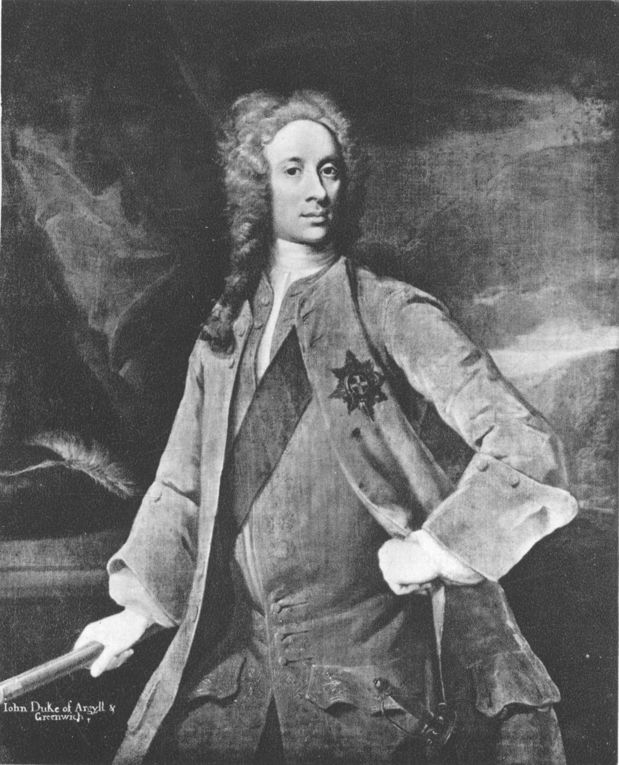
JOHN CAMPBELL, SECOND DUKE OF ARGYLL
William Aikman
National Portrait Gallery
Not only were the Tories inclined to peace, but several eminent Whigs, who were watching all the Queen’s motions, might be easily gained upon this line. Of these the greatest was Shrewsbury, at this time a sincere advocate of peace. He was in the opinion of all men a prize of the first order. Finally an agitation for peace enabled the whole propaganda against Marlborough to be used to the fullest advantage. The General—thus it ran—was prolonging the war for his own profit. Military men raised by the luck of battle to dizzy heights were naturally prone to preserve the conditions upon which their authority and affluence alike thrived. How many good opportunities of obtaining all the objects of the war by sagacious and even glorious peace had not Marlborough burked! He could have had a good peace after Ramillies; he could have had a better peace before Malplaquet. Even now everything could be obtained by a sincere negotiation. But nothing could be expected except a continuance of the slaughter and taxation, and the ever-mounting indebtedness of the landed gentry to the money-power, while the General ruled all. Here, then, was Harley’s political campaign, and to it he devoted himself with slow-burning zeal and shuffling skill.
However, the peace movement encountered obstacles none the less serious if submerged. First, the Tories, for all their party spite, were powerfully affected by the impression of England leading Europe, of redcoats beating the French, and some, politics apart, could scarce repress a cheer for the Duke of Marlborough. Secondly, the Ministry presented an oblique front to the peace talk. They too, so they declared, were striving for peace. Indeed, indefatigable negotiations, fathomless to outsiders, were unceasing. Discussion must therefore turn, not upon a vague desire to escape from war burdens or hardships, but upon particular points of the Treaty. And who had cried loudest for “No Peace without Spain” but Rochester and his Tories? Many Tories prided themselves upon being what Marlborough called “good Englishmen.” War under Marlborough, however costly, had spelt glory. No would-be Minister dared openly cast away the fruits of eight dazzling years. Evidently this part of the case had to be stated by the Tory leaders with discretion.
Thirdly, there was the Queen. It was engrained in Anne that her security upon the throne depended upon the stunning defeat of France. All her reign she had pursued this course and had prospered. If she felt her own position greater, more solidly founded, if she found all the princes of Europe attentive to her slightest mood, it was because of her wonderful success in war which Marlborough had unfailingly brought to her. True the Queen was tired of the ordeal. She was galled by the submissions to Marlborough, and still worse to the Whigs, which it required. Had she not exclaimed on the day of the Oudenarde dispatch, “Lord, when will all this dreadful bloodshed cease?” None the less she remained deeply conscious that her sovereignty and British national greatness were founded upon undoubted victory in the war, and that this victory in one form or another, as long as Marlborough was her servant, was almost certainly within her grasp.
Therefore Harley, working steadily through the whispering Abigail, found that his peace talk gained only a lukewarm, doubtful, and hesitating response. The Queen made difficulties about backstair audiences. Abigail flitted to and fro with explanations that “my poor Aunt” was “short of ready money [courage],” and that she allowed herself to be overborne by the cruel pressures of her Ministers and General.
Abigail Masham to Robert Harley
September 4, 1709
My friend [the Queen] will not consent to my going from hence till I go to lie in, which will not be till the middle of this month, the soonest, for she says I am so near my time the journey may disorder me so much that I may not be able to come hither again, and for that reason she won’t let me go. I did not write you this before because I have been in hopes every day of bringing her to give me leave. . . . I can’t tell you what use my friend has made of the advice was given her in your letter, but she heard it over and over. She keeps me in ignorance and is very reserved, does not care to tell me any thing. I asked her if she had gratified my Lord R[ochester] in what he desired; she answered, yes, he was very well satisfied, but told me no more. I shall tell her what you said to Mr Masham when I have an opportunity. You may venture to write anything and direct for him, perhaps they will not have the curiosity to open his letters; but make use of the names you sent me. I am very uneasy not to see you before you leave London, but it is impossible for me to do it. Mr M[asham] presents his most humble [service] to you, and we both wish you a good journey, and safe back again.[236]
Even the slaughter of Malplaquet did not affect the Queen, nor, indeed, her people, as deeply as might have been hoped by the Tories. British troops had been few and their losses comparatively small. It was the Dutch, the Prussians, and the mercenaries whom England set in motion and directed who had shed their blood. The British casualties at Malplaquet had been under eighteen hundred. Marlborough’s fame, his influence upon the Continent, his comradeship with Eugene, had compelled the tremendous event. The war was not all loss or waste to the British realm, and it was no use for Mr Harley to pretend the contrary.
In the winter of 1709 it was by no means clear that the Tory Opposition could ride back to power upon a hasty peace. At the end of October Harley was discouraged, and Abigail could give him no comfort. But if the peace agitation failed, what other course was open? There was always one sure issue which could be raised—“The Church in danger.” On this the strongest elements in the Tory Party and the immense power of the country clergy could be rallied. Harley, however, was the last man to choose such a cry. Had he not at all times striven to modify the rancour of the Church against the Dissenters? Had he not, with St John in his train, joined Marlborough and Godolphin in 1704 on the definite basis that the Occasional Conformity Bill should be shelved or defeated? Was he not himself of Dissenting stock? Those who had opposed him most among the Tories were those very Highfliers with whom the contest between Church and Chapel was a perennial crusade. As Harley viewed the situation in October 1709, nothing could have seemed less propitious than bringing the Church question to the forefront of politics, or using it as the vehicle of success at a General Election. It would certainly unite the super-Ministers, the Whigs, and the moderates. It would divide the Tories. The Catholics would lose interest; the moderates or “whimsicals” would fall away; and Harley would be left alone to share misfortunes with Rochester and the High Church. Yet the caprice of events was to draw him into this very quarrel and to yield results beyond his dreams.
Since June the Whigs had demanded the Admiralty, over which Pembroke had presided after Prince George’s death, for Orford.[237] This actor in the Revolution, and hero too of the battle of La Hogue, was the sole member of the Junto who had not regained the Council Chamber. The Queen, remembering his attacks upon her late husband’s administration, employed all her means of resistance. Marlborough and Godolphin, deeply concerned by the flaring party complexion of the Government, tried to stave off the appointment. But the Whigs used their power in the Government and in the House of Commons in their usual hard, decisive way. “If the business of the Admiralty,” said Halifax, “be not set right, it will be impossible for Lord Somers to continue in his employment.”[238] A point was reached when Marlborough and Godolphin had to throw their weight in with them. Marlborough advised the Queen to yield.
At length she gave way. She had a grievance against Sir John Jennings, a competent captain who was also proposed as a member of the Board. He was involved with those who had criticized her husband’s administration. She consoled herself by insisting on his exclusion. Orford was nominated head of the Admiralty on November 8. All five members of the Junto—the five tyrant Lords—sat with Queen Anne at the council board. Now at last this long confederacy declared itself satisfied. There was a momentary lull. Political stabilization seemed to be achieved, the tension eased. The Queen even smiled at Sunderland. Sarah reported the prodigy. Marlborough had no illusions. “I believe,” he replied to his wife (November 1),
her easiness to Lord Sunderland proceeds from her being told that she can’t do other than go on with the Whigs; but be assured that Mrs Masham and Mr Harley will underhand do everything that can make the business uneasy and particularly to you, the Lord Treasurer, and me.[239]
The end of 1709 marked the zenith of Britain in Europe, of the Whigs under Queen Anne, and of Marlborough’s career. Thereafter all fell with odd rapidity. The victorious Alliance moved forward with ever-growing disunity and ever more unreasonable pretensions. The Whigs were driven from office; Marlborough was hounded down; and glorious England turned renegade before all men. But the winter sun shone with fitful brightness.
|
Marlborough to Townshend September 11, 1709 * The bearer [Major-General Gronstein] that is sent by the Deputies has been an eyewitness of the greatest part of the action. It has been more opinionated than I have seen, so that it has been very bloody on both sides. My next must give you the particulars, for I am so tired that I can hardly hold my pen. P.S. We have so beaten the French that I beg you will tell the Pensioner that it is now in our powers to have what peace we please. [Add. MSS. 41178, f. 65.] September 13 * . . . I may let you know that the gain of this battle is very glorious for the arms of the allies, but our foot has suffered extremely, especially the Dutch more than any other nation, for though they acted with very great courage they had not the good fortune to force the enemy’s retrenchments, so that their horse could not act. As I do not yet know what account the deputies and their generals give I beg you will say nothing of what I write. The French are so beaten and discouraged that I do not doubt of the pensioner hearing very quickly from Monsr. de Torcy; I believe on both sides there has been more men killed and wounded in this battle than in all the battles since the war, for there was very little quarter given on either side. The Dutch generals blame some of the Hanover Battalions, otherways all has been very friendly in seconding each other, as if they had been the same nation. Except at Blenheim I never see the French do so well, for after the greatest part of their foot was beaten their horse charged several times and beat a good many of our squadrons. The whole Household charged twice. In the last we beat them so that they have suffered very much. . . . [Ibid.] |
|
Goslinga to Heinsius; Heinsius Archives. |
|
Arneth, ii, 88. |
|
Marlborough to Godolphin, October 3; Coxe, v, 73. |
|
Marlborough to Godolphin, October 3; Coxe, v, 73. |
|
* “Les princes se sont bien exposés.”—Goslinga to Heinsius, September 13 (Heinsius Archives). |
|
S.P., 84/233. |
|
September 17, 1709; Hague Archives. |
|
Portland Papers, H.M.C., iv, 27. |
|
Blenheim MSS. |
|
Lediard, ii, 193. |
|
Blackader, p. 363. |
|
Blenheim MSS. |
|
Sarah Correspondence, ii, 391. |
|
Blenheim MSS. |
|
Legrelle, v, 486. |
|
Marlborough to Godolphin October 7, 1709 * . . . It is most Certain that the great and only difficulty of the Peace is the Evacuating of Spain. I beleive it was in the power of ffrance at the beginning of the treaty to have given us permission of severall places in Spain, but how shamfull a part that must have been I leave to others Judgement. It is certain there is no relying on ffrench sincerity, so that I see no so good end as the takeing measures for the forcing them out of Spain. [Blenheim MSS.] |
|
See Legrelle, v, 487. |
|
“God forgive those who will be responsible for breaking negotiations upon the false assumptions about affairs in the North.”—Petkum to Rouillé, December 10 (Legrelle, v, 492). |
|
Blenheim MSS. |
|
Ibid. Mentioned by Coxe, v, 117, and W. T. Morgan, English Political Parties (1703-10), p. 374. |
|
Marlborough Papers, H.M.C., 43 (a). |
|
Blenheim MSS. |
|
Swift, Memoirs relating to the Change in the Queen’s Ministry in 1710 (edited by Temple Scott, 1897-1908), p. 373. |
|
Thomas Hearne, Collections (edited by C. E. Doble, 1889), ii, 265. |
|
See Geikie, p. 169 n. |
|
Portland Papers, H.M.C., iv, 525. |
|
John to Sarah, June 4; Sarah Correspondence, i, 175. |
|
Ibid., i, 241. |
|
Coxe, v, 105. |
Queen Anne brooded and planned revenge upon the Whigs. Her power, founded upon Marlborough’s victories, was immense. The Courts of Europe studied her whims; the fierce parties in Britain competed for her smile. But there is a cruel sketch of her about this time, oppressed with sorrow and physical suffering, struggling under her burdens, which commands sympathy and mocks pomp. “She appeared to be the most despicable mortal I had ever seen in any station. The poor lady as I saw her twice before, was again under a severe fit of gout, ill-dressed, blotted in her countenance, and surrounded with plaisters, cataplaisma, and dirty-like rags.”[240] From the autumn of 1709 onward the Queen felt herself capable of driving out the Whigs if she could take her time and have good advice. Thereafter she thought about little else. These Whigs had forced themselves upon her. They had intruded into her Council of State. They had used without scruple the power they had from majorities in both Houses of Parliament to override her sovereign pleasure about the personages she thought fit to employ. Not only were her wrath and prejudice directed against the Whigs, but they fell upon Godolphin, her Lord Treasurer, who had been their tool. Marlborough, although not upon this plane, had lent his weight to the Lord Treasurer and shared his disfavour. As for Sarah, the Queen was utterly worn out by her arguments and admonitions. She desired above all things never again to hear her voice or see her handwriting. Nothing remained of that remarkable partnership except the opportunities of quarrel; and these were nearing their end.
When they met at great functions, or when Sarah’s offices required her attendance, appearances were preserved. Sarah was a State and political personage. Her dismissal might be followed by Marlborough’s resignation and a crisis in Parliament and throughout the Alliance. Even the rumours that she was in disfavour stirred Europe. The Queen did not feel strong enough to face such contingencies in the autumn of 1709. Had Sarah discharged her duties with respectful formality, avoided all intimate or controversial topics, and remained in the country as much as possible, a tolerable relationship between the two women might have been preserved. But Sarah’s judgment was warped by her hatred of Abigail, and she was tormented out of all prudence or proper self-respect by jealousy of her triumphant rival. She obtruded herself upon the Queen; she protested her party views; she asked for petty favours, and attributed the refusals to the influence of Abigail. Abigail Masham had become an obsession to her, and she acted as if it were possible to tear the Queen away from her by force. Thus what might have been a dignified if frigid association became a violent and protracted annoyance to the Queen. At every rebuff or repulse Sarah wrote of her grievances to her husband, and urged him, as he loved her, to take up the cudgels on her behalf. All the advice he gave was sound. He begged her to stay away from Court, not to accost or write to the Queen, to remain as quiet as possible and ask no favours. This was advice which Sarah could not bring herself to follow.
“I would go upon all-four to make it easy between you,” wrote the Captain-General (August 19), “but for credit, I am satisfied that I have none; so that I would willingly not expose myself, but meddle as little as possible.” (August 22) “Be obliging and kind to all your friends, and avoid entering into cabals, and whatever I have in this world, if that can give you any satisfaction, you shall always be mistress of, and have the disposing of that and me.”[241]
[August 26]
. . . It has always been my observation in disputes, especially in those of kindness and friendship, that all reproaches, though ever so reasonable, do serve to no other end but the making the breach wider. I can’t hinder being of opinion, how insignificant soever we may be, that there is a power above which puts a period to our happiness or unhappiness; otherwise, should anybody, eight years ago, have told me, after the success I have had, and the twenty-seven years’ faithful services of yourself, that we should be obliged, even in the lifetime of the Queen, to seek happiness in a retired life, I should have thought it impossible.[242]
The British envoy to the Court of Hanover, Mr Howe, having died, Sarah, ignoring these sagacious counsels, unfolded to Anne the hard case of his widow, and suggested a pension and apartments in Somerset House. The Queen said stiffly it was a matter for the Lord Treasurer. Sarah then asked for some vacant lodgings in St James’s Palace for herself in order to make a better entrance to her own apartments. The Queen, as Sarah no doubt knew only too well, had promised these to Mrs Masham’s sister. Sarah said they had been reserved for her when they fell vacant. “I do not remember that I was ever spoken to for them,” said Anne. “But, supposing that I am mistaken, surely my request cannot be deemed unreasonable,” said Sarah. “I have a great many servants of my own,” rejoined the Queen, “and some of them I must find room for.” “Your Majesty, then, does not reckon Lord Marlborough or me among your servants?” This was picking a quarrel, but Sarah persisted. “It would be thought still more strange were I to repeat this conversation and inform the world that after all Lord Marlborough’s services your Majesty refuses to give him a miserable hole to make a clear entry to his lodgings. I beg, therefore, to know whether I am at liberty to repeat this to any of my friends.” The Queen, much ruffled, after a long pause said she might repeat it. “I hope your Majesty will reflect upon all that has passed,” said Sarah, leaving the room.[243]
The impropriety of Sarah’s manner in a subject addressing the Sovereign must be judged in the light of her love and intimacy dating from childhood’s days; but the folly of her persistence needs no comment. It did not end here. Sarah resorted to her pen, which was pointed and tireless. She lectured the Queen on the duties of friendship. She dwelt upon the sin committed by those who took the Sacrament while still at enmity with their fellows. She demanded to know by what crime she had forfeited the royal favour. She furnished a lengthy memorial setting forth her services over more than a quarter of a century. But nothing that she could do served any purpose but to confirm the Queen in the position she had adopted. “It is impossible,” wrote Anne, “for you to recover my former kindness, but I shall behave myself to you as the Duke of Marlborough’s wife, and as my Groom of the Stole.”[244]
All this account comes to us from Sarah herself. It proves her as wrong-headed in defending her case to posterity as in pleading it with Queen Anne. The breach was now open and scandalous, and all the ambitions of a rival, of a clique, and the interests of a great political party were concerned to keep it so.
The accomplishment of the Queen’s political purpose was by no means easy or free from risk. The Government commanded the ability of the great Whig lords, and behind them lay the force of the Whig organization. This included not only the City, with its mysterious power of manufacturing credit, but also the Dissenters, who might upon occasion become the Ironsides. Besides this both Houses of Parliament—the Commons but one year old—were capable at any time of taking sharp and measureless action against the Court, of refusing supplies to carry on the war, of arresting and impeaching friends of the Queen, or having her gentlewoman, the comforting Abigail, dismissed or sent to the Tower. Above all, Marlborough stood at the head of the armies of the Grand Alliance, apparently invincible, indissolubly wedded to Godolphin, to the Whigs, to the Parliamentary system, as well as to Sarah.
This was a great combination for the Queen to confront. Such was her confidence in herself and in her majesty and prerogative that she set herself without hesitation to overthrow it. But she must have good advice. Her intentions could only be carried through by a parliamentarian of profound astuteness and skill. Mr Harley’s experience of the House of Commons was unequalled. His management when Speaker or Secretary of State had repeatedly been attended by success. Although he did not control the Tory Party, he had it all behind him now. With the Queen’s favour he was, in fact, the head of an alternative Government. He alone would know how to play the Queen’s very difficult game. She must act upon his advice. How could she, a woman, cope otherwise with great questions and great figures? But happily at the Queen’s ear, always at hand, there was Abigail, Harley’s relation and dear friend, whispering slander against the Marlboroughs, waiting hand and foot upon her, always available to carry messages or to arrange interviews. Up and down the backstairs Abigail conducted Harley, or carried his counsels to the Queen.
The successive steps by which the Queen sought and compassed the destruction of her Ministers were calculated and timed with remarkable address. At every stage her action was measured by the growing Tory strength in the country. This process continued remorselessly through the autumn of 1709 to the winter of 1710. This gradual but persistent change from Whig to Tory was only possible because the doctrine of collective Cabinet responsibility was in its infancy. The Lord Treasurer had many of the duties but few of the powers of a modern Prime Minister. His colleagues at the council table felt little loyalty to one another or to him. The Queen had no thought of loyalty to her Ministers, nor to the Parliament which voted her great supplies by their majority. To break and turn them out upon the advice of secret counsellors and by intrigue, veiled under deceitful protestations of confidence and regard, was her unswerving aim. She pursued it with almost total disregard of the consequences to the war, upon which she had spent so much of her subjects’ blood and treasure, or to the princes of the Grand Alliance, to whom her royal faith was pledged. Queen Anne conceived herself as entirely within her rights in cleansing herself from the Whigs whom she detested, and also in punishing the two great super-Ministers who had helped to force the Whigs upon her. In behaving thus the Queen violated every modern conception of the duties of a constitutional monarch, and also most of the canons of personal good faith. Nevertheless, neither she nor her subjects felt the same repugnance to these methods as we do to-day. Royal favour was like the weather. It was as useless to reproach Queen Anne with fickleness and inconstancy as it would be to accuse a twentieth-century electorate of these vices.
So complete a transformation in little more than a year of a Government unquestionably sustained by majorities in both Houses could not have been effected if the threatened Ministers had stood together and acted resolutely in their own defence. It would probably have been possible in the early stages to confront the Queen and her secret advisers with an issue. Marlborough, with his sure instinct, was, as we shall see, most anxious for a decisive trial of strength on well-chosen ground. But at every stage the timidity of Godolphin, and the jealousy and selfishness of the Whigs towards one another, prevented any combined front from being formed. Harley, with extraordinary subtlety, managed to present always baffling and oblique issues, never hesitated to recede here and there for the moment, led the Queen to be prodigal in assurances of goodwill and promises to go no further, and thus edged and wedged the doomed administration inch by inch and week by week down the slope towards the disastrous general election which a dissolution against the advice of Ministers could at any moment precipitate.
Party historians, Whig and Tory, have had their say. Modern opinion unitedly condemns the failure to make peace both before and after Malplaquet. But no one can read without disgust and censure the shameful tale of the Harley-Abigail intrigue. Harley, as we have seen, was now master of the Tory Party. All its various circles from Jacobites to moderate Churchmen and patriotic fox-hunters were agreed that the Whigs should be turned out and the war stopped, whatever might happen to Marlborough or to the Allies. Queen Anne had become a traitor to her own Ministers. Harley and the Opposition, agitating from below, received a grand encouragement from above.
Two main methods were pursued by Harley. The first was a villainous propaganda against Marlborough, or what was more easy, ‘the Marlboroughs.’ Here was this pair and their offspring holding the Queen in bondage, engrossing to themselves all the sunlight of the realm. Here was this General gathering with his covetous hands filthy lucre in fabulous quantities. He was prolonging the war for his own advantage. He had prevented a triumphant peace in order that he might batten on the public fortunes at the head of the army, which, it must be admitted, he sometimes conducted with diabolical skill, but—as Harley did not shrink from hinting—with doubtful courage. Even to this level did he sink. The General had now at Malplaquet contrived a battle, which for its brutal slaughter was without compare, in order that he might line his pockets with the profits of favouritism and corruption, through filling the commissions of those he had led to death. Now this ogre, in base ingratitude to the Queen to whom he owed all, in treason against the kingdom and Parliament, was secretly aiming at the Crown. A new Cromwell dictatorship was his goal. See how the mob cheered him when they had the opportunity. Parliament itself must be on its guard against an ambitious adventurer, who had betrayed in turn every party and every prince he had served. Such, in insidious forms, was the nourishment which Harley fed to Abigail, and which Abigail fed to Anne.
For the rest there were the Whigs, the party foe, a cabal of wealthy nobles, an obsolete expression of the forces which had cut off the head of King Charles the Martyr, now allied with the profiteers and moneylenders of the City and the Bank of England. These were piling up ceaselessly a gigantic debt, of which they were the usurers, which soon would equal in its dead weight and in its interest the whole value of the land and annual food of England. These same Whigs were at heart not only republicans but atheists. It might be going too far to suggest they were the only evil-livers in the land; but still, their standards of morality were drawn at a level which, if accepted for a generation, would destroy the Church of England and debase the British breed.
Ought not the Queen to count for more? Ought she not to be mistress in her own realm? Could she not free herself with loyal aid from the trammels in which Whig majorities in the Commons and the Lords had entangled her? Then England might also be freed from the recreant, self-seeking, and blood-sucking allies who sheltered behind her sword—victorious no doubt—who pursued aims which had no longer any interest for the British Isles. Let the Queen use her undoubted rights and power, let her throw herself with confidence upon the love of her people; and the hateful toil of war would end, peace could be made upon unchallenged victory, and plenty would cheer manor house and vicarage alike. Such was the propaganda, a mixture of fact and malice, pressed upon Queen Anne from many quarters, urged by Harley in his backstair consultations, and counselled by Abigail at the Queen’s bedside as she smoothed the pillows and removed the slops.
Side by side with all this lay a plan of action profoundly studied and step by step brought into execution. Fortified by the unfailing favour of the Queen, Harley now began to tamper with the Whig weaklings. The Duke of Somerset was a Cabinet Minister. Although a duke and wealthy, he had never reached beyond a secondary sphere in national politics. A searching process of reciprocal canvassing and criticism proceeded within the ranks of the aristocracy. Society and politics coincided through the entire field. In that keen, well-informed atmosphere personal defects were soon descried. Somerset’s intelligence was limited, but he was independent, ambitious, bold, and could upon occasion be both violent and forcible. The insulting manner in which he had driven Harley from the Cabinet in 1708, when Marlborough and Godolphin had stayed away, had played its part in history. His wife was becoming the Queen’s close friend. The seduction of the Duke of Somerset from the Whigs and his separation from Marlborough and Godolphin were objects of high political importance.
Harley knew all about the Duke of Somerset. He measured shrewdly both his smaller qualities and his large potential usefulness. For more than a year Somerset was led to believe that he might become the head of some great Ministry, truly national, combining the best in all parties, for causes with which, until they were defined, none would disagree. No records are available of Harley’s approaches to Somerset. But we know that the Queen—no doubt by Harley’s guidance—began to show him exceptional favour from the end of 1709. She was repeatedly closeted with him. She listened with unwearied patience to all the advice he had to give. He basked resplendent in the royal grace. Godolphin wrote drily to Marlborough that Somerset seemed to be more hours each day with the Queen than away from her. Already because of his airs he was spoken of in the Court as “the Sovereign.” We are witnessing an early eighteenth-century example of the process, familiar to twentieth-century democracy in every land, by which a pretentious, imposing mediocrity can be worked up into a national leader. The Duke of Somerset enjoyed the treatment, and while sitting at Council with Marlborough, Godolphin, and the Whigs, upon the assumption of amity and good faith, he actively, crudely, and obviously played Harley’s game. Lord Chancellor Cowper has passed a severe judgment on him. “On the whole he appeared a false, mean-spirited knave, at the same time he was a pretender to the greatest courage and steadiness.”[245]
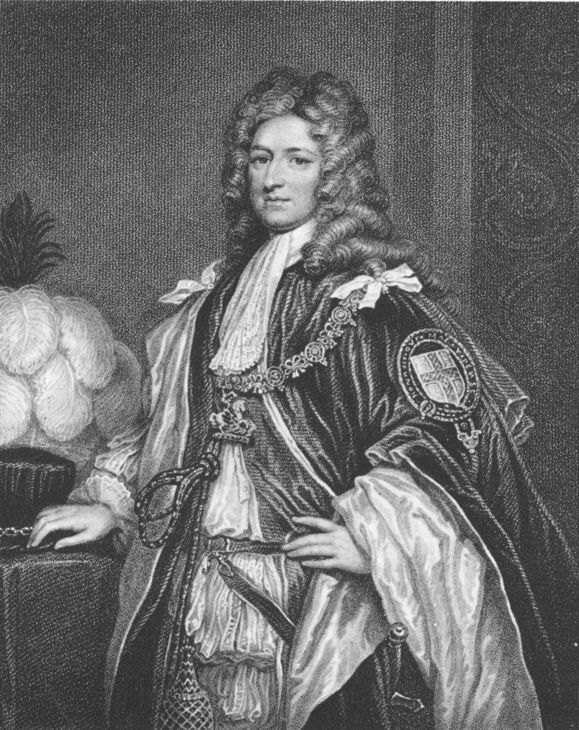
CHARLES SEYMOUR, SIXTH DUKE OF SOMERSET
From an engraving after a painting by Sir Godfrey Kneller
Somers may also have been toyed with. “Mr Erasmus Lewis told me,” says Carte (April 10, 1749),
that at the latter end of 1709 or beginning of 1710, Queen Anne sent for lord Somers, and told him, as they were alone, she having an opinion of his judgment and impartiality, desired him to tell her his opinion of the Duke of Marlborough. He said he would; and told her that he was the worst man that God Almighty ever made; that his ambition was boundless and his avarice insatiable; and that he had neither honour nor conscience to restrain him from any wicked attempt, even against her person, as well as against his country, etc. Somers (as the Queen was weary of the duchess) expected to be made first minister, but was baulked. The Queen had expressed herself advantageously of his honour, integrity, and capacity.[246]
But this is doubtful authority.
The next to be detached was Earl Rivers. Godolphin, with his unique experience of the pettiness and baseness of noble persons, and also of others where office is concerned, was early apprised of the alienation of Rivers. In his apprehension he proposed to Marlborough that Rivers, who was a general of some repute, should replace the much aspersed and grievously mutilated Galway as Commander-in-Chief in Spain. Marlborough was by no means incapable of a political job. The old, trained courtier had seen the like without undue aversion for more than forty years. But he had the prejudice which all good soldiers have against putting inferior men in command of troops. Moreover, he was loyal to Galway. Although he had criticized severely Almanza and some of his other operations, he none the less believed that this Huguenot refugee and hero was one of the finest warriors in that age of ceaseless war. Marlborough did not readily hold with the modern doctrine, popularized by Napoleon, that generals must be judged by results. He therefore upheld Galway, and with many regrets left Lord Rivers on Godolphin’s hands. Henceforward Rivers, while preserving his position as a leading Whig, acted in the interests of the Tories.
A far greater figure was the Duke of Shrewsbury. No one could charge him with ignoble ambition. Some twenty years before he had been King William’s Secretary of State, and known to all as “the King of Hearts.” In unaffected dislike he had cast away office and power. He had repeatedly refused to resume the burden. He had quitted the island. Amid the monuments, pleasures, and cosmopolitan society of Rome he had been for years the prototype of an English grandee. Noble in the technical sense, of vast wealth, bland, affable but remote, detached from his surroundings, disdainful to politics, but with his historic, formidable record, the Duke of Shrewsbury had brooded agreeably upon the Roman scene.
Upon Queen Anne’s first coming to the throne Marlborough’s resolve had been to bring him into the highest place next to Godolphin. But Shrewsbury preferred his idle life in Rome. He had married an Italian lady whose previous morals had not escaped gossip or even scandal, and whose manners were in all quarters judged lively to the point of being deplorable. In December 1705, when Shrewsbury passed through The Hague, Marlborough had made renewed attempts to rally him to the Administration. Nothing, not even the comical little creature he had espoused, could deprive him of his political status. Shrewsbury had now returned to his great estates in England. Again Marlborough endeavoured to enlist him in the Government. Would he not, perhaps, at least be Master of the Horse? There would be no need for him to do business, or suffer any personal inconvenience. But Shrewsbury amid profuse expressions of friendship had preferred a private life. On another occasion in 1709 Marlborough had spoken to him of the undue claims made by the Whigs, and had dwelt on the importance of having moderate men in the Government. It seemed that this conversation was to be the forerunner of others.
Shrewsbury, whose interest in politics was now being revived by his desire to carry his Italian wife into the forefront of haughty English society, had perhaps been conscious of waiting for some time. Marlborough for his part had found the Junto, upon whom his policy had come to depend, by no means eager to admit Shrewsbury to their circle. True he was a famous Whig and one of King William’s most trusted Ministers. But was it, they asked themselves, for his party colour and services that Marlborough sought to include him in the Government? Was it not rather because he had let that colour fade, and was at heart as ready to work for national as for party purposes? The Lords of the Junto might have accepted Shrewsbury as a mild Tory, but in 1709 they had no relish for him as a Whig. They saw in this idea of Marlborough’s only another attempt to build up the strength of the super-Ministers against honest party men. At any rate, Marlborough never resumed his conversation with Shrewsbury, and Shrewsbury was perfectly free to allow his own weight and standing to play their just part in political events.
But Shrewsbury’s value to Marlborough’s system was also his value to Harley. Shrewsbury was the man of all others to break the Whig phalanx. He was the wedge to drive deep into the official array. Before the end of 1709 Harley had reached a tolerably good understanding with this timid, gifted magnifico. Here was a Whig who cared nothing for the Junto. Here was a Whig whose name was revered throughout that party but who took no further interest in its fortunes. Here was one who could be introduced into the Government as a friend who was in fact their foe. “I am sensible how far I am from being able,” wrote Shrewsbury to Harley (November 3), “to act any considerable part in the good you mention, but shall always be ready to concur with you in everything that may be for the interest of the public, being convinced nobody can wish better to it nor judge better of it than yourself. I do not doubt but the generality of the nation long for a peace. . . . Some opportunities have already been lost.”[247]
The Houses met on November 15. The Queen for the first time since her husband’s death opened Parliament in person in royal and war-time pomp. Her speech from the throne, though read, as some noticed, in faltering tones, was all that a Whig Parliament could wish. French duplicity had used the peace negotiations in an attempt to provoke dissension among the Allies. Their designs had failed. The war had been renewed with greater resolution. A splendid victory had been won, and peace was now only the more needed by the enemy. But the war was still going on, and the final effort was required. The Queen appealed for generous supplies.
The Whigs excelled in Parliamentary stage-management. Under their influence the House of Commons resolved, contrary to all custom, to present the Address to the Sovereign on the very same day. Both Houses then proceeded to extol Marlborough. Never in the whole course of the war had the Commons expressed thanks to their General in such glowing terms. They exalted the victory of Malplaquet. They praised his skill and valour. Fifteen of the most distinguished members of the House were deputed to wait upon him with the thanks—against which no single speech had been made—of the most powerful assembly in the world. The Lords vied with the Commons. When Marlborough returned and came to the Upper House on November 17 Lord Chancellor Cowper outstripped all the eulogies he had earned in eight years of invincible war. Klopp rightly says, “This day may be called the supreme and also the last pinnacle of Marlborough’s career.”[248] Barely two years were to pass, and two more unfailing campaigns to be fought, before he was to be dismissed from all his offices, his faithful generals superseded or cashiered, and he himself charged with peculation and eventually driven from his native land in obloquy.
Hoffmann, the Emperor’s Minister, saw beneath the structure of this fine parade. “This extreme politeness,” he wrote, “is, to speak exactly, a result of the pleasure which the Whigs have derived from the appointment of one of their friends as Lord High Admiral; and,” he added, with less foresight, “this satisfaction promises everything we can desire.”[249] More than six million pounds—at which Europe gasped—was voted for the war with the utmost concord and dispatch. “Our Parliamentary business is going wonderfully [à merveille],” wrote Marlborough (November 25) to Count Maffei.[250] He told Hoffmann that he believed the session would end six weeks before its usual time. Whig ascendancy was a dangerous medicine; but it certainly seemed at first to work.
|
Memoirs of Sir John Clarke, pp. 71-72. |
|
Coxe, v, 168-169. |
|
Coxe, v, 108-109. |
|
Ibid., 110-111. |
|
See Coxe, v, 110-111. |
|
William, first Earl Cowper, Diary, p. 50. |
|
James Macpherson, Original Papers (1775), ii, 283. |
|
Bath Papers, H.M.C., i. 197. |
|
Klopp, xiii, 370. |
|
Hoffmann, December 20; loc. cit. |
|
Dispatches, iv, 657. |
Two unforeseeable but eventually devastating episodes now occurred in which the Whigs showed weakness and unwisdom. For the first they had only themselves to blame. The part played by Dr Sacheverell in the history of the Church of England is out of all proportion to his moral or mental stature. It exercised an influence which lasted for several generations. After the trial of Sacheverell no British Government, even during all the long reign of the Whigs, dared to make an attack upon the Church of England. The Dissenters, though immune from persecution, were for five generations tolerated only upon the characteristic British device of an Act of Indemnity passed from year to year, like the Army (Annual) Bill. It was not until the nineteenth century was well advanced that the religious disabilities of Nonconformists and Catholics were removed; and then only by Tory hands.
Noorden has drawn us a picture of Sacheverell more lively than is found in our own histories.
His learning was shallow, but his bold forehead, his audacious words and puffed-up pride, the unction which oozed from him as he walked or preached, the Parsee-like play-acting and elaborate gestures, the whole personality set on calculated effect, made him appear to emotional women and simple men as a piece of incarnate saintliness. Others regarded him as a charlatan. His view of God and the world was comprised in the ancient and tenacious papistical Oxford principles: “The priest God’s vessel; no salvation without priestly mediation; the death-wounds of Charles Stuart equal to the wounds of Christ; the Nonconformist sects the devil’s brood.” Nature had endowed him with a craving for sensation which was hereditary in his family. He was a climber thirsting for martyrdom without peril: more noise more honour.[251]
On November 5, 1709, Sacheverell preached a sermon in St Paul’s before the Lord Mayor of London on “the perils of false brethren in Church and State.”
“I remember,” wrote a Whig observer, “he sate directly against me during Prayers, and I was surpriz’d at the Fiery Red that overspread his Face, (which I have since seen fair and Effeminate enough) and the Gogling Wildness of his Eyes. And I may truly say, He was (if ever Man) transported with an Hellish Fury.”[252] There was no remarkable doctrinal departure in the sermon. It represented the views of the main body of the English country parsons. The Doctor had preached it in Oxford four years earlier, in 1705, without its attracting any attention. But now he added certain hostile allusions to Godolphin, who was classed among the “false brethren” as the “wily Volpone.” The Treasurer had long been nicknamed “the Fox,”[253] and was thus easily identifiable. It was not only Guy Fawkes Day; it was the anniversary of William III’s landing at Torbay. Whig ears were all attention. There was a sounding-board for words which otherwise would have passed unnoticed. The Tory Party was boiling and bubbling under the rule of their party foes, and under the illicit, but all the more thrilling, favour of Queen Anne. The Reverend Doctor was well aware that he was playing high politics. His move, though perhaps spontaneous, was a recognizable feature in the general Tory attack. The Lord Mayor listened without noticeable discomfort. But when the sermon was printed, with a dedication to himself, and when no fewer than forty thousand copies were sold or distributed in a few days, he made haste to dissociate himself from these dangerous manifestations.
Interest spread throughout the country. “We long here,” wrote the Jacobite Hearne (November 19), “to see Dr Sacheverell’s Vth of November Sermon preach’d upon these Words, In perils amongst false Brethren. Upon which Words I remember he formerly preach’d at St Marie’s and ’tis said ’tis the very same Sermon, only with some Alterations and Additions. It makes a great Noise, and several give out that he will be prosecuted, but that you know best at London.”[254]
Sacheverell’s discourse threw the Whig Party into a rage. They were in the full pride of place and power. They viewed the sermon as a challenge, not only to their Government, but to the very principles of “the Glorious Revolution of 1688.” Party men may be forgiven for party passions, but cooler heads and broader views are required at the summit of affairs. An Opposition would naturally welcome just this kind of discussion; but it was not for a Government in full career and at the height of war to indulge them. Obviously the wise course was for Ministers to ignore or belittle the whole affair, and perhaps set one of their minor supporters to deliver a counterblast. There were, however, in the Cabinet Council several elements which did not conform to reason.
Godolphin was deeply sensitive about attacks upon his phantom Tory orthodoxy. He was naturally disquieted by the state of his relations with the Queen. He had the feeling that he was being singled out and marked down as a victim of Tory vengeance. He was therefore in a state of lively indignation. It happened to suit some at least of his Whig colleagues to indulge and even to inflame his wrath. Wharton and others thought that Whig interests would be served by making the Treasurer break his last contacts with the Tories. Marlborough had not returned from the front when the matter was first discussed by the Council. Sunderland was, as usual, a zealot. The Whig Party, Wharton as the leading spirit, clamoured for spirited action. It was decided to pursue Dr Sacheverell. In December articles of impeachment were exhibited against him by the majority of the House of Commons.
The Government’s tactical error was understood by the Tories from the first. “So solemn a prosecution for such a scribble,” wrote Dr Stratford, tutor to Harley’s son (December 21), “will make the Doctor Sacheverell and his performance much more considerable than either of them could have been on any other account.”[255] As was well said at the time, “the Whigs took it into their minds to roast a parson, and they did roast him, but their zeal tempted them to make the fire so high that they scorched themselves.”[256]
The second episode, though ranking much smaller in history, nevertheless cut deeply into the sequence of events. The mortifications for which Marlborough’s secret information had prepared him began almost as soon as he came home. In January Lord Essex died, and the Lieutenancy of the Tower, together with the Oxford Regiment,[257] became vacant. Upon these, as on all other military appointments, it was the unvarying custom for the Captain-General to advise the Queen. Marlborough, having in his mind the interest of the Ministry in conciliating Somerset, planned to give the Tower to the Duke of Northumberland, and the regiment to Somerset’s son, Lord Hertford. Whether apprised of this or not, the Queen’s backstair advisers thought otherwise. Their candidate for the Tower was Lord Rivers. They would find in his appointment a means of displaying their power to reward new adherents. Rivers waited on Marlborough and asked for his recommendation. Marlborough replied affably that the office was not one of sufficient importance for him, and that he hoped to serve him better on a future occasion. Rivers then asked permission to plead his own suit to the Queen. Marlborough, assuming naturally that no appointment would be made without his advice first being sought, and resolved to advise against Rivers, consented. But when almost immediately afterwards he had an audience and submitted Northumberland’s name, the Queen answered forthwith, “Your Grace has come too late, for I have already granted the Lieutenancy to Lord Rivers, who has assured me that you had no objection to him.”[258] Marlborough saw at once that he had been tricked. He protested, but the Queen declined to recede from her promise to Rivers. That same day the Queen sent him a written message desiring him to appoint to the vacant regiment no other person than Colonel Hill, Mrs Masham’s brother.
It was obvious that an insult of the most carefully studied character was intended by the Queen’s secret advisers. But the issue ran much deeper than this. In an army in which the leading officers were regarded as the champions of two fiercely struggling parties, whose exploits were cheered or disparaged according to their political colour, it was utterly impossible to maintain discipline or safely to conduct operations except upon the basis of all these men knowing that in their military fortunes the Commander-in-Chief was supreme. It was bad enough that the prowess of the Tory or even Jacobite Webb should be vaunted against the services of the Whig Cadogan in the House of Commons. But these unseemly proceedings could not be extended to the British Army in the field without destroying its efficiency. There was already much talk of Mrs Masham’s growing influence, and of Sarah’s loss of favour. “The dispute was not between the Queen and my lord Duke, as some will have it, but whether Mrs Masham and her party should have a disposal of all the vacancies in the army, and, by degrees, of everything else.”[259] The appointment of Mrs Masham’s brother to a regiment over the heads of many more competent and experienced colonels was nothing less than a signal to the Army that Marlborough no longer possessed the confidence of the Queen, on which his authority over the British forces stood. The evil of such a demonstration would swiftly extend to the Allies, spreading doubt and discouragement as it travelled. Already the enemy were watching with eager eyes for every sign that the power of their antagonist was waning. The proposed appointment of Abigail’s brother to a regiment might well be fatal to the campaign for which the largest armies yet seen were soon to assemble.
Marlborough therefore refused point-blank. He informed his Whig colleagues of his inflexible resolve, and they promised to stand by him. Sunderland, perhaps because he already had a sense of a threat to himself, was especially vigorous. Somers offered either to go with the Captain-General to the Queen or to make a separate intercession. Thus sustained, Marlborough sought a second audience. He pleaded his case with his usual skill and force. He warned the Queen that, apart from the military impropriety of appointing so young an officer on favour over the heads of others with better claims, the event would in the circumstances “set up a standard of disaffection to rally all the malcontent officers in the army.” He appealed to the Queen that after all his services he should not be treated thus. Anne remained obdurate. She did not show the slightest sign of sympathy, still less of yielding. Coldly and harshly she ended the discussion with the words, “You will do well to advise with your friends.” “He could not draw one kind expression from her.”[260] Marlborough left her presence in extreme distress. The peering courtiers in the antechamber noticed that that serenity which neither the heat of battle nor the endless vexations of business had ever disturbed had for the moment deserted him.
He now took a firm decision that the Queen must either dismiss Abigail or himself. On this he invited the Whigs and Godolphin to rally. There is little doubt that he measured the situation rightly. Unless they all stood together and drove Abigail out, their destruction by the intrigues of which the Queen was at once the head and the tool was certain. What better ground could be chosen for Parliament with its Whig majority in both Houses, for the nation at large, and for Europe, than this contrast between the illustrious Commander at the head of the Grand Alliance and the spiteful ingrate of the bedchamber? Marlborough’s military eye recognized this as an occasion, which might never return, for “venturing all” as on a day of battle. He therefore, without the ceremony of leave-taking, left London and drove down with Sarah to Windsor Lodge on January 14. But the Whigs failed him; and so, from the best of motives, did Godolphin. The Junto, so pertinacious and united in forcing their way into office, were divided and irresolute upon the method of holding their positions. Godolphin laboured for a compromise behind the scenes. Neither he nor Somers attended the meeting of Ministers which Marlborough had arranged. Somers preferred to remonstrate with the Queen himself. Sunderland alone was vehement for action. These divergencies paralysed the Ministers. When the Cabinet met next day Marlborough’s place was empty. We have seen what had happened two years before when he and Godolphin had absented themselves in order to force Harley’s resignation; but now events ran differently. No Minister interrupted the business to draw attention to the General’s absence. They looked at each other and at the Queen, and said no word. The business proceeded mechanically, and the Council separated as if nothing unusual had happened. By this neglect to take united action, as much as by their foolish prosecution of Sacheverell, not only the Whigs but Godolphin settled their own speedy downfall.
Alone at Windsor Lodge with Sarah, Marlborough penned his ultimatum to the Queen. His first resolve and his best was to end the letter with the words, “I hope that your Majesty will either dismiss Mrs Masham or myself.” He sent this draft to Godolphin with injunctions to show it to the Whigs, rally them to it, and present it to the Queen. All the Ministers except Sunderland seem to have lost their nerve. Godolphin was obsessed with the feeling that his sole duty to his friend and to the nation was to patch up the quarrel. He therefore damped and divided the meetings of Ministers, which were held at Devonshire House. He absented himself and persuaded others not to attend. Meanwhile, as he did not himself dare broach the matter, he implored Somers to expostulate with the Queen. Somers has left a full account of what he said, or wished to have said, to the Queen. His eloquence loses nothing in the record. “And may I,” said he, “take the liberty to observe that the Duke of Marlborough is not to be considered merely as a private subject, because all the eyes of Europe are fixed upon him, and business is transacted with him under the notion of one who is honoured with your Majesty’s entire trust and favour; and as men depend on all which he does? The army also unanimously obeys him, because the soldiers look up to him for advancement.”[261] Anne listened coldly. She made a few perfunctory remarks about her regard for Marlborough and his great services, but for the rest she maintained an adverse reserve.
An agitated correspondence now ensued. Godolphin’s letters betray his distress. “I am in so great a hurry,” he wrote to Marlborough (January 16), “and my thoughts so much distracted with the confusion I see coming upon everything, and everybody equally, that I have neither had time to write nor a mind enough composed to write with any sort of coherence.”[262] It is only rarely we find Sarah’s letters preserved. In this episode her correspondence with Maynwaring, her secretary, shows her clear-cut view.
Sarah to Maynwaring
January 1710
The Queen gives no answer to Godolphin’s representations; she says she will send for Somers. . . . I conclude you will wonder with me why these lords . . . should think it reasonable for Lord Marlborough to come. I am sure if he does I shall wish he had never proceeded in this manner, but have gone to council in a cold, formal way, never to the Queen alone, and declared to all the world how he was used, and that he served till the war was ended only because he did not think it reasonable to let a chambermaid disappoint all he had done.[263]
She sought to enlist the Whigs wholeheartedly in her husband’s support by holding out the hope that he would range himself definitely with their party.
Thursday morning, January 19
. . . If this business can be well ended, which I much doubt, there must always be an entire union, as I have ever wished, between Lord Marlborough and the Whigs; but he will not say so much as he thinks upon that subject at this time, because I believe he imagines it would have an ill air, and look like making a bargain for help; and I am of that mind too. But if this matter were settled, interest as well as inclination would make them friends as long as they lived.[264]
Meanwhile the news that Marlborough had left town caused a stir in Parliament. Sunderland and some of Marlborough’s partisans began to talk of an address to the Crown praying for the dismissal of Mrs Masham by name. Marlborough never lent himself to this; he was ready to put the issue to Anne personally and, if possible, in the name of his colleagues, but he certainly never contemplated or countenanced the harsh measure of a Parliamentary demand. Even Sarah, usually so downright, drew the line at this. Nevertheless it was the only movement of any effect which was contemplated. If it had been encouraged by the force of a united Cabinet it might have been successful. The reactions in Parliament were impossible to forecast. The point, though vital to a Commander-in-Chief, was a narrow one, and acquired its sharpness from personal stresses only vaguely known to Parliament. However, the mere rumour that such rough action was being discussed filled the Queen with lively alarm, and we may be sure that Harley liked the prospect as little. If the brunt fell upon Abigail, if Abigail were driven from the Queen’s ear, the whole political deployment now prospering so well would be ruptured. Abigail was the vital link. It was not thought wise to expose her to what might at this stage be a shattering blow. From the moment that Queen Anne heard these ugly tales her temper altered. She sent again for Somers. “I do assure you that I feel for his Grace as much kindness as ever; yet I am much surprised at the great offence which is taken at my recommendation, and when Lord Marlborough comes to town, I will endeavour to convince him that my friendship for him is as entire as he can desire.”[265]
All his colleagues now begged Marlborough to come back to London. This he steadily refused to do. He was disconcerted by the evident lack of support which the Whigs would give him. At the same time he would not, for the reason Sarah mentioned, join himself definitely to their party. He, however, yielded to the adverse currents and ebbing tide so far as to excise from his letter the decisive sentence which said, in effect, “Either dismiss Masham or me.” The letter now went forward to the Queen in a modified form.
Marlborough to the Queen
Madam,
By what I hear from London I find your Majesty is pleased to think that you are of the opinion that you are in the right in giving Mr Hill the Earl of Essex’s regiment. I beg your Majesty will be so just to me as not to think that I can be so unreasonable as to be mortified to the degree that I am, if it did proceed only from this one thing. It must be a prejudice to your service, while I have the honour to command the army, to have men preferred by my professed enemies to the prejudice of general officers of great merit and long service. But this is only one of a great many mortifications that I have met with, and as I may not have many opportunities of writing to you, let me beg your Majesty to reflect what your own people and the rest of the world must think who have been witnesses of the love and zeal and duty with which I have served you when they shall see, after all I have done, it is not able to protect me against the malice of a bedchamber woman.[266]
On January 20, before this reached her, Anne summoned Godolphin and declared, “After deep consideration of Lord Somers’s suggestion I am resolved not to insist on the appointment of Colonel Hill to the regiment. Inform the Duke of Marlborough that I will tell him myself if I see him soon, as I hope I shall.” Godolphin replied, “I wish that your Majesty had communicated this to the Duke of Marlborough at an earlier period, as he would then doubtless have been satisfied; but as I am afraid that at present it will not have such good effect, I must request your Majesty to write to him yourself.” The Queen only said, “I will tell it to him myself when I see him.”[267]
Marlborough’s letter now arrived. Its severe and challenging tone, joined to his prolonged absence from the Court, made an impression upon the Queen. She and those behind her saw that, merely by remaining in the Ranger’s Lodge for a few days longer, he could create a Parliamentary situation out of which might emerge a direct public attack on Masham. The Queen, therefore, sent again for Godolphin. She showed him the letter. He said, “It is a very good letter.” “Do you think,” said the Queen, “the conclusion of it is good?” “It shows,” said the Treasurer, “that he is very much mortified, and I hope your Majesty intends to answer it.” The Queen said, “Yes, but should I not wait for an answer to the message which I sent by you?” “With humble submission,” replied Godolphin, “I think not.” After a pause the Queen closed the conversation by saying, “I will write to the Duke and send the letter to you to-night.” But she did not write. Marlborough, convinced that this was a fatal turning-point, and also that his foes behind the Queen were no longer sure of their ground, was still obdurate. It was no longer a question of a regiment for Hill. Masham must go.
But now, armed with the Queen’s surrender upon the immediate issue, Godolphin and almost all his colleagues insisted upon Marlborough’s return. Plainly he had gained a victory, and certainly they could argue that his position with the Army was entirely safeguarded. It would be long, they supposed, before such an attempt to undermine his authority as Captain-General would be renewed. Marlborough and Sarah saw clearly that this was no longer the crux. Anne, once again forced to submit to Ministerial control, would be only the more resolved to break it. He might have carried the incidental point, but Harley’s opportunities of mischief were endless so long as Abigail had the Queen in her empoisoned hands.
We must not underrate an ordeal in which women are concerned, when one of the women is a Queen whom every one reveres, when one great party stands ready to exploit the situation, when two-fifths of either party would rally to the cry, “No bullying of the Queen. Is she not even able to nominate a colonel to one of her regiments? Is all jobbery to be reserved for the favourites? Besides, has she not already given way?” We can easily see across the centuries the undercurrents which terrified the Whigs and Godolphin, and led them all to caress and coerce Marlborough into acquiescence. Against his truest instincts and the plain facts he yielded to the intercession of his friends, and thus exposed himself and them to the inveteracy of their foes. Never did the chance return of taking Abigail by the scruff and Harley by the throat.
So all was settled to the general acceptance. Marlborough returned to London, and on Tuesday, the 23rd, was received by the Queen with more smiles and favour than he had known since Ramillies. The Whigs purred to one another in short-sighted relief. Godolphin felt that he had averted a catastrophe. Harley comfortably cast up the balance of gains and losses. Marlborough knew that he and his policy were doomed. He and all he stood for were henceforward only prey to time and occasion.
There now arose a general wish that the Duke should cross the seas for The Hague and to the Army. Some said it was a manœuvre of Harley’s to get him out of the way before the Sacheverell trial began. But there is solid proof that Parliament was deeply concerned both about the peace negotiations and the approaching campaign. The Dutch were known to be calling for him with insistence. Partly in the desire to enhance his authority, partly to free him from the political brawl which was now imminent, his best friends agreed with his worst foes that he should be gone. An address was carried to the Queen by the Whigs praying that Marlborough should be sent forthwith to supervise the peace negotiations. “We cannot fail,” declared the Commons, “to make use of this opportunity to express our sense of the great and unparalleled services of the Duke of Marlborough and to applaud your Majesty’s great wisdom in having honoured the same person with the great characters of general and plenipotentiary, who, in our humble opinion, is most capable of discharging two such important trusts.”[268]
According to Hoffmann, these terms were used in order to uphold the prestige of Marlborough on the Continent after all the recent bickerings, the rumours of which had been greedily lapped up abroad. The Duke himself must indeed have been glad to quit the darkening scene in London. Instead of having to grind and squeeze his honoured royal mistress amid the deceits, intrigues, and brutalities of party warfare, he could become again Prince, General, Plenipotentiary, with the magnates of Europe waiting upon his action, and brave armies impatient for his presence. When before sailing he was asked who the plenipotentiaries would be, he replied gaily and grimly, “I think there are about a hundred thousand of us.” But his real battleground was in England. It was at Westminster and in Whitehall that the fate of the war now lay. The Queen had replied coldly to the Commons’ address. She had refused the laudatory draft which Godolphin had laid before her. She preferred terms which followed as closely as possible the rejected Tory amendment. “I am so sensible of the necessity of the Duke of Marlborough’s presence in Holland, at this critical juncture, that I have already given the necessary directions for his immediate departure; and I am very glad to find that you concur with me in a just sense of the Duke of Marlborough’s eminent services.”[269]
The coast was now clear for Harley and Abigail, and the impeachment of Dr Sacheverell was about to begin.
|
Noorden, iii, 638. |
|
Quoted in W. T Laprade, Public Opinion in Eighteenth-century England (1936), p. 51. |
|
Volpone is the chief and most odious character in Ben Jonson’s satire on avarice, Volpone, or The Fox. |
|
Hearne, p. 312. |
|
Portland Papers, H.M.C., iv, 530. |
|
Burnet, History of His Own Time (1833), v, 443. |
|
Now the 4th Hussars. |
|
Coxe, v, 126. |
|
Morrison Papers (Second Series), ii, 81; quoted in W. T. Morgan, English Political Parties (1703-10), p. 380. |
|
Account of the Conduct of the Duchess of Marlborough, p. 272. |
|
Coxe, v, 131. |
|
Ibid., 135. |
|
Sarah Correspondence, i, 289. |
|
Coxe, v, 134. |
|
Coxe, v, 134. |
|
Conduct, p. 275. |
|
Coxe, v, 143. |
|
Parliamentary History of England, vi, 892. |
|
Ibid., 894. |
Sacheverell’s trial began in February. A battle royal on party principles was now joined. At the root lay the question, was the Monarchy founded in divine right or upon a Parliamentary title? Both sides had to face complications. Sacheverell had preached the doctrine of non-resistance to royal authority “in the highest strain.”[270] This led him into a tangle; for he and all the Tories who were not Jacobites or Non-Jurors had solemnly accepted the Revolution, and without it the Queen, from whom the Tories hoped so much, would not possess the Crown. Therefore he had to argue that ‘resistance’ had played no part in the driving out of one King and the setting up of another. James II had gone of his free will, and William III had come with no design of conquest. Had it been otherwise, he asserted, the Revolution would have been black and odious. Thus non-resistance, puffed so high in theory, appeared in practice to produce results with which the most ardent revolutionary might be content. But if this absurd hypothesis failed, as fail it must, then nothing stood between the Revolution and all Dr Sacheverell’s offensive censures. The preacher had used this subterfuge to indict the Revolution without apparently repudiating it.
The Whig managers of the impeachment for their part were bound to challenge the Tory doctrine of non-resistance in the most strenuous fashion. They declared that resistance ratified by Parliament had brought Henry IV, Henry VII, William III, and Queen Anne herself to the Throne. But then they must remember that their leaders were the Queen’s Ministers, and that neither Queen Anne nor any other sovereign could relish open-mouthed championship of the right of subjects to rebel. They were the more anxious to extol the strength of the Queen’s Parliamentary title; and as the case proceeded they were drawn into a series of admissions about the birth of the Prince of Wales which struck at the whole popular foundation of the Whig case. They boldly declared that but for the Act of Parliament, not the Queen, but her brother would reign. In right of blood his claim, they affirmed, was just. Where, then, was the famous warming-pan, still worn on political fête-days in farthing miniature, and where all the laboured significance of the word praetensus? The warming-pan was brazenly discarded as a lie that had served its purpose. Polite society had for some time ceased to believe it; but for the Whigs to proclaim their own work of falsehood to the nation was a grave imprudence. The Tories also were distressed. They had salved their consciences in acting with the Whigs in the Revolution with doubts and aspersions on the legitimacy of the Pretender. These serviceable fictions alone reconciled for both parties the hereditary and Parliamentary rights of Queen Anne. Now they were swept away, and by the very party which had triumphed through exploiting them! The effect in the constituencies was deeply harmful to Whig interests. They could be taunted as self-confessed liars. Moreover, the Succession settlement was weakened by the avowal that the rightful King was for ever to be excluded because of the misdeeds of his father.
Lastly, the effect upon Anne was adverse to the Whigs. Henceforward she accepted the fact that her brother was legitimate. All the more, therefore, did she rest herself upon the Church of England. All the more did she see in protecting that sacred structure alike from Popery and Dissent her sole spiritual claim to wear the Crown. All the more was she tempted to favour her brother’s right to succeed her, and thus make final amends to the shade of her father at the expense of her bugbear, the Elector of Hanover. In the autumn of 1710 she would ask that the expression in an address from the City of London “that her right was Divine” might be omitted “as she could by no means like it.”[271] But at the same time she clung with even greater devotion to the Church as her comforter under the pricks of conscience, and to the Tories as her shield against republican principles. However, the Queen preserved strict neutrality in public. “I was with my aunt [the Queen],” wrote Abigail to Harley (February), “last night on purpose to speak to her about Dr S[achevere]ll and asked her if she did not let people know her mind in the matter. She said no she did not meddle one way or other, and that it was her friends’ advice not to meddle.”[272]
Behind all the intriguing doctrinal issues, from which our ancestors derived so much refined mental occupation, lay the broad discontents of the people. The war pressed heavily upon the masses. The harvest of 1709 had been bad; the price of bread was almost doubled;[273] the taxes on the countryside were heavy. The press-gang was hot for the fleets, and under veiled forms compulsion chiefly recruited the armies. The distresses of the poor had been aggravated by the arrival of twelve thousand refugees from the ravaged Palatinate, to whom much charity already needed at home was directed. Alien immigration, it was said, deprived the poor of their meagre relief. Hatred of the unhappy foreigners rose in the streets. The London populace was against the Government. All grievances were ruthlessly exploited and inflamed by the resources of a great party. The long-drawn-out impeachment of Sacheverell made him the focus of nation-wide opinion, and the symbol of all that was hostile to the Whig Administration. Events and mismanagement tended to prolong the proceedings. Instead of a hearing at the bar of the House of Lords, it was resolved to fit Westminster Hall for a ceremony of the utmost formality. This required weeks of work from carpenters. The planning of the ‘scaffolds’ was entrusted to Sir Christopher Wren. The Queen had a special box built for herself. She refused vigorously to allow a gallery to be constructed above it. “She would have no one over her head,” so the saying ran.[274]
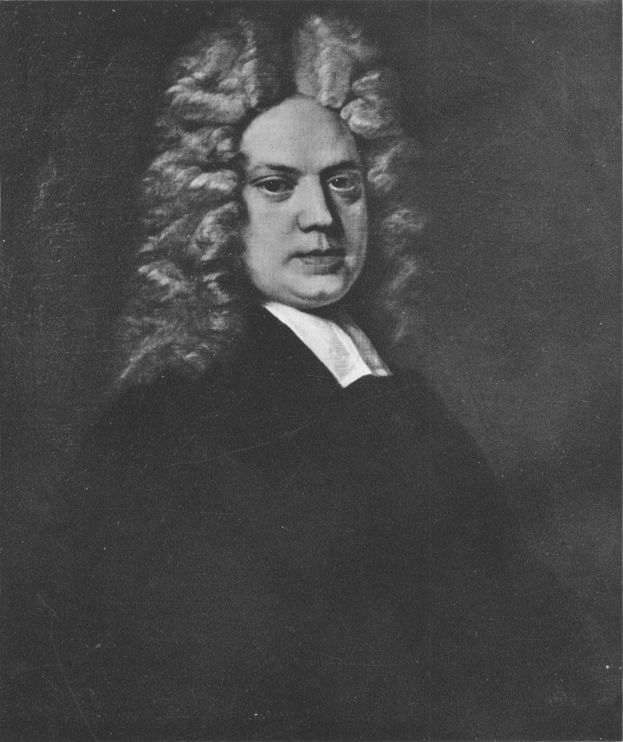
HENRY SACHEVERELL
By permission of the President and Fellows of Magdalen College, Oxford
From the earliest stages of the trial Sacheverell’s popularity with the crowd became obvious. Admitted to bail, he made a daily progress to Westminster escorted by enthusiastic throngs. The poorer people pressed to touch his hands or garments. When the Queen’s sedan chair threaded its way through the multitude her subjects beset her with loyal shouts and cries of “We hope your Majesty is for the Doctor.” Inside the Hall Sacheverell’s unctuous eloquence drew tears of partisan piety from Tory ladies, while the Whig beauties soon found the legal arguments tedious. Rioting broke out in the streets. The pews of Dissenting chapels were made into bonfires. Bishop Burnet saw one man cleave another’s head with a spade upon the learned issue. Threats to sack the palaces of the Whig nobles were freely uttered.
“This uneasy trial of Sacheverell,” wrote Godolphin to Marlborough (March 5), “does not only take up all my time, but very much impairs my health, and how it will end I am not at all certain. But I certainly wish it had never begun.”[275] And (March 17) “The Duke of Somerset labours hard against us.”[276] “I believe,” wrote John to Sarah (March 13/24), “the behaviour of the Duke of Somerset, the Duke of Argyll, and Lord Rivers, are true signs of the Queen’s being of their mind, which must inevitably bring a great deal of trouble to her. I do, with all my heart, wish I had not recommended the Duke of Argyll, but that can’t now be helped; nothing is good but taking measures not to be in the power of ungrateful people.” And the next day: “I can’t think it possible that the duke of Somerset will give his vote or opinion for the clearing of Sacheverell; if he does, there is nothing he would not sacrifice to have power: his behaviour in this matter will be a true weathercock of the Queen.”[277] On March 23 Dr Sacheverell was found guilty by sixty-nine to fifty-two, a majority of seventeen votes. A motion to incapacitate him from preferment in the Church for three years was lost by one. “So all this bustle and fatigue,” exclaimed Godolphin, “ends in no more but a suspension of three years from the pulpit, and burning his sermon at the Old Exchange.”[278]
The Sacheverell trial was a Whig disaster of the first magnitude. Beyond all doubt it turned the scale. They had hoped by a careful restatement of party fundamentals to rally all moderates and waverers, particularly in the Lords. The division lists on the impeachment showed only too plainly their miscalculation. Sacheverell was now the hero of the day. A lucrative living was bestowed on him by a Tory admirer. His journeys through the country were a triumphal progress. He was welcomed by thousands of ardent Churchmen at every town, and often also greeted by mobs who hailed the mixture of religion and politics for which he stood by riotous demonstrations against the Government.
It was at this inauspicious moment that Sarah came into final collision with the Queen. Feeling that her personal relations had become impossible, she had in February induced her husband to ask the Queen, first, to allow her to remain as much as possible in the country, and, secondly, that at the conclusion of peace she might resign her offices in favour of her two daughters, Lady Rialton and Lady Sunderland. Sarah affirmed that Anne had promised her this reversion upon a former occasion. The Queen, who was bidding farewell to her General starting for the wars, readily agreed to the first, but upon the second contented herself with saying that she hoped the Duchess would not leave her service. When later on, however, Sarah pressed for more precise assurances and mentioned a promise, the Queen said first, “I do not remember that I was ever spoke to about it.” On being further pressed she ended the discussion by saying impatiently, “I desire that I may never be troubled any more on the subject.”
Sarah, when she had returned fuming to the country, commented at table freely upon public affairs, and was by no means careful what she said about the Queen. It was a definite part of the Harley-Abigail campaign against her to report to Anne anything likely to make ill-will, and it is certain that their tales lost nothing in the telling. At the Court Sarah was accused of uttering atrocious sentiments and calumnies against her mistress. Indignant, she demanded an audience to clear herself. The Queen did her best to avoid seeing her. She found three separate hours unsuitable, named a fourth, and cancelled the appointment on the grounds that she was going to Kensington. Sarah followed her there, and asked the page of the backstairs to tell the Queen she begged to be received. Then she sat down, according to her account, in the window, “like a Scotch lady with a petition, instead of a trusted and lifelong confidant.”[279] After a long interval she was admitted.
All accounts of what followed are based upon Sarah’s narrative in her Conduct of the Duchess of Marlborough, which she published in 1742.[280] The Queen began by saying, “I was just about to write to you.” As Sarah tried to unfold her case Anne said, “Whatever you have to say, you may put it in writing.” She repeated this interruption four or five times. Sarah protested that she only wished to clear herself from false aspersions. The Queen turned away her face from her. Sarah declared that there were those about the Queen who had made her believe that she had said things of her which she was no more capable of saying than of killing her own children, and “that I seldom named her Majesty in company, and never without respect.” To this the Queen observed generally, “Without doubt there are many lies told.”
Sarah then pressed to know what exactly it was that she was alleged to have said. The Queen used the second formula which her advisers had no doubt suggested. Sarah in her letter asking for the audience had written, “What I have to say in my own vindication will have no consequence in obliging her Majesty to answer.” Fastening upon this, the Queen repeated again and again, “You desired no answer and shall have none.” To all protestations and entreaties she made this unchanging reply. At length she moved towards the door. On this, in Sarah’s words, “when she came to the door I fell down in great disorder. Streams of tears flowed down against my will and prevented me speaking for some time.” There may have been a moment when Anne relented, for she certainly stayed and listened further. But presently, recovering herself, she repeated again and again her parrot sentence, “You desired no answer, and you shall have none.” At last Sarah could endure it no longer. “I am confident your Majesty will suffer for such an instance of inhumanity.” “That will be to myself,” said the Queen. These were the last words ever interchanged between the two women. They never saw each other again.
“After I had come out from the Queen,” says Sarah, “I sat me down in the long gallery to wipe my eyes, before I came within sight of anybody.”[281] She recovered her spirits before her temper: Gaultier reported that she “left the palace like a fury.”[282]
Throughout the spring and summer an outpouring of addresses, organized by the Opposition, and expressing Tory sentiments and fervent loyalty, flowed to the Queen from all parts of England. Anne was delighted with these manifestations. She frequently received the deputations in person and made no secret of her sympathies. Even Lockhart, the leader of the Scottish Jacobites in the Commons, was welcomed by her. “Her Majesty,” he writes,
seem’d very well pleased, gave a gracious return to the address, and then told me, tho I had almost allways opposed her measures, she did not doubt of my affection to her person, and hop’d I wou’d not concurr in the design against Mrs Masham or for bringing over the Prince of Hannover. At first I was somewhat surprized, but recovering my self, I assur’d her, I shou’d never be accessary to the imposing any hardship or affront upon her.[283]
Shrewsbury had hitherto been a frequent visitor to the buildings at Blenheim. He lived but a few miles away at Heythrop. Lately his visits had ceased; and Sarah could only guess whether this was due to general politics or to her incautious disparagements of the Italian Duchess. While the Sacheverell trial hung in the balance, and when popular opinion ran strongly against the Government, it had been a matter of widespread curiosity which way the Duke of Shrewsbury would vote. He voted for acquittal. No one could reproach him for this. He was a free man. His vote on the merits was right and in harmony with the public mood, but the fact that one of King William’s most renowned Ministers walked through the lobby of the House of Lords against Sacheverell’s impeachment showed many people that the impeachment was as wrong as every one now saw it had been impolitic.
What set London agog was not Shrewsbury’s vote against the Government, but its sequel. On the afternoon of April 14 Anne sent for the Marquis of Kent and deprived him of his office of Lord Chamberlain. He could be consoled with a dukedom. The next morning Shrewsbury, within seven weeks of his hostile vote on the key issue of Sacheverell, was appointed in his stead. In this period the Lord Chamberlain, with his constant access to the Sovereign and his immense social and ceremonial power in the Court, was an officer of State almost as high as the Lord Chancellor. That such an office should be in hands independent of the Ministry and of the harassed Treasurer and First Minister was a political change of the first order. The Queen, sustained by her secret advisers, did not even mention the matter to Godolphin beforehand. She wrote to him (April 13) of her desire “to allay the heat and ferment that is in this poor nation. Since you went to Newmarket,” she continued, “I have received several assurances from the Duke of Shrewsbury of his readiness to serve me upon all occasions, . . . which offer I was very willing to accept of, having a very good opinion of him, and believing he may be of great use in these troublesome times. . . . I hope that this change will meet with your approbation, which I wish I may have in all my actions.”[284]
The Treasurer on this wrote to the Queen in the most vehement terms:
Your Majesty is suffering yourself to be guided to your own Ruin and Destruction, as fast as it is possible for them to compass it, to whom you seem so much to hearken. . . . There is no Man [he said of Shrewsbury] of whose Capacity I have had a better Impression; nor with whom I have lived more easily and freely for above twenty Years. . . . [And] to bring him into your Service and into your Business at this Time, just after his being in a publick open Conjunction in every Vote with the whole Body of the Tories, and in a private, constant Correspondence and Caballing with Mr Harley in every Thing, what Consequence can this possibly have, but to make every Man that is now in your Cabinet Council, except [the Duke of Somerset] to run from it as they would from the Plague.
He concluded with “two humble requests”:
The one, that you will allow me to pass the Remainder of my Life always out of London, where I may find most ease and Quiet. The other, that you would keep this Letter and read it again about next Christmas, and then be pleased to make your own Judgment, who hath given you the best and most faithful advice.[285]
But how could Godolphin resign? Was not Shrewsbury exactly the element with which he and Marlborough had wished to strengthen the Government? Was he not a national statesman who would keep the Queen high above the “merciless men” of both parties? Had not Marlborough himself half a year earlier wished for such a development? The doctrine that the Sovereign acts only on advice of Ministers responsible to Parliament was in its infancy. How could Godolphin boggle at a lapse in procedure, however unpleasant, however menacing? The first conclusion of the Junto, particularly of Sunderland, was that Shrewsbury’s appointment was a stroke by Marlborough and Godolphin to reconstruct the Ministry at their expense. This opinion seems to have been widely held outside ministerial circles.[286] The Junto were therefore suspicious and dumb.
When Godolphin reached London on the 16th it was the Queen who was the first with reproaches. “He had shown,” she remarked, “more uneasiness in the new appointment than any of his colleagues.” When the Queen assured him that she intended no further changes Godolphin’s rejoinder was laconic: “The reports of the town run high on that subject.” His dismissal from the royal presence was cold and formal. When he met Somers and Sunderland he found them alive with distrust. His agitated manner and downcast mood convinced them that his fortunes were not divorced from theirs. There remained an even greater fear—the dissolution of Parliament. This now became the dominant factor. After Sacheverell the Whigs did not dare to face the country. They had forced themselves upon the Queen in the name of Parliament and the electors. They were now unsure of the electors; and they knew the Queen could soon get rid of the Parliament, already in its second year. There was nothing for it but to make the best of Shrewsbury and hope to conciliate him. “I have seen Lord Somers and Lord Sunderland to-day,” wrote Godolphin to Sarah.[287] “Both appear to me to be mortified as much as myself, but thinking it reasonable enough to dissemble.”
Moreover, Shrewsbury was profuse in his expressions of friendship for the Lord Treasurer and of admiration for the General in the field. He wrote in the most ceremonious style to Marlborough. In a soothing interview he half persuaded Godolphin that he meant to work with him. Godolphin, therefore, submitted to what was none the less a royal affront to his office and status and a searing mark of his loss of credit with the Queen. “I have seen the Duke of Shrewsbury,” he wrote (April 17). “I find most people are of opinion that he will like very well to live easily with us, and I am not unapt to think so too. But I think ’tis very plain that he comes in by Mr Harley.”[288] And on April 20: “The Lord Chamberlain was extremely full of professions to you, to me, and to Lady Marlborough; and that by whatever door he came in, it was always with an intention and a desire to live well with us three. I answered with compliments from you and me. . . . His Grace protested most solemnly to me that he never had spoken one word to Abigail in his life.”[289]
Marlborough, banging away at Douai with the daily chance of a decisive battle upon his hands, had no doubts about what the new appointment meant. Shrewsbury had been brought into the Government not as his man, but Harley’s. He foresaw from the instant the truth, which was the worst. “I am very much surprised,” he wrote to Godolphin (May 5), “at the courage of the Duke of Shrewsbury to come so freely into the storm: I think you and I may see very plainly by neither the Queen’s nor his ever taking notice of it to us, that they have another scheme than what would be approved of by us.”[290] And to Sarah: “If I know anything of the temper of the Queen, she would not have made this step, but that they are ready to go into all the extravagances imaginable. The chiefest care now should be, that the Parliament be preserved; for if that cannot be obtained, which I very much doubt, nothing will be worth the managing. Of all things, the Whigs must be sure to be of one mind, and then all things, sooner or later, must come right.”[291]
Shrewsbury lavished reassurances upon Marlborough. After all, they had much in common in the past. Both at the peril of their lives had been in correspondence with King William. Each had played an historic part in driving out Popery and King James. Both had in remorse or reinsurance kept alive under the shadow of treason their correspondence with the exiles at Saint-Germain. Both had faced a mortal danger at the time of the Fenwick trial. Marlborough had borne the strain imperturbably. Shrewsbury had crumpled beneath it. In his nervous depression he had abandoned public office. Marlborough had marched on through dark years to world glory. The pair had everything in common, except that they were to sit in the same Cabinet in opposite interests. But even this glaring fact, which Marlborough discerned so plainly, was veiled by ceremony and soothing protestation. At no moment was any issue presented upon which Marlborough could make a stand either to the Queen or to the new Lord Chamberlain. All had to be passed off with bows and compliments.
|
Burnet, v, 421. |
|
Bath Papers, H.M.C., i, 199. |
|
H.M.C., Portland Papers, iv, 532. |
|
Price of Wheat (per Quarter)
[Ernle, English Farming, Past and Present, p. 440.] |
|
Wentworth Papers, p. 111. |
|
Coxe, v, 154. |
|
Ibid., 155. |
|
Ibid., 157 et seq. |
|
Coxe, v, 156. |
|
Blenheim MSS., quoted in S. J. Reid, John and Sarah, Duke and Duchess of Marlborough, p. 322. |
|
Conduct, p. 279. |
|
Blenheim MSS., quoted in S. J. Reid, p. 327. |
|
F. Salomon, Geschichte des letzten Ministerium Königin Annes, p. 24. |
|
Lockhart Papers (1817), i, 317. |
|
Coxe, v, 215-216. |
|
Conduct, p. 291. |
|
Maffei’s letter of May 23 to Marlborough; Coxe, v, 221. |
|
Ibid., 219. |
|
Coxe, v, 223. |
|
Ibid., 224. |
|
Ibid., 225. |
|
Ibid., 226. |
Once again the great armies assembled, and now more numerous than ever. Although the plans of the Allies contemplated converging inroads upon France from the Rhine, from Dauphiné, and upon the coast, all gravitated irresistibly to the main theatre. Apart from the separate, self-contained war in Spain, all the subsidiary operations languished. Marlborough’s diminished authority was incapable of infusing vigour into them. The Elector of Hanover threw up the command of the Imperial forces on the Rhine on the ground that they were relegated to a minor rôle. Even with a superiority of three to one he had only gaped at his opportunities in 1709. Victor Amadeus of Savoy felt that this was a season for politics rather than for war; and M. de Seissan, a French refugee of some mark, who had undertaken to raise the Cevennes, never found himself provided with the means to undertake this task.
All lay in the north and among the fortresses. Here Marlborough and Eugene would war with Villars supported by four other marshals; and every scrap of force that could be gathered by the war-wearied combatants was hurried to their respective camps. The confederate army marshalled 155 battalions and 262 squadrons, with 102 cannon, 20 howitzers, and 40 pontoons.[292] France, rightly judging the impotency of the minor theatres, claimed to have available for Villars’s command no fewer than 204 battalions, 308 squadrons, and a full proportion of artillery and pontoons. Villars’s own statements of his strength vary. When making head against Marlborough and Eugene he boasted of a great superiority: in his memoirs he declares himself the weaker by 40,000. There is no doubt that the allied armies were far better equipped and supplied and thus stronger in war-power than their opponents, and all the movements of both sides were based upon this fact.
European and English public opinion expected that the two great commanders, superior in skill and in the numbers at their command, would soon bring the war to an end; but the task was not so easy. The dangers and cost of assaulting bravely held entrenchments were rated at a new high level after Malplaquet. The campaign still lay in the second and third lines of the French fortress zone, with all the obstinacies and time-losses that must be encountered there. The problem of feeding and foraging their enormous armies in ruined, famine-stricken regions confronted these lords of thirty or forty thousand cavalry with rigorous limitations. Eighteenth-century warfare had reached its maximum and its culmination as a result of squandered opportunities both of victory and of peace, and of a will-power on both sides which was alike unreasoning and indomitable. Meanwhile at Gertruydenberg the diplomatists and plenipotentiaries, surrounded by a host of agents and busybodies, official and unofficial, manœuvred sedately around the clauses of the peace treaty, incapable as were the armies of reaching a decision.[293]
Two alternatives offered themselves to the Allies for the final penetration of the French fortress zone (see map, p. 239). The first, which no doubt Marlborough would have favoured because of the use he could make of British amphibious power, was near the coast, down the Lys by Saint-Venant and Aire, aiming at the creation of a new reinforcing base at Abbeville. This movement would turn the left and cut in behind the principal fortresses of the French barrier. It would also avoid the fortified line which Villars was preparing from La Bassée to Douai. A right-handed operation of this kind, however, though very agreeable to English interests and to the true strategy of a combination possessing the command of the sea, exposed the whole of Brabant to a northward thrust by strong French forces. The other choice was to punch at the French centre up the Scarpe to Douai and towards Arras, with further inclination towards Cambrai. Advance by this route was the most direct invasion of France. It covered Brabant and the Spanish Netherlands from French counter-strokes, and it threatened simultaneously five or six fortresses essential to the French defence, any of which might be attacked, all of which must be heavily garrisoned. Both routes led into unravaged regions where the advancing armies could feed themselves for many weeks. Both were sustained by good waterways. Marlborough controlled the Lys up to Armentières, and the Scheldt to beyond Tournai. By either of these rivers he could draw through Ghent the whole resources of the confederacy, and carry forward supplies, siege-trains, and munitions with ease and sureness. Upon the whole, the central punch, if successful, would lead into better ground for the operation of all arms, and especially the cavalry, then so dominant a factor. Thus the strategic choice was evenly balanced; but the political needs of the Dutch to have the main allied army between their regained territory and the enemy was decisive. There is no evidence that Marlborough at this time pressed seriously for the coastal movement. The councils of war were guided by him and Eugene towards the French centre. This meant the siege of Douai, followed if successful by that of Arras. There was complete agreement upon this.
The French placed four armies in the field—in Roussillon under Noailles, in Dauphiné under Berwick, on the Rhine under Harcourt, and the great mass under Villars, when he was fit enough, in the Netherlands. Owing to the stringency of food, forage, money, and equipment, these armies were to stand everywhere on the defensive. In the main theatre the winter was spent in strengthening the fortresses and collecting supplies. In March Berwick was offered the command till Villars had recovered sufficiently. Berwick demanded authority to assemble and forestall the impending attack. As this was contrary to Louis XIV’s general conception of a defensive campaign, he was not encouraged, and proceeded, as originally proposed, to his command in Dauphiné. Marshal d’Artagnan, who had succeeded to the title of Duc de Montesquiou by which he was in future to be known, was therefore placed in charge of the preparatory phase. He reinforced La Bassée and Ypres, with some difficulty persuaded Louis to let him use men and money to strengthen the lines about La Bassée, and clamoured for everything needed for war. Montesquiou as yet could only feed 40 battalions and 40 squadrons upon this front, and that for a short time.
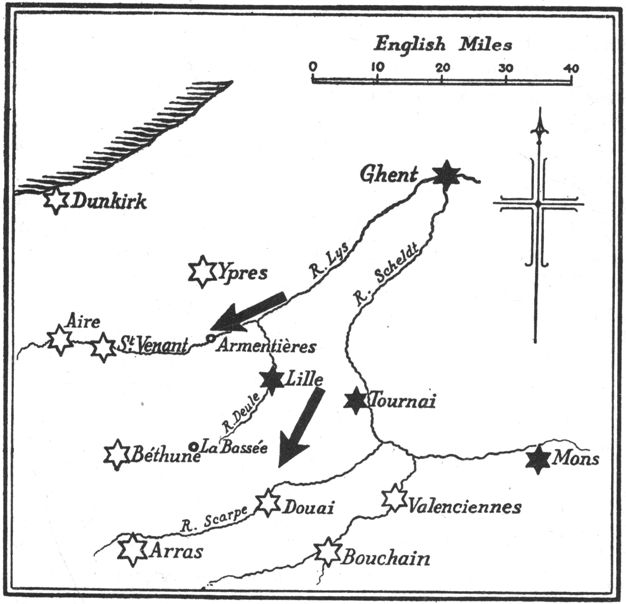
THE CHOICE IN 1710
Marlborough, arriving at The Hague, decided to take the field at the end of March. He ordered Albemarle, who had been in command of the British troops in Flanders during the winter, to seize Mortagne and Saint-Amand, on the Scheldt, so as to open the water communications for a siege of Douai. Albemarle captured Mortagne on April 14. It was retaken the next day by Luxembourg, and finally mastered by the Allies on April 18. Saint-Amand, surrounded by inundations, was not yet found assailable. This preliminary thrust did not relieve the uncertainties of the French High Command. It might equally well be a feint down the Scheldt to cover an eventual movement by the Lys. However, the confederate army began to assemble around Tournai, and in the third week of April Marlborough and Eugene arrived together from The Hague at that fortress. In spite of the late spring and the consequent shortage of forage, they had decided to begin operations at once without waiting for all their troops to arrive or for the grass to grow.
To besiege Douai it was necessary first of all to pierce the French defensive lines. Only half the allied army had yet assembled; sixty thousand men were still to come, but it was known that the French would be largely immobile for some weeks, and a great operation to pierce their lines was planned, albeit with incomplete forces.
The map opposite shows the situation in the middle of April.
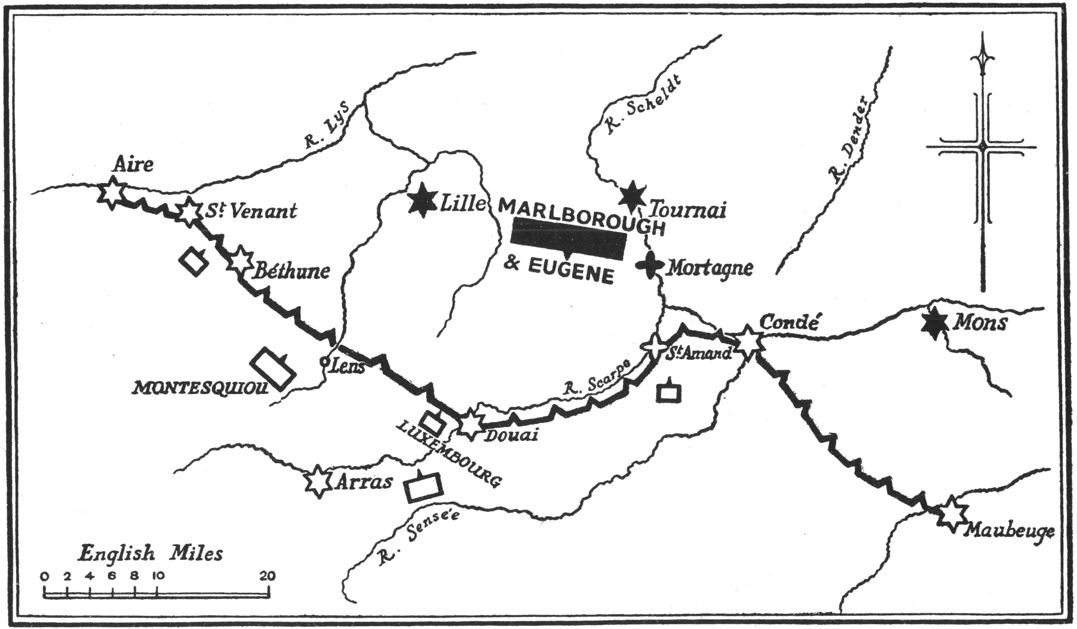
THE SITUATION IN APRIL 1710
“I hope to date my next on the other side of the lines,”[294] wrote Marlborough on the 20th, when the Allies advanced. The Duke of Würtemberg and Count Feltz, with 15 battalions and 50 squadrons, were sent ahead to the Deule. The army followed in four columns. The next day Würtemberg, accompanied by Cadogan, entered the French lines at Pont-à-Vendin. The defenders retired without fighting. Feltz failed at Pont-Auby, but Eugene, coming up in heavy force, crossed at Courrières and Saut, and the main army followed across these captured bridges and pressed on to the south of Lens, where it halted, before the Vimy Ridge after a thirty-mile march. Montesquiou, who was evidently not expecting so early an attack, and could not in any case command the means to resist it, was caught foraging, and retreated across the Scarpe at Vitry, breaking his bridges behind him. On the 22nd the advance continued. Montesquiou, now joined by Luxembourg, withdrew precipitately, his front ruptured and his forces overweighted. On this day the Allies followed him across the Scarpe at Vitry, and camped on the south bank. Eugene remained north of the Scarpe to invest Douai from that side. Thus in three days Marlborough had advanced forty miles, and had crossed the Deule and the Scarpe without fighting. Douai was already almost isolated. Montesquiou could not attempt to stand along the Sensée. All the water from this river had been diverted to fill the inundations around Douai, and the river-bed was passable almost everywhere. He therefore fell right back to Cambrai. Here the shortage of supplies and the loss of all his forward magazines compelled him to disperse the greater part of his army, and Marlborough could begin the siege of Douai in most favourable circumstances.
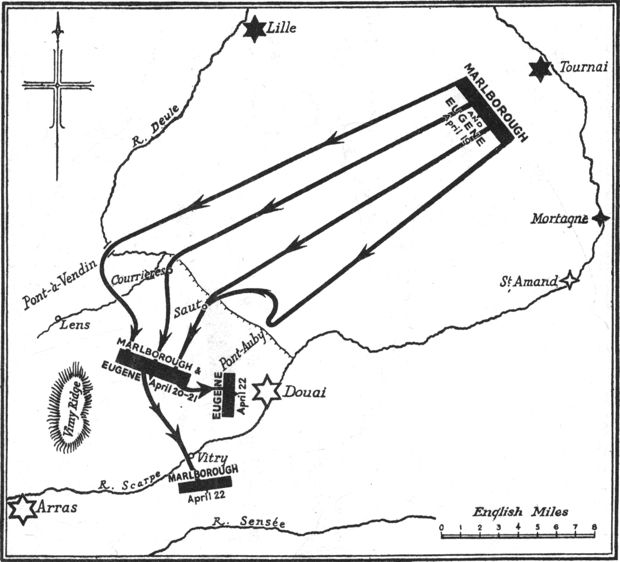
THE ADVANCE: APRIL 19-22, 1710
This masterly movement of extraordinary rapidity was made possible only by dry forage brought by water. It succeeded because it was launched before the enemy could feed on the ground enough troops to man their extensive lines. All these fortifications, upon which so much labour had been spent, proved perfectly useless. They were simply walked over, and a very great tract of country, which might well have been disputed for the whole campaign, passed at a stroke into Marlborough’s possession. We are often told of the leisurely and ceremonious methods of eighteenth-century war. Here are movements of large armies as swift and sudden as any in military annals.
John to Sarah
Lens
April 21, 1710
In my last I had but just time to tell you that we had passed the lines. I hope this happy beginning will produce such success this campaign as must put an end to the war. I bless God for putting it into their heads not to defend their lines; for at Pont de Vendin, where I passed, the Mareschal d’Artagnan was with 20,000 men, which, if he had stayed, must have made it very doubtful. But, God be praised, we are come here without the loss of any men. The excuse the French make is, that we came four days before they expected us.[295]
Marlborough to Godolphin
Lens
May 1, 1710
* I have receiv’d none of Your letters since my last, nor nothing new has pass’d here. Our Canon both from Gand and Mons, cou’d not be coming forward til to morrow, so that we hope to have part of them here about the eighth, and that we might not Continu intierly Idel. Tho it be against the rule to open the trenches before we have our Canon, we think of doing it tomorrow, or the next day at farthest, for if it were possible we wou’d faine be masters of this town in this month of may.[296]
Douai was a fortress of the first order, well prepared and supplied for a siege. The Deule and the Scarpe were joined by a canal in the town, which was therefore an important key to the waterways. It was protected by a number of strong outlying posts, and by Fort Scarpe, a large detached work which guarded the north-western approaches. Water played a great part in its defences, and the inundations severely limited the sectors open to the attackers. General Albergotti commanded the fortress with a garrison of over eight thousand men, comprising 17 battalions in Douai and 3 in Fort Scarpe.
The lines of circumvallation were completed on April 28. Forty battalions and as many squadrons under the command of the Princes of Anhalt and Orange conducted the siege, which Marlborough and Eugene covered. It was generally hoped that the town would be reduced before the grass grew and Villars could assemble an army strong enough to attempt relief; but the siege-train of two hundred guns, including 80 heavy pieces, did not reach the camp till May 9. The fact that the French had control of the sluices made water communications difficult. They were also able, by galleys from Condé operating down the Scheldt, to threaten water convoys moving south from Tournai. Marlborough therefore collected large quantities of wagon transport, and also developed the water communications up the Deule from Lille. The heavy batteries began to play on May 11.
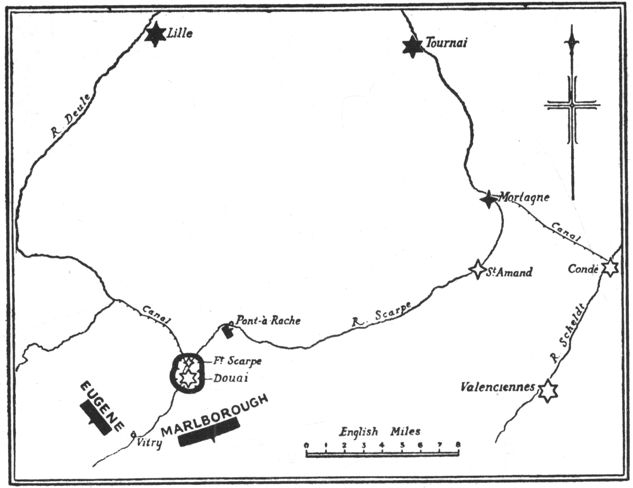
THE SIEGE OF DOUAI
Louis XIV hoped that by this time Montesquiou would be strong enough to impede the task of the besiegers. He was answered that the Allies, even after undertaking a siege, were still superior, and that the French army could not yet take the offensive. Villars arrived at Péronne on May 14, and took command. His army could not be fully assembled till the end of the month. Although strategically the great King was upon the defensive, the idea of a battle to relieve Douai, if a good chance offered, was cherished. Berwick, recalled from Dauphiné, joined the army for the same purpose as Boufflers before Malplaquet. Commanders-in-chief fought so hard in the battles of those days that it was indispensable to have a recognized understudy fully versed in the part. The gallant Villars was still suffering from his wound. His knee discharged, and from time to time threatened an abscess. He had had a steel “machine” made which held the joint rigid on horseback. He could not ride for more than two hours without fatigue and pain. But he was none the less overflowing with vitality and what in any man less brave and skilful would be called braggadocio. His army began to draw together around Cambrai. Far from minimizing his forces to safeguard his reputation, he declared that he was at the head of 160,000 men. Actually he had a little over 100,000.
* “The Marishal de Villars,” Marlborough wrote to Slingelandt (May 12), “is expected in a day or two on this frontier. We shall be able to guess by his first motion what his orders and intentions are. We are taking the necessary precautions for the receiving him, but til I see him on the plains of Lenz, I can not bring my self to believe thay will run soe great a hazard as a battel on these plains, where two lucky houres might deside the fate of ffrance.”[297]
Innumerable sieges took place in these long wars, and most of them were merely matters of routine. But the siege of a fortress as strongly garrisoned as Douai, with the two main armies in close contact around it, created a situation in which on any day one of the decisive battles of the world might explode. The fact that no great battle was fought does not mean that an intense trial of strength and skill was not proceeding between these armies, upon whose interplay all European eyes were fixed. Marshal Villars rejected the idea of a move against the allied left by crossing the Scheldt about Valenciennes. This would enable practically the whole of the besiegers to join the covering armies, while still leaving Douai isolated. He could not hazard forcing the Scheldt in the face of such opposition. He rejected also a move against the allied centre by crossing the streams of the Sensée and the Moulinet under virtually the same conditions. He resolved, therefore, to move round the allied right between the Scarpe and Lens, while leaving a force at Bouchain which, if Marlborough withdrew his besiegers from that side of Douai, could march into the place with men and supplies, and break the siege. Thus he hoped to pin the besiegers to their task at no great expense in numbers, and to bring a superior field army to bear upon Marlborough and Eugene in the region of their communications.
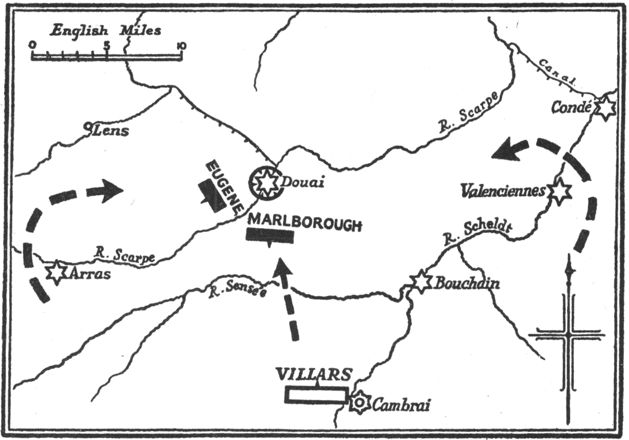
VILLARS’S CHOICE OF ACTION (MAY 1710)
According to Villars, Berwick and Montesquiou deprecated a battle, and Villars admits in his memoirs that he did not mean to fight one. He thought, however, that it would do his army good to march up to close contact with the enemy, and that if they were found well posted he could easily retire. He represented his manœuvre from the outset to his colleagues as a reconnaissance with the whole army. Announcing by word and manœuvre that he intended to attack from Bouchain, he concentrated forward in that direction, brought in all the troops from Arras, and advanced north-westward full of menace. The Ally cavalry patrols detected, as Villars desired, the eastward march of the Arras detachment. Marlborough and Eugene personally reconnoitred all the possible battlefields between Douai and the front Valenciennes-Arleux, and the confederate army was deployed in that direction. Only 30 battalions were left at the siege and 12 squadrons at Pont-à-Rache. The whole of the cavalry, which had been feeding its horses from the Deule barges south of Lille, were also brought across the Scarpe by Vitry.
As this confrontation developed day by day both sides received strong reinforcements: Villars from the Rhine and Dauphiné; Marlborough of the Hessians on the spot, of the Palatines coming into Brabant, and of several cavalry regiments which Eugene had summoned from the Rhine. By May 22 the armies faced each other, Marlborough and Eugene being astride of the Scarpe. These two Commanders, acting as ever in the most perfect harmony, of course realized that Villars might only be making a feint, and one fine night would move suddenly back to the west. They therefore built no fewer than twenty bridges across the Scarpe between Vitry and the lines of circumvallation, so that their whole army, moving on interior lines, could swing round to the new quarter of the compass without the slightest impediment.
On May 25 Villars made this move. Under the cloak of darkness he crossed the Scarpe by eight bridges just east of Arras, and debouched into the plain of Lens. On May 27 the three French marshals, Villars, Berwick, and Montesquiou, reconnoitred the allied right wing and, not liking the look of it, continued their left-handed movement towards Lens. Simultaneously Marlborough and Eugene extended their right, drew in the bulk of the siege troops, and formed a front facing west, leaving only the Dutch under Tilly south of the Scarpe. On May 30 Villars advanced directly to within barely two miles of the confederate line, which was now covered by a chain of redoubts. Simultaneously Albergotti began a series of vigorous sorties from Douai. Marlborough none the less brought up Tilly and the Dutch troops, and battle from all appearances seemed imminent. Both the allied Commanders feared this was not true. But Marlborough’s letters still convey a sharp impression of this crisis of war.
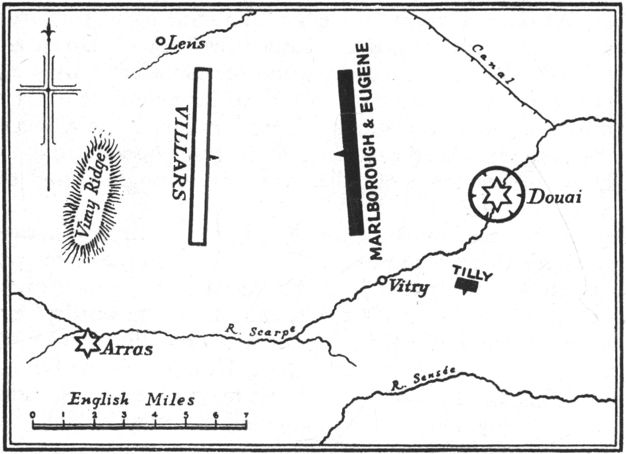
MAY 27-30, 1710
“This minute they bring me word,” he wrote to Godolphin (May 22),
that the French have passed the Scheldt, and are marching this way; they must make one motion more if they will attack us. Whatever may be the success, pray assure the Queen that, for her sake, as well as my own, I shall do my best; for, if we have a battle, this must decide the fate of almost all Christendom. . . . May the great God of battles give us success![298]
And (May 26):
Marshal Villars’s army increases every day; those that are not yet come have ground marked for them in the line, which is above eight miles long. He gives out that his army will be 160,000 strong. It is certain they have a great number of battalions; but I believe, by the sickness they have at this time in their foot, we have as many men as they. . . .
I am this day threescore; but, I thank God, I find myself in so good health that I hope to end this campaign without being sensible of the inconvenience of old age.[299]
Marlborough to Townshend
June 1, 1710
* Marshal de Villars last Friday left his baggage at Arras with an intention to have attacked us that day, but when he came so near as to see us, he changed his mind, and has since called two councils of war. The enclosed will let you see their opinions, which I desire might be shown to nobody but the Pensioner, Count Sinzindorff and Slingelandt; I have it from a hand that has never failed me, it is the same that gave the first notice of the expedition of Scotland, as also that of Brussels, so that I rely on this paper and hope to be informed of the King of France’s answer. The Prince of Savoy thinks we should resent the insincerity of the King of France, who at the same time he amused us with a sham negotiation gives orders to his general to venture battle.[300]
And (June 2):
The enclosed is what was sent to the King of France two days ago.[301] If the Court should insist on attacking, his army is so near that he may be with us in two hours’ time; however, we think ourselves so securely posted that we have sent the troops back for the carrying on of the siege. . . . I thank God I have my health; but what I hear from your side of the water gives me so much uneasiness that I am not so fully pleased with those sanguine thoughts as formerly, that God would protect and bless us; but with all my soul I pray He may, and shall very freely venture my life that we may have success.[302]
All day the great masses watched each other within cannon, and at some points within musket, shot. The French marshals, including Villars, were agreed that the Allies were too strong to be attacked, and in the evening the French withdrew out of immediate striking distance. This was no doubt a wise decision. The question arises, however, why if the numbers of men were approximately equal, as Marlborough writes, he and Eugene did not themselves advance and attempt to force a battle. The answer must be that they did not intend at this time to run any supreme risks. They thought the war was certainly won, and that they need only continue to conduct it successfully to compel a peace. Time, they believed, was on their side. There was no warrant for staking the overwhelming advantages that had been gained. This reasoning was no doubt sound upon all the military facts. Perhaps Marlborough was not himself satisfied with it. His mind was oppressed by the hostility of the Queen and the growing power of his foes in England. He did not feel that confidence in victory which had inspired him at Blenheim and Ramillies. “I am not so fully pleased with those sanguine thoughts as formerly, that God would protect and bless us,” is a sentence which shows that the strains and stresses to which he had been so long subjected had worn him down. Had he felt the same need and urge for battle as in his campaign of 1705 it is by no means certain that Villars could have paraded and promenaded north of the Scarpe with impunity.
As part of the siege works, a dam had been built across the Scarpe at Biache to turn the waters for a time into the neighbouring marshes and thus prevent the flooding of the trenches. This dyke was defended by a fortified post. Villars was attracted by a plan to overpower this post, destroy the dam, and with the pent-up waters break an important bridge behind it, as a prelude to an attack on the allied sector between the Scarpe and the Sensée. Oddly enough, at the same time Marlborough began to feel uneasy about Biache and this particular dam. On the morning of June 2 he rode thither himself with Count Tilly. He reinforced the garrison with eighty men, and personally gave orders to the commanding officer to defend himself to the last extremity, assuring him that he would be supported in good time. The very same night about nine o’clock it happened that the enemy attacked. Whether from cowardice or treachery, the officer surrendered the post without any resistance, and with six officers and 150 men was taken prisoner. The dam was partly broken, and some waters released before the counter-attack drove out the intruders. The bridge, however, was not swept away by the scour. The incident is of interest because, unless it was pure coincidence, it not only illustrates Marlborough’s attention to detail, but is another example of the uncanny efficiency of his Secret Service.
The siege of Douai was strongly contested. Albergotti is said to have made no fewer than thirty-two sallies during its course. But the Prince of Anhalt’s attack in particular progressed steadily. The covered way was mastered by the middle of June, and on the 19th two important ravelins of the inner defences were stormed in a bloody assault. During the night of the 24th the besiegers were so much the masters that they were filling up the ‘capital ditch’ and building galleries across it. On the morning of the 25th Albergotti beat a parley, offering to surrender Douai but not Fort Scarpe. This was refused, but after some haggling he yielded, and on the 26th articles of capitulation were agreed.
On the morning of the 29th General Albergotti marched out with 4527 effective men. He led his troops past Marlborough and Eugene with mutual salutations. After having ridden some little distance he turned back and joined the two Princes, and all proceeded to dine together, while the survivors of the garrison made their way to Cambrai, escorted to the French lines by some squadrons of allied horse.
The losses of the siege had been severe. Albergotti had lost a third of his men. The Allies had paid eight thousand casualties for the acquisition of the fortress; but, what was even more costly, they had consumed the whole of May and June, and their campaign, which had started so early and so brilliantly, was now a month behind their plans. Marlborough’s depression was extreme. “I long,” he wrote to Godolphin (June 12),
for an end of the war, so God’s will be done; whatever the event may be, I shall have nothing to reproach myself, having with all my heart done my duty, and being hitherto blessed with more success than was ever known before. My wishes and duty are the same; but I can’t say that I have the same sanguine prophetic spirit I did use to have; for in all the former actions I did never doubt of success, we having had constantly the great blessing of being of one mind. I cannot say it is so now; for I fear some are run so far into villainous faction that it would give them more content to see us beaten; but if I live I will be so watchful that it shall not be in their power to do much hurt. The discourse of the Duke of Argyll is that when I please there will then be a peace; I suppose his friends speak the same language in England, so that I must every summer venture my life in a battle, and be found fault with in the winter for not bringing home peace, though I wish for it with all my heart and soul.[303]
Not only the resistance of the fortress but the ravages of typhus had smitten the besiegers. “My last quarters,” wrote Marlborough to Godolphin (June 16),
infected a great many of my servants, by which I have lost Groffy, my steward, and poor Turliar [his dog]; but the rest are recovering. It is impossible, without seeing it, to be sensible of the misery of this country; at least one-half of the people of the villages, since the beginning of last winter, are dead, and the rest look as if they came out of their graves. It is so mortifying that no Christian can see it but must with all his heart wish for a speedy peace.[304]
Harley’s tentacles now extended in all directions. He had brought into being a group of officers clustered around the Duke of Argyll who were actively disloyal to the Commander-in-Chief, under whom they were serving, and eagerly bidding for promotion in the Army from the régime that was rising into power.
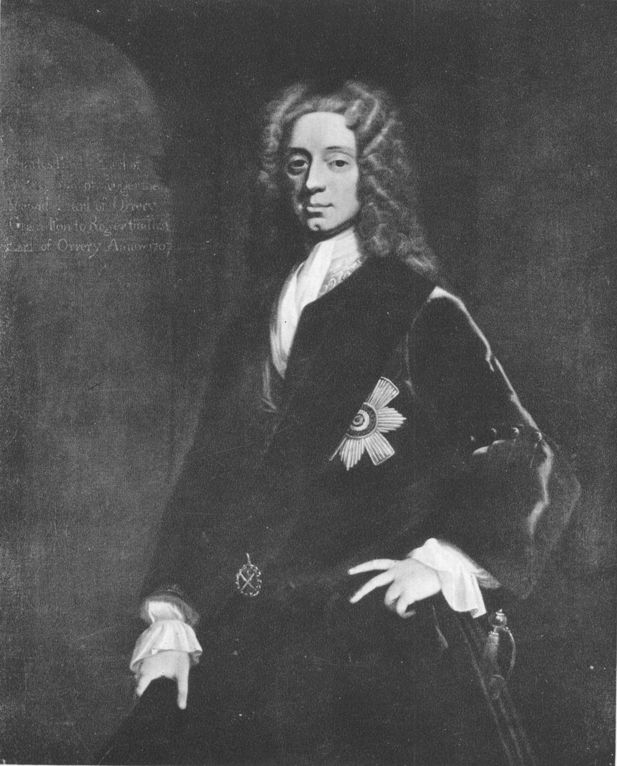
CHARLES BOYLE, FOURTH EARL OF ORRERY
Charles Jervas
National Portrait Gallery
Orrery to Harley
Camp before Douay
June 21, 1710
Mr Benson will be able to give you a good account of our affairs here, having been in the camp with us about six weeks, where he has been several times entertained by the Vicar-General [a sneering allusion to Marlborough’s wish for the Belgian Viceroyalty] and often had discourse with him. I think I already observe an alteration in the behaviour of this great man and his friends upon the prospect of the change in England. They seem to affect a greater air of civility than they once thought they should ever have occasion for, and I am apt to think they will in some little time make overtures of accommodation; for I am persuaded that, though the General should entirely lose his power, he will do all he can to keep his place.
The Duke of Argyll and I have yet had but very little correspondence with him, and we have no inclination to have any with him for the future, further than the duty of our posts obliges us to; but it is the custom for all officers when they quit the camp to ask his leave, which is a ceremony we would willingly omit if we could. The only way I think for us to be dispensed with in that respect is for the Queen by letter or any other proper method to signify to us her leave to go out of the camp and return to England when we think fit.
I have lately written to H[enry] S[t John] about my being made a Major-General. . . . I am plainly left out in this last promotion out of pique which has stopped at me though there are not Major-Generals enough upon this establishment. . . . I don’t desire it for my own particular advantage. . . .[305]
And again from the camp before Béthune (July 31):
Some time ago I writ to H. St [John] pretty earnestly to let him know how necessary I thought it was that some restraint should be put to that exorbitant power Lord Marlborough has in the army. I am every day more convinced of that necessity, for he plainly disposes of preferments here with no other view but to create a faction sufficient to support him against the Queen and her friends in case every other prop should fail.
I mentioned at the same time my promotion of Major-General which I think I have no ill title to, and which I suppose upon the first application to the Queen will be granted. It will be of use to encourage her friends here and will add a little to the present mortification of his Highness.[306]
It is not often that personal motives are so nakedly exposed.
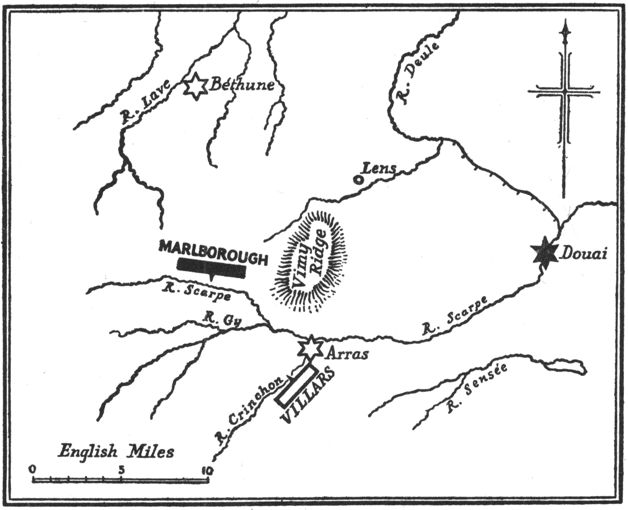
JULY 12, 1710
The flow of Ally reinforcements was continuous. Marlborough replaced the weakened regiments from his numerous garrisons, and in the first week of July he and Eugene stood at the head of 182 battalions and 284 squadrons, all in good strength, a total of 120,000 men. It was still their intention to strike at Arras, the keystone of the last line of the French fortress barrier. In the face of bad weather it took a fortnight from the fall of Douai to recondition the army, to replenish its food and forage, and to place it upon a new front north of the Scarpe between Douai and Lens. On the 12th the Allies moved forward past and over the Vimy Ridge, and lay along the Scarpe with Arras in full view. Villars, denuding the French garrisons not immediately threatened, had concentrated an even larger army in his new lines stretching along the Crinchon stream from Arras to the Somme. These fortifications, held in force by the main army of France, offered bluntly to the Allies another Malplaquet. Upon the acceptance or refusal of this challenge the decisive character of the campaign depended. Afterwards, as will be seen, Argyll attacked Marlborough for timidity in not having besieged Arras, as he had already attacked him for temerity in fighting at Malplaquet; but at the time the allied high command was united in declining to play so high a stake as the great frontal attack upon the whole French army in its entrenchments which was the needful preliminary. All were agreed that the French position was too strong to assault. General Kane, a competent officer not involved in the highest affairs or intrigues, says, “Villars’s army much outnumbered ours, and he retired behind the Sensée, so that there was no coming at him nor laying siege to Arras.” It was therefore resolved to lay siege to Béthune, a place of minor importance on the southern tributary of the Lys, which opened a waterway for a subsequent attack on Saint-Venant and Aire. This decision was in fact a reversion to the discarded alternative of a coastal advance, at a season too late to reap its rewards. Marlborough revolved deeply an attack upon Calais and Boulogne. Political deterrents were added to the military difficulties. He wrote to Godolphin (August 2):
You may be assured that the King of France is so encouraged by what passes in England that he has taken a positive resolution for the continuation of the war, and reckons upon my not being employed this next campaign. The little consideration that the Queen has for you and me makes it not safe for me to make any proposal for the employing those regiments now in the Isle of White; though, if things were formerly, I could attempt a project on the sea-coast that might prove advantageous. But as everything is now, I dare attempt nothing, but what I am almost sure must succeed; nor am I sure that those now in power would keep my secret.[307]
Béthune, which was defended by fifteen battalions, was invested on July 15, and capitulated on August 29.[308] The siege was bloody, and cost 3500 men, apart from sickness and desertion. Villars continually threatened a battle for its relief, but he, like the allied commanders, was not prepared to “venture.” Once again, after the capture of Béthune, Marlborough and Eugene pondered the question of a general assault upon the French entrenchments, and once again they decided not to try. “Our sickness continues,” wrote Marlborough to Sarah (August 28), “but I thank God I have my health, and will take the best care I can to keep it. My poor coachman, that has lived so long with me, died of this fever yesterday; and poor Daniel, my favourite cook, is not yet recovered; but they hope he will.”[309] Although there had been no battle, the losses of the campaign had been heavy: eight thousand at Douai, 3500 at Béthune, and fourteen thousand sick or deserted. Nevertheless, while resigning the main objective, and in spite of “a very unlucky accident,”[310] they felt strong enough to attack two fortresses at once.
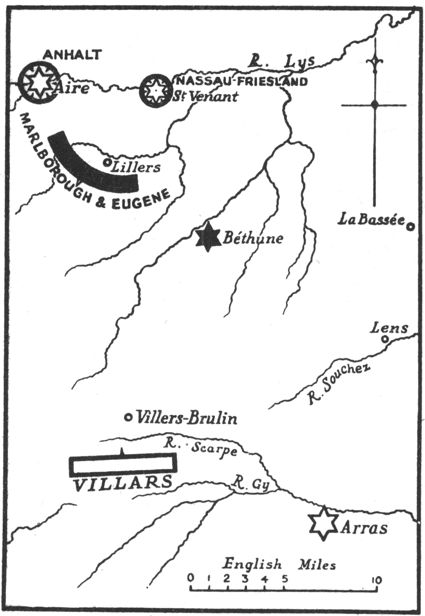
SIEGES OF AIRE AND SAINT-VENANT
On September 6 Anhalt with forty battalions and as many squadrons besieged Aire, and Nassau-Friesland (the Prince of Orange) with twenty battalions and five squadrons Saint-Venant. Of the two towns Aire was incomparably the stronger, and held a garrison of fourteen battalions, double that which defended Saint-Venant. Marlborough stood midway between his sieges and Arras. Upon the whole, this phase offered Villars his best opportunity. With sixty battalions and forty-five squadrons withdrawn from the allied army for the sieges, and with all Brabant exposed except for its fortresses, the possibility was open to him of taking the offensive. He suggested this course to Louis XIV, but in a half-hearted manner. The King, who was watching the English Court even more closely than the fighting front, would not allow him to run such risks. Villars therefore contented himself with harassing the communications, and one sharp action occurred with Eugene’s foraging parties and their escorts, in which the French sustained a rebuff. Saint-Venant fell on September 30. Aire made a more obstinate and formidable resistance. The slaughter was heavy, and the weather terrible. “Our poor men,” wrote Marlborough, “are up to their knees in water.” It was not until November 9 that the capitulation was signed. The garrison had lost more than a third of its strength, and the Allies nearly seven thousand men, apart from sickness. Villars, whose wound required repeated attention, had handed over the command of his army to Harcourt after the fall of Béthune some six weeks earlier. It was now too late to attempt an advance on Abbeville and the creation of a new base there, and both armies dispersed into winter quarters.
Although this campaign, so costly in casualties and disease, was conducted impeccably by Marlborough, and the results achieved were substantial, it was nevertheless a disappointment. That Marlborough and Eugene with 120,000 men should not have been able to bring the enemy to battle or take Arras seems surprising in view of the achievements of their great years. Reasons other than military must be invoked in explanation. Marlborough, ageing rapidly, undermined at home, uncertain of the loyalty of some of his principal officers, could bring himself to do no more than play military chess with his accustomed skill, and wait for the enemy to make some fatal mistake. If he had run the supreme risk, if he had hurled his army upon the French entrenchments, or if, repeating his manœuvre of 1705 and carrying eight days’ supplies in his wagons, he had marched through the intervals between the French fortresses and forced a crisis, he might have ended the war at a stroke, or, on the other hand, have ruined all. No one can pronounce. The authority of the twin Captains cannot lightly be set aside by posterity. What they deemed imprudent must certainly have been perilous. What they declared to be impossible was probably beyond the reach of mortal man.
|
Marlborough, 110 battalions and 161 squadrons; Eugene, 45 battalions and 101 squadrons. |
|
Marlborough to Godolphin Hague March 1st, 1710 * You will see by the enclosed intercept’d letter from Monsr Torcy that I shall not be able til the next post of giving the Queen any account of the Negotiations; these people continu resolv’d to have a Peace if it may be had for Sicilly and Sardagn [Sardinia], by which I think it is absolutly necessary for the Queens Service that the Parl: shou’d be setting, for shou’d it be refus’d or grant’d without the knowlidge of Parl: I fear it might cause very great uneasiness, but You on the place can best judge, which will be best to continu the setting or to make a short prorogation. March 11 * . . . The Pensioners are expected back this night or to-morrow morning early to make their rapport. We know already that the French sent last night an express to their King. What I can observe of the Pensioner and others is that they seem resolved not to comply with France in such a peace as may leave the war in Spain. Though at the same time they tell me that there is an impossibility of continuing the war. However they are very desirous of doing all in their power for our taking the field early and I expect Cadogan and the undertakers for the forage and wagons to be here on Thursday so that I may give the necessary orders that nothing may be wanting, . . . for I think the only good step we can make towards a peace is to get early into the field. . . . Gromko [Grumbkow] has in great confidence given me a relation of the offers the King of France has made to his master. . . . March 12 * I have just now come from the Pensioners when Monsieur Buys and Van Derdussen have made their rapport. . . . I think the French have it still in their power to amuse and cheat us. But if they should be in earnest to have a peace and that they will be contented with Cicilly for the Duke of Anjou you may assure the Queen that in my opinion every man in this State will be for it. And I am very much afraid that if the French will insist upon more they will even in that case find very many friends in this country. . . . I think it absolutely necessary that my Lord Townshend and I should have positive orders how far we may agree to any consideration for the Duke of Anjou. . . . By what Count Sinzindorff says to me it is very plain that the Court of Vienna had much rather not have a peace with France than to allow any part of the Monarque of Spain to the Duke of Anjou. March 14 * . . . My Lord Townshend and I had a conversation with the Pensioner last night where he owned to us very freely that he did not believe that France had sincere intentions of evacuating Spain. But if they could or would do it for Sicilly, he looked upon it as a great happiness. He assured us that nobody but ourselves knew of his opinion on this particular; for till the French should make a positive declaration he thought it dangerous even for the knowledge of Vanderdussen and Buys. March 19 * This morning the Pensioner brought me a letter he had received from the French ministers at Gerturenberg. . . . I think everybody is convinced that the chief design of France is to cause a division amongst the Allies; the Imperialists are very desirous of making a peace with France upon the conditions they offer of giving four cautionary towns in their country, and the States General are as positive in putting an end to the war at once by giving the Duke of Anjou a partage. Hague April 5, 1710 * I shall not trouble You with the reflections of these people on the occasion of Sacheverelle. Thay turn every thing to be a reason for Peace, which thay will have, if the ffrench be in earnest. Petkome return’d yesterday from Gertruydenberg. He thinkes ffrance is desirous of a seperatt Peace [i.e., a peace made by all the Allies with France apart from Spain], provid’d we will be content’d with the four Cautionary towns, or that thay will evacuat Spain if the D. of Anjoue may have a reasonable Partage. These people are I belive unanimously resolv’d to give him Sicilly and Sardain, but I believe the Pensioner thinkes the ffrench are not in earnest, which makes him very uneasy, not knowing how to gett ride of these Plenepotentiarys. Comte Senzindorf Ld Townshend and my self are to be att the Pensioners at four aclock where Vanderdussen and Monsr Buys are to be. I believe it will be resolv’d that thay shou’d this evening or to morrow morning return to Gertruydenberg, in order to endeavour the knowing if the ffrench have any thing else to offer. I hope thay will speak so plainly that att their return, we may on tuesday lett you know if these Negotiations are to Continu; Pr: Eugene is expect’d here next tuesday. John to Sarah Hague April 12, 1710 * I am sorry to see in all Yours the Condition things are in, in England, I am afraid it maybe one of the things which incorages ffrance in the resolution thay seem to be in of carrying on the Warr. I am to leave this place on Munday, in order to be at the head of the Army the friday following which is above a month sooner than we have ever taken the field since this Warr. Marlborough to Godolphin Hague April 13, 1710 * You know that these people are so very fond of Peace, that when ever the ffrench will be reasonable, we shall have it, which in my opinion is as absolutely necessary for the Queens service as for these people. Pr. Eugene has said what he can to persude the impossibility of ending this War, but by a seperat Peace with ffrance [i.e., leaving Spain to be conquered afterwards]. We shall see in one month after we have been in the field, not only the humour of the ffrench, but of these people also. The Imperiallist Continu very obstinat, in never Consenting to any Partage. [All the above letters are from Blenheim MSS.] |
|
Coxe, v, 181. |
|
Coxe, v, 184. |
|
Blenheim MSS. |
|
Hague Archives. |
|
Coxe, v. 193. |
|
Coxe, v, 194. |
|
B.M., Add. MSS. 41178, K. |
|
This must have been a letter intercepted or betrayed at the front. There were evidently two spies, one in the camp and one at the Court. |
|
Coxe, v, 195. |
|
Coxe, v, 197. |
|
Ibid., 198. |
|
Portland Papers, H.M.C., iv, 544. |
|
Portland Papers, H.M.C., iv, 553. |
|
Coxe, vi, 342. |
|
Argyll to Harley August 29 The town of Béthune has designed to capitulate, so we shall have it in a day or two. What our mighty Prince of Blenheim will think of doing afterwards, I know not; but if we pretend to take any more towns, our infantry will be quite destroyed and our horse so much out of order that we shall be obliged to stay as long in garrison next spring as the enemy, and I don’t know but his Grace may think it his interest to have it so. [Portland Papers, H.M.C., iv, 569.] |
|
Coxe, v, 332. |
|
Marlborough to Godolphin Sept. the 22nd, 1710 * Since my last we have had no letters from England. Wee have here had a very unlucky accedent. Great part of our powder and amunition that was for the carrying on of these two sieges, came from Gand on thursday last escort’d by 1200 foot and 450 horse on friday thay were attack’d by the Enemy and beaten, so that the powder was blown upp, and the rest of the store ships sunk; I have sent to Lille Menin Tournay and Doway to see what stores we can have from those places, for Pr. Eugene and my self are resolv’d not to raise this siege as long as we have any hopes of getting powder enough to make the trenches, but what gives me the greatest uneasiness is that this misfortune may make our designe on the Cost impracticable, but I am so desirous of executing it, that you maybe sure if it be possable, it shall be attempt’d; but my head at this time is so full how to gett the necessary stores for the carrying on of this siege, that I cant think of any thing else for some few days. [Blenheim MSS.] |
Hitherto the forces gathering against the domestic system and foreign policy of Marlborough and Godolphin had been numerous and powerful, but disunited. After the trial of Sacheverell they became sentient and focused. There emerged the same group of powerful nobles loosely attached to either party which had played its part in 1708 and was to do so again in 1714. But this time their weight was cast on the Tory side. The encouragement which the Queen gave to almost all elements hostile to her own leading Ministers offered prospects of favour and power to both honest antagonism and selfish aims. To control the government of Britain, which Marlborough’s sword had raised so high, was an attraction captivating the great nobles and magnates of the day. At the root lay Harley with the Tory Party, and now, somewhat incongruously, with the Church. The jealous or disaffected officers in the Army found their leader in the Duke of Argyll. In the Cabinet the Duke of Somerset was incited by the craft of Harley and the smiles of Anne to pursue his dream of heading a Government. He found support at this time from the Duke of Newcastle, Lord Privy Seal. He saw himself upon the high road to mastery; he did not hear the slighting comments which those whom he aspired to lead, and whose interests for a time he served, were accustomed to make upon him behind his back. Already, as has been described, Shrewsbury had begun in his cautious manner to work with Harley. All these men in the months following the Sacheverell fiasco ‘entered into measures’—to use their dignified expression—with one another. Harley, in close touch with St John, guided from the House of Commons; Argyll glared in the camp; Somerset flaunted himself at the Court; and Shrewsbury lent an aspect of prudence and disinterested moderation to the whole cabal. A novel term now came into British politics. The five Whig lords had been called the Junto. The new group was nicknamed the Juntilla. “There is a Juntilla in imitation of the Junta,” Count Maffei[311] wrote to Victor Amadeus, “and the Duke of Somerset, who is called by the nickname of ‘the Sovereign,’ plays the figure of a chief, although the others, who are of his society, make him depend on their counsels, and only make use of him to inspire the Queen with what they think proper.”[312]
Behind them gathered a train of minor figures, peers and Members, some in the Ministry, some in the Army, all in high expectation of office or promotion. Among these the Earl of Orrery, Earl Rivers, and Earl Poulett were the most prominent and bitter. Orrery and Rivers were general officers of the army. Rivers had made the campaign of 1702 under Marlborough, who promoted him lieutenant-general. Hoping to advance more rapidly, he procured Marlborough’s aid in obtaining the command of the ‘descent’ planned by Guiscard on the French coast in 1706. When this force was diverted to Spain he found himself confronted with the choice of serving under Galway or returning home. He preferred to return home after disparaging Galway to the best of his ability at the Court of Charles III. In April 1708 Marlborough nominated him to the Queen for promotion to general of horse, and also had him sworn a Privy Councillor. This ambitious man foresaw the downfall of the Whigs, and by the winter of 1709 was intimate with Harley and active in his interest. We have seen how serviceable this interest proved to him when the post of Constable of the Tower fell vacant. Thenceforward he became the unscrupulous and virulent enemy of the Commander-in-Chief under whom he served, and to whom his whole rise had been due. Macky says of Rivers:
He was one of the greatest rakes in England in his younger days, but always a lover of the constitution of his country; is a gentleman of very good sense and very cunning; brave in his person; a lover of play, and understands it well; hath a very good estate and improves it every day; something covetous; a tall, handsome man and of a very fair complexion;[313]
to which Swift adds “an arrant knave in common dealings, and very prostitute.”[314]
Earl Poulett, nicknamed “Swallow,” had played some part in the Union with Scotland in 1706, and was a Tory politician of minor consequence. Macky describes him as “a mean figure in his person, and not handsome.” He rarely spoke in Parliament, but was busy behind the scenes. He was one day to make a speech which got him into trouble.
Apart from Argyll and Orrery, who were actually serving in Flanders, these personages were not acting beyond their rights. Harley’s combination, however disreputable and clandestine in its methods, is not to be dismissed as mere intrigue. It represented powerful forces in the land, and stood for a definite and arguable policy both at home and abroad. Harley had never diverged from the principle on which he had accepted the Secretaryship of State before Blenheim, of a broad-based centre administration to serve the Queen and make her independent of the extremists of either faction. This had also been the conception of Marlborough and Godolphin, but they had been forced to abandon it, and had become the agents or prisoners of the Whig Junto. They had done this against their will and better judgment; but the fact remained that they had done it. Neither had the Queen altered her general position of wishing to reign above either party with the assistance of leading statesmen from both sides. Harley had received in the Sacheverell turmoil an unexpected and most powerful source of strength from the excited and now arrogant Church party and clergy. This did not harmonize with his general view, but it was none the less welcome and potent. Nor could even the Jacobites be disdained. They proffered their goodwill to a movement which promised to them the disintegration of the European coalition which had so long waged successful war against their true King—as they saw it—and against the chivalrous French monarch who had sheltered him, and who championed the Catholic faith.
But apart from self-interest and the wish to acquire control of the State the main bond between all these diverse elements was a common desire for peace. Harley’s policy was to stop the war. Shrewsbury was convinced not only that it should stop now, but that it might have been stopped in the spring of 1709. The Tory Party wanted peace, but peace with British profit. The Queen was the least convinced upon the peace. Her chief desire was to free herself from the Whigs, and now from the Marlboroughs, and to reign—to quote the phrase by which she was allured—“as Queen indeed.” But she had been too long in the war to think lightly of the abandonment of its aims. She was convinced that only by unquestionable victory could her throne be safe; and she saw no means of accomplishing this end but through Marlborough. Therefore, while the successive steps which Anne took to achieve her personal aims, or in response to the pressure of forces round her, wore the aspect of deliberate design, they were in fact only tentative, and were limited at every stage by the fear of a break-up of the Alliance or a financial collapse in the City of London.
In the winter of 1709 the leading members of the so-called Juntilla believed that a good peace was procurable at will. They continued to nurse this conviction in the spring of 1710; but although they remained eager for peace, they became, as the summer wore on and they approached nearer to direct responsibility, increasingly doubtful whether it could now be obtained on any terms which the nation would accept. They were not blind to the fact that as they weakened Marlborough, and as the shadow of his approaching fall spread across Europe, the goal they sought receded. They were in close enough contact with affairs to feel the stiffening of the French attitude. At length they realized that there was no chance of their being able to present a good peace to the nation before the election. To present a bad peace was to ruin their chances. Therefore, like the Queen, they reached the conclusion that the war must be continued for the present, and this in its turn imposed a certain restraint upon their action.
In this, rather than in any lack of power, lies the explanation of the gradualness with which the change of Government was effected. For, after all, it was upon the election that all political fortunes depended. All the news from the country was bad for the Whigs. There was keen political excitement and a great deal of discontent. The Tory Party was active and confident, and the Church vehement. The Whig leaders knew all this as soon as their opponents, and were completely unnerved thereby. With the estranged Queen on one side and a hostile electorate on the other they felt that they were doomed. They and their majorities in both Houses stood upon a trapdoor, and at his selected moment Harley could draw the bolt. This sour fact explains, though it does not excuse, their lack of loyalty to one another. Their only choice appeared to be either to resign together and at once or to be dismissed piecemeal. They drifted into the latter course largely because of their hope that the normal life of the Parliament on which alone they now depended might be preserved, and also that perhaps Marlborough, whom they had ridden so hard in the previous year, might produce some new victory which would once again retrieve all. In this unhappy plight they passed the summer.
With the appointment of Shrewsbury the Queen felt that she had gone far enough for the moment. She would not be pressed into action which would lead to Marlborough’s resignation. Neither would she free herself from the “bondage” of Sarah and the Whigs to submit to another thraldom of the Somersets and the Tories. She was well aware that the disgrace of Marlborough and his wife would not bring the country any nearer to the peace she was beginning apprehensively to contemplate. Harley had, therefore, to move with caution. Access to the Queen had been increasingly difficult since the rise of the Somersets at Court. A doleful letter from Abigail reveals this.
Abigail Masham to Robert Harley
April 17, 1710
I am very uneasy to see you, but my poor aunt [the Queen] will not consent to it yet; she puts me off from time to time, which gives me a great deal of trouble. I think it necessary for her service as well as my own for us to meet, for a great many reasons; therefore I have a mind to do it without her knowledge and so secret that it is impossible for anybody but ourselves to know it. I would come to you to-morrow night about eight o’clock to your own house if you approve of it, but if you have made any appointment with company, any other night will serve me. Send this person to me to-morrow about ten in the morning to let me know your resolution what I must do.[315]
If Shrewsbury, Somerset, and Harley could agree upon the next move, and gain the Queen’s support for acting, another Ministerial change would follow. Strenuous efforts were made throughout April and May to create this situation. Harley had his internal difficulties. The high Tory feeling aroused by the Sacheverell trial, unless carefully managed, might swamp his moderate schemes. His secret correspondence with Buys and the peace party in Holland had led to hostile comment in the House of Commons. There had been mutterings even of impeachment.[316] Opinion among the Whigs was divided. Godolphin still hoped, though faintly, for an understanding between Shrewsbury and the Whigs. But how was this to be achieved? His own position became daily more embarrassed. He was reading one day to the Queen a reference in one of Townshend’s letters which mentioned rumours that the Treasury was to be put in commission. “She gave a sort of scornful smile,” wrote the Treasurer,
but did not think fit to say a word to me upon it, and, perhaps, it is not yet in her intentions or thoughts; but what she may be brought to in time by a perpetual course of ill offices and lies from Mr Harley and his friends, and no pains taken by anybody for me, to break the force of those impressions, I am sure I cannot answer. But this I know, that as long as you are abroad in the field, and that your army cannot be regularly paid but by my particular care and endeavour, no slight provocation shall prevail with me to quit my post. . . . But the insolency of Mr Harley and his creature is inexpressible. The Duke of Argyll’s brother [Lord Islay] and Lord Rivers, and that sort of cattle, have as little management [i.e. decent behaviour] here as you say he has abroad.[317]
Marlborough to Heinsius
May 8, 1710
* . . . Your desiring my thoughts as to what effect the change in England may have as to the common cause God only can tell, but to you as a friend I own very frankly that I do not like it, and do from my soul wish that we had a good peace; I am sure you do me the justice to believe that I shall lose no opportunity this campagne that may bring it to that happy end.[318]
Sarah had retired to Windsor Lodge after her parting from the Queen in April. She was now disillusioned of the Whigs, and impatient at their weakness and vacillation. She despised the individual attempts they made to stand well with Somerset at the expense of Godolphin.[319] She remained convinced that there was no comfort to be drawn from Shrewsbury. With sure instinct, she distrusted his affabilities, she recognized him throughout as an enemy. She was disgusted when the Whigs in their distress suggested even that she should seek a reconciliation with Abigail. Sunderland had toyed desperately with the idea of joining forces with Somerset. He had a three hours’ conversation with him, as between colleagues, and reported hopefully that Somerset had spoken with great coldness of Shrewsbury, and had declared that he had only met Harley once at Argyll’s house. Sarah was sure that her son-in-law was allowing himself to be deceived.
She now became the object of Whig solicitations to return to Court. We have need of “a good advocate with the Queen,” wrote Lady Cowper (May 14).[320] Godolphin frequently advised her to come to town, and Maynwaring constantly warned her of the dangers of leaving the field open.[321] But Sarah at this time followed Marlborough’s advice to keep clear of the Court and leave the Queen alone. She shared to the full his prescient pessimism. She took such pains to have her letters destroyed that history is indebted to Maynwaring for preserving the following sprightly epitome.
Sarah to Maynwaring
Saturday Morning, the 20th of May, 1710
. . . What you write to-day of “The Sovereign” [Somerset] and his company at dinner, is not of a piece with the last letters; and ’tis certain if 89 [the Whigs] think of continuing in the Government, that fool must be exposed and run down: there is no other way to deal with him; but as long as 89 fear an ill Parliament, nothing can be done but by gaining 28 [the Duke of Shrewsbury] which I believe is impossible, tho’ I find 6 [Sunderland] is pretty well satisfied with him. I wish I may be mistaken in my opinion. But what a melancholy reflection it is for 89 that now their fate depends upon gaining a man, that t’other day they would have flown over the top of the house if anybody had proposed his coming into employment. Since [either] their bottom is not very strong, or else we apprehend shadows; if the first, I think they have been very much to blame to 38 [Godolphin] and 39 [Marlborough]; if the last, they must yield to 28 [Shrewsbury], just come into the service.[322]
There was the root of the matter. They “fear an ill Parliament. . . . Their bottom is not very strong.” Was it, then, for these men of straw that she had toiled so long, to find that, having grabbed all at her expense, they could not even stand themselves, but must drag down Marlborough and Godolphin with them?
The Duke, from the impressions he could derive at the front, had still not entirely discarded hopes of Shrewsbury. He enjoined his wife not to be offended by the ignominious suggestions of the Whigs in their despair. He saw the whole scene with sombre vision; everything he wrote came true.
Rumour was now busy at Court and in the coffee-houses that Sunderland would be the next victim. Tory addresses were being framed against him in the City, in Surrey, in Shropshire. Tory partisans assailed him throughout the country. The talk was that the fall of Sunderland would be the prelude to the dismissal of the Parliament. Marlborough had heard of this in the camp from the high language of Argyll and his clique of officers.
John to Sarah
May 18/29, 1710
. . . To be emperor of the world I would not give reason for people to believe any consideration would make me truckle to Mrs Masham. I can, for the good of my country and friends, live so as not to seem to know they are in the world. . . .
If Shrewsbury intends to keep any measures with you and me he will make it his business not to suffer Sunderland to be removed, but when the time may be proper for the taking off of the mask his being put out will be the first step.
I have so resented the behaviour of 221 [the Duke of Argyll] that nobody converses with him but such as are angry with me.[323]
About a week later the following note reached Harley:
Somerset to Harley
Kensington
May 24, 1710
The Duke of Shrewsbury says you desire to talk with me, so let me know before eight o’clock if you can be at home, or at Northumberland House, this night at nine, accordingly I will come from hence. In case you choose to come to me I will have a servant to conduct you, and if I come to you, then have your back door open for me; but if this notice has not the good fortune to fall into your hands by eight o’clock, then any time you shall appoint to-morrow morning I shall obey.[324]
Unknown as yet to Marlborough, Shrewsbury had taken his first important step. He had brought together Harley and Somerset, and he provided easy access for Harley to the Queen. At the head of the Juntilla a powerful triumvirate had come into being. A further attack could now be launched against the Whig holders of office. Sunderland was to be dismissed, and the hostile forces also felt themselves strong enough for another affront to Marlborough, which should produce a separate trial of strength.
After the campaign Marlborough had submitted a series of promotions to encourage the Army. He had, however, stopped on the roster only one short of the names of Mrs Masham’s brother, Colonel Hill, and of her husband, Colonel Masham. Harley and Somerset were not slow to point this out to the Queen. They saw, and so did she, an opportunity of renewing under more favourable conditions the rankling issue that had been fought out earlier in the year. The Queen invited Marlborough to propose both names, and meanwhile she delayed signing the whole list of promotions. Marlborough immediately complied in the case of Masham, but raised objections to Hill which were certainly justified on military grounds; for even in those days of favour such an appointment would create a scandal in the Army.
While Cardonnel was at the front Walpole acted as Secretary-at-War.[325] The Queen sent for him. She remarked that if the promotion list were stopped only one short of Mrs Masham’s brother it would be thought by all the world to be done out of prejudice to him. She then told Walpole “to notify her Secretary of State for three more commissions of Brigadiers.”[326] Walpole knew that Sarah had not been satisfied with his attitude about the Hill promotion in January. He was sincerely attached to the Whig interest, to Marlborough, and especially to Sarah, to whom he felt himself indebted for his advancement, and of whose reproaches he stood at this time in awe. He therefore expostulated boldly with the Queen, reminding her that she had already told him that, though she wished Colonel Hill to be Brigadier, she would not insist upon it if the Duke objected. With his quiet force, already noticeable, he used all the arguments about the mortification such a step would be to the Commander-in-Chief, and how it would lessen his credit and authority in the Army. “I shall be in a very unhappy circumstance,” he wrote to Marlborough, “if I venture to say that to the Queen which perhaps few servants have done, and at the same time shall be thought to act a trimming game.” There is no doubt that he went very far in his remonstrances, and also that the Queen was shaken thereby. She consented at length not to order the three extra commissions until Walpole had been able to write to Marlborough about them. Till then, however, she would sign none of the other commissions. At this point she blurted out that she had stopped them in order to force the Hill promotion. Walpole continued to protest, and the Queen had misgivings about the admission she had made. She no doubt saw how it might be represented that she was holding up the entire promotion of the Army in order to favour Abigail’s brother.
“She commanded me strictly,” wrote Walpole to Marlborough, “not to tell anybody, in particular not to let you know that she stopped the commissions on this account, but would have it thought, as it hitherto has been, that the delay was accidental.” Walpole ends his letter to Marlborough:
As my obligations to the Duchess of Marlborough are so infinite that I would rather dye than deservedly lose her good opinion, soe I beg if my judgment may sometimes lead me to think what is not altogether agreeable to her, you will not expose me to her resentment, if you doe not distrust my sincerity, which, believe me, you never shall have reason to doe.[327]
The busy circles at Court were soon astir with this new mischief. We may admire the cleverness of selecting a point which at the same time enlisted the Queen’s affection for Abigail, revived her vexation over the January dispute, and threatened Marlborough with a thrust which must, if it went home, humiliate him before his army. Moreover, this was the very point on which it had already been found impossible to marshal Whig resistance. It seemed to the Whig leaders no more, one way or the other, than a petty piece of patronage—of which there was plenty—and a chance of pleasing the Queen cheaply. They were concerned that Marlborough should take it so seriously. They did not see that it would rot the Army, and treated it entirely as a matter to be smoothed. Marlborough’s daughter, Lady Sunderland, was no doubt expressing the prevailing view in Whig circles when she wrote her mother in the last days of May:
When I heard the report mamma speaks of, of Mr Masham’s having something given him in the army, I did not think it wrong (as the world is made) for papa to humour the queen in it; but for the other [an accommodation with Abigail] I own I hoped it an impossible thing for you ever to be reconciled to such a creature even if it could do good, but that is impossible; it would, may be, let her do the mischief underhand. I dare say nothing will be ever right, but the removing her; and if that can’t be, I hope she will join with the Tories and not with the Whigs, and then it won’t be in their power to ruin all the world when there is a peace.[328]
And Godolphin to Marlborough (June 2):
I find by Mr Walpole, that you have not been easy in the matter of Abigail’s brother. I am sorry for it, because it puts a difficulty upon your friends here, and nothing would so much gratify your enemies. The question is not so much what is wrong and what is right, but what gives a handle to the Duke of Somerset to tell lies, and make impressions, where nobody has the opportunity of setting it right, or so much as of knowing it till it is too late.[329]
Meanwhile Marlborough, in reply to Walpole, gave reasons which might seem unanswerable.
Camp before Douay
May 29th, 1710
. . . The trew reason for my restraining the promotions of brigadiers to the 25th of March, was not only from the numbers and confusion it must have occasion’d amongest the queen’s subjects, but also have given great disatisfaction to all the forainers, this army being compos’d of eight different nations, and next to the blessing of God, we owe all our success to our unanimity, which has been hethertoo, as if in reallity we were but one nation, so that I beg her majesty will be pleas’d to allowe of its stoping at the 25th of March; and as soon as a promotion can be made with any coullor of reason, I shall be sure to take care of those mention’d by the queen.[330]
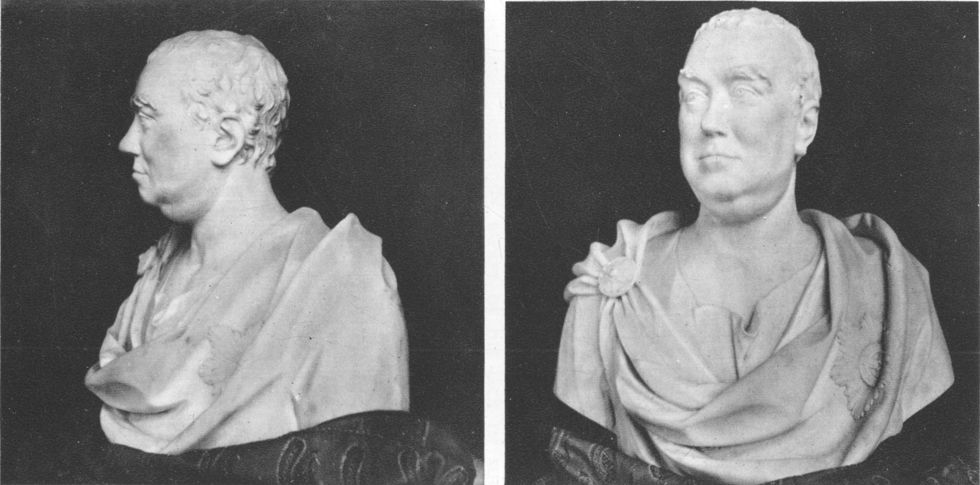
ROBERT WALPOLE
J. M. Rysbrack
By permission of the Marquis of Cholmondeley
Anne was conscious of the weight of these reasons which Walpole urged resolutely upon her. “The Queen was,” wrote Walpole to Marlborough, using ciphers for names,
not a little at a loss what to do and seemed both unwilling to comply or deny; at last desired it might be done, but in the softest manner that was possible. The commission is therefore to be taken out by me and sent over to you to be delivered at the end of the campaign or when he shall think fit. The Queen promised to write this night to you to assure you that no mortification was meant; and I must say that in this and the last conference there seem’d a great struggle betwixt the desire of doing the thing and not putting a mortification upon you.[331]
Marlborough, painfully aware of his lack of support at home, was so far mollified by these expressions that he published the commission at once. Colonel Hill became a Brigadier. The Army did not, however, receive any immediate benefit from his military skill. He repaired at once to Spa to undergo a thorough cure before subjecting himself to the rigours of active service. As this treatment did not quite carry him on till the end of the campaign, he found it necessary in due course to write to Marlborough:
Brussels
October 29, 1710
* The benefit I hoped to receive by the waters made me stay as long as my pass would permit me. Since I was come to this place every one tells me the Army after the siege will break up. If so, I hope your Grace will excuse my coming back to the camp and give me leave to go for England which I humbly submit to your Grace and shall wait here for your orders.[332]
The Triumvirate at the head of the Juntilla found the Queen very ready to get rid of Sunderland, and relieved that they thought it could now be safely done. The question of his successor was more delicate. Harley, true to his plan of a Government of the Centre, wished to offer Sunderland’s Secretaryship of State to the mild Whig Newcastle. The Tories pressed hard for a wholehearted member of their own party. Anglesey and “Swallow” Poulett both heard their claims discussed in their presence at Harley’s house. Harley had need of all his tact. Anglesey was too extreme to suit his combination in the vacant office. Such a choice would alienate all middle opinion. He made Poulett, who really had no chance, flatter himself with the idea that he should make a high-minded and voluntary sacrifice of what he was in no case going to receive. It was difficult, he suggested, to bring in a man so close a friend of his as “Swallow.”[333] If he must have a Tory Harley preferred a colourless figure.
Godolphin, still wearily confiding, in spite of Sarah’s scepticism, in Shrewsbury’s benevolence, saw no other way to save Sunderland than that Marlborough should appeal to the Lord Chamberlain. Marlborough’s remaining influence was begged in aid all through the summer not only by Godolphin but by the Whigs. He had no illusions: but out of loyalty he complied with his friend’s request. He wrote to Shrewsbury. The letter is not extant. It would in any case have been futile. Actually it arrived too late. Sarah’s disapproval of such a gesture was anticipated, and the letter was kept secret from her. “Lady Marlborough,” wrote Godolphin, “has been, and is still, so much dissatisfied with the Duke of Shrewsbury that I thought it would rather do hurt to acquaint her with your letter to him.” Shrewsbury contented himself with disclaiming all responsibility. He threw the blame on Abigail. * “She could make the Queen,” he remarked to Sarah, “stand on her head if she chose.”[334] By June 1 Godolphin was certain of Sunderland’s coming dismissal, and that the question of a successor alone caused delay.
“I am told,” wrote Sarah to Maynwaring (June 1), “that the persecution against Lord Sunderland is renewed again, with more violence than ever. . . . I conclude the Duke of Shrewsbury, Lord Halifax, the Duke of Newcastle and Mr Harley are pretty near of one mind.”[335] Sarah was entitled, according to her and also our ideas, to apply the word “violence” to the turning out of Ministers who still possessed effective majorities in both Houses. Her own “violence” was of a simpler character. About this the talebearers were again active.
Martha, Lady Mansell,[336] to Harley
May 28, 1710
I am almost fright’d to death with the threats of a great Lady who is now retired from Court, which one that lately came from the Lodge tells of. In a little time she says she shall return with as full power as ever, and that both you and every friend you have shall feel the effects of her utmost revenge. Lady Orkney is often with her, and at the table begins a health to her and all that’s for the Duke’s interest, and total destruction to those that are not for it.[337]
It cost Harley nothing to bring the Whigs into these discussions, and feed them with false hopes. Somers was clearly ready to preserve his own position by agreeing to sacrifice Sunderland. He none the less obtained from Godolphin another payment of a thousand pounds from the Secret Service fund the receipt for which is dated June 14—the day before Sunderland’s dismissal.[338] Somers evidently thought himself safe whatever happened, and that a moderate Government would include leading Whigs. He became anxious that Marlborough should not by a resignation create a crisis which would render this impossible. He wrote to him (June 6) urging his concentration upon the campaign, as the sole chance was a victory in the field. “You have done wonders for us, and I hope you are resolved to complete them, and I am sure you will do all that is possible. It is very natural to say then, why is the Duke of Marlborough so imprudently interrupted when he has the cause of all Europe upon him?”[339]
Somers might urge Marlborough to hazard another battle to save the political situation. But this was exactly what Marlborough would not do. He allowed nothing to disturb his duty to the Army. The military facts alone could render a battle possible. He was coming increasingly to regard his military fame as all that might soon be left him. * “I am with drawing my self,” he wrote to Godolphin (June 5), “as fast as the Service will permit, out of all that sort of intelligence with the foraine Courts, so that it may naturally fall into the hands of the two Secritarys.”[340] Isolated and unsupported, Marlborough awaited the impending blow. That it might injure his authority with the Army to the utmost, Argyll spread through the camp that the Queen was weary of Marlborough’s services, “which would quickly appear by the removal of Lord Sunderland.” Sad, toiling, prescient, the Captain-General watched narrowly the operations of the great armies, never being drawn by one hair’s-breadth from his professional art.
John to Sarah
June 15
All my friends write me that I must not retire, and I myself think it would do great mischief if I should quit before the end of this campaign. But after the contemptible usage I meet with, how is it possible to act as I ought to do? Would not you have some time ago thought anybody mad that should have believed it would ever have been in the power of Mr Harley and Mrs Masham to make the Whigs to remain tamely quiet? They are mistaken if they think this is to go no farther than the mortifying of you and me; for their ruin, and a new Parliament, is most certainly the scheme. For my own part I have nothing to advise: for if the Whigs suffer Lord Sunderland to be removed, I think in a very short time everything will be in confusion.[341]
And (June 19):
* If I were to make the choice, I had much rather be turn’d out, than that Ld. Sund: shou’d be remov’d, so that I hope all my friends will struggle with all their might and power, for if this point be carry’d there nothing disagreable and ruinus but must be expect’d.[342]
To please Godolphin Marlborough wrote him one more letter (June 9/20) which the Treasurer could read to the Queen.
I am sorry Lord Sunderland is not agreeable to the Queen; but his being, at this time, singled out, has no other reason but that of being my son-in-law. When this appears in its true light, I am very confident every man in England will be sensible that my enemies have prevailed to have this done, in order to make it impossible for me, with honour, to continue at the head of this glorious army, that has, through the whole course of this war, been blessed by God with surprising successes.[343]
There was no response. The choice had at last been made. It had fallen upon Lord Dartmouth, son of Marlborough’s Jacobite friend of Revolution days. He was a respectable man, a moderate Tory politician, whose significance at this juncture depended upon the fact that his father had died in the Tower for the cause of James II. He himself mentions that the decision had been delayed a month. While Godolphin was ignored, the Whigs had been consulted. They, of course, objected to Anglesey; the Queen was against the famous but somewhat obsolete candidate Nottingham; Newcastle had fallen into the background; the ridiculous Poulett had offered himself in vain by a series of mock renunciations. Finally Somers, on behalf of the Whigs, was authorized to agree to Dartmouth.[344]
On the morning of June 14 Boyle was sent by the Queen to take the seals from Sunderland. At such a moment his strict party principles and stiff personal character stood him in good stead. He quitted office with dignity and, indeed, with scorn. No accusation could be made against him. No pretext but the Queen’s dislike could be adduced. Anne therefore offered him a pension of three thousand pounds a year. Sunderland’s answer was becoming: “If I cannot have the honour of serving my country, I will not plunder it.” Great employments lay before him in another reign. Meanwhile he had his library to amuse him.[345]
The Queen had written to Godolphin (June 13), telling him of her intention, and asseverating there was no idea of removing Marlborough from the command.
It is true indeed that the turning a son-in-law out of his office may be a mortification to the Duke of Marlborough; but must the fate of Europe depend on that, and must he be gratified in all his desires, and I not in so reasonable a thing as parting with a man whom I took into my service with all the uneasiness imaginable, and whose behaviour to me has been so ever since, and who I must add is obnoxious to all people except a few?[346]
And the next day:
I have no thoughts of taking the Duke of Marlborough from the head of the army, nor I dare say nobody else; if he and you should do so wrong a thing at any time, especially at this critical juncture, as to desert my service, what confusion would happen would be at your doors, and you alone would be answerable and nobody else; but I hope you will both consider better of it.[347]
The Queen could write this to her faithful, lifelong servant, although she had determined to get rid of him and, in fact, did so in a couple of months.
England was still at war and at the head of the Grand Alliance. All from the Queen downward showed themselves under extreme anxiety. What would Marlborough do? Veritable entreaties from every side were made to him not to give up the command. The Whig leaders feared the danger of his instant resignation. On the day of Sunderland’s displacement they and Godolphin held a meeting at Devonshire House and drafted a joint letter beseeching him to stay at his post. This was now their only hope, both for themselves and for their Cause.
June 14/25, 1710
. . . We find ourselves so much afflicted with this misfortune that we cannot but be extremely sensible of the great mortification this must give you at this critical juncture, when you are every moment hazarding your life in the service of your Country, and whilst the fate of Europe depends in so great a degree on your conduct and good success: but we are also as fully convinced that it is impossible for your Grace to quit the service at this time without the utmost hazard to the whole Alliance. And we must therefore conjure you by the glory you have already obtained, by the many services you have done your Queen and country, by the expectation you have justly raised in all Europe, and by all that is dear and tender to you at home, whose chief dependance is upon your success, that you would not leave this great work unfinished, but continue at the head of the Army. This we look upon as the most necessary step that can be taken to prevent the dissolution of this Parliament. Your Grace’s compliance with this our earnest request would be the greatest obligation to us, and all that wish well to our country. And you may depend upon it that the contrary will be the greatest satisfaction to your enemies.[348]
This was signed by Cowper, Godolphin, Somers, Newcastle, Devonshire, Orford, Halifax, and Boyle.
Heinsius added his appeal.
June 21/July 2
* I beg you not to give way to vexation, but on the contrary to prove by the continuation of your service that you take the common cause more to heart than the resentment you feel in yourself.[349]
The Emperor was the most insistent of all. “Illustrious Cousin and most dear Prince,” he wrote (July 16),
. . . can your affectionate heart, even for a moment, indulge the thought of such terrible calamities, both to the public weal and yourself? by which the whole fruits of the war, acquired with such labour and glory, would be exposed to the utmost peril; and the almost desperate cause of the enemy, to the eternal reproach of your name, would resume new strength, not to be overcome by future exertions. I am willing to believe, on the contrary, that you will continue firm to the public weal; and be convinced, that whatever aid, favour, or authority, I can ever confer, shall be given to you and yours, as the Prince of Savoy will tell you more at large.[350]
Marlborough had never doubted, as we know, that he must hold his post till the end of the campaign. At Godolphin’s request he had once again threatened resignation. It had been of no avail. All the time his own mind was clear: Sunderland would be dismissed, and he would have to stay. A collapse in the field and the break-up of the Alliance might have been the consequences of his retirement. No one then or since has ever doubted that it was his duty to stay. But with what melancholy feelings did he face the closing circle of jealousy and malice which after so many glories, with full success in view, and while all the world wondered, was to be his reward. To Sarah, beloved wife and faithful comrade, he wrote his heart. In tragic letters he warned her of the dangers to which she might expose herself and him in their native land, “in a country amongst tigers and wolves.” He had evidently through some secret channel received evidence of Somers’ double-dealing.
John to Sarah
July 3, 1710
. . . However uneasy or disagreeable it may be to me to continue in the hurry of business, I have not been so blind with passion but that I foresaw the impossibility of my retiring at this time without inevitable ruin to the whole; so that I will comply with the desire of the lords. But I am in no ways convinced that my continuing will save the Parliament; for Mr Harley and his friends know the whole depends on that. . . .
I have had an information concerning Lord Somers, which I would trust nobody but yourself with, and that can’t be till we meet. Be upon your guard as to what you say to him, and let nobody know that I have given you caution.
For God’s sake let me beg of you to be careful of your behaviour, for you are in a country amongst tigers and wolves. You have my wishes, and shall have my company whenever I can be master of myself. . . .[351]
And (July 5): “Keep your temper, and if Parliament continues, we will make some of their hearts ache.”[352]
But he could hardly expect that this point had escaped his foes.
John to Sarah
July 7
Yesterday being thanksgiving day, I was in devotion, and earnestly hope God will forgive what is past, and strengthen our hearts; so that for the time to come we may bear with patience the ingratitude we have met with, which He no doubt in due time will punish; for we, I fear, have so justly merited His anger, but no ways have we deserved this usage from the Queen. We must look upon this correction of His as a favour, if it atones for our past actions. As I would not be a favourite, were it in my power, my daily prayers shall be that you and I might be so strengthened by His Grace, that the remainder of our lives might be spent in doing good, by which we might at last be acceptable to Him.
You do not give any account of how you are to pass this summer; I should hope it would be with your children, as much as possible, so that you might not be alone, which might give you so much occasion for the spleen. Whilst the Queen is at Windsor I should think you should avoid being at the Lodge; but pray do whatever shall make you most easy.[353]
And to Heinsius (July 5):
* I have taken the resolution of continuing at the head of the army as long as it is possible, & so I have write to my friends in England: but should these new favourites proceede so violently as to break this present Parl. with what heart can I act? For God’s sake make M. Vriberg talk boldly on this subject for our all depends on it. . . . If we can preserve the Parl. I should hope everything might be retrieved, but unless that can be done, I fear very great confusion.[354]
And (July 31):
* You will know by what I have desir’d Ld. Townshend to tell you, that our affaires in England are in a very desperat condition. I am impatient of receiving your friendly advice. . . . The measures taken are not to turn the Ministers, as thay Call them, out, thay having no power, but by the authority of the Queen to remove all their friends, by which thay use them more Contemptably then if thay were turn’d out; I cou’d bare my share of it with patience, if I did not see imediate ruin to the Comon Cause.[355]
Ailesbury was still living in Brussels when Marlborough returned from the front at the end of this successful but disappointing campaign. The old Lord was offended, because, although he had always written to the Duke and offered his congratulations after every one of his victories, Marlborough had neglected to condole with him on the death of his wife. Ailesbury was in two minds about calling upon him. He wished to show his resentment. On the other hand, he was loath to join in the general desertion of a falling man. He passed two or three days in some distress of mind, but when “by the cannon at three in the afternoon I knew he was arrived” pride and resentment overbalanced, and “go to him I did not.” “About eight next morning he sent an old servant of his for to know when he could come to see me, and without any apology I said I would expect him. . . .”
He generally went out in the morning, for he supposed (and I not) that his levée would be crowded as heretofore; so about ten I dressed myself, and just as they were beginning to shave me, my Lord came in, for as to his levee, there was but two or three insignificant persons as I was told—a true emblem of this selfish and flattering world, and ’twas because I would not be like those time-servers that I was so uneasy, as I before mentioned, on his approaching near this town.
After obliging compliments Ailesbury said:
“My Lord, you seem melancholy; that belongs to none but me. I thought you understood an English Court better than to be surprised at changes. As for our laws, they are excellent, but as for the Court, one is as sure of keeping an employment at Constantinople as in London. As you know by experience, when the Whigs were triumphant the Tories fell to the ground, and now can you wonder that the Whigs have found the same fate? . . . You have a fine family and a great and noble seat; go down thither, live quietly and retired, and you may laugh at your enemies. Lay yourself at the Queen’s feet, and let her dispose of you as she shall think fit, and know by experience that she is a most gracious Princess.” “One might imagine [replied Marlborough] that you had seen the letter I wrote to the Queen on this last subject matter, for ’tis wholly agreeable to the advice you have given me. I am sorry that my papers are gone with my heavy baggage to Holland, by Gant, or I would have shown you the copy.” I concluded with an old English term, “Say, and keep to what you say.” He stayed a day or two, being here with his friend Prince Eugene of Savoy.
Ailesbury writes contemptuously of the magnates and allied functionaries in Brussels:
In his greatness some few kept up to their birth, but all the rest were ready to lick the dust off his shoes, and then abandoned him at his fall. By the continued wars and little intermission, the nobility and gentry were ruined in a manner, and they sought after preferment like a hungry dog after a crust, and made servile court also, with the hopes that their estates might be better preserved from plundering. Besides that they have a natural itch towards preferments, and think it is a disgrace to be without one, set aside the profits that may come in by it. On the whole they were wholly subservient towards this Lord and the States Deputies of Holland, and in a mean manner, and to see how they deserted this Lord was shameful—at least in my eyes that, God be praised, could never do a mean thing, and that is all I can glory in.[356]
These strictures were founded upon fact. Marlborough was so disgusted by the treatment accorded him that he avoided passing through Brussels during the campaign of 1711. And so Ailesbury never saw him again.
|
The Savoyard Minister in London. |
|
Coxe, v, 224. |
|
Macky, pp. 57-58. |
|
When he died prematurely in 1712 his will created a stir. He left nothing to his family, but distributed a fortune among twenty ladies, described by Swift in less flattering terms. |
|
Portland Papers, H.M.C., iv, 540. |
|
See The Wentworth Papers, p. 112. |
|
Godolphin to Marlborough, May 5/16, 1710; Coxe, vii, 227-228. |
|
Heinsius Archives. |
|
Maynwaring to Sarah; Sarah Correspondence, i, 316-317. |
|
Sarah Correspondence, i, 313. |
|
Ibid., 336. |
|
Ibid., 332-324[TN: sic]. |
|
Sarah Correspondence, i, 326-327. |
|
Portland Papers, H.M.C., iv, 542. |
|
Coxe, Memoirs of Sir Robert Walpole (1798), i, 23 n. |
|
Loc. cit. |
|
Coxe, Walpole, i, 23 n. |
|
Sarah Correspondence, i, 273-274. |
|
Coxe, v, 237. |
|
Coxe, Walpole, ii, 19. |
|
Ibid., 22. |
|
Blenheim MSS. |
|
See Poulett to Harley, Portland Papers, H.M.C., iv, 542-543. |
|
A later narrative of the Duchess of Marlborough (Blenheim MSS.). |
|
Blenheim MSS. |
|
Wife of Sir Thomas Mansell, a Welsh Tory neighbour of Harley’s, Comptroller of the Household, and a Lord of the Treasury. The Wentworth Papers, p. 133. |
|
Portland Papers, H.M.C., iv, 542. |
|
P.R.O., T48, Secret Service. |
|
Coxe, v, 255. |
|
Blenheim MSS. |
|
Coxe, v, 258. |
|
Blenheim MSS. |
|
Coxe, v, 259-260. |
|
Burnet, vi, 6-7 n. |
|
Boyer, History of the Reign of Queen Anne digested into Annals, ix, 228-230. |
|
Marlborough Papers, H.M.C., p. 43 (a). |
|
Ibid., p. 43 (b). |
|
Conduct, p. 301. |
|
Heinsius Archives. |
|
Coxe, v, 282-283. |
|
Coxe, v, 268-269. |
|
Ibid., 273. |
|
Coxe, v, 267-268. |
|
Heinsius Archives. |
|
Heinsius Archives. |
|
Earl of Ailesbury, Memoirs (1890), ii, 62-65. |
Throughout this summer the eyes of Europe were fixed upon London in hope or fear. It was realized at Versailles, as well as in every allied capital, that a profound change in the government and policy of England was in progress, and that Marlborough’s power was passing. For nine years, in a world war on the largest scale yet known, he had been the central managing force against France. He had struck the main blows himself, and in his hands Britain had become the keystone of the confederate arch. Now, as the result of processes which to friend and foe alike were mysterious and, apparently, irrational, the will-power of the Islanders, for so long the supreme factor in the struggle, seemed about to fail, or even to be exerted in the contrary direction; and this at the moment when all that it had sought was in its grasp. “The fearful carnage of Malplaquet,” says Klopp, “was less important to the development of the peoples of Europe than the bloodless change of the Ministry in England which began with the dismissal of Sunderland.”[357]
“The driving cog of this great cabal,” wrote Hoffmann to Vienna,
is Sir Robert Harley, and beside him the Dukes of Shrewsbury and Somerset, Lords Rivers and Peterborough, together with the favourite, Mrs Masham. There would be much to say against the integrity and capacity of most of them. This cabal has gained control of the Queen to such an extent that it has the power both to make a complete change in the Government and to dissolve Parliament. But its members lack the courage to push affairs so far at one stroke. For in that case bad results at home or outside the country would bring such grave responsibility that the Tories would not be sufficiently strong in a new Parliament, and perhaps also not prepared, to rescue the cabal. . . . But if the cabal proceeds further, it is certain that neither Marlborough nor Godolphin will be able to remain in office.[358]
The Juntilla were voluble in reassuring the Allies. They tendered explanations of Sunderland’s dismissal to the ambassadors in London. “This morning,” wrote Count Gallas (June 13),
the Duke of Shrewsbury came to see me to tell me in absolute confidence in the name of the Queen that she intended to dismiss Lord Sunderland, the Secretary of State. She anticipated that owing to the relationship between Lord Sunderland and Marlborough this change would be widely discussed, and I was to assure the Emperor and the King of Spain that the object was not at all to diminish the prestige of Marlborough, which the Queen wished to preserve. The Queen was, moreover, resolved not to weaken the position of England in the international sphere. The affair was a purely personal one, affecting Lord Sunderland only: the Queen had kept him in her service till now merely out of respect for Marlborough.[359]
“It is not to be imagined,” said Shrewsbury, “that the Queen would depart from her settled policy to the detriment of the Common Cause.” He reiterated this statement. The Imperial Ambassador replied politely that any anxieties he might have had were removed by the fact that a man of Shrewsbury’s moderation held the ear of the Queen. Shrewsbury assured him that his influence would always be used in favour of the Imperial House, and if more war were needed he would certainly vote for it. He added, however, “England is badly in need of peace.”
These last words more than undid, in the mind of Gallas, the effect of all that had been said before. Peace no longer depended upon England. The decline of Marlborough’s authority had caused an instantaneous revival of the spirit of the French Court. At Gertruydenberg their plenipotentiaries were adopting each day a more haughty tone. Gallas ended his reports to Vienna and Barcelona with the words, “I am very much afraid grave results may follow.”
Hoffmann[360] was also present. He formed an even more unfavourable impression.
This visit to Count Gallas is most astonishing. If the Queen really does not intend to proceed further, there is no need for her, merely because she dismisses one single Minister, to give such assurances to the allied Powers. The visit, therefore, suggests that she may have other intentions. . . . Moreover, the movements and intrigues throughout the kingdom render it impossible for stability to be reached without a complete change. The Tories intend to secure the dissolution of the present Parliament and the summons of a new one. If they succeed, this gives them control of the Government; thus the Queen will no longer be able to select moderate men of both parties. . . .
It is difficult to foresee the attitude which Marlborough and Godolphin will take. As long as the war lasts both of them will be needed; for if the Treasurer were dismissed, the credit which is the real basis of the wealth of the country at this moment, would simply collapse, and everything would be plunged into the utmost confusion. Events here have already had the result that France is stiffening.[361]
Sunderland’s successor, Lord Dartmouth, was a mild nonentity. “It does not matter,” wrote Gallas, “whether one talks to him or not.” Hoffmann mentions the rumour that the Tories only thought of keeping him in his position for the time being, in order to prevent “too much uproar at first.”[362] “In this affair,” reported Gallas, “all hopes and fears are set upon the question of whether the Queen will confine the changes to Sunderland.”
Gallas gives an account of a dinner on June 27, to which he, together with the Portuguese and Florentine ambassadors, was invited by the Duke of Shrewsbury. Shrewsbury lived in Kensington Palace, in attendance as Lord Chamberlain upon the Queen. His Duchess received her guests, and conducted them to the Queen’s rooms. There they found Shrewsbury and Somerset. Somerset, in the presence of the ambassadors, spoke to Shrewsbury about Godolphin in such bitter terms that Gallas realized that Godolphin’s fall was also intended. In the midst of this the Queen entered. Dinner was announced. The Queen motioned Count Gallas to her side as they left the room. She told him she wished to repeat the promise which the Duke of Shrewsbury had made in her name. The Count might assure the Emperor and the King of Spain that she would never change her opinions, and would always be on the side of continuing the war till a good and honourable peace had been secured; nor would she bring anything to pass which would embarrass the Common Cause. Gallas expressed his thanks, and they seated themselves for dinner.[363]
After dinner Gallas found the Duke of Shrewsbury in animated conversation with the Portuguese ambassador. Shrewsbury emphasized the need for England to make peace so much that the Portuguese asked in surprise, “What is this intended to show? Do you wish to make peace without driving the Duke of Anjou from Spain?” “Certainly not,” replied Shrewsbury, taken aback; “we ask for a good but a rapid peace.” “Such language is common here,” added Gallas, “and they talk as though they had peace in their hands—as though other persons were diligently prolonging the war. The majority of the English nation is now urgent in its demand for peace. The new party find peace very desirable owing to the turmoil they have caused in the country.”[364] Although Shrewsbury was the only newly appointed Minister, the foreign ambassadors in June began to speak of the Juntilla as “the new Government.”
The same assurances were given to the other ambassadors. Vryberg, the Dutchman, alone appeared content. He believed no further changes would follow. In conversation with Gallas and Hoffmann he dwelt upon the great influence that the Treasurer still had with the Queen. “This is correct,” wrote Hoffmann.
The Treasurer goes daily to Court, usually twice, and speaks to the Queen in her Cabinet. He would be much too shy to do so, if he felt that the Queen did not trust him. As long as this Minister is heard, we may hope that the Queen will not be led to take any unsound decisions while surrounded by these new persons who have nothing else on their lips than the need for peace.[365]
While the allied diplomatists strove thus to console each other, and their Governments dwelt in suspense, while the great armies lay in close contact and ready for battle upon any day, the conference at Gertruydenberg had been proceeding. On March 9 the French envoys had met Buys and van der Dussen on a yacht at Moerdyk. The ensuing negotiations were vitiated from the outset by an underlying dualism: the French were primarily concerned with compensation for Philip V and attempting to gain this before discussing terms for the evacuation of Spain, while the Dutch were anxious to secure satisfactory guarantees concerning Spain, and accused the French of dishonesty when they tried to shift the emphasis of the negotiations on to the issue of compensation.
It is possible that the Allies would have agreed to provide Philip with an alternative realm after a satisfactory plan of evacuation had been settled. Marlborough, however, was sceptical of this. In close touch with opinion in Vienna through his private correspondence with Brigadier Palmes, our envoy there, he knew that the Austrians would never consent to give up Sicily to Philip. This, they declared, would make Naples strategically untenable. His conversation with Sinzendorff strikes an ironic note, in which he very rarely permitted himself to indulge. “If,” he remarked to the Austrian envoy, “there were a favourable territory with which to endow Philip, which is not Belgium, Spain, the Indies nor Naples, nor Sicily—and, of course, the Duchy of Milan cannot be touched—England would agree to the arrangement.”[366]
The conference at Gertruydenberg had begun with the Dutch, represented by their peacemakers, more stiff than they had been at any previous time. It continued during the whole of the siege of Douai, but thereafter a potent tide carried the French into marked recalcitrance. Louis XIV became increasingly convinced that Queen Anne’s heart was changed, that the Whig power was menaced, and above all that Marlborough was no longer master of events. From this time forth the discussions degenerated into elaborate grimaces, and ended in bitter mutual distrust of each other’s good faith by both the French and Dutch negotiators.
Petkum tried in vain to persuade the French to be more accommodating. He saw his long efforts at mediation going for nothing. But after the fall of Sunderland the governing circles in France thought of little more than throwing the odium of the final breach upon the Dutch.[367] It was necessary to make a case for the French people. The larger calculations of Versailles were based upon domestic affairs in England. Time would bring them the ultimate victory. In July, alleging that the Dutch were impossible, Louis XIV brought the conference to an end. In replying to Petkum’s shrill remonstrances the French envoys at Gertruydenberg revealed their true motive. “We see things quite differently,” they wrote; “we are convinced that in a short time you will see the English commander dismissed in disgrace, or treated in such a way that he will be unable to continue to serve with honour, and that further the present Ministry will fall, and Parliament will be dissolved.”[368]
Their calculations were not belied.
On June 15 four Directors of the Bank of England, headed by Sir Gilbert Heathcote, sought an audience with the Queen. Newcastle countenanced and introduced them. The Directors exposed the danger of a financial panic. The rumours, they said, of a change of Ministry were undermining all credit. What would happen if the foreign holders of bank-stock threw it upon the market? This wonderful new credit system, which seemed to conjure wealth and power from the very air, which every country in the world regarded with astonished envy, was at once the object of hatred and worship. Even those who hated it most bowed with awe at the shrine of the then Young Lady of Threadneedle Street, who could cast among her votaries the means of building fleets and marshalling armies, of battering down fortresses, and building fine houses for noblemen, or paying their debts, and, indeed, every other enjoyment and necessity. The fox-hunting squires and the old-world Jacobites might rail at the money power. The Tory Party might feel in its bones that all the land of England was, through the growth of national debt, becoming mortgaged to a kind of London Shylock. Still, no set of men could be found who would dream of taking office without this marvellous credit apparatus at their disposal.
The Queen was sensibly affected by the bankers’ protests. In her reply she assured them that she did not intend to make further changes. This was at once interpreted as excluding not only changes of Ministers, but a change in the Parliament. The rumour caused widespread relief. We can see how shrewd and deeply informed was Hoffmann from the fact that he reported that the Queen’s assurances did not cover “the life of the Parliament.”
Almost every one considers that the dissolution of Parliament is certain, and already the excitement over the Election is as great throughout the Kingdom as though the dissolution had already taken place. But it is said that this event will not take place till September, so we may still hope that difficulties will arise in the meantime sufficient to restrain the Queen, if she really has this intention.[369]
When Harley heard of this bankers’ deputation he was indignant and at the same time, considering his own behaviour, comical. “This is a matter of a very extraordinary nature,” he wrote to Arthur Moore, a Commissioner of the Board of Trade, of whom we shall hear later (June 19), “that private gentlemen (for it cannot be conceived for their own sakes that the Bank deputed them) . . . should have the presumption to take upon them to direct the sovereign. If this be so let us swear allegiance to those four men and give them a right to our passive obedience without reserve.”[370]
During the whole of Anne’s reign members of both parties had sat together in the Government. The proportion varied with the complexion of Parliament. Hitherto the assumption had been that they worked together for national purposes. At this juncture we see one set of men holding the great offices, and at their side or close at hand another set, encouraged by the Queen, whose whole purpose was to drive out the Ministers, and become themselves the masters of the Government, and if possible of Marlborough’s services.
The position of Godolphin, fatally weakened by the Sacheverell trial, had now become entirely devoid of strength or dignity. The Queen still listened to him on great business, but no longer allowed him the slightest influence on patronage of any account. He had submitted to Shrewsbury’s being appointed Lord Chamberlain without his having been consulted. He had protested, and his protest had been ignored. He had striven hard to save Sunderland, but Sunderland had been dismissed. Even in minor offices under the Treasury his nominations were not accepted. Any step which he might wish to take to placate hostile colleagues or opponents was barred by the backstair counsellors, who were resolved not to allow him to strengthen or even mitigate his position. He knew that all about him was intrigue, that the Queen no longer valued his advice, and that his dismissal was so constantly discussed that even British ambassadors abroad reported the tale in their dispatches to London. Yet after nearly a lifetime of high office he still held stubbornly to his post. This was not from any base or small motive. He believed that only by his control of the Treasury could Marlborough receive the regular supplies without which neither his army nor the war could be maintained. For the sake of his friend and of the allied cause he endured every conceivable humiliation, and was resolved to persevere to the end, hoping that it would not be distant. “But,” he wrote to Marlborough, “it will be no great surprise to you to hear in some very short time that I am no longer in a capacity for doing you any further service.”[371]
Marlborough had been persuaded from all quarters to retain his command, and the Parliament had so far been preserved. The Queen had promised that no further changes should be made. The Whig leaders at home had little hope but to procure delay. If they could keep Marlborough and prevent a dissolution of Parliament two things were possible. There might be a victory in the field, and an atmosphere for negotiations re-created; or else the Ministerial reconstruction would take the form of a broad-bottomed administration including Harley, the moderates of the Court party, and the more pliant Whigs. But threatening electoral disaster demoralized the individual members of the Whig Party. The first Whig definitely to take a favour from the new power was Halifax. He had shown rancour towards Marlborough since the time of Townshend’s appointment to The Hague. At the beginning of July, having, as he protested, convinced himself that the credit of the country was not endangered, and that the present Parliament would continue, he cheerfully accepted the post of Townshend’s colleague at The Hague. He too nursed the illusion that a “Whig game was intended at bottom.”
Godolphin reported the new appointment to Marlborough.
Godolphin to Marlborough
July 3 [1710]
. . . It is my opinion our governors do believe they have given so just occasion of offence to our present Parliament that there can be no safety for them without having another, so constituted as to sanctify and approve what they have done; and the sooner they go about that the more likely they think themselves to succeed in it, and I think so too. . . . I find by the Queen this morning, and by Lord Halifax himself yesterday, that the Lord Chamberlain has prevailed with her Majesty to add him immediately to Lord Townshend. This is yet a secret here to everybody, . . . but as Lord Halifax has told me the story of that affair, I don’t dislike it at all, for he has given me his word and honour he will be entirely firm to the Parliament.[372]
Halifax himself hastened to make out to Marlborough that his appointment was in the nature of a bargain with political opponents, and that the price he had exacted for a seeming departure from Whig interests was the continuance of the Parliament. But Marlborough was not in any way deceived. To Sarah he wrote, “Lord Halifax being employed in the way he is, it seems to me very extraordinary; for I can’t comprehend how it sh’d be agreeable either to the Whigs or Tories; or that he himself at this juncture sh’d care to be so employed: but so many extraordinary things happen every day that I wonder at nothing.”[373] Godolphin and his principal Whig colleagues resolved to use their remaining strength against the approaching Dissolution, and to save their resignations for that. The Treasurer was clear that, whatever happened, Marlborough should remain at the head of the Army. “The madness,” he wrote to Marlborough (July 24), “continues as fierce as ever against the Parliament; and most people that I talk with think that extremity is now very near.”[374]
And (July 31):
The Queen seems . . . to look upon it only as a personal contest for power and favour, and whether the Whigs or Tories shall have the greatest sway; and though it may make a little shock at present, yet all that will be set right, and recovered again by the new Parliament, which will be entirely at the Queen’s disposal, and have nothing so much at heart as to deliver her from the tyranny of the Whigs and their supporters. This is the language and the scheme. When it comes to be executed, the Lord Chancellor, Lord President, the Duke of Devonshire, and myself, seem resolved to retire, as what may most effectually contribute to a good Parliament.
Now, as to you, I think your conduct must be quite the contrary. You must still represent the mischief of this measure, and the ill consequences of it with the allies, and most particularly with the States and the Emperor, etc.; but, at the same time, continue to give assurances of your best and most faithful services.[375]
During this period the powerful, baffling influence of Shrewsbury made itself felt at almost every stage. His natural timidity and air of disinterested detachment, the ease and grace of his conversation, the part he had played in great events, all made their impression upon every one. He bore himself as if he were every one’s friend, a thoroughly good fellow, whose only wish was to make every one live happily together at home and bring about peace with honour abroad. He soon disarmed Godolphin of his suspicions. The Treasurer till the very moment of his fall regarded him as the best hope of maintaining a steady policy and putting the brake on Harley’s intrigues. Marlborough could not clear his mind of the belief first that Shrewsbury was his friend, and secondly that his sagacity would prevent him from wrecking the war and the Grand Alliance. He could not rid himself of those memories of William III’s time in which he and Shrewsbury had shared deadly secrets and anxieties together. As Marlborough during his years of power had at all times been anxious to have Shrewsbury in the Government and had made several overtures to him, he could not easily feel uncomfortable about one to whom he had always wished well. Thus when Godolphin emphasized the vital importance of Shrewsbury’s aid and urged Marlborough repeatedly to use his influence with him, he complied easily—too easily.
Sarah was the only one who throughout was sure that Shrewsbury was an opponent and ‘Harley’s man.’ She herself had perhaps contributed to bring this about. Until the end of 1709 they were on close neighbourly terms, Shrewsbury calling frequently upon her, and bringing his new wife with him. Caustic comments about people rose readily in Sarah’s mind and were with difficulty restrained upon her tongue. Shrewsbury’s Italian Duchess was a tempting, provocative topic. When we remember the enormous discontented interests concerned in bringing Shrewsbury and Harley together against Marlborough and Godolphin, it is not strange that telltales were found in this case, as with the Queen, to make the worst of anything she said. At any rate, shortly after Shrewsbury joined the Government, and after Sarah’s final quarrel with the Queen, the visits from Heythrop to Blenheim had come to an end in a marked manner. Godolphin thought this was due to the new Lord Chamberlain not wishing to impede his favour with the Queen by civilities to her bugbear Sarah. Probably, however, Shrewsbury’s wife played the greatest part in this coldness. She wished to be a great person at the English Court, to be everywhere received and flattered. This was not to be gained by social arts alone; and such as she possessed repelled. Political power was needed to carry her into the highest circles. Her husband had but to seek such power for it to be his. Thus it may well be that she stirred him to action, and also, having heard some of Sarah’s pointed remarks about her, inclined him to the anti-Marlborough camp, where he was always welcome.
Whether or not Sarah had pricks of conscience about her indiscretions, she was from the beginning sure that Shrewsbury was irrevocably engaged in the opposite interest. She continually warned her husband and Godolphin not to be deceived by his bland manners and conciliatory professions. She waxed so hot about this that Marlborough and Godolphin did not vex her with the sight of her husband’s letters to Shrewsbury. It is often wise for a man in a great position to invoke by personal appeal, written or spoken, the aid of a powerful colleague, presumably a friend. But to make several such advances without any adequate response is only to reveal weakness and invite hostility.
“If,” Marlborough wrote to Godolphin, “after the two letters I have written to the Duke of Shrewsbury I must be mortified, I am resolved to give no farther trouble, but conclude him to be as mad as the rest. I must own to you my weakness, that I can so little bear mortifications that it is all I can do to keep myself from being sick.”[376] And to Sarah (July 17), “It is impossible to be more sensible than I am of the outrages I meet with; but since everybody thinks I must have patience I must suffer for three or four months. . . . I was in hopes you had taken your resolution of staying in the country till my return, and of never being prevailed upon again to write to the Queen, which I beg you will continue firm to; for as things are now, you must expect neither reason nor justice, but, on the contrary, all the brutality imaginable. I am forced to give over writing, fearing my temper might lead me to say what, in prudence, is better to let alone, in so base an age.”[377] And (July 22/August 2), “The king of France is so heartened by our late proceedings in England, that all the letters from Paris mention the great applications for carrying on the war.”[378]
|
Klopp, xiii, 440. |
|
Hoffmann’s dispatch, July 11; Klopp, xiii, 452. |
|
Ibid., 437. |
|
Hoffmann, it will be remembered, was the Imperial Resident in London. Gallas was an Imperial Envoy on special mission. |
|
Hoffmann’s dispatch, June 24; Klopp, xiii, 437-438. |
|
Hoffmann’s dispatch, June 27; Klopp, xiii, 442. |
|
Gallas, July 1; Klopp, xiii, 442. |
|
Ibid., 443-444. |
|
Dispatches of Gallas and Hoffmann, July 1-4; Klopp, xiii, 444. |
|
Sinzendorff’s dispatches, March 27; Austrian State Archives. Cf. Noorden, iii, 668. |
|
Lediard, who met Petkum in 1719, quotes (ii, 283) a letter of his saying of the French, “The gaining of time was their chief point, and every pretence of delay contributed, in their opinions, to the interest of their master.” |
|
Klopp, xiii, 447. |
|
Hoffmann’s dispatch, June 27; also that of July 4; Klopp xiii 442. |
|
Portland Papers, H.M.C., iv, 545. |
|
Coxe, v, 313. |
|
Coxe, v, 296-297. |
|
July 24; ibid., 298. |
|
Ibid., 314. |
|
Coxe, v, 314-315. |
|
Coxe, v, 312. |
|
Ibid., 309. |
|
Ibid., 311. |
Both sides now looked abroad. Harley and what was now being called the Court party had for some time felt the need of giving Hanover favourable impressions of their views and intentions. The opportunity came during the summer. Mr Howe’s successor at Hanover must be a fit person to prepare so important a Court for coming changes. Accordingly the Queen wrote (June 25) to Godolphin:
* You spoke to me some months ago that Sir Philip Meadows might be sent to Hanover. There being a man who is known to everybody in that court, I think it more proper to send him thither at this juncture than one who is a stranger to them—Cressit. I would not give my orders to Mr Secretary Boyle in this matter until I had first acquainted you with my intentions.[379]
Godolphin, though fully aware of the purpose of the appointment, perforce acquiesced, and a few days later Cresset was made envoy to Hanover. He wrote to the Elector that his mission was one of goodwill.[380] He was, however, going as an envoy not so much of Great Britain as of Harley and the Juntilla. He was to carry with him from the Tory leaders pledges of loyalty to the house of Hanover. But the pith of his task was to propose to the Elector that his Highness should succeed Marlborough as Commander-in-Chief of the main armies. Although these experienced politicians did not share the fears they excited in the Queen and expressed in the Court and the clubs that Marlborough might become “a second Cromwell,”[381] yet the shadow of his renown lay heavy upon them. While he stayed his power was massive; if he went the void would be grievous. In that case what could better convince the nation that no Jacobite restoration was intended than the appointment of the Hanoverian heir to the highest command; and what could better commend the unofficial rulers to him than the offer? It was well known that the Elector had been offended by Marlborough’s secrecy before Oudenarde. It was hoped that he was jealous of his fame. If so this proposal, made with so little concern for the public interest, might be tempting.[382] “I hope you will be very particular,” wrote Shrewsbury to Harley on July 22, “in your instructions to Mr Cresset, as well as for Holland as Hanover, where I hope he may be very useful.”[383]
But on July 25 Cresset, whose plans for sailing were not noticeably aided by the Whig-controlled Admiralty, suddenly died. Before expiring he was able to seal up all his papers and send them to Harley. Harley showed remarkable concern until they were safely in his hands. Indeed, the Juntilla were strangely excited. “The death of Mr Cresset,” wrote Peter Wentworth to his brother, Lord Raby, “was a great disappointment to some people, and reported by way of jest that he was poisoned by the Whigs.”[384]
Somerset to Harley
July 26 [1710]
On this most unfortunate occasion of Mr Cressett’s death it is absolutely necessary you do come to the Queen and to the Duke of Shrewsbury’s at or before nine o’clock this night. We have talked it over and do conclude it to be of so very great consequence that somebody ought to go immediately to Hanover and in his way discourse the Pensioner too on the present change of persons and of the Parliament, . . . and who hath the honour to be in the Queen’s confidence. If it be thought a right thing neither the Duke of Shrewsbury nor myself will decline it, but on the contrary either of us will go very cheerfully, as we don’t doubt that my Lord Poulett will say and do the same—to go within less than ten days and to return in less than six weeks. I give you this short hint of our thoughts that you may prepare your own against nine o’clock.[385]
On the other side as early as June Walpole had suggested to Marlborough that pressure might be brought to bear by the allied Governments upon the Queen to save the Ministry and the Parliament. Formal occasion was given for such intervention by the Queen’s voluble assurances, after Sunderland’s dismissal, that no further alterations in the Ministry would be made. Marlborough saw the objections to this course. Knowing the Queen as well as he did, he feared that she might easily be led to resent such interference in her affairs. Still, all the Allies were extremely alarmed: they wished to take advantage of the opening offered to them, and Marlborough lent himself to the process. If it were to be done at all it must be done thoroughly. He therefore communicated with all the Courts with whom he was in close contact. In particular he addressed himself to Eugene, who wrote at once to the Emperor (July 23):
The confused state of affairs in England has come to a head. The Queen cannot any longer put up with the Whigs and the Marlborough party, although she still has a certain, though less, consideration for the person of my lord Duke himself—which may perhaps be a reason for hesitating and postponing the issue. Otherwise Parliament will be dissolved, and the said Whigs, together with all those friendly to Marlborough, will be removed from their offices. . . .
We have learned from my lord Duke and elsewhere that the situation in England is of such danger and consequence that a [Ministerial] revolution is without doubt to be feared this coming winter, or else the Queen must undergo a complete change of front. . . . The Tories intend absolutely to bring about peace, to get the upper hand, and completely destroy the Whigs—but the Whigs and our whole work itself can only be preserved through the continuation of the war. It is certain that the majority of the Tories are followers of the Prince of Wales, . . . and that according to all appearances they must act in concert with him and with France.[386]
As a result of these representations Joseph wrote a personal letter to the Queen, and also ordered Gallas to act directly under the control of Eugene and Marlborough.[387]
Though Marlborough showed both reluctance and misgivings, he certainly did his best to marshal the Allies on the front proposed. “Prince Eugene on this occasion,” he says, writing on July 10 to Sarah, “has been very kind, and tells me that he is sure his Court will act as I will have them. But I am of opinion, as in most things, the less one meddles the better.”[388]
Godolphin had suggested to Marlborough (June 16/27) the lines which the reply of the States-General to the Queen’s assurances might follow:
The best use which we think can be made of this is for the States to return an answer by Vryberg that they are very much concerned for what has happened to Sunderland, who was known to be so great a friend to them and the Common Cause; that they are very glad to hear the Queen has no intention to make further changes; but if there is to be the least thought of parting with the Parliament, as it is very industriously spread in that country by the friends of France, it will be utterly impossible to hinder these people from running into peace, just as France wishes, leaving England and the Queen to shift for themselves, without any security against the pretensions of Louis XIV.[389]
This appeal against a dissolution was going a long way, and certainly lay open to the Tory retort of foreign interference in British affairs.
Similar replies to the Queen’s assurances were drawn up in all the Courts concerned. The Dutch were the first, on July 15, to present their version to the Queen at Kensington. Vryberg had asked Godolphin’s advice beforehand. Godolphin unwisely sent him to Somerset, and thus the Juntilla became aware of the contents of the resolution of the States-General before it reached the Queen. They saw their opportunity. Almost as soon as the step had been taken Godolphin realized it was a mistake. Vryberg was made conscious of a rebuff. The Queen took the paper only with the remark, evidently prepared beforehand, “This affair is of such importance and of such a nature that it will require some time to reflect upon it maturely, and give an answer to it.” Forthwith the tale was spread throughout the Court that the Dutch Ambassador had presented a note intruding upon the Queen’s own business. In vain did the ambassadors endeavour to counteract this injurious tale. This was no advice initiated from abroad. It was simply the grateful reply to the Queen’s freely given assurances. Besides, were there not matters of common interest to all members of the Alliance? Would not the people of England feel concerned if the Emperor wished to dismiss Prince Eugene, or the States-General Pensionary Heinsius? The rejoinder which was made to this shows how the threat of a Parliamentary address about Mrs Masham rankled. Conditions in England, said the Juntilla adherents, are different from all other countries. Here an attempt has been made to coerce the Queen in the choice even of her own personal attendants. “Still,” answered Count Gallas,
though this plan may have been made, we have seen that it was not executed, and however unacceptable it may have been to the Queen, it is not to be compared with the feelings which her Majesty would have if, as the result of a step taken by her, the welfare of the whole nation—indeed, of all Europe—were plunged into the gravest peril, and the high name and reputation which she had won in conjunction with her previous advisers was sullied and lost before the world.[390]
The Elector of Hanover was the next to reply. His language was extremely blunt. He wrote through Bothmar, his Ambassador at The Hague, that he hoped the Queen did not intend to make any further changes in a Ministry which deserved so well of her, and in a Parliament which was so excellently disposed. It was no part of Harley’s politics to become involved in an argument with the heir to the throne; and the Hanoverian reply was left unanswered. The King of Prussia wrote far more ceremoniously. The representations of Lord Raby, now working for the Juntilla interests in Berlin, had been effective. Frederick I confined himself to thanks for the assurances, and disclaimed any idea of judging the Queen’s internal policy. He notably avoided all references to a dissolution of Parliament. This impeccable document was shown in mute rebuke by the new favourites to Vryberg, so that he might compare it with his own.
During July the Whigs had been baffled by elusive negotiations, the effect of which was to play upon their individual ambitions and jealousies and to divide them from each other by flattery and false hopes. Harley and Shrewsbury were adepts in this, and the Queen was freely used to play her part. All the talk was for a “broad-bottomed” Ministry of moderate men, including, of course, the best men of both parties. There was truth as well as cajolery in this. It was what Harley at heart preferred. From day to day the rumours of a dissolution faded or advanced, according as the Queen would go to Windsor or stay at Kensington. But at the core all was settled. Harley meant to have a new Parliament. Nothing could be achieved without that. He was acutely aware of the danger of dwelling with the existing hostile body, which, once reassembled, might act with the vigour of self-preservation against the secret advisers of the Queen. It must never meet again. In his letters at this time Godolphin assumed that he would one day be confronted with the Queen’s commands for a dissolution of Parliament, and that then would be the moment when he and the Whig leaders would make their united stand. But this was not the way in which Harley meant to approach the crisis.
The practice of ‘making’ elections did not begin or end with the eighteenth century. The Lord-Lieutenants and sheriffs on such occasions played a great part in England. So sure had the Whigs been of themselves in 1709 that they had allowed many Tory sheriffs to be chosen all over the country, reserving their own nominations for 1711, the normal election year. The Lord-Lieutenancies were still, however, mainly Whig. Harley felt the need of changing them, as much as possible, before the appeal to the electors was made. But here Godolphin was an obstacle. He was reserving all his strength to resist the election, and striving, on Marlborough’s advice, for the “life of the Parl.” He would certainly not alter the Lord-Lieutenancies to suit the Tories. Thus, if the election was to come, if the Queen was to be rid of the Whig Parliament, and the Lord-Lieutenancies were to be largely changed for that purpose, Godolphin must first be driven out; and he must be driven out in ample time for partisanship to be well directed. The old Treasurer, knowing every inch of the ground, blocked the path of dissolution. Therefore he must go. The shock would be taken on the personal issue, and not upon the general question of dissolution.
Harley was “in almost daily attendance upon the Queen.”[391] His brother, Edward Harley, has left a monograph from which we learn that the Queen’s letter dismissing Godolphin was prepared in the early days of July.[392] But again the difficulty was to find a successor who would satisfy the competing influences at Court. Harley did not feel strong enough as yet to take the chief post. Once he did so the Tory demands upon him would have passed all bounds. Defoe in his reports dwelt on the importance of assuring people “that moderate counsels are at the bottom of all these things; that the old mad party are not coming in; . . . that toleration, succession or union are not struck at, and they may be easy as to the nation’s liberties.”[393]
If Harley stood aside, Shrewsbury was the obvious choice. All his life he had shrunk from the responsibilities and even more from the toil of high office. He hastened to decline, and enlarged on his view in a letter to Harley, written after one of the many secret conclaves held at Kensington Palace. “I have ten reasons, every one strong enough to hinder my doing it. . . . In my mind you should be at the head, because you then come naturally into the Cabinet Council, where you are so much wanted; and every one of the other Commissioners [of the Treasury] should be persons able to serve not only at that Board but in one of the Houses of Parliament.”[394] The plan of putting the Treasury in commission had, moreover, the advantages of satisfying several claims so balanced as to be awkward. “Swallow” might here find the solatium for his imaginary sacrifice of the Secretaryship. It was accordingly adopted. Sir Thomas Hanmer, a moderate Tory, was offered by Shrewsbury a junior Lordship on the Treasury Commission on August 2.[395] Hanmer declined, but the fact shows that the whole scheme was now complete. All that remained was to strike the blow. The Whigs, like many others, were still lulled with the notion that any further changes would be moderate in character. Newcastle seemed reassured. Halifax prided himself on being mediator between his colleagues and the moderates at Court. He and the Whigs had been encouraged by the prorogation of Parliament, and the consequent postponement of the dreaded dissolution.
But now an incident occurred which brought the whole matter to a head. Gallas had received from the Emperor the letter which Joseph I had written on the lines suggested by Eugene in replying to the Queen’s assurances after Sunderland’s dismissal. The Emperor, writing with his own hand, allowed himself great freedom in commenting on the Ministerial changes and deprecating the dissolution. Gallas was so apprehensive of its effect that he did not present it until Eugene and Marlborough, as well as Godolphin, had approved it. Their advice was wrong. This was just the kind of letter which Harley had been waiting for. A foreign potentate, the most backward of all in discharging his obligations to the Alliance, had intruded upon the prerogative of the Queen of Great Britain! It was decided to follow exactly the opposite course from that urged by the Emperor, and to dismiss Godolphin.
Gallas presented his letter on August 1. In the interval, while, unknown to the world, the Treasury Commission was being finally settled, he had a conversation with Shrewsbury. Shrewsbury suggested that the Emperor’s letter had not come from Vienna. He hinted that it was not the spontaneous expression of a sovereign’s personal feelings, but a document concocted by interested persons. In this he was, as we have seen, not far astray. Gallas, of course, said, “The Emperor did not need to be asked by others to write this letter, for my reports of the real state of affairs give him sufficient cause for anxiety.” He pointed to the Emperor’s own handwriting. “Surely,” he said, with more force, “I am the last person to whom such reproaches [about interference] should be addressed. For of all the ambassadors here I can give the most examples of how the Queen has intervened in matters of slight importance, now with the Emperor, now with the King of Spain, without either the Emperor or the King having ever taken amiss what was written with good intention for the Common Cause.” He protested that a dissolution at this moment would violate the assurances he had received in June. “Foreigners,” said Shrewsbury, “have strange ideas of our affairs. Do you imagine that the whole welfare of England depends upon the five hundred persons who are now sitting in the Commons? I tell you that the whole of England knows its interests and realizes fully that this war must be pursued with energy until a good peace can be secured. But peace must be accepted as soon as possible. Meanwhile it is a difficult request to make to the Queen that she should retain in her service persons who are opposed to her.” “Will the Queen,” asked the Ambassador, “impose upon the Emperor and the other allies the danger of losing all the advantages they have won?” Gallas reports that Shrewsbury gave him a reply “from between his teeth, which was not easy to understand, but his look revealed to me the truth.” He wrote at once to Prince Eugene, “My fears are greater than my hopes.”[396]
The fractious and gallant Lord Raby had now completed his embassage at Berlin. He had for some time past transferred his loyalties to Harley. It was, however, Godolphin’s duty to provide him with some employment, and a vacancy occurred at the Board of Trade. “Lord Raby is not very easily satisfied,” he wrote to Marlborough (July 27), “and if he were, it is not in my power to do him much service. I took occasion to mention his name for the present vacancy in the Board of Trade, but it would not do. I suppose that is for some favourite that is to be provided for.” “Is it possible,” commented Marlborough (August 2), “that you can be so sunk in the Queen’s opinion, that she will make any commissioners of trade, or any other that belongs to your office, without first consulting you?”[397]
The Treasurer was aware that the Court party were plotting his dismissal and disputing about his successor at the busy, furtive conclaves in the Queen’s apartments. There was a slender hope that she would desist for fear of the effect abroad of such a change. Indeed, for some days she seemed to wish to deceive him by a return to her former cordiality. She spoke of the importance of “a moderating system,” and even hinted vaguely that he should be reconciled with Harley. That this was designed to draw Godolphin from the Whigs is suggested by the report which Shrewsbury conveyed through Halifax to Godolphin that the Queen was resolved to make him and Harley agree. Amid these lures and traps the Treasurer held his head high and transacted his business as usual. But the end had come. There seems to have been a Cabinet on the 6th at which he had an altercation with Shrewsbury, reproaching him with “French counsels.” The Queen intervened on Shrewsbury’s side, and Godolphin continued to argue, and this time with her. On the morning of August 7 he called upon the Queen, and afterwards penned a perplexed note to Marlborough: “I think the safety or destruction of the Parliament remains still under a good deal of uncertainty.”[398] In the evening he again sought the Queen’s presence, and for two hours he harangued his Sovereign upon the evils of government by secret cabals, and closed by asking, “Is it the will of your Majesty that I should go on?” The Queen replied without hesitation, “Yes.”[399] She had for nearly a month been lending herself to all the arrangements for putting the Treasury in commission. Men had been sounded: men had been chosen. For some days at least everything had been settled. The next morning one of the Queen’s servants brought Godolphin a letter.
The Queen to Godolphin
Kensington
August 7, 1710
The uneasiness which you have showed for some time has given me very much trouble, though I have borne it; and had your behaviour continued the same it was for a few years after my coming to the crown, I could have no dispute with myself what to do. But the many unkind returns I have received since, especially what you said to me personally before the lords, makes it impossible for me to continue you any longer in my service; but I will give you a pension of four thousand a year, and I desire that, instead of bringing the staff to me, you will break it, which, I believe, will be easier to us both.[400]
Thus ended an association which had lasted for more than thirty years of Anne’s life, had been a prop to her in times of trouble both under King James and King William, and in her own reign had helped to make her Throne unsurpassed in Europe. Mr Montgomery took a few hours to sign and settle a good many minor things; then he broke his staff and cast the fragments in the grate. He had stood by Marlborough to the end. Harley became Chancellor of the Exchequer and in all that mattered First Minister.
The Queen to Marlborough
Kensington
August 8, 1710
The Lord Treasurer having for some time shown a great deal of uneasiness in my service, and his behaviour not being the same to me as it was formerly, made it impossible for me to let him keep the white staff any longer, and therefore I intend him this evening to break it, which I acquaint you with now, that you may receive this news first from me, and I do assure you I will take care that the army shall want for nothing.[401]
Godolphin to Marlborough
Tuesday, August 8, 1710
I believe it will be no great surprise to you, after the steps made here of late, to hear the Queen has this morning, been pleased to dismiss me from her service. . . . What I am chiefly concerned for just now is, that you should take this matter in the manner that is most advisable for yourself and all the world besides.
It is my opinion that you should represent to the Queen that it is impossible for anybody to imagine but you must be affected by this stroke in the most sensible manner, . . . but by no means to think of leaving your post till you have had an answer from the Queen to this letter, from which you will be best able to judge what step you are next to take.[402]
And (August 9):
Though my circumstances at present are a little discouraging, yet nothing can ever make me neglect doing what is best for the whole, or thinking of everything that may be most for your honour and safety.[403]
It would be idle to portray Godolphin as a powerful and dominating personality, fitted for the contentions of a tumultuous period. He was an honest servant of the State, loyal and faithful to his friends and to his duty. He had unrivalled knowledge and experience of affairs. He was a most able and circumspect finance Minister. The means by which he provided the immense sums required for the war, at a time when taxation was narrowly limited in character and degree, and when the credit system was in its mysterious infancy, must be regarded as a splendid public achievement. In that lax age his personal integrity shone as an example. He more nearly corresponds to the great civil servants of the present day than any of his contemporaries. He quitted his nine years’ administration of war-time finance, with all the opportunities of self-enrichment by speculation or by taking presents, apart altogether from direct corruption, without reproach and with barely a thousand pounds a year. In days when a Paymaster-General, by merely using according to custom the interest on the moneys which passed through his hands, could amass an enormous fortune Godolphin walked out of the Treasury poorer than he had entered it. Although addicted to cards and betting and a passionate lover of the Turf, he always played for modest stakes and lived at the height of power with admirable frugality. Queen Anne’s offer of a pension of four thousand pounds a year was never implemented. It is uncertain whether she did not give it or he would not have it. But by a curious coincidence his immediate family wants were provided for. He was dismissed on August 7, and ten days later the death of his elder brother brought him an inheritance of four thousand pounds a year.
John and Sarah regarded themselves as responsible for his well-being. Their houses were at his disposal. He spent a good deal of the remaining two years of his life at Holywell. His chief concern was to prevent Marlborough from giving up the command of the army, and to try to help him through his influence with Boyle and in other ways. He was not, however, able to play any strong part in Parliament. He left the defence of his finance in the competent hands of Walpole, in whose qualities and future he had unbounded belief. In every respect his conduct after his dismissal was a model of good temper and disinterested care for national interests.
|
Blenheim MSS. |
|
See Salomon, p. 35. |
|
These rumours extended to Versailles. See Klopp, xiii, 364; Macpherson, ii, 189. |
|
See Harley’s letter to Newcastle, August 10; Portland Papers, H.M.C., ii, 214. |
|
Bath Papers, H.M.C., i, 198. |
|
The Wentworth Papers, p. 128. |
|
Portland Papers, H.M.C., v, 552. |
|
Feldzüge, Series II, iii, App., 208-209. |
|
Joseph’s letter in Klopp, xiii, 552-554. |
|
Coxe, v, 281-282. |
|
Sarah Correspondence, ii, 445. |
|
Gallas, July 15; Klopp, xiii, 453. |
|
Portland Papers, H.M.C., ii, 211. |
|
“An Account of the Earl of Oxford by his Brother,” B.M., Lansdowne MSS.; Portland Papers, H.M.C., v, 647 ff. |
|
Defoe to Harley, July 28, 1710; Portland Papers, H.M.C., iv, 552. Defoe was employed by Harley to travel round England and Scotland and send in reports on the state of political opinion. |
|
Shrewsbury to Harley, July 22, 1710; Bath Papers, H.M.C., i, 198. |
|
Sir Henry Bunbury, Memoir and Correspondence of Sir Thomas Hanmer, p. 127. |
|
Klopp, xiii, 463. |
|
Coxe, v, 303. Marlborough to Heinsius July 26, 1710 * By this post I am not favour’d by any from you, but Ld. Townshend has given me a very perfect account of all that has pass’d. The ffrench letter is calculat’d a good deal for England. I pray God it be not in concert with some of our new Ministers; if thay continu in the full power thay now have, we must expect every thing that is bad; as I have taken the resolution of being guid’d by my friends, and particularly by you, I shal rest quiet; other ways I like nothing that is doing in England. By the last post I had an account of Ld. Cunningsbey’s being turn’d out to provide for Ld. Anglessy who is thought one of the greatest Jacobits in England, and I am prepar’d to hear every thing that is disagreable. [Heinsius Archives.] |
|
Coxe, v, 320-321. |
|
Loc. cit.; from a letter of Godolphin’s (August 7). |
|
Coxe, v, 322. |
|
Coxe, v, 322. |
|
Ibid., 322. |
|
Ibid., 323-324. |
When the ability of the Whig Party, their resolute majorities in both Houses of Parliament, their lively association with the prosecution of the war and the Hanoverian Succession, are considered, it is surprising how easily and tamely they allowed themselves in a few months after the trial of Sacheverell to be chased from power. This can only be explained by the astute and perfectly measured tactics of Harley. When the story which the last three chapters have recounted is reviewed, he does not seem to have made a single mistake in choosing his ground, in timing his action, or in dealing with the Queen, the Tories, and the Whigs. He was not the chief of the Tory Party in a formal sense. They regarded him to some extent as a deserter who had fallen out with his new friends, and been returned to them at a discount, though endowed with the priceless favour of the Queen. They never cared much for a leader who had been brought up a Dissenter, was notoriously broadminded about the Church of England, and had thrown his weight against the Occasional Conformity Bill. Moreover, the new ferment which the Sacheverell trial had raised in the country, spreading and strengthening throughout the summer of 1710, sustained those very Tory elements which it was Harley’s avowed policy to keep in subjection. As the prospect of power drew nearer, the Tories who had adhered to Rochester and Nottingham since these Ministers had been expelled from the Government in 1703 and 1704 felt that the victory when gained belonged to them. Harley acquired merit with them because through his command of Abigail, and through Abigail of the Queen, he was able to procure the transference of power. They admired his management, and chuckled appreciatively over his devices and deceits. They were glad that he should render them these valuable services. They were not aware that he proposed to make them serve him.
Harley’s adroitness was constantly shown in his handling of the clusters of crude, inexperienced, but none the less determined claimants who presented themselves as the various appointments were successively vacated by the Whigs. He succeeded in giving the Tory leaders the impression that the moderate Government of the centre for which he was working was purely transitional; that a frontal attack on Marlborough, Godolphin, and the Whigs would certainly be repulsed; that he must detach important Whig Ministers if he was to carry the Queen; and that, above all things, nothing must be done which would fatally cripple credit or the war. It would be easy thereafter, he let it be thought, to take the further steps, and give ‘the gentlemen of England’ their full satisfaction. But this was not at all what he meant to do.
This same complicated scheme which held the Tories in leash was also nicely adapted to the confounding of the Whigs. The allied ambassadors, one and all, were astounded that these great statesmen and Parliamentarians allowed themselves to be set at odds with one another, and hoodwinked and tricked until they degenerated into a rabble—no one thinking of anyone but himself. No doubt the Whig fear of the Queen on the one hand, and of a General Election on the other, was harassing in the last degree. Still, at any time in the first six months of 1710 Marlborough, Godolphin, and the Whigs, if they had acted together upon any one of the provocations they received, could have raised a Parliamentary storm before which Queen Anne might well have had to bow. But Harley’s skill never presented a direct issue on which they could all fight. His attacks were always oblique. First, over the Hill promotion, he isolated Marlborough from his colleagues. How could the whole Government resign upon the petty question (as they conceived it) of the appointment of a brigadier to gratify the Queen? His second attack was upon Godolphin. The appointment of Shrewsbury behind the back of the Lord Treasurer, virtually Prime Minister, was an open, deadly blow at Godolphin’s authority. On the other hand, as we have seen, Shrewsbury was exactly the man against whose appointment no united objection could be raised. Marlborough had always wished to have him in the Government. He was a Whig, foremost in the Glorious Revolution. He had been King William’s trusted Minister. He was eminent, he was detached. How could the Whigs resign in a body to prevent so famous a figure joining the Queen’s Government in an office, that of Lord Chamberlain, which peculiarly concerned her Majesty and her Court, merely because the process of consulting the Lord Treasurer had been omitted? By these two blows, the second of which was accepted with submission, the two super-Ministers were divided from the main body of the Government and the Parliamentary forces at its command.
It was not until the effects were thoroughly understood throughout the political world, and signals of encouragement had been given to all the forces of opposition whether at the front or in Parliament, that Harley assailed the Whig phalanx. Here again the selection of Sunderland for extrusion was judicious. Sunderland, a rasping figure, an uncomfortable colleague, was obnoxious to the Queen, had no popularity with the Whig Party, and, though Marlborough never pressed for him, would not have entered the Government had he not been Marlborough’s son-in-law. By this time, too, the whole foundation of the Government had been so much shaken that his dismissal caused far more trouble in the Grand Alliance than it did in British politics. His fall not only broke in upon the Junto, but was everywhere taken as an affront to Marlborough, and a sign that his ascendancy over the Queen had departed. The dismissal of Sunderland by the royal authority, without the advice of any of the responsible Ministers, was a striking event; and when it was endured by all his colleagues without any protest, except from Marlborough and Godolphin, it was obvious that no Whig Minister was safe.
In the two months’ interval between the dismissal of Sunderland and that of Godolphin every one of the Whig Ministers, except perhaps Orford and Wharton, was played with by Harley in the most ingenious fashion. After what they had swallowed they were bound to base their hopes upon a moderate central Administration. Each was made to feel that his chances of inclusion depended upon his behaviour. Several were mocked with the hope of becoming the head of the new Government. Somerset above all deluded himself in this way. Somers also had the pleasing vision of bestriding both parties with the favour of the Queen, and having at his disposal the services of Marlborough in the field. In both these cases Anne, under the guidance of the backstairs, played an artful part. In long and frequent audiences she made both the Duke of Somerset and the Lord President Somers feel that they each might be indispensable to fill Godolphin’s place. Halifax was early induced to accept small favours from the rising power. The Duke of Newcastle sincerely desired a Government of both parties, and he was the only one of all the Whigs that Harley really meant to keep. His daughter eventually married Harley’s son. He succeeded in keeping him till he was not worth keeping any more. Only Cowper, the Lord Chancellor, seems throughout to have acted with simplicity and courage. He held on till the end, but left with dignity.
The prejudices of most of these men were during July skilfully turned against Godolphin. He was evidently marked as the next victim. The Whigs had never cared for him, and they found it easy to ascribe their growing misfortunes to his clumsiness with the Queen. Had not “Volpone” also been foremost in urging the ill-starred prosecution of Sacheverell? Thus the fourth stroke was triumphantly delivered by Harley, and Godolphin had to throw his broken white staff in the grate. Even now the idea of a “broad-bottomed” Administration was used to tantalize the remaining Whigs. Harley did this with perfect ease because it was what he wanted himself. He realized, however, that whether he would succeed in his wish entirely depended upon the character of a new House of Commons.
Meanwhile Harley, Shrewsbury, and Somerset all felt the need of establishing relations with Hanover, and after Cresset’s death, which caused a month’s delay, their choice fell upon Lord Rivers. But the rumour that Marlborough was to be superseded had already travelled far in Europe. At the end of August the Amsterdam Gazette announced that Lord Rivers had been sent to offer the Elector the command of the armies in Flanders. This created consternation throughout the Alliance. Meanwhile the Juntilla became less sure of their ability to do without Marlborough. It was certain that the war was going on, and they could not afford to be without a General. Certainly they did not wish to offer the main command to the Elector and be refused. Without knowing of the Amsterdam disclosure, but upon the same day,[404] they deleted from Rivers’ instructions the section containing the invitation. Rivers was authorized to use his discretion on the spot. He left London in the first days of September. He bore with him a ceremonious letter from the Queen, also letters from Shrewsbury and Rochester expressing in fervent language their friendship and devotion to the house of Hanover. Passing through The Hague, he saw Heinsius. The Pensionary at once reported to Marlborough as follows:
Heinsius to Marlborough
Sept. 13, 1710
* I ought to tell you that Lord Rivers, passing through here to Hanover, has assured me that the change [of Government] has not led to any alteration in the public will to procure a good peace, and has also made me aware in his talk that he has no instruction to speak in Hanover about the command of the Army, as the rumour had run; by this I have been much relieved, for it disposes of all the anxieties we have felt on this subject, and the Elector will no longer be embarrassed.[405]
Marlborough had not been in any way disquieted by the Rivers mission to Hanover, or by the rumours which attended it. First, he was sure that he stood on strong ground with the Elector, and, secondly, he did not seem to mind being superseded by him. He may well have contemplated serving under him as his Chief of Staff, as he had been willing to do in 1707, and earlier, in 1702, under Prince George of Denmark.
John to Sarah
August 21, 1710
. . . You mention again in yours the great desire Lord Sunderland has of having me well with the Elector. You may assure him that I have more real power with his Highness than any man in England; and I have been assured that I may depend on his not accepting anything that may be uneasy to me. But this should not be spoken of, for the very foundation of Mr Harley’s scheme depends very much on this.[406]
And (September 4):
My last letters from The Hague say that Lord Rivers was expected everyday; the Amsterdam Gazette says he is to offer the Elector of Hanover the command of this army. I wish so well to my country, and have so great a respect for the Elector, that if I could any ways contribute to the making him successful, I should cheerfully do all in my power, without any thoughts of reward, but the gaining his esteem, enjoying quiet afterwards, and contemning the ungrateful malice of my enemies.[407]
And again to Godolphin (September 4):
The Amsterdam Gazette has acquainted the world with Lord Rivers’ errand to Hanover. I own I wish the thing might be made practicable; since it is what might reasonably free me from the incumbrance I now lie under. Besides, I have of late received so many civilities from the Elector of Hanover that I should be glad to use my best endeavours to make it easy to him; but I think the Dutch and Prince Eugene would never be brought to agree to it, though the Queen should declare never so much in favour of it. My resolution is to be careful of behaving myself so in this matter that the Elector may take it kindly of me.
I am here lodged at the abbey of St Andrew very much to my liking; but it is so near the town that I fear the noise of the cannon and small shot, when the attack begins, will be troublesome. . . . The certainty of a new Parliament makes everybody that has any interest desirous of going for England; if I refuse, they will take it unkindly; and if they go, I shall lose the service of a great many.[408]
These secret letters to his wife and his greatest friend, before whom pretences were alike needless and useless, show that he did not cling to his command if any reasonable arrangement could be made to replace him. Indeed, he probably felt that, serving under the Elector, and in combination with him, he might still find the means of preventing the disaster which now threatened the fruits of all his labours and the allied cause.
The Hanover Court were convinced, and even ardent, supporters of Marlborough. “They are,” wrote Horatio Walpole to his brother, the Secretary-at-War, “very much alarmed at the late proceedings in England and think it is time to look about them, being apprehensive of 54 [Harley], and are almost ready to declare for 89 [the Whigs].” And again, on August 18: “I think 39 [Marlborough] should be very diligent in making his court there, which I am afraid was formerly a little neglected, and I am persuaded he will find all imaginable regard and confidence from thence.”[409]
Any resentment which the future King George I may have harboured against Marlborough about the Oudenarde campaign played no part in this crisis. The aged Electress and her son decided to send a special envoy to London to watch over their interests and report upon the new Ministers. This envoy was the trusted Bothmar, who used his opportunities to such advantage that for twenty years after the accession of George I he founded or marred the political fortunes of British Ministers. But before Bothmar repaired to England he must first be saturated with Marlborough’s views. For this purpose a sojourn of no less than three weeks at his headquarters was deemed necessary. Robethon, for ten years confidential secretary to the Elector and Marlborough’s intimate correspondent, was instructed to arrange this.[410]
The Elector went out of his way to write to Marlborough upon the main issue (September 8), “I hope that nothing will be capable of inducing the Queen to take the command of her armies from a general who has acquitted himself with so much glory and so much success, and in whose hands I shall always see it with pleasure.”[411]
Rivers arrived in Hanover on September 18, and was politely received. After presenting his letters and reiterating the assurances they contained, he suggested to the Hanoverian Prime Minister, Count Bernsdorf, that the Elector might reply to Queen Anne in the following terms: “I would esteem myself infinitely happy if I could find the means of showing her, by effects, the zeal which I have for her service; and the greatest favour which her Majesty can do me is to put me in a condition of being able to be useful to her.” This was, of course, a device for offering the command without definitely committing the British Government to dismissing Marlborough, or running the risk of receiving a refusal from the heir to the throne. The Hanoverian Court had been well informed about the mission, and the Elector had prepared himself for an invitation to the supreme command. He had already decided upon, and drafted, his answer. It was a reasoned refusal. “His Electoral Highness leaves her Majesty to judge whether the zeal which she has always shown for the Common Cause ought not to decide her to allow the war to be finished by a general who has pressed it thus far with so much success, and who has won the confidence of her Majesty’s Allies.”[412]
The diplomacy of the Juntilla had saved them from this rebuke. The Elector rejected the words which Rivers suggested, and wrote only a ceremonial letter of thanks to the Queen. Rivers, who was found to be the bearer to the Elector neither of an offer of the command nor of an invitation to visit England, was treated with some coolness. His deprecations of Bothmar’s impending visit to Marlborough’s headquarters and to London were ignored. He was allowed to leave amid civilities, but without the customary present.[413] Thus words were paid with words.
Marlborough’s judgment was in no way distorted by the Hanoverian favour and confidence shown him in these days. He saw that the true interest of the Elector was not to give himself to either party, but to be courted by both. His letter to Sarah of September 13, although marred by one bitter phrase, is as profound and clairvoyant a document as any he ever penned.
John to Sarah
Sept. 13, 1710
I believe you judge very right that the Queen has deferred her resolution of putting you out till my return. But if there be any pretence [pretext] given, they will do it before; for they are impatient of having that blow given. The Queen is as desirous and as eager in this remove as Mr Harley and Mrs Masham can be. I do by no means approve of the behaviour of the Duke of Shrewsbury in this whole matter; but remember, as Lady Peterborough used to say, that I tell you that he will be, as well as the Duke of Somerset, duped; for nobody has a real power but Mrs Masham and Mr Harley. In my opinion, all reasoning serves but to cheat ourselves; for no good judgment can be made, when one has to do with Mrs Masham and Mr Harley; so that the only measure in which you and I may be sure of not being deceived is to know the truth, that whatever can be done to make us uneasy will be attempted.
I am of opinion that the King of France has taken his resolution not to think of peace till he sees, this winter, the behaviour of England. You must not flatter yourself that the Elector of Hanover is capable of acting a vigorous part. I believe he will show that he esteems me; but at the same time, will be desirous of meddling as little as possible with the affairs of England, for which I cannot much blame him, for not caring to have to do with so villainous a people.
I am still of the opinion that the only good you can do is to be quiet, by which you will give them no handle to use you ill before my return.[414]
Harley’s control of the Exchequer gave him an immediate means of putting pressure upon Marlborough in a most sensitive spot. Hitherto the building of Blenheim Palace had proceeded steadily in accordance with the Queen’s original commands. She herself had chosen the architect, and personally interested herself in the design. Indeed, she had had a model made and set up in Kensington Palace. According to a deep law of nature, the architect’s estimate of £100,000 fell far short of the realized expense. By June 1710 £134,000 had already been spent, and the work was but half completed. The continual payments from the Exchequer had become galling to Parliament. The “golden mine of Blenheim” was harped on by Tory members of the House of Commons when in opposition. Now they had the power. The new Treasury Board as one of their first acts suspended the payments. With much cleverness a trap was laid, in which, wary as they were in money matters, John and Sarah were eventually to some extent entangled.[415] Vanbrugh was induced to write to the Duchess dwelling upon the injury and loss which a temporary interruption of the work would cause, and pleaded seductively that she should give him a letter declaring that, whatever might happen, the workmen should not suffer. At the same time the workmen and smaller contractors were prompted to apply to Marlborough for the payment of their wages and bills which had fallen into arrears. Their plight was cruel.[416] If either Marlborough or his wife had committed themselves in the slightest degree to this responsibility they would have found themselves saddled with the whole remaining burden. But both declined to involve themselves. “Instead of complying with him,” noted Sarah on Vanbrugh’s letter, “I stopped the works in 1710, until the Crown should direct money for it.” “Let them keep their heap of stones,” said Godolphin.[417]
Marlborough was insistent in advising his wife not to give any directions to the builders which might be treated as interference. “My opinion is,” he wrote, “that you and I should be careful of leaving the disposition of carrying on the building at Woodstock to the Queen’s officers. . . . It is our best way not to give any orders, but to let the Treasury give what orders they please, either for its going on or standing still.” Even the action of Sarah in stopping the works and discharging the workmen seemed to him imprudent.
It no way becomes you or me to be giving orders for the Queen’s money. . . . You know my opinion, that neither you, nor I, nor any of our friends ought to meddle in their accounts, but to let it be taken by the Queen’s officers, as they always ought to be. She is the mistress of her own money, and consequently of the time of finishing that house. Whilst Lord Godolphin was in, and I had the Queen’s favour, I was very earnest to have had it finished; but as it is, I am grown very indifferent. For as things are now, I do not see how I can have any pleasure in living in a country where I have so few friends.[418]
Marlborough had set his heart upon this mighty house in a strange manner. Sarah considered it as his “greatest weakness.” It certainly gives us an insight into the recesses of his being. There is no doubt that the desire for posthumous fame, to “leave a good name to history,” to be remembered long generations after he had passed away, was in these years his strongest passion. At his age he could not hope to enjoy Blenheim much himself. Several years must pass before it could even offer the comforts of Holywell. It was as a monument, not as a dwelling, that he so earnestly desired it. Hence the enormous thickness of the walls and masses of masonry in Vanbrugh’s plan had appealed to him, and had probably been suggested by him. As the Pharaohs built their Pyramids, so he sought a physical monument which would certainly stand, if only as a ruin, for thousands of years. About his achievements he preserved a complete silence, offering neither explanations nor excuses for any of his deeds. His answer was to be this great house.
This mood has characterized dynasts in all ages, and philosophers in none. Remembrance may be preserved to remote posterity by piling great stones on one another, and engraving deep inscriptions upon them. But fame is not to be so easily captured. Blenheim cost him dear. It weakened him in his relations with hostile Ministers. It exposed him to mockery and malice. The liability for its expense was turned as a weapon against him. In after-years he was forced into unsuccessful litigation with the Crown. In his will he had to leave £50,000 to complete the work otherwise derelict. Indeed, his happiness lost much, and his fame gained nothing, by the building of Blenheim. However, Blenheim stands, and Marlborough would probably regard it as having fulfilled its purpose if he returned to earth at this day.
|
August 24/September 4. |
|
Heinsius Archives. |
|
Sarah Correspondence, i, 364. |
|
Ibid., 372. |
|
Coxe, v, 329. |
|
Coxe, Walpole, ii, 32-33. |
|
Robethon to Marlborough Hanover August 29, 1710 * M. de Bothmar will start to-morrow from The Hague and will be here on September 3. He will be able to stay three weeks before returning to The Hague to embark as soon as possible for England. We shall arrange here with him in what way he can converse at length with Your Highness before crossing the sea, and what pretext can be found for him to make a stay with the army. Our Ministers (as well as the Minister himself) understand how useful it will be to His Highness [Prince Eugene] that this envoy before taking up his duties should have the honour of consulting with you and profiting by your lights [lumières] upon the disastrous conjunction in which British affairs lie at present, more dangerous than ever since the dismissal of the Treasurer. M. de Bothmar having forwarded the letter which he has received from Your Highness, I have not failed to communicate it to my master, who has been deeply impressed by the strong and agreeable terms of which you make use to mark your devotion to his interests. He has ordered me to thank you in his name. In truth he takes the English affairs far more to heart than he has ever done, and he has ideas which are very just and clear-cut. He counts much upon the goodness which he hopes Your Highness will have to guide M. de Bothmar upon this new ground, so slippery and so embarrassed. If during the three weeks that this Minister will pass with you Your Highness has anything on which you wish him to receive instructions [from the Elector] I beg that your letters should be sent to me through General-Major St Laurant, feeling sure they could not be in better hands. [Blenheim MSS.] |
|
Macpherson, ii, 191. |
|
Macpherson, ii, 191. |
|
Cowper, Diary, p. 49 (October 26, 1710). |
|
Coxe, v, 397. |
|
Coxe (vi, 370) shows in detail the alleged interferences, extending from 1705 to 1710, on which Ministers relied in their efforts to transfer the responsibility for the arrears for Blenheim from the Crown to Marlborough. |
|
William Stratford, of Christ Church, Oxford, to Edward Harley (his former pupil) August 21, 1710 The debt to the workmen at Blenheim that is known is above £60,000. They owe to Strong the mason for his share £10,500. It will go hard with many in this town and the country who have contracted with them. Their creditors begin to call on them, and they can get no money at Blenheim. One poor fellow, who has £600 owing to him for lime and brick, came on Saturday to Tom Rowney [Member for Oxford] to ask for a little money he owed him. Tom paid him immediately. It was about £5. The fellow thanked him with tears, and said that money for the present would save him from gaol. [Portland Papers, H.M.C., vii, 14.] |
|
Reid, p. 345. |
|
October 25, 27, and 30; Coxe, v, 350-351. |
The last hope of the now ignominious band of Whigs lay in averting the dissolution. To the end they continued to flatter themselves that this would not be forced upon them. Their very apprehension might in itself have confirmed their opponents. Harley knew well from the beginning that without a dissolution he could do nothing, and, indeed, that his path was perilous. The Whig Parliament had no opportunity of coping with the situation created during the summer. They had separated in May. Harley did not dare to let them meet again. Parliaments were dangerous instruments in those times, and rarely had a House of Commons more just grounds for complaint against the Crown. They must therefore be prorogued until they could be dissolved. Harley had no choice in this. It is remarkable that he persuaded so many of the remaining Whig Ministers, now become his colleagues, that the issue still stood in doubt. Then, when the moment was ripe and none could resist, the final blow was struck. Somerset woke up to the fact that he had been fooled, as he deserved. The scales of illusion fell from Somers’s eyes. Newcastle had for some time taken refuge in absence. Halifax had become futile and even contemptible. The old Admiral, Orford, and the sharp-tongued libertine Wharton were ripe for the sickle. All this proceeded behind the back of Parliament and through advice tendered to the Queen by a man who, having no constitutional right to advise the Sovereign, tampered with her through her dresser.
The dismissal of Godolphin had been the necessary preliminary to changing the Lord-Lieutenancies in the interests of the new Government at the elections. On September 5/16 Godolphin was supplanted in the Lord-Lieutenancy of Cornwall by Rochester. The Whig Duke of Bolton was deprived of three Lord-Lieutenancies, two of which were given to the Duke of Beaufort, an ardent Tory. General Webb, the gallant Jacobite of Wynendael, became Lord-Lieutenant of the Isle of Wight. These changes were typical and significant. New sheriffs now became the returning officers in a good many counties. Nevertheless, in the advent of the fight there was a resurgence of hope among the Whig leaders.
Sunderland, inveterate optimist, wrote to Marlborough (August 10), “By all accounts from the counties there is like to be a good election.”[419] “The stocks fall so much,” wrote Godolphin to Seafield, a Scottish peer (August 10), “and our people suffer to that degree that they begin to be enraged at what is doing. . . . I have great hopes we shall have a good Parliament here.”[420] Marlborough responded a little to the combative mood. He wrote to Sarah (August 11), “What has been said by the Duke of Shrewsbury, that he knows the way home, he may by it cheat himself; for a ruined people may be angry.”[421] He gave precise directions about the return of Cadogan for Woodstock,[422] but on the general result he had no illusions. He warned Sarah (August 18), “My intelligence is very positive, that there will be a new Parliament, and that you must not flatter yourself, but expect everything that can be disagreeable personally to yourself; for there is no barbarity but what you and I must expect.”[423] And (August 25), “The Queen will risk England rather than not vex you. She has at this time no resentment but to you, me, Lord Treasurer, and our children. God knows how little I have deserved this, and his will be done.”[424] And to Heinsius (September 8), * “A New Parl. is so sure that all the officers that have interest to be chosen have desired leave of me to goe for England to take care of their Elections. . . . My Lord Godolphin assures me that the chief member of the Bank has promised him that they will lend moneys for the subsistance of this army during this campaigne.”[425] He had evidently obtained a new source of secret information.
Marlborough to Godolphin
Aug. 16, 1710
. . . I am informed that Mr Harley, in his conversations, keeps no sort of decency for you or me, by which it is plain that the Queen has no design of reconciling you and Mr Harley, as was mentioned to me in a former letter. . . . When I see you, you shall have the particulars, how I came to be informed of this business. . . . I beg you will never mention this to anybody; for though I think I shall have the glory of saving the Queen, she must know nothing of it; for she certainly would tell so much of it to Mrs Masham and Mr Harley, that they would for the future order it so that I should not come to know, which, otherwise, I shall know, all that passes.
Our extravagant behaviour in England has so encouraged the French that they take measures as if the war were but just beginning; so that our new Ministers will be extremely deceived, for the greater desire they shall express for peace, the less they will have it in their power to obtain it.[426]
And (August 30), “I hope and believe you think so well of me that after this campaign we may yet for some few years live in more quietness than these new vipers would have us.”[427]
To the influence of the Queen and the Court, to the new Lord-Lieutenancies and the Tory sheriffs, the Tories now added an effective piece of electioneering. A rowdy triumphant progress was organized for Dr Sacheverell from London to the lucrative living in Shropshire with which he had been presented. This went well. At every town and village through which he passed the whole force of the Tory Party was used to make a violent demonstration. The nobility, the gentry, and the clergy found themselves able to draw the mass of the people in their train. These had no votes, but by their enthusiasm and turbulence they gave a formidable encouragement. Multitudes greeted the Doctor. The roads and hedges were lined with cheering peasants; the steeples were illuminated or beflagged. Cavalcades of fox-hunters and yeomen escorted his coach. Mayors received him with ceremony. He passed from feast to feast. The excitement and passion became intense. The old mood of the Restoration seemed to have returned.
Towards the end of September the Queen, emboldened, yielded herself finally to Harley’s political management. For some days her blandishments to Somers had ceased. The Lord President was conscious of a disdain, perhaps not undeserved. On the 19th under evident pressures he resigned, and with him the Duke of Devonshire, the Lord Steward, and Boyle, Secretary of State. The next day, when these three hopers against hope had been succeeded in their offices by the Earl of Rochester, the Duke of Buckingham, and Henry St John, who became a Secretary of State, the Council met to swear the new Ministers. No sooner was this ceremony completed than the Queen declared that she had determined upon a dissolution. She caused a draft proclamation to be read. The Lord Chancellor Cowper, got up to protest. Orford, Lord High Admiral, and Wharton, Lord-Lieutenant of Ireland, veteran chiefs of the Junto, were ready to support him. But before Cowper could even begin the Queen rose to depart, and the sitting came to an end. Wharton and Orford sent in their resignations in the afternoon. These were at once accepted. The Duke of Ormonde was appointed to Ireland instead of Wharton, and the Admiralty was placed under a commission of Tories. On the 22nd, the proclamation having been printed, the Queen commanded the Lord Chancellor to affix the Great Seal to it. Cowper objected. The proclamation declared that the Queen’s Council had given its consent. He knew this was not correct: the matter had not even been discussed in the Council. He could not therefore set the Seal to it. He tendered it instead to the Queen, thus resigning his office. No Whig Minister comes out of this story so well as Cowper. Harley was at his wit’s end to find a successor. The Queen meanwhile declined to accept the Seal, and a solemn comedy of pushing it to and fro followed. Cowper’s diaries tell the story to his credit.
September 22
. . . She strongly oppos’d my doing it, giving it me again at least 5 times after I had laid it down, & at last would not take it, but commanded me to hold it, adding, “I beg it as a Favour of you, if I may use that Expression”: on which I took it again. . . . The Reason of all this Importunity, I guess, proceeded from the new Miny. being unprepar’d of a Succr. that wod. be able to execute the Office well . . .: so, much to my Disatisfaction, I return’d home with the Seal. But the next day I gave up the Seal, on my Knee; which the Q. accepted.[428]
For the time being the Lord Chancellorship, like the Treasury and the Admiralty, had to be put in commission. As the Commissioners could not confirm what had taken place before they entered office, a second proclamation was printed containing the first. Well might the Imperial Ambassador remark, “If the great men who are being dismissed are compared with those who replace them, one cannot help wondering that such a change has taken place. Everything here appears so confused and unstable that the situation seems unlikely to last.”[429]
But one figure of outstanding abilities, “above the common herd,” as he would himself have expressed it, St John, had now reached a commanding station.
“Mr St John’s heart will be at ease,” wrote Stratford to Edward Harley (August 17); “he will be in the post he has long wished for. I pray God he consider himself under his new character, a Secretary of State must not take all those liberties one of War might think perhaps ‘proper to his station.’ ”[430]
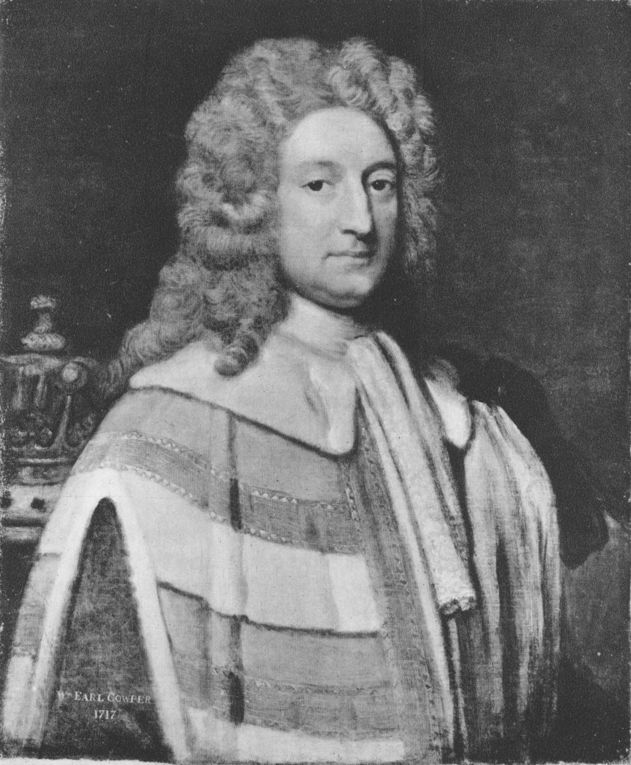
WILLIAM, FIRST EARL COWPER
Sir Godfrey Kneller
National Portrait Gallery
The Tory Don paid frequent visits to St John’s “poor disconsolate” wife in Berkshire and found his hopes vain. “I met nothing there,” he wrote again in 1711, “but sorrow and disorder. That unfortunate gentleman is more irregular if possible in his private than public capacities.”[431]
The appointment of the aged, ailing Rochester, uncle of the Queen, to be Lord President, showed clearly the party tendency which would govern the Administration. Rochester had been out of office since 1703. He had sought to keep England out of large Continental operations. If she must fight, let it be on the oceans; and there let her make conquests in the vast New World. Peace and isolation if possible, but, if not, at worst a half-hearted war—such was the policy and strategy of Rochester. For the rest, he represented the Church of England in its highest expression. No one but Rochester seemed able to answer for a Tory Parliament. But Rochester was a man of the strictest principles. He could have no accommodation with the Whigs, whom he abhorred as republicans, atheists, war-mongers, war-usurers, and friends of the Dissenters. He warned the Queen that she must have an honest party Government, and no nonsense about tame Whigs or non-party moderates, however eminent. All this must, however, await the result of the polls. Parliament was dissolved on September 30.
At this time Marlborough had developed a friendship with the Earl of Stair. Stair was a man of remarkable ability, and afterwards under George I one of the most capable ambassadors Britain ever sent to Paris. He was now serving under Marlborough, and the Duke began to use him as his confidential agent when on leave in London.
Stair to Marlborough
London
September 22, 1710
* Your Grace will know the changes that have preceded and followed the dissolution of Parliament which happened yesterday without one word being spoke at Council, for the Queen rose upon the moment the proclamation was read. The Queen this day refused My Lord Chancellor’s demission but it is not believed he can be persuaded to continue. Lord Orford laid down this morning. . . .
I saw Lord Poulett this morning who professed himself your faithful servant with great kindness and affection. Your Grace’s presence here will be very necessary to calm things before the sitting down of the Parliament. The delay of dissolving Parliament has been a great disadvantage to the new party. The Whigs have recovered themselves and are united and bold.[432]
Up till the moment of Godolphin’s dismissal Somerset had acted confidently with Harley and Shrewsbury. But as Harley’s ascendancy with the Queen became obvious Somerset’s eyes, though clouded by vanity, were opened. The brilliant prospect he had seen for himself at the head of a Ministry of both parties, the prime favourite of the Queen, and revered as the honest man whom the whole nation trusted, faded with disconcerting swiftness. Somerset now foresaw that in the present weakness and confusion of the Whigs, to which he had himself so largely contributed, an election might yield a Tory Parliament. Such a Parliament would certainly not accept him as leader. He therefore set himself to oppose the dissolution; but he was overborne. He had played his part; his usefulness was exhausted. When the dissolution was announced his fury knew no bounds. Without resigning his office of Master of the Horse he gathered the Whig ex-Ministers at his house and announced his intention of fighting the election hand in glove with them. He would do his best, he said, to keep as many Tories and Jacobites out of Parliament as possible. On such occasions help from almost any quarter is welcomed, and even the most recent quarrels are forgotten. Somerset went off “in a pet to Petworth” and flung himself into the election fight against Harley, while his Duchess wrestled vigorously but vainly with Abigail for the Queen’s favour.
But Harley’s electioneering was as good as his intrigues. The very counties in which Somerset had considered his influence supreme were those through which Sacheverell had made his progress. Somerset found himself confronted with an angry opposition who declared he was “against the Doctor,” and at the polls his candidates went down like ninepins. His short-lived power was gone. He had been one of the chief factors in the ruin of his own party. It had profited him nothing. All he had done was to set the Tories over them and himself alike. Nevertheless the Duchess of Somerset’s relations, and to some extent his own, with the Queen were such that he did not resign; nor did Harley think it wise to proceed to extremities against him. He and his wife actually continued for a year and a half in their offices, backbiting and slandering their new colleagues with the same bitterness as they had their old.
The passion of the election exceeded anything that had been known since the days of Charles II. Indeed, old men thought the savagery of the Civil War had returned. “By the accounts you give,” wrote Godolphin to Seafield (October 12), “and by what we find, all the most arbitrary proceedings in the elections are to be expected, but how anybody can think that is long to be maintained in our country and in this constitution is to me, I confess, a very great riddle.”[433] “There never was so apparent a fury,” Craggs reported to Marlborough (October 13), “as the people of England show against the Whigs and for High Church. Those that voted for Mr Stanhope at Westminster were knocked down; Sir Richard Onslow has lost it in Surrey, and I believe in Parliament they will exceed two to one.”[434] “Nor do we fight” wrote Defoe, “with cudgels only as at Marlow Whitechurch etc., . . . but with swords and staves as at Coventry, with stones and brickbats as at other places. Even our civil war . . . was not carried on with such a spirit of fury as is now to be seen.”[435] “In a great many of the elections,” Peter Wentworth told Lord Raby, “the nonconformists have voted for the Torys, and ’tis thought it proceeds from the assurance Mr Harley has given their preachers that there shall be nothing this Parliament done against them, but their tolleration keep inviolable.”[436]
The contest at Woodstock was complicated by the fact that, the Government having cut off supplies and Sarah having stopped the building of Blenheim, the workmen and labourers had been summarily dismissed unpaid. This had upset the neighbourhood. Marlborough’s estate agent, one Travers, placated these unfortunate people by distributing three hundred pounds on account of what was owing to them by the Treasury, and Marlborough’s candidates were both returned by the handful of freeholders who formed the double constituency.[437]
The Tory Party, united and inflamed, proved itself, as Marlborough had for years believed, definitely the stronger part of the nation. In Westminster the Whig General Stanhope, absent upon the Spanish front, was defeated by the Tory General Webb, amid scenes of ruffianism. Newcastle and all the Whig moderates were rallied. But far and wide throughout England the Whigs were overwhelmed. Bishop Burnet was frightened by a High Church mob. Sir Gilbert Heathcote, director of the Bank, representative of the hated money power, was insulted in the streets. All Wharton’s candidates were thrown out in Buckinghamshire.[438] In Scotland, where Hamilton and Mar worked for Harley, “the Whigs, to the fears of Popery and the Pretender, added the danger that Presbytery was in. The Tories spoke little above board, but underhand represented that now or never was the time to do something effectually for the King, and by restoring him, dissolve the Union.”[439]
Two hundred and seventy Members lost their seats. In the new Parliament the Whigs were not a third of the House of Commons. It was proved, indeed, that “the Whigs had no bottom.” When this was realized the stocks fell by 30 per cent., and the Bank refused to discount any foreign bills.[440]
Thus was ended, by the power of the Queen and, as it now appeared, by the will of the electorate, the ever-famous Administration of Marlborough and Godolphin, which for eight years had led the league of European nations to victory against the exorbitant power of France, which had made the British Island one United Kingdom, and had raised Great Britain from despondency and weakness to the summit of world affairs. The old Treasurer had retired to Newmarket. Marlborough, entangled in the war, wedded to the Army, claimed by the Allies, remained to struggle on, like a weary, baited bear chained to the post. The Continent, which had long yielded itself to the strong impulse of the island Power, without comprehending the causes of its inspiration and mysterious strength, was now staggered by what seemed to be a meaningless disintegration, the result of a bedchamber intrigue.
Queen Anne, after the intense personal stresses of the conflict which had raged about her, and perhaps also in her own conscience, and in which her will-power had played the decisive part, withdrew to Hampton Court to recover her strength and balance. By all accounts she was enormously relieved and gratified by the results of her exertions. She was not the only Sovereign to rejoice. Louis XIV knew that at the eleventh hour he had been saved from utter ruin. When he heard that the Queen had dissolved the Parliament he sent for Mesnager, his former agent at The Hague, to read him the news. “It is impossible,” wrote Mesnager,
for me to describe the transport of joy the King was in upon reading that part, [viz.] the dissolving of Parliament; “Well,” says the King, “if Monsieur Harley does that, I shall say he is un habile homme, and that he knows how to go through what he has undertaken: Mesnager,” adds the King, turning to me, “it is time you were in England;” I could not interpose for some time, the King was so full of this news, and talked so fast; sometimes to himself and sometimes to me, and as I was going to speak the King bade me attend in an hour; so I withdrew, and the King went to another apartment. I understood afterwards that his Majesty went to Madame de Maintenon’s lodgings to give her part in the news he had received, and perhaps to consult with her what measures should be taken in this important juncture.[441]
Marlborough had measured rightly the whole sequence of events from the beginning. He lent himself to various requests made to him by Godolphin and other Whigs. From time to time he wrote letters to the Queen or to Shrewsbury. But at no moment did he deceive himself. As far back as the summer of 1709, when he saw that Abigail had supplanted Sarah in the Queen’s favour, he knew that, unless some extraordinary step was taken, his system was doomed. When the Queen was instigated to make the Hill appointment, he chose that moment and that ground, unsatisfactory though they were from some points of view, for the decisive fight. If Godolphin and the Whigs had rallied to him when he quitted the Cabinet and retired to Windsor, the Queen would in all probability have been compelled to amend her courses. Parliament was in session, the campaign was about to begin, the Government was intact. Then was the chance, which never recurred, of bringing everything to a head. It would not have been necessary, in Marlborough’s opinion, to proceed against Abigail by a Parliamentary address, and neither he nor Sarah advocated that course. The pressure which the whole Ministry could have brought upon Anne to choose forthwith between her responsible Ministers and her backstairs advisers would almost certainly have been irresistible. Abigail could have been chased from the Court, and Harley exposed before Whig majorities in both Houses.
As things fell out, the Ministry suffered the worst of both courses. The Queen was filled with fear and resentment at the rumour of a Parliamentary address against her cherished Abigail. When this menace proved to be unfounded her fears passed, but her resentment remained. Nothing that had ever happened before had smitten her so deeply as this. All her quarrels and scenes with Sarah, all the interminable correspondence, all the political stresses attending the dismissal of Harley in 1708, and the forcing upon her one after another of the lords of the Junto—all these were upon a lower plane. The alleged attempt to set the House of Commons upon Abigail, and upon her for sheltering Abigail, was, she felt, a mortal affront. Repeatedly in this long-drawn crisis we find the rancour which this episode aroused, hardening her against her Ministers, and severing the last personal ties which united her to Marlborough. It enabled Somerset week after week to pour into her eager ear tales of this outrageous design to rob her of her own personal friend and attendant. How easy for Harley to warn her of Marlborough’s alleged desperate ambition! Her grandfather had perished on the scaffold; her father had died in exile. Marlborough, at the head of the armies and of the Grand Alliance, was far greater in power than Cromwell before he became Lord Protector. Deposition in favour of the detested Elector, a republic of the Whigs, a dictatorship of Marlborough, were all bugbears which could be used to aggravate her anger and her alarm. And, on the other hand, what alluring prospects had been unfolded to her, not only by Harley, but also by the unwitting Somerset, and perhaps by Somers! The over-mighty subject should be put down; a Government above party, of her own choosing, should be established; the royal prerogative should be erected again on a new foundation. She would be Queen indeed.
|
Coxe, v, 346. |
|
Seafield Papers, H.M.C., p. 209. |
|
Coxe, v, 311. |
|
John to Sarah August 16, 1710 . . . I beg there may be no alteration made at the election of Woodstock; for I intend Cadogan shall come to England with me. 39 [Marlborough] shall expect more assistance in 87 [Parliament] from 197 [Cadogan] and 202 [Macartney] than any other Members, for they have both honesty and courage to speak the truth; so that I do earnestly desire that these two men may be chose preferable to all others, with which I desire you will lose no time in acquainting 38 [Godolphin], and that I beg it of him as a particular favour that he would take care of securing an election for 202, for 39 does think it absolutely necessary to have him early in 108 [England] this winter, of which he will take care. [Sarah Correspondence, i, 363.] |
|
Coxe, v, 330. |
|
Coxe, v, 330. |
|
Heinsius Archives. |
|
Coxe, v, 304-305. |
|
Loc. cit. |
|
Cowper, Diary, p. 46. |
|
Dispatches of Gallas and Hoffmann, October 10; Klopp, xiii, 488. |
|
Portland Papers, H.M.C., vii, 12. |
|
Portland Papers, H.M.C., vii, 39. |
|
Blenheim MSS. |
|
Seafield Papers, H.M.C., p. 211. |
|
B.M., Coxe Papers, xxxiii, 102. |
|
Defoe, A Weekly Review, vii, 333-337. |
|
The Wentworth Papers, p. 151. |
|
Travers to Marlborough Woodstock Sunday, Oct. 8, 1710 * Yesterday Lt. Gen. Cadogan and Sir Tho Wheate were elected here without any of the opposition lately threatened by the adverse party, and I sent for the chief of those who had chosen the present Mayor out of course, and were for excluding Sir Tho and choosing me in spite of all my representations to the contrary. With much ado I persuaded them to desist, and not so much as to name me. So all was done quietly and I congratulated the Freemen on their choosing two such worthy members, and thanked them in the name of the High Steward for this mark of their affection and respect for him. When I came hither on Friday morning I found the scene much changed from what Mr Vanbrugh and Mr Hawkesmoor had told me, and whereof I gave your Grace an account from Henley by last post. The people who had been turned off without their wages were full of complaints and tears and then threats and violence—and Lord A. having very much importuned a neighbouring gentleman to stand, and Sir John Walter having called here last Tuesday with Sir Rob. Jenkinson and others and declared he would set up an honest gentleman there being now a proper occasion for it, Blenheim being indeed under a cloud, and Sir Thomas Wheate being so apprehensive of their surprising us that he had sent expresses to all the gentlemen and other foreign freemen who are our friends to come in to our assistance. To prevent therefore any tumult that might be set on foot at the Election, and in compassion to so many poor starving people . . . I borrowed £300 here on my own credit and ordered the Comptrollers to pay off the poor labourers and to divide the overplus among the most necessitous of this town. . . . I am glad that I called here because I am told that the people in my absence would have insisted on a Pole which before I could not have believed, besides the satisfaction of having stopped the clamour and relieved the necessity of a great many poor wretches. [Blenheim MSS.] |
|
Portland Papers, H.M.C., ii, 223. |
|
Lockhart, i, 319. |
|
Portland Papers, H.M.C., ii, 223. |
|
Minutes of the Negotiations of Monsieur Mesnager at the Court of England towards the Close of the Last Reign (1717), p. 61. The Bavarian Agent in Paris to the Elector of Bavaria. October 18, 1710 The King received, this Day, certain Advice from England, that the Parliament is dissolved, and that the proposed Changes in the Ministry will take Place. . . . It is not at all doubted but that the Duke of Marlborough will give up the Command of the Army, and the more as the now ruling Party will leave no Stone unturn’d to induce him to it. . . . And if the Duke of Marlborough should resign the Command of the Army, in whom else can they have so entire Confidence? I don’t know a single Person fit for the Post; for besides being a good Officer, he must likewise be an able Minister, one who has Credit with and Influence over the Confederated Princes, which they will not find united in any one besides the Duke of Marlborough. If the Duke of Hanover should accept of it, he will never agree with Prince Eugene; And thus we shall see Matters absolutely put on a New Face. . . . The Duke of Berwick, who had early Notice of this Event, has wrote to Monsieur de Torcy, to desire him to represent to the King, that now would be a proper time to attempt a Descent, not in Scotland, but in England; and that he was very willing to put himself at the Head of 20,000 Men, and be secure of Success in carrying over the King of England. [Lediard, ii, 286.] |
“You may venture to assure everybody,” declared St John, the newly chosen Secretary of State, “that credit will be supported, the war prosecuted, the Confederacy improved, and the principle in which we engaged preserved as far as possible. Our friends and enemies both will learn the same lesson, that however we differ about things purely domestic, yet we are unanimous on those points which concern the present and future happiness of Europe.”[442]
Behind these words of high resolve and reassurance the new Ministers were intent upon making peace. But even before they had obtained power they had become convinced, though with much reluctance, that the war would go on for some time, and that peace was more distant than before their intervention. In these circumstances they found it convenient to upbraid the Allies upon their many obvious shortcomings. They proclaimed that England would show even greater vigour in the war than under the late Administration. All the more was it necessary that her allies should act up to the highest standard of their obligations, and should be made to, at all costs. “The most popular thing for England,” wrote Harley, with much candour, “is to press all the Allies to keep exactly to what they have agreed to do in their Treaties. The partiality to them has been much complained of, and the pressing relentlessly to their exact performing is the likeliest way to obtain peace.”[443]
This certainly was a sound policy for men who did not care very much what kind of a peace it was. Nevertheless, the complaint of England against her allies, especially the Empire, was only too well founded, and a certain tonic was administered to them by the attitude of the new Government. England had got into the position of begging them to follow her. The change of government, which occasioned so much waste of power, at least reversed this process: the Allies now begged England not to desert them. St John was especially anxious to whip up the Empire. His mood towards Austria was always hostile, and his language harsh. He found it more congenial to harry the Allies than the enemy.
Upon universal appeal and overwhelming reason Marlborough had retained his command under the new Administration. He had every proof that they hated him and the cause which he upheld; but they also at the same time feared and needed him. In his headquarters, from which he was conducting the sieges of Aire and Saint-Venant, he awaited their orders. At first these were expressed very roughly. St John in particular seemed to find a strong satisfaction in displaying himself as master of the great man who had favoured his early career, admitted him to his comradeship, helped him with his debts, and, indeed, almost adopted him as his son. All his letters about Marlborough at this period are of a scornful and often spiteful character. He wished at once to patronize him and to make him feel the humiliation of his new position. We shall see that some months later, under political strain, he changed his note and flattered, proffering his false friendship, as if he were back in the buoyant days of the Blenheim campaign.
The new Ministry, however, pursued contradictory and ambiguous courses towards their General. They would have rejoiced if they could have flung him out, and set the Elector, George Louis, in his place; but that could not be done. They were conscious of serious danger in dismissing Marlborough before finding a substitute whom England and the Allies would accept. On the other hand, they wished to bend him, break him, tame him to their yoke. They sought to foster a faction against him among his generals and colonels. They laboured to show the Army that his political power was gone. They took the whole business of promotion out of his hands. They set up a board in London under the Duke of Ormonde, his political opponent and professional competitor, to scrutinize and decide the claims of all officers for promotion. They dismissed or removed from their special appointments his most trusted and competent brigadiers and rising officers. They appointed in their stead those who had been personally disloyal or offensive to him in the campaign, or who had insulted him in Parliament. If there was anyone on whom he specially relied they removed him. If a man could be found who was particularly obnoxious they thrust him forward as near to the Commander-in-Chief as possible. They even made a virtue of this by pretending that Marlborough was making by favouritism an army to subvert the Crown and Constitution. The Queen herself, they hinted, was in danger from his favouritism. Above all, Abigail’s brother and husband, Brigadiers Hill and Masham, sailed forward upon this breeze.
If Marlborough endured this treatment his authority with the Army must, they thought, be fatally wounded. If, on the other hand, he found the treatment intolerable, let him resign. They saw that if he resigned he would put himself in the wrong. To dismiss him was dangerous: to provoke his resignation comparatively safe. Then they could have filled England with the cry that he had deserted his post on party grounds, that he had cast away the cause of the Allies, that he had ruined the peace which otherwise was in their hands. Any disaster in the field which followed his withdrawal they could lay on him. In fact, their conduct towards him during their first months exceeded in malice and in meanness anything which is known—and it is a wide field—in the relations of a British general with a British Government. In all this the most poisonous was St John.
Marlborough, though he writhed and groaned under the ordeal, was in no mood to yield his enemies any advantage. He held on to his position with the tenacity with which he had fought the siege of Lille two years earlier. Surrounded upon every side by foes, the worst—his own countrymen—at his back, exposed to all the hazards with which war between equal armies confronts a general, feeling the French spirit rise every day as his political weakness became known, watching the peace which would have released him steadily recede, he repressed all impatience, and disdained or ignored every insult. But can we wonder that in such distress he would have welcomed serving under the Elector of Hanover, or transferring the command in the best conditions to him?
In his steadfast attitude he gained comfort from the great companions with whose aid he had waged the long war. Heinsius usually presents himself to us as a prosaic, austere, and even bleak personality; he had been in conflict with Marlborough over the Barrier since 1709; but we now see him showing every sign of personal sympathy.[444] The Elector of Hanover, recognized future master of these arrogant Ministers, and the King of Prussia gave him unswerving support. The Elector declared publicly as a member of the Grand Alliance that unless Marlborough remained in command of the armies he would withdraw his troops. Frederick I spoke in a similar spirit. Eugene, who was not the master of armies, could only publish his resolve not to serve in Flanders except with Marlborough. As for the Dutch, their remonstrances on Marlborough’s account had already strained their relations with our queer Queen and her new circle.
Sarah, above all a pugnacious politician, soon in the excitement of the election began to regret that her husband was still the servant of the new Government. But these were unreasonable reflections upon a decision so deliberately adopted. Marlborough’s reply was overwhelming.
John to Sarah
Oct. 4, 1710
I find by what Mr Maynwaring has said or writ to you, you are jealous of my acting so with Mr Harley or the Tories, as that the Whigs may have reason to be angry. In the first place, I should not, at this time, have been where I am, if it had not been unanimously desired by all the heads of the Whigs. By the same advice, I have made steps to the Elector of Hanover, who has entered very kindly into my concerns. The States, the Emperor, and the Elector, all three have engaged me to continue with the army, which I suppose is, and will be approved by the Whigs; for I am resolved of doing nothing but in concert with them. I detest Mr Harley; but think I have lived long enough in the world to be able to distinguish between reason and faction.
Nothing is more desired by me than to be quiet; my greatest concern is, if possible, to avoid the harsh usage which is most certainly resolved to be put in practice against you, for whom I must ever be more concerned than for all other things in this world. . . . We are in circumstances that require great temper, by which I hope we may at last overcome our enemies.
Blenheim continued to be a source of vexation and embarrassment.
I think that those that take care of the building at Blenheim, when the winter season and the want of money makes the work to cease, should take care to cover the works, so as what is already done may receive no prejudice, and then it may remain as a monument of ingratitude, as Mr Van. calls it in his letter. I hope the wainscot and every other thing, in your apartment and mine, is finished so that we may live in that part of the house in the spring.[445]
We are masters of St Venant, and I yet hope we shall have Aire by the 20th.[446]
Sarah was pleased to find her husband so apparently indifferent to the fate of Blenheim. “My lord Marlborough,” she wrote to Godolphin,
approves very much of all that I said to Mr Travers upon the subject of Woodstock, and I suppose will not be less of that mind when he sees the letters that Mr Joyns writ, to fright me into sending them money. He adds that they may pull down what they have built, if they please, he will never contradict it, which I was glad to see; for I think that building was the greatest weakness my lord Marlborough ever had, and, being his passion, I am pleased he has overcome it; and, I believe, these Ministers thought to ensnare him by it.[447]
We have seen the unsoldierlike letter written by Lord Orrery in June, suggesting that the Queen should give him and Argyll leave to quit the Army without reference to the Commander-in-Chief.[448] This seed bore fruit.
Marlborough to Godolphin
Oct. 4, 1710
Everything is done to lessen my credit here. By the last post Mr Secretary wrote, by the Queen’s order, to acquaint Lord Argyll that his friends have desired leave for him to come for England, and she had allowed of it. This is so very extraordinary a step that even the Duke of Argyll came to me yesterday to assure me that he had made no application, and that, when he should desire to go for England, he should apply to me for my leave. The folly and ingratitude of the Queen make me sick and weary of everything.[449]
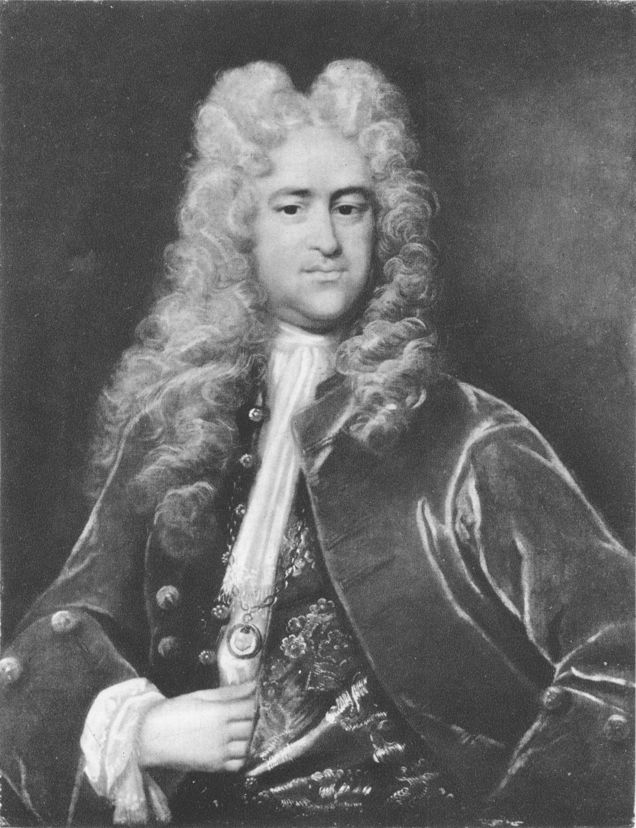
SIR JOHN VANBRUGH
John Closterman (?)
National Portrait Gallery
The Duke of Argyll, for all his bitterness, had not behaved in the unmilitary fashion the Queen had been induced to authorize. There was a strong opinion in the camps on questions of disciplinary etiquette, and a prominent man, a famous warrior like Argyll, would lower himself in Europe by any gross misbehaviour. But, though he had not been as forward in casting contumely as the Secretary of State wished, he was none the less a few weeks later gazetted General of Infantry in the British Army. Hoffmann, whom nothing escaped, wrote:
After everything that has taken place between him and Marlborough during the last two campaigns, the appointment will cause Marlborough vexation. That is, however, what it is meant to do. He will be insulted until he resigns voluntarily. Those responsible for the changes here do not intend to let him remain in his high position, because they fear his revenge. The real Tories might tolerate him, although only in such a fashion that he was completely dependent upon them. He cannot, however, be so on account of the Whigs. His position is therefore extremely complicated.[450]
One day this winter in the House of Lords Lord Scarbrough, who had been now Whig, now Tory, but always a malcontent, proposed incontinently that the Lord Chancellor should be directed to send the Duke of Marlborough a letter of thanks for the great successes of the year. Argyll, who had by now returned, objected at once to the motion. “What reason,” he asked, “can there be for such a message of thanks, unless custom is to be made the reason? Four strongholds have no doubt been captured; but only one of them, Douai, is of importance. The other three have cost the best blood of the army.” Two other Generals, both opponents of Marlborough, Lords North and Grey, supported Argyll, and Scarbrough, who had acted without any authority or preparation, withdrew his motion.[451] On this, as St John acidly observes in his correspondence, “One would imagine Lord Scarbrough was hired by somebody who wished the Duke of Marlborough ill to take so ill-concerted and ridiculous a measure.”[452]
A third calculated affront followed a few days later. Informers had reported that three of Marlborough’s general officers, Meredith, Macartney, and Honeywood, the first two Members of Parliament, had in the camp drunk to the health of the Duke of Marlborough, and confusion to the new Government and Mr Harley. Such toasts were common at that time among both parties in the armies, and no notice had ever been taken of them. Without any attempt to establish the facts, or to allow the officers to deny or excuse them, they were immediately cashiered. The orders, in the name of the Queen, were sent through Marlborough under seal, to be delivered by him unopened. He only learned from the officers what their punishment had been. These three young generals were among the very best who had risen in the fierceness of the fighting, and they were also Marlborough’s personal friends. There was much astonishment at this measure, both in the army and at home. “All officers,” reported Hoffmann,
speak on behalf of the three. If generals are cashiered on information supplied by an informer, even the most guiltless are no longer secure. Macartney admits freely that he had drunk to the confusion of Marlborough’s opponents. But if they mean to punish these said officers they must punish almost the whole army.[453]
It was not, however, the officers at whom Harley and St John were aiming. They were attacking Marlborough. In order not to inflict needless suffering upon subordinates, they therefore allowed the three generals to dispose of their commissions under the purchase system, thus saving them from financial ruin. The opportunity was taken of giving Lord Orrery one of the vacancies thus created. Thus he gained the major-generalship for which he had striven so assiduously.
It was a reasonable expectation that Marlborough’s treatment at this time by the Queen and Government would have rendered his position impossible by destroying his credit with the Army while heavy operations were proceeding. He himself certainly feared that this would be the result. Curiously enough, the reverse happened. Never in the height of his success was there such a rally to him throughout the allied armies as in these winter months. Apart from the group of intriguing officers round Argyll, all ranks sought occasion by the strict performance of their duty to prove their discipline, and show their respect for their General. In that glorious army of veteran soldiers drawn from eight nations, welded together by so much war for causes which for the most part they comprehended and espoused, the malignant timeservers and backbiters became lepers. Dutch Deputies and foreign generals now supplied Marlborough by their alacrity with the support hitherto forthcoming from home; and, far beyond the Army, there spread through all the signatory states of the Grand Alliance a vehement resolve that he should not be taken from them before the fruits of their efforts were gathered in.
One has a sense at this time of the magnitude of the power which was being wantonly destroyed. The British oak had struck its roots so deep in Europe, its branches spread so far, that even the lopping off of tremendous limbs and the undermining or severing of one root after another still left it erect, the feature of the landscape. Marlborough’s faults and limitations have not been, need not be, concealed; his misfortunes now crowded upon him; but he remained the champion of Europe against the military dictatorship of Louis XIV; and, apart from his enemies in England and France, all the nations looked to him.
As the weeks passed those who had risen by the methods we have described found themselves, in their turn, oppressed by the weight of official cares, and disturbed by the temper of their own new-found Parliament. The landslide of the elections had carried affairs far beyond that moderate, middle dispensation which Harley and the Queen, to say nothing of Marlborough and Godolphin, had always desired. The year 1708 had produced a sultry Whig House of Commons: 1710 showed a red-hot Tory domination. From the backwoods of England, from the acres which they cultivated with hard authority and exemplary skill, came in unforeseen numbers and in uncontrollable temper the backbone of England, the Tory squires, blessed by the Church they had sworn to defend. Their hatred for the Whigs was at once instinctive and religious. The process of electioneering had, however, exercised an educative function. They had catered for the Nonconformist vote; they had boasted that the national credit would be safe in their hands; and though they disapproved of Marlborough’s tactics and strategy, as well as his character and politics, they were at first genuinely anxious to beat the French, and not to show themselves less competent than their opponents.
We can see how irresistibly the character of the new House of Commons impressed itself upon the Queen and her advisers. All ideas of co-operation with moderate Whigs, upon which Harley had traded so successfully before the election, had been swept to limbo by one stroke of the national wing. All plans for an equipoise of parties, and their impartial control by the Queen’s favourites at the Court, vanished like the smoke of a quenched fire. This was not Harley’s Parliament. St John felt far more at home with the new majority. When Sarah saw St John in a large company just before he became Secretary of State, she said “in her manner which was often the reverse of polite,”[454] “There goes an ungrateful rogue.” St John seemed resolved to prove that this was true. He availed himself of Harley’s apparatus for collecting dispassionate information from many quarters through trusted agents. In Holland Harley had an agent, one John Drummond, a Scottish merchant and resident of high standing, very shrewd at finding out facts, and blunt in reporting them. Drummond, who was used as a channel between the Ministry and Marlborough, wrote to both Harley and St John.
John Drummond to Harley
Amsterdam
November 1/12, 1710
What is it are we to imagine that hinders or will hinder their [the French] new proposals, but what they write us every day, viz. the hopes they have of the divisions in England and that the Duke of Marlborough will be made so uneasy as to be obliged to retire and abandon the army, who they know has been no less instrumental in keeping the Allies together than in his success in the field? It is not for his person, but for the public good that I argue or presume to meddle in so important an affair, for well do I know all his vices as well as his virtues, and I know as well that though his covetousness has gained much reproach and ill-will on this side of the world, yet his success in the field, his capacity or rather dexterity in council or in the Cabinet, and his personal acquaintance with the heads of the Alliance and the faith they have in him, make him still the great man with them, and on whom they depend. I can tell you with certainty what I meet in daily conversation, that you will have little money to expect from this [Government] if he stay at home, that they wish with all their hearts almost any sort of peace before he be taken from them, that there is no Englishman who they have any opinion of for the command of an army but himself, that his agreeing so well with Prince Eugene is one of their greatest contentments and to make a new acquaintance and intimacy of such a nature with any one is what they fear and abhor the thoughts of.
Pensionary Buys came to me two days after Lord Rivers left this place almost with tears in his eyes, saying “Lord! what shall become of us. Lord Rivers would give me no satisfaction that the Duke shall return. For God’s sake write to all your friends, let him but return for one campaign till the French but once make new proposals, let the Queen afterwards do with him what she pleases, but must the safety of us all be put in the balance with personal pique which perhaps may be reconciled if rightly gone about?” I hope the Queen will forbear her farther resentments till a better occasion, though justly deserved by him and all who belong to him. Baron Gersdorff was last day here: he is Envoy at The Hague for the Elector of Saxony or King of Poland; he assured people in a general assembly or society that his master would recall his troops if the Duke was not to command.[455]
This letter smote Harley. For all his love of dissembling, artifice, and intrigue, to which was soon added inveterate drunkenness, he was nevertheless a man built on a large scale and of a nature not wholly divorced from the life of Britain. He was not at all like St John, a brilliant, fugitive rascal, prone to bully or grovel with equal facility according to circumstances or mood. Also Harley felt himself the man responsible. On him lay the burden. He had been wronged. He had resented his injuries. He had avenged them. But he felt himself morally as well as constitutionally accountable to Parliament and in some degree to history. One is at first astonished at the freedom with which this powerful Minister, having through Abigail entire control of the Queen, and thus through his adroitness of the British system, unbosoms himself to the outspoken John Drummond at Amsterdam. But, of course, this letter was meant for Marlborough.
Harley to John Drummond
Amsterdam
November 7/18, 1710
. . . As to any reconciliation between me and the [Duke of Marlborough], give me leave to say that I were unworthy the Queen’s service should I not live with anyone that her service or the public good requires. I do solemnly assure you I have not the least resentment towards him or anyone else. I thank God my mind puts me above that. I never did revenge injuries. . . . In one word I do assure you, I can live and act with the Duke now in the same manner and with the same easiness as the first day that ever I saw him. . . .
I have upon many occasions since shewn by actions relating to his particular affairs of Blenheim that I am far from resentment. But this I find by experience, those who have done injuries are more difficult to be reconciled than those who have received injuries, and hatred, the more groundless and unreasonable it is, the more durable and violent it most times proves. Now I have opened to you my heart upon this subject and do again assure you that no resentment of mine shall ever obstruct the public service or hinder the co-operating with any one for the good of the common cause. . . .[456]
Negotiations were therefore set on foot with Marlborough, with the object of reaching a basis upon which he should command the armies in the now inevitable campaign of 1711.
John Drummond to Harley
Amsterdam
November 29/December 10, 1710
. . . Mr Secretary St John will have acquainted you with what I wrote him of my discourse with [Marlborough]. . . . He has faithfully promised both to the Grand Pensionary and to Buys that he is resolved to live with you if you will make it practicable or possible for him; he will not enter into the heats of party debates, but will go heartily and sincerely into all the measures that may be esteemed proper for carrying on the war, but for other votes he will be at his free liberty. . . .
This he consented to, and desired me to write very plainly that he was pretty much desponding, and yet seemed well resolved to carry on the war he had so successfully brought this length, by sticking to her Majesty’s service as long as even his greatest enemies should think it possible or practicable for him. . . .[457]
St John, into whose hands the transaction now fell, was far from satisfied with what he heard of Marlborough’s attitude. “There is, I dare say,” he wrote to Drummond,
no one disaffected man in the Queen’s dominions, but who will engage to be of no party, to vote as he finds things first, to be as hearty as any man where the Queen’s honour, or the nation’s good is concerned. These are vague and uncertain propositions, which tie him down to nothing. . . . If he comes home and disengages himself from the Whigs; if he puts a stop to the rage and fury of his wife, in short, if he abandons all his new and takes up with all his old friends; by the Queen’s favour, and by the remains of regard for him which are preserved in the breasts of several people, he may not only stand his ground, but, in my humble opinion, establish himself in as lofty a situation as it becomes a subject to aspire to: but if he imagines that people will any more be caught with general and inconclusive discourse, if he thinks that people will any more engage to him whilst he lies under no engagement, nor gives any security to them; depend upon me, for once he will find himself deceived.[458]
Marlborough stayed as long as possible at The Hague, and kept the seas between him and his ferocious fellow-countrymen. Here, at least, he found a friendly and grateful Government. Here he remained a European figure, whose gleams were not yet extinguished in the British fog. But the crux was still to come. Harley owed everything, including his daily existence as a Minister, to the Queen, and Anne’s fondest wish at this moment was to dismiss Sarah from her appointments, and make sure she never would see that once dearly loved being again. Mrs Masham kept Anne intent upon the point. Therefore Harley, who was by now earnest to obtain Marlborough’s services in the new campaign and to use his shield with the army to cover clandestine negotiations for a separate peace, had still one more ugly difficulty to overcome. Sarah must go. She must be stripped of her offices: she must give up the Gold Key. This the Queen demanded at all costs. Could Marlborough ever be brought to consent to this? His love for his wife was well known: his submission to her was a proverb. Would he, could he, force her to resign? If so, the last obstacle was removed. A working arrangement could be made between him and the Ministry. He should lead the army in the final campaign which Britain would fight. At the worst he would uphold the front; at the best some new astonishing event might repair the disaster which the change of Government had palpably caused.
Harley and St John—for these are the two who now counted—therefore pursued their policy of bargaining and affronts, of baits and insults, of compliments and threats, and neither they nor anyone else knew what Marlborough would do.
No view of the problems of the new Ministry is intelligible without the Spanish scene. Stanhope’s visit to England at the end of 1709 gave him a gloomy impression. As one of the managers of the Sacheverell impeachment, he felt the hostile surge of popular feeling. Towards the end of March he left for his command in Spain. He stopped at The Hague to discuss the main strategy of the war with Marlborough and Eugene, and particularly to impress upon the latter the need for further Austrian troops in the Peninsula. Accompanied by Craggs,[459] he sailed from Genoa in the middle of May for Catalonia with £80,000 in bullion, a thousand German troops, and considerable corn supplies. At the end of the month he reached the allied headquarters. Starhemberg, on the Aragon border, had under his command about eighteen thousand well-equipped troops, while beyond the river Segre, at Lerida, Philip had been able to concentrate twenty-two thousand Spaniards. For two months Stanhope pleaded for a general advance. Fresh from home politics, he knew the urgent need for an offensive, and as a soldier he longed to take advantage of the complete absence of French troops from the country.
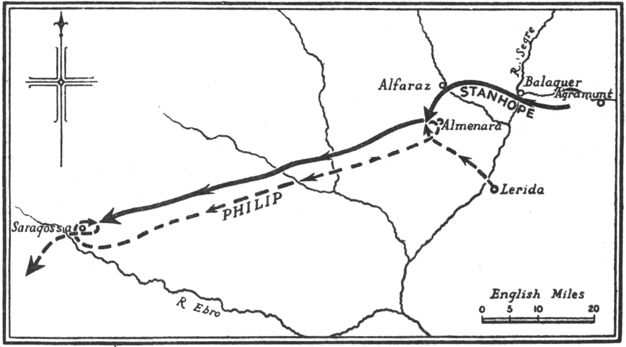
ALMENARA AND SARAGOSSA
At length, in July, Norris’s fleet in the Mediterranean brought over reinforcements, and Stanhope was allowed to advance across the Segre at Balaguer, and race with his English dragoons for the bridge of Alfaraz, some twelve miles distant. The capture of this key point would cut off the enemy from North and West Spain. Upon this movement the campaign opened. By the morning of July 27 the whole allied army had crossed the bridge unopposed. Philip from Lerida reached Almenara, two miles short of the bridge, on the same day. Since noon Stanhope had been arguing and shouting and threatening to leave the country if Charles took no action. Just before sundown he wrested from his reluctant colleagues the order for a cavalry charge.
At the head of twenty-six squadrons he gave the signal. Wave upon wave of dragoons swept up the hillsides flanking the Bourbons’ positions, and forced their whole army into flight. The opposing cavalry leaders met in personal combat, and Stanhope cut the Spaniard down.[460] “If we had had two hours’ daylight more . . . not one foot soldier of their army would have escaped.”[461]
Lerida was now untenable, and Philip retired on Saragossa, pursued by the allied army. On the evening of August 19 a second action was fought under the walls of the provincial capital. After three hours the whole Spanish army fled in disorder into Castile. Almanza had been avenged. The way to Madrid lay open. A week after the victory at Saragossa there was a decisive council of war.[462] Stanhope held the view, which the year before had been Marlborough’s, that Charles’s forces should march at once to Madrid to meet Galway’s force from Portugal. The reduction of Spain was the more urgent after the breakdown at Gertruydenberg. But Starhemberg declared for more cautious moves. He proposed to halt at Saragossa. “Conquests should be made step by step, and not by springs and bounds.” Valencia should be reoccupied. Philip’s communications with France should be cut, and the remaining Bourbon strongholds in Northern Spain systematically reduced. The majority of the council voted with the imperious English leader, flushed by his recent successes, and Charles reluctantly consented to the general advance on Madrid.
Winter was at hand when, at the end of September, Madrid was reached. The communications to the sea-coast were seriously lengthened, and the Spanish population implacable.[463] Above all, a new leader had arrived at the Bourbon headquarters at Valladolid. Vendôme, in disfavour and retirement since his defeats in 1708, was now by Villars’s advice sent to Spain with high authority and the hastily collected French garrisons of Navarre. At the final crisis of the war in Spain he was to save the cause of Philip V. His arrival was greeted with enthusiasm by the Spanish at Valladolid. Swiftly concentrating the Bourbon army, he marched southward to prevent a junction between the allied army in Portugal and that in Madrid. Stanhope was moving southward to the point of junction at Almaraz when the French forestalled him. The English army in Portugal, awaiting a successor to the disgusted Galway in the person of Lord Portmore, had made no forward movement over the frontier. The Portuguese withdrew into ‘summer quarters,’ and Stanhope was forced to return to Madrid, leaving Vendôme free to encircle the Spanish capital and the Allies by cutting the communications with Catalonia and the coast. Thus in a few weeks the whole state of the war in Spain was transformed.
Stanhope’s proposal to winter in Castile was overruled by the council of war; and at the beginning of December it was decided to retreat into Aragon, a hundred and fifty miles away. Harassed by Spanish irregular bands, short of supplies and money, the allied forces quitted Madrid on December 3. Owing to the scarcity of forage in the devastated countryside they marched in three parallel columns, the Spanish and Portuguese levies on the right, Starhemberg in the centre, and Stanhope on the left. Stanhope, with 4500 men, halted for the night of December 6 at the old Moorish town of Brihuega to rest his troops and bake bread. Starhemberg lay at Cifuentes, five hours’ march away over hilly country. The columns had been harried on their march by Spanish bands. The last that had been seen of Vendôme was near Talavera, seventy miles south of Madrid, and when on the morning of the 8th horsemen were seen on the heights around Brihuega, Stanhope assumed that they were the familiar Spanish irregulars. At midday, however, Vendôme’s artillery began to fire upon the town. What had happened?
On the day that the Allies were leaving the northern suburbs of Madrid Vendôme and Philip had entered the capital from the south. The Marshal hurried the King out of the town in keen pursuit of the allied columns, and at the head of his cavalry plunged across the flooded Henares at Guadalajara. Hearing from his advanced Spanish detachments that they had found Stanhope at Brihuega separated from Starhemberg, he marched incessantly to the scene. A little after midday he arrived with some ten thousand men on the hills above the town. The English general prepared himself for the worst. One of his officers made his way through the enemy lines to warn Starhemberg that Brihuega could not be held for more than twenty-four hours. With no artillery, and a mile and a half of crumbling mud walls and ancient Moorish castle, Stanhope made the best dispositions in his power. Trenches and pits were dug in the streets, houses and church steeples fortified.
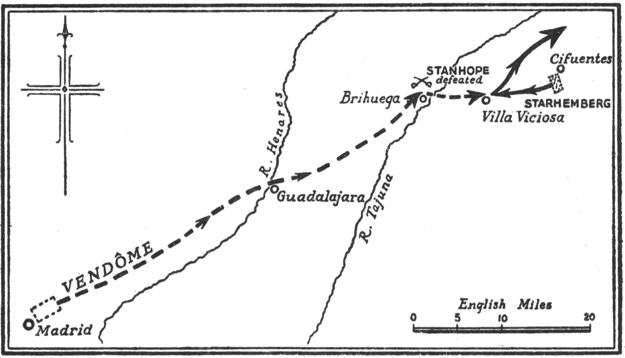
BRIHUEGA AND VILLA VICIOSA
By evening over a thousand shot had been fired into the town. An offer of surrender was refused. The next morning the French cannon were brought to close quarters, and a crashing bombardment smashed in the northern gates. The assault began. Not until the evening of the 9th did the Spaniards pass through the breaches and street fighting begin. The Spanish cannon were now mounted inside the walls to rake the streets with grape. Amid the cannonade and blinding smoke from damp wood, lit to baffle the besiegers, the British infantry were driven step by step from their fortified houses and barricades into the citadel. With the town burning, their ammunition nearly exhausted, and over six hundred casualties, Stanhope and his troops surrendered as prisoners of war.
Starhemberg had received the message from Brihuega, but, waiting for his artillery, refused to march until midday on the 9th. He arrived in the neighbourhood at nightfall, a few hours after Stanhope’s surrender. After a fierce battle round the village of Villa Viciosa with Vendôme’s victorious troops, in which the Bourbon army lost more than four thousand men, Starhemberg was left in possession of the field. An admirably executed retreat into Catalonia followed, and at the beginning of January 1711 he reached Barcelona with a remnant of eight thousand men.
Thus swiftly had the tables been turned. The allied offensive had ended in disaster. Vendôme and the people of Spain had settled the Spanish succession in their own way.
|
St John to Drummond, October 13, 1710; Letters and Correspondence of Viscount Bolingbroke (edited by G. Parke, 1798), i, 5. |
|
“Mr Harley’s Plan of Administration” (October 30, 1710); Earl of Hardwicke, Miscellaneous State Papers (1778), ii, 485. This programme was read by Harley to the Queen at Windsor. |
|
* We have just heard with much surprise that the Lord Treasurer has been deprived of his office, which shows clearly enough what will follow. I am much relieved to know that you are resolved to remain at the head of the Army whatever happens. I have to-day talked with Lord Townshend, who holds the same view. I will not fail to speak to him to see what can be done to make it public. [Heinsius Archives, August 23, 1710.] * I am much relieved that you have been told yourself that nothing ill is intended as far as you yourself are concerned, at least until you are back in England, for I believe your presence will dissipate all that, and that you will be in a position to prevent it; which I hope and wish with all my heart. France shows no sign of wishing to resume peace negotiations. I do not know whether as you think they wish first of all to see the behaviour of the new Parliament, or whether they are waiting on the course of the campaign in Spain. [Heinsius Archives, September 20, 1710.] |
|
William Stratford in his party outlook interpreted these affairs in his letters to Harley’s son, Edward, so as to throw an unwarranted odium upon Marlborough. “In one month more, Blenheim would have been covered so as to be secure against any injury from the weather. Their orders were positive to break off, and if it continue in the condition it is left, the frost and wet will ruin all that has been done this summer.” (Portland Papers, H.M.C., vii, 20.) |
|
Coxe, v, 354. |
|
Coxe, v, 358-359. |
|
Coxe, v, 360. |
|
Hoffmann’s dispatch, November 4; Klopp, xiv, 3. |
|
Hoffmann’s dispatch, December 12; Klopp, xiv, 17. |
|
St John to Drummond, Nov. 28; Bolingbroke Correspondence, i, 24. |
|
Hoffmann’s dispatch, December 30; Klopp, xiv, 23. |
|
Klopp, xiv, 31. |
|
Portland Papers, H.M.C., iv, 620-621. |
|
Portland Papers, H.M.C., iv, 623. |
|
Portland Papers, H.M.C., iv, 634. |
|
November 28/December 8; Bolingbroke Correspondence, i, 26. |
|
The younger. |
|
Probably the Duke of Sarno; but this is disputed. See note in B. Williams, Stanhope, p. 96. |
|
Dispatch to Dartmouth; quoted in Williams, p. 95. |
|
On the controversy over the date of the fatal council see Landau, Geschichte Kaiser Karls VI als König von Spanien (1889), p. 572; Parnell, The War of the Succession in Spain, p. 284; and Williams, p. 99 n. |
|
For stories of outrages perpetrated by the heretic invaders see Williams, p. 101, and especially Landau, p. 575. |
After a rough three days’ passage Marlborough, accompanied by Bothmar, on December 26/January 6 reached Sole Bay. He had memories of these waters, where forty years before he had, as an ensign in the Grenadiers, fought under the Duke of York in the flagship Prince in that hard naval battle.
Forty years of service in the British Army, forty years of toil and hazard, facing so often the cannon and the greater risks which beset responsible persons: and now, with a lifetime behind him, back again at Sole Bay, with far more troubles than had burdened him upon the bloody decks of the flagship! What would await him in his native land, the England whose foes he had always confronted, and always beaten? The skies were sullen, and a wintry gale whipped the roadstead. The repository of power, the Queen, his foe; the Parliament, counter-check upon the Crown, ranged in bitter hostility; the Government, a confederacy undecided whether to exploit all the power he had gathered or squander it and him.
One fearless face he saw, one smile of supreme welcome—Sarah. Yet the immediate decision required of him was to procure her expulsion from the high political offices she had won by nearly thirty years of service to Queen Anne. No wonder he bent under this impact. No wonder foreign ambassadors found his countenance changed, and many calculating observers thought that he would soon die. After having lifted Britain to a height hitherto undreamed of, he came home to a society which could have treated him no worse if he had ruined, instead of rebuilt, the State.
Modern opinion is placidly astonished that these eighteenth-century combatants should have cared so much for political sway. Why should not Marlborough dismiss to the devil Abigail, Harley, and St John, and the envenomed hive that buzzed around them, and post home to have a merry Christmas with Sarah and his family? Why struggle further, and by struggling suffer measureless strains and unending insults? Let these hornets sting each other and themselves—as, indeed, they were soon to do. Nowadays every one would say ‘Resign!’ But this was the eighteenth century, when the birth-thrust of the Island people was in its prime. The will to rule was strong; it coursed in the veins of all the able men who formed the high circle of England. To rule, to conquer, not to lose the game for self or Empire, was their part. In Marlborough’s breast also lay the heavy obligations he had contracted in Europe. Twenty-six signatory states of the Grand Alliance, eight nations actually at the moment in his army, absolute victory at last in reach, defeat and confusion advancing in insolent array; impossible to give in, to beat the chamade, to march out even with the honours of war—were they offered. One more effort must be made, one more campaign must be fought; who should say that another Blenheim, another Ramillies, might not lie in the spring? At the worst, the front would be held, and these traitor Ministers—for as such he regarded them, and as such they were to be regarded by two generations of Englishmen—would have the chance to make a reasonable peace.
When we depict Marlborough under the impression of a hostile England, it must be remembered how few were those who had the right in those days to speak for the nation. The peasants and other working-people were not admitted to national affairs. But in many a cottage and in almost every tavern Marlborough’s old soldiers had spread his fame, and after nine years of victory he was a hero to the populace. There were the French, so powerful, so dangerous, so arrogant; there was the Pope, and the fires of Smithfield (and who had not read, or been told of, Foxe’s Book of Martyrs?); there was the Pretender, and his warming-pan! The war was long, the times were hard, but “Corporal John” led the redcoats to some purpose. Even in this dark hour Marlborough could not pass through a village without tumultuous manifestations of regard and admiration from its inhabitants. In those aristocratic days it was considered by Whigs and Tories alike a crime to use what was called the ‘mobile,’ or mob, in politics. Thus the Duke always after his great successes slipped home by unexpected routes. However, on this occasion as he drew near London crowds gathered about his coach, and the news of his coming spread and ran before him. The people accompanied him in growing numbers. In the City the doors and windows were filled with cheering men. Cries were raised continually, “God bless the Duke of Marlborough!” With these mingled others in the Whig tune—“No wooden shoes!” “No Popery!” Marlborough was well aware of the embarrassments to which such a demonstration would expose him. He would be accused of leading the rabble to coerce the Queen. He therefore, instead of going direct to St James’s, turned to Montagu House, and before visiting the Queen waited some hours for the populace to disperse.
Hoffmann’s account is authoritative.
London
9 Jan., 1711
* The Duke of Marlborough . . . landed on Epiphany Day. As he drove through this town he was welcomed with great rejoicing by crowds in the streets, who pressed round his carriage in such great numbers that in order not to arrive at St James’s Palace, wherein he now resides, accompanied by such a mob, whereat offence might have been taken, he considered it best to drive by side roads to the house of his son-in-law, the Duke of Montagu, and to remain there until the crowd had dispersed again, after which he drove in a hired carriage to his house and went into the Queen’s presence, but remained with her Majesty only a quarter of an hour. . . . People think him very much thinner and greatly altered, to which his fatiguing journey, when he had no sleep for five nights, may also have contributed.
Since the bad tidings of affairs in Spain have spread, it is noticed that people speak with more moderation and consideration about the Duke than was the case before this change.[464]
When the next day Marlborough entered upon business with the Queen the conversation was pretty stiff. “I am desirous,” said Anne, repeating the formula agreed at the Cabinet, “you should continue to serve me, and will answer for the conduct of all my Ministers towards you. . . . I must request you would not suffer any vote of thanks to you to be moved in Parliament this year, because my Ministers will certainly oppose it.” Marlborough replied, “I shall always be ready to serve your Majesty, if what has recently passed should not incapacitate me.”[465] It was thus understood that he would accept the task of commanding the armies in the coming campaign, and would sit in the Cabinet with the new Ministers. He remained a few days in London. All the Ministers called upon him except Harley. Harley sent a message to say that he would prefer they should meet as if by accident at the Council or the Court, after which he would pay his visit. This method was observed. “The Duke had a very cold reception last night,” wrote Harley to Newcastle (December 29). “This day he had by appointment an audience for an hour and a half. He made great professions of compliance. That was told him which you advised. How long he will keep his temper I cannot tell. Certainly he has advisers who will ruin him, and while we are keeping all things in temper, they will drive it to extremity.”[466]
Any inclination on the part of Ministers to treat with fairness the work of their predecessors was resented by the ardent Tory majority. No fewer than two hundred and seventy members of the former House of Commons had lost their seats. There had arrived from the constituencies a strong body of rural Tories, many of them quite young, who firmly believed that the intrigues of the Dissenters were destroying the clergy, that the money power of the City was devouring the landed gentry, and that it was their duty to respond to the Queen’s appeal for rescue from these base conspirators. Sentences had been put in the Queen’s speeches to give this vehement contingent some verbal satisfaction. Such tactics had only fanned the flame. These raw, untamed, horribly zealous Tories came together in an association. Because of the strong ale brewed in the country houses in October, a small Jacobite coterie had come to be called the October Club. The newcomers joined it, quadrupled its membership, and became group-conscious. They met together in their taverns and private houses, and formed a confederacy in which the minority on any issue bound themselves to act with the majority. They conceived themselves to be at once the purgers and the saviours of the nation. Although the bulk of their talk was current party politics, they comprised within their body or covered externally all the latent Jacobite elements in the realm. It was well said of them they were Jacobites when drunk and Tories when sober. They became immediately formidable in the House of Commons.
The high circle of Ministers and ex-Ministers, most of whom were only slightly attached to party, except at election times, and several of whom were involved in the great transactions by which England had risen to mastery, were alarmed and perplexed by this development. They found themselves confronted by a mass of resolute, thick-headed, earnest gentlemen, who actually believed in the propaganda which had served its purpose at the election. Harley was deeply embarrassed. He, like all other Prime Ministers in such circumstances, having attained power, wanted to be quit of electioneering rant, and do his duty by the national issues. But, as often happens, the rank and file demanded that action should follow the ‘will of the nation’ and the guidance they had received from their leaders. Harley, St John, and Shrewsbury had found it congenial and also necessary to feed and even fan this temper. They had told the electorate that the financial record of the Marlborough-Godolphin Administration was profligate, incompetent, and corrupt. How, then, asked their followers, could matters stop at this point? How could prominent and aggressive members of the party responsible for these offences actually remain in office?
This mood turned in particular against Walpole, who not only had taken so active a part in War Office and Admiralty business, but had often expounded or defended the whole financial policy of the late guilty Administration. Walpole adhered stubbornly to Marlborough. He was a Whig, but also a rising Minister whose qualities had made a deep impression upon the new Cabinet, and particularly upon Harley. He had fought on the Whig side at the election. Nevertheless, in the unformed practice of those times he still retained his office as Treasurer to the Navy.[467] At this moment almost the sole survivor in office of the Whig Administration, and one of Marlborough’s few remaining friends, Walpole worked behind the scenes. But the impression of his personality wrung from Harley the tribute, “worth half his party.” He was now the only Whig Commoner that he wished to keep. In January the pressure of the October Club forced Walpole out of the Ministry. This was indirectly another mark of hostility to Marlborough.[468]
The tactics of trying to throw blame upon the late Administration were carried by Harley and St John into another field. The sudden overturn in Spain made it necessary to seek scapegoats. When in the previous September tales of the victories of Almenara and Saragossa had reached London the new Ministers, who obviously had been in no way concerned in them, appropriated the credit as their own. Now black disaster had supervened, and they were conscious that as they had been five months in office some part of its burden might lie on them, more especially as they had been so eager to claim the honour of previous successes. They therefore became anxious to carry the discussion of Spanish affairs back to the year 1707, to the defeat of Almanza and the failure to take Toulon. They considered that the House of Lords, in which there was a substantial though latent Whig majority, might well be tested upon these issues. They found in Peterborough an admirable exponent of reproach about everything that had been done in Spain. Peterborough was high in favour with the new Government. He was actually under orders to proceed to Vienna as ambassador and plenipotentiary, charged especially to reconcile the Emperor and the Duke of Savoy. He had nursed for nearly four years his grievances, and was eager to profit by this favourable atmosphere. Ministers moved the Queen to send a message to the Lords deploring the defeat at Brihuega, and calling for measures to repair the misfortune. The departure of Peterborough was postponed by a resolution; and a series of debates ensued, of which he was the centre, and from which he emerged amid stentorian party applause.
We have already[469] described Peterborough’s conduct in Spain and Savoy during 1707. Modern studies have marked it with an abiding stigma. But Peterborough now had a Government ardent in his cause, a friendly House of Lords, and a mass of controversial documents already largely given to the world on his behalf by his champion, Dr Freind. He forthwith exposed his whole indictment of the war policy of the Marlborough-Godolphin Administration in the unsuccessful year 1707, and in particular he attacked Galway and Stanhope, upon whom he laid the blame of Almanza and indirectly of the failure at Toulon. Thus, instead of having to defend themselves over their own disasters, the news of which had lately reached Britain, the Ministers were able to concentrate attention upon events which, for good or ill, were decided by other Ministers four years earlier.
The debates in the Lords were long and patient. No doubt the reports which have come down to us are greatly abridged. Still, there was an immense series of short debating speeches in which all the great men on both sides, and, indeed, every peer of prominence, took part. The issues were confused. Peterborough accused the late Ministers of having urged an offensive in Spain at a time when all should have been concentrated upon Toulon. He attacked Galway with ferocity. Marlborough, who, as we have seen, had disapproved of Galway’s action at the time, could not sit silent under this injustice. He interrupted the proceedings. “It was,” he said, “somewhat strange that generals who had acted to the best of their understandings, and had lost their limbs in the service, should be examined like offenders, about insignificant things.” And a few days later, when all the enemies who had now come into power had exhausted their venom upon the greatest Government that had ever ruled in England, and upon the unfortunate, mutilated, broken Huguenot refugee, who nevertheless was one of the best-proved fighting generals in Europe, Marlborough said that he could not “perceive the tendency of the inquiry demanded; but if they designed to censure persons who had acted to the best of their understandings, they would have nobody to serve them.”
The discussion proceeded for several days, and raised the false point of whether the Ministers of 1707 had or had not ordered an offensive war in Spain, and this without any attempt to define what kind of operations would constitute an offensive or a defensive, or which strategy would have best served the general cause. Peterborough, holding to his main contention that he had opposed the advance which had been followed by Almanza, sought to make this advance appear the same as a general offensive. He likewise suggested that he and the Duke of Savoy had hatched together a grand plan of their own, by which the forces attacking Toulon might have been vastly strengthened and success assured. Marlborough’s reply is preserved verbatim:
“My lords, I had the honour of the Queen’s command to treat with the Duke of Savoy, about an attempt upon Toulon, which her Majesty, from the beginning of this war, had looked upon as one of the most effectual means to finish it. And I can assure you that in the whole negotiation, with his Royal Highness’s Ministers, one of whom, Count Briançon, is dead, the other, Count Maffey, is now here, not one word was spoken of Spain, where the war was to be managed, upon its own bottom, as well as that of Italy; and both independently upon one another. As for the war in Spain, it was the general opinion of England that it should be offensive: And as to my lord Peterborough’s projects, I can assure your lordships that one of the greatest instances that Holland and Savoy made was that the Emperor, and we, should not insist upon an expedition to Naples, which might hinder the other design. My lords, my intentions were always honest and sincere, to contribute all that lay in my power, to bring this heavy and expensive war to an end. God Almighty has blessed my endeavours with success: but if men are to be censured when they give their opinions to the best of their understandings, I must expect to be found fault with as well as the rest. My lord Galway, and everybody in Spain, have done their duty: and though I must own, that lord has been unhappy, and that he had no positive orders for a battle; yet I must do him the justice to say that the whole Council of War were of his opinion, to fight the enemy before the coming up of the Duke of Orleans with a reinforcement of 9 or 10,000 men. On the other hand, I must confess I do not understand how the separating of the army would have favoured the siege of Toulon.”[470]
Here Peterborough interrupted. “There was a necessity,” he said, “of dividing it to go to Madrid.” Marlborough rejoined, “I will not contradict that lord as to the situation of the country: but this separation of the army could not be in order to a defensive but to an offensive war; which, in my opinion, was the best way to make a diversion, and thereby hinder the French from relieving Toulon. But after all, that unhappy battle had no other effect than to put us upon the defensive; for the French troops that were detached from Spain never came before Toulon.”
There is no part of this terse statement that is not valid. Peterborough’s pretence that he had enjoyed a superior secrecy with the Duke of Savoy was politely but remorselessly exposed. We have seen[471] the inconvenience which he caused by his advocacy of an expedition to Naples and the withdrawing of troops for this purpose from Spain. Secondly, Marlborough showed that the advice which Peterborough boasted of having given at the council of war—namely, the dividing of the army for a march upon Madrid—was essentially advice for an offensive. Thirdly, he declared that an offensive policy in Spain, whether pursued by the Galway or the Peterborough method, was best calculated to free the siege of Toulon from interference. Finally, he affirmed that even after the defeat of Almanza none of the French troops withdrawn from Spain were able to arrive in time to take part in the defence of Toulon. These arguments did not, however, produce a decisive impression upon the majority of the Lords, and in the upshot, against the protest of thirty-six peers, Peterborough was honoured by a resolution thanking him for his services, and Galway and the generals who had supported him were censured for their action. Harcourt, the Lord Keeper, in congratulating Peterborough on the vote of the House, took occasion to gibe at Marlborough, by eulogizing Peterborough’s “magnanimity” in accepting the public thanks “unalloyed by any other reward.” The process of being wise after the event, and, as was complained of in the debate, judging men by events and not by their conduct, also reflected upon the Marlborough-Godolphin Administration. This was the more wounding because the Whigs had a definite, though at this time disorganized, majority in the House of Lords.
Meanwhile the correspondence of Ministers shows their relations with Marlborough almost from day to day.
“As for the great man [Marlborough],” wrote John Drummond to Harley (January 16), “deal with him as he deserves. I have nothing more to say for him. I believe his wife may advise him sooner to curse God and die than be reconciled to you. If he let such a wife and such a son-in-law manage him, may he fall in the pit they have digged for him.”[472]
And St John to Harley (January 17):
My lord Marlborough desired me to write you word that he would come to my office whenever you pleased to appoint, that he had something of moment to say to you and to me together. I find by the Duke of Shrewsbury that he is desirous to have some of the horse guards over with him the next year, in expectation of a battle, and horse being the only article wherein the enemy can pretend to be equal to us, I hope the Queen will let the Scotch, at least a detachment of them, go. Besides these he may have some squadrons of dragoons; and I think after that he cannot grumble if we take five battalions for our attempt upon Quebec. . . . I am preparing a state of the General Officers, and if she pleases will break Lord Marlborough’s faction, by doing what is right in its own nature, and without giving him any just mortification as General.[473]
This unpleasant mood of the Secretary was soon to undergo a change. Meanwhile his thoughts upon Quebec were to open a new and discreditable story. He has given his own account of the interview at which he patronized, lectured, and even threatened the illustrious chief to whom he owed his earlier advancement.
“The great man has been told by the Duke of Shrewsbury,” he wrote to Drummond (January 23),
by Mr Harley, and by your humble servant, that since the Queen agrees to his commanding the army, it is our duty, and in the highest degree our interest, to support him, if possible, better than he ever yet was, and that he may depend upon this. . . . He was told at first that he had nothing to reproach us with, that his wife, my lord Godolphin, and himself, had thrown the Queen’s favour away, and that he ought not to be angry if other people had taken it up. He was told that his true interest consisted in getting rid of his wife [i.e., from her offices], who was grown to be irreconcileable with the Queen, as soon as he could, and with the best grace which he could. He has been told that he must draw a line between all that has passed and all that is to come, and that he must begin entirely upon a new foot; that if he looked back to make complaints, he would have more retorted upon him than it was possible to answer; that, if he would make his former conduct the rule of his future behaviour, he would render his interests incompatible with those of the Queen. What is the effect of all this plain dealing? he submits, he yields, he promises to comply; but he struggles to alleviate Meredith’s disgrace,[474] and to make the Queen make a less figure by going back than she could have done by taking no notice at all of the insolence of him and his comrades. He is angry at the Duke of Argyle’s being appointed to command in Spain, and would, I suppose, have him punished, for acting on a plan which we have all, even the Queen herself, been concerned in. In short, to finish this description, I doubt [i.e., suspect] he thinks it possible for him to have the same absolute power which he was once vested with, and believes, perhaps, that those who serve the Queen are weak enough not to see the use that he would make of it. Once more, by all the judgment which I can form, the exterior is a little mended; but at heart, the same sentiments remain, and these heightened and inflamed by what he calls provocations. We shall do what we can to support him in the command of the army, without betraying our mistress; and unless he is infatuated, he will help us in this design; for you must know that the moment he leaves the service and loses the protection of the Court, such scenes will open as no victories can varnish over.[475]
These last words were the threat, in terms brutal enough, that the new Ministers had beneath their cloaks some exposure which they would make unless Marlborough was submissive. No doubt they had already begun to prepare a case against him for peculation. They may also have heard from their own Jacobite sources that he still retained some contact with Saint-Germain. Once they were in secret relations with France, they might easily hear of his 1708 correspondence with Berwick about peace and about the douceur which he had twice rejected, but also in the interval had mentioned.
All these matters will be dealt with in their place. It is only necessary at this point to observe that Marlborough’s actions were not in the slightest degree influenced by such menaces. Throughout he behaved exactly as he would have done if there had not been the least substance in them, or even any colourable show. As long as he conceived himself bound to the Grand Alliance, he served the Ministers to the best of his ability in the field. Once he determined to oppose the peace and break with Harley and St John, he faced with his eyes open whatever they thought they could do.
With the change of Government came also a change in the Press. During the Marlborough-Godolphin epoch the newspapers, such as they were, and the general complexion of the news-letters had been coloured to favour the Government. The various hostile pamphlets that had appeared had been in the nature of libels frequently prosecuted by the Executive, or Jacobite publications adroitly skirting the verge of treason. But now authority had changed sides; and in St John the new Administration possessed a patron of literature and a writer of high distinction. St John, young or old, triumphant or downcast, Minister or exile, Jacobite or Hanoverian, applauded or attainted, always lived in a circle of brilliant writers whom he cultivated, whom he often supported, and who followed with genuine admiration the glint of his star. He now, with all the power of Secretary of State, threw himself into the Press affair. The Tories must have a service of newspapers, news-letters, and pamphlets which should turn the tables upon the writers of the outcast régime. Already in August 1710 he had set on foot The Examiner in answer to Addison’s Whig Examiner. This weekly sheet declared its purpose “to examine some of these [Whig] writings with an evil tendency either to religion or to Government.” Prior, Freind (Peterborough’s eulogist), and Oldisworth, all old Westminster School boys, formed a capable staff. But The Examiner made no real play until, first, they were protected by the new men in office, and, above all, until they were taken charge of and inspired by Swift.
In November 1710 Swift began on the tide of the Tory victory to throw himself into The Examiner. He meant to make it, if not the brightest, at least the most envenomed sword that struck at Marlborough, Godolphin, and the Whigs. Marlborough, still at the front, was, of course, his largest, most vulnerable, and most sensitive target. The pen of a brilliant writer, loaded with official information and driven by a strange malignancy, stabbed ruthlessly at the great figure who filled the British horizon and played, next to Louis XIV, the greatest part in Europe. In his celebrated No. 17 of The Examiner Swift addressed himself in his biting, robust English to the complaints made by the extruded Whigs that Marlborough had been treated with ingratitude.[476] The mordant cleric set himself to prove that Marlborough had not hitherto been the victim of British ingratitude; and he did it in a style which showed his desire to repair this neglect. In pages read by all who took part in English public life he first challenged the claim (which Marlborough had never made) that the Army, military officers, or a commander, however renowned, should presume to meddle in the political government of Britain. That was for the Queen, and for the Queen alone, subject, of course—though this was not mentioned—to such influence as Abigail might exert. Swift suggested to an audience eager to listen that Marlborough was seeking to subvert the State and make himself a second Cromwell. Who was he to match his weight against the authority of the Ministers of the Crown? The greater his power, the more speedily should it be reduced.
Upon the question of ingratitude, which Marlborough had not mentioned, except in his secret letters, but which naturally arose in men’s minds from the treatment he was now receiving, Swift descended to the bluntest details. Every one is familiar with the balance-sheet which he drew up of the rewards given in ancient Rome to successful generals and the actual disbursements which England had made to Marlborough. The Roman gratitude, with its frankincense and earthen pots to burn it in, its bull for sacrifice, its embroidered garment, its crown of laurel, its statue, its triumphal arch and triumphal car (valued as a modern coach), was estimated as worth £994 11s. 10d. The Bill of British Ingratitude, comprising Woodstock, Blenheim, the Post Office grant, Mindelheim, pictures, jewels, the site of Marlborough House, and current employments, amounted to £540,000. In all conscience, was this not enough?
The reply made by the scribes of the late Ministry drifted down unfavourable channels. The Medley, which attempted to match The Examiner, tried to set off against this £540,000 the value of the several battles won by the Duke, and “twenty-seven towns taken” reckoned at £300,000 a town. Thus a total was reached of £8,100,000, which by deduction left the British nation the debtor to Marlborough by £7,560,000. Such computations were unconvincing, and the whole damage of the attack remained. Marlborough, who knew himself powerless, and was only holding his command in the hope of preserving his European system and all that had been gained in the long war, was most painfully affected both by Swift’s attack and the defence which was offered. He had certainly built up a great fortune in the process of raising England to her new status and to the primacy of Europe. But he had never represented the military as opposed to the civil power. He had always embodied both. Since the last year of King William he had been the Plenipotentiary appointed by the Crown and Parliament, and since 1702 he had in fact, if not in form, been the chief Minister of the Queen. It was a poignant ordeal to command the army against the might of France, with potential disaster in the field often at no more than a few hours’ distance, while being assailed by scurrilous pamphleteering instigated by the Ministers who still sought to profit from his services.
By the winter St John had also started The Post Boy, which with equal virulence, but with less style and force, pursued the same quarrel. Harley too had his newspaper, The Review; and another writer of the Augustan age of English letters, in his way as great as Swift, and like Swift living with us to-day, Defoe, assailed Marlborough in a different key from this quarter. These famous penmen, aided by clusters of bristling subordinates, vying with one another, laboured week by week to portray him to the excited, prosperous, triumphant public which his victories had called into being as a monster of covetousness and bloodthirsty iniquity.
These were not days when public men could afford to disdain the Press. It was a poisoned dagger at the disposal of gifted and unscrupulous magnates. There were no correctives, apart from State prosecutions and the pillory. There was no broad, tolerant public opinion to rebuke violent excesses, or cast a shield of respect over the great man of the day. He could be hounded down with brutality before a highly cultivated audience of three or four thousand well-to-do persons.
But the depths of insult were plumbed by the notorious Mrs Manley, who had published in May 1709 The New Atalantis, a scurrilous and indecent chronicle of society under Charles II with frequent references to Marlborough’s early escapades. Mrs Manley was at this time living with the printer of The Examiner. She was thus in close touch with Swift, who drew inspiration from her knowledge and from a kindred mind. Swift repaid her with constant aid and guidance, and used her to write obscenities and insults beyond the wide limits which he set himself. That she was also patronized by Harley is shown by her subsequent appeals to him for money after the death of the Queen.
Marlborough always intended to keep the command for the new campaign provided that due authority was given him, and the Army properly paid and maintained. The Ministers, forced by public opinion, by the Allies, and by the pressure of events, were now ready to give him satisfaction upon these points. Marlborough, however, held the whole issue in suspense in the hope of preventing Sarah from being deprived of her offices. His greatest and chief motive was his affection for her; his second, his instinctive dislike of losing a point in the political struggle. These offices were vantage grounds of power. The mere quitting of them was serious. Their speedy occupation by the enemy was worse. Thirdly, there was the renewed insult and proclaimed loss of favour with its consequent injury to his prestige in all quarters. The Ministers who saw all this naturally feared that he would refuse the command if his wife were dismissed. On the other hand, the Queen cared about nothing in the world so much as getting rid of Sarah at once and for ever. In the plight to which things had come this passion can readily be understood.
Marlborough therefore, keeping his own counsel, resolved to try all in personal ordeal with the Queen. Sarah, for her part, was resolved not to make her loss of office the cause of her husband’s resignation, with its measureless reactions at home and abroad. She wrote a most humble letter of contrition and apology, begging in abject terms to be allowed to retain her offices, and promising most solemnly never to vex the Queen upon the old topics of controversy.[477] On January 17, 1711, the way having been to some extent prepared by one of the Queen’s doctors, Sir David Hamilton, Marlborough presented this letter to Anne. With delay and obvious reluctance the Queen opened it, read it, and replied, “I cannot change my resolution.”
It is painful to record what followed. It can only become comprehensible in the atmosphere of adulation and obsequious servility which surrounded the monarchs of those days. “I would go upon all-four,” Marlborough had written in the autumn, “to make it easy between you.” He now made this undertaking good. The invincible captain, and statesman who for ten years had led Europe against France, now fell on his knees at the Queen’s feet in personal supplication for his wife’s employment. He used those arts of persuasion and appeal so long renowned in the greatest matters. He used them in vain. The Queen declared that her honour was involved in Sarah’s dismissal. She demanded that the Gold Key of the royal wardrobe should be delivered to her within three days. Marlborough begged at least for ten, and Anne rejoined that it should be two. “I will talk of no other business till I have the Key,” she said.
What a contrast does this picture of Marlborough’s humiliation, better suited to an Oriental setting than to a Christian land, present to the glittering scenes of war, where the veteran armies marched and manœuvred, steel flashed, drums rolled, and famous generals and princes saluted or stood attentive to the orders of their chief! Yet this obsequious grovelling to royalty was an essential part of the pathway to the bright fields of power and action in an age when royal favour dominated all. Let us make haste to draw the curtain upon an unnatural spectacle which reduces the stature of a soldier without raising the majesty of a queen.
Marlborough went home to tell Sarah that he had failed. “The Duchess,” says Archdeacon Coxe, “now felt the necessity of acting with the dignity becoming her spirit and character.” It was time. According to some accounts, she flung the key on the floor, and bade her husband take it back at once. The victor of Blenheim and Ramillies picked it up, and made haste to comply. Sarah’s offices were divided. Abigail became Keeper of the Privy Purse, and the Duchess of Somerset Groom of the Stole.
The Ministers were greatly reassured to find after some days that Marlborough did not resign; but for several weeks all remained uncertain. “Compliments are paid,” explained Marlborough to Gallas, “but no declaration has been given which could convince me that I am being seriously asked to continue to serve. Everything rather appears to be directed to force me to refuse my obedience, so that they may fall upon me and obtain all the advantages which would follow from my refusal. If I am dismissed, the present advisers of the Queen will have to answer for it to the country.”[478] The ambassador remarked in his dispatch on this conversation:
It becomes daily more apparent that the reflex of the Queen’s animosity against the Duchess falls back so heavily upon her husband that if he is left in command it will merely be out of fear of public opinion, which demands his retention. . . . So I think that Marlborough will be kept in command, but in such a manner that he has hardly anything more than the mere name. He will be surrounded with declared foes, and a beginning has already been made by sending Lord Orrery to replace his friend and supporter Cadogan. He will be pressed in every possible manner and attempts will be made to maltreat him so that at last he may be brought by some means to resign, or else die of anger and disappointment. Very good progress has been made towards this last object, for Marlborough has suffered so much that he no longer looks like himself.[479]
Gradually a settlement was reached. In spite of the libels with which they assailed him through their pamphleteers, in spite of the adverse Parliamentary debates and of all the floutings and intrigues of the Court and Society, he was found willing day by day to concert with Harley, St John, and the rest the necessary measures for the campaign. Over £6,000,000 was voted by the House of Commons for the war, and solemn promises were made to Marlborough that full and punctual payments should be made for all the services upon which the Army depended.
It must have been with a long breath of relief that he quitted those scenes of sneers and self-abasement which he had endured in London for the headquarters of the allied army, where upon all sides he was received with the highest ceremony and respect.
|
Blenheim MSS. |
|
Coxe, v, 405. |
|
Portland Papers, H.M.C., ii, 224. |
|
He had been appointed in 1709 on the death of Sir Thomas Littleton. |
|
Cardonnel to H. Watkins (Secretary to the British Embassy at The Hague). Westminster Jan. 2, 1711 * I have not [been] edified much since our being here. To day Mr Walpole had his Dismission by a letter from Lord Dartmouth, ’tis said Mr Freeman will succeed [i.e., follow] him. Lord Rochester, Duke of Shrewsbury, Duke of Buckingham, Ld Pawlet and severall others have been with my Lord Duke & given each other mutual assurances of ffriendship, but Mr Harley keeps off, so that I am very doubtfull whether it may be practicable for his Grace to continue at the head of the army. I rather encline to believe it will not, tho’ he has given assurances to the Queen and to these Lords that He is very ready & willing to joyne with them in whatever measures may be thought most advisable for the Publick good. [Blenheim MSS.] |
|
Vol. V, p. 258. |
|
Parliamentary History, vi, 276-277. |
|
Vol. V, p. 245. |
|
Portland Papers, H.M.C., iv, 655. |
|
Portland Papers, H.M.C., iv, 655. |
|
Meredith was one of the Whig officers who had been recently cashiered for attacks on the new Government. |
|
Bolingbroke Correspondence, i, 77. |
|
Swift, Works (edited by Temple Scott, 1897-1908), ix, 92. |
|
Coxe, v, 410. |
|
Marlborough to Gallas, January 27; Klopp, xiv, 27. |
|
Marlborough to Gallas, January 27; Klopp, xiv, 27. |
Marlborough met Robethon at The Hague. He took him in his coach on the drive to Scheveningen, and talked to him for two hours in all the intimacy of their association and common interests. Robethon’s report to the Elector of Hanover of this conversation reveals Marlborough’s feelings and intentions at this hour, and, indeed, the English scene, far better than any other record we have. Also, which is very rare, we hear him speak.
“I am ashamed [he said] of my own people and the black calumnies with which each party tears the other. But what grieves me most is the real danger in which my unhappy country lies. I call God to witness that I love the Queen and my country with devotion, and it is from this motive that I have made so much effort to keep my post. Nothing would have been easier for me than to throw England into confusion. For the Whigs believed that I should quit my functions in disgust and make common cause with them against the Court, while the Tories flattered themselves that in order to keep office I would join absolutely with them and declare myself against the Whigs. But I have done neither the one nor the other. A third course which would have been more to my liking than any other was to retire to the country and to withdraw myself absolutely from everything. Things would perhaps have taken such a turn (the command being in other hands) that all would have conduced to my fame, and I should have been missed. That would no doubt have been the surest means of avenging myself upon my enemies. But the public and my country would have suffered, and I thought that I owed them the sacrifice of preferring to serve with discomfort and to expose myself to unfortunate events, although I know how ready the new Ministry will be to blame me for them. Another very strong reason which decided me is my interest in the succession. For I believe that I can be useful in that by remaining in my post, and preventing it falling into evil hands.
“But [he added] do not deceive yourself. This party of the Prince of Wales is very strong. No one dares speak openly for him. That would be treason. But we who know the ground know also the intentions and motives which cause the different manœuvres we see now in England. The party of the October Club is dominant in the Lower House. These are the country gentlemen, so called because of their ardour and because the strongest beer is brewed in the month of October. These fellows have carried several divisions against the Whigs and the Court together. Of these Octobrists the greater part are Jacobites. The others aim at living like their ancestors when England took no part in external affairs. All of them are weary of the taxes and seek a speedy peace. The Queen’s Ministers are in the same mood, Shrewsbury among them. Rochester’s idea is that England ought to remain neutral during this war and watch others fight. You know this President of the Council and how much he liked to lead and govern; but he is greatly changed. He has become old, infirm, and timid. He does not lead at all in the Cabinet Council, and never speaks there in a decisive tone. Neither does Harley. He never speaks except upon Treasury or Parliamentary business and then only with extreme timidity. Each fears to venture too far and thus lay himself open to others. The result is that no one takes the direction and all drifts at hazard. Lord Shrewsbury is even more timid than these two. The Duke of Buckinghamshire is bold enough, but he has neither the capacity to steer the ship nor enough reputation to make others follow him. The Duke of Queensberry is a nonentity. Only the Secretary of State, St John, applies himself to business and, being a man of talent, will soon learn how to deal with it. You in Hanover would do well to look after him. He speaks more boldly to the Queen in Council than anyone else.
“Harley and his relation Mrs Masham are by no means Jacobite. If this man had the choice, he would prefer the Protestant Succession to the Prince of Wales, and if by joining himself with the Whigs he could form a party stronger than that of the Tories, he would do it to-morrow. But the Tory Party (or rather, the Octobrists) is so strong in the Lower House that it is to be feared that Harley, who will always sacrifice everything to his ambition and private interests, will be obliged, if he is to keep his place, to devote himself to them, and to embrace all their schemes; and then the Prince of Wales’ business might move so quickly that there would no longer be any remedy.
“This is not to say [added the Duke] that I believe that the Queen is for the Prince. Her interest is to reign quietly, and to consolidate after her the Protestant Succession, and I am sure that this is also her intention. For to make an agreement with the Prince of Wales that he should reign after her would be to risk her own freedom, and even her life, by delivering herself to the impatience of the party which wishes to secure the Throne for the Prince. But the Queen is a woman; she can be deceived; she can be led where she does not think she is going. I cannot describe to you to what degree her favourite and Mr Harley control her. They can raise and lower her mood at their pleasure. The poor Queen has still from time to time this winter had openings of heart to me, which have made me realize to what a point these people have laid hold of her mind. In a word, the time will come, and perhaps sooner than anyone thinks, when it will be necessary that his Electoral Highness should appear and testify publicly that he has the Succession at heart.
“We regard the Elector as an honest Prince, incapable of falsifying the expectations we have of him. He has accepted our Succession, and following the advice of his friends, when the time comes, he will always be the Master of the saving of England, and perhaps of all Europe. Never will his friends abandon him, unless he abandons them first.”
He disapproved [says Robethon] and cast far aside the suggestions of Lord Sunderland, whether for the taking into the Hanoverian service the three cashiered generals, or for giving pensions to several impoverished lords. “All these [said he] are miserable palliatives. We must have a cure which goes to the source of the evil, and which must be applied when the real moment comes.”
I then pressed him to declare himself more fully upon this point. He said that the time was not yet, that we should make “a watching war” [la guerre à l’œil] and be in a condition to act according to the situations which might present themselves; and that the best policy for the present was for your Highness to humour the Queen as much as possible, and to live with her Majesty and with her Ministers on the best of terms.[480]
In April an event occurred which cut to the tap-root of the European quarrel. The Emperor died of the smallpox.
Mentz [Mainz]
April 23, 1711
. . . On the 16th at daybreak [wrote Eugene to Marlborough] . . . he was believed to be out of danger. The same day, towards evening, his malady increased, and he died next morning at eleven. Your Highness knows what a blow this is to the affairs of Europe; but it is still more severe to those who had the honour to serve him, and particularly to me, who have always felt a strong attachment to his person. I received, in consequence, an express from the Empress-Mother, who governs in the name of King Charles, to come and confer with the Elector of Mentz, and to take the command of the Empire, as marshal. I am, therefore, going to-morrow. . . . I send an order to Count Felz to obey your Highness in all things until my arrival.[481]
All military plans were cast into the melting-pot. * “It would be very necessary,” Marlborough wrote to Heinsius (April 29), “for me to know from England as well as from Holland how far this death of the Emperor is to have any influence on our operations. . . . [One should] lose no time in sending a Deputation to the Queen in order to regulate everything with that end. . . . No siege can be ventured till this is settled.”[482]
By the death of the Emperor Joseph his younger brother, the Archduke, now fighting for the crown of Spain as Charles III, became sovereign of the hereditary dominions of the house of Hapsburg, comprising Austria, Hungary, Bohemia, and Silesia. It was presumable that he would be elected Emperor of the Holy Roman Empire by the German Electoral princes. The Imperial Office had usually gone to the heir of the hereditary Austrian dominions. Although Prussian ambitions might stray in this direction, they were never to be achieved. The other potential rival, the Elector of Bavaria, expelled alike from Bavaria and Belgium, was a fugitive from Marlborough’s sword. There does not seem to have been any serious doubt throughout Germany, or, indeed, at The Hague or in London, that Charles III would be elected Emperor in natural succession to his brother. The exertions of Prince Eugene, in fact, procured the support of all the Teutonic Electors.
THE EMPEROR CHARLES VI
From an engraving after a painting by Sir Godfrey Kneller
But how had this affected the Allies and the war into which they had all become welded? Many British historians or writers have suggested that the prime cause of the quarrel had disappeared, and that there was no further reason for pursuing it. The Crowns of Spain and the Empire were now united in a single person, who would from Vienna rule half the world. Where, then, was the balance of power? Was not this aggrandizement of the Hapsburg family an evil of the same order as the union of the Crowns of France and Spain? Was the Grand Alliance—and in particular were Holland and Britain—to continue fighting to bring about this result? It has therefore been generally argued that the death of the Emperor Joseph was an overwhelming justification for a speedy peace.
But these fancies ignore the practical facts as they impinged upon the actors of that day. First, Charles III was King of Spain only in name, and ruler of the Indies and controller of the Mediterranean only by the navy of Britain. Secondly, if he should ever acquire these titles in a treaty of peace, he would be no menace to the Sea Powers. They were not afraid of him. All too plainly they had seen the weakness of the Empire. They had carried it on their backs; they had kept it alive with their money. Blenheim had saved Vienna. Marlborough in Flanders had gripped the main military power of France for eight campaigns. Even so the Empire, which was to have been the mainstay of the original Alliance, had barely preserved a coherent existence. Therefore the spectacle of nominal unions of states and dominions under the Vienna Court and the Imperial Crown caused no real alarm to the Allies. They all accepted the prospect with hardly a tremor. The Germanic states naturally did not object to the Holy Roman Emperor of their choice becoming possessed of whatever Spanish dominions he could seize and rule. The Dutch never seem to have feared a union of Spain and Austria or regarded it as comparable to the control and exploitation of Spain by France. Even the Tory Ministry in England, already involved in their secret negotiations with France for a separate peace, never hesitated to accept the amalgamation under one Crown of Vienna and Madrid if it could be obtained. On the first day that the news was received in London the Imperial Envoy, Gallas, received immediate and explicit assurances that the British Cabinet would support the election of Charles III to the Empire and in no way abandon his claims to Spain and the Indies.[483]
Nevertheless the death of the Emperor, so far from bringing peace nearer, drove it farther away. It completely ruptured, as we shall see, all plans for a decisive campaign in Flanders. It stimulated Louis XIV, and furnished him with a verbal argument against the logic of the Allies. It convinced him that he would be able to defend his northern fortress-line through the whole of 1711, and therefore that his remaining strength would outlast Marlborough’s dying favour.
The practical point which vexed and baffled the Allies was confined to the Spanish theatre. Stanhope was a prisoner in Bourbon hands, and the Tory Ministers, much to Marlborough’s disgust, showed no eagerness to effect his exchange. The English troops were become leaderless. The allied forces were in a luckless state, unpaid and unreinforced, huddled in small Catalonian garrisons behind crumbling walls. Of the £1,500,000 voted by Parliament for the war in the Peninsula, none had been laid out. Only £200,000 had reached the army, and that had been seized by British ships from Genoese galleys and forcibly borrowed from the Italian bankers. The Tory indictment of the Whig generals, Galway and Stanhope, in the Lords at the opening of the session of 1711 had been conducted with partisan vigour by Peterborough and Argyll. It seemed only fitting that the bristling Campbell, aflame with martial ambition, should be chosen by the new Government to take over the command of the English troops in Spain. His factious conduct in Flanders prevented him from serving under Marlborough, and his indiscriminate incursions into high politics made his continued presence in England uncomfortable to his associates. On January 11, 1711, he had received from the Queen his appointment as commander-in-chief of the English forces in Spain, with emoluments amounting to £20,000 a year. Peterborough, airily self-confident as he was, had shown little eagerness to offer himself. He knew too well that Spain was the grave of military reputations, and his own, though vindicated by a party majority, was none too robust.
Confident in the support of the new Administration, Argyll left England at the end of March. He did not perceive that the Spanish military deadlock would enable the Tory Ministers to stop insisting on “no peace without Spain.” Travelling overland through Holland and Italy, he arrived at Genoa early in May. In conversation with the English agents and Italian bankers he learned the financial, administrative, and above all military chaos that awaited him. On May 9 he wrote to St John that only £40,000 had reached the troops in Spain since Saragossa, adding, “I doe not wish to ruin my reputation.” On landing at Barcelona on May 29 Argyll wrote a complaining letter to the Queen. “I found neither money nor credit to subsist your army, which is starving for want of pay, being four months behind of this, not to mention what is due to them on account of former years. . . . I must confess, Madam, this accident was very surprising to me, having received positive assurances from your Majesty’s Ministers that measures would be taken to supply this service as well as any other.”[484] With five thousand ill-equipped and unpaid troops, Argyll joined Starhemberg in the field. The Austrian general, with about twenty-one thousand men under his command, was engaged in desultory fighting with Vendôme to hold the roads across the Catalonian frontier to Barcelona and Tarragona. All through the summer and autumn the armies marched and counter-marched around the mud walls of the frontier village of Pratz del Rey.
Thus precariously Charles III at Barcelona still maintained a foothold in his kingdom. Outside Catalonia all Spain was against him. If he left Spanish soil the Duke of Anjou would rule almost without opposition. The military verities were altered by the death of the Emperor only to the detriment of the Allies. Charles’s place was now in Vienna. His duty to his home country, and, indeed, to the Alliance, urgently required his presence there. Wratislaw and Eugene wrote in the name of all the authorities who constituted the Imperial State to demand his immediate return. It is to the credit of the Archduke that he set so much store by the Spanish and Catalan loyalties he had won. His blood was up, and urged him not to desert Spain for the Empire; but rather all the more to use the Empire to conquer Spain. He therefore concealed his intentions as long as possible; and when after five months’ delay, waiting for English subsidies and in the hope of opening an effective campaign, he was obliged to sail from Barcelona on his journey to the Imperial capital, he left his bride as the symbol of his authority and the pledge of his return. On the day he landed at Genoa (October 12) he was elected Emperor at Frankfort as Charles VI.
One of the by-products of the Emperor’s death was to furnish Harley and St John with a specious argument for their secret negotiations with France. If the Allies’ candidate for the Spanish throne was simultaneously driven out of Spain and translated to the summit of the Empire, was there not a lively prospect of his making a direct settlement with France on the basis of his keeping the Milanese, Naples, and Sicily—in fact, Italy—together with the Netherlands, and leaving the Duke of Anjou (Philip V) in form, as well as in fact, ruler of Spain and the Indies? The French had offered these terms to Charles in 1706, and again in January 1711. He had remained loyal to the Alliance. This was just the solution which Tories as well as Whigs in Parliament had been brought to regard as most abhorrent to British interests. The strong naval power of France would assert a real authority over the Spanish Indies, and an estranged Hapsburg monarchy at Vienna would from its Italian dominions obstruct British trade in the Mediterranean and all that movement to the East which was to flaunt a vision of fabulous wealth before the eyes of a triumphant generation. Thus it could be urged that England too must be in secret parley with Versailles.
Such arguments enrich debate, but darken counsel. The sole remedy for the embarrassments of the Allies at this juncture was a remorseless punching at the heart of France, the shattering of her remaining armies, and the deep invasion of her territories. A continuance of this pressure, upon the proclaimed decision that Marlborough would be upheld to the end, would at any time have re-created the opportunities lost at The Hague at the beginning of 1709, and again at Gertruydenberg in 1710. But the Tory Government were now furnished with a supply of convenient words, which they could parade as a substitute for necessary deeds.
Most commentators, including especially Tory apologists and later pacifist writers, treat the question as if England could have had peace for the asking. She could, indeed, secure peace by the sacrifice of most of what she had gained and by the desertion of her Allies. But the Court of France, and even the aged Monarch at its head, were now once again thinking in terms not of peace, but of victory. It was not, indeed, to be such a victory as seemed already gained in 1701; but they saw before them a treaty incomparably superior to anything attainable in 1706 or 1709 or 1710. This realization imposed itself by successive severe gradations upon these new British Ministers who in the previous summer and autumn had thought that all was for them to take or leave. Now Harley, St John, and Shrewsbury understood that they had got to go on fighting. The Queen, if indeed she had ever wavered, had never lost that conviction. They might negotiate underhand with France, but fight all the time they must. Thus we see during the summer of 1711, and when the campaign opened, a remarkable smoothing over of their differences with Marlborough. Only by the power of his sword could they extricate themselves, without arousing British fury, from this wearisome war. We therefore witness a series of overtures of goodwill to Marlborough which were sincere because they corresponded to a real need. Indeed, a competition arose in this sphere also between Harley and St John. They vied with one another, and Shrewsbury joined them, in phrases of conciliation and friendship. Marlborough’s advice was asked upon the international scene. It was intimated that the building of Blenheim would be resumed. The indispensable General must be kept in good humour. “Thou shalt not muzzle the ox when he treadeth out the corn.” This imposed a similar behaviour upon Marlborough and his wife.
John to Sarah
Hague
April 16, 1711
The reason of my desiring you not to name any of the Ministers in any of your letters is from the certain assurances I have of their opening all the letters which come to me. I know you are very indifferent as to their opinion of yourself; but the concern you have for me must in kindness oblige you never to say anything of them which may give offence; since whilst I am in the service I am in their power, especially by the villainous way of printing, which stabs me to the heart; so that I beg of you, as for the quiet of my life, that you will be careful never to write anything that may anger them; and for your own satisfaction, be assured that I know them so perfectly well that I shall always be upon my guard. But whilst I serve I must endeavour not to displease; for they have it so much in their power to vex me that I must beg you will, for my sake, be careful in your discourse, as well as in your letters. . . . My thoughts are that you and I should endeavour all we can not to have enemies; for if we flatter ourselves with the having many friends, it is not to be expected when favour is lost, as ours is entirely.[485]
These wise injunctions were only partly followed by Sarah. Having been deprived of her offices, she had to quit her lodgings in St James’s Palace where she had lived so long. In her vexation she ordered the brass locks which she had fitted to the doors at her own expense, the mirrors, and the marble chimney-pieces to be removed with the rest of her property. When Marlborough heard of her intentions he wrote at once (May 24) in a sterner tone than he used to her on any other occasion.
Your letter . . . speaks so freely of Mr Harley that I am sorry to see that you have already forgot the earnest request made by me. . . . The prints being governed by Mr St John and Mr Harley, they must be disagreeable as long as these two see and hear what you speak and write.
I am sent word the Queen is desirous of having the lodgings at St James’s, so that I desire you would give directions for the removing of the furniture, as the Queen intends to join some part of them to her own lodgings. I beg you will not remove any of the marble chimney-pieces.[486]
Sarah obeyed, and the marble chimney-pieces remained. Otherwise she removed every scrap that belonged to her. She took pains to procure a written statement from the Court official who took over the apartments that “all the chimney-pieces and slabs, wainscot windows and floors, were left in the same condition” as when she had lived there. But the tale of her first intentions and the fact of the brass locks being stripped from the doors were used against her by her enemies with mischievous effect. When Maynwaring remarked to Harley that he hoped the veto on the building of Blenheim was likely to be lifted, the Chancellor of the Exchequer replied, “So it was, till this late bustle about the lodgings. . . . The Queen is so angry that she says she will build no house for the Duke of Marlborough when the Duchess has pulled hers to pieces, taken away the very slabs out of the chimneys, thrown away the keys, and said they might buy more for ten shillings.”[487] But he added that he would do his best to placate the Queen, and told Maynwaring to tell this to Marlborough.
Harley kept his word, and Marlborough expressed his gratitude in graceful terms. “I am extremely obliged to you for the assurances you give me that the building of Blenheim shall not be neglected. I cannot dissemble the desire I have to see that monument of her Majesty’s goodness, and the nation’s acceptance of my service, brought to some degree of perfection.”[488] There were other matters about which he had to appeal to the Minister. “Upon my word and honour I am no ways ambitious of power, but if it be not made visible to the officers that I have the Queen’s protection, it will make it very difficult for me to preserve that discipline in this army which is for her service, which I have very much at my heart.”[489] And (June 11/22), “I am very sensible how necessary good husbandry is in the vast expense we are at. I have hitherto heartily endeavoured to put an end to it, and assure you that while the nation is obliged to bear that heavy burden, it shall be my constant study to manage that part of the war I am concerned in with the utmost frugality.” Harley replied with equal cordiality.[490]
The good relations thus temporarily re-established between Marlborough and the Government formed a basis at home upon which the campaign could be conducted. But the balance now leaned heavily against the victorious Allies, and Marlborough’s letters to Godolphin show his gloom and despondency. His health was poor. The news of Rochester’s death, which occurred suddenly at this time, aroused sombre thoughts. (May 25) * “I see Ld. Rochister is gone where wee must all follow. I believe my journey will be hastn’d by the many vexations I meat with. I agree intierly with You that men are never want’d. I am sure I wish well to my country, and if I cou’d do good I shou’d think no pains to much, but I find my self dekay so very fast, that from my heart and soull I wish the Queen and my Country, a Peace. . . . I have already told You that wee are very considerably weaker and the Enemy much stronger then the last campagne, so that God only knows how this may end.”[491] And (May 4), “Since constant success has not met with approbation, what may I not expect when nothing is done!” But with that sense of resolve which so often emerged from his depression, and was the prelude to great exploits, he added, “As I rely very much on Providence, so I shall be ready of approving all occasions that may offer.”[492]
|
Robethon to the Elector of Hanover, March 21, 1711; Klopp, xiv, 672-677. |
|
Coxe, vi, 16-17. |
|
Heinsius Archives. Marlborough’s underlining. |
|
Report of May 8; Klopp, xiv, 92. |
|
Argyll to the Queen, May 14 (N.S.), 1711; Morrison MSS., H.M.C., p. 471. |
|
Coxe, vi, 8-10. |
|
Coxe, v, 417. |
|
Ibid., 419. |
|
Bath Papers, H.M.C., i, 203. |
|
Ibid., 202. |
|
Ibid., 204. |
|
Blenheim MSS. |
|
Coxe, vi, 23-24. |
In the summer of 1710 a small expedition approved by Marlborough and Godolphin, and consisting only of a regiment of marines and a few ships under Commodore Martin and Colonel Nicholson, had with the aid of the New England colonists very successfully captured Acadie (Nova Scotia) and Port Royal (Annapolis) from the French. The Commodore returned to London with the good tidings and four Red Indian chiefs. These were a great success in London, and the word ‘Mohawk’ came into fashionable use. St John’s interest in the New World was aroused. He sought an opportunity for a larger oversea expedition which should illustrate the Tory conception of how wars should be waged. He was already busy at these schemes in the winter of 1710.[493]
Harley was from the outset adverse. He knew that Marlborough would oppose grave reasons to weakening the army by the withdrawal of battalions from Flanders and the diversion of drafts already prepared in England. As Chancellor of the Exchequer he had a special right to intervene. His brother Edward Harley, “Auditor Harley,” as he was called, being an official in the Treasury, he obtained full and early information about St John’s requests for money. The Auditor noticed that St John was working with and through Arthur Moore, a Commissioner of Trade and Plantations and Member for Grimsby, a man renowned neither for birth nor conduct. Thus advised, the Chancellor resisted. “Pray do me the justice to believe,” wrote St John to him, “that I am not light or whimsical in this project. It will certainly succeed if the secret is preserved, and if it succeeds you will have done more service to Britain in half a year than the Ministers who went before you did in all their administration.”[494] The proposed expedition was not brought before the Cabinet, but in February and March St John repeatedly pressed it upon Harley, and Harley raised one objection after another. Marlborough, having made his protest, resigned himself to the loss of the troops and sought Harley’s aid in securing some foreign substitute.
Though preparations were moving forward, the project was still in suspense when a sudden event assisted it. Harley became the victim of a murderous attempt. The so-called Marquis de Guiscard had languished in London since the abandonment of his plan for the descent on Charente to raise the Cevennes in 1706. This adventurer, ex-priest, pretended noble, lieutenant-general in the Austrian service, had temporarily held the command of an English regiment, and on the failure of the enterprise had been granted a pension. He had since lived a profligate life about town. St John, before quitting office as Secretary-at-War, had already made him a boon companion. They dined and diced together. They courted the same mistress, but with so negative a rivalry that their first quarrel was about disclaiming the paternity of a bastard child. Guiscard, whose real name was de la Bourlie, brooding morosely over his vanished importance, set his hopes upon St John’s arrival in power. Their difference over the penalties of gallantry had not long interrupted convivial relations. Guiscard imagined that the new Ministers would do him justice. His pension of five hundred pounds a year was irregularly paid. He complained that it was too small. Harley, whose weakness inclined to wine rather than to women, disapproved of Guiscard’s disorderly life, and sorrowed that his name should be so frequently linked with that of the Secretary of State. As a contribution to public morality he reduced Guiscard’s pension from five hundred to four hundred pounds. The new Government must stand on a firm moral foundation.
Guiscard saw it all in a different light. He opened a traitorous correspondence with the enemy. The channel through which his reports were directed is of interest to this account. The reader will remember Catharine Sedley,[495] the heiress upon whom the youthful John Churchill’s eyes had been directed by his family; but he had preferred the penniless Sarah. Catharine, in spite of being “tall, plain, thin, angular,” had made a career for herself as one of the mistresses of James II. She was created Countess of Dorchester, and in her later prime she married Sir David Colyear, afterwards in 1703 Lord Portmore. Portmore had been appointed in July 1710 Galway’s successor in Portugal. Guiscard seems to have known Catharine well enough to ask of her the favour of transmitting in the diplomatic postbag through her husband at Lisbon a letter addressed to a French banker named Moreau. Lord Portmore had the curiosity to open the letter, and Guiscard’s treachery was exposed. He warned his wife, who intercepted other packets entrusted to her by Guiscard. The first letter some weeks later was brought on the waves and winds to Harley. He wrote at once on March 6 to Marlborough.
March 6/17, 1711
* There is fallen into my hand a letter wrote by Msr Guiscard to Msr Croissy at ye Court of France: & with it a letter from an officer in Flanders to Guiscard containing intelligence of the operations impending there, as Guiscard does of what intelligence he can learn on this side. He is very particular about Msr Seissan[496] & his designes; he proposes methods to discover his correspondence in France, he proposes an invasion of the Queens dominions; the particulars are impossible to be set forth till yr Grace sees the Copys wch shal be sent by the next, in the mean time the best care is taken to intercept what goes by this nights Post; your Grace knows best what warning is necessary for Msr Seissan who seems to be in some danger had this villanous mans letter been sent: I am in hopes also to discover what officer of this Army it is who makes Guiscard the channel for his intelligence: I beseech your Grace upon this extraordinary occasion to pardon the length of this letter.[497]
Two days later was Queen Anne’s Accession Day. The Chancellor of the Exchequer paid his visit to the Queen at St James’s Palace. On the way across the park, where the ornamental lake now lies, he looked out of his sedan-chair and observed the “Marquis de Guiscard” parading with the quality. He was angered. He obtained a warrant from the Queen for his immediate arrest. A Cabinet committee to examine him was convened for two o’clock. Harley had forgotten the anniversary, and had visited the Queen dressed as if the Court were still in mourning. He hastened to repair this oversight by donning a new blue-cloth coat with a fancy waistcoat heavily embroidered with floral decorations in gold and silver. This was a lucky impulse. He wrote to Newcastle, “Mons Guiscard is taken up for High Treason. The Lords are sent for to examine him immediately. Your Grace’s presence is desired here.”[498]
In the meantime Guiscard had been arrested. When he saw St John’s well-known signature at the foot of the warrant he was transported with fury. “Kill me on the spot,” he said to the messengers, who, however, conveyed him in custody to the Secretary’s office in the Cockpit. Here, while waiting for the Council to assemble, he was given some food, and managed to secrete a penknife. When brought before the Cabinet committee he was placed facing the light, and Harley changed places with St John the better to observe him. Not one only, but a series of treacherous letters was brought in evidence against him, and the case was soon so clear that the bell was rung for the messengers to take him to Newgate. At this moment he appealed to St John. His manner suggested a confession. Might he speak with him in private? St John, with all their joint memories in his mind, indicated that this business was official. “This is hard,” exclaimed Guiscard. “Not one word.” A desk separated him from the Secretary of State; but as he was being conducted from the room he leaned over Harley’s right shoulder and, crying “J’en veux donc à toi [Then I’ll take it out of you],” stabbed him in the breast with his penknife. The heavy gold and silver embroidery, reinforced by some swathings of flannel, and the fortunate interposition of the Chancellor of the Exchequer’s breastbone, broke the penknife, and a second more shrewdly directed stroke produced no more than a bruise. Harley collapsed from the force of the blow.
A scene of wild confusion followed. The Ministers drew their swords and fell upon Guiscard. St John thrust him through the arm, but both the Dukes of Ormonde and Newcastle plunged their swords into his body. Some rushed out for assistance. Others stood upon the tables for greater security or a better view. St John made to give a second thrust, and plainly meant to kill him on the spot. “Swallow” Poulett intervened, crying, “Do not kill him; keep him for an example.” So hot was the Secretary of State that his sword, according to Swift, was taken from him broken. Burly messengers arrived, one of remarkable physical strength, and felled the miscreant to the ground. “Why didn’t you finish me?” he cried to Ormonde. “This is not a gentleman’s affair,” replied the martial Duke; “you will be dealt with by others.”
By all accounts St John’s excitement and passion were uncontrollable. Rushing out to call a surgeon, he “ran away in the utmost confusion to St James’s, went to Mrs Masham’s lodging in much fright, . . . rested a little, and then hastened to assure the Queen that Harley was not dead.”[499] Indeed, Harley’s injury was not at all serious. He himself preserved a perfect composure. He asked the surgeon whether his wound was mortal, gave instructions for the Frenchman’s wounds to be dressed,[500] and sent word to his sister to go to dinner without him.
Marlborough to Harley
Hague
March 24, 1711
* . . . The discovery you have made of the villany of Mons. Guiscard I hope may bring to light such officers as are ill inclined in ye Army, that they may all have their just reward. You will have seen by what I wrote to ye Duke of Shrewsbury the 13th of this month that Monsr Seissan is gone post to Turin, as soon as he returns I shall not fail to warn him to be upon his guard. Mr St John will have told you how uneasy I am to find We shall have upwards of Thirty Battalions in ye Field less than the last year, while the Enemy will certainly be more numerous; therefore I hope I shall be impower’d to replace ye Five Battalions that are going from hence; however you may be assured I shall be careful to lay hold of every opportunity that may offer for the publick good. I must not conclude without returning You my thanks for your kind promises to Vanbrook & Mr Travers.
P.S. Since I clos’d this I have an account from Mr St John of the barbarous Villany of Guiscard. I thank God he could not effect his design & that You escap’d so well, since he writes me he hopes You are in no manner of danger. However I shall be uneasy till I hear You are recover’d.[501]
This episode proved of far-reaching importance. It raised Harley from out of the midst of his embarrassments to the pinnacle of public sympathy. At the moment when all his enemies and many of his supporters were turning upon him he became the object of national solicitude. In those days, antiseptic treatment being unknown, any wound was dangerous. Harley certainly took a long time to recover. Britain waited at his bedside. The Tory Party threw themselves into the public mood with hearty zeal. Previous grievances were brushed aside. The Chancellor of the Exchequer, who had the safety and solvency of the country in his hands, had been the object of an assassin’s knife. A foreigner, a Frenchman, a Papist—or so they said—had struck a felon’s blow at the hope of Britain. The whole Government felt the advantage of this wave of sentiment. It struck St John quite differently, and there followed a ridiculous competition between him and Harley and their respective partisans for the honours of potential martyrdom in retrospect. St John claimed the blow was meant for him. The Harleyites rejoined that it struck Harley. St John and his friends dwelt upon the fact that his signature had been upon the warrant, and that only Harley’s changing places with him had saved him from the attack. They pointed out that it was St John whom Guiscard had asked to see alone. They were unfortunately not able to make their full case and emphasize the personal intimacy which had subsisted between the pair. That would have led them on to uncertain ground. But it became an act of faith with St John’s adherents that he was the real martyr in the public cause, and that it was to him that sympathy and popularity should rightly be directed.
Harley lay in bed and said nothing. His case was that he had in fact been stabbed; his blood and not St John’s had flowed; it was his breast that was bruised; his wind that had been taken by the force of the blow. These were solid titles to public esteem. The Queen, responding to a strong favourable current, and certainly not against his advice, created him Earl of Oxford and Mortimer, and Baron Harley of Wigmore Castle. Aristocratic circles might be mildly scornful of these high-sounding names, and critics conned with unusual attention the genealogies which the College of Heralds prepared. But more important than these honours was the appointment which the Queen hastened to make of her Chancellor of the Exchequer to the office of Lord High Treasurer, vacant since Godolphin’s dismissal. Thus Harley became in form, as well as in fact, First Minister of Great Britain.
A kind of equipoise was reached in the Tory Party between the claims of Oxford and St John to be Guiscard’s true quarry. So nice was the balance that the pamphleteers were forced to announce that honours were even. Swift, who had thought of publishing his vivid account of the scene in The Examiner, felt his allegiance divided and refrained. He confided the task of writing a pamphlet to Mrs Manley, whose scurrility was still the talk of the town. “I had not time to do it myself, so I sent my hints to the author of the Atalantis,” he wrote to Stella.[502] Later in the year he terms the pamphlet “an account of Guiscard by the same woman, but the facts sent by Presto [himself].”[503] The gentle authoress was in a position to appreciate the delicacy of her task. “It would appear reasonable to suppose,” she wrote, “that if upon the pretence of confession Guiscard could get Mr St John to withdraw, Mr Harley might possibly be of the Party, and he have the chance to murder both before they could be assisted.” She also stated that after Guiscard’s second blow on Oxford’s chest he had rushed on St John, “thus seeking the destruction of those two dreadful enemies of France.” Louis XIV, after all these years of war, still reigned over twenty million Frenchmen, and made head against the bulk of Europe. In all his dominions there were certainly no two lives which he was more concerned to preserve than the rival victims of this outrage. They had been for some time his only hope of victory.
While Oxford was recovering from his wound the direction of affairs fell into St John’s hands. He acted with secrecy and decision. He set to work to organize the largest expedition which had yet crossed the Atlantic. He wished to get it off while the Chancellor of the Exchequer was still on the broad of his back. Suddenly he became all smiles to Marlborough. He entertained Mr Craggs, the Duke’s confidential agent. He extracted the five battalions. The contrast of what he wrote to Marlborough on March 27 with his letter to Harley of January 17[504] is a characteristic example of his volatile caresses and scowls.
“Your Grace may be assured of my sincere endeavours to serve you and I hope never to see again the time when I shall be obliged to embark in a separate interest from you. Craggs dined with me to-day: we were some time alone. . . . Mr Lumley will have been able to tell your grace how sincerely I wish you established on that bottom, which alone suits the merit and the character of a man like you. I do not believe there is any inclination wanting in the persons mentioned by your grace, and confidence will soon be restored.”[505]
It would almost seem that St John hoped while his rival was out of action to gain Marlborough to himself. Meanwhile the expedition progressed. Ten ships of the line, with their frigates and smaller vessels, and thirty-one transports bearing more than five thousand troops, were assembled in the Channel. St John managed the affair personally. “As that whole design,” he wrote to Drummond later (June 26), “was formed by me and the management of it singly carried on by me, you will easily imagine that I have a sort of paternal concern for the success of it.”[506] So great was his desire for secrecy that the Admiralty Board were in no way consulted, and were therefore able subsequently to disclaim all responsibility.[507] Secrecy achieves its highest effect in amphibious war. There were other advantages. “As these preparations,” wrote St John, “both for land and sea were kept private and went almost singly through my hands, so it fell to me therefore to contract on this occasion by the Queen’s command.”[508] It was certainly also important that prying eyes should not peer into this part of the affair.
The goal of the expedition was to be Quebec. If the conditions of the main war allowed it, if the plan were shrewdly elaborated, the carrying of the war into the heart of the French dominions in North America and the capture of their capital would be a trophy. But St John had in view a more vital objective. To capture Quebec was a deed of fame, but it was far more important to capture Abigail. Although allured by the hope of glory and sustained by the assurances of substantial illicit pecuniary gains, the Secretary of State, to do him full justice, regarded these aims as definitely on a lower plane than his designs for obtaining supreme power. He felt himself master of the House of Commons. He was its favourite speaker, better than anyone else, far better than his chief. He could express the dumb, pent-up fury of the mass of the Tories. But Harley still had the Queen. He had got her through Abigail.
Why should not St John lay his hands upon this magic charm? In this expedition lay the chance. All was secret—plans, numbers, destination, contracts—all was in his private control. It remained to choose a commander for so important an enterprise. But could there be any doubt about that? In Brigadier John Hill—the “four-bottle man,” as he was reputed—St John discerned all the qualities requisite for the high task. Hill had no intention of going back to Flanders, and a foreign mission was already at his disposal. He was Abigail’s well-loved brother. Like her, he had been educated and fostered by Sarah’s incontinent benevolence. His appointment would be an intense gratification to Abigail. It would give Jack a chance of military glory. It would prove to her where her true friend could be found. It was all the more valuable as an act of faith because Brigadier Hill’s credentials would not in ordinary circumstances have gained him so brilliant an opening. Moreover, as Harley was against the expedition he would also tend inevitably to be against this grand opportunity for Brigadier John Hill. Some time in April Hill received the command.
St John was also careful in choosing his admiral. Rear-Admiral Hovenden Walker, like his military colleague, had not any notable war achievements to his credit, but he was known to be an extremely sound Tory and the kind of officer who would not be offended if in private he were called a Jacobite. He was accordingly knighted in April, and with the Brigadier sailed out to the West at the beginning of May 1711 in a fleet comprising nine battleships and forty transports carrying seven regiments, in all six thousand strong. It is not certain that St John had succeeded in preserving the secrecy to which he rightly attached so much consequence. He had, of course, been obliged to talk it over with his journalist friends. The Examiner staff had information of which the Admiralty were not apprised. Swift was none too sure that the leakage might not have extended farther. “Our expedition fleet is but just sailed: [I] believe it will come to nothing. Mr Secretary . . . owns four or five princes are in the secret; and for that reason I fear it is no secret to France. There are eight regiments; and the admiral is your Walker’s brother, the midwife.”[509]
Thereafter the silence of the Atlantic Ocean, which in those days was profound, lapped the expedition for many weeks. St John had sent it off before Harley got well. He was contented. Abigail too awaited results with high hopes. She thought of all Sarah had been able to do for her husband when she had the Queen’s ear. Now Abigail would bring her brother, at whom so many had mocked, into the van of great affairs. It would be made clear that victorious commanders were made by royal favour, and that now she had the favour. Her only sense of vexation arose from Mr Harley’s want of enthusiasm. Considering all she had done for him—put him where he was, made him master of England, shown him how to turn the tables upon old Marlborough and Godolphin—surely it was shabby of him to object to this small expedition, the chance for her brother, and the compliment to herself. Anything was possible if the leverage she had now was properly used. The triumphant return of Brigadier Hill, with a victory gained in accordance with Tory strategy, would raise him to such a pitch that who should say where he would stop, once the Queen could do without Marlborough.
The political aspects of the Quebec expedition are far more important than its military fate. The arrival of this magnificent armada in Boston Harbour towards the end of June aroused from the New England colonists a wave of Imperialist enthusiasm. For the first time large forces from the Mother Country had been sent to attack the French possessions in Canada. The success of 1710 had been gained with modest means. But here at hand was the power of Britain, at that time deemed invincible. The New Englanders made haste to do their part. Men flocked to the militia. A colonial force was set on foot to march overland and make good the conquests to be expected from the fleet and the regular troops. Under the command of Colonel Nicholson a strong column started northward from Boston with great alacrity. Unfortunately, Admiral Walker was not acquainted with the navigation of the St Lawrence, nor was he successful in finding efficient local pilots for those waters. When he reached the mouth of the river he was beset by fog, and also alternately by gales. “For God’s sake,” wrote Hill (August 12) to St John, “let me come home when I have done my business.”[510]
On August 22 in thick weather a land officer on board the flagship, the Edgar, saw breakers to the westward, and in great haste went and told the Admiral. “But [he],” writes Walker candidly, “being a land captain, and [I] depending on the judgment of Captain Paddon of the flagship, I had little regard to what he said. . . . However, he came down a second time desiring me for the Lord’s sake to come on deck myself, or we should certainly be lost. So I put on gown and slippers and went on deck and made sail, and clawed off the land.”[511] Eight transports went on the rocks, and nearly eight hundred of Marlborough’s much-needed soldiers were drowned, together with many men of the crews. This loss quenched the spirit not only of the Admiral, but also of Brigadier John Hill. They had recourse to a council of war on the flagship. It was then realized they had only been provided with three months’ stores and provisions, of which the greater part was already consumed. Even if Quebec were captured, which was not impossible, a winter there with any serious force required preparations which, unhappily, had not been made.
The council of war came to a unanimous decision. It was to go home. They executed it with promptitude.[512] The land column from New England, which was marching forward and had reached the neighbourhood of the border, heard after a while that the enterprise was abandoned. They were therefore forced to retrace their steps. Opinion in Boston formed itself unfavourably to these methods of oversea warfare. In the few weeks that the Admiral and the Brigadier had been in the harbour quite unpleasant relations had sprung up between the British and colonial authorities. The British thought the colonists awkward, uncouth, narrow, and hypocritical. The colonists thought the British haughty and incompetent. Both sides expressed their opinions, and nothing occurred in the operations to contradict them. The aftermath of the Quebec fiasco was markedly unhelpful to the British reputation in the New World.
Although some disquieting reports had reached England in September, it was not until the middle of October that the bulk of the expedition regained their native shores. The Admiral lost no time in disembarking from his flagship in order to explain matters at Whitehall. In this he was lucky, for the vessel (through a thief among the crew dropping a light when stealing gunpowder from the magazines) blew up at Spithead with a total loss of five hundred men.[513] There, however, his good fortune stopped. His professional conduct was not admired even by his Tory friends; and when the Whigs returned in 1714 he was not only struck off the list of Admirals, but even deprived of his half-pay.
Thus failed St John’s only military design. He had, however, secured a personal advantage which in his eyes far outweighed this mischance. He had got Abigail. The waiting-woman had shared his hopes, his suspense, and his disappointment. When she learned that her brother, in spite of her favour, had not brought home a victory like Blenheim or Ramillies, she wept. She was irritated by what was brought to her of Sarah’s caustic comments. In this quarter little was left unsaid. Nothing was forgotten of how Sarah had paid for the first gentleman’s shirt Jack Hill ever put on his back, and how he was the fool of his large, indigent family, which she had unwisely saved from the gutter. But what really angered Abigail was the outrageous manner in which Oxford seemed inclined to dissociate himself from the whole adventure. He was reported to have betrayed unseemly mirth upon various occasions—not only in his cups. He had even used serious terms in criticizing the arrangements for the expedition and the personnel to whom it was confided. Abigail felt that here was lack of gratitude indeed.
He had, however, some reason. There was found among Harley’s papers, published only in 1899, the following note, which had evidently served as the basis of a statement he sent to the Queen shortly before his dismissal in the summer of 1714. Allowance must be made for his antagonism at that time to St John. The facts, however, speak for themselves.
June 4, 1711, three days after, Robert Harley being Treasurer, comes a demand for £28,036 5s. (all his and Lord Rochester’s endeavours to stop the expedition had been fruitless) for clothes sent to Canada. The Treasurer sampled payment (with very good reason): upon this Mr Secretary St John came with much passion, as also Mr [Arthur] Moore, who said it was hard he should be made the first example. This made me have some suspicion, but Mr Secretary procured the Queen’s positive pleasure to have it paid, as appears by his letters: and June 21, the Queen signed a warrant for it. However the Treasurer took all the precaution he could to find out the truth, but the things being conveyed away, and no further light to be found, the 4 of July the [money?] was ordered, pursuant to the Queen’s warrant. Upon the return from that expedition, it was discovered that the whole had cost but £7000 and that £21,036 5s. was divided between them. I have borne the larger upon this because it was the only occasion for their anger; though it occasioned much more mischief; for those who had unjustly got this, being masters of the secret of the treaty of peace, laid it out upon stock, where was most lost [i.e., the use of an official secret for a speculation which failed].[514]
Although Harley had been sorry to lose Walpole, an attack upon Godolphin’s finance was the necessary foundation for his own schemes as Treasurer. He therefore yielded himself to the spirit of his majority, and plans were prepared for a great exposure of the misdeeds of the former Administration. Guiscard’s attack forced Harley to his bed, but the plan came into operation. On April 4 Auditor Harley alleged in the Commons that thirty-five million pounds of public money remained without account. This figure staggered both the House and the political world out of doors. It was as if three or four thousand millions had been declared unaccounted for in the closing phases of the twentieth-century World War. Parliament was given the impression that the whole of Godolphin’s stewardship of the Treasury had been one vast muddle, out of which enormous gains had enured to private persons. Passions ran high, and days of violent debate ensued. The villains—so urged the October Club—who had prolonged the war for their own enrichment and robbed the public till should at all costs be hunted down. Blood should flow in expiation of their crimes as it had done in public quarrels some sixty years before. Five or six heads, they cried, should fall; and the Ministers who had made the charges were startled to find that this war-cry was meant to be taken literally. These angry country Members clamoured for acts and not mere words of vengeance. Four days after Guiscard’s outrage it was proposed in the Commons that a Committee should be appointed to examine the public accounts. Seven of the Tory rank and file were selected, the most prominent being Lockhart and Shippen, both Jacobites, who were well pleased to discredit the existing régime.
St John was in general fully prepared to exploit the temper of the new Parliament, and from its beginning had become conscious of rivalry now rising into antagonism with Harley. But this story of the unaccounted thirty-five millions did not command his acceptance. He knew it was rubbish. All the accounts were in existence. The process by which the Treasury examined them was intolerably slow, but also, it is claimed, extremely sure. Malversation was inexorably brought to the notice of Ministerial chiefs some years after the culprits had passed away or were involved in other combinations. Walpole analysed this monstrous figure of thirty-five millions and showed that part of it came from the time of King Charles II, that the bulk was from the reign of William III, and that in no time were the accounts so regularly cast up as under Godolphin. Fourteen or fifteen millions of accounts were with the Paymaster, Brydges. Only four millions altogether had not been finally scrutinized and admitted, and these four millions were at the moment being dealt with by the Lord Privy Seal, the Duke of Newcastle, who had practically arrested the progress of business for fear of being committed to any impropriety. Walpole’s answer, although not published at the time, has been regarded by historians as conclusive.
St John was aware of all these facts. He had also his own point of view on the matter. He had been Secretary at War from 1704 to 1708. Brydges had been a principal civil servant at his side. He was also a personal friend who was commonly supposed to lend him money. The whole of this vast accountancy had passed through Brydges’ hands. He was the crux on which all had turned. St John recoiled from the thought that the impact of these absurd allegations should fall upon him. Contrary to his political game, and to the disappointment of his enthusiastic backers, he set himself to shield Brydges from this storm. At this time when he was the chief, most capable, most brilliant actor, and in full possession of the stage, he administered to his own close supporters and particular faction in Parliament and out of doors a series of shocks. He was the man they had expected to lead the assault. Instead he was the one who broke it. With a wealth of official and Ministerial knowledge, he defended Brydges, and thereby the whole system and course which had been followed. This is the most becoming incident in his brief, spectacular official career. It was not only in its public aspect disinterested; it ran counter to his interests. Swift, who never indulged such weaknesses in matters of faction, candidly explained the disaster to Stella.
I am heartily sorry to find my friend the Secretary stand a little ticklish with the rest of the Ministry: . . . Mr Secretary, in his warmth of speech, and zeal for his friend Mr Brydges, on whom part of the blame was falling, said, he did not know that either Mr Brydges or the late Ministry were at all to blame in this matter; which was very desperately spoken, and giving up the whole cause; for the chief quarrel against the late Ministry was the ill management of the treasure, and was more than all the rest together.[515]
All this was vexatious to Harley, who from his couch of recuperation brooded upon his great financial schemes, to which he deemed the dark background of Godolphin’s misdeeds most important. Whether this idea crossed the mind of the Secretary of State is not known. It is, in any case, fastidiously severe to impute bad motives to good actions.[516]
Harley’s recovery opened a new phase in the political history of this memorable year. He returned to the House of Commons on April 26, and received the congratulations of Speaker Bromley amid a general ovation. The outburst of sympathy which Guiscard’s outrage had evoked had markedly strengthened his position. In the competition for the martyrdom he emerged justly and decisively the winner. St John, on the other hand, had disappointed the keenest partisans. Harley did not, however, rely upon this fleeting mood. During his convalescence, aided by his brother the Auditor, he had prepared a financial scheme of high political significance. This scheme owed its inspiration to the genius of the author of Robinson Crusoe. Defoe’s imagination was captivated by the South Seas. In the West Indies and in the vast lands of Central and South America lay the opportunities of fertile trade and fabulous wealth, both lying within the domain of the Royal Navy. These wonderful regions, hitherto exploited only by the decadent Spaniards, needed an ample supply of slave labour to make them immediately profitable. Hitherto the Queen’s ships, in order to weaken Spain, had hampered the importation of negro slaves from West Africa into the West Indies and South America. In the future the Navy would keep the seas clear for this traffic, of which the financial rewards seemed likely to be immediate and enormous.
Harley, thus stimulated, conceived as a supreme new feature in the treaty of peace the assent of Spain to a British slave trade across the South Atlantic on a hitherto undreamed-of scale. Instead of dreary wrangles about the towns of the Dutch Barrier, or the negative satisfaction of dismantling Dunkirk, there would be presented to the Tory eye the glittering prospect of wealth and of oversea acquisition. The Allies might suffer, France might revive, accusations might be made of ill-faith; but here was something for Britain, swiftly realizable, and also distributable among the fighting forces of the Tory Party. Here was something which would salve consciences, perhaps to be distressed by other peace conditions, and reconcile the whole majority behind the Ministers to the treaty which in one form or another Harley was resolved to make.
There was another and more subtle advantage. The apparatus of credit which fascinated London and dazzled Europe had hitherto rested entirely with the merchants and the ‘moneyed men’ who formed the most powerful wing of the Whig Party. As long as this continued the Tories could never be masters in their own house. The ‘gentlemen of England’ would always have to go hat in hand to the magnates of the City and of the Bank of England. To escape from this thraldom a substitute must be found. One, the Land Bank, had already been tried under William III. It had failed dismally. Here in the South Seas would be provided an alternative foundation for a Tory money-power which would manufacture credit and sustain a vast public stock, to whose fortunes large numbers of the ruling classes would owe their allegiance and an agreeable addition to their incomes. Moreover, whereas the Whig money interest seemed to thrive on Continental war and the piling up of debt for destructive activities, the new Tory moneyed interest would be inextricably interwoven with peace, with a peace treaty, and with the native Tory policy of isolation from Europe and expansion overseas.
This, then, was Harley’s design. The method was simple. Following the precedent of the East India Company, a new South Sea Company was to be created. It would enjoy a monopoly of trade rights, and in this case especially of trading in slaves with Central and Southern America. The Company was also to be assigned in perpetuity the revenues from certain taxes. In exchange for these benefits the directors were to assume the burden of a ten million pounds floating debt, upon which they were to pay to stock-holders agreeable to the transfer interest at 6 per cent. Thus the nation would be relieved of what seemed a gigantic burden; a new stream of wealth would be drawn to London, and a rival financial institution, loyal to the Tories and favourable to peace, would be brought into being against the Bank of England.
The Chancellor of the Exchequer had unfolded this scheme, in his last important speech as a Commoner, to the House of Commons on May 17. It commended itself very seriously to all sections in the Tory Party. Harley’s reputation as a financial “sorcerer”—to quote Sarah’s searching comment—was established. There was much to be said against the finance of the South Sea scheme, and it played its part in the catastrophic Bubble of 1720. There was everything to be said, according to modern ideas, against its decency and morality. But nothing could be urged against its political astuteness. It lay harmoniously in the Tory interest from every angle.
Harley and his Administration—for such in fact it was—at this time sustained two serious losses. On May 2 its nominal head, Rochester, had died, and in the first week of July Newcastle fell from his horse and followed him to the grave. Rochester in his closing year was the most moderate of the Tories, and the one who of all others could restrain the violence of the Church. Newcastle was the least partisan of the important Whigs. He possessed much influence with the Bank of England. His death left a gap which no Whig of eminence was now willing to close.
These Cabinet vacancies had to be filled, and a keen struggle followed between Oxford and St John upon the character of the new appointments. The Secretary of State, backed by the majority in the House of Commons, pressed for full-blooded characteristic Tory names. Oxford laboured to frustrate them. Strengthened by the halo of his martyrdom, with the repute of his finance and the continuing favour of the Queen, he desired to preserve some central elements in the Cabinet. He proved at the moment strong enough to fill the two great offices as he wished. Rochester was succeeded by the Duke of Buckingham. “John o’ Bucks,” as he was called, was a typical man of the centre. It was said that his independence was such that he could be turned out of any Government without offence to either party. In the Spanish debates in January he had shown marked friendliness and respect to Marlborough, and had paid him high compliments, followed by an interchange of ceremonial bows. Thus here also the appointment conformed to Harley’s desire for an accommodation with Marlborough, at least while the great operations of the campaign were in progress.
Newcastle’s place was filled in a manner deemed equally surprising and astute. The reader may remember that when Marlborough in 1707 paid his visit to Charles XII of Sweden he relied for his special information about the Swedish Court upon the Rev. John Robinson, who had for many years been chaplain to the English Embassy at Stockholm, and had awaited Marlborough’s arrival at the Swedish encampment outside Leipzig.[517] Robinson left a valuable record of the conversations between the two commanders. Since those days he had become Bishop of Bristol, a preferment due less to his ecclesiastical than to his diplomatic attainments. He was certainly an extremely able man, well versed in the politics of Europe. Harley’s choice had, and was meant to have, a further significance. Since Archbishop Laud, of blessed Tory memory, no bishop had sat in the Royal Council as a Minister. The appointment of the Bishop of Bristol to be Lord Privy Seal made a profound impression upon the Church party. Once again it threw open to the Church of England those doors to secular power which had clanged to so harshly in 1641, and were soon again to be closed for ever. The fact that the Bishop was a sensible, lay-minded man of manageable principles was agreeable to Oxford, and not in the circumstances objectionable to the Church party. They held it as a symbol of a return to the good old times.
In a period when personalities were considered of first consequence in public office, when every aspirant was scanned and canvassed with great knowledge, and from many points of view, the rearrangement of the Cabinet by Oxford in the summer of 1711 must be considered masterly. In the wake of these successes it was easy for the Lord Treasurer to fill his own vacancy at the Exchequer with an obscure but blameless Member, one Robert Benson, brother-in-law of Lord Dartmouth, “a giver of good dinners,” and above all a firm adherent of the Lord Treasurer’s fortunes and system. As an exiguous sop to the October Club he was content to fling the Mastership of the Buckhounds to St John’s associate, Wyndham.
|
His order to the Ordnance to prepare stores, the first step, is dated September 10, 1710 (B.M., Add. MSS. 32694). |
|
Portland Papers, H.M.C., iv, 652. |
|
Vol. I, pp. 125-126. |
|
The French émigré whom it was intended to employ in a descent upon the French coast. |
|
Blenheim MSS. |
|
Harley to Newcastle, March 8, 1711; Portland Papers, H.M.C., ii, 225. |
|
Portland Papers, H.M.C., iv, 670. See also Swift, Works, ix, 207-214, for an anonymous essay on the Guiscard affair, written probably by Harley. |
|
Guiscard died of his wounds and their neglect in Newgate. (Coroner’s deposition, March 28, 1711; in Portland Papers, H.M.C., iv, 668.) |
|
Blenheim MSS. |
|
Journal to Stella, April 16, 1711. |
|
Journal to Stella, November 3, 1711. |
|
Bolingbroke Correspondence, i, 128-133. |
|
Bolingbroke Correspondence, i, 264-265. |
|
J. Burchett, Naval Transactions, p. 778. |
|
Bolingbroke Correspondence, i, 253. |
|
Journal to Stella, April 29, 1711. |
|
S.P., 42-68. Details in Walker’s Journal (1720). |
|
Loc. cit. |
|
Journal to Stella, October 6, 1711. |
|
Journal to Stella, October 16, 1711. |
|
Portland Papers, H.M.C., v, 465. |
|
Journal to Stella, April 27, 1711. |
|
Brydges acknowledged to Marlborough the help he had received from the Duke’s Parliamentary friends: * “I am to return Y. G. my most humble thanks for ye support I received not long ago from your friends in Parl. For this kindness of theirs I stand indebted to Y. G. upon whose account I take it for granted they exerted themselves in my behalf. How far I am to be affected by ye Votes wch past, I know not yet, but I am confident, I made it appear to ye world, I could not justly be included in them, since my accounts have been all given in, wch is as much as can be expected, & I may say, more forward by far than ever any of my Predecessors were: but let what will happen to me, if their animosity was level’d only at me, & w. be satisfy’d with ye sacrifice of one so low as I am, I sh. submit, & retire from business with as much pleasure as I came into it.” (Stowe Collection, 57, v, 89-93; Huntington Library, California.) |
|
Vol. V, p. 252. |
“I once heard the Duke of Wellington asked,” wrote the historian Stanhope in 1836, “whether he thought Napoleon or Marlborough the greater general. ‘It is difficult to answer that,’ he replied. ‘I used always to say that the presence of Napoleon at a battle was equal to a reinforcement of forty thousand men. But I can conceive nothing greater than Marlborough at the head of an English army. He had greater difficulties than I had with his allies; the Dutch were worse to manage than the Spaniards or the Portuguese. But, on the other hand, I think I had most difficulties at home.’ ”[518]
Chroniclers must measure justly the immense efforts necessary to mount and sustain the campaign of 1711. It involved the final consumption of Marlborough’s power. In spite of the savage party antagonisms in England, in spite of secret negotiations, in spite of exhaustion and war-weariness, the Common Cause and the Captain-General once again had the strength to draw the great armies to the field. A lull imposed itself on faction. The whispers of intrigue were for a space stilled. Indeed, even the doubters felt that France would not be able to withstand the persistent force and culminating momentum of the Grand Alliance.
Before the end of March the movements of the French and the news from the frontier seemed to indicate a design to besiege Douai before the Allies could take the field. Marlborough countered this by sending Cadogan with a covering force of twenty thousand men to the plains of Lille and strengthening all his positions along the Scarpe. This done, he plunged into the business of bringing the army into the field at the highest strength. He wrote repeated personal letters to all the signatory states about their contingents. He made arrangements for the pay of the troops and auxiliaries, for the accumulation of food and transport, for the posting of recruits and drafts, and for the armament of the fortresses taken in the last campaign. Fifty pages of his letters during the six weeks he remained at The Hague are printed in the Dispatches. He also opened the cordial correspondence with the new Ministers which he maintained throughout the campaign. Every few days he wrote at length to St John in terms of deference and goodwill. In fact, he gave the new Secretary of State far fuller accounts of this campaign than he had ever sent to his predecessors. His further correspondence with Oxford will require to be studied later. Like his letters to Shrewsbury and Poulett, it shows the enormous pains he took to conciliate those who had been his opponents but under whom he had agreed to serve, and to create a basis of mutual confidence upon which he could act. The Ministers for their part replied in the most complimentary terms, and anyone reading by itself the correspondence of this summer would have no inkling of what had happened at the beginning of the year, or of what was to happen at its close.
In February the Queen was moved to send a letter to the States-General in which she commended Marlborough to them in high terms, and affirmed her unswerving confidence in his skill and her resolve to support him. Consideration was also shown to Marlborough’s position at the head of the Army; and the clique of officers who had gained favour by backbiting him in 1710 were given higher but other employment. Argyll had been sent to Spain. Orrery was withdrawn from the Army and ousted Cadogan in diplomatic functions at The Hague. We find him almost immediately in polite and ceremonious relations with the Duke. A working basis, at any rate, was formed for the purposes of the war between Marlborough and his political opponents. Thus the campaign of 1711 shows Marlborough as General only. Could he under these conditions succeed? The question as the Whigs viewed it at the time is illuminated in Lediard’s pages. He quotes a letter written before this campaign.
Some Persons would still pretend to put a good Face upon the Matter, and do not question, from the Duke of Marlborough’s past Successes, but that he will yet frighten our Enemies into an Honourable Peace: But, I am afraid, he is not likely to do so much, at this time, when the Enemy are encouraged to take Heart afresh, the Allies full of Jealousies and Fears, and himself extreamly mortified; Things are not the same, any more than the Usage he meets with: When he is uneasy in his Thoughts, undermin’d in the Favour of his Sovereign, and vilely misrepresented to the People: When his Want of Interest at home makes it impossible for the Allies to depend upon the Hopes he gives them; When he is without Authority in his Army, where it is made criminal to espouse his Interest, and to fly in his Face is the surest means to Advancement; When it is meritorious in his Officers to cabal against him, and the most factious will be thought the most deserving: With what Heart can a Man, in these Circumstances, serve? Or, what Success can be expected from him, when he is to depend upon professed Enemies for his Support?[519]
The capture by the Allies in 1710 of Douai, Béthune, Aire, and Saint-Venant had marked a further piercing of the French fortress barrier. At the point of maximum penetration only Arras and Cambrai stood in the way of the long-sought allied march into the heart of France. Their command of the sea enabled the Allies, if they should invade upon a narrow front, to replenish their advancing armies by opening new bases on the sea-coast at Abbeville or even at Havre. The conclusion of peace between the Empire and Hungary promised to free Imperial troops for the main theatre. The adjustment of the differences between Victor Amadeus and the Imperial Court made it likely that the crafty and powerful Duke would act with vigour in Dauphiné.
Marlborough longed for the arrival of Eugene. In repeated letters he begged him to hasten his journey. On March 9 there is a postscript in his own handwriting: “Au nom de Dieu, mon prince, hâtez votre voyage autant qu’il sera possible.”[520] Amid all the relaxations of success, when none of the Allies was frightened any more, the spectacle of Marlborough and Eugene within the French frontier at the head of a hundred and forty thousand men seemed once again to bring an absolute decision within reach.
But even before the death of the Emperor these prospects became overclouded. First, Augustus II of Poland and Frederick IV of Denmark were eager to profit by the enforced sojourn of Charles XII of Sweden in Turkey. The Empire, by now relieved from the Hungarian drain, found a new cause of disquiet. A “corps of neutrality” of the various states involved was required to ward off these northern perils. This force was formed mostly at the expense of the army in Flanders. Queen Anne’s new Ministry withdrew the five British regiments from Marlborough for Abigail’s brother’s expedition to Quebec. But worst of all was the behaviour of the King of Prussia. In the crumbling of the Alliance he dabbled in that kind of blackmail which has a semblance of right behind it. King William III of England had bequeathed his whole family inheritance to his cousin, the young Prince John William Friso of Nassau, whom we have seen in action at the head of his Dutchmen at Oudenarde and Malplaquet. But the King of Prussia contested this will, and, as the only surviving grandson of Prince Henry of Orange, claimed the whole inheritance. He had already in the course of the war occupied considerable portions of it.[521] He now demanded from the States-General formal recognition of these claims, and some others besides. Failing satisfaction, he would withdraw the twenty thousand troops which, under the bold Anhalt, played so large a part in Marlborough’s combinations.
Marlborough, himself hunted at home, had to compel the Dutch to submit to this ill-usage. At this moment he is seen struggling with both sides. Notified from Berlin of Frederick I’s veto upon the march of the Prussian troops, he wrote to the King (March 27):
I must not lose a moment to mark to your Majesty with all respect, that the standstill order to your troops, if not revoked, spells not only the ruin of the coming campaign, but also without doubt that of the Grand Alliance. I am sure that this is not the desire of your Majesty, who up to this moment has contributed with so much zeal and glory to procuring a balance in Europe, upon which our posterity can dwell in peace for many a long year.
He then promised his utmost exertions with the Dutch, and ended:
Thus I beg most humbly to your Majesty to be so good as to give orders to your troops to begin their march forthwith by the routes prescribed, so that we do not lose by a single stroke the fruit of so much blood and treasure spent, and are not forced to subscribe to a shameful and ruinous peace. This is the mercy which I venture to claim from your Majesty’s loyalty and virtue.[522]
At the same time he wrote repeatedly to the young Crown Prince of Prussia, whom he had captivated during the campaign of 1709.
It is not necessary here to probe the merits of the dispute about the Nassau inheritance. Holland itself was divided upon the issue. The provinces which favoured the re-creation of a strong Stadtholder were for the young Prince, but the majority were for giving way to the Prussian demand as an exigency of the war. Passion ran high in Berlin. When Eugene said to General Grumbkow, “Why don’t you advise your King to show generosity to the Prince and give way?” that tough but thoroughly well-disposed officer replied, “I shall be particularly careful not to give such counsel; for it would carry me to Spandau [the Prussian Bastille].” All hanging in the balance, the young Prince of Orange was begged to come from the army to The Hague to make a composition. On Marlborough’s appeal[523] he accepted the invitation, but in crossing the Rhine estuary near Moerdyk a squall capsized his vessel, and though most of his retinue saved themselves, the heroic Prince, whose life was so important to Holland, and his adjutant were drowned. He must have used up all his luck at Malplaquet. This tragedy at least ended the deadlock. The claims of his infant daughter and young widow were, after some pious formalities, sacrificed to the public need; Frederick I was satisfied, and after a vexatious delay the Prussian troops moved to their place in the allied camps.
There is an incident recorded of Marlborough’s relations with the Prussian commander, afterwards famous as “the old Dessauer,” which illustrates the Duke’s art of managing men and keeping this army of so many different nations together in perfect accord.
The Prince of Anhalt, of one of the most ancient and noble houses in all Germany, and an officer of the highest reputation among the Allies, commanding in chief the Prussian troops, of great fierceness of courage and a haughty and imperious spirit, took it into his head upon some occasion or other that the Duke had offended him, and determined to go and expostulate the matter with him, and express his resentment according to the conception he had entertained of the affront. Upon his admittance, his eyes darting fire, the Duke received him with open arms, and, embracing him, said, “My dear Prince, you have prevented me. I was just sending to beg the favour of your company in order to have your opinion upon a design I have formed for attacking the enemy, which I cannot undertake without your approbation, and assistance in the execution, for there are no troops I depend upon like those you command, nor any general in the army but yourself whose head and heart I can trust so in the conduct of an enterprise of such importance. If your Highness will be pleased to sit down, I will inform you of the particulars of my scheme. Tho’ the honour of this visit makes it very agreeable to me, yet if possible I am more sensible of the good fortune of it at so critical a time.” . . . When the Prince returned, he said to his friends, whom he had informed of his intentions to insult the Duke of Marlborough, “The ascendant of that man is inconceivable. I was unable to utter an angry word; he totally disarmed me in an instant.”[524]
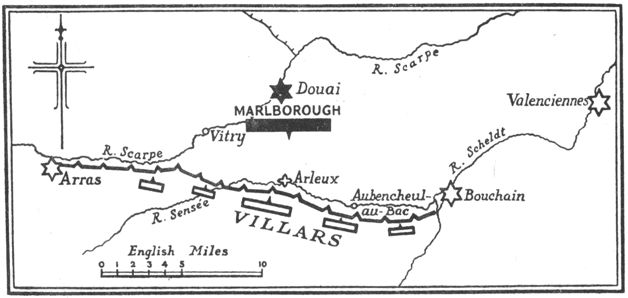
MAY 1711
Marlborough took the field at the beginning of May with 120,000 men, facing Villars’s line from Arleux to Bouchain. This was the most interesting part of the front, for the conquest of Cambrai or Bouchain would effect the deepest inroad into France. Moreover, the inundations of the Sensée were traversed here by two causeways at Arleux and Aubencheul-au-Bac. The strength of the French position was obvious. “The enemy,” he wrote to St John on the 7th, “are very busy fortifying and securing all the passages of the rivers, and are being obliged to send a good part of their horse to some distance for the conveniency of forage.”[525] “Our chief business at present,” said Marlborough, “is to subsist.”[526] He fed himself by the Scarpe through Douai, and was at the same time concerned in passing a heavy convoy of munitions to the newly captured fortresses on the Lys. The French garrison of Valenciennes were but ten miles from the Scarpe, and made several successful raids upon the barges, in one of which they destroyed not only many laden barges but two escorting battalions.
Eugene had joined Marlborough on May 13. The Duke was facing the enemy in the neighbourhood of Douai. The Prussian dispute was at its height, and none of their troops had reached the army. He welcomed Eugene with heartfelt pleasure. But the death of Joseph had disconcerted all plans. The two comrades were to be together only for a few weeks. The Imperial Diet was to meet at Frankfort for the election of the new Emperor. Louis XIV saw that by threatening an invasion he could convulse all German affairs, and with a comparatively small detachment frustrate the impending onslaught from Flanders. He ordered Villars on June 3 to send 15 battalions and 15 squadrons to the Rhine. This shrewd stroke was immediately effective. On June 14 Eugene, with the whole of the Imperialist troops, was forced to march off to the Rhine. At the same time the Dutch, feeling themselves isolated, insisted upon strong garrisons in all the conquered fortresses.
Whereas in March Marlborough had, with his remaining strength and by many personal submissions, begun to concentrate 140,000 men, counting also on the comradeship of Eugene, he now saw himself left alone with but 90,000 men, opposed by a French army certainly 30,000 stronger. His vehement efforts to resist or repair this denudation, both with Vienna and The Hague, exhibited him as a beggar on all sides. His distress could not be concealed. Everything had gone wrong. In the British Government and around the Queen there was an air of singular detachment. Ministers shrugged their shoulders about the war, and threw the burden on Marlborough. He and his Whig friends wanted the war to go on. The Tories had always wished to quit. Out of their patriotism they had deferred to the policies of their opponents for this one more campaign. With what noble superiority to party wishes had they not played their part! Against their better judgment—so they presented it—they had given Marlborough a final chance. If he failed, how right they would be proved. All the time Harley and St John knew that upon his exertions in the field depended their means of making any peace tolerable to the British nation.
Marlborough, in order to divert attention from the departure of Eugene and his troops, and also to pin Villars to the defence of Arras, marched westward, crossing the Scarpe between Vitry and Douai, and formed his front towards Lens, his right wing resting on the Vimy Ridge. He was now definitely weaker than Villars, and he lay in these broad plains for more than a month reviewing his troops, and drawing them out in line of battle to tempt Villars to an attack, which he had no intention of making. Villars, far from attacking, on June 2 sent 42 battalions and 26 squadrons, including all Max Emmanuel’s troops, to meet Eugene on the Rhine, and moved the rest of his army to the neighbourhood of Arras. This still left the French with a small superiority, and ten weeks of the campaign had passed in futility.
Marlborough’s conduct of the war at this time is in strong contrast with the aggressive method of his earlier campaigns, and also with the extraordinary exertions he was shortly to display. He was not only depressed by all he heard from England, but he had serious and alarming symptoms of illness. His headaches and earaches were severe. He suffered again from “giddiness and swimmings in my head, which also gave me often sickness in my stomach,”[527] and it may well be that he was not much removed from the stroke which five years later fell upon him. By all accounts he had greatly aged, and was, in fact, worn down by the long, exacting war.
He was also worried lest Sarah should live in Marlborough House before the damp was out of the new walls. “My only design in building that house,” he wrote (May 7),
was to please you; and I am afraid your going into it so soon may prejudice your health, so that you must be careful of having it well examined at the end of September; for should it not be thoroughly dry, you ought to stay one year longer. . . . We have had miserable wet weather ever since we came into the field, and I pity the poor men so much that it makes me uneasy to the last degree, for it can’t be otherwise but great numbers must be sick.[528]
All the time he set his mind upon the problem of how to end the war by military means. In his camp at Lens he formed an elaborate strategic and political plan. He sent his friend Lord Stair upon a confidential mission to Oxford. In the first place he was to unfold to the Lord Treasurer, as he now was, a military scheme whereby the bulk of the allied army would, instead of dispersing, spend the winter concentrated upon the frontier. This involved a heavy additional expense in the provision of food, dry forage, and also shelters for the troops and stabling for the horses. It would cost about double as much as the ordinary winter quarters. On the other hand, it would cost the French incomparably more; indeed, they could not match it. It would keep the pressure upon them at its height, and would enable the campaign of 1712 to be begun at the earliest moment and at great advantage. In the second place, Stair was to try to transform the civilities entertained between the Lord Treasurer and the Captain-General into a definite association. Marlborough had, of course, no accurate knowledge of the peace intrigues. The pains which St John had taken to hide these from him had baffled for once his Intelligence service. The handful of men involved guarded their secret with remarkable success. Marlborough could therefore look upon the arrangement with Oxford as the sole means of undoing the harm that had been done by the change of Ministry and of prosecuting the war to a satisfactory conclusion.
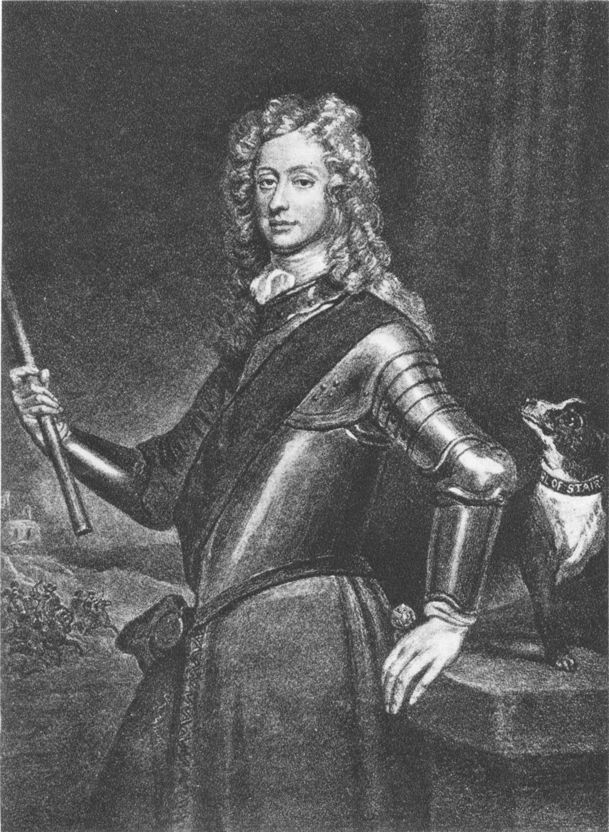
JOHN DALRYMPLE, SECOND EARL OF STAIR
From an engraving after a painting by Sir Godfrey Kneller
The military project was easily settled.[529] But the political overtures which Marlborough made to Oxford encountered an insuperable obstacle. Oxford knew that he could not carry Marlborough with him in his peace plans, and if they succeeded he would not need him. Many years later Stair, in a letter written to Lord Marchmont (December 10, 1734), explained this clearly:
I went to London, and delivered my lord Marlborough’s letter to Lord Oxford. After many delays, I had at last a very free conference with his lordship, in which he spoke with great freedom and plainness to me. I thought, by all my lord said, our conversation was to have ended in establishing a very good understanding between my Lord Treasurer and the Duke of Marlborough; but his lordship in the end thought fit to say that he must defer declaring his final resolution upon the whole matter till our next conversation, which he faithfully promised me should happen in a very few days. . . . From day to day I put my lord Oxford in mind of finishing our conversation, but to no purpose. In the interval Mr Prior was sent [to] them back from France, which they took to be a carte blanche for settling all the differences of Europe; and, in the end, I was allowed to go back to the siege of Bouchain with a bamboozling letter from my lord Oxford to the Duke of Marlborough.[530]
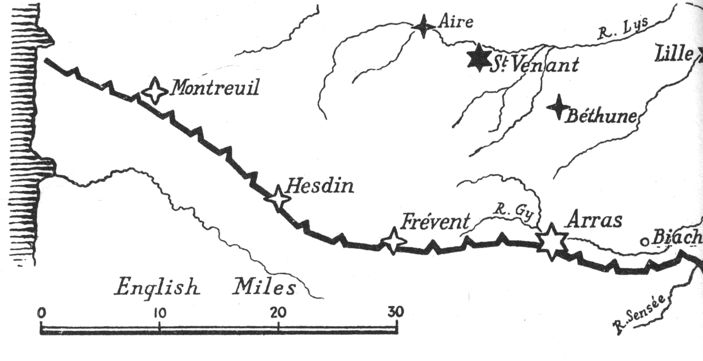
THE NE PLUS ULTRA LINES (west half)
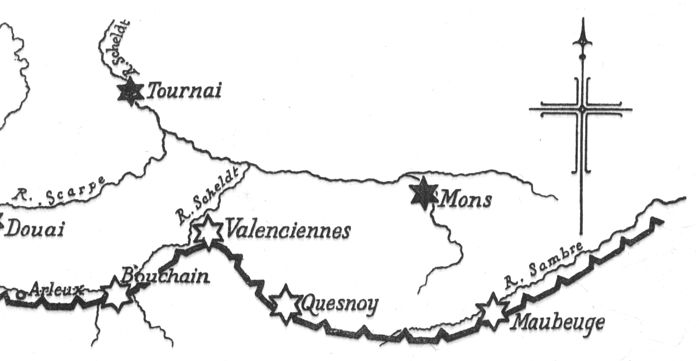
THE NE PLUS ULTRA LINES (east half)
There is little doubt that what Marlborough proposed to Oxford through Lord Stair was that they should work together à deux to fight the war to a finish. Oxford weighed this matter long and anxiously. If the war must go on in 1712 an arrangement with Marlborough seemed indispensable. But the progress of negotiations made in secret gave Ministers increasing confidence that the armies would not be forced again to take the field. Nevertheless, amicable relations were maintained between the Treasurer and the General. These might ripen into close co-operation or wither into antagonism.
Since the changes in London had first been perceived by the French Court, and still more since the Gaultier mission,[531] the whole policy of Louis XIV had been to gain time for the downfall of Marlborough and an English defection to break up the confederacy. Thus, and thus alone, could France be saved. Hence Marshal Villars was forbidden to risk any battle in the open, and only allowed to fight behind parapets. After the siege of Douai in June 1710 the French had begun to construct an immense new line of fortifications and inundations behind and through which they could stand or manœuvre. This line ran from the sea by the Canche river through the fortresses of Montreuil, Hesdin, and Frévent, and thence to the Gy, or Upper Scarpe, west of Arras. It followed the Scarpe to Biaches, turned along the valley of the Sensée to Bouchain on the Scheldt, and thence to Valenciennes. The whole of this ninety-mile front was fortified, not for a siege defence, but for the effective manœuvring of a field army. The many marshes of those days were multiplied and extended by numberless dams, which spread broad sheets of water, or quagmires, more impassable still. The watersheds between the rivers were held by strong ramparts with deep ditches, often doubled, in front of them, and frequent redoubts or strong points. Behind the line, which ran east and west and was almost straight, was a thorough system of lateral roads and bridges, and food and ammunition depots for use in emergency were established.
Beyond Valenciennes the fortifications ran through Quesnoy to Maubeuge, on the Sambre, and thence down that river to Namur, beyond which lay the natural barrier of the Ardennes. But this sector was not likely to be involved in the operations of 1711. The Allies could only approach the lines to attack the strong fortress of Arras in their centre by the riverways of the Lys and the Scheldt, which join at Ghent. They could accumulate supplies in the four fortresses captured in 1710—Aire, Saint-Venant, Béthune, and Douai—and operations on a great scale were almost certainly to be confined to the twenty-five-mile sector Arras-Bouchain. During the whole of the winter great numbers of peasants were employed by the French in perfecting this defensive system, every mile of which was studied with the utmost care. By the spring of 1711 Villars was so pleased with his lines that he began to boast about them in his usual exuberant style. It was a joke in the armies that Marlborough had bought himself a new scarlet coat of a cut which the tailor described as ne plus ultra. Villars, fastening upon this phrase, applied it to his lines, and it was soon on every lip.
Field Deputy Goslinga, who, it will be remembered, believed he had won the battle of Oudenarde and persuaded Marlborough to take Ghent and Bruges in the winter of 1708, had been present at Malplaquet, but had not made the campaign of 1710. In 1711 he reappeared at headquarters and has left a lengthy account of his achievements. He deplored the departure of Prince Eugene, “whose genius for war,” he remarks sourly, “is greatly superior to that of the Duke”; and he dwelt upon the discouragement which spread through the army when relegated to Marlborough’s sole care. He mentions instances of how as he went about the camps he expressed these helpful opinions to Albemarle, Dopf, and other generals. He induced Albemarle to write a letter to Eugene explaining “in lively colours” the depression of the troops and the other inconveniences and misfortunes which would follow from his departure and begging him to return. Goslinga also wrote in the same terms to his friends at The Hague. These letters, he tells us naively, unhappily fell into the hands of the enemy and were read by Marshal Villars with gusto.[532]
Notwithstanding these unpleasing and injurious activities, Marlborough made a renewed effort to conciliate the hostile Deputy. Cadogan was instructed to bring him friendly messages, “protestations of friendship and entire confidence,” to assure him that “Milord” would treat him in the highest intimacy, and open to him alone all the plans which he might make during the campaign, “that he would consult with me and would be enchanted if I would communicate my thoughts, upon which he would always reflect as they deserved.”[533] Goslinga was flattered, and henceforward, as he tells us, he always gave the right advice to Marlborough, and made for him all the plans that succeeded, and many others which would have succeeded if Marlborough had not been too timid or too basely interested in the prolongation of the war to adopt them. In particular, of course, Goslinga thought it would be a good thing to force the enemy’s lines. Having reached this profound conclusion, he did not neglect to impart it to the Duke.
One day finding myself alone with Milord in his room, I referred to the talk I had had with Cadogan and told him that, being at once his servant and friend, as he knew, I felt obliged to tell him that now that he was alone and without a companion to share with him the honour of any conquest or successful battle, I should think that it would be in his own interest to try some enterprise and with this object to surprise some part of the enemy’s lines; that if ever a sensational stroke [un coup d’éclat] had been necessary for his own personal interest as well as for that of the Common Cause, this was the time, . . . when the English Government was using every means to drive out all his relations and friends from the control of affairs, and when he could only by some glorious achievement oblige them to go with him bridle in hand [bride en main].
Marlborough, according to the Deputy, concurred in these reasonings. He thanked Goslinga for them and, drawing him towards the map on the wall, examined the military possibilities.
After some discussion we agreed that an attempt should be made by marches and countermarches to mislead and confuse the enemy, and then by some great and precipitate march cross the Sensée at whatever was the best point.[534]
A few days later Marlborough saw the Deputy again and told him that when the grass was grown so that the army could live beyond the Sensée he would try to cross it either at Arleux or at Aubencheul-au-Bac, or, again, below Marquion stream. Goslinga seems to have been somewhat startled as well as pleased to find these ideas, of which he now conceived himself the fountain, taking shape. To safeguard himself in case things went wrong (“pour me disculper en cas de malheur”) “I asked the Duke if he would allow me to confide the design to the Pensionary and M. de Slingelandt and above all to the Prince of Savoy, who was still at The Hague.” Marlborough approved this step; the Deputy wrote accordingly, and a few days later received a letter from The Hague expressing general agreement. Milord, says Goslinga, appeared to be very much pleased, and to put matters in train resolved to capture the position of Arleux.
The Duke had, of course, no need to use Goslinga as his channel of communication with Heinsius and Eugene. He had worked with them in the greatest matters for ten years. If he took the pestilent Deputy into his confidence it was because this was a lesser evil than having him spreading doubt and despondency throughout the army, and making all the mischief he could at The Hague.
|
Earl Stanhope, Miscellanies, pp. 81-87; see also in this work Wellington’s considered amplifications of his original remark. |
|
Lediard, ii, 290. The writer’s name is not mentioned. |
|
Dispatches, v, 266. |
|
He had seized Lingen. The dispute at the moment was over the recognition by the Dutch province of Overyssel of his occupation of the border county of Mörs and castles in Guelderland. See Klopp, xiv, 147-149. |
|
Dispatches, v, 284-285. See his letter of the same date to Cadogan. |
|
Marlborough to Heinsius July 6, 1711 * This morning I have spoke with the Prince of Orange & I think that he is now in that temper that if the States desire his coming to the Hague, he will comply. . . . As to the Elector of Bavaria I think it is very plain that every step he made at the Hague was by the consent & advice of the King of France. As to the detachment sent to the Rhine, the French have sent more Battalions & we more squadrons, so that upon the whole I think they are pretty equal; but I must beg you to consider that if we shall resolve to make detachments equal with the French, we then put it in their power to carry the war where they please, which I am sure is not the interest of England & Holland. This is only for Yourself; it not being proper to argue with the Pr. of Savoye. If the French shall by their detachments give us an advantage, I hope you are so kind as to believe that I would make the best use of it, both for the public good as well as for my own honour. I do assure you I am very desirous of making a diversion which will be the surest way of helping the army on the Rhine; is it unreasonable to expect that some troops should be sent from Hungary thither? [Heinsius Archives.] |
|
Diary; Belvoir Castle MSS. |
|
Dispatches, v, 330. |
|
Dispatches, v, 330. |
|
John to Sarah, May 18; Coxe, v, 27. |
|
Coxe, vi, 24. |
|
Stair to Marlborough July 24, 1711—Tuesday * On Saturday I saw my Lord Treasurer at his own house just before he went to Windsor. I delivered your Grace’s letter and offered him the memorial with all the other papers, but he refused to take them till they had first been put into the Queen’s hands; and I received her Majesty’s directions as to the persons to whom I was to talk of the project. On Sunday after dinner I had the honour to wait upon the Queen to deliver your Grace’s letter. Her Majesty was very inquisitive as to your Grace’s health. I gave her Majesty the memorial and other papers and gave her Majesty an account of the contents. The Queen asked certain questions as to the secrecy and how it be kept, having to be done in conjunction with the States, and if the making of magazines would not declare the design. Her Majesty appointed me to wait upon my Lord Treasurer, Lord Chamberlain, and Mr Secretary St John about these papers, which I did on Monday morning at eleven o’clock at my Lord Chamberlain’s. I answered several questions that were asked to make the matter plain; the lords seemed convinced that the things proposed were reasonable and that the design if prosecuted could not fail to act. Afterwards I gave them an account of the situation of the war in Flanders and that your Grace intended thus continuing, and at the same time let them know what difficulties there would be in the execution of anything and the uncertainty of success. I told them at the same time that if their lordships would let your Grace know, that it was the Queen’s opinion and their own that something was to be risked to bring the French to a battle, it would very much encourage your Grace and would have great influence on bringing the States to the resolution of endeavouring something. I told them further that if anything was to be attempted your Grace would find yourself very much stinted, for you had no power to call from the country whatever might be necessary for carrying on the public service, such as forage to be supplied to the troops, wagons, etc. They thought it was reasonable that my lord Orrery in the Queen’s name should move the States to take the like resolution. I saw my Lord Treasurer this morning to know if he had anything to say by me to your Grace; he told me he intended to write himself. [Blenheim MSS.] |
|
Marchmont Papers (1831), ii, 75-82. The letter is of great interest. |
|
Goslinga, p. 116. |
|
Ibid., p. 117. |
|
Goslinga, pp. 120-121. |
The forcing of long lines was a standard operation until the Great War of 1914. In the old days, when the defence was not greatly superior to the assault, the attacking army feinted one way, and made a forced march by night the other. The interest of Marlborough’s campaign of 1711 consists in the artifices and stratagems which he used, and the perfection and true sense of values with which he combined and timed all parts of his schemes. He weighed every factor justly, but most of all he read the character and temperament of Marshal Villars.
The causeway across the Sensée by Arleux has been mentioned. Arleux was a French fort north of the river, and guarded the entrance to the causeway. The lines lay behind the Sensée, itself impassable by its morasses and floods. Marlborough wanted Arleux out of the way. If he took it himself and demolished it, it would be a sure sign that he designed to pass the river there. In that case Villars would man this portion of his lines in sufficient strength, and there could be no surprise. Marlborough therefore sought to induce Villars to demolish Arleux himself. In this seemingly impossible task he succeeded.
On July 6 an allied detachment of seven hundred men captured Arleux and its garrison. The immediate object of this operation was reported by Marlborough to St John to be the breaking of the dam which the enemy had made on the Sensée. No one can say even now that at the time it had a deeper significance. However, having taken Fort Arleux, Marlborough proceeded, not to demolish it, but to fortify it, and on a much larger scale. He placed a strong force under Hompesch on the glacis of Douai, five miles away, to cover this work. Hompesch was certainly careless, for on July 9 Villars counter-attacked the fort and Hompesch’s camp. The fort held out, but Hompesch was seriously cut up and lost nearly a thousand men killed, wounded, and prisoners. Villars exulted publicly, and in his letters to Paris, upon the affront he had inflicted upon his opponent. Marlborough persisted in the fortifying of Arleux; but when these extensive works were completed he assigned only a small garrison of six hundred men to their defence. This clearly wears the aspect of design. Moreover, the Duke now displayed considerable irritation at Hompesch being surprised, and it got about in the allied army, and spread to the French, that he was much upset and very angry. On July 20-21, having recalled Hompesch, he marched his army twenty miles farther to the west, and camped south of Lillers; at the same time he reinforced his garrisons in Douai, Lille, and Tournai, so that he had an exceptional number of troops unnoticed thereabouts. He left his pontoons at Douai. These were certainly definite steps in his plan. They deceived Goslinga, who wrote a letter of protest to Marlborough, complaining of his “remaining so long with folded arms inactive at the head of so fine an army.”[535]
More important, they deceived Villars. He too moved his main army a march farther to the west, but at the same time detached a force under Montesquiou to capture Arleux. Villars now viewed Fort Arleux in a new light. He had wished to keep it as a toll-gate to the causeway on Marlborough’s side of the river. But now it appeared that Marlborough, far from wishing to demolish it, desired to keep it to prevent an incursion by Villars. If Marlborough had demolished it, Villars would have refortified it. As Marlborough had greatly strengthened its fortifications, Villars thought it would be right to destroy them. This was precisely the reaction which Marlborough had foreseen. With his main army forty miles away, and quite a lot of his troops dispersed within easy reach of Douai, Arleux and its weak garrison was a bait: and the bait was taken. On July 22 Villars attacked Arleux. Instead of using any of the troops which he had within reach of Douai, Marlborough dispatched Cadogan with thirty squadrons and all the Grenadiers from the camp near Lillers to the rescue. Cadogan was too late—Kane even says “he took not such haste as the occasion seemed to require.” Arleux was captured by the French, and its garrison were made prisoners of war. Marshal Villars trumpeted to the world this new gross humiliation he had inflicted upon Marlborough, and proceeded to level the peccant Arleux to the ground. At the same time, feeling comfortable about his right, he sent Montesquiou on with his detachment to reinforce Maubeuge and threaten Brabant.
The effect upon Marlborough of this second rebuff was noticed by all. His customary urbanity and composure deserted him. “He was,” says Kane, “very peevish publicly.” He was known to be ailing in health, worried out of his wits by politics, and now deeply angered by the severe pinpricks he had received. Spies were everywhere, and his demeanour was reported to the enemy. It was a natural reply to Montesquiou’s advance to Maubeuge that Marlborough should send a similar force to the eastward. Accordingly he ordered Albemarle, with twelve battalions and twenty-four squadrons, to Béthune. The French staff saw nothing unusual in this, nor did they notice that, mixed up with Albemarle’s movement, much of the baggage of the army and the heavy artillery with a strong escort moved on towards Douai. It now became known that Marlborough had resolved to attack Villars and his lines with the main army in the neighbourhood of Arras. He had for some time past been writing, even to his most intimate friends, that battle would be necessary. On July 26, escorted by two thousand horse, he made a personal reconnaissance of the French lines west of Arras about Avesnes-le-Comte. He took a large staff with him, and rode close enough to have a brush with the French light cavalry. It is noticeable that, though the French force from Maubeuge moved towards Brabant, Albemarle moved no farther east, and Marlborough contented himself with sending a small reinforcement to Brussels. The stage was now set.
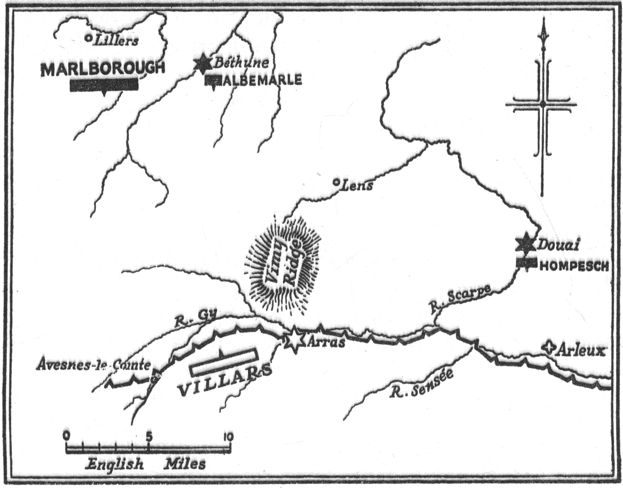
JULY 26, 1711
Count Tilly, whom Goslinga describes as a brave and loyal man, had his wife with him in the camp. This lady was not only talkative, but suspected, by Goslinga at least, of illicit correspondence with the enemy.[536] Marlborough visited Count Tilly and informed him of his decision to attack Villars in two or three days. Goslinga, who was now in the secret, lunching with an abbé near by, committed the calculated indiscretion of drinking to the great event which would happen two days later, and was pleased to see a young stranger at the table leave very rapidly after the meal. Thus from many sources Villars by the end of July was convinced that Marlborough meant to attack him. It was now too late to recall the French troops sent to Maubeuge, and his Intelligence informed him that Albemarle was still at Béthune, near enough to join the main allied army for the battle. The fact that Albemarle had not moved to protect Brussels seemed to prove that he was needed by Marlborough for a general engagement. Villars thereupon concentrated all his forces upon the sector of the lines west of Arras. His men worked night and day to strengthen the already formidable defences. He drew in all cannon and detachments and drained the garrisons of all the fortresses in reach. The ardent spirit of the Marshal was highly elated by the prospect of an attack upon his lines. As he surveyed their immense strength and the superior numbers of the army he had arrayed behind them he proclaimed on all sides his confidence in the result. He even wrote a letter to the King, for which he was afterwards ridiculed, declaring that he had brought Marlborough to the ne plus ultra.[537]
On July 30 twelve hundred pioneers were busy preparing the roads by which the allied army would advance southward; and all detachments in the neighbourhood were recalled, except those which lay to the east. Albemarle at Beuvry, near Béthune, received orders to hold himself in readiness to join Marlborough. Knowing nothing of Marlborough’s plan, he wrote to Drummond (August 1):
I have just now received orders from Marlborough to rejoin the army which marches to-day to attack the enemy within their lines. God give us good success in case we undertake this great affair! Marlborough tells me he is resolved to do it, but I declare that I doubt the result, the enterprise appears to me very dangerous, the enemy, in spite of detachments, is yet much superior to us, and it is true that the defection of our army has been terrible this campaign and still continues.[538]
On the 2nd and 3rd the Duke moved forward again and halted abreast of Villers-Brulin within striking distance of the French. He ordered the cavalry to make the thousands of fascines which were needed to fill in the double ditches in front of the French entrenchments. Every preparation was made for battle in both armies. All his commanders, except four or five who were in the secret, were thoroughly misled and deeply alarmed. Defeat was probable; a frightful slaughter certain.
Cardonnel’s letter to Robethon on the evening of August 3 may be presented as a masterpiece of discreet ambiguity:
Monsieur de Villars has assembled all the troops he could, and our advices even say that the garrisons of Ypres and St Omer are in march to join him. Nevertheless, we may probably attempt to force his lines before two days are at an end, all possible preparations being made for that end.[539]
On the 4th Marlborough, protected by a large force of cavalry and attended by a numerous staff, reconnoitred the enemy’s lines at close quarters. While all eyes were attracted by this spectacle, the field artillery moved off to the eastward in successive detachments. Captain Parker, who was posted with his company, heard of this reconnaissance, and thought there was “something extraordinary in it.” He asked his Brigadier for leave to ride out with the Duke.
This was readily granted, and thereupon I kept as near his Grace as I possibly could. He rode upwards of a league along their lines, as near as their cannon would permit. From thence I could discern plainly by the help of a prospective, that the lines were very strong and high, and crowded with men and cannon, and that the ground before them was levelled and cleared of everything that might be any kind of shelter to those that approached them. Notwithstanding all this, the Duke’s countenance was now cleared up, and with an air of assurance, and as if he was confident of success, he pointed out to the General Officers, the manner in which the army was to be drawn up, the places that were to be attacked, and how to be sustained. In short, he talked more than his friends about him thought was discreet, considering that Villars had spies at his very elbow. And indeed some began to suspect that the ill-treatment he had met with at home, or the affront he had lately received from Villars, might have turned his brain, and made him desperate. When I found the Duke had almost done, I returned to my post. At this time, I observed General Cadogan steal out of the crowd, attended by one servant only, and he made all the haste he could to camp. I did not think much of this circumstance at that time.[540]
Cadogan, with an escort of forty Hussars, galloped off to Douai. Here he found Hompesch. As darkness fell troops from Lille, Tournai, and Saint-Amand joined the Douai garrison, the whole forming a corps of twenty-three battalions and seventeen squadrons. During the morning, while Marlborough’s pioneers were all out preparing the approaches towards the French left, the whole of the field artillery—this certainly seems a great risk—began to move in the opposite direction, and at nightfall Albemarle, instead of being summoned west to join Marlborough, was ordered to march with the utmost speed to Douai. Thither the heavy baggage with its exceptional escort was also proceeding.
That day in the allied camps there was a solemn hush. All were ready to do their duty and pay its forfeits if these were demanded of them. Still, the memories of Malplaquet, and the close survey of the enemy’s lines which so many officers had been able to make, led experienced men to wonder whether the Captain-General was in his right mind. There can be no doubt of the readiness of these hard-bitten professional troops to make the frontal assault, and their faith in Marlborough’s hitherto infallible skill mastered their misgivings. But when during the afternoon the orders for battle were circulated bewilderment was general. The sun set upon two hundred thousand men who expected to be at each other’s throats at daybreak. Villars moved about his army, animating his soldiers for an ordeal which would decide the fate of France. As he considered the position he must have felt, with Cromwell at Dunbar, “The Lord hath delivered them into our hands.” All the enemy accounts show that the French soldiers braced themselves in the highest spirit of devotion to conquer or to die, and that their High Command was well content that the supreme stake, decisive for the long war, should on these terms be ventured. As night approached a large body of light cavalry was sent out on the right flank of the allied army, as if to portend some movement towards the west. This was the last thing the French saw before darkness fell.
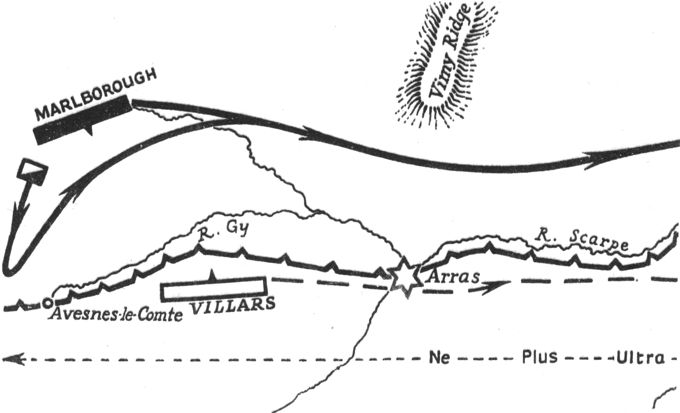
THE MARCH TO ARLEUX (west half)
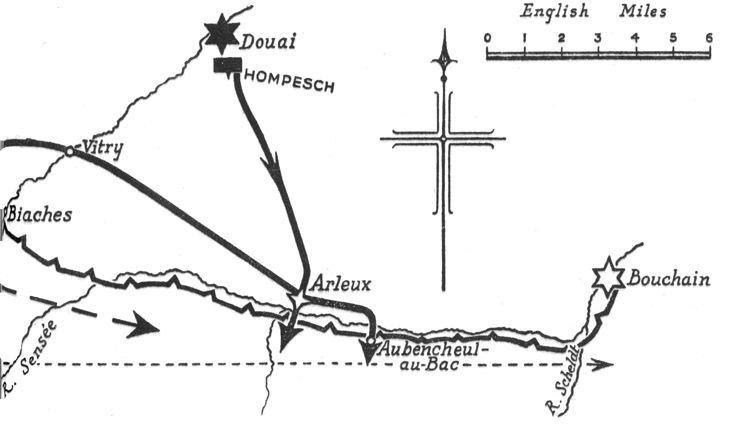
THE MARCH TO ARLEUX (east half)
“At length,” says General Kane, “tattoo beats, and before it had done, orders came to strike our tents immediately.”[541] The troops stood to arms. Soon staff officers arrived to guide the four columns, and in less than half an hour the whole army was on the march to the left. All through the moonlight night they marched eastward. They traversed those broad undulations between the Vimy Ridge and Arras which two centuries later were to be dyed with British and Canadian blood. The march was pressed with severity: only the briefest halts were allowed; but a sense of excitement filled the troops. It was not to be a bloody battle. The “Old Corporal” was up to something of his own. On they strode. Before five o’clock on the morning of the 5th they reached the Scarpe near Vitry. Here the army found a series of pontoon-bridges already laid, and as the light grew they saw the long columns of their artillery now marching with them.
At daybreak Marlborough, riding in the van at the head of fifty squadrons, met a horseman who galloped up from Cadogan. He bore the news that Cadogan and Hompesch, with twenty-two battalions and twenty squadrons, had crossed the causeway at Arleux at 3 a.m. and were in actual possession of the enemy’s lines. Marlborough now sent his aides-de-camp and staff officers down the whole length of the marching columns with orders to explain to the officers and soldiers of every regiment what he was doing and what had happened, and to tell them that all now depended upon their marching qualities. “My lord Duke wishes the infantry to step out.” One must remember that he was dealing with an army composed primarily of men many of whom, though only privates, had for several years, some for ten years, had no other life but the service, and who were keen critics of every move in war. He knew that their comprehension of what he was doing, and what he was saving them from, would gain him their utmost efforts. The whole army marched with every scrap of life and strength they had. As the light broadened and the day advanced, the troops could see upon their right, across the marshes and streams of the Sensée, that the French were moving parallel to them within half cannon shot. But they also saw that the head of the French horse was only abreast of the allied foot. “It was,” says Parker, “a perfect race between the two armies, but we, having the start of them by some hours, constantly kept ahead.”[542]
THE MARCH TO ARLEUX (west half)
THE MARCH TO ARLEUX (east half)
Marlborough, putting his fifty squadrons to the trot, hastened on to join Cadogan. His infantry followed with a superb endurance and devotion. Men marched until they dropped, fainting or dying by the road. The track was lined with stupefied soldiers, of whom scores expired from their exertions. Little more than half stayed the course. It was like the rush upon Oudenarde, but far longer. In sixteen hours the infantry of the army marched thirty-six miles, and by four in the afternoon considerable masses had arrived in the new position behind the enemy’s lines from Oisy towards the Scheldt.
Villars had not learnt that Marlborough was marching till eleven o’clock that night. All his troops were in the trenches, ready to stand to arms at a moment’s notice. He had received a message from Montesquiou, near Maubeuge, that he expected to be attacked at dawn. This was, of course, a delusion. He began to be uncomfortable about the Cambrai-Bouchain area, which, as he says, “was no longer defended.” It was 2 a.m. before he was sure where Marlborough was going. He knew at once that he had been forestalled. He ordered the whole of his army to march eastward, and hurried on himself at the head of the Maison du Roi. He was met on the way by the news that the lines had been crossed by an allied advance from Douai, and that large hostile forces of cavalry and infantry were already across the Sensée. On this he pressed forward so rapidly that he arrived on the scene at about eleven o’clock with two or three hundred men. He found Marlborough at the head of a veritable army, long past his lines, and ready to receive him. The impetuous Marshal lost a hundred of his men, and was within an ace of being captured himself, before he accepted what had happened.
During the 5th of August the bulk of the allied army was crossing the Sensée and drawing up inside the enemy’s lines. The whole of the cavalry of the right wing, which acted as rearguard, was employed in bringing in exhausted soldiers, their muskets, and their packs, with which the route was littered, as they had fallen by the way. Villars’s main body, after a forced march, was now approaching. The night of the 5th fell on these exertions.
We are indebted to Goslinga for an invaluable sketch of the next morning’s proceedings.[543] The Deputy arose at the first glint of dawn (à la petite pointe du jour) and proceeded when dressed to Marlborough’s quarters; for he felt it his duty to keep him up to the mark. He learned that the Duke had already ridden forth in the dark. The Deputy caught him up after a while and found him accompanied by Hompesch, Bülow, and other principal generals. Marlborough greeted him, and explained that they were going to examine the ground on the front of the army. It looks very much as if the Deputy had overslept himself, but this in no way diminished his self-confidence. “Milord,” he records, “said to me out loud, so that every one could hear him, ‘Now we shall make our siege’ (meaning Bouchain): ‘our hands are free. I shall use these five or six days which we need for the preparations, in trying to bring the enemy to action.’ I loudly applauded this generous resolve,” says Goslinga, “and animated the Duke to it. Hompesch did the same.” Meanwhile the cavalcade, with its escorting squadrons and patrols, reached the hamlet of Framegies. Here they met two peasants, who declared that the French army was close at hand and advancing. Cadogan and Goslinga climbed the church tower, and even before they reached the top saw a couple of miles away several heavy French columns marching forward and already in the act of deploying. They could even see the colour of their flags. Most of the High Commanders, including Hesse and Würtemberg, had now come up, and all sat their horses awaiting Marlborough’s decision. Not so Deputy Goslinga. With all his faults, right or wrong, he was always for fighting; which is something. “Ought you not,” he said to Marlborough, “to make all the troops stand to arms, and harness the Dutch artillery, and bring the English artillery as fast as possible across the Sensée?”
Marlborough was a model of politeness and patience in personal relations. Up to now the Deputy had always received bland and even deferential treatment from him. Long night marches, early rising, endless vexations, intense military issues, had not hitherto worn down Marlborough’s ceremonious manner. However, on this occasion Goslinga was conscious of a very definite change. “I found him freezing; he answered me dryly [sèchement] that there would be time for that, that the first thing was to find out whether the ground made a general attack possible. I answered him,” says Goslinga, “that it was always right to be ready,” and on this the Deputy turned to Cadogan, looking for his support. “I couldn’t get a word out of him [Je n’en pus tirer une seule parole].” Hesse offered to reconnoitre with his cavalry. Marlborough contented himself with ordering forty squadrons to stand by. Goslinga, the privileged civilian in the midst of these military men, let himself go.
As for me, seeing this coldness of Milord, and of Cadogan, so ardent by nature but now ice in this rencontre, I said that I should go and warn Count Tilly; and if Milord was agreeable, I would in passing by the left give the order for the army to stand to arms, and to harness and to bring up our artillery: and at the same time recall by a cannon-shot all the foraging parties which were afield.[544]
Goslinga records that Marlborough said to him most coldly, “All right—you may do it,” and that he added as the Deputy rode off, “I shall expect you for dinner at noon.” Was this good manners, or was it ridicule? Certainly it dismissed very curtly Goslinga’s wish for a battle. Across the centuries one can almost hear the titter that ran round the circle of high, proud military men, with lifetimes of war behind them, as the important and self-important Deputy galloped off to issue his commands. “Don’t be late for dinner!” “What,” he said to himself, “dine, when we ought to beat the enemy!” “I went off quite hotly without listening for anything more.” (Actually he writes sans attendre réponse, but the answer had already been made.) It suited Marlborough well to be alone with his officers.
As it gives so good a picture of the army—all the better because the impression is unstudied—it is worth while following Goslinga on his gallop. First he met some subordinate commanders, who asked, “Is it true the French are forming in battle before us?” “I told them nothing was more true, and urged them to array their men.” He gave his orders to the Dutch artillery, and then hastened to the tent of Count Tilly.
I found him still in bed, but, having made him get up, I explained to him the situation. I was not particularly surprised not to find him respond to my insistence to come with me at once to Milord. His great natural phlegm, augmented by his great age, did not leave him any too capable of vigorous action. The defensive was his forte. Seeing I should not get much out of him, I told him I should return to the front of the army where I had left Milord and most of the generals, and that I should await him there. I returned at full gallop, and found Milord almost where I had left him. He said to me when I accosted him that, according to the reports which the peasants had given, the French left was covered by marshes, and their right by a deep ravine, and that it would be difficult to attack them.[545]
Goslinga thereupon interrogated the two peasants for himself, and believed that he had extracted a statement from them that, though there was a ravine on the left, there was no marsh on the right. Marlborough put up with all this, so contrary to the discipline of an army, and to almost anything that a commander-in-chief is entitled to expect; but no doubt he saw how surely such behaviour would put every one on his side. His strategy was just as good on the smallest scale. All he said was that after the arrival of Count Tilly they must settle what should be done.
Meanwhile Goslinga hastened from one general to the other. “First I tackled Hompesch, and tried to make him stimulate Milord, but he put me off [mais il battit froid].” Goslinga turned to Natzmer. All that the Prussian cavalry general, a hard, fierce man of war, hero of the charge at Oudenarde, would say was, according to Goslinga, “We shall have to examine the ground.” Natzmer in his own account says, “I supported my lord Duke.”[546] Then Tilly arrived with the other Dutch Deputies, and a sort of council of war was held in the open, and it seems on horseback. Goslinga remembered that once, in 1707, Marlborough in a burst of confidence had said to him in effect, “When I don’t want to do a particular thing I call a council of war.” The Duke now asked for opinions in the reverse order of seniority. All were for battle if the ground permitted it, but the English generals Orkney and Lumley, and Anhalt the Prussian, declared that the ground was too favourable to the enemy, and that the best thing was to cross the Scheldt. Albemarle hedged. Hesse and Würtemberg, according to Goslinga—and the story is taken as he tells it—were for the attack. Thereupon Marlborough spoke for the first time.
He said that there was no possibility of bringing the enemy to decisive battle except by attacking at great disadvantage, and that the only thing to do was to cross the Scheldt and besiege Bouchain. Count Hompesch and the Dutch general Fagel, and even the other two Dutch Deputies, thereupon supported Marlborough. Goslinga protested at length and aloud. “But I spoke in vain,” he writes. “Milord held to the resolution which had been taken.” It was settled that at sunset the army should cross the Scheldt by four bridges covered by a rearguard of forty squadrons. The generals then dispersed. Marlborough again asked Goslinga to dine with him. “But,” says this irate civilian, almost alone among chiefs of war,
my heart was too full of wrath against his damnable politics, which by avoiding battle only sought to prolong the war, and held out to him the benefits of his continued command of the army, and the ruin of the new English Ministry which could not maintain itself in office if the war went on, because only the Whigs could raise the necessary money from the City. Such were the sad results of having a foreigner in command.[547]
Thus the self-assurance of Goslinga was proof against the almost unanimous opinion of all the captains, and even of his own two colleague Deputies, and, as usual, his chagrin took the form of imputing dishonourable or corrupt motives to all who differed from him, and particularly to the great man who had—not from inclination, it must be admitted—treated him with so much ceremony and forbearance. The Deputy spread his complaints in all directions and managed to create a good deal of ill-feeling and misconception.
Drummond wrote from Amsterdam to Oxford (August 12):
I was sitting with the Grand Pensionary when the express came in; he was much concerned at our not fighting, and said, when the States consented to attack the lines, they consented to gain them by force and to fight the enemy. . . . The States Deputies called out to attack, the Duke called a council of war, . . . and his Grace, contrary to his practice throughout all this war, voted not to attack. . . . The Duke may have good reasons for what he has done, besides a great majority on his side of old generals. . . . Count Sinzendorff had some German accounts, which were wrote with malice and passion by what I could hear, and he added as his opinion, that if he were a Prince who had a General who had gained twenty battles, and had been guilty of this one neglect, he would hang him for it.[548]
When the more civil of these criticisms reached his ears Marlborough was deeply offended. He protested to Heinsius (August 13, 1711):
* I do heartily thank you for your kind congratulations on our passage of the lines. I am persuaded they are very sincere & proceed from a real friendship to me, therefore I cannot help unburdening myself to you that I think I lye under great hardships & discouragement on this occasion, by some letters I have seen from Holland, which seem to reflect on my not making the best use of our advantage by giving the enemy battle as soon as we had passed the lines. I own had it been practicable there is no comparison between the advantages of a Battle, & what we can reap from a siege, but there is not one general or other officer that have the least judgment in these matters but must allow it was altogether impossible to attack the enemy with any probable hopes of success. I cannot but think it very hard, when I do my best, to be liable to such censures.[549]
Let us now judge this episode in the light of modern knowledge. Marlborough had hoped that Villars would be stung into attacking him during the 6th, and, in spite of the severe forced march, he had the army well in hand for this. But it had not been his purpose to fight an offensive battle himself after forcing the lines. His intention was always to move to his left, cross the Scheldt, and besiege Bouchain. All his dispositions on crossing the Sensée and the lines—the roads, the bridges, and the bivouacs of his troops—were arranged for such a movement. Of course, if Villars had committed some grave fault, either by attacking or exposing himself to be attacked at a disadvantage, he would have turned aside to deal with him. Nothing of this kind had occurred. Whatever the two peasants may or may not have said, we now know that Villars lay on the 6th with his right on the fortified town of Cambrai, his centre in Bourlon Wood, of which we have heard since, and his left on the marshes and stream behind the village of Marquion, where the Canal du Nord now flows. Villars himself considered that his position was very strong. A modern study of the ground confirms this view. By the afternoon of the 6th he had a substantial superiority in numbers. He had been entrenching his front and preparing abattis in Bourlon Wood since about eight o’clock.
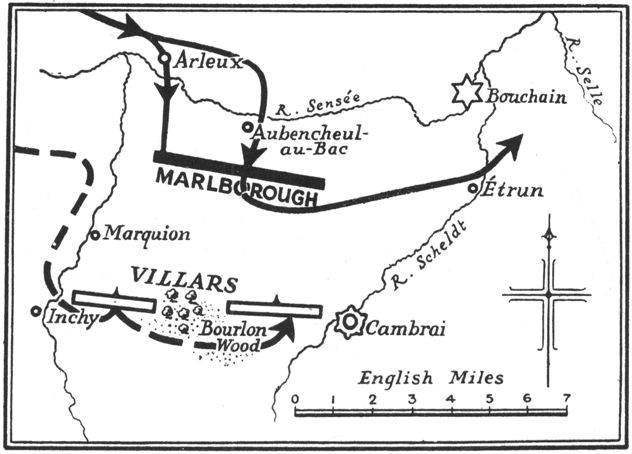
AUGUST 6, 1711
Both armies were tired, but the French had marched along their prepared lateral roads, and the Allies for the most part had tramped across country. Being on outer lines, they had had nearly ten miles farther to go. The allied generals who were consulted had complete confidence in Marlborough, and if he had said “Attack” they would have fallen on in good heart. They would certainly not have wished to venture against his better judgment. The decision was obviously his. It was convenient in the controversy of that time to cite the agreement of all these eminent warriors, but Marlborough alone bears the responsibility. Apart from the natural desire which we all have to witness miracles, there is no doubt he was right. The Allies were under no call to fight a desperate battle. As far as they knew, they had the game in their own hands, if they did not throw it away. Moreover, at this particular juncture Marlborough, although at the head of a smaller army, had gained all his strategic objects. He had ruptured the long-vaunted Ne Plus Ultra line, and was now in a position, albeit inferior in numbers, to undertake a siege. Villars must submit to his will; Bouchain was in his grip. It is, however, remarkable that “Everybody almost except my lord Duke and Cadogan are against this siege.”[550]
Villars had now for the moment a choice of evils. He could only protect Bouchain and Valenciennes by moving his army to the right bank of the Scheldt. If he did so Marlborough could besiege Arras. There was no doubt which would be the greater loss. He resigned himself to a siege of Bouchain, and hoped from his safe and near base at Cambrai to interrupt it. In the afternoon of the 6th the allied army marched to its left towards the Scheldt, and by evening eight bridges had been thrown by Etrun. During the night the whole army passed over in heavy rain. Goslinga dilates and gloats upon the confusion of this night march, and tells us that ten thousand men could have routed all. In fact, however, Villars could not pierce the strong cavalry screen, and rested in complete ignorance of what was happening; and the passage of the Scheldt and the investment of Bouchain were accomplished without the slightest loss or even interference. The whole operation was acclaimed at the time, and has since been held to be, an unsurpassed masterpiece of the military art. Indeed, not only in the army but throughout Europe it was regarded as Marlborough’s finest stratagem and manœuvre.
|
Goslinga, p. 125. |
|
Goslinga, p. 125. |
|
Mentioned in Coxe, v, 58. |
|
Portland Papers, H.M.C., v, 62. |
|
Lediard, iii, 149. |
|
Parker, Memoirs, pp. 153-154. See also Kane, p. 85. |
|
Kane, p. 85. |
|
Parker, p. 155. |
|
Goslinga, p. 132. |
|
Goslinga, p. 132. |
|
Goslinga, p. 135. |
|
Natzmer, p. 168. |
|
Goslinga, p. 141. |
|
Portland Papers, H.M.C., v, 68. |
|
Heinsius Archives. |
|
Colonel James Pendlebury, Master Gunner, to Earl Rivers, July 27/August 6; Portland Papers, H.M.C., v, 63. |
Bouchain was an amazing operation. It can only be understood by those who will study the maps and diagrams. Marlborough, having passed the Scheldt during the night of August 6-7, moved round the east side of the fortress and threw a number of bridges across that river by Neuville. He made his main camp between the Scheldt and the Selle, but he immediately pushed his right hand across the Scheldt to the westward, so as to encircle Bouchain. At the same time Villars in superior strength, with at least a hundred thousand men, came to sit down with him at the siege.
On August 8 the Marshal, finding his suddenly captured lines abandoned, and Marlborough committing himself to Bouchain, moved into the angle formed by the Scheldt and the Sensée and established himself there, barely two miles away from the besieged fortress. That same day he sent thirty battalions and proportionate cavalry under Albergotti, whose repute after his defence of Douai stood high, across the Sensée to occupy the high ground at Wavrechin, south-west of Bouchain. This strong force immediately began to construct an entrenched camp. They were separated from Bouchain by the marshes of the Sensée, but through this there ran a winding track called the Cow Path. The French took possession of this, improving it as a route and protecting it, as entrenching was, of course, impossible, by a system of fascinades, never used before or since in war. The parapets on both sides of the Cow Path were made of long faggots bound together for nearly two miles from tree to tree between the willows and rushes which grew in the inundation.[551] Thus constant communication was soon established between the superior relieving army and the strong garrison of the fortress.[552]
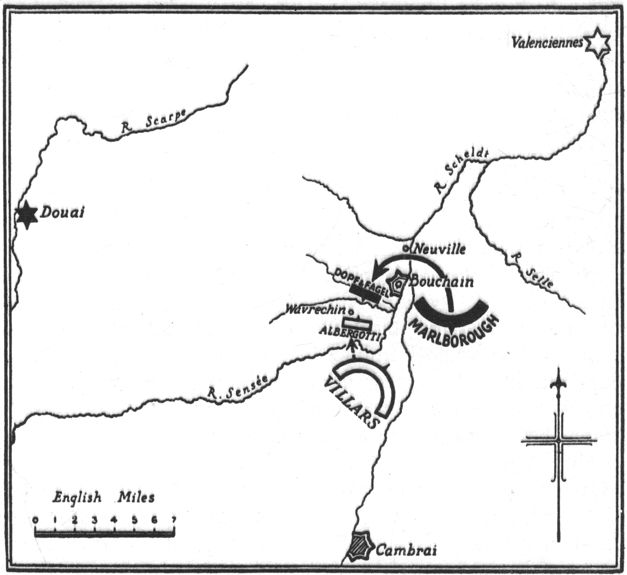
AUGUST 9, 1711
Albergotti’s position at Wavrechin had an even more important significance. Marlborough’s communications ran through Douai, nineteen or twenty miles to the west. They were within easy striking distance of the French in their entrenched camp at Wavrechin. The Scheldt was blocked above him by the fortress of Valenciennes. He had to bring in a siege-train now at Tournai, and also all the supplies and munitions for the siege and for his own army of about ninety thousand men, from Tournai down the Scarpe to Douai, and thence by wagon convoy from Douai, or, as was arranged later, by a short cut from Marchiennes. Villars could at any time cross the Sensée and march northward, traversing all Marlborough’s communications. Marlborough’s only remedy in that case would be to come round north of Bouchain and fight a battle. As he must keep at least twenty thousand men in the trenches of the siege, he would have to fight at odds of seventy thousand against a hundred thousand or even more. During the whole of the siege he accepted and often courted this possibility. He must have foreseen all these dangers before deciding on the siege. No wonder even his most faithful followers and admirers in the High Command thought the siege impracticable.
As soon as Marlborough heard on August 8 that the French were crossing the Sensée in force he concluded that Villars meant to cut his communications and bring about a battle. This was, indeed, an obvious move for Villars to make, and it would immediately have forced an encounter in the open field, which Marlborough above all things desired, even at serious numerical odds. He did not mean to fight another Malplaquet, but would have welcomed another Ramillies. He therefore, before finally engaging in the siege, multiplied his bridges below Bouchain, and began moving his main army round to meet Villars somewhere between Bouchain and the Scarpe.
However, Villars had apparently a move either way. If Marlborough came round to the west the Marshal could cross the Scheldt instead of the Sensée by a right-handed instead of a left-handed movement, and once he was ensconced there the siege of Bouchain would become impossible. On the other hand, Arras would be uncovered. Marlborough could then march through Douai direct upon that place. Therefore when Villars began feinting across the Scheldt his gesture did not carry conviction. As long as Marlborough was ready to fight a battle in the open plains west of Douai at heavy odds his plan was sound, and he was master. On any other basis the siege of Bouchain was absurd.
It seemed at first essential to the siege to drive Albergotti out of the Wavrechin position. Dopf had already crossed at Neuville with 30 battalions and 40 squadrons[553] to complete the investment which at Wavrechin was obstructed. Dopf was reinforced during the night of the 8th by sixteen battalions under Fagel; and Cadogan, that trusted Eye, went with him. In this force was the whole of the British infantry. On the morning of the 9th they were ordered to assault Albergotti in such fortifications as he had been able to construct overnight. Here Captain Parker may take up the tale.
Our British grenadiers were ordered to march up to the top of the hill on the left of their works, in order to begin the attack on that side. Here we were posted in a large high-grown field of wheat, about seventy or eighty paces from their works, expecting every moment, when the signal should be given to fall on.
I must confess I did not like the aspect of the thing. We plainly saw that their entrenchment was a perfect bulwark, strong and lofty, and crowded with men and cannon pointed directly at us: yet did they not fire a shot great or small, reserving all for us, on our advancing up to them. We wished much that the Duke might take a nearer view of the thing: and yet we judged that he chose rather to continue on the other side in order to observe the motions of the enemy on that side, while we were attacking them on this.
But while I was thus musing, the Duke of Marlborough (ever watchful, ever right) rode up quite unattended and alone, and posted himself a little on the right of my company of grenadiers, from whence he had a fair view of the greater part of the enemy’s works. It is quite impossible for me to express the joy which the sight of this man gave me at this very critical moment. I was now well satisfied that he would not push the thing, unless he saw a strong probability of success; nor was this my notion alone: it was the sense of the whole army, both officer and soldier, British and foreigner. And indeed we had all the reason in the world for it; for he never led us on to any one action that we did not succeed in. He stayed only three or four minutes, and then rode back; we were in pain for him while he stayed, lest the enemy might have discovered him, and fired at him; in which case they could not well have missed him. He had not been longer from us than he stayed, when orders came to us to retire. It may be presumed we were not long about it, and as the corn we stood in was high, we slipped off undiscovered, and were a good way down the hill, before they perceived that we were retiring; and then they let fly all their great and small shot after us: but as we were by this time under the brow of the hill, all their shot went over our heads, inasmuch that there was not a single man of all the grenadiers hurt.[554]
This episode reveals Marlborough’s soldierly qualities as a model for all commanders of British troops. We find him at sixty-one, in poor health, racked with earache and headache, after ten years of war, making these personal reconnaissances within deadly range of the enemy’s entrenchments and batteries in order to make sure that his soldiers were not set impossible tasks and their brave lives not cast needlessly away. Although he was the key of the Grand Alliance, he did not consider his life too precious to be risked. It was because his soldiers felt he was watching over them, and would never spare himself where their welfare and honour were concerned, that they were deeply attached to him. His “attention and care,” as Corporal Matthew Bishop wrote, “was over us all.” Always patiently and thoroughly examining the conditions on the front of the army, unwearied by the ten campaigns, burdened by no sense of his own importance, undiscouraged by the malice of his enemies at home, he performed to the very end most faithfully and vigilantly the daily duty of a soldier. It was through this rule of conduct that he earned from the rank and file the nickname of “the Old Corporal.”
Parker, it must be remembered, was not writing for the Press or the public. His journals lay for forty years in some old trunk and were not printed till long after he was dead. He never spoke to Marlborough during the whole of his service, but watched him only from a distance. He even thought he had been passed over in promotion. His testimony is therefore of peculiar interest.
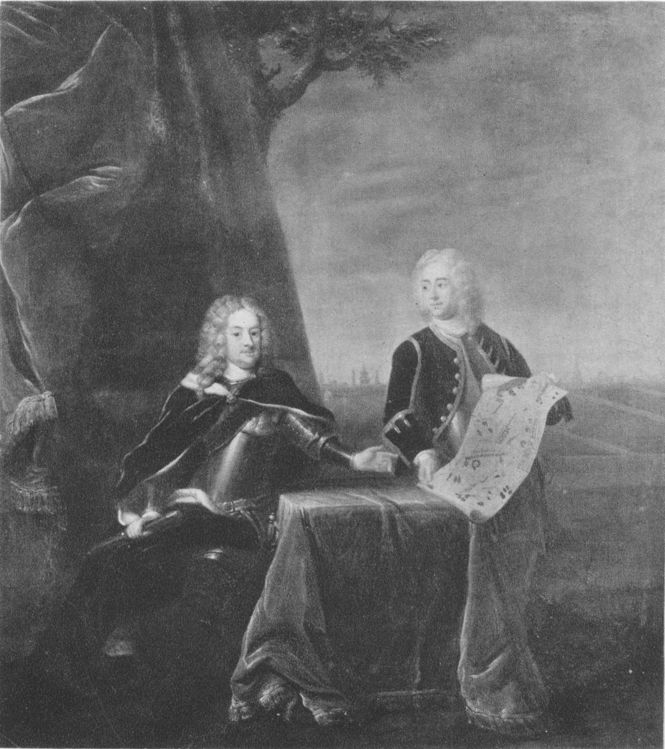
THE DUKE OF MARLBOROUGH AND COLONEL ARMSTRONG
From a copy of a painting by Sir Godfrey Kneller
By permission of J. W. S. Armstrong, Esq.
Perhaps it would have been better if the French had recognized the Captain-General as he rode along the front in the high corn within seventy paces of their entrenchments. One volley, and he would have ranked in our national affections with Wolfe and Nelson. He would have been spared the detestable indignities and maltreatment which his Tory countrymen had in store for him. But there was nothing morbid about Marlborough. He liked living, and was content to take whatever came. It was all in the day’s work. Still, if the French had had sharper eyes, the pens of Swift, Macaulay, and Thackeray would have been blunted.
When it was found impossible to dislodge the French from their Wavrechin position, Marlborough consulted the engineers of the army upon whether Bouchain could be taken, and whether it was practicable to persevere in the siege. All answered in the negative except one, Colonel Armstrong, who declared it could be done, and that “he was ready himself to undertake the most difficult part of it.” Under the cover of five thousand British troops there was raised in the darkness of the night opposite the French entrenchments a series of “most noble and indeed surprising redoubts with double ditches in which were mounted twenty-four large pieces of cannon, over which at daylight the British standard was flying.”[555]
Marlborough now proceeded to wall himself in upon all sides. On August 12 he demanded from the Dutch Council of State six thousand pioneers, or workmen, with their tools, raised by compulsion from the provinces of Flanders, Brabant, and Hainault, and seven hundred additional wagons. “I regret to make these demands upon you,” he wrote, “but the service requires it.” The Dutch immediately produced all these men for him. Marlborough had prepared an elaborate organization for their control. With their aid and by the labour of the army he constructed lines of circumvallation around the whole of Bouchain, except on the side of the southern marsh and along the Selle and the Scheldt, and also double entrenchments from these lines to the Scarpe, making a protected area about seven miles long north-west of the siege, through which he could draw all his supplies, conveyed by water to Marchiennes. He also entrenched the whole of his camp on the east of Bouchain, and fortified the Scheldt southward against Villars. The total length of these lines, which were, of course, additional to all the siege-works, amounted to over thirty miles. Thus he constructed not only one fortress around another, but a fortified feeding-area joining him to his waterways, fortresses, and supplies. These prodigious works, which came into existence very rapidly during August, could, of course, only be very lightly held by an army of ninety thousand men. One may imagine how intense was the effort required to make sure that whatever section was attacked would be reinforced in time from the general reserve. At no period in his service was Marlborough more active than at this siege. At all hours of the night and day he moved about the astonishing labyrinth which he had constructed for his protection while he strangled Bouchain.
“The increase of the enemy’s army,” he wrote to Godolphin (August 13), “by their draining their garrisons from all places, gives them so great a superiority that the Deputies thought it proper to advise with their general how far it might be practicable to persist in attempting the siege of Bouchain. The greatest number of them thought the difficulties we should meet with could hardly be overcome. However, we are taking the necessary steps for the siege.” And again (August 17): “We have not yet quite overcome our difficulties, though we have forced them from several posts; they have none left but a path called the Cow Path, through a great bog, at which they can pass only one in front [single file]. . . . If we can succeed in this siege, we shall have the honour of having done it in the face of an army many thousands men stronger than we are.”[556]
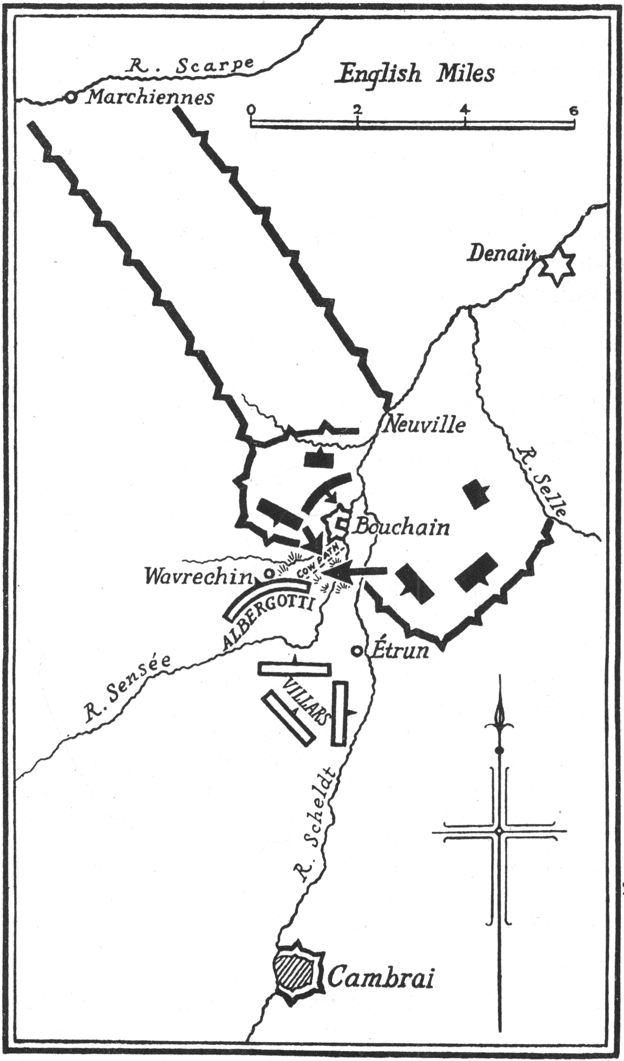
THE SIEGE OF BOUCHAIN
The severing of the Cow Path was a prime essential. Accordingly the besiegers set out into the morass from both sides, building fascinades—swiftly copied—step by step till they got near enough for an attack. Marlborough came himself to direct this curious operation, and examined its possibilities with scrupulous care. The water in the marsh was in places up to the necks of the four hundred grenadiers who assaulted on the 17th. A short officer had himself carried, a particular target, high on the shoulders of his men. The fortress cannon fired heavily upon the wading and splashing soldiers as they struggled slowly forward; but the French defenders fled when their advance continued. The Cow Path was taken, and the town completely isolated.[557] “Our greatest difficulties,” wrote Marlborough to Godolphin (August 20), “for the siege of Bouchain are over. . . . They are now shut up on all sides.”
The siege-train began to arrive from Tournai on August 21. The approach trenches were opened the next day, and the batteries began to fire on the 30th. While Marlborough bombarded Bouchain, Villars bombarded him. “The situation of both armies is so extraordinary,” he wrote to Godolphin (September 3),
that our army which attacks the town is bombarded by the enemy; and we have several posts so near to each other that the sentinels have conversations. The whole French army being so camped that they are seen by the garrison of Bouchain, makes the defence the more obstinate; but, with the blessing of God, I hope we shall get the better of them, and, if they opiniatre beyond reason, may be an argument for their being made prisoners of war.[558]
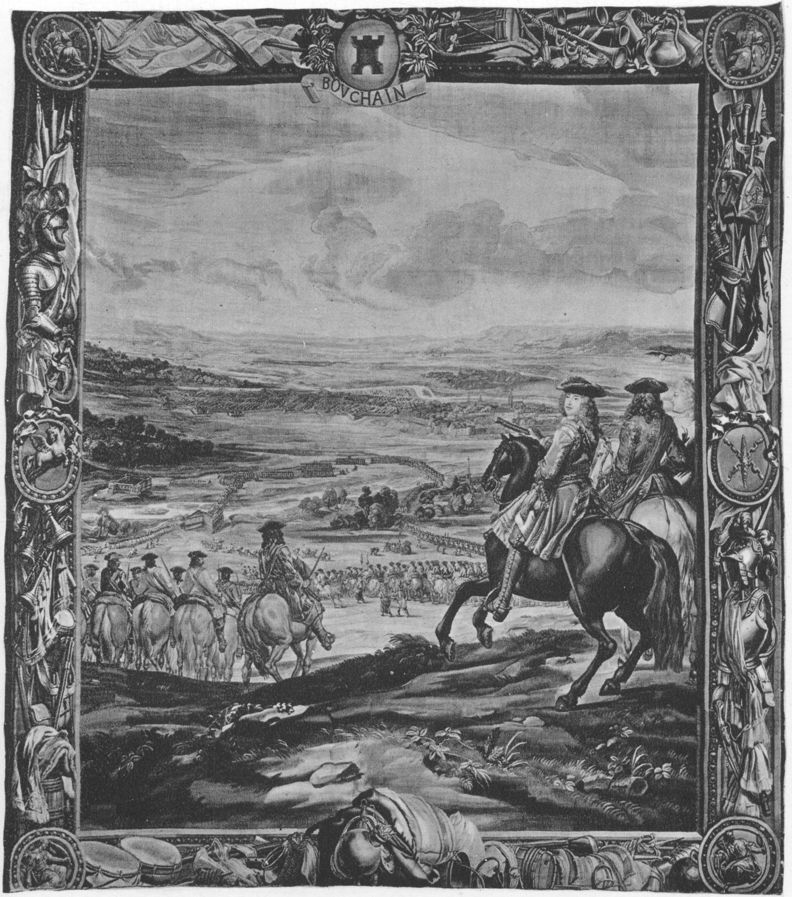
TAPESTRY OF THE CAPTURE OF BOUCHAIN
By permission of the Duke of Marlborough. Photograph by permission of the Victoria and Albert Museum
The spectacle of a siege proceeding with two great armies so closely interlocked was unique in the wars of the eighteenth century. It was watched by all Europe with profound interest. The actual reduction of the fortress proceeded with great rapidity. By September 12 the long ordeal reached its end. The governor hung out white flags upon all attacks. He offered to surrender the fortress if he could march out with the honours of war. Marlborough usually accorded such conditions. But on this occasion he determined to inflict upon Villars, under whose eyes the drama proceeded, a rebuke which would be everywhere noticed. He demanded that the garrison should yield themselves prisoners of war. The governor refused, and a terrible bombardment was resumed. The defenders then proposed they should become technically prisoners of war, but should be allowed to reside in France on parole, because the Dutch fed their prisoners so badly. A second time the bombardment was resumed, and after some hours unconditional surrender was made. Two thousand five hundred men marched out of the place into captivity. The Allies had sustained four thousand casualties in the siege. Marlborough was master of Bouchain. It was his last conquest and command.
Meanwhile his relations with Oxford continued apparently to improve. Evidently he tried to indicate that the necessary concessions might be made to France, leaving Spain to be cleared up later, and that he would undertake this task. “I must confess to you,” he wrote to Oxford (September 3), “the last six weeks have given me frequent and sensible remembrances of my growing old; the conscience of my doing my utmost for the Queen’s service, the hopes of her Majesty’s acceptance and the assurance of your friendship are my chief consolation, and . . . if I can any way contribute towards the putting the war in Spain or any other part of the service on a better foot . . . I pray you will not spare me.”[559]
Oxford for his part went very far in his protestations of friendship to Marlborough. He even touched upon the secret negotiations for peace which he was conducting, though his letters attained a very high economy of truth.
August 28/September 8
I have delayed mentioning a particular of great moment because I have no cipher to write to your Grace, but I shall reserve the whole to send by Lord Stair. In general it is this: the French made an offer to the Queen of a general peace, and to do it by the canal of England. The Queen’s answer was she would enter into no separate treaty, neither should it be transacted here; she had several things to demand for the good and quiet of her dominions, but she was resolved not to act without her allies, and particularly the States. They [the French] sent a paper in general promising satisfaction to all the allies, in barriers, in trade, and all other articles: this being thought too general, they have sent a man over to explain it: what he says will all be transmitted over by Lord Raby.
And upon the personal issue:
I can say no more than this, that I shall leave it to my actions to speak for me, and so give your Grace demonstration that I am the same man towards you as I was the first day I had the honour of your acquaintance; and I shall as heartily promote everything under your care as I did, or would have done, in any time since I have been known to you.[560]
But all the time poison was working.
St John to Oxford
Windsor
September 4, 1711
. . . John Drummond intended to leave Amsterdam this week, so that he will soon be here. Heinsius and Buys both told him their accounts from the army assured them that Torcy was in England. They both desired the Duke of Marlborough might not be in the secret of the peace, and Buys reflected with warmth on the treatment which he had received from his Grace and from Lord Townshend when the last negotiation was on foot.[561]
One of Oxford’s correspondents wrote (September 1711):
At the same time that the outed family are applauded above measure, and bloated on the success at Bouchain, I find they double their malice against your Lordship, and spare no cost to encourage pamphlets against the Ministry. ’Tis a notion in the pamphlet shops that Whiggish libels sell best, so industrious are they to propagate scandal and falsehood. The taking of Bouchain now animates them afresh, ’tis a mighty glorious thing for them to be as long in taking a little town as our ancestors have been in reducing all France; but why is Dunkirk spared all this time? either for treacherous reasons or out of remorse of conscience.[562]
The project of wintering on the frontier had moved forward slowly. The Treasurer showed himself well disposed towards it, and made great play with providing the money and enjoining secrecy. The Dutch, however, were reluctant to promise their contribution. They had become with reason deeply suspicious of the English Government. Marlborough still hoped to persuade them, and might well have succeeded had he been able to return to The Hague immediately after the fall of Bouchain. This was, however, impossible. The English Ministers received the Dutch objections with inward satisfaction. They found themselves in the agreeable position of obliging Marlborough and making a show of favouring his schemes without having to make any substantial exertion. It suited Bolingbroke particularly to throw the blame upon the backward allies. Marlborough in urging his scheme had stated, incautiously perhaps, that it was vital to a successful campaign in 1712. The Secretary of State lost no time in exploiting this admission with the Queen. “If the project has been disappointed,” he wrote (September 25), “it has not been so by your Majesty, who gave orders for readily entering into the necessary measures on your part. However, it is of some use to have my lord Marlborough’s confession, that we may be disabled from doing anything the next year, and that the enemy may, perhaps, be in a condition to act offensively.”[563] This produced the desired effect upon the royal mind. “I think,” wrote the Queen to Oxford (September), “the D. of Marlborough shews plainer than ever by this new project his unwillingness for a peace, but I hope our negociations will succeed and then it will not be in his power to prevent it.”[564]
Oxford seemed genuinely disappointed. “Ours is a very unlucky situation,” he wrote to Marlborough, “that every one is shrinking from the war, and at the same time casting the burthen upon Britain, and yet unwilling to let her have the least advantage. I would to God that our Allies would resolve either to make a good war or a good peace.”[565]
Marlborough could do no more than put the facts before Heinsius.[566]
He allowed himself to indulge the illusion that a friendly basis had been established between him and the Cabinet under which he was serving. He seems to have relied too much upon the Treasurer’s professions of goodwill. The warfare of pamphlets continued. One praising Marlborough’s strategy was thought erroneously by Ministers at home to have emanated from his chaplain, Dr Hare. A virulent counterblast by Mrs Manley was circulated. Marlborough on reading this was thrown into lively and excessive distress.
John to Sarah
Oct. 1711
* I have receiv’d Your letters by Collins, and the print’d paper call’d Bouchain, as also a villinous answer to itt, by which I am of opinion, as I have been for some time, that whilest these barbarous proceedings are in fashon, it were to be wished that we shou’d never apear in print, and endeavour to do all the good we can, without expecting ether favour or justice; it is impossible for me to express the real concern I have had on the account of this barbarous libel, when I am emparing my health, and venturing every thing for the good of my Country.[567]
He appealed, somewhat naively, to Harley to protect him from such attacks while he was serving at the front.
Marlborough to Oxford
October 19, 1711
. . . There are two papers lately published, on your side, and some copies are already got here; the title of one is “Bouchain” and the other an answer to it. I do not know whether your lordship looks into such papers, and I heartily wish they had been kept from me. I am sure you cannot hear of one without the other; and when I protest to you I am no way concerned in the former, I doubt not but you will have some feeling of what I suffer from the latter. . . . The authors of these papers, as well the one as the other, are not only my enemies, they are yours too, my lord; they are enemies to the Queen, and poison to her subjects; and it would be worth the while to make a strict search after them, that the punishment they deserve may be inflicted upon them. But all the remedy, all the ease I can at present expect, under this mortification is that you, my lord, would do me the justice to believe me in no way an abettor or encourager of what has given me a mortal wound; but I will endeavour to bear up under it.[568]
Considering that undoubtedly Sarah through Maynwaring was active in attacking the Government and that the Whig scribes plied their quills with partisan vigour, Oxford was entitled to the full advantage of his reply.
Oxford to Marlborough
October 19/30
. . . I hope my sentiments are so fully known of that villainous way of libelling, I need say little to your Grace upon that subject. When I had the honour to be Secretary of State, I did, by an impartial prosecution, silence most of them, until a party of men [i.e. the Whigs], for their own ends, supported them against the laws and my prosecution. I do assure your Grace I abhor the practice as mean and disingenuous. I have made it so familiar to myself, by some years’ experience, that as I know I am every week, if not every day, in some libel or other, so I would willingly compound that all the ill-natured scribblers should have licence to write ten times more against me, upon condition they would write against nobody else. I do assure your Grace I neither know nor desire to know any of the authors; and as I heartily wish this barbarous war was at an end, I shall be very ready to take any part in suppressing them.[569]
After Bouchain Marlborough, still hoping to carry out his plan for the advanced winter quarters, had wished to attack Quesnoy. He rode out with the cavalry and reconnoitred the intervening country. He persuaded Oxford to support this further operation. But once again the Dutch in their uncertainty were disinclined to spend more life and treasure. They made no effort to provide the forage and supplies which Marlborough required, and after garrisoning Bouchain and repairing its fortifications he withdrew upon Tournai, and in October sorrowfully dispersed the Grand Army to its normal winter quarters.
He now set out for home. He wrote to Oxford a letter so conciliatory and submissive as to be painful for his admirers to read, but for which there was justification in the tone of Oxford’s correspondence.
October 1711
But, my lord, as you have given me encouragement to enter into the strictest friendship with you, and I have done nothing to forfeit it, I beg your friendly advice in what manner I am to govern myself. You cannot but imagine ’twould be a terrible mortification to pass by The Hague, with our plenipotentiaries there; and myself a stranger to their transactions; and what hopes can I have of any countenance at home, if I am not thought fit to be trusted abroad. I could have been contented to have passed the winter on the frontier, if the States had done their part; but, under my present circumstances, I am really at a loss what part to take. My lord, I have put myself wholly into your hands, and shall be entirely guided by your advice, if you will be so kind as to favour me with it.[570]
We can see the answer he received from his letter to Sarah of October 22.
* The intelligence You have had as to the particulars of the peace having been sent to me, is without foundation, and I know the intentions of those that now govern is that I am to have nothing to do in the peace. This is what I am extreame glad off, but thay must not know it. . . . As I am now convinced the peace will be conclud’d this Winter, I shall take my measures for living a retier’d life, if it may be in England I shall be glad of it, if not my business shall be to seek a good climate, for my Constitution is extreamly spoilt.[571]
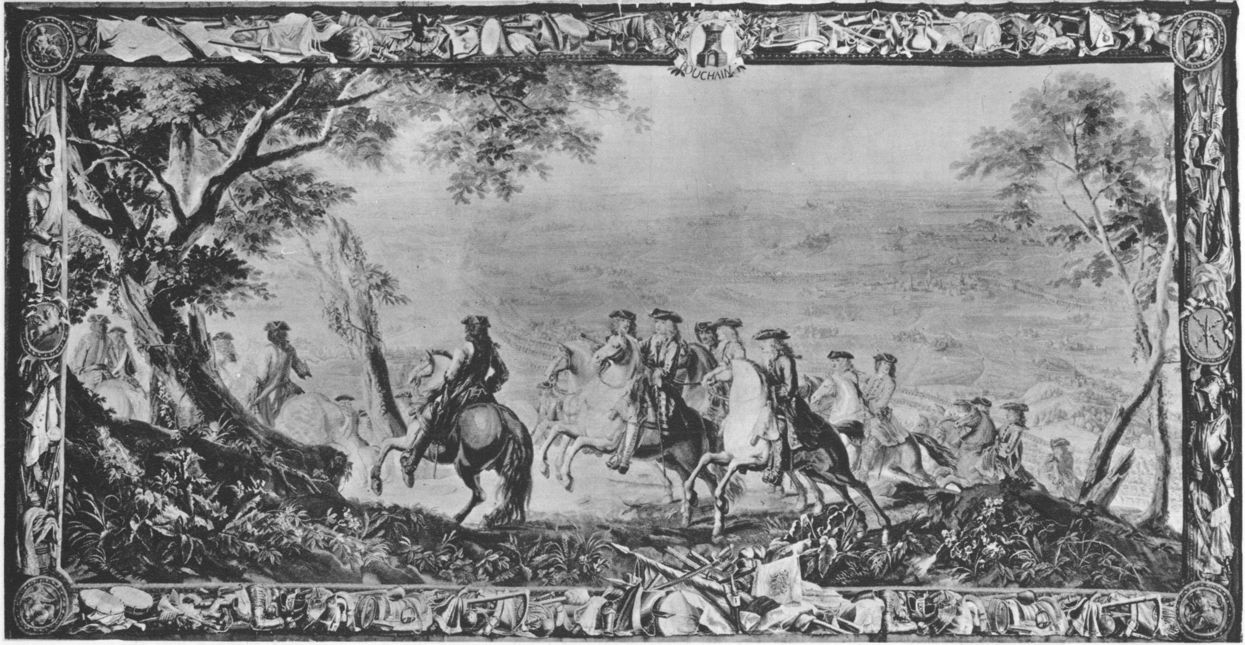
TAPESTRY SHOWING MARLBOROUGH AT BOUCHAIN
By permission of the Duke of Marlborough. Photograph by permission of the Victoria and Albert Museum
He also made a request to Oxford upon a matter petty enough to excite amusement. He had evidently allowed himself to be deceived by the Treasurer’s copious affabilities. But this was not the moment to ask for paltry favours.
I entreat your lordship will please to direct Mr Lowndes to send orders to the Custom-house that my baggage, and some small remains of my camp provisions, may pass directly to Whitehall, and be visited there, as has been practised in former years. I flatter myself your lordship will believe me when I promise you I will make no ill use of this indulgence.[572]
“Thus,” wrote General Kane, “ended the Duke of Marlborough’s last campaign, which may be truly reckoned amongst the greatest he ever made.” Natzmer goes even farther. “The year 1711,” he wrote, “was certainly the most glorious for my lord Duke. . . . Next to God this success [the passing of the lines] must be attributed solely to his wisdom, and he can be justly given credit for it as a coup-de-tête.”[573]
Some records of a regimental officer are also available, and are of value.[574]
In after-years Marlborough always looked back to the campaign of 1711 with pride. The Blenheim tapestries made under his directions assign to the capture of Bouchain a prominence over any of the great battles he had won. To understand this one must weigh the facts and figures. An army of perhaps 130,000 opposed by 90,000 could normally undertake a first-class siege, and provide a covering force which at any time could fight a battle behind entrenchments, or even at a hazard in the open. But for an army of 90,000 to effect the conquest of a fully garrisoned fortress in the face of at least 96,000 was an overturning of all the rules and experience resulting from twenty-five years of continuous war.
Thus ended the ten campaigns of the Duke of Marlborough, during which he had won four great battles and many secondary actions and combats, and had taken by siege thirty fortresses. In this process he had broken the military power of France, and reduced the first of military nations to a condition in which they were no longer feared by any country. He had practically destroyed the French barrier with the exception of some fortresses of the third line, and at any time a road into France could be opened. During the whole of these ceaseless operations of war on the largest scale the world had seen, or was to see for several generations, confronted by the main armies of France and their best generals, he had never sustained a defeat or even a serious check. Hardly a convoy had been cut up or a camp surprised. The aspect which these affairs wore to friend and foe alike was that of certain victory in any battle, siege, or foray he might undertake. The annals of war contain no similar record.
|
Lediard, ii, 325. |
|
Eight battalions plus 1100 last-minute reinforcements; say five thousand men. |
|
Authorities differ about the actual numbers. |
|
Parker, pp. 160-162. |
|
Parker, p. 163. |
|
Coxe, vi, 79-80. |
|
Coxe, vi, 80. |
|
Ibid., 81-82. |
|
Bath Papers, H.M.C., i, 208. |
|
Marlborough Papers, H.M.C., p. 39 (a). |
|
Portland Papers, H.M.C., v, 84. |
|
Ibid., 94. |
|
Coxe, vi, 110. |
|
Bath Papers, H.M.C., i, 212. |
|
Coxe, vi, 109. |
|
* It will be in the power of the French [he wrote (September 28)] to have such a superiority as must give the law next campagne, especially if what I hear be trew that you will not agree to the Project sent by Ld Albemarle, fearing it might be contrary to the Treatys of Contribution made by M. Pesters. It is most certain that the foundation of that Project is to hinder the Enemy from making their magazines, which I think . . . must have given us a good Peace; but if the fact be so by the Treatys of Contribution that they are to make their magazines in quiet, I very much dread the consequences for the next campagne; & am very much afraid that if they make the right use of it, they may retake Bouchain, when our troops are quartered at so great a distance as the Project of the Council of State sends them. I do not flatter myself that any representation of mine shou’d change your resolutions, but I clear my conscience by letting you know what I fear. [Heinsius Archives.] |
|
Blenheim MSS. |
|
Coxe, vi, 121-122. |
|
Ibid., 122-123. |
|
Coxe, vi, 111. |
|
Blenheim MSS. |
|
October 26; Coxe, vi, 114. |
|
Natzmer, p. 328. |
|
From the family records of Lieutenant-Colonel Gordon Halswell. Captain James Gordon to Lieutenant Swan, Royal Scots Fusiliers September 12, 1711 * This year the D. of Marlb. has certainly made it appear that as much of the glory of this war is due to him as aniebody else; for you know Prince Eugene had always the vogue before; not that I should pretend to detract from the Sterling merit of that great man, but only I would that every one have his due. Pray give my respects to all my good friends in your Regiment, and oblige your most obedient humble servant. And to James Murdock, minister of Kirkcordan: * We have been very busie this Summer; wheras when we took the field we were all persuaded we should be idle; but the D. of Marlborough, who is as famous for Stratagems as ever Ulysses was and more happy in his victories than Hannibal himself, under Providence and good Fortune, would not suffer us to be passive; but on the contrary we have been very active and successful in pushing the enemy, not only within the walls but in the field, having got over their prodigious lines, which nobody thought we should have done without a battel; but having never lost a man in the cause, it is of more consequence to us than any battel we have fought this war, besides the considerable little Town of Bouchain; so the campaign being near an end, we reckon we have no more but to go to garrison very soon; for this end our army is divided up and down the fields. And the next year: * How much the D. of Marlborough was traduced and detracted from, amongst ’em, how much his ingenious strategems and notable feats of war were contemned and set at nought witness the Siege of Bouchain. What a simple insignificant [thing] it was reckoned and how contemptibly it was spoken of among ’em; tho’ the D. of Ormonde, when he saw and considered it, thought it as signal and remarkable action as he ever either heard or read of, finding that we are thereby near master of the Scheldt, that there are above 76 villages in its Chatelleny, how inconsiderable so ever it be in itself, and what prodigious difficulties there were in the Siege, which sometimes seem’d to be insuperable. I hope Sir Thomas Hammond [Hanmer] is gone home, sensible of a great many mistakes and false opinions abundance of his compatriots labour under, and will endeavour to undeceive ’em, for sure the most part of ’em that has served under the D. of Marlborough must love him for his shining merit and capacity. Here is a tribute which was surely not unwelcome: Thursday, August 9, 1711 * Dear Grandpapa I did not write to you before because I could not congratulate you for any victory but now I heartily do upon that glorious success of passing the Lines performed by her Majestys Arms under your Command july 25 in the low countries. I hope you will go on in winning of Battles, taking of towns & beating & routing the French in all manner of ways, and then come home with a good peace & look back upon those glorious toils of the battles of Ramellies Bleinheim Schelenberg &c & the sieges of oudenard Ghent &c. I am now at the Lodge in the little Park & like it verry well the Birds are very pretty. I wish you all happiness & good success in all your undertakings. I hope you will think nothing of all this flattery, for it is my thoughts, & I cant help saying Happy the Isle with such a Heroe blest What Vertue dwells not in his loyal breast? On thursday 2 of August I presented the Banner to the Queen & was received but coldly. You see I write on tho I have no awnser. Your dutifull Grandson, W. Godolphin [Blenheim MSS.] |
The negotiations which eventually led to the Treaty of Utrecht must now be related. In 1715, when under George I the triumphant, and justly indignant, Whigs were busily seeking evidence for the impeachment of Oxford, a “Committee of Secrecy” was appointed to find out how the negotiations had first been set on foot; and also whether any overtures had been made by ex-Ministers for a Jacobite restoration in the event of Queen Anne’s death. The object so ardently pursued was to fix a criminal responsibility upon Oxford which would deprive him of liberty, if not of life. Hopes centred upon Prior’s papers, which had been impounded by the new Whig Ambassador, Marlborough’s friend, Lord Stair. Prior had been Secretary at the English Embassy in Paris, and all transactions were believed to have passed through his hands. Nothing, however, rewarded this diligent search; all that was found was already public. In 1711 a letter from Versailles dated April 11/22 had reached London, had forthwith been brought before the Cabinet, and immediately communicated through Lord Raby to the Dutch. No fault could be found with this, and efforts to go behind or beyond it proved fruitless. It was not until Torcy’s memoirs were published towards the end of the eighteenth century, when all the actors had been in their graves for two generations, that the truth, supplemented still later by research in the French archives, became known.
When Marshal Tallard was Ambassador in London before the war he had as chaplain a French priest named Gaultier. Tallard, departing in 1702 upon the rupture between England and France, left Gaultier, instructing him, in Torcy’s words,
to prolong his stay in London as long as he was allowed to dwell there, to watch events discreetly, and to report to the French Minister for Foreign Affairs, but to do this with the discretion necessary to avoid being looked upon and accused in England as a spy; therefore to write rarely, and in a manner which would not draw upon him an order of expulsion from England, or other usage even more unpleasant.[575]
Eight years had passed during which the Abbé had faithfully fulfilled his part. After a while he became chaplain to Count Gallas, and was accustomed to celebrate Mass in his Embassy chapel. In this secure position he heard and saw all he could, but wrote seldom to France, and never upon military matters. No one had the slightest idea that he was a French agent. Lord Jersey, a Tory-Jacobite noble of strong French sympathies, had been English Ambassador in Paris after the Peace of Ryswick. He had married a French Catholic, and this lady was accustomed to attend Mass at Gallas’s chapel. There Gaultier became acquainted with her. He gained the confidence of the Jersey household, and thus extended his political and social contacts in London. Jersey, though not holding or seeking office, stood well with the new Ministers.[576] In particular he was intimate with Harley, as he then was, and Shrewsbury. When, therefore, he found them eager for peace and looking around for some secret channel to France, he suggested the Abbé Gaultier as a trustworthy emissary. The two English Ministers readily fell in with the idea. They confabulated with Gaultier, and, unknown to any other person, unknown to the Cabinet, unknown even to St John, Secretary of State, they sent him through the lines near Nieuport to Paris, where he arrived on January 7/18, 1711. He was charged to tell Torcy that the new Ministers sought peace and believed it necessary to the welfare of England, and that they would be glad if Louis XIV would propose to the Dutch a renewal of the conferences which had ended at Gertruydenberg in the summer. This time the English plenipotentiaries would make sure the negotiations should not be broken down by the Dutch.
“Who would have said at this time,” wrote Torcy in his memoirs,
that the prosperity of that formidable Alliance of the enemies of France and Spain had reached its final limit; . . . that the Supreme Being Who fixes the bounds of the sea and calms when it pleases Him the force of its tides would stop so swiftly the torrent of so many victories; that before two years had flowed away these proud warriors, so drunk with their successes, would, confounded in their designs, restore to the King the most important fortresses they had captured; that there would no longer be any question of their demanding hostages to guarantee the inviolable word of a great King, nor of proposing as the foundation of a Treaty odious preliminaries; . . . that in spite of the efforts of the Alliance [Ligue] and the advantages it had gathered, the grandson of St Louis chosen by Providence to reign in Spain would dwell secure upon his throne, recognized as monarch and lawful possessor of Spain and the Indies by a host of foes, who brought home after so many years of bloody war nothing but the crushing burden of the debts contracted to sustain their vast designs?[577]
Torcy only knew Gaultier from his Secret Service reports.[578] He was greatly surprised to find his own skilful spy in London returning to him in the capacity of envoy from the British Government. Gaultier, departing brusquely from the actual terms of his mission, spoke at once as a zealous Frenchman. “Do you want peace? I come to bring you the means of negotiating and concluding peace independently of the Dutch, who are unworthy of the consideration of the King and of the honour which he has so often extended them by addressing himself to them, and by seeking to pacify Europe through them.” “To ask,” comments Torcy, “a Minister of Louis XIV if he wished for peace was like asking a sick man attacked by a long and dangerous malady if he wished to get well.” He showed, however, far more suspicion of his own employee, Gaultier, than had the two English Ministers. It seemed to him incredible that such proposals could reach him through such a channel. However, the British emissary asked very little. “Give me,” he said, “a letter to Lord Jersey. Write to him simply that you have been very glad to learn from me that he was in good health; that you have charged me to thank him for his regards, and to give him your compliments. This letter will suffice by itself for my passport, and for my credentials to listen to any proposals which may be made to you. I will return to London, and bring them back in no time.”
Torcy consulted the King, and all was discussed in council at Versailles. There was a natural doubt whether the English advances were genuine, but the opinion prevailed that “the overtures of the new Ministers were less deserving of suspicion, because it was their personal interest that the war which redounded to the prestige of their opponents should end at once.” It was decided to give Gaultier his letter. “There do not seem,” remarks Torcy, “any objections to writing it, but many in refusing to do so.”[579]
The Abbé Gaultier did not transact business only with Torcy. With that Minister’s assent he also visited Marshal Berwick on Harley’s behalf.
“He told me,” says Berwick,
that he had orders to speak to me about the Pretender’s affairs, and to concert with me the means of restoring him; but before he entered upon the point, he was to exact a promise, first that no person at Saint-Germain, not even the Queen, should be privy to the matter; secondly, that Queen Anne should enjoy the Crown in tranquillity during her life, provided that she confirmed the possession of it to her brother after her death; thirdly, that sufficient securities should be given for the preservation of the Church of England, and of the liberties of the kingdom. To all this, it may easily be imagined, that I readily consented, and I had the same confirmed to him by the Pretender, to whom I introduced him for that purpose. . . . In order to shew that we would omit nothing, and to give proofs of our sincerity, we wrote to all the Jacobites to join in with the Court. This contributed greatly to make the Queen’s party so superior in the House of Commons that everything was carried there according to her wishes.[580]
Gaultier reached London on January 28/February 8. He displayed Torcy’s letter to Harley, Shrewsbury, and (it is to be presumed) Jersey, whom alone it apparently concerned. By word of mouth he stated that the French were ready to treat and to come into conference. The two Ministers were disappointed that France was not more forthcoming. Perhaps they realized how very cheapening to their position Gaultier’s first mission had been. They felt conscious of a rebuff. Evidently Gaultier was made sensible of their mood, because in a letter dated February 13 he put something not far removed from an ultimatum before his French masters. He wrote that the friendly British Government earnestly hoped that a definite offer of peace would come to them from Paris, and in such a form that it would appear to have arisen spontaneously from France. This alone would enable these Ministers who were running risks by their peace policy to preserve their reputation, both with Parliament and their allies. He had, or affected to have, a hammer with which to drive this nail. The armies were assembling. Marlborough would soon take the field with Eugene at his side. “Be assured,” wrote Gaultier (February 27, 1711),
that you will never have so fine an occasion of ending this quarrel than that which is open to-day; for if the Duke of Marlborough should happen to gain another battle during the impending campaign in Flanders, the Queen with her new Ministers will be obliged to fall back once more into the hands of the Presbyterians, and God knows when we shall have an end to this war.
And, a few days later (March 10), “They [our friends] are always of the same feelings here. . . . What then do you fear?”[581]
Torcy and the French Government, from the King downward, had their fears, but their hesitation was due rather to their growing hopes. Some profound and to them blessed change had occurred in England, and the whole Alliance might collapse. The Great Council which sat around the King, with Madame de Maintenon close at hand, became conscious not merely of relief, but of a wonderful opportunity. In this atmosphere the discussion was hard, and Torcy, who was determined not to lose the thread, or cord even, that had been thrust into his hands, had serious anxieties. A further interchange between the Governments took place without modifying the issue. In the end the shadow of Marlborough taking the field, and the chance which none could ignore of another shattering battle, decided the French to comply with the wishes of the English Ministers. Torcy dwelt upon the Dutch reports—coloured no doubt—of the steadfastness of the new English Government. To break at this point, he wrote, would have been in effect
to preserve to this General the dangerous authority which he had over the troops, and to leave him still in the command of the Armies: it would in any case be difficult to deprive him of it; his reputation was too firmly established, and no capital fault could yet be imputed to him. No general officer in England possessed the same talents, and none could fill his place in the confidence of the Allies. The new Ministers had curtailed his authority; but this rather futile mark of their ill-will in itself showed him that he was feared and that his services were indispensable. He was irritated by the affronts made to his wife, to his allies, to his friends, and by seeing their enemies promoted in their places. They had vexed him still more in cutting off part of the power he had wielded in preceding years, but none the less they had left him enough to revenge himself. The sole way of reducing him to the rank of an ordinary subject, was to make peace.[582]
Thus Torcy records the arguments he had used. They prevailed, and when Gaultier arrived on April 6/17 to procure the reply the Council met to consider a formal French proposal for a treaty, first with England, but carrying with it the consequence of a general peace. “As no one could doubt that the King was in a condition to continue the war with honour, it should not be taken as a sign of weakness that his Majesty was prepared to break the silence which he had kept since the separation at Gertruydenberg.” Accordingly the King offered to negotiate peace on the following basis: The English should have effective guarantees for the future of their commerce in Spain, in the Indies, and in the ports of the Mediterranean. The Dutch should have an adequate Barrier for the safety of their Republic; and this Barrier should be “agreeable to the English nation”; the Dutch should further have entire freedom and security for their trade. Arrangements would be made in good faith and in the most reasonable spirit to satisfy all the allies of England and Holland. “As the success of the King of Spain’s affairs opens new expedients for settling the disputes about the Spanish Monarchy, an effort will be made to surmount the difficulties in this quarter, and to safeguard the commerce and generally the interests of all Powers engaged in the present war.” Conferences should be opened at once upon this basis, and the King would treat either with England and Holland alone or jointly with them and their allies, according as England might wish. Aix-la-Chapelle or Liége might be the scene of the conferences for a general peace, at the choice of England.[583]
Gaultier delivered this very important document, dated April 11/22, in London ten days later. Harley was still indoors, absorbed in the financial schemes he was preparing for Parliament. Up to this point his only Ministerial confidant had been Shrewsbury. It was now necessary to inform the Dutch. Shrewsbury had ventured thus far in this delicate and, in those days, dangerous transaction. But now he was determined that the responsibility should be shared with the Cabinet. His wishes prevailed. The French note was brought before the Cabinet and sent to the Dutch “as a paper come to the Queen’s hands, without saying how.”
It was not until this Cabinet (April 26) that St John, the Secretary of State who has been so often credited with the whole of the peace negotiations, was allowed to enter into them. Hitherto he had been writing to Drummond, now the important link with the Dutch peace party, assurances for the benefit of the Dutch of the British resolve to prosecute the war to the end, and to make peace only in common. Repressing whatever surprise or resentment he may have felt at having been kept in the dark, or possibly not knowing even now of Gaultier’s to-ings and fro-ings, he accepted the new position. Harley, while moving towards a very large objective in the mole-like fashion which he enjoyed, had taken little care of detail. Lord Jersey had fed Gaultier with all sorts of suggestions, and made through him offers which went far beyond anything that the two Ministers had contemplated. He had let it be supposed that England would give up Gibraltar and Minorca,[584] and, above all, he had fostered the idea that all these peace parleys, so precious in themselves, were but the preliminary to the succession of the Prince of Wales upon the death of the Queen. In fact, the French Government had been amazed at the language which Gaultier seemed to be authorized to use on behalf of Britain. Now and henceforward the business passed out of these irresponsible hands into the masterly, if unscrupulous, grip of St John. Within a few weeks of the receipt of the French proposal he had taken that complete control of the whole negotiation which he never relinquished until the Treaty of Utrecht was signed.
The Cabinet in general were also at this time apprised of Harley’s South Sea project. Buckingham urged that a demand should be made upon the French for “cautionary towns,” or more properly ‘treaty ports,’ in the West Indies and South America, in order that the hopes which were to be aroused might be capable of fulfilment. It was therefore decided to send not only Gaultier but Matthew Prior, who was in St John’s particular circle, and had diplomatic experience in France, to Paris, to ask for additional easements and to procure from the French more explicit undertakings upon the commercial aspect. “I always thought it very wrong,” said the Queen, “to send people abroad of meane extraction; but since you think Mr Prior will be very usefull at this time, I will comply with your desire.”[585] Prior’s commission was extensive. Now for the first time, at the beginning of July, there appears a written document on the British side of the negotiations. It was remarkable:
Le sieur Prior est pleinement instruit et autorisé de communiquer à la France nos demandes Préliminaires, et de nous en rapporter la réponse.
A. R.[586]
This document was, of course, disclosed to the Committee of Secrecy in 1715; and it was immediately noticed that the Queen had given this general and far-reaching authority to a comparatively small personage upon her own sign manual. No Minister cared, or dared, to take formal responsibility for this extraordinary ‘power.’ Anne was willing as sovereign alone to bear the brunt before Parliament. When in due course Prior in his examination was asked, “Did the Lord Treasurer send you to France?” he was able to reply, “No, I was sent by the Queen.” This evidence, coupled with the document, was insurmountable, and after four years Harley’s subtlety and foresight stood him in good stead.
Thus empowered, Prior proceeded in the deepest secrecy, which nevertheless was to some extent already penetrated,[587] to Versailles, where he arrived on the evening of July 21. He had three interviews with Torcy. In the first he unfolded the English demands. It was the purpose of the new Government to secure substantial commercial advantages for England by agreement with the French before hampering themselves with claims on behalf of the Allies. England required, first, the right to import African negro slaves into the West Indies and South America, termed in the discussions the Assiento; secondly, the naval bases of Gibraltar and Minorca; thirdly, the cession of Nova Scotia and Newfoundland, and various fishing and trading rights in those quarters; fourthly, the demolition of the fortifications at Dunkirk; and, fifthly, the recognition by France of the sovereignty of Queen Anne. After these requirements had been set forth Prior was instructed to ask for the everlasting division of the crowns of France and Spain, an adequate Barrier for Holland, an especial barrier for the Duke of Savoy, and a barrier for the Empire. Nothing was said about the succession in England; nothing about the Germanic frontiers on the Rhine; nothing about the Emperor’s claims in Italy, Spain, Bavaria, or the Netherlands. All this was left for future discussion.
At Prior’s last interview Torcy, feeling himself in the presence of a Government which wished to make a separate peace for its own special advantage behind the backs and at the expense of its allies, felt sufficiently emboldened to ask abruptly, “What is France to have from England in return for all this?” In all previous negotiations England had prescribed terms in conjunction with her allies. The atmosphere was different now. A transaction which would be regarded as odious by all except its peculiar beneficiaries, and not a general peace, was on the board, or, rather, under it. Prior, who, though a good poet, was not lacking in diplomatic experience or skill, and who knew France and the French well, was taken aback. Like other Englishmen, he had nursed for some years the feeling, born of unbroken success, that we had only to ask what we thought reasonable to receive it. He replied, “Spain and the Indies for Philip V.” “Have you, then,” inquired Torcy, “Spain at your disposal?” Prior was astonished at this rejoinder. Torcy pursued his advantage. He read to Harley’s envoy the latest batch of Petkum’s letters from Holland, from which it appeared, or was made to appear, that the Dutch, fearing an English desertion, were themselves ready to enter into private preliminaries.
No progress was made in these conversations, except that it became clear that Great Britain was entirely resolved on peace and persuaded it could be obtained on the terms she wished; and that France saw enormous opportunities, first from British over-eagerness, and secondly from disagreements among the Allies the moment they became aware of the secret negotiations. Upon the commercial aspect there was a complete deadlock. So it was decided that Prior and Gaultier should return to London, and that the discussions should be resumed there. Mesnager, the French commercial expert, was also to go, but to travel separately. Mesnager entered England without detection, but Prior, by the untutored zeal of a Customs official, was arrested at Dover. He was, of course, released as soon as he produced the warrant of the Secretary of State. But the fact became known outside the close Court and Cabinet circle, and rumour immediately ran rife.[588]
The lengthy document containing Mesnager’s instructions was remarkable because it showed that the French only half believed that the English Ministers were bent upon a separate peace. The French still expected that they would be confronted with a demand for general preliminaries affecting all the Allies. If, however, the British policy was really as base and unscrupulous as it had been presented, then very considerable sacrifices would be made by France to secure the effective detachment of Britain from the Grand Alliance. Mesnager therefore had authority on this assumption to concede Gibraltar anyhow, and Minorca or even Corunna in the last resort; to meet the English claims in North America; and to agree, if nothing else would suffice, to the razing of Dunkirk. Furthermore, as something had to be said about the Rhine, although the English had not mentioned it, he was allowed to indicate the cession of Kehl and Breisach as a sop to the Empire and the Germanic states.
Prior met the inner Cabinet on August 18. The discussion was resumed at Windsor the next day, and here, for the first time, St John’s co-Secretary of State, Dartmouth, was made party to the negotiations. He was informed, but he was also excluded. St John, who was the most capable Minister, and the only one who spoke good French, wrestled with Mesnager. From August until October these hagglings continued. Mesnager found that the English Minister was undoubtedly resolved upon a private peace for Britain, without worrying too much about the allies. He therefore gradually conceded all that his instructions allowed him. In return he asked that the British Government should commit itself positively, and not merely by indifference, to the compensatory demands which France would make upon the allies of Britain. If England was to have special consideration she must not wrangle with France at any later stage because of the disappointments of her comrades in the war. Mesnager sought to shape the dual preliminaries in this sense, and St John, intent upon the special gains of England, allowed the document to take this form. Shrewsbury, who followed the negotiations with closer attention than the other Ministers, evidently felt increasing uneasiness, particularly about Dunkirk, the Protestant Succession, and the removal of the Pretender from France.[589] Anne herself was less troubled. “Since I saw you,” wrote the Queen to Oxford (September 19), “Lord Chamberlain has talked a good deale to me about the Peace, and I hope he will act very heartily in it, tho’ he seems a little fearfull.”[590]
By the beginning of October the results of this process were ready for the Cabinet. A conference to discuss the French offers was held between the Ministers involved. At this meeting Mesnager was led inadvertently into an indiscretion. With some simplicity, he asked what the British Government proposed about the Succession in England, and generally about the Jacobite question. It almost seems that he had not heard of Gaultier’s conversation with Berwick. The effect of his question froze the Ministers into silence. For a time not one could think of anything to say. Then St John intervened roughly, and possibly on the spur of the emergency. “It would be impossible,” he said, “for England to make peace with a country in which the Pretender was living.” That this represented the public position of Shrewsbury and most of the Ministers is undoubted. It was not, however, a decision to which they had deliberately come; nor was it in accordance with the conversation which Gaultier had held in January with Berwick, in consideration of which the English Jacobites in Parliament had given their support to the Ministry during the whole session.
The comment which forces itself upon the student of these times is that this vigorous declaration of inveterate war against any Power which gave asylum to the Prince of Wales was made by the statesman who only three years later was Jacobite Secretary of State at Saint-Germain. St John had the character which enabled him to say anything which the moment required in the most brilliant and decisive manner. He could hit any nail directly on the head with his hammer; which nail did not seem, in his brief heyday, to be particularly important.
The Queen to Oxford
September 24, 1711
I have this business of the Peace soe much at hart, that I cannot help giveing you this trouble to ask if it may not be proper to order Mr Secretary, in case he finds M. Mesnager very averse to the new propossition, not to insist upon it, and if you think it right I hope you will take care Mr Secretary has such an order in my name, for I think there is nothing soe much to be feared as the letting the Treaty goe out of our hands.[591]
It now became indispensable once again to widen the circle of those responsible. Poulett, Bishop Robinson, and Buckingham were for the first time apprised of the work of the year. The upshot of this serious conclave was the general feeling, voiced by Shrewsbury, that the draft preliminaries, however advantageous, were too shameless for publication. Even St John, while parading his work, admitted that “it required dressing up.” Accordingly Prior was sent to Mesnager to rewrite the section which concerned the allies in terms which would throw some cloak, or at least some veil, over their naked, cynical realism. The French emissary was deeply embarrassed. All that he had given to England had been upon the basis of her flagrant public desertion of her allies. Now, having pocketed their special advantages, the English Cabinet wished apparently to be protected from some at least of the strictures which would be passed upon them by their comrades. Mesnager therefore asked for time to communicate with Versailles. However, St John rose to the occasion, and with the compulsive violence of a vital mind induced him to take the responsibility. On October 8 the three documents relating to the English claims, to the interests of the allies, and to the special interest of Savoy were signed between England and France, and approved by the Queen.
|
Torcy, Mémoires, p. 666. |
|
He was to get a pension of £3000 from France for his services (see Edinburgh Review, October 1835, p. 15). |
|
Torcy, p. 661. |
|
The Abbé had been reporting regularly to Torcy since about January 1710. See Salomon, p. 50. |
|
Torcy, p. 666. |
|
Berwick, ii, 182-183. |
|
French Foreign Office Archives, “Angleterre,” tome 232; quoted in O. Weber, Der Friede von Utrecht, p. 27. |
|
Torcy, p. 665. |
|
Lamberty, vi, 669. |
|
See French Foreign Office Archives, “Angleterre,” tome 233, f. 43. |
|
Bath Papers, H.M.C., i, 217. |
|
P.R.O., Treaty Papers, f. 15. |
|
Brydges to Marlborough June 9/20, 1711 * It is lookt upon here as certain, that there are Propositions in agitation for a General Peace. Y. G. must undoubtedly be apprised of them, if there are, tho ye treaty is carried on with ye utmost secrecy, if there is one, I am inclined to believe, that ye Message which was sent with so much privacy about three weeks ago to Holland was upon that account. [Stowe Collection, 57, v, 89-93; Huntington Library, California.] |
|
Brydges to Marlborough August 23, 1711 * We have a strong report in town of a secret negotiation of peace being carried on, and that which confirms people in this opinion is the search that was lately made of some persons as they landed upon coming over from France, but were released again upon their producing passes from the Secretary of State and all their papers delivered to him. . . . Mr Prior was declared to be one of the number. I would not trouble your Grace with a matter of town talk if I had not a reason to look upon it as being true and that he went over about three weeks ago with Monsieur de Torcy’s secretary, and whether the treaty has been desired by the French and what promises have been offered or asked I am wholly a stranger to. P.S. There was a Council last Sunday at Windsor and his Grace the Duke of Somerset did not endeavour to come into it. [Blenheim MSS.] |
|
Shrewsbury to Oxford; Bath Papers, H.M.C., i, 212. |
|
Ibid., 210. |
|
Bath Papers, H.M.C., i, 218. |
The tale of these times should not be told as if it were wrong for an Opposition to seek to become a Government, or for Ministers at the head of the State to labour diligently for peace. The stigma upon them lies somewhat differently. Just as they had obtained power, not by free debate in Parliament, but by a backstairs intrigue with the Queen, so they sought a peace by a greedy and treacherous desertion of their allies. In the first case, they infringed every principle of Parliamentary government as accepted in Great Britain to-day. In the second, they violated the whole structure of personal and international good faith, of which British Governments have so often prided themselves on being the architects and defenders. All this, however, was but the starting-point. The career of deliberate bad faith for special national advantage, pursued by Ministers whose personal interests were also engaged, had but begun. It was now confined to the words of documents and the mutterings of Cabinet conclaves. Presently we shall see it translated into action in the field and in the face of the common enemy; and few who study it with attention will be surprised at the old French taunt, “Perfidious Albion.”
England and France were now agreed upon the preliminaries, and the special interests of England were only too well protected. St John next addressed himself to the task of reconciling the allies to the Anglo-French basis. He thought at first this would be easy. The Dutch, who had hitherto only been shown Torcy’s letter of April 11, had passed the summer in uncertainty and suspicion. They had perhaps been inclined to follow the British example of direct and separate contact with France. They had not made any formal complaint upon the terms of the Torcy letter; and St John might reasonably claim that they were not disturbed by it. None of the other allies had been informed at all. Now in October the preliminaries, apart from the secret Anglo-French agreement, were circulated to the allied Courts. Vehement opposition developed at once from two quarters. The first was, of course, Vienna. The Emperor protested by every means in his power—and there were many—against the proposal to deprive the house of Hapsburg of Spain and the Indies. On this, as Charles VI or as Charles III, he had a strong case against England. Was it not at the English request that he had gone to Spain to fight so long and hard for the Peninsular monarchy? Had he not twice been proclaimed King of Spain at Madrid? Had not the English Parliament above all other bodies or powers in Europe proclaimed and ceaselessly ingeminated “no peace without Spain”? Yet now England appeared ready to turn her back on all this. Why? Was this the whole of the transaction? Were the so-called French proposals for discussion in fact a bargain already struck between England and France? What lay behind?
Continental historians like Klopp naturally dwell upon the ill-usage of the Emperor Charles; but there is another side. No allied Power had more at stake in the war than the Empire. None had made greater promise to contribute to it. But what had been the performance? Where had been those ninety thousand men whom in the original treaty the Empire had bound itself to maintain upon the Rhine and in the Northern theatre? Where had been that support which the Hapsburg Emperor professed to enjoy from the Germanic states? The feeble, ill-paid armies, never rising above forty thousand, which under unhelpful or incapable commanders had appeared upon the Rhine had been the laughing-stock of friend and foe. The contingents which the Germanic princes should have sent to their supreme liege lord had only appeared in the guise of mercenary troops paid and maintained by the Sea Powers. Nothing had been given freely to the Empire. That decrepit body, paralysed from the outset by the Bavarian desertion and the Magyar revolt, had utterly failed in all its engagements. Vienna itself had been saved by the battle of Blenheim, gained in Central Europe by British soldiers and by contingents maintained by England and Holland. Even the troops which Eugene had led with quenchless valour and unsurpassed skill had been largely provided by the Sea Powers. His Turin campaign was sustained almost entirely by British money and allied contingents. His attempt on Toulon was similarly founded, and there remained much reproach about the ineffectual use of these resources. The Empire had shown itself quite unmindful of the Common Cause, which now played so large a part in their protestations, when they weakened the Toulon expedition for the sake of acquiring territorial gains at Naples. The military convention which they had made with France at the end of 1706 had shown no consideration for allied interests, and had liberated large numbers of French troops, cut off and invested in the fortresses of the Milanese, to face Marlborough in Flanders in 1707.
Klopp, while admitting the woeful facts of physical failure, still claims that the Empire had acted loyally and correctly. This loyal and correct attitude had, however, been maintained while they were carried shoulder-high by the Sea Powers. Perfidy among allies is justly odious, but failure to fulfil solemn undertakings and make adequate contribution to the common cause is not distinguishable, in its consequences at least, from perfidy. No British Government was therefore unprovided with an answer to the Austrian reproach. To bring all this to a point St John had at the end of June asked that eight thousand of the Imperialist troops released from Hungary should be sent to reinforce the Duke of Savoy and encourage his offensive. It was a request which courted a refusal, which the Secretary could turn to good account. “We must look upon a refusal,” he wrote with characteristic cant (June 12), “as an absolute desertion of the Common Cause.”[592] He could write this while he was corresponding with Torcy upon the basis that the allies were the “common enemy.”
It was not from the Empire but from another quarter that the real thrust against the new British policy was delivered. The Elector of Hanover held a far stronger position in everything that concerned England than the Emperor. His troops had fought well throughout the war in the main theatre and in Marlborough’s battles. His son had risked his life in the charge at Oudenarde. But far more important than such actions or gestures was the fact that he was the proclaimed constitutional heir to the British throne. All party politics in England revolved around him. We have seen the perfervid attempts of Oxford, Shrewsbury, and St John to gain his good graces. Well might they try; for the Queen’s health, for many years precarious, gave no assurance of a lengthy reign. At any time a recurrence of her gout or some other of the maladies by which she was afflicted might remove her from the scene. Where then would be those proud Ministers who had obtained power by her favour and Abigail’s intrigues if they now set themselves in direct hostility to the sincere desires and the treaty rights of their future sovereign? Although two generations had passed since the axe had fallen upon an English Minister as the result of impeachment for policy apart from rebellion, no one could say that the practice might not be revived. The fate of the great Lord Strafford was still vivid in men’s minds. The weapons of impeachment and attainder remained in full existence. They were perhaps blunted by the insensible but ceaseless march of culture and civilization which distinguished this great period in our history. But it would not take long to sharpen the axe on the Tower grindstone. That these possibilities were never forgotten by the public figures of the age of Anne is revealed by innumerable references in their letters. Marlborough certainly never had the assurance that even his victories could protect him from impeachment. The dispossessed Whigs from now onward never ceased to declare of Harley that they “would have his head” should they regain power. The Hanoverian accession would give them power. A quarrel with the sovereign designate upon the high issue of the abandonment of the war might easily inspire power with vengeance.
The attitude of the Court of Hanover became at once vehemently hostile to the peace and to the new advisers of Queen Anne. This was even so marked as to show a very considerable detachment on the part of the Elector from his prospects of gaining the British throne. Evidently by his antagonism to the Tory Ministers, who would presumably be in office on a demise of the Crown, he tempted them for their own sakes to look elsewhere for a successor, if that were possible. They might well face the perils of such a course if it became the only escape from other equal dangers. Hitherto they had hoped that the lure of the crown of Great Britain would far outweigh any pride in the Electoral Hat. It now appeared that the Elector was at heart a Hanoverian prince rather than a candidate for the British throne, and that he did not hesitate to base his chances of succession upon the Whigs and upon Whig policy at home and abroad. These developments intensified severely the passions of the British parties during the last years of Anne, until at times they seemed almost to revive in a gentler period the merciless hatreds of Charles II’s reign and of the Popish Plot.
During these months the whispers had grown in Whitehall. The allied ambassadors in their anxiety obtruded themselves on Ministers and asked awkward questions. Oxford was not handy at replying. He lied obdurately without convincing. Sometimes he talked confusedly for an hour without creating any impression but that of mistrust. On October 5, meeting Hoffmann at Court, he said, “I beg you to see that no time is lost in submitting the plan of campaign for Spain, which has already been asked for a number of times. I am afraid it may arrive too late.” Hoffmann smiled sardonically at him. “Have we really got to make a plan of campaign for Spain, when every one here knows that a peace is concluded, or at least certain? Indeed, if rumour is to be trusted, I should not like to carry the news to King Charles.” “I should, though,” replied the Treasurer genially. “How is that, when Spain and the Indies are to be given to the Duke of Anjou?” “There is no question of that,” asserted Oxford, turning sharply away to end the conversation.[593]
St John throughout this interval had been more artistic. He diffused ceaselessly an atmosphere of defeatism and uncertainty. He threw out a continuous stream of hints that the Alliance was breaking up. Every one was playing for his own hand. Only the Queen, of course, as he made out, was faithfully, laboriously, quixotically, adhering to the Common Cause. When Brigadier Palmes, of Blenheim day, returning from Vienna, suggested that opportunity was favourable for capturing Sicily, St John replied, “How do you know that the Court of Vienna is not at this very moment secretly negotiating with France?” To the Savoyard envoy he said, “Are you sure that negotiations are not proceeding in Holland?” And to the Hanoverian he remarked, “I don’t say that we have anything in hand, but if we had we should be doing nothing more than what others have long been doing.”[594] In this way he rocked and shook all the foundations of the Alliance, and sought to encourage the signatories to break their bond and shift for themselves, well knowing he and his colleagues had stolen the decisive march upon them all. It is an astonishing proof of the basic strength of the structure that it did not collapse entirely during the summer.
His relations with Gallas soon became unpleasant. Gallas was a deeply informed, farseeing, zealous servant of Charles III and of the Empire. His ability and his knowledge made him feared and hated by the Secretary of State, laden with his covert designs. Gallas became conscious that the Government had surrounded him with a network of spies. He mentions some names in his dispatches. He was, however, more successful in finding out the secrets of others than in guarding his own. He was not aware that a trusted servant of his household, the priest Gaultier, who officiated in his chapel, had long been the agent of France, and had now also become the agent of England. A more deadly seduction followed. Whether or not Gaultier guided St John into the secret circle of Gallas’s embassy is not known, though it is a reasonable assumption. At any rate, in the summer of 1711 St John had bribed the first Secretary of the embassy, one Clemente, to betray his ambassador. Clemente delivered to the Secretary of State Gallas’s reports to Barcelona and Vienna, together with the cipher which translated them. St John had the advantage of reading in the dispatch of July 31 a very candid account of himself and his principal colleagues, which rings true to-day. Gallas wrote:
He [Oxford] is so well informed in internal affairs that he may almost be regarded as perfect in that respect, but he knows very little of foreign affairs; yet he is always with the Queen. . . . To talk to Dartmouth is like talking to a brick wall. St John is just the opposite. He investigates everything, takes everything in, and can always be relied upon to make a formal statement. Neither his rank, his credit, capacity, or steadiness make one believe him. Moreover, his arrogance and excessive fiery temper are increasing from day to day to such an extent that one cannot penetrate his real ideas. Besides this, he is given to the bottle and debauchery to the point of almost making a virtue out of his open affectation that public affairs are a bagatelle to him, and that his capacity is on so high a level that he has no need to give up his pleasures in the slightest degree for any cause.[595]
And again (July 31), “The Ministers and the dominant party are enemies rather than friends of the Alliance.”[596]
Moreover, Gallas had a plan. He urged that some personality of the highest repute should be sent to London to question Ministers and grip the situation. Obviously Prince Eugene was the man. All through the summer Gallas was suggesting this to his masters. They dallied. Eugene was indeed to come; but too late.
Naturally St John and Oxford were entitled to regard Gallas as a dangerous, inveterate opponent. We need not waste indignation upon the trick of opening, decoding, or suppressing the correspondence of ambassadors, privileged under the law of nations; for this practice did not end with the eighteenth century. St John by October felt free to indulge his resentment against Gallas. The Ambassador had ceased to attend his receptions. Although Gallas was blissfully unaware of St John’s information, the two men were no longer on speaking terms. The note setting forth the French proposals was now presented by St John to the allies. Gallas received his copy. He treated it with slight consideration. St John expressed his disgust to Raby, created Earl of Strafford in September:
“He calls the proceeding an enigma, and in short, speaks the language which the impertinence of an Austrian Minister, improved by the encouragement and conversation of a saucy faction, might make one expect. It shall be no fault of mine if he does not receive such a reply as, by the decency of it, will give him reason to be ashamed, and as, by the resolution of it, will confound him.”[597]
It was the peculiar quality of St John to be able to brand in the most caustic terms in others the exact conduct which he was himself pursuing. To criticize a Government of which he was a member was “to attack the Queen.” His opponents were always “a shameless faction.” The allies were always guilty of the basest duplicity. He was unfeignedly indignant at the espionage and corruption by which he felt himself surrounded, and to which he made a notable contribution. He could use all arguments and all rhetoric on all sides of all questions, and he did it with a zest and pith which almost enlists us in the cause he championed at the moment. He had good reason to be annoyed when, the day after the French note had been sent in secrecy to the allies, its text appeared in the Whig news-sheet. There was a great sensation. “Both Whigs and Tories in the coffee houses were so astonished at the terms that they looked at each other without speaking. The stocks on the exchange fell several points.”[598] Gallas reported that “the publication of the new scandalous preliminaries last Sunday by the Daily Courant has made Tories and Whigs terrified and dumb.”
The Ministry asserted that Gallas had disclosed the secret. They may well have had conclusive but unpublishable proof at their disposal. Anyhow they had an ample case against Gallas if they wished to get rid of him. They knew from his intercepted letters that he had arranged to have Peterborough shadowed on his mission as ambassador to Vienna. They had had his own opinion of them set before them in terms which to men of intelligence must have appeared particularly insulting because so shrewd. They found, however, a difficulty in dismissing Count Gallas: he had already been recalled. The Emperor Charles VI had summoned him to Vienna. It was possible none the less to inflict on him an affront which travelled round Europe. On October 26 the Master of the Ceremonies announced to him that, “owing to the displeasure his conduct had caused her, the Queen had forbidden him the Court, and would explain her reasons to the Emperor. Announcements from the Emperor through another servant would be acceptable to the Queen.”
St John used his Post Boy to vilipend the Ambassador, and hold him up to the anger of the Tory Party. Nevertheless, in the solid tolerances of those days Gallas, though excluded from his functions, remained for many weeks in England as a private person. The manners of the eighteenth century permitted the most scathing official discourtesies to subsist by the side of very considerable minor politeness.
Marlborough’s overtures, through Stair and in his correspondence with Oxford, had lasted during the campaign. Many persons not privy to these communications believed that an effective combination between the General and the Lord Treasurer would be a supreme advantage to the public. It would afford the best chance either of “a good peace or a good war.” It would secure the Hanoverian Succession beyond all question. It would furnish the Queen with a Government of a moderate character, representative of both parties and at the mercy of neither. It certainly fulfilled in home affairs what had been the consistent conviction and desire both of the General and the Treasurer. It was in principle a return to the basis of 1704, without Sarah or Godolphin. But the obstacles were now insuperable.
Marlborough, absorbed in the arduous campaign and unaware of the secret negotiations, had only responded to Oxford’s peace feelers by general assurances. He was more than willing to see the obstacles which had wrecked the Gertruydenberg conference swept away, and a broad settlement made in Europe. But that he should be a party to a separate peace behind the backs of the other signatory states never entered his mind. He was the soul of the Grand Alliance. He was enjoying far better treatment at the hands of its members than from his own countrymen. While in England savage party enmities beset him, in Europe he was trusted, admired, and venerated. Oxford, who understood this, did not venture to declare his own true position. He was sure that no common policy on these lines could be agreed between them. He meant to have peace almost at any price, and he now felt certain he had it in his grasp. As the campaign drew to a conclusion the correspondence between the two men had evaporated in civilities.
Each relied on certain forces or processes. Hanover was now Marlborough’s most important stronghold. He still hoped for a friendly arrangement with the Treasurer, but he was determined to preserve his influence there. When at the beginning of October he returned to The Hague and entered its atmosphere of anxiety and suspicion he put himself in the closest contact with the Elector George Lewis. Neither knew what the British Government had done or intended. Both were sure that private negotiations were going on between England and France. How far these were operative, or whether there was a definite agreement on any particular point, was still unknown. It cannot, however, be doubted that Marlborough and the Hanoverian Court were in entire agreement, each spurring on the other, that a separate peace by England at the expense of the allies should be resisted by every means in their power.
On the other side Oxford and St John had their plan. If, as Oxford apprehended, they could not gain Marlborough to their schemes they meant to dismiss and dishonour him; and they believed they had the means to do both. If he would go forward with Ministers upon the path of a separate peace his interests would be protected in every way. If not, then, in the words which Bolingbroke had used to Drummond earlier in the year, “such scenes will open as no victories can varnish over.” Thus Marlborough’s choice was either to become the military tool of a disloyal peace or to face the full malice of the Government supported by the Queen and commanding majorities in both Houses. He was somewhat slow in becoming aware of this issue.
His eyes were to some extent opened upon his arrival at The Hague. The partisan attack launched by the new Ministry upon the financial conduct of Godolphin, the fantastic tale of “thirty-five millions unaccounted for,” had led to the appointment in the spring of a House of Commons “Commission of Accounts,” composed of ardent Tories, headed by Lockhart and Shippen, another red-hot Jacobite. The Lockhart papers and the report which he presented to the House of Commons give a full account of the work of the Commission. Their hope and object was to unearth financial scandals and cases of peculation among their predecessors and opponents. Godolphin was protected from any personal charge by his evident poverty; but Walpole, the truculent and most competent Whig statesman in the Commons, was marked as a target. Above all, Marlborough attracted the thirsty scrutiny of the Tory-Jacobite committee. These volumes have not concealed the many good and valid reasons which the Jacobites had to seek revenge upon him. From the night in 1688 when he rode away from James’s camp at Salisbury he had been their most relentless and deceitful foe. His own notorious love of wealth, the fortune he had made, the perpetual annuity voted to him for his victories, the salaries and allowances he drew from so many English military offices and as Deputy Captain-General of Holland, the ten years in which he had managed things in his own way—all proclaimed a broad and fertile field to the inquisitors. It had been known in Government circles for years past that he deducted annually a percentage from the pay of the foreign contingents serving under him and took other perquisites to form an Army fund which he said was devoted to Secret Service of all kinds. Over this, of course, he had complete control. It is the essence of Secret Service funds that no account of them can ever be presented. Thus he could be charged by his political foes with having pocketed as much as he chose of this percentage.
Marlborough does not seem to have been the least disturbed by the holding of the inquiry. He wrote to Sir Solomon Medina, the principal Government contractor, who had been summoned to England, that he was glad he was to be a witness, and would afford any documentary assistance in his power. But either Medina had some grievance about the payments made to him or he was gained to the Government interest. Whatever the cause, he certainly framed his deposition in an injurious and misleading form. He said that from 1707 to 1711 he had paid the Duke of Marlborough on bread and various contracts for the army the sum of 332,425 guilders for his own use, and yearly twelve or fourteen wagons gratis “for the use of the Duke himself.” He mentioned also quite properly that on each contract he had presented Cardonnel with a gratuity of five hundred ducats, and paid Mr Sweet, the Deputy-Paymaster at Amsterdam, 1 per cent. on all the moneys he received.
As soon as he heard of this Marlborough wrote a full explanation to the Commissioners.
Having been informed on my arrival here that Sir Solomon de Medina has acquainted you with my having received several sums of money from him, that it might make the less impression on you I would lose no time in letting you know that this is no more than what has been allowed as a perquisite to the general, or commander-in-chief of the army in the Low Countries, even before the Revolution, and since; and I do assure you, at the same time, that whatever sums I have received on that account have been constantly employed for the service of the public, in keeping secret correspondence, and getting intelligence of the enemy’s motions and designs.
He then declared that he had also received 2½ per cent. upon the pay of the foreign auxiliaries during all these years for Secret Service, that he had himself negotiated this agreement in the capacity of plenipotentiary under King William III, and that he held Queen Anne’s warrant dated July 6, 1702, for the transaction.
And now, gentlemen [he continued], as I have laid the whole matter fairly before you, and I hope you will allow I have served my Queen and country with that faithfulness and zeal which becomes an honest man, the favour that I intreat of you is that when you make your report to the Parliament you will lay this part before them in its true light, so that they may see this necessary and important part of the war has been provided for and carried on without any other expense to the public than ten thousand pounds a year. And I flatter myself that when the accounts of the army in Flanders come under your consideration, you will be sensible the service on this side has been carried on with all the economy and good husbandry to the public that was possible.[599]
Evidently he supposed his explanation was complete and would be accepted. Anyone considering his behaviour at this time will feel, “Here is a man with a clear conscience who cares nothing for the worst that his foes may do.” And this conclusion has its force for us to-day.
His attitude might well have arisen from the hardihood of his nature and those powers of endurance under the most severe pressures which he had shown during the Fenwick trial and on many other occasions in his long, anxious career. Yet this was a matter which was now bound to come to a head, and was sure—unless Ministers turned it aside, as they could so easily do—to involve a cruel ordeal. These Ministers would have blithely purchased Marlborough’s support for their policy or his compliance in it, or even his silent neutrality, by relieving him of all vexation. It should not be supposed that St John, for instance, was at all scandalized by what he had learned. He had just netted a large sum of money from the special clothing contract for his Canadian fiasco. Even if he put the ugliest construction on Marlborough’s conduct, St John did not think any the worse of him for it. He had long regarded it as a fine blackmailing counter to compel Marlborough to serve and aid the Tory Ministry. It was for this reason he had written his letter in 1711 to the go-between, Drummond, to make Marlborough aware that the new Ministers felt they had him in their hands. If he stood aside from the impending clash, if he retired to Woodstock to superintend the building of his palace, they would no doubt be very ready to give him guarantees against annoyance or molestation.
Both Marlborough’s political action at this juncture and his personal integrity must be judged in relation to his knowledge of these facts. He never hesitated at all in the course which he took. He rallied the whole political power of the Allies against a separate British peace. He used all his paramount influence in Hanover, both through Robethon and also directly upon the Electress Sophia and the Elector, to make them dare all against it. He was working in the most complete intimacy and accord with Bothmar. Whatever he afterwards encountered, it was with his eyes open. He did not turn aside by a single step from the policy on which he was resolved. He faced the accusations with which he knew he would be assailed with no more unmanly shrinking than he would a cannon-ball in the field. He meant to throw his whole weight—and it might well be decisive—on the side of the immense forces gathering against the Ministry and their dishonourable negotiations. He seems nevertheless to have imagined that Oxford, whom he had driven from office in 1708 in circumstances of affront and danger, and who now stood in a situation commanding enough, but also precarious, would, merely as a matter of truth and fair play, not misrepresent the facts against him or treat them with prejudice and malice.
Marlborough to Oxford
Hague
November 10, 1711
. . . Upon my arrival here, I had notice that my name was brought before the Commissioners of Accounts, possibly without any design to do me a prejudice. However, to prevent any ill impression it might take, I have writ a letter to those gentlemen, setting the matter in its true light, which Mr Craggs will deliver; and when you have taken the pains to read the enclosed copy, pray be so kind as to employ your good offices, so as that it may be known I have the advantage of your friendship. No one knows better than your lordship the great use and expense of intelligence, and no one can better explain it. . . .
My lord, you see I make no scruple to give you a little trouble, which to a temper like yours rather increases than diminishes the pleasure of doing a good office. I do, therefore, boldly claim the benefit of your friendship, and am so sanguine as to expect the good effects of it, which I shall make it my constant business to deserve. The endeavours of our enemies to destroy the friendship between us will double mine to continue and improve it.[600]
With this he enclosed a copy of the formal letter he had written to the Commissioners.
But when truth is stifled under veils of tactics and deceit, and when fair play between man and man has long been devoured by antagonism, such an appeal was not worth making. By this time the Treasurer knew that Marlborough would act against him on the treaty issue. Why, then, should he give up his weapon and the chance of setting a hostile House of Commons loose upon him? “That were some love, but little policy.”
The strongest efforts had been made by the Queen’s Ministers to reconcile the Elector of Hanover to their courses. Lord Rivers was sent over with the so-called French offer of peace preliminaries. Oxford, Shrewsbury, and even Buckingham, a non-violent but undoubted Jacobite, vied with one another in their professions of devotion to the Hanoverian Succession. Abigail later on, with more comprehension than she ever showed at any other time, explained to Mesnager the root fact that the peace could only be carried under extreme asseverations of the loyalty of the Queen and of the whole Government to the Act of Settlement. This aspect was well understood at Hanover. By no one was it realized more intensely than by the aged Electress Sophia. She must be regarded as the mainspring of Hanoverian policy. That her son also held her views does not detract from this. This resolute, clear-sighted old woman revolted at the fabric of falsehood and hypocrisy which now enwrapped the policy of Britain. She never made a secret of her admiration for Marlborough. When Strafford had on one occasion twitted her “that he saw she belonged to Marlborough’s party” she answered with vigour, “If the Queen had made an ape her general, and this ape had won so many victories, I should be on the side of the ape.”[601]
In answer to the laboured explanations of the peace policy of the English Government the Electress Sophia remarked to Strafford, “If you had been willing to accept peace on such terms as are printed in the English gazettes a great deal of blood and a great deal of the money of England and Holland might have been saved.”[602] The Elector too gave his opinion upon the peace proposals to the Queen, and mentioned that he would send to London a man who was in his confidence. This envoy was, of course, the Baron von Bothmar. To Oxford he wrote in sharply edged terms; he expressed his joy at the Queen’s declared resolve to make peace only in common with her allies.
This is worthy of the behaviour of so great a Queen, and, besides that, is in keeping with your achievements for the general interests of your allies during the course of such a famous war. . . . And you, my lord, are too penetrating to have failed to realize that the fruits of this war will be lost if Spain and the Indies remain in the hands of the Duke of Anjou, for this will soon render France once more in a state to give the law to Europe, and bring to nought all those wise measures which the Queen began in order to secure lasting prosperity for her people.[603]
This language, especially the phrase about France “giving the law to Europe,” is familiar to us. It has been already repeated a dozen times in Marlborough’s secret letters to Godolphin and Sarah in the last five years. One can hardly doubt its parentage.
Following upon all this, the Hanoverian Court framed a long formal protest to the British Government against according Louis XIV
a peace glorious to himself, ruinous to the victorious Allies, and destructive to the liberties of all Europe, in acquiring the power of giving a monarch to Spain, of imposing another on Great Britain, and of making the validity of the Crown of the Empire depend on his approbation.[604]
Bothmar, armed with this manifesto, set out for London. He did not travel alone. At The Hague he was joined by Marlborough, and the two arrived together in the closest relations in good time for the meeting of Parliament. Bothmar presented his memorandum to the Secretary of State on November 28. The Ministers were surprised and shocked by this implacable resistance from the one quarter they were bound to respect. They were still more surprised and angered when the very next day they found this document also published and reprinted in successive editions of the Daily Courant. The Duchess of Somerset read the document to the Queen. Thus all along the line the struggle was openly joined. The heir to the Throne, the reunited Whig Party, the weight of the Grand Alliance, and behind them all Marlborough, ranged themselves against the separate peace already agreed between England and France.
The political crisis which followed is notable in English history.
|
Bolingbroke Correspondence, i, 241. |
|
Klopp, xiv, 175. |
|
Ibid., 115. |
|
Gallas, July 17; Klopp, xiv, 116. |
|
Loc. cit. |
|
Bolingbroke Correspondence, i, 404. |
|
Hoffmann, October 27; Klopp, xiv, 178. |
|
Coxe, vi, 124-125. |
|
Coxe, v, 126. |
|
Macpherson, ii, 347. |
|
Ibid., 267. |
|
Ibid., 263. |
|
Coxe, vi, 135-136; quoted from an anonymous History of Europe (1711), p. 398. |
The disclosures by the Daily Courant on October 13 of the peace preliminaries said to be ‘offered’ by France brought the whole question before the nation. The Whig Party was instantly united against the settlement. They had recovered their poise in opposition. They began to feel again that “they had a bottom.” If any issue could revive them it was surely the abandonment of the principle “No peace without Spain,” which they themselves had accepted from the Tories, and to which many Tories still adhered. The Junto Lords began again to meet in their country houses and to marshal their forces for the session of Parliament. They contemplated a public memorial to the Queen protesting against the negotiations. They were stimulated by the eagerness of all the elements on which they depended, and felt themselves moving upon their main highway in conjunction with all the states of the Grand Alliance.
At this time they gained a welcome, though hardly an exhilarating, adherent of high consequence. The Earl of Nottingham, who had been forced to cede the Secretaryship of State to Oxford in 1704, was, even more than Rochester, a high Tory, and without doubt the leader of the Church of England. He had shared in Rochester’s fall, but he had not been restored when the Tories returned to power. He had always disliked a Continental war. In opposition to Marlborough’s demands for the Low Countries he had expounded the Tory strategy of leaving foreigners to cut each other’s throats on the mainland, while England picked up valuable possessions in the outer seas. In 1704 this policy had expressed itself in terms of contact with Portugal and of a major English effort in Spain rather than in Flanders. In fact, though in an entirely different connotation, Nottingham was the parent of the phrase “No peace without Spain,” now on all Whig lips. He could therefore, with a fine show of verbal consistency, place himself upon the Whig side on the dominating question of the hour. But a barrier intervened between him and the Whigs. As lay leader of the Church he was the champion of the Occasional Conformity Bill. If he was to preserve his hold over the clergy, and, indeed, live up to his life-constructed reputation as a man of the highest piety and virtue, he must be true to the Occasional Conformity Bill.
This measure now stood in a totally different light from when it was last successfully burked in 1704. Then it had been—apart, that is to say, from the spiritual and mystic issues involved—a party move of the Tories to hamper the Whigs at the elections and keep them out of public life. Now the settlement of this once bitter controversy might be the means of putting the Whigs in office. Nottingham felt differently about it, and so did the Whigs. The combination between the Anglican Church, headed by a statesman so long ill-treated by the Crown, and all the Whig forces, against the disreputable negotiation casting away the principle of “No peace without Spain,” seemed to offer almost the certainty of victory. If the Church could be joined to the Whigs the effects of Sacheverell would be largely effaced. The anxieties of the Queen about her beloved Church would be removed, and an Administration might be formed which would revive the honour of England, and in which Nottingham felt he might with exemplary decorum and consistency play a leading part.
It is a measure of the commotion in the public mind, of the intensity of Whig feeling against the peace, and of their resentment at the manner in which they had been driven from office, that the Junto not only agreed with Nottingham not to oppose the Occasional Conformity Bill, but also carried with them the whole of the Whig Parliamentary party. They were even able in some degree to quiet the Dissenters, against whom it was aimed and supposed to be a deadly blow. All this was another sign of how the stakes were raised by both sides as their passions, intellectual, moral, and unmoral, became ever more vehemently engaged. The Whigs accordingly came to terms with Nottingham. They guaranteed an unopposed passage for the Occasional Conformity Bill in return for his wholehearted opposition to the proposed peace. Rumours that Nottingham was being got at soon reached the Tory chiefs. Poulett was deputed to get into touch with him. His report was not reassuring. “I find Nottingham,” he wrote to Oxford in November,
as sour and fiercely wild as you can imagine anything to be that has lived so long in the desert; I had two hours and a half discourse this forenoon with him and shall acquaint you with it when you please. . . . I am a great deal concerned how your numbers may answer in our House, for I think the Queen’s enemies at present generally understand one another much better than her friends and servants. The adversaries have been a long time prepared for a meeting [of Parliament] which will decide the fate of Europe as well as Britain.[605]
In Whig circles there was wicked glee. Nottingham’s health was drunk in bumpers at their banquets and in the Kit-cat Club. His lugubrious countenance and preternaturally solemn demeanour had long gained him a nickname. Wharton, with deplorable levity, remarked, “It is Dismal will save England at last.”[606]
Oxford and his friends, aware of the gathering storm, were full of fears for the meeting of Parliament. They could count on the Commons, where the bulk of the Tory Members would stand by them through thick and thin. Even if the parsons were placated by Nottingham the squires would not be daunted. After all, it was the squires who would have to give the votes. But in the House of Lords the forces were nicely balanced. Nottingham would certainly influence a number of peers, and even some bishops might be affected. The Scottish peers therefore acquired particular importance. It was urgent to bring them to London, and it cannot be doubted that appeals for their attendance were sustained by various inducements. Still, it took eight or nine days of hard travel for the chivalry of North Britain to reach the Metropolis. All the Whig forces, on the other hand, would be ready from the first day. Parliament was prorogued from week to week. It should normally have met early in November. People began to say that the Government did not dare to call Parliament together upon their peace terms. This talk travelled to The Hague. It was indispensable that Ministers should announce in the Queen’s Speech that the States-General had agreed to a conference after the preliminaries. Strafford declared that the Dutch and other allies were becoming unmanageable. They were ceasing to pay attention to anything he said. Finally Parliament was summoned for December 7, and on this the Dutch, hoping that the Ministry would not survive the ordeal, consented to meet the French at Utrecht in February.
But an even graver anxiety oppressed Oxford and St John. They began to feel uncertain about the Queen. Deeply as she desired peace, she was aware that its dangers might affect not only her Ministers but herself. Had she not been warned repeatedly only a little more than a year ago by Oxford, Somerset, and others that Marlborough was aiming at the crown? And had they not assured her that the Whigs whom she had driven from her presence had always been Republicans at heart? Her new Ministers were challenging all those strong forces in the nation which had brought her to the throne, and the great European combination whereby Marlborough had raised her to the head of Europe. From all quarters forces seemed to close in upon her. Every foreign ambassador told the same tale. She knew that she was deceiving and deserting her allies, that her royal word would be a mockery throughout the world.
Abigail’s soothings were a comfort to the Queen; but she had another woman friend. The Duchess of Somerset was not in contact with the Queen’s person in the intimate fashion of her bedchamber woman; she was rather a trusted social companion. In the year that had passed Somerset’s breach with the Ministry had become complete. When, after having worked against them at the election, he had presented himself with effrontery at the Council, St John had got up from the table, saying he would not sit in the room with such a man. He was no more at Cabinet or even at Court. He glowered from Petworth upon the scene of his miscalculations; but his Duchess was daily at the Queen’s side, matching Abigail’s assurances with Whig admonitions, not easily at times to be distinguished from threats.
On top of this came Nottingham’s change of sides, and the prospect that the dear Church entrusted to Anne’s keeping would soon gain that safeguard against hypocrisy and blasphemy for the sake of office for which it had so long and so earnestly striven—which the Queen had always wished it should have. The combination of the Whigs with even part of the Church party seemed a strange, unnatural thing. Nevertheless, the Queen felt that for the Whigs to carry the Occasional Conformity Bill meant a sensible mitigation of those sectarian broils which had always vexed her so sorely, and a real victory for the Church. Thus we have in these weeks a host of impressions of keen alarm in Tory circles about the attitude of the Queen. Swift’s letters to Stella during December are a mirror of these. “Mrs Masham . . . gave me some lights to suspect the Queen is changed.” “The Queen is false, or at least very much wavering.” “I have now some farther conviction that the Queen is false, and it begins to be known.” “Arbuthnot is in good hopes that the Queen has not betrayed us. . . . But I cannot yet be of his opinion.” “The Queen certainly designs to change the Ministry.” “We must certainly fall if the Duchess of Somerset be not turned out, and nobody believes the Queen will ever part with her.”[607]
A final effort was made to gain Marlborough and some of the Whig leaders. The peace policy must go through, but all personal issues could be smoothed over. The Queen sent for Somers, Halifax, and Cowper. Not one of the Whigs would yield; and Marlborough was bound to the Grand Alliance. When it was found that the Opposition meant to play their hand for what it was worth, Oxford resolved to match their stake—to match it and to overbid it.
Meanwhile the Whigs were preparing night and day for the meeting of Parliament. They now felt themselves strong enough to bid for the crowd. Gone were the days when Sacheverell had been the popular idol. His progress to Shropshire had played a great part in the election of 1710. Now the Whigs would have a procession of their own. November 17 was the anniversary of the accession of Queen Elizabeth, when good Protestants and good Englishmen were accustomed to demonstrate their abhorrence of Popery, persecution, and generally of tyrants and foreigners. A great midnight procession was arranged through London. A thousand pounds was readily forthcoming for the expense. The Duke of Kent, still remembering how he had been thrust from the office of Lord Chamberlain for the sake of Shrewsbury, was a stalwart contributor. Effigies were prepared of the Pope, the Devil, the Pretender, Sacheverell, and Oxford. These were to be escorted through the streets of the City and Westminster by a mighty concourse of Whigs, and burned in proper style.
There was no harm in this. It was but a part of the usual horseplay of English politics. But the Tory Ministers found it a serious addition to their anxieties. They too resolved to turn it to account. They filled the town with rumours that a terrible conspiracy of the Whigs was afoot to depose the Queen and set up an atheist republic. They declared that the rabble would be hounded on to attack the Lord Treasurer’s house. They banned the procession, and seized the obnoxious effigies. For this purpose they called out a great body of troops—not only the Guards, but the militia. With many people they made themselves a laughing-stock, but good Tories lashed themselves into fury by contemplating the perils by which they were menaced. The important thing was the effect which fear would have upon the Queen. Up to a certain point it had acted unfavourably to Ministers. Whether beyond that point better results could be secured was a matter on which Oxford thought himself the best judge.
Marlborough landed at Greenwich on the very day that the procession was forbidden. As soon as he heard about it he decided not to come into London. He therefore remained during November 18 at Greenwich Hospital, and waited on the Queen only the next day. Anne gave Oxford her own account of the interview. “The Duke of Marlborough came to me yesterday as soon as I had dined, made a great many of his usiall professions of duty and affection to me. He seemed dejected and very uneasy about this matter of the publick accounts, stayed neare an hour and saw nobody heare but my self.”[608]
The account which St John received of this audience drew from him the following comment:
The Duke of Marlborough I have seen once, but it has been in public, so that I am very much a stranger to his Grace’s sentiments. I hear however that . . . in his conversation with the Queen he has spoken against what we are doing; in short his fate hangs heavy upon him; and he has of late pursued every council [sic] which was worst for him.[609]
But it was not only Marlborough upon whom Fate hung heavy. Three years would see a fuller unfolding. Marlborough was to pass the last decade of his life in his Oxfordshire home in honour and splendour. St John was to dwell attainted, in exile, cast off even by the Pretender to whom he had fled, and, with all his matchless abilities, never again in thirty years to speak in Parliament or hold office under the Crown.
At length the day of great debate arrived. Whatever the misgivings of Ministers, these bold and hardy men played their hand magnificently. In the Queen’s Speech we discern the literary parade and polish of Bolingbroke, and also that comprehension of all the political values which he shared with Oxford. The Queen read her speech herself. Every statement, every guarding phrase, every word, should be studied by those who wish to bring back again to themselves the passions and artifices of those days in their pristine force. The whole story is there in all its truth, and with all its lies. Every appeal that the Government could make to its supporters, every affront profitable to offer to the other side, found a place in this adroit and provocative declaration. The first sentence contained what was meant to be a cut at Marlborough, and drew out the main lines of party conflict. “I am glad that I can now tell you that notwithstanding the arts of those who delight in war, both place and time are appointed for opening the Treaty of a general Peace.” The second affirmed what was not only false, but known to be false. “Our allies, especially the States-General, whose interest I look upon as inseparable from my own, have, by their ready concurrence, expressed their entire confidence in me.”[610] This was followed by assurances about the Protestant religion, the succession, and by a eulogy on the blessings of Peace and Plenty in which all might concur.
After the Queen had read her Ministers’ speech, which was also what she meant and wished to say herself, she took an unusual course. Laying aside her robes, she returned to the House incognito, as the phrase went, and sat in a special box prepared for her. Thus the Lords would debate her words in her presence, as though in Cabinet. After the Ministerial proposal of the customary address of thanks uprose—lank, sombre, cadaverous—Nottingham. High Tory, High Churchman, trusted leader of the country clergy, statesman who had now extorted the Occasional Conformity Bill from the Whigs, carrying with him in that small, narrowly balanced assembly eight or ten peers in his following, shaking the bishops where they sat, Nottingham moved his amendment to add to the Lords’ reply the crucial words “that no peace could be safe or honourable to Great Britain, or Europe, if Spain and the West Indies were allotted to any branch of the house of Bourbon.”
The Government speakers took the line that this was not the moment to debate the issue of Spain, for which another day would be found, but rather to thank the Queen for her speech. Accordingly they met Nottingham’s amendment by moving what is called the ‘previous question’—i.e. that “the question be not now put.” On this the Government was defeated by a single vote. The debate which followed is fully recorded.[611] Marlborough sat an impressive figure through its course. “He was at the head of the Whigs,” wrote Oxford to Strafford a few days later. He was bound to speak in any case, but chance gave him an advantage. Lord Anglesey, who had hastened back with Ormonde from Ireland, spoke late, and said, “We might have enjoyed that blessing [of peace] soon after the battle of Ramillies, if the same had not been put off by some persons, whose interest it was to prolong the war.” This repeated the malignant sentence of the Royal Speech, and fixed the charge directly upon Marlborough by reference to Ramillies, of which certainly he had no need to feel ashamed. He had never had much practice in speaking, but he was always able to express himself with force and dignity. In those days the weightiest speeches were often the shortest. He rose and said:
“I think myself happy, in having an opportunity given me, of vindicating myself on so material a point, which my enemies have so loudly, and so unjustly laid to my charge before a person [here he bowed to the Queen where she sat] who, knowing the integrity of my heart, and the uprightness of my conduct, will not fail to do me justice. I refer myself to the Queen whether, while I have had the honour to serve her Majesty as general and plenipotentiary, I have not constantly informed her, and her council, of all the proposals of peace that have been made: and have not desired instructions for my conduct on that subject. I can declare with a safe conscience, in the presence of her Majesty, of the illustrious assembly, and of that Supreme Being, Who is infinitely above all the powers upon earth, and before Whom, according to the ordinary course of nature, I must soon appear, to give an account of my actions, that I was ever desirous of a safe, honourable and lasting peace; and that I always have been very far from any design of prolonging the war for my own private advantage, as my enemies have most falsely insinuated. My advanced age, and the many fatigues I have undergone, make me earnestly wish for retirement and repose, to think of eternity during the remainder of my days; the rather, because I have not the least motive to desire the continuance of the war, having been so generously rewarded, and had honours and riches heaped upon me, far beyond my desert and expectation, both by her Majesty and her Parliaments. I think myself bound to this public acknowledgment to her Majesty and my country, that I shall always be ready to serve them, if I can but crawl along, to obtain an honourable and lasting peace; but at the same time, I must take the liberty to declare, that I can, by no means [join in] the measures that have lately been taken to enter into a negotiation of peace with France, upon the foot of the seven preliminary articles; for I am of the same opinion with the rest of the Allies, that the safety and liberties of Europe would be in imminent danger, if Spain and the West Indies were left to the house of Bourbon; which, with all humility, and as I think myself in duty bound, I have declared to her Majesty, whom I had the honour to wait on, after my return from Holland: and therefore, I am for inserting in the address the clause offered by the Earl of Nottingham.”[612]
It had been expected that this speech with its profound effect would finish the debate, but the division was not until the next day, and Cowper, Bishop Burnet, and Halifax flung in their discharges in Marlborough’s support. Again the couriers for all Europe were waiting upon the result. They left with joyful reports from the ambassadors that the Government had been beaten. Upon the voting the next day Oxford and the Ministers, who had counted upon a majority of ten, found themselves defeated by twelve. In the sensation and stir which followed the voting of all these solid, tough, amazingly capable oligarchs, the Queen rose from her seat in her private box, and the high functionaries pressed forward to attend her. Would she, asked Shrewsbury, give her hand to him to be led from the House, or would she prefer the hereditary Lord Great Chamberlain, Lord Lindsey, to conduct her? “Neither of you,” said Anne, and with a wave of her hand she beckoned the Duke of Somerset, still in a sense a Cabinet Minister, but who had voted against the Government and the address to the Crown, and who, to quote Swift, “was louder than any in the House for the clause against peace,” to lead her forth.
This proceeding staggered every one. According to the rules of this intense game, upon which, be it remembered, the fortunes not only of Britain but of Europe depended, such an event betokened the fall of the Ministry. Wharton, whose rake’s character was often redeemed by his mordant wit, had been grimly placing both hands to his neck whenever Ministers rose to speak. Indeed, this was the level upon which politics seemed to stand. Swift remarked in these days genially to Oxford, “I shall have the advantage of you, for you will lose your head and I shall only be hanged, and so carry my body entire to the grave.”
Oxford’s account to Strafford shows his resentment.
No one of the Court or of the Church party, would enter into the debate about Spain and the Indies, except some few scattering words, desiring that a day on purpose might be appointed for that debate, but the General [Marlborough], putting himself at the head of the Whigs, and his other creatures who have promised to screen him from the discoveries the Commissioners of Accounts have made, would not consent to that; depending upon the money which is given for votes (which is wonderful) and the absence of the Scots Peers, whom the floods have hindered, they pressed the question, and upon the division, carried it, by one vote only; when fourteen of the Queen’s servants, who have been kept in by the indulgence showed them [i.e., moderate Whigs], voted that way, and others broke their words, not without sensible reasons; but this goes for nothing; the General and the foreign Ministers have united to blow up this; which will return upon themselves. . . . This proceeding will oblige the Queen, without reserve, to use the gentlemen of England, and those who are for her prerogative; it will draw marks of displeasure upon those who have barefaced set up a standard against her.[613]
St John in his letter endorses the charge of bribery, in speaking of the “cabals of the foreign ministers against the Queen, particularly of Buys and Bothmar, and of the distribution of money, in which the last of these was actually concerned.” If there was not any truth in the charge of corruption, it was no thanks to moral scruples on the part of Bothmar. Though bribing Members of Parliament was carefully considered, the decision was adverse, principally because funds were lacking.[614]
The sequel to the vote in the Lords marks again the power of the House of Commons. Against them were the Lords, the allied princes and sovereigns of Europe, the victorious Commander, all the interest of the Whig Party, and, it must also be urged, the honour and faith of Britain to a European League which she had long led. Up to this point it had been believed that an adverse vote in the House of Lords on a major issue of confidence would overthrow the Ministry. But the Tory majority in the Commons cared nothing for all this. They meant to beat the Whigs and stop the war, and their will prevailed. Walpole, by ever-growing quality and performance now become in fact leader of the Opposition in the Commons, had moved the same amendment to the address on the same day. It was rejected by 232 to 106. Thus those Ministers who had by backstairs intrigue and royal favour insinuated themselves into office without due Parliamentary support had now exchanged this questionable, precarious foundation for a Parliamentary majority, which proved to them a rock around which all the tides, currents, and waves of political life swirled in vain. The Queen’s undermining gesture after the division in the Lords revealed her to be wavering on the verge of reluctantly deserting Oxford, as she had blithely deserted Marlborough and Godolphin. But the vote of the Commons restored her nerve. The Crown and Commons together could override all other forces in the realm. This was the fact which after some delay proved decisive.
The division in the Lords took place on December 11. Swift thought that all was over. There was talk of a Somerset-Nottingham-Walpole Ministry. St John was for some days in the depths. Abigail lifted her hands in helpless consternation. But Oxford, more secretive and baffling than ever, never doubted that with the support of the House of Commons he could command the Queen, and that with the Queen he could beat all opponents. When Swift and others accosted him in these critical days he did not altogether conceal his nervousness, but he always said, “Poh! poh! it will be all right.” And thus in his interest it fell out.
Upon Marlborough’s speech and vote in the debate on December 7, Oxford resolved to proceed to all possible extremities against him. The Lord Treasurer’s confidant, Drummond, now in England advising Ministers, wrote that very night to tell Heinsius that Marlborough was to be dismissed from the command of the Army, and that the Duke of Ormonde would take his place.[615] Actually this was not effected for another three weeks. There were two reasons for the delay. The first was to gain time to blacken his character by bringing the report of the Commission of Accounts before the House of Commons. The second was the difficulty of convincing the Queen that she could break him publicly without danger to herself.
On December 15 the Commons called for the report of the Commissioners of Public Accounts, and on the 17th for the documents on which it was based. This damaging indictment, the most hostile that lifelong foes and faction could devise, was circulated under obligations of secrecy to all the Members on the 21st. The Commons were then adjourned for Christmas until January 14. Thus Oxford and St John planned to have one side of the case only under the eyes of those who would judge it for three weeks before any answer could be made. At the same time they hoped that rumours of the gravity of the charges against Marlborough and of scandalous revelations would spread far and wide in an atmosphere of mystery and suspicion.
When these tactics were discerned Marlborough himself published in the Daily Courant the letter of justification which he had sent from The Hague to the Commissioners. The letter made so considerable an impression in that buzzing, excited Court and in the London world that the Government thought it best to publish the report, which was accordingly done on December 29. By this the impression was created that there was a case of peculation disclosed against Marlborough, to which he had an answer, but that the matter must now go forward to a Parliamentary decision. As the Ministers were sure of their majority in the House of Commons, it was obvious that some formal censure upon the Duke was intended, and would be inflicted.
Thus armed, Oxford used all his influence with the Queen. He did not confine himself to the dismissal of Marlborough. He demanded from Anne a simultaneous extraordinary creation of peers, to be sure of a majority in both Houses. The two proposals went forward together. Anne was already inclined to the second. She had been induced to confer an English peerage—the Dukedom of Brandon—upon the Duke of Hamilton. The recipient of this honour claimed the right to sit and vote in the House of Lords as an English peer. No such case had previously arisen. The matter had been sharply debated on December 10. Where majorities were so narrow every vote counted, and the bringing in of Scottish nobles under English peerages was a serious party issue. The Whigs, using their majority, succeeded in defeating this proposal by a majority of five. The Queen, who listened to this debate as to others, took it as an attack upon her prerogative. No one had ever questioned before the power of the Crown to create peers, and the fact that a man was a Scottish peer already could be no disability to him. She therefore agreed to Oxford’s plan to overcome the Whigs in the Lords by making twelve additional Tory peers at one stroke. This memorable decision was taken, and its consequences rolled forward in our history.
The Queen still shrank, though not on any grounds of compunction, from the step upon which the world waited of dismissing Marlborough while all preparations were still going forward for another campaign. Oxford and St John worked upon her fears. In this they went to all lengths in malice and mendacity. They warned the Queen that she had now reached the same parting of the ways which had confronted her grandfather over the execution of the great Lord Strafford. To Charles I’s faithless surrender at that crisis they ascribed his ruin and slaughter. To desert chosen and trusted Ministers in the hour of stress was only to redouble all existing difficulties and dangers. The Ministers declared that for their protection not only must the extraordinary creation of peers be made, but that Marlborough should be publicly broken, and that the Duke and Duchess of Somerset should be dismissed from the Queen’s presence. Unless this were done, and done at once, they could not guarantee that the Whigs, who were in fact, they suggested, the Cromwellians of sixty years before, with Marlborough at their head, would not thrust her from her throne, and deprive her of her liberty and perhaps of her life. Marlborough, they hinted, would reign in her stead.
These conversations, of which there is no direct record, are reflected in the account which St John wrote to Strafford, the great-nephew and now the namesake of the famous Ministerial victim of Parliamentary wrath.
Now my pen is in my hand, I cannot forbear saying that I sincerely think this is the most important conjuncture that any Prince has been in since the time that your Excellency’s ancestor was attacked by the faction which began with him, and did not conclude their tragedy even with his master. That King sealed the warrant of his own execution, when he gave up his servant, and our mistress has no way of securing herself, but exerting her power to protect her Ministers, who have rescued her from domestic bondage, and are going on to relieve her from foreign oppression. I will never deceive you, my lord—I would not do it even in the most pardonable, the most agreeable manner—by concealing real dangers, and giving false hopes; you may therefore depend upon me when I tell you that I think all safe, and the Queen determined.[616]
Such arguments prevailed upon the Queen. Actually Oxford and St John were both sure of her from the 12th of December onward. On their side they agreed to put up with the Somersets retaining office, and threw them in as a make-weight to impress upon Anne that she was “Queen indeed.” Marlborough appeared at Court for the last time in Queen Anne’s reign on December 30. He was still Captain-General and a member of the Cabinet. No Whigs attended, and he stood alone among his enemies. He was shunned by all. “Nobody hardly took notice of him,” wrote Swift, who received an exulting account from his Ministerial friends.[617] Such a spectacle, though entirely in accordance with the character of such tribes, is none the less unpleasant. There he stood, stared at and scorned, with no protection but his composure and his fame. The Cabinet Council on the following day, with the Queen presiding, recorded the following decision:
Being informed that an information against the Duke of Marlborough was laid before the House of Commons, by the commissioners of the public accounts, her Majesty thought fit to dismiss him from all his employments, that the matter might undergo an impartial investigation.[618]
That night Queen Anne wrote the letter to her servant and counsellor of thirty years, and the builder of her fame and power, which ended for ever all relations between them. We do not know the terms in which Oxford and Abigail prompted her to write, because Marlborough was so moved by reading them that he flung the letter in the fire.[619] His answer tells the tale.
Marlborough to the Queen
Jan. 1, 1712
I am very sensible of the honour your Majesty does me in dismissing me from your service by a letter of your own hand, though I find by it that my enemies have been able to prevail with your Majesty to do it in the manner that is most injurious to me. And if their malice and inveteracy against me had not been more powerful with them than the consideration of your Majesty’s honour and justice, they would not have influenced you to impute the occasion of my dismission to a false and malicious insinuation, contrived by themselves, and made public when there was no opportunity for me to give in my answer, which they must needs be conscious would fully detect the falsehood and malice of their aspersions, and not leave them that handle for bringing your Majesty to such extremities against me.
But I am much more concerned at an expression in your Majesty’s letter which seems to complain of the treatment you had met with. I know not how to understand that word, nor what construction to make of it. I know I have always endeavoured to serve your Majesty faithfully and zealously through a great many undeserved mortifications. But if your Majesty does intend, by that expression, to find fault with my not coming to the Cabinet Council, I am very free to acknowledge that my duty to your Majesty and country would not give me leave to join in the counsel of a man who, in my opinion, puts your Majesty upon all manner of extremities. And it is not my opinion only, but the opinion of all mankind, that the friendship of France must needs be destructive to your Majesty, there being in that Court a root of enmity irreconcilable to your Majesty’s Government and the religion of these kingdoms. I wish your Majesty may never find the want of so faithful a servant as I have always endeavoured to approve myself to you.[620]
The New Year’s Day Gazette announced the creation of the twelve peers (among whom was Abigail’s husband), and the dismissal of Marlborough from all his offices. The Captain-Generalcy, the command of the armies, and his command of the 1st Guards were given to Ormonde. Rivers, who had made a career for himself by his hostility to the chief to whom he owed his rise, became Master-General of the Ordnance. One can imagine the clatter of the factions, the flouts and snorts of the bewigged magnates, of their proud womenfolk, and their literary fighting cocks. They had no lack of fuel for quarrel or gossip, for taunt and rejoinder. But the most pregnant comment was made by Louis XIV: “The affair of displacing the Duke of Marlborough will do all for us we desire.”
|
Portland Papers, H.M.C., v, 119. |
|
Swift, Journal to Stella, December 5, 1711. |
|
Swift, Journal to Stella, December 21, 1711. |
|
Bath Papers, H.M.C., i, 217. |
|
Bolingbroke Correspondence, i, 480. |
|
Parliamentary History, vi, 1035. |
|
Parliamentary History, vi, 1035-1046. |
|
Parliamentary History, vi, 1037-8. |
|
Bolingbroke Correspondence, ii, 49. |
|
“Baron Bothmar,” wrote Eugene (January 24), “raised the question whether I could not employ a sum of money for the winning over of certain Members of Parliament, to which end he handed to me a detailed list of fifteen of the same who were to be brought over by these means. The cost of this amounted to £10,400, with the condition, however, that payments should be continued every year so long as the war lasted and this sum of money should be paid to them not otherwise than in the name of the Elector; for these people reckoned that since he was in the future coming to the Throne, they could accept and act with the money in this fashion with good conscience. I did not fail to point out to Baron Bothmar that such acceptance came easy to his master as one who would alone benefit by it; that although I had certain funds at my disposal, the proposed amount was so large and particularly the commitment of the future that I for my part was not prepared to offer to do anything whatsoever.” (Feldzüge, Series II, v, App., 12.) |
|
Drummond to Heinsius, December 7/18, 1711; Weber, p. 140. |
|
December 15, 1711; Bolingbroke Correspondence, ii, 74. |
|
Journal to Stella, December 30, 1711. |
|
Coxe, vi, 152. |
|
Marlborough Papers, H.M.C., p. 16 (b). |
|
Coxe, vi, 152-153. |
The impact of the Hanoverian manifesto on the London world was serious. Many Tories were shaken by it. Few there were who did not ask themselves how they would stand when this reproachful Prince was their King and master. If they held together it was for mutual protection. Thus the crisis lasted. The Hanover complaint met its counterblast in Swift’s Conduct of the Allies. This cool and massive catalogue of all the shortcomings of the Dutch, of the Empire, of the German states, constitutes an indictment filled with just counts. Being primed with the secret information of Ministers, Swift was able to expose the recent neglect of the Dutch to accept their part in Marlborough’s scheme of wintering on the frontiers. He represented the allies as a tribe of recreants and spongers who had failed in their engagements and thriven on the victories and subsidies of England. In many ways the booklet was inevitably a tribute to Marlborough. But nothing could have been better devised to create schism in the Grand Alliance at a time when the French were still in arms and the war in progress. No one can dispute many of Swift’s reproaches against the allies. But the Dutch at least had an overwhelming rejoinder. Although a far smaller community, they had maintained continuously in Flanders double the army of England.[621] They had repeatedly desired to make peace. They had been forced to continue the war by Queen Anne—for that was how they could state it—upon the strange cry, “No peace without Spain,” which had arisen from English party politics. They had shed their blood for this to please England. Now they were insulted and about to be deserted. But to the Tories all this was the best October ale. They salved their conscience by abusing their allies.
For all his partisanship Swift was shocked at Marlborough’s dismissal. “These are strong remedies,” he wrote (December 31); “pray God the patient is able to bear them. The last Ministry people are utterly desperate.”[622] And the next day:
The Queen and Lord Treasurer mortally hate the Duke of Marlborough, and to that he owes his fall, more than to his other faults; . . . however it be, the world abroad will blame us. I confess my belief that he has not one good quality in the world beside that of a general, and even that I have heard denied by several great soldiers. But we have had constant success in arms while he commanded. Opinion is a mighty matter in war, and I doubt the French think it impossible to conquer an army that he leads, and our soldiers think the same; and how far even this step may encourage the French to play tricks with us, no man knows. I do not love to see personal resentment mix with public affairs.[623]
Marlborough bore his graceless treatment with dignity. Apart from the flash of anger which Anne’s letter had extorted from him, his bearing was serene and even cheerful. He spoke and wrote as if his affairs belonged to less dismal chapters of history. He felt himself supported by the interest of one of the great parties in the island. He knew that he had the goodwill and confidence of the whole of the Grand Alliance. He was sure the armies he had led, and particularly the British troops, thought well of him. Although no man of spirit cares to have a task of which he is master taken from his hands while still unfinished, he was unfeignedly relieved not to have to risk his military fame and long-strained luck at the beck and direction of Oxford and St John and the rest of his Tory foes. The balm of ease, after ceaseless toil and thought, flowed out upon his soul. Everything in his behaviour shows that the oft-repeated wishes of his home letters for peace and quiet were sincere. This certainly was his first reaction.
Hompesch, Albemarle, Grumbkow, Schulenburg, Wratislaw, Robethon, all sent expressions of their sorrow or their wrath at his treatment. To them he wrote variants of the same reply. To Hompesch: “You will have already learned my fate, that the Queen has thought well to relieve me of all my employments. I have just been sharply attacked again, but provided that this lets me get home to the country, as I have so long desired, I shall be content with my lot, and indeed shall owe a debt to my enemies.”[624] To Albemarle (January 28, 1712): “I . . . am very sensible of the friendly part you take in what has happened to me. The Friday’s mail will have brought you an account of what passed on Thursday in the House of Commons. If it procure me a quiet retirement—as you know it is what I have long wished for—I shall be easy in relation to my own fortunes.”[625] To Schulenburg (February 22): “So long as my destiny brings no detriment to the public, I shall always be content with it, and I shall count myself more than happy in a retirement where I can reflect ripely on the vicissitudes of this world.”[626] And to Robethon (February 22): “Nothing could console or encourage me more than the feelings which you convince me their Electoral Highnesses have towards me.”[627] This last was certainly a solid assurance.
It is remarkable that, although while in power Marlborough complained often of his treatment in his secret letters to Godolphin and Sarah, and showed himself so sensitive to the attacks of the Press and the pamphleteers, once he became a private person without responsibility for national interests, no word is ever known to have escaped him of reproach or self-pity. Up till the moment when he was dismissed from his offices we have an enormous mass of correspondence both public and private relating to the war and politics. But henceforth, except for the few farewell letters which have been mentioned, he wrapped himself in almost complete silence. A handful of letters to Sarah in rare intervals of separation, a few on business, a few on politics (mostly to Hanover), one about the Woodstock election, and a few asking for some assistance or protection for faithful servants, or wounded or unemployed officers, are all that have been found during these years of exile and obloquy.
Cadogan’s letter to an intimate friend throws an agreeable light on that fine soldier.
Hague
24 Jan., 1712
* . . . Wee have Dear Judge in the course of our long acquaintance generally agreed in our opinions of men and things, this makes it easy for me to guess att the indisposition of mind you complain of, and the cause of it. I am deeply affected in the same Part, and by the same Distemper, and am so far gone in it, as not only to be tired of business and Employments, but even weary of Life itself. You know the bottome of my Heart, therefore can better imagine then I describe the afliction and weight of Grief I am under. I am uncertain and I assure you unconcerned as to what becomes of my self. I shall act according to the strictest rules of Gratitude Duty and Honour, in Relation to our Great unfortunate Benefactor, and my Zeal Inclination and desire to serve and suffer for him are equal to the vast obligations and Favours I have received from him. As to the rest, I shall doe as People att Sea when the violence of the storm obliges them to abandon the Helm and cut down the masts, I commit my self to the mercy of the winds and waves. Whether they force me to split on Rocks or whether my good Fortune may throw a Plank in my way to carry me ashore, I am grown so insensible or so resigned as to be no longer in Pain about.[628]
At home the Whigs raised the loudest outcry in their power, and their newspapers strove to contend with the cataract of libels and abuse which the Ministers unloosed. History was searched for a parallel to Marlborough’s fall, and the name of Belisarius was now on many lips. Sarah asked Bishop Burnet to explain the allusion to her, and when he told her of the Emperor Justinian’s ill-usage of his great general she inquired the cause. The Bishop is said to have replied, “It was because he had the broth of a wife.” But perhaps this was only what he thought of afterwards.
The tale of Marlborough’s disgrace astounded Europe. It was everywhere, even in France, regarded as a prodigy of ingratitude by a sovereign towards a servant and subject. It had been a strange experience for friend and foe to watch the Queen seemingly tearing down with both hands the whole structure of European policy, the building of which had been the task and glory of her reign. When she proceeded to strike at the architect of her own and her country’s fame and power, amazement and scorn were universal.
In the armies which he had led the shock and grief at his dismissal were painful. General Kane in his Memoirs expressed the overwhelming opinion of British officers.
And now, after this great Man had reduced the Common Enemy of Europe to the last Extremity, had taken the last Barrier of his Kingdom, which lay now open to the Allies, his Army dispirited, and their Courage, and his whole Nation in a most miserable Condition; I say, after he had done all these great Things so much to the Honour of the British Nation, was he ignominiously traduc’d, and turn’d out of all Employ, and even forc’d to fly his Country, of which he had been so great an Ornament; and this done by a Set of vile profligate Men, who had insinuated themselves into the Favour of the weak Queen, and were at this Time carrying on a scandalous underhand Treaty with the Grand Enemy of Europe.[629]
This feeling was shared by every rank. All our fighting diarists and correspondents write in the same sense.
Lieutenant Gordon Halswell to Lieutenant Sinclair, Royal Scots Fusiliers
* They are doing strange things in Great Britain. They have overturned our Captain-General, and meantime we are without a head. They have taken from him all his public Offices, but for what, we don’t yet know. They have impeached him in Parliament for several things and yet we don’t hear he can be found guilty. It may give a moral reflection upon the unsteddiness of human affairs—a great man and one of the greatest Generals and subjects in the world, stript of his glory in a moment when neither his friends nor foes expected it.[630]
Corporal Matthew Bishop was consternated.
In 1711/12, hearing that our brave Duke of Marlborough was gone to England, I began to be under some Apprehension that he would not return; therefore I concluded the Neck of the War was broke, and that I should be disappointed of the Pleasure of seeing Paris that Year; though we were once in Hopes of arriving to that Honour, had not our Conductor been detained in England. . . . Even none could avoid giving him their Praise; and he was worthy of all, for his good Discipline and good Order; and the greatest Blessing of all, his Success in all his Attempts, which was owing to his profound Knowledge in sending proper Emissaries to observe the Enemy’s Motions. Oh! said I, must we part from such a Man, whose Fame has spread throughout all the World?
On hearing that it was confirmed that he was no longer to command, it terrified my Soul to such a Degree, that I could not rest Night or Day.[631]
The corporal’s emotions led him into poetry, and he gave vent to the following lines—often quoted, though their author is usually forgotten.
God and a Soldier Men alike adore,
When at the Brink of Danger, not before;
The Danger past, alike are both requited,
God is forgot, and the brave Soldier slighted.[632]
But a friend was approaching. Charles III had quitted Spain in October, and assumed his duties as the Emperor Charles VI. At Milan he heard of the French peace preliminaries, and wrote his protest at once to Queen Anne. It was not until he reached Innsbruck a week later, and met his Council of Regency, including Prince Eugene and Wratislaw, that he learned of the dismissal of Gallas. This was regarded by all as a great affront, but opinions were divided as to how it should be met. Eugene urged that no other Ambassador should be sent to London until full amends had been made. But the opposite counsels prevailed, and after two days’ discussion the Emperor commanded Eugene himself to go to England and try to restore his relations with Queen Anne. This was, in fact, the plan which the luckless Gallas had urged during the whole summer. Like most of the decisions of the Holy Roman Empire, it was adopted too late. Hoffmann was instructed by courier to prepare the English Court for the impending visit of Prince Eugene.
No guest could have been more unwelcome to Harley and St John than the famous warrior. They knew that his comradeship with Marlborough was proof against all shocks. They were sure that he would cross-question them about their peace negotiations. It was obvious, moreover, that his arrival would comfort and fortify the Whigs. They therefore without delay and by every channel repeatedly tried to prevent his coming. St John sent a stream of letters to Strafford at The Hague to turn him back, and to enlist the Dutch in this task. “Your Excellency is to discourage as much as possible this Prince from coming over. . . . It is high time to put a stop to this foreign influence on British councils; and we must either emancipate ourselves now, or be for ever slaves.”[633]
Eugene floated down the Rhine and reached The Hague in the middle of December. Here Strafford delivered his discouragements. Heinsius, completely cowed by the new English attitude, advised the Prince against the visit. A message was given him from St John that, owing to the ferment in men’s minds in England, the Government could not be answerable for his safety. Eugene, impelled by further orders from the Emperor, replied by asking for a yacht and a frigate for a convoy. The request was presented to the Cabinet by Hoffmann. At first this was considered as a courtesy which could not be refused. But as the anxieties of Ministers grew their manners declined. Eventually they decided to refuse all assistance. Fresh instructions were sent to Strafford, who was also a member of the Admiralty Board, to deny Eugene all transport or protection on the seas. But this order took some time to reach The Hague.
Eugene’s contacts with Strafford were not agreeable. The Prince regarded him with unconcealed suspicion. The preparations and plans for the campaign were at that time under discussion at The Hague. In a conference at which Strafford was present Eugene remarked blandly that he had indeed much to say about military matters, but he could not speak of them in the presence of the English Ambassador, because he did not know whether he was an Englishman or a Frenchman. No more scathing taunt could be conceived. Yet if the conference could have seen the terms upon which Torcy and St John had been corresponding they could not have impugned its justice. For instance, Torcy wrote to Gaultier that Oxford and St John were to be assured in the name of the King that all the manœuvres employed by the common enemies were incapable of upsetting his resolves. St John accepted this expression of “the common enemies” as applied to all the allies of England who were unwilling to follow his lead. “It is the desire of the ill-intentioned,” he wrote to Torcy, “to arouse this mistrust both among us and everywhere else, but I am not worrying on that account, because it merely depends upon the All-Christian King to render all their efforts vain.”[634] In fact, Oxford and St John, dominated by their party struggle, now looked upon the French as friends, and upon their allies, by whose side they were standing in the field, as foes.
Strafford had sustained another rebuff at this time. When he made his statement upon the French preliminaries to the allied ambassadors and secret Deputies of the States-General gathered at The Hague, the Imperial Minister, Baron Heems, audaciously transformed guesses into assertion: “I put it to Lord Strafford that a treaty has already been signed between Great Britain and France. I can tell him the day and the hour on which it was signed. I can tell him the room, how many candles there were burning, how many seals there were on the document, what was the colour of the wax and of the threads whereby the sheets were bound together.”[635] Strafford was completely disconcerted. He remained silent before the company under these tremendous assertions.
Eugene pressed for transport and convoy to England. Strafford, not having received the latest Cabinet decision, left it to the captain of the frigate, to whom he sent an ambiguous note. The captain complied with alacrity; but the voyage was severe. For more than a week Eugene tossed about between Flushing and Harwich, buffeted by the waves and baffled by the winds. This was certainly the longest sea journey which this great man ever endured. The tale of his coming had outstripped him. When he reached Harwich he was told that all the towns between that port and London were crowded with people who had gathered from the countryside to welcome him and to look at him. Here we see with what attention and passion our ancestors followed the great events and heroic figures of their age. They were tough, but they nursed a strong sentiment. News travelled fast and far, and people formed their own opinions.
Eugene also learned of Marlborough’s dismissal from all his offices. He was resolved to be a model of discretion; so, instead of landing at Harwich, he coasted round to the Thames. Up the Thames he sailed in the yacht (which the scholarly St John spelt as badly as Marlborough—“yatch” against “yahct”). He was boarded by one of Marlborough’s officers, and later by Drummond from the Court. “I had to tell him,” reported Eugene to the Emperor,
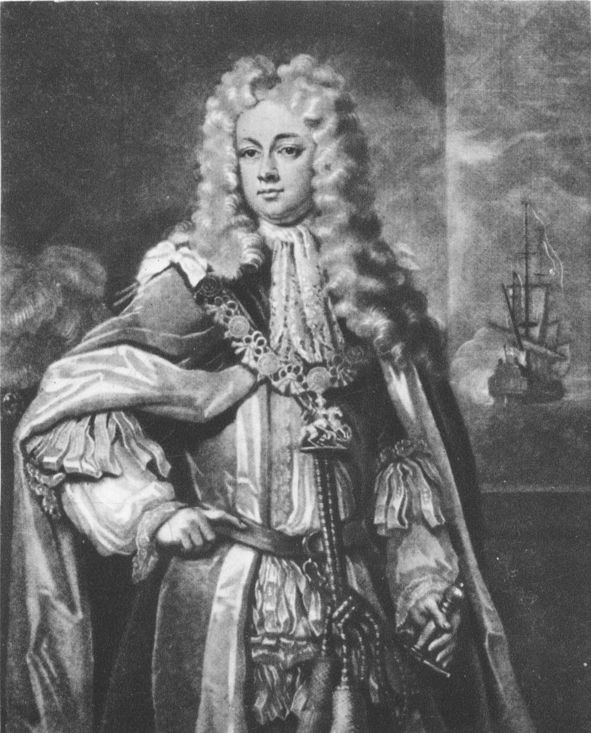
THOMAS WENTWORTH, THIRD EARL OF STRAFFORD
From an engraving after a painting by C. D. Agar
that since it was known all over the world what a firm and intimate friendship I had fostered with the Duke of Marlborough, now finding him in misfortune, I could not do otherwise than uphold my friendship with him, lest the world should say, and I leave it as an evil echo after me, that I deserted and abandoned a friend in his hour of sorrow and stress when fortune had forsaken him.[636]
He had thought of landing at Greenwich, but there was a large gathering awaiting him there. He hoped to land at the Tower, but the wharf was black with people; so he came on with the tide as far as the Whitehall Stairs, where no one expected him. He took “the first cab he saw,” and drove to Leicester House, the residence of the departed Gallas, which was still maintained to receive him. At Leicester House Marlborough was the first to visit him. They were long together. The next morning he was to see the Queen. St John had been very ready to “treat him chère entière.”[637] No doubt he would gladly have taken him round those houses of revelry which he used to frequent in company with the late lamented Guiscard. Such entertainment would certainly not have appealed to Eugene. But at least the Secretary of State conducted him in his own carriage to the Queen.
She gave me audience in her Cabinet, and I found her somewhat embarrassed and aloof. I explained to her briefly my mission, and finally asked her with which Minister I should converse. I noticed, however, that she must have been primed beforehand, for she gave me as answer that she had resolved that the business already known to me by secret information should be dealt with only in Holland, and she could not depart from this.[638]
The Prince observed that there were other matters besides, and especially the restoring of a perfect harmony between her Majesty and the Emperor. Anne was now being drawn beyond the limits of her Ministerial advice; so she said that her health would not enable her to see much of him, but her Ministers, meaning Oxford and St John, would hear all he had to say.
Eugene was two months in England. He paid several friendly visits to Ormonde at Richmond in the interests of the impending campaign, but his interviews with Ministers were rare. None visited him formally. They contrived to prevent the banquet which the City of London had wished to hold in his honour.[639] But nothing could deprive him of the admiration of all classes and both parties. His anterooms in Leicester House were so crowded with notables, some of whom came a hundred miles to see him, that the floors cracked under their weight. Crowds surrounded the house continuously, and followed him cheering when he walked abroad “in modest dress, very thoughtful or rêveur,” with “a way to toss his head on the right and the left to be seen of everybody.” When he went to the Opera with Marlborough the spectacle of “those venerable and respectfull men sitting in a box together” attracted the eyes of the audience much more than the actors. Even the “rabble which fills the upper gallery, and has always been very rude, stamping, bawling, singing, hissing and the like . . . when he came into his box gave three huzzas, were very silent during the action, and when the Prince went, they gave him three huzzas again.” On this Marlborough assured him that it was an honour as good “as a voley of canon or of small shot in others.”[640]
Portland, the son of king William’s confidant, gave a dinner in his new dining-hall “finished and furnished a purpose,” at which Marlborough, Devonshire, Godolphin, Sunderland, Townshend, and several ambassadors were present, and at which “no servant in livery was suffer’d to come and wayt, all that wayted were gentlemen that offer’d themselves, to have an occasion to see the feast.” The repast, which began at six, and was held to beat all records both for quality and quantity, was consumed to the ceaseless sound of trumpets and kettledrums, and the entertainment, followed by a ball, continued till five o’clock the next morning. Apparently neither Eugene nor Marlborough would dance. “I dont thinck,” writes Portland’s anonymous correspondent, “they could kick their heels like Nero or Louis XIV, . . . tho both have very handsomly kicked the Grand Monarch at the great balls of Blenheim, Ramelies, Turin and Blaregnies.”[641]
The only important official conference was at Dartmouth’s office on January 31. Eugene raised three points: the plan for the war in Spain, whether the Empire should attend the conference, and, thirdly, Gallas. On this last his instructions were humble. The Emperor could not withdraw an ambassador without either a breach or a formal leave-taking. At least this should be regularized by letter. In due course the Ministers replied that the Spanish campaign could only be settled at The Hague; that, of course, all the Allies should come to Utrecht; and as for Gallas, the Queen would not receive his letter. This, then, was all that resulted from the visit of Prince Eugene, which in the previous autumn might have changed the march of events.
Shortly after his arrival tidings had come from Spain. Starhemberg, who had been reputed to be finished, had won a considerable action under the walls of Cardona. The enemy had been repulsed with the loss of his whole artillery. This news made a stir. To Oxford and St John it was most unwelcome. These Ministers, in whose eyes the Allies were “the common enemy,” necessarily regarded a British and allied victory as a disaster. The Tory Party, while loyal to their leaders, had never reconciled themselves to the abandonment of the Spanish aim and catchword. Now it appeared the cause was not lost; perhaps we were winning after all. It was in this unfavourable atmosphere that the two ruling Ministers approached the formidable trial of strength involved in charging first Walpole and then Marlborough with peculation. This episode of domestic politics will be reserved for the next chapter. Both before and after it they laboured to raise the “ferment” they affected to deplore to the highest pitch.
During the month of February rumours ran rife in London that Prince Eugene and Marlborough were engaged in a plot to depose the Queen. Torcy gravely records in his memoirs how Eugene was to set London on fire, while Marlborough seized the person of the Queen. He safeguarded himself by the words, “It may be that those who tell these tales were ill-informed.” This monstrous story was spread about the capital, and every effort was made by the Government to create a mood of panic which should react in their favour, both upon their majority in the Commons and still more upon the nerves of Anne. At that time there was a set of rowdy, well-born young men who, reviving the memories of the Mohawks whose visit in a previous year has been mentioned, called themselves the Mohocks. These pampered ruffians indulged in various nocturnal escapades; some harmless pranks, others veritable outrages on public decency and order. This was all brought in to create the impression that anarchy and revolution were near. The guards about Kensington Palace were doubled, and cavalry posts were mounted at various points. Harley inflamed his colleagues by reading to them two alleged dispatches of Eugene’s, which he said he had intercepted in the post. In these were reported conversations which the Prince was said to have had with Marlborough and Bothmar, replete with references to deeds of violence. The guilty Ministers should, it was said, be ‘de-Witted’—a well-understood reference to the lynching of the de Witt’s at The Hague in 1672. “The destruction of a few worthless fellows now at the helm ought not to stand in competition with the Common Cause. . . . Yea, Bothmar said smiling that it were better that all at the helm were blown up in the air than that should suffer.” However, it was added, Count Sinzendorff had written to Prince Eugene “that in his opinion it would not be proper for him to stay here to see the execution of it.”[642] Such were the cruder versions spread about the town of what the Lord Treasurer unfolded to the Cabinet.
There was, of course, no shred of truth in all this rubbish. Eugene’s reports to the Emperor are preserved in the archives at Vienna, and are printed in the Feldzüge. They comprise dispatches written on the dates mentioned to the Cabinet by Oxford. They deal very candidly with English affairs and statesmen, but there is nothing to lend the slightest colour to the rumours of a revolutionary design. At this time the Government had made a speciality of opening the diplomatic correspondence leaving England, and the Lord Treasurer may well have had one of Eugene’s dispatches before him and doctored it to the form he required for his purposes. Eugene found much difficulty in communicating with Vienna through The Hague. Queen Anne’s Ministers had a much shorter route through the enemy’s lines. “The worst and greatest contretemps,” wrote Eugene (January 29), “is that the Ministry receive almost daily letters via Calais; thus they can know exactly what is happening at the Congress, while I, all the ambassadors, and the good party must remain robbed of news by contrary winds.”[643]
The lie was given to all this chatter and buzz of horrible plots to stimulate the faithful and delude the vulgar when the Queen summoned Eugene to her presence on her birthday, and presented him with a diamond-hilted sword valued at £4000. If Ministerial beliefs had been on a par with their whisperings they must have expected that he would draw it and plunge it into her breast. Nothing of the kind occurred. On the contrary, during his last days in England Oxford made remarkable overtures to Eugene. His methods were characteristic. He got into touch with him through a friend who knew a friend of the Prince’s, and by this devious channel arranged that he should visit Eugene up his backstairs in the dark of the night. His demeanour was most cordial, his two-hour talk discursive. But Harley had, as usual, a clear purpose behind his copious verbiage. He did not mean to make a personal enemy of Eugene, or let him leave the country with every contact broken. He exacted from the Prince a return visit. It was arranged with similar precautions, and proved equally sterile. “I entered his own house in the deepest secrecy,” wrote Eugene, “through a particular door which is usually kept locked. We talked together confidentially, but as there is nothing material to report, I need not go into details.”[644]
Two of Eugene’s rejoinders during his visit to London which went the rounds and have become well known are typical of the attitude which he consistently adopted. Burnet records that, he having mentioned to the Prince the remark of a Minister that Marlborough had “perhaps been once fortunate,” Eugene replied, “No greater tribute could be given him, since he was always successful.”[645] When at a dinner Oxford toasted him as “the greatest general of the age,” “If that be true,” said Eugene, “I owe it to your lordship.” Thus always did the famous Prince and warrior proclaim his friendship and admiration for his comrade of so many glorious days.
|
A comparative table showing the numbers of the English and Dutch forces in Flanders during the war is to be found among the Strafford Papers in the British Museum (Add. MSS. 22264, f. 67). It is as follows:
| |||||||||||||||||||||||||||||||||||||||||||||||||||||||||||||||||||||||
|
Swift, Journal to Stella, December 31, 1711. |
|
Ibid., January 1, 1712. |
|
Dispatches, v, 573. December 28 is the date given by Murray. Marlborough was not dismissed until December 31. It seems that the date has been wrongly transcribed. |
|
Ibid., 574. |
|
Ibid., 577. |
|
Dispatches, v, 578. |
|
Cadogan papers in private possession. No clue has been found to “Dear Judge.” |
|
Kane, pp. 101-102. |
|
Halswell letters in private possession. |
|
Bishop, pp. 235-236. |
|
Bishop, p. 266. |
|
Bolingbroke Correspondence, ii, 52. |
|
October 22; Bolingbroke Correspondence, i, 454. |
|
Lamberty, vi, 731. |
|
Feldzüge, Series II, v, App., 14. |
|
Bolingbroke Correspondence, ii, 56. |
|
Feldzüge, Series II, v, App., 14. |
|
Abel Boyer, Annals (1712), pp. 338-339. |
|
Willem III en Portland (edited by Japikse, 1928), ii, 713. |
|
Willem III en Portland, ii, 716. |
|
Bolingbroke Correspondence, ii, 147-148. |
|
Feldzüge, Series II, v, App., 46. |
|
Feldzüge, Series II, v, App., 87. |
|
Burnet, vi, 103. |
During Prince Eugene’s visit the Government continued their campaign of detraction against the late Ministry, and above all against Marlborough. Next in their animosity and fear stood Walpole. They knew they had struck down the great man of their day. It was only after some years that Harley and St John realized that they had incurred the implacable vengeance of the great man of the future.
The first report of the Commission of Accounts had been presented to Parliament before the Christmas adjournment. The Commissioners were still at their task. Evidence was tendered to them which revealed an impropriety committed by Walpole a year earlier, when he was Secretary-at-War. In a contract for forage not made by him but for which he was responsible two sums of £500 had been paid to one of his personal friends, a certain Robert Mann. There was no suggestion that Walpole himself had benefited by the money. He had merely endorsed the bills and sent them to Mann. The explanation was sufficient to clear Walpole of personal corruption; but it showed a want of delicacy and propriety against which public servants would nowadays be required to keep especially on their guard.
On the other hand, the facts were also capable of being presented in a manner most injurious to the competent, vigorous Leader of the Opposition, who was every day hitting the Government hard in the House of Commons, and whose able pamphlet The £35,000,000 Accounted For had demolished their case against their predecessors.[646] The Commissioners hastened to lay the facts before their party friends. Ministers did not decide their course without testing the opinion of their supporters. In this Bromley, the Speaker, who was, of course, elected as a partisan, was adviser. He convened a party meeting, and laid the facts before it. Many of the members did not think the case very good, and deemed it unfair to use it against the Leader of the Opposition. This opinion manifested itself strongly as the party discussion proceeded. But Bromley clinched matters by saying bluntly that unless Walpole were got out of the way it would not be possible for the Government to carry through their business. His knowledge was too great, his attacks too damaging. His exclusion was, he said, the unum necessarium. On this appeal it was decided to go to all lengths against Walpole.
Accordingly, on January 17 Walpole was heard in his defence, and thereafter it was moved that he was “guilty of a high breach of trust and notorious corruption.” An amendment was proposed to leave out the words “notorious corruption.” The House rejected this by 207 votes to 155. It was then moved to commit him to the Tower during the pleasure of the House. On this the Opposition moved that the House should adjourn. The Government majority fell to only twelve. A further motion “that the said Robert Walpole be for the said offence expelled from this House” was carried by twenty-two. These figures tell their own tale. A majority of twelve on the crucial division was a poor showing for a Government which had a normal majority of between 100 and 150. Walpole was accordingly arrested and sent to the Tower. His seat was declared vacant, and his mouth was stopped. To keep it stopped as long as possible in Parliament, the House was led to proceed by successive adjournments and did not technically rise until July. Walpole was thus imprisoned for nearly five months in the Tower.
His constituents stood by their member, and he was returned again while still in custody. Defoe, who had a year earlier visited Norfolk, mentions the strength of his influence in the Eastern counties: “Here I am in a land,” he had reported, “where the Queen’s writ does not run, but only that of King Walpole.” The House refused to admit Walpole on his re-election, and declared it void. They maintained their expulsion order during the whole Parliament. This was a great convenience to the Government. It also provided the precedents which were used in the Wilkes case fifty years later. Few even in the Tory Party considered Walpole at all affected in his honour. He was visited not only by the leading Whigs, and of course by Marlborough, but also by many other persons of consequence. His room in the Tower was more like the scene of a levee than a prison. The Ministers had gained their advantage in excluding their most dangerous antagonist from the House of Commons, but they were deeply concerned by the lack of support they had received from their own followers upon the critical division. It was resolved to take much greater care on the next occasion.
This was, of course, their attack upon Marlborough. Oxford and St John were by now alive to the difficulties of branding the champion of Britain in her age of glorious advance. For eight years in succession the House had passed its resolutions of thanks by overwhelming majorities and often unanimously. Every session delegations of its members had waited upon him to express their admiration and gratitude for his services. It was a sharp turn now, after he had been stripped of all office and was a private person, to inflict upon him by a purely party vote an insulting censure which sought to rank him with criminals.
There was another difficulty which affected the Cabinet internally. Brydges, Paymaster and Accountant-General, was, like most of the governing functionaries of that day, a Member of Parliament. No one could speak with greater authority on the issue. He had, indeed, a considerable personal responsibility. He had been attacked the year before in the first flush of the Tory election success. He had been defended by St John, now Leader of the Commons. St John, against the immediate interests of his party and for the sake of doing him justice or other motives, had vindicated Brydges, and pricked the bubble of “the £35,000,000 unaccounted for.” Brydges was therefore in an unassailable position. He was still Paymaster. He was working daily with Ministers. He let them know that he would justify Marlborough. It was not easy to foresee what the effect of his intervention would be.
There was nothing for it but, in Oxford’s phrase, “to use the gentlemen of England.” The question was how far these gentlemen would go. On the one hand, it was believed that by better whipping a good majority could be obtained. On the other, there was a desire to reach some compromise. Mr Speaker Bromley, acting now very much as his predecessor Oxford had done in previous Parliaments, measured up the forces. Proposals were made to Marlborough’s friends in the House that he should acquiesce in the report of the Commission, in which case the censures would be the mildest possible. On the other hand, if he resolved to defend himself and to oppose the Government it was hinted that severe measures would be taken. The ‘gentlemen’ would be used with vigour. Impeachment was their only weapon, for the Commons could not commit a peer to prison. That there was talk of impeachment is evident. Bromley’s letter to Oxford reveals these preliminary discussions.
January 21, 1711
I find nothing will satisfy, nor be taken to be falling gently, that shall go farther than to declare that in consideration of the General’s great services the House does not think fit to proceed upon the report. Voting the money on the contract for bread no perquisites, and that the 2½ per cent. is public money and ought to be accounted for, is what he will not hear of; for that is putting him into the power of his enemies, and he had rather lose his head. This shews he has great confidence in the solicitations that have been made, and I presume to acquaint your Lordship with it that due care (better care than last Thursday) may be taken to oblige the attendance of some, and to engage others on this occasion.[647]
There were personal negotiations.
Brydges to Marlborough
January 10, 1712
* I was this morning with Mr St Iohn whom I found concern’d upon his having heard Yr Grace intended to push for a Vote of Iustification in Parl. He thought it wd be looked upon as an attacking ye Ministry, wch wd engage many, who wd otherwise not appear against you to espouse their interest, & I find by him it will be very difficult to prevent a vote’s being carried that ye 2½ pr ct be deem’d publick money, Yr Grace having in effect, he sayd, own’d it in your letter to ye Commissrs to be such. He will have ye honour to discourse you upon it himself, & says if he does not see Yr Grace at his house to morrow before six in ye evening he’l wait upon you at yours.
Mr Sweet has sent me a letter to deliver the Commissioners of Accots wch I’l beg leave to show Y. G. first. The substance of it is that ye 2½ was left in his hands for Y. G. & that he knows nothing of any warrant or authority for deducting it, but took it always to be a free gift of ye troops.[648]
Evidently Marlborough was offered the resolutions which were afterwards passed by the House, with the threat of far worse if he resisted them. He refused point-blank. He was perhaps willing that the House should take note of the report and decline to act upon it because of his previous services. Nothing less than this would satisfy him. He would “rather lose his head.” Swift, who was in the swim with St John, wrote to Stella:
The Minister’s design is, that the Duke of Marlborough shall be censured as gently as possible, provided his friends will not make head to defend him, but if they do, it may end in some severer votes. A gentleman, who was just now with him, tells me he is much cast down, and fallen away; but he is positive, if he has but ten friends in the House, that they shall defend him to the utmost, and endeavour to prevent the least censure upon him, which I think cannot be, since the bribery is manifest. Sir Solomon Medina paid him six thousand pounds a year to have the employment of providing bread for the army, and the Duke owns it in his letter to the Commissioners of Accounts.[649]
Somers, under King William, when impeached for his share in the Partition Treaties of 1700, had appeared at the bar of the Commons, and by his eloquence and his facts had converted the assembly. Marlborough had been inclined to follow this precedent, but his friends, including certainly Godolphin, dissuaded him. Passions ran too high. The life of the Government was at stake. Every effort had been made to bring up their reserves. He would only court a greater humiliation by pleading in person before a tribunal bound in self-preservation to proclaim the kind of view which Swift had expressed. He therefore, with Godolphin’s assistance, prepared a statement covering every point in the charges in the Commissioners’ report. This was no doubt in the hands of his friends, but was not published till some time after.
As this matter affects Marlborough so deeply it is better to record its principal features in his own words:
The first Article in the Report is founded upon the deposition of Sir Solomon de Medina, by which you are informed of a yearly sum paid by him and his predecessor, contractors for Bread and Bread-waggons, to myself. This payment in my letter I have called a perquisite of the general or commander-in-chief in the Low Countries; and it has been constantly applied to one of the most important parts of the service there, I mean the procuring intelligence, and other secret service. . . .
The commissioners are pleased to observe that these sums cannot be esteemed legal perquisites because they do not find them claimed or received by any other English general in the Low Countries. But I must take leave to affirm to this house, that this perquisite or payment has been allowed to the general or commander in chief in the Low Countries both before and ever since the Revolution, to enable him to carry on such secret services. The like allowance was made to prince Waldeck, whilst he was general of the Dutch army in Flanders; it was made during the last war as well as this. . . .
The Report may have observed very rightly, that, by the strictest inquiry the commissioners could make, they cannot find that any English general ever received this perquisite. But I presume to say, the reason is, that there was never any other English general besides myself who was commander-in-chief in the Low Countries. I crave leave then to say, that this observation in the Report, was occasioned through want of due information in the usage of the army. In receiving this as an established and known perquisite, I have followed and kept up that usage, which I found in the army, when I first entered upon that service; and upon this ground alone I hope that this House will not think that I was unwarranted in taking it.
. . . This allowance to the general can have no influence upon the contract itself, which is actually made and signed at the Treasury, and the price regulated by what the States have agreed to pay for the bread for their forces. I appeal to all the officers who have served with me in Flanders, whether the forces in her majesty’s pay have not all along had as much, and as good bread as those of the States, and at the same prices; which everybody will believe to be the lowest that considers the frugal economy of the States, and the small pay of their troops. And therefore I may safely conclude, that if the English have had their bread as cheap as the Dutch, they have had it as cheap as was possible. Nor indeed can it be imagined to be otherwise; for the very supposition of two different prices, paid by different troops in the same army, for the same quantity of bread, would occasion a mutiny. But this whole affair has been so regulated, and there has been so little occasion for complaint, that it is well known our army in Flanders has been duly supplied with bread during the whole war, and has received it with an exactness that will be hardly thought consistent with the secrecy, and suddenness of some of the motions [movements] that have been made.
Now as to the second Article in the Report allow me to observe to you, that it has arisen only from the information I myself gave the commissioners by my letter to them; this matter having relation to that part of the service to which the sums in the former article have been applied; that the Commissioners might have a true state of it, I chose to insert a short Account of it in my letter to them. If I did this voluntarily out of duty to the public, I hope I shall be thought to have given you information upon a certain belief, and I was altogether blameless in the part I have had in it. It will be necessary that I trouble the House with an Account of the time and occasion whence this payment of 2½ per cent. by the foreign troops, commenced. During the last war, the allowances by parliament for the contingencies of the army, of which that of secret service is the principal, was £50,000 per ann. But this allowance fell so far short of the expense on that head, that upon the prospect of this war’s breaking out, the late king assured him [calculated], that this last part of the service never cost him less than £70,000 per ann. However, the allowance of parliament for the whole contingent service during this war has been but £10,000 per annum, £3000 of which or thereabouts has generally gone for other contingencies than that of intelligence. The late king, being unwilling to come to parliament for more money, on that head of the service, proposed this allowance from the foreign troops, as an expedient to assist that part of the service, and commanded me to make the proposition to them; which I did accordingly, and it was readily consented to. By this means a new fund of about £15,000 per annum was provided for carrying on the secret service, without any expense to the public, or grievance to the troops from whom the allowance was made. . . .
This expedient being formed in the manner I have shewn, her majesty was pleased to approve it by her warrant, . . . [which] was countersigned by the secretary of state whose province it belonged to, as the only proper officer. . . .
The true design of this deduction being to supply the secret service, gentlemen, I hope you will observe, that this, together with the sum on the former article of the allowance by parliament, when put together, doth fall short of the allowance given by parliament in the last war upon this head. . . .
I cannot suppose that I need to say how essential a part of the service this is, that no war can be conducted successfully, without early and good intelligence, and that such advices cannot be had but at a very great expense. Nobody can be ignorant of this, that knows anything of secret correspondence or considers the numbers of persons that must be employed in it, the great hazard they undergo, the variety of places in which the correspondence must be kept, and the constant necessity there is of supporting and feeding this service; not to mention some extraordinary expenses of a higher nature, which ought only to be hinted at. And I affirm, that whatever sums have been received on this account, have been constantly employed in procuring intelligence, in keeping correspondence, and other secret service. . . . And though the merit of our successes should be least of all attributed to the general, the many successful actions, such as have surpassed our own hopes, or the apprehensions of the enemy, in this present war in Flanders, to which our constant good intelligence has greatly contributed, must convince every gentleman, that such advices have been obtained, and consequently that this money has been rightly applied. . . .
Having given this full and faithful account of the rise and use of this deduction, it must, I flatter myself, appear to everybody that hears me, to have been a real service, as well as saving of money to the public. And though honour is due to the memory of the late king, who formed this expedient, and to her majesty, who approved of it, by her warrant, I cannot, upon this ground, apprehend any imputation to myself, who have pursued this, so much to the advantage of my country. . . .
Upon the whole matter, I cannot but hope this House will find reason to be satisfied with this part of my conduct; and I think it no ill service, that so necessary and important a part of the war, and which has turned to so good an account, has been managed with so little expense to the public; and I may, with the greatest certainty, assure them that all other parts of the service have been carried on with all the good husbandry that was possible. And I believe I may venture to affirm that I have in the article for Secret Services saved the government near four times the sum this deduction amounts to. Which I must reckon so much money saved to the public.[650]
The debate was fierce and solemn. The Members felt that in striking at Marlborough they were striking at the new greatness of their country. On the other hand, what would happen to their party if they did not strike home? But the defence was solid. Sir John Germaine, speaking from the bar, declared that he had served in the Low Countries under Prince Waldeck, and that that General had, as Marlborough declared, received the same perquisites and allowances for the purpose of military intelligence and Secret Service. Sir Charles Hedges, the Tory Secretary of State, who ten years before had countersigned the Queen’s warrant under which Marlborough received the 2½ per cent., stood by his action and absolved the former Commander-in-Chief of all impropriety. There was no dispute about the warrant. Then up rose Brydges. No report of his speech is contained in the Parliamentary History, but Hoffmann’s dispatch, unearthed by Klopp, shows that Brydges was particularly vigorous in emphasizing that the British people owed the information services to the careful expenditure of this money, and in consequence the Army had never been surprised. Brydges dared to say “that the proceedings were a scandal to the British people.”[651]
On the other side St John, Wyndham, Hanmer, and Edward Harley urged the infliction of the censure. Not only Whigs, but moderate Tories spoke on Marlborough’s side. The House was full to overflowing. No fewer than 435 Members took part in the division, and it was carried by a majority of 276 against 165 that “the taking of several sums of money annually by the Duke of Marlborough from the contractor for foraging the bread and bread wagons in the Low Countries was unwarrantable and illegal.” The Government, refusing a motion for adjournment which was moved by the Opposition, also carried “that the deduction of 2½ per cent. from the pay of the foreign troops in her Majesty’s service is public money, and ought to be accounted for.” On the two heads the sums involved were computed to amount to between £170,000 and £250,000. It remains only to be mentioned that Cardonnel’s petty perquisite of 500 ducats, for which there was no excuse but custom, was made the ground for expelling him from the House, and that Mr Sweet, although it was proved that his deduction of 1 per cent. was likewise a customary fee to the Paymaster of the Forces, was ordered to be prosecuted.
Thus the Ministry triumphed, and Marlborough’s name was tarnished in history by this cruel, false, and ungrateful censure. The Queen said in her reply to the address communicating the resolution, “I have a great regard for whatever is presented to me by my Commons, and will do my part to redress whatever you complain of.” Brydges was so disgusted that he offered his resignation to Oxford, and was only with difficulty persuaded to continue in his key-office.[652]
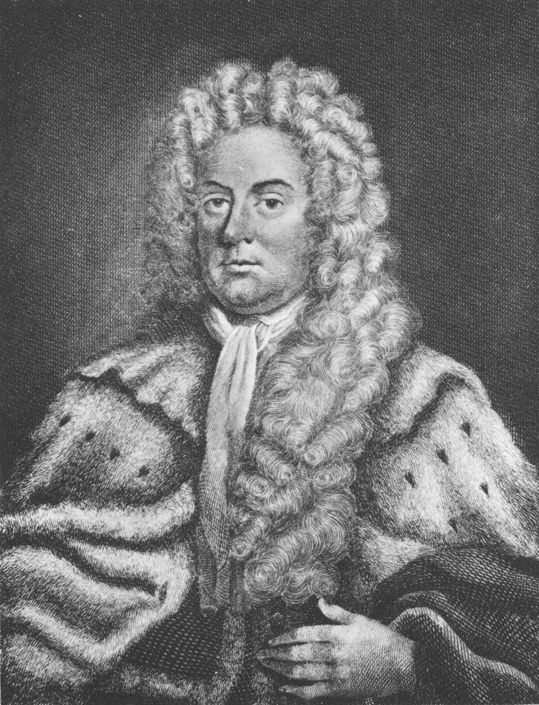
JAMES BRYDGES, FIRST DUKE OF CHANDOS
From an engraving after a portrait by Michael Dahl
It would have been natural after such resolutions for the Commons to impeach Marlborough at the bar of the Lords. However, no further steps were taken. One reason at least is obvious. The Duke of Ormonde was now Commander-in-Chief. The Ministers who had just obtained a party verdict against Marlborough authorized Ormonde to draw the same deduction upon the bread contract and bread wagons, and to receive the same 2½ per cent. on the pay of the foreign troops, and to use it for the same purposes as Marlborough had done. Thus, while inducing the House of Commons to condemn his practice, they themselves vindicated him by adopting it.[653]
There is one final refutation of these charges, which has never yet been published. A year later at Utrecht in long procession the Princes and Courts of the Grand Alliance recorded their full approval of the deduction of the 2½ per cent., declared that it was their own money, and that it had been spent to their entire satisfaction.
The Electors of Cassel and Düsseldorf sent identical letters:
* Although we agreed entirely that this deduction of 2½ per cent. for the Secret Services had been granted without expecting any rendering of account, the nature of the business demanding it, nevertheless we admit that we are fully satisfied and convinced that the said money has been disposed of for the above purposes, and we should think it an injury to the reputation of this great General if we did not declare that his prudent and wise handling of these sums has principally contributed, after the Grace of God, to the gain of so many glorious victories, and to the surprising successes which have accompanied the armies of the Allies during the whole course of this long war.
And in order that a complete and full justice may be done from our side, we have to bear witness that we granted and accorded voluntarily the said 2½ per cent. to the said Duke of Marlborough for the above purposes and without the rendering of account.[654]
Dalwigh, Counsellor of State and plenipotentiary of the Landgrave of Hesse, stated to the Peace Congress:
* I have paid from the amount received for the troops of his Most Serene Highness in the service of her Majesty the Queen of Great Britain 2½ per cent. to the Prince and Duke of Marlborough. But I declare at the same time that this has been paid upon the initiative of his Serene Highness my master himself in consideration of the great services which his Highness my lord Prince and Duke has rendered to the Common Cause in general, and to his Highness and his troops in particular. And thus Mr Sweet has never demanded it by order of the Queen, or of anyone else, not having even the right to do so, this being contrary to the treaties made concerning the said troops.[655]
The Elector of Hanover was even more emphatic:
* Since we feel obliged to bear witness to the truth on the subject of the 2½ per cent. which has been deducted during the war from the pay of the troops which we have had in the service of her Majesty the Queen of Great Britain in the Low Countries: We declare and affirm by this present document that we have voluntarily accorded this sum as a free gift to the Prince and Duke of Marlborough in the quality of General Commander-in-Chief of the Allies. The fact that the other generals in command of allied armies have enjoyed similar gratuities has led to the practice of employing the said 2½ per cent. for the most part in Secret Service work for which one is informed no other provision has been made.
Moreover, we declare that we are fully convinced and satisfied that the Prince Duke of Marlborough has annually applied these sums to the Secret Services according to their destination, and we are persuaded that his wise application of these amounts has forcibly contributed to the gaining of so many battles, to the passing of so many entrenchments and so many lines, successes which, after the blessing of God, are due in great part to the good intelligence and information which the said Prince has had of the movements and condition of the enemy. . . .
George Lewis
Electeur[656]
It is to be noticed that these testimonies were recorded when Marlborough had fallen from power and was only a wanderer on the Continent. They were solemnly presented by the allied princes and states to the Peace Congress as an act of justice and as a salute to the General who had served them well.
Professor G. M. Trevelyan has declared that no one ever gave better value to England than Marlborough for every guinea he received. But this is not the point at issue. No single charge of corruption or malversation was ever proved against Marlborough, and the charges on which he was condemned were manifestly disproved. For two years all the malice of a triumphant faction and all the power of the Crown were remorselessly used to make a case against him. The Commission of Accounts ransacked the records of the Army in the confident expectation of finding that he had been accustomed to take a profit upon sales of commissions by officers to their successors, or on promotions to replace officers killed in action. This was one of the libels blatantly proclaimed against him by the Tory pamphleteers. It touched his conduct not only as Captain-General but as Colonel of the Guards. It is incredible that if such abuses had occurred they would not have been brought to light. Any officer who would come forward with a complaint would have been sure of favour from the ruling powers. Marlborough’s Whig friends were anxious about this, but no single jot of evidence was found against him in all those long ten years of command. “Few,” wrote Burnet, “thought that he had been so clear in that matter; for it was the only thing in which now his enemies were confident that some discoveries would have been made to his prejudice; so that the endeavours used to search into these matters proved nothing, but raised the repute of his incorrupt administration more than all his well-wishers could have expected. Thus happy does sometimes the malice of an enemy prove.”[657]
But the Tory lie stands upon the journals of the House of Commons. Marlborough’s answers and the failure of his accusers did not bar a scandalous prosecution being set on foot against him for the recovery of all these sums expended so well in the British interests. Nor could they prevent a sneer or a smear remaining on the pages of history, and successive generations being content with the loose impression that there was something dishonest in Marlborough’s conduct.
Marlborough was careful and thrifty in all he did. He saved money for himself and the public every week. His strictness about the funds, public and private, under his control descended to the smallest details. In a lavish and corrupt age he practised a severe, businesslike economy. He would take presents from the princes of the Alliance, and might even in the event of a peace and in certain circumstances have accepted the rewards of Louis XIV himself for services which were not incompatible with the interests of England. No doubt when, in the occupation of conquered territory, ‘safeguards’ were granted to individual owners, he took these payments as a kind of prize money. But where public money was concerned his record is impeccable. He is entitled to claim from his countrymen the declaration that he acted with strict integrity and according to his warrant in the administration of all Army funds entrusted to him. If this be challenged, let the contrary case be made.
|
Walpole’s two pamphlets in defence of Whig financial administration are published in Boyer’s Annals, p. 25. |
|
Portland Papers, H.M.C., v, 139. |
|
Stowe, 57, vol. vi, pp. 152-153; Huntington Library, California. |
|
Journal to Stella, January 23. |
|
Parliamentary History, vi, 1088. |
|
Hoffmann, February 5; Klopp, xiv, 254. “Marlborough’s friends,” reported Hoffmann, “are of the opinion that he cannot be got at by lawful means, and that the whole charge against him is only intended to blacken him in the eyes of the nation and justify his removal.” |
|
Huntington Library Bulletin, November 11, 1931, p. 124. |
|
Burnet, vi, 104. |
|
March 13, 1713; Blenheim MSS. |
|
January 18, 1713; Blenheim MSS. |
|
Hanover, January 13, 1713. See also Marlborough Papers, H.M.C., p. 16(a), for letter of March 23. Similar unpublished letters from the Bishop of Paderborn and Münster (January 7, 1713), from the dragoon regiment commanded by Baron de Waleff (March 9, 1713), and from the envoy of the Elector of Trèves at Utrecht (January 18, 1713) are also preserved in the Blenheim archives. |
|
Burnet, vi, 104-105. |
The Tories were now triumphant at home, and on January 29, 1712, their plenipotentiaries, the Bishop of Bristol and Lord Strafford, together with representatives of Holland and the Empire, met the French in conference at Utrecht. None of the Allies knew what secret understandings subsisted between England and France, but when the Marquis d’Huxelles announced the French proposals these were denounced at once as treating the allies of England as if they were vanquished states. The unconditional retention of Spain and the Indies by Philip V was claimed by the French to be finally settled. The rest of the French demands affronted the Dutch, the Germanic Princes, and the Empire. English interests alone were privileged. The anger of the Allies knew no bounds, and in England outside the Court circle widespread wrath was mingled with wider shame. In the Commons the ‘gentlemen’ “stood by the Queen”; but in the Lords Halifax, in spite of the recent wholesale creation of peers, carried an address to continue the war rather than submit to such terms. This “ill-usage of the Queen” by war-loving factions in factious defiance of her Ministers, as St John viewed it, absolved him in his own opinion from all inconvenient obligations. He and Oxford began forthwith to negotiate a peace treaty with the French, the signature of which would bind the allies or leave them to their fate.
At this moment there occurred in the French royal family a remarkable, and many believed a sinister, series of deaths. The Dauphin, son of Louis XIV, who had played so vigorous a part in breaking the negotiations of 1709, had expired in April 1711, leaving behind him, besides his younger sons (the Dukes of Anjou and Berri), a son and two grandsons, all of whom stood in the direct line of succession to the throne of France, and constituted an immense barrier of probability against the succession of Philip V and the union of the two crowns in a single person. Now, in February 1712, this barrier was almost shorn away. The sequence was amazing.
On February 12 the Duchess of Burgundy, daughter of Victor Amadeus and wife of the new Dauphin, died of smallpox. Four days later her husband, the Dauphin, fell ill. He immediately predisposed himself to death. The next evening he had an altar erected in his sick chamber and received the last succours of the Church. On the 18th he died. Thus there passed from France the amiable Prince who had been the pupil of Fénelon, had muddled with Vendôme the battle of Oudenarde, and was wistfully regarded as the virtuous hope of the French monarchy. The couple who had been so swiftly swept away left behind them two little boys, the elder of whom, five years old, became the third Dauphin in twelve months. The younger was only two years old and very sickly. Both these children were immediately stricken with the malady which had destroyed their parents. It would be natural to suppose that the wife had given the dreaded infection to her husband, and that the children had caught it from them. But when the third Dauphin died in a few days of this scourge the rumour of poison grew, and suspicion against their cousin, the Duke of Orleans, nephew of Louis XIV, was so strong that the King imprisoned Orleans’ chemist in the Bastille. It is even said that the Duke of Orleans himself suggested this. Modern opinion may feel that the chemist was ill-used.
Only the sickly and infected infant, aged two, now lay between the personal union of the crowns of France and Spain. His own escape is worth recording. In the words of the Duchess of Orleans,[658] the mother of the suspected Duke,
When the little Dauphin became quite red with the smallpox and sweated, the doctors opened a vein, and in consequence of this operation the poor child died. . . . His little brother had exactly the same illness. While the nine doctors were busy with the elder child, the nurses locked themselves in with the younger prince. Yesterday, the 9th, the doctors wanted to open a vein because the child had severe fever; but the governess, Madame de Ventadour, and her deputy, strongly opposed this, and steadfastly refused to permit it, and only kept him nice and warm. So this child was saved[659]
—to become eventually Louis XV.
In a period when the affairs of the world were largely swayed by dynastic events this strange succession of deaths upon the main highroad of European history paralysed France and staggered all other countries. One could hardly follow the succession of blows, and as the couriers arrived with their tidings at every capital the general conclusion, for which no proof has ever been advanced, was that Orleans had poisoned the whole lot. It was even reported that the aged monarch was himself a victim.
Nothing could be more embarrassing to Oxford and St John than these deaths in France. The French royal family, with whom they were in deep confederacy, had virtually disintegrated before their eyes. The security against the union of the two crowns, which they had so confidently paraded in the persons of the Duke of Burgundy and his two sons, had almost vanished. Whatever virtue there had been in a French declaration that the Crowns should never be combined seemed to have been destroyed beforehand by the most inexorable of facts.[660]
As no one expected the infant Prince to live, and as even the Tories could not stomach the union, imminent as it appeared, of the Crowns of France and Spain in the person of Philip V, the English Ministers proposed that Philip should renounce the throne of France for himself and his heirs. But now the French lawyers affirmed that such a declaration was contrary to the principle of the French monarchy and was necessarily invalid. St John and Oxford then proposed that Philip V should renounce the throne of Spain on accession to that of France, in which case France would receive compensation in Italy, and Spain would fall to the Duke of Savoy. The advantages offered to France in Italy were so substantial that Louis XIV agreed that the proposal should be made to Philip. The concession cost him little. It captivated the English Ministers, who saw themselves suddenly within reach of diverting Spain and the Indies from the house of Bourbon and vindicating after all the “No peace without Spain” cry, thus completely cutting the ground from under the Whigs. On May 28, while the messengers were riding to Madrid, Oxford told the Lords that peace upon these lines was near. But a new surprise was in store. Philip V chose at all costs to retain the crown of Spain, which he had gained with his sword and with the love of the Spanish people through so many cruel years of war. All solutions were therefore destroyed, and Europe was confronted with the double deadlock which perhaps Louis XIV had foreseen—that Philip could not renounce the crown of France and would not renounce the crown of Spain. Upon this all the Allies called for the renewal of the war. No basis of peace, no treaty of any kind, was in sight. The armies were, in fact, already assembling, and such was the feeling in England that the Ministry ordered the Duke of Ormonde and the British forces to join them. Thus the only result of the Tory peace effort and intrigue with France, for the sake of which they had supplanted Marlborough and Godolphin and rendered their country odious to all its allies, had been to condemn all Europe to two more campaigns.
Ormonde reached The Hague on April 9, and assumed command of the British-paid forces, all of which, with the rest of the allies, were now marching to the points of assembly. Ormonde’s orders were to see the Pensionary and
express to him the Queen’s resolution of pushing the war with all possible vigour, until the enemy should agree to such terms of peace as might be safe and honourable for herself and her allies; to assure him that he was prepared to live in a perfect and good correspondence with all the generals of the Allies, and particularly with those of the States; to desire the Pensionary to inform him what plan had been agreed upon for the operations of the campaign; and as soon as he arrived at the frontier, to meet with Prince Eugene, and such others of the generals as should be in the secret, and with them to concert the proper measures for entering upon action.[661]
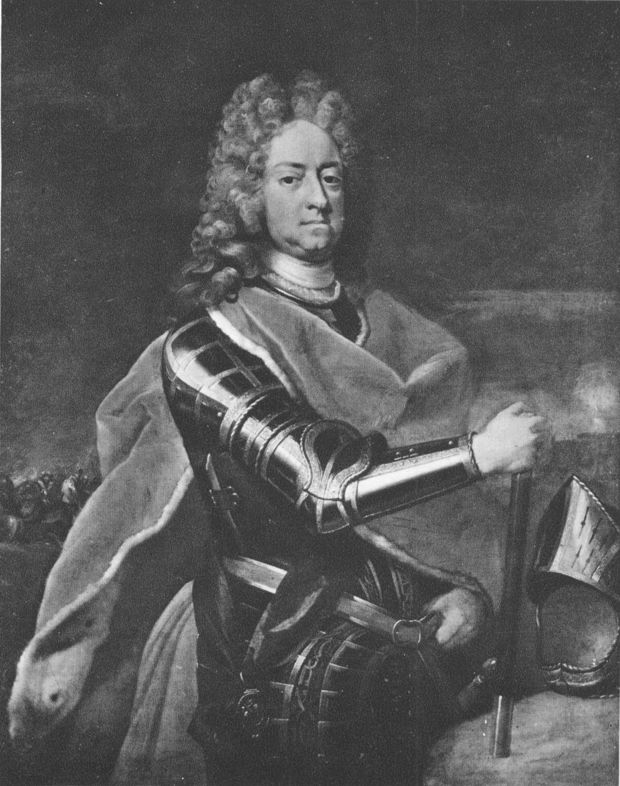
JAMES BUTLER, SECOND DUKE OF ORMONDE
Michael Dahl
National Portrait Gallery
To these forthcoming declarations the Dutch Council of State replied with some stiffness:
That there was no particular resolution taken as to the operations of the campaign, but they left it to their generals, who with their deputies were to act in concert with the generals of the Allies: and that they had given orders to their generals to live in a good correspondence with his Grace.[662]
The Dutch and other allies excused themselves to Ormonde for having made Prince Eugene Generalissimo. They explained that in practice Ormonde and the Prince were now “upon an equal foot.” Cadogan, though excluded from the list of lieutenant-generals, offered—no doubt at Marlborough’s desire—his services to the new Commander-in-Chief, who was allowed by the Government to accept them. The allied army, concentrating beyond Tournai, amounted to 122,000 men, with 120 field cannon, apart from the siege-train. Against them stood Villars with 100,000 men, ill-equipped and with a weak artillery.[663] When on May 17 Ormonde met Eugene at Tournai the physical ascendancy of the Allies was evident, and the purely military prospects bright. It was agreed to pass the Scheldt behind Bouchain, and to advance towards the enemy, either to attack him if he were ill posted or to lay siege to Quesnoy, a small but effective fortress ten miles south of Valenciennes.
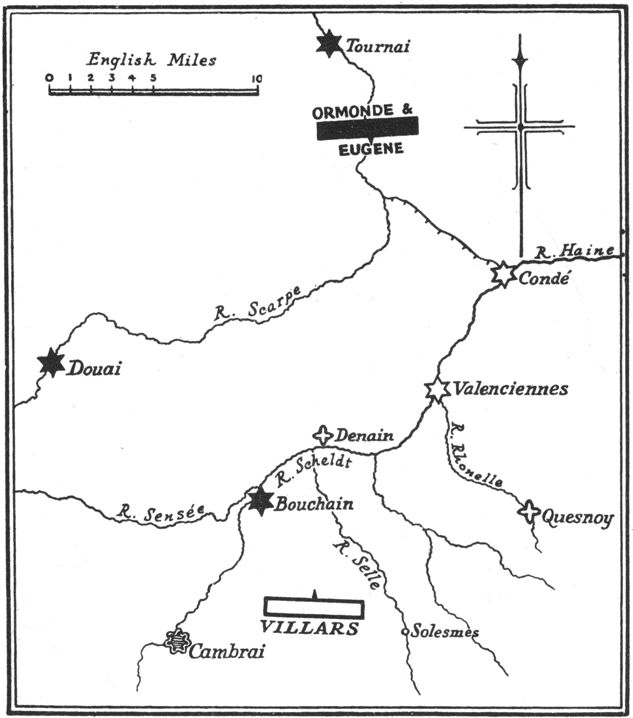
MAY 1712
Ormonde had thus been enabled to take the field in favourable conditions and upon honourable terms. Only a few days before Eugene had recorded his opinion that he was “the finest cavalier and most complete gentleman that England bred, being the glory of his nation.”[664] But already St John had begun to make him aware of the purposes for which he was to be used. On April 16/27 he wrote:
I find by very certain intelligences from Holland that the Dutch Ministers are not without their fears of their new General [Prince Eugene]. They begin to consider that he is a Papist, and a German, at least in interest. That the Emperor, his master, has nothing to lose on the side of the Netherlands; that a battle won may give ground for insisting on higher terms than the House of Austria is now likely to obtain; that a battle lost may still contribute to prolong the war, and that in either case, the expense of blood will fall to the share of the Queen and States. I am of opinion that these reflections have occasioned private directions to their [the Dutch] General, to use more caution than the Prince will perhaps approve. This measure, your Grace sees, is not very consistent with the compliment made him, . . . in the name of the States, of an unlimited command. We hardly think the enemy would have taken the posts in which they now are, if they had not had a prospect of subsisting in them, till there is forage on the ground.[665]
Thus nicely did the Secretary labour to sow distrust between Ormonde and Eugene and prevent active operations.
On April 25/May 6 St John wrote again desiring Ormonde to make sure that all the foreign troops paid by Britain should be kept under Ormonde’s direct command—i.e. not merged with the similar mercenary forces in the Dutch pay:
There can be no need for me to enter into the grounds which we have in this conjuncture to be jealous of Prince Eugene’s conduct; your Grace sees and knows them all better than I can repeat them. But on this occasion the Queen directs me to inform your Grace that she thinks you are to be more cautious for some time of engaging in an action, unless in the case of a very apparent and considerable advantage, because you will be daily strengthened by the arrival of the Imperial troops. It is but just that these should have their part, if anything of that kind is to happen.[666]
In reply to this Ormonde reminded the Minister that in his instructions he “was ordered to act in conjunction with the Allies, in prosecuting the war with vigour; so that, should there happen a fair opportunity to attack the enemy, he could not decline it, if proposed by the Prince and States.” And a few days later: “If there be a good opportunity to attack the enemy, and get into France, by the way of Champagne, I am sure the Prince and the States will press it, unless they hear from England that the peace is near being concluded.”
The armies were now in presence of one another, and on May 10/21 St John wrote the following letter to Ormonde:
Her Majesty, my Lord, has reason to believe that we shall come to an agreement upon the great article of the union of the two monarchies, as soon as a courier, sent from Versailles to Madrid, can return; it is therefore the Queen’s positive command to your Grace that you avoid engaging in any siege, or hazarding a battle, till you have farther orders from her Majesty. I am, at the same time, directed to let your Grace know that the Queen would have you disguise the receipt of this order, and her Majesty thinks that you cannot want pretences for conducting yourself so as to answer her ends, without owning that which might, at present, have an ill effect if it was publicly known.
This was the notorious restraining order which later formed the principal article in St John’s impeachment. But the postscript is not less remarkable:
P.S. I had almost forgot to tell your Grace that communication is given of this order to the Court of France; so that if the Mareschal de Villars takes, in any private way, notice of it to you, your Grace will answer accordingly. If this order is changed on either side, we shall, in honour, be obliged to give notice of it to the other.[667]
To Gaultier St John was even more explicit. “I asked Mr St John,” wrote Gaultier to Torcy (May 21), “what Marshal Villars should do if by chance Prince Eugene and the Dutch attempted some offensive. He answered that there would be nothing to be done but to fall upon him and cut him to pieces, him and his army.”[668]
It would have been a grievous, though a permissible, measure to tell Eugene, the States-General, and other members of the Alliance that the British forces would not fight until the peace treaty was settled one way or the other. But for an English Minister, acting in the name of the Queen, to conceal from the Allies his intention, while disclosing it secretly to the enemy, was in fact to encompass the defeat of Eugene and the slaughter of the allies and comrades with whom the British troops had so long stood shoulder to shoulder. Nothing in the history of civilized peoples has surpassed this black treachery. The punishment meted out in after-years by their countrymen to the criminals concerned may lighten, but cannot efface, its indelible stain.
Ormonde, so popular and magnificent, so gallant in his youth, now showed himself the weak, base creature he was at heart. With his eyes open he lent himself to this shame; and it was no thanks to him that Eugene and the allied generals to whom Ormonde was bound in soldierly faith did not in fact suffer the fate wickedly contemplated by St John. But the Prince, who had so much experience of war and treachery, was vigilant; and the Dutch, fortunately for themselves, were wary. It was noticed that Villars, although but a league away from the superior confederate army, took no trouble to entrench his camp, and sent out no reconnaissances to test the strength of the allied forces. He lay as if to invite attack. He might well do this, for, according to St John’s assurances through Gaultier and Torcy, as well as from the communications he had directly with Ormonde, he had a right to suppose that not only the redcoats but all the British-paid forces, numbering between forty and fifty thousand men, or nearly half Eugene’s army, would desert at the moment of battle, and leave the rest an easy prey—in St John’s words, to be “cut to pieces.”
The apparent imprudence of so capable a general redoubled the suspicions of the allies. Eugene resolved to put Ormonde to the test. The Duke, though consenting to dishonour, was no adept in deceit. He failed at once as hero and as cheat. He could not meet Eugene and the allied generals as guests at his table without revealing his embarrassment. He could not withstand the hard questions which the Dutch Deputies asked in formal interviews. When a reconnaissance in force showed that the French army, only four miles away across a plain, lay without entrenchments of any kind, and Eugene, supported by all technical opinion, had proposed an advance and a battle, he wrote pitifully to the Secretary of State (May 29):
You may easily imagine the difficulty that I was under to excuse the delaying a matter, which, according to the informations I had from the quarter-masters-general, and several other general-officers, that went out with the detachment, seemed to be so practicable. The best excuse I could make was Lord Strafford’s sudden voyage to England, which gave me reason to believe there must be something of consequence transacting, which a delay of four or five days would bring to light: and therefore I desired they would defer this undertaking, or any other, till I should receive fresh letters from England.[669]
But when he made this answer in the camp Prince Eugene and the Dutch Deputies told him plainly “that his answer was agreeable to the suspicions they had for some time entertained, particularly since the express of the 24th, which they knew had brought him letters from England.” Ormonde could only keep on saying “that before he entered upon action, he should be glad to receive letters from England, which he expected every moment.” In this plight the affairs of the confederate army remained for several days. When on June 7 the expected letter from St John came it only expressed “the impatience her Majesty was in to hear whether the orders, sent on May 10, came safely and early to his hands, and the assurance she had of his punctual obedience to her commands in so nice and important a conjuncture.” Ormonde had already described to St John the distrust among the allies by which he was encompassed. Now he struck a note new to the Secretary:
There are several among them who do not hesitate to say aloud that they have been betrayed. I am afraid that if the conclusion of peace is postponed, I shall find myself Commander only of the British national troops. I am strengthened in this fear by the fact that the Elector of Hanover is strongly opposed to the peace, and will let his troops serve with the Dutch. I am also doubtful whether we can win over the Danes.[670]
He ended with a belated and irresolute suggestion:
You may guess how uneasy a situation I am in; and, if there be no prospect of action, I do not see of what use I am here; and, if it suit with her Majesty’s service, I should be glad I might have leave to return to England.
He did not know how far men’s minds had travelled upon the frenzy of despair which convulsed the councils at The Hague—councils secret now from those deemed “the English traitors.” It was, in fact, seriously planned to disarm and arrest the twelve thousand British troops in Flanders. The famous redcoats whose martial honour stood so high in those professional camps were to be seized as hostages against the faithlessness of their Government. Primoli[671] reported to Gallas from The Hague on June 7:
Welderen and Hop have set out for the army. It appears they have the intention of disarming the English. If one can win over the rulers of Hanover and Denmark, it is certain one would carry this out. Only Prussia is frightened of this. My view is that such a blow would have a very good effect in London. They are so blinded at the moment there by the duplicities of the Ministry that they do not see through their intrigues. The enclosed letters directed to me from London full of questions prove this. If this were done they would then become aware of the treachery which these Ministers are plotting equally against the common welfare of the Alliance as against the real interest of England.[672]
This desperate project, hitherto recorded only in Continental histories, fortunately came to naught. That it was known to St John is shown by a sentence in his letter to Harley of this same date: “Some are even saucy enough to insinuate so far as to attempt seizing the British troops in Flanders.”[673] To such a point had the Queen and her new friends brought the Common Cause.
Rumours of the deadlock at headquarters travelled far and fast. Even “the gentlemen of England” were upset at the idea of a British Commander-in-Chief standing in the line with his allies but forbidden to give them true aid and succour. On May 28/June 8 Halifax brought the whole business before the Lords. He recounted the memorable victories of the Allies which had brought the “common enemy” of Christendom to extremities. He declared these prospects totally defaced by the orders given to the Queen’s General not to act offensively against the enemy. On this there was much questioning of the Government whether in fact any restraining orders had been given to Ormonde. The Lord Treasurer said
that they who had the honour to serve the Queen could not reveal the orders she gave to her General without a particular direction from her Majesty; and that in his opinion those orders were not fit to be divulged. However, he would adventure to say that, if the Duke of Ormonde had refused to act offensively, he did not doubt, but he had followed his instructions: and it was prudence not to hazard a battle upon the point of concluding a good peace, especially considering they had to deal with an enemy so apt to break his word.
This was pretty blunt. St John in the Commons had no mind to go so far. He covered himself with denials, which were accepted by his supporters, and, as Swift said, “these all went swimmingly.” In the Lords the matter was more sharply probed. Wharton, fastening upon Oxford’s allusion to the treacherous character of the French, interrupted with the pertinent question, “Whether it was not better to push such an enemy with the utmost vigour till he was reduced to the method of dealing honestly?” Oxford became even more candid. “Though the Duke of Ormonde may have refused to hazard a general action, yet I can be positive he would not decline joining with the allies in a siege, orders having been sent him for that purpose.” This eminently civilian idea that a siege is a compromise midway between a battle and a treaty gave Marlborough his opening. He had come to the House resolved to support or second Halifax. He now rose and said, “I do not know how to reconcile the orders not to hazard a battle and to join in a siege to the rules of war, since it is impossible to make a siege without either hazarding a battle in case the enemy attempt to relieve the place, or shamefully raising the siege.”[674] He continued:
“Altho’ the negotiations for peace may be far advanced, yet I can see no reason which should induce the Allies or ourselves to remain inactive, and not push on the war with the utmost vigour, as we have incurred the expense of recruiting the army for the service of another year. That army is now in the field, and it has often occurred that a victory or a siege has produced good effects and manifold advantages, when treaties were still farther advanced than is the present negotiation. And as I am of opinion that we should make the most we can for ourselves, the only infallible way to force France to an entire submission is to besiege and occupy Cambrai or Arras, and to carry the war into the heart of that kingdom. But as the troops of the enemy are now encamped, it is impossible to execute this design, unless they are withdrawn from their position; and as they cannot be reduced to retire for want of provision, they must be attacked and forced. For the truth of what I say I appeal to a noble Duke [looking at Argyll], whom I rejoice to see in the House, because he knows the country, and is as good a judge of these matters as any person now alive.”[675]
Argyll, newly returned from Spain, responded to this appeal, though in a manner different from what Marlborough may have hoped.
“I agree with the noble Duke [he said] that it is impossible to remove them, except by attacking and driving them away, and until that is effected, neither of the two sieges alluded to can be undertaken. I likewise agree that the capture of these towns is the most effectual way to carry on the war with advantage, and would be a fatal blow to France.”[676]
He then reproached Marlborough for not having taken these towns in the campaign of 1710, instead of wasting much blood and treasure for the sake of Béthune, Aire, and Saint-Venant—“dovecotes,” as the critics were wont to class them. Argyll’s rejoinder, delivered with force and fire, made a marked impression upon the House. Here was a General of proved courage and long experience, who had fallen out with the Ministry, who was no longer in command, and who nevertheless stood up to the great Commander and supported the Government policy. The Lords had no knowledge of what St John had written to Ormonde, still less of what he had written to Torcy. The balance of opinion was that it was not unreasonable for the British to hold the allies back at such a moment. Another Malplaquet, with peace on the threshold, would be unendurable. Granted the long way we had journeyed in negotiation and the limited knowledge of the House, this was a not unnatural conclusion. Nottingham said “that he could not comprehend why orders had been given to our General not to fight, unless certain persons were apprehensive of weakening the French, so far as to hamper themselves in bringing about designs which they durst not yet own.” The Duke of Devonshire remarked “that, by the proximity of blood, he was more concerned for the Duke of Ormonde’s reputation than any other; and therefore he could not forbear declaring he was surprised to see any one dare to make a nobleman of the first rank, and of so distinguished a character, the instrument of such a proceeding.” But Halifax, not relishing the prospects of a division, was now willing to withdraw his motion. This was not allowed. In the closing moments “Swallow” Poulett flung the grossest insult at Marlborough which his busy brain could frame.
“Nobody [he said] could doubt of the Duke of Ormonde’s courage and bravery; but that he was not like a certain General, who led troops to the slaughter to cause a great number of officers to be knocked on the head in a battle, or against stone walls, in order to fill his pockets by disposing of their commissions.”[677]
Finally Oxford, speaking again, gave the most positive assurances that neither he nor the Government would ever engage in a separate peace. His words were remarkable: “Nothing of that nature was ever intended; for such a peace would be so foolish, villainous, and knavish that every servant of the Queen must answer for it with his head to the nation.” “The Allies,” he assured the Lords, “are acquainted with our proceedings, and satisfied with our terms.” Wharton, whose interventions were always pointed, besought the Lords to bear in mind these words “foolish, villainous, and knavish,” and also the words “answer for it with his head.” Ministers obtained a majority of sixty-eight to forty. But Parliament and the nation did not know what the Government had done, and what the Allies, now paraded as in contented accord, were really thinking.
Marlborough had sat silent under Poulett’s taunt. It was evident that it was not one to be answered with words. As soon as the House was up he sent Lord Mohun to Poulett with an invitation, in the style of those days, “to take the air in the country.” Poulett had not been expecting such a retort. “Is this a challenge?” he asked. Mohun replied that the message explained itself. He added, “I shall accompany the Duke of Marlborough, and your lordship will do well to provide a second.” A tragic episode was soon to prove that when Mohun spoke in this way he was in earnest. Affairs of this kind were usually kept by gentlemen secret from their wives. Poulett was, however, unable to conceal his agitation. Lady Poulett acted promptly and with the zeal of an affectionate spouse. She wrote no fewer than five letters to the Secretary of State, imparting the unhappy position in which her lord now found himself. Although he was twelve years younger than Marlborough, he felt politics ought not to take this unpleasant turn. In her first letter his wife begs Lord Dartmouth “to order the guards to be ready upon two noblemen’s falling out; she will listen when Lord Mohun comes, and will send a more speedy and exact account.” Her next note runs, “I listend and itt is my Lord Mallbouro that has challings my Lord by Lord Mohun. Pray lett him be secured immedatly.” In a third note, headed “Saturday morning,” Lady Poulett again urges Lord Dartmouth to send guards, and adds, “the Treasurer must make itt up with Halifax . . . that noe more quarills happens one this occasion which I hope you and the Queen will prevent for the present. Pray burn my letters and send the very next gard att hand to secure my Lord and Lord Mohun.”[678]
Thus energetically did Lady Poulett arouse Dartmouth to a just sense of the impending danger. The Secretary of State went at once to Marlborough, and personally requested him “not to stir abroad.” To reassure the Pouletts two sentries were forthwith placed outside their house. These measures taken, the Queen was informed.[679] She sent Marlborough a royal command that “this might go no further,” and to require his word to that effect. Here were other “restraining orders.” Eventually some sort of apology was made by Poulett. In this age of duelling, and while charges of selling commissions were actually the subject of official investigation against Marlborough, it was hardly possible to imagine a more just provocation than Poulett’s words. This did not prevent Swift and his Examiner pack from crying out in scandalized virtue against party duels.
|
Elizabeth Charlotte de Bavière. |
|
Klopp, xiv, 304; quoted from a letter of the Duchess of Orleans (March 10). |
|
See Portland Papers, H.M.C., iv, 672-677. |
|
Tindal, Continuation of Rapin’s History, xvii, 495. |
|
Ibid. |
|
See map at p. 540. |
|
Portland Papers, H.M.C., v, 157. |
|
Bolingbroke Correspondence, ii, 267-268. |
|
Ibid., 274. |
|
Bolingbroke Correspondence, ii, 319-320. |
|
Edinburgh Review, October 1835, p. 9. |
|
Mémoires du duc d’Ormond, i, 203. |
|
Ibid., 207. |
|
Gallas’s secretary. |
|
Klopp, xiv, 332. |
|
Correspondence, ii, 374. |
|
Parliamentary History, vi, 1132. See also Coxe, vi, 197, and Lockhart, i, 392, for a better reporting of the debate. |
|
Coxe, vi, 191. |
|
Parliamentary History, vi, 1132. |
|
Parliamentary History, vi, 1132. |
|
Dartmouth Papers, H.M.C., 309. |
|
Cardonnel to Watkins Westminster June 3, 1712 * It seems the Earle Pawlet was pleas’d to take this occasion to reflect very grosly upon my Lord Duke as if his Grace had fought so many battles and expos’d so many men’s lives against Stonewalls with no other view than the disposal of Commissions. This is the Substance of wt I have heard, but ’tis reported to have been much worse & utter’d in the most brutal manner. What grounds there could be for anything of this kind you are as good a judge of as anybody. His Grace thought his honr so farr concernd that the next morning he sent Lord Mohun to tell Lord Pawlet his Grace expected satisfaction, but the two Lords could not see each other till Saturday morning, when ’tis said Lord Mohun us’d pretty plain language. By this time it had gott Wind. Centries were posted att Ld Pawlet & Ld Mohun’s, tho’ the latter was not at home. Ld Dartmouth was sent att the same time to his Grace. Thus by Her Majestys interposing Her authority I think all is put up again, but it is reported Lord Pawlet is order’d to make some appology the first time they meet in the House. [Blenheim MSS.] |
While the Lords’ debate was in progress Eugene and the Deputies, having put Ormonde to the test of a proposed battle and found him wanting, decided to besiege Quesnoy. They acted independently of the Captain-General. On June 8 they crossed the Selle, and began the investment. Ormonde compromised. He allowed seven battalions and nine squadrons in the joint pay of England and the States to take part in the siege, and lay with the rest of his forces between the French position and that of the besiegers, as if he were in fact a covering army. The enemy commander took this much amiss. He regarded it as a breach of the dishonourable understanding into which the British general had entered.
I have received several advices that Quesnoy is invested, and that part of the troops in your Grace’s army are employed in that service. By order of the King, I desire to know of you if any of the troops under your command have a share in undertaking or forming that siege; for I cannot believe Prince Eugene would venture to attempt it only with the forces he commands. Pray explain your position to me, so that I may know how to act if Prince Eugene perseveres in the siege.
This request of Marshal Villars was reasonable. He had a right to know whether the English were friends or foes. He had been formally apprised by her Majesty’s Government that treachery was afoot. He may be pardoned for wishing to make sure against whom it was designed. To these expostulations Ormonde returned an answer worthy of himself and of the policy he served. He wrote:
That as the Marshal observed himself of what consequence it was to keep this affair secret, he would leave him to judge whether he could have done it better than by the conduct he had observed. It was true that for the siege of Quesnoy, which it was not in his power to prevent, he had furnished some troops, which were paid in part by the States, but not one single man solely in the Queen’s pay.[680]
Villars on this put to the British Commander-in-Chief from the opposite standpoint the same blunt question with which Eugene and the Dutch Deputies had plagued him for a fortnight. He intimated that it was his military duty to interrupt the siege, and that as the English General ought not, according to the understanding, to hamper him, the King of France would expect him to strike. But to this Ormonde made no response. There is no need to waste sympathy upon him. No decent, honest man would have done this work. When he had received the command the Tories boasted that he would soon show himself a finer soldier than the Duke of Marlborough. These pages have fully described his military performances. There remained only to pay the forfeit.
The siege of Quesnoy proceeded apace, and so did the English negotiations, which, now abandoning all pretence, were on the verge of a separate peace. Ormonde, seeing that Quesnoy was approaching its last straits, wrote to Eugene “that the British forces would continue with the army provided that he abandoned the siege.” Eugene answered “that instead of relinquishing the siege, he would cause it to be prosecuted with all imaginable vigour.” This ended correspondence between the two Commanders. Eugene, seeing the close and constant communication which took place between his ally and the enemy, gradually disentangled his forces from Ormonde’s, and took all proper measures for his own security. At this time he let it be known “that he would be glad if the English would march off, they being now only a burden to the Netherlands.”
A struggle began in the heart of this valiant, renowned confederate army for the foreign troops in British and in British-Dutch pay. But there was never much doubt of the issue. The private soldiers felt the same scorn and hatred for the behaviour of their caitiff allies as the generals and princes who led them. Ormonde knew that if the armies separated he would be followed only by the British nationals. He also knew what their feelings were. He had, however, another anxiety upon a nice point of perverted honour. In all the agreements made between St John and Torcy, as well as in the contacts he himself had had with Marshal Villars, the assumption had always been that when Great Britain quitted the front at least forty thousand men would be withdrawn from the allied army, and that Prince Eugene and the Dutch would thus lie at the mercy of greatly superior French forces. On this basis the separate peace treaty was to be concluded. On this basis King Louis XIV consented to surrender Dunkirk to a British garrison. But now Ormonde felt he could only desert in pursuance of his orders with the twelve thousand English. This defection, falling so far short of the expected quota, would leave Prince Eugene with a still respectable army. How then would France behave? Would Dunkirk be delivered? If not, on which port should the British retire? Oppressed by these problems, Ormonde did his best. On June 28 he sent written orders to the generals of the foreign troops in British pay to hold themselves and their men in readiness to march. With the exception of four squadrons, one regiment of dragoons, and one battalion, all answered unanimously “that they could not follow him nor separate from Prince Eugene without express orders from their respective princes.” Some of the generals who were princes sent insulting replies. On July 1 the Allies stormed the counterscarp of Quesnoy, and the place surrendered, its garrison of nearly three thousand officers and men becoming prisoners of war.
At length the day of the parting came. In the middle of July Prince Eugene issued orders for a march, and Ormonde prepared to announce on behalf of England that an armistice had been arranged between the French and British Governments. He set his columns in retreat upon the north. He was followed only by a handful of the foreign troops. These mercenaries, from the poorest private upward, although warned that a half of their pay would be cut, resolved in a spasm of pride to stand by Prince Eugene and the Common Cause.
The misery of the redcoats has often been described. Under an iron discipline the veteran regiments and battalions, whose names had hitherto been held in so much honour in the camps of Europe, marched off with downcast eyes, while their comrades of the long war gazed upon them in mute reproach. The strictest orders had been given against recrimination, yet the silence struck a chill in the hearts of British soldiers whom no perils had daunted. But when they reached the end of the march and the ranks were broken terrible scenes were witnessed of humble men breaking their muskets, tearing their hair, and pouring out blasphemies and curses against the Queen and the Ministry who could subject them to that ordeal. Others of these rough fellows—the scum, we are assured, of our country—sat on the ground weeping with rage and grief when they thought of all they had dared and suffered, and of “the Old Corporal” who had led them on.
St John saw the episode from a different angle. To Harley’s relation Thomas at The Hague he wrote (July 11/22), in a letter which gives us as accurate and revealing a measure of his nature as any upon record, the following sentence: “For the foreigners to desert her Majesty whilst her bread was in their mouths and her money in their pockets, to leave her subjects exposed for ought they knew to the attempt of the enemy, this the Queen looks upon to be such an indignity, such a violation of all faith, that she is resolved to resent it in the manner becoming so great a Princess.”[681]
No humiliation was spared the retreating British troops. Tournai, Mons, and other conquered fortresses shut the gates in their faces, though, as Millner relates, “they handed over their walls . . . some things which our men most wanted.” In retaliation Ormonde seized Ghent and Bruges. Meanwhile the egregious Jack Hill, with a squadron of the fleet and a few battalions, had occupied Dunkirk; and Swift could write obsequious letters to Abigail complimenting her as “the governess of Dunkirk.”
Thus did St John carry through the policy to which he had bent himself. There was only one Englishman in that age, or perhaps in any period of our history, who had all the qualities necessary to carry such a policy to completion. It was a momentous contribution to the history of England and of Europe. It belongs by right to him. He bore its weight during the many years he was yet to live, and he bears it in history. When later in the year he was attacked in the House of Commons for carrying on the negotiations “in a fantastic and treacherous manner” St John said
he hoped it would not be counted treachery to act for the good and advantage of Great Britain; that he gloried in the small share he had in these negotiations; and whatever censure he might undergo for it, the bare satisfaction of acting with that view would be a sufficient recompense and comfort to him all his lifetime.
It is not often that statesmen are taken by Fortune so strictly at their word.
The fact that twelve thousand British had been withdrawn from the army did not deprive the Allies of their numerical preponderance or of their superior equipment and immense supplies. The preparations to carry the war into the heart of France which Marlborough had urged, and to some extent procured, had resulted in the creation of immense magazines on the Scarpe and the Scheldt in the region south of Tournai. Being in control of the whole navigation of the Scarpe to Bouchain, Marlborough’s administration in 1711 had constructed a veritable fleet of enormous barges called ‘bilanders,’ capable of moving a siege-train and supplies with an ease and upon a scale hitherto unequalled. The principal magazine was established at Marchiennes, north of Douai, on the Scarpe. Here were collected
above a hundred bilanders, a hundred pieces of cannon, three hundred waggons with their harnesses, the hospital of the army, and in the storehouses or in the bilanders a prodigious number and quantity of bombs, grenades, bullets, musket-balls, powder, corn, meal, hams, bacon, cheese, butter, beer, wine, brandy, merchandise, ladders, hatchets, bills, planks, match, flint, and, in a word, all sorts of provisions necessary to make two sieges, and there were likewise a good number of horses.[682]
All the fortified places in the forward areas had been loaded with munitions, food, and forage for Marlborough’s further advance.
However, Villars, lying on the Arras-Cambrai front, was well posted to oppose the operations of Eugene’s weakened army. After Ormonde’s departure Eugene marched south-east and invested Landrecies. His line of communications ran by water from Tournai through Saint-Amand and Marchiennes, on the Scarpe, and by road through Denain, behind Bouchain on the Scheldt, to his new conquest of Quesnoy. Anyone can see from the map that a siege of Landrecies was a venturesome effort. Although the Prince held the fortresses of Douai and Bouchain as a shield towards the enemy, and further had constructed a line of defences from Douai to Neuville, he was presenting nearly sixty miles of communications to a flank attack by Villars; and once he was engaged in a new siege this attack could be delivered in superior force. In consequence Eugene had to denude the garrisons of his fortresses and fortified positions to a dangerously low level. He had also to weaken the field army in order to make good this long, vulnerable line of communications. Lastly, he had in his rear the still untaken fortresses of Valenciennes and Maubeuge, which, without Ormonde’s aid, he had not been able to besiege.
The disasters which now overwhelmed the campaign have cast a cloud upon Eugene’s military record, and led at the time, and since, to unfavourable comparisons between him and Marlborough. The explanation is no doubt the passion to achieve success, in spite of the manner in which he had been treated, which laid hold of Eugene and led him into risks which ought not to have been run. His was the strategy of exasperation.
A brief account will suffice of the melancholy three months (mid-July to mid-October) in which the allied army under Eugene lost more than had been gained in the three preceding years. As soon as Landrecies was invested on July 16 Villars crossed the Scheldt and encamped on the Selle near Cateau-Cambrésis. From here he began preparing the roads from the Selle to the Sambre and bridging the Sambre in many places above Landrecies. This portended an attempt in force to relieve that place. Eugene was not disquieted by this, for Villars’s movement brought the two main armies into close contact, so that a battle could be fought in which Eugene’s far more exposed communications would not tell against him. He was glad to see the French working parties across the Sambre. It was evident that if Villars moved into that region the French communications would be exposed almost as much as those of Eugene. He therefore withdrew his covering troops a little nearer to the siege and prepared himself for battle in and about his lines of circumvallation.
On July 22 the French army crossed the Selle about sixty thousand strong, and marched in eight columns along their prepared routes to the Sambre a few miles south of Landrecies. Night fell on the appearance that this movement would continue the next day; but under the cover of darkness Villars marched in the opposite direction. He retraced his steps to Cateau-Cambrésis; he descended the Selle, all the crossings of which had been occupied by his cavalry, and during the night of the 23rd his vanguards crossed the Scheldt north of Bouchain by Neuville. At seven o’clock on the morning of the 24th he approached in superior force, increasing every hour, the allied fortified camp at Denain. Denain was a vital point in Eugene’s communications. It was behind the left of the entrenched line he had thrown from the Scheldt to the Scarpe at Douai. Seventeen battalions and twelve cannon, eight thousand men in all, under Albemarle were assigned to its defence. The position was strong and carefully prepared, and had been reinforced by Eugene only a few days before. It was, however, too large to be defended by a detachment against an army, and an army was now rapidly deploying before it.
Eugene did not receive the news of Villars’s doubling back till the early morning of the 24th. He immediately ordered his whole movable force to march from Landrecies to the succour of Denain, and rode over himself to the threatened position. He found Albemarle now gravely concerned. The French advance guard was already close to Neuville, and heavy columns of foot were rapidly crossing the Scheldt. Eugene saw that Albemarle if seriously attacked must retreat to the east bank. He therefore posted the seventeen squadrons of cavalry he had brought up from the Abbey of Denain on the heights on that side to cover Albemarle’s infantry when they had crossed. In order to clear the way for such a withdrawal he ordered all the baggage to cross at once by the single existing pontoon bridge. These orders given, Eugene galloped back to press the march of his own army, which was by now striding along the fifteen miles which had separated them from Denain. He had hardly left the scene when the French attack on Neuville began. Four ally battalions guarding the lines were routed, and an important convoy sheltering behind them was captured with five hundred prisoners. Albemarle, after an attempt to succour the convoy, regained the Denain defences and manned the ramparts. Before these the French army was now drawing up in line of battle.
It was often asked that year in the camps why there was only one pontoon bridge behind so considerable a force as seventeen battalions. The explanation which was commonly given did not redound to Ormonde’s credit. It was known that on the evening of the day on which he had declared the cessation of arms he sent to Denain for all the pontoons he had lent Albemarle. The most earnest appeals of Eugene and the Dutch Deputies could only procure a respite of eight days before these invaluable copper boats were removed. It was alleged that, on the day they left, two French engineers in disguise went with the party which fetched the pontoons away, that they spied out the whole position, and discovered especially that there was only a solitary bridge behind it. Though Ormonde always declared he knew nothing of this, it was the talk in the army and in the allied Courts that the plan had been concerted between the British and French commanders. This was not true; but if it had been true the event would not have been more disastrous.
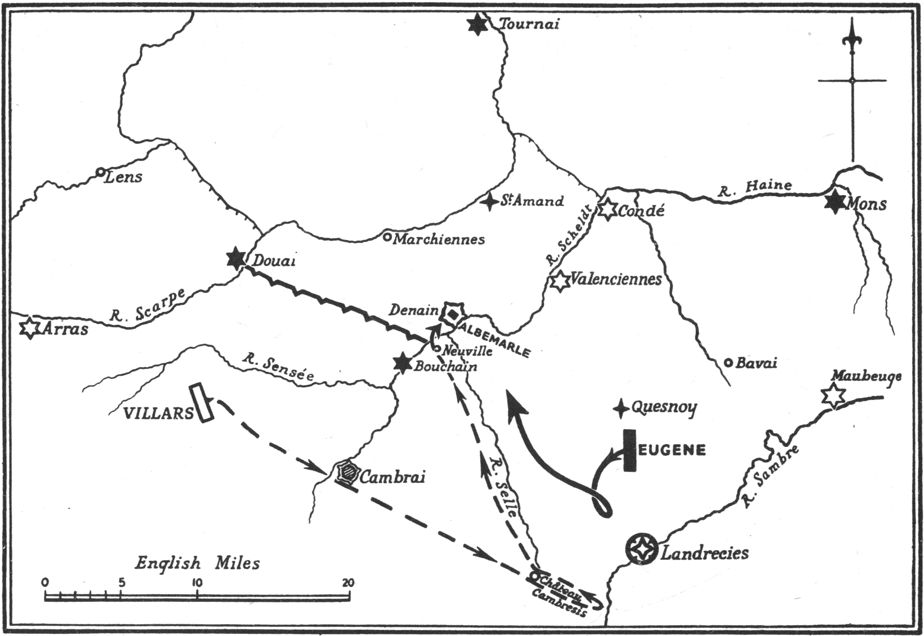
THE SURPRISE OF DENAIN
By noon, the French deployment being complete, Villars attacked with thirty-six battalions in three columns supported by six more. When told that fascines were lacking to fill the ditch he cried out vehemently, “We will fill them with our bodies.” The whole line, drums beating, advanced six or seven hundred paces without firing until within half musket shot of the ramparts. The defenders discharged their cannon loaded with canister and three volleys of musketry. The French faced this fire unflinchingly and in perfect order. Undeterred by several hundred casualties, their muskets slung, and sword in hand as at Steinkirk, they scrambled across the ditch and stormed the parapets. The allied troops, mostly Germans, with some Dutch, had all fought well in previous campaigns; but now after a weak resistance they fell back in serious disorder to their second line of defence, and an immediate retreat was ordered upon the bridge. The French, intoxicated by the first draught of victory they had tasted in Flanders for ten years, re-formed, and renewed their attack with fury. Even now the bulk of Albemarle’s men might have escaped. But the bridge had broken under the hurried motions of the transport, and the whole of his force was pinned between the now overpowering masses of the French and the river. The Scheldt here flows sluggishly but very deep, and between banks six or seven feet high with no sloping shores. Whole battalions were driven into the water and perished. Four generals, including the brave Count Dohna and Count Nassau-Woudenberg, who might have swum the river on their horses, were dragged down by swarms of drowning men. Albemarle and a score of distinguished officers were made prisoners. Of the rank and file 1000 were killed, 1500 drowned, and 2500 surrendered. Out of Albemarle’s whole force scarcely three thousand escaped. The French losses did not exceed four hundred. Eugene, his army still three hours away, was unable to intervene, and the Prince remained a sombre spectator on the farther bank.
Such was the victory of Denain, the only one gained by the French in the Low Countries since the wars of King William III. Voltaire declared that it was more essential to the safety of France even than the Treaty of Utrecht, and that if Villars had his due he would be called the saviour of his country. “Denain,” said Napoleon a hundred years later, “saved France.” Eugene’s communications were severed. He was soon forced to raise the siege of Landrecies. Marchiennes, with its enormous magazines and transport, lay in Villars’s grip. In the next few days all the strong posts of the Allies on the Scarpe were taken by the Marshal. Anchin, Pont-à-Rache, Hasnon, Mortagne, and Saint-Amand were all captured full of stores and with their garrisons. Marchiennes resisted till July 31, when five thousand men surrendered as prisoners of war, and the whole supplies for the campaign, “enough for two sieges,” fell into the hands of a gallant enemy, long unused to such plenty.
On August 12 Villars laid siege to Douai. This superb fortress, which had afforded the main trial of strength for the great armies in the year 1710, and had cost fifteen thousand men to take, was found garrisoned by only six battalions, and in spite of Eugene’s efforts for its relief fell on September 8. Quesnoy, sole success of the campaign of 1712, surrendered on October 4. Bouchain, Marlborough’s masterpiece of 1711, resisted for only eight days. In fact, the entire structure of the allied military power beyond the French frontier was torn to pieces, and the whole ascendancy and initiative passed to the amazed, resuscitated enemy. Besides seventeen battalions destroyed at Denain, upward of forty were surrendered with these fortresses, making a loss of fifty-seven battalions, or one-third of the units of the army, in these few months. Well might Louis XIV write to the Archbishop of Paris calling for solemn services of thanksgiving. Amid their loud Te Deums the old monarch, delivered from ruin, might have found a place for the trinity of serviceable agents through whom the wonders of the Almighty had been performed —Abigail, Harley, and St John.
The Old Campaigner, La Colonie, fought in the action of Denain and has left a vigorous and picturesque account of the assault. His regiment encamped on the field of battle for ten days. There was anxiety lest the great numbers of corpses rotting in the Scheldt should block up the locks at Valenciennes and elsewhere and bring about an epidemic. An order was therefore issued that all soldiers who knew how to swim, and cared to dive for the bodies of their drowned adversaries, would receive thirty sols for each corpse, “besides what spoil they might find on the same.” This sport proving popular, an immense trench of great depth and width was dug into which the bodies withdrawn from the water, excepting those of the four generals, were thrown. This gruesome sketch seems suited to the general theme.
Not only victory but discipline had quitted the Allies and the British army with Marlborough. No sooner had his régime of alleged stinginess and peculation come to an end than for the first time the quality of the bread supplied to the troops gave rise to bitter and widespread complaint. The sudden deterioration in the husbandry of the army makes a mark which runs through the diaries and letters of officers and soldiers alike. During the month that Ormonde was immobile at Cateau-Cambrésis, negotiating with Villars, his troops fared ill, and their temper became morose.
The soldiers had nothing now to do but their Quarter-guard duty, and from a rising ground in front of our Camp, had a fair view of that rich part of France, which they reckoned they had dearly earned the plunder of. They were greatly exasperated at the disappointment, and were continually murmuring at those who brought them within sight of the “promised land,” as they called it, and yet would not suffer them to taste the “milk and honey” it abounded with. Here they often lamented the loss of the “Old Corporal,” which was a favourite name they had given the Duke of Marlborough; and to make the matter worse, through the carelessness of the contractors, their bread was so intolerably bad, that it was with great difficulty the officers could restrain them from mutinying. This prepared them for mischief, and they were resolved to pay a visit to France, before they left the quarters they were then in. As forage grew scarce in our Camp, and none was to be had near us but in Picardy, we had liberty by the favour of Villars to forage in that country. It nettled our soldiers that their General should condescend to ask leave: however they were determined to lay hold of this opportunity of tasting some of the sweets of France.[683]
This mood led to a horrible outrage.
Upon all foragings a strong detachment was sent out the night before, under the command of a general officer, to keep the foragers within bounds, to cover them from the enemy, and to prevent irregularities and abuses. When the detachment marched off, a number of soldiers of all nations stole out of Camp with their arms, they chose officers and swore obedience to them, their principal care being to keep at a distance from the covering detachment. Among these one party of British soldiers, to the number of six hundred, came to a village called Molain, where the inhabitants were in arms, and had barricaded all the avenues to the town. Upon this an engagement ensued, in which some of the soldiers fell; this enraged the rest to that degree, that they rushed up to the barrier and drove the inhabitants into the church; but as they again fired from thence, in their fury they set fire to the church, burnt it to the ground, and upwards of four hundred persons perished in the flames; then plundering the town, they set it on fire; and as it grew dark, stole privately into Camp. Two days after, a complaint was made to the General, and the affair was inquired into, but no discovery could be made. This was a taste of what France might have expected, and I mention it for that purpose only; for the action in itself is utterly inexcusable.[684]
Later in the year a grievous mutiny actually broke out among the British troops in Ghent, provoked in the first instance by “the extreme badness of their bread.”
This prepared them [says Parker] to mutiny; and some sly villains, finding the generality of them in this disposition, artfully insinuated that they had a considerable arrear of pay due to them; that the War being over, the greater part of them would soon be disbanded, and that consequently they must expect to lose all that arrear unless they did themselves justice while they had their arms in their hands. This took with the giddy unthinking part of the soldiery, and a villainous and bloody design was formed.[685]
Fortunately the authorities were warned in time, and after some days of crisis three thousand men, armed and in mutiny, were surrounded by cavalry and cannon, and forced to surrender at discretion: whereupon ten of the ringleaders were executed on the spot.
Corporal Matthew Bishop, who was serving in Ghent at the time, gives an independent account and takes occasion to point his moral:
At that Juncture of Time there was a great Disturbance at Ghent amongst the Soldiers, which occasioned some to suffer Death. On hearing that News, I could not contain myself any longer without observing to the first Officer I met with, Sir, with submission, what can be the Meaning that all our Garisons are disturbed in this Manner? It is an Instance that never happened during the Time of the Duke of Marlborough. The Officer replied, There is no accounting for it; . . . O the Duke of Marlborough that gained the Love of all Men, knew better, than to put it in any one’s Power to upbraid him; for all his Men in general were obsequious. Now they are become refractory, and neglect their Duty.[686]
For his services in the campaign the thanks of both Houses of Parliament were solemnly voted to the Duke of Ormonde.
The separate preliminaries of peace between England and France being now agreed, and England having arranged an armistice for herself in the field and quitted the allied front, it seemed that St John’s labours had achieved their first stage. He looked about him for reward and advancement. He intimated to Oxford and the Queen that he would find it agreeable to be raised to the peerage by the revival of the family earldom of Bolingbroke which had just lapsed in the older branch. Oxford would have been wise to comply fully with these desires. He was, however, already conscious of St John’s jealousy and latent antagonism. It is one of the self-indulgences of unworthy men in power to pay off such minor scores when opportunity seems to offer. Therefore Oxford, with his remaining influence, moved the Queen to demur to the grant of an earldom, and accord instead a viscounty. St John was deeply angered by this slight. He saw at length how foolish he would be in quitting the House of Commons, the seat of his direct power upon the Tory Party. It is astonishing to modern eyes that this realization should have come to him so late in the day. The honour and status of a peerage were in this period invested with a glamour and splendour which has since become markedly diminished. The House of Lords, though already decisively overmatched by the Commons, was still the scene of an immense, sedate, and elegant power. St John had yielded to this mood. He had been rebuffed in the manner which he could least easily resent. By all the standards to which he subjected himself in asking for a peerage, the double elevation to a viscounty was enormous. Yet he was dissatisfied—and with good reason. Even a dukedom would not have compensated him for leaving the House of Commons, where his eloquence and partisanship made him in the absence of Oxford supreme.
He now wished to withdraw his request. He was informed by an elaborate grimace of State that the Queen’s pleasure had already been exercised for his ennoblement. To decline a viscounty would be to affront the majesty of the realm and the whole nobility. To take such a step upon the difference between a viscounty and an earldom, which was the only reason he could now advance, would be to give offence to the social world in which he moved. Besides, becoming first a viscount was no reason why he should not later on become an earl or better. Thus in July 1712 St John quitted the House of Commons for a more exalted sphere. He did so with the chagrin and latent malice of one who instead of thirty pieces had received only twenty-five.
A week later the battle of Denain let loose its tide of disaster upon the Allies. While Eugene recoiled and Villars advanced from one success to another, it was thought suitable that the new Viscount Bolingbroke should proceed to Paris with an imposing retinue as Ambassador Extraordinary. This step was calculated to give the most marked encouragement to the French and to strike a further wounding blow at the deserted and collapsing allies of twenty years of war. It commended itself to the new Viscount as an opportunity of posing upon what was still the most splendid scene in the world, and also of revelling in those pleasures which French society carried to their highest pitch.
Apart from these advantages his mission was sterile. He was welcomed at the French Court with all the gratitude he deserved. The King and the highest nobility lavished their favours upon him. His gallantries were viewed with an indulgent eye, though his habit of boasting about them excited comment. Torcy, however, extended him a spacious hospitality. He was the guest of the Foreign Minister’s aunt, Madame de Croissy, and here he was entertained by the famous beauty Madame de Tencin, who became his mistress. Madame de Tencin was also a good servant of France, and her liaison with Bolingbroke opened to Torcy then and thenceforward another intimate view into the governing system of Britain. The granting of passports to visit France after the long war, and with so many business prospects opening, was in the gift of the Secretary of State. Bolingbroke was able during his visit to Paris to put the system on so satisfactory a footing that, as we learn from Prior, he netted for himself as much as three thousand pounds in a single year. In public affairs all he gained was an extension of the armistice for an additional two months. This enabled the disasters which befell the allies to come to their full fruition during the campaign.
|
Pelet, xi, 462-463. |
|
Portland Papers, H.M.C., v, 201. |
|
Lediard, iii, 319. |
|
Parker, pp. 175-176. |
|
Ibid., pp. 176-177. |
|
Parker, p. 187. |
|
Bishop, pp. 264-265. |
The presentation of the proposed terms of a separate peace to Parliament on June 6 forced from Marlborough his last public action during the remaining life of the Queen. These terms were a shock to many supporters of the Government, but the Ministerial defence, the realization that the main issue was decided and that the Tory policy had prevailed, commanded great majorities in both Houses. Marlborough made his protest and declared, “That the measures pursued in England for a year past were directly contrary to her Majesty’s engagements with the Allies, sullied the triumphs and glories of her reign, and would render the English name odious to all other nations.”[687] This is the only record that exists of his speech. Strafford replied with asperity, saying “That some of the Allies [meaning the Dutch] would not show such backwardness to a peace as they had hitherto done but for a member of that illustrious assembly [meaning the Duke of Marlborough] who maintained a secret correspondence with, and endeavoured to persuade them to carry on the war; feeding them with hopes that they should be supported by a strong party here.”[688] Cowper, alluding to Strafford’s foreign mode of speech, rejoined “That the ex-Ambassador had been so long abroad that he had almost forgotten, not only the language, but the Constitution of his own country. That, according to our laws, it could never be suggested as a crime . . . to hold correspondence with our allies; . . . whereas it would be a hard matter to justify the conduct of some persons in treating clandestinely with the common enemy.”[689]
Nothing could, however, stem the tide, and the treaty terms were approved in the Lords by no fewer than eighty-one to thirty-six. Twenty-four lords recorded their formal protest. Among them are the names of Somerset, Godolphin, Devonshire, Haversham, Wharton, Marlborough, Nottingham, Mohun, Townshend, and Cowper. The majority ordered this to be expunged from the journals of the House, but the powerful nobles and politicians concerned, defying Parliamentary laws, had the terms of their protest circulated throughout the country, and only printers and publishers were punished for the offence.
Having thus placed himself on record, Marlborough withdrew finally to the country. Blenheim was, of course, only a skeleton, and all work upon it stopped. But he still had his house at St Albans, and Marlborough House, in London, had been open for nearly a year. He lived during the summer months in rustic pomp at Holywell, observing with impassive eye the procession of military disasters which fell upon the Allies, and the destruction of his achievements in the campaigns of 1710 and 1711. On Blenheim Day he gave a feast, which Godolphin, Cowper, Walpole, and a large company attended. He had pitched his campaigning tent upon the bowling-green. In this historic tabernacle most of the great decisions of his ten campaigns had been taken. The tent, we are told, “was magnificent, being of Arras-work, and very curious in its kind.”[690] It stood there the rest of the summer, and sightseers resorted to it in crowds from the countryside at a fee of sixpence. The hostile Press declared he was using army tents to shelter his faction and to amass greater opulence. The venom and scurrility of the attacks made upon him by the Government-paid or otherwise procured writers from Swift downward exceeded anything known before or since. If he had been the vilest criminal, if he had been guilty of cowardice or treachery in the field, if he had led the English armies to a series of shameful defeats, nothing more could have been said against him. The Examiner wrote of Malplaquet (April 13):
What a deplorable Sight it was to see Men with their Limbs shot off lying upon the Field in such an abandoned, wretched Condition that Ravens and Crows have fallen upon them for Carrion. Wanting proper Persons to dress their Limbs, their Wounds putrefied to such a degree that Dogs gnawed their Flesh while they were yet alive. Amidst this Torture, thousands expired that might have been preserved if the General had not sunk the Money designed for Medicines and Surgeons. No Age, no Country, how barbarous so ever, hath ever given us such an Instance of Cruelty and Avarice.[691]
Another passage in this organ of St John’s roused the indignation of Captain Parker:
That the Duke of Marlborough was naturally a very great coward: That all the victories and successes that attended him, were owing to mere chance, and to those about him; for whenever he came to be engaged in action, he was always in a great hurry, and very much confounded upon every little emergency that happened; and would cry in great confusion to those about him, “What shall we do now?”
“Had I not read these very words,” wrote the Captain, “I should never have believed that any man could have the face to publish so notorious a falsehood.”[692]
During the autumn Marlborough resolved to leave England. There was then, and has been since, much controversy about his reasons, and so many can be given that a certain air of mystery still shrouds the event. There are, as usual, two contradictory explanations for his action. The first is that he wished to go, that the Cabinet would have prevented him, but that Harley secured him his passport from the Queen. Alternatively, it is said that he did not wish to go, but that Harley, fearing to have him in the country, forced him into exile by the threat of using letters or information supplied by the French Government either of Marlborough’s correspondence with Saint-Germain or of his offers to make peace in 1708.
Both these theories are plausible. Marlborough would certainly have liked to live in England; but this ceaseless girding and insult directed upon him by the Court and the Ministry, with all their resources, was not calculated to make life pleasant even in the country in summertime. Winter was now drawing near, and with it the reassembly of a Parliament eager to hound him down, and ready to approve every new affront or injury which Ministers might suggest. Although the Whig nobility, the bulk of the officers who had served under him, and the mass of ordinary folk were still friendly, and as the social scale was descended enthusiastic, a definite change had been produced during this year by the torrent of calumny unloosed and impelled against him.
In those days of brief triennial Parliaments a new election was distant but a year. If Marlborough remained in England nothing could prevent his greatness from becoming the most obvious target. Instead of the bolts and balls he was accustomed to face in the field, he would find himself in the midst of a filthy warfare of slander and abuse. The election of 1713 might well be fought on fouling his name and reputation. The worst motives would be imputed to whatever he did. If he exerted himself it would be his disappointed malice; if he remained silent it was no doubt his guilty conscience. All these long years of camp and march we have seen in his letters the longing for home and peace—the peaches ripening on the wall, the great building at Woodstock growing from day to day, rest with children and Sarah at his side. But this prospect now seemed to be defiled. He could not at this time find happiness or even peace in England.
A second set of arguments arose from the political outlook. The Queen was ageing fast. Her health was such that almost any month might see a dangerous crisis. The whole issue of the Succession had now again been called in question by the Parliament of Tory squires, and by the profound quarrel which the two ruling Ministers were developing against their allies, and their deep understandings with the enemy. The Tory policy which Harley and St John, however ill-wed, were unfolding step by step must reach its crisis before long. The two Englands stood against one another, and were being inflamed to hatred and violence by every art which Government authority or high party influence could command. Marlborough could not live at home without the active protection of one or the other of the violent factions. Naturally he must incline to the Whigs; and if so he must endure ceaseless persecution from the Ministers, and from the Queen into whose ears their lies and hatred were daily poured. Already he was beset by observers and spies. Every person who visited his house, every call he paid, even the days when he kept indoors—all were eagerly reported to Whitehall.
There was a fierce spirit among the veteran officers of the Army now at home in England. Some had been forced to resign their commissions; others had seen promotion go on party grounds to their rivals, their juniors, and, as they judged, their inferiors. They felt that the fruits of the long struggle which had been won, and in which they had risked their lives, were being wantonly cast away, and that the military fame of England, till now glorious, was being dishonoured. The idea that the British Army, which had borne itself so proudly on the Continent, had become odious in all the camps for deeds of baseness and deceit obsessed their minds. These were hard men, wrought by a lifetime of war, to whom bloodshed was a profession. Their swords were at their sides as they paced the streets of London. At any moment—in the park, in the coffee-houses, in the taverns—taunts might be thrown and passions break loose, and a bloody deed be done. Whatever happened would be laid to Marlborough’s account. To leave the country was to be free from all this. The whole Continent regarded Marlborough as a prodigy. The lustre of his victories, the sagacious consistency of his policy, the enormous changes in the relative power of nations which had followed from his conduct, assured him a reverential welcome everywhere outside France. He was rich; money could be transferred abroad; there was Mindelheim, which he had never seen. In England he was a prey. In Europe he was a Prince. Here, then, was peace and a broad sanctuary. Why tarry among foes and fogs?
A third, more directly practical reason for his going abroad is apparent in the State suits set on foot against him. The Attorney-General was slowly moving forward the prosecution which, pursuant to the resolution of the Commons, required that Marlborough should repay to the Exchequer all the moneys he had expended upon the Army intelligence service in a ten years’ successful war. This might well confront him with a judgment to find more than a quarter of a million sterling. Another suit, equally vexatious, had been started against him by the Crown about the expenses of the “monument of national gratitude,” Blenheim. Careful as he had been, it was alleged that when the Government payments were in arrear he had written from the front to keep the workmen in employment for a few weeks upon his orders or Sarah’s, or otherwise had interfered. The Queen was now moved to use this against him. A process to require him to repay at least £30,000 was on foot. If he left England these processes might be suspended. If he remained at home and at variance with the Ministry he might be sensibly impoverished. One could not tell the lengths which malice would go as it fed upon triumph.
These causes seem a sufficient reason for any man’s departure from his native land. But Marlborough’s traducers have found others in addition.
During the debates about the peace, in opposition to it, M. de Torcy acquainted Lord Oxford, that after the Duke of Marlborough had hindered the peace of 1706, when it should have been made, he had treated with the French court to make them one, and was to have two million of crowns for it. . . .
When M. de Torcy discovered this, the King of France allowed Lord Oxford to make use of it, to send the duke of Marlborough abroad; but insisted that his life should not be touched; and so it was. They had a meeting at Thomas Harley’s house, in James street, Westminster, Oxford coming to the street door, in his coach, the Duke of Marlborough in a chair to the garden door opening into the park; it was then resolved, that the duke of Marlborough should go abroad. Prince Eugene and Lord Wharton both said, on the occasion, that the Duke of Marlborough had not a clear conscience, or he would not have submitted to that step.[693]
The authority for this is Oxford’s secretary, Erasmus Lewis, a serious witness. The arrangements for the meeting are certainly characteristic of Oxford. Moreover, there is no doubt that a meeting took place, for Marlborough, writing to Oxford from Antwerp on December 4/15, 1711, says, “When I had the honour of seeing you last, I told you that the disappointment of Mr Cadogan’s company would hinder my going to Italy this season.”[694] At this meeting, it is alleged, Oxford blackmailed Marlborough into leaving the country.
If this story be true Oxford must have had an easy task. He was forcing an open door with a battering-ram. It cannot be thought at all surprising that the French should at this time, as at others, wish to strike down Marlborough, nor that they should place incriminating letters, if they had them, at the disposal of their English confederates. “This man,” they might have said, “who is heading the resistance to peace, was ready enough to make one, less than four years ago, if he had got two millions out of it.” It would be beyond human nature that a monarch and Government in dire straits, with an exhausted nation behind them, should respect such a pledge of secrecy to their arch-foe now driven from power.
Against this view, however, there are a number of facts. Marlborough had exacted the return of his original letters from Berwick, and there is no reason to suppose that Berwick, punctilious in a matter of honour, especially towards a kinsman and a soldier for whom he had profound admiration, did not comply with this condition. There would, of course, remain any disclosure the French Court might make about the negotiation; but all this could be denied, and the assertions of a war enemy have never been taken as good evidence. Secondly, Marlborough himself wished, on the grounds which have been set forth, to leave the country, so that there was no necessity for Oxford to put pressure upon him. Thirdly, apart from Oxford himself, the “major part of the Ministers, particularly Mr St John, was against it, being afraid of his Grace as well abroad as at home and thought their power would secure them better against him here.”[695] It was Oxford who, behind their backs, procured Marlborough’s passport from the Queen, and took pains to obtain Marlborough’s personal acknowledgment to him for it.[696] Anne was favourable to Marlborough’s wish and remarked, “He did wisely.”[697]
The pass permitted Marlborough to go into foreign parts,
whithersoever he may think fit, together with his suite, and committed him to the good offices of kings, princes, republics and Her Majesty’s Allies as well as to commanders etc. her own subjects. Allowance to go freely and commodiously wherever his need requires, and states that such good offices shall be acknowledged and returned when opportunity serves.
It is dated from Windsor Castle on October 30, 1712, and countersigned “Bolingbroke.” This did not prevent the Secretary of State sending the following message of November 11 through Gaultier to Torcy:
The Duke of Marlborough has asked permission from the Queen to quit the kingdom, and that, after a good deal of contest and consideration, her Majesty has given him leave. He is to pass by Ostend, Bruges, Ghent, Brussels, and Liége to his principality [of Mindelheim], thence through the Tyrol to Venice, and finally to Naples, where he is to sojourn as long as he pleases. Such is the route which has been traced out for him without permission to pass anywhere else.[698]
To describe Bolingbroke as a good liar would be a misstatement. He scattered his lies with such profusion that he wasted them.
Another link with England had been snapped by the death of Godolphin on September 15, 1712. Boyer says that
he died at St Albans, having been long afflicted with the stone in the kidneys. . . . Notwithstanding the clamours which were raised against him, his administration was found thoroughly clear, sound and unattackable; so that as he lived, he died with an unblemished character, to which the most candid of his enemies paid a due respect.[699]
Walpole visited Godolphin during his last illness at St Albans. As Godolphin lay dying he turned to Sarah and said to her, “If you ever forsake that young man, and if souls are permitted to return from the grave to the earth, I will appear to you, and reproach you for your conduct.”[700] But Sarah quarrelled with every one before her life was over. Godolphin was not buried for three weeks. His embalmed body lay in the Jerusalem Chamber until a sufficient number of Whig Knights of the Garter could come to Westminster to bear the pall, “for they don’t find the Tory Knights so ready to come to town a purpose.”[701] He was interred in the Abbey on October 7, the Dukes of Marlborough, Devonshire, Richmond, and Schomberg bearing up the pall.
Sarah’s tribute deserves record.
He had conducted the Queen with the care and tenderness of a father or a guardian through a state of helpless ignorance and had faithfully served her in all her difficulties before she was Queen, as well as greatly contributed to the glories she had to boast of after she was so. . . . He was a man of wonderful frugality in the public concerns but of no great money above his paternal estate. What he left at his death showed that he had been indeed the nation’s treasurer and not his own.[702]
On November 15 a shocking event occurred which must have reconciled Marlborough to leaving England. The Duke of Hamilton, newly created Duke of Brandon, a man of great charm and quality, a strong Jacobite, had been nominated Ambassador to France, and, having asked the Pretender’s leave before accepting the post,[703] was soon to start for Paris. He thus became the central figure in the plans of the Ministry. A quarrel about a disputed estate arose between him and Lord Mohun, who had so lately visited Poulett with Marlborough’s challenge. The result was a duel justly described in the annals of the age as “terrible.” They met at daybreak in Hyde Park. Colonel Hamilton attended the Duke, and Mohun’s second was General Macartney, Marlborough’s faithful officer, who had been broken for drinking “confusion to the Whigs.” The Duke of Hamilton proposed that the seconds should not fight; as, however, they both desired to do so, he consented, and the two pairs attacked each other with their rapiers. Almost immediately Hamilton killed Mohun, but at the same time he received himself a wound of which he died in a few minutes. Swift says:
The dog Mohun was killed on the spot; and [while] the Duke was over him, Mohun shortening his sword, stabbed him in at the shoulder to the heart. The Duke was helped toward the cake-house by the ring in Hyde Park, . . . and died on the grass, before he could reach the house; and was brought home in his coach by eight, while the poor Duchess was asleep.[704]
This tragedy produced a furious commotion. The Tories declared that Macartney had stabbed Hamilton as he lay on the ground. Both seconds fled the country. The hue and cry was raised after Macartney, and Bolingbroke paid a bill for the efforts made to apprehend him. He escaped to the Continent, knowing that he would certainly not receive fair treatment from the dominant faction. After the accession of George I he returned and submitted himself to justice. He was tried and acquitted, and his name cleared.[705] But now, in 1712, every effort was made to cast further aspersions upon Marlborough. He was the centre, said the Tories, from which the bullies of the Flanders army derived their inspiration in murdering the Queen’s Ambassadors. At the coroner’s inquest it was insinuated that he had been privy to the challenge sent by Mohun to Hamilton. The fact that both Mohun and Macartney were near to him in sentiment and association lent colour to these utterly unfounded suggestions. To free himself from such an atmosphere, where furious men of the sword were eager to engage the political opponents who they conceived had ruined them and their country, was surely one of the motives which had made him resolve to leave a land so torn at the height of its success with feud and hatred.
Marlborough conveyed most of his settled estate to his sons-in-law. He transferred £50,000 to Cadogan at The Hague, so that, as Sarah wrote, he should not be without the means of sustenance “if the Stuart line were restored.” On November 24 he set out with only a few servants for Dover. Sarah was to follow later. Contrary winds detained him for a week, but on December 1 he embarked upon the ordinary packet-boat without any attention except the salute of its captain. No record exists of his reflections upon this melancholy voyage.
Sarah in her will prescribed as the condition of any biography of her husband that no single line of poetry should be quoted in it. Nevertheless, the valedictory verses which Addison wrote deserve inclusion on every ground.
Go, Mighty Prince, and those great Nations see,
Which thy Victorious Arms before made free;
View that fam’d Column, where thy Name engrav’d,
Shall tell their Children, who their Empire sav’d.
Point out that Marble, where thy Worth is shown,
To every grateful Country, but thy own.
O Censure undeserv’d! Unequal Fate!
Which strove to lessen Him who made Her Great;
Which pamper’d with Success, and Rich in Fame,
Extoll’d his Conquest, but condemn’d His Name,
But Virtue is a Crime, when plac’d on high;
Tho’ all the Fault’s in the Beholder’s Eye.[706]
|
Parliamentary History, vi, 1146. |
|
Loc. cit. |
|
Loc. cit. |
|
Lediard, iii, 291-292. |
|
Quoted in Laprade, p. 120. |
|
Parker, p. 168. |
|
Carte’s Memorandum Book; Macpherson, ii, 85. |
|
Bath Papers, H.M.C., i. 225. |
|
Boyer, quoted by Lediard, ii, 294-295. |
|
Loc. cit. |
|
Cowper, Diary, p. 54. |
|
Letter dated November 11, 1712, French Foreign Office Archives; quoted by Stanhope, Reign of Queen Anne, p. 539. |
|
Boyer, p. 392. |
|
Coxe, Walpole, i, 42. |
|
The Wentworth Papers, p. 302. |
|
Essays by Sarah included in Sarah Correspondence (ii, 125-126). |
|
English Historical Review, i, 768. |
|
Swift, Journal to Stella, November 15, 1712. |
|
The Privy Council minutes on the duel in Dartmouth Papers, H.M.C., p. 311. |
|
Lediard, iii, 297. |
The captain of the packet-boat on arriving at Ostend the next morning hoisted her ensign on the topmast-head. This was taken as a signal that Marlborough was on board. Forthwith all the cannon on the sea-front fired a salute, and on the ship entering the harbour the artillery of the ramparts fired three salvos. Cadogan and the Governor with a great crowd received Marlborough as he landed. When the next day, December 13, he set out for Antwerp not only did all the Dutch cannon fire again, but even the English ships in the harbour as well.[707] At Antwerp he was met by the governor, the Marquis of Terracena, who had come over to the allied cause with the rest of Belgium on the morrow of Ramillies. The Marquis offered in the name of the Emperor all the honours due to sovereigns. Marlborough declined these dangerous compliments; but the mass of the people thronged about him, acclaiming him as their deliverer and champion. This, indeed, he had been, against not only the French but also the Dutch.
From Antwerp he wrote to Oxford asking again that Cadogan might be released from his duties to travel with him as his companion.[708] The brave, generous Irish soldier, who was never found wanting in fidelity or chivalry, gladly cast away any prospects he might have under the Tories in order to accompany his old chief. “The Duke of Marlborough’s ill-health,” he wrote to Oxford, “the inconvenience a winter’s journey exposes him to, and his being without any one friend to accompany him, make the requesting leave to wait on him an indispensable duty on me, who for so many years have been honoured with his confidence and friendship, and [owe] all I have in the world to his favour.”[709] The Ministers were not unwilling to oblige him. The Queen’s permission was granted; but Cadogan was shortly afterwards dismissed from all his appointments.
So enthusiastic were the demonstrations of the Belgians that the Duke, mindful of the long arm of Queen Anne’s Government, took by-roads on his journey to Maestricht. Here in Dutch territory he found the whole garrison drawn up to receive him. General Dopf attached himself to him in the name of the States-General, and with Cadogan conducted him upon what became perforce a triumphal progress. On the journey to Aix-la-Chapelle all the cavalry forces within long marches came out to ride with him; and in the town of Aix, then so small as to be described by Lediard as “a poor, obscure village,” the peasants from the surrounding country crowded in, curious and wondering. A saying ran about Holland and Belgium at this time, “Better be born in Lapland than in England.”[710]
From Aix-la-Chapelle Marlborough wrote to Sarah. She had much to arrange before leaving England, and he missed her greatly. “The port of Ostend,” he wrote, “is never shut by the frost and that of the Brill very rarely. . . . This frosty weather makes the sea calm, and the roads as good as in summer; so that I could have wished we might have got to Frankfort before the thaw, of which I now despair.”[711]
John to Sarah
Aix-la-Chapelle
Jan. 21, 1713
* Since the 20th of the last month I have receiv’d no letters from England, so that I am altogether ignorant where You maybe that I am resolv’d to write no more til I hear from You. Wee have now a thorough thaw. You will find the ways extreamly bad, and as this place is extreamly durty I have resolv’d to go to Mastrick the begining of the weak, and there to expect You. I send this letter to Ostend in hopes it may meet You there, for affter all the advises Your friends may give You, I cant but think that You will find that the most Convenient place for Your landing will be Ostend, where I wish You in safety with all my heart, so that I may have the happyness of having Your Company.[712]
John to Sarah
Maestricht
Feb. 5, 1713
If you have observed by my letters that I thought you would have left England sooner than you have been able to do, I hope you will be so kind and just to me, to impute it to the great desire I had of having the satisfaction of your company. For I am extremely sensible of the obligation I have to you, for the resolution you have taken of leaving your friends and country for my sake. I am very sure, if there be anything in my power that may make it easy to you, I should do it with all imaginable pleasure. In this place you will have little conveniences; so that we must get to Frankfort as soon as we can. I wish we may be better there; but I fear you will not be easy till we get to some place where we may settle for some time; so that we may be in a method and orderly way of living; and if you are then contented, I shall have nothing to trouble me.[713]
Sarah joined her husband in the New Year.[714] He had impatiently and eagerly awaited her arrival in Maestricht. Together they wended through Germany, always being received with respect and pleasure by the inhabitants and with salutes and ceremonies by the rulers.
Sarah’s letters from exile are a refreshing counterpart after forty years to the love-letters which she wrote to the young officer of the Guards. The rabid politician, bitter controversialist, fierce mentor and rebuker of the Queen, the tyrant of the Court and of society, recede. We find a mellow and philosophical personage, sometimes scornful but entirely self-possessed, content for the most part with life as it offers itself each day. Her two principal correspondents in England were Mrs Clayton, wife of one of the Duke’s estate agents at Woodstock, and one of her cousins, Mr Jennings, who had driven down with her to Dover and had seen her on board the packet for Ostend.
She reacted in a lively fashion to her Continental impressions. “All the Places one pass’s thro in these Parts,” she wrote to Jennings (February 12),
have an Air very different from London. The most considerable People I have seen have but just enough to live, and the ordinary People, I believe, are half-starvd; but they are all so good and so civill that I could not help wishing . . . that they had the Riches and the Libertys that our wise Cittyzens and Countrymen have thrown away, or at best put in great Danger, . . . and tho the Generality of them I have seen are Roman Catholicks, they fear the Power of France so much that they drink to the Protestant Succession, and the Honours they have don me in all Places upon the Duke of Marlborough’s Account is not to bee imagined, which is not disagreeable now, because as it cannot proceed from Power, it shews that he made a right Use of it when hee was General.[715]
Husband and wife both stayed some time at Aix-la-Chapelle, where John had “the advantage of one month of the hot baths.”[716]
“I cannot end my letter,” says Sarah (March 31),
without giving you some Account how I pass my Time in this Place, which is in visiting Nunnerys and Churches, where I have heard of such Marvells and seen such ridiculous Things as would appear to you incredible. . . . Tis so much beyond all that I ever saw or heard of in England of that Religion which I am apt to think has made those Atheists that are in the World; for tis impossible to see the Abuses of the Priests without raising strange Thoughts in one’s Mind, which one checks as soon as one can; and I think tis unnaturall for any Body to have so monstrous a Notion as that there is no God, if the Priests (to get all the Power and Mony themselves) did not act in the Manner that they doe in these Parts, where they have three Parts of all the Land in the Country, and yet they are not contented, but squeeze the poor deluded People to get more, who are really half-starved by the vast number of Holydays in which they can’t work, and the Mony they must pay when they have it, for the Forgivenesse of their Sins. . . . In one Church where I was lately, there were 27 jolly-face Priests that had Nothing in the World to doe but to say Mass for the living, and to take the dead Souls the sooner out of Purgatory by their Prayers.[717]
At Frankfort, which they reached in May, they were not far from the war. “I am come just now,” wrote Sarah (May 14, 1713),
from a Window from which I saw a great many Troops pass that were under the Command of P. Eugene. They paid all the Respects as they went by to the D. of Marl. as if hee had been in his old Post. The Men lookd very well. . . . To see so many brave Men marching was a very fine Sight, it gave me melancholly Reflections, and made me weep; but at the same Time I was so much animated that I wishd I had been a Man that I might have ventured my Life a thousand Times in the glorious Cause of Liberty, the Loss of which will be seen and lamented too late for any Remedy; and upon this Occasion I must borrow a Speech out of Cato: “May some chosen Curse, some hidden Thunder from the Shores of Heaven, red with uncommon Wrath, blast the Men that use their Greatness to their Country’s Ruin.” . . .
When I had written so far I was calld to receive the Honour of a Visit from the Elector of Miance. I fancy hee came to this Place chiefly to see the D. of Marl. His shape is, like my own, a little of the fatest, but in my Life I never saw a Face that expressd so much Opennesse, Honesty, Sense, and good Nature. . . . I can’t help repeating Part of his Compliment to the Duke of Marl., that he wishd any Prince of the Empire might bee severely punished if ever they forgot his Merit. The Civillitys are so great that are paid him by all sorts of People, that one can’t but reflect how much a greater Claim he had to all manner of good Usage from his own ungrateful Country. It would fill a Book to give you an Account of all the Honours don him as we came to this Place by the Ellector of Solms, and in all the Towns, as if the D. of Marl. had been King of them, which in his Case is very valuable, because it shews tis from their Hearts; and if hee had been their King hee might have been like others, a Tyrant.[718]
May 16, 1713
I am not uneasy as you think upon Account of the Time that is so heavy. . . . Mr Cowley . . . says ’tis very fantastical and contradictory in human Nature that People are generally thought to love themselves better than all the Rest of the World, and yet never can indure to bee with themselves; . . . but tho’ I love Solitude more than ever, I would not have you think that I don’t wish earnestly to see my Friends, and to be in a dean sweet House and Garden, tho’ ever so small, for here there is Nothing of that kind; and in the Gardens, tho’ the Hedges are green and pretty, the Sand that goes over one’s Shoes is so disagreeable that I love to walk in the Roads and Fields better, where the D. of Marl. and I go constantly every Day in the Afternoon, and stop the Coach and go out wherever wee see a Place that looks hard and clean. ’Tother Day we were walking upon the Road, and a Gentleman and his Lady went by us in their Chariot who wee had never seen before, and after passing us with the usual Civilitys, in half a quarter of an Hour or less they bethought themselves and turnd back, came out of their Coach to us, and desired that wee would go into their Garden, which was very near that Place, and which they think, I believe, a fine Thing, desiring us to accept of a Key. This is only a little Tast of the Civillity of People abroad, and I could not help thinking that wee might have walk’d in England as far as our Feet would have carryd us before Anybody that we had never seen before would have lighted out of their Coach to have entertaind us. . . .
I am confydent I should have been the greatest Hero that ever was known in the Parliament House if I had been so happy as to have been a Man; as to the Field, I can’t brag much of that sort of Courage, but I am sure no Mony, Tittles, nor Ribons should have prevaild with me to have betrayd my Country, or to have flatterd the Villians that hav don it. . . . This long Letter upon Nothing will make you think that tis no Wonder my Time does not lye upon my Hands, since I can employ it so idly, but that is no Argument for my troubling you so much.[719]
Cardonnel’s wife had died, and Marlborough wrote (July 24):
I would have written to you sooner, dear Cardonel, if I had believed it possible to say anything to lessen your grief; but, I think, of all worldly misfortunes, the losing what one loves is the greatest, and nothing but time can ease you. However, I could not deny myself any longer the satisfaction of writing to assure you that I shall always be very sorry for anything that is a trouble to you, and that I long for the opportunity of assuring you myself that I am your humble servant and faithful friend.
P.S. The Duchess of Marlborough desires me to assure you of her true friendship and concern for you upon all occasions, and she would have wrote herself, but she thinks this will be the least troublesome to you.[720]
From May till the end of the year Marlborough and his wife lived quietly in Frankfort. The Duke paid a visit to his principality of Mindelheim, and was received there with royal honours. All this time the decoration of Marlborough House was proceeding, and the celebrated Laguerre was painting the battle-scenes upon the staircase and the hall. “I am very desirous of having it finished,” wrote Sarah from Frankfort (June 17, 1713),
tho the giving all the Trade and Power to France does not look as though I should ever enjoy it. However, I have this Satisfaction wherever I am, that tho a Woman, I did all I could to prevent the Mischiefs that are coming upon my Country, and having nothing to reproach myself with, nor nothing in my Power that can doe any good, I am as quiet and contented as any Phylosopher ever was. But, at the same time, if I were a Man I should struggle to the last Moment in the glorious Cause of Liberty; for if one succeeds tis a great deal of Pleasure, and if one fails tho one loses one’s Life, in that Case one is a Gainer, and when one considers seriously tis no matter how or when one dyes, provided one lives as one ought to doe.[721]
October 27, 1713
. . . I should be very well contented to live out my short Span of Life in any of my country Hous’s. This is a World that is subject to frequent Revolutions, and tho one wish’s to leave one’s Posterity secure, there is so few that makes a suitable Return that even upon that Account . . . one need not be unhappy for Anything that is not in one’s Power to help.
Gradually, however, homesickness got the better of her “phylosophy,” and she uttered a cry of pain more audible because of its restraint.
The best Thing I have heard is that those Men who have been so bold in betraying this Country have been much frightnd of late, but I have heard that some of them were never counted very valiant, and tis the Nature of Cowards, I believe, never to think they have Security enough when the least Danger appeares. . . . But I am intirely of your Mind that wee shall soon bee out of the Pain of Uncertainty. I wish I could as easyly believe that I shall bee contented when I have lost all, and am forced to live the rest of my Life in these durty Countrys. I am now in some Doubt whether my Phylosophy will goe so far as that, tho it has been sufficient to support me against all that the worst of Men or Women have don, and tho I know one shall bear whatever one can’t help, I pray most heartily that I may not be tryd any further, for tis quite another Thing to hear that one is never to see England nor one’s Children again . . . than it is to leave a disagreeable Court, when one knows one has not deserved ill Treatment, and only to make a Sort of a Pilgrimage for a little while, hoping to see Justice don upon some of one’s Enemys.[722]
The hardest forfeit was not, however, to be exacted.
There are three aspects of Marlborough’s life at this time which require scrutiny. First, his contacts with England; secondly, his relations with Saint-Germain; and, thirdly, his association with Hanover. Upon all these there has been much discussion.
Cadogan was his chief agent and most faithful friend. The rugged Irish soldier who had borne the brunt of so many serious days had been for twenty years in Marlborough’s circle and for ten his right-hand man. He lost his employments; yet he still preserved connexions with Ministers to which they attached importance, and which were serviceable to Marlborough. Cadogan shared in the main Marlborough’s exile, but was able to pass to and fro from Germany to England through Holland, or even through Dunkirk, being everywhere received as the honoured Quartermaster of the army in famous days.
Stanhope ranks next in Marlborough’s system. The immense personal force and versatility of this man grows on all those who study his vivid career. He was as straight as a die. Sincere, ardent Whig and Protestant, warrior, diplomatist, and statesman, he was certainly one of the greatest personalities of the Age of Anne. Marlborough placed full confidence in him, and he was upon the whole his foremost champion in London. Yet this attachment was not due so much to personal regard or admiration as to a conviction that Marlborough’s sword and the Protestant Succession were one. All the Whigs valued Stanhope, from the ageing Lords of the Junto to the new generation of brilliant men who were now approaching their prime. They knew that in the Cause he would stop at nothing that honour allowed.
The third was Sunderland. His disloyalties to Marlborough in the days of prosperity had arisen mostly out of his superabundant Whiggery. This characteristic, which Queen Anne found so obnoxious, and which in former years had been a marked inconvenience to Cabinet business, now in Opposition left the former Secretary of State with a secondary but none the less unshakable position in the heart of the Whig Party. Well may they have said to him as misfortunes fell in successive sheets upon them, and as their resentments smouldered with a fierceness we can hardly understand, “You were indeed right when you wished to use our Parliament against the accursed Abigail.” Sunderland’s ties with Marlborough were those of husband of his daughter and father of his heir. Walpole was another Whig in a close intimacy with the great absentee. The able Stair, leading the Whigs in Scotland—the danger-point of Jacobite intrigue—and the younger Craggs, the faithful envoy of many missions, were also in frequent movement between Frankfort or Antwerp and London.
Nearly all these men, now in this chilly period, had sunshine days before them. Cadogan would be Captain-General, Stanhope Secretary of State and head of a Government. A similar experience awaited Sunderland. Before Walpole there spread that long reign of power which consolidated the achievements of Marlborough’s wars, and laid the foundations on which the great Chatham was afterwards to build the further expansion of England. Stair was to become one of the most capable ambassadors our Island has ever sent to Paris. Craggs attained a Secretaryship of State. To all these men during the years of evil Marlborough was a figure of unfading fame, and if occasion should serve of immense importance.
It seems unnatural that, with these masterful, virile Whig associates and all that the near future seemed to hold in store, Marlborough should still have cultivated those undefined, mysterious, and to a large extent meaningless relations with Saint-Germain which never ceased from 1689, when William was enthroned, to 1716, when Marlborough sank into bowed old age. His communications with the cast-out Court, his asseverations of sympathy, his cruelty of mocking hopes, his blandishments and moonshine promises, continued in an airy way. During his stay at Frankfort he was in touch with Mary of Modena, with his nephew Berwick, and with the pretended Prince of Wales. In this phase there are no letters of Marlborough’s, authentic or forged; but the Stuart archives, the Macpherson documents, and Berwick’s memoirs all show us the repercussion upon the shadow Court of occasional communications received from Marlborough—always referred to in their code as “Monsieur Malbranche.” He is from time to time visited by an agent, who converses with him, reports the gist, and returns with conciliatory replies. These interchanges were initiated by the Jacobite circles themselves. Soon after the Duke was dismissed from his posts at the beginning of 1712 Middleton, the Pretender’s Secretary of State, had written to him that the King and the Queen-Mother were convinced that it must be a source of grief to him that he had not followed their advice in paying his debt to them while he had the means at his disposal. They regretted his misfortune, but the King had great confidence in him and awaited his assistance; for even if his power had vanished, his ability and experience would be of great value.[723]
From Berwick’s letters we see that Marlborough asked the banished Prince and circle to trust him as a friend who always cherished the hope of being of service. He suggested to them that they should use their influence, and that of the French Government, to assuage the hostility of Oxford towards him. He pointed out that the Tory Government had all his estates and property in their power, that he was pursued by a Crown lawsuit which might beggar him, and that unless they could help him he would be forced to make some bargain with Harley which would prevent him from achieving his lifelong aspirations for their good. Finally he sought a pardon from James III which would protect him in the event of a restoration.[724] These protestations did not deceive Saint-Germain. They had endured twenty years of them. On the other hand, they were in no condition to reject any assurances of goodwill. In their forlorn plight, with the desperate project of an invasion of Britain always in their minds, it was better to be cheated again by Marlborough than to feel once and for all certain he was their foe. They nursed the illusion that a day would come when by a sweep of his arm he would undo the past. But this was but a daydream. They had little to give but words, which seemed an equitable return.
Berwick’s letters speak always slightingly and sceptically of Marlborough’s assurances, and yet they give the impression that Berwick is always pleading his uncle’s cause at Saint-Germain. He thought it best to do so in an offhand manner. We know this gentleman is only playing with us. Still, it may suit our interests to work upon his fears. Let us pay him words for words. Above all, we must never regard him as a man either to be totally trusted or to be considered of no power or value. Had Berwick been a perfervid advocate of Marlborough, his ardour would at once have been discounted because of their kinship, and by the soldierly esteem which was known to subsist between them as military men. Thus what Berwick advised was done, and back went the messenger with polite comfortings, the counterpart of what Marlborough had proffered.
Historians have made great play with this shadow traffic. They have sought to represent it as a prodigy of infamy and deceit, and have even alleged that Marlborough was at all times ready to serve the side that won. But there is no truth in this. That Marlborough would have been glad to end his days at Blenheim Palace even if Parliament had brought back the Stuart line may be true. He did not wish to die abroad in poverty, or to be victimized and stripped at home; but he never meant to allow a Jacobite restoration if by his utmost exertions he could prevent it. This is what invests his whole relationship to Saint-Germain with an air of heartlessness and hypocrisy, which was habitual and persisted in long after his gestures had ceased to count in any effective degree.
Why did he do it? At this stage he must have realized that the risk of such correspondence far outweighed the reality of any benefits he could personally receive. It might estrange him from all his Whig colleagues. It might ruin his interests with the future Hanoverian King. It is possible only to surmise the answer. There is, however, a theory which fits all the facts of twenty years. These contacts with the Jacobite Court were to him a window of indispensable intelligence. We have seen how on the eve of the Blenheim march he was closeted with the Jacobite agents, and how he learned from them in return that Berwick was to serve in Spain and would not be sent against him in Germany. Is it certain that the Paris spy whose deadly information has been mentioned so frequently, and who clearly moved in the innermost circles of Court politics and fashion at Versailles, was a Frenchman, and not an English Jacobite of rank, busying himself in this ceaseless reporting of military and political facts? Might not such an agent have felt that he was helping his own country at the same time that he pocketed the Secret Service payments, and might he not have salved his conscience by the belief that in helping Marlborough he was helping some one who was perhaps the sole hope at once of a victorious England and a Stuart restoration?
This is, of course, pure speculation, but at this period we find Marlborough’s relations with the Court of Hanover as good as those with Saint-Germain. We have seen how some of William III’s Ministers maintained correspondence with James II, and showed King William the letters they sent and the answers they received. Something very similar occurred at the present juncture. Marlborough is hand-in-glove, with the Hanoverian Court. All their principal personages are working in the closest confidence with him. Bernstorf, Robethon, Bothmar, ask his opinion and act on his advice. They were as sure that he was in their interests as the Jacobites were sure they were being fooled.
In these spider’s webs of diplomacy and intrigue all the actors were enveloped. Oxford’s and Bolingbroke’s relations with Torcy, begun while they were at war and continued now, were more confidential than any which they had with the Queen, with their allies, with their colleagues, or with their own supporters in Parliament. In October 1712 Bolingbroke had asked Torcy to let him have the names of Whig leaders who were in correspondence with Saint-Germain.[725] Torcy accordingly approached the Pretender and his Secretaries. It was vital to the banished Court that the inviolability of British confidences made to them should be preserved. Honour apart, one single breach of confidence would have fatally and for ever debased the currency of treason. The Pretender replied to the effect that he was a gentleman as well as a king. Nevertheless Torcy and the French Foreign Office, to whom the poor Jacobites were daily beholden, managed to obtain either some old letters of Marlborough’s or tolerable proofs that communications had passed between him and Saint-Germain.
Some time in 1713 Harley, himself wooing both the Pretender and the Elector alternately, sent documentary evidence to Hanover which he confidently expected would blast Marlborough’s dangerous credit in that quarter.[726] When the whole tale of Marlborough’s craft and stratagems is remembered, and how he was renowned for dissimulation, it is indeed astonishing that these revelations should not have achieved their aim. But they made not the slightest impression. Klopp says, “Marlborough succeeded in an astonishing way in not losing the confidence of Saint-Germain, while at the same time preserving that of Hanover.”[727]
But this dictum would be erroneously construed if it were thought that Marlborough was in fact playing a double game. On the one side all was civil sham, and known to be so; on the other, deadly earnest and rightly judged as such. The Electress Sophia reposed absolute faith in him. She regarded him with the highest admiration and regard. Her son, more sceptical, and soured by Marlborough’s reticence in the Oudenarde campaign, none the less had no doubt which side he was on. Robethon trusted him implicitly.
Marlborough had hardly reached Frankfort in 1713 when he became deeply leagued with the Hanover Court. “What are the steps in general which we should take here,” they asked in a memorial dated March 10, for the Elector’s friends in England, communicated to Marlborough through Cadogan, “after we have received the news of the Queen’s death? What procurations, patents, or orders should we have ready to be sent then, wherever it will be necessary?” On the assumption that it was necessary that the Electoral Prince (the Elector’s eldest son, who had fought so well at Oudenarde, and was afterwards George II) was to set forth immediately on the Queen’s death for London, a whole series of searching questions were asked both of the Whigs at home and of Marlborough abroad. “What part would Marlborough choose to act? Would he go directly to London, being one of the Regents, or go along with the Elector?” Meanwhile Robethon asked that he should stay within reach, and that, instead of going to live at Frankfort, he should settle at Wesel.[728]
Cadogan gave answers in Marlborough’s name to many of the questions.
It was the Duke’s opinion that the Elector [not the Electoral Prince] should go to England immediately upon the Queen’s death, with full powers from the Electress as her lieutenant-general. The kings of England frequently invested lieutenants to govern the kingdom in their absence, with all the authority and power they possessed themselves.[729]
Marlborough intimated that when he was sure of the fidelity of the troops abroad he himself might follow the Elector into England, and leave the Electoral Prince with Cadogan to command them. The following letter shows that these plans were carried far.
Bothmar to Robethon
March 25, 1713
Cadogan thought that the Electoral Prince should not go to take the command of the English troops on the Continent; but that Bothmar should provisionally have powers in his hands to authorize the Duke of Marlborough and himself [Cadogan] to secure these troops and the fortresses they garrison. If the Electress did not choose to sign a commission of that kind it would be sufficient to have one signed by the Elector in her name. The troops upon seeing a parchment with the great seal of his Electoral Highness would readily obey a man so agreeable to them as the Duke of Marlborough. It was not necessary to follow the form used in commissions of that kind in England, nor to write one in English. The Duke of Marlborough’s commission and his own were in England, and he could not send copies of them; but it would be sufficient to say in the new patent that he was now invested with the same powers he had formerly from the Queen.[730]
Eventually Sunderland supplied the forms of the patents. Cadogan gave Bothmar the character of some officers. The commandant at Dunkirk, a Scotsman, and two battalions of that nation were thorough Jacobites; but the eight English battalions were well affected, and “would give a very good account of the other two, and of their commandant.” Cadogan added that Marlborough recommended the Elector to have some one with the Pretender to send exact and speedy intelligence of everything that happened. Marlborough himself offered to find the man, if the Elector would lay out fifty louis d’or a month, and in the meantime he would try to find out what he could himself. Marlborough named three agents who might be used as spies.[731] His advice was taken with valuable results.[732]
Side by side with Marlborough, the Hanoverians gazed through the window which he had opened and kept open for their benefit and his own. Can we not see how very flat the exposures of the distrusted and detested Harley fell when flaunted before such close confederates? Marlborough could have revealed to the Court of Hanover every word he had spoken to the Jacobite agents without in the least affecting their relations. Indeed, it may well be that he did so.
No one can read without regret and repugnance the long, wearisome tale of the frauds and injuries which Marlborough perpetrated upon the house of Stuart. No attempt has been made in these pages to conceal or palliate them. It is enough for his fundamental integrity to prove that from the moment when he warned James II at Winchester in 1687 to the day when he welcomed King George I upon his succession in 1714,[733] a period of nearly thirty years, he never swerved from his fidelity to the Protestant Succession. To this he devoted all the power of his sword and his statecraft, and all the network of his subterfuges and deceits. The reader is not invited to admire the seamy side of that intense period, but only to admit that Marlborough’s purpose throughout was unchanged.
|
Lediard, iii, 297. |
|
Bath Papers, H.M.C., i, 225. |
|
Portland Papers, H.M.C., v, 257. |
|
Blenheim MSS. |
|
Coxe, vi, 227. |
|
Blenheim MSS. |
|
Coxe, vi, 229. |
|
She applied to Dartmouth for a passport on January 29. (Dartmouth Papers, H.M.C., p. 315.) |
|
Letters of Sarah, Duchess of Marlborough, at Madresfield Court (1875), p. 25. |
|
Bath Papers, H.M.C., i. 225. |
|
Bath Papers, H.M.C., i, 28. |
|
Ibid., 31. |
|
Bath Papers, H.M.C., i, 37-38. |
|
Coxe, vi, 244. |
|
Ibid., 41. |
|
Coxe, vi, 43. |
|
Macpherson, ii, 297. |
|
Stuart Papers, H.M.C., i, 278-279. |
|
Stuart Papers, H.M.C., i, 248. |
|
See Macpherson, ii, 638. |
|
Klopp, xiv, 408-410. |
|
Macpherson, ii, 475-477. |
|
Macpherson, ii, 478. |
|
Ibid., 477. |
|
Their identity is preserved: (1) one of the magistrates of Huy; (2) an Irish officer of the name of Carol, who affects the Popish religion, but is a Protestant in his heart; (3) a Lorraine gentleman, who served in the army under the name of Remiremont. |
|
See the letter of an agent to the Electress dated April 5, 1714; Sir Thomas Hanmer, Correspondence (edited by Sir H. Bunbury, 1838), pp. 165-168. |
|
See Vol. I, pp. 241-242. |
The Duke of Hamilton having been killed in his duel with Lord Mohun, a new envoy of high consequence must be found to reside in Paris while armistice ripened into peace. Shrewsbury, whose tastes in these years were noticeably deflected by his wife to scenes of social pomp and glitter, was found willing to accept the task. Bolingbroke’s correspondence with him from the beginning of 1713 shows that the extrusion of Dartmouth from the peace negotiations had already become evident. These early months of 1713 were the brightest in Bolingbroke’s career. Between the vivid years of audacity, excitement, debauchery, and intrigue and the long grey aftermath of disappointment, exclusion, and futility, they form a gleaming passage. In the state into which he had brought our affairs abroad he was the only man capable of securing any settlement with France. He and his associates had broken up the Grand Alliance, had involved its armies in defeat, and had revived not only French hopes but French ambitions. But for Bolingbroke’s statecraft, gambler’s-craft, and personality, we might have thrown away the victory without gaining peace. For good or ill the Treaty of Utrecht was better than an indefinite continuance of a broken-backed war. Therefore there were occasions in the spring of 1713 when Bolingbroke’s gifts were serviceable to his country. At times, indeed, he seems to speak in ringing tones for that great England whose sacrifices he had mocked, whose interests he had squandered, and whose honour he had lastingly defaced.
Torcy and the French Court, with the old King chastened and tottering in its midst, saw in the bitter quarrels of the Allies the chance of regaining in a few months of successful war and chicane all that had been cut from them by the swords of Marlborough and Eugene. In this mood they dallied in coming to terms. The weeks slipped by. Eugene in the name of the Emperor clamoured for the preparation of the armies for a new campaign. In England Ministers did not dare meet Parliament except upon the basis of a compacted peace. There were no fewer than eleven prorogations. At last Bolingbroke realized that all his blandishments of the French and his camaraderie with Torcy were exhausted. The desperate nature of his own plight if Parliament met while war and peace were alike in chaos startled him to robust action. All his sense of values underwent a swift change. The French, so eagerly courted and praised, fell under his ban. The Dutch, so sourly viewed, so roughly treated, began to acquire a new merit. The fact that each of these Governments looked upon his transition with contempt did not strip it of its efficacy. At the end of February the Secretary of State drew up an ultimatum to the French Court prescribing the final outstanding demands of England. There were the fishing rights off Nova Scotia; there were the monopoly upon the Amazon for Portugal and the addition of Tournai to the Dutch Barrier. These must be met fully and forthwith, or England would rouse all the allies to a renewal of the war. France was neither in the condition nor temper to stand a united onslaught. The resumption by England of her place in their ranks would largely reverse the advantages they had gained by her desertion. Considering how wonderful had been their deliverance, how cruel the strain upon the French people, how worn out their martial strength, to haggle too long over details in the hopes of exploiting the confusion of the Allies would be a folly and a crime from which they shrank. Accordingly, on March 31/April 11, 1713, the peace was signed at Utrecht between France and England, Holland, Portugal, Prussia, and Savoy. England and France signed first at two o’clock in the afternoon, Savoy and Prussia, with Portugal, in the evening, and the Dutch Republic at midnight.
Upon Bolingbroke’s younger brother, George St John, was conferred the honour, as Tories saw it, of bringing over the Treaty. On the afternoon of Good Friday, April 3/14, his post-chaise drew up at Whitehall. Covered with dust, he ascended the steps, and Bolingbroke met him in a brief, dear-bought hour of triumph.
What is called the Treaty of Utrecht was in fact a series of separate agreements between individual allied states with France and with Spain. The Empire continued the war alone. In the forefront stood the fact that the Duke of Anjou, recognized as Philip V, held Spain and the Indies, thus flouting the unreasonable declaration to which the English Parliament had so long adhered. With this out of the way, the British Government gained their special terms, most of which would long ago have been conceded, and many of which ceased to have importance after a few years. The French Court recognized the Protestant Succession in Britain; agreed to expel the Pretender from France, to demolish the fortifications of Dunkirk, and to cede various territories in North America and the West Indies—to wit, Hudson Bay, Newfoundland, Nova Scotia, and St Christopher. Perpetual amity and goodwill was declared, and both sides swore not to make war without giving six months’ notice. With Spain the terms were that England should hold Minorca and Gibraltar, thus securing to her while she remained the chief sea Power the entry and control of the Mediterranean. Commercial advantages in Spanish South America were obtained, and in particular the Assiento, or the right for thirty years to import African negroes as slaves into the New World. By this it was hoped to build the South Sea Company as a Tory rival to the Bank of England. Spain covenanted not to cede any portion of her dominions to France, and as a corollary England guaranteed the integrity of the remaining Spanish Empire against all comers. A renunciation was made both by France and Spain against the union of the two Crowns. This, as has been seen, now hung for its validity upon the frail child since known to history as Louis XV. Madame des Ursins, unkindly called “the Lady Masham of the Court of Spain,” who dominated Philip’s wife, and was thus in many ways the core of his indomitable resistance, was rewarded with the Duchy of Limburg. On the other hand, the Catalans, who had been called into the field by the Allies, and particularly by England, and who had adhered with admirable tenacity to Charles III, were delivered over under polite diplomatic phrases to the vengeance of the victorious party in Spain.
The Dutch secured a restricted Barrier, which nevertheless included, on the outer line, Furnes, Fort Knocke, Ypres, Menin, Tournai, Mons, Charleroi, and Namur; Ghent, for communication with Holland; and certain important forts guarding the entrance to the Scheldt. The commercial advantages of trade with Belgium were to be shared between England and Holland. Prussia obtained Guelderland at the expense of Dutch claims. All other fortresses in the Low Countries beyond the Barrier were restored to France, including particularly Lille. Victor Amadeus of Savoy gained Sicily and a strong frontier on the Alps. Portugal was rewarded for feeble services with trading rights upon the Amazon. The frontiers on the Rhine and the fate of Bavaria and the Milanese were left to the decision of further war. Such were the settlements reached at Utrecht in the spring of 1713.
The Emperor Charles, indignant at the Spanish surrender, continued the war during the whole of 1713; but the French armies, though themselves exhausted, took the key fortress of Landau, and penetrated into Germany. In March 1714 the Emperor was forced to conclude the Peace of Rastadt, where he entrusted to Prince Eugene the duty of making such terms with Marshal Villars as the situation permitted. By this treaty the Rhine frontier was settled as follows: France regained Strasburg and Landau, and ceded all conquests on the right bank of the Rhine. The Elector, Max Emmanuel, was reinstated in Bavaria, incidentally extruding Marlborough from his principality of Mindelheim. “He laughs best who laughs last.” The Milanese, Naples, and Sardinia rested with the Empire. On this basis Europe subsided into a long, if uneasy, peace, and although these terms were not comparable with what the Allies could have gained in 1706, in 1709, or at Gertruydenberg in 1710, they none the less ended for a while the long torment to which Christendom had been subjected.
Bolingbroke’s masterly defence of the Treaty of Utrecht and its forerunner, Swift’s Conduct of the Allies, together with the squandered opportunity of making peace in 1709, constitute a case for the policy of the Tories which, though rejected during the long period of Whig rule, has commanded the respect of later times. Bolingbroke was no doubt right in saying that if the Allies in 1712 had conformed to the new policy of Queen Anne’s Government, and had cordially joined with them in making a general peace, the odious events which followed in the field would have been avoided. If they had agreed with him, there would have been no need for him to go behind their backs. If they had desisted from the campaign, England would not have been forced to desert their camps. If they had not incurred the military disasters in the autumn of 1712, the united Allies could have forced France into far more satisfactory arrangements for the Dutch, the Germanic states, and the Empire than were in fact achieved. But all this reasoning stands on a false foundation. They did not conform, they did not agree, they did not desist, and the disasters followed. Was, then, England relieved from all obligations towards them? The solemn condition of the Grand Alliance was that they should make peace in common, and England was by no means absolved by the fact that she suddenly became more anxious for peace than the other signatory states. If the shortcomings of our allies in waging war were as gross as Swift pretends, that was a ground for reproach, but not for betrayal or desertion. It certainly did not lie with England, which for so long had urged the unrelenting prosecution of the war, had imposed its formula, “No peace without Spain,” upon reluctant Dutch and indifferent Germanic states, to blame them for not obediently abandoning their policy because England had a new Minister and Queen Anne a new favourite. The secret and separate negotiations of the Tory Ministers inspired our allies with distrust and anger. It was neither right nor reasonable, therefore, to expect from states smarting under the sense of having been tricked patient, loyal co-operation. If the Tory Ministers had wished to carry their policy, they should have done so straightforwardly, openly, and in concert with their allies. They did not do this, because they had to deceive their own Parliament as well as their allies, and confront them both stage by stage with new situations.
It is not, therefore, upon the terms of settlement in general that censure can found itself. The mean and treacherous manner in which the Grand Alliance had been broken up, with the shameful episodes of violated faith and desertion in the field, inflicted the stigma which was for so long visible on the face of this transaction. Forty years later William Pitt, writing to Sir Benjamin Keene, feeling the odium which still clung to England and infected her every public pledge, pronounced the stern judgment that “Utrecht was an indelible reproach of the last generation.”[734]
Marlborough had always believed that unless France was reduced, not merely to temporary exhaustion, but to a definitely restricted power, the wars of his generation would be renewed in the future. This was looking far ahead, but the fact remains that in the century that followed Europe was racked with repeated conflicts and Great Britain fought four separate wars with France, aggregating in all forty-three years of deadly strife. During these wars the first British Empire was largely ruined. Great coalitions were formed against Britain. She was stripped by war and other causes of her vast American possessions. Her existence as a world state was repeatedly in jeopardy, and finally, against Napoleon, she was at one time left alone to face the world. That these indescribable perils were surmounted by the valour and vigour of the descendants of those who fought in the age of Anne unfolds a series of new marvels and prodigies in our island story.
Archdeacon Coxe, writing in 1819, was able to condemn the Treaty of Utrecht and its disreputable concomitants by convincing reference to the events of the previous hundred years. If, he was able to argue, Marlborough had been sustained by his countrymen to the end the “overweening power” of France, the greatest military nation and the greatest block of nationhood which existed, would have been finally reduced to harmless limits. But as the human tale unfolds its chapters of confusion and misfortune, so all proportions and relations fade and change. Writing now, more than a hundred years later, we may perhaps be content that an overweening Germany did not sooner present to us the menace which our ancestors recognized in France. And to-day this same France, so long the terror of Europe, is a precious, indispensable guardian of those very causes of national freedom, religious toleration, and Parliamentary government which in a different combination were all at stake in Marlborough’s time. Thus do the very foundations of historical judgments change with the centuries. It is not given to princes, statesmen, and captains to pierce the mysteries of the future, and even the most penetrating gaze reaches only conclusions which, however seemingly vindicated at a given moment, are inexorably effaced by time. One rule of conduct alone survives as a guide to men in their wanderings: fidelity to covenants, the honour of soldiers, and the hatred of causing human woe.
At the time the sense of frustration and of the casting away of the fruits of so much perseverance and good fortune rankled deeply in many bosoms. The fate of the Catalans, abandoned, slaughtered, and oppressed, made a dark page in our records, and even to-day plays its part in the internal affairs of Spain. The fierce debates in Parliament cannot be read without a blush. All might so easily have been made smooth and clean; but the unending cadence of history shows that moderation and mercy in victory are no less vital than courage and skill in war. England in 1713 rejoiced that peace, no matter how, had come at last. The nation as a whole endorsed and acclaimed what Queen Anne and her Ministers had done, and even when under George I the Whigs regained the full and prolonged control of affairs they did not venture, as will be seen, to challenge the settlements which were made.
Early in December 1713 the Queen fell ill. The gout by which she had long been plagued took a new form, and she suffered severe attacks of fever before the abscess formed in her leg. Her condition caused lively alarm in all quarters, but for different reasons. On December 3 Abigail warned Oxford that there was danger. The fortunes of the Ministry hung upon Anne’s life; but far greater issues were involved. At this time the quarrel between Oxford and Bolingbroke had not reached the point where the unity of the Tory Party was seriously affected. The Pretender had as yet made no public declaration that he would always remain a Catholic. Hopes of his conversion might well be entertained not only among interested politicians or Tory partisans, but throughout the nation. Most serious of all, neither the Court of Hanover nor the Whigs in Great Britain had made any effective preparations for the tremendous and deadly crisis which must instantly attend a demise of the Crown. No man, not the shrewdest or best-informed, could predict what would happen. The Tories had majorities in both houses; they had a newly elected Tory House of Commons. All the commands in the fleet, Army, and fortresses were in the hands of trusted Tory or Jacobite adherents. Ormonde was Warden of the Cinque Ports, and in close touch with Berwick. A Jacobite governed Edinburgh. The Whig Earl of Dorset had been ejected from Dover Castle. No attempt had been made by the Whigs to organize the nuclei of resistance. They had their Act of Settlement—the law on their side—but that was all.
A wave of fear swept through one half of political England lest they should lose the Queen, through the other lest the Protestant Succession should be subverted, and through both lest civil war, with all its uncountable horrors, should come. It was a quarrel which nobody wanted, but into which all would inexorably be drawn. The French were also on the move. Under pretext of changing garrisons several battalions and all the Irish regiments in the French service moved towards the coastal towns.[735] Abigail’s brother, Jack Hill, who was governor of Dunkirk, expatiated on its advantages to French troops as a port of embarkation for England. Faced with this peril, the Whigs looked about them for means of defence. A hurried meeting was held at Wharton’s house. Strenuous appeals were made to Hanover by the Whigs in England and by Marlborough from Frankfort. The Electress and her son acted with what vigour was possible. Marlborough and Cadogan both held their provisional commissions to take command of the British forces which remained in the Low Countries. There were troops at Ghent and Bruges, there were troops at Ostend; above all, there was the garrison at Dunkirk. Two of Marlborough’s trusted Lieutenants held command under Hill. Colonel Armstrong, the engineer who had distinguished himself in the capture of Bouchain, was Quartermaster-General. Colonel Kane, the diarist whose opinions have several times been cited in these pages, commanded the citadel.
Bothmar to Bernstorf
December 16, 1713
Both the Duke of Marlborough and Cadogan have provisional orders from the Electress to take command of the troops and garrison in case of the Queen’s death. Cadogan told me it would be proper to have a particular one for Mr Armstrong, Quartermaster-General at Dunkirk, to seize upon that place, and execute the orders of Mr Cadogan.[736]
Marlborough himself travelled from Frankfort to Antwerp, where he established himself at the beginning of December. Here he was in much closer contact with events. He had sent Cadogan to The Hague to learn the “sentiments and thoughts of our friends in England, and to inform himself of the situation of things in Holland.” Upon Cadogan’s return from The Hague he sent a full account, and formally accepted the Elector’s commission as Commander-in-Chief.
Marlborough to Robethon
Feb. 26, 1714
I am very glad to find by him [Cadogan] the Republic takes the alarm, and begins to wake out of the lethargy it has fallen into since the peace at Utrecht. . . . The first and great mark of their present good disposition is their secret resolution to set out, as soon as possible, a strong squadron of men-of-war, for which they have found a very plausible pretext, when their preparations are so far advanced, as to oblige them to own it. They have likewise, in case of her Majesty’s death, agreed on the most proper means for assisting his Electoral Highness with their troops.
. . . I have received the commission his Electoral Highness has been pleased to honour me with. I must beg of you to make him my most humble and sincere acknowledgments for this new mark of favour and confidence. I shall make the best use I can of it for his service, in the advancing of which I am always ready to hazard both life and fortune.[737]
Thus we see Marlborough still in the centre of all those forces which he had previously directed, and assisting to weld together the Whigs in Britain, the army in Flanders, the Dutch and the Empire behind the house of Hanover. There can be no doubt of either his acts or his intentions.
It would, however, be a mistake to imagine him at this time as a fretful, energetic schemer impatiently awaiting a new turn of fortune’s wheel. From the moment he had been relieved of his military and European responsibilities he had sensibly aged. He laid down at the same time his burdens and his strength. However painful it might be to watch the squandering of so much that he had gained, he did not despair about what could not be prevented. He yielded himself easily to his new-found leisure. The will-power which for ten years had held the whole movement of Europe upon its course first relaxed and then declined. He enjoyed the placid days as they succeeded one another. Sarah rallied him severely. He had grown, she complained, “intolerably lazy.” He would hardly write a letter—not even to his well-loved daughters. But his noble air and the sense of authority and kindliness which his presence conveyed made their impression upon all who met him. Alison records a notable saying about him at this time. “The only things the Duke has forgotten are his deeds. The only things he remembers are the misfortunes of others.”[738]
Sorrow too fell upon him in these wanderings. Early in 1714 his third daughter, Elizabeth, Countess of Bridgewater, died of the smallpox scourge. She was his favourite child, and deeply attached to him. All accounts describe her sunshine nature and graceful virtues. When at Antwerp Marlborough received the news of her death his head dropped on the marble mantelpiece against which he leaned, and he is said to have become unconscious.
By the end of January the Queen was clearly better. She had recovered sufficiently to open Parliament in person on February 15. Oxford laboured to reassure the nation that there was no question of altering the Succession, and that the best relations prevailed with the Court of Hanover. No one believed him; and with reason, for at this very time he was through Gaultier offering the Pretender the Throne if he would change his religion. All this, of course, lay in secret; but once Parliament met, the Whigs were able to force the issue of the Succession into the full glare of debate.
In March the Queen fell ill again, and anxiety became intensified. In April the Whigs and the adherents of the house of Hanover persuaded the Hanoverian envoy Schütz to request a writ of summons for the Electoral Prince to take his seat in the House of Lords as Duke of Cambridge. This measure was well conceived. It exposed the Ministers to the utmost embarrassment, and it split the Tory Party. Hanmer had been chosen Speaker, and became at once the leader of a strong body of Hanoverian Tories. In the Lords attack was pressed on the general issue that the Succession was in danger. Argyll, who since his experiences in Spain and Minorca bore resentments against the Ministry as bitter as those he had lately nourished against Marlborough, assailed the Government. He alleged that subsidies were being paid by the Treasury to the Jacobite clans in the Highlands, and that Whig officers were being purged from the Army. So serious was his alarm, so intense his new rage, that he became reconciled with Marlborough. The whole bench of bishops, with two exceptions, voted with the Opposition. The Ministers escaped censure, which in this case was tantamount to an accusation of high treason, only by the twelve votes of the batch of peers created two years before.
The writ for the Electoral Prince, of course, struck the Queen in her most sensitive spot. She was convulsed with distress and wrath. A series of vehement letters in Bolingbroke’s haughty style were sent to Hanover. The aged Electress, whose illuminating intelligence had long cast its light upon the European scene, was so painfully affected by their tone that she expired a few days later. The Elector George Lewis was now the direct constitutional heir. By this time Oxford and Bolingbroke had received the Pretender’s answer to their invitation to change his religion.[739] His answer was fatal to his prospects, but for ever honourable to his name. It has been well said that his sincerity and honesty should win for his memory the gratitude of the British nation. He repulsed with indignation the suggestion that he should forsake his faith for his crown. When Oxford and Bolingbroke received his reply both realized that there was no hope of a Restoration. Oxford, with hardly a day’s delay, renewed perfervid blandishments to the Court of Hanover, Bolingbroke told the French envoy, Iberville, that “people would rather have a Turk than a Catholic.” From this moment Oxford seems definitely to have rallied to the Hanoverian Succession and to have endeavoured to bring the Queen to the conviction that it was inevitable. But now he found his influence gone. He had quarrelled with Abigail. He had refused her a share in the profits of the Assiento contract, for which Bolingbroke had led her to hope. She therefore threw all her weight against him, and, dreading the prospects of a Hanoverian monarchy, strove to lead the Queen into Jacobite paths. Here, however, Anne became intractable. She, like every one else, had been staggered by the Pretender’s uncompromising refusal to abandon the Roman Catholic faith. She feared that his accession would fatally injure the Church of England, her rock in tribulation. She therefore allowed events to drift on their course, and implored Oxford and Bolingbroke to be reconciled to each other. This, indeed, was but one of the measures their safety required. But their mutual hatreds and charges against each other were too serious to be overridden even by the instinct of self-preservation.
By a strange perversity the Secretary of State continued to the full limit of his great office to take a whole series of measures which, while they gratified Tory partisanship, were consistent only with a Jacobite Restoration. The chief of these was the renewed purge of the Army. Argyll was removed from all his places, and Stair was ordered to dispose of the command of the Scots Greys. A long list of generals, colonels, and captains were ordered to sell their regiments and companies unless they were willing to promise that they would “serve the Queen without asking questions.” A scheme, involving the dismissal of seventy-two officers, was set on foot to break up nine Protestant regiments quartered in Ireland, and to create in their place fifteen new regiments of suitable complexion.
On the other side nothing was now neglected. The group of war leaders, Marlborough, Cadogan, Stanhope, and Argyll, were now all acting in unity, and resolved if need be to proceed to extremities. A convention was drawn up between the States-General and Hanover for ships and troops. Stanhope privily organized the French Huguenot officers and men in London. Many veterans discharged from Marlborough’s armies were enrolled in secret bands. Argyll and Stair took similar steps in Scotland. It was widely believed that the Regular Army itself, in spite of the purge of officers, would not act against the renowned Chiefs of the great war. A Whig Association was formed comprising a large number of officers who undertook to remain armed and ready at call, and a fund was created to which the merchants of the City largely contributed.
When Marlborough at Antwerp was invited to join this body he declined.[740] His refusal excited surprise at the time, and has been criticized since. It can hardly be doubted that he was wise not to join a purely Whig conspiracy. He was more than ever determined in his freedom not to be enrolled in the ranks of either party. By any overt action he would have presented the Government with the advantage of reviving the cry that he sought to become a second Cromwell. There is, however, no question where he stood. A more decisive step was in his mind. He had resolved to return to England. “Pray be pleased to take an opportunity,” he wrote to Robethon (June 18), “of acquainting his Electoral Highness that my best friends think my being in England may be of much more use to the service than my continuing abroad, upon which I design to return as soon as the Parliament is up.”[741]
And (July 9):
My last letters were very full of hopes that something considerable for the Protestant Succession may yet be done before the Parliament parts; so that I flatter myself that the arrival of Mons. Bothmar may be of great use, the Parliament being likely to set sometime longer than was expect’d. I shall not leave this place till about the end of this month. I followed your directions in acquainting Mr M[olyneux][742] as to the number of the troops [i.e. the troops in Dunkirk]. They are all well inclin’d except the two battalions of Orkney.[743]
The air of meaningless mystery which surrounds Marlborough’s leaving England also covers his return. It is certain that he took this decision without reference to whether the Queen was dead, dying, or about to recover, and without regard to whether Oxford or Bolingbroke emerged the winner from their struggle. The only consideration which he mentioned was that Parliament should have risen. This would free him from some minor annoyances. Parliament was prorogued on July 9/20, and Marlborough set out accordingly for Ostend.
Sarah was with him. There was no doubt about her sentiments. She was, as ever, the full-blooded Whig, hating the Pope and Pretender with equal zeal. Her motive also was simple. She was burning to get home. The longing to be back in England seemed to have taken possession of her soul. There is no doubt that the moment of Marlborough’s return was influenced by this rather than by any deeply calculated plan of action. At first the Continent had seemed to him an attractive change from the English political scene. But after a year this mood had passed. He was not comfortable at Antwerp. * “We had a very inconvenient house,” says Sarah, “and before we could remove from thence the Duke of Marlborough was so weary that he took a resolution to go for England.”[744] We see also that he had not the slightest fear of returning home. He asked no one’s permission. He made no concealment of his intentions. “The Whigs,” wrote one of Swift’s correspondents, “give out the Duke of Marlborough is coming over, and his house is now actually fitting up at St James’s.”[745] He appeared perfectly sure of himself, and that he would be able to deal with the facts of his native land as he found them. He was as cool and matter-of-fact as on the morning of one of his battles. On the other hand, he was in no particular hurry. He was prepared to wait a week or two for a fair wind that would carry him across in a single day. Here too we see Sarah’s influence. She hated the sea, and hoped to avoid sleeping on board. It must be remembered, however, that in those times, when a passage might take twelve hours or twelve days, there was a tactical advantage in being able to move fast, once one had moved at all.
Throughout his voluntary exile Marlborough had maintained civil relations with Oxford, and in January 1714 the Treasurer had granted a warrant of £10,000, for which the Duke thanked him, for some resumption of the building of Blenheim.[746] It is possible, though no correspondence exists, that Bolingbroke had also kept contact with him. But there is no truth in the widely made suggestion that his return to England was the result of any understanding or agreement with either of the quarrelling Ministers. In fact, the contrary is easily proved. “Lord Marlborough’s people,” wrote Bolingbroke to Strafford (July 14), “give out that he is coming over, and I take it for granted that he is so; whether on account of the ill figure he makes upon the Continent, or the good one he hopes to make at home, I shall not determine.”[747] The Secretary of State then hinted that Marlborough was in cabal with Oxford, and he used this as an additional means of arousing the prejudices of the Queen against his rival. There is no doubt that the prospect of Marlborough’s return was extremely unwelcome to him. To Prior in Paris it was a source of dread. “We are all frightened out of our wits,” he wrote, when he at length heard of it, to Bolingbroke, “upon the Duke of Marlborough’s going to England.”[748]
“It is surprising,” wrote Bothmar, already in London (July 16/27),
that the Duke of Marlborough comes over at such a crisis, and does not rather wait until it is seen which of the two competitors will carry it with the Queen; Lord Sunderland himself does not comprehend this. I am told he will be the day after to-morrow at Ostend, in order to embark there for this country. Cadogan has been for eight or ten days in the country [i.e. out of London]. He is expected back this evening. He said when he went away that the Duke of Marlborough would wait for him at Antwerp. The impetuosity of the Duchess has probably precipitated this journey.[749]
Sarah to Mrs Clayton
July 14, 1714
* This is only to tell my dear Mrs Clayton that we hold our resolution of leaving this place upon Friday next. We shall bee three days going to Ostend and there wait on a fair wind, and wee shall rather stay there than come without a very good one because it is intolerable to goe to bed in those boats; but if we can have such weather, and in the daytime, wee may hope to get to Dover without going to bed, and it will be easy enough to sit upon the deck.[750]
On the road to Ostend an incident occurred. The Royal Irish Regiment, ultra-Protestants from Northern Ireland, and Webb’s were both quartered in the castle of Ghent. Captain Parker tells us that “on hearing that the Duke was to pass that way, all the officers of both Regiments went without Antwerp port, and drew up in two lines to pay him our compliments, and shew the respect we still retained for his Grace.” The Duke and Sarah rode up on horseback, and spent half an hour talking to the officers “on indifferent matters before resuming their journey.”[751]
Sarah to Mrs Clayton
Ostend
July 30
I am sure my dear friend will be glad to hear that we are come well to this place, where we wait for a fair wind, and in the meantime are in a very clean house and have everything good but weather. . . .
The respect and affection shewn to D. of Marl. in every place where he goes allways makes me remember our governors in the manner that is naturel to do, and upon this journey one thing has happened that was surprising and very pretty. The D. of Marl. contrived it so as to avoid going into the great towns as much as he could, and for that reason were a little out of the way not to go to Ghent. But the chief magistrates, learning where we were to pass, met him upon the road, and had prepared a very handsome breakfast, for all that was with us in a little village where one of their ladys stayed to do the honours, and there was in the company a considerable churchman.
Among the governors of the town there were a great many officers that came out with them afoot, and I was so much surprised and touched that I could not speak to the officers without a good deal of concern, saying that I was sorry for what they did fearing it might hurt them, to which they replyed very pollitickly or ignorantly, I dont know which, “that it was not possible for them to suffer for having done their duty.”
The D. of Marl. is determined to stay here for a fair wind. . . .
I long to embrace dear Mrs C. . . . I have as ill an opinion of public affairs as ever, but I would fain end my life in England with my friends, if I can, and even submit to Popery or anything that cannot be helped.[752]
But while Marlborough and his eager wife waited at Ostend for the fair wind events moved to their decision in England.
|
Coxe, Memoirs of the Kings of Spain (1815), iv, 190. |
|
Macpherson, ii. 548. |
|
Macpherson, ii, 519. |
|
Macpherson, ii, 569-571. |
|
Allison, Life of John, Duke of Marlborough (1852), ii, 247. |
|
Pretender’s letter dated February 26, 1714; French Foreign Office Archives, “Angleterre,” tome 255. Another letter dated March 13; Macpherson, ii, 525. |
|
See N. Tindal, Continuation of Rapin’s History, xviii, 167. |
|
Macpherson, ii, 627. |
|
Marlborough’s private agent in Hanover. |
|
Macpherson, ii, 632. |
|
Blenheim MSS. |
|
Swift, Works, xvi, 141. |
|
Bath Papers, H.M.C., i, 244. |
|
Coxe, vi, 112. |
|
August 7; Bolingbroke Correspondence, iv, 579. |
|
Macpherson, ii, 636. |
|
Blenheim MSS. |
|
Parker, p. 197. |
|
Coxe, vi, 295. |
Bolingbroke’s improvidence was unsurpassable. He had used partisan power with the utmost brutality against the Whigs. He had injured and outraged all the allies. He had earned the cold, enduring antagonism of the Hanoverian Court and of the lawful heir to the throne. He had gloried in trampling down every principle and interest which was dear to the new England sprung from the Revolution. Yet he had by no means resolved to bring in a Popish prince. He continued to walk with the Protestant Succession, wondering hopefully if a moment would come to stab it in the back, but not having by any means made up his mind to do so. He had removed from the Army all officers who were anchored to the Act of Settlement, and were the products of the period of glory. From every side he had gathered and promoted avowed Jacobites to the higher positions in the armed forces. Yet he joined himself with the proclamation extorted by public opinion from Queen Anne setting a five thousand pound price on the head of the Pretender if found on British soil. He had declared that the exiled King had no more chance of coming to the crown as a Papist than the Sultan of Turkey, yet all his future and the future of his party could be saved only by the accession of this unyielding Prince. The Queen’s life hung on a thread, and he and all the interests he directed hung on that same thread. At any moment all might fall together. He could not see beyond a demise of the Crown, yet at Christmas this had seemed very near. The crisis might at any moment recur.
In these precarious months of 1714 his main activities were to rend the Tory Party by a mortal quarrel with Oxford, and to fan the flames of faction with the Schism Bill. By this measure no Dissenter would be permitted to teach in either public or private schools, or even in private houses. The entire religious education of Nonconformist children would be taken from their parents and handed over to schoolmasters licensed by the bishops. In the House of Commons this attack by the Church upon the Chapel had a great success. The Tory majority and the ‘gentlemen of England,’ who after winning their second general election thought the world was theirs for ever, affirmed by 237 votes to 126 these principles of religious intolerance oppressing a large and powerful body of their fellow-countrymen. In the Lords the margin was narrow. Bolingbroke exerted his gifts of oratory, but the Bill passed only by 77 to 72. Five of the most eminent bishops of the Church of England voted against it as an act of persecution. This law, so cruel in itself, was to Bolingbroke a move in his strife with Oxford. In Defoe’s words, “The Schism Bill was a mine dug to blow up the White Staff.” Oxford did not resist its passage. He could not afford to run counter to the excited feelings of the Tory Party. He sat dumb and glowering through the debates. He did not vote. He was preparing his counter-mine. It was of a different character, but might well in the end have proved more deadly.
In the Spanish Trade Treaty were found certain explanatory articles held to be injurious to British commerce. An inquiry was demanded by the Whigs and the merchants into the circumstances which had led to their insertion. The inquiry was resisted with warmth by Bolingbroke. He sought to repulse it in his most arrogant manner; but Oxford supported the demand, and hinted darkly at hidden motives and grave malfeasance. The House of Lords called for the papers relating to the treaty, and for the names of those who settled its details. It was common talk that these were Bolingbroke and his confederate, the Commissioner of Trade, the Irish adventurer Arthur Moore. The Commissioners of the Board of Trade and Plantations and the directors of the South Sea Company were examined. It was discovered that in the original Assiento contract a share of profits was reserved by the Spanish Court; and that this share had not been made over with the rest to the South Sea Company, but retained nominally in the hands of the Treasury.[753]
The Lord Treasurer repudiated all responsibility on their behalf. It was openly alleged that a large sum had been divided between Bolingbroke, Abigail, and Arthur Moore. We now know that the Secret Service funds were systematically raided to meet the needs of the new favourite and Ministers. The Queen’s drafts upon these funds for her private purposes during the last two years of Godolphin had been at the rate of £282 a month. During the Tory rule they rose to £976, or more than three times as much.[754] But even this did not satisfy Abigail. Her transference of allegiance from Oxford to Bolingbroke had been finally determined by the fact that the Treasurer had “refused her a job of some money out of the Assiento contract.”[755] In her anger she told him bluntly she would carry no more messages to the Queen for him, and later added, “You never did the Queen any service, nor are you capable of doing her any.”[756]
The warfare between the two chief Ministers had thus reached its climax. It was clear that Oxford was determined to expose the Secretary of State, whatever it might cost himself, the Tory Party, or the Queen. In these straits Abigail, urged on by Bolingbroke, acted with vigour. On July 9, the day after the Secretary of the Treasury, Lowndes, had formally disowned all knowledge of where the missing Assiento money had gone, Abigail induced the unhappy, entangled, stricken Queen to come down in person and prorogue Parliament. For the moment a breathing-space was gained, but the autumn session was not far off. Public indignation ran high. The South Sea Company, without even according him a hearing, expelled Arthur Moore from among its directors. Everywhere it was said that when Parliament assembled in the autumn “the Dragon,” as Oxford was nicknamed, “would have it all out.” One thing was certain—the Ministry as constituted could never face even their own Tory Parliament again. The desertion of the allied armies in the face of the enemy abroad in 1712 could now be matched by an episode equally disgraceful at home. To this shameful conclusion had two evil counsellors led the tottering Anne. And now they were at each other’s throats, and the hour of reckoning had come.
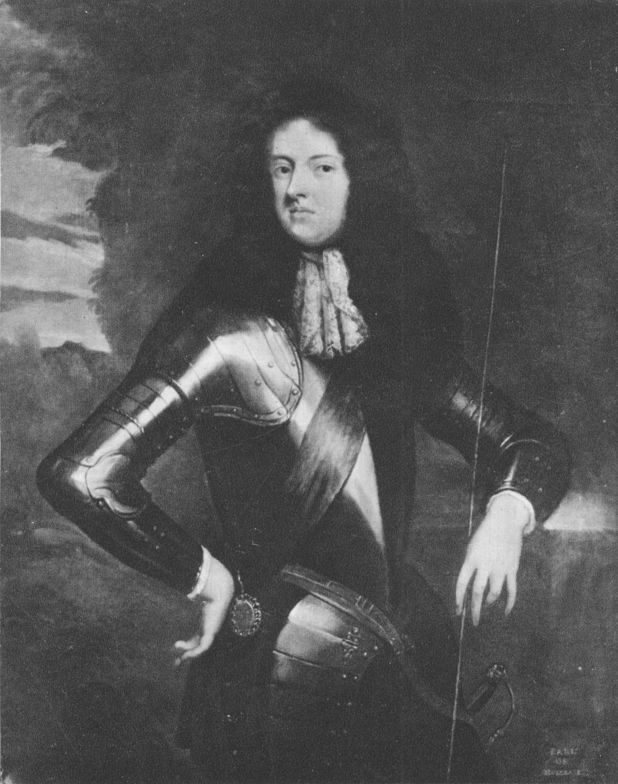
JOHN SHEFFIELD, FIRST DUKE OF BUCKINGHAM AND NORMANBY
This portrait has been ascribed to Sir Godfrey Kneller, but some think it is only a copy of a Kneller painting.
National Portrait Gallery
“Good God,” exclaimed the Duke of Buckingham (after he had been put out of office),
how has this poor Nation been governed in my time! During the reign of King Charles the Second we were governed by a parcel of French whores; in King James the Second’s time by a parcel of Popish Priests; in King William’s time by a parcel of Dutch Footmen; and now we are governed by a dirty chambermaid, a Welsh attorney, and a profligate wretch that has neither honour nor honesty.[757]
Many accounts converge upon the conclusion that the final scene in the long debate between Oxford and Bolingbroke at the Cabinet Council of July 27 brought about the death of Queen Anne. Already scarcely capable of standing or walking, she nevertheless followed the intense political struggles proceeding around her with absorbed attention. She notified the Lord Treasurer by gesture and utterance that he must surrender the White Staff. The sodden, indolent, but none the less tough and crafty politician, who had overthrown Marlborough and changed the history of Europe, had his final fling at his triumphant rival. For months past he had lapped up the Treasury tales of the corruption whereby the Secretary of State and Abigail were enriching themselves. Some weeks before he had submitted to the Queen a “brief account” of his own conduct, in which detailed charges of peculation were made against Bolingbroke. The swindles of the Quebec expedition in 1711, the naked abstraction at the beginning of 1714 of Secret Service money by Bolingbroke to pay off a mortgage on his estate, the passport scandal, and the gross malversations of Arthur Moore, in which Bolingbroke was deeply involved—all these were at his fingers’ ends. And this was the man who should supplant him! In savage tones across the table, both men being within six feet of the Queen, he denounced him to her as a rogue and thief, and in terms of vague but none the less impressive menace made it plain that he would denounce him to Parliament.
Anne was deeply smitten. She had made up her mind, by the processes which have been described, to get rid of this lax but formidable Minister, by whose advice and aid she had violated the friendships of her lifetime and stultified the purpose of her reign. But she knew too much about Bolingbroke, his morals, his finances, his malpractices, public and private, to feel that in quitting Harley she had another stepping-stone on which to stand. Certainly she could not appoint to the Lord Treasurership a man whose financial probity was under investigation and in general disrepute. There is little doubt that she was harassed beyond human endurance. She had taken all upon herself, and now she did not know which way to turn. She was assisted and carried from this violent confrontation, and two days later the gout which had hitherto tormented her body moved with decision towards her brain. Oxford went home to scribble doggerel to Swift about the vicissitudes of statesmen. Bolingbroke remained master of the field and of the day—but only for the day.
During forty-eight hours Bolingbroke possessed plenary power at a cardinal point in English history. What did he mean to do? Had he a clear resolve, equal to the emergency, for which he was prepared to die or kill? “Harry” was never of that stuff. There was no Cromwell in him; there was no Marlborough; there was no Stanhope. He dawdled, he wavered, he crumpled. More than that, his luck ran out.
There is a striking incident recorded of the night of July 28. Bolingbroke, who was in the position of a man charged with the royal commission to reconstitute a Government, had bidden all the rising generation of Whig leaders to dinner at his house in Golden Square. The names of those he had invited are surprising—Stanhope, Craggs, Pulteney, Walpole, Cadogan—in fact, a cluster of Marlborough’s friends and adherents and of Bolingbroke’s most bitter foes. All these men had been outraged by his conduct. The generals had seen the cause they had fought for cast away. Cadogan had seen his revered chief wronged, insulted, and driven into exile. Stanhope had been superseded. Craggs on Marlborough’s missions had been treated with barely disguised contempt. Walpole had been sent to the Tower for five months on a charge of corruption, which at its worst was venial compared to the misdeeds of Bolingbroke. Yet they were all invited, and all except Walpole met round Bolingbroke’s table on the night of July 28.
The Secretary expatiated upon his fidelity to the house of Hanover and to the Act of Settlement, and made it clear that places in his new Government would be offered to the company. But surely this was not the end to which his actions for months had seemed to point. He had purged the Army: he had begun to tamper with the Navy. Every one of these Whigs believed that he was plotting to bring in the Pretender, and place him as an avowed Papist upon the throne, in defiance of all the laws and oaths that had followed the Revolution of 1688. If he did not mean this what did he mean? It is pretty plain nowadays that he meant nothing definite—certainly nothing that could become effective at that time. He wanted to build up a situation step by step, so that if his affairs prospered he could move with safety in the direction he desired. But if it became too dangerous he thought he could withdraw with equal facility, and court the Elector of Hanover as easily as the “Prince of Wales.” For this he needed power and time. He gained the power, but the time was denied him.
The resolute, able men who sat at his table were not hampered by any of the balancings which obsessed their host. They meant, if it were necessary, to fight a civil war for the Protestant Succession. Their situation was incomparably stronger than when the Queen had first fallen ill at the end of 1713. They had a sworn association; they had arms; they had large funds; they had the whole force of a great party and of strong elements in the national life. For months they had been secretly recruiting Marlborough’s veterans—sergeants, corporals, private men. They had several thousands of them on their lists in London, and many others in the Provinces. They had with them nearly all the officers who had led the British troops under Marlborough in ten years of victory. They were in the closest touch with Marlborough, and knew he was on his way to England—would, if need be, take the field at their head. If he could not arrive in time, Stanhope would act. Little recked they of lands or life. Finally, they had the law and the Constitution on their side.
It must have been one of the strangest dinner-parties upon record, and there are many. No one knew the Queen was going to die. No one knew how long she would live. She might live for years. She had been as ill as this at Christmas, and had recovered. At the end Stanhope spoke words of grave and fair import. He offered a soldier’s terms to Bolingbroke. Let him put the fleet into the hands of admirals loyal to the Hanoverian Succession. Let him restore Marlborough to the command of the Army and of the fortified seaports. This done, let him enjoy the Queen’s favour while she lived, and all would take their chance of office under the future George I without bearing him malice. If not, let him play the other hand, and put it to the test. But Bolingbroke, who had got round so many deadly difficulties in breaking Marlborough, deserting the allies, and carrying the Treaty of Utrecht, and now at last had got rid of Oxford, was by no means ready for such sharp choices. He was obviously incapable of responding with force and sincerity. He fell back on general phrases. As the party broke up Stanhope in all the bluntness of after-dinner camaraderie said, “Harry, you have only two ways of escaping the gallows. The first is to join the honest party of the Whigs; the other to give yourself up entirely to the French King and seek his help for the Pretender. If you do not choose the first, we can only imagine that you have decided for the second.”[758]
If Bolingbroke had had more time, if the Queen had lived for another six weeks, it seems very likely that he would have brought about—not for any steady purpose or conviction, for at his heart there was nothing but brilliant opportunism, but for his caprice and ambition—what might have been a civil war as cruel and bloody as has ever rent our nation. While he had made every preparation in his power, had even bargained with Torcy for French troops, yet when it came to the point he had neither the soul to decide nor the manhood to dare. We must indeed thank God that our Island story was not seared by a hideous tragedy; that Marlborough’s sword and the bayonets of his veterans, that Colonel Blackader, Captain Parker, Sergeant Milner, Corporal Bishop, and their comrades, were not engaged on English soil against a goodly company of sentimental Jacobites and stout-hearted country squires and their dependants; and that the old quarrel of Cavalier and Roundhead, in different forms but perhaps on a far larger scale, was not renewed again in England. To the brink of this catastrophe our national life was brought by the wickedness and inherent degeneracy of this richly gifted man.
One is surprised to find serious writers describing his actions as if they were deserving of impartial presentment. Whigs and Tories, Hanoverians and Jacobites—it was, they suggest, six of one and half a dozen of the other. Marlborough had won the war; Bolingbroke had made the peace. Great and respectable currents of opinion flowed in either cause, and history, we are enjoined, must with a cool detachment tolerate both points of view. But this weak mood cannot be indulged in a world where the consequences of men’s actions produce such frightful calamities for millions of humble folk, and may rob great nations of their destiny. By personal vices of heart and mind, by deeds of basest treachery, by violation of law and public faith, this man St John—unpurposed, unprincipled, miscreant adventurer—had brought his native land to the edge of the abyss, and in this horrid juncture he could not even clothe crime with coherency. Let the lifelong failure and suppression of his bright gifts procure no mitigation of modern censure. Let us also rejoice that poor Queen Anne was now at her last gasp. Just in the nick of time she died. She had lived long enough to strip the name of Britain of most of the glories with which it had shone. She had seen it become odious or contemptible throughout the world. She sank into her mortal collapse with her country in the jaws of measureless tribulation. But luckily she expired while there was still time to save it.
Anne allowed Oxford to take leave of her with some ceremony; but her gout increased, and she suffered from pains in the head. Her six doctors who divided the responsibility were all anxious. “On Friday morning [the 30th],” wrote one of them, Daniel Malthus, “her Majesty rose and in her dressing room between 9 and 10, had two very violent convulsions, one immediately after the other which lasted till 11.”[759] Meanwhile the Council met in the palace. They were about to transact business when the door opened, and in marched the Duke of Somerset and the Duke of Argyll. Both were Privy Councillors, but neither of them had received a summons. They declared that the dangerous illness of the Queen made it their duty to proffer their services. The Tory Ministers were taken aback at this apparition. These were not men who could easily be ejected. Somerset was the embodiment of political effrontery and violence. Argyll had been the first man in the storm of Oudenarde. If the Tory Ministers had risen from the table, drawn their swords, and ordered the intruders to depart, they would have been at the level of the crisis. As it was, they were only flustered. Before they could recover, Shrewsbury, who had certainly planned this stroke, was uttering suave phrases of welcome and thanks to the two Dukes for the patriotic impulse which had moved them. With an adroitness which can be discerned across the interval of time, he began to speak of the Queen’s health. The doctors must at once be summoned to the Council. The two stranger Dukes should hear for themselves what they had to say. The doctors came, and related at length the various professional tortures they were inflicting upon the patient. By the time they had finished Somerset and Argyll were for all intents and purposes members of the Cabinet. It is noteworthy that these were the same three Dukes, and men of middle views, who had turned the scale in 1710 against Godolphin and Marlborough. Now they acted in an even greater crisis. In each case Shrewsbury was the prime mover, and revealed in different forms the latent power and guile of his nature.
It was obvious that the great business of the day was to advise how the Queen should fill the vacant office of Lord Treasurer. Oxford had delivered up his staff. It had not yet been bestowed upon another. To whom could it go but Shrewsbury? This was no matter of finance. The Succession was at stake, and the prevention of civil war. Shrewsbury was willing to become First Minister during the emergency. What had the Tories, and, above all, what had Bolingbroke, to say? None of them had any conviction. They had no plan. They had taken no resolves. Against them were determined men. Before he knew where he was Bolingbroke was proposing that the Queen should be advised to appoint Shrewsbury Lord Treasurer.
“From near noon,” says Dr Malthus, “Her Majesty had her understanding perfect, but from that time answered nothing but aye or no.” The doctors were asked “whether she could be spoke to.” To quote Malthus, “At the coming out of the fit the Duchess of Somerset desired from the Lords of the Council that they might propose something to her of great moment to her, which granted, some went in, of which the Dukes of Shrewsbury, Somerset, and Argyll were part.”[760] Lord Chancellor Harcourt guided her hand as she passed the White Staff to Shrewsbury, uttering, it was untruthfully asserted, the words, “Use it for the good of my people.” The Queen then sank into a coma, and the Ministers returned to the council chamber with Shrewsbury at their head. By this transaction, which seemed to move so naturally and perhaps inevitably, Bolingbroke was destroyed. In the morning all power was in his hands; in the evening he was almost an outcast.
The Council sat far into the night. Vigorous measures were taken to ensure the Hanoverian Succession. Messengers were dispatched in all directions to rally to their duty every functionary and officer throughout the land. The fleet was mobilized under the Whig Earl of Berkeley, and ordered to patrol the Channel and watch the French ports. Ten battalions were recalled from Flanders. The garrisons were put under arms, and the train-bands warned. The Dutch were reminded of their treaty obligations. Everything was prepared to proclaim the accession of the Elector of Hanover as George I. These orders bore the signatures not only of Shrewsbury, Somerset, and Argyll, but of Bolingbroke and his Tory colleagues. In the circumstances they could do no less. Indeed, as the ponderous balance had now tilted, their safety lay in showing themselves especially ardent. Throughout the 31st the Council toiled and acted. On this day the Cabinet became merged in the Privy Council. Somers, Halifax, and other leading Whigs took their places at the table. It was now a national body of overwhelming power, none dissenting or daring to dissent. As the day wore on the physicians reported that the Queen could certainly not recover, and that the end was near. All preparations were made with heralds and Household troops to proclaim King George.
Queen Anne breathed her last at half-past seven on August 1. It is sad to relate that her death brought an immense relief to great masses of her subjects. By a harsh coincidence the Schism Act, by which Bolingbroke was to persecute the Dissenters, came into force on that same day. The death of the Queen was an assurance to Nonconformist England that it would be a dead letter. But above all there was the blessed certainty that there would be no Popery, no disputed succession, no French bayonets, no civil war. Without the slightest protest or resistance, the Elector of Hanover was proclaimed Sovereign of the United Kingdom of Great Britain and Ireland.
|
I. S. Leadam, Political History of England (1702-60), ix, 219. |
|
P.R.O., Treasury, 48. |
|
Lord Mahon, Reign of Queen Anne, i, 86, 87. |
|
Swift, Works, xvi, 144-173. |
|
Parker, pp. 184-185. |
|
Salomon, p. 312; W. Michael, England under George I (1936), p. 50. |
|
Dr Daniel Malthus to Sir W. Trumbull, August 6, 1714; Downshire Papers, H.M.C., p. 902. |
|
Dr Daniel Malthus to Sir W. Trumbull, August 6, 1714; Downshire Papers, H.M.C., p. 902. |
All England awaited the arrival of King George I. An epoch glorious in its prime, shameful in its close, had passed away. The famous Age of Anne, the supreme manifestation of British genius, its virtues and vices, in peace and war, by land and sea, in politics, letters, and architecture, was over. A new scene opens with different patterns, lights, and values. All the old actors quit the stage—some in ignominy, some in splendour. Younger men of high gifts and proved capacity present the drama of national life after the triumphs and intense passions of the war. Milder, easier, more comfortable, less romantic themes rule in British society for many years. England had gained heights in the world that she had never reached before. She sat exhausted after prodigious exertions upon these commanding uplands, and regathered her strength and poise.
The contrary wind which had detained Marlborough for a momentous fortnight was at last changed to ‘fair.’ He landed at Dover on August 2, and there learned the news of the Queen’s death. On this homecoming he did not attempt concealment.[761]
He was everywhere received with demonstrations of welcome and regard. Notables and populace thronged the streets of every town and village through which he and Sarah passed, and when they entered the City they were escorted by hundreds of gentlemen on horseback, a body of grenadiers, the civic authorities, a long train of attendant coaches, and an immense concourse of all classes, who accompanied him with loud, unceasing cheers, drowned amid which, we are assured, there were also boos.
The gradations by which Bolingbroke passed from the position of the most powerful and most brilliant Minister to a culprit awaiting his trial succeeded each other with swiftness. His authority had gone. His policy, if he had one, was gone. Indeed, his only hope was to disavow the designs in which he had dabbled. He was still Secretary of State. But soon a black box in Bothmar’s keeping was opened with the names of the Regents appointed by King George I to rule the realm till he could reach London. There were twenty-five Regents. Among them was not found the name of Bolingbroke. The list had been drawn up from the Hanover angle. Extreme Whigs like Somers, Sunderland, and Wharton were not included; neither were any of the Tory Ministers. Marlborough was surprised and offended not to be declared a Regent; but, considering that this Council of Regency was to come into being in England only until the King could come himself, and that Marlborough was also beyond the seas at the time the list was drawn, his complaint was ill-founded. The omission of his name, as was soon proved, was neither a slight nor intended to be one.
St John, though he put upon it the best face he could, was not slow in realizing his position. To him, it has been said, the twenty-five Regents were twenty-five Sovereigns. He was directed to send his dispatches to them. Day after day for nearly three weeks he paced the anteroom awaiting their pleasure. Swift, whose world had also clattered about his ears, and who saw the loss of all he had gained by the malice of his pen, warned the stranded Secretary to expect the worst. On August 16 there arrived from Hanover a curt dismissal and an order to deliver up his seals to Townshend. Thereupon, as an indication of what was in store, he was visited by two lords who collected and sealed up such papers as he had not already destroyed and was willing to surrender. He retired to the country, a prey to equally well-founded regrets and fears.
No ceremony was used with the Tory underlings and creatures. Abigail had played little part in the closing scenes of her mistress’s life. It was the Duchess of Somerset who took charge of the deathbed and the corpse. Abigail and her husband hastened to the country, carrying with them, it is alleged, a substantial sum of money. She lived in complete obscurity till 1732; but no one can say she had not had her hour. The fate of Mrs Manley was more harsh. “The bill your Lordship was so good to send me,” she wrote (August 30, 1714) to her patron, Oxford,
went immediately to quiet uneasy creditors, and now I have nothing but a starving scene before me, new interests to make without any old merit; Lord Mal—— and all his accomplices justly enraged against me; nothing saved out of the general wreck, for what indeed could I save? your Lordship’s bounty being all I ever received from the public for what some esteem good service to the cause; many persons prejudiced, but none in particular thinking themselves obliged.[762]
Oxford in misfortune was sustained by his admirable phlegm, by liquor, and by the intense inward joy with which he watched the ruin of his faithless and lately triumphant confederate. He was more concerned in bringing to light Bolingbroke’s peculation in the Quebec expedition than about his own defence. He even seems to have persuaded himself at first that he would find favour in the new reign. In this he was speedily undeceived.
George I landed at Greenwich on September 18, and in the palace by the waterside received the nobility of his realm. At heart this lucky German Prince regarded them all with a comprehensive, impartial distrust and disdain. He had received the news of his accession without excitement and certainly without enthusiasm. He had accepted the British crown as a duty entailing exile from home. He had gazed long and attentively upon the darker side of British politics without understanding the stresses which were its explanation. He had seen both parties competing year after year for his favour in order to advance their own ends. He despised them, alike for their servility and their factiousness. He knew how little they cared for him, except as an instrument, even a tool, in their Island quarrels. They were using him as a convenience, and he would use them as their mood and plight deserved. Between them, as he saw it, they had made England play a part of faithlessness and military desertion which all Europe, friends and foes alike, viewed with sincere and open scorn. They had begged him to leave his Hanoverian home to rule over them. He would be graciously pleased to do so, according to the rules arising from their civil and religious fights. Besides, they were rich, and the great force they embodied might well be made serviceable to Hanover and in the larger European problems. Around him were well-tried counsellors like Bernstorf, Bothmar, and Robethon, deeply versed in English political intrigue. He brought with him a pair of ugly and rapacious German mistresses and a son whom he hated like the plague.
He trusted no English statesman. Bolingbroke and Oxford were the men who had betrayed the allied cause—the men of Utrecht. Ormonde was the general who had deserted Prince Eugene. Shrewsbury had played a part of duplicity in breaking up the Grand Alliance. Somers, Halifax, Sunderland, and the rest of the Whigs had all been ready to sell one another for the sake of office. Even the mighty Marlborough, master of war and guide of Europe, had concealed from him the plans of the Oudenarde campaign, and had certainly sought to reinsure himself with Saint-Germain. Thus our new Sovereign took the poorest view of his principal subjects, and set himself to manage them with much perplexity but genuine contempt. And who was he himself, it may be asked, to be their judge? A narrow, vindictive, humdrum German martinet, with dull brains, coarse tastes, crude appetites; a commonplace and ungenerous ruler, and a sluggish and incompetent commander in the field—that was all. Surely his accession, however indispensable, was a humbling experience to the tremendous society and nation whose arm had broken the might of the France of Louis XIV. But these are the penalties of a divided national life.
The political arrangements were made with that expert skill which is best exercised under conditions of unsympathetic detachment. The King of England could not speak a word of English; but he had his own advisers, who now became the repositories of power. They decided in principle to ban the Tories from office, to put the old Whig Junto in the shade, and to bring forward a new generation. Bolingbroke had already been dismissed. When Oxford at length came forward Dorset presented him thus: “Here is the Earl of Oxford, of whom your Majesty must have heard.”[763] The King, disconcerted, allowed him to kiss his hand, gave him a frozen stare, and turned away. Ormonde, having already learned that he was stripped of his command, departed from the Court without a word.
Marlborough, on the other hand, had been received with the greatest honour and cordiality. “My lord Duke,” exclaimed the King, as soon as he landed, “I hope your troubles are now all over.” He was immediately granted an hour’s audience, and the first warrant signed by the King reinstated him as Captain-General, Master-General of the Ordnance, and Colonel of the 1st Guards. A small incident in these crowded hours shows the agreeable terms upon which he found himself with his Sovereign. Dr Garth, Marlborough’s devoted admirer, had for some time been also physician to the King. He was the recipient of the first knighthood conferred in the new reign. He asked as a special favour that the accolade might be given him with Marlborough’s sword, and the King complied with this in much good humour. A week later the King was entertained at a banquet at Marlborough House, and in every way showed the Captain-General countenance and favour. There was no doubt more policy than personal friendship in these demonstrations. Nothing could strengthen the new reigning house more at this moment than these proofs that Marlborough was with it. In the British Army, where the veterans had not forgotten Ormonde’s desertion of Prince Eugene in 1712, the “Old Corporal” was welcomed back with warm satisfaction; and throughout Europe the States and Princes of the former Allies were impressed with the power and stability of the new Government.
At first the Whigs and Hanoverians were in a mood to revive the foreign policy and European grouping so grievously broken since 1710, but these ideas faded before the realities of a new day. Utrecht was irrevocable. A Ministry was swiftly formed. All the Lords of the Junto were installed in Cabinet posts. Shrewsbury gladly yielded the Treasurer’s staff, and resumed the wand of Lord Chamberlain. The Treasury was placed in commission under the Presidency of the none the less unsatisfied Halifax. But the real business of the State, subject to the supervision of the Hanoverian circle, fell increasingly to Townshend, Stanhope, and Walpole. There could be found no three abler men in the full vigour of manhood and prime. Townshend and Stanhope were the Secretaries of State. Walpole, owing to the disapprobation of Bothmar, had to console himself with the lucrative office of Paymaster of the Forces and the patronage that flowed therefrom. Nottingham, “Dismal,” was the only important Tory figure in the Administration, and he in Tory eyes was a renegade.
Now was the hour of Whig retaliation. The Tory Parliament, lately dominated by the October Club and swelling with incipient Jacobitism, had been profuse in its asseverations of loyalty to King George and had voted him munificent supplies. They were remorselessly dissolved; and from the new election an overwhelming Whig majority was returned, which, as it fell out, inaugurated nearly forty years of Whig ascendancy. As if the spell which had bound them to life had been snapped with the end of their period, Somers, Shrewsbury, Halifax, and Wharton all died within a few years. Bolingbroke alone survived for more than a generation to gaze forlornly upon the past and mock himself with vain hopes.
His immediate conduct and fortunes deserve a passing glance. The Whig Parliament proceeded to repeat the odious process of recrimination and censure in which four years earlier the Tories under Harley and St John had so wantonly indulged at the expense of Marlborough and Godolphin. A sincere loathing was felt by the political victors for the men who had made the Treaty of Utrecht. Not one of them was ever allowed to hold Ministerial office again. But against the principal authors of the desertion and separate peace the ancient processes of the Constitution were set in motion. Parliament, with the full assent of the Crown, demanded the punishment of the ex-Treasurer, who had negotiated with France behind their backs; of the ex-Secretary, who had, it was alleged, conspired to subvert the Act of Settlement and bring in a Popish prince to the prejudice of the lawful Sovereign; and of the General, who had marched away from the allied camps, taking with him the pontoons which might have averted the massacre of Denain. The procedure of impeachment was invoked. The brilliant Bolingbroke’s nerves collapsed hopelessly under the strain. At first jaunty and audacious, he tried to carry off all with a gay confidence. He spoke in the Lords with fire and skill. He built the largest bonfire before his house to celebrate the Coronation. He presented himself at the theatre as a patron of the arts, and kept high state in his London house. But a slow, cold fear began to gnaw his heart. He knew how much he owed. He dreaded what he would have to pay. His trepidations led him to an astonishing course. He threw himself upon the magnanimity of Marlborough.
Marlborough was no doubt surprised when the ex-Secretary of State called at his door. A long account stood between them. Marlborough had befriended him in his early career. He had made him Secretary-at-War in the great days. He had helped him pay his debts. He had almost called him his son. He had never done him any injury, and there is no record of any harsh word which he ever spoke about him. On the other hand, no one had pursued Marlborough with more malignity than Bolingbroke. He had helped in his overthrow. He had turned Swift loose upon him to traduce his character and libel his wife. In his hour of authority he had lectured and patronized him. He had written scores of letters about him in terms of hostility and contempt. He had largely destroyed his European work. He had removed him from the command of the allied armies, broken his faithful officers, and involved the British troops in the foulest dishonour. He had led and persuaded the House of Commons, in spite of truth or justice, to brand him for all time as guilty of peculation and corruption. His had been the hand that would have denied him even an asylum abroad. He had even written to Torcy that he would cut off his head, and only a few months before had threatened to send him to the Tower if he set foot in his native land. Now, in all the disreputable inconsequence of his nature, he came to beg his help and advice.
Marlborough was not a vindictive man, but, as Bolingbroke’s biographer justly observes, “He would have been either much more or much less than human—he would perhaps have acted with ridiculous weakness—could he in his heart have forgiven Bolingbroke, or have performed towards him a friendly part.”[764] The Captain-General received his visitor with his usual good manners. Bolingbroke sought to know how he stood with the new régime, and what his fate was to be. He appealed for aid and pity, under the cloak of seeking advice. Marlborough read him through and through. He had had many opportunities of seeing whether a man was frightened or not; but he was all bows, consideration, and urbanity. Bolingbroke soon felt that at least he had one friend. When this impression was established, Marlborough confided to him the fact that his life was in danger. It was not the purpose of the new King and Government to persecute the Tory Party or punish the Tory leaders as a whole. In the new reign there must be a fair start. But it was felt that an example should be made. Speaking as one known to be deep in the secrets alike of Heinsius and of the Hanoverian circle, he hinted that Oxford and the Whigs had reached an agreement on which Bolingbroke’s blood should set the seal. The sole hope for him was to fly the country. There might just be time.
Bolingbroke, already in the grip of fear, was panic-stricken not only by Marlborough’s words but by his manner. That very night, after showing himself ostentatiously at the theatre, he set out for Paris disguised as the valet of the French messenger La Vigne. From the packet at Dover he wrote a letter to his friend Lord Lansdowne which as it passed from hand to hand created amazement. “I left town so abruptly,” he wrote,
that I had not time to take leave of you or any of my friends. You will excuse me when you know that I had certain and repeated information, from some who are in the secret of affairs, that a resolution was taken by those who have power to execute it to pursue me to the scaffold. My blood was to have been the cement of a new alliance; nor could my innocence be any security after it had been once demanded from abroad, and resolved on at home, that it was necessary to cut me off.[765]
His life was, of course, in no serious danger, but Marlborough had frightened him out of his wits, and by running away from England he admitted the worst that his opponents could have charged against him. Marlborough had no strong sense of humour, but he must have chuckled over this.
In after-years Bolingbroke publicly denied that Marlborough’s warnings had been the cause of his flight. The French Ambassador, Iberville, who arranged it, wrote to Torcy (April 5), “Milord Bolingbroke has just been warned that his destruction is resolved.”[766] And (April 12), “He was warned on sure authority that the decision was taken on Tuesday the 2nd to accuse him of high treason, and that they boasted they had enough against him to cut off his head. His head was demanded by the Emperor and the Dutch.”[767] And a year later (May 6, 1715), “It is taken as certain that it was Milord Marlborough who warned Lord Bolingbroke of the Cabinet’s decision not to spare him.”[768]
By his flight Bolingbroke was held to have admitted the worst his enemies could allege. An Act of Attainder was passed upon him. In a few months he became Secretary of State to the Pretender, and held this office during the rebellion of 1715, thus making war upon the country of which he had so recently been a principal Minister. His habit of revealing secret business to his mistresses and his outspoken criticisms of the Shadow Court at Saint-Germain led to his dismissal in 1716 by the Pretender. It was eight years before he was, with some tolerance, allowed to return to England, but the Attainder, though mitigated in respect of his property, debarred him for ever from Parliamentary life.
Oxford’s behaviour in adversity extorted respect from all. When it became clear that the new House of Commons would demand his impeachment, and a formidable catalogue of high crimes and misdemeanours was drawn against him with all the skill of the Whigs, guided by the deadly common sense of Walpole, he announced through his brother, Edward Harley, “that he would neither fly his country nor conceal himself, but be forthcoming whenever he should be called upon to justify his conduct.”[769] While the process developed against him he regularly attended the House of Lords. Here he was shunned by most of those who had shared the responsibility for his actions and competed for the favours he could formerly bestow. Among these timeservers Lord Poulett, “Swallow,” was conspicuous. When eventually the articles of impeachment were exhibited against the ex-Treasurer in the Lords, and a resolution was carried to commit him to safe custody in the Tower, he spoke with a dignity “unconcerned with the life of an insignificant old man,”[770] and declared that with his dying breath he would vindicate the memory of Queen Anne and the measures she had pursued. Edward Harley says that “he fetched tears either of rage or compassion from the greatest of his enemies; the Duke of Marlborough himself saying that he could not but envy him that under such circumstances he could talk with so much resolution.” He had much to answer for; but behind him stood the fact that his policy had received the sincere assent of the Queen, and had been affirmed by two successive elections and Parliaments. His coach was accompanied through Piccadilly and Holborn to the Tower by a great throng of the common people, and when the Whigs shouted, “Down with the Pretender!” and “Down with the traitors!” the Tory chorus overpowered them with “High Church!” “Ormonde and Oxford for ever!” The gates of the Tower closed against this excited concourse, and Oxford remained there for a long time.
Marlborough’s restoration to the highest military and political functions had been complete. He was the most august member of the Cabinet. He held once more his great military offices. His political friends occupied all the important positions, military, civil, and diplomatic. Townshend, Stanhope, and Walpole were the life and soul of the Government. Cadogan held high command under him in the Army. Craggs seemed likely soon to be a Minister. Stair, the capable Ambassador in Paris, was the most prominent of British envoys. Although Sunderland thought himself slighted by receiving no more than the Lord-Lieutenancy of Ireland, Marlborough’s numerous relations were so well represented in Ministerial and Court positions as to cause jealousy. His three sons-in-law, Lord Godolphin, the Earl of Bridgewater, and the Duke of Montagu, received respectively the posts of Cofferer of the Household, Lord Chamberlain to the Prince of Wales’s Household, and the command of a regiment; and his daughter, the Duchess of Montagu, was Lady-in-Waiting to the Princess of Wales. His levée was as crowded as in the famous years. Once again, affable and bland, smiling and bowing, courteous to all, he was the centre of the Antechamber, “making the same figure at Court that he did when he first came into it.”[771] Sarah seldom accompanied him to these circles where she had so long been powerful. She was disillusioned. She had urged her husband not to take any office. “I think,” she wrote to Lady Cowper, “anyone that has common sense or honesty must needs be very weary of everything that one meets with in Courts.”[772]
The Duke, however, wielded an immense influence whenever he cared to use it. He had the satisfaction—and it must have been a great one—of reinstating in the Army the faithful, war-proved officers who had been the victims of Bolingbroke’s purges. With Argyll and Cadogan as his two subordinates, he rearranged and redistributed the commands of the Army, the fortresses and regiments. That this process should be severe and resented by the Tories was inevitable. It was certainly not needlessly vindictive. Marlborough, now as ever, was averse to the partisan treatment of national affairs. If he had been inclined to pursue officers of merit who had been disloyal to him he had the fullest opportunity. But there is no record of such a reproach having been made against him. None the less the control of the Army was brought into harmony with the interests of the house of Hanover and the Protestant Succession. This work, which occupied the winter of 1714 and the greater part of the next year, was soon to be put to a serious test.
In the acrid debates about the size of the standing army he effectively championed against a harsh prejudice the interests of the foreign officers who had bravely served him in the wars. “Thus to cashier,” he told the Lords, “officers, particularly French refugees, whose intrepidity and skill I have often experienced, many of whom have served during twenty-five years with disinterested zeal and unblemished fidelity, would be the height of ingratitude, and an act of injustice unparalleled even among the most barbarous nations.”[773] He also successfully resisted on behalf of the Government the Tory proposal to confine by law all British regiments to their respective stations, saying, “His Majesty having trusted his royal person and family entirely into the hands of the nation, and at the opening of the Session told the Parliament that what they should judge necessary for their safety he should think sufficient for his own, we cannot do less for his Majesty than to leave to his great wisdom and direction the disposal of the few troops that are kept on foot.”[774] In this case his appeal was accepted without even a division.
In fact, during 1715 the actual government of the country seemed to be carried on by an inner Cabinet of German and British Ministers, of whom Marlborough, though not the most active, was the foremost. “Under the cover of darkness,” wrote Hoffmann, “Marlborough, Townshend, and Bernstorf meet every night at Bothmar’s house.”[775] Bonet, the Prussian envoy, wrote at the same time, “This quadrumvirate settles everything.”[776] Very soon they were joined by Stanhope. This system prevailed during the whole of 1715, and Marlborough dropped out of it through the decline of his energy and the eventual breakdown of his health. He no longer made the same commanding impression upon people. Although he was the King’s greatest subject, and in the greatest situations, the actual leadership and conduct of business did not lie in his hands. Nor did he seek to assert it. His life’s work was done, and his genius for command and control had gradually departed.
There is ample explanation and excuse in human nature for the wrath with which the Whigs pursued the ousted Tories. But the reaction which followed was formidable. The Tory Party, undoubtedly the stronger, now saw themselves not only stripped of power and office, but censured in scathing terms by those over whom they had lately ruled. They claimed that the country had been with them in the Peace. They were sure it was with them against the renewal of the war. The Whigs, they declared, in their hearts sought to resume the foreign policy of 1710, for which a great standing army and heavy expenditure would be required. Inflamed by the impeachment of their leaders, offended by the foreign aspect of the Court and the King’s hostility to them, the Tories gave way to angers which stirred in every class and every parish throughout the land. This violent mood prepared their further undoing, for the Pretender, misled by their discontents, encouraged by Bolingbroke, proceeded to claim his rights with the sword. Here is no place to describe the rebellion of 1715 in Scotland and its suppression. Marlborough as Captain-General used the whole power of the Army against the Jacobites. He was no longer fit to take the field himself, nor, indeed, were the forces and operations upon a scale requiring his presence. It seemed natural that Argyll should command King George’s forces in Scotland, and thither also Marlborough sent Cadogan with the six thousand Dutch troops readily furnished by the States-General under the Succession Treaty.
Marlborough presided over, rather than conducted, the brief and petty campaign. He rightly predicted Preston as the point at which the Jacobite inroad from Scotland would be arrested. He sat daily in the Cabinet and strongly supported the exclusion of the Duke of Somerset, whose high words about the detention of a nephew in the Tower had provoked his colleagues. When Argyll’s chivalrous sympathy for his fellow-countrymen in arms against the Crown made him lax and lukewarm at the head of the Royal forces in Scotland, Marlborough intervened effectively to have him superseded by Cadogan. The crazy allegation that he trafficked with the Pretender at this period, though in accord with everything that Jacobite traducers have said about him, is belied by all his actions and all his interests. Yet it is an old man whom we now see once again installed in the highest authority; and the vigour of the Government measures must be ascribed to Ministers in their prime like Townshend and Walpole, and above all Stanhope.
Political England, which in the spring and summer of 1715 had been so fiercely discontented with the Hanoverian-Whig régime, rallied to it in overwhelming decision against rebellion and invasion. Both parties—one sadly, but none the less decidedly—joined in protestations of loyalty to King George. A price of £100,000 was set upon the Pretender, dead or alive. Hundreds of suspected notables were placed under preventive arrest. The Swedish fleet, in which Charles XII had planned to come to Scotland with twelve thousand of his veterans, was attacked and destroyed in Danish waters by British battleships, allied with the Danish squadron and under the Danish flag. Ormonde, whose popularity had been counted on to carry all before it in the south and west of Scotland, arrived in France a fugitive, and did not dare even to land again in counties, like Devonshire and Cornwall, in which he had formerly been all-powerful. The ill-starred Pretender, escaping from his flicker of sovereignty in Scotland, dismissed Bolingbroke from a phantom Secretaryship of State. The death of Louis XIV in September 1715 and the accession to power of the Duke of Orleans as Regent fundamentally altered the policy of France towards the house of Stuart, and new combinations opened in Europe which are beyond the scope of this account.
Very little blood was shed in the fighting of 1715, and—according to modern standards—restraint was shown by the Government towards the prisoners they had taken. Two lords only suffered on the scaffold, and a few score of shootings and hangings measured the penalties among officers and the rank and file. Tory England, which had rejected the cause of a Popish prince and had adhered steadfastly to the Act of Settlement, now looked forward to a general election as the constitutional means of voicing just grievances. But in this they were forestalled by the passing of an Act which, with doubtful moral warrant, extended the life of the House of Commons to seven years. In this period the Hanoverian dynasty became consolidated upon the throne, and the Whig Party grew to such ascendancy that they could afford to fight among themselves for the control of the Government. After their able men had jostled each other for some years the scandals which followed the bursting of the South Sea Bubble opened to Walpole a long reign of peace and plenty, sustained by bribery and party management. This period of repose and growth, albeit an unheroic pendant to the glories of the Age of Anne, was the necessary prelude for the renewed advance of Britain to Imperial State under the command of the great Pitt. Thus the scroll unfolds.
|
The Flying Post (August 5, 1714) reported: Rochester August 3, 1714 To-day, about 12 o’clock, the Duke and Duchess of Marlborough passed through this city; they were received with great expressions of joy from the people, especially those at Chatham, who strewed their way with flowers, as they adorned their houses with green boughs, and welcomed them with repeated shouts and acclamations. They were met about three miles from hence by Dr Harris [author of History of Kent (1719)], one of our prebendary’s, the minister of Chatham, and many other gentlemen of that place and Rochester, on horseback. Dr Harris made a short and congratulatory speech which the Duke returned with all possible condescension and humanity. |
|
Portland Papers, H.M.C., v, 491. |
|
Michael, p. 76. |
|
Thomas MacKnight, Life of Bolingbroke (1863), p. 439. |
|
MacKnight, p. 437. |
|
French Foreign Office Archives, “Angleterre,” tome 265, f. 105. |
|
French Foreign Office Archives, “Angleterre,” tome 268, f. 25. |
|
Ibid., f. 28. Confirmation is available from a totally different quarter. Edward Harley, the Auditor, in his “Memoirs of the Harley Family” says, “The Lord Bolingbroke, by the private negotiations of the Duke of Marlborough and those employed by him, was not only prevailed upon to quit the Kingdom in disguise, but also to deliver up his book of private letters relating to the peace.” (Portland Papers, H.M.C., v, 663.) |
|
E. Harley’s memoir of Robert Harley, quoted in Michael, p. 23. |
|
Quoted in Michael, p. 128. |
|
Lady Mary Wortley Montagu; quoted in Michael, p. 95. |
|
Diary of Lady Cowper, p. 196. |
|
Coxe, vi, 317. |
|
Ibid., 316. |
|
Quoted in Michael, p. 106. |
|
Loc. cit. |
Marlborough’s daughter Anne, Sunderland’s wife, who by all the records preserved of her appears in a light of kindness and charm, died of what was called a “pleuritic fever” in April 1716. Her father was broken by the blow. His love for his wife and children stood always first in his life. Sarah also gave way to deep depression. They retired to Holywell alone together. Here on May 28 the headaches and giddiness which had always dogged him culminated in a paralytic stroke. He was at first robbed of both sense and speech. Dr Garth, summoned from London, administered the bleedings and cuppings which were the remedies of those days. Gradually his mind cleared, and bit by bit his speech returned. In the summer he was well enough to be moved to Bath, where the waters did him good, and the natural strength of his constitution largely repaired the lesion in his brain. In November he had a second even more severe stroke, and it was thought by all that his end had come. But again he made a surprising recovery. He was able after a while to resume the riding which had become second nature to him and was his daily exercise almost to the end of his life. His mind, though its energies were weakened, had rapidly regained its full poise and clearness, but he never recovered the complete power of speech. He could converse agreeably on every subject, and his judgment and sagacity were unimpaired; but, as often happens in such cases, certain words were stumbling-blocks, and as he was not willing to expose this weakness to strangers, he became increasingly silent except in the family circle. He still took a keen interest in public affairs. He voted for Oxford’s impeachment in 1717. * “He was at this time,” says Sarah, “so ill that he could not go fifteen miles without being tired.”[777] He had in his old age developed an inveterate dislike of the opponent who had brought him down, and though stricken himself, he used all the influence he could still command to prevent the impeachment from being allowed to lapse.[778] Perhaps his own sense of being mentally crippled embittered him. All his life he had been a humane man, whose path was free from the tiresome, baulking shadows of revenge.
On account of his infirmities he sought, as was indeed no more than proper, to give up the Captain-Generalcy. But this did not commend itself to George I. The quarrel between the King and the Prince of Wales was at its height, and the Sovereign could not run the risk of the vacant office being demanded for his son. He therefore begged Marlborough to continue Captain-General, and the Duke in fact held this post, though quite unable to discharge it, until a few months before his death.
Marlborough had nearly five more years of life. He always maintained a considerable state. He attended the House of Lords regularly till November 1721, and lived at Holywell, which was well established and comfortable, or at the Lodge in Windsor Park, which Sarah had considerably enlarged, or at Marlborough House; but all his active interest was in Blenheim. One wing was finished, and the rest was rising slowly year by year. His surviving daughters and their husbands, and now grandchildren growing up, all wished to pay their court to him; but Sarah for one reason and another surrounded him instead with all kinds of quarrels, for which she has left abundant self-justifications. These are recorded with care in the pages of Archdeacon Coxe, and have been even further exposed in the present century by Reid’s agreeable narrative. It is not necessary to do more than mention them here.
She fell foul of Sunderland both on family and political grounds. A year and a half after his wife Anne’s death he married again—as Sarah thought, beneath him. He made financial settlements which she considered prejudicial to her daughter’s children. She reproached him in harsh terms. Sunderland, who had filled so many high offices and lived all his life in an atmosphere of controversy, retorted with an equal command of combative and insulting phrase. When in 1718 he became head of the Government their breach was already final. This did not, however, prevent Sarah from quarrelling simultaneously with Sunderland’s principal opponents, Townshend and Walpole, and her animosities pursued these statesmen during the whole of their lives. She accused Craggs, when Secretary of State, of having offered her a gross discourtesy before a masquerade in 1712.[779] Craggs denied the story, and the charge was perhaps unfounded, but she hated him well and long. Soon she believed Stanhope, before whom the highest political prospects were open, was intriguing to obtain Marlborough’s office of Captain-General, and she abused him heartily on all occasions.
Her dispute with Cadogan was still more painful. He had, she alleged, misapplied, and even partly misappropriated, the fifty thousand pounds which Marlborough had entrusted to him when he quitted England at the end of 1712. He had transferred it from Dutch funds, which later had paid interest at only 2½ per cent., to the loans of the Empire, which yielded 8 per cent. with a proportionate increase of risk. She declared that he had profited substantially by the difference in interest. Dominating her husband in his decline, she demanded a repayment of the capital, by this time greatly depreciated, and asserted her rights at law. Into this sorry story there is no need to pry, though voluminous material and documents exist at Blenheim. It is impossible to deny that Sarah’s claims were seriously founded. She gained her action, and Marlborough’s brave and faithful comrade, always lax in money matters, had great difficulty in making the necessary restitution.
It can hardly be thought strange that she fell out with her architect, Vanbrugh, as well as with several of the contractors who built Blenheim. She had always, as has been seen, disapproved of a palace on so magnificent a scale. She visited this upon Vanbrugh, whose ambitious design had been the cause of so much friction and embarrassment to Marlborough. When she saw the chaos in which the works stood in 1716 her wrath overflowed. She fought Vanbrugh with zest and zeal. He was a person of some consequence in society with a tongue and pen of venom. Here, then, was another fertile and enduring theme of strife. The building of Blenheim under all the varying relationships of Marlborough with successive Governments no doubt gave opportunity to extravagance, inefficiency, and actual fraud. On the whole, the merits lay on Sarah’s side, and she certainly gained several actions against the contractors.
But the saddest quarrels, and those that rent Marlborough’s heart, were with her two surviving daughters, Henrietta, Lady Godolphin, and Mary, Duchess of Montagu. Both daughters, while declaring and evincing devotion to their father, treated their mother undutifully and even cruelly. These distresses darkened Marlborough’s closing years, but while he tried to soften his wife’s severity he always stood by her on every occasion. And she stood by him. All the love and tenderness of her vehement, tireless nature centred upon her failing husband. She waited on him hand and foot. She watched over him night and day. She studied his every wish, except in the one matter which would have rejoiced him most. At one time a sham reconciliation with her daughters was performed in his presence; but love was dead on both sides between mother and children. Sarah prowled around his couch like a she-bear guarding its slowly dying mate, and tearing all, friend or foe, who approached.
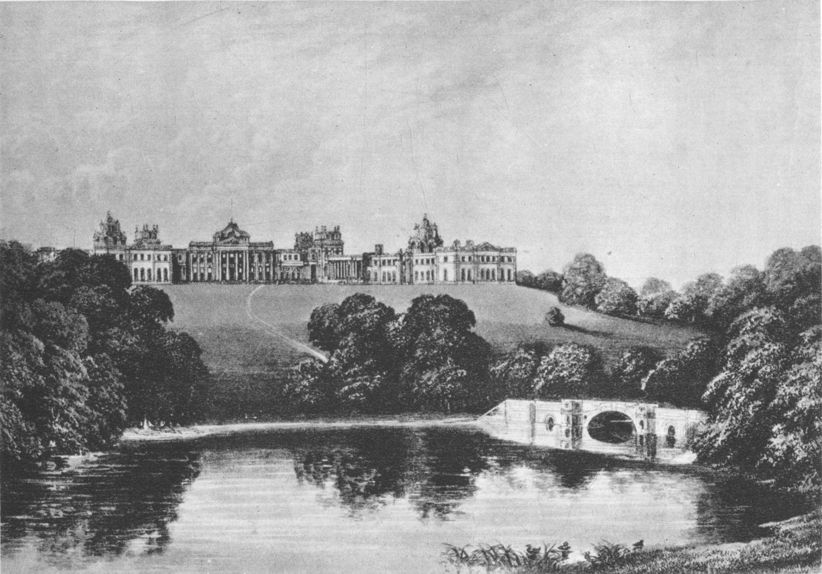
BLENHEIM PALACE
These shadows did not, however, fill the picture of Marlborough’s decline. There were happiness and pleasure as well. The new generation and their friends were welcome in the half-finished palace. Young soldiers came on visits of courtship or pleasure, or in the hope of seeing the warrior whose deeds resounded through the world. Coxe gives an agreeable account of theatricals where, after its lines had been carefully pruned by Sarah of all immodest suggestion, All for Love was acted with much skill. It was in this bright and innocent circle that Marlborough realized some of those pleasures of home of which he had dreamed throughout his campaigns. He himself played cards for amusement, particularly piquet and ombre; while Sarah indulged her taste for more serious stakes. He rode about his wide park and properties often twice a day, or drove behind postilions with his wife. Always he remained a centre of harmony, patience, and gentleness; and always the object of veneration and love, with which pity increasingly mingled.
In 1720 the amazing episode of the South Sea Bubble inflamed, scorched, and seared London society. Sarah, with her almost repellent common sense, forced the Duke out of the market before the collapse, and added £100,000 to the fortune which he and she had gathered. Nor was this feminine intuition. In a blistering letter she wrote, while all English society was bewitched by speculation, “Every mortal that has common sense or that knows anything of figures sees that ’tis not possible by all the arts and tricks upon earth long to carry £400,000,000 of paper credit with £15,000,000 of specie. This makes me think that this project must burst in a little while and fall to nothing.”[780] All the Ministers, her enemies, were involved in the scandals and widespread ruin which followed. Sunderland and Craggs were grievously stricken in fame and fortune. Unscathed herself, Sarah gave full rein to her honest indignation. She urged the hounds of public wrath upon the trail of the wrongdoers. But these held high places, and, although hard pressed, were able to retaliate in their own fashion. All her enemies in the Government and at Court laid their heads together. They worked upon the King. To keep her quiet or busy with her own affairs, they set on foot against her, with his connivance, the most fantastic slander that could be imagined. She was in a plot, they said, to bring back the Pretender. She had even sent him a large sum of money. Marlborough, in spite of his health, was summoned by his estranged son-in-law Sunderland, then Prime Minister, to receive this monstrous accusation against his wife.
* “That winter [1720],” Sarah writes in her “Green Book,”
when the struggle was in Parliament about the Directors and the South Sea (being always mighty averse to that scheme and wishing to have the Directors punished), I talked to all the Parliament men that I knew, wishing that the Parliament would be as honest as they could, thinking that that would help the publick credit, and upon this heed one day I asked a friend of my lord Cadogan how he would be, endeavouring to persuade him that it was his interest to join with the Duke of Marlborough, who was of my mind in all the Proceeding: I did not say one word of any of the ministers that was the least offensive . . . , but my lord Cadogan (who can never forgive me for defeating his design of cheating the Duke of Marlborough of £50,000 which he had in Holland to secure bread in case of forfeiture in England) took this handle with a fruitful invention to go to my lord Sunderland and my lord Stanhope and told them millions of falsities that I had said of them on that subject, which put my lord Sunderland into such a violent passion that he sent immediately to speak with the Duke of Marlborough and said all that can be imagined ill of me to him, and amongst the rest he assured him that I was in a plot to bring in the Pretender and that in the Spanish-Scotch invasion I had remitted a great sum of money for that service, and that the King could prove it. This conversation harassed the poor Duke of Marlborough so much that he came home half dead.
Nothing could have been better calculated to drive Sarah into fury—she, the lifelong Whig, the foe of Popery! But when she resorted to Court aflame with injured innocence she found herself sullenly received, and her impassioned letter of protest drew from the King only the following curt reply:
St James’s
December 17, 1720
Whatever I may have been told upon your account, I think I have shown, on all occasions, the value I have for the services of the Duke your husband; and I am always disposed to judge of him and you by the behaviour of each of you in regard to my service. Upon which I pray God, my lady Marlborough, to preserve you in all happiness.
George R.[781]
“They who play at bowls must look for rubbers.” But the behaviour of his nearest and dearest was Marlborough’s unceasing distress. No excuse can be offered for the Duchess of Montagu’s conduct to her mother. She made a practice of ignoring her even in the presence of strangers.
* After the great illness that the Duke of Marlborough had in 1716 . . . I was determined to bear whatever she would do rather than hinder any of the Duke of Marlborough’s Children from comeing to my house when he was sick. And this was so great an encouragement to all manner of ill behaviour, that what I had hid so long They made publick, for They never came to see their Father in a morning, but att the hours when Company was there, going up towards him without taking any notice of me, as if they had a pleasure in shewing everybody that they insulted me.[782]
These disagreeable conditions continued through the years.
The Duchess of Montagu to her Father
Jan. 1, 1721
* I was to wait upon my Dear Father last night, to tell You What I hope You know without my saying it, that I was very sorry not to be at home when You came. If You could have the least pleasure in the Variety of coming here, any afternoon, it would be a great one to Me, and to anybody, I am sure, that You would let meet You. My Lord Sunderland is a very good Whisk player, and my Sister Godolphin can play and would be pleas’d with it, (I know), in Your Company. I hope You will come again, and be so good to let me know when, that I may send to them, or anybody You like. I know my Dear Father can never be with anybody that don’t love him, but I am sure there is no body that does it more than
Your most Dutifull
M. Montagu
Marlborough to Mary
* I thank You for your Letter my Dear Child, but I observe that You take no manner of notice of your Mother: and certainly when You consider of that, You can’t imagine that any Company can be agreeable to me, who have not a right behaviour to Her. This is doing what is right to Yourself as well as to your affectionate Father
Marlborough
January 2, 1721
* My dear Child,
Your expressions of duty and tenderness to me would give me the greatest satisfaction if they were joined to that duty and kindness which you really owe to so good a mother: and I am not only concerned but surprised at your manner of expressing yourself about her, when you tell me, she will own to me, she has done things that were never done by any mother, kind or unkind. I know very well how tenderly she loved you and thought it one of the greatest misfortunes of her life that she could not live in such a manner with you as to have those comforts which tis natural and reasonable for every parent to hope and expect from the duty and kindness of their children. . . . Though upon shewing your letter to your mother and enquiring of her what you mean with regard to that very harsh expression “that she had done what no Mother did” I can’t find that you had any reason for your complaint, but she had a great deal.
Praying God Almighty to turn your heart to what is certainly most just and what has always been my earnest desire.
And later still, in faltering hand:
* I am not well enough to write so long a letter with my own hand; and I believe I am the worse to see my children live so ill with a Mother for whom I must have the greatest tenderness and regard.[783]
None the less the old warrior lived his last spell in sedate splendour, and was not deserted by that Olympian calm which had been his shield in the great days. After all his toil he reposed in much tranquillity and contentment. He devoted to the conciliation of domestic broils those resources of tact and patience which had so long held the Confederacy of Europe united. From the habitable wing at Blenheim he watched the masonry rising up with that daily interest which had in bygone years measured so many processes of battering down; and the distant chink and clang of the hammers took the place of the cannonades by which more than thirty of the strongest fortresses in Europe had been infallibly reduced to surrender. But always he was true to the Grand Alliance on which his life had been founded. Never in all the family conflicts did he allow his loyalty to stray from Sarah. There he remained at the end of the long road, on the crest of the hill, trying to bring order out of confusion and reach his just and final peace. Although the evening sky was slashed with storm-clouds, the horizon upon which the light faded was suffused with a gentle and steady glow. Those who loved him and those whom he loved bickered and snapped at one another, while he did his best for them all.
It is indeed astonishing that during all these years when he had so much leisure he should never have left any record, even in conversation, of the critical and disputed passages in his life, nor told his tales of camp and court. Had he done so, it is impossible that some account should not have been preserved. For him the past was the past, and, so far as he was concerned, it might rest in silence. He was by no means indifferent to his fame. His desire “to leave a good name to history” had always been strong within him; but as he looked back over his life he seems to have felt sure that the facts would tell their tale, and that he need not stir himself to do so. He looked to the great stones rising round him into a noble pile as one answer which would repeat itself with the generations. It is the truth that only a single remark of his about himself has survived. One day he paced with failing steps the state rooms of his palace, and stood long and intently contemplating his portrait by Kneller. Then he turned away with the words, “That was once a man.”[784]
The span of mortals is short, the end universal; and the tinge of melancholy which accompanies decline and retirement is in itself an anodyne. It is foolish to waste lamentations upon the closing phase of human life. Noble spirits yield themselves willingly to the successively falling shades which carry them to a better world or to oblivion.
The Archdeacon has recounted Marlborough’s death in 1722 in the magniloquent terms appropriate to a ducal demise in an age when hereditary aristocracy still ruled the land. Of course, it is more becoming for a warrior to die in battle on the field, in command, with great causes in dispute and strong action surging round; like Charles XII at Frederikshald, like Berwick at Philippsburg, or Wolfe on the Heights of Abraham, or Nelson at Trafalgar. But these swift exits are not in human choice. Great captains must take their chance with the rest. Cæsar was assassinated by his dearest friend. Hannibal was cut off by poison. Frederick the Great lingered out years of loneliness in body and soul. Napoleon rotted at St Helena. Compared with these, Marlborough had a good and fair end to his life.
Early in June 1722, at Windsor Lodge, he was attacked with further paroxysms, and though his reason was unclouded, his strength began to fail rapidly. He was aware that his end was near. Around him fierce animosities divided his wife from his daughters. Sarah unfolds a sad account of the final scene.
* The afternoon before her father died, when I had no hopes or his recovery, I was mightily surprised and troubled at what did not expect, that the Duchess of Montagu and my lady Godolphin were without. . . . I am sure it is impossible for any tongue to express what I felt at that time; but I believe anybody that ever loved another so tenderly as I did the Duke of Marlborough may have some feeling of what it was to have one’s children come in, in those last hours who I knew did not come to comfort me but like enemies that would report to others whatever I did in a wrong way. However at the time I thought my soul was tearing from my body and that I could not say many things before them, yet I would not refuse them to come in, for fear I should repent of it. Upon which I desired Mrs Kingdom to go to them and tell them that I did not know what disorder it might give their father to go to him now, but I desired they would judge themselves and do as they liked, but I begged of them that they would not stay long in the room because I could not come in while they were there, being in so much affliction. Mrs Kingdom delivered this message and she told me that the Duchess of Montagu answered that she did not understand her but that if she meant that they were not to see their mother they were very well used to that.
They staid a great while and not being able to be out of the room longer from him I went in though they were there, and kneel’d down by him. They rose up when I came in and made curtsys but did not speak to me and after some time I called for prayers. When they were over I asked the Duke of Marlborough if he heard them well and he answered yes and he had joined in them.
After that he took several things and when it was almost dark, these ladies being all the time present, I said I believed he would be easier in his bed, the couch being too narrow, and ask’d him if he liked to go to bed. He said Yes, so we carried him upon the couch into his own room.[785]
He lay quietly or in a coma for some hours, and died with the dawn of June 16 in the seventy-third year of his age.
His funeral was a scene of solemn splendour and martial pomp. Sarah would not accept the offers of the State, wishing to bear the expense herself; but the nobility, the Army, and the College of Heralds surrounded and followed the funeral car as it made its way through immense crowds to Westminster Abbey. Eight Dukes, Knights of the Garter, followed the Duke of Montagu, chief mourner, and in the procession walked Cadogan, now Commander-in-Chief, and a group of generals who had shared equally in Marlborough’s glories and misfortunes. The coffin was lowered into the vault at the east end of Henry VII’s Chapel, and rested there for some years.
Marlborough’s death stirred his old soldiers wherever they might be. There was long sung in the taverns a folk-song of his martial deeds. One verse of this shows the feelings of those humble people towards their hero.
Now on a bed of sickness prone
I am resigned for to die;
You generals and champions bold,
Stand true, as well as I.
Unto your colours stand you true
And fight with courage bold.
I’ve led my men through fire and smoke,
But ne’er was bribed with gold.[786]
Sarah survived John by twenty-two years. The story of her life would require a separate study far beyond the limits of this work. She lived entirely for her husband’s memory. At sixty-two she was still remarkably handsome, and her high, keen intelligence also exercised a powerful attraction. Lord Coningsby begged her to marry him, and wrote her letters of ardent affection. But she put him aside gently, and their considerable correspondence, which had lasted over many years, comes abruptly to an end in 1723. Another suitor was found in the Duke of Somerset. To this lord of vast possessions, who had played his part in history, she returned her famous answer, “If I were young and handsome as I was, instead of old and faded as I am, and you could lay the empire of the world at my feet, you should never share the heart and hand that once belonged to John, Duke of Marlborough.” Somerset respected her all the more, and she was a help to him in his later marriage.
Although hitherto she had never cared for Blenheim, she made it her duty to fulfil in letter and in spirit Marlborough’s wishes for its completion. She threw herself into this task with characteristic efficiency, and the fifty thousand pounds he had left to finish it went double as far as equal sums spent by the Government in previous years. Besides this she herself built a triumphal arch at the entrance to the park from Woodstock. On the rise opposite the palace she set up a pillar of a hundred and thirty feet, surmounted by a leaden statue of the Duke, which looks from the ground no larger than human, but is actually twenty-five feet high. On three sides of the plinth of this fine monument she had inscribed the Acts of Parliament setting forth the gift of Blenheim by the nation and Queen Anne, and on the fourth an inscription recounting the ten campaigns. This inscription is said to be by the hand of Bolingbroke, and is a masterpiece of compact and majestic statement. In fact, it would serve as a history in itself, were all other records lost.
Finally she charged Rysbrack to make for the Long Gallery the celebrated bust of Marlborough, of which an illustration has already been given in these volumes; and a statue of Queen Anne upon which, after all that had passed, there were inscribed the words, “To the memory of Queen Anne, under whose auspices John, Duke of Marlborough, conquered, and to whose munificence he and his posterity with gratitude owe the possession of Blenheim.”
She was no doubt the richest woman alive in any country, having at least £40,000 a year in the commanding currency of those days. She used her fortune to sustain her ideas and assert her power. She lived in some state in her various homes, and even built, and rebuilt to her liking, a fifth house for herself at Wimbledon. She also gave largely to charity. She built almshouses in Woodstock and in St Albans, and helped a surprising number of people whose misfortunes or qualities appealed to her, some of whose cases have become known. She administered her estates with broad-minded capacity, and distributed her favours among her descendants according to her likes and dislikes, both of which continued to be vehement. Her most remarkable gift was the ten thousand pounds and landed property with which she presented William Pitt, then comparatively a small figure in national affairs, in order to make him independent of Court or Cabinet favour. Although her relish for his attacks upon Walpole affords one explanation of her motive, it is nevertheless an extraordinary fact that in the bloom of youth and in extreme old age her instinct discerned undiscovered genius in the two greatest builders of British imperial power.
After her death, in accordance with her wish, Marlborough’s body was removed from King Henry VII’s Chapel in Westminster Abbey to the tomb she had built at Blenheim. There they lie side by side in victorious peace.
The picture opposite reminds us of the length of Marlborough’s journey. The young officer, here shown bearing the lilies of France in the service of Louis XIV, had done his work. He marched by unexpected paths. He had consolidated all that England gained by the Revolution of 1688 and the achievements of William III. By his invincible genius in war and his scarcely less admirable qualities of wisdom and management he had completed that glorious process that carried England from her dependency upon France under Charles II to ten years’ leadership of Europe. Although this proud task was for a space cast aside by faction, the union and the greatness of Britain and her claims to empire were established upon foundations that have lasted to this day. He had proved himself the “good Englishman” he aspired to be, and History may declare that if he had had more power his country would have had more strength and happiness, and Europe a surer progress.
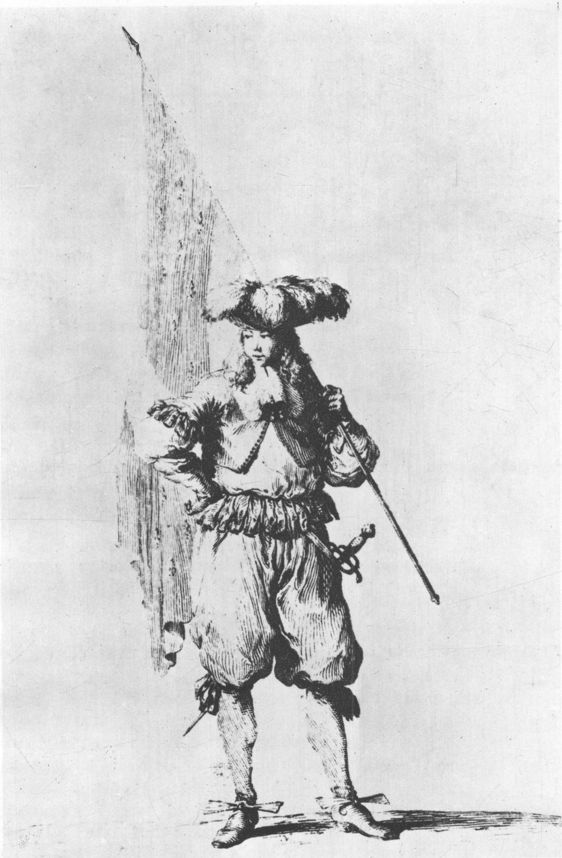
MARLBOROUGH AS A YOUNG OFFICER IN THE FRENCH ARMY
Bibliothèque Nationale, Paris
|
Blenheim MSS. |
|
Edward Harley, “Memoirs of the Harley Family,” Portland Papers, H.M.C., v, p. 665. |
|
“The Impertinence I mention’d (at the time of the Masquerades) [1711 or 1712] was as follows. Lady Anne Spencer and Lady Charlotte McCarty being generally at my Lodgings to amuse the Duke of Marlborough, one of them told me that there were a great many people that went to the Masquerade would come first & shew themselves to me if I lik’d it: Upon which I said, If They pleased; thinking that their Comical dresses might divert the Duke of Marlborough, as well as the Young people; And upon that Several did come. Among which Mr Secretary Craggs came dress’d like a Friar: He sat down by me and ask’d me if He should give me some advice. And then added that He wonder’d (or to that purpose) That I should see the Masquerades, for my enemies might come as well as my Friends. To which I said, Who are my Enemies? Then he answer’d, The Duchess of Montagu or my Lady Godolphin may come, and not knowing them you may give them a cup of Tea or a Dish of Coffee.” Sarah’s “Green Book,” f. 21; (Blenheim MSS.). |
|
Blenheim MSS. |
|
Coxe, vi, 3-8. |
|
Sarah’s “Green Book,” ff. 8-9; Blenheim MSS. |
|
Sarah’s “Green Book”; Blenheim MSS. |
|
Blenheim MSS., quoted in Reid, p. 413. |
|
Sarah’s “Green Book”; Blenheim MSS. |
|
I am indebted to Mr H. M. Collier for this version. Others are found in the Journal of the Folk Song Society, i, 156; iii, 200; v, 265. |
The Public Record Office
Secret Service Accounts (Treasury, ’48).
The British Museum
Unedited Coxe MSS.
Additional Manuscripts, 41178 (Townshend Papers).
Blenheim Palace, Woodstock
Marlborough Papers.
Sarah, Duchess of Marlborough, Papers.
Sunderland Papers.
Le Ministère des Affaires Étrangères, Quai d’Orsay, Paris
Correspondance politique, “Angleterre,” tome 265.
The Hague Archives
Heinsius Archives.
Archives of the States-General (Goslinga and Slingelandt letters).
The Huntington Library, San Marino, California
Stowe Collection (Brydges Papers).
Family papers of the Hon. Edward Cadogan.
Family papers of Lieutenant-Colonel Gordon Halswell.
Ailesbury, Thomas Bruce, Earl of: Memoirs, vol. ii (Roxburgh Club, 1890).
Berwick, James Fitzjames, Duke of: Memoirs, vol. ii (English translation, 1779).
Bishop, Matthew: Life and Adventures (1744).
Blackadder, Lieutenant-Colonel John: Diary (1700-28) (ed. A. Crichton, 1824).
Bolingbroke, Henry St John, Viscount: Letters and Correspondence (ed. G. Parke, four vols., 1798).
Boyer, Abel: History of the Reign of Queen Anne digested into Annals (1709-14).
Burnet, Gilbert: History of His Own Time, vols. v, vi (1823).
Cowper, William, First Earl: Private Diary (Roxburgh Club, 1846).
Eugene, Prince of Savoy: Feldzüge, Series II, vols. ii-vi (Imperial General Staff, Vienna, 1876-81).
Feuquière, Antoine Manassès de Pas, Marquis de: Mémoires (Paris, 1775).
Goslinga, Sicco van: Mémoires (1706-9 and 1711) (1857).
Hardwicke, Philip Yorke, Earl of: State Papers (two vols., 1778).
Hanmer, Sir Thomas: Correspondence (ed. Sir H. Bunbury, 1838).
Hearne, Thomas: Collections (ed. C. E. Doble, 1889).
Kane, Colonel Richard: Campaigns of King William and the Duke of Marlborough (1735).
La Colonie, Jean-Martin de: The Chronicles of an Old Campaigner (translated Walter C. Horsley, 1904).
Lamberty, G. de: Mémoires pour servir à l’histoire du XVIII siècle, vols. v, vi (1735, etc.).
Macpherson, James: Original Papers containing the Secret History of Great Britain (two vols., 1775).
Manley, Mrs: The New Atalantis (1720).
Marlborough, John Churchill, Duke of: Letters and Dispatches, vols. iv, v (ed. Sir G. Murray, 1845).
Marlborough, Sarah, Duchess of: Account of the Conduct of the Dowager Duchess of Marlborough from her First Coming to Court to the Year 1710 (1742).
—— Private Correspondence (two vols., 1838).
—— Letters from Madresfield Court (1875).
Natzmer, General: Des General Feldmarschalls Dubislav G. von Natzmer Leben und Kriegsthaten (1838).
Parker, Captain Robert: Memoirs (1683-1718) (1746).
Parliamentary History of England, vol. vi (ed. William Cobbett and J. Wright, 1810) (Hansard).
Pelet, J. J. G., and F. E. de Vault: Mémoires militaires relatifs à la succession d’Espagne sous Louis XIV (1850).
Ralph: The Other Side of the Question (1742) (answer to the Conduct).
Recueil des instructions données aux Ambassadeurs de France: Hollande, vol. ii (ed. Louis André and Émile Bourgeois, Paris, 1923).
Schulenburg, J. M.: Reichsgrafen von der Leben und Denkwürdigkeiten,
vol. ii (1834).
Swift, Dean: Works (ed. Sir W. Scott, nineteen volumes, 1883).
Tindal, N.: Continuation of Rapin’s History, vols. v, vi (1763).
Torcy Jean-Baptiste Colbert, Marquis de: Mémoires (ed. Michaud and Poujoulat, 1850).
Villars, Claude-Louis-Hector, Duc de: Mémoires (ed. de Vogüé, 1887).
Wentworth, Thomas (Earl of Strafford): The Wentworth Papers (ed. J. J. Cartwright, 1883).
Bath Papers, vols. i, iii (1904). (Harley, Shrewsbury, St John, and Marlborough correspondence.)
Dartmouth Papers (1889).
Downshire Papers (1924). (Queen’s death.)
Hare Papers (1895). (Francis Hare, Chaplain-General.)
Mar Papers (1904). (Jacobite correspondence.)
Marlborough Papers (1881).
Portland Papers, vols. ii, iv, v, vii (1897). (Harley correspondence.)
Round Papers (1895). (Petkum correspondence.)
Russell-Frankland-Astley Papers (1900). (Tory correspondence.)
Seafield Papers (1894). (Godolphin letters.)
Stuart Papers, vol. i (1902). (Jacobite correspondence.)
Townshend Papers (1887).
Alison, Sir Archibald: Life of John, Duke of Marlborough. (1852).
Atkinson, C. T.: Marlborough and the Rise of the British Army (1921).
Campbell, K.: Sarah, Duchess of Marlborough (1932).
Coxe, W. C.: Memoirs of John, Duke of Marlborough (1820).
Lediard, Thomas: Life of John, Duke of Marlborough (1736).
Reid, S. J.: John and Sarah, Duke and Duchess of Marlborough (1914).
Taylor, F.: The Wars of Marlborough (1921).
[For a comprehensive list, see Vol. II, p. 610.]
Arneth, Ritter von: Prinz Eugen von Savoyen (1864).
Coxe, W. C.: Memoirs of Sir Robert Walpole (three vols., 1798).
Feiling, K. G.: A History of the Tory Party (1640-1714) (1924).
Fortescue, Sir John: A History of the British Army, vol. i (1889).
Gachard, L. P.: Histoire de la Belgique au commencement du 18e siècle (1880).
Geikie, R., and I. Montgomery: The Dutch Barrier (1705-19) (1930).
Klopp, O.: Der Fall des Hauses Stuart, vols. xii-xiv (1881-85).
Landau, Karl: Geschichte Kaiser Karls vi als König von Spanien (1889).
Laprade, W. T.: Public Opinion and Politics in Eighteenth-century England (1936).
Leadham, I. S.: Political History of England (1702-60) (1921).
Legg, Wickham: Matthew Prior (1921).
Legrelle, A.: La Diplomatie française et la succession d’Espagne, vols. v, vi (1892).
—— Berwick et Marlborough: Une Négociation inconnue (1893).
Macknight, Thomas: Life of Viscount Bolingbroke (1863).
Michael, Wolfgang: England under George I (translated 1936).
Miller, O. B.: Robert Harley (Stanhope Prize Essay, 1925).
Morgan, W. T.: English Political Parties and Leaders in the Reign of Queen Anne (1920).
Nicholson, T. C., and A. S. Turberville: Charles Talbot, Duke of Shrewsbury (1930).
Noorden, Carl von: Europäische Geschichte im achtzehnten Jahrhundert, vol. iii (1871).
Parnell, Hon. Arthur: The War of the Succession in Spain (1888).
Petrie, Sir Charles: Bolingbroke (1937).
Reese, Werner: Das Ringen um Frieden und Sicherheit (1708-9) (1933).
Sautai, M. T.: La bataille de Malplaquet (1904).
Sichel, Walter: Bolingbroke and his Times (1901).
Stanhope, Philip Henry, Earl: History of the Reign of Queen Anne (1872).
Strickland, Agnes: Lives of the Queens of England, vol. viii (1852).
Trevelyan, G. M.: England under Queen Anne: The Peace and the Protestant Succession (1934).
Weber, Ottokar: Der Friede von Utrecht (1891).
Williams, Basil: Stanhope (1932).
Burne, A. H.: “Marlborough’s Battlefields Illustrated: Malplaquet,” The Journal of the Royal Artillery, vol. lx (1933-4).
Cra’ster, H. H. E.: “Orkney’s Letters,” English Historical Review, vol. xix, April 1904.
Fieldhouse, H. N.: “Bolingbroke and the D’Iberville Correspondence,” English Historical Review, vol. lii, October 1937.
Harvey, E. L.: “Letters and Accounts of James Brydges (1705-13),” Huntington Library Bulletin, No. 2 (1931).
Lord, W. F.: “Political Parties in the Reign of Queen Anne,” Transactions of the Royal Historical Society, vol. xiv (N.S.) (1900).
Morgan, W. T.: “The General Election of 1710,” Political Science Quarterly, vol. xxxvii (1922).
Thornton, P. M.: “The Hanover Papers (1695-1719),” English Historical Review, vol. i (1886).
Trevelyan, G. M.: “The Jersey Period of the Utrecht Negotiations,” English Historical Review, vol. xlix (1934).
Review of G. W. Cooke’s Memoirs of Lord Bolingbroke in Edinburgh Review, vol. lxii, October 1835.
|
The dates indicate neither the first nor the current editions of works, but the editions consulted. Dates in the footnotes are inserted on the same principle. |
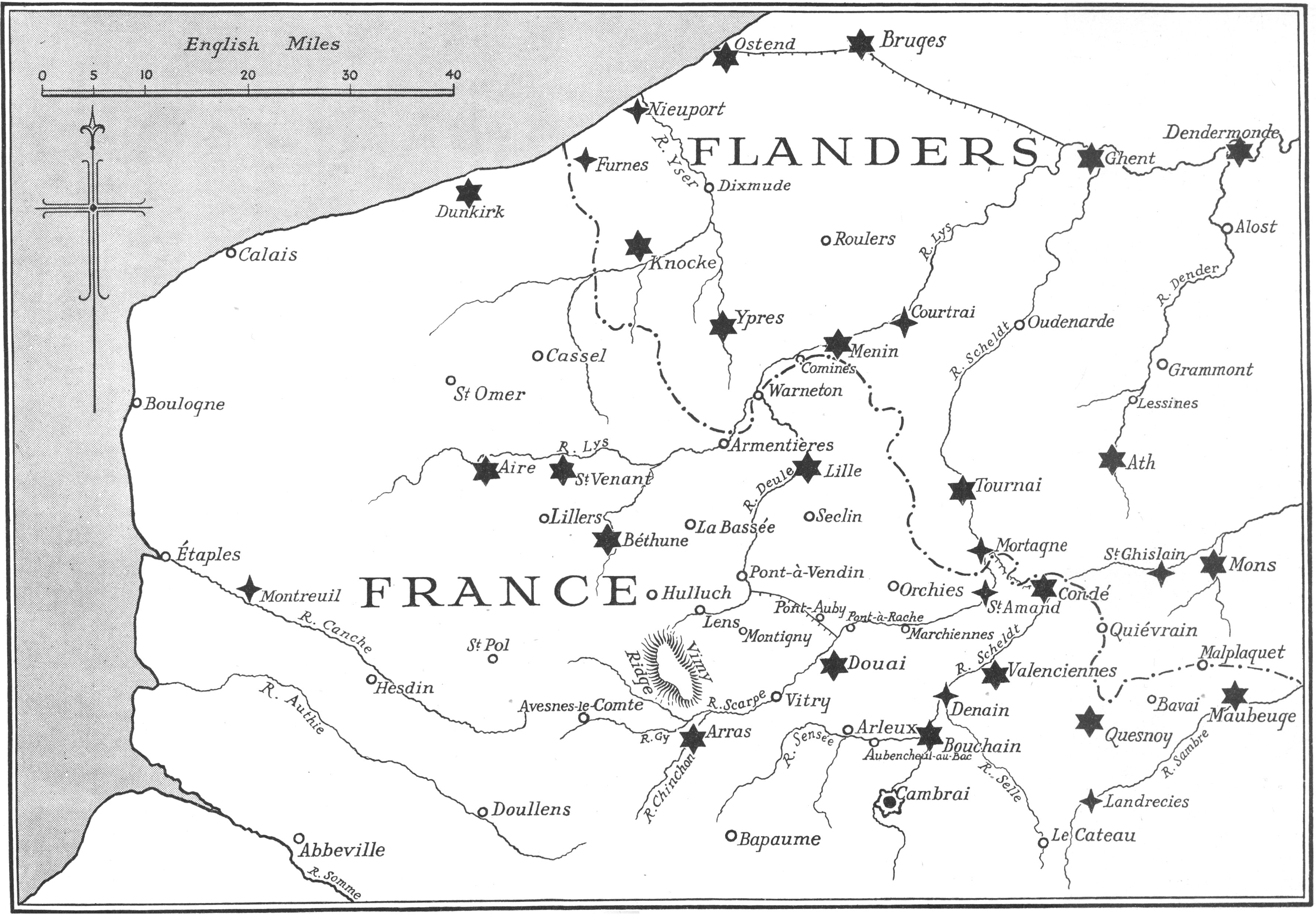
THE WESTERN NETHERLANDS
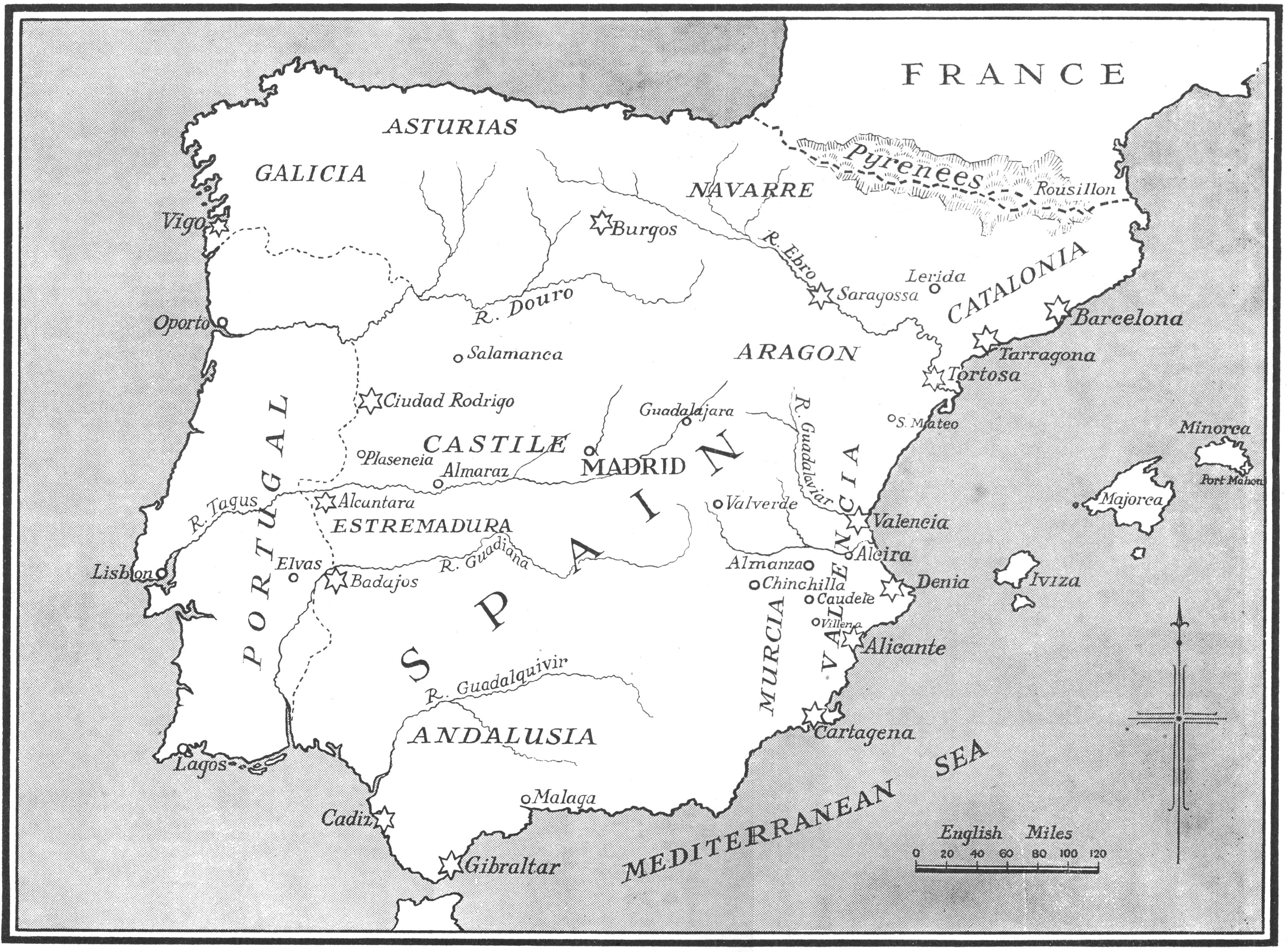
GENERAL MAP OF SPAIN
Addison, Joseph, valedictory lines by, on M., 577
Admiralty, the, in commission, 323
Ailesbury, Thomas Bruce, second Earl of, 280-281
garrison of, 111;
siege of, 257-258, 334, 337, 407, 547
Aix-la-Chapelle, 579
Albemarle, Arnold Joost van Keppel, first Earl of, 47, 49, 239, 423, 424, 425, 435, 557-558
Albergotti, Chevalier d’, 139, 140, 146, 147, 148, 149, 158, 166, 167, 243, 251, 440, 441, 442, 443
Alègre, Lieutenant-General Marquis d’, 24, 25, 27
Alfaraz, bridge of, 347
Allied forces, British troops among, 36;
campaign of, in 1708, 46;
augmentation of, 47 et seq., 50;
in January 1709, 52;
concentration of, before Mons, 137;
at Malplaquet, 142 et seq.;
besieging Mons, 181;
ninth campaign of, 234 et seq.;
reinforcements of, 254;
rally of, to M. in 1711, 340-341;
campaign of, in 1711, 405, 415 et seq., 421 et seq.;
Almenara, 347
Alsace, Eugene’s demand for, 71, 72, 73
Amnesty Act, the, 33
Anglesey, Arthur Annesley, fifth Earl of, 272, 275, 497
Anhalt-Dessau, Leopold, Prince of, 244, 251, 257, 410-411, 435
Anne, Queen, 18, 25, 33, 54, 57, 96, 373, 379, 475, 507, 545, 550, 565;
and Marlborough, 18, 21, 177, 196, 212 et seq., 220-221, 321-322, 355, 371, 504-505, 518, 530, 572, 574;
title of, to throne, 19, 69, 223, 467;
and the Whigs, 31, 34, 194-195, 196 et seq., 263, 492-493;
remarriage of, suggested, 33-34;
and peace, 55, 63, 262, 471, 492;
and Duchess of M., 64, 136, 196 et seq., 226 et seq., 346, 351 et seq., 362, 368;
and Godolphin, 196, 218-219, 221, 229 et seq., 285-286, 305, 575;
and Harley (Oxford), 200, 390, 478, 615-616, 633;
and English politics, 207-208, 224, 331-332, 495-496, 614;
military appointments made by, 212 et seq.;
and the Church of England, 223, 490;
and the Tories, 224, 259, 263, 492-493;
loyal addresses received by, in 1710, 228;
warned of possible financial panic, 287-288;
Stair’s audience with, 415 n.;
loyalty of, to the Grand Alliance, 449-450, 477, 487;
on Prior’s commission, 465-466;
and Duchess of Somerset, 492, 493;
action of, after Queen’s Speech in 1711, 498-499, 500;
peers created by, 502-503, 505;
condition of, in 1712, 570;
political preparations for death of, 591, 592;
last days of, 601, 604-606, 612, 614, 615-616, 617, 621, 622;
and the Protestant Succession, 605-606;
inscribed statue of, at Blenheim, 651;
and Abigail Hill (Mrs Masham)—see under Masham, Mrs
Letters from:
to Godolphin, 229-230, 276, 295, 305;
to the States General, 406
Letters to:
from Argyll, 377;
from Joseph I, 297
Argyll, John Campbell, second Duke of, 187, 261, 265, 338, 606, 630;
at Malplaquet, 169;
hostility to M., 177-178, 188-189, 252, 253, 255, 256, 267, 274, 339, 340;
political actions of, 225, 547, 604-605, 620, 621;
in Spain, 376-377
Argyll’s brigade at Malplaquet, 154
Arleux, demolition of, 421-422;
M.’s march on, 428 et seq.
Artagnan, Marshal d’—see Montesquiou
Asfeld, —— d’, 51
Assiento, the, 401, 467, 596, 605, 613-614
Asturias, Louis, Prince of, 74, 125
Augustus II, of Saxony and Poland, 118, 343, 408
Auvergne, Prince of, at Malplaquet, 136-137, 162, 165, 169
Bankers’ deputation, Anne’s reassurance of, 287, 288
Bavaria, Max Emmanuel, Elector of, 374-375, 413, 597
Beaufort, Henry Somerset, second Duke of, 321
Beauvillier, Philippe, Duc de, 83, 123
Belisarius parallel, the, 510
Benson, Robert, 404
Bernard of Lyons, banker, failure of, 60
Bernstorf, Count, 315, 590, 602
Berri, Charles, Duke of, 535
Berwick, James Fitzjames, Duke of, 20 et seq., 181-182, 239, 245, 461, 573, 587-588, 589
Biache, dam at, 250-251
Bishop, Corporal Matthew, cited, 117-118, 153 n., 167 n., 444, 511-512, 564;
life-story of, 117 n.
Blackader, Lieutenant-Colonel John, 117, 163, 164, 178
Blencowe, William, 20
Blenheim, battle of, 117 n., 144, 162, 165, 172 n., 375, 474
Blenheim Palace, 136, 317 et seq., 328, 380, 381, 608, 640, 642, 650-651;
Shrewsbury’s visits to, 136, 229, 293
Blockade, enforcement of, 100
Bodegraven conversation, the, 58-59
Bolingbroke, Henry St John, first Viscount, 253, 259, 333, 334, 339, 372, 391, 477, 515, 523, 562, 632, 651;
wife of, 324-325;
and M., 334, 362-363, 451, 530, 574, 609, 629-631;
character of, 343, 470, 478, 479, 619;
and the Quebec expedition, 384-385, 391 et seq.;
and Guiscard, 385 et seq.;
and the financial inquiry, 397 et seq.;
and peace, 450, 465, 535, 537;
and the Treaty of Utrecht, 465, 594-596, 598, 619, 626;
and the Pretender, 470;
responsibility of, for the British desertion, 472 et seq., 555;
orders of, to Ormonde, 538, 539, 540-542;
and his viscounty, 564-565;
embassy of, to Paris (1712), 566;
and the passport scandal, 566, 569;
correspondence of, with Shrewsbury, 594;
quarrel of, with Oxford, 612;
dinner of, to Whig leaders, 616 et seq.;
downfall of, 624 et seq.;
flight of, 629 et seq.;
end of his career, 495, 629, 632
Letters from:
to Drummond, 362-363, 392, 485;
to M., 391;
to Ormonde—see Bolingbroke, orders of, to Ormonde;
to Oxford, 450;
to Strafford, 499;
to Torcy, and his to Bolingbroke, 513-514
Bolton, Charles Paulet, second Duke of, 320-321
Bothmar, Baron von, 299, 314, 485, 487, 488, 499, 500 n., 518, 590, 592, 609, 626
Bouchain, 129, 130, 452 n., 561;
siege and capture of, 416, 432, 435, 437, 439, 440 et seq., 449, 456
Boufflers, Louis-François, Duc de, 47 n., 94, 125, 126, 132, 175, 179, 181;
at Malplaquet, 145, 152, 156, 169, 170-171
Bourlon Wood, 437
Boussu Gap, the, 132, 133, 134
Boyle, Henry, 50, 54, 69, 275;
resignation of, 323
Brandenburg, Karl Wilhelm, Electoral Prince of, 139
Bridgewater, Scroop Egerton, fourth Earl of, 633
Bridgewater, Countess of (née Elizabeth Churchill), death of, 604
Brihuega, 349
Brissœul, 130
Bristol, John Robinson, Bishop of—see Robinson, John
British Empire, dangers surmounted by, 599
British troops, proposed disarming and internment of, 545;
forced desertion of, under Ormonde, 553-554;
complaints of, and mutiny among, 562-564;
in Low Countries in 1713, 602
Brittany, Duke of (Dauphin of France), 536
Bromley, Mr Speaker, and the peculation charges, 522, 524
Brydges, James (later first Duke of Chandos), 398 et seq., 523, 524-525, 529-530
Buckingham, John Sheffield, first Duke of, 323, 372, 403, 465, 471, 615
Bülow, General von, 165
Burgundy, Louis, Duke of, 23, 24, 27, 28, 83, 123, 125, 535;
death of, 536
Burgundy, Marie Adelaide, Duchess of, 123, 536
Burnet, Gilbert, Bishop of Salisbury, 225, 329, 498, 510, 533
Buys, William de, 54, 57 n., 185, 236 n., 264, 286, 343, 450
Byng, Admiral Sir George, 51, 100 n.
Cadogan, William, first Earl, 47, 106, 107, 240, 370, 405, 406, 423, 426-427, 429, 439, 443, 539, 577, 586, 602, 633, 636;
at the siege of Mons, 130, 139, 140, 181;
election of, M. on, 321;
on M.’s dismissal, 509-510;
with M. in exile, 578-579, 585-586;
quarrel with, of Duchess of M., 641-642
Cadogan-Albergotti parley, the, 139-140
Cameronians, the, 163-164, 178
Cardona, battle at, 517
Cardonnel, Adam de, 25-26, 268, 483, 530;
letter to, from M., 583-584
Catalans, the, fate of, 597, 600
Cateau-Cambrésis, 562
Caya, the, Galway’s defeat on, 73
Chamillart, Michel de, 22, 25-26, 27, 123
Charles VI, Emperor—see Charles III, of Spain
Charles III, of Spain (later Emperor Charles VI), 39, 50, 51, 67-68, 125, 347, 348, 376, 477;
Viceroyalty of the Netherlands offered to M. by, 17-18, 42-45;
and crown of Spain, 36;
and the Empire, 374 et seq.;
elected Emperor as Charles VI, 378, 412;
protests of, against the peace treaty, 473;
and M.’s dismissal, 512;
and Peace of Rastadt, 597
Charles XII, of Sweden, 120, 183, 403, 408, 637
Château l’Abbaye, 21
Chemerault, General, 153, 154, 167
Church of England, the, 193, 194;
Clarke, Sir John, on Anne in 1709, 196
Clemente, ——, 478
Coaquin, —— de, 125
Commission of Accounts, the, 398, 482 et seq.;
first report of, 521
Conduct of the Allies (Swift), 506, 598
Coningsby, Thomas, Earl, 650
Courtrai, 102
Cowper, William, first Earl, 204, 208, 311, 323, 493, 498, 567;
and M.’s. desire for Captain-Generalcy, 186;
resignation of, 323-324
Cowper, Mary, Countess, and Duchess of M., 266
Coxe, Archdeacon William, cited, 599-600
Craggs, James, 42, 43, 185, 191, 327, 346, 586, 587, 633, 641, 643
Cranstoun, Colonel, quoted, 89, 116;
Croissy, Madame de, 566
Dartmouth, William Legge, first Earl of, 275, 469, 478, 517, 594
Dedem, General, 140
Defoe, Daniel, 301, 327, 366, 400, 522, 613
Dendermonde, 67
Denia, 51
Desmarets, ——, 98
Devonshire, William Cavendish, second Duke of, 323, 548
Dijon, 95
Dohna, Johann Friedrich, Count, 560
Dopf, General Daniel Wolf, 106, 137, 442, 443, 579
Dorset, Lionel Sackville, seventh Earl (later first Duke) of, 601, 627
Douai, 116, 125, 232, 339, 405, 421, 422, 561;
siege of, 240 et seq., 251, 407, 417
Drummond, John, 342 et seq., 361, 362, 392, 465, 485, 501, 515
Dunkirk-Meuse, French line (1709), 102
Dursley, James Berkeley, Viscount (later third Earl of Berkeley), ships under, 100 n.
Dutch, the, distrust of, for M., 17-18, 59, 61;
proposals of, for peace, 19-20, 59;
Louis XIV’s wish to negotiate only with, 22;
and separate peace negotiations, 22, 53 et seq., 468, 472-473 (see also Moerdyk);
reinforcements provided by, 47, 50;
position of, in 1709, 57 n., 58;
after Malplaquet, fortitude of, 175;
changed attitude of, to peace, 176;
and siege of Mons, 180;
support of, to M., 336;
loyalty of, to the Grand Alliance, 506-507;
Eugene made Generalissimo by, in 1712, 539
Dutch Barrier treaty, negotiations on, 37, 39-40, 55, 57, 59, 60;
M.’s opposition to, 40, 41, 42, 59, 61, 66, 190;
official British attitude to, 60, 67, 467;
crucial articles in, 77 et seq.;
secured at Utrecht, 597
Dutch field Deputies attached to M. during the campaign of 1709, 139. See also Goslinga
Dutch forces at Malplaquet, 149, 150-151;
losses and valour of, 155, 164
Dutch preliminary treaty, Articles IV and XXXVII of, 77, 78, 80, 81
England, responsibility of, for loss of the peace in 1709, 37, 89-91;
perfidy of, to allies, 195, 471, 472, 545, 567, 594;
popular discontents in, in 1710, 224;
election of 1710 in, 321, 326-329;
negotiations of, with France, 378-379;
peace terms offered by, in 1711, 466-467;
M.’s contacts with, in exile, 585 et seq.;
peace rejoicing in, 600
English and Dutch forces in Flanders, comparative table of, 506-507 n.
English fleet, the, operations of, in 1708-9, 53
English trade, restoration of, 20;
in the Indies, special grants of, 39
Eugene of Savoy, Prince, 23, 46, 47, 48, 58, 61, 85, 87, 88, 103, 105, 128, 132, 133, 181, 190, 237, 281, 303, 313, 330 n., 336, 343, 375, 420, 455 n., 572;
suggested for Viceroyalty of Netherlands, 44-45;
on the Rouillé mission, 57;
letters from, to the Emperor, 68, 135-136, 297;
and the conversations with Torcy, 71;
at siege of Tournai, 111;
plans of (August 1709), 124-125;
on preparation for battle (September 10, 1709), 141;
at Malplaquet, 142, 143, 145, et seq., 156, 169;
letter to, from M., 297;
Goslinga’s eulogies of, 418-419;
visit of, to England, 478, 512, 514, 515-517;
on bribery, 500 n.;
and M.’s dismissal, 514;
tributes of, to M., 520;
Generalissimo in campaign of 1712, 539;
Ormonde’s treachery detected by, 543, 544;
severance of, from Ormonde, 552, 553;
and the campaign of 1712, 556 et seq.;
and the Peace of Rastadt, 597;
Ormonde’s desertion of, 626, 628
Fagel, François Nicolaas, Baron, 115, 116, 151, 435, 443
Feltz, Count, 240
Feuquières, General le Marquis de, 174
Finck, Lieutenant-General —— de, 155
France, military misfortunes of, 14 [TN: sic], 52;
peace conditions laid before, 19-20;
peace offers of, M. told of, 41;
great frost and famine in, 52-53, 60, 95, 98;
exultation in, over Malplaquet, 175, 178;
peace offer of (December 1709), 184;
peace offer of (1711), 449;
proposal of, for a peace treaty, 463-465, 479;
and Spain, union of crowns of, objection to, 536, 537. See also Louis XIV
Franco-Dutch peace conversations, essential basis of, 53;
revealed in Rouillé letters, 56
Frederick I, of Prussia, 48, 49, 299-300, 336, 408, 409;
Frederick, Crown Prince of Prussia, 49, 409
Frederick IV, of Denmark, 408
Freind, Dr John, 358
reinforced after Malplaquet, 180-181;
in the field in 1710, 238
French fortress line, 236 et seq., 417-418;
taken, 429
French Royal Irish Regiment (the “Wild Geese”), 159
French spirit revived after Malplaquet, 183, 283, 284, 294, 322, 336 n., 379, 427
Gallas, Johann Wenzel, Count, 297, 302-303, 376, 459;
on the dismissal of Sunderland, 283;
assurances given to, by Anne, 284-285;
on his proposed address to the Queen, 299;
on M.’s position in 1711, 369-370;
and St John, 477 et seq.;
supersession of, 480, 512, 517
Galway, Henri de Massue de Ruvigny, first Earl of, 72-73, 182, 205, 260, 349, 359, 376;
Peterborough’s attack on, and M.’s defence of, 359, 360, 361
Garde Française, the, at Malplaquet, 148, 164
Gaultier, Abbé, 416, 458 et seq., 513, 542, 604;
as British emissary, 459 et seq.;
and Gallas, 477
Geldermalsen, Adriaan van Borssele, 104
George Lewis, Elector of Hanover (later George I), 25, 34, 234, 299, 315-316, 336, 371, 475, 476, 485, 544, 592, 602, 603;
efforts to reconcile to a separate peace, 486, 487-488;
M. exonerated by, 532;
accession of, as George I, 593, 622, 623, 625-626;
character of, 626-627;
first ministry of, 627-628;
appointments made by, 633-634
Letters from:
to M., 315;
to Duchess of M., 645
George, Electoral Prince of Hanover (later George II), 25, 228, 591, 592, 626;
Whig proposal to summon as Duke of Cambridge, 604, 605
Germaine, Sir John, 529
Gersdorff, Wolf Abraham, Baron, 343
Gertruydenberg peace conference, 235, 236 n., 283, 286, 287, 348, 379, 459, 597
Ghent, 28, 39, 46, 47 n., 99, 102, 111, 554, 563-564, 597
Gibraltar, held by Britain, 467, 596
Godolphin, Sidney, first Earl of, 83 n., 200, 201, 221, 231 et seq., 633;
and the Whigs, 30, 31, 32-33, 196, 211;
Jacobitism of, 33;
and his Tory orthodoxy, 211;
disregarded, 289;
character of, 306-307;
Harley’s attacks on, 309-310, 397 et seq.;
and the Commission of Accounts, 482;
death of, 574-575;
and Anne—see under Anne, Queen
Letters from:
to Duchess of M., 231;
to Seafield, 321
Letter to, from Anne, 229-230
Godolphin-M. correspondence, 34-35, 46, 47 n., 50, 57-58 n., 60, 64-65 n., 69, 84, 100 n., 101, 105, 113, 114, 115, 119, 179, 182, 183 n., 205, 216, 225, 232, 235-236 n., 243, 248, 249, 252, 255-256, 264-265, 270, 272, 274, 275, 290-291, 292, 293-294, 298, 304-305, 306, 313, 322, 338, 382, 446, 448
Godolphin, W. (grandson), letter from, to M., 456 n.
Goslinga, Sicco van, 101, 104, 108, 130, 131, 139, 140, 176, 418-420, 422, 432 et seq.;
at Malplaquet, 151, 152, 154-155, 173, 418
Grammont, Antoine, Duc de (later Duc de Guiche), 94;
troops of, 125
Grand Alliance, desire of, for peace in 1708-9, 17;
and effects of the Barrier Treaty, 189;
British perfidy to, 195, 471, 472, 545, 567, 594, 599;
battle considered on both sides but not offered, 249, 256;
replies of, to Anne’s assurances, 298 et seq.;
crumbling of, 408;
Anne’s loyalty to, 449, 477, 486;
end of, Torcy on, 460;
as “common enemies,” according to Torcy, 513, 517;
princes of, refutation by, of charges against M., 531 et seq.;
Eugene made Generalissimo by, 539;
Great Britain, zenith of, in Europe, 195;
separate peace of, with France (1712), 567-568. See also England, English
Great Frost, the, of 1708-9, 52-53, 95, 98
Grumbkow, General Joachim Ernst von, 47, 190, 236 n., 409
Guiscard, Louis, Marquis, 385 et seq., 515
Hague, The, 379, 502, 512, 513, 517
Halifax, George Savile, Viscount, 54, 320, 493, 498, 535, 626, 628;
and M.’s associate plenipotentiary, 65;
appointed to The Hague, 290 et seq.;
and the restraining orders, 545-546, 548
Hamilton, Sir David, 368
Hamilton, James Douglas, fourth Duke of, 502;
Hamilton, Colonel John, 576
Hamilton, General, 151
Hanmer, Sir Thomas, 302, 530, 604
Hanover, British relations with, 295, 311 et seq.;
protest of, against the proposed peace, 488, 506;
M. and, while in exile, 585, 590
Hanover, Duke (Elector) of—see George Lewis
Harcourt, Simon, first Viscount, 621
Hare, Rev. Dr Francis, 452
Harley, Edward, 301, 324, 384, 397, 530, 632
Harley, Robert—see Oxford, Earl of
Harley, Thomas, 554
Hearne, Thomas, 210-211
Heathcote, Sir Gilbert, 179, 329
Hedges, Sir Charles, 529
Heems, Arnold, Baron de, 128, 514
Heinsius, Pensionary, 20, 55, 59, 67, 235 n., 236 n., 336, 501, 513, 538;
relations of, with Torcy, 19, 41, 53, 62-63;
and preliminary Barrier treaty, 41, 60-61;
correspondence of, with Portland, 56, 59 n.;
and Rouillé mission, 57-58;
letters to, from Goslinga, 131, 176-177
Heinsius-M. correspondence, 55, 87, 100, 101, 103-104 n., 128, 183, 265, 277, 279-280, 304 n., 312, 322, 374, 436-437, 452
Helchin, 21
Hertford, Algernon, Lord, 212
Hesse-Cassel, Wilhelm, Prince of, and siege of Mons, 130, 131, 139, 181;
at Malplaquet, 151, 162, 164, 169-170
Hill, Colonel John (later Brigadier), 212 et seq., 268-269, 271, 309, 331, 335, 393 et seq., 554, 602
Hill, Abigail—see Masham, Abigail
Hoffmann, Johann Philipp von, 512, 513;
cited, 32, 208, 221, 282-283, 284, 288, 324, 339, 340, 354, 530 n.
Holy Roman Empire, the, 52, 334, 374, 408, 473 et seq., 512, 596, 597
Holywell, M.’s life at (1712), 568
Hompesch, General Reynour Vincent, 421-422, 429, 432, 435, 508
Honeywood, Brigadier, 339-340
Hop, Jacob, 545
Howe, Mrs, 198
Hungary, revolt in, 52
Huxelles, Nicolas du Blé, Marquis d’, 535
Iberville, ——, 631
Indies, the, English trading rights in, 39
Irish-French regiments, moved to the coast, 601
Islay, Archibald Campbell, Earl of, 265
Jacobites, the, 33, 261-262, 288
James II, 222, 232, 386, 590, 593
James Edward Stuart (the Old Pretender), 33, 36, 54, 69, 70, 223, 469, 470, 495, 596, 612, 637;
and rebellion of 1715, 636-637;
Duchess of M. accused of aiding, 644-645
Jennings, Sir John, 194-195
Jersey, Edward Villiers, first Earl of, 459, 465
Joseph I, Emperor, 17, 68, 297, 302, 303;
Juntilla, the, 260, 262-263, 312
Junto, the, 194-195, 230, 260, 489
Kane, Colonel (later General) William, 602;
at Malplaquet, 159 n.;
Kent, Henry Grey, Marquis (later Duke) of, 229
Klopp, Onno, cited, 208, 474, 591
La Bassée, lines of, 106, 110, 236
La Colonie, Jean-Martin de, cited, 148, 158-159, 562
La Gorgue, 111
Laguerre, Louis, 584
Landau, 597
Landen, battle of, 172
Landrecies, siege of, 556-557, 561
Lansdowne, George Granville, Baron, letter to, from Bolingbroke, 631
Leake, Sir John, 100 n.
Leopold I, Emperor, 277
Levant trade, the, 38
Lewis, Erasmus, cited, 204-205, 573
Linares, Duc de, 94
Lindsey, Robert Bertie, fourth Earl and first Marquis of (later first Duke of Ancaster), 498
Lottum, Count, at Tournai, 115, 116;
at Malplaquet, 146, 148, 152, 153, 156, 161, 166
Louis XIV, 52, 60, 68, 92, 330, 365, 376, 391, 561, 566;
and peace, 22, 23, 26-27, 53, 54, 60, 62, 82, 83, 96, 98, 119, 183, 184, 463, 538 (see also Moerdyk, conversations at;
Naples;
Rouillé mission;
Torcy, Marquis de);
and Philip V, 75-76;
and the war, 114, 119, 132, 133, 239, 244, 257, 412, 417;
on dismissal of M., 505;
death of, 637
Louis, Dauphin of France, 74, 83, 122, 123, 124;
opposition of, to the Allied peace terms, 81, 83-84;
death of, 535
Lumley, Lieutenant-General Henry, 48, 112, 391, 435;
at Malplaquet, 169
Luxembourg, Major-General the Chevalier de, 112, 125, 131, 239, 240
Macartney, General George, 340, 576
Maestricht, 579
Maffei, Count Annibale, 260
Maintenon, Madame de, 81 et seq., 95, 99, 123-124, 330, 463
Mainz, Elector of, 582
“Maison du Roi,” at Malplaquet, 142, 169, 172 n.
Malplaquet, battle of, 191, 342, 568;
carnage at, 92, 150, 151, 171, 172-173, 282;
Bishop on, 117 n.;
origin of, 128;
cannonades at, 137, 150-151, 160, 161, 162-163, 168;
M.’s conception of, 143-144;
course of, 145 et seq.;
British regiments at, 145 n., 169;
British casualties at, 151, 193;
cavalry stage of, 166 et seq.;
Villars’s counter-stroke in, 166;
allied pursuit impossible after, 168, 176-177;
French defeat at, 170-171
Malplaquet, plateau of, allied positions on, 137
Manley, Mrs Mary, 367, 390-391, 452, 625
Mann, Robert, 521
Mansell, Sir Thomas, on Malplaquet, 177
Mansell, Martha, Lady, cited, 273
Marchmont, Alexander Campbell, second Earl of, letter to, from Stair, 415-416
Marlborough, John Churchill, first Duke of:
Biographical, political, and general references:
on his wish for peace, 21 et seq.;
on goodwill promised to him by d’Alègre, 24;
bribe proposed for, 26;
and Whigs in 1708-9, 30 et seq.;
Whig valuation of, 31;
bet by, 47-48;
visits of, to England, 54 et seq., 61;
Anne’s displeasure with, 64, 136, 186 et seq., 212 et seq., 250, 275 et seq., 287, 407, 451;
and relations of, with Saint-Germain, 70, 585, 587 et seq.;
feeling of, for Pretender, 70;
life appointment as Captain-General sought by, 185-187;
resolve to retire, 187-188;
accused of prolonging the war, 191, 202;
career of, zenith of, 195, 208;
and his wife, Harley’s propaganda against, 202;
attempts of, to bring back Shrewsbury to the Government, 206;
downfall of, 208, 280 et seq.;
mortifications endured in 1710, 212 et seq.;
demands dismissal of Mrs Masham, 214, 215, 218;
deserted by Whigs, 215;
on the Shrewsbury appointment, 232;
as essential to peace, 262, 263;
appeal by, for Sunderland, 272;
dismissal of, foreseen by the French, 287;
and Godolphin’s dismissal, 306;
and his wife, devotion of, to Godolphin, 307;
affection of, for Blenheim Palace, 319;
power of, Anne’s dread of, 332, 335;
position of, under the Tory Administration, 334 et seq.;
Tory tactics regarding, 334-335;
affronts offered to, 338, 339-340;
public ingratitude to, 365-366;
dual position of, since 1702, 366;
abasement of, to save his wife’s offices, 368-369;
and Harley, 449-450, 452 et seq., 572-574;
Tory Ministers’ plan for dismissal and dishonour, 481-482;
and Commission of Accounts, 482 et seq., 502, 526-527;
return of, to England in 1711, 488;
audience of, with Anne, 495;
speech of, in 1711, 497-498;
last attendance of, at Court, 504;
and Eugene in town together, 515, 516, 517, 518-519;
and the peculations charge, 523 et seq.;
on sieges and battles, 546-547;
last public action in Anne’s reign, 567;
homes of, in latter days, 568, 640;
leaves England, 569 et seq., 610, 623;
prosecution of, as to Secret Service money, 572;
Crown suit against, concerning Blenheim, 572;
aspersions on, 576;
life of, in exile, 578 et seq.;
intimates of, 585-587;
advice of, sought and given on procedure at death of Anne, 591-593;
and the Protestant Succession, 593, 607;
Mindelheim lost to, 597;
appearance of, 603;
and loss of his favourite daughter, 604;
returns to England, 607 et seq., 623-624;
reception of, by George I, 626, 627;
welcomed back by his army, 628;
and Bolingbroke, 629 et seq.;
under George I, 633 et seq.;
sole remark made by, on himself, 648;
death and burial places of, 648 et seq.
Character and characteristics:
attitude to money, 24 et seq., 48, 49, 63-64, 72, 182, 343, 482, 534;
as worker, 29;
urbanity, politeness, and patience, 59, 423, 433;
health of, 69, 249, 256, 382, 413, 423, 444, 578, 603, 604, 639;
sensitiveness, 173, 294, 452-453, 509;
tendency to depression, 249, 250, 252, 382, 383, 413;
tenacity, 335;
domestic affection, 367, 570, 604, 639;
conciliatoriness, 406;
“ascendant” of, 411;
as the “Old Corporal,” 428, 444;
accused of cowardice, 569;
dissimulation, 591;
indolence in later years, 603
Diplomatic occupations and influence:
authority of, and its foundations (1708-9), 17 et seq.;
interview of, with Pesters, report on, 18;
personal effort of, for peace, 20 et seq.;
correspondence with Berwick on peace, 20 et seq.;
secret cipher used by, 20;
uninformed of the Heinsius-Torcy conversations, 20, 23;
Secret Service of, 20, 49, 56, 82-84, 132, 249, 251, 483, 526, 527-529;
and promises to secure peace, 24 et seq.;
opinion of, on the Spanish diversion, 37;
the Barrier Treaty opposed by, 39, 40, 41, 42, 59, 61, 64, 189-190;
Heinsius’ divergence from, 41-42;
views of, on peace offers from France, 42;
and Viceroyalty of the Netherlands, 42 et seq., 44-45, 59, 61;
in ignorance of the Moerdyk conversations, 55;
decline of the power of, 55, 64, 90, 109;
instructions to, on concluding peace, 56-57, 60;
and Rouillé discussions, 56 et seq.;
Heinsius warned by, as to secret negotiations, 57 n.;
instructions made known to Heinsius, 57 n.;
colossal bribe for, 63-64;
a colleague asked for, 64-65;
meeting of, with Torcy, 70;
scheme of, for Parliamentary rule in France, 84;
and rejection of allied ultimatum, 84, 85;
and Article XXXVII, 84, 85-86;
real attitude of, to peace, 85 et seq.;
on the Spanish imbroglio, 88;
culminating moment in his career, criticism on, 89-90;
Secret Service advices from Paris in 1709, 141;
on demand for cautionary towns in Spain, 183;
peace conference favoured by, 185;
conversation of, with Robethon in 1711, 371 et seq.;
letter to, from Eugene on death of Joseph I, 374;
and Elector George Lewis, 481;
opposition of, to a separate peace, 485
Military references:
winter campaign of 1708-9, 28;
successes of, in 1708, 28;
thanks of Parliament to, in 1708-9, 31;
views of, on the Spanish diversion, 37;
campaign of, in 1708, results of, 46;
preparations of, for next war, 46 et seq.;
efforts of, to get troops from Prussia, success of, 48, 49;
on Louis XIV’s position in 1709, 50;
a campaign in Flanders expected by, 54;
and officers outstaying leave, 54;
preparations of, for a new campaign (1709), 65;
plans made for a Spanish war, 76;
as scapegoat, 92;
on supplies in 1709, 99;
strategic situation early in 1709, 102, 103;
councils of war of, at Ghent, 102-103;
on siege of Tournai, 114 et seq.;
and investment of Mons, 130 et seq.;
position of, on September 7, 1709, 133;
and Eugene, a battle desired by, 134;
aim of, to induce Villars to fight, 137-138;
and Eugene, harmony between, 139, 146, 193, 247, 343;
and battle of Malplaquet, 143 et seq. 173-174;
wish to besiege Maubeuge, 179;
Mons besieged, 180 et seq.;
request of, to Anne for Captain-Generalcy and her refusal, 186-187;
return of, to the army, 220-221;
on peace, necessity for, 237;
and Eugene at Tournai, 239-240;
on expectation of Villars’s arrival, 245;
and Eugene, reconnaissances by, 247;
officers under, disloyalty and greed of, 252-253;
letters from, in camp, 253-254;
and Eugene, why not more effective in 1710, 258;
and the army promotion, 268 et seq., 331;
urged to fight a battle, 273-274;
Anne’s asseverations on retaining him in the command, 276, 283;
Whig leaders’ request to, to retain the command, 276-277;
treatment of, at Brussels, 281;
public persuasion to retain command, 290;
supersession rumours on, 312;
resignation of, anticipated, 330 n.;
power of promotion taken from, 335;
Hoffmann on difficulties of his position, 339;
Drummond on M.’s importance to the war, 342-343;
fame of, spread by his old soldiers, 353;
welcome home of, Hoffmann on, 354;
on his retention of command, 369-370;
at The Hague in 1711, 371;
Ministerial overtures to, 380;
and the overseas expeditions, 384, 385;
men withdrawn from, and lost, 395, 396, 408;
as General only in 1711, 405 et seq.;
Anne’s promise of support to, 406;
longing of, for Eugene’s company, 407-408;
and Eugene, near Douai, 412;
small forces of, in 1711, 412, 413;
conduct of war in 1711, 413;
plans of, for winter quarters in 1711, 414;
manœuvres of (summer 1711), 418 et seq.; and Goslinga, 419-420;
garrisons reinforced by, 422;
a battle deemed necessary by, 423;
reconnaissance by, in 1711, 423, 426;
troops mystified by, 427;
march of, to Arleux, 428 et seq.;
council of war called by, 435;
strategy of, 435;
finest stratagem and manœuvre of, 439;
lines and entrenchments of, in 1711, 445-446;
praise of, by Captain James Gordon, 455-456 n.;
end of his last campaign, 455 et seq.;
summary of career of, 457;
position of, in 1711, Torcy on, 463;
overtures to Oxford, ineffectual, 480-481
Marlborough-Godolphin Administration, 361, 364;
end of, 329;
financial record of, 356;
Peterborough’s indictment of, 358
Marlborough, Sarah, Duchess of, 265-266, 453, 510, 634, 639;
estrangement of, from Anne, 64, 187, 196-198, 213, 226 et seq., 362, 368-369;
on M.’s position in 1710, 216-217;
and Walpole, 268, 269, 641, 652;
and Shrewsbury, 292-293;
on St John, 342;
and the Hill family, 393;
and Godolphin, 575;
in later life, 580;
and the return to England, 608, 609 et seq.;
quarrels of, 640 et seq.;
winnings of, from the South Sea Bubble, 643;
accused of helping the Pretender, 644;
latter days of, 650;
wealth of, 651
Letters from:
to Mrs Clayton, 580, 609-610, 610-611;
to Godolphin, 338;
to Jennings, 580-583;
Letters to:
from Godolphin, 231;
from M., 87, 112-113, 114, 120, 136, 141, 171, 177, 181, 195, 197-198, 225, 232, 237, 243, 256, 267, 274-275, 278, 279, 291, 294, 298, 313, 316-317, 318, 321-322, 380, 381, 414, 452, 454-455, 579-580
Marlborough House, 413-414, 584
Martin, Commodore, 384
Masham, Colonel Samuel (later Brigadier), 268, 335;
raised to the peerage, 505
Masham, Abigail (née Hill), 35, 136, 187, 369, 475, 486, 492, 493, 554, 562, 625;
intrigue of, with Harley, 192-193, 200 et seq., 219, 221, 264, 308, 320;
and Duchess of M., 197;
and Quebec expedition, 393, 394, 396;
and Bolingbroke, 614
Maximilian Emmanuel, Elector Palatine—see Bavaria, Elector of
Maynwaring, Arthur, 266, 272-273, 453
Meadows, Sir Philip, 295
Medina, Sir Solomon, 483, 525, 526
Mediterranean Sea, English command of, 52, 596
Medley, The, 366
Menzikoff, Prince, 120
Mesnager (Nicolas le Baillif, Comte de Saint-Jean), 471;
on Louis XIV’s joy at the English dissolution, 330, 468, 469
Mey, General, at Malplaquet, 151
Middleton, Charles, second Earl of, 587;
Miklau, General, at Malplaquet, 166
Mindelheim, principality of, 571, 584, 597
Moerdyk, conversations at, 54, 55, 56, 286, 343
Mohun, Charles, first Baron, 549;
Moles, Duc de, 75
Monk, General, precedent of his appointment, 185, 188
Mons, cavalry from, 112;
siege of, 129 et seq., 179, 180, 182
Montagu, John Montague, second Duke of, 633
Montagu, Mary, Duchess of (née Churchill), 634, 642, 646-647
Montesquieu, Duc de (d’Artagnan), 125, 132, 239, 240 et seq., 422, 423, 431
Moore, Arthur, 289, 384, 397, 613, 614, 615
Mordaunt, Charles, Lord, 34
Naples and the Sicilies, 38, 53, 56, 58, 70, 235 n., 236 n., 286
Nassau inheritance, the dispute over, 408, 409-410
Nassau-Friedland, Johan Willem Friso, Prince of—see Orange-Nassau, Prince of
Nassau-Woudenberg, Count Cornelis van, 560
National Debt, the, 202-203
Natzmer, General, at Oudenarde, 435
Ne Plus Ultra line, the, 421, 438
Netherlands, the, Villars’s army in, 239
Netherlands, Viceroyalty of, refused by M., 17-18, 42 et seq., 61;
proposed offer of, to Eugene, 44-45
New Atalantis, The, 367
New World and West Indies, French cessions in, at Utrecht, 596
Newcastle, John Holles, Duke of, 259, 272, 275, 311, 320, 387, 388, 402
Newfoundland and English fishing rights, 467
Nicholson, Colonel, 384
Noailles, Anne-Jules, Duc de, 95, 239
Noorden, C. von, cited, 209
Norris, Admiral Sir John, 100 n., 347
Northern War, prospect of, in 1709, 183, 184
Northumberland, George Fitzroy, Duke of, 212
Nottingham, Daniel Finch, second Earl of, 275, 489 et seq., 496, 548
Obourg, 131
Occasional Conformity Bill, the, 193, 308, 490, 491, 493
October Club, the, 356, 357, 372, 404
Orange-Nassau, Johan Willem Friso, Prince of, 111, 112, 181, 244, 257, 408, 409-410;
at Malplaquet, 150, 151, 155, 164;
drowned, 410
Orford, Edward Russell, Earl of, 194, 195;
Orford, Robert Walpole, first Earl of—see Walpole, Sir Robert
Orkney, George Hamilton, first Earl of, 130, 131, 137, 435;
at Malplaquet, 146, 152, 153, 161, 162;
Orkney, Elizabeth, Countess of, 273
Orleans, Philip II, Duke of, 50, 360, 536, 537, 637
Orleans, Duchess of (née Elizabeth Charlotte de Bavière), cited, 536-537
Ormonde, James Butler, second Duke of, 323, 335, 497, 516, 538-539, 543 et seq., 564;
and Guiscard, 388;
M.’s money practices continued by, 531;
in the field, 538 et seq.;
restraining orders to, 539 et seq.;
and siege of Quesnoy, 551 et seq.;
desertion of, with the British troops, 553-554, 626, 628;
dismissal of, 627;
flight of, after the ’15, 637
Orrery, Charles Boyle, fourth Earl of, 253, 260, 261, 340, 370, 406
Oudenarde, battle of, 17, 19, 430, 536, 620;
Oudenarde campaign, George Lewis’s grievance over, 25 n., 314, 626
Oxenstiern, Count, killed at Malplaquet, 150
Oxford, Robert Harley, first Earl of, 33, 35, 186, 187, 188, 227, 252, 288-289, 332, 372-373, 381, 475, 546, 562, 574, 590, 604, 605, 608, 632-633, 639, 640;
policy and aims of, 190 et seq., 200, 201, 202, 204, 259, 308, 309, 346;
and Abigail Masham, 200, 201, 202, 219, 221, 264, 308, 320;
and Shrewsbury, 207;
as Chancellor of the Exchequer, 305;
character of, 343, 396, 615, 616;
earldom conferred on, 382, 390;
and the Quebec expedition, 384-385, 393, 394, 396, 397;
Guiscard’s attempt to assassinate, 387 et seq.;
and the South Sea Bubble, 401-402, 465, 613-614;
peace plans of, and M., 414-415;
secret peace negotiations of, 459, 460, 462, 464;
and Hoffmann, 476-477;
Gallas on, 478;
proceedings of, against M., 501 et seq.;
peace negotiations of, 535, 548;
and M. during exile, 590-591, 608;
dismissal of, 615-616;
after his dismissal, 625, 627, 632-633
Letters from:
Letters to:
from Bolingbroke, 450;
from George Lewis, 487;
from M., 382, 388-389, 452-453, 454, 455, 485-486, 573;
from Mansell, 177;
from Mrs Masham, 264;
from Somerset, 296
Oxford Regiment, appointment to, 212 et seq.
Pallandt, Johan, Baron, 130, 151
Palmes, Major (later Brigadier), 47 n., 286, 477
M.’s advices from (1709), 121 et seq.
Parker, Captain Robert, cited, 159 n., 426, 430, 443-444, 563-564, 569
Parliament, dissolution of, 231, 235 n., 300, 320 et seq.
Peace, desire for, 17 et seq.;
allied conditions for, 19-20, 36, 54;
M. and, 21 et seq., 24 et seq., 37, 88 et seq., 183, 191;
secret negotiations for, 53, 458 et seq.;
open negotiations for, 53 et seq., 62 et seq., 71, 73 et seq., 182;
Tories and, 191-192, 333. See also Utrecht, Treaty of
Pelet, J. J. G., cited, 110, 138
Pembroke, Thomas Herbert, eighth Earl of, 194
Peterborough, Charles Mordaunt, first Earl of Monmouth and third Earl of, 358 et seq., 376, 377, 480
Petkum, Herman von, 55, 62, 69;
peace negotiations of, 19, 20, 23, 53, 85, 182, 184, 287, 467
and the War of Succession, 36, 50, 124, 125, 183, 347, 378;
Louis XIV and, 53-54, 74, 75-76, 80;
refusal of, to leave Spain, 74, 538;
ejection of, and compensation, 236 n., 285, 537-538 (see also Naples);
entry of, into Madrid, 349;
and peace proposals concerning, 535, 537, 538, 596;
recognition of, 596
Portland, Hans William Bentinck, first Earl of, 55, 56
Portland, Henry Bentinck, second Earl (later first Duke) of, 516-517
Portmore, David Colyear, Earl of, 349, 386
Portmore, Catharine, Countess of, 386
Portugal, English army in, 349
Poulett, John, first Earl, 260, 272, 302;
Pratz del Rey, 378
Press, the, change in, 364 et seq.
Primoli, ——, cited, 545
Pringle, Robert, 83 n.
Prior, Matthew, 416, 458, 465 et seq., 609
Protestant Succession, the, 54-55, 223, 467, 486, 601, 605;
Dutch guarantees of, 19, 36, 40, 54-55, 57 n., 60;
Harley and, 372;
Anne’s concern for, 373;
recognized by France, 596
Prussia, gains of, at Utrecht, 597. See also Frederick, Crown Prince, and Frederick I
Puységur, Lieutenant-General, 168
Quebec expedition (1711), 362, 391 et seq., 615, 625
Queensberry, James Douglas, second Duke of, 372
Quesnoy, 539, 551, 552, 553, 556
Quévy, 133
Raby, Thomas Wentworth, Baron—see Strafford, third Earl of
Rakoczy, Franz, defeat of, 52
Ramillies, battle of, 97, 137, 191, 442, 497
Rantzau, General, at Malplaquet, 151-152, 154, 155
Rastadt, Peace of, 597
Regency, Council of, 624
Restraining orders, the, 535 et seq.
Review, The, 366
Rhine frontier, French troops drawn from, 101;
as settled at Utrecht, 597
Richards, Major-General John, 51
Rivers, Richard Savage, fourth Earl, 205, 212-213, 225, 260-261, 265, 312, 315, 316, 486, 505
Robethon, Jean de, 626;
M. and, 371 et seq., 485, 590, 591
Letters from:
to Bernstorf, 602;
to M., 314-315 n.
Letters to:
from Cardonnel, 426;
Robinson, John, Bishop of Bristol, 403-404, 471, 535
Rochester, Laurence Hyde, first Earl of, 36, 193, 194, 320, 323, 325, 372, 382, 402, 489
Rochester Tories, and the war, 190
Ros, Lieutenant-General, 47
Rouen, riots at, 95
Rouillé mission, the, 54 et seq., 59, 60, 62, 73, 132, 182
Royal Irish Regiment, the, “Wild Geese” defeated by, 159
Ryswick, Treaty of, 19
Sacheverell, Henry, 209, 322-323, 494;
trial of, 209, 221, 222 et seq., 259, 261, 264, 308, 311, 346;
sermon by, 210-212
St Albans almshouses, 651
Saint-Germain, Court of, M. and, 21, 587 et seq.;
correspondence with, amnesty for, 33
Saint-Ghislain fort, 130-131, 140
Saint-Hilaire, ——, 166
St James’s Palace, 381
St John, George, 595-596
St John, Henry—see Bolingbroke, Viscount
Saint-Venant, 102, 110, 111, 129, 257, 334, 337, 407, 547
Salisbury, Gilbert Burnet, Bishop of—see Burnet, Gilbert
Saragossa, battle of, 348, 357
Savoy-Piedmont, Victor Amadeus, Duke of, 68, 73, 234, 260, 359, 360, 407, 474, 597
Scarbrough, Richard Lumley, first Earl of, 339
Scarpe, river, 247
Scheldt, river, 26, 28, 91, 112, 115, 128, 239, 435, 439
Schulenburg, General, 90, 115, 116, 118;
at Malplaquet, 146, 147-148, 152, 153, 157, 161, 166
Schism Bill, the, 612-613, 622
Schütz, ——, 604
Seafield, James Ogilvy, first Earl of, 327
Secret Service funds, raids on, 273, 614
Sedley, Catharine, 386
Seissan, —— de, and the Cevennes, 234, 386, 389
Septennial Act, the, 637
Shrewsbury, Charles Talbot, twelfth Earl and first Duke of, 136, 191, 205 et seq., 232, 259, 260, 267-268, 272, 292, 301-303, 362, 372, 594, 626;
visits of, to Blenheim Palace, 136, 229, 293;
and the Sacheverell trial, 229;
appointed Lord Chamberlain, 229 et seq., 309-310;
dinner given by, in June 1710, 284 et seq.;
Anne’s rebuff to, 498;
given the succession to Oxford, 621;
death of, 628
Shrewsbury, Adelhida, Duchess of, 136, 206, 293
Sicily—see Naples and the Sicilies
Sinzendorff, Philipp Ludwig, Count, 87, 88, 128, 190, 286, 519
Slingelandt, Simon van, 176, 245, 420
Somers, John, Baron, 30, 216, 273-274, 277, 311, 320, 493, 525-526, 626;
opinion of, on M., 204-205, 216;
resignation of, 323;
death of, 628
Somerset, Charles Seymour, sixth Duke of, 204, 259, 260, 311, 320, 332, 492-493, 498-499, 636, 650;
and Sacheverell trial, 225;
letter from, to Harley, 267;
and elections of 1710, 326-327;
dismissal of, sought, 503;
Somerset, Elizabeth, Duchess of, 326, 327, 369, 488, 492-493, 503, 625
Sophia, Electress of Hanover, 34, 314, 485, 487, 602, 605
South Sea Company, the, 400, 401, 402, 596, 613-614;
the bursting of the Bubble, 638, 643
Spain, 125, 179, 358, 464, 498;
Whig peace terms for, 36-37, 182;
British obsession with, 37, 38, 54, 489 et seq.;
surrender of, guarantees of, 73, 74, 75;
M.’s plans for war in, 76;
French evacuation of, demand for, 182, 183 n., 184;
British troops in, condition of, in 1711, 376, 377;
French peace terms on, 535;
English terms with, at Utrecht, 596
Spanish Indies, English trading rights in, 39
Spanish possessions, proposals as to, 19, 20
Spanish Succession, War of the, varying progress of, 51, 234, 346 et seq., 351, 357 et seq., 376, 517
Spanish towns, desired cession of, 86, 87, 88, 183
Spanish Trade Treaty, the, 613
Stair, John Dalrymple, second Earl of, 325-326, 415-416, 586, 587
Stanhope, James, first Viscount, 39, 43, 51, 328, 346, 347-348, 351, 358, 376, 586, 587, 618, 628, 633, 637, 641
Starhemberg, Guido, Count, 50, 346-347, 348, 351, 377-378, 517
Stollhofen, Lines of, 96
Strafford, Thomas Wentworth, Baron Raby and third Earl of, 299, 303-304, 324, 450, 479, 513, 535, 567
Letters to:
from St John, 503-504;
from Peter Wentworth, 296, 327
Stratford, Rev. Dr William, 211-212, 324, 337 n.
Sunderland, Charles Spencer, third Earl of, 30, 38, 66, 195, 373, 587, 626, 633, 640-641, 643, 644;
and M., 32 n., 42, 83 n., 586;
dismissal of, 267, 268, 271-272, 273, 274-276, 283, 310
Sunderland, Anne, Countess of (née Churchill), 639
Surville, ——, 116, 121, 130 n.
Sweet, Benjamin, 483, 530, 532
Swift, Dean Jonathan, 364 et seq., 393-394, 493, 498-499, 501, 504, 506, 507, 525, 546
Taisnières, battle of—see Malplaquet
Taisnières, Wood of, 139, 146, 152-153, 155 et seq., 173
Tallard, Camille d’Hostun, Comte de, Marshal of France, 126, 458
Temple, Sir Richard, regiment of, at Malplaquet, 154
Tencin, Claudine de, and Bolingbroke, 566
The £35,000,000 Accounted For (R. Walpole), 521
Tilly, Count Jan Tserklaes, 108, 150, 247, 248, 250, 424, 433, 434, 435
Tilly, Countess, 424
Torcy, Jean-Baptiste Colbert, Marquis de, 53, 62 et seq., 80, 172 n., 182, 183, 459 et seq., 463, 572
Letters to:
from Berwick, 24;
from Bolingbroke, 574;
from Chamillart, 25
Torcy-Bolingbroke agreements, etc., 553, 566
Torcy-Heinsius negotiations, 19, 62-63, 67, 70-71, 86
Torcy-Marlborough peace discussions, 69-70
Torcy-Petkum conversations, the, 19-20
Tory Party, the, 34, 177, 191, 222, 341-342, 355-356, 517, 601, 635-636;
and peace, 36, 40, 190-191, 489;
and Hanover, 311-312, 475, 486;
Toulon, siege of, 37, 358-361, 474
Tournai, 102, 106, 139, 239, 539;
siege of, 107, 108, 109, 110 et seq.
Tower, the, Lieutenancy of, 212 et seq.
Townshend, Charles, second Viscount, 450, 641;
as M.’s diplomatic colleague, 66, 69, 70, 73 n., 74-75, 189;
letters to, from M., 85, 88, 172 n., 183, 249;
as Secretary of State, 624, 628, 633
Travers, —— (M.’s estate agent), letter from, to M., 328 n.
Trentschin, Rakoczy’s defeat at, 52
Tullibardine, John Murray, Marquis of, 151
Ursins, Anne-Marie, Princesse des, 125
Utrecht, peace congress at, 517;
M. exonerated at, 531 et seq.;
French peace proposals at, allied wrath over, 535
Utrecht, Treaty of (1713), and negotiations leading to, 458 et seq., 628;
Bolingbroke and, 465, 594, 595-596, 619;
nature of agreements made in, 596-601
Van der Dussen, Bruno, 53, 54, 57 n., 68-69, 185, 236 n.
Vanbrugh, Sir John, 328 n., 337, 642
Vehlen, Count, at Malplaquet, 165
Vendôme, Louis-Joseph, Duc de, Marshal of France, 28;
Victor Amadeus—see Savoy-Piedmont, Duke of
Villa Viciosa, battle of, 351
Villars, Marshal Claude-Louis-Hector de, 52, 84, 97-98, 102, 106-107, 108, 121, 122, 123, 125, 134, 138, 237, 238, 256, 257, 348, 413, 417, 418, 419, 421 et seq., 437, 539;
achievements of, 96-97;
authorized to give battle, 101, 127, 132, 133;
M.’s repeated deception of, 103, 110, 422, 424 et seq.;
and siege of Tournai, 110-114, 119, 128;
and investment of Mons, 130 et seq.;
at Malplaquet, 144, 145, 154, 156, 167, 174-175;
effects of his wound, 167, 175, 245, 258;
operations of, near Douai, 245 et seq.;
and his ne plus ultra letter, 425;
reply of, to M.’s march on Arleux, 431-432;
and Ormonde, 542 et seq.;
and English treachery, letters exchanged on, with Ormonde, 551-552;
operations of, in 1712, 556 et seq.;
success of, at Denain, 560-561
Vryberg, Marinus van, 38, 41, 55, 285, 298-299
Wackerbarth, Lieutenant-General, at Malplaquet, 159
Waldeck, George Frederick, Prince of, 526, 529
Wales, Princess of, (née Caroline of Anspach), 634
Walker, Rear-Admiral Hovenden, and the Quebec expedition, 393, 395, 396
Walpole, Horatio, cited, 176, 314
Walpole, Sir Robert (later first Earl of Orford), 268-269, 307, 310, 575, 587, 628, 632, 633, 637;
and Duchess of M., 268, 269, 641;
and M., 269, 270-271, 357, 586;
and the Commission of Accounts, 398, 482;
charged with peculation, 518, 521, 522-523
Webb, General John Richmond, 213, 321, 328
Week, General, 151
Welderen, Johan van, 545
Wellington, Arthur Wellesley, first Duke of, on relative greatness of Napoleon and M., 405
Wentworth, Peter, cited, 106, 296, 327
Wesel, 591
West Africa, slave trade with, 400-401, 402
Westphalia, Treaty of (1648), 71
Wharton, Thomas, first Marquess of, 33, 310, 320, 491, 499, 548, 602;
resignation of, 323;
death of, 628
Whig Association, the, 606, 607, 617
Whig Examiner, The, 364
Whig Party, the, 30 et seq., 42, 60, 202 et seq., 263, 586, 600, 616, 628;
and M., 30-31, 55, 178, 208, 220-221;
and peace, 30 et seq., 36, 42, 54-55, 60, 191;
zenith of, under Anne, 195;
and Anne, 196 et seq.;
and Sacheverell case, 221 et seq., 226, 494
William III, will of, 408-409
Wimbledon, Duchess of M.’s house at, 651
Withers, General Henry, at Mons, 139, 140;
at Malplaquet, 146, 149, 155, 156, 158, 161, 166
Wood, General, at Malplaquet, 165, 169
Woodstock, almshouses at, 651
Wratislaw, John Wenzel, Count, letter to, from Charles III, 44;
M.’s disclaimers to, 56
Wren, Sir Christopher, 224
Würtemberg, Charles Alexander, Duke of, at Malplaquet, 165, 240
Wyndham, Sir William, 404, 530
The footnotes have been renumbered sequentially throughout the entire book.
The original spelling and punctuation have been retained, except that a few obvious typographic errors were corrected.
The surname of Lieutenant-Colonel John Blackadder is variously spelled Blackader.
Inconsistent page references in the original, when discovered, are indicate by [TN: sic].
In some formats or readers you may click on the map on page 166, and the maps of the Western Netherlands and Spain for a larger image.
[End of Marlborough His Life and Times Vol. 6 by Winston S. Churchill]