
* A Distributed Proofreaders Canada eBook *
This eBook is made available at no cost and with very few restrictions. These restrictions apply only if (1) you make a change in the eBook (other than alteration for different display devices), or (2) you are making commercial use of the eBook. If either of these conditions applies, please contact a https://www.fadedpage.com administrator before proceeding. Thousands more FREE eBooks are available at https://www.fadedpage.com.
This work is in the Canadian public domain, but may be under copyright in some countries. If you live outside Canada, check your country's copyright laws. IF THE BOOK IS UNDER COPYRIGHT IN YOUR COUNTRY, DO NOT DOWNLOAD OR REDISTRIBUTE THIS FILE.
Title: A Future Chalet School Girl
Date of first publication: 1962
Author: Elinor Mary Brent-Dyer (1894-1969)
Date first posted: August 8, 2025
Date last updated: August 8, 2025
Faded Page eBook #20250811
This eBook was produced by: Alex White, Hugh Stewart & the online Distributed Proofreaders Canada team at https://www.pgdpcanada.net
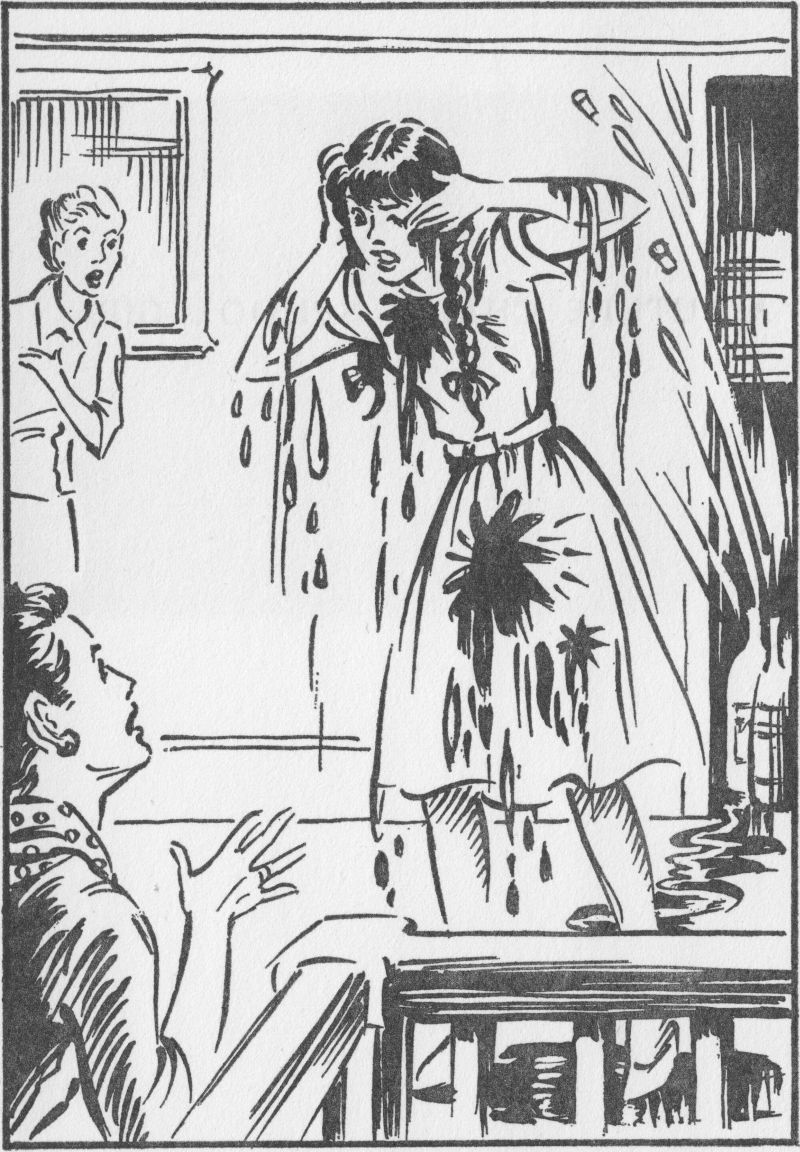
“What on earth was that?”
A FUTURE CHALET SCHOOL GIRL
By
Elinor M. Brent-Dyer
First published by W. & R. Chambers Ltd. in 1962.
To
PHYLL
who has kept on asking for a story
about the people of the country like
the first Chalet books.
With much love from
ELINOR
| Chap. | Page | |
| I. | Mélanie in Trouble | 7 |
| II. | Chickenpox! | 16 |
| III. | Letter from Switzerland | 26 |
| IV. | Joey makes a Plan | 35 |
| V. | The Minibus | 47 |
| VI. | At Freudesheim | 56 |
| VII. | A Chapter of Accidents | 68 |
| VIII. | The Tiernsee at Last | 79 |
| IX. | Joey Meets an Old Friend | 91 |
| X. | The Three R’s Arrive | 100 |
| XI. | Escapade and the result | 112 |
| XII. | Jack Takes a Hand | 122 |
| XIII. | On the Way to the Zillerthal | 130 |
| XIV. | Ruey Asks for Advice | 141 |
| XV. | The Showdown | 150 |
| XVI. | “What on Earth was That?” | 161 |
| XVII. | Trip to Kufstein | 171 |
| XVIII. | Ditched! | 181 |
| XIX. | Tante Jeanne | 191 |
| XX. | The Wind-up | 202 |
“But I still don’t see why I must leave St. Katharine’s,” Mélanie said rebelliously.
“My dear girl, if I’ve told you once, I’ve told you a score of times,” her aunt said, giving her an exasperated look. “Uncle Oliver has been chosen for this good appointment, which is a chance in a thousand. He can’t pass it by, even if it does mean that we must go to live in Switzerland. He has accepted it and we’re going.”
“Well, but—I don’t see why I couldn’t just go on at Kate’s and come out to you for the hols,” Mélanie broke in.
“You know perfectly well why. I promised your parents we would look after you as long as they were out of England. How can we do that if we are in one country and you in another, may I ask?”
“I’d be all right—honestly. I’d be a boarder and goodness knows I’d be looked after all right. Mary Swanson says you can’t call your soul your own—not with Mother Mary Joseph on the job! I could come to you for the hols. Oh, Auntie, do, do let me!” Mélanie was at her most persuasive.
“No—and please accept that as final, Mélanie. I’m tired of all these arguments and they won’t do you any good. Once for all, these are our plans. Uncle and I leave for Geneva at the end of May. You may finish the term at St. Katharine’s. Rev. Mother will accept you as a boarder for the last half of the term. But if you want that to happen, you must stop all these pleadings and grumblings and realise that what has to be has to be. If you won’t, I shall cancel the arrangements with Rev. Mother and you’ll come out to Switzerland with us. Now that is my last word, and please grasp that.”
Mélanie glared at her aunt for a moment, her sea-blue eyes flaming with fury. “I—you—I think you’re a beast!” she gasped finally, before swinging round and tearing from the room, slamming the door after her with a bang that shook the house. Another more muffled one from upstairs announced that she had reached the haven of her bedroom.
Mrs. Raymond nearly called her back. Then she thought better of it and picked up the sewing she had laid down when her tempestuous niece had tried, for about the fiftieth time since she had heard the news, to coax her to rescind the fiat that she must leave her beloved school and go to Switzerland when her grown-ups went.
“Poor child!” she thought compassionately. “Better leave her to get over it. She’ll feel better presently.”
Meanwhile Mélanie, having flung herself face downwards on her bed, burst into tears and cried till she was a sight to behold. She cried until she had no more tears to shed, her face felt stiff, her eyes were swollen and her nose was crimson. Then she rolled over on to her back and lay, still shaking with the violence of the storm.
“It’s horrible of Aunt Amabel!” she thought. “I’m positive Maman and Daddy would say it was quite all right for me to be a boarder at Kate’s and just go to Switzerland for the hols. They never meant me to leave just because Uncle Oliver wants to go out of the country. If they did they’d have taken me to Mañaos with them. Oh, I wish they had! I don’t believe it’s as hot as all that. Oh, Maman—Maman!”
She turned over again and tried to squeeze out a few more tears, but she had cried herself dry already. She gave it up, shut her eyes and lay wondering if there was anything she could do to keep herself at the school she had loved ever since she had first gone there, three years before, when she was just eleven.
As might have been expected, she presently found herself getting muddled. Her outburst of rage and tears had tired her out and while she was still wondering hazily what to do, she fell asleep. Mrs. Raymond, coming upstairs to see what she was doing and call her down to tea, found her slumbering peacefully. Her lashes were still moist and her face was swollen and blotched with crying. Her aunt’s eyes were very tender as she looked down at the girl.
She had no idea of giving in, all the same. Mélanie’s father was her twin and she had promised both him and his pretty Breton wife that she would watch over their only child like a mother. That did not mean letting her stay in another country, and Mélanie must make up her mind to it, whether she liked it or not. But for once, Mrs. Raymond decided to pass over her rudeness.
“Mélanie!” she said. “Wake up, dear! Teatime!”
Mélanie roused slowly. She yawned and stretched, wondering why her eyes felt sore and she had a dull headache. Then she remembered and a sullen, resentful look crossed her face.
“What do you want?” she asked sulkily.
“Teatime. Run along and sponge your face and tidy your hair. You’ll feel better then and a cup of tea and one of my fresh-baked teacakes will cheer you up,” her aunt said briskly.
“I don’t want anything. I’ve got a headache.”
“Tea will clear that up. Come along—up you get!” Mrs. Raymond knew that her niece was brimming over with self-pity and she had no idea of allowing it.
Mélanie glanced at her aunt under her long lashes. What she saw made her give up her first idea of rolling on to her face and taking no notice. Aunt Amabel could be very sweet but when a certain expression came into her eyes, the young woman had learnt that it was better for her to obey. She scrambled off the bed, picked up her towel and spongebag and marched off to the bathroom, literally bristling with resentment. Mrs. Raymond straightened the crumpled counterpane and then went downstairs to the drawingroom where a luscious tea was waiting on a small table drawn up to the fire. It might be April, but it was very chilly yet.
Mélanie trailed in five minutes later. Her eyes looked better, but it was plain that this was the only improvement. She took her tea but shook her head at the inviting plump triangles of homemade teacake.
“Don’t want it. I said I’d a headache.”
“Very well. There’s plenty of bread-and-butter if you prefer that,” her aunt told her, taking no notice of her manner.
Mélanie said nothing. She sipped her tea, for she was thirsty. She was also hungry, but she persevered in her sulkiness. Aunt Amabel paid not the slightest heed. She finished her own tea with every appearance of enjoyment; offered her niece more tea—which was refused—and gingerbread—also declined—and then proceeded to clear the table.
“Have you finished your prep for tomorrow?” she inquired before she wheeled the trolley out to the kitchen.
“No.”
“Then run along and finish. Don’t forget to switch on your fire. It’s too cold for you to sit upstairs without it.”
Mélanie mumbled something that might have been acquiescence, and stalked off upstairs in a positive aura of indignation. Her aunt looked after her with something like consternation. It was all very well for herself. Mélanie was her twin’s girl and she was ready to make all sorts of allowances for her; but Mr. Raymond definitely would not. He was rather a stern disciplinarian and he had said more than once—and not without truth—that Mélanie was badly spoilt and must be taught that she couldn’t have everything she wanted. Furthermore, if she was refused, she must accept it without either sulking or arguing. He was very fond of the girl, but he thought—and rightly—that the moving about continually with her parents, which had been the rule during the first eleven years of her life, had been very bad for her. He had gladly agreed to take her when her father had decided that the heart of Brazil was not the proper place for a schoolgirl.
The two years with the Raymonds had certainly made a difference in Mélanie in some ways. It was quite a year since they had had an outburst like this and Mrs. Raymond wanted to keep it to herself if possible.
She washed up, prepared one or two items for dinner, and then ran upstairs. In her present mood, Mélanie would be quite capable of sitting without a fire. However, she had obeyed her aunt so far and was busy with her essay, which luckily she had roughed out previously.
Her aunt came in briskly, pulled the curtains at the lattice window close and then glanced at the work on the small table.
“Nearly finished?” she inquired.
“Yes; I’d only got it to copy,” Mélanie said.
“And then?”
“Rep for lit.”
“Good! Bring it downstairs when you’ve finished your writing. You can learn it in the drawingroom. Hurry up, little girl! Even with the electric fire it’s none too warm up here. We must be in for a frost!”
Mrs. Raymond nodded pleasantly and left the room, shutting the door carefully behind her. Mélanie went on with the essay. Despite herself, she was feeling rather more cheerful. If she could flare up in a rage, it rarely lasted for long and already she was beginning to feel that she had done herself no good by her afternoon behaviour. She must try other tactics, especially with Uncle Oliver. The trouble was she couldn’t make up her mind what exactly to do. Crying would get her nowhere with him. He would simply send her upstairs until she felt like being a pleasant companion again. Since coaxing had got her nowhere with Aunt Amabel, she guessed that it would be worse than useless with him. Tempers—oh, no! that was the worst bet of all. Mélanie finished her essay and put it into her school-bag, tidied herself meticulously, and went downstairs to the drawingroom with her copy of As You Like It to do what she could with William’s pleading speech to Phebe and her own problem unsolved.
Mrs. Raymond had been to the kitchen to look at her cooking. Now she came in, sat down at the other side of the hearth and remarked as she took up her sewing, “I’ll hear that when you’re ready. If you know it, you might run and lay the table for dinner. Give me the book when you’re ready.”
Mélanie nodded and buried herself in William’s plea. Ten minutes later she was able to repeat it without a mistake and her aunt sent her off to add the book to the rest and then to lay the table for dinner. She herself, after a glance at the clock, went to the kitchen to look at the casserole she had prepared that afternoon.
Mr. Raymond arrived shortly after seven to find a bright, firelit room and a hot meal awaiting him. Also, thanks to his wife, a niece who replied pleasantly to the remarks he addressed to her. He never knew about the tantrum earlier.
Dinner over, Mrs. Raymond and Mélanie washed up while Mr. Raymond took a well-earned rest in the drawingroom until they had had coffee. Then he went back to the diningroom to deal with some important papers he had brought back from the office while Mélanie curled up on the settee and finished the last of a book she had from the school library. It must be returned tomorrow and she simply must know just how Werner got out of his difficulties.
The clock struck nine and her aunt, who had been busy in the kitchen appeared to say, “Nine o’clock, Mélanie! Finished your story?”
“Just!” Mélanie said with a deep sigh as she closed the book. “It’s a gorgeous yarn. I don’t know how she does it!”
“Whose is it?” Mrs. Raymond asked, coming to sit down for a moment.
“Josephine M. Bettany—she wrote Dora that you gave me for Christmas. This is a history yarn, though—about the Swiss fighting the French Revolutionaries. It’s marvellous!”
She stood up and rubbed her eyes. “My eyes do feel queer and my head still aches a bit.”
“That’s with crying so hard. Never mind, chickie. Run along to bed now. Give your eyes an extra good bathing with hot water and then cold. I’ll be up presently and give you a Disprin to ease the headache. You’ll feel better after a good night’s sleep.”
Mélanie nodded. “Can I go and say goodnight to Uncle?”
“Yes; but don’t stay talking. He’s very busy just now.”
Mélanie put her book on the hall table as she went past to the diningroom where her uncle looked up to kiss her goodnight.
“No chatter tonight,” he said warningly. “By the way, Auntie is coming up to Town with me on Saturday morning. Want to come too?”
“Oh, yes, please!” Mélanie sounded delighted. Trips to Town during the term were few and far between, her guardians both considering that with all the schoolwork she had it was better to keep treats for the holidays.
“Very well,” he said. “We might manage an hour or two at the Zoo after lunch. But run along now. I’m busy.” And he turned back to his papers.
Mélanie went upstairs feeling considerably happier. In fact, when her aunt arrived with the Disprin and a cup of hot Ovaltine to drink after it, she had the grace to murmur unevenly, “Sorry I was such a pig this afternoon.”
“Then we’ll say no more about it,” her aunt said with a kiss. “Switch off your bedlight when you’ve finished the Ovaltine and try to go to sleep. Goodnight, little girl.”
Mélanie slept very well, but the headache persisted in spite of that and she felt dull and heavy all day. Not that she said anything to anyone. She had no intention of missing that trip to London on Saturday. She had it, but somehow she didn’t enjoy it as much as usual. She was quite glad to go to bed soon after dinner, she felt so tired. Her aunt, coming in at about eleven o’clock to look at her found her sleeping heavily and looking rather flushed.
“Tired out,” she thought. “She’s growing rather quickly just now, I think. And that reminds me: I must try her summer frocks on. She probably needs one or two new ones.”
Sunday began badly. That heavy sleep was not refreshing and Mélanie came downstairs to breakfast looking weary.
“What’s the matter with you?” her uncle asked as she slid into her seat.
“I don’t know. I’m tired,” Mélanie said.
Her aunt gave her a quick look. “Tired? Didn’t you sleep well?”
“I think so. I don’t know. I’m just tired.”
“If that’s what a trip to Town during term time does for you,” her uncle remarked, “there’ll have to be no more. Come along and see what an egg will do for you.”
But not even a perfectly poached egg had any temptation for Mélanie. She played with it and halfway through breakfast, she suddenly burst into tears for no apparent reason. Mrs. Raymond hustled her off to bed at once. She helped her to undress, for Mélanie was crying too much to be much good. By the time she was in her nightgown, her aunt was only waiting until she was safely tucked up in bed to fly to the telephone and ring up the doctor. He arrived with a promptness that was startling if anyone had bothered to think about it. No one had much time just then. For his verdict was just what Mrs. Raymond had expected. There would be no more trips to London for Mélanie that term; no need to bother about summer frocks for the next few weeks and no more St. Katharine’s, either. She had chickenpox!
It was a really bad case. Mélanie ran a high temperature for the first few days and when that had subsided, she felt very weak and miserable. It made matters no better that the doctor, having asked how long she had been feeling poorly and heard that it was two or three days before he had been called—but she had said nothing so as not to miss the London trip—said nothing himself, very expressively.
By that time, the rash was well out and she was covered. Mrs. Raymond had a fine time of it, trying to keep her from scratching as the blebs dried up and began to itch. Only the information that wherever she broke one with scratching she would leave a permanent mark deterred her—and by that time, she had already left one place on the very tip of her nose.
For the first fortnight or so, the doctor ignored her extreme depression. He had two girls of his own, the younger of whom was Mélanie’s great chum. He knew how wretched she was feeling and expected that, as she grew stronger, this would pass. It did not; and he instantly took measures.
“Now then, what’s really wrong with you?” he demanded one fine day.
“Nothing,” Mélanie growled.
“You look like it! Got a pain anywhere—feel sick? No? Then why are you looking like a week of wet Sundays? And why aren’t you eating? You’re convalescent now. You ought to be eating like a horse, making up for lost time. What’s at the bottom of it all, eh?”
Mélanie was silent. Being a truthful young thing, she could not tell him that it was illness any longer.
“Come on, now!” he said, sitting down on the edge of the bed. “May as well come clean first as last, for I don’t stir from here till I know the reason for this dying-duck-in-a-thunderstorm attitude.” He gave her a twinkling smile as he finished and, knowing him, she let the barriers go.
“I’ve got to leave Kate’s this term—and Aunt Amabel promised I might stay till the end at least—and now I’m missing all these weeks because of this beastly business.”
“That all? Bless me, Mélanie, if you were as fit as a fiddle you wouldn’t be at school, anyhow.”
Mélanie sat up with a bang, looking wildly curious. “Why ever not?”
“Because the school’s closed for the next three weeks. Can’t keep a school open with an epidemic running through it like wildfire.”
“Epidemic—at St. Katharine’s?” Mrs. Raymond queried, startled.
“I’ll say so! Eighty-one cases in the Senior and Middle schools and practically all the Junior school and three of the Sisters and Mother Mary Joseph thrown in for good measure! She seems to have escaped it in her extreme youth. We’ve been able to keep it to the school, thank goodness. But it’s needed drastic measures.”
“Have Anne and Rosalind got it?” Mélanie asked, looking distinctly more alive than she had done since the chickenpox started.
“No, thank heaven! Had it years ago when they were K.G. babies.” He turned to Mrs. Raymond. “We’ve tracked down the source—one of the Fifth Form boarders who went home for a sister’s wedding. One of the little pages came down with it a few days later.”
“That’s Susan James,” Mélanie said. “I remember her being away for the wedding. She brought a hunk of the cake back with her for the other boarders.”
“But didn’t her people warn the school at once?” Aunt Amabel asked.
“Didn’t know a thing about it till Rev. Mother wrote to them about Susan. Then Mrs. James remembered that her sister had written to say that the boy must have overeaten as he’d been poorly ever since they got home. She jumped to it at once, rang up the sister—they live in Aberdeen—and was told that it was chickenpox all right. Reverend Mother was nearly dancing when she heard, Mélanie. I believe she’s vowed that never again will she let any boarder go visiting in termtime. The girls were bad enough, but Sister Angela has been seriously ill—much worse than you, so don’t think you’re the only one, my girl. And, of course, Mother Mary Joseph put the last touch to it.”
Mélanie went pink, but she asked which of the other Sisters had had it.
“Sister Bonaventure and Sister Mary Margaret.” He suddenly grinned. “As for your respected Head, she was so mad to think she had succumbed to such a childish complaint, she hadn’t time to worry about anything else.”
Mélanie actually giggled. “It does sound awfully undignified.”
“So she seemed to think.” He turned to Mrs. Raymond. “Nothing much wrong with Mélanie now. Feed her up and keep her cheerful. She can get up for an hour this afternoon and she’ll be fit again shortly. Mélanie, Rosalind sent you a couple of paperbacks to read and a jigsaw. I left ’em on the hall table. Mind you burn ’em when you’re done with ’em. Now I must be off. You’re not the only pebble on the beach, young Mélanie!” He patted her shoulder and left the room with her aunt. Behind him was a greatly cheered patient who was still giggling over the thought of the very dignified Head Mistress having chickenpox.
From that day she made real progress, and when the doctor looked in the following Monday, she was impatient to be allowed to leave her bedroom.
He laughed as he examined her. “You’ll stay here until the quarantine is ended—next Sunday. After that you can go out so long as you don’t do anything silly and catch colds.”
“What about school?” Mélanie asked anxiously.
“Nothing about school—or not for another fortnight, anyhow.”
“But—but that brings it to half-term!” his patient protested.
“Can’t help that. You’d better spend the time helping your aunt to let down your frocks. What a lanky length you are to be sure! Anne and Rosalind won’t recognise you when they see you!”
Downstairs, he warned Mrs. Raymond again about chills. “She’s had a nasty go of it and she’s done a lot of growing, so keep an eye on her and don’t let her play any tricks. I’m not sure she oughtn’t to have a change before she goes back to school. She’s not nearly as fit as she thinks she is.”
“But—but that’s impossible now!” Mrs. Raymond gasped. “We leave in a fortnight’s time—at least Oliver and I do. I promised Mélanie she should have what’s left of this term——”
“Leave—oh, yes; you’re off to Geneva, of course. O.K. Cut that half-term you promised her and take her with you. Couldn’t be better. A holiday for the next two or three months should set her up properly.”
“I don’t like breaking my word,” Mrs. Raymond said slowly.
“I know. I’m sorry about that. But strictly speaking, she needs the rest. She’s at a tiresome age, growing and developing in all directions, and this thing has taken it out of her. Don’t you worry; I’ll tell her myself that it’s doctor’s orders and see that she grasps it, too.”
“But will she be fit for the journey?” her aunt asked, looking worried.
“How are you going? By road? Right! Break the journey and give her a night at a hotel somewhere. Then she won’t hurt.”
With this he departed. Later, he kept his word and by the time he had done with her, a resigned Mélanie had taken in the fact that you can’t have chickenpox violently and add a couple of inches to your height and hope to take up your ordinary life the moment quarantine is ended.
It was a busy time for them all after that. Most of the furniture was to be stored until the Raymonds could find a house or flat for themselves. For the present, Uncle Oliver had taken a furnished flat in Geneva. They had to sort out what they wanted to take with them and arrange for what was left to be stored. An entire new outfit had to be bought for Mélanie. None of last summer’s clothes were any use to her, even when they had been let down to their fullest length. Besides that, certain farewells had to be made, among them a visit to St. Katharine’s.
She left that till the last day and turned up at Break when everyone she met yelped with surprise at her growth and her thinness.
“Goodness, Mélanie! You are a long yard of pump water!” Rosalind Kaye told her unflatteringly. “Mind you eat piles of choc in Switzerland and fatten up a little. And drink all the cream you can get. Isn’t Switzerland famous for its milk?”
“Of course it is!” someone else put in. “Look at the tins of Swiss milk they export!”
Reverend Mother made no remarks on her appearance.
“I’m sorry you aren’t coming back to us,” she said when her pupil appeared in the study. “You have made real progress this year and would have been put up to Lower Fifth if you’d gone on working as you have done.”
Mélanie blushed. “I did try,” she murmured.
“We all know that. I’ve been very pleased with you. Be sure you keep it up wherever you go next term, and do us credit. I hope you’ll be very happy, my child, though that will depend largely on yourself. Remember, places don’t really matter so much. It’s what we bring to places—and people—that will decide whether we find life good or otherwise.”
Mélanie reddened again. She wondered how much Reverend Mother knew about her rebellion. She would have been surprised if she had known. What Reverend Mother didn’t know about character wasn’t, as someone had said, worth knowing. Mrs. Raymond had said nothing about her bad niece’s attitude to the coming changes, but the nun had guessed well enough.
“Well, I mustn’t keep you long on your last day. I expect you are very busy. Don’t forget us and if ever your people come back here while you are still of school age, we shall hope to see you among us again. Now, here is a little book I want you to have. Try to read a little in it every day, if it is only a sentence or two. You won’t care much for it just yet, I expect, but you will later. If you ever want our help, ask for it. Now you must go. God and Our Lady bless you and keep you, now and always.”
“Th-thank you, Reverend Mother,” Mélanie gasped, as she accepted the stoutly-bound copy of The Imitation of Christ Reverend Mother had given her. “And—and I’ll promise to try to read this every day—and—and thank you for everything.”
Reverend Mother gave Mélanie a sudden smile as she backed to the door and made her reverence. But as the girl drew the door close after her, she glanced back and saw that the nun had picked up her pen and was already busy with the paper she had before her on the desk.
Break was over by this time, so she could say goodbye to no one else at school. Her books had already been returned to the stockroom and her personal belongings sent home. She had nothing more to wait for. She turned at the school gates for a last look at St. Katharine’s. Then she went out and her uncle was waiting for her with the car. She scrambled in beside him, feeling that the old life was over and she had a new one to face.
Not that she had much time for brooding on it. There were so many oddments to clear up when she reached home, that she was kept busy until bedtime, which still came at eight o’clock. She had meant to squeeze out a few tears, once she was safely in bed, but it didn’t work out that way. She finished her prayers, snuggled down and—knew nothing more until Aunt Amabel was calling her next morning, and bidding her hurry up with her bath as Uncle Oliver wanted to set off by nine o’clock at the latest and it was seven already.
It was a wild scramble after that until, punctually at nine, the last bags and cases had been packed into the car. Mélanie and Mrs. Raymond had taken their seats and Mr. Raymond slammed the door behind him, locked it and came to whisk them away—first to the house agent’s to leave the keys and then off along the roads, busy with traffic, towards Dover, where they were to cross to France.
“What will happen to the things we have still left in the house?” Mélanie inquired as they ran through Kent, past the hopfields where the bines were already covering the strings and poles with frail green foliage.
“The men will get the keys from Seviers’ office and remove them during the morning,” her aunt explained. “They are to be stored with the rest.”
“Oh, I see.” Mélanie said no more and settled down to watching the scenery until they arrived at Dover Harbour, where the cross-Channel ferry was already waiting.
The crossing was delightful. The sea was like a millpond and, by the time they reached Calais, Mélanie was so thrilled that she had no time to follow the school timetable throughout the day as she had intended. In fact, as she was to find out, there was so much that was new to consider that she forgot all about being tired until late in the afternoon when she grew quieter and finally stopped talking altogether. Mrs. Raymond was glad when they reached Dijon where they were to spend the night and go on next day.
Dinner was followed by bed for Mélanie, and next morning they were off again on the last one hundred and odd miles that remained. Mr. Raymond was anxious to reach their destination as soon as possible now, so he held firmly on the way and they paused only for lunch, which they had at a place called Lons. Then on again until suddenly, after the long miles of white, tree-lined roads, they were running through suburbs, and a cool breeze with the smell of water on it came to meet them. Presently, Uncle Oliver swung the car round a corner into a comparatively quiet road lined with great blocks of modern flats. Before one of these he drew up.
“Are we there?” Mélanie asked tiredly as he opened the door and stepped out.
He gave the white-faced girl a quick look. “Yes. Very tired, Mélanie? Never mind. Home is here for the present and you shall have a meal and go to bed at once. You’ll feel better after a good night’s rest, little girl.”
Mélanie scrambled out and stood looking round with very little interest. She was too tired for that. Aunt Amabel came to join her and slip an arm round her waist.
“What about the car, Oliver?” she asked, as he wrestled with the boot to get out the cases.
“O.K. I’ll lock it and leave it. The main thing is to get you and Mélanie somewhere where you can rest. In at those doors, Amy, while I bring out the cases. Ah!” as the doors swung open and a man in the uniform of a concierge appeared. “Here is someone to help.”
Five minutes later they were all in a lift, being whirled up and up till it stopped at the seventh floor where the man ushered them out, led them along a corridor and paused before one door to which he produced the key and unlocked the door with a flourish.
“Voilà, Monsieur,” he said, presenting the key to Uncle Oliver. “Étage sept, numéro dixhuit.” He bowed and waited expectantly.
Uncle Oliver nodded, asked him to see to having the rest of the boxes and cases brought up and gave him a pourboire, at which he grinned expansively before vanishing. The luggage came up in due course, but by that time weary Mélanie was in bed and Aunt Amabel was asking what arrangements could be made for a tray for her. There was a big restaurant below where most of the flat-dwellers fed.
“I’ve nothing much here—only coffee and a loaf of bread and some butter,” she said anxiously. “I’d like her to have soup and a light pudding of some kind. Can you see to it, dear?”
Uncle Oliver laughed and pointed. “There’s a house telephone. Give your orders over that, Amy. You can always have a meal sent up here if you prefer it to feeding downstairs.”
So presently Mélanie was supplied with a bowl of delicious soup, followed by a jam omelette and accompanied by a glass of milk yellow with cream. She just managed to keep awake long enough to clear her dishes. When her aunt looked in to see if she was ready to have the tray removed, she found her niece sound asleep, the tray on the floor by the bed and The Imitation lying open on the pillow. Mélanie had tried to keep her promise to Reverend Mother, but Nature had been too strong for her, and if she had read the first three words, it was as much as she did.
“Dear Rosalind and anyone else who is interested,
“I’m writing to you, Ros, but it’s for the whole form if they want to read it, so don’t hog it all to yourself—or even to the family. I’ll be sending postcards all round but it’ll have to be in small batches. P.C.’s cost the earth here and the postage is just as bad. Twenty-five centimes if you write a message more than five words long! I ask you! A franc is worth about two bob so that means sixpence per card. You won’t get many cards, any of you, at that rate!
“We got here about five days ago and was I tired! All I wanted was to go to bed and stay there. Not that it lasted. I slept and slept and slept and Auntie left me to it until I woke of myself. As it was about half-past six when we got here and I never woke till eleven next morning I had about fifteen hours dead to the world.
“By that time, Uncle had gone off to find his office and meet the new people and Auntie had been busy rearranging things in the flat here. I felt rather a pig when I saw all she’d done, but it wasn’t my fault. She didn’t wake me.
“Brekker was weird. No eggs and bacon or anything like that. It was a real continental brekker with milky coffee, rolls—scrummy!—cream-coloured butter and black cherry jam! ‘Luscious’ doesn’t describe that jam! I never tasted anything like it!
“I got up after that, but when I arrived with my tray, I was told to take it to a service lift and send it down. These are service flats and there’s no washing-up. There are cleaners who do the housework and all your washing goes out. I was thrilled about it, but Auntie says this is only for the present. We’ve got to find a house of our own somewhere, for living here costs the earth and it just won’t run to it—or not for long. Everyone says that Geneva is one of the most expensive places to live in, so Auntie and Uncle are going to try to find a place somewhere at the other end of the lake and Uncle will come in daily by car, just as he used to go up to Town. The reason is that there are such lots of things here like U.N.O. and the Red Cross, and the International Labour Bureau and things like that. There are such crowds of foreigners wanting houses and flats that the rents are ghastly and everything else is the same. Mrs. Embury is going to try to find us somewhere near Montreux where they live or somewhere else at that end of the lake. And before I forget, they don’t call it Lake Geneva here, but Lac Léman. Isn’t it rummy?
“I’ve just reread what I’ve written so far and I can guess you want to know who Mrs. Embury is. Her husband is Uncle’s boss. I haven’t seen him yet, but she is a perfect dear! Fattish, though she says that since she had an operation for appendicitis she’s much slimmer, very jolly, and Auntie says she must have been awfully pretty when she was younger. There are seven Embury boys and she told me that after the third she spent her time in between the rest hoping that the next baby would be a girl, but it never was.
“She came to fetch Auntie and me the very first morning. She said she knew how hard it was when you didn’t know where the best shops were and so on. She would have asked us to go to stay with them for a while, but she is full up with visitors just now—the boys are all away at school, even Alan who is the baby. I mean that he’s seven, but he’s the last. Rupert, the eldest, is seventeen and Lionel who comes next is sixteen. Then there are Maurice, Robin, Paul, Guy and Alan. I’ll bet they don’t have much chance of visitors when that crowd is at home!
“And oh, my dears, what do you think? She’s a most tremendous pal of Josephine M. Bettany—the one that wrote Dora and Tessa in Tirol and all those gorgeous historical novels that we have in Kate’s library. She—Josephine Bettany, I mean—lives in the Oberland, which is what they call the mountain part in the east. Her husband is head of a big sanatorium on a shelf right up in the mountains called the Görnetz Platz. She has an even bigger family than the Emburys, but mixed. I mean some are girls and some are boys. Mrs. Embury is going to invite Auntie and me to go and meet her some time when she is staying with them. Isn’t it a thrill?
“Mrs. Embury says she’s most awfully jolly and friendly and not a bit grown-up unless she wants. But mostly, she doesn’t. I’m going to try to get a few autographs from her and I’ll send them to you, Ros, to hand round to anyone who wants them.
“Auntie’s calling to me to go with her and Uncle for a sail on the lake. To be continued in our next!
“Later. We’re back from our sail and it was marvellous! It’s a gorgeous evening here with the sun shining like mad on the water, though there was a jolly little breeze once we got right out on the lake. I was glad of that. It’s awfully hot in the daytime in Geneva and it makes me feel limp. I suppose that’s the result of chickenpox. By the way, is everyone back yet? And is Sister Angela all right now? Don’t forget to write and tell me all the news. Now I’ll go on about here.
“There’s an awful lot to see, but the pick of the lot is Mont Blanc. They say he’s only visible about one day in three. The rest of the time the mists are down and then you’ve had it. We never saw him till this evening and we might have missed him then, but some people passing us in a boat yelled at us to turn round and look, so we did. He was marvellous! I never even imagined anything so tremendous and so stately. I heard Auntie catch her breath and I couldn’t say a thing myself just at first. All that shining whiteness against the deep blue sky—it was earlyish in the evening, of course—and looking so calm and settled as if it had always been there and always would be. I can’t express it properly, though. You’ll have to see him for yourselves sometime.
“Auntie took me to see the Alabama Hall which is in the City Hall. This is where the Red Cross Society was begun in the middle of the last century. It seemed weird to find a Swiss place called ‘Alabama’, so I asked Auntie and she asked someone else and they said that it was because a Court of Arbitration was held there to settle a row between the Americans and us about some ship called the Alabama. I don’t know that yarn.
“Then another day we went to see the Monument of the Reformation—a tremendous long wall with the four men responsible for most of the Reformation in Switzerland, anyhow, sculpted against it. They are Farel, Beza, Calvin and John Knox. I don’t know a thing about the first two, but I do remember that Calvin’s name was really Jean Chauvin. John Knox, of course, was the old fellow who was so rude to poor Mary Queen of Scots. I shouldn’t like to meet any of them in the dark! I think Farel looks the grimmest and John Knox the crossest. They’re huge! I think each figure is about ten feet high. On either side of them are other Protestant figures like Oliver Cromwell, and Admiral Coligny who was killed in the massacre of St. Bartholomew, and others.
“That’s about all we’ve had time to see as yet, except the shops and they are marvellous. Geneva is the big place for watches and clocks and some of those you see in the shop windows are—I nearly said marvellous again, but remembered what Sister Clare said about repetition, so I didn’t. I’ll say gorgeous instead. The duckiest cuckoo clocks! I’d love one for my own, but even the smallest seems to cost the earth.
“Auntie has just come in to say I must stop writing and go to bed. It’s almost ten o’clock and up till today I’ve been going to bed at eight ever since the chickenpox. Tomorrow’s Sunday, so I’ll finish then. I’ve still something more to tell you all, but——”
(At this point, Mrs. Raymond took the pen out of Mélanie’s hand and removed her paper. It really was much too late for a girl who was still not very far removed from convalescence. However, the letter was finished next day.)
“Sunday. Auntie took my pen away and sent me to bed in earnest. However, I’ve got this whole afternoon, so I’ll finish. It’s a blazing hot day—much too hot to go out. Even up here with all the windows and doors open, it’s like an oven. I’ve got my dressing-gown on and nothing else, so I’m not too bad. Now where did I get?
“This really is funny. Uncle told us the first evening but I hadn’t got round to telling you. What do you think? His boss, Mr. Embury, was at prep school with him. Uncle says when he went into the office, he just stared and gasped and then he said, ‘It’s Emmy, isn’t it?’
“Mr. Embury stared at him and then jumped up exclaiming, ‘Sunny Raymond, by all that’s queer!’
“Then they sat down and had a terrific natter. They’d both gone to different schools when they left their prep and Uncle says when he was a kid he was always called by his first name—Leonard. He’s Leonard Oliver. But when he went to his public school, a cousin of his who was Leonard, too, had been there a year before him, so he had to use Oliver and it stuck. That’s why, when Mr. Embury was writing to him, he didn’t know who it was.
“It makes things a lot nicer all round. The Emburys are doing all they know to find us a house somewhere near them. That’s above Montreux and Mrs. Embury says it’s a lot cooler than Geneva and, of course, much cheaper. The only thing is, houses aren’t easy to find here, any more than in England. Remember what Susan James said about the time Margaret had when they were trying to get one before they were married? It’s just about as bad here.
“But even more than that, we’re to go and meet Mrs. Maynard—that’s Josephine Bettany; I told you about her husband being head of a big sanatorium out here—and Mrs. Embury says she’s sure if it’s too hot for Auntie and me down by the lake, she’ll ask us to stay with her for a week or so later on when the heat really gets going, just to give us a break.
“I’m dying to meet her. She has triplet girls—our age. Their names are Len, Con and Margot. They go to a school that’s up on the Platz. It’s called the Chalet School. I seem to think I’ve heard of it somewhere, though where, I haven’t a clue at the moment. Just imagine triplets of fifteen, though! Doesn’t it seem weird?
“This morning, after we’d been to church—the Sacré Cœur—we went to see the place where the dam across the Rhône is. It really is marvellous—like a great waterfall. Uncle told me that they regulate the level of the water in Lake Geneva by it. Considering the size of the lake, I think it’s a mar-(scored out) wonderful piece of work. I wonder if Daddy has ever seen it? He’d be interested. That’s the kind of work he does.
“Then we had to come back for lunch and now here I am, scribbling hard. I’ll post this when we go out after tea, which we have in the flat here. Auntie has a spirit stove and a kettle and we make it ourselves. Oh! I must tell you about the cakes. Not that you get much in the way of sponges or fruitcake here. They’re all called ‘pâtisseries’ which means ‘pastries’ and that’s just what they are. Huge buns hollow inside, only the hollow is filled with whipped cream and jam: or meringues, simply smothered—smothered in whipped cream: or leaves of pastry so thin they’re like ice-cream wafers spread with jam and—yes; you’ve got it! Whipped cream! The Swiss do go a lot on whipped cream.
“Auntie has just called that tea is nearly ready and this is going to cost the earth in postage, even though I’ve written small and on the thinnest paper I could find. You won’t get as much as this another time, I warn you. But I will write after I’ve met Josephine Bettany and tell you all about her. I’m longing for it to come. And yet I’ll bet I feel sick with shyness when it does. However, it won’t be for a week or two, yet. She’s spending this week-end with the Emburys, but some other old friends are going to be there as well or we’d have been invited, too. I must finish. Do write and tell me all the news and if Sister Angela is back in school yet.
“Give my love to your people and you might ask your dad if he knows Dr. Maynard, Josephine Bettany’s husband. I believe he’s rather out of this world in his own job.
Heaps of love to everyone,
Your old pal,
Mélanie.
“P.S. I just had to open this, though I’d sealed and stamped it, but I simply had to let you know. I’ve met Josephine Bettany!!!
“After tea last night Uncle said we’d go for a run round the lake. We were just outside Montreux when we were caught in a traffic jam and had to pull up. The jams are awful sometimes! While we were waiting, I heard someone yodelling loudly and I looked out and there was Mrs. Embury with two other ladies. One was small and very fair with her hair twisted round and round her head in masses of plaits. She must have a positive mane to do it like that. The other was tall and dark and she had a deep fringe and earphones of black hair. Mrs. Embury managed to scrabble nearer and then she called to us to pull out to the side as soon as we could and she’d wait.
“Uncle laughed, but he did as she asked and then, when the jam was moving on, Mrs. Embury came up to the car with the two ladies and introduced us all round. The little fair lady is a Frau von Ahlen, but I don’t think she’s a German. The other was Josephine Bettany herself. Only, of course, I had to call her ‘Mrs. Maynard’. It didn’t seem right, somehow.
“Oh, Ros, she’s a poppet! She really is. She’s so jolly and so friendly. I was expecting to be so shy I wouldn’t know where to look; but I hadn’t a chance. Mrs. Embury must have told her about us, for she knew all about the chickenpox. She said I looked like it and far too leggy. She asked how I liked Geneva and when I said it was marvellous, but dreadfully hot, she said yes; she knew all about that and she didn’t think it a good place for an ex-chickenpox patient and something must be done about it. Then she talked to Auntie while Frau von Ahlen talked to me a little. She asked me if I wasn’t going to the Chalet School when next term begins.
“Of course, I’d never thought of such a thing and I said so. Then she said it might be a good idea and her little girl is there—Gretchen, she called her. I wonder if Auntie would agree? I know she thought of a school in Geneva, but she did say she hoped the heat wasn’t going to upset me because I was so limp all yesterday. Of course, no other school could be the same as Kate’s or even equal to it; but I think I mightn’t mind the Chalet School so much. The Maynard triplets go there and Mrs. Maynard says their house is bang next door and she’s often in and out.
“ ‘I was the first pupil the school ever had,’ she said with a grin. ‘I’m one of the foundation stones. If you went there, you’d see quite a lot of me. I must have a chat with Mrs. Raymond.’
“We had to go on after that. But wasn’t it marvellous?
“M.”
“Girls! Girls! When you’ve finished upstairs, come to me in the study! I want a word with you!”—thus Joey Maynard the day after the Chalet School had broken up and most of her family had come home for the holidays.
The Maynard triplets, who had finished their bedroom work already and were in Con’s room, discussing various ideas for the next few weeks, looked at each other with giggles and then ran down to the study where their mother was seated at her desk. Certain big sheets of paper lay before her and the three stopped and grimaced at each other. She was going through their reports.
“Come in,” she said cheerfully, glancing up. “Yes; these are your reports and I may say I’m quite satisfied for once. Your art is marked ‘Conscientious’, Len. I suppose that’s the best Miss Yolland could find to say about it. However, it’s not your fault. Either you can or you can’t. You, my lamb, obviously can’t, any more than I could. As for your maths, Nancy Wilmot says, ‘Len works hard, but she will never be brilliant. Still, she is accurate in what she does’.”
“Thank goodness I can drop maths next term!” Len said fervently. “The rest’s all right, isn’t it?”
“Oh, yes. Most of the remarks are quite complimentary. It’s a pity about the maths, but there it is. Anyhow, you’ve tried steadily and that’s all we could ask of you. Con,” she turned to her second girl, and Con fixed deep brown eyes on her rather apprehensively.
“My maths are lots worse than Len’s. I just can’t see through them.”
“Poor lamb! Don’t I know it! Still, you’ve worked better, by all accounts, and, like Len, you may drop your maths next term. It’s odd both you girls should be so bad at them. I know you take after me there, but considering your father, I’d have thought you’d have been better. But it’s a good report, too. Now for you, Margot.”
Margot looked anxious. “I’ve tried this whole year. Have I got my remove?”
“You have, my lamb. In fact, you’ve got a double remove—you’re jumping Va and going straight into VIb. There’s only one ‘if’ about it.”
“Oh—what?”
“You’ll stay there only if you continue to work as well as you have done all this past year. And, by the way, I seem to have achieved one daughter who is capable of doing rather more than adding two and two together and making four of them! Your maths remark says, ‘Margot has pulled up tremendously throughout the year and her maths are really good’. There’s for you!”
Margot’s blush ran right up into the roots of the red-gold curls that framed her face. “Oh, Mamma!” she exclaimed, reverting to the name of her babyhood in her delight. “How simply miraculous of Willy!” Then she added eagerly, “Is the rest as decent?”
Joey glanced down the sheet. “Yes—every single subject. Oh, I am glad! It’s the best report you’ve ever had—but you must have known you’d get a good one after winning form and exam prizes, not to speak of French and handcrafts. Have you chosen your book, by the way?”
The Chalet School gave prizes, but in a way all its own. Many years ago, a fund had been established for the prizes list and was carefully portioned out each year among the forms. At first, the income had gone to books for the prize-winners; but of late years only a proportion had been spent that way, the remainder going towards something for the House to which each girl belonged. Nowadays, the prizes were book tokens with the sole proviso that the winners must tell the Heads what they had chosen. This meant that a check was kept on the girls and the money was not wasted on light novels that would be read and then pushed aside.
“I know what I want to get with mine,” Len said. “I’m having three more Jane Austens and that finishes my set.”
“Poetry for me,” Con laughed. “I think I’ll have T. S. Eliot.”
Joey nodded. “Right! Well, now I want to talk about something quite different. Do you remember me telling you about a girl in Geneva called Mélanie Lucas?”
“The one Aunt Winifred knows that her uncle is a pal of Uncle Martin’s and works in his office?” Margot asked.
“Margot! What awful English! If Aunt Hilda could hear you, she would die on the spot!”
Margot blushed. “Sorry! But you know what I mean.”
“Oh, yes; I can translate. And you’re right—that one.”
“What about her?” Len asked. “Didn’t she have chickenpox rather badly just before they came out here?”
“Quite right; she did. And now, although she has really recovered from that, she isn’t making headway otherwise. Aunt Winifred says Mrs. Raymond is anxious about her. She’s thin and white and always limp. That’s Geneva, of course. It’s much too hot and relaxing for an ex-chickenpox patient.”
“I know,” Len agreed. “I do love Switzerland, but I must say I’d hate to have to live in Geneva. It’s so crowded and hot in the summer and the rest of the year you get those teasing winds.”
“What, exactly, is cooking?” Margot demanded shrewdly.
“I’d like to help that child. Her own mother is thousands of miles away up the Amazon. I know how I’d feel if it were one of you.”
“But doesn’t her aunt look after her? I thought she was acting as mother to her?” Len sounded perplexed.
“I know. I was only looking at it from Mrs. Lucas’s point of view.”
“What do you want us to do?” Con demanded, going straight to the point.
“I want to invite Mélanie to come to us for three or four weeks as soon as we’re safely settled down at the Tiernsee again.”
There was silence as the triplets looked at each other.
“But why?” Margot asked at last.
“Well, Aunt Winifred was on the phone to me just after breakfast and she says she thinks she’s got a house for the Raymonds not far from them. A little further up than they are. She’s taking Mrs. Raymond and Mélanie to see it this morning. If they can come to terms with the present owners, they’ll be moving in a fortnight or so.”
“Why doesn’t Auntie Win ask them to go to her?” Margot queried.
“My good girl, the boys will all be home at the end of this week. Where do you think she’d put visitors? Especially as Irene—her sister, you remember—is coming out next week for a holiday.”
“Irene?—she’s the one that’s Matron of that hospital in Newcastle where Alix Rutherford was when they found out what was wrong with her, isn’t she?”[1] Len questioned. “We’ve never seen her. Is she as nice as Auntie Win?”
|
A Genius at the Chalet School |
“Quite, I should think. I never knew her as well, though. Irene was older than us. She’s awfully keen on sports—I know that. But never mind that. The point is, Auntie Win can’t have the Raymonds and Mélanie there at present; and if they do get this house, Mrs. Raymond certainly won’t want her niece hanging about while she’s busy getting straight.”
“Why not?” Margot demanded. “She could be a lot of help, surely? She’s around our age, you said. When we came here, we three did a lot to help, I remember, and we were only ten.”[2]
|
Joey Goes to the Oberland |
“You three were as fit as fiddles and Mélanie isn’t. From what I hear, she’ll want to pitch in and do all sorts of things and she isn’t fit for it. But if you three will agree, we can have her with us and return her ready for anything. Life at the Tiernsee will brace her up if anything will. But it depends on you three. I know the Three R’s will be with us in three weeks or so, but I don’t see Ruey objecting.”
Con looked at her sisters. “Can we do with her, do you think?”
“We must,” Len said firmly. “Oh, I know it’ll mess up our ideas for the early part of the hols, anyhow, and you know, Mother, we do like to have you to ourselves in the hols. Ruey and the boys are part of the family now, so they don’t count. Mélanie will be a stranger and it’s bound to make a difference. All the same, if it’s like that, we can’t refuse.”
Margot shrugged her shoulders. “It’s a bore, but I suppose it can’t be helped in the circs. There isn’t anything else her aunt could fix up?”
“Short of sending her back to England, I don’t see what else she could do. They came here as utter strangers. Even Uncle Martin was a shock when he and Mr. Raymond first met. They haven’t had time to make friends and they certainly can’t send a girl of fifteen to stay by herself in an hotel.”
Len assented. “It would be ghastly for her! But how long for, Mamma?”
“I thought a month to get her properly on her feet. Even Montreux can be pretty hot, you know. My idea was to go there ourselves and settle in. We’ll have heaps to do——” She stopped short and then went on, “We’re going on Monday. I thought we’d ask them to send her on the Saturday following. Some one can take her to Basle and put her on the Paris-Vienna express and some of us could meet her at Innsbruck and bring her up from there.”
Con looked up. “How are we going to fit her in—especially when the Three R’s come? We were a good bit of a squash last year after all the kids came back.”
Joey laughed. “We can make room all right. Never mind about that now. I know what I’m talking about. Listen, girls! I know it’s asking a lot of you. You three are inclined to be clannish. You do like us to be just family in the hols——”
“It’s our only chance when we’re away at school most of the year,” Margot pointed out. “Even if we are just next door, it’s not the same thing.”
“It’s better for us than for the boys,” Len said quickly. “They’re in England in termtime.”
“Oh, I suppose we’ll agree,” Margot said glumly. “It’s a sickener, all the same.”
Joey looked at her sharply. “If that’s how you’re going to look at it, we’ll forget it,” she said firmly. “To feel she was an unwelcome guest would do Mélanie far more harm than good and I won’t have it. If she comes, it’s because we welcome her—all of us. Now go away and talk it over among yourselves. I’ll be in the playroom if you want me, I expect. Scram, the three of you, and you can tell me what you’ve decided when you have decided.”
She got up and left the room and they heard her running upstairs, calling to the small fry who were in the playroom, since the day had dawned with such heavy rain that any going out was done for. Left alone, the triplets looked at each other.
“She’s disappointed,” Len said heavily. “We’d better do as she says and talk it over. I don’t see, myself, how we can get out of it—not and feel decent about it. But we’ll discuss it. Come on! My room!”
They went up to Len’s sanctum and settled themselves near the window.
“I wish Mother wasn’t so awfully wanting-to-share all the time,” Margot said crossly. “She’s always doing it and it comes hard on other folk.”
“She did leave it to us to decide,” Len pointed out.
“Not much ‘leaving’ about it. If we don’t agree, she won’t say anything or even look it; but we shall feel horrid pigs, all the same. I shall!”
“So shall I,” Con said mournfully.
“And so shall I,” Len chimed in. “We certainly shan’t enjoy ourselves at that rate. We’ll just have to accept it and be decent about it. After all, Mamma is only going to ask her for four weeks. The hols are nearly ten this year, thanks to the extra building they’re doing. Surely we can put up with having a stranger wished on to us for four weeks out of ten?”
Con suddenly made up her mind. “Right!” she said with decision. “When you put it like that, it isn’t nearly so bad. It can’t be helped, Margot. If we can’t share Mamma and our fun with a girl who’s been ill and still feels rotten, we’re worse than pigs. O.K., Len; I’ll agree.”
The pair looked expectantly at their third. She made a hideous face.
“Oh, you two are just too good to live! Anyhow, Len always does give up to other people——”
“I don’t!” Len cried indignantly. “A nice wobbly-minded object you seem to think me! I only give in when I see that it would be mean not to.”
“Oh, well, you know what I mean. I wish you weren’t so ghastly unselfish. It makes it rotten for people who aren’t—like me. I’ll give in, of course. But I’m not going to pretend I like it. I don’t! Oh, I’ll be nice to—what’s her name again—Mélanie, isn’t it? I say!” Margot’s volatile mind was off on another tack. “Isn’t that a French name? But she’s English, isn’t she? How come she has a French name?”
“Why not? Lots of English girls have French names,” Con pointed out. “There’s Yvonne Robinson—and Marie Anderson—and—and——”
“Gabrielle Lambert,” Len put in with a grin.
The other two stared.
“Who on earth is she?” Margot demanded.
“Well, actually, it’s her second name.”
“Who is she?” Con insisted.
“Jack Lambert, of course. She’s Jacynth Gabrielle—after her two aunts. You remember Gay Lambert, don’t you, when we were infants? And Jacynth Hardy? She’s named after them.”
“Mercy! If that’s the case, I don’t wonder the kid insists on being ‘Jack’,” Margot said, her eyes dancing. “Anyhow, anything less like a ‘Gabrielle’ I can’t imagine. ‘Jack’ just fits her.”
Len chuckled. “She’s awfully fed up about it. Luckily, all her own crowd have either never known her real name or forgotten it by this time.”
“We won’t give her away,” Con promised solemnly, though her own eyes were alight with laughter.
“Oh, rather not!” Margot concurred. Then she went back to the former topic. “All the same, ‘Mélanie’ isn’t an ordinary name for an English girl.”
“Perhaps her mother is French,” Len suggested. “We’ll ask Mamma. She’ll know. Well, that’s settled, then. Mélanie is to be invited and we’ll be decent to her. O.K.?”
“O.K.!” the other two replied, and she sighed with relief.
“Let’s go and find Mamma and put her out of her misery. She really was fed up, you know, even though she said nothing. I’ve heard her say that a big family like ours may be a real handicap if we all find our friends in it and don’t worry about other people. Our own crowd should come first, of course, but we needn’t try to keep other people outside.”
“I don’t believe you would,” Con said soberly. “You’re more like Mamma that way than Margot and me.”
Margot flushed. “I’m the worst, though. You remember——”
“No, we don’t!” Len spoke sharply. “And you aren’t to, either. That’s over and done with and you’re to forget it. You’re not a bit like that now.”
“Do you honestly think so?” Margot spoke with fervour. “Oh, Len, do you? And you, too, Con? I have tried——” Her voice died away.
“Certain of it,” Len said, for the episode to which Margot had referred had been a very unpleasant one and had brought unhappiness to all three, though the youngest had suffered most and still worried about it in private.[3]
|
Theodora and the Chalet School |
Con slipped a hand through her arm. “Len’s right, Margot. You have changed. Why, all this business about Mélanie proves that. Now come on and find Mamma and tell her to send that invite off.”
Joey was found squatting on the playroom floor before one of the two magnificent dolls’ houses which even the fifteen-year-old triplets were not too grand to play with occasionally. One had been made by Dr. Maynard when his three eldest were tinies. The other had been won by Con at one of the Chalet School Sales of Work in aid of the big Sanatorium.[4] Con had been only nine at the time and her beating everyone, her mother included, over the competition, had been regarded as a triumph. The doll’s house had been made by Tom Gay, now working in a big settlement in Dockland. Tom—proper name, Lucinda Muriel, though no one at school except the authorities had ever been allowed to know it—had been a noted carpenter and her doll’s houses were wonderful and an annual event at the Sale, even after she left school.
|
Carola Storms the Chalet School |
Felicity and Cecil, the two small girls, adored both houses and had arranged to spring-clean both, seeing how wet it was. Joey had been helping. Now, at sight of her three big girls, she scrambled up.
“Hello! Come to help us? We’re refurnishing. I mean, we’re exchanging some of the furniture in each house. Felicity and Cecil thought it would be fun. What do you three think?”
“Oh, jolly!” Con exclaimed as she knelt to peer in. “Where are you putting the chesterfield suite, Felicity?”
While Con and the two little girls were busy, Len drew her mother to one side. “Mamma, we’ve talked things over and we think you must ask Mélanie. We’ll all do our best to give her a good time.”
“Only,” added Margot, who had followed them, “do tell us one thing. She’s English, isn’t she? Then why has she such a name? I never before heard of an English girl called Mélanie.”
“Auntie Win told me that her mother is French. I expect it’s her name.”
Con having settled the knotty point of the chesterfields, came up to join them. “We seem to be meeting a lot of new French people lately.”
“Only Solange—and Mélanie seems to be only half-French, anyhow,” Len pointed out. “I like the name. It’s pretty.”
“Oh, so do I,” Con agreed. “What part of France does her mother come from, Mamma?”
“Brittany, I believe. I’m nearly sure that’s what Winifred told me.”
“Brittany? We’ve had girls from there, haven’t we?” Len asked with sudden interest.
“We have. Notably, Jeanne le Cadoulec. By the way, I wonder what’s become of Jeanne? They went to Canada in the early days of the war, I know; but after that, we lost touch and no one seems to have heard anything of them. When we first started to compile the Record Books I know Mdlle de Lachennais tried to find out during the summer holidays, but all she got was that the château had been burned to the ground during an air raid and both the Comte and Comtesse had died in Canada. Now don’t get any wild ideas into your heads about Mélanie perhaps being Jeanne’s girl, because she certainly isn’t. Jeanne was two or three years younger than I and Mélanie is not so much younger than you three—less than a year—and Jeanne wasn’t even engaged when they left France, while you three were howling infants. So you can put any ideas of that kind right out of your silly heads at once.”
“I suppose so.” Len spoke reluctantly. “It would have been rather a coincidence if she had been, but, as you say, she can’t be.”
“Not possibly! Well, if you three can look after the babies, I’ll slip down to the kitchen. I want a word or two with Anna. Thanks for your decision, my lambs. As a reward, I’ll tell you that there’s a big surprise waiting for you at the Tiernsee. No; I’m saying no more, but you can spend your spare time wondering about it. I mean no more; so no coaxing! It won’t get you anywhere. Listen for the twins, Len. They’re sleeping at the moment, but it’s after eleven, so they’ll be rousing any moment now. I’m off!” And she took to her heels and went tearing downstairs more like one of themselves than the responsible mother of a family of eleven.
“How are we going this year? By train or by road?” For a wonder, it was Con who asked the question. Usually, she fell in with whatever the others decided and questioned nothing.
“That,” said Joey, “is ‘wrop in mist’ry’. Ask Papa. He’s the only one that knows. At least,” she added as she held out her hand for Len’s cup, “all I know is that he told me to leave it to him and to ‘ask nae questions and I’d be tellt nae lees’.”
“And he’s out and goodness knows when he’ll be back,” Margot said exasperatedly. “Wouldn’t you know it would happen like that? It’s the end!”
The door of the Speisesaal where most of the long Maynard family were at breakfast, swung open, and Stephen, eldest of the five boys, marched in with the postbag.
“Sorry I’m late, Mum. Here’s the post and Pa’s on the way. I saw the car halfway down the road as I came round the bend.”
Joey looked resigned but said nothing. Until her first son went off to his prep school, the family had called their parents “Papa” and “Mamma” for the most part. But when first Stephen and then Charles had come back with the terms used by their little playmates, she had been wise enough to realise that custom was too strong for her and had given in where they were concerned. “Dad” and “Mum” were common coin with the elders now, though the tinies were still started off on her own choice. “Pa” was new these holidays.
“I suppose the next thing will be that I’m ‘Ma’!” she thought to herself. Aloud, she merely requested Stephen to put the postbag on the side-table and go to the hatch for his plate.
Stephen grinned and obliged. By the time he was seated at table, making vast inroads on the plate of scrambled eggs Anna had handed through the hatch, the doctor himself had arrived.
“Good morning, folks!” he said as he took his seat. “Sorry I’m late, Joey. The car acted up. I fancy she needs taking down.”
“What? Oh, gosh! How are we getting to Die Blumen, then?” Margot demanded while Len brought her father’s plate and Joey passed down his own special washtub of a cup full of steaming coffee.
“Well, not by the car, in any case,” he replied, attacking his meal with the zest of a hungry man who has been called out in the middle of the night to a patient some miles away up in the mountains.
“Well, we couldn’t,” put in six-year-old Felicity, with a shake of her flaxen curls. “There’s too many of us.”
“Are we going by train, then?” Con demanded, elbows on the table and her chin in her hands. “That’ll be somewhat of a chore, won’t it?”
“Elbows off the table!” Joey said automatically. “Jack, what are we going to do? This is Friday, you know, and we talked finally of going on Tuesday. I’d like to know a few details!”
“You’re all hearing—presently. When I’ve stoked up. Any more coffee, Jo?”
“Oceans! Hand your cup along. And hand along the key of the postbag with it, will you? I may as well be sorting.” She held out her hand, adding, “Fetch me the postbag, Chas, will you?”
Charles brought the bag while she poured the coffee, and all eyes were turned on her when she fished out the contents.
“Dr. Maynard—Dr. Maynard—Dr. Maynard—Mrs. J. Maynard—Miss L. Maynard—from Ruey, Len. Let’s have her news when you’ve read it—Dr. Maynard—Jack, you’ve hogged the lion’s share as usual.” Her voice died away as she ran through the remainder, flipping them to their various owners. “That’s the lot! The rest are mine.”
There was silence as they devoured their correspondence. A long and loud chuckle from the doctor made them all look up, however.
“What’s the joke?” Margot demanded.
He raised his eyes from the typewritten screed he was holding. “Wouldn’t you all like to know! O.K.—O.K.! I’m telling you in a moment. Finish eating and we’ll go to the salon. I’ve news for you—News, with a capital N.”
No one delayed after that. Felicity finished her milk in two gulps. Stephen shoved a half-roll into his mouth and was dumb for two minutes. Felix, Felicity’s twin, glanced round the table, saw that everyone was occupied, and licked the remains of honey off his plate—and got away with it for once. No one looked at him until the plate was safely on the table and Felix himself was beaming sweetly at them.
“Clear the table, or Anna won’t love you,” Joey said as Jack got to his feet. “It won’t take you two minutes with all hands to the pumps. Twins, push the chairs back and put the napkins in the drawer. Mike, take the rolls basket to the larder and put it away safely. Con, you and Len fold the cloth, please. It’s got to last one more day, anyhow.”
They jumped up and Jack slid a hand through his wife’s arm. “Come along! You shall have first skim!”
“Not fair!” It came in a shriek from at least half of them.
“Quite fair! Your mother and I are one. What’s hers is mine and what’s mine’s my own. You scram and clear. You’ll hear fast enough.” With which he walked Joey out of the room and along the hall to the salon.
“Jack! You are an inveterate tease!” she protested, laughing.
“If I don’t take strong measures sometimes, I never get a look in at you!” he retorted. “Here! Sit down and get an eyeful of that!” He put his letter into her hands and sat watching her changing expressions with a broad grin.
She skimmed the sheets swiftly and then looked at him with eyes like saucers. “Jack Maynard! What on earth does this mean?”
“Exactly what it says, my love.”
“But—a minibus! How on earth can we afford it? And what, exactly, is it?”
“Remember that Italian kid we had at San last autumn—Piera Foncelli?”
“Of course I do. You had the world’s work to persuade her to go into San, poor baby. Small wonder, after all she’d undergone already!” Joey’s eyes were black pools of pity. “Even Lourdes hadn’t healed her and she’d had heaven knows how many ops. But you did make a big difference for her, Jack.”
“Well, her people were madly grateful when it was all over. Signora Foncelli embraced me lavishly and I rather thought he was going to follow suit! In fact, I only got out from under in time!”
Joey broke into a ringing peal of laughter. “This is all news to me. I don’t blame them. Under God, you saved her life and made it possible for her to get about under her own steam and lead a more or less normal life. But what has all this to do with us having a minibus?”
“Well, Signor Foncelli wanted to give me a small fortune. The man’s more or less a millionaire, you know. I refused, of course. It was my job and I did it and that was that. But I had to give in to one thing. He presented me with a ticket for some big lottery or other, just to ease his mind, I think. I never thought of it again. Didn’t even think it was worth mentioning. Then a month ago, among my letters at the San, I was informed that I had won a prize. Not the first, by any manner of means; nor yet the second; I believe it was the fifth. Anyhow, it was a few thousands. If you’d been at home at the time, you’d have heard all about it, but the news came that week-end you were down at the Emburys. Then I decided to say nothing but give you a surprise. I put a proportion into the bank to the education fund for the kids. The rest, I decided to spend on a minibus. It struck me as just the thing we need for taking a crowd like ours away. I wrote to various firms, making inquiries, and finally came to an agreement. The only thing was that I wasn’t sure about when I could get delivery. I only fixed it up finally last week. However, as you see, the thing’s arriving tomorrow some time——”
At this point, the family burst in on them and he had to tell his story over again. The boys roared over the kissing business; but when they understood that the overwhelming gratitude of the Foncellis meant that they would have a bus of their own, the entire party cheered until Joey hushed them firmly.
“If you yell like that, we’ll have half the Platz coming to ask who’s being murdered! Pipe down, the lot of you!”
They piped down. When Joey spoke in a certain tone, they knew better than to disobey her. Then the questions began.
“When’s it coming?” Len asked eagerly.
“Tomorrow morning, I hope. Tomorrow some time, anyhow.”
“How big is it?” Margot wanted to know. “Will it take the lot of us?”
“It seats twelve, but as some of you are quite small, it’ll take us comfortably, I think. There’s a big boot at the back where all the luggage can go, and racks on either side for hand-luggage.”
“Who’ll drive?” Stephen demanded.
“I will, of course. But we’ll borrow Gaudenz from the school to help us load up. Which reminds me, Joey, you’d better get on to the Raymonds and arrange for that kid, Mélanie, to come with us at once. She’s a skinigallee, so we can fit her in and I don’t like the idea of that lonely train-journey for her.”
“What about Bruno?” the twins queried. They adored Bruno, the big St. Bernard.
“Bruno won’t want a seat. The floor’ll do him. What about Mélanie, Joey?”
“It’s all right so far as I’m concerned. But if we’re taking her on Tuesday, I’d better get on to the Raymonds at once. It’s leaving them none too much time to have her ready.”
“It isn’t,” Len agreed. “This is Friday.”
“I expect they can manage. I know she had to have a new outfit; she grew so much after chickenpox. There’ll be little or nothing to buy for her. But there may be laundry to see to.” Joey jumped up. “I’ll go and ring them at once, Jack. Len, fetch my bag, will you? I have their number in my shopping-list book. Shall I tell them to send her up here on the Monday, Jack? Or should we pick her up somewhere? Monday, up here, I think. We want to get off to an early start, so it would be easier all round. Suppose I invite Mrs. Raymond to bring her up on Monday and stay for the night? We could drop Mrs. R. at Interlaken as we pass. She’s not very big and it would be for quite a short time. We shouldn’t mind a squash for under an hour, would we, folks?”
“It’s O.K. by me,” Margot said instantly.
The rest agreed. “Some of us can take Cecil and the twins on our laps for that time,” Len added. “And there’s not much of Chas, even now. The three boys could crowd into one seat and then we’d have oceans of room.”
“Can do. Len, you run upstairs and tell the Coadjutor that I’m coming in a few minutes. You other two, go and be starting on the beds, please. Boys, Anna will be wanting you. Twins, go with Con and Margot and help with the beds will you? I’m for the phone!” And Joey fled to her study to ring up Geneva.
Mornings were always busy times at Freudesheim. With all the family at home, there was far more work than Joey with Anna and Rösli, her two helpers, could cope with. But the three eldest girls always helped with the housework and the boys with the odd jobs round the house. From the beginning, Joey and Jack had insisted on their children being useful in the home. All three elder girls could make beds, sweep and dust and attend to similar chores quite well; and Len, at any rate, was a good cook for her age. At nearly sixteen, she was very capable, and Joey had once stunned Jack by saying that whoever married her firstborn would get a wife in a thousand. As he tended to regard even the triplets as mere children, it had been a shock to him.
His family stampeded off to attend to their jobs and he himself went to snatch a couple of hours’ sleep before paying a last visit to the big Sanatorium at the other end of the Platz before he began his holiday.
The minibus duly arrived next day and the entire family, including Anna and Rösli with the year-old twins who were the last of the family, surged out into the road to welcome and admire it.
“Oh, isn’t it pretty?” Con said ecstatically. “Lime-green and cream! Just the two colours I love. What shall we call her?”
“ ‘Minnie’,” Joey said with a grin; but she was howled down.
“What a ghastly idea!” Margot cried. “It’s a horrid name! We must think up something better than that for her.”
“We’ll wait till we get to Die Blumen,” Jack informed them. “Time enough then. Look, Joey! Plenty of room here for everything!” And he exhibited the roomy boot with pride.
“Oceans!” she agreed, peering in. “Anna, we won’t pack the linen in the hampers this time, but just parcel it and tuck the parcels in where they’ll go. And, thank goodness, we haven’t to bother with the pram now. The big folding pushchair can go in here under everything. What a blessing!”
“Plenty of room for everyone—including Bruno,” Jack said, clapping the sides of the handsome St. Bernard who was snuffing round suspiciously. “Don’t forget his dishes and the big can of water for him, Steve.”
Stephen, who was inspecting the engine, which the man who had driven the minibus up to the Platz was explaining to him, looked up and nodded. “O.K., Dad.” He turned to the man. “What does she do to the litre?”
The man told him and he grinned cheerfully. “Good-oh! We ought to shift a bit on a clearish road.” He turned to his father again. “Jolly good buy, Dad!”
“Yes,” Jack agreed. “She’s exactly what we need. Well, she’d better go to the garage now. We’re blocking up half the roadway.”
“Will it take her?” Joey asked.
“Just! I’m leaving the car at the Graves’ at present. They aren’t going away till September and Phil can use her if he likes in the meantime. He was saying they needed a new one, but he’s waiting till August is over to get it.
“Well, it’s time this lady was put to bed. There’s any amount to do otherwise. You’d better get on with your packing and whatnots, Joey.” He left her and went to settle finally with the firm’s representative while Joey, picking up her small Cecil, called her family off to get on with their chores. But that was a weekend of rejoicing for everyone.
It was the early evening. Mélanie, sitting in the back of Uncle Oliver’s car beside Aunt Amabel, suddenly snuggled up to the lady. She was overcome by the most appalling attack of shyness. She didn’t see how she was going to spend the next few weeks with a whole gang of total strangers. School was all very well, but she had never lived in a crowd and she didn’t think she would like it in the least.
Mrs. Raymond put an arm round her with a smile. She knew exactly how Mélanie felt. There was nothing she could do about it. The girl must cope with it herself. But she tried to infuse a little courage into the hug she gave her niece.
“If the Maynard girls are as charming as their mother, you’ll have a delightful time,” she remarked cheerfully.
“Ye-es,” Mélanie returned dubiously.
Wisely, Mrs. Raymond let it alone. “Look at the view, Mélanie! What magnificent mountains! And such scenery!”
Mélanie sat up and took a little notice. They were running up a steepish road into the heart of the mountains. Great shoulders rose all round them. At one side, deep down in a ravine, a torrent brawled noisily round the boulders in its bed. On the far side of it were more mountains. They crossed a bridge over the ravine, and now the forbidding slopes were folding back to give tiny patches of green turf, usually with a tethered goat or two feeding and a little chalet standing far back under the shelter of black-trunked pines that furred the mountain-sides about here. Tiny gay flowers starred the turf and the air pouring through the open windows was sweet and fresh with a tang to it that made Mélanie forget the limpness which had been hers for the past month.
“Goodness! What a change from Geneva!” she exclaimed as she sat erect and sniffed loudly.
Uncle Oliver chuckled. “Geneva lies hundreds of feet below in a comparatively narrow cleft which traps all the heat. Up here, the wind blows free and the air is pure. Incidentally, it is much fresher. You’ll be glad of a blanket tonight, Mélanie.”
“Shall I? I can’t imagine it!” Mélanie returned.
“Wait and see if I’m not right. Hello! Here’s the fork. Now we go up again. That other road is only for foot traffic—or very light vehicles. There’s a stream crosses the path and only a plank bridge over it. Up here—Look, you two!” He nodded ahead and Mélanie, hanging out of the window, saw that they were coming to a stone bridge which curved high above the bed of a stream which at the moment had only a thin trickle of water running downwards. The upward curve began quite a good way back and Mélanie commented on it.
“What’s the idea of such a long bridge for such a brook?” she demanded.
“Ah, but Embury tells me that when they have the spring and autumn rains here, especially when they also have the spring thaws, that brook at which you are sniffing is a torrent which floods easily. This is the road along which the ambulances for the Sanatorium come and they have tried to avoid any sensations they can. Hence, the length of the bridge. Now we turn down here and hit the high road again.”
He swung off to the left, braking carefully, for the road was steep if short. Then, as he had said, they had reached the wide highroad once more and the mountains on the left-hand side had swung right away so that the travellers gazed out across a plain where Mélanie caught the sparkle of blue waters.
“Lake Thun,” Uncle Oliver said, nodding towards it. “Interlaken is further along; and Lake Brienz. You’ll see them some time, Mélanie.”
“Shall I? How gorgeous!” Mélanie was thrilled. She had forgotten about being left with strangers in the excitement of the run. “Uncle Oliver, if that brook—oh, well, stream, then!—floods as badly as all that, what happens to walkers and hikers who want to get across along the highroad?”
“They have the wooden bridge of which I told you. Also, as they have had one or two quite unpleasant floods of late years, the authorities have had the bed of the stream deepened and have cut channels further up among the trees to carry off part of the water, so Embury tells me.”
“Where does it end up?” his niece asked.
“Eventually, down at the lakes, I suppose. Ah! Here we are! Round this curve—and there’s the house! We’ve arrived!”
The shyness returned as Mélanie turned to look at the big house, with its white-washed walls broken by balconies running round the first and second floor windows: its steeply pitched roof rising high, with dormer windows breaking the line; its door at the side with a porch over it whose roof was a miniature of the house’s; the broad path with flower borders on either side and a wide lawn to the left. There seemed to be an army of windows, many of them flung wide open to the western sun and the sweet air. Then she had time for no more, for the car had turned in at the open gateway and they were slowing up at the foot of the steps which led to the door. At the same moment, a tall slim figure appeared at the top of the steps and Joey Maynard came running down to welcome her guests.
“Welcome to Freudesheim!” she exclaimed as she pulled a door open. “Mélanie, you’ll be here for only one night this time, but I hope you’re going to feel that our house is a real ‘Happy Home’ to you. Out you get!” She pulled Mélanie out and left her, to run round and do the same to Mrs. Raymond. “I hope you’ll feel the same,” she said earnestly when Aunt Amabel was standing beside her. “You must come up later on, and have a holiday with us. We have our faults but we are hospitable—especially to our own countrymen!” She paused and glanced at Uncle Oliver, who had switched off his engine and scrambled out.
Mrs. Raymond introduced him. “This is my husband, Mrs. Maynard. Oliver, Mrs. Maynard.”
Joey shook hands. “Can you stay for the night as well?” she asked.
He shook his head. “Sorry; but I have to be at the office early tomorrow morning. I only came to bring my wife and Mélanie.”
Joey laughed. “Did you say ‘early’? What on earth time is that?”
“In this case, around half-past seven. Yes; I know. The hours were a shock at first. After starting work nineish, it was a big effort for the first week or two to be there by half-past eight at latest. But one gets accustomed to anything in time. Anyhow, there it is and I must get back to the flat tonight, I’m afraid. Thanks, all the same.”
“Another time, then—some weekend when you and Mrs Raymond can come together,” she said with a smile. “Hello, Jack!” as a tall, fair man strolled round the corner of the house. “Here are our guests! Mrs. Raymond, my husband.”
The two men “took” to each other at once. Two minutes later, they were off to the garage to inspect the minibus, leaving the females of the party to go their own way. Joey tucked a hand through Mélanie’s arm, and led Mrs. Raymond into a wide, cool hall with painted floor, rugs here and there, a fine old Welsh dower-chest and sundry chairs.
“The family’s in the salon,” she said. “I thought having the whole lot pouring down on you at once would be rather overwhelming. The babies are in bed, of course, and so are our elder twins. But that leaves six for you to meet—quite enough at one time! Come along!” And she opened a door at the end of the hall and ushered them into a long, sunny room, running from back to front of the house, with wide casements at each end and french windows at the side, opening on to a second lawn. The floor was polished parquet and Mélanie’s introduction to the three girls and three boys scattered about the room was to slide, slither and stagger into one of the girls who had sprung forward to catch and steady her before she fell headlong.
“I told Anna it was far too slippery!” Joey Maynard exclaimed. “Be careful, Mrs. Raymond. This chair is quite comfy. Come on, family!” Then as they gathered round, the girl who had saved Mélanie still clutching her, she went on, “This is the elder part of our family. My triplets—Len, Con and Margot. Our three boys—Stephen, Charles and Michael.”
The scarlet Mélanie saw that the girl who had caught her was called Len. She was much too embarrassed to sort out the other two or the boys. What a way to come into a strange house! She felt shyer than ever!
Joey, glancing at her, guessed and promptly tried to help.
“Girls, take Mélanie up to the night nursery and let her see the babies. But whatever you do don’t wake them! She can wash at the same time if she feels like it. Supper is nearly ready.” She turned to Mrs. Raymond. “I’m proposing to send all the young fry off to bed after that. We’ve a heftyish journey tomorrow, so they’d better have a long night—or as long as we can manage. I hope you don’t mind, but breakfast will be at half-past seven as we want to start off at eight-thirty at latest. You did put Mélanie’s night-things into a small case, didn’t you? Because then her big one can be packed into the boot of the minibus tonight. All our belongings are there already. The girls and I did that this afternoon—with a little assistance from Jack and the boys, of course. Then in the morning, after we’ve fixed the beds and used crockery, there’s nothing to do but lock up and go.”
“Will the things be safe overnight?” Mrs. Raymond asked.
“Quite! The boot locks, of course. The garage locks—heavily. We have a big St. Bernard who can almost hear the grass growing and would certainly raise the place if any marauders arrived. Finally, I’m a light sleeper. One has to be with a bunch of babies around.” She laughed gaily as the three girls took Mélanie out of the room and upstairs, along a corridor and into a room which was over the front half of the salon.
“This is the kids’ room,” said Len in low tones. “Come on in and you can have a peep. There!” as they stopped at a cot where a small, black-curled person was slumbering deeply. “This is Cecil. Over here are our new twins—Geoff and Phil. Aren’t they poppets?”
The very dark member of the triplets drew aside a curtain and Mélanie stooped eagerly over the cots. The tiny boy had a straight, thick mop of bright red hair, but his little sister’s, as thick and straight, was much darker. She wore it cut in a heavy fringe across her brows and Mélanie gave a glance at the fairest of the triplets, whose red-gold curls were gleaming in the evening sunlight.
“Some of the rest of you have red hair,” she whispered. “You are lucky. I wish my hair would turn red.”
Len hushed her in very low tones. “Don’t whisper. It carries worse than almost anything else but a plain yell. Now come and see the other twins.”
The other twins were in a room close by and here was another shock for Mélanie, for they were milk-fair, with flaxen curls, pink and white skins and, as she learned later, eyes of flax-flower blue.
“The fairest of us all,” Len said when they had left the room and the three were escorting their visitor to the bathroom. “Notice Geoff? Red hair’s in the family, as you said. We three all started out red, only Con turned dark—as Phil is doing.”
“Phil won’t be as dark as Cecil and me,” Con said. “I know her hair’s darkening, but she still has blue eyes.”
They were in the bathroom by this time and Mélanie was washing her hands. She had Len and Con fixed in her mind now, so the third must be Margot. She still felt desperately shy and whenever she thought of her wild entrance to the salon, she felt herself going red. The triplets had plenty to say, but she found it hard to go beyond a “yes” or “no”. She thought Len seemed very grown-up in some ways and so did Margot in others. Con she was not sure about. She was a silent girl on the whole, though the other two chattered on easily.
“Finished?” Len queried presently. “Then come on down to the Speisesaal. There goes the gong!” as the deep roll of a Burmese gong sounded.
“Mind you make a good supper,” Margot added with a giggle. “We always have plain breakfasts because some of the kids are inclined to be tummyish if we drive for a long distance.”
Mélanie followed them downstairs and into a big diningroom where the elders were already seated. Len gave the visitor a seat between herself and Con, and Margot went to face them. The three boys arrived breathless and with damp hands. Then supper began.
“Eat up, Mélanie,” Joey Maynard encouraged her. “You’ll get a plain breakfast tomorrow.”
Mrs. Raymond, who had been hearing about the weakness of one or two of the family, smiled sympathetically. “Mélanie is a good traveller as a rule,” she said. “She was very tired after the long trip to Geneva, but her tummy was steady enough.”
“It’s mainly Felix and Cecil,” Joey said airily. “Margot used to be a trial, but she’s outgrown it, thank goodness! But I’m making no statements about what’ll happen tomorrow. The minibus is a new experiment for us.”
“Don’t you worry,” Jack remarked. “She’s beautifully sprung and ought to be as easy as any car.”
“How are you going to fit them all in?” Oliver Raymond inquired.
“Easily! Chas can sit with Felix and Felicity; and the three babies will be on various knees. Apart from lunch-cases and oddments of that kind, there’s no luggage to worry about in the body. It’s all in the boot, as you saw. We’ll have plenty of room.” He left the subject and began to talk of their route.
Mélanie sat almost silent throughout the meal. Her aunt glanced at her once or twice in a worried way. She hoped the girl would get over this absurd fit of shyness before long. Joey knew what she was thinking and, after the meal, while the elder girls were clearing the table, she remarked on it.
“Don’t you worry about Mélanie. No one can ever be shy for long with our crowd. It just isn’t possible. She’s only rather overwhelmed at first. I suppose we are rather a mob. But she’ll come out of it all right. Anyhow, I’m glad she’s coming with us. Geneva is no place for a chickenpox convalescent—especially one who has grown as she seems to have done. She’s like my Chas—length without breadth. He, poor lamb, had to have an emergency op. for appendicitis last summer and he always was a threadpaper at the best of times. We’ll try to put a little flesh on both their bones, once we’re settled down at the Tiernsee. And now, tell me about this house. Have you really got it? Oh, good! When do you move in?”
Thereafter, they talked domesticities until the girls came into the garden where they were and Margot proposed taking Mélanie next door to see their school.
“Not much to see,” Joey said. “It’s all locked up now. Even Karen and Co. went off this morning. Oh, go, by all means. Only mind you’re back here by twenty to nine. I want you folk in bed by nine sharp. Keep an eye on the time, Len.”
“O.K.,” Len said. “Come on, Mélanie. You can see the outside—and the gardens, too. You’re not too tired, are you?” she added suddenly, her eye being caught by Mélanie’s washed-out look.
“I’m all right, thanks,” Mélanie said. “I’d like to see your school.”
“Then come on!” Margot cried. “Across here and round these bushes. We don’t have to go out into the road. Dad had a gate set in the hedge.”
She led the way, and the rest followed, Len bringing up the rear with their guest. The gate opened on to a narrow walk with bushes on either side. A low wall lay behind the bushes, and presently they came to a flight of steps which led down to a rock garden. The girls paused to let Mélanie see its glories.
“We made this ourselves,” Len explained. “At least the rocks were there, but it was dug out for us and we set the plants when we first came.”
“We didn’t,” Margot interjected. “It was the Seniors of that year who did it. But we’ve kept it going, since. Like it, Mélanie?”
“Yes; it’s beautiful.”
“We’d better get on if we’re showing her all the outside,” Len interrupted. “We haven’t too much time. Along here, Mélanie. There! That’s our school—the main building, anyhow. It used to be a big hotel when the Platz was a climbing centre; but there were other places that were easier for climbers, so the hotel didn’t pay and when we decided to come out here, the Company bought it for the school. It’s been added on to since, of course. It wouldn’t be nearly large enough for us now.”
“Have we time to show her our chapels?” Con asked.
“I doubt it. Mother said we were to be back by twenty to nine. But we can show her the annexe and the outside rooms where we have art and dommy sci and all that. But we’ll have to hurry.”
Hurry they did and by the time they had returned to Freudesheim, Mélanie was really tired and her mind was in a complete muddle with all she had seen. Joey sprang up from her seat as they appeared. “Good girls! But now you must go straight to bed. Mélanie, you’re sharing a room with your aunt for tonight. Len will take you there and see you have all you need. I’ll be along around nine to make sure you’re all safely in bed, so mind you’re there—or else!”
The triplets giggled, though Mélanie stared open-mouthed. How could Mrs. Maynard be the mother of girls as big as the triplets. She seemed more like an elder sister to them. They all said goodnight and went off and she found that she was in a big white bedroom with two beds in it. Len saw that she had towels and all she required and showed her the bathroom on this floor.
“We’re on the next landing,” she explained. “This used to be our room until Mother said we were old enough to have our own separately. Then we moved up. I’ll come down last thing and see that you’re all right, shall I?”
“Thank you. It’s awfully decent of you,” Mélanie murmured.
Len laughed. “What rot! It isn’t anything. But you’d better hurry now. Mamma is a pet, but when she says a thing she means it. See you shortly!” and she ran off and Mélanie heard her scuttering up the stairs.
Undressing and washing took very little time and when Len arrived in a long white dressing-gown, her glorious hair tied in two tails for the night, she found the visitor in bed, gazing out of the window at the distant view. It was growing dark, but the line of mountains in the distance was clear against the sky. After Geneva with all its noise of a busy city, it seemed very still and quiet up on the Platz. Mélanie was drowsy already, but she roused up when Len came to stand beside her and ask if she had everything she wanted and was all right.
“Perfectly,” Mélanie replied. “Thanks a million for coming.”
“Well, I expect Mrs. Raymond will be up shortly,” Len said. “I’d better scram. Besides, Mamma certainly will and she’ll expect to find me in bed, too. Night-night, Mélanie!”
“Goodnight,” Mélanie replied.
Len vanished—and only just in time. Five minutes later, there was the sound of light footsteps and the door opened again to admit Mrs. Maynard. She came quietly across the floor, but by that time, tired Mélanie was fast asleep and she never heard the murmured blessing Joey always gave each of her children and which she now extended to this latest addition to her charges. She never even roused when her aunt came up an hour later. In fact, she never stirred at all until she was wakened by the ringing of a bell to find that the house was in a quick bustle. It was the day for going to the Tiernsee and for the first trip in the minibus!
“Goodbye, Mélanie darling. Have a good time and enjoy yourself. Be a nice guest, of course—but I’m sure you will.” Mrs. Raymond gave Mélanie a last hug, tucked a small parcel into her hand, saying, “That’s from Uncle. Now I must go or I shall miss my train!” waved her hand and vanished into the station, leaving Mélanie feeling shy all over again.
Not that she had much time to think of it. Joey Maynard, duly warned the night before, took charge immediately.
“Well, now,” she said cheerfully, “we’d better rearrange the seating before we start off in earnest. Anna, you and Rösli stay where you are. And you’d better keep the babies. I’ll see to Cecil. You two F’s sit across the aisle from me—Felix on the outside. Then we can get you to the door quickly if you feel rocky, old man.”
“Not going to,” Felix said stoutly.
“You never know. Anyhow, we’ll be safe rather than sorry. Chas, you sit by me and Steve and Mike behind. Len and Margot at the back and Con and Mélanie in front of Anna and Rösli. Bruno can have the aisle to himself, bless him!” And she clapped the flank of the magnificent St. Bernard who was pressing up to her, wagging his great tail slowly.
“Before we set off, you take Bruno for a turn or two up and down, Steve,” the doctor interjected at that point. “It’s a good chance.”
“Keep to this side and don’t be too long over it,” Joey chimed in. “I’d like to reach the Tiernsee before bedtime!” She chuckled, not knowing just what was going to happen before the party reached their destination.
Stephen went off with Bruno, accompanied by his faithful satellite, Charles. They were quickly back and everyone scrambled into the minibus to take the allotted seats. Jack Maynard, already at the wheel, cast a final glance round to make sure that no one had been left behind, as he explained with a grin; Joey slammed the door shut and they were off!
Their way lay first along the Hoheweg, Interlaken’s main street. It was slow going at first, but presently they were beyond the gay little town and were out on the fine autobahn and running along the shores of Lake Brienz, with its well-wooded mountain slopes and many high waterfalls.
“We’ll see quite a lot of eastern Switzerland,” Con explained to Mélanie. “We’re going by Buchs, as that’s the shortest way. It’s the border Customs post and once we’re past that, we’re into Tirol and then it isn’t so frightfully far to the Tiernsee. You’ll love it, Mélanie. It’s so beautiful and the bluest thing you ever saw. Do you swim, by the way?”
Mélanie nodded. “We had our own swimming-bath at Kate’s—my old school.”
“St. Katharine’s really, I suppose?” Con queried.
“You’ve said it. Reverend Mother insisted that we should all learn unless we had a doctor’s certificate to say we mustn’t. She said everyone should. You never knew when it might come in handy.”
“How right she was!” Con laughed. “Oh, well, then, that’s O.K. We all swim, even the two F’s. Cecil will learn this year. She was only two last year and anyhow, we didn’t have the kids with us at first. Auntie Madge took them off to England with her because Mamma wasn’t very fit.”
“We had Phil and Geoff, though,” Margot put in, leaning forward. “It was only the two F’s and Mike and Cecil Auntie Madge had.”
“You are lucky to have such a lot of you,” the only child said enviously.
“We are,” Con agreed. “And we’re luckier still to have parents like Mamma and Papa. They are real poppets!”
It was at this point, just as they swung to the north-east away from the lake shore, that the first incident occurred. There came a sudden howl from Mike who had a window seat.
“Yowey! Stop, Dad! My hank’s blown away!”
“Not likely—not for a dozen hankies!” his father retorted. “What were you doing to lose it, anyhow?”
“Nothing—just flying it out of the window. It’s the only one on me. Do stop! I’m goin’ to sneeze!” And Mike gave a most portentous sneeze.
“Here’s one,” Len said, handing over a clean one. “Luckily, I brought a spare or two. Don’t be an ass, Mike. We can’t stop for a tuppeny-ha’penny hanky! And don’t go streaming that out of the window,” she added warningly.
“Here—you swop seats with me,” said Stephen, suiting his action to the word.
“But I can’t see round you—you’re too fat,” Mike complained.
“Less of it, young ape! You can see well enough. You’re not all that mad on watching the scenery as a rule. You stay put—or else!”
“Beastly bully!” Mike grumbled.
“Mike!” It was said in the doctor’s gentlest tones, but there was meaning in it, and Mike calmed down. Dad was easy enough as a rule, but when he spoke like that, you listened—or else!
By this time, they were well on the way to Rosenlaui. Mélanie and Con settled down to a chat about their respective schools, the other pair of the triplets chiming in. The boys were occupied with their own interests and the elder twins sitting quietly. Joey eased Cecil who was drowsing and cast a glance at the two F’s. What she saw made her give an exclamation.
“Stop, Jack! Here, someone! Take Cecil!” She bundled the black-curled creature into Len’s ready arms, grabbed Felix and hustled him to the door of the bus—only just in time.
Cecil, rudely disturbed, yelled, and Len had a fine time soothing her. Stephen made a face.
“That kid’s the edge!” he remarked. “Oh, I suppose he can’t help it, but he’s a ghastly nuisance.”
“Didn’t he have a Kwells this morning?” Con demanded.
Felicity turned round. “Mamma did bring him one, but he dropped it when she’d gone,” she said sweetly.
“On purpose, you mean?” Len queried, since Cecil was soothed now and snuggling sleepily in her arms. “Oh, the naughty boy! Felicity, do keep an eye on him another time and if he plays that trick, you’ll have to tell Mamma.”
“Tell me what?” her mother demanded at that point as she returned with a white-faced Felix. “Can you keep Cecil a little, Len? I’ll just nurse him for a while. He’s feeling rather bad yet.”
“Serve him right!” Margot said virtuously. “He didn’t swallow his Kwells.”
“Oh!” Joey gave her son an exasperated look. All the same, when she was back in her seat, she drew him on to her lap and cuddled him comfortably. “That was very naughty, Felix, and I’m not sorry you’ve been sick. You may remember to take it properly another time. Now cuddle down and take a nap.”
Felix smothered a sob. “I—I thought I’d be all right this time,” he mumbled as she snuggled him against her.
“And you weren’t. Well, never mind. You’ve punished yourself, so we’ll say no more about it. But another time——”
She got no further. A shriek from Con interrupted her.
“Oh, Bruno’s going to be sick now! Stop, Papa!”
With a resigned air, Jack pulled in at the side and Con and Mélanie, assisted by Stephen and Mike, got the heaving gentleman out and behind the minibus while Joey remarked that he had never done this before.
“And he won’t do it again if I can help it,” Jack growled. “Kwells for him, too, next time. How’s Felix now, Joey?”
“Better, thank you,” said that hero for himself.
“Well, that should larn you,” Margot told him.
“You can’t talk,” her father said. “You were pest enough yourself when you were his age. He’ll grow out of it—as you did. Ah! The invalid seems to be recovered. Here they come!”
The invalid came bounding in, wagging his tail and looking quite pleased with himself. The party settled down once more and Jack drove off, remarking severely, “I hope that’s the last of that sort of effort.”
The next stop was when Charles, who had been sitting very good and quiet, suddenly observed that he felt hungry and when were they going to have dinner? Jack glanced at the clock on his dashboard and replied that he could wait for another half-hour. But Charles had set the others off. Even Felix, who had had a nap against his mother’s shoulder and was sitting up again, quite refreshed, said that he felt empty. His father had produced a small tablet for him and guaranteed that he ought to be all right after that.
“We’ll pull in at the next likely place,” the doctor said, “but you can’t have very long. We ought to be much nearer the frontier by this time if we’re to get up to the Tiernsee by the kids’ bedtime. Now stop nattering and hold your horses. We can’t stop here to feed and well you know it.”
However, twenty minutes later, he pulled up a little lane and Joey, with an eye on the time, took charge with speed and decision.
“That basket—and that one, Margot. The one under the back seat, please, Anna. It has the flasks and cups in it and the clip-on shelves. You see to those, Steve. Len, give me Cecil now. It’s time she was rousing, anyhow, or she’ll be awake half the night. Three sandwiches for everyone, Con. Felix, eat yours in small bites and very slowly, please.”
The sandwiches were given out—good hefty ones of rolls stuffed with mutton cooked after some patent way of Anna’s which told Mélanie after the first mouthful how hungry she was. They were followed by apricots, ripe and full of juice, and washed down with homemade lemonade. Then Joey produced damp sponges and paper towels for sticky hands and faces. The baskets were returned to their places and they set off again. The babies had their own special food which was in Anna’s charge, and once they had been fed and sponged, she produced two small hammocks which she slung across the aisle. She added two little pillows and light shawls and when the pair were established and tucked in, added webbing straps which kept them secure. Both were drowsy, for it was past their afternoon naptime, and, to Mélanie’s amazement, both fell asleep with very little fuss.
“Aren’t they good?” she said in an awestruck aside to Con.
Con nodded. “Awfully good. But they generally are asleep by this time. It’s what they’re accustomed to. I say! This thing can shift, can’t it?”
The doctor was making up for lost time now. No more than Joey did he desire to be late on the road with five tinies among his passengers. They reached Buchs safely where he dealt with customs and passports while the family—including Bruno—jumped out and stretched their legs. Len walked off the two F’s and Cecil and presently returned with them comfortable and refreshed, while Joey assured herself that her babies were all right. They had ended their nap and the hammocks were rolled up and tucked away. Mélanie was induced to sit with tiny Philippa in her arms and exclaimed delightedly over the big blue eyes looking up at her doubtfully. Phil was an amiable baby, but she was wary of strangers. However, Margot came to sit beside them and chatter to her, so the doubt changed to content. Con had Phil’s twin, small Geoff, and Felicity had left her seat and come to admire her youngest brother and sister.
“This is Tirol,” Margot said presently when Phil was gazing out of the window, burbling happily to herself. “Now we go up and up and up and then you’ll see——” She broke off.
“What shall I see?” Mélanie asked curiously.
“Wait and see,” was the unsatisfactory reply, accompanied by a giggle.
“I wish we could have the windows further open,” Mélanie remarked, giving it up. “I’m boiled!”
At which moment, Joey, turning round in her seat, called, “Coats, everyone! And shut that window beside the two F’s, please, someone.”
“Coats!” Mélanie gasped. “But why on earth?”
“The higher you get, the colder it is,” Margot said with another giggle, wriggling into her own coat while Stephen shut the window as desired. “You’ll see.”
Mélanie saw fast enough. Before they had gone very far, they came to light patches of snow and she exclaimed aloud.
“Snow! Snow in summer! We can’t be as high as that, surely?”
“We are,” Joey said. “You mayn’t have noticed it, but we’ve been steadily going up for the last twenty minutes or so.”
“Didn’t you see Dad change gears?” Stephen demanded. “Didn’t you hear the difference in the engine?”
“I never noticed,” Mélanie said humbly. She was completely unmechanical. To her a car was a car and there it began and ended. The same thing went for a bus—mini or touring-coach.
“Girls!” the gentleman grunted with contempt.
“You pipe down!” Margot said smartly. “I’ll bet there’s lots of things Mélanie notices that you wouldn’t. F’rinstance,” as they reached the top and began slithering down to the valley again, “what were the names of the flowers in the grass banks we went past a short time ago?”
As Stephen had little interest in flowers, he was floored. Charles answered the question, though.
“Wild snapdragons—the yellow ones—and pansies and marguerites and globe flowers. And those bushes that came right down to the road were junipers. Anna makes a tisane from the berries for headaches. I’ve seen her doing it.”
“Anna makes lots of tisanes,” Felicity put in with a toss of the long flaxen curls that were scattered about her shoulders. “Some of them are nice, but some are horrid.”
Len laughed. “She makes a most gorgeous hairwash. It leaves your hair all silky-feeling and nice.”
“She must be awfully clever,” Mélanie said, casting a glance back at stout, bespectacled Anna, who was knitting placidly.
“Well, I suppose she is,” Con observed.
At this point, tiny Geoff suddenly began to bounce, waving his arms excitedly. Con was unprepared for this. He hit her on the nose with one fat paw; gave an extra big bounce and landed on the floor with a bump. A loud yell followed this effort, but before anyone could do anything about it, Jack Maynard gave a queer sound, stamped hard on his accelerator, and the minibus leapt forward as if, Len said later, something had stung her in a vital spot. No one was prepared for it and the resultant chaos was something to wonder at. Margot only just managed not to fall off her seat and she kicked Bruno who barked loudly in company with Geoff’s wails. Mike landed on the floor with a wild yell which drowned his small brother’s noise effectually for a moment. Mélanie, still holding Phil, involuntarily clutched her tighter and the startled baby gave a howl, grabbed at one of the long black pigtails and hauled with a will, drawing a squawk from her nurse. Anna grunted as her knitting was jerked from her hands and Joey herself capped the lot, for she slid sideways off her seat and landed in a heap with a squall. At almost the same moment, there came a most terrific crash immediately behind them, accompanied by a minor thud on the roof and loud scratchings and scrapings. Then the little bus rolled clear and Jack Maynard pulled into the side, produced his handkerchief and mopped his face.
“Oh, what ever is it?” Len exclaimed, bounding to her feet. She forgot the rack overhead and the crack she gave herself drew a sharp cry from her.
Stephen also was on his feet. He strode across Mike, and rushed to help his mother up before making for the door to hang out and look up the road behind.
“GOSH!” he gasped. “Oh, my gosh and golly!”
“What is it?” Con asked shakily.
Instead of answering, he turned to his father. “My goodness, Dad! We nearly copped it good and hearty that time. Just come and look at this!”
Jack bounced out of his own door, while Con, having rescued Geoff, who seemed to be trying to scream himself into a fit, cuddled him until Joey reached out for him before demanding, “Is everyone all right? Anna—Rösli?”
Rösli was sobbing hysterically, but Anna maintained her usual placidity as she assured her mistress that they were unharmed.
“And cease thy tears, silly girl!” she scolded Rösli robustly. “All is well and it were better to be thanking Our Lord and the blessed saints for keeping us safe than weeping like an infant!”
Margot gave a faint giggle. “I suppose it might be worse. Dad! What did happen?” as the doctor, having inspected the road, came back to the bus, wiping his hands on his handkerchief.
“A tree falling across the road. Thank God I happened to notice it swaying and guessed what was up. And thank God this thing accelerates as she does. I couldn’t possibly have backed in time, so I had to take a chance on accelerating and we got out from under just in time.” He climbed back into his seat and sat there for a moment. Then he roused.
“I think a hot drink is indicated before we go any further.”
“Find the flasks, Anna,” her mistress said, still occupied with Geoff, whose howls had subsided into sobs. “And the cups, too. Girls, see to it, will you? There, there, Mamma’s little man! It’s all right now. Don’t cry, my precious. There, there.”
Margot and Len got up and went to help Anna with the flasks and cups. Everyone had a drink of hot coffee, and presently Jack, driving carefully, eased the little bus from under the branches lying across her roof.
“We’ll have to stop at the first place we see to report, and someone must telephone the Gasthaus at the top to warn other drivers,” he said. “Keep your eyes skinned for anyone coming up this way—not that they can go fast, and it’s a straight enough road. They’d see the tree in plenty of time. But they ought to be warned, just in case.”
“And let’s hope that’s the last of our accidents,” Joey remarked, looking up from a soothed Geoff who seemed to be drowsing off at last. “Mélanie, let me assure you this sort of thing is extremely rare, even in a family so prone to adventures as ours.” Then she added to her husband with a change of voice, “Jack, has it struck you what it would have been like if we’d been in an ordinary car? Minnie has stood up to it all right; but in a car——” Her voice died away and her companions were left to realise that they had every reason to be thankful for the minibus.
It might have been worse, though Jack Maynard considered that it was quite bad enough. The top and sides of the minibus were badly scored and scratched and there was a nasty dent in the roof. The back window was cracked clean across from side to side, but it was not, thank goodness, broken. Indeed, as Joey pointed out consolingly, there was nothing that couldn’t be put right fairly quickly and the whole thing was covered by the insurance.
“And at least all the damage—all that counts—is only to Minnie herself. We might have had a few hospital cases, but we’re spared that, thank Heaven!” She paused before she added in rather a different tone, “Have you thought what might have happened if that glass had broken and gone flying in all directions?”
“I have, indeed,” he responded. “And have you thought what might have happened if we hadn’t been able to get out from under as we did.”
“Gosh! We’d all have been strawberry jam on the road!” Stephen exclaimed.
“Don’t be so disgusting!” Margot cried. “What do we do next, Dad?”
“As I said, find a ’phone somewhere and report to the police and also the Gasthaus at the top. They’ll have to send men to clear the mess away. The road’s completely blocked at the moment.”
“They’ll have to divert the traffic,” Len said thoughtfully. “Oh, Christmas! What a jam there will be if we don’t find that ’phone in short order!”
“Not to speak of the fact that this is the tourist season,” Con put her oar in. “It would happen just now, of course.”
“Talking pays no toll,” her father returned with a faint grin. “In you get, you youngsters. The sooner we can get on to the police, the better.”
Satisfied that all the damage to Minnie was surface and that neither engine nor tank had suffered, Jack drove carefully down the remainder of the road where, as Len had predicted, a traffic jam of monumental size was already beginning to pile up on the uphill side. Stephen and Charles shouted to angry drivers out of the windows, explaining in two words exactly what had happened—“Tree down!” Margot helped out by repeating the warning in French and German alternately. Finally, they found a telephone and Jack contacted the nearest town of any size. He got on to the Polizei quickly and was requested to stop there and give a full report. Then he rang up the big Gasthaus at the top of the road, although, as Joey said with a grin, they must know all about it by this time. The frightened babies had been calmed by now and even Rösli was recovering from her terror.
Joey pulled a long face when Jack came back from the telephone to explain. “Mercy! What on earth time shall we reach the Tiernsee? Frau Pfeiffau will wonder what’s happened to us and she won’t know what to do. Jack! Go back and ring up the Kron Prinz Karl and ask Herr Braun to send someone to explain to her, will you? It begins to look as if we’d have to spend the night in Innsbruck—if we can get rooms.”
“No,” he said. “Dear knows how long the police may keep me. They’re never exactly rapid. I’ll drive you folk to the Bahnhof first. You may be lucky and catch a train almost at once. You and the kids can finish the journey by train and I’ll see what’s happening from the bobbies’ point of view. If I’m likely to be held up for long, I’ll snaffle a bed somewhere and come on tomorrow. Oh, and I’ll keep Bruno with me. You can’t cope with him and all the kids as well.”
Hearing his own name, Bruno heaved his bulk up from the floor where he had settled down again and pushed forward, trying to wag his tail. Joey laughed and clapped his sides.
“Good old man!” She turned to Jack. “O.K. That seems to be the best we can do and I really would like to get Cecil and the babies in bed before midnight. But we’ll have to take time to fish out a few cases from the boot. I did send a couple of hampers of bedlinen and so on in advance for Frau Pfeiffau to get the rooms ready; but there aren’t any nighties, etc. there.”
“Let’s hope the shock hasn’t jammed the boot,” Stephen remarked.
“It hasn’t,” his father said briefly. “You pipe down for a moment. Very well, Jo; you can fish in the Bahnhof Platz when we get there.”
“It won’t take long,” Len said. “We put cases with our night-things and sponges and so on where we could get at them at once, and you know Mrs. Raymond gave you out a set for Mélanie to shove into our case, so that’s all right, too.”
“Then we seem to be all set,” Joey said with relief. “Get on then, Jack. It would be maddening if we just missed the next train!”
However, when they reached the Bahnhof, it was to find that a train for Kufstein was due in less than forty minutes, which gave them comfortable time to buy the tickets, get out the four cases and even have coffee in the refreshment room. Jack waited to see his party safely on to the train and then went off to the Polizei where, as he had expected, he was kept an appreciable time, telling his story and assuring the man in charge that no one had been hurt—not even his dog. By the time he had finally satisfied them, handed over his name and both addresses and the names of various people who could authenticate his identity, it was evening. However, he found on inquiry that a room could not be had, so he started off once more for the Tiernsee, hoping that Joey would have left a door on the latch and that he could get into his home without rousing anyone.
Meantime, Joey and the family were managing as best they could in a crowded train. She had the three tinies and the two F’s with her, but the rest had to squeeze in where they could. Len grabbed Mike and found a place in one compartment. Anna joined the other two boys who preferred to stand in the corridor. Con took Rösli and Margot went off with Mélanie. Anna had taken charge of the cases and piled them up in a corner and sat on them, keeping an eye on Stephen and Charles who were enjoying a game of Roadside Cribbage.
Crushed into a corner with Mélanie on her lap, Margot pointed out various points of interest as they neared the capital of Tirol. She also related one or two of the family legends of her mother’s doings when she was a schoolgirl and the Chalet School was in Tirol, and kept her new friend in fits of laughter. There were no English with them, so the rest of the people were left to wonder what all the jokes were about. But it did Mélanie good. She forgot her fright as she heard how a very Old Girl, Grizel Cochrane, had demanded Holy Water for hair rinsing instead of hot water[5]; and when Margot described the adventure they had had up the Tiern Pass the previous summer, mistaking two innocent hikers for bank thieves and doing battle with them, she nearly fell on to the floor with her peals of mirth.[6]
|
The School at the Chalet |
|
Joey and Co. in Tirol |
They had a ten minutes wait at Innsbruck. Then on again, until the train drew up at Spärtz and they all tumbled out, for this was the station from which they would get the tiny mountain train to take them on the last stage of their eventful journey.
Joey, clutching a twin in either arm, with Cecil clinging to her skirt, counted heads anxiously. Satisfied that no one had been left to hurtle on to Kufstein, she led the way to the side platform where the train was waiting. Miraculously, it was half-empty and they were able to sit down comfortably. Rösli took Cecil and the triplets squabbled for the twins, Margot and Con winning, while Len went forward to keep an eye on Mike, always a stormy petrel in the family. He was not a bad boy, but he kept everyone wondering what he would do next, for he was brimful of mischief. Joey was looking forward hopefully to the day when he would go to Dartmouth where she trusted naval discipline and training would tone him down as even school had not done.
This was Mélanie’s first experience of a mountain train and when they were all settled and the little train began to glide up the well-wooded slope, she felt distinctly nervous. She kept casting apprehensive looks from side to side, wondering what would happen if the cable broke.
“What’s wrong?” demanded Con, who was sitting beside her.
Mélanie looked sheepish. “I—I was just wondering what would happen if anything gave way suddenly,” she owned.
Con laughed. “I thought that was it! But it’s a very rare happening and all that would happen would be that we’d be stuck until they could free us. So far as that goes, we elder ones could always get out and walk. It’s a lovely walk—when you aren’t too tired.”
Joey overheard them. “I’ve known this railway for more years than you folk can claim and I’ve never yet heard of an accident. The state authorities are a lot too careful. It wouldn’t do the country much good with tourists if there was a smash, and tourists are the mainstay of Tirol these days. But don’t think you’re original in feeling like that. Most folk do, the first time they tackle one of these railways.” She broke off there to exclaim, “Mike! Sit still! You can’t jig about like a mad hyena here!”
Mike subsided and presently, as they reached the top, there, straight before them, lay the lake of which Margot had told her so much. A big Gasthaus stood at one side and a group of porters from the hotels scattered around the lakeside were waiting for visitors’ luggage.
Mélanie had no time to take in the view, for the little train had stopped and people were scrambling out. The porters had rushed forward, though there were comparatively few visitors at that hour. One of them detached himself from the rest and came forward, holding out hands and with words of welcome on his lips. He was a fair, lean fellow and Joey greeted him rapturously as an old friend.
“Grüss Gott, Eitel! Yes: here we all are, except the doctor and he will be along presently. Your mother is at Die Blumen, nicht wahr? I do hope she hasn’t worried about our being so late.”
He said something in the German in which she had spoken, and she laughed and nodded. Then he moved over to Anna and kissed her heartily, much to Mélanie’s amazement. Margot saw it and explained.
“Anna and Eitel are cousins. When the Chalet School was out here—over there on the other shore—they both worked in the kitchen. Frau Pfeiffau, who is at our place now, is Eitel’s mother. She had a huge family—sixteen or seventeen, I believe—and quite a lot of them worked at the school.”
“Oh, I see,” Mélanie responded. “Oh, goodness! He’s never going to carry all that lot at once, surely?” For Eitel had produced a heavy strap which he threaded through the handles of all four cases before he slung the burden over his shoulder.
“He always does,” Margot said placidly. “He’s terrifically strong. Come on! Mum’s calling to us to get off. She wants to get the kids to bed.”
Joey was calling, most imperatively. “Come along, you people! Margot—Mélanie! Hurry up. You’ll have plenty of time for chatter during the next few weeks and it’s long past the babies’ bedtime. We walk the rest of the way, Mélanie. It isn’t far.”
It wasn’t; and in any case, Mélanie was glad of the chance to stretch her legs after sitting for most of the day. They crossed what Joey called the water meadow and came out on a fine, hard road which ran northwards round the eastern shore of the lake. The deep blue waters—still, since there was no breeze to ruffle them on this hot night—lay on one hand. On the other, the mountain sloped up to the sky. A couple of men and a woman were busy raking hay on the grassy slopes, which, further along, were wooded with pine and fir. To the west, the mountains looked bare and craggy, though their bases were also wooded, and Mélanie, looking across the glassy surface of the lake where the great peaks were reflected as in a mirror, saw that the road there seemed to sweep back to a small peninsula which was dotted with hotels and Gasthäuser, as well as with a few chalets. A white-painted steamer was chugging down the lake steadily towards a short wooden pier running out from the peninsula, and a great hotel, all lit up now, stood alongside.
Margot nodded towards it. “See that hotel over there—beside the ferry-landing? That’s the Kron Prinz Karl where Herr Braun lives. He just adores Mum. He’s known her since she was a kid younger than us. He still calls her ‘Fräulein Joey’ unless he manages to remember. He’s a pet!”
“Where was the school?” Mélanie asked curiously.
“Over there—that great big chalet with the other not far away. We built that when the school began to grow so enormously.[7] It was Middle House. Then there was Le Petit Chalet School much further back, where the Juniors were. You can’t see it from here, but we’ll take you round tomorrow. Our house, Die Blumen, was another school, St. Scholastika’s. It was run by a Miss Browne. When she gave up, most of the girls came to us, so the house wasn’t wanted and my Uncle Jem bought it for a summer home for them. Only, of course, when we all had to clear out of Tirol, the house was sold.”[8]
|
The New House at the Chalet |
|
The Chalet School in Exile |
Len had overheard this and came to add her quota. “When we celebrated the school’s coming-of-age, we were all brought here by turns for a weekend. Mamma went with the prefects and she says that, when she saw the Tiernsee once more, she knew she’d just have to have a home here again. She’s always loved it so much. At first, it didn’t seem likely she’d get one. Then she met the former ’cello master who was living at Die Blumen and learned that he was giving up and going to live in Salzburg to be near his daughter. So she dashed in and snaffled it for our holiday home——”
Margot suddenly interrupted. “Len! What about that surprise Mother said she had for us? I’d forgotten it till now. What do you think it is?”
Len shook her head. “I haven’t a clue. We’ll know in a minute, anyhow. Look, Mélanie! Round this bend and——” Her voice died away and she stood stockstill.
So did Margot. They stared at the chalet which stood well back from the shore path, with a white wooden fence round the narrow front garden. Then, with one accord they turned and stared at each other.
Joey had reached them. “Yes; we’ve been doing a spot of building on,” she said. “That’s the surprise. For goodness’ sake, girls, don’t dilly-dally here. Geoff’s going to let off any moment and I want to be under cover before it happens. I only hope Frau Pfeiffau has their milk ready for them, or he and Phil are going to raise the entire lakeside with——”
The rest of her speech was suddenly drowned by an angry yell from her son. Geoff had been whimpering steadily all the way from the water meadows. He was tired and hot and sticky and hungry. He wanted his supper, a clean nighty and his nice, comfy cot. No one was taking much notice of his whimpers, so he set to work to show what he could do. His bawling set his twin off and Cecil was beginning to whine. Joey leapt forward and swung the gate open. Those in charge of the tinies went up the short path at full speed, but by the time they had reached the door, all three were roaring at the tops of their voices.
As they all crowded into the wide hall a door at the back opened and a thin, worried-looking woman, well on in the sixties, appeared. She gave an exclamation and her face lighted up with a beaming smile as she hurried forward, talking fast and eagerly, her arms held out for Geoff who was fighting with everything he had. Joey replied almost as fast and they vanished through the open door, followed by Anna and Rösli with the other two. The howls went on for about a minute. Then there was a sudden blessed silence and Len laughed.
“Food was ready,” she remarked. “Well, that’s that. Come on, everyone. Let’s hang up our things and go and wash. I can do with it after all the soots from the engine. This way, Mélanie. Bag the first peg you find and hang your things up on it.”
Mélanie obeyed her. She had noticed that people mostly did when Len spoke. And yet, it wasn’t that she was bossy. She just simply seemed to lead. They left the small cloakroom and came back to the hall where Len’s eye fell on the cases which Eitel had left there.
“Let’s cart these upstairs,” she suggested. “I know which is Mother’s. I’ll take it to her room and unpack it ready, so that she can get the babies to bed as soon as they come upstairs. Con, just see that Mike and the two F’s wash properly, will you? And Margot, you might take—Oh, but you can’t, of course.”
“If you mean take the other cases where they belong, why can’t I?” Margot demanded.
“Because we don’t know if we’re having the same rooms or not,” Len said simply. “We may quite well be in the new part.”
“Glory! I’d forgotten that. O.K. I’ll just get the washing things out of ours and the boys’ and we can wash, at least. As you say, we can’t do much more until Mum tells us what to do. You carry on with her case.”
Margot bent down over the cases and Len staggered off to the front of the house after saying to Mélanie, “Come along and see Mother’s room and you can help me hunt out what she’ll need for tonight.”
She led the way to a big white room, pleasant and airy, with an open door at one side leading into another room. Len planted the big case down on a stool and began to open it. She nodded to the door.
“That’s where the babies sleep, though I don’t know if the two F’s will be there this time. Go and see what beds there are, will you, Mélanie?”
Mélanie came back to report that there were three cots only and Len nodded. “I thought as much. Only Cecil and the twins this time. I expect the two F’s are in the new part. So, I fancy, will we be.”
“Quite right, my lamb. You are. So are Steve, Chas and Mike. So are Mélanie and each of the three R’s when they arrive.” Joey came, carrying a pacified Phil, while Anna and Rösli followed with Geoff and Cecil. “Everything ready?” she went on as she laid the baby on her own bed. “Good! Then you girls run along and make yourselves fit to be seen while we get these three into their cots. They are nearly asleep, thank goodness! I’ll be down shortly, for Cecil is much too drowsy to say her prayers and we won’t bother with baths tonight—just sponge hands and faces and tuck them in.”
The girls ran off and presently everyone was downstairs in the big Speisesaal, as Mélanie heard them call it. Joey arrived a minute or two later and moved to the head of the table, already spread with good things.
“Say your grace and bless yourselves,” she said, setting the example.
When they all were busy with cold chicken and salad, she looked round on them with a beaming smile before she observed, “Just for tonight, you folk are all where you were last summer and Mélanie has Ruey’s bed in your room, Len. Tomorrow, we must see about settling you in the new rooms. Tonight, we’re all tired and it’s growing late. Bed for everyone, as soon as we’ve cleared away. Papa isn’t coming up tonight, that’s evident, though I’ll leave the side-door on the latch just in case. Sleepy, Felicity?” as that small person yawned widely. “Finish your milk, darling, and then you and Felix may run off upstairs. Who’ll go with them?”
“Me!” It came in a chorus from the triplets.
Joey laughed. “Con, I think. Will you help her, Mélanie? By the way, Con, they’re to have that little room next door to mine and it’s ready for them. No baths—they’re too tired. Go with Con and Mélanie, pets, and Mamma will come up presently to see that you’re snug and safe in bed. Bid goodnight and go.”
The two said goodnight and trailed off with Con and Mélanie, the latter thrilled at the thought of playing nurse to them. But when she and Con came down from seeing the pair safely into bed, Joey got up, looked round and laughed.
“The Tiernsee at last!” she said as she went off to keep her promise. “What a time we’re all going to have!”
“And you truly went to school in this chalet?”
Mélanie spoke eagerly to her hostess before she turned again to the big chalet with its niche over the front door in which stood a statuette of the Blessed Virgin. The garden was fenced round with a high wooden fence and outside the fence ran a deep ditch, some two feet wide. At the gateway, it was bridged over and from the gate to the house ran a broad path, hedged on either side by a low trellis covered just now with rambler roses.
Joey, who was standing with her young guest on the little bridge while her family remained—somewhat reluctantly—on the pathway beyond, nodded.
“I not only went to school, but lived here, my lamb—for the first two or three years, anyway.” She pointed unashamedly up at the house. “See those windows up there? They belong to our first dormitory. The room at the left of the door as you go in was the study and those two at the right belonged to Hall. This used to be a guesthouse and Hall was the old Speisesaal. We were quite a small school when we began, of course. I can claim the honour of being the first pupil.”
“Who was the second?” Mélanie asked as she gazed at the building.
“A girl named Grizel Cochrane. She taught music here, too, for some years. Then she gave it up to join an old friend in business in Auckland, New Zealand, and there she still is. She’s often talked of coming back for a holiday, but it’s never come off, so far. And the third is a very dear friend of mine. You’ve heard the girls talking of ‘Tante Simone’? Her parents’ cousin came to be my sister’s partner when she opened the school and she brought Simone with her.”
“Where are they now?” Mélanie was deeply interested in all this past history.
“Mdlle Lapâttre died a long time ago and Simone is married and has a family like me—though not such a large one. Tessa, her elder girl, was an only child for seven years before Pierre, the first boy, was born. There are another boy and a little girl who is six months old now. After Simone came,” went on Joey, warming to her story, “we began to grow. Before the first half term we were seventeen and the eighteenth arrived before that summer term ended.”
“Gosh!” Mélanie’s tone was awestruck and Joey promptly giggled.
“Don’t sound so astounded! We nearly doubled that for the next term and we went on growing.”
It was at this point that the lady who had been sewing near the window in the old study, could contain her curiosity no longer. She tossed down her needlework on a small table nearby, jumped to her feet and ran to the door, determined to find out why these strangers were taking such an interest in her home. She came down the path and Joey, who had been standing slightly behind the fencing so that she was not clearly visible from the windows, came forward to apologise for their seeming rudeness. She never managed to utter a word. The mistress of the chalet stood staring at her as if her eyes would fall out. The next moment she uttered a shriek, wrenched open the gate and flung herself on Joey, hugging her vehemently, while the assembled party on the path, and Mélanie, gaped at the performance.
“Joey—Joey Bettany! But where, then, hast thou come from?” she cried, speaking in English which was fluent enough, but strongly accented.
Joey, whose first thought had been that she was dealing with a lunatic, seized her by the shoulders and held her back, scanning the attractive dark face with eager eyes. “An Old Girl, I know! But—who?”
“Have I, then, changed so much? But you—you are not changed at all.” The stranger was calming down and her English was better. “Oh, Joey, have you forgotten me? I am—I was—” she corrected herself, “Irma Ancockzy. I am now Irma von Rothenfels. We live here. My husband is manager and chief engineer for the waterworks. We came only five months ago. Before that, we lived in Bavaria. And oh, Joey, when I found that our new home was to be my own dear school, I cried for gladness! But come in—come in, all! Joey! You are wedded, I see, but surely these are not all yours?”
Joey grinned. “Well, not Mélanie. She’s a friend. All the rest are mine and I have three babies besides at the other side of the lake. I’ve achieved eleven, up to date. What about you? And why haven’t you got into contact with us before? The school, by the way, is in the Oberland now. So is a big branch of the San and my husband, Jack Maynard—you remember Dr. Jack, don’t you?—is head of it, so we live at the Platz as well.”
“But this is great news! Come in—come in, all! I will give you Kaffee und Kuchen and then you, Joey, shall tell me all—everything!”
“I’ve told you the main items,” Joey returned as she went up the path willy-nilly, for Frau von Rothenfels was gripping her arm tightly. “Ow! Don’t clutch me like that! My arm will be black and blue before morning! But my dear girl, it’s much too early for Kaffee und Kuchen—barely 15.00 hours. We’ll pay you a visit, but no Kaffee und Kuchen just now, please.” She turned. “Come on, family—which includes Mélanie. I want Irma to meet you properly.”
Irma laughed. “I should hope so. Joey! It does not seem possible! These big girls and all the others. But pray, then, did you wed the instant you reached England after we all had to go?”[9]
|
The Chalet School in Exile |
“More or less,” Joey nodded as Irma ushered them into her pretty sitting-room. “The October after, anyhow, and these three arrived in the November of the next year.”
Irma’s jaw fell. “Three? Did you say—‘three’? But no, Joey! Even for you such a wholesale thing must be impossible. You are—how did we say it?—pulling my leg, nicht wahr?”
“Not so, but far otherwise. It was the sensation of the year. Was Madge furious? There was she, married ages before me and with only three of her own and there was I, married little more than a year and with three redheads to my credit! How I enjoyed myself!” And she chuckled deeply.
“But I am sure you did.” Irma glanced in friendly fashion at the crimson triplets. “But they have not stayed red, Joey—at least, this one has golden hair——”
“Red-gold,” Joey said, smiling at Margot. “Len went chestnut. Only Con really changed. Anyhow, after them I only had singletons for the next three. Stephen, Charles and Michael. Then, when we were in Canada, these two came along—Felix and Felicity. I waited quite a time after that for our small Cecil—Cecilia Marya after the Robin. You remember her, of course?”
“Oh, I do! What is she doing now?”
“She’s a nun—La Sagesse. She’s in Toronto now, though for a time, she was in Montreal. She’s Cecil’s godmother, of course. And then, last year, I treated the family to twins again—Geoffrey and Philippa. What about you?”
“I have been wed only seven years and we have three boys and one girl. The boys are Leopold—but we call him Leo—and Gottlieb and Fränzchen, who is named for his papa. Our girl is the baby and we call her Lieserl though her real name is Maria Elisabetta. She is just a year old last month and Leo is five. I hope our next one will also be a girl, or Lieserl will be spoilt by her adoring papa and brothers.”
“Well, where are they?” Joey demanded after a quick glance which Irma answered with a little nod. “Show them to us and don’t be so stingy.”
“Ah, that I cannot just now. They are out with Mamsell. But wait and you will see them presently. But now, Joey, tell me everything. When did you all go to Switzerland? Is the school as large as ever? Are any of our old mistresses still with you? And have you met any more of our girls—Frieda—Simone—Marie von Eschenau? And the others——”
“Whoa, there! You needn’t talk about me being wholesale. You’re as bad yourself. Of course we four have always kept in touch. The other three are married and Frieda has six children now and Marie also has six. Simone has only four. Her young Tessa was an only for seven years. Then she had two boys and this summer, her small Marie Roséline came along. I refused to have another baby named after me and Tessa is Thérèse Marguerite. So the new baby is Roséline. As for your other questions, we’ve been six years in Switzerland. You may ask the girls about the school,” she indicated her triplets. “They are all pupils there and can tell you the very latest. But, Irma, tell me, why didn’t you get into touch with us sooner?”
A shadow swept over the animated face. “Ah, that is a story I do not like, though it is all over now, thank God! I am alone, but for my husband and children. My parents, my brothers and the baby sister are all gone. Let us not talk of it now. Let us, rather, rejoice that we are here together again.”
Joey glanced at her keenly and then changed the topic to school gossip in which she was ably assisted by the triplets and Felicity, who was not shy and kept putting in her small oar on occasion. Mélanie listened with all her ears and wondered. It seemed quite a school, if all they said was true!
At last Joey decided that they must go on or they would never get anywhere. She stood up and took her leave, insisting that Irma must bring her entire family over to Die Blumen at the first opportunity. In her turn, she promised that they would come visiting again. Irma charmed the boys by telling them that her husband would take them over the waterworks and explain everything to them. It was exactly what they wanted.
“Now don’t forget,” Joey said at the gate. “You’re to come round to see us. You’ll want to see Jack again and I shall set Bill and the Abbess on to you the first chance I have. Oh, Irma, this is thrilling! And it’s so jolly that it’s happened the very first day we’re here. We’ll see lots of each other, I hope. I must write to Madge the first moment I get. She’ll be wildly excited. After all, you were one of her girls. Goodbye, my lamb. Be seeing you. Come on, family! We’ll go as far as the ferry-landing and catch the steamer across the lake. I can see it coming up to Geisalm, so if we don’t dither, we’ll catch it all right. We’ll have a longer walk this evening. Goodbye, Irma. We must fly!”
Irma von Rothenfels waved her hand to them and hung over the gate watching them until they were lost among the crowds making for the landing-stage. Then she went back into the house and sat down to her sewing again, her mind very busy with memories of her schooldays at the Chalet School.
Meanwhile, Joey and her party had succeeded in catching the ferry and stood in a group up in the bows, all chattering eagerly.
“What a lovely thing to happen our first day!” Len exclaimed. “Was she one of the Juniors, Mamma? I don’t remember you ever talking of her before.”
“Oh, yes. Irma must be seven or eight years younger than I am. She was no angel, I remember. Always up to the eyes in any mischief going on.”
Mélanie looked at her with dancing eyes. “You don’t seem to have minded very much. The school sounds awfully decent, too, from all you both say. But I’d no idea it had been going on so long.”
“My lamb, use your wits! You’ve been told we’ve had the coming-of-age. We’re looking forward to the Silver Jubilee before long. As for ‘decent’, of course it was—and is, even though you do have to speak other languages two-thirds of your time. Still, that’s why girls are sent to us. You aren’t at a loss in other countries if you can speak English, French and German, for they will get you around in most civilised places. So it’s all to the good.”
“It’s the best school in the world, anyhow!” Felicity cried.
Joey laughed and ruffled the silvery-fair curls. “Do you really say that after a whole year of it?” she teased.
“Why, Mamma, you know it is! I wouldn’t go anywhere else, not even if I was promised—oh, anything!”
“That’s how I think about Kate’s,” Mélanie said abruptly. “It’s the best school in the world and I love it. Only—only Auntie won’t hear of my going back now. She says she promised Maman she would look after me and she can’t do it properly if I’m in one country and she’s in another. I do feel so sick about it!”
Joey smiled at her. “But, you know, I do sympathise with her over that, Mélanie. I don’t exactly like having my boys so far away from me in termtime and they are mine. If we could manage otherwise, we would; but we can’t, worse luck! If I had charge of someone else’s girl, I should feel just the same as your aunt about it. In fact, I’m afraid I’d do exactly what she’s done and say I couldn’t have it. Don’t worry, sugar-pie! We’ll set to work and find you a nice school in Switzerland. It won’t be Kate’s, I grant you, but I expect that once you’ve settled down, you’ll enjoy it all right. Cheer up, my lamb! These are holidays and we needn’t bother about school yet.”
Mélanie glanced across to where the triplets were standing in the bows with the two F’s, pointing out various interesting things to them. The three boys had moved off to the door of the engine room—not that they had a hope of being admitted, but it was more interesting than just standing staring at the scenery. It was all right for girls, Stephen had said, but chaps wanted something more than that.
“Mrs. Maynard,” she said, “I don’t feel I shall ever like another school. I suppose I’ll have to put up with it, but——”
Joey interrupted her. “Let’s leave it at that. Only don’t set yourself dead against your new school or you’ll not only never like it, you’ll make yourself miserable and that will make your aunt miserable. You couldn’t help it. We affect the people who are nearest to us whether we know it or not and we’ve no right to be deliberately selfish about anything. In fact, it’s worse than unkind—it’s a sin. So try to think along the lines that while it won’t be Kate’s, it will be something pretty decent. Your aunt will see to that. When it comes, make up your mind to enjoy it and be as happy as you can. In fact,” she wound up, “I’m giving you the old advice—‘If you can’t be aisy, be as aisy as you can.’ It’ll help all round, as you’ll find out before you are very much older. Now we’re turning in and there’s the doctor waving to the family. I hope Anna has Kaffee und Kuchen all ready. I want mine, whatever the rest of you may feel. This latest excitement about Irma has given me quite an appetite!”
The next excitement proved to be the arrival of the Three R’s, as everyone called them—Roger, Ruey and Roddy Richardson. By this time, Mélanie had heard a good deal about them and she was anxious to meet them. At the same time, she was not quite sure if she really wanted them there. It has to be confessed that she was inclined to be jealous and possessive. She had grown very fond of both Mrs. Maynard and the doctor and she liked the triplets and was becoming chummy with Margot. How things would be when there was another girl, she did not quite know.
Roger proved to be a big, powerfully-built fellow of well over seventeen, red-headed as all of them were, and brown-faced. Ruey was a slim slip of a girl with friendly hazel eyes and Roddy, aged thirteen, was freckled like a plover’s egg and brimful of mischief. Mélanie knew that they were orphans and the wards of the doctor and his wife. Also that Ruey was a Chalet girl like the triplets. The three had been spending the first fortnight of the holidays with cousins in England who were also some sort of relations of Mrs. Maynard—she had not yet got that part disentangled—and Mélanie, judging by the excitement of everyone, even the two F’s, gathered that they were regarded as integral parts of the family.
On the day they were expected, the doctor drove the eldest eight and Joey down to Spärtz in Minnie, once more restored to her pristine glory, during the morning. Joey wanted to shop and the rest were eager to show their new friend sundry places closely associated with the more exciting historical episodes of the school’s history. It was shortly after 18.00 hours that they gathered on the platform of the little station to await the Kufstein train which stopped long enough to pick up and decant passengers from the tourist centres round about. With so many of them, Mélanie was able to keep in the background at first and observe the newcomers. She felt shy of big Roger, who was in his last year at school as she had heard. Despite herself, she was attracted to Ruey of the eager face and laughing voice. Roddy, she dismissed as “just another boy like Steve”. It was when she had got this far that Joey called her to come and be introduced.
“Come along, Mélanie! You three, this is Mélanie Lucas who is spending part of the hols with us as Geneva, where she’s been living, doesn’t suit her.”
“No wonder, if it’s been as hot as this all the time,” Ruey said with a friendly grin. “Ouf! I’m parboiled! And we were in a compartment with some people who insisted on keeping the windows shut most of the time!”
“Poor you!” Margot cried. “Why didn’t you go into the corridor?”
“We did—all we could. But you couldn’t spend the night in the corridor,” Roger said with a broad grin.
“I should think not!” This was Joey. “Oh, well, we nearly always get a breeze up at the lake. Got all your traps? Then we’d better make a move. And while we go, Ruey, tell me how Daisy is.”
“Oh, she’s very well. She said I was to tell you she’s mad all through that they can’t come this year for their hols, but it can’t be done. They’re going to Scotland in September for a fortnight to stay with friends of Laurie’s. Oh, and Aunt Joey, Peter’s trying to walk now. He hangs on to everything at hand and hauls himself along. That’s good for just fourteen months, isn’t it?”
“Poor Daisy! And Tony at the stage where he’s into anything! She’ll have her hands full now.”
“She has; but she doesn’t seem to mind. She wrote you a long letter and gave it to me for you. It’s in my case. I’ll give it to you when we reach home.”
“Mind you do. I want all the hanes,” Joey returned, using a Welsh word for gossip. She and the school had spent some years in the Welsh marches and some things had stuck, despite their six years in the Oberland.
“You stop nattering and come on,” Jack said, leading the way out of the station, much to the amazement of the Three R’s.
“Hi! We haven’t got to walk up, have we?” Roddy demanded.
“No, my lad. We’re going up in Minnie,” his guardian told him.
“Who’s Minnie?” It came as a chorus from the three.
“Minnie the minibus,” Joey said swiftly. “It’ll be a bit of a jam, but we can manage all right. They finished the new motor-road up to the Tiernsee last April, so we may as well use it.”
“You’ve got a minibus?” Roger exclaimed. “But when? You never said a word about it in your letters last term.”
“She only arrived a day or two before we came here,” Joey explained. “I didn’t know myself, until almost the last. We’ve had one adventure in her already,” she added tantalisingly. “In fact, it’s a miracle we’re here at all to welcome you. I rather thought we might be strawberry jam on the road. However, thanks to your Uncle Jack’s always being as cool as an ice-floe, we avoided it by the skin of our teeth. But it was a hair-raising moment, I can tell you!”
“What have you been doing?” Roger demanded as they came out of the station into the Bahnhof Platz where the shimmering heat haze enveloped them at once.
“Tell you later. Meantime, what about Minnie? Here she is!” And Joey waved her hand lavishly at the little bus.
“Gee! She’s a peach!” was Roddy’s dictum. “What’s her mileage, Uncle Jack?”
“Cruising speed, around forty-five to fifty. But she can shift all right when she must and accelerates up to seventy-five. You can go over her later on. In the meanwhile, we all want to get home. Shove those cases in the boot at the back, Roger——”
“Mind how you do it!” Joey shrieked. “I’ve got glasses and some crockery in there, as well as a new bedside lamp for your room, Roger. For pity’s sake, be careful!”
“O.K.—O.K. Keep your wool on! I’ll be careful!” Roger retorted as he bent down to investigate. “Yes; I see. Right! Hand me that case, up, will you, Steve? Now that affair of yours, Ruey. Roddy’s lot can go in here. There!” as he closed down the boot. “That’s done! And the next item on the programme?”
“Into Minnie and roll home,” Joey said from the doorway. She had heaved up the two F’s and was calling to Mike to come along. “You go to the back, will you, Roger? Mike, go with Roger. You, too, Chas. Roddy and Steve in front and Len beside Chas. Now you girls. That’s all right.” She slammed the door. “O.K., Jack. We’re ready.”
“What a lot she holds, and all quite comfy,” Ruey remarked as they swung out of the little Bahnhof Platz into the main street. “This is a smash—er—jolly good buy, Uncle Jack. When did you lot come down, anyone?”
“We’ve been down all day,” Con said. “We wanted to show Mélanie Spärtz and the church and all that, and there was shopping to do. So we came off this morning. The babies are at home, of course, with Anna and the Coadjutor.”
“Did you show Mélanie the place behind the altar where there’s a secret passage leading to the cave?” Ruey demanded with a smile at Mélanie.
“Of course,” Margot cried. “And Mum told her story of their escape while we were there.”[10]
|
The Chalet School in Exile |
“It was thrilling!” Mélanie said solemnly. “Only now, I want to see the cave. I suppose,” wistfully, “they wouldn’t let us go through the passage to it?”
Joey swung round in her seat to eye her with horror. “If they let us go a million times, I, for one, wouldn’t do it—not for all the tea in China! Once was more than enough for me! So you can get that idea out of your head as fast as you like, Mélanie!”
“O-oh! I didn’t know,” Mélanie said faintly.
“Was it really as awful as all that?” Ruey asked with interest.
“Awful wasn’t the word for it! I had nightmares about it—until I wrote Nancy Meets a Nazi. Then I did get it out of my system, more or less. But I’m not going through that awful place again if I can help it!”
“Well, what about going to the cave again, Aunt Joey?” Roddy wanted to know. “I’d like to climb up like those girls you talked about did, and come down by the mountain path.”
“You may—if you can persuade your uncle to take you. I’m not going there again in a hurry. That cave must have a hate at me. Something ghastly has happened every time I’ve visited it and I’m not risking it again.”
Charles lifted up his voice. “Mum, do you remember the awful mist that came up last summer and how we missed the Sonnalpe and got right down to the St. Scholastika end of the lake?”
“Gosh!” said Roddy with a chuckle. “That was something like an adventure. I thought we’d never get back.”
“Too well, I remember! That’s why I’m not tempting Providence again,” Joey said.
“Oh, well, we can think of something else,” Margot put in. “What about that trip to the Zillerthal Chas messed up for us?”[11]
|
Joey and Co. in Tirol |
“I didn’t—anyhow, I never meant to!” her brother retorted.
“You certainly didn’t,” Len agreed. “You’d a bad time that time, poor old Chas! But the Zillerthal is quite an idea, Mother. Dad, what do you say?”
“I’ve no objection—so long as it doesn’t inspire Chas to play up for another op.”
“He couldn’t—they took his appendix away,” Ruey laughed. “He couldn’t manage that again.”
Felix turned round. “Couldn’t it grow again?” he asked.
“Not an appendix,” Margot said decidedly. “O.K., Chas. I take that back. You didn’t ‘go for to do it’.”
“Not all that horrid pain!” Charles shuddered at the memory.
Joey intervened quickly. Charles was a sensitive boy and he had been a delicate baby. His illness last summer had given her a fright and she was inclined to be anxious about him. Now she said, “I think the Zillerthal is a good idea. I’d love to see it again, though it won’t be what it was the first time we went there, worse luck!”
“Why not?” Roger demanded. “Landslides, or something?”
“Not that I know of. But when we went as a school, people were only beginning to use all these parts for holiday centres and right out in the wilds the folk were living more or less as they’d lived for the past two hundred years or so. I told you last year about the small boy who made the horns at us in case we had the evil eye. I doubt if you’ll find that sort of thing now. But it is a lovely place and I’d love to see it again. We could go as far as Mayrhofen in Minnie and then park her somewhere and go by the rock path and under the great arch on our own arched insteps. Only we’ll have to pitch on a fine day. I don’t fancy that path in wet weather. Too slippery!”
“Right you are!” Jack said as he turned the minibus into the new Autobahn which led up to the Tiernsee. “That’s settled. The first fine day, we pack up and make for the Zillerthal. O.K., Roddy?”
“Sounds smashing,” Roddy agreed.
“And I’ve thought of something else we can do,” Joey went on. “What about a trip to Salzburg? Not even the girls have been there and I’ve not seen it since we were married. Wanda and Friedel would be delighted to see us. Can we do it in one day, or must we spend a night?”
While the elders discussed this—incidentally deciding that it ought to be a weekend trip if they could find rooms anywhere—Ruey was asking Con, “Who are Wanda and Friedel? I never heard of them before.”
“But you’ve heard of Tant Marie—Mamma’s great pal?” Con said. “Tant Wanda is her sister, only she’s older than the others. And she and Onkel Friedel were in America for ages. They only came back to Austria last year. That’s why we’ve scarcely seen them, I suppose.”
Margot leaned across Mélanie to chime in, “Tant Wanda has a family of five. There are Kieferl and Ileana who are years older than us—both grown up, in fact. Then there was Hildegard who would have been seventeen; and Joletta who would have been our age. But they both died when they were little. After them came Josef, who is twelve, and the last two are Olinda who is eight and Maurus who is six. I believe Olinda is coming to the school when she is twelve.”
Margot poured out all this information at a great rate and her sisters began to laugh. Mélanie looked bewildered and Ruey said firmly, “Woa, there! I can’t take it all in. What did you say they called the girls that died?”
“Hildegard and Joletta,” Con told her. “Oh, and Joletta begins with a J not a Y as you might think. I believe it’s the German form of Violet. I think that’s what Charlotte Yonge says, anyhow. It’s pretty, isn’t it? And Tant Marie once told me that Joletta looked like being the prettiest of all Tant Wanda’s girls and they’re all pretty. I’d love to see them all.”
“I wonder Auntie Joey hasn’t used Joletta—and Olinda for her books,” Ruey remarked. “You know how batty she is about unusual names.”
Mélanie looked at her with a tinge of dislike. This girl seemed to be as much one of the family as if she were a real Maynard.
“If we do go to Salzburg,” observed Jack at this point, “let’s pray we don’t run into a thunderstorm as we return.”[12]
|
The New Chalet School |
He looked meaningly at his wife and she burst into peals of laughter. “It would be worse than the last time! At least we were in a full-sized coach and had room to lie down. We couldn’t do that in this affair!”
“What’s that?” cried Len from the back, where she had been keeping an eye on Mike the restless.
“Haven’t I ever told you that yarn? Evidently not. Oh, it was an adventure we had when I’d left school—just. I was invited to join in the usual trip and accepted joyfully. I didn’t bargain for what was to come, you see.”
“How come you never told us about it before?” Margot demanded.
“I forgot, I suppose. So much happened in the next years, it faded from my memory.”
“I thought you’d told us simply everything by this time,” Len said pensively. “You always do manage to come up with something new, though. You’ve never used it in any of your books, either.”
“Oddly enough, no. It could come in quite usefully some day, though. I’ll remember it, now I’ve been reminded of it.”
“Oh, we forgot to tell Ruey about Irma!” Margot changed the topic.
“And who gave you leave to use her Christian name like that?”
“No one. It’s you always talking of her like that. I’m sorry, though. I’ll be careful.” Margot turned to Ruey again. “She’s another Old Girl we’ve discovered, Rue. She was a Junior when Mum was a Senior. She’s married now and where do you think she lives?”
“How on earth should I know?”
“Can’t you guess? Go on! Have a shot at it!”
“Well—is it at the Tiernsee?”
“Yes,” Con said, forestalling Margot who had been about to cry, “Don’t tell!”
“Then I can guess, all right. She’s in that house the school built for the Middles. Or else the one you call Le Petit Chalet.”
“Wrong! She’s in the Chalet itself. Her husband is the new manager of the waterworks. What’s more, she’s taken us all over it. We can imagine exactly what it looked like when Mamma was at school there,” Con said.
“Oh, lucky you! Why didn’t you wait ’til I came?” Ruey wailed. “I’d love to see it!”
Joey looked back and laughed. “Don’t look and sound so woebegone! Irma will certainly take you over it if that’s what you want. They live in the front part. Most of the rest is used for offices and so on; and they’ve divided Hall into two rooms which Irma uses as her Saal and the Speisesaal. The original Speisesaal is a big office now. But there aren’t many alterations.”
“And Herr von Rothenfels is going to take us over the waterworks and let us see everything!” Stephen put his oar in. “We’ve been waiting till you chaps came. That’s the sort of job you mean to do, isn’t it, Roge?”
Roger nodded. “Hope so, anyhow. I’m all for it. When does it come off?”
“Any time now, I expect. We might go round there tomorrow and see if we can see him and find out. He said he’d take us all, but I don’t suppose the girls want to go all that much.”
“I say, this is a bit of all right for me. What kind of a chap is he? Mind if you ask questions, I mean?” Roger sounded excited for him.
“He’ll let you ask all the questions you want,” Jack remarked as they reached the top of the road and turned left to run along the lake road to Die Blumen. “He’s a very decent sort. Irma’s a lucky girl.”
“And he’s a lucky man!” Joey retorted. “Irma’s as decent as they come.”
He laughed and gave his mind to steering the bus carefully round a sharp curve. “I’ll not contradict you.”
“Where do you park her, Uncle Jack?” Roddy demanded.
“In the new garage. We’ve been doing a spot of building on and a good-sized garage was included. There you are, you three! How d’you like it?” as he drew up at the wide gate which led to the new part.
“Oh, nifty!” Roger exclaimed. “There’ll be heaps of room now. But you seem to have been keeping a mighty lot of secrets from us,” he added accusingly as Mike scrambled out to open the gate. “First the bus and now this!”
“We didn’t tell anyone,” Joey said serenely as the minibus rolled up the path to the garage. “We thought it would be a nice surprise for you all. Yes; there’s room for everyone now and one or two extra visitors as well. You’ve a room to yourself, Roger. Roddy and Steve share another and Mike and Chas have another. The girls all have rooms of their own. The two F’s have that place on one side of ours and the babies are in the old night nursery where they were last summer. That leaves us the other bedrooms free.”
“What about the bottom half?” Roddy queried.
“A study for Uncle Jack; a workroom for you boys and a sittingroom for the girls. The old gloryhole is a playroom for the small fry. So if we do have any bad days, you needn’t be on top of each other. And I’m making no promises, but with all this spare room now, we may decide to come up for Christmas and then you people will get plenty of skating. Roddy! Stop yelling! You’re enough to deafen anyone!” For Roddy had given a wild howl of delight.
“Pipe down, ass!” his elder brother said. “Shall we rescue the cases now, Aunt Joey?”
“No; leave them till later. There are soap and towels in the bathrooms. Scram and wash, all of you, while I go to see how my babies are and see about tea. We’re having tea today in honour of your arrival. Hurry, all of you! I’m hungry and thirsty and I’m waiting for no man.”
They trooped off upstairs and presently were all seated round the big table in the Speisesaal—all, that is, but the babies and Cecil. Joey kept her small fry strictly to quarters until they were old enough to behave nicely at table.
Tea was a luscious meal with plates of sandwiches and sausage rolls as well as fancy bread twists and pastries. Joey was busy with the big urn she always used when everyone was at home and Jack was asking the boys about their last term. The girls chattered among themselves, only Mélanie being unwontedly silent. Joey glanced at her once or twice, wondering what was wrong. She was not noisy, but she usually had plenty to say for herself.
After tea, the girls cleared the table and washed up, and then Len ran after her mother to help with putting the tinies to bed while Margot and Con marched Ruey off to show her her new bedroom and help her unpack. In their excitement, they forgot Mélanie for the moment. The boys had departed in a body, no one knew where, and Felix and Felicity were out in the garden, making the most of the time before they were summoned to bed, too.
This was the first time such a thing had happened. Until today, she had never been left by herself and as she stood at the window staring out unseeingly at the beautiful lake, a feeling of ill-usage rose in her. Now that this new girl had come, they couldn’t be bothered with her. It was horrid of them! Well, it helped her to make up her mind about school, anyhow. She had been thinking of asking Auntie if she might go with the Maynards to the Chalet School, but if this was the way they were going to treat her, she wasn’t going to do a thing about it. She would ask to go to a school on Lake Geneva and they could go and fry themselves! And silly Mélanie gave herself up to an orgy of self-pity and jealousy.
“Len, where’s Mélanie?”
“She went off by herself with Bruno quite early on. She said she didn’t want to bathe and she did want some stamps. I expect she’s gone to the Post.”
“You’re sure you didn’t forget to ask her to go with you?”
Len stared. “Of course we didn’t. What makes you ask that? You surely don’t think we’d be such pigs as not to?”
“I didn’t—not really. But she seems to have turned suddenly shy and standoffish all over again and I wondered what was up. Have you any idea what it’s all in aid of, Len?”
“Not a clue—though I’ve noticed it myself. I thought perhaps she was homesick for her people—though it is rather late in the day for that now.”
“Much too late. She’s been with us for three weeks and it would surely have shown before this. Do you think she’s quite well?”
“So far as I know she is. She’s never said anything.” Len slid off the verandah rail on which she had been perched and shook out her skirts. “Shall I go and meet her? If she’s feeling homesick, it might buck her up a bit. I can bathe when we come back.”
“Why didn’t you go with the others?” Joey queried.
“If you must know, I dropped my toothpaste last night and forgot about it. This morning, I sprang gaily out of bed on top of it. It was a full tube and it bust. I’ve been cleaning up the mess.”
“Len Maynard! You really are a careless brat! And what have you done about cleaning your teeth this morning, may I ask?”
“I used salt. And that, by the way, is quite a good idea. I’ll stroll round to meet Mélanie and get a new tube at the same time. Glad you reminded me for I’d forgotten about getting another and this is Saturday. Salt does for once, but I can’t say I like it.”
Joey laughed. “I’ve had to do it myself on occasion. Very well, Len. Run along and meet Mélanie and replace your toothpaste. How are you off for cash? Shall I give you the money for it?”
“No, thanks; I’ve got heaps. One doesn’t spend a lot up here as a rule.”
“No; one never did. Though there’s a lot more opportunity than there was when I was your age. Put a hat on, by the way. It’s much too hot for you to risk sunstroke. Do you know if Mélanie had hers?”
“Yes; I saw her going and she had it on all right.”
“Good! Well, I’ll go and change and have a swim myself, I think. It’s shady round here for the next hour or so, mercifully.”
“Tell the others Mélanie and I will be with you all anon. They knew what I was up to, of course—at least Con and Margot and Ruey did. They’ll wonder where I’m going if they see me legging it for Briesau.”
“I’ll tell them. Now be off with you, or it’ll be too hot for you to go swimming until the sun moves on a little.” Joey wiped her face. “It’s positively sultry! It wouldn’t surprise me in the least if we had a storm later on.”
“Hope you’re wrong; but you’re probably quite right. Oh, well, we’ve had glorious weather so far.” Len waved her hand and went to fetch her big panama hat before she set off on the walk round the lake in search of Mélanie.
Joey watched her with a smile as she thought how well her eldest girl was growing up. “She’s a real pal to me already. And she is the most dependable creature. What’s more, she’s kind with it. I hope she manages to find out what’s wrong with young Mélanie. She’s more likely to be able to put it right than I am.”
She went into the house to change into swimming kit and presently came out, her bathing wrap about her. The boathouse from which they bathed if they were not using The Tub—a big, clinker-built boat which it would have puzzled them to upset, so broad was she in proportion to her length—was just across the path. Joey made for it and a moment later was being hailed by the entire family—all but the baby twins and Cecil, who were having their morning nap, and Len and Mélanie.
“Mamma, what ages you’ve been!” Con called, swimming in to scramble up on the shelf at one side of the boathouse. “And what on earth is Len doing? She can’t be taking all this time to wipe up toothpaste, surely!”
“Len’s gone off to meet Mélanie at the Post and also to buy herself some more toothpaste. They’ll be back here shortly, I expect,” Joey replied, tossing off her wrap. She raised her voice in a clear call. “Hi! Roger! Fetch back that boat! I want to do a spot of diving!”
Meanwhile Len, walking rather more slowly than usual because of the tremendous heat, made her way across the water meadow and round the curve of the path that led from Seespitz to Briesau, the only proper village on the lake, with its scatter of hotels, Gasthäuser, the little church and some chalets which took in boarders during the summer season. Part of the way lay in shade, but most of it was exposed to the rays of the sun. Len tilted her hat well over her pretty nose and sauntered along more and more slowly.
“The further I am from Briesau, the shorter distance I’ll have to walk to meet Mélanie,” she thought. “The toothpaste can wait till this evening when it ought to be cooler. Gosh! How hot it is! I’m sweltering! There isn’t a breath of air anywhere!”
No Mélanie appeared, though she walked the whole way to the Post Hotel, one side of which was the post office and general shop. At one time it had been the only shop. Nowadays, however, there were boutiques dotted about where one could buy trifles, sweets, alpenstocks and so forth. But the Maynard family remained faithful to the place Joey remembered from her early days. Len went in to be warmly greeted by Fräulein Schmidt, a pleasant, middle-aged person.
“Grüss Gott, Fräulein Len. Vat can I do for you—stamps—chocolat—peecture pos’cartes?”
“A tube of toothpaste, please,” Len said, speaking in English which always flattered Fräulein Schmidt. “Oh, and has Fräulein Mélanie been in yet?”
“Fräulein Mélanie? Aber nein, mein Fräulein.”
“Not?” Len looked blank. “But she said she was coming for stamps.”
“She may on zee way haf lingered?” Fräulein Schmidt suggested as two men, obviously English tourists, came in.
“Well, this is the end!” Len said crossly. “I never met up with her and she hasn’t been in at all! Where has the girl got to? And Bruno?”
“Perhaps zese Herren—Bitte, meine Herren, haf you a girl mit a big dog seen?”
“She’s about my age and she has two long black plaits and is wearing a blue frock. Oh, and the dog’s a St. Bernard,” Len chimed in.
The younger of the pair nodded. “Oh, yes; we saw her. I remarked on the dog—a magnificent specimen. She was making for the path up the Bärenbad Alpe, I think.”
“The Bärenbad?” Len looked blank again. “Whatever took her up there? Anyhow——” She stopped short and changed the end of her sentence. “I’d better make tracks after her. Thank you so much. Danke sehr, Fräluein Schmidt. Auf wiedersehn!” She left the shop, forgetting her toothpaste and making off as fast as she could for the foot of the path that led up the Bärenbad Alpe. Halfway up was a primitive Gasthaus where coffee, lager beer and rolls and butter were obtainable. Besides that, if you cared to pick the wild strawberries that flourished on either side of the path, you could buy a saucer of whipped cream to eat with them. The Maynards knew it well. They had often climbed that way during the previous summer. None of them had ever gone alone, though, and although they had wide bounds, those did not include the Bärenbad Gasthaus. They were expected to keep to the lakeside and go no further than Briesau on the western shore in any case. Joey had explained all this to Mélanie the day after they had arrived. If the girl had really gone there, she was deliberately disobeying orders.
“There’ll be a row unless I can get her back in decent time,” Len thought as she hurried up the path.
A moment later, she had an even better reason for hurrying. From very far away a growl of thunder came, faint, but unmistakeable. Len swung round and looked towards the north-east whence storms usually came. The sky was still a hard, brassy blue and the sun still poured down, but she noted one or two wisps of greyish cloud floating in the distance and it seemed to her that, just there, the blue had a greenish tinge. There could be no doubt about it. They were in for a thunderstorm.
Len knew just how quickly such storms can travel in alpine areas and just how violent they can be. She turned round again, mopping her crimson face, and quickened her pace.
“If I don’t hurry we mayn’t be able to get down before it comes,” she thought anxiously. “If that happens, we’ll have to shelter in the Gasthaus and then there will be a row. Dad’s so strict about obedience—with us, at any rate; and I don’t suppose he’ll let up for Mélanie. He always says disobedience is the beginning of all sorts of trouble. Oh, bother take her! Why did she have to go off like this, the silly ass?”
Another growl, louder and more prolonged than the first, sent her running up the last of the way to the Gasthaus at full speed. Luckily, she had not far to go and as she reached the steps leading up to the railed-in platform where drinks and rolls were served, she saw Mélanie, leaning against one of the posts, gazing dreamily across the lake to the Sonnalpe. At her side stood Bruno and Len could hear him whimpering. His dog’s instinct knew that something unpleasant was on the way. Mélanie was taking no notice of him.
Len cleared the steps in two bounds and Bruno bounced at her, barking joyously. Here, at least, was someone with a little sense. He had been dragged up the steep path on this boiling day—and in his heavy coat, he felt the heat very much—and when they had reached this place which he knew, he had never been given the drink of water he wanted badly. But Len was his missus and she would see to a dog’s little comforts.
Mélanie turned her head and saw Len. Suddenly, she went scarlet, but her chin went up. She wasn’t going to let Len Maynard tick her off, even though she knew she deserved it. They had shoved her into the background ever since that Richardson girl had come and she wasn’t to blame if she found amusements for herself! All the same, she wondered just what the doctor and Mrs. Maynard would say to her.
Len paid no heed. She ran forward, catching at the other girl’s arm. “Mélanie! Why on earth are you here?” she asked sharply. “Come on at once! We must get down as soon as we can. There’s a storm coming!”
Mélanie glanced in the direction of Len’s outflung hand, and the red vanished from her face. She was terrified of thunder and it was all too plain by this time that thunder was coming and coming like a galloping horse.
“Thunder! Oh, Len, how ghastly! Whatever shall we do?”
“Get down before it does come if we possibly can,” Len said curtly. “Have you had coffee or anything? No? Then come on! Where’s Bruno’s chain?”
“I didn’t bring it.” Mélanie was clinging to Len now, plainly terrified. Small wonder, either, with those great masses of black cloud piling up in the north-east, slashed across every now and then by swift lances of lightning.
Len said nothing, though her lips thinned. She snatched off her leather belt and slipped it through the ring in Bruno’s harness. Then, gripping Mélanie’s arm, she pulled her down to the path and they set off down it as hard as they could pelt. In fact, Bruno dragged them along. Like Mélanie, he hated thunder and already the peals were coming louder and louder and faster and faster.
It was the best thing for all of them. Trying to keep up with Len and Bruno and not miss her footing gave Mélanie too much to think about for her to worry badly about the storm as yet. Down and down they fled, keeping on their feet by one miracle after another, for the path was anything but smooth and how they managed to avoid tripping over the various snags of rock in it was a marvel. They did it, and were two-thirds of the way down when suddenly the light vanished and they were in a world of semi-darkness while overhead the lightning flashed and the thunder roared deafeningly.
Mélanie would have stopped, but Len dragged her on. “We can’t stop here! Too many trees around—and I’ve had all of falling trees I want these hols!”
This reminder gave fresh strength to Mélanie’s failing legs, and the pair dashed on through the gloom and reached the foot of the path safely at last. Mélanie would have stopped there, but Len had her head too well screwed on to allow it.
“We’ve got to go on! The rain’s coming any minute now and there’s not an atom of shelter here. We’ll be drowned out if we’re caught here. Come on, Mélanie! You can’t hang about and have hysterics yet!”
The last word touched Mélanie’s pride. It was a terrifying experience, for the rain had not come yet, though the thunder was pealing almost continuously, the noise echoing right round the lake with a horrible intensity. Len herself was alarmed. It had suddenly dawned on her that if the rain still held off and anything were struck, everywhere was dry as tinder. Unless they could get to the lake shore, they might have to run for it through fire! But in any case, Bruno gave them no chance of stopping. He knew where home was and he was making for it as hard as he could go. Some instinct made Len keep hold of the end of her belt though it was a question how much longer it would stand up to the strain.
By this time, they were among the chalets and hotels and might have sought shelter at any one of them, but Bruno was stopping for no one and Len, fearing lest anything should happen to her mother’s pet, still clung to him. So they were towed past everything and down on to the lake-path where Bruno turned and, with the feeling of its familiar smoothness under his huge paws, galloped along. They were beyond the Chalet and beneath the great stony flank of the mountain when the belt gave up. It snapped suddenly, throwing Len backwards, Mélanie with her, while Bruno, released from the weight of the girls, fled homewards as hard as he could go.
The pair staggered up against the rockwall, but still kept upright; but it was the finish, so far as going on was concerned for the moment. Len said later that her legs felt like cottonwool and she had the most horrible stitch. Mélanie only shuddered and declared that it was like a nightmare—the worst kind. Yet Len still kept her head, even now.
“No—no, not in the ditch!” she shouted to make herself heard above the thunder. “It’ll flood, once the rain comes. Let’s—try——” She got no further, for she had no breath.
It was at this point that flying footsteps sounded behind them—a man’s footsteps. The next moment they stopped and a beloved voice exclaimed, “Len! Is that you? And Mélanie, too? What on earth—No! Never mind! Come on before the rain comes! Here, take my arms!”
A strong arm was extended to each of them and they struggled on for a few paces. Then Mélanie gave out. She tripped and would have fallen if Dr. Maynard hadn’t caught her. He released Len, and held her up.
“O.K.,” he said. “Here! Over my shoulder!” And he tossed her up round his shoulders in “fireman’s lift”, while catching hold of Len again. “Now for it, Len! We can make it, I think! Keep going, little girl! We’re nearly there!”
He might have taken them to the Seespitz Gasthof, but he knew that the telephone there was out of commission and he wanted to save Joey further anxiety if it were possible.
They made it, though not before the rain did come with a mighty “swoosh”! It fell like a solid wall of water just as they reached the gate of Die Blumen and Len declared ever after she had no idea how she managed the final struggle up to the house. They were all drenched to the skin before they got there, but the front door was open and Joey, white as a sheet, was standing at it, trying to peer out into the rain and the darkness to see if she could see the girls. Behind her, Con was bringing a bowl of water for an exhausted St. Bernard who had flopped down in the hall, panting loudly.
As Jack appeared with the girls Joey, regardless of everything but that the pair were safe, sprang out and her arms went round Len who was barely able to stagger up the steps. Another moment, and they were under cover.
Mélanie was crying bitterly and Len, safe in her mother’s arms, forgot that she was nearly sixteen and a probable prefect next term. She wobbled to the nearest seat where Joey sat her down. Then, with her face buried in her mother’s dress, she too howled as if she were no older than Felicity.
Retribution had to be held for the next two or three days. Mélanie was too poorly for anything but bed the next day. Even when she got up she looked pale and unlike herself, though sturdy, healthy Len had been all right after a long sleep. In fact, Len was thoroughly ashamed of her breakdown and only too thankful that none of the others had been present.
“You—you won’t tell the rest what a kid I’ve made of myself?” she whispered to Joey when that lady appeared at her bedside next morning.
“Is it likely? Don’t be silly, Len. It was the natural result of being all revved up and completely exhausted. But the next time you want to give your loving family a shock, try something a little less spectacular, please.”
“Oh, I didn’t want to do it. It just happened. May I get up, now? I feel quite all right, only rather hungry. I could do something to coffee and rolls and I wouldn’t say ‘No’ to an egg,” Len said suggestively.
Joey laughed. “Oh, you’re all right, no doubt of it. Very well; get up and by the time you’re dressed, I daresay there might be a tray ready for you in my bedroom.” Then she added hastily, “But come quietly. I had a night of it with Geoff and he’s just dropped off to sleep, poor little man.”
“Teeth?” Len asked as she wriggled into her dressing-gown and slippers.
“You’ve said it. And his howls woke Phil, though I’m bound to say she soon dropped off again after I’d taken him into our room.”
Len was at the door. “What a time you must have had when we three were babies! Twins are bad enough. Triplets must be just that much worse.”
“You and Con were very little trouble, mercifully. Half the time the teeth came with very little fretting from either of you. Margot was the problem. She cut nearly every tooth with bronchitis. What a time I had of it with her!” Joey said reminiscently.
“Poor you! Well, I must scram. Be seeing you. Don’t forget that egg, will you?” And Len went off laughing.
Mélanie was another story. She was still rather near her bad illness and she was kept in bed for two days. Even when she got up, she looked rather wan, though she insisted she felt all right.
Len waited with some impatience for the retribution she knew would come. In the Maynard family, disobedience always brought trouble and though nothing had been said to her so far, she knew she wouldn’t escape. It came on the Friday. Mélanie had come to breakfast looking herself again and Len, at least, knew what to expect when her father said as he left the room, “I want to see you and Mélanie in the study after you’ve finished your chores, please, Len.”
Since nothing had been said to them so far, Mélanie had put the whole thing out of her mind, so it came as a distinct shock when the pair reached the study to find him sitting behind his desk, looking very judicial.
“Sit down, you two,” he said, waving them to chairs. “Now then, I want a showdown. Come clean, both of you! Len!”
Len said, “Yes, Papa?” rather apprehensively.
“Will you tell me why you went up the Bärenbad Alpe when you know quite well that you are all forbidden to leave the lakeside when you’re alone?”
Len flushed. “I—I—just went,” she said after a minute’s pause.
“In direct disobedience to orders? Not like you, Len. It’s very rarely you have to be spoken to for that sort of thing. I’m disappointed in you. I did think you were to be trusted to keep to bounds.”
The violet eyes fell under his stern gaze, but Len said no more. Tell tales she would not, and she had no other excuse to offer.
He turned to Mélanie, who was looking faintly scared. “And what have you to say for yourself, Mélanie? You know as well as Len does that excursions of that kind are strictly forbidden, don’t you? You were told when we first reached here, weren’t you?”
“Ye—es,” Mélanie faltered. This was almost worse than Uncle Oliver’s diatribes. Then she pulled herself together. “Please, it wasn’t really Len’s fault. She came up after me to fetch me back. I know that.”
Jack stared. “What on earth do you mean?”
“Well, you see I really did go to buy stamps. And then—I don’t know—I just thought I’d go up—and I had Bruno with me—so I—I thought it would be all right. I’m awfully sorry, Len. I never meant to get you into trouble.”
Jack’s face relaxed, though he still looked rather grim. “So that’s the way of it. I’m glad you can exonerate Len so honestly. Though I must say, Len, I think you might have used your wits and rung us up before you went sailing off into the blue like that. As it was, your mother hadn’t the least idea where you were and I wasn’t at hand and she was nearly frantic with worry when the storm came on. Another time, please do show a little more common sense!”
Len’s cheeks were scarlet at this well-deserved rebuke. She had nothing to say and she sat there looking and feeling thoroughly ashamed of herself.
Her father hid a smile before he went on. “I’m glad to know that at least it wasn’t deliberate disobedience. As the eldest, you are largely responsible for the little ones. If they see you disobeying, they will follow suit. If they get into trouble for it, part of the blame is yours.”
Len still had nothing to say. Mélanie spoke up for her.
“Please, Dr Maynard, do you think that’s quite—quite fair?”
Before Jack could reply, Len said, “Oh, it’s fair enough, really. The kids do copy me in lots of ways—worse luck! I’ve seen it often enough for myself. Goodness knows I wish they wouldn’t! But there it is. I can tell you, it isn’t all jam, being the eldest in the family!”
The only child thought this over and Jack sat silent, watching them both. “I hadn’t thought of that. I’ve always wanted and prayed I might have brothers and sisters—well, one of each, anyhow. I never thought I might have to try to be an angel without wings because of them.”
“But you can’t help it,” Len said ruefully. “It sort of follows. At least, it does in our family. School’s like that, too. You look up to the prees like anything when you’re a Junior and a Middle. If they’re decent and you try to be like them—well, it helps.” She looked at her father. “Like Mary-Lou Trelawney, Dad. You know, crowds of the brats thought the world of her and tried to—to measure up to her ideas. I did myself.” She suddenly flushed, rather to Mélanie’s amazement.[13] She could not know that Len was thinking of a certain very official encounter with the said Mary-Lou Trelawney when that young woman had spoken her mind freely about certain of her junior’s tendencies. Her comments had certainly made Len try to change them.
|
Theodora and the Chalet School |
“In fact,” said Jack, thinking it was time he took a hand again, “what you two are old enough to realise is that you can’t go through life without having some sort of influence on your fellow-men. It’s up to you whether that influence is for good or evil.”
“What a simply ghastly nuisance!” Mélanie exclaimed involuntarily.
The doctor bit his lips. “Nuisance or not, that’s the way it is. Nothing you can do can alter it, I’m afraid.” Then he turned to his daughter. “Len, I’m sorry I misjudged you. All the same, at nearly sixteen, it’s time you learned to think before you act. It was quite right to go hunting for Mélanie in the circumstances. Where you went wrong was in not letting your mother know where you were going and what you were doing. Also, I can’t, for the life of me, understand why you didn’t stay where you were until the storm was over. You’d have been saved a bad drenching, anyhow.”
“I expect that was to try to save me from a row,” Mélanie said in conscience-stricken tones. “I really am awfully sorry, Len. I never meant to be such a pig.”
“Oh, it’s all right,” Len murmured. “And Dad’s quite right. I certainly ought to have rung Mamma and kept us there. I can see it all right.”
“Then that’s so much gained.” The doctor was suddenly smiling. “All right, Len. You can run along now and join the others. I just want two words with Mélanie. She’ll be along in a few minutes. Off you go!”
The last shadow had left Len’s face. “I really will try to think a bit more,” she said fervently. “And I’m awfully sorry Mamma was worried.”
“She’s got over it now. You run along.”
Len went, though not without an encouraging glance at Mélanie, who was looking faintly scared. What was he going to say to her by herself?
“Why did you go off by yourself like that?” Jack asked as the door closed behind Len.
Mélanie went very red and twisted her ankles together. She had had time to think while she was in bed and she knew, deep down inside her, that the first cause had been her own jealousy of Ruey Richardson. She wasn’t going to own to it, though. It had such an unpleasant sound.
“I—I just felt like being alone for a while,” she mumbled at last, seeing that he evidently meant to have some sort of answer from her.
“Oh-ho! Those hermit feelings! Well, Mélanie, just remember in future that none of us can indulge our feelings regardless. Other folk have their feelings, too. A nice world it would be if we all went round giving way to them! Now I’m saying nothing more about this, except that I want your word of honour that you won’t play us that sort of trick again.”
Mélanie remained silent. She didn’t like to feel tied to bounds. He eyed her keenly, guessing what she felt.
“Well?” he said. “Are you going to promise? If not, Mrs. Maynard must write to your aunt and say we are sending you home as we don’t feel we can be responsible for you any longer.”
Mélanie looked as she felt—aghast. What on earth would Aunt Annabel say to her if she were returned like that? As for what Uncle Oliver would think of it—she turned cold when she considered that. She nearly fell over herself in her hurry to promise.
“I give you my word of honour I won’t do such a thing again. Honestly, Dr. Maynard, I’ll stick to the lakeside unless I ask first.”
“Right! Then we need say no more.” His tone altered. “Having a good time—apart from the storm, of course? I won’t ask you if you enjoyed that,” he added teasingly.
“Oh, I loathed it! I hate thunder and lightning! I’m terrified of them!”
“Now why on earth? They’re just natural phenomena—I mean they come in the course of the weather. Actually, they’re no more dangerous than a really high wind. Are you afraid of that, too?”
“No; I don’t mind wind. But I do dread thunderstorms.”
“But why?”
Mélanie looked foolish. “Of course, I do know now that it wasn’t really true, but I was sure it was when I was little and when there’s a thunderstorm, I just can’t forget,” she said, none too lucidly.
Jack looked at her with a twinkle. “Sorry, Mélanie, but I’m no thought-reader. What is it that you don’t really believe now—except when it thunders?”
“Well, you see,” Mélanie began confidentially, “once, when I was quite young, I went to a little private school that was kept by a funny old lady. She used to tell us when it thundered that it was God’s Voice warning naughty children. And she said the lightning was His sword with which he would kill those who weren’t sorry. I know it isn’t true; but when there’s a storm, I can’t help just wondering.”
Jack was silent for a moment as he anathematized the old lady. Then he said gently, “But my dear girl, there isn’t a word of truth in it. Thunder and lightning are caused by the atmosphere being supercharged with electricity. God doesn’t treat us that way, child. Now listen to me. The next time a storm comes along, you remember that it’s nature’s way of getting rid of an overplus of electric excitement—like you being sick when you’ve overloaded your tummy with too many creamcakes. That, in effect, is all it is. Your tummy gets overloaded and can’t do its job properly, so it clears itself—unpleasantly, I admit, but you’re usually all right, once it’s over. In the same way, the atmosphere gets clogged and can’t do its proper job, so a thunderstorm comes along and clears it. You know, yourself, how fresh it feels after a big storm.”
“I never thought of it like that,” Mélanie said thoughtfully. “I’ll try to remember that. Perhaps it will help.” Suddenly, she laughed. “It’s funny, anyhow.”
“And here’s something more to help you. You believe that God is Love, don’t you? Why do you think Love should be so cruel, especially to the creatures He created Himself? And that’s an idea that’s even better to hang on to. Now I must attend to some letters, so you run along and join the others—in the lake, I imagine, a hot day like this.”
Mélanie stood up. “Thanks a lot for what you’ve said. I’ll try to remember. And—and I truly am sorry to have given you and Mrs. Maynard so much trouble. I won’t do it again,” she said shyly before she left the study to go flying upstairs and change into her swimming suit before she shot off to the boathouse where, as she had been well aware, the rest were happily disporting themselves.
The next day dawned bright and sunny but with a light breeze to temper the worst of the heat. Joey, seated behind her big coffee-urn, looked down the long table at her husband and remarked, “This looks to me like a day made on purpose.”
“Made on purpose for what?” he demanded.
“An excursion, my love—an excursion. What else? And I propose the Zillerthal, which will be new ground to everyone but us two. Breakfast is early; it’s a glorious day and Phil and Geoff seem to have got over their teething for the moment. I can go with a free mind. What about it, everyone?”
She had no need to ask that twice. Everyone was all over the idea and the noise they made about it might have been heard to the far end of the lake. Even the doctor was heard to say how fortunate it was that yesterday he had had Minnie refuelled and oiled so that she was all ready.
“What about eats?” Margot queried. “Do we feed there or take our own?”
“Oh, take our own, of course!” This was Roger. “I don’t want to have to jam into a crowded Speisesaal at some hotel and wait for an hour before we get anything to eat. Rod and Steve and I can dash down to Spärtz by train and buy fruit. You can pick us up there, can’t you, Uncle Jack?”
“Easily!” The doctor felt in his blazer pocket and produced his wallet. “Here you are! That ought to be enough.”
“Then we’d better get off or we’ll miss the train.” Roger looked at his watch. “We’ve got ten minutes exactly. Come on, you two! Excuse us, Aunt Joey!”
The three went tearing off, pausing only long enough to snatch linen hats from the hatrack before they rushed out of the house and along to the terminus of the little cogwheel railway.
“They haven’t a thing they may need,” Joey said helplessly. “Why couldn’t they hang on a minute or two longer? Some of you girls will have to bring their raincoats. Oh, well, they’re gone, and that’s the end.”
“Con, you and I will see to the beds,” Len cried, bouncing out of her chair after gulping down the last of her coffee in a most unladylike way. “You come, too, Mélanie. Margot, you and Ruey clear the table. Then we must all turn to and cut sandwiches. Goodness knows if Anna has anything ready!”
However, when Joey went along to the kitchen five minutes later, accompanied by the Two F’s, and made inquiries, Anna smiled blandly and produced from the larder a big trayful of her famed little meat pies and another of fruit tarts, crowned with meringue. She had also a basketful of rolls still hot from the oven and Rösli was coming up from the garden with her apron full of newly-pulled lettuces.
“How on earth——” Joey began; but Anna was ready.
“When I awoke and saw how fine a day it was,” she said in her own tongue, “I knew that you would wish a picnic. It was very early, so I arose and came down and made these. And cakes, I have in the boxes.” And she produced her cake-boxes filled with various delicacies.
“Then we have only the drinks to see to,” Joey said with a sigh of relief, “for the boys have gone down to Spärtz to buy fruit. Make a jorum of coffee, please, and I’ll do one of my fruit drinks. That’ll be all we need. Oh, Anna, what a boon and a blessing you are to me!”
Anna beamed. She adored her mistress. In fact, if Joey had needed it, she would have lain down and let her walk on her. Joey, however, was thinking of something else, even as she brought her bottles of fruit syrups and began mixing her drinks carefully.
“We won’t take Cecil and the babies. It would be too long a day for them and they would be tired. They’ll be quite safe with you and Rösli. And Anna, why don’t you pop them all in the big pram this afternoon and go and visit your mother? Rösli can go with you, can’t she?”
“Ja, Madame. My mother likes Rösli very much and that is a good, kind thought, for my married sister from Kufstein is come to visit for a week and I would like well to see her.”
“Then you do that.”
“And I will also keep Bruno, for long rides in the new little auto make him sick,” Anna added, remembering what had happened on the journey here.
“Very well. Lock up the house and take the keys with you. I’ve no idea when we shall get back, but we’ll be later than you, I know.”
Joey’s mixture was ready by this time and she was pouring it carefully into two huge thermos-flasks, while Rösli, having washed the lettuces, packed them into a big plastic case, strewing crushed ice from the refrigerator among them to keep them crisp.
By this time, the girls had assembled in the kitchen and Joey set them to packing the pies and tarts into other plastic boxes with a warning to be careful as they were new-baked that morning.
“Did you do them on purpose, Anna?” Margot asked. “What a peach you are!”
“She always was,” Len said with a grin at Anna. “These rolls are still hot, Mother. We can’t butter them like this.”
“No; put the butter into a container and we’ll butter them as we need them,” Joey returned, flying round to collect plastic mugs and plates and put them into another case. “Con, scram and fetch some towels and sponges—oh, and soap! I know what you’ll all be like long before the day’s over.”
“Pocket-combs!” Mélanie exclaimed. “I’ll go and fetch them, shall I?”
“Yes; and the First-Aid box out of my bathroom,” Joey added. “We’ll be safe before we’re sorry! Felicity, pet, you and Felix run and tell Papa that we’re nearly ready now, will you? Only waiting for the coffee. Ruey, we’d better take milk for them, too. Get it, will you?”
So much did they hurry that, less than an hour after Joey had made her suggestion, they were all in the bus, with their goods and chattels in its boot, and Joey was kissing Cecil and the babies goodbye.
“Get them to bed in good time, Anna,” she said as she gave Geoff to Rösli. “They’ve had a few bad days with Geoff’s tooth. Thank goodness it’s safely through and Phil doesn’t look as if she was starting again just yet. Cecil, my precious, be a good girl while Mamma is away and you shall have a lovely surprise tomorrow.”
“Wis’ I could come wif you,” Cecil said sadly.
“So you shall another day. But this will be a long trip and Mamma doesn’t want her pet tired out. You’ll be good, won’t you, with Anna and Rösli?”
Cecil nodded her black head vigorously. “I’ll be dood. Vewy dood, Mamma.”
“That’s my precious! Yes, Jack; I’m coming! I’m coming now!” Joey bestowed a last kiss on her fifth daughter and scrambled leggily into the bus where a seat had been left for her at the front. The five girls had crowded themselves into the back. Charles and Mike were seated in front of them and the Two F’s were just behind her. She suddenly thought of something.
“Half a tick, Jack! Felix, have you had a tablet? You aren’t going to be sick this journey if I can prevent it.”
“He’s had it,” Jack remarked. “I saw to it myself. Now are you ready?”
She laughed and he let in his clutch and the little bus went rolling off, with everyone in it waving to the folk left behind.
In Spärtz, they found the boys waiting for them at the foot of the mountain. Roger was carrying a flat case of plaited straw under one arm and a basket containing a magnificent melon on the other. Stephen and Roddy had a big basket of pears between them and Roddy bore a bag of grapes in his free arm. Stephen was loaded with a basket of grapes.
“Well, it was going pretty cheap,” Roger said as he heaved up his case. “It seemed a pity not to get it while we could. We’ll shove the apples and pears into the boot, shall we? I thought the grapes would do us for elevenses in case we didn’t want to stop anywhere. And,” he added with a grin as he took the key of the boot from the doctor, “I wasn’t sure what sort of provision Anna might have made for tea. We can manage without cakes and pastries if we have plenty of fruit.”
“You stop talking and hurry up with parking it,” Jack ordered. “I want to be well on the road to Mayrhofen before the traffic begins to thicken.”
Roger laughed and went off. A few minutes later, he and the other two were back in the bus. Roddy and Stephen sat together. They were great chums. Roger took the remaining seat and Joey, turning round, called Con to come and share it with him.
“We’ve quite a way to go before we reach Mayrhofen,” she said, “and you’ll be horribly cramped if you all sit together like that. You can change with someone else later. Come on, Con!”
Con came forward and sat down while Joey slammed the door. Then they were off again and running through the little town, already growing busy, though it was barely nine o’clock. They crossed the railway snaking along to Vienna, and, a few minutes later, were free of Spärtz and going along a good road to the south-east.
“Is this the Zillerthal yet?” Ruey asked.
“Not yet,” Joey said. Then, quickly, “Oh, Jack, slow down a moment. I want them to see St. Notburga’s castle—up there, everyone. It’s roofless and ruined, now. And further along we come to Thurneck, which is an agricultural college, these days. Go slow for a while, Jack. There’s quite a lot they shouldn’t miss.”
Jack obliged and they trundled along until they reached Strass, the first little town in the Zillerthal. Thereafter, he quickened, for the traffic was growing thicker and he knew what it would be like in another hour or two.
Through Schlitters, with its legend of the butcher who found a heap of gold, but omitted to commend himself to God before he took it and so lost all but the handful he had taken at first.
“What’s the moral?” Felicity asked. She had lately taken to demanding a moral in every story she was told.
“Huh! That’s easy!” Charles told her. “Thank God for everything good that happens to you—and the butcher didn’t.”
“Oh, I see.” His small sister settled back, satisfied, and Joey drew their attention to the hayfields on one side where people were hard at work on the second hay harvest. On the other side ran the swiftly-flowing Ziller, and trundling along the railway line was the little train which runs between Mayrhofen and the great main lines. It was ambling along as if it had all the time in the world to spare and Stephen chuckled when he saw it.
“We’ll be there ages before it is,” he observed.
“I’ll bet its passengers wish they were with us,” Charles added.
“Any yarns of round about here, Mum?” Margot inquired.
“Heaps, of course. For instance, it was from this valley that your favourite carol was given to the world.”
“What?” Len cried. “Not Stille Nacht, Heilige Nacht? But I thought that was a German carol.”
“Austrian, in the beginning,” Joey said. “Want to hear the yarn?”
She was assured that they did.
“Well, the story goes that one Christmas about two hundred years ago, the church organ at Oberndorf im Salzburg broke down—the church mice are supposed to have been eating the bellows—and they wanted music for the Christmas High Mass, so the schoolmaster, Herr Gruber, and the priest, Fr. Mohr, put their heads together. Herr Gruber wrote the words and Fr. Mohr wrote the music and the church had its High Mass choral after all.”
“Go on,” Con said eagerly as her mother paused.
“When it was over and the bellows had been mended, the carol, words and music, was shoved behind the organ pipes and forgotten, until one day in 1818 an organ repairer from the Zillerthal was working on the organ and found the carol. When he went home, the carol went with him.
“In those days, the Zillerthalers were famous for making gloves and bags and for woodcarving which they used to take to Germany to all the big fairs. As a kind of advertisement, they also took a choir to sing and in 1831, thirteen years after the discovery of the carol, it was one of the songs they sang.”
“Why didn’t they sing it before?” Mélanie asked.
“No use asking me; I haven’t a clue. They just didn’t. Anyhow, it made a terrific stir when they sang it at Leipzig which has always been famed for its music. The most important musicians came flocking to hear it and the end of it was that it was sung at one of the big concerts in the Tonhalle and gripped everyone. That was the beginning. From there, it was carried all over the world, and now it is sung everywhere at Christmas.”
“I wonder,” Con said dreamily as Joey ended, “what Herr What’s-his-name and the priest would think if they could know about it?”
“I ’spect they do,” Felicity said.
“They probably have such wonderful music where they are, that it doesn’t mean anything to them now,” Len said. “But if they do, they must feel very glad that they gave such a lovely thing to the world.”
“What’s this place, Pa?” Stephen demanded as they came up to another little town. “It’s a bit bigger than the others.”
“This is Zell-am-Ziller,” his father said. “This is the place where the Gauder Festival takes place every year on May 1st. It’s the Zillerthal’s greatest day and visitors from all over the world come to see it. They have a show of cattle and so on; and sports; and dancing and singing; and a good time is had by all. It lasts the whole weekend. Then it ends and the people go back up the valleys to their farms and their work for another year.”
“Has it been going a long time?” Ruey asked.
“About four hundred years,” Joey said. “And I’ve another yarn for you. In the sixteenth and seventeenth centuries, the valley was very thinly populated and a good many people used to go off to the fairs to sell their goods. Naturally, they came in touch with Lutheranism and quite a number of them became Lutherans, much to the dismay of the reigning dukes. However, no real notice was taken of it until 1830, when the Lutherans demanded permission to build a church for themselves. However, the Stande—the government, that is—refused to allow it on the grounds that it was a break in the religious unity of Tirol which until that time had been spared the ghastly religious wars of their neighbours. The Emperor—of Austria, I mean—confirmed this, so finally the Lutherans were given a choice of two things. They could either give up their beliefs and be reconciled to the Church; or they could move to certain other parts of the Empire where Lutheran communities already existed. In that case, they would be given every help to establish themselves in their new homes. But stay in Tirol, they might not.”
“Which did they do?” asked Mélanie, who had been listening absorbedly.
“Most of them accepted the Emperor’s offer, though some did recant and return to the Church. Anyhow, Tirol remained Catholic as it had been for centuries and still is. But it was all done peacefully, thank goodness!”
“It was very broad-minded of the Emperor, wasn’t it?” Con said.
“Oh, well, he lived in comparatively broad-minded times. I don’t say it would have been settled so pleasantly a hundred years before. Probably not. But remember that the eighteen-thirties weren’t so far away from our own times, though they may sound like the Dark Ages to you folk.”
“What comes after Mayrhofen?” Roger asked, giving the chatter a new turn.
“The valley splits up there into four branches. The most important is the Tuxerthal, which leads up to two great glaciers, the Olperer and the Ritterspitz. There’s a little town at the top called Hintertux and I believe there’s quite a good road so far. After that, I rather fancy you still have to go on your own arched insteps,” Jack replied.
“Why?” Roddy asked.
“Because by that time you’re into the heart of the mountains and it’s very wild and bleak. I’ve been there in my time, years ago, of course, and a bleaker place I never want to see. No trees worth speaking of and only short coarse grass where the goats and sheep and cows graze in summer. But it’s a short summer for them. I’ve seen snow in June there.”
“But this is August,” Stephen said. “Can’t we go up there? I’ve never seen a glacier close at hand. Couldn’t we feed there and then climb up and take a dekko at one of them?”
His father grinned. “Hardly! Not one of you is dressed for that sort of work. We’ll go up to Hintertux if you like. But no glaciers for you today, my lad—or no more than you can see from around there.”
As they were all in shorts and shirts with only blazers or cardigans in case of need and every last one of them was in sandals, there was point in his remark and Stephen subsided. Especially when Joey added decidedly, “In any case, the two F’s and Chas and Mike aren’t going. I’ve not been myself, but from all your father says, it’s none too easy, though it’s safe enough. So make up your minds, all of you. Do you want to feed near Mayrhofen or do you want to go on to Hintertux? For we’re near Mayrhofen now. If you look ahead, you can see the church spire in the distance.”
They all crowded up to the front to look and Len exclaimed, “Goodness! It’s green! Doesn’t it show up against the black trunks of the pines? Is it painted? Or is it copper gone verdigrisey?”
“Not knowing, can’t say. Painted, I should imagine. Yes, Len; you’re right. It does stand out. When I was here before, we came by the train and never noticed it. It’s very striking, isn’t it, Jack?”
“Very,” he agreed. “And on the whole, I think we’ll feed at Mayrhofen. We’ll go through the place and find somewhere off the beaten track. Not,” he added severely, “that I should imagine any of you can be really hungry. Every time I’ve glanced round, you seem to have been eating fruit.”
“Oh, we haven’t—not really!” Margot exclaimed. “You do make us sound a set of greedy pigs! Anyhow, I’ve only had an apple and a pear and I’m quite ready for a proper meal, thank you!”
He chuckled, especially when the rest chimed in. “O.K.—O.K.! You shall have your meal and then we’ll run up to Hintertux and you can have a look round. We may even find time to take a look at one of the other valleys. You ought to see them, for they are all gems in their own way. However, we’ll leave that until we’ve been up to Hintertux. Now keep your eyes open and see if you can find a good place for our meal!”
“Len, are you madly anxious to go on reading, or can you spare time for a talk?” Ruey had come into the garden to where Len was sprawled in a deck chair, apparently intent on her book.
She looked up at Ruey and gave her a matey grin. “I’m anything but madly anxious to go on with this thing. I dislike it. But it’s our holiday task and, so far, I haven’t done a thing about it. As we’re all set for a quiet Sunday, I thought I’d better start in; but actually, I don’t care if I never see it again.”
“Why not? What on earth is it?” Ruey asked curiously.
“Sesame and Lilies by the late John Ruskin; and the later he is the better from my point of view. Derry said we ought to know something about him because he used the English language so amazingly and she felt sure most of us would never bother about him later on. So she chose this for our task. She’s right. Once I’ve got through it, I never want to read the old thing again. And yet, you know, he wrote one of my favourite books.”
“What’s that?” Ruey queried.
“The King of the Golden River—a sort of fairy-tale—well no; actually, I suppose it’s more of an allegory. But I do love that. This thing is the driest stuff I ever read. What do you want to talk about?” And Len abandoned Ruskin and his works quite cheerfully.
“It’s about Mélanie,” Ruey replied, eyeing her doubtfully.
“What about her?”
“Well, I don’t know, exactly. It’s only—Len! Have you ever heard me say or do anything to upset her? I mean, I like her quite a lot, but she’s barely civil to me—hasn’t been from the first. I want to know why.”
With her last words, Ruey squatted down on the grass before Len and looked up at her anxiously.
Len dropped her book on the grass, set her elbows on her knees and tucked her chin into her hands. “You’d better not sit there. The sun’s blazing down on your head. Come round to the side. Then we’ll talk.”
Ruey wriggled round until she was under the shade of the big walnut tree where canny Len had set up her chair. “What do you think, Len?”
“I’ve noticed her manner to you. I like her myself, but she’s awfully odd in some ways.”
“Well, do you think I’ve done anything to upset her? I never meant to.”
“Not that I know of. I say! That’s rather a drop!”
“Is it? But why?”
“Well, you see Mélanie is coming to the school next term—she doesn’t know anything about it so far, so for goodness sake don’t tell her! Mamma told me yesterday, though—and I rather think she’ll be in your form. I thought if she was, she would have a pal in you to start off with. But it looks rather as though things wouldn’t work out that way.”
“It does,” Ruey agreed. “She seems to have taken a complete hate at me, but I’m bothered if I know why. I can’t think of a single thing I’ve done. That’s why I’m asking you. I thought you might have seen. I know she’s awfully touchy and with touchy people it’s so easy to get their goat.”
“It is!” Len spoke feelingly. The youngest triplet, Margot, was a touchy young person, though she was struggling to overcome it and was much better this year than she had ever been before. But Len knew plenty about touchy people.
It was the Sunday after the expedition. They had all enjoyed it thoroughly, especially the run up the Tuxerthal to Hintertux, where they had found a shop which sold beautiful wood-carvings and everyone had plunged and brought back at least one souvenir of the trip. It had been very late when they finally reached home again and the two F’s, at any rate, had slept solidly almost the whole of the way back, causing Joey to remark that next day should be a quiet one. However, since then, the weather had been changeable, with mist and rain at intervals. Yesterday had been better and this morning had dawned with heat-mists which made the doctor say that they would do very little until the evening.
They had gone to early Mass in a body, but since then, apart from seeing to the necessary chores, most folk had taken things quietly in the garden or down by the boathouse. Joey had sent Anna and Rösli off for the day, and she and the family had attended to everything—which was not much extra, for Anna had prepared a cold meal for midday, so there was no cooking to do.
Phil had been fretting with a new tooth the previous night, and Joey herself had lain down when the meal was over, with the babies in the other room. Margot and Con had taken charge of Cecil and the two F’s, and the doctor had proposed a stroll for the other male members of the party, leaving Len, Ruey and Mélanie to do as they chose. Mélanie had vanished with a book and Ruey, after a shower and a change of clothing, had sauntered out into the garden in search of Len. It struck her that this would be a good chance to discuss Mélanie’s inexplicable attitude towards her. Ruey looked up to the eldest Maynard in a way that would have startled that young lady had she realised it. The younger girl had a high opinion of her senior’s good sense and clear thinking and she was really puzzled to know what was the cause of Mélanie’s behaviour. The visitor never stayed alone with Ruey a moment longer than she could help. She would chatter eagerly with all and sundry, but she had nothing to say to Ruey—or the boys, either, for that matter. In short, her bearing was one of deep resentment, and Ruey had no idea why.
“I wish I knew what’s eating her,” she said abruptly, looking up at Len. “And more than ever, now you’ve told me she’s coming to us. I had an idea she was going to school in Geneva, somewhere.”
“No; Mamma says Mrs. Raymond told her that it wouldn’t be possible as the heat there took so much out of her. You didn’t see her at the beginning of the hols, but honestly, Rue, she was a limp rag!”
“Oh well, then, school in Geneva would be impossible for her,” Ruey agreed.
They were silent for a few minutes after that, Ruey staring across the garden and Len looking down at her thoughtfully. Presently, the elder girl spoke.
“I can’t tell you what’s eating her,” she said, lying back in her chair and looking down into the beautiful hazel eyes Ruey turned on her. “I know exactly what you mean, but I just can’t see any reason for it. Why don’t you ask her flat out?”
Ruey went pink. “I don’t like to. It would seem like—like—well, like making a silly fuss and—well, I’m not sentimental as you should know, but I do like her and I’d like her for a friend. I think there’s a good deal in her if you could once get past that manner of hers.”
Len chuckled. “May I be there to see you sentimental! It would be almost as funny as it would be in Roddy or Steve. I do, honestly, think you’ll have to ask her, Rue, if you want to do something about it.” She hesitated. Then she went on, “The only thing I can think of is that she’s jealous of you.”
Ruey stared. “Jealous? Of me? But why on earth?”
“I haven’t a clue. It’s the only thing I can think of.”
“But Len, that can’t be true. She’s been like that to me from the word ‘go’, and she didn’t know me when we first joined you, so how could she possibly be jealous of me? I don’t see it at all.”
Len considered. “Well, as you know, you three reckon as part of our family. Look at the way Mother ticked you off for leaving the bathroom untidy yesterday! But she wouldn’t do that with Mélanie. She’s a visitor and not family. I know she thinks Mother is something out of this world. I can see that she could very easily be jealous of you on that score.”
Ruey stared at her and then went off into peals of laughter. “Oh, Len!” she gasped. “No one could be jealous of someone for getting a good ticking-off. And it was a good one,” she added, sobering a little. “Even Matey couldn’t have torn a strip off me any better. Gosh! What a careless ass I felt before Aunt Joey had finished!”
“I can imagine it!” Len had suffered the same way more than once, for her own besetting sin was carelessness, though long and careful training had taught her a good deal. “All the same, don’t you see, it was treating you as you are—family?”
Ruey thought this over. “I see what you mean,” she said at last. “But as you say, we do belong to you. Aunt Joey and Uncle Jack are the nearest thing to parents we have now. The Rosomons are perfect dears, but they are only cousins. Daisy is too young to treat us as Aunt Joey does. But after all, Mélanie has her own father and mother, even if they are a few thousand miles away at the moment. And besides them, she has the uncle and aunt she’s living with. We three have nobody but you folk.”
Her face was very pink and her lips quivered. It was only that spring that the space-travel mad Professor Richardson had gone off into space with another man in an attempt to reach the moon. Nothing had been heard of them for months and it seemed all too possible that the pair had met with disaster, since even the great radio-telescope at Jodrell Bank had been unable to pick up any trace of them after the first day or two. There had been very little sympathy between the professor and his children but, as Ruey had once said, he was their father and at least he had been there. Now he was nowhere and they had lost their mother when Ruey was only twelve, so they were orphans. If it had not been for the Maynards, she and her brothers would have been very much alone, and it was only an accident that they had made friends with the family in time for Joey and Jack to be appointed guardians to the three.[14] It was quite possible they might never have met the Rosomons, their cousins, if they had not known the Maynards. And though all three Richardsons had become very fond of the Rosomons, they neither did nor could mean the same to them as the people who had taken charge of them at almost a moment’s notice and so completely adopted them into the Maynard family.
|
Joey and Co. in Tirol |
Len thumped her on the back encouragingly. “Buck up, Rue? You have got Mother and Dad and you do belong to us, utterly and absolutely. As for Mélanie, if that’s what’s wrong, the sooner she snaps out of it the better for her. As I said, if I were you, I’d ask her pointblank. She can’t eat you and, if you have a proper showdown, you may get somewhere.”
Ruey blinked swiftly once or twice. Then she said, controlling her voice carefully, “Perhaps you’re right. I almost think I will have a go at her. I’ll have to be on the look-out for a decent chance, but if I get one, I’ll take it. We can’t go on like this. Besides,” she added shrewdly, “Aunt Joey or Uncle Jack will be sitting up and taking notice if we do. They’re neither blind nor silly.”
“Yes; there’s that, too,” Len assented. Privately, she thought that her mother, at any rate, knew all about it already and was standing back to see what would come of it. Joey never “butted in” on her children, as she would have said, unless she saw it was needed. Her theory was that the young should learn to stand on their own feet and face their own problems. Only, she always made sure that they knew that she was there if they wanted her.
“Yes; the more I think about it, the more I see that you’re right,” Ruey said. “The only thing will be finding a chance. We’re all so on top of each other, most of the time. You’ll try and help me out there, won’t you, Len?”
“O.K. If I can wangle an opening for you, I will,” Len agreed. “But—don’t get mad at me, Ruey, but there’s just one thing I want to say.”
“I shan’t get mad. You’ve been too jolly decent to me. What is it?”
“You’ll have to hang on to your temper. She mayn’t take it very pleasantly—at first, at any rate—and she may say things. If she does, don’t you try to better her. That would make it all worse than ever.”
Ruey laughed ruefully. “I know that. I’ll hang on to my temper all right. I want to get this thing thrashed out. It’s not very nice to go on with someone hating you plainly all the time and not know why. It spoils everything.”
“Has it spoilt these hols for you?” Len queried curiously.
Ruey nodded. “It has, rather. Oh, not altogether and often not at all, because lots of times I’ve forgotten it. But it’s been there.”
“Then the sooner you get going on her the better!” Len said decisively. “If Mother ever got to know of it, there would be a row. She’d be quite capable of shunting Mélanie off to her own folk in short order. We don’t want that!”
“My goodness, no! That would be the end!” Ruey exclaimed. “And it would probably get her into a fearful row with her own people. Oh, no, Len! We can’t let that happen! I’ll have a go at Mélanie the very first chance I get.”
“Good for you! And I’ll help if I can,” Len said, reaching for the book she had dropped on the grass beside her. “And now we’ve got it all settled, do you mind if I give my mind to the rest of this chapter? I must get through the thing somehow, and this is the beginning of the last week in August. I know we have extra long holidays this year because of the extra building, but I’d like to get it off my mind and have done with it. Haven’t you a book of your own out here?”
“No; but you’ve reminded me I’ve got my own holiday task to get through.”
“What is it?” Len asked as Ruey got up and stretched.
“Tale of Two Cities. I know Dickens is a great novelist, but I do wish he wouldn’t have so many people in his books. I have to keep going back to find out who’s what and it takes twice as long,” said Ruey, who was no reader.
Len chuckled. “You’ll have got over that by the time you’ve read half-a-dozen more of his. Go and get it, Rue, and bring it back here. I may want to unburden myself about Ruskin from time to time and you’ll be handy as an audience!”
Ruey grinned and moved off. “Well, at least I’ll get some amusement out of that, if I don’t out of Dickens. But if that’s the sort of thing they give you in the Sixth, I think I’ll be content to stay in Va. It’s not at all my cup of tea!”
“O.K., if you like to face the Abbess and explain why you’re slacking like that.”
“Yes; you would think of something like that!” Ruey retorted. “Oh, well, I’ll think about it.”
“Do; and go and get your book and leave me to try and take this stuff in properly. I’ve read the same sentence three times and can’t make much sense of it. It’s you talking. Scram!”
Ruey “scrammed”, but she felt distinctly better for her talk with Len, and certainly very much happier about Mélanie.
Mélanie had taken her book down to the boathouse. Jack had had it built with broad shelves on each side and along the outside of the doors. On hot days it was pleasant to sit here and dabble your feet in the water while you read or sketched. It was a favourite place with them all, but Mélanie didn’t expect any company this afternoon. Len was under the walnut tree and Con and Margot had the two small girls and had settled themselves in the garden at the back where they could get shade. Mrs. Maynard had gone to try to make up for lost sleep, since Phil had fretted through half the night with a coming tooth. The doctor had gone off with all the elder boys. As for Ruey, she neither knew nor cared what that young person’s plans might be.
She had no holiday task to bother about, so she hunted up another of Mrs. Maynard’s books which she hadn’t read and presently she was sitting comfortably on one side of the boathouse, her sandals off, her feet delightfully cool in the quiet water, while she read with absorbed interest of the doings of Wilma in Mystery at Heron Lake.
After a time the book palled on her. So did the loneliness. Over at Briesau she could see people enjoying themselves in the water and on shore in parties and groups. The sounds of singing drifted over to her now and then. She began to wish she had someone with her.
“Shall I go back to the house and see if I can find anyone?” she thought. “Len might come, perhaps. I like Len awfully. Con and Margot can’t as they’re in charge of the kids.”
She very carefully excluded Ruey from her mind. She did not like Ruey Richardson and she could see no reason why the slim, red-headed girl should be into everything, just as if she were one of the Maynards themselves. She wasn’t! She was only a ward and that was quite different.
Mélanie closed her book and put it and the cushion on which she had been sitting into the boathouse. She locked the doors in accordance with the strict rule and turned to jump to land, dangling the keys in one hand. At that moment, Joey Maynard appeared, very fresh and trim in her green cotton frock and big shady hat lined with green and wreathed with a green scarf.
“Hello, Mélanie!” she said. “Those the keys? Good! I’m going over to the Chalet for Kaffee und Kuchen. What are you doing here all alone?”
“I was reading,” Mélanie explained. “I thought I’d go and ask Len to come and join me. It is a bit lonesome by oneself.”
“I don’t suppose she will,” Joey said, “and I’d rather you didn’t ask her. She’s struggling with her holiday task, not having bothered about it till today. It really is a struggle and she’s best left to herself to get on with it. I’d take you with me, but Frau von Rothenfels said when she rang me up just now that she’s been poorly the last day or two and though she felt well enough today to have me, she didn’t want a crowd; so I’d better not. I’ll tell you who’ll be quite at your service, though, and that’s Ruey. Why don’t you hunt her up and ask her to join you?”
Joey looked down at Mélanie with a glint in her eyes. Len had been perfectly right in her guess that her mother had noticed something. She had! What was more, if the atmosphere didn’t improve soon, Joey meant to take a hand herself. She was leaving it alone at present to see if the two girls could settle the affair between them. That would be much the best way, of course.
When Irma’s call had come, she had just given up trying to sleep. She decided that she would feel better if she got away from everything for an hour or two. She had called Con to come and help bring the twins, who were rousing themselves, down to the garden. She had bidden her and Margot look after them, told them where she was going, and then she had departed, satisfied that all would be well. The three elder girls were quite capable of looking after the small fry for a couple of hours.
Now she smiled at Mélanie before she said, “You go and ask Ruey to come and keep you company. I don’t believe she’s worrying much about her holiday task; but Len has to get through Sesame and Lilies, poor lamb. Off you go! We’ll have a meal when I come back and after that, we’ll all go for a stroll.”
She took the keys from Mélanie, got out the skiff and locked the doors again before handing them back. “Here you are! Hang on to them and don’t lose them. If you and Ruey like to take the Tub out a little way, there’s no reason why you shouldn’t. Only don’t leave the boathouse unlocked. We sometimes get hooligans from Innsbruck and the other towns up here on a Sunday and we don’t want either to lose our boats or have them damaged.”
She gave Mélanie another smile and a pat on the shoulder, scrambled into the skiff and a minute later was skimming across the lake with long, steady strokes which made the light boat cut through the water at a great rate.
Mélanie stood watching her. Then she turned and made her unwilling way to the house. She didn’t want Ruey to join her, but Mrs. Maynard had told her to ask her and there was something in her voice that had made Mélanie feel that it would be wiser to do as she was told. She could only hope that either she couldn’t find Ruey or else the other girl would decline to come.
As it happened, just as she walked up the path, Ruey came out of the house, her book in one hand and a deckchair in the other. She stood still when she saw Mélanie, for instantly the idea had flashed across her mind that this was her chance to have that showdown. She propped the chair against the verandah railing, put the book at the top of the steps and came forward, eagerly. “Hello, Mélanie! Coming into the garden?”
Mélanie looked at her with open dislike in her eyes. “No. Mrs. Maynard has gone across the lake to have Kaffee und Kuchen with Frau von Rothenfels and she sent me to ask you to join me at the boathouse. She said if we liked to take the Tub out a little way, we might.”
Ruey jumped at it. “O.K. That’ll be smashing! If it’s cool anywhere today, it ought to be on the water. Wait a sec till I get a hat!”
She ran back into the house to fetch her hat and presently the pair were going sedately to the boathouse. Mélanie unlocked the doors and between them they got the Tub out.
“You sit in the bows and I’ll row us out, shall we?” Ruey suggested. “We can change over, coming back.”
Mélanie curled herself up in the bows and Ruey ran the oars out, fitted them on the rowlocks and pulled off. Inwardly, she was delighted. A better opportunity for the showdown Len had recommended could not have been found. She rowed out to their extreme boundary. Then she shipped her oars, leaned back, tossed the little anchor overboard and bent forward.
“Mélanie, I want to talk to you.”
“What about?” Mélanie asked with assumed sleepiness.
“I want to know why you hate me so much.”
The sleepiness was gone and Mélanie sat up with a jerk. “I don’t hate you at all—I don’t hate anyone. It’s wicked to hate,” she added primly.
“Come off it! Of course you do or you wouldn’t be so sniffy with me. What have I done or said to upset your applecart?”
“Nothing! You couldn’t do or say anything that could upset me,” Mélanie replied, emphasizing the “you” for all she was worth.
“But I must have done. You’re all right with the Trips, but you seemed to dislike me from the start. Why?”
“Oh, don’t be so silly!” Mélanie snapped. “I neither like nor dislike you. I’m indifferent to you. And if all you want is to talk that sort of rot, we’ll go back.”
Ruey’s monkey was up and she was an obstinate creature, as more folk than one had found out before this. “Oh, no, we won’t!” she retorted. “We’re not going back until you’ve told me why you’re always so—so sniffy with me. You never speak to me unless you can’t help it. You won’t stay alone with me for a minute if you can avoid it. I’m only surprised you came with me now. What’s at the bottom of it all? That’s what I want to know.”
“Then I’m afraid want must be your master!” Mélanie retorted in her turn. “I’ve said all I’m going to say about it. And now, will you please get that anchor up and turn back? Or do you want me to take the oars from you?”
“Don’t be such an ass!” Ruey said sharply as Mélanie actually tried to grab one of the oars. “You can’t scrap in a boat. Mélanie! Stop it, or you’ll have us both in the water! Don’t you know any more about behaviour in boats than that? Sit down, and stop assing about!”
The scorn in her voice pierced Mélanie’s would-be indifference. She lost her temper and replied furiously, “Of course I do! Don’t you talk to me like that, Ruey Richardson!”
“Then don’t you act so that I have to do it,” Ruey returned, cooling a little.
Mélanie sat back, leaving the oars alone, but she was not cooling. Ruey Richardson had asked for it. Very well; she should have it!
“All right, then. Since you’ve asked, I’ll tell you. And after that, perhaps you’ll leave me alone. I don’t hate you, but I do loathe you! And that’s different. I was having a gorgeous time with the triplets and then you came and spoilt it all. You’re always there! I never can get any of them to myself without you butting in. Mrs. Maynard and the doctor are forever making a fuss of you. Anyone would think you were the Lord High Everything! Anyhow, I don’t think so. If you’d any decency about you, you’d stand back a little and let other folk have a chance. But oh, dear, no! That isn’t your way! You’ve got to be in everything—and I mean everything! Even the two F’s have to tag after you—and Cecil. You might be another sister instead of just someone who has nothing to do with the family, really!”
The words came pouring out at such a rate that Ruey was stunned to silence. But when Mélanie had to stop for breath, she took her turn.
“That’s just where you’re wrong. I am part of the family. Roger and Roddy and I belong now. Aunt Joey has always said we belong as much as anyone else!” She stopped there and there was silence for a moment. She was trying to control the anger welling up in her and Mélanie was glaring at her but unable to think of anything to say in reply.
With a big effort, Ruey got hold of herself. When she spoke again, it was in quieter tones. “Mélanie, has anyone told you anything about us three—I mean, how it all happened and why we belong nowadays?”
Mélanie stared at her. “I don’t know what you mean,” she said sulkily.
“Then you haven’t been told,” Ruey said with conviction. “You’d understand if you had.”
“I know you live with them in the hols. What’s that got to do with it?”
“It’s got everything to do with it. I’d better tell you, I suppose.”
“You needn’t bother. I don’t want to hear.”
“I don’t care whether you do or not, you’re going to hear. After that, you can make up your mind what you’re going to do about it——”
“I won’t listen! I’ll stop up my ears!”
Ruey looked at her scornfully. “O.K. Play baby, if that’s what you feel like! But I’ll tell you one thing, Mélanie Lucas. If you do, I’ll know that’s exactly what you are—a spoilt, petted baby, who can’t even play fair!”
It got Mélanie on the raw. No one had ever called her unfair before. She threw back her head, her eyes blazing. “Very well, if that’s what you think. Go on; but cut it short. I’m not really interested.”
Ruey bit her lips hard. It was all she could do not to fly into a rage. However, she still held on to herself, though it was hard.
“Our mother died three years ago. You probably haven’t heard of our father, though he’s quite famous in his own line—was, I’d better say.”
Mélanie stared again. “What are you getting at? Is he alive or isn’t he? You surely know that!”
“He’s probably—dead,” Ruey said. “But you’re right. We don’t really know. He may be alive still. If so, it’s a miracle.”
The anger died out of Mélanie’s eyes. She gave Ruey a puzzled look and her voice was gentler as she asked, “But surely you know something?”
It had its effect on Ruey. Her voice was still hard, but she spoke more quietly. “We three always thought he was an astronomer. That’s what we were told. It was far more than that, though. He never bothered much with us. I think he didn’t like children.” She paused to steady herself before she went on, “It didn’t matter so much when Mummy was alive. And after she—she died, we had a housekeeper, Miss Wotherspoon. But she left in June last year and then Dad had to take some notice of us. We three went to day-school then, so he had to do something about us. He took us away from school—right in the middle of term—and closed the house and brought us out here. He had some job or other and wanted to be in the mountains. He rented a chalet a little way up the Tiern Pass, where we lived, and then he went off and left us to it. I kept house and the boys did the heavy work and no one cared two hoots what we did. He came down now and then to hand over a cheque for expenses and sometimes to write up his notes. But that was all.”
She went on with the story and Mélanie, despite herself, felt her interest growing. Ruey told how Roger had cut himself very badly and the Maynards had come to their help. How Joey had taken hold and mothered them, and how eventually her father had come to close up the chalet as he had had an offer to share in a flight to the moon.
“That’s what he was really mad about, though Roddy and I knew nothing about it and Roger only vaguely,” Ruey said.
“But—Uncle Oliver says it’s crazy to think of that sort of thing yet!” Mélanie cried. “Supposing he didn’t come back—Oh! Is that what’s happened? Did he really go off?”
Ruey nodded. “He had to do something about us, of course. His idea was to enter the boys as boarders at their school and ask our Head to find somewhere for me to live.” Her tone was hard as she added, “We might have been unwanted puppies, for all he cared!”
Mélanie drew a quick breath, but she said nothing and it is doubtful if Ruey noticed. She was too intent on her story. She told how Joey and Jack had taken up the matter with the Professor and how it had ended in the two of them being appointed guardians and trustees for the three, with full control of them either until he came back, or, if he didn’t, until Roddy came of age. It is doubtful if Len had envisaged such a wholesale explanation but having once begun, Ruey felt she had to go on. It was the best thing she could have done. Under her silly jealousy and possessiveness. Mélanie was generous enough. When Ruey finally told of those dreadful days when they knew that their father had really taken off, and how even the great radio-telescope at Jodrell Bank had been unable to pick up signals not very long after the spaceship had taken off, she suddenly caught the other girl’s hands in hers.
“Oh, Ruey! How ghastly! How simply ghastly! Oh, I am so sorry! It must have been awful for you—and the boys, too!”
“It might have been worse,” Ruey said slowly. “We might have been left without a soul in the world to care about us. As it was, we had Aunt Joey and Uncle Jack. And we had Daisy and Laurie Rosomon. They’re cousins of ours and Daisy’s a relation of Aunt Joey’s. It was through her we met. We didn’t even know they existed—or they, us.”
“Oh! And I’ve been such a pig to you! Ruey! I’m most awfully sorry. Can you forgive me and let’s start again? I’d like to if you will.”
Mélanie’s face was flushed with eagerness and her sea-blue eyes were brimful of friendliness. She was still holding Ruey’s hands and now she squeezed them in friendly fashion.
“Will you, Ruey?” she repeated. “And please, please will you forgive me for being such an utter beast to you? I truly am sorry.”
Ruey drew her hands gently away. “Of course I will. But you do see, now, how it is that we—well, we’re part of the Maynard family, don’t you? I’m sorry if I’ve done anything to upset you and spoil your fun; but I can’t feel just like a visitor at Die Blumen—and Freudesheim. They are truly my homes. Aunt Joey has insisted on that from the start and so has Uncle Jack.”
“No, of course not! I do understand. And,” Mélanie added, determined to go the whole hog, “if I hadn’t been such a brute I’d have understood ages ago. Anyway, I wouldn’t have got all fussed up and horrid——”
“Ahoy, there! Are you folks anchored out there for life? Or do you want Kaffee und Kuchen?” Jack Maynard’s voice rang strong and clear across the water and the two girls woke up to their surroundings with a start.
“Oh, gosh! I forgot all about the time!” Ruey said limply. “What time is it, Mélanie? O.K., Uncle Jack! We’re coming in now!”
“Half-past four!” Mélanie exclaimed with a glance at her watch. “Goodness! We’ve been out nearly an hour and a half at least! But it was so interesting, Ruey.”
Ruey was busy hauling in the anchor. She landed it with a “flump” in the stern and then attended to the oars. Jack had vanished, having seen that the pair would be back shortly. As Ruey dropped the oars on the rowlocks, Mélanie gave her a quick, shy glance. “Shall I come and take one oar, Ruey? We ought to get back faster that way.”
“Come on!” Ruey said, moving over to make room for her.
It is doubtful if they went any faster. Pulling together like that takes practice. But it certainly felt matier. Len was waiting at the boathouse when they finally arrived. She glanced swiftly at them, but said nothing beyond remarking that three would get the Tub safely home sooner than two. They unshipped the oars and handed them to her to put in the rack. Then between them they manœuvred the Tub comfortably into her berth and tied her up. That done, Mélanie locked the doors after she had rescued her book, and they all strolled back to the garden, arm-in-arm, with Mélanie in the middle. The feud was over!
The moment Joey reached home, she felt the change in the atmosphere. Just what had happened, she didn’t know nor, being a wise woman, did she ask. But there was no mistake. Both Mélanie and Ruey looked happy and the sense of strain had vanished.
“And thank goodness!” she thought as she ended her rounds of last calls by turning into Len’s bedroom where she found her eldest sitting up in bed and looking exceedingly wide awake.
“What’s wrong with you?” she demanded as she closed the door silently.
“I wanted a word with you—privately.”
Joey laughed and came to perch on the bed beside her. “I’m all ears. Go ahead and unbosom yourself of your sorrows.” Then, before Len could speak, she added, “But before you do that, can you tell me what’s happened between Ruey and Mélanie?”
“I can’t—not really. Ruey came to me about things this afternoon and I advised her to have a proper showdown with Mélanie. They went out on the lake so I suppose it came off. They came for Kaffee und Kuchen quite ’appy and chatty but I haven’t said anything, of course, and neither have they.”
“No; best to let it alone. They’ll tell us if they want to. Well, now tell me your problem.”
Len went pink. “You’ll say I’m an ass.”
“Not improbable. Most of us are at times. Go on, Len.”
“Well, you know I shall be in VIb this coming term.”
“So I’ve been told. What about it?”
“Well, they generally choose sub-prees from VIb and—and I don’t want to be chosen.”
Joey sat back. “Why ever not? It’s quite likely you will be. You’ve been doing a good deal of leading in the school this last year—Jack Lambert and Co., for instance. It’s almost certain they’ll drop on you for a spot of official leading.”
“I’m awfully hoping they won’t. Anyhow, it was Jack Lambert who started it. The young blighter never gave me a chance to do anything but help out.”
Joey chuckled. She knew Jack. Then she turned serious again. “Unless you’ve a big reason, do you think you ought to refuse to help out?”
“But I have a big reason. I’m too young. No; wait!” as Joey opened her lips. “I’m only fifteen. I shan’t be sixteen till after half-term. Fifteen’s much too young to take on an official job like that when there are heaps of other people older than I am who could do it just as well, if not better.”
Joey surveyed her thoughtfully. With her curly mop tied in two tails that dangled over her shoulders, Len looked much younger than usual. She was such a capable girl that her mother had almost forgotten how young she really was.
“You know,” she said solemnly, while Len gazed back at her, “this is history repeating itself.”
“What do you mean?”
“It’s more or less what I said when they broke to me the glad news that Mary Burnett was leaving unexpectedly and I must be Head Girl in her place.”
“Then you jolly well ought to understand how I feel. Oh, Mamma, do be a pet and tell Auntie Hilda to lay off me! I don’t want to be official—not yet.”
“I see. I understand and I sympathise. But if I do ask her, are you sure there are plenty of others to do it?”
“Dozens! Ros Lilley, to start with. She’s past sixteen now. So are Ricki Fry and Marie Hüber. Jeanne Daudet will be seventeen in February and she’s frightfully capable. That’s four to start with. And Heather Clayton has a birthday these hols and so have some of the others. You know, we three will be the youngest in the form.”
Joey thought again. She was well aware that it was Len’s brains which had taken her so quickly up the school. If the girl had liked the idea, she would have said nothing. As she clearly didn’t, her mother saw no reason why she should be asked to take on responsibilities she didn’t want for at least another year. The school would take no harm by waiting.
“It seems so grown-up,” Len pleaded. “I don’t want to be grown-up in all that much hurry.”
“No; I see your point,” Joey said slowly. “So far as that goes, I don’t want you to be grown-up yet, either. I’m in no hurry to lose my first babies.”
Len laughed. “Not much babies about us now! I’m as tall as you. But I would like just this one last year of being just in form.”
Joey made up her mind. “Very well. I’ll see Auntie Hilda and tell her I’d rather you waited another year. I won’t promise that she’ll listen to me. But I’ll do what in me lies. That’s a promise.”
Len wriggled forward and flung her arms round her mother in a mighty hug. “You are a poppet and a gem of a mother! It isn’t that I want to shirk, but——”
“Keep your voice down! I don’t want the rest wakened. Tell me; does Con feel this way, too?”
Len giggled. “Not she! She says she knows no one in their senses would make a prefect of her so she’s not worrying. And Margot knows it won’t happen to her, either. She’s jumping a form and she told me she was more or less on probation this term, so she’s safe. That’s rot, of course. Now she’s really digging in, she’ll go on. You know how she’s changed this year.”
“I know.” Joey said no more. Margot had always been the Maynard family problem, first as a frail little mortal and then, when two years in Canada had solved that, there had still been her disposition. She had a violent temper which flared up for the least thing. In addition, she had owned what she called “my devil”, and she had listened to him far too often. Last summer these things had led her to lengths which had given everyone, including herself, a bad shock. Since then, she had done her best to fight her temptations. It was hard, uphill work, but, as her sister said, she had changed very much lately.
Joey got up, tucked in her eldest and said goodnight and retired to her own room with a good deal to consider when she could find time.
As it happened, she had to shelve most of it, for next morning, Margot herself came to her, looking very woebegone.
“Mother, it’s a ghastly nuisance, but—but——”
“Well? But—what?” Joey demanded.
“I’m afraid I’ll have to go to the dentist.”
Joey swung her daughter round to the light and looked at her. Margot was paler than usual and there were shadows under her eyes.
“Open your mouth and let me see,” she commanded.
“It’s right at the back. I—I’ve broken a tooth.”
“How on earth did you do that? Just a moment. Yes; I see. Margot Maynard, you’ve broken the crown right off! What was it—cracking nuts?”
Margot nodded.
“And a nice sore tongue you’ve given yourself, apart from toothache! That wasn’t done yesterday. When did it happen?”
“Last week.”
“Why on earth didn’t you tell me before?”
Margot dropped her long lashes and looked foolish.
“I suppose you thought I’d scold. Well, you can take it all as said. You’ve punished yourself nicely by being so silly. Go to Papa and ask him for a mouthwash and use it while I ring up Herr Sartorius and see when he can take you. Run along.”
Joey turned to the telephone while Margot went laggingly to find her father and ask for the mouthwash. Luckily for her, he was busy and after examining the tooth, merely gave her what she needed and let it go at that. By the time she had used it and the mouth felt easier, her mother was calling to her to hurry and get ready. Herr Sartorius would see her at noon that day and they must go at once if they were to be on time.
In the end, it was quite a party that went down. Mélanie had ripped up the side of one sandal and needed a new pair; Len’s hair needed cutting and so did that of all the boys, including small Felix. Joey decided that Felicity’s curls should be thinned a little and seized the opportunity, having rung up the family hairdresser and discovered that he could take the girls that afternoon. Ruey had some shopping to do and, in short, Jack was called on to run the crowd down to Innsbruck in Minnie. Only Con of the elders remained behind, she having promised to spend the afternoon with Irma von Rothenfels. She undertook charge of Cecil and the babies that morning to give Anna and Rösli a chance to get on with the work of the house. In the afternoon, they would take over.
“Hope you won’t have too bad a time,” she said to Margot as she and Cecil saw the others off. “You won’t be back late, will you, Mamma?”
“We will not. Have a good time with Irma and give her my love. Best keep Cecil in the garden this morning. It’s going to be a scorcher of a day,” Joey said as she took her seat.
“O.K.” Con stood back and Minnie rolled off.
It was a quiet morning for the stay-at-homes. The babies had their mid-morning nap, after which Con played with them until Anna summoned her to Mittagessen and took over with the small fry. Con had promised to be at the Chalet early as Irma had offered to start her off on making pillowlace. She changed into a clean frock after her meal, pulled on her enormous floppy-brimmed hat and set off slowly on the walk round the head of the lake.
Irma was ready for her and before long both of them were deep in the mysteries of threads and bobbins and pins. Neither Len nor Margot enjoyed needlework, but Con rather liked it. She was neat with her fingers and, before long, she had grasped the first principles and was enthralled to see an inch or two of lace coming to life as she shifted her pins and twisted her threads.
At first the pair kept their attention strictly on their work, but after a while Irma considered that her pupil could manage with a little overseeing and took up her own much more complicated strip of lace.
“I’d love to be able to do something like that,” Con said presently, pausing in her own work to look at it. “It’ll take me ages, though, before I can. Is it very difficult, Irma?”
Irma laughed. “For me, I do not find it difficult. I have done this work for many years—since before I was as old as you.—Wait, Con! That is wrong. It is this bobbin you must pass over. Have care of your work, Liebchen.”
Con corrected her mistake which Irma had seen just in time and decided that she had better not talk for the moment. But presently, when the inch-wide strip was beginning to show the pattern nicely, she paused again.
“Did you do this in Hobbies?” she inquired.
“But no. In Hobbies Club I did—ah, I forget—woodcarving—a—a chipping. I did not carve deep. Do you guess my meaning?”
Con nodded. “Chip-carving. Len does it. She’s quite good, too. Margot prefers fretwork. I was never keen on either. You do remember your English well,” she added.
Irma laughed. “But I have remembered more and more since you came. Though you talk German so well, that indeed I do not have much practice even now.”
“Why didn’t you tell us you wanted to talk English?” Con asked. “We’d have stuck to it all right if we’d known.” Then, glancing out of the window. “I say! You’re going to have visitors. Look, Irma!”
Irma followed her gaze and exclaimed in German. “Oh bother! Frau Grauenstein and her daughters. I do not like them, but some time I have known them. I cannot be rude. Stay here, Con. I will receive them in the salon and try to get rid of them soon. If you cannot go on without me, will you arrange our Kaffee und Kuchen? You know where I have all? We will cakes and rolls and fruit have. Please take a fresh cloth from the cupboard—you know which one, nicht wahr? I will not be long.”
She went out with this, just as her unwelcome visitors reached the door and Con, left to herself, tried to go on, but soon found that she had made a slip and gave it up. She glanced at her watch and saw that it was rather early for Kaffee und Kuchen. However, there were plenty of books and magazines lying about so she amused herself nicely until the sound of high-pitched voices told her that Irma’s small family were coming home and roused her to the fact that she had better begin to see about Kaffee und Kuchen.
By this time, she, like the rest of the elders, knew the Chalet well. She left the room, pausing outside the door of the salon to learn if the visitors were still there. A deep, growling voice told her that they were. She ran along to warn Irma’s Mamsell and the children—and only just in time. Already Leo and Gottlieb were demanding “Mütterchen”. She explained that they must wait, for Mütterchen was busy with visitors. Mamsell took them off to their own quarters and Con, left alone, went upstairs to look for the linen-cupboard and the clean cloth Irma had requested.
She was not quite sure which cupboard it was. The first proved to contain blankets carefully enclosed in cellophane wrappings and packed away so neatly that she muttered to herself, “Shades of Matey! She must have made an impression on Irma in her young days!”
The next cupboard was found to contain sheets and pillowcases, equally trim and tidy, and the next door she opened proved to be a bathroom. She turned to the other side of the corridor and after finding a bedroom and a cupboard devoted to spare china and glass, tried the third. It seemed to stick and she had to give it a wrench to get it open. It came away so suddenly that she nearly fell over. At the same time, there came a tremendous “Pop!” and Con, recovering her balance bang opposite the aperture, was showered with something wet and sticky. At the same time, a whole fusillade of “Pops” followed the first and when Irma, shrieking at the top of her voice, came hurtling up the stairs, she was met by a parti-coloured creature who was streaked with blue-black liquid from brow to ankles and who was exclaiming, “What on earth was that?”
Behind Irma came a large fat lady and two bespectacled young women, all exclaiming and screaming, and Mamsell suddenly appeared from the other end, followed by Leo and Gottlieb, also yelling at the full pitch of her lungs.
“Irma—Irma! What is it?” Con shrieked, fumbling for her handkerchief.
She was answered by a triple “Pop!” and more of the liquid sprayed in every direction.
For reply, the horrified hostess dived at the door and slammed it shut only just in time, for there came more claps and from under the door crept a dark stream, gaining volume, so that Frau Grauenstein and her daughters scuttled hastily down the stairs again, while Irma, giving Con an aghast look, swung open the bathroom door and pushed her in.
“Schnell—schnell!” she gasped, leaving her elder guests to take care of themselves, while she tugged at Con’s once dainty frock, getting her out of it at top speed. “It is my wine—my blackcurrant wine! And I was sure I had the corks wired securely. But this awful heat! Oh, Con! It will not wash out!”
“What!” shrieked Con. “Do you mean that I’ve got to go round looking like this till it wears out?”
Between the whole set of circumstances, Irma was nearly hysterical already. She dropped down on the edge of the bath and rocked with laughter while Con made a dive for the toilet basin and, turning on the taps, began to scrub face and hands vigorously.
“But no, Con!” Irma managed to speak at last. “It will wash off your skin but oh, your dress! And your underclothes! And I cannot give you mine for they are too short. But what can we do? You must bath, though, and wash your hair for it, too, has wine in it. Oh, my beautiful wine and now it is all gone!”
And all gone it was, with the exception of two bottles at the back. There had been twenty, and the resultant mess was hair-raising. Mamsell, who had begun to wipe up the floor of the corridor was bidden stop and rush off to Die Blumen and ask Anna for a complete change of clothes for Con, who emerged from her unexpected bath clean, except for an odd smear here and there. Irma had to see to Kaffee und Kuchen herself—the Grauensteins had departed by the time she got downstairs, followed by Con, wrapped in a dressing-gown until Mamsell could get back with her clothes—and the small boys, needless to state, thought it fine fun and only regretted that there were no more bottles to bang.
“What Joey will say to me when she hears about your clothes, I cannot think,” Irma mourned when at long last she and Con were sitting enjoying their meal.
Con laughed. “I don’t think she’ll say anything. It was a complete accident,” she said comfortingly.
But there she was wrong. Joey, having heard the whole story from her old friend who had escorted Con round the lake just in time to meet Minnie at Die Blumen, looked meditative and then said thoughtfully, “Now I wonder how I can work that into my next yarn!”
“Mum! Where, exactly, are we going today? You’ve never told us.”
Stephen was busy at the refrigerator, filling the thermos jugs with a chilled drink of Joey’s own concoction and known in the family as “Cherry Whiskers” and exceedingly popular with everyone.
She herself was making sandwiches at the kitchen table but she turned round to give her eldest son a matey grin. “Kufstein, my boy! I’ve only been there once when I was younger than you and Dad says he’s never seen it, so it’ll be new to us all. I should think we ought to enjoy it.”
“Is there anything much to see?” This was Charles who had been foraging in Anna’s jam cupboard and now arrived with a mighty pot of plum jam.
Joey gaped at it. “Wasn’t there anything larger while you were about it?” she inquired.
Charles grinned. “Nope—but with a big pot you can be more lavish. Here you are, Rue!” And he dumped the pot so casually in front of Ruey that it nearly fell over the edge of the table to the floor. Ruey caught it with a shriek just in time.
“If you waste jam by smashing the pot,” Joey said severely, “you’ll go without in your tartlets. Do four each, Ruey. Goodness knows where we’ll be by teatime and I hate having to stinge.”
“You couldn’t!” retorted Roger as he hurtled into the kitchen in time to hear this. “It’s not in you.” He continued on his journey, slamming the door behind him with a right good will.
“I wish you folk would learn not to bang doors!” Joey called after him. “It’s a wonder there’s any glass left in the house!”
Len was fishing eggs out of a big pan and depositing them in a bowl of icy water from the well outside. She stopped long enough to say, “It’s a wonder there’s anything breakable left. The ornaments on the shelf in the salon just bounced yesterday when Mike crashed the door to. And Felix is getting as bad as the others.”
“You girls aren’t very much better,” Joey said ruthlessly, shoving her pile over to Con who was packing a big plastic container. “How many does that make, Con?”
Con counted. “Four each—and all man-sized. Won’t it be enough?”
“It ought to be. Now let’s see. One each of Anna’s pies—four sandwiches—two hard-boiled eggs—lettuce and radishes—fruit—where’s the fruit, somebody?”
“Roddy took the baskets out to Papa to put in the boot,” Len informed her. “Margot was getting ice from the deep-freeze for the lettuce and she said she’d take that along as soon as she had finished. Mélanie and Anna are fishing for cakes and there’s only the coffee and milk to see to and then we can get off.”
“Just as well. Yes; I know it’s quite early yet, but you know how the roads fill up after nine o’clock and everyone doesn’t drive as carefully as your father. Anyone who has finished had better go and tidy up at once. Bring your blazers. It may be chilly coming back. And if you want to take snaps, don’t forget your kodaks. Finished that stuff, Steve? Then off you go and find Felix and see that he’s properly washed. Chas, you go, too. Where’s Mike—and Roddy?”
“Both helping Pa,” Stephen said serenely as he moved to the door. “Where’s the kid likely to be, Mum?”
“No idea! Yell till he comes and then march him off to the bathroom.”
Stephen departed, followed by Ruey who had finished her tartlets and left them to Con, the champion packer of the family, to put into their case. Len removed her eggs from the bucket and tucked them into a basket while Joey, who had been cleaning the butter from her fingers at the sink, turned to survey the piles of cases and baskets on the table.
It was very early—barely half-past seven—but Kufstein lay a good many miles to the east and when the Maynard family went off on such long expeditions, they always set out as soon as possible.
“Carry everything out to Minnie, girls, and give them to your father to pack,” the mistress of the house said. “Anna is seeing to the coffee and milk. I’m off to spend a few minutes with my babies.”
She left the kitchen and the girls scurried round. Ten minutes more saw the place cleared and the rest of the party, including the two eldest boys and Mike, streaming upstairs to the bathrooms to make themselves fit to be seen.
The doctor was the last to appear, but by the time he was ready, the family were all seated in Minnie with the exception of Joey who was cuddling her babies and talking to Cecil.
“Ready, Jo?” he called.
She nodded and handed the year-old twins over to Anna who tucked one under each arm while Rösli, who had come out to see if she could do anything to help, picked up the small Cecil.
“You’s always going’ fwom me, Mamma,” Cecil mourned.
“Only in holiday time, pet. You and the babies have me all to yourselves in termtime,” Joey said, kissing the small face. “Presently, all these big people will be at school again and then I’ll be with you always. They must have their share of me, you know. Be a good girl till Mamma comes back and help Anna and Rösli to look after Phil and Geoff and Bruno, will you?”
Cecil nodded vigorously, “I’ll help. Come back soon.”
Joey gave her another kiss and then fled, for Jack was calling imperatively. “Come on, Jo! We shan’t be off by midday if you dither like this!”
She scrambled in and sat down beside Roger. “Cecil feels neglected, I’m afraid. However, as I’ve just told her, once all you folk go back to school, she can have all of me she wants.”
“Poor little Cecil!” said tender-hearted Len. “But I suppose a long trip like this would be too much for her?”
“Far too much,” the doctor said as he let in his clutch and Minnie began to move. “She’s a lot better at home with Anna and Rösli.”
“How long is it to Kufstein?” Margot asked, using the continental expression where distance is frequently measured by time.
“All depends on the roads and the traffic. Once we’re out of Spärtz, we’ll let her out a bit. I reckon we ought to be in Kufstein somewhere around eleven. It’s only just eight o’clock.”
“What’s there to see?” Charles asked. He had a habit of returning to a subject if he had not been satisfied previously.
“Oh, an old castle which used to be a fortress; then a political prison and now is a museum,” Joey said. “Also, if we go into the woods, there is a series of warm lakes——”
“Warm lakes?” Half-a-dozen voices interrupted her.
“Do you mean—like geysers?” Mélanie asked, startled.
“No, my lamb. They’re fed by hot springs, of course, but not geysers. This part of Europe is not volcanic that I know of. You have to go to Italy and Greece for that sort of thing—not that they have geysers there, either.”
“You get geysers in New Zealand,” Roddy remarked.
“O.K. I’ll wait till I get a chance to go there, then,” Mélanie told him.
“You can come along with me when I go,” he said.
“Bless me! What’s all this?” Joey demanded amazedly.
“Just that I’ve made up my mind to go in for sheep-farming, Aunt Joey. I want to see the world a bit, and you know how they talk about New Zealand lamb, so I thought I’d have a shot at that. It’ll be O.K., won’t it? I mean I don’t want to go to college or anything like that and you don’t have to have a degree for sheep.”
There was silence for a moment. Then Ruey demanded to be told what had put it into his head. He was quite ready to tell her.
“Well, last term we went to the British Empire Exhibition and I got talking with a chap that has a sheep farm in the South Island. He told me a bit about it and it seems a decent sort of life. When he saw I was getting keen, he gave me his dad’s address and told me if I still thought of it later, to write and let them know and I could go as a—a pupil. That’ll be O.K., won’t it, Uncle Jack?”
“Not by a long chalk on present grounds,” Jack said, recovering from his astonishment, for up till then, Roddy had refused to consider his future at all. “I’ll want to know a lot more about this chap and his dad and the conditions and so on before I’ll send you off to New Zealand. Oh, I don’t say it mightn’t be a good job if it’s what you really want; but I’m making no decisions or promises yet, so don’t you think it, my lad.”
“It’s what I want all right,” Roddy said placidly. “Right up my street. Out-of-door work and in a new land and no beastly swotting up for exams. O.K.; that’s a go.”
Jack laughed, but the younger members of the party were all agog, and they plied Roddy with questions as to what his new friend had told him until they were well away from Spärtz and humming along the great Autobahn leading north-east to Kufstein. Then Joey insisted on changing the subject.
“It’s time the girls had a chance,” she said. “Mélanie, I’ve some news for you. First of all, you’re staying with us until we go back to the Platz. I heard from your aunt yesterday and she says even Montreux is stifling at present and you’re better away from it.”
“Good! I was hating the thought of going and leaving all you here to stay on,” Mélanie said with a sigh of delight. “I expect I’ll get enough of Montreux when term begins.”
Joey twinkled at her. “That’s what you think. You won’t be near Montreux.”
“Not near Montreux!” Mélanie exclaimed. “Where shall I be, then?”
“With us on the Görnetz Platz. In other words, my sweetiepie, you’re coming to the Chalet School. As the holidays have had to be lengthened, thanks to all the building we’re doing, term won’t begin until September 29th, so you’re staying until we go back—during the second week of September, that is—and we’ll drop you at Interlaken at the Bahnhof. You’ll have your new uniform to see to, you know.”
Mélanie’s eyes and mouth were three round O’s with her amazement. “Gosh! Is it really true?”
“Of course it’s true. My dear girl, do close your mouth before you swallow us whole! Jonah’s whale had nothing on you at the moment!”
Mélanie shut her mouth with a snap. Then she said, “Oh? And I’ve just been waiting till I got back to Aunt Amabel to coax her good and hard to let me go to the Chalet School! Oh, this is marvellous!”
In her excitement, she flung her arms round Stephen who was sitting next her and hugged him vehemently. He protested loudly and gave her a shove which nearly landed her on the floor. Only Len’s grab at her saved her. But she was so thrilled that she never thought about it.
“I call it wonderful!” Then she added loyally, “Of course, I’d rather have gone back to Kate’s. Since I can’t, though, I do honestly think the Chalet School will be the next best thing.”
“So that’s all right,” Joey said cheerfully. “Well, calm yourself, my child, calm yourself, and don’t go hugging boys who loathe it. As for you, Steve, there’s no need to be rough. A little more consideration, my son.”
The pair went crimson and Jack changed the subject in his turn by pointing out a tumbril laden with hay and drawn by two sleek oxen across a field. This was something they had not seen before and he had to halt Minnie to let them gaze their fill.
“Jus’ like in the Bible!” Felicity said rapturously.
“Isn’t it weird?” Margot cried. “And nowadays, when most folk use tractors and things like that. I’ll bet they do their threshing with flails.”
“It wouldn’t surprise me,” Joey said calmly.
“We’ve seen the big dogs pulling the milk carts in Switzerland and Belgium,” Con observed, “but this is something quite new.”
Her father laughed. “I’ve seen something even weirder,” he observed.
“What’s that?” half-a-dozen voices demanded.
“A woman guiding the plough with her husband and son—I suppose that’s what they were—hitched up to it.”
“No!” Ruey exclaimed. “Why on earth should they?”
“Probably couldn’t afford horses or cattle, so did the best with what they had—themselves. Tirol is a poor country, remember, and this was between the wars when it was very much poorer.”
“Aren’t peasant countries generally poor?” Margot queried.
“As a rule they are—countries which depend mainly on agriculture. It’s the countries which have rich iron and coal mines, or oil-wells and so on, that are wealthy. Speaking generally, you can say that agricultural areas are always poorer than industrial ones.”
“But Switzerland hasn’t any coal mines or iron or oil,” Roddy objected, “and they do a lot of manufacturing.”
“Switzerland has any amount of water-power and uses electricity. Even so, she doesn’t do all the heavy manufacturing that they have in Germany or Russia or Britain.”
“She’s doing more now, though,” Roger put in. “I suppose that’s due to the extension of hydro-electric works.”
“I expect so. Also, her position in the middle of Europe is a help. Poor little Tirol, tucked away in a corner between Italy and Austria hasn’t much chance.”
“I suppose,” Len said thoughtfully, “that you could use the British Isles as a very good miniature example of all that. Ireland has next to no coal or any of those materials and is almost wholly agricultural, except for Northern Ireland, where she lies near enough to northern England for the transport of ores to come fairly cheap. All the Midlands and the north of England and a good deal of southern Scotland have coal and iron and that’s where most of the wealthy cities are. In the Highlands and the West country of England, there isn’t any and those parts are mainly agricultural. That’s rather interesting, isn’t it?”
“I never thought of it before,” Mélanie rejoined, looking amazed.
“Nor did I,” Ruey chimed in. “But you’re right, Len. It is rather fun to see how it works out with different places.”
“Oh, there’s more to it than that,” Joey said. “You have to take into account the backwardness or otherwise of the people; the possibility of getting the raw ore shifted to where it can be smelted—transport counts for a lot—and whether a people can get money for the different processes.”
“Gosh! What a business!” Stephen remarked.
Mélanie looked at those she could see. This sort of talk, forcing you to think of such things, was new to her. Very dimly, she began to see that the Chalet School people dug pretty deeply and that this was what was meant by real education. So far, she had lumped everything together as “Lessons” and her main idea had been to get through as easily as she could.
A cry from Con turned her thoughts.
“Oh, Mamma! Look at that castle affair perched up on that rock!”
Joey peered up. “That’s the Geroldseck Fortress and we’re almost into Kufstein. What’s the time? Just on eleven. Jack! We’ll find somewhere for elevenses first, I think.”
“First,” said Jack firmly, “we’ll find somewhere to park Minnie. Elevenses after that, if you please.”
“Have it your own way, but don’t dither. I’m so thirsty, my tongue’s hanging out of my mouth. It’s a pity,” she went on with a wicked look at Con, “that we didn’t ask Irma for one of those two last bottles of blackcurrant wine of hers. I’m sure she’d have loved to let Con have half of what was left, seeing she’d already had quite a dose of it.”
“If we weren’t in Minnie,” Con said severely, “I’d tell you exactly what I think of you. That business wasn’t my fault!”
Mike’s eyes gleamed. “What did it taste like, Con?” he asked. “Oh, go on! You must know. I’ll bet you licked your lips clean, anyhow.”
“Well, I didn’t,” Con said coldly. “I’m neither a dog nor a baby boy——”
It was just as well that Mike was fenced in by Roddy. He did jump to his feet with a shout of rage, but Roddy stiffened and he could hardly climb over him. In any case, his father ordered him sharply to sit down.
“If you can’t take teasing at your age, the Navy’s off, where you’re concerned,” Jack added. “You began it yourself, anyhow. Pipe down!”
Mike knew better than to argue. He sat down sulkily and, as they had entered the town, there was plenty to distract his attention. Joey, leaning across and speaking in an undertone and fluent German, told Con to leave him alone.
“You’re years older than he is. You’ve no need to mind his cheek. Let him alone, Con!”
Con blushed. “Sorry! I didn’t mean to get his goat.”
By this time, Jack had found parking-space, and they all tumbled out and followed Joey down a quiet street where she soon found a patisserie where coffee, soft drinks and luscious cakes were to be had. Under their influence, Mike forgot his sulks and Con her offended dignity, and when they finally left and gathered into a clump to discuss their next move, all was, as Jack murmured to his wife, “gas and gaiters”.
They had a full day of it. They visited the ancient fortress of Geroldseck which, at one time, kept the head of the valley and more than once saved Tirol from invasion in that quarter. Later, as Joey had told them, it became a prison for political prisoners. Nowadays, it led a somewhat drowsy existence as a museum. The elders enjoyed it and Felicity and Felix liked parts, though Jack presently took them outside and let them run about to stretch their legs. After that, they explored the little town before they found Minnie and drove up to the pretty Pfrillsee, one of the warm lakes of which Joey had spoken. It had been turned into a swimming-bath, but they found that they might picnic on the banks and, as the male part of the party proclaimed loudly that it was famished, they sat down under shady trees and made a leisurely meal enlivened by a competition between the boys and the younger girls who all tried to see who could eat one of Anna’s “squashy” cakes most tidily. The said cakes were a delicious mixture of almond flour, honey, sugar and eggs and highly popular, but they were also crumbly, and to eat one tidily was a problem only solved by Stephen, who put his into his mouth at one blow and disposed of it that way.
“Steve! You pig!” Margot cried as he sat solemnly munching and completely speechless. “It serves you right if you choke!”
Stephen was unable to respond, but he won the prize offered by Jack. Every one else was covered in crumbs, but he had disposed of all his safely and satisfactorily.
“That’s one blessing of a big mouth,” he informed his sister.
“Thank goodness no one saw you,” Joey sighed. “Your manners!”
“I’ve won the prize, anyway,” he returned triumphantly.
Jack laughed and handed over a note. “I’m bound to say I never reckoned on your doing that,” he observed. “What do you want to do next, Joey? We can’t sit here all day, pleasant though it is.”
“Except for the flies,” Mélanie said ruefully as she waved a small cloud of tormentors away. “Why are pines so fly-ie, someone?”
“No one knows,” Joey returned. “Put on that ghastly pipe of yours, Jack, and see if we can get a little peace. We’ll have half-an-hour’s rest before we set off again. I thought we might go on through the woods as far as the Längsee and then cut down to the Thiersee road and so back to Kufstein.”
“O.K.—if that’s what you want to do,” he said, feeling in his pocket for his pipe. “Sure you’d rather have the fumes of my baccy than the flies?”
“Certain!” Joey said in heartfelt tones. “If it’ll clear these pests away, I’ll be only grateful.”
“It will!” Ruey cried. “I should think it would finish hornets!”
He lit up and the fumes of his tobacco were certainly respected by the flies, for they kept at a distance after that. Joey stretched herself out, murmuring, “Wake me, someone, when it’s time to go.” The triplets, Ruey, and Mélanie began to pack up the remnants while the boys rinsed the cups in the warm waters of the little lake and set them to drip on the grass.
“I’m awfully glad you’re coming to school with us, Mélanie,” Margot said when they had finished and settled down to gossip while the boys strolled off on their own devices.
“So’m I—all except having to talk German on two days a week. I can talk French—Maman saw to that. But when it comes to German, I’ll just have to go dumb!”
“No fear you won’t!” Margot grinned. “You show me a mistress who lets you sit dumb through her lessons and I’ll give you a pound of chocs!”
Mélanie looked horrified and the other two took a hand.
“Honestly, it isn’t as bad as it sounds,” Con said. “Everyone helps you out and it isn’t long before you find you can understand a good deal. After that, you begin to speak and, by the end of term, you’ll be quite comfy.”
“Never!” Mélanie said with finality.
Len laughed. “It’s true enough, Mélanie. And as it’s only German you have to bother about, you’re luckier than most new girls.”
Felicity, snuggled up beside her eldest sister, looked up with an angelic smile. “I’ve thought of something. Let’s all talk German every third day for the rest of the time we’re here. It’ll help you and by the time school begins you’ll be able to understand some and even talk a little, too.”
“It’s an idea,” Len said thoughtfully. “It would help the boys, too. Mamma was just saying yesterday that it’s a pity they can’t keep up their languages in termtime.”
“They’ll have forty fits at the idea,” Margot observed, “especially Mike. He’s like me, worse luck! Likes to go a bust and then rest on his oars for a while. Oh, it doesn’t pay—I know that. But that’s how we two feel.”
“Not you now,” Len said quickly. “Look how you’ve slogged all this year. I agree it seems to be Mike’s form; but he’ll find out sooner or later that you don’t get anywhere by that sort of thing.”
“Let’s hope, for his sake, it’s sooner and not later.” Margot spoke with real feeling and after a quick glance at her, Len changed the subject. “I wonder what legends there are about these parts?”
“How do you know there are any?” Mélanie demanded.
“Oh, certain to be. This country is chock-a-block with legends. We’ve told you the one about the Tiernsee. I’d like to know something about the ones hereabouts.”
“So would I!” Con sat up and shook back her long pigtails. “We’ll have to ask Mamma. She’s sure to know them. She always does. Hi, Mamma! Not going to snooze all the afternoon, are you?”
“I heard every word you fellows said,” Joey returned sleepily.
“Dormouse, from ‘The Mad Hatter’s Tea-party’ out of Alice in Wonderland!” Felicity said, unexpectedly.
“Quite right! What do you people want with me?”
“Are there any legends about these parts?” Len asked.
“Hundreds, I should think. Why?”
“Well, we’d like to hear some of them—one, at any rate. Go ahead!”
“You might give me a little peace sometimes,” Joey grumbled. She sat up. “What’s the time, someone? As late as that? We’d better start out, Jack. I don’t want to be too late on the road. Give the boys a yell while I do my hair again.” She fished in her bag for a comb and pulled down her plaits, untwisting them with swift fingers. The girls followed her example while the doctor got to his feet and went off, yodelling melodiously for the boys. By the time the males returned, everyone was looking spick and span, even Margot’s wild halo of curls having been groomed into place for the time being.
“I do envy you your hair,” Mélanie said, eyeing the glory covetously. “I always wanted curls and my hair’s as straight as a barge-pole.”
Margot giggled. “You’d look awful with curls. They wouldn’t suit you a bit, any more than they’d suit Ruey.” She caught the latter’s eye as she spoke and Ruey joined in the giggles.
“What’s the joke?” Mélanie asked.
“Me,” Ruey said placidly. “I used to want curls, too, and one day in the Easter hols, I thought I’d see what I’d look like, so I got some setting-lotion and Margot helped me wash my hair and rub the lotion in and set it in curls.”
“And when we took the pins out, you never saw such a sight!” Margot chimed in. “Of course, we weren’t exactly experts and it was a wild fuzz.”
“Then what did you do about it?” Mélanie demanded.
“Washed it all out,” Ruey said. “And so much washing made my hair so soft I couldn’t do a thing with it for days afterwards.”
“Just as well you did it in the hols,” Len laughed. “Matey would have gone up in the air if she’d seen it! It was exactly like a bird’s nest!”
“Finished?” Joey queried as she came over with the last cups.
“Just! Now you can tell us a legend while we stroll back to Minnie,” Con insisted.
“Well, just one,” Joey yielded. “Boys, you take the baskets and cases, will you? Come on, girls! I’ll tell you how the Hechtsee happened.”
They strolled off, leaving the men of the party to see to the impedimenta and Joey started off on her legend.
“The Hechtsee lies between the Thiersee and the Thierberg. Once it was a valley of rich meadows where people grazed fine flocks of sheep. One day, however, a young shepherd met and fell in love with a fairy who dwelt there. Unfortunately, he seems to have been a frivolous young man and when the fairy found that he was making love to all the pretty girls of the village, she was furious. She struck the ground with her wand and at once a hundred springs leapt up, flooding the valley so quickly that the shepherd had no chance of escape. Before he knew where he was, he was struggling in deep water and his terrified flock were drowning round him. The fairy vanished and when the next day came, fairy, shepherd and flock had all vanished with the meadowland and in their stead lay a lake, calm and beautiful and deep, and no one saw anything of man or animals again, for even their bodies had disappeared under the fairy springs during the night.”
“It was hard luck on the sheep,” commented Stephen who had joined them. “He only got what he asked for.”
“Please, oh please could we go and see it?” Felicity begged.
“Not today, I’m afraid, precious. We’ve quite a round to go and I don’t want to be too late getting home again. But you shall see it some day.”
“Promise, Mamma?”
“Yes; that’s a promise. We mayn’t manage it this time, but we’ll go another.” Joey promised. “Now run on with Felix and see which of you finds Minnie first.”
The twins raced off and the rest followed them in more leisurely style. Presently, they were all standing round the little bus, Jack and Roger packing the boot, while the others scrambled in and took their seats. Then they were off down the hillside and making the round Joey had suggested. Halfway to Kufstein, they found another ideal picnic spot where they had coffee and cakes, and after that Jack, who had been consulting his map, announced that they would not go back the same way, but by another road which would bring them out at the foot of the Tiernsee, near St. Scholastika’s, the last village before the wild little Thier left the lake and went plunging down to join the Inn.
“It’s not the Autobahn,” Joey said as he pointed out the route to them.
“No; but it looks a fairly decent road and we’ve a little time in hand if we go that way. Also, I’m hoping we’ll miss a lot of the tourist traffic.”
“Oh, well, you’re the boss,” she said. “All I ask is that you don’t lose us. Oh, and keep an eye open for any trees that look likely to come down on us, all of you. I don’t want another dose of that kind.”
“Not very likely. You sit down and stop nattering,” her husband told her with a grin. “All right behind, everyone? Then off we go!”
The road was very lovely, running between trees at first and then coming out on to a road that ran between fields where harvesting was going on busily. They passed several tiny hamlets where people stopped what they were doing to stare at Minnie and her gay load. Con had been moved to start one of their favourite school songs and everyone joined in. Everyone sang more or less, from Jack who owned a fine bass to the twins who piped up in sweet trebles. Joey was their prima donna. All her family sang, but to none of them had she passed on the full beauty of her voice, though Margot was developing a very sweet soprano and Con looked like turning into a good contralto. They sang school songs, songs of long-standing popularity, folk songs from three or four countries, and, led by the boys, the latest pops. They were just finishing a rousing “John Peel” with special attention to the “View Hol-loo-oo!” when Jack, who had been singing as loudly as anyone, suddenly stopped short and sounded a frantic fantasia on his horn. His quick ear had caught the sound of a powerful motor heading their way and, if it belonged to anything of size, there would be little room for it, as the road at this place was narrow and winding and Minnie herself took up a good deal of it.
Everyone heard the sound of the motor now. Clearly, whoever it was was making speed and, so far as could be judged, not paying much heed to their horn. On one side of the way was a high hedge. On the other, a ditch and another hedge. Jack had little time to think. He steered sharply for the ditch, for he had already seen that the ground fell away steeply on the other side and it was a case of choosing the lesser evil. With a great screeching of brakes and a positive fanfare on the horn, Minnie slid heavily into the ditch and ploughed along it. At the same time, there swept down on them, doing at least eighty m.p.h., an enormous tourer. For one awful moment, they thought she would crash into them. Then the danger was past. They heard the wings scraping past and the buckling of something. The tourer was past. A little further on, she stopped and then a very angry man came hurtling down the road towards them, while Jack, an equally angry man, struggled out of Minnie and went to meet him.
Joey demanded anxiously to know if anyone was hurt but, apart from a few odd bruises and a bad shaking, no one was any the worse, though the twins were howling with fright and Mélanie was sheet-white. Being assured of this, she ordered them all to stay where they were, struggled out past the steering-wheel and out on to the road where she cut short the swearing-match going on there.
“Be quiet, both of you!” she cried imperiously. “There are children and young girls listening to you! Stop it at once—at once, I say!”
The two men stopped short and Jack, at any rate, was red under the rebuke in her gaze. The stranger choked and gulped. Then he, too, fell silent.
“And now,” she said icily, when there was complete silence except for the wails of the twins, “perhaps you’ll explain why you were bursting along such a narrow road as you were. Well for you that we weren’t horse-drawn! You’d have made a veritable holocaust of us if we had been. I don’t suppose you’d have enjoyed having to answer for half-a-dozen deaths, probably most of them children. People don’t love Herod any more than they did centuries ago. It’s no thanks to you that there wasn’t a horrible accident.”
The two men goggled at her in silence. She was silent, too, after her last sentence. No one seemed to have anything more to say. Then there was a stir behind them and Len sprang to the road, hauling at Mélanie, who barely reached it before she was violently sick. That set Felicity off and Felix followed suit. In fact, before everyone was through, a good hour had been spent and the stranger, who had been pressed willy-nilly into service, had forgotten his rage while Jack had been far too busy doing what he could for the sufferers to think of anything else. But once it was over, Joey took hold again.
“And now,” she said to the cause of the accident, “you had better see if you can help us to get our bus back on the road again. I’ve no idea where we are, but I doubt if we shall find a garage anywhere very near. Go and back your car if you can’t turn her, and give us a tow, if you please.”
He swallowed. Then he meekly obeyed her. Under Jack’s orders, everything removable was taken out of Minnie and they made valiant efforts to get her back on to the road. In the end, they had to give it up. She was well and truly ditched and it would need a breakdown gang to lift her. The three grown-ups had to consult and, finally, Jack went with the stranger to Kufstein while Joey and Roger unpacked the remains of their food and administered a small meal to all who could eat. Mélanie and the twins were dosed with the last of the coffee, but when the triplets proposed going to see if they could find a farm or a hut where they could get milk, Joey forbade it firmly.
“We’re staying together,” she said curtly. “Are you feeling better now, Mélanie? What about Felicity, Len?”
Len, who was sitting by the roadside with Felicity in her lap, looked up. “She’s sleeping, poor pet. How’s Felix?”
Felix was sleeping, too, worn out by all the excitement coupled with the fright and the sickness. Joey sighed thankfully and settled them all down to wait until something came to take them away. But by the time they did finally reach Die Blumen, it was after midnight and then they had had to come by train and hire at Spärtz to get them up the mountainside. As for Minnie, she had been left at Kufstein to have her various injuries put right and they had no use of her for a full week.
The stranger had apologised fully when it was all over and Joey had relaxed her iciness sufficiently to accept the special apology he made to her for his language at the time of the accident. But she remained quite unfriendly and it is not too much to say that he finally slunk off, having had a lesson on the evils of blinding down narrow winding roads that he would not forget in a hurry.
By the time Minnie did come home again, August had slid into September. One day, Mélanie noticed that the number of visitors to the Tiernsee had begun to thin out. Far more were going than coming. Those that came, did not stay. She mentioned it as they were rowing across the lake to have Kaffee und Kuchen with Irma von Rothenfels.
“The season’s ending,” Len said. “The Stephanie’s closing in a fortnight and the Kron Prinz Karl at the end of the month. Herr Braun told me so when I met him this morning. And the Alpenhof closes next week.”
“What happens to the waitresses and all the rest?” Mélanie asked curiously.
“Go home, I suppose. Mamma, do you know?” Con asked.
“Exactly that,” Joey nodded, one eye on Cecil who was in the stern of the boat between the twins. “No, Cecil; don’t trail your fingers in the water, pet. I’d like you to reach the Chalet looking clean and tidy at least.”
Margot, pulling steadily, backed by Len and Ruey, chuckled. “More than she’ll be when she gets home again.”
“It won’t matter then. Bath and bed when we get home, eh, Cecil?”
It was only Joey and the girls who were going. Jack had taken all the boys down to Mike for an expedition to Steinnach—probably the last for that holiday, since the coming week must be given up to cleaning Die Blumen so that it could be left in order, ready for the next visitors.
Joey herself had news for Irma and was very cheerful about it. Her “niece-by-marriage”, Daisy Rosomon, had had her first little daughter early in the week and there had been loud rejoicing, especially among the triplets, for Daisy had promised the previous summer that if her next baby should be a girl it should have their three names. Her husband had stepped in, however, though they knew nothing about it as yet. Have a daughter of his named Helena Constance Margaret, he would not, and a letter was already on the way saying that the baby would be Margaret, certainly, after her own mother, but her first name and that by which she would be known would be Mary. In addition to that, Miss Annersley, Head of the Chalet School, had written to say that all the building was finished and they were hard at work, fitting up the new house to have it ready for the beginning of term. She had succeeded in finding all the extra staff she needed, both teaching and domestic, and the school would be well on the way to four hundred and fifty pupils. They were taking in the “Babies” at St. Nicholas and the new house would retain that dedication. The place they had been using was to be divided up into three residences, one of which Herr Laubach, the ex-art master of the school, already occupied. In another, Miss Denny, who took languages other than the compulsory three, and her delicate brother, who was the school’s singing master, would make their home. The third was to be used for anything extra needed. Felicity, who was a member of St. Nicholas’s, should be thrilled. Her twin, however, was to go to prep school in England with Mike and Charles and was inclined to be very superior about it all. It was the first time in their lives that the twins had been parted and Felicity minded badly, though Felix was far too excited about his own future to care. Joey was glad that the small girl had this fresh event to look forward to.
So far, none of the girls knew what the new house would be used for. Now, as she saw her fourth daughter’s serious little face, she decided to break the news.
“I’ve something to tell you all,” she said.
The rowers promptly let their oars trail in the water and the rest looked at her expectantly.
“Something nice?” Ruey asked.
“I hope you’ll all think so. I heard from Auntie Hilda this morning. The new house is finished and they’re furnishing it and it’ll be all ready for the beginning of term.”
A cheer went up, even Felicity brightening enough to join in.
“What is it to be called, Mamma?” she asked.
“St. Nicholas,” Joey said.
“But it can’t! That’s our house!” her daughter retorted promptly.
“Quite so. And it’ll go on being your house.”
“Mamma! Do you mean we’re going to be properly at the school?” Felicity demanded excitedly.
“Just that,” Joey nodded.
“Then—but that means we’ll have Mops Robertson with us again!” Len cried.
“Miss Robertson to you, please!” her mother crushed her. “Yes; I know she was at school with you, but now she’s a mistress, you’d better forget it. You don’t call Miss Yolland ‘Rosalind’, do you?”
“And that,” her eldest daughter remarked, “is exactly why I don’t mean to come back to school to teach until every girl who is there with me has left. All right: we’ll remember. But who else will be there? Don’t tell me we have enough new infants to fill an entire house this term!”
“We have not. But we’re moving part of the Juniors over there to make more room for older girls. I understand that quite a number from Glendower House are coming out, as well as complete new girls, so we shall need every inch of space there is. That’ll be fun, won’t it, Felicity?”
“Oh, miraculous!” Felicity breathed, having picked up this expression from her elder sisters. “Now, I’ll be a real Chalet girl without having to wait till I’m ten. Goody, goody, goody!”
Joey gave herself a mental pat on the back for having cheered up her small girl and called the others to order.
“Now then! Are we going to spend the afternoon with Irma or are we staying on the lake? I don’t mind, but make up your minds.”
The oarswomen grinned, took up their oars and, with a few good pulls, had them across the remaining distance in very short order. Joey and the younger girls sprang out and Len and Ruey moored the boat, handing in the oars and cushions to one of the boatmen who hired out craft to visitors, before they ran after the others.
Irma von Rothenfels was on the look-out for them, and came racing to the gate to welcome them. “Come in, all! This so great heat is not good to stand in. Felicity, will you and Cecil go to Mamsell? She and the boys are at the sandpit. It is shady there, Joey, and will be good for them. And you, too, Felix. Will you go?”
Felix nodded. He took no notice of the hand his twin stretched out to him, but stuffed his stubby fingers into his pockets and strolled along the path in his most manly way. The two mothers gazed after them, Joey’s eyes very soft and tender.
“Poor little Felicity!” she said. “But it had to come some time. Felix is all a boy and he can’t be always satisfied with just a sister, even though she is his twin. But it’s hard on her. They’ve been all in all to each other up to the present.”
“But Felix will come back to Felicity,” Irma said. “Twins—that is a very close tie. And she will make friends for herself, once the first break is over, nicht?”
“Oh, I suppose so. But it’s a cloud on her just now. Oh, well! No use discussing it. Talking pays no toll!”
Irma smiled sympathetically. “Come into the garden and let us sit down,” she said. She looked at her younger guests. “What would you wish to do?”
“Sit and listen to you and Mamma reminiscing,” Con said promptly.
“But I am sure you will know all from your mother’s tales,” Irma protested laughingly.
“You’d be amazed if you knew what lots she suddenly remembers that are quite new to us,” Len told her. “If you two jog each other’s memories——”
“Besides, don’t forget that Mélanie knows only a few and she ought to learn all she can of our back history before she comes to school,” Margot interposed. “And come to that, Ruey doesn’t know much more than half.”
Joey and Irma eyed each other and chuckled.
“What’s the joke?” Len demanded.
“I was just remembering that jazz orchestra Evvy Lannis and Corney Flower got up between them—remember, Irma?”
“I do—and I was remembering Baby Voodoo. Do you people know those yarns?” Irma’s English had improved greatly of late.
“Oh, we all know those. They’re among the pick of the early legends,” Con informed her.
Joey rounded on her. “Quite so! Well, suppose we change places for once. We’ll be audience and you folk can be story-tellers. Get to it, Con!”
Three separate gasps of horror answered her, but she was adamant and Irma backed her up. “But yes; I am sure there are many stories of these later years of which I know nothing.”
The three looked at each other. “Of course, we three were only tinies—well, we were just ten when we came out to the Platz,” Len said. “Can we remember any of the yarns about the Seniors, do you think?”
Con suddenly giggled. “Remember how Mary-Lou and Co. decided to go all Regency in their language that term Peg was Head Girl? And how she cured them?”
Joey laughed. “I remember it all right. I thought it was exceedingly neat and one up on Peg. But how do you three know about it?”
“Mary-Lou told us years after,” Margot explained. “Yes; it was a good idea, wasn’t it? Mary-Lou said having to write out the sermon was the edge!”
“Mary-Lou herself did rather well when Ailie and Co. grabbed everyone’s oddments, whether they were lying round loose or not, and shoved them into Lost Property,” Con said. “ ‘Meek’ wasn’t the word for that crowd after that!”
“That wasn’t Mary-Lou’s idea. It was Naomi Elton’s,” Margot corrected her.
“I know that—but it was Mary-Lou who carried it out,” Con returned.
“But I have not heard of this before. Do continue!” Irma begged.
So the triplets told the stories and Irma chuckled long and loud over them.
“Peggy had a pretty bad time of it that term,” Joey said reminiscently. “There was all that trouble with that girl—what was her name?—Eilunedd—Eilunedd—oh, something or other——”
“Eilunedd Vaughn,” said Len. “But she was one of the oldest that term. I remember thinking she was quiet grown-up. How did she make trouble for Peg? This is a new one on me. Go on, Mamma. What happened?”
“I’d forgotten all about it till now. Oh, she was in Special Sixth and expected to be Head Girl after Jacynth Hardy left. But two years before that, the school had a doing with another member of Special Sixth and Hilda Annersley said, ‘Never again!’ ” Joey paused before she added, “And I didn’t blame her.”
“What happened?” Irma asked eagerly. “Do tell me, for I have lost so much.”
“Oh, Marilyn was up to the eyes in her work. She was clever and very ambitious. When it came to a choice of school or work, work got it every time. So Eilunedd was out of it and she was furious and did her best to make things unpleasant for Peggy. She pulled up before the end of term, but for the first month or two, Peggy had a sticky time of it. She came through all right, though.”
“Poor old Peg!” Margot commented. Like all of them, she was very fond of her eldest cousin. “Oh, well, she’s enjoying life now, anyhow, judging by her letters.” She turned to the others. “Just think! Peggy’s been a married lady for nearly a year! Isn’t it amazing?”
“The next thing,” said Con, “will be that she’ll be a proud Mamma, and Mamma will be a great-aunt!” She giggled. “What a joke!”
“And Auntie Mollie will be a grandmother!” Margot supplemented. “How ghastly! She’s far too young! Bride once told me that her mother wasn’t quite nineteen when Peggy and Rix were born. That makes her——”
“Forty-three and that’s not so very young,” Len observed.
“This conversation will now cease,” Joey commanded. “At this rate, you must look on Auntie Madge and Uncle Jem as Methusalehs. Goodness knows what you’re making of me! A double Methusaleh, I don’t doubt. Stop it, you three!”
“Oh, you couldn’t be a Methusaleh if you tried,” Margot told her. “It isn’t in you!” With which all the girls agreed heartily.
“Well, let it drop and go on with your yarns. What about the time when St. Nicholas visited the school and Mary-Lou got stuck on top of a cupboard and couldn’t get down till someone came to rescue her?”
“And the time at St. Briavel’s when Prudence and Co. tried to midnight in the orchard and were chased by pigs?” Con added with a giggle.
“If you come to pigs,” Len said, “what happened at Zermatt last summer? Do you remember how Willie tried to stop the old sow and the creature simply hurtled between her legs and brought Willie down on top of herself?” Whereat, the three screamed with laughter.
“But who is ‘Willie’?” Irma asked when they had calmed down again.
“Miss Wilmot—our maths mistress,” Con replied. “She’s an Old Girl, so you probably know her. Oh, but you must!” as Irma shook her head. “She was at the school when it was here. She’d be a Senior when you were a Middle.”
Irma gasped. “Do you mean Nancy Wilmot?” she exclaimed, wide-eyed.
Joey nodded. “Nancy it is. Why are you so startled? She had brains enough.”
“But—but did you say she taught maths? But no, my Jo! I cannot believe it.” Irma was emphatic. “Not Nancy! It is impossible!”
“True, all the same. She’s as fat as ever and quite as pretty, but she’s outgrown her laziness. She keeps them all well up to the mark.”
“But she does make you understand what you’re doing,” Len said. “I used to enjoy my maths lessons. And out of school, she’s a real poppet.”
“A maths mistress a poppet?” Up went Mélanie’s hands in an unmistakably French gesture. “Oh, no! Impossible! Awfully decent, if you like. Never a poppet.”
Irma gave an exclamation. “But, Mélanie, you remind me of someone—someone I knew very well, many years ago. Wait, please. I must think.”
They fell silent and stared at her while she wrestled with her memory. Mélanie was beetroot red with embarrassment, but she, too, was silent. Then Irma clapped her hands suddenly. “I have him! Mélanie, are you not niece or cousin to Jeanne le Cadoulec? For you are like her in some ways.”
“I had an Aunt Jeanne le Cadoulec, but I never knew her. She died before I was born. She was going to America and the ship was lost and a good many people were drowned. She was one of them,” Mélanie spoke reluctantly.
Joey was on her feet, her hands on the slim shoulders, her eyes gazing down into the sea-blue ones raised to her. “I thought there was something familiar about you. I should have known those eyes of yours. They are exactly Jeanne’s eyes. And you have her mouth and that little trick with your hands. How could I have been so blind? Of course you’re like Jeanne in lots of ways.”
“We did wonder before we first met her,” Len cried. “Don’t you remember?”
“I do. Mélanie, what is your mother’s name?”
“Marie-Mélanie-Thérèse Lucas. And I am Marie-Mélanie-Jeanne Lucas. Did you really know Tante Jeanne? Maman will never talk about that time because it was all so dreadful. You see, I had a brother older than me and he died at that time. He was three years old and Maman was terribly upset. I did just know I had a Tante Jeanne, but that’s all.”
Joey nodded. “I remember that Jeanne used to talk of her eldest sister Mélanie, but somehow I got the idea that she’d entered religion.”
“That was Tante Yvonne. Maman was the eldest and then there were Pierre and Yvonne. And then two more brothers who were with the Free French and died. My Uncle Gaston died when he was seventeen and the Château was burned down in air-raids and so Maman hates even to think of that time and you can’t blame her.”
“Then that accounts for our not being able to get any details of Jeanne for the record except her school ones. I did write, but the letter was returned and no one seemed to know anything.”
“But now,” said Irma, afraid lest sadness would overshadow her tea-party, “at least we know that Mélanie has every right to be a Chalet School girl. You may not be a grandchild of the school, Mélanie, but at least you are a great-niece.”
“Niece, you mean,” Joey said firmly. “She’s Jeanne’s niece. I’ll have your mother’s address, please, Mélanie, so that I can write to her about Jeanne. She won’t mind now, you know. It’s all over and done with years ago and the pain will have gone out of it. I think she’ll be very glad to hear that you’re coming to the school here.”
And, to anticipate a little, when Mrs Lucas replied to Joey’s letter, she said that she was very glad. Jeanne had been the baby of the family and her loss had been a great grief, but Marie Lucas wrote to say that she was glad to think that her memory would be kept green by the Chalet School records, and so by the niece she had never known.
As for Mélanie, she summed up her own feelings that evening when she said, “It’s been a decent day, hasn’t it. And now I really do begin to feel that Tante Jeanne was a person. I never did before.”
“No one could expect it,” Joey said as she kissed the girl goodnight. “But now you know far more about her and I’ll tell you more, too, as time goes on. You must know about Jeanne. We were all very fond of her. Besides, she was one of us who had to fly from the Nazis and was in all that ghastly adventure.[15] Yes; it’s been a very good day—for us as well as you.”
|
The Chalet School in Exile |
It was the day before they were due to leave the Tiernsee, with all its loveliness, and its memories for the elders. The early part of the week had been taken up with intensive cleaning, though Die Blumen was not to be closed, for Joey’s elder sister, Lady Russell, was coming with her husband for a fortnight’s holiday at the end of the month. The middle of October would see Sir James and Lady Russell, together with their two eldest girls, en route for Australia where he was due for a series of conferences among the doctors. They expected to be away ten months at least and possibly a year, and Madge Russell had determined to have a holiday in the place she loved as dearly as her sister did.
“Once we get off, I know I’ll have to be ‘Lady Russell’, bother it!” she wrote to her sister. “I’m going to have a full fortnight away from all that sort of thing first, if I die for it. We’ll return by way of the Platz to say goodbye to Ailie. Thanks a lot for promising to have her for the holidays, Joey. Dick and Mollie are taking on the twins, and David is all tied up with his hospital work and makes his own plans these days. We aren’t even bringing Sybs and Josette with us. Sybs is off to stay with the Trelawneys and Josette will go for a week to Elinor Pennell’s and then come back to the Trelawneys, so they’ll be nice and handy when we return to do the final packing.
“By the way, we’re staying with Con Stewart when we reach Sydney. You have the address. Write often, please, and let me know how my bad Ailie is progressing. I did so hope for one daughter who would be a gentle, domesticated little girl, but I’m doomed to disappointment. Sybs is domesticated, but she’s never been very forthcoming. Josette is not domesticated, and seems to be all set for a scholastic career of some kind. And Ailie is a nice mixture of young demon and tomboy. Oh, well! Such is life!”
The letter had branched off after that, but Joey had chuckled over this part. All the same, she made up her mind to have a serious talk with her bad niece and see if some improvement could not be made before Madge came back from Australia.
Now she came out to the garden where most of the family were congregated to give them some pieces of news and to ask how they would like to spend the day. She was greeted with shouts of welcome and cast a glance at the playpen where her twin babies were supposed to be sleeping. Both, however, were crawling about, very bright and wakeful, so she sat down in the deck chair Roger set up for her and proceeded to unburden herself.
“News from everywhere,” she said briskly. “First of all, a wedding and two engagements.”
“Gosh! Whose?” Len demanded. “Not David or Rix?”
“Talk sense! Neither is old enough and, so far as I’ve heard, even Rix isn’t bothering over much with girls yet. It may come any day now, of course. He’s twenty-four. But I haven’t heard even a rumour of it. No; the bride is Vanna Ozanne. She’s marrying an American and going to live in Indiana, so your Aunt Janie says.”
“What’s his job?” Margot asked.
“Fruit-farming—but he has a good private income, which is as well. Vanna never had much idea of the value of money. As for the engagements, one is Nancy Chester and the other is Julie Lucy. Nancy is engaged to a young doctor in her hospital. They won’t be married for a while yet. Julie is marrying a man who is a housemaster at young Barney’s school. That’s how they met. The wedding is to take place next Easter.”
“Then what becomes of Julie’s career as a barrister?” Con demanded.
“Oh, that’s off. She won’t have time as the wife of a housemaster. However, Janie says she’s intensely happy, so she’s all right. Oh, and young Kitten is coming here next term. Keep an eye on her, Felicity.”
“Why?” Felicity asked, round-eyed. “She’s nearly two years older than me. She won’t be in the same form.”
“I’m not so sure. Kitten isn’t exactly brainy. What’s more, according to your aunt, she’s a lazy little wretch over her lessons.”
“I’ll be decent to her,” Felicity agreed, looking startled.
“Is that all?” Stephen asked, looking bored.
“All from Guernsey. No—wait! Paul Chester is coming to your school as a junior master next term. Do you remember him at all?”
“Rather! He gave me a lot of tips about bowling spinners that hol we had in Guernsey. Quite a decent chap.” Stephen looked satisfied.
“So he did. Then you’ve him to thank for being in the First XI this last summer.”
Joey turned to her letters again. “Daisy writes that she’s expecting you three Richardsons for the Christmas hols. That O.K. by you?”
“Quite, by me,” Roger nodded. “Roddy, too. What about you, Ruey?”
“Oh, I’d love it! I’m dying to see little Mary. But aren’t you coming here?”
“Nothing settled yet. Possibly. You’d better go, Ruey. I’ll tell you folk a secret, but you’ve got to swear to keep it a secret. Laurie Rosomon is coming out to join the Platz San next summer. We’ve been trying to get him for ages, and he’s agreed at last. This will probably be your last chance to be with them in Devonshire, so I’d go, if I were you.”
Ruey subsided and Joey turned to her last letter. “Now this is real news.”
“From Canada—Auntie Rob!” Con exclaimed, leaning over her mother’s shoulder. “Oh, what does she say?” Whereat, her sisters all sat up excitedly.
“She’s leaving Canada and she’s going to a convent in the south of France. They want someone there to teach English and Rob has been chosen.”
Her own family cheered. Robin Humphries, in religion, Sœur Marie-Cécile, was Joey’s adopted sister; and her home, before she entered the convent, had been with them. Even Felix and Felicity joined in, though they had been babies when she left England; but the others had seen to it that they knew all about “Auntie Rob”. Ruey knew about her, but Mélanie looked startled.
“Mélanie looks stunned,” Joey said. “We haven’t had time to tell you about her, my lamb, but she’s in the very heart of the family. You must ask the girls and they’ll explain.” She turned to survey her own family. “She’s due for a shock when she sees you folk. It’s six years since she left us and you’ve done quite a lot of growing since then. You twins were the babies. She’s never seen the other three—except for photos and snaps.” She laughed. “And of course she hasn’t seen you Richardsons, either, though I’ve told her plenty about you. Well, that’s the lot. Now then, what shall we do with the rest of the day? It’s ten o’clock and I want you all in bed by nine as we’re making our usual early start tomorrow. Still, that gives us at least ten hours. What shall it be? Speak now, or forever hold your peace!” she added dramatically.
Silence! No one had any ideas on tap at the moment. Finally, Ruey spoke.
“What about a trip down to Innsbruck? That wouldn’t be too far, would it?”
“What about just staying up here and messing about?” Roger suggested. “I’ll tell you what. Let’s go and see the chalet we had last year and picnic there. We talked of going before, but we’ve never done it.”
Joey looked dubious. “I’m not sure. I’ll have to find out if it’s safe. You know what they said about the Pass last summer. If it’s all right, I’d rather do that than traipse about Innsbruck, especially as we’ll have to take the babies, whatever we do. Anna is still up to the eyes and she wants Rösli to help her, so I said we’d look after the infants.”
“I’ll go and ask Pa if he’s heard anything.” Stephen bounded up. “That would be a nifty wind-up—lots better than mucking about a town!”
He dashed off and presently came back to announce that his father said the Tiern Pass was still safe enough for some distance beyond the chalet which the Richardsons had inhabited the previous summer, and if that was what they meant to do, he himself would join them after Mittagessen. He had too many letters to attend to to come before.
“Then that settles it,” Joey said. “Come on! All hands to the kitchen! Eggs, sandwiches, cakes and fruit. Fruit drinks and milk. That’ll have to do us. Anna can’t spare time for baking, I’m afraid, so no pies.”
“What about the kids?” Roger asked with a glance at the babies and little Cecil who had been playing with her doll during all this.
“I’ll stay with them,” Mélanie offered.
“Then that’s settled. Come along, the rest of you, and fill some baskets.” And Joey led the way to the kitchen.
As they had the tinies with them, they walked to the chalet up the Tiern Pass. The first part of the way lay round the lake-head and then across the triangle of Briesau, the only true village on the lakeside until one came to St. Scholastika at the foot of the lake. Here, it was hot and sunny, for there were only a few trees, apart from those in the garden of the chalet, and no one was very sorry when they reached the mouth of the Tiern Pass. Once very important, the pass had now, since new roads had been built, practically fallen into disuse. This was as well, for in parts there had been rockfalls and it was considered unsafe towards the middle, though so far, either end had remained stable.
The chalet was a little way along, where the path swung back into a wide cleft in the mountain wall. At the other side brawled a brook, when there had been rain. Just now, it was a mere trickle.
“But it can flood quite nastily,” Joey remarked. “That’s why the chalet has that deep ditch all round, with the bridge across. We had one really bad flood our first spring up here and sundry minor affairs later on. That ditch helped a good deal, once it was dug.”
“Oh, you never can trust to alpine streams in autumn and spring,” Margot said gaily. “Here we are, Mélanie. That’s the house. That was the verandah where we attacked the bank-robbers.”[16]
|
Joey and Co. in Tirol |
Mélanie, who had been told the story in detail, grinned, but Joey protested.
“They were not bank-robbers, but two highly-respectable young men. It was only your silly imaginations that made robbers of them.”
“It’s all shut up,” Ruey announced, scanning the one-storey building which was raised on stout, six-foot pillars out of the way of any floods. “The jalousies are closed—look! I wonder if we can get in?”
She scrambled up the ladder which led to the balcony that ran across the front, and turned the handle. The door swung open and she gave a cry.
“Goodness! What a shambles!”
“Where? Let me see!” The entire party surged after her, all but Joey whose first care was to wheel the big pram in which the babies were sleeping at last, into the shade. That done, she picked up Cecil whose three-year-old legs could not negotiate the steps, and carried her up and into the chalet.
She stood stockstill with amazement at what she saw.
There was a certain amount of furniture—chairs and a table and an electric cooker—but it was lying in all directions. Part of a meal was on the table but the bread was mouldy; flies had drowned in the bowl of fruit; glasses had been overturned and knives and forks lay where they had been dropped. Nor were any of the other rooms any better. A stretcher-bed stood in each, unmade. Chests of drawers had the drawers pulled out and some, at least, of the contents had been cast higgledy-piggledy on the floors and the beds. Odd magazines and books—mainly paper-backed—lay in the corners. The whole place looked as if the occupants had fled in sudden panic, snatching only what was handy and leaving the rest.
“Mamma! What do you think has happened?” Con cried.
“Looks like a wholesale flight,” Roger said. He suddenly grinned. “Think we’ve landed on real criminals this time?”
“Nonsense!” Joey said sharply.
“Perhaps they saw ghosts,” Stephen suggested.
“Much more likely someone was taken seriously ill—or they had bad news from home and had to leave at a moment’s notice,” Len said crushingly.
“But why should they leave the place in such a mess?” Ruey asked.
“Well, I don’t know what’s happened,” her guardian returned. “It may be anything—though hardly the wild ideas of you two boys. The main thing is to find out who it belongs to. We’ll have to let them know. Roger, do you know who your dad rented it from last summer?”
“Not a clue. Who did Uncle Jack give the keys to when we left?”
“Of course! He’ll know all right.” Joey looked relieved. “You go and give him a ring and ask him to come here as soon as he can. No, girls! Don’t touch a thing. Leave it all as you found it. Except,” she added, “if the electricity is still on, we might make some coffee. I brought some on the off-chance of getting the people here to make it for us.”
“It’s on, all right,” Charles said, having turned on a tap. “Look! The element’s going red all right.”
“Right! Switch it off again for the moment. Roger, you go and phone. Got any money?”
“Plenty for that. Coming, Len?” He turned to Len.
“Yes; you’d better go, too,” her mother said. “He may forget something and two of you will be better. In the meantime, come away, the rest of you and we’ll sit down and rest until they come back. Come along!”
She tucked Cecil under one arm, and waved the rest of the gang down the steps in the wake of Len and Roger, who were racing off to the nearest place whence they could ring up Die Blumen.
“It’s to be hoped Father drops everything and comes,” Margot remarked as they sat down a little distance from the chalet. “Mother, what do you think can have happened?”
“I’ve told you—I haven’t the faintest idea. But the owners certainly ought to know if they don’t already.”
“But they’d have sent to lock the place up, wouldn’t they?” Roddy objected. “I mean, it must have happened quite a bit ago. That bread was green!”
“That’s true.” Joey knit her brows. “Well, it’s beyond me. We’ll see what Papa thinks about it. In the meantime,” she went on, “nattering about it won’t help. Let’s play a game. What about Rigmarole? You begin, Con. Mélanie, you know how it’s played, don’t you? Con begins a story and stops short somewhere and the next person carries on and so on. Begin, please, Con. And while I think of it, keep off our present excitement, please.” She glanced at the younger members of the family. Felicity was looking scared and Charles was an impressionable boy.
Con obliged by beginning a pirate yarn and by the time she stopped just as the pirates and the sailors of an English ship were fighting it out with cutlasses, everyone was thrilled, for she was a born story-teller. Roddy carried it on and ship-wrecked the victorious crew on a coral island where Ruey was presenting them with a great cave as a ready-made home when Roger and Len appeared.
Stephen saw them first. “What’s Pa say?” he shouted.
“He’s coming. And he says we aren’t to go in again nor touch anything—not even the cooker,” Len responded. “So coffee’s off. What about some fruit drink? I’m parched!”
“Fetch it then and come and join in the game,” Joey replied. “Go on, Ruey.”
Rigmarole was a game the Maynards knew and loved, so when Jack Maynard arrived, accompanied by Irma’s husband whom he had rung up to meet him at the mouth of the Pass, the shipwrecked crew were established in their cave and had sundry wild adventures which got madder and madder as the tale went the rounds.
The two men could throw no light on what had happened. Franz von Rothenfels had heard that the chalet had been let to a married couple who had brought two other men with them; but they had kept clear of Briesau for the most part, going down to Innsbruck for such shopping as they needed and having little or nothing to do with anyone.
“Where did you leave the keys last year?” Joey asked Jack.
“With Steinmann Brüder,” he replied. “I’d best get on to them and let them know the state of things.”
“Do you think they’re criminals, Dad?” Stephen asked eagerly.
“My good lad, I know nothing about it. They evidently left in great haste, but why or wherefore, is beyond me. In any case, we’ll leave it alone. None of you is to go in there again. That clearly understood?”
It had to be, when he spoke in that tone. Some of them were disappointed, but they knew better than to argue about it. He and Herr von Rothenfels stayed long enough to enjoy a glass of fruit drink. Then they went off to ring up the house agents from the chalet and, by that time, Joey decided that Mittagessen was in order.
Later on, the doctor returned to say that someone was coming up from Innsbruck to examine the place for himself. He would bring keys and lock it up when he had seen it.
“Did they tell you anything about the people?” Joey asked in an eager aside while the rest of the party went off to seek milk from one of the Briesau chalets.
“It was taken by a young fellow who said that he and his wife and her two brothers wanted it for a couple of months or so. One of the brothers had been ill and had been recommended mountain air. They paid the rent for the first month and the second was due about now. That’s all he could tell me. We’ll know more when young Steinmann has been over it.”
Herr Steinmann turned up midway through the afternoon, together with someone from the police. The Maynard family were enjoying a game of Scandal, for it was much too hot for romping games. The game ended when the strangers appeared and Jack got up to join them, bidding the youngsters to keep clear, much to the disappointment of Roddy and Stephen in particular.
When they finally came out from their inspection, Herr Steinmann locked up the place behind them and handed the key to his companion. They accepted Joey’s offer of a drink and food, but they said very little. In fact, it was not until much later that the family heard the news. Then, as they agreed, it was thrilling enough for anyone.
The tenants who had fled in such disorder had been Polish refugees. The brother who had been ill had actually been shot at and wounded as they managed to slip across the border from Poland and the others had only been able to get him away at the risk of their own lives. That had been in the April. Since then, they had wandered on, stopping only a short time in any place. They hoped to get away to America, but they had been afraid to appeal to anyone for help until they got either there or England. They had hoped to escape notice in this secluded chalet, but one day the wife, returning from shopping in Innsbruck, had glimpsed a man who was an enemy of her husband’s. She was afraid that he had seen her, though she had slipped instantly into one of the big department shops and left it by a side-entrance. On her arrival with this news, they had packed what little they could carry, including some jewels she had inherited from her mother and to which they had contrived to hold on through all their trails. Then they had left at night, making the journey down to Spärtz on foot and heading for the south. Finally, they had reached Genoa, where they had sold part of the jewels and taken passage on a British cargo-boat which also carried a few passengers, reaching London just after the Austrian police had unravelled their history so far. In London, they had applied for political asylum and, as the Maynards heard later, it was granted, so the end of that tale was a happy one.
In the meantime, at eighteen hours, Joey and Jack insisted that the picnic party must come to an end, and they had packed up and set off for Briesau and the ferry to take them back to their own Buchau. They reached Die Blumen to find a triumphant Anna with the house in spotless order and a meal on the table that excelled anything she had produced these holidays.
“Gosh!” came from the boys as they surveyed the table.
There was boned chicken, a salad, rolls fresh from the oven, a huge dish of a pink fluffy mixture which had as its basis ice-cream and continued with sliced peaches, ratafia biscuits, white of egg beaten to a great cloud with sugar and a lavish sprinkling of grated almonds and chocolate on top of a blanket of whipped cream. This richness was supplemented by plates laden with Anna’s most delightful cakes. Jack eyed the table thoughtfully.
“Anna seems to have gone all out to upset your tummies tomorrow,” he said. “Jo! A dose of castor oil for everyone at bedtime!”
“No castor oil,” Joey said incisively, so that she was heard above the shrieks of horror that greeted this unpleasant suggestion. “For one thing, there’s none in the house. For another, you’d only make bad worse. It’s all light, except for the chicken, and won’t hurt them so long as they don’t guzzle!”
“Well, on your head be the consequences,” he returned as he set to work to serve the chicken.
After the meal was over, everyone below twelve was hustled off to bed and Joey called on the girls to help her while the boys were summoned by the doctor to pack the boot, ready for the morning. When that was over, Charles, Stephen and Roddy went off, and Roger and the doctor escorted what was left of the female portion of the party and Bruno for a final stroll by the lake.
“Though at nine, we all go to bed ourselves,” Joey said warningly. “We have to be up at six, remember. I want to get back home before dark if I can. Thank goodness some of the maids from the school are opening up the house and putting it ready for us. Anna and Rösli must be nearly dead to the world.”
“I’m dying to see Auntie and tell her about everything,” Mélanie said, “but I almost wish I was coming back with you.”
Mrs. Raymond was to meet them in Berne to collect her niece and carry her off to the new home in Montreux, Berne being easier for there than Interlaken.
“Oh, well, you’ll be seeing us in less than a fortnight,” Con said comfortingly. “Anyhow, you won’t have time to miss us with all your outfit to see to. Don’t forget to see that every single thing is marked clearly with your full name. Matey won’t love you if you don’t.”
“Too true!” Len sighed. “I can see us all spending the next few days sewing on nametapes. And we have the boys to see to as well as our own.”
“It’s been a gorgeous holiday,” Ruey said cheerfully. “Better, even, than last year’s—and that was marvellous, goodness knows!”
“Hasn’t it?” Con agreed. “And,” with a wicked look at Roger, “no one has tried to half-kill themselves.”
Roger refused to rise. “Quite so. And we haven’t had an encounter with bank-thieves, or got lost in the mist, or even had someone start an appendix.”
“But we’ve had all this afternoon’s excitement,” Len returned. “And plenty of excitements with Minnie—right from the very beginning, too. I shouldn’t say we’d had a dull time, anyhow. In fact, I call it pretty exciting on the whole.”
“True for you. Aunt Joey, how will you feel when you get rid of us chaps next week and the girls the week after? You will feel lost with just the nursery kids around. No one shrieking for you but Cecil and the babies.”
“I’ll have a little peace, anyway,” Joey squashed him. “And why you want to go off so soon when you’re not due at the University until October, I can’t think,” she added. “What’s the great idea?”
“Oh, I might as well go with the kids and keep an eye on them. It’s only ten days and I’m going to the Rosomons, once I’ve parked Steve and the others.” Jack had been exchanging a few words with an acquaintance he had made. Now he came back to the chattering group to say in portentous tones, “Bed!”
They turned and wandered back to the house. He said goodnight at the foot of the stairs and went off to his study to make sure he had left nothing behind after he had reminded them to go straight to bed and not hang about gossiping.
Roger led the way and Con and Ruey followed him. Len brought up the end of the procession with Mélanie. Halfway up the stairs, she stopped and laughed down to her mother. Joey raised her eyebrows questioningly.
“You know, Mamma, I don’t wonder you love Tirol so much. I’m beginning to feel that way myself about it,” Len told her solemnly.
“So’m I!” came in a chorus from the rest. Roger adding, “A very nifty hole!”
Mélanie had the last word. “I’ve loved every minute of it. It’s been the holiday of my life. I’m only sorry it’s practically over. Still, there’s school to look forward to now—oh, yes, there is, Margot!” as that young woman gave vent to a snort. “Of course, I’ll always love Kate’s best; but as things are, I’m looking forward to my new school—the Chalet School!” She turned to follow Len who had gone on. Then she stopped once more to hang over the banisters and add to the laughing Joey below, “And, you know, that’s something I’d never believed could happen!”
[End of A Future Chalet School Girl by Elinor Mary Brent-Dyer]