* A Distributed Proofreaders Canada eBook *
This eBook is made available at no cost and with very few restrictions. These restrictions apply only if (1) you make a change in the eBook (other than alteration for different display devices), or (2) you are making commercial use of the eBook. If either of these conditions applies, please contact a https://www.fadedpage.com administrator before proceeding. Thousands more FREE eBooks are available at https://www.fadedpage.com.
This work is in the Canadian public domain, but may be under copyright in some countries. If you live outside Canada, check your country's copyright laws. IF THE BOOK IS UNDER COPYRIGHT IN YOUR COUNTRY, DO NOT DOWNLOAD OR REDISTRIBUTE THIS FILE.
Title: The Child's Auction and Other Stories
Date of first publication: 1869
Author: Oscar Pletsch (1830-1888)
Illustrator: Oscar Pletsch (1830-1888)
Illustrator: Harrison Weir (1824-1906)
Illustrator: Hammatt Billings (1818-1874)
Date first posted: August 7, 2025
Date last updated: August 7, 2025
Faded Page eBook #20250809
This eBook was produced by: Marcia Brooks, Pat McCoy & the online Distributed Proofreaders Canada team at https://www.pgdpcanada.net
This file was produced from images generously made available by Google Books
THE
CHILD’S AUCTION,
AND
OTHER STORIES,
FOR YOUNGEST READERS.
With more than One Hundred Illustrations
BY
OSCAR PLETSCH, HARRISON WEIR, HAMMATT BILLINGS, AND OTHERS.
BOSTON:
JOHN L. SHOREY, No. 13 WASHINGTON STREET.
NICHOLS & HALL, No. 43 WASHINGTON STREET.
1869.
Entered, according to Act of Congress, in the year 1868, by
JOHN L. SHOREY,
In the Clerk’s Office of the District Court of the District of Massachusetts.
Electrotyped and Printed by Geo. C. Rand & Avery, Boston.
CONTENTS
| IN PROSE. | |
| PAGE. | |
| The Children’s Auction. By Ida Fay | 1 |
| A Story Small, but True | 4 |
| The Snow Cord and the Rain Cord | 6 |
| The Walnut Fleet By Sandy Bay | 7 |
| A Morning Call. (Oscar Pletsch) | 9 |
| Give Heed to Little Things | 12 |
| The Boy and the Nettle | 13 |
| About a Tame Tiger. By Trottie’s Aunt | 14 |
| Blowing Bubbles | 16 |
| The Professor. (Oscar Pletsch) | 17 |
| What we owe to the Sheep | 21 |
| The Show of Wild Beasts | 24 |
| What Harry found out | 25 |
| Chasing a Butterfly. By E. C. | 26 |
| A Secret.—Don’t Tell | 27 |
| Perseverance and its Reward | 28 |
| The Swallow and his Mate | 29 |
| Think Twice before you Shoot | 31 |
| The Turtle-doves | 32 |
| You can’t come in. (Oscar Pletsch) | 33 |
| The Power of Goodness | 37 |
| Beg, Sir | 40 |
| How the Ape, &c. By Trottie’s Aunt | 42 |
| Sunbeam | 45 |
| The Fire Balloon | 48 |
| Robert the Organ-grinder | 49 |
| Help One Another | 51 |
| Our Dog. By Mrs. Ogden | 54 |
| Cooking Dinner. (Oscar Pletsch) | 56 |
| Getting Ready. (Oscar Pletsch) | 57 |
| Pop-corn | 59 |
| The Brother and Sister | 60 |
| The Goat | 61 |
| How the Dog, &c. By Trottie’s Aunt | 62 |
| What Lucy found out | 64 |
| Don’t touch this Baby. (Oscar Pletsch) | 65 |
| Do not take. By Col. Woods | 67 |
| The Grateful Tiger | 70 |
| The Stormy Petrel | 73 |
| How the Cat, &c. By Trottie’s Aunt | 74 |
| The Dove’s Nest | 77 |
| Sister and Brother Playing | 80 |
| Tit for Tat. By E. Carter | 81 |
| About the Air | 84 |
| Of what Use can I be? | 86 |
| James’s Ride | 88 |
| Under the Umbrella. (Oscar Pletsch) | 90 |
| Red or Black. By Uncle Charles | 95 |
| What a Lazy Boy! (Oscar Pletsch) | 97 |
| Brightening all it can | 99 |
| How the Swans, &c. By Trottie’s Aunt | 100 |
| The Child who fell | 102 |
| In the Wheelbarrow. (Oscar Pletsch) | 105 |
| The Dog who had no Home | 109 |
| Hold on, Boy! | 112 |
| Teasing Willie | 114 |
| Coal | 116 |
| Wheat | 117 |
| The Bantam Hen | 118 |
| The Great Tea-party. (Oscar Pletsch) | 121 |
| How the Twins, &c. | 122 |
| The Two Little Bluebirds | 125 |
| The Child’s Carriage | 127 |
| Our Sail down the Bay | 128 |
| I want a Lump of Sugar | 129 |
| The little Monkey | 135 |
| Pat and his Pig | 137 |
| Our Autumn Games | 139 |
| The Proud Cat By Trottie’s Aunt | 141 |
| The Young Neighbors | 145 |
| Arthur’s Schooner | 148 |
| The Pear on the Ground | 150 |
| Safe bind, Safe find | 151 |
| The Grand Concert (Oscar Pletsch) | 153 |
| Our Home in Georgia | 155 |
| The Piping Bulfinch | 157 |
| John the Green-house Man | 160 |
| Hide and Seek | 162 |
| Lost in the Grove | 164 |
| Little Anna. By W. O. Cushing | 168 |
| Charles and his Ducks. (Oscar Pletsch) | 169 |
| Our Friend Carlo. By Mrs. Ogden | 174 |
| Aunt Julia’s Gift | 177 |
| The Sailor-boy | 179 |
| The Tailor-bird | 181 |
| Out on the Snow | 185 |
| How the Dog got the Stick | 187 |
| IN VERSE. | |
| A Good Rule. By Emily Carter | 11 |
| The Bath-tub. By Mrs. Wells | 20 |
| Under my Window | 23 |
| The Hare | 27 |
| The Slothful Shall Come to Want | 31 |
| Evening Song | 36 |
| The Heavenly Father | 39 |
| The Fox and the Goose | 43 |
| The Cunning old Cat By E. C. | 44 |
| The Stag and the Wolves | 47 |
| What says the Clock. By E. C. | 52 |
| Little Voices | 53 |
| The Hunter’s Horn | 69 |
| Mary’s Rhymes. (Oscar Pletsch) | 72 |
| Washing. By M. S. C. | 79 |
| The Holly. By M. S. C. | 83 |
| The Woodman | 85 |
| The Anxious Mother | 92 |
| The End of the Bow. By Emily Carter | 93 |
| The Mother’s Lullaby. By M. S. C. | 96 |
| Good Wine | 103 |
| Lucy takes Care of the Flowers | 104 |
| In the Attic. By Mrs. Wells | 106 |
| The Kittens. (Otto Specker) | 108 |
| Baby’s Song | 109 |
| The Quail. By Emily Carter | 116 |
| Bed-time. By Edith Renshaw | 120 |
| Keep Trying | 132 |
| The Skipping-rope | 133 |
| Harry on his Horse | 134 |
| The Yellow-bird. By Mrs. Wells | 143 |
| The Honey-bee | 144 |
| Picture Rhymes | 147 |
| Little Molly. By Marian Douglas | 149 |
| Mabel’s Resolve. By Mrs. H. F. Harrington | 167 |
| The Seasons. By L. F. | 172 |
| Winter has come | 173 |
| The Blackbird. By Mrs. Wells | 176 |
| Song of the Bee. By Marian Douglas | 183 |
| Table Rules | 183 |
| A Wintry Day. By E. Taylor | 187 |
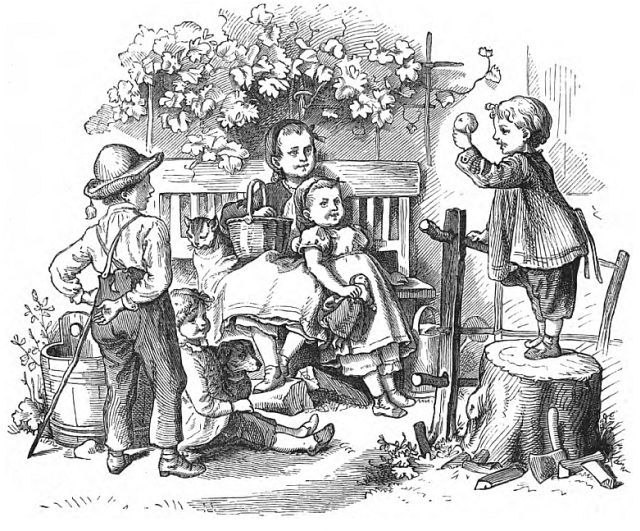
“How much for this fine apple?” said Arthur Lane, as he stood upon a stump near the fence, and held up an apple.
“One cent!” said little Julia, as she stood leaning against her sister Ruth, and holding her doll.
“Only one cent for this fine apple!” cried Arthur.
“Two cents,” said Martin, the boy who drove the cows.
“Thank you, sir,” said Arthur. “I am offered two cents. Going for two cents. Going—going”—
“Three!” cried Charles, who sat with his dog on the sod.
“The bid is three cents,” said Arthur. “Only three cents for this beautiful apple! I hope, miss, you will not let it go at so low a price. Going for three cents—only three!”
But, before Arthur could say “Gone,” Ruth, the elder sister, who sat with a basket in her lap, and the cat by her side, cried out, “Four cents!”
“Thank you, miss,” said Arthur. “I am offered four cents for this very superior apple.” Then, turning to Julia, he said, “Would not Dolly like it, ma’am? You must bid for her. You need not tell me you can’t afford it.”
“Well, then, I bid five cents,” said Julia, laughing.
“That is right,” said Arthur. “Five cents. Going—”
“It isn’t worth two cents,” said Martin.
“Look here, mister,” said Arthur, “if you mean to run down my goods, you must leave this auction. See how well the cat and dog behave.”
Martin leaned upon his stick, and was silent.
“The bid is five cents,” said Arthur. “Going for five cents! Five cents only! Only five cents! This is your last chance. Five cents! Going—going—gone! To Miss Julia Lane.”
Now, you may like to know why it was that these children were willing to pay so much for an apple; for it was quite true, as Martin said, that it was not worth two cents.
I will tell you how it was. There was a little girl of the name of Rachel, who went to the same school with these children; and this little girl was quite poor, for her father and mother were both ill.
The next Friday was to be the birthday of this little girl; and Ruth said, “Poor little Rachel wants a new pair of shoes. Let us make her a present of a nice new pair of shoes.”
“Let us do it by all means,” said Arthur. “How much will a pair of shoes cost?”
“We can get a good pair for two dollars,” said Ruth.
“Here are twenty cents,—all I have,” said Arthur.
“I will add ten to that,” cried Charles.
“I will add fifteen to that,” said Julia.
“I will add five to that,” said Martin.
“And I will add fifty to that,” said Ruth. “So now we have a dollar promised. How shall we get one more?”
“Let us have an auction,” said Arthur, “and sell as many things as we can get. I will be the auctioneer. See me sell this apple, and say if I cannot act like an auctioneer.”
So Arthur mounted the stump, and sold the apple.
The next day, the children told all the boys and girls of the school, that they were going to have an auction in the summer-house, to get money to buy a present for Rachel.
The boys and girls were all glad to lend their help. One gave a ribbon, one a top, and one a bag of marbles. One little boy gave a nice penknife, and another a bat and ball. One little girl gave a doll, and another a pencil. Many more things were given,—more than I can tell you about.
Arthur was once more the auctioneer. Some of the old people, learning what was going on, came to the auction, and made bids for the things that were sold.
When the auction was over, Arthur and Ruth counted up the money, and how much do you think they had made by the sale? They had made just seven dollars!
This was money enough to buy, not only a pair of shoes, but a calico dress and a pair of stockings, for little Rachel, besides food enough for her parents for a whole week.
How happy the children were when they took the things to Rachel! and how happy she and her parents were, to see the children so good and kind!
Ida Fay.

I have thought that some of the children might like to hear about a squirrel I used to know when I lived in Mississippi. It will not be a long story to tell; for he was a very small squirrel, and died quite young.
Oh, dear! I must not tell you the end of the story before I you know the beginning. Well, one bright May morning I was sitting sewing at the window; and Rhoda and Teresa, two dear little girls who were living with me, were playing in the yard.
Presently they came scampering into the parlor in a great flurry. Two eager faces were turned up to mine, a hand was seized by each of the children, and both cried out in a breath, “Oh! dear Aunt, do please just come and see what Uncle Jacob has brought for us!”
Uncle Jacob was a black man, and, of course, not their uncle at all; but Southern children always call a colored person uncle or aunt, because they think it more kind and respectful.
When we reached the back piazza, there was Uncle Jacob, holding in his hand the tiniest little squirrel that ever was seen. It was not more than two or three days old, and had not learned even to open its eyes.
“O Jacob!” said I, “how could you be so cruel as to take that baby-squirrel away from its mother?”
“ ’Deed, ma’am,” said Jacob, “I didn’t take him away from his mother. De ole snake take him away; an’ I take him away from de snake, an’ kill de snake. I fotch de squirrel home to de young ladies, so dey could raise ’im. Mighty fine pets dey is, so peart and lively.”
“Well, children,” said I, “it seems we shall have to adopt this little fellow; but how shall we feed him? It would not be the right sort of kindness, to save him from the snake only to let him starve. Run to the kitchen, and ask Aunt Lucy to please send me some warm milk.”
The milk was soon brought. I dipped a small sponge into it, and then held the sponge close to the squirrel’s mouth. He must have been hungry; for, as soon as he smelt the milk, he caught at the sponge, and began to suck it as fast as he could.
When he had finished his breakfast, Rhoda put him in a blanket on a nice bed of cotton, and he went to sleep as comfortably as if he had been in his own little nest in the hollow tree.
It would take too long to tell you how Bunny grew and grew; how, after he had had enough of sucking milk from a sponge, he took to helping himself to biscuits and lumps of sugar from the table; how at last he learned to get at the kernel of a nut, as cleverly as any of his little wild brothers and sisters. I must haste to the end.
One day in October, I went with Teresa to gather some bright autumn leaves. Rhoda stayed at home because she had a hard lesson to get; and we left her, on the steps of the piazza, at her books.
We got the leaves, and were almost home, when we heard a loud cry of lamentation, and soon saw Rhoda running to meet us, and weeping bitterly.
“O Aunty! O Tressy!” she cried: “our dear Bunny is killed. A horrid snake caught him as he was jumping about. I heard him cry. I ran to him. I screamed as loud as I could for help. But the snake would not let him go; and nobody would come for such a long time! And when Uncle Jacob came, and killed the old snake, poor Bunny was all crushed and dead. Oh! I wish there was not a snake in the world—so I do!”
Rhoda refused to be comforted, and Teresa mingled her tears with hers. Uncle Jacob, as he leaned thoughtfully on his spade, uttered his thoughts thus: “ ’Pears as if dat ar squirrel was bound to be killed by a snake.”
Mrs. E. H. Downing.
I know a little boy named Edwin, who likes snow very much. He has a pair of India-rubber boots with which he can wade through the melting snow. He also has a sled with which he can coast down hill.
Sometimes he will harness his dog to the sled; and then the dog will run like a reindeer over the snow and ice, dragging the sled with Edwin on it.
This little boy wishes very often that it would snow. Sometimes he springs out of bed, and looks out of the window to see whether any fresh snow has fallen through the night; and he will be vexed if, instead of that, he finds the rain pouring down.
What do you think he said, one day? “I wish,” said he, “that a snow cord and a rain cord hung down from the clouds; so that, if I pulled the snow cord, it would snow, and, if I pulled the rain cord, it would rain. Oh, how I would pull the snow cord, and make the snow fall down!”
Now, I would say a word to all little boys who wish that they had a snow and a rain cord. God holds all the cords in his hand. He sends the rain and the snow. He knows what is best for us. Do you not think, then, that we should be content with what he sends?
Uncle Charles.
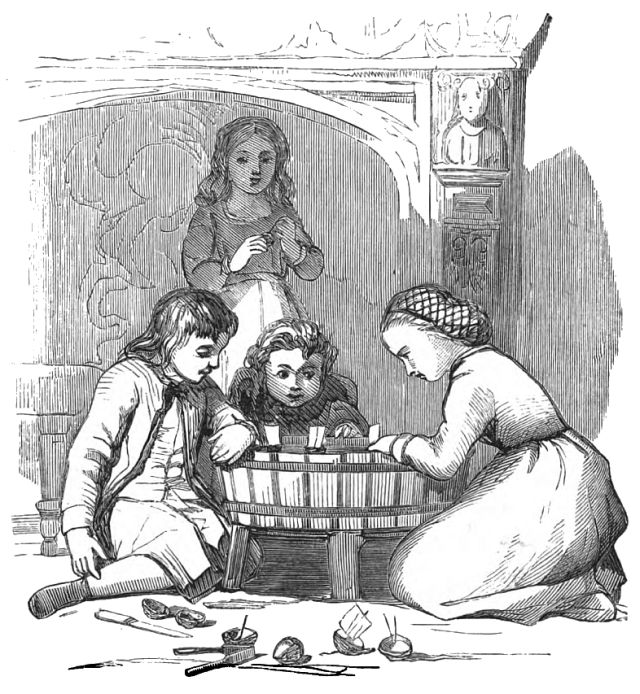
Here are four children having a nice time sailing boats. Each boat, you see, is the half of a walnut-shell.
Charles, the eldest boy, cracked the nuts neatly into halves, picked out the meat (I wonder what he did with it), and then fitted out each boat with a wooden tooth-pick mast and a paper sail.
Then he and Mary launched the boats; and off went the whole fleet to sea in the wash-tub. Johnny sat in his little chair close beside the tub, looking at the fun; and little Annie was busy all the while trying to rig a boat with her own hands.
How well the boats floated on the water! “This,” said Mary, “is the sloop ‘Mary Jane,’ bound for Cape Ann.”
“This,” said Charles, “is the fast clipper-ship ‘Eagle,’ bound on a voyage round the world.”
“The Mary Jane has on board a fine lot of fresh mackerel,” said Mary.
“The Eagle is not in the fish-trade,” said Charles.
Little Johnny said nothing, but puffed out his lips, and blew a long breath upon the water.
“The wind is rising,” said Charles, laughing. “There’s a stiff breeze from the north-east.”
Here Johnny gave another puff. “It is getting rough and squally,” said Mary. “We shall have a gale of wind before long. The ‘Mary Jane’ will have to take in sail.”
“Let the gale come,” said Charles. “The good ship ‘Eagle’ will not take in sail. The harder it blows, the faster she goes!”
Just then Johnny gave a third puff, and aimed it right upon the sail of the good ship “Eagle.” Over she went.
“Capsized!” said Charles. “Get out the boats! Cut away the masts! Hoist a signal of distress!”
“Never fear,” said Mary: “the ‘Mary Jane’ is bearing down to the rescue. I told you there was a gale coming.”
“Yes,” said Charles; “but I didn’t expect a hurricane.”
“It was nothing but a squall,” said Johnny. “Look out for another!”
And he gave another puff, which capsized the whole fleet, including the “Mary Jane.” So the play ended in a roar of laughter; both Charles and Mary declaring that no ship could live in such a sea.
Sandy Bay.
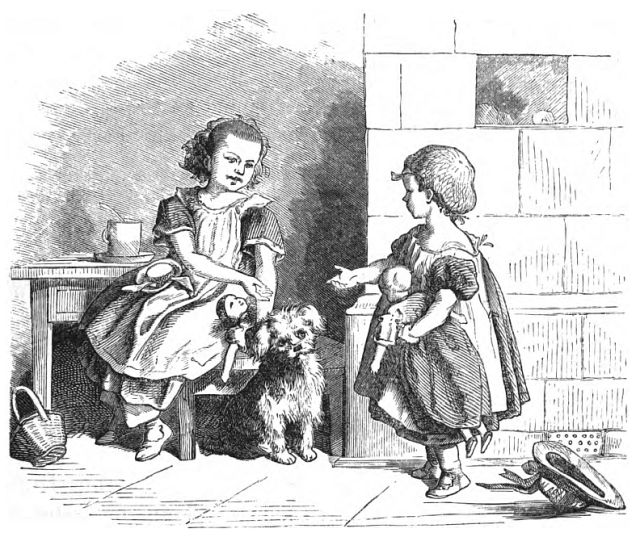
Ah! here are our little friends, Bertha and Mary!
Why, I mistake: these are Mrs. Rose and Mrs. Lily! Mrs. Rose has come to pay Mrs. Lily a visit.
“Dear Mrs. Rose, how glad I am to see you!” says Mrs. Lily, as they shake hands. “You will stay to tea with me,—will you not?”
“Thank you, Mrs. Lily; but—ah! your little dog! Will he not hurt me?”
“Oh, no! Frisk never harms any one, though he does open his eyes so very wide at you. Do you not see how he tips his head on one side, and looks at you as much as to say, ‘Oh! I know who you are. You are my mistress’s dear friend, Mrs. Rose. I am glad to see you.’ ”
“Well, Mrs. Lily, he is not like Ellen Lee’s dog. When I met Ellen on the street the other day, and wanted to put my arm in hers, to walk with her, Jip sprang upon my dress, and barked at me so hard I was afraid of him. He would not let me touch her.”
“I like my little dog better than Jip, Mrs. Rose; for, though he cares most of all for me (don’t you, Frisk?), he is very fond of my friends. Now, make a bow, Frisk. Did you ride, Mrs. Rose?”
“No: the day was so fine, I thought I would give Amy a walk through the fields. Such beautiful butter-cups and daisies as we picked! But I feel very tired, for I had to take Amy in my arms, as you see. Ah! my hat has fallen on the floor.”
“I will pick it up, my dear. Throw off your cloak, too, and let me take Amy’s things; and do sit down and rest yourself. I will call Mary to bring in some more tea, and another cup and saucer.”
“Do not give yourself that trouble, Mrs. Lily. Ah! it is very warm. I will throw off my cloak a moment.”
“I hope you will excuse this basket on the floor, Mrs. Rose. I have been so busy to-day; and Katie has just come home from a visit to her cousin Susan! You see I have her hat in my lap. How old is your little girl?”
“Amy is three years old.”
“Why, Katie is only two years old, and yet she seems almost as large as Amy. But do take a seat at the table, Mrs. Rose.”
“I think I cannot stay to tea to-night, Mrs. Lily; for it is quite a long walk to my house, and I fear it will be dark before I get home. I like to have Amy go to bed before dark.”
“Let me order my carriage, then, for you. Mary, tell John to bring the carriage to take Mrs. Rose and her little girl home.”
“You are very kind, Mrs. Lily. I hope you will return my visit soon; and Katie must come, too, to see Amy. Good-by.”
“Good-by, Mrs. Rose. I am glad you called.”
h. l.
One rule to guide us in our life
Is always good and true:
’Tis, “Do to others as you would
That they should do to you.”
When urged to do a selfish deed,
Pause, and your course review;
Then do to others as you would
That they should do to you.
When doubtful which is right, which wrong,
This you can safely do:
Yes, do to others as you would
That they should do to you.
O simple rule! O law divine!
To duty thou’rt a clew.
Child! do to others as you would
That they should do to you.
Emily Carter.
Two men were at work together one day in a yard where ships were built. They were hewing a stick of timber to put into a ship. It was a small stick, and not worth much. As they cut off the chips, they found a worm,—a small worm, not more than half an inch long.
“This stick is wormy,” said one: “shall we put it in?”
“I do not know,” said the other: “yes, I think the stick may go in. Of course it will never be seen.”
“That may be; but there may be other worms in it, and these may increase, and hurt the ship.”
“No, I think not. To be sure, the stick is not worth much; yet I do not wish to lose it. But, come, never mind the worm: we have seen but one; put it in.”
And so the stick was put in. The ship was built and launched. She went to sea, and for ten years she did well. But at last it was found that she grew weak and rotten. Her timbers were much eaten by worms.
But the captain of the ship thought he would try and get her home. He had a costly load of goods in the ship,—such as silks, teas, &c.,—and a great many passengers.
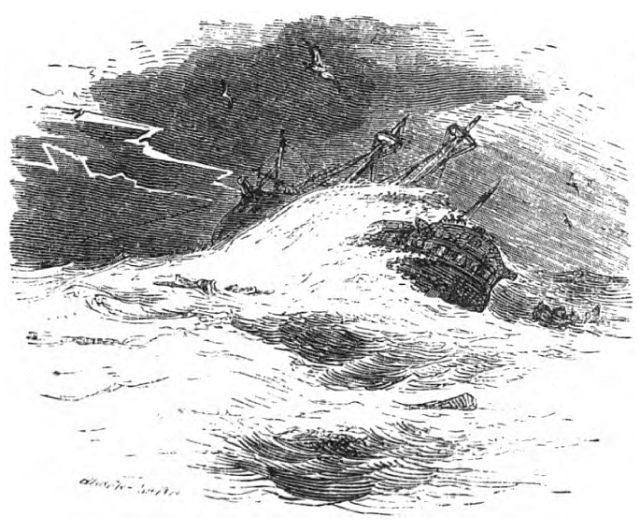
On their way home, a great storm came on. The ship for a while climbed up the high waves, and then plunged down, creaking and rolling very much. At last she sprang a leak.
They had two pumps, and the men worked at them day and night; but the water came in faster than they could pump it out. She filled with water, and went down under the blue waves, with all the goods and all the people on board. Every one perished.
Oh! what a loss there was of life and of goods! and all because that little stick of timber with the worm in it was put in when the ship was built.
How much mischief may be done by a little worm! and how much evil may a man do, when he does a small wrong, as that man did who put the wormy timber into the ship!
Sandy Bay.
A boy came crying to his mother because he had been stung by a nettle.
“I am sure I never thought it would hurt me,” said he, “for I only touched it as gently as possible.”
“That is just why it stung you,” replied his mother: “if you had only grasped it firmly, it would have done you no harm.”
It is thus in life. Evils that are boldly met will not harm us so much as those which we meet with a faint heart and a feeble hand. It is always best to “grasp the nettle.”
“I have just heard a true story of a tiger. I think you would like to hear it. Shall I tell it to you?”
“Oh, yes! for you have never yet told me about a tiger.”
“Well, there was a man named Brown, who lived in India, and who had a tiger; and this tiger was so fond of Mr. Brown, that he was as tame as a dog with him. The tiger’s name was Tim.
“Tim would run and jump and play with Mr. Brown, and lick his hands and his face, and come when Mr. Brown called him, and go when Mr. Brown told him to go, and, in fact, do all that Mr. Brown told him to do.
“But, though Mr. Brown was fond of Tim, I cannot say that Mr. Brown’s friends were quite so fond of Tim. Tim was kept in a yard near the house; and, when these friends came to call on Mr. Brown, they could not but stand in fear of the tiger.
“They thought to themselves, ‘What if the great beast should spring here, and spring there, and spring this way, and spring that, until his next spring would be at us! He may love Mr. Brown, but he does not love us; and how do we know but Tim may strike us with his claws, and hurt us or kill us?’
“Now, Mr. Brown had to leave his own home, and go to a land far, far away; and though his friends were sad that Mr. Brown should go away, yet it must be said they were glad to think that now they should get rid of Tim.
“But Mr. Brown was not glad. Oh, no! it made him sad to think that he and Tim must part; for he could not take Tim with him. So Mr. Brown thought the best thing he could do for Tim was to put him into a place where wild beasts were kept. He begged the man who took care of the beasts to be kind to Tim; and then he said ‘Good-by’ to his dear Tim, and went to the land that was far, far away.
“Now, when Tim found that Mr. Brown was gone, Tim was so sad, that he would not run nor jump nor play nor frisk. He did not seem to care for any one at all. He would sit all day long at one end of the cage, and would just eat what they gave him, and sleep when the time for sleep came. But life was sad to poor Tim. His dear, kind friend was gone, and there was no one else whom Tim cared to see.
“Some years went by, and still Tim was just in the same sad state, when, one day, what should Tim hear but a step that he knew right well! Up sprang Tim, and with one bound was by the bars of his cage.
“Tim looked and looked to the side from which the sound had come: and at last he gave a bound and a spring, and a roar of joy; for Tim had heard the footstep right, and it was in truth his own dear friend and master who was once more by his side.
“Poor Tim! He did not know how best to show his joy. He rubbed his head on Mr. Brown’s hand; he licked his face; he purred out his joy like a cat; and all the time he seemed to want to say, ‘Oh! do not leave Tim again. My heart has well-nigh broken, you have been away so long. And, now you have come back, how glad I am!’ ”
“And did Mr. Brown leave Tim again?”
“That I do not know. I only know that Mr. Brown was very glad to see Tim once more; and that Tim, for some weeks, saw Mr. Brown once a day, and was happy.”
Trottie’s Aunt.
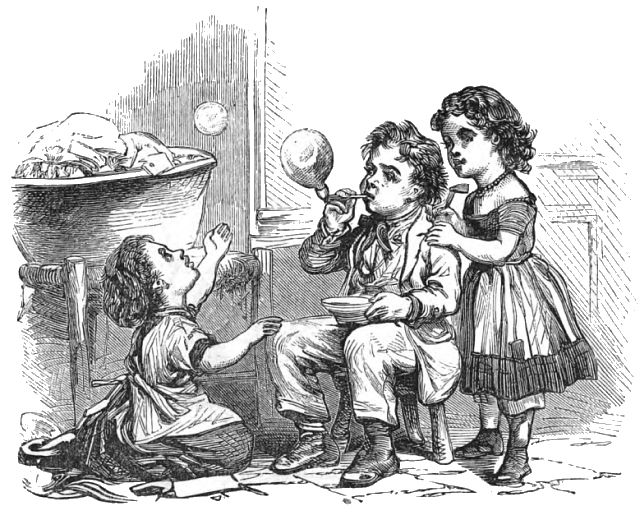
On a rainy day in June, Paul said to his sister Ann, “Now, if you will get a bowl of soap-suds, I will show you something.”
Ann ran and got the bowl of soap-suds, and John took from his pocket a pipe. Then he sat down on a stool, and began to blow bubbles.
Little Jane came in to see him.
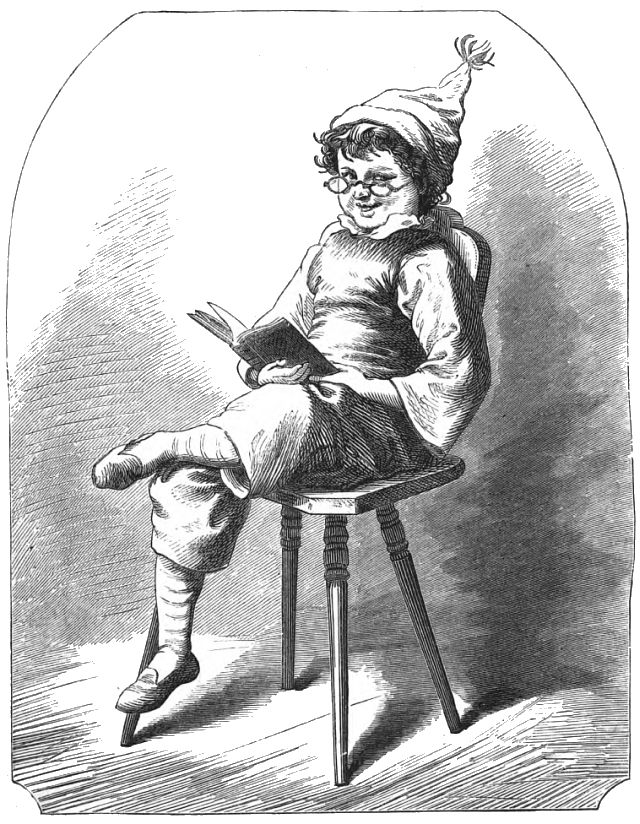
THE PROFESSOR.
John has put on his grandfather’s spectacles and cap. He calls himself “Professor Noodle, lecturer on Mother Goose.” He has a book in his hand, and he tries to look quite wise and grave; but in this I do not think he succeeds.
“Now, children,” he says, “you will please be still, and hear my lecture. Ahem! My subject, ladies and gentlemen, is Mother Goose. How the heart thrills at that name! Homer was great; Milton was great; but Mother Goose”—
“Look here, Professor: what will you take for that cap?” cried little Edwin Potter.
“Silence!” cried the Professor, in a loud voice. “Hear me for my cause, and be silent that you may hear. I shall divide my lecture into ten heads. First, who was Mother Goose? and where was she born? Second,”—
But here one of the Professor’s hearers, little Susan Ide, cried out, “I don’t want to hear about Mother Goose. I want to hear a story.”
“The young lady wants to hear a story,” said the Professor, shutting up his book. “Well, a story it shall be. But shall it be a true story, or a story made up out of my head?”
“Let it be a true story,” said Susan.
“If it is to be a true story,” said the Professor, “I must take off my spectacles and my cap. There! the Professor has left the chair; and now it is I, John, who speak.
“Not long ago a Mr. Webb, a friend of my teacher, was walking on the bank of the river in Paris, when he saw a man who held a dog by a chain. The dog seemed frightened, as if he knew what the man was going to do.
“ ‘Poor beast!’ said the man. ‘See how he fawns about my feet! He knows I am going to drown him.’
“ ‘But why will you drown him? Are you his master?’ asked Mr. Webb.
“ ‘Yes, I am his master,’ said the man, ‘and he is old. Poor Ponto! I am sorry, but it must be.’
“The dog gave a low whine, as if he understood what was said; and, trembling, he crouched down close to his master.
“ ‘He does not seem so very old; and it is too bad to drown so bright a dog,’ said Mr. Webb.
“ ‘Sir, he is of no use to me,’ said the man; ‘and, besides, I cannot afford to pay the tax for keeping him.’
“Thus speaking, the man put the dog into a boat, and rowed to the middle of the stream. When he came to where the water was quite deep, he all at once lifted up the dog, and threw him with great force into the stream.
“If the man had thought that the dog’s age would prevent his struggling for life, he was much mistaken; for Ponto rose to the surface, kept his head well up, and trod the water bravely.
“The man then began to push him away with an oar, and at last struck out so far as to deal the dog a blow. By this the man lost his own balance, and fell into the river. He could not swim, and cried loudly for help.
“What did poor Ponto do? Why, he swam straight to the man who had been trying to drown him. With his teeth he took hold of the man’s collar, and held him up till a boat could put off from the shore and save him.”
“And did they save poor Ponto, too?” asked Susan.
“Oh, yes! they saved the dog too. He was in great joy, and jumped up to lick his master’s face and hands.”
“The master did not deserve so good a dog.”
“That was just what Mr. Webb told him, but the man seemed sorry for what he had done, and said to Mr. Webb, ‘I was wrong,—I was wrong. Poor Ponto returned good for evil,—didn’t he? As long as I have a crust of bread, I will give half to my poor Ponto.’
“A woman, who had a basket on her arm, came up at the time, and said, ‘I should think you would be ashamed to look the brave dog in the face;’ and out of her basket she took a piece of meat, and gave it to the dog.
“You may be sure that Ponto had a good time of it after that. Mr. Webb would often meet him in the street; and, as the story of the dog’s brave act was soon well known, he had many friends to feed and pet him. And so his old age was no doubt the happiest part of his life.”
The first thing in the morning
When little Bessie wakes,
All full of life and gladness,
A pleasant bath she takes.
She frolics in the water
With childish glee and grace;
She dashes it and splashes it
About her neck and face.
Just three years old was Bessie,
When, on a summer day,
They took her to the sea-side
Along the sands to play.
They took her to the smooth beach
Where rolls the ocean flood;
They thought the salt sea-water
For Bessie would be good.
The beautiful sea-water!
She claps her tiny hands;
She loves the salt sea-water,
The hard and shiny sands.
She pulls the slimy seaweed,
The shells and pebbles wet;
She laughs to see the pretty mark
Her little toes have set.
“Come now, my little daughter,
And go into the sea;
A cool and pleasant bath for us,—
For Bessie and for me!”
“I’d rather not,” lisps Bessie,
And her lip begins to curl;
“I think it is too big a tub
For such a little girl.”
Mrs. A. M. Wells.
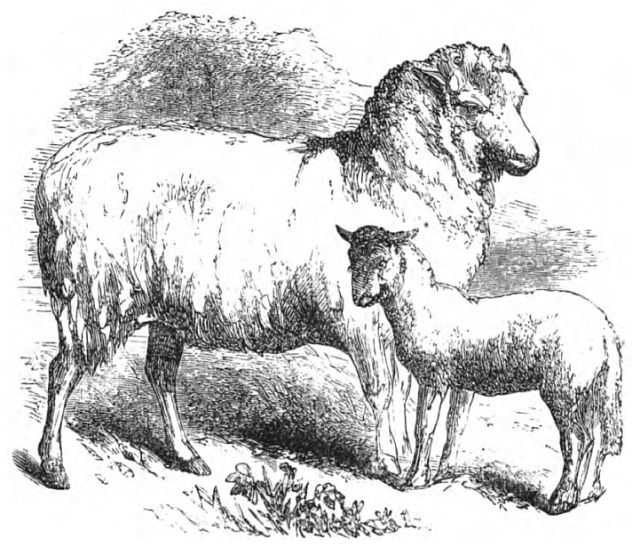
Dear Charlie, or Annie, or Willie, or Mabel,—I wish I were a fairy, and could guess your name!—have you a hood or cap to keep your ears warm when you play in the snow? have you mittens for your hands, and stockings for your feet? and do you sleep at night under a warm blanket? Then I think you will like to hear something about the sheep that give the wool out of which all these nice garments are made.
If you had wings, and could fly like a bird, you would be able to look down upon a great many different countries, and almost everywhere you would see sheep feeding on the mountains or the hills or the plains.
These sheep are not all alike, any more than boys and girls are alike. Some are black, some white, some brown, some yellow. But they all give wool, to keep little folks and big folks warm in the winter; and if you will run all over the house you live in, up stairs and down, and, every time you see any thing made of wool, say, “Thank you, dear little sheep!” you will say it over and over again a great many times; for there are carpets and rugs and shawls, and many more things, in the different rooms, made of wool. And, if I were you, I would keep my little feet trotting till I had found them all.
But do not go yet: I have something more to tell you. Mr. Whiteflock has a large farm in the country, and owns sheep; and, when the hot days of summer come, he takes down his big shears, and goes out among them. First he sends the little lambs away; then he cuts all the wool off the backs of their mothers.
Do you think this is cruel? Oh, no! The sheep like to have their wool cut off: it makes them cool. But you cannot think how queer they look after it is done. Oh, how you would laugh if you were to see them.
But the poor, dear little lambs do not laugh: they cry. They left their mothers looking nice and comfortable in their white coats of wool; but now they look naked and strange and miserable, and the little lambs do not know them.
Their mothers call them; and the lambs run with joy, just as you do, when your mother calls you. But they are frightened the moment they see their mothers,—so frightened, that they bleat in distress, and scamper away as fast as they can. This makes the poor mother ewes very unhappy, and they call again and again. Then the lambs come, and take another peep, and run away this time as fast as before.
At last the silly little lambs begin to find out that it is really the voice of their own dear mothers; and so they come and stay with them.
Do you think this is strange? If your own dear mother should come to you all at once with her hair cut off close to her head, and try to take you in her arms, do you not think that you would be frightened, and run away, just like the little lambs?
Elizabeth Harrington.
Under my window, under my window,
All in the mid-summer weather,
Three little girls, with fluttering curls,
Flit to and fro together;
There’s Bell, with her bonnet of satin sheen;
And Maud, with her mantle of silver green;
And Jane, with the scarlet feather.
Under my window, under my window,
Leaning stealthily over,
Merry and clear, the voice I hear
Of each glad-hearted rover:
Ah! sly little Jane, she takes my roses;
And Maud and Bell twine wreaths and posies,
As busy as bees in clover.
Under my window, under my window,
In the blue mid-summer weather,
Stealing slow, on a hushed tip-toe,
I catch them all together,—
Bell, with her bonnet of satin-sheen;
And Maud, with her mantle of silver-green;
And Jane, with the scarlet feather.
Under my window, under my window,
And off through the orchard closes,
While Maud she flouts, and Bell she pouts,
They scamper, and drop their posies:
But dear little Jane takes nought amiss;
She leaps in my arms with a loving kiss,
And I give her all my roses.
Thomas Westwood.

John and Mary, Thomas, Ruth, and Julia, have been to see the wild beasts that were shown in the great tent on the open lot in Main Street, in our town.
These children saw the lion and the lioness, in a cage with iron bars. John had read the story of the bad boy who kicked at the bars of a lion’s cage to vex him, till at last the lion put out his claw, and caught the bad boy by the boot.
“I will not try such a game as that,” said John. “It is not well to fool with wild beasts. I once saw some boys plague a wild cat that was chained to a post. I could not find fun in seeing the poor beast tormented.”
After they had seen the lion, these children went to see the tiger and the elephant. Then they saw a camel and an ostrich. The children were much pleased; and, when they went home, they read stories of the habits of all these animals.
Aunt Mary.
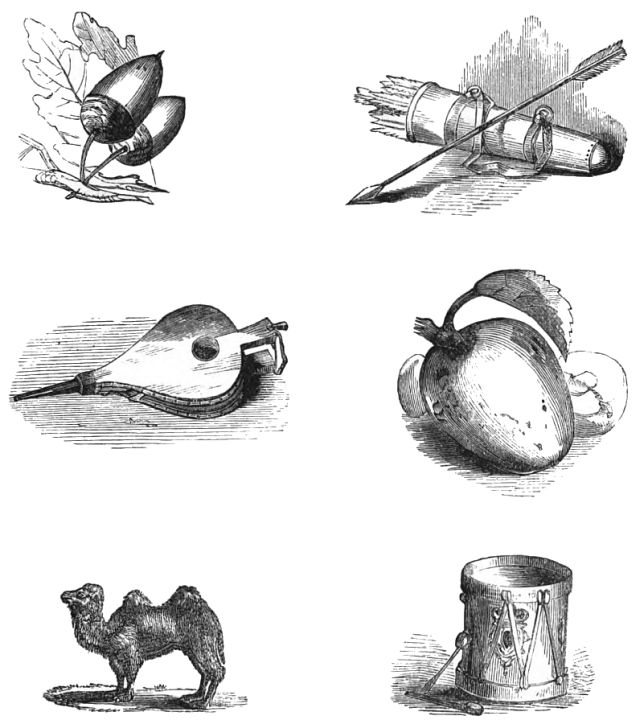
Here are six pictures; and, of the objects they show, three begin with A, one with B, one with C, one with D, and one with Q. Harry found them all out. Can you do as much?
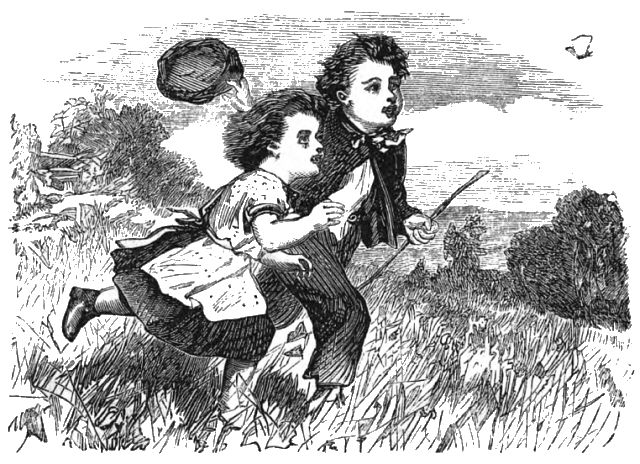
William and his sister Emily went out on a fine day in June to see the men cut the grass. But soon the little girl saw a yellow butterfly, and cried out, “O William, do help me to catch that beautiful, beautiful butterfly!”
So the two started in chase of the bright little thing. William took off his cap, and held it so he could put it over the butterfly, if the butterfly would only be so good as to light on one of the dandelions, and wait.
But the butterfly did not choose to do this. He flew high up, where neither William nor Emily could reach him. And at last they sat down on a rock, and then William said,—
“On the whole, I am glad we did not catch the butterfly; for we did not want it, and we should only have hurt it. Why should we harm a bird or a butterfly just to please ourselves? We ought to know better.”
Just then the butterfly lighted on a blade of grass close by; and William quickly pulled off his cap, and was about to catch the butterfly, when Emily held his arm, and said, “Why should we harm a bird or a butterfly just to please ourselves?”
William laughed, and said, “You are right, Emily. Those who preach ought to practise. Now, I will tell you what will be better than chasing butterflies. Let us go and pluck some harebells.”
“Oh, yes!” cried Emily: “why didn’t we think of it before? Mother is so fond, you know, of having harebells in her little vase!”
And so the brother and sister did a much wiser thing than chasing butterflies. They went and made a nice little nose-gay, all of harebells, and took it to their mother, who kissed them both, and thanked them for the gift.
Emily Carter.
 Scamper, scamper, little hare!
Of the cruel dogs beware!
They are swift upon your track:
Run, and stop not to look back.
A friend asked a pretty child of six years of age, “Which do you love the better,—your cat or your doll?” The little girl thought some time before giving an answer, and then whispered in the ear of the questioner, “I love my cat best, but please don’t tell my doll.”
I once knew a man whose name was James Audubon. He had made up his mind to write a great book about the birds of America.
He could draw and paint well: so he went out into the woods, and shot wild birds of bright plumage, and of these he made colored drawings while the tints on their feathers were yet fresh and gay.
He went on with his work for years, and at last had made a thousand drawings. But by accident a fire broke out, and all the nice pictures were burnt.
Here was a misfortune! But what did Audubon do? Instead of complaining, he went to work and made new drawings, till he produced a great book, by which he got fame and wealth. Thus perseverance had its reward.
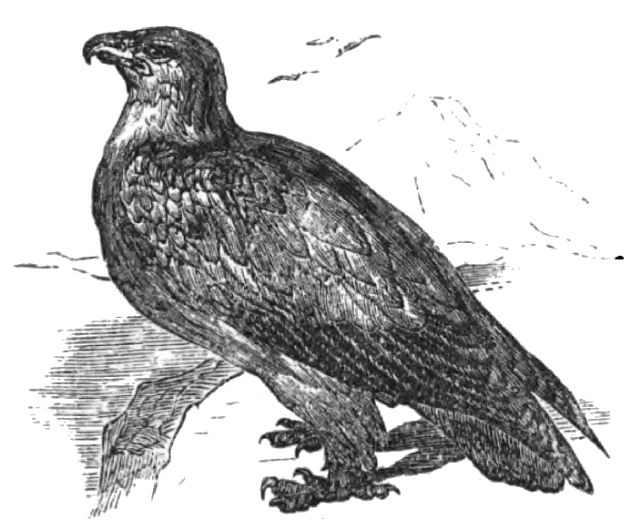
Among the drawings that Audubon made, were several of eagles. Here is a copy of one of his pictures; but it has not the fine colors he put in.
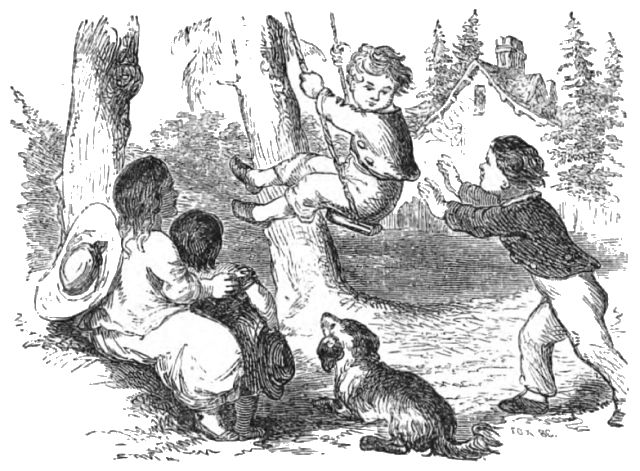
As I was taking a walk the other day, I saw a nice cottage with spruce-trees in front. Near by, two boys were at play swinging under a tree, while their sisters sat on the bank.
It was a pleasant scene; and, as I was tired, I stopped and began to talk with the children. The boy who was in the swing jumped down, and came to the spot where I stood.
We talked of trees, of flowers, and of birds. Then the larger of the two girls, who sat on the bank, said, “I think that birds must have some way of making known their wishes to one another.”
“What makes you think so?” I asked.
“Why, sir, this last spring, some swallows built their nests under a piazza of the house of a friend of mine. They were so tame, that the mother-bird would let us come up to her and touch her as she sat on her eggs. We gave her the name of Cozy.
“Now, the lower windows of my friend’s house have large panes of French glass, pure and clear as crystal; and sometimes, as you look at them from the outside, they reflect the waving trees and the blue sky so as to deceive the birds.
“Our poor little Cozy was deceived in this way. She left her warm eggs, and flew out for a few moments; and seeing, as she thought, a nice tree waving in the breeze, she flew towards it, when she hit her head against the glass, and was killed.
“She fell dead on the piazza. Soon the male bird found out what had happened. He seemed in great grief. He flew down to where his mate lay, and twittered as if to wake her. Then he flew up, and looked at the eggs. He acted as if he did not know what to do.
“At last he flew off, and we did not see him for three or four hours. Then he came back, and (will you believe it?) he had a new mate with him. He flew up where the eggs were, as if to show them to her; and she sat down on them, and sat till she hatched out four little swallows.
“Now, I think that the male swallow must have gone to some young hen-swallow, and told a pitiful story of how his dear Cozy had been killed, and how four little birds couldn’t get out of their eggs for want of a mother to keep them warm, and hatch them.
“And then the young hen-swallow must have said in reply, ‘I will be a mother to the little dears. Come, guide me to them swiftly.’ ”
Thus ended the little girl’s story. I laughed, and bade the children good-by; and the boys placed one of their sisters in the swing, and began to set it in motion.
Edward P. Carter.
Ralph Snow owns a brood of young chickens. He also has a pet owl he calls Downy. The other day some of Ralph’s chickens were killed, and Ralph thought that Downy killed them.
So Ralph loaded his gun; and, one night when the moon shone, he went out to watch. “I will kill Downy on sight, if I find he is to blame,” said Ralph.
“Think twice before you shoot,” said Ralph’s father.
Ralph had not watched long when he heard a noise among the chickens, and saw Downy come out with something in his claws. “Ah! you bad owl! Now I’ll shoot you!” cried Ralph.
So he raised his gun; but as he did so the thought came to him, “My father told me to think twice. Let me look closer at poor old Downy.” So he looked closer, and then found that Downy did not have a chicken, but a great fierce rat, in his claws.
The rat had done all the mischief in killing the chickens; and now Downy had caught him in the act, and the rest of the chickens would be safe. “How glad I am I did not shoot Downy!” said Ralph. “My father was right in telling me to think twice.”
Wm. C. Godwin.
He that hath it and will not keep it,
He that wants it and will not seek it,
He that drinks and is not dry,
Shall want the means wherewith to buy.
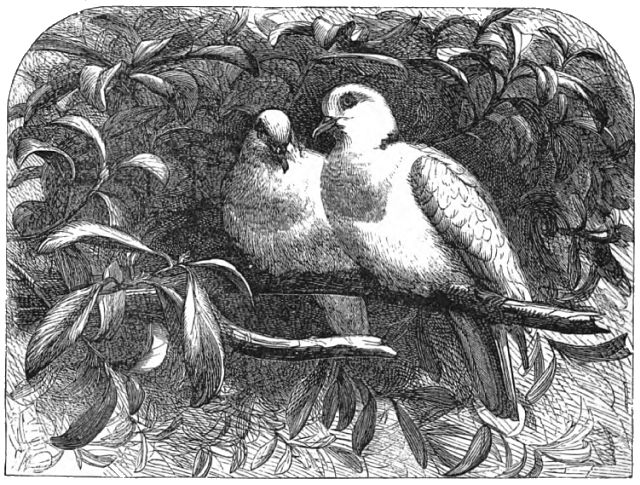
See them on the bough of the tree. Two little turtle-doves, sitting side by side! They never quarrel. If one gets a nice seed, the other does not try to get it away. “Coo,” says one; and “Coo,” says the other.
“Look at the doves on the high branch there,
Brother and sister, always a pair:
In sunshine bright, and in rainy weather,
They love each other, and keep together.
“Little children, in child-like love,
You should be like the gentle dove,—
Ever ready in peace to live,
Slow to offend, and quick to forgive.”
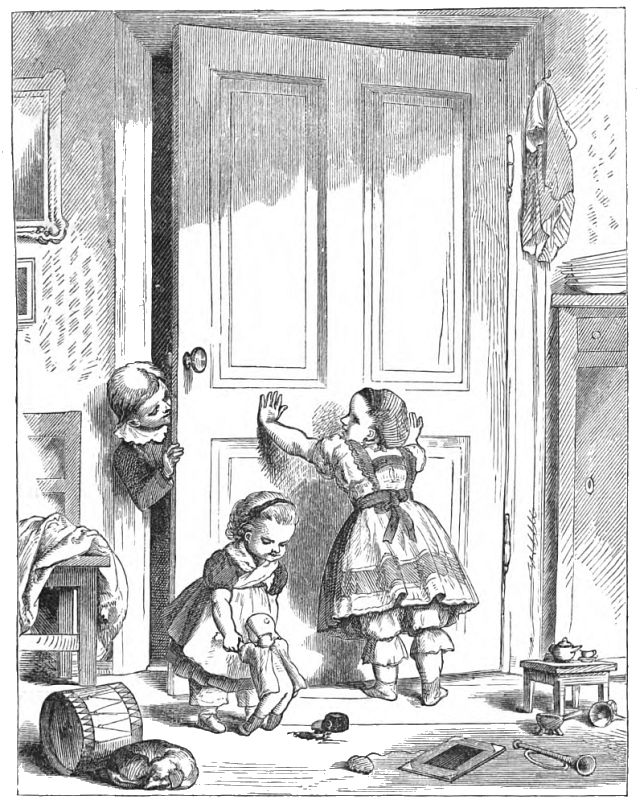
“YOU CAN’T COME IN.”
Once there were two little girls whose names were Jane and Mary. Jane was seven years old, and Mary was four. They had a brother whose name was Frank. He was a year older than Jane.
Mary and Jane used to have good times in the play-room, but John would sometimes come and tease them. So one day, when Jane heard him coming, she pushed with both hands against the door, and said, “You can’t come in.”
“Is tea ready?” said John; for he saw the doll’s tea-things on the doll’s little table. But Jane knew that he came to make fun of her and Mary and the doll; and so Jane said, once more, “You can’t come in.”
“Oh! but I must come in,” said Frank. “It is raining out of doors, so that I cannot fly my kite; so I must come and play with you and the dog.”
“Will you promise to be good, and not plague us, if I let you in?” said Jane.
“Yes: I will be very good,” said Frank.
“Then you may come in,” said Mary, letting him open the door.
“Now, I’ll tell you what we’ll do,” said Frank. “There’s a drum on the floor, and there’s a tin trumpet. We’ll get up a procession in honor of the doll; not of your poor rag-doll, Mary, but of the fine lady-doll that belongs to Jane. Where is she, Jane?”
“She is in the next room in her little carriage,” said Jane. “I will drag her in.”
So when the lady-doll was brought in, Frank roused up Trip, the dog, and harnessed him to the carriage. Then Frank took the rag-doll, whose name was Polly, and he tied her so that she sat upright on the dog’s back.
“Stop, sir, stop,” said Frank, as Trip tried to run away. “You must not start till the procession is ready. We must now get some flags.”
So they got two broomsticks, and tied ribbons to them, and hung them with pictures.
Mary carried one of the broomsticks, and Jane the other. Then Frank got his sword, and put his cap, with a feather in it, on his head.
Then he took the trumpet and the drum, and said, “Now, Mary, you shall see what a procession is. I am the band of music, and I go first. Then you shall follow with the flag; then Jane shall come; and, last of all, Old Trip shall come with the rag-doll on his back, and the lady-doll in the carriage. Now form in a line; and, when I sound the trumpet, we will begin to march.”
So they formed in a line; and Frank blew the trumpet and beat the drum. What a noise he made! Trip, at the same time, began to bark.
First they marched all round the room, three or four times. Then they marched from corner to corner. Then they ran. Then they walked slow; and at last they stopped, and gave three cheers.
This made Trip bark all the more. He did not know what it all meant. But the dolls behaved well.
It was a famous procession; but I am sorry to say that it was so noisy that the mother of the children came in to see what was the matter.
As soon as the door was opened, Trip broke loose from the carriage, and ran down stairs, and hid in the cellar. And so the great procession came to an end.
Ida Fay.
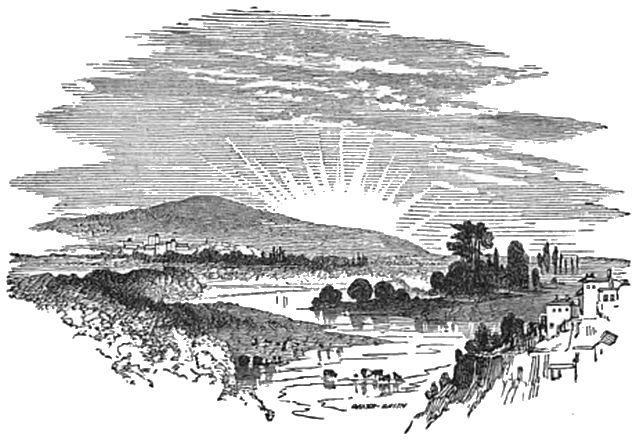
Here are some lines our Jamie learnt to say
While down the west sank the bright summer day:
I hope, dear child, that you will learn them too,
And in this hope I give them here to you.
Now the golden beams of day
In the west are fading,
Evening’s tints of sober gray
Fairest scenes are shading;
Sweet repose on all around
Silently is stealing,
Hushed is every busy sound,
Softened every feeling;
And my joyous song ascends,
Gratitude expressing,
For my home, and health, and friends,
And each daily blessing.
Lord, thy love I still would share
As the day is closing;
Guard me with thy tender care
While I am reposing:
Let my slumbers, calm and light,
Free from care and sorrow,
Make me feel all fresh and bright
When I wake to-morrow;
And in happier worlds above
May I dwell forever,
Where the Saviour reigns in love,
And night cometh never.
Once there was a good man whose name was John Kant. He lived at Cracow, in Poland, where he taught and preached. It was his rule always to suffer wrong rather than to do wrong to others.
When he got to be quite old, he was seized with a wish to see once more the home of his childhood, which was many miles distant from where he now lived.
So he got ready; and, having prayed to God, set out on his way. Dressed in a black robe, with long gray hair and beard, he rode slowly along.
The woods through which he had to pass were thick and dark; but there was light in his soul, for good thoughts of God and God’s works kept him company, and made the time seem short.
One night, as he was thus riding along, he was all at once surrounded by men,—some on horseback, and some on foot. Knives and swords flashed in the light of the moon; and John Kant saw that he was at the mercy of a band of robbers.
He got down from his horse, and said to the gang, that he would give up to them all he had about him. He then gave them a purse filled with silver coins, a gold chain from his neck, a ring from his finger, and from his pocket a book of prayer, with silver clasps.
“Have you given us all?” cried the robber chief, in a stern voice: “have you no more money?”
The old man, in his confusion, said he had given them all the money he had; and, when he said this, they let him go.
Glad to get off so well, he went quickly on, and was soon out of sight. But all at once the thought came to him that he had some gold pieces stitched into the hem of his robe. These he had quite forgotten when the robbers had asked him if he had any more money.
“This is lucky,” thought John Kant; for he saw that the money would bear him home to his friends, and that he would not have to beg his way, or suffer for want of food and shelter.
But John’s conscience was a tender one, and he stopped to listen to its voice. It seemed to cry to him in earnest tones, “Tell not a lie! Tell not a lie!” These words would not let him rest.
Some men would say that such a promise, made to thieves, need not be kept; and few men would have been troubled after such an escape. But John did not stop to reason.
He went back to the place where the robbers stood, and, walking up to them, said meekly, “I have told you what is not true. I did not mean to do so; but fear confused me; so pardon me.”
With these words he held forth the pieces of gold; but, to his surprise, not one of the robbers would take them. A strange feeling was at work in their hearts.
These men, bad as they were, could not laugh at the pious old man. “Thou shalt not steal,” said a voice within them. All were deeply moved.
Then, as if touched by a common feeling, one of the robbers brought and gave back the old man’s purse; another, his gold chain; another, his ring; another, his book of prayer; and still another led up his horse, and helped the old man to remount.
Then all the robbers, as if quite ashamed of having thought of harming so good a man, went up and asked his blessing. John Kant gave it with devout feeling, and then rode on his way, thanking God for so strange an escape, and wondering at the mixture of good and evil in the human heart.
Mary F. Lee.
Can you count the stars that brightly
Twinkle in the midnight sky?
Can you count the clouds, so lightly
O’er the meadows floating by?
God the Lord doth mark their number
With his eyes, that never slumber:
He hath made them every one.
Can you count the insects playing
In the summer sun’s bright beam?
Can you count the fishes straying,
Darting through the silver stream?
Unto each, by God in heaven,
Life and food and strength are given:
He doth watch them every one.
Do you know how many children
Rise each morning, blithe and gay?
Can you count the little voices,
Singing sweetly, day by day?
God hears all the little voices,
In their infant songs rejoices:
He doth love them every one.
From the German.
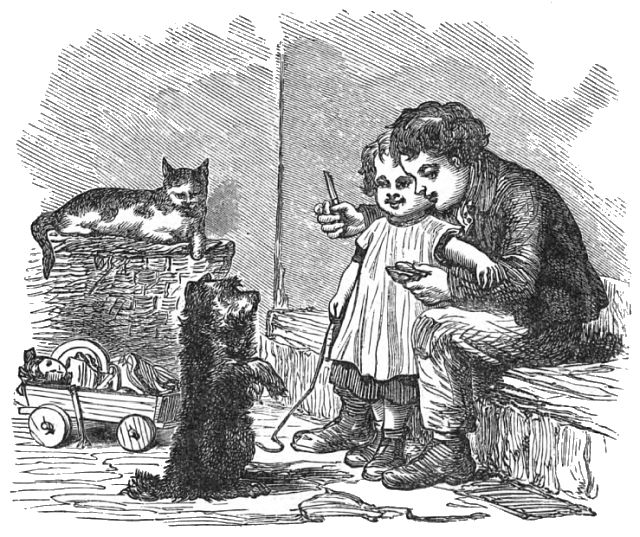
Now, Dash, if you want this bit of meat, you must sit up on your hind legs, and act like a good dog. You must not say “Bow-wow,” till I tell you to speak.
The cat sits by the wall, and she can see you. Sam is here with his cart, and Kate’s doll is in it. If you sit still, and do not bark till I tell you to, you shall have the meat; and then you shall drag the cart for Sam.
Look at Dash. How still he sits! He tries to be a good dog, and he shall have this bit of meat; for I told him he should have it, and we must be true in all things. Here, sir! Here, Dash! Now speak!
He says, “Bow-wow.” Take the meat, sir. See him eat it. He likes it. Pat him, Sam. He has been a good dog. The cat says, “Mew.” She, too, wants a bit of meat; but I have no meat for her. Wait, old cat, and you shall have some fresh milk.
Now come here, Dash, and let me tie you to Sam’s cart. There! Now drag it out on the grass. Do not run fast. Be good.
“Now I will tell you a story of an ape.”
“Oh, do! I like to hear of apes. Apes are so sly.”
“Yes, that they are; and this ape was sly, as you will hear. His name was Ned. He was so sly as to take what was not his; and in this way he did so much harm, that his master had to tie him up with a big chain.
“Now, Ned did not like that they should tie him up; and he did all he could to get rid of his chain, but it was of no use: he could not get it off.
“Now, his master had a pet dog who loved cakes and good things as much as Ned did; but the dog did not steal them.
“No: he would sit up on his hind legs, and put up his paws, and beg, as much as to say, ‘Will you give me a nice cake? I should like a nice cake so much.’
“And so Jack the dog got more cakes than Ned. Ned would have been a wise ape to ask for a cake in the same way; then Ned would have got one too.
“One day Ned saw Jack with a plate of nice things, and Ned put out his paw to try to take some for himself. But the plate was too far off.
“Ned tried, and tried; but, try as hard as he could, he could not get at the plate. So Ned had to sit still, and see Jack eat the nice food; and by and by he saw Jack put his paw in the plate, and take hold of the plate.
“Then Ned must have thought, ‘Now is my time. If I could but get Jack to pull back that plate, then the plate would be near to me, and I could put in my paw, and get the nice food. What if I take hold of Jack’s tail, and give it a hard pull? Will not that make Jack pull the plate, so that it will be near to me? I will try.’
“So Ned put out his paw, and took hold of Jack’s tail, and gave it a hard pull; such a hard pull that Jack cried out with pain, but did not let go the plate.
“So Ned pulled Jack, and Jack pulled the plate, till the plate was so near to Ned that the sly ape could put his paw in the plate, and eat the nice food at his ease.”
“Oh, what a sly ape, and what a bad ape too!”
“Yes, he was a bad ape to eat up the nice food that was not his own.”
Trottie’s Aunt.
FOX.
“Mrs. Goose, it is such lovely weather,
We ought to take a walk together.”
GOOSE.
“Mr. Fox, I prefer to remain at home.
Just now ’twas so fine I was tempted to roam;
But, since you’ve been standing near my door,
I don’t think it so fine as it was before.”
The weather was fine enough, ’twas true:
The sun was shining, the sky was blue;
But the goose, you must know, was a little afraid,
For she knew what tricks Master Fox had played;
And, had she consented with him to roam,
Never again would she have come home.
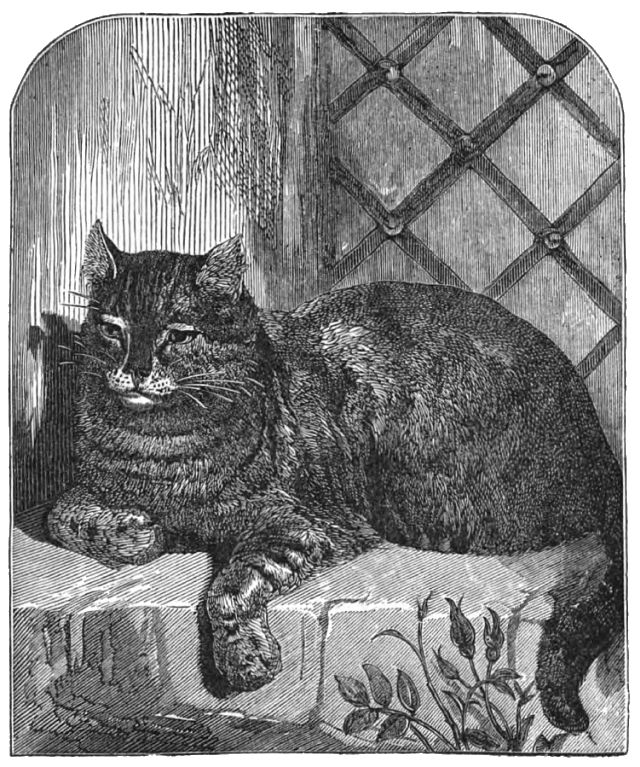
Out came three young mice
From a hole in the wall;
Then back, in a trice,
They ran, one and all;
For there sat the cat,
And to seize them she meant:
They did not like that,
So back they all went.
The cunning old cat,
Who knew she could peep,
Lay down on the mat
As if fast asleep.
She shut up her eyes,
And kept very still:
“Now, now,” thought the mice,
“We may get what we will.”
So forth they all crept,
As sly as could be:
They thought the cat slept,
And so could not see.
And there, on the floor,
Lay a nice bit of cheese,
And some crumbs by the door:
Oh! could they get these!
So, near and more near
The little mice went;
But, ah! with a tear
Their fate I lament.
Up sprang the old cat,
And caught them all three,—
Three mice, nice and fat,
Thought the cat, “good for me!”
Emily Carter.
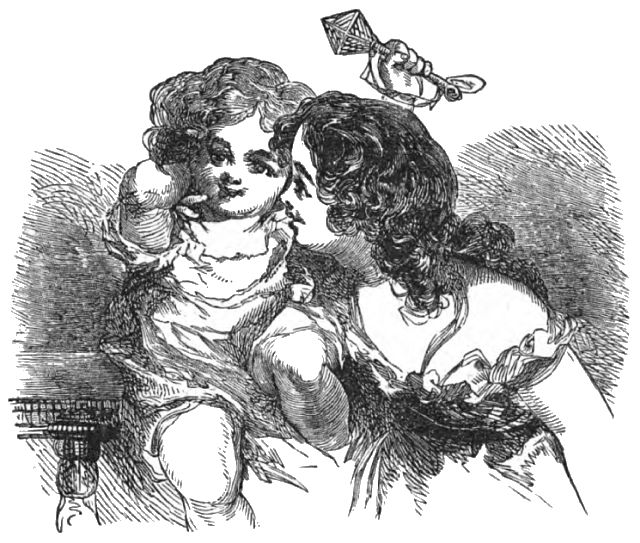
I do not believe you know what I am going to write about, though Sunbeam stands all alone as the name.
“Yes, yes, I do!” I hear little voices saying. “Why! I know what a sunbeam is: of course, I do.”
“Why! I have seen one ever so many times, on the carpet, shining brightly.”
Well, children, so have I; and sometimes I have stooped to pick up a sunbeam, thinking it was something I could touch; but I could never move it.
That is not the kind of sunbeam I am thinking of now; for our little sunbeam I have often caught up from the floor, and hugged and kissed it, till, in return, I felt my hair pulled rather sharply.
“Well, now,” you ask, “what do you mean? What is your little sunbeam.”
Why, children, it is a dear little baby-boy! He has many pet names, but I think the sweetest one is Sunbeam; for he is just like a sunbeam, ever shedding light on all, because he is so good tempered, and so full of fun and play.
He is only one year old; but we called him Sunbeam long before his first birthday. He has bright blue eyes and flaxen hair; his cheeks are red like little roses, and no one can help kissing them.
But what makes him look most pretty is his sweet little mouth, which has ever a smile on it; and this is why we call him Little Sunbeam.
He loves flowers dearly, though he is so very young. When only eight months old, if any one gave him a flower, he would seem almost wild with joy. He would press his little fat hands together, and hold it fast, so that no one could take it from him.
Sometimes Sunbeam would wake up in the night, and lie awake, and laugh and play till he was tired; and then he would nestle down to sleep. Was it not nice to have a sunbeam in the night-time?
Our little Sunbeam’s real name is George. I know in one home there is a little sunbeam whose name is Ma′tie; in another home, one is called Gertie; another, Nelly; and another, Alice.
Dear children, what is Sunbeam’s real name in your home? Or is there no sunbeam there,—no such little sunbeam as I have been telling you about?
Mother and father could tell me, I know. Now, I will tell you how each one of you, children, may know whether you are a sunbeam in your home.
If you are good and obedient, kind and pleasant to your brothers and sisters, always trying to make others happy, and thus always happy yourselves, why, then I am sure that your father and mother must think that they, too, have a little sunbeam.
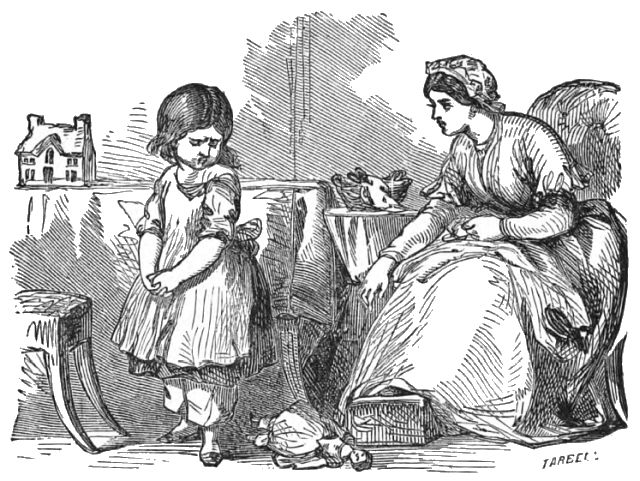
Children ought ever to be little sunbeams; but I know of some that are not. What shall we call them? Shall we call them little clouds, shade-spots? Children, which are you? sunbeams or clouds? Which shall we call this little pouting girl—a sunbeam or a cloud?
Aunt Mary.
 Three fierce old wolves saw a stag on their way:
Ah! now we’ll have a good dinner, thought they.
So they ran and ran with all their might;
But the stag was swift, and the stag was bright:
“You may pick my bones, old fellows,” thought he,
“If you can come up to-day with me.”
The wolves they ran till they gave it up:
“Ho! ho!” thought the stag, “now where will you sup?”
Hot air is lighter than cold air. So, if we fill a balloon with hot air, it will rise high up through the cool air around us.
We use gas now for balloons. We use the same kind of gas that is burned to give light; but, when balloons were first used, they were sent up by hot air.
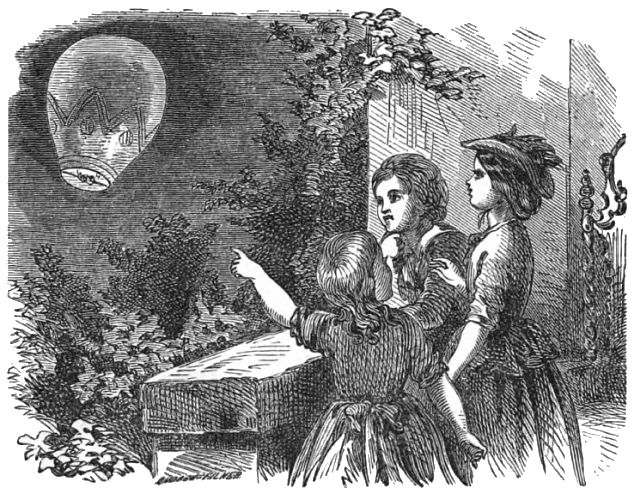
Three of my little friends, on the Fourth of July, thought they would send up a balloon in the old way, by the use of hot air.
So they made a balloon of paper; and, as soon as the night grew dark, they lighted a fire inside of the balloon, fixing it so that the fire would heat the air without at once burning the paper.
Up rose the balloon, and it made a fine show for some minutes. But at last the paper caught fire, and then some of the burning pieces fell on some dry hay near the barn. Soon it was in a flame.
If we had not run out, and put the fire out, much harm might have been done. So I hope you will not try to send up a balloon with fire in it. In your plays, do not run the risk of doing harm to yourself or to others.
Uncle Charles.
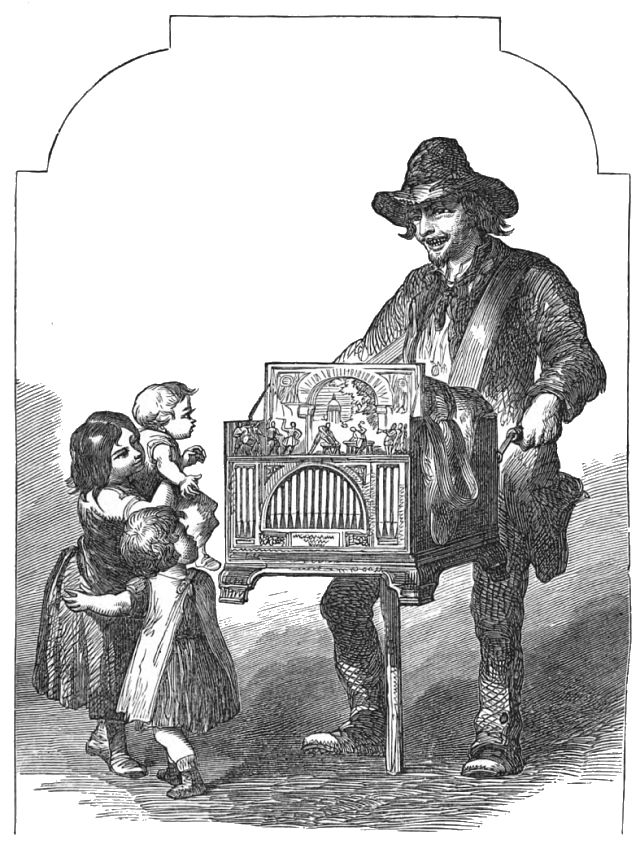
ROBERT THE ORGAN-GRINDER.
Come, and hear what I have to tell you of the left-handed organ-grinder. His name is Robert. He is well known in our town. He was once a brave soldier, and his right hand was shot off in battle.
Before he went to the war, he had worked on a farm. Few men were so quick as Robert with the spade or the hoe, the scythe or the rake.
But when he lost his right hand, and came home from the war, he did not know what to do to maintain himself and his poor old mother. He could not mow, he could not dig.
Robert wished he had been taught, when he was young, to read and write and cipher; but his parents had been too poor to send him to school, and so, while yet a boy, he had been kept at work on a farm.
Mr. Wilton, a rich, kind man, who had learnt of Robert’s good conduct in battle, came to him, and said, “Robert, I will fit you out with a hand-organ, and you shall go round, and play for all the poor children.”
“But how shall I pay my way?” asked Robert.
“I will take care of that,” said Mr. Wilton. “I will see that you and your mother have enough to live on. Should people that are able give you money for playing, so much the better. What you get you can lay by for a rainy day.”
So Robert now goes round with a hand-organ. All the children in our town love him dearly, and he loves the children too. He loves them so well, that I think he spends too much of his money in buying toys and books for them, instead of “laying it by for a rainy day.”
But, if this is a fault, it is one I shall not blame him for. You should see the smile that lights up his face when he sees a troop of children running to hear him play, and to gaze on the wonderful little figures which move on his organ as he turns the handle.
The babies all stop crying when they see Robert coming; and I think there are many people in our town who send presents to Robert and his mother, just to pay him for the good he does in amusing our little ones.
Anna Livingston.
A poor lame boy was walking along one of the muddy streets of the city, trying to find a good place to cross. The heavy rains had fallen, and the mud was quite deep.
While he was waiting to cross, and afraid to venture, because of his lameness, another lad saw him, and cried out, “Stop, stop. I’ll carry you over.”
In a moment he took the little cripple in his arms, and bore him over to the other side of the street. In doing this, he got quite wet and muddy; but he did not mind it, for he felt glad in doing a good act. A good act is its own reward.
It was a pleasure to him to see the smile on the face of the little lame boy as he was set down on the clean sidewalk. “I thank you ever so much,” said the little lame boy. “You are quite welcome,” said the other.
Uncle Charles.
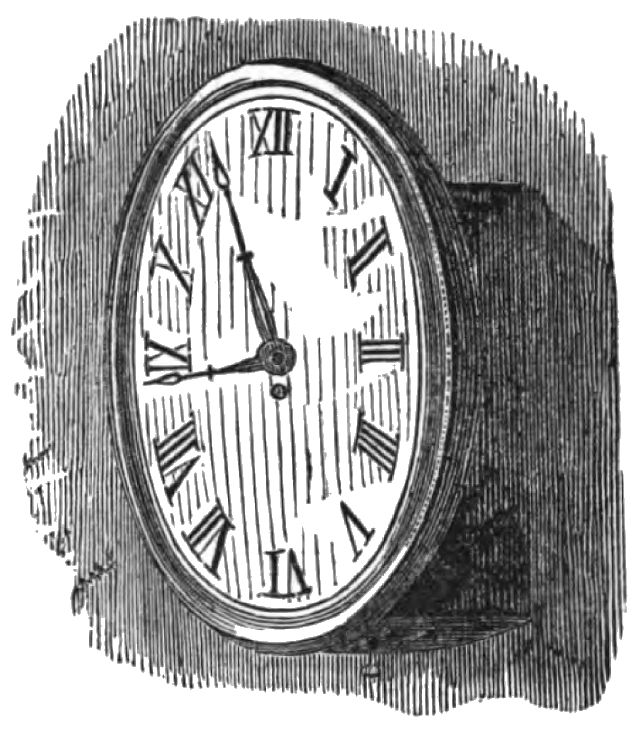
“Tick,” the clock says,—“tick, tick, tick!”
What you have to do, do quick.
Time is gliding fast away:
Let us act, and act to-day.
If your lesson you would get,
Do it now, and do not fret:
That alone is hearty fun
Which comes after duty done.
When your mother says, “Obey,”
Do not loiter, do not stay;
Wait not for another tick:
What you have to do, do quick.
If my little boy will mind,
And be prompt and good and kind,
Time to him will be a friend,
Time for him will sweetly end.
Emily Carter.
What says the little brook?
“I am but a little brook:
Yet on me
The stars as brightly gleam
As on the mighty stream;
And, singing night and day,
I sparkle on my way
To the sea.”
What says the little ray?
“I am but a little ray,
Sent to earth
By the sun so great and bright,
Giving food and heat and light;
Yet I gladden every spot:
The palace and the cot
Hail my birth.”
What says the little flower?
“I am but a little flower
At your feet:
Yet, on the path you tread,
Some joy and grace I shed;
So I am happy too
For the little I can do
When we meet.”
What says the little lamb?
“I am but a little lamb,
Soft and mild:
Yet in the meadows sweet
I ramble and I bleat;
And soon my wool will grow
To clothe you with, you know,
Darling child.”
What says the little bird?
“I am but a little bird,
With my song:
Come, hear me singing now,
As I hop from bough to bough;
For I cheer the old and sad
With my voice, and I am glad
All day long.”
What says the little child?
“I am but a little child,
Fond of play;
Yet in my heart, I know
The grace of God will grow,
If I try to do his will,
And his law of love fulfil
And obey.”
Our dog’s name is Carlo. Father bought him when he was only ten weeks old, and with him his little brother. Carlo is black. He has long ears, and his paws are spotted with white.
The first night that father brought him home, Carlo was well content, for his brother was with him; but, when his brother went to live on the next farm, Carlo felt very lonely, and cried so all night that he kept us all awake.
But he soon became used to being alone, and slept in his warm bed in the barn very happily. He was a playful little dog. He would pull the slippers from my father’s feet, and carry them out in the snow, and shake them till he almost shook them to pieces.
If any one of the girls got down before the stove to put wood into it, Carlo would take the end of her dress in his mouth, and run as far as he could; and, when he found she could not get up, it would please him very much.
He was fond of running away with towels and entry mats, and he would often shake or tear them quite to pieces. The hens did not like Carlo, and I will tell you why.
The hens, you must know, dread very much to step on the snow. In winter time, Carlo would run into the shed where the hens were; and he would bark at them, and drive them out on the snow, till you might see them all standing on one foot, and shivering.
Then mother would rap on the window, and shake her head at Carlo; and he would look up, with an innocent look, as much as to say, “Why, what have I been doing, that you should shake your head at me?”
When he was first brought to the house, the cat went away, and spent a day under a rock in the field; but, when she found that he had come to stay, she came home.
She never liked Carlo; but she had a kitten not so old as the dog, and this kitten and Carlo were great friends. Sometimes they would make such a noise playing in the house, that we would have to put one of them out; and then both of them would cry so that we would have to put them to bed.
One Sunday all the folks went to church. The dog and the kitten thought they would have a nice time. Mother had left her closet-door open, and what do you think these little rogues did?
Why, they dragged all the things out of the closet, across the chamber floor, through the entry, down the front stairs, to the front door. What a high time they had!
When the family came home from church, they found the hall strewn with slippers, boots, and dresses, and pieces of all kinds of cloth, that had been in a large bag in a corner of the closet.
The first time Carlo heard thunder he was not a year old. He seemed to think it was the sound of carriages, and he barked well at it.
When the swallows flew close to the ground, Carlo would chase them, and bark when he found he could not catch them.
Carlo is a wise old dog now; but he still does some cunning things, and I may tell you of them one of these days.
l. o.
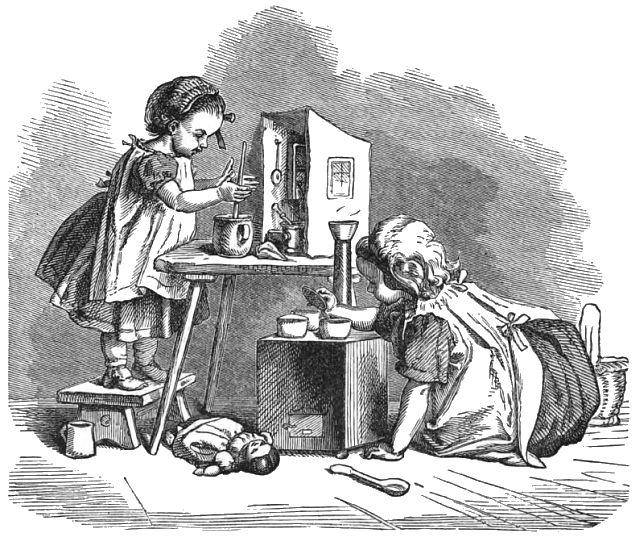
What a hard life of it these little housekeepers do have! Here are Bertha and Mary once more hard at work; so hard at work, that they do not see that poor Dolly is lying flat on her back on the floor.
Mary is busy mixing pancakes, and Bertha is warming the soup on her little toy stove. I do not see any smoke come out of the chimney,—do you?
Let us now take a peep into the children’s little kitchen. I can see a ladle, a pestle and mortar, and a mug. I wonder what sort of pancakes Mary is mixing, and whether the soup will be nice. I wish they would ask me in to dinner.
“Why! they are only making believe,” says a little girl, as she looks at the picture. “I, too, can look busy when I am dressing my doll, and yet I am all the while only making believe that it is a baby.”
Ida Fay.
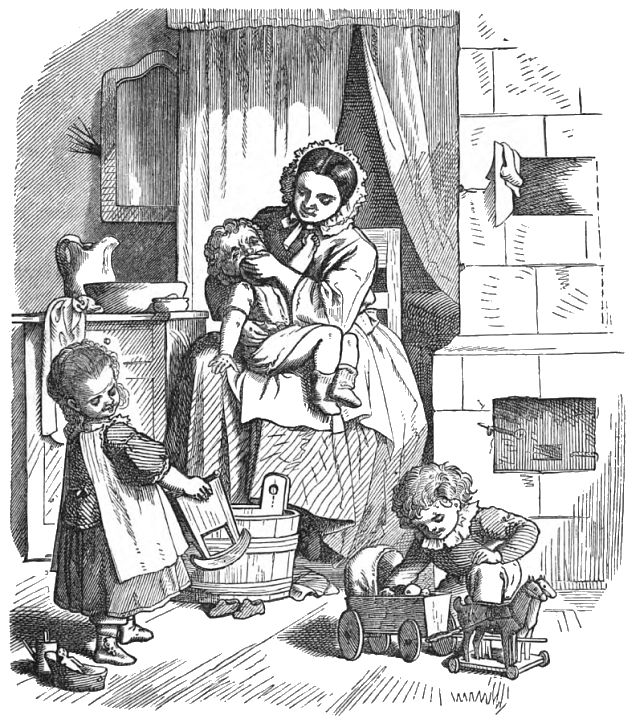
What have we in this picture? Let us look at it closely. Is it not a pleasant room to look into? See the nice bed with curtains all around it, and the looking-glass on the wall.
Master Ned is having his morning bath. Nurse has washed and dressed Mary and Frank, who are at play by her side.
She has just taken Ned into her lap from the tub where he has had a good plunge, and she is washing his face with a sponge. As she dips the sponge into the bowl on the table, and puts it to his mouth, see what a fuss he makes about it!
Ah! Master Ned, you need not throw your head back, and your hands up in that style, and try to scream “Oh, oh, oh!” Nurse will hold you fast till she makes your little mouth as sweet as roses, ready for papa and mamma to kiss when you go down to your breakfast.
“Hold still a minute longer,” Nurse says, “till I wipe your face dry with the towel. And don’t kick your socks off into the water again. See, I have hung up one pair on the stove-door to dry already. There are your little shoes by the tub, and soon you will be as clean as clean can be. Who so sweet as my baby?”
Mary thinks it is very funny to see Ned; but her doll Bess must be made ready for breakfast too.
So she takes dolly out of the crib, and puts her into the little tin bathing-tub on the floor. First, Mary filled the tub with water from the watering-pot you see there.
“Lie still, Bess, while I get your dress to put on,” says Mary.
I wonder where Mary keeps her dolly’s clothes. Oh! I see a drawer in that table where the bowl is,—don’t you? It has a knob on it; and I think Mary will go there for dolly’s clothes, when she has put the crib down.
How smiling she looks as she turns her head round to see if Bess likes her bath!
Mary is six years old, and is a dear good little girl, whom everybody loves. You can tell how good she is by looking at her face as she stands there, with her clean apron on, and boots so neatly buttoned up.
It is very easy for us to know about little girls and boys, if they are good or not. Good thoughts show out in the face. They make the eyes bright and sparkling, and the mouth all smiles; and these are what we like to see in our darlings.
Let me take a peep into your eyes now, little reader, and see what is written in them. Is it love and goodness? Always have kind thoughts in your hearts, and then you may be sure people will love you as they did Mary.
Now look at Frank. Frank is four years old. He does not seem to notice Mary or Ned or Nurse. He is playing with his wagon and horses. He has loaded his wagon with blocks, and is packing them down with one hand, while the other is on his knee.
“There, you are about full, old wagon,” he says. “Now for a start.”
“Get up, Tom and Dick,” he shouts; and the wheels roll over and over, and away the wagon goes.
Make haste, Master Frank, with your load, or Mary and Ned will be off down stairs without you.
When Nurse says, “Come, now, we are ready,” how quick they will all jump, and drop their toys! Then such a scampering to see who will bid papa and mamma a “good morning” first.
Ned’s little feet cannot keep up with Mary and Frank; so Nurse takes him up in her arms, and a little chorus of sweet voices greets the parents of these good children.
h. l. n.
Last May, when the pear-trees were all full of white blossoms, a little boy, who had never seen them before, but who had lately eaten some “pop-corn,” ran in from out-of-doors to his mother, and cried out, “O mother, come and see! come and see! The trees are all full of pop-corn!”
One day James and Ann found themselves alone in the house, and James said to his sister, “Come, Ann, we will try and find something nice to eat.”
Ann said in reply, “If you will take me to a place where no one can see us, I will do as you ask me to.”
“Oh, well!” said James, “come with me into the dairy, there we can taste of the cream.”
“No,” said Ann; “for look! there is a man chopping wood before the door, and he will be able to see us.”
“Then come into the kitchen; there is a jar of honey in the closet, and we will dip our bread in it: that will be good.”
Ann replied, “But consider, there is the neighbor who always sits with her work at the window of the next house.”
“Well,” said James, “we will go into the cellar where we shall find some nice pears; and it is so dark there that surely no one can see us.”
“O my dear brother!” said Ann, “you do not really believe there is any place where no one can see us. Do you not know that there is an Eye above, which can see through any wall, and see well in the thickest darkness?”
James was silent for a moment, and then said, “You are right, my dear sister. God can see all that takes place in the world he has made. He sees us when no mortal eye can see; then let us try to do no wrong.”
Glad was Ann to find that James, though quite young, could learn the great truth she had tried to teach him. She took a large card, and wrote on it these words, in large letters, and gave it to James to hang over his bed:—
“God sees us always. Let this thought keep us from sin.”
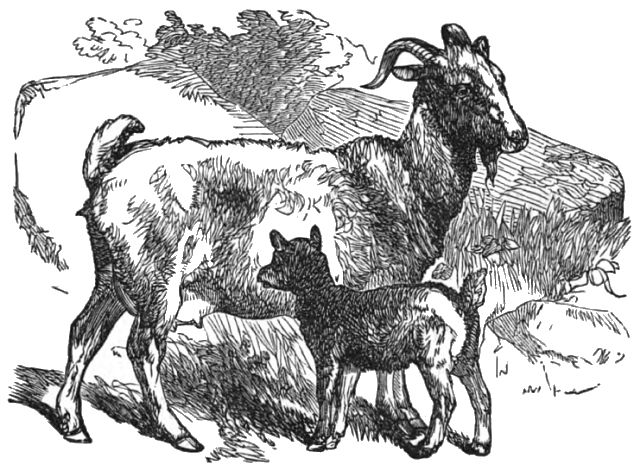
See the goat and her kid. A kid is a young goat. He will play like a lamb. He likes to play.
The milk of a goat is good. Some folks like it as well as they do cow’s milk, and drink it in their tea.
I know a baby who lives on the milk of a goat, and sucks it from the goat. The goat seems to love this baby.
A goat can climb well. I once saw five goats on a high rock. It was so high that men could not climb it.
A man tried to shoot one of these goats; but he did not do it, and I was glad that he did not do it.
Goats like the fine grass and the sweet herbs which they find high up on the hills and in the seams of rocks.
The flesh of some goats is good to eat, but I do not think it is as good as the flesh of sheep.
Some of the poor folks in our town, who cannot keep a cow, keep a goat that they may have milk.
The goat can butt with his horns; so you must not tease him, or go too near him unless you know he is kind.
“My friend Mr. Ray has a dog whose name is Max. This dog has one queer way of his own: he will not let a man sit in a room with his hat on.
“A few weeks back, Mr. Wade, who lives in our street, went to call on Mr. Ray; and, as he knew Mr. Ray well, Mr. Wade did not take his hat off when he came into the room, but just sat down in a chair, and began to talk to Mr. Ray.”
“But that was rude—was it not?”
“Yes: I think it was rude; and Max must have thought so too; for, when he had waited some time for Mr. Wade to take off his hat, he went up to Mr. Wade, and gave a loud bark.
“By this bark he meant to say, ‘Why do you sit down in this room with your hat on? Do you not know that it is rude to do so? Take your hat off, you rude man, or I shall take it off for you.’
“But, though Max knew what he meant by his bark, it was more than Mr. Wade knew; so Mr. Wade sat quite still, and kept his hat on.
“Then Max must have thought, ‘This will not do. If you do not know better than that, I must teach you. If you will not take your hat off with your own hands, I must take it off for you.’
“So Max walked round to the back of Mr. Wade’s chair, and stood up on his hind legs, and, with his fore-paws, lifted the hat from Mr. Wade’s head, and took it by the rim in his mouth, and ran off with it, and put it in the hall, on the stand where the hats were kept.
“Then Max came back, and looked up in his master’s face, and gave a short, glad bark, as much as to say, ‘Am I not a good dog? I have taught this rude man that he must be polite.’
“Then Max turned to Mr. Wade, and gave a low growl, as much as to say, ‘Now, sir, the next time you come to see my master, I think you will take your hat off in the hall. But, if you do not take it off, I shall take it off for you: you may be sure of that. I will not let a man be so rude as to sit in this room with his hat on, and talk to my master.’
“And then, when Max had growled at Mr. Wade, Max lay down on the rug, and went fast to sleep.”
“I shall not forget to take my hat off when I go into a room where there is a lady or a gentleman.”
“That is right. You must not forget the story of the dog who knew better than to let a man be so rude.”
Trottie’s Aunt.
There’s not a leaf within the bower,
There’s not a bird upon the tree,
There’s not a dew-drop on the flower,
But bears the impress, Lord, of Thee!
Who never tries will win no prize;
Who cannot work must fail;
Make your hay on a sunshiny day,
Wait not for storm or hail.
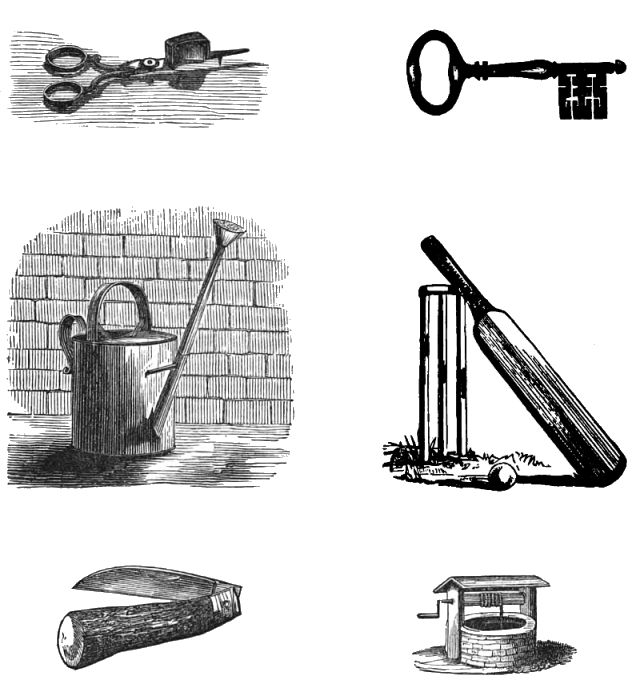
Here are six pictures, and Lucy counted nine objects they represent. The name of one begins with S, two with K, four with W (watering-pot, wall, wicket, well), two with B. Lucy is six years old. Can you do as well as she did?
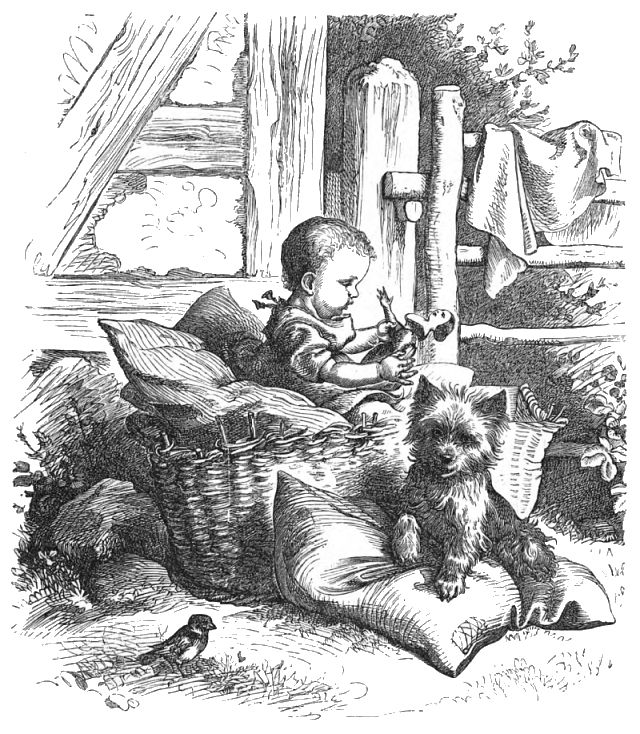
I am a dog, and my name is Nip. I am put here to take care of this ba′by. You must not touch this ba′by: if you do, I shall bark and bite.
Oh! I am such a fierce dog, and I have such sharp teeth! You should see me chase the geese when they stray off too far from the barn! You should hear me bark at the old bull when he runs at the boys who throw stones at him in the field!
The old cat does not like me, and so I get out of her way as fast as I can; but Tit likes me. Tit is a tame bird who comes and eats out of my plate. I am good to Tit. No one must hurt Tit when I am by.
But I must tell you of the ba′by. This ba′by’s name is No′ra. She has a doll, and the doll’s name is Tiz′zy. That’s a queer name, isn’t it?
Well, this ba′by’s moth′er said to me, “Now, Nip, I must go and pick some peas, and I want you to take good care of the ba′by while I am gone. Be a good dog, and you shall have a nice bone by and by.”
That’s what the ba′by’s moth′er said; and I mean to stay here and watch. I like a nice bone to pick; but it is not for a nice bone that I mean to be good, and do as I am bid. No: I mean to be good for the sake of be′ing good.
I am a very brave dog. One day last week an old tur′key ran at a child, and cried, “Gob′ble, gob′ble, gob′ble.” What did I do? Why, I got be-tween her and the child, and I barked so that the old tur′key ran off. Tur′keys must mind how they be-have when I am round.
I have a lit′tle house with a bed of hay in it, and there I sleep at night. If any one comes up the yard after nine o’clock, I wake up and bark. But, if I see it is one who has a right to come up the yard, then I stop bark′ing.
I do not think a thief would find it ea′sy to steal things on our place. He would have to put me out of the way first.
Per-haps you think I now have said e-nough for a dog. If so, I would have you to know that it is not I who claim to have said all this; but it is ba′by’s sis′ter who has said it for me. That sis′ter’s name is
Ida Fay.
Just thirty-three years ago, I lived in the town of New′port, in the State of Ken-tuck′y, and was en-gaged in saw′ing and sell′ing lum′ber. Our saw′mill stood on the bank of Lick′ing Riv′er, which flows in′to the O-hi′o, op′-po-site the great cit′y of Cin-cin-na′ti.
Be-tween the mill, and the town, there is a large tract of land, which at that time had but one house on it. This house had been built for a man who was not rich e-nough to fin′ish it; and as it stood out in an o′pen space, a good way off from oth′er hous′es, its doors and win′dows were all shut and fast′ened, so that bad boys from the town could not get in′to the rooms and do harm.
The lit′tle foot-path that led from the town to the mill ran a-bout four hun′dred yards from the house; and a-long this path I had to pass dai′ly.
One fine day in June, as I was go′ing to my din′ner, I looked up at the lone house, and saw hun′dreds of swal′lows fly′ing round and round it, darting this way and that, o′ver the roof and o′ver the chim′neys, and twit′ter-ing and chat′tering at a great rate.
Their mo′tions were so strange, that, at the risk of los′ing my din′ner, I went o′ver to see what was the mat′ter. Going round to the back side of the house, I saw that the kitch′en part of it had two porch′es, one a-bove the oth′er; and that some swal′lows had built their nests in the up′per porch.
My com′ing did not dis-turb them in the least; and I soon saw that a bat′tle of some sort had been fought. Some of the nests had been torn down; feath′ers lay scattered a-bout; and one poor bird lay dy′ing on the ground, his eyes gone, and his feath′ers rum′pled.
I saw that a num′ber of swal′lows were fly′ing to and from one nest that was close up un′der the ceil′ing, a-gainst the wall. In that nest was a bird, and the oth′ers were try′ing to make her get out of it; but this she would not do.
Some of the birds seemed to be try′ing to tear the nest from the wall; while oth′ers were peek′ing a-way as if they would pick it to pieces. But they all failed to pull it down, or to drive the old swal′low out of it. I sat down to watch the end of the fight.
There was a pond not far off, where the earth had been dug out to make bricks for the house; and all at once I saw some swal′lows come from that pond, with clay in their bills, and be-gin to put it on the nest where the old swal′low still sat.
Oth′er swal′lows were quick to take the hint; and a-way they flew to the pond, and back they came with clay, un-til, in a-bout twen′ty min′utes, they had cov′ered the nest with clay, and quite shut in the stub′born old swallow. They had bur′ied her a-live!
Then the swallows all be-came still, as if con-tent with their work. I want′ed to get at the nest to let the poor old bird out; but I could not do this, as there was no lad′der at hand.
Per-haps the old bird de-served her sad fate. I think she had lost her own nest, and then had sought to take one that did not be-long to her. Per-haps the dead bird was her mate. I think it was.
These two had taken an-oth′er bird’s nest by force. They had broken the law of right, and they were pun′ished.
All my lit′tle read′ers will a-gree with me, that those two swal′lows had much bet′ter have built an-oth′er nest of their own. Let us all learn the good les′son which this true sto′ry teach′es. Let us nev′er take what is not our own.
Springfield, Ill.
John R. Woods.
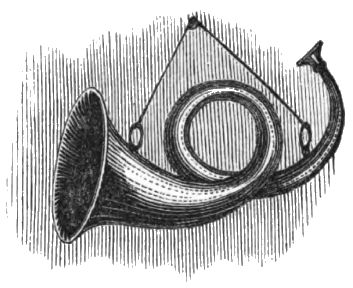
This is the horn of the hunter so gay;
He gets up from bed at the break of the day;
He mounts his good mare, and he gallops away.
He has a small gun that is slung to his back;
And after him run his dogs, Tiger and Jack.
Fly, birds I scamper, deer! and get out of his track!
A thing can’t be ended before it’s begun:
You must crawl and walk before you can run.
Most boys and girls have heard the sto′ry of the slave who took the thorn out of the li′on’s paw. The li′on was grate′ful for the kind act; and, when years had gone by, he would not harm the slave, though the slave was made to go in′to the li′on’s den.
Not long a-go, in Dub′lin, at a place where wild beasts are kept, a ti′ger fell ill. He would not eat. He could not walk. At last the keeper found that the poor beast had some′thing the mat′ter with his paw.
You know how sleek and strong a ti′ger is, and how he likes to walk back and forth in his den. Some of you may have seen a ti′ger yawn, and show his great teeth. These teeth are so great that he could soon crunch up the bones of a large man.
A ti′ger’s paw is like a cat’s paw; and a cat, you know, sheathes her sharp claws in the soft pad of her foot, and puts them out on′ly when she wants to stretch her-self or to scratch.
The paw of the Dublin ti′ger was looked at; and it was soon found that the claws grew in′to the pad of the foot, and that this was the cause of the pain and the lame′ness.
But what was to be done? If the claws were left to grow, they would make the foot worse and worse; and yet how could the claws be cut out? That would hurt the ti′ger a good deal at the time; and he might try to kill those who hurt him, for he would not know that they did it for his own good.
At last it was planned that seven men should hold the ti′ger with ropes, and that his sore paw should be caught in a noose, and drawn un′der an iron grat′ing, so that the sur′geon might reach the paw.
Well, the ti′ger let the man put the rope round his neck; but it was a long time be-fore they could fix the rope round his paw. He would toss off the rope be-fore it could be drawn tight. But the men kept on, and at last the poor beast was bound, and the sur′geon be-gan to cut.
The ti′ger did not know what they were at, and his pain made him fierce. He tried to strike at the sur′geon with his great paw; but the sur′geon was safe be-hind the bars. Then the ti′ger tried to catch him in his jaws. But this he could not do; and then the poor beast seized hold of the bars so that he broke two of his great teeth.
As soon as the sur′geon had cut the claws out of the foot, so that they would grow right, the ropes were un-done, and some wa′ter was thrown o′ver the ti′ger to cool him. Then the ti′gress was let in. She went up to the ti′ger, and licked his sore foot, and soon his pain seemed to be gone.
Now comes the part of this true sto′ry that made me think of that of the slave who helped the li′on. The sur′geon who had cut the ti′ger’s claws, as soon as the ti′ger was calm, went up to the front of his cage.
The ti′ger knew him at once, and seemed to know, too, that to him he owed the cure of his foot; for the poor beast did not try to knock him down, or to eat him up, but came to the bars of his den, and be′gan to purr like a great cat, and put down his head for the man to pat.
The ti′ger tried, as much as a ti′ger could, to show that he was grate′ful for what had been done for him.
You see pres′ent pain may bring fu′ture joy. Ma′ny things, which seem hard to bear, may be sent for our good. I think you could find some texts in the Bi′ble which would tell you this.
Isabel Thorne.
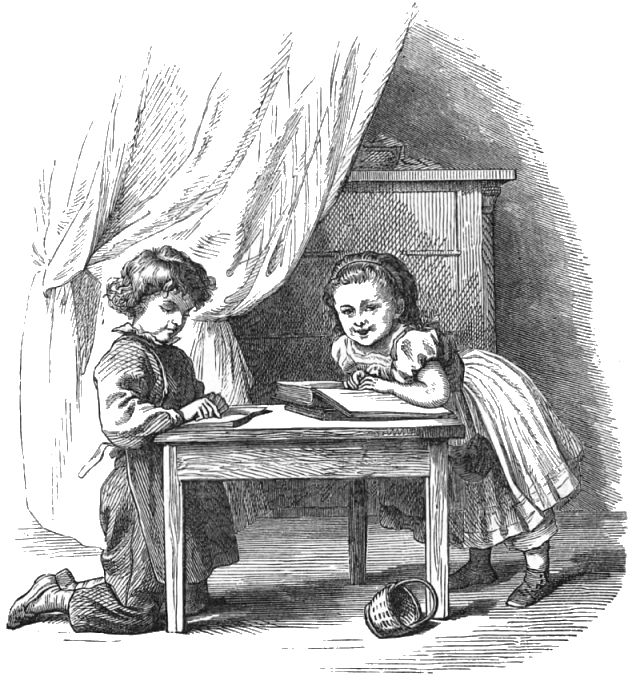
While John knelt, and read at times,
Mary made these idle rhymes.
A, B, C,
Come here to me;
D, E, F,
I am not deaf;
G, H, I,
You must not cry;
J, K, L,
I learn to spell;
M, N, O,
I learn to sew;
P, Q, R,
I saw a star;
S, T, U,
How do you do?
V, W, X,
Don’t break your necks;
Y, Z, &,
I’m at a stand.
Now try if you
As well can do.
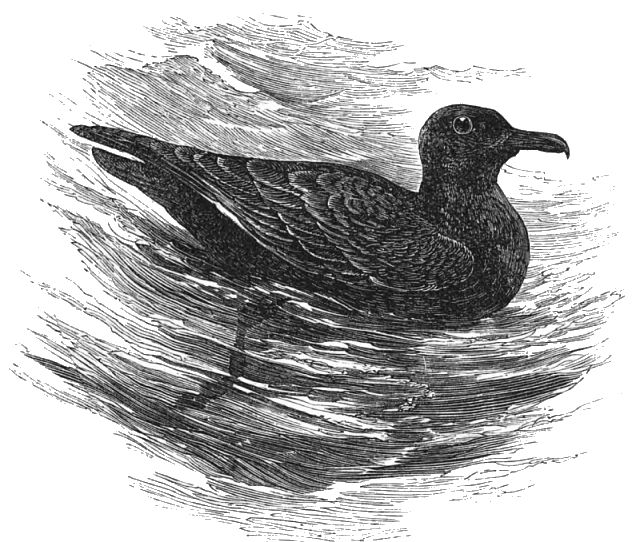
Far, far out at sea, when you can see no other bird in the air or on the water, you may see the little bird called the storm′y pet′rel, and which sail′ors call by the odd name of “Moth′er Ca′rey’s Chick′en.”
Once, ma′ny years a-go, when I was quite a small boy, I went to sea, and I used to love to watch these little birds. They would fol′low in the wake of the ship, and I would throw out small bits of pork for them to eat.
Once I thought I would catch one. So I took a small hook, and put on it a bit of pork as a bait, and threw it out by a string on the wa′ter. Soon I caught a little pet′rel by the bill and drew it in, and held it in my hand.
The hook had not hurt it, but the little bird was much fright′ened. An old sail′or who stood by told me, that, if I did the bird any harm, we should have a bad storm.
Though I did not be-lieve this, I did not harm the bird. I soon let it fly. It was glad to be gone.
The pet′rel is quite a small bird. It is not much larger than the pict′ure I here give you. Hun′dreds of miles from land, you may see flocks of these birds. Their beaks are hooked at the end. They make their nests in the holes of rocks.
Some-times when a storm comes on, the pet′rel will fly on board a ship; and I nev′er knew a sail′or yet who was not kind to these birds. A sail′or would not kill one,—no, not for a large sum of mon′ey.
These little birds will swing up and down on the high waves as if they liked the mo′tion. They frol′ic in the foam and spray of the wild waves, just as spar′rows do in the clo′ver and blos′soms of the land. Should you ev′er go to sea, you must be sure and look out for a “Moth′er Ca′rey’s Chick′en.”
Uncle Charles.
My friend Mrs. Vose went to live in a land far off at the West, where there were so few cats, that the mice had a fine time of it.
They could run here, and they could run there; and they could eat this, and they could eat that; and there was no cat to stop or to stay them.
So my friend thought that she must have a cat, let it cost what it would. And it did cost her a good deal; for she had to give ten dol′lars for her cat.
My friend had not had it long when it had two little kit′tens, and then died. “Oh, dear! oh, dear!” thought my friend Mrs. Vose: “it will not do to lose the kit′tens as well as the cat.”
So she took great care of them. She fed them with nice warm milk, and gave them a nice soft bed to lie on; and she took such care of them, that they grew and grew, till at last they grew to be cats. One of these cats Mrs. Vose gave to a friend, and one she kept for her-self.
Now, the cat Mrs. Vose kept for her-self was a nice good cat, quite white, all but one ear, and that was black; and this cat was so fond of Mrs. Vose, that it did not like to be out of her sight.
If Mrs. Vose went from her home, this cat would watch for her to come back; and, when it saw Mrs. Vose, it would run to meet her, and rub its head on her dress.
If it had known how to speak, it might have said, “I do love you so! You were good to me when I was a kit′ten, and took great care of me; and, now that I am a cat, I will do all I can to please you.”
So the cat loved my friend Mrs. Vose, and my friend Mrs. Vose loved the cat.
But a time came at last when Mrs. Vose had to leave her home far at the West, and go to live a long way off to the East; and she thought, “What shall I do with my cat? If I take my cat with me, I fear she will not stay in a new home; and then she will be lost. I think I will give my poor cat to a friend who I know will take care of her.”
So Mrs. Vose gave the cat to her friend; and her friend was so glad to have the nice, good cat, that she said she would take all the care of it she could, and do her best to make the cat fond of its new home.
So Mrs. Vose said “Good-by” to her friend and to the dear cat, and went off more than a hun’dred miles to her new home.
When she got to her new home, Mrs. Vose missed her dear cat more than I can tell you. Two, three, four weeks went by; when one day, just as Mrs. Vose came home from her walk, she heard, close by the door, “Purr, purr-r, purr-r-r, purr-r-r-r,” more and more loud.
“Why, that sounds just like my dear old cat!” cried Mrs. Vose; and she looked down, and saw that it was in-deed her own dear cat that had come to her.
The cat was in such a state of glee, that it did not know how best to show its joy. So it ran and rolled, and rolled and ran, and frisked and purred, and purred and frisked.
If the cat could but have spoken, it would have said, “Oh, I am so glad to see you once more! Why did you not take me with you? But see: I have found you out once more. I have come miles and miles to find you; and, now that I have found you at last, I am so glad!”
“But how had the cat found its way?”
That I do not know. All that I know is, that Mrs. Vose was as glad to have back her cat as the cat was glad to be once more with her dear friend.
Trottie’s Aunt.
I don’t like horses that will not spring,
And I don’t like bells that will not ring;
I don’t like fire-wood that will not burn;
I don’t like mill-sails that will not turn;
And I don’t like children that will not learn.
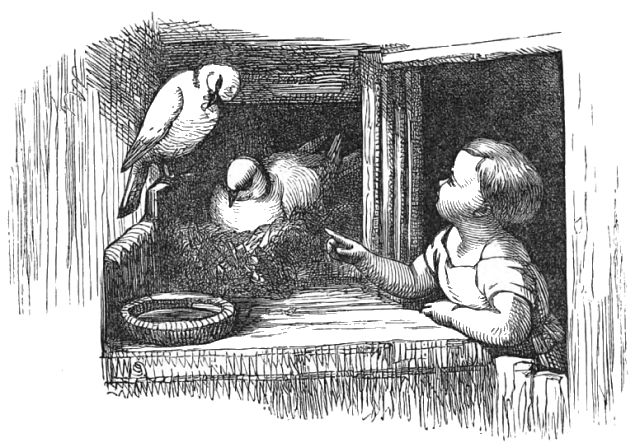
“What does the dove mean by pluck′ing the soft feath′ers from her breast?” asked Charles, who had been look′ing for some time at a dove and her mate, as they tried to make a nest fit for their young ones.
“The dove will use the soft feath′ers to make the nest soft and warm for her young,” said Charles’s moth′er.
“But I should think it would hurt the poor dove to pluck the feath′ers so out of her breast,” said Charles.
“I do not doubt that it hurts her,” said his moth′er; “but a good moth′er is will′ing to be hurt for the sake of her child.”
Charles looked up in his moth′er’s face; then went and kissed her, and said, “I know who is a good moth′er.”
“Do you not know,” said she, “that those who give, if they give with a lov′ing heart, are more hap′py than those who take? It was Christ him-self who said, ‘It is more bless′ed to give than to re-ceive.’ ”
Charles thought of these words the next day, when he went out to walk.
His moth′er had given him a nice ripe peach. Now, he was very fond of peach′es; but he held this one in his hand a long while, so smooth it was to the touch, and so fair to the sight.
While he held it, a poor little girl, thin and pale, and with no shoes on her feet, came by. She had a bas′ket of chips that she had picked up in the street. She gave a quick glance at Charles and his peach; then turned a-way, and walked on.
Though quite a young child (as you may see from his pict′ure), Charles knew what was meant by those words, “It is more bless′ed to give than to re-ceive.”
He looked at his peach, and his mouth wa′tered while he looked. He looked at the little girl; and pity crept in′to his heart, soft as the first light of day in′to the heart of the rose.
Which should win,—the flesh, or the soul? love of self, or love of do′ing good? Brave little Charles! “Come here, little girl!” cried he. “Do you want this peach?”
The little girl heard him, and what a smile came on her face! That smile more than paid Charles for the peach. “You may have it,” said he, hold′ing out the fruit.
“Oh, thank you, thank you, dear little boy!” said she, taking the peach, and set′ting out to run.
“Stop, stop, little girl!” cried Charles.
She came back; and Charles said, “I would like to see you eat the peach. If you want it, why do you not eat it?”
“May I not give it to my mother? She needs it more than I do,” said the little girl.
Charles thought of his own dear moth′er, and said, “That is right. Give your moth′er the peach. Kiss me, little girl.”
So the little girl kissed Charles, and thanked him again and again, and called him a dear little boy; and then she ran home to give the peach to her moth′er, who was ill with a bad cough.
Charles looked after the lit′tle girl till she was out of sight I think he must have felt in his heart that it is in-deed “more bless′ed to give than to re-ceive.”
Emily Carter.
A very little girl, one day,
Looked out when it had rained,
And saw that on the gravel walk
A shining pool remained.
Out of the bush a robin flew
Quite down into the pool:
He dipped his beak, he washed his wings,
And thought it nice and cool.
Then back he flew into the bush,
To sing this merry song,—
“I like to wash in water clear,
It makes me fresh and strong.”
Now, when the little girl saw this,
She thought that she would try
To let herself be washed and dressed
Without a silly cry.
m. s. c.
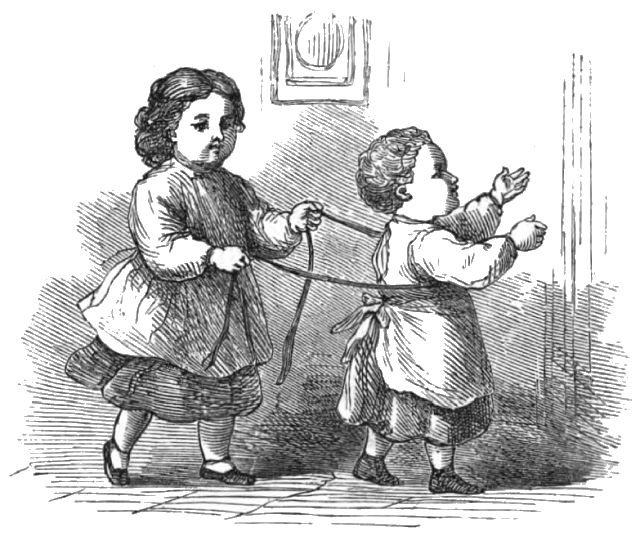
I have two dear little chil′dren, and I love them very much. Let me tell you a short sto′ry a-bout them.
One is a little girl, and her name is Jean′ie. She is a-bout three years old. She is quite a bright little girl; and she some-times makes us laugh by the odd things she says.
She used to call a pen′cil “a mark.” A hammer she would call “the pound.” The fire she would call “the burn.” Even now she calls the stars “the twinkles.”
Jean′ie is quite a good lit′tle girl most of the time; but once in a while she is naugh′ty, and then she has to stand in a cor′ner till she is good.
She has a little broth′er who has be-gun to walk a-lone. She calls him “a cun′ning, splen′did lit′tle fellow.”
Some-times the two play horse to-geth′er. Baby will then try to go quite fast, and often he will fall down.
Some-times he bumps his head, and then he cries hard; and some-times he does not get hurt, and then he will laugh, and roll o′ver on the floor like a very gay horse in-deed.
Should you not think these two would have nice times?
H. C. Pulsifer.
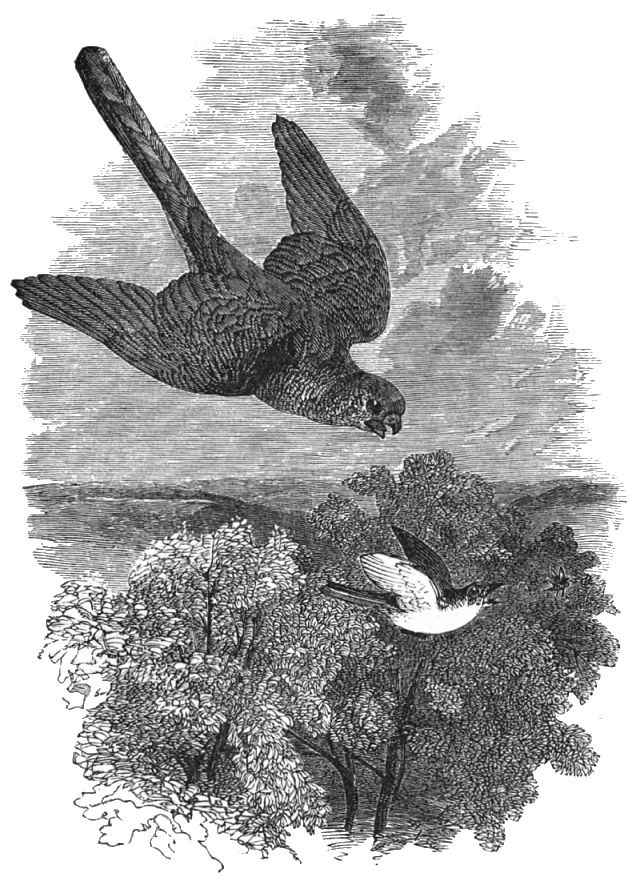
When a man who hits an-oth′er man gets hit him-self, we say he gets “tit for tat.” When a boy who trips an-oth′er boy gets tripped him-self, we say he gets “tit for tat.”
Look at the pict′ure of the lit′tle bird who tries to catch an in′sect. The lit′tle bird does not know that a great hawk is try′ing to catch the little bird. Ah, little bird! look out, or you will get tit for tat!
The hawk feeds on small′er birds. His flight is low but swift; and he clutch′es his prey with his feet as he sweeps a-long.
The small birds, in their turn, feed on flies and grubs and fly′ing in′sects; also on fruits, seeds, and ber′ries.
The small′er the crea′ture is, the more there are of the kind. There are more spar′rows than rob′ins, and more rob′ins than hawks. There are a mill′ion times more of the in′sect race than of the small′er kind of birds.
In in′sect life, we find the same law at work. The large in′sects prey on the small′er; and these last feed on oth′ers that are small′er and more in num′ber.
The midg′es, that you some-times see when the sun beams out, seem to be sport′ing in his ray. But, most like′ly, they are fly′ing a-bout to catch small′er in′sects,—in′sects so small and slight that you can-not see them.
Birds of prey try to catch all sorts of small′er birds; and these last try to catch the in′sects. While these in′sects are seizing on small′er in′sects right and left, these small′er ones may be living on oth′ers small′er still.
If the birds should stop feeding on the in′sects, the in′sects would grow to be so ma′ny that they would eat up our fruits and corn. How ma′ny in′sects do you think a swallow eats in one day? He eats ma′ny thousands. He does not eat grain.
So you see, by a law of their being, birds and in′sects prey on each oth′er. For rea′sons known only to Him-self, God has made this a law of their being.
But should men prey on men? Oh, no! That would be wrong. Men can think and love. Men are free. Men must do good to one an-oth′er. Men ought to let the law of love rule in their hearts.
But can we love what is bad? No. We need not love what is bad; but we can be so kind to bad folks, as to try to change them from bad to good. Let us try to get “tit for tat” in do′ing good, and not in do′ing bad. That would be a “tit for tat” with which I should not find fault.
I do not mean by this, that we should do good so as to have good done to us. No: we should do good, because it is good, and so is the law of God.
I saw a little girl the other day help a poor fly out of a cup of milk. She did it to save the fly from drown′ing, and be-cause it seemed to need help.
She did not do it be-cause she thought the fly could ever be of any use to her. No: she did it be-cause she had a kind heart, and did not like to see even a fly suf′fer.
Emily Carter.
 In summer nobody cares for me;
But, as soon as the flowers are dead,
They call me the beautiful holly-tree,
With berries so shining and red.
My boughs are so tough and my prickles so strong,
They keep little fingers in fear;
But some will be gathered before very long,
For Christmas will shortly be here.
The fullest and prettiest boughs may go;
But many, I hope, will remain,
To feed the poor birds in the frost and the snow,
Till summer brings sunshine again.
m. s. c.
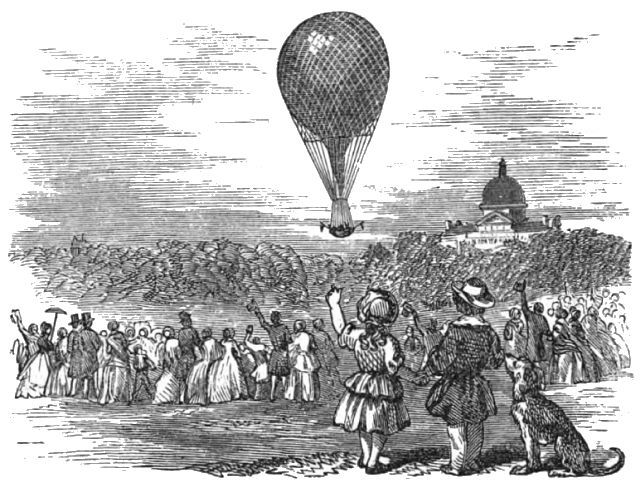
“O Charles! how I do love this nice walk on the Common! The air blows all over my face. And look up! There is a balloon! It is far up above the trees, quite high in the air.”
“Yes, Jane, it is pleasant to feel the fresh air in our walks. We seem to breathe more freely. We get quite strong again. The air is all around us. We cannot see it, but we feel it.
“Now look at the balloon. It moves fast. It will soon be higher than the State House. It is the wind that drives the balloon along. Wind is air moving fast.
“The chief use of air is for us to breathe it. When we breathe, we draw in the air through our mouth and nostrils; and it goes into our lungs, and mixes with the blood.
“Air is made up of two parts. One part is mixed with the blood when we breathe, and the other comes back through the nose.
“If a man were shut up in a small room, in which the doors and window fit so tight that no air could get in, by and by he would use up all the good part of the air; and then, if no more fresh air were let in, he would die.
“People should always let fresh air into their rooms, because to breathe bad air is hurtful to the health: it makes us weak and sickly.
“Beasts and birds need air as we do. If a mouse or a bird were shut in a box, which had no hole in it, the mouse or bird would die for want of air.
“Fishes breathe air through the water in which they live. If we fill a box with water, and put a fish in it, and then shut the lid very close, the fish will die. You must not cover the top of the glass globe in which my gold-fish swim.
“When the wind moves fast, it blows away fog and damp. It also fills the sails of ships, and the sails of wind-mills.”
Was not Charles good to tell his sister all these true things about the air we breathe? The two children gazed up at the balloon till it looked no larger than Jane’s bonnet. Their dog Grip was with them, and they had a good time on the Common.
Tremont House.
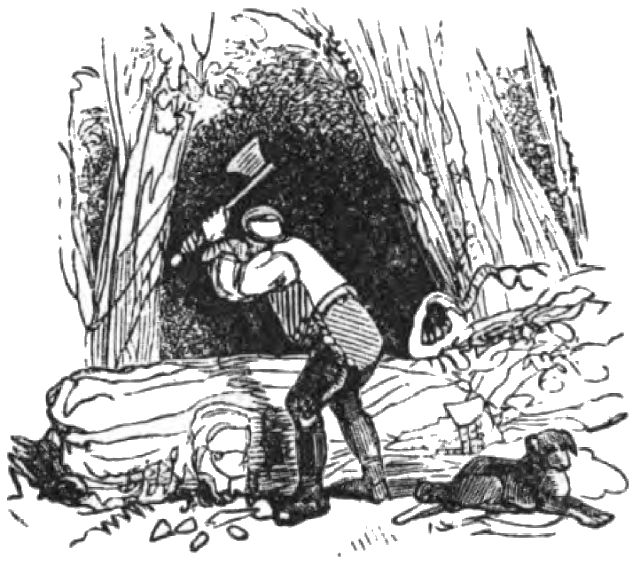
See the woodman with his axe!
He the stout old oak-tree hacks:
By and by, it down will fall;
Stand from under, one and all!
There was a little boy, and his name was Richard. His mother had told him to try to be of some use in the world.
“Of what use can I be?” said he: “I have no money that I can give away. If you will tell me what to do, I will do it.”
“Little boys must learn to think for themselves,” said his mother. “ ‘Where there is a will, there is a way.’ Say to yourself, ‘Now, what is there I can do to please or help some one who needs pleasure and help?’ ”
Richard’s mother then left him to think for himself. “Now, what is there I can do?” thought he. “Who needs help? Let me see. I know! There is poor old Mrs. Lane: she is so lame and ill, that she has had to stay in her room these two years. She has few joys of any kind. Can I not do something for her?
“I have no money. I have no cake. Indeed, she could not eat cake, if I were to give her some. I know what I will do! I will take my little magazine to her, and show her the pictures, and offer to read to her. And there is something else I will do.”
And what do you think that “something else” was? You will know soon. Richard had a little garden. He ran into his garden, and plucked two roses, a white and a red, the best he could find.
Then he went to Mrs. Lane’s house, and asked if he could see the old lady. “Yes,” said the girl who came to the door: “the old lady loves to see young folks.”
So Richard went in, and gave Mrs. Lane the roses, and said he would like to show her his little magazine, and read some of the pieces to her if she would like to have him.
The color came to the pale face of the poor old lady, so pleased she was with the little boy’s visit and his gift of roses. “Did your mother tell you to come?” asked she.
“No,” said Richard. “As school did not keep to-day, I tried to think of what use I could be to somebody, and at last I thought of you; and here I am.”
“Bless you for the thought, little boy!” said Mrs. Lane. “Now sit down, and read me one of the best stories in your little book.”
So Richard sat down, and read to Mrs. Lane, and then showed her the pictures,—wonderful pictures they were,—all of little girls cooking their dolls’ dinners, and washing their dolls’ clothes, and of children at play!
These made the old lady clap her hands and laugh. She pointed out to Richard many little things in the pictures which he had not noticed, and then he laughed too; and the two felt like children together, and became quite merry.
When Richard got up to go, he found he had been with Mrs. Lane more than an hour. Time had slipped by without his knowing it. The old lady thanked him, and said he had done her much good, and that he must come again; and Richard went home, glad in the thought that he had been of use to some one that day.
William C. Godwin.
Tell not every thing thou fearest;
Believe not every thing thou hearest;
Be most bold when danger’s nearest.
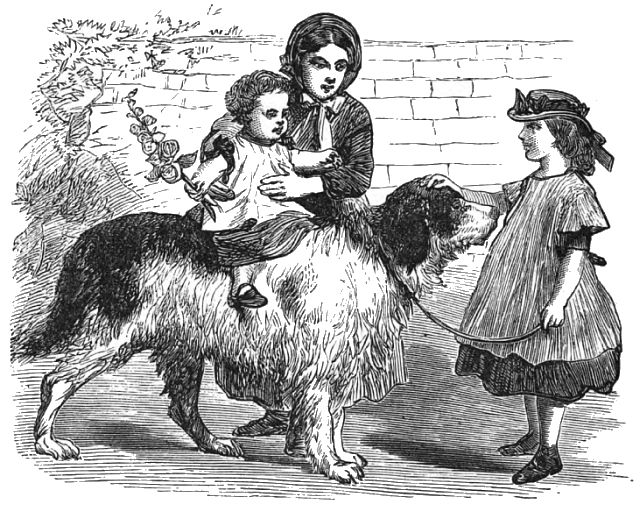
Boz is a good big dog, and he will let James ride on his back. Now, Ruth, if you will hold James on, I will lead Boz by this string. You must not let James fall. Boz must go slow.
James has a branch of a rose-bush in his hand. Hold it tight, James: you need not fear. Boz will not run. He knows that you are a small boy, and that we must take care you do not get hurt.
There! This good dog has gone twice round the yard, and James has sat still on his back. Soon we will let James ride the old horse. Then James shall hold a whip.
Once a boy went down to the sea-shore, and went in-to the sea to swim. But it was too deep where he went in, and he cried loud for help. Our Boz was nigh, and heard him.
Boz can swim like a fish. He ran in, and swam to the boy; and, just as the boy was like to drown, Boz let him take hold of his neck, and so saved his life.
Now James has had his ride, and he shall lead Boz in-to the shed; and there we will give the good dog a bone to eat, for he wants his food.
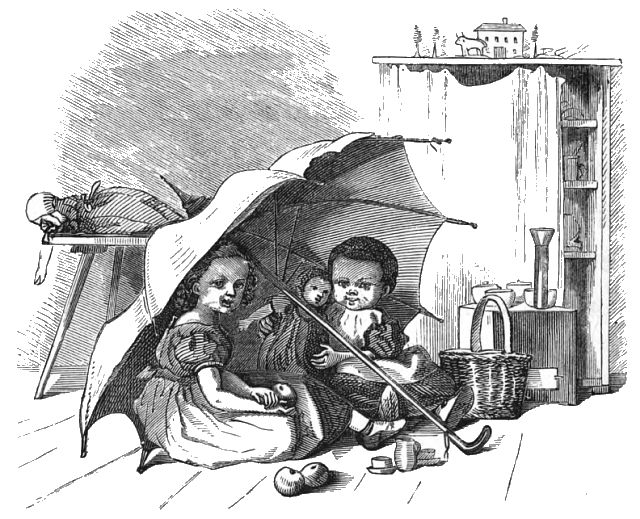
“I’m tired of playing with cups and saucers and baby-house things,” said Bertha one day. “I want something new. Lie there, dolly, and take care of yourself while I see what I can find.”
So she left her doll lying on the table, as you see it in the picture, and ran into the entry closet to hunt for some new plaything.
In a few minutes she came back, dragging in the nurse’s old cotton umbrella. It was not a handsome umbrella. It was very much worn and faded, very heavy, and very large.
“Just the thing to make a tent of!” said Bertha, as she spread it wide open. “Now, Mary, let us play that you and I were out in the fields, ever so far away from home, and that we got lost, and that night was coming on, and no house was near, and that we hadn’t any shelter but this.”
“Yes,” said Mary; “and make believe that it began to rain, and that my dear little Jane began to cry, and that I held her in my arms, and that we sat down together just as close as we could to keep each other warm.”
“Yes,” said Bertha; “and play that we had been to a picnic, and that you had some ginger-nuts in that basket, and that I had two or three oranges, and that we had nothing else to keep ourselves from starving.”
“Yes,” said Mary; “and make believe that it grew darker and darker and darker, and that we couldn’t sleep; but that we were not at all afraid, and sat up and talked, and told stories all night.”
“How lonely it is!” said Bertha.
“How hard the wind blows!” said Mary.
“And how the rain beats on the top of the tent!” said Bertha.
“But it can’t wet us; can it?” said Mary.
“Not unless it comes in underneath,” said Bertha. “Is not the ground getting damp?”
“What will poor Mamma do when she finds that we don’t come home?” said Mary. “How worried she will be!”
“Father will be out with a lantern in search of us, and John and the dogs will be with him. The neighbors will be out too, and perhaps they will ring the bells. What a fuss there will be.
“It’s lucky we have such a nice tent to cover us; isn’t it?” said Mary.
“Yes,” said Bertha: “it’s so nice, that I almost think I should like to live in it all the time.”
What Mary thought on this point will never be known; for, just as she was about to tell, nurse came in, and took away that precious umbrella! It was an old friend of hers, and I suppose she was afraid it would get hurt; for she shut it up with great care, and put it back in the closet, leaving Bertha and Mary sitting just as they were, without any umbrella over them.
“Now,” said Bertha, “make believe that a fairy came, and took away our tent; and that we went to sleep for two minutes, and, when we woke up, found ourselves sitting here on the nursery floor.”
“Yes,” said Mary; “and here is our cooking-stove all ready for us. I think we had better fry some pancakes, and have a good supper, for we are very hungry you know.”
Ida Fay.
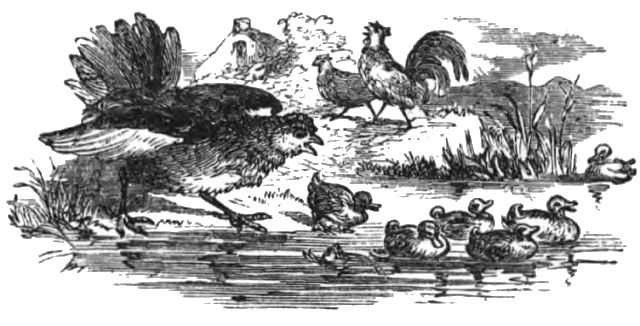
Oh! look at the hen with her brood of young ducks!
What a strait she is in! how she flutters and clucks!
She wonders to see them all run to the water,—
Her whole little brood,—every son, every daughter!
Oh! what can possess them to take such a whim!
Not from her can they get it! She never could swim!
Stupid hen! Can’t you see they are not of your feather?
That you like the sunshine, and they rainy weather?
Can’t you see they are ducks, and not chickens at all?
Cluck away as you may, they’ll not come at your call.
The water they love, and the water they’ll get:
Go scratch in the garden! Don’t stand there and fret!
Emily Carter.
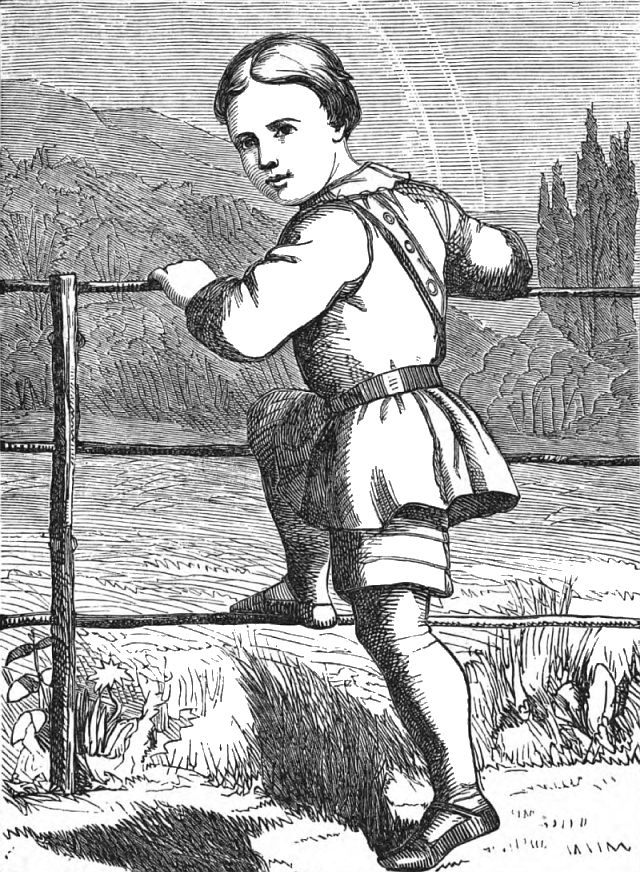
“The sweet summer shower, the glad summer shower,
How bright it has left every leaf, every flower!
And, spanning the sky, see that beautiful bow!
Now, little boy, little boy, where would you go?”
“To the end of the bow, where it touches the ground:
There jewels in plenty, and gold, may be found.”
“But are you quite sure you can go there to-night?”
“Why, look! ’tis not far: it is plainly in sight!”
“Before you can get there, the rainbow will fade.”
“Oh! not if we run. Come, and don’t be afraid.”
“Who told you, my boy, of these riches so rare?”
“My sister: she told me they truly are there.”
“Go ask why she does not herself seek the gold.”
“I asked; and she said, ‘Fortune favors the bold.’ ”
“By riches that vanish, my boy, set no store.”
“But where is the rainbow? I see it no more!”
“So fleeting, so fading, my boy, you will find
All jewels, all riches, save those of the mind.
But goodness and knowledge—oh! labor for them,
And they will outshine every star, every gem.
For them you will never, dear boy, have to go
Over fences and thorns to the end of the bow.”
Emily Carter.
When Work comes into a house to stay,
Then Want will speedily flee away;
But let Master Work once go to sleep,
And Want will in at the window peep.
Two little boys had a quarrel; and what do you think it was all about? Why, it was all about the color of lobsters!
“Hurrah for the sea-side!” cried Philip: “what fun I shall have, with the boating and the bathing, and the digging in the sand! But the fishing will be the best fun of all. Many a jolly red lobster will I drag out of the sea!”
“Red lobsters—red!” cried Henry, with a loud, rude laugh. “Catch a red lobster if you can! If you had seen as many lobsters as I have seen, you would know that they are of a dark color, almost black.”
“You must not try to make fun of me!” said Philip, while his cheek grew almost as red as the lobster he was thinking of. “As if I didn’t know the look of a lobster, when my aunt has lobster-salad once a week! The shell is red, I tell you.”
“The shell is black, I tell you,” said Henry; “black as my boots! If you say it is red, you say what is not true.”
“Do you mean to say I tell a lie?” said Philip, getting very angry; and from high words the two boys were near to coming to blows, when an old man came up, and asked what was the matter.
“This boy says lobsters are black, and I say they are red,” cried Philip. “Now, are they not red, sir?”
“Are they not black, sir?” asked Henry.
“Be still, both of you,” said the old man. “Neither of you seems to be aware that lobsters are black till they are boiled, and that then their color is changed to red. Now, before you quarrel again, my lads, be sure you know what it is all about.”
Uncle Charles.
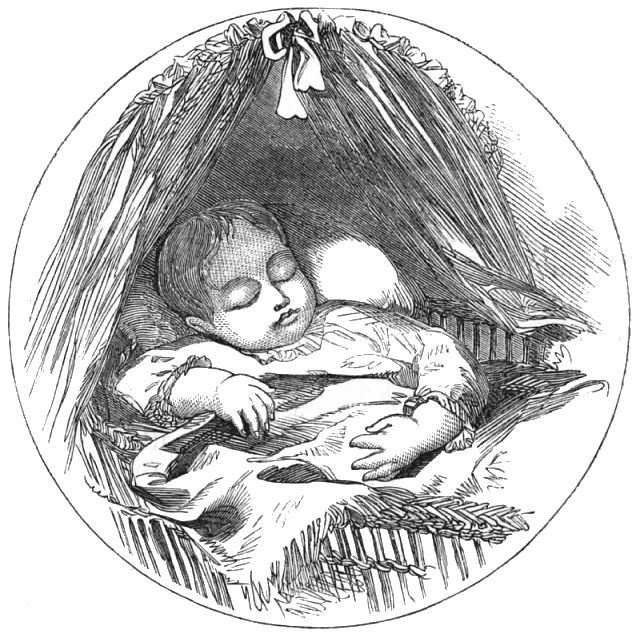
I’ll watch the baby tenderly.
The snow-white lambs rest sleepily;
The birds are nodding on the bough,
And soon they’ll close their eye-lids now;
Close thine eyes, my baby, too:
Hush! for I am watching you,—
Sleep, baby, sleep!
Sleep, my baby, peacefully.
All fast asleep the flowers do lie:
The roses red, and lilies white,
The daisies meek, and cowslips right.
None so fair as mine can be!
Lulla, lulla, lullaby,—
Sleep, baby, sleep!
Lulla, lulla, lullaby!
The angels hover over thee,
For cradles are their special care:
They sing their choicest anthems there;
They soothe thy slumber blissfully;
Lulla, lulla, lullaby,—
Sleep, baby, sleep!
Sleep, my baby fair and bright!
As yet thou’rt like the angels white,
The sinless flowers, and merry birds;
And still to thee I sing the words
Of mother’s loving melody:
Lulla, lulla, lullaby,—
Sleep, baby, sleep!
m. s. c.
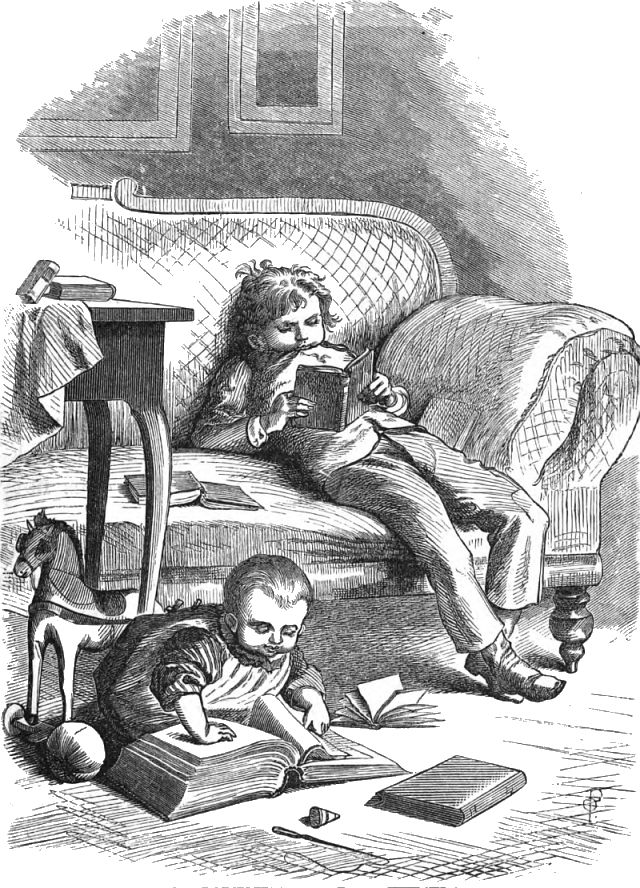
“WHAT A LAZY BOY!”
See that big book on the floor! Ba′by is on his knees, look′ing at the pict′ures. Behind him are his horse and his ball. Be-fore him are his whip and his top and a small book.
Do not tear the leaves of that big book, ba′by. Do not soil them. You must learn to use books well.
But who is that large boy on the so′fa? I think he cannot know that I am look′ing at him. That boy is the ba′by’s broth′er. His name is Ralph. He loves to read; but I hope, when you read, you will not let your limbs lie loose, like a wet rag, as he does.
Just look at him! What a sight! Where is his neck? He has sunk his chin down on his breast till his neck is quite out of sight. He does not sit up, and he does not lie down. He is la′zy.
True, it is a hot day, and Ralph has had a long walk in the woods. But he will find it is a bad hab′it to rest in that way when he reads. I hope, if you look at him, you will look on′ly to shun such ways.
We must take care not to cop′y bad tricks. I once knew a lit′tle girl whose name was Ann, and who was led to school by an old ne′gro whose name was Jake. Ev′e-ry day Jake would come and lead Ann to school.
Now, Jake had what is called a hitch in his gait; for one of his legs was not so long as the oth′er, and this made him walk lame. But Ann, see′ing Jake walk so all the time, began, with-out know′ing it, to walk like him.
It was not right that Ann should walk lame, for her limbs were all sound and well made. But we are apt to cop′y bad tricks; and poor Ann, by walk′ing much with Jake, when she was quite young, caught a trick which she did not get o′ver all her life. She is grown up now, but she still has a hitch in her gait.
This shows what great care we ought to take, not to let what is wrong or out of rule do us harm. We need not cop′y a thing that is wrong or out of rule be-cause we may have to see or hear it; but we should try to cop′y what is good and right.
I have known the young to catch tricks of wink′ing and stut′ter-ing. There was a lit′tle girl of the name of Ag′nes, who stut′tered bad′ly. Her friend Julia used to mim′ic her. By and by Ag′nes was cured of the trick, but Julia had caught it so that it was hard for her to get rid of it.
All these thoughts have come to me through see′ing that la′zy boy on the so′fa. I hope he will soon get up, and stretch him-self, and then sit down, as the young ought to sit, e-rect and with his limbs well placed.
Mary F. Lee.
It had been a dark and rainy day; but, as the night drew near, the mist rolled off and the sun began to shine clear, and to light up the woods and fields with his glad rays.
“Look, father!” cried a little girl; “look! the sun is brightening all it can.”
“Brightening all it can? So it is!” said the father. “And you, my little girl, can be like the sun, if you will.”
“How, father? How can I be like the sun?” she asked.
“By looking happy, and smiling on us, and never letting the tears come into those blue eyes. Only be happy and good: that is all.”
The next day the music of this little girl’s voice filled our ears all day: the little heart seemed full of joy and love.
When asked why she was so happy, she said, with a laugh, “Why, don’t you see I am like the sun? I am brightening all I can!”
“That is right, my little girl,” said her father. “Try to make others happy, and it will make you happy yourself.”
I hope that many other children will try this little girl’s plan. If we would be happy ourselves, we must first try to make others happy. If we would be loved, we must first love.
Uncle Charles.
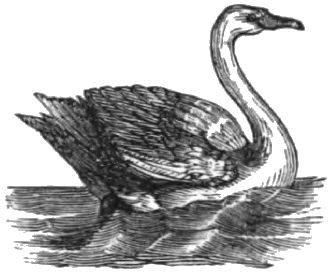
A friend of mine lives in a fine place where he has some swans. A stream runs through his grounds, and in this stream the swans may be seen.
It is a fine sight to see them swim up the stream and down the stream. They look so grand, and move so slow, and they arch their long white necks, and turn now to this side, now to that, as much as to say, “Are we not fine white birds? Do we not look well as we swim so grand and so slow?”
One day, when my friend went out for a walk, he went near the stream to look for the swans; but the swans were not in the stream, and my friend looked this way, and looked that, but could not see them.
At last he spied two swans hard at work, making a nest. They were making it out of such sticks and straw and bits of hay as they could find. How busy they were!
My friend went near to them, but they were too hard at work to mind him much; and they put straw upon straw, stick upon stick, here a little, and there a little, to make their nest as high as they could.
“What can the swans do that for?” thought my friend; “for what can they want to make such a high nest? They find it hard to get sticks and straw. I will help them.”
So my friend told his man to bring more sticks and more straw near the place where the swans were so hard at work. And when the swans saw the sticks and the straw, they were glad, and made haste, and put here a stick and there a stick, and here some straw and there some straw, till they had made a high heap some feet from the ground.
When the swans had made this high heap, they put some nice soft hay at the top; and in this nice soft hay they put their eggs, and then the two birds seemed to be quite at their ease.
“Well, this is odd,” thought my friend. “What can it mean? What can have made them want such a high nest as this? I must wait and see.”
He did not have to wait long. In a few hours from that time there came a flood—such a flood! Roar, roar, roar, it came,—down, down, down; and the stream was soon so full, that it rose and rose, till it rose above its banks, and swept down all that came in its way.
But those wise swans had put their nest where the stream could not come; and so they could sit on their nice warm nest, and see the stream go by with a roar and a rush; and they could put out their long white necks, and look, and draw in their long white necks, as if they would like to say, “We are glad that we have this nice warm nest. We are glad we built it high, out of the reach of the flood. Here we are safe and warm, we and our eggs.”
“But how did the swans know the flood would come?”
That I cannot tell you. He who takes care of the birds of the field took care of those poor swans, and put it into their minds to make that nice safe nest.
Trottie’s Aunt.
Not long since, a little girl, not three years old, who lived in the town of Beaver Dam, Wisconsin, fell down stairs, and was so stunned by the fall as to lie senseless.
Nobody saw this, or knew of it, except an old family cat whose name was Buff. And what did Buff do? Why, like a good, bright cat, she ran to a room in the back part of the house, where the child’s mother was at work, and there Buff began to mew quite loud and fast.
“Why, Buff, what is the matter with you?” said the child’s mother. “Mew, mew!” said Buff; and at the same time ran back and forth from the room to the stairway.
“Say, what do you want, old cat?” asked the woman. “You are hungry, I suppose. Well, here is a bit of meat. What! You won’t touch it? Then I think you have caught a rat, and want me to see it. Silly old Buff! Go away!”
But Buff began to mew the louder, and to run to and fro from the room to the stairway all the faster, as if to say, “I am not hungry, and I have not caught a rat. It is something more important than a rat! Come and see! Come and see!”
Moved by the strange conduct of the cat, the mother at last followed her to the front entry; and there, at the foot of the stairs, she found her dear little girl lying senseless, with a bruise on her head.
“O Buff, Buff! why did I not heed you sooner?” cried the woman, as she took up the child.
I am glad to say that the dear little girl, by being cared for at once (thanks to old Buff) soon came to her senses, and was found to be not much hurt. Buff had an extra saucer of milk that night as a reward for good conduct; and the next day the little girl tied a blue ribbon round Buff’s neck.
Edith Bryan.
The best of wine for children, it is the pure white wine,
That gushes from the earth where trees their leafy branches twine:
It flows through field and meadow, where bird and insect play;
It gives no child the headache, drink deeply as he may.
And if it’s best for children, as all wise people tell,
I think it must be pure and good for grown-up folks as well;
For many have been rescued from illness and from pain
The day they took to drinking the pure white wine again.
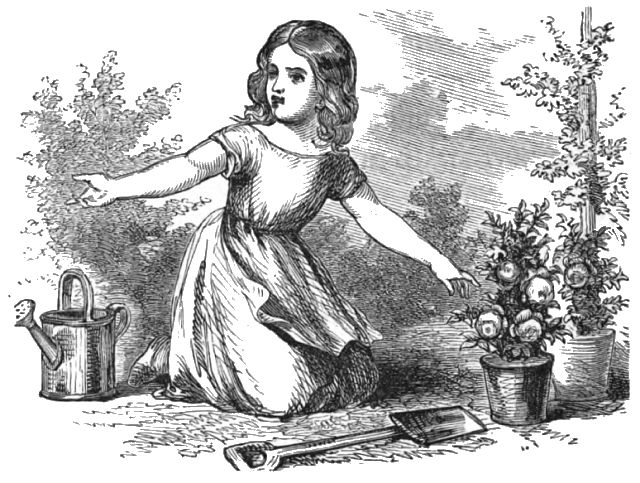
Child, when, with tending, careful hand,
Amid the flowers you go,
Forget not Him whose watchfulness
Sends rain on all below.
Each little plant that lifts its head,
And sparkles in the sun,
Owes all it has of life and joy
To God, the almighty One.
Each little child whose heart begins
To love, to pray, to learn,
A faithful heavenly Father has,
To whom that heart should turn.
The same great Hand that guides the stars,
Pours down the fruitful shower;
Then let the rain-drops speak His love,
The stars proclaim his power.
m. s. c.
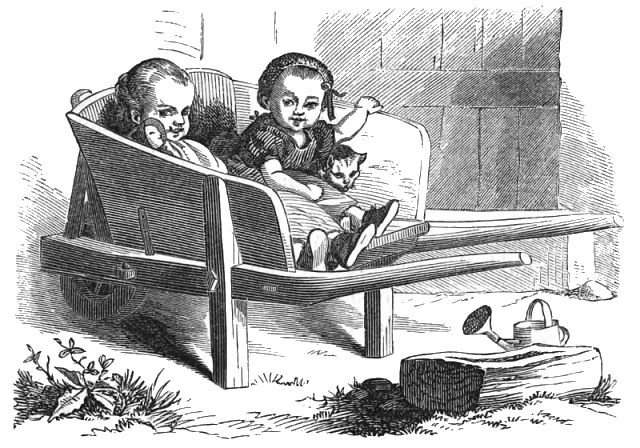
Mary’s little cousin Helen came over to play with her the other day, and brought her doll, which she calls Tot. It was a warm, bright day. So the two little girls left their play-things in the house, and went out to take a run in the garden. The cat went with them.
They chased each other over the lawn; they swung each other in the swing under the great elm-tree; they played hide and seek in the hedges, till at last they began to feel quite tired; and when they came across the old wheelbarrow, which was standing near the corner of the barn, they thought it would be very nice to get into it and rest themselves.
So Helen, with Tot in her arms, got in first, and seated herself on one side. Mary took her place on the other. “Come, pussy,” said she, “here is just room for you.” Pussy jumped in; and there they all were, as snug as you please. The picture shows you just how they looked.
But the picture does not show what took place a short time after. I must tell you that. John, the gardener, came up to get his watering-pot; and, when he saw Mary and Helen sitting there so quietly, he couldn’t help laughing right out. He took hold of the wheelbarrow, and said he had got two fat little pigs in it, and that he thought he would carry them to market.
Then he wheeled them gently through the barn, and down the gravel-walk that leads to the gate, and up the path that winds through the rose-bushes, and in and out among the flower-beds, and stopped at last right in front of the parlor windows.
Mary and Helen laughed all the time; and once in a while a sound much like a squeal was heard from them. They liked wheelbarrow riding better and better the farther they went. But pussy did not like it so well, and so jumped out.
When Mary’s mother saw them, she said, “Why, you little rogues, what are you doing in that dirty old wheelbarrow, and where have you left your sun-bonnets?”
And Mary said, “Mamma, you must make believe that we are little pigs, and that John is wheel′ing us to market.”
Ida Fay.
What can be the matter with pussy!
She never comes now to her play,
But hides herself up in the attic:
I see her go there every day.
Or if she comes down for a minute,
And I catch her up in my lap,
She cannot be coaxed to stay in it,
Not even for one little nap.
No cat, I am sure, could be fonder
Than Pussy was, always, of me:
Let’s go to the attic and find her,
And see what the matter can be.
’Tis not very light in the attic.
“Puss, puss!” But she don’t hear me call.
We’ll look in that chest in the corner:
My stars! Here’s a sight, after all!
Three kittens,—a white and a black one,
And one little perfect Maltese.
O pussy! How charming to have them!
I’ll just take them up, if you please.
You darlings! you queer little mewlings!
You sprawlers! you smallest of cats!
You half-seeing, half-mewing kitties,
It can’t be you’ll ever catch rats!
Dear Blacky, no big boy shall drown you;
Dear Whitey, I’ll feed you with cream;
And you, my Maltese, my pet beauty,
Shall lie in the warmest sun-beam.
But pussy, I see, is uneasy:
Dear cat, I won’t take them away;
At least not until they grow bigger
And stronger and able to play.
How happy and proud you are, pussy,
With all your new duties to do!
Good-by, then, for that just reminds me
That I have my own duties too.
Mrs. A. M. Wells.
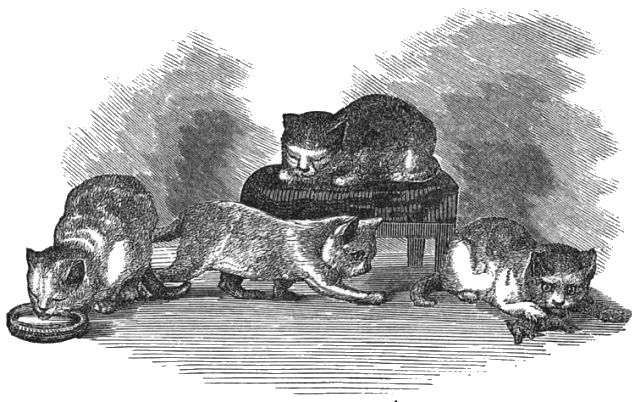
Kittens, now I’ll find names for you,
Each from the thing it best can do:
Velvet, we’ll call the one there asleep;
Slyboots, the kit who softly doth creep;
Mouser, the pussy who hunting doth seem;
Lickdish, the one with its nose in the cream.
They grew to be cats, each nice little kit.
Velvet, all day on one’s lap would sit;
In the corn-loft, Mouser a-hunting would go,
While Slyboots crept through the barn below;
Lickdish went in the kitchen to dwell:
If he was a plague, ask cook: she’ll tell.
Otto Specker.
Sell not the bear’s skin before you have caught him;
Reckon not your sheep’s wool until you have bought him.
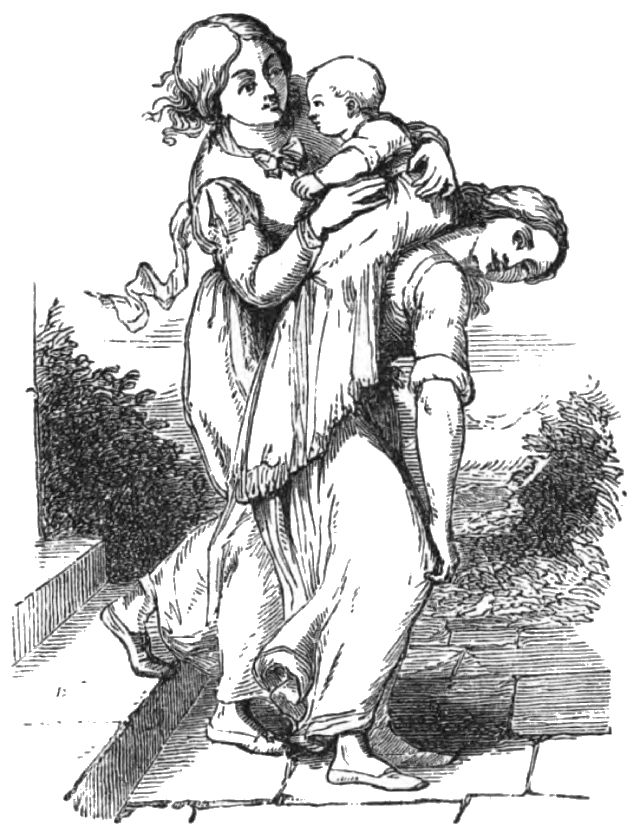
One, two, three!
What do I see?
I see baby boy,
Baby sees me!
Trot, trot, trot!
What have you got?
I’ve got baby boy,
Trot, trot, trot!
Canter, canter, canter!
Canter up the hill!
That’s the way the baby rides,
Going to the mill,
Grind, grind, grind!
Hear the busy wheel!
That’s the way the water works
Grinding up the meal.
l. s. h.
Once, as I was walk′ing through a crowd′ed street in a great ci′ty, I felt some′thing touch my leg. The touch felt like a gen′tle nip, as if a child had nipped me with fore-fin′ger and thumb.
I turned, but saw no one, and walked on. Soon I felt a-gain the same lit′tle nip on the back of my leg. What could it be? I turned, and saw a lit′tle ter′ri-er dog, who ran back, and crouched, and begged par′don so hum′bly, by his look, that I could not help laughing.
He looked as if he were want′ing to say, “Ex-cuse me, high and noble sir: I am nothing but a poor, mean, worthless lit′tle dog. But pray don’t kick me. I nipped you on the leg to let you know I have a use for you. If you would be so good, high and noble sir, as to come with me, I will show you what I call a hard case.”
The lit′tle dog, seeing that I did not kick him, or look an′gry, came near′er, stood up on his hind legs, and put out his fore paws in a coax′ing way, as if to beg me to give heed to him.
“There! good dog!” said I, stoop′ing and pat′ting him on the head. Then I walked on. But I had not gone far when I felt the same lit′tle nip on my leg. I turned, and there was the same lit′tle short-legged dog a′gain, beg′ging me to at-tend to him.
“This means some′thing,” thought I to my′self; and I looked at him keen′ly. He seemed to know what I was think′ing of; for he gave a short, shrill bark, and trot′ted off, then turned to make sure that I fol′lowed him.
See′ing that I did fol′low him, he barked a-gain, then trot′ted off fast′er than be-fore. And so he led me on and on, up this street and down that, till we came to a gate, and un′der this gate he went.
Soon he came back, and barked, as much as to say, “Why don’t you come in? I want you to come in. Do come!” I tried to o′pen the gate, but in vain. The dog a-gain went un′der the gate, and was si′lent.
I was about leav′ing the place, when I heard him yelp′ing far off round the end of the wall. He seemed wild with the wish to have me come.
So on I went, and came to a place where the wall had fal′len down, so that I could squeeze my-self through. This I did, and found my-self in an old yard. My small dog-friend ran on to a shed, where there was an old coach with the wheels gone.
In′to this coach I looked, and what do you think I saw? I saw a poor old dog with five small pups! She was thin and al-most starved, and the pups were al-most starved too.
The lit′tle dog who had nipped me in the street had found out their bad state, and had taken pit′y on them, and led me there to see to them! This is a true sto′ry.
The poor moth′er had been lost by some sports′men. These pups had been born, and she would run out into the streets, and pick up such food as she could find, and then rush back to her lit′tle ones. Was it not a hard case?
I took the poor dog home, and in a week I had her fat and well, with her little ones cud′dling round her.
I did not for-get the lit′tle dog who had nipped me in the street. I took him home, too, and you may see him, if you will come to my house a few miles from town.
I call him Nip′per. He keeps the barn free from rats, and drives off the bad boys who come to steal my fruit. The pups are of a good breed, and I can sell them at a high price, if I do not choose to keep them.
Uncle Charles.
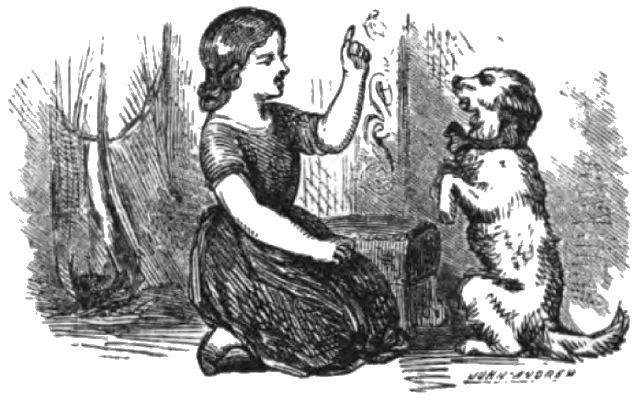
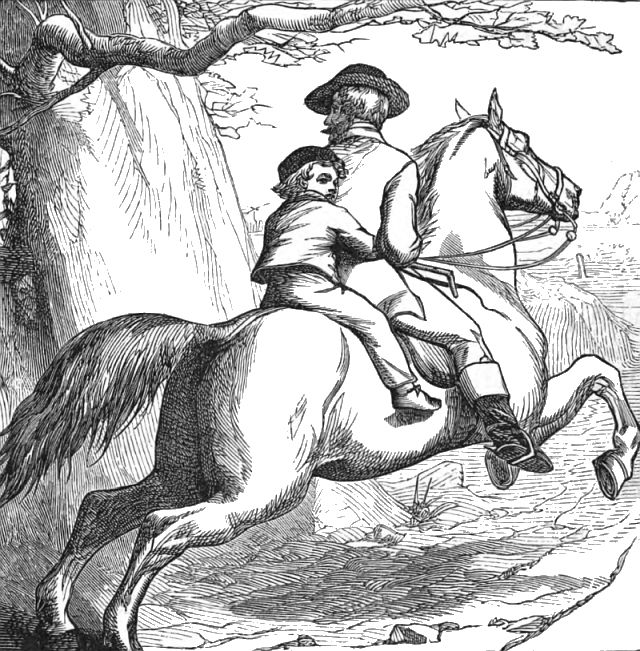
Look at the man and the boy on the back of the great horse! How fast the horse goes! I hope he will not trip. If he should trip and fall, the man and the boy would get hurt.
Why do they ride so fast? You shall hear. The boy was sent a long way with a note, which he was told to leave at a man’s house. He left the note; but, on his way home, the sky grew dark.
“I think it will rain soon,” thought the boy; and, as he thought this, he saw a man on the back of a horse. “Will you let me ride with you?” said the boy.
“Yes, my lad,” said the man; “give me your hand, and jump. It will rain fast soon. Hold on tight to my back, and I will leave you at your house.”
So the boy gave a jump, and got on the back of the horse; and off they went, so fast that the boy got home in good time to shun the rain.
I hope none of my young friends tease; for a tease can never be loved by any one. Willie Gibbs, the boy about whom I shall tell you, was a sad tease. But Willie had an excuse which I hope not many little boys and girls have.
His mamma was not a lady who stayed at home, and cared for her little boy’s mind and manners: she was so fond of balls, parties, gay new dresses, and visiting, that she often left Willie to the care of the girl who worked in her kitchen.
Now, Willie soon found, that, by asking often and long for any thing, this girl would give it to him,—to “stop his noise,” as she called it. Mr. and Mrs. Gibbs did not act more wisely; and so Willie was the pest of all who came in his way.
Willie’s papa sold chairs, sofas, tables, and other like things. Now, Willie used often to go to his papa’s store, where he gave much trouble to the clerks, whom he would tease for things he ought not to have.
One day, when he was at the store, he wished to be placed on a bureau, so that he might look in the glass that was fixed on the top; but the clerk told him he must not be placed there, for he might break the glass.
Willie cried and screamed, and, I am sorry to say, was very rude. By and by the clerk was called to another part of the store; and, while he was gone, Willie got a chair, and set it beside the bureau, and so climbed up to the glass.
But, while this bad boy was in the chair, he slipped, and struck his head on the glass as he fell, breaking the glass, and cutting his head so that the blood ran down his neck. His papa then said that Willie should not come to the store any more; but Willie, as soon as he got well of his cuts, teased so much to go again to the store that his papa said he might.
For a time Willie did no harm to the things there; but he had not left off his bad habit. He would beg his papa for money to buy cakes or candy or apples. Often, when Mr. Gibbs was selling things to people, Willie would come and say, “Papa, papa, I want five cents for James to get me some cakes at the baker’s. Papa, papa, I want them quick.”
Mr. Gibbs would then send James to the baker’s for the cakes; but, no sooner would Willie eat them, than he would begin to cry for candy. Once he teased for his papa’s knife; and, though Mr. Gibbs knew it was not a fit play-thing for his little boy, he at last gave it to him. While all were busy at work, Willie cut a nice hair-cloth sofa so that it was spoiled.
One day Willie went out of town to a farm-house to spend the day in play with Charles Howe. Now, Charles, when his mamma said he must not have a thing, or must not do a thing, did not ask again; so, when Willie wanted to go to the barn to see the men thresh grain with a machine, Charles said, “Mamma told us both not to go there as we may get hurt.”
The boys soon went out to play, and Willie then ran away to the barn. But he went too near where the men were at work, and, in a short time, got his hand caught in the machine. There it was jammed so badly that the doctor said that Willie must have his hand cut off; and, sad to say, this was done.
Willie is now a man; but he must always regret the loss of his hand. He must regret it all the more because the loss came to him through his own bad habit of not doing as he was bid.
Aunt Juliette.
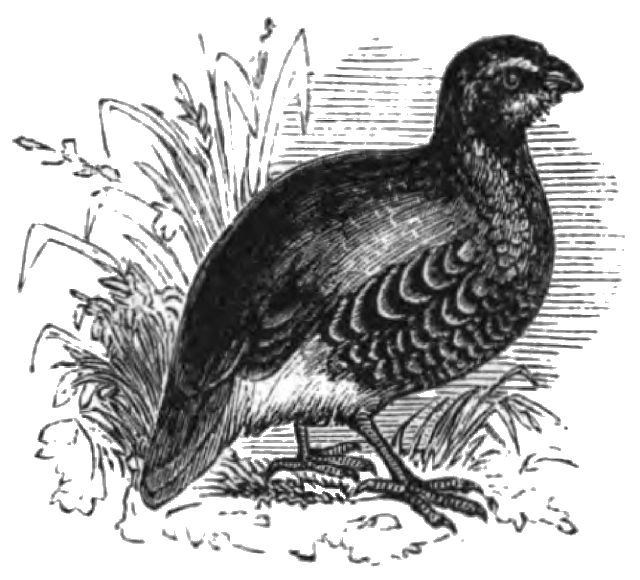
Quail! quail! the hunter is near:
If you whistle so loud, he surely will hear.
With his gun in his hand he roams through the field
To see what the bushes and hedges may yield.
Quail! quail! Look out for your nest
And the three little quails who there are at rest:
If you should be shot, what would they all do?
Fly quickly, I beg. What I tell you is true.
e. c.
Coal is found deep in the earth. It is there that we may dig it out, and make fires of it. We can get light as well as heat from it; for the gas which we burn to give us light in the house or in the street is got from the coal that men dig out of the ground. Of how much use to us is coal! Is not God good to give us coal? We ought to thank him with all our hearts for all the good things He gives us.
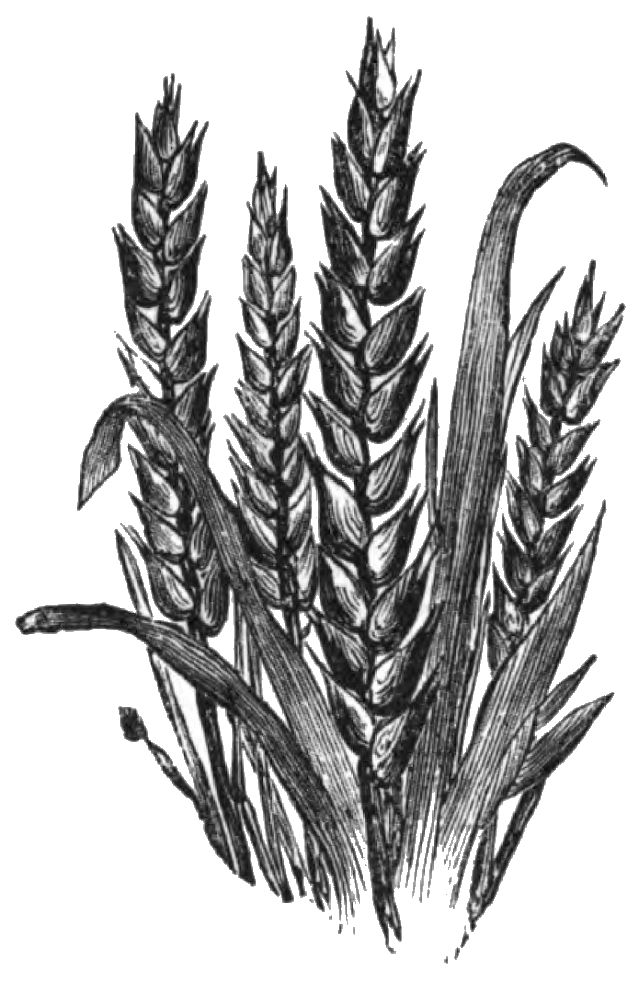
Did you ever see the plant out of which your bread is made? Here it is. It is called wheat. Did you ever see a field of wheat? You must ask to see one, if you go out to walk where it grows.
Wheat is one of the most useful of plants. It may be raised on all sorts of soils, but likes best those soils in which there is some clay.
Wheat sown in the spring is called spring wheat; but the kind is quite the same as that sown before winter, and known as winter wheat.
When the grains of wheat are well threshed from the chaff and straw, they are sent to the mill, and ground into the flour of which our bread is made.
Think how much must be done before you get the bread which you see day by day on the table.
The earth must be ploughed, the seed must be sown; and then all would be in vain if the good God did not send his sunshine and his rain, that the wheat might grow and get ripe.
And then, when it is ripe, men have to cut it down, and thresh it, and send it to the mill, where it is ground and sifted, and then put into bags or barrels, and then sent to the stores, where it is bought and sent home for your use.
All this, and more, has to be done before my little readers are fed with their daily bread. Learn to think of these things.
Aunt Fanny.
One day my dear little nieces came to me and said, “O Aunt! we have such a nice story to tell you about our little bantam hen; and can’t you write it out for us?”
So they began to tell it, first one, then the other, each waiting patiently for the other to repeat what she happened to remember.
Now you must know that these little girls, who are called Lalla and Janna (but whose real names are Sarah and Joanna), live in a most beautiful home in New York. Their father and mother are so very kind, that they allow them to have many pets, such as kittens and a little dog.
Once a poor woman, whose children their good mother had helped to feed and clothe, brought them a little bantam chicken to have for their own. You can guess how happy they were, when they were told they might keep this chicken. They named her Pinkey.
She was very tame, and wise for a chicken. At meal-times, when Lalla and Janna were at the table with their father and mother, Pinkey would come to the long window, which opened on a piazza, and tap on the glass with her beak, as if she would say, “Let me in. I want my breakfast and dinner too.”
So they would open the window, and in Pinkey would hop. Then they would put a plate of nice meat and potatoes on the floor, and she would eat them all up. Then they would give her some water to drink, and a very good meal she would make. Wasn’t Pinkey a petted chicken?
But this is not all. They let her go up into their nursery, and lie down in the crib which these little girls used to sleep in when they were very small. They are now six and eight years old, and quite large.
When Pinkey grew older she wanted to lay her eggs in this crib, and did so two or three times. Once she hatched out a little chicken, which grew up, and used to follow Pinkey about wherever she went.
Sometimes Pinkey would go in among some bushes in the garden, and there make her nest for eggs. Then this little chick of hers would walk round in the path outside (to keep watch, I suppose) till she came out again, and they would march off together.
But now comes the funniest part of the story. One day, because the little girls would not let Pinkey lay her eggs on their bed, which she wished to do, what do you think she did?
Why, she seemed very much put out about it, and went out of doors, flew up on the branch of a tree, and let an egg fall down on the ground. Of course, it was all broken and spoiled.
Now, do you think Pinkey did this out of spite, because she could not have her own way? I have heard of some little folks showing such temper; but I never heard of a little hen acting so badly before,—did you?
On the whole, we will think that Pinkey did not know any better, though she was such a bright little bantam.
This is all a true story.
h. l. n.

Kneel, my child, the sun has set;
And with dew the flowers are wet.
Birds and lambs have gone to rest:
Now for children sleep is best.
Kneel, and think of Him whose might
Gives us day and gives us night;
Old and young, to Him we owe
All of truth and good we know.
Kneel, and feel that He is near,
He your little prayer will hear;
Pray that He our souls will keep,
When we wake and when we sleep.
Edith Renshaw.
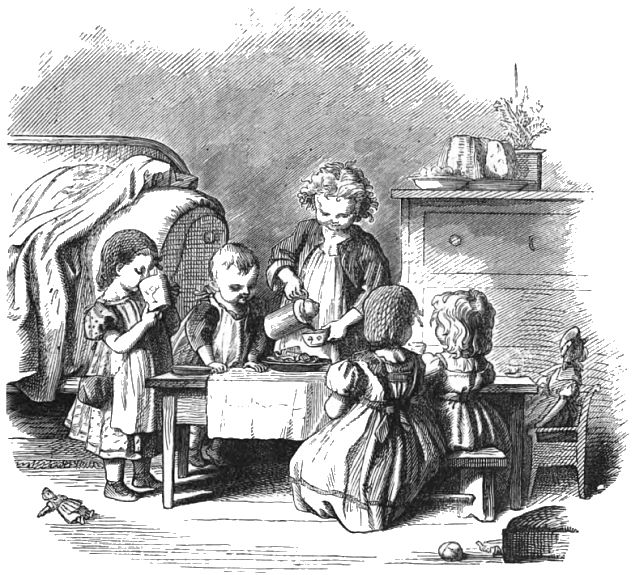
Don’t you wish you could have been at Ruth Green’s tea-party? It took place the last week in September. The day was fair and warm.
Jane Lee came with her fine lady-doll, which she placed in a little chair by her side. This doll was so grand that she wore her bonnet at the table, though none of the rest of the party wore bonnets.
Mary Sumner sat on a little bench with Jane. Julia and little Anna stood up at the other side of the table, and Ruth poured out the tea. They called it tea, but I think it was milk and water.
A little cup was placed for the lady-doll; but she acted as if she were too proud to drink like common folks. A poor little doll, who had no fine bonnet to wear, was left by Anna to lie on the floor.
These children had for their food some nice grapes, also baked sweet apples, and bread and butter. After they had had their tea, they went out on the lawn to play.
A good time they had. They played puss-in-the-corner. The corners were four trees in a square. Ruth was the first “puss;” and she caught Mary Sumner, and then Mary had to be puss.
They kept the game up till Ruth’s mother came out and said it was six o’clock, and the coach was ready to take the company home.
The four little girls went into the house, and put on their things. Then they kissed Ruth and her mother, and bade them good-by. Then John, the man who was to drive the coach, helped them all in, and off he drove in fine style.
These little girls have not yet done talking about the grand tea-party at Ruth Green’s house. They hope to meet again one of these days.
Aunt Fanny.
El′la and Em′ma are twins; that is, they are sis′ters of the same age. They are each of them just four years old, and look so much a-like, that you would hardly know one from the oth′er. They have a moth′er and a fa′ther, who love them dearly.
One day, when their fa′ther did not come home, their moth′er told them he had gone to Cal-i-for′ni-a.
The lit′tle girls did not know that California was a great way off. Oh, no, they were too young for that; but they missed their dear, kind fa′ther so much, that they could not help cry′ing.
Their moth′er could not find time to play with them as their fa′ther had done. She had to take care of their lit′tle ba′by broth′er; and this kept her busy all the day long; so the lit′tle girls were left to a-muse them-selves.
One day, El′la said, “I guess it is time for pa-pa to come home and play hide with us.”
“Oh, no,” re-plied Em′ma: “mam-ma says, he can-not come now.”
“Oh, dear!” said El′la, “what shall we do? We need pa-pa to play with us. He makes us laugh so much, when he plays horse, and rides us on his shoul′der.”
“I’ll tell you what we will do,” said Em′ma: “we will go to Cal-i-for′ni-a and find him.”
“So we will!” said Ella, jumping up, and clap′ping her lit′tle hands for joy. “Come, let us go quick!”
“Stop, stop,” said wise lit′tle Em′ma: “we must wear some-thing on our heads.”
“What can we wear?” ask-ed El′la: “our hats are on the high shelf.”
“I’ll fix it,” said Em′ma; “here is Bridg′et’s yel′low hood which you can wear. I will take this old sun-shade. Now we are all read′y.”
In a few min′utes they were out in the street; for Bridg′et had been so careless as to leave the front door open. They took hold of hands, and trot′ted a-long as fast as their lit′tle feet could go. Pret′ty soon they reached the Com′mon.
As they had not liv-ed long in the cit′y, they had nev′er seen the Com′mon be-fore. They were quite de-light′ed with the beau′ti-ful trees, and the bright green grass. When they came in sight of the pond, Em′ma cried out, “O El′la, we have found it now! I guess this is Cal-i-for′ni-a. Mamma said pa-pa was go′ing a-cross the big wa′ter. Yes, this is it! I know it is. Now we shall see pa-pa.”
They ran so fast down the hill to reach the pond, that, when they got there, poor El′la fell headlong in-to the wa′ter. Em′ma screamed; and their fa′ther’s great dog, Pon′to, who had followed them out with-out their knowing it, came rush′ing down the hill, wag′ging his tail, and barking with all his might, “Bow, wow, wow! Bow, wow, wow!” as much as to say, “What’s the mat′ter now?”
As soon as he saw El′la in so much dan′ger, he jumped in-to the wa′ter, took hold of her dress with his strong teeth, pull-ed her up on the land, and laid her by Em′ma’s side.
A po-lice′man, who saw the lit′tle girl fall, came up, and took her in his arms. When he learnt that the chil′dren were on their way to Cal-i-for′ni-a, he laughed, and told them that California was too far off for them to walk there.
They could not tell him where they lived; so, when he found that the dog was theirs, he turned to Pon′to, and said, “Home, sir! home!” and off Pon′to ran, as if he well knew what the man meant.
By and by the good dog stopped at the door of a house and scratched and barked. So the man rang the door-bell, and Bridg′et came; and, when she saw El′la all wet, she cried out, “Why, what’s the matter?”
The moth′er of the twins came, and, learning what had hap′pened, thanked the man, and took the chil′dren up stairs, and changed their dress′es. They gave their word that they would not a-gain stray a-way from home with-out leave.
You will be glad to learn that their fa′ther is now at home, and that they have grand times with him. They some-times go on the Com′mon, and Pon′to goes with them.
Acorn.
Two young blue-birds flew out of their pretty nest one summer morning, to see what they could find in the garden. After they had played a little while, one of them followed a bright green fly, which he thought looked as if it would be good to eat.
The fly flew to the summer-house, and the bird flew after him. The fly was tired, and lit on a post to rest. The post was square and hollow, and the beams of the roof of the summer-house lay upon the top of it.
Near the top there was a hole, about large enough for you to put your little hand through; and the fly was sitting on the edge of the hole. When he saw the blue-bird coming to eat him, he flew into the hole, and the blue-bird darted in after him.
The blue-bird did not know how hard it would be for him to get out. He found himself in a dark, close place. His bright blue wings touched both sides of his prison. There was no room to fly. He sank down to the bottom of the post.
The other blue-bird, his little brother, who had always lain close beside him in their soft nest, had flown after him in his chase, because he did not like to lose sight of him for a moment. He heard his brother beating his wings against the inside of the post; he heard his cry of fear and distress, and he went into the dark hole too.
But this second little blue-bird could not help his brother: he only fell down in the lonely dark place, and lay by the other’s side on the cold, hard floor. They could not fly straight up to the little spot of light far away at the top of the post. There was no room for them to spread their wings. Their mother looked for them among the trees and bushes, but could not find them. But a little girl, whose name was Mary, and who had been picking violets on the bank near the summer-house, had seen the birds fly into the hole, and now heard their sad cry for help.
“How can I help them?” thought Mary. She looked at the bottom of the post; and she thought that if she should take a hoe that lay near by on the grass, and dig away the earth from the post, she could make a hole in it through which the birds might fly.
So Mary worked and worked; and by and by she found a weak place in the wood of the post, and here she made a hole. “Now, little birds,” said she, “you must not be in such a hurry as not to stop and thank me.”
So first she took out one little bird, and kissed it, and let it go. Then she took out the other, and kissed that too, and then let it go. They lighted on a rose-bush near by; and their mother came; and they were all so glad that they sang a sweet song, which Mary thinks meant, “Thank you, thank you, little girl.”
Mary sat down in the shade with her doll, and rested. She was happy in the thought that she had saved two little birds from a sad fate.
Nahant.
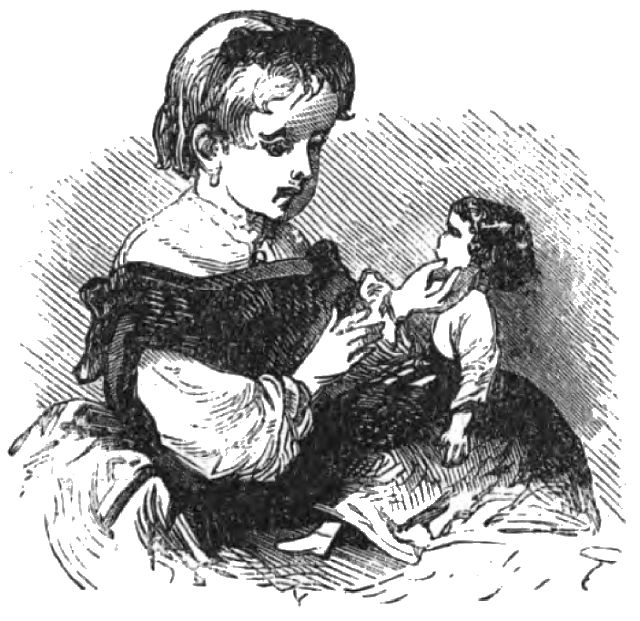
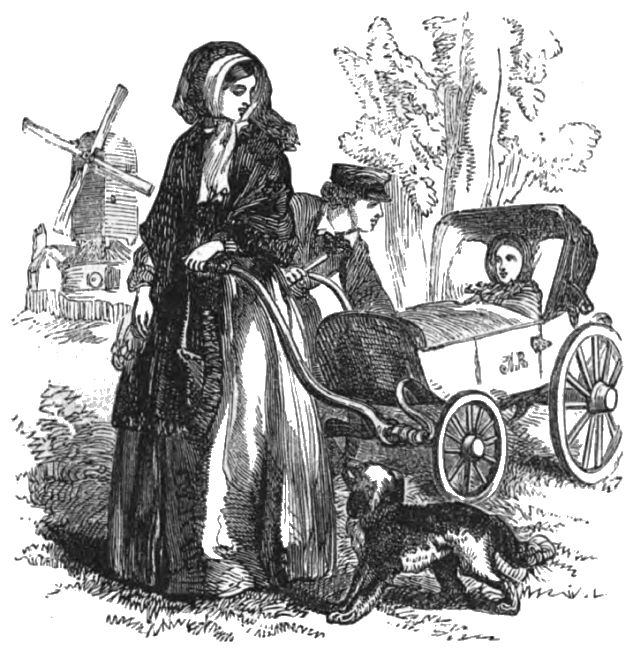
Jane has been ill for some weeks; but she is now so well that she can be taken out in her little carriage.
Her mother drags the carriage; and her brother John walks by the side of it, and tries to amuse and cheer his sister. That nice little dog who goes with them is named Tim.
I will tell you how Jane was made ill. She went with wet feet. Her mother had told her to change her shoes at once when they were wet. But Jane forgot to do this.
So she took a bad cold, and had to stay in the house three weeks. She is glad now to see the green fields once more, and to hear the birds sing. She knows now how good a thing it is to be in health, and she will take care not to get her feet wet when she can help it.
Keep your feet dry. Do not sit down on the damp grass. Do not sit or stand in a draught when you are heated. Shun it at all times. Children are often made ill from not minding these rules.
Aunt Fanny.
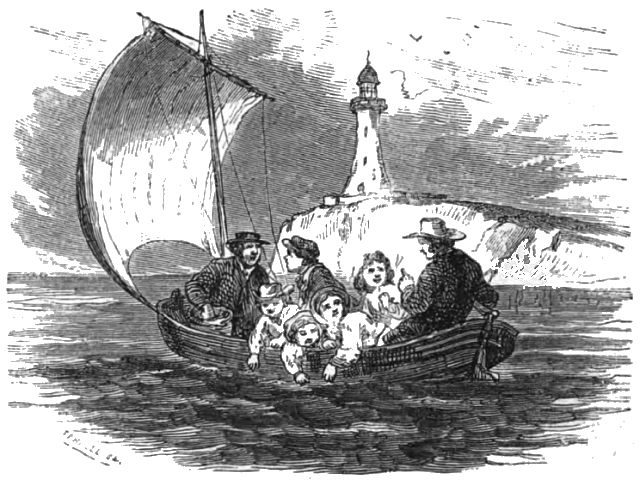
There were five of us, besides father and Uncle James. It was a nice mild day. The sun shone, and the sea was smooth and clear.
We went on board the sail-boat at ten o’clock in the fore-noon. There was a light breeze, just enough to fill our sail.
Father sat at the helm, and Uncle James took care of the sail. We sailed as far as the light-house. Here we went on shore, and had a good time.
We ran along the beach. We shouted to the sea-birds. We picked up shells and white stones; and we got some small stones, and made them skim over the water.
Then we went up to the top of the light-house, and saw the lamps which the man lights at night so that ships may not come too near the rocks. The man kept the lamps so bright that you could see your face in them.
After we had seen enough of the light-house, and had eaten our dinner on the rocks, we went on board the boat and sailed home. The wind kept fair, and we got home safely before five o’clock.
Henry.
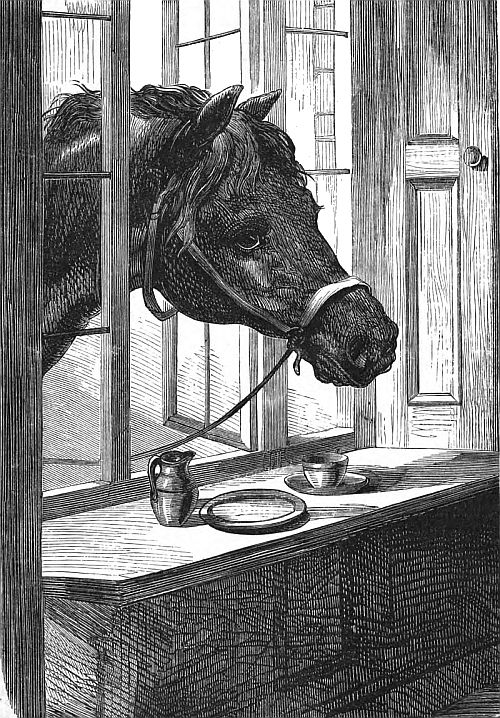
“I WANT A LUMP OF SUGAR.”
Did you ever see a horse eat sugar? If not, let me tell you about our old horse Easy. We called him by that name because his trot was an easy one. He knew more than any horse I ever met with.
Once, when I was quite a small boy,—so small that I could hardly lift my hand up as high as Easy’s mouth,—my aunt gave me three big lumps of sugar, and I gave one of them to old Easy.
He had to put his head down to get it, as I held it up in both hands to his mouth. First he smelt of it, so as to be sure that I was not giving him something he did not like; and then he took it up with his lips with great care, so as not to hurt my hands with his teeth.
I laughed loud as Easy took the sugar and ate it. He was loose in the field at the time. As soon as he had eaten the sugar, he made an eager noise, such as we call a whinny; as much as to say, “Oh, that was the nicest thing I ever did taste! Do give me some more, Charley! do give me some more!”
He put his nose down to my hands, and then smelt all over my face: and, when I ran away from him, he ran after me, making that same eager noise; which meant plainly, “Do give me some more! do give me some more!”
So I have known little boys and girls, after you have given them a stick of candy or some peppermints, cry for more. So I have known a baby, not four months old, to whom I gave not long since a nice, sweet bit of pear, cry out loud for more.
I crept under the fence, and so got rid of Easy. Then I ran to my aunt; and she gave me two more lumps of sugar, both of which I gave to the old horse. He made the same funny noise, to tell me how glad he would be to have a little more. “No, Easy,” said I: “I cannot give you any more to-day.” So he went back to his grass.
But Easy did not forget the sugar. Always after that, when he saw me in the field, he would run to me, and beg for sugar. If I went into the stable when he was in his stall, he would cry out, not in words, but with a noise that meant, “Do give me a lump of sugar!”
Once, when the sugar-bowl stood on the board at the window of our dining-room, my aunt let me take a lump, and call to Easy, and give it to him. After that, Easy would come and put his head in at the open window whenever he could get a chance.
The sight of the sugar-bowl would excite him so, that he would not leave the window till we had fed him. His look seemed to say, “I want a lump of sugar!” He was fonder of sugar than any little child.
Once he did a bad thing. When no one was in the room, he upset the sugar-bowl, and ate up all the sugar. But I do not think, wise as he was, he knew that this was wrong.
I must now tell you of a good thing he did, and then we will bid good-by to old Easy.
Near our house there lived a poor woman, who had a baby-boy named Nic. This boy, though not two years old, was all the time in some sort of scrape.
Once he toddled away from home; crept under the fence into our field; sought out the horse-pond, and there tried to seize a frog which sat on a stone in the pond.
But the frog was too far off for Master Nic to reach him. Nic did not mind that. Into the pond he went, deeper and deeper, till the mud made him slip, and down he fell with his head under the water.
I think the frog was not sorry to see this. But old Easy, who was chewing grass at the edge of the pond, pricked up his ears at the sight. Perhaps he thought he might find a lump of sugar in the little boy’s hand.
So into the pond he went, and, seizing Nic by the slack of his dress, lifted him out, and dropped him on the grass where it was dry.
Sad to say, this bad little boy had no sooner got on his feet, and rubbed the mud from his eyes, than he picked up a stone and threw it at the good old horse who had just saved his life.
Nic’s mother, who had seen it all, ran and caught Nic, and led him into the house. Whether she took down the rod, and whipped him, I cannot say. I only know, that, just about that time, there was a loud noise of a child crying in that house.
Uncle Charles.
A graceful child my pathway crossed,
As late I trod the busy street;
And lightly o’er her head she tossed
A rope which swiftly passed her feet.
I in her pleasure took a part;
And, when she paused, I said to her,
“How did you learn this pretty art?”
She answered, “I kept trying, sir.”
B. R.
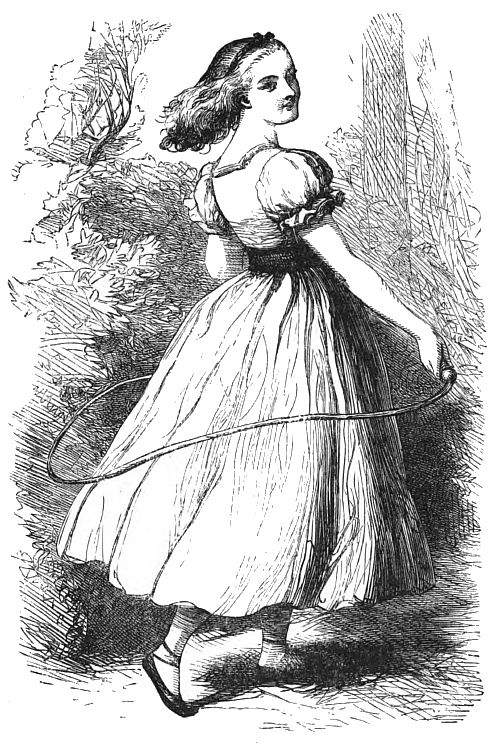
See Nora with her skipping-rope:
How fast she makes it fly!
She will not jump too much, I hope,
But soon will put it by.
Good things are good while rightly used;
But they will end in harm
If in the use they are abused,
And then they lose their charm.
E. C.
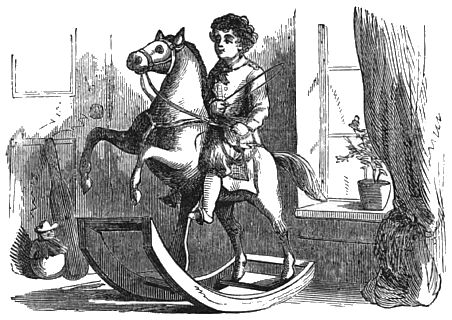
“See my nag, so fine and gay;
See us ride, away, away!
On, sir, on! I have a whip!
Gallop on, and do not slip.
“If to battle I would speed,
Match me, if you can, my steed;
Him no smoke, no noise, can tire:
You should see him under fire.
“Guns may roar, and drums may rattle;
But he shrinks not from the battle:
Fifes may scream, and wagons rumble;
But he does not lag or stumble.
“Now, sir, there’s the foe advancing;
On, sir, on! thus gayly prancing,
On!”—Ah! how our plans miscarry!
Over go both horse and Harry.
Emily Carter.
A gentleman, whose home was in Boston, went in a ship away and away, across two oceans, until he came to the country called India, that you sing about in the Missionary Hymn. It is very warm in India all the time; and there are animals there that could not live out-of-doors here, because it is not warm enough here.
Monkeys live there in great numbers. They are noisy, mis′chiev-ous animals, and get angry very easily. This gentleman told me, that, if he was thirsty when riding in the burning heat, the servants would stone the monkeys and get them angry, and then the monkeys would pelt them in return; but, instead of throwing sticks and stones, they would throw cocoa-nuts.
This was just what the men wanted; for the cocoa-nuts were so high up on tall trees that it was hard work to get them; but, if the men kept out of the way when the nuts fell, the fall would crack the nuts, and then it was easy to open them, and drink the sweet milk from them.
When this gentleman had a home in India, he got a little monkey to tame. He was a pretty little monkey, with a cunning little face. He was not like the monkeys you see in the streets, but another sort of monkey.
At first the little creature would break and spoil things; but, after a time, he could be trusted an hour alone in a room; but, if he was left longer than that, he would do mischief.
One day his master heard a very great noise in his chamber. When he went to see what it was all about, what do you think he saw? A number of wild monkeys had come in by the open doors and windows, and were meddling with every thing they could reach.
The little tame monkey had a stick in his paw, and was driving them out with pretty hard blows. He was making a great noise, scolding them; and they were chattering and screaming from the hurt of the blows, and from anger at being driven away by a monkey.
You may be sure the wild ones scampered when they saw the little one’s master; and the little one ran to him, and grinned and chattered, as if he knew he had been a good little monkey.
He used to sleep at the head of his master’s bed, just outside of the mos-qui′to-netting. Quite often he would wake before his master, and get tired of waiting for him; so he would pull aside the netting, and, putting two little paws in his master’s hair, pull it with all his might.
Now, as he was strong in his paws, he thought it was fine fun; but his master did not think so. Should you like to be woke up in the morning in that way?
His master used to go away quite often, and leave the little monkey at home. Then the little monkey would go into the forest, and be a little wild monkey again; but no matter: when his master came back, there would be the little thing to meet him.
This monkey would jump into his master’s arms, and put his paws around his neck, and grin and chatter, and then spring away to a table, and turn heels over head, and sit and grin at his master, and then spring back again into his arms.
When the gentleman came back to Boston, he left this little monkey in India. Perhaps he is living there now.
l. o.
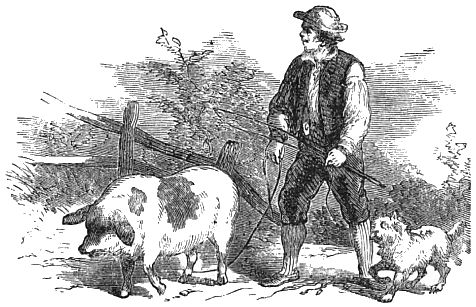
See that nice fat pig! The name of the man is Pat, and the name of the dog is Bob. Pat will drive the pig to town, and there he will sell him. As the pig is fat, I think he will bring a good price.
Pat keeps ten pigs, and he has a large clean place for them. He does not like to make his pigs live in the mud and the mire. Pigs thrive best when they can have pure air and a clean pen.
In the fall of the year, Pat lets his pigs run in the fields and woods, and eat nuts and roots. The pigs do not fear the snakes. A pig will kill a snake. If you want to get rid of snakes, let the pigs have a chance to catch them.
A good man will be good to beast and fowl. He will be good to his pig and his horse, to his cow and his ox, to his sheep and his dog, his goat and his cat. He will be good, too, to his hens and his geese, and to the small birds that come near his house.
I hope that the boys and girls who read this book will be good to all things that live. I hope they will not hurt a fly if they can help it. The child who is not kind to beasts and birds will not grow up to be kind and just to men.
I have five little boys and six little girls in my house; for I keep a school. Their ages vary from three to nine years. They are good children, and fond of games out of doors.
One of these days I will tell you of these games. One of them is a very old and simple game. I think you must have heard of it. The children all take hands, and dance round in a ring, singing,—
“Here we go round the barberry-bush,
The barberry-bush, the barberry-bush;
Here we go round the barberry-bush,
So early in the morning!”
Then the children all stop, and make a motion as if they were washing clothes, singing all the time,—
“This is the way we wash our clothes,
Wash our clothes, wash our clothes;
This is the way we wash our clothes,
So early in the morning!”
Then the children all join hands again, and sing,—
“Here we go round the barberry-bush,” &c.,
as they sang at first. Again they stop, and this time they make motions of wringing out linen. While doing this, they sing,—
“This is the way we wring our clothes,
Wring our clothes, wring our clothes;
This is the way we wring our clothes,
So early in the morning!”
Again, hand in hand, the children dance round, singing the lines they sang at the beginning of their play. As soon as these are ended, they stop, and go through the motion of starching clothes, singing the while,—
“This is the way we starch our clothes,
Starch our clothes, starch our clothes;
This is the way we starch our clothes,
So early in the morning!”
Taking hands again, they now sing for the fourth time the lines we quoted first. Then the children go through the motion of ironing clothes, and sing,—
“This is the way we iron our clothes,
Iron our clothes, iron our clothes;
This is the way we iron our clothes,
So early in the morning!”
For the fifth time, they sing the lines,—
“Here we go round the barberry-bush,” &c.
Then, having imitated in their play all the motions of washing, wringing, starching, and ironing, they end the game by breaking loose from one another, and skipping or hopping by themselves, or dancing two by two, and singing,—
“Thus we play when our work is done,
Work is done, work is done;
Thus we play when our work is done,
So early in the morning!”
When well played and sung, this game, simple as it may seem, is a very pleasing one both to the players and the lookers-on.
As the evenings grow longer, I let the children sit up till the lamps are lighted. Sometimes Uncle Henry comes in and plays with them. Uncle Henry is my brother. He plays blind-man’s buff with them, and makes shadows on the wall for them with his hands.
He makes them laugh a good deal by the odd things he shows them. Last night he fixed his hands so as to cast a shadow like that of a face. Then he imitated the shadow of a rabbit. I give you here a picture of what he did.
Aunt Fanny.
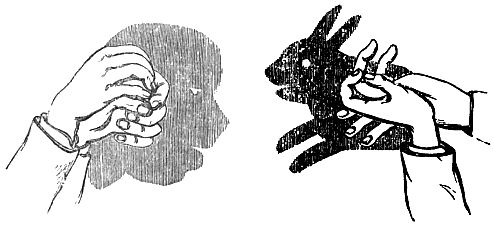
A friend of mine lived near the sea, and there was a nice path from her house to the sand on the shore. She had a large white cat, who liked to walk up and down this path where she could be seen, and praised for her fine looks.
Now, this cat would go for her walk all by herself: she would not let a cat come and walk with her. She did not spit and mew; but she would turn her head, and look so proud, that not a cat would dare to mew, as if to say, “Let me come and take a walk with you.”
But the oth′er cats would walk a long way off, and look at the great white cat, as much as to say, “You are a fine white cat. I wish I had such fur, then I could give my-self such grand airs as you do.”
One day, when my friend sat on a seat near the path, she saw her white cat come from the house for a walk, and move along with so slow and grand a pace, that it would have made you laugh.
Some way off came more cats,—a gray cat, and a black cat, and a brown cat, and a white-and-black cat,—more cats than I can tell you of. But they did not come near the great white cat; or, if they did come too near, she had but to turn her head to make them keep their place far off.
So they walked and walked; and if the white cat stood still, then the rest of the cats stood still too; and when the white cat walked on, then the rest of the cats walked on too. And so they went and went, till they came quite near to where my friend sat, so that she could see them well.
Now, the white cat walked on, grand and slow; and the brown cat, and the gray cat, and the black cat, and the rest of the cats, walked far off, as best they could.
But the black cat did not like to walk so far off, so it thought it would go on quick; but, when the white cat heard its step, she turned her head, and looked, as much as to say, “Keep off, keep off! you must not come here. I will not walk with common cats like you.”
And, as the black cat did not seem to know what to do, the gray cat put out its paw, and took the black cat by the tail, and gave it a great pull back, and mewed as if it would like to say, “You bad cat, to go so near! Keep back, or I will pull you once more.”
And, as the black cat did not like to be pulled in that way, it took care not to go near the proud white cat a second time.
“How I should like to have seen that proud cat take its walk! It must have been fine fun to see it, and to see all the other cats walk near, but not so near as to hurt the pride of the white cat. It must have looked odd.”
“Yes: my friend told me it did look quite odd, and made her laugh; and, if she had not seen the gray cat pull back the black one, she could not have thought it would have done so.”
Trottie’s Aunt.
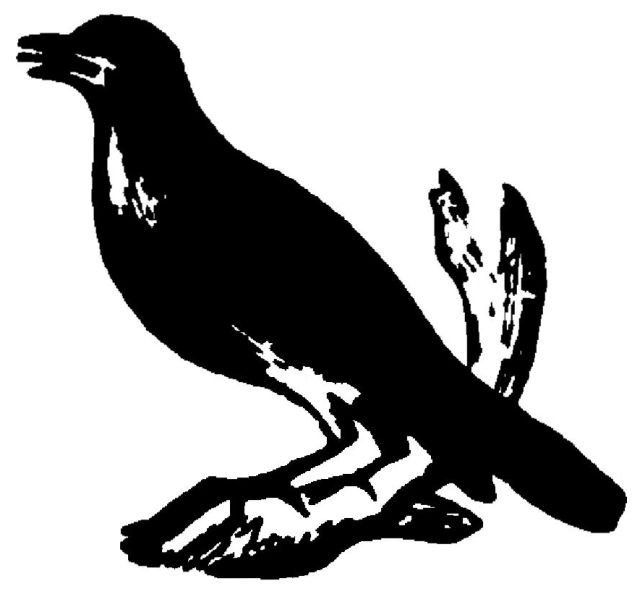
What sweet voice was that I heard?
“Whit, whit, whirrup wee!”
’Tis the summer yellow-bird
On the linden-tree.
Hark, and hear him! that is he:
“Whit, whit, whirrup wee!”
In and out his way he weaves;
Resting now, and now he sings:
Now, half-hidden ’mid the leaves,
Smooths his glossy wings.
Hark, and hear him! that is he;
“Whit, whit, whirrup wee!”
Mrs. A. M. Wells.
When some one told Plato that a man had been speaking ill of him, Plato said, “What more need I do, than live in such a way that no one will believe the man who speaks ill of me?”
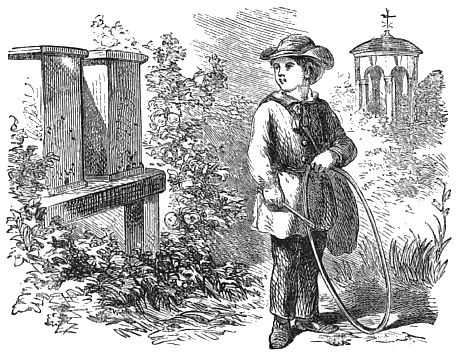
The honey-bee is hard at work;
Children, come and see!
The pretty brown and yellow bee,
In the clover worketh he,
Oh, how merrily!
The honey-bee he works all day;
Children, come and see!
In the flower-beds all the day,
His cell with wax to overlay,
Working busily.
The honey-bee is going home;
Children, come and see!
The honey-bee is going home,
With honey for the honey-comb,
Flying heavily.
The wasp is hiding in the peach;
Children, come and see!
All day long he has his will,
All day long he sucks his fill,
In the old fruit-tree.
Ah! poor wasp, he has no hive;
Children, come and see!
He, the idler, while he feeds,
Does not think of future needs,
Like the honey-bee.
Summer will not always last;
Children, come and see!
When the summer-days are past,
These poor wasps, all dying fast,
Cold and poor will be!
But just look within the hive;
Children, come and see!
There the bees are all alive;
They on golden honey thrive.
Industry for me!
h. b.
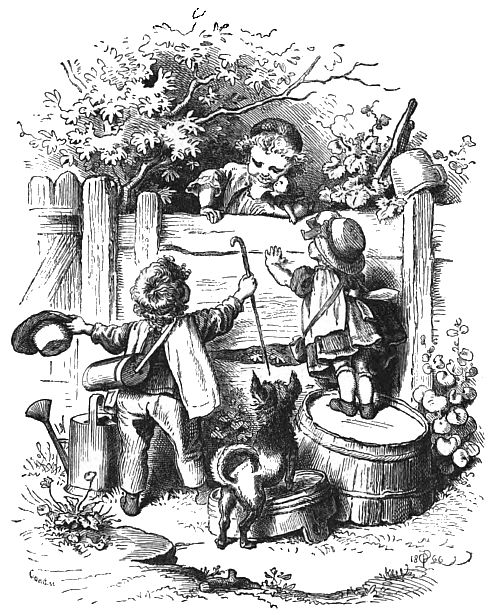
MARY SPEAKS TO PAUL AND JANE.
Good folks, how do you all do? How are the hens? Do they lay eggs now, or are they shed′ding their feath′ers? Have they lost any of their chick′ens late′ly? Those bad rats!
Is your dog, Growl, quite well? And Mrs. Muff, the cat, how is she? Mid′dling well, I trust,—she and her charm′ing kit′tens. My re-gards to them all. None of them are drowned yet, I hope. I don’t see them about.
Come and see me soon. If you will come, I will show you the ducks and the new calf. Do not put your-self out to get an ap′ple for me. Thank you, I am not hun′gry. Do not urge me to take any nuts. In try′ing to crack them, I might jam my fin′gers.
So you mean to be a soldier, do you? That thing round your neck is a knap′sack, is it? Don’t hurt any body with that stick, will you? Or is it a sword you have in your hand? Ex-cuse my bad eye-sight.
Who says your dog isn’t a beauty? And what a sweet voice he has! Bark on, sir! That means, good morn′ing, I sup-pose.
Did you ask after the health of my little Bella? I have her in my arms, you see. She is nicely, I thank you. She was out on the wet grass all night, but she did not take cold.
PAUL REPLIES TO MARY.
I nev′er heard a girl talk so fast as you do, Mary Burns. You put so many ques′tions that I for-get half of them. If you will come in and play with us, you shall have some ap′ples and nuts, and I will show you my new book.
MARY SPEAKS TO PAUL.
Open the gate, then. I will come. Tell Growl he must be civ′il, and stop bark′ing. Tell the cat I would like to see her kit′tens. If the pigs have not been fed, let me see them too. We will have a good time in the barn. Shall I bring Bella too?
PAUL TO MARY.
Yes, bring as many dolls as you please. But you must let Jane hold her. Now I will open the gate.
o. p.
Said George, if I could have my wish,
I’d take a net, and catch this  .
.
Said Charles, a fish I would not keep:
I’d rather have this fine fat .
.
________
Then Ellen, who was standing near,
Said she would like this pretty  .
.
And I, said Rose, would have enough,
Could I but have this nice gray  .
.
________
Richard, who sometimes was a grumbler,
Said, fill for me this fine glass  ;
;
But Mary turned from looking on it,
And said, give me that lady’s  .
.
________
Next little Jane put in a word:
Her wish was for this singing  .
.
This  , said Tom, will do for me;
And I, said John, will take this  .
.
________
Thus boys and girls kept up their fun
One summer day at set of  ,
,
While gazing with an eager look
Upon the pictures in this  .
.
Uncle Charles.
 Here is a picture of a little schooner which
Arthur’s Uncle James has made for him. It
has sails and masts, and a flag at the head of
the fore-mast. It will sail well before a fair
breeze.
Here is a picture of a little schooner which
Arthur’s Uncle James has made for him. It
has sails and masts, and a flag at the head of
the fore-mast. It will sail well before a fair
breeze.
The bow-sprit is the spar which runs out at the fore part of the schooner. This spar is joined by a rope, called a stay, to the top of the fore-mast. The small sail on that rope is called the jib.
The mast behind the fore-mast is called the main-mast, and its large sail is called the main-sail, and its small sail is called the main-top-sail. You can now guess which is the fore-sail and which is the fore-top-sail.
Arthur is not five years old, and so his moth′er does not let him go alone to the pond to sail his schooner. His uncle goes with him, and they take along with them the good dog Brisk.
What do they want of Brisk? I will tell you. Sometimes the wind dies away, and the schooner is stopped in the middle of the pond; and then Uncle James says to the dog, “Brisk, go and bring that vessel back to us.”
Brisk does not have to be told twice. He jumps into the pond, and swims to the schooner; then takes it in his mouth, and swims back to the shore. As soon as he gets on dry land he shakes himself, and scatters the water about so that Uncle James and Arthur have to get out of his way.
Aunt Fanny.
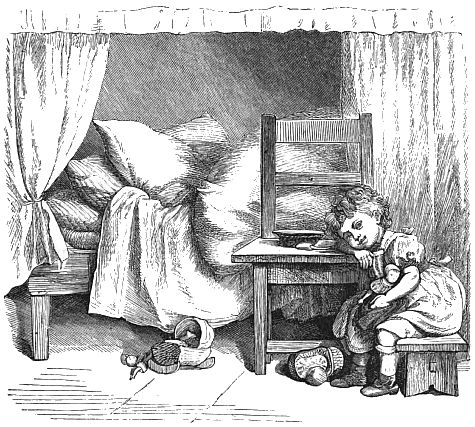
There’s company coming, there’s company coming,
There’s company coming to tea!
So now, little Molly, lay by the big dolly,
And come and get ready with me.
I’ll put on your dress that is braided with blue,
And tie on your shoes that are shining and new,
And curl up your locks like a princess’s hair;
And then you must sit yourself down in a chair,
As calm as a clock and as still as a mouse,
And wait till the company come to the house.
And when they appear, oh! be careful, my dear:
I can’t allow any loud noise while they’re here.
The books on the table be sure not to touch;
And don’t ask me questions: you mustn’t talk much;
And yet don’t be shy, and hide back of my chair,
And only look out with a pout and a stare.
Don’t finger your belt like a vain little miss;
And, if one should happen to ask for a kiss,
Don’t, shrugging your shoulders, behave like a dunce,
But put up your lips, and go kiss him at once.
That’s the suitable way for a maiden of three
To entertain visitors!—chick-a-dee-dee!
So now, little Molly, lay by the big dolly,
And dress for our company tea!
Marian Douglas.
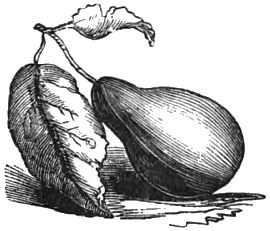 A little boy, as he walked home from
school, saw a ripe pear lying on the
ground in the front yard of a large,
fine house. It was a nice, yel′low
pear. The little boy was hungry.
“How I would like that pear!” thought
he. “I might reach it through the slats of the fence. No
one sees me.” Hardly had the thought come to him than
he called to mind these words, Thou God seest me.
A little boy, as he walked home from
school, saw a ripe pear lying on the
ground in the front yard of a large,
fine house. It was a nice, yel′low
pear. The little boy was hungry.
“How I would like that pear!” thought
he. “I might reach it through the slats of the fence. No
one sees me.” Hardly had the thought come to him than
he called to mind these words, Thou God seest me.
He at once turned his head away from the pear, and walked bravely on. But he had not gone far when a little girl came running after him, and said, “My mother sent me with this pear to give to you, little boy. She saw you through the blind as you looked at it, and sends it to you with her love.”
There was once a farmer of the name of Jones, who had a bad habit of putting off things that needed to be done. In his yard was a little gate which opened into a field. This little gate, for want of a latch, could not be shut close.
When Farmer Jones went through the gate, he took care to pull it after him; but other people would not take such care. The wind, too, would often blow it open again after he had closed it.
And so the hens were always getting out, and the sheep and lambs were always getting in; and it took up a good deal of the childrens’ time to run after the chickens, and drive them back into the yard, and to send the sheep and lambs back into the field.
The farmer’s wife often told him that he ought to get the latch mended; but he used to say that it would cost twenty cents, and was not worth while, and that the children might as well be driving the hens and the sheep in and out of the yard as be doing nothing. So the gate was kept without a latch.
One day a fat pig got out of its sty, and, pushing open the gate, ran into the field, and thence into the woods. The pig was soon missed; and Farmer Jones, who was tying up a horse in the stable, left the horse to run after the pig.
Mrs. Jones, who was ironing some clothes in the kitchen, left her work, and ran after her husband. The daughter, who was stirring some broth over the fire, left the broth, and ran after her mother.
The farmer’s sons and his man Tim all joined in the chase after the pig; and away they all went, men, women, and children, pell-mell, to the woods.
But Tim, making more haste than good speed, sprained his ankle in jumping over a fence; and then the farmer and his sons had to give up the chase of the pig, to carry the man back to the house; and of course Mrs. Jones and the daughter had to go with them to aid in binding up the man’s limb.
When they got back to the house they found that the broth had boiled over, and the dinner was spoiled; and that two shirts, which had been hung to dry near the fire, were scorched and spoiled.
Farmer Jones scolded his wife and the girl for being so careless as not to take away the shirts and the broth from the fire before they left the kitchen: but he himself had been quite as careless; for, on going to the stable, he found that the horse, which he had left loose, had kicked a fine young colt, and had broken the colt’s leg.
Poor Tim was kept in the house two weeks by the hurt on his ankle; and, as it was the haying season just then, the loss to the farmer was great.
Thus Farmer Jones lost two weeks’ work from his man, a fine colt, a fat pig, and his two best shirts, to say nothing of the loss of his dinner,—all for the want of a latch that would have cost twenty cents.
“I should have been much better off,” said he to his wife, “if I had taken your advice, and mended that latch.”
“Yes,” said his wife. “We must not forget the old saying, a stitch in time saves nine.”
“And that other old saying,” said he: “Fast bind, fast find. I shall turn over a new leaf.”
William Godwin.
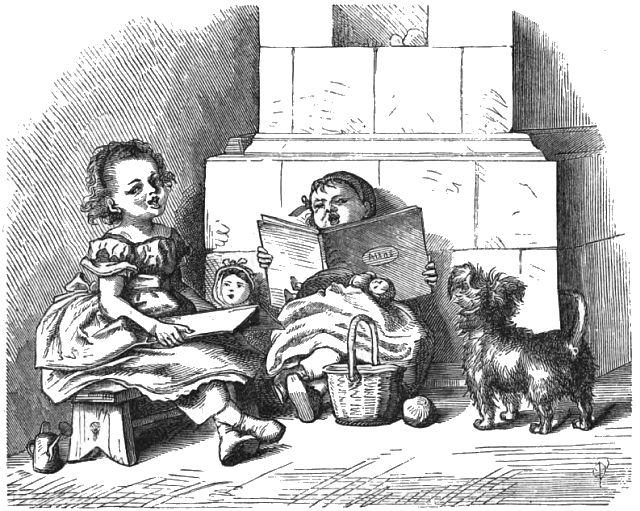
Bertha went with her mother one afternoon to hear Miss Kellogg at the Music Hall. When she got home she could talk of nothing else. She had told Mary all about it before bedtime. That is what put it into their heads the next day to take their dolls to a concert. Bertha said that her doll Ada was about old enough to take lessons, and that it was time for her to hear some good singing. Mary said her Sophy was rather young to go to a concert, but that it was a good thing to bring children up with a taste for music.
So the watering-pot, ball, and other playthings were laid aside, and the grand concert began.
The first piece was the well-known song, “Buy a broom.” Look at the picture. Mary, you see, with Sophy in her lap, is singing with all her might. Is that an atlas that she holds before her? Oh no! of course not. How could you make such a mistake? That is her music-book. You could not expect her to sing such difficult music without her notes. Bertha has her notes too, but does not look at them quite so closely. She sings with great expression. She has heard Miss Kellogg sing.
Ada the doll sits between them as quiet as can be; and Frisk the dog stands looking on and listening, without even wagging his tail.
The next song was “The Lavender Girl,” which was sung by Mary alone. It was so well done that Bertha clapped her hands, and said, “Make believe, Mary, that the audience clapped their hands and stamped for you to sing it over again.” And so Mary sang it a second time.
Then came, “Oh, dear! what can the matter be?” and then “I won’t be a Nun,” in which both voices took part. Bertha alone then sang “The Brave Swiss Boy,” in fine style. Of course there was great applause; and Bertha made a courtsey to the make-believe audience, and sang it again with great effect.
She then announced that Part First of the programme was ended, and that there would now be an intermission of five minutes.
In the second part of the performance the singers pitched their voices in a higher key, and put in some fine flourishes of their own. Frisk could keep quiet no longer. He began to bark furiously, taking part, as Bertha said, in the chorus.
At last, papa opened his library door and said,—
“That will do, my darlings. We have had music enough for to-day. You are getting a little too noisy.”
And so the grand concert came to an end.
Ida Fay.
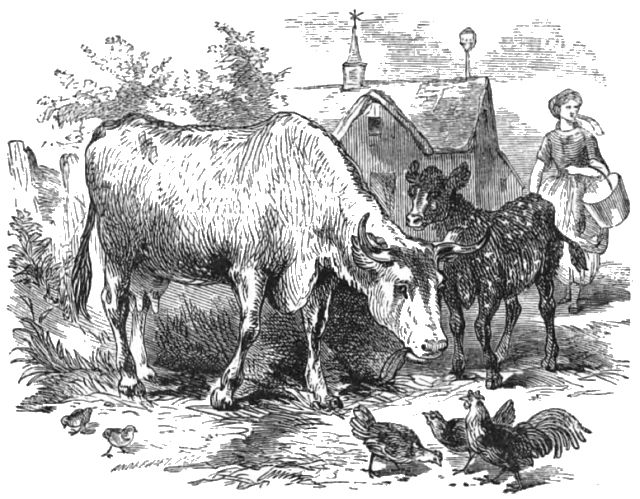
I am a little boy; and I live far a-way at the South, in the pine-woods. If you live at the North, there are many things here that would be new and strange to you. Let me tell you of some of them.
We live on a plant-a′tion. Cot′ton grows here; and the negroes are pick′ing it now, for it is the twen-ti′eth of Sep-tem′ber. The bolls, or pods, burst o′pen, and then the white cot′ton can be picked out.
This cot′ton is put in′to large bas′kets. I can see large black men and wom′en, and I can see lit′tle black boys and girls not much big′ger than I am, all hard at work in the field.
My fa′ther has just brought in a bas′ket full of sweet po-ta′toes. We shall have some of them baked for din′ner. Did you ev′er see sweet po-ta′toes grow′ing? The long vines, with their bright green leaves, quite cov′er the ground.
Not far from the sweet po-ta′to patch, you might see three rows of strange plants, with leaves al-most as large as an um-brel′la. You could not guess what they are. They are tan′yah plants, and their roots are good to eat.
I have my les′sons at home, as there is no school near. My fa′ther teach′es me. Some-times, af′ter I have learnt my les′sons, I play with Dai′sy. Dai′sy is the name of my kit′ten.
Some-times I watch the liz′ards and the bugs, or chase the but′ter-flies. The liz′ards are queer lit′tle an′i-mals. Some of them are striped with bright col′ors, and some have blue tails.
You would start to see them at first, they look so much like snakes; but they will not hurt you. They catch and eat flies and oth′er in′sects.
I ride in the wag′on with Bill, the freed′man, when he goes to the field to get a load of hay or corn. The mule’s name is “Old Slow.” He knows a good deal, and is strong, and can draw a big load; but he is a la′zy old mule.
Some-times I go with fa′ther and moth′er and Car′rie to hunt for wild grapes in the woods. These grapes are called mus′ca-dines. They are quite large, sweet, and good. The trees and bush′es are cov′ered with them, and we get our bas′kets full.
At oth′er times we go to the “old fields” to get per-sim′mons. These, when ripe and soft, fall from the trees. You would like them; for they are sweet as su′gar. The birds like them; and the ’pos′sums like them too.
You would find it good fun to hunt with me, by the side of some ditch or fence, for May-pops. These are good to eat. They grow on vines, and are as large as a hen’s egg. They are full of a sweet, juicy pulp.
The vine bears a pret′ty flow′er called the pas′sion-flower. If you tread on the fruit, it bursts, and makes a noise like a pop-gun.
At night I drive up Hearty, the cow, for Carrie to milk. Hearty has a calf called Spotty. Look at the pict′ure of the two.
Our house has trees near it. There are oak-trees, wild orange-trees, plane-trees, cher′ry-trees, peach-trees, ap′ple-trees, and oth′er kinds of trees; and there are rose-bush′es that bloom all the year; and jas′mines and yuc′cas and myrtles and fig-trees: I cannot tell you all.
The mock′ing-birds sing in the oaks near our house. You should hear how sweetly they sing! Moth′er has two young mock′ing-birds in a cage. They are just learn′ing to sing.
If you wish me to tell you more, I must put it in an-oth′er let′ter. I cannot write well yet; so I get my fa′ther to write this, while I tell him what to put down. Now good-by, and think of me as your lit′tle friend.
Pineview, Ga.
Clarence Howe Jacques.
“I am now going to tell you about a school for birds.”
“A school for birds? How odd! I never heard of such a school.”
“And yet such a school there is, and very good scholars it makes. They cannot read or write, but they can sing.”
“I would like to see birds at school. Tell me of it. Do they not sing without being taught?”
“They sing a few simple notes, like the small linnets you may hear in the fields; but, after they are taught, they will whistle regular tunes.
“Last summer I was at a friend’s house at Nahant. I rose early in the morning, and went down stairs to walk on the piazza. While there I heard, as I thought, some person whistling a tune in a very sweet style.
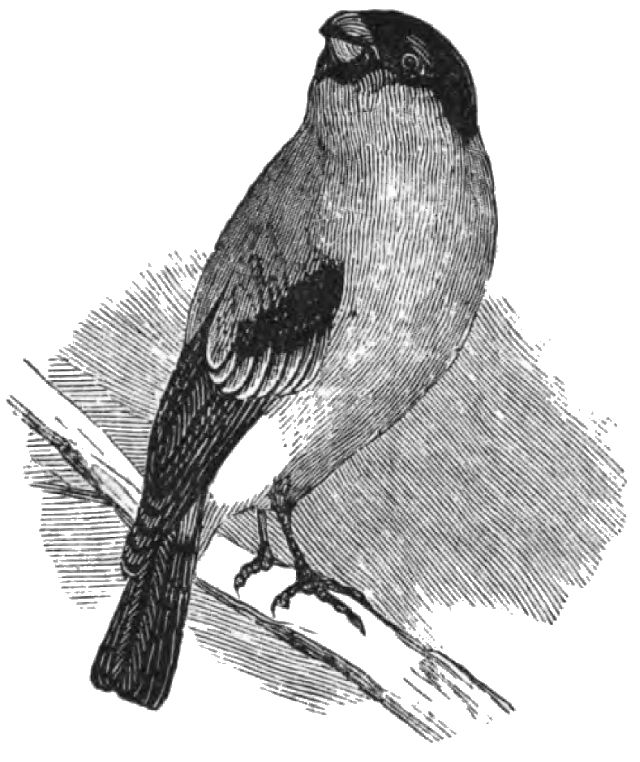
THE PIPING BULFINCH.
“I looked around, but could see no one. Where could the sound come from? I looked up, and saw a little bird in a cage. The cage was hung in the midst of flowers and twining plants.
“Can it be, thought I, that such a little bird as that has been taught to sing a regular tune so sweetly? I did not know what to make of it!
“When my friend came down stairs, she told me that it was indeed the little bird who had whistled the sweet tune.
“Then my friend cried out to the bird, ‘Come, Bully, Bully, sweet little Bully Bulfinch, give us just one more tune.’
“And then this dear little bird hopped about its cage, looked at its mistress, and whistled another sweet tune. It was so strange to hear a bird whistle a regular tune!
“ ‘Now, Bully,’ said my friend, ‘you must give us “Yankee Doodle.” Come, come, you shall have some nice fresh seed if you will whistle “Yankee Doodle.” And the little thing did whistle it, much to my surprise.’ ”
“My friend then told me that she had brought the bird from the little town of Fulda in Germany. In Fulda, there are little schools for teaching these birds to sing.
“When a bulfinch has learnt to sing two or three tunes, he is worth from forty to sixty dollars; for he will bring that price in France or England.
“Great skill and patience are needed to teach these birds. Few teachers can have the time to give to the little children under their charge so much care as these bird-teachers give to their bird-pupils.
“The birds are put in classes of about six each, and kept for a time in a dark room. Here, when their food is given to them, they are made to hear music; so that, when they have eaten their food, or when they want more food, they will sing, and try to imitate the tune they have just heard. This tune they probably connect with the act of feeding.
“As soon as they begin to imitate a few notes, the light is let into the room; and this cheers them still more, and makes them feel as if they would like to sing.
“In some of these schools the birds are not allowed either light or food till they begin to sing. These are the schools where the teachers are most strict.
“After being thus taught in classes, each bulfinch is put under the care of a boy, who plays his organ from morning till night, while the master or mistress of the bird-school goes round to see how the pupils are getting on.
“The bulfinches seem to know at once when they are scolded, and when they are praised by their master or mistress; and they like to be petted when they have done well.
“The training goes on for nine months; and then the birds have got their education, and are sent to England or France, and sometimes to America, to be sold.”
Emily Carter.
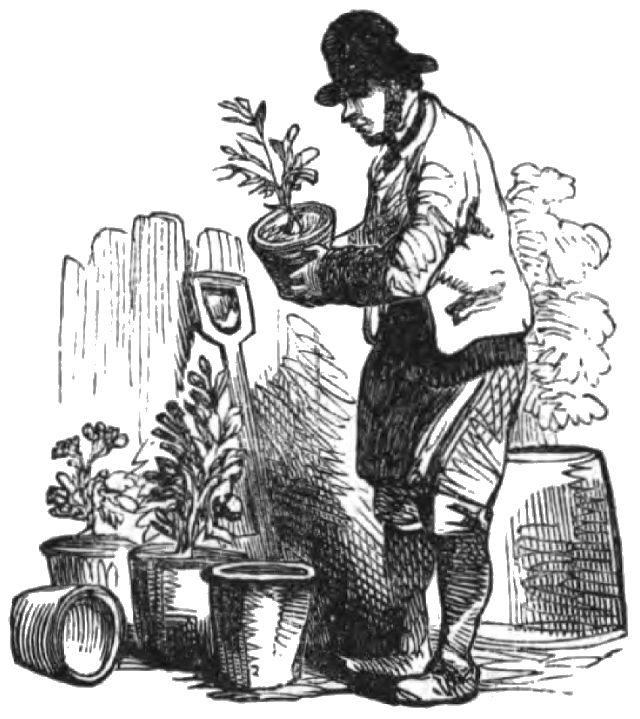
John takes care of plants in a green-house. He loves to see the flowers in bloom. He can tell the names of all the flowers, and he knows how to treat them so that they will grow well.
John is fond, too, of little girls and boys. He will give us a nose-gay if we go to see him. He will pluck a fine rose for you, and for me he will pluck a pink.
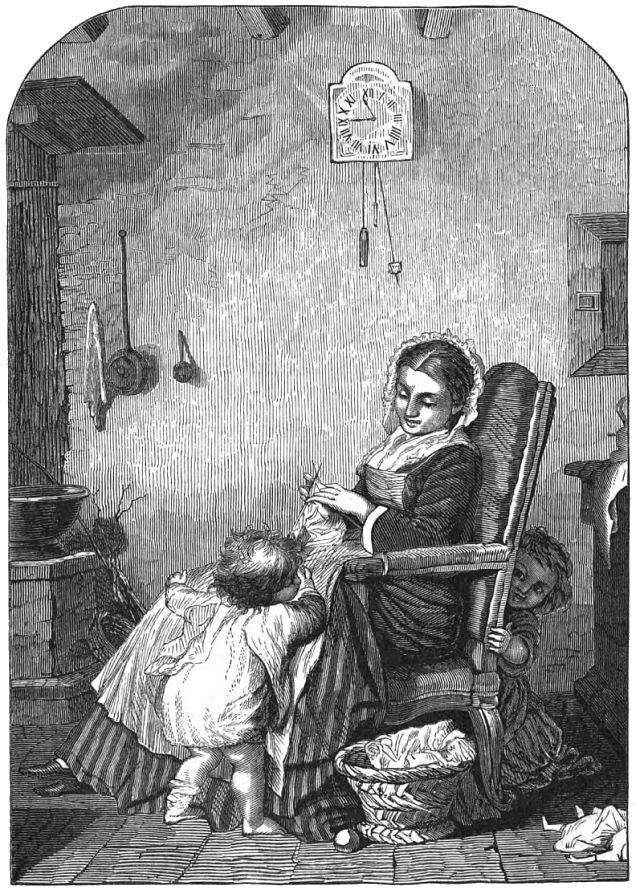
“HIDE AND SEEK.”
“I see the little boy!”
Such are Ellen’s words as she kneels behind her mother’s chair, and plays at “hide and seek” with her brother Edwin, who has his arms on his mother’s lap.
Edwin is not quite a year and a half old. He is still called “Baby;” for it seems only the other day that Ellen saw him in his crib, trying to put his toes in his mouth.
What a baby he was! Not a thing would he get hold of, that he would not put it in his mouth. If Ellen put her head down to kiss him, he would seize a lock of her hair, and tug away at it, till he made her cry out, “Oh, don’t!” And then he would thrust the hair into his mouth.
Once she let him take a little vase in which she used to keep her flowers. He put it in his mouth, but did not like the taste of it; so he threw it on the floor, and broke it.
They would bring the cat to him; and baby would seize a handful of Pussy’s fur, and put his mouth down to suck it in. Soon his little hand grew so strong that he would pull out more hairs than the cat could well spare.
Pussy was very good at first. She would let Baby take hold of her with his little fingers, and pull her about as if she was so much cotton-wool. She seemed to know he was a baby; for she never scratched him, even when he was rough to her. But now she runs and hides when she sees Baby creeping along the floor to seize her. He has grown too strong for her.
Look at the picture! Edwin’s mother is knit′ting a stocking for him. He wears out stockings fast. He pulls at them till he tears them. He likes to go with bare feet. But it is too cold for bare feet now.
Can you see where Ellen’s doll is lying? You cannot see its head, but you can see its left arm and its two feet. I hope the floor is clean where the doll lies, so that it will not soil that nice white dress.
Can you tell what time it is by the clock? If not, you must ask some one to show you. Can you tell whether the clock is going? How can you tell?
I must tell you a short story about Ellen before I take leave of you. The day before Christmas, Ellen went out in the woods to get some evergreen with which to deck her little room.
While she was searching on the ground and under the snow, a poor little bird hopped along to her as if to beg for something to eat. Ellen had some crumbs in her pocket, and she threw them to the bird. He ate them gladly. He had been a long while without food.
The next day she found this little bird on the sill of the win′dow of her room. She opened the window; and he hopped in, chirping as if he would like to say, “A merry Christmas to you!” Ellen fed the little bird once more, and then let him fly off to the woods.
Emily Carter.
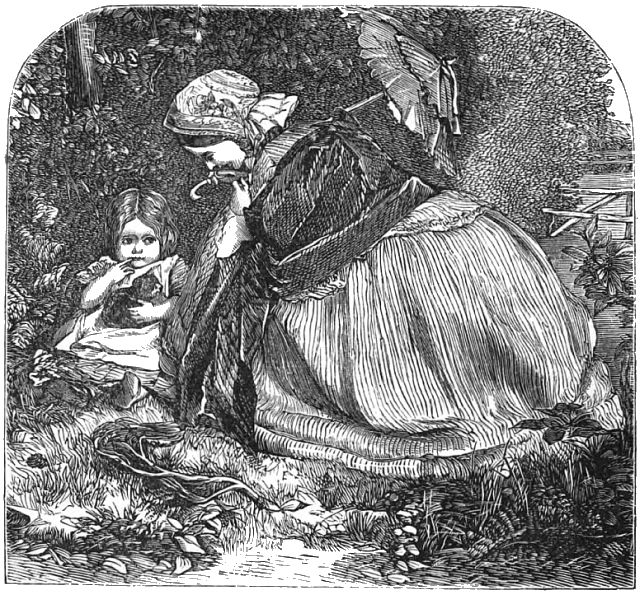
Lucy Lee was a little girl not three years old. She lived with her mother, in a small white house not far from a grove of oak-trees.
Lucy had a black kitten, whose name was Fun. This kitten was so tame, that he would let Lucy hold him in her arms for half an hour at a time.
On a hot day in June, Lucy thought she would take Fun in her arms, and go into the grove: for it was cool in the grove; and in the grove she could hear the birds sing, and could see the blue flowers she loved.
Now, Lucy ought to have asked her mother for leave to go into the grove. But Lucy did not do this. She did not tell any one where she was going. In this she was wrong.
On her way, she stopped at the bee-hive to look at the bees. They did not harm her,—not they! They saw she did not fear them. They did not quite like the kitten. But Fun kept still, and did not put out his paw to catch them. If he had put out his paw to catch the bees, they would have stung him.
When she had looked at the bees long enough, Lucy went on and on, till she came to a fence. She crept under the fence with Fun all the time in her arms. Then she saw the blue flowers in the grass, and knelt down and smelt them.
Fun jumped out of her arms, and ran; and Lucy ran after him. When she caught him, she thought she would turn and go home. But she could not find her way home. She walked and walked, till she grew so warm and so tired, that she sat down on the grass.
“What shall we do, Fun, if we have to stay here all night?” said Lucy. But Fun was so well pleased with his nice seat in her lap, that he only said, “Purr-r-r, purr-r-r!”
“Hark! Is that a wolf, or a lion?” said Lucy, as she heard a step on the grass near by. It was not a wolf, nor was it a lion. It was Mrs. Gay, a good lady, who was taking a walk in the grove.
Mrs. Gay had a sun-shade in her hand. Lucy sat on the grass with her kitten in her lap, and the fore-finger of her left hand in her mouth. Mrs. Gay wanted to laugh at the sight, but put her hand up to her lips so that she might not laugh out loud.
“Whose little girl are you?” asked Mrs. Gay.
“I am my mother’s little girl,” said Lucy.
“But what is your mother’s name?”
“My mother’s name is mother.”
“And what is your own name, little girl?”
“My own name is Lucy Lee; and my kitten’s name is Fun; and baby’s name is baby; and we have a dog at home: his name is Tiger. The moolly-cow’s name is Norma.”
“And do you mean to stay here all night, Lucy Lee?”
“Oh, no! I want to go home. Take me to my home.”
“Tell me if your home is a white house, or a red house.”
“It is a white house, but the blinds are green.”
“Where does your dog go when he wants to swim?”
“He goes to the brook; and the moolly-cow goes to the brook too: but the moolly-cow goes to drink, not to swim.”
“So there is a brook not far from your house, is there?”
“Yes, ma’am: there’s a brook not far from our house.”
“Well, now, Lucy Lee, if you will jump up, and give me your hand, I will lead you to your home. I think I know where it is.”
So Lucy put down the kitten, and jumped up, and gave the lady her hand, and let the kitten run after them. And the lady led Lucy through the grove to a field, and through the field to a road, and up the road to a gate, and through the gate to the door of a house, and through the door to a room where Lucy’s mother sat with a baby in her arms.
“Why, my dear Mrs. Gay, where did you find that stray child?” said Mrs. Lee. “I was just trying to learn what had become of her.”
“I found her in the grove,” says Mrs. Gay.
“I shall punish you, Lucy, if you go into the grove without asking leave,” said Mrs. Lee.
“It was Fun that led me too far,” said Lucy. “Fun wanted to run away. Fun is to blame, mamma. Fun led me too far.”
“Well, my child, there is another kind of fun that leads folks too far very often. It is not safe to take Fun for our guide. I forgive you this time.”
Ida Fay.
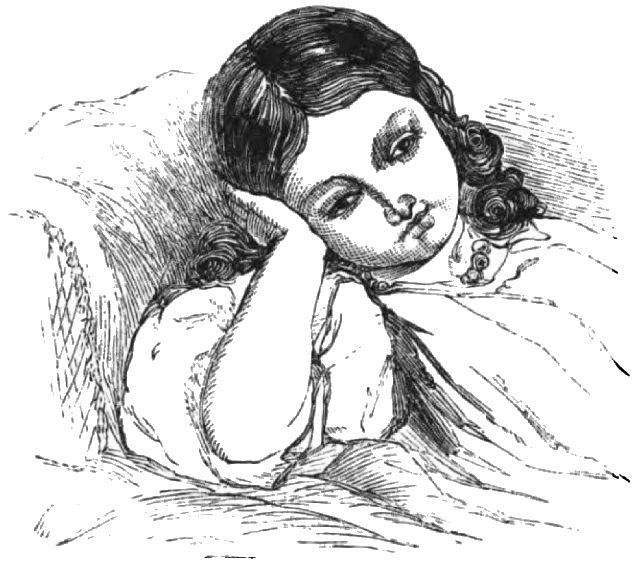
What makes our dear Mabel so tired to-night?
Mamma has not kissed her, nor put out the light;
Yet I see, through the curtains, as slyly I peep,
Her blue eyes are closing: she’ll soon be asleep.
I will tell you: Big Bridget, the cook, went away
This morning; and Mabel, throughout the long day,
Has helped in the kitchen, up-stairs, and all round,—
A brisk little housemaid as ever was found.
’Twas a droll sight to see her, and made us much fun,
With her sleeves fastened up, and a long apron on,
First washing the dishes, then dusting a shelf
With a great feather-duster as tall as herself.
Now standing on tiptoe, as small as a fairy,
Skimming the cream from the milk in the dairy;
Now peeping to see if the biscuits were brown,
And merrily laughing to find how they’d grown.
But she was most pleased, when at last, with a broom,
She had chased a black spider quite out of the room:
“He was going, mamma,” she said, ready to cry,
“To eat for his supper this dear little fly.”
And what do you think were the last words she said
As mamma led her darling at night up to bed?
“When I’m a big lady, and go to housekeeping,
I sha’n’t leave a cobweb for spiders to sleep in.”
Mrs. H. F. Harrington.
 This is the cottage
where little Anna lived. She
ran out, and played all day in the
green meadows, and was as happy
as a bird.
This is the cottage
where little Anna lived. She
ran out, and played all day in the
green meadows, and was as happy
as a bird.
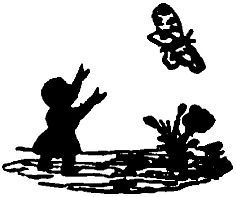 A great golden
butterfly was resting
on a flower.
Anna ran to catch
it; but away it flew, up into the
bright blue sky.
A great golden
butterfly was resting
on a flower.
Anna ran to catch
it; but away it flew, up into the
bright blue sky.
 Then she sat
down among the
lilies, and kissed
their red lips, and said, “Pretty,
pretty, pretty!” That was all
she could say.
Then she sat
down among the
lilies, and kissed
their red lips, and said, “Pretty,
pretty, pretty!” That was all
she could say.
 There was a little
lamb feeding in the
meadow. Anna went up to it,
and patted its soft white wool
with her hands.
There was a little
lamb feeding in the
meadow. Anna went up to it,
and patted its soft white wool
with her hands.
 Then she ran down
to the little brook that
flowed through the
meadow, and there she saw her
face in the clear water.
Then she ran down
to the little brook that
flowed through the
meadow, and there she saw her
face in the clear water.
 When she was
tired, she lay down
under a bunch of
lilies, and went to sleep. There
is where her mother found her,
asleep among the flowers.
When she was
tired, she lay down
under a bunch of
lilies, and went to sleep. There
is where her mother found her,
asleep among the flowers.
w. o. c.
If wishes were horses, beggars would ride;
If wishes were watches, I’d wear one by my side.
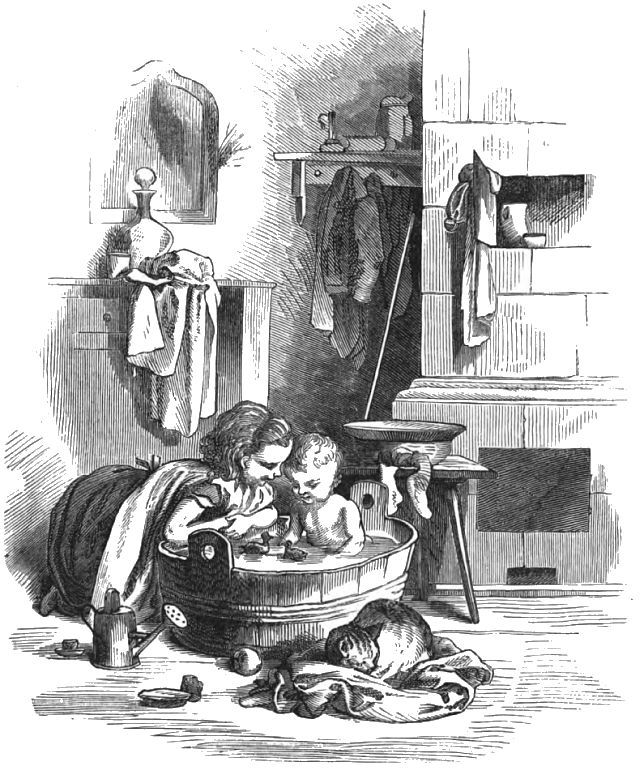
See Charles in the big tub! The big tub is filled with water. Charles is taking a bath. His sis′ter Em′ma is by his side. Down′y, the old cat, lies a-sleep on the shawl on the floor.
Charles has with him in the tub two little ducks. But they are not live ducks. They are made of wood. They float on the water.
Em′ma is a good sis′ter to Charles. She takes care of him. She loves to a-muse him, and to tell him sto′ries.
“Shall I tell you a story of a duck?” said she, as he sat in the tub, and looked at the wooden toys.
“Oh, yes! I would like to hear a story of a duck,” said Charles. “Is it of a live duck?”
“Yes, of a live duck,” said Emma. “And the story is a true story. The duck was born in the barn of our mother’s Aunt Jane. Aunt Jane keeps ducks and hens. Last spring, one of the girls put a duck’s egg by the side of some hens’ eggs on which an old hen was sit′ting to hatch them.”
“Was the old hen a good hen?” asked Charles.
“Yes, she was a pretty good hen. She kept the eggs all warm un′der her feath′ers. All day and all night she sat on them, and by and by ten little chick′ens were hatched out. Two or three hours after, a queer little duck broke the shell of its egg, and wad′dled out.
“The chick′ens soon saw that he was not one of them. Then what did they do? Were they kind to him, as they ought to have been? Did they give him the warm side of the nest? Did they let him feed with them when their food was brought?
“It grieves me to say that these self′ish little chick′ens did none of these things. But they would fly at the poor little duck, and would peck at him, and would drive him from the nest, so that he had no peace of his life, and did not know what to do.”
“If I had been a chick′en, I would have fought for him,” said Charles. “Did not the old hen take care of him?”
“What could the old hen do while her ten chil′dren were all act′ing so bad′ly? The old hen would have been kind to the duck; but the chick′ens would not let her.
“And so this poor little duck was driven from the nice warm nest where he was born. It seemed as if he must die, un-less some one would take care of him, and keep him warm.
“Now, there was a good old cat in the barn.”
“Was it as good a cat as our old Down′y?” asked Charles.
“Yes, I think it must have been as good a cat as Downy,” said Emma. “She was a wise old cat. She knew that the folks at the house did not want the little duck to be hurt. So she took pity on him.
“This cat had three little kittens; but they were good little kittens, and not self′ish, like the chick′ens, though they loved dear′ly to play. Well; the old cat went and took the little duck in her mouth,—not to eat him, oh, no!—but to take him to her nice warm home in the hay. And there she put him down by the side of her kit′tens.
“One of the kittens put her paw on the duck to tease him; but the old cat gave the kitten a cuff on the ear, as much as to say, ‘Paws off! You must be kind to this little or′phan duck. You must not scratch him, nor scare him. You must let him feed from your dish, and let him lie down by your side and sleep. I shall pun′ish you if you are not good to him.’
“And so these little kittens all be-haved in the sweet′est man′ner to the little duck; and the little duck led a hap′py life. The chick′ens were all a-fraid to come near to harm him; for they knew the old cat would drive them off.
“It was a queer sight to see the three kittens curled up a-sleep, with the little duck in the midst of them a-sleep too, and all at peace. Now, was it not bet′ter to act like the kit′tens than like the chick′ens? Which would you have act′ed like?”
“I would have act′ed like the kittens,” said Charles. “I would like to see that good old cat. I would put a blue rib-bon round her neck as a re-ward of mer′it.”
“Now it is time to get up from your bath, and let me wipe your skin dry,” said Emma.
So Charles got up; and Emma wiped him dry, and put on his clothes, and gave him his play′things.
Though there is a rod be-hind the glass in the room where Charles took his bath, his mother has never had to use it yet; for he is a good boy.
Aunt Fanny.

Spring is sweet,
When flowers are fair;
Summer’s heat
Is hard to bear.
Autumn shows
Its fruit like gold;
Winter’s snows
Are very cold.
Summer, spring,
And autumn gay,
And winter, wing
Full fast away.
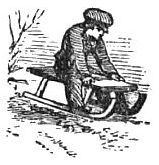
While they flee,
They seem to call,
“How good is God
Who gave them all!”
l. f.
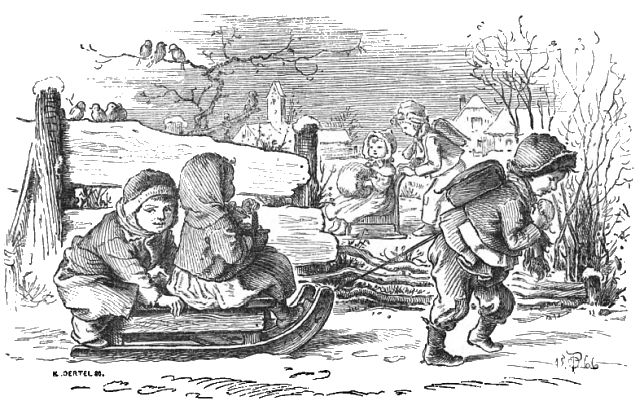
Through the deep snow, here we all go!
Old Winter, you see, has come:
Icy and cold, he is taking sharp hold,
And his grip makes our fingers quite numb.
But we have good cheer while Winter is here,
For Christmas brings joys in good number:
We coast and we skate, both early and late,
And are ready at night for sound slumber.
So, Winter, come nigh, say we, say I!
And good luck to the Christmas tree!
May the evergreen holly find us grateful and jolly,
And bear presents for you and for me!
Ida Fay.
When Carlo grew to be older, he began to go to school. He did not go every day, and did not study out of books, as the children do; but he may have studied in some way that dogs only know. His master was su-per-in-tend′ent of schools; and, when he visited them, Carlo went with him to help him superintend.
He would go to each child, and put his nose up to the child’s face, and wag his tail, as if he wanted to say, “How do you do?” And the children would pat his head and smile.
One day he was shut out of the room because his master did not like to have him make the children laugh. The school-house was a very old and bad one; and in the entry was a crack between two boards, just high enough for Carlo’s eyes to reach it. So he ran along by this crack, and cried; and the children could see his bright brown eyes, and hear him cry, and they laughed: and so Carlo was allowed to go into the room.
He liked to go to church; and, when his master thought Carlo was safe with the horse out-of-doors, Carlo would walk into church, and walk up the pulpit-stairs, and then turn and come down. All the children would laugh; but the preacher could not see the dog, and perhaps wondered what the children were laughing about.
When he was a puppy, Carlo liked to eat eggs; and he had to be whipped to make him stop it. One day, when he was a big dog, he found an egg in his house. A hen had laid it there. But he was afraid we would think he had taken it to eat; so he took it carefully in his mouth, and laid it on the step of the back door.
I gave him two large bones for his dinner one day. He smelt them all over, and then ran away with one, and buried it in the ground. At supper-time I had no bones for him; and I said, “Go and get the bone you buried.”
He looked about a little time to be sure I had nothing for him, and then ran away, and dug up the bone he had buried at dinner-time, and brought it home, and ate it for his supper.
Carlo did not like to have his master take much notice of other dogs. One day a man came to bring some corn to be ground in the mill, and his dog came with him. The dog went to Carlo’s master, and jumped up on him, and he patted the little dog. Carlo went up, and looked in his master’s face, as if to say, “Speak to me.”
But he thought he would try Carlo; and he said, “Go away!” Then Carlo could bear it no longer, but took the other dog by the neck, and shook him till he cried; and then he let him go, and jumped up, and sat by his master’s side with his face close to his, as if to say, “I am your dog.” And his master patted him, and he was happy again.
He did not like to be made sport of. A boy came to the mill one day, and played with him, and they had a very nice time. Presently the boy began blowing beans at him; and he stopped playing, and went to his master, and sat by him with his head very high, and would not look at the boy at all. Do you wonder that we were very fond of Carlo?
L. Ogden.

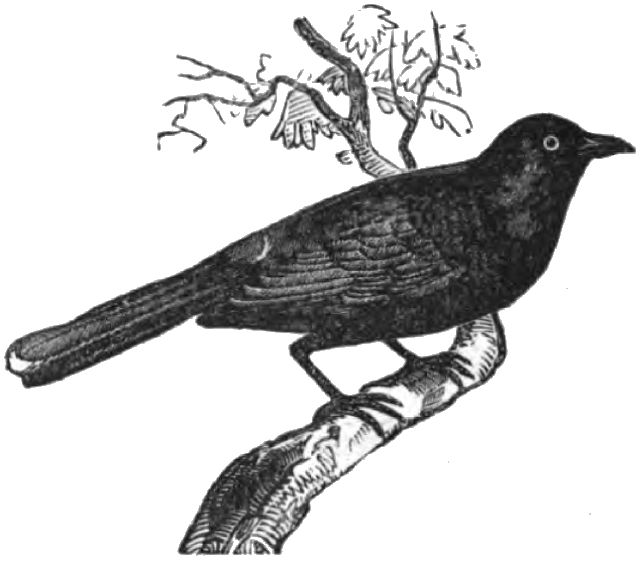
Where the corn grows and the barley,
In the fields of wheat,
There the blackbird, late and early,
Singeth loud and sweet.
Let him take the grains that suit him,—
Barley, wheat, or rye;
Let not Dick the farm-boy shoot him:
Wherefore should he die?
Far and wide the grain is growing;
And a few small seeds,
Gathered from the plenteous sowing,
Are the most he needs.
Let him eat the grain that suits him;
Let him eat the wheat,—
Tuneful blackbird, late and early
Singing loud and sweet!
Mrs. A. M. Wells.
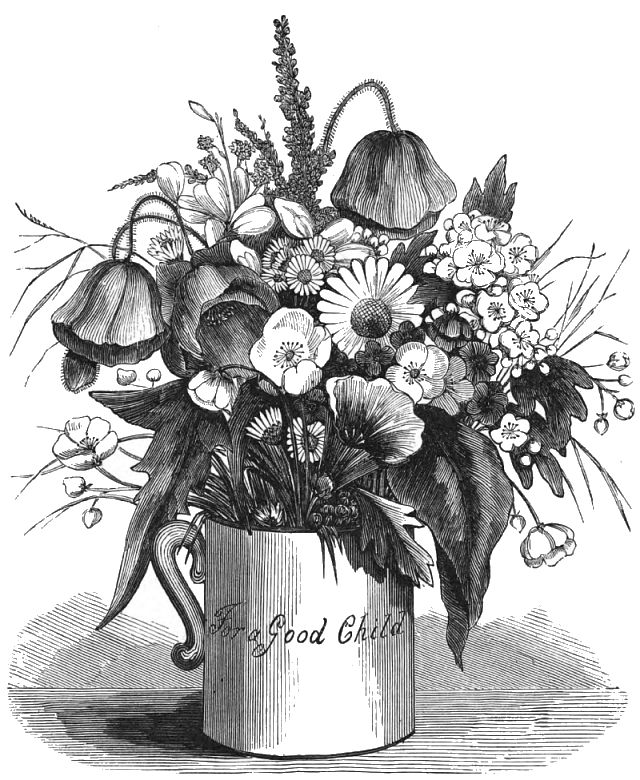
I have a little neph′ew, whose name is John. He is four years old. He has a large box full of toys. He has a ball and a bat, a top and a whip, a sled and a pair of skates, and more things than I can think of now.
But, fond as John is of his toys, there is one thing that he loves more than all; and that is a flower. Now, is it not odd that John should love a flower best of all? for a flower soon fades. You cannot keep a flower as you can keep a top and a ball.
John’s fourth birth-day took place not long ago, and I cannot tell you the names of all the gifts that were sent to him on that day. But I will tell you of two of them. His Aunt Julia sent him a bunch of flowers, and his Aunt Susan sent him a mug.
On the side of this mug, he could read four words. I shall not tell you what those four words were. You must learn to read them your-self on the mug; for I will show you a pict′ure of it.
John took the flowers which his Aunt Julia had sent to him, and he put them in the mug which his Aunt Susan had sent to him. Then he placed the mug of flowers on the shelf in the par′lor, where his fa′ther and moth′er could see the flowers and en-joy the sweet scent.
I cannot tell you the names of all the flowers in the bunch; but John could tell you, young as he is. I can see a pop′py, and an as′ter, and a forget-me-not; but there are some plants, the names of which I do not know.
John is three months old′er now than he was when his aunts gave him the mug and the flowers. He now hopes that there will be a snow-storm soon, so that he can use his sled and his skates. In the sum′mer he loves the flowers; in the win′ter he loves the snow. He finds some-thing good to love, and to thank God for, at all times.
Aunt Fanny.
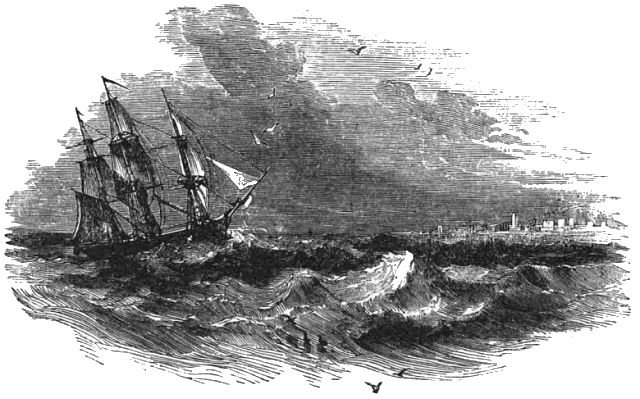
Do you see that fine ship? That is a picture of the ship which took a little boy, whose name was Alfred, across the wide ocean, twenty years ago.
Alfred was the son of a poor man who did mason-work. Do you know what mason-work is? I will tell you: it is the work of a man who has to lay bricks or stones with mortar in walls; and this man is called a mason.
Alfred’s father was on the high, high wall of a house which he was helping to build; when all at once his foot slipped, and down he fell to the ground. He was so much hurt that he could not work after that.
And so Alfred’s mother had to take in washing, and work hard to maintain the family. Alfred was then at school; but he had been such a good boy, and had studied his lessons so well, that he could read, write, and cipher much better than many older boys.
So he said to his mother, “I must not stay here to add to your cares. Let me go to sea, and I will soon learn to take care of myself; and perhaps, dear mother, I may be able, one of these days, to take care of you and father and sister Julia.”
So Alfred went to sea in that good ship. First he went as a sailor; and he behaved so well, and was so prompt in doing his duty, that, when he was sixteen years old, he was made second mate.
Then he learned what is called navigation; that is, the art of steering a ship across the wide, wide sea, where you can see nothing but water and sky all the time.
He learned so fast and so well, that he soon rose to be first mate; and, when he was twenty-one years old, he found himself captain of one of the best ships that sailed from New York.
What a happy thing it was for Alfred, when, on coming home from one of his voyages, he could say to his mother, “Mother, quit that wash-tub! And you, father, pack up your things! Here is the deed of a nice little house I have bought for you. You, Julia, shall have a first-rate Chickering piano; and there’s nothing better than that, they tell me, in the way of pianos. We cannot do without music, you know.”
How happy they all were! And how happy the sailor-boy was to be able to make those who were near and dear to him so well off!
Alfred has now a little daughter of his own. Her name is Edith. She can read and write. She is very fond of hearing him tell stories of his life at sea, and of the good ship he sailed in when he went on his first voyage.
Anna Livingston.
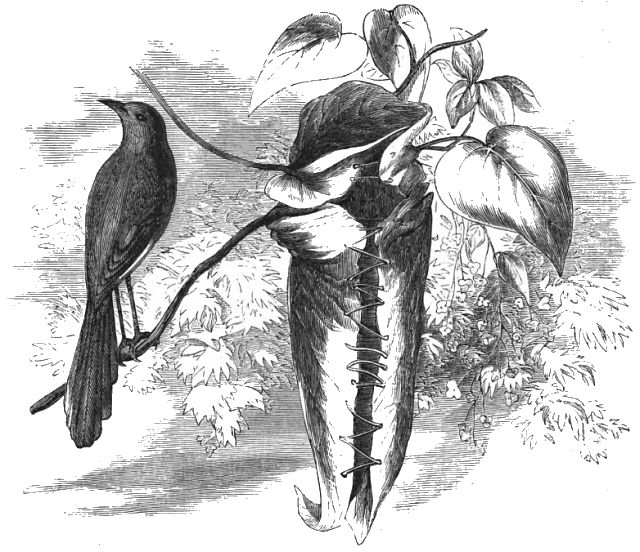
“Did you ever hear of the bird that knows how to sew?”
“No: I fear you are making fun of me. Who ever heard of a bird that could sew? Where could it get its needle and thread? Where could it get its thimble?”
“What I tell you is true. There is a bird called the Tail′or Bird, be-cause it knows some′thing of the art of the tailor, and sews its nest.
“This bird is a na′tive of India. I do not think it is to be found in our coun′try. The way in which it makes its nest is quite odd. It choos′es a leaf, one that hangs from the end of a small twig. A-long the edge of this leaf it makes a row of holes.”
“But how can it make the holes without a needle?”
“Can you not guess? Has it not something sharp as a needle? Look and see. Why, it uses its beak, to be sure! And it uses it just as a cob′bler uses his awl. It does not need a thimble.
“When the holes are made, the bird gets a thread; and this is a long fi′bre of some plant which the little feath′ered tailor knows where to find.
“Having got its thread, the bird pass′es it through the holes, and draws the sides of the leaf down, so as to form a kind of hollow cone, with the point down. You must learn to know the shape of a cone. The nest in the picture is partly like a cone.
“When the bird cannot find one leaf that is large enough for its need, it will sew two leaves together. Within the hol′low it thus makes, it puts some soft white down, like short cotton-wool; and then this wise little tailor-bird has a warm, neat nest for its young and itself.
“I hope, as you grow old′er, you will love to read about birds, and learn all the strange things that are known of them and their ways; for these give proofs of the wis′dom and good′ness of God, to whom we owe all that is wise and good.”
Emily Carter.
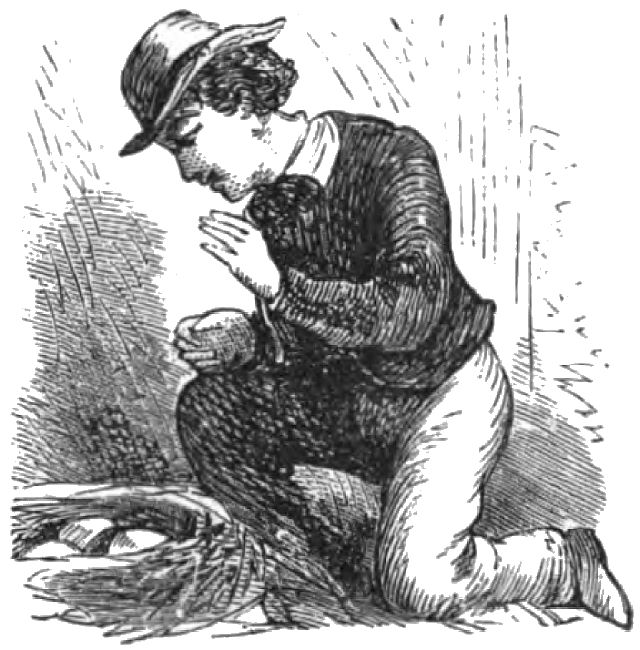

Buzz-z-z-z-z-z, buzz!
This is the song of the bee.
His legs are of yellow;
A jolly good fellow,
And yet a great worker, is he.
In days that are sunny,
He’s getting his honey;
In days that are cloudy,
He’s making his wax:
On pinks and on lilies,
And gay daffodillies,
And columbine-blossoms,
He levies a tax!
Buzz-z-z-z-z-z, buzz!
The sweet-smelling clover,
He, humming, hangs over;
The scent of the roses
Makes fragrant his wings:
He never gets lazy;
From thistle and daisy,
And weeds of the meadow,
Some treasure he brings.
Buzz-z-z-z-z-z, buzz!
From morning’s first gray′light
Till fading of day′light,
He’s singing and toiling
The summer day through.
Oh! we may get weary,
And think work is dreary:
’Tis harder by far,
To have nothing to do!
Marian Douglas.
In silence I must take my seat,
And give God thanks before I eat;
Must for my food in patience wait
Till I am asked to hand my plate.
I must not scold nor whine nor pout,
Nor move my chair nor plate about;
With knife or fork or napkin-ring
I must not play; nor must I sing.
I must not speak a useless word;
For children should be seen, not heard:
I must not talk about my food,
Nor fret if I don’t think it good.
I must not say, “The bread is old,”
“The tea is hot,” “the coffee cold;”
I must not cry for this or that,
Nor murmur if my meat is fat.
My mouth with food I must not crowd,
Nor while I’m eating speak aloud;
Must turn my head to cough or sneeze,
And, when I ask, say, “If you please.”
The table-cloth I must not spoil,
Nor with my food my fingers soil;
Must keep my seat when I have done,
Nor round the table sport and run.
When told to rise, then I must put
My chair away with noiseless foot;
And lift my heart to God above
In praise for all his wondrous love.
Selected by Frankie R.
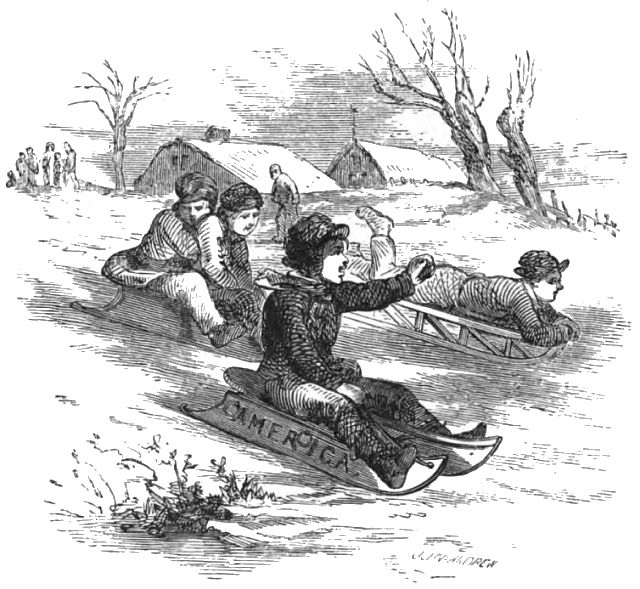
See the boys on their sleds! I can count one, two, three, four boys; and then there are some more boys at the top of the hill, and one who drags his sled up the side of the hill.
It is a cold day, but these boys do not stand still so long as to feel the cold. They keep warm; for they move fast, and they shout and laugh.
If they fall down on the snow or ice, they do not mind it much. Up they jump, and up the hill they go with their sleds. If they up-set their sleds in the snow, those who come be-hind them cry out, “Clear the track! Get out of the way!”
Do you see the boy who has his hand up? Well, I will tell you what he did. As he went home with his sled one day, he saw a poor old man who had a large bag of corn on his back. It was a hard load for the old man.
So this boy went up to him, and said, “Sir, if you will put your bag on my sled, I will drag it for you. It will not be hard for me to drag it on my sled.”
To which the old man said, “I thank you for your kind thought. You are a good boy to care for the old and weak.”
Behold the gray branches that stretch from the trees!
Nor blossom nor verdure they wear:
They rattle and shake to the northerly breeze,
And wave their long arms in the air.
The sun hides his face in a mantle of cloud;
The roar of the ocean is heard;
The wind through the wood bellows hoarsely and loud,
And over-land sails the sea-bird.
Come in, little Charles, for the snow flutters down;
No paths in the garden remain:
The streets and the houses are white in the town,
And white are the fields and the plain!
Come in, little Charles, from the tempest of snow;
’Tis dark, and the shutters we’ll close;
We’ll put a fresh fagot to make the fire glow,
Secure from the storm as it blows.
e. t.
A friend of mine took his dog out for a walk, and they came to a stream which ran quite fast. My friend threw a stick in the stream, and then said to his dog, “Go, Jack, and fetch me that stick.”
In jumped the dog into the stream; and he swam, and he swam, and he swam. But, swim as fast as he could, he could not swim so fast as the stream could flow: and so he could not get up to the stick to take hold of it; no, not though he swam as fast as he could.
So he must have thought to himself, “This will not do: I shall swim and swim till my strength is all gone, and yet I shall not get up to the stick. I know what I will do so that I shall yet win the race.”
So the dog swam to land. And, as soon as he was on dry ground, he ran, and he ran, and he ran,—oh, so fast!—till he had run past the stick a good long way; and then he jumped into the stream once more, and swam up to meet the stick; and soon he saw the stick come float′ing down.
“Ah, ah, Mr. Stick! I think I have you now,” thought the dog; and with that he took the stick in his mouth, and swam to land; and then he ran up to his mas′ter, and put down the stick at his feet, and looked up in his face, and wagged his tail, as much as to say, “What do you think of me now? Do you not think I was a wise dog to play the stick such a trick as that?”
And his master gave Jack a pat on the head, and said, “Good old Jack, wise old Jack!” And Jack was so glad, that he began to bound and jump and bark for joy to think what a wise, good dog he had been.
Trottie’s Aunt.

FINIS
“A CAPITAL WORK FOR CHILDREN.”
The Nursery.
The best monthly magazine for children ever published is The Nursery, a beautiful work of thirty-two pages, bound in green covers, and richly and plentifully illustrated with cuts from designs by Oscar Pletsch, Billings, Harrison Weir, Frolich, and other artists celebrated for their drawings of children. The reading-matter is quite as good as the pictorial; it being original, and by writers specially distinguished for the adaptation of their style to the comprehension of the young. No parent or teacher, having the charge of young people under ten years of age, can do better than subscribe for this charming magazine.
“Among American periodicals for the young, there is not one that we can more confidently commend than The Nursery. Indeed, there is not one of the kind in Europe that quite comes up to this.”—N. Y. Times.
“It is well worth a quarter’s ordinary schooling to have it a single six months in the family.”—Waukegan (Ill.) Gazette.
“The celebrated Oscar Pletsch, the most famous artist in Germany for his drawings of children, is contributing original designs to The Nursery. They are spirited and full of character.”—Boston Transcript.
The Nursery forms two beautiful volumes a year. It enters on its fifth volume January, 1869. Price $1.50 a year, in advance. A single copy, 15 cents. Three copies a year for $4; five copies for $6; each additional copy for $1.20. Volumes begin with January and July.
For Premium-Lists, Circulars, &c., address the Publisher, JOHN L. SHOREY, Boston, Mass.
The Nursery Series
OF STORIES AND PICTURES.
Containing all the engravings and reading-matter of The Nursery, with an additional engraved frontispiece. Beautifully bound in green cloth, and richly gilt. Price $1.25 a volume.
The following are NOW READY, and form the most attractive library for young children that has ever been issued.
THE SICK DOLL, and other Stories. With an exquisite frontispiece of “The Mother and Child,” beautifully engraved. $1.25.
THE CHILD’S AUCTION, and Other Stories. With a new engraved frontispiece of “Lucy Learning her Letters.” $1.25.
THE GREAT SECRET, and Other Stories. With a new engraved frontispiece of “Mary and her Dog.” $1.25.
☞ The above three volumes neatly put up in a box, and forming a most beautiful holiday gift for children, may be had at the rates above mentioned. The three volumes contain MORE THAN THREE HUNDRED ENGRAVINGS, expressly drawn to interest and amuse the young, and executed in the highest style of art.
⁂ For Sale by all Booksellers. Sent, postpaid, on receipt of price, by the Publisher,
JOHN L. SHOREY, No. 13, Washington Street, Boston, Mass.
TRANSCRIBER NOTES
Misspelled words and printer errors have been corrected.
Punctuation has been maintained except where obvious printer errors occur.
Page number errors in the table of contents have been corrected.
Book cover is placed in the public domain.
[The end of The Child's Auction and Other Stories by Oscar Pletsch]