* A Distributed Proofreaders Canada eBook *
This eBook is made available at no cost and with very few restrictions. These restrictions apply only if (1) you make a change in the eBook (other than alteration for different display devices), or (2) you are making commercial use of the eBook. If either of these conditions applies, please contact a https://www.fadedpage.com administrator before proceeding. Thousands more FREE eBooks are available at https://www.fadedpage.com.
This work is in the Canadian public domain, but may be under copyright in some countries. If you live outside Canada, check your country's copyright laws. IF THE BOOK IS UNDER COPYRIGHT IN YOUR COUNTRY, DO NOT DOWNLOAD OR REDISTRIBUTE THIS FILE.
Title: With Allenby in Palestine
Date of first publication: 1920
Author: Frederick Sadleir Brereton (1872-1957)
Illustrator: Frank Gillett (1874-1927)
Date first posted: August 6, 2025
Date last updated: August 6, 2025
Faded Page eBook #20250807
This eBook was produced by: Al Haines, Cindy Beyer & the online Distributed Proofreaders Canada team at https://www.pgdpcanada.net
With
Allenby in Palestine
BY
LT.-COL. F. S. BRERETON
Author of “With the Allies to the Rhine”
“From the Nile to the Tigris”
“Under Foch’s Command”
&c. &c.
Illustrated by Frank Gillett, R.I.
BLACKIE & SON LIMITED
LONDON AND GLASGOW
By Lt.-Col. F. S. Brereton
The Great Airship.
Under French’s Command.
Colin the Scout.
With Allenby in Palestine.
How Canada was Won.
The Dragon of Pekin.
Rough Riders of the Pampas.
The Great Aeroplane.
Tom Stapleton.
On the Road to Bagdad.
Printed in Great Britain by Blackie & Son, Ltd., Glasgow
Contents
——————
| Chap. | Page | |
| I. | The Syrian Desert | 9 |
| II. | Tomkins gives his Story | 24 |
| III. | On Intelligence Service | 39 |
| IV. | An Arab Raid | 54 |
| V. | On an Expedition | 67 |
| VI. | Behind the Enemy Lines | 83 |
| VII. | A Turkish Round-up | 98 |
| VIII. | A Midnight Encounter | 112 |
| IX. | Information of Importance | 126 |
| X. | The Wells of Magdhaba | 140 |
| XI. | Omar falls Prisoner | 153 |
| XII. | Water-supplies in the Desert | 166 |
| XIII. | The Arab Gateway | 183 |
| XIV. | In the Holy City | 198 |
| XV. | Deceiving the Enemy | 211 |
| XVI. | A Clever Ruse | 224 |
| XVII. | Victory in Sight | 238 |
| XVIII. | Donald Carruthers meets with Trouble | 251 |
| XIX. | Friends in the Hour of Need | 264 |
| XX. | The Conquest of Palestine | 277 |
Illustrations
——————
| Page | |
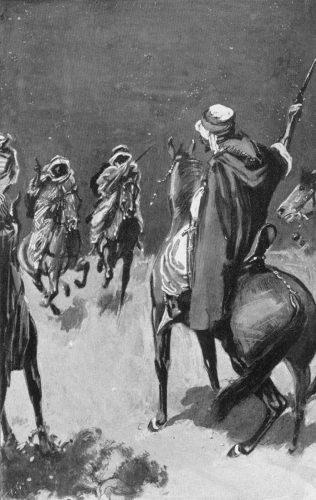
| “Gallop!” Donald shouted. “Go straight for them” | Frontispiece |
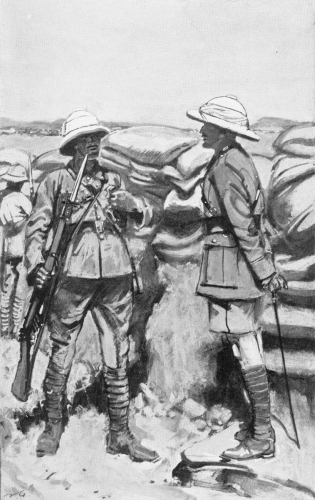
| “You ain’t a-goin’ to chuck me out now, sir?” he asked | 64 |
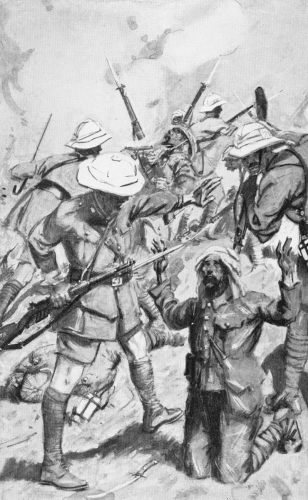
| “As Allah wills!” he cried. “Excellency, I surrender” | 160 |
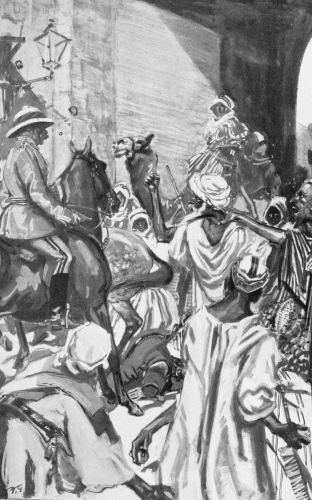
| “Kill him! Shoot him!” came from the mob | 256 |
WITH ALLENBY IN
PALESTINE
—————
It was hours since a burning, blistering sun had risen from the Syrian desert, and, creeping above the sand-dunes and hillocks and rocky ridges, had swept its way slowly and relentlessly across those sandy wastes, till now it had crossed Palestine itself and was passing gloriously out over the Mediterranean, below the placid surface of which it was already sinking out of sight. Yet its rays illuminated the landscape, cast long shadows behind every rock and tree and sand-dune, and caused the figures of men and beasts to stand out, silhouetted sharply against the background.
Not so far from Gaza, the old capital of the Philistines, whence Samson of Biblical memory carried the gates away more than a thousand years before the birth of Our Lord, and to which the great Alexander once laid siege, at a point rather closer to El Arish, there stood on an eminence two figures, one in the dress of an Arab, and the other in that of a Turkish officer. In the near distance the tinkle of bells sounded from the minarets of the mosques—minarets which stood up sharply outlined in the falling sunlight—while presently, across the silent landscape, mingled with the bleat of sheep, there came the call of the priests to the Faithful.
“Allah! Il Allah! Allah is great!” sounded across the orange groves and the plantations. “Allah! Allah! Il Allah! Allah is great, and we are his chosen people!”
The Bedouin bowed himself down low as he faced the sun, then, with a gesture to the officer beside him, he strode off towards the nearest mosque, where, joining a hundred and more of the men of the village, he spread his carpet on the ground and prostrated himself as every follower of Mohammed was then doing.
As for the Turkish officer, he lifted one hand and gripped an overhanging branch of the olive tree which threw its shadows about him. The bells from the minaret and the mosque might tinkle as musically as possible; the olive groves, the oranges, the pastures all about him, those bleating sheep, the beauty of this landscape in southern Palestine, might attract the eye and the attention of the ordinary individual, but to him they were nothing. His eyes were fixed instead upon the desert of Sinai, gleaming down below him: a huge, dull, sandy-yellow waste, supporting but little life, waterless, lapped on one edge by the waves of the Mediterranean, closed in farther on by Egypt, and by the British garrison which had already defeated Turkey’s attempt to take the country.
The man loosened his hold of the bough, and, clenching both fists, raised his arms aloft.
“Those British!” he exclaimed, “those British! Everywhere one goes one meets them! Everywhere they succeed! Everywhere they smile at us Germans—pity us even! And we? How we hate them, the whole breed! See them there in the desert. More than a year ago, we, who sent the Turks to attack the Suez Canal, thought the scheme to be madness, but urged our friends on because it was another sting, another thorn in the flesh of the British and would occupy their attention. But now the British are turning the tables on us. What we knew to be a hazardous adventure, impossible without proper preparations, they are undertaking in that slow, steady, stolid way of theirs. Bah! How I hate them!”
Well might this individual growl and grumble as he stood there upon that lofty pinnacle, and, raising his glasses, surveyed the country down below him. For the rays of the falling sun lit up the countryside more brilliantly, more clearly, even than at noontide. Gone was that shimmering haze which in the hottest part of the day makes distant vision impossible; gone, too, were those mirages which are so frequently encountered in desert countries, and which deceive the traveller and raise his hopes only to dash them again when he is near exhaustion. The air was as clear as crystal, objects twenty miles distant stood out boldly, while the desert itself, this huge sandy waste, was like a great yellow table, smooth when seen at that distance, yet, when observed through the glasses which the man had now raised to his eyes, was found to be lumped into heaps, criss-crossed with gullies and seamed by one long black meandering snake-like line which was lost in the far distance towards the Suez Canal, and which terminated not so far from El Arish. Smoke came from various portions of this long meandering line, and, directing his glasses upon those spots, the man could see encampments, tents in neat array, concrete buildings, huge water-tanks, and locomotives, all the paraphernalia necessary for a practical engineering venture.
“They come! Yes, these British are bent on the conquest of Turkey. Bah! and we cannot prevent them.”
Travel along that black line from the point where it left Egypt and entered the desert. Those who knew the Suez Canal well and had lived in those parts before the Great War disturbed the peace of the world would tell you that though a railway ran from Port Said to Suez, skirting the great canal which de Lesseps dug from the Mediterranean Sea to the Gulf of Suez, no track, railway or otherwise, passed out into the desert, or rather that what tracks there were did not deserve the name, since a desert breeze was sufficient to cover them with sand. As a consequence, they were always shifting, and no man with sense in his head ever dared to go far away from the canal unless prepared for a desperate journey.
But now a steel-girdered bridge was building at El Kantara, across the great Suez Canal, and miles of steel rail ran sheer across the desert, passing every now and again railway stations built to last, not for one year or a few years only, but to endure for a generation; passing, too, water-towers and every sort of appurtenance such as one would find in England. And there at the far end, within a short distance of El Arish, were gangs of native labourers still engaged, as the sun sank, in spreading wire netting across the sand, in placing sleepers upon it, and in fixing yet more rails to push the line on towards Palestine.
And beyond them, dug in, living in their sandy trenches, with leafy bivouacs close behind, were British and Indian troops, a barrier of defence for the workers, ever alert to observe the slightest movement on the great yellow table-land around them, ready to drive off any raiding party which the Turks might send down upon them.
“Of course it’s not going to be a joy-ride—eh what?” demanded one young officer of another, as he rammed a monocle into his eye and peered along the line. “At this rate we could reach Gaza in three months’ time, if the Turks would let us. But well, you know, they must have been watching us at work, and I’ll bet they’ve made every preparation.”
His comrade nodded his head. “You ought to join the Intelligence Branch, Tom,” he laughed. “I’m quite sure the General would be overjoyed to listen to your profound wisdom. Just put your eyeglass in your eye and go and tell him all about it. He’d thank you for the warning.”
The officer addressed turned sharply, stared at the young fellow who had spoken to him, while his well-tanned face became a shade redder, laughed heartily, and seized him by the arm.
“Good egg!” he shouted. “We’ll both advise the General. You come along, Donald. Jingo! How is it we’ve forgotten to do this before? Here’s the General missing an Intelligence officer in me, and in you simply wasting a railway expert. There’s nothing like advertising oneself. Come on! Let’s step round to head-quarters at once and tell him all about it.”
The joke ended in laughter, while the two went off arm in arm along the rails to their quarters. Let us introduce the pair.
Tom Masterman, tall, bronzed, his short khaki knickers reaching to barely four inches above his knees, his sun-helmet the worse for wear, his puttees tattered, looked, for all that, what he was—a typical young English officer. Bronzed, as he was, to the colour of old red brickwork, the small moustache he boasted cut a thin, almost white line, across his lip, and accentuated his colour. Arms bared to the shoulder, and they and his hands as red as his face; a tattered khaki shirt, and a belt to which a revolver-pouch was attached, completed an appearance attractive enough, and one which would have given confidence to anyone who relied upon his protection.
Then look at Donald—Donald Carruthers. A little shorter, sturdier in build, and of darker complexion, he was perhaps two or three years younger than Tom. Yet one would have hazarded a guess, after but short acquaintance, that he was perhaps more steady and serious, better informed probably, and certainly had come into closer touch with the things in life which really matter. To put it plainly, Tom had been born more or less with a “silver spoon” in his mouth, while Donald, the child of needy parents, had been forced to work from an early age, and for quite a time past had earned his own living.
“Not that it makes much difference, you know, Tom,” he had said, “a fellow enjoys doing something and earning the money to pay for what he wants. Of course your people could afford to send you to a fine school—Rugby, wasn’t it?—then on to the university. Mine couldn’t.”
“Which was bad luck,” Tom replied magnanimously. “There’s not two opinions about it, Donald, my boy. If we were to reverse positions, you’re the man who would have done far better at school and at college. I’m a dunce and always shall be one. I’m one of the sort of fellows that like a free open-air life, and haven’t the brains and the endurance for much else. I’m not too fond of hard work; though, mind you, if I was driven to it, I dare say I could work with anyone. But you, Donald, I believe you positively love work, don’t you?”
Thereupon the Scotsman chuckled: “I don’t know, Tom. I’m as fond of the free open air as you are, only you see I had to work; it’s become a habit, and I like it for that reason. Besides, the harder one works the better results one gets. I’m ambitious, and by working hard I may be able to rise as high as I ever imagine. Now you, what do you want to rise for? You’ve no incentive. Soldiering’s the sort of profession that you should follow. Work? Why, you work hard enough at that, and I envy the way you manage the men, control the workers, get things done, and command the situation. I doubt if I could ever do it. But there, come on, tea’s waiting.”
They went to their tea as the sun was sinking, and then, lighting their cigarettes, strolled out along the line to the trenches, held by the force which was placed there to secure the workers against a sudden incursion by the enemy. Joining a group of young officers they stood chatting for a while, Tom in the centre, leading the conversation, Donald, quiet and thoughtful, staring across the desert.
“Yonder is Gaza—eh?” he asked one of the young officers near him.
“Yes, Gaza,” came the answer, “and if you take a look through my glasses you will see the lines the Turks have constructed. They have strong defences in front of the city, and others a good deal nearer to this point, between us and El Arish. Yes, there’s heavy fighting before us.”
“And that hill yonder?” asked Donald, pointing to an elevation some little distance from the city of Gaza, to which he had drawn attention, and rather nearer El Arish.
“That distant hill,” came the answer; “who can say? Look it up on the map when you get back to your quarters. But it stands out clearly, doesn’t it? It might be only a mile away instead of six or more. Wait a moment! Look again, see that tree near the top? Watch the man just beneath it, his figure is silhouetted against the sandy background, and you can see it quite clearly.”
Donald stood peering through the glasses for perhaps five minutes, his attention riveted upon that distant hill and upon the figure standing out so clearly upon it.
“Queer!” he said; “I could have sworn somehow that—that there’s something about that beggar that reminds me of something or someone, though, of course, even with these fine glasses the size is much cut down. Now where and what?”
“Good gracious, Donald, you’re surely not trying to make out that you’ve spotted a friend or an old acquaintance amongst the enemy, and that a good six miles off?” laughed Tom, joining him at that moment “Here, let me squint at the beggar. Turk!” he exclaimed, when he had fixed his glasses upon the spot. “Turk, sure! You can see his fez. Wait though, no Turk ever stood like that, I’ll bet. More like a German, you’d say—eh?”
“Certainly,” Donald answered. “Reminds me of a beggar I knew once. Come on, let’s get back to our quarters.”
They strolled off across the sand, careless of the fact that they might be exposed to Turkish marksmen lying out in the desert. Experience had taught the British force that, whereas in France a German would have lain out for hours in the hope of shooting down a British soldier, the Turk hardly bothered his head about such a matter. During periods of active fighting he was an enemy to be respected; during quiescent times, when men lay in their trenches, the two opposing sides watching one another, he was almost too lazy to indulge in sniping. He respected burial-parties. He behaved as an honourable adversary, taking pains to turn his guns from all hospitals and dressing-stations.
Now, whether or no he lay out in the desert watching the British troops, he took no notice whatever of the two British officers strolling away towards their bivouac, so that Donald and his friend went unmolested.
“So you think that that chap over there was a German, and somehow he reminded you of someone—a Hun, I presume?—whom you knew,” remarked Tom, when they had reached their station. “It’s rather a tall tale—eh, Donald? You looked through an excellent pair of glasses at a spot miles distant, and, though I allow that the air is wonderfully clear and objects stand out marvellously in it, yet—tall—eh? But what about this German?”
“I’ll tell you,” said Donald, as he lit another cigarette and threw himself into a deck-chair in their quarters. “It’s an ordinary sort of tale, and only helps to show what sort of people the Germans really are. As to recognizing my man at such a distance, well, the thing seems quite impossible, but queerer things have happened in this war, and—who knows?—the fellow yonder might actually be Hermann Schlogg—no, pardon—Andrew Stewart—the man I had in my thoughts.”
It was at moments like these that Tom screwed his eyeglass into his eye and stared quizzically at his chum. “Hermann Schlogg—beg his pardon—Andrew Stewart—” he lisped, “this sounds interesting; perhaps you’ll explain. Go ahead, Donald! Schlogg—eh? nasty name. But Stewart—not the same man, surely?”
Donald puffed at his cigarette. “Here’s the yarn,” he said. “I’m not much good at spinning tales, so please don’t interrupt. Let’s see—Hermann Schlogg—eh? Well, to begin with, he was a precious scoundrel.”
“Precious scoundrel!” Tom ejaculated.
“But wait a moment. Hallo there, Tomkins, my pipe if you please!” Donald shouted to an orderly not far distant, to his servant, in fact, who at once came running forward.
“Pipe, sir—certainly, sir. Found it immediately you’d gone, and have been carrying it ever since in my pocket, and a lucky thing too, I should say.”
The man, a huge, broad, brawny individual, stood above the two officers, saluting, the light from the shaded lamp near at hand reflected from the drops of perspiration on his forehead, while a broad smile wreathed his features. One saw at a glance that Tomkins was not only Donald’s servant, but in all probability his friend also—one possibly honoured at times with his confidence. Nor indeed was that a surprising matter, seeing that Tomkins, a cockney from the south of London, had some years before transported himself to Scotland and happened to have been at work in the earlier part of the war at the very spot where Donald was employed.
The latter took the pipe from him, thanked him a little absent-mindedly, for his attention was fixed upon the subject under discussion, drew a tobacco-pouch from his pocket, and turned again to Tom.
“Aye, a wretched scoundrel; yes, this man Schlogg or Andrew Stewart,” he said. “The fellow nearly wrecked the place where I was employed, and if he had been a little more successful I certainly should never have come out. Hallo, you still there, Tomkins! Ah, you know Schlogg, don’t you? But there, good-night!”
“Know Schlogg, sir? Gosh! Do I know that dirty German? I’d wipe the floor with ’im if I could put me fingers on ’is neck this minute. Gosh!”
Tomkins, bulky and burly, went off into the darkness and sought his own special bivouac, muttering deeply. For, to tell the truth, if his master was somewhat stirred at the recollection of this name, so also was he.
“Git round, you boys!” he said when he had reached his own tent, “I’m goin’ to spin yer a yarn about my young orficer chap—young Donald—and about a swine of a German called Schlogg, only they made ’im British and gave him the name of Stewart. I don’t know, but from what I over-’eard to-night it seems that my lieutenant has been usin’ his glasses on the Turkish position, and saw a man there that reminded ’im of the German. Well, if it was Schlogg, and we come up against one another, something’ll happen. If ’e gets first chance, it’ll be good-bye to yours truly; if it’s me that gets first bite at the Jerry, Schlogg’ll disappear—dis—ap—pear! D’you ’ear me? Git yer pipes goin’, boys. ’Ere’s the yarn; I tell yer it was nearly a case with the Lieutenant and me and a lot of others.”
In the dark shadows, cast by the deeply-stained canvas of the bell tent in which Tomkins and his fellows lay full length, little more than a faint reflection from their hands and faces could be seen, excepting when now and again one of them puffed heavily at his pipe, and the ashes, reddening brightly, half illuminated the scene. Above them gleamed a cloudless sky, spangled with millions of radiant stars, while rising gently over the distant horizon was a mere segment of the moon, pale and translucent, throwing its silvery-white rays across this wide sweep of inhospitable and trackless desert, just as it had done two thousand years ago; peeping into the same hollows, illuminating the same waterless wastes, flinging its beams into the shadows of distant oases, and there illuminating the figures of Arabs, dressed, even now, precisely as were their ancestors of the long-past days. Now those beams made their way inquisitively through the open flap of the tent in which Tomkins lay, and, falling upon his animated face, allowed his comrades to read its every expression.
“I’m goin’ to tell yer of this ’ere Schlogg that got called Stewart,” he said, as he moistened his palms in truly British fashion and put his pipe on one side. “Jenkins, ’ere, don’t git putting yer foot on my pipe, and, while I remember it, ’and us over yer pouch, this ’ere story is goin’ to be worth a quid of ’baccy. Where was I?”
“Wandering,” came a cultured voice from the darkest corner. “Tomkins, get on with the yarn—you’re a procrastinator.”
“Pro—— ’ere, that’s too big a word—too much of a mouthful for me—but to you, Mr. Jones, it’s nothing. You’re a man of edication, everyone knows. Some day I’ll take lessons from you. We, that is Lieutenant Donald Carruthers and myself, was employed at one of the docks along the River Clyde, afore this ’ere war broke out. The young Lieutenant was on ’is own, as you might say; his people was poor and unable to give him assistance. At seventeen ’e was earnin’ ’is own livin’ as a clerk at the docks, and the young nipper interviewed me when I went there to git work. Then the war started, and you can believe me ’e’d ’ave been off at once if our boss ’adn’t ’a known ’is age, and written to the people what fixes up recruitin’. Same wi’ me—not me age, that is—but they got me turned down at first, or else I’d ’ave gone off first day Kaiser Bill began fightin’ the French and Belgiums. But it ’aint Kaiser Bill I want to talk of——”
“It’s Schlogg,” came a voice from the same corner, “the man called Andrew Stewart—naturalized, I suppose?”
“Got it in once!” exclaimed Tomkins, smiting his thigh with a brawny hand and once more anointing the palms; “but you’re clever, Mr. Jones. All the same, that’s what happened; this ’ere Schlogg feller was what you’d call a prosperous trader in our town; he was just the sort o’ alien that comes in, seizes opportunities, and gits on in the world when a Britisher would starve. I don’t pretend to know how these alien beggars do it, but there it was—Schlogg made money. He had an uncanny way of makin’ friends, ’e began to rise, got known, and soon got put on the Town Council. And then Kaiser Bill began this war, to make ’imself the Emperor of all the world, includin’ China.”
There was a guffaw at that. “Emperor of the whole world, eh? Well, he’s a long way from that now after more than two years’ fighting, but I’ll wager he’s sorry long ago that he ever started this murderous business. But there, you get on, Tomkins, I’m getting interested. Schlogg was a cunning, clever beggar evidently, and not the only German who made friends, went up in the world, got rich and powerful—all at the expense of the British. The war broke out—Schlogg was quite a ‘big bug’ in your part of the world.”
“You’ve got it—just the very turn! ’E was just a knut,” grinned Tomkins, “and didn’t mean to go back to Germany or ’ave anything to do with any of ’em. If there ever was a man with love for the British, full of patriotism and liking for his new country, that man was Schlogg. ’E announced it everywhere, let everyone know; downed the Kaiser and the Germans in his public speeches, and then got naturalized and borrowed a good old Scotch name. Andrew Stewart became more popular than was Hermann Schlogg. Ugh! it do make you wonder what our British authorities was doin’!”
“Not a bit of it, not a bit of it,” came in the quiet voice of the one called Jones, hidden in the corner. “This Schlogg wasn’t the only case of this sort. Numbers of Germans were naturalized after the war broke out, and I dare say quite a number of them have already proved to be quite undeserving of the honour paid them; some, in fact, I know turned out to be absolute traitors to their adopted country.”
“Traitors!” shouted Tomkins, “you’ve got it again, Mr. Jones. That’s what this ’ere Schlogg was—I ain’t goin’ to call him Stewart no longer—Schlogg ’e’ll be to the end of the chapter. Well—traitor? Gosh!—but, I’ll tell you. Y’see our port was ’andy for ships comin’ over from America; they began to dump ammunition on us, and there was times when the docks was weighed down with shells and such-like. Long trains o’ trucks ’ud stand there close to the ships till they was piled high with every sort of ammunition, and then off they’d go, where I couldn’t guess, and never even bothered. But young Donald—him what’s now Lieutenant, and a pretty slick young orficer as yer know—’e ’ad the bookin’ of them trucks, and, with a jolly good reason too, ’e got suspicious that people was tryin’ some sort o’ dirty business.
“There ’ad been a dirty tyke in these ’ere works called Schmidt, who’d done a bit o’ work and knew the ins and outs of some of the business, but he’d been suspected by one of the bosses, and one day got caught red-handed in thieving. They dismissed ’im, but ’e used to hang about the place afterwards, and Donald found ’im once or twice in places where ’e’d no right to be, ordered ’im off, and threatened to give ’im in charge next time he caught ’im ’anging around. But our young orficer kept an eye on ’im, and what struck ’im as strange was that though this ’ere Schmidt never seemed to do no work, ’e was always a bit of a toff and throwin’ money about.
“One night Lieutenant Donald met ’im along o’ Schlogg, and then it got to a point where ’e suspected that Schlogg was providin’ Schmidt with that money, and ’e asked himself: ‘What for?’ So things went on until one night Donald’s suspicions was confirmed by a sudden outbreak of fire in one of our ammunition-trains.”
“Schlogg’s work, I presume?” asked the voice from the distant corner.
“Sartin sure!” growled Tomkins; “only Schmidt ’ad to do the donkey work, and Donald spotted the beggar creepin’ along to do it. But ’e was too busy then to do anything else but tackle the trouble. D’you mind this, you fellows? If that fire had spread and one of the wagons had gone off, every blessed shell and every box of explosive on that dock, to say nothing of the stuff filling the ships near by, would have gone slick up, and the town and the docks and the countryside would have been destroyed.”
“Lor’!” gasped one of the men. “It’ud ’a been awful.”
“It would have led to tremendous loss of life and material,” said the quiet voice. “What then? The Lieutenant had detected Schmidt at work, he saw the trucks blazing, what then? What about Schlogg?”
“They weren’t alone,” answered Tomkins, seizing his pipe, ramming the ashes deeply into it and striking a match fiercely, “there were other dirty tykes in the town, aliens same as them, but they was forgotten by everyone, and certainly by the Lieutenant. When we saw the fire creepin’ along one of the trucks that happened to be full o’ straw, and sweepin’ against the end and sides o’ the next one which was piled high with shells—Jemima! it made me hair stand on end. I turned to bolt, I tell you.”
“Ah! shouldn’t wonder,” came from one of the men; “it was about the only sensible thing a man could do.”
“Gurr!” growled Tomkins; “you wouldn’t call the Lieutenant stupid, would you? ’E didn’t turn and bolt; ’e just shouted to me to stop. ‘ ’Ere you, go and uncouple the truck just in front of the one next to the fire!’ ’e ordered. Yes, ’e did, ’e ordered, though I’d never, in the course of all the time I’d known ’im before, ’eard ’im speak loud to anyone. ‘Quick with it,’ ’e says, and then off ’e goes full tilt along the docks without waitin’ to see what I was goin’ to do. I skipped for an uncoupling rod, got one somehow, and soon threw the links loose. By then there was one or two other fellows ’andy, and we started to push with all our might, till presently we got the line o’ trucks moving, inch by inch at first, and then increased the pace and the distance till they were perhaps a hundred yards away. For more men had come, and once you get a line o’ trucks to move they don’t want so much ’andlin’. All the same, man-power alone wouldn’t ’ave done the trick. There was a little motor engine in the yard that was used for haulin’ empty trucks, and the bright lad in charge of it backed ’er along the line at once, hooked on, and with our help got the whole show movin’. By then the truck that was on fire was sendin’ a blaze of flames up.”
The men in the tent began to get excited, some of them stood up, and the one whose pipe had now and again burned up brightly and illuminated the scene forgot to pull hard at it; even the nonchalant individual, by his voice and speech undoubtedly a man of education, who had lounged in that distant corner, came forward till the beams of moonlight, streaming in through the open tent upon Tomkins’ excited features, fell on his also, disclosing a face on which breeding and intellect were reflected.
“The truck then, Tomkins,” the latter individual asked, “blazing high, and, attached to it, that one full of ammunition? If that had gone off, as it might have done any moment, anyone working near would have been destroyed.”
“D-e-s-t-r-o-y-e-d! Gosh!” shouted Tomkins; “blown up! Blasted to bits, you mean; every ship alongside would have gone off like a rocket, and I reckon that even those trucks we’d hauled away would have exploded! Destroyed! Mr. Jones, you ain’t in it this time—spiflicated is the right expression! And would you believe me?” he went on, after a glance round to see that all were paying attention, “this ’ere Lieutenant—this young Donald—was workin’ alone with a hose he had fixed up there. ’E was standin’ close to the end of the truck full o’ explosives, playin’ on the flames at fifteen feet distance. ’E was streamin’ with water, for ’e’d doused ’imself so as to keep ’is own clothing from getting alight, and even then I reckon the heat scorched ’em; and, to make short of the yarn, ’e finally doused the flames and stopped all danger.
“By then ’e was as black as coal, and pretty tired out with ’is exertions; but, though we chaired ’im along and give ’im a bit of a cheer, ’e didn’t sit down or go and forget the things that was in ’is mind but went straight off to the perlice to denounce this fellow Schlogg, and Schmidt who was in ’is pay.”
“Oh!” came from one. “Yes?” from another.
“He denounced this fellow Schlogg?” said the one called Jones.
“To denounce ’im,” said Tomkins, a trifle irritated, “to denounce ’im, I said, ’e went to do it, but Schlogg—a beastly name that, what sticks in a man’s gullet—this ’ere Schlogg, or Stewart, ’ad got word beforehand about young Donald being on ’is track and ’e’d made ’is plans. Of course ’e’d got clear o’ the place, and with plenty o’ cash, too, you bet, before the explosion was timed to come off, but ’e’d paid that there Schmidt mighty well to take ’is chance, and, if the young Lieutenant or anybody else interfered wi’ arrangements, to see to it that information didn’t reach the perlice. These alien spies are desperate beggars, and, d’yer believe me? that there Schmidt or one o’ the others of ’em put a bullet through the lad when ’e was on his way to the perlice station, point-blank, as ’e came along the docks.”
Everyone in the tent stood up again. “Shot Lieutenant Donald? Good gracious!” came from Jones, whose language was always polite.
“Good gracious ain’t in it,” growled another. “I call it the act of a swine. And these aliens was allowed to be abroad in good old Blighty! S-s-strike me!”
The man knocked the ashes out of his pipe with unusual energy, while the moonbeams flitting about his perspiring face showed that he was scowling.
“And then?” said another man. “He wasn’t killed, or he wouldn’t be out here. What was the upshot of the business, Tomkins? I suppose the fellow escaped?”
The worthy Tomkins snorted. Once more he glanced round the tent full of comrades, and, having expectorated into the horny palm of one of his hands—a rather unpleasant habit of this brawny fellow—he lay back on his elbow, wriggled himself comfortably into the sand—for the desert, unless the sand be arranged comfortably under one, can provide a very hard bed indeed—and once more addressed himself to the party.
“Git off!” he snarled; “in course they got off; who was to prevent ’em? The perlice, pore dears, ’adn’t got any power to touch these aliens, not in those days, though precious soon afterwards there was a law passed in some sort of an Act that I don’t know much about.”
“D.O.R.A.,” came from Jones, “otherwise, Defence of the Realm Act. It provided special areas from which aliens were entirely excluded.”
“Any name yer like—Dora or Kitty or any other, it was an Act, that’s all I know, and it cleared all the aliens out, and of course it would ’ave cleared this ’ere Schlogg if ’e ’adn’t gone already. But ’e was too nippy, ’e was. ’E precious soon learned that young Donald wasn’t dead, but ’e never dared show ’is face back in that town. Young Donald got winged in the right leg, or else maybe ’e’d ’a caught the fellow who fired the shot. Then off ’e was carried, but not ’ome to bed. For ’e insisted upon bein’ taken to the perlice station, and givin’ all the information ’e’d got together about Schlogg and ’is accomplices. Schlogg’s never been ’eard of since. For all I know that was ’im yonder over in the enemy lines; shouldn’t wonder.”
Nor indeed would such a thing have been extraordinary considering the wonderful events and the most unexpected things which have been brought to light in this great war of nations. Things far stranger than ever were provided in fiction have occurred, and the writer of fiction, who in the past was often accused of exaggeration, has now been more than vindicated. Let us venture a stage further and state that in actual fact that solitary figure, standing upon the hill-top not so far from Gaza, shaking his clenched fists in the direction of the British railway, which meandered serpent-like from the distant canal and for ever moved forward with the one purpose of providing a line of communication for the troops presently to invade Palestine, was none other than Schlogg—more recently Andrew Stewart—the rascal who had fattened and grown rich in Britain, who had so easily gulled the pleasant friendly people about him, and who had masked his real intentions by loud-voiced assertions of his love for the British and by promptly adopting that nationality once Germany declared war on the Allies.
Here was this man who had rewarded the many kindnesses offered him in Britain by acts of the grossest treachery, and who would, could he have done it, have killed Donald. Now, having failed in his effort to blow up that port to which Tomkins had referred, and having made good his escape, the wretch, in place of feeling contrition for his disgraceful act and for his treachery, had promptly joined the Turkish army, and for many months past had nursed as a bitter grievance the fact that Donald had thwarted his intentions.
Perhaps the nursing of a grievance on the part of this treacherous German was of no particular moment, for it did not aid the enemy nor damage the prospects of the Allies in the slightest; but, supposing Donald were to come into contact once more with the fellow, supposing this Schlogg had the power to ill-treat him, what then? It wanted but little imagination to realize that Schlogg would prove a bitter and a cruel adversary, to understand that his memory would not fail him, and that if ever he had the opportunity he would wreak a terrible vengeance, and so rid himself of his grievance. Fortunately, however, some miles of sandy waste country intervened, and while Donald was with the British force, Schlogg was with the Turkish.
“And that’s the end of it—eh?” said Jones reflectively, when there had been silence for a while. “I suppose you presently joined up, and young Mr. Donald too? He’s a fine young chap, and that gallant act in preventing the explosion of the truck, with instant death facing him, was just what one might expect of him.”
“Gallant act! Should think it was!” cried Tomkins. “Joined up, did you say? Why, the very next day, when I went to see the Lieutenant, ’e was for bein’ off. He was under age, mind you, but that didn’t matter. It took a month, though, to heal ’is wound, but then nothing could keep ’im out of the army. ‘That feller Schlogg has taught me something about the Germans’, he told me one day. ‘If they’re all of the same pattern, and I’m told they are, then the sooner every man in Britain gets to the front and teaches ’em a good lesson the better. I’m going off to be recruited’.”
“Ah!” ejaculated one of the men; “and then?”
“Me too, I told ’im,” said Tomkins. “We joined up alongside one another. We did our little go at the Dardanelles; now we’re ’ere, shouldn’t wonder if we went right into Palestine, and all on account o’ this ’ere Schlogg of whom I’ve been talkin’. Pass that ’baccy, me lad; a glass o’ beer out ’ere in this dreary, fiery desert ’ud be somethin’, wouldn’t it now? But there ain’t none,” he added, with a sigh. “Well, a chap must keep ’is courage up by ’opin’ that the day’ll soon come when ’e can enjoy an honest glass. Thanks, mate, for the ’baccy. Heigh-ho, you’ve ’ad the yarn! You can take it from me, Germans are mostly swine, and that young Lieutenant Donald and ’is chum, Mr. Tom, are two of the finest orficers as you’ll ever serve under.”
It was dawn—dawn in the desert. Far to the east, beyond this sandy waste, a flicker of light illuminated the heavens, which, since two hours after midnight, had grown densely dark, while the moon and the myriad stars which had peeped down upon the encampments below, upon Tomkins and his fellows, had disappeared entirely. Now the first gleaming rays of the rising sun sent long shafts of golden light sweeping the sky, playing across the barren wastes and hovering over gullies and hollows. Slowly and steadily the orb climbed higher, till presently its beams were flooding the land, and full day had come.
By then, all along the railway, camps were astir; at the far end men were standing to arms in their trenches, the old custom of the army, since surprise attacks were to be expected at dawn. Behind them, in other trenches, or under shelter behind some sandy hillock, other men dressed in shorts, with sleeves tucked to their elbows, were busily getting their fires ready, and already there was the aroma of frying meat and of coffee. Still farther down the line of these trenches were Indian troops, the actual front being held by dusky warriors who peered above the parapet with that steady calm so common to men of India, while here and there dotted amongst them were the Sahib officers, the Britishers who were in control of the battalions.
Moving backward a stage: there were other trenches, reserve and support, in which more troops stood to arms, while other cooks were busily making preparations; and then on the far flank, their horses sheltered in a tiny oasis of palm trees, lay some few men of a mounted unit—Light Horse—just the handy fellows for desert fighting.
“Ought to consider ourselves lucky,” said Tom, when the troops had been dismissed, the sentries posted, and the men had gone to breakfast. “Here are we with palm trees quite close at hand, and sheltering our and the men’s mess, while up there to our left the other fellows are out in the grilling sun with nothing to shelter them but reed huts and blankets. Pass the coffee, Donald. Another slice of bacon, Tomkins, and I’ll take my bath an hour after breakfast.”
Bath! Sufficient water right out there in the desert! A year before the thing would have been quite impossible, and Tom would have been a madman to have suggested it. But the coming of the British force into the desert, the bold decision to conquer this sandy waste, and to lay across it an iron track and a road which would enable troops to be flung by the thousand upon the Turks in Palestine, had revolutionized the place and banished many of the old hardships and dangers attached to travelling there. Right back, very near Kantara, there were huge pumping stations, and iron pipes were laid from them which carried water right away for miles into the desert. There were huge reservoirs or cisterns at the various stations along the line, there were draw-off taps in every camp, in short there was water in abundance.
“Lucky? Yes!” agreed Donald, when he had discussed his breakfast. “Not that a fellow isn’t getting hardened, for a few months out here in this burning waste seems to dry up one’s skin and make one used to heat. But supposing one had to fight. Well, I don’t know, I think it would come as a relief, for, ’pon my word, working out here grows monotonous. Ah, Zouave, you’re a little early. In half an hour I will come for my lesson.”
Tom smiled. “What a fellow you are, Donald!” he lisped, “though I do admire your ambition and the way you stick to a disagreeable job. I’m far too lazy a chap to learn such an outlandish language as this Arabic, while I’m perfectly sure I’d never twist my tongue round the Turkish words I’ve heard; but you, I’ve heard you gabbling with Zouave till one might have thought you were a native. I envy you that power. I’d never be able to do it myself, even if I wasn’t a lazy beggar.”
Yet even slothful Tom, gallant soldier that he was, could not fail to pick up some few words of the native languages; for, as we have indicated, the force protecting the head of this advancing railway was not composed of British troops alone. In the earlier days of the war, in 1914 and 1915, the proportion of British troops to native had been distinctly greater, but now the calls on white troops for the Western Front had thinned the ranks—that and continuous fighting—and Indian battalions, than which there were none better, had increased in numbers. As for natives of other sorts, there were thousands along the line of the railway, “literally thousands”, Donald had agreed when he and Tom had discussed the matter, laying the rails, building the various stations, erecting the water-tanks, laying pipes, doing a thousand things.
“I do not know what we should do without the Egyptian Labour Corps,” Donald had remarked. Also, in days to come he would not have known what to do without his increasing knowledge of the native languages. Donald was not a genius, indeed he had the average healthy young man’s dislike of sedentary work and love for the open, yet common sense and ambition had prompted him to take advantage of his opportunities from the moment he had landed at the Dardanelles. There events had kept him too busy to pursue any studies; but here, in the desert, when acting as guard to the advancing railway, there were whole days, whole weeks, in which he and his comrades must lie sweltering in their trenches, relieved now and again, yet still remaining in the desert, times when work of any sort came as a relief to the monotony of life, and the Zouave had proved a positive find to him.
“A positive find,” Donald had described him. “The beggar was taken on as an interpreter and seems to have learned English in Cairo. A more honest fellow I never wish to meet, and he seems to take a positive pleasure in teaching one.”
“All of which is very interesting,” laughed Tom, who was never tired of quizzing his chum. “Soon, my dear boy, you’ll be wanting to learn German, and Schlogg—Andrew Stewart—don’t you know? would be just the boy to teach you. Goodness! I’m constantly thinking of that fellow. It worries me when I realize what idiots we British have been. It staggers one to hear that, while the war was on, aliens were actually allowed to change their names, to camouflage themselves as real Britons. And he became naturalized, you said, didn’t you? Of course, that assisted the rascal immensely, and with what result; he almost destroyed one of our shipping ports, you told me, to say nothing of shooting you. Donald, my lad, if Schlogg ever sets his eyes on you, beware! For he’ll have a fine bone to pick with you.”
Donald would indeed have need to take care, should that unlikely event follow. But the possibility seemed small. For Schlogg might at that very moment be hundreds of miles away, perhaps fighting with the Germans in France. Yet, as we know, this rascal was actually only a few miles distant, with a strip of sandy desert between him and the young fellow who had upset his plans in Scotland—a strip constantly narrowing, as the British railway from the canal steadily pushed its way towards Palestine. Supposing, then, that Schlogg did at some time come face to face with Donald. But, pooh! as we have said, the possibility was so slight, even knowing the rascal to be in Palestine. As for Donald, he ignored it entirely, indeed he forgot the very existence of the German in his interest in local affairs. His zest for information and his ambition to push on in the world caused him to apply himself to study during every hour which would otherwise have been idle, and already he had his reward.
“Wanted at Head-quarters,” he was told a few days later. It was Tomkins standing in front of him, as stiff as a ramrod, his bronzed face perspiring beneath his topee, a perpetual grin on his face, for to cast his eyes on Donald was a real pleasure to this faithful fellow. “The aide-de-camp says as you’re to look quick too, sir,” he added. “There’s something on; shouldn’t wonder if they was goin’ to promote yer.”
“Pish!” Donald snapped his fingers in his face and smiled indulgently, for it was just like Tomkins. His eager interest in his master was always prompting him to make such suggestions.
“ ’E’ll be a general, yet, ’e will,” he had told his friends when speaking of his officer. “ ’E’s got the brains and the go, and—just you pay more attention there, young Thomas, for I’m a-tellin’ yer of an orficer that’s someone—this ’ere orficer o’ mine will go high, ’e will, and ’e can fight. You should have seen ’im at the Dardanelles. Well, that’s a yarn that’ll keep till to-night, and I’ll tell yer then.”
“Wanted, quick, sir!” he repeated, as he saluted and turned about to follow Donald on his way to the General’s quarters.
The latter was situated in an adjacent oasis, for now that the railway had crept sinuously across the greater part of the sixty miles of desert intervening between the Suez Canal and Palestine proper, it had begun to enter a portion of the waste which was less arid than that in the centre. The fringe of the desert of Syria it might be called, in which hummocks of sand and masses of rock were to be encountered more frequently, and where oases, patches of palms with water in hollows beneath them, had become the rule rather than the exception, as when they were farther back towards Egypt. Beneath these trees a simple bell tent was set up, and in front of it at a table sat a spruce, clear-eyed, active officer, perhaps forty years of age, the Brigadier-General in command of this section of the defences. Donald tilted his topee to the correct angle, pulled down the skirt of his tunic, and, stepping up to the table, drew himself up at attention and saluted.
“Lieutenant Donald Carruthers,” he said; “you sent for me.”
The General was tracing a line on a map pinned on to the table in front of him, running the point of a pencil from one place to another, and for a moment did not look up; then, laying both his hands on the table, he threw his head back, and Donald found himself looking into eyes as frank as any he ever saw, and into a face which at once commanded his respect. Not that he had never seen the General before, for that he had, but this was the first time that he had had a personal interview with him.
“Lieutenant Donald Carruthers,” his aide-de-camp repeated, for he stood at Donald’s elbow; “you gave me instructions to send for him, sir, he——”
“Precisely, I remember. Of course, Mr. Carruthers, you speak more than one language.”
Donald flushed and nodded. “Yes, sir: Arabic, Turkish, a little, enough to get on with, I think, and a smattering of other tongues such as French.”
“Which you’re hardly likely to need much in this war, my lad, unless you get transferred to the French front. Out here Arabic and Turkish are what we want. Mr. Carruthers, you’re with the Light Horse, I understand, and—well—I’m looking for an officer who could make himself useful to my Intelligence Branch. I want an officer who can speak Arabic and Turkish, and again, of course, his employment would not be exactly here, but—” he lifted the pencil and pointed through the trees out into the desert to the hills of Palestine beyond, “but might take him into the enemy country. In short, the officer I am looking for requires a good deal more than the mere power to speak and understand the native languages, he needs quickness—er—courage, and resource. Now?”
Donald’s face flushed, his eyes sparkled, he almost interrupted the General.
“Of course he would have to take someone with him, and up to a point he could choose his own man; both of them would have to take risks beyond those faced by the average soldier.”
“Yes, sir,” said Donald, bracing himself up a little more if that were possible.
“He might be captured,” said the General, speaking quietly, whereat Donald nodded, “he might be killed——”
“Certainly, sir, that’s a chance we all take out here in the war.”
“But disagreeably—in rather an unfortunate manner—not as a British officer would like to die. He might be hung, or shot, or killed in some other treacherous manner. If now you care to consider this proposition for a while, and return to me saying that you would prefer not to undertake such a responsible task, why, my lad,” said the General, looking straight into his eyes, and rather liking Donald’s expression, “why, my lad, come here and tell me frankly and I’ll think none the worse of you.”
“But,” gasped Donald, “but I don’t want to consider it any more, sir, of course I accept the job, I—I—I jump at it. It’s a splendid chance.”
“Good! I felt sure that it was your sort, Mr. Carruthers; I can put the utmost reliance on you. And your companion?—say two if you like.”
“Tom,” Donald almost shouted at him, “Tom Masterman—pardon, sir, Lieutenant Tom Masterman, and my servant, Tomkins.”
“They speak Arabic?” asked the General curtly.
Whereat Donald’s hopes fell to the ground.
“Er—no, sir—but——”
“Exactly,” smiled the General, “but if one does that’s enough, you mean. Well, you must take your chances, and of course it’s almost hopeless for me to expect you to discover both an officer and a man who can speak Arabic as you can. Yes, as you can, for I took pains to ascertain in the camp whether there was an officer here fit for this special work. Yours was the only name submitted. Now, Mr.—er—Mr. Carruthers, we’ll go into the details of this matter. Come and sit beside me.
“Here you see a squared map of this district; that’s our line, and that’s the railway working up close behind it. Here is El Arish and Gaza is over there, while the Turkish lines, such as we know them from aeroplane observation, are indicated here in blue. What we want to know is, what force they have behind those lines, and in particular what strength they possess farther east. To be frank, here we are faced with a frontal attack against positions carefully warned and prepared. We would like to outflank those positions by riding round them. Is that possible? Mr. Carruthers, that is a question for you to ascertain and to send information on to our Intelligence Branch. Good morning!”
It was an abrupt dismissal, yet it was done with a kindly glance, and Donald saluted and turned away, with the friendly attention of the General following him.
“Stands straight and sturdy! I like the free play of his limbs—holds his head well—one of the right breed, I think, and never flinched when I talked about risks; that after all is what one might expect in these wonderful days when every young fellow one meets is one of the right sort. And then he didn’t lose his head either—no sign of self-importance about that fellow—talked quietly, hoped he would succeed, and when he said ‘hoped’ one saw that he meant he would in spite of any difficulties. Good! I’m glad his name was brought to me, and from what I’ve heard of the young officer he wants to accompany him, he’ll do—a different class of course—and the orderly Tomkins will do too. I wish them every success, and above all I wish that I was young enough to go with them and that I could speak Arabic. Burr! What a fool I was when I was a youngster.”
As he sat at the table under the shadows of the palms, with the open map spread before him crackling in the breeze, the General stared out into the desert. His eye traced first of all the lines lying some way beyond, where British and Indian soldiers trudged to and fro in their trenches, and where sentries stood at attention beneath the wattle-and-canvas screens erected to protect them from the sun; his mind travelled to Cairo, where he had been stationed for years, and he thought of the pleasant times he had spent there, of the easy days of soldiering before the war, of those merry dinners and dances and entertainments, of tennis and polo and all the other amusements which had occupied every spare hour of his existence.
“Burr!” he grumbled; “if only I had sat down to learn as this youngster has done. See, he’s still young enough to join in every sort of gaiety, once the war is over, and he not only understands soldiering but he’s likely to be useful in other spheres.”
He took a cigar from his pocket, bit off the end, and lit it reflectively. “Burr!” he repeated, as he blew a puff of smoke into the heated air, “but he’s a fine young fellow.”
Donald might be fine, might be fairly tall and straight and lissom, might even have displayed wonderful calmness before the General, but back there in his own quarters he was like one transformed.
“Get up!” he shouted, as he brought a hand with a slap on Tom’s almost bare shoulders; “stand up and listen, d’you hear? We’re going off on an expedition, my boy! Don’t stare, just listen!”
“But—but—but——” began Tom, expostulating. “I hear, you idiot—and if you don’t—— Expedition?”
“Yes,” shouted Donald, as though Tom were a mile away, “if only you’ll let me get a word in edgeways, I’ll tell you. Ah, that’s Tomkins! Come here!”
“Yes, sir, certainly, sir. Then, sir?”
“Listen! don’t interrupt,” said Donald. “The General——”
“Ah!” said Tom, in his bantering way; “you’ve been giving him a little advice, I suppose, Donald.”
But at length Donald was able to tell his story, and then, if he had been excited, a little overwrought himself, Tom and Tomkins were even more so.
“An expedition! Secret? To round up the Turks? Golly!” shouted Tom, while the orderly perspired more freely than ever in his excitement.
The future would tell whether they had cause for excitement or regret, for undoubtedly the commission on which they were to go was likely to be one of considerable danger, might entail privation and even lead to death.
“And then,” said Donald, “we ride out into the desert just as the light fails, and two hours before the moon is expected. That huge hillock yonder, which they say is a mound of sand in the form of a cross and which is reputed to have been erected to commemorate the first Crusade, will be our rendezvous. Then, as the moon comes up, we strike north from it, hoping by early dawn to reach cultivated land and hide in some dwelling. Afterwards——”
“Afterwards!” whispered Tom. “S—sh—sh! Men! Stop for a moment. Did you see anything out there?”
The two young fellows were seated together on the raised fire-step of the sandy trench in which their men were doing duty that night, and for an hour past had been carefully making plans and discussing their impending preparations for the adventurous journey for which they had been selected by the General. The spot on which they sat was, we should say, higher up than the ordinary fire-step, and had been delved out of the sand and held in place by sand-bags, so as to provide a more or less sheltered and convenient spot in which the officer commanding a platoon or company could seat himself and watch his surroundings. From that spot, indeed, it was possible to obtain a clear view over the desert with little more than one’s head showing, while at the same time an officer could see right along the trench on either hand, over the traverse, and so control the movements of his men.
But it was not now the trench and its silent occupants which attracted Tom’s attention, it was not the sentries posted at intervals along it to which he drew Donald’s gaze. His arm was swung out towards the desert, while his form, lissom and at ease a moment before, was now rigid, every muscle taut, his other hand dropped to his pistol-holster, his eyes were fixed on the open. Then slowly he gripped Donald’s arm, and by the pressure of his fingers caused him to follow the line on which he was directing his attention.
“Yes,” he heard Donald remark in a low whisper, a few moments later, “something there. I saw a man or men. Slip down into the trench, Tom, and warn the sentries. Pass the word down into every dug-out for the men to come up. Warn the machine-gunners to make preparations. Quick!”
Tom was gone in a moment. Staring after him Donald saw his figure flit along the trench. Then followed low voices, smothered exclamations, the dull almost inaudible thud of feet along the sandy bottom, and the rasp of boots on the wooden steps leading up from the shallow dug-outs where the men could obtain protection. A faint moon riding in the heavens barely sufficed to illuminate the scene, and its rays seemed to be so much absorbed by the all-pervading sand in front of the position that nothing but a faint mist was visible—that and those shadowy forms which Tom, and Donald after him, imagined that they had seen. Yet, in spite of the absence of light and of the sudden summons, the men below, well trained to their duties, slid into position with practically little sound, and now, as Donald stared along the trench, it had become suddenly peopled. Close beside him were a dozen men with rifles already levelled, farther along was a machine-gun section, with the muzzle of their weapon already raised just above the parapet, and still farther along were more men with the barest gleam, the minutest reflection of light above them where their bayonets were held in readiness for the enemy.
Yet, if the British were prepared for anything that might happen, not a man there but started involuntarily as, of a sudden, the enemy launched one of those raiding attacks which he attempted but seldom, but which when he launched them were such formidable affairs.
Not, be it observed, that the Turk himself was fond of raiding British positions. He was far too stolid and slow a soldier for that form of military exercise, but the Arabs who fought with him, and from whose ranks he obtained a large proportion of his regular cavalry, were splendidly fitted for such dashes, for midnight onslaughts, more particularly on an enemy wholly unprepared for them; and these men counted upon surprise as a means to success almost more than they did upon their numbers. A sudden, smashing, unexpected attack, heralded by much shouting and the firing of weapons, a murderous dash through unprepared ranks, and then a hasty retreat, were the chief features as a general rule of their marauding expeditions. Now, having crept to within easy striking distance of the British line, they attempted to terrify the enemy by most appalling shouts.
“Allah!” the cry went up in shrill tones. “Allah, il Allah!” and then followed the loud report of rifles as the party dashed forward.
“Steady!” Donald shouted. “They are two hundred yards off I should say. Give them half a minute. Let every man hold his fire till I shout. Tom, do you go along to the far end of our section. You sent your warning either way, so that the men to left and right of us have prepared also, but what I particularly want you to do now is to go slow, to wait your time, just as I shall here. We want to make sure of a prisoner, you understand?”
“A prisoner!” gaped Tom; “but they’ll be on us in a moment.”
“A prisoner, sir?” asked Tomkins, ever at Donald’s elbow.
“Yes, certainly, so that we can interrogate him; the information he could give might be of the utmost assistance. Now go to your posts, a minute has passed, or more I should say. Look, the direction of their attack is taking them to our left a little. There, our men are already opening fire. Now it is time for us to follow.”
Minutes fled by, and for the next quarter of an hour the contest was of a desperate nature, for the absence of light favoured the enemy. Yet machine-guns fired at random, especially when trained at the right elevation during the day-time, are apt to do much execution even in the dead of night, while rifles may cause serious losses even when the aim is not directed. Still, the Arabs who now charged down upon the British position missed many of the missiles fired at them, and with their ranks only slightly broken actually reached the trench to Donald’s left, the men on the extreme left of the attack galloping forward immediately in front of the main body. Then men threw themselves from their horses, and, rushing forward, engaged the troops lining the trench.
“Stand your ground!” Donald shouted. “Don’t attempt to leave the trench! Open your magazines and keep firing!”
Shouts resounded from every side. The darkness was rent asunder in all directions by the flash of fire-arms, while bullets clipped the air, rushing hither and thither, screaming their way out across the desert, finding a billet here and there—no man seeing his victim—and at times coming into contact with a stirrup-iron or some portion of the equipment of the enemy, and ricochetting away with a loud scream, which was almost more startling than the shouts of the Arabs. Then the attack subsided almost as suddenly as it had opened. It was one of the features of these raids, indeed, that the enemy came down upon the defenders like a whirlwind, hacked their way through them, did as much mischief as was possible, and then were gone, literally disappeared into the darkness, and were swallowed by the silence.
Yet on this occasion, though they disappeared rapidly enough, they had not met with the success they had hoped for. That fortunate discovery of Tom’s, made in sufficient time, had enabled the alarm to be given, and as a result it was the Arabs who suffered most. Flares thrown out in front of the trench showed a number of their bodies lying stark, while horses were piled up on one another. Better still, they showed four prisoners, who had been disarmed and dragged into the trench at the very first onslaught. Then, as the investigation was proceeded with, half a dozen of the British troops were found to have been wounded, some rather seriously, while, to the consternation of Donald, Tom was missing.
“Missing!” he exclaimed; “a prisoner?”
“I seed ’im climb up over the parapet, sir, wi’ my own eyes,” said Tomkins. “Me and ’im was fi’tin’ alongside one another when a couple of them bloodthirsty Arabs rushed at us. I could show you the spot where I fired and knocked one of ’em over, and the next instant ’is horse leapt right over our heads; t’other chap pulled rein, and in a minute Mr. Masterman was out of the trench and rushing up to collect ’im. ’E was after takin’ those prisoners you had spoken about. What happened later I ain’t able to say. There was a rush of Arabs from another direction, a sweep got at me with a sabre, and if I ’adn’t dodged ’e’d have cut my napper off. Then, if I didn’t just give ’im the bayonet deep, and recovered in time for another. Afterwards——”
“Stop!” Donald commanded, for Tomkins was one of those loquacious fellows who would have gone on for minutes together narrating his experiences, little thinking that all Donald’s thoughts were concentrated on his chum, now missing.
He went along the trench with Tomkins following, and, tossing a flare into the open, inspected the immediate surroundings.
“It was just ’ere,” Tomkins said. “Just right there, sir. There was two of ’em coming along. There’s the cove that I shot—’e won’t bother us any longer. You can see where the sand’s all churned up by their horses, but there ain’t a sign of Mr. Masterman!”
Even in the very early hours of the morning which dawned after this somewhat exciting episode, no trace of Tom could be discovered, though there were ample signs to intimate that there had been a struggle. Men were walking up and down the trenches, peering over the parapet, staring at the bodies lying out in front, and fighting the battle over and over again. Without doubt the skirmish had given our lusty fellows some pleasurable excitement, for holding this advanced line which defended the advancing railway was monotonous work, and what with the heat, the flies, the chronic thirst from which they suffered, the dust, and numerous other discomforts, this trench warfare in the desert was by no means exciting. The gallant fellows, whether British or Indian, welcomed anything which brought excitement into their lives, and when, every now and again, trench raids were organized by the Commander, there were more volunteers for them than could be employed. Here the tables had been turned, the Arabs had themselves tried a raid, and had been worsted. Their casualties had been heavy, as was easy to be seen, while the British had escaped comparatively lightly, though to Donald the loss of Tom was a heavy blow indeed.
“It just makes me decide to move at the very earliest moment, Tomkins.”
“Yessir!”
“And to carry out my special job at the same time as I look for Mr. Masterman. Well, you heard what the orders were last night; you know that I have been selected for a special mission. I told you that I had received consent to choose an officer and a man to accompany me; I chose Mr. Masterman and you—you can back out if you like.”
“Back—back—back—back out!” Tomkins’s face swelled in his indignation, while his eyes bulged. “Back out when there’s a chance to get in and do something against these Turkish beggars? Me? Me not want to go, sir? Me throw away my chances? Me? Tomkins? Gurr!”
The fellow seized a huge khaki handkerchief and mopped his forehead. Then he thrust his face forward in the most pugnacious manner until it was within a few inches of Donald’s. Hardly respectful, one would say, but Tomkins was a privileged person.
“You ain’t a-goin’ to chuck me out now, sir?” he asked, and there was almost a threat in his tone.
Donald lifted his hand. “It is arranged,” he said; “we go to-night. Now we’ll hoist a flag, and go out and bring in any of those fellows who may be still alive. Incidentally, we’ll make a collection of their clothing and weapons.”
Tying a strip of white material to a bayonet, Donald held it over the parapet and waited. Occasionally a Turkish sentry sent a bullet across the British trenches; but as Donald raised his flag, heads bobbed up from the opposite trench five hundred yards away, and presently a white flag was raised above them.
“Safe to go out, then. We’ll send a party over the parapet and make a thorough investigation.”
Donald, the medical officer, a party of stretcher-bearers, Tomkins, and one or two others at once clambered into the open, and for the next half-hour busied themselves with inspecting their fallen enemies. Seven of them were found lying dead quite close to the trench, some fifteen more had suffered a similar fate and had fallen farther out, a dozen horses were down, and those that were still alive were shot, being too badly injured for recovery. Only three of the Arabs were discovered to be living, and these were at once lifted gently on to stretchers, and carried back to the regimental aid post. Then the whole party retreated, bearing the clothing and weapons of the fallen, while another party, still in full view of the enemy and advanced two hundred yards in front of the trench, dug a grave and reverently interred the bodies, the regimental Padre officiating.
Meanwhile, other men had dug holes into which the bodies of the horses were dragged, sand being thrown over them till they were thickly covered. Then, when the last man was in the trench again, the flag was pulled down, the Turkish flag in the opposite trench disappearing a moment later.
“Ping!” came a bullet from the opposite side. “Ping, ping!” two shots rang out in answer from the British troops. The armistice, a merely local and temporary affair, was over, and hostilities had once more commenced between the Turk, holding his trench to oppose the advance of the British invader, and the Briton facing him, stolidly waiting till his railway was completed, when he proposed to invade the Holy Land and cast the Turk out of it for ever.
For Donald there was little rest. He and Tomkins slipped back well behind the line, where, in the first place, he interrogated the Arab prisoners. Then, selecting some clothing, and taking a spare dress with them, the two, having partaken of a hearty meal, and packed their saddle-bags with food and flasks of water, mounted a couple of the horses which had borne the Arabs during their night attack and had fallen into British hands, and, crossing the British line again, struck out into the open.
“It’s a special mission—the first on which I’ve ever been employed, and I mean to carry it out successfully,” said Donald. “But however successful I am in getting information—for that is my first duty—I shall call the whole thing a dead failure if I don’t get news of Tom. Come along, Tomkins, remember your job is to keep silent. If there’s a row you can support me, but, until I tell you, you sit quiet on your horse and say nothing.”
The men in the British trench watched the retreating figures as the faint silvery rays of the moon played upon them until they were lost in the distance. Then the men tumbled into their dug-outs and fell asleep, and only the sentries were left marching to and fro or peeping over the parapet, wondering, no doubt, what fortune would follow the adventurous officer and man who had just left them, and whether they would ever return to describe their experiences.
Once more it was early dawn, and over the wide sweeping stretch of this lonely desert of Sinai the light from a sun not yet risen was already stealing swiftly, throwing into strong relief the hillocks and mounds and hollows, and making vision wonderfully clear considering the early hour. Those rays fell upon a huge cruciform mass of rock and sand, in some manner reminiscent of the Crusades, erected perhaps centuries before, though by whose action, at whose command, and for what particular reason no one can say. There it stood, a beacon as it were, a mark in this particular corner of the desert, and one which served as a halting-place for Donald and Tomkins.
They had reached it at a little after two in the morning, and, riding their horses into a dip in the side of this huge mass of sand, which offered a convenient hiding-place, they dismounted and ate a hasty meal.
“Now I’ll clamber up to the top and have a look round. If the coast is clear we’ll ride away straight out of the desert before the stronger light comes.”
Donald left Tomkins at the foot of the mound and clambered up cautiously. Lying flat on the top, he was able to obtain a wonderful view of his surroundings: the country was as flat as a billiard table on all sides, but was pock-marked here and there with hollows, to the bottom of which the light had not yet penetrated; while hummocks were illuminated towards the top, though at the base they were only dimly visible. Turning his gaze in the direction of Palestine, he caught sight of a range of hills on which he had looked on many a day before. Their summits alone were now visible, pinnacles of rock thrust towards the heavens in the most fantastic manner, while one at least was brightly illuminated by the still unrisen sun. Then gradually he was able to penetrate the haze, which still, for the most part, covered his surroundings, and to make out glades of trees, narrow gullies, and a huge valley, broad at the commencement and running backward into the country.
“Just the place for us,” he thought; “we shall reach there perhaps in an hour, and with good fortune we shall be hidden amongst the scrub which seems to cover the hills on either side. We’ll clamber up through them, gain some spot from which we can command a good look-out, and then consider matters. Good! ‘Good egg!’ as Tom says. Poor old Tom, wonder what’s happened to him.”
He slid down the steep side of the mound and leapt into the saddle. Naturally active and young and full of vigour, his life in the desert had increased Donald’s powers wonderfully. In the old days, when working in Scotland, he would no more have thought of riding on horseback than perhaps he would of flying. Now that he had joined a mounted regiment, and had had a long experience, riding came quite naturally to him; his training in the army had taught him not only how to sit on a horse but how to care for the animal itself, how to feed and groom and generally look after it, and, better than all perhaps, how to detect in a moment its smallest ailment.
“Up you go!” he cried to Tomkins, leaping with a bound into his saddle, and then slipping his feet into the stirrups as the beast moved off. “Golly, these Arab stirrups are no joke! I expect the majority of the beggars ride barefooted and grip the stirrup-iron between the big toe and the next. My toes are far too tender for that sort of game, and I don’t suppose I could move far without these sandals. Up you go, Tomkins. I expect if a British aeroplane was overhead, and spotted us, we should have to gallop for it, for there’s no doubt about it we look like the genuine article.”
Even their own comrades, manning the trench far behind them and practically invisible from the sandy rise on which Donald had been resting, would have failed to recognize in the two horsemen who now cantered across the still-remaining strip of desert towards the wooded country beyond (the Promised Land), whither British-Indian battalions were steadily and irresistibly marching, the officer whom they knew so well and the curious character who bore the name of Tomkins—the warm-hearted, laughing, good-tempered fellow who would pass days without an evil word with his comrades, yet who in a moment would flare up into a rage if one of them so much as ventured to suggest that Donald and Tom were not the finest officers in the whole force.
“You just look ’ere,” was a common expression of Tomkins’, “I ain’t a-goin’ to stand no sort o’ lip from you nor from no one, and just you mark it: if yer gives me jaw, and dares to tell me that your Mr. So-and-so is equal to my Mr. Carruthers, I’ll take yer by the nose, I will.”
They loved to chaff him about it, they loved to “pull his leg” by sudden criticisms of Donald; and Donald would certainly have flushed red many a time if he could have known how frequently he was the cause of the uproarious laughter which came from the men’s quarters.
But this second rider Tomkins! Impossible! The fellow looked a Bedouin from the top of the turban, which clung to his head so tightly, to the pistol which dangled from beneath the handsome cloak thrown over his shoulders. The clank of his weapons helped the delusion. For Tomkins was armed to the teeth; a scimitar dangling at his knee, a couple of horse-pistols thrust into the belt of camel’s hair round about his waist, a dagger—a murderous-looking affair—was there also, and slung across his shoulder a long native rifle.
“Come hup! You ain’t a-goin’ to trip and throw me on me nose, are you? Come hup!”
That didn’t sound very much like a Bedouin.
“Don’t forget you’ve got to hold your tongue, Tomkins,” Donald said severely. “Now let’s put ’em into a gallop.”
As they make their way towards the shelter of the scrub on the fringe of the Holy Land it might be well to outline, in a few words, the events which had preceded this ambitious attempt on the part of the British to invade Palestine and oust the Turk for ever from the Holy Land. Earlier in the war the Suez Canal line had been held by British-Indian troops, lest a Turkish invading force should make its way into the country and cause insurrection behind that line; in the west other troops had been engaged with sundry desert tribes in the pay of Germany. It hardly need be mentioned that very early the Turks had, in fact, attempted an invasion, and had with undoubted boldness crossed the desert—this same desert—almost on the same line as that on which the British railway was now pushing forward. The Turks came with camel and mule and horse transport, and were ignominiously defeated, as, perhaps, was only to be expected. Then, slowly, as the British force increased, troops were pushed out into the desert; garrisons were posted here and there, until a chain of posts extended well beyond the canal and was steadily pushed forward.
Later, as the Dardanelles venture came to an end, and the Turks for the moment had the best of the fighting in Mesopotamia, the decision was made to attack the Turk at home and to force him out of Palestine. To do that a large army was necessary, and to concentrate so many troops on the Syrian frontier, on the borders of the Holy Land, required special means of transport. For sixty miles of desert lay between the canal and Palestine. Obviously the best course was to erect a railway, but whoever heard of railways being laid across a desert, the surface of which was always moving, and the configuration likely to be altered by the smallest breath of air?
The decision to build a railway and the actual commencement of the work were separated by an interval in which the Sultan’s forces, goaded on by Germany, and a little truculent after their successes in the Dardanelles and in Mesopotamia, did their utmost to upset the plans of General Sir Archibald Murray. They had built a strategic railway to Beersheba, where they made preparations for a second invasion of Egypt. Their troops actually reached the British line of desert posts at Romani, some ten miles from El Kantara, and therefore within dangerous reach of the Suez Canal. But British-Indian troops barred the way, the Turkish attack was broken, and the affair ended in a gratifying victory for our forces. Moreover, it cleared the air for us considerably. Turkish effort was broken for the moment; Sir Archibald Murray had an army of engineers, thousands of Egyptian Labour men, and abundant troops to push his plans forward. The building of the desert railway was pressed at once, and nothing the Turk was able to do could stop it.
Already it promised to be of great importance and assistance. It had reached within striking distance of El Arish, and threatened Gaza and the Turks in the Holy Land. It gave promise to thousands of oppressed people in the holy city of Jerusalem that they would presently be released from the yoke of the infidel, and to thousands more in the sacred cities of Bethlehem, Nazareth, and many another in Judea and on the banks of the Jordan and the Dead Sea. It carried hopes into the breasts of a numerous population that presently the British would oust the infidel Turk and bring to all that freedom and prosperity and personal liberty which for so many years had been enjoyed by the Mohammedans and other races who were the subjects of Great Britain.
Not only had British engineers achieved the conquest of the desert by means of the railway, but men of the Expeditionary Force now made light of long marches across sandy surfaces; for where no roads were provided a special apparatus was attached to their boots, and, with sand-shoes of queer design and ungainly appearance, they could trek for miles without exhaustion. Behind them, and running parallel with the line, they left a road of beaten sand over wire netting such as is used for chicken runs; and it provided a highway second only to the railway. And in the months to come, when Jerusalem was occupied and the Turk almost driven out of the country, mail trains crossed the desert to scheduled time. Officers sat in the restaurant cars discussing a meal and soliloquizing on the beauties of a sunset while being conveyed over this new railway—the product of the Great War, and a lasting memorial of British engineering genius and perseverance.
In the opening lines of our narrative we have shown that the British line stretched in front and within striking distance of El Arish, and the Turkish front line between it and Gaza, the ancient citadel of the Philistines. It was drawing near the month of December, and already from the congestion on this desert railway, arising from the numerous camps erected along it, and from the vast accumulation of stores of every description, all moving farther and farther towards the frontier of Palestine, it was obvious that operations of importance were in contemplation. Yet experience had taught British generals discretion. At the Dardanelles, and many and many a time on the Western Front, frontal attacks had been inevitable. For there was no way round, and the enemy’s line must be smashed and broken through to come to his vitals. Here, however, with a broad frontier ahead, and the Turks chained, more or less, to that portion of the land abutting on the Mediterranean, it was possible, perhaps, for light horsemen and extremely mobile columns to make a sudden sweeping movement out into the desert and so to ride in behind the Turkish lines.
Observers on aeroplanes had scouted the country, thousands of aerial photographs had already been taken with the object of ascertaining what preparations the enemy had made in this direction, and yet no absolutely satisfying intelligence had been secured. It required personal investigation on the part of an officer trained to observe, fearless and determined, and above all one who through his acquaintance with the tongues of the natives would be able to pass as one of themselves. Where could such an individual be discovered?
The British nation is by no means polyglot. In its insular pride, and perhaps under the influence of a foolish tradition, it has to a considerable degree despised the acquisition of foreign languages. The methods of teaching French and German, for instance, to take two only as examples, have been of such a nature as to do nothing to attract the schoolboy or the student. Thus, without doubt, an officer acquainted with the native tongues was a rara avis. No doubt there were officers in the Egyptian army who could speak the languages generally employed in Egypt, as without doubt there were Indian officers present who could speak many of the dialects of India, but there were few indeed who combined a knowledge of Turkish with Arabic and a smattering of the Egyptian tongue.
Donald Carruthers was no particular genius; he was no brighter and no duller, we may say, than his average brother officer, but he came from a different school than that of the greater number of them. Almost from his earliest days it had been steadily impressed upon him by his parents that he had his way to make in the world, and that upon himself entirely depended what resulted. The lesson had not been unheeded, and habits of work and perseverance had resulted from it whilst he was at home. He had learned to like industry; and the acquisition of languages, for some strange reason which no one could explain, was to him an easy matter; he mastered them rapidly whilst others laboured to pick up a few words of them. And now, here he was, after adventurous months in the Dardanelles, and more months—monotonous months we must admit—in the desert, able to converse with Turks and Arabs and Egyptians. Nor was this due to his natural aptitude alone. He owed even more to his persistent determination to equip himself with what he realized could not fail to secure important advantages to any officer.
“He’ll do very well, that young fellow Donald Carruthers,” the General told his aide-de-camp that night, when Donald and Tomkins had flitted out of the camp, and the General, having inspected them carefully just as the light was failing, had returned to his quarters. “I’ve lived many years in Egypt and India, and, ’pon my soul, I never saw anyone look more like an Arab chieftain, while the man, Tomkins, looked a thorough Bedouin of the desert, and a pretty rascal at that. Glad I heard about young Carruthers so early. They’ve been sending inquiries from head-quarters for just such an officer to proceed to the capital of the King of the Hedjaz, who is throwing in his lot with us. Now that would be capital sport; if I was a youngster there’s nothing I’d like more than to go off and command the army of Hedjaz. Fancy riding at the head of several thousand desert Arabs, each one of whom detests the Turk! But they’d be a handful—a terrible handful! For, no doubt, the army would include hundreds of men who would think nothing of murdering their enemies. But there, we were just in time; I’ve a sort of notion that young Carruthers will do very good work.”
“And it’s very bad luck, sir, that young Masterman was knocked out just as the expedition started—very bad luck.”
The General agreed with a nod of his head. “Killed by now, I fear,” he said. “He was a dashing young fellow, and from what young Carruthers tells me he was evidently taken prisoner or knocked out in the endeavour to secure prisoners at Carruthers’ suggestion. Well, many fine young fellows have gone the same way, and I fear many more will follow before this war is finished.”
The General sighed. He got up from the table, and, knocking the ashes from the pipe he had been smoking, he tapped it against the leg of his chair. He stared thoughtfully into the darkness through the open flap of his tent. In the months that had gone by since the commencement of the war he had seen hundreds of young fellows, much like Donald, killed or maimed in the fighting, and, though he was a man of war himself and an old soldier, the memory of such losses troubled him always. For no one cared more than he did for the safety and the happiness of the officers and men under his command.
“Still, it’s the price we pay! It is the price of empire,” he told his aide-de-camp. “Now to bed.”
He went off humming a tune, for if losses sometimes weighed heavily upon the General he was at least philosophical, and realized that war without its thousands of casualties was an impossibility. Darkness swept across the place, covering the tent in which he lay on his couch, hiding the figure of his aide-de-camp, who still sat in a deck-chair in front of his open tent, and entirely blotting out the landscape, the tops of trees which formed the pleasant little oasis in which they lived, the tracks leading from it across the sand in numerous directions, the trenches beyond, with their leafy screens, their cook-houses dug in, their incinerators, the whole paraphernalia of an army ready for any eventuality.
That same darkness, too, had closed round the figures of Donald and Tomkins, who, as we know, had ridden across to the cruciform mound from which they were to make their final dash into the heart of the enemy’s country. See them now, cantering across the final strip of sandy waste, and reaching a country quite unpopulated as yet, but broken here and there by rocks which thrust their brown dry surfaces upward through the sand, by patches of scrub, looking thirsty and shrivelled, and presently actually by stunted trees, which gave promise of a more fertile tract shortly.
As yet only a faint light illuminated the surroundings, and though Donald had looked far from the elevation to which he had climbed, and had been able to make out some of his surroundings both near and distant, yet, as he acknowledged to himself, his scrutiny was by no means perfect. There might, or there might not be Arab horsemen hidden in the hollows into which his eyes could not penetrate, and there were likewise quite possibly, here and there amongst the trees towards which the two were now riding, camps of Turkish troops, placed there in case of a sudden dash by British light horsemen.
“We have been lucky,” Donald admitted half an hour later, when the sun was still hidden below the horizon and the two of them had reached a belt of trees which were clad thickly with green leaves, and had no longer the shrivelled, dried-up appearance of the stunted trunks and boughs with which they had come in contact a little earlier. “We can take it quite easily now; the thing to do is to look out for a track and to ride on into the thick of the forest. We can always get our direction from the fact that we should be ascending towards the left. What’s that yonder—a stream? Let’s water our horses and drink ourselves, for there’s no knowing when we may have another chance.”
Threading their way carefully amongst the trees, which grew thicker as they advanced, they slowly climbed the hill, and an hour later had reached the summit to which Donald had pointed from his look-out in the desert.
“Now we’ll dismount, slip the bridles from our horses, and put on their halters; then a feed and a rest; after that to business.”
“Yes, sir, to business,” the big burly Arab beside Donald answered, a grin wreathing his face. “This is going to be the finest trip I’ve ever taken. My word! look yonder, sir, there are our lines standing out clear, and there’s a Turkish camp not three miles from us.”
It was true enough. The sun, now risen above the horizon, flooded the desert till the sandy waste shone like burnished gold, while the light played upon the distant trenches, and upon khaki figures where the British were holding the enemy. Near at hand were other lines, where the Turks were dug in, and, as Tomkins had said, a bare three miles away in a big open patch, surrounded by woods, lay an enemy encampment.
Without a doubt the two of them were embarked on a hazardous journey. For here they were behind the enemy lines, in the heart of his country.
For three days Donald and his companion secreted themselves in the wood which they had gained after crossing the desert. Not that they remained always in one spot, for to have done so would not have given opportunities for carrying out the commission for which they had set out.
“Our job is to discover Turkish camps, to make plans of their positions, to estimate the number of men in them, to set down what batteries are present, and generally to collect information which will show our General what sort of resistance might be offered by the enemy if an attack was made from this direction.”
Tomkins opened his mouth and gaped. “Yessir.” To speak the truth, tactics and strategy were entirely beyond this burly, simple-minded fellow, who, like many a thousand more of his comrades, was quite content to carry on so long as he had confidence in his officers, and, speaking generally, the average soldier has had that during this warfare. Tomkins had the greatest faith in the General who commanded the particular force to which he was attached, but there was little doubt that Donald was, in his eyes, far more important an individual than was even the General. “Of course, sir,” he said, “camps—number of soldiers there—guns—what not. You’ll do it—you’ll get back to the lines, and if they don’t promote you on the spot, and put your name in dispatches, why, bust me! But supposin’ we wasn’t to come out here, and didn’t get any information, what then?”
“The plans of the General would be greatly altered, that’s all, Tomkins. Imagine for a moment that you were commanding the force lying in front of our railway—a force, by the way, getting bigger every day, for we are close to El Arish and shall probably seize it at any moment—well then?”
Tomkins gaped again. No amount of imagination on his part could conjure up for him the position where he was a general in command. The very thought that he would be dressed in a khaki tunic to which red lapels were attached, and that his sun-helmet would be distinguished from all the rest, rather frightened the gallant fellow.
“Me a general commanding the troops, sir? Gosh!”
“Only imagine,” said Donald. “You’ve got that barrier of Turkish troops lying along a line from El Arish down in this direction, and it stands between you and the Holy Land, which you propose to invade. Well then, instead of breaking your head against that barrier, sending your men forward to capture a position which has been heavily wired and is protected by any number of machine-gun posts and gun-pits, wouldn’t it be better to walk round the edge and get in behind it?”
Tomkins could understand that, though it made him think even more of Donald.
“It’ud make ’em scuttle, it would,” he admitted.
“But it’s a move that anyone would suspect in a position similar to that held by the Turks, therefore one anticipates that they have placed strong forces down here. Our General wants to know whether that is a fact. If it is not he’ll take every advantage of it, and I hope,” added Donald, with a flush, which was hardly visible, seeing that his face and hands were stained, “that this trek of ours will give him great assistance. Anyway the troops down here are not sufficiently numerous to make a flanking attack out of the question.”
Very carefully he jotted down every day, and almost every hour, notes as to their position and the position of the Turkish camps. Riding silently among the trees, skirting boulder-strewn tracks, taking advantage of every atom of cover where possible, and at other times boldly venturing into the open and relying upon their disguises, he and Tomkins surveyed the surrounding country closely, and at the end of three days had obtained most valuable information.
“If only we’d some carrier pigeons I’d send off my notes and plans at once. As it is, I’ve half a mind to order you to ride back with them; but on second thoughts I believe it’ll be better to push on. We’ll trek to-night, Tomkins. I’ve been spying with my glasses from the top of the hill, and up there to the north-west I have spotted a big stretch of wooded country which will give us another hiding-place. We’ll water the horses and move off as soon as it is dark. Food, by the way, is going to be one of our greatest difficulties.”
“Food? Yes,” said Tomkins glumly, for without doubt their stock was already growing low. “But there will be plenty down in the camp yonder, and if we run out altogether we must make a night raid on them. I’d risk anything rather than go without food.”
One could imagine, looking at the burly fellow, that such deprivation would be an utter misery to him, and that, while he would have welcomed any amount of fighting and even hardship, the thought of a shortage of food would trouble him to a great extent. Here, for the moment, they were secure, and that evening, having stamped out the ashes of the fire which they had ventured to light, and made sure that no one was near them, they turned off into the open country, along a track which Donald had already mapped out, and before the morning dawned had gained that wooded country to the north-west of them.
“And now we come to a time when you will keep house and home while I go out and investigate,” said Donald. “Yes, it’s no use trying to alter my decision, Tomkins. If the two of us were seen riding about, and we were accosted, the fact that you did not reply would certainly arouse suspicion. Remember, Arabs are the politest people under the sun, they never meet, or pass one another, without greeting after the fashion of the country. Now, let’s hunt round for a nice little nest; the higher it is the better.”
They wended their way in amongst the trees, and some two hours later were fortunate enough to discover a rocky hollow near the top of a hill. It was overshadowed by trees and bushes and sufficiently large to accommodate themselves and their two horses. A stream bubbled from a crevice in the rocks not far away, and formed a pool some twenty feet below. There was abundant grass all round, while beyond the fringe of trees which surrounded them was a cultivated country with vines and olive groves and orange trees stretching almost as far as the eye could reach. Here and there, too, could be seen the tents of enemy encampments, while a village nestled amongst the hills perhaps three miles away.
“I’ll make for it this afternoon,” thought Donald. “Perhaps I shall be able to buy some food there and gain some information.”
The sun was falling and the heat had slackened when he set out again, leaving Tomkins disconsolate and fearful behind him. Cantering along a glade, he presently reached the village and found it occupied by Arabs.
“Greeting!” called an old man, shambling along the village street, leaning upon a stick, his grey beard reaching almost to his waist; “greeting, brother! May Allah go with you!”
“And with you too, O father,” answered Donald. “Tell me, friend, what is the name of this village, and whither I am going. I have been sent from yonder camp in the south in search of a camp which lies not far from Gaza, but the trees and the hills have confused me and I have lost my road. I was directed to Beersheba.”
The old man peered at him from beneath long grey eyebrows, and pondered for a minute. Then he lifted his stick and pointed: “Yonder, O son of the desert, lies Beersheba—the sacred city. Beyond it, still farther, is the camp of which you speak, for without doubt it must be that one. Rest a while here, take coffee with me, for I would hear your tale of our people. Come, my house is close at hand, food and coffee shall be placed before you.”
“Ah, food!” said Donald, as he slipped from his saddle. “Tell me, father, is there one within the village who could sell me the flesh of a goat, for I have still a long journey before me?”
The ancient Arab led him through a doorway, up a winding path to a mud hovel on the hill-side, and waved to a wooden seat placed in the porch within. He clapped his hands, and a girl brought at his summons steaming coffee, while within a short time she placed before the two of them a dish of meat.
“The flesh of a goat! Come, my son, eat. As to food, yea, I myself will sell you half a goat and some date flour with it. Now, tell me of the war and of our people, tell me also of the Turks.”
He threw his hands into the air with a gesture of contempt, and, seeing at once that he had one to deal with who was unsympathetic with the enemy, Donald made the most of the occasion. For an hour, perhaps, he chatted with the old man, and then paid him for the flesh and date flour.
“Blessing go with thee!” said the old man. “My son, there are things that I would say that perhaps are not small things, perhaps that should not pass between two of us of the Arab race. Yet we are but slaves, we Arabs. It is the Turk who rules in this country, and we who might be prosperous, rich, and happy, we live in such places as this.”
He pointed, again with a gesture of contempt, to the mud hovel which was his dwelling.
“Doubtless the Sultan and others know for what reason they fight the British, yet I, who am an old man, would tell you that the men of Britain are our best friends in reality. Wherever they go, there their colonies are filled with contented, happy, free people. There are no slaves such as you find in this country. Well, a few months will tell its own tale. Who knows? It may be that the Turk will be driven out of the holy places of Palestine. Now, may Allah ride with thee, farewell!”
Mounting his horse, Donald made a wide circuit, and, indeed, took the road for Beersheba. But a little farther on, when well out of sight of the hovel where he had been so hospitably received, he swung off up a gully, and, gaining a field-track, traced his way back to Tomkins, whom he found staring about him, his hair dishevelled, his face deeply seamed and lined, a general air of anxiety and depression about him.
“Blimy, sir!” he exclaimed, with an air of relief, as Donald rode forward out of the trees, “but this is a good sight for me! ’Ere ’ave I been kicking my heels, wondering all day long what had happened to you, thinking one moment that I’d ride out and find you, and then remembering that you’d given strict orders——”
“That you were to stay where I left you—precisely!”
“Aye!” said Tomkins, almost with indignation; “but the hours went by and I obeyed all the time till I thought you were in trouble. I was just then for being off when you turned up, though I grant you I took you for a real Arab as you came along, and put my sights on you at first. Any luck, sir?”
Donald told him precisely what had happened.
“I’ve had the most extraordinary meeting possible, and have been able to add to my plans immensely. I propose to turn back to-night and retrace our steps so that I can put all the plans I have, and the information, at the disposal of the General. After that I shall suggest to him another journey, for the old man will no doubt befriend me. Come, a good meal, and we’ll be off. To-morrow night we ought to be able to reach that sandy cross which was our rendezvous, and in the early morning we should be riding into our own lines.”
They watered their horses, and, having eaten a meal and slept until dusk was approaching, they saddled their mounts, packed their kit-bags, and made ready for the return journey. It was just at the moment when Tomkins was on the point of leading the horses out of the little rocky hollow in which they had taken shelter that Donald heard sounds in the distance, and ordered him to return at once.
“Bring the animals right to the back and hide them behind those bushes,” he commanded, “then get your weapon ready and lie down there on the rock. It may be simply a peasant making his way through the trees, or it may be a few soldiers, or some Arabs; in any case we have a splendid position from which to watch them, and I’m thankful to feel that we are so high up and that no one can attack us from above. Keep your eyes open now, Tomkins, and not a word!”
They hastily placed the horses under shelter, for the hollow to which they had gained access was, as a matter of fact, a most excellent hiding-place. Almost a complete circle was formed by the rocks ranged round it. They left a gap of some five feet in front, facing down the hill, and a far narrower gap at the back, from which, by craning his neck, Donald could look down the other slope of this eminence. To right and left there was a clear view for some yards, though trees cropped up, growing thicker and thicker in the distance. As for the rocks themselves, sun-dried and splintered, every crevice was filled with moss and lichen and ferns, whose growth, no doubt, was promoted by the spray constantly drifting over them from the column of water tumbling from the hill-side near at hand. There, too, was another point which would aid the defence of such a spot, for, with the aid of a stick and half an hour’s labour, Tomkins had already contrived to lead a stream of water from the little natural pool into which it bubbled, right to the very edge of the rocks, from which it could be reached quite easily. No doubt a little further work would carry the stream actually into the hollow, so that there was no possible chance of dying of thirst even if surrounded by hundreds of enemies. For food, too, they were now quite well off, seeing that Donald had replenished their larder.
The crackle of men’s feet or of the hoofs of horses amongst the scrub in the wood down below them grew louder as the two waited and watched under cover. Then a man appeared, mounted upon a horse, evidently a Turkish soldier, followed by another figure—that of an Arab—and presently by half a dozen more all belonging to the Turkish cavalry.
“On their way across the hill to one of the camps no doubt,” thought Donald. “Hist! Tomkins, not a word!”
“Halting!” whispered Tomkins a minute later, when the party who seemed as though they were about to make down the hill pulled in their horses, and sat there chattering and looking all about them.
“Repeat the tale,” said the man who led them, an officer by his dress, “you, who gave us information, repeat your tale.”
“Excellency,” said the man, the Arab who rode immediately after him, “I was on my way through the village yonder—see, you can yourself, from this point, catch a glimpse of its roofs—when I saw an Arab ride into the place and accost one of the inhabitants. I took little notice of him, seeing that he was one of the Faithful, yet there was something about the man, or about his horse, which arrested my attention.”
“Ah! about the man or about his horse—which?” demanded the officer.
“The horse, Excellency,” the Arab said. “I, who am a lover of horses and some horseman, have but to see an animal once to recognize him anywhere amongst hundreds of others, and, lo! the beast which this Arab rode was of a certainty one who carried one of my brothers on a recent raid on the lines of the infidel.”
“You know that for sure?” demanded the officer; “you saw this thing occur?”
“Verily, I was one of the party, Excellency, and now in the village yonder I came across this stranger Arab, riding this self-same horse. Of a truth this is a strange thing, I thought. How is it that this beast, which was captured but half a dozen days ago, is now being ridden in our lines by one who is a stranger to me, yet by an Arab who undoubtedly is a soldier? It set me thinking, Excellency. I went to the house where I had business and pondered. I looked out from the door and saw this Arab taking meat and drink with the old man whom he had accosted, and then I watched him ride away in the direction of Beersheba.”
“And then?” demanded the officer.
“I made myself known to the aged father of the village and spoke with him. ‘This man,’ I asked, ‘this Arab, what of him?’
“ ‘One of the Faithful,’ he replied, ‘he had lost his way to one of our camps beyond Beersheba, and rides now in that direction.’ ”
“And did he?” demanded the officer.
“Of a truth he did; I followed him at a distance, and tracked him till close to the city. There he turned off suddenly, rode across the open country, and then dived into this wood. It was a strange proceeding, Excellency. This horse, captured by the enemy, was being ridden in our country by a man who told his tale of journeying to the camp yonder beyond Beersheba, yet when out of sight of the village he turned off and retraced his steps past the village, into this wooded country. I asked myself whether that was the action of a true believer—one faithful to the Sultan—and I sought the nearest military post with my information.”
“For which you shall be rewarded handsomely,” the officer answered. “But of what use is all this tale if the fellow is not discovered? We have traced him to the wood; now the track is obliterated amongst the trees and all this bracken and undergrowth, and there is not a sign of him.”
“Stop, Excellency, not a sign of him?” cried the man, who during the whole conversation had been peering in all directions and had been staring hard at the ground. “Wait, Excellency!” he cried, slipping from his saddle. Then, leaving his horse standing unattended, he moved in a circle round the party, gave vent to a cry of triumph, and suddenly returned to the officer. “See, Excellency, there is a track quite close at hand here, and what is this?”
He held up an object to the officer, who, taking it from him, examined it carefully, holding it up to the light and scrutinizing it closely.
“A revolver cartridge—not of Turkish or German make. Hum!—suspicious! Now, supposing this should be British, yes, this adds to the weight of the information you have brought, my friend. And the tracks; you say you have discovered them?”
“Yea, Excellency; see here! They are the tracks not of one, but of two horses, and they lead up the hill to its summit.”
The whole party turned their horses, and, having looked in the direction of the hollow for a few moments, they picked up their reins and rode up the hill towards the spot where Donald and Tomkins were hiding.
Discovery was certain. The two men who had dared to leave the British lines, and who had ridden so boldly into Turkish country, were face to face with a situation which could only mean danger and difficulty for them.
Donald stood up from behind the leafy cover where he had been crouching, and, revolver in hand, faced the party of Turks, who, led by the Arab informer, had come in search of him.
“Halt!” he cried; “what would you? Let no man place his hand on his weapon or I shall fire instantly. Now, speak, why would you disturb one of the faithful?”
Instantly the whole party pulled in their horses, and there commenced a discussion in low tones, while more than one of the Turks looked askance in the direction of the forest and appeared on the point of bolting.
“This, then, is your Arab whom you followed?” the officer asked of his informer swiftly, while he kept his eye on Donald, and more particularly on his weapon; “a soldier, and one who will give us trouble. Yet I see nothing in this man to arouse suspicion. Why? Why should we trouble?” he suddenly asked, anxious to get out of a position which, while it might be awkward and dangerous for Donald and Tomkins, might mean hard knocks for himself and his friends. “Come, my friend,” he said to the Arab, “we are making a mistake, we will ride away and leave the fellow to himself.”
“With the knowledge that here is a British officer masquerading as an Arab, Excellency!” the man shouted, stung to fury at the thought that all his trouble was to lead to nothing, and that failure to effect a capture on the part of the men he accompanied would certainly lose him the reward already promised. “See, Excellency, that is no true Arab there who covers us with his revolver! It is a white man—a spy—let us attack and capture the rascal.”
Arab-like, the man did not stop to consider the cost of such a deed. Angry at the thought that all his efforts might yet result in losing the reward, his anger spurred him to effort, and greed did much to rouse his courage. Not that the Arabs lack in that respect as a general rule, at least those of the wild and free Bedouin tribe do not; and this man with his cloak swinging behind him, his eyes protruding, every muscle of his body taut, looked a dangerous fellow, and needed no encouragement to fling himself upon Donald.
“Charge him, Excellency,” he said; “send your soldiers about the place and surround him, then call upon him to surrender.”
“Stop! Peace, fool! Now, you over yonder——” With an effort the Turkish officer pulled himself together, and revived his sinking courage. To tell the truth, he did not at all fancy the prospect of a tussle out here on this hill-side, for, whatever the man might be who had suddenly challenged him and ordered him to be gone, he was a formidable fellow.
Donald dressed as a British officer, in his khaki shorts, his wide-spreading topee which shaded the sun-browned face, marked by a small dark moustache, might look young, but at the same time he gave an impression of determination and coolness which had already stood him in good stead. Not for nothing had he fought on the Dardanelles and later in Egypt. The lad who could unhesitatingly stand and play a hose on a blazing truck, knowing that the next moment he might be blown to fragments, was not one to hold back when fighting was in prospect.
That was his picture as a British officer. Now, with his face stained, a turban round about his high forehead, his eyes flashing, his lips apart and his white teeth showing, the man who challenged the party of Turks flung a silent warning at them. His broad shoulders his muscular arms, his active frame, the manner in which he threw his head backwards and held it, all this combined with the firmness of his voice, told the Turk in command of the party that he had no chicken-hearted individual to deal with.
“Halt!” the officer shouted; “you who are yonder, come here, laying down your weapon before you move. I’ll give you a few moments in which to consider. See, you are denounced as a spy! The man here states that you are from the British lines. Yield yourself, and you shall be fairly tried before you are executed.”
“What’s all the palaver mean, sir?” came from Tomkins. “That there bloke don’t look so jolly ready to run in and take us, do ’e? But the Arab chap wants watching, ’e’s a sly dog ’e is. I’ve got me eye on ’im, you bet.”
“Silence! don’t show a finger! Friends,” called out Donald, “I’ll give you a warning: whoever I am, I wish no harm to any one of you. Begone about your business. Above all, let no one come closer, for to do so will mean to ask for a shot from this revolver.”
The Turk hesitated; he turned questioningly upon his troopers, and there was little doubt from their faces that they had no stomach for a fight. Not that we infer that the Turkish soldier is a poltroon. Far from it; for to make such a statement would be to rob British lads of their glory in those battles on the Dardanelles, in Palestine, in Mesopotamia. Yet it happened that these men of the party were no fire-eaters, and, moreover, Donald’s threatening aspect and the strong position he held rather discouraged them.
But there was the Arab to deal with. Very quietly, almost unnoticed by Donald, he was moving slightly away from the party, gaining a foot, more or less, every moment, higher up the hill, till he looked down into the hollow from a different position. Then of a sudden he drew a horse-pistol and fired it point-blank at Donald, a moment later rushing in to come to close quarters. Instantly Donald swung round, and, lifting his revolver, covered the man. But within a second he had lowered the weapon, for Tomkins now stood up, still hidden from the Turks by a thick growth of brambles near him, his body poised for a spring, his eyes fixed upon the Arab.
“Don’t shoot, sir,” he called hoarsely; “leave ’im to me; I’ll learn ’im a lesson.”
And “learn him a lesson” Tomkins did, in a manner particularly British. As Donald dodged down behind a boulder, the man who had led the Turks in search of them reached the very edge of the hollow, and with an active spring leapt on to one of the boulders, while in his right hand he held an undischarged pistol. A second later he disappeared backwards, for Tomkins struck upwards with the whole force of his body, and, hitting the man just below the chin with his clenched fist, sent him flying. He landed with a thud on the dry ground outside, and lay there groaning, blood streaming from his mouth and nostrils.
“You see what’s happened to your informer,” shouted Donald. “Then let it be a further warning. Besides, you now know that I am not alone. Now, move off quickly, for I cannot promise that we shall not shoot. I give you one minute.”
A minute was more than sufficient for the half-hearted Turk and his party. They turned their horses at once, clapped spurs to the animals’ flanks, and galloped down the hill, looking over their shoulders now and again, fearful that Donald would take aim at them.
“And so they go, and good riddance to them,” laughed the latter. “All the same this is a plaguey business, Tomkins. I’d hoped to get back to our lines without anyone suspecting us, and now there are those fellows riding as hard as they can go to the nearest Turkish camp, and you may be sure that that will result in other Turkish soldiers being sent out to search for us. The worst of it is that these Turks are not altogether ignorant fellows, nor badly equipped. Germany has seen to that and supplied them with arms and ammunition, and it’s quite probable that there’s a German signalling section in these parts—I mean a wireless section. It may be that the centre is at Beersheba, where their strategic railway ends, while there will be field outfits which can pick up a message. If that is so, bodies of Arab horse or Turkish cavalry will be sent to cut us off, and our difficulties are sure to be increased considerably.”
Tomkins scratched his head. As already observed, he was not deeply versed in military matters. As a fighting asset he was of considerable value to his own people, for he was one of those willing, cheery individuals who are so often to be found in the non-commissioned ranks of our battalions. Lacking in initiative and in imagination, he had yet an abundance of courage, mixed with considerable dash and daring, and so long as he could follow or could obey a command he was a man to be thoroughly counted on. In a tough struggle with an enemy he could defend himself as well as could any person. But place the humble and faithful, not to say jovial Tomkins in a really difficult position, where strategy and forethought were necessary, and perhaps some cunning, and he was utterly lost, unless a leader happened to be promptly forthcoming. In Donald’s company the gallant fellow had no qualms and never a single misgiving. He never stopped to wonder whether his young commander was right or wrong, he knew nothing about military tactics, and had no ambition to educate himself in that direction. He just liked fighting and adventure for their own sakes, and he was enormously pleased if he could enjoy them in the company of his officer.
He scratched his head.
“Wireless? Wireless outfit? Signals? And you think they’ll send a Turkish or Arab force to cut us off, sir? Why, that’s just all the better for us. It’ll give us a right down good time, and we shall have something to talk about when we get back to our lines. That there bloke down there ain’t got half a ’eadache—I don’t think, sir! Next time ’e comes up against a British soldier I advises ’im to keep at long range. A fist is as good as a rifle-butt any day, and if one o’ mine gits right ’ome, same as this one did, the chap as gits it in the neck, as you might say, don’t want no sleepin’-drafts after. Bust me if I don’t take ’is pistols. They’ll look pretty in this waist-belt o’ mine.”
The gallant fellow climbed over the rock, bent over the prostrate figure of the Arab, and took the weapons, lifting them carefully and thrusting them into the belt wound round his waist. Meanwhile Donald had clambered to the very highest point, and, unslinging his glasses, had focused them upon the retreating Turkish cavalry. Once the party was well out of sight he returned and bade Tomkins prepare for instant departure.
“We won’t change our intentions in the slightest,” he said. “In any case those fellows will be able to give information as to our hiding-place here, and any party sent out to capture us must make for this rendezvous. After that it will be a question of tracking us, a more or less risky business, so that if we dash off now we shall have a long start of any pursuing party. But if they wireless to the front, and parties are sent off to intercept us, we shall have to try to avoid them. That, it appears to me, is our greatest danger, and we shall have to keep a very careful look-out in case we stumble upon them. Now, saddle up and let’s be going.”
Some five minutes later, having meanwhile placed the unconscious Arab in the shade of a bush, and heaped sand beneath his head, so that he was fairly comfortable, Tomkins going still further in his efforts to relieve the man by placing a wet cloth across his forehead, the two swung themselves into their saddles, and, making sure that their long Arab weapons were ready loaded, they rode off into the forest and took the direction for the hill-top which had been their first stopping-place after leaving the desert. As darkness fell they halted and tied their horses to a tree, after having watered them at a stream. Then the two of them partook of a meal, washing down the flesh of the goat, which Donald had bought, with draughts of pure spring water. Half an hour later they were fast asleep, while the first rays of dawn found them again moving.
“This will be the critical day for us,” said Donald, as they finished breakfast and again saddled their horses. “If signals have been sent through, the parties of Arabs or Turks sent to cut us off from our base will have been organized during the night, and will be setting out just about now. You keep an eye to the right and in front, while I watch the left and the rear; in that way we ought to get an early warning.”
Yet they rode for four or five hours without meeting a single soul, for they were traversing wooded country where peasants and shepherds had no occasion to go. At every elevation they halted to survey the country all round them, and then, satisfied that no one was near at hand, they pushed on for another spot from which they would be able to view the surroundings. Yet, in spite of their precaution, it was the enemy who first discovered them, and it was the sudden whistling of a bullet past their heads which warned them that they had been discovered. At the moment they were riding up-hill, across more or less open country, towards a ridge beyond which lay the hill-top for which they were making.
“Gallop!” shouted Donald. “I think that bullet came from behind, and at any rate the report sounded from that direction; in that case the faster we can go the sooner we can get out of range, and once on the ridge we shall be able to look down on both sides. Come along, Tomkins.”
With their cloaks blowing out behind them, and the manes of their horses swept backwards by the breeze they made, the two galloped at fast pace up the rough track which led to the ridge, and, diving into some scrub and trees, presently reached the highest point.
Several shots had followed them, until from the direction of the sound and from the noise made by the missiles they felt positive that their pursuers were behind them. Any doubt that they may have had was set at rest before they reached the hill-top, for figures then became visible; some dozen Turks came into view, galloping their horses across the country which Donald and Tomkins had just crossed.
“Just ten, I make them,” said Donald, as he pulled in his horse, and, dismounting, led it behind a mass of boulders. “Keep an eye on them for a while, Tomkins, while I take a look ahead on this side of the ridge. It would never do to be caught between two parties.”
While his comrade sheltered behind the same group of rocks and unslung his long Arab weapon, ready to defend the position, Donald put his glasses to his eyes, and, sitting down, carefully scrutinized the country towards which they were making. Not a person was to be seen, not a horseman was visible, while the desert, now well in sight, lying almost at his feet as it appeared, disclosed not a sign of life.
But behind there was danger.
“There was ten of ’em at first,” said Tomkins, “but now if there ain’t forty or more, sir, and all Turks, I should say. They are coming along up the hill as fast as their horses can bring ’em. What’s the order, please, sir?”
“We’ll hold ’em here,” said Donald with decision. “I’ve been thinking it out, Tomkins. If we ride down-hill now, we’ve got to cross open country, and, although I’ve not been able to see a single enemy there, it’s just possible that some of them are riding amongst the trees right over yonder. I vote we stop these fellows here, and turn them back if possible. In any case, if we put up some sort of resistance and check their progress, it’ll make them think and hold back for a while; and once we’ve brought that about we can push on as fast as our horses will take us. There’s another good point, too: it’ll give our beasts a rest; they have been coming along fast and are blowing after climbing the hill. Take a pot-shot at that fellow who’s leading the Turks. He may or may not be an officer, but in any case he means business, and the sooner he’s stopped the better.”
Tomkins was nothing if not thorough when it came to the use of a rifle, or even of one of those Arab weapons. The gallant fellow rather prided himself upon his prowess, and, as a matter of fact, was in the habit of making good scores on the range at ordinary practice. He flung himself down upon the dusty ground, shuffling his limbs into a comfortable position, swung the Arab weapon up till he had it levelled to his satisfaction, glued his eye along the sights upon the figures of the advancing Turks, and then pressed the trigger.
A loud report, a column of smoke burst from the muzzle, and perhaps half a second later the horse carrying the Turk rose on its hind legs, lashed the air frantically, and then fell backward, rolling over its rider.
“Just one, sir,” said Tomkins, with a satisfied smile. “I aimed for his middle. Next time I’ll make for his head. These ’ere weapons ain’t to be relied on, or perhaps the powder they use ain’t as good as it might be. I’ll give ’em just one foot six higher, and that’ll hit ’em plump in the body. My word! if only it was a British rifle there wouldn’t be no bloomin’ error about it.”
“Ping!” a bullet struck the boulder just below the gallant fellow, and sent splinters about him, one of them striking Donald heavily on the hand and drawing blood. Then the enemy opened a sharp fusillade, for some twenty of them, under the command of a non-commissioned officer, had drawn rein within long range, and, dismounting from their horses, had opened fire.
Not that that troubled either Donald or Tomkins seriously. For they had ample cover where they were, but that the position was none too happy was clear some few minutes later when a hundred Arab horsemen rode from the trees down below them, and presently some fifty of these mingled with the Turkish troopers, and, setting spurs to their horses, came galloping as fast as they could towards the top of the ridge. It was two unsupported British soldiers against a host of enemies.
Tomkins looked up at Donald inquisitively, for as yet the young officer had disdained to take cover, not out of mere stupidity or in a boasting manner, or because he wished to appear particularly brave. If Donald had been inclined to do that sort of thing in his early fighting days, experience at the Dardanelles, where to expose a head was too often to court a bullet, had taught him the necessary lesson. But here there was need to survey the position thoroughly.
“It’s an officer’s duty to make sure of his surroundings, to see every point and to weigh everything up before he comes to a decision,” he had been told. “If need be he must expose himself to the bullets of the enemy, remembering always that his life is valuable and that this exposure should not be unnecessary. But if need be he will take any chance so as to obtain military results. . . .”
“Quite so,” thought Donald, as bullets flicked by him, “a chap has to stand on these boulders and look about, so as to make quite sure of these things. Now there’s one thing that does strike me: we’re looking down into a sort of wide hollow, and on either side the country is extremely rough—too rough, I should say, for horsemen——”
“Eh, sir?” asked Tomkins, for his officer was soliloquizing aloud.
“I was saying,” said Donald, a little testily, as he pushed his turban a little farther back on his head—“I was saying that the country on either side of this face of the ridge is extremely rough and rocky—too rocky for horsemen, and that that is why we took the road which brought us to this spot.”
“Yessir, but—” expostulated Tomkins, dashing the perspiration from his face, an anxious look in his eyes as he wondered what Donald could be doing, “but that ain’t goin’ to save us from these ’ere cut-throats. Here’s the road and there’s seventy or eighty of ’em charging up, I should judge. They are within fair gun-shot of us—what’s the orders?”
“But,” said Donald, not to be hurried even by Tomkins’s impatience, “the point is of some importance, because to ride round us and take us in rear will require quite a couple of hours I should say. The enemy will have reckoned that and they will prefer a frontal attack. That means that we have got just this road down below us to protect. It’s rocky enough, too, but no doubt horsemen come over frequently and in the course of years have trodden a path or have cleared obstructions away, so that there is no great difficulty in reaching the ridge, but for a body of horsemen it is a different matter. Tomkins, you can pull off at the leaders.”
The fellow was only too ready; shuffling himself again into a comfortable position, he levelled his long Arab rifle at the head of the galloping procession, and presently smoke blew out again from the muzzle, while a bullet screamed its way down-hill. This time it struck the leader, and probably through the body, for the man instantly dropped limply over the neck of his horse, and then, losing his balance, fell to the ground, while the animal he rode reared up, turned to his left, and dislodged the next rider. Yet the confusion was soon done with, and when Donald looked again, the mob was charging rapidly, at even faster pace.
“We’ve both got to get in our shots,” he said. “Keep plugging away, Tomkins, and don’t stop even if they do get quite close to us, for we’ll then use our service revolvers. Don’t forget that the horses will be blown by the time they get within easy distance, so that we shall have an advantage. What we want to do principally is to break them up into scattered parties.”
He flung himself down close to Tomkins, behind the row of boulders which his servant had selected because of the cover they gave, and, aiming between two of them, sent shot after shot into the charging horsemen. Tomkins, too, fired as rapidly as possible, while the group of Turks, who had dismounted, sent in continuous shots which now and again struck the boulders or screamed overhead or thudded into the ground, often sending clouds of dust into the eyes of Donald or Tomkins. As the minutes passed, and the distance between the attackers and the defenders decreased, the shots began to take effect—those from Tomkins’s weapon in particular. Men fell here and there, while many of those who had remained on horseback rolled out of their saddles, horses thrashed the air in terror or in pain, and more than one beast stumbled and fell on the rough steep road, and, rolling downward, brought others to the ground. When at length the leaders were within fifty yards of the top of the ridge they had only a following of some ten troopers.
“Every one of them blown and their horses coming at a slow trot,” said Donald. “I hate killing men, but it’s our lives or theirs. I think we can give them one more shot apiece from our rifles and then take to our revolvers.”
Each picking a man, they pulled their triggers, and then, drawing their revolvers, made ready to stand up and open fire with them.
“When I give the word,” said Donald, “not before. It’s no use firing until they’re within some twenty yards of us; I think we might stand up now.”
Instantly they rose up from behind the boulders, and held their weapons in front of them. Then Tomkins took swift aim and fired, while Donald was in the act of picking off another man. Suddenly there was a shout from the Turk who now led the forlorn band making for the ridge. He swung his horse backward till he faced down-hill, and, clapping spurs into the unfortunate beast, he endeavoured to force him to a gallop. A boulder caught the horse’s foot, and the next moment the man had been thrown heavily, while the horse rolled down-hill, narrowly missing crushing the man who had been mounted on him. The cry, the sudden misfortune of their leader, and the sight of the two Arabs standing with drawn revolvers on the top of the ridge sufficed to cause the others to turn about promptly, and in a minute they were retreating as fast as their tired horses could take them, looking askance over their shoulders, fearing that at any moment the men above would fire into them.
“That’s all right,” said Donald, as he lay down behind the boulder again, “we don’t want to shoot men who have given up the fight, only to let the whole lot know we’re not going to be taken easily. I think that’s rather a good show, don’t you, Tomkins?”
“It’s just the finest thing I’ve ever been in, sir,” came the emphatic answer. “I don’t mind how often they do that sort of thing, only o’ course it ain’t always goin’ to be so one-sided. If them fellows was to take us from behind here, or in flank, as you’ve said, we wouldn’t stand much chance. I guess they’ll clear off for a bit and have a pow-wow, as you orficers calls it, and then try to settle the business in some other way. Seems to me, sir, as if that was the sort of chance we ought to make the most of.”
“Agreed,” said Donald, “they’re not likely, I think, to try to charge up-hill again. If I was the chap down below in charge of the troops I should send off a body of men to either flank. Of course I know it would take them, say, a couple of hours to ride in behind us here, but I should send them so that the enemy up on the ridge could see them, and know that they might be surrounded at any moment. Then I’d separate my men, dismount the whole lot, and send them up-hill with orders to take advantage of every rock, keeping twenty or more firing all the while at this very spot. Two of us couldn’t stand that sort of business long, Tomkins, could we?”
“Not if Britishers was down below there, sir,” sniffed Tomkins, “but these ’ere scum of Turks and Arabs, well——”
“Quite so,” said Donald. “Supposing we slip off at once, we ought to have a good half-hour’s start, I should reckon, and if we make straight down here, across the dip, and up to the height over there, we can repeat the process of holding them off if they come after us.”
Withdrawing from the spot with the greatest care, so that the enemy should not suspect their movements, they led their horses down-hill for a few yards, and, mounting them, retreated as fast as the ground would allow them. Half an hour later they were across the hollow and were riding up the opposite height, being forced to follow open country because no track was possible elsewhere. It was when they had almost reached the summit of the height for which they were making, that Donald called Tomkins’s attention to the fact that horsemen had crossed the ridge they had recently left and were spurring down into the hollow.
“We’ll take a breather at the top here,” he told Tomkins. “The fact is we might go on riding hour after hour with those fellows getting closer every moment, and the time would come when they would close round us and corner us. What we’ve got to do having given them one lesson, is to repeat it quickly, so as to make ’em hold off. It’s afternoon now, and if we can keep ’em away for another three or four hours we shall have dusk coming, then we’ll make a bee line for the desert.”
They rode over the top of this second ridge without making any particular effort to conceal their presence from the enemy, and, once more placing their horses under shelter and carefully selecting their ground, they lay down under cover to await the approach of the enemy. It seemed that the latter had already forgotten the lesson they had been given, or perhaps they felt braver and stronger in one another’s company; in any case, having gained the hollow below, they followed the track which Donald and Tomkins had taken and came riding along it massed in a bunch, keeping no particular order but riding within easy reach of one another. Tomkins levelled his weapon and pressed the trigger when they were three hundred yards distant, and promptly the men scattered, leaving one dark figure lying on the ground.
“Not what you’d call the boldest tactics—eh?” grinned Donald. “If their leader had only spurred to the front, and brought ’em all along, neither we nor twenty men like us could have stopped the rush, but he’s taken ’em in the opposite direction, and they’re pow-wowing again. Trust a Turk to do a bit of talking, Tomkins; I think he talks more than does the British soldier.”
“The British soldier, sir!” gasped Tomkins, for such an insinuation roused his anger instantly and he was far too serious an individual to realize that Donald was poking fun at him. “Us talk, sir? Thomas Atkins stand about and gas same as there ’ere Arabs and Turks! Why, I sees ’em, particularly those Egyptian Labour Corps chaps, gassin’ by the hour together, and all about nothing I expect. British soldier talk! Why, ’e’s the quietest, most reserved feller that you could come across, only I allows he ’as ’is grievances at times.”
“Ah yes!” agreed Donald, for who does not know that the British soldier, and his officer too, is frequently possessed of a grievance?
“ ’E grouses, ’e does sometimes,” admitted Tomkins grudgingly, “but talk like a bloomin’ Turk! Git up, will yer!”
He actually fired his rifle again, though without taking aim, while Donald smiled indulgently at him. Everyone knew Tomkins: quick to anger, swift to make friends, a really good-hearted fellow.
“They’re doing just as one would expect of them,” said Donald, perhaps ten minutes later, after the Turks and their Arab comrades had withdrawn to a distance and had there, when well out of range, as they imagined of the weapons held by the two Arabs they were pursuing, gathered together again and discussed the situation. Now they were moving off in a number of smaller parties, and it was quite clear that it was their intention to surround the men they were following.
“It’s time for us to pack and go. We’ve held them up for a good half-hour, and we have given them the second lesson, which will make them still more cautious. We’ll ride over the ridge yonder and see what happens.”
Turning rather sharply to the right, the two rode at a hand-gallop over an undulating strip of country, here free of trees and green with grass; then another ridge faced them, and, clambering to the top, they crossed it and when out of sight turned slightly right again and rode on rapidly. An hour later they passed through a belt of trees, and, seeing in the distance the hill-top which had been their rendezvous on the first day of their excursion, they set their horses’ heads direct for it and went on steadily, halting every now and again to give the animals a breather, and watering them once on the journey. Dusk was falling as they reached the spot for which they had aimed.
“We’ll off-saddle for a couple of hours and eat a meal,” said Donald.
“Off-saddle, sir!” ejaculated Donald. “Supposin’ now, that that wireless of theirs had sent men over in this direction, and we ’ad to do a bolt?”
“Quite right,” admitted Donald; “we’ll leave the saddles on and slack the girths a little. Then food, Tomkins; my word! I am hungry!”
“Me too, sir,” grinned his servant. “I’m a-wonderin’ whether we’ve shaken them chaps off; they’re a sly lot, them Arabs, and there’s never no knowin’. But it’s been a fine game, sir, a really great day, and I’ve enjoyed it thoroughly.”
Some four hours later the two tightened the girths of their saddles, swung themselves into their seats, and rode off through the darkness, Donald directing their journey by means of the stars. Riding steadily down-hill, and threading their way amongst trees, passing through a wooded country, it was some long while before they reached the broken, arid stretch which abuts on the desert of Sinai. Somewhere out in front of them lay that cruciform heap of sand for which they had made on their outward journey, and beyond it, hidden in the cloak of darkness which covered the expanse of sand stretching right away to Egypt, lay the British line, with British-Indian troops on guard, sentries marching to and fro in the narrow trenches, officers and men fast asleep in the airy dug-outs under the leafy shelters they had erected, while farther in the rear lay the supports in case of emergency. Did anyone in that long line give a thought to Donald and Tomkins?
In a bell tent located in a green oasis not far behind the line held by mounted troops sat that General who had given Donald his instructions, with a shaded lamp burning feebly in front of him, a map spread out upon the table, and near at hand a calendar.
“How many days?” he was asking his aide-de-camp a little testily.
“They’ve been gone almost a whole week and we’ve had no word of them. Yet our aeroplanes have reported unusual movement of Turkish cavalry and of Arabs in the very country young Carruthers was to investigate.”
“Hum,” he remarked, rubbing his chin with the back of one finger and seeking unconsciously for the cigarettes he carried in his pocket. Having extracted one and placed it between his lips, he again fixed his eyes on the calendar. “Almost a week,” he said, “news of enemy cavalry movement, information from one aeroplane observer that he had observed something in the nature of a fight well behind the enemy lines, and—and—no news of them.”
“No, sir. But a week is not a very long time. Young Donald Carruthers has a considerable reputation. He is looked upon by his brother officers as something of a genius when it comes to languages. He has a peculiar faculty for picking them up, and, being an amateur actor, he seems to love to carry out a part such as he has now undertaken. I wouldn’t think of being anxious about him at this moment.”
Yet what would he have said could he have seen Donald at that moment. He and Tomkins had gained the actual fringe of the desert and were contemplating a rapid return to the British lines, when of a sudden they became aware of horsemen all about them, silent figures seated upon animals whose feet were taking them out into the desert.
“Arabs!” whispered Donald. “Keep quite close to me, Tomkins; don’t attempt to turn at all, but ride on with them; by doing so we shall be thought to be of their party. Later on we may be able to break away.”
Yet their difficulties increased as the moments passed. For the number of riders swelled, till the two formed part of quite a considerable body. Not a man spoke, there was not a sound save the ghostly clank of a bridle, or the metallic rattle of a rifle as it struck a buckle. But the plans of this body of horsemen seemed to have been fully made, for they headed for the desert, rode out into it, and, turning slightly right, galloped off in the direction of the British line.
“A raiding-party,” whispered Donald; “they are going to try another dash at our trenches, Tomkins. This is an extremely awkward business.”
What Tomkins thought he kept to himself, though Donald could hear him growling under his breath. For Donald the danger of the position was clear enough. He and his comrade had by sheer accident, by ill-fortune, become mixed up in a band from which there was no extricating themselves, and which, it seemed, if they accompanied it much longer, would lead them under the rifles of their own brothers.
The predicament in which Donald and Tomkins discovered themselves, on that night during which they were endeavouring to return to their own people, proved, as it happened, though providing danger enough, a blessing to their comrades. At the moment, however, to Donald and the gallant fellow with him, only ill-fortune, danger, and difficulty could be seen in the venture.
“How on earth we are to get out of this I don’t know,” Donald kept repeating to himself, and then a moment later turned, as an Arab rode into him in the darkness, and greeted him with the politeness common to this people. “Just mischance, my brother,” he said. “But no harm is done, indeed, I swear it. Greeting, my friend.”
“Allah go with thee,” came the soft answer, while the man glided off and disappeared in the darkness It was a ghostly band that they rode with: at first appearing only a hundred strong, it looked now as though a thousand men had joined the cavalcade; and still they rode on with not a sound save the clanking of harness, the neighing of horses now and again, and the musical tone of some Arab as he exchanged a few short words with his immediate neighbour. But of a sudden a cry was heard, and instantly every man drew rein and began to dismount.
“What then, brother?” asked Donald, surging up to a man near by him.
“We rest, brother,” the man answered. “In an hour or two we shall move forward again, and when the sun rises we should be at the Wells of Magdhaba.”
“The Wells of Magdhaba?” thought Donald. “Why, they are about twenty-one miles south-east of El Arish, close to the wadi (river) which runs down to that place. What on earth can be the meaning of this move? At first I thought that these fellows were on their way to make a raid on our lines, but it doesn’t look like that now I must say. It’s queer this night ride of Arabs, and I begin to suspect that there are Turkish troopers here too. Surely the beggars aren’t leaving El Arish!”
“And then, brother?” he asked the man, who seemed inclined to be communicative. “The ride has been a tiring one and we could well do with a rest.”
“That is so—a long rest, with abundance of water for our horses and for ourselves. That would be pleasant. But it depends upon the feringhee dog. The unbeliever has brought his iron road close to El Arish, as you know, my friend, and he will strike at that place at any moment. It seems that the infidel who leads us—a curse on him, he is a German, and it troubles me that we should be under the command of such a fellow—is uneasy, and though I do not know what is in the mind of this German and his war staff, I do begin to think that we are running away from El Arish.”
“Ah! Oh! running away from El Arish! and yes, there are Turkish infantry over there who must have left their station before the horsemen or else they would have been far behind. This looks like a general exodus,” thought Donald. “Farewell, for the moment, brother,” he whispered to the other; “we will meet at Magdhaba.”
Little did Donald realize what truth there might be in those words, and how prophetic they would prove to be. Here was a man standing near him in the darkness, whose profile stood out sharply against the light cast by the stars—indeed darkness was not the term to apply to the atmospheric condition at that moment. It can be densely dark in the desert, but on fine nights the reflection of the sand, and the myriad stars above throw out such light that figures can be seen at reasonably close distance, even features can be distinguished, and the features of this Arab were plainly visible to Donald, who edged closer to Tomkins, put his mouth close to his ear and talked in a low whisper.
“We’ve stumbled on something very important,” he said.
“Yessir, yessir,” came the muffled answer.
“Don’t answer, Tomkins. Nod your head. I don’t want to hear your voice at all; it’s dangerous enough for one of us to talk. Now listen to this: I strongly suspect that our threat to El Arish is causing the garrison to be withdrawn, and as the Wells of Magdhaba are south-east, and on the direct line of retreat from that place, it appears to me that the German fellow who commands the Turks is endeavouring to save his force by a secret withdrawal.”
The head close to his lips nodded vigorously. Tomkins muttered beneath his breath and then turned his face to Donald, his big eyes gleaming in the starry light.
“That means,” said Donald, “that we’ve got to clear out of this at once. Never mind the risk, we’ve got to go at once. I want you to walk your horse beside me, take his reins in your left hand, and carry your revolver slung over your right wrist. I’ll hold my horse with my right hand, so that we are both walking together with the horses hiding us from the people about. We’ll edge our way gradually out towards the desert, and the very first chance we get we’ll spring into our saddles and be off.”
The head nodded again. There was a grin on Tomkins’s face; he was thoroughly enjoying the excitement of this adventure. It thrilled him to think that he and his officer were surrounded by men who, had they suspected that they were British, would have hesitated not a moment but would have cut their throats. The spice of danger sent his courage soaring upward, and, though he hoped that the two of them would make good their escape, he half hoped at the same moment that something would occur just as they were slipping away to enable them to get the better of the enemy.
“It’s just a little sort of a squabble we want, that’s all. Blimy! with all this dirty lot round us, a decent Briton wants to get away so that ’e can breathe. Pah! you can smell ’em a mile off. But if one of ’em will just do me the favour of standing in my way and askin’ who I am, where I’m from, who I want, and other inquisitive sort o’ questions, why, s’welp me——!”
He clenched his huge fist, and then, as Donald shook him vigorously by the arm, the fellow slipped the lanyard of his revolver over his right wrist, and, taking the reins of his horse into his left hand, he moved off, obedient to the orders he had received. Very slowly the two, sheltered as it were from the gang of horsemen near them, walked on; reaching an open spot, they wandered, aimlessly as it appeared, across to the far side, where they came upon a battalion of Turkish infantry seated on the ground, resting.
“Begone!” commanded a Turkish officer in low tones; “go back to your people.”
Though the Arabs were assisting their Turkish masters, there was without doubt no great love lost between them, and always the Turk behaved as though he were the superior. Donald and Tomkins instantly obeyed, the latter following Donald’s movements closely. They wandered back across the space, mixed amongst the horsemen again, and essayed to reach the desert by another route. It took them more than half an hour, moving a foot or two at a time, then halting, and sometimes gaining a dozen yards, only to halt again for several minutes, but at length they appeared to have reached the very fringe of this gathering, and drifting away from it across the sand they presently climbed out of the dry wadi, and, hoping that they were out of view of the Turkish troops, swung themselves into their saddles.
“Just move off very slowly till I give the word,” said Donald. “I don’t believe those fellows behind there can see us, and in two minutes we shall be without doubt out of their sight. Then we’ll send our horses along at speed. It will take two or three hours’ riding to reach our lines, and the sooner we get there the happier I shall be. Now trot,” he said, some three or four minutes later, nothing having occurred in the meanwhile and no shout and no command having followed them.
Some five minutes later he pulled rein and the two sat in their saddles while Donald calculated from the stars the direction they ought to take.
“Pretty well as we lie,” he told Tomkins, “I reckon that by striking perhaps a little to our right we shall ride straight into the centre of the British line. We will canter for ten minutes, then walk our horses for ten, and canter again, and so on continuously. You’re ready? Then off we go.”
Touching the flanks of their horses with their sandalled heels, they soon had them cantering across the dry, sandy surface of the desert, and it looked already as though they had been fortunate enough to free themselves entirely from the unwelcome company into which they had fallen sometime earlier. But one other danger Donald had neither foreseen nor calculated upon. He had forgotten that no army marches en masse from one station to another unless its flanks are protected by scouts thrown out at some distance. He might have guessed, had he given the matter but a thought, that the Turkish commander would never venture to send his troops from El Arish to the Wells of Magdhaba without placing a screen well out in the desert between them and any scouting-parties which happened to be sent out by the British. Had he neglected to do so, some dashing band, say of the Camel Corps, might have broken his line and caused havoc amongst the troops. As it was, a screen of horsemen were riding across the desert in a parallel line to the main body, and, before Donald even suspected their presence, half a dozen horsemen suddenly seemed to rise from the ground in front of them.
“Whither in such haste, brother?” one of them called. “Halt and answer our question.”
“Gallop!” Donald shouted. “Get your revolver out. Go straight for them.”
Tomkins was taken by surprise even more than was his officer, and yet in a flash he was ready for the encounter. Shouts answered Donald’s call, the challenge was repeated, and then a shot awakened the silence of the desert. But undoubtedly the men who accosted them were as much surprised as they, and were wholly unprepared for a struggle. A shot from Tomkins landed home, while Donald contrived to wing one of the horses. Thereupon the men who stood in their path fled to one side; and, clapping spurs to their horses, the two who had ventured into the Turkish lines galloped away and were quickly lost in the darkness of the desert.
Three hours later a British sentry challenged two horsemen who rode towards the line held by the same force which Donald had recently left.
“Halt!” came the shout. “Stand still. Who are you?”
“British,” Donald shouted back, “a British officer and a private dressed as Arabs.”
“Dressed as Arabs!” he heard a voice repeat. “Call the officer. Stand still, you two, you are under our rifle-fire. Two men who say they are a British officer and a private, sir,” Donald heard the same voice declare. “They tell us they are dressed as Arabs. I don’t like the story one bit.”
“Dressed as Arabs—a British officer!—What’s the name of the British officer?” was shouted from the trench.
“Lieutenant Donald Carruthers.”
“Lieutenant Donald Carruthers!” exclaimed the officer; “why, that’s the fellow we’ve been ordered to look out for—the fellow who left our lines some days ago. Who’s the man with him—Private Tomkins?”
“Advance!” the officer commanded. “Bear to your right a little and you’ll find that the trench is bridged and you can get over. Two of you men make ready to take the horses. Mr. Jones, tell off a man to lead Mr. Carruthers to the General’s quarters. But you’ll stay, won’t you, just for a yarn, Carruthers?” the officer added, as Donald crossed the trench by a movable bridge, and dropped from his saddle, when his hand was instantly gripped.
“Sorry, can’t! Absolutely out of the question. I’ve got very important information which I ought to hand over to the General without a moment’s delay. Awfully sorry! Please have me sent on to his quarters at once, I’ll come some other time and have a word with you, Martin.”
It was strange that after his long adventurous ride Donald should actually have come back to a part of the long line, held by the British Force, where an old friend of his was in command of the garrison. It helped not a little, for within five minutes he was being led away across the open to the General’s quarters, and half an hour later he was ushered into the tent of that somewhat magnificent individual.
“Very glad to see you, very glad to see you again, Mr. Carruthers, I’ve been bothering my head for days past, thinking that you were lost, captured, shot, executed—sit down, lad. You’re thirsty? Here, bring this officer something to eat and drink.”
An orderly appeared at the tent door—an orderly who looked first at the General and then stared hard at the Arab seated in front of him, his mouth agape—and then managed to gulp “Yessir!”
“Booby!” shouted the General irascibly; “don’t you recognize the officer, man? Get off!”
The orderly flew, and returned very shortly with some iced tea, which Donald gulped greedily.
“And now,” said the General, a smile lighting up his steel-grey eyes, “your tale.”
Very rapidly Donald outlined the adventures which had befallen himself and Tomkins, and traced as well as he was able the line of his route on the map the General provided. At the same time he produced from a skin pouch hung round his neck, and worn under his Arab dress, a little bundle of notes which he had made during his journey. One after another he spread them out and explained them, pointing out the position of enemy forces, the lie of the country, the guns here, the horsemen there, and a number of other details which he had very carefully noted.
“Good! Very good! splendid!” the General exclaimed, as he took in the information. “By George! a very observant young fellow,” he was saying to himself, “and dashing too. If he’d been captured, they’d have made nothing of cutting his throat promptly. Well, now, Mr. Carruthers, and then you returned in the same way and without adventure?”
“Almost,” Donald told him, “almost, sir, except——”
“What?” the General snapped; “but there, you came through safely, so it is hardly of importance. You rode back into our lines without suffering any misadventure?”
Donald hummed and hawed a little. He did not like to interrupt so august a person as this General, but in his own mind the information he had obtained during the last two hours of his mission was far and away the most important of any.
“You see, sir,” he began, “just as we were riding into the desert we came across something which you might like to hear of.”
“Might like to hear of!” The General looked at him sharply under the rays of light cast by the shaded lamp. “Of course I should, Mr. Carruthers, if you consider it of importance. I had the idea that you might have had a skirmish or have been chased by a few desert pickets. I can see by the way you’re speaking, however, that there’s something more. Please tell me.”
Two minutes later he jumped to his feet of a sudden and gripped both sides of the table with his two hands.
“What! You came across a strong column of horse and infantry marching along the Wadi El Arish, and you’ve heard that they were on their way to the Wells of Magdhaba?”
The General stared at Donald and then through the open flap of his tent, thinking deeply. He struck a bell and commanded the orderly to send for his aide-de-camp, and at the same time to call for horses.
“It’s the most important news we’ve had for weeks and weeks, Carruthers,” he said. “It can mean only one thing. We have been pushing on steadily towards El Arish, and this Turkish movement indicates that they are abandoning the place and are retreating towards their base at Beersheba. Are you fit for another ride? Not too tired, I mean.”
“Certainly not, sir,” came the prompt answer.
“Then—then I’ll give you ten minutes in which to get back into your khaki. I shall want you to tell the G.O.C. precisely what you’ve seen and heard. Orderly, lead this officer back at once to his quarters.”
Donald’s head was more or less in a whirl as he trotted behind the orderly through the darkness. He was overjoyed to feel that he and Tomkins had got safely through their adventure, but to return and discover that his information was likely to prove of vital importance was overwhelming. In a dream he tore off his Arab garb, plunged his face into a bucket of water, and in some way or other managed to remove the greater part of the stain with which he had coloured himself.
Very little more than ten minutes had elapsed before he was back again at the General’s quarters, Tomkins in the meanwhile having helped him wonderfully by discovering his khaki clothing. Then he swung himself on to the horse provided, and trotted off after the General on an excursion which was to lead him into further adventure.
A thin crescent of the moon was shining in the heavens and faintly illuminating the desert, here so thickly populated. Figures stood out sharply against the light as Donald rode along behind the British trench line, westward, toward the sea-coast. Presently the rays showed him a busy camp, about which sentries were posted and numbers of palms grew. There were more trees in the centre of this large oasis, tents pitched here and there, and a few huts, while shimmering in the beams was a huge pool of limpid water, its banks composed of tightly-stretched canvas suspended on stout pegs, while, from a three-inch pipe, water gushed into it, pumped from the distant station to El Kantara.
Had Donald, or indeed any of the other officers there, had time to think and reflect just a little, it might have caused them some small thrill of pride to consider what that three-inch pipe of gushing water meant, and how much labour and forethought it represented. Consider for a moment. Almost sixty miles away, close to El Kantara and the Sweet Water Canal, British engineers had, some time after the commencement of the war, designed and erected a huge filtering and pumping station, and from that point had laid sixty long miles of sinuous iron piping—a water main which carried this limpid stream, tested bacteriologically, absolutely pure, right away from the neighbourhood of the Suez Canal to the farthest edge of the desert. And there was this same water, guaranteed pure, cool and refreshing, gushing musically into an artificial pool, within some miles of the enemy lines.
But Donald had other things to think about. At a nod from the General he dismounted, and then entered a hut in which he discovered a number of officers assembled about one who was undoubtedly the Commander-in-Chief. Then he listened while the officer who had brought him repeated his own statements.
“Ask him to step forward,” he heard the great man say.
“Ah, sir, congratulations, Mr.—er——?”
“Carruthers,” interjected the other General.
“Ah, Mr. Carruthers!” the great man went on, “I give you my warmest congratulations; now repeat that portion of your tale which has regard to the Wells at Magdhaba. You are positive that there were Turkish infantry there, and Arab horsemen?”
“Positive, sir,” Donald answered, as he stood at attention. “There is no doubt that they were a force who had marched from El Arish, and were resting on the route to the Wells of Magdhaba—I learned that much from an Arab.”
“And you surmise?” asked the General, with his eyebrows lifting.
Naturally Donald was a little diffident. It is not becoming for a young officer, a Second-Lieutenant, to air his opinions before a trained and trusted warrior of General’s rank. Yet here was a case where he had special information, and, moreover, he was invited to give his views.
“My impression, sir,” he said, “is undoubtedly that the enemy are abandoning El Arish, and are marching via Magdhaba on Beersheba. It is not the most direct line, I know, but possibly it is the easier route and better supplied with water. I reckon their numbers at more than a thousand.”
“Thank you. Good-night!”
He was dismissed abruptly, but in no way unkindly, and, marching from the hut, stood outside watching that flood of water splashing musically into the pool. Then he became aware of orders being shouted, of much bustle about the camp, and was presently accosted by the aide-de-camp who had ridden with him from their own quarters.
“They’re acting on your information, young Carruthers,” he said, not without just a tinge of envy in his voice. “My word, what a lucky young beggar you are! I’d have given anything to go on a jaunt like that. Only, of course,” he added magnanimously, “I expect I should have been knocked out for my pains, or rather because I’m such a dunce that I couldn’t pass for an Arab anywhere. Congratulations! I do hope that the news you’ve brought will allow us to make a scoop. If we can surprise the enemy at Magdhaba we shall have got a good blow home. Now come along, the Desert Corps is going to make a march on El Arish.”
It should be recorded at this moment that Donald’s luck in falling in with that Turkish column was not the first intimation that the enemy were abandoning El Arish. The General Officer commanding the British troops had in fact already received news to that effect from his aeroplane scouts earlier on this day; but Donald’s tale confirmed the news and convinced the General that it was of importance and that the moment had come to strike the first blow preparatory to the actual invasion of Palestine.
Australian and New Zealand mounted troops, who formed part of the Desert Force assembled at this spot, together with the Imperial Camel Corps were already streaming out of the camp in the direction of El Arish, and after them went Donald and the aide-de-camp. Under the gentle rays of the moon they traced their way across the sandy waste, broken here and there by patches of palm trees. Twenty long miles were traversed before El Arish was reached, but presently patrols had actually entered the place, meeting with no resistance, for without doubt von Kressenstein, the German general commanding the Turkish force, had abandoned the station when faced by the British threat. A day later, British infantry had also reached the spot, and El Arish was firmly occupied.
“The next business will be to follow the enemy to the Wells of Magdhaba,” said the officer with whom Donald was riding. “I hear that the force is to move on at once, and aerial observation has fully supported the information you brought us. How d’you feel, my lad, for such a journey? You must be dog tired.”
“On the contrary, never fresher in all my life,” laughed Donald, “and I should enjoy nothing better than a scrap such as this promises to be.”
“Me too, sir,” Tomkins chimed in, respectfully enough, when the officer had moved off and he was left alone near Donald. “I’d just like to visit that lot of chaps again under different conditions. There would be no question now of our trying to worm our way out of their ranks and steal off. It would be them perhaps as wanted to get away; or perhaps they’d make a fight for it.”
“Depend on it, they will certainly put up a stout resistance,” Donald answered. “You will remember that infantry were there with the Arab cavalry. I’ve no doubt that it’s a mixed force, with many guns. I’ve been making some inquiries, and they tell me that Magdhaba is likely to provide the Turks with quite a strong position, so that in one way and another this isn’t likely to be altogether in the nature of a picnic.”
The two joined a column of horsemen, consisting of the Anzacs and the Imperial Camel Corps, and marched straight along beside the wide ditch, now absolutely dry, known as the Wadi El Arish. At times, very occasionally indeed, after heavy rains the place would be occupied by a roaring torrent, and to attempt to cross it would be almost out of the question; more often it was merely a wide, deep, sandy ditch, which offered quite an excellent road for horsemen, and gave, in addition, very good cover for the troops who occupied it.
Marching along this line, the striking force sent to attack the Turks found, on arrival in the neighbourhood of El Magdhaba, that the enemy had taken up a position on both flanks of the wadi, where he occupied a circular line which, if there were sufficient troops with the British force, might be partially or even completely surrounded. Nor had he natural features alone to rely upon in aiding him to defend the place. For there were five prepared positions, long since erected and of some strength, with trenches and rifle-pits lying between them and linking them up.
It was very early in the morning of the 23rd December when the British force reached this position, and at once the decision was made to attack at three points: practically the front, the right, and the rear of the Turkish position, the front being allotted to the New Zealand and Australian horsemen, the latter under the command of General Chaytor.
“It’s going to be a stand-up fight, without a doubt,” an officer told Donald—the officer indeed who had ridden with him on the previous night. “You’d better stay over here, Carruthers, and watch the business, for you are not attached to anyone’s staff and your regiment isn’t present. It’s only a fool who seeks trouble in these days, and by seeking trouble I mean going forward under fire when there’s no occasion for you to do so.”
Yet sitting in the rear hardly suited Donald. To be sure, he unslung his glasses and fixed them upon the Turkish position and upon the camelry and the mounted troops, and watched as their animals were led into any convenient hollow, while the dismounted men spread themselves out at intervals and began an approach towards the Turks.
A gun opened behind the Turkish line; a shell burst not far from them. Then there followed other guns, while presently Turkish machine-guns were rattling, and through his glasses Donald could see clouds of sand knocked into the air as bullets struck the ground. Occasionally, too, he saw one of the attackers roll over and lie motionless.
Donald let his glass hang from his shoulder and moved to another position which seemed more convenient. Little by little, attracted by the scene, excited by the progress of the troops, quite unconsciously in fact, he moved nearer and nearer, and presently, to his own surprise, found himself in amongst the skirmishers who were slowly making their way under Turkish fire towards the central position. An Anzac horseman suddenly leapt to his feet and ran forward, dropping to the ground only a few yards from Donald. There he levelled his rifle and fired, and immediately rose again, only to twist round suddenly and fall backward.
“Hit!” ejaculated Donald, only then beginning to realize his own danger. “Look round for stretcher-bearers, Tomkins, while I take his rifle.”
Clapping his glasses into their case, he seized the wounded man’s rifle, and, taking his bandolier, crept forward. Not that he could see much as yet to fire at, but presently a brown spot in the distance developed into the head of a Turk, and soon he became aware that quite a dozen were in view, manning machine-guns with which they were sweeping that face of the defence. Throwing himself flat, he took careful aim and pressed the trigger. A second later another shot rang out by his side, and, turning, he was astonished to find Tomkins.
“Like old times, sir,” the fellow sang out merrily, for fighting always put the gallant fellow into the best of tempers, “that shot of yours knocked one of the machine-gun crew over, and mine has touched up a second. Give ’em two more and that gun won’t open again in a hurry.”
They fired together and then saw the two remaining men of the gun’s crew run for their lives, and presently disappear behind a barricade of sand-bags.
“We are as far forward as any of the others, and so long as we keep the enemy from making use of that gun I think we shall be doing our duty for the moment,” Donald said. “When our men rush on again we’ll join them, Tomkins. I begin to think that we’re absolute fools—you and I.”
“Thank you, sir,” grinned Tomkins.
“Fools—idiots, if you like—” said Donald, a little severely, for just then a bullet fired from some quarter which he could not suspect had kicked the sand into his face, and had very nearly struck him. “What business have we to be out here? If we’re shot it’s our own stupid fault. We’re simply asking for trouble.”
“Aye, yessir, certainly! But so’s the Turk, and don’t forget, sir, we’ve got one to get back on ’im. What about the Dardanelles? Didn’t ’e give us a warm time there? Besides, what about ’is treatment of our prisoners? General Townsend and his garrison were taken at Kut only last April, and folks say that our boys received dreadful treatment. There’s bound to be truth in that, so it’s the duty of every one of us to get back on the Turk. Ha! Right-o, matey!” he shouted, sitting up and looking to the rear. “I knew you’d be fetched in good time. You light yer pipe, you’ll be all right within an hour or two, and blest if you won’t be back in Blighty long afore we shall.”
He was waving to the wounded Anzac whose rifle Donald had taken, and, turning his head, the latter saw the wounded man leaning up on one elbow endeavouring to light his pipe, while he waited for the arrival of a squad of dusky bearers then bearing down upon them. A bullet flicked the sand near his feet, another Turkish bullet threw a cloud into the eyes of the approaching bearers, while an enemy shell burst not twenty yards from them, spluttering shrapnel on all sides, and biting the sandy surface of the desert in a hundred places. But the bearers came on steadily. They reached the wounded Anzac, laid their stretcher down beside him, and knelt down, while one of the dusky fellows—for all were natives of India, and belonged to an Indian Field Ambulance—carefully examined the wound, detected by skilled observation the nature of the injury, and instantly issued orders. One of his comrades dived into a pannier slung over his shoulder, another held the wounded limb, while a third gave assistance to the leader. In ten minutes they had the man carefully bandaged up, and in another five were moving away with him on their stretcher, still apparently unconscious of the bullets which Turkish snipers sent flicking across their course, and still utterly indifferent to the shells which burst in their neighbourhood.
“Ain’t everyone’s job!” reflected Tomkins. “Here’s you and me, sir, with rifles in our hands and bayonets at the business end of ’em, with our blood warmed up so to speak, and a chance of killing Turks as well as being killed by them, but, bust me! them there bearer chaps—Hospital Corps fellows—don’t stand no chance except of being killed, in a war same as this. They can get bayoneted by a wounded Turk that they are trying to help; they may be picking up one of our wounded men when the enemy surround the place; they’re out to receive heaps of knocks and plenty of wounds, without so much as a dog’s chance of paying ’em off. That ain’t the sort o’ business that I’d be after. I can take my hat off to ’em, sir, but fightin’s more in my line. I ain’t got the courage for pickin’ wounded off of the field o’ battle and carryin’ on with a steady head whilst the Turks is throwin’ bricks and metal at me.”
“No! Agreed!” Donald answered.
Perhaps he’d never thought of the subject seriously before, but here was an object lesson, and, seeing it, he could not but reflect that the work of the bearer or any member of the Medical Corps at the front and in battle is of a special nature, demanding its own particular fund of courage. A man may take aim and fire into the ranks of the enemy knowing that he is returning the compliment, he may reload and aim again quite automatically, for that is his training and it takes little initiative to do so. But it requires courage, and its own peculiar brand of steadiness, to allow a man to kneel under heavy fire to investigate the injury of some comrade, to apply the necessary treatment after having recognized the actual nature of the wound, and then to carry the stricken man from the field of battle.
But other matters now occupied the attention of Donald and Tomkins. There came a shout from the Anzacs lined up on either side of them. Men rose to their feet in all directions, while from the front a sudden storm of firing opened, and bullets kicked the sand in a thousand places.
“Charge!” someone shouted.
“Charge!” Donald echoed.
“Hoorush!” shouted Tomkins; “forward!”
They joined in a mad rush upon the Turkish main position—a rush which presently brought them to close quarters with the enemy and which led to bayonet fighting. It was in the midst of this scuffle that Donald came face to face with one whom he had met before and who was to take no unimportant place in his future.
“Charge!” the command rang all along the ragged, irregular line of dismounted Australians as they leapt to their feet and raced towards the enemy main position.
“Charge!” yelled Donald, mad with excitement for the moment, leaping to the head of the line, and waving his hand to the men immediately behind him.
“Forward, boys!” shouted Tomkins, at Donald’s elbow, waving his rifle over his head with one hand, as if it were a mere cane, while he too beckoned to his comrades of the Australians charging behind him.
Bullets flicked the sand at their feet, bullets screamed past their ears and thudded heavily as they struck the ground. Machine-gun bullets spread widely over their course and thrashed the sand into huge clouds; then a bursting shrapnel shell added to the noise, the dust, and the confusion. But those men of Australia, who had thrown themselves ashore at Anzac Beach on the early morning of 25th April, 1915, whom no amount of difficulty and danger could restrain, were not likely to be held back now by mere bullets. Wire entanglements of the most intricate and formidable nature might delay their charge, but bullets, never! And here wire entanglements were almost conspicuous by their absence, and only rolling ridges of sand, numerous palm trees, and mud walls offered resistance.
Resistance! The gallant fellows, all tried fighters, thoroughly experienced soldiers, actually took advantage of the very points which were established to arrest their progress. A wall which formed the outer work of the Turkish strong position gave them wonderful shelter, behind which they lay recovering breath, while bullets hissed through the air over their heads. Men threw themselves down beside the palm trees, while others, stooping low, dashed along under the shelter of the rolling hillocks of sand; and so, little by little, a short rush here, a longer one there, then a rest, and finally one last tremendous effort, and the whole force closed in upon the enemy and came to hand-grips with him.
It was Tomkins’s voice which drowned that of every other man as he bellowed to his comrades to charge. It was Donald, still crazy with excitement, who rushed along beside him with half a dozen Anzacs close at hand, and it was this impetuous band which first closed with the enemy. Bayonets crossed. There was the clash and clang of metal, the dull thud as an Anzac got home in the breast of a Turk, the jar of a rifle-butt banged on the head of another; for one of the Anzacs happened to have lost his bayonet and so swung his rifle as if it were a flail. Turks came at them from all directions; three flung themselves against Donald, and one, lunging, passed his bayonet between his arm and his body, happily missing our hero. A second fired his rifle almost at point-blank range, and here, too, as luck would have it, the bullet shrieked its way past his cheek without even touching him. But the third, driving down his guard with a downward stroke of his rifle, tossed his weapon to the ground and flung himself upon Donald with the fury of a cat, and for a minute or two the two rolled and struggled, Donald pommelling at the man’s head, while the Arab—for it proved to be an Arab—made frantic efforts to draw a huge dagger, secured in his belt.
“Roll over, roll over!” Tomkins shouted, having dispatched his own man just then and coming to Donald’s assistance. “Give me a chance and I’ll run the fellow through. Now roll!”
“Surrender!” Donald commanded, striking the man again fiercely in the face and then gripping his beard and pushing his head back, “surrender!” he gasped. “You’ve nothing to gain by fighting on, but everything to lose; surrender or my friend will put his bayonet through you.”
A quick glance, one more struggle, the prick of Tomkins’s bayonet as he sought an opportunity to slay the man, and then the Arab suddenly flung his hands upward and ceased to fight.
“As Allah wills!” he cried. “Excellency, I surrender. Tell your soldier to be merciful to me.”
“Stand back!” Donald commanded, as Tomkins lunged forward; “the man has surrendered, and you need have no further fears for me. Now give me a drink of water, Tomkins, for what with the rush and the heat and the way this beggar tackled me I’m awfully thirsty. Stand up, you!” he commanded, addressing the prisoner; “your name?”
“Omar, Excellency. I am your prisoner, sir, say that you will protect me.”
The man looked round at the soldiers now standing about, all armed with rifles and bayonets, and cast an anxious glance at each one of them. For men in the heat of battle at times do things that they would not dream of doing when their blood is cool, and the sight of this Arab attempting to stab an officer had roused each one of those present. Not that they would have ventured for one moment to slay a prisoner who was unarmed, but this fierce-looking Arab, with his gleaming teeth, his roaming eyes, his heated air, and his belt bristling with daggers was no unarmed prisoner. He was an antagonist to beware of, and, bearing in mind the treachery Anzacs and others had already met with on the part of the Arabs, he was a man to be carefully watched and shot out of hand should he show any sign of treachery. British soldiers before that day had befriended Arabs, had offered them a drink of water, their most treasured possession, only suddenly to receive the dagger of the assassin when their backs were turned.
“Looks a chap as would cut yer throat and then go to his dinner with a healthy appetite,” said Tomkins, as he moistened the palm of one hand in characteristic fashion, and shook his rifle in front of the prisoner. “I don’t hold with these ’ere Arabs, I wouldn’t sleep alongside one of ’em—not for a fortune. Besides, this chap’s armed. I’ll take ’is weapons from ’im.”
“Wait!” said Donald, who had now regained his breath. “Omar,” he commanded, “you’ve surrendered yourself a prisoner, but you still stand armed before these soldiers, and if they look threatening it’s for that reason. Raise your hands above your head—so! Now, do not move so much as a finger, while I relieve you of your daggers.”
The man obeyed instantly, while Donald, walking up to him, drew the daggers from his belt as well as a huge horse-pistol. Then, running his hands up and down his body, he satisfied himself that the man had now no longer any weapons.
“That is well,” he said. “Now swear this oath—‘By Allah, I will be a true servant to the British. By Allah, I give my word not to attempt an escape, and I will ever remember that my life has been spared when it might have been taken from me.’ Swear it.”
There was no doubt that this wild-looking creature who answered to the name of Omar was more than a little impressed. When he threw himself on Donald it was with the one wish to slay an infidel, and, if die he must in the attempt, to die an honourable death. But to be suddenly ordered to surrender, to be allowed to rise to find these men standing about him, when Turkish soldiers would have run him through with their bayonets, surprised him so much that he could scarcely speak; and then Donald’s friendly speech—the fact that here was a white man who could converse with him freely in his own language—added to his astonishment in the whole affair. Omar was bewildered, but, in the manner of all Orientals, recovered his self-possession at once, resumed his dignity, and with the fatalism of his race adopted the new position forced upon him.
“Excellency,” he said, “I thank you for the manner in which you nave treated me during these last few minutes. You ask me to swear allegiance to the British; then, as Allah witnesseth, I swear it. Not, mark you, Excellency, that I am a turn-coat; yet the Turk is a hated taskmaster of us Arabs, and you are of a different religion; we are of the faithful, while you, Excellency, without desiring to speak that which is unfriendly, you are unbelievers. But there are some who bear you good will, Excellency, there is one from whom I have learned something of the white man, he who has come across the sea, the man also who governs in Egypt.”
“You have heard of the Englishman, then?” said Donald, becoming interested. “But wait, you have not given me your parole. Swear that you will not attempt to escape and that you will do no injury to our cause.”
“I swear it, Excellency,” came the immediate answer, while the man’s eyes shone. A smile wreathed his lips, showing his gleaming teeth; then, stretching out a hand, he bowed toward Donald, and, taking one of his hands, lifted it to his head. “As Allah witnesseth,” he cried again, raising his eyes to the heavens, “the Englishman is now my friend and master. I give my word to him that I will make no effort to leave his presence without his expressed wish and desire, and I swear that no act of mine nor word of mine shall bring injury to him. Excellency, as to this tale of the white man, it has been going through the land of Palestine and Turkey. There have not been wanting men in the days before the war who spake to us of the shortcomings of the Turks our masters, of the oppression of the Sultan and his officers, and who made comparisons between the life of Arabs living under the Turkish yoke and of those others, their brothers, residing in Egypt and adjacent countries; yet we scarce believed them. Then came prisoners of war——”
“Ah!” said Donald. “Prisoners of war?”
“Yes, prisoners of war. But wait—” cried Omar, suddenly, opening his eyes wider, “what is there about your voice that seems to me familiar? I would swear that I have never set eyes on you before, but the voice—the voice!”
Donald started. He was beginning to wonder what tales he would hear from Omar of British prisoners of war, and beginning to hope that he would learn of their condition, when the man’s reference to his voice caused him to stare hard at him. He strode a few paces to one side, and looked at him sideways, getting a clear view of his profile. Then he walked to the front and stared full into his face.
“We have met before, Omar,” he said. “Presently I will tell you when and where. Now tell me of these English prisoners.”
“Excellency, it was of one in particular that I would speak: tall, and fair, and slim, and captured but a few weeks ago not ten miles from this point. He happened to have done a service to one of our Bedouin leaders, who befriended him, and introduced him to the Turkish officers amongst whom there are some who speak your language. From this source my chief, the Arab, gained information of the ways of your people and told the tale to me. I myself——”
“This prisoner, you knew him? You saw him? Your words show that you did,” declared Donald. “Tall and slim, you say? captured only a few miles from this point? and within recent times? His name?”
“Ah, Excellency, his name! I cannot remember; the words were strange to my ears. Yet perhaps if I heard them I might recollect.”
“Lieutenant Tom Masterman—Masterman!” cried Donald eagerly.
“Masterman,” the Arab answered, pronouncing the word slowly, syllable by syllable. “Masterman, Excellency, wait! Yes, of a surety that was it.”
“And—and—where is he held a prisoner?” demanded Donald, trembling now with eagerness.
“In Jerusalem,” came the prompt answer. “There he is well cared for by the Turks, yet who can say where he will be to-morrow! This British threat to capture and drive the Turk from his own country is raising tenfold the hatred of our Turkish masters. Even we Arabs, fearing the changes that may be brought about, have been roused to fury at the prospect of an invasion. Who can say what will happen to any British prisoner? Who can say how long this friend of yours will remain in Jerusalem?”
There was a pause for a while in the conversation. Only Tomkins now remained near at hand, while the other soldiers had pressed on to complete their capture. Indeed within the next few minutes the fighting about the wells subsided altogether, for the British attack from three points had proved successful; how successful can be gathered from the fact that practically the whole Turkish force was put out of action, nearly thirteen hundred prisoners were captured, together with stores of guns and ammunition, while a large number of the enemy were killed. Not more than some hundred and sixty of the attacking force had been killed or wounded—a marvellous performance when one considers that the columns had been forced to attack over practically open ground, exposed to the fire of an enemy who was himself concealed until almost the last moment.
It was during this last moment that Donald had come upon Omar, and it was during this fierce brush with the enemy that one of those curious meetings which so often occur had taken place. Actually Omar was the very Arab against whom he had cannoned only a few evenings before when he and Tomkins strayed into the midst of the column of Turks and Arabs escaping from El Arish, and it was from Omar himself, who took our hero for an Arab on that occasion, that Donald was lucky enough to learn those facts which had proved of such value to the British.
And now he was listening to further news. Omar had actually seen Tom Masterman. Omar might assist in bringing about his rescue. Donald stepped up to the man, took both his hands, and stared into his face.
“Omar,” he said, “a few minutes ago your life was forfeit, and had I not spoken the word you would have been slain: you owe your life to me.”
“Excellency, I owe you more than life itself,” the man answered, while his lips trembled.
“Then repay the debt. Help me to reach this English prisoner, by name Tom Masterman, assist me to rescue him from his prison and to bring him back to our lines. Then will you have fully repaid me for anything that I may have done for your safety.”
Omar bent towards our hero.
“Excellency,” he said very solemnly, “by one of my race the sparing of life is too seldom indulged in, and treachery comes but naturally to him, yet a man’s oath is valued higher than the value of pearls. By Allah, I swear to you that my life is yours. Should I prove unfaithful, it is forfeit to you on the instant, and you will be justified if you shoot me down like a dog that slinks about the desert. That is the vow I make, O Excellency, in gratitude for the service you have done me this day in saving my life. I will devote myself to the search for this officer friend of yours, this brother of your Excellency. If I fail, then it will not be for want of trying. Say then, Excellency, what is your wish? Do I depart now, entering once more the Turkish lines where in future I shall be as an enemy, or shall I wait a while, biding a more favourable time?”
“Depends upon the General,” said Donald. “If I can get his permission we will leave to-night or at latest to-morrow. Omar, I trust you—you will be true to me to the death.”
The man bowed before him, touching his forehead with both hands, and, indeed, there was no doubt from the expression of his face and from his earnestness that he meant every word he said. The future was to prove whether this wild son of the desert could keep his oath. It was to show him the faithful friend of Donald, and was to bring the two into many a dangerous corner in their search for Tom Masterman.
Man proposes, but fails often enough to carry out his purposes. Yet it was through no fault of Donald Carruthers that he did not set off from the Wells of Magdhaba on the day following that on which he and Omar had met once again in the struggle round the wells. The ride into the enemy country, the hasty return, the march to El Arish, and finally the dash after the retreating Turkish column and the fighting under the blazing sun had had their effects on Donald.
In the early morning he felt feverish; an hour later, Tomkins, coming to his tent, was alarmed and horrified to hear his young officer muttering and rambling. A medical officer, being called, had him removed promptly in a motor-ambulance to the nearest ambulance-station, and a few hours later Donald was lying on a stretcher at a casualty clearing-station.
“Bound for the base,” the medical officer told him. “Fact is, young fellow, you’ve been doing too much and have been foolhardy. A white man can come into these deserts and preserve his health only if he takes certain precautions. Of course if he goes out into the open without a topee on his head he’s simply asking for trouble. But there, lad, your temperature has come down, but you’re not fit yet to be talked to. I’ll order you a draught. We’ll send you down by the train to-morrow.”
“Send me down by the train to-morrow!” Donald almost shouted when the doctor had gone. “I’m feeling as fit as ever I was; besides, I’ve work to do—there’s Omar.”
He caught sight of the bearded Arab seated just outside the open flap of the huge hospital marquee in which he was lying, and beckoned to the man. Then another figure came into view. It was Tomkins.
“None o’ that, sir,” he said severely. “Orders is orders, and I’ve ’ad mine—to keep all sort of riff-raff from you. This ’ere chap can squat outside as ’e’s been doin’ for hours, like a faithful dog, but come in—if ’e does I’ll break ’im up, so you understand, Omar, don’t you?”
Omar nodded his head. He seemed thoroughly to appreciate the fact that Donald was ill, and had already reckoned up Tomkins’s position. Moreover, he realized already that the latter might easily become jealous of him. As for Donald, though he fretted at his condition and at the orders given, he presently forgot all about the matter. For though he had temporarily shaken off the fever, and had indeed been able to converse with the doctor, that night his temperature rose again to an alarming height, and he began to ramble and wander once more. It was more than a week later before he could be sent down country, and for three months he rested in Cairo, trying to shake off the weakness that had followed the sunstroke which he had suffered.
“It’s no use, my boy,” said another doctor, the specialist in fact, when he visited the hospital one day, “this climate is against you; you must go home to Scotland before you can make a complete recovery. There, no arguments!” he went on, holding up a hand in that peremptory way that specialists have; “I’m too busy to argue. That’s the order. Book him for the next ship, please. Good-bye, my lad!”
And so it came about that Donald went down country to Alexandria, embarked on a hospital ship, and presently found himself in England. And it was not till some months later that he had thrown off his weakness and was once more back at the front with the force then invading Palestine.
Meanwhile much had been happening in the country where he had already met with such adventures. Donald left the Expeditionary Force, destined to invade Palestine, still slogging through the sandy wastes of the Desert of Sinai, and on returning found it had pushed its way actually over the fringe and had already set foot in the “Promised Land”, though, it is true, only just over the border.
To understand completely the position of affairs, and to realize the difficulties which beset General Murray and Generals Dobell, Chaytor, Chauvel, and others, one needs to do more than look at the maps of the country already crossed and of that which was the objective of the British force. As already mentioned, the actual invasion of a country, provided that the only opposition to be met with is that offered by the enemy, is a question of military tactics and strategy, combined with the presence of an adequate force of soldiers of every arm of the service, and also of a supply service capable of giving rapidly to the soldiers all the munitions of war, all the food, and the thousand-and-one other items needed by a force on active service. “An army,” it is said, “fights on its belly.” It must be obvious that no man can be expected to march far and fast, and to fight perhaps at the end of a long and trying day, unless his strength is sustained by adequate nourishment. Indeed, the best of rations are none too good for a soldier engaged in really serious fighting.
This being admitted, how much more important must it be to make sure that man and beast are adequately supplied with water on every occasion. Then, while studying the map of the country, consider the difficulties in this Desert of Sinai.
The Engineers of the Expeditionary Force had already conquered the waterless desert. Four-inch water-mains gushed an ice-cold flood at many points. Cisterns were placed under the cool shade of the palms, the water being protected from pollution by suitable covers. There were horse-troughs where horses and mules by the hundred could drink their fill, and elsewhere there were actually open-air baths where men could splash and almost indulge in the luxury of a swim. And that in the heart of a desert whose waterless state had led in the ages past to the death of hundreds of people.
But a water-main cannot be laid under the gun-fire of a defending enemy. Moreover, troops may advance, we will say, twenty miles a day, with comparative ease, while it takes weeks to lay a water-main all that distance. Thus, having secured El Arish and the Wells of Magdhaba on the very fringe of the desert, General Murray with his staff had to consider what should be his next step towards the invasion of Palestine. Rafa and Gaza, two ancient towns, stood on the sea-coast north of him, separated from the British front by perhaps twenty miles of sandy, practically waterless, country, and defended by von Kressenstein’s Turkish army. Should he then march to the right and invade the country to the south and east of those two towns? Or should he, in face of the opposition likely to be met with there, march straight upon them?
The question of supplies, and more particularly of water-supply, undoubtedly influenced the decision. From El Arish he might rush the defences of Rafa, while his supplies could for a few days be guaranteed by the British fleet, operating off the coast. Once Rafa was held, he might at a second jump capture Gaza, and there too his garrison could be supplied from the sea until such time as the railway and the water-mains could be pushed up to the place. If he marched south and east he must take his troops into a more difficult and a still waterless country, and the support of the fleet would be out of the question.
It was for this reason that the coast route, the only possible route, was selected, and while Donald was on his way home the first movement towards the capture of Rafa was taken in hand. The Turks were in a strong position at Magruntein, just south-west of Rafa, and, following swiftly on the successful attack on the wells at El Magdhaba, General Dobell and his Desert Column flung themselves upon this place on the 7th June, 1917. To approach the place they marched some thirty miles over soft sand, and, as a result of a sharp and strenuous battle, captured Magruntein and Rafa, taking numerous prisoners, some of them German, and killing and wounding quite a number of the Turkish garrison—this with only slight loss to the Desert Column and the Yeomanry, who formed part of the attacking force. Having cleared the enemy out of the place, the British force was at once withdrawn, as even with the assistance of the fleet it was hardly possible to hold the position.
The Sinai Desert was now practically clear of the Sultan’s troops, and General Murray had now before him the serious invasion of the Holy Land. His next step must be actually to sweep aside Turkish resistance and cross the frontier into Palestine, capturing, as he did so, Gaza, the city of the Philistines.
One needs to glance at the map to realize the extraordinary difficulties which lay before him. The Wadi Ghuzzee, a broad, deep, sandy ditch, flooded in times of rain, formed the actual line of the frontier, and lay between himself and Gaza. On all sides sand stretched interminably, and the ever-present difficulty of water-supply was likely to be increased by the fact that his line of march and Gaza itself stood some little distance from the sea-coast, while the force he must take with him must be of such a size as to dominate the enemy, and, that being so, must tax his every reserve in the direction of supplies.
The moment had come, indeed, or was near at hand, when the British Commander could no longer rely upon assistance from the fleet, and when he must boldly strike out into this inhospitable land, trusting to swift victory to enable him to bring up supplies from the rear, and so to provide ample food and water for the horses and men of the force sent against Gaza.
It was a momentous decision to make; its success depended greatly on the force the enemy had placed in position, also upon the nature of that position. As a matter of fact, von Kressenstein had made the fullest preparation and had made also the utmost of the very great advantage he possessed in the position he had taken up. He had merely to hold out for a sufficient number of hours, and to resist the British attack, then the force which was attempting to hurl his men aside would become short of water, their horses would be unable to move, and the men themselves would lose that dash which is required in desert fighting more than in almost any other form of warfare. Could he delay success on the part of the British, he might even defeat General Murray’s force, and certainly the very fact of having stopped its advance and checked it absolutely would cause the British General to beat a hasty retreat, not because he feared envelopment or defeat at the hands of the Turk, but because his men and beasts would be gasping for water.
It may not, therefore, come as a great surprise to the reader to learn that this attempt on Gaza made in March, 1917, proved a failure, though, to be sure, at one time it went very near to ending in success. It was a question of hours merely. Could Turkish resistance have been beaten down sooner, the men of this gallant Expeditionary Force would have seized the ancient city of the Philistines and held it against all comers. But to do the Turk but justice, he clung to his position doggedly, while the British, as the hours went by, found their supplies of water, of ammunition, and other necessaries growing short. The moment arrived at length when retreat was absolutely essential, and they were forced to return to their base at Deir El Belah.
Nor did a second attempt, made in April, prove more successful. There was very heavy fighting and considerable casualties were suffered both by the enemy and ourselves, but the result was once more failure. The position at Gaza, though fiercely assailed, proved impregnable, not so much because our troops were unable to brush the enemy aside, but, to repeat the point and to emphasize it, because, after a long march across the desert, striking boldly into this inhospitable country, they were unable to throw the enemy out of his entrenchments soon enough to allow them to push on to Gaza, and there secure the water-supply, without which the place would have been untenable even for the Turks.
It was a set-back for the British, and left them still in the desert, on the very fringe of Palestine, but not yet masters of that country. It was reserved for General Sir E. H. H. Allenby, for him who had commanded the Cavalry Division in the famous retreat from Mons, and, later on, one of the British armies on the Western Front in France, to repair this misfortune to the British force. It was under his command that Donald, reaching the country some little time later, once more began active service with his comrades.
“Of course, things have changed a lot since you left us,” Donald was told. “Though the Turk held us up in front of Gaza, and though, altogether, we had a rather unsatisfactory fight there, the set-back has made the final conquest of the place and of Palestine itself a far more likely affair. You see, it’s a question of that water again. In March and April we had to push off into the open, plunge as it were from a diving-board into an ocean of sand, where not a drop of water was to be obtained, and where every man and beast must carry his own rations. Just think it out, Donald.”
Donald did. He screwed up his lips. “I know something of that,” he said. “Every beast is so laden with water-bags, and the men the same, that they sink deeper into the sand. It means that it takes longer to cover a distance which they would easily cross in perhaps half the time if they went with light equipment, and, of course, they arrive at their destination far more fatigued than if they went without such a burden.”
“Precisely! That’s just the point. I was in that last show. We trudged across the desert, laden like beasts of burden, and there we were at the end of a twenty or thirty mile march breaking our heads against trenches held by men who hadn’t had need to walk a dozen yards—fresh men, with water and food beside them—men who had merely their rifles and ammunition to look after, while we had actually to go into action with water-bottles strung about us as well as everything else. But, as I was saying, the set-back has altered all that, and we shall have a better chance next time, though it’s hard on those who ‘went under’ through it. We’ve been steadily stepping our way up towards Gaza, while the railway and the pipe-line have come ahead until they are far more handy. Next time we attempt the job the march will be a shorter one, our transport will be organized to replenish our supplies, and our men will require merely a reasonable ration of water attached to their persons. That means they will get to grips with the Turk while they are still fresh, and—well, I don’t think they’re going to be put back this time. I never saw a fresher lot. Of course we’ve had a great number of Indians here since you went home, and as many white men as could be spared have been called to France, while others have joined us from other fronts, but the backbone of the old force is still formed by the divisions you knew. There’s the good old 52nd, for instance, lads from round about Glasgow who never seem to get enough fighting. Then there’s the 53rd, boys from the hills and valleys of Wales; and the 74th, too, not to mention the 60th, which has recently joined us from Salonika—London chaps—counter-jumpers you would have called some of ’em before the war, but you’d better not say it out here in their hearing. They’ve put their own mark on this war, have the London chaps, and I should think the old city must be proud of them. Then, of course, there’s the Anzacs—the Desert Column would be nothing without them.”
The few days after Donald’s arrival proved to him that General Sir E. H. H. Allenby had indeed a magnificent force under his command, and, moreover, had it splendidly equipped. No effort had been spared in providing for the next advance, while huge sums of money had been expended in supplying the necessary material for assisting the bravery and dash of our soldiers. As ever before, the question of water-supply was paramount. But the British line had now crept forward till it was within measurable distance of the Turkish position, while an army of transport animals and suitable vehicles was at hand to ensure the transportation of water and supplies in any direction.
There was about the men an air of suppressed excitement with which Donald was soon infected.
“Not as a bloke always wants to be fighting alongside his own people,” grumbled Tomkins that evening, when he had one of his numerous confidential chats with our hero. “You know I’m one o’ them sort o’ fellows that likes goin’ off on me lonesome, same as we did months ago before you got sunstroke. Now if we was to be sent on a jaunt like that again—if only there was a reason for us to cross the enemy lines——”
“Reason!” exclaimed Donald, “reason, Tomkins? Have you forgotten Mr. Tom Masterman? What better reason could we have, provided I could only get news of him? And that brings me to Omar. You’ll remember that I handed him over to the Intelligence Branch of General Head-quarters when I was sent down country to the hospital, and since then I’ve not heard so much as a chirrup from him. But Omar is an honest man. He promised me faithfully that if ever he had the opportunity he would endeavour to obtain tidings of Mr. Masterman. What I want to do now is to get in touch with the fellow. That’s the worst of being a subaltern and on regimental service: one is tied down to one part of the line and can’t move about as one wishes. But I’m going to call on the Intelligence people this very evening.”
As a matter of fact a week elapsed before Donald could contrive to leave the line, for his troops were on duty. Even then it was Omar who first approached him, before Donald could introduce himself to the Intelligence Service.
“Excellency,” he said, coming forward and bowing outside Donald’s tent, “Excellency, it is with heart overflowing with happiness and joy that I once more reach you. Allah has indeed been good to me, for he has restored you strong and well again. Of a truth, my master, this is a happy day in the life of Omar.”
The bearded face reflected the happiness of which he spoke; more than that, there was a suspicion of tears in the corners of his eyes as he greeted our hero. For, without doubt, Omar was a most faithful and a really grateful individual. Nor in that respect was he very different from many of his own people. The Arab is a man of refinement, speaking of him generally; cruel to a degree on some occasions, he is for all that filled with the finest instincts, and is undoubtedly nature’s gentleman. Beat him in fair fight, give him fair, even indulgent conditions, and he can be trusted to honour his word, and faithfully to perform those things which he has agreed to do. Do him a service, and he is your friend for life, without reward, seeking only to repay that which he owes. Without a doubt Omar owed his life to Donald and felt deeply grateful.
“And now, tell me, Omar, what you have been doing,” said Donald as they sat outside the tent, “and, above all, is there news of my old friend, Tom Masterman?”
“Listen, Excellency. I have been into the enemy lines more than once for those white officers who work for your General. I have gained certain tidings for them, but always when I have sought to learn news of this friend of yours I have been baffled. However, only a week ago there came one into my presence who had seen him, Excellency. He is still in Jerusalem, but not so well treated as of yore; he has been ill and nigh unto death. My messenger tells me that the infidel German now controls the Turks in the sacred city, and that, as a consequence, the condition of the prisoners is far worse. Excellency, that is the sum of my information.”
“Still in Jerusalem—being badly treated—under the heel of the Germans!” ejaculated Donald.
He walked away into the desert to think the matter over, and that evening introduced himself to the Intelligence Service.
“Ah! back again, Donald?” cried an officer who had known him in the earlier part of the campaign, and who indeed had been the one to advise the General to employ him for secret service. “I do believe you’ve come to us just in the nick of time. Just wait a moment.”
“If that means that the General has again need of my services, I am ready,” answered Donald. “Let me tell you why, or rather let me give you a particular reason. My old friend, Tom Masterman, is a prisoner in Jerusalem. I want to see whether I can’t effect his release.”
“The deuce you do! But wait, I’ll go and see the General.”
When Donald returned to his camp that night he bore secret orders. Lighting the shaded candle, he laid a little heap of papers on the rickety table, and, seating himself on his camp stool, stared at these words:—
“You will proceed to Jerusalem and adjacent cities, and will report at the earliest possible moment as to the disposition and strength of the enemy forces.”
Donald whistled.
“That means a stunning time,” he told himself. “If I get through with the job I shall be lucky. But what a chance to get in touch with Tom! Jingo, I’ll risk anything for Tom; and, besides, what a fine thing to beat the Turk and get through with this business!”
A hot, stuffy day was at length drawing to a close, and Jerusalem, the Holy City, with its teeming thousands, seemed to be sunk in slumber. Even the ancient and massive walls which had kept the Crusader at bay, and had in turn denied entry to the Saracen, appeared to be affected by the all-pervading heat, or perhaps this was due to the faint mist thrown off by the heated bricks and stone. In any case even the walls of this famous city appeared to be drooping. As for trees and shrubs in the gardens of the suburbs, they hung their leafy heads as if this had been a most trying day in their existence.
Within the city itself, in the better and more open part, Turk and Arab and Christian jostled one another as they made their way about their varied business slowly and with flagging energy. Soldiers of the Turkish army moved aimlessly here and there, lounging amongst the people, a little down-at-heel, distinctly war-worn, bronzed and grizzled. An occasional German officer, too, threaded his way along the streets, casting contemptuous glances at all and sundry. For in 1917 the Prussian officer was still, in his own estimation, the elect of all people. He was still the all-conquering agent of the All-Highest Kaiser, and, though victory over the world was slow in coming, and the cost of the struggle already fearful, he had not yet seriously considered possible defeat; he had not yet learned the lesson which was to come to him later; and the thought that, one of these days, he must walk in humility before the peoples of the world had not even crossed his mind. He was, as ever, a swaggering, blustering bully, and looked upon the people of Jerusalem, whether Turk or Christian, as the scum of the earth, in value far beneath the German, and fit subjects for his oppression.
Just outside the Arab quarter of the city travellers from without were making their way in a long, broken string toward the gateway, while others from within were hastening to leave before the Turkish guard shut the gates and made exit impossible. A motley throng they were, whether coming or going. Arabs mounted on horseback, magnificent men, fierce-looking, armed to the teeth, as arrogant almost as the Germans. Yet with all their arrogance these men were the essence of politeness.
“Greetings, brother!” one called to another, meeting him in the gateway and drawing rein. “May Allah go with thee! Now tell me news of thy father’s son.”
“And may Allah shower his blessings on thine own head, O father of my comrade! All goes well. We return now to our father’s house to have speech with him.”
Women laden with baskets crowded their way through the gates. Others entered the city bearing jars of water on their heads, sidling their way along with that easy poise and grace so typical of Eastern women. Some came borne on camels, women and children poised uneasily, it seemed, on either side, a vast weight under which the beasts appeared to stagger. Others were mounted on asses, while mingled with the long procession of persons entering and leaving were a score or more of laden beasts driven by Arabs of every description.
“A plague on thee, then, that thou must roam always into a side street! Take the path that lies before thee, and move swiftly.”
A tall, tattered driver rushed at one of the asses leading his small caravan, and, seizing its rein, jerked it from the path it had taken. Then he turned upon a down-at-heels individual who was with him and abused him roundly, much to the amusement of the onlookers crowded near the gate.
“He is the idle son of a dog. His father and his father’s father were but sorry rascals,” piped an aged individual who sat cross-legged on a neighbouring stall at the back of which were piled baskets of fruits. Not that the said individual appeared to care whether he sold his wares or not. He had, in fact, sat there, backed by his goods, in the self-same spot for hours now, not alone on this hottest of hot days, but day after day, so that he had become a familiar figure to those who passed within and without the gate of the Arab quarter. A wizened, dried-up old man, with deeply-seamed face, a long white beard, and thin aristocratic lips which poured sarcasm, vituperation, or compliments, without fear or favour, upon those who passed, save only when a Turk happened that way, or a German swaggered through the entrance. Here was occasion for the old man to raise his voice and amuse the bystanders.
“Thrash him,” he piped, with a malicious chuckle. “This fellow is but a sloth. Beat some haste into his limbs, so that in his later days he may call down blessings on thee.”
“And see how well I take the advice, my father,” sang out the driver who had shouted at his helper. “Thou sluggard, who settest every animal on a wrong course, stand that I may castigate thee before this ancient man who gives me advice. Now, turn round. This to remind thee in future to be more attentive to thy duty.”
He seized the unfortunate fellow who accompanied him, and, swinging him round roughly, beat him with his whip till the man howled and broke away. But it was only to move out of reach of the whip, where he stood trembling and whimpering.
“Now, move on!” shouted his irate master. “Get to thy work, and see that thou keepest beyond the stretch of my arm. Father, may Allah send thee blessings.”
They left the aged vendor of fruits chuckling into his beard and preparing to gossip with members of the crowd. Then, squeezed to one side by a column of asses laden with skins of wine and proceeding in the opposite direction, and almost crushed against the nearest wall by a camel which came stalking majestically past them, contemptuous of its surroundings, grunting its disgust—for its back was invisible beneath a huge load of hay which swept the path on either side—the man who had belaboured his helper and that sorry person himself threaded their way into the Arab quarter.
“Next time you want to lay into me, for goodness’ sake make use of the other end of your whip,” grinned the helper, when the column came to a halt in a native square which was deserted. “It’s all very well, Omar, this playing a part, and doing the thing in proper style, but ’pon my word if beatings come into the programme we’ll have to change places.”
The down-at-heels fellow actually chuckled, showing an excellent set of teeth in the process, while, strangest thing of all, the one who had belaboured him, and who had appeared so fierce a little time before, actually cringed before his servant.
“Excellency, forgive!” he begged. “My master, not for all the gold in the Sultan’s palace at Constantinople, not for the riches of the world, would I willingly raise my hand against the one to whom my life is forfeit. But he at the gate, that toothless old man, that windbag of the Arab quarter, he is known to all within the city. It is said, and perhaps with good reason, that he is in the pay of the Turkish police, and bears tales to them. Certain it is that he knows all who enter the quarter and all who leave it, and has knowledge of their doings. Had we entered without exchanging a word his curiosity would have been aroused. But we sought his notice, we accepted his advice. Doubtless he is gratified that I, who am a stranger, acted upon it promptly.”
“Perhaps,” laughed Donald, for without doubt it was he disguised as Omar’s assistant. “All the same, taking a licking in public doesn’t go down well with a Briton. He wants to hit back. If the fellow on the fruit stall had been young I’d have liked to punch his head for interfering. But understand, I’m only joking. I can see how important it is to allay suspicion, and trust you succeeded in doing it. You think the old Arab is satisfied?”
“Curious, and partially satisfied, Excellency. To-night he will be quite content, for I shall stroll back to the gate to thank him again and to have a word with him. I shall then tell him my tale. My father lives outside the city, and, fearing an invasion by the unbeliever, sent me hither to hire lodgings for himself and his wives, and to carry certain articles for the furnishing. It will allay his curiosity. You shall yourself be a witness of the interview. Now, Excellency, we will push on across this square and, emerging on the far side, will turn into a court which opens on the left. The house within is owned by one who is a friend of mine and who will surely give us shelter. For you, master, though I grieve to say it, there will be no entry to the house. You are a servant of low degree who must live in the stable.”
Donald chuckled again. The whole adventure amused and interested him intensely, and he was wise enough to see that the rôle he was playing was likely to permit of his free movement in Jerusalem without fear of arousing the suspicion of the Turks—a very important matter to him.
“Of course it would be a little annoying if Omar had to lay into me on every occasion,” he told himself, laughing at the thought. “But then, if a licking in public allows me to get about without exciting these people, and without setting a horde of Turks after me, why, I’ll put up with it almost with pleasure. Now, Omar, here we are, and as I’m a menial I just trot off to the stable. You can leave the beasts to me and go off to your friends. I’ll give the animals water and a feed, and then groom them. If you want me at any time, just whistle as we’ve arranged.”
They left the deserted square, and, emerging into a narrow street, too narrow in fact to accommodate wheeled traffic, they finally swept under an ancient archway and gained a courtyard in the centre of which a fountain bubbled. The stables were on the left, and the living apartments on the right. Taking the leading ass, Donald led it through a wide doorway, and soon had all the animals assembled. Then he stripped their loads from their backs, led them into the courtyard till they had satisfied their thirst at the basin which surrounded the fountain, and finally drove them under cover again, when he fed them with the contents of one of the loads they had carried.
“Excellency, food for thee. In a little while I shall go once more to the gate to have speech with the old man. It were well that you flung that cloak about your shoulders, and pulled the cape over your head. So are garbed many of our people when night has fallen, for we feel the cold. Would that I could take you to the board of mine host, for that is your right.”
“Don’t you worry about that, Omar,” Donald told him, with a laugh. “This food is good enough for a king, and I prefer my safety to the company even of your good friends. I’ll be ready when you signal for me.”
He sat down at the door of the stable, in the shade cast by a pomegranate tree, and ate heartily, his appetite by no means lessened by the danger which without a doubt surrounded him on every side. In point of fact there was no cooler nor more calculating person in the whole of Jerusalem than Lieutenant Donald Carruthers. Neither Christian nor Arab quarter contained one who set about the task before him with lighter heart, and none in similar position could have been more indifferent to the risk he ran of discovery. These ancient surroundings, the massive walls of this Holy City, its age-long traditions, and its associations with all that Donald had learned to hold sacred affected him far more than did fear of the Turk. He revelled in the sights and sounds of this Arab quarter. He snuffed at the evening breeze as it brought to his nostrils that scent which clings to the native quarter of every Eastern city. And he enjoyed to the full, as he cast an observant eye all round, the Eastern character of the architecture, the pillars, arches, and minarets, the carved basin about the bubbling fountain which for all he knew had been erected before Saracen or Crusader set eyes upon this hallowed spot, perhaps even prior to that day the anniversary of which is held sacred throughout the civilized world, the fateful day when The Christ trod the Via Dolorosa on his way to crucifixion, laden with the cross on which he was to be nailed.
Here, in the famous city upon which the eyes of Christians have been turned for centuries, where King Solomon the wise erected a temple so long ago as one thousand and twelve years before the coming of Christ, almost beneath the shadow of the Holy Sepulchre, Donald ate and reflected. He thought of those far-off times, of the historical events which had centred in Jerusalem—more important events than in any other city of the world—and conjured up the scene as then represented; not a difficult task, seeing that he was in the native quarter, and much of it was very old, and possibly just as it had been in those days. And in doing all this, in day-dreaming, he actually forgot his own particular mission. But a sharp word soon brought him to his senses. Unseen by him, Omar had emerged from the Arab house opposite, bringing two men with him, one of whom pointed to the tattered figure seated against the door of the stable, apparently asleep, though actually lost in thought and enjoying his romantic surroundings to the full.
“Then thou art fortunate, O brother,” he said, with a note of satire, pointing again. “Thou canst, I see, afford to keep in thy service one who sleeps when on duty. Tell me, Omar, hast thou not asses here to be cared for, and must thou then groom them thyself?”
It was a challenge which Omar, for the safety of his young master, must needs take up on the instant. He flew in Donald’s direction, and, arriving within reach, launched a blow at him with his whip, which he artfully contrived should just miss him.
“What then, sluggard!” he shouted. “Again! Must I for ever be at thy heel to chastise thee? Up! The asses need attention. Thy services will be dispensed with on our return to my father’s house.”
Donald bolted within the stable, and, seizing the nearest beast, led him off to a post, there to tie him up and groom him.
“Just what I deserved,” he grumbled. “I was building castles in the air, wondering how those old-time people looked, how they spoke, and what they ate and thought of. Then comes Omar on the scene, and he can be fierce when he likes. George! being a menial isn’t everyone’s job. I dare say it isn’t a bad education, for it keeps one up to the mark; and being abused and thrashed too—gurr!—well, it ain’t too pleasant, but perhaps it’ll make one a little more careful in future when dealing with those below one in station. Steady! Now you shall be set free, and I will groom another.”
An hour later he had completed his task, and sat down once more at the door to ponder and reflect. He could have remained there for hours with pleasure and profit, for, though he had some knowledge of the East already, this city was more than the East. He thought of the troops under Allenby’s command, back there on the fringe of the desert; and of the Turkish lines before Gaza, in which the Philistines held sway in days of old, and which was now blocking the advance of this host of Britons. It was something to command attention and thought, for they were men of the West, bent on marching into Palestine with the object of defeating the Turk and for ever freeing this Holy City of Jerusalem from the yoke of the despot. He traced the line of their possible advance from before the city of Gaza. Ascalon of ancient memory lay on the coast, and men of Australia and New Zealand would ride through it. Beersheba, too, would see these young soldiers of the twentieth century, brought from the utmost ends of a world empire beside which the power of the men of Rome was as nothing; these young men who had flown to arms at the call of their King, and who were fighting not for conquest, as were the Germans and their allies, but for the freedom of the world, for the suppression of that militarism which the Kaiser and his war lords had fostered.
In the old days, from Dan to Beersheba was a journey of moment, yet these same comrades of Donald’s were to accomplish it, and even to go farther, their path taking them into Gath, through Bethlehem, where, at the birth of the Christian era, the Christ, a child, lay swaddled in a manger, and whither, at the guidance of a star, came the astrologers of the East to present their offerings to the “New-born King”, while awe-stricken shepherds listened to heavenly music and messages.
It overwhelmed Donald to think of all those old-time happenings. It caused him to glow with enthusiasm when he remembered that he was now actually in the city of David, since whose time it had been captured on many an occasion by diverse peoples; that for all he knew, he had been actually treading the very flagstones which had supported men of the Roman empire, and was within a stone’s throw of the spot where Pontius Pilate held court, where he delivered his judgments to the people, and where, uneasy at his decision, he bathed his hands before the multitude, thereby signifying that he absolved himself of all responsibility for the act which handed the Christ into its keeping.
Older men than Donald would have been impressed. Men of wider experience would have forgotten self in their intensely interesting surroundings. Yet Donald had his duties, and Omar kept them before him.
“The time has come to visit the old man at the gate once more,” he whispered, coming into the stable. “Cast your cloak about you and come.”
They left the courtyard and the bubbling fountain as dusk descended, and passed into the streets of the Arab quarter, Donald still sunk in reverie, careless of the future, and unmindful of the dangers which surrounded him. That they were real enough he was to learn before he once more returned to the spot to which his faithful guide had brought him.
A smoking oil lamp swung to and fro above the inner entry of the gateway that gave admission into the Arab quarter, creaking as faint gusts of wind, welcome enough on this hot night, caught and swayed it. Under the faint beams it cast, a Turkish soldier lolled against the gate-post, smoking a cigarette, staring aimlessly at nothing in particular. A vendor of sherbet plied his trade in a far corner, while the muffled figure of a Bedouin of the desert hurried past the scene as if suspicious of everyone.
Farther away, on the confines of this native quarter, one caught the brilliant rays of an electric beam—the modern next door to the ancient method of lighting—while people dressed in the clothing of the natives of Europe passed to and fro, some idling, some gossiping, others discussing the war news with some heat, while others listened with indifference to the items read aloud to them.
Amongst these more civilized dwellers there moved a mixed throng of persons. A Jewish priest, a Greek, interned but permitted to be at liberty, a dusky servant, a wounded Turk, dragging himself along the footpath, and, as before, the ubiquitous, ever-present, ever-contemptuous German. There were prisoners of war too, for the Turk placed no barriers about these unfortunate fellows. The task of feeding the normal population of the country was sufficient without having to issue rations to prisoners. They were given unwonted liberty, could work for those who would employ them, and were to be seen, occasionally unattended, making their way about the city.
One of them passed down the street, out of the quarter, and found his way to the Arab bazaar.
“Plaguey job this being sort of mess-president for the fellows who are prisoners with me,” he said. “Hi! you! greetings, brother, where does one purchase fruit in this city?”
Very haltingly did he manage to express his wants to the Arab he had met, and it was with some difficulty that he managed to comprehend the reply.
“An unbeliever! Pah! Fruit then, brother. Go to the gateway which leads to the open country, and there you will find an aged one who dispenses such things. Beware of him, for he has a shrewd and a sharp tongue. May Allah curse all unbelievers!”
The man spat on the flagstones as he passed along, while the white prisoner, tall and slim and distinguished looking, stared after him a little pugnaciously.
“Funny lot of beggars,” he said. “Because one isn’t of their way of thinking and of their own particular religion one is an outcast, to be cursed on all and every occasion. Can’t say I dislike the Arab, for he’s a gentleman, even if he is a little proud. The Turk now, he never bothers to talk about unbelievers and all that. He’d welcome some of us up here. At least, the soldiers I’ve met would. He’s sick of fighting, and hasn’t an ounce of pride.”
It was Tom Masterman. An untidy individual lounging near the stall owned by the aged man with the long beard—he who was given to exchanging remarks with all who entered or left the city—started as the prisoner came forward, and then shrank back out of sight as the young fellow halted before the old man. Omar, then seated cross-legged on the stall, sipping a tiny cup of Turkish coffee, frowned upon this interloper who had come to interrupt his chat with the keeper of the stall, and as yet failed to recognize him. As for the old man himself, he lifted his head, and, holding his cup poised between his knee and his mouth, treated this interrupter to a malignant stare which might have frightened anyone but Tom Masterman.
“Of course, old sport, I know I’m an unbeliever and all that,” he said aloud, as if encouraging himself. “I’ve heard all the stuff that you’d like to say before doing business. I’m not fit to tread the same ground. I’d sully your infernally dirty stall. I’m an unbeliever and an outcast, and you will call every sort of curse down upon me. Well, after that you’ll grab the money I’ve got and charge me an exorbitant price. That’s the native dealer all over. He mixes religion and business. My father, greeting!” he sang out, and without doubt Tom had vastly improved in his knowledge of the language since the Turks had captured him, now so many months ago.
“And to you, O unbeliever——”
“Quite so. I’m used to all that. Let’s take it as said,” cried Tom, breaking into English. “My father, there are my brothers yonder who have need of the fruits you sell. I pray you exchange some of them with me for the coins I carry. See, there is silver, good money. Now, a fair exchange, and then my blessing.”
“Thy blessing indeed! Thou dog! Thou scum! But the money is good. Seek the fruit for thyself from yonder baskets, and remember that in these hard days of war it is dear. So! Go to thy kennel.”
The old man lifted his chin, put the cup to his delicate lips, and let the hot, savoury, highly sweetened aromatic coffee trickle down his throat. But the cunning fellow contrived to watch his customer out of the corner of his eye, and eagerly grabbed the money as he departed.
“Then farewell for this night,” said Omar, to whom Donald had ventured to signal. “To-morrow, soon after sunrise, I will return to give thee tidings of the outer world. Allah give thee sleep!”
“And may he bless thy slumbers!”
The old Arab sat himself cross-legged on his stall, wiped his lips with the edge of his cloak, and settled himself to sleep. It appeared as if he occupied the same position day and night, and never moved from the gateway. Meanwhile Tom went off with a basket of fruit dangling in one hand, while first Donald and then Omar followed. It was, however, but for a little while that they were the only followers. Presently a fourth person took the same road, following stealthily in the wake of Omar.
“It is as I suspected,” he was saying to himself as he hugged the shadows and paused here and there to escape detection. “These two come to the gateway as strangers, yet one of them I have seen before. The other, the hired man, is no Arab, though indeed he would deceive the majority of people. Yet to me the deception was plain almost from the first. He is a spy hired by the English, perhaps a native of Egypt, or even an Englishman. There is never any saying what risk those people will not take. They are bold to the point of foolishness, and often I have thought that I would rather serve them than these Turks, who are ignorant, stupid, and wastrels. But here is a prize! These men have come to the city for a purpose, and that purpose,—yes, what is it?”
For an aged man the rascal hurried along nimbly enough, so that one suspected at once that his long beard and his general appearance were perhaps artificial to some extent. Indeed they must have been so, for presently, finding himself being left behind, he ran up the street at a pace which would have called for effort on the part even of Donald.
Meanwhile the latter had waited his time and opportunity, and had then caught Tom up when crossing a deserted space.
“Stop! Tom, as I live. Don’t talk too loud. Come over here into this archway.”
The one addressed turned round abruptly, bent his head forward, and peered at the ragged Arab who addressed him. Then, with a sharp cry he leaped toward him.
“It—it can’t be Donald. Impossible!” he exclaimed, as if he could not trust his ears. “Not Donald, surely!”
“Hush! Don’t talk. Anyone may be listening. Come over here. Now shake hands, old fellow.”
In the darkness of the doorway their hands met in a long, strong grip, while Donald heard his old chum give vent to a gasp which went very near to being a sob.
“You! Here in Jerusalem! I can’t believe it,” gasped Tom, leaning against a stone door-post as if the shock had taken the strength out of his limbs. “What’s brought you here? What’s doing? How are things going with our fellows? They say we’re up against it at Gaza. The Turks tell us they’re top dog, and that Britain’s beaten. Germans in the city take a delight in shouting out that the old country is done for and that the Kaiser has got to London.”
“And you believe these tales?” asked Donald.
“Believe them! Look here, Donald. A fellow laughs at first. He just passes along and doesn’t worry. That’s when he’s been a prisoner only for a short time. But time tells, time and short rations and harsh treatment. No news grows into bad news, and one begins to wonder, to doubt, to feel uneasy, even to become despondent. There ain’t no Marconigrams up here. What news there is has been doctored. I haven’t seen a newspaper since I was taken, so you must make allowances.”
Again a deep gasp, once more that sound so suspiciously like a sob. Without a shadow of doubt Tom was overwrought, upset by this sudden meeting, his heart too full of joy and relief not to show some feeling. Stoical enough on most occasions, he could have listened to his own death sentence without so much as a tremor; but to meet his old chum so unexpectedly, to have the burden of a long captivity so suddenly and hugely lightened, set him trembling.
“Hang a chap’s knees!” he grumbled, while he still wrung Donald’s hand. “Can’t keep mine from knocking. Might be in the deuce of a funk, eh? But what’s the news, and—hallo—who’s this?”
“Master, quick, there is one who follows! Pass on across the square while I hide and watch. Do not return by the direct route to our quarters but by a roundabout way. Move away at once, I beg of you.”
The faint slither of sandals could be heard some distance away, though no figure was visible. Not that that was remarkable, seeing that Omar himself had approached without their seeing him. Yet that someone was near seemed certain, and Donald could trust Omar to have had cause to warn him.
“This way,” he whispered to Tom, taking his ragged sleeve between his fingers. “Now round the turning and so straight on. We can leave Omar to deal with any follower. If we come to a part which is better lighted, do you move on ahead, and on no account venture to speak to me. Now I’ll tell you what’s happened. We’ve crossed the desert and are ready to smash the Turkish lines. The war is still in full blast, though the German has been getting a hiding on the Western Front during the past year. We tackled him on the Somme, and almost broke through his lines. Russia is almost out of the war, America is expected to join us soon, and—and that’s about the end of it. Now about yourself.”
“I’m as fit as a starvation diet can leave one. There are a good number of British prisoners here, and so long as we behave ourselves, and don’t try to get out of the city, they leave us much to ourselves, making very little difference between officer prisoners and others. We have to forage for food, and live from hand to mouth. But what about getting away now? What are you here for? Some new move, eh?”
Chatting in low tones, and walking swiftly, they twisted and turned as they passed through the quarter, and so interested did they become in the stories they had to tell, or to listen to, that they lost something of their caution. Almost unconsciously they penetrated into the adjacent quarter, where there was better lighting, and found themselves traversing one of the important streets of the city. It was just when they halted, and at Donald’s advice separated with the idea of returning to the Arab quarter, that Donald cannoned against an individual who of a sudden emerged from one of the houses. A distant electric beam fell upon him and disclosed the uniform and the figure of a German officer.
“Clumsy fool!” he shouted, swinging a cane he had in his hand and bringing it sharply across Donald’s legs. “Have you no better thing to do than to so insult an officer?”
Donald swung round, smarting with pain, his rage suddenly surging to a point where it was almost uncontrollable. He clenched his fists and was on the point of throwing himself upon the German when with a struggle he managed to curb his passion.
“I ask forgiveness, Excellency,” he managed to say in Arabic, though the effort cost him something, and indeed it was only by a heroic struggle that he managed to keep his hands off the man who had assaulted him.
“And I know how to punish a careless churl who by rights should not venture into this side of the city. Let us look at you. Now see how a German can use his stick.”
The officer swung Donald round, gripping him by the shoulder, and peered into his face. Then he swung his cane overhead, and was in the very act of bringing it forcibly across our hero’s legs when, of a sudden and quite unexpectedly, he arrested the movement. Dropping the cane, he seized Donald’s other shoulder, swung him till he was in the full light, for the fellow was of far heavier build than our hero, and peered again into his face. A second later he swept the head-gear from his captive’s head, looked at first astonished and then triumphant, and shouted at the top of his voice.
“This is an Englishman! I recognize him. He was at one of the British ports when I was working for our Government.”
Donald had also recognized the man who had so unfortunately cannoned into him. Indeed, after the first stroke of his cane he had recollected the voice and had his suspicions. Now he knew for certain that the German who gripped him so firmly by one shoulder, while he groped for his revolver with the other, was none other than Schlogg, otherwise Stewart, the wretch who had acted so treacherously on the Clyde, and who had very nearly killed him now some two years or more ago. It was no longer a case of restraining his anger. He was no longer called upon to withhold his hand for fear of raising suspicion. Here was a case for immediate action, and even then Donald might be too late, for the German gripped him with a grasp of iron. Yet Donald was no weakling. Life in the desert had fined him down, while plenty of riding and other exercise, not to mention his military duties and the fighting in which he had taken part, had made him strong and active. He bent back a little, beat off the German’s grasp with a terrific blow of his right fist, and then, swinging all his weight behind the other arm, he struck out just as Schlogg drew his revolver. Indeed, the German’s finger was already on the trigger, and Donald’s blow and the shot synchronized precisely. The bullet fled upward past our hero’s head, chipped some three inches of stone from the lintel of the doorway, and then howled and shrieked its way over the houses. Donald’s hard-clenched knuckles lit full upon the cheek of the German, thereby doing little to improve his looks. The blow, driven home with all the Scotsman’s weight behind it, sent Schlogg’s head violently to one side, and still with undiminished impetus caused the rascal to roll upon the ground.
Next moment Donald had darted away, and, diving into a side street, ran for his life. So far his venture behind the lines of the enemy had been productive of success and failure. He had learned much that was likely to be of value to his own people. Also he had actually had the good fortune to happen upon Tom Masterman. But his disguise was discovered by this unfortunate meeting. Then, too, unsuspected by him at present, but known to Omar, that old man at the gate, a spy in the pay of the enemy, had also good reason to suspect him. Worse even than the thought that he would now be sought for high and low was the fact that Tom had disappeared, while Omar also was lost for the moment.
Perhaps there was little wonder that Donald slunk presently into a dark doorway, and, flinging himself on the pavement, held his head moodily between his hands while he cogitated deeply.
“A dickens of a hole,” he observed sotto voce. “Tom lost; Omar gone—well anywhere; whole city roused, and my disguise no longer useful. A pretty kettle of fish. Oh, my beloved aunt! as Tom so often says when he’s a little flummoxed, what can a chap do to get out of this muddle?”
“In the name of the Sultan, halt, and answer our questions.”
Pickets hurriedly formed in the guard rooms of the Holy City emerged into the streets and took up the hunt for an Arab of whose appearance they were uncertain. The gatehouses disgorged the men on duty there, so that no one might pass outside the city during the remaining hours of darkness, while the signal station controlled by German sappers sent out its Morsed messages to all outside, counselling care, giving peremptory orders, warning the commanders that a spy was at liberty in Jerusalem and that he might be expected to break through the cordon as soon as day dawned.
“It’s just as clear as daylight that I shall be spotted if I venture out as I am,” Donald told himself, still holding his head in his hands, still uncertain how to act, though half an hour had passed since his encounter with Schlogg. “The dickens of it all is that I’ve lost Omar as well as Tom, and can’t easily find my way back to our quarters.”
A noise across the way attracted his attention, and, rising at once, he squeezed his body into the doorway. A sandal slithered on the pathway, and then there was silence. A moment later he heard a faint whistle. Instantly Donald answered, and, emerging at once, crossed the street.
“Omar!” he whispered.
“Master!” There was more than a sob in the reply. “Master, I thought you were lost. I was but just getting within easy distance of you when all this happened. And since then I have had to watch lest any followed. That old man at the gate is like a snake for cunning and quick action.”
“Old man at the gate! Don’t understand! What’s he got to do with all this trouble? Surely he doesn’t suspect us? But wait, I remember now that you were a little uneasy about him. What then?”
“Master, he is a paid spy of the Turks, of that I feel quite sure. He followed us a while back when your comrade came to his stall. To think that such a thing should have happened, to think that in all this city this friend, for whose rescue you scheme, should come to the very stall where I was discussing events with the owner, and near to which you were lounging and listening. Of a truth the hand and perhaps the wisdom of Allah is in all this. But the tale is soon told. The old rascal, he of the long beard and the aristocratic appearance, he suspected you, and seeing you leave in the wake of the British prisoner, and noting that I followed, he, too, it seems, came after me, anxious to spy out all that concerned us. At this very second he lies tied hand and foot in the garden of our neighbour’s house. I could have killed him, Master, but there is little fortune in raising one’s hand against the aged, for aged he is in spite of his activity. He lies where he must be discovered at the first streak of dawn, if he does not attract the attention of passers-by before that, for I could not gag him. Then, indeed, will the whole city be aroused. Already soldiers are parading the streets, and I hear that signals are being sent to the country. Yes, Master, though we are ignorant of many matters, and know not how you speak across space through wires, and even now, they say, without the aid of them, yet that you do it we know well, just as my friends to whom I have since returned have described to me. The city and its surroundings are being warned. To leave the place or to stay here is equally hazardous.”
“Agreed, Omar. But it don’t say that they’re going to get us for all that,” said Donald. “A fellow can’t think here. Why shouldn’t we return to our quarters? Your friends would perhaps accept a bribe to hold their tongues, and might even help us?”
“They would do what was possible, of that I am sure, Excellency,” said Omar thoughtfully. “But they are fearful of their neighbours, for were they to be denounced, then the Turks would take a bitter revenge upon them. Therefore to hide in their house is out of the question. It may be that to declare your disguise to them is not a wise proceeding, for an Arab of the city is a covetous individual. Money tempts him at times to forget his honour, and, moreover, you are an enemy. Were I alone it would be a different matter. But my master must recollect these things. It is because of this that I did not declare your presence to my friends. They could do no harm so long as they were ignorant.”
“But now it looks as if we needed their help badly. I think we ought to chance treachery on their part,” said Donald. “Surely they are long-headed enough to realize that the Turk may get the worst of the fighting, and that the British may soon be masters of all Palestine and certainly of Jerusalem. I vote we return there and offer them our string of asses, promising that if they prove faithful we will return one day and reward them further. Failing that, the situation appears hopeless, for there is nowhere else that we can go, and as soon as day dawns I, personally, shall be discovered, while that old ruffian at the gate will decidedly do his best to put the authorities on your track.”
When they came to consider the whole question there was little doubt in both their minds that they had no alternative. Jerusalem was undoubtedly a big city, there might be numerous holes and corners in it where fugitives could hide for a while; but sooner or later hunger would force them into the open, and meanwhile the Turks would set their search-parties to work to hunt every crevice and every niche in the city.
“We’ve got to get outside the walls at daybreak,” said Donald with decision. “Then let’s decide how it’s to be done. I vote we get back to these people at once and trust them. Tell me, Omar, have you faith in them yourself?”
“Decidedly, Master,” came the ready answer, “and now that I know that we have goods to offer them, with a promise of more should we return, I feel sure of their treating us honourably. This way then. Pause not if one of the pickets accosts us or orders us to halt. Instead, dart round the nearest corner and run.”
“Halt! In the name of the Sultan, halt!”
“Run,” whispered Omar as the challenge rang out, for, turning out of the narrow street in which Donald had taken shelter, the two of them had run headlong into a couple of Turks who with rifles slung were patrolling the place. Swinging round instantly, they dived through a doorway, clambered a wall, and, dropping into an adjacent street, were soon in safety. Half an hour later they gained the quarters at which they had put up earlier in the day, and, while Donald went to the animals, Omar entered the house to interview his friends.
“It is well, Excellency,” he said, when he emerged some minutes later. “I have placed the whole facts before my brothers and they will assist, the more so because we have great news from Medina. Master, the Arabs of that kingdom have risen and flung off their allegiance to the Turk. The sheikh at Hedjaz has assumed the honours of the king of that region, and already there has been fighting between Turk and Arab. As a consequence, many of our people in these parts will wish for their success, and will even dream of the day when the nation may be independent. Come into the house, my master. Let my friends greet you.”
The ceremony of introduction was formal, the Arabs greeting Donald not as a menial, as he was dressed, but as an official of high degree.
“We are willing to do all for you, and that without reward,” said their spokesman, the very one who had pointed Donald out to Omar earlier in the day, and had spoken of him as idle. “Yet this question of passing without the gates is one of great difficulty. We have taken counsel together, but there is none that can hit upon a plan.”
“Tell me,” said Donald, as he bent toward them. He was seated now on a divan, his legs crossed beneath him, a posture only possible after long and painful practice. “Tell me, could my comrade here pass as a woman? He is of no great size, and were his face hidden behind a veil, as it would be, none could recognize him, for his beard would be hidden also. Think now, he is of a spare frame, and if he wished might ape the short step of a woman.”
All eyes were turned upon Omar, while that individual’s proud features were for a moment clouded by something approaching a sign of disgust. Donald was indeed asking much of the Arab!
“I! As an Arab woman? Wherefore, O Master?” he asked, a little abruptly.
“Because then I have a plan. Could you pass as a woman, Omar? That is the main question. If you can, then I have a way whereby we may go together.”
Omar stroked his short, peaked beard and reflected, while the Arabs seated on the divan peered at him curiously. Man’s estate is something of which the Arabs, of all peoples, are intensely proud and jealous. Would then this brother of theirs condescend to such a disguise?
“Speak!” one of them demanded, after a long and painful pause. “Truly I may say that there are few of us people who would venture to do this thing, or who would willingly ape the woman. But thou hast good cause to do much and endure much for this Englishman, O brother. Already hast thou told us of the time when he could have taken your life and would not.”
The reminder was more than sufficient, and indeed Omar had already made up his mind that his master must have some very good reason for making the suggestion, and that he must of course fall in with it. He rose to his feet at once and bent in courtly manner toward his host.
“Brother,” he said, “I am willing to do this thing. But there are difficulties. A man may come to your house and have speech with you, may even break bread at your board, but it is against the teaching and the customs of our people that he should have speech with the women of the household. Nor could he have the audacity to ask for their clothing. I appeal to you then, my brother, to advise me in the matter.”
The Arab in whose house they sat at once motioned him to return to the divan and left them for some few minutes. He returned smiling, bearing a bundle of garments.
“There is much curiosity upstairs,” he said. “I left the women wondering what was my purpose. Now, Omar, fling this robe about you, and put on the head-gear and the veil. We will tell you how like your appearance is to that of a woman.”
It was with some amount of curiosity, and with faint smiles, politely suppressed, that the men assembled watched him don the disguise. Then they bade him walk across the floor before them.
“Take shorter steps, friend,” said the Arab. “Just stoop a little. It is well. I would pass you a hundred times in the streets and not know you for whom you are. What then?”
He turned to Donald inquisitively, and sat down again on the divan.
“Tell me,” said Donald, “have you camels here, and is there reason why you should send them laden into the country? I recollect that when we entered through the Arab gate, and came in this direction, we were almost swept from the path by a beast carrying hay which was moving toward the gate. That seemed strange to me. Why carry hay out of the city?”
“A very proper question. But yet it is so,” the Arab replied. “Consider, I have a farm beyond the walls, and little storage there. But here, above the stable, there is a huge barn wherein we store our fodder. Twice every week I send a load out through the gates, sometimes borne by a camel, and at others on the backs of asses. It is a custom of many of my neighbours also. Ah! I begin to see the Englishman’s intention. He would hide himself in this load, while Omar, disguised as a woman, would lead the beast without the gates. It is a clever ruse and promises success. Were I to seek to escape under similar need to yours I would adopt such a course, were I fortunate enough to think of it. Truly it is a cunning scheme and promises well.”
“A splendid idea, Master,” cried Omar. “At first I could not understand why you should ask me to appear as a woman; but now that is clear, and of course I am willing. Only these garments appear to me to be too good. I am a poor woman, one who tends her own beasts, and whose duties are therefore rough. I must be clad suitably.”
The provision of suitable garments was no great difficulty, and very soon Omar was dressed in them. When he pulled the sides of his head-dress down across his ears, and across the yashmak which covered his face from immediately below the eyes, not even his best friend could have recognized him.
“I have only to be careful to walk with short steps and not to be too active,” he said. “Now we will see about the camel. In three hours, Master, it will be light, and within a few minutes of the dawn people are passing in and out through the gates. I will ask our host to give us food and drink, and to secure more in a suitable package, so that we may have some on our journey. We must take our arms, too, and money is essential.”
They ate heartily while they discussed their plans more fully. Then they went to the stable, and, bringing a camel out into the courtyard, loaded him up with hay from the store above, till such a mound lay on his back, and was built out on either side of him, that to Donald it seemed that he would scarcely pass through the gate of the courtyard.
“In any case he’ll flatten the passers-by against the walls,” he laughed. “But that seems to be usual here in these narrow, winding streets. Now we proceed to finish the work.”
They had left a long hollow immediately over the beast’s back, and into this Donald crawled, having bidden farewell to the Arab. Settling himself as comfortably as he could, by lying face downward at full length, he gave them a signal, when more hay was piled over his body, smothering and hiding it entirely. Then ropes were passed round, securing the whole load, while the animal was bidden to rise.
“He will take you as far as the farm of which I have spoken,” the Arab told Omar. “After that you must fare for yourselves. Farewell, brother. May Allah conduct thee and the Englishman in safety through the lines of our Turkish masters!”
Dawn had already broken. The rosy rays of a rising sun were falling aslant the narrow streets of the Arab quarter, and were already waking those who slept on the flat roofs all around. Sounds came from Jerusalem, sounds of an awaking multitude. Shadows grew shorter and were banished. A morning breeze swept through the place, and, blowing aside a thin heat mist, made all things visible. Omar led the camel timidly, as a woman might, and turned out through the doorway. Donald wriggled a hand through the hay and made a channel by means of which he could see something of his surroundings. There, yonder, towering above the waking city, above its ancient wall, towering as it had done for centuries past, was the Mosque of Omar, the sacred temple erected by the Turks, with its twin avenues of cypresses leading up to it. What incidents it had looked down upon, what history had been made on the sacred spot where it stood, where once had stood the temple erected by Solomon! How puny and insignificant in comparison with all that had passed seemed the going of that camel, the fate in store for the Scotsman riding on its back, hidden in a heap of hay, seeking his life and safety outside this city! Yet to Donald and Omar the affair was full of importance and of danger. The gate lay before them. The camel swept along the narrow street, grunting and grumbling. Would he be allowed to pass out of the quarter without his load being scrutinized? Would Donald and his Arab friend contrive to carry out the bold scheme on which they had started?
“Way there for our father of the Arab gate! Stand aside all and give passage to this old man who is known to all peoples. Listen then to his tale of the wrong and the injury done him during the hours of darkness.”
A burly ruffian, a native of the city, strode down the narrow street which joined that leading from the quarters in which Donald had taken refuge, and from which he had but just set out on the laden camel. The fellow led an ass of small size, dragged it rather by the head, while the unfortunate beast positively swayed and tottered beneath the weight superimposed upon it. For curled up on a native saddle, with his two long attenuated brown legs emerging from beneath the white robe he wore, and his sandals dangling from his toes, sat none other than the aged man of the Arab gate, the peevish, inquisitive person who was wont to sit the livelong day on his fruit-stall in the shadow and hurl invective, satire, compliments, and curses at all who entered or went out through the ancient portal. With his two bony hands gripping the broken pommel of the saddle, and his long, white beard, which indeed gave him a benevolent appearance, now sweeping over his breast, this man made his way to his accustomed perch, attracting the attention of all in the neighbourhood.
“And a cunning one is our friend of the gate,” said an Arab who, hearing the shouts of the rascal who led the ass, leaned over the parapet of his house and peered into the street. “To-day he picks a quarrel with some harmless individual who passes his stall, and so brings people about to buy his wares. Yesterday, perhaps, he stopped some wayfarer to learn tidings of the outside world, and then retailed them to an audience drawn to the spot by his shouts and by sheer idle curiosity. And with the same result. His fruit was sold and the aged rascal went home satisfied. Or perhaps he became embroiled with one of less gentle habits than the majority, one who ignored the old man’s age and was careless of his grey beard and locks. Perhaps the one he baited turned upon him, for, from my own knowledge, he of the stall by the gate can vex the spirit of the best tempered amongst us. He may have suffered chastisement, and now he hires a ruffian of loud voice to announce the fact, and rides to his post so as to command the compassion and the alms of those who are soft-hearted. Ha! He meets with trouble.”
The particular trouble proved to be the arrival, at the point where the road in question joined the other leading from the quarters which Donald had occupied, of the ass bearing the aged man, and of the camel with its load of hay in which our hero was smuggled, at one and the same moment. To proceed side by side was out of the question, for the load of hay brushed the doorsteps on either hand. For an instant the two beasts and their leaders became wedged together.
“Back!” shouted the rascal leading the ass. “Way for my master.”
“Nay, but this is a woman who leads the camel. Back thyself, thou blatant bully. Way for the camel!”
A bystander interposed, and he and the man leading the ass faced one another, the latter with a hand already dropping to the haft of a dagger. It looked as though there might be bloodshed, and perhaps there might have been had it not been for the prompt action of Omar. Remembering the rôle he had to play, he shrank back, tugging at the rope-lead of the camel; and fortunately on this occasion—a rare occasion we must admit—the obstinate brute, who, as a rule, would have refused to back, and would only have been forced to move by blows levelled at his head, actually consented to give way and stepped backward, allowing the aged vendor of fruits, the gossip and spy of the Arab gate, to move forward. Then the camel followed, and, looking through the channel he had made, Donald found himself staring at the back of the old man’s turban. A little later other beasts squeezed into the street, separating the two, and after a while the camel was forced to a halt by a block in the procession.
“That fellow still continues to give tongue to the crowd,” thought Donald. “Shouldn’t wonder if he’s contrived to raise a crowd round the old man’s stall, and that’s why we’re hung up like this. For the average man in these parts doesn’t count time. He’ll hang about the better part of the day on the smallest excuse, and, besides, a crowd always attracts the curious, and these natives are decidedly curious.”
He might have said the same of almost any people. On the smallest pretext people will gather together the world over, the crowd increasing simply by the addition of those who are anxious to learn why people are gathered together. But there is this difference between the West and the East. In London and elsewhere the affair is soon over. Men live their lives at a faster pace and have little time to stand about. In the East one day is as good as—perhaps even better than—another. You can do to-morrow what is left undone to-day. Time is of little or no consequence, and to hurry is unseemly. Thus the mob brought together by the bawling of the rascal hired for the occasion blocked the street just within the gate, while a string of asses and camels hovered on the fringe waiting quite patiently to pass through. Indeed, a goodly number of their attendants were crowding round the old man’s stall, listening to the tale of woe he was unfolding to them.
“A spy within our gates, I tell thee,” he shouted querulously. “I, who know all that passes here, saw beneath the disguise of this one, and knew him as one of the unbelievers. But he had one with him who is of our race, a renegade, a traitor. I followed. Listen, people. This rascal threw himself upon me and beat me. See, I am still bruised. My limbs are numb. I cannot walk. I can no longer earn a living—unless ye who listen to this tale are sympathetic and will assist me. I thank you, brother, a gift is better than a purchase. Allah reward thee! And you, oh friend, take your choice of fruit. This coin is sufficient for the purpose. But wait! See that these rascals do not escape. To-day, now, this very instant perhaps, they are endeavouring to pass out of the city. Search every person. Suspect all loads. Investigate, and remember that the governor has promised a reward to the lucky one who detects and arrests them.”
That was sufficient to stimulate every man in the quarter. People who stood adjacent to the stall turned to look at their neighbours. Others on the fringe of the crowd scrutinized those in front suspiciously. Men ran along the line of beasts halted because of the throng, pommelling their loads, though there were few large enough to offer cover to a man of average size. But the load upon the camel’s back was an ideal hiding-place. It caught the eye of the old man as he sat upon his stall, cross-legged as of yore, like a king upon his throne.
“How now for that camel’s load?” he called. “Hay makes a splendid nest. Are there none here who will search it?”
Men broke away from the throng and raced toward the camel. Others, unable to move, shouted encouragement. In the midst of the turmoil a Turkish picket burst its way into the street just in front of Omar, and, levelling their rifles, ordered the mob to disappear.
“Let all be gone at once. I have orders to fire without warning. I shall give the command in less than one minute,” came the voice of the officer in command of the picket. “Begone!”
The bystanders fled at once, knocking one another over in their anxiety. They pushed their way frantically to the side streets, dived under the bellies of the asses, and broke away promptly. For the Arab had become familiar with Turkish methods. An order was something to be obeyed, because to a Turk the taking of Arab life was merely an incident.
“Now, move on! Clear those gates! Forward!”
The string of asses got under way. The camel with its load of hay followed muttering and grumbling, the load, swaying from side to side, bumping into the walls, brushing the doorsteps, even sweeping with a silken rustle across the edge of the stall upon which the old Arab was seated, and upsetting one of his baskets.
“A curse on thee for carelessness,” the rascal he had hired shouted.
“May thy back be sore for a week,” the aged Arab piped, as he frowned at the camel.
The fugitives were through. They were in the open. Before them lay the farm, and behind some part of the danger which threatened them. But there remained in Jerusalem Tom Masterman and Schlogg, the latter unhappily already aware of the identity of the prisoner who was talking with the British officer disguised as an Arab, whom he had recognized as Donald.
“We will see what can be done with this prisoner,” said Schlogg, a cruel leer on his lips. “Now I will cause the whole city to be hunted for that young fool who so nearly caused my arrest in Scotland. Nearly caused the authorities to apprehend me, did he, and spoiled the game I was playing? Well, first of all, we’ll see what we can do to the prisoner in return, and then if Donald Carruthers comes within my range—phew!”
He whistled. It was a way he had when deeply moved. Schlogg’s face was anything but pleasant as he went to his quarters. It boded ill for Donald should he fall into this German’s hands. It boded immediate ill to the unfortunate Tom. Indeed, not many hours passed before he was apprehended, when his lot, already hard enough, was made increasingly and cruelly so by this mean, vindictive German, who thus paid off as it were in some small measure the hatred he felt for Donald.
Turning to the right a little, the woman who led the laden camel went by a path which led in the direction of the Mount of Olives, near which was the farm to which they had been directed, and presently they reached it only to tumble upon more trouble.
“Hist, Master, there are troops here! Lie still.”
“Hang it!” exclaimed Donald, for he had been looking forward to regaining his liberty. The hay pressing all about him and the heat of the camel’s body, which it held enclosed, as it were, and which seemed to increase, as indeed was only natural, were becoming most unpleasant. Perspiration poured from his body and he was already gasping for breath. But there was no alternative; for, as they reached the farm and entered a walled yard in which they had intended to deposit their load and the beast, they found horses tied in one corner, while a mixed band of Arab and Turkish horsemen were seated or were wandering about the place.
“Dickens of a nuisance!” grumbled Donald, as he stared at them from the centre of his prison. “What are we to do with the load? It’s got to be slung off or they’ll be suspicious. Gemini, this is getting a little troublesome!”
It was getting a great deal more than that, it was becoming highly dangerous; for, seeing a woman enter the yard, Turkish politeness merely caused the troopers to stare at Omar, but the Arabs advanced and offered assistance.
“It is a big task for but one woman,” said one of them. “Sister, I would help you.”
“And I will give a hand also,” a second declared. “We await the arrival of an officer, and have time on our hands.”
Was Omar to refuse bluntly, or to accept? The first would have been considered a rudeness by the Arabs, while the latter meant the instant discovery of both Donald and himself. But Omar was equal to the occasion. Replying in a muffled voice, he thanked his would-be helpers.
“But I am not to unload the beast,” he said, his voice wonderfully like that of a woman. “I am to wait here for my lord, who comes to take the load to a farm elsewhere, where he has sold it.”
It was fortunate that at that moment one of the Turks gave vent to a cry which sent all the men out of the yard. Instantly Omar darted to the gateway and peered out.
“It is their officer. He is down below at the bottom of the hollow, and they are assembled about him.”
“How far off?” asked Donald sharply.
“Maybe three hundred yards, Master.”
“Any trees about? Any sort of cover? Any hollow by which we can go?”
“Wait, Excellency. I will go to the gate again and ascertain for you. But—why? Does my master intend——”
“I’ll tell you what I intend when you give me the answer,” came the blunt response. “But you can take it as settled that I’m going to get out of this oven at the first possible moment. If I don’t I shall be roasted. I’ve had one heat stroke already, Omar, and I’m sure to have another if I’m in here much longer.”
He felt sick, and as if his head were bursting, for a white man may not take liberties when he is in a tropical country. He needs to wear the lightest of clothing, and to have free circulation of air all about him. If he is careful—just ordinarily careful—as to his diet, and as to what he drinks, and in particular if he keeps his head and spine well protected from the direct rays of the sun, and his eyes shaded, then he can support life in any climate. Pack him into a prison of any description, and he will rapidly lose his health. To Donald in a prison such as he then inhabited a heat stroke was inevitable if he were not soon released.
“Master, they have walked still farther away. The officer is pointing out various spots in the surrounding country, and has a map before him. I think they are practising.”
“Ah, a sort of staff ride. Training cavalry in map-reading. Well?” demanded Donald. “What about cover?”
“The place is bare of trees, but there is a hollow commencing just behind the farm and leading eastward. Beyond that there is a cypress grove, and then open country.”
“Get this beast to lie down,” gasped Donald. “Slack off that rope. Quick, for I feel as if I were exploding!”
Omar shouted at the beast. The camel pitched and rolled like a ship at sea, and finally kneeled on the stone-flagged floor of the yard. Then Donald wriggled his way from the centre of the hay load and flung himself down under the shade of the wall.
“Get some water and throw it over me,” he gasped. “I feel awful.”
There was a canopied well in the centre of the yard and a stone trough beneath it, with a native receptacle just below. Omar ran to the place, and, quickly coming back, dashed the contents of the pail over Donald, returning two or three times to repeat the process. For a quick glance told him that imprisonment in the load of hay had been harmful to his master. Donald was indeed gasping. His face was crimson, his breath short, his eyes protruding. But the cold douche soon cooled him down, and in ten minutes he felt better.
“What about those fellows?” he asked, as Omar returned from the gate.
“Still at their post some distance away. Does my master intend to hide in the farm?”
“Hide? Not much! Pick out four of the Arab horses that seem likely. Then strip off that dress of yours. I’ll hunt round for food.”
He found some in the farm and threw it into a saddle-bag dangling from one of the Arab saddles. Then he swung himself into his seat upon one of the horses and picked up the reins of a spare animal. Omar followed suit promptly. Turning out of the yard, they entered the hollow, gained the cypress grove, and, threading their way through it, swept into the open. Jerusalem, the Holy City, lay behind them. For the moment Tom Masterman must be left there a helpless prisoner, and Schlogg could be dealt with on a future occasion. Donald let his eye roam over the blue-grey roof of the great mosque, followed the massive walls of the city, and for a few seconds looked with becoming reverence upon the trees overhanging the distant garden of Gethsemane. How such names recalled his boyish days! How wonderful it seemed to be there looking upon such hallowed ground, and to remember that just as Englishmen of old, heroes such as Richard Cœur de Lion, came to this holy land to free it of the infidel, so now were he and his comrades bent on the same errand!
But he was in the enemy lines. A price had already been placed on his head, and Schlogg, the despicable German who had misused British hospitality to such purpose, and whom Donald had checked so thoroughly, was already dispatching search-parties to apprehend the young Scotsman he had sworn to capture.
“Shoot down any Arab fellow who does not surrender at once,” he told those who were in command of the search-parties. “If this rascal is taken alive, bring him to me—to me, do you hear, for I have special need of him.”
Men rode from the Arab gate, their weapons flashing in the sun. Other parties issued elsewhere. Donald turned, took a farewell glance at the Holy City and rode off into the open.
British might was gathering rapidly upon the borders of ancient Judea as the weeks of the year 1917 progressed. Neither desert nor lack of water nor disease could arrest the advance toward the Promised Land and toward Jerusalem, the historic city upon which the eyes of Christians throughout the world were turned even more now than throughout the past ages.
As Donald rode eastward from the famous city toward the valley of the Jordan, where its waters pour into the enclosed Salt Sea, British troops, men from every county of the old country, men of England, Scotland, Ireland, and Wales, with their dusky brothers from the plains and hills of India and their brothers from Australia and New Zealand, were working without rest; were creeping ever forward; were slowly, inevitably drawing nearer to the Turkish trenches which covered the approach to Gaza and the coast, and to Beersheba toward the east. But the hour to strike had not yet arrived.
Without a doubt those efforts made in March and April had been premature. Their success had depended absolutely upon the progress of troops operating dangerously far from their base against an enemy whose real strength was uncertain, and whose actual positions were not then uncovered. Those positions might, and actually did, prove to be far more formidable than anticipated, while the enemy’s reserves were within easy distance. Thus there was delay, and the vital question of water for the troops promptly came under consideration.
We have dealt with this before. We repeat it to emphasize its great importance. Dash and courage have carried British troops through far greater difficulties than those presented by the Turkish army. But sheer courage and élan are useless when the vital needs of attacking troops are absent. As well send battalions without guns, rifles, and ammunition against the enemy. The attempt was almost foredoomed to failure, for its success depended far too much on luck—in short, it was premature.
General Allenby approached the operation in a different manner, as already stated. He worked his way forward gradually. He massed vehicles and beasts at his water-base ready for an advance, and made sure that success or failure would find his troops thoroughly well provided for. Supposing they broke the Turkish line, then they might lie down there in the open, ready to push forward on the morrow, satisfied that supplies of food, water, and ammunition would reach them at nightfall. And if they failed in their first attempt, there would be no absolute need to retire. They might cling to the Turk, worry him, hold to some favourable position till the guns had opened the way more freely and progress was possible.
We may with profit advance the tale a little, for, seeing the width of the British front and the number of troops employed, it would be wellnigh impossible to attempt a full description of the operations which, beginning on the last day of October of this year, resulted in the capture of Jerusalem before Christmas.
British and French and Allied troops were then hammering the tottering German lines in France. Vimy had fallen to the gallant Canadians, Messines Ridge had been wrested from the enemy, while Prussian troops were being slowly and steadily thrown from the heights of Passchendaele. Yonder, across the great Atlantic Ocean, our cousins of America were feverishly preparing men and guns so that they might presently take their place beside the Allies, for at length German arrogance and brutality had exhausted even American long-suffering and patience. Russia was a seething cauldron of revolution, with Bolshevism gaining power and influence. The better classes there—the officer and the bourgeois classes—were being exterminated, and already a terror worse than that which had existed in France in the great Revolution of 1789 was sweeping the country.
Roumania was crushed. She had come but late into the conflict to join the Allies, and then not at an auspicious moment. Yet she was cut off from all friends save Russia, and were the latter country to fall Roumania must certainly succumb. There had been a chance that, by throwing in her lot when she did, she might receive the support of her neighbour, Russia, assist in throwing back the Austro-Germans, and so help in the final victory. As it was, German propaganda had led to an upheaval in Russia, to the downfall and murder of the Tsar, and finally to Bolshevism, a species of super-socialism, influencing the lower orders, or rather the ignorant, the unruly, and the discontented, to attack all others and to aim at the destruction of every institution making for law, order, and true liberty. This chaos rendered Russia useless to the Allied cause. It was to bring the country into actual conflict with its old friends later on, and it led to the utter subjugation of Roumania. German propaganda did more. It infected Italian loyalty. It raised sedition in the ranks of some of her fighters, and of a sudden they broke. As General Allenby completed his arrangements for the final advance on Jerusalem, the Italian armies at Caparetto gave way, and there commenced at first a stampede, and then a rapid retreat which did not stop until all the country’s gains during the war had been lost, until the River Piave had been passed, the fairest province of all, that of Venice, had fallen into the invaders’ hands, and Italian moral had been shaken.
But all was not lost. British and French Divisions were rushed to the scene and now stood behind the Italian battalions ready to support them. The Piave was held, and presently, late in 1918, the losses were retrieved and Italy won glorious victories.
In other theatres of war, too, British troops were battling. For instance, they were marching and counter-marching in the pestilential climate of East Africa, while they garrisoned India for fear of native incursions over the border. In Salonika, far nearer home, where they were, as it were, on the flank of the enemy, they clung to a difficult front and, by trench raids, and their increasing strength which permitted of certain operations made it impossible for Bulgaria to assist her neighbours. Allied aeroplanes bombed the long rail link between Austria and Turkey, so that with that and the absence of support owing to Austro-German occupation elsewhere, the Turks had enough to do to fend for themselves.
Thus it happened that the improved position of Allenby’s troops, the huge preparations which time and more adequate resources had allowed of his making, and the further bringing forward of the desert railway and the pipe-line, found the enemy in less favourable conditions than had been the case in the months of March and April.
They broke before the British bombardment and the steady advance of British-Indian troops. Not, let it be stated, that they ran from their trenches. They fought stubbornly in selected positions which they had strengthened wonderfully. But in the end they broke before the gallantry and the inflexible determination of troops than which Britain possessed none better on any front. Beersheba fell to our arms, and with the ancient place some two thousand prisoners and fifteen guns. Men of England, Scotland, Ireland, and Wales, of Australia and New Zealand trod the streets of this little place teeming with so many memories, and drank greedily from the famous wells around which Abraham, Isaac, and Jacob had pastured their flocks. Beersheba stood within sight and touch of many historical places. Over the way was Hebron, and near it the brook of the same name, while the vale ran on toward the Holy City. In olden days there was a legend that Hebron was inhabited by giants; British troops when they reached it found it devoid of glamour, and but a fly-infested, dusty place. Yet it had its associations, and most of the men, like Donald, could quietly revel in them.
But we have anticipated a little. Beersheba fell to British arms. Gaza was secured after a bitter contest, the guns of the fleet assisting our soldiers. By the 7th of November the line was well advanced, and was spreading eastward; for in order to outflank the Turks Allenby must strike for the heights of Judea on which Jerusalem stands. Those heights run north and south for some considerable distance, and once secured would give an advantage. By the 10th of the month the Turks were in flight toward Hebron and Jerusalem, having suffered heavy losses, while seventy guns had fallen to the British. Still the pursuit was pressed. Ascalon was entered. Joppa, the ancient port, found white and dusky troops, sweating in their khaki, patrolling the town, and British ships riding off the coast. No rest was allowed the fleeing Turks. Horsemen, camelry, infantry and tanks pushed on, and presently our men were almost within rifle-shot of Jerusalem. Mizpah and Bethlehem were seized. Our troops cut their way to the far side of Jerusalem till they were on the road to Jericho, and the Holy City was isolated. It stood like a jewel in its setting of green in that wide circle of British bayonets, and once again, after so many years, English soldiers looked down upon the original centre of all Christendom. Who would venture to assert that they were not as true soldiers of the cross as those who had gone before them? For in this great war of the nations Britons and their allies have striven and fought and died for liberty, including the religious liberty of all peoples, and for all the great Christian principles which Germany sought to overthrow.
No shot was fired into Jerusalem. No fighting marred its actual fall. General Allenby entered with but a small body-guard, reverencing the traditions of the place. And as he entered, though the collective fortunes of the Allies, struggling in the war, still trembled in the balance, and many hardships and dangers were yet to be encountered, British prestige in the East rose to pinnacle height at the news of this most important capture. It was a sign of the coming end. It pointed the finger to the final victor. It made the Kaiser and his friends tremble.
The hoisting of the Union Jack over the walls of this sacred place practically put an end for the time being to Allenby’s operations, though there were plenty of skirmishes between Jericho and Joppa. Yet there was no sensational advance. That was left for the following year, 1918. Towards its termination, after the huge Kaiser battle had been fought in France, and had failed, though going very near to success; when Britain, America, and their allies were driving the invader, the ravisher of France and Belgium, from the invaded countries, then Allenby struck again, worsted the enemy, destroyed his armies by giant blows dealt so swiftly that the Turk was bewildered, and finally utterly defeated him.
But that was in 1918. This was now the year 1917, and we left Donald just outside the Arab quarter of the city, safely through the net for the moment, yet with a price on his head, the country aroused against him, and the rascal Schlogg bent first on capturing him and then on wreaking vengeance upon him.
“We’ve got to consider ways and means precious soon,” said Donald as he and Omar set their horses into a canter and rode across the open. “At first I thought the best plan would be to secure something which would make us look a little more like Arab troopers employed with Turkish forces. But now that we’ve sneaked these mounts the Turks will certainly pass the warning to their outposts, who will be looking for Arab horsemen.”
“Yet to find us will be no easy matter, Master,” the fellow answered. “For, consider, there are Arab horsemen here, there, and everywhere. Moreover, it may be that the disguise you have will be useful. Suppose, now, we fall in with friendly Arabs?”
That set Donald thinking. He had already been told that the natives of Medina had rebelled, but had hardly realized the importance of the information. Yet that it was important both he and the Turks were to learn very soon. For with the coming into the conflict of these wild horsemen of Arabia, Turkey must needs watch her eastern flank. Turkish engineers—or rather German engineers—had run a railway through Damascus to Medina, so as to allow of the transport of troops to hold the native tribes in subjection, and a branch of that rail fed Jerusalem and was continued to Beersheba and El Auja for the express purpose of allowing the enemy to attack the Suez Canal. Now Arabs of Medina were attacking the railway. They were riding beside it far away on the flank of the British and were already conducting raids against the Turkish lines in that direction.
“I’m inclined to believe that our best road lies in the direction of Arabia,” Donald told Omar. “You see, if we strike south we shall have a host of Turkish troops to pass through, for they hold that front very strongly and expect attacks along it. I should say that we might, by striking east, manage to ride round them, and perhaps come into contact with these Arabs of Medina in the process.”
They travelled far that day without meeting any soldiers and without being challenged, and at night lay down in the open, throwing rugs over them, for the nights were cold in those highlands. At dawn they ate a meal, and once more took the road eastward, down the heights and into the deep depression which forms the bed of the Dead or Salt Sea. Here the heat was great, and their speed slackened.
“Nasty place to find yourself in without water,” thought Donald. “They say of the Dead Sea that it is impossible to drink its waters, and just as impossible to sink in it. But the curious thing is that though it is so loaded with salt as to make a man unsinkable, and to support even a piece of metal, a feather will soon get loaded with the salts and sink to the bottom. Natural phenomenon, I suppose. The place looks inhospitable and ugly.”
They cleared the valley and rode up the opposite ridge, still eastward bound. Some two hours later, when they were riding across the country of ancient Reuben, and making their way down a valley, a shot rang out and Turkish soldiers galloped in from the sides of the gully and barred the path in front.
“Turn round! Gallop!” shouted Donald, swinging his horse round with a jerk of the rein and involuntary pressure of his knee.
“Too late, Master! See, there are enemies on either side and behind. We have fallen into a trap. These people must have sighted us a long time ago and made their arrangements to surround us. We have ridden into their midst and are prisoners.”
A Turkish officer rode forward, carrying a loaded revolver held at arm’s length, while Donald and Omar lifted their hands above their heads.
“You are Arabs?” he asked, scrutinizing them closely. “Ah, and I see that you ride army horses stolen from just outside Jerusalem. Arrest these men! Shoot them if they venture resistance. One of them is accused of being a British officer in disguise. The message I received this morning states that one of our German officers has given information to that effect. Understand, you two, you are prisoners, and that my orders are to carry you back to head-quarters alive or dead; which it is to be depends solely upon yourselves. Bind them hand and foot and disarm them.”
It was a sorry ending to what had been a great and a most enjoyable adventure. True, it had not been so successful as it might have been. Donald had already amassed quite an amount of useful information to convey to his chief, but his designs for Tom’s rescue had come to naught. And now—well, the prospects were not very encouraging. The German had long since won an evil reputation for his treatment of prisoners, particularly of those discovered in disguise. The Turk’s conduct was not very much more to his credit. He had his own drastic ways, his own little cruelties, and in both cases the methods as regards those accused and convicted of spying were barbarous. Donald shivered, though the heat was great.
“All up, I fancy!” he murmured. “But—well—but we shall see. We ain’t dead yet. While there’s life there’s hope.”
It was a sorry return to Jerusalem for Donald and the faithful Arab who accompanied him, for they were borne on the back of a camel, having first been bound hand and foot and then tossed into a species of pack-saddle with which the animal was fitted.
“I wouldn’t so much mind coming back as a prisoner,” gasped Donald, as the beast entered the Arab Gate, swaying to and fro till the prisoners felt giddy with the motion; “but to lie here bound so firmly, parched with thirst, and almost mad because of the flies swarming about us, is more than trying. Ah! The Arab Gate, and—and there’s that rascal with the long beard.”
“Ho! ho! So the great ones are returned! So here comes back to us that rascal who was so slothful, and whose disguise my old eyes penetrated at the very first. Greeting, brothers! To-morrow, perhaps the next day—when Allah wills, the reward will come to you for all this rascality. Greeting!”
It was the piping voice of the aged individual who sat at his stall just within the gate, and as ever he passed remarks with those who entered or left. His eyes were sparkling now as Donald peered down at him. He was stroking his beard with satisfaction, while there was a dangerous expression on his face which betokened that he himself had more than a passing interest in the prisoners.
“So these are the ruffians who set upon me! Or rather, it was one of them, at the instigation of the other, without a doubt. How now can we properly show our disapproval of them?”
The cavalcade entering the gateway had been halted because of congestion higher up the street, and for a while the camel stood there, swaying from side to side, thrusting his head now here, now there, while the man who led him sat down at his feet. In front was the Turkish officer who had effected the capture, and behind were half a dozen troopers, now dismounted. It was an opportunity not to be wasted, and swiftly the old Arab racked his wits for a means to ensure the destruction of these two who had worsted him in their first encounter.
“So these dogs are come back to us,” he piped, addressing himself to the troopers, yet so loudly that his words reached the officer. “So you carry back into the city those who were sent here for the purpose of poisoning every Arab, and, in particular, every Turk amongst us. Know you, friends, that they came to introduce the pestilence amongst us. I, who am an old man and know much, tell you that I have certain information that they sneaked into this gate with a string of asses, and that with them they brought the seeds of cholera. And you—O wise men of Turkey, O obedient sons of the Sultan—you carry them back so that they may slay you and your brethren.”
The man leading the camel looked up of a sudden, for he had nearly fallen asleep, and stared at the aged Arab with frightened eyes. One of the troopers went to the camel and threw furious glances at the helpless prisoners, while the officer, one recently promoted from the ranks and a man of no education, turned his horse and rode nearer.
“Repeat that, old man,” he said, casting a suspicious glance at Donald. “We know one of these rascals to be a spy. He is a British officer. Of that I am sure, for a German officer with us has sent that information. But a poisoner of our people! That is terrible!”
The aged Arab stroked his beard and laughed aloud at him. “An infidel officer told you all that, yet knew nothing of the motive which brought the Englishman here,” he cried. “But then, as Allah hears me, who could not have told you that much? I, even I who am aged and half blind, detected his disguise at the very first. I, the old man of the bazaar, who know all who enter and leave, and learn much that happens outside, I tell you that I was expecting the arrival of these people. I had heard of the plot to poison all within this city. Listen: have the British then broken our line at Gaza? Are we so helpless that they can march into this country as they will? Ye who know much know that our soldiers bar the way, and that the enemy knows not in what direction to turn. But a pestilence here would spread to the army. It would weaken our force. It would thin our ranks and so lead to a British victory. And still ye enter the city carrying these poisoners with you.”
They were gathering about him now, some wide-eyed, for your native of the East is intensely ignorant and still more superstitious. Glances of hatred were being flung at the prisoners, while more than one of the soldiers looked as if he would turn his horse and gallop away. They were in that mood when, if roused a little further by the old Arab, they might easily turn upon their prisoners and murder them.
“And you declare, old man, that they are sent here to kill us all, to weaken our power, to slay us with a pestilence?” asked the officer, his lips trembling.
“As Allah hears, I swear it. Even now they may have succeeded, for, see, you yourself have a deadly pallor, the pallor of those who are dying. Brother, it were better to end this thing at once. It were a noble deed to save the people and the country.”
The officer drew his sword, while what little colour there had been in his sallow face fled altogether. One of the troopers levelled his rifle at the human load on the pack-saddle. Even the aged Arab rose, hoping that action would be taken, and swiftly drew a dagger from beneath his robe. Then the scene was of a sudden interrupted, for a man cantered up to the gate and entered the city, plunging at once into the midst of the escort and their prisoners. He was a short, thick-necked, heavily moustached individual, dressed in khaki clothing of Turkish cut, and wearing a topee upon his head. Yet no khaki that was ever cut, nothing, could make him appear anything but a German.
“Schlogg!” groaned Donald, who was peering over the edge of the pack-saddle on which he had been thrown. Indeed he was expecting to be murdered any moment. “That fellow! Then this will be the end of us. Omar, you’ve heard what I had to say about the German against whom I ran when I was with my friend Tom Masterman. That’s he.”
“Ah!” Omar looked at the new-comer placidly, with the eyes of the fatalist. To him life or death were of less consequence than to Donald or any other European. Yet give him the opportunity, free his limbs and hand him a weapon, and he would fight for his life like a tiger.
“The infidel!” he growled. “Of a truth, Master, these Germans are of a different stamp from those who are your brothers. Even I can see that with ease, for they lack breeding. They walk about with a scowl upon their faces, and of my own knowledge and by report I know that they are overbearing. How will this fellow treat this matter?”
Schlogg lifted his topee and wiped his heated forehead with a huge red handkerchief, letting his reins drop for the moment on the neck of his mount. Then he urged the beast nearer the camel and took a long triumphant look at Donald.
“So you have caged the birds at last,” he said, as if he were talking to himself. “Then why all this commotion? Old man, what need to draw a weapon? Sit down! Stand away from that camel, you men! Now, sir, tell me the nature of the trouble?”
In a moment he had gripped the situation and mastered everyone, the aged Arab included. Issuing his orders in the most peremptory fashion, he did not even hesitate to strike savagely at one of the troopers who was slow in obeying them. Then, ignoring the scowls of some, and the mutterings of the old man, he dropped a hand on the pistol-holster in his belt and turned to the officer.
“What then? There was a commotion, eh? You were about to throw yourself upon these prisoners with whom you were sent as escort. For that, sir, men are court martialled and shot. Proceed! Your tale?”
First from the officer, then from one of the men, and lastly from the old Arab he learned of their suspicions.
“Stop!” he commanded, while his eyes seemed to grow brighter, and he flung a look at Donald which boded little good to him. “So they are poisoners? So you have evidence that they came to scatter around the seeds of cholera?”
“By Allah, it is the truth! Excellency, I who sit by the gate day and night, and know much, I swear by the beard of the Prophet that this thing is so. They came hither with laden asses. It was I who detected them, and doubtless I whom your Excellency will cause to be rewarded. And again it was I who sit here but for whom these fools who rode as their escort would have taken the prisoners into the heart of the city. Then indeed were we undone.”
Schlogg smiled sardonically, though his heavy moustaches almost hid his humour. “Ignorant fools!” he told himself. “As if these prisoners could do such a thing as to introduce the poison of cholera. Yet, wait, I seem to remember that the possibility was discussed by our own people, and the wish expressed that in some such manner we could slay our enemies in France and elsewhere. But, pooh! catch an Englishman doing that! He’s too great a fool and too soft-hearted. This rascal Carruthers came with a definite purpose. He entered Jerusalem to gather news of Turkish preparations near Gaza and elsewhere, and he hoped also to hear of his friend. Ha! That is magnificent. I bag the friend first, and now I have this fellow who set the police on me in Scotland. Truly this is good fortune. Tell me, old man,” he demanded, turning towards the Arab once more, “in your country and amongst your people an enemy who enters your gates with the intention to spread pestilence receives punishment? Or do you call down upon his head the blessings of Allah?”
The aged Arab bridled. His eyes flashed, and for a moment he regarded the German as if he would willingly throw himself upon him. But any show of excitement is foreign to the habits and customs of the native of the East. He is taught restraint from childhood, and his natural slothfulness and desire for peace and quietness make of him a somewhat reserved and undemonstrative person. Yet, when stirred, he can be a tiger, and can display the utmost energy and ferocity. The Arab stroked his beard while he regarded Schlogg with kindling eyes.
“Let us not breathe the name of Allah in connection with such a matter, and with such ruffians,” he said. “But let us rather discuss the question of punishment. The wretch who would destroy his enemies as these prisoners would have done is torn to pieces, or stoned to death by our people. Yet, in the bringing of death to them, we are mindful that vengeance must first of all be satisfied, so that at length their end comes as a relief to such rascals. That is the method and the punishment amongst us Arabs.”
He stroked his beard again and flung a vengeful glance at Donald, whose form could be seen lying full length on the pack lashed to the camel’s back. Then his hand went to the dagger he had hidden beneath his cloak, and, gripping it, he prayed that this German infidel would leave to him the settlement of the whole matter. But Schlogg seemed to have already forgotten his presence. He was staring up the street at nothing in particular, and was thinking deeply.
“It would be an easy way of ridding myself of the fellow,” he was saying to himself. “But—but then where would be the satisfaction? No, I will take his punishment upon myself. I will deal with this Carruthers and his friend Masterman together. The native here is nothing to me. These ruffians can cut his throat just as soon as they like, and perhaps that will satisfy them. Take this Arab fellow off the camel,” he commanded the Turkish officer abruptly. “Throw him into the gutter. Then march on with the Englishman. I will show you where he shall be imprisoned.”
Rapid glances were exchanged between the Turks and the old Arab. One of the men actually fingered the lock of his rifle, while the old man was still toying with his dagger.
“What? And be cheated of our just revenge?” he was muttering. “Let this infidel dog take the other infidel under his own wing, for some special reason that he has not mentioned?”
“Carry out the order!” Schlogg cried imperiously, dropping his hand upon his revolver. “You who are in command of this escort, see that the native is cut loose at once and handed to this toothless old Arab. Then march on with the Englishman. Come! I will brook no delay. You have a duty to carry out, and I also.”
He left little doubt as to his intentions, for he drew his revolver on this occasion, having before been content merely to place his hand upon the holster. Then he levelled it at the officer.
“And so you will send them all to their death! So you will willingly carry death by pestilence to the people of this city! Then may Allah fling curses upon you, O infidel!” shrieked the old man, still seated upon his stall. “Listen, O faithful ones! Listen, ye followers of the one and only Prophet! Here is an infidel officer who would take beneath his wing a brother infidel sent hither to slay us all!”
Already the altercation at the Arab Gate had brought together an increasing crowd, for the block higher up the narrow street leading away from the gate, which had first of all caused the escort and their prisoners to halt, still continued, and now a motley collection of individuals bent on entering the city were gathered at the gate. They were massed outside, they and their camels, or were squeezed just within the gate with the asses they were leading. Men shouted. There was a rush toward the Arab’s stall. Someone threw a stone at the German, and then weapons were drawn on every hand.
But even yet Schlogg had not quite lost control of the situation, though it had become more than delicate. Indeed, it promised danger to him as also to Donald. For what did these Turks and Arabs care for the German? To them he was an alien, an infidel, an unbeliever, as hated as were the British, or even more than they. More than that, the man’s arrogance, his desire to coerce the mob, enraged them. Why then should a foreigner seek to order the faithful in the gates of the Holy City? That, added to the suspicion that he was now endeavouring to protect this miscreant who desired to spread a pestilence amongst the inhabitants, set even the peacefully-disposed against Schlogg. Led by the aged Arab, they shouted their anger at him. The officer reined back his horse, and dropped a hand to his revolver. Instantly Schlogg fired, and the Turk fell from his saddle.
“Now indeed is this infidel declared an enemy of the people,” a man screamed, flinging a stone at the German at the same moment. “See, he shoots a Turk, and would see us all die of cholera!”
“Kill him! Shoot him!” came from the mob, now increased in numbers and seething in the narrow place within the gate.
“Ah! Slay him and the other infidel. On to them, brothers! It will be a noble deed to rid the city of these miscreants.”
It was the old Arab who led the mob now. He had risen to his feet and stood on his stall brandishing a long weapon. Then he leaped to the ground, and, seeing that the camel was a trifle nearer to him than was Schlogg, and that Donald and Omar lay bound hand and foot on it, and were the cause of his discomfiture on an earlier occasion, he rushed toward them, a sea of frenzied natives all about him.
In such ways and in such sudden and unforeseen manner does the fortune of individuals alter. A moment before it appeared as if the ruffianly Schlogg had chiefly attracted the unwelcome attentions of the mob to himself, to the partial exclusion of the prisoners. Now, simply because Donald and Omar were nearer this old Arab, it was they who were likely to suffer first. Indeed, it appeared as if their last moment had arrived, and as if Donald’s mission must end in violence and bloodshed at the very gates of Jerusalem, the Sacred City.
Who can say precisely what happened in that mêlée within the gates of Jerusalem? The surging crowd struggling about the swaying camel, and the escort of Turks had their eyes for some few brief seconds fixed upon the Arab who had done more to rouse them to a pitch of fury than had any other individual. The aged rascal, who had leapt from his stall whereon he had been wont to sit for years past and pass comment upon the changing crowd which moved within and without the gate, stood brandishing his weapon before them, gesticulating, shrieking at the top of his voice, and pointing first to Schlogg, the German, and then to Donald Carruthers, lying helpless on the camel.
That was the scene one moment; the next, the old man had disappeared, had fallen clattering to the stones, while the surging crowd trampled upon him, swaying this way and that, knowing not what to do. For their leader had, as it were, been suddenly extinguished.
Look closer. A ragged individual had joined the mob assembled about the gate. Other individuals, perhaps more ragged than he, had come in company with him, and in mixing with the throng they had slowly wormed their way to a position in which they stood between Donald and the aged Arab. It was one of these three, the first of them in fact, who suddenly dived towards the ground, caught the old rascal by the heels, and threw him heavily. The mob did the rest—trampling the life out of the Arab.
“Now the camel,” the man said, sotto voce, to his two comrades. “Push your way to it. Hi! Hi!” he shouted at the top of his voice, pointing at the German, “see, the infidel is still before you, threatening you with his weapon!”
In a second the interest of the mob, which a moment before had been centred upon the helpless load borne by the camel, was, because of the incitement of this new leader, suddenly transferred to the German. They shouted as they stood about his horse, they flung stones at him, while numbers of them brandished weapons before his eyes.
“Quick! Pull the camel this way! Cut them loose! Now cut the ropes which bind their legs and arms. That’s the way! This way with them!”
In a dream, as it were, Donald found himself hauled from the pack-saddle lashed to the back of the swaying camel, and carried bodily through the crowd. Before he knew what had happened he discovered himself, with Omar close at hand and also being carried, passing through a narrow alley-way which led from the place just within the gate. They turned the corner, were hurried up a street hardly wide enough to accommodate a camel, turned to the left, and then halted at a doorway.
“Break it open!” said a voice, and the man spoke English—that ragged individual who had so suddenly intervened in the uproar. “No, don’t kick, that’s not good enough—try this boulder.”
He left Donald to one of the other seedy-looking Arabs, who supported him (for as yet neither Donald nor Omar could stand, for their limbs were numbed by the ropes which had been fastened very firmly about them), and, picking up a huge stone from the rough pathway, stepped back and threw it with all his might at the door, bursting it open promptly.
Donald’s eyes opened wide. Who on earth could this tall, unprepossessing Arab be?—yes, Arab! for as yet he had not taken notice of the fact that the man spoke English.
“Come in!” the man commanded, as he stood in the doorway, tall, upright, energetic. “Now take them into the room just here and let them lie down. Rub their hands and legs as hard as you can, so as to restore circulation. That’s right! Now I’ll shut the door. My aunt! isn’t this a business?”
He burst out laughing, while the two men with him, who had not yet spoken, grinned broadly. “By gum! not half!” said one, and he also spoke in solid, if not good, English. “You just lie down there, sir, while I take a rub at your wrists and hands,” continued he, turning to Donald. “Feel tingly—eh? Shouldn’t wonder. Well, in a short time we’ll have you fit to move about again.”
“G-u-r-r-r!” grumbled his comrade, “my chap don’t speak English—that’s difficult.”
“Your pardon!” said Omar, for long association with the British had given him more than a smattering of the language. “Though an Arab I can well understand your meaning. Do this for me, friend, and I shall be grateful.”
“What on earth does it all mean?” gasped Donald, feeling as though his head would burst, feeling almost inclined to weep, so great was his revulsion of feeling. For consider, but five minutes before he had expected to be killed by that rascally Arab. Even if that had not occurred he had anticipated being led off a prisoner by Schlogg—and would death on the spot not have been preferable than falling into the hands of the German? He shivered, and, lifting his tingling hands, the fingers of which were still quite helpless, he brushed the hair away from his forehead. “Can’t understand this. That’s Tom, I should say,” trying to point to the tall Arab, who now stood peering at him anxiously, “but these two other fellows I don’t know. What’s it all mean? How’s it all come about?”
“You shut up!” commanded the tall Arab abruptly. “In the first place, you’ll be attracting the attention of the very nice people we have about us, and, in the second place, you’re just wasting the breath you’ll want yet to get out of this place with a whole skin—savvy? This isn’t a picnic, you know, Donald. We’re in the midst of things, as it were, and Schlogg, if he gets a chance, won’t miss us. Get on with that work, you men, I can give you only two minutes longer, for already I see natives rushing along the street searching for us. Golly! That was a very exciting business! I thought that wretched Arab would have stuck his knife right through you, Donald, and I’m sure he’d have loved to have done so—unpleasant eh?”
Donald shivered again. Yes, he had watched the rascal rushing towards him, and had writhed and wriggled in the vain effort to shake his bonds loose so that he might protect himself; but even had he succeeded, had his hands and limbs been free, he would still have been helpless. For see, even now he could not stand, while his fingers were still tingling and powerless. Yes, he remembered the terrible feeling he had had as he peered over the side of the pack-saddle and watched the rascally old Arab rushing towards him.
“And then didn’t he go down?” cried the tall Arab. “I was lucky! I caught him by the legs and over he went like a ninepin. After that I rather think the mob must have trampled upon him and crushed all the life out of his wretched old carcass. But there, you’re better, eh? You can stand up? Don’t look at me as though I was a ghost. I’m Tom—Tom Masterman—right enough, and these others are two of my fellow-prisoners—excellent chaps—privates from a Scottish regiment.”
Men rushed past the house, shouting at the top of their voices, others dashed into the street and paused to look about them.
“They went this way,” shouted one, “I saw them carry the prisoners through the alley-way into this street, and now there is no trace of them; they are in one of the houses. Break in the doors! Force your way in—pursue them! Think, brothers, these men bring the pestilence to spread amongst us!”
The mob was there again, falling into this narrow street, surging up and down it, getting in one another’s way and gesticulating wildly. A hundred different suggestions were made, and a hundred voices thundered advice at any one who would listen, but no one cared to follow it. So, for perhaps ten minutes, they surged to and fro, seeking in every corner, shouting loudly, some of them foaming with anger at the thought that the men they sought had now escaped them. Then they were joined by one of the Turkish soldiery who had formed the escort appointed to carry the prisoners into Jerusalem—a tall, broad-shouldered Turk whose voice and presence at once commanded attention.
“Ye seek like fools,” he cried. “Here are some who swear that they saw the prisoners carried into this street, while others assure me that they have not passed out of it at the far end; then others cry aloud that they have entered one of the houses and demand that each one should be searched. Yet none of you makes the attempt. As Allah lives, this is a strange proceeding! See you, half your number go off at that point opposite the house just there,” and he pointed to one of the buildings. “Now you will turn and demand entrance at the doors to right and left of you. We here on this side of the spot will do the same with the doors in this direction. If the prisoners are found, drag them out alive—alive, I command you. For then we will conduct them with all solemnity to the place of execution, and there ye shall stone them to death, for such reward befits the crime they have attempted.”
“All of which is very pleasant hearing,” grinned the tall Arab, now known to Donald as Tom Masterman. “In a moment, of course, they will be knocking at this door, and will easily push it open, though I have taken the precaution of putting the boulder against it. We’ve got to get out of here at once. Upstairs you go! Ah! I can see now that you can walk, Donald, and you too, Omar. Up you go, and we’ll soon get away from these people.”
Yet none too soon; for as they clambered the rickety ladder, which did duty for stairs in this ancient Arab dwelling, they heard frantic individuals without hammering at the door, and presently sounds told them that someone was pushing it open.
“They’ll be inside in a minute,” said Tom, still in command of the situation. “Jim, you pull up the ladder. Oh, it’s nailed at the top, is it? Never mind, kick it loose. That’s the way! Now, pull it up, and stand guard just at the top, though be careful not to let them see you. Up we go again, for there’s a second flight. Now let’s have a look to see what the roof can do for us.”
“Half a mo.!” it was the other sturdy individual who accompanied Tom who now drew their attention to the windows of the house. “Half a mo., sir, what’s this? Why, ain’t this something that’s worth looking at? What’s to prevent us now changing our house? This one ain’t likely to be too comfortable—t’other’s more to our liking—’sides the entrance to it’s easy, eh?”
He stood aside while Tom and Donald—the latter now able to walk quite freely, and almost in possession of the full use of his hands—pressed towards the window. It was a narrow, latticed affair, which admitted but a modicum of light and air, yet, when it was pushed right open, they were able to look down from it into the narrow street below, and could actually throw missiles upon the heads of the crowd surging there. The opposite row of houses leaned towards them. Indeed, in many parts of the older quarters of Jerusalem, where the streets are extremely narrow, the houses on opposite sides of the thoroughfare approach so closely the one to the other in their upper stories that, just as was the case in old London before the Great Fire destroyed many buildings, and before schemes for the widening of streets had come into being, the inhabitants of opposite houses can converse quite easily, and can even shake hands with one another. In the street in question access to the opposite houses was a matter of comparative ease, for, as in many parts of the ancient city, boards rested between the opposite windows, carpets hung across them, and, in some cases, the owners had, as if by common consent, made this scaffolding into a species of outside storehouse.
“Just the thing!” said Tom.
“Do fine!” agreed Donald. “We slip across, enter the opposite house, and then creep away at the back of it. Only——”
“What?” demanded Tom.
“Only, you see, there’s a search-party already entering, you can see them going through the door down below.”
“Then keep back from the window. We shall have to wait, of course. If the beggars below mass here we may find ourselves in an awkward position. Jim, don’t you show yourself whatever happens.”
Yet, whether Jim did so or no was a matter of small importance, for the mob, surging into the house in which they had taken refuge, quickly discovered traces of the fugitives: a blanket torn from the pack-saddle of the camel lay on the floor where Donald and Omar had been placed by their rescuers, and on it lay more than one of the rope thongs which had bound their limbs, and which, though cut through almost on the instant that they were torn from the camel, had clung to their garments as they were carried away.
“Allah rewards us!” shouted the huge Turk who led the search-party, and had now been called to this building. “Here are sure signs that the rascals broke their way into the house and took refuge. Seek for them, for they must still be here. What? You say that there is no stairway, that it has disappeared? Yet, see, here is sufficient plaster lying about the floor to prove that the ladder has been recently torn away and removed. Fetch ladders. You who have fire weapons, shoot into the upper stories, while others warn the people outside to be ready to receive the men should they endeavour to leap from the windows.”
A hundred pairs of eyes stared at the front of the house and at the upper windows. Hundreds of individuals rushed to join the mob now collecting outside the house, and the shouts were deafening.
“A nasty noise,” said Tom, groping for the eyeglass which he had been accustomed to use but which he had lost long since.
“Unpleasant, yes,” said Donald, “but I notice that those fellows who went into the house opposite are now rushing out to join the others. I think we might venture across in a few moments. Listen to those shouts; they’re firing up here. That’ll help matters, for it’ll attract the attention of the mob to the interior of the house.”
“Firing rifles and horse-pistols,” reported Jim, as he came clambering up to the upper story. “I left ’em because their bullets were coming unpleasantly near, and also I wanted to report that they’ve found a ladder somewhere near at hand, and it was just being brought in through the doorway.”
“Then it’s time we left. I’ll lead the way; no, I won’t,” Tom said. “On second thoughts, Donald, you go first, then Omar, then Jim and the other chap. I’ll hold the bridge till the very last. Now none of your lip, Donald, go!”
And Donald went. Peering carefully out of the window until he saw that none of the crowd were observing the outside of the house, he clambered through and scrambled to the opposite window, crossing the short planks which joined them. Then the others followed, Tom coming last of all. By then Donald had passed through the room he had entered, had descended the first flight of stairs, and had even ventured to the ground floor.
“All clear!” he reported; “they even took the trouble to shut the door as they left. What about this back door?”
“Ah! What about it?” grinned Tom. “Looks as though it might suit us very well. Then out we go. This way, Donald. Now we are well on our way to get clear of these Turks and Arabs and to escape from Jerusalem altogether.”
They emerged into a narrow street at the back of the house, dived into one of the numerous alley-ways which ran between the buildings in this old quarter, and presently strolled through the very gate within which Donald and Omar had so very nearly met will destruction. Hardly an Arab was there now. The stall, on which the old Arab was wont to sit, still stood in its place, while at its foot lay the stark body of its one-time owner. A Turkish guard who stood on duty at the gate itself, marching listlessly to and fro, took not the slightest notice of the five down-at-heel natives who now marched from the city.
They were free! They were in the open! They dived amongst the gardens which surround the city wall, and for the time being were in safety.
“Now, Tom, my boy, you can just spin your yarn, and tell us how you contrived the whole business,” said Donald, some hours after their escape from the Arab Gate of Jerusalem, as he flung himself down on the grass beneath a cluster of trees, in which the little band had taken shelter, at the far end of a gully leading southward from the city. “The whole thing has been too bewildering for me to understand. All that I know is that Omar and I were on the point of being knifed when suddenly three dirty natives intervened, cut us adrift, and finally helped us to liberty. Get in at it.”
Tom searched the ragged folds of his flowing Arab garment in the vain endeavour to discover a cigarette, and pulled a wry face at the memory of the fact that he was absolutely without tobacco. It was the same with his monocle. Long since it had been broken or taken from him.
“That’s one of the worst parts of captivity, I can tell you, Donald; these Turks are the biggest thieves under the sun. Though on the whole they treated us quite decently, they are themselves so hard up for food that of course we had a rough time of it in that respect. Practically we had to fend for ourselves, and in effect we became beggars. But, yes, how did it all come about? That brings us back to that precious beauty Herr Major Schlogg, as he called himself.”
“Stewart,” interrupted Donald.
“Don’t understand,” grimaced Tom. “Oh yes, I do though! Now I remember. Of course, that’s the beauty—the fellow who tried to blow up that munition port where you were employed in the early months of the war. My word! Doesn’t he hate you, too, Donald! He took the trouble to tell me all about it after that unfortunate meeting of ours. I thought he would have battered my head in with the butt of his revolver, he got so angry. You see, I was collared and put into prison straight away, and that very evening he sent for me to interrogate me.”
“Yes, I understand, I expected that,” said Donald. “And then?”
“Well, he told me what sort of a fellow you were,” grinned Tom. “How much he loved you, how very anxious he was to meet you, and how he’d made up his mind to shoot you like a dog on the very earliest occasion. Then he took the trouble to let me know that the whole countryside had been stirred up to search for you, while he himself was going out of the city to make inquiries. That was yesterday. Wait, though, was it? So many things have happened that I have become quite confused. Anyway, it was quite recently.”
“And then he must have received information of our capture,” Donald reminded his friend.
“That’s it, that’s it,” agreed Tom. “Sent for me again to tell me all about it, and then mounted his horse and rode off. Jim here, and the other fellow, were prisoners with me. We grabbed the jailer who was looking after us, locked him into our cell, made our way out, stole some garments, and, hearing the hubbub down by the Arab Gate, made our way in that direction. Of course it was you and Omar: you have been the source of tremendous worry to this city, Donald. Even now the whole place is seething, searching for you, while your coming has ended in the death of more than one of these Arabs. My advice to you is to steer clear of these people. If they lay a hand on you you will meet with trouble.”
Tom seemed to enjoy the idea, while Donald laughed back at him. For who was going to worry about danger and difficulty after he had passed through so much, and so recently? Certainly not Donald or Tom, while Jim and his friend, the other British soldier, guffawed at the very thought of trouble.
“Only, of course, you’ve got to be sensible and take every precaution,” said Donald after a while. “I vote we rest here until the early hours of the morning, and then push on down the gully. With a little luck we shall be able to get some food, and if we hide up during the day we can continue our journey every night afterwards.”
The plan was, in fact, the only sensible one that they could follow, though their powers of marching through this hostile country depended, in the first place, on their being able to remain unobserved, and, in the second, upon their being lucky enough to obtain food and drink with which to maintain their strength. Fortunately, all five of them were thoroughly conversant with the habits and manners of the natives—many of whom were well known to Omar—their disguises were good, and they themselves were fearless. Thus, a hen-roost relieved of some of its tenants in one of the villages, a kid snatched from another, and water taken from the wells did more than keep body and soul together, while every night that passed found the party nearer the British lines. Yet it was more than three weeks before they gained a spot within easy distance of their former comrades.
“Fighting going on, I think,” said Donald, as they drew within ten miles of the line. “Those are guns in the distance, and I fancy I hear musketry-fire. The time has come when we shall have to be extra careful. We have been trekking eastward all the time, and I propose now that we turn in that direction still more abruptly, and make a wide detour. For, if our people have commenced an attack of any importance, the enemy will have been drawn towards the coast and his flank will be less strongly guarded; that’ll give us a better opportunity of slipping through.”
Four nights later they reckoned they were well on the fringe of the Turkish fighting-line. On their right, that is to the west, they could see the flashes of guns extending right away in the distance, while the rumble of artillery had grown continuous. Without a doubt British guns, by a bombardment on the Turkish lines, were preparing a way for a British attack in force, but out where they were no guns could be seen, and only a few horsemen were occasionally visible.
Keeping to the gullies as much as possible, and threading their way amongst scrub and trees, they presently descended a rocky slope and gained the actual edge of the desert, just as Donald and Tomkins had done now many months before, after their first adventurous visit to the lines of the enemy.
“Stop!” commanded Tom. “I can see something out in front of us—patrolling Turks, I have little doubt. Sit still, for already they may have seen us.”
There came a sharp challenge. Figures could be seen in the dim light before them, and then of a sudden the five discovered a body of individuals riding all round them.
“Halt!” came the sharp command. “Stand still!” and then in the Arab tongue, though evidently spoken by a British officer, “You Arabs, put your hands above your heads and do not venture to move. Otherwise, as Allah is above us, you will be shot down.”
“Half a mo.,” shouted Tom; “friends!”
“Steady!” bellowed Donald. “Don’t shoot—we’re British!”
“We ain’t,” declared Tom, sotto voce, not in the least disturbed by this sudden and rather dramatic incident. “What about Omar? and who’s going to say, when they put the light on us, that we four are British? A dirtier scarecrow than you, Donald, I never did see, and British? Gee! as the Americans say, it ain’t possible.”
“How many of you are there?” came the next question.
“Five!”
“Then fall out you five camel men on the left and pick up these fellows. We’ll get back to our own line and then examine them carefully. Now, put your beasts in motion.”
It was an isolated group of camel men from the Camel Corps who had so unexpectedly fallen upon Donald and his friends, and with them they returned by a devious route, far into the desert, and so gained the British line now advancing on Gaza and Beersheba. Perhaps an hour later, Donald, now a little more presentable, his face washed clean, his hands also, and an old tunic over his shoulders, found himself before the General who had sent him on his mission.
“And so that’s you, Mr. Carruthers. Well, I can hardly believe it.” The General smiled as he stepped forward and gripped our hero’s hand. “But yes, it is the same Mr. Carruthers I know. Very warm congratulations, sir, not only on your safe return, but upon your gallantry. Now, sit down. There, don’t bother about your clothes. I dare say you do feel strange in that old tunic, but to-morrow you will be as smart as ever you were, once you’ve got into your own uniform. That reminds me, I sent a chit over to your quarters to tell your servant—Tomkins, wasn’t it?—to come over here with all your things. You’ll dine with me, Mr. Carruthers, to-night, I hope?”
“Hope!” As if Donald wouldn’t! But how he wished that Tom were to be there with him. He did not gauge the thoughtfulness and consideration of the man before him.
“Sit down, do,” the General repeated; “we’ll have the whole of your story to-night at dinner. That reminds me, I’ve sent a message to Mr. Masterman, who, I understand, returned with you—an old friend of yours—eh, Mr. Carruthers? Well, I hope he’ll be here to help with the story, so that I can be quite sure that you’re not romancing. Well, I’m only making fun. Now we’ll get to serious business. Tell me all that you observed behind the enemy lines; but first let me say that we have commenced a big, and, we hope, a last attack on the Beersheba-Gaza position, and if we capture it, then Jerusalem and all the places between this and that city will certainly fall into our hands. Now, here is the map, proceed.”
There is little further to tell of the doings of Donald Carruthers and Tom Masterman, yet the tale of this British campaign in Palestine is by no means ended. That attack then being made upon the Gaza lines under the command of General Allenby proved, as the reader already knows, an unqualified success. For very careful preparations had been made beforehand. The troops were assured of abundant supplies of food, of ammunition, and in particular of water, while the close proximity of the railhead, and abundance of transport made the bringing up of reserves a comparatively easy matter.
Gaza and Beersheba fell. British troops were in Hebron before many days had passed, and presently the Turks had retired from Jerusalem. Then the fighting continued north of the city on a line between it and the coast, and once more, as hot weather came on, General Allenby consolidated his position, brought up his railway, and prepared again for an advance on a large scale.
The great Kaiser Battle had been fought and lost by the Germans, the enemy’s front had been utterly broken by Foch and his gallant men before General Allenby struck finally for the possession of the Holy Land. When at length the hour arrived for launching the attack, British-Indian troops dashed forward, and, in the course of a few breathless weeks, Damascus, Beirut, Aleppo, and other places were captured, while practically the whole of the force was either killed, wounded, or captured. It was the end of Turkish dominion in the Holy Land, it coincided with the downfall of Turkish power in Mesopotamia and on the upper reaches of the Tigris and Euphrates, and it led to the absolute defeat of that nation.
Christendom discovered itself once more, after long weary years, in possession of Jerusalem, the sacred city, while the down-trodden peoples, in Turkey, in Palestine, and in Mesopotamia, breathed freely after years of subjection. To Donald came the experience of tramping the streets of Jerusalem after the solemn entry of General Sir Edmund Allenby, to see Christians, Armenians, Arabs, Mohammedans, and Jews greet the arrival of the British troops with acclamation. Even down at the Arab Gate he met with nothing but friendly glances. A few inquiries there told him what had happened on that eventful day when he and Omar had lain bound hand and foot just within that gate, surrounded by the mob of fanatics.
“Schlogg may have been a rascal,” said Tom, as he discussed the matter with Donald, “but all the evidence goes to prove that, surrounded as he was by those fellows, he yet fought bravely to the end—until his revolver was empty. Then they dragged him from his horse and beat the life out of him.”
Donald sighed. With the magnanimity of a Briton he was sorry for the German. Yet Schlogg was only one other of the subjects of the Kaiser who had met with his deserts, one more of those thousands of German agents who, had they had their way, would have trodden the other nations of the world under their feet for ever.
TRANSCRIBER NOTES
Misspelled words and printer errors have been corrected. Where multiple spellings occur, majority use has been employed.
Punctuation has been maintained except where obvious printer errors occur.
Some illustrations were moved to facilitate page layout.
[The end of With Allenby in Palestine by Frederick Sadleir Brereton.]