
* A Distributed Proofreaders Canada eBook *
This eBook is made available at no cost and with very few restrictions. These restrictions apply only if (1) you make a change in the eBook (other than alteration for different display devices), or (2) you are making commercial use of the eBook. If either of these conditions applies, please contact a https://www.fadedpage.com administrator before proceeding. Thousands more FREE eBooks are available at https://www.fadedpage.com.
This work is in the Canadian public domain, but may be under copyright in some countries. If you live outside Canada, check your country's copyright laws. IF THE BOOK IS UNDER COPYRIGHT IN YOUR COUNTRY, DO NOT DOWNLOAD OR REDISTRIBUTE THIS FILE.
Title: A People's Life of Christ
Date of first publication: 1920
Author: John Paterson Smyth (1852-1932)
Date first posted: August 5, 2025
Date last updated: August 5, 2025
Faded Page eBook #20250805
This eBook was produced by: Marcia Brooks, Pat McCoy, Al Haines & the online Distributed Proofreaders Canada team at https://www.pgdpcanada.net
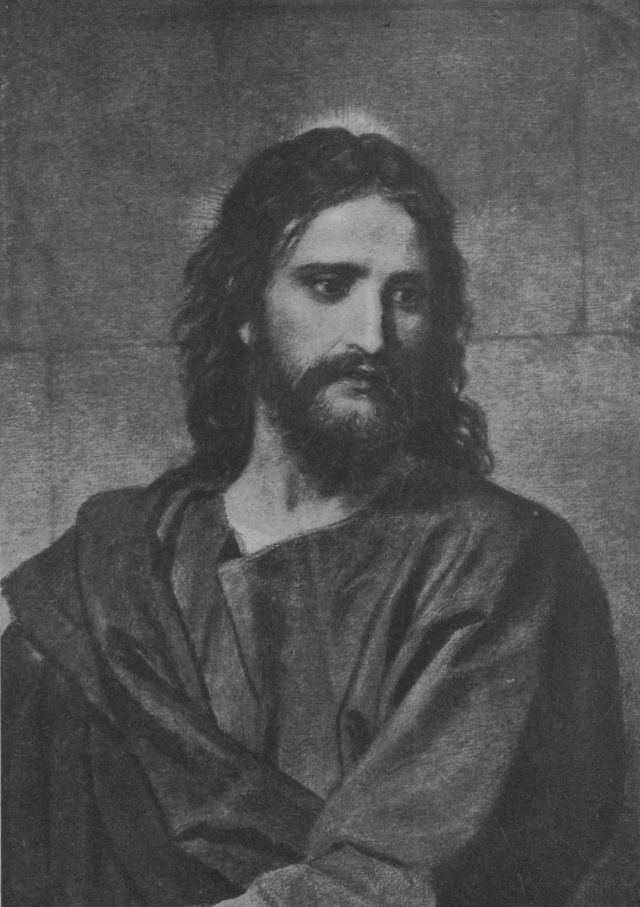
By permission of Franz Hanfstaengl, Munich.
THE SON OF MAN
From the famous painting of “Christ and the Rich Young Ruler,” by Heinrich Hofmann.
A PEOPLE’S
LIFE OF CHRIST
BY
J. PATERSON-SMYTH
B.D., LL.D., Litt.D., D.C.L.
AUTHOR OF “THE GOSPEL OF THE HEREAFTER,” “THE BIBLE IN THE MAKING,”
“HOW WE GOT OUR BIBLE,” “LIFE AND LETTERS OF ST. PAUL,” ETC.
TENTH EDITION
HODDER AND STOUGHTON
LIMITED LONDON
| First Printed | 1920 |
| Reprinted | August 1921 |
| Reprinted | December 1921 |
| Reprinted | April 1922 |
| Reprinted | June 1922 |
| Reprinted | November 1922 |
| Reprinted | March 1923 |
| Reprinted | August 1923 |
| Reprinted | September 1923 |
| Reprinted | January 1924 |
Made and Printed in Great Britain.
Hazell, Watson & Viney, Ld., London and Aylesbury.
TO MY BOY
IN THE UNSEEN
CONTENTS
| BOOK I | ||
| IN THE BEGINNING | ||
| PAGE | ||
| I. | BEFORE THE WORLD WAS | 3 |
| II. | A WORLD PREPARING | 9 |
| III. | A WORLD SET THINKING | 13 |
| BOOK II | ||
| WHEN THE CHRIST CAME | ||
| I. | THE NATIVITY | 21 |
| II. | THE VIRGIN BIRTH | 27 |
| III. | BOYHOOD | 34 |
| IV. | YOUTH AND MANHOOD | 42 |
| V. | THE CARPENTER | 47 |
| BOOK III | ||
| THE FIRST YEAR | ||
| I. | THE BAPTISM | 53 |
| II. | THE TEMPTATION | 59 |
| III. | THE FIRST DISCIPLES | 68 |
| IV. | THE CANA WEDDING | 74 |
| V. | THE ANGRY CHRIST | 82 |
| VI. | NICODEMUS | 88 |
| VII. | HOW THE BAPTIST DIED | 93 |
| BOOK IV | ||
| CAPERNAUM | ||
| I. | HOW JESUS CAME TO CAPERNAUM | 103 |
| II. | CAPERNAUM BY THE SEA | 109 |
| III. | THE CALL OF THE FOUR | 116 |
| IV. | THE FIRST SABBATH | 119 |
| V. | A PROPHET IN HIS OWN COUNTRY | 125 |
| VI. | A PRODIGAL AND A PUBLICAN | 132 |
| VII. | TWO DINNER-PARTIES | 139 |
| VIII. | THE MULTITUDES | 145 |
| IX. | ONE DAY IN CAPERNAUM | 152 |
| X. | THE BEGINNING OF TROUBLE | 159 |
| XI. | THE KINGDOM OF GOD | 167 |
| XII. | THE SERMON ON THE MOUNT | 174 |
| XIII. | THE TWELVE | 179 |
| XIV. | THE FUNERAL AT NAIN | 185 |
| XV. | ON HOLIDAY | 190 |
| XVI. | CÆSAREA PHILIPPI | 197 |
| XVII. | FAREWELL TO GALILEE | 204 |
| BOOK V | ||
| MEMORIES OF THE JERUSALEM ROAD | ||
| I. | AN AUTHOR COLLECTING MEMORIES OF THE ROAD | 211 |
| II. | FIRST ATTEMPT ON JERUSALEM | 217 |
| III. | A LOST STORY OF THE GOSPELS | 224 |
| IV. | THE TEACHINGS OF THE ROAD | 230 |
| (I. THE FATHERHOOD OF GOD) | ||
| V. | THE TEACHINGS OF THE ROAD | 235 |
| (II. THE BROTHERHOOD OF MAN) | ||
| VI. | THE TEACHINGS OF THE ROAD | 241 |
| (III. RESPONSIBILITY) | ||
| VII. | THE TEACHINGS OF THE ROAD | 248 |
| (IV. THE GREAT ASSIZE) | ||
| VIII. | THE SECOND ATTEMPT ON JERUSALEM | 252 |
| IX. | THE RAISING OF LAZARUS | 257 |
| X. | ONE MAN MUST DIE FOR THE PEOPLE | 262 |
| XI. | THE END OF THE ROAD | 266 |
| BOOK VI | ||
| JERUSALEM | ||
| I. | PALM SUNDAY | 275 |
| II. | DENUNCIATIONS | 281 |
| III. | THE TRAITOR | 285 |
| IV. | THE LAST SUPPER | 288 |
| V. | GETHSEMANE | 293 |
| VI. | A JEWISH INVESTIGATION | 296 |
| VII. | THE ROMAN LAW COURT | 301 |
| VIII. | CALVARY | 307 |
| IX. | A LOST CHAPTER IN THE LIFE OF CHRIST | 313 |
| X. | THE RESURRECTION | 317 |
| XI. | AN OLD MAN’S EASTER MEMORIES | 321 |
| XII. | THE TRAINING OF THE FORTY DAYS | 328 |
| XIII. | RETURNING TO THE FATHER | 334 |
| INDEX | 337 |
“In the beginning was the Word, and the Word was with God, and the Word was God.” Here we first touch the life of Christ. In the life of any great man of the earth we begin with his birthday, his first appearance in this world. That is his beginning. But in our Lord’s life our thought must go back to the eternal world where He belongs, in which this world of ours is but a mere modern incident. The whole fabric of our faith rests on the fact that beyond this world which we know, beyond the stars and planets, beyond the realms of matter and space and time is the real world, the world of the Eternities—the world of God and of the holy angels, the world from which this and all worlds come. We cannot see that world. We cannot map out its continents and shores. No gleam of its golden cities has ever touched our eyes. But we believe that it is all around us from eternity, and He who came from thence has told us things about it.
He has told us not only that it is an infinitely holy world but, what perhaps touches some of us more nearly, that it is an infinitely kindly, friendly world, that they on that side are keenly interested in us on this side. From the Bible point of view the galleries of the Unseen are crowded with spectators watching with deep interest our life on earth. “We are compassed about with a great cloud of witnesses.” Jesus, to whom that eternal world is His native air, is always feeling this. He tells of the Father looking on us with love and pain. He tells of the joy in Heaven over one sinner that repents on earth; of the earth-children’s guardian angels “always beholding the face of the Father which is in Heaven.” He tells of Abraham in that Unseen life rejoicing to see His day here, so interested is that world in ours. In the story of the Transfiguration, Moses and Elijah, two of the great old-world saints, came out from that Unseen life to meet their Lord and speak to Him—of what? Of Pharaoh and the Red Sea—of Ahab and Naboth’s vineyard—the things that interested them most on earth? Ah, no. They also had been caught up into the kindly interest of the great souls who are watching us from the galleries of Creation. “They spake of His decease which He should accomplish at Jerusalem.” Does it not suggest the deep, absorbing interest which they and their great comrades within the Veil were taking in the drama of Redemption on earth?
This is all comparatively modern—only two thousand years ago. But St. Paul tells the Ephesians that this deep interest in us has been from the beginning, that the coming of the Christ was no mere afterthought. It was the eternal purpose of God’s love, he says, from the foundation of the world that the eternal Christ should save humanity, that the poor earth-children should be gathered into the arms of the Father. God was always caring.
Keeping all this in mind we shall better understand what the Bible teaches, that “every incoming of God into human experience is prepared there in the Unseen before it expresses itself here in the Seen. It is known on that side for what it is, long before the moment comes for its manifestation on this side.” There in that kindly world “in the beginning was the Word, and the Word was with God, and the Word was God.” There in God’s loving purpose in the far eternities the Incarnation was prepared “for us men and for our salvation.”
So we have to go very far back for the story of our Lord’s life, beyond the farthest point that imagination can reach, countless ages before the Genesis story when in the beginning God created the heavens and the earth, limitless time behind the Incarnation “when Jesus was born in Bethlehem of Judea in the days of Herod the King.”
That is St. John’s attitude in his story of Christ.
I love to think of that dear old Bishop of Ephesus, “the disciple whom Jesus loved,” sitting down to write before he died his “Life of our Lord,” his “Gospel of an old man’s memories.”
But behind the memories of the human Jesus, who had been so affectionate with him in those three years in Palestine, lies the deeper, solemn thought of the eternal Christ, “whose goings forth have been from of old, from everlasting.” “In the beginning was the Word, and the Word was with God, and the Word was God.” Then he thinks how that eternal Christ had been caring for this poor world in the ages before the Incarnation. Far away back in that dim past, when the world had no thought of Him, “He was in the world, and the world was made by Him, and the world knew Him not.” “In Him was life, and that life was the light of men.” “He was the true light that lighteth every man coming into the world.”
It is all mystery. Human thought cannot dwell in that rarefied atmosphere. We can but whisper wonderingly to ourselves, “The Christ was always here. His presence in the Universe was the condition of its life. His presence in man brought the light of conscience. All the time from the beginning of this world One was standing in the midst of us whom we knew not.” That is what St. Augustine meant in saying that Christianity has been with us since the Creation. That was the daring thought in the mind of Tertullian, that, through all the ages, Christ had been preparing Himself for Incarnation.
St. John thinks of Him as in the world before the Incarnation revealing the infinite God through Nature and Intellect and Conscience. So he uses a term familiar in Greek and Jewish thought of the time, “the Word of God.” “In the beginning was the Word.” A strange term at first sight to signify the Christ. But it expressed the thought in the Apostle’s mind, and it had the advantage of being familiar in a similar sense to Greek philosophy and Jewish thought of his day. Roughly we may give its meaning here as that which reveals or manifests God. Greek philosophy put some such meaning on the term. Men could not see or touch the infinite source of all things. They could only know Him in His manifestation in the world around them. And so by a fine poetic figure they called this manifestation of God His “Word.”
See the idea. How does any one manifest his thought and inner being? By his word which he speaks. By his word he expresses himself, puts himself in communication with you, makes his thoughts and feelings known, gives effect to his will. The word proceeding from his thought and will carries the imprint of his inner mind and character. By his word you get to know him.
Now, how is one to know the infinite, invisible, incomprehensible God? Only by His manifestation of Himself in the conscience of men, in the wonders of life, in storm and sunshine, in the midnight heavens, in the wonder of the dawn, in the beauty of the earth and the glory of the sea, in the golden corn-fields feeding the world. These are the manifestations of God, His Word to men. Whatever power produced these was thought of even by pagan philosophers as the Word of the Supreme Being.
So far even pagan thought could go. But the Apostle’s thought went far deeper. He knew of a fuller manifestation. For three years he had walked the fields of Palestine with One who, he now felt, was the fuller Manifestation, the fuller Word of God to the world. So he goes on, “The Word became flesh.” The Word, who from the beginning had been manifesting God in the wonders of nature and the mysteries of life, at length in the fulness of time passed to the fuller manifestation. “The Word became flesh and dwelt among us, and we beheld His glory, the glory as of the Only begotten, full of grace and truth.” That was the climax of the revelation of the Godhead, the revelation not merely of God’s power and greatness, the revelation of God’s heart, of God’s tenderness, of God’s infinite friendliness and loving-kindness. Thus we see the Apostle’s thought when he calls Him in fullest sense The Word of God.
But the poor world had to wait a long time for that manifestation. We do not know why God delayed the Incarnation so long. But we know that He was caring for that desolate world before Christ came. And we know that He has all eternity to make up to them for their loss. God has a good deal of time to do things between this and the other side of eternity.
One’s heart goes out to those poor pagan men in that lonely world before Christ. They had their aspirations after good as we have. They had anxiety and suspense. They had pain as keen as ours over their boys who died in battle. They were afflicted as we are in mind, body, and estate. And they had no kindly God to turn to. They made pathetic guesses about Him. Their philosophers proved a Creator from His manifestations in Nature; but Nature could only tell that He is great and powerful. Civilized nations embodied their guesses in Jupiters and Junos. But alas! they were not beings that troubled people could pray to. As for the poor savage, he was only frightened by the resistless powers of Nature. He heard the fierce storm-wind rushing along and the trees crashing in the forest, and the thunder and hail and fire mingled with the hail, and he cowered in his cave and made idols and fetishes and cried to them to appease the Great Being or Beings who were so powerful. These poor idols were his attempt at a manifestation of God.
As one reads ancient history the thought must often come that the poor lonely old world was “groping after God if haply they might find Him.” And their philosophies and mythologies and idols and fetishes were the measure of all that they could attain to. It is pathetic. No one to tell them what they wanted to know. Is he a personal God with a heart in Him? Is there anything in Him of justice or loving-kindness? Could he hear a poor mother crying over her dead child? Does He ever think about us at all? Surely it is pathetic. If I did not believe that God was caring and that He would some day in some world make up to them for all they had lost, I should think it was cruel of Him to leave them thus.
Oh, those generations old,
Over whom no church-bells tolled,
Sightless, lifting up blind eyes
To the silence of the skies,
For the innumerable dead
Is my soul disquieted.
Trust them with God, says the Divine revelation. Christ is caring for them. Christ will not forget them. They are amongst the crowds to whom He went straight from the Cross in the three days when He proclaimed the good news to the “spirits in prison.”
Still Thy love, O Christ arisen,
Yearns to reach those souls in prison.
Through all depths of pain and loss
Sinks the plummet of Thy Cross.
Never yet abyss was found
Deeper than that Cross could sound.
So we leave these old-world men with Christ. Where better could we leave them?
Thus the long dark centuries rolled on. And still God gave no sign. But all the time in those old-world days the Divine purpose was working out, unhasting, unresting. In divers ways “Christ was preparing for Incarnation.” We do not know enough to trace His path in history. We can only guess and look for occasional glimpses of it. We see the procession of the ancient empires, Assyrian and Babylonian, Persian and Greek and Roman. And we hear the old prophets tell that these were part of a great purpose, that Jehovah was working out some great design.
One day we come on a clearer glimpse. One day, two thousand years before the Incarnation, we see a young shepherd on the Syrian hills, stirred with high aspirations, called to separate from idolatrous home and kindred to go out not knowing whither he went. And Abram heard the inward call of the Eternal and set out on his divine mission. All unknowingly he went forth, an old-world John the Baptist, “to prepare the way of the Lord.” Thus began the training of the Jewish race. They were secluded that they might be open to receive a new revelation They were separated from the idolatry and polytheism of their ancestors that they might learn of the one God. They were disciplined and trained in the knowledge of Jehovah as no nation had ever been before. All down their history they heard prophet voices telling of God’s righteous will. And down through the web of prophecy ran like a golden thread the mysterious promise of some future day when in them and their seed should all the nations be blessed. Again and again in prophetic visions of their future appeared and reappeared a dimly seen figure, perhaps human, perhaps divine—the Son of David—the Son of Man—the Son of God—the Servant of Jehovah, the Wonderful, the Counsellor, the Prince of Peace of whose government there should be no end—the Lamb to be led as a sheep to the slaughter on whom the Lord should lay the iniquity of us all.
All this set men expecting, looking forward. But God still kept silence. Nothing happened. The Jewish Kings and prophets passed away and the sorrowful days of the Exile came. The Jews were scattered all over the earth. And the world went on its way rejoicing and sorrowing, struggling and sinning. And still God gave no sign.
At last the time drew near. And as it came, behold a marvellous thing. The world beginning to make ready! Like the unconscious ocean responding with its tides to movements in the moon, Earth seems unconsciously responding to movements in the Eternal World. When that world was preparing to send us the Christ, this world began to make ready. Looking back now, long after the event, one can hardly fail to see what seems a Divine shaping of history in preparation for Him.
Here are the facts. When the Christ was coming, three races held the chief influence in the world—the Greek, the Roman and the Jew. The polished Greek, the powerful Roman, the hated and despised Jew. They were the prominent peoples of the civilized world. Nay, they were the civilized world. No others counted. Pilate recognized this when he put his inscription of the Cross “in Hebrew and Greek and Latin.” Now if these three peoples in the generation before Christ, without knowing or intending, seem almost as if conspiring together to prepare for His coming, is it too much to say that it at least suggests a Divine preparation? Men who do not take Christ into account may look on it as the chance happenings of history. But I think Christians, who recognize the stupendous thing about to come, will feel, as they read the history of the time, that not only the Baptist but the world around was sent to “prepare the way of the Lord.” At any rate, this is what happened.
First, the Roman made the road for the coming of the King. A century before Messiah’s day the world was intensely localized and subdivided and broken up into separate little nations, with their separate religions and customs and laws, their jealousies and suspicions, their constant wars, their bristling frontiers barring communication. The land was harassed by skirmishing bands, the sea was impassable by reason of pirates. Humanly speaking, a century before Christ no Palestine movement could ever have spread beyond Palestine. It was humanly impossible for a universal Gospel to win free course through the world.
Just at this crisis came a striking change. The Romans accomplished it. When Jesus came, instead of frontiered nations separated and suspicious, He found a levelled world with the fences down. Rome had welded the incoherent kingdoms into one, smashing up the separated patriotisms and religions, federating the world into a single great monarchy. The Roman roads traversed the civilized world, the iron power of the Cæsars kept universal peace. The highway was open for the coming of the King. One has but to watch the free, unrestricted journeys of St. Paul all over the Empire to see what the Roman peace and the Roman road and the Roman world-unity meant for the spread of the new religion.
So far the Romans and the Road. What of the Greeks? An open road for the coming Gospel was of little avail without a common language to carry it through the world. The Jew spoke Aramaic, the Roman knew Latin, the many peoples spoke languages as confused as at Babel. But, as the day drew near when Messiah was coming, the Greek, all unknowing, was doing his part to prepare the way of the Lord. His beautiful, flexible tongue became the chief language of the Empire. Men all around the Mediterranean, while speaking their own language, also learned to use Greek. It became the language of the whole civilized world. Thus the vehicle was prepared for carrying the new teaching.
Again we get our object lesson in the travels of St. Paul. Alike to Romans and Corinthians, to the polished Athenians and the rude pagan tribes in the highlands of Galatia, we hear him tell in a tongue “understanded of the people” the wonderful works of God.
The Greek, the Roman, and the Jew. Pioneers preparing the way of the Lord. The Roman cleared the road, the Greek supplied the language. What of the Jew? What could he accomplish? Hated and despised by the dominant races, shut up in his little far-off corner of the Empire, what was to be expected of him in a world-wide movement?
To him who seeks God’s hand in the preparation for the Christ, the Jew of Messiah’s day is the most striking instance of all. Secluded for centuries amongst the hills of Palestine, he had been keeping for the world the Oracles of God, the teaching of spiritual religion, the prophecies of a Golden Age in which the Coming One should come. Then came what seemed to the Jew the tragedy of the Captivity. To us, looking back on it long after the event, it seems, like many another tragedy of history, a distinct working out of the purpose of the Almighty.
For the Exile scattered the Jews throughout the world. As a gardener transplants his young trees from the nursery to place them out over the land, so God transplanted Israel and scattered him among the nations. After the Captivity only a small minority returned to Palestine. The bulk of the exiles settled in their new homes or spread themselves out for trade among the nations around. Historians of the time tell us that there was no nation where the Jews had not settled, growing in power and in commercial influence. They were everywhere in force throughout the Empire. Outside the Empire their great colonies in Babylon and Alexandria were a headquarters for the race. Like the Greater Britain which we speak of to-day, so was the “Greater Israel” spreading through the civilized world vastly outnumbering the Palestine stock, but ever looking back to Jerusalem as exiles to their home. They were one-eighth of the whole population of Egypt. We form some idea of their numbers and of the extent of their wanderings as we watch a group of them, fifty years later, come back for the annual Pentecost to Jerusalem, “Parthians and Medes and Elamites and dwellers in Mesopotamia, in Judea and Cappadocia, in Pontus and Asia, in Phrygia and Pamphylia, in Egypt and the parts of Libya about Cyrene, strangers from Rome, both Jews and proselytes, Cretes and Arabians.”
They were everywhere, and everywhere they carried with them their religion and their sacred Books, as we read, “Moses hath in every city them that preach him, being read in the synagogues every Sabbath Day.”
And everywhere, above all, they clung to their national hope of the Messiah who should come. That coming of Messiah was the supreme culmination. For that Judaism existed. “The prophets,” says their Talmud, “prophesied only of Messiah.” “For Messiah only was the world created.” True, they did not know when Messiah would come. True, they had narrow, unspiritual thoughts of Him as the deliverer and exalter of the Jews. They looked not for a light to lighten the Gentiles, but only for the glory of His people Israel. Yet, even so, think what it meant as a preparation for the Christ to have people with such beliefs spread everywhere among the heathen.
Though personally disliked, they had a very wide influence. The more thoughtful of their pagan neighbours, dissatisfied with their own wretched polytheism and idolatry, felt the attraction of a religion in their midst which proclaimed with no uncertain sound One God, lofty and holy, who valued religious conduct, who cared for men, who listened to prayers, who intended some great thing in the future for humanity. In every city proselytes from heathendom were joined to the synagogue, and outside these a far larger number of “adherents” (“devout men” they are called in the Acts), like the centurion in the New Testament, were attracted to the doctrines and acquainted with the Scriptures of Israel, and formed a fringe of partly leavened Gentile life around the Synagogue.
And a very important factor in this connection—about two hundred years before Christ, the Hebrew Bible had been translated into Greek, the common tongue, the famous Septuagint Bible, which could be read by Jew and Gentile, which proclaimed to Jew and Gentile alike a righteous God and some Great One who was to come.
Though the bulk of the Jews were blinded and their hearts were holden, though Palestine crucified Messiah when He came, yet we have but to turn again to the story of St. Paul with the Synagogue forming everywhere the seed-bed of the Church, to realize the enormous influence of that scattered Israel in helping “to prepare the way of the Lord.”
Surely it is significant that, just when the Son of God was about to come into the world, the three great peoples who composed that world should have unconsciously conspired to make ready His path. Surely it should at least suggest a Divine Hand reaching forth to fashion out of many elements a great result.
But, beside those external changes, geographical and political, we seem to see an equally significant internal preparation in the thoughts and feelings of men at that time. It was a tired, discouraged, dissatisfied world which awaited the coming of Christ. It sorely needed some one to help and hearten it up. Of course, that was true in some measure at all times before He came. But humanity was growing. Conscience was asserting its supremacy. Men were thinking more and feeling their dissatisfactions more.
Let us look again at these three races, the Greek, the Roman, and the Jew.
There were the Greeks, the proud, eager, restless, beautiful Greeks, with their noble art and literature and philosophy, and their love of the beautiful, and their poetic imagination which peopled Olympus with the gods. To this day the whole civilized world looks to these ancient Greeks with wonder and gratitude. We owe to them the best of our culture. Above all things they stood for culture. Never was any nation prouder of its culture. Never had any nation better reason to be proud.
But, alas! we have learned in the recent Great War days what culture can come to without religion, and the poor Greeks of that day were learning what Germany may some day learn for her eternal good, that the world cannot get on with culture only. I picture these Greeks as like the modern Parisians, a light, pleasant, quick-witted people, who like to amuse themselves, to enjoy themselves. But the enjoyment was a good deal on the surface. Down underneath life was a bit pathetic. Their best days were over. The golden age of Greece was in the past. Their political integrity was lost. They spent their time in frivolity, and worse. Profligacy and corruption were eating like a cancer, and their beautiful religion had no power to check their bad propensities. How could it? Even in the best days their beautiful gods on Mount Olympus were not very moral. You could not imagine any one offering them spiritual prayers.
In the simplicity of their lusty youth-time their gods had been real to them. They believed in their gods. They were not a bad sort of gods. Jove was the good-natured father and creator. Their gods fought with them at the Pass of Thermopylæ, where the famous three hundred laid down their lives for Greece and for right.
But now they were a hopeless and effeminate race. Though they kept up their forms and their images, they had utterly lost all real belief. Their mythology had become a fairy tale. “Men had climbed up into Olympus and found no gods there.” And so it was a lonely world for the poor Greeks. The Bishop of Tokyo told the writer lately that this is the condition of Japan to-day. In young, happy days nations and men can get on with frivolity and pleasure, and statues and poetry; but there are days when these things fail. In our sorrowful times we want a god of some kind to turn to. Even Jupiters and Junos will be some use, provided we believe in them. But, alas, if we do not!
Look at the Romans. The Romans were in no decline like the Greeks. Theirs was a brave, magnificent world in its pride of power and mastery and success. But historians tell us that underneath this showy power and magnificence was a sink of rottenness. Family life was unspeakable. Tyranny and cruelty were rampant. The people were degraded and brutalized. Their favourite amusements were the hideous slaughters in the arena. Slavery was the curse of the Empire. Two men out of three who walked the streets of Rome were slaves, and two women out of every three, and two girls out of every three subject to every whim of their masters, to every suggestion of passion or lust. The slaves were wretched. The best of them crowded to Christianity when it came. The worst of them debauched Rome. They brought in new, unnatural vices. They corrupted the masters. They corrupted the children. Every passion of the golden youth of Rome was ministered to by them. The Roman boys grew old and jaded and rotten with vice before they were out of their teens. A half-century later St. Paul indicates the position in his terrible first chapter of the Epistle to the Romans. God gave men up to uncleanness through the lusts of their own hearts. With all its pride and magnificence, that Roman world was a lonesome world for individual men and women. A world without God. Whenever one was in sorrow, whenever one was disgusted with himself, whenever one had aspirations after Right, there was no god to pray to except the goddess Rome and the deified emperor who was worshipped as representing Rome. Put yourself in their place. Think how you would feel.
But that is not the main point. That was true of Paganism always. The main point is that the best of the Romans were sick of it all. Any uplift would be welcome. There were fine characters amongst those pagan men. We remember later on how the Roman centurions in the New Testament felt attracted towards Christianity when they came in contact with it. It is pathetic to see how the leaders of Roman thought felt the position. It was an age of philosophers groping for truth and groping for some guidance for conduct. Men had advanced beyond the unthinking stage. They were thinking hard. With their heaven, like the Greek heaven, empty of gods, they tried to think out some sort of religion to live by. They studied the mystery of Conscience. They recognized its authority. For Conscience, said one of them later on, is a sort of inward divinity. That was a long step forward for pagan people.
Their Stoic philosophers evolved a noble teaching. “Seek virtue. Listen to the voice of Conscience. For Conscience is a sort of inward divinity. Probably there is some great Being behind it. But even if not, follow that voice.” Was not that a fine attitude for pagan men?
Surely God was helping. The Coming One, who lighteneth every man coming into the world, was lightening their hearts.
There were longings, yearnings, strivings,
For the good they comprehend not.
And the feeble hands and helpless,
Groping blindly in the darkness,
Touched God’s right hand in that darkness
And were lifted up and strengthened.
They did their best, these old thinkers, and it was a very good best. But it was all speculation. They had no solid foundation as the Jews had, to build a religion on. So their highest efforts failed. Their speculations could not stand the rough and tumble of life. Their fine theories never gripped the common people. They touched the high-water mark of unaided human reason in trying to think out a religion for itself. But they failed.
They failed. But does it not seem that just when pagan men were thus seeking for light—at the very time when these highest efforts of unaided humanity had broken down—does it not seem worth note that just at this crisis of the world’s history the Christ should come?
What of the Jew, the third great division of the world? Probably some one will retort that, however it might be with the Greek and the Roman, the Jew, at any rate in his obstinate perversity, was in no receptive mood for the coming of the Christ.
I think that is an exaggeration. You are judging by the bigoted, prejudiced Jew, who is prominent in the New Testament just because of his opposition. Remember that many of the best of the Jews saw the prophetic hope fulfilled in Jesus and became the first and most devoted members of the young Church.
As we study the writings of the time we find that, like the Greeks and the Romans, thoughtful Jews too were dissatisfied with their religion. The travelled Jew, away from Palestine, was broadened by his contact with other peoples and his sympathy with much in Gentile learning. He grew out of touch with the Palestine exclusiveness. Living in kindly relation with his pagan friends, he felt that Judaism which could not take them in could never be a religion for all humanity. Jehovah was the tribal God of Israel only. The rest of the world could only reach Him through Israel, through circumcision, through burdensome rules of an alien people whom they disliked. The position was an impossible one. We have the writings of such Jews trying to reconcile their religion with broader hopes of a religion for all.
If it were only possible that Judaism, with its noble theology, could blossom out into a great world-embracing religion, with no distinction of Jew and Gentile, Greek and Barbarian, bond and free! And the really thoughtful Jew knew that that was in the vision of the prophets of old, that one day from the stem of Judah should spring the spreading flower of a world-religion to bless all humanity when Messiah should come.
There is this, too, to be considered. Earnest spiritual men of St. Paul’s type had outgrown the Law. Paul says it was meant to be outgrown, that it was only temporary, a school-master (child-leader) to lead men to Christ. And, in revealing the misery of his own spiritual struggles before his conversion, he shows how earnest Jews were seeking some more hopeful approach to God. To such men Christ would be a joyful discovery.
But the most striking, the perfectly startling thing to one who does not know it, is the tense expectation of the whole Jewish world in that generation when Christ came. I am bold to say that no national history has ever shown a more arresting, convincing phenomenon than that mental attitude of the Jewish world when Jesus was coming.
The last of the prophets who had prophesied of the Coming One had been five hundred years dead. And nothing had happened. One might well expect that men should forget or give up hoping after five hundred years. Yet here was a whole race on the tiptoe of expectation just as the time drew near. A whole popular literature had sprung up expressive of that expectation in the interval between the Old Testament and the New. There is no space here to tell of this literature. Here is a little specimen from one of its books, the Book of Enoch. It was current in the two generations before Christ. St. Jude knew it. Doubtless Jesus knew it. I have often thought that it was there He got His favourite title for Himself, “The Son of Man.”
“And in my vision I saw that with the Eternal was one whose countenance was like man and his face full of graciousness. And I asked the angel, and he said unto me, This is the Son of Man with whom dwelleth Righteousness and who reveals all that is hidden. . . . And this Son of Man will be a staff to the righteous and a light to the Gentiles and the hope of those who are troubled in heart. All who dwell on the earth shall bow the knee before him. For this reason he had been chosen before the foundation of the world and for evermore.”
These books indicate the growing expectancy. But in the beginnings of the Gospels you find it throbbing on every page. The messages of the old prophets had crystallized into a definite hope. That hope sprang into eager questioning whenever a leader appeared. When Judas of Galilee came in the days of the taxing, much people followed him, hoping he was Messiah. When John the Baptist appeared, what was the first thought? “All men mused in their hearts of John whether he was the Christ or not.” What was the first question when he started his preaching, “Tell us, art thou Messiah? Art thou he that should come?” One cannot but feel that we are in an atmosphere of tense expectation.
Only now, looking back, can we realize the position. We have seen at a certain period of history the great nations of earth unconsciously making a pathway for the Christ, and the whole Jewish race on tiptoe of expectation of Him, and the poor world at its lowest blindly groping for some uplift.
And, just then, THE CHRIST CAME!
Just then the Christ came. “In the fulness of time God sent forth His Son.” Forth from the Eternal World into this world. Keep both worlds in view all the time.
We have come now to that event in the history of our race for which all previous history was only a preparation, that stupendous event which bridged over the chasm between God and man, when He came down to earth in human guise “whose goings forth have been from of old, from everlasting.”
And the first thing that strikes one—so utterly unlikely, so almost incredible at first sight—is the simple, ordinary way in which the great thing happened. If He had come with mighty cataclysm and rending of the heavens, that was to be looked for. But to come in this simple, ordinary way! And yet, on second thought, is not this God’s method in working all His wonders? Is it not “just like Him,” as we say? That is how they do things in that Eternal World. In the building of an oak, in the making of a planet, in the wonder of the dawn, in the miracle of the yellow harvest—that seems God’s method always, quiet, simple, unnoticed.
So Jesus came in utter, unexpected simplicity, not with pomp or glory or rending of the heavens, but gently, quietly, as the dew comes or the dawn. Here is a stupendous happening, beyond the grasp of thought, and so easily does it blend with the simplest elements of life around that we feel some difficulty in retaining any wonder and awe. One feels almost as if reading an ordinary village chronicle.
So easily, simply, naturally did the Christ become man.
The story opens in a country village, secluded among the hills of Galilee. In the village street is a carpenter’s shop and a country carpenter working at his bench with saw and hammer and chisel, making tables and chairs, and ploughs and cattle-yokes for the country-side around. He is working hard and working happily, with the thought of his betrothal in his heart and of the home which he is preparing for his bride.
Down the village his betrothed dwells, Mary, the daughter of Anna, a peasant girl though of royal blood, working in her home spinning and bread-making and drawing water from the well with the other village girls in the evening. We know her as a maiden gracious and modest; we picture her to ourselves with a beautiful face to match her beautiful soul.
And Joseph the carpenter loved her. All accounts suggest that he was older than she, and perhaps for that reason he thought of her more tenderly. He liked to watch her passing and to dream of their coming life together. And, surely, it was pleasant to her to meet him after his work and hear him talk of his brave plans and hopes. For Galilee was free from the strict conventions about lovers that obtained in the South in Jerusalem.
But other and higher things were also in their thoughts. These two were no ordinary lovers, wrapped up in themselves and their future. Joseph, we are told, was “a righteous man,” and Mary’s was a pure and lofty soul, fit to be chosen for God’s eternal purpose. They were religious as all lovers ought to be in this solemn, beautiful crisis of their lives. Mingled with their happiness was the thought of God and His goodness, and surely they sometimes talked together of what was so much in the minds of all religious Jews just then, the greater hope of Israel, the Messiah to come. And we picture the girl going home after these meetings and kneeling by her cottage window to pray to God for her lover’s life and her own.
Who could dream that in that simple setting should be wrought the miracle of the ages! The Unseen World, so long watching its preparation with enthralling interest, were now shifting to earth the drama of Redemption. And they were to play their part in its opening scenes.
One day—one night, perhaps, at her prayers—came suddenly on the maiden a stirring of her whole being and the awe of the Supernatural, and an angel vision and a voice from the Unseen,
“Hail, thou that art highly favoured,
The Lord is with thee.”
And as she bowed there, trembling in astonishment and awe, in that hour came to her the tremendous announcement that the great hope of Israel, the hope of the long ages, was to be fulfilled at last.
“Fear not, Mary, thou hast found favour with God. And behold, thou shalt conceive and bring forth a Son, and thou shalt call His name Jesus. He shall be great and shall be called the Son of the Highest . . . and of His kingdom there shall be no end. The Holy Ghost shall come upon thee and the power of the Most High shall overshadow thee. Wherefore, also, that holy one to be born of thee shall be called the Son of God.”
And Mary said,
“Behold the handmaid of the Lord. Be it unto me according to thy word.”
And the angel departed from her. Silence alone becomes us here, and the veil drawn before a woman’s heart. No note or comment must intrude on the sacred reticence of that story, which could only have come to us through Mary herself.
A woman, overwhelmed with her tremendous secret such as no woman’s heart before had ever borne, is “going with haste into the hill country of Judea”—to tell a woman. Not even to her betrothed can she unburden her thoughts. A woman at such a time needs a woman. Her cousin, Elizabeth, was the wife of a country priest, and the angel said she also was in the purpose of the Almighty. Another man-child was coming into the world to be the herald to Israel of the coming of Messiah.
So Mary came to the priest’s house in the hills of Hebron, and the two women met and told their stories to each other and went over the details wonderingly again and again. Never could either forget the sacred experiences of those three months while they communed with each other and with their own souls and with God, night and day, in that quiet little house on the hill-side. And the busy world outside, occupied with its own little projects, went on unknowing of the great thing which had come to pass.
The Blessed Virgin returned to her Nazareth home. No longer the light-hearted girl who had left it. In these three months the girl had become a woman, grown in spiritual stature, living very close to God in a new wonder-world, brooding all alone in trembling joy over the transcendent mystery locked in her heart. Not even Joseph knew. But, as the months passed, the wondering joy in her eyes became shadowed with cruel pain as she slowly realized the horrible suspicion that was coming to her lover, the awful trial of his faith. Think of the agony to both of them that day when Joseph, her betrothed husband, “being a just man and not willing to make her a public example, was minded to put her away privily.” Truly, already the sword was piercing through her soul that the thoughts of many hearts should be revealed.
Those days of misery passed. In the visions of the night when the spirit world touches human souls, the message of God came to that tortured man and he awoke assured, ashamed, happy, to take unto him Mary his wife, to watch with reverent tenderness over that maiden-mother and the unborn Christ. But Mary could not easily forget those days. Such experiences leave marks on a woman’s heart.
Three months later. The sun is setting over the Bethlehem hills, touching the bare uplands of the wilderness of Judea and the purple mountains of Moab far off against the sky. On the valley road to Bethlehem is a straggling procession of travellers, and amongst them a young countrywoman, wearily riding, with her husband beside her leading the ass. “For there went out a decree from Cæsar Augustus that all the world should be enrolled. And Joseph also went up from Galilee out of the city of Nazareth unto the city of David which is called Bethlehem, because he was of the house and lineage of David, to enrol himself with Mary, his betrothed wife, being great with child.”
So they draw near to Bethlehem through a land alive with historic memories. In the pastures beside them Ruth long ago gleaned in the fields of Boaz. In that hollow to the right outside the gates, brave men had died to bring David a drink of water from the Well of Bethlehem. A little off the road is a memorial sacred to all Jews, where the light of Jacob’s life went out when “Rachel died by me in the land of Canaan, and I buried her by the roadside on the way to Ephrath (which is Bethlehem).”
But their thoughts are preoccupied with greater things soon to come to pass. And Joseph is hastening to find rest and shelter for his companion. Those last miles have been very trying for her. At ordinary times there would be no anxiety about lodging, for in the friendly East hospitality is a sacred duty. But the travellers for the census have crowded the town. There is no room anywhere for the belated wayfarers, not even in the inn.
It was nobody’s fault. Nobody knew Who was coming, except the adoring crowd looking down from the ramparts of the World from which He came, and they in that world of Goodwill would not blame us though they might well have enjoyed the unconscious irony of it all—the Lord of the Universe coming to this little world of His, and they have no room for Him.
They were glad to take refuge at last in one of the natural caves in the hill-side where cattle were bedded. And there, with no kindly woman hand to aid her, came the pains of child-birth on that lonely woman, and “she brought forth her son and wrapped him in swaddling clothes”—there was no one else to do it—and laid Him in the manger with the cattle around Him for His first infant sleep.
Did ever baby enter this world in lowlier guise? And do we not all love Him the more for it? Somehow it would spoil the picture if He had been born in a palace with princesses to wait on Him and high priests in attendance. That poor little Baby, whom nobody noticed, comes to us in His helplessness with such clinging appeal, as if trusting Himself utterly to us, as if bidding for our affection, wanting us to be fond of Him. So touchingly, appealingly did the Christ-child come.
But that is only half the story of His birthday. The angels are coming in. Two worlds are in the picture. Keep the whole picture in view, else the story will go wrong.
Simply, ordinarily as the coming of the dawn, happened this tremendous thing in the history of the universe, the coming of the Lord of Glory into human life. On the earthly side just a stable, a manger, the cattle in the stalls, a woman wrapping her baby in swaddling clothes. Nothing of wonder in it. Nothing of awe. Until the world from which He came flashes in upon the scene, where high over the stable, outside in the starlight, was the heavenly host, stirred to its depths at the coming of the Christ-child.
Remember it is all one story, all one picture—the Divine Babe on the earth, who had come from the heavens, and over Him in the heavens the angels outside rejoicing and keeping His birthday. Again I repeat, in the life of the Christ keep always in your consciousness the world from which He came. We believe in it all right. But we are dull and slow of heart. We let it slip out of view. And so our picture gets out of focus.
No part of the Christ story has so touched our imagination as this inrush from the other world; how its music swelled and died over the pasture-fields of Bethlehem with its glad tidings of great joy which should be to all people; how the hosts of Heaven, as they listened, could not restrain their delight, breaking forth in the eternal anthem of their world above—Glory to God in the Highest!
But unless we keep habitually in mind that other world, that eager, interested, enthusiastic world, its very wonder and beauty tend to separate it from us, to make the picture of the angels from Heaven rather misty and cloud-like beside that of the manger and the Baby on the earth. Now that must not be. Any haziness as to the reality and close presence of that world puts the whole story out of gear. For this is no mere exquisite poetic fancy, hallowed by sweet associations of childhood. It is just part of the story of the Baby and the swaddling clothes. Both must go together. Both are equally real. It takes both to complete the picture.
Jesus, to whom that World was His native air, always sees the two worlds together. He speaks of Heaven and angels and spirits as familiarly as we speak of our native town and the friends that we know. When He looks upon a little child on earth, He sees also its guardian angel before the Father’s face in Heaven. When He sees a sinner repenting on earth, He sees the joy in the presence of the angels. He feels that that native world of His is always around Him, always interested in our world.
We have already noted that every incoming of God into human life, every spiritual uplift which this world receives, is begun in that World before we know anything about it here. It is known on that side long before its manifestation on this side. Think, then, how we should expect such a stupendous project as this Incarnation of the Eternal Son to have been acclaimed in Heaven at the beginning, and followed with adoring interest when the stage was shifted to earth, and we shall see how fittingly comes in the angel joy that night over the glad tidings that should be to all people, “Unto you is born this day, in the city of David, a Saviour, who is Christ the Lord.”
As the question has in recent years been coming into public discussion and often causing uneasiness and doubt, it seems desirable to insert a brief chapter here on the Virgin Birth of the Lord.
The questioning does not come from unbelievers only. There are Christian men who claim that it does not affect the belief in Christ’s Divinity and ask that it be left an open question, that for the relief of doubt the statement be deleted from the Creed, “conceived by the Holy Ghost, born of the Virgin Mary.”
Freely giving all credit for honesty of purpose, one can but designate this hazy attitude as a grievous mistake. Nothing has occurred to justify it. In the long run it must affect belief in the Divinity. It was not for nothing that the Church made this statement so prominent in her Creed. For this is the lesson which history has taught, that whoso loosens men’s belief in the Virgin Birth of the Lord is loosening the keystone in the doctrine of the Incarnation.
It is difficult to deal briefly with this large subject. Let me try, first, to state the historical position, indicating how this doctrine was placed in the Creeds; second, to deal with objections and doubts; and, third, to emphasize the vital importance of keeping this teaching embedded in the faith.
First, the historical position. During the lifetime of our Lord the question was never thought of amongst the disciples. Until they had realized the Deity of Christ such a thing would have seemed absurd, preposterous, incredible. The holy reticence of the Virgin Mother, who “kept all these things and pondered them in her heart,” leads us to believe that the story was not divulged except, perhaps, to a very small circle of intimates. How could it be? Think of the delicacy and natural reserve on such a subject, at a time when Jesus was only regarded as man. With our solemn reverence for the mystery of the Incarnation, it is hard to think ourselves back into the position. But history brings us sharply down to earth, telling the coarse slanders suggested later by the enemies of Christianity. Could the Blessed Mother herself ever forget that awful day when even Joseph, her espoused husband, had doubted her? Until, in later days, she realized Christ’s Deity and the stupendous meaning of that Virgin Birth, how could she reveal to a suspicious world an experience that must seem to them unmeaning and impossible?
Always remember that Jesus was received by the disciples as a man. That was evidently the Divine purpose. Jesus so willed it. As a man He won their affection, admiration, and reverence; gradually their feelings deepened into wonder and awe—into perplexity and suspense. They did not know what to think. And He did not help them; He kept the Divine secret. Even when they caught glimpses of it He forbade them to speak; even after the Transfiguration He bade them keep silence till “the Son of Man be risen from the dead.” It was only as the end drew near that He began to reveal Himself. “Ye believe in God, believe also in Me”; “I and My Father are one”; “The Holy Ghost, whom I will send from the Father”; “One day I am coming to judge the quick and the dead.”
But it was not until after the Resurrection and the mysterious Forty Days, and the Ascension into Heaven, and the coming of the Holy Ghost, that the stupendous revelation dawned fully upon them, and with adoring awe they realized Who had been with them all those wondrous three years in Palestine, as they wrote: “The Word was made flesh and dwelt among us, and we beheld His glory, as the glory of the Only Begotten of the Father.”
This was quite irrespective of any Virgin Birth. Most of them knew nothing about it, and if they had never heard of anything earlier than they knew, their belief would be unshaken. “We know that the Son of God is come.” But think what a delightful confirmation and rounding off of their belief when the long-guarded secret at length was revealed in the atmosphere thus fitted to receive it. It would have had no meaning before. Now its significance was apparent. It cleared away perplexities from the mystery of the Divinity. It fitted into the Incarnation as the key fits into the lock; as the lost piece fits into the broken puzzle.
It came, of course, from the Virgin Mother direct, or through her intimate circle, probably St. John and the holy women her companions. We know nothing of its first announcement. We know nothing of the evidence which satisfied the Church. We know that “Mary, the Mother of Jesus, was with the brethren.” We know that in a few years the knowledge was all over Palestine; that after it had lived some years in the oral traditions, it was written down by St. Matthew and more fully by St. Luke, that the Church sent out these Gospels as expressing her belief and incorporated that belief into her very earliest Creeds. Here is the Roman baptismal creed about the year 100: “Born of the Holy Ghost from the Virgin Mary.” And in all the ages since, unchanging, unwavering, she has made it her central statement of the Incarnation in her Creeds. To this very day, in every part of the world, she bids her children keep reciting this their belief in the Incarnation. “In Jesus Christ His only Son our Lord, who was conceived by the Holy Ghost, born of the Virgin Mary.”
Keep things in their right order as they happened to the disciples. First had to come the overwhelming conviction of the Deity of Christ. Only when men recognized this could the question of the Virgin Birth be discussed at all. Without this it would have no significance. Only when they were worshipping the ascended Christ as God could the full conviction and full significance come of the Divine secret of Mary: “The Holy Ghost shall come upon thee and the power of the Highest shall overshadow thee, therefore also that Holy One that shall be born of thee shall be called the Son of God.” Then, it fitted in like the key to the lock, like the missing piece of a puzzle, rounding off and making conceivable the fact of His Divinity.
When was it made public? Not after many years when legends might have had time to grow. No. Just after the Resurrection. Professor Harnack, the greatest authority for this period, himself not believing in the Virgin Birth, admits: It was the common property of Christians everywhere about the end of the first century, and therefore must be ascribed in Palestine to the first decades after the Resurrection.
What is the evidence for it? The only possible evidence for any historical fact after so many years is that the men of that day, the only ones in a position to judge the evidence, believed it and put it forth as an authoritative statement about their Lord. And that they certainly did.
The very fact that St. Matthew and St. Luke wrote it down as their account of the Church’s belief, and that the Church accepted and put forth these Gospels as a true account of her belief, should be sufficient to show this. It is extraordinary how people miss this point. To read the arguments against the Virgin Birth, one would think that St. Matthew and St. Luke were the only witnesses, as if they were writing some theories of their own which they wanted the Church to believe. Realize this fact—that they were only writing down the Church’s beliefs. Grip on to this statement and learn it by heart. The Church did not believe the Virgin Birth because it was put into these Gospels, but it was put into these Gospels because the Church believed it. St. Matthew and St. Luke have the whole Church behind them.
If people would remember this, and keep their heads and keep their common sense, we should have less talk about this objection, the chief difficulty of Christian doubters, that the other New Testament writers do not witness to the Virgin Birth.
Let me deal with this now. Never mind infidel objections for the moment. This is the most formidable difficulty put forward by Christian doubters. St. Mark does not mention the Virgin Birth. Neither does St. John. Nor St. Paul in his many voluminous Epistles. Does not this suggest that they did not believe it? The objection looks serious until you consider it.
First, keep clearly in mind that the Church’s accepting the Gospels of St. Matthew and St. Luke as a correct statement of her teaching is evidence of the widespread belief on this subject. Why, then, did not St. Mark record it? Open his book and you will see that he is only telling of the public life of Jesus. He starts off with the Baptism and the Mission to Galilee. He never touches anything earlier, while St. Luke aims, as he says, to teach “all things from the very first.” You can hardly use Mark as a witness on either side.
Why did not St. John mention it? I do not know. But keep in mind that he must have been familiar with the Gospels of St. Matthew and St. Luke, that he knew in any case that the Virgin Birth was in his lifetime accepted throughout the Church—that his purpose was to supplement the other Gospels, to write only that which was not written already. This was written already. If that is not sufficient answer, take notice of this, that St. John is looking at Christ’s birth from the side of Heaven, not of earth. He, too, writes about the birth of Christ, but instead of telling that Jesus was born in Bethlehem of Judea he tells how Jesus came down from the higher world. This is his preface telling of Christ’s birth corresponding to the prefaces of St. Matthew and St. Luke. “In the beginning was the Word, and the Word was with God, and the Word was God. . . . And the Word became flesh and tabernacled amongst us, and we beheld His glory.” Does this seem as if St. John was opposed to the Church’s belief in his day?
As for St. Paul. Why cannot people remember that we have no record at all of his story of the Life of Christ which was the constant every-day preaching of himself and all the apostles? He had his regular course of teaching on Christ’s life. “My Gospel,” he calls it; “how Jesus Christ rose from the dead according to my Gospel.”
We have no record of that Gospel, that life of Christ which he daily preached. Therefore, if you think he did not preach in it the Virgin Birth no one can contradict you. But here is a vitally remarkable fact. If St. Paul did not write a Gospel, St. Luke, his disciple and close companion, did write a Gospel, while he was in St. Paul’s company. All the years that he was in close touch with St. Paul he had two manuscripts in hand, one a diary of the life of St. Paul, to be afterwards published as the Acts of the Apostles. Another much more precious and important, to be published first, a Life of his blessed Lord. It was believed that St. Paul had chosen him to do it; that St. Paul was his collaborator; that it was St. Paul’s teaching; the early Church called it St. Paul’s Gospel. Here are two Fathers of the second century—Irenæus, in Gaul, says, “Luke put down in a book the Gospel preached by Paul”; Tertullian, in Africa, says, “Luke’s digest was usually ascribed to Paul.” And this is the Gospel that gives such special prominence to the Virgin Birth of Jesus!
In the face of such facts surely the silence of the Epistles is not important. The Epistles scarcely ever touch the life of Christ. They were special letters on special occasions, mainly to deal with current controversial questions. Evidently this question did not come up for discussion. Probably because nobody disputed it.
I have here stated the chief difficulty of Christian doubters, the silences of the New Testament. Judge if it is serious enough to disturb the Creeds. Infidels, of course, make short work of the whole question. “Virgin births do not happen in human experience.” Granted. But Christs do not happen either. What the Bible asserts is that both happened once and that one belongs to the other. It does not convince the infidel, but it breaks the point of his argument with Christian men. We are not arguing with infidels. For men who do not believe in the Deity of Christ, this question can have no meaning or credibility.
Now for the last point, the importance of keeping this teaching embedded in our Christian faith. Some Christian men—very few in number—have asked that, for the relief of honest doubters, the statement be removed from the Creeds, “conceived by the Holy Ghost, born of the Virgin Mary.”
The questioning of the Virgin Birth is no new thing. It is as old as the Church, as old as the heretic Cerinthus, the opponent of St. John. It has come up at various times. It has come up in our day. But with this difference. In early days all the challenge came from outside, from men who disbelieved the Deity of Christ. The two ideas, the Deity of Christ and the Virgin Birth, went together. Men accepted both together or denied both together. In our day has come the attempt to separate them. Some men who are believers in the Divinity of the Lord claim that the Virgin Birth be left an open question.
It is a kindly attempt for the sake of the doubter to make the Christian Creed easy to believe. But you cannot make the Christian Creed easy to believe. The Christian Creed can never be made easy to believe. It is the most tremendous, the most incredible thing in the whole universe to believe. That God became Man! That the Word became Flesh!
Make belief easy! Nay, the serious thing is that this doubt will make belief hard, instead of easy. For surely some day your thinker must think back to ask himself, How did God become man? All deep thinkers must face that and try to solve it. Here is an old heresy which denied the Virgin Birth, and this was its best attempt to solve its question. “The heavenly person Christ descended from high heaven in the fifteenth year of Tiberius Cæsar and united Himself to the human person Jesus, who was at that time about thirty years old.” How does that strike you as a guess to replace the Virgin Birth? That was the best they could do, and other heretics tried and did no better. Try if you can do any better, believing the Incarnation, while denying the Virgin Birth. There is no sense in talking thus of making belief easy.
We are told that God could as easily accomplish the Incarnation, if Jesus were the child of Joseph and Mary. Granted. With God all things are possible. But why not the Virgin Birth, which the evidence points to? It might be as easy for God thus to accomplish the Incarnation. But would it be as easy for us to believe it? Why do we want to make guesses for ourselves as to what God might have done? Why not accept that which the Church and the Bible assert that God has done—and which fits into the Incarnation as the key fits the lock?
No. Both doctrines must stand or fall together. All experience shows it. Take, for example, this instance where a great German theologian, who taught the Incarnation, denied the fact of the Virgin Birth. But his pupils in the end kept both doctrines together, accepting or denying them together. One set, as they grew more deeply into the thought of Christ’s Deity, felt compelled to keep the Virgin Birth beside it. The other set rejected the two together and became Unitarians.
That is the conclusion to which experience points. Both will ultimately go together. Half-way houses, half-way positions only lead to a minimized Christianity, and are never safe.
Turn from this theological discussion about our Lord to the personal thought of that dear Lord Himself. Think with wondering, adoring awe of the mystery of the Incarnation—that the Word became Flesh—that God became man—that He who stoops to love us and whom we try to love is the Christ the Eternal Son of God, whose goings forth have been from of old, from everlasting—and as you think of the Christ-child in the dear old Christmas story, rest happy and peaceful in the simple old faith. Nothing has happened or can happen to disturb it. What the Church has been saying for two thousand years she will keep on saying till there are years no longer: “I believe in Jesus Christ, His only Son our Lord, who was conceived by the Holy Ghost, born of the Virgin Mary.”
In the biography of any great man to many of us the most fascinating part is the story of his boyhood, the child’s artless prattle, the natural unself-conscious talk of the growing boy, the development of his mind, the little anecdotes about him, the details of his life in which we like to think we see signs of coming greatness.
We have often wondered and felt disappointed that the Gospels give us no story of the childhood of our Blessed Lord. Did the Evangelists not know? Why did not His mother, who must have told the stories about His birth, tell people also about the incidents of His boyhood? Perhaps she did, and the village friends, more interested in their own children, forgot. More probably she did not. The Gospels repeatedly present her as observing and marvelling and pondering over the events of the Childhood. They suggest a quiet, reticent woman, wrapped in loving, reverent thought of her mysterious Child, solemnized by the memories of His miraculous birth; seeing the high destiny before Him, but not knowing how it should be accomplished, and, therefore, often puzzled; noting intensely the strange things that were happening, trying to fit them into her ideas, thinking and wondering and holding her peace. “Mary kept all these things and pondered them in her heart.” But she does not seem to have talked much about them.
One cannot help wondering as to how she regarded Him. Did she think of her boy Jesus as Divine, the Eternal Son of God?
The Gospel story makes it impossible to think so. Our own reason forbids it. Else how could He be brought up as a natural human boy, subject to His parents, growing in wisdom and stature and in favour with God and man? How could she have reproached Him for lingering in the Temple in the midst of the Doctors? How could she have dealt with Him at all as her child? The thought of His Divinity would have overwhelmed everybody and made it impossible to treat Him as human. The family life would have been impossible, inconceivable. The purpose of the Incarnation would have been frustrated that He should be Very Man and grow gradually in personal life and human consciousness.
No, she did not think of him as God. She knew that He was the promised Messiah, but the Jews had very vague notions about the Messiah. She knew that His miraculous birth set Him apart. But she could not have realized that stupendous secret of His Divinity which only came to her in later years.
Not even the disciples realized it until near the end. The secret of the Divinity was kept through most of His earthly life, that He might grow gradually in a man’s experience of men, that men should know him as a human friend, that Peter should question Him, that John should lay his head upon His breast, that little children should nestle confidingly in His arms, that publicans and harlots should talk to Him and take courage. How could these things be if they realized that He was God?
We see Him gradually disclosing the secret as the end drew near. We see in the Apostles a gradually growing wonder and awe. We see them startled at times by passing glimpses of the truth and bidden to be silent. But it was not until He died and rose again, it was not fully until He had ascended to His glory and sent the promised Holy Ghost, that the full consciousness of the tremendous mystery came upon them and they looked back on the cherished memory of those three years of His companionship, wondering how their eyes were holden that they should not know what they knew now, that “the Word was made flesh and tabernacled among us, and we beheld His glory, the glory as of the Only Begotten of the Father, full of grace and truth.”
May we reverently, hesitatingly go a step further? We are on holy ground, facing eternal mysteries. But we cannot help thinking about Him. We desire to understand Him so far as we may. What was the Divine Child’s consciousness Himself?
Remember we have to believe in His humanity no less than in His Divinity. He became “Very Man,” like us in all things but that in which we could not bear to have Him like us, our folly and wilfulness and sin. The Boy Jesus was a human Boy. One wonders when did His higher consciousness begin to unfold? When did He begin to be aware of the stirring of unfathomable depths within His soul? Did a feeling of awe come over Him as sometimes in His boyish prayers He caught faint suggestions of a forgotten greatness, of a world of light and beauty far transcending anything He ever saw on earth? Did the growing Child ever wonder who He was, ever try to understand His vocation and the reason of His presence here?
We know that His acceptance of the limitations of humanity meant a certain shutting out of the full consciousness of His true dignity in the Eternal World. He could not otherwise have been Very Man. Yet there is probably more to say. It is an interesting suggestion that the secret of Jesus may have been somehow in His subconscious mind, “under the threshold” of consciousness, while His ordinary waking consciousness was truly and really that of a natural human boy. Much study has been given in late years to the phenomena of our subconscious mind, with its storehouse of forgotten memories that lie “under the threshold” and now and then, upon sudden excitation, float up, one and another, into our consciousness. One sometimes reads of a lost child living with Indian tribes or in some poor man’s home for twenty years and at times, when some crisis comes to stir the depths, becoming vaguely conscious of dim memories of a noble home and beautiful surroundings and a shadowy mother’s face somewhere in the distant past. Perhaps something like that was true of the Divine Child in Nazareth.
We cannot think it irreverent to allow such thoughts thus far, but we must not presume further.
At any rate, though so little is recorded, we may without hesitation try to picture for ourselves His childhood, and meditate about it. We may study the knowledge that we have of His surroundings and let imagination touch it with reverent hand. All the more if we seem to notice in His later utterances some references to His boyhood memories.
Think first of Nazareth, His home, the most sacred spot on this earth, the background of all His memories of childhood and youth. He was Jesus of Nazareth always to the people. That was the title nailed to the Cross, and He who spoke from the Heavens to Saul of Tarsus was “Jesus of Nazareth, whom thou persecutest.”
You want some idea of Nazareth to begin with. Here is Palestine stretching out before me. I am looking north. To my left is the blue Mediterranean, to my right the line of the Jordan running parallel. Now get in your mind’s eye a broad valley cutting right across these lines through the hill country of Central Palestine from the Mediterranean Sea to the Jordan. That is the Valley of Jezreel. The land north of it is Galilee. Now stand about the centre of that valley, looking northward, and you are facing the Nazareth road leading up into a natural amphitheatre in the hills.
There in that natural amphitheatre in the hills is the boy-world of Jesus.
I have been trying to picture Him in that little world. Thinking of scenes in one’s own boyhood is a help. And I have, hanging before me in my study, a large photograph of that amphitheatre in the hills, where I can see the identical mountains and valleys that He saw, and the very fields where He walked, and the little mountain town nestling white against the dark rocks behind. I can watch Him in imagination moving through it all.
Spite of the ruin caused by Turkish rule, the main features of the scene are little changed since His day. He, too, saw such narrow, crooked streets, and the houses outside among the fields and gardens, and the vineyards on the terraced hills, and the green valleys bright in the spring-time with lily and larkspur and dog-rose and white anemone and all that profusion of rich and varied wild-flowers which makes one of the chief beauties of Northern Palestine. There are the very mountain tracks of His long walks, and the high hill behind the town from which on clear days He could see Tabor and Hermon and the mountains of Gilboa, where Saul and Jonathan died, and the rough highlands of Galilee spread out like a map, and far away the dark waters of the Mediterranean Sea. In that unchanging East, the same children are still shouting in the streets, and the same girls are at the village well, and on the roads are the same country people in their picturesque dress, who all know each other. Aye, and the very birds of the air that He talks about, many of them quite familiar to ourselves, the lark and the thrush, and the robin, and the wagtail running over the pebbles in the brook, and the crowds of common sparrows that He says God took note of though their market value was only two for a farthing.
That is Nazareth, His home. In the carpenter’s cottage in one of these streets He lived, a natural human boy in a natural human family. There were other children besides Jesus in that home. You remember the taunt of the Nazareth neighbours, who would not accept Him as a prophet because they knew His artisan family who used to live in the next street. “Is not this the carpenter, the son of Mary? Are not His brothers James and Joses and Judas and Silas? Are not His sisters here with us?”
We need not here discuss the oft-debated question as to whether they were Mary’s younger children or the children of Joseph by a former marriage. Much has been written on both sides without leading to any widely accepted conclusion. Enough for us to know that there were brothers and sisters growing up with Him in the home.
It needs an effort to pass from thinking of the Eternal Son, whose goings forth have been from of old, from everlasting, to thinking of and trying to visualize a little Boy in Nazareth going on messages for His mother and sweeping up the shavings in the carpenter’s shop, to see Him among the children playing in the market-place the games of the unchanging child-world such as our children play to-day.
Did you ever think how unchanging is that child-world, that world which changes nothing in all the passing centuries, playing the same sort of games to-day and singing the same sort of rhymes as their child-world has been doing since the Tower of Babel? As you hear the children to-day singing in the streets “London Bridge is broken down” and “Round and round the mulberry bush,” so, two thousand years ago, you might have heard the Nazareth children:
“We have piped and ye not rakedtoon,
We have mourned and ye not arkedtoon.”
And Jesus remembered that rhyme one day in the midst of a solemn discourse. In English it reads: “We have piped unto you and ye have not danced, we have mourned to you and ye have not wept.” But Jesus was quoting one of the old familiar rhymes of His childhood. This is one of those delightful little discoveries of Biblical scholars. You cannot get it rhyming in the English or in the Greek. Only in the language of the Nazareth children. And I shall never again hear the children singing in the market-place without thinking of that rhyme and the Child Jesus at play.
Probably many little unnoticed touches in His illustrations came to Him half unconsciously from such memories of His childhood. For example, I see a Boy one day tenderly replacing a little bird fallen from the nest and feeling somehow that God was caring, that even “a little sparrow cannot fall to the ground without the Father knowing.” I see a workman’s wife, in that Nazareth cottage by the workshop, losing a coin that means so much to her that she “lights a candle and sweeps the house and seeks diligently till she find it.” I see a woman in her home measuring out the three measures of flour for the weekly bread-making. Three measures happen to be her usual weekly quantity for her little family. She is mixing leaven with it. And there is a small boy, no higher than the bread-board, running his fingers through the flour and asking a child’s endless questions about the What and the How and the Why of what mother is doing. I think He was looking back on some such child memory when He told that “the kingdom of God was like the leaven which a woman hid in three measures of meal until the whole was leavened.” How often have such little pictures flashed back into our minds when bigger things have been forgotten!
The Child came to earth with no infinite knowledge. He had to learn even the facts of His religion. But if the effect of such teaching lies mainly in what the learner’s mind brings to it, think what it meant to this Child.
His first teaching of religion would, of course, come from His mother. That is God’s gift to mothers all the world over, though with the Jews it is the father on whom the responsibility is laid. Think of the sacred hours when Mary put her Child to bed, teaching Him His prayers, telling Him of the Father, with the absorbing thought in her heart of the great destiny before Him. O Mary mother, and in a lesser degree every mother to whom such charge is given, Blessed art thou among women. Alas for the mother and child where that is not realized!
The Jews were especially particular about the religious training of children. Even in a pagan land with a pagan father we remember young Timothy and his Jewish mother, “From a child thou hast known the Holy Scriptures.” Directly a child learned to speak, his religious teaching began. He learned the “Shema,” corresponding to our Creed; for hymns, he learned the simpler psalms; for history, the story of God’s dealings with Israel. Even before he learned anything he could not toddle through the door without seeing the folded Mezuzah with its sacred words nailed to the door-post, the sign of the Divine guard over Israel’s homes.
Everything around was teaching him religion; the Sabbath meal, the Sabbath lamp, the weekly synagogue, the annual celebrations, the Harvest Festival, the Feast of Weeks, the Day of Atonement, the Passover, for which the men left the village for Jerusalem every year. Think what it meant to this Son of Mary to find the thought of God so woven into ordinary life. So gradually, humanly “the Child grew and waxed strong in spirit, and the grace of God was upon Him, and daily He increased in wisdom and stature and in favour with God and man.”
When He was about six years old He would go to the synagogue school of the town, taught by the country rabbi. The Jews of that day set high importance on the school. It was unlawful to live where there was no school for the children. Up to ten years of age the Bible formed the text-book.
So I see the little Boy going to school with His brothers and sisters. I see Him seated with His fellows in semicircle on the floor learning from His teacher the Word of God. How stupidly we often teach the Bible to children! I wonder what sort of man was that old rabbi who had the teaching of Jesus. Do you remember how Longfellow, in “The Golden Legend,” pictures the scene?
“Come hither, Judas Iscariot,
See if thy lesson thou hast got
From the rabbinical book or not.
• • • • •
And now little Jesus, the carpenter’s son,
Let us see how thy task is done.”
When He could read, the chief, probably the only, books He had access to were those of the Sacred Scriptures. Jewish writers mention books of children’s portions, such as the story of Genesis. We shall think more fittingly later on how much the Bible meant to the growing Boy. Here we have but to emphasize that the central foundation of His education from early childhood was the sacred influence of the Scriptures. How one wishes that it might be so in all our homes!
But to Him we know that all God’s world would be sacred and educative. Beside the Written Word, lay around Him in all its beauty the Unwritten Word, the Father’s great book of Nature, the Song without words of which the Bible supplies the words and through which the Father was always speaking to Him. We feel that a special consciousness of the Father’s presence was always with Him. Very mysterious and beautiful and wonderful is the Divine communing with a child’s soul, even before reflection begins. How much more so with the Divine Child!
I look at the Nazareth photograph hanging in my study and I think of the Boy wandering over that open hill-side amidst beautiful Nature, the manifestation of God; seeing God’s green hills and laughing streams, and God’s sun rising to light the world and sinking in crimson glory into the waters of the Great Sea; seeing the Father’s flowers and birds and beasts, and delighting in them, and loving them, and feeling that the Father also delighted in them and loved them. In all His references to Nature afterwards He makes you feel this. God is behind it all, interested in it all. God loves the little lambs sporting in the fields. God watches the poor sheep going astray. God feeds the birds of the air, which toil not, neither do they spin. God sees the young sparrow fallen out of the nest. He clothes the grass of the field. He decks for His pleasure the wild-flowers of the hill-side, so that “Solomon in all his glory was not arrayed like one of these.” And when the Nazareth farmer flings the wheat into the ground, the Child sees that the life is from God which miraculously springs up, “first the blade, then the ear, and after that the full corn in the ear.”
Did any other boy on earth ever enjoy Nature and love it and see God in it as this Nazareth Boy? Think if we could bring up our children like that! To see God stirring in the life of Nature, to watch with reverence the unfolding of a bud, to feel that the hurting of a little bird or the trampling on a bed of wild-flowers was taking the name of the Lord our God in vain. Think what a joyous, natural thing a child’s religion could be made, with the thought of the kindly, affectionate Father so near to him always. Surely Jesus was a happy child in that free, simple boyhood in Nazareth before the consciousness of the world’s pain and sin began to press upon His heart.
When He was twelve years old comes the one recorded story of His youth, the only break in the long silence of thirty years. One wonders why? Is there a purpose in telling this? Is it intended to suggest a crisis in His development? Did perhaps the first dawning of the Christ-consciousness come to Him then?
When a Jewish boy was twelve he became a “Son of the Law” by a ceremony analogous to Confirmation or to the ceremony in any religious body by which a child is admitted to full Church privileges. His childhood was over. The serious responsibilities of religion came to him. And he could now go to the Festivals with the grown-up men. So we read of Jesus that “His parents went up every year to Jerusalem at the Feast of the Passover,” and when He was twelve years old “He went up with them to the Feast.”
The prominence given to this incident challenges our attention. I see a silent, thoughtful Boy, who has been looking forward to this for months, setting out in keen excitement with the band of Nazareth pilgrims, coming down the Nazareth road to the Plain, watching the new groups that swell the procession at every cross-road, passing historic places of Patriarch and Prophet, being told of Elisha as they rested at Shunem, passing by Gibeah, the birthplace of King Saul, joining in the joyous chant of the processional psalms—the Songs of Degrees as they are called in our Psalter—as the pilgrims caught the first sight of Jerusalem in the distance.
As the mountains stand round about Jerusalem
So is the Lord round about His people
From this time forth for evermore.
• • • • •
I was glad when they said unto me,
Let us go up to the house of the Lord.
My feet are standing within thy gates, O Jerusalem.
• • • • •
Pray for the peace of Jerusalem.
They shall prosper that love thee.
Peace be within thy walls
And prosperity within thy palaces.
For the sake of the house of the Lord our God
I will seek thy good.
It is hard for us to think ourselves into the thoughts of an enthusiastic Jewish boy, still more of this Boy, as He saw for the first time sacred Jerusalem. To Him it was no mere capital of the nation, no mere city clothed with historic memories. It was the Holy City, associated with His religion, with His prayers, with His Bible, with the most sacred moments in the life of His race. When the pilgrims entered by the Damascus Gate they were entering the City of God.
It was surely for Him a day to be remembered. And all that week the wonder and reverence would grow. Think of His solemn feeling as He entered the stately Temple, the House of His Father, the centre of Israel’s worship all the world over. Think how His spirit would stir within Him as He saw the vast crowds, more than a million of devout Jews from every nation under Heaven, thronging the streets, camping on the hills, all come together with one intent—to worship the Father in His holy Temple! No doubt some of His elders, cynical and disillusioned, would discount the reality of much of that worship. But disillusions do not come till we are older than twelve! Surely that sight would stir Him to the depths.
Think of Him again that solemn night when each family, or group of families, held in some “upper room” their celebration of the Passover which, through all the centuries, had been pointing forward to Himself. When the lamb that was slain and the unleavened bread and the herbs were on the table, when the youngest boy present, probably Jesus Himself, asked the question in the appointed ritual, “What mean ye by this service?” and the oldest man at the feast solemnly replied, “It is the sacrifice of the Lord’s Passover, who passed over the houses of the children of Israel and delivered our houses.” Surely, such a scene would stir strange thoughts in the Boy.
And then the rabbis. For some reason the story dwells specially on His intercourse with the rabbis.
The Jewish Talmud tells us that the members of the Temple Sanhedrim were accustomed at Festivals to sit on the Terrace to teach. It was simple, popular teaching. Anybody might come. Anybody might ask questions. And one day the Boy, straying through the stately courts with the wonder in His eyes amid the new strange impressions crowding upon Him, suddenly found Himself on the Terrace!
In a moment mother and friends and everything else were forgotten. Here was His young soul thirsting for knowledge, starved by the ignorant old rabbi in Nazareth. There were the great teachers of the nation, the men who knew!
All that day I see Him eagerly listening. At night I see Him straying in the city when He could not find His friends. I suppose some kindly woman was good to the lost Child and gave Him food. Next morning He is in His place again, listening, thinking. And sometimes He asks eager questions. And at last the old rabbis begin to notice Him, and to get interested, and finally to “wonder at His understanding and answers.”
From what we know of them otherwise, we should not expect much help from Jewish rabbis in the awakening of a boy’s mind. But much might depend on the boy. Even dry-as-dust theologians may sometimes remember that they were once boys themselves; and the fresh, eager mind of such a Boy as He might well appeal to the best in the teachers. And the best of these Jewish rabbis were much more than mere formal theologians. There were deep thinkers and noble souls amongst them. Such names as the Rabbi Hillel, and Shammai, and Gamaliel, who afterwards taught Paul, are cherished to this day in Jewish history as the noblest of the leaders of religious thought. And these all lived and were probably present that day on the Terrace. For they would surely not be absent at Passover.
Jesus, in later days, had not much opinion of rabbis in general. But here these rabbis and He were evidently interested in each other. They set the Child thinking, and I am sure He set them thinking. One wonders what He thought about their teaching. One wonders what sort of questions He asked. There were so many things He would want to know—perhaps of God’s purposes for Israel, of the Messianic hope, of the significance of the Passover, perhaps of the mystery of suffering and sin existing side by side with the Father’s love. How one wishes to hear His questions and the answers. Evidently they are the important thing if the story is intended to suggest a crisis in the Child’s life. But St. Luke only knows what Mary knew, and she only came in at the end. He seems to have got his information from her. Frankly, the story is disappointing in its incompleteness.
One hopes that some of those greater rabbis were there capable of entering into His eager thoughts. It looks well for them, at any rate, that He should stay on listening and questioning, as the time slipped by unnoticed for the Nazareth pilgrims’ departure, till after three days, distracted with anxiety, Joseph and His mother, seeking Him, found Him there “in the midst of the Doctors, hearing them and asking them questions.”
When Mary saw Him she was “astonished.” Astonished, probably, to find her shy Child in close intercourse with the great rabbis. But more than that, I think. The Child Himself seemed somehow different. There was a new look in His eyes. Something must have happened!
Ah! yes. Jerusalem had happened, and that private Passover, and the Temple of His Father, and that million of men bowing before God, and this questioning of the rabbis. From the prominence given to this latter, we can hardly doubt that it counted largely, though the written record of it does not help us much. At any rate, something had doubtless happened in the Child’s soul.
This story of the first Passover, the one break in the silence about the Childhood, was surely told to mark some crisis in His life.
How true to nature is Mary’s reproachful question, “Son, why hast thou thus dealt with us?” Just what any mother would say when, after days of anxiety, seeking a strayed child and imagining all sorts of terrible possibilities, she suddenly comes on him safe and happy and evidently quite unconscious of her and her anxiety. The poor human mother was thinking of the family uneasiness. Like many another mother, she failed to enter into the mysterious thoughts stirring in the heart of her Child.
In His reply we have the first recorded words of Jesus. It suggests how beautifully she must have taught Him of the Father. It suggests that she had probably told Him already of His mysterious birth and His special relation to God. “Why, mother, how is it that you are surprised? Should you not expect to find Me here occupied in the things of My Father, in the house of My Father?”
But it suggests also more than that. He seems to speak now as one who was already somehow a little apart from her life, as one beginning to think thoughts that even she could not share. We reverently conjecture that the slumbering instinct of the Eternal was awakening in the Child, lighting up the dim consciousness in Him already, that He was somehow different from those about Him, from the children He had played with and the parents who reared Him up. The development of a boy’s mind is gradual, unseen, as the rising of the sap in a young tree at spring-time. Sometimes there come crises in that development. Even to an ordinary boy of twelve there are solemn moments in life, as some of us can remember, looking back on our childhood, when God visits the young soul in secrecy and silence and our elders know nothing of it. What may come to any son of man at twelve years of age, we may surely expect to come in infinitely deeper sense to the Divine Son of Man under the solemn, exciting influences of that Passover week.
Some glimmering of this must have come to His mother, for we read, “they understood not the saying which He spake unto them . . . But His mother kept all these things in her heart.” It was not the only time, as we see later, that His mother did not understand Him. In later life it was unavoidable that He should often have to stand apart and not be understood. But it must have been a bit lonely for Him now—only twelve years of age—to have to think His thoughts alone. The beginning of the loneliness of Jesus.
All this gives more emphasis to the next little statement, “He went down with them and came to Nazareth and was subject unto them.” To a thoughtful boy, even if He were an ordinary human boy, such high thoughts and such high happenings would tend to make the dull village life distasteful. Might He not stay with the great teachers in Jerusalem? Might He not remain there in His Father’s house and learn great things and do great things “about His Father’s business”? Had He done so, we should have, doubtless, found high and holy reasons for it. But the Divine Child had learned and hereby teaches us that simple obedience and distasteful occupations may be sometimes still more high and holy in the sight of the Father. For us who chafe at the dull routine of life it is good to learn that routine was His appointed lot.
For Jesus at present that monotonous daily round was “His Father’s business.” For He was only twelve and the simple home life and subjection to His parents was, doubtless, the best preparation for His future. No unnatural stimulation should be His, no precocious growth, no flattery or admiration. The young life was to develop naturally, normally, healthfully, wholesomely. The Boy was to grow to manhood unnoticed, unknown. Probably He did not know then that the Divine guidance, shown later perhaps in the duty to provide for a widowed mother, would keep Him for eighteen years more in that obscure village life. So with the new questionings in His heart and the new wonder in His eyes, the Child went home to Nazareth to grow in fitness for His coming life-work for us men and for our salvation.
Now we take a long step forward. Eighteen years have passed. We glance once more at the Nazareth home. The Divine Boy has grown to manhood. Joseph the carpenter is dead and the lonely widow has sobbed out her grief in the arms of her beloved Son. Ah, it was good to have Him near her in the day of her sorrow, good to have Him to stand by her in all the lonely years to come until, as He was leaving the world, from the agony of the Cross, He commended her to the care of His closest friend, “Woman, behold thy son; Son, behold thy mother!”
It seems that He had to work for her support. Perhaps the brothers and sisters were married and had homes of their own. “Is not this the carpenter, the son of Mary?” said the Nazareth neighbours, who ought to have known the position. So we think of Jesus as He grew into manhood working as a carpenter, supporting His widowed mother.
Behold the Son of God in His lowly humility! A workman at his trade, a carpenter earning money. Do we want to know His views of trade and of money? Consider some lessons of that carpenter’s shop. He made ploughs and cattle-yokes. And you may be sure they were good ploughs and cattle-yokes. The farmer who wanted honest work would come to Him for it.
And so He taught mankind for ever the dignity of honest labour in the sight of God. Then, as now, people looked down on the working man. His Nazareth neighbours sneered, “Is not this the carpenter?” “The mechanic’s occupation,” says Cicero, “is degrading. A workshop is incompatible with anything noble.” Think how Jesus the artisan has ennobled all honest work! The carpenter at his bench can feel comradeship with his Lord.
I don’t know right where His shed may have stood,
But often as I’ve been a-planing my wood
I’ve took off my hat just when thinking of He
At the same work as me.
And I’ll warrant He felt a bit pride like I’ve done
At a good job begun.
So I comes right away by mysen with the Book,
And I turns the old pages and has a good look
At the text I have found that tells me as He
Were the same trade as me.
Consider, too, that He must have had to deal with money, to buy wood, to sell His work, to make bargains with customers. And so the Christ has taught us that all business life may be holy, that handling money is no more ignoble than handling the patriot’s sword, that the shop counter and the office desk may be kept pure from evil as the altar of God.
Linger a moment more in that carpenter’s shop. I like to think that the children were not discouraged from coming into that workshop amongst the shavings. They liked Jesus. He was in favour with God and in favour with man, says the Gospel. And we are sure that He was in favour with children. We know that the Carpenter loved to have children about Him. And doubtless He had the habit of telling them stories, for He was always telling stories in His later life, and we can hardly believe that He never did it before. And, surely, the children learned from the stories in that workshop more of God’s love and God’s care than from all the religious teaching of the synagogue school.
As the close of His waiting time drew near, we dare not try to follow the great thoughts stirring in Him as He wrought at the bench by day or climbed in the evening the Nazareth hills, contemplating in solitude the mystery of His future, or staying as in later days, on the mountain top “continuing all night in prayer to God.”
We look up to Him from afar in His life of utter self-surrender and unbroken communion with the Father. We think of Him living in daily intercourse with the inspired Dreamers and Poets and Prophets of His nation. In these days it is worth while thinking about this. Nothing should so deepen our reverence for the Bible as the thought of how He regarded it. He had only the Old Testament, of which many think rather disparagingly to-day. He tells us where it is imperfect, leading on to something higher. But all His life it was the Bible of His education, the Bible of His ministry. He took for granted its fundamental doctrines. He accepted it as the preparation for Himself, and taught His disciples to find Him in it. He used it to justify His mission and illumine the mystery of the Cross. Above all, He fed His own life on its contents, and in the great crises of His life sustained Himself upon it as the solemn Word of God.
So the quiet years rolled on till “Jesus began to be about thirty years old.” Then at last the crisis arrived. His time was come!
That year the whole land was throbbing with a keen excitement. After five centuries of silence a prophet had come again to Israel. And the people were clamouring, “Art thou Elijah?” For in the popular belief Elijah was to come again, and when Elijah should come Messiah’s feet were on the threshold.
John the Baptist was stirring an expectant nation to its depths. “Repent ye! for Messiah is coming! The Kingdom of God is at hand. I am the promised messenger sent before His face to prepare His way before Him.”
The excitement culminated seventy miles off in the Jordan Valley. The villagers were crowding to hear and bringing back the news. All Nazareth was excited. They could talk of nothing else.
And Jesus heard and understood. One night He laid down the carpenter’s tools for the last time. It was the end of the long, quiet years of waiting.
“Then Jesus arose and went from Galilee to the Jordan to John to be baptized of him.”
Turn back for a moment—thirty years back to the day when the Virgin Mary after the Annunciation “went with haste into the hill country of Judea to tell Elizabeth, and when Elizabeth heard the salutation of Mary the babe leaped in her womb for joy” as if doing homage to his coming Lord.
The two children were born within a few months of each other. While thinking of the boyhood of Jesus in Nazareth we have lost sight of that other boyhood in the old clergyman’s house on the hills of Hebron.
John is very important in the story of our Lord’s life. He is the last of that long line of prophets who stand out prominent and lonely, like mountain peaks on the horizon of Israel’s past, who came to declare the Divine will and to point to the coming Day of the Lord.
John is great enough—no greater, says Jesus, was ever born of woman—to have a whole chapter, or many chapters, to himself. But not here—our eyes must be kept always on the central figure. This other must only be sketched lightly in for the purpose of the picture. It is told of a great artist who painted the Last Supper that when some one remarked on the exquisite beauty of some detail in the picture he instantly dashed his brush across it lest anything should for a moment draw attention from the Christ.
Little as we know of Jesus in His youth, we know still less of John. The preparation of the two was very different. The Christ who was to identify Himself utterly with us as one of ourselves was brought up in the close intimacy of village life with all sorts of people. His humble forerunner was brought up alone.
We picture him a silent, lonely boy, precocious as an old man’s only child would be without brothers or sisters, without playmates or companions, learning from his parents the destiny before him, happiest in solitude, wandering in the wild hill country for days together, thinking, brooding.
We see him in his manhood a hermit in the wilderness far from the haunts of men, an enthusiast with the dreamer’s eyes, an ascetic cutting himself off from human ties, denying himself lawful ease, in fasting and penitence seeking self-mastery, clothing himself in hair-cloth, feeding on beggar’s food of locusts and wild honey. And all the time meditating on every utterance of the prophets of his nation through whom God in old days spoke to men. Their sterner side, the denouncing of sin and their calls to repentance strongly appealed to a man of his temperament. But it was only as a fringe to the central thought which absorbed him in the prophetic writings, that mysterious line of thought running like a broken thread for eight centuries through the web of prophecy, the dream of a Golden Age, of a Kingdom of God, of a day in the future when some great Coming One should come. Out of this he wove his vision of the future. But it was hard to weave. It was difficult, perplexing, contradictory. Even Isaiah, his favourite author, could not help him much. For the Messiah who was to be called “Wonderful, Counsellor, the Mighty God, of whose Kingdom should be no end,” was also to be “led as a lamb to the slaughter, on whom the Lord should lay the iniquities of us all.” A very perplexing study—this coming Messiah.
He knew that he himself was mysteriously linked with that Coming One. His father had doubtless told him of the angel message at his birth that “he should go before Him in the spirit and power of Elijah.” That had for him a very solemn meaning. For he knew the old prophecy, “I will send Elijah before Him.” He was familiar with the poetic notion widespread amongst the common people—“One day Elijah shall come again, and when he shall appear then Messiah’s feet are on the threshold.” No wonder life had an awful seriousness for this man. He felt himself in some way the destined watchman for Messiah, and he watched for Him “as they that watch for the morning.”
One feels drawn to that pathetic figure in his rough hairy robe in the gloomy fastnesses of the hills, in the desolate wilderness by the Dead Sea. Always alone. Thinking out his perplexities, fighting his hours of doubt and despondency when they came. No one to encourage, no one to praise him. He thought nothing of himself: “I am but a voice in the wilderness.” He sought nothing for himself, and he got nothing. He was but to hold open the door for others. The Great Baptizer was never to be baptized himself. He was to have no happy companionship with Jesus as others had. When others were bringing in the Kingdom which he proclaimed, he was to be murdered in a prison cell.
A pathetic, lonely soul. But thus God has often trained the greatest of His prophets and preachers. In his solitude, through simple faith in his God, was wrought the deep earnestness, the firm belief in his message, the utter disregard of the face of man which made him fit to prepare the way of his Lord. In this solitude the Divine presence became more real and that Unseen World from which Messiah should come.
At last his time came. I read, “Now in the fifteenth year of Tiberius Cæsar Pontius Pilate being governor of Judea and Herod being tetrarch of Galilee, Annas and Caiaphas being the high priests, the Word of God came to John the son of Zacharias in the wilderness. And he came into all the region round about Jordan preaching the baptism of repentance unto remission of sins, as it is written in the book of Isaiah the prophet, The voice of one crying in the wilderness, Make ye ready the way of the Lord. Make His paths straight.”
It was a miserable, downtrodden people to whom John came. The hand of them that hated them lay sore upon them. The names just mentioned indicate the position. Tiberius Cæsar was an imperious master. Pontius Pilate, more than any governor before him, set all their religious scruples at defiance. The high priests were an open scandal to their office, and the mass of the people scarce deserved any better. Like people, like priest. Palestine had lost heart. The spirit of the old Israel seemed dead. The only sign of life was in the Nationalists of the North, the rebellious Home Rulers in the free highlands of Galilee who hated to have the foreigner ruling over them and dreamed of the great old days when Jehovah was their King. It is interesting to find one of these rebels a brother of Jesus, Simon, who for that reason is called Zelotes. These were a constant source of trouble to the Government. They wanted to bring in an outward Kingdom of God by the sword, and they that took the sword perished by the sword. But they never gave up hoping. Some day that Kingdom of God would come.
And, strange as it may seem in their miserable condition, that hope was widespread amongst the people. A moment ago I wrote “the old spirit of Israel seemed dead.” But it was only in seeming. Beneath all the surface deadness and depression, like the dead roots beneath the snows of winter, lay the deep, strong hope of the coming deliverance—a hope that could be stirred to life by any sudden excitation.
The most striking and startling thing in their history is the silent, tense expectation of the whole Jewish world in that generation. No national history has ever shown a more arresting, convincing phenomenon than that attitude of Judaism just when Messiah was coming. The last of the prophets who had told of the Coming One had been five hundred years dead, and nothing had happened.
Yet here is the first thought when the Baptist appeared: “All men mused in their hearts of John, whether he were the Christ or not.” Here is the first eager question: “Tell us, art thou Elijah who should prepare the way? Art thou the Christ? Art thou He that should come?” One feels oneself in an atmosphere of tense expectation.
Now suddenly from the wilderness a voice came ringing out: “The Kingdom of God is at hand.”
Jerusalem began to grow excited. Startling rumours arose as if out of the air. There was talk of a holy hermit in the mountains, a mysterious man like the popular vision of Elijah, with a robe of camel’s hair and a leathern girdle about his loins. Some one knew some one else who had heard him in the hills. A little later excited voices were declaring in the city: “We have heard him, we have seen him. He is Elijah come back! He is denouncing our sins! He is calling to repentance! He is proclaiming the Kingdom! He is saying startling things about Him who is to come!”
Within a month the whole country-side is up and excited. The roads are crowded with pilgrims hastening to the Jordan—men and women, town-folk and country-folk, traders and tax-gatherers, soldiers and farmers, scribes and rabbis. Long afterwards Jesus recalls that excited rush to the Jordan: “What went ye out into the wilderness to see?”
It was a solemn, stirring time in Palestine. At first sight it seems little different from what we remember ourselves. In Wales, in Ireland, in America have been periods of spasmodic excitement when for months together a whole country-side went wild about religion, and then the excitement died down, often with little permanent result.
But here there is a vast difference. John was not merely calling to repentance. This repentance was only in preparation for the great thing to come, as when Israel purified itself at Sinai long ago to prepare to hear the voice of God. So closely was penitence connected with the advent of Messiah that there was a Jewish saying: If Israel really repented for one day the Son of David would come.
“Repent ye,” rang the stern words of the preacher. “Repent, for the Kingdom of Heaven is at hand. Think you it is a light thing, this coming of the Kingdom? Do you imagine yourselves ready for it in your careless security? Repent ye! Prepare ye! It is the crisis of your race. The axe is already laid to the root of the tree. Take heed lest it be cut down and cast into the fire. Away with your hypocrisies and shams and unrealities! Bring forth fruits worthy of repentance. For Messiah is coming, whose fan is in His hand, and He shall winnow the chaff from the wheat, the shams from the realities. And think not to say within yourselves, We have Abraham to our Father. For God is able of these stones to raise up children unto Abraham.
“No! I am not Messiah. I am not that Prophet. I am but a voice crying in the wilderness, ‘Prepare ye the way of the Lord.’ His feet are already on the threshold the latchet of whose shoes I am not worthy to unloose. I am only sent to prepare you for Him, and I only baptize with water unto repentance. He shall baptize you with the Holy Ghost and with fire.”
John was moving from place to place up the river northward, with the crowds daily increasing. He had reached Bethabara, twenty miles from Nazareth, when one day a quiet young Nazareth peasant came down the hill road and stood unnoticed in the crowd.
This is what he saw.
An enthusiast of flashing eyes and wasted face, standing high on the bank pouring out his soul. And around him a crowd of excited people, some cynical, questioning, some wondering and perplexed, the greater part caught up in the wave of religious emotion, sobbing out their penitence. A great crowd of them. For “there went out unto him Jerusalem, and all Judea, and all the region round about Jordan, and were baptized of him in the Jordan, confessing their sins.” That was what Jesus saw.
Day after day He watched them. And then—one day when the baptisms were over and John stood alone—Jesus alone walked out to him into the water. And as He comes I watch the Baptist’s face—the sudden start passing into close attention—into curiosity, perplexity, wonder. Then the eager, awestruck questioning in his gaze, “Who is it?”
They must have met in childhood, but evidently not in manhood, for John says, “I knew Him not.” Probably he did not know whether Messiah was already on earth or whether He would come suddenly from Heaven in power and great glory. But in that Presence he felt moved to the depth of his being. Something in this Man before him was stirring strange premonitions.
And then—Jesus raised His eyes and looked him straight in the face. And then—he knew!—he knew! He whom he had dreamed of all those lonely years, straining his ears to catch the coming of His feet—the Messiah, the hope of Israel—He is come!
Can you imagine the tumult in the mind of the man, the astonishment, the prostrate humility, the sudden change of tone. A moment since he had been scathing imperiously the proudest of the Pharisees. “Ye serpents, ye generation of vipers!” Now all his courage and confidence is gone—what! Thou! “I have need to be baptized of Thee, and comest Thou to me?”
But Jesus gently bade him continue his office. True He had no need to be baptized into repentance. But this baptism was an initiating into the kingdom of faithful souls. And Jesus would submit to it with the humblest of them all. “Suffer it to be so now, for thus it becometh us to fulfil all righteousness.” So He suffered him. John laid his hands on Him and bowed Him beneath the water. Thus was He initiated into His office. His private life closed. The new period opened. The humble villager from the workshop of Nazareth was henceforth the Messiah of God.
For then—something happened which neither of them would ever forget. As Jesus went up out of the water praying—praying perhaps His favourite prayer, “Father, Thy kingdom come, Thy will be done”—suddenly to them both the Heavens opened and a vision like a Dove lighted upon Jesus and a voice was heard by them—a Voice Divine, “This is My beloved Son, in whom I am well pleased.” And John knew of a certainty that he had found the Christ.
Once, in later days, in a moment of black despondency in his dungeon, there came to him a passing doubt. One of his own disciples remembers it after his death, how he sent two of them to ask, “Art thou He that should come, or do we look for another?” But there was no doubt now. After the Baptism he said solemnly to his audience, “One is standing in the midst of you whom ye know not.” After the Temptation, when he next saw Jesus, he cried, “Behold the Lamb of God.”
“Then was Jesus led up into the wilderness to be tempted of the devil.” It is just after the Baptism. Then, we are told—immediately—the scene changes—in outward environment—in inward experience. From the Baptism to the Temptation. From Light to Darkness. Straight from the opened Heaven and the voice of the Father was Jesus led up into the wilderness to be tempted of the devil.
Its prominence in the Gospels makes it quite clear that this was no mere incident, but a solemn and most important crisis in the life of Jesus. It seems that He was meditating on His tremendous life-work, struggling with its perplexities, seeking the way out, and that Satanic agencies of awful power were struggling with Him, trying to tempt, to mislead, to deflect Him from His course. He who became man to found the Kingdom of God must begin by encountering and defeating, as man, the powers of the Kingdom of Evil.
One day, the Lord told this story of the Temptation to some of His disciples. Probably in all its deep realities it was beyond their comprehension. Probably He put it in simple form for them. But even in this simple form one wonders how they took it. Were they just as puzzled as we are? Did they express their perplexity and ask questions and receive answers, as in that other mystery (St. John vi) of the Living Bread that came down from Heaven? We are not told. Perhaps it was intended that we should puzzle it out for ourselves. So we have to face it.
At the very outset it starts two difficult questions.
Are we to take the story just as it reads—external, literal, actual—with evil spirit voices audible in the air and a dark powerful being visible to the sight and bearing Jesus bodily to the mountain top, to the pinnacle of the Temple? Or is this only His picturesque way of describing the contest in His own soul? If we were watching the Temptation, should we have just seen a lonely man amid the desolate rocks of the wilderness, absorbed in thought—standing on guard for forty days against invisible powers of evil that were testing out His soul—meditating on His life-work, considering and rejecting one plan after another suggested to Him, plans seemingly plausible but tainted with evil. Some of us will feel that this seems more natural, more like what happens to ourselves. It makes His temptation more like to our own.
Our alternatives would to Jesus be practically the same, for of course He would recognize the evil one beside Him, whether visible or not. I think either supposition is quite allowable to us, provided only that we recognize the suggestions that came to Him as real temptations, and that they arose, not in His sinless soul, but were impressed on Him from outside.
Which at once inevitably starts the much more serious question, How could the Lord Jesus be tempted at all in any real sense, since He was without sin? Temptation in our case implies some evil disposition in ourselves to respond to the temptation. His humanity was sinless. Was Jesus’ temptation then a mere sham fight, with no real danger, no real struggle?
God forbid! Else what comfort would it be to me in my temptation? Mine is certainly no sham fight. I know that, to my bitter cost. What use to point me, for my encouragement, to a Divine Conqueror in shining armour that no dart could pierce? A thoughtful old man, an unbeliever, said one day to the writer, “If your Christ is God, His temptations are no comfort to me.” And it was difficult to answer him convincingly. One felt it was a true instinct in that old man that craved to find beside him a living human friend who had been tempted really, tempted sorely like as he himself had been and who could feel with him and help him as a wise elder brother who knew.
And yet—Could the sinless Christ be really tempted? The Bible distinctly says, Yes.
Now think this out. Sinlessness does not mean that enticements to sin can never present themselves, or be felt as enticements. It only means that they are never consented to, never yielded to; that in face of this enticement the will keeps loyal. There is a difference wide as the sky between a keenly felt temptation from without and the stain of a guilty, consenting thought within. So temptation is nothing derogatory. Nay, the proudest, happiest memories in a true man’s life are the memories of conquered temptations. Alas! we have not many such.
Yet in our deep reverence we shrink from the thought of our Lord even feeling any temptation. But is not that because we fail to realize His utter self-surrender in becoming man? While always remembering that He is Very God, we must emphasize that He was made Very Man for us men and for our salvation. It was a Man, not a God, who conquered in the temptation. When our Chief condescended to come and fight beside us He laid down His shining armour and fought as our comrade on foot in the ranks. He exempted Himself from nothing. He was tempted like as we are.
Whether we can understand it or not, we are taught that Jesus, in taking our human nature, took with it all the legitimate human cravings of that nature, the same physical tendencies and desires that in us furnish the inlets to sin. He felt the keen pain of hunger as I do, His thirst on the Cross was so torturing that He begged for a drink; His body shrank sensitively from pain; His spirit was almost crushed by mental agony in Gethsemane. Naturally would come the temptation to escape these things “if it be possible.” He would not be human otherwise. So we are distinctly told that His sinless nature was liable to sore temptation; that the struggle was often severe; that He conquered only with real effort. For what saith the Scriptures? “In that He suffered, being tempted, He is able to succour them that are tempted.” And again, “We have not an high priest who cannot sympathize with our infirmities, having been in all points tempted like as we are, yet without sin.” These were not Jesus’ first temptations, nor His last. All His previous life He was subject to temptation as we are. And all His after-life, for Satan here departed only “for a season.” Even in Gethsemane temptation was with Him. “If it be possible, let this cup pass from Me.” And He tells His disciples so touchingly at the end of His life, “Ye are they who have continued with Me in my temptations.” But He always won out.
So far for our poor weak efforts to understand.
Now turn to the story itself. I see Jesus that day coming up out of the Jordan, His soul stirring with deepest emotions. He is passing through a supreme spiritual crisis. The Voice from Heaven, the Consecration of the Holy Ghost, the consciousness of supernatural powers, the beginning of His life enterprise, the realization of the tremendous thing it is going to mean “to be about His Father’s business.”
Then—not of His own motion, but in simple obedience to the Divine impulse from the Father—“was Jesus led up of the Spirit into the wilderness to be tempted of the devil.”
In such overwhelming tumult of thoughts and emotions one wants to get away from people, to be alone—to think. I see Him passing through the crowd on the river-bank wandering away alone—up the winding path up into the hills away amongst the woods. All night long He keeps going, oblivious of all around Him, till He finds Himself amongst the desolate rocks and caves of the wilderness with the wild beasts.
There all alone, for forty days, St. Luke says, He was “led in the wilderness tempted of the devil.” I want to fix your attention on these forty days. We many of us almost ignore them in thinking of what happened afterwards. We are wrong. The more one studies it, the more one suspects that this was the supreme time of His conflict, these terrible forty days in which the strain of mental excitement was so tense that He was unconscious that He had had no food. Can you even faintly imagine the strain on a man that would keep Him in that state for forty days?
When a man is under terrible strain he is oblivious of all about him, unconscious that he has eaten nothing. If you find him suddenly waking to a consciousness of his hunger should you not think that the strain was easing off? The story of the recorded temptations suggests this, a sense of relief after tension, a sudden waking up from some keen strain of soul, a coming back to earth, as it were, when the forty days’ strain was over and He became conscious for the first time of His craving hunger. It must have been a fearful time, those forty days. It catches one’s breath, the attempt to realize it. It suggests a vast, mysterious spirit universe with invisible evil powers around us, striving with man, striving with God. I sometimes wonder if that forty days brought into His favourite prayer a new petition: “Lead us not into temptation, but deliver us from the Evil One.”
What these forty days meant of rapt, mysterious spiritual conflict Jesus never told to mortal man. I suppose it could not be told in language intelligible to us. Perhaps it was only at the end that the Divine event became human enough to talk of. I dare to think of Him these forty days, unconscious of earth, His spirit away in the infinities of the spirit world in awful conflict, grim, incessant, pitiless. He is away beyond our ken. The hunger is the first sign of His coming back to us. Perhaps only then began the part of the Temptation that we could understand.
After the forty days of strain we read He hungered. Such severe hunger we know nothing of. Those who have suffered for many days tell us of the urgent, imperious craving. Jesus was no trained ascetic, like the Baptist. At this moment His healthy human body craved intolerably for food. In the dim light, to a hungry man, the scattered stones would suggest loaves. Probably, too, the terrible depression would bring morbid doubts. He was faint with starvation. He was alone with the devil. We know what intense depression and loneliness can do at such a time, suggesting doubts, making every good thing doubtful and unreal.
This is the moment for the first recorded attack. “If Thou be the Son of God.” If Thou be! Art Thou sure? May not this wild fanatic Baptist be wrong? May not the Voice from Heaven and the Holy Dove be an hallucination? Before starting on this mission and leading others astray, test Thyself. Try if Thou canst even save Thyself from starvation and death. Son of God—if Thou be the Son of God, command that these stones become bread.
Why not? At first sight it would seem a reasonable and innocent thing. He is conscious, perhaps for the first time, of illimitable powers. There lay the temptation. Why should not He exercise this supernatural power? He exercised it later in feeding the multitude and in turning water into wine. Why not now?
There lies the subtlety of this temptation. It would be stupid to suggest to Him a thing plainly wrong. Do we not all feel that our worst temptations are those in which we tempt ourselves to ask about some desirable action, Am I quite sure that this is wrong?
Faint and depressed though He was, in the keen pain of hunger Jesus saw that He ought not to do this. Why? We can only reverently conjecture. Was it not that He was led up of the Spirit into this keen testing and that He must not ease it off? Was it not, too, that He must not use for Himself and His own ease the power that He held for the service of others? Was it not that He must trust Himself utterly to the care of the Father, doing nothing of Himself to help Himself? Having for our encouragement consented and submitted Himself to the conditions of our poor humanity He cannot break these conditions by doing miracles for His own relief. That would take Him out of our class. For, you see, if He would do this now, why should He not do it again and again to save Himself from poverty, want, homelessness, this poor Human Son of Man who had not where to lay His head? Why should He not escape the agony of Gethsemane? Why should He not save Himself when a similar temptation was offered in His dying agony, “If Thou be the Son of God, save Thyself and come down from the Cross.”
No! He saved others. Himself He cannot save, either then or now. If He cannot live without wrong He is content to die. He has never been so near death before, that famishing Christ.
There are times when we too could ease ourselves and make life pleasanter and get money and prosperity and provide better for our families if we would not be too particular about absolute submission to God’s holy will. “A man must live,” we say. In this victory Jesus speaks to us from the wilderness. “My child, I know the temptation of the Breadwinner. I have been through it. Learn from Me. Learn from that dead boy on the battle-field of France. A man need not live. A man can die rather than betray the right.”
Now comes the next temptation.
By faith in God—through the word of Scripture Jesus had won. Now the Evil One meets Him on His own ground. Since you have such faith in God, show this faith. Cast Yourself from the pinnacle of the Temple in the sight of the assembled priests and worshippers. That will show perfect faith. That will be a crowning sign of Messiahship, for it is written of old, “He shall give His angels charge of thee: and on their hands they shall bear thee up, that thou dash not thy foot against a stone.”
How are we to interpret this temptation? Did Satan take the Saviour bodily up and place Him on a pinnacle of the Temple? We know enough of the power of the spirit world to make this quite credible. Or is this a pictorial way of expressing a deep spiritual temptation suggested to Him?
He had doubtless been thinking out His life plan. The consciousness of His supernatural powers must have been a great temptation. How could He best bring to the poor troubled world the blessing of the Kingdom of God? Should He unfurl the banner of the Kingdom with the hosts of Heaven at His command? Should He win allegiance at once by showing His miraculous powers? The people looked for miracles as the proof of Messiah’s claims. They would not accept Him otherwise. We see them later again and again demanding a sign from Heaven. Should He give them now an incontestable sign, a sensational advertisement of religion? Should He come forth as a mighty wonder-worker? If He should cast Himself from the heights into the midst of the assembled worshippers or start in some miraculous way corresponding to this, He would certainly be received with rapturous acclaim, and from the Temple could go forth in triumphant march, crowned with continual miracles, bowing all people to His sway.
“There is your opportunity,” whispers the tempter in His ear. “Son of God—if Thou be the Son of God—cast Thyself down. Show Yourself allied with the Almighty. Bring in with power this Kingdom of God with which You think to bless humanity. Thus, without suffering and weary delay—thus will You reach Your goal.”
Would not this be a real temptation to the Son of Man? Not for His own sake, of course. Even Satan knew that no thought of personal ease or glory would be any temptation to Him. It is only we who can be tempted by coarse bait like that. But for the sake of the poor troubled, sinful world to whom He might bring more quickly the Kingdom of God. Jesus must have thought about this miracle plan, else He could hardly have treated it as a temptation. It must have appealed to Him for the moment at least.
But He knew that wonder and faith are very different things. To startle men by miracle would not necessarily make them better. He is come to gain men, not by His power, but by His love. He is sent to reveal the affection, the tender pain and self-sacrifice of God. If that would not win men, then nothing would win them. So He looked on the two alternatives. On the one hand a weary road, disappointments, delays, sufferings, the Cross. On the other hand, the age-long expectation of Israel that Messiah should lead them triumphant from the sanctuary of the Temple.
And Jesus made His choice.
He thought of the easy miracle plan only to reject it. In the path of duty He would unhesitatingly cast Himself from the pinnacle of the Temple or the pinnacle of the Universe. But unless one is clearly in the path of duty it is only presumption to challenge God to give His angels charge. Jesus said, “It is written Thou shalt not tempt the Lord thy God.”
“Then the devil taketh Him into an exceeding high mountain and sheweth Him all the kingdoms of the world in a moment of time.” Perhaps it means literally what it says that, “in the body or out of the body,” Satan took our Lord into a high mountain and by miraculous spirit power showed Him all the kingdoms of the world and the glory of them.
But probably it rather means that Jesus is thinking out His future plans for bringing in the Kingdom of God and has presented to His mind the Messianic vision when He should have the heathen for His inheritance and the uttermost parts of the earth for His possession. There is His promised Kingdom. The desert vanishes. The world appears. And still to imagination the horizon keeps widening. The whole beautiful world lay before Him in the sunshine, with its cities and palaces, its armies and peoples rich and grand and powerful and all bowing in lowly homage before its Lord who made it.
He longs to realize that vision that He might bring happiness and nobleness to an evil world! What a world it would be if Jesus were its King! But how to accomplish it? “All these things will I give,” said Satan, “and the glory of them, if Thou wilt do homage to me.”
Evidently we are to understand that He was tempted to do something which, on reflection, appeared to Him equivalent to an act of homage to the evil spirit. Perhaps to bring in His Kingdom by force as Mohammed did. Or perhaps, more probably, “It can be brought in quickly and easily if You will make some compromise and ally Yourself with the great ones of the world; with the Roman power; with the Scribes and Pharisees. All great movements have been accomplished thus. It is only thus that the world can be won.” As if some popular preacher to-day should be tempted to think, “I shall do more good for God, I shall be more influential, and people will listen to me better, and I shall preach religion more effectively, by compromising a little, keeping friends with the powerful, not clashing with popular prejudice, by putting less emphasis on certain important truths which I deeply feel.”
What the tempter said to Jesus is largely true. We can all win some portion of the world and its glories if we are content to pay the devil’s price. Do homage unto me. The Church has not always escaped that temptation, trying to “overcome the world” by compromise and bargain with those who seemed the masters of it.
But Jesus will make no compromise with an evil world. It will mean a slow, painful process by love, self-denial, self-mastery, self-surrender, by committing Himself defenceless to men to do what they will with Him. It is a long, weary task. It will take many centuries to accomplish. Even now, after two thousand years, it is not half accomplished yet. But it will be. The kingdoms of this world shall become the Kingdoms of our God and of His Christ, and He shall reign for ever and ever. For this steep, difficult path of duty Satan offers his easy road, level and alluring, at the cost of a little homage to evil. But Jesus will have none of it.
“Get thee behind Me, Satan, for it is written, Thou shalt worship the Lord thy God, and Him only shalt thou serve.”
Now we have done. See what we have learned. (1) That our Lord, to whom we confess our failures, can sympathize in our temptations, “having been in all points tempted like as we are, yet without sin.” The fact that He did not yield does not make His sympathy the less. Just think of it. Here are three of us, brothers, straining up a mountain-steep. The height up to victory is one hundred degrees. At fifty degrees my breaking-point comes. My brother gasps on to seventy degrees and then fails. He can sympathize with me. He knows. But the elder brother panting beside us, trying to cheer us on, refuses to give in. The darkness is coming, but He struggles on. The sweat is pouring down. He is gasping for breath. But He keeps on. Through stress and pain He wins out. Can He not sympathize as much as the brother who has failed? He has suffered more than either of us.
(2) And He has done what the other brother did not. He has shown me the possibility of winning. That is the second lesson, the cheering, inspiriting lesson of the Temptation. “O My poor, dispirited, tempted brother,” says the triumphant Jesus from the wilderness, “come on and win! For you can win. There is no reason why you should not. You have lost heart. You have taken to submissive, sentimental talk about the power of temptation and the sadness of failure. It is very touching, very sentimental. But it is cowardly talk. It is not true. Be a man! Try again in My strength. I have taken your humanity to show what humanity can do. I fought beside you as a man with no help that you have not—no help but simple faith in God. Mine was an infinitely harder fight than yours. And I won. And because I in the greater fight won, you in the lesser fight can win also.”
Then the devil leaveth Him, and behold angels came and ministered to Him. An earnest of what will come to His poor servants too after every conquered temptation.
A week later. With a sense of rest and relief from tension we turn from the desolate wilderness and that conflict with devils to follow the Lord back into the ordinary human intercourse that He loved among the simple, friendly peasants of Galilee.
Were it not for the loving memories of the aged St. John fifty years later, we should have lost a most interesting story of the week after the Temptation—the days when Jesus found His first disciples. The Gospels of St. Matthew, St. Mark, and St. Luke give the chief events of the Lord’s life. They represent the common history, the common Gospel taught to the young Church, first orally and then later on in these written books. But there are many gaps in their story. Here is one where they pass straight from the Temptation to the Ministry in Galilee with no note of any happenings between.
But away in distant Ephesus there was an old disciple reading these Gospels, and, as he read, filling up in thought the gaps in the story. As he reads of the Temptation I fancy him saying, Ah, they have left out those wonderful days after the Temptation! As he reads of Jesus publicly calling the disciples to office he thinks, They have said nothing of the days when we disciples first got to know Him.
St. John had some memories that the others had not, sweet intimate memories in those precious three years when he lived so close to Jesus. And as he thought of them he told them to his people, and as he told them they were written into his Gospel.
Among all his memories one stands prominently out—the memory of an afternoon at four o’clock fifty years ago—the hour when he first met his Lord. That is the red-letter day in his life. He cannot leave that out. So he sketches in memories of the week after the Temptation, and that red-letter day is the centre of his picture. It is interesting to be able to say that it was probably Saturday, the Sabbath. For he gives a sequence of four morrows and on the third day after these was the wedding in Cana. Now the uniform custom of the Jews fixed Wednesday for a maiden’s wedding. So we count back from Wednesday to the previous Thursday.
Watch the scenes as he groups them. First day, Thursday. He is with the Baptist at Bethabara. He and a group of young comrades with the longing for higher things had come with the crowds from Galilee to hear the new prophet. They responded to him at once and became his disciples, and stayed on beside him until the call of the fishing season should hurry them back to the Lake.
The mission of John had so stirred the whole land that the Pharisees in Jerusalem thought it worth while to send a deputation to inquire about him. On this Thursday, probably the day before Jesus returned from the wilderness, they arrived. The great Missioner met them quite frankly. He had nothing to conceal.
“Tell us, who art thou?”
“I am not the Christ.”
“What then? Art thou Elijah?”
“I am not.”
“Art thou that Prophet?”
“No.”
“Well, then, who art thou, that we may give an answer to them that sent us? What sayest thou of thyself?”
“I am the voice of one crying in the wilderness, Prepare ye the way of the Lord, as said Isaiah the prophet.”
“Why then baptizest thou, if thou art not the Christ, neither Elijah, neither the Prophet?”
“I baptize with water. In the midst of you standeth one whom ye know not.”
“On the morrow” the Baptist is standing with some of his intimates when, suddenly from that path on the hill-slope where He had disappeared six weeks ago, Jesus appears walking towards them, a tired man surely, with the strain of the awful forty days showing on Him; with the light of another world in His eyes. The Baptist had doubtless wondered whither He had disappeared. Now he recognizes Him at once and eagerly, reverently points Him out to his companions. “Behold the Lamb of God, which taketh away the sins of the world. This is He of whom I spake to you already. I beheld the Spirit descending as a Dove out of Heaven, and it abode on Him, and I have seen and bear witness that this is the Son of God.”
And the old Bishop of Ephesus feels young again as he remembers how his heart stirred in him that day at the first sight of Him for whom Israel had longed through the ages, who was to take the world’s sin and lift the world’s burden.
Memory goes on. Again on the morrow, the Sabbath, in the afternoon, he and his comrade Andrew are talking with their master, talking surely about Jesus, when on the path below by the river Jesus passed. I can see the Baptist excitedly gripping the arm of his young companion, “Look! Behold the Lamb of God!” The Lamb of God. They could not realize all that meant till they saw that Lamb of God sacrificed on Calvary. But, moved by a sudden impulse, greatly daring, “these two disciples who heard John speak followed after Jesus.” Probably the Baptist encouraged them to do so. No personal attachment to himself must hold them now. He was there only as the herald of his Lord.
I can see the two young fishermen starting down the path shyly, timidly, awkwardly, half hoping, half fearing that Jesus might speak to them. And Jesus, hearing the footsteps, turned round and beheld them following, as surely through all the ages He turns to timid disciples where He beholds them wishing to follow Him. Kindly, encouragingly He asks them, “What seek ye?” Perhaps He is testing them, making them ask their own hearts what they seek. He wants them to know. He does not mind ignorance, weakness, stupidity, anything, if only one can feel “I seek God. I seek service with Thee.”
The embarrassed young countrymen hardly know what to reply. “Master, where dwellest Thou?” Ah! Jesus knew what they wanted. “Come with Me,” He said, and He took them to His poor little lodging, and they abode with Him that day. John remembers so clearly, looking back over half a century. “It was about the tenth hour” (four o’clock). How could he ever forget? Think what it meant in the light of after-days to have been all that evening there alone with Jesus, sharing His simple hospitality, questioning Him, talking to Him easily and naturally, listening as He told them perhaps of His pain for men’s troubles and sins, of His enthusiastic plans and hopes for this Kingdom of God. And, as His sympathy drew them out to talk shyly of their own aspirations, I feel sure that He said—it would be just like Him to say it—“One day I shall want you both to stand by Me and help.” That is the sort of appeal that draws out the best in a man.
Think of these two young men coming back that night under the starlight, their pulses stirring with wonder and enthusiasm, their hearts swelling with a great reverent affection for their new friend. “Aye, they would follow Him, follow Him to the death!” The whole world was changed for them that night. Earth was never the same again.
“One of the two,” says John—with characteristic modesty he will not name himself as the other—“One of the two was Andrew, Simon Peter’s brother.” So happy is Andrew over his intercourse with Jesus that he goes at once to find his brother. “Simon, we have found the Christ! Not merely the Baptist has told us. We have found Him for ourselves.” That conviction came from his evening with Jesus. Blessed are they who from the depths of their own experience can say, We have found the Christ. Blessed still more who bring another to find Him.
So “he brought him to Jesus.” That was how Peter—the rash, impulsive, affectionate, blundering Peter came into the group. As he came Jesus looked on him and then gave him a new name. Perhaps he was distrusting himself for his impulsiveness and wavering, and that Jesus saw it as He looked on him, reading his soul. “Simon, son of John, I know all about you. You shall one day be strong where you have been weak. You shall one day be called Cephas, the Rock.” That is how the Lord puts heart into men, seeing with loving insight what they can become.
John is going over in memory that far-back scene. Peter is long since dead, gone to be with his Master in the spirit land, but the old disciple still remembers the expression in Jesus’ eyes as He looked upon Peter that day, as doubtless he remembers that other day three years later when again “Jesus looked upon Peter, and Peter went out and wept bitterly.”
The next day is a picture of the Cana road, a beautiful wooded part of the main road through Palestine. Jesus is starting for Galilee. He is to stop at Cana for a wedding. The three young friends go with Him, for their homes are in the neighbourhood and they too are invited to that wedding. On the road Jesus finds Philip. I daresay He knew him already. Now Philip has an intimate friend, Nathanael Bar-Tolmai, who lives in Cana. We judge this Nathanael a devout Jew. A quiet, meditative man who lived much in communion with God. Surely he and Philip had often talked together of the Coming Hope of Israel.
Scarce could Philip wait for his arrival in Cana to seek out his friend.
“Nathanael, listen! We have found Him of whom Moses in the Law and the Prophets did write.”
“Who is he?”
“Jesus of Nazareth, the son of Joseph.”
But Nathanael is sceptical. He does not expect Messiah to come in this casual way. He is probably an older man, too cautious to be carried off his feet by this young enthusiast. He answers in the contemptuous proverb of the day, “Can any good thing come out of Nazareth?”
Philip will not argue with him. “Come and see,” he says. Aye, Come and see. That is the best reply to doubters about Jesus. Philip feels that to meet Jesus will settle the question. One look, one word, from Him will go further than all arguments. He brings Nathanael out to meet the others. “And Jesus, looking on him” (note again how John recalls the expression in his Master’s eyes), “Jesus looking on him saith, Behold an Israelite indeed, in whom is no guile.”
That look holds Nathanael, puts him at once in spiritual affinity with the speaker. There is an instinctive perception by which true souls recognize each other all the world over.
He hesitates for a moment. “Why, how do you know about me?” he asks.
“Ah, I know all about you. Before Philip called you, when you were under the fig-tree, I was looking on you.”
For some reason these words had a startling effect. It could not have been merely the supernatural knowledge about the fig-tree. That would hardly account for the utter wonderment, the instant, complete surrender involved in his rapturous confession. But I can imagine what would account for it. If you had gone to hide yourself in the secret seclusion of that fig-tree where no eye could see—to be alone with God in some deep spiritual crisis; if you saw in the eyes and words of Jesus that He was aware of your every thought and aspiration and utterance in that secret place; if you felt His appreciation, His sympathy in those secret longings of your soul—might not that startle you to cry with Nathanael in amazed comprehension, “Rabbi, Thou art the Son of God! Thou art the King of Israel!”?
Yes. He was the Son of God. But for the present He prefers to veil His divinity and to be with these young comrades as one of themselves. He answers with the title that He loved best all His life—the Son of Man—the Son of the common people. “Verily, verily, I say unto you, Ye shall see the heavens opened and the angels of God ascending and descending on the Son of Man.” It is not easy to see the appropriateness of the reply. But we know it was the custom of pious Jews, in their daily devotions, to meditate on certain portions of the Old Testament. One wonders if Nathanael’s meditation under the fig-tree that morning had been on Jacob’s vision and the angels of God ascending and descending. That would at once give point to the words and greatly deepen the conviction of Nathanael that He who stood before him knew every thought in his heart.
I like to think of that aged disciple cherishing with reverent affection those memories of his youth. I like to think how God in human guise taught these young men religion. Not by proving His Godhead or frightening them about the fate of sinners, but just by loving them, making friends with them, letting them know Him. The whole suggests a delightful charm, a wonderful human attractiveness in Jesus. By instinctive perception true hearts welcomed Him, loved Him. They could not help it.
So it was then. So it is now. Those young disciples are representatives of countless crowds all down the ages, who have felt drawn to Him by spiritual affinity, by that spell which His personality laid upon them. That is how Jesus always wins allegiance from humble, open-minded men. We cannot meet Jesus in person as they did, but maybe if we prayerfully studied this story of His life, seeking just to know Him, we too, like these young men, might get attracted to Him and trust Him and want to be a little bit like Him.
And when we have grown thus to know Him the other lesson is apparent on the very surface of this story. The way in which these early disciples spread His religion was simply by bringing a comrade to know Him. If we each of us did that, the Kingdom would come at once. I came on a quaint old writer the other day who made this startling statement: “If there were only just 100 real Christians this year to start with, and each Christian brought just one friend each year to know his Lord, the whole world would be at His feet in twenty-five years!” I did not believe it, but I added up the figures. Next year 200, then 400, 800, 1,600, and so on, doubling each year. In the 25th year it made 1,600 millions—more than the whole population of the earth. What friend says to friend—what comrade says to comrade—what mother says to child. Oh! the mothers—God bless them—they are almost the only ones doing it. Almost every mother would like her child to know Jesus. It is through the mothers that the Kingdom has got even as far as it has.
On the following Wednesday, three days later, Jesus went to a village wedding which had some important results in His life. “Now the third day,” says St. John, who was with Him, “there was a marriage in Cana of Galilee. And the mother of Jesus was there, and Jesus also was invited and His disciples to the marriage.”
Judging from His mother’s prominence and her anxiety about the arrangements and her directions to the servants, it was evidently a wedding in the family. Either the bride or the bridegroom was a near relative of Jesus. I like to think of the little village maiden with the white veil and the myrtle wreath in her hair, glad and proud because Jesus had come to her wedding. Probably she had known Him from childhood, since her home was only four miles away. Perhaps she was one of the children to whom He had told stories in the carpenter’s shop, and now on the day of her woman’s joy she wanted her Cousin, whom she admired and loved as a big elder brother and who was already becoming known as a Teacher sent from God—she wanted Him to honour her wedding, and to see her happiness and to bless her. Therefore Jesus was invited to the marriage.
And Jesus came. With all His great thoughts and plans and responsibilities, with the destiny of humanity resting on His shoulders—Jesus accepted the invitation. Jesus came to the wedding. And Jesus enjoyed coming.
Some people think of Jesus as one who would go to a wedding as a solemn duty—a superior clerical person with pious intent to speak a word in season to the guests. Don’t you believe it! Jesus was too natural and kindly and sympathetic for any such attitude. He came because He enjoyed coming. No man on this earth enjoyed life as Jesus did. He just loved it. He enjoyed every bit of it. He delighted in nature. He delighted in little children. He enjoyed His friendships, and could not bear to be without them. He enjoyed so much the happy intercourse of social gatherings, especially amongst the poor, that the Pharisees called Him a glutton and winebibber, a friend of publicans and sinners. It was a spiteful slander, to be sure, but the point is that it could never have been said at all about Him unless He was joyous and happy in social life and ate His bread with gladness.
Jesus made happiness wherever He came because He was so happy Himself. He laughed pleasantly at weddings. He loved meeting people. He is constantly cheering up despondent people. Cheer up, He says. Be of good cheer. Why, of course He was happy. The happiest people in the world to-day are those who are doing most for others, and the people who have joyous ideas of God and perfect trust in God, and the people of boundless optimism who know that they must finally succeed, who know that death only means birth into a fuller life and that evil is a thing which one day must vanish for ever. None of us could help being happy if we were like Him.
Add to this the joy of His life-work, helping unholy men to be holy and unhappy souls to be happy and feeling the infinite, happy, holy world above watching Him with eager sympathy. In His joy over a sinner won back to righteousness He hears even the angels of God rejoicing.
I don’t know where we got our widespread notion of the Jesus of a sad countenance. Certainly not from the Gospel story. I suppose it originated in Isaiah’s prophecy of “the man of sorrows and acquainted with grief.” The great painters have persistently repeated that in their pictures, and their pictures have made us carry it into His life story—to the spoiling of it. True, He has borne our griefs and carried our sorrows. Lovingly, thankfully we acknowledge it. But to feel for others and to die for others does not destroy the joy of a great soul. Nay, to such an one the enthusiasm of self-sacrifice is a joy in itself. Ask the lad who on the battle-field faces death in No Man’s Land to bring in a wounded comrade. To be able to die for men would be, I think, an additional element in the inner joyousness of Jesus.
Humanly speaking, it was that gaiety of heart, that inner joyousness that carried Him through. He never lost it. Not even in the saddest days. Only three hours before Gethsemane He reminded His disciples how happy they had been together, and His last wish was that when He was gone the joyousness which He had had all His life might remain with them and that their joy might be full. Why, Jesus and His disciples were, at least in the earlier days, just the happiest and brightest set of comrades on this earth. He says Himself one day, and I think He must have said it laughingly, “We are like a bridal party on a honeymoon—the children of the bride-chamber when the bridegroom is with them.” “Why don’t your disciples fast and mourn?” asked the gloomy Pharisees. “They don’t want to fast and mourn,” says Jesus; “we are too happy together. The children of the bride-chamber do not fast while the Bridegroom is with them. The days will come when the Bridegroom shall be taken away from them. Time enough to mourn then. Let us wait till the trouble comes.” Nay, Jesus was not of a sad countenance. We know that His personality was very attractive, and sad countenances are not usually very attractive. We don’t like them. And He did not like them. He even enjoins His disciples—“When ye fast be not of sad countenance.”
And Jesus was God. As you picture Him happy at this wedding feast, learn of Jesus the kindly nature of the Godhead. God likes weddings. God likes happiness. Here in Cana of Galilee see the eternal Christ, so human, so natural, happy in a little festive gathering of villagers, sympathizing with the joy of young lovers in their marriage, and say to yourself, That is God. That is how God feels. God, of course, cares above all for holiness and nobleness in us. But God is not a sort of magnified clergyman, interested only in Churches and preaching and sacraments, standing apart from us in our lighter moments. The Father is interested in all His children’s interests. He enters into all pure human feelings and enjoyments. He sanctions and blesses all natural relationships. He is interested in the birds of the air and the wild-flowers of the field and the young lambs sporting in the meadows and the children playing in the market-place and the mother’s tender thought for her baby and the shy young bride meeting her bridegroom. God likes to see us enjoying ourselves. God made music and art. God gave us humour and laughter to help us over the rough bits of the road. To set a group of people merrily, innocently laughing is to do the will of the Father which is in Heaven. Don’t you think religion would be a very simple, lovely thing, don’t you think it would be more attractive to our children if we would learn it from Jesus’ point of view?
Now an awkward thing happened. Remember this was a peasant wedding. They were poor people, to whom a wedding feast was a strain on their resources. In the midst of the festivities came a painful pause. Some one suddenly discovered that the wine had run short. A mere trifle, some man may say. No woman would say it. At any rate, the little bride of Cana would not say it as she thought how she and her bridegroom would be shamed before their friends. And Jesus did not say it. Jesus knew the proud sensitiveness of a peasant family, and how keenly they would feel the shame of failing in hospitality at such a time.
His mother whispered to Him—I suppose only John heard her—“They have no wine.”
Did she expect a miracle? We cannot tell. He had never yet done anything miraculous, and one would think miracles belonged to higher occasions than helping out a supper. Perhaps it was that she had always been so accustomed to lean on Him in her difficulties since Joseph died that she turned instinctively to him now. She knew He would care—that He would help in some way if He could. After all, it is not a bad sort of faith to come and tell your troubles to Jesus, even if you cannot see anything that can be done at the time.
Yet His answer shows that He felt her urging Him to do something. His answer as we have translated it rather jars on us, “Woman, what have I to do with thee.” But we have only the bare words, not the tone of voice or the expression in His eyes which makes such a difference in the meaning. The word Woman, too, which sounds harshly to us, was an ordinary mode of address even when expressing respect and affection. Augustus uses it to Queen Cleopatra. In the classics persons of highest rank are thus addressed. It was thus that Jesus addressed the Magdalen weeping at the tomb. And you remember His dying words to His mother at the Cross, “Woman, behold thy Son.” I notice, too, that she does not seem hurt or dissatisfied. She knows Him too well for that. She sees His sympathy. If she cannot understand she can trust, so she simply tells the servants, “Whatsoever He saith unto you, do it.”
No—Jesus was not impatient with her. Yet His answer must have been a reminder to her that there was a change in their relation. She must not now presume as in the days when He “went down to Nazareth and was subject unto her.” He had a great mission. He had thoughts now which she could not share. Personal relations must not interfere. It was a hard lesson for a mother to learn, a lesson which had to be repeated to Mary again and again. She would remember that other answer which surprised her in His boyhood, “Wist ye not that I must be about My Father’s business?”
It looks as if He hesitated for a moment about doing that miracle. I do not think it irreverent to suggest that He came to that wedding without any such intention. He had chosen to assume human limitations. He did not necessarily always look into the future. We read once that He was surprised at something unexpected. If it were so here He had to make quickly a sudden decision. He had not yet begun His public life. He was, as it were, standing on the threshold. To begin miracles would mean the crossing of the Rubicon and plunging at once into the great life struggle which ended at Calvary. Was this the Father’s guidance that He should begin it now—this loving impulse to save His young friends from being shamed? In such impulses we usually find God’s will for ourselves.
In a moment His decision was made. A week ago He had refused to turn stones into bread to relieve His own hunger. Now He would turn water into wine to save the feelings of His friends. That is God.
“Fill the waterpots with water!” And they filled them up to the brim. And He said, Draw out now and bear unto the president of the feast. And they bare it. And when the president of the feast had tasted the water that was made wine and knew not whence it was (and asked not whence it was, like many of ourselves with God’s gifts to us) the president of the feast said to the bridegroom, “Thou hast kept the good wine until now.”
Do you think that young bride and bridegroom would easily forget what their Cousin had done for them at their marriage feast? Pity somebody could not have told the little bride of Cana that day that her wedding was to be the most famous wedding in all the world’s history—that two thousand years after we should be studying the story as the beginning of the manifestation of God to men.
For this wedding marked a crisis in the history of Jesus, not only the beginning of His public life-work but also the beginning of His revealing who He was. That is how St. John feels about it. “This beginning of miracles did Jesus in Cana of Galilee, and manifested His glory, and His disciples believed on Him.”
This “beginning of miracles” seems a fitting place to speak of the miracles of our Lord. Some people think that miracles are rather a stumbling-block in the Gospels. They could believe the story more easily if the miracles were left out. Perhaps so. But the Evangelists were not writing to suit people’s beliefs. They were simply telling the story as they knew it. And miracles were certainly no stumbling-block to them.
The nineteenth century physical science used to insist, “Nature works by uniform laws. We see no miraculous interruptions. Therefore any story of miracle must be regarded as at least doubtful.” But twentieth century science is more modest. It confesses that it only knows the sequence of phenomena. It knows nothing of causes or of the Will behind causes. For Cause means a Will behind. If a unique occurrence such as the Incarnation be admitted science would be willing to admit that unique events which we call miracles might be expected to accompany it. To the reverent mind, to him who has the sense of wonder, the universe is full of magic and mystery. “As for me,” says Walt Whitman, “I see nothing else but miracles. To me every hour of the light and dark is a miracle.”
How did this miracle manifest His glory? By showing who He was. The Lord of Nature. I do not suppose those young disciples understood all this at the time. They had only known Him a few days. But St. John is looking back after the Crucifixion and Resurrection and after fifty years of meditating about his Lord. He knew now who He was. He had already written, “He was in the beginning with God. All things were made by Him; and without Him was not any thing made that was made.” He had made the world. He had been giving the harvest and turning water into wine in the vineyards all through the ages.
I remember one day travelling through the Rhone Valley in Switzerland when this thought came back to me of the miracle in Cana. It was pouring with rain. The slopes of the valley were clothed with vines. The water was falling heavily on the vineyards. In another month the vine-gatherers would come and find that water turned into wine. And the wine would be brought to the feasts of the world and the ruler of the feast would taste the water that was made wine and know not whence it was. “That fine flavour,” he says, “that delicate aroma. It comes from the hot sun and the nature of the grapes and the chemical constituents of the soil on that particular hill-side.” That is all. He sees no farther. He never realizes the solemn glory that surrounds all common life when God is working His miracles in the wheat-field and out in the vineyards turning water into wine.
Miracles are only helpful when they teach us that that solemn glory is around us all the time. In a miracle the great Worker just shows Himself for a moment that we may remember that He is working when no miracles are seen. The miracle only makes the hidden glory visible. The extraordinary only shows that the ordinary is divine—like the lightning flash that manifests for a moment the stupendous electric power that is working through the Universe.
So Jesus manifested His glory as the disciples looked back in after-years. But, though the miracle manifested His glory, we are not to think that that was His reason—certainly not His chief reason for doing miracles. He was in no hurry to manifest His divinity. He was rather chary with His miracles. He would do no miracles for miracles’ sake to force compulsory belief. But, being Divine, He exerted Divine power when He saw fit, for the instruction of His disciples and especially for bringing comfort and happiness to men. If a clamorous crowd demanded miracles for a sign He rebuked them. “An evil and adulterous generation seeketh for a sign.” If He was tempted to turn stones into bread for Himself He refused. But if a young bride was in danger of being shamed before her neighbours—if a widow at Nain had lost her only boy—if a little girl at Capernaum was sick of a fever or a blind beggar was crying out in misery by the roadside, Jesus would do miracles without hesitation.
And these miracles manifested His glory even if not done for that purpose. “A poet does not write poetry to show that he is a poet. A generous man does not give gifts to show that he is generous. But it shows it.” Jesus did not do miracles to prove that He was Divine. But it proved it to all true hearts who had a capacity for knowing Him.
After all, miracles are a very poor revelation of God. It is a vulgar, shallow thought that looks to power as God’s chief glory. That is but the lowest side of it. When Moses cried to God, “Shew me Thy glory,” he was told, “I will make all My goodness pass before thee.” God’s chief glory is not His power, but His goodness, His sympathy, His generosity, His infinite loving-kindness. The impulse to save a straitened family from embarrassment at their wedding feast is a far nobler revelation of God than a miracle turning water into wine.
As we read how “Jesus was invited to this marriage and His disciples,” do we not wish that Jesus were invited more to all our marriages and that young people would prepare for this solemn ordinance as they prepare for Confirmation and Holy Communion? I don’t know how this young couple at Cana prepared for their marriage. But I know what their Church directed. The Jewish wedding in our Lord’s day was much more than an occasion of festivity and merriment. Marriage was a very solemn thing. The young people were exhorted to prepare for it by fasting and prayer and confession of sin. God was kept in all their thoughts when marriage was impending. The old rabbis had a saying that Jehovah Himself blessed the cup at the marriage of our first parents and Michael and Gabriel were the groomsmen and the angels sang the bridal hymn.
The Marriage Service of the Church strikes a still higher note. It tells how Jesus adorned and beautified marriage by His presence and first miracle in Cana of Galilee. It declares marriage to be a holy estate signifying the mystical union between Christ and His Church, and that therefore it is not to be enterprised or taken in hand lightly or wantonly, but reverently, soberly, discreetly, and in the fear of God. Aye, surely it ought not. When God gives two young hearts to each other—when a man is taking a woman’s life into his hand, and a woman is taking a man’s life into her hand, for better for worse, for richer for poorer, till death do them part—surely it is a solemn moment in life—surely there should be less of lightness and flippancy and more of the solemn, joyous, touching thought that the Father is interested in His children’s happiness and offering His benediction all the days of their life.
There are marriages and marriages.
There are marriages which in a few years have become flat, stale, and unprofitable—there are marriages where the two have remained lovers all their lives long. The difference is not only as to whether there is real love in the marriage, but mainly whether there is God in it. Even real love is not safe without that. One should always advise young lovers that the days before marriage be spent much in prayer and thought and solemn resolutions. Be sure the wedded life will be the happier for it. Be sure the wedding day will lose none of its brightness if Jesus be called as in Cana to the marriage.
After the Cana wedding Jesus started to go up to Jerusalem to the Passover. The route lay along the blue Lake of Galilee through the meadows and garden of that lovely land—the Garden of Princes, as it was called. At first He struck northward to Capernaum, where some of His young disciples had their homes by the lake-side and where He could best join one of the pilgrim caravans going up to the Feast. We read that His mother and brothers were in His company as far as Capernaum. He stayed only a few days, and nothing important happened. We might have left this visit unnoticed but that it helps to fix attention on Capernaum as we pass. For this story will have much to do with that beautiful little town on the lake-side. It became Jesus’ home, “His own city,” the centre for His Galilean ministry and the scene of the most familiar stories in the Gospels.
Thence He went on to Jerusalem to the Passover as He had probably done every year since that first Passover of His boyhood.
But there was a difference now. It was no longer a private worshipper, it was a national Reformer, though not yet publicly declaring Himself as Messiah, who went up to the house of His Father to open His ministry in the capital city. The capital in every nation is the centre forming public opinion. Perhaps for that reason He would make His first public appearance there before the chiefs of His people and the vast Passover crowds assembled from all over the world.
If they had only known it at Jerusalem it was a crisis in their history, as it is written in Malachi the prophet: “The Lord whom ye seek shall suddenly come to His temple as a purifier and refiner of silver, even the Messenger of the Covenant whom ye delight in.”
Alas! they did not delight in Him this first Passover. The second Passover we have no knowledge of. The third Passover they crucified Him.
One can hardly wonder. It was almost a foregone conclusion. Democracy had not yet been born. The people had no power. Power and privilege lay in the hands of a clerical aristocracy, the Scribes and Pharisees, who were bigotedly self-satisfied with their religion as it was, and a political aristocracy, the Herodians, whose interests lay with Herod and Herod’s business, as the minion of the Roman Emperor was to keep the people in subjection.
Like the privileged classes in all ages, they are determined to keep things as they are. Now comes out into the arena a Reformer, an Enthusiast, a religious Revolutionary, who is determined not to leave things as they are. His sympathy is with the people. He does not like these privileged classes, with their tyranny and self-righteousness and their contempt of the poor and outcast. He hates the hollow formalism of their religion and the pettiness of their notions about God. And He has not the least hesitation in expressing Himself frankly about them. A conflict was inevitable.
Only two events stand out in this visit, the cleansing of the Temple and the interview with Nicodemus.
The Temple was to every Jew a sacred ensign. The eyes of Israel’s exiles scattered in many lands turned to the Holy City and the Temple of Jehovah, the centre of their national worship. To Jesus the Temple was the visible symbol of the Father’s presence. “Wist ye not,” said the Boy of twelve, “that I must be in My Father’s house about My Father’s business?” He loved the House of God. He was very jealous for its honour. Year after year He had indignantly seen its desecrations and sympathized with the murmurings of the pious worshippers. Probably He had this in His mind now as He drew near to Jerusalem.
For the avarice of a greedy priesthood had made the Temple into a great money-making machine. The beautiful outer court was a noisome cattle mart, “the Bazaars of the Sons of Annas,” the high-priest. The shouts of the market, the din of the money-changers, the bleating of sheep and the lowing of oxen disturbed even the devotions of the people in church. It was a huge system of graft and a most profitable business, and the Church had a large rake-off from its dishonest gains. The Temple revenues were enormous.
We know how easily abuses are passed over when they contribute to public convenience and when powerful money interests are behind them. It was necessary, of course, to have cattle-markets and changers of money. The scandal was that simple folk should be cheated under the roof of God’s house, that worshippers should be disturbed by the unseemly traffic, that the Church should reap enormous gains from these questionable dealings of cattle-men and money-changers. The people were ashamed of it. We learn that the Temple market was most unpopular. But the fact that the whole race had put up with it for so many years marks a real lack of reverence and devotion.
St. John has in mind a day in that Passover week. The city is densely crowded. The streets are ablaze with colour. All around the Temple are multitudes of worshippers in their picturesque national costume—not only the men of Palestine, but devout men from every nation under Heaven. The most pious of Israel’s race from every land assembled at their Holy Place to worship God. Surely a sight to stir the heart of the Christ.
Hour after hour the Temple is filled and emptied. New worshippers in turn are moving towards the entrance. In the beautiful outer Court of the Gentiles, open to the sky, with its stately cloisters and exquisitely carved pillars, a crowd is waiting its turn to enter and worship. But the cattle are trampling all over the court and the bankers and collectors are rattling their coins and sellers and bargainers in unseemly tumult are audible in the Holy Place itself.
Many take it as a matter of course. They are used to it now. Many are murmuring as they have murmured for years. “It was not so in our day,” said the old men from afar; none dare do more than murmur through fear of the priests.
Now there is a sudden commotion at the gate and all eyes are turned to see the young Prophet from Galilee. For people are talking about Him already. The Galileans who have come up are spreading His fame. There are rumours of His connection with the famous Baptist. Men are talking, too, of miracles performed in the city. People are beginning to wonder and inquire.
So Jesus enters. Not the meek and lowly Jesus of our pictures nor the friendly Jesus of the Cana wedding. This is a very different Jesus—a stern, masterful man, striding in imperious anger through the court like a king coming to chastise misbehaving servants. Indignantly He turns on the rulers of the Temple and into the sudden silence falls His ringing rebuke. “Take these things hence! Make not My Father’s house a house of merchandise!”
No wonder He startled them. The people are staring in wonder and awe. “My Father’s house!” Who is this that uses such words, who presumes to take this imperious attitude to the leaders of the Church? His glance is proud and high, like one of the prophets of old, as He drives the cattle through the gates and hurls to the ground the money-changers’ desks. The authorities are positively frightened, too dumbfounded to resist Him. I can see some Scribe or Pharisee coming up to remonstrate, “It is written that thus we shall worship Jehovah. It is written that we shall offer the sacrifice at His altar.” “It is written,” thunders the indignant Christ, “My house shall be called a house of prayer. But ye have made it a den of thieves!”
The chiefs of the Church were offended beyond remedy. The Pharisees had had their authority publicly challenged. The Priests had had their grafting business openly disgraced. They would never forgive this. Jesus that day practically sealed His fate in Jerusalem. And He knew it.
Two years later at Passover time again they would conspire in that very place to take away His life. Was He thinking of that when they asked Him for a sign, “What sign shewest Thou for doing this thing?” And calmly He gave the sign. “Destroy this Temple,” He said (the Temple of My body), “and in three days I will raise it up.”
No one, it would seem, understood Him at the time. It remained a puzzle. But they remembered it. At His trial His enemies said, “He has threatened to destroy the Temple.” On Calvary they sneered, “Thou that destroyest the Temple and buildest it in three days, save Thyself now.” After the Resurrection the disciples remembered and understood. “In three days I will raise it up.”
That was how Jesus began His public career. Not a very tactful way to begin. No. Tactfulness is very good in its place, but there are times when only blazing indignation will suffice. No man ventured to resist Him. The sympathy of the frightened people was on His side, rejoicing to see one do what they dared not. The conscience of the offenders themselves was on His side. They knew they were wrong, and He forced them to think of it. And there was something of awe and dread in this royal, compelling, Messianic vindication of the purity of the worship of God. And surely above all was the look in the eyes of the Christ, the awesome impression made by “the wrath of the Lamb.”
The wrath of the Lamb!
It is wholesome for us to think on this side of our Lord’s character. Why does not some great artist paint an angry Christ? For our usual pictures of Jesus with mild, gentle face, and our usual teaching about Jesus in His meekness and love are in danger of presenting a false, one-sided picture that does not appeal at all to red-blooded men. They cannot help feeling that love with no capacity for hatred and anger is a mawkish, colourless thing. They feel that righteous anger, anger which makes men afraid, is part of a strong man’s character. And they are right. For Jesus, who alone exhibited perfect manhood, was again and again angry.
We learn from Jesus that anger is Divine. But we need also to learn from Jesus what anger should be in a strong man’s life. For much of our anger is weakness, not strength—petulance, ill-temper, passion that we are too weak to control. And much of our anger is selfish because some one has injured ourselves. And much of our anger is relentless and bitter and unforgiving.
Therefore I bid you pause to behold the angry Christ. He is indignant here with covetousness and graft, trading on the piety of simple people. He is angry later on when a set of narrow bigots bring up their petty little Sabbath rules to keep Him from healing a suffering man. “He looked round about on them with anger.” He is angry again at the very thought of a man who should seduce one of the little ones. “It were better for him that a millstone were tied about his neck and that he were drowned in the depths of the sea.” He exposes with fierce anger and merciless satire the tyranny and hypocrisy that kept men back from God. Look at that awful 23rd of St. Matthew: “Woe unto you Scribes and Pharisees, ye hypocrites, ye play-actors, ye whited sepulchres! Ye blind guides! Ye bind grievous burdens on men’s shoulders and touch them not yourselves with one of your fingers! Ye compass sea and land to make one proselyte and make him more a child of hell than yourselves! Ye serpents, ye generation of vipers, how can ye escape the damnation of hell!”
That is your meek and lowly Jesus when His anger is stirred! If you want to see real, terrible wrath, if you want God’s view of tyranny and cant and hypocrisy, behold the angry Christ.
Where did we get our notion of a jellyfish Christianity that thinks it almost wrong to be angry at all? I have heard repeatedly during the war that our anger against some of the outrages in Flanders was not according to Christ. Not according to Christ? Why, the man that is not angry at such things is not a Christian at all. He has no part or lot with Christ.
Anger is Divine. We do well to be angry. We should be angry oftener if we were nobler men. But let our anger be patterned on the anger of Christ.
(1) Learn first that He was never angry at wrongs to Himself. Men might do what they would to Him, reject Him, despise Him, mock at Him, spit on Him, nail Him in bitter agony to the Cross. Amid the shouts of mockery on the Calvary slopes He is thinking of the ignorant temporary excitement of the mob. “Father, forgive them, they do not know what they are doing just now.”
But let grafters pollute the house of God, let hypocrites make the people disgusted with religion—let men oppress the weak—let one seduce a young girl into ruin and sin—and straightway the terribleness of His wrath is upon them.
That is Jesus. No personal resentment. If a man smite Him on the one cheek He would turn the other. And He bids you do the same—if it is your own cheek. But if it be the cheek of some helpless one that is smitten—that is a very different story.
(2) Learn, too, that His anger is but the other side of His love. Does any one think His anger inconsistent with His love? Why, His love is the very basis of His anger. Because He loved the oppressed He hated the oppressor. Because He loved that ruined girl He would blast the seducer. Because He loved to see people rejoicing in the presence of the Father His wrath seared the hypocrites who were degrading religion.
(3) But especially learn for your comfort and encouragement that His wrath is always trembling on the brink of forgiveness. His anger is against wilful, deliberate wickedness—against the hypocrite, the unloving, the obstinately unrepentant. But the first sign of sorrow would touch Him into tenderness. For the tyrant and the hypocrite He thunders parables of denunciation. To the penitent poor struggler at the first sign of goodness He has stories like the Lost Sheep and the Prodigal Son. Such is the quality of the anger of Jesus. Be as angry as you will if you will be angry like Him.
You can imagine the excitement in the city that night. In the face of the whole Jewish world from every land this young Teacher had challenged the chief authorities of the Church and nation and denounced them publicly as a den of robbers! Imagine such a charge against our House of Bishops! Or imagine in our Senate a holy man reverenced by the people, striding in imperious anger through the chamber and in the name of God and Righteousness proclaiming the whole assembly a set of grafters. Don’t you think the city would be a bit excited over it?
You may be sure that at every dinner-table in Jerusalem that night, in every group in the streets, they were talking of the mysterious young Prophet and the sensation He had made in the Temple. Partisans of the established order were hostile and critical. But many thoughtful people even amongst the Pharisees were impressed by His action. At any rate, He was a holy man and a fearless champion of Right. And there were whispers that He might be something more. The Galileans had brought strange rumours from the North. I wonder if John and his young comrades told of the Baptist’s declaration about Him. The Baptist’s word would go far with men just then.
Perhaps they did. More likely I think they did not. Probably Jesus forbade them. For His miracles and the unavoidable talk about Him were becoming rather embarrassing, drawing around Him the wrong sort of people. The Jerusalem crowd, like the Galilean crowd, thought of the Kingdom of God as, of course, a Kingdom of Righteousness, but prominently as a kingdom of power and greatness for their nation, a return of Israel’s ancient glory when Jehovah Himself should be their King and Messiah their leader to temporal power, the viceroy of Almighty God.
With such notions in the air it would take little to gather around Him a very embarrassing crowd, enthusiastic for One who should do honour to their nation, but cold and indifferent to His real purpose, the spiritual uplift of human souls. So He seems to have kept a good deal aloof in Jerusalem, discouraging all premature popularity.
But people could not be prevented from thinking about Him. Many of all classes were thinking. St. John selects one prominent instance to tell us of.
“Now there was a man of the Pharisees named Nicodemus, a ruler of the Jews.” This man is thinking things out. In spite of the hostile attitude of his fellows this daring young Prophet has greatly appealed to him. He is wondering about Him. He wants to find out. He seems at heart honest and earnest. But he is a timid, conservative ecclesiastic, and that type of man in any age does not easily commit himself. So he steals out alone in the night under the Passover moon concealed by his long mantle, keeping on the shady side of the street until he finds the house where Jesus is staying, probably with His disciple John.
I can see John showing in the distinguished visitor into the poor little upper room which he shares with his Master and remaining there listening and remembering things that he is one day to tell the world. Is it irreverent to wish that he had remembered it better? He has only preserved for us a few brief notes. We have to read between the lines and fill it up as best we can.
We gather that Nicodemus wanted to hear about this Kingdom of God which Jesus had come to establish and also that he had the popular notions about it. He expected, as most others did, a temporal kingdom of glory and prosperity for Israel. Every Israelite, of course, would be by birth a member of it. He had hopes that Jesus might turn out to be the promised Messiah. Being an old man, and wise, and of high position in the religious world, perhaps he had the kindly thought that his counsel and influence might be of value to the young enthusiast who had begun so recklessly this morning. And no doubt if Jesus were founding a kingdom such as he expected he would have been a valuable ally.
But if he had any such patronizing thought the quiet dignity of Jesus must have put him in his place at once. For he addresses this young peasant with deepest respect. “Rabbi, we know that Thou art a teacher come from God, for no man can do such miracles as Thou doest except God be with him.”
What he was going on to say we can only conjecture, for Jesus abruptly cuts him short, as if reading and answering the questions in his mind. “Verily, verily, I say unto thee, Except a man be born again he cannot see the Kingdom of God.”
We assume that He explained more fully what He meant. “Rabbi, your notion is utterly wrong. Before you go further let me put you right. This is no kingdom of politics and earthly power and privilege. This is a kingdom of faithful souls, of men and women with a great ideal, loyal to God in the inmost recesses of the heart. For this something more is needed than Jewish birth and privilege. Except a man—any man, Jew or Gentile be born again, born from above, born of the Spirit of God, he cannot enter into this kingdom of faithful souls.”
One wonders why this should so puzzle a thoughtful religious rabbi. The idea of spiritual rebirth was not strange to a Jew. A Gentile received into Judaism was thought of as reborn. Perhaps the puzzle was that every man, even a Jew, should need to be reborn, for, Every Israelite, said the rabbis, has his part in the world to come. Jesus must mean something different from what he meant. “I don’t understand,” he says. “How can a man be born when he is old?”
How? Jesus does not explain the “how.” He appeals to the man’s own experience. “You know the difference between fleshly and spiritual, between the natural man who lives for this world and the spiritually minded man whose heart is set on God. Now that which is born of the flesh is flesh. The spiritual is that which is born of the Spirit. The spiritual mind, the passion for high ideals, does not come by chance or by natural growth. The Spirit of God must accomplish it. As for the ‘how,’ let that alone. That is beyond you. The influence of God’s Spirit is free as the wind, mysterious as the wind. Hear that wind blowing now amongst the trees outside. Thou canst not tell whence it cometh or whither it goeth. So is every one that is born of the Spirit. My Kingdom is a Kingdom of Spirit-born men, born of the Spirit of God.”
The old rabbi gives it up. “How can these things be?”
“Art thou the teacher of Israel, and understandest not these things? If you cannot understand the simple fact that it requires God’s Spirit to make a man spiritual how shall you believe when I tell you of deeper heavenly mysteries? For I only can tell them. No man hath ascended into Heaven for this knowledge, only the Son of Man who is in Heaven (even now). You have many more surprising things to learn before you can understand Me and My Kingdom. I am not coming, as you think, to a princely throne to show God’s power but to a shameful Cross to show God’s self-sacrifice. For as Moses lifted up the serpent in the wilderness to save Israel, even so shall the Son of Man be lifted up.”
Imagine the state of mind of the great rabbi as he listened. Here is this obscure young peasant, without learning of the schools, without recognition by the Church, quietly, unself-consciously taking His place as his superior, claiming to be from Heaven and to know the counsels of God and to be the light of the world and the source of eternal life. Surely He must be a victim of illusion or else there must be in Him something divine.
That is all. We do not know how the conversation ended, for the closing words are evidently St. John’s own comment. And we do not know how the great rabbi received it all, whether he understood or whether he went away sorrowful. We should like to know. For he appeals to us as an honest truth-seeker in spite of his caution and timidity. Whatever the result, it did not break his attachment to Jesus. Twice afterwards we hear of him. Each time he is befriending Jesus and each time with his characteristic caution. Once, when the rulers were about to do violence to Him, Nicodemus makes a non-committal defence of Him. “Doth our law condemn any man without a hearing?” And again, when Jesus was dead and Joseph of Arimathea was burying Him we are told that “Nicodemus, who came to Jesus by night,” brought his secret gift of spices, the last thing he could do for the young Friend whom he admired even though death had now evidently marked Him as a failure.
So the Rabbi Nicodemus moves out of the picture. But we must not pass on without thinking a little more about that question which so puzzled him.
This much at least we can say. It is a lesson in the evolution of humanity. God has magnificent ambitions for our race. As from the lower creation He evolved the higher being, Man, so from this natural man God is evolving the still higher being, the spiritual man—the man in touch with God. The natural man has the capacity for rising into the spiritual man, as a caterpillar has the capacity for rising into a butterfly. But every caterpillar does not evolve into a butterfly, and every natural man does not evolve into a spiritual man. He could, but he does not. To accomplish this, Jesus says he must have personal dealings with God. His life must be vitalized by God’s Holy Spirit. The natural man may become a fine type of natural man, as the caterpillar may become a fine type of caterpillar. But the finest type of caterpillar is not a butterfly. He has missed his destiny. And a fine type of natural man is not a spiritual man. He needs the vitalizing touch of the Spirit of God.
The Baptist had in some degree taught that lesson already. “I can prepare you,” he said. “I can baptize you with water unto repentance. But the Coming One only can give you spiritual life. He only baptizeth with the Holy Ghost and with fire.”
Perhaps to some of us, as to Nicodemus, this seems a hard saying. But had we not better think about it, since Jesus is so insistent on it? Too many of us are content with being improved caterpillars, decent, respectable types of natural man. And the Spirit of God, in His ambition for us, is waiting, waiting. All around us, like the air we breathe—like the soft wind which bloweth where it listeth.
His the gentle voice we hear
Soft as the breath of even,
Which checks each fault and calms each fear,
And speaks of Heaven.
And thou canst not tell whence. Thou canst not tell. That is the hopeful thought. I must not confine that free breath of God to the saintly soul living amid all the privileges of the Church.
If I hear of a rough soldier brought up in an evil home, who has learned to swear but not to pray, but who is loved by his comrades for utter unselfishness and who at last dies in Christ’s fashion to save another, I am to think that every good and perfect deed is from above. I am to think what Jesus says of that mysterious breath of God—“Thou canst not tell.”
We do not know how long Jesus stayed in Jerusalem after the Passover crowds from all nations had scattered homeward. Not long, we imagine. Somehow, Jerusalem was uncongenial. Cathedral towns are often prejudiced and self-satisfied and rather under the influence of the prevailing clerical tone. True, Jerusalem crowded around Him, impressed by His miracles, but I read the curious statement that “Jesus did not trust them, for He knew all men.” I suppose this meant that He knew they would follow Him until they found out, but no longer. They did not want what He wanted. His path was not their path. His ideals cut straight across theirs. And when they clearly saw the position, they would crucify Him.
So He retired into the country with His disciples. For perhaps eight months of His public life He moved about quietly amongst the farmers and village people of Judea. We have no record of these eight months, the kindly deeds of miracle that He did, the gracious words of teaching which He said. We do not know why. Humanly speaking it might be because the fishing season was on and John had to go back to his work in Galilee. We would give much to-day for that story. Without it we can only judge from the little that we know.
Did you ever go on a walking tour through the old country villages in England or France with a few congenial companions? Somehow, I always think of these Judean wanderings as something like that. This first year was a time of peaceful obscurity. The second was a year of stress and storm. The third a time of trouble and danger and death.
I think this first was Jesus’ brightest, happiest year. It was early summer in the country, and Jesus loved the country. He and His young companions were happy and care-free. They had no money, but that did not matter where people were so hospitable. I think of the little company as they tramped the country roads, enjoying the brown hills and the sound of running streams, talking to the children who ran out from the cottages, giving pleasant good-day to the travellers whom they met. They would come on a blind man or a poor leper at a lonely cross-road and heal him. They would rest in a sunny village in the hills when they were tired. There was no hurry. Jesus always leaves that impression. God is the one quiet, unhurried Worker in the Universe. He has eternity in which to do things. What Jesus had to do was just to live His life, to render Christianity into the simple language of daily work and rest. And the villagers who had heard the Jerusalem rumours about Him would gather around in the evening and the Master would talk to them and tell them His delightful parable stories, lifting up their whole thoughts of life and of God’s love. And then they would be asked to some one’s supper. There would be no restraint or awkward silences in the cottage where Jesus was a guest. And one day the woman of the house would have her little boy in hopeless disease, and Jesus would hear of it and lay His healing hands on the little lad and bind that mother’s heart to Him for ever. I think that was how Jesus began preaching the Kingdom. He did not at first demand their allegiance. Perhaps he did not denounce their sins. But He won their allegiance by the spiritual attraction of His life, and sinners in His presence began wishing to be like Him.
And if some day afterwards after the rumours came that their kindly visitor had been murdered in the city and had risen again in His power—if that mother and these villagers learned that their mysterious Guest had come down to earth to represent God to men—don’t you think they would have very happy beliefs about the lovableness and friendliness of God?
I read once in a schoolboy book that to the savage and the schoolboy and the primitive man everywhere there are two kinds of God—a lovable God and a God who must be squared. The first is worshipped from sheer admiration and reverence because he is a good and lovable God and an able God capable of Godlike achievements. The second is worshipped as a measure of precaution lest, being enormously powerful and rather uncertain in his actions, he might perhaps rend his votaries.
I think that is true. And I have not any doubt as to which idea of God these Judean peasants would get from Jesus.
As we follow Him over the country-side these long summer days we—unexpectedly for us—find ourselves in the neighbourhood of John the Baptist not many miles off over the hills. It is rather a surprise. We somehow fancied the great Baptizer’s mission was done on that critical day when he baptized Messiah and proclaimed to his disciples “the Lamb of God who taketh away the sins of the world.” Probably his mission was done and he only waited the signal to retire, the signal of a people’s acclamation and a nation on the march following the Christ.
But no such signal has come. Months have elapsed and he has seen nothing and heard little of the Messiah for whom he has waited all his life. No sign has come that Jesus has declared Himself, that Messiah has wrought redemption in Israel.
So John is still waiting his signal to retire. It is coming. Sooner than he expects and in a very different way. Herod and the Pharisees are seeing to that. Meanwhile he goes on preaching Righteousness and the coming Kingdom, and surely with a new and more confident note since that unforgettable day by the Jordan. He probably talked more intimately of Jesus now that he had seen Him, for the people said afterwards when Jesus had become famous, “John did no miracle, but all things that he told us of this Man were true.”
John’s mission goes on, but with a difference which shows that his work is drawing to a close. The crowds are no longer following. His influence is waning. The first excitement about him has died down. His disciples begin to grow jealous for their Master. A few months ago the world was gone after him, he was the greatest power in Israel, but just at the zenith of his popularity he had suddenly paused and pointed to One greater than himself. From that day his decline began. They do not quite understand. They hear the increasing fame of the new Prophet. They see the accustomed crowds no longer. And they are sore vexed, for they dearly love their brave, silent master who is being deserted.
Things come to a point one day in their dispute with a Jew about purifying. Probably this Jew had been with Jesus and was drawing comparisons derogatory to John’s baptism. They can keep silent no longer. “Master, He to whom you bare witness beyond Jordan, behold He is baptizing and all men come unto Him.”
Only then did they really know how great was the man they followed. Never greater than in this hour of his failure. “It is all right,” he said; “my day is over. When I am gone a brighter day will come. To that I look forward. You remember how I told you all along that I am nobody, that I am not the Christ but the messenger before Him. I am but the humble friend of the Bridegroom, rejoicing in His success. I am going away into the silence, but in that silence falling around me I hear the voice of the Bridegroom. Therefore I rejoice. He must increase. I must decrease. This my joy therefore is fulfilled.”
It takes a big man to feel like that. Thus the great Baptist lays down his office. These are his last public words recorded. A month later he lies in the Black Dungeon of Machærus facing death.
Take notice that it is at this point the three first Gospels begin the story of our Lord’s ministry in Galilee. And note, too, that that is the only ministry with which the writers are concerned. Judea and Jerusalem they have practically nothing to do with until they followed the Master when He went up to die. They all begin their story at the same point. “When Jesus heard that John was delivered up He withdrew into Galilee.” For “He knew that the Pharisees had heard that He was making even more disciples than John.” Which meant that they were watching Him and that His arrest would speedily follow. And that would not suit His plans. His arrest was to come too and His imprisonment and death. But He could not have them happening just now. His time was not yet come.
So He closed His pleasant ministry in the Judean hills and passed through Samaria into Galilee. But, before following Him, let us stay for a little to see the last of John the Baptist.
The black fortress of Machærus was one of the southern defences of Palestine. A grim, gloomy pile of black lava rocks looking out over the desolate waters of the Dead Sea. A fitting place this to break the spirit of the man who had dared to say the truth to Pharisee and Priest, to call adultery by its right name though the adulterer was a king. Here through the long, hot summer lay the Baptist in his dungeon, accustomed all his days to the free air of heaven. Above him on the slopes was the palace of Herod. Across the black waters lay the scene of his boyhood and the wilderness where he had striven with his great thoughts of Jehovah and his dreams of Messiah and the Kingdom of God. Ah, that Kingdom of God which seems so long in coming. And Messiah and the Holy Dove that touched Him on the Jordan!
Sometimes his old disciples came to visit him in his prison and bring him news of the outer world. The only news he cared for was news of his Lord. These disciples had been scattered after his arrest. Some had obeyed his pointing and followed Jesus to Galilee. But they were perplexed and rather disappointed. Nothing exciting had happened. Messiah did not take to Himself His power and reign nor give any public sign of the Restoration of Israel. They would tell John how He was moving about amongst the people, that vast crowds were hanging on His words, but that He was so little regardful of the characters He associated with that the Pharisees called Him “the friend of publicans and sinners.”
And again they would tell of His simple teaching, the little story parables which He told to the people. And one day after some startling miracles just after the raising of the Widow’s son at Nain I read that “the disciples of John came and told him these things.”
And the grave, silent prisoner listened, thinking—brooding.
Little they knew the concealed trouble in his heart. A little later comes the startling revelation, a story which on any less authority we should hardly have believed.
We shift the scene forward for a moment to Galilee, where Jesus is gone. In the crowd around Him are a couple of tired, depressed men with the stains of travel on them. Jesus turns to meet them as they draw near. And in a moment the whole trouble comes out.
“Master, John the Baptist has sent us to ask, Art Thou He that should come, or look we for another?”
“Art Thou He that should come?” Just think of it! The proclaimer of the Christ expressing his doubt of Him! Think of the artless honesty of a story that records that so simply. Think what an agony of doubt the man must be in to send such a question.
What shall we say? That he was a weakling? That he had lost his faith and was unworthy to be the herald of the Christ? Ah! no. The man who thinks that knows little of the psychology of doubt or the torture of a great soul whose belief is shaken.
Sad losses have ye met,
But mine is heavier yet,
For a believing heart is gone from me.
I think of that free son of the desert shut up for months in his hot, gloomy dungeon. A temperamental man, a man of moods with the solitude and restraint getting on his nerves. The deepest religion could hardly save one’s faith in that black dungeon of Machærus. There are bright days when he can hear, as it were, the voice of the Bridegroom. But there are days of perplexity. For John is expecting things to happen—to see, before he dies, his life-dream coming true. And Jesus is moving so slowly. In John’s day, as in ours—whether we want glory for Israel or righteous victory over Germany—it is a keen test of faith when God moves slowly.
To a great, lonely soul upheld all his life by a foreseen vision, it is no light matter, at the end when death is facing him, to have to doubt.
At any rate, it was good to have one like Jesus to go to. Ah! Jesus understood. He always understands. The Jesus of the Temptation knew what morbid depression could do. He sends back to His poor servant a message that he will understand of the fulfilment of bright prophecies familiar to them both. “Go your way and tell John what ye have seen and heard: the blind receive their sight, the lame walk, the lepers are cleansed and the deaf hear, the dead are raised up and the poor have the good news preached unto them.”
We know nothing further. We assume that John took fresh grip of his courage and hope. Probably he was ashamed of his doubt and felt that it would lower him in the eyes of his Lord. And we hope that somebody told him, before he died, what Jesus said about him when the messengers were gone. “Among them that are born of women there is no man greater than John.”
Think of the generous Son of God saying that of His poor servant just when he was so ashamed of himself, and whisper this to your own heart: If it be possible to say a generous word of me when I am ashamed of myself I can trust Him to do it.
Never be afraid of Jesus in honest doubt and perplexity. Doubt is only sinful when you are content to doubt. If you cannot believe, what else can you do but doubt? Only do not rest in it. It is an unwholesome atmosphere. Tell a wise friend. Tell your clergy, if you find them worthy. But especially tell your Lord. Be frank and fearless with Him. He will understand. So long as a man can do what the Baptist did—go to Christ with his doubt, his faith has not got very far wrong.
Now with renewed faith the poor captive can sing his Nunc Dimittis even if death be near. And death is very near. But he is to have some curious experiences before the end. One day King Herod surprises him with a visit. Another day he sends for him to talk to him in the palace. They get to know each other. This Herod is a queer mixture—mean and treacherous and sensual and cruel, but yet with some good in him. I never yet knew a bad man without some good in him. God made man in His image and the worst of us has not yet entirely defaced it. That bit of good is the one thing that God may get hold of.
There was not much to get hold of in Herod. His family history was bad. All his surroundings were bad. Perhaps not all. If there was a woman in his life just now dragging him down there had been another woman in his life long ago. Not his mother. In the Acts of the Apostles, in the list of clergy at Antioch, I read of “Manaen, the foster brother of Herod.” It sets me wondering about the humble woman who reared these two boys, one to be an adulterer, a tyrant, a murderer; the other to be a preacher of the Gospel of Christ. I wonder if Herod owed to her the little good that was in him.
He liked John. He was influenced by him. His conscience was stirred by him. I read that he heard him gladly and did many things because of him. St. Mark says that one of his reasons for keeping John in prison was to save him from the murderous plots of the Queen Herodias. For Herodias hated John as only an insulted woman can hate. If no man can love as a woman can no man also can hate as a woman can. “Hell hath no fury like a woman scorned.” Herodias had betrayed her first husband. She had carried on an intrigue with his brother Herod while Herod was a visitor in her house. And Herod’s young Arab wife heard it and fled to her father and so made room for Herodias in the palace. And Herodias knew, and the whole court knew, that this daring prophet had said publicly to her husband, “It is not lawful for thee to have her.” Kings and Queens did not count much with John where righteousness was concerned. But Herodias did not forget. She could bide her time.
Three months later. It is Herod’s birthday. The stately hall in the palace of Machærus is blazing with lights, and around the board he has gathered a brilliant assembly, his lords and captains and chief estates of Galilee. As the night goes on, the revelry grows fast and furious. Even the prisoner in his dungeon can hear the music and shouting. And at the height of it all Herodias springs a new sensation by sending in her beautiful daughter Salome to entertain the guests. Salome is what we would call a “fast society girl.” She can dance for them the sensual Eastern dances which no decent Jew would tolerate. The guests are watching her graceful postures and applauding to the echo. The half-drunken king is so pleased that he swears before them all that she may ask what she pleases even to the half of his kingdom.
The excited girl goes to consult her mother and returns to the boisterous company with a new, hard look in her eyes. And the plaudits and the laughter cease and the drunken men are half sobered as they hear that clear young voice in its cruel demand, “I will that thou give me here in a charger the head of John the Baptist.”
Bad as they are, they are troubled and ashamed. They know that holy prophet is loved by the people, and they know very well why Herodias wants his head. Even Herod in his cups is sobered by the horror. Herodias has won out. She has trapped the king at last. His depraved notions of honour leave him no escape. “The king was exceeding sorry, nevertheless for his oath’s sake he would not reject her. And he sent and beheaded John in the prison.”
“The king was exceeding sorry.” Aye, and he was sorrier afterwards, when the curses of the populace were ringing in his ears, “for all the people looked on John as a prophet.” The conscience which led him to listen and do many things because of John, that conscience now shook him over the pit of hell. Sleeping or waking, he thought of John. That dead, blood-stained face was ever looking him in the eyes. When he heard, a little later, of the miracles of Jesus, his conscience made him cry in superstitious dread, “It is John come back.” They told him it was perhaps Elijah or one of the prophets. “No,” he cried, “it is John. It is John, whom I beheaded; he is risen from the dead and therefore mighty works do show themselves in him!”
Thus did his outraged conscience deal with King Herod.
And thus at last came John’s signal for retirement in the moonlight call of the headsman in his dungeon. And the bleeding head was brought in before the revellers and the girl carried the ghastly trophy to her mother. And the disciples buried the headless body and “went and told Jesus.” And the brave, lonely prophet passed into the Unseen to watch again for his Lord till two years later straight from the Cross came the triumphant Christ to preach His Gospel to the dead, to unfurl His banner and set up His Cross in that mysterious Land of the Departed. There John met again “the Lamb of God who taketh away the sins of the world.”
We now come to another crisis in the story, what the Evangelists seem to regard as the opening of the story proper, the beginning of the public ministry in Galilee. They indicate it by a bold landmark. “Now when John was delivered up Jesus came to Galilee preaching the Gospel of God and saying, The time is fulfilled, the Kingdom of God is at hand. Repent ye, and believe the Gospel.”
If our Bibles were properly edited this crisis would be indicated by a broad space and the beginning of a new section. The reader should mark it carefully in his Bible.
This public ministry is what the Evangelists are mainly concerned with. All that went before they treat as preparatory, the solemn background to their story. We have been studying that stupendous background, the age-long preparation for His coming, the eternal purpose in that kindly world from which He came, the centuries of Jewish prophecy, the eager expectation of Messiah, the pagan world unconsciously setting the stage for Him. Then His birth, His boyhood, the manhood of the young Carpenter, with His dreams of the future. Then the great day when He came forth from His seclusion, the Baptism, the Temptation, the first meeting with His young comrades, the first visit to Jerusalem, the happy mission tour amongst the Judean hills brought to a close at the arrest of the Baptist.
In the Evangelists’ plan all this is but the Prologue or Preface. They point back to it. They start out from it. But their main story begins at this definite point.
The new story will bring us to a new town, not generally prominent as it should be in our thoughts about Jesus. There are four towns prominent in His life: Bethlehem where He was born, Nazareth where He was reared up, Jerusalem where He died, and that little fisher town where we are now to live with Him for more than a year, the centre of the Galilean life, Capernaum by the Lake.
This is the story of Capernaum.
The main sources for this Galilean story are the first three Gospels. St. John does not help us much here. The story had been sufficiently told already.
Here seems a fitting place for a note on these first three Gospels. Notice, first, that they cannot accurately be called Lives of our Lord. They are rather collections of reminiscences, incidents, and discourses treasured in the minds of the first disciples, but not always set down in consecutive order.
The first generation of Christians had no consecutive written life of our Lord. Most of them only knew what they learned every Sunday in church in separate portions like our “Gospel for the day,” and the stories that were afloat generally through the community, gathered from men who had seen and heard the Lord. They knew the order of events at the beginning, the Incarnation, the Baptism, the Temptation. They knew the order of events at the end, the journey to Jerusalem, the Trial, the Crucifixion, the Resurrection, the Ascension. But of the history between, the central story of His life on earth, while they knew familiarly and cherished in their hearts the separate incidents and discourses, they only knew them as separate incidents and discourses, without being always able to place them in their right order. And the result of this appears in the written Gospels, which are simply a record of the unwritten Gospel as the first Christians were taught it. The first three Gospels represent versions of the life of our Lord as it was taught in the region where each Evangelist lived, supplemented by information gathered by the writer from eye-witnesses or from other sources.
The first Gospel written was that of St. Mark, and it will surely make more vivid and interesting his story of these Galilean days if we keep in mind that it is mainly a record of the story as St. Peter used to tell it. St. Mark had little personal knowledge of the Lord’s life, but he was in close touch with the man who knew it more intimately than any other. Peter was his close friend. “Marcus, my son,” he calls him.
Here is the statement generally accepted by scholars, which comes from Papias, Bishop of Hierapolis, just after St. John’s death.
“Mark, the interpreter of Peter, wrote down accurately, yet not in order, all that Peter told as said or done by Christ. For Mark himself did not hear the Lord nor was a disciple of His, but . . . of Peter, who used to give teachings to suit the immediate wants (of his hearers) but not as making a connected narrative . . . so that Mark made no mistake. For he took care of one thing, not to leave out anything he heard or give anything in a wrong way.”
We might almost call his book the Gospel of St. Peter, and thinking of it thus we find many interesting little touches suggesting Peter behind it. For instance, as we think of Jesus in Capernaum lodged in Peter’s house and read that one morning He rose up for prayer “a great while before day,” we can well imagine Peter, as he told it, remembering how he heard Him that morning moving about in the next room.
St. Matthew, we learn on the same authority, wrote in native Aramaic a collection of Logia, or Sayings of our Lord, which was afterwards expanded by him or by others into our present Gospel, using a good deal of St. Mark’s material.
St. Luke, we assume, learned his Gospel first in his native church, probably Antioch, but he has a good deal of material from St. Matthew and St. Mark, and, doubtless, from the many little sketches that he refers to in his first chapter. We shall see later on that he learned much also from the many disciples whom he met during his attendance on St. Paul, men who must have largely helped him in that unique section in the middle of his Gospel, the Memories of the Jerusalem Road.
In all three Gospels we find related much in the same way the doings and sayings of the Lord so familiar to us, but not always in the same order, which makes it difficult to tell consecutively the story of this Galilean ministry.
Now we are ready for the story.
The time is the year a.d. 27. The scene is the region bordering the Lake of Galilee, and the centre of it His home, Capernaum by the Lake.
The previous section closed with His tour in the South through the Judean villages. We saw Him strike northward to Galilee “when John was delivered up,” but, instead of following Him, we delayed a little in the South to watch the fate of the Baptist. We are now free to follow Him to the scene of His public ministry beside the Galilean Sea.
Doubtless there were many happenings on His way to Galilee which we shall never hear of in this life. St. John recalls one as they passed through Samaria into Galilee, the Samaritan woman at the well.
I think when they reached the Galilean border at the cross-roads He bade good-bye to His companions (probably Peter and Andrew and Philip, and perhaps John). He was going westward, perhaps home to Nazareth. They had to go eastward, home to their fishing. They had been a good while away already, and their work was waiting. We must remember that theirs was yet but an unattached companionship. They had not yet been called to any definite mission. They had just had some happy months with Jesus. He had taken them with Him on that pleasant summer wandering on the hills and had won from them that hero-worship which only enthusiastic young men could give. And they would never forget those days.
I think of them at the border bidding Him good-bye and going off happy and excited to tramp over the hills home to Capernaum. For they had hopes at least, if not a definite promise, that they should one day be allowed to help Him in His great life-work, and they probably knew that before long He would follow them to the Lake.
Doubtless it was part of His plan and an important part of their education that they should be away from Him for a few months. Jesus had a great respect for men’s personality. He never rushed people. He liked them to have time to think. This waiting time was good for thinking. I picture them daily at their fishing, looking for His coming, talking of Him to each other, and thinking about Him and learning to love Him more and to miss His presence, and so growing in unconscious preparation for the great work of the future.
And Jesus took His solitary way westward along the Nazareth road, and so passes out of our sight. There was no one to tell what happened in those weeks. So far as we can judge, He was alone, as much as the people would let Him be. For His fame was spreading, and the men of Galilee were telling of the happenings in Jerusalem at the Passover, “for they also had been at the Feast.” I suppose He wanted time to think out His plans. I suppose in the synagogues and evening gatherings, when the village people came around Him He told them wonderful things about the Father’s care for them and His project of a Kingdom of God to come on earth. But we are not told anything except one little incident in St. John’s recollections.
One day on His wanderings He came to Cana. I suppose He stayed with “Nathanael of Cana of Galilee,” the man whom He had drawn into the circle of His friendship on that memorable visit a few months before. I can imagine Nathanael receiving Him with reverent joy as He came in tired one evening. I can see him the next morning showing Him his garden and the seat under the fig-tree where a spiritual crisis had come to him. And have you any doubt that He got a delighted welcome that day from the little bride of Cana at whose wedding He had turned the water into wine? It was pleasant to have a day or two to rest among such friends.
Not much resting time remained. For already the news of His arrival had spread far and wide. All Galilee was excited. Twenty miles away Capernaum was on tiptoe of expectation, for the young fisher disciples were home with exciting news. They told that He, whose fame was already spreading through Galilee, was soon coming to their town. And the cripple in his pain and the mother with her sick child were wondering hopefully what might happen when the Great Healer came.
Here comes in the incident related by St. John. While Jesus was at Cana of Galilee that day with Nathanael and the little bride of Cana, twenty miles away in Capernaum, in the upper town where the wealthier people lived, was a very sorrowful home. A “nobleman” or courtier of Herod was living there, and his only child lay dying. He heard the town rumour that Jesus was coming. But He would come too late. One can imagine the passionate cry of the mother, “Do not wait! He is at Cana already. Who knows but He might come to save our child!”
That evening he is in Cana post-haste. “Master, could you come? My boy is dying!”
It was always a disappointment to the Lord that nobody seemed to want Him except as a healer. Nobody seemed to care about His Gospel and His kingdom. Sadly He looks at the man representing the general unspiritual attitude. “Except ye see signs and wonders ye will not believe.”
The poor father does not understand. He does not want to understand. “O Sir, come down ere my child die!” Jesus could not resist that. In a moment His power-thought reached that distant home and He looked into the eyes of the tortured man. “Go thy way, thy son liveth.” Something in that look made it impossible to doubt. And next morning, as his reeking horses were in sight of Capernaum, he met the joyful message from his wife. “Tell me when?” “Yesterday, sir, at the seventh hour the fever left him.”
And Herod’s officer knew that at that very hour Jesus had said, “Thy son liveth.” And himself believed and his whole house. They gained far more than the life of their boy. That family, who had never seen His face, through gratitude for His kindly thought of their child, became His first disciples in Capernaum. Through gratitude God gets His best disciples. “What shall I render to the Lord for all His benefits which He hath done unto me?”
So Herod’s officer and His family pass out of the story. Perhaps. But here is an interesting conjecture.
Only two of Herod’s people are in the later story. Years after we find Manaen, Herod’s foster brother, a companion of St. Paul. But long before that we find “Joanna the wife of Chuza, Herod’s steward, who ministered to Him of her substance,” who lingered at the sepulchre on the Resurrection day, mourning for the dead Christ. One wonders if she was the wife of that officer of Herod, the mother of that little boy who was sick at Capernaum. For then, as now, the mothers are always those whom Jesus most easily gets.
Very soon the nobleman’s family had the opportunity of thanking Him in person. Before me as I write is a photograph of the Lake road as it leaves Cana, winding down along the slopes to Capernaum. It runs through rough, open country with a beauty of its own as the wild shrubs break into flower in the spring-time. I can picture the “nobleman” there urging on his horses, impatient to get back to his boy. I can see the Lord Himself, some days later, walking down the same road to begin His public ministry in Galilee. A few miles on an opening in the hills shows the Lake lying below and Chorazin, Bethsaida, and Capernaum clustered on its western shore. I picture Peter and Andrew and Philip and others meeting Him on the road, and the Capernaum townspeople staring and gathering in groups as they watched their neighbours coming with the stranger Rabbi.
And there is a tax-gatherer named Matthew in his office by the public road watching, perhaps, that day the coming of the Stranger. Years afterwards he remembered and realized its importance and wrote in his Gospel of the time, “when Jesus came to Capernaum by the sea in the borders of Zebulon and Naphtali, that it might be fulfilled which was spoken by Isaiah, The land of Zebulon and the land of Naphtali, towards the sea beyond Jordan, Galilee of the Gentiles. The people which sat in darkness saw a great light, and to them which sat in the region and shadow of death, to them did the Light spring up.”
So Jesus came to Capernaum.
Capernaum by the Sea. The little fisher town of Galilee. The second home of Jesus. The scene of the most familiar stories in the Gospels. Once the most favoured spot on earth. “Thou Capernaum, which art exalted up to Heaven . . . if the mighty works which have been done in thee had been done in Sodom it would have remained to this day.”
To follow Jesus in His Galilean ministry, you must see Galilee, you must see the Lake, you must see Capernaum.[1]
[1] I am assuming what most Biblical scholars believe, that the mound of ruins called Tel-Hum at the north-west corner of the Lake marks the site of Capernaum.
Galilee was the wild highland province in the North amid the mountains. Galilee was to Judea what Scotland was to England in olden days. The North and South disliked each other. The Southern regarded the Northern as an inferior people. “Out of Galilee ariseth no prophet.” “Can any good thing come out of Nazareth?” They despised their lack of culture. They sneered at the rough burr of the Galilean accent. A Galilean in Jerusalem in the days of our Lord was as noticeable in speech as a Scotchman in London. They detected Peter at once. “Thou art a Galilean; thy speech bewrayeth thee.”
And the free mountain people resented this attitude. They were haughty as the proud Highlander to the Lowlander of the plains. And with some reason. They were the patriots, the rebels, while the Judeans submitted tamely to oppression. “Their country,” says Josephus, “was never without brave men.” They differed from the Southern, says the Jewish Talmud, “in caring for honour rather than money.” Perhaps that was one reason why Jesus chose Galilee as the cradle of His Gospel. A Galilean Himself, He went South after His Baptism. He tested Jerusalem. He toured for some months in the land of Judea. Perhaps He was deciding between the North and the South. And when He had decided, when the time was come, “He went north into Galilee preaching the Gospel of God and saying, The time is fulfilled. The Kingdom of God is at hand. Repent ye, and believe the Gospel.”
Galilee was proud, too, of its greater prosperity. This “land of Asher and Naphtali” had water in abundance, the rivers from Lebanon, the springs among the hills.
Asher his bread shall be fat.
He shall yield royal dainties.
The country was widely cultivated and thronged with villages. It was surrounded by wealthy Gentile nations. The great roads of the old world traversed its plains. The romance of them was not then spoiled by smoky railways.
These great white roads, full of colour and movement, stand out prominently in the picture. There was the great caravan road between Damascus and the Mediterranean, the famous “Way of the Sea” that Isaiah tells of, “the Way of the Sea over Jordan in Galilee of the nations.” The Romans paved it and took tolls of its traffic, and in one of its toll places, as it passes Capernaum, Matthew sat at the receipt of custom. There was the broad eastern road coming straight from Arabia. And the Great South Road to Egypt, where the Midianite merchants long ago picked up Joseph on the way and sold him to Potiphar, the captain of the guard, where merchant caravans with their lumbering camels, and soldiers and officials and travellers from many lands were passing every day since the time of Abram.
The Great Roads kept Galilee in touch with the romantic outer world. Perhaps Jesus thought of that too when choosing His stage. “Of all things in Galilee,” says a famous recent traveller,[2] “the sight of these immemorial roads taught and moved me most, not only because they were trodden by the patriarchs, and the chariots of Assyria and Rome have rolled along them, but because it was up and down these roads Jesus saw passing the immortal figures in His parables. Along them came the merchantmen seeking goodly pearls, the king departing to receive a kingdom, the friend on a journey, the householder arriving suddenly upon his servants, the prodigal son coming back from the far-off country.” The far-off country! What a meaning has this frequent phrase of Christ, when you stand in Galilee by one of her great roads, roads which so easily carried willing feet from the pious homes of Asher and Naphtali to the harlot cities of Phœnicia, roads which were in touch with Rome and Babylon.
[2] George Adam Smith, Geography of the Holy Land.
So, in making the background for the picture of Jesus in Galilee, think of the mountain tribes in their gay, sunny land, of the hum of their busy life, of the men of all nations passing daily across the stage out into the unknown romantic world, the “Far Country.” You will the better understand His crowded, colourful life and the multitudes springing up around Him at every great crisis.
But you must see the Lake of Galilee, the heart and centre of it all, and the home which He had chosen, Capernaum by the Lake.
First see the Lake of Galilee. See a very deep, central valley cutting Palestine from North to South, through which the river Jordan flows. Down in this deep valley near its beginning in Galilee, down at the base of the mountains, down deep, six hundred and eighty feet below the level of the ocean, with the land beside it rising in cliffs and terraces, lies the Galilean Lake. Quite a little lake, about twelve miles by six. It is hard to realize that around that little Lake was staged the central story of humanity.
To the tourist of to-day it is a dreary, barren place, though with a wild, desolate beauty of its own. It is sadly changed since the old days. For the curse of Turkish rule has been on the land for centuries. The sturdy men of Galilee were taxed out of existence. The farmers were crushed and had no heart to work. The trees were cut down ruthlessly and no man replanted. A land of oppressed people, a land denuded of trees is bound to go like Galilee.
For one thousand years the Christian world has felt the shame of it, that the sacred ground where the Son of God had walked should be in the cruel hands of the infidel. Eight hundred years ago Peter the Hermit went forth throughout Europe to stir the knights of Christendom to the First Crusade. Another attempt followed, and another and another, seven Crusades in all. Their story is among the great romances of history, associated with heroic names familiar to us all, Frederick Barbarossa and Baldwin of Jerusalem and the Sultan Saladin and Richard of the Lion-heart. We have even the story of a Children’s Crusade in the Middle Ages, a beautiful, pathetic tale, a host of boy enthusiasts setting out amid the applause of multitudes, only to die on the road or be captured by the pirates of Algiers.
The Crusades ended in failure. The Turk held his grip. But even as I write a marvellous thing has happened. After the seven Crusades, after one thousand years of failure, England has sent out the eighth, a new Crusade. And England has won! Truly we are living in wonderful times, so wonderful that we have almost ceased to wonder. At the close of the Great War, amid the shouts of victory and the crash of falling empires, we have almost lost sight of this great thing that has happened. The Last Crusade is fought. The Holy Land is free. Palestine has its chance once more. Who can tell what lies hidden in the future? Will Palestine repeat its Old Testament story? Will it be peopled again by the ancient race? Will it ever bloom again as the Garden of the Lord, the beautiful land which Jesus knew?
For in the days when Jesus knew it it was a very different Galilee. Josephus and other travellers have told of its beauty. In the lands now bare of trees were beautiful woods. Where marshes are now there were noble gardens. Where a few wretched ruined villages stand to-day was a fringe of prosperous towns bordering the Lake. The traveller to-day sees only a few lonely boats on the water. Then there was a busy fishing fleet and king’s barges and crowds of pleasure-boats from royal Tiberias and the lake towns.
There was a very prosperous fishing trade. The lake fish had a high reputation in Jerusalem and the Syrian towns, and even as far off as Rome. Vegetation around the Lake was so brilliant that it was almost looked on as a miracle. For Nature, says Josephus, collected here the plants of every clime. Down by the hot lake shore grew tropical fruits, and terrace by terrace, ascending, gave the trees of many climates bearing fruit and flowers for ten months of the year. Jehovah, said the rabbis, created seven seas, but the sea of Galilee was His delight.
Not the desolate Palestine of to-day, but this bright, sunny picture is the background that belongs to the Evangelists’ story.
Now let us locate Capernaum in the picture. Imagine yourself back in the days of our Lord. Stand at the foot of the Lake at Taricheæ, the village of the Pickleries, where the fish were prepared for export to the great towns. Look northward to Mount Hermon with its brilliant crown of snow. Then, in a boat, move northward along the western shore. Passing bright villages whose names do not concern us, we come in about six miles to the lovely white city of Tiberias, the home of Herod, the political capital of Galilee. A gay, festive, half-pagan town, bright with uniforms of soldiers and officials and the train of the court, with its fast society, its painted courtesans and the gay, wicked, holiday life of a fashionable Roman watering-place. Behind it is the sanatorium of Emmaus, where rich patients from all lands came to the hot springs. If we ever wonder at the number of sick mentioned in the Capernaum story, we must remember that the sanatorium of Emmaus was only a few miles away.
Moving north from Tiberias to the north-west corner of the Lake, the cliffs gradually recede, leaving room for the rich plain of Gennesareth. Just where they begin to recede lies the village of Magdala, whence Mary the Magdalene comes into the story. Just two miles beyond lie, close together, Chorazin, Bethsaida, Capernaum. The names are only too familiar. “Woe unto thee, Chorazin! Woe unto thee, Bethsaida! And thou, Capernaum! which art exalted to Heaven.”
Drop anchor there a few yards from the beach, just beyond the Capernaum landing-stage, where the big, clumsy fishing-boats are pushing out to sea and the sailors are shouting to each other, and merry children are laughing and building castles in the sand. You are just about where Jesus told the parable of the Sower, where He used to “enter into the boat and pray them to thrust out a little from the land, lest the multitude should throng Him, and He taught the people out of the boat.”
Straight before you lies Capernaum amid its trees and gardens. High on the slope is the inevitable Roman barracks, hated of the people; but the present chief of the garrison is a friend, a pagan centurion in sympathy with the religion of Jehovah. “He loveth our nation and hath built us our synagogue.” In the street below is the white synagogue which he built, where Jesus preached on several Sabbaths. Back among the trees in the bright gardens on the hill are the “up-town” people’s houses. There lived Jairus, the ruler of the synagogue, and “the nobleman whose son was sick at Capernaum.” And in one of these homes Jesus went to dine with the wealthy Simon the Pharisee that day when a sinful woman “washed His feet with her tears and wiped them with the hairs of her head.”
Now run your eye along the water-front past the crooked streets and the open-fronted shops, past the little harbour with its furled brown sails. There is Bethsaida, which means the Fishers’ Town, practically almost a part of Capernaum. Old Zebedee lives there, a master fisherman, owning several boats, with his sons James and John and their mother Salome, whom we shall meet by and by as the ambitious “mother of Zebedee’s children,” seeking high places in the Kingdom for her sons.
There on the strand is Simon Peter’s house, where he lives with his family. His wife’s mother lives with them and his young brother Andrew. Take special notice of that house of Peter, for behind one of its windows is the sacred little room where Jesus lodged whenever He was in Capernaum. Through the roof of that house the palsied man was lowered with ropes tied to his bed. On that bit of strand before the door the Capernaum folk crowded on that famous day when
At even ere the sun was set
The sick, O Lord, around Thee lay.
Look on still to the right where the broad white Roman road, the Way of the Sea, from Damascus to the Mediterranean, skirts the northern shore of the lake, where all day long are passing soldiers and travellers and Syrian caravans of Eastern goods for Europe. The Romans collected taxes from them as they passed. And beside that road, just where it touches the town, see the golden eagle standard marking the Roman custom-house where one Matthew whom we know, the son of Alphæus, sits at the receipt of custom.
Now turn right round and look straight across the water at the view which Peter saw whenever he opened his door, the view which lay as background in the memory of the Apostles when in after days they told the story of Jesus in Galilee.
Across the Lake, six miles away, is the rough wild country of the Gerasenes, rising in slopes and terraces to the skyline. Thither the boat was headed every time when Jesus asked, as He so often did, “Let us go unto the other side.” Somewhere on these mountains He continued all night in prayer to God. There He found the mad demoniac wandering among the tombs. Down these bare slopes “the herd of swine ran violently down a steep place and were choked in the sea,” and the people said that the devils had entered into them. At the Southern end were the moors, famous in Jewish history, where Sisera hurried to cool his parched throat at the tent of Jael the wife of Heber the Kenite. At the northern end is the “desert place” where tradition places the feeding of the five thousand who followed the Lord when He took His tired disciples on holiday. “Come ye apart into a desert place and rest awhile.”
And down below, as in a mirror, the whole picture is repeated in the still waters of the Lake. In these waters the disciples earned their daily bread. There Jesus used to teach the people out of the boat; there was the miraculous draught of fishes; there in one of its sudden storms the frightened disciples were “toiling in rowing,” and the Lord came to them in the darkness walking on the sea. And there, too, on one of these headlands that morning after the Resurrection the Master, whom they had seen crucified, called from the shore, and John cried to his comrades, “It is the Lord,” and Peter flung his fisher coat about him and rushed to Him, wading through the water.
Get that picture clearly in your minds, the busy fishing towns with the boats on the strand, the dark blue Lake in its framing of hills, the rough country of the Gerasenes at the further side, and you have the setting of the central story in the Gospels when Jesus came to Capernaum.
St. Mark writes as the beginning of the Capernaum story the calling of the first Apostles. Which looks as if Peter, to whom it meant so much, had told him that it was the beginning. It is a very brief, rapid little sketch. St. Matthew repeats it almost verbatim. The Antioch Church had evidently a fuller account, which St. Luke gives us. We have to weld the two together.
Surely it was a delight to His young fisherman friends to meet their beloved Master again that day when He entered into Capernaum. But the joy of the meeting and the claims of hospitality must give way to the pressing call of their work. A night or two later I see them start off fishing with their partners. A wild night on the Lake, “fisherman’s luck,” no fish in the usual haunts, the nets torn and covered with sand. For I see in the morning two battered boats beached on the shore and “the fishermen were gone out of them washing their nets.” And Jesus is out already on the beach. And the townspeople are gathering around Him, respectfully curious, “pressing on Him to hear the Word of God.” Not yet clamouring for miracles. They were too shy of the Stranger yet. And Jesus liked them best that way, for He had greater blessings for men than even healing their sick.
I see Him entering into one of the boats, which was Simon’s, and He prayed him to thrust out a little from the land. And the people crowded to the water’s edge, looking out over the sunny Lake to the yellow hills of Gadara. And He taught the people out of the boat.
And when the teaching was over something happened. In the midst of the great things Jesus could think of the small things. He could think of those tired fishermen and their profitless night’s work. He knew what it meant to poor working men. So “when He had left speaking He said unto Simon, Put out into the deep and let down your nets for a draught. And Simon said, Master, we have toiled all night and took nothing, but at Thy word I will let down the net.” It was not the weary acquiescence of a tired, despondent man. He knew the Master too well for that. It meant, “We did no good last night, we see less chance to-day; but if You tell us, that is a different matter.”
“And when they had this done they enclosed a great multitude of fishes, and their nets were breaking. And they beckoned unto their partners in the other boat that they should come and help them, and they filled both the boats so that they began to sink. But Simon Peter, when he saw it, fell down at Jesus’ knees, saying, Depart from me, for I am a sinful man, O Lord! For he was amazed, and they that were with him, at the draught of fishes which they had taken. And so were also James and John, who were partners with Simon.”
Keep in mind all through this story that one chief purpose He had was to train the men to whom He would commit His great project. Already He had begun to train them. Already He had begun to amaze them. They would be more amazed still. For as yet they had not even begun to learn the greater wonder that He who had just filled their nets by the magic of His will was He who created the fishes of the sea and whatsoever walketh in the paths of the sea.
Is not it just like Peter, that impetuous cry, so like his confused utterance later on the Mount of Transfiguration, “not knowing what he said.” “Depart from me!” It was the very last thing that he wanted. It was just the awe of a deeply wrought soul feeling his weakness in the wonder of that power and his sinfulness in the presence of that pure white holiness. He had seen much already to call forth that feeling in Jesus’ presence. It was something much more than the miracle of the fishes that brought Peter to his knees that day.
Well for us all often that Jesus does not take us at our word. “Depart from me, for I am a sinful man.” “Nay,” said Jesus, “fear not, from henceforth thou shalt catch men.” Which makes us suspect at once that He had a deeper purpose in this miracle than merely compensation for a bad night’s fishing. Already He was training them for discouraging days to come. Never had it seemed less likely that fish should be caught. But Jesus was with them, and their nets were bursting. He meant it as a lesson. Did they look back on it in after-days as a parable of encouragement? “From henceforth thou shalt catch men.” Did they remember it that wonderful Pentecost day when Peter told of the Christ to that most unlikely crowd in Jerusalem who had just crucified the Lord, with the startling result that out of that crowd “there was added to them that day about three thousand souls.” Three thousand souls! The nets were bursting! I can imagine them that night flushed with wonder and excitement. “Oh, could it be that He was standing there to-day invisible! Peter, you remember our great haul in Capernaum that day when there seemed no hope of fish? Did He mean this? He said we should catch men. He said He would be with us always. Was He really beside us to-day? Are the old days come back?”
“From henceforth thou shalt catch men.” No doubt Peter knew that this was a reference to the call which they expected. And surely he who fell at Jesus’ feet, bowed down by his sinfulness, rose all the fitter for his holy task. But this was no fit moment for such solemn call. These were no cloistered saints who could sit at leisure indulging in spiritual emotions. They were rough fishers at their work. The boats had to be cleaned. The nets had to be mended. The haul had to be packed in boxes for the fish-dealers in Tiberias and Jerusalem. So it was by and by when that work was done that Jesus said to Simon and Andrew his brother, “Come ye after Me, and I will make you to become fishers of men.” And going on to the next boat where the partners were mending their broken nets, “He called James the son of Zebedee and John, his brother; and they left their father Zebedee in the ship with the hired servants and went after Him.”
They took this as their definite call, not as mere disciples, mere learners any more, but as helpers and comrades beside Him in His life-work. It was the further step in what had begun that day when they met Him by the Jordan six months ago, when two of them sat alone with Him for hours in His little room and heard of His enthusiastic plans for the future of the world, and all life was changed for them for ever.
There is the beginning of the Kingdom of God! Was ever a more weak, unpromising beginning? Think how it would appear that day to any sensible man of the world. Five men walking up the strand in an obscure fishing village. One of them an enthusiast imagining himself sent to found a Kingdom of God. The other four, ignorant young fishermen under His spell without any idea of where they were going or what they had to do. And the bewildered Zebedee sitting in the boat with his hired servants shaking his wise old head and wondering how soon those foolish boys of his would have sense and return to their work.
But look back on it to-day in the light of the later history! Surely “the foolishness of God is wiser than men, the weakness of God is stronger than men.”
So far as we can judge it is the following Sabbath in Capernaum which makes St. Mark’s next picture, when Jesus made His first public appearance in church and made His first public declaration in Galilee concerning His mission. Morning service in the synagogue was usually at nine o’clock. And people were in time in those days. “Walk fast to church,” said the rabbis; “walk slowly home that you may have time to think.” I see the village people that morning on every path that led to the centurion’s new white synagogue on the hill. Not very different except in dress from the people in our own day in any country town going to church. The farmers and fisherfolk are coming with their families. Old Zebedee is there, awkward in his Sabbath clothes, with his wife and his big sons James and John. Andrew is walking with Peter and his family, and probably the Master is walking with them. And Jairus, the ruler of the synagogue, from the upper town, and “the nobleman whose son was sick at Capernaum,” and surely with him the mother of the child to see and hear Him who had saved their boy. The streets are thronged and bright with colour. The synagogue to-day will be crowded to the doors. For they know that the Stranger is sure to be in church, and it is the custom for the ruler of the synagogue to invite any prominent visitor to preach.
Now they are in church. If there were time I could almost report for you the whole of the church service. The chief Minister rises to begin the prayers. Listen to the opening prayer as Jesus probably heard it that morning:
“Blessed be Thou, O Lord, King of the world, who formest the light and createst the darkness, who makest peace and createst everything. . . . Blessed be the Lord our God for the glory of His handiwork and for the light-giving lights which He has made for His praise. . . . Amen.”
Then the second prayer:
“With great love hast Thou loved us, O Lord our God, and with overflowing pity hast Thou pitied us, our Father and our King. For the sake of our fathers who trusted in Thee . . . have mercy upon us and teach us. Enlighten our eyes in Thy Law. . . . Unite our hearts to love and fear Thy name. For Thou art a God who preparest salvation and hast chosen us from among all nations. . . . Blessed be the Lord who in love chose His people Israel! Amen.”
So the prayers went on, and after the prayers came the reciting of the old Jewish creed, the “Shema,” “Hear, O Israel, the Lord our God is one Lord,” etc., and after the Creed rolled out the sonorous response of the people. Jesus is joining in it, and Peter and Zebedee with that crowded congregation.
“True it is that Thou art our God and the God of our fathers, our King and the King of our fathers, our Saviour and the Saviour of our fathers. . . . Jehovah shall reign world without end! Blessed be the Lord who saveth Israel. Amen.”
Then you can see Jesus and the whole congregation bowing their heads for the six Benedictions, beginning:
“Blessed be the Lord our God, the God of our fathers, the God of Abraham and Isaac and Jacob. . . . Blessed art Thou, Jehovah, the shield of Abraham. . . . Blessed art Thou, Jehovah, who quickenest the dead. . . . Thou art Holy and Thy Name is Holy. Amen. Blessed art Thou, Jehovah, God, the only One. Amen.”
So proceeds the liturgical part of the service. Then come “the First and Second Lessons.” When the Liturgy is over I see the Minister approach the Ark and reverently take the Roll of the Law and then the Roll of the Prophets. At the reading of the Prophets, “Here followeth the sermon,” if there be present any rabbi or prominent person. And here I see the Minister looking at the Visitor in Peter’s seat, “Sir, if you have any word of exhortation for the people, say on.”
Amid tense expectation He comes forward through the crowded church. He begins by reading the lesson from the Prophets. It would be very interesting to have a report of that sermon. Quite probably we have if we only knew where to look for it. For we have in the Gospels many records of His sayings, separate and disconnected without any note of time or place. For instance, St. Matthew, whose chief object was to collect “the Sayings,” seems to have gathered quite a number of them after the Sermon on the Mount. It is not at all likely that all the sayings in four long chapters of St. Matthew were said at one time. Long sermons were not His custom. As we look through these sections for that opening manifesto in Capernaum, we find there the identical words that St. Mark uses in this story of the Capernaum Church Service, “They were astonished at His doctrine, for He taught them as one having authority, and not as the Scribes.”
And some of the preceding words would fit in quite naturally in this opening sermon of His Gospel in Galilee. We can well imagine Him, after proclaiming the Kingdom, guarding Himself against a suspicion that attached to Him that He was overthrowing the old Law. “Think not that I am come to destroy the Law and the Prophets. I am not come to destroy, but to fulfil.” Then with calm authority He proceeds to lift that old Law on to a higher and nobler meaning, surely a daring thing to do. “Ye have heard in the Law that it was said to them of old time, Thou shalt not kill, and whosoever shall kill shall be in danger of the judgment. But I say unto you, Whosoever is angry with his brother shall be in danger of the judgment. Ye have heard that it was said, Thou shalt not commit adultery, Thou shalt not forswear thyself, Thou shalt love thy neighbour and hate thine enemy. But I say unto you, Love your enemies. . . . I proclaim to you higher and deeper meanings for all these laws.”
That was a startling, daring, authoritative way to treat the Bible, “I say unto you.” If we are right in seeking here the Capernaum discourse, we can well understand St. Mark telling of this congregation at Capernaum, “They were astonished at His doctrine, for He taught them as one having authority, and not as the Scribes.”
Jesus never got that sermon finished. For even as He spoke there arose a wild disturbance. There was a lunatic there, a demoniac, listening, a man with a double personality, his own and that of the evil spirit which controlled him. The excitement was too much for his poor, clouded brain. “Ea! Ea! What have we to do with Thee, Thou Jesus of Nazareth? I know Thee who Thou art, the Holy One of God!”
You can imagine the disturbance in that crowded church, the frightened women, the people springing to their feet. But as they look at Jesus they grow quiet at once. His calm, pitying eyes are on the poor, demented creature. Then come His words of stern authority who came to destroy the power of the Evil One, “Hold thy peace! Come out of him!”
“And when the unclean spirit had torn him and cried with a loud voice, he came out of him. And they were all amazed. What new thing is this? With authority He commandeth the unclean spirits and they obey Him!”
The Sabbath is not over yet. It was an excited crowd that walked home from church that day, talking of the things which they had seen and heard. James and John are walking now with the Lord and with Peter. We learn from Jewish writers that in spite of their rigid Sabbatarian notions, what we should call “Sunday dinner” was a hospitable custom of the day. Apparently James and John were invited to dinner in Peter’s house to meet the Master. So Jesus came home down the harbour road “to the house of Simon and Andrew with James and John.”
But the Sunday dinner was not ready. The house was in confusion. The “great fever,” the common scourge of that hot, low lake-side, had suddenly stricken the housekeeper, the mother of Peter’s wife. The Master came in and laid His hand upon her “and immediately the fever left her and she arose and ministered unto them.”
Then came the Sabbath evening rest, as much as people could rest on that exciting day. The rules were very strict. There must be quiet everywhere until the setting of the Sabbath sun. But “at even when the sun was set” the picture is presented, so familiar through our favourite hymn. Those in Peter’s house could hear the beginning of hurried footsteps and the eager talking and the sounds of a gathering crowd, and when they looked out, behold, “the whole city was gathered together at the door.” All over the strand, down to the waterside amongst the boats and the brown nets drying on the shore, were the fevered bodies lying on their mats, and the mother with her pining baby, and the rough man leading his blind boy, and here and there a demoniac held by strong hands. And Jesus in the doorway looking on it all.
A painful sight. Yes, but to Him surely a touching, beautiful sight as well. All that tender love and sympathy, all that wistful desire to help which brings poor humanity in touch with God, so manifest in the faces of that waiting crowd, with their sick, gathered together at the door. One thing at least is clear in the sorrowful mystery of pain: it brings out the divine in man. The pain in our hearts for our dear ones suffering, the longing to help, the utter self-sacrifice of a mother for her child, these are reflections of the Father’s heart, the instincts buried deep in the soul of the world when in the image of God made He man.
Jesus would feel closely akin to them that day. For their sympathy was but a faint shadow of His own. All through the Gospels that lesson is emphasized, the keen, tender, human sympathy of Christ for individual suffering people. And more than that. We are taught that He healed people at the cost of strain and loss to Himself. “Somebody hath touched Me,” He said, when a woman surreptitiously touched Him and was healed. “Somebody hath touched Me, for I feel that strength is gone out from Me.” So as He moved amongst those afflicted ones His heart was sore for them. I see Him stoop first to take up a sick baby in His arms while the sobbing mother kneels before Him and a withered boy on crutches is hobbling up to Him. And the blind and the halt stretch forth their hands. And the fevered patients are eagerly waiting their turn. And as He touches them into health He feels strength going out from Him. So St. Matthew, in telling this story, gives a beautiful new meaning to the prophecy of Isaiah, “He hath borne our griefs and carried our sorrows.” St. Matthew puts it thus, “He took our infirmities and bare our sicknesses.” He took them on Himself and at His own cost healed them.
Surely He was tired that night.
Doctors and clergy know the exhausting nerve strain of hours amid severe suffering if one has really let his heart go out in sympathy. The Lord, in addition, was giving of His strength to heal. We may well believe that He was very tired as He lay down on His mat in Peter’s room that night with the pleasant feeling that He had left so many happier and better. But for Him there was a deeper need than bodily repose. Before the dawn, “a great while before day,” Peter heard Him steal out of the house—this is one of the little touches in St. Mark that suggests Peter behind him. With the golden dawn touching the hilltops and the Lake in its silent beauty lying below, Peter found Him kneeling on the brown hill-side, resting His soul in undisturbed communion with the Father. That was His constant need in all His earthly life. Even He could not go for long without it. Still less can we if we would be strong and happy. So He bids us always to keep coming to the Father.
There He planned with Peter a tour over the hills through the villages of Galilee “that I may preach the good news there, for therefore am I sent.” So began another unrecorded journey, another of the unwritten chapters in His life. Doubtless there were precious utterances that we shall never know, deeds of power and love that we shall never hear of. The Capernaum story shows how rapidly events crowded each other in His busy days. Yet in His solitary tour before He came to Capernaum we hear of only one miracle, “the nobleman’s son,” and here, where He was probably a month or two away, we glean just one incident, the healing of a leper.
And this happens repeatedly. Whole tracts of His public life are passed over almost in silence. It is curious, this reserve of the Gospel story. We have only got mere glimpses of the life of our Lord. Only some things were written. Doubtless they are sufficient. “These things are written,” says St. John, “that ye might believe.” And a note at the close of his Gospel, with a touch of Eastern exaggeration, reminds us of the unwritten chapters. “There were many other things which Jesus did, the which, if they should be written every one, I suppose that even the world itself could not contain the books which should be written.”
In this tour I place His rejection by His native town of Nazareth. It is one of those unplaced incidents in the Gospels which might very well belong here. Many lives of our Lord place it before the Capernaum story. And St. Luke seems to bear them out. But the other evangelists do not. And the Lord’s own words at Nazareth seem to settle the question. “Ye will surely say to me, Whatsoever things we have heard done in Capernaum do also here in Thine own country.”
So we follow Him in thought as day by day He moved through the villages, till one evening “He came to Nazareth, where He had been brought up.”
There was the village street where He had played with the other children, and the old rabbi’s school where He had learned His lessons with them, and the well from which He had carried water for His mother, and the carpenter’s shop, and the farmers for whom He had made the ploughs and cattle-yokes, and the old friends who had been kind to Him when He was a little boy, and the hills where He roamed in His young manhood with the big, mysterious thoughts surging in Him. Wherever our roaming, whatever our experiences, the little home town can touch us as no other place on earth.
Though scarce a year had passed since He left it to meet the Baptist, it must have seemed like many years, so much had happened, so utterly had life changed for Him. He had gone out an obscure young peasant with mysterious visions of the future; He came back after His wondrous experience conscious that He was the Messiah of God.
We would give much for the story of these few days. Did the old friends of His childhood come round that night to greet with respect and affection that young townsman who had grown so famous? Was His mother there in the old home behind the workshop? Think of meeting her under such conditions and sitting up to talk with her half the night of the things which she had “pondered in her heart” all the long years since the angel Gabriel came.
But the Bible draws a veil across, perhaps lest we should make too free with the humanity of the Son of God.
We are only told the story, the shameful, disappointing story of His visit to the synagogue on the Sabbath Day. The surroundings are just as in the synagogue at Capernaum, the crowded church, the intense excitement, the young rabbi calling for the reading of the Prophets. If He read, as is probable, the lesson for the day, it was surely a remarkable coincidence that He should unroll the volume at the 61st of Isaiah:
“The Spirit of the Lord is upon me, because He hath anointed me to preach good tidings to the poor, to proclaim release to the captives and recovering of sight to the blind, to set at liberty them that are bruised, to preach the acceptable year of the Lord.”
Then He rolled up the roll and gave it to the minister and sat down. And the eyes of all in the synagogue were fastened on Him.
You can feel the tense pause. Then the thrill through that whole congregation as He calmly announced:
“To-day is this Scripture fulfilled in your ears.”
That is all that is recorded of the sermon. It is enough. It accounts for all the excitement following. For it is a distinct assertion that He was the Messiah whom Israel had dreamed of through the centuries, and a proclamation of the sweet sympathy and graciousness of His Messiah mission.
Surely it startled them. Yet we gather that His winsome way of telling it touched them deeply, for in spite of all their prejudice and suspicion we read, “All wondered at the gracious words that proceeded out of His mouth.” We have repeated hints of this magnetism when He spoke. How could it be otherwise? The heart of Jesus revealing in every word and look the kindly attitude of God to men.
But there are all sorts of people in a congregation, and moods change even in the same people. At first He won them and carried them off their feet by His words of grace. But as He went on He could see a change. Cavillings and murmurings and whisperings among themselves. “Is not this the carpenter, the son of Mary? Are not His sisters with us? Why does not He do here what He did in Capernaum?” We can see at once several causes of prejudice and antagonism. First, He was too well known. A prophet hath no honour in his own country. Messiah would be expected as a mysterious being appearing suddenly from the unknown. They had known Him familiarly from childhood. To many there He was an old schoolfellow and playmate. His family were living round the corner. There was, also, the petty class snobbery. And for snobbery commend me to a country town. True, they were gracious words which He spake. But they were spoken by the village carpenter. And there were people there who thought themselves much better than a village carpenter, rich people, professional people, people who owned a little property. And many even of His own class would be as quick as any to join in the sneer against an upstart workman who had set up to teach his betters. “They were offended in Him.”
The story is so perfectly natural. Just what would happen in any country town to-day. “Who is this setting up as Messiah? Is not this the carpenter who worked with Joseph, the man whom we hired to make our chairs and tables and cattle-yokes? His brothers are common men, James and Joses and Simon. His sisters are living in the next street.”
It is very human. Many of us would not be above it ourselves.
They were jealous, too, of the rival Capernaum, another characteristic of country towns. “If this townsman of ours is so great, why does He not do here in His own country the mighty works that have made Capernaum famous?”
Altogether it is a pitiful little exhibition of human nature as it is. But it is all so human and natural, so like ourselves, that we have no right to take the superior attitude so usual in condemning Nazareth. Rather say, It is just like us. We are no better. We are all a pretty contemptible lot. And yet we are the people that Jesus makes allowance for as He did for them. I think He made allowance for them. I know He said, “A prophet hath no honour in his own country.”
They went to awful extremes in Nazareth. The fanatics crowded and jostled Him as He came out and nearly pushed Him off the edge of the hill road to the ravine below. Of course He was cut to the heart, saddened and disappointed, as He is cut to the heart, saddened and disappointed by us every day. But the Christ is too great and too noble to resent or bear grudges. He has no illusions as to the sort of people we are. Spite of it all He wants to bless us if we do not prevent Him, if we do not throw away our opportunity.
Nazareth threw away its great opportunity. Passing through the midst of them, He went His way. And, so far as we know, Nazareth never saw Him again.
Now I have an important thought to present, a side of Christian evidences not sufficiently dwelt on.
As I watch these Nazareth people sneering at the presumption of their village carpenter, I am impressed with the seemingly utter hopelessness of the project before Him. How could a man in His position accomplish anything? I am thinking what a puzzling problem He presented to the thinking men of His day and to the thinking men of our day who regard Him only as a man.
To the men of His day He was, of course, only a man. A noble, kindly, strangely attractive man. But only a man. They knew His social position. A working man in the lower ranks of life, associating with common people. This Nazareth story shows how that would prejudice His position. They saw that this working man’s knowledge of the world and His intercourse with educated men must be very limited. He was shut out from the influences that would give wisdom and refinement and breadth of thought and fit Him to be a leader of men. Nearly all His life was spent in manual labour, a life certainly not favourable to mental development.
They saw, too, that this untaught artisan, dreaming of His Kingdom, was a lone, unfriended man. He had no patrons or protectors to take Him by the hand. The men of influence took no notice of Him. The Government was suspicious of Him. The priests and leaders were bitterly hostile.
Add to this that He came forward of His own accord. No one invited Him. No one wanted Him. He was not called as a leader in some great national crisis. He came of Himself. One could understand Him as the leader of a popular revolution, stirring an excitable people to revolt. But He steadily discouraged this attitude. He refused the rôle of a popular hero, He said His Kingdom was not of this world.
Was there ever a more hopeless position for a world reformer?
But wonderingly they watched this man laying His hand on blind eyes, and they saw; putting His fingers in deaf ears, and they heard; touching the leper and the sick, and they recovered; commanding unclean spirits, and they obeyed; nay, it was even said that death itself could not resist Him. Capernaum told of Jairus’s daughter; a crowd at the Nain funeral told of a dead man come alive; all Jerusalem was electrified over the story of Lazarus. No wonder they were puzzled.
Then they saw this uneducated peasant, who had spent His life at the bench, not only claiming a knowledge of highest spiritual truth, but assuming an authority that no holiest prophet before Him had ever dreamed of assuming. He actually took it on Him to forgive men’s sins. He took it on Him to correct their Holy Bible itself. “Ye have heard that it was said (in your Bible) to men of old time . . . But I say unto you higher and deeper things.” Nay, He even dared to say things about Himself which no sane man should ever have said, which could hardly be regarded as other than blasphemy. Yet said them so sanely and calmly and with such quiet authority that it was hard to regard Him as mad or irreligious.
Listen to Him.
“The Son of Man shall be crucified . . . and in three days He shall rise again. Verily, verily, I say unto you, He that heareth My words and believeth on Him that sent Me hath everlasting life. He that hath seen Me hath seen the Father. Whatsoever ye shall ask the Father in My name I will give it to you. The Holy Ghost whom I will send unto you from the Father. The Son of Man shall come in His glory and all the holy angels with Him, and before Him shall be gathered all nations for judgment. I appoint unto you a kingdom as My Father hath appointed unto Me. I am the Light of the world; I and My Father are one.”
Imagine the horror of a thoughtful Jew in the face of such stupendous claim. It was madness. It was blasphemy. And yet—— Browning hits off the probable attitude in the shrinking apologetic “Epistle of an Arab Physician” who had spoken with Lazarus of Bethany:
This man so cured regards the curer then,
As—God forgive me! who but God Himself!
Creator and Sustainer of the world
That came and dwelt in flesh on it a while
—‘Sayeth that such a One was born and lived,
Taught, healed the sick, broke bread at his own house,
Then died with Lazarus by for aught I know,
And yet was—what I said nor choose repeat
• • • • •
The very God! Think Abib, dost thou think!
Aye, this Nazareth carpenter was a problem. He kept men busy thinking. Look again at His lordly, independent attitude to the people and their leaders. One would think this unfriended peasant might at least try to conciliate His public.
Nay, He comes as their master, the teacher, reprover, reformer of His age. Though tender as a woman to penitent sinners, He lashed the popular evils with unsparing hand. The people winced under His rebukes. “An evil generation.” “An evil and adulterous generation.” “It shall be more tolerable for Sodom in the judgment than for you.” Not a good way to gain popularity.
Perhaps He was wiser with the clergy and leaders. Listen to Him. Like an angry King scourging his unfaithful servants, “Woe unto you, Scribes and Pharisees, play-actors. Ye shut the Kingdom of Heaven against men. Ye love greetings in the market-place and the uppermost seats at feasts. Ye hypocrites. Ye play-actors. Ye blind guides. Ye serpents. Ye generation of vipers, how shall ye escape the damnation of hell!”
Think of bishops and clergy and gentry and rulers of the people in our day listening to such scathing rebukes. From whom? Not an aged, venerable priest of ripe experience and recognized authority. No. Is not this the carpenter, the son of Mary? How knoweth this man learning, having never learned? Little wonder they were offended in Him. Little wonder they demanded “that He should be crucified.” And He heard the demand and calmly He consented. So they killed Him. That was their way to settle the problem. But that did not settle the problem. He became a harder problem than ever when His followers began to proclaim the resurrection from the dead.
That problem remains to-day, but infinitely intensified. For we have to add this stupendous fact, that ever since that alleged Resurrection this Man has been steadily winning the world’s allegiance, that now, after 2,000 years, this Nazareth workman is thought of with awe as Almighty God.
In our day, too, there are men who think of Jesus of Nazareth as a good man, a holy teacher, but only as a man with foolish, mistaken followers, who believed that He was God and imagined all sorts of unbelievable events—the Resurrection, the Ascension, the Coming of the Holy Ghost—things that could not possibly have happened.
I am not here censuring any honest thinker. The Deity of Christ is a tremendous thing to believe, and every honest thinker has a right to face the problem straight. But he must face the whole problem.
Call up again that scene in the Nazareth synagogue with the people sneering at the presumption of their young village carpenter. Put yourself in their place.
Picture a similar scene to-day. The workshop of a common carpenter down in one of our back streets. And inside a young man in worn clothes working at his bench, a hard-handed working man, born of humble parents, associating all his life with common people, having no intercourse with cultivated men, no access to books, little time for reading or study, a man with nothing noticeable about him, for we know nothing of his high thoughts and lovable character.
Suppose this young man, whom you have often hired for carpenter work in your homes, suppose he set out to stir the conscience of this city. Suppose we invited him to preach in our church. Would not some of you say, “Is not this the carpenter?” Would not you be offended in him?
What would you say if you were told that that young artisan was going to revolutionize humanity, that 2,000 years hence many millions would be devotedly attached to him, that men would treasure his slightest word so that if a lost saying of his were anywhere discovered the whole civilized world would be stirred by the news? What would you say if some one prophesied to you that in 2,000 years all over the world, amongst the highest and most intelligent races of earth, that young carpenter would be worshipped as God?
Is there anything more unbelievable in the whole history of the world than that the carpenter of Nazareth, whom His townsmen sneered at, should be worshipped all over the earth to-day as God; that after 2,000 years of studying and testing and examining His life He should be increasingly prayed to and adored; that the few words which He spake and the story of a few months of His life should be the greatest uplifting power that this world has ever known?
Only a mere man, an unfriended young man, a carpenter, three-and-thirty years old. Only three years of that time in public, if public it might be called, going about a few obscure towns in Palestine. Only a few comrades of His own social standing to be the nucleus of His world-kingdom. He had no time to organize or mature a system of religion. He left no code of laws, no body of divinity. Only a few unpremeditated words uttered, it would seem by chance, at the wayside, at the well, or in familiar intercourse with friends. Not a line, not a word of writing. Just a few spoken truths left behind Him.
And then He died. They killed Him. Only a man was He? Surely the problem should keep one busy thinking.
We have placed the Nazareth story in that first tour from Capernaum because we do not know where else to place it. We really know almost nothing about that journey. Peter and his comrades evidently went. But we are not taken with them. St. Mark keeps us in Capernaum. He just shows us Jesus starting from the lake-side and then, as it were, keeps us there waiting for His return. Then the story is resumed.
“When Jesus again entered into Capernaum it was noised abroad that He was home.” (R.V. margin.) You see Capernaum is now regarded as “home.” Again St. Mark resumes his rapid word-pictures. He is seeing through Peter’s eyes a densely crowded house, crowded “so that there was no room to receive them, no not so much as about the door, and Jesus spake the word unto them.” The narrative suggests Peter’s house, though the crowd would suggest a larger building. The picture is of the inner courtyard of a Jewish house open to the sky, with a raised gallery lightly roofed opening back into the living-rooms. From that gallery Jesus is speaking, and around Him are probably friends and members of the family and some prominent people. There is a little touch in St. Luke’s mention of these prominent people which sets one thinking. “There were Pharisees,” he says, “and doctors of the Law from Galilee and from Judea and Jerusalem.” We know that the authorities of Jerusalem are not very friendly, that His visit to the Passover and the Cleansing of the Temple have not impressed them favourably. So one feels a bit suspicious of the visitors from Jerusalem and Judea.
Picture, then, the people listening, the courtyard crammed tight, and the dense crowd outside the door craning their necks to hear and see, interested, curious, inclined to believe, and these dignitaries of the Church in the place of honour near Jesus. Naturally the people look to them for a lead. A well-known writer suggests that it was like Israel gathered on Mount Carmel to witness the issue between Elijah and the priests of Baal. I think this is too severe. These Jerusalem clergy were not yet distinctly hostile; just watchful, critical, suspicious.
Suddenly comes a startling interruption. Everybody is looking upward, wondering what has happened. This is what has happened.
When it was noised abroad that Jesus was home, the news came to a hopeless paralytic on his sick-bed. We can read between the lines enough to make us suspect that he had brought this trouble on himself, that he had wrecked his constitution in a dissipated life and wasted his substance in riotous living. He had sown his wild oats and was reaping the crop. Perhaps he had gone away over the Great White Roads, out from his pure village home to the harlot cities of Phœnicia in the “far country.” Perhaps the Lord had him in mind in the story of the Prodigal going out into that far country. Now he lies there a helpless wreck. We have all seen such wrecks. And his bitterest thought is that he has brought it on himself. The narrative suggests that he is truly penitent. But what is the good of it? God could not forgive a man who had ruined his own life and probably, in the doing of it, ruined other lives as well.
Doubtless, like many a prodigal, there was something attractive in him. Your prodigal is often a very attractive fellow. At any rate he had friends who tried to rouse him out of despondency. And one day they come to tell him that “Jesus is home.” Jesus had cured cases as hopeless as his, and Jesus, they said, was most kindly when men were most miserable. “Come on, let us carry you to Him. Who knows what may happen.”
So in his helplessness and remorse they bring him to Jesus. But they cannot get even anywhere near the door. They might try to-morrow. But the Prophet might be gone to-morrow, and these good fellows hated to disappoint their friend. Now that they had stirred some hope in him he longed to get near Jesus and feared that he should miss Him. Then a bright idea occurred to them. Fishermen have often to use their wits to get out of an awkward place. “Let us get some rope out of the boats here on the beach and climb to the roof.”
That was how the sermon of Jesus was interrupted. A noise in the roof, the tiles stripped away, the light shining in, and Jesus looks up to see four brown sailor faces looking eagerly down with their four cords tied in sailor knots at the corners of the mattress. And down through the roof swings the poor, frightened paralytic, down to the very feet of the Lord. I can imagine His good-natured smile at the kindly trick. “Jesus, seeing their faith,” says the Evangelist. He loved to see the unselfish affection for their friend, but He specially loved to see people trusting Him and determined not to be put off.
So He looked into that white face at His feet, and through the unutterably sad eyes so wistfully calling to Him, He could see right into the miserable remorse behind. Ah! Jesus knew what was troubling him most. And His heart went out to him. “Cheer up, My son, be of good cheer.” That was His favourite word to desponding people always. “Be of good cheer, thy sins are forgiven thee!”
Here is the proof of my assumption that the man was troubled about his sins. Jesus would never say this to him otherwise. You can see the startled wonder of the man. “Who is this that knows my inner thoughts and puts His finger right on the hidden pain?” Something in Jesus’ look carried instant conviction, and the whole story suggests that he felt himself forgiven, that, as the words were spoken, the sense of God’s pardoning love was shed abroad in his heart.
But, if he was surprised, surely, though for another reason, his friends were surprised. Every one was surprised. We ourselves would have been surprised. This was not at all what they had expected. The man had come to be healed of bodily disease. The healing of his soul seemed a less important thing. Why should he be put off with religious talk about the forgiveness of sins?
That was where Jesus differed from them. Aye, and differs very often from us. When we seek other’s good we frequently put religion second. See, for example, how Social Service appeals to us more than missionary effort. We are all thankful for the growing interest in the workers, and the poor, and the old, and the sick. We feel that Christ desires His Church to care for them as He did Himself. Surely we are right. It is a prominent duty of the Church. But keep it in its right place. Put first things first. With Jesus the first thing was to teach the Father’s love and the forgiveness of sins. The chief thing was to cure the disease in the heart of the world. We say, It is a great thing to build fine houses in the slums. Jesus says, Yes, but it is a greater thing to build fine souls to dwell in them. We say, It is a blessed thing to bring poor strugglers happiness and comfort. Yes, says Jesus, but it is a more blessed thing to bring them God. Jesus pities them infinitely more than we. But Jesus knows what they most need. That is where our valuation differs from His. That is why there was surprise here, that He should have thought first of the man’s soul.
But there was more than surprise in the Jerusalem visitors. There was anger and suspicion. The Scribes and Pharisees began to reason, “Who is this that speaketh blasphemies? Who can forgive sins but God alone?”
“And because He was God,” says St. Augustine, “He heard them thinking.” And He accepted their challenge of His claim to Divinity. “Why reason ye these things in your hearts? Whether is it easier to say, Thy sins be forgiven thee, or to say, Arise and walk? You think in your hearts that I am blaspheming. You think that any pretender may use such words, since there is no way of testing them. But that ye may know that the Son of Man hath power on earth to forgive sins, I say unto thee, Arise, take up thy couch and go home. And immediately he took up the couch and went forth before them all.”
What the man felt we can easily imagine. What the Scribes felt we are not told. We know there was nothing good to tell. But the simple people, less hardened by prejudice, more receptive of Divine impressions, “were all amazed and glorified God, saying, We never saw it on this fashion!”
Ah! why could not those bigots let the people alone? Jesus could always get the big heart of the people. In all ages it is the narrow, unloving bigot, be he Christian or Jew, Protestant or Roman Catholic, High Church or Low, who is the curse of religion just because he is unloving. Here love would have rejoiced to see that cripple healed, and from that would have gone on to inquire sympathetically about the kindly power that had healed him. It was the unloving heart that kept them from God. “He that loveth not knoweth not God, for God is love.” The bigot is not the man who fights against our opinions. The bigot, whatever pious words he may use, is the man with the shrivelled heart who fights unlovingly. Such men were they who ultimately brought Jesus to the Cross, and all through His teaching He leaves the impression that the worst sin in all the world is the sin of an unloving heart.
The people could not help being influenced by their leaders. So the serpent crept into the little Eden of Galilee. From that day began whisperings and hints and suspicions till, in the end, Capernaum looked askance at Him. And all the time the Heavenly host was watching how men were treating their Lord.
The picture which comes next in all three Evangelists means a further shock to the men from Jerusalem.
By the side of Peter and Andrew and James and John, who were already beginning to be recognized as His close attendants, He is going to place one of the class most scorned and disliked all over Palestine. I wonder if even the other disciples liked it at first.
You remember the great, white Roman road, “the Way of the Sea,” from Damascus, skirting the north-east shore of the Lake, and the white building whose eagle standard marked the Roman custom-house just beyond the Capernaum landing-place, where Levi or Matthew, the son of Alphæus, “sat at the receipt of custom.” The Capernaum people did not like him or his occupation. The Roman oppressor was levying taxes on the subject races, and one of that race was making money by collecting these taxes from his fellow-countrymen. And worse than that. The publican usually farmed the taxes of the district, paying a lump sum to the Government and making his profits by extra charges. John the Baptist knew all about it. “What shall we do?” asked the publicans coming to his baptism. “Exact no more,” said he, “than that which is appointed you.” We can quite believe that Matthew made his money in that usual way and then resolved, as that other publican when he came under the influence of Jesus. “If I have wronged any man,” said Zaccheus, “I restore him fourfold.”
One day, we are told, “Jesus was teaching by the seaside and all the multitude resorted unto Him,” the townspeople, and the crowd of strangers, and the fishermen in the boats, and the passengers at the landing-place, and the busy caravans stopping on the white road by the custom-house. And as He returned “He saw Levi the son of Alphæus sitting at the receipt of custom. And He said unto him, Follow Me. And he arose and followed Him.”
To a superficial reader the incident is puzzling. It seems so unlikely that Jesus should suddenly call a man of that class and that a man of that class should arise at once and leave his business to follow the call of a stranger. Ancient writers tell how sceptics sneered at the story. “Either the Evangelists were romancing or Matthew was a fool.” But, of course, we assume that much happened before this call. We should have had the same difficulty about the other Apostles if St. John had not put us right. For we are only told that Jesus saw two fishermen in a boat and called them and they followed Him. If St. John had not recorded many years later the touching circumstances in which those young fishermen had first come to know and love the Lord long before this public call, we should never have known of it. Probably many other difficulties in the Bible story would vanish similarly if we knew all the circumstances.
No. Jesus did not do these unnatural things. And Jesus did not lightly allow men into the fellowship of the Apostles. He waited and tested and received or rejected after full consideration. There was that Scribe who wanted to join Him. “Master, I will follow thee whithersoever Thou goest.” One would think a converted Scribe would be a valuable follower. But Jesus tested him. “Foxes have holes, the birds of the air have nests, but the Son of Man hath not where to lay His head.” And the Scribe dropped out. There was the rich young man who went away sorrowful. Jesus wanted him. “Jesus, beholding him, loved him.” He ought to have been an Apostle or at least a disciple. But Jesus risked losing him by a supreme test, “Go and sell all that thou hast and come.” And that young man went away sorrowful, for he had great possessions. The Lord certainly did not choose His Apostles lightly. He did not call Matthew till he was ready to be called. There must have been previous intercourse.
One wonders how Matthew began his connection with Jesus. I notice that he is “Levi, the son of Alphæus.” And that three other Apostles are also sons of Alphæus; probably the same man. If so, Matthew was their brother, though they might not care to acknowledge him, and probably also a family connection of Jesus. So it is not unlikely that he might have known Jesus in his boyhood and lost sight of Him when he disgraced his family by becoming a publican, and that Jesus renewed the acquaintance when He found him in the Capernaum custom-house. Matthew could not help liking Him, for He was probably the only one of his family connections who would speak to him at all. I think he was always ashamed of his trade when Jesus came in. I picture to myself one day, while Jesus was in the office, a poor fisherman coming in who was in arrears with his taxes, that he pleaded with Matthew to give him time, not to sell his boat and nets or the cottage that sheltered his wife and child. I think Matthew wished that Jesus were not in the office that day. But he would not yield. Business is business. If he were too soft with people he would never get on. And I imagine Jesus, as He went out, just looking at him, as He looked at Peter the night of his denial—and that was all.
But after the fisherman had gone I think somehow Matthew did not feel quite comfortable. And that night the thought of the fisherman’s wife and child came between him and his sleep. And I do not think he foreclosed on the boat and nets next day. And I think he grew ashamed to meet Jesus and gradually began to hate his extortionate trade and to wish he could win the approval of Jesus of Nazareth.
I imagine the soul of the man growing through the silent influence of Christ. I see him hanging on the outskirts of the daily crowd by the seaside near the custom-house. I see him yearning for better things, sometimes telling Jesus of the thoughts stirring in his heart.
This is only my speculation. But it is not a baseless speculation. For, at any rate, I know something of the kind was happening in the soul of that publican to make him fit to be an Apostle. And the Lord knew it, as He knows every thought of shame or penitence or good desire in any of us. And so one day He came to the tax-gatherer’s office and said unto him, “Follow me,” and Matthew heard Him with surprise and delight. “And he arose and left all and followed Him.” But the stigma of the old life remained. Matthew was always diffident on account of it. Mainly on his account Jesus was sneered at as “the friend of publicans.” And poor Matthew humbly writes himself down in the list in his own Gospel as “Matthew the publican.”
We can safely assume that the other six Apostles could tell us similar stories of their acquaintance with the Master before they were called. I wish they had told. One would specially like to hear Judas Ish-Kerioth, Judas the man of Kerioth, the only one chosen outside of Galilee. How could Jesus ever have chosen him? There must have been something promising about the man. There must be some striking, pathetic experiences in his previous story to explain why Jesus put Judas Iscariot in the number of the Twelve.
Next comes the story of two dinner-parties at which Jesus was guest.
After his call Matthew did rather a brave thing. He gave a farewell dinner to the staff of the office and the publicans of the district around to celebrate this crisis in his life. He would let his comrades see what Jesus meant to him, and what new hopes and enthusiasms were stirring in his heart. His religion made him feel brave enough to face possible jests of his friends. And his religion did not make him feel so good, so superior, that he could not associate with the old comrades, many of whom, with all their faults, had been kindly friends in the past.
But think of his daring to ask Jesus to come and dine with them! He must have known the Master’s heart well to venture on that. And think of the surprise of these outcasts of society to receive the invitation. You can hear them talking together about it at the custom-house. “Little we have to do with holy prophets in any capacity, but to meet Jesus of Nazareth in social friendship at a dinner! Wait till the Pharisees and Scribes hear of it, who would not let their garments touch us in the street. No wonder people like this friendly prophet. No wonder Matthew Levi is eager to follow Him. Maybe if we had had one like Him to teach us our religion we might be different men to-day.”
And Jesus knew how to dine with publicans and sinners as a friendly man would dine with friends. Men would feel at home with Him. Of course there was something in Him that would make it impossible to take liberties, impossible to have conversation unfit for His presence. That was a dignity innate in Himself. But be sure there was no aloofness, no note of patronizing condescension that might hurt. Jesus treated every man respectfully. I see Him sitting beside His host, dipping with him in the dish. I hear Him joining pleasantly in the talk at the table, and somehow, half unconsciously, the guests would rise to the occasion. He could enter into their feelings and bring out the very best in them. And I am quite sure every man at Matthew’s table that day felt himself a better man for having been there.
But think of the shock to the Scribes and Pharisees and respectable religious folk of Capernaum. They could not but hear of it. Jesus was too famous. This dinner-party was too outrageous. Imagine to yourself a holy Brahmin in India dining with the lowest pariahs.
I do not see how they could have been present with any self-respect or without violating the privacy of the publican’s feast. There was a good deal of freedom in Jewish social life, but not such freedom as that. Therefore it was probably next day, in one of the lake-side gatherings, that they attacked the disciples, “Why eateth your Master with publicans and sinners?” It was quite a reasonable question to ask. “Why does He like to be with such people?” But it does not seem to have occurred to them at all to ask, Why do they like to be with Him? Men of their class do not usually care to associate with religious people. The whole story of Jesus leaves the impression that publicans and harlots and outcasts of every kind did really like being with Him. Why?
Surely because they had a sense of kindliness and hopefulness and sympathy which they were little accustomed to, which won and attracted them in spite of themselves. Because, in all His stainless purity which shamed and humbled them, they could see that He was thinking the best of them, making the best of them, seeing the good in them so nearly buried by the evil. He made them feel hopeful for themselves. He made them feel that, sinful and reprobate as they were, they were of infinite value in the sight of God.
That was the secret of His attraction. That was why “the publicans and sinners drew near unto Him” and “the common people heard Him gladly.” He saw good in them. He made friends with them. He trusted them. He opened His heart to them. And all the teaching and warning and advising in the world does not count in comparison with that. The sullen, hardened publican, scorned by society and scorning it in return, felt that this Man of infinite purity had no scorn for him at all. The woman whom good people shunned like a leper, felt to her astonishment that He did not shun her, but spoke to her comfort and consideration and hope.
That was why they liked to be with Him. Keep firmly in your thoughts that this is God. This is God’s heart, God’s feelings, God’s hopefulness. For when we are asked what our God is like, we can only point to Jesus.
A little later came the other dinner.
It fits in with the Lord’s friendly attitude to the better sort of Pharisee that St. Luke records three occasions of His dining in a Pharisee’s house. The first of these (chapter vii) comes amongst the incidents of Capernaum and its neighbourhood, and evidently belongs to this early period before the hostility of the Pharisees had hardened against Him.
After one of His busy days Jesus had an evening engagement to dine with Simon the Pharisee. He would walk from Peter’s house, through the narrow streets, by the new synagogue, up to the Upper Town amongst the trees and gardens where the wealthier people lived. That dinner has been heard of throughout the world, not because of Simon’s stately home and beautiful surroundings, but because of a poor sorrowful “woman that was a sinner,” who intruded herself on the feast. The narrative suggests that she had met Jesus already and had some deep cause for gratitude to Him. I picture to myself a miserable girl, seduced and forsaken, remembering in agony the innocent old home amongst the hills, and the old father and mother whom she dares not face any more, and the God whom she can never pray to again.
Society has rightly a wholesome horror of her sin. But it does not discriminate. Many a “fallen woman” is so because she is vicious. But many a girl has a pathetic story to tell of her fall and the lover whom she trusted, and we damn her into the outer darkness without asking. And her fellow-women are the worst. But Jesus would listen to her. We do not know this woman’s story, but we know that there was no pity for her, no future, no hope here or hereafter. Until one day she met Jesus. Maybe she was there at one of His touching presentations of God such as we meet later, as the shepherd seeking his lost sheep over the desolate mountains, as the father of the lost prodigal longing for his child. Maybe one day she told Him her miserable story and poured out her penitent soul before Him and heard, like that other adulteress in St. John, “Neither do I condemn thee. Go and sin no more.” At any rate, there had been some previous dealing with Jesus, which had stirred new hope in her and changed all life for her for ever, before she crept in to that feast of Simon with the passionate gratitude in her heart.
The narrative has difficulties, but I think it is usually misread. The woman did not come merely to express penitence. Her attitude is clearly that of passionate gratitude for something. Surely He had met her before and had taught her of God’s fatherhood and God’s forgiveness. Perhaps she was just leaving Capernaum to begin a new life, aye, perhaps to go back to her mother, and had no other chance before she left of showing her love. Otherwise there would seem little excuse for her intrusion.
You can see that the host was friendly to Jesus, but clearly he was condescending. There was a difference between a Pharisee of his position and the young preacher who was known as a Nazareth carpenter. Servants are quick to take the tone from their master or mistress. The courtesies offered to wealthier guests need not be extended to Him. It was honour enough for Him to be guest in a gentleman’s house. He thought Jesus did not notice it, but He did.
An Englishman’s house is his castle, they say. An Eastern man’s house is not. Strangers are freer to pass in and see the guests. But not this sort of stranger. The guests were reclining on couches around the board, their feet resting on cushions behind. Suddenly a passionate sobbing was heard. A woman with unveiled face and hair unbound, the sign of a fallen woman, was kneeling on the ground behind the Lord, in her hand an alabaster box of ointment. Her tears were raining on His feet, “and she wiped them with the hairs of her head and kissed His feet and anointed them with the ointment.” Her emotion was intense.
Simon the Pharisee was greatly scandalized. His respectability was compromised. What business had this wanton in his house? The whole thing was shameful. The woman’s touch was a pollution. Evidently he was too polite to express his feelings since Jesus did not seem to object. But he was free to think. And he thought hard things. “If this man were a prophet He would have known what manner of woman this is that toucheth Him.” His thoughts were evident in his face.
At any rate Jesus read them. “Guard your thoughts, for they are read in Heaven,” says St. Augustine. And He spoke out straight.
“Simon, I have somewhat to say unto thee.”
With grudging respect he answers:
“Master, say on.”
“Simon, there was a certain creditor who had two debtors. One owed five hundred pence, the other fifty. When they had nothing to pay he forgave both. Now which of these two will love him most?”
“I suppose,” said the annoyed Pharisee with an air of indifference, “I suppose he to whom he forgave most.”
“Thou hast rightly judged. Now, Simon, do you see this woman? I came into your house. You did not even offer me water for my feet. She has wetted my feet with tears and wiped them with her hair. You gave me no kiss of greeting. She, from the time I came in, has not ceased to kiss my feet. My head with oil you did not anoint. She has anointed my feet with ointment. Wherefore I say unto thee, Her sins, which are many, are forgiven, for she loved much; but to whom little is forgiven the same loveth little.”
Of course He did not mean that sinning much had a certain advantage since it led to loving much. He was taking Simon at Simon’s own valuation. “You do not feel that God has much to forgive you. She, with her infinite sense of her sin, cannot control her adoring gratitude.”
Then He lays His hand on the sobbing woman at His feet. “My child, thy faith hath saved thee. Thy sins are forgiven thee. Go in peace,” or rather, more accurately, “Go into peace.”
And we are sure she went into peace, whatever be her after-story. Many think that here she disappears from history. But there is a widespread, persistent opinion in the Western Church from early days, identifying this penitent woman with Mary the Magdalene. Whether it be true or not, it is hard to eradicate it now. It is embedded in centuries of Christian art and literature. The name of Magdalene has become a synonym for a penitent fallen woman, and all over Christendom our Rescue Homes are called after the name of Mary the Magdalene.
It may be true. There is much to say for it. The Talmud says that Magdala had an evil name for its licentious women. The Jews regarded harlotry as demon possession, and she was the woman “out of whom Jesus had cast seven devils.” There is also this persistent belief in the Western Church. And there may well have been some wonderful experience of the grace of Christ to account for her supreme devotion to Him.
We shrink from identifying this friend of the Lord with that poor soiled woman in Simon’s house. And yet, if it be so, is there any more touching story in the Gospels than that of the utter devotion of a once fallen woman in her adoring gratitude for His love who had saved her? Humbly she followed in the little group of women who ministered to Him. With breaking heart she watched Him die on Calvary. Regardless of scorn and insult, she followed His body to the tomb and was first at the sepulchre on the Easter morning while it was yet dark and saw the first sight of the risen Lord. She, supposing Him to be the gardener, saith unto Him, “Sir, if thou hast borne Him hence, tell me where, and I will take Him away.” Jesus saith unto her, “Mary!” And she fell at His feet, “My Master! My Master!”
We cannot get these pictures right of Jesus in Capernaum and throughout Galilee without sketching in always the background of multitudes. Always you feel the presence of the friendly crowds, the popularity of Jesus. It comes rather as a surprise. We think of Him as despised and rejected of men. We have been so obsessed with the thought of the national rejection that we have not been much noticing the crowd of simple, honest faces always about Him, listening, liking, applauding.
Evidently He was immensely popular. Popularity was thrust on Him. Every page of the record has enthusiastic crowds around Him. We read, “the multitude thronged Him.” “All men are seeking Thee.” “All the city was gathered together at the door.” “They came to Him from every quarter.” “They ran to Him from every city.” “The people hung on Him listening.” “His mother and brethren could not come at Him for the crowds.” The woman with the issue of blood came behind Him in the press. He had to feed five thousand men that followed Him to the desert. A crowd was waiting beneath the Mount of Transfiguration. Crowds, enthusiastic crowds, pressing on Him all the time. “So many coming and going that there was no leisure so much as to eat.” He seemed to draw them like a magnet. They liked to be near Him. They were not merely curious crowds, but crowds who were fond of Him.
And, mark you, this was not merely in the early Galilee days. It continued right through. Even to the end. Even in hostile Jerusalem. When St. John says “the Jews sought to kill Him” he is speaking of the hostile Pharisee party. The people, the masses, never sought to kill Him. They were His friends, His champions. They crowded the streets in the Palm Sunday procession. Next morning, in the Temple, “all the people came near unto Him.” The Pharisees said, “If we let Him alone all men will believe on Him.” And again, “Perceive ye how ye prevail nothing? Behold, the world is gone after Him.”
Right to the end He was the popular hero. The people championed Him. He was always safe when they were about. When His enemies sought to seize Him “they feared the people.” “They said, Not on the Feast Day, lest there be an uproar among the people.” They had to get Judas to betray Him “in the absence of the multitude.” They had to arrest Him at night when the people were in bed. True, there was a crowd at the early morning trial yelling out, “Crucify Him”—a packed jury persuaded by the priests that they should ask Barabbas and destroy Jesus. But the big crowd at Calvary that day who saw Jesus dead, “when they saw what was done beat their breasts and returned.”
If I were a Christian Jew I should challenge the statement that the Jewish people rejected Christ. The authorities did. The nation in its official capacity did. And the people were priest-ridden cowards who could only beat their breasts as they returned from Calvary. If the spirit of their famous ancestors had been in them that day they would have torn asunder priest and Pharisee and soldier ere a hair of His blessed head was touched. For, cowards though they were, the heart of the common people was with Him right through. And, I say it with reverence, I think Christ in the judgment will remember that for Israel.
One feels glad for Him that He had that pleasure during this trying year in Galilee. For surely it was a pleasure to have kindly faces about Him, even if there was not yet any widespread desire to yield to Him. Few of them, at least then, became His disciples. They were ignorant people. They were largely of the earth earthy. They could not rise to understand His high ideals. But, though they could not understand, they had an affectionate regard for Him. In their enthusiasm they thought one day to seize Him and make Him a King. He soon disillusioned them. He wanted not an outward throne in Israel, but an inward throne in their hearts. And the disillusion was a keen disappointment to them. But they did not give Him up for that, even though their leaders were busy sowing suspicions. It is a curious position. It sets one thinking about His feeling towards them. Probably it is expressed in His words to one of His admirers. “Jesus, beholding him, loved him and said unto him, One thing thou lackest, come and follow Me.”
He liked them. Someone has said God likes the common people. That is why He made so many of them. And they liked Him. They could not help liking Him. He was so human, so friendly, so pleasant. And He was one of themselves. He was a man of the people and understood and sympathized with them as only a man of the people could. This was no leisured philosopher lecturing poor people. No man in the crowd was poorer or had worked harder than He. They knew it was a penniless, homeless man who told them to put righteousness above comfort, that it was a workman who knew the meaning of being weary and heavy laden who told of God’s rest for a world that was tired, “Come unto Me, and I will give you rest.”
And He had a genius for looking for the best in men, though He knew the worst in them. He thought the best of them. He hoped the best for them. He made the best of them. That draws out the best in men. I read the other day of one of His followers, a University professor. One of his students says of him, “He always assumed that we meant to be decent fellows, and so we had to be.”
Yes, one feels glad for Him that, amid all the disappointment and misunderstanding and hate and treachery, the simple people cared for Him. And does not one feel a bit more hopeful of poor humanity in its relation to God? For these were not saints, but ordinary sinful people. And this was God in human form who so attracted them. Maybe we are not quite so bad as the theologians tell us, so “very far gone from original righteousness.” Maybe God would attract us all if we really got to know Him.
Which suggests a serious question. In this story of old the multitudes thronged Him, the people were fond of Him. It is not so to-day. The bitterest disappointment about religion to-day is that the masses are estranged from the Church.
They were estranged from the Church in Jesus’ day too. But it is a much more serious matter to-day. Nobody noticed then. Nobody cared. The working class was the under dog. They did not count. They are not going to be the under dog in future. They are going to count. In this world-reconstruction after the war not kings nor autocrats, but the people are to rule. That is what makes the estrangement of the masses so especially important. For who is to rule these rulers? Who is to check and guide them? You have some check on a king. You can dethrone him if he deserve it. You have no check on a whole people if they go wrong. You cannot dethrone them. There is no check but religion. No guide but Christ. Alas for the new world after the war if the democracy remains estranged from the Church!
Why are the multitudes estranged to-day? They would say, It is the fault of the Church, the fault of professing Christian people. And it is a striking fact that the masses who are hostile to Christianity are somehow not at all hostile to Christ. I have been reading an anti-Church writer, a popular leader of the working classes. He inveighs passionately against Christianity. But curiously he adds, “Jesus was not like that. If Jesus were here we should be crowding around Him as of old.” I wonder, would they? I think they would. Whether they would obey Him or not is another question. It is true that they themselves are largely to blame. There is too much sentimental questioning as to why the masses do not come to church. The chief reason is that they do not want to come to church. They do not care enough for serious things.
But the Church, too, must be largely to blame. Surely she should be able to present Christ so as to attract them. Something is wrong. I wish we knew exactly what.
I asked an educated working man. “Let the Church come out boldly,” he said, “as her Master would, on the side of the masses, on the side of labour against capital. Then you would see the multitudes following again.” But that is not true. Her Master took no sides except that of Right against Wrong, of Selfishness against Unselfishness, quite irrespective of classes. No. A partisan Church would not represent Christ, and would not, in the long run, attract even the workers. If Jesus did not flatter the higher classes neither did He flatter the multitudes who followed Him. He loved them, but He dealt bravely and truly with them. Of all who ever served the people, Jesus was the frankest. He told them their faults. He preached to them Unselfishness. He bade them play the game. He told them that happiness comes not from outward prosperity.
His Church’s business is to follow His lead. For instance, in the Labour question many are insisting that the clergy should be trained to know the problems of Industry. I see no necessity. In the matter of production there are three partners: the Capitalist, who provides means for labour; the Worker, by hand or brain, who produces or distributes; the Consumer, without whom the others would have no place. Formerly the Capitalist usurped power over the others. Now the Worker is trying to do so. And the Consumer would probably do the same if he could. The Church’s place is to represent her Lord, to say to Capitalist and Worker and Consumer alike, “Sirs, ye are brethren, why do ye wrong one to another? One is your Master, even Christ, and all ye are brethren.”
But if the Church must not take sides in the warfare of classes who are now very well able to fight for themselves, there is one class that she must always take sides with—the poor, the helpless, the oppressed. And she has not been doing it. Often has their bitter cry gone up to her Lord, “Your Christians are so busy saving their souls that they have not time to save us.” The Church was more regarded as the champion of the helpless in the old mediæval days, when
In Westminster’s royal halls,
Robed in their pontificals,
England’s ancient prelates stood
For the people’s right and good.
If ever the Church is to present her Lord aright that the multitudes may follow Him again, she must go out into the open to champion the helpless. She must insist on the necessity of Social Religion.
What do we mean by Social Religion?
There are two favourite saints in the Greek Church—St. Cassian and St. Nicholas. Cassian is the type of individual Christianity. He takes great care of his own soul and his own salvation; he has six services a day, with fasts and scourgings. Nicholas is of another type. His life is spent in service. He helps the poor for Christ’s sake; he tends the sick; he champions the oppressed; he loves the little children.
Cassian, according to the legend, enters Heaven, and is questioned by the Lord:
“What hast thou seen on earth, Cassian, as thou camest hither?”
“Lord, I saw a waggoner floundering in the mud.”
“And didst thou not help him?”
“Nay, Lord; I was coming into Thy presence, and I feared to soil my white robes.”
Afterwards Nicholas comes in, all stained and soiled with mire.
“Why so stained and soiled, Nicholas?” asks the Lord.
“I saw a poor waggoner,” says Nicholas, “floundering in the marsh; and I had to put my shoulder to the wheel, and help him out.”
“Thou didst well, Nicholas,” says the Lord. “Thou, Cassian, since thou didst carefully guard the white robes of thy baptism, shalt have a day every year dedicated to thy honour. Thou, Nicholas, since thou didst help thy brother out of the mire—thou shalt have four.”
Which things are an allegory. God will bless and prosper His Church in proportion to the help which she gives to His poor children floundering in the mire, for whom Christ died.
Which things are also an illustration of the two types of religion in the Church to-day. The first is occupied with the overwhelming thought of one’s own soul, one’s own salvation, one’s own devotion to God, one’s responsibility for one’s own spiritual life. This we may call Individual Religion. Let no man make light of it in his enthusiasm for Social Service. For it is the foundation of all religion. It has been in all ages the inspiration of saints and heroes, who have sacrificed everything for holiness of life. It is in the deepening and strengthening of this individual religion lies the great hope for the future of the Church and of the world. But, as it deepens and strengthens, it remains no more individual religion. As religion grows, there comes to it its crown and blossom. More of the Christ-likeness passes into it—the love and pity for all our fellow-men; the pain at all the evils which beset them; the indignation against all the wrong that is done them; the generous enthusiasm to spend and be spent for them; the resolve at all costs that they shall get the chance at least to live out the best that is in them.
If ever the Church of God is to raise the masses, if ever she is to rouse men’s enthusiasm for her Lord, she must rise to a higher and broader ideal of religion. She must not only try to comfort the miserable; she must gird herself to cut off the sources of their misery. She must not merely try to reform a few drunken and immoral, whilst leaving a condition of things which makes it almost impossible for them to be other than drunken and immoral. She must concern herself with social conditions in so far as they affect the characters of the people; she must teach the State that national character is more important than national wealth; she must call out the best of her children—her hard-headed, sensible laymen, her business men, her professional men, her working men—and demand of them that they shall give to Christ’s business some of the time and thought and energy which they give to their own business; she must insist for the well-dressed people streaming out of the churches on Sunday that God’s purpose for them is not fulfilled when they have given all attention to edifying their own souls; that beyond their own salvation and edification their thoughts must go forth not only to the heathen abroad, but also to their helpless brethren at home—to the tenement room, and the hospital, and the workhouse, and the drink-shop, and the pawnshop, and the poor, neglected children in evil homes. These things must be made the business of the Church; and if men tell us that the Church must keep to her proper business of saving souls, we reply: Good enough for the Church to save souls in the way that her Master did. Yes, the Church’s proper business is saving souls, if we understand Christ’s method of saving souls—touching them with the beauty of the self-sacrificing life; teaching them, through love of the brother whom they have seen, to believe in the love of God whom they have not seen. Maybe then the estranged masses would learn to know Him as in Galilee. Maybe we should get the multitudes around Him again.
We are to sketch a specimen day of our Lord’s life in Capernaum. The Gospel story is so much made up of separate incidents brought together, not always in consecutive order, that only once in the Capernaum life are we able to sketch a continuous day where the sequence of events is clearly given, where we are told by St. Mark, i.e. probably by St. Peter, that these things happened within twenty-four hours (St. Mark iv. and v.).[3]
[3] Perhaps St. Matthew ix. and xiii. give each a specimen day, but it is doubtful.
The time is about March a.d. 28. A spring morning by the lake-side with the bright sunshine resting on the pleasant little town and the green hills behind, touching the rippling lake into a silver sea dotted with brown sails.
Jesus is in His boat anchored off the beach. His boat. The boat which He had asked Peter to place at His disposal, that it should wait on Him, His pulpit, His rest-place, His means of travelling on the Lake. What a relic it would be if we had it to-day! The shore is crowded down to the water’s edge, a mass of bright colour in the morning sun, a great multitude. For his fame has spread far and wide. All sorts of people are there. Townspeople and visitors from the regions around—Pharisees from Jerusalem, women with sick babies, merchants and travellers on the Great White Road behind, stopping curiously to observe and listen—earnest people, grateful people, careless people, curious people, puzzled people, with a sprinkling of people critical and suspicious. But, most important of all, that group of young fishermen for whose sake mainly the teaching is given. For it must always be kept in mind that one of the chief purposes of His life was the training and teaching of the men who should carry on His teaching when He had left the earth.
He is teaching this morning a solemn lesson about the Kingdom, that men must be in the right attitude to receive or respond to it. That they themselves are responsible.
Here is the great crowd listening. In an hour they will be scattered. Some will profit eternally. Some will not profit at all. Why? The answer is important for those people, important for the disciples in their future preaching, important for all in every age who listen to the teaching of the Word of God. Why is this difference? Listen. It is God Himself who answers. Because, says Jesus, the effect of the teaching depends on the character of the hearers. Therefore He says, “Take heed how ye hear.” The world to-day is impatient for “good preachers,” and rightly. But the Lord here puts the emphasis rather on “good hearers.” The preacher must realize his responsibility. But, says the Lord, the hearer must also realize his. The character of the hearer determines the result.
Notice how briefly, tersely, arrestingly Jesus teaches that lesson. There is a farmer on the hill-side at his spring sowing. Jesus is silently watching him. The people naturally look with Him. Then He turns abruptly to the crowd:
“Hearken. Behold a sower went forth to sow. Some seeds fell on the trampled path and the birds of the air devoured it. Some fell among thorn roots and the thorns sprang up with it and choked it. Some fell on rocky ground with no deepness of earth, and it withered under the hot sun. Some fell on good ground, the ground of an honest, good heart, and it alone bore fruit, thirty, sixty, a hundred fold. He that hath ears to hear, let him hear.”
That is all. It was a very short sermon. But a very arresting sermon. Most of them, we learn, did not understand it. Not even the disciples at first. But whether they understood it or not, that little picture would stick. They would talk about it, guess about it, ask each other’s opinion about it. But when once they saw the meaning they would never forget it. That was the value of His parable teaching. He knew it had to be carried in men’s memory for years, and He put it in the form most convenient for carrying.
Then He went up to Peter’s house to dinner and afterwards instructed the disciples more fully on that parable. St. Matthew suggests another great crowd in the afternoon. Perhaps that was the time of the kindred parables of the Mustard Seed and the grain growing secretly. Probably there were questions asked and answered and miracles of healing as He moved amongst the people. Evidently there was excitement in the air that day. Something seemed to stir special enthusiasm in the hearers, for we find men coming forward offering to be His helpers. A Scribe said, “I will follow Thee whithersoever Thou goest.” Another said, “I will follow Thee after my father has died.” He tested them and turned them down. They were not sufficiently in earnest. He had no use for mere flashes of emotional enthusiasm.
So passed that long, hot afternoon. Now it was late evening and He was growing tired. There had been a good deal of strain that day. “Bring around the boat,” He said, “let us go to the other side.” That other side, lonely and desert, was always attractive to Him when He was tired. In a few minutes the boat was at the landing-place, the sails were up, and “they took Him as He was into the boat and the disciples followed with Him.” Probably they did not quite like the look of the sky as they started. But the Master wished it, and He was tired. The people were so excited about Him that day that a number of boats put out to follow Him.
It was a long sail of seven miles in the teeth of the wind. Jesus, lying in the stern sheets very weary, soon fell asleep. And as He slept the spray was wetting Him and the storm was rising and the clouds were gathering black over the farther shore. In the centre of the Lake the storm broke. Peter and his comrades knew what was coming. But there was no time to run for shelter. They must face it out. The storms on that Lake come with startling suddenness. The Lake lies deep in a mountain gorge and the wind sweeps through that gorge as through a funnel. Now the strong fishing-smack is tossing like a paper boat and the “other little boats that followed” are nearly blown out of the water. Peter and his comrades were accustomed to storms. Probably never before had they faced such a storm as this. Never before had they cried in terror to a landsman, as the boat began to sink, “Lord, save us, we perish!” I suppose it was Peter who blurted out in the extremity of their danger, “Lord, carest Thou not that we perish?” Already they were learning to turn to Him in every trouble. They were learning their life lesson.
Quiet and self-possessed, the Master woke. Then He arose and rebuked the winds and said unto the sea, “Peace! Be still!” And the wind ceased, and there was a great calm. “And the men marvelled [perhaps the men in the other boats] and said one to another, What manner of man is this that even the winds and the sea obey Him!”
I have repeatedly pointed out that in His words and deeds the training of His future Apostles was chiefly in His mind. Surely this tremendous miracle was part of their training. They had by and by to face a hostile world and to trust Him utterly even when He was not with them. Clearly they were not yet able to trust even when He lay asleep beside them. Is not that what He meant when He turned to them, gasping in their sudden relief, “Why are ye so fearful? Have ye not yet faith?” Thus, gradually, patiently, step by step, He taught them that unconquerable trust in Him by which in after-days they “turned the world upside down.” Their experience of this night was a great step forward.
Except the miracles of raising men from the dead, this is the most tremendous miracle in the Gospel story, incredible for one who disbelieves the Divinity of Christ. The Apostles, after the Resurrection, told it simply as one amongst the many strange things that happened to them. By that time they had seen so many things to wonder at that they had ceased to wonder. If we believe that God rules, that Christ arose from the dead, that He who set going the winds and the waves did not leave Himself powerless amongst the forces of Nature, we take this miracle as simply an incident in the great Miracle of the Ages, the coming of the Son of God to men.
Now from the storm of the natural world we pass to a storm of the mysterious spirit world of which we know so little, which lay open and manifest to the eyes of the Christ as the storm of the Galilean Lake.
The tempest during the night had driven the boat to the southern end of the Lake, to the coasts of the half-heathen Gadarenes. In the morning twilight the disciples land near the old cemetery, following their Master with a new, solemn awe. And scarce have they left the shore when a new fear is upon them. There are horrible cries amid the rocks and graves, and a big, murderous lunatic, absolutely naked, clashing his broken chains, is charging down upon them. I suppose that wild storm had excited him to frenzy. All that night he had been rushing through the storm, howling, revelling in the mad outburst of nature. They recognize him at once as “the madman of Gadara,” the terror of the whole country-side, “who had his dwelling in the tombs and no man could any more bind him, no, not with chains, because he had been often bound and the chains had been rent asunder by him and the fetters broken in pieces, and no man had strength to tame him. And always, night and day, in the tombs and in the mountains, he was crying out and cutting himself with stones.”
He had another madman with him who stood peering from the rocks. Quietly Jesus went forth to meet them. Suddenly the furious creature stopped when he saw Him and threw himself beseechingly prostrate at His feet. Perhaps some momentary glimpse of sanity drove him there for protection. But it passed in a moment. In our ignorance of the spirit world we can only say what happened. There seemed in the poor wretch a double personality. Some evil spirit power regained possession of his mind. “What have I to do with Thee, Jesus, Thou Son of the Most High? I adjure Thee by God, torment me not!”
Perhaps it was to awaken him to self-recollection that Jesus asked his name. It was in vain. The evil spirit, the strong man armed, was keeping his palace. “My name is Legion, for we are many.” But a stronger than he had come upon him and overcame him. “Come out of the man, thou unclean spirit!” And in a moment the poor, demented creature had come to himself, became his own man again, standing in a sane world with a brotherly hand on his shoulder. Men had tried men’s way of taming him. Jesus tried God’s way.
One does not know how to take the rest of the story. That in the midst of the excitement a terrified herd of swine ran violently down the precipitous slope and were choked in the sea, that the onlookers attributed this to the evil spirits passing into them, that much is clear. For the rest, I prefer to be silent. There is something more profitable to think of as the story closes. The swineherds fled and reported what had happened. And the crowds, coming out, saw the Madman of Gadara “sitting at the feet of Jesus clothed and in his right mind.”
The frightened Gadarenes besought Jesus to depart out of their borders; their swine were more important to them than their souls. So He entered into the boat to return to Capernaum. And the “Madman of Gadara” began to publish in Decapolis what great things Jesus had done for him; and all men did marvel.
In a couple of hours they are back at the Capernaum landing-stage, and St. Mark says there was a great multitude gathered to meet Him by the sea. You can see them crowding the wharf, gathering on the strand, watching eagerly for His well-known boat. Doubtless rumours were rife about the happenings last night. Some of the boats caught in the storm had arrived hours ago and told of the stilling of the tempest, and early boats from Gadara would have passed on the tale about the madman of Gadara and the swine. So it was an excited crowd that waited by the sea. They receive Him reverently as He steps from the boat, but they are packed too close to avoid thronging and pressing as He gets through.
There is a man pressing through the crowd to find Him, a man who had been all night waiting, going to and fro through the wild storm between the sickroom and the shore.
“O Master, my little daughter! She is at the point of death. Come and lay Thy hands on her and she shall live!”
Probably Jesus knew the child. It did not take Him long to know children, and this was Jairus, the ruler of the synagogue where He used to preach on Sabbath Days. “He went with him,” says St. Mark, and a great multitude, choking the narrow streets, followed and thronged Him. “And a woman, which had an issue of blood twelve years, and had suffered many things of many physicians and was nothing bettered but rather grew worse, came in the crowd behind and touched His garment.”
How natural it all is! Poor woman, in her shame-faced modesty she could not tell Him of her woman’s disease. If she could only touch Him secretly! But she could not. He instantly perceived that strength had gone out from Him. We have noticed this before. Jesus did not heal without loss of vitality, without giving of Himself. Call it superstition if you will, this touching His garment. No poor soul, ignorant or superstitious, can ever reach out to Him without response. Only He wanted her superstition to rise into real faith. His eye was upon her, kindly, invitingly, till she came and fell down before Him and told Him all the truth. And He said unto her, “Daughter, thy faith hath healed thee. Go in peace and be whole of thy plague.”
Only a few minutes’ interruption, but it seemed like an hour to the impatient father whose child was at Death’s door. Ah, it is too late after all! There is his servant now whispering in his ear, “Thy daughter is dead; do not trouble the Master any more.”
Think of the Lord’s quiet sympathy with that poor father. With the destiny of the whole world resting on His shoulders, His heart is suffering with Jairus. “Fear not! Only believe, keep trusting Me still.” So He kept on His way to the house. Think of the sensitive delicacy which turned out the howling hired mourners from the death-chamber and directed that no one should come in but Peter and James and John and the father and mother of the damsel. Then watch the tender child-love in Him as He touches caressingly that dead young face. “Talitha cumi.” (“My little girlie, rise up”). And note that quiet, common-sense direction like any doctor at a bedside, “Now see that something is given her to eat.”
It was a tired, happy Jesus that lay down in Peter’s little room that night; surely with the pleasant thought of the poor lunatic, and the little girl’s mother, and all the poor sufferers that He had made happy that day. That is what makes the happiness of God. That is the God whom we have to do with in the struggle of life, in its pain and sorrow, in the hour of death, in the Day of Judgment. Thanks be to God.
So ends the story of one day in Capernaum.
About nine months have passed since Jesus came to Capernaum. Nine bright, happy months, healing the sick, cheering the despondent, making happiness everywhere. Out every day in the bright spring-time in the boat or on the hill-side with the simple, happy country people about Him. He was telling them things of God that were strangely attractive. They were like children discovering new beauties in life. For here was a young peasant man talking to poor peasants, talking joyously as one who had no worries or cares, who felt poverty no trouble, who felt God so near, who put heart into men and bade them not fret for the morrow. Sordid human life was transformed by His presence. Men caught visions of “The Life Beautiful” here and hereafter. It was delightful to be with Him.
These were the golden days in the ministry of Jesus, the Romance of Galilee. The disciples adored Him. The people admired Him. They all loved Him and were happy with Him. And He was happy with them. Never again had He so happy a time. The Pharisees did not like it. They could not understand this gay, happy religion. They thought a religious man should be mourning and fasting. But He smilingly told them, “We are too happy for that, happy as a bridal party. Can the children of the bride-chamber fast while the bridegroom is with them?” But He added with sad premonition, “The days will come when the bridegroom shall be taken away from them.” Ah, yes! The days would come. The days were coming when unloving hearts would spoil for ever the happy, golden days in Galilee.
We are approaching a turning-point in the life of Jesus, where we can hear far off the mutterings of gathering storm and see the troubled dawn of the coming days when the bridegroom should be taken away from them.
Already there were little rifts within the lute. We notice that He was suspected of revolutionary tendencies and had to guard Himself. “Don’t think that I am come to destroy the Law and the Prophets.” At the healing of the man let down through the roof He had shocked and angered the Pharisees by authoritatively forgiving sin. Then He was freer than strict Church people liked in associating with all sorts of undesirable people. He had caused serious offence in choosing a despised publican as His disciple. A few spiteful people had begun to sneer and call names. He was a gluttonous man and a winebibber, a friend of publicans and sinners. But as yet these seemed but trifles, inevitable in the progress of any popular leader.
Now, suddenly, unexpectedly, we note a marked change. All at once in Capernaum, without apparent reason, the ugly whisperings take voice, the hostility becomes pronounced. He is charged publicly as a Sabbath-breaker, a revolutionary, an irreligious man. He is unorthodox. He is disloyal to the Church. He does not keep the fasts. He works His miracles through Satan. “He casts out devils by Beelzebub, the prince of the devils.” Alas for the bitterness of spiteful souls, for the cloud come over the sunny days in Galilee!
Reading only the first three Gospels, the source of this Capernaum story, this sudden opposition is difficult to account for. But long after these Gospels, St. John wrote his reminiscences, filling up the gaps in the narrative, and there we seem to find a probable explanation. There is a story early in St. John (chap. v.) which belongs evidently to this early Capernaum period, where he tells us that at a certain feast of the Jews[4] Jesus went up to Jerusalem. This is news to us. The Capernaum story gave no hint of any visit to Jerusalem. Probably St. John was up in Jerusalem at the time, as he frequently was, perhaps making arrangements with the Jewish fishermen about consignments of fish from the Lake.
[4] It would have saved much controversy if St. John had told what feast it was. The question is important for the chronology of our Lord’s life. But since there is no clear decision we shall not discuss it here.
“Now there is in Jerusalem,” he says, “by the sheepgate a pool, called in Hebrew Bethesda, having five porches. In these lay a multitude of impotent folk, blind, halt, withered, waiting for the moving of the water.” Jesus is there watching them. He notices especially one poor paralytic of thirty-eight years’ standing. For months he had lain at the Bethesda Pool, daily listening to the dreary chatter of people about their ailments, daily losing hope. Suddenly he feels a kindly hand upon his shoulder.
“Do you want to be made whole?”
“Oh, Sir, there is no hope for me. I have no friend, when the water is troubled, to put me into the pool. Another always steppeth in before me.”
“Arise, take up thy bed and walk!”
“And straightway the man was made whole and took up his bed and walked. And the same day was the Sabbath.”
Which accounts for what follows. The Jews said unto him, “It is the Sabbath. It is not lawful for thee to carry thy bed.” But he answered them, “He that made me whole, the same said unto me, Take up thy bed and walk.”
Now note the response. Not, Who is he that did this blessed, wonderful thing for thee after all thy misery? but, Who is the man who told thee to carry thy bed? See the spirit of it. Quite orthodox, quite correct, very zealous for the Sabbath rules, but absolutely irreligious. For the essence of religion is love. Love to God and love to man. And the Mohammedan or the heathen with the loving heart stands far higher in God’s sight than the most orthodox Churchman without it. Mere orthodoxy without love spells bigotry. And bigotry is little more than spite and fault-finding and ill-temper masking under the cloak of religion. Jesus had to face a good deal of bigotry. And He hated and exposed and trampled on it every time.
“Who told you to carry your bed?” The man did not know, for Jesus had passed into the crowd. Afterwards Jesus met him in the Temple. A good place to find him, suggesting his gratitude to God. And as they parted He said to him, “Now you are made whole do not fall back into your old sin, lest a worse thing befall you.”
And the man told the Jews that it was Jesus who had made him whole. And for this cause did the Jews persecute Jesus because He did these things on the Sabbath day. “But Jesus answered them, My Father is always doing good, Sabbath or no Sabbath. My Father worketh hitherto, and I work. Therefore the Jews sought the more to kill Him, because He not only broke the Sabbath, but called God His own Father, making Himself equal with God.”
They actually “sought to kill Him.” That week in their bigot zeal they would have anticipated Calvary and slain the Son of God a year before His time. This short visit marks a crisis in His life, the turning of the tide against Him. If the Capernaum historians had told us of this visit, we should not have been puzzled at the change of attitude when He returned. The story from Jerusalem and, no doubt, emissaries from Jerusalem followed Him back to Capernaum.
Things will never again be as pleasant in Capernaum. When He came back, emissaries from Jerusalem seem to have followed Him to the lake-side, spying on Him, reporting to Jerusalem, stirring up bad feeling. And now there are two distinct parties here in His native province—the adherents of the Scribes and Pharisees who are out to make trouble, and “the multitudes” who still follow Him and admire Him and champion Him, though they cannot help being in some degree influenced by the suspicious attitude of the others.
This visit to Jerusalem marks the setting in of a definite, settled hostility that will pursue Him to the end. Already they had sought to kill Him. Already we begin to see Calvary in the distance.
St. Mark’s next picture presents Jesus in Capernaum, after His return from Jerusalem, walking with His disciples through the corn-fields on the Sabbath Day, perhaps on their way to church. For some reason “they were an hungered.” They had had no breakfast. St. Matthew emphasizes this. And the disciples plucked the ears of corn and did eat, rubbing them in their hands. Some of the hostile party met them on the path and at once turned on their Master. “Why do Thy disciples do that which is not lawful on the Sabbath Day?”
What was the wrong? Why should they turn on Him? Why? Forsooth, because for sake of the slave and the labourer in the field God’s law forbade threshing and winnowing on the Sabbath, and these pious people had decreed that rubbing the ears of grain in the hand is the same as threshing, and blowing away the husks is winnowing! To us such silly bigotry seems rather amusing than otherwise. Yes, because it is not our own bigotry. These men saw nothing amusing in it. They took themselves quite seriously. Your true bigot always takes himself seriously. He is too deficient in sense of humour to be able to smile at himself. We need not talk. We, too, can remember solemn denunciations about trifles just as important as rubbing corn in the hands, when we were told that religion was in danger, that some doctrine of the Faith was involved. A kindly spirit and a saving sense of humour would have avoided a good deal of trouble in the Jewish Church and the Christian.
Think of the patience of Christ. The Lord of the Universe condescending to reason with this foolishness! He could always be patient with foolishness. If it were not for the spiteful bitterness behind it! This is what He had to put up with all through the coming days. Try to sympathize with Him. Think of the thankless task that the Son of God set Himself in coming to save humanity.
Kindly, patiently, He comes down to their level, reasoning with them as we do with little children. “Your Sabbath notions are utterly missing the meaning of the Father. The Sabbath was made for man, and not man for the Sabbath.”
On the next Sabbath the Scribes and Pharisees seem to have laid a trap for Him to put Him wrong openly before the people. When Jesus arrived at church that morning, there was a man there in the synagogue with a withered hand, and they watched whether He would heal him on the Sabbath Day. It looks like an arranged plan. Notice the change of attitude. On His first appearance in that Capernaum synagogue He had openly healed a demoniac on the Sabbath and the people sympathized with wondering delight. No watching or questioning.
Jesus looked on the man with his useless arm and the pitiful entreaty in his eyes. A tradition has come down through the lost “Gospel to the Hebrews” that the man appealed to Him. “I am a stonemason, making a living by my hands. I pray thee, Jesus, restore me that I may not shamefully have to beg my bread.” And they watched Him, challenging Him to break the Sabbath. The callousness of these men roused His indignation. Jesus, looking round on them with anger, accepted their challenge. He said to the man, “Stand forth!” And then to the others, “Is it lawful on the Sabbath Day to do good or to do harm [by leaving the good undone]? What man of you, if he have a sheep fall into a pit on the Sabbath Day, will not lift it out? Is not a man of more value than a sheep?” And they held their peace. The congregation watched the contest in silent excitement. Then saith He to the man “Stretch forth thy hand.” And his hand was restored whole as the other.
One would think that this miracle should have been an unanswerable argument. But these bigots took no kindly pleasure in that. The bigot heart cannot believe any one right but himself. Nothing can persuade him. When the light is shown him he calls it darkness. When proof comes he explains it away. Was there ever such an example as these Scribes and Pharisees opposing Jesus? Even His mighty miracles, they said, were done by collusion with Satan. He casteth out devils through Beelzebub, the prince of the devils. That is the obstinate sin against light. That, says Jesus, is the sin against the Holy Ghost which hath never forgiveness. For every one who sees God’s light and obstinately rejects it in spite of his conscience is blinding himself, drawing blood, as it were, on the spiritual retina. These men, in spite of conscience, rejected the light. In bitter bigotry they called it darkness, and in the end tried to put it out for ever on Calvary. In pity for this poor stonemason He had accepted their challenge and broken the Sabbath, and by His miracle put them openly to silence. And they were filled with madness, and took counsel how they might destroy Him, just like their friends in Jerusalem a few weeks ago. They would have done it too, only that the multitudes would not let them touch Him. There are times when we get rather ashamed of our common humanity.
These are not the only charges against Him. The Sabbath was only a little part of the controversy. Try to understand the position.
The Son of God came down to earth to put religion on its right basis, to lay down authoritatively what His inspired prophets had been trying to teach long ago—that Religion meant righteousness and love, not petty external rules and restrictions; that men were not slaves but the children of the Father, who needed and craved for their love.
The cardinal sin of Judaism lay in substituting for this love a service of external formal rules and restrictions. Look at the religion that Jesus found in the nation which was to represent God to men. To fast twice in the week was to be pious. To give public alms was to be benevolent. To wear phylacteries and repeat formal prayers in the street was to be devout. To hate publicans, to shun sinners, to dislike and despise Gentiles was a mark of loyalty to God. The Sabbath was the central test. All the petty, slavish little rules which the Scribes had bound upon the Sabbath were the prominent demands of religion.
You can imagine how Jesus would hate these miserable misrepresentations of God. He censured the blind guides and their beggarly little rules. He repeatedly broke their Sabbath. I think He sometimes went out of His way to break it, that He might rebuke their false thoughts and restate the Divine purpose. “The Sabbath was made for man, and not man for the Sabbath.”
The Sabbath question is a good example of the whole controversy. The Sabbath was made for man, He said, for man’s happiness, for man’s highest good. Examining the various passages in the Old Testament we find always the fundamental, twofold purpose. Men were to have holiday from work and they were to rejoice in the Lord on their holiday. Rest and Worship. The Father’s kindly law for His children’s good.
(1) The weekly holiday was that they should rest, recuperate, enjoy themselves, be happy. God said to men and women at their work, to the children at school, to the slave in his bonds, to the beast under the yoke, Rest and enjoy yourselves and have a good time one day in every seven. Some of the Jews would rather work and make their slaves and cattle work. “When will the Sabbath be gone, that we may buy and sell and get gain?” But the Father would not allow His holiday to be spoiled. Thou and thy manservant and thy maidservant and thine ox and thine ass. All shall have holiday. The Sabbath was made for man.
(2) But for complete man. Not merely for the body which gets tired. Man is more than his body. The “I,” the self, the man as he stands beneath the eye of God and enters into relations with God, the man who is destined for the eternal adventure of the Hereafter, is much more than the mere temporary body through which he manifests himself. So the Father, thinking of man’s highest good, said not merely, Come apart and rest, but, Come apart with Me and rest a while. Rejoice in your holiday, but rejoice in the Lord. Think high thoughts. Give your souls a chance to grow. Remind yourself of God’s loving purpose for your temporal and your eternal good.
Such was the Sabbath, the good gift of God, the Sabbath made for man. Behold God in the Creation story looking on this Sabbath which He had made, “and behold it was very good.”
Now in the patient Christ in the corn-field behold God again looking on His Sabbath that men had spoiled, and behold it was very bad. The Jewish church people had spoiled God’s holiday, taken the gladness out of it, covered it with irritating rules and restrictions, which caused almost more weariness than work itself. A healer must not do a kindly deed, a cripple cured must not lift his cushion, a man must not walk more than so many yards, a woman must not have a needle in her clothes, disciples must not rub corn in their hands, lest they should come into condemnation. The Father was a jealous, irritating ruler, and man was a worried slave of this Sabbath holiday. And when Jesus came down with the free air of Heaven fluttering their little parchment rules, they took counsel to kill Him and cursed Him as a Sabbath-breaker in the name of the Lord.
Make no mistake about the attitude of Jesus to these Jews. For it is the attitude of God. Judge them fairly, and be sure He judged them fairly.
Does any one think that Jesus would condemn an honest man who sincerely questioned and opposed Him because His teaching seemed revolutionary? God forbid. That would be utterly unfair. For to them He was merely a new teacher. They did not think of Him as Divine. Does any one think He would condemn a loving-hearted man who in his zeal for God had mistaken thoughts about the Sabbath? God forbid. Lovingly, sympathetically He would correct him and bless him.
Settle it down deep in your hearts that when God condemns any man it is not for honest doubts or mistakes, but for deep moral fault in the man’s own soul. It was the vicious spirit, the unloving heart in these men that condemned them. That was why they could not recognize the Divine when they saw it. The unloving heart can never know God. “He that loveth not,” says the Apostle, “knoweth not God.” He that loveth is on the way towards God. The more you love any one, wife or husband or child or friend, the more you love even the dog that follows you, the more likely you are to find the way back to the universal heart of the Father. The unloving heart is the cardinal sin. Not drunkenness, nor impurity, nor any other sin can compare with it in the eyes of Christ. “The publicans and harlots shall go into the Kingdom before you.”
The unloving heart spoils happiness everywhere. It spoiled the happiness even of Jesus in Galilee. Nevermore now to the close of His life shall He have back again those happy first days in Capernaum.
At last there came a day which stands forth above other days in the story of Capernaum, nay, in the story of the world, when Jesus began to lay the permanent foundations of His Kingdom of God on earth. For many months He had been preparing. Vast, friendly crowds were following. Disciples were attending Him from town to town. But it was all a one-man movement depending on one single life, which was menaced by steadily growing hostility, even by the beginning of conspiracies to destroy Him. He knew that His death was within sight. It was time to lay down permanent foundations for His Kingdom.
We must here interrupt the story to think about that Kingdom.
Ask students of history. Who are the men who have inspired the big things, the things pure and honourable and lovely and of good report that stand out beautiful in the world’s story? Unanimously they reply, the enthusiasts, the men of great ideals, who saw visions and dreamed dreams, and wrought, and suffered, and perhaps died to work them out and so made this world a nobler place to live in.
That is true. The enthusiasts of the large vision down through the ages have been the pioneers in the uplift of humanity. But this story of the Gospels is to teach us that all their visions are but fragments and reflections of the Great Vision brought down from Heaven 2,000 years ago, that these enthusiasts have behind them the Master of all Enthusiasts, who began to see His visions and dream His dreams in a carpenter’s workshop, and then came forth to show them to men and to work, and suffer, and die to make them realities.
I am thinking of some of the enthusiasts whom I have known and loved, with their eager projects for the good of man. There were men eager about Missions to the heathen, about Temperance, about Housing of the Poor, about Playgrounds for city children, about Old Age Pensions. I have one friend, now within the Veil, who was so excited about the helpless classes in his city, and especially about slum children, that every talk with him was bound to end in passionate words about it. He was a plain, humble man, but so persistently did he keep on about his ideals that he actually forced the hand of a set of us in that city to found a valuable Social Service Union. Truly this would be a poor world if you took those eager enthusiasts out of it!
With all deep reverence I say that such enthusiasts suggest to me, far off, the thought of our Lord. Did you ever think of His central enthusiasm, the special subject that bulked so prominently in His thought that it seemed as if He—if we may reverently say it—could not help talking about it?
What was it? Think. It was the centre point of all His teaching, the Vision that filled His outlook into the future of the world. It was the subject of His very first sermon. His last instructions in the days after the Resurrection pertained to it. The twelve Apostles were sent out to teach it. The seventy disciples got it as their subject. His whole teaching bore on it. Almost every parable was an illustration of it. If you look through a Concordance you find the title of it about a hundred times in the Gospels.
Just as I have said. As every great human teacher who is capable of enthusiasm has some central ideal that is so prominent in his thoughts that he will continually talk of it, so in all reverence we may say of the Divine Teacher that He had such a central ideal too.
He called this ideal of His “The Kingdom of God.” You remember His very first proclamation, “The Kingdom of God is at hand,” His very last teaching before His Ascension, “being seen of them forty days and speaking of the things concerning the Kingdom of God.” You remember how nearly all His parables were illustrations of it. The Kingdom of God is like Mustard Seed, like Leaven, like Hid Treasure, like a Draw-net, and so on and on through the series. The Kingdom of God! The Kingdom of God!
That is my first thought. That Jesus had one great central enthusiasm that seemed to Him more important than anything else, and that He called it “The Kingdom of God.”
Now, what did He mean by this Kingdom of God? Was it merely a future Heaven to look forward to after death? Emphatically, No. It was clearly some present thing. Something that first of all concerned this earth, that had to begin and grow and spread for a blessing to earth.
His word-pictures show that. It is as a little seed which shall grow into a spreading tree. It is as leaven which spreads in meal till the whole is leavened. It is as seed growing secretly. It is as a corn of wheat springing up, first the blade, then the ear, after that the full corn in the ear. Evidently it is a living, growing thing, spreading gradually on earth for earth’s blessing and good.
It was a lovely project to make a lovely world. It was a vision far off of a nobler humanity, of Courage and Heroism, of Righteousness and Love, of true men and pure women, of kindly hearts and helpful hands, of Knights of God going out to sweep oppression from the earth, to pull the poor sinful world straight. It was Jesus’ vision of a Golden Age on earth, a Kingdom where a righteous, loving God should rule and where men should by love serve one another.
Let the sweet, fair vision rise before you. Christ’s ideal for His Church. A band of loyal hearts following Him for love of Him, walking through this world ennobling life, then trustfully stepping out with Him off the edge of the world into the thrilling adventure of the Hereafter. Of all the romantic expeditions which this world has seen, there is none more romantic than this to which Jesus called men by the Galilean Lake long ago, to which He is calling them on the banks of the St. Lawrence to-day. When you are older than Methuselah in another life you will be still feeling the thrill of it, always standing on the edge of wonders.
For years He had brooded on His vision on the hills of Nazareth. It developed as He made chairs and cattle-yokes for the people. Try to get into sympathy with Him in His thoughts. If His vision materialized Earth would be singing unto the Lord a new song, and when their life here was over the members of His Kingdom should pass within the Veil to be a Kingdom of God in the Unseen Land. That was the vision of the young Enthusiast in the Nazareth workshop. His Kingdom of God.
But it was no Utopia, no mere dreamer’s vision. He proclaimed it as a practical project to be realized.
First He told men it was already in existence. Note His alternate name for it, The Kingdom of Heaven. Note the form in which He bids us pray for it.
| Thy Kingdom Come | ||
| } | In Earth as it is in Heaven. | |
| Thy Will be Done | ||
That is, as it already exists in Heaven.
Which brings at once the stirring thought so easily ignored in the materialism of earth life, that this Kingdom is already existing with all its powers and all its laws in the Spirit world from which He came. He is only founding a colony on earth of the already existing Kingdom in Heaven. That Kingdom there is behind the enterprise, throwing out its colony into a new region, as the great Roman Empire used to do. That is the idea which St. Paul gave to the Philippians. “Our citizenship is in Heaven.” You Philippians are a proud colony of imperial Rome. Rome is behind you. Her citizenship is yours. Her power and privileges, her pride and position belong to you. Your citizenship is in Rome. But you Christians in Philippi are citizens also of a greater empire, the Kingdom of Heaven, whose colony was founded here by its King. Your citizenship is in Heaven. The whole Spiritual Universe, the God of that Universe, the angels, and archangels, and all the company of Heaven are responsible for you.
That is the inspiring thought to bring hope and courage in despondent days. Christians of the old world needed it in troubles and persecutions. Christians of to-day need it in these difficult days when men are saying Christ has failed, His Kingdom is toppling down. Nay. Lift up your hearts, lift them up unto the Lord! The whole Spiritual Universe is behind that little Kingdom. Therefore the powers of Hell cannot prevail against it. Spite of all reverses Christ must finally win.
Hour after hour on the sea-shore you watch the tide, now advancing a little, now falling back. But always inevitably the tide comes in! Century after century men have watched the spiritual tide advancing, receding. But God is behind it. The tide is coming in. One day, spite of all reverses, “The kingdoms of this world shall become the Kingdom of our Lord and of His Christ, and He shall reign for ever and ever.”
Is not this the explanation of the quiet confidence, the happy optimism of our Lord in those discouraging three years in which He was founding His Kingdom? Of course there were tremendous difficulties. This poor, degraded race must be roused to believe in the Heavenly Vision, and rise to it, and want it, and yield their wills to it. Yes. But He was not in a hurry. He had all time before Him. And failure was impossible. Millions would die in ignorance of it and pass into another life. But the vision of the Kingdom was waiting them in that other life too. Jesus could wait.
He was not in a hurry. He was but sowing the seed of Heaven in a little seed-plot in Palestine. He was but gathering a nucleus of faithful hearts to whom He would commit His undertaking, and then He would be with them always to the end of the world. He could afford to wait.
But He did more than that to make it an attainable reality. At the close of His three years’ life on earth, after the Resurrection and Ascension, this is what men had learned about the Kingdom. That He who proclaimed it was God, that God had come in human guise to dwell with men that men might know of certainty what God was like who was behind that Kingdom—not only the unutterably holy Deity but the generous, sympathetic, kindly Father and Friend. The poor world had been guessing blindly about the great and awful Being who held them in His hand. They saw the terrors of Nature around, the fierce storm wind crashing through the forest, the thunder and hail and fire mingled with the hail, and they wondered what He was like who was above all life. Now they knew. When they had learned that Jesus was God they had learned what God was like. They had seen Him with the children’s arms around His neck. They had seen Him cheering on poor outcasts who had little hope. They saw His love, His self-sacrifice, His pain over their failures, His tender solicitude. They did not know at first that this was God, not even those who knew Him best. They only knew Him as the bravest, tenderest, most lovable Comrade that ever men had. Little by little the ineffable mystery was dawning on them. Think what it meant WHEN THEY KNEW! when He rose from the dead, when the Holy Spirit came, when they learned with wonder and awe that He who had walked beside them as their Comrade and Friend was the eternal God!
But far more than that they had learned that He came to take human flesh upon Him, to incarnate Himself in humanity that the nature of God, the Spirit of God, the power and strength of God should be infused into poor, sinful men. Have you ever seen an anæmic girl dying in a hospital because she cannot make red blood? A strong, virile man stands beside the bed, the surgeon makes an incision in his vein and in hers, and the strong tide of life passes into her from him and new power comes. Something like that is the meaning of the Incarnation. Something like that is the meaning of that holy Sacrament “for the strengthening and refreshing of our souls.” That was His answer to poor sinners struggling with their sins. “I am come,” He said, “that they may have life, and may have it more abundantly.” That in the new power of the Kingdom of God the poorest struggler may be able to rise higher than the great saints of the earlier world. And, more still, that He had come to die for the sins of the world, “to give His life a ransom for many.” Then He rose from the dead. And He thrilled them with the hope of an exciting future. He told them there was no death, that life went straight on, that His Kingdom was going forward into a wondrous life pervaded by the love of God.
Such are some of the things which the Gospel of the Kingdom meant.
He trusted men to carry out His project.
In younger days some of us have wondered how He could bear to think of unconverted people in His town, in Palestine, throughout the world, without wanting to go right off and convert every one of them, or at least tell them of His Good News. We thought they must be all lost if they did not hear of it before they died. Evidently Jesus did not think so. God’s thoughts are not as our thoughts. His Gospel has taught us to trust all men to the Eternal Love, which willeth not that any should perish. No man shall miss the drawing nigh of the Kingdom, whether it be in this world or in the World to Come. No man will be lost through ignorance. No man will be lost until the Father has, as it were, put His arms around Him and looked him in the eyes with His Eternal Love and been rejected.
So Jesus’ chief work was not the preaching to individuals and converting individuals, but rather the starting of a Society which should go on through the ages proclaiming “The Kingdom of God has drawn nigh.”
It is touching to see how He trusted men with this project. There is nothing which stirs some of us like being trusted, especially when we do not deserve it. Men did not give Him much reason to trust them during His three years’ ministry. But He could look beneath the surface. No one ever believed in men and trusted men as Jesus did.
I have met somewhere a quaint old legend that when the Lord returned to Heaven the angel Gabriel asked Him, “Master, did You accomplish Your purpose? Did You convert all men to be citizens of the Kingdom?”
“No,” He said, “I only founded the Kingdom and told a few men about it and left it to grow.”
“But Lord, how will the world know?”
“Peter and James and John and the rest will teach them.”
“But they may forget, or neglect, or fail.”
“They will not fail. I am trusting them.”
No, they did not fail. And the Church has not failed. But, alas, the brightness of that early vision is dimmed! The saddest stories in history are those which tell how the noble ideals of reformers have been degraded by their followers. We have low, selfish ideals of that Kingdom as merely a means of getting to Heaven ourselves. We have divisions and separations instead of a united Church going forth triumphantly to establish the Kingdom. We are a pretty poor sort of people to trust the Kingdom with. But we shall do better. We have not failed.
So we have to keep in mind in studying this story His prominent purpose of starting that little Society which should go on through the centuries. Day by day for three years He was keeping around Him a little group that He had chosen as the nucleus of His future Church, showing them His ideals, inspiring them with His thoughts, touching them with His life, so that when He should ascend into Heaven He would have ready for His purpose a trained, consecrated band of men on whom the Holy Ghost should come.
So the great day came when the Lord would begin His daring venture to realize His vision, to place this Kingdom of His dreams with solid feet upon the earth. And He did not mean to accomplish it Himself. He was going to entrust it to men. As when a generous war leader calls to him a man shamed for cowardice and makes him a hero by entrusting him with a dangerous mission, so Jesus with generous trust would commit His great enterprise to poor humanity so pitifully disappointing Him and yet so pathetically desiring to be worthy. “I will trust them,” He said; “they will rise to the trust, and I will be watching over them till the end of the world.”
So He would appoint twelve men to begin with, “that they might be with Him” in close, familiar intercourse, that He might teach them, and give them His full confidence, and inspire them with His enthusiasm, and mould them to His likeness, and thus make them the nucleus of His coming Kingdom. It was a splendid venture of God’s generous faith in man.
He did not choose men of position, learning, or intellectual power. One wonders why. Considering the tremendous task before them, one would think He might have chosen better for His Kingdom than these unlearned and ignorant fishermen. In ten minutes’ thinking you could pick out what would seem a far better Twelve. Such men, say, as the Capernaum nobleman, or Nicodemus, or Joseph of Arimathea, or Lazarus, or the young Ruler, or Jairus, or Saul of Tarsus, who was up at Jerusalem just then, a theological student in the college. Men of culture, and ability, and knowledge of affairs, men who had influence to push the project and money to back it up. Yet He did not choose them.
Perhaps, humanly speaking, He could not get them. The young Ruler, at any rate, who seemed so fit to be an Apostle, shrank from the ordeal and went away sorrowful. Not many would rise to Jesus’ demand as these fishermen did to leave all and follow Him.
Or, perhaps for this first stage, He did not want men of influence and position. Just now what was needed was trustworthy witnesses to the fact on which the Kingdom rested, that the Eternal Son of God had come to earth and lived with men and died for men and rose again and proclaimed a Kingdom of God upon earth. Now the best witnesses to a fact are plain, practical, unimaginative men, not easily carried away by fancies or theories, and so thoroughly impressed and convinced of the fact that they would risk even their lives on the truth of it. For instance, in the sceptical theories about the Resurrection, that the witnesses were visionaries who in rapt devotion imagined these séances with the risen Lord, what an assurance it gives to think of these practical, unimaginative men in their commonplace life, washing their nets, and daring the storms, and packing fish for the markets! One does not easily fancy visionaries in such an environment. Add to this their deep faith in God, their daily companionship with Him for years, their utter surrender to and enthusiasm for His Kingdom, and perhaps you will have reason to think that they might be just what He wanted. At any rate, He chose them.
It is the eve of their Ordination day. A still summer night on the Peaks of Hattin, near the shores of the Lake of Galilee. There, under the silent stars, all the night long, lay a solitary Man rapt in close communion with Heaven. While below, in the villages and on the hill slopes, the crowds who followed Him were asleep. “Jesus went up into the mountain and continued all night in prayer to God.” How often He must have done this! It was His great relief and refreshment and help in the hard strain of His life on earth, with the great burden of humanity resting upon Him. He could not do without it. He knew what it meant to Him and He knew what it would mean to His poor, struggling disciples. Therefore, He keeps telling them to try it for themselves. For, He says, every poor struggler may come thus like a little child to the Father and tell Him of his cares and troubles, and efforts, and aspirations, and the Father will listen to him and love him and help him.
Now that summer night is lightening to dawn. The day is breaking, with the reddening sky and the fresh breeze from the Lake, and the chirping of birds wakening at the appearance of day. Gradually the hill slopes are dotted with people. The disciples and the multitude are seeking Him. As they draw near His look suggests something solemn and unusual. Evidently the disciples have some knowledge of what is coming as they gather nearer around Him on the summit.
“And when He was set His disciples came unto Him.”
Then amid solemn, wondering silence He calls twelve names. “Simon!” and Simon came. “Andrew!” and Andrew came. Then James and John and the others in their order, ending with Judas Iscariot, who afterwards betrayed Him. He called unto Him whom He would, and they came unto Him.
That simple ceremony on the hill that morning was one of the great events of history, the beginning of a little society, the Christian Church, which should go out through all the ages proclaiming His Kingdom, the planting of a seedling in which He saw far off a great spreading tree with the fowls of the air lodging in its branches.
Then to the disciples, waiting in silent expectation, came what we might call their Ordination Sermon. “He opened His mouth and taught them” the ideals of the Kingdom. The Kingdom of God was no new idea to the Jews. In ancient days it was their proudest boast that God was King in Israel. And in the most depressing times of their history, their prophets persistently pointed to a Golden Age when there should be a Kingdom of God again. But naturally, the people read their own low thoughts into it. That coming day was to be a Day of Holiness, it is true, but prominent in their thoughts was “Der Tag”—The Day somewhat in the German sense. A day when Messiah should lead Israel to victory, when the nations which oppressed them should bow beneath their feet, and Israel should rule gloriously. They already believe that Jesus is the Messiah, and now He is going to speak to them of the Kingdom of God.
Then Jesus opened His mouth and taught them—not of triumph and revenge and wealth and self-assertion. That was not His ideal of a happy world.
Blessed are they who are content to be poor, not clinging to or tangled up in their possessions.
Blessed are the meek who do not assert themselves.
Blessed are the merciful, for they shall obtain mercy.
Blessed are the pure in heart, for they shall see God.
Blessed are the peacemakers, for they shall be called the children of God.
Blessed are they that hunger and thirst after righteousness, for they shall be filled.
Blessed are they who suffer for righteousness’ sake, for theirs is the Kingdom of Heaven.
So begins the Ordination Sermon of the Twelve, His presentation of the Kingdom beyond the stars which they were to proclaim on earth. We have St. Paul’s version of it twenty years later, his picture of the man who is a subject of the Kingdom.
He suffereth long and is kind, he envieth not, he vaunteth not himself, is not puffed up, seeketh not his own, is not easily provoked, doth not behave himself uncourteously, beareth all things, believeth all things, hopeth all things.
Such is Christ’s vision of a happy world, His Kingdom of God on earth, that He bids us pray for; “Thy Kingdom come on earth as it is in Heaven.” Surely Earth itself would be almost Heaven enough if His Kingdom should come.
Now He goes on to impress on them their responsibility and His deep trust in them. Hear Him tell those simple, ignorant men to whom He was committing His project: “Ye are the salt of the earth. Do not lose your saltness. Ye are the light of the world. Let your light shine before men.” Only a generous heart could trust like that. Only the generous heart of God could believe in men as Jesus believed. And He got great results.
The first sixteen verses in the fifth of St. Matthew seem an Ordination Sermon addressed to the Twelve. Then, with the people listening, He goes on to explain about the Kingdom. He shows how the old religion of Israel was related to the new. The old was a preparation for the new. The Law and the Prophets were founded on the eternal distinction of Right and Wrong. That can never pass away. “Think not that I am come to destroy the Law and the Prophets. I am not come to destroy, but to fulfil.” The foundations, God and Right and Duty and Love, must stand for ever. They belong to the Upper Kingdom in the spiritual world which God is extending to earth.
Therefore, love as before, but love in God’s way. Love even your enemies. Do good to them that hate you. Pray as before, but pray in deep reality. Enter into thy closet and shut to thy door and come as little children to the Father. Ask, and it shall be given you; seek, and ye shall find; knock, and it shall be opened. Give alms as before but secretly, in God’s sight for God’s sake. Judge not unkindly the deeds of others. Judge generously, sympathetically, as God does. And trust Him to the uttermost. You poor, fretted children of men, the Father wants you to live a happy, care-free life in His presence. That is what they do in the Upper Kingdom. Behold the birds of the air, who cannot sow nor reap, and God takes care of them. Behold the wild-flowers of the field, that toil not to spin their robes of beauty, yet Solomon in all his glory was not arrayed like one of these. Are not ye of more value than they? Do not worry. You are in the Father’s house. Your heavenly Father knoweth that ye have need of all these things.
Therefore, be not anxious for the morrow. For God will be in the morrow, in the morrow of life caring for you, in the morrow of death waiting for you. There is nothing in all the wide world worth fretting about except sin. For “God’s in His Heaven, all’s right with the world.” Therefore, seek ye first the Kingdom of God and His righteousness and all will come right for you here and hereafter.
Surely the noblest teaching ever given on earth. The veriest unbeliever acknowledges this, to whom Christ is only a great preacher of righteousness. Therefore, in this chorus of praise a warning is needed. Beware of the sceptical attitude, so common to-day, which lauds Jesus as the loftiest of human teachers and the Sermon on the Mount as “the best thing in the Gospels.”
Nay, the best thing in the Gospels is the Gospel itself, the assurance that the Son of God has come, the manifesting of the righteousness and love and self-sacrifice of God in the person and life and death of the Eternal Son, by which He touches our hearts and wins our love, and makes us desire to follow these ideals for ourselves. The Christ of God was more than a mere preacher of Righteousness. Alas for this poor world if Jesus only came to preach “Sermons on the Mount”!
This was the Eternal Son of God through whom the worlds were made, telling authoritatively of God’s Kingdom in the world from which He came and patterning His earthly kingdom upon it. Sceptics tell us that God cannot be really known, that the God of our conceptions is after all only a man-made God, a projection of our own highest thoughts of what God ought to be. A great sceptical writer pictures a man standing on a snow-clad mountain slope at dawn. The sun behind throws a gigantic shadow of the man all down the snow-field. And the man looks on this projection of himself and calls it God. “Thus does poor humanity make its gods. God is but a man’s God made by man’s guessing, imagining, hoping.”
Nay, this God whom Jesus reveals is not a man’s God. This is God’s God. The Christ was not guessing, imagining, hoping. He knew. And He came down to live and die on earth because He wanted us to know. To know God, to understand God, to think from God’s standpoint, to learn the law of the Kingdom above which He taught us that day in the Sermon on the Mount.
People generally think of the Twelve Apostles vaguely and impersonally. They are names rather than men. Just a group of saintly figures, all pretty much alike, perhaps with halos round their heads as in the church windows. But, of course, to those who knew them they were people much like ourselves and by no means all alike. They were a group of living, warm-blooded men, quite diverse in appearance and character and temperament and disposition, and in that diversity a very interesting set of people to know. And if we would think of them like that we might learn to discriminate so as to know them when we meet them, and perhaps to learn, too, how Jesus wanted all sorts of people then and wants all sorts of people now to serve in His Kingdom, even people like ourselves.
I am writing this in a New England fishing village by the Atlantic. Before me is a lake-like expanse of sea about twelve miles by six, about the size of the Sea of Galilee, shut in by islands on the far side. And I am meeting daily with fishermen and owners of boats, men of the class of Peter and James and Andrew. They are brave, quiet, hard-working men. Many are deeply religious men, though silent and reserved about it. They are interesting personalities when you get to know them. One you remember by his quick, shrewd thought; one by his grim, narrow sense of right; one by his half sad, half humorous views of life. There is a curious vein of sentiment too, so frequent in men who lead primitive lives, often an unexpected appreciation of beauty, silent, inarticulate.
Nightly, before dawn, their clumsy boats go out to the fishing grounds. Sometimes they come in with a heavy haul, sometimes they “have toiled all night and have taken nothing.” It is a rough, dangerous life. To a landsman it seems a dull, monotonous life, and the men seem dull, monotonous men—until you get to know them, until one tries to tell you of the wonder of the dawn at sea and the beauty of the lone morning star, or another tells his yarn of the excitement in a sudden storm, or in the rare contest with a shark or giant sunfish, or, as we talk of the fisher Apostles of long ago an old salt wonders with dry Yankee humour how St. Peter must have felt when he got a brutal dogfish in his net.
It helps to bring life before one in Capernaum “by the Sea.” This is the type of men of whom Jesus made Apostles. These are the fishermen whom Jesus knew, with their half articulate thoughts, their desire for God, and their affection for Himself, their stories and dry humour which must have often made Him smile in the happy gaiety of these Galilee days before the big troubles came.
What a hold He had on them! How intimately He knew them, that young dreamer John, that sober-faced Thomas, that excitable Nationalist rebel Simon the Cananean, that impulsive, irrepressible Peter for whom He had such an affection in spite of his faults. And the two inseparables, Philip and Nathaniel. And all the rest of them down to Ish-Kerioth, the lone Judean, who was never quite at home with these men of the North. They were all very human, with plenty of human faults. But Jesus would have been very lonely without them. His was a nature that craved for friendship, and they gave it unstintingly.
In the first group are, naturally, the biggest men, the enthusiasts, the leaders, the men of most force of character and most eager devotion to Jesus and His great purpose. They are two pairs of brothers—Peter and Andrew, James and John. These four are close friends. And they were the first of the band to make the acquaintance of Jesus. We remember their first meeting more than a year ago. One of themselves, writing in his old age the Gospel of St. John, recalls every detail, even the very hour. It was about four o’clock in the afternoon. Two of them, Andrew and John, were standing with the Baptist at the Jordan when Jesus passed by. “Behold,” said the Baptist, “the Lamb of God.” And the two young men started after Jesus timidly, half hoping, half fearing that He might speak to them. And He did. He took them to His little lodging and they stayed all that wonderful evening with Him, sharing His supper, sharing His thoughts. And as they came away that night, out under the silent stars, their hearts swelling with a great new love and hope and enthusiasm, the world was for evermore changed for them. Their hearts were bound to Him for ever.
And one of the two was Andrew, Simon Peter’s brother. He findeth his own brother Simon and brought him to Jesus. And I suppose John brought his brother James.
These four go together. I watch them as they follow Jesus in the way coming down from the Mount. Peter is rather a senior man, not young, not old (“When thou wast young thou girdest thyself, when thou art old another shall gird thee”), a big, rough fisherman with weather-beaten face, humorous, kindly, affectionate, a favourite with his comrades, a man who has his weaknesses, which Jesus will correct, a man of hasty impulses, a man who makes mistakes as every man worth while does.
In his great heart is a deep, reverent affection for Jesus and an older man’s instinct to take care of his younger Leader since He will not take care of Himself. He is allowed a freedom of remonstrance beyond the others. Once he presumed too far. But Jesus knew him too well to misunderstand.
Beside Peter is, not his brother Andrew, but John, his constant comrade. “Peter and John” are always together in the story. John is not a leader, but he is a deeper character than Peter. John is a thinker. One pictures him a youth with fine face, gentle and scholarly, with the dreamer’s eyes; a man who, walking this green earth, sees “a door opened in Heaven,” and the man who is quickest of all to apprehend the high thoughts of his Master. He and his brother have hot impulses beneath for which Jesus playfully used to call them “Sons of Thunder.” But no man else was admitted to such close intimacy as John. He is “the disciple whom Jesus loved.”
Andrew goes with James. The chief thing we know of him is that he brought his brother to Jesus. Church tradition says he was crucified and on his cross kept telling men about his Lord. That is the origin of the St. Andrew’s cross. James we know least about. He died young. But we knew that Jesus used to call him a Son of Thunder, and that he was important enough for Herod to cut off his head. Herod got hold of two of this group, James and Peter, and God allowed James to die while He saved Peter. Perhaps he might have been the greatest of all if he had lived. But God had other use for him in the life beyond. And he and Peter know now why God let him die then. Surely they must often have talked of that when they met in the larger life forty years later.
Such are the first group. The big men, the passionate, enthusiastic men. James the fearless man who died for Christ, Andrew the practical man who worked for Christ, John who thought deeply without speaking, and Peter who spoke often without thinking, that impetuous, blundering Peter, the most human of them all. One likes to think how Jesus was drawn to him though he was a blunderer and for three hours a coward. It makes us hopeful for some of ourselves, who are also blunderers and cowards but who deep in our hearts can feel with poor Peter, “Lord, thou knowest all things, thou knowest that I love Thee.”
That is the first group. Are some of us saying, “Ah, well, I certainly do not belong there. I am not an enthusiast. I am a dull, cold man. I often have doubts. Sometimes I am afraid that I do not belong to Christ at all. And yet I would not give Him up for all the world. I do not see myself in Peter’s group, at any rate.”
Well, let us see the next group walking together, Philip and Nathaniel Bar-Tolmai and Matthew and Thomas. These are very different men. They love Jesus too. But they are smaller men, useful, practical men, but not capable of being leaders. They are thoughtful, rather sceptical. It took some of them a long time to believe that Jesus was Divine. They could not help it. They were built that way.
Look at Philip. One day Jesus asked him, “Whence shall we buy bread to feed this multitude in the desert?” This He said to prove him. But Philip did not rise to the test. Instead of saying, “Lord, You know You can do all things,” he begins to calculate the price in the baker’s shop. “We cannot do it, Lord. It would take two hundred pennyworth of bread.” Another day Philip appeals for proof. “Show us the Father, and it sufficeth us.” And Jesus turns to him with the gentle rebuke, “Have I been so long with you and yet hast thou not known me, Philip? He that hath seen Me hath seen the Father.” That was Philip. Wanting proofs. Wanting to see. Not a bad thing either, if not carried too far.
His comrade, Nathaniel, was like him, yet unlike. He, too, was a slow, cautious man and somewhat doubting. One day Philip comes eagerly to tell him about Jesus the Messiah. Nathaniel has his doubts about Jesus the Messiah. “Can any good thing come out of Nazareth?” But the moment he met Jesus his doubting was over. He was a silent, meditative man who, under the fig-tree in his private garden, read and prayed and thought about God. In such a man the spiritual insight grows rapidly. He had not been many minutes with Jesus before he cried, “Rabbi, Thou art the Son of God, Thou art the King of Israel.” Nathaniel was a very lovable friend for Philip to have, an honest, pure-minded man who would sympathize deeply and speak candidly. “An Israelite indeed,” said Jesus, “in whom is no guile.”
Thomas we always think of as “the Doubter.” He always saw the dark side of things. “Lord, we know not whither Thou goest, and how can we know the way?” And when Jesus was going back into danger at the death of Lazarus, Thomas was sure He could not escape being killed. And he refused to believe in the Resurrection on the testimony of his fellow Apostles. He would give all the world to believe it, but it was too good to be true. Thomas was built that way. There are others built that way. It is far harder for some men than for others to believe in Christ. And they are often men of honest and good heart. And when they find Jesus they are often the staunchest of all. Such was Thomas. Though he could not see the way, he would follow Jesus in it to the end. Though he felt that Jesus must be killed if He went to Lazarus’s funeral, the faithful heart cried out, “Let us also go that we may die with Him.” And if he was slow in believing that Jesus was risen, yet, when convinced, his faith rose highest of them all. “My Lord and my God!” No one else had ever called Jesus God.
Matthew is paired with Thomas. Two silent, diffident men. We do not know much about him. He was a son of Alphæus—probably Cleopas—and, if so, a cousin of the Lord. He had been an outcast from his family, a publican, a tax-gatherer. But when the spell of Jesus fell upon him he responded nobly. “Immediately he left all and followed Him.” His official training probably stood him in good stead when he was preparing that collection of “Logia” or “Sayings” of Jesus, which afterwards developed into our Gospel of St. Matthew. And it was at the feast which Matthew prepared in his house that the murmurings of the Scribes and Pharisees drew from Jesus that great declaration, in which His whole Gospel seems to be summed—“I came not to call the righteous but sinners to repentance.”
The last group scarce appear at all in the Gospels or in the later story of the Acts, probably because their work was in more distant lands. They are types of that multitude of faithful souls in all ages whose silent work is only known to God, whose names are in the Book of Life. They were Matthew’s three brothers, sons of Alphæus, James the Little and Jude and Simon the Rebel, very strict Jews, all the stricter perhaps because their brother was a publican. James, the little man, became later the Bishop of Jerusalem. Jude wrote that stern, gloomy Epistle in the New Testament. Simon was a Nationalist, a rebel against Rome. We might class them as intensely earnest, rather narrow and bigoted, the men who objected to Peter eating with Gentiles and who had little sympathy with Paul’s revolutionary ideas of a world-wide Church where Gentile and Jew stood equal. We know such men to-day. Narrow men, but intensely earnest. Such men will grow broader through their connection with Jesus. They need to grow broader. But they are valuable men in opposing errors and innovations. The Church has often had cause to be grateful to such men.
And last and least of all is Judas Iscariot, the financial man, the man of affairs, who looked after the business end of the Mission. That is an important work always in the Church. Business men, who cannot teach or preach, are doing most useful service in consecrating their business abilities to the Church, though I do not suppose they would feel complimented by our comparing them to Judas.
One wonders why the Lord chose Judas, or why Judas cared to come. Certainly not for monetary reasons. There was not much picking or stealing to be got out of twelve poor missioners. There is some pathetic story, which we shall never know, of his first meeting with Jesus which would explain why Jesus kept him at His side. He must have been attracted to Jesus. Perhaps, knowing his weakness, he felt safer with Him. True, he fell to lowest depths. But I cannot forget that he wanted to be with Jesus, and I cannot forget that in his agony of remorse he was a big enough man to fling back the bribe in the face of his tempters and go away and hang himself. A smaller man would not have done that. Jesus had a greater hold on him than he knew, and it drove him mad to see Him condemned and to feel that he had betrayed Him. “Good for that man if he had never been born.” But will Jesus ever forget him?
So Jesus called all sorts of men to be apostles. In His service is work for all sorts of people, the geniuses and enthusiasts and blunderers and doubters and ignorant and stupid. There are elements of greatness in all of us which He will develop, and elements of evil which contact with Him will destroy. He wants us all and calls us all.
He wants amongst the clergy the enthusiast, the spiritual genius, the prophet of the Lord. He wants, also, that poor, shy, awkward pastor without much genius or eloquence or power of organization, but whose loving life is a continual sermon. Amongst the lay people He needs the genial, kindly soul who makes religion so attractive, and the silent, reserved man, honoured for his sense of right. He needs the clever woman novelist whose books lift the world a little nearer to God, and the simple little mother, the sunshine of her home, whose children rise up and call her blessed. He wants us all, and calls us all, and by His grace can make all of us a blessing to the world.
Jesus is coming home, down the hill road, after the Sermon on the Mount. “After He had ended all His sayings in the ears of the people, He entered into Capernaum.” And the Twelve were with Him, fresh from their ordination, with a new, deeper solemnity in their hearts, thinking, listening, observing and thus, unknowingly, fitting themselves for the future.
They see a poor leper come to Him on the road. “Lord, if Thou wilt, Thou canst make me clean.” And Jesus said, “I will, be thou clean.”
An hour later they come on another happening even more interesting and instructive. They have entered the town. The narrow, crooked street is packed with an eager, admiring multitude following. The Master is on His way to His little room in Peter’s house when the way is stopped by a deputation of the Capernaum elders with a most unusual request—that He would do a kind deed for a heathen soldier. The Roman captain from the barracks on the hill is greatly distressed about a young slave lad in his household who is in terrible pain, grievously tormented and at the point of death.
It was not often that a Jew would ask favours for a heathen. But this is a very unusual heathen; a man with a big heart who was fond of his slave boy, a man with a big soul who felt the emptiness of his pagan creed and saw in the Jewish worship of the One Holy God some satisfaction for his soul’s deep needs. Such are the men of honest and good heart who we believe must always find Jesus, if not in this world in the world to come; “the children of God who are scattered abroad.” Such men are drawn to Christ like the steel to the magnet.
Of course he knew about Jesus. His fellow official was “the nobleman whose son was sick in Capernaum.” For months past he could hardly get through the streets for the crowds, nor miss hearing reports of what the young Prophet had said. But he could only reverence Him afar off. He was only a “sinner of the Gentiles.” Therefore, his Jewish friends came interceding for him. “He is worthy that thou shouldest do this for him, for he loveth our nation and hath built us our synagogue.”
And Jesus went with them. But the centurion, as he saw Him coming, felt that he had been too bold. Think of a proud Roman officer feeling thus towards a Jew! Surely Jesus must have impressed him strangely, suggesting the legends of his old gods coming down to earth. He actually seems to have seen what the Apostles themselves hardly recognized yet, that this Jesus of Nazareth was more than mortal man. When He was yet far from the house, he sent friends to Him, saying, “Lord, trouble not Thyself, for I am not worthy that Thou shouldest come under my roof. Wherefore neither thought I myself worthy to come unto Thee. Only say the word and my servant shall be healed.”
Surely Jesus loved the humility of the man as well as his faith. The true heart has always a sense of its own unworthiness. “Lord, I am not worthy, but I need Thee and I trust Thee.” That is a safe passport to the heart of Jesus.
All the fitness He requireth
Is to feel your need of Him.
So, says St. Augustine, while he counted himself unworthy that Jesus should enter his house he was counted worthy that Jesus should enter his heart.
But more remarkable is the loftiness of his faith. His soldier training gave form to his faith. The invisible world was to him a camp of mighty living forces where the authority of Jesus was paramount. “I myself am a man under authority. I can order a soldier Go, and he goeth, Come, and he cometh, Do this, and he doeth it.”
Jesus was greatly pleased. No such faith had ever met Him before. Coming from a Gentile man, it seems to suggest to Him the vision of His coming Kingdom universal in the world, spreading far beyond the limits of the Chosen People, and a warning to that People who were already disappointing Him. “When Jesus heard it He marvelled and said to them that followed, Verily, I have not found so great faith, no, not in Israel. And I say unto you that many shall come from the East and the West and shall sit down with Abraham and Isaac and Jacob in the Kingdom of Heaven, but the sons of the Kingdom shall be cast out into the outer darkness, where shall be weeping and gnashing of teeth.” That was bitter hearing for the Jews. “And He said to the centurion, Go thy way, as thou hast believed, so be it done unto thee. And his servant was healed in that hour.”
So the centurion was rewarded and the Jews were warned, and the apostles had learned another life lesson. And the Master had added another to the offences which His enemies were scoring up against Him.
That was a striking miracle. But it was as nothing to the tremendous happening of the day after. It must have been very exciting to follow Jesus in those days. Every day brought fresh surprises. We are thankful that St. Luke has rescued from oblivion the story of the funeral of the widow’s son.
The day after—or, as some manuscripts read “shortly after”—He went to a city called Nain, and His disciples went with Him and a great multitude. Nain was a little mountain town in South Galilee near the place of the Witch of Endor, about twenty miles from Capernaum. Nain means pleasant, beautiful, and probably deserved its name though it is a desolate spot to-day. The ruins of the old village are still to be seen nestling picturesquely on the slopes of Little Hermon, and the remains of the old gateway where Jesus met the funeral, and the ancient burial caves about a mile away. So it is easy to reconstruct the picture as Jesus and His followers were drawing near to the town, probably in the evening. A simple, peaceful, pastoral scene, the cattle grazing on the hill-side, the farmers returning from the field, the children playing about the city gate, the evening sun softly touching the trees and roofs of the bright, pleasant, restful little town. All bright, peaceful, happy. When suddenly the note of tragedy creeps in. They hear in the distance a strident wailing, and soon through the town gate emerges the head of a long funeral procession. Such a very tragic funeral! On the wicker bier the body of a dead lad, bound in the white grave-clothes, with the head and shoulders bare, and in front of the bier a stricken, tottering woman. “He was the only son of his mother, and she was a widow.” It is a picture of human life with its touching contrast of happiness and sorrow, with the deep tragedies suddenly rising in the midst of easy, comfortable lives.
Everywhere every one gives way to a funeral. With respectful sympathy Jesus and His followers draw aside to let the mother pass with her dead son. She has no eyes for Him who is standing on the roadside with His heart going out to her.
I am picturing that picture.
I am thinking of that mother, and the countless mothers through the ages, passing before Jesus with that dead son. And of the deeper tragedy when the lad is spiritually dead, bound not in grave-clothes of linen but in the bonds of imperious evil habit, and the bearers, his careless companions, are carrying him to his ruin; and the mother, sobbing out her broken heart, has no eyes for Jesus at the roadside. And I know that Jesus is always in the picture, though she see Him not, and “He has compassion on her.” We have seen enough of such pictures without going to Nain for them. Somewhere at every hour is repeated the agony of King David in the chamber over the gate.
Somewhere at every hour
The watchman on the tower
Sees messengers that bear
The tidings of despair.
O Absalom, my son.
The boy goes forth from the door
Who shall return no more.
With him their joy departs,
The light goes out in their hearts,
In the chamber over the gate
They sit disconsolate,
And for ever the cry will be,
Would God I had died for thee,
O Absalom, my son.
The most heart-breaking picture in the memory of any man is that where he has seen a mother crying over her son dead, or, still worse, going straight to his ruin. And the central lesson of the story of Nain is this: Keep Jesus always in the picture having compassion on her. No weak, unavailing compassion, is His. It is the compassion of the Almighty, All-loving God who has taken that dead boy into a nobler life, who is watching over that sinful one with more pain than his mother’s, and all through this world and the world to come seeking that which is lost if so be that He may find it. Only that Gospel can make such pictures bearable.
He is looking on that tortured woman. Her hand is on His heartstrings. In a moment He has touched the bier, and they that bare it stood still. And the words of power thrilled through the dead heart and brain, thrilled through the spirit world where that soul had gone. “And he that was dead sat up and began to speak. And He delivered him to his mother.” Delivered him to his mother. Was not it “just like Him,” as we familiarly say? We reverently mean, was not it “just like” God? Does it not deepen our hope of the glad day that is coming when, in the land of the Hereafter, He will take your boy and mine and deliver him to his mother?
For this is truly God’s heart that we see. And this story is no fairy tale. It really happened. For there was a multitude following Jesus and another crowd at the funeral. And they told it everywhere. They knew that they were telling an incredible story. It ought to be easy to contradict it. This report went forth into the whole of Judea and all the region round about. And fear took hold on all, and they glorified God, saying, “A great prophet has arisen amongst us” and “God hath visited His people.”
Does some impatient mother cry with quivering heart, Why does not this pitiful Lord raise my boy too and all our boys? Ah, you know you do not mean it! You would not dare call him back if you could. There were many widows in Israel in the days of Jesus, as broken-hearted as the widow of Nain. And Jesus had compassion on them. But He did not bring back the boys. Why He did it here we know not. I humbly think it was reluctantly and for some great reason. Surely He would not do it otherwise. For if we are right in our belief that death means birth into a larger life, the evolution of a soul into a freer, nobler existence, it would be like putting the chicken back into the egg, putting the child back into the womb, bringing the butterfly back to be a caterpillar again. Three times He did it in the whole of His life. He only could tell why. But we can reverently conjecture why He would not do it more.
Keep your boy in your thoughts. Keep him in your prayers. Thank God for that larger life into which he has gone. In that free, growing life he will be well worth waiting for in the day when God in His good time will deliver him to his mother.
The ordination of the Twelve marks a crisis in their lives. Up to this they had been with Him intermittently, as they could, in the intervals between their fishing expeditions. Now they were to give up their secular avocations, to “leave all and follow Him,” and trust for their support to their own little savings and the hospitality of the people. He had only a short time to be with them now. So from this point forth He seems to have concentrated on them, teaching and training them for the day when He should be gone from them. And from this time forth we must keep them specially in our minds as we think of His miracles and His teachings in their presence. They did not know it, but these things were chiefly intended for their training.
One day, soon after their solemn call, He sends them forth on a mission tour by themselves to proclaim the Kingdom of God. Evidently this is a training for their future life-work. They must learn to stand on their own feet without His physical presence. They must go in simple trust, taking no purse nor scrip. They must go solemnly as God’s ambassadors, and to that end He says, “I give you power to work miracles, and everywhere you go proclaim, The Kingdom of God is drawn nigh.” It is easy to see how such expeditions would count in preparing them for the days to come.
So they went out from Him two and two, probably as they are paired in the lists of the Apostles, Philip with Bartholomew, Matthew with Thomas, etc. And surely He was praying for them and upholding them while they were gone.
Sooner than we expected we find them back in Capernaum. Probably they had hurried back with the sad tidings that met them. Everywhere in the South the dark rumour was spreading that Herod had murdered John the Baptist at Machærus. But the news had reached Him already, for “the disciples of John buried the body and went and told Jesus.”
The Twelve came back enthusiastic, delighted with their success. “Lord, even the devils were subject unto us in Thy name.” And the Lord was glad and thankful. These simple men, these babes in Christ, are already learning to bring the blessing of the Kingdom to men.
And here comes a delightful touch in this picture of our Lord. He is going to take them on holiday. They had come back to find Him troubled about the Baptist’s death and troubled, probably, about another thing too. They find Capernaum seething with excitement. Multitudes from all over Galilee are crowding around Him. They, too, are stirred over the Baptist’s death and raging against the tyranny of Herod. They want to see Jesus and listen to His teaching. But in view of what happened next day one suspects that there was more than that, secret whisperings and hopes of a popular revolution with Messiah at its head. Perhaps this last outrage would rouse Him to take His place and deliver the people of God from the yoke of oppression. The Evangelist pictures the turmoil in Capernaum, the excited multitude, the many coming and going, crowding and clamouring around the tired little company, no rest, “no leisure so much as to eat.”
Then Jesus spake the very word they needed. “Come away with Me into a country place and rest a while.”
He knew they wanted rest. That Mission had been a hard pull. There was over-tension of mind and body. The strain of this crowd was bad for them. They needed perfect change and rest. Doubtless He Himself needed it more than any of them. One likes to think of Jesus needing change and rest like ourselves. He thought it was good for them all to get away amid the fields and woods and mountains and streams, to relax the tension, to rest the mind, to commune with God. “Come away to the country with Me and rest.”
It brings Him nearer to us, this wise, kind invitation. Jesus is always like that. He knoweth our frame and remembereth that we are but dust, and it is good for those of us who have much work and nerve strain to feel His sympathy in our need of rest, to feel that holiday time as well as work time is the will of a kindly God.
So they are off on holiday.
Peter has run the clumsy lugger to the wharf. The Master is seated. They all clamber in. Now the red-brown sail is set. They are steering north-east to the country hills, away from the bustle and strain and excitement—on holiday—rejoicing to feel a boat under them again, laughing and talking and interrupting each other as they eagerly remind each other of the mission experiences, and then with the anger and sorrow in their hearts tell Jesus what they have heard of the dead Baptist in Machærus.
But, like many busy men who sorely need a holiday, they find that that holiday is not easy to get. That multitude on the shore cannot be kept back. Jesus is in the full tide of His popularity. The crowds have noted the direction of the boat, and now they can be seen hurrying together by the road round the north end of the Lake, even women with sick children trying to keep up with the procession.
So they had scarce landed when the crowd was upon them. His plan for a quiet holiday was defeated. How pleasantly He took it! These thousands of people intruding on His solitude, thwarting His purpose. But they wanted Him, wanted Him badly. That is always enough for Jesus. Those mothers with the sick children went to His heart. So He received them graciously and told them delightful things about the Fatherhood of God, “and healed those that had need of healing.”
So passed long hours of strain and effort. Then the evening was come. And Jesus was thinking of those tired, hungry people. And surely thinking also of the instruction of His Twelve. How far already had they learned to trust Him? So He turns to Philip. He sets Philip thinking. “Where shall we get bread, Philip, that these may eat?” This He said to prove him. But Philip does not rise to the proof. “It cannot be done, Master. It would take two hundred shillings’ worth of bread.”
Jesus does not argue with him. He knows when to be silent. He lets the thought sink in. He will see by and by how the others will respond. But they are no better. When the day began to wear away they came to Him. “Master, send them away, the day is far spent. Let them start for the villages and get something to eat.” Jesus said, “Give ye them to eat.” “Lord, how could we do it? Shall we buy in this desert two hundred shillings’ worth of bread?” Evidently Philip had been talking.
Then Jesus proceeded to act. Great was the deed of kindness to the hungry multitude. Greater still in its far-reaching effects the lesson to the twelve men of still imperfect faith. “How many loaves have ye? Go and see.” And they told Him they had only five loaves and two fishes, their own little supper. So He directed that the people should sit down in companies on the green grass in hundreds and fifties. “And He took the five loaves and two fishes, and looking up to Heaven He blessed and brake and gave to the disciples to set before them.” Take note of the solemn words, “He looked up to Heaven and blessed and brake and gave to the disciples.” Almost the very words at the institution of the Eucharist later on. We shall see in a few moments that the thought of that Eucharist was in His mind, the Bread from Heaven to feed poor human souls. He was beginning to prepare the Twelve for the mystery of the Holy Communion.
All four Evangelists tell of this miracle. The Twelve saw it. The multitudes saw it. We simply receive it as recorded. We believe in simple faith that it was wrought by His power who, as Lord of the Harvest, does a similar and greater miracle every year of our lives, multiplying for us each little grain of wheat thirtyfold, sixtyfold, an hundredfold.
Scarce was the supper over when trouble began. When the people saw the miracle they grew wildly excited. He perceived that they meant to take Him by force and make Him king. This is only one indication of the widespread feeling that would need but little to bring to a head. In the excited condition of Galilee just then, excited all the more by the murder of the Baptist, five thousand men could start a revolution. It was Passover time, when the whole Jewish world was crowding to Jerusalem. If they could escort Him to Jerusalem now, gathering rebel multitudes around them as they went, and proclaim Him as King of the Jews amid the representatives of the nation from all over the world assembled at the Passover!
It was a serious danger. Nothing that His worst enemies could do would be so fatal to His purpose. If the Kingdom of God could be made to appear as an earthly political movement, it would wreck all that He had accomplished, and the saving of the world would have to begin again some other way.
He had to disappear at once. Apparently even the Twelve were in sympathy with the crowd, for He had to constrain them, to force them to embark at once without Him and start for home while He sent the multitudes away.
Then Jesus departed into the mountain to pray. That was His refuge in every crisis. He could not do without it. A crisis was coming now. Jerusalem was growing more hostile. The death of the Baptist showed what He must expect. The widespread desire of Galilee to make Him the hero of a popular revolution would force an issue soon. The end was drawing near.
The twilight deepened into darkness and the darkness into denser midnight, and the rising storm was howling through the hills, and still the lonely Christ was there upon the mountain, continuing all night in prayer to God. Reverently we conjecture that His life-work was in His thoughts, and this poor sinful world, and the peasant crowd that He had fed, and His chosen Twelve who should build the Kingdom. They were all unconscious of His thought and prayer for them. The great world, that lay such a burden on His heart, knew not and thought not of the lonely Watcher. The five thousand were asleep in the villages below. The Twelve were frightened that He was not with them in the storm. Just like ourselves, when the storm is rising and the wind is contrary and we are frightened and despondent in some gloomy outlook. And we forget, nay we often altogether doubt that He is watching and caring and interceding for us all.
A red stormy dawn was lightening in the east. He is watching the disciples in the fury of the gale “toiling in rowing, for the wind was contrary.” They had been blown down the Lake. They were in serious danger, and the danger was increasing. Surely He was teaching them in a wonderful way, step by step. In the previous storm it was daylight and He was with them in the boat, and they learned that in His presence no danger could come. But they must learn to trust Him when He was not visibly present, to walk by faith, not by sight. The young Church must be launched in a stormy world when He has gone to the Father. What will they do without Him when the tempests come? As the eagle pushes her young over the cliff and when they are terrified soars down to save them, so Jesus lets them forth into the danger, as they will have to go in later years, without His visible presence, that they may learn that unseen He is with them always. When you wonder at the fearless faith of these men in their later story always keep in mind this strange schooling which they had had.
Now, suddenly, in the twilight dawn, “in the fourth watch of the night,” they see Jesus near them walking on the sea. At first they were terrified and cried out for fear, as we when He comes to us in some hour of darkness and dread, perhaps to lift one of our dear ones into the larger life. We, too, are terrified and cry out for fear. But over the howling storm they hear His voice as, thank God, some of us have learned to hear it when the storm is passed: “Be of good cheer, it is I, be not afraid.”
But the teaching is not over yet. In the sudden rebound into confidence in His presence one of them cries out. Of course it is Peter, that impetuous, affectionate Peter, who seldom takes time to think before he speaks, who leaps into the water first and then, when he is in, sees the dangerous waves. “Lord, if it be Thou, bid me to come.” In the sudden reaction of shame at his fright he feels he can outdo every one in confidence in his Lord. Is not that Peter all over? Just as in that night before the Crucifixion, “Though all shall be offended, yet will not I.”
Jesus said unto him, “Come.” He had a real affection for this impulsive Peter. He loves those impetuous people that often make mistakes. “And when Peter was come down out of the ship he walked on the water to come to Jesus.” Yes, while he looked to Jesus he could do it. But when he looked away and saw the wind boisterous he was afraid, and beginning to sink he cried, “Lord, save me, I perish!” But he had to do with one who would not let him greatly fall. Jesus stretched forth His hand and caught him, and when he was safe came the gentle rebuke, “O thou of little faith, wherefore didst thou doubt?” You could have come all right if you had not begun to doubt. Was not that a lesson worth the learning?
Ah, these Apostles were getting wonderful training!
Even yet the teaching of that day is not over. They have still to learn a deeper sacramental meaning in this Feeding of the Multitude. St. John remembers what the other Gospels have left out. After they reached Capernaum and had rested and eaten, Jesus is out again in the afternoon by the sea. And the excited crowd is around Him. And they cannot talk or think of anything but the Miracle of the Loaves. And Jesus falls in with their mood. But He startles them as He had never startled them before.
“Labour not for the bread which perisheth, but for that Bread which abideth unto everlasting life, which the Son of Man will give unto you. I am the Bread of Life. I am the true Bread that came down from Heaven. Except ye eat the flesh of the Son of Man and drink His blood ye have no life in you.”
No wonder He startled them. Puzzle and perplexity is on every face. Questions and remonstrances pour in upon Him. Even the Apostles feel this is beyond them. Probably we have only a condensed report. May we presume to suggest the thought which He conveyed?
There is a food for the soul as well as for the body. Yesterday your bodies were weak and tired. When I fed you with the loaves, new strength and courage came. So is it also in the life of the soul. In a way that you cannot now understand, I convey my own life and strength to men. I am come that ye may have life, and have it more abundantly. He that feedeth on Me shall live by Me.
One does not wonder they were silent in puzzled surprise. Perhaps to those accustomed to Eastern teachers it was not quite so puzzling as it seems. To us, who have learned how through the Holy Sacrament the Christ conveys to men His life and strength, it is easier to understand now. But it is no wonder they called it a hard saying, that after it some of them walked no more with Him, that He turned sadly even to the Twelve, “Will ye also go away?” “Nay,” said the poor puzzled Apostles, “Lord, to whom should we go? Thou hast the words of eternal life.”
They learned in some degree the meaning later. We know in some degree the meaning now. “The body of our Lord Jesus Christ, which was given for thee, preserve thy body and soul unto everlasting life. Take and eat this in remembrance that Christ died for thee, and feed on Him in thy heart by faith with thanksgiving.”
Now comes a most critical week in the training of the Twelve.
There are signs of an approaching crisis in the Galilean ministry. The multitudes are less in evidence. We are hearing more about the Twelve. The time is drawing near “when He is to be received up and must steadfastly set His face to go to Jerusalem.” More and more from this time forward He seems thinking about the end and preparing for it. And this preparation is more and more centring on the men who shall carry on His project when He is gone. They have been more than two years with Him and they are very backward still. They are not yet weaned from the petty Jewish idea of a temporal Messiah to win glory for the nation. They have no idea at all that His path of self-sacrifice is to end in an ignominious death and in rising from the dead to begin the great world-wide spiritual Kingdom. The end is drawing near, and must not catch them unprepared.
More than ever He seems desirous to be alone with them. And it is not easy. That day when He bade them “Come apart with Me” and found a multitude waiting on the further shore is but a specimen of what was happening all the time. His fame is at its height. His miracles are centring the attention of the whole nation. The hope or the fear of a Messianic revolution is growing. So wherever He goes He cannot get privacy.
Evidently that is why we read that at this time He took them away outside Palestine into the land of the Canaanite, the region of Tyre and Sidon where He healed the daughter of the Syro-phœnician woman. And after that to other secluded places we hardly know where. St. Mark says, “He went into the parts of Dalmanutha,” wherever that was, somewhere in the wild region around the Lake. We see little of Him. Just glimpses here and there.
Here are two glimpses, the beginning and end of a most critical week. This is the first. Away in Northern Galilee at the sources of the Jordan in the magnificent scenery at the base of Mount Hermon lies the beautiful little city of Cæsarea Philippi. Somewhere there, in one of the mountain gorges above the town, He is retired with the Apostles. St. Luke says He was apart from them alone in prayer. As He rises from His prayer He comes across to the little group.
“Tell me, what do the people think about Me? Who do they say that I am?”
“Master, some, like King Herod, think that You are John the Baptist risen. Some say You are Elijah come back to earth—some that You are Jeremiah, or one of the old prophets.”
Doubtless He knew very well what people thought and only asked with a further purpose in view. Suddenly He sprung the question direct upon them.
“But who say ye that I am?”
That was what really mattered. He was leaving His Kingdom of God in their care. How much had they learned or even conjectured from these two years of teaching and familiar intercourse? Prompt and unhesitating, Peter speaks for them all. “Thou art the Christ, the Son of the living God!”
That was a tremendous discovery, the great crisis in the training of the Twelve. If ever Christianity loses its power it will be if men weaken on that central fact. One gets uneasy in these days at the tendency to make belief easier, to explain away miracles, to water down the creeds. Beware lest it lead to watering down the Christ. That is the rock on which everything rests. “Thou art the Christ, the Son of the living God!”
Evidently that response moved Him deeply. “Blessed art thou, Simon Bar-Jona, for flesh and blood hath not revealed this to thee, but My Father who is in Heaven.” It meant so much to Him just then. He could trust His men. They were at last beginning to see the light, to recognize that He was no mere leader of a national revolution, but One from Heaven come down to earth, the King of the spiritual Kingdom of God. That was a great step gained.
But only a step. They still expected that, because He was so great, He would lead Israel gloriously to a spectacular success and they should see the Kingdom of God come with power. So He must go on to prepare them for a terrible disillusion which, coming unexpectedly, might shatter their faith. He had given passing hints already, but to no purpose. Now on their awestruck hearts was beginning to dawn the tremendous “secret of Jesus,” who He was. Straightway He charges them strictly to keep that secret to themselves. It must be a secret between Him and them. Tell no man. The time for full disclosure is not yet. The Eternal Christ must die as man before the world shall recognize Him as God.
This meant terrible, sorrowful disclosures. From that time forth He began to teach them: “The Son of Man shall be delivered into the hands of men, and they shall kill Him, and after that He is killed He shall rise the third day.”
One would think that was plain enough. But you can see that it was not. It startled them. It puzzled them. But they could not take it literally. How could they? Here was their adored Master whom they had just recognized as Divine, who had come to win the world for His Kingdom of God. And now at the very beginning He talks of being killed! Surely He must intend some hidden mystical meaning. You could not expect these men to rise to the conception of a God whose greatness consisted largely in His capacity for utter self-sacrifice, who for the sake of men should submit to shame and spitting and agony and death, and then, rising triumphant over death, should win men to loving obedience all the world over. No. It could not be literally true. They were startled for the moment. Just a bad passing fright. That was all. “They understood not that saying,” and were afraid to ask Him. They would not inquire too closely. They would try to forget it.
But Jesus cannot let them forget it. Later on He repeated it. Then they began to be frightened. Poor Peter felt as if a cold hand had gripped his heart. Impetuously, presumptuously he begins to remonstrate. “God forbid! Lord, this shall not happen to Thee!”
Why did Jesus turn so sternly on him? Did it bring back the temptation in the wilderness when Satan had suggested how He could win without such tragedy? The passionate pleading of affection often makes a duty harder, as when a young wife with her little children whispers the doubt to her husband going out to face death in the war. “My husband, must this duty necessarily come on thee?” Was this misery in Peter’s face Satan tempting Him again? Something must explain that terrible rebuke to the man who so loved Him. “Get out of my sight, you Tempter. You are thinking like men, not thinking like God!”
Thinking like God! What does He mean? Turning to them all He tells them, “Thinking like God means utter self-sacrifice for Right. You are thinking like men. You want me to save My life. He that wants to save his life shall lose it. He that is willing to lose his life for the highest good shall save it. That path is Mine, and he that would come after Me must deny himself and follow Me on that path.”
A high lesson indeed. Evidently too high yet for them. For even after all this they do not yet take it in that Jesus must die. It seems incomprehensible to us. But you have to think of the obstinate way men cling to preconceived ideas, of the tendency in all of us to try to put away unpleasant thoughts, of that buoyancy in human nature that makes us hope that somehow painful things will not happen. Surely there was some undercurrent of uneasiness. But it was after all this that they disputed one day who should be the greatest in the coming Kingdom, that the mother of Zebedee’s children asked that her sons should rule at His right hand and His left. Nay, it was after all this that the Crucifixion took them by surprise and they utterly despaired when the dead Jesus was laid in the grave. We are strange people, we humans.
This little glimpse through the trees on that mountain gorge marks the beginning of a never-to-be-forgotten week amid the wild grand solitudes of Mount Hermon. We have no record of its intimate intercourse. Jesus and the Twelve together. But we know that it was no ordinary week in the schooling of the Apostles. It opens with this picture of the great confession, “Thou art the Christ, the Son of the Living God.” It was to close with a greater scene, the solemn climax of the Transfiguration and that glimpse through the Veil into the Unseen World where Jesus belonged.
For we are told of its closing day that “after six days He took Peter, James, and John and went up into the mountain to pray. And He was transfigured before them.” These men told the story after the Resurrection. They were forbidden to tell it before. By putting together the three separate accounts in the Gospels we get some idea of this second picture in their memories.
They were alone in the darkness of a summer night high amid the slopes of Mount Hermon. The Master was apart from them, rapt in prayer. When they had said their own little prayers they lay down to sleep in their cloaks. Some time in the night they were awakened by a sense of brightness and glory, and that consciousness of strange happenings that sometimes breaks even through our sleep. And their eyes opened on a sight never given to mortal man before. They seemed in a new world. I suppose they thought they had died and gone to Heaven.
The Master was still praying. And, as He prayed, the fashion of His countenance was changed. Drawn by the nearness of the Father and the touch of the invisible world, the Divinity within Him shone out through the vesture of flesh, and His raiment became glistening, exceeding white as no fuller on earth could whiten it. And through the veil of that spirit world which had sent Him here, came spirit forms, the spirits of Moses and Elijah, the great leaders of Israel, who had gone in there so long ago. They appeared in glory and spake of His departure, His “out-going” which He should accomplish at Jerusalem. They spake of His “out-going” as those other spirit forms had sung of His “incoming” thirty years ago on the Bethlehem plains. Ah, that spirit world was keeping close in touch with Him!
Whatever may be said about the phenomena of modern “Spiritualism,” there can be no question of the real “Spiritualism” high and true that surrounds the life of Jesus in the Gospels. From the spirit crowd that hailed His birth on the Bethlehem plains down to the “two men in white apparel” who appeared at His Ascension we have continual incursions from another world, voices, appearances, indications not to be questioned of a sphere outside our own, intensely interested in the drama of our Redemption. No honest reader of the Gospels can ignore it.
We believe that that world is equally around us still. If we cannot see it, it is only that the light is wrong, that the glare of this world obscures it. Just as happens every day when the glare of the sunlight revealing to us every little flower and leaf and insect shuts out from us the great Universe which stands forth in the midnight sky. The light is wrong for it. If we never got darkness to correct our vision we might never believe in that starry world at all. Maybe only the closing of our eyes in the darkness of death will put us in the right light for seeing that spirit world. But we firmly believe that it is around us all the same as it so manifestly was in the life of Jesus.
The three bewildered men gazed and gazed in dumb astonishment to the end till the vision was passing. Then the irrepressible Peter could not contain himself any longer. Dazed by the sight, he felt himself in Heaven. And poor Peter had not been having much of Heaven lately with the hints of his Master’s death, with the memory of that stern rebuke. No wonder he wanted to keep his Heaven as long as he could.
“O Master, let us stay. It is good for us to be here. Let us make three tabernacles, one for Thee, one for Moses, one for Elias.” It was a wild thing to say, and it is delightfully natural to hear his apologetic way of telling the story against himself. (Remember that St. Mark is really the Gospel of St. Peter.) “I did not know what I was saying, for we were sore afraid.”
“And while he yet spake, behold a bright cloud over-shadowed them and behold a voice out of the cloud which said, This is My beloved Son, hear ye Him. And they fell on their faces and knew no more till Jesus came and touched them, and they looked up and saw the cold dawn upon the mountain and saw no man save Jesus only.”
The vision was past. The gates of the Unseen had closed again and they found they had not got to Heaven after all.
So prominent was the Transfiguration in the teaching of the early Church that the story is embedded in all three of the Synoptic Gospels. What shall we think of it? That it was a vision, a dream with no objective reality? Surely not. At any rate, the men who saw it never thought that. Long afterwards the aged John remembers that night as a great reality when “we beheld His glory, the glory of the Only Begotten of the Father.” And Peter kept telling the story to the Church. “We were eye-witnesses of His majesty and heard the voice from Heaven when we were with Him in the holy mount.”[5] Any doubt of its reality comes from our materialist minds, not realizing the constant presence close to us of the spirit world which is presented all through the Gospels as very near always and very deeply occupied with Jesus.
[5] 2 Peter i. 16-19. Though this Epistle may not have been written by St. Peter, it would at least aim to represent his teaching.
Reverently meditate for a moment on that scene. Look at the Lord Himself, rapt in prayer, steadfastly setting His face to go to Jerusalem to die. May we reverently say that He needed prayer for Himself, that in it His soul might be calm and still in the unruffled peace of the Father’s presence? Was this the answer to His prayer, bringing the exile back for the moment to the precincts of His home, to hear the approval of the Father, to be glorified with “the glory which He had before the world was”?
Think what it would mean to the bewildered Apostles, how it would exalt and solemnize their thoughts of the Master, that He who moved daily with them in human comradeship was reverenced and adored beyond the sky. And what a revelation of the nearness of the Unseen World! How they could understand the Lord’s quiet, confident optimism about His Kingdom in the face of all the disappointment and seeming failure! How could it fail! The omnipotent world beyond—“God and the holy angels and the spirits of just men made perfect”—was pledged to its success. That world was watching in closest sympathy. Here were two spirit visitants who had left this earth centuries before. They had risen far above earthly thoughts, caught up into the large enthusiasms of that other life. Moses did not talk of Pharaoh and the Red Sea. Elijah was not thinking of Naboth’s vineyard. Those old memories were trivial now. “They spake with Him of His decease which He should accomplish at Jerusalem.” Does it not suggest at once how they and their great comrades within the Veil were watching eagerly their Master’s life on earth and the great crisis of man’s redemption, the greatest event in the history of their race?
And, passing to a smaller issue which closely touches ourselves, does not this thought, so fully confirmed by our Lord, of the deep sympathy and interest of that other land help us to believe, or at least to hope, that our dear ones in that spirit land to-day, living and conscious and remembering, are watching and thinking of our life on earth and loving and helping and praying for us who are still in this world of shadows. That was the bright, happy belief of the early Church. Some of the greatest of the old Fathers loved to picture it. The galleries of the Unseen Land crowded with spectators. Like the “old boys” coming back on the anniversaries to a great English school watching the games and contests in which they had played long ago. Some such thought was in the mind of him who wrote the Epistle to the Hebrews. Seeing that that spirit land is watching the contest, “seeing that we are compassed about with so great a cloud of witnesses, God and the holy angels and the spirits of just men made perfect, let us run with patience the race set before us.”
That wonderful week opening with the Great Confession and closing with the Transfiguration marks a new crisis in the history of the Lord. He seems different, higher, greater, more apart. He is contemplating the end. “As the time draws near that He should be received up He is steadfastly setting His face to go to Jerusalem.” But we must not anticipate.
Sharp and sudden is the transition after the Transfiguration from the harmonies of Heaven to the discords of earth. Peter thought it would be good to remain in the peace of the heavenly surroundings. But they must not. The earth life and its troubles are calling.
As they come down we catch the few questioning words, “Master, why say the Scribes that Elijah must first come?” “The Elijah who was to come,” He says, “has come and they did unto him whatsoever they listed.” They killed him in the Machærus dungeon.
As down the long slope they come to the other disciples they hear disturbing sounds, the noise of a crowd, sharp voices and scornful words. Evidently the people have discovered their retreat. Evidently, too, something unpleasant has happened, for the nine disciples are silent and confused and the Scribes are there mocking and taunting. Suddenly the people see Jesus approaching and “when they saw Him they were amazed.” Perhaps at some change in His appearance, some added trace of majesty after that night of wonders.
But His eyes are on those malignant Scribes. He takes the shrinking disciples at once under His protection. “What is it all about? What question ye with them?” The Scribes are taken aback, the disciples are silent. But an excited man from the crowd throws himself before Him, kneeling down, “O Master, I beseech Thee look upon my son, for he is my only child.” He tells the pitiful tale of the lunatic boy possessed by an evil spirit throwing himself into the fire and into the water. “And I besought Thy disciples to cast it out and they could not.” This explains the mockery of the Scribes sneering at the disciples and doubtless at their Master. Such a poor, spiteful, pitiful business in contrast to the sweet vision of Heaven last night!
“O faithless generation, how long shall I be with you? Bring the boy to me. Now tell me how long has he been thus?”
“He has been so from a child. O Master, if Thou canst do anything, have compassion on us!”
“If Thou canst! Cannot you trust Me more than that?”
And straightway the father of the child cried out with tears, “Lord, I believe, help Thou mine unbelief!” Surely a cry of faith that touched Him to the heart, what many a poor honest doubter has cried to Him since. And immediately the evil spirit was cast out and Jesus lifted tenderly the poor grovelling boy and gave him back to his father.
Naturally the defeated disciples asked Him, as they departed, “Lord, why could not we cast him out?” And Jesus told them. Because of their lack of faith, because their spiritual level had been lowered and this was a miracle of special difficulty. A lesson which some of us can translate for ourselves. There are days when, through our neglect, our spiritual life is at a low ebb and we are less able than at other times to cast out our devils. For each of us one kind of devil is hardest to cast out. We need to get to our knees when this kind comes. “This kind goeth not out but by prayer and fasting.”
No use in remaining in retreat now that the people have discovered them. So they start homeward to Capernaum. The days in Capernaum are fast drawing to a close. And because the time is short He must give more attention than ever to the Twelve. He must avoid as far as possible the crowds and public miracles and keep His chosen band nearer to Himself. St. Mark tells us how He tried to avoid recognition on the way back, by untrodden ways, by the track through the hills, and He would not that any man should know. And on the way He talked again of His approaching death.
But they needed many lessons before they could understand that. One sometimes imagines that if we were there we would have learned faster. Just look at them on the mountain road going home. The Master is walking in front thinking His high thoughts and they are straggling in twos and threes behind whispering between themselves. They do not want Him to hear. “For, by the way, they were disputing together who should be the greatest” in the new kingdom. Evidently they had got it into their heads that a crisis was coming in the development of this Kingdom. Probably too there was some jealousy that Peter and James and John had again been chosen for special intimacy. Do not judge them hardly. Their Master did not. They were not yet self-sacrificing saints, these simple young countrymen. Visions of some great future were in their minds, and each wondered how he himself would figure in it.
Jesus did not interfere. He did not usually interfere much in men’s private thoughts, and ever chose the right moment to speak. They thought He had not noticed. But next evening, as they sat resting in Peter’s house, with quiet humour He springs the question on them, “Now tell me what you were disputing about on the way?” I see the quick, shame-faced glances at each other. They looked everywhere but at Him. They knew that He knew, and in confusion they held their peace. I see Peter’s little boy rubbing against His knee. The child was fond of Him. His little playmate welcoming Him home. So He lifts him to His knee, and that child nestling in His arms is an acted parable. “Look at him,” said Jesus. “Whosoever shall humble himself like this little child, the same is greatest in the Kingdom.”
So through the heart of a little child He taught His lesson against jealousy and self-seeking. The heart of a little child was very dear to Him, type of the sweetest graces in His Kingdom. An unspoiled child does not feel that he is humbling himself through the lowliest service. He seeks not great things. He makes no claim. He just goes where he is told and takes what is given to him. He adapts himself pleasantly to life. He is quite unself-conscious. He has nothing of his own, and lives in happy trust in his parents. And Jesus says that to be religious is to be like that in the Father’s house, that the chief condition of greatness in the sight of God is to have the heart of a little child.
But there are other lessons to teach from the text of Peter’s little boy. As the child nestles in His arms He is looking into the future, to the innocent children grown to evil manhood and womanhood through enticement or evil example of others. Even we ourselves feel sore at times watching an innocent, attractive child in the home of godless parents. We wonder that God should entrust such people with children’s souls. It is something to think that God Himself feels as we do. “It were better,” said the indignant Christ, “for a man to have a millstone tied round his neck and he be cast into the sea than that he should mislead one of My little ones. Take heed that ye despise them not, for in Heaven their guardian angels always behold the face of My Father which is in Heaven.”
Even the Twelve needed this warning. Women and children did not count for much before Jesus came. I place here on one of these days of His farewell to Capernaum that other delightful picture of the children brought for blessing ere He departed. The story stands in the Gospels without mark of time or place except that it was about this period and that He was going away from somewhere. I think of the mothers of Capernaum, sorry that He is going, whom their children are fond of and wanting His farewell blessing for the little ones. They are lingering about the door while He is teaching His solemn lessons to the disciples. And these self-important disciples are indignant that at such a time He should be disturbed by mere women and children. This is one of the few times when He is angry with them. “When Jesus saw it He was much displeased and said, Suffer the little children to come unto Me and forbid them not, for of such is the Kingdom of Heaven. And He took them up in His arms and blessed them. And He departed thence.”
We note a few more traces of teaching before He left. One day John asked Him: “Were we right in forbidding a man who followeth not with us who was teaching and healing in Thy name?” and Jesus said, “Forbid him not. He that is not against us is on our side.”
Another day Peter wants to know about forgiveness. How oft must I forgive? Until seven times? Nay, said Jesus, but until seventy times seven. The times to forgive are unlimited. For how can a man forgiven so greatly by God forgiven ten thousand talents—take his brother by the throat who owes a hundred pence?
So in careful teaching, in close intercourse passed these last days in Capernaum. Little of miracles or of public teaching. Jesus and His twelve men together.
Before He departs let us glance at the position. For His great purpose the ministry in Galilee seems almost a failure, though we must never forget that He got eleven of His twelve Apostles there. At first the people received Him gladly. He was so different from their haughty clergy. He was a friend of the common people. And he was the hero of the Nationalist patriots who, like the Irish to-day, wanted “Israel a nation.” They hoped for a second Judas Maccabæus, who should lead them to freedom. But gradually they became puzzled and dissatisfied with His ideals. It is the trouble always of reformers with the wider vision. Men occupied with their little local ambitions could see no higher meaning in His Kingdom of God. He was doing nothing to overthrow their enemies or to restore the kingdom to Israel. And the hints and suspicions of their honoured rabbis and the Jerusalem Scribes and Pharisees were having their effect. He was overturning the Law of Moses and breaking the Sabbath and casting out devils through Beelzebub. So the people became gradually estranged. When, after the feeding of the Five Thousand, He turned down their final effort to make Him a King and put them off with that mystical discourse about the Bread from Heaven, many even of His closer followers “walked no more with Him.” That day marked a serious defection. Even the Twelve seemed shaken. Jesus felt it so deeply that He turned sadly to them, “Will ye also go away?”
The test of a great soul is how he faces failure.
Jesus faced it calmly in sublime confidence. Not merely because He was Divine but because He was a man walking in the path of duty and trusting everything to the Father. It is only the great souls who take inevitable failures calmly and go on even unto death, leaving results with God.
He is going on now to face what His destiny has still in store. “Now that the time was well nigh come that He should be received up He steadfastly set His face to go to Jerusalem. Sadly He bade good-bye to His native province which had failed Him. As He sorrowed later over Jerusalem, so He sorrowed now over those pleasant places by the Lake, his home through many vicissitudes for more than a year. One can picture Him on the Jerusalem road turning back for the last look.
“Woe for thee, Chorazin, Woe for thee, Bethsaida. And thou, Capernaum, which wast exalted to Heaven, shalt be cast down to Hades. For if the mighty works which have been done in thee had been done in Sodom it would have remained to this day.”
So Jesus bade farewell to Capernaum by the Lake.
“When the time was well nigh come that He should be received up, He steadfastly set His face to go to Jerusalem.”
And these are “The Memories of the Jerusalem Road.”
The main source of them is a new section which St. Luke has inserted right in the middle of the Gospel story, a section of about three hundred verses peculiar to his book. The other Gospels have not got it. St. Matthew and St. Mark tell of the Galilean ministry and then, with a brief passing reference to the interval, transfer their story to the week before the Crucifixion, as if little had happened between. St. Luke keeps with them in the Galilean story and goes on with them to the time of the Passion. But right between the two he inserts these Memories of the Road which he has collected, bridging over the interval between Capernaum and Calvary. Unfortunately, this is obscured in our present method of printing the Gospels. It would make so much for clearness if we should edit St. Luke so as to make this section stand out distinctly, headed by the Evangelist’s solemn introduction, “Now when the time was well nigh come that He should be received up, He steadfastly set His face to go to Jerusalem.” At any rate, the reader should carefully mark it in his Bible (chaps, ix. 51, to xviii. 14).[6]
[6] It must not be too literally insisted on that everything here belongs to the Jerusalem Road. A few incidents inserted rather suggest an earlier date. But with this caution, the title here given to the whole section is justified—“Memories of the Jerusalem Road.”
One likes to think of this young author with his literary instincts and his absorbing interest in his new book. He is travelling with St. Paul and always carrying about in his baggage his two precious manuscripts. One is a Diary, which is some day to appear as a Life of Paul in the Acts of the Apostles. But that is to be a later and secondary affair. Far more important to him is the other, the notes which he is collecting for the great work which has absorbed him for years, a Life of the Blessed Lord Himself. This is to be published first. This is what mainly occupies his thoughts. Paul is apparently collaborating with him.[7] Probably the impulse to write it came from Paul. They are collecting material everywhere. As they travel together they are continually meeting old disciples, men who had been with Jesus thirty years ago, and coming on well-authenticated memories of incidents and discourses not yet gathered into the central tradition. Thus came the story of the Angels and the Shepherds, probably come down through the Virgin Mother herself. Thus came the priceless parables of the Lost Sheep and the Prodigal. Thus came this whole section of Memories of the Road, memories of that pathetic half-year after Jesus left Galilee on the road to His death.
I can imagine the eager interest of the young writer collecting his material. I can feel his delight when he first came on the story of the Prodigal. I can see him one day beginning his “Memories of the Road” with this distinctive opening sentence, “Now when the time was come that He should be received up, He steadfastly set His face to go to Jerusalem.”
[7] See Book II, chap. ii.
As we study this section, we find that it is not, as we might have expected, the record of a straight journey to Jerusalem to His death. That need have occupied only a few days, whereas the record of the road is six months long.
It is rather a record of the roads outside Jerusalem during six months in which He seems, as it were, besieging the city, making repeated attempts on the Capital of His nation. For in every country the Capital is the centre of influence. And in Jerusalem at the Festivals He could get the ear of the whole Jewish world assembled from all lands. Reverently we conjecture that before He was received up the Lord would make His appeal to assembled Israel, if they would let Him. He desired to come to the centre of His nation to gather her children as a hen gathereth her chickens under her wings.
“And they would not.”
They would not. Every time He entered they attempted His life, so that He had to withdraw. For He must not die yet. His time is not yet come. He has much still to do before He dies, much still to tell of the heart of the Father. If He cannot tell it in Jerusalem He must tell it where He can, in the wilderness in the little frontier villages, and trust to the memory of His disciples to bear it on. So for six months, repulsed from Jerusalem, He is telling His Gospel in the country outside. Three times He ventures in, always at Festival time. Twice He is driven out by the violence of His enemies. The third time He comes in to die. His time is come.
Thirty years later St. John writes his reminiscences of the same period, quite a different set of memories. Curiously, St. Luke’s record keeps altogether outside Jerusalem. And curiously too, St. John’s stories of the same period keep altogether inside. We could hardly have read either intelligently without the other. It is like the double story of the siege of Paris in 1870, where one writer was outside and could not get in and the other was inside and could not get out.
We have a Town story and a Country story which we have to piece together. The Town story is St. John’s. It tells nothing of the Road or of the happenings outside. It meets Jesus, as it were, whenever He enters the city, and tells of what happens there till His enemies drive Him out, and, as it were, waits inside till He comes in again. It never follows Him out. It never passes the gates. That is the Town story.
The Country story is St. Luke’s. Starting from Capernaum it goes with Jesus on the road towards Jerusalem, but never follows Him in until the end. It leaves Him at His entrance, waits, as it were, outside the gates to catch Him up again when He comes forth, follows Him persistently till He ventures in again, and then again leaves Him, waits for Him outside. We have to weave these two together for the Record of the Road.
So far as we can follow it, it makes a pathetic picture, this record of the last six months of the Son of Man on earth. Even before He left Galilee the toils were closing around Him. Already He was in danger. It is of these closing Capernaum days that we are told, “Jesus walked in Galilee, for He could not walk in Judea, for the Jews sought to kill Him.” And now, in this winter of a.d. 28, when He steadfastly set His face to go to Jerusalem, the Record of the Road is the record of a hunted, persecuted Man. It tells of six months of mighty works indeed and momentous teachings, but of six months of troubled wanderings in the winter, interrupted by brief sojourns in remote frontier villages; six months, if not of actual flight, of ever-recurring avoidance of murderous designs now approaching their appalling climax. It is on this road to Jerusalem we are told that He said pathetically to one who offered to follow Him, “Foxes have holes and the birds of the air have nests, but the Son of Man hath not where to lay His head.”
We follow Him now in the early days of the Road.
The great national Harvest Festival, the Feast of Tabernacles, in Jerusalem, was drawing near when Jesus bade good-bye to Capernaum, leaving us as well as His brethren and disciples uncertain whether He meant to appear at the Festival or no. Many things are uncertain about this journey. It would seem that He intended to make it an impressive progress, teaching and preaching. He sent messengers, two and two, before His face to prepare for Him. One of these couples, probably James and John, reached a frontier village of Samaria and were rudely repulsed by the jealous Samaritans, “because His face was as though He would go to Jerusalem.” The disciples were indignant. James and John wanted to call down fire from Heaven as Elijah did. But Jesus quietly accepted the rebuff. “Ye know not what manner of spirit ye are of. Let us go to another village.” Probably another couple, a week or two later, reached the village of Bethany, near Jerusalem, and went to the most important house in the village, where one Lazarus lived with his sisters Martha and Mary. Theirs was a very different reception. In spite of the certainty of clerical disapproval in the city near by, preparations were joyfully made to receive this young Prophet from the North who was stirring the country to its depths, whom, doubtless, they had often talked of together.
Jesus was on the road behind His messengers. We know nothing definite here as to the incidents of this journey. The time was short. Probably the happenings were few. When He arrived at Bethany the house would be en fête for the Festival, the green booths erected in the courtyard and in the garden, and the ladies of the house busy in preparation for His coming. Here comes in that pleasant picture of Eastern hospitality when the tired Jesus rested in the house of His new friends, when Martha was cumbered with much serving and Mary sat at His feet and heard His words.
Pause for a little here in this home which counted for so much to the Master in the sorrowful days that followed. So far as we know, this was their first meeting. Out of it arose a very beautiful friendship, which has attracted the interest of Christendom in all the ages to this pleasant home in Bethany. For in this home some of His happiest hours were spent. Here we see Jesus in private life relaxing from the heavy strain in the intimacy of home. Good is it for any public man to have such relief and refreshment. Jesus had a delightfully human need of friendship. Even in Gethsemane, sustained by communion with the Father, He wanted also the sustaining of the friends who had come with Him. Do not go away from Me. “Tarry ye here and watch with Me.”
Such friendship He got in this Bethany home. And we know how He enjoyed it and responded to it. Every time He drew near to Jerusalem He seems to have stayed in this house. Night after night in the troubled week of the Passion He rested His tired soul going home to Bethany. And there He came back to bid farewell to earth. On the Day of the Ascension “He led His disciples out as far as to Bethany. There He passed from them and was carried up into Heaven.”
“Jesus loved Martha and her sister and Lazarus.”
They are types of the Master’s friends whom we know in all ages. We all know Martha, the elder one, the worker, the good housekeeper, capable, strenuous, bustling, a little brusque and impatient in manner but with a heart of gold, with her reverence for the Master tempered by the woman’s mothering instinct towards the persecuted young Prophet who had not where to lay His head. The Martha of our own day is of the salt of the earth, the good manager, the skilful nurse, the strenuous, capable woman on whom most of the work falls. She has her faults, and she is often misunderstood. She does not talk much of that religion which is the ruling power of her life. She hides her feelings. She hates sentiment. She does not suffer fools gladly. But under a dry, caustic humour she hides a very loving heart. Young people jest at her, but come to her in their troubles, and laugh about her tenderly, affectionately when she is gone. The Marthas are great helpers of the world.
Some of us have met Mary, the gentle, gracious woman, thoughtful, meditative, prayerful, with the eager, receptive soul of a child, thrilling to the great thoughts of the Master whom she adored. Some who do not know her compare her disparagingly with her practical sister as a dreamer, neglecting commonplace duties for the indulgence of mystic contemplation of God. Her friendship with Jesus is sufficient answer. He would have no sympathy with such attitude. The story simply suggests a devotional soul to whom the Divine was very real, one of “the pure in heart who see God,” and is the more lovable for it. Both sisters gave to Him the sympathy and reverent affection that eased the burden of His toilsome days. They represent the best types of Christian women in the world to-day. They are very different in temperament, but He loved them both alike.
We know little of their brother, that silent Lazarus, who speaks no word in the story. It has been suggested that he was the young ruler who once made the Great Refusal, whom Jesus, beholding, loved and kissed him on the brow. All we know is that Jesus was especially attached to him, that though He had a deep affection for Martha and Mary, even they recognized Lazarus as pre-eminent in His heart. “He whom Thou lovest,” they call him.
Such is the little family who made “home” for Jesus when the world was hard on Him. By and by He made home for them in His Eternal Kingdom, “that where I am there ye may be also.” Which sets us thinking. Here are no romancings, but solid facts. Martha and Mary and Lazarus are living and loving still in the wondrous life of the Hereafter; Jesus is still building His Kingdom on earth, and the world is still hard on Him; and there are families, all too few in this world to-day, simple, loving people, who put Jesus first; families where, as in the family of Bethany, the Master feels at home.
Thus He rested that evening on the Road, talking with Lazarus in the garden, sitting with the sisters before He retired to sleep, walking, perhaps, to the bend of the road whence He could see across the valley the lights of the city where a million Jews from all nations were assembled for the Feast of Tabernacles. To-morrow He would go in to the Festival.
It is the 18th of the month Tisri, or October, a.d. 28. Jerusalem and the country around is en fête for the Feast of Tabernacles, the Harvest Festival, the brightest, gladdest holiday of all the year, the feast of a nation resting from its work, “the feast of Ingathering at the end of the year when thou hast gathered in thy labours out of the field.” Everybody went to this popular Festival. Vast multitudes crowd the streets, men of many lands from the Danube to the Euphrates, friends greeting friends who had not met for a year. They are living in the open air, dwelling in booths. Bordering every street, crowning the city walls, filling all the open spaces are the booths of green branches of olive and vine, with bunches of ripe fruit hanging over each booth. In these pleasant bowers the people kept holiday, commemorating dramatically the old Wilderness days when their fathers dwelt in tents.
Like our own Christmas, it had, doubtless, much of careless merrymaking mingled with its religious devotion. But the prominent thought was thanksgiving to God. The Church was much in evidence. Five hundred priests were up for the ceremonies. The Temple was crowded all the day long. Amid the chanting of priests and the sounding of silver trumpets the people rejoiced, praising the Lord. No other festival so expressed the joyous side of their religion. “He who has not seen this festival,” said the rabbis, “does not know what joy means.”
This year there is a new note of interest amongst the crowds. Beneath all the festivities and rejoicings and greeting of friends is an undercurrent of speculation and expectancy. Everywhere they are whispering of Jesus of Nazareth. They dare not talk openly for fear of the priests. This past year has made Him famous. Judean and Galilean are taking sides in dispute, and the pilgrims from far-off lands are hearing strange things about this mysterious young Prophet who is reviving the old national dreams of Messiah.
Ah! if only these dreams were like those of their great Prophets! Surely this national gathering were then a notable opportunity for proclaiming His Kingdom. But Israel’s dream was of the earth earthy, of national glory and vengeance, not of a Kingdom of God.
On this 18th of October the Festival is half over and there is keen disappointment that Jesus has not come. But the wiser old Jews feel that the peace of the city is safer without Him. His presence just now might be a serious danger. For the Galileans are acclaiming Him as Messiah and King, and the clerical rulers are determined to crush Him, and there is very inflammable material in the city in that million of Jews assembled from all nations in all the fanaticism of patriotism and religion.
But Jesus is coming. We put aside St. Luke’s Country Record for the moment and turn to the Town Story of St. John. Here are some of the pictures passing in his mind.
The fourth day of the Feast. The outer court of the Temple crowded with worshippers waiting their turn to get in to the Service. Judean and Galilean are disputing together. The foreign pilgrims are listening and trying to understand, and John the disciple is in the crowd overhearing the murmured talk around him.
“Where is He?”
“What think ye? That He will not come to the Feast?”
“He is a good man.”
“Nay, He but deceiveth the people.”
“Think ye that He is truly the Messiah, the Christ?”
“Nay, how could the Christ come out of Galilee?”
“Hath not the Scripture saith He cometh of David’s seed and of Bethlehem, David’s city?”
“We know this man, whence He is. When Messiah cometh He will come out of the Unknown. No man will know whence He is.”
Suddenly they become conscious that something is happening, as though a light breeze had ruffled that sea of humanity, and in a moment all eyes are turned to where a Man is standing in the centre of the great court by a pillar. And the foreigners see for the first time the tall young countryman with strangely attractive face standing in His blue and white travel-worn robe. And a stillness falls of wonder and reverence, such as the Gospels often seem to suggest, at the appearance of Jesus. Who can account for these instinctive feelings? Charles Lamb once said, “If Shakespeare suddenly appeared in this room we should all rise to our feet. If Jesus entered, we should instinctively kneel down.” I think people always felt like that when Jesus appeared.
Then says St. John, “He taught them.” We do not know what He taught them. But we know that now and henceforth there ran through His teaching a revelation of Himself as the Lord from Heaven. In Galilee He had moved humanly, companionably, among men, bidding even His Apostles to be silent as to what they knew or guessed about His Divinity. Now we see Him gradually disclosing Himself as the Eternal Son come forth from God for the world’s salvation.
And, though this tremendous disclosure was beyond them, yet we know that He impressed them deeply. Stranger though He was to the great majority at the Feast, again and again we read, “Many believed on Him.” From His lips fell the high thoughts from above, and true hearts will always respond to the highest. For the germ of the Divine is in the heart of humanity. Bad as we are, we were made in the image of God.
But many did not respond to Him. Hereby hangs a solemn truth. The very presence of Jesus, then, as now, was a touch-stone testing human souls. There was something in Him which inevitably appealed to the best side of men, which thrilled down deep in those instincts for good which lie buried deep in the heart of humanity. If you were a true man and met Jesus, you could not resist Him. If you had any high ideal of God, you could not help seeing that ideal in Him. That was the reason why true hearts responded. That was the condemnation of those who resisted Him. He was not their ideal because God was not their ideal. “If God were your Father,” said He, “ye would love Me, for I came forth from God.” And again, “He that is of the Truth heareth My voice.” “My teaching is not Mine, but His that sent Me. He that willeth to do God’s will, He shall recognize the teaching.”
So He lays down the illuminating principle that it is the heart and will, rather than the mere intellect, which finds God. It is the aspiration of the heart after the Divine Reality which finds that Divine Reality. The most ignorant peasant, aspiring after the right, recognizes the Father’s voice like a little child. The wisest sage without such aspiration misses it. That is the sweet reasonableness of the religion of Jesus. That is the encouragement for the simple and ignorant. Not the wisdom of the wise, but the heart of the child is needed to find God.
Keep your eyes still on that crowd. Evidently He had made a tremendous impression. For, as He passes out, and the spell-bound audience get their breath again, again John the disciple hears the low-voiced comment:
“Is not this He whom they seek to kill? And, lo, He speaketh openly and they say nothing to Him. Can it be that the rulers indeed know that this is the Christ?”
Alas, no! They have far other thoughts. But they dare not lay hands on Him with that sympathetic multitude around. If they have fallen under His spell for the moment, they soon recover themselves as they pass from His presence. And their anger rises at the talk outside. For there are men there not afraid to talk, free sons of Israel from far-off lands, who scorn the abject attitude of priest-ridden Jerusalem. Jesus had greatly impressed them. For we read “of the multitudes many believed on Him, and they said, When the Christ cometh will He do greater things than this man hath done?”
This was not pleasant hearing for the rulers. We read, “When the Pharisees heard the multitude murmuring these things concerning Him the chief priests and the Pharisees sent officers to take Him.” So when in the evening He stood again in the court there were police uniforms visible in the crowd, and Jesus knew why they were there. They were an indication of what was coming. Sadly He turns to the people, “Only a little longer shall I be with you,” He said, “then I go My way to Him that sent Me.” But the officers were men as well as policemen, and as they looked and heard they had no heart for the business in hand. The spell of Jesus was on them too.
Now the scene changes. The police are before the Council.
“Why have ye not brought Him?” asked the Sanhedrim.
“We could not touch Him. Never man spake like this man.”
“Are ye also led away?” sneered the angry councillors. “Have any of the rulers believed on Him, or of the Pharisees? But this accursed common people know not the Law.”
Clearly the rulers have not it all their own way. Not only the crowd but even their own police officers are beginning to think for themselves. Nay, even the Council itself is not unanimous. St. John sees at least one venerable rabbi sitting silent, dissenting, more in sympathy with the police than with his clerical brethren. The Rabbi Nicodemus has not forgotten the young Teacher whom he had secretly visited that moonlight night at the Passover. He, too, has fallen under the spell of Jesus. Now, as then, he had no courage to stand out with Him. But the old man had admiration for Him and lingering affection. He would say a timid word for Him now that He was in danger. But he was repulsed with withering scorn. These overbearing clergy turned fiercely on him. “Ha! Art thou also of Galilee? Search and see, for out of Galilee ariseth no prophet.” And Nicodemus had no courage for further protest.
Prepare for another picture in the memory of St. John. It is the last day, the Great Day of the Feast. Its prominent feature is the ceremony of the Water-drawing. He sees the great morning procession to the Pool of Siloam. At its head are the priests in their gorgeous vestments, led by one bearing the golden pitcher. Behind them a vast concourse of pilgrims in festive array, waving their branches of willow and palm, singing the processional psalms of praise to Jehovah. Through the long, crooked streets, by the beautiful gardens, beneath terraces swarming with sightseers, they reach Siloam and draw the water with songs of rejoicing. Probably Jesus is in that procession, sharing with all true hearts in the praise of the Father.
Now the scene changes. The multitude is back in the Temple. It was a stirring sight which John the disciple saw. The stately altar with its vested priests, the great surging mass of humanity, the riot of colour, the waving palms, the robes of many nations, the sea of eager faces, brown faces pale with the fervour of excitement, white faces browned by tropical suns. All, for the moment, at least, stirred to the depths, caught up in the enthusiasm of praise to Jehovah. Surely it was not all mere outward ritual. Israel was for the moment nearer to its God.
All eyes are fixed on the high ceremonial as the water with the wine is poured out upon the altar to symbolize the giving of water in the desert long ago, to thank God for showers from Heaven on the thirsty land, and, more than that, to pray Him for showers of blessing on their thirsty souls. The rabbinical writers dwell on this thought. And surely there were dissatisfied, thirsting souls that day in the midst of all the outward hilarity, wanting God, wanting satisfaction for the craving in their hearts which their evil priesthood and their outward ceremonial could not give. Then the silver trumpets ring joyously out and the great Hallelujah swells through the church, “O give thanks unto the Lord, for He is good, for His mercy endureth for ever.”
Now comes a dramatic pause while the sacrifices come in. I suggest this as the critical moment in the memory of St. John. For here, in the waiting silence, rang out a clear, solitary voice, “If any man thirst let him come unto Me and drink. He that believeth on Me, as the Scripture saith, Out of his heart shall flow rivers of living water.” It is the Son of God Himself looking on dissatisfied souls and promising a happy fulfilment of their desires. It is not an interruption, but an interpretation of the ceremonial. Doubtless St. John did not quite understand it at the time, but, writing long after in the light of later days when the great gift of Pentecost had come to the Church, he adds, “This spake He of the Spirit which they that believed on Him should receive.”
Think of the sensation in the Temple at that moment. Was He divine? Was He mad? This lone, mysterious Prophet saying of God’s gift to the thirsting souls of the world, “If any man thirst, let him come unto Me!”
The evening celebration only increased their bewilderment. We assume that it was when the golden candelabra were lighted and the worshippers, with blazing torches, sang their rejoicings for that pillar of light which had led their fathers in the desert that the word of Jesus came to them again. “I am the Light of the World. He that followeth Me shall not walk in darkness, but shall have the light of life.”
This was awful blasphemy. But more awful was to come. There was a movement in the crowd to seize Him. But something of awe and wonder held them back. “No man laid hands on Him,” we are told, “for His hour was not yet come.” Solemnly He continued, “I am going away from you, and ye shall seek Me and shall not find Me. Whither I go ye cannot come. Ye are from beneath. I am from above. Ye are of this world. I am not of this world. Except ye believe that I am ye shall die in your sins.”
That “I am” was an awful expression, the most solemn, sacred title of God Himself. They would remember how Moses spake to the Israelites of old, “I am hath sent me unto you.” The hearers are aghast.
“Who art Thou?”
“Even the same which I told you from the beginning. One day ye shall know. When ye have lifted up the Son of Man then shall ye know that I am and that I do nothing of Myself, but as the Father taught Me.”
And again the next day He repeats that solemn title, “Before Abraham was I am.”
Surely these assembled pilgrims from many lands went home with a strange story. No man had ever heard such words before. And they were not without effect. “As He spake these things, many believed on Him.”
But the others called it blasphemy. “They took up stones to cast at Him, but Jesus was hidden and went forth out of the Temple.”
Is it possible to realize that tremendous position? “O Jerusalem, thou knowest not this day of thy visitation! One standeth in the midst of you whom ye know not!” He who had come for His brief moment to earth, whose goings forth were from of old, from everlasting, stood in human guise amongst them at this Festival, as they dramatically reproduced the old wilderness days. He had been with their fathers in those wilderness days. He had called Israel of old to teach religion to the world. He would call Israel now to a fuller revelation of the heart of God towards men. And the tragedy of it was that they did not know and did not care to know. They were too dull and evil-hearted to know. And He wanted them to know before they killed Him.
So ends His first attempt on Jerusalem.
Unless He would face immediate death He must now escape from the city. He has made wonderful use of these three days. But with the departure of the friendly multitude His life is no longer safe. He must flee now to the wilderness with His little band and there continue the message that He would leave for the world which Jerusalem would not hear.
We have passed over two incidents in the Festival week which should be noticed.
One day Jesus and His disciples as they passed saw a blind young man seeking alms at the Temple gate, and as he turned his poor sightless eyes on them some one told them that he had been born blind. Which at once set the disciples curiously speculating. Since suffering, they thought, must be the result of sin, an interesting problem was raised, “Master, who did sin, this man or his parents, that he was born blind?”
There are many who speculate thus about the mystery of life’s troubles, who raise no hand to relieve them. The compassionate heart of Jesus had no patience with such speculations just then. “It was neither for his sin nor his parents’,” He said, “but that the works of God should be made manifest.” Of course He did not mean, This man was born blind that I might work a miracle, but that such suffering is a Divine call to work the works of God, the works of sympathy and help. Life’s suffering, He says, is God’s call to relieve it. That is the work of God, and we are all God’s fellow-workers when engaged in such work. Jesus was representing the Father by loving and helping that blind man as the Father would have done. We represent the Father when we make men feel that God is thinking of them and through us is helping them. And many an afflicted one, through such love of the brother whom he has seen, has learned to believe in the love of God whom he has not seen.
I notice that this was but one of the little chance opportunities of doing kindness, and Jesus seized it at once. He did not wait to gather funds and found a Social Service Institute for blind men. That is a fine thing to do. But the lesson here is that of doing the little every-day kindnesses that come in our way. Jesus was only “passing by” and saw one blind man, and immediately concentrated His attention on him. Life is full of these little opportunities. As you pass through life you see every day a big heap of human trouble and a little heap of human happiness, and if you can lift even a little grain off one heap to put it upon the other, Jesus says you are doing the works of God.
The blind man heard Him speak of doing the works of God. He knew not what that meant till he felt the friendly hand upon his shoulder as Jesus stooped to anoint his eyes with clay. “Now go to the Pool of Siloam and wash.” And he went and washed and came seeing. Who can imagine the tremendous thing that had happened to him, the unutterable wonder and joy as he rallied from the first shock and entered a new world of light and glory and beauty and far-flung spaces and stately buildings and faces of men and women with the souls looking through. To a man who had never seen this world before, it must have seemed like entering Heaven. Was this what Jesus meant by the works of God? Could he ever show his gratitude sufficiently to the Man who had done this for him!
Soon an excited little crowd is around him.
“Is not this the blind beggar of the Temple gate?”
“Certainly it is he.”
“Nay, but he looks like him.”
A pair of eyes make a great difference in a face.
“Yes,” cried the bewildered man in his strange, new world. “Yes, I am he!”
“But tell us, how were your eyes opened?”
“The man that is called Jesus did it.”
“Where is He?”
“I don’t know where He is. I don’t know where anything is yet.”
Some one suggests, apparently with hostile intent,
“Let us bring him to the Pharisees in the Council.”
So they brought to the Pharisees him that was born blind. “And it was the Sabbath Day,” says St. John. So immediately we look out for trouble. That rabid Sabbatarianism, the curse of Jewish religion, would surely bring Jesus into the danger line again.
The man stands before the Council with the crowd around him.
“What of this Jesus? Tell us what happened.”
“He put clay on mine eyes, and I washed and do see.”
Then breaks out a division in the Council itself.
“This man is not of God for He keepeth not the Sabbath.”
“Well, but how can a sinful man do such miracles?”
In their perplexity they ask the man,
“What do you think yourself about Him?”
The man knows his danger, but will not be browbeaten.
“I think He is a prophet.”
“Ye think He is a prophet! We think you are an impostor! Go, bring his parents before us.”
So the parents are brought. But they will not commit themselves. They know the power of this terrible hierarchy. They know that the priestly decree had gone forth, If any man confess Jesus to be Messiah he shall be excommunicated.
“Certainly this is our son. Certainly he was born blind. But we know nothing more. He is of age. Ask himself.” So the parents in their fright.
Again the young beggarman is called up. “Give glory to God! We know this man is a sinner.” But in the wonder and delight of his new world he is beyond all fear of them now. He will be loyal at all costs to the unknown Friend whom they hate, who has changed all life for him.
“Whether He be a sinner or no I know not, but one thing I know, that whereas I was blind now I see. We know that God heareth not sinners. Since the world began was it ever heard that any man opened the eyes of the blind? If this man were not of God He could do nothing.”
They answered and said, “Thou wast altogether born in sin. Dost thou teach us?” And they cast him out. The ban of the Church was put on him. Henceforth he shall sit at the Temple gate no more. No longer shall he worship in the house of God. He shall have no employment from any God-fearing man. Shunned as a leper, he goes forth an excommunicated Jew. But he bears it all for this unknown Jesus.
And Jesus heard it and sought the poor outcast. And, as he poured out his gratitude, surely Jesus taught him of the Eternal Love which had sent Him down to earth to work the works of God until the man’s soul was ripe for a final question, “Dost thou believe on the Son of God?” And he said, “Lord, I believe,” and he worshipped Him. So in that day when the door of the earthly Church was closed against him, the door of the Kingdom of Heaven was opened, and a poor blind beggar saw the light of God when the proud teachers of Israel missed it.
So the blind beggar passes off the stage. But probably he means more to the world than we know. For if, as is conjectured, Jesus spoke publicly of his case and of the cruel shepherds that had cast this poor sheep out of the fold, then we owe to this blind beggar the beautiful parable, that immediately follows, of The True Shepherd and the Hirelings.
Not through false shepherds who tyrannize over the flock can men be shut out from the fold of God. I am the true door of the sheep. The hireling shepherd careth not for the sheep. I am the Good Shepherd. The Good Shepherd giveth his life for his sheep. Therefore doth the Father love Me, because I lay down My life. No man taketh it away from Me. I lay it down of Myself. As the Father knoweth Me even so know I the Father, and I lay down My life for the sheep.
So through the blind beggar comes this lovely parable.
The other incident belongs to one of the Lost Stories of the Gospels. There are many lost stories of the life of Jesus. This is one of the very few that have been recovered. It is set down in the midst of St. John’s Gospel, where it should not be, where it is out of place. St. John did not write it. Nor did any of the other Evangelists. St. Luke did not find it in compiling his Memories of the Jerusalem Road. It does not appear at all in the original Gospels. But it lived and was handed down in the memories of early disciples, till one day, long after the Gospels were published, some one wrote it in the margin of one of the Gospel manuscripts. By and by some transcriber copied it into the text, and its appeal was so strong that a place had to be made for it. So was rescued from oblivion this touching little story of The Woman taken in adultery.
As the modern novel in our day parades its unsavoury sex problems, so did the Pharisees in the days of Christ. As He stood one day in the intervals of worship in one of the Temple courts, they brought to Him, with brutal indelicacy, a woman caught in adultery, in the very act. You can see the leering looks and the sobbing woman with her face hidden in her hands. The whole thing was shameful, repulsive. But, since He had chosen to cast in His lot with sinful humanity, Jesus could not escape contact with things shameful and repulsive. It was not the first or the second time such women had come before Him. We know of the fallen woman at Simon’s feast, and of the harlots who crowded with the publicans to hear Him.
And there was a suspicion that He was too lenient in dealing with such outcasts. He spoke hopefully to them. He was tender with them. He often led them to penitence and to God. He knew that many were the victims of men, more sinned against than sinning. Doubtless He hated the false morality of their day and ours, which damned the fallen woman and let the fallen man escape. But there was more than this in the charges against Him. He actually asserted that the sins of respectable people, covetousness, bitterness, the unloving heart, were blacker in God’s sight than even sins of fleshly frailty. The proud, pious Pharisee, with his hypocrisy and his scorn of the common people, was more hateful in His sight than even the woman in her shame. One day He said it straight out to these sanctimonious clergy, “The very publicans and harlots go into the Kingdom of God before you.”
Now this is dangerous talk for a public reformer. It is so easy to misunderstand or misinterpret. Most of us would be afraid to say it straight out lest we be charged with making light of sins of personal impurity. But Jesus did not hesitate to say it straight out because it needed to be said. It is not making light of the sins of the flesh to say that there are sins of the spirit worse and more dangerous and more difficult to cure, all the more so because they are regarded more lightly. The clever business man who unscrupulously wrecks his competitors, the spiteful lady who smilingly hints slanderous things about her neighbour, would come quite confidently to church in Jerusalem or in Montreal and be very much startled at being placed below some woman who had fallen. But Jesus would place them there. And they would not like it. Neither did the Pharisees.
So we can perceive the trap which they laid for Him here. “Master, Moses decreed that such women should be stoned. What sayest Thou?” But He knew their hearts. These were no pure-minded people, honestly shocked and pained by this abominable sin. Such people would never have dragged the wretched woman publicly before Him. It was a malicious plot to compromise Him with the public.
He would not further degrade the wretched woman by looking on her shame. He turned away as though He saw not, and stooped down and wrote on the ground. In the embarrassing silence we can conjecture His thoughts of her and of them. Which was the worse, the shameful thing that this woman had done, or the malignant attitude of her sanctimonious accusers? When they persisted in spite of His silence, He raised Himself and looked on them. And, as He looked into their hearts, He forced them to look too,—
And the ghosts of forgotten actions came floating before their sight,
And things that they thought were dead things were alive with a terrible might.
He arraigned them sternly at the bar of Conscience. “He that is without sin among you, let him cast the first stone. And they, when they heard it, went out one by one, beginning from the eldest even unto the least. And Jesus was left alone and the woman where she was.” She did not go. She could not, while He who had protected her looked down upon the ground like a brother bowed beneath a sister’s terrible sin. The story suggests that He had pierced her conscience too, that a broken and contrite heart lay before Him in her agony of a woman’s shame. Then He lifted up Himself and looked on her. “Woman, where are they? Did no man condemn thee?” “No man, Lord.” “Neither do I condemn thee. Go thy way. From henceforth sin no more.”
We are looking into the heart of God. That was Christ’s way of healing sin. We cannot cast out adultery by stoning it with stones. But Christ can touch a human heart by tenderness and forgiveness, and a new woman arises to go and sin no more.
Jesus’ attempt on Jerusalem in that exciting Festival Week has resulted, as He knew it would, in His expulsion from the city. So we lay aside the Town Record of St. John to take it up again two months later, when He returned at the Feast of Dedication, since St. John’s record does not follow Him outside.
We return to St. Luke and the Country Record of the Road, following Jesus into the wilderness. The places are not recorded. We do not know where He went. Probably through the Perean district beyond Jordan. And we do not quite know the order of the teachings and incidents recorded. St. Luke keeps simply presenting his collection of pictures of the wanderings one by one with seldom any clear indication of time or place. Perhaps they are in consecutive order. More probably they are not. “One day,” he says, this happened. “Another day” that happened. “After these things” something else happened.
We notice that the whole period seems rich in teachings rather than in incidents, as if the Lord, as His time drew near, was desirous of leaving for the world in the memory of His disciples the many things He had to say which they would not let Him say in Jerusalem. The limits of space forbid any treatment in detail. It seems best to collect here some of the most prominent thoughts in these Teachings of the Road without regard to sequence.
Prominent above all the teachings of Jesus is that of the Fatherhood of God, and the most precious page in the Memories of the Road is that which tells how He taught it as He went up to die.
I see the young author, St. Luke, writing his new book, gathering up stories not already recorded. I think of his excitement that day when he first heard from men who had been with Jesus on the Jerusalem road the stories of the Lost Sheep and the Prodigal. He knew that Jesus had always been teaching the Fatherhood of God. But surely never with such exquisite pathos as here. What a delight to get this as a chapter in his new Gospel!
The story probably belongs to Jericho just before the end of the Road, when Jesus had dined with Zaccheus and his publican friends, “And the Pharisees and Scribes murmured saying, This man receiveth sinners and eateth with them.” He had already got a bad name for this. He would receive and talk with publicans and harlots and outcasts of any kind, and it was a constant surprise to the Pharisees and Scribes that He should like to associate with such people. The more surprising thing did not seem to occur to them at all, that they should like to associate with Him. For surely it is not usual for outcasts and sinners to like being with One utterly holy and pure. But evidently they did like to be with Him.
And then He told the Pharisees why He liked to be with them. He told of the pain and love in the Fatherhood of God. He told them His three little parables of the shepherd who had a hundred sheep, and the woman who had ten pieces of silver, and the father who had two sons, and each of them had lost one, and just because they had lost one were more concerned about that one than about all the rest. The point in the stories is that something was temporarily lost, something of great value to the owner, and because it was lost He was greatly concerned, just as we would be.
The whole emphasis is on the feelings of the owner. They are parables of the Fatherhood. They are not parables of the Lost Sheep or the Lost Coin or the Lost Son. It is not the sheep or the coin or the son that Jesus is thinking of. It is the feeling of the person who has lost them. The parables are about God, revelations of the heart of the Father. He is the shepherd who has lost his sheep and is out on the weary road to find it. He is the woman seeking diligently for her lost coin. He is the father whose heart is sore for that prodigal son in the far country.
There is the infinite pathos in the Fatherhood of God. Elsewhere Jesus tells of God’s love to His faithful children. “Fear not, little flock; it is your Father’s good pleasure to give you the Kingdom.” “Your Heavenly Father knoweth that ye have need of all these things.” “When ye pray to Him say, Our Father.” All that is most comforting for His faithful children. But all that does not touch us like this pathetic picture. The Father’s pain and loss. The sore heart wanting His child back.
Listen to this revelation of the Father’s heart, not by a mere man, not even by an Apostle. The Only Begotten Son, who is in the bosom of the Father, He hath revealed it. That it is God’s loss more than yours when you go astray. That God suffers more than you suffer by your godless life. That He cares more than you care for your return to good. That was a startling thought to the Pharisees. It is a startling, almost incredible thought to some of ourselves. And yet it ought not to be if we would look, as Jesus bids us do, at the reflection of God in all human love around us.
It is the love losing the loved one that suffers the most. It is the poor old father whose hair turns grey when his boy has gone wrong, not the boy himself, who often does not care. Oh the agony one has seen in the faces of fathers and mothers who would suffer any pain in this life, who would go into the outer darkness in the next life if it were possible, if by any means they could save the thankless child! The memory rises before me of one dear old friend. “We have known each other for years,” she said, “but I never told you of my secret sorrow, my only boy who went wrong and fled from this country. For ten years I have not heard of him. I do not know to-day if he is alive or dead; but, God help me, he is never out of my thoughts day or night.”
It seems almost incredible that Jesus meant just that when He told of God’s loss. Every mother on this earth, if she never saw a Bible, has in her heart the revelation of the tenderness of God. Jesus said so. Judge the Father by the best in yourselves. If ye, being evil, know how to care thus for your children, how much more does the Heavenly Father? Could any man stay away from Him if he believed that?
And again He touches the depths of each parent’s heart. The Father rejoices in His faithful children, but all the good children cannot compensate for the one bad one. There are ninety-nine sheep safe out of the hundred, and nine coins out of the ten, and one boy out of the two. But God is not satisfied. No one escapes in the crowd. The Father’s pain and longing is for each separate one. Does any reader know the misery of seeing one son drift into vice while the others are happy and good? Would all your good boys make up for that one? Would not the pain be ever there for that erring son? Would not the cry of your heart be ever rising up, the heart of the great God echoing in yourself, “My boy! my boy!”? I must seek that which is lost until I find it. Oh, thank God for ever for that revelation! That is what Jesus says. God is like that, only infinitely more so. It would be too good to be true if Jesus had not said it.
And then He tells of the earnestness of God’s seeking. The woman sweeping the house and seeking diligently. The father at the gate projecting his thoughts and will into the heart of that lost son among the husks and the swine-troughs. The shepherd ever out on the desolate mountains seeking that which is lost until he find it. “Until he find it,” Jesus says. The Father does not console Himself for your loss by fellowship with beings who have never sinned. He does not content Himself by putting others in to fill the blank. He is not a great labour employer who can hire fresh hands to take the place of the failures. No, says our Blessed Lord, He is the Father. He wants you. He misses you. He goes after that which is lost until He find it.
“Until He find it.” God only knows how much that means. How much in this world. How much in the next world. Sometimes one almost hopes that such a love can never be ultimately defeated. There is only one thing that can defeat Him, the sinner’s own will. That can. And so the Lord elsewhere pathetically puts it, “If so be that He may find it.”
One of the best of Bulwer Lytton’s stories tells of a father whose boy had wandered away into the wild iniquity of London life, tells how he went on in his recklessness and sin regardless of the misery he was causing in his home. And then is pictured for us the broken-hearted old man, a high-minded, honourable soldier, exhausting every effort night after night, month after month, wandering through the city streets, haunting every gaming saloon and place of evil resort. He cared not that strangers suspected his morality. He cared not for anything but to find that son who was breaking his brave old heart.
It is a picture, a faint but truthful picture according to Jesus, of our Father seeking the lost. That son never dreamed of the old father thus caring. He thought of him only as stern and indignant, cursing him who had dishonoured the proud old name. Just like ourselves when we are rebelling against God. Our first thought is His anger, His vengeance, His cold, dispassionate watching of our sorrow and remorse. Our last thought is that the Father is suffering, longing, hoping.
And yet the last thought is the true one. Jesus says here that the depths of God’s heart are stirred by our evil doing. He makes diligent search. He leaves no stone unturned. He is beforehand with us in our repentance. Every stirring of remorse and penitence and hope is prompted by Him.
It is hard to believe it. It is too good to believe. And yet surely I must believe it. I have the word of Christ Himself that it is true, the shepherd seeking, the woman sweeping, the father grieving. I have the confirmation of it deep in my own heart as I think what I should do if my child went wrong. A mother said to me one day, “If my boy were missing in the blessed land not all the angels in Heaven could hold me from going out into the outer darkness to seek for my boy till I found him.” That was not irreverence. It was a reflection of God’s heart. It is a poor business if God is not good as that mother. And I have the further confirmation from men themselves, who have told me again and again of the disturbings and promptings, of the agony and remorse, of the wishes and resolves a thousand times made and broken. “It is just hell,” said a man to me one day. Nay, it was not hell. It was the shepherd seeking, the woman sweeping, the outraged Father in His stern love seeking that which was lost if so be that He might find it. As the man spoke to me I thought of this parable, Christ’s revelation of the Fatherhood, and I felt we were on holy ground. That spirit world is all around us. If our eyes were opened to spiritual sight, if our ears were purged from the noises of earth, we might see at such times the footsteps of Christ, we might hear in such struggles the pleading of God, seeking that which is lost until He find it.
And if He find it there is joy in the presence of the angels of God. The joy of the Father is imaged by Christ in the day of the Prodigal’s return. It is imaged in lowlier way in the unutterable gladness of that old father in Lord Lytton’s tale, when, after months of grieving and praying and searching through the London slums, he at last found his son. And that son was so surprised and startled and touched to the heart at the discovery of that untiring love that his whole life was changed, and he started manfully in a new career and won honour for the old father whose life he had so darkened.
Who can tell the gladness of that old man as he heard on every side the praises of his boy? He had sought for that which was lost, and he had found it.
That is God. That is the Father, so far as poor human minds can guess at Him. We do not half believe it. It is too good to be true. But it is true all the same. Christ has declared it. It is no fairy tale. It is true, and it belongs to every one of us. We are not orphans. God is our Father. It says to the poor straggler longing to be faithful, “Fear not, little flock, it is your Father’s good pleasure to give you the Kingdom.” It says to every wretched sinner away in the far country, “Arise and come back to the Father.”
The Fatherhood of God stands first in the thoughts of Jesus for His Reconstruction of Human Society. From it inevitably follows the Brotherhood of Man. If the Father is caring so dearly for His poor human children, surely it must please Him that they care for each other, and surely He must be angry with any one among them who brings to another unhappiness or sin. So Brotherhood stands out prominent in the ideals of Christ. Unbrotherliness is the supreme sin.
Again I am reminded of the interesting time St. Luke had in collecting these Memories of the Road. One day he found the delightful stories of the Lost Sheep and the Prodigal, parables of the tender Fatherhood of God. Another day he came on the startling picture of Dives and Lazarus, Christ’s stern indictment of the Unbrotherliness of Man. Its dramatic force gives it special prominence as a centre for the other teachings on the subject.
It is a Romance of Two Worlds, a Drama in two parts: Scene I, This World; Scene II, The World to Come.
Scene I. A lordly mansion. Wealth and pomp and luxury, halls bright with laughing guests, ante-chambers filled with obsequious servants. And in the centre of the stage the master of it all, “a rich man clothed in purple and fine linen and faring sumptuously every day.” In the near distance “a beggar named Lazarus, lying at his gate, full of sores and desiring to be fed with the fragments that fell from the rich man’s table. Moreover, the dogs came and licked his sores.”
A simple little picture, so vivid that you are forced to see it. A picture of society in the days of Christ, and, alas, equally a picture of society in our day—gaunt, haggard poverty and proud, luxurious wealth standing close together, looking each other in the face!
Keep your eyes on the Rich Man all the time. It is his story. His is the portrait that Jesus is sketching. The other characters belong only to the setting. And note that this is simply the story of a Rich Man, not of a wicked Rich Man, nor a dishonest Rich Man, nor a cruel Rich Man, just an ordinary commonplace Rich Man.
Neither he himself nor his world sees anything to blame. He is not charged with any evil conduct, nor with acquiring his wealth by dishonourable means. It is not even said that he was harsh to the poor. Lazarus would not be daily at his gate unless he were accustomed to get the broken meats. He was capable of friendship with his wealthy guests. Probably he went to church and paid his tithes and was a highly respected man in his own circle.
What was his sin? An unloving heart, an utter disregard of the Divine law of Brotherhood. He was willing that the scraps should go to Lazarus with the dogs at the gate. But he never thought of any closer relation. He never dreamed that Lazarus was a brother with a brother’s claim for sympathy and friendship. The Great Gulf between Rich and Poor lay between them, widening every day, and he never thought of crossing it by a kindly word or a thought of friendly interest. That was his sin. An unloving heart. He never saw the Divine fact of Brotherhood.
One day he was to see it. And the Great Gulf too. When it was too late.
Scene II. The curtain rises on another world. “It came to pass that the beggar died and was carried by the angels into Abraham’s bosom. The rich man also died and was buried.”
Jesus paints all His pictures against the background of the Eternal World surrounding this world as the sea surrounds the land. So He lifts the curtain again. But on a far other scene amid the dread solemnities of the After-life. He would teach men that death does not close the life drama. Life goes on. Character goes on. Responsibility goes on. Memory and Conscience pass out with man into the solemn Otherworld. The spot-light is still on Dives. It is his story that is being told. As the curtain rises we get a glimpse of him. Away in the dim distance amid the solitudes of great spaces, a little shrivelled soul in the infinite loneliness. And in torment. For Conscience is awake now that has slept through the years when he fared sumptuously every day. The jar of death has awakened it. He sees. He knows. And the poor soul naked and afraid has no relief, nowhere to turn. “In Hades he lift up his eyes, being in torment.” It is an awesome picture which Jesus draws. Not the crude, mediæval fancies of a material hell of fire and flames. But infinitely more solemn and impressive. In the vast solitudes of the infinite spaces a lonely soul in torment.
I sat alone with my Conscience
In that land where time has ceased,
And discoursed of my former living
On the earth where the years increased.
And the vision of all my past life
Was an awful thing to face
Alone, alone with my Conscience,
In that weird and lonely place.
Did that “lonely place” reveal to him the loneliness of an unbrotherly world? In the awful solitude he lifts up his eyes to find some friendly face. He sees Lazarus afar off in Abraham’s bosom, and he prays that Lazarus should be sent to bring the sympathy and comfort which he had never thought of offering Lazarus on earth. “Send Lazarus!” He has forgotten for a moment that he is no longer the rich man who can order Lazarus about. But he is bidden, “My son, remember thy lifetime, when thou hadst the good things and Lazarus the evil things.”
Aye, he remembers—himself and Lazarus—his own unbrotherliness and the loneliness of the sick pauper, and he sees with horror the “great gulf” which he and his like had dug between them. It all looks so much worse in the clear vision there. And now in the white light of eternity he sees that he who is digging a gulf between himself and his brother is digging a gulf between himself and God. “Between us and you there is a great gulf fixed.” Does he remember that there was a time when he could have bridged that gulf with a few kindly words? Now it has become unfathomable.
It does not belong to the subject, but it is worth a momentary digression to point out, in passing, that the purpose of this parable was not to reveal the mysteries of the After-world. Jesus was teaching the social duty of Brotherhood. He but lifted the curtain for a moment to follow Dives into the Unseen to show the eternal consequences of the unbrotherly life. Let no man strain the meaning of all the pictorial details. There is a “great gulf” to-day between the unbrotherly rich and the poor in this world. There is a great gulf between bad people and good people in this or any other world. Between Dives, who had come into that world selfish and godless, and the holy souls at rest in the Lord there is, of course, a great gulf fixed. And so long as Dives remains a selfish, godless soul that great gulf must remain fixed. Surely Jesus did not mean to teach that good men in that world of love cannot pity or help worse men. God forbid. That would not be the Jesus that we know. I read it as a stern discipline of God that the unbrotherly man must stand unhelped till he learn the misery of unbrotherliness.
But men who have forgotten the Fatherhood of God have drawn unwarranted conclusions from this parable of the Brotherhood of Man. They have gathered from it the doctrine of an endless hell, whereas hell does not come into the story at all. The Revised Version puts that right for you. Not in hell, but in Hades, in the life immediately after death, Dives lifted up his eyes in torment of soul. They have gathered from it that death fixes every man’s fate irrecoverably for ever. This is presuming beyond what is written. Jesus pictures the great gulf between good and evil with Dives on the wrong side. But when we ask, with hushed voices, if Christ will never bridge that gulf, if Dives must be on the hither side to all eternity, there is no answer. It did not concern the purposes of the story. If you seek the answer you must seek it elsewhere in the teaching of Jesus, in the Fatherhood of God who has pain for ever over one sinner that repenteth not, in the Good Shepherd wandering for ever on the Desolate Mountains seeking that which is lost, if so be that He may find it. I know nothing of the ultimate fate of Dives, but I know there is no “great gulf” too deep for Christ.
Through all depths of pain and loss
Sinks the plummet of His Cross.
Never yet abyss was found
Deeper than that Cross could sound.
Thus Jesus sketched His immortal cartoon “Unbrotherliness” as He saw it in His day. Dives is its representative, and He sends Dives to the Place of Torment for it. And He says if others do not wish to share his fate they had better remember God’s law of Brotherhood.
Another day He touches the subject again in the story of the Good Samaritan, where a despised Samaritan—a German, as we should put it—is brought in to teach the meaning of neighbourliness. Again and again the same thought comes up. You must forgive your offending brother till seventy times seven. You must be kindly and helpful even if he is ungrateful, “for the Father is kind to the unthankful and the evil and sendeth rain on the just and on the unjust.” And “This is My commandment, that ye love one another.” “One is your Master, even Christ, and all ye are brethren.” It is needless to quote further. The Law of Brotherhood is everywhere.
But the most powerful comment on the cartoon of Dives is His tremendous picture of the Judgment, where it would almost seem that Brotherliness or Unbrotherliness were the factors deciding destiny. The Judge is the Son of Man, the Brother of Humanity. Kindness or unkindness to the least of these His brethren is done unto Himself. Unnoticed He has been moving through human life, looking through the eyes of the lonely and troubled who were longing for brotherhood. Men did not know that He was looking. The kindly hearts saw nothing worth notice in their little kindnesses. The unbrotherly are astonished that one should observe their unbrotherliness. But He was noting it all. “I was hungry and ye gave Me meat, thirsty and ye gave Me drink, sick and in prison and ye visited Me. Come, ye blessed of My Father. For, inasmuch as ye did it to one of the least of these, My brethren, ye did it unto Me.”
That is a tremendous emphasis to lay on the Law of Brotherhood. We need to remember it. Lazarus at the gate is His illustration of the world of suffering and need lying at our doors now as then, and Dives comes to warn us.
In this city to-day the poor are herded together like rabbits in a warren, in miserable dwellings at exorbitant rents, and you cannot stir the city to do anything. Every summer little children are dying for lack of playgrounds and open spaces in our crowded slums. Poor old women beyond their work have no Old Age Pensions or other relief, as they have in the Old Country. There are lonely, under-paid girls in shops, living in conditions that bring dangerous temptations. If I do not dwell on the unbrotherly struggle of Capital and Labour it is only because workmen are learning to fight for themselves since the Church would not fight for them. They are unbrotherly too, in this day of their power. They are a menace to society. They have learned unbrotherliness in a bitter school. The Chronicles of Labour in the past make sorrowful reading—women and little children working in mines, sweat-shops, and factories where the poor were exploited, starvation wages, homes where modesty and decency were impossible.
Our daughters with baseborn babies
Have wandered away in their shame.
If your daughters had slept where they did,
Your daughters would do the same.
And Christ was looking. And we were not caring. They were not our families who lived in wretched houses. They were not our children who were tempted. Only Christ’s poor families. Only God’s poor children.
Said Christ the Lord, “I will go and see
How the men, My brethren, believe in Me.”
• • • • •
Great organs surged through arches dim
Their jubilant floods in praise of Him,
And in church and palace and judgment hall
He saw His image high over all.
But still wherever His steps they led
The Lord in sorrow bent down His head,
And from under the heavy foundation stones
The Son of Mary heard bitter groans.
• • • • •
Then Christ sought out an artisan,
A low-browed, stunted, haggard man,
And a motherless girl, whose fingers thin
Pushed from her faintly want and sin.
These set He in the midst of them,
And as they drew back their garment’s hem
Through fear of defilement, “Lo, these,” said He,
“Are the images ye have made of Me!”
What wonder that He was fierce at the unbrotherliness of man! What wonder He sent Dives to the Place of Torment!
“All ye are brethren.” We must not limit it to the relation between Rich and Poor. Sympathy and friendship and kindliness in our own circles are equally the rule of the Brotherhood. God wants a happy world. And this great duty He lays upon us all, the sacred duty of giving Pleasure.
It all comes to this. In the Social Reconstruction of Society to-day, the world’s great need is Christ. Men are teaching laws of economics and principles of Utilitarianism and ethical persuasions on the duty of doing good. But they are leaving out Christ. And they are not succeeding. And they know it. Our political and industrial and social leaders feel their impotence, their lack of some great spiritual impulse to make the projects work. It is religion that is needed. It is not enough to tell us to do right. We want a pressing motive and a power. Jesus supplies the motive in the Fatherhood of God and His tender care for us and for our brethren that brought the Eternal Son to Calvary. And He supplies the Power. By the power of His Holy Spirit, through Prayer and sacrament, character is ennobled and we become willing to do things troublesome to ourselves. “The love of Christ constraineth us.” And this is the message that we have of Him, “that he who loveth God love his brother also.”
Prominent also in the teachings in the Memories of the Road is Jesus’ great parable of the Responsibility of Life. Probably it was taught more than once with variations to fit the hearers. St. Luke gives us one rendering of it near the end of the Road when Jesus was “nigh unto Jerusalem, and they thought the Kingdom of God was immediately to appear.” St. Matthew has another version, which he places a week later, the version familiar to us as the Parable of the Talents. This latter has the fuller teaching.
The centre thought is this, that men’s chief business in life is to be faithful stewards of a trust reposed in them by God. Men of that day looked on wealth and all other advantages as their own property, to be used for themselves. Men of our day do the same. We try to check them by external force, by income-tax and special levies on extravagant wealth. Jesus went to the root of the matter. The true remedy is change of heart, change of view-point. Men must learn to see life as it really is in relation to God, in relation to eternity. This, says the Eternal Son, is life as God sees it. God is our Father. All we are brethren. And our position with respect to God and to each other is as when “a man going into a far country called his own servants and delivered unto them his goods, to one five talents, to another two, to another one, to trade therewith for him.”
Practically, it comes to this. That God sends each one of us into the world to accomplish a certain life-work, to help Him in pulling this poor old world straight. That He endows each one with more or less ability for the accomplishing of this purpose. That He will one day ask of each of us, My child, show Me thy work. How hast thou accomplished the life-purpose to which I set thee and for which I endowed thee? How much is the world better, how much is your own life better, for your having lived?
Here is how our Lord puts it. There is a rich householder owning slaves. “Bondservants” is the Greek word used, suggesting, I suppose, that because God has created us and preserved us and redeemed us and endowed us with all our gifts and powers, we of right belong to Him altogether, body and soul. Therefore, according to the parable, no honourable man has a right to say, “My neighbour may lawfully choose to serve God and I may lawfully choose not to serve Him.” No, we are not our own; we belong to God, whether we like it or not.
The rich householder is going away on a journey, and before going he calls out those servants of his to set them their work. There is the picture. The castle gates are open. The chariot is ready. The long, red-covered table is laid in the hall, dotted over with little piles of gold and silver—one talent, two talents, five talents—and the great householder stands looking into the face of each servant, gauging his capabilities, giving him more or less of trading capital according to the task set him. He knows them all intimately. In that patriarchal household he has watched the little children tumbling in their play, and they have grown to manhood in his presence. Trading is not quite our idea of slaves and their work. We think of “Uncle Tom’s Cabin,” and the black slave sent out each day to work in the fields. But, if your slaves are men of clever brain and poor physique, you would not get the best value out of them that way. Then, as now, the Jews are born traders. Some in a small way. Some in a great business. Each according to his ability. So that, if you had to teach this parable of responsibility to the Jews, I cannot imagine any way that would more appeal to them than this way in which our Lord puts it.
Now watch the servants at the long, red-covered table as the talents are handed across. Who owns these talents? Surely the Master. They are His stock-in-trade, to be used for His profit. “Lord, you delivered unto me five talents, two talents,” etc.
Then watch the servants at God’s long counting-table here in the world to-day. Whose are the talents with which they are entrusted? Wealth, influence, position, intellect, business ability, beauty, attractive manners, health—all the long list of talents and gifts. Whose are they? God’s. What are they given for? For trading. For His profit. What profit does He want? He has a great work to do for this poor world, to make it happier, holier, nobler every way, and He will not do it except through His servants. If they will not work, the poor world’s blessing must wait. There is no other way. Therefore are our talents given.
Why, if we would only think of it, this word “talents” is itself a remarkable proof of how this conviction has wrought itself into our thoughts and language. One of the most fascinating of studies is the study of words and their origins. We use this word freely in ordinary life. Where did we get it? Out of this parable of Christ’s. When we speak of a talented boy, a statesman, a lawyer of great talents, what did it originally mean? What should it mean now? That that boy, that statesman, that lawyer has received great gifts from God, on trust, for God’s use, to trade with them for God, for the sake of his brethren. No man, or woman, or Church, or nation, ever received any gift or endowment for himself alone, but that with it he might help others to make life better and nobler.
And, if that be so, that all the talents are God’s endowments, see what follows.
What becomes of the wretched snobbery of wealth, or birth, or intellect? “I was born rich. I was born of good family. I was born with intellectual gifts.” Well, be thankful for them. These are great gifts, but they carry great responsibilities. And surely they do not justify any man in looking down upon another to whom the Father has given smaller gifts. You had no more right than the other to come into the world in that rich or well-born or clever family. The Father planned it so for you surely that you might help the more. Noblesse oblige.
Or how can a man dare to use these talents of the Master merely for his own gain, his own advancement, forgetting God, forgetting his brethren?
Or how can a man comfort himself on his death-bed with the thought that he never had done much harm to any one? In all the difficulties of diagnosing a man’s spiritual state, that is one of the most frequent that clergy meet with. You try to probe the man, to find out his state, and he coolly tells you, “I do not think God can have much against me. I do not think I ever wilfully did any harm to anybody.” Fancy a man talking like that! As if God had sent him here and endowed him with abilities just that he might keep from doing harm. Fancy one of our big builders coming to see his work and finding a man that he paid and fed sitting idle on the scaffolding. “I am not doing any harm,” says the man. “I am not dropping any bricks down on the people in the street.” As if the employer was paying and feeding him merely for that. Life would be very different if we realized Christ’s teaching in the parable. We should feel the words that we utter in the Confession, “We have left undone the things that we ought to have done.”
That is the first point. All our talents were given by the Master that we might use them for good.
Now face another thought. Somebody is saying in his heart, These talents seem very unfairly distributed. Why do we not start fair if God is making us responsible? We are not in the same position socially. We are not all equally rich, or strong, or clever, or attractive in manner. Two boys in the same class, two girls in the same home, two people in the same pew differ enormously in ability, physical, intellectual, moral, spiritual.
Yes, even moral and spiritual. That is the hardest part of the mystery. It is really easier for some people than for others to be land and generous, to keep their tempers, to make other people happy. It is really easy for one man to believe and trust in God, while another, born with a sceptical temperament, finds it very much more difficult. This is a deep mystery. I do not understand it. I shall not try to explain it. It lands us in the mysteries of heredity and other deeper perplexities.
But Jesus does not ignore that difficulty. He faces it as a fact. He recognizes that God gives to one one talent, to another two, to another five. He does not stop to explain it. But He says we need not worry about it. For the Gospel, the Good News in the parable is this, that it is not all mere chance, that God knows, that God cares, that God discriminates, that by and by the man with the poor endowment will, if he be faithful, receive the same glad, hearty approval as the other. “Well done, good and faithful servant,” God says. Good and faithful, not good and brilliant, not good and successful. We cannot all be that. But, thank God, we can all be faithful each in his own little part, and that is all that God asks.
Therefore do not lose heart. Do not complain. Do not say it is unfair. Do not think it is all chance. God has planned that one should have more endowments than another, but that means also more responsibility. Somehow it would seem as if this diversity of gifts were a necessity of God’s working. Some time ago I watched the organ builders at work in a church. All the pipes were scattered over the pews, from the great eighteen-foot diapason down to the little shrill whistle the size of one’s little finger. And I saw that the builder was as careful in the tuning of the little one as of the great. He did not want the little one to do the work of the great. Each made its own sound and so the music came out right. One wonders if it is so also with the great Master playing on the keyboard of the Universe. Does He get the music best by the diversity of the notes?
Touch for a moment the next thought in the parable. The men went off to increase the talents. Two of them used them, and so increased them. One of them failed to use, and lost. From which arises at once God’s law of trading with all His talents, God’s law of Spiritual Profit and Loss. Here it is briefly stated: He that useth increaseth. He that useth not shall lose. It is the law of all God’s talents, bodily, mental, and spiritual.
1. He that useth increaseth. All over nature it is true. Look at a blacksmith’s arm; why is it so powerful as compared with yours? He that useth increaseth. Look at a blind man in his keen sense of touch, distinguishing the black from the white cat by touching its fur. Look at the trader with the quick turnover. He that useth increaseth.
And so too in spiritual life. The old Christian man who has used his soul, his spiritual talent, his sense of God’s presence, his need of prayer, sees all increase by using till at last his soul grows strong and noble and God becomes very near and real, and his Bible becomes to him his joy and peace, and everything that he does and everything that is done to him, and everything that is done against him, all somehow deepen his spiritual life, all are bringing him near to God.
2. And he that useth not shall lose. One of these men did not use his talent. He did not steal it or misuse it, only left it unused. He had a feeling of the littleness of life. He had only one talent and did not think it worth while bothering about. So he buried it to save trouble and thought he could keep it unused. But he could not.
This, too, is a law of God in all life. Look at the fakir’s arm in India, shrivelled to the bone by disuse. Look at Dr. Manette, in Dickens’ “Tale of Two Cities,” losing his power of speech through not using it. Look at the mole living underground in the dark and losing its sight. There are in the Mammoth Caves of Kentucky whole races of blind fish and frogs living in the darkness. Their eyes seem all right until you touch them with a knife, then they go to dust. That is nature’s law. Nature says if you do not use them you shall not keep them. He that useth not shall lose.
And that too is awfully true in the spiritual life. A man for years neglects prayer, Bible-reading, church-going, Holy Communion, meditation about God. Then he wonders that infidelity is growing in him, that he cannot believe or pray. It is the great law: he that useth not shall lose.
Carlyle tells a story out of the Koran of dwellers by the Dead Sea, to whom Moses came. They neglected Moses. They refused to use the teaching of Moses. And so Moses departed. When next they were found, says the Koran, they were turned into apes. By not using their souls they lost them, and now they look out into the dreariest, most undecipherable universe. “Only once in seven days they remember that they had souls.” And Carlyle mockingly asks, “Hast thou never, my reader, met with specimens of these, who only once in seven days remember that they had souls?”
Now we come to the picture of The Master’s Return. Note first the attitude of the servants, “Lord, you gave me” two talents, five talents. Ah yes! All good work for God has underneath the glad, grateful acknowledgment that it was God who had given all that they had to begin with. Non nobis, Domine. The faithful workers think of God as the great giver. The unfaithful think of Him as the great demander, “Lord, I knew thee to be a hard man,” etc.
Then look at the encouraging attitude of the Great Householder in this parable. He loved to praise, He hated to find fault, He expected good things from these poor servants of His, and He is so glad that they have not quite disappointed Him. True, they are stupid and faulty, they might have done better. The man with his four talents would probably feel small coming after the man with ten. But listen to the generous, hearty praise, the glad, cheery “Well done!” of Him who delights to praise and hates to blame. Think of the heartening up that comes to a poor servant when a master unexpectedly puts his hand on his shoulders, “Well done! Well done!” Ah, that is the Master we have to do with. Do not forget it in despondent times. God is not looking to find fault or pick holes in you. He is looking for any good in you and rejoicing to find it.
One thing more. When a man has developed his talents and abilities, what is God’s reward? Is it to cease work, to sit down in a big church in Heaven for all eternity? What is the reward for work according to this parable? The reward is more and grander and higher work. Just as on earth, when a man has done well in a small position, he gets a bigger position where he can do greater work. Thus Jesus lifts the curtain of eternity to show us that we are in a more spacious universe than we knew. When this life is over, He says, life goes on. What you call death, the end of this career, is but birth into a new and more exciting career whose prospects should stir the very blood within you. The After-world is not mere rest and finality, but constant and delightful progress. The good servant has not reached his goal, but sighted a newer and diviner goal. Joyously he goes on. “Well done, good and faithful servant, faithful over a few things, I will make thee ruler over many things, ruler over five cities, over ten cities.” That is God’s reward. Not sitting idle for ever in Heaven. Not like the poor retired business man dozing in the chimney corner till he is sick of it. But eternal, untiring service of everlasting youth and vigour, giving oneself for the service of others, letting oneself go out in sympathy with others, helping and blessing the universe of God, perhaps going out with Christ into the outer darkness to seek that which is lost, if so be that we may find it. That is the joy of the Lord for him who will use his talents, the joy of unselfish service for ever and ever.
All through the teaching in the “Memories of the Road” runs the thought of the Eternal World encircling this world of time as the sea encircles the land. In the parables of Dives, of the Rich Fool, the Virgins, the Talents, everywhere, the issues lead up to the World Beyond. Jesus keeps lifting the curtain for glimpses of a farther horizon, giving the true perspective to human life by seeing us always in a wide, spacious Universe where both worlds are one. And most prominently of all in His pictures of the Judgment. Men must see life truly by seeing Eternity around it and regulate conduct by constant reference to the final verdict of God.
No teaching of His got more prompt response in the conscience of His audience. For no sensible man, Christian or non-Christian, doubts the probability at least of a final judgment of some kind. You may challenge the heathen and the infidel, who doubts everything else in the Bible, challenge him to assert a belief that there shall never be any judgment for the deeds done in the body. He dare not. And why? Because the conviction has an authority deeper and more fundamental than the Bible. The conviction is woven into the very fibre of our moral being. The Conscience, which God has placed in us, demands it as a necessity. There is a rough common sense, a rough moral sense in us all which imperatively demands that it shall not be the same in the end for Herod and John the Baptist, for Jezebel and Mary of Bethany, for Father Damien, who sacrificed his life for the lepers, and Napoleon, who waded through bloodshed to a throne.
Conscience insists, “It ought to be.” And Jesus places on this conviction the seal of His confirmation, “It shall be.” They that have done good shall go to the Resurrection of Life, they that have done evil to the Resurrection of Condemnation. There is no real doubt anywhere about the fact. The details need not be pressed. Whether, for example, we are to take literally His dramatic picture of the Great White Throne with all humanity gathered before it. All that is important is this, that whether in a day or in an age, whether in the flash of a moment or in the slow, gradual growth of character towards the Right Hand or the Left, There shall be, says Conscience, There shall be, says the Christ, one day a Judgment, a great sorting of human souls.
Now comes the question. On what principle shall this Judgment be made? And again comes the reply of Conscience and again comes the confirmation of Him who endowed us with Conscience, “It shall be a judgment according to character.” The question on that day is, What have they become, good fish or bad, sheep or goats, wheat or tares? That is unquestionably the teaching of Christ. God in Eternity will judge every man according to his fully developed character. Not according to appearances or professions or beliefs or shibboleths, but according to the true final reality of his being, according to his likeness or unlikeness to the nature of Christ.
Therefore that Judgment will be a much more serious matter than asking, “Do you believe in the Lord Jesus Christ?” To believe in Him is the most important thing for any man. For that is the highest power in the Universe to change the heart and ennoble the life. But it is that ennobled life which counts. Even though it be the most important question on earth, I doubt if any man will ever be asked in the Judgment, Do you believe in Jesus Christ? The final test is, What has that faith wrought in you? What have you become? It is very striking that our Lord, who says so much about this believing and trusting, does not speak of it at all when depicting the Judgment. There it is, What has he become? Loving or Loveless, Wheat or Tares, Sheep or Goat?
Let no one misunderstand here. Let no poor disciple be frightened, as he thinks how God must be judging him to-day. Fear not. Judgment will not come till you are ready for it. God sees the trend of each life. God is judging to-day not what we have become, but what we are becoming. And He who judges cares more for our eternal good than we care ourselves.
Which brings to us the solemn thought that the Judgment is not merely something away in the future. It is going on to-day. Every day we are becoming. Every day Acts are growing into Habits, and Habits growing into Character, and Character is fixing eternal Destiny. Every day we are growing into ways of thinking and feeling about certain things, of liking or disliking certain things, of keeping or not keeping God and Right foremost in our lives. We are becoming the people who shall go to the Right hand or the Left.
The Bible would suggest, not that God comes out of His place to put us at the Right hand or Left, but that we sort ourselves. To use an illustration of Ian Maclaren, It is as if sheep and swine were feeding in a field together. When the night comes, the sheep of their own accord will go to the fold and the swine of their own accord will go to the stye. Those who have groped after Christ on earth will be on one side, because of their own choice they are of one kind, and those who have lived for self and sin will be on the other side, because of their own choice they are of another kind. We are growing each day towards the Right hand or the Left as we shall stand in the Great Assize.
But Jesus tells us more than the principles of Judgment. He tells us the one thing that takes the horror and fearsomeness out of it. The Son of Man Himself shall be our Judge. He who understands us and loves us and died upon the Cross for us, who longs with a great longing that no one of us shall be lost. Here is no great Police Magistrate coldly investigating, but the Divine human Elder Brother, who in all His dealings with men drew out the best in them and hoped the best for them and looked for the smallest good in the midst of their evil, who could see the good motive behind the mistaken action, who could see the sorrow and remorse deep in men’s hearts when others saw only their failure and their sin. Watch Him in the Judgment picture searching out the little deeds which good people have forgotten. “Lord, when saw we Thee hungered?” etc.
All His teachings on Judgment must be read in the light of this. Everything must be in keeping with Him. Read the unutterable joy in His “Come, ye blessed,” and the unutterable pain if He must say “Depart.” When you read of Damnation and of Everlasting Punishment, keep your eyes always on the face of Christ and whisper to your puzzled heart that nothing can happen out of character with Him. His poor servants have felt this, and been perplexed by teachings which jar horribly, scholars have felt this and gone back to reread their New Testament. You see some of the results in the present Revised Bible, where the word Everlasting is everywhere significantly altered, and the words Damn and Damnation have vanished for ever out of the Word of God. The word Damn reads Condemn, without saying to what or for how long. The word Everlasting means age-long, or belonging to the future age.
There is no space here to discuss the subject beyond this:—There are three words about Judgment that have been grievously misread—Damnation, Hell, Everlasting. Let me make the statement straight out and challenge any scholar to contradict it, that there is nothing in Christ’s words in the original language of the Bible that justifies the use of these English words in the meaning that we now attach to them, a meaning that was not in them when our Authorised Version was printed, and therefore the Revised Version has practically swept them all away. In that Judgment no man will be lost whom it is possible for God to save. No man will be lost till the Father has, as it were, put His arms around him and looked him in the eyes with His unutterable love and been rejected. It is not for us to presume into unrevealed mysteries or to lighten the awful fate of age-long punishment or chastisement. But it is for us to assert that the Divine Brother is the Judge and that the Bible bids us look forward to when Gehennas shall be no more, when evil and the Evil One shall have vanished for ever out of the whole wide Universe of God.
So Jesus stamped indelibly on the consciousness of humanity this solemn thought of Judgment. He forced men to project themselves in imagination to the Great Assize in that spiritual world of realities where money counts for nothing and love counts for everything, where all the external things of earth have dropped away like the dead leaves of autumn, and the self stands naked and alone in the light of the clear white righteousness of God. I myself alone with my Conscience. The little easy judgments that satisfied me on earth are shrivelled up in the atmosphere of that new world, and on the amazed soul pours in from every side the white light of truth. No more self-flattery. No more self-deceiving. In that day I shall know myself as I never did before. And in that day I should be grievously frightened for myself if my dear Lord were not there to be my Judge. That is the steadying point in the awesomeness of the Great Assize. “We believe that Thou shalt come to be our Judge.”
Such are some of the prominent teachings of the Memories of the Road.
Now it is December, a.d. 28. Two months have elapsed since His expulsion at the Feast of Tabernacles. These two months’ wanderings have brought Him back to the danger-line again, to the house of Lazarus and Martha and Mary. Again it is festival time in Jerusalem, the Feast of Dedication, commemorating the national deliverance two hundred years ago by their great hero leader, Judas the Maccabee. The heel of the Roman conqueror is on their necks, and there are patriots there who have shared in more than one abortive rebellion. And a mysterious Messiah is in procession through the land. It is inevitable that men should be thinking of Jesus.
“Now,” says St. John, “it was the Feast of Dedication, and it was winter. And Jesus walked in the Temple in Solomon’s Porch.” He had ventured in, perhaps alone, that morning, probably in spite of anxious fears in the home at Bethany. He must attempt Jerusalem again, where the festival crowds are assembled, if, perchance, they will give Him a hearing before the end.
He is walking in the Cloisters of Solomon, sheltering, perhaps, from the winter rain, when the excited patriots catch sight of Him. Is it an omen from Heaven? Has the Deliverer appeared suddenly on the Festival of Deliverance?
Like the Irish or the Poles, in ferments of national feeling they can see nothing more important than political triumphs. They know that He claims a higher mission, but they have no sympathy just now with anything higher.
“Art Thou come as another Judas the Maccabee?”
“How long dost Thou make us to doubt?”
“If Thou be Messiah, tell us plainly!”
Ah! yes, He is the Messiah, but what profit to tell them who seek but a leader of revolution, while His patriot ambition is for a noble nation in the Kingdom of Righteousness and of God? God’s will for Israel is concerned with higher things than petty national ambitions. What should it profit a godless little country to win political power which they would misuse as the Romans did? What profit to Israel if it should gain dominion over the whole world and lose its own soul?
“Art Thou Messiah? Tell us plainly.”
“I have told you already,” He patiently replies, “and ye believe not. If ye were My sheep, if your hearts beat true to high aspirations, ye would recognize Me. Even the works that I do in My Father’s name bear witness of Me.” How much more He said to them we are not told, save that He startled them at the close by the tremendous assertion of His Divinity. “I and the Father are one!”
Instantly there is a stupefied silence. Not even the Nationalist enthusiasm is proof against this. Then a sudden outburst of Oriental rage, a yelling mob rushing for the big stones. And in a moment Jesus, alone and defenceless, is facing death. We remember Stephen. Death is not far off when an Eastern mob gets roused. Again they seem about to anticipate Calvary. But His hour is not yet come. Calmly He faces the furious crowd with the stones upraised.
“I have done many good works among you. For which of them do ye stone Me?”
“For blasphemy we stone Thee, because that Thou, being a man, makest Thyself God.”
Some in our day express doubt whether Jesus ever definitely claimed to be Divine. The mob with the big stones had little doubt what He claimed. And it frightened them. There was something in Him that overawed their superstitious minds. They dropped the stones, staring stupidly at Him, and Jesus walked through them and went out of the city for the last time. Next time He comes He will let them have their will of Him.
But as He goes His heart is sore for Jerusalem. As He ascends the hill road on His way to the Bethany home, you can see Him looking back on that fair city which had again cast Him out. “O Jerusalem, Jerusalem, thou that killest the prophets and stonest them that are sent unto thee! How often would I have gathered thy children together as a hen gathereth her chickens under her wings, and ye would not. Behold, your house is left unto you desolate. Ye shall see Me no more till the day that ye shall cry, Blessed is He that cometh in the name of the Lord!”[8] Which prophecy was fulfilled on the first Palm Sunday.
[8] Luke xiii. 34, records this in the Memories of the Road, St. Matthew inserts it in the week of the Passion, which gives a much less probable setting for it.
There was relief in the anxious hearts at Bethany. They had hardly expected Him to come out alive. He did not stay long with them. Soon He passed from them into the wilderness again to prepare for the end. And as they bade Him good-bye Martha and Mary little dreamed of the big sorrow about to fall on their happy home and how sorely they would want Jesus ere they saw Him again.
He went away, we are told, to the other Bethany beyond Jordan, to the place where John baptized at the first. And again the multitudes came crowding after Him, and they said, “John did no miracles, but whatsoever things he spake of this man were true.” And many believed on Him there. He is back again where His life-work had begun, where the Holy Dove had descended upon Him. And again great things happened and great things were said which we can only place conjecturally.
One day, in a country synagogue, He had to face again, as in Galilee, the fanatic Sabbatarianism which had degraded God’s blessed holiday. A poor woman in the congregation had been for eighteen years bowed down with hardening of the joints, so that she could in no wise lift herself up. As her wistful eyes sought Him, He called her and laid His hands on her and immediately she was made straight and glorified God. The stupid, old country rabbi angrily protested, and Jesus was very indignant. “Ye hypocrites, ye play-actors, can ye never be real? Ye loose your ox or ass and lead it away to water on the Sabbath. Ought not this daughter of Abraham, whom Satan has bound for eighteen years, to be loosed from her bonds because it is the Sabbath Day?” And in spite of lifelong prejudice, the heart of that congregation stirred in sympathy with Him, and all the multitude rejoiced for the glorious things done by Him.
Another day they challenged Him on the marriage question, and He made that definite pronouncement which has stood through ages as a barrier against laxity and divorce. The world never needed it more than it does to-day. “For this cause shall a man leave father and mother and cleave unto his wife, and they twain shall become one flesh. What therefore God hath joined together, let no man put asunder.”
One day a lawyer came with evil purpose, tempting Him. “Master, what shall I do to get eternal life?” And Jesus put in one sentence for him the whole of religion. “Thou shalt love the Lord thy God with all thy heart and thy neighbour as thyself.” But he, willing to justify himself, asked, “Who is my neighbour?” And so came down to us another utterance about Brotherhood of Man, the parable of the Good Samaritan.
Again, one day He was dining in a Pharisee’s house. The guests were men imbued with the pettiness of their class, and the table talk turned on the importance of tithings and ritual and ceremonial washings before meat. Jesus, as usual, went to the heart of the matter. These things are all right, He said, if religion is behind them. But some of you who observe these most scrupulously pass over the weightier matters of the Law, righteousness and the love of God. These things ought ye to have done and not leave the other undone.
There is a multitude of such incidents in St. Luke’s note-book. We have not space to record them. But one more we must make room for. Somewhere here comes the story of what Dante calls “The Great Refusal,” the story of the rich young man who went away sorrowful.
A young man, it would seem, such as Jesus ever sought, with honest and good heart, seeking the right. He was a religious young Pharisee, prominent in the Church, a ruler of the synagogue, trying, like Saul of Tarsus, to keep the Law and yet with a haunting lack in his life and a vision sometimes dawning of what he might be, a vision such as we often have in our youth, which all his external observance could not satisfy. One day he came with deep reverence to Jesus, running to Him and kneeling before Him. “Good Master, what shall I do to obtain eternal life?”
We cannot help liking him. He is young, and youth is the time of heroic aspirations. He is honest and sincere, and he has high ideals. The heart of Jesus went out to him at once, He only could look into his soul and see its longings, its honesty, its strength, and its weakness. And, like a wise physician, He treats this special case. “Why callest thou Me good? God only is good. If thou wouldest enter into life, keep the commandments.”
Alas! what a disappointment! That is what he had been wearily doing for years, obeying the countless little rules of the Church, doing the external deeds, trying to satisfy his soul. Is this all the Great Prophet could tell him?
“O Master, I have been trying to keep them from my youth up. What lack I yet?”
And Jesus knew he had been trying and knew why he was dissatisfied. Never did His heart so go out to any inquirer. Jesus, beholding him, loved him and kissed him on the brow. Then, looking him straight in the eyes, He risked a heroic remedy and challenged him to face it. “My son, there is one thing that would satisfy your craving. If you would be satisfied, if you would be perfect, go and sell all that you have and give it to the poor, and come and follow Me.”
This, of course, is not meant for all men. A wise physician of souls gives the special advice needed for each individual case. Jesus, as the Master of spiritual pathology, was here dealing with a special pathological case, an earnest soul worthy a big test. And this was for him a very big test. Lay aside your wealth and your honoured position in the world and take your place with the poor, shabby followers of a homeless Man. It was a big stake to risk. But the prize would be the friendship of the Son of God. Perhaps Jesus thought of him for the apostolic band. If the young enthusiast before Him could rise to this high test, it would be the beginning of a splendid manhood. He might be the noblest of all the Apostles.
He had to decide. How little he dreamed that the eyes of the world down the future would be focussed on his decision. Jesus watched him. It was the supreme crisis of his life. Was he big enough for such a test? For a moment it seems so. His eyes are flashing with the glimpse of heroic possibilities. Then he stops—and thinks—and hesitates—and fails. He finds there is something he values even above his heart’s ideal. And the light died out of his eyes and “he went away sorrowful, for he had great possessions.”
He went away sorrowful. And he had made Jesus sorrowful, as so many of us have done in all the ages. One day, when we know even as we are known, I think our deepest regrets will be that we have so often disappointed Him. We know no more of that young ruler. Maybe, in the hurt to his soul through his Great Refusal, he flung himself into the sins and dissipations of a wealthy young man. Maybe, he came back to Jesus before the end. Some suggest that this story belongs earlier in the history and that this young ruler was Lazarus of Bethany. I do not know. I do not see much reason to think it. But one thing I know, that he could never forget that supreme moment in his life. And another thing I know, that Jesus would never forget through eternity that young man whom He had loved and kissed on the brow.
So St. Luke’s record goes on following Jesus amid such teachings and incidents through these two months of retirement, till one day came a sudden interruption. A messenger in breathless haste from the sisters in Bethany, “Lord, he whom Thou lovest is sick!”
Often looking back on our lives, we have reason to remember trivial incidents that have led to most important events. We cannot judge what is great or little in our lives. One day in this quiet retirement by the Jordan came a hurried message from the sisters at Bethany. “Lord, behold, he whom thou lovest is sick.” It made little impression on the disciples. They were sorry for the moment, but it seemed of no great consequence. Looking back afterwards they could see that it was the summons to Calvary.
Jesus knew, even as the messenger arrived, that Lazarus was already dead. Yet for two days He remained quietly where He was, continuing His final teachings for the world. But all the time Lazarus of Bethany was in His thoughts. He was seeing the Divine guidance. The time was near that He should go to the Father. But He would startle the sluggish soul of Jerusalem before the end.
On the third morning He roused the disciples.
“Come, let us go to Judea again.”
“To Judea again! Why, Lord, they have been just seeking to kill Thee there. Goest Thou thither again?”
“There are twelve hours in the day,” He answered, “in which a man may work.” A man is immortal while God has duties for him. “Our friend Lazarus sleepeth, and I go to awake him.”
“But, Lord, if he sleep he will do well.”
“Nay, Lazarus is dead. And I am glad for your sakes that I was not there, that ye may believe. Now let us go to him.”
How reluctantly they went and how greatly they feared for their Master’s life we learn through the loyal, desponding Thomas. “If He go to Judea He goes to His death. Let us also go that we may die with Him!”
In the village of Bethany, in the glory of spring-time, two desolate women are mourning their dead. In the garden the flowers are blooming and the birds are singing joyously. But “in the garden there is a sepulchre,” and God’s joyous world seems but mocking them in their pain. All Nature is out of sympathy. Every budding tree and leafy hedge, every bird and flower is telling of life. And Lazarus is dead! Only Jesus could teach those poor mourners the lesson of the spring-time which the wise, kindly souls in that other world know, that winter for ever shall result in spring, that death means birth into a larger life.
The sisters are still true to character. Mary is weeping in her darkened room, thinking bewildering thoughts. The messenger has come back alone with his strange report, “This sickness is not unto death, but for the glory of God.” And yet Lazarus is dead! The practical Martha is caring for the guests who have come in kindly sympathy to visit and console. Suddenly some one announces that Jesus is coming, and the quiet, silent woman can restrain herself no longer. She is hurrying down the road to the outskirts of the village. She is sobbing out her heart before her brother’s closest friend. “Lord, if Thou hadst been here my brother had not died!”
“Martha, thy brother shall rise again.”
You can read between the lines how that answer has disappointed her. It sounds so like the trite condolences she has been hearing all day. “Oh yes, Lord, I know that he will rise at the Last Day.” As if she would say, That is not much comfort, it is too far away. And, if we are honest, we must confess ourselves in sympathy with Martha. It may not sound religious, but it is very human. The Resurrection at the Last Day does not comfort us much if it be taught as it usually is, as an isolated, far-off fact with nothing between. We believe in it as a mysterious, magnificent crisis in our future story when the unseen spirit life shall rise to a nobler stage. But we are little people. We need to be helped over the tremendous interval. If Lazarus is dead, it is little comfort to his sister to know that he shall live again in some far future day. But Jesus is not pointing to a far future day. Lazarus is living now in the spirit world. His life goes on. He cannot die. For “I am the Resurrection and the Life. He that liveth and believeth in Me shall never die.” Life in touch with God is immortal. Life out of touch with God He does not speak of here. Life put of touch with God He would not call life at all. Lazarus is living and is coming back to show it.
Martha is puzzled, she does not understand all this, but she believes utterly in Jesus and leaves her puzzles to Him. “Yea, Lord, I believe Thou art the Christ, the Son of God who should come into the world.”
Now Mary is hurrying to meet Him with the same heart-broken cry, the one thought of both sisters since the funeral day. “Lord, if Thou hadst been here my brother had not died.” But something in His appearance awes and silences her—a look of strain and trouble and inward agitation. The Evangelist himself was evidently greatly impressed. “He groaned in spirit and was troubled.” At the tomb he again sees Him groaning in spirit. On the way to the tomb he sees tears on His face.
We do not know the meaning. It does not seem natural to think of it as grief for a sorrow that He was just about to remove. Might it be reluctance to bring back His friend, even for an important purpose, into the miseries of this sinful world? Might it be because—since we have already seen, His miracles were not wrought by a mere word of power but in some mysterious way by the giving of Himself—that greatest of miracles meant a correspondingly great strain. Even when a poor woman in Capernaum touched Him for healing, He perceived that strength had gone out from Him. For we love to believe that His miracles were no cheap exercise of power. They were wrought at cost to Himself. He gave His strength to give strength to others, His life to give life to others. Not only on the Cross, but all through His days, He was giving Himself for others.
By this time the crowd from the house had gathered around Him.
“Where have ye laid him?”
“Lord, come and see.”
As befitted his station, Lazarus was probably buried, not in the public cemetery, but in his own private tomb. “In the garden” was a favourite place of interment. So they led Jesus to the garden amid the flowers of the spring-time, little thinking how very soon they would be burying Jesus Himself amid these flowers of the spring-time, “in a garden” not far away.
Jesus said, “Take ye away the stone.” Martha is horrified lest the poor body be exposed in the dishonour of death. But He silences her with a word, and sets her heart and the hearts of all that assembly bounding with excitement. “Said I not that if thou wouldest believe thou shouldest see the glory of God?”
Then, after a public thanksgiving to the Father, His word of almighty power went sounding into that tomb and into that spirit world where the departed one stood. “Lazarus, come forth!” Then a solemn, awful pause, while men held their breath in horror and expectation. In that pause tremendous things were happening on that border-land where both worlds meet. Then he that was dead came forth, bound in the grave-clothes. And Jesus said, “Loose him and let him go.”
That is the end of the story. For a moment we are allowed to gaze on the triumphant Christ and the dead man alive in his sisters’ arms, and the crowd holding their breath in astonishment and awe. Then the curtain falls. And the crowd goes away. And we go away. To think. To wonder. Perhaps to doubt.
First of all, men doubt. Is the story true? No shame to anyone to doubt that. The story challenges doubt. They ask, Why did St. John alone record this tremendous happening? But that objection equally applies to the raising of the widow’s son. Is it true? Why did St. Luke alone record it? Why did only Matthew and Mark record the raising of Jairus’s daughter? We do not know. But we may conjecture. Remember that these Gospels were written after the stupendous fact of the Resurrection of the Lord Himself. By that time, to the men who had been with Jesus, life had grown so full of wonders that nothing was especially wonderful. We think the raising of Lazarus should be the prominent thing in all the Gospels. Nay, the raising of Lazarus and of the widow’s son fall into subordinate place beside the tremendous things that happened after the Crucifixion.
Now look at the other side. Whenever you find it not easy to believe that a certain thing happened, it is a good test to ask, Is it easy to believe that it did not happen? Did St. John invent a deliberate untruth? Did he dream it or imagine it? Why, every little detail is circumstantially given, the message to the Wilderness, the journey to Bethany, the meeting with Martha and Mary, the crowd of Jewish spectators, many of them hostile to Christ, who could challenge the truth of such a story in a moment. St. John says it was the great public event which led to the Crucifixion. Is it easier to believe that the story is false than to believe that the Son of God who rose from the dead raised Lazarus?
Then we cannot help thinking of Lazarus. Even in the presence of the victorious Christ at the tomb, we cannot keep our eyes off Lazarus. Often in this history we have wished to know the further life of men who have for a moment crossed the stage with Jesus. Above all others Lazarus. The man who went into the world beyond the grave and came back. How did he look on this world? Why did he not tell of that world which Jesus pictured in His story of Dives as a world of vivid conscious life and thought and memory?
Where wert thou, brother, those four days?
There lives no record of reply.
Why did he not tell? Probably because he had nothing to tell. There may well be, after the strain of death, a brief period of repose in which nothing is known, from which one wakens refreshed as a child in the morning. Or perhaps in that brief, bewildering experience it was impossible to adjust or co-ordinate his thoughts, or to find human words in which to express them afterwards. Think, if in a world of blind, deaf men one got his sight and hearing for an hour and then relapsed, what could he tell to his comrades or even fully realize to himself. The man would be just dazed and unable to express it. The men to whom he might try to tell it would have no faculties to take it in, nor any experience to help them in picturing it. A blind man cannot picture colour, a deaf man cannot imagine music, however much you tell him. We are the blind, deaf men in this universe of God. If one of us should pass to that world where the eyes of the blind are opened and the ears of the deaf are unstopped, surely it would be hard at first even to realize what had happened, much more to communicate it if he should be able to return to earth.
I think of Lazarus as a man dazed by the tremendous thing that had flashed on him, as it were, for a moment. Surely he went softly all his days, a quiet, silent man with a far-off look in his eyes, as one who has dreamed a wondrous dream and cannot recall it.
Thus Jesus taught again that death was not an ending. Only one lesson more was needed, and that was coming soon, when the Christ of God Himself arose from the dead and brought life and immortality to light through the Gospel.
That was an awed and silent crowd around the tomb of Lazarus, standing stupefied at the gates of the world unseen. As in a dream they watch Jesus departing. As in a dream each moves silently home. Words are vain things at such a moment.
“Many of them believed.” They had doubted and wondered. They were afraid of the priests. They dreaded the revolution that Jesus might bring. No priests nor politics can restrain them now. “No man can do these miracles except God be with him.”
But, the historian adds, some of them went as hostile informers to the Pharisees to report this thing which Jesus had done. And we recall with dread His warning in the story of Dives. No miracle will convert men who desire not good. “Neither will they be persuaded though one rose from the dead.”
If anything could make us ashamed of our common humanity and teach the evil of a godless world and the patience of God, the story of the world’s treatment of Jesus should do it. For the world is doing to Jesus now what the Jerusalem people did to Jesus then. In brief, telling strokes St. John sketches it in. He manifests Himself as the Light of the world, and the darkness comprehended it not; as the Shepherd of the sheep, and they will not hear His voice; as the Life of men, and they will not come that they may have life; as the Love of God, and they hate Him the more; as the Truth to make men free, and they choose the father of lies. And now, when He reveals Himself as the Resurrection and the Life, they respond by a combination to bring Him to His death.
And still He keeps on loving us,
Loving all along.
Within an hour the chief Pharisees had received the report. Before night all Jerusalem was ringing with the news. The populace was excited. The position grew dangerous. It needed but this to inflame the multitude to carry Jesus of Nazareth in triumph as King and to bring down the terrible might of the Roman power.
It was necessary to call immediately a council of the Sanhedrim. That night the meeting was held in the house of Caiaphas the High-priest. It was the most serious crisis in Jerusalem for many years, and every senator was present. One fear was in every heart, a popular revolution with Jesus as its centre just at the critical time when the whole Jewish race was assembling for the Passover. And then the end. The vengeance of powerful Rome, the overthrow of their Church with its rich endowments.
There were faces there troubled, doubting, bewildered, faces white with consternation and anger. “What are we doing? This man is doing many miracles. The people are getting out of hand. If we let Him alone they will all believe on Him. The Passover crowd will rise in insurrection to make Him King, and the Romans will come to destroy our Temple and our nation.”
Some argued one thing and some another. But the temper of the meeting was for action, not argument. This is no time for debating. Miracle or no miracle, this man is a national danger.
Then the High-priest, the president, arose in his place; a keen, dark man with clever face, a leader of men, who could go straight to his point without scruple.
“Ye know nothing at all. There is only one way out. Do you not see that it is better that one man should die for the people that the whole nation perish not? This man must die!”
“That one man should die for the people.” See how St. John catches hold of the phrase. The High-priest, he says, was unconsciously prophesying better than he knew, that Jesus was about to die for the nation, and not for that nation only but for all God’s children scattered abroad through the world.
That was the final decision of the conclave. Whether by secret assassination or by legal process, Jesus must die and without delay. The safety of the Church and the nation required it. “Salus populi suprema lex.”
Forty years after, in the horrors of the Siege, they learned the lesson which Germany has learned lately, which all nations need to learn, that you cannot save a Church or nation by doing what is wrong, that bad ethics can never be good politics. For God ruleth in the affairs of men. So in the Hall of Evil Counsel that night they brought a curse upon their nation, and in their wickedness wrought unconsciously the will of God that one man should die for the nation, that the Good Shepherd must lay down His life for the sheep.
And the great spirit world watched wonderingly what men were doing to their Lord. And God in Heaven kept silence.
From that hour Jesus was doomed. But the authorities had to go warily. They dare not seize Him openly. In the excitement and enthusiasm after the raising of Lazarus any attempt on His life would have but precipitated the revolution which they dreaded. In their embarrassment it was some relief to hear that Jesus had disappeared. Somehow that secret doom became known. One thinks again of Nicodemus, that timid old senator, who had never lost his kindly feeling for the young Prophet. Perhaps he had sent down private warning after the meeting. So Jesus retired away into the wilderness to some place called Ephraim, no one knows where, to spend peacefully with His disciples His last few weeks preparing for the end. They had to hide close this time, for the bloodhounds were after Him; the order had gone out “that if any one knew where He was he should show it that they might take Him.”
That little camping place among the hills of Ephraim should be, if we could identify it, one of the Holy Places of the world. It was somewhere in the wilderness of Judea, somewhere near the scene where He had laid His life plans three years ago when He was led “up into the wilderness to be tempted of the devil.” Now He could look back on the whole interval between. “If thou wilt bow to me,” said Satan, “and take the easy path, the kingdoms of the world and the glory of them shall be Thine.” If He would fall in with the popular wishes and condone the evil of their chiefs and leave their ecclesiastical corporation untouched, there need be no Crucifixion. But He had chosen otherwise. So He faces death. He had foreseen it all and had chosen it willingly. “No man taketh My life from Me. I lay it down of Myself.” These are His last quiet days, the preparation for Calvary.
Then, as the Passover draws near when the Lamb of God should be offered up, He sets forth for Jerusalem to die.
Now behold a dramatic picture. The pilgrim Christ in the lone hills of Ephraim is “steadfastly setting His face” on the Jerusalem road, and, all unknowing, from every land, the whole Jewish world is crowding to meet Him. Like our “Greater Britain” beyond the Seven Seas was the “Greater Israel” spread through the earth, vastly outnumbering the Palestine stock, ever looking to Jerusalem as exiles to their home, crowding back every year in their myriads to the Passover. Watch the great hosts assembling from every quarter. The descendants of the exiles who had remained in Babylon, the Jewish colonies from far Alexandria, the merchants from Rome, from Greece, from Asia Minor, from every Mediterranean harbour, from every port and mart of the civilized world, “Parthians and Medes and Elamites and dwellers in Mesopotamia, in Judea and Cappadocia, in Pontus and Asia, in Phrygia and Pamphylia, in Egypt, in the parts of Libya about Cyrene, strangers from Rome, Jews and proselytes, Cretes and Arabians,” all unconsciously converging to the stage of the central drama of history, where they and that pilgrim Christ should meet.
The Record of the Road is nearly over. The end of the Road is in sight. Jesus has decided that the time has come. He is going up to Jerusalem to die.
The Passover is near, and it promises to be the most dangerous, exciting Passover ever held in Jerusalem. For the multitudes, sufficiently excited already, are stirred beyond measure by the raising of Lazarus. In the streets, in the bazaars, little else is talked of. The road to Bethany is daily crowded with sightseers to see the empty tomb and the home of a man who had come back from the other world. Surely God hath visited His people, and Messiah is come who shall set Israel free!
The rulers, unable to deny the miracle, are desperately holding the people in leash. For if the crowds from all nations coming in should be caught up in this excitement the end of all things is near. Their chief hope is that Jesus will keep away. It is the one question in Jerusalem for friend and enemy alike. “What think ye? Will He come to the Feast?”
Aye, He will come. If they could but see Him as He comes! Not the daring leader of Revolution whom they feared or desired marching in pride of power to the Capital, but a silent, sorrowful Man with the light of another world in His eyes, walking apart in a world which had disappointed Him. Here is a vivid picture, one of Peter’s memories of the road as he taught it to St. Mark. “We were in the way going up to Jerusalem, and Jesus went before us, and we were amazed, and as we followed we were afraid. And He began to tell us what things should happen unto Him.”
The picture stands out distinct. The lone mountain road in the wild country of Ephraim, the group of frightened disciples in wonder and perplexity, with their eyes on Him who walks before them silent and apart. Far otherwise were they accustomed to travel with Him in the free, happy comradeship of the Galilee days. The relation is changing. For months past their love and admiration have been deepening into solemn reverence. There is a growing sense of awe and wonder and mystery, a thrill of impending crisis. He is passing beyond them. They cannot understand. They do not know what to expect. But certainly the farthest off thought is that of failure and death.
One would think they could not misunderstand Him now. Twice already, though in less detail, He had warned them of what was coming. But clearly they do misunderstand. He cannot mean it literally. This dying and rising has some mystic meaning. How could He suffer death who has just brought Lazarus from the dead? For they, too, are caught up in the throbbing expectancy of the nation, and that miracle of Bethany has brought the Kingdom nearer. The day of Israel’s glory is coming. Perhaps it will come now amid the Passover crowds when “the Lord God shall give unto Him the throne of His father David, and He shall reign over the house of Jacob for ever, and of His Kingdom there shall be no end.” To enthusiasts in this golden cloud of preconceived ideas it was quite possible to misunderstand Him even now.
As we follow them on the road we see how persistent was their illusion. No better proof could be given than this incident a day or two later.
Their path has struck into the highway from the North, where they meet the long train of Passover pilgrims from Galilee. I see the Capernaum folk getting together, resting together in the evening. And there in the moonlight I see a woman draw near to Jesus. We have seen that woman before, two years ago, in a street in Capernaum walking to synagogue on the Sabbath to hear His first sermon with her husband Zebedee and her sons. A consuming ambition is in her proud old heart. An unworthy ambition? Who shall say? It is the ambition of a faithful woman who followed Jesus to the Cross, a mother’s ambition, not for herself but for her sons. The day of triumph is coming for Jesus and His Kingdom. Her two sons are in the three highest in the confidence of their Master. She has often heard them speculating who shall be greatest.
They know, or divine, their mother’s purpose as she approaches.
“Master, will You grant me a mother’s request?”
Gracious, as of a King, is the reply,
“What wilt thou, Mistress, that I should do for thee?”
“Grant that these my two sons may sit on Thy right hand and on Thy left in Thy Kingdom.”
With what kindly pity He looks on that mother and her sons. How little they realize the disillusion that is coming!
“Ye know not what ye ask. Are ye able to drink of the cup that I have to drink of and to be baptized with the baptism that I am to be baptized with?”
Doubtless James and John think of troubles incidental to revolutions, of risking life to defend Him if the need should arise. Fearlessly they reply, “We are able.”
And He knew they were. He knew that they would die for Him if necessary. He knew them better than they knew themselves. He sees us all capable of better things than we know. As they stood there before Him, selfish and ambitious, did He look forward to the testing of the far-off years when “Herod slew James, the brother of John, with the sword” and the aged John went to his martyr death in devoted loyalty to His beloved Lord? Surely the pathos of some such vision was in His solemn reply:
“Ye shall indeed drink of the cup that I drink of and with the baptism that I am baptized withal shall ye be baptized. But to sit on My right hand and on My left is not Mine to give, but to those for whom it hath been prepared.”
And yet they saw not. Did their mother not see? A woman’s instinct is wondrous keen where her heart is concerned. Did no cold premonition touch her as she looked in the face of that beloved Master? The gaiety of the old Capernaum days is gone. He seems more solemn, more unearthly, more apart. Not like a King going to His Kingdom. Rather like a King going to His death. What is this cup and this ominous baptism for Himself and for her boys?
O mother of Zebedee’s sons, such thoughts will come if they come not to-day. To thee and those brave sons who were to be at His right hand and His left. For the day of bitter disillusion is near when thou shalt bow before that Lord upon His cross of shame and on His right hand and His left two convicted thieves!
The incident is not yet closed. Surely it was an added pain to Jesus at this solemn crisis to see this self-seeking even in the inner circle of the Twelve. In dealing with us men He has to be accustomed to disappointment. “He knoweth our frame, He remembereth that we are but dust.” The Apostles are naturally indignant. There is a sullen restraint in their attitude to James and John. They are very human, those Apostles. But such tempers cannot abide in the presence of Jesus. He called them unto Him. Once before He had reproved their jealousy of each other by setting a little child in their midst. Now He repeats His lesson in gentle reproof to them all. And, to do them justice, they remembered it well in the after-years.
“The kings of the Gentiles lord it over men, and their great ones exercise authority over them. But it is not so among you. Service is the true measure of greatness. Whosoever would be great among you, let him serve most. Whosoever would be first of all, let him be the servant of all. For the Son of Man came not to be served, but to serve, and to give His life a ransom for many.”
The procession moves on.
A few days later we have another picture of the Road. They are nearing Jerusalem now. The pilgrim crowd from the North is approaching Jericho and the townspeople are crowding through the gates to meet them. For the rumour has got abroad that Jesus, who raised Lazarus of Bethany from the dead, is amongst them who, men say, is coming the Messiah of God to deliver Israel from the Roman yoke. Their enthusiastic reception testifies to His hold on the people. How could His disciples in the midst of such scenes anticipate anything but triumph for their Lord?
In the crush of the multitude, amid the shouts and acclamations, a blind beggarman is almost trampled down at the gate.
“What does it mean?” he asks, and the passers-by answer with a joyous shout,
“Jesus of Nazareth passeth by!”
And in a moment a wild hope is in the blind man’s heart. Jesus, who healed that blind man in Jerusalem! Jesus is passing! Jesus is escaping him! Like a drowning man with his last hope slipping from him he puts his whole soul into that desperate cry. Even above the uproar Jesus heard it:
“Jesus! Thou Son of David, have mercy on me!”
Again and again rang out the passionate appeal by the name which the multitudes loved to call Him. The people tried to silence him, but no one could silence him. “Thou Son of David, Thou Son of David, have mercy on me!”
And the compassionate heart of Jesus went out to him, as it must always to him or to you or to me when we sorely want Him. No shouting of multitudes can prevent His hearing. He stopped the whole procession on the spot.
“Call him,” He said.
And friendly people came to the blind man.
“Bartimæus, be of good cheer! Arise! He is calling thee!”
He flung off his old robe. They lead him trembling to Jesus.
“What wilt thou, My son, that I should do unto thee?”
“O Rabboni, that I may receive my sight!”
And immediately he received his sight and followed Jesus in the way.
There is silence in the multitude, the awe of the supernatural. Then the enthusiasm breaks forth redoubled. The heart of the people is touched by that kindly deed. Not by power but by love does the Christ win humanity. The story of Bartimæus soon got abroad. Now the whole city has come together. Everybody wants to see Jesus.
A well-dressed man on the edge of the crowd is straining to see, for “he is little of stature.” And, though he is a rich man, nobody makes way for him. For this is Zaccheus, the publican, the Chief of Customs in Jericho, whose riches, they say, come from wrongful extortions. The story suggests a deeper motive than mere curiosity. Nothing will keep him back. The town boys, as is boys’ custom from time immemorial, are swarming in the trees to look down on the procession. And this sober, grown man of wealth and position will sacrifice his dignity to get up beside them in his deep desire to see the face of Jesus. The story of Matthew in the customs’ office in Capernaum has doubtless reached the Jericho custom-house. There are thoughts and aspirations in the heart of this man, a great longing to see Matthew’s friend.
So that is Jesus! That tall, white prophet with the brave, kind face, moving in silent dignity down in that crowd, the Great Jew who does not scorn publicans and sinners! How little we know the secret cravings and dissatisfactions in the hearts of ordinary people of our acquaintance! Like many around us whom we pass unnoticed, this lonely rich man had an unsatisfied soul, longings which no one but God could satisfy. Else would Jesus never have paused and looked up into that tree and spoken to the man as if He had no other purpose in coming to Jericho than to meet him. “Zaccheus, make haste and come down, for to-day I must abide at thy house.” And Zaccheus learned to his astonishment, what we all can learn for our eternal good, that no poor soul can ever long for Jesus without Jesus knowing it.
Think what it meant to that despised publican to have Jesus come in and eat with him and talk with him and understand him, understand not only the evil in him but the craving for good. There is wondrous power in a love that can understand a man and believe in him in spite of his faults.
There are two men in each of us, the man as the world knows him and the real man as God knows him. The Jericho people knew Zaccheus as a publican and a sinner, a man who did not go to church, a man who disliked them as they disliked him. Jesus knew his shyness, his desire for friendship, his longing after better things. And Jesus knew why he did not go to church amongst people who looked down on him and his family. Trust God not to misunderstand you even if every one else does.
All that was worst in Zaccheus was hardened by the scorn of his neighbours. But his hardness broke down before the heart that understood him and trusted him. We know nothing of that wondrous evening, of their intercourse together. But we know that Jesus bound that man to Him in loyalty for ever. And we see the inevitable result in the vow which he made to Him as they parted next day. “Lord, from this day forward the half of my goods I give to the poor, and if I have done any wrong to any man I will restore him fourfold.”
But the Jericho townspeople were vexed. The popular enthusiasm was chilled. “He is gone to be guest with a man who is a sinner.” Here I would place the parables of the Lost Sheep and the Prodigal, which St. Luke has inserted in these Memories of the Road. If we assume that next day, after the example of St. Matthew, Zaccheus invited his friends to a farewell dinner to the Lord, we have by far the most probable setting to be found anywhere in the Gospels. “The publicans and sinners drew near unto Him and the Pharisees and Scribes murmured, This man receiveth sinners and eateth with them.” That was His offence. He had eaten with publicans. If this conjecture be correct, if this dinner brought the stories of the Lost Sheep and the Prodigal, we owe to Zaccheus a bigger debt than we knew.
If any man be in Christ he is a new creature. “To-day,” said Jesus, “is salvation come to this house.” So Zaccheus parted from his new-found Friend never to see His face again on earth. Two weeks later he heard that they had crucified Him in Jerusalem.
That is all we know of Zaccheus. There is a legend that he became prominent in the Church, that in later years he became Bishop of Cæsarea. There is another little legend dimly in my memory, which I met with somewhere long ago. A very aged man, little of stature, every morning tending the ground around an old sycomore tree near Jericho. “Old man,” asked a passing stranger one day, “why carest thou thus for the old sycomore tree?” “Because,” said the old man, and his eyes grew young as he said it, “from the boughs of that tree I first beheld my Lord.”
This is the end of the Memories of the Road. When we next see the Lord He is entering Jerusalem to die.
Twelve miles up the wild hill road between Jericho and Jerusalem where the traveller in the parable “fell among thieves,” and the pilgrim procession is passing by Bethany through rows of Bethany villagers crowded on the roadside to see Jesus of Nazareth, who had raised Lazarus from the dead. As they see in the crowd the eager faces of the Bethany family come to welcome them, Jesus and His comrades drop out of the procession, which continues its way to Jerusalem. This is on Friday, “six days before the Passover.”
Next evening, when the Sabbath is over, there is a banquet in Bethany in honour of Him who had brought Lazarus from the grave, and, as we should expect, “Martha served and Lazarus was one of them that sat at meat.” And Mary is in her little room unwrapping a precious alabaster vase, and her face is white with unutterable pain, for she more than others is in the secrets of the Master, and her woman’s heart has divined that He is come to Jerusalem to die. The twelve Apostles are present. Amongst them take special note of one, not prominent before, that red-haired man of moody, sullen face who shall win undying infamy ere the week is out. Irritable, disillusioned, disappointed, with evil purposes already forming in his heart, he is utterly out of sympathy with that company. For the moment he hates them all, and would vent his ill-humour on them.
When Mary, in her uncalculating extravagance of affection, pours her costly gift over the Master’s feet, he can see nothing in it beautiful or touching. It is a stupid, foolish extravagance. “It might have been sold for three hundred pence and given to the poor.” In his ill-temper he would reprove indirectly even the Master who permitted this. The soul of Judas is in black mood this night.
Jesus rebukes him and defends the gracious deed. Utilitarian considerations are not the only ones in life. Sentiment counts for something. Some of the noblest stories in history—the Three Hundred at Thermopylæ—the Light Brigade at Balaclava—are stories of “waste.” All life is the more beautiful for beautiful lives of women “wasted” in patient sacrifice without apparent result. Waste of love is not waste. The spikenard may be poured out vainly in uncalculating devotion, but the world is filled with the odour of the ointment. This waste that men murmured at gave pleasure to Jesus, and He gratefully accepted it. If they had only known that it was the last time such tribute could ever be paid Him, that within a week He would be lying dead in Joseph’s tomb, they who murmured with Judas would hardly have grudged Him that “waste” the expression of a woman’s soul poured out. They did not know. But Jesus did. “Let her alone. Against the day of My burying hath she done it. Ye have the poor always with you. Whensoever ye will ye can do them good, but Me ye have not always. She has done to Me a beautiful deed, and wherever My Gospel is preached throughout the world this shall be told of her.”
Next morning all Bethany awoke in pleasant excitement, conscious that their village was the centre of observation. For they were housing Jesus of Nazareth, the prophet of God who had raised their townsman Lazarus from the dead, who, men said, was come as the Liberator of Israel. All the long pilgrim caravans turned to gaze as they passed. The Passover tents on the hill-side were pouring crowds into the village. The whole country-side was astir. Even the sightseers from Jerusalem were already crowding in. Bethany in a night had become famous.
One thinks of Jesus that sunny morning returning to breakfast from His morning prayer on the hills, passing through the gathering crowds, with the disciples coming to meet Him elated and expectant. Never had His authority stood so high before. Never before had they felt themselves so prominent in the world. What was their silent Master intending? Something surely was bound to happen now. By and by their excitement deepened as Peter and John came out to them. “We are sent to Bethphage for a young ass colt on which never man sat. He is going to ride to-day in procession to Jerusalem!” Soon the news spread through the excited crowds. What wonder if the disciples began to dream day-dreams—of a crisis coming—of a Kingdom of God at hand! The judges in ancient Israel rode on white asses. And there was an old Scripture prophecy, a prophecy of Messiah: “Behold thy King cometh to thee, O daughter of Zion, meek and having salvation; lowly and riding upon an ass, upon a colt the foal of an ass.” Small blame to them if they dreamed dreams that day amid the excited crowds of Bethany.
And across the valley in Jerusalem is similar excitement. The pilgrim strangers have caught it from the men of Galilee. The whole race of Israel is represented at that Passover. The city is crowded with strangers. The hill slopes are covered with tents and encampments, a million fanatic patriots from all over the earth. And every one is talking of Him. Many had seen or heard of Him in the Festivals before and had carried the report of Him to far-off lands. Very varied are the opinions about Him. The knowledge that the clerical caste is against Him does not make Him the less popular with many in that crowd. And now, like wildfire, the rumour is running—the caravans through Bethany are spreading it as they come; Jesus of Nazareth is coming for the Feast, He who raised Lazarus of Bethany from the dead, He who the Galileans say is the Messiah of God!
Yes, He is coming, coming to His death. Twice already has He attempted Jerusalem. Twice they drove Him out by murderous assault. Now they will drive Him out no more. He has done with His quiet, unobtrusive methods. This day He is openly, publicly asserting His Messiahship and claiming recognition at the nation’s hands. And He knows what the end will be.
So in humble pageant He rides in from Bethany, and His followers, as in a dream, march exultant beside Him, swelling with pride at the popular enthusiasm. The road is lined with crowds as for a royal procession. A shouting multitude is before Him and following. Now a larger crowd from the city swarms out to escort Him, telling each other of the raising of Lazarus. Every moment the enthusiasm increases. The common road is not good enough for His progress. The Galileans are carpeting the way with their garments. The multitudes are strewing His path with green boughs and the applauding shouts are audible in Jerusalem itself! “Hosanna! Hosanna! Hosanna to the Son of David. Blessed is the King of Israel who cometh in the name of the Lord. Hosanna in the highest!”
While the multitude is acclaiming “the King of Israel that cometh,” it is easy to understand day-dreams and illusions in His disciples. But it is a dangerous treason-cry, and His enemies are noting it. Before many days it shall stand in mockery as His title on the Cross. And, alas! it is the cry which gives the main secret of the enthusiasm. Not longings after righteousness nor delight in His high ideals, not even the personal attraction to Himself, though that counted largely in His fellow-countrymen from the North. No, but the hope of an Israelite King, the mad fantastic dreams of a fanatic crowd who forgot their common sense in the excitement of the moment—dreams of Jehovah delivering His people—visions of the Great Miracle-worker who raised Lazarus from the dead riding to the capital in power irresistible, of the power of imperial Rome collapsing before Him, of Pilate and his grim garrison fleeing as chaff before the wind. Yet perhaps it was not so mad or fantastic, after all. For there were men there that day who saw forty years later a rapid revolution with less prospects than now, which suddenly swept the power of Rome out of Jerusalem. Yes, but brought it back later in a terrible revenge which laid their beautiful city in ruins and for ever blotted out Israel as a nation.
Jesus knew what would happen, what must inevitably happen to such a people as this who had turned from their high destiny as spiritual leaders of the world to battle with great Rome for temporal power. Did no one observe His face as He rode silently on? No proud joy there of a leader rejoicing in the acclamations of His people. Compassionate, sympathetic, as with children in their foolishness, but with high solemn glance out into the far distances. And unutterably sad. The face of a patriot sorrowing for His country, of a King who had failed riding to His death.
Now the road turns suddenly to the northward, and here at this angle the city which had been hidden by the shoulder of the mountain bursts suddenly in all its glory on the view. The dream city of the Jew. The city of God. The centre of the national memories. “Jerusalem, the joy of the whole earth.” No other sight could so stir the heart of a Jew. And His heart is deeply stirred, but with sorrow and pain, that He could not have saved His nation and their glorious city from its doom. Oh, if they who had been born to the highest destiny on earth had but received Him, sent from God to them to accomplish their destiny! What a future there might have been for Israel and its lovely city, the centre of the spiritual empire of the world!
To the consternation of His followers, He utters His thought aloud. “Oh, if thou hadst known, even thou, in this thy day, the things which belong to thy peace—but now they are hid from thine eyes! For the days shall come upon thee that thine enemies shall cast a trench about thee and lay thee even with the ground and thy children within thee . . . because thou knowest not this time of thy visitation!” It was an awful vision before His eyes. Men in that multitude saw it forty years later. The landscape covered with Roman encampments. The beautiful city a shapeless ruin with the vultures hovering over the countless crosses to feast on festering bodies of crucified Jews. The country desolate. The people almost exterminated or sold into slavery. Israel as a nation wiped out for ever. “Alas, thou knowest not this time of thy visitation!”
To those who were near it was a terrible utterance, gripping like an icy hand upon their hearts. But probably not many heard it. The first Gospels do not even mention it. It was not until long after that it came to the ears of St. Luke. The procession moved happily on unknowing. The acclamations were redoubled. “Master,” cried some angry Pharisees in the crowd, “rebuke Thy disciples.” “Nay,” said Jesus, “if these should hold their peace the very stones would cry out.”
As the tumultuous crowd swept in through the gates the foreign pilgrims came running to ask what it meant, and the answer of the multitude rang back like a triumphal chant: “This is Jesus, the prophet of Nazareth of Galilee!” And the baffled priests and Pharisees cried angrily to each other, “Perceive ye how ye prevail nothing? Behold, the whole world is gone after Him!”
Doubtless there were some anxious moments for the authorities. It seems evident that the leader of that multitude, if He were so minded, could that night have cleared Jerusalem of the Roman power. But nothing happened. There was no revolution. Pilate and his cohorts remained undisturbed. Jesus, having dismissed the multitudes, passed into the Temple. One cannot help wondering what the multitudes thought. Were they disappointed? Did they hope that the great doings would come later on?
We have no clear record of the close of this eventful day. One expects a dramatic close such as the cleansing of the Temple which the Synoptic Gospels place here on this day or the next. But St. John puts it very much earlier in the history, and it seems improbable that it could have happened twice. If we omit it here the scenes of Palm Sunday close with St. Matthew’s delightful little picture of Jesus with the children: “Jesus entered into the temple of God.” Into the house of His Father where He had come first as a little boy of twelve one day long ago. Surely that day came back to Him as He entered unexpectedly on a multitude of young children assembled in the church probably for a great Passover Children’s Service. And, imitative, as all children, of what they had heard in the streets, the little ones impulsively sprang to their feet as they saw Him. “Hosanna! Hosanna to the Son of David!” That is all they could remember. He was greatly pleased, and the clergy were greatly vexed that He should be. “Hearest thou what they say?” asked the indignant chief priests. “Yes,” He said, “I hear them. Have ye never read, Out of the mouth of babes and sucklings Thou hast perfected praise?”
That Palm Sunday procession rather frightened the chief priests. Jesus of Nazareth was very much more powerful than they had thought. And at the moment they could not tell how He might use His power. He could probably have rallied the whole nation around Him in a revolution against Rome. And, though they feared that as dangerous, it was not the worst thing to be feared. In fact, if that were His aim the Pharisees might even have gone over to Him, for they were intensely Nationalist. The main trouble was that He would not let religion alone. He would revolutionize the Church. He would overthrow “the party of order.” He was an iconoclast, a Root-and-branch Reformer. In a Church ruled rigidly by the clerical caste He was an anti-clerical.
The issue was plain. The Jewish Church must revolutionize itself or Jesus of Nazareth must die. And they had already decided the issue. “Hands off the Church. This man must die!”
But they were astute men. They had learned a lesson. To seize Him openly would turn the people against them. They must play a waiting game. Probably when the Passover crowds were gone home their chance would come.
Meantime, if they could manage to discredit Him with the people as indifferent to national aspirations, as disloyal to Moses and the Church, as a blasphemer against Jehovah; or, if they could discredit Him with the Government as a dangerous disturber of the peace, something might be accomplished. But they must walk warily.
“Then went the Pharisees and took counsel together how they might ensnare Him in His talk.” That was the first step—to ensnare Him in His talk—to prejudice Him with the people or with the Roman power—to trap Him, all unsuspicious in His guileless simplicity, that He might say something that could be used against Him.
So on the Monday and Tuesday as He taught in the Temple in the intervals between the services, they had men “planted” to ask Him questions. Some of these questions have been recorded for us.
The Capitation Tax was a brilliant idea. The Jews did not like taxes. Most of us do not. And a tax is especially hateful when it is a mark of servitude to a foreign over-lord. Of course the crafty leaders did not go themselves with their question. That would be too apparent. They sent young disciples with their opponents, the Herodians, as if they had been disputing the matter together. With innocent face the schemers come to the great Rabbi to settle this case of conscience for them. They had been well schooled. “Master, we know that Thou art true and teachest the way of God in truth, neither carest Thou for any man, for Thou regardest not the person of men. Tell us, therefore, what thinkest Thou? Is it lawful to give tribute to Cæsar, or not?”
It was a clever little trap. To say “Yes” would turn the populace against Him; to say “No” would render Him liable to a charge of treason. There was something to be said on the Nationalist side. There was something too to be said for Cæsar, who had to pay the cost of government and the upkeep of the Great White Roads. But Jesus declines such discussion. “Why tempt ye Me, ye hypocrites? Show Me the money. Whose is this image and superscription?” “Cæsar’s.” “Then by using his coinage you recognize his authority. Pay therefore to Cæsar what belongs to Cæsar, and to God what belongs to God.” And they were not able to take hold of the saying before the people.
By and by come the Sadducees, who deny the Resurrection, to get a laugh against Him with their time-honoured old case of the woman who had had seven husbands. “In the Resurrection whose wife shall she be?” He is in no mood for this ill-timed trifling. The people are listening, and in a moment He has lifted them to a higher plane, to that atmosphere where love ties are spiritualized and refined. “Ye do err, not knowing the Scriptures nor the truth of God. In the Resurrection life they neither marry nor are given in marriage, but are as the angels. And, as for your doubts about the Resurrection, have ye not read what Moses himself has taught you that God is the God of Abraham and Isaac and Jacob? Now God is not the God of dead men, but of living. They are all living in His sight. Ye do greatly err.” That was a telling ad hominem argument, and the people enjoyed it thoroughly. Even some of the Scribes could not help applauding. “Master, Thou hast well said!”
Then the Pharisees conspire together and send a Pharisee lawyer to test Him with one of the vexed questions of the schools. Of the 613 precepts and commandments in the injunctions of the Scribes, some of course were of major and some of minor importance, and the schools of Shammai and Hillel disputed as to “lighter” and “heavier” commands. They would publicly test this Rabbi. “Master, which is the great commandment of the Law?” Jesus again deigned to answer seriously, and all the rabbinical quibbles were forgotten as they heard that noble pronouncement: Thou shalt love the Lord thy God with all thy heart. This is the first and great commandment. And the second is like unto it. Thou shalt love thy neighbour as thyself. These two commandments are the centre of all religion.
The hearers are deeply impressed. Even the questioning lawyer has the grace to be ashamed of himself. He was a bigger man than his fellow-conspirators deemed. “Truly, Master, Thou hast well said. To love God with all one’s heart and one’s neighbour as oneself is more than all burnt-offerings and sacrifices.” And Jesus recognized an honest man and looked him in the face in kindly approval. “Thou art not far from the Kingdom of God!” “And after that no man durst ask Him any more questions.”
But they were not to get off so easily. It was His turn now to ask questions.
“What think ye of the Christ? Whose Son is He? If David called Him Lord, how is He then His Son?
“Hear another question. A man had two sons. He sent them to work in his vineyard. The first refused, and then repented and went. The second said, I go, Sir, and went not. Which of the two did the will of his father?”
“The first!” they cried impulsively, not immediately catching His drift.
“Aye,” He said, “the first, and you are the second. Verily, I say unto you, the publicans and harlots who repented and went, go into the Kingdom of God before you!”
And then He turned to the people in their hearing and told them, in a scathing parable, of the great God who trustingly let out His vineyard of Israel to those wicked husbandmen, and they stoned His servants who came asking for fruits, and they crowned their iniquity by murdering His beloved Son. “What, therefore, shall the Lord of the vineyard do to them? Must He not miserably destroy them and give the vineyard to others?”
“God forbid,” cried the startled hearers.
“Nay, God will not forbid. I say unto you that the Kingdom of God shall be taken from Israel and given to a nation bringing forth the fruits thereof!”
And then, as they stood there cowering before Him, those hireling shepherds whom God had entrusted with His flock, the anger of the Lord rose mightily within Him. Like a master rebuking His unfaithful servants, He pilloried them publicly before all the people, and so lashed them with the scourge of His fierce indignation that they never could forget it as long as they lived.
“Woe unto you, Scribes and Pharisees, hypocrites! Ye who shut the Kingdom of Heaven against men, who neither enter in yourselves nor suffer them to enter, who compass sea and land to make one proselyte, and make him more a child of hell than yourselves. Woe unto you, ye blind guides, who strain out the gnat and swallow the camel, who make your petty little rules about anise and cummin and leave out the weightier matters of the Law, justice and mercy and faith, who cleanse the outside of the cup and platter and within it is full of extortion and excess. Woe to you, you whited sepulchres, who appear outwardly righteous to men but inwardly are full of hypocrisy and iniquity. Woe unto you! Ye build and adorn the sepulchres of prophets whom your fathers killed, and say to yourselves, We would not have killed them. Fill ye up the measure of your fathers’ guilt. God is sending you prophets and wise men and ye will kill them and scourge them from city to city. On you shall come the guilt of the righteous blood shed upon the earth from the blood of Abel to the blood of Zachariah, whom ye slew between the temple and the altar. Verily, all these things shall come upon this generation!”
“And Jesus walked out of the Temple.” And never entered it again.
So spake the angry Son of God to men who had betrayed their trust. It is a solemn revelation of that kindly Christ. There is a soft, lazy notion amongst men of our day that God does not get very angry at all with sin now—that He is the kind, good-natured, easy-going Father who judges evil doing as merely weakness, who just wants His child to stop crying and be happy. God forbid! As He spake to men of old, He is speaking to men still. Many a man in agony of penitent remorse has said as stern things as this to himself because he heard a Divine voice speaking them within. Blessed is he who listens and speaks it for himself. He is very near to finding out good things about God.
When He thus left the Temple for the last time He had virtually pronounced His own death sentence. Before the assembled crowds He had so denounced the whole hierarchy of the Church that if they let it pass they could never hold up their heads in Jerusalem again. Either He or they must go under now.
While He rested that night with His disciples, one of the Twelve was missing. The clerical leaders had called an emergency meeting. Something must be done, and soon, to silence Jesus of Nazareth. But what? The people were the trouble. They were disappointed that nothing had come of the Sunday procession. Their enthusiasm was ebbing. Some were growing hostile. But still somehow Jesus had a powerful hold on them. If He were to be arrested it must be “in the absence of the multitude,” and night or day in that excited week the multitude was never very far to find. It might be necessary to wait till the people had gone home. They must wait and see what chance would turn up for them.
The chance was nearer than they thought. Outside in the moonlit shadows a skulking figure is challenged by the officer of the guard. “Bring me in to the Council. It is in the matter of Jesus of Nazareth.”
And so the traitor came into the presence of the conspirators. An unexpected piece of luck. One of His own close friends who could catch Him unguarded. “And they were glad and covenanted to give him money. And he consented and sought opportunity to deliver Him unto them in the absence of the multitude.”
In these few words the Evangelist relates the most awful act of treachery in the history of humanity, and brands before a horrified world the man who broke faith with Christ, the traitor who played the part of friend that he might betray to His death the Master who loved him.
Can anyone account for it? We are told that avarice was his ruling passion and that he betrayed his Master to an awful death in order to gain thirty pieces of silver. One hesitates to believe it. It sounds weak, inadequate, unconvincing. He was an unutterable villain, it is true, but a man does not commit such unutterable villainy for the bribe of a few pounds or dollars and then fling back the bribe in the teeth of the givers. And besides, it does not fit in with the facts or with the man.
For this man had it in him to be more than a mere crawling money-seeker. Three years ago he was a clever, devout young Jew interested in his religion and its Messianic hopes. One day he met Jesus of Nazareth, and the two were attracted to each other. Else would Jesus never have called him into the fellowship of the Apostles, nor would Judas have responded to His call. There was not much in the possible pickings from a few travelling preachers to attract him. Judas, like the others, left all and followed Him, and he continued with Him when others “walked no more with Him.” This man was no monster. He was a man like ourselves. He had great possibilities for good. But he had great possibilities for evil too. We are not trying to whitewash him—only to understand him.
No doubt he was covetous, but that alone does not explain. Now put ambition as the ruling passion, and see if it does not fit the story better. Assume that ambition disappointed led to bitterness, and bitterness to alienation from Jesus, and alienation to hostility, and hostility to treachery. He thought of Jesus as out to found an earthly kingdom. They all thought that. And he was ambitious, like James and John, for a high place. And he was disappointed. He was in a subordinate position. He never “attained even to the first three.” I think of him, the lone Judean never quite at home with that band of Galileans, and so the more inclined to feel jealous and envious when others were chosen before him—at the house of Jairus, at the Mount of Transfiguration. As time went on the Kingdom itself grew rather doubtful. Jesus did not seem to want it. He took no advantage of His popularity. When they tried to make Him a king He refused. Judas would grow suspicious, discontented, alienated. One suspects that the Palm Sunday procession brought things to a head. That morning stirred eager hopes in them all, that public triumphal procession, that multitude acclaiming “the King of Israel in the name of the Lord.” It looked as if Jesus had but to put forth His hand to gratify all their ambitions. And He would not do it. He let the opportunity pass. He let the enthusiasm cool. And then, in His stern indictment of the hierarchy of Israel, He destroyed His last chance. Judas had wasted his years on a fruitless cause and would feel resentful and angry with the Visionary who had disappointed him.
Of course the others were disappointed too. But they did not grow soured. They trusted Jesus. They were so personally devoted to Him that so long as He was with them nothing else mattered much. Judas was different. For a good while past something had been coming between him and his Master. Maybe some secret sin other than his ambition and avarice, something that was rotting out the soul of the man and making him shrink from and dislike the presence of Jesus, who could look into his heart. And, once he had grown estranged from Jesus, there was nothing to check his soul’s deterioration. We cannot trace the psychological progress of a soul that had been yielding to the influence of evil till at last, in the terrible words of the Evangelist, “Satan entered into him.” It seems intended as a literal statement of fact.
“See yonder man in whose great brain I entered
Working strange madness within.”
The horrified disciples could see no other explanation of his infamy. He was possessed, demented. He was so bitter and angry and resentful towards the Master that he was determined to do Him harm. He was so carried beyond himself by some terrible possession that he did not see the unutterable horror to which he was tending.
We shall meet him again when he did see.
Of the Wednesday we know nothing. Jesus did not come into the city. The multitudes looked for Him in vain. Either in the seclusion of the Bethany home or in some quiet solitude in the hills He was alone, preparing for the end, probably in intervals communing with the Twelve, bracing them against the coming days. Possibly some of the long discourses of the next evening recorded by St. John may belong to this time of solemn retreat. They seem rather long and many for a single sitting after all the incidents of the Supper.
Thursday evening was the time of the Paschal feast and the disciples ask, “Where wilt Thou that we prepare?” Why did not He tell them straight out? His answer reminds us that He was in constant danger that week. It suggests the cautious watchfulness of a hunted man afraid of being arrested before the time, like Prince Charlie in the Highlands with secret watchwords and plans. Nobody must know beforehand lest it should get out. Especially Judas must not know beforehand. Peter and John do not know as they set out. “Go into the city where the women come from the wells. Note the unusual sight of a man bearing a pitcher. That is the secret sign. He is watching for you, and will go forward without speaking. Follow him to the house where he entereth in.”
Of course the head of the house was a disciple. It is an interesting conjecture that he was the father of John Mark, whose upper room was in later days a favourite meeting-place of the Apostles. For, if so, it brings a curious little incident into line. Mark tells of the arrest of a young man with only his linen night-garment on, who, when the soldiers seized him, left the garment in their hands and fled from them naked. Readers have wondered why this incident should be dragged in. There seems no reason for telling it. Probably Mark is giving a little picture most prominent in his own memory—a picture of himself. Picture the traitor doing the most likely thing of first leading his men to the Upper Room, where he had just left Jesus, and then finding Him gone, following to Gethsemane, and young Mark springing hurriedly from his bed and racing ahead to warn them, and the soldiers trying to intercept him. You see how natural and how interesting this little story becomes.
And when the hour was come He sat down and the twelve Apostles with him. The farewell supper after those three happy years together. There is an especial tenderness in His heart to-night. “Jesus, knowing that the time was come that He should depart to the Father, having loved His own which were in the world, He loved them to the end.” “With desire I have desired to eat this Passover with you before I suffer.” “Ye are they who have continued with Me in My temptations.”
Yes, they had. And yet even at this crisis they could not behave themselves courteously and humbly. What a disappointment they were, a set of good-hearted, ill-mannered children! They disputed for places at the table, who should be highest. Even Judas, with the thirty pieces of silver in his pocket, seems to have tried for a high place. At any rate, he got it, beside the Master Himself. And later on he wished he had not.
Jesus was silent. He seemed not to have noticed. But they soon saw He had. For a little later, at the ceremony of the hand-washing, “He riseth from supper and layeth aside His garment, and took a towel and girded Himself . . . and began to wash the disciples’ feet and to wipe them with the towel wherewith He was girded.” They had put off their sandals as they entered the room and reclined with hot, tired, dusty feet. There was usually at entertainments a slave to do the foot-washing. There was no slave here, and no one else humble enough to do it except the Lord of the Universe, who had so often taught them, the greatest is he that serveth. Startled, self-reproachful, they kept silence till He came to Peter.
“Never, Lord, never to the end of the world, shalt Thou wash my feet!”
“Peter, if I wash thee not thou hast no part with Me.”
Then, with his usual impulsiveness, he is off to the other extreme. “Lord, not my feet only, but also my hands and my head!”
So He went the round. Think of Him washing the feet of Judas and the secret horror of the man who knew where those feet had taken him last night. And then, when He had resumed His place, He uttered His quiet rebuke: “If I, your Master and Lord, have washed your feet, surely you might wash one another’s feet. I have washed you, and ye are clean, but not all—alas, not all!” Was this a warning to Judas that He knew, a last appeal before the final step was taken? And did the traitor’s hypocritical smile fling his sympathy back on Him? For immediately He was greatly troubled in spirit and said, “Verily I say unto you, one of you shall betray Me!”
Nothing so impresses on us the emotional strain of that night as the response of these men in their sudden consternation. Everything was upset. Feeling was at high tension. The poor disciples, humbled by the foot-washing, felt so self-reproachful that, for the moment, they almost imagined they might be capable of even this. “Lord, is it I?” and another said, “Is it I?” Afterwards they remembered, with horror, the hardened impudence of the traitor, “Lord, is it I?” They could not forget that. Then Peter makes a sign to John. “Ask Him who it is?” John was at the right hand of Jesus, and Judas evidently at the left. But Jesus did not answer plainly, probably out of delicacy to the traitor. “He to whom I shall give the sop.” And He gave the sop to Judas first, being next Him. And, says the Evangelist, “When he had received the sop Satan entered into him.”
Probably at the moment even John did not more than suspect, for the others too received the sop after Judas. If they had known who the traitor was they would hardly have risked letting him go. But Jesus felt now that further delay was vain. “What thou doest, do quickly.” And even then He said it so guardedly that they thought He was sending Judas on some business. But Judas knew that it meant his dismissal from the band, and with anger in his heart, “having received the sop, he went out, and it was night.” That little flash of memory came back to them afterwards. The lighted room, the open door, the blank darkness outside where the traitor had gone.
His going seemed to clear the air. Jesus turned to comfort the little band, who had been growing more and more depressed. All hope of the earthly Kingdom was already scattered to the winds—there was the dread of losing the Master whom they dearly loved—and now there was the horror of an unknown traitor in their midst. Surely they needed comfort, looking out into the unknown.
And their Master, as always, was putting Himself in their place. No thought for Himself. He was thinking of them.
“Now is the Son of Man glorified. My little children, only a little longer am I with you. Let not your hearts be troubled. Ye trust in God. Trust also in Me. I go to prepare a place for you, and I will come again and receive you to Myself, that where I am ye may be also. And fear not desolation in the life now before you. I will not leave you orphans, I will come to you. And whatsoever ye shall ask in My name that will I do, that the Father may be glorified in the Son. Peace I leave with you, My peace I give unto you; not as the world giveth give I unto you. Let not your heart be troubled, neither let it be afraid.”
Near the close of the Paschal Supper Jesus rose solemnly in His place, and they could see that some great purpose was in His mind. The Jewish Passover, looking back to a great deliverance, was now to be invested with a new meaning, looking forward to a greater Deliverance. So has come down to us the Christian Passover, the Christian Eucharist. The earliest tradition of what happened that night is that which was taught to St. Paul “that the Lord Jesus, the same night that He was betrayed, took bread, and when He had given thanks He brake it and said, Take, eat; this is My body which is broken for you. Do this in remembrance of Me. After the same manner also He took the cup when He had supped, saying, This cup is the new covenant in My blood. This do, as oft as ye drink it, in remembrance of Me.”
This is not the place for teaching or controversy about that Holy Sacrament. All Christians see in it a badge of Christian fellowship and a memorial for ever of Him who died for our sins. Most Christians see also that it is very much more, however they may differ in phraseology expressing it, even the conveying of His life into the life of men, “the strengthening and refreshing of our souls by the Body and Blood of Christ, as our bodies are by the bread and wine.”
Now it is almost midnight. Final farewells must be said. Full of tenderness for that pitiful little band left to face the world, He pours out His soul, commending them to the Father. “Lifting up His eyes to Heaven, He prayed: ‘Father, the hour is come, glorify Thy Son. I have glorified Thee on the earth. I have accomplished what Thou hast given Me to do. I have manifested Thy name to the men whom Thou hast given Me. Now I am no more in the world, but these are left in the world, and I come to Thee. Holy Father, keep them in Thy name. I pray not that Thou shouldest take them out of the world, but keep them from the Evil One. Sanctify them in Thy truth. Thy word is truth. As Thou didst send Me into the world, so am I sending them. Let the world know that Thou didst send Me, and lovest them as Thou lovest Me. Neither pray I for these alone, but for all them that shall believe on Me through their word. Father, I will that where I am they may be with Me. O righteous Father, the world knew Thee not, but I knew Thee, and these have known that Thou didst send Me. Let the love wherewith Thou lovedst Me be in them and I in them.’ ”
Then when they had sung a hymn, the Passover Hallel (probably Ps. cxviii.), they went out into the Mount of Olives.
They had to go carefully in that midnight walk lest they be tracked to their retreat, for danger was around them and treachery was in the air. Peter remembers one pathetic incident as they moved through the shadows. He had good cause to remember it, and St. Mark heard him tell it often in later days.
“All ye,” said Jesus, “shall be offended because of Me this night, as it is written, I will smite the shepherd and the sheep shall be scattered.” Their hearts sank within them. Was it not bad enough that one should be a traitor? Did He mean that they would scatter and leave Him in danger? Peter cannot stand this.
“If everyone should be offended, Lord, yet will not I!”
“Peter, this very night, before the cock crow, thou shalt three times deny that thou knowest Me.”
No wonder the horrified Peter should vehemently reply, “If I were to die with Thee I would not deny Thee.” Likewise also said they all.
The Master in silence lets it pass. He is in no mood for talking now. An awful oppression of soul is on Him. He has borne up for a long time. He can bear it no longer. There is a terrible conflict before Him, and the instinctive craving is on Him for solitude and prayer. And yet—how it touches one’s heart! that natural human desire for some friendly heart near Him. “I must go yonder and pray. But don’t be very far from Me. Keep near Me, you three, and watch with Me.”
Then from the frightened three He hurries forward about a stone’s-throw into the shadows. He must be on His knees. The crisis of His destiny is on Him.
We would veil our faces before the eternal Christ struggling in His mysterious agony. But it is meant that we should see. He is on His knees now with His face to the ground, and the sweat like great drops of blood gathering on His brow, and from His tortured soul goes up that cry of uttermost agony—many a stricken soul has prayed it since then: Father, if it be possible let this cup pass from Me!
Who can explain for us that terrible conflict which rent the soul of the Son of Man that night? What was this bitter cup that He shrank from? We know of the horrible experiences before Him next day. But who that knows Him could imagine for a moment that such things should have so disturbed Him? There must have been in that hour, in some way beyond our ken, some awful burden laid by the Sin-bearing for human Souls on the sinless soul of the Christ, some deadly conflict with the powers of darkness that after the Temptation “departed for a season.” Was the season over? Was the Evil One battling again in the supreme contest with God in human flesh?
He is struggling with Himself, struggling to bend His human will down to the line of duty. And almost failing, one would think. “Father, if it be possible, let the cup pass!” Let the infidel and shallow critic carp at it as weakness. To us it is the touch which brings the human Brother beside us, a man like unto His brethren. He is nearer and dearer to us because of it. He would not be the same to us at all if it cost Him nothing.
That cup cannot pass. He must win His battle. But we dare not further intrude.
At last came the end and the relaxing of the tension. “Father, if this cup may not pass except I drink it, Thy will be done.” And the storm ceased, and there was a great calm.
Three times He turned from His prayer to the friends who were to help Him by their nearness and sympathy. And they failed Him—failed Him miserably every time. In the midst of His agony they were fast asleep. And He went away and prayed the more earnestly, and again He turned to them—and again they were asleep. He must tread the winepress alone. How our hearts rise gratefully to Him in His sympathy with these poor sleepers! We know what we should say in our hurt at such desertion. “Much they care for me and my trouble!” Not so Jesus. He knew them too well. He knew it was not that they did not care, but that they were tired men, dead tired after the strain of that day. “The spirit is willing,” He said, “only the flesh is weak.” That is the Jesus whom we have to turn to, who can see the good in us when all misunderstand.
But they have slept too long. They should have been on guard, knowing the danger which threatened Him that night. He Himself is the first to see it coming, the flashing of lights, the sound of rough voices, the youth in the white nightrobe racing to warn Him, the Sanhedrim police drawing near through the trees “with lanterns and torches and weapons.”
Not Roman soldiers, as usual in our pictures. It is worth noting here that Pilate and his soldiers had nothing to do with the arrest. Judas received “the band and officers from the chief priests and Pharisees,” and it was these who made the arrest. If Pilate sent soldiers he would have to know why. If Roman soldiers arrested Him they would take Him in charge and lodge Him in the Roman barrack, and they certainly would not have surrendered Him to Jewish priests to judge Him. The guilt must fall entirely on the Jews. The Roman law never touched Jesus till the Jews brought Him into Pilate’s court.
“Lo, he that betrayeth Me is at hand!” Judas has chosen his time well. That midnight visit to Gethsemane gave him the chance he wanted. The disciples are caught off guard and surrounded. And now the traitor, throwing off all disguise, comes forward into the light. In all the infamous story of Judas is nothing more infamous than this signal of his to the police, “Whomsoever I shall kiss, that same is He. Seize Him and hold Him fast.” And he came forward in friendly greeting and said, “Hail, Master!” and kissed Him! For the honour of our poor humanity one would like to believe that our race of itself could not sink quite so low, that it was because “Satan entered into him.”
But the honour of our humanity is not safe with any of them just now. Jesus came forward and surrendered Himself. “Ye seek Jesus of Nazareth. I am He. You have no charge against these. Let these go their way.” So they let them go. And they went! they went! Though Peter rushed in blustering to slice off Malchus’s ear, panic seized them all. It is a pitiful, almost incredible tale. “Then all the disciples forsook Him and fled.”
So He is led away, majestic, alone, with the hands of the rough Temple guard on His shoulders. Did the traitor go with them exulting in his success? Or did he suddenly, horror-struck by his sin, slink away like our first parents “amongst the trees of the garden”? Jesus had looked him straight in the face. “Judas, betrayest thou the Son of Man with a kiss!” Had his hell already begun?
They led Jesus away to Annas first, the ex-primate of the Jewish Church, that covetous old priest whose family, so the Talmud says, were making a fortune out of the degradation of the Temple. Jesus had called it “a den of thieves.” Annas would not forget that. This was no court, only an informal gathering of councillors as they were assembling waiting for the Sanhedrim court to open at dawn. There in the dead of night, with no friend to see fair play, they tried to wring out of Him some ground of accusation. Annas began to question Him of His disciples and His teaching. To which Jesus replies: “What need of this questioning? I have spoken openly to the world, in the Temple and in the synagogue, where these councillors here were usually present. Ask these what I said.”
The old priest looked offended. He was not accustomed to such talk, and one of the officers of the court, noticing this, slapped the Prisoner across the face. “How dare you answer the High-priest so?” One remembers a similar scene in the trial of St. Paul, when the High-priest commanded them to smite him on the mouth, and Paul lost his temper. “God shall smite thee, thou whited wall!” But this was not Paul. With quiet dignity Jesus replies: “If I have spoken evil, bear witness of the evil; if not, why smitest thou Me?”
They did not get much out of this secret enquiry. “Take Him away,” said Annas, “to be judged by Caiaphas and the Sanhedrim court.” And again one sees what chance He had of a fair trial. “Now Caiaphas,” says St. John, “was he who gave counsel to the Jews that one man should die for the people.”
So Jesus was led down the stairs to cross the open courtyard where the police and the servants were gossiping around the fire. And in that open courtyard was tragedy for one of His disciples. Peter and John, ashamed of running away, had returned cautiously to the house of Annas to see what would happen. John was known to the servants, perhaps through his previous fishing trade, and got permission to bring in Peter. But the sharp portress at the gate recognized Peter as he passed. “Art thou not one of this fellow’s disciples?” Peter, taken suddenly, answered with a lie. “No, I am not.” But the girl was not satisfied. She muttered her suspicions as he hurried past to lose himself in the group around the fire. He was warming himself at the fire and pretending to be at ease. But that girl would not let him alone. “Certainly you are one of them,” cried several voices. “You are a Galilean. Your accent betrays you.”
“Certainly I am not,” he excitedly replies; “I don’t know what you are talking about.”
Now came a worse fright. One very dangerous man was studying him closely, a kinsman of Malchus, whose ear Peter had cut off.
“Did I not see thee in the garden with Him?”
In the old fisher days Peter could probably swear as well as another, and now in his fright the old habit caught him. He began to curse and to swear. “I do not even know the man!”
But the curses froze on his lips. Even before he turned round he felt that he had been overheard. For just at this moment Jesus was being led bound through the court on His way to the Council. And a cock was crowing outside in the early dawn. “And the Lord turned and looked upon Peter. And Peter went out and wept bitterly.”
Now Jesus faces a more important enquiry. The court of the Sanhedrim is assembled in the council-room within the Temple bounds and Caiaphas the High-priest is in the president’s chair.
Volumes have been written about the Sanhedrim court and its wise, humane provisions against the miscarriage of justice in the days when it had the power of life and death. And Christian writers, arguing from this, have declaimed against the shameless illegality of this trial of Jesus. And sceptics have doubted the accuracy of the Gospels, since it seems inconceivable that any court should conduct such a travesty of its own legal system. The real situation seems to be that this was not a criminal trial at all, but rather what we should call a “Grand Jury” investigation to prepare an indictment for submission to the Roman court. The power of life and death was not allowed to the Sanhedrim at this time. Recent writers on Roman law, especially since the discovery of the Oxyrhynchus papyri, inform us that it could never occur to a Roman mind at this period that any person in a Roman province could be tried for his life by any but Roman authority.
This court of Caiaphas, then, was a “Grand Jury” to prepare a charge for the prosecution in the Roman court. And they must present a charge that would appeal to Pilate. Ecclesiastical offences, Sabbath-breaking, or rebellion against the hierarchy, or casting out devils through Beelzebub, would be laughed out of court. They were in a difficulty. Even with false witnesses the best they could get was a charge that He had threatened to pull down the Temple. He had said something like that and it might be made a charge of revolutionary intention and Pilate would have to pay attention to it, for he himself had got into trouble at headquarters for offences against the Jewish Temple. But it would not make a strong case. Could not they get something from the Prisoner Himself that would tell with the Governor?
But Jesus held His peace, protesting nothing, explaining nothing. And this silence angered them. The High-priest sprang up in fierce impatience. “Why don’t you answer? You hear what these are witnessing against you.” But Jesus held His peace. It would almost seem as if the blustering Caiaphas was growing uneasy. There seems something of fear and awe in that solemn appeal, “I adjure thee by the living God to tell us whether thou art Messiah, the Son of the Blessed.”
And Jesus said, “I AM, and one day ye shall see the Son of Man seated on the right hand of power and coming in the clouds of heaven.” Then the High-priest rent his clothes. “What further need have we of witnesses? Ye have heard His blasphemy? What is your sentence? And they all condemned Him to be worthy of death.”
So the investigation ended. They had not a very good case yet, but it was the best they could do. Blasphemy would not count for much in a Roman court. But it would count for something, for the wise Roman Government had ordered Pilate to be careful in the more serious matters of Jewish religion. But “I am the Messiah” might count for much. The Government had had serious troubles with false Messiahs before now.
And then—a horrible thing that we hate to tell. The court became a bear-garden. They flung the Prisoner about as only an Eastern mob could do. “And some began to spit on Him and to blindfold Him and to buffet Him, crying, Prophesy to us, thou Messiah, who is he that smote Thee? And the officers received Him with blows of their hands.”
Caiaphas and the Council saw it and held their peace. Probably Joseph of Arimathea and Nicodemus saw it—and could do nothing. And I think Judas Iscariot saw it and went mad. For this seems the only place where this incident of Judas will fit in. “Judas Iscariot, when he saw that He was condemned, repented himself.”
As the procession moves forth to Pilate’s court with the bound Prisoner in their midst I see a demented man, haggard and dishevelled, struggling in the grasp of the Temple police, shouting fiercely at the priests, flinging his fistfuls of silver on the marble floor at their feet. Conscience at last has the wretched traitor by the throat. The horrors of hell are upon him. As the police throw him contemptuously out through the gates, I see him rushing away as if ridden by demons, away through the streets, through the lonely roads, away to the desolate Field of the Potters.
“O God! I kissed Him with a traitor’s kiss! I thought they might not condemn Him. I thought the people might save Him. I thought He would save Himself. I have sinned! I have betrayed the innocent blood! I sold Him for thirty pieces of silver! I threw it at their feet, but they did not care. Nobody cares now. Except Jesus—and I have sent Him to His death. He knew I would betray Him, but He risked His life and kept me near Him. And I kissed Him with a traitor’s kiss!”
Then the end. “He departed and went and hanged himself.” The only decent thing in the whole infamous transaction.
He might have done better than hang himself. Yes. He might, in his madness, have attempted a rescue on the Calvary road and died for Jesus on a Roman spear. He might have flung himself, in his remorse, at the foot of the Cross and let Jesus do to him what He would.
Yes. He might have done better. Suicide is itself a crime. But he might have done worse too—a great deal worse. He might have endured to live on and brave out his sin, and curried favour with the priests, and persuaded himself he had done well for Church and State. He might have kept his pieces of silver and added to them and grown rich and fat and comfortable and damned his soul ten times deeper. And because he did not, because he had at least the grace to feel that he was too bad to live and to go out and hang himself—we cannot help, deep down in our hearts, thinking a little better of him and hoping that God, maybe, thought a little better of him too.
So Judas passed through the “Traitor’s Gate” and into another world. “He went to his own place.” Many have speculated about that place. Better let it rest. If any sin could damn a man his sin should. If ever any hope for him arises in our hearts it is not because of anything in the character of Judas, but of something that we cannot help clinging to in the nature of Christ.
I am thinking of an old friend who in his schoolboy historical essays had only two designations, “The best man that ever lived,” or “The worst man that ever lived.” He knew only blacks and whites. And the histories of Jesus are too often vitiated by such tendency. Now you cannot write true history that way. There are none utterly black in human experience. And none utterly white—save One.
Pilate had very bad faults, the chief one affecting the trial of Jesus being his anxious dread of that jealous old emperor at Rome. But he was a fair judge—and more—he was in sympathy with his Prisoner and tried to save Him.
The procession of priests and elders and scribes soon forgot the interruption of Judas as they moved on to the Prætorium where Pilate held his court. This was the real trial which should decide the Prisoner’s fate.
It was now about seven o’clock in the morning, and as soon as preliminaries were arranged the Governor opened court. At once we feel in a new atmosphere, calm, dignified, judicial. In a Roman law court, unless we know to the contrary, we may always assume a fair trial. The prisoner’s interests are carefully looked after. All writers on Roman law emphasize this. In the trial of St. Paul, later on, Festus lays down the general principle. “There is a certain man left prisoner by Felix about whom the chief priests and elders of the Jews informed me, asking for sentence against him. To whom I answered that it is not the custom of the Romans to give up any man before that the accused have the accusers face to face and have had opportunity to make his defence.” This principle of fair play was firmly established in Roman procedure. Therefore one must hesitate before accepting the widely made charges of unfairness and illegality in this trial before Pilate.
The Evangelists are reporting varying traditions of the trial. It is not always easy to reconcile them or to fit in the questions and answers. Taking as a basis the usual procedure of Roman law courts in the provinces, let us try to construct the trial.
The scene is in the open air, the courtyard of Pilate’s palace. There is the Governor on the judgment-seat, alert and soldier-like, with the imperious attitude of a ruling race. He dislikes and fears those troublesome Jews who have got him into difficulties more than once. He has a Roman’s scorn for their provincial religious bigotries, but he has stern orders from Rome not to irritate them unnecessarily.
Now the Roman law had no place for a public prosecutor. Charges must be brought by citizens before the law can act. The Sanhedrim representatives are before him as prosecutors, and the judge opens proceedings with the usual set question:
“What accusation bring ye against this man?”
It has been argued from this that he knew nothing about Jesus, which is very improbable. At any rate, this proves nothing. It is the formal opening question. One does not understand the rather impertinent reply, “If he were not a malefactor we would not have brought him here.” Perhaps not having a good case they were fighting for time. Pilate promptly rebukes them.
“If ye have no serious indictment to lay before this court, if it be some matter of your national customs, take Him and judge Him yourselves.”
“It is not permitted to us,” they reply, “to put any man to death.”
Which indicates at once that they are arraigning Him on a capital charge. Whereupon Pilate insists on a definite indictment, probably in writing. This is what that careful historian St. Luke has got for us:
“We have found that this man is (1) perverting the nation, (2) forbidding tribute to Cæsar, (3) saying that He Himself is Messiah—a King.”
The first charge is ambiguous. They probably hope it will pass unnoticed. The second is clearly untrue. Jesus has almost said the opposite. The third is a dangerous charge under the Julian law of treason, and Pilate is bound to take it very seriously.
According to the custom of the court, he calls on the accused to plead “Guilty or not guilty? Art thou the King of the Jews?” Jesus sees the ambiguity of the question: “Sayest thou this thing of thyself, or is it what others tell thee? Do you ask if I claim to be king in your sense of the word, or are you referring to Jewish reports of my being Messiah?”
“Am I a Jew?” is the scornful retort. “What care I for your Jewish reports? Thine own nation and the chief of the priests have brought Thee before me. What hast Thou done? Art Thou a king?”
“Yes,” says Jesus, “I am, but My Kingdom is not of this world, else would My servants fight.”
Pilate wants a more explicit answer. “Thy Kingdom? Art Thou, then, a king?”
“Yes, I am a king, the King of all truth-seekers. Every one that is of the truth heareth My voice.”
“Truth!” scoffs the contemptuous Roman, “who shall say what is truth?”
But he has evidently come to the conclusion that this Messiah does not really design any overt action against Rome.
Then he seems to have conferred with the prosecutors. “I find no fault in Him,” that is, no real ground for this charge of treason. This is usually called a verdict of acquittal, and it is claimed that it should have ended the trial. So it should, and probably would, if it were a verdict of acquittal. What Pilate probably meant was that, though Jesus did claim to be Messiah and did not disclaim being a king, and though His followers and fellow-countrymen interpreted this as rebellion against the Roman power, yet he, Pilate, believed they were mistaken and that Jesus had no intention of rebellion against the Empire. Technically He could be brought in guilty, but He really was innocent of treasonable intent. Therefore Pilate wished the prosecutors not to press the charge.
They insisted on pressing it. Jesus’ confession, coupled with His followers’ belief, brought Him within the Julian law of treason. They could get His condemnation on that, and they felt that they could force Pilate’s hand by playing on his dread of the emperor. “Whoso maketh himself a king speaketh against Cæsar.”
It is easy to say that Pilate should have ignored them. So he should. But it needed some courage. He knew that there was nothing which the Roman Government more dreaded than an assumption of Messiahship in Palestine. It had cost them dearly already. And he could see in his mind’s eye the charge that might go before Tiberius Cæsar, with whom he was no favourite. “This man confessed in open court that he claimed to be Messiah. There is clear evidence that the Jewish people and his own followers interpreted this as revolution. Against this was only Pilate’s private opinion that the man himself did not really mean all that his followers thought he did. And on this private opinion and against this evidence he has set the man free.” Pilate was really in an embarrassing position. He might be forced on technical grounds to pronounce the death sentence against his own conviction.
Now comes a dramatic little incident in the trial, the page-boy bringing a note from the Governor’s wife, “Have thou nothing to do with this just man, for I have suffered many things this night in a dream because of Him.” Dreams and omens would startle the bravest of Romans. Julius Cæsar was murdered because he neglected Calpurnia’s dream. That letter did not make Pilate happier.
And still the clamour went on around him. “He stirreth up the people, beginning in Galilee.” In his perplexity he catches at the word Galilee: “Is the man a Galilean? Of Herod’s jurisdiction? Could I throw my responsibility on Herod, who is in Jerusalem just now?”
So he sent Him to Herod. Perhaps the Galilean ruler will be interested in the Galilean prophet and express an opinion. But that wily old Jew was too clever to be caught. He was not going to mix himself up with a treason trial. And the prisoner’s lofty attitude vexed him. Jesus would not open his lips to the Baptist’s murderer. So Herod and his officers set Him at naught and put an old purple robe on Him in mockery of His kingship and sent Him back. There is no escape for Pilate that way.
In the interval of waiting the position has grown worse. The priests have been exciting the people. Now Pilate is getting nervous and losing his grip. In a weak moment he appeals to the people. “Ye have a custom that I should release to you one prisoner at the Passover. Will you have Jesus of Nazareth?” “No!” cried the mob with a fierce, angry shout. “Not this man, but Barabbas! Barabbas! Barabbas! Barabbas!”
Why Barabbas? Evidently because Barabbas was a political prisoner in jail for insurrection. Though it was but some petty brawl, at any rate he had had the courage to strike against Rome, and the sympathy of the mob was with any man who was “against the Government.” The real offence of Jesus, in their eyes, was that He had not been in insurrection as they had hoped. And probably in his heart Pilate knew it.
The responsibility of decision is thrown back on him. He hesitates. And in such a position he who hesitates is lost. The rough soldiers are beginning to feel ashamed for him, and longing to hear a curt soldierly order to clear this rabble out of the court. He has to decide and he has not the heart to decide bravely. In his perplexity he utters the question that has been troubling him all the morning: “What shall I do with Jesus, which is called Christ?”
The mob knew very well what they wanted done with Him. The fierce cry rings out, “Let Him be crucified!” Ah! but they have not had the troubling thoughts about Him that Pilate had. This silent Prisoner has strangely impressed him. He has talked to Him and conferred with Him. He does not know what to think of Him. He has never seen any one like Him before. There is a look in those eternal eyes which he cannot understand, attracting him towards something beautiful and high, yet repelling him with a sense of awe and mystery. His wife’s strange dream too stirs superstitious fear in him.
“Crucify Him! Crucify Him!”
Pilate’s temper is roused. “I will not crucify Him. I will scourge Him and let Him go!”
So the order goes to the guard-room and soon the white, exhausted Prisoner is strapped to the scourging post and His blood is flowing and His nerves are quivering under the brutal lash of the executioner. Surely the lowest scum of the Roman soldiery were in the barrack-room that morning. Who else could have the heart for horse-play with that silent, tortured Man? They crushed a wreath of thorns upon His brow. They flung Herod’s purple cloak again over His bleeding shoulders. They put a reed in His right hand and mocked Him, crying,
“Hail, King of the Jews!”
Just then Pilate (we hope not knowing what they had done) was making his last appeal for pity. He ordered his Prisoner out before the people. “Then came Jesus forth wearing the crown of thorns and the purple robe, and Pilate said unto them, Behold the Man!”
Was ever such a moment on this earth before? The Eternal Christ of God, who had come to die for man, standing in patient dignity bleeding and mocked before the lowest of His creatures. Had they no heart—no pity? Had “Satan entered into them” too?
“Crucify Him! Crucify Him!”
Pilate stands watching Him, wondering and perplexed. And now come back again his superstitious fears as a clear accusing voice rings out across the court:
“He ought to die because He made Himself the Son of God!”
The Son of God! “Then was Pilate the more afraid, and entered again into the palace and asked Him, ‘Whence art thou?’ But Jesus gave him no answer.” It was too late for answers now.
And this seems to make him the more afraid still. “Speakest Thou not to me? Knowest Thou not that I have the power to crucify or release Thee?”
As a superior condescending to an inferior, as a judge trying to make some little allowance for a culprit, Jesus speaks:
“Thou couldest have no power against Me except it were given thee from above. Bad as thou art, they that delivered Me to thee have greater sin than thine.”
What shall Pilate do with this Jesus which is called Christ? He wants to stand by Him. His conscience tells him he ought. But before his mind’s eye is that fierce old Tiberius, cruel, irritable, suspicious. He is conscious of the implied threat in that challenge of the Jews: “If thou let this man go thou art not Cæsar’s friend.” What shall he do? At any rate, he will try to save his face and throw back the responsibility where it belongs. “When he saw that he prevailed nothing, but rather that a tumult was arising, he took water and washed his hands before the multitude, saying, I am innocent of the blood of this righteous man. See ye to it. And all the people answered and said, His blood be on us and on our children!”
We need not go on. We know the end. How the poor coward, with the eyes of Jesus resting on him in this great crisis of his decision, gave up the struggle. “Then he delivered Him unto them to be crucified.”
That is what Pilate did with Jesus who was called Christ. And for that dastard act he has stood in the pillory for two thousand years wherever the Christian creed is said, “Suffered under Pontius Pilate.”
They have laid Him unresisting on that rough black Cross. Through His hands and feet they drive the cruel spikes. Now by combined effort the Cross is lifted up and dropped into its socket, tearing through nerve and muscle in the merciless shock. And the Son of God, in His awful pain, is looking forth—on the fair city that has cast Him out to die, and the soldiers at His feet throwing dice for His clothes and the priests brutally exulting in their victory and the holiday crowd out to see the spectacle. The world in miniature is there before Him—the world for which He is dying.
“And the world knew Him not.” One day it shall know. And the meaning of it all. And down through the centuries that horrible black Cross, emblem of shame and ignominy unspeakable, shall be the sign of the noblest thought that has ever touched humanity, the emblem of the self-sacrifice of God.
“And the people stood beholding.” Ah, be fair to that people! It was not a multitude all hostile to Jesus. We are not all utterly bad. Jesus trusted us. He thought us worth His self-sacrifice. We should not be worth saving at all if we were as bad as some tell us. We are told that one cannot trust the good instincts of humanity. That the crowd who cried Hosanna in the Palm Sunday procession was the crowd that cried afterwards, Let Him be crucified! Don’t you believe it! That fanatic priest-ridden Jerusalem rabble does not represent the big heart of the multitude who, even if they did not follow Him, admired Him and championed Him and would not let the Pharisees lay their wicked hands on Him. God has a bigger grip than that on the heart of humanity. There were sorrowful crowds from Galilee who remembered the dear old Capernaum days, and thoughtful strangers from all over the world whom He had roused for the moment to nobler thinking, and a Roman centurion who deemed Him a Son of God, and daughters of Jerusalem who wept and lamented Him, and the multitude who were beating their breasts as they returned—not to speak at all of His close followers who were breaking their hearts. Jesus was not altogether deserted in His pain.
But that Calvary crowd presenting the world in miniature in its attitude to the Christ held also prejudiced, bitter enemies, and the Evangelists, in their soreness, give them special prominence. There were taunts and jeers and triumphant sneering that He had met the fate which He deserved, and the priests and Pharisees and leaders of the Jews were not ashamed to demean themselves by shouting with the rabble: “If Thou be the Son of God, come down now from the Cross! Let this Christ, this King of Israel, come down that we may believe! He saved others, Himself He cannot save!”
He hears it. He knows it. Himself He cannot, must not save. But His heart is troubled for these mockers. He thinks not of Himself in His mortal anguish, but of them in their meanness and degradation and sin. At last He breaks the silence. From men in all their sinfulness He turns with trustful heart to the great Father who made them.
“Father, forgive them; they know not what they do!”
Behold the revelation of the heart of God! He is too great to bear grudges. He is troubled and concerned for them rather than angry, concerned that they are showing up worse than they really are. Think of the generous heart of that dying Jesus who could actually try to find an excuse—not merely forgive—not merely pray for—but actually try to find something to say in their favour. There was very little that could be said, but He looked for it and said it. Their prejudice, their upbringing, their ignorance about Him. They do not know what they are doing. If they realized it they would not do it. Father, forgive!
We must all stand before the Judgment-seat of God. But it is something to remember of Him who made allowance even for these: “We believe that Thou shalt come to be our Judge.”
Surely they did not hear Him. The mockers themselves could hardly be proof against that. In that uproar of shouting and mockery and derision only those very close to the Cross could have heard.
One at least heard. With astonishment and awe. And it seems to have touched a long silent chord untouched perhaps since his childhood and his mother. “Now there were two malefactors crucified with Jesus, one at His right hand, another at His left.” Both joined at first in the mockery of this “Messiah.” What use a Messiah if not a Messiah of the sword? “If Thou be Messiah, save Thyself and us!” Now one is growing silent. I see him, grim and stubborn, scowling at the crowd, too busy with his own pain to think of Another’s. Then that brave, silent dignity begins to touch him. The magnetism of Jesus is drawing him. His heart misgives him, he is ashamed of himself, ashamed of that coward crowd mocking a helpless man.
And then—it happened. Jesus speaks, and that robber holds his breath as he hears, not cries of pain or curses that come so easily to himself. “They do not know what they are doing. Father, forgive!” And lo! a miracle. In an instant the man is changed, suddenly converted! The beauty of the Christ character has done for him in a moment what all the remedial legislation of the Empire had failed to do in years—wakened within him a reverence for the good, a sorrow for the past, a dim dawning of beautiful ideals. And with it an awe and wonder at this mysterious Messiah crucified for calling Himself the Son of God. A Jerusalem criminal would have heard talk about His claims and His Kingdom. That is what they are killing Him for. Who is He, this Man of Mystery? What is He?
Again his companion joins in the reviling. No wonder, with such an example before him. Grey-haired priests, learned scribes, venerable doctors of the law. No wonder he should revile. But that grim, silent comrade of his will stand it no longer. “Dost thou not fear God, with thyself in the same condemnation? And we indeed justly. We get the due reward of our deeds. But this Man hath done nothing amiss!”
See the high possibilities of a poor human soul touched into beauty by contact with Christ. Reverence, penitence, humility—then angry, unselfish championing of the Sufferer beside him—then higher still, that strange instinct of faith, the conviction that this is no ordinary man. He is fainting in his agony. Death is drawing near, whatever death may mean, unconsciousness, nothingness—he does not know. From his frightened heart goes forth the desperate cry, “Jesus, remember me when Thou comest in Thy Kingdom!”
And the heart of Jesus went out to the poor soul, the first-fruits of His death for men. He can scarce turn His head to look at him. His parched lips can hardly form the words. But there is the majesty of a King in that response of the dying Christ. “Verily I say unto thee, This day shalt thou be with Me in Paradise.”
So came to that poor robber forgiveness and peace and a promise of life at the other side of death. If any one knew Jesus knew. If He meant anything He meant this: “To-night, when our dead bodies are hanging on the Cross, you and I will be together in that World of the Departed and we shall recognize each other as the two men who hung upon the Cross this morning.” Three hours later, He, the Lord of that World, passed in and waited for the dying thief.
Twice already has He broken the silence. First as a Priest, and never had men so generous a priest as He, interceding for those who were pursuing Him to His death. Then as a King, speaking right royal words, promising a poor robber a share in His Kingdom. And now we hear Him speak again, not as a Priest nor as a King, but as the human Son of Man in His dying hour with a mother and a friend to think of and human obligations to discharge towards them.
It is blazing noontide. Three hours of torment have passed. The shouting has ceased. The people are getting tired of the show and scattering over the hill. By the Cross stand the soldiers in the sweltering heat, with their centurion sitting his horse still as a statue. They do not mind that a little group who had “stood afar off” should draw near now at the end to see their Friend die.
So “there stood by the cross of Jesus His mother,” with her friends. She has no care for scorn or mockery, no eyes for the stately rabbis as they pass. She is the mother. No one shall hold her back. There is no earthly comfort for her now but to be near Him, though she may not even wipe His brow or cool His burning lips. There she stands in her tearless pain, the Mater Dolorosa with “the sword piercing through her heart,” with her whole soul in agonized gaze on His face who hangs above her. He is Messiah. He is her Lord. She does not forget that, though the mystery is beyond her. But just now above all else He is her Son, the Infant who lay upon her breast long ago, the bright brave Boy of the Nazareth workshop, the Youth who worked for her when her husband died.
It was awful to look at Him thus. Yes. And no one knew it better than He Himself. It was no place for her now as the crisis of His agony drew near. In all His pain, in all His great thoughts for the world’s redemption and the glory that is to come He is not too occupied to think of His widowed mother about to be doubly widowed now. His dying eyes are on the two in that little group, the mother who bore Him, the comrade who was closest to Him in life and in death.
“Mother, behold thy son! Son, behold thy mother!” “And from that hour that disciple took her to his own home.”
So, gently, lovingly, thoughtfully, He detaches Himself from the last earthly ties and turns alone to face the deeper, more terrible experience yet to come. It is impossible for human thought to understand or conceive the horror of the next three hours, when to the torture of bodily pain is added the unspeakable mental agony of some mysterious spiritual struggle. Fittingly it is covered by darkness, the darkness perhaps of the coming earthquake. A dense grey haze is deepening over the scene; the outline of Olivet, the towers and domes of Jerusalem grow dim and indistinct. “Now from the sixth hour there was darkness over all the land until the ninth hour.”
Was it a sign of God’s displeasure, a protest of Nature against the wickedness of that day when they tried to put out the Light of the World? Was it a reverent veil over that mysterious struggle? Was it a last conscience call to the city and people? Darkness over all the land.
No man saw Him in that crisis of His agony. We are told that the three hours of darkness were hours of silence. Not till the close, which was the close of His life, was the silence broken by that cry which told how those hours of darkness had been spent. It made a tremendous impression on the watchers of the Cross. It is the only word from the Cross preserved in the first two Gospels. It is the only one in which the very syllables uttered have been recorded, as if the hearers could never get them out of their heads. Three hours of silence, of darkness, of struggle unspeakable, and then that great cry of unutterable relief. “About the ninth hour Jesus cried with a loud voice, Eloi, Eloi, lama sabacthani. My God! My God! why didst Thou forsake Me!”
A cry, I repeat, of unutterable relief. Not “Why hast Thou forsaken Me?” The Greek of the Gospels uses the aorist tense, “Why didst Thou.” It is over now. The relief is come. But it was utter forsaken abandonment while it lasted. “My God! My God, why didst Thou?”
Think of the daring, confident honesty of the Gospels which recorded that cry alone as the last word of the dying Christ. No wonder that infidels should fasten upon it. The noble young enthusiast found His mistake at the end. He had sacrificed all for a splendid idea. He hoped all along that God would acknowledge Him. But inexorable death taught Him His error and His last terrible cry was a cry of despair and disillusion. God had forsaken Him. His splendid self-sacrifice was in vain. No Christ was He.
Who are we that we should understand the deep secrets of the Almighty? We know that the Crucified One was the eternal Son of God. If we reverently try to conjecture the meaning we see but one key to the mystery: that He was the Divine Sin-bearer of the world’s sin. We may not be able to pronounce exactly what that means. We may differ about our theories of Atonement. But we at least believe that “God made Him to be sin for us, Who knew no sin,” that “His own self bare our sins in His own body on the tree,” that “He was wounded for our transgressions. He was bruised for our iniquities, the chastisement of our peace was upon Him, and by His stripes we are healed.”
Somewhere here lies the secret of the awful three hours’ struggle, the cup for whose passing, if it be possible, He had prayed in Gethsemane, to the drinking of which He had there devoted Himself.
Further than this we presume not. We know at least that it was for us He suffered this abandonment.
Yet once Immanuel’s orphaned cry His universe hath shaken!
It went up single, echoless, My God, I am forsaken!
It went up from His holy lips amid His lost creation
That no man else need ever cry that cry of desolation.
Now that the supreme spiritual struggle is over the bodily craving asserts itself. It is a sign that His spirit is at rest. As in the dread forty days of the Temptation, He never thought of food, but when the strain was off “He was afterwards an hungered,” so it is here. How truly human He is! And how winsome is His frank trustfulness in the innate kindliness of a rude Roman soldier. He said to him, “I thirst.” And immediately a sponge of vinegar is raised to His dying lips. One would like to be that soldier who brought it.
Then cometh the end. The six hours on the Cross have worn out His strength. The pulse of life is beating very low. But He is at rest in unspeakable relief. Reverently one imagines His quick vision of the past: the commission from the Father, the types and shadows, the ancient prophecies, the helpless world, the rejected love, the agony and bloody sweat, the Cross and passion, the laying down His life for these poor human brethren. “It is Finished!” He cries in the glad confidence of a work well done. It is finished! It is accomplished! “Father, into Thy hands I commend My spirit. And having said thus He gave up His spirit.”
But not to rest, or die, or go to Heaven. His earth adventure is not yet completed. He would bring His victor tidings into the spirit world to tell the men of earth who have crossed the border.
So comes another chapter in the Life of Christ, and we, standing on tiptoe on the edge of the world, look out over the wall to try with wondering hearts to follow Him in thought into that new adventure in the Hereafter.
This journey of the Lord into the world of the dead has been made a prominent article of the Christian faith. Unfortunately, in our stupid conservatism, we retain the phrase as in our early Prayer-books, “He descended into Hell,” and therefore people misunderstand and avoid it. And so this solemn statement has become “The Lost Article of the Creed,” and popular theology leaves out the most wonderful chapter in the life of Jesus amongst men. In the innocent Early English the hell meant the Unseen, the “covered in.” In the old English game of forfeits, “the hell” was where laughing girls hid to escape being kissed, and to this day I believe in the country parts of Devon a thatcher who “covers in,” is still called a “hellier.” Theologians are not always blessed with common sense. The old phrase, with its terrible later meaning, remains in the Creed, and each generation of children has to be taught that it should read, “He descended into the Unseen, into the World of the Departed, in the great waiting life after death.”
Men ask, Where passed the Spirit of Jesus when Fie die. “Straight to Heaven,” one says. “Nay,” said the Lord Himself after the Resurrection, “I have not yet ascended to My Father.” Where, then, did His spirit go?
“Nobody can tell.” Yes, one Person could tell, and only one—He only could have told of His solitary temptation in the wilderness, and He evidently told it. He only could have told of His visit to the World of the Departed, and evidently He told it. After the Resurrection He was with them forty days, teaching the things concerning the Kingdom of God. In these unrecorded teachings He surely told them this. Why? Because the knowledge of it was so widespread in the early Church and there was no one else to tell it.
There is a popular notion that we have only some obscure verses of St. Peter and St. Paul in favour of such teaching. Not at all. St. Peter and St. Paul were only two in the crowd of teachers of the early days who proclaimed triumphantly this visit of the Lord to the World of Departed Men.
St. Peter is thinking of it in his first sermon, “His soul was not left in Hades.” That by itself would prove nothing. But when I find the same St. Peter, long afterwards, telling circumstantially in his First Epistle (iii. 18) that when his Master was put to death in the flesh He was made more alive in His spirit, in which spirit He went and preached to the spirits in safe-keeping, “for which cause was the glad news preached to them that are dead” (iv. 6), it seems a fair inference that Peter had some definite information. Then I find St. Paul (Eph. iv. 9) writing of the gifts bestowed by the ascended Lord. The word “ascended” causes him to pause abruptly. “Now that He ascended, what is it but that He descended first into the lower parts of the earth (i.e. the World of the Departed), that He might fill all things?” Hades and Heaven alike had felt the glory of His presence.
But far more convincing is the fact that, immediately after the Apostles’ days, in the first Christian literature outside the New Testament, we find the knowledge widespread in the Church. We read the writings of the ancient bishops and teachers beginning at the death of St. John, the very men on whom we depend for information as to Baptism and Holy Communion and the authenticity of the Gospels, and there we find prominent in their teaching the Gospel of the Lord’s visit to the World of the Dead.
For example, Justin Martyr, who was born about the time of St. John’s death, feels so strongly about the Descent into Hades that he actually charges the Jews with mutilating a prophecy of Jeremiah foretelling it.
Irenæus, the famous Bishop of Lyons in France, a little later, tells how the Lord entered the World of the Dead preaching to the departed, and all who had hopes in Him and submitted to His dispensations received remission of sins.
Then away in Egypt hear St. Clement of Alexandria, born about fifty years after St. John’s death. He has most interesting little touches in his chapter on the descent into the World of the Dead. He asserts as the direct teaching of Scripture that Jesus preached the Gospel to the dead, and he thinks that the souls of the Apostles must have taken up the same work when they died, and that not merely to Jews and saints, but to the heathen as well, as was only fair, he says, since they had no chance of knowing.
St. Clement’s great disciple, Origen, comes next. His evidence comes in curiously. A famous infidel named Celsus is laughing at this widespread belief of the Church. “I suppose your Master, when He failed to persuade the living, had to try if He could persuade the dead.” Origen meets the question straight. “Whether it please Celsus or no, we of the Church assert that the soul of our Lord, stript of its body, held converse with other souls, that He might convert those capable of instruction.”
In Western Africa this teaching is presented by another great teacher, Tertullian. In Jerusalem, Cyril, the bishop, in his “Catechetical Lectures,” teaches it with a ring of gladness and triumph. He sees Christ not only with the souls who had once been disobedient, but also in blessed intercourse with the stragglers after right who had never seen His face on earth. He pictures how the holy prophets crowded to the Lord—how Moses and Abraham and Isaac and Jacob and Samuel and John the Baptist ran to Him with the cry, “O Death, where is thy sting? O Grave, where is thy victory? For the Conqueror hath redeemed us!”[9]
[9] See Plumptre, “The Spirits in Prison.”
So we find our “Lost Chapter” in the Life of Jesus. It was one of the glad notes in the Gospel harmony in the purest and most loving days of the Church, the days nearest our Lord and His Apostles. It was a note of triumph. It told of the tender, thoughtful love of Christ for the faithful souls who had never seen Him. It told of the universality of His Atonement. It told of victory beyond this life—that He who came to seek and to save men’s souls on earth had carried His “good news” into the World of the Dead while His body lay in the grave. That He passed into the Unseen as Saviour and Conqueror. That His banner was unfurled and His Cross set up in the world of departed men. That the souls of the ancient world might turn to Him and live. That the spirits of old-world saints and prophets had welcomed Him with rejoicing. That even men of lower place had yet found mercy. In the “many mansions” was a place even for them.
This, then, is the joyous meaning of the “Descent into Hades.” What a vivid reality it gives to that World of the Departed which men think of so vaguely! Was there ever before or since in the Universe such a scene, such a preaching—-such a Preacher—such an audience? Could the wildest flights of imagination go further? Yet it is all stated as a sober fact.
Stand we again on Calvary on the evening of that Good Friday. The Eternal Son of God dying on the Cross with His heart full of pain for that world which He is redeeming; and yet full of triumph too and glad anticipation. He has finished the work that was given Him to do. He is leaving His Church with that blessed Gospel of salvation to preach through the centuries to all souls on earth. But what of the souls who had gone out from earth without knowing Him? The Church replies, through her Bible and her creed and her early teachers, that He was not forgetting them. He is going forth in a few moments “quickened in spirit” to bring His glad Gospel to the waiting souls. The first great missionary work of the Church.
May we not reverently see His anticipations of it in His departing words as He started on His mission, “Father, into Thy hands I commend My spirit [in the journey on which I am going]?” May we not read it in the “Au revoir,” not “good-bye,” to the thief beside Him, “To-day shalt thou be with Me in Paradise”? May we not dwell on the joy and gratitude and love which must have shaken that world within the veil as the loving Conqueror came in among them? And may we not reverently follow Him still in thought when He returned to earth and, as we conjecture, somewhere in the forty days after the Resurrection, told His disciples of that marvellous experience? For how else could they have learned it?
Realize the wonder of this adventure of Jesus! In this world men lifting a dead body from the Cross. In a world near by men exulting in His coming to their great spirit land across the border. All are His brethren. No world frontier can keep Him from His own. Love finds the way. “For neither death, nor life, nor angels, nor principalities, nor powers, nor height, nor depth, nor any other creature is able to separate us from the love of God, which is in Christ Jesus our Lord.”
We take up again the story on this earthly side. It was worth while, that hopeful glimpse of the spirit world beyond, for we have to come back to a very unhopeful world here. That Saturday was a heart-breaking Sabbath to the poor disciples. They saw only a dead body lifted from the Cross. They could know nothing of that wondrous adventure where He had gone. They are in the depths of despondency. Their hearts were bound up in Jesus. They had risked everything on Jesus. And Jesus is dead. His enemies have won out after all. How could He have died? How could He have failed? And yet—and yet what else is the meaning of it? One moment it seems impossible but that God must vindicate Him before the world. The next their hearts grow cold at the memory of that awful death-cry, My God, I am forsaken!
It is the one thing most evident from the fragmentary accounts that have come down to us, that nowhere on the wide earth that day could be found a more hopeless, desponding group of people than the disciples of Jesus who lay vanquished and dead in the tomb of Joseph of Arimathea. The spring of their life is broken. There is nothing to do, nothing to hope, nothing to look forward to. The men are gloomily wondering if they must go back to their fishing. The sobbing women are preparing spices to embalm a dead body. Jesus is dead. The end of all things is come.
For the moment, as we put ourselves in their place, our hearts are sore for them. But we know what is coming.
Twenty-four hours after look at them again. Dazed and awestruck, wild with excitement but solemnized by the first dawning of an unutterable gladness—in the city and out of it meeting each other, rushing to each other, crying excitedly to each other: “The Lord is risen! He is come back from the dead! He has appeared to Simon! He has spoken to Mary! He has sent messages to us all! He came to us in the Upper Room! We are to meet Him in Galilee!”
“They believed not for joy.” It was too good to be true. They loved even to remember that horrible yesterday, deepening by contrast the gladness of to-day. As the days went on and they grew more accustomed to His presence, all life was revolutionized for them. They were changed men for ever. They were living in a new world of wonder and romance. Their beloved Comrade and Master was God in human disguise. And they went out in the strength of that unshakeable conviction to “turn the world upside down.”
The whole Easter story moves in an atmosphere of joy. And that joy, if we think about it, is one of the strongest of Christian evidences. For, is there any way to account for it but in the truth of the stupendous, incredible fact which they proclaimed, that the Christ of God had risen from the dead and brought life and immortality to light through His Gospel?
There are those who claim to account for it otherwise, and people who begin to have doubts about the Resurrection often imagine that if they knew the best that clever sceptics could say it would probably overthrow their faith. Now, when children are afraid of a bogey on the dark stairs, it is good that one pull the sheet off and show them the bogey. I would send such to the ablest sceptical books even at the risk of losing their half-belief—it would be no great loss—that they might see for themselves the very best that has been said.
The sceptic, however honest and fair, cannot avoid being influenced by his fixed presuppositions—that Jesus was only human—that miracles do not happen—that therefore the Resurrection cannot be a fact. But unless the Gospel story is intentional fraud—and he does not think that it is—he has to face the very serious problem of the immediate and universal joy at the Resurrection of Christ.
He does not usually explain it as Legend. Legend cannot account for it. Legends can grow rapidly in an excited atmosphere. Many a baseless legend has gained acceptance within a century. But this had no time at all to grow. Within a week the despondent disciples were convinced and rejoicing. Within two months Peter was challenging the Jews to their teeth in Jerusalem itself within sight of Calvary and the sepulchre, “Ye killed the Prince of Life, whom God raised from the dead.” Before a single Gospel had been written Paul, a contemporary of Jesus, was risking his whole Gospel on the truth of the Resurrection. “If Christ be not risen, then is our preaching vain, and your faith is also vain.”
Legend is barred out.
Here is a theory that once had some vogue. There is something suspicious in Pilate’s surprise that Jesus should be already dead. Crucifixion is a slow process. One takes a good while to die. Perhaps Jesus was not quite dead. Perhaps the poor, cramped, nerve-shaken man was awakened from His death-like swoon by the cold tomb and the sharp, pungent spices! What a likely explanation of the Easter story! We have to account for the sudden joy of the Apostles, for cowards turned into heroes, for the powerful conviction that conquered the world—and we are told of Jesus of Nazareth and His disciples conniving at a miserable deception, of a poor crawling spectre whispering and skulking and hiding and dying again in a few years! Was that what has stirred the world to enthusiasm for the Lord of Life? Is that what James and Peter and Paul died for? Did the great Christian Church arise on such a foundation?
The most persistent and plausible theory, the theory which practically holds the ground to-day, is that of “Visions,” beginning with that of Mary Magdalene. A hysterical woman who greatly loved might so easily, in the dim light of dawn, be mistaken through her vivid emotions and desires. Quite true. That is exactly what the hard-headed Apostles suspected of her and her woman friends. “Their words seemed to them as idle tales, and they believed them not.” It required more than that to make them believe.
But, we are told, the Apostles themselves were not difficult to persuade—that when once the report had got abroad it would be natural for them to expect to see Him—that our knowledge of ghost stories and spiritualistic séances shows how credulous people will believe what they expect. But if the Gospel story be not wilfully untrue the Resurrection of Jesus was the last thing that they expected. And rough, hard-headed fishermen are not likely subjects for sentimental hallucinations. And all through their lives they kept confidently declaring that He had held converse with them again and again, that for forty days He had lived intermittently among them “teaching the things pertaining to the Kingdom of God.” And that forty days itself is a remarkable limit for mere imaginary visions. Unanimously it is declared that He rose on the third day and after forty days passed from earth. One would think, if once the contagion of seeing visions caught on, it could hardly be limited so circumstantially.
These are actually the most plausible theories offered to explain the belief in “a Resurrection that could not have taken place.” Fraud and connivance or apparitions and hallucinations are the basis of the world-belief in the Resurrection.
Opposite these are the simply told facts of the whole story tested through nineteen centuries from every angle, and disciples who were very “slow of heart to believe,” but, when they believed, believed utterly and without wavering.
If ever doubt should come, face it frankly and honestly. Study the most thoughtful of sceptical explanations, and then turn to the simple conviction of the rough fisherman who told the story: We twelve men knew Jesus of Nazareth. Some of us were brought up with Him. All of us were three years with Him. We saw Him crucified. We saw Him dead. And we saw Him alive again in radiant bodily existence. We saw Him repeatedly. He was forty days with us. He talked with us and taught us. He sent us out on this mission. Many of us repeatedly saw Him in Jerusalem. Behind us are five hundred brethren in Galilee, most of whom are still living. We are absolutely, positively certain, and we tell it for your sakes that ye may believe that He who tabernacled with us was the Only Begotten of the Father, full of grace and truth.
No detailed narrative has come down to us of the successive appearances of the risen Christ and the intercourse of the Forty Days. Just a collection of several little stories as they impressed this one or that one—this group or that. There were evidently many more appearances than those recorded in the Gospels. St. Paul gives several others, and St. John expressly says, in speaking of the Resurrection sign given to the doubting Thomas, that there were many other such “signs” which are not written in this book. “But these are written that ye may believe.” The statement too that “He was with them forty days teaching the things concerning the Kingdom of God” suggests long and repeated intercourse.
In all their after-lives the central memories of every disciple would cluster around these few weeks, but the grouping would not be the same—the mental picture would be different in each. One of them fifty years after lets us look at his picture.
St. John, as we know, wrote his Gospel very many years after the other Gospels. He was then an old man, living far away from the scenes of his boyhood. The young peasant of the Lake of Galilee was now the beloved Bishop of the Church of Ephesus. But the old man’s eyes are ever turning back to the past—above all to those three wonderful years when he had walked the fields of Galilee with Jesus—“the disciple whom Jesus loved.” How wonderful were those years, looking back on them through the golden haze of Resurrection and Ascension, “when we beheld His glory, the glory of the only begotten of the Father, full of grace and truth.”
The old comrades were gone, James and Peter and Andrew and Philip were long ago departed to be with their Master in the Unseen, and he was left alone of all that band, brooding as an old man will on the precious memories of the past.
I’m growing very old. This weary head,
That hath so often leaned on Jesus breast,
In days long past that seem almost a dream.
Is bent and hoary with its weight of years.
I’m old, so old I cannot recollect
The faces that I meet in daily life:
But that dear Face and every word He spake
Grow more distinct as others fade away,
So that I live with Him and the holy dead
More than the living.
And how his people loved to hear the old man’s memories of those years! They had probably, at least one, of the other Gospels in writing. But it was so different to hear their dear old Bishop telling what he remembered—and he remembered so many things not written in their book. Year after year he told them what he knew, and as he told it repeatedly the story grew into shape, and so there came to us the Gospel of St. John, the Gospel of an old man’s memories.
How many things he had to tell his people outside their gospel story! His first meeting with Jesus—the marriage at Cana—the mysterious sacramental teaching about “the Bread of God that cometh down from Heaven”—that precious discourse and prayer after the first communion—the story of that awful day of desolation when he saw Jesus dead and all hope seemed gone for ever, and then his personal memories of the Resurrection and of the great forty days after it.
In this Gospel of his memories he does not tell of the Resurrection itself. He is recalling the day when into his despair and desolation there crept the first dawning belief that the dear Lord was back with them alive.
Something happened that forced immediate conviction. “Then I saw and believed,” he says.
“Master, tell us,” they would ask, “what did you see? Why did you believe?”
“I will tell you. It was this way. ‘On the first day of the week, Mary Magdalene went early to the tomb while it was yet dark. She saw the stone rolled away and the tomb empty. Terrified, she rushed back to tell Peter and me. We ran full speed to see. I was the younger, I got there first, and I looked into the tomb and saw it was as Mary had said. But I went not in. Then as I looked Peter arrived and went straight in, and I saw him beholding, gazing, staring at the empty grave-clothes and the napkin lying rolled up away by itself.
“ ‘Then I went in, and when I saw what Peter had seen—then I saw and believed.’ ”
Now, what do you think made St. John believe? Empty grave-clothes would not make him believe any more than they made Mary believe. The body might have been taken away. Why did Peter stare so at the appearance of the winding-sheet and the napkin apart by itself? And why did John—when he saw what Peter had been staring at—immediately believe?
Some fifteen years ago Dr. Latham, the master of Trinity Hall, Cambridge, was in Constantinople; while visiting the cemetery he saw several funeral processions come in.[10] The corpses were carried on biers on men’s shoulders. They all lay face upwards. The grave-clothes were all alike. The face, neck, and upper surface of the shoulders were in every case uncovered, so that between the grave-clothes and the napkin that enveloped the top of the head, a space of a foot or more, the body was wholly bare.
[10] Latham, “The Risen Master.”
Remembering how slowly customs change in the East, and how especially slowly burial customs change everywhere, it seemed a safe assumption that this was exactly how Jesus’ body was dressed when it was laid in the grave.
Now picture to yourself that dead body laid in the grave, the winding-sheet reaching up to the shoulder and then the bare shoulders and neck, and the napkin around the crown of the head. Then ask yourself what appearance would the winding-sheet and napkin present, suppose the body turned to dust, or vanished, or exhaled or spiritualized without disturbing the wrappings.
Now follow Peter as he went into the sepulchre. At once he saw that something most unusual had taken place. The linen cloths were lying—lying as if the body were still in them, except that they had fallen flat, for the body was gone out of them, but it had not displaced them. Moreover, he saw that the napkin that had enveloped His head was lying on its raised step by itself, still with its “roll” in it; it too had fallen a little flat, for the head was gone out of it, but otherwise it was undisturbed. Indeed, the Evangelist uses a word which properly applies to the head around which the napkin is rolled, not to the napkin itself. It was a “rolled-round” napkin, he says.
All this arrested Peter’s eye. John looked in and only “sees,” but Peter, when he went in and was arrested by this remarkable phenomenon, “beholds” (a different Greek verb) the cloths as they lie and the rolled-round napkin in the place by itself. If he had seen that the linen cloths had been unwrapped from the body, and then had been folded up and laid on the ledge, and if he had seen that the same attention had been shown to the napkin, he would have gathered no more from that than that the body was gone, and he saw that in any case. Any hands might have unwound the cloths and folded them up so carefully. But, from what he saw, it was plain that no hands had been there at all. The body had simply moved out, exhaled itself out of the cloths without disturbing them or loosing their fastenings and the cloths had fallen flat—the head had simply moved out of the napkin without disturbing it, and then it also had fallen flat. It seemed plain to them that the body had not been removed; it had actually risen. No man’s hand had done it: it had been done by the mighty power of God.
“Then went in also that other disciple, which came first to the sepulchre, and he saw and believed.” To see that the body was gone was not to believe. But to see that the body had gone out of the cloths without disturbing them, though they had been wound round and round, and that the head had gone out of the napkin, leaving it “wound round” still—that was to believe that Jesus had risen from the dead.
The men were astonished, but they did not lose their heads. They had eyes to observe, they had a mind to believe. They evidently saw all there was to be seen, and they tell us. And it is remarkable that, in doing so, they say nothing of a heap of spices. For spices had been freely used about the body of Jesus. A hundred pounds of spices had been used, wrapped carefully within the folds of the linen cloths. Where were these spices now? If the cloths had been unwound from the body, they would have dropped in a great heap upon the ledge or floor of the tomb. It is plain that they had not so dropped. They were invisible to Peter and John. For the body had risen without disturbing the wrappings and the spices were still concealed within its folds.
Thus the old man told of the first startled dawning of hope. But I can imagine his people asking “Is that all?”
“All! Why, no. I am only speaking of my first conviction that the Lord was risen. After that we saw Him—over and over again. Sometimes I was present. Sometimes I was not.”
“But, master, tell us your own memories of that time.”
“I remember that day after Peter and I got back. We were eagerly trying to tell what we had seen when suddenly Mary of Magdala burst on us all trembling and excited. ‘I have seen the Lord!’ she cried, ‘actually seen Him! He has spoken to me! He bade me come and tell you! I did not recognize Him at first. I was frightened at the empty tomb, and I thought it was the gardener, who might tell me what they had done with the body. He just looked at me for a moment. And my heart stood still! And then—He just called my name in the old familiar tones, “Mary!” And I knew! I knew! I fell down at His feet and cried, Rabboni! Rabboni! And He bade me come and tell you all!’
“That evening again we were all together. We had fastened the doors through fear of the Jews, for the feeling was bitter against us that week. We were talking and wondering and tremblingly hoping—we hardly knew what. Some of the women had told us of angels at the tomb. But we did not believe them. We thought even Mary’s story might have come from an overwrought fancy. But Peter had just come in with a strange new look in his eyes, and he told us positively and solemnly that the Lord had appeared to him. He would not talk about it. He has never talked about it since. But he was sure—sure. We were utterly astonished. The excitement was so intense that even when two disciples from the Emmaus road burst in with fresh tidings they could not get a chance to speak for the cries of delight that met them. ‘The Lord is risen! The Lord is risen! He has appeared to Simon!’ When they got a chance they told us how He had met them and walked and talked with them and was known unto them in the breaking of bread.[11] So we listened and wondered and hoped and rejoiced. Then—suddenly—a solemn silence fell—Jesus was present! No one had heard Him come. No one had unbarred the door, but He was there! We were frightened. We thought it was His ghost. But He looked on us in the old way and spake in His own voice. We heard the old familiar greeting, ‘Peace be unto you!’ and we could doubt no longer. It was no ghost. It was Himself in radiant bodily form. Then He breathed on us and said ‘Receive the Holy Ghost. As My Father hath sent Me, so send I you.’ And, oh! we disciples were glad when we saw the Lord!
[11] St. John does not put this incident in his record, probably because it was already fully told by St. Luke. But it evidently belongs to this meeting where he was present, and would most probably be related in his reminiscences to his people.
“I remember how we told Thomas that night and he would not believe us. ‘It is impossible,’ he said; ‘you must be mistaken. Except I shall see the wounds and the print of the nails I will not believe.’
“All that week we went about dazed, like men in a dream, and then the following Sunday the Lord suddenly came to us again. We never knew when He would come or from whence. This time Thomas was with us. And I shall never forget how He talked to Thomas and showed him His wounded hands and feet, and how Thomas was so astonished and so broken with joy that he could only fall down in adoration and cry, ‘My Lord and my God!’
“Ah, yes! We saw Him many other times during the forty days after the Resurrection. I remember especially one of those days—and Peter never forgot it to the end of his life. We had all been bidden by the Lord to meet Him in Galilee. We were back in the homeland, back in Capernaum by the lake-side, with all its memories of the old happy days together. While we waited for His promised coming to the mountain, one morning we had a wonderful experience. We had been out all night fishing in Peter’s boat—Peter and my brother James and I and Thomas and Nathanael and two others. We had no success. All night we toiled and rowed and flung the nets, but we caught nothing, just as on that other day three years before, when He first called us. Just as the day was breaking we saw Him on the shore. Oh, I knew, I felt sure that it was He. But I could not speak. The others did not know Him in that dim dawn.
“Then we heard His voice clearly across the water. ‘My children, cast your net on the right side of the boat, and ye shall find.’ They cast the net wearily, and without much hope. But, the moment they tried to pull it in, a great wonder and dread fell on them. They could not pull it in, it was so heavy with fishes. Then I could not keep quiet any longer. ‘Oh,’ I cried, ‘it is the Lord! it is the Lord!’ And Peter flung himself straight into the sea, for we were near the land, and we all got into the little boat and hurried after him. And there was Jesus Himself on the shore, Jesus my Lord and my God!
“And when we had breakfasted off the fish, Jesus asked Peter: ‘Simon, son of Jonas, lovest thou Me?’ ‘Yea, Lord.’ ‘Then feed My lambs.’ And again He asked him, ‘Simon, do you really love Me?’ ‘O Lord, You know I do.’ Then He asked the third time, and I could see Peter was hurt because He asked the third time, and he cried to Him, ‘Lord, You know all things, You know that I love You.’ And Jesus said to him, ‘Follow Me.’ Then He prophesied how Peter should die.
“I was just behind. Peter turned and looked at me. They used to call me ‘the disciple whom Jesus loved,’ and Peter said to the Lord:
“ ‘Lord, what shall John do?’
“How I waited for the answer! I don’t yet know what it meant. ‘If I will that he tarry till I come what is that to thee?’
“Dear master, could He have meant that you are not to die at all?”
“Ah, I know not. I have lived so long now, and they are all gone long ago, and that rumour did go forth among the disciples at the time that I should not die. Yet I know He did not say that, but ‘If I will that he tarry till I come.’ ”
These are only some of St. John’s personal memories. Others told of the meeting with James and with the five hundred brethren in Galilee. Was there a meeting with His mother which no one has recorded? The Forty Days of “teaching concerning the Kingdom of God” suggests extended interviews. If we had a full account of the happenings of these Forty Days we should probably realize more than we can do now the fullness and variety of demonstration which lay behind that confident, unshakeable conviction of the early Church.
All through the life of Jesus we have been tracing His prominent purpose—the training of the men to whom He would commit the carrying out of His Kingdom on earth after His visible presence was withdrawn. That training went on still after He rose from the dead in the mysterious Forty Days before the Ascension. Aye, and after the Ascension down through the centuries. “I have many things yet to say to you, but ye cannot bear them now. But when He, the Spirit of truth is come, He will shew you all things, and bring all things to your remembrance whatsoever I have said unto you.”
We glance briefly now at the training of the disciples in the revelation of the Forty Days.
The first thing we notice is that it was not a spectacular demonstration to the world. It was not a revelation to everybody—not to the enemies or to the careless crowds in Jerusalem. It was a revelation to His own disciples. “Him,” says St. Peter, “God raised up and manifested Him, not to all the people, but unto witnesses chosen before of God, even to us, who did eat and drink with Him after He rose from the dead.”[12] The manifestation was not intended to convince and overawe gainsayers and outsiders, but to assure and comfort and discipline and teach the men on whom the future of His Church depended. In any case, the outsiders and the careless crowd would not have been able to understand or appreciate these revelations. It required a certain preparation, a certain fitness. A mere coarse physical miracle the crowd could understand, but not the miracle of the Lord’s new life. If He had been raised to the old natural human life as Lazarus was it would have been easy for any one to understand and test that. All the careless crowd could be made witnesses that Jesus who had been crucified was alive again, the very same man.
[12] Acts x. 40.
But that was not at all what happened. That would not have revealed the Deity of Christ nor indicated how, through the ages, He could be invisibly present with His people all over the world. It would have been no pledge of a new, endless, glorified life. The chasm between the seen and the unseen would have been still unbridged.
No, what is revealed is not the continuance of a mode of existence with which we are acquainted, but a new mode of existence which before that time was undiscovered and unknown. Slowly and wonderingly men began to see how different was the Resurrection life from the poor ordinary life of man. The wonder of Jesus’ risen life helped them to see how life is independent of its present conditions, how we can retain old thoughts and feelings without being bound by the limitations under which they were shaped.
The stories of the Resurrection and After are very fragmentary. There are large gaps. We do not know the consecutive order of events. Probably if we knew all we should see more clearly the Divine purpose in the manifestations of the risen Christ and appreciate the Divine order in which it was worked out. But, even as it is, the design is evident. (1) To demonstrate the reality of the Resurrection and the identity of “this same Jesus” who rose from the dead. (2) To prepare them for the coming withdrawal of His visible presence, to enable them to realize the future abiding supernatural presence when that visible presence should be withdrawn.
The first was easy enough. The second by no means so. The wild delight of that Easter Day seemed to leave little room for any further thought than this: The Lord is risen. The beloved Comrade and Master is back with us. He whom we saw dead is alive again. He whom we trusted should have redeemed Israel has not failed us after all. Oh the deep, overmastering gladness of it, when they had utterly lost heart, when they had seen His enemies triumphant, when they had seen Him dead, when they had prepared spices to keep His body from decay; the wild delight of finding that He was alive, that He had conquered death, and come back as victor into the midst of them again!
Probably at first they did not stop to think whether it was a simple coming to life under the old conditions like Lazarus. Probably they did not know, and I suppose they did not care to know, that the Resurrection was the beginning of a new order, that it was a new, mysterious, glorified life into which the Lord had risen.
But they had to be taught this, else they never could grip the great thought of His continued and abiding presence all the days to come, not with them only but with the whole Church of the future.
Studying carefully, we can see now that in all His appearances, step by step, He was teaching of that new life as they could bear it. In His very first appearance (it was to Mary Magdalene) that lesson was begun. In her first wondering joy she throws herself at His feet, “Rabboni! My Master!” She had found again the Friend whom she had lost; but no more than that. She has no loftier title than the old one, My Master! My Teacher! He is to her the same human Jesus. His Resurrection is but a return to the old life. She would clasp His feet with loving, reverent hands. Therefore in His reply He corrects and raises her thought: “Touch Me not. Do not take hold of Me. Do not cling to Me. Things are changed. But go and tell My brethren to meet Me.” It was the first indication that the old intimacy is to be exchanged for a higher fellowship.
So with the disciples on the Emmaus road that evening. They felt the mystery in His presence. Their hearts burned within them as He walked and talked with them. But He did not reveal Himself until the end. Then when they knew Him He remained visible just long enough to make them certain of His identity. As the old familiar intercourse was about to be resumed He withdrew Himself from their sight, and so the truth dawned on them that He belonged to a new order, that the claims of the invisible world were on Him, a world into which they could not follow Him yet.
Then He appears in the midst of the assembled disciples—suddenly, unexpectedly, “when the doors were shut.” We in our present ignorance cannot know the change which was wrought in our Lord’s Resurrection body, yet there is something of the mystery revealed which claims our reverent attention. Doors and walls made no obstacle to Him. They were terrified and thought they had seen His ghost. But He comforted them and showed them that it was He Himself in radiant bodily form, quite recognizable but no longer subject to earthly conditions.
And so through all the other appearances. He is seen and recognized only as He wills and when He wills. He appears in the midst and is no longer seen coming. He appears unexpectedly and as suddenly disappears. He arranges to meet the disciples in Galilee, but does not go with them. When they are there He suddenly appears. He speaks to Thomas words which show that He was present and listening unknown to them all when Thomas expressed his doubt. Thus the conviction of His unseen presence would gradually grow on them.
As the Forty Days went by the awe and wonder deepened. They see Him no longer subject to human needs nor bound by natural laws of earth. How tired He used to be, and hungry and thirsty—how glad He was of shelter in the Bethany home. All this is changed. The risen Christ needs neither shelter nor rest. Forty Days He lingers in the world, but in no earthly home! Steadily the conviction grew that their Lord was moving in another and higher sphere of existence than that of the old days on earth.
He was felt to be different and yet the same. He retained the little peculiarities of voice and manner, the little unconscious gestures which distinguish one man from another. And the same heart beat in His breast. His love was as in the old days, strong and unchanged. His memories of the old days went on without a break. The old themes of conversation were quietly resumed as if the chasm of death and the three days in the World of the Departed had not intervened at all. Before His death He had told them, “After I am risen I will go before you into Galilee.” Now He says, “Tell My brethren to go unto Galilee; there shall they see Me, as I have told you.” Before His death He told them, “The Holy Ghost will come to you.” Now He bids them wait on in Jerusalem for the fulfilment of that promise which, said He, “Ye have heard of Me.” Continuity was unbroken between the old life and the new.
And His treatment of men was the same; Peter, for example. We know His training of Peter in the Galilee days. Watch His further treatment of him after the Resurrection. First, that touching message from the tomb: Go tell My disciples, and especially tell Peter, Peter, who is breaking his heart over his faithless denial; Peter, who hardly counts himself My disciple any more. Tell Peter especially. Then the private interview which Peter would never divulge; then the threefold question, “Lovest thou Me?” corresponding to the threefold denial—the same treatment continued, the same skilful, tender hand carrying on his education.
So also in the case of Thomas. Everywhere it is impressed on them that the Lord who has returned victorious over death is the same to His friends as ever. He stoops to cheer feeble faith with the same gentleness. He rebukes with the old tender gravity. In every act they recognize the heart of the earthly Jesus unchanged by death.
At once we notice a change from their old attitude of respectful affection. Solemn reverence and awe and humble adoration have come into it. They used to be like a band of brothers in familiar intercourse. They would sit with Him and eat with Him. One of them would almost recline upon His breast at supper. Now all this old free intimacy is over. We hear of their worshipping Him, of recognizing Him as “My Lord and my God.”
Gradually, but surely, they learned the lesson of the Forty Days, that it was the Eternal Son of God in disguise who had been their Comrade and Friend, that He had passed into a higher order, that He could be present with them when they saw Him not, that a spiritual and eternal fellowship was to take the place of the temporal and visible.
So effectually did they learn it that at last they could look forward calmly to the great parting which was to come. The most convincing proof that they had learned it is in the story of the Ascension. There we might surely have expected sorrow and desolation, the feeling that earth was a poorer place for ever. There is no sorrow, no desolation. Earth is not poorer, but richer and grander. “He was parted from them.” “And they returned to Jerusalem with great joy!” For they had learned His lesson of the Forty Days. He would be “with them always to the end of the world.”
May we not learn something for ourselves too from the Lesson of the Forty Days—some hints of the life destined one day for men? So far as we can gather from these manifestations of the Risen Lord we too, when we die, and our friends who have died, will remain the same men and women and yet become very different men and women. Our life will not be broken in two, but transfigured. We shall not lose our identity, our memory, our love. We shall still be ourselves. We shall know and be known. We shall preserve the little traits of character which individualize us here but glorified by an ennobling change of motive and aim.
It is not true that in the dim realm of the Hereafter Life all must for ever remain obscure to us on earth. We cannot know much. “It doth not yet appear what we shall be.” But the Unknown Life is not all unknown now. The Passion week tells of His comfort to the poor robber: To-day shalt thou be with Me, and we shall know each other as the two who hung upon the Cross this morning; the Easter manifestations tell of One who was dead like our dead once, who went through the dark river as they did and reached the farther shore, yet when He came back to meet again His friends on earth was as human and as much their own as ever. The river of death had not washed out the memory of the old days nor destroyed the affection for the old friends. Does it not lead us to hope and believe the same of our dear ones whose hands we have folded reverently beneath the winding-sheet and to “comfort one another with these words?”
But this happy, wondrous, awesome intercourse must have its end. The visit of the Eternal Son to earth, that visit which began in the Bethlehem manger, is over. As He Himself so simply puts it, “I came out from the Father and came into the world; again, I leave the world and go unto the Father.”
Of course. One cannot even conceive any other ending. Try to imagine the Lord of the Universe remaining on this little planet, living—where?—in Jerusalem or London or Paris or Rome? Where He lived for the time He would be present. Everywhere else He would be absent. The bare thought is belittling and absurd.
He must withdraw Himself in bodily presence that in spiritual presence He should be close to His poor brethren everywhere at all times, that any poor soul might at any moment enter into his closet and shut to his door and be with Him. “It is expedient for you that I go away.”
There is a simple child notion of the Ascension—of His body passing through Earth’s atmosphere into the ether beyond and then on and on through infinite spaces to the throne of the Eternal Heavens. It is a child notion. Literally conceived it leads to childish questions: Is Heaven a place or a state of being? Is it a place in some fixed local direction? How can there be any Above or Below on a planet constantly revolving?
But our child notion, though a misapprehension, is not so bad for a rough working idea—a simple symbol of the truth which the Ascension represents, that the Lord in His spiritual body was passing into the invisible order, returning to that sphere of being from which He came.
We believe that the visible event which we call the Ascension was His kindly condescension to simple human minds. We naturally connect that higher life which is beyond our present comprehension with the blue heavens above, or the starry heights beyond the blue. In concession to this simple thought, instead of just disappearing as at other times, He rose from the earth and a cloud received Him. It only meant that He had passed from our present sphere of existence to another sphere beyond our ken.
So one day came the last interview, the final farewell. He was teaching His last lesson of the things concerning the Kingdom of God. “All power is given unto Me in Heaven and in earth. Go ye therefore and make disciples of all nations, baptizing them in the name of the Father, and the Son, and the Holy Ghost, teaching them to observe all things whatsoever I have commanded you. And lo, I am with you alway, to the end of the world.”
Then He led them out towards Bethany for the final good-bye. And He lifted up His hands in blessing. And while He blessed them He was parted from them and carried up into Heaven.
Jesus of Nazareth was gone.
Our story breaks off here. It has no ending. As we saw in the first pages, it had no beginning, going back into the dim eternities behind, so now it breaks off incomplete, it has no ending, looking forward into unseen ages to come.
The Gospel story is but an episode of three-and-thirty years in the history of the Life and Work of Jesus Christ for men. The chapters behind it are in the records of eternity. The future chapters are still to be written in the records of that other world. One has visions of humanity in that other world reading it when “the Books are opened in Heaven.” Aye, one has visions of humanity in that other world writing it—of great souls of earth continuing their activities in the Hereafter, of thinkers and painters and poets
Each in his separate star,
Painting the thing as he sees it
For the God of Things as they are.
There lies the continuation of the Life of Christ, that life and work for men which goes on to the Consummation of the Ages when Death and Hell, and Evil and the Evil One, shall be cast into the Lake of Destruction, when Evil shall have vanished out of God’s Universe for ever and God shall be all in all.
“Then,” says the inspired Apostle, “then cometh the end.” Then perhaps the great souls in the Libraries of Heaven shall write Finis on Christ’s work for men.
The Ascension is but the close of the little human episode of three-and-thirty years.
Three-and-thirty years ago, as men count time, from the kindly World above, a little Baby came into this world of ours to live and die for men. And the Heavenly host broke bounds that Christmas night in adoring sympathy with the self-sacrifice of God. “Glory to God in the Highest, and on earth peace, good-will to men!”
For three-and-thirty years with wonder and pain they watched the things that men were doing to their Lord.
Now the end of this episode is come. His mission is accomplished. He returns with poor humanity on His heart for ever—returns triumphant to the Infinite Life, to the throne of the Universe, to the Presence of the Father and the Heavenly hosts and the anthems of the Christmas angels.
Lift up your heads, O ye gates; and be ye lifted up, ye everlasting doors; and the King of Glory shall come in. Who is the King of Glory? Even the Lord of Hosts. He is the King of Glory.
THE END
INDEX
Andrew, 180
Annas, 296
Apostles, 179
Arrest, 295
Ascension, 334
Baptism, 53
Barabbas, 304
Bethany beyond Jordan, 254
Bethesda Pool, 160
Bethlehem, 24
Bethsaida, 113
Boyhood of Jesus, 34
Brethren of Jesus, 38
Brotherhood, 235
Cæsarea Philippi, 197
Call of Apostles, 116
Cana wedding, 74
Capernaum, 103
Census, 24
Child world, 38
Children and Jesus, 48, 206, 280
Children’s rhymes, 38
Church and the Masses, 148
Clearing the Temple, 83
Confession, the great, 198
Crucifixion, 307
Crusades, 111
Damn, Damnation, 250
Dedication feast, 252
Demon possession, 121, 204, 205
Disciples, the first, 68
Divorce, 254
Doubt, 98
Dying thief, 309
Easter memories, 321
Education of children, 39
Emmaus, 325
Enoch, book of, 17
Everlasting punishment, 250
Expectation of Messiah, 16, 49, 55
Fatherhood of God, 230
Feeding five thousand, 192, 193
Feet washing, 289
Forgiveness, 134, 142, 143, 308
Gabriel, legend of, 172
Galilee, 109-111
Gethsemane, 293
Good Samaritan, 238
Good Shepherd, 227
Good will of multitude, 145
Gospels, 104
Great gulf, 237
Great refusal, 255
Greater Israel, 11
Hallel, 292
Harnack, 29
Herod, 98
Herodians, 282
Herodias, 99
Holiday, on, 190
Husbandmen, wicked, 283
Iscariot, 138, 184, 275, 285, 295, 299
Jairus, 113
Jericho, 269
Joanna, 108
John the Baptist, 53, 54, 69, 95
Joyousness of Jesus, 75
Justin Martyr, 314
Kingdom of God, 167
Kiss, the traitor’s, 299
Koran, 246
Labour problems, 148
Lake of Galilee, 111
Lamb of God, 58
Lazarus of Bethany, 257, 260, 261
Light of the World, 222
Living water, 221
Lost, seeking the, 230
Machærus, 96
Martha and Mary, 215, 258, 310
Memories of childhood, 38
Messianic expectation, 16, 49, 55
Nain, 185
Nativity, 21
Neighbour, 235
Nicholas, St., legend of, 149
Nobleman’s son, 106
Optimism of Jesus, 170
Ordination of Twelve, 175
Origen, 315
Oxyrhynchus papyri, 298
Palm Sunday, 275
Paul’s Gospel, 31
Peter, 71, 180, 198, 203, 293, 323, 326, 331
Pilate, 301
Pilate’s wife, 304
Popularity of Jesus, 145
Prayer, 123, 175, 194, 196, 291
Problem of Jesus, 128
Publicans, 136
Punishment, eternal, 250
Raising of Lazarus, 257
Resurrection, the, 317
Rhymes of the children, 38
Roads, the great white, 110
Ruler, the young, 254
Sadducees, 282
Salome, daughter of Herodias, 99
Salome, wife of Zebedee, 267
Samaritan, the good, 238
Septuagint, 12
Sermon on the Mount, 174
Simon the Pharisee, 141
Slavery, 14
Solomon’s Porch, 252
Sons of Thunder, 181
Sower, the, 153
Spiritualism, 201
Stoics, 15
Tabernacles, feast of, 214
Talents, 241
Tax-gatherers, 136
Temptation, the, 59
Training of Apostles, 155, 192, 194
Turkish rule, 111
Twelve, the, 179
Virgin birth, 27
Walking on sea, 194
“Way of the sea,” 110
Wedding in Cana, 74
Widow’s son, 185
Word, the, 4
World preparing for Christ, 9
Wrath of the Lamb, 85
Writing on the ground, 228
Young man in linen garment, 288
Young Ruler, 255
Zaccheus, 270
Made and Printed in Great Britain.
Hazell, Watson & Viney, Ld., London and Aylesbury.
TRANSCRIBER NOTES
Misspelled words and printer errors have been corrected. Where multiple spellings occur, majority use has been employed.
Punctuation has been maintained except where obvious printer errors occur.
Book name and author have been added to the original book cover. The resulting cover is placed in the public domain.
[The end of A People's Life of Christ, by J. Paterson Smyth.]