* A Distributed Proofreaders Canada eBook *
This eBook is made available at no cost and with very few restrictions. These restrictions apply only if (1) you make a change in the eBook (other than alteration for different display devices), or (2) you are making commercial use of the eBook. If either of these conditions applies, please contact a https://www.fadedpage.com administrator before proceeding. Thousands more FREE eBooks are available at https://www.fadedpage.com.
This work is in the Canadian public domain, but may be under copyright in some countries. If you live outside Canada, check your country's copyright laws. IF THE BOOK IS UNDER COPYRIGHT IN YOUR COUNTRY, DO NOT DOWNLOAD OR REDISTRIBUTE THIS FILE.
Title: What’s Past Is Prologue
Date of first publication: 1963
Author: Vincent Massey (1887-1967)
Illustrator: Al Beaton (1923-1967)
Date first posted: July 24, 2025
Date last updated: July 24, 2025
Faded Page eBook #20250734
This eBook was produced by: John Routh & the online Distributed Proofreaders Canada team at https://www.pgdpcanada.net
What’s Past Is Prologue
the tempest: Act 2, Scene 1
© Vincent Massey 1963
All rights reserved—no part of this book may be
reproduced in any form without permission in writing from
the publisher, except by a reviewer who wishes to quote brief
passages in connection with a review written for inclusion
in a magazine or newspaper.
Printed in Canada by the T. H. Best Printing Company Limited
In dulci memoria A.V.M.
The author and the publisher wish to thank the following for permission to use quotations from copyrighted material:
The University of Toronto Press, Toronto, for extracts from The Mackenzie King Record, vol. 1, by J. W. Pickersgill; The Houghton Mifflin Company, Boston, for extracts from The Second World War, vol. 2, by Winston Churchill and The War Speeches of Winston S. Churchill, vol. 1;
Lord Beaverbrook and the Bonar Law-Bennett Library of the University of New Brunswick, for a short quotation from the Bennett Papers; and Kathleen P. Milne, executrix of the David B. Milne Estate, for excerpts from letters from the late David B. Milne to Alice Massey.
The author also wishes to thank those who gave him permission to quote correspondence and the many persons who in different ways—by writing letters, answering questions, checking facts and sources—helped him to settle problems that arose in the preparation of the manuscript.
A book of memoirs does not, perhaps, require an apology, but it probably does call for an explanation. Why should it be written? Henry Thoreau said he wrote about himself because he knew himself better than anyone else. An author thus finds a ready source of material; but we still have to ask why he writes. Perhaps this is the answer: his views can be seen best in the context of personal experience.
For this reason I was persuaded by my friends to write this book. I claim no merit for the opinions expressed in its pages, but I know that the subjects themselves are often important; the more we ponder them the better.
I have been fortunate in those who were interested in the book and gave me wise and generous counsel. I can mention but a few. Mr. W. H. Broughall, Mr. Robertson Davies, and my son Lionel read the text with a discerning eye. Mr. T. A. Stone, Senator Norman Lambert and Mr. John Holmes were kind enough to apply their special knowledge to certain sections. Sir John Wheeler-Bennett perused a number of chapters critically and helpfully. Professor James Eayrs of the University of Toronto was of the greatest assistance through his researches. My secretary, Miss Joyce Turpin, through her devotion to her task and her skill in its performance has earned my sincerest gratitude.
The reader deserves his meed of thanks. If a book is a personal narrative, those who read it forge links with the author; he in turn can only respond with warmth and appreciation.
V. M.
Batterwood,
nr. Port Hope, Ontario
September, 1963
| Contents | |
| Chapter | |
| one | Roots: 1887-1906 |
| two | Branches: 1906-1919 |
| three | Business: 1919-1925 |
| four | Politics: 1925-1926 |
| five | Washington I: 1926-1927 |
| six | Washington II: 1927-1930 |
| seven | Batterwood I: 1930-1935 |
| eight | London I: 1935-1939 |
| nine | London II: 1939-1942 |
| ten | London III: 1942-1944 |
| eleven | London IV: 1944-1946 |
| twelve | Batterwood II: 1946-1952 |
| thirteen | Ottawa 1952-1959 (I) |
| fourteen | Ottawa 1952-1959 (II) |
| fifteen | Batterwood III: 1959-1962 |
| Index | |
| Illustrations | ||
| 1. | The author, aged five | Photograph by J. Fraser Bryce, Toronto |
| 2. | The author as Pius VII in Paul Claudel’s play, L’Otage, Hart House Theatre, 1924 | |
| 3. | Hart House | University of Toronto—Max Fleet |
| 4. | Lionel and Hart in front of the foundation-stone of Hart House, 1920 | |
| 5. | The Canadian Legation in Washington, 1927 | Harris and Ewing |
| 6. | President Coolidge and the Canadian Minister with Canadian guard of honour, Washington, 1927 | |
| 7. | The High Commissioner with senior members of his staff: Major-General Georges Vanier, Mr. Lester Pearson, and Mr. Ross McLean, London, 1936 | |
| 8. | The Author | Karsh, Ottawa |
| 9. | Alice Vincent Massey | Fayer, London |
| 10. | Mackenzie King, the author, and Sir Herbert Samuel at the Liberal Summer Conference, Port Hope, 1933 | |
| 11. | The High Commissioner and General Sir Alan Brooke, 1940 | The Bystander |
| 12. | The King and Queen with the High Commissioner at the reopening of the National Gallery, London, 1946 | R.C.A.F. |
| 13. | F/L Hart Massey, R.C.A.F. | Fayer, London |
| 14. | Capt. Lionel Massey, K.R.R.C. (60th Rifles) | Fayer, London |
| 15. | Mrs. Hart Massey | Karsh, Ottawa |
| 16. | Mrs. Lionel Massey | Karsh, Ottawa |
| 17. | The author and Mrs. Massey, London, 1939 | Dorothy Wilding, London |
| 18. | The Royal Commission on the Arts, Letters, and Sciences, 1949-51 | |
| 19. | Batterwood House | Lazlo Udvarhelyi |
| 20. | Princess Elizabeth and Prince Philip with the Chancellor of the University of Toronto at Hart House, 1951 | Globe and Mail |
| 21. | Jonathan, Jane, Susan, and Evva with their grandfather | Fednews |
| 22. | In the State carriage on Coronation Day, 1953 | National Film Board |
| 23. | With Sir Anthony Eden and his goddaughter Susan at Government House, Ottawa, 1956 | National Film Board |
| 24. | Presentation of mascot, ‘Batisse’, to Royal 22e Régiment | Canada Wide |
| 25. | An investiture at Government House | National Film Board |
| 26. | The Governor-General becoming Chief Running Antelope of the Blood Indians | Lethbridge Herald |
| 27. | With the Eskimoes on Baffin Island | National Film Board |
| 28. | In the ‘Saucy Sally’ from H.M.C.S. Buckingham | National Film Board |
| 29. | In the aircraft over the North Pole | Fednews |
| 30. | On tour (Wolf Cubs) | Lethbridge Herald and Fednews |
| 31. | On tour (Cowboys) | Lethbridge Herald and Fednews |
| 32. | Aboard H.M.C.S. Cayuga | National Defence, Ottawa |
| 33. | The Queen and the Governor-General at Batterwood House, 1959 | Maria Schartner |
| 34. | Review of 1st Canadian Infantry Division, Gagetown, New Brunswick, July 1, 1956 | Fednews |
| 35. | The Governor-General and his personal staff, 1956 | National Film Board |
| 36. | The President of the University of Toronto and the author with model of Massey College | University of Toronto—Ken Bell |
| 37. | Massey to Visit the North Pole (cartoon) | |
What’s Past
Is
Prologue
The big house was a paradise for children. A Victorian mansion with a massive staircase, and a spacious hall. A little fountain played there, and goldfish darted in and out of miniature castles. On the top floor was a room laden with the treasures of family tours such as ostrich eggs, a model Swiss chalet, Arab costumes, and African assagais. They recalled tales we had heard of an uncle we were too young to have met who once brought an Arab home from Egypt and who introduced several monkeys into his father’s house on Jarvis Street. In the attic was a ‘magic lantern’. There were no moving pictures in those days, but there were animated slides. One was in constant demand. It showed an old man in a nightcap, asleep and snoring, with his mouth wide open; a mouse crawled up the sleeping figure and disappeared in the mouth. That gave us unfailing delight. In an ample conservatory flourished orchids and other tropical plants; a greenhouse was given over to grapes. The gardener, a strict man, once caught me red-handed among them. It is a curious thing that gardeners seem so often to be short-tempered, while men who work with horses are generally amiable. The coachman, unlike the gardener, was a friend; the enormous carriage horses in his care were a source of fascination.
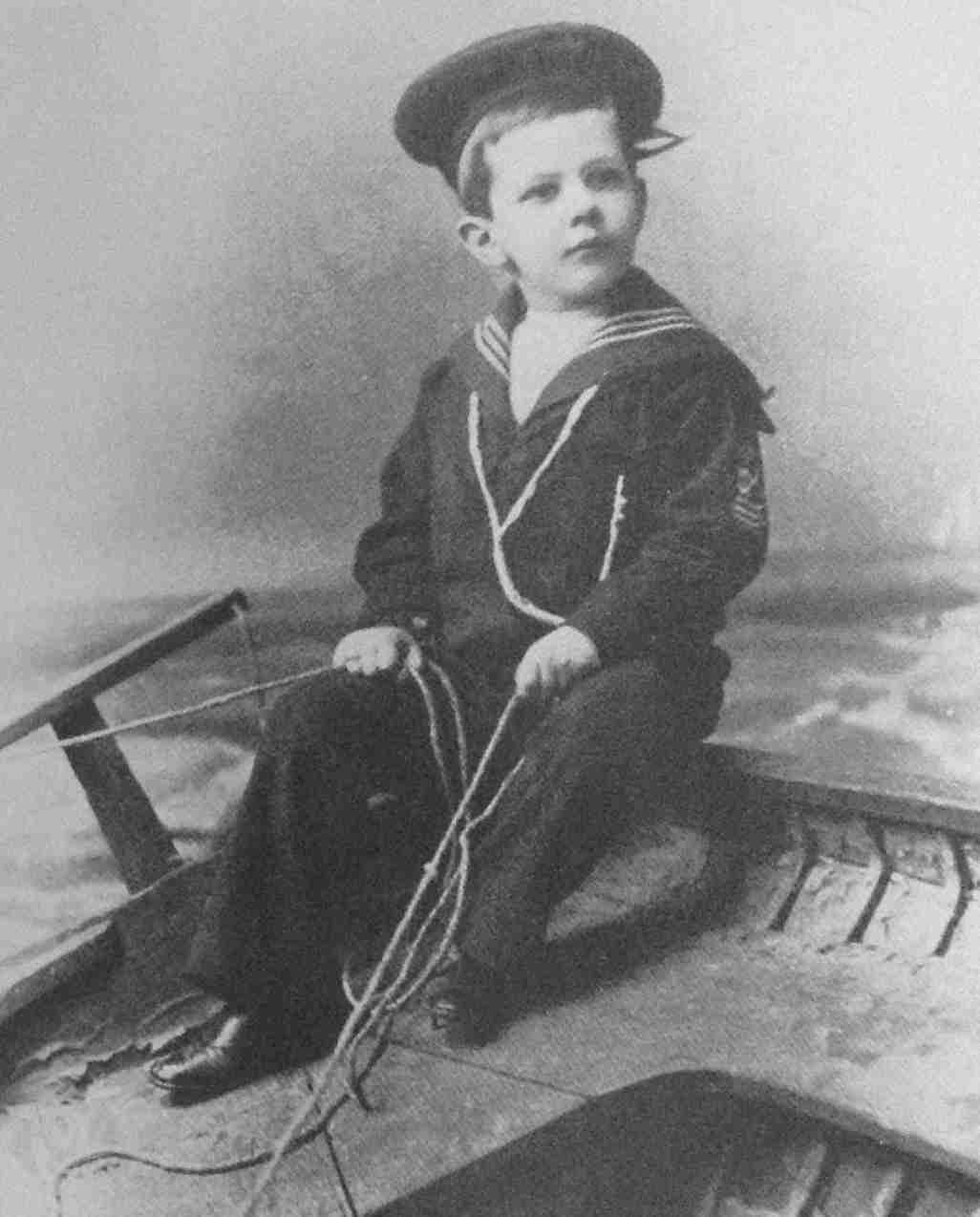
The author, aged five
The big house was the home of my grandfather, Hart Massey. He was a stern man, but an indulgent grandparent. He would occasionally take me to ‘The Works’, the factory where farm implements were made in the family business. This was always an exciting experience. You passed from the quiet of the office through a single door into the din and murk of the machine shop. The transition was rather frightening. Farther on, in the foundry, you saw molten metal being poured into moulds and, in the paint shop, great machines being dipped into enormous vats of vermilion paint. There was a haunting smell.
A visit to ‘The Works’ generally involved lunching with members of the Board. There was nothing very elegant about this meal, served in the basement of the caretaker’s house, but to a small boy it was a resplendent and overpowering occasion.
A great day in our year was when our grandfather took my little cousin Ruth and me to the Exhibition, the annual fair still permanently embedded in Toronto life. The family company in those days always had an exhibit designed to interest and amuse visitors from the country. A favourite was ‘the vegetable wedding’, wherein carrots, beets, lettuces, and other produce, fashioned into figures of life size, took part in a mock marriage ceremony.
Ruth lived across the street from us. As very small children—she was a couple of years younger than I—we were constant playmates. We created a world of our own out of the large and shaggy garden in which our grandfather’s house stood. We were both fairly determined characters. Difference of opinion would arise, and often Ruth with a toss of her head would disappear to return to her parental roof. That gave me an early sense of the unpredictability of women. Later in life, as Mrs. Harold Tovell, Ruth became an able historian of art, and she will be remembered for her important study, Flemish Paintings of the Valois Courts.
Overlooking our grandfather’s garden was a convent school. We could occasionally see the sisters in their coifs, framed in the windows. Our attitude to the nuns was uncharitable and, indeed, deplorable. We were convinced that the children had been captured and were kept in the convent against their will. Such was the influence of the Puritan strain in our family.
Puritanism is an important stream in Canadian social history. There were really three Puritan streams which merged: from New England (whence we came), from Scotland, and from the evangelical England of the nineteenth century. With it came principles, convictions, and standards of life, and the determination to maintain them. But it had its obvious weaknesses:
The Puritan, as down life’s path he goes,
Gathers the thorn and casts away the rose,
Thinking to please, by this peculiar whim,
The God who fashioned it and gave it him.
Geoffrey Massey, my immigrant ancestor nine generations ago, came to Salem, Massachusetts, from Cheshire in the late 1620s. (When I visited Knutsford in that county, I found the family name repeatedly, in the churchyards of neighbouring villages.) Geoffrey had better-than-the-average education of his day. I have seen his copperplate handwriting on documents in Salem drawn up by him. The Masseys, like many pioneering families, moved into the wilderness from the coast, not once but several times. The last migration took place in 1800, when they left New York State for Upper Canada. I cannot claim that the family possessed any special eminence, but always, in the period of pioneering and later in the management of a growing business, its members had the qualities of integrity and diligence. It was not a bad legacy to pass on.
My father was a semi-invalid for most of his life, as a result of an early illness. He was unable to read without suffering severe headaches, and I remember his saying, in a perfectly matter-of-fact tone, ‘When I go to Heaven I expect to spend the first thousand years in reading.’ Despite ill-health and a sombre outlook on life, he had an affectionate temperament and an engaging sense of humour—the kind that lets one laugh at oneself. My father could generally see the funny side of his eccentricities, as when, in certain weather, he would wear three overcoats on a drive, taking off one after another as he got warmer. He had neither recreations nor hobbies, except his collection of pictures. These were nearly all the work of minor painters of the Barbizon School, or of Dutch artists of his day. They gave him intense pleasure not because of any pride of possession but simply because he liked living with them. I well remember seeing him in a black velvet jacket sitting alone in the room where most of them hung, deriving quiet enjoyment from these works. He always showed great personal generosity. He enjoyed giving money away, although the objects of his philanthropy were not always wisely chosen. Rarely could he resist an emotional appeal, and he was especially susceptible to the pleas of coloured parsons. I thought on one occasion of blackening my face and asking my father for a subscription for ‘de workers in de vineyard’: I am sure I would have come away with a handsome cheque! And when the disguise was discovered my father would have enjoyed the hoax as much as its perpetrator.
My mother, Anna Vincent, was of Huguenot ancestry. Members of her family had played a very creditable part in the church, at the bar, and in business. An historian of the Vincent family says this about my maternal grandfather: ‘My father in his early life worked on a farm and inherited all the American democratic dislike for mere privileged aristocracy. Accordingly once, in his later life, on being asked whether he had a family coat-of-arms he replied, “Oh! yes, of course.” “But what is it, Mr. Vincent?” he was asked; “we have never seen it.” “It is very simple,” he said, “just a currycomb and a sawbuck—both rampant!” ’
My mother came from Pennsylvania. She was a gay person, with warm and gentle manners. People in the shops in Toronto that she frequented spoke of her with affection for many years after her death. She had been brought up in a community that must have been attractive to a young woman with a charming temperament and high spirits. She was devoted to my father and adapted herself loyally to the habits of a family steeped in the Puritan tradition, accepting very sweetly the restrictions imposed on her life.
When I was about sixteen, I went with my parents on a visit to London. My mother was very anxious to attend a performance at the opera. My father relaxed his self-imposed rules about the theatre sufficiently to agree to their going. The regulations of Covent Garden, however, offered a difficulty—evening dress was obligatory. This presented no problem to my father, who looked rather distinguished in white tie and tails, but it did involve a low-cut dress for my mother—foreign to my father’s taste. However, a compromise was reached by adding net to the bodice of her dress. From what I remember, it was a very happy evening for them both.
I have often been asked how a family with our austere background could have produced actors and actresses. Perhaps my father’s power of mimicry and love of charades provides an answer. But the theatre, as an institution, was on the proscribed list. I got him to go a few times to the theatre—once, as I have already said, to the opera in London; once to hear Parsifal, because it was a drama with a religious theme; once to the London Hippodrome, because it was not called a theatre (some of the jokes were startling, but my father didn’t understand them); and once to see one of Shakespeare’s plays, which were acceptable as classics. I was well on in my teens before I was allowed to enter a theatre. The play was Beerbohm Tree’s production of Richard II at His Majesty’s in London. The presentation by a theatrical actor of a theatrical king was most satisfying to my juvenile mind.
If the theatre was barred to me in my early years, so were many other things. Our family recognized no place in life for dancing, playing cards, tobacco, or alcohol in any form. Sunday was a day of unbroken austerity.
Most of my father’s friends were ministers of his Church. One of these was a southern American by the name of Goucher, commemorated by a college for women in Baltimore which he founded. He once told us a moving story about Abraham Lincoln which, as I remember it, ran as follows: as a boy, Dr. Goucher was in Pittsburgh with his family when Lincoln was to be given a public reception on his way to Washington for his second inauguration. Little Johnny Goucher was told that he could not be exposed to the crowds on that occasion and had to remain at home. He escaped and, joining a long line of city dignitaries making its way into the Monongahela House, young Goucher slipped, with others, into the great parlour where the President was greeting his friends and admirers. So entranced was he by the scene that before he knew it the room was empty save for Mr. Lincoln, and himself hidden in the corner. As Lincoln was about to retire into his private apartments, he heard the sound of a foot and, startled, turned round quickly to see the diminutive figure advancing towards him. The boy said more or less what he had heard his elders say a few minutes before, ‘I wish you all success in your great mission, Mr. President,’ and put his hand out. Lincoln grasped it, along with most of the boy’s arm and, leaning over, said, ‘My boy, love your God and your Country and you will be all right,’ and disappeared.
My father, because of his health, was unable to be a companion to my brother and myself; that role was played by a fabulous uncle—the sort of uncle every boy should have. He was an exciting person: he had one of the first motor-cars in Canada; he had travelled widely and brought home the most astonishing things from the South Pacific and the Middle East; he organized a family camp on a northern lake where he performed the most prodigious feats like shooting a water snake with a revolver. Uncle Walter meant a good deal to me. On warm summer evenings his little daughter Ruth and I would go for a ‘spin’ with him on our ‘safety bicycles’. I still can remember the pungent smell of the newly-laid asphalt with which a few of the streets were paved.
During my early years my enterprising uncle bought a farm not very far from Toronto on which my father built a house. The farm had plenty of interest for a small boy. It had a dairy herd from which pasteurized milk was produced (I think this was the first experiment of the kind in Toronto), but the farm possessed amenities too. A tiny stream fed a chain of ponds in which lethargic trout lay awaiting capture; a rough little golf course wound its way through the pastures; there were horses to ride and drive. Here we used to spend the summers.
Toronto, where I was born in 1887, was in my early years a small, quiet, coherent town; it was far from today’s shapeless city, with its pulsating, insistent activity. Then, as now, it escaped the guidance of the planner. Motor-cars had, of course, not yet made their appearance, and there were countless horses. In the older parts of Toronto, known as ‘residential’, you can still see, behind many of the houses, buildings that were at one time stables, and later were converted into flats. As a boy I could hear, after I was tucked in bed, the romantic sound of trotting horses on the pavement and I knew that there must be a special party that night, probably a ball at Government House, round which the social life of the city revolved. I could imagine a scene of gaiety still far beyond my years.
The Lieutenant-Governor in those days had little concern with the province outside Toronto, and there was a preferred list of those who had the entrée to Government House, which then stood in pleasant grounds on King Street. There were four buildings on this corner—Government House itself, Upper Canada College, a church, and a saloon (to use the venerable term); a pale little joke of the time was that the four buildings represented legislation, education, salvation, and damnation.
The winter climate has not changed, although our approach to it has. In those days there was no snow removal; runners took the place of wheels on all vehicles. Everyone had sleighs of one sort or another. Loads of hay on sledges, coming from farms to stables in the city, offered good sport to boys and girls who clambered aboard them and stole rides. Men so inclined indulged in racing on Sunday afternoons between trotting horses drawing light cutters. Mounted policemen made a half-hearted effort to stop this form of sport, possibly because of its danger to pedestrians, but particularly because of the desecration of the Sabbath. The city policemen wore black Persian lamb caps of an attractive cut; their uniforms were not yet defaced by garish shoulder badges in an alien tradition. We went to school in moccasins, wearing on our heads knitted tuques. On Saturday afternoons a driving club had its meet at ‘The Guns’ in Queen’s Park, and a long line of cutters and sleighs of all sorts, some drawn by tandems, wound its way through the city to the pleasant chime of sleigh-bells on the horses. Winter brought many pleasures. New Year’s Day, under the prevailing Scottish influence, was a festival of importance. Those of us who were old enough would hire sleighs and call on the young ladies of our acquaintance. Mamma was always in the drawing-room; tea was probably the best we could hope for. Our aim was to accomplish as many calls as possible, and the climax was reached at Government House where there was always something stronger than tea.
Sunday sixty years ago was a sombre day. Paterfamilias, in top hat and frock coat, with his domestic brood, found his way to one or other of the many churches (as many as there were saloons, it was said)—generally on foot, because for long no streetcars ran on Sunday. The sidewalks, for the most part, were made of boards. The streets were generally paved with wooden blocks, sections of logs, with a persistent inequality of surface. Red brick was the prevailing material for buildings. Electricity was far from universal. Our house, like many, was lit by gas. I can remember my father generating current by rubbing his shoes on the carpet and lighting the jet by touching the burner with his finger and creating a spark. The streets in those days were rich in trees not yet sacrificed to the demands of the motorist, the traffic engineer, or the hydro-electrician. Their loss has made Toronto streets in our subtropical summer hotter than they need be. They were always hot; one way of cooling off in the evening used to be to ride on an open streetcar. I remember the circular run on the four streets which constituted the ‘belt line’ through which we passed (for a single fare) at an unbelievable speed. Motor-cars began to appear as a startling innovation while I was still at school; ours was among the first. Nowhere in Toronto were you far from open country. I could reach it on foot from my father’s house on Jarvis Street in a few minutes. The country meant much to us, especially on holidays. Of these, the twenty-fourth of May was the entrance-gate to spring. It had the aroma of tradition. It brought the excitement of fireworks. No one today seems to know its meaning any more.
The story of my family would not be complete without some account of a legendary figure who played a part in our affairs over many years. His name was Walter Seldon. There is a certain mystery about his background. I think he was originally employed in the factory as a wood-carver making ‘patterns’ in wood as models for use in the foundry. I knew him as someone in the family service in an entirely nondescript capacity. My father was unable to define his functions, and referred to him as ‘my man Friday’. His duties extended from mending electric bells to performing simple transactions at the bank, and supervising, or at least reporting on, some of the building activities in which the family was engaged. Seldon was very tall and had the moustache and goatee and the bearing of a Southern colonel. He was an excellent photographer for those days—both expert and prolific. In his correspondence with my father when he was away, about subjects that covered a wide range, he would frequently drop into the third person. ‘Seldon did this,’ he would say; or, ‘it is Seldon’s view.’ He had views on most things. He was often moved to write portions of his letters in verse. He had one overwhelming obsession and that was his unflagging loyalty to the family in whose service, in one capacity or another, he spent his entire life. He lived in a small house which he owned, beautifully kept and full of a nightmare of objects he had acquired as gifts from various members of the family, such as unwanted wedding presents. The house was alive with clocks, all kept in perfect order, which proclaimed the hour perpetually in various accents; one of them, it may be hard to believe, was equipped with running water and electric light. For years he was a pensioner; when he died we felt that something important had passed out of our lives.
My early education might be called chequered—I was sent to five schools. First a tiny kindergarten, with a population of three. Then a public school of the standard pattern which my father thought would exercise a democratic influence on his offspring. My dear mother very nearly undermined this carefully planned educational move by insisting that in inclement weather I should be driven to the school in the family brougham. The horror of this to the unfortunate boy concerned was something of which she had no conception. The situation was saved by collusion between the coachman and the boy, as a result of which I was dropped several streets away from the school. No one ever discovered my guilty secret. The school was, of course, for both boys and girls; the classes were too big; the school yard was sordid; my teacher for most of the time was a pleasant young woman who did me no good by paying more attention to me than she should, so that inevitably I was called ‘teacher’s pet’.
My father and mother insisted upon removing me from school now and then to go with them to some winter resort. This was not very helpful to a schoolboy—let parents take heed! There was one journey, however, sad though it was, for which I was most grateful (one of several visits to England when I was old enough to have some conception of what I observed). At this time my mother was very ill, and for three or four months I was free to explore London, about which I journeyed on the top of a horse-drawn bus. I was fascinated by all I saw and those months served to consolidate and deepen a love of England which remained with me from the time I was taken there as a child.
I have never felt away from home in England. This cannot be explained by heredity. My ancestors left Cheshire in the seventeenth century, but my feeling for England could hardly have been much stronger if I had emigrated to Canada myself. As was natural, I was first enchanted by the pictorial England—the ancient villages and the old buildings of London. Then I began to relate what I saw to the history I had read. Later on, of course, I began to acquire an understanding of English life and to appreciate its quality. There is nothing un-Canadian in this. We are North Americans in Canada, and much of our thinking and manner of living is shaped by this fact. But it is a platitude to say that we are the better Canadians if we remember the legacy of England—and, of course, Scotland.
There is no word that properly includes both these mother countries. Britain? No. It’s a useful and indeed an inescapable term to employ in most contexts, but it’s a blue-book word; it does not come from the heart. We can put it to the test by substituting ‘Britain’ for ‘England’ in certain well-known lines of poetry:
Oh, to be in [Britain]
Now that April’s there,
Till we have built Jerusalem,
In [Britain’s] green and pleasant land.
That there’s some corner of a foreign field
That is for ever [Britain].
For several years after my mother’s death in England, our house was presided over by a cousin of my mother who had been brought up on a pre-Civil War plantation in Alabama. She had all the graces of a Southern lady—charm, dignity, and sweetness of character. ‘Cousin Kate’, as we called her, brought to the Scottish-Canadian town where she lived the sentiments and convictions of a Southerner which she never lost. If anyone strummed ‘Marching through Georgia’ on the piano she would slip quietly out of the room. She was a perfect hostess and loved gaiety; my much younger brother, Raymond, and I were very grateful for her influence as a foster-mother as we appraised it in later years.
Raymond and I are rather more than nine years apart in age. From the early days we were always very close, as our mother died when he was seven and it fell to me to play some part in his upbringing. As a child, a schoolboy, and always, he has been the most charming of companions. He was an enthusiastic amateur actor from his earliest years: at school and in the army when, during a tedious period with the Canadian Forces in Siberia after the Armistice, he organized dramatic entertainment for the troops. After the War when he was making an effort, under parental pressure, to become a business man in the family firm, he often appeared in the cast at Hart House Theatre.
When Raymond declared his intention to become a professional actor he came into head-on collision with my father, whose attitude to the theatre I have already described. It was obviously my duty to intervene on Raymond’s behalf; I did my best and learned what it is like to be placed between an irresistible force and an immovable object. Happily, my father relented and withdrew his objection to Raymond’s becoming a professional actor, but expressed the hope that he would not ‘practise’ (rehearse) on Sunday! Raymond first appeared on the professional stage in 1922, in London, and my father lived long enough to enjoy seeing him and to share the family’s pride in his success.
Phase three in my school education was the bright one. It carried me to what was called the Provincial Model School—an impressive name for a school in the state system like any other one except that the parents of the pupils paid a nominal fee and, as it was connected with the local institution for the training of teachers, its standards were rather higher than those of other schools. ‘The Model’ had a special character in another respect—it was not co-educational. The classrooms for the boys were on one side of the building and those for the girls on the other; the playing-fields were separate—we never saw one another at all at work or play. The boys were taught by men and the girls were taught by women, and I am sure we all worked harder as a result.
It is hard to understand why this school appealed to the boys in it. The building was gloomy and depressing; the scholastic year included few amenities. The rather drab routine that we followed can be understood when I say that a moment of delirious excitement came when we were all marshalled into what was known as the ‘theatre’ (which alluring name was applied to the school auditorium), probably to hear the Minister of Education deliver an address, never very thrilling, on Empire Day. The curriculum was dull and conventional but, although not decorative, it had its own fibre. It was far removed from what an American educationist has called ‘the playpen conception of education’. We were given not what we were expected to like but what was thought to be good for us. Arithmetic and English grammar played a large part in our programme and our infant minds were stiffened by the task of wrestling with both. We memorized quantities of verse. The drawing master induced us to pursue our ways through the bypaths of art by drawing cubes and spheres with a very hard pencil. The teaching of music was equally unrewarding. After the failure to conquer a problem in arithmetic or to parse an English sentence, we were ‘kept in’ until we did what was asked of us. We somehow realized that the master who imposed this ordeal on us was also keeping himself in for our benefit. We were made to take our hurdles, and that was the reason why most of the boys who passed through this school looked back on their years with satisfaction and pride. Our masters were gifted men, with a genuine vocation for teaching. We would not have put it that way but we sensed it. I am very glad to have learned from personal experience that what matters most in a school is the teacher. We cannot be too often reminded as we build educational palaces that the people who work in them are more important than the place in which they work. When we left the school we were somehow drawn back to it, and old boys used to return now and then to see the men under whom they had been persuaded or dragooned into doing their best, and to sit proudly at the back of the classroom to observe for a few minutes the new generation facing the tasks that they vividly remembered. No former pupil of the Model School (pupils were not called students in those days) could say anything about it without expressing his admiration, gratitude, or just plain awe of a master whose name was Porter—‘Tommy’ Porter, as we called him. How well I can remember his piercing steel-blue eyes—there was nothing he missed. He lived only for the boys he taught; their success was his. No one I ever knew so completely embodied the qualities of the great schoolmaster.
When I left the Model School I moved to the local high school called, romantically, the Jarvis Street Collegiate Institute. It was in sharp contrast with the school I had just left. It was co-educational—very co-educational. I have only one or two recollections of that period, which was brief. The principal used to visit the classes. On one occasion he came to ours when the lesson was devoted to French. He interrupted the teaching and informed us, as if this were a new discovery, that certain letters should produce a different sound in French from that in English, illustrating this graphically by the word bon, which he said in French was not pronounced ‘bonn’ but quite differently—‘bong’. We were suitably impressed.
I left the Collegiate Institute, not without some efforts of my own, after, I think, one term, and was entered at St. Andrew’s College, which had been modelled on the English public school without, I fear, a very accurate understanding of the principles on which it was based. For instance, the prefects, if I remember correctly, had privileges without corresponding responsibilities. A powerful secret society known as a ‘fraternity’ was allowed to exist in the school, having a divisive effect on what ought to have been a community. (The school I am speaking of is the one I knew over fifty years ago and not the excellent institution it is today.) Some of the masters were very able. The best of them was the history master, William Grant, who later held a professorship at Queen’s University and after that became principal of Upper Canada College. He made history live. Later I got to know him very well because he became my wife’s brother-in-law. He once told me that he never was as pleased with the results of his teaching as when he encountered two boys fighting fiercely because one of them said that a certain seventeenth-century figure in Scotland was ‘Bloody Claverhouse’ and the other maintained that he was ‘Bonnie Dundee’. No history master could be paid a greater compliment.
Not all the masters were of his calibre. I recall a lesson about Coleridge’s Ancient Mariner in which we were told that the date of the action in the poem could be determined by the cross-bow with which the albatross was shot: the cross-bow came into use at a certain time, and therefore this incident must be thought of as having taken place not earlier. No better example could be given of how not to teach poetry.
It would be an understatement to say that I did not excel in games. I hoped to be a cricketer, but my aspiration to be in the eleven was soon shattered. I was told I held my bat like a broomstick. The only award I ever won in any sport was for fencing; as there were only three contestants and the other two were really boxers by choice, my medal represented no great achievement.
St. Andrew’s was and is one of a number of independent schools which play a very important part in Canadian education. They give the pupil a rounded life that the state system, for obvious reasons, cannot provide. There was a time when such institutions, although they offered amenities and advantages of various kinds, left much to be desired when it came to scholastic standards. Now, for many years, that has not been true. Most of them compete satisfactorily with schools in the provincial systems. They have their critics, but the adverse comments they receive would be modified or would disappear if the critics had some first-hand knowledge of the life in the schools they criticize. They are no longer the preserves of the ‘privileged’—although those fortunate enough to attend them are privileged in the exact sense of the word. The progressive educationist will tell you that ‘the whole child’ goes to school; the independent school, as we know it in Canada, ministers to the whole child in all aspects of his being.
I left St. Andrew’s to enter University College, an integral part of the University of Toronto. The transition from school to university was complicated by the existence of fraternities, societies that had spread into Canada from the United States. The practice of a fraternity is to entertain schoolboys before they enter the university and, in sharp competition with their rivals, to commit them as potential members. Nothing could be more natural or useful in a large university, particularly one almost wholly non-residential, than clubs formed by undergraduates of either sex; but there are some features of fraternities as they exist today that are, in my view, undesirable. For one thing, they are mutually exclusive, and members are recruited, not as in ordinary clubs, but only on invitation and on a highly competitive basis. They are secret societies where new members are subjected to an initiation, sometimes involving public humiliation. Again, the fraternities in Canadian universities are nearly all branches of a larger society similarly represented in numerous universities chiefly in the United States. The theory is that everybody belonging to this chain of ‘chapters’ is the ‘brother’ of everybody else, singing the same songs, wearing the same badge, and using the same fraternal ‘grip’ in shaking hands. But these things symbolize an entirely artificial relationship between persons generally with no common interests at all. In some American universities the fraternities, as I have described them, have been converted into normal clubs. But where they continue on the old basis, they create little communities far too narrow in the tastes and sympathies of their members.
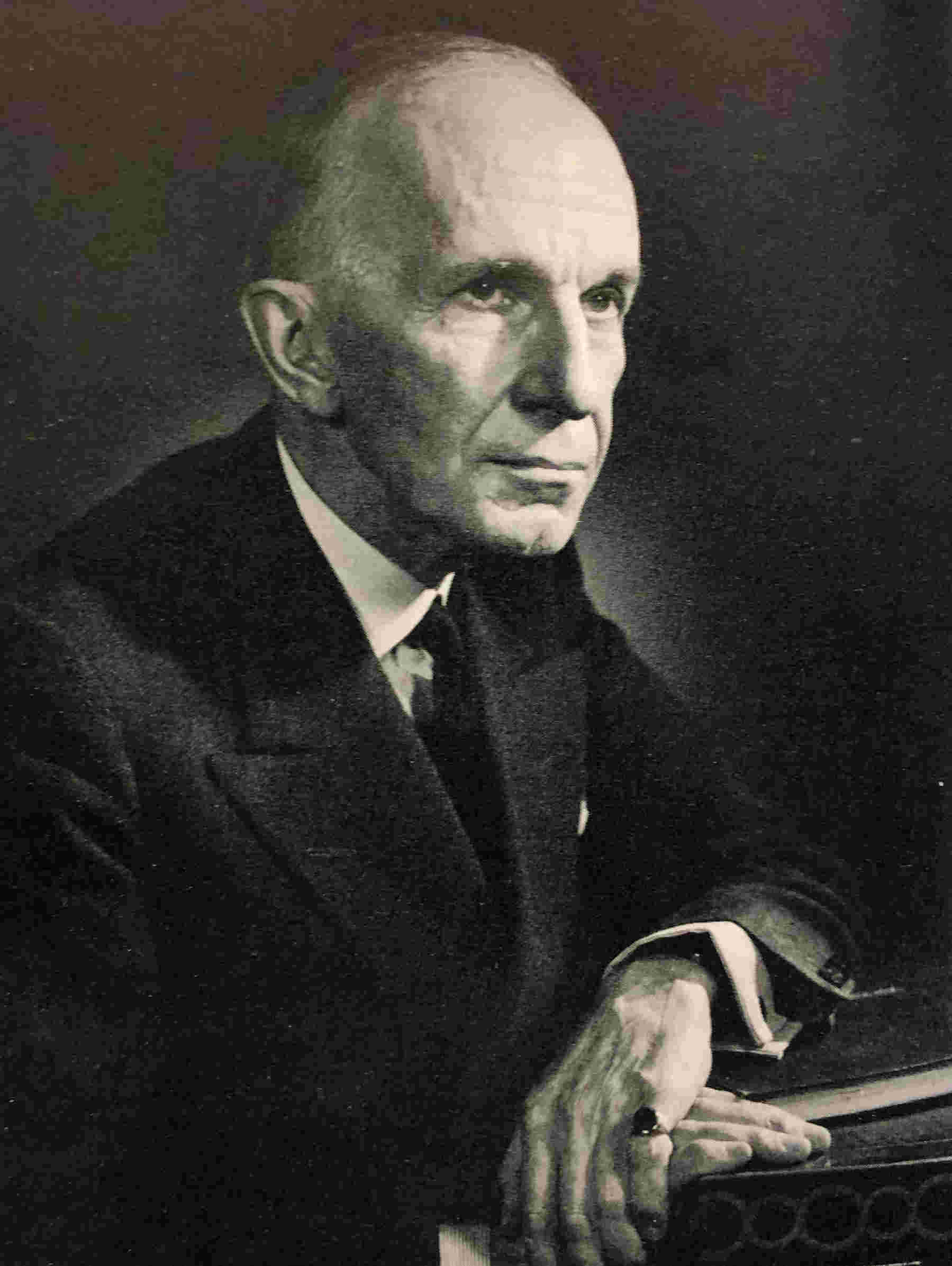
The author
In my last year at school I was entertained at several fraternity houses. (To use the technical term, I was being ‘rushed’.) In one of these I had two very close friends. I was asked whether I would like to join it, and without adequate reflection, judging the group only from my two friends, I agreed, and then in a solemn ceremony I pledged myself not to join any other. I was then given the freedom of the house. I discovered that, on the whole, the undergraduates who were members were not people with whom I had many interests in common, and I was not happy about the decision I had made. Two other freshmen were similarly involved. We decided that we would not go through with it and made it known that we did not wish to join. At that point a crisis developed. We were told that what we intended to do was like jilting a girl at the altar. Every conceivable kind of pressure was put on us to join what we no longer wished to join. Graduate members were enlisted to influence us. In my case, a girl—a friend of one of the members—was asked to do what she could to dissuade me from doing such a terrible thing. However, the three of us were immovable. We didn’t join, and after the storm was over I was very grateful that I was quite free in the University, without any ties at all, to find my friends where I wished.
I was lucky in my friends. The one I saw most of was Murray Wrong, the son of the professor of history. We were together at school and at University College and Balliol, and often I was a very happy guest in his father’s house at Murray Bay. Murray had a really distinguished mind. His ‘First’ in history was well-earned. He had inherited some of the finest qualities of his grandfather, Edward Blake, with just a touch of his intellectual coldness. He became a don at Magdalen, Oxford, and died very prematurely. He and I and others formed ourselves into a little group we called ‘The Seven Seekers’; we met quite often to take the universe apart and put it together again—not that we agreed on how it should work.
In 1909 I began to keep a diary. The first entry reads: ‘I resolve for the fourth or fifth time to keep a common-place [book] and with the inspiration afforded by Brown Brothers’ excellent book binding (witness this volume) I am determined to succeed better than in past attempts. . . .’ I managed to keep the diary regularly, and still do; but it is not like the famous diary kept so meticulously throughout his life by Mackenzie King. Nevertheless, though there are gaps here and there, without such a record this book would have been almost impossible.
University College in my time was really a non-collegiate body—it had no residence and little to give it the cohesion of a community, but it did include in its faculty some persons in the best academic tradition. They were talented men, highly individual, often eccentric in their habits. Standardized practice and overwork had not yet threatened academic life with uniformity. Our professors were good teachers and possessed for the most part very personal qualities. We were able to know them; the contacts between teacher and student were not yet smothered under the weight of numbers. We were spared the dreary and futile machinery of compulsory lectures and the ‘credit’ system. The standard of teaching was high, but the curriculum was muddled. There is something wrong with the pattern of one’s studies when failure to pass in experimental psychology might be atoned for by success in an examination on the minor prophets—which was my experience. My curriculum was a potpourri of unrelated subjects. In our English studies we were forced to acquire some knowledge of Anglo-Saxon. I expressed my views on this in an adolescent outburst in the undergraduate newspaper, concluding as follows:
Of course there are charms proper to Old English. In Germany they often spend an hour on a single vowel in a troublesome word. It must be thrilling, no doubt, to see a ‘mutating diphthong’ started from its lair in Anglo-Saxon philology, pursued relentlessly past the northern dialects, hounded on through the mazes of Anglo-Frisian, and finally pinioned in some dark corner of the Gothic language.
The professor concerned was a tolerant man and accepted my ‘undergraduate mutiny’, as he called it in the classroom, with humorous benevolence.
I was involved in the production of the inevitable undergraduate magazine, which we called Arbor, taking its name from the motto of the University. As one of its editors I wrote to ask whether Mr. Goldwin Smith would contribute something to our magazine. He wrote back to say that he could not do that, but would two or three of us come to lunch? He was living at the time in dignified retirement in a distinguished and venerable house in the Georgian style, ‘The Grange’ (later part of the Art Gallery of Toronto). We were much impressed to be in the presence of the great scholar, and in this perfect setting. His manner of living was very rare in the Canada of the day. We were struck by the ritual of his handing the keys of the wine-cellar to the butler, who was asked to bring up a bottle of sherry. After lunch we sat in his study and heard him talk about the great nineteenth-century figures whom he knew before he came to Canada. (He lived to write the obituaries of most of them.) He told us that on one occasion he had met a colleague of Pitt and had dined with one of Napoleon’s marshals. Later I came to deplore Goldwin Smith’s hope that Canada would become part of the United States, but as a kindly elderly host to three eager young men, he could not have been more charming. He said nothing of his pessimistic views about our country, although in his talk he reflected many of the opinions with which he will always be associated. He spoke with deep sadness about Gladstone ‘going over to Home Rule and leaving us’; he said that O’Connell was a blackguard; he gave expression to his pro-Boer sympathies and his hatred of party government. A remark of his, characteristically pungent, was that ‘the artifice to which Joseph Chamberlain would not stoop has yet to be invented’! He thought that Chamberlain’s illness was partly feigned. Goldwin Smith’s legs were the thinnest I had ever seen—I suppose then I did not realize that it was a mark of extreme age.
Alfred De Lury had the thankless task of trying to teach me mathematics. He had a hereditary love of Irish literature and was able to combine trigonometry and Yeats with ease. I shall be always grateful as well to W. S. Milner, who guided us through the landscape of ancient history. I remember the comment he used to make, in his rather nasal voice, on some impulsive observation one of us might make: ‘Now let’s stay with that a moment.’ Malcolm Wallace opened the doors of seventeenth-century English literature and the history to which it belongs: John Milton walked through them, alive. Dr. VanderSmissen, with his monocle, his enormous moustache and old-fashioned clothes, introduced us to Goethe. Of one of our French professors, St. Elme de Champ, who had a huge black beard and wore a violet rosette, it was rumoured incredulously among the undergraduates that he was a French baron. He lived in a club for members of the faculty in a rather sordid old building, and managed to smuggle into those inelegant and teetotal precincts contraband in the form of French wine.
I wish more people over the years had had his courage. The University suffered, and still suffers, from a convention under which it is ordained that no alcohol in any form shall be consumed on its premises. There is no statute to this effect—it is purely a tradition which gallant efforts have not succeeded in breaking. The authorities have tried to prevent cocktail bars from being established within a certain distance from the university grounds, somehow overlooking the fact that the enterprising undergraduate could always go a few hundred yards farther to find all the cocktails he wants, available, to use the parlance of the day, in licensed ‘outlets’. This recalls the advertisement of a school in the south-western States, proclaiming that its precincts were ‘six hundred feet above sea level and seven miles from any form of sin’!
I cannot overstate my debt to one member of the faculty—the professor of history, George Wrong. I learned much from him as a teacher; for two years I was happy to have him as my chief. In my view, George Wrong has never received adequate recognition. He was not a great scholar, though the books he wrote were urbane and distinguished contributions to Canadian history. With his great resourcefulness, energy, and imagination, he was largely responsible for the creation of the Champlain Society (which for many years has reproduced important documents relating to Canadian history), for The Canadian Historical Review, and for the Historical Club of the University, consisting of undergraduates, which since 1904 has met at the houses of hospitable citizens to read and discuss papers. But George Wrong’s greatest contribution was the organization of the Department of History. Under his direction was firmly established the tutorial system based on the Oxford model. Appointments to the staff were of a high order of ability and always included a few distinguished young historians from England. It is greatly to the credit of this department that when, after the Second World War, the number of undergraduates reached a peak of nearly 18,000, overcrowding classes and lecture halls, its staff refused to give up the tutorial system bringing teacher and student into close personal touch. It continues today as a result of great effort and self-sacrifice on the part of the teaching staff.
During my later school and university years, I seem to have been almost as much in the Wrongs’ house as in my own. The atmosphere was enchanting. Mrs. Wrong had Victorian manners but also a quiet, never-failing sense of humour. I can well recall the picture of the old-fashioned drawing-room, with the Scottish maid Lizzie putting the oil lamp on the table (Lizzie lived to be one hundred and three); Mrs. Wrong reading a volume of Trollope (she herself might have come from the pages of Barchester Towers); Mr. Wrong probably lying in front of the fire, occasionally using his snuff-box, and making remarks that his wife may have regarded as somewhat too frivolous; the children sitting about the room reading. A far distant cry from cocktails and T.V.! George Wrong was a robust Canadian but a great lover of England as well—as Canadians should be. Sometimes after studying some episode in our history he would display a rather prickly nationalism, but on his return from visits across the water, his assistant on the history staff would say with humour and affection, ‘The Chief’s come home completely feudal.’
As I have said, I often stayed with the Wrongs at Murray Bay. They were among the first English-speaking Canadians to spend summers there, where life in those days was both simple and civilized—plenty of books, good talk, life close to the wilderness, happy relations with the habitant population. Sometimes we would picnic up the river. We would reach the chosen spot, generally on the shore of the St. Lawrence, in canoes, and build a generous fire—the evenings, even in summer, were cool. There would be reading aloud in the firelight—J. M. Synge’s latest play perhaps being introduced to us by Will Blake in his fine voice reminiscent of County Galway in Ireland. Years later, when my wife and I had taken a house at Murray Bay ourselves, Blake arrived one day with the proofs of his translation of Hémon’s Maria Chapdelaine. It is not really a translation, it is more than that—a retelling of the story in exquisite English. He read us some of the chapters, the broad St. Lawrence and the blue hills making a perfect setting for the tale. Blake did nothing that he did not do well—with a trout-rod or a rifle, or in a canoe. He loved Murray Bay and had countless friends among the habitants. One of them said, when he heard of his death, ‘Il était le seul étranger qui était de notre paroisse.’
Will Blake’s daughter Nell, who later became Mrs. Philip Mackenzie, inherited her father’s knowledge of woodcraft and love of the wilds. She was a friend of mine since we played together as children in her father’s garden. Later I was often a guest at her place near Montebello in Quebec, with a tract of forest and two gleaming little lakes on one flank and a superb view over the Ottawa Valley on the other. Her death was a sad blow to her many friends.
I spent some very happy holidays in Georgian Bay where friends of mine had a house known widely as ‘Longuissa’. The establishment was really a matriarchy, with our hostess, Mrs. Archibald Campbell, presiding over it, following traditions that have disappeared long since. Longuissa had a routine—inflexible, even monumental. Some of it was inherited from Scotland, some of it belonged to Canada. At breakfast, porridge was consumed peripatetically—all of us moving slowly about the veranda. This habit has long since disappeared (you can’t eat corn flakes moving round!). Chaperonage was unshaken. If we were gathered in the evening and two young people were missing, their absence would be noted by our hostess and commented on. Lunch took place on an island or a point some distance away from the house—a delicious cold meal, at which everyone was required to choose an implement (never two, still less three), knife or fork or spoon; no more. In addition to the hampers for lunch, there was always a basket for books—the book you happened to be reading, or some spares, and always Blackwood’s and The Cornhill. In due course, we would return to the house and engage in whatever activity we wished—or almost what we wished. Our hostess and her family were determined that the house party at Longuissa should not be disturbed by invasion. If anyone was so ill-advised as to pay an impromptu visit to the family, whoever saw them approaching would sound the alarm and the entire family and guests would disappear from the house into the adjoining woods. The visitors might well be intimate friends in Toronto, but the friendship was not exportable. No motor boats were permitted in the bay; no irritating noise from engines; no gasoline fumes.
Under the influence of two or three Oxford men who had been at Balliol, I was determined to follow in their path. Here, not for the first time in my education, I met parental resistance. A young friend of my father’s, neither helpfully nor accurately, described the dissipated life he believed was led by Oxford undergraduates. Fortunately, there were countervailing influences. Among those on my side of the issue was a college servant at Balliol—scout, to use the time-honoured term—employed during the summer months as a waiter in an hotel in Devonshire where I was staying with my family; his affectionate description of the College strengthened my desire to get there and was not without some effect on my father.
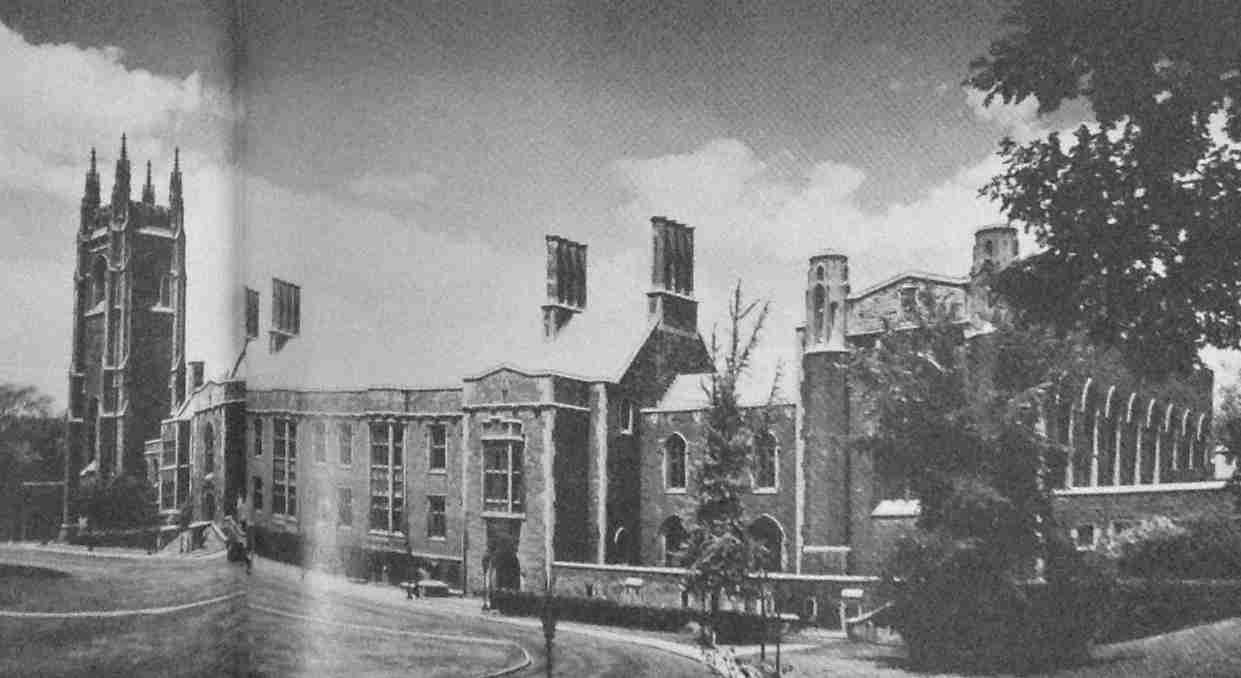
Hart House
I was admitted to Balliol in 1910 but delayed my entrance until 1911. While I was an undergraduate, I had realized that the University of Toronto was sorely in need of equipment for the extra-curricular life of the students and it seemed that a considerable sum of money from my grandfather’s estate, of which I had been made an executor, could appropriately be applied to the erection of a building for this purpose. My father concurred, the University agreed, and we got to work on the plans. We decided to call the building Hart House, using my grandfather’s Christian name. It was of great importance that someone who understood the idea behind the project, which in many ways was novel, should work with the architect in the early, critical period. To do this I postponed my arrival in Oxford for a year to collaborate as a layman with him. Henry Sproatt was a man of real genius and a master of the Gothic form—the last of his kind in Canada. Gothic to him was not a language to be acquired—it was his own vernacular. He was unfamiliar with university life and the purpose to be served by Hart House, but he and I worked together—very happily—and the plans of the building grew under our joint efforts. These sometimes involved tiresome details such as the arrangements of the kitchens, about which my diary states that the problem was ‘household science versus household sense’. Cooking is a science, but it is also an art. If this were better understood we would be spared institutional cooking in which taste is neglected in favour of calories and protein—important but not supreme. I travelled a good deal, visiting students’ unions in Great Britain and the United States, the study of which had a bearing on the plans of Hart House.
At this time I journeyed also extensively in Canada. Undertaking a trip in 1911 to the West Coast, on this journey I was, so the record runs, made aware of only three subjects: real estate, crops, and reciprocity with the United States—in that order. The manager of one of the branches of our family business struck a melancholy note: reciprocity, according to his way of thinking and that of many others, would involve grave changes in our national destiny, morals, mode of living, religious life, and spiritual welfare.
One of the most interesting things in our country is the meeting of traditions, such as those coming from the ‘old country’ and those springing out of our North American soil. In Regina I stayed as the guest of the Lieutenant-Governor, a picturesque ‘old-timer’ who was determined that the office he held should remain true to British tradition. I remember driving to the Methodist Church in Regina from Government House near the city in a landau drawn by two splendid coach horses, with perfectly liveried coachman and footman on the box. We rocked and bumped over the bald prairie on our way to the church several miles away.
A few months earlier I had had the pleasure of meeting the Governor-General, Lord Grey, at Government House in Ottawa. I recorded:
The atmosphere there is more like that of a simple English country house than that of a Vice-Regal residence. Had quite a talk with the volatile Lord Grey who impressed upon me the necessity of arousing in Newfoundland a sentiment favourable to annexation to Canada. He is a delightfully affable, democratic sort of man with boundless enthusiasm. . . .
[Diary entry. May 7, 1911.]
I became a member of Balliol in the autumn of 1911 and commenced two of the happiest years I can remember. How many men have talked of the spell under which the undergraduate lives. Quiller-Couch understood it when he wrote of Oxford:
Know you her secret none can utter?
Hers of the Book, the tripled Crown?
Still on the spire the pigeons flutter;
Still by the gateway flits the gown;
Still on the street, from corbel and gutter,
Faces of stone look down.
• • • •
Still on her spire the pigeons hover;
Still by her gateway haunts the gown;
Ah, but her secret? You, young lover,
Drumming her old ones forth from town,
Know you the secret none discover?
Tell it—when you go down.
The College was what a college ought to be—a community. There was a great variety among its undergraduates—the great English public schools were fully represented and the smaller ones too, also the grammar schools, and there was a fair number from other parts of what we then called the Empire and a few from the United States and Germany. The undergraduates in Balliol were more varied in their background and tastes than in any other college in Oxford during my time, which gave life at Balliol a healthy versatility. The dons in those days were not nearly as numerous as they are now and formed a very close group dedicated to the College and its life. Their outside interests then were few and their devotion to Balliol gave it strength and cohesion. According to the local tradition they were, in most cases, addressed by their Christian names or nicknames by the undergraduates. It was a striking custom for those days and reflected the family atmosphere of the College. The Master, Strachan-Davidson, was an Olympian figure—remote and awe-inspiring. No one minded his eccentricities—if you come from Olympus these things do not matter. My recollection is that he knew hardly any undergraduates by name, although he made a gallant effort to do so. Innumerable stories are told of his confronting some junior member of the College from time to time and saying, ‘Your name is Thompson, isn’t it?’ ‘No, Master, Higgins.’ ‘You come from Scotland, don’t you?’ ‘No, Master, South Africa.’ There the conversation would end. We dined at the Master’s lodgings in groups. At twenty minutes past nine the custom was that the senior undergraduate would make the move and we would leave, relieved that the evening had come to an end, because it was never riotously gay. The Master had a cat, Tiberius, who used to stroll round the room, and when there was no obvious subject of conversation, someone was certain to say, ‘Tiberius is looking very well, Master’—and that always kept us going for another three or four minutes.
I read modern history. My tutor for the whole time was A. L. Smith. Countless old Balliol men will, I know, share my gratitude to this gifted teacher. Teaching was more important to him than the writing of books, and his counsel was always wise. I am particularly grateful to him for one piece of advice. ‘Don’t concentrate’, he told me, ‘too closely on your academic work. You are not here to get first-class honours, you are here to get everything you can out of Oxford life—enjoy it to the full.’ I got a second, having followed unknowingly a dictum of the Oxford don, Sir Walter Raleigh: ‘Final Schools and the Day of Judgment are not one exam but two.’ I would have read ‘Greats’ but I hadn’t the necessary preparation in the classics. ‘Greats’, I have no doubt, provides the finest training a mind can receive. But I had, as a matter of fact, become very much attached to history at the University of Toronto. A well-organized course in this subject, the study of the cause and effect of man’s actions, provides an intellectual discipline of rare value.
Among the dons one remembers at Balliol, ‘Sligger’ comes high on the list. Urquhart was his real name and why he was called ‘Sligger’ we never knew. His subject was history. He was not an outstanding scholar, but he was the sort of man to whose rooms (he was a bachelor) undergraduates would be drawn as by a magnet, and the talk that took place in those long evening sessions meant as much as lectures and essays. Far different was the historian H. W. C. Davis—austere, remote, indeed, rather frightening. In an inspired moment someone gave him the nickname ‘Fluffy’, by which he was known always but by which he was never addressed. The Junior Dean in my time was Neville Talbot, a clergyman of enormous physique—jolly, almost boisterous in his manner. He was quite capable of pouring a jug of cold water, with a gale of laughter, on an undergraduate proceeding under his window to the baths rather late in the morning. With the spirits of a schoolboy went great qualities which were to reveal themselves during the First World War. He was the brother of Gilbert Talbot, whose name is commemorated in Talbot House, known universally as Toc H.
It is natural that in so human an institution as Balliol, friendships should be many and should last. Harold Macmillan reminded me not long ago that we had been friends for fifty years. My recollection of Harold as a fellow undergraduate is entirely consistent with his most distinguished career. We have kept in touch over the years and have often stayed in each other’s houses. In the early 1920s, Harold was an A.D.C. to the Duke of Devonshire, the Governor-General of the day. When the Duchess stayed with my wife and me for a few days in Toronto, Harold was in attendance. Shortly after that he became engaged to the Duke’s daughter, Dorothy; Alice and I were happy that in later years we saw much of them both in London.
A contemporary of mine who has become over the years one of my greatest friends was Alister Wedderburn. He came up from Eton as a formidable figure. He had rowed in the Eton boat; he was very tall and extremely good-looking; he was in the Oxford eight, and became president of the Union. Alister was a frightening person to those who didn’t know him well, but I soon became aware of his modesty, great reserves of affection, and all that can make anyone a close and valued friend.
One of the men who lived on my staircase was Cyril Asquith, known to his friends as ‘Cys’. He had the diamond-like brilliance of his family, and subsequently became a distinguished High Court judge. When I was ‘up’, Mr. Asquith (the Prime Minister) came to the principal annual dinner of the College, at which the health of the guest of honour was always proposed by the senior scholar. The senior scholar was ‘Cys’ Asquith, and he took that occasion to pull his father’s leg in a witty and elegant speech. He complained very solemnly of the food he had been given as a small boy in the Asquith household, and he charged his father with heartless neglect when he suffered from the measles.
Robin Barrington-Ward was one of my greatest friends in the College. He was the son of the rector of a small Cornish parish, his father having taken orders late in life. I had one or two charming holidays with him in that most delectable of counties. We were to see much of each other in later life.
One of my most brilliant contemporaries was Walter Monckton. He was perhaps best known to undergraduates as a first-class cricketer, having as I remember played in the Harrow eleven. He is one of the most versatile men I know, as his career has amply demonstrated—soldier, barrister, public servant, cabinet minister, banker, Visitor of Balliol, of which last-named office I am sure he is as proud as of any in his career.
We were fortunate in Balliol in having some first-class undergraduates from the United States. One of these, who became a great friend of mine, was Whitney Shepardson. Like all the best representatives from his country, he made a well-rounded contribution to the College and grew to love Oxford and to acquire a deep feeling for England itself. This was shown in after years through his active interest in Anglo-American relations, as an able contributor to the Round Table magazine, and as a senior member of the Carnegie Corporation of New York.
A fellow undergraduate of whom I was very fond was Spenny Compton. (Lord Spencer Compton seems too formal a designation for one so unassuming.) He won the affection of everyone with his quiet modesty and natural capacity for making and keeping friends. Later he came to Canada as an A.D.C. to the Governor-General. His name appears in the memorial window at St. Bartholomew’s (the little Government House church), which the Duke of Connaught had put in in memory of the members of his staff who had fallen in the First World War.
Spenny Compton’s sister Margaret, now the Dowager Lady Loch, has been a lifelong friend. She possesses both enterprise and courage: she received her licence as a pilot in the year in which she became a grandmother. She has for some time lived half the year in Cyprus, and during the turbulent times no governor was able to get her to leave her isolated villa except Sir John Harding who persuaded—or I should perhaps say ordered—her to stay for a time in the shelter of a town. Not long ago when I had to undergo a serious operation, I was faced with a lonely period of recovery. Margaret, who was on a visit to the United States, as an act of real friendship, altered her plans in order that she could come to Batterwood for three or four weeks to provide company for a convalescent.
A student going from the new world has much to learn before he can adjust himself fully to English college life. One evening as a freshman I had dined with a second-year man. Next morning we met in the Quad. My instinct, coming from a country where salutations are very common, was to say good morning, or offer some form of greeting. He, on the other hand, looked straight through me. I wondered whether I had done something to put him off, but I realized very soon that you didn’t address anybody unless you had something to say—it was a time-saving habit. But I should not be surprised if the difference in practice, represented by this tiny incident, has not caused some people from abroad to wonder, and even to worry. Perhaps not enough attention has been paid over the years to the importance of informing young men about to go to an English college about the difference in habits and manners they will find.
I was lucky enough to dine once or twice with a Fellow of All Souls on the guest night, which that famous College observed on Sundays. It was an exciting experience for a green undergraduate—dinner in the beautiful hall, port and dessert in an adjoining room, coffee and tobacco in a third room, and post-prandial drinks in a fourth. At one stage in the evening, one of the college servants stood behind me and said, ‘The Warden wishes to have a glass of wine with you, sir.’ I frankly didn’t know what he meant, but a glance at the Warden himself at the far end of the table enlightened me. I saw Sir William Anson looking at me with a glass in his hand. We drank each other’s health with due gravity.
There were in Balliol at the time three Societies—the Annandale, the Brakenbury, and the Arnold. The current joke was that the Annandale washed but didn’t work, the Arnold worked but didn’t wash, while the Brakenbury made an ineffective effort to do both. As in all ‘mots’ there was an element of fantasy in this—I enjoyed my membership in the Brakenbury!
I was one of the editors of a magazine—The Blue Book we called it—which, like countless others, had a short, eventful, and, on the whole, satisfying life. The name was ill-chosen because the language of the magazine was, happily, far removed from that of government publications. There was good writing in it—an example of the fact that undergraduate magazines often reach a level of style that, for some reason, the writers seldom achieve later on. Perhaps it is because they are ‘on their toes’ and uninhibited. One of our board was poetry editor. I fancied myself as a poet—he did not. I produced a piece of verse and sent it to him anonymously; he passed it for publication—and never forgave me. The appearance of the magazine was celebrated by a memorable dinner. The menu, which follows, was superbly printed by the Clarendon Press and, as a result of earnest research in the Bodleian, records a choice of food more historical than digestible:
BILL OF FARE
Broth
Som Playses
A Sirloin of Beef
A Roast Duck
A Pie of Eels and Lampreys
A Venison Pasty
Hearbs & other Country Messes
A Tipsie-Cake & other Sweetmeats
Seasonable Fruits
A Stilton Cheese full ripe
Segars, Tobacco & Snuff
Dishes of Bohea to taste
Strong Ale of a triple Brew Small-beer
Audit Ale of Cambridge, Sherry-wine & Bristow-milk
On the reverse side of the sheet, recorded irrevocably, are the exuberant signatures of some of the diners, in a state of elation which in after years they might perhaps be willing to forget!
I was one of a small group, Spenny Compton was another, who founded a university society that lasted much longer than the magazine. The Ralegh Club survived two wars and is still going strong. The purpose of the Club was to discuss the affairs of the British Commonwealth, and its membership was restricted to undergraduates from Commonwealth countries. Our juvenile enthusiasm was guided by one or two dons who helped us find speakers, especially for the annual dinner which was, and I believe still is, a distinguished event attended by public men of eminence as guests. We engaged in a great deal of research on the best way to spell the name of the great Sir Walter which, because of the various combinations, can be written in over a hundred different ways. On the menus of the club dinners we printed this invocation, taken from Milton’s ‘Of Reformation’: ‘Thou who of thy free grace didst build up this Brittanick Empire to a glorious and enviable heighth, with all her daughter islands about her, stay us in this felicitie. . . .’ Oxford is a fertile soil for traditions; some of them can be artificial. We established one practice which, considering the name of the Ralegh Club, seemed to be appropriate—the use of churchwarden pipes at our meetings. An absent-minded Canadian professor upset the box containing the pipes and broke them all. This was perhaps a good thing, because we were becoming a bit bemused by tradition.
I recall a stay I made at this time with Sir Horace Plunkett in his house outside Dublin; he was very kind to Oxford undergraduates. Sir Horace was a great figure in the Ireland of his day. His special interest was the organization of Irish agriculture, to which it can be said he devoted his life; he was a practical visionary. On this visit, I met the famous George Russell (‘Æ’) who combined in his active life economics, poetry, and painting; Mrs. John Richard Green (the widow of the historian) who, I was told, was at the moment engaged in gun-running in preparation for ‘trouble in Ireland’; and other people representing various aspects of the Irish issue.
My athletic life—using the term in the broadest sense—was, as always, limited. Tennis, country walks, yes, and the Oxford countryside had unlimited resources for that, and for the bicycle. In organized sports I contented myself with the role of a cox in the ‘torpids’, the winter races on the river. If anyone thinks that that function is comfortable or automatic in its performance, he should make further inquiries. The study of the currents, particularly in that serpentine section known as the ‘Gut’, was an intellectual exercise, and the negotiation of these gave no small satisfaction to the humble person in the stern in whose hands eight hearty oarsmen had placed themselves. The weather that generally prevailed I do not care to remember. My modest performance as cox of a College boat pales into insignificance beside that of my younger son, Hart, who coxed the Oxford eight many years later and won well-merited acclaim.
Nothing is harder than to describe what a college means to you. Its influence is always intangible; the life within its walls is always complicated. What you want to describe seems to dissolve under the impact of description. One whose description did not dissolve it is Harold Macmillan. Here is the conclusion of his memorable speech before the Balliol Society in 1957.
. . . if I have ventured to speak a little of the Balliol that I knew, it is because I feel sure it is the way to renew in each of your minds your affection for the Balliol of your time and of all time. For that of course never changes. Balliol still retains its unique character among all Oxford Colleges and, I was going to say, among all human institutions. . . . And so, because in spite of all the affected cynicism, the passion for epigram, the very natural cult of extreme views—sometimes on the right, sometimes on the left—that youth properly pursues, because after all Balliol is something greater than can be described except in very simple words, I will—greatly daring—go back to Belloc—
Balliol made me, Balliol fed me,
Whatever I had she gave me again;
And the best of Balliol loved and led me,
God be with you, Balliol men.
This year, 1963, we celebrate our 700th anniversary.
As an undergraduate I fell under the influence of Lionel Curtis—influence is, perhaps, too weak a word, for he was the most persuasive and magnetic of men. The Round Table group in England had taken shape by that time, composed almost entirely of men who had worked with Lord Milner in South Africa in the early years of the century—a group that will go down in history under its nickname ‘Milner’s Kindergarten’. I had the privilege of seeing something of Lord Milner both in England and Canada and I remember how touched I was that, when we arranged to discuss some matter, he insisted on coming to my club in London, which was an unusual compliment for one of his eminence to pay a young man. I could understand what he meant to the group who worked with him in South Africa before Union was achieved.
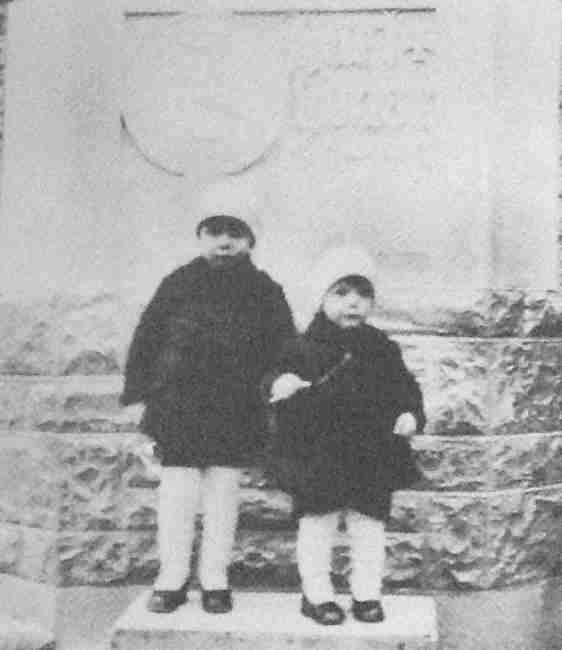
Lionel and Hart in front of the foundation-stone of Hart House, 1920
Lionel Curtis was my guest in Toronto several times, and I often stayed with him in Herefordshire. I recall happily those week-ends and the walks we took together in that lovely countryside with its red (and very adhesive) soil. Curtis was deeply engaged in applying to the Commonwealth the principles that had lain at the back of the South African Union. Studies on a project to federate the Commonwealth of Nations were emerging from his library in great profusion. These were given close examination by his friends in London, whose meetings were known as ‘Moots’, and in due course were dispatched to other Round Table groups organized in various parts of the Commonwealth for their criticism. The original and most important document for this purpose was known as ‘The Green Memorandum’, which embodied a careful and well-written statement describing a system of Imperial Federation. It was a private document, entirely anonymous, and printed with alternate pages blank, on which the recipients were invited to write their comments. The plan was to form groups on a very wide scale. When I returned to Canada from Oxford in 1913, it fell to me to play an active part in the organization of the Round Table movement in the Dominion.
This work was from the outset complicated by a certain ambiguity in the purposes of the movement. Was it (and I and most of our Canadian members came to wish it to be) a purely disinterested study of what we then called ‘the Imperial problem’, to which those of greatly differing points of view would be not only admitted but welcomed? Or was it less an attempt to examine the problem of Empire than an effort to persuade, to convince, as many as would listen that its solution lay in Imperial Federation?
The conflict was brought into the open with the publication of Lionel Curtis’s The Problem of the Commonwealth, in the summer of 1916. The Canadian groups (of which I had in that year become secretary) were opposed to the proposal that this work, with its contentious advocacy of a centrally-directed Empire, should appear while the War was still in progress. We feared, and rightly so, that its publication would unnecessarily alarm and alienate Canadian opinion, and do our movement perhaps irreparable damage. Lionel Curtis accepted our protestations to the extent of agreeing to publish his book under his own name, with a preface explaining that its point of view was his alone, and also to omit the offending chapter on fiscal policy (which would have reposed the power to tax in the hands of an Imperial parliament). He then sailed for Canada to explain his decision to his friends here. At the conclusion of his Canadian tour he wrote me a lengthy letter from Victoria. I quote from this letter portions that illustrate the characteristic energy and enthusiasm of their author as well as the difficulties in which our movement found itself at that time:
It is now 1.30 a.m. & I sail at 7 a.m. so forgive me if I am hardly legible & be tender to any errors I make. The vastness of this country overpowers me & the vastness of the responsibility which rests upon its scattered population. I suppose I am further from you than is Moscow from London.
Peace whenever it comes will be quickly followed by an election, & upon the character of the Parliament then elected will depend whether Canada sends representatives to an Imperial Convention & how they are instructed. It may make all the difference if before that election every constituency in Canada is permeated by R. T. groups, so that you have men equipped for action throughout the Dominion. You can’t do this nor can Glazebrook. But you can call into being an organization which will do it. The first object in all organization is to make oneself unnecessary. This thing has got clear past the kind of drawing room meeting stage in which we have been working. It has passed in a word by one rapid transition from the stage of private enquiry to public action.
At present a deal of the effort you evoke from others as well as yourself is going to waste. One reason is the need of proper minutes at your meetings due to the fact that no one less overworked than yourself has been given that work to do. There was some thought & energy devoted to devising a publications committee, which was actually appointed. But the Committee has not matured, & many things have been undone which would have been done with such a Committee in being. That could not have happened if minutes were kept & read. . . . My point is that you could accomplish so much more so much more quickly if you could bear to see other men do things somewhat less well than you would wish to do them yourself.
I am writing to you with the kind of freedom I used to Kylie & use to Philip [Kerr], as I write to the dearest friends I have. The cause we bear on our backs is not merely Canadian, not even Imperial, but human. . . . Your handling of the matter so far is a success which can be made a much greater success. I should only sicken you if I dwelt on the successful part of it. The best help which friends can give to each other is to show them how & where work can be improved, if only one can do it without a spirit of censoriousness, & that is where my pen & tongue fail me.
Lionel Curtis was given, with affection combined with humour, the title ‘the Prophet’. It was not a bad appellation. He was moved always by a vision of what he thought could and should be done. No one could conceivably have been more sincere. Like many high-minded characters devoted to a cause, he was quite prepared to turn a very sharp corner in the development of his argument. But the cause was always uppermost in his mind, never himself.
Curtis was obsessed with what he conceived to be his mission, and his attitude to persons was influenced by the extent to which they accepted his views. During his visit to Canada in 1916, I was shown the proofs of his book. I questioned a line of argument that I thought would do more harm than good. When it is said that we are drawn by logic to a certain conclusion—in this case the choice being between the federation of the Commonwealth and its disintegration—many people refuse to be thus placed on the horns of a dilemma, and search for a third alternative. My own doubts were interpreted by Curtis as faint-heartedness and our personal relations, for the moment, were affected.
As time went on, Curtis’s advocacy of a federal Commonwealth became more and more definite and precise. His friends very often did not see eye to eye with him, but that did not dampen his fervour. In Canada some persons in the political world denounced the Round Table movement as a sinister conspiracy. It was, in a sense, a conspiracy—though no one could have been less sinister than the conspirators. I wrote to my father-in-law early in 1917:
I am trying to do what I can to keep alive the Round Table idea, and as a matter of fact at the present moment it is easier than ever to form groups of students who gather together and interest themselves in our external affairs, particularly our relations with Great Britain and the other Dominions. It is only by a very widely spread study of this kind that the leaders of the country can be provided with educated opinion on the subject [which] Anglo-Saxons here, as in England, are often too provincial to care about.
[Letter to G. R. Parkin, January 15, 1917.]
In an attempt to dispel suspicion of our movement, the Toronto group decided to move, in Curtis’s words, ‘from the stage of private enquiry to public action’. We drafted a memorandum designed to appeal to all those who took seriously the future welfare of the Empire—not just those who were committed to the Curtis solution of Imperial federation. The memorandum’s key provisions were these:
II. Effective organization of the Empire does not involve any sacrifice of responsible government in domestic affairs or the surrender of control over fiscal policy by any portion of the Empire.
III. But it is an inevitable development of responsible government in the dominions that they should assume their proportionate share in the defence of the Empire, and should have a voice in determining its relations with other states.
Of these provisions I wrote later in 1916: ‘Now is the time to give the movement real point and to avoid the possibility of a charge of insincerity by making membership in the Groups conditional upon the acceptance of the very broad principles suggested in the Memorandum.’
[Letter to J. W. Flavelle, December 28, 1916.]
A room, belonging to Victoria College, at 84 St. Mary Street became our new, and first, permanent headquarters in Canada; and we retained further, in a modest application of Parkinson’s Law, an organizing secretary (W. F. Bowles), and a stenographer. I explained the functions of the new office to a meeting of the Toronto groups held at Victoria College on February 15, 1917:
Its principal usefulness is in co-ordinating the work of various Round Table groups. . . . Further, in the office is being kept a record of press cuttings from representative newspapers all through Canada, which will grow into a very valuable compendium of Canadian opinion on subjects connected with the Imperial problem. Any member of a Round Table Group who wishes to make use of the office for the purpose of studying books and records is welcome to do so. It should be added that a complete set of the Round Table quarterly and of Round Table documents is kept there. The telephone number is N 2876.
That evening I recorded in my diary: ‘Feeling of meeting for more action.’
Thus thrown open to the public, the movement attracted considerable public attention and—with the noteworthy exception of the city of Winnipeg—considerable public support. Our first public meeting was held in Convocation Hall of the University of Toronto on April 27, 1917. ‘The meeting’, I wrote shortly afterwards, ‘was the first public appearance of the Round Table movement, and I think the evening made perfectly clear what our aim is, that is, to stimulate a wider and more extensive study of the Imperial problem. There are some, however, who will not be convinced that the movement does not involve “treasons, stratagems and spoils”. . . .’
[Letter to Professor J. T. Shotwell, May 3, 1917.]
Soon after this occasion I departed, on army service, for Camp Borden and then for Ottawa. I had less and less time for Round Table work. The movement was in any case dying a death that in retrospect appears wholly natural. Early in 1918 I proffered the following explanation of what was happening to the Round Table in Canada to the editor of the Round Table quarterly in London:
Since last summer it has not been advisable to continue our development of the Canadian Round Table movement. The period of political chaos from which we emerged on the formation of Union Government last Autumn made any propaganda impossible and for the last five or six months the very much increased concentration on the activities connected with the War made it wise to do nothing more than allow the Round Table Groups throughout the country to carry on with a little quiet encouragement from headquarters. The position now is this: the Groups which were either established or resuscitated a year or more ago are enjoying varying degrees of activity. We continue to issue from Toronto our literature when it is asked for but we have been following the plan of a policy of retrenchment as regards extension of the Groups and propaganda either in the Press or on the platform. Our machinery is ready to be set in motion again when circumstances warrant it but we are all agreed that activity for some time will be impossible.
[Letter to Reginald Coupland, March 14, 1918.]
By the year’s end—which mercifully brought the War’s end—I had become even more forcibly opposed to the Curtis conception of Empire and of the Round Table as a vehicle for his views. The London group had for some time pressed for the convening of a general Round Table Conference immediately after the War for the purpose of reinvigorating the drive for Imperial federation. ‘I am rather doubtful about such a meeting,’ I wrote to A. J. Glazebrook on November 16. ‘I cannot help feeling that the usefulness of the Round Table ends with its work of inquiry and the stimulation of interest in the Imperial problem, and does not include the propagation of any particular set of ideas. . . .’ So, in fact, it was soon to prove.
When the original Round Table movement faded out, Curtis turned his attention to other fields—Ireland, India, Shanghai. After the end of the Second World War he applied his thinking and his zeal to the problem of world organization. He approached it with his old logic—logic, as always, charged with emotion. His ideas may not have been acceptable but there could not have been any question of the purity of his motives. A permanent monument to Lionel Curtis is Chatham House in London, home of the Royal Institute of International Affairs which was largely his creation.
No account of the Round Table movement in Canada at this time would be complete without a warm reference to the part played by Edward Kylie. A close personal friend of mine, he and two young English dons, Keith Feiling and Kenneth Bell, were the men who had guided my steps to Balliol, the college to which they owed so much. After his return from Oxford, Kylie taught history in the University of Toronto but kept his contacts with members of ‘Milner’s Kindergarten’ in London and did much to stimulate an interest in the affairs of the Commonwealth in Canada. He was a great teacher, both in relation to the students who fell under his spell and in his influence on the people he met in a wider field. He died on active service during the War.
When I returned to Canada from Balliol in 1913, I became deeply involved in academic life. By that time the hall of residence for Victoria College, built by the estate of my grandfather, had been finished. As a trustee, I had been able in the academic year 1910-11 to influence its plans. It resembled an Oxford or Cambridge college; the undergraduate rooms were divided into houses and the building possessed a dining-hall, a senior and a junior common-room, and so on. The architectural style of the building was collegiate Gothic—what the current generation of architects would not call architecture at all but archaeology; but, for all that, in the hands of an architect with the requisite feeling and skill, it was an agreeable form for academic structures so long as the necessary craftsmen could be found. We were fortunate in having Henry Sproatt as the architect.
In the autumn of 1913 I was given a junior post in the Department of History in the University, as a lecturer, and I was asked to become dean of residence of Victoria College in the same year and ‘break in’ the building I had played an active part in planning. It was given the name of the President of the College, who had directed its affairs for many years. Victoria was steeped in the Puritan tradition, and Dr. Burwash followed it loyally. It was his boast that there was little smoking among the students. Once he found a tobacco pipe in the grounds of the College. ‘But then, after all,’ he said, ‘it might have been left there by one of the workmen.’ Dancing in the College was taboo, and on the occasions when it would have taken place almost anywhere else, a grim form of hospitality was offered: the undergraduates walked round the rooms in pairs, the wilder types occasionally engaging in illicit dancing on the top floor of the building where the sound of the orchestra could just be heard.
Having been appointed dean after two or three years in Oxford, I was inevitably a suspect character. Was I going to anglicize the student body? My view was that the essentials of life in an English college applied equally well to one in Canada. There were naturally many differences, but the basic principles were the same. A ‘college’ is essentially a community wherever it exists. It happened that the dons who lived in residence in Burwash Hall, whether Canadian or English, had, for the most part, an Oxford background, but the members of the faculty not living in residence who used the new equipment of the common-room and the high table in the Hall had very little or no college experience. Nevertheless the common-room worked; the different streams of tradition merged successfully. It was some time, however, before my relations with the undergraduates became adjusted. We all had a good deal to learn. I made my first crucial mistake when, after watching the students come into the Hall in sweaters and other forms of clothing unsuitable to the environment, I posted a notice outside the Porter’s Lodge to the effect that ‘jackets will in future be worn at meals’, signed by myself as dean of residence. The instructions were observed—shall I say—imperfectly. Signs of mutiny appeared among the troops. A few days later when I and some of my colleagues were sitting at the high table, all the undergraduates in the Hall, wearing coats according to the new rule, rose with one accord and with a beautifully synchronized movement, removed them and sat down in their shirt sleeves. I thought this collective rebuke extremely funny and behaved accordingly. But something had to be done. Some form of student government was essential. If an elected body of undergraduates was led to understand the reason for certain rules and conventions, then they would presumably enforce them themselves. That, in due course, was what happened.
My relations with the students thereafter were, on the whole, very happy, although I had always to remember that Oxford men could easily be misunderstood and that therefore I had to exercise the greatest tact. Also I had to accept a certain amount of friendly leg-pulling. There was an annual event at the College called ‘The Bob’, named after a much-beloved figure who had been the caretaker of the College for many years. At ‘The Bob’, which was attended regularly by almost all the members of the faculty and, of course, the student body, it was the custom to have skits which dealt faithfully with the mannerisms and frailties of the teaching staff. I knew that I would have my share. In due course, a student appeared made up to resemble myself. He proceeded to give an address to an imaginary group of undergraduates about behaviour in the Hall and finished with this superb peroration: ‘It doesn’t matter what you eat, it’s how you eat it!’
At this time a friendship grew between myself and Eustace Percy, who then was at the British Embassy in Washington. We saw much of each other on both sides of the Atlantic. In 1913 I stayed with him in a house he shared with several other brilliant young men, two of whom were Loring Christie, later our Minister in Washington, and Felix Frankfurter, afterwards a justice of the Supreme Court of the United States. No. 1727 Nineteenth Street was known locally as ‘The House of Truth’. Frankfurter has described this famous house:
I forget who dubbed it the House of Truth but the name stuck: namely, something about the fact that it was a place where truth was sought, and everybody knew it couldn’t be found, but even trying to seek the truth conscientiously is a rare occupation in this world. The dominant quality of the house was that you were unafraid to talk about anything. That makes for an interesting society. . . .
There was no TV. People didn’t fix their dinners so they wouldn’t miss this or that show. . . . You had to provide your own delight, and conversation is still the common basis for human intercourse.
[Felix Frankfurter Reminisces (New York, 1960), pp. 107, 112.]
It took my brother, who was with me—he was then a schoolboy—some time to recover from the effects of intellectual conversations in this house, carried on incessantly at lunch and dinner and, indeed, at breakfast!
Eustace Percy made a great impression as a diplomat on those he met in the United States. When he left his post, the following line from Richard II expressed the feeling of his hosts at a farewell dinner: ‘We thank thee, gentle Percy, for thy pains.’ I recall that at a week-end at Syon House, where there was a large party, Eustace scandalized the old Duke of Northumberland, his father, by his startling views on coal royalties. He reminded one a little of the radical Nevil Beauchamp in George Meredith’s novel. He spent some years in politics and became a member of the Government; but his greatest work was done in the academic sphere as head of King’s College, Newcastle.
After I returned to Canada, I spent many happy and refreshing hours at the Arts and Letters Club in Toronto. It had, and still has, vitality and personality, and has grown its own traditions. It is composed of people professionally engaged in literature, the arts, and music, and also some qualified laymen. The presiding genius of the Club for many years was Augustus Bridle, who fully embodied its spirit. One of his greatest contributions was to lose its constitution, so that we were not unduly concerned with machinery. The constitution did survive in musical form, having been set to plainsong by Healey Willan. Lunch is the important meal of the day. The president of the Club, as I remember well, might unexpectedly produce G. K. Chesterton to speak, or a visiting company playing The Beggar’s Opera to sing, or perhaps one of the members of the Club would be moved to play one of Chopin’s nocturnes during lunch just because he wanted to, or exhibits of artist members would be hanging on the walls. The Club gave us windows on a fascinating world.
Later, when I came back to Canada in 1944 from my post in London, having not been here for seven years, I went with joy to my old haunt, lunching there at the invitation of the members. The Club was packed, and I found out later that all the members had been told by telephone of the occasion. At the end of lunch the president said: ‘Gentlemen, I introduce to you the tenth president of the Arts and Letters Club and the first Canadian in Great Britain.’ It was not easy to respond. I had to get myself under control before I could say how touched I was at the welcome.
While I was dean of residence at Victoria, Dr. G. R. (later Sir George) Parkin visited Toronto in his capacity as Secretary of the Rhodes Trust and was accompanied by his daughter Alice. I saw much of them both. Parkin was charged with magnetism, which accounts for the fact that even now one meets men, pupils of his at Upper Canada College where he had been principal, who remember him with deep respect and gratitude. On the New Brunswick farm where he was born, he was a perfect example of the eager student engaged in learning despite the demands of farm work. He had, so it was said, actually read Horace and Virgil between the handles of his father’s plough. In his unusual career he showed the illumination that comes from a classical education. I remember taking him to lunch in the Senior Common-room at Victoria College where he kept us all enthralled for most of the afternoon by the power of his imagination applied to humane learning.
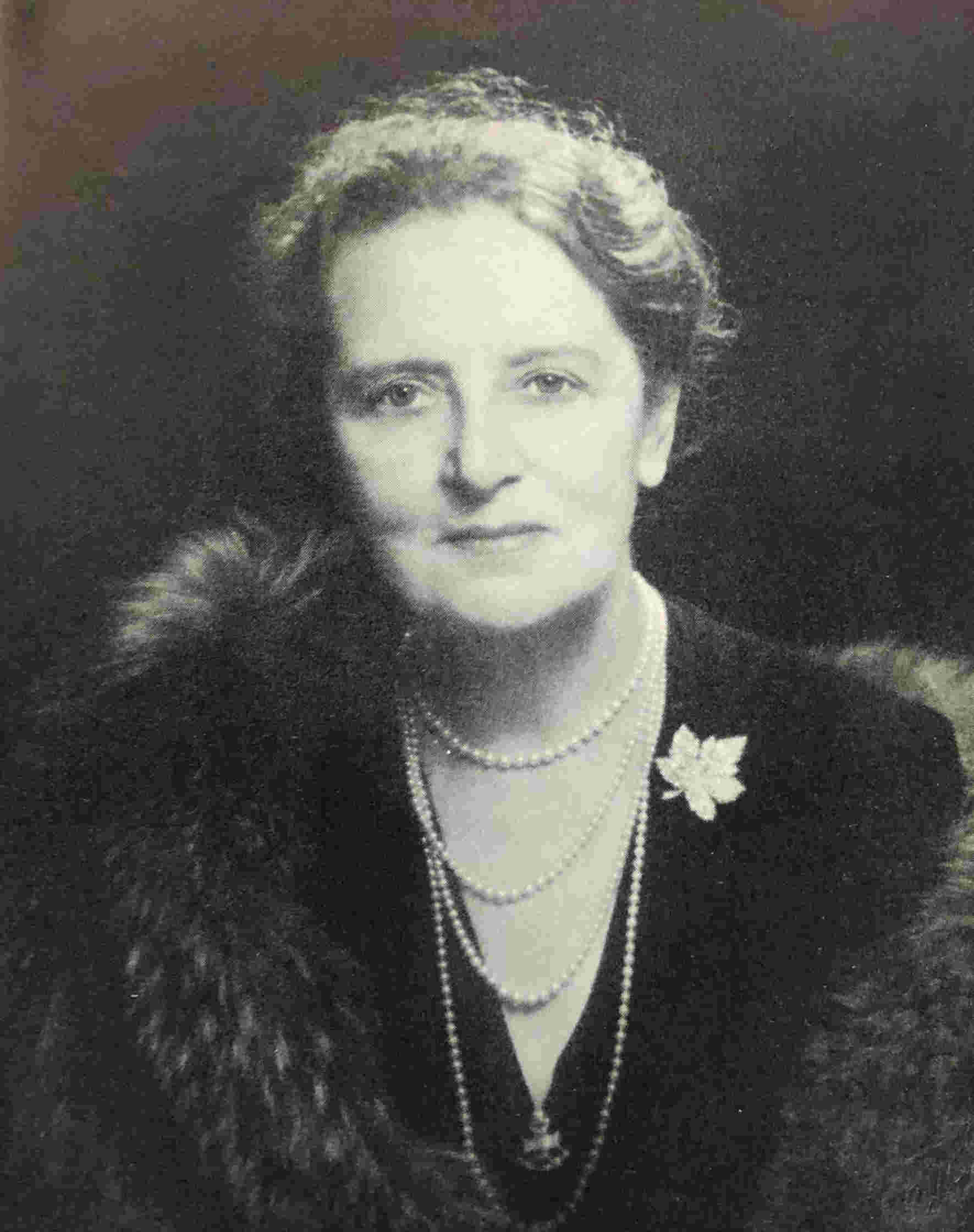
Alice Vincent Massey
Alice and I had met once or twice at her father’s house at Goring-on-Thames, where the Parkins dispensed generous hospitality to Oxford undergraduates. In 1914 she accepted the headship of a hostel for women students in the University of Toronto, called Queen’s Hall, and while we were both living in Toronto we saw a good deal of each other and found ourselves drawn together by that mutual attraction that defies analysis. Our formal engagement was very brief, and in June 1915 we were married in St. George’s Cathedral at Kingston where Alice’s sister, Maude, the wife of a professor at Queen’s University, lived. One of the officiating clergymen was my chief, George Wrong, who was in holy orders. My brother Raymond, who as a gunner officer was taking a course at Kingston, was a resplendent best man. The wedding, as befitted a war-time marriage, could not have been simpler—at 8.30 a.m., informal dress, only a handful of persons present, no wedding breakfast. Alice and I contented ourselves with a picnic meal à deux by the roadside, many miles from Kingston. It was a ‘quiet wedding’, but for us it was the prelude to thirty-five years of complete happiness.
At the beginning of August 1914, Raymond and I had arranged to spend some time with a French family near Blois. We arrived at the house at a dramatic moment. Our host, the Vicomte de Sèze, did full justice to it: ‘Ah! Messieurs! Vous êtes arrivés à un moment effroyable! C’est un moment colossal! C’est un moment prodigieux! Ecoutez, messieurs, c’est le tocsin qui sonne! La guerre est déclarée!’
We returned to England not without considerable difficulty. On the journey we found that, with our declaration of war on August 4, the sentiments towards British subjects, after having been very chilly, had become much warmer. In a crowd, if our language was noticed, someone was sure to call out, ‘Ah! Messieurs, vous êtes Anglais! Nous sommes compagnons!’ We would shake hands most fervently.
I cabled the Queen’s Own Rifles of Canada, in which I held a commission, volunteering for active service, but received no reply, and Raymond and I sailed for Canada as soon as we could get passage. My war service in the Canadian Army was, perforce, in Canada (I was no happier about this than others who were unable to go overseas) and consisted of staff duties. For much of the time I was stationed at Camp Borden, where I was in charge of musketry training for the military district. To my surprise I found myself made a lieutenant-colonel.
A dramatic incident remains in my mind. The redoubtable Sam Hughes decided, as Minister of Militia, to inspect the camp, where there must have been some 30,000 or more troops, and, for reasons best known to himself, to hold a ceremonial review. The heat was tropical, most of the troops had been in the army for a very short time, and they were living in anything but comfort. The announcement of a review was, to put it mildly, most unwelcome. But the men in the ranks had their revenge. The field where the event was held was covered with dust and a great deal of ash left from the fires when the area was cleared of timber. A strong wind blew directly towards the saluting base and the troops realized that by dragging their feet the reviewing stand would be brought under attack. The result was that at the end of the march past, every one of the officers on the stand had a blackened countenance and, to complete the satisfaction of the troops, no one could be punished.
At Camp Borden Alice and I lived in a little canvas hut; so did a flourishing community of field mice. Our Scottish terrier, MacAllister, instead of chasing them away, indulged in the policy of fraternization. One night when Alice found the sheet on her bed not entirely motionless, she discovered that a new family of mice had just been launched on their career.
I continued to take a keen and, as it appears in retrospect, a critical interest in the war-time political scene in Canada. In September of 1917, in response to a request from my father-in-law, I prepared a letter in which I set out my impression of the situation:
There is a conflict all through Canada at present between the organized parties—the machine—and honest independent public opinion. It may safely be said that neither party as a whole possesses a creed which has any meaning at the present moment. One of the vices of Canadian politics has always been, at least for the last forty years, that the division between parties was not founded on opposing principles. Everyone knows that Canadian party politics have been too often merely a struggle between the ins and outs. The traditional parties, however, are even more meaningless now than ever. On both sides the hack politician sees that his greatest advantage lies in the continuance of a straightforward party fight. Coalition or fusion of any kind would mean the end of ‘patronage’. The machine party man on the Government side has prevented serious concentration on the great business of the moment and has made much more difficult any unity in the House. On the Liberal side the professional politician has been able to work even more successfully. On this side of politics the leader and a great mass of his French-Canadian followers for many reasons regard the War as a remote and secondary matter. English-speaking Liberals have made use of the glamour surrounding the name of the ‘old chieftain’ and have secured through Laurier’s personal ascendency the continued adherence of Liberals, particularly in the Maritime Provinces and in the West, who do not see that the patriotism of their party at present is not much more substantial than a tissue of fine phrases.
The convention of Western Liberals at Winnipeg last month was a victory of the Western Liberal machine by a succession of very adroit manoeuvres. The managers of this convention succeeded in passing resolutions which committed the convention to an unswerving determination to win the war as well as to undying loyalty to the leadership of Laurier. Since this convention there has been some reaction in the West against such unscrupulous juggling; how strong the reaction is, the general election will show.
The situation in the country at present is pretty much as follows: the Government, as at present constituted, is in a great measure discredited by a good deal of blundering, unnecessary delays in meeting emergencies and by the adherence of people of the type of Rogers. The belated vigour with which it has passed legislation of the last few weeks is looked upon by many persons, particularly in the West, as an effort to win the election rather than the war. This applies to the War Time Elections Act.
On the other hand the Liberal Party has a French-Canadian core. This element together with those voters of alien origin, which the War Time Elections Act still leaves on the register must needs give it a colour which will lead many loyal Liberals to disregard the counsels of their traditional leaders.
Canada is at present in a pathological condition and as happens in the case of a human body in this condition, inherent weaknesses are very apparent. Even apart from the racial division, we are far from being a national unity. I forget whether you were in Toronto during the debate on the Conscription bill. If you were you must have noticed how out of touch with the current of events the Maritime Provinces have become. There are many Liberals from Nova Scotia and New Brunswick who hold the out-worn theory that conscription was incompatible with the status of a free country. The most unfortunate division of the country, of course, and this is the one which you will notice particularly in the West, is that which is marked by the bad lands on the north shore of Lake Superior. The reason why an agricultural region west of Winnipeg can be out of sympathy with the manufacturing centres of the East is of course obvious. But one could have wished that the war might have brought these two sections of the country closer together. The Westerner, from his remoteness from the sea and [because of] the vast country around him is really a very provincial person and the bogey of the big interests in the East is constantly paraded before him by Western politicians, the most able of whom are all Liberals.
Sir Edmund Walker and Sir John Willison, two eminent Easterners who are probably most in sympathy with the West, are looked upon, one as a bloodless capitalist and the other as a Machiavellian Tory. Efforts have been made repeatedly by Sir Robert Borden to reform his cabinet with the Western Liberal element adequately represented. He has failed to capture the Western Liberal organizations. It is expected that he will still be able to include certain Liberal politicians in his reformed cabinet but how much of a following they will command it will be difficult to estimate.
[Letter to G. R. Parkin, September 28, 1917.]
About a year before the end of the War, I was sent from Camp Borden to Ottawa as Associate Secretary of the War Committee of the Cabinet. Of this transition I wrote at the time to Lionel Curtis:
. . . a conspiracy between my present Chief, Mr. Rowell, and the Minister of Militia led to my ‘loan’ from the Army to the secretariat of the War Committee of the Cabinet. I have been here now about six months, and I find the work extremely varied and always interesting. My immediate Chief is the Vice-Chairman of the War Committee, Mr. Rowell, and I knew him well enough to realize what an excellent man he would be to work with. There is an enormous amount to be done, and I think my training makes me of some use. Work is the only thing which stands between one and dementia these days, and I welcome it, and the more of it the better.
Incidentally my work in Ottawa gives me a perspective of Canadian politics and life generally which is invaluable. I have learned more about our Government particularly and government generally in the last few months than I could in as many years in a library. It is very amusing to see one’s pet theories swept aside one after the other by the realities one comes up against in a place like this. I should not say all one’s theories, because in some respects such an experience tends to confirm certain preconceptions, but generally I find that one undergoes a readjustment which is extremely salutary.
[Letter to Lionel Curtis, August 9, 1918.]
My work with the War Committee thus gave me an intensive course on the machinery of government in Ottawa. The mechanism could have been more perfect. The role of secretary seemed to be imperfectly understood. As a secretary myself I acquired a professional point of view on this subject. Secretaries of Ministers were often chosen without either experience or training, which meant that they were not able to help their chiefs as they should. As a consequence, the chiefs had too much, their secretaries too little, to do.
The War Committee was given the task of preparing memoranda on a whole range of subjects that found their way to the Cabinet, and frequently led to action. The initiative of N. W. Rowell, who made a very able chairman, was often responsible for this. He, unlike many politicians in Ottawa, possessed the power of delegation, and I found myself busy in providing a liaison between the War Committee and various departments of government and organizations like the Imperial Munitions Board. One of my duties was to help Rowell draft legislation (at which he was a master) for a national department of health. Rowell was convinced of the virtue of prohibition and used the war as an argument for this baleful measure. He had a zeal for reform of all kinds; like many zealous reformers, his feeling for Man was sometimes greater than his feeling for men.
After the end of hostilities, a committee of the Cabinet, known as the Repatriation and Employment Committee, was formed to deal with problems connected with reconstruction. I was appointed its secretary and later director of the organization working under it. The function of the committee was largely to coordinate the work of government departments and voluntary bodies such as the Great War Veterans’ Association (out of which grew the Canadian Legion), concerned with the re-establishment of ex-servicemen, and to deal with various problems arising from the transition from war to peace. I lived for part of the time in the Victoria Chambers on Wellington Street, which was an ancient block of bachelor flats reminiscent of nineteenth-century London. My room cost me $1.50 a day.
The epidemic of Spanish influenza struck Canada in the autumn of 1918. We would have been more shocked by the number of fatalities had it not been that this scourge came after the long lists of casualties in the war years. Public gatherings were forbidden; the horse-drawn hearses moved at the trot because they had so much to do.
Hart Massey learned late in life that there was much pleasure to be found in giving money away for causes in which he believed. His first substantial benefaction was the endowment of a professorial chair at Victoria College, where he had been a student and of which he was an ardent supporter. He was no less ardently opposed to the proposal to move the College from Cobourg, its original site, to Toronto as one of the colleges of the University, and fought the battle of the location as stoutly as any alumnus—and lost it. His defeat, however, did not deter him from his intended endowment, and the College, far as it now was from ‘the old Ontario strand’, duly benefited from his philanthropy.
A few years later, Hart Massey built what was then called. Massey Music Hall. (The word ‘music’ was later dropped because the original name suggested something quite different from what my grandfather had had in mind.) By his decree, the foundation-stone of the Hall was laid by myself at the age of six. Over the years a long procession of eminent artists have sung or played to audiences in its precincts. Despite its unlovely architecture, it has contributed much to the development of music in Canada. The Toronto Symphony Orchestra and the Mendelssohn Choir were nourished within its walls, and since its rehabilitation it is equipped to perform its functions for many years to come.
My grandfather died in 1896. His was an unusual will for that time. The greater part of his estate was set aside for public institutions and causes. Under the terms of the will, of which I became an executor when I came of age, the estate was to be wound up in twenty years, which would have meant the disposal of the assets in 1916. There were two reasons why this was not advisable. In the first place, the funds were chiefly in the form of shares in the family business and their sale over a short period would have adversely affected the value of the stock; secondly, the distribution of such a sum of money to a great number of diversified institutions in so short a time would probably have meant its misapplication in many cases; it would also have involved the disappearance of a fund that, if kept intact, would be of immense value over the years through the income derived from it. It was decided, therefore, to incorporate a trust to be known as the Massey Foundation to which would be transferred the assets of the Massey Estate, the objects of the Foundation being identical with those incorporated in my grandfather’s will. This device enabled us to conform to its terms and at the same time to establish a fund of permanent usefulness.
My father, at first, did not see eye to eye with me about the creation of the trust; he would have preferred to see the assets distributed and the estate wound up. But I brought in some heavy artillery in the person of a favourite cousin of mine and a man of great ability, George Vincent, who was the head of the Rockefeller Foundation, a trust vastly larger than anything we had in mind but embodying similar principles. We convinced my father. The Foundation was incorporated in 1918 and commenced operations in the following year.
The Massey Foundation was the first trust of the kind to be established in Canada. It was, of course, more modest in its assets than many trusts formed recently in this country or the great foundations of the United States. From the beginning we regarded it as a source of money to be used for the creation of something that otherwise would not have come into existence. With very few exceptions, we resisted requests to make grants to existing projects and reserved our resources for new things.
The size of a grant of money is often of less importance than the selection of the object of the benefaction and the amount of thought that goes into it. During the forty years and more of its active operations, the Massey Foundation has always been given personal direction. If the grant was for the erection of a building, the trustees, in consultation, of course, with the ultimate owners, made themselves responsible for the design and equipment of the structure; this was handed over to the institution concerned finished in every detail. If there are two adjectives the trustees have felt could be applied to the work of the Foundation, they are ‘flexible’ and ‘personal’.
In 1919, with some difficulty, I persuaded the authorities of the Methodist Church of the day to authorize an inquiry by a commission organized by the Massey Foundation into the secondary schools operated by the Church. As chairman of the commission, I had three first-rate colleagues—the Reverend James Smyth, Principal of the Wesleyan Theological College, Montreal; George H. Locke, Chief Librarian of Toronto; and Professor J. C. Robertson of Victoria College, Toronto. We were much interested in our task but our reforming zeal was unfortunately not balanced by a sober estimate of what recommendations would be acceptable or even possible. The standards in the institutions we visited, of which there were twelve, varied greatly, and at the time were not very high. Most of these schools and colleges remained untouched by our recommendations; the seeds that were sown fell very largely on stony ground.
My father was the chairman of the Foundation until his death in 1926. Ill-health, however, kept him from being as active as he would have wished, and the responsibility for the direction of the trust fell largely on me. The Foundation’s trustees have always avoided publicity, although most of its benefactions have been known to the general public. They have been highly varied in character. The completion of Hart House, an inheritance from the original Massey Estate, was our outstanding enterprise. The work commenced in 1911 and the building was officially opened in 1919. After our marriage, Alice played a great part when it came to the furnishing and interior decoration of the structure, where her taste was invaluable. Construction slowed down inevitably during the course of the First World War and the building in its unfinished state was used for war purposes. An inscription on the wall includes a passage in which I tried to describe its purpose. It runs as follows:
The prayer of the Founders is, that Hart House, under the guidance of its Warden, may serve, in the generations to come, the highest interests of this University by drawing into a common fellowship the members of the several Colleges and Faculties, and by gathering into a true society the teacher and the student, the graduate and the undergraduate; further, that the members of Hart House may discover within its walls the true education that is to be found in good fellowship, in friendly disputation and debate, in the conversation of wise and earnest men, in music, pictures and the play, in the casual book, in sports and games and the mastery of the body; and lastly, that just as in the days of war this House was devoted to the training in arms of the young soldier, so in the time of peace its halls may be dedicated to the task of arming youth with strength and suppleness of limb, with clarity of mind and depth of understanding, and with a spirit of true religion and high endeavour.
Hart House resembled a medieval structure in the time it took to build as well as in its architectural style. This made it possible to make additions as the building grew. The theatre provides an example. One day Alice and I were paying one of our frequent visits to the partly finished structure and found ourselves in the basement under the quadrangle, where there was an immense space excavated but with no assigned purpose. The roof rested on well-proportioned arches, and at one end, the flanking supports and beams joining them resembled the proscenium of a theatre. We said to each other in almost one breath, could this be a theatre? The architects were quickly consulted and gave a favourable verdict. A theatre seating about 500 was the result. A small art gallery and chapel were two further additions made while the building was under construction.
Hart House followed the medieval custom of having portraits and caricatures in painted glass or carved in stone. I enjoyed a little Gothic joke on Alice. One of the stone corbels in the Great Hall was made to resemble her, and on the underside of the flat stone above were carved a distaff in front and a fish behind; for Alice, since becoming a housewife, found that angling, a favourite pastime, was taking second place. Above the panelling in the Great Hall was a perfect place for lettering on all four sides of the room as part of the decoration. It occurred to me that the famous passage from Milton’s Areopagitica beginning: ‘First, when a City shall be as it were besieg’d and blockt about . . .’ would be highly appropriate in war-time. The architect’s only comment was ‘Is it a hundred yards long?’ It was.
It was our hope that Hart House would have the physical beauty that would influence the young men who tarried for a time within its walls. I remember a comment made to me about the building, with which I was in strong disagreement. My friend said that an undergraduate would be unfitted for simple living after familiarity with so elaborate and luxurious a structure. He was confusing beauty with luxury. It is better to be ‘graced with elegance, than daubed with cost’. Hart House is not luxurious—indeed, it possesses a certain austerity—but human beings do respond, perhaps unconsciously, to fine proportions and dignity in buildings.
It was highly important that Hart House should be organized and regarded as an educational institution and not simply a club ministering to the material needs of the undergraduate. Not that it was intended that any formal education should be carried on within its precincts. We hoped that the student would find educational nourishment by taking part in its musical and artistic life and in debating, and by reading in the library.
The constitution which was devised at the time of the opening has remained largely unchanged. The government of Hart House rests in the hands of a body known as the Board of Stewards, composed partly of undergraduates and partly of members of the faculty. It is presided over by the Warden, who is appointed by the University, and who is responsible for the direction of the House and for the standards of the life inside it. Hart House represents the truth that, however admirable a physical structure may be, it can never do what is asked of it without personal qualities on the part of its head. The House was fortunate in having had as Warden for twenty-six years a very gifted person who brought the stone walls and timber to life. Burgon Bickersteth will long be remembered for what he did to make Hart House live and for shaping its character. Alice and I were deeply grateful for the warmth of his friendship and, although he now lives in Canterbury, I am happy to be able to see him from time to time.
This is not the place to catalogue all the various undertakings of the Foundation, but a few might be mentioned. We believed in the functions of the independent school, and Upper Canada College received a grant at a critical time in its history which made possible the construction of new houses and the Georgian quadrangle. We tried to strengthen the Canadian Institute of International Affairs by providing, in 1932, the salary of a permanent secretary for an initial period.
In the early ’20s four distinguished musicians came to us and said, ‘We think we are a string quartet.’ And that is what they were, and for twenty years, with the support of the Foundation, they gave great pleasure not only in Canada but in the United States and Europe. The group bore the name of ‘The Hart House String Quartet’. Once when on a train running between Montreal and Quebec, the Quartet wanted to rehearse the concert to be given the following day. They asked the conductor whether, when the dining-car was empty, they might do so. He said, ‘Why sure, boys, get your fiddles out’; whereupon they commenced. The noise of the train proved too much for Debussy’s Quartet, especially its pianissimo movement, but the conductor had been listening intently. He had never heard this kind of music before in his life and his nose was almost inside the viola. He suddenly exclaimed, ‘Just a minute, boys, just a minute,’ and pulled the communication cord to stop the train, saying, ‘I want to hear this—now finish it!’ There is a sequel to this story. The Quartet were in Hamilton playing a programme, which again included Debussy’s Quartet. They were close enough to the railway station to have an engine drown out the music; they always called that the ‘engine’s revenge’.
In 1933, it was necessary to rehabilitate Massey Hall, and the Foundation was responsible for a substantial proportion of the cost. This structure did not acquire any external beauty by what was done, but it was made more comfortable and safe against the hazard of fire, without affecting the acoustics of the building, which have always been remarkable. This feature of the auditorium had been arrived at more by good fortune than by the application of science, but it placed the hall, so experts say, among the first few concert halls in the world.
It was natural that a corporation, the majority of whose trustees were members of the same college, should not neglect it. Thus, the Massey Foundation established a fellowship at Balliol and constructed a room in the College that performs a variety of services. The College decided it was to be known as the Massey Room. On the wall is a little silver plate with this inscription:
HOC TRICLINIUM BALLIOLENSES QUATTUOR ACCEPTORUM
SEMPER MEMORES BENEFICIORUM NECNON MULIER
HUIUS DOMUS AMANTISSIMA IN USUM IUNIORUM
REFICIENDUM ET ORNANDUM CURAVERUNT MCMXXXVIII
[Four Balliol men, always mindful of the benefits which they
have received, and also a matron much devoted to this House,
have restored and equipped this common-room for the use of
junior members, 1938.]
At the beginning of the 1939 War a country house near Hereford in England, which for long has borne the name of Garnons, was taken over by the Foundation as a convalescent home for Canadian officers and operated for five years, having as patients some 2,700 officers from the Canadian Services. It was intended to fill the gap between a patient’s discharge from hospital and his return to duty. We made the atmosphere as much unlike a hospital or a military unit as possible, and it was run as far as it could be as an English country house. The lovely Wye Valley gave it a perfect setting. Alice ran Garnons by remote control from London and we both tried to visit it whenever we could. It was in the hands of a resident hostess with two or three young women who acted as ‘daughters of the house’. Quite apart from the therapeutic effect of such an institution, I am happy to think that hundreds of Canadians learned to love the English countryside from their stay at Garnons.
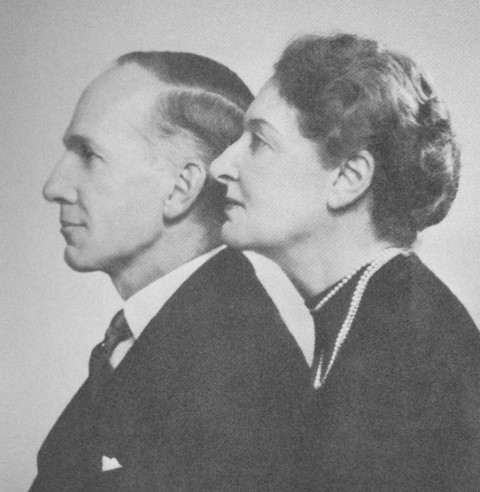
London, 1939
During our ten years and more in London, Alice and I, on behalf of the Foundation and aided by our two sons, Lionel and Hart, formed a collection of contemporary English paintings. We kept in touch with the principal dealers and acquired one or two pictures at a time; during the War they were sent away for safekeeping. When hostilities ceased, the pictures were all assembled at the Tate Gallery. We greatly wondered whether the collection had any unity. We found that it had and this view was reinforced by what some wise advisers told us. After extensive travels, including Australia and New Zealand, the collection, numbering some eighty-odd pictures, is now permanently housed in the National Gallery in Ottawa.
Offers from the Massey Foundation to erect buildings did not always meet with success. In October 1937 I told Mackenzie King that the Foundation would be glad to build and equip a concert hall in Ottawa if the Government would make available the land. This aroused no interest, let alone enthusiasm, and the proposal died a natural death. Many years later, in the early 1950s, I told the government of the day that the Foundation would be glad to erect a building in Ottawa for official hospitality and the entertainment of distinguished guests if the land could be provided. We had Lancaster House in London and Blair House in Washington in our minds as models. Once again our offer was not accepted.
An example of what can be done with a relatively small amount of money is provided by a system of awards instituted and financed by the Foundation known as the Massey Medals for Architecture. These are intended to encourage architects in their profession and to stimulate public interest in what they do. Arrangements for a competition held every two or three years are made by the Royal Architectural Institute of Canada, and medals are given to the winners. It is quite clear by now that the objectives of this plan are being fully achieved.
My grandfather left a sum of money in his will for the erection of a building in the American University, Washington, D.C., which had still to come into being. This university possessed some endowments that provided travelling fellowships, and we prevailed upon it to use the money not for bricks and mortar but for scholarships for Canadian students to enable them to study abroad. For twenty years, from 1920 to 1940, students were chosen annually from the University of Toronto. A preliminary screening was carried out by the Warden of Hart House, and after this Alice and I chose the students who, in our view, showed the greatest promise of achievement in later life. How often we were fortunate enough to hit the target, the names of successful candidates would show. Among them were Lester Pearson, Wynne Plumptre, Saul Rae, Tommy Stone, Tuzo Wilson.
One of the responsibilities of the Foundation for a number of years was the financing of Hart House Theatre. The theatre, although physically a part of Hart House, was managed by an independent board as an amateur repertory theatre, with a professional director who was free to choose the actors as he wished. Apart from him and one or two technicians, the theatre was run entirely by amateurs, chiefly drawn from the University. During its career as an independent theatre it presented 126 productions. They were inevitably unequal in quality, but, at its best, with the excellent amateur actors available, the standard was very high indeed, and people are kind enough to say that the theatre was an important factor in the development of the ‘little theatre’ movement in Canada. Later on it was decided quite rightly that henceforth it should perform the functions of a university theatre, and that the actors should be drawn from the student body. The change took place in 1946 and a permanent director, Robert Gill, was appointed. The success of the theatre under the new plan has thoroughly justified the change in organization.
Alice and I took a great interest in Hart House Theatre and its affairs, and in the early years the theatre was our major hobby. In my case this involved a certain amount of amateur acting—an unusual recreation for a serious business man, but I saw no reason why dramatics were any more frivolous or unbecoming than golf or shooting or yachting.
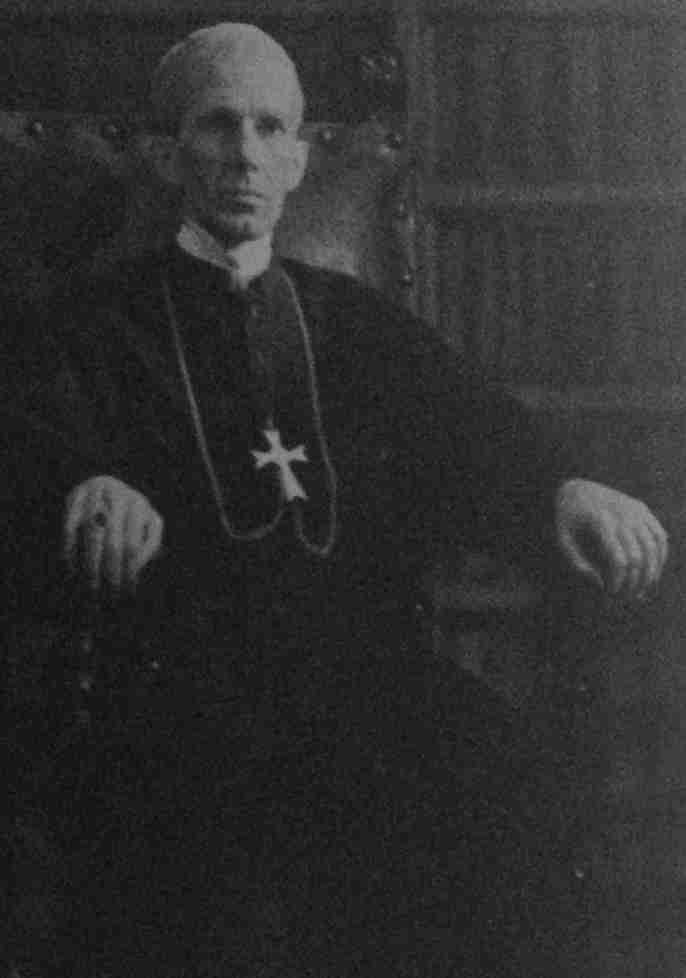
The author as Pius VII in Paul Claudel’s play, ‘L’Otage’, Hart House Theatre, 1924
As an amateur actor in Hart House Theatre, I remember one play vividly. It was Paul Claudel’s L’Otage, in which I played the part of the Pope who had been captured by Napoleon—Pius VII. I thought I would consult the Roman Catholic Archbishop of Toronto, Dr. McNeil, about certain matters connected with the play, and he very kindly let me come and see him. He lent me some things to be worn and when I asked him on which finger the Pope wore his ring, he told me and asked, ‘Have you got a ring?’ I said to His Grace at once that the property room could make one. He said, ‘Oh, no, no, I will lend you my Vatican ring,’ and before I could restrain him he went upstairs, and came back with a beautiful amethyst ring which he insisted on my taking. I wore it each night for the run of the play, being very careful not to tell anyone from whom I had borrowed it.
Each summer for several years I amused myself and tortured our guests at Batterwood by writing and producing a film play. If your victims are both docile and intelligent, you can do wonders, even with black and white film and without benefit of sound track. My star production was a three-reel drama entitled ‘How Derek Dared’, done in the best nineteenth-century romantic manner.
In later years I was happy to have close relations with the Stratford Festival from its beginning. I shared the pride of countless Canadians in this remarkable achievement, through which Shakespeare is presented as well as anywhere else in the world. I valued the honour of being asked to lay the foundation-stone of the permanent theatre. On my last visit to Stratford before leaving Ottawa, I was given two presents which I treasure—both of them from the first play produced. One was a drawing by Tanya Moiseiwitsch (widely known as a genius in theatrical design) of Alec Guinness as Richard III, and the other the orb he carried in the ceremonial scenes. After the presentation was over I was asked if I would like to know where the orb had come from. I was told that the girl in the property room, true to its ‘make do’ traditions, had hit on the idea of using a float that performs a useful function in the cistern of a lavatory, and by adding a cross and applying gilt paint, had brought the orb into being.
When I returned to Toronto in 1919 from my temporary government service, I entered the family business as secretary of the firm, having already been elected to the board of directors in 1917. The time had come when there were no other members of the family actively connected with the business, which had not yet become a public company. The reorganized office of secretary, which had been a merely titular appointment held by persons with other duties, was now given greater responsibility. This was made necessary by the increased attention given to labour-management relations and the definite change in the public attitude towards industry.
In 1920 I paid my eleventh visit to England, partly on business and partly to allow Alice and me to renew our contacts after the War. I thought myself fortunate in being able to acquire a motor-car—they were very hard to come by at that time. The car was a Model-T Ford, and was inevitably called Henrietta. She had a very uncertain nervous system, was extremely difficult to start, and her headlights could be called unreliable. Henrietta was frequently beyond human aid—certainly beyond my capacity as a mechanic. I remember leaving her outside the House of Lords where Alice and I had gone to hear a debate from the gallery. My car stood in striking contrast to the Daimlers and Rollses parked in the square. When we came out, Henrietta would not start; I asked a chauffeur if he could help me and he replied with a touch of hauteur, ‘Sorry, sir, I don’t know nothink about a Ford.’
We were motoring one evening through Sussex when one of the lights failed. A tall, helmeted figure appeared out of the dusk to tell me I had only one light. I told the policeman that I was on my way to a garage to have it attended to. He said, ‘You can’t travel with one light.’ I asked, ‘What can I do—leave the car at the side of the road?’ ‘No, sir, I am afraid you can’t, that would be obstructin’ the traffic.’ An appeal for guidance led simply to the classic formula, ‘I must have all particulars.’ I gave him these and somehow the problem was solved.
One Sunday morning Alice and I, driving in our none-too-silent Ford, paused with the engine idling to listen to what a wild-looking speaker on a scarlet rostrum was saying. He was calling down thunderbolts on the established order. A policeman came up and said, ‘I’m sorry, sir, but the audience can’t hear what the gentleman is saying because of the noise of your engine!’ I turned the ignition off with a sense of shame.
The public speakers to be heard in London fascinated me, as they have done countless people. I made a list one day of the organizations represented at the Marble Arch: New and Latter House of Israel, Christadelphians, Protestant Alliance, Catholic Evidence Guild, Irish Freedom League, Christian Evidence Society, Metropolitan Secular Society, ‘Cancer Cured without Surgery’, West London Mission, Church Army, London Council for Public Morality, British Fascists. I didn’t see a Communist speaker and asked a policeman if there was one. ‘Yes, sir,’ he replied, ‘over there on the grass.’
One last word about Henrietta. It was discovered after careful researches and inquiries that the difficulty with this car was due to one defective part which had to be replaced; the replacement, however, could not be found in England. I had turned the car in to be sold, before Alice and I went aboard a liner in the Mersey to sail for Canada. It was then that a small package marked ‘Urgent’ was brought to me. It looked as if it might have come from Cartier’s, the jewellers, but inside we found the part that, had we had it months earlier, would have made Henrietta’s anatomy perfect!
One evening during this English visit, we saw Ruth Draper perform in what must have been one of her earliest professional appearances. She was brought up in old-fashioned New York, where the social standards were often stricter than in Europe, and her genius for a time was confined to the drawing-room. Ruth became a great friend of ours; she stayed with us now and then in Toronto, and we revelled in her art. She had not only an actress’s flair for interpretation of character but a dramatist’s creative sense. She wrote her own sketches from the beginning. On one occasion when Alice and I were crossing in the same ship with Ruth, I found myself once or twice sitting in a deck chair beside her when she was at work on one of her monologues. To hear her discuss it was no small privilege. Ruth was a woman with basic simplicity and intellectual honesty, a dignity that came from her upbringing, and a penetrating insight into human nature. An incident that took place when she was staying with us in Toronto was characteristic. Would she do one of her monologues for the two of us in our library? She agreed at once, sat in a chair, and did her moving Irish sketch, ‘In County Kerry’—a thing that only a great artist could do and a great lady would do.
Innumerable people will remember Ruth Draper’s performances—with no special costume except perhaps a shawl, no properties but a chair and possibly a table on a bare stage which she filled with people conjured out of her imagination. When she came to stay with me at Government House in 1955 she was seventy-one. I told her how well she was looking and how much I had enjoyed her performance on the previous evening. She said, ‘Well, Vincent, I am going on because I am very well. I love my work and I think I’m improving.’ Alas, before long her art was a memory.
In 1921 the headship of our company became vacant through the death of its president, and I was chosen by the board to succeed him in December. I certainly was not elected because of any long experience of business, or because of mature years; I became head of the family firm as a member of the family, very conscious of my own shortcomings as a manufacturer-in-the-making. I was not as familiar with our product as I might have been. One evening Alice and I were riding near our home in the country, and as we were passing a farm a man came forward, addressed me by name and said, ‘Our corn-harvester has broken down and we can’t find out what the trouble is—can you help us?’ I murmured a prayer that somehow I could be carried through this emergency. I dismounted and went over to where the ailing implement stood and started to tinker with it, with the most profound ignorance of the function of any part that I examined. But the particular angel that looks after mortals ignorant of mechanics was on duty that evening, and somehow the machine started to work. We went on our way, my reputation, I am ashamed to say, enhanced.
The Company’s organization after my election as president followed a common English pattern wherein a full-time chairman concerned with general policy presides over shareholders’ meetings, while a managing director performs the duties of executive head of the business. The former functions were mine as president, and the duties of managing director were entrusted to a general manager, Thomas Bradshaw, a well-known chartered accountant. Despite what differences there may have been in the careers we had followed hitherto, we had something striking in common. The intrusion into the business of two persons who were not ‘machine men’—that is, almost born in it—was a disturbing innovation in the Massey-Harris community.
It was for me to discover what I could most usefully do as president. I was concerned, quite naturally, with (to use a gravely abused phrase) public relations, in the broader sense—contacts with the Government and with the public. This, to mention a rather narrow section of the front, involved some concern with advertising. This I thought in dire need of reform, but the path of the reformer is rarely smooth. I remember being interested in the design for the annual calendar, which was distributed all over Canada and abroad in immense numbers. The calendars in the past seemed to have reached the lowest possible level. I was proud of the design that I introduced—a spirited picture of three horses pulling a binder over the brow of a hill—not great art but good graphic art. The directors would have no part of it. They said the horses were pulling too hard—that it was a bad advertisement for our binders, which were supposed to be easy to draw. It is hard to reconcile salesmanship and art.
No more urgent task confronted the Company than to seek out and enter new markets. We had at this time great expectations—in retrospect, much too great—of what might be done in Soviet Russia. Before the Bolshevik Revolution, the Company had begun to develop an important trade with Russia and, like other exporters, we were anxious to resume commercial relations if this proved feasible, notwithstanding the disappearance of the old régime. I was gratified by the decision of the Canadian Government to participate in the Genoa Conference in 1922; for the purpose of the Conference was to restore, as far as was possible, pre-war patterns of trade in Europe, and for this reason a Soviet delegation had been invited to take part. Early in 1922 I wrote, as president of the Company, to the Prime Minister of Canada, urging Canadian participation:
I cannot help feeling that it is of the greatest importance that this country should have its own representative at this meeting. It is now apparent that the Conference is going to be of the greatest significance. The fact that Russia and Germany are to be represented gives the Conference a reality which previous gatherings of the kind have lacked. Secondly, it would seem likely that the beginning which was made in Washington in the re-establishment of better international relations, will be followed up, in Genoa, by still further steps toward the restoration of the better relations on which the revival of trade is dependent. In other words, the Genoa Conference is very likely to lead to some definite programme towards the world’s economic rehabilitation. It might well be that trade relations, hitherto impossible, between Russia and the rest of the world, will follow as a direct result of the Conference, and apart from the moral fact of our being represented there, it is this possibility which leads me to regard our representation as a matter of practical importance. In the matter of trade arrangements, the British Government is not likely to have any sentimental leanings towards Canada, still less the Americans, and it might well be that unless we have someone there to fight our own battles, the Canadian exporter will be quite forgotten in whatever trading schemes should arise from the Conference. There are a great many Canadian firms deeply interested in this matter apart from the Company which I represent.
[Letter to Mackenzie King, February 9, 1922.]
The Company was kept closely informed about the proceedings at Genoa by our own representative, R. O. McDonald, who had been the Company’s manager in Moscow before the war, and who actually succeeded in getting himself appointed an official member of the British Empire delegation. ‘We are watching the Conference with tremendous interest,’ I wrote to E. R. Peacock, who had been sent to Genoa as the representative of the Bank of England. ‘It has a peculiar significance, of course, to this Company, because of the possibility that through its success our trade relations with Russia, so very important to us before the war, might be in some measure restored.’ [Letter to E. R. Peacock, April 21, 1922.] McDonald reported the course of negotiations in a letter to me of May 4:
. . . the Russians’ particular concern is the receiving of immediate and sufficient financial assistance from the other Powers. The other Powers have in mind that credits created by them available to Russia would be sufficient to answer Russia’s requirements. The Russian Delegates have in mind the securing of loans. So far as Great Britain is concerned, credit if granted would be on some such lines as the Export Credit Scheme and the Trade Facilities Act. Neither of these would help our case at all. We would be able to deal with Russia only if Russia accepted these credit granting schemes as sufficient for her requirements, and if Canada took part in some such scheme either by membership in the Central International Corporation or by direct independent action on the part of the Canadian Government by granting credit or guaranteeing credits extended to Russia.
Discussing this question with Sir Charles Gordon [the Canadian delegate], and trying to impress upon him (which you had already done) the importance to Canada of firms such as ours securing some share in reopened Russia’s trade, and the impossibility of getting any share of that trade without some scheme enabling our Company to finance orders placed on long-term credits, Sir Charles wired to the Prime Minister of Canada asking for authority to agree the preliminaries [sic] in connection with the formation of the Central International Corporation, and to indicate that Canada, subject to Government approval when details were submitted, would be a partner by guaranteeing the capital of a National Corporation to the extent of £1,000,000. A newspaper comment since then would indicate that the reply received from the Canadian Government was favourable.
[Letter from R. O. McDonald, May 4, 1922.]
Not for the first time, ‘newspaper comment’ was to prove incorrect. Mackenzie King had in fact replied (although we did not know it at the time) by posing a chilling query on a wholly different aspect of the matter. ‘Some criticism here’, his telegram to Sir Charles Gordon stated on May 1, ‘that Canadian delegation to Genoa includes no person knowing economic questions from Labour standpoint. Please indicate . . . if Canadian delegation is in any way handicapped.’ Sir Charles indignantly repudiated this suggestion. But on May 23, the Prime Minister put an end to Canada’s association with the proposed credit institutions. ‘I should inform you’, he cabled Gordon, ‘that consensus of opinion appears to be very distinctly against Canada becoming identified with the International Corporation and organizing a National Corporation, and unless very strong reasons can be shown wherein Canada will greatly benefit by such a step, or suffer loss by not taking it, my opinion is Council will decide against participation.’ And so, of course, it proved. We were greatly disappointed at this outcome.
I did much travelling as president. In former years the head of the Company had often visited the West of Canada—or the North West, as it used to be called—but I felt that more attention should be paid to the prairies as a community and not merely as a market. It was a useful time to visit the western provinces and meet as many people as possible, address luncheon clubs, and generally get about, for we were then in the grip of a depression and western criticism of the East was, as always in such a period, greatly sharpened. Nevertheless, my reception in the West was warm and friendly.
I made an extended tour of European countries where the Company had branch offices and, with considerable difficulty, I managed to get permission from the Soviet authorities to visit Russia in 1924. In this my motive was twofold. I wanted to see what could be done towards even partially restoring the trade we had carried on with Imperial Russia before the 1914 War. I also was very curious to see what was going on in that mysterious country. Alice went with me, as she did on nearly all my tours, and we spent a deeply interesting fortnight behind the iron curtain many years before Churchill coined that phrase.
I took with me as secretary a member of our London staff whose name was Voss. He had been born and reared in Latvia; Russian, therefore, was his native tongue. Our journey began in July 1924, and we went first of all to Kaunas, Lithuania. We were superbly entertained by the Company’s agents and several important people in the city. Luncheon after our arrival lasted three hours and was done in Russian style—an hour of zakuska and vodka. In the evening there followed reciprocity in entertainment, in which Alice and I gave a dinner party for our luncheon hosts. They chose ten o’clock as the hour. Once more we moved majestically through a three-hour repast, drinking the health of the Republic of Lithuania, our hosts, the Company, M. le Président, Madame la Présidente, and so on. Dinner was complicated by the fact that one of our guests spoke only French, another one only English, and another one only Russian. We retired with impaired digestions but with a sense of accomplishment at 1:30 a.m.!
The next morning we had a late breakfast, having escaped by a narrow margin another ceremonial meal. (There is no finer strand in the Anglo-Saxon tradition than that which insists that breakfast is an informal repast.) We arrived at Riga later in the morning. Our first duty was to deposit in our hotel letters, books, and papers that might be confiscated in the Soviet Customs. In about twenty-four hours we arrived at the Soviet frontier and passed under a formal banner of welcome to the ‘Proletarians of the World’. We felt very definitely that we were excluded from this gesture of hospitality! The little frontier post fairly bristled with bayonets and rang with the jingle of spurs. A few miles further on we were closely examined by a posse of officials—passports, luggage, and so on—a very long process. Blank letter-paper was scrutinized for watermarks; André Siegfried’s current book L’Angleterre d’aujourd’hui excited official suspicion. It was eagerly searched and looked up in the Communist Index Expurgatorius, but escaped confiscation.
The journey to Moscow took another twenty-four hours. The peasants at the stations were caricatures of themselves. Soldiers and officers were everywhere. There was public provision of hot water at every station for the making of tea, which was drunk continuously. On the train we made the acquaintance of two fellow passengers—a Mennonite school-teacher temporarily in the service of the Canadian Pacific Railway and returning from the frontier having escorted 1,200 Mennonites en route to Canada, and a young Mennonite friend of his, a private in the Red Army, a Communist, who, because of conscience, had refrained from accompanying his parents to Canada. They were an agreeable pair, both German-speaking, and we enjoyed our long conversations with them, greatly aided by Alice’s expert knowledge of their language. (Eight years later in Saskatoon an unknown person telephoned us and asked if he could call, saying we had met some years before. He turned out to be the Mennonite teacher; he had managed to leave Russia and was living happily in Canada, having reached his land of promise.)
After our arrival in Moscow the next day a gendarme in charge of the train told Voss that I had been seen taking pictures at the railway stations, contrary to regulations, and that I had to go with him to the gendarmes’ room, a sort of improvised police station, to give up the film. This I did amid the courteous apologies of at least three guardians of the law who told me that if the films, when developed, revealed no military secrets, I might have them back. As a matter of fact the films revealed no secrets, military or otherwise, as they were entirely blank, the camera which I had bought in Berlin not having been equipped with an inner lens! I often wondered how long the Soviet people worried about this episode thinking, no doubt, that this was a kind of invisible negative which only came to life when a certain liquid was applied to it.
Tiny incidents are sometimes significant. When I arrived at the gendarmes’ room at the Moscow Station I was very courteously offered a chair. As I was about to sit down, I noticed in time that the chair had no seat. When the gendarmes saw this, they burst out in roars of laughter—in which, of course, I joined—and I thought they would never stop. I have always been told that the Russian sense of humour is simple and robust. Let us hope this is true, for a sense of humour and a sense of proportion are supposed to be one and the same thing.
Moscow must have been a city of great charm. Most characteristic were the countless Byzantine domes of the churches, generally covered in gold-leaf or painted bright blue or green. The revolution, however, had left its mark—buildings and streets were in bad repair and there was a depressed air in the city that was unmistakable. Persons of all classes wore every sort of clothing and, on the whole, Moscow was a sombre community with few smiles and little laughter. A different side of the Revolution was to be found in the innumerable bookshops everywhere in Moscow, full of books either propagandist or educational in purpose—among them numerous technical works.
One evening we dined at what had been one of the smartest of Moscow restaurants, now dismal and dilapidated. Its professional standard of cuisine and service was maintained, but the waiters seemed depressed and apprehensive; ours, looking carefully round him and also under the table, said, ‘Things were not like this in the old days.’ The kitchens of our hotel had not survived the revolution and most of our meals consisted of food bought on the street, chiefly caviar (of an inferior quality) and black bread, wrapped up in pages of a newspaper and carried back to our room. We were in Russia at a time when espionage was at its height. I was not permitted (with one exception) to see any official, among the many I saw in connection with business matters, unless a third person was present; generally a sour-looking individual in a black leather jacket. An English journalist said that one of his staff had had his rooms searched while he was away. He complained of this and also of the loss of his diary which was missing when he returned. He was told that unfortunately the diary was lost but he could be supplied with a copy.
We dined one evening at the British Embassy with Hodgson, head of the British Trade Mission. On the table was some very fine plate which belonged to the Embassy and the table was generally arranged as for a formal dinner party, but we were all in ordinary clothes in deference to Communist prejudices.
It was interesting that at the theatre criticism of the Communist system was permitted. Allusions were freely made to the mechanical character of the Soviet State and to its arbitrary system, although no individuals were singled out for criticism. We attended Mass at two churches—one the Church of Christ the Saviour, which belonged to that branch of the Orthodox Church that had established relations with the Communist régime, known officially—and ironically—as the ‘living Church’. That was the last adjective I would apply to it from what we saw. Although the service was very fine, showing great beauty, the Church seemed to lack vitality: the pews were far from full, and a good many of the congregation were apparently there out of sheer curiosity. After this we went to the Church of the Ascension not very far away, which was packed with people, apparently belonging to the upper classes, mostly poorly dressed, and with faces that bore the marks of suffering. There is some irony in the fact that Communists freely use Christian phrases and relate them to their State, such as ‘a house divided against itself’, and ‘He that is not with me is against me’.
One saw touching signs of the cruel persecution of those classes that the Communist régime wished to liquidate. At the Smolensky Market there were dozens of such people endeavouring to sell what they could—such as odd pieces of household linen, or pairs of white gloves, carefully cleaned. One of the art galleries in Moscow displayed a collection of nineteenth-century French paintings acquired by a pre-revolution magnate. It was admirably hung and catalogued. While we were there we saw a woman in peasant clothes, a shawl over her head, examining some of the pictures intently when, to our surprise, she produced a lorgnette! The little incident told its own story.
We saw what we could of Moscow, but were not permitted to see the Kremlin or to leave the city. We drove round Moscow in a droshky. Our cocher, like others, wore the traditional dress—a beaver hat of nineteenth-century pattern, and a cloak with a three-tiered cape. The horses were all very well cared for. The Communists had tried to nationalize such vehicles, but all the horses disappeared almost overnight to moujiks in the country, and the State had to give in. They remained an outpost of capitalist freedom for some time. Indifference to State trading regulations could be disastrous. I was told that the president of the second largest bank in Russia was given ten years’ imprisonment for owning twelve suits of clothes and having given expensive dinners.
After about ten days in Moscow which, in relation to business, were rather less frustrating than I feared, we went to Leningrad. Like all visitors, we were greatly struck by the beauty of the city. It was planned in the grand manner, with well-proportioned buildings displaying great elegance and dignity, but we found the dilapidation shocking. Whole streets were empty and houses were being stripped of window frames and sills and even joists for firewood. The city was on the verge of ruin. There was no business to be transacted in Leningrad as Moscow had become, in every way, the centre of Russian life. At the door of our hotel in Leningrad a little girl, with charming manners and well-bred features and voice, was selling a few papers of pins. Not only would she accept no money without giving pins in exchange but she proudly insisted upon giving the correct number.
One monument of the old régime was standing in Leningrad—an equestrian statue of Tsar Alexander III, but on the base was cut a new inscription; this is the translation I was given:
My son and my father during life were executed,
And I reaped the lot of lifelong infamy;
I stick here as cast iron bugbear for the Country,
Who threw over for ever the yoke of autocracy.
The last but one autocrat of All Russia
Alexander III
While we were at Leningrad, by accident we discovered a shop that was selling linen from the Winter Palace. A case of this had just been opened and we bought several dozen table napkins bearing the Imperial Arms and the ciphers of either Alexander III or Nicholas II.
We went from Leningrad to Tallinn (Reval in former days) and spent much of the night at the border in the hands of Customs and other officials which, coupled with the fact that there was no sleeper, did not give us the maximum repose. The Soviet officials, of whom there were many, male and female, had us in hand from about midnight until 2:00 a.m. and after an interval, the Estonians took us on until about 5:00 a.m. Three icons which we had bought in Leningrad were sent back to Moscow for a licence necessary for the export of antiquities. The regulations were possibly reasonable, but the manners of the officials were not. However, the icons duly arrived in Canada about a year later.
We handled the problem of a collection of Russian propagandist posters which I had bought and the table napkins, referred to above, rather differently. A Soviet woman official, armed with an electric torch and a skewer, and with a very vindictive expression, had discovered the icons where we were sitting, but she did not see the other articles because they were strapped to Alice’s person under her burberry, which made her look like a femme enceinte. This possibly evoked a certain amount of chivalrous sympathy, even from the Soviet officials. From Estonia we went back to Riga, and after a journey through Poland, Austria, Hungary, and Czechoslovakia, with visits to the principal cities, we returned to London.
My time in the headship of the Company, 1921-5, was not a period of great prosperity. We were caught in the depression and there were no profits from which dividends could come. I am sure that to be the chairman of a meeting of shareholders and under the obligation to tell them that they are getting no dividend, and why, is an admirable preparation for a life of diplomacy.
I cannot say that I was very happy with the board of directors of the day. They were, most of them, men whose experience had been narrow and, as a group, they were not equipped to direct the fortunes of a company that was about to become a great international corporation. I tried to interest my fellow directors in a plan for bringing into the business young men who had had a first-class education. There was no warm response to that. The principle I had in mind was that if a man brings a trained mind to his work in industry or commerce or, indeed, in almost any occupation, he will make faster progress than those who have not had this advantage. But the thought of taking a university graduate and employing him in the business was something the board could not comprehend. Fortunately such a point of view is becoming increasingly rare. Leaders in industry are now the first to realize the importance of a liberal education as the best foundation for a business career—the sort of education that teaches the student to use his mind—how to think. I am often asked questions on this subject. ‘X’ wants to go into business—what preparation should he have—a school of business administration or what? In my opinion technical training is no substitute for the kind of education that gives the student mental clarity and precision. Once this is acquired, the technicalities of business are best learnt in business itself and not through the study of theory. If the critic murmurs that a liberal education is not practical, he can be informed that there is nothing more practical than a trained mind.
The attitude of the board towards juniors was significant. There was one young man, employed in Europe, whose marked ability called for promotion. On my return from a visit to England I said what I thought was obvious—that he should be brought to Toronto and given more important duties. One of my colleagues said, ‘When I was Jimmy’s age I was doing what he is doing now. He is getting along fast enough!’ In due course, J. S. Duncan was brought back to the head office and after steady promotion given the headship of the Company, which position he held for fifteen years.
During the régime of my predecessor, it was decided to establish works councils in the Company’s factories, resembling the ‘Whitley Councils’ in England. These were composed of an equal number of men from the management and from the factory workers, with chairmen appointed by the Company. All matters concerning wages, hours, and working conditions had to be referred to the councils as a consultative body. I found that this was a very successful experiment; it lasted, as a matter of fact, for over twenty-five years. The members voted nearly always as individuals and not simply as members of the panel to which they belonged. A crisis, however, arose during my time. With the Company losing money, as it was in those years, it was found necessary to cancel two bonuses that had been added to the wages just after the war and had amounted to a twenty-per-cent increase. Two years later a motion was made in the council by one of the workers’ representatives that the twenty-per-cent bonus should be restored. The management’s representatives moved an amendment that would have reversed the motion. The issue was debated on a panel basis—the factory workers on one side and the management on the other. Before a vote was taken, the impasse was referred to me as president and I appeared before the council, with their permission, and gave the members a full account of the Company’s financial position during the preceding few years and, to the dismay of one or two of my fellow directors, placed before them the appropriate statements. It seemed obvious that the workers deserved to know the facts. After presenting the statements, I withdrew. Later I was informed that the council had voted unanimously for the amendment that left the bonuses cancelled. Speaking of the Company’s financial position, one of the workers observed, ‘You can’t draw blood from a stone.’ The news of this episode reached various other companies and I was asked whether it should not be made public, the object being to show how useful works councils could be in keeping wages from getting out of control. This effort to exploit the incident and to misinterpret the objects of the council was most annoying and I refused to allow any publicity whatever. The presentation of the financial statements to the council was, of course, a very unusual procedure, although entirely justified. Even the shareholders of the Company were not told much about its affairs. The secretary used to read the necessary statements at an annual meeting so rapidly that no notes could be satisfactorily taken. To conform to the law, one copy of the statements was printed and put away. If a shareholder wished to see these it was his right to be shown them, but this was not encouraged. Massey-Harris in those days was still a private company.
Looking back on this period it is extremely hard to realize that there was little, if any, departmentalization in the Company. There was no well-defined sales department, or department of production. Officers of the Company moved easily from one division to the other. No firm tradition of practice developed in any of them. This was perhaps less a defect in management than it was a tribute to the versatility of the men who had run the Company in the past. Those at the top were equally at home discussing sales projects, manufacturing plans, or the affairs of what today would be called the research department.
My headship of Massey-Harris led to two or three other directorships, among them that of the Canadian Bank of Commerce—this chiefly because of the long-standing association between the Company and the Bank, and not because of any contribution I could personally make to banking. The directors’ meetings were full of interest, and I was glad to be associated with this great institution. It was the practice of the board of the Bank, at the conclusion of its meetings, to count the notes that, having become too worn for further use, were turned in by the bank staff to be destroyed. (In those days chartered banks issued their own currency in certain denominations.) On these occasions two great hampers full of notes were brought in by bank messengers. The notes were then placed on the table in bundles. These the directors would take, count the notes, checking them against the slip attached to each bundle, and then pass them to the messengers. This procedure was carried out with great efficiency, after which a very impressive procession of the directors, senior bank officials, and the messengers with their precious burdens, wended its way down to the incinerator. The furnace doors were opened and the bills were thrown inside. One day during the counting I thought I detected a mistake in the bundle I was dealing with. I was just about to draw it to the attention of the president (who at that time was Sir Edmund Walker) when I heard him say, ‘It is a very interesting fact that in all the time I have been a director of this Bank, there has never been a single error in the packages of bills to be destroyed!’ I thanked heaven that I had delayed my comment. I counted my bundle again and found, of course, that I had been wrong! Sir Edmund’s presence at the meetings widened their interest. He was one of the ablest Canadians of his time in the world of commerce and finance, but his knowledge and experience did not stop there. Those fields in Canadian life represented by the Toronto Art Gallery and the Royal Ontario Museum owed much to his active encouragement. There was little he touched to which he did not lend distinction.
Soon after I became president of the Massey-Harris Company, the general election of December 1921 brought to power a Liberal government under Mackenzie King. My letters within a few months of this event recall my views of his first administration, which soon changed from great expectations to something like disillusionment. On March 4, 1922, I wrote to Sir George Parkin:
You will see with interest the recent political developments in Canada. Although Mackenzie King commands but little respect, and has few friends, even in his own party, he seems, on the whole, to have selected a reasonably good Cabinet. The last trace of hysteria caused by the election is now over, and the ministers are finding themselves up against a very grim task. Our national finances are in a particularly anxious condition. The railway problem is still very far from solution, and the recent census has revealed the fact that we have not been holding our immigrated population to anything like the extent we thought we had. The situation is aggravated by the discouraging conditions in the West, and the feeling amongst the Western population of hostility to, and suspicion of, the East is intensified by the enormous increase in the debt which the West now owes . . . the East.
The cleavage between the Eastern and Western provinces has become greatly intensified of late. If Mackenzie King had been able to bring about an alliance with the Progressives, or Farmer Party, he would have been able through such a coalition, to represent the country as a whole, but having been won over by the right wing of his Party, he threw the Progressives into opposition, which leaves the three prairie provinces practically unrepresented in the Government. We therefore have the predominant element, in the opposition, united by class, and also based on a sectional unity. King, however, is very wisely playing for as much support from the Progressives as he can get, and this, I feel, is really in the national interest.
August brought disenchantment. I wrote to Eustace Percy:
I am afraid I am developing into a crusted Tory. I think it a very reasonable transformation under the influence of the watery sentimentality of our present Prime Minister. I am sure there could be nothing more damnable in political life than sentiment completely detached from reality. We shall never get anywhere here until the farmer movement as a class conscious movement is a spent force and out of its pieces come the old two parties, Conservative and Liberal, whose names have lost all meaning whatever.
[Letter to Lord Eustace Percy, August 2, 1922.]
And on the same day I wrote:
One thing which annoys me is the lack of interest on the part of the Government in immigration from Great Britain. The one thing which would prevent us from becoming Americanized would be a constant flow of good immigrants. The Australian and New Zealand Governments are apparently very keen about this, but our own Cabinet, partly, I suppose, because of the French influence, seems very apathetic. In the meantime Sir Clifford Sifton is indulging in rhapsodies about the hardy peasants of Central Europe, of whom I think we have enough.
[Letter to V. Bulkley-Johnson, August 2, 1922.]
During the spring of 1924 I became involved, on behalf of the Company, in negotiations with the Government concerning the Budget, in particular its provisions for the farm implement industry. Because the life of the Mackenzie King administration was at the mercy of the sixty-five Progressive members representing mainly Western rural communities, the Government was under heavy pressure to reduce the tariff on agricultural machinery. This, we felt, would deal a crippling blow to the Company, and we sought, together with other firms with similar interests, to dissuade the Government from adopting measures so drastic as to make future operations difficult if not impossible. My diary records that a meeting took place on March 7, 1924, between several members of the Liberal administration (including the Prime Minister, Mackenzie King; the Acting Minister of Finance, J. A. Robb; the Minister of Marine and Fisheries, Ernest Lapointe; and the Minister of the Interior, Charles Stewart), and members of the industry: ‘Conference pleasant but result uncertain.’ And on April 7: ‘Went (solo) to see the Prime Minister re tariff matters. . . .’ These representations attracted, inevitably, a good deal of press attention, and the rumour was started that I, on behalf of the Company, had threatened the Government that if satisfactory concessions were not forthcoming, the Company would be sold to an American firm. According to the Lethbridge Herald of March 17, 1924:
It is stated on excellent authority that Mr. Massey has threatened to sell out his plant, lock, stock and barrel, and bring to a close the career of the lone implement concern in Canada. It has been known for some years that the International Harvester Company of the United States has been ready to acquire Massey-Harris . . . and thus eliminate all competition in the implement business. Hitherto the Canadian concern has declined to enter into such a combine and has preserved its identity.
However, Mr. Massey, according to a reliable source of information, has now decided that if the Government makes a cut in the tariff on these implements of any consequence he will throw up his hands, sell out to good advantage to himself, and close his factory. . . .
In this accusation there was not a shred of truth. I wrote to several newspapermen whose papers had carried the story to tell them so. To W. A. Buchanan of the Lethbridge Herald I said:
I regret very much that anyone bearing a responsible position in our Company should be accused of trying to stampede the Government by any threat as to what would happen if the tariff were reduced. It is, of course, both foolish and improper that efforts should be made to embarrass Governments by insincere forecasts of disaster. The members of the farm implement industry honestly feel that any reduction in the already moderate duties on farm machinery will make it very difficult for them to meet competition from the United States. Lower duties may well mean a transfer across the border, or liquidation, of old established houses, but whatever is done we, in this Company, will, of course do our best to carry on as long as we can although we believe that if the tariff is still further reduced our future will be very doubtful.
[Letter to W. A. Buchanan, March 26, 1924.]
To John Stevenson of the Farmers’ Sun:
I dislike as much as you do any attempt to bully a Government, and I am not at all oblivious of the fact that manufacturers have, on occasions, used unsportsmanlike tactics, but we are doing everything in our power to keep to the rules of fair play, and the only weapon which is being employed is an honest statement of fact coupled with the equally honest opinion that a cut in the existing tariff will be a very serious blow to an industry already heavily beset. Innuendoes are easy to make and hard to meet, and therefore the victim becomes a little sensitive when he encounters them.
[Letter to John A. Stevenson, April 2, 1924.]
And to John W. Dafoe of the Manitoba Free Press:
In this present issue over the tariff, we are endeavouring honestly to do nothing more than present what we believe to be the facts, and to avoid anything . . . unsportsmanlike. The Tariff issue is bound to be fought most keenly on both sides, but I hope, as I know you do, that we can achieve some success in keeping mis-statements and bitterness out of the controversy.
[Letter to J. W. Dafoe, March 29, 1924.]
In our attempts to keep the tariff from being lowered to what we regarded as ruinous levels, I had also been in touch with the Leader of the Opposition. On March 17 I sent Arthur Meighen a memorandum expressing the Company’s point of view, and on March 22 I wrote to him as follows:
I was much disturbed to read an editorial in the Mail & Empire, this morning, on the tariff question, with the suggestive caption ‘Has the coon climbed down?’ . . . The leader taunts the Government with its evident failure to fulfil promises of tariff reduction. It seems to me that although this may be easy party tactics for the moment, it really is dangerously provocative. A Government generally finds it more difficult to withstand the taunts of its opposition than to resist the pressure from within its own ranks, and although such attacks in the opposition press may place it in an awkward position, such a policy may lead to the further sacrifice of the very principles which the opposition press is supposed to stand for. I only know that such an editorial as I have referred to makes us more apprehensive than the most extremely free-trade talk from the West. . . .
[Letter to Arthur Meighen, March 22, 1924.]
A month later, the Budget was brought down. As we had feared, the Government, torn between protectionist and free-trade pressures, yielded more to the latter than to the former. Farm implements suffered along with other manufactures. I was concerned to learn that Meighen, among others, had somehow got the impression that the tariff reductions were satisfactory to the Company or, even, had been the result of an agreement between the Company and the Government. I wrote to the Leader of the Opposition on April 22 to assure him of the untruth of these beliefs: ‘I am in a position to make a definite unequivocal denial without any reservations whatsoever. We have always protested against any reductions in the duty on agricultural implements, and far from regarding the duties, as announced, as satisfactory, we look upon them as having done a grave injury to the industry of which we form a part.’ I added, unwisely as it was to prove later on, the following heated paragraph:
It is difficult to avoid a feeling of deep resentment at the action of the Government. We were assured by responsible ministers, up to the very last moment, that nothing would be done to injure the farm implement industry. The whole attitude of the Cabinet, in this matter, seems to reveal an even mixture of cynicism and hypocrisy. If the tariff changes would be of any substantial value to the farmer we could not complain, but, as you know, the solution of the farmer’s troubles must be found elsewhere.
[Letter to Arthur Meighen, April 22, 1924.]
I was to hear more of this incident when, during the following year, I became a member of the Government I had so intemperately denounced.
In 1922 I had fallen heir to the presidency of what was known as the National Council of Education, which had been formed in Winnipeg three years before. It was hoped that it could create a bureau of education on a national basis, non-governmental and unofficial, which could be a clearing house of ideas in this field. This could have been achieved without an infringement of any provincial prerogatives. I felt we were making some progress when in Toronto in October of 1922, on the initiative of the National Council of Education, the Government of Ontario invited the ministers and deputy ministers of the provinces to discuss the Council’s proposal for the establishment of a Canadian bureau of education. Quebec was among the provinces represented. The bureau was to be under joint provincial control and would deal, not of course as an administrative body, but as an advisory council, with educational matters of common concern. If atmosphere is a criterion, the meeting was very successful. It did not, however, lead to the establishment of the proposed bureau, because of the lack of a person or persons both free and able to follow up the idea and also because of a feeling of apprehension among certain provinces that the field of education might be confronted with federal intervention.
The organization had to content itself with the holding of two very successful popular conferences on the subject of education—one in Toronto in 1923 and the other in Montreal in 1926. It also brought into being a plan to bring persons from abroad to address audiences in Canada on education and related subjects. This was inaugurated by Sir Henry Newbolt who made an extensive tour. This proved, if it needed proof, what an impact on our community well-chosen guests can make. Years later one of our most welcome visitors to Canada was Lord Halifax, who, as Lord Irwin, came shortly after his term as Viceroy in India to open a special lectureship instituted by the Massey Foundation. His charm and the quality of his mind made a deep impression on his Canadian audiences. Over the years Edward Halifax and I became warm friends. Such visits form an invaluable link between Great Britain and Canada, especially if the traffic is not all in one direction. During the War Canadian speakers visited the United Kingdom and their presence there was often very helpful.
During these years Alice and I were captivated by what was happening in the world of art in Canada. I think our original inoculation, so to speak, took place when we had the privilege of choosing a number of Tom Thomson’s sketches, shortly after his death. We spent nearly a day looking at the brilliant little panels that had been painted in the open, not as studies for larger paintings but as finished works in themselves. So began our collection of Canadian pictures. We bought them chiefly from the painters themselves, most of whom we knew. Later on, our pictures went with us to Washington, where visitors from Canada saw Canadian paintings very often for the first time, were most interested to know where they came from, and were surprised when they were told. We took a number of them to London, also, where Canadian pictures had been extremely well received about ten years before at the great British Empire Exhibition at Wembley, and had played their part in the furious controversy between traditionals and modernists. The shock troops of the latter were the famous Group of Seven. One of their number I know well, Lawren Harris; our friendship dates from our days together at the University. Alex Jackson, too, is a very old friend. The Canadian spirit has never been better expressed than by the pictures produced by the members of the Group and their friends in the 1920s.
Some years later I met one of the most remarkable artists Canada has known. Emily Carr was about sixty years of age when we visited her at her home in Victoria, B.C. We found her very much the person you would expect from her art and her writing, with independence of mind, remarkable vigour, and a down-to-earth view of what she talked about. Like many painters, she wrote as well as she painted. In her little house she lived surrounded by pets; two elderly griffons, an ancient cat, a female monkey, and a parrot made up the menagerie. We were enthralled by the mass of canvases stacked in the studio, scenes of Indian village life and of the towering rain forests of the British Columbia landscape, pulsating with movement and alive with colour so vivid as to be almost overpowering. She was constantly painting in a more and more modern manner. Someone has said that there has never been a more distinguished woman painter—this sounds like an extreme statement, but if one lists the women painters of various countries and eras, of whom there have not been very many, and considers the power and versatility of Emily Carr, a case can be made for this judgment.
Not long after we had returned to Canada from Washington—it must have been in 1930 or early in 1931—Alice and I visited an art dealer’s shop in Toronto to view a collection of pictures, by various painters, that were offered for sale. One of these pleased us greatly. Its subject was simple enough: a bunch of white flowers—trilliums, I think—placed in some sort of jug on a window-sill overlooking the roofs of a small town—purple, green, the off-white of the trilliums, and throughout the canvas—it was an oil—masses of grey and even black strikingly and effectively employed. We bought the painting without hesitation, though the name of the artist was unknown to us—and, indeed, to practically everyone else in the country. His name was David Milne.
Soon after this transaction took place, we received a letter from this as yet unknown artist. So delighted was he by the sale of his picture—one gathered that this was an event so rare as to be historic—that he proposed to us that we should purchase the entire contents of his studio, sight unseen. Alice and I agreed, accepting the price suggested by Milne—a modest enough sum—and we awaited the arrival of the consignment, having no idea what it might consist of. My diary for September 15, 1934, contains the following entry: ‘Much excited by the arrival of David Milne’s pictures, 250 of them.’ Two hundred and fifty of them! It was a fantastic purchase, and Alice and I unhesitatingly agreed that our obligation to David Milne could not possibly be discharged by the payment of the relatively small amount for which he had asked. So we entered into an arrangement with the gallery from which we had bought the first of Milne’s paintings whereby we would offer for sale, through its facilities, some of the canvases that we had purchased, a proportion of the proceeds to accumulate in a fund that would be Milne’s own. This arrangement served the double purpose of securing for the artist a fair return on his work and, what was no less important, of doing all that might be done to see that his talent attracted the attention of the not very large art-collecting public at that time.
While our long absence overseas deprived us of the pleasure of Milne’s company—not that he was a very gregarious person—and of doing all that we would have liked to do to encourage an interest in his work, it did mean that we were generously exposed to Milne’s gifts as a writer. A steady stream of notes and letters flowed to us in London from his tiny cabin in the wilderness, on Six Mile Lake near Georgian Bay. They described his environment—the cabin’s interior, his painting place for the day, the brilliant sunshine on the rocks and the blue water, or the terror of a winter’s storm—and they described his work—few painters can have had a more penetrating or intelligent idea of just what they were trying to do.
. . . I am sick of exhibitions, of having anything to do with them, anyway. I haven’t got over my last Toronto visit yet, no painting worth while, no etching worth while. There are some signs, though, of renewed life, and I don’t feel depressed, at least not on such blue and white sunny afternoons as this. I painted the first picture in over a month yesterday, not much, but something to think about. A bright blue one, the blue shadow of the rock . . . One thing at a time is the holy salvation for me. Meeting fine people, and seeing exhibitions, and fussing with exhibitions, is very nice, too nice, it doesn’t mix with painting.
[Letter to Alice Massey, January 17, 1935.]
The first very cold night of the winter, clear, snowy and with a high wind right from the north. Over the windows on this side I have hung two blankets. On the west window I can see the sparkle of frost. As I look steadily at it, I find it hard to believe that I am not looking through it at the sky and the stars. The cabin is banked round with snow, the wind rattles the tar paper on the roof, and inside—this is a miracle—it is warm, light, quiet; the clock ticks, the fire crackles and the wind makes a whooing sound in the stovepipe. From this one small place in all the wilderness the storm is shut out, here a human being can work, eat and sleep, safe, right in the midst of danger.
[Letter to Alice Massey, December 3, 1935.]
Nobody ever made a better Sunday morning than this. . . . This point of rock with pines on it pushing up into the breeze. Blue lake and white pillow clouds. The sweet scent of pine needles distilling in the sun. I paddled over to this island in the morning before the wind got up, brought my lunch—bread and butter, cream cheese, strawberry jam (very nice), a lemon, sugar and a cup—I have a wind-breaker, the old army coat, and a ground sheet to sit on, this pad and pencil to write with, and some sketch-paper.
[Letter to Alice Massey, July 5, 1936.]
I have been working on ‘Good-bye to a Teacher’. In that, in addition to one teacher and eleven scholars, there are: 1 porcupine eating an apple; 1 white rat; 1 robin mistaking the white rat’s tail for a worm; 1 small green snake, 1 small yellow bird on a branch, 1 ant.
[Letter to Alice Massey, ‘Sixth Day of Christmas’, 1938.]
. . . I may do another ‘Good-bye to a Teacher’, which produced a whole flock of interesting problems. One of them is that in these figure pictures it seems almost impossible—without deliberately setting out to do it—to get away from expressions in faces and poses. I have some similar ones more or less planned but have no idea when they will be done or whether they will ever be done. There is one—‘Passenger List’—or ‘Bill of Lading’—that’s Noah checking off his list while the animals press into the ark. Not funny, but easy, light, natural. In any of these I don’t go outside my own experience for material. Noah is just an ordinary person. I don’t go to a book to see what the animals are like, I just take what I already have in my mind. ‘Christ in the Wilderness’—the wilderness is right around Six Mile Lake with a canoe and a campfire and smoke and stars—and maybe northern lights. ‘The Anointing of Christ’—no anointing because I have no experience with anything of that kind. Just Lazarus and some other men—disciples—and Martha and a very earthly—human—Mary—and an earthly—human again—Christ, and a supper table, which would be not unlike my own.
Well, the long winter is about over. ‘Sap’s running’, or will be the first fine day. Don’t you wish you could go out and tap a few trees in Hyde Park?
[Letter to Alice Massey, March 9, 1939.]
After reading David Milne’s letters, as fresh and tart and vivid as his paintings, you did wish that you could tap for sap in Hyde Park, or take out a canoe on the Thames, so descriptive were they of the Canada he loved and of which he has left such a treasured record. His letters and his pictures—many of which we took with us to London—did as much as anything in those years to keep our memories of our country vibrant and immediate in our minds. Today their impact is more widely experienced than David Milne, painting in the solitude of his cabin, could possibly have known. One of his pictures hangs in the dining-room of the Prime Minister of India, to whom I gave it when he was staying with me in Ottawa.
I was made a trustee of the National Gallery in Ottawa in 1925 and served until I went to Government House in 1952—for the last four years, as chairman. The money provided by the government was not lavish, and the temporary quarters occupied by the Gallery until quite recently were most inadequate. But careful buying made possible a collection modest in size but excellent in quality. We were, happily, able to conduct the Gallery’s affairs without political interference except on one occasion. Our decision to acquire a casting of Epstein’s superb bronze statue of the Ethiopian Emperor was vetoed on the absurd ground that its purchase would be regarded as an indication of Government policy in the Italo-Abyssinian War!
The Gallery possesses a fine collection of pictures illustrating the service of the Canadian Forces in the Second World War. In one of my talks with the Minister of National Defence I urged the employment of war artists; photographs were not enough. I made practically no impression on his mind, but fortunately later on a corps of war artists was organized as in the First World War and with no less success.
Politics has a fascination for most of us. We read avidly about politicians and imagine ourselves in their place, feeling quite sure we would know what to do. We generally underrate or overlook the burden they carry and exaggerate the power they wield. Seldom, however, does an opportunity come to join them.
When a message came to me from the Prime Minister in August 1925, asking me to see him, I obeyed the summons with much interest, almost excitement. Would it lead to my entry into the political field? I discovered that it would. An election was in the offing: would I contest a seat? Here opened a thrilling prospect. When you have talked and written about public affairs in theory, the chance of dealing with them in practice is very nearly irresistible. It was the historian Seeley who said: ‘History is past politics; politics is present history.’ I had no idea whether I was equipped for politics. Mackenzie King once told me that Sir Wilfrid Laurier had said to him that he ‘ought to get Vincent Massey to go into public life’. This was surprising, as I didn’t think I was known to Sir Wilfrid. I must say that I wonder whether I would have been a good parliamentarian. But be that as it may, I said yes to the Prime Minister’s invitation. This, had I been elected, would have meant the severance of all my connections in the business world, and the probability of becoming a private Member of Parliament and little else. I felt it not unreasonable to suggest to the Prime Minister that if I stood as a candidate for Parliament I should be given ministerial status, so that if elected I would have a full measure of responsibility. I told Mackenzie King that if his government was returned and I was a member of his cabinet, he could count on my loyalty, but on the inside he might find me restless. As it happened, the conversation in Ottawa was followed up by a visit to me by one of Mackenzie King’s ministers, who held the portfolio of trade and commerce. He told me, on behalf of his chief, that I would be made a minister without portfolio if I were prepared to stand as a candidate and that the intermediary himself would vacate his post, which I would be given after the election if results went the right way. In retrospect I found it hard to believe that this extraordinary proposal would have been put into effect. However, I accepted the offer. I told the board of directors of the Massey-Harris Company that I had been asked to stand as a candidate, and received formal permission to accept Mackenzie King’s offer, as a result of which I was appointed a minister without portfolio.
I thought that with my experience in industry, and as a student of politics and public affairs generally, I might be of some use if elected. Within the precincts of the Company, however, and in the business world, I was regarded by many as being almost guilty of treason. For instance, the Toronto Board of Trade, to whose council I had been elected a year or so before, did not reelect me, doubtless in order to show me what they thought of my traitorous conduct. (Years later the Board made me an honorary life member.) Although the board of directors of the Company did not withdraw its consent to my candidature, an acrimonious debate among the shareholders over my standing for election as a member of the Mackenzie King government made it advisable for me to resign the presidency and my directorship lest the situation should be prejudicial to the best interests of the Company. At the same time I decided to leave the boards of two other corporations of which I had been a member, the Canadian Bank of Commerce and the Mutual Life Assurance Company, and settled down to the period of politics that lay ahead of me.
I was about to enter a tangled political landscape. Early in 1924 I described it in these words:
The full recovery of the West, in my opinion, will take some years, and its ‘come back’ is of course closely related to the fortunes of the Dominion as a whole. These are in a very important degree bound up with the prospects of a successful immigration policy, and this again I do not think will ever be sincerely carried out by the present Government. If Mackenzie King’s flirtation with the West is successful, and his party, in its policies, swings to the left, Liberalism in Canada stands some chance of meaning something again. If it becomes the low tariff radical party it will throw the type of Liberal, who is an ultra-Conservative under another name, into the Conservative camp where he belongs, and we may have some chance of having two great parties, representative of the Dominion as a whole and sincerely divided along the ancient lines. If this happens and a revived Conservative party, with protection and the greater emphasis on the Imperial tie, emerges on the one hand, confronted, on the other, by a new Liberal party adhering to low tariff, or free trade, and with its emphasis on Canadian nationalism, then I think the political air will be very much clearer, and the utterances of politicians inevitably more sincere.
[Letter to R. M. Barrington-Ward, January 30, 1924.]
I doubt if the Liberal Party ever went to the country with a drearier set of policies than it did on this occasion. The tariff, as I have said, played its role as the major issue. Apart from Liberal tariff policy, a lethargic public was offered reform of the Senate and promised changes in railway transportation and immigration policy.
It was, of course, necessary for me to find, or to be found, a constituency. There was little or no party organization to help. Such matters were generally left to the decisions of venerable party stalwarts who looked down on the political scene from their position of security in the Senate. In my case, the assistance was limited and not very effective. I had my own views on the subject of the constituency I wished to contest. Several ridings were suggested, including Stormont and North-east Toronto. However, having settled in the country near Port Hope, I regarded myself as a resident of Durham, the county and the constituency being the same, and I wanted to contest it, although it had returned Conservatives since 1904. My opponent, who was the sitting member for the constituency, was very popular in the community, where his family had lived for several generations. A Liberal candidate, Robert Gill, had already been nominated, but as an old friend of mine and a loyal party supporter, he gallantly stood aside and worked for my election. It didn’t take long to find out that there was no effective Liberal Association in Durham. The Association proved to be a ‘paper tiger’. Little had survived the previous election except the debts incurred by the former Liberal candidate, and a few camp-followers hungry for patronage. My nomination took place in due course in Orono.
I was told repeatedly that it was important for me to pay the debts left by my predecessor as candidate. I had no idea what the money had been spent for and I don’t think I could have found out if I had asked. In any event, I didn’t think it was for me to clean up the dubious mess of a previous campaign, and I refused to do so. The answer to that was that ‘the boys in X won’t work’. ‘Well,’ I said, ‘we’ll get along without them.’ The boys didn’t work, and their indifference played a considerable part in the adverse results. The five-week campaign provided an intensive education for which I shall always be grateful. I learned a good deal about the community which I could have done in no other way. It has often been said that politics brings out the best and the worst in people. I saw something of both. A great many of my supporters, indeed most of them, were very sincere, very loyal and hard-working, and wanted nothing for themselves; there were also, of course, the others, and at times when I was depressed I felt that the applicants for paid work in the campaign seemed often to be divided into three categories—crooks, cranks, and crocks. One of the bills received by my agent was an account for attending some of my meetings—not flattering to a young politician! This was an exceptional case, as was that of a man doing road work who, when I said I hoped I might have his vote, replied, without revealing much subtlety, ‘How much is it worth?’
Money continues to play far too big a part in our elections, both locally and nationally, and politicians still seem to be mainly indifferent to the cause of electoral reform. As a Toronto newspaper noted not long ago, the present regulation requiring the official return of a candidate’s campaign expenses is an election joke and is observed only nominally. The costs incurred by national political organizations in running campaigns are prodigious, as I have reason to know, having been the head of one of them in 1935.
As a candidate, I was very green and made many mistakes. I had no one with me in my little organization with the necessary experience, who, at the same time, shared my own views as to how a campaign should be run. I have only myself to blame for some of the errors made. For one thing, I held far too many meetings; people who go to political gatherings are generally those who are converted already, and the time spent on them can be largely wasted. There was too much publicity. I remember in particular a poster with my own likeness on it which was distributed far too widely in the constituency, and was much too durable! After the campaign was over, this melancholy reminder of the contest looked down on me from telephone poles, fence posts, and the sides of barns for what seemed to be an interminable period. I am quite sure that the extent to which poster advertising was used gave the country elector an impression of lavishness which was unhelpful to my campaign. Again, there was far too little personal canvassing. If I can speak with all the wisdom of a defeated candidate and the rich experience of one short campaign, I am sure that what really matters most in a political contest is the intimate personal canvass which permits the voter to get to know and appraise the candidate. The brevity of the campaign made this difficult in my case, but perhaps I did not take sufficient advantage of my opportunities.
I was advised by some of my supporters that I should drive my own car in the campaign because, so they said, it would look better. I did not agree; I thought I should carry on normally. If I were otherwise engaged, I should have used a driver, and I did not see why, for the sake of show, I should temporarily send him away, particularly when I needed him more than I ever did because of the strain of those weeks.
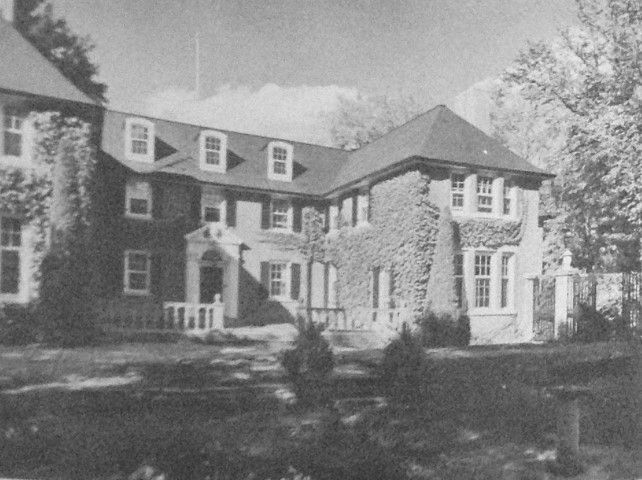
Batterwood House
I was handicapped by the fact that, although I was a resident of Durham County (Batterwood was not a summer place as it was often called; it was my home) I had not lived there long enough to be accepted as a member of the community. I would probably have done just as well in some other riding.
I think, too, that the voter must have found it difficult to understand how a manufacturer could be on the low-tariff side of the dominant political issue. My views on such matters were much the same as those of my grandfather when he lived in Newcastle and was a supporter of Edward Blake. I cast my first vote in 1911 for Laurier’s policy of reciprocity (and in so doing cancelled my father’s vote). My candidature in 1925 was completely consistent with the opinions I had always held, but it was very easy to call me a renegade Conservative and to act accordingly.
The campaign had not been long under way when I received a letter from the Leader of the Opposition, Arthur Meighen. He proposed to make public the correspondence we had exchanged over a year earlier, before I had entered public life and when I was still president of the Massey-Harris Company, on the subject of the tariff. By disclosing what I had said on that occasion about the government of which I was now seeking to become a member, he hoped, of course, to embarrass me and to bring about my defeat in Durham. I refused to agree that the letters should be made public. I wrote to Meighen on October 2, 1925:
I recognize the fact that I am now engaged in public discussion of issues which involve the subject of our correspondence, but I want to make it very clear that whereas the letters in question were written by me as an officer of the Massey-Harris Company, I have entered the political field as an individual. I am not at liberty to release any of the Company’s correspondence which was written as ‘Confidential’.
And again, on October 8: ‘If the words “private and confidential” on a letter have any meaning it is this: that the writer means that they are to remain private and confidential unless he sees fit to release them.’
There was no doubt at all that what I had written in the letters Meighen referred to was inconsistent with the speeches I was making in my campaign. I thought it well to consult a very experienced former politician, Sir William Mulock, whose judicial robes cloaked, but did not entirely conceal, a fervent interest in politics. He gave me very good advice. He said, ‘Of course, there is inconsistency between what you wrote then and what you are saying now, but what you should do is to say in one of your speeches that you wrote the letter to Meighen as head of your Company and explain frankly how it came about that you changed your mind.’ I made a speech in a village with the Biblical name of Ebenezer (which in Hebrew, I was interested to find, means ‘stone of help’!) dealing candidly with the inconsistency in question. This I admitted, pointing out that in a letter I had written to the Leader of the Opposition, I was speaking as the head of my company; that in the budget of 1924, although the duties on agricultural implements had been sharply reduced, this disadvantage had been offset by certain compensating measures; that the position of the business after this legislation was very much the same as it had been before; that I had declined to release this correspondence, which had been marked ‘confidential’, because a private company in the nature of things must remain aloof from political discussion.
The campaign in Durham attracted considerable attention; the Prime Minister and the Leader of the Opposition did not neglect it in their speeches. The result of the poll in the constituency was 7,020 votes for Bowen, 6,074 votes for Massey—a Conservative majority of 946. It might well have been higher; in the next general election, in 1926, Bowen polled 2,033, his Liberal opponent, 539. My workers had been over-optimistic; they actually had ropes ready to pull my car triumphantly through the streets of Port Hope after the poll was announced.
The contest, as I have suggested, was rugged. I wrote at the time:
The campaign was a most strenuous one and my own contest, in Durham County, peculiarly difficult because the Conservatives flattered me by making a personal attack on me second only in violence and bitterness to that which was aimed at the Prime Minister. My defeat was due chiefly to the tidal wave of protectionist feeling which swept over the Province. But this wave of sentiment for extreme protection will, I believe, very soon recede. I feel convinced that the extravagant measures which Meighen proposed are not in the interests of the country as a whole, not even, taking the long view, in the interests of those who were most zealous in demanding them.
[Letter to J. S. Duncan, November 28, 1925.]
The personal bitterness of the campaign did not, however, extend to the relations between myself and my opponent, Fred Bowen. He and I all through had been on the best of terms, and between us there was mutual respect. Many years later, I heard that he had been asked by those who were directing his campaign to do certain things which he regarded as unfair. He refused to comply with the instructions and said that he would rather retire from the contest than do so.
Nationally, the campaign was a disaster for the Liberal Party. The Prime Minister and eight of his colleagues were defeated, and the Party was returned without an over-all majority in the House of Commons (Liberals 101, Conservatives 116, Progressives 24, Independents 2, and Labour 2). This débâcle can probably be attributed to a sterile policy, listless leadership, and lack of organization. I well remember an informal meeting that took place at my house in Toronto to make it possible for a number of the principal members of the Liberal Party to meet the leader and discuss the future. The morale of the Party could not have been lower, and the exchequer was nearly empty. Mackenzie King wrote to me about the occasion as follows:
I shall never forget the exceptional company you had assembled at dinner, and the quite unique gathering around the open fire later in the evening. It was a most kind thought on your part to arrange for me to have the opportunity and privilege of meeting the particular gentlemen you brought together, and to have the open and free exchange of opinion, views and impressions which we enjoyed. I only hope I did not say too much. I am sure the evening will prove a memorable one. I could almost hope it may not be without historic significance.
[Letter from Mackenzie King, November 16, 1925.]
Not all of those present were so optimistic, and several attacked, none too obliquely, the leadership of the Party. Mackenzie King was very sensitive to these attacks, and defended himself at considerable length.
I had attended one or two Cabinet meetings as minister without portfolio, but very soon, after the results of the election were known, I laid down my heavy responsibilities and unobtrusively withdrew from the Cabinet! The Government, or what remained of it, ignored the widespread view that it should resign, and decided to meet the House of Commons. I do not think this would have been my decision, but I was far too junior a figure on the political scene to offer any views on this subject.
Although I had retired from the Cabinet, I was still a member of the Privy Council, and, as an active participant in the recent election, I felt I should do what I could in this confused period of Canadian politics. On the general problem of the future of the Party, I consulted leading Liberals in Toronto, and others such as Charles Dunning in Regina, and T. A. Crerar and John Dafoe in Winnipeg. Before Parliament reconvened, I had conferences in Ottawa with the Prime Minister and others on the contents of the forthcoming Speech from the Throne. When I arrived back in Toronto I had spent my tenth consecutive night on the train.
With the opening of Parliament on January 7, 1926, the House of Commons became the centre of interest. The important question was simply this: would any of the twenty-five Progressives join the Liberals to keep the Government in power? The Progressive Party had its origin in and derived its strength from the West. Its members had strong views on the tariff and other economic questions. They were radicals in the correct meaning of that term and were little touched by socialist thinking. They have been accurately described as ‘liberals in a hurry’. On January 12 a debate took place on the Leader of the Opposition’s amendment to a Government motion to proceed with the consideration of the Speech from the Throne. This could only lead to a crucial division.
During the evening C. A. Bowman, the editor of the Ottawa Citizen, called me out of the gallery to say that seven Progressives had decided to vote for the amendment—enough to defeat the Government by two votes. I went to see the Liberal whip, Pierre Casgrain, and warned him of the necessity of keeping the debate going and postponing a division, and then Bowman and I met one or two Progressives in the corridor. One of them invited us to his room, where about a dozen others dropped in, and we had a frank discussion. The Progressives spoke of their restlessness and resentment at their neglect in the former Parliament, the Liberal opposition to them in the campaign, and the Government’s failure to enact satisfactory measures. I suggested, however, that to vote the Government out would lead to confusion worse confounded, and that their only hope lay in open, formal co-operation between Liberals and Progressives on an agreed legislative programme. This was a new idea to most of them and a welcome alternative to the hole-in-the-corner bargaining of the last session, which had impaired the dignity of both groups. We talked until after midnight, and the whole atmosphere was vastly different when we broke up.
I believe that this conversation played a decisive part in the course of events. I was authorized by this informal meeting to see the Prime Minister and commence negotiations leading to a basis of co-operation. In the meantime, it was important that the debate should be kept going and that the Government should make clear through one of its ministers (I suggested Boivin to Mackenzie King) that Meighen’s amendment, if voted down, would not be considered by the Government as a vote of confidence and, lastly, that the Progressives were to be assured that they would have an opportunity to discuss the legislative programme in the debate on the address.
The next day I saw Mackenzie King and Ernest Lapointe, told them of my conversation, and stressed the importance of appropriate action. I then went up to the House and saw the Progressive whip, who was in caucus at the time, and arranged with him to see the Prime Minister and start conversations leading to co-operation with the Liberals. I then went to James Woodsworth’s room where I had a talk with him and with A. A. Heaps, a western Labour member.
The following day the Progressive whip, Spencer, said that his people were disappointed that the Government had not made it clear that it would not regard the Opposition’s amendment as a ‘confidence’ motion. I went over to the East Block, got the Prime Minister out of a Cabinet meeting, and told him this. Spencer had said that a division should on no account take place before eight o’clock, to allow for a Progressive caucus at seven, which would probably strengthen the position of the Government in that group. This I also transmitted to the Government people. Later that day I saw two other Progressives and had a reassuring talk with both. The debate proceeded with crowded galleries and a full house, with but one absentee. Boivin made the required statement. I heard the rest of the debate from the gallery, and the division was taken at 12:45 a.m. Only five Progressives voted against the Government, which was given a majority of three.
So precarious a hold upon power could not last long. Within a few months a vote of censure was moved in the House after its special committee had disclosed grave irregularities in the operations of the Customs service. Mackenzie King thereupon advised the Governor-General to dissolve Parliament, before the vote of censure could be taken. The Governor-General refused dissolution, Mackenzie King resigned, and the Governor-General then turned to the Leader of the Opposition to form a government. Mr. Meighen’s ministry was defeated in the House of Commons before it was three days old; Meighen then asked for, and received, dissolution, and a new general election was upon us.
The stage was now set for the great national debate upon what history knows today as the King-Byng incident. I had come to know Lord Byng of Vimy during his five years as Governor-General and, like all who knew him, to respect and admire his bearing and obvious sincerity. ‘Byng is a great success,’ I had written to a friend in England shortly after the new Governor-General had taken up his duties. ‘He is extraordinarily conscientious and extremely simple, and has a great capacity for making friends. . . .’ (Letter to V. Bulkley-Johnson, August 2, 1922.) But as a practising politician and a loyal supporter of my party, I naturally sought, along with its leader, to turn the constitutional issue into which Lord Byng had been drawn to our political advantage, if this could be done without discrediting either Lord Byng personally or the office he occupied. I was concerned that in the heat of the election campaign, the issue might not be handled by our speakers with as much tact and delicacy as it seemed to me to require, and I wrote in this sense to Mackenzie King soon after the campaign got under way:
I have been discussing the situation with a number of important Ontario Liberals and I thought you might like to have a line as to feeling here.
There is a very general—almost universal—feeling here that the constitutional question has to be most discreetly handled—otherwise it may become a distinct embarrassment rather than a great and lasting aid to the Liberal cause in Canada. Everybody in our party here of course agrees entirely with your contention that the Governor-General’s office should be put on the same basis as that of the King, in the matter of the prerogative of Dissolution. This is excellent fighting ground and we should fight hard; but in order that the inevitable flag-waving of the Tories should be limited as far as possible in their effect on the electorate, two points, we think, should be made absolutely clear by Liberal leaders in the press and on the platform:
(a) That the Liberal party holds as an essential part of its creed that Canada’s destiny is that of a nation within the British Commonwealth and under the Crown.
(b) That the remedy for the present situation and the means of preventing a recurrence is in a simple statement of principle (which should be given as definitely as possible) which will be submitted to Parliament in the form of a resolution.
I am delighted to find great enthusiasm among Liberal workers everywhere. We are now on the attack which is a great advantage and the ammunition furnished by the Budget and the question of constitutional rights is excellent. The loyalty cry will of course be raised but we needn’t worry about it provided we take proper precautions. On the other hand we all feel here that if the electorate really gets into its head that the British connection is likely to be weakened by our party’s success the results will be very serious to the Liberal cause in Ontario as well as elsewhere. The history of other campaigns I think proves this.
It is also important, we feel, that the speeches in Quebec should be discreet—intemperate utterances from any quarter will hamper us in our fight here in this province.
[Letter to Mackenzie King, July 8, 1926.]
This advice Mackenzie King was disposed to accept, although not all of our candidates were as restrained as they might have been; in Quebec, particularly, some of them followed the line of the Independent, Henri Bourassa, who had talked of ‘the spectacle of a British general constituting himself the docile election agent of the crafty little barrister from the Portage plains’. (Toronto Star, August 19, 1926.) But, so far as it could, the Party took the position that the Governor-General was not to be blamed, but rather the fault lay with Arthur Meighen for placing him, by faulty advice, in an untenable constitutional position. My own views on the matter I conveyed in a private letter to Geoffrey Dawson of The Times:
When I said that Lord Byng’s act was ‘in theory the action of an official responsible to the Colonial Office’, what I had in mind was this: that he had acted in accordance with the old and now obsolete theory with regard to the powers of a Governor-General. This view is, of course, that of Berriedale Keith and Rowell and numerous authorities on the modern British Empire. I did not, for one moment, mean to suggest that Lord Byng had acted on instructions from the Colonial Office, in fact I knew that he had not, and I share your relief over this fact.
However one may feel about our national status, here in Canada, it is not held by a responsible member of any party that there is any power, in Downing Street or anywhere else external to ourselves, that is exerting any undue influence or control over our own actions. What we Liberals are contending with is a mental attitude—the ‘Colonial mind’ in Canada itself—which is thwarting the development of a full national consciousness. This national consciousness I need not say is not contrary to the interests of the Empire but is the very rock on which the Imperial structure must rest.
[Letter to Geoffrey Dawson, August 19, 1926.]
I did not know at the time that Mackenzie King had privately requested the Governor-General to consult the Government in London, a request that Lord Byng quite properly refused.
In a later chapter I shall deal with my views on the subject of the constitutional prerogatives of the Governor-General when, twenty-five years after the King-Byng affair, it was my honour to represent the Sovereign in Canada.
My defeat in Durham in the General Election of 1925 had by no means disillusioned me with political life, and I was as anxious as ever to run in the General Election of 1926 if an opportunity presented itself. I was therefore delighted when Mackenzie King wrote to say that he would be pleased if I would contest Temiskaming North:
. . . If the French and the English of the riding will unite on you as the Liberal candidate, you ought not to miss the chance of coming into Parliament as the Member for that constituency. It is altogether likely that the next Parliament will last for four or five sessions. If you run in Temiskaming you will be certain of a seat in the House, and, if we are returned, of your rightful place in the Ministry. If, by any chance, we should not be returned, you will be in Parliament and able to obtain a solid footing there.
I would advise you to think the matter over very carefully. The chance for a safe seat like Temiskaming North does not come to a man more than once in a lifetime.
[Mackenzie King to Vincent Massey, July 29, 1926.]
This was in fact preaching to the converted. But I was not so eager for election as to want to force my candidature, or even to appear to force it, upon a constituency in any way unwilling to receive it. Before allowing my name to be put forward, I wanted to be sure that the local riding Association was united in favour of accepting an outsider, and to find out whether this was in fact the case, I approached a French-speaking member of the Party, P. J. Cardin, in order to have him investigate the situation on the spot. I wrote to him as follows:
If there is a general feeling amongst the Liberals of the riding for myself as a candidate, we feel with you that a new convention should be called. This is the only way in which the situation can be clarified. At that convention Mr. Bradette should resign and move that I be the candidate. This motion should be seconded by one of the leaders of the English-speaking Liberals. Then the invitation should be conveyed to me immediately and with as much publicity as possible.
We feel that it would handicap a new candidate to be put in the position, in the public mind, of waiting on the doorstep while negotiations are in progress. If I appeared in the riding before I was publicly offered the nomination it would look as though I had engineered it myself. That charge would be used against me and would be very damaging. We appreciate your willingness to go to North Temiskaming and we feel very strongly that you only can arrange things properly and if you are on the spot. It is quite clear to us here that I should not enter the riding until I am invited to do so as the Liberal candidate. Mr. King asked me to stand in North Temiskaming only if I were offered the unanimous nomination and did not want me to enter the contest under any other conditions. I need not say that I am most anxious to have the seat redeemed for the Party and to have the honour myself, but in order that the chances may be as favourable as possible all difficulties must be removed before my campaign starts. I am stressing this point not because of personal inclination but because I want the campaign to be as successful as possible for the Party.
[Letter to P. J. Cardin, August 6, 1926.]
Cardin, however, for what reason I do not know, did not proceed to the riding as I had requested and, as a consequence, I remained un-nominated. I wrote of this new development to Mackenzie King:
The situation in N. Temiskaming moves slowly. I was very sorry that Mr. Cardin didn’t arrange to go to Timmins himself as you hoped he could—as it happens negotiations at long range have not succeeded at all. They held their convention on Tuesday last and my name was not even mentioned.
The unanimous opinion . . . talking the matter over yesterday was that (assuming that they really want me in N. Temiskaming) another convention should be called immediately and that should I be offered the unanimous nomination, I should proceed at once to the riding but not before. We all agreed that nothing would be more damaging to the Party or to the campaign than for me to commence the latter without proper credentials—this if I remember was your view too. The Tories would have damaging ammunition if any colour could be given to the charge that my candidature was not the spontaneous act of the official Liberal organization in the riding—this is impressed on me by all the group here who are in a position to advise. My wife and I are eager to get into the fray and greatly hope that North Temiskaming is to be ours to fight for.
[Letter to Mackenzie King, August 7, 1926.]
It was soon to prove, however, that it was not to be ours to fight for. A meeting of the riding Association decided that the honour of contesting its seat in the House of Commons should go to a candidate who lived in the riding rather than to an outsider such as myself. ‘I was very greatly disappointed at the turn of events in North Temiskaming,’ I wrote to Mackenzie King on learning of this news.
I had expected from what I had been told by many people that the invitation which I had received from there represented a unanimous feeling, and on this assurance, as you know, I was fully prepared to enter the field. As a matter of fact, I had begun to look forward with genuine keenness and pleasure to the campaign. The riding, as I heard more about it, interested me very greatly and the decision, at last Saturday’s meeting, was a great disappointment. I had taken on a French Secretary and had, for a week, been waiting hourly for the invitation to proceed north. It is difficult to know just what happened. . . . As it has turned out, the lapse of time without direct contact on the spot allowed a local feeling to develop in favour of the local man to which he finally succumbed.
[Letter to Mackenzie King, August 19, 1926.]
The door of business was closed behind me and the political path seemed blocked. What was to be my next move? I wanted to carry on with what I had set out to do. The Liberal Association (what there was of it) was asked by the Prime Minister to do what they could to find a constituency that I could contest in the next election, which did not seem to be far off. There did not appear to be any intense interest in what I could do for the Party from now on. My candidature in 1925 had obviously been not without some use, but there is not much gratitude in politics.
The position of Canadian minister at Washington, though constitutionally provided for by an arrangement with the United Kingdom in 1920, remained unfilled. For this there was a variety of reasons: the fear of some Canadians that to exercise the right of legation in this way might weaken the Imperial tie; objections to the expense; and, not least, the difficulty of finding the right man for the job. One of several aspirants for the post was seriously considered, but he imposed an impossible condition, namely, that he should remain a senator and become minister at the same time.
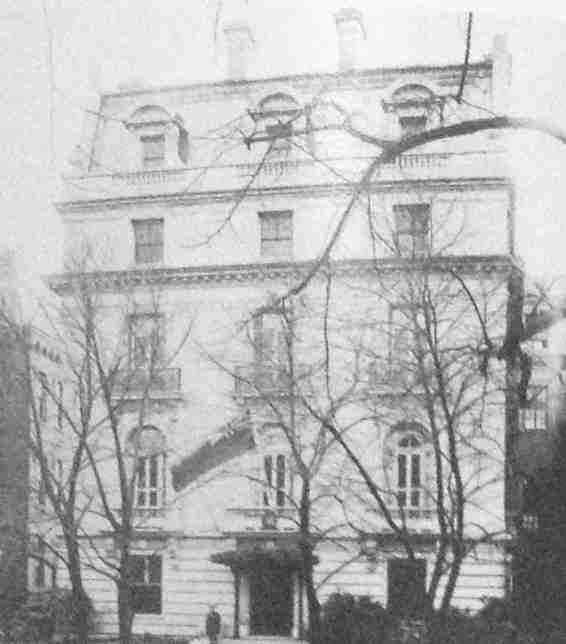
The Canadian Legation in Washington, 1927
Early in 1926 Mackenzie King asked me if I would be willing to become Canada’s first diplomatic representative in the United States. He wrote:
I really believe, were you to take on the task of organizing an office at Washington, and go as the first Minister from Canada to any country (in this case the most important country of all), you would never regret the step, and that should you decide to re-enter the arena of active politics at a later date, your achievements in the field of diplomacy would be all to the good. I think the appointment would be universally approved in our country, and greatly welcomed in the United States. I say all this despite my own personal preference and desire to have you at my side in the House of Commons to which I have looked forward more than words can express.
[Letter from Mackenzie King, April 25, 1926.]
My first reply to this invitation was in the negative. I frankly did not think then that the Washington post offered an adequate opportunity for useful work. But when I had studied the position, it became clearer that a Canadian minister in Washington would be able to perform very real public service, and so when Mackenzie King again wrote to ask me to accept the appointment, I said I should be glad to do so. Alice and I were at the time staying at the Ambassador Hotel in New York, which the Prime Minister thought might be prophetic. It was.
The announcement of my appointment met with a mixed reception—not on personal grounds, but because the establishment of a Canadian mission in Washington was still highly controversial, sufficiently so, indeed, to be expressed in a number of anonymous letters. One of these was written in an educated hand on the back of a deposit slip in a Montreal bank:
Thousands of people in Canada are determined to have no Canadian Ambassador or Envoy at Washington. It’s a parting of the ways and split up of Empire too serious to contemplate. I hereby give you warning that if you are appointed to the position I will personally finish your course with a knife in your belly; shooting is too good for you, and I’m not afraid of hanging for principle.
I attached little importance to this communication, since a real assassin rarely advertises his intention; but the letter did reflect a popular attitude towards the establishment of the post.
Having agreed to the appointment, I applied all the time and thought I could to preparing for it. Mackenzie King was very helpful in attaching me to the Canadian delegation to the Imperial Conference of 1926. I was not formally a member of the Conference, but as an ‘adviser to the Canadian delegation’ I was free to attend all its sessions. As minister-designate to the United States, I was able to make useful contacts in Great Britain, and I hoped to moderate the mild apprehension some people in London felt about the establishment of a Canadian mission.
This feeling, I was relieved to discover, was not shared by authorities in the British government, not at any rate by the Foreign Secretary. In a conversation with Mackenzie King, Sir Austen Chamberlain remarked that:
as far as the British Government were concerned, there was really nothing that they were anxious about in the matter; . . . that all he would ask was that the Minister at Washington might keep the British Ambassador sufficiently informed concerning matters with which he was dealing, so that if he were questioned he would not appear in ignorance of them; that the Ambassador would do the same thing concerning matters in which the Canadian Minister was interested; there was no need of him to know details, but just sufficient to be au fait.
[Memorandum by W. L. M. King, October 25, 1926, King Papers.]
It was agreed at this time that, contrary to the 1920 arrangement, the Canadian minister should not be responsible for the operation of the British Embassy in the absence of the British ambassador.
The proceedings of the Imperial Conference of 1926 opened with an introductory speech by Stanley Baldwin, followed by the heads of other delegations. In my diary I described the impressions which each created:
Canada conciliatory and contented; Australia impatient for material results; New Zealand placid and unobtrusive; South Africa polite, but restless and ominously determined on a new definition of status; Newfoundland purely Colonial and proud of it; Irish Free State polite and non-committal; India unctuously loyal in a speech that bore the sign manual of the India Office.
[Diary entry, October 19, 1926.]
Every student knows the results of this Imperial Conference and the famous ‘Balfour Declaration’ which emerged from it. There could hardly have been greater disparity between the views of those assembled at this gathering: on one flank, Australia and New Zealand, who were content with things as they were; on the other, South Africa and the Irish Free State, who formed a fellowship of disaffection. Harmony was not reached without patience and effort. The greatest contribution towards conciliation was made by Mackenzie King, who was always at his best in the role of mediator. I can vividly remember the comings and goings—the impromptu informal meetings between various representatives of both sides, which took place at all hours at the Ritz where the Canadian party were staying. Leo Amery, at that time Secretary of State for Dominion Affairs, who was generally in disagreement with Mackenzie King on Commonwealth policy, paid a high tribute to his work at the Conference in giving as his view that he was the great constructive figure among the Dominion statesmen. Sir William Tyrrell (permanent head of the Foreign Office) told me that he regarded King as the ‘umpire of the Conference’.
The most striking figure from Ireland was Kevin O’Higgins. At a dinner given by the Benchers of Gray’s Inn, which I attended, he made a moving speech in which he said that although only a few years had passed since the Irish troubles, he as a member of the Executive Council of the Irish Free State could now meet three former chief secretaries for Ireland in the same room, ‘not only in peace but in friendship’. The three persons to whom he referred were Lord Balfour, Lord Merrivale, and Hamar Greenwood, all of whom had administered British policy in Ireland in the post of chief secretary. I was sitting beside O’Higgins and I could see how moved he was. Thinking of his assassination which came so soon, one can only murmur sadly, ‘what a waste of goodwill’.
Lord Byng had returned from Canada by the time the Conference met. I saw him shortly after my arrival and he said, I think with considerable magnanimity, that he was going to meet Mackenzie King’s train at Euston. This courteous act was reciprocated by the Prime Minister when he attended a dinner of the Canada Club in honour of Lord Byng, and spoke. Considering the sharpness of the issue between the two men not many months before, the exchange of courtesies between them was striking and pleasant to contemplate.
Lord Balfour was kind enough to give a luncheon for me, to which he invited Lord Cecil of Chelwood, Sir Austen Chamberlain, and Sir William Tyrrell. It was a very pleasant compliment to Canada. I was much impressed by the brilliance of my host; in intellectual ability he even outstripped the fine intelligence of Robert Cecil. Austen Chamberlain did not seem to me to be a man of first-rate mind, but he obviously possessed high character and the sort of disinterested goodness and amateur methods that now and then have enabled British statesmen to play notable roles in negotiations with foreign diplomatists, even when the latter have been armed with subtler minds and the traditional techniques.
Now and then we were able to emerge from the political world. On one of these occasions Alice and I lunched with the St. John Ervines, to meet Bernard Shaw and his wife. (We had produced two or three of Ervine’s plays at Hart House Theatre and had got to know him in this way.) Shaw was in an impish mood, looking extraordinarily eupeptic at seventy. He discussed how he had just been recording his voice in a gramophone for the sake of posterity and could think of nothing to say but the first speech of Richard III; it was not a bad choice for the self-styled despiser of Shakespeare. Mrs. Shaw said that he ranted like a third-rate actor. I told him that I had received a cable to the effect that Heartbreak House had been a success at Hart House Theatre. He replied, ‘It naturally would be, it’s a very good play.’ Shaw’s talk was as brilliant as I expected it would be, but I couldn’t overcome a feeling that there was an element of artificiality in it. The epigrams seemed rather to get in the way. I would have liked to hear his sober view about many things, but Shaw without iridescence would not have been Shaw.
We lunched one day with Eddie (Sir Edward) Marsh in his rooms at Gray’s Inn, and saw his pictures, which left hardly a square inch uncovered on the walls. I got to know him well over the years—a unique figure in London life. With quite modest financial resources, he did much to help young writers and artists.
We occasionally got into the country. Sometimes we stayed at Cliveden with Waldorf and Nancy Astor. It is a pity that in the countless things written about Cliveden it is seldom made clear that the guests in that hospitable house covered the widest range and included people of great diversity of mind and experience. The phrase ‘the Cliveden set’ was invented with malice, and was intended to suggest that Cliveden was a meeting place for ‘appeasers’ in the years just before the last war. There were, of course, many guests with whom the word ‘appeasement’ was rightly or wrongly associated, but there were as many others of differing views. The important thing about Cliveden as a centre was that the visitors could enjoy the opportunity of good talk and free talk under the aegis of a gifted host and hostess.
Nancy Astor’s well-known aversion to alcohol was greatly softened within the precincts of her constituency. In walking round with her, on a visit to Plymouth during the savage bombardment of the town, we were interested to see her go to the door of a public house and shout a friendly greeting to the customers inside.
We spent a week-end at Chatsworth, the family seat of the dukes of Devonshire, and visited Hardwicke, that treasure-house of Elizabethan craftsmanship and design which has been lived in for three and a half centuries by one family. At Chatsworth we went to evensong in the chapel, the congregation consisting of the family, their guests, and about thirty members of the domestic staff. The Duke read the Lesson, the Rector of the parish took the service, and the parish choir was in attendance. Chatsworth, over the generations, provides a good example of the role of the English country house. This has too often been misinterpreted, the word ‘privilege’ being used without the recognition that privilege was, in most cases, fully balanced by responsibility. The country house was a home; it was also an institution and played no small part in the fostering of the arts, the promotion of good taste, and experiment in farming. The Cavendish family at Chatsworth for centuries have built up the great art collections and the superb library that are its glory. Through the development of horticulture on the estate, and in its great conservatory, it anticipated functions later performed by the public gardens at Kew, and other places. ‘Out of such houses came the Royal Society, the Century of Inventions, the first museums and laboratories and picture galleries, gentle manners, good writing, and nearly all that is worth while in our civilization today.’ This tribute to the great country house is the more striking, paid as it is by H. G. Wells (Experiment in Autobiography, Vol. I, p. 135).
While the Imperial Conference was in session, I was asked by Mackenzie King to represent the Canadian government at the opening, by the Prince of Wales, of the Maison Canadienne in Paris—the building for Canadian students in the university quarter. This involved a number of brilliant events, among them a dinner at the British Embassy for the Prince of Wales—one of the most glittering occasions there since the War, with an atmosphere quite pre-war: gold dinner service, footmen in dress liveries and powdered hair, official Paris blazing with Orders, and a superb display of the jeweller’s art.
The following day a luncheon was given by the President of the Republic for the Prince of Wales at the Elysée Palace. I told the man driving my taxi where to go, having had my instructions confirmed by the concierge at my hotel to make sure. After driving for some minutes he turned to me and told me that the Elysée Palace Hotel had been burned down, where did I really want to go? I said, with some asperity, ‘To the house where the President lives.’ He said, ‘Ah, la Présidence! Il faut tourner.’ I said what had to be said, and in due course we swung into the courtyard of the Elysée just as the guard of honour was dispersing, and I knew that I was late. The Chef de Protocol met me with a saddened expression and escorted me into a room where it seemed to me that there were several hundred figures of heroic size waiting for me in silence—I felt just eighteen inches tall! I recognized the features of Briand, Poincaré, Herriot, Lord Crewe, Lord Derby, and then in the corner our host, Monsieur Doumergue, and his royal guest, to whom I made my apologies.
On the last evening of the visit a large and brilliant dinner for men at the Cercle Interalliée was held for about 200 guests. Our host was Marshal Foch, on whose left I sat. He would not speak English although I am sure he could. He made himself most agreeable and I found him a simple and engaging old man, the steel of his character just faintly discernible under his courteous manners.
When I was in London it was thought that I should have an audience of the King before taking up my appointment in Washington. This was duly arranged. When I arrived at the Palace I asked the lord-in-waiting who received me whether the phrase ‘Kiss hands’, which is used in the Court Circular, should be taken literally or only figuratively. He said, ‘By Jove, I don’t know—I’ll ask Reggie!’ He disappeared for five minutes or so; when he came back he said, ‘Yes, you really do kiss hands’; so when I was ushered into the Presence, in place of shaking the King’s hand, I kissed it. I noticed an expression of surprise on the face of the Monarch. We had a very agreeable talk. Later on I discovered that although you actually kiss hands when you are sworn of the Privy Council, the phrase, in relation to other appointments, is purely metaphorical. Others have made the same mistake. I had asked the Palace about the order of dress, and I was told that the King preferred men received in audience to wear frock coats, as he and his household normally did. It was not obligatory but it was customary. My tailor, always ready for an emergency, produced at short notice a frock coat which, I am happy to say, still fits.
While I was in London at this time, in a conversation with the Archbishop of Canterbury, Dr. Randall Davidson, I mentioned that, although I had attended the Anglican Church ever since my university days, I had never been confirmed, and I thought I would like to be. The Archbishop said he would be delighted to officiate if I would come to Lambeth Palace Chapel one day. This I did. There were four people present: the Archbishop, Mrs. Davidson, Alice, and I. Before we left the chapel, the Archbishop pointed out the seventeenth-century screen and altar rails which, he said, had been placed there by Archbishop Laud. This interested me greatly, as it was because of the High Church movement personified by Laud that my ancestor Geoffrey Massey left England in the 1620s to seek the freedom he desired in Massachusetts; the wheel had come full circle!
Apart from the Conference, my presence in London was useful in a more modest, practical way. The money voted by Parliament for a diplomatic mission in Washington in the current year was made available for Alice and me to purchase plate, linen, glass, china, and so forth, for a legation house when the time came to occupy it.
My new appointment caused me to become disturbed by the possibility of a conflict of interest. In Washington I might be involved in the process of negotiating tariff policies on behalf of my government. I did not want at the same time to hold shares in a company that was so closely concerned with such negotiations, nor to act as a trustee for the Massey Foundation with its large holdings of the Company’s stock. Fortunately the moment for disposing of Massey-Harris shares was propitious. The price of both common and preferred stock had for some time been bid up briskly on the exchanges; and when it became rumoured that American interests were seeking to acquire control of the Company, an unprecedented speculation had driven the price of the shares to an ‘all-time-high’.
At this juncture a Canadian syndicate, formed by Thomas Bradshaw of the Massey-Harris Company and the Toronto financier J. Harry Gundy, made an attractive offer for the blocks of stock determining control. Through the National Trust Company, which conducted the negotiations, I decided to release to this syndicate my own Massey-Harris holdings and those of the Corporation for which I was a trustee. Newspapers unfriendly to the Government, and I cannot think friendly to myself, tried to make it appear that I had been ready to sell out the Company to the American interests concerned, and had been deflected only by the patriotic gesture of Messrs. Bradshaw and Gundy. This was a wilful misrepresentation of the facts. Had any offer from the United States far exceeded that of the Canadian syndicate, I should then naturally have had to consider whether the best interests of those for whom I was a trustee would be served by its acceptance. Such a decision would have been neither easy nor automatic, and I was glad that I was not called upon to make it. The insinuations in the press and elsewhere that only the patriotism of Messrs. Bradshaw and Gundy had saved the Company from passing into American hands were quite untrue, as I have said, but they rankled all the same. Alice’s brother-in-law, who was also a trustee of the Massey Foundation, urged me to take a calm view of the affair:
We all agree that least said is soonest mended; that the financial world will very soon get to know the exact facts, and that to attempt to enlighten the public would be in vain. Rundle [of the National Trust] and I, if questioned about it by anyone whose opinions are worth having, will say that various American interests had made offers to the National Trust Company for the blocks of Massey-Harris stock held by that Company, as they had a perfect right to do; that negotiations had been carried on by the National Trust Company, not by yourself; that the National Trust Company, while not refusing to do business with Americans, had been so far from giving them the preference that they had finally, as the official statement showed, accepted the offer of the Canadian interests.
. . . I suppose that it is impossible for you to take quite my own phlegmatic point of view about newspaper criticism, which is that it does not matter in the least, and that one’s only excuse for replying to it is that one wants the joyaunce of a gentle passage at arms.
[Letter from W. L. Grant, February 15, 1927.]
I replied:
. . . the important thing after all is of course that we have made a very good deal which is to the advantage of the institution of which we are Trustees, and the lies which the other fellows have been talking will vanish into thin air as lies generally do. This lofty philosophy I have only acquired after a succession of choleric outbursts which have relieved my temper.
[Letter to W. L. Grant, February 19, 1927.]
Some difficulty arose over the form of the announcement in which the terms of our transaction would be made known to the public. A few hours before I was to leave for Washington, I went to the office of the National Trust Company to see the press statement that had been prepared by Bradshaw and his associates. His draft, as I had thought it might do, sought to represent his syndicate as having saved an old Canadian firm from passing into American control. Rundle and I refused to accept it. The situation was not improved by the knowledge that my train was about to leave. I told Alice, who had been waiting elsewhere in the building, that she would have to go as far as New York City without me, and that I would try to join her there. She left with one or two members of the staff and was seen off at the station by a group of friends who were rather bewildered to find that the wife of the first Canadian minister to the United States was going to Washington without her husband!
Meanwhile, at the Trust Company, a melodramatic scene was in process of enactment. Following out refusal to sign the Bradshaw statement, Rundle and I had proceeded to draft our own, the important portions of which read as follows:
Some time ago it became known that interests which had very substantial holdings in the Company were willing to dispose of their shares. These interests, in conjunction with those who are presently directing the affairs of the Company, having a keen appreciation of the desirability to Canada and to Canadians of retaining to this country this important institution with its world-wide trade and its opportunities for greater extension and progress, entered into negotiations for the sale of the shares to those closely connected with the present management.
It is gratifying to state that, with the assistance of important Toronto financial interests, all of the shares in question have been acquired.
When we finished drafting this statement, we called Bradshaw in to see it. Was it correct? we asked him. He said. ‘Yes.’ Would he sign it? ‘No.’ ‘Why not?’ Because, he said, he wouldn’t have ‘a pistol pointed at his head’. We suggested to him that if he would not sign a statement that he said was a correct version of the facts, we were all in a very curious position. We told him, in fact, that unless we could agree upon a draft statement, the transaction would not take place. This brought the desired result. After he had spoken to the president of the Company on the telephone, Bradshaw finally initialled the statement. In this way the control of the Massey-Harris Company passed into new hands, and the old firm ceased to be a family business exactly eighty years after its original establishment.
After catching up with Alice in New York, I left for Washington with her and the others according to our original plan. Certain representatives of the press, not uniformly friendly, had been fellow passengers of Alice and had tried their best to extract information from members of my staff who were on the train, to provide entertaining reading for those hostile to the establishment of the mission in Washington. Nothing much came of that.
On my arrival in Washington, the solidarity of the British Empire, as we still called it then, was proclaimed by my welcome at the station by the British ambassador, Sir Esme Howard, and his wife, Lady Isabella, and the minister of the Irish Free State, Timothy Smiddy.
The next day, as a newly-arrived chief of mission, I called formally on the Secretary of State. A legendary figure, Eddy Savoy, the Secretary’s messenger (who had ushered visiting ministers into his master’s room, I was told, since 1869) approached me with great deference and, with the Negro’s love of ceremonial and a desire to be correct, asked me if he was to announce me to Mr. Secretary as ‘the Minister of the Dominion of Canada’ or ‘the Canadian Minister’. I told him that the simpler form was preferable, but Eddy could not resist the more sonorous title, and whenever I called on the Secretary of State I received the full treatment. Had Eddy but known, he might with constitutional correctness have gone even further, for after consultation with Ottawa in 1928 it was decided that the formal designation of the minister should be ‘His Majesty’s Envoy Extraordinary and Minister Plenipotentiary for Canada to the United States’.
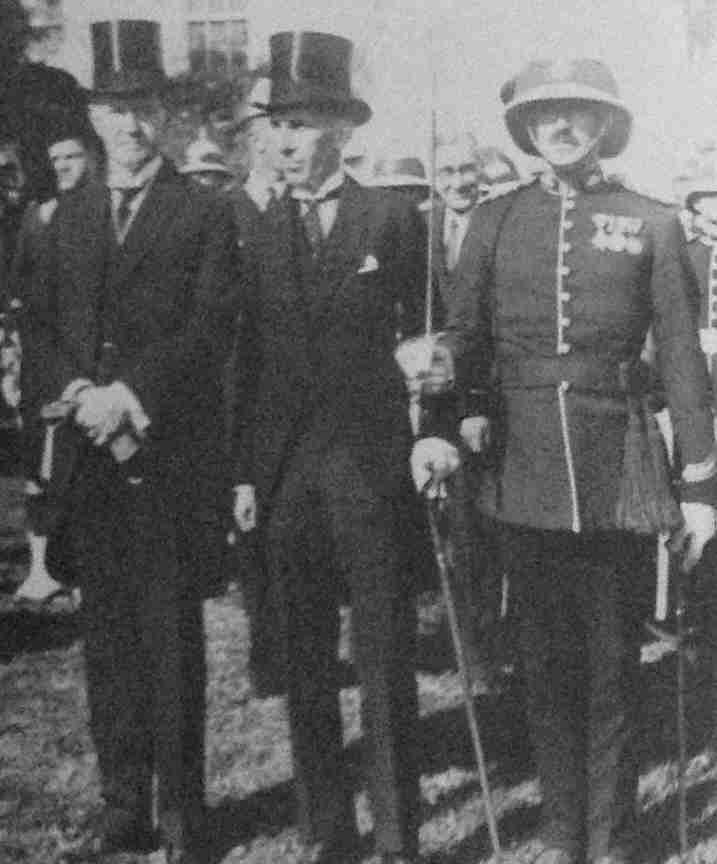
President Coolidge and the Canadian Minister with Canadian guard of honour (O.C. Major M. Greene, R.C.R.) Washington, 1927
Arrangements had been made through the British Embassy for my presentation of letters of credence to the President, Calvin Coolidge, and this took place a few days after my arrival. Although the Irish minister, T. A. Smiddy, had established the precedent of presenting his letters on his own, I was very anxious that the British Ambassador should go with me to the White House: it would thus be made clear to the public that Great Britain approved of the establishment of a Canadian legation and that the two missions were on friendly terms. Ceremonial can often demonstrate facts in a way that the written word cannot. As Mackenzie King agreed with my suggestion, I wrote to Sir Esme Howard on January 20, 1927: ‘I myself should be most grateful for your presence on this occasion which, as a matter of fact, will symbolize the invaluable support you are giving your junior colleague during his initiation, and for which he will always be most grateful.’
Esme Howard did not, of course, present me to the President—that would have been quite incorrect, because the Canadian mission was an independent establishment—but the formula agreed upon, and accepted by Ottawa and London, and used by the Chief of Protocol, Butler Wright, was ‘the Canadian Minister, accompanied by His Britannic Majesty’s Ambassador . . .’. The ceremony of presentation of letters was extremely formal, even stiff. My diary, written late that night, February 18, records it as follows:
On arrival at the White House we were met by a covey of footmen who dispersed and revealed the officers standing at attention, the President’s military and naval A.D.C.’s. To these I was introduced. There were two other junior officers moving throughout the ceremony like wooden soldiers on the stage—to these I was not introduced. From the door we proceeded on Wright’s right to an ante-room where Sir Esme Howard was waiting. When the summons came that the President was waiting we all fell in according to a pre-arranged plan and moved into the audience chamber like a squad of guardsmen at Wellington Barracks. On arriving we bowed low at the door, advanced across the room, bowed again, and stood still—how still! Butler Wright then introduced me as ‘His Britannic Majesty’s Envoy Extraordinary and Minister Plenipotentiary to represent the interests of the Dominion of Canada, accompanied by His Britannic Majesty’s Ambassador . . .’. I then read my address, handed to the President my letters of credence after which he read his address; then we shook hands and there followed what was alleged to be an ‘informal’ conversation. During the ceremony we stood as follows:
JUNIOR ADC JUNIOR ADC
X X
MILITARY ADC NAVAL ADC
X X
THE PRESIDENT
X
CHIEF OF PROTOCOL CANADIAN MINISTER BRITISH AMBASSADOR
X X X
During the ‘informal’ conversation (which resembled two public speeches delivered in alternate sentences to two audiences composed of one person each) the President asked where I came from, whether Toronto was near the Lake and if this was the first Canadian diplomatic mission. I told him that my people came from Massachusetts originally and then came to Canada after a short time in Vermont. He said that his people came from Massachusetts, moved to Vermont, but stayed there. I suggested that there was only one lap left to be made. I gave him a personal message of friendship and goodwill from the King, which I had received from His Majesty at Buckingham Palace. He replied in a stiff-jointed sentence. After I could bear it no longer and the time seemed to have arrived to move, I begged leave to present my staff and introduced, when they had been summoned, Mahoney and Stone. We then retired with Prussian rigidity and I was taken back to the hotel by Wright.
The ceremony struck me as having stiffness instead of dignity, and where it was meant to be impressive it was simply pompous. In other words, the participants were oppressed by their own ritual. In Great Britain, however intricate and elaborate the ceremonial may be, there is a prevailing sense of humour which keeps the ritual as the servant and not the master of the situation.
[Diary entry, February 18, 1927.]
Coolidge was, of course, famous for his taciturnity, but he had an astringent humour, although it took some effort to find it behind his granite-like façade. He cannot be said to have had a cosmopolitan outlook. The British ambassador’s wife once asked the President if he was going to visit Europe after retiring from office. Mr. Coolidge replied, ‘No, I guess we haven’t got anything to learn from Europe.’
Esme Howard was one of the most lovable of men, with transparent integrity, unshakable loyalty to his friends, and charming manners. He had never made speeches before he came to Washington, but spoke very acceptably to the American people. As a professional diplomatist with a long and distinguished career, he conformed to the highest traditions of his Service but had an imagination that enabled him to understand and accept the changes that were taking place, one of which was, of course, the establishment of a Canadian legation in Washington. His view and mine about this innovation were identical. We both felt that the Canadian mission in Washington, far from impairing the diplomatic unity of the Empire, could strengthen it and produce an even greater solidarity. It was important that this should be so and that the public should realize it. One day when we were riding in Rock Creek Park, as we often did, I remember his saying, ‘Well, if anybody sees us this morning on our horses he will realize that the Canadian minister and the British ambassador are not quarrelling!’ To a young and entirely green diplomat who had to learn his own job and train a staff at the same time, the value of Howard’s assistance can hardly be measured. I treasure his parting testimonial, delivered in a speech to the Canadian Club at Ottawa before his return to England in January 1930:
. . . there has never been a shadow of any sort between us. We have discussed matters of common interest and matters of all kinds so freely that we have become friends and almost as brothers. So much for our personal relations. But I should also like to say this, that the establishment of the Canadian Legation in Washington, so far from creating difficulties for the conduct of the affairs of our British Commonwealth, as some persons supposed, has on the contrary been of real help and assistance in the conduct of those affairs in the United States.
I can say in return that the friendship of Esme Howard and all his staff, without exception, meant more to the new Canadian mission than can be said. The British Embassy could not have been more helpful, and for this we had a lasting sense of gratitude.
Sir Esme’s wife, Lady Isabella (although she was an Italian, as her father had an English earldom she used her courtesy title), was a great friend of ours. Socially, as well as in a more official sense, the British Embassy and the Canadian Legation almost ran in double harness. Each informed the other of arrivals in Washington who might be appropriate guests, and my third secretary, Tommy Stone, shared a house with Esme Howard’s third secretary, Michael Wright, who later had a distinguished career in his own service.
In October 1927, the South African government set up a legation in Washington, which became the third mission from British Empire countries other than the United Kingdom. This step was not taken without the almost morbid susceptibilities of the South Africans being occasionally upset. Anything that the British Embassy or our legation attempted to do to help seemed likely to be misunderstood. However, it all settled down in due course. No such mistrust marred our cordial relations with the Irish minister, Timothy Smiddy. Soon after his departure from Washington, he wrote to me as follows:
I take the liberty of saying that the helpful and friendly spirit that has marked the relations of the three representatives of the British Commonwealth at Washington (to which our esteemed & worthy Sir Esme Howard made such a contribution) belies any fear that may have existed as to the advisability of the independent diplomatic representation of the Dominions & the Irish Free State at Washington.
[Letter from T. A. Smiddy, January 12, 1929.]
It had been the intention of the South African government that its representative in Washington should act as well as high commissioner in Canada. To this principle of double credentials I was strongly opposed. ‘I think this would be a most unfortunate arrangement,’ I wrote to our Under-Secretary of State,
and furthermore I do not think it would be well received in Canada. Our public is so sensitive as to any form of dependence on our neighbour that to receive as a representative of another state a man who would inevitably devote most of his time to the United States and would be in permanent residence there, would neither be a happy nor a popular step. Moreover, it would in my opinion establish a precedent which other governments would be fairly glad to follow if we let them. It of course is a fairly common practice to accredit diplomatic representatives at Washington to States of relatively minor importance such as Cuba, but I do not think we want to occupy a corresponding position in the world and to incur the danger of building up a diplomatic corps in Ottawa of minor officials whose chiefs are interested primarily in relations with another country.
There is, I think, another point involved. South Africa is a dominion, and as such bears a different relation to us from her relation to foreign states. To appoint one and the same man as a diplomatic representative to a foreign state and to a sister dominion as well would suggest to the public that there was no difference between relations between units of the British Commonwealth and the relation between such units and foreign states. This may seem like pedantry, and I am quite prepared to admit that one can be over meticulous in connection with mere forms, but I cannot help feeling that at this particular stage of development it would be unwise to incur unnecessary criticism.
There is another point. If a ‘diplomatic’ representative is received from South Africa, as the government at Cape Town apparently desires, what is to be his relation to the representatives of foreign states? Presumably they would accept an intra-imperial friendship as being identical with that existing between foreign states, and would accord the South African Chargé d’Affaires or Minister full diplomatic precedence, but what is to happen if an Australian or Irish representative appears on the scene with a relationship to Canada similar to that of the British High Commissioner, which is non-diplomatic? Are the states of the British Commonwealth in their mutual representation to be divided into two categories, diplomatic and non-diplomatic? This would lead to confusion worse confounded.
South Africa has, I am given to understand, received representations from the United States government to the effect that the latter would prefer to receive full diplomatic representation in the form of a properly equipped diplomatic mission in Washington rather than a trade commissioner in New York with diplomatic trappings. We are asked to receive as diplomatic representative of South Africa not even a trade commissioner resident in Canada but one-twelfth of a trade commissioner (based on our population ratio) resident on foreign soil. I hope that we will politely decline to accept the arrangement as not being in the interests of ourselves, South Africa or indeed the United States.
[Letter to O. D. Skelton, July 14, 1928.]
These arguments were well received in Ottawa, and I was pleased when, doubtless in deference to Canadian feeling, the South African government dropped this dubious project.
It did not take me long to discover how much business awaited the establishment of a Canadian legation. The British Embassy had very loyally looked after Canadian affairs but, needless to say, no one in that mission was personally familiar with the Canadian scene. Our problems presented the heavily-laden Embassy with an added burden which it was unfair to impose upon them. According to Esme Howard, who as British ambassador when our Legation was established could speak with real knowledge, ‘the affairs of Canada supplied the Embassy with fully one-third of its work.’
The transference of Canadian files from the British Embassy to the new Canadian Legation where they belonged was a revealing process. Here is an example. One day Esme Howard came to the Legation and, as he himself afterwards recalled the incident to me, ‘[I] walked into your office with an enormous dossier of papers under my arm and you glared at me and said “I know what you’ve come for—you’ve come to pass the buck.” To which I answered “You’re perfectly right, that’s just what I’ve come for.” . . . I must say I was at the time terribly pleased to be able to pass the buck. . . .’ (Letter from Lord Howard of Penrith, January 10, 1935.) The dossier to which Esme Howard referred was concerned with the operations of a Canadian rum-runner (those were the days of prohibition) called I’m Alone which was sunk by an American coastguard ship in the Gulf of Mexico, one of her crew being killed. Esme Howard said that for some time the Embassy had thought this vessel was of British registry, with an Italian name, ‘Imalone’, but they were wrong. With some humorous satisfaction, he placed the file on my desk. The skipper of the I’m Alone Captain John T. Randell, was in spirit an Elizabethan—he belonged to the days of Drake. He was a man of great rectitude in other matters but disliked the principle of prohibition so much that he did everything he could to thwart it. The Canadian Legation handled the matter through the diplomatic stages with the very important aid of the British consul-general in New Orleans. (We had then no consular service of our own, our first consular office in the United States having been opened in New York in 1943. I am afraid that the British consuls were not overburdened with thanks from Ottawa for their services, but I did what I could from Washington.) The I’m Alone case was later submitted to arbitration, and the United States government eventually paid a substantial sum in damages. The outcome of the event was, therefore, very satisfactory to us. On learning of it I wrote to Lord Howard:
I well remember your visit to my office when you left the I’m Alone baby on my doorstep. It was a useful episode because it demonstrated to an incredulous public here, or at least an incredulous element in our public, that two British Missions in Washington could co-operate pretty well, and that the British Empire was not in imminent danger of collapse as the result of the arrival of a Canadian representative, however green he was.
[Letter to Lord Howard of Penrith, February 22, 1935.]
Soon after my arrival in Washington, I paid my respects to the Belgian ambassador, Baron de Cartier de Marchienne, who was Doyen of the Diplomatic Corps. He became a very good friend of mine, as a colleague both in Washington and later in London. He belonged to the old school. He possessed great shrewdness with just a little touch of cynicism. He had unfailing elegance of manner and was one of the few men surviving in my time who, when in full evening dress at a reception, carried an opera hat under his arm. He had what is not to be despised in a diplomat—an unerring knowledge of good food. We were lucky to inherit his chef. He said to me once, when I had congratulated him, as the most natural thing in the world to do, on the delicious food he had given us at some meal, ‘The whole key to that is that you have to be in touch with your chef.’ Years later when we were both in London he told me that the chef employed by one of his colleagues came and applied for a similar position at the Belgian Embassy, and he said, ‘Why do you wish to leave His Excellency? Are you not well enough paid?’ He said, ‘Yes, I am very well paid.’ He then said, ‘Are you overworked?’ ‘No.’ ‘Well, then, why do you wish to leave?’ ‘Because His Excellency never sees me.’ That I remember vividly.
We had not been in Washington long before our housing problem became pressing. We had established ourselves to start with in the Mayflower Hotel, and I took a house not very far away to serve as the chancery of the Legation. The hotel, good though it was, was still an hotel and I felt very strongly that Canada should have a suitable legation house, accommodating, if possible, both residence and chancery. In this project, I got little comfort from the Department of External Affairs. The Under-Secretary of State, O. D. Skelton, had but little knowledge of the representational side of a diplomat’s work. He found it difficult to distinguish between a building with dignity and distinction and the ostentatious and opulent embassies that some foreign states maintained extravagantly in Washington. There are few people who would dispute the value of intelligent and constructive hospitality and the necessity of adequate equipment for it. How often important things are discussed at a dinner party more usefully than in somebody’s office. Skelton’s attitude towards the exchanges of hospitality had its humorous side—‘if you are asked to dinner, presumably you must engage in reprisals’! He could see no reason why the Canadian Legation could not be in an hotel, at least for an initial period. This, of course, had I agreed, would almost certainly have meant indefinitely.
We searched Washington for a suitable house, or at least Alice did, and finally discovered 1746 Massachusetts Avenue. It had been built in the French urban style by a woman whose financial resources and whose husband’s taste had made a perfect combination. The ground floor had ample rooms, one of them well adapted for use as the Minister’s study; a quite beautiful staircase led to the next floor, the piano nobile, with very handsome drawing-rooms and dining-room. On the next floor were bedrooms and above that there was ample room for the small chancery required in those days. This was reached by an electric elevator.
The house was for sale, fully furnished, for the sum of $500,000, and the furniture was excellent in quality. It would have cost $35,000 per annum to lease it. The purchase price was admittedly high; certainly Ottawa thought so, and reacted accordingly; but we were living in the late twenties in an era of fictitious prosperity and the cost of everything was inflated. In the final settlement, the owner of the house was asked to retain a certain amount of furniture of museum quality, unsuitable for the use of the Legation, and this reduced the price somewhat. The house served as the Canadian Embassy until 1946, after which, regrettably, it was used solely as the chancery, and steel filing cabinets took possession of the elegant rooms. It was hard not to murmur ‘ichabod’ when one saw what had happened.
But to return to the purchase of the house. After much abortive correspondence, I was inclined to give in. But Alice would not surrender. She said, ‘No, we are going to get this house’, and I was encouraged to pursue my efforts. As photographs had had little effect on Ottawa, I asked the Department if the Minister of Public Works and the Government Chief Architect could examine the house and report on it. They agreed. I asked the Doyen of the Diplomatic Corps in Washington and the British Ambassador if they would see the Minister when he came and give him their honest and unbiased view as to the suitability of this building as a legation house. They both did so, and spoke very enthusiastically, and I am sure sincerely, about it.
A special vote in the House of Commons was needed to make the money available. One evening at a dinner party a note was brought to me by the butler with the welcome news that the vote for the purchase had passed the Commons. There had been a spirited debate. Opposition members were quick to grasp the possibility of political advantages in resisting this vote. The Prime Minister, however, stuck to his guns. He cited the cost of the buildings acquired for the missions of two other countries (Mexico and Argentina) which had each spent much more money for this purpose than the Government was asking for the Canadian Legation. He also defended the purchase on sound practical grounds. The Leader of the Opposition, R. B. Bennett, took a very gloomy view. He was against the proposed purchase because he was convinced that the establishment of our mission in Washington heralded the end of the British Empire as far as Canada was concerned. He spoke as follows:
This country apparently is entering on a great adventure, the last great adventure in our relation to the British Empire. I am wholly opposed to the establishment of this embassy at Washington. It is but the doctrine of separation, it is but the evidence in many minds of the end of our connection with the empire. For that is what it means. It means nothing else ultimately, because if we are a sovereign state we cannot belong to the British Empire.
The main contention of the Opposition was that the Legation was entirely unnecessary. This view indeed had been shared by certain persons on the Liberal side. For example, W. S. Fielding, the Minister of Finance in the early twenties, declared that ‘a Canadian representative at Washington . . . would have an almost entirely ornamental position’ as ‘there is really no diplomatic work he could do’. A fair comment on that far-seeing observation lies in the fact that in the first year of its operation the Legation sent more than a thousand messages to the Department of External Affairs in Ottawa and over 300 to the United States Secretary of State, as well as countless less formal communications to various agencies of the United States Government. By 1929, when the Legation had settled into its diplomatic routine, the number of out-going communications from 1746 Massachusetts Avenue was no fewer than 8,000 a year.
Despite the favourable outcome of the vote in the House of Commons, the permanent head of the Department of External Affairs remained unconvinced of the wisdom of purchasing the house, and seemed determined to put the worst interpretation on the Government’s decision. He wrote to me soon afterwards from Ottawa:
As you have doubtless learned, the Opposition returned to the attack on the Washington Legation by moving an amendment to the supply bill for a reduction of the vote from $500,000 to $25,000. The amendment was defeated by 89 to 48. Four Western Progressives, Carmichael, Evans, Fansher and a fourth whose name I have forgotten, joined the Conservatives in voting for the reduction. The Liberals and such other Progressives as voted voted against.
A free vote would have yielded very different results. A deputation of Western members waited on the Prime Minister to express their opposition to the proposals, and in the Liberal Caucus which was called, very strong opposition was voiced. The ground was taken that the purchase was premature, and that it would be better to wait some years until the Legation had made clear its value to the people, and until the size and character of the quarters required had been demonstrated by experience. It was further contended that a house of the size proposed was quite unnecessary for business purposes, and that it evidenced an undue emphasis upon the social and entertainment side of the Legation. There was also some criticism based on the assumption that the house was intended solely for a residence for the Minister. One factor which contributed to members’ discontent was the circumstance that the Government had decided not to include in the present estimates any provision for public works in the various constituencies, aside from the usual rivers and harbors appropriations, of interest only to Maritime constituencies. . . .
As you know, when I returned from Washington I was of the opinion that it would be desirable to lease rather than buy for the time being, and that I so reported to the Prime Minister. I did not take any part in the recent discussion of the question, as I considered that the matter had become one of political expediency which it was for members of the Cabinet to judge. I may, however, tell you that it is my frank personal opinion that the purchase at this time is a mistake. Undoubtedly much can be said for it as a purely business proposition, and I have no doubt also that it will facilitate the administrative as well as the social functions of the Legation. Politically, however, a half-million dollar vote is premature. The Opposition have treated it as a godsend, and will continue to make capital of it. Next year they will bring the details of the purchase, including the furnishings, before the Public Accounts Committee, and continue to utilize it for political purposes. The Government forces assented to it only on the personal urging of the Prime Minister. The result has been that the authority of the Prime Minister and Cabinet with the party has been very decidedly strained. A few of your personal friends among the members supported the purchase, but judging from the corridor gossip I have heard, the feeling of the Liberal members was ten to one against the suggestion. What is more serious, the Washington experiment will be prejudiced in the eyes of a great part of the country. However, what is done is done, and we shall hope for the best in future.
[Letter from O. D. Skelton, April 16, 1927.]
I replied:
I was, of course, greatly distressed to see that the proposal to purchase quarters for the Legation here should have become such a highly controversial matter. It is hard to say whether the question will last as a debating point for two or three years or whether it will evaporate. I quite agree with you that so long as it lasts, the work which the Legation is trying to do here will be rendered the more difficult. The expenditure of $450,000 or so as a capital outlay on the work here makes it all the more important that visible dividends should be paid on that capital, and no effort will be spared on our part to earn the dividends.
You say, in your letter, that a free vote in the House would have yielded very different results. This may be true but it is a significant fact that the majority of that section of the House which habitually votes independently supported the full vote of $500,000. It strikes me as being very significant that two labour members and a group representing the United Farmers of Alberta, should have given their support to the measure.
[Letter to O. D. Skelton, August 18, 1927.]
I find myself in sympathy with a remark that is quoted in my diary, made by Philip Lothian, while British ambassador in Washington: ‘Philip said apropos of his relations with Christie, his Can. colleague, that they would be better if Skelton did not regard co-operation with anyone as a confession of inferiority.’ (Diary entry, October 23, 1940.)
As matters turned out, I was vindicated in my prediction that opposition to the purchase of the Legation would soon disappear, and had the satisfaction, two or three years afterwards, of receiving a letter from Skelton acknowledging this to be so. ‘There is a certain amount of difficulty inevitable in working out a new service,’ he conceded, ‘owing to lack of experience and certain divided parliamentary opinion on the whole diplomatic experiment, but conditions are steadily improving in both respects.’ (Letter from O. D. Skelton, April 18, 1929.)
Skelton is often referred to as the creator of our diplomatic service. This is not entirely true, although he made a great contribution to the service as its able permanent head for sixteen years, approached his work in a spirit of very real loyalty to the post, and brought to his task a brilliant academic mind. During his time the Canadian foreign service became a reality, largely because the prospect of serving Canada in this new and exciting field attracted a number of the ablest young men then available and the growing service was safe in their hands.
One might have expected that a person with so scholarly a mind as Skelton would be objective in outlook, but in certain matters this was not so. He had a strong and lasting suspicion of British policy and an unchanging coldness towards Great Britain. In other words, to put it bluntly, but I feel not unfairly, he was anti-British. No one who worked with him, or knew him well, could, I think, fail to recognize this.
In my relations with Skelton there were other problems. As an illustration I may quote from correspondence about the appointment of my ‘opposite number’ at Ottawa. I was very pleased that the Coolidge administration had selected as the first minister of the United States to Canada a very capable member of the foreign service, William Phillips. I was anxious that the presentation of his letters of credence to the Governor-General should be conducted in a manner no less dignified than the presentation of my letters to his President. I was therefore somewhat alarmed to receive word from Skelton that, as I wrote to Mackenzie King,
. . . it was His Excellency’s desire that Mr. Phillips should be received at Government House ‘quite informally’, and this phrase was used in an official telegram which I received on the 19th [of May] from the Department of External Affairs. Mr. Phillips has asked me just what the word ‘informal’ means or its bearing on the ceremony on the 1st of June. I have taken the liberty of writing to His Excellency to point out that, from conversations which I have had with officials here, and from my knowledge of the general atmosphere, I am certain that it would be distinctly unfortunate if Mr. Phillips were not received in a manner corresponding to my reception here, when I presented my Letters to the President. This ceremony was carried out with great dignity according to a rigidly prescribed form. I have sent Dr. Skelton a memorandum covering the details which no doubt you have seen.
I would strongly suggest that Mr. Phillips should not be asked to depart from the procedure employed when an American diplomat presents his Letters of Credence which is, of course, very similar to the ceremonial prevailing in Washington on corresponding occasions.
Mr. Phillips, after all, has been an Ambassador to a European power and the details of his official reception in Ottawa, as the first Minister to Canada from any country, will be watched with immense interest both here and elsewhere.
[Letter to Mackenzie King, May 21, 1927.]
I wrote as well on the matter to Skelton. His reply was characteristic:
The use in my telegram of May 19 of the words ‘quite informally’ was unfortunate, though it has unduly alarmed the guardians of propriety in the State Department. I was quoting His Excellency’s words with reference to the procedure he intended to follow when the new Minister was introduced to him. . . . There was no thought of not providing in detail for the conveyance and introduction of the Minister and his staff. I am sorry I used these words, which out of their spoken context seem to have given the wrong impression, but I think I could have assumed that, even if the United States State Department might fear that the Viscount Willingdon, formerly Governor of Bombay and Governor of Madras, would fail to see that the ceremony was carried through with all due propriety and respect, at least the Canadian Legation would have taken it for granted. . . .
Our republican friends seem always to have been punctilious on such matters. . . . It is doubtless a necessary preoccupation, though personally I wish more of their time might be given to such questions of diplomatic procedure as remembering that His Majesty’s Government in Canada is not a branch of His Majesty’s Government in Great Britain.
[Letter from O. D. Skelton, May 23, 1927.]
It is only fair to add that Skelton’s report of Lord Willingdon’s wish that the post-presentation portion of the ceremony be as informal as possible was wholly accurate. As Phillips recounts the scene in his own memoirs, after he had handed his credentials to the Governor-General, Lord Willingdon said: ‘Now that all this is over let’s get rid of these glad rags and go out and take a hike.’ (William Phillips, Ventures in Diplomacy (London, 1955), p. 65.) Years afterwards, when it fell to me to receive the credentials of many foreign diplomats in Ottawa, I sought to combine both informality and dignity in the proceedings, as I shall relate.
A year or so after the opening of the Washington Legation, the Government was considering further diplomatic representation abroad. Paris and Tokyo were the capitals concerned. Here, it seemed to me, was an opportunity to lay the foundations of a professional foreign service. I wrote on the subject to Skelton:
A few ministerial appointments in our diplomatic service should, I feel, be reserved for ‘de carrière’ men. We can’t build up a diplomatic service and attract the best men unless there are a few prizes open to them at the zenith of their career. The principle of appointing some of our Ministers from the Service cannot be established too early. . . .
I cannot help feeling that I am on sound grounds in suggesting that Tokyo might well go to a Service man.
[Letter to O. D. Skelton, November 1, 1928.]
This suggestion, however, was not acted upon. The appointment of our first minister to Japan went to a prominent business man, Herbert Marler of Montreal, who like me had unsuccessfully contested a seat in the General Election of 1925.
Another of my suggestions that went unheeded at the time concerned the appointment of military attachés to the Washington Legation. I wrote early in 1927 to the then Minister of National Defence, J. L. Ralston, as follows:
It has occurred to me that your Department may, possibly, wish to send a representative to Washington, attached to the new Legation, to keep them in touch particularly with the development of civil aviation. Information on all such matters has, of course, hitherto been supplied by the British Embassy, but, presumably, this channel will no longer be appropriate.
[Letter to J. L. Ralston, February 10, 1927.]
I returned to the attack a month later, and wrote to Ralston:
I gather that there is a considerable amount of correspondence between the Military and Air Attachés of the Embassy and our Department of National Defence. Now that we have an establishment of our own here we should naturally stand on our own feet in such matters although it may be . . . that one or two of the Attachés would be sorry to give up the connection which such correspondence gives them with the authorities at Ottawa.
[Letter to J. L. Ralston, March 8, 1927.]
It was not until February 1940—not a moment too soon—that the first Canadian service attaché, in the person of Air Commodore W. R. Kenny, took up his duties at the Washington Legation.
I had been given a fairly free hand in the choice of my small staff of four at the Legation. Hume Wrong (later our able ambassador in Washington) came to me from the University of Toronto as first secretary. Of equal rank was Laurent Beaudry from Quebec, where he was well known in journalistic circles. Later he was transferred to the Department of External Affairs in Ottawa, where his experience in the Washington Legation was most useful. Tommy Stone was my third secretary and my private secretary. In both these tasks he served loyally and well; later he held two important ambassadorial posts in our Service. The other member of the staff was Merchant Mahoney (later high commissioner in Dublin), who had been in Washington since 1917. He had been attached to the British Embassy to advise on Canadian commercial matters and he was a very capable secretary at the Legation. Some time later I asked External Affairs to appoint Donald Matthews from Toronto as an honorary attaché—the work had become too heavy for the existing staff. The Under-Secretary of State had firmly fixed in his mind that an unpaid attaché must inevitably be a playboy, but I overcame this illusion, and Matthews was a very competent and hard-working member of the staff. Later he became an ambassador in our service.
One of our early, and minor, problems was what we, as Canadian representatives, should wear on ceremonial occasions. During the Legation’s first year I and my staff wore, for want of anything else, British diplomatic dress, but it soon seemed appropriate that we should contrive our own. Skelton wrote to me on the question: ‘Do you think we should seek some sartorial genius to devise a new one, or vary the British with some distinctive Canadian feature? Or should we try the frock coat of the American gentlemen, or the overalls of modern democracy?’ (O. D. Skelton to Vincent Massey, August 13, 1928.) I replied:
My view is that we should adopt the usage of wearing diplomatic uniforms. The practice is followed by most of the nations and it is not without its importance, particularly in the case of a country like ourselves freshly embarked on the diplomatic sea. . . .
As regards the type of uniform, the pattern among the principal nations varies but slightly. I think that we should by all means have a uniform which is distinctively Canadian, but this distinction can be provided quite easily by the use of maple leaf embroidery on the collar and cuff and by the use of a special Canadian button.
[Letter to O. D. Skelton, August 15, 1928.]
The wearing of diplomatic dress offended, for some reason, the sensibilities of the first secretary, Hume Wrong—he referred in a letter to ‘this confounded uniform question’—and when I and my diplomatic staff posed for our first formal photograph, Hume appeared resolutely attired in civilian clothing.
In November 1927 discussions took place in Washington on the subject of the St. Lawrence Seaway. I have the record of a conversation Mackenzie King and I had with the Secretary of State in which it was made clear to Mr. Kellogg that Canada could not move fast in the matter, and that if pressure appeared to be exercised by the United States, the question might well fall foul of party politics in Canada. Later, of course, the positions were reversed. The seaway was completed after considerable pressure had been brought to bear on the United States by Canada, and with fitting ceremonial the St. Lawrence Seaway was opened by the Queen in July 1959. On this occasion the Queen, as Queen of Canada, received the President of the United States on Canadian soil and opened the seaway as our Sovereign.
During the Legation’s first year, the staff and I were heavily engaged in the process of getting organized and learning our jobs. We were all new. It so happened that in addition to the normal activities of the office, two unprecedented events took place for which we were responsible—the dedication of a Canadian monument in Arlington Cemetery and the first state visit ever paid by a Canadian Governor-General to Washington.
The monument commemorated the service of those Americans who had fought with the Canadian forces in the First World War before their country became a belligerent. It was a replica of Sir Reginald Blomfield’s ‘Cross of Sacrifice’, which stands in almost every Commonwealth military cemetery the world over. My opposite number for this occasion in Washington was Dwight Davis, the American Secretary of War. He said to me that the ceremony should be in the Canadian Minister’s hands and the invitations issued by him, and that the United States Government would be happy to conform to our ceremonial practice. The service of dedication took place on Armistice Day. Canada was represented by a contingent from the Royal Canadian and Royal 22nd regiments and the pipes and drums of the 48th Highlanders of Toronto. Over 250 troops in all participated, and at my earnest request they wore not khaki but full dress. They had been put through very exacting training in ceremonial and could not have been smarter. The United States Army produced troops in equal numbers, drawn from the 3rd Battalion, 12th Infantry. The ceremony, carried out before a very distinguished audience, followed the pattern traditional with us. The marching and counter-marching of the pipes and drums between the ranks of the troops of both countries, playing the ‘Highland Lament’ (‘The Flowers of the Forest’) was something our friends in Washington had never seen. In the course of the ceremony, at the appropriate moment, the ‘Last Post’ was sounded by trumpeters of the Royal Canadian Horse Artillery and the Royal Canadian Dragoons, and ‘Reveille’ by trumpeters of the 3rd United States Cavalry. The ceremony ended with ‘The Star Spangled Banner’ played by a Canadian band and ‘God Save The King’ played by a band from the United States Army. It was a lovely Washington day and the warm autumn sun and cloudless sky seemed to confer a special benediction on the scene. There were few people looking on who were not deeply moved by what they saw and heard.
The Canadian contingent was generously entertained in Washington by the American Army—so generously in fact that it was remarkable that not a single ‘crime sheet’ was made out. The behaviour of our troops off duty was equal to their bearing on parade.
On the day following the unveiling ceremony, the President received the Canadian contingent in the grounds of the White House. The weather again was faultless and the setting, of course, superb. Before the ceremony I presented the official party to the President in the Executive Office. The group included the visiting Minister, Colonel Ralston, and two senior generals who made a striking appearance in full dress uniform. (I could not help wondering what impression the red coats were making on the mind of this Vermonter.) After the usual exchange of courtesies the President said, ‘Well, I’ll see you out in the yard in a few minutes.’
As I waited in the Blue Room to take Mr. Coolidge out to receive the salute and inspect the troops, I noticed on the wall a painting of George Washington, with the following inscription on the frame: ‘Portrait saved in 1814 by Mrs. Madison.’ Turning my head slightly to the right I could see through the window our Canadian troops on the lawn, their bayonets flashing in the sun and the colours of both regiments in position—the first redcoats to appear in Washington since Cockburn’s troops burnt the White House 113 years before. I decided it might not be well to remind the President of this interesting piece of history. I would have acted differently with his successors. We then went outside and the President received the General Salute and inspected the troops without, I fear, looking at any of them—something that soldiers never miss.
Everything had been done by the American authorities to welcome the Canadians warmly and with feeling. Only one request I made did not meet with acceptance. The troops were not permitted to march from Fort Myer to the White House through the streets of Washington. They arrived in an adjacent field by bus. I assumed that the risk of an anti-British demonstration by someone in the crowd was in the minds of those in charge.
We gave a dinner for the visiting officers and their opposite numbers on the evening after the ceremony. The Secretary of State was the principal guest. A small orchestra from the Royal Canadian Regiment played ‘off stage’ in the hall; all the appropriate traditions were followed, such as the appearance of pipers from the visiting contingent who circled the table at the appropriate moment. I was a little nervous lest there might be a conspiracy between my Scottish (temporary) military attaché from the 48th Highlanders, Eric Haldenby, the pipe major, from the same regiment, and my Scottish butler, as a result of which we might have too much piping! But the pipes were a great novelty to our American guests, and after they disappeared the Secretary of State leant across the table from where he was sitting next to Alice and said, ‘Mr. Minister, can we have the pipers again?’ Pipes, which traditionally provide martial music, here were serving the cause of international concord.
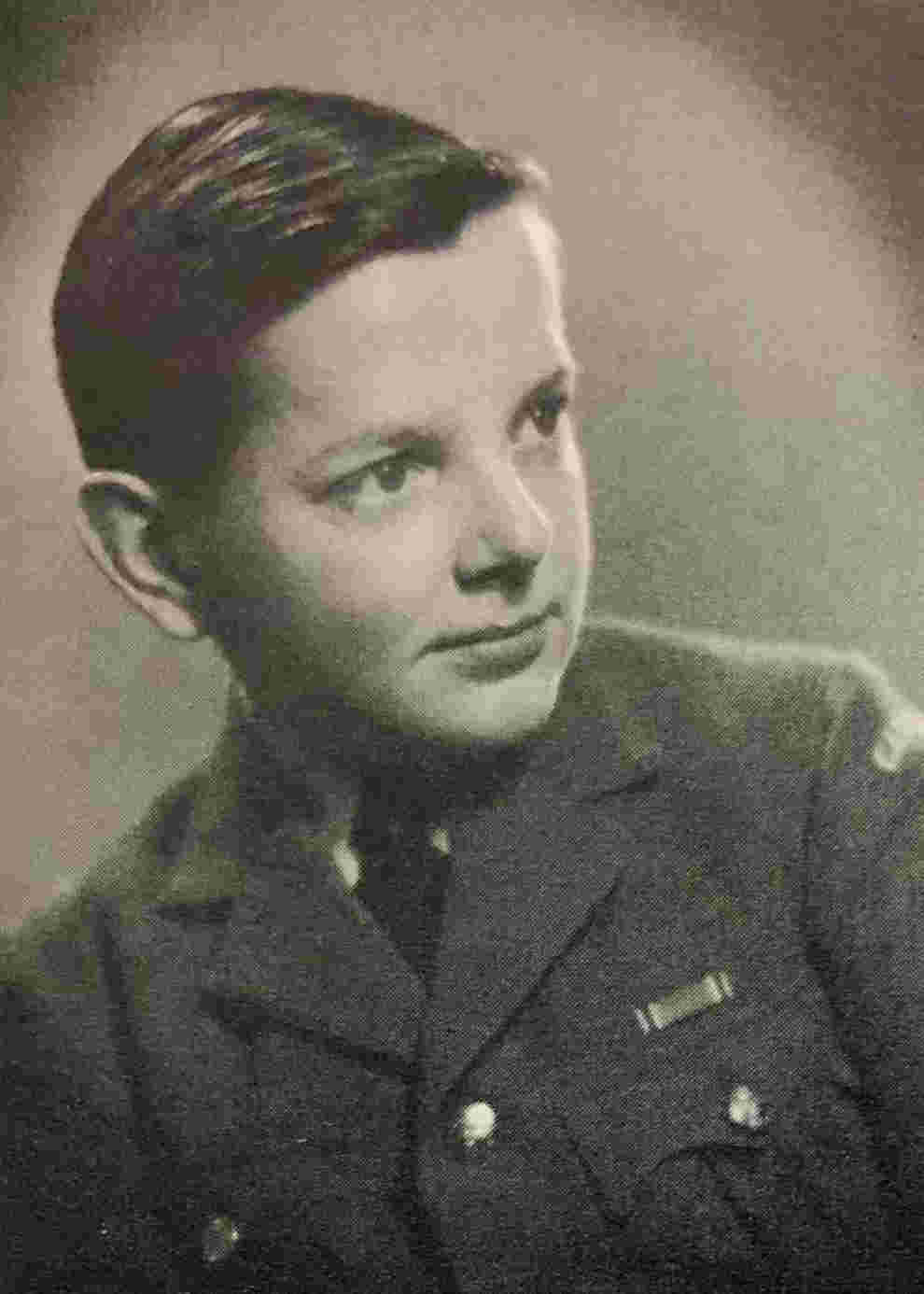
F/L Hart Massey, r.c.a.f.
Before the troops left on the final day, they assembled at the Legation in service dress, when Alice and I received them all and gave them refreshments before they entrained. After it was all over and we were sitting in the drawing-room discussing the party with not unreasonable satisfaction, we noticed coming down the hall two small figures in yellow sweaters and grey flannel shorts, proceeding on a somewhat irregular course and wreathed in charming smiles—our two young sons, Lionel and Hart, who had apparently been tempted to try what appeared to them to be lemonade, but was really punch. From their pleasant bearing, we concluded that, whatever they did in the future, their manners would not be impaired!
In conversations my wife and I had with Lord and Lady Willingdon in Ottawa on July 1 and 2, 1927, we suggested that they might pay a visit to Washington. At that time we and they thought it might well be comparatively informal and private, but later in September I told His Excellency that I had changed my view about the proposed visit and that I now thought that a Governor-General visiting a foreign country—as he was by theory and practice the representative of the Crown—should be received with the honours accorded by custom to a sovereign. This procedure would not only be in accordance with the new status of a dominion, but would give the Dominion in question appropriate prestige externally, would have a salutary effect on national feeling, and might even serve to strengthen relations between the countries concerned. The Governor-General entirely concurred. It was eventually agreed in principle by both Ottawa and London that Lord Willingdon, although the representative of our Head of State, should be received as if he were Head of State himself. Hitherto when a Governor-General had visited Washington he had reverted to his permanent status, whatever that might be, and the visit was always of a private nature. During the course of the correspondence on the procedure to be followed in this visit, however, some doubts arose in London. The Department of State, on learning of this, suggested that it might be well to change the suggested procedure. I took strong exception. I asked the Under-Secretary of State in Washington, W. R. Castle, whether, if we could show there was agreement between Ottawa and London, this would not remove any possible embarrassment on the part of the United States. I suggested that the best plan would be for the British Ambassador and me to come down together for a private and informal discussion with him at the State Department. This talk took place. Castle told us that the matter had been unnecessarily brought to the attention of the President, and that Mr. Coolidge, being punctilious about etiquette, might feel obliged to insist on a modification of the programme. The question seemed to be that if the Governor-General could not visit Washington as a head of state, could the President, as a sovereign, exchange courtesies with an official who was definitely a sovereign’s deputy? The Ambassador and I joined forces in urging Castle to do what he could to see that the procedure that had been proposed to me originally by the Secretary of State himself should not be altered.
There were the makings in this incident of a very awkward and embarrassing situation between Washington, London, and Ottawa. Fortunately, restraint and patience prevailed on all sides and arrangements for the visit proceeded on lines that had been agreed to by those concerned. The accepted procedure meant, of course, that, although in the United States the British Ambassador was the representative of the Sovereign and outranked any other subject of the King, on this occasion the model was provided by the visits to Washington in former years of two or three heads of state—kings or presidents—who had received appropriate honours. And so, at the State Dinner at the White House, the Governor-General and Lady Willingdon were given precedence over the British Ambassador and his wife. Nothing could have better emphasized our sovereign and independent status in the eyes of our American friends.
A hitch occurred in the preparation for the Willingdons’ visit: the Governor-General had omitted to obtain the King’s permission to make it. It was always necessary for anyone in this post to receive the Sovereign’s consent before leaving the country. It was particularly important to get the King’s permission in this case, because a State visit was involved. Some earnest correspondence ensued. I received a private letter from Lord Willingdon after the ruffled waters had become smooth again and the visit had been approved and was imminent, which concluded, ‘My love to your lady and please tell her I am polishing up my crown and sceptre.’
The Willingdons arrived from Baltimore in a special train; I had gone over to accompany them to Washington, where we were met at the station by the Secretary of State. We proceeded to the Legation with a cavalry escort. After lunch at the Legation, I took the Governor-General to call on the President, and Alice took Her Excellency to call on Mrs. Coolidge. About an hour later, these visits were returned at the Legation, which created no small stir in the diplomatic world because the President practically never entered the portals of a foreign mission. As is well known, Calvin Coolidge did not exactly generate riotous fun, but Lady Willingdon succeeded in making him laugh uproariously during the short time they were talking in our drawing-room.
We gave a dinner party of about forty at the Legation for the Willingdons, followed by a reception for nearly 500 guests. Then as now, the question as to whether Canada should or should not join the Pan-American Union, as the organization was then called, was hotly debated in Ottawa. While Alice and I were receiving our dinner guests, we saw, moving down the hall towards the drawing-room, the director of the Pan-American Union. Some significance might well have been attached by a sharp-witted diplomat to his presence at the dinner party, but there was nothing to be done about it except to find him a place, and this was done by Tommy Stone with remarkable celerity and skill, for to change the seating of so protocolaire a party was no easy task. The director no doubt had received in error a card to the dinner in place of one to the reception.
The evening was a great success. Chief Justice Taft, who had been a guest, said, with one of the ripples of laughter that started in his boots and worked its way up, ‘Well, Mr. Minister, all you have got left to do now is to invite the Queen to come and stay.’ I wonder if he meant Queen Victoria? The Willingdons’ visit gave great pleasure to us and to all those who met them. Two people more experienced in official social life could hardly have been found, or two who were more perfect guests. In a letter he wrote to me after leaving Washington, Lord Willingdon said:
The visit was a great adventure, but I think we can both claim it went thoroughly well, and whatever rigid officials may think or say at home, I believe you and I, with the great help of our wives, did more in three days to produce goodwill and understanding, than they could produce by years of despatches.
[Letter from Lord Willingdon, December 10, 1927.]
Little did I think when we welcomed the Willingdons as our guests that twenty-six years later I was to be received in Washington on a similar visit.
The Legation played some part in the Diamond Jubilee of our Confederation in 1927. It was the wish of the Government that Charles Lindbergh should be present at the celebrations in Ottawa, and I was instructed to arrange this. It was no easy job; it was accomplished only by handling the matter on the highest diplomatic plane and with considerable persistence. I felt, and still feel, that it was inappropriate that the principal figure on such a solemn national occasion should be someone from outside the country, whatever his achievements may have been. Canada, however, was glad to do honour to this remarkable and attractive young man.
Protocol, to use a tiresome word for the trivia of diplomatic life, presents many problems. For example, the practice in most capitals was that every chief of mission, on his arrival, called on all his colleagues, and all his colleagues returned his call. The expenditure of time by those concerned might well be called excessive. Protocol is relatively unimportant but never completely negligible. There must be, naturally, a set of rules to govern the procedure on diplomatic occasions; otherwise chaos, social frustration, and official disorder would ensue. The important thing is, as with all rules, never to treat them as masters but always as servants; the dictates of protocol must be applied with common sense and, I would like to add, some humour. It is worth recalling an incident that shook social Washington to its foundations in my time.
One day, after Esme Howard had become Doyen of the Corps, all the chiefs of mission received a request to assemble at the British Embassy at a given hour, the reason not being disclosed. When we were seated in the Victorian drawing-room of the old Embassy, the Ambassador said that he had asked us to meet in order to discuss ‘what posterity will no doubt know as “l’affaire Gann” ’. He then outlined the problem. Mrs. Gann was the sister of the Vice-President; he was not married, and had asked her to act as his hostess during his term of office. He made it known that his sister was his ‘official hostess’ and that he wished her to take the place at all functions that would have been occupied by his wife had he had one. A South American ambassador had issued invitations to an immense dinner party to be held in the Pan-American Union, which was to include the Vice-President and his sister. Where was Mrs. Gann to be seated? What was to be her place, for example, in relation to the wives of senators? Driven to distraction by this problem of placement, the ambassador appealed to the Doyen of the Diplomatic Corps—hence the conference at the British Embassy. As a result of this meeting, we asked for a ruling from the Secretary of State who, as Foreign Minister, was the obvious person to give one, in accordance with the practice followed in nearly all other countries. He was, however, unwilling to do so, and said that it was not for him to say where the sister of the Vice-President should sit at dinner. His reluctance, it may be hard to believe, derived from the Constitution of the United States. The matter involved two branches of the government—the administrative and the legislative; the wives of senators would be quite unwilling to accept a ruling given by a member of the administration, particularly if it was against their inclinations. We decided that, for the rest of that régime, in diplomatic houses, Mrs. Gann was to be placed in accordance with her wishes. It was unwise to invite senators’ wives to a dinner at which she was to be present. Chief Justice Taft once observed to me that there was no country in the world that claimed such a lofty indifference to the question of official precedence as his and then proceeded to talk so much about it. I think the Chief Justice would agree with a remark made by the late Lord Salisbury in talking about this question: ‘Those who mind don’t matter and those who matter don’t mind.’
Washington in the 1920s possessed great charm. The federal administration provided orderly development, and the city acquired increasing beauty under the guidance of a Fine Arts Commission. In those comparatively simple days, Virginia and Maryland exerted a gentle influence. Despite its large population, Washington was a relatively quiet community. On a Sunday afternoon one could gather wild flowers within the precincts of the city.
Social Washington was divided between the transitory population of diplomats, persons engaged in politics, members of the armed forces, and civil servants. On the other hand, there were the permanent Washingtonians—often retired diplomats and others who had been in official life—who were known as ‘cave-dwellers’. It was a closely-knit community, small enough for ‘X’ to know what ‘Y’ and ‘Z’ were doing, big enough to provide a wide variety of talent and experience. The members of the Diplomatic Corps entertained one another far too much; as in many capitals, the Corps tended to chase its own tail. Alice and I at our Legation tried to make our own parties as varied and broadly-based as possible. Senators and congressmen who were found at diplomatic dinner tables were not necessarily those who were of special importance politically. It was always wise to seek out politicians who were significant persons, and, not always an easy process, to meet them on social occasions. The constitutional pattern of Washington made this important. Official contacts with the United States Government were, of course, with the Secretary of State and other members of the administration, and yet many of the questions diplomats had to face were subjects with which Congress was immediately concerned. A formal official approach to a senator or congressman was considered improper. The informal contacts in the field of hospitality could, therefore, serve a useful purpose.
We used the new Legation house to the fullest extent for hospitality. No mission in Washington was more active than ours in this respect. We tried to make our entertaining constructive. We were happy to welcome visitors from Canada, both official and unofficial, and of these there were many. Also we were glad at the Legation to play our part in entertaining guests from the United Kingdom and other Commonwealth countries.
Ramsay MacDonald was one of these. He paid a most successful visit to Washington in 1927. It was very useful for the American capital to see that a socialist politician was not necessarily equipped with horns and a tail. There was no very strong bond of sympathy between MacDonald and the trade-union hierarchy in the United States. He was amazed at their conservatism and affluence. At a dinner given him by the American Federation of Labour, which I attended, one of MacDonald’s hosts referred to the ‘Packard Eight’ which he owned, which, with his chauffeur, he would like to place at the guest’s disposal. Ramsay MacDonald came again to Washington in 1929 as Prime Minister. We gave a large luncheon party for him at the Legation. He brought with him on this occasion, as his private secretary, Tom Jones (who served four prime ministers in this capacity). I remember that Jones was very anxious to discuss with me the speeches his chief was to make in Canada, and I went over drafts with him. ‘T. J.’ and I became great friends and later I paid one or two visits with him to his native Wales, where he was at his best. In his soft Welsh accent he would talk of those things that mattered to him and to which he contributed so much: the Welsh language, workers’ education, literature, and the arts. It was through him that two famous Welsh ladies, the Misses Davies, made their house in Montgomeryshire a centre for art and music and for fine printing at the Gregynog Press. In that house, where Alice and I once stayed, superb pictures hung in an alien Victorian setting.
Another Commonwealth visitor—one could then define him as such—was W. T. Cosgrave, the President of the Executive Council of the Irish Free State, who arrived one evening with his party, bored by the formalities and the dryness of their visit to Washington and happy to relax in my study—‘Massey, for the love of God give us a dhrink, we’re dying of thirrst!’ As he sat down and looked about him Cosgrave said, ‘How do you expect a country with a poet in its cabinet to afford a legation like this?’ (Desmond Fitzgerald, who was present, was both a politician and a poet.) We gave a dinner for Cosgrave, who delighted us all with his Irish stories.
One day General Smuts came to the Legation. It was the first time I had met him—but later I always saw Smuts when he came to London. He never said anything that was not worth listening to, and he possessed a vitality and buoyancy that made me, many years younger though I was, feel like an older man. As far as I can remember, he never brought a colleague with him on any of his visits.
Ernest Lapointe came to Washington, and we were happy to have him as a guest. He represented Canadian statesmanship in the best sense—with a quiet and distinguished assertion of the principle of nationality, tempered by a deep sense of tradition and belief in the blessings of the British connection. During the Imperial Conference of 1926, Lapointe had appeared on toast lists, along with people of the stature of Lord Grey of Fallodon and Lord Robert Cecil. On these occasions the wisdom and brilliance of his speeches made me proud of him as a Canadian.
André Siegfried, who had become a friend over the years, was our guest at the Legation on one or two occasions. He was one of the few Frenchmen who had a real understanding of Anglo-Saxon institutions, but his immense skill in assembling data was not always equalled by his ability to draw sound conclusions. For all his scholarly objectivity, he seemed to share his fellow-countrymen’s sense of apprehension when Great Britain and the United States were drawn together in a new entente. Was this really to prove to France’s disadvantage?
One day Frederick Banting came to lunch. A fellow guest was a lady whose daughter had been saved by insulin and who had been an anonymous supporter of Banting’s researches. The daughter was produced after lunch for Banting to meet. Later that day, Harvey Cushing, the great surgeon, came to tea and saw my son Hart for the first time since, as a neurosurgeon, he had operated on him successfully years before in Boston. Thus, in the Canadian Legation on the same day, a Canadian doctor met an American child who would always be indebted to him, and an American doctor met a Canadian who will always be similarly grateful.
A picturesque figure in the Washington of those days was General Dawes (Mr. Hoover’s Vice-President). In the manner of politicians who exploit symbols for political purposes, he fostered a monstrous pipe. I remember that at a very large dinner party that General and Mrs. Dawes gave in the Pan-American Union, he produced this notorious object with the fish course, and lit it. The French Ambassadress, sitting beside him, was visibly distressed. Such mannerisms, I think, were not so much natural to Dawes as a conscious affectation.
Shortly after Herbert Hoover’s inauguration, a Gridiron Club dinner took place at which both he and Franklin Roosevelt were present, one of the annual banquets which were the raison d’être of this famous club of newspapermen. At these events members of the Press, by tradition, discuss the administration with no inhibitions. I sat next to Roosevelt, who was then Governor of New York State. Like everyone else, I found him charming and distinguished. I wondered at the time, however, whether he was a little too much the amateur in politics; was this suggested by his actual experience—or was it his Rooseveltian enthusiasm? I remember a prophetic remark I heard made by Bernard Baruch in November 1933 about Roosevelt when he said, ‘Franklin will weave his way through!’ At this Gridiron Dinner there was an interesting exchange between Roosevelt and Hoover in their speeches. The proceedings on these occasions were ‘off the record’, but after thirty-three years I think I might be permitted to refer to what was said. Roosevelt: ‘I remember with pleasure my work with Mr. Hoover when we were both in the same—I mean when neither of us knew which party the other was in.’ Hoover, later: ‘We were, of course, never in the same party but at the time we Republicans were endeavouring to forget politics and help the Democrats to win a war!’
One day in Washington I had the great privilege of lunching alone with Mr. Justice Oliver Wendell Holmes, one of the greatest judges—and men—that the United States has produced. At the age of eighty-nine he had the spirit and wit of a boy—rather a mischievous boy who seemed to enjoy developing his sceptical philosophy. This he expressed, as he did most things, in epigrams. I remember his saying that so uncertain is man of the universe that he cannot be sure whether he is inside it or not, therefore he must start life with one fundamental statement of faith—that he is not God. He said that he never read newspapers or contemporary books like memoirs or biographies—all too ephemeral. He played solitaire every night. His wife and he had read the whole Bible aloud to each other. I found him a most wonderful old man—liberal, chivalrous, human, aristocratic, whimsical, lovable, and terrifying in his learning.
Another judge whom we knew well—one who was still an active member of the Supreme Court—was Mr. Justice Brandeis. He was a great figure in Washington, learned and wise, with fine feeling and a liberal mind. He both thought and felt deeply; he was not too concerned with ideas to be unmindful of men. I well remember the quiet little dinner parties in his apartment—when we adjourned to the drawing-room, the brilliance of the talk, led by our host, was in contrast with the rather sombre décor.
It was at this time that I first met Walter Lippmann. He must surely be unique as a commentator over these long years. No one in the field of journalism could possess more influence, which is based on nothing more spectacular than true objectivity, accurate knowledge, and serenity of judgment. I was lucky enough to see him often when I was in London.
In New York I met J. P. Morgan, and had an interesting talk with him one day in his office in Wall Street. He reflected the authentic view that New York business takes, or took, of Washington. I asked him if he ever came to the capital. ‘No,’ he said, ‘I hate it. I hate the way they do things. They are so damned second-rate. Every politician seems to have a double motive.’ The remark was an interesting reflection of what happens when political and business capitals are in different places. When, as in London, politicians and business men meet often quite naturally and get to understand each other, a gulf in knowledge and mutual respect is far less likely to prevail. In Canada, as in the United States, our commercial and governmental capitals are not the same, but somehow the gap between them is not so wide with us.
When I went to New York I seldom failed to visit my club, ‘The Century’. Most clubs that I know in the United States lack the personal atmosphere that clubs in London and, indeed, in Canada generally possess. ‘The Century’ is an exception—the club staff, at least those of long standing, all coloured, are apt to know you by name and perhaps your taste in drinks, while Dan, the hall porter, was in the high tradition of that great office in clubs and knew everyone. ‘The Century’ has a superb library which is put to full use, as a little anecdote will show. Some friends of mine and I were sitting at lunch at a table set up in the library, the dining-room being full. A member from another table apologetically asked if he could take a book off the shelf behind where we sat. He said, ‘We are having an argument about Roman agriculture and I want to consult Varro.’ This was not the sort of incident one associates with New York.
Shortly after arriving in Washington, I made the acquaintance of Willmott Lewis, correspondent of The Times and one of the best journalists of his day. I got to know him very well and was one of the many who deeply admired his ability to interpret for his newspaper the American scene, which he probably understood better than any other non-American. He succeeded in winning the confidence of Americans of all political persuasions. He was a journalist-ambassador in the highest tradition.
My time at Washington fell within the era of Prohibition, which produced its own problems and gave rise to situations in which embarrassment and humour were often mixed. At public luncheons and dinners, cocktails were generally offered unobtrusively to guests, and the guest, if he was a diplomat, had to choose between criticizing by implication his host’s attitude to the law by refusing the drink, or helping to break the law by accepting it. It was probably best to leave the matter in the host’s hands. On one occasion I was invited to speak at the weekly luncheon meeting of a distinguished club in New York. Before we entered the large dining-room the chairman asked me and the other head-table guests to come with him to another room where, in place of a tray of glasses, I saw an elegant visitors’ book which we were all asked to sign. No refreshments appeared, and I never knew why until many months later I was told that the cocktails that were ready were hastily put under cover because it had been rumoured that the Canadian Minister was a rabid teetotaller and would be deeply offended by the presence of alcohol in any form. On that occasion I don’t think I did my country any good at all!
I find myself talking a bit about prohibition—it used to be the most boring subject in Washington but it played an important part in the local folk-lore. I will touch on another incident. Esme Howard was greatly irked by the unfriendly publicity in the more irresponsible press about the importation of wines and spirits by the British Embassy. Diplomatic missions were entitled under their immunity to make such imports for their own consumption. That, however, did not prevent newspapers from printing photographs and headlines such as ‘More booze for the British Embassy’, and publicity of this kind was gleefully received by prohibitionist organizations which had begun to feel that their cause was losing support. The federal government, of course, was powerless to take any action. The British Embassy was the principal, although not the only, target for this form of attack, and Esme Howard decided that it would be best to ask for no more licences to import wines and spirits, and acted accordingly. This prompted criticism from other quarters. He is on record as having said later that he hoped that this might be a warning to all diplomats never to act under the influence of irritation.
I was asked later on at a dinner party what the self-governing dominions were going to do now that the British Embassy was going dry; I replied, ‘remain self-governing’, and that was, of course, what we all did. When Ronald Lindsay became British Ambassador, he had to decide whether or not to follow his predecessor’s example. He asked for my views and I advised him to revert to the status quo ante; he reverted.
There were ugly rumours to the effect that some junior members of embassy staffs made ‘diplomatic liquor’, to use the elegant phrase, available to certain friends in Washington for a consideration. I remember a hostess saying at her dinner table that this was most unfair and quite untrue because she had tried to buy wine from some diplomats and they had refused to sell it to her.
Each year there took place in Washington an international ‘oratorical contest’ in which a group of adolescents from various countries competed as public speakers. I felt it my duty to attend these events when a Canadian contestant was involved. My view was that such competitions were, educationally at least, an abomination. The candidates generally expressed second-hand ideas and shop-worn clichés; they rarely showed any originality of thought and all seemed to exhibit the same mechanical emotion. The Washington contest was a recurring nightmare.
I did not take long to find that Canada had a rather special although unobtrusive role to play in Washington as an occasional intermediary between Great Britain and the United States. I remember once or twice my British colleague, Esme Howard, said to me something to the effect that he knew I was seeing the Secretary of State and would I mind having a word with him about such and such a matter. The question had nothing to do with Canada, but was something about which I could, in good conscience, speak to the Secretary of State as a Canadian.
During my time in Washington, Senator William E. Borah was an active, able, and aggressive figure in the political arena. He was consistently anti-British in his views. When Philip Kerr (later Lord Lothian) came to Washington he very much wanted to have a talk with Borah and induce him if possible to pay a visit to England. Borah would never go to the British Embassy, but he was quite prepared to accept invitations from the Canadian Legation, and one day at lunch Borah, Philip, and I had a talk, in the course of which the Senator told us that he would be glad to go to England. Unfortunately, however, the visit never took place.
Philip Lothian was for long a close friend of mine. I often stayed with him and he with me. On one occasion, when he was away from home, he offered Alice and me his Jacobean house, Blickling Hall, in Norfolk, for a quiet week—we were a bit overtired at the time. Thanks to the restorative effect of beauty in that most lovely of houses, and the great park in which it stands, we returned to London much refreshed. Philip was a great servant of Great Britain and the Commonwealth. As ambassador in Washington, his work was brilliant. His knowledge of the United States was deep and he got on easily with the American public. As someone said, he had the great advantage of being a ‘marquess and a mixer’.
Nineteen twenty-eight being an election year, the two great party conventions took place then. I was anxious to attend them both as an observer. Many diplomats went to such conventions as part of their official duty, thus adding to their knowledge of the American scene, and their ability to report on it. This I made clear to the Government in Ottawa. My invitation to attend the Republican Convention in Kansas City became known through the press, and a member of our House of Commons not very helpfully asked whether it was true. The matter surprisingly reached the Cabinet—the Government thought that my attendance at this meeting might be misunderstood in Canada. After some ambiguous communications on the subject from Ottawa, I decided not to go to either of the party conventions. Although I thus escaped two exhausting visits, I was robbed of an experience that would have been very useful.
Diplomats have often to say no to interesting invitations, for a variety of reasons. In March 1928 Haley Fisk of the Metropolitan Life Insurance Company asked me to succeed R. B. Bennett as a director of the Company. This, of course, would have been quite inconsistent with my position as a public servant, and I declined.
Alice and I travelled widely. On all of our tours except one, when we went to the West Coast, we took Tommy Stone with us as secretary. He looked after the journeys with great efficiency and was a delightful travelling companion. Our aim was to visit all forty-eight states; we left Washington too soon for that, but we saw something of thirty-two—I blush to think of the number of speeches I made! A good many of them were published in a book called Good Neighbourhood (a phrase that appears in Jay’s Treaty, 1794). I dedicated the book to Lal (the name we called Alice in the family) and wrote a piece of verse in her copy:
I vowed, if at some future date
A little book I should create,
Either profound or trivial,
Enduring or ephemeral,
That book I’d love to dedicate
To Lal.
And here it is; you know each speech,
You shared the natal pangs of each;
Heard them; endured my moods and took
Days for the printer’s slips to look
Within the proofs, nor let them reach
The book.
Good Neighbourhood is yours; to you
I give it as your simple due.
To all my pleasures, pains and strife
You give, dear heart, the touch of life;
So this is dedicated to—
My wife.
To travel in the United States in the job I held at Washington was rewarding. I wonder if any country presents such diversity—such contrasts. The South makes a strong appeal to everyone. In so many ways it was still the romantic South of history and fiction. Charleston in South Carolina gives you the eighteenth century. To look forward you must see Tuskegee, the great college for Negroes in Alabama, the creation of one of the most remarkable figures in American life—Booker T. Washington. We spent a day in the college and we were given a vivid picture of its work. Among the coloured members of the faculty, we met, in his laboratory, the famous professor who, I was told, had developed some 300 different industrial uses of the peanut—not an unimportant achievement in the South. Before we left, the student body, about 1,500 in number, sang spirituals for us: ‘Go down, Moses’ and ‘Steal away to Jesus’ with their familiar words—stark and tender. In the grounds of the institute there is a monument to its founder on which are written these words, which express the inspiration of Tuskegee: ‘I will let no man drag me down so low as to make me hate him.’
We went to the blue-grass country of Kentucky and visited some of the great stud farms. At a dinner given us I received what I suppose was the greatest compliment a Kentuckian had to offer at the time—practically an accolade. My host said, ‘We took the Canadian Ministah to see “Man O’War” and he was able to look that great horse in the eye as an equal, for each is without a peer in his own realm!’
We enjoyed our visit to Louisiana—few people can resist its appeal. There the French language has been almost lost, except in the country districts, but nevertheless several of the City Council of New Orleans were able to talk to us in that tongue. French will not survive in isolation. It can only be preserved when, as with us in Canada, there is an organized community dedicated to its survival. In this city every year they celebrate the anniversary of Andrew Jackson’s victory over the British general, Pakenham. The event is now regarded less as the commemoration of a victory of the United States over Great Britain than as the mark of the commencement of more than a century of peace. At the last dinner before my visit, I was told that a telegram of sympathy was sent to London about the serious illness of our King. At that time I was frequently asked by doormen and elevator boys in hotels, ‘Have you got any word today about “the King”?’
I recall my visit to the Grand Canyon—quite unbelievable in its splendour. I made the descent from the ‘rim’ to the river and returned in one day. My guide was the superintendent of the park, and I suspect that he tried to see how the Canadian Minister would behave when he skirted the precipices. There were plenty of them, and my mule, like all mules, had a suicidal complex—he could not be persuaded to leave the outer edge. There was something a little sinister in the name of the path we used—Bright Angel Trail!
In this wonderfully varied and fascinating country there are unending contrasts. I recall a visit we paid to Mrs. Whitelaw Reid in the outskirts of San Francisco. Her husband had been American ambassador to the United Kingdom. Her California house, built in the heyday after the ’49 Gold Rush, she kept very faithfully as a ‘period piece’. Mrs. Reid entertained on an impressive scale. I well remember a week-end or two at her country house in Westchester County, New York, which did not seem, in its size, to fall very far short of Buckingham Palace. Her kindness and warmth as a hostess gave her hospitality its charm.
Another celebrated hostess in New York (I would hesitate even now to put these ladies in any order of precedence!) was Mrs. Cornelius Vanderbilt. Her house on Fifth Avenue (the only private residence south of Central Park, and long since demolished) was famous for its parties in the grand manner. She had a fondness for royalty—and this earned her the sobriquet invented by naughty boys at the British Embassy of ‘the Kingfisher’—unfair to a kind and gifted hostess.
I have fond memories of Cooperstown in New York. I first got to know it when Alice and I stayed there many years ago. Not far away from the town, on the shores of a lovely lake, was a property given as a Crown grant by George III to a family that still owned it. Here was an estate almost feudal in character in the centre of a complex of modern industrial towns. Cooperstown is one of those communities in the United States to which you don’t belong unless your grandfather had lived there. Those who know it only as ‘the home of baseball’ (it has a museum dedicated to the game) see another Cooperstown when they visit it.
I found that old Philadelphia possessed its own charm, and that the qualities of Quaker life had by no means disappeared. I was asked to speak at the convocation of Swarthmore College, where the ceremony took place out of doors. It was very moving when the president asked the audience to observe silence for a few moments (a Quaker tradition), and silence prevailed, save for the sound of a gentle wind in the trees. To speak after such a period of quiet was stimulating.
The official visitor to the United States is made sharply aware of an alarming competition between motorcycle policemen and traffic lights. I sometimes ploughed through the traffic like a cutter through the waves. I went on one occasion to Kansas City to attend a national Boy Scouts’ convention. I arrived at a suburban station and was met by the committee and two motorcycle policemen. They asked if my heart was all right, because ‘we’re going to give you a fast ride’. They did. We drove the eight miles through the centre of the city in nine minutes, so I was told, the policemen attempting to clear the traffic ahead with shrieking sirens. There was nothing I could do about it. The application of speed and noise to this journey was quite unnecessary, as I had to wait half an hour before my time came to speak after our arrival at the hall.
I paid official visits to both Annapolis and West Point. At the former place I saw the primitive little mace that had been used at the opening of the first legislature of Upper Canada at Niagara-on-the-Lake by Governor Simcoe and had been captured in the War of 1812. Mr. Franklin Roosevelt, as President, with great courtesy restored this precious object to Canada; it now reposes in the University of Toronto.
My visit to West Point was marred by the fact that I arrived late, having taken the wrong road and encountered unexpected week-end traffic. Also I had not been told that the visit was to be of a ceremonial nature. I had an escort of cavalry from the gates to the Headquarters where I met the Superintendent (Commandant). To my horror, I saw drawn up in review order on the parade ground some 1,200 cadets in their striking dress uniform, who must have stood there I cannot say how long waiting for me. I could have crawled into the smallest hole. After abject apologies were made, the inspection and march past took place in the normal manner. The site of West Point could not be finer, overlooking the Hudson River and surrounded by hills. The buildings are impressive, particularly the superb chapel, whose architects were Cramm and Goodhue, the greatest Gothicists in the United States. Henry Sproatt, who designed Hart House, learned his art from them.
During our time in Washington there were few international crises. I was, however, concerned with the signing of the pact that was intended to introduce perpetual peace. One morning the Secretary of State, Mr. Kellogg, sent for me, and I found him in conference over the note to be sent to the dominions asking them to participate in this multilateral treaty ‘to outlaw war’—now generally known as the Kellogg Pact. I was asked to read the draft and make any comments I wished. I ventured to question one clause which said that the treaty had been so phrased as to bring the dominions in as separate participants. I was told it meant that the full title of the King had been used, including the phrase ‘Dominions beyond the Seas’. I objected that the full title of the King was always used in such documents and that the dominions had to be participants in any case. After a short discussion the clause was struck out. This episode showed the position of a Canadian representative in Washington as an interpreter of the changing Commonwealth to those not always able to understand it. I recall a less formal occasion when I was able to perform this function.
One day I received a telephone call from a senior officer of the State Department asking if Newfoundland should be included in the multilateral treaty referred to above. The answer was no. Question: ‘But isn’t Newfoundland a self-governing dominion?’ Answer: ‘Yes, but not a signatory of the Covenant of the League.’ Question: ‘Is India a self-governing dominion?’ Answer: ‘No.’ Question: ‘Is she a signatory of the Covenant?’ Answer: ‘Yes.’ Comment: ‘What a funny empire you’ve got!’
Of the substance of the Kellogg Pact, I find I was at the time somewhat sceptical, though not cynical. I wrote of it to Philip Kerr:
I confess I could not see how very much was to come of this plan when it was first proposed, but as negotiations have proceeded, it seems that Kellogg’s effort may lead to something of substantial importance. I am much impressed by the understanding way in which he endeavours to allow for obligations under the League of Nations Covenant. He apparently has pretty widespread backing here. He is of course as you know, desperately keen about the whole thing and, generally, it seems to me, there is reason to believe that something worth while is going to come of it. I quite agree with you that the movement to outlaw war isn’t going to accomplish its idealistic purpose by the exchange of a few documents, but I cannot help feeling that if the Kellogg Treaty is signed by most of the Powers, including all the big ones, it will have an important effect on opinion in this country [U.S.A.]. It will certainly create a better atmosphere vis-à-vis Europe.
[Letter to Philip Kerr, May 15, 1928.]
One of my tasks in Washington was to explain to Canadians what a legation was and what it did. I tried to get the travelling public from Canada to make use of the mission. As Canada at the time maintained no consular officers, the Legation itself had to perform the personal services that normally are looked after by consuls. A very important duty of a diplomatic mission is to help its nationals in any possible way, without being too much concerned with technicalities. And here I might answer a question I have often been asked: namely, the difference between an ambassador and a minister. The answer is that there is not any difference at all in function—only in some unimportant matters of precedence.
Canadian-American relations, as we dealt with them at the Legation during my years in Washington, were mainly the kind of fence-line disputes that develop between the best of neighbours—disputes over boundary waters, suppression of smuggling, immigration, allocation of radio broadcasting channels, fisheries, extradition, and the like. We had not yet begun to consider ways to handle trouble in far-away places, such as Egypt or Laos, or even in places not quite so far away, such as Cuba. But already one persistent difference in the outlooks of Ottawa and Washington upon the world scene had appeared. This was our attitude towards the Pan-American Union. One of the last papers I prepared before leaving the United States dealt with this subject; in view of its continuing interest today, I quote from my memorandum the following:
At first it might seem reasonable that this Dominion should take any step likely to increase her points of contact with the outside world. It might well appear that our national prestige would be enhanced and the range of our external trade extended by our full participation in the Pan American movement. On closer examination, however, I have come to the twofold conclusion that the benefits of such a step would be illusory and the dangers inherent considerable.
The efforts which have been made in the last forty years to give reality to this organization seem to be peculiarly barren in concrete results. The actual accomplishments can be divided under three heads. In the first place it must be admitted that the succeeding conferences show an increasingly successful effort to apply in treaty form the principle of conciliation and arbitration in international affairs. The Gondra Treaty was a genuine achievement and the Treaty of Arbitration and Conciliation which was signed in 1929 carries this development still further. Canada, however, would seem to be too remote from all of the participating states except one to stand in any need of such international engagements with them. With regard to the one nation in the case of which friction happens occasionally to occur, we are capable of making our own arrangements for arbitration without invoking the aid of any general treaty for the purpose of keeping the peace in South and Central America.
Another useful function of the Pan American Conferences has been the stimulation of interest in technical developments, the promotion of such activities as sanitation, agricultural science, and the accomplishment of international agreements on such matters as consular regulations and patent legislation where uniformity is all-important. But such activities have little interest for Canada. Our state of civilization is such as to require no outside examples or stimulus in the normal functions of government, and, again, we are too remote from the South American States to be obliged to assimilate our usages to theirs.
The third outcome of the Pan American movement has been the creation of the Pan-American Union in Washington. This building represents a concrete symbol of Pan American ideals. The arrangement of its symbolism is therefore significant. In the placing of national flags and coats of arms and the busts of national heroes in this rather grandiose and florid structure, no doubt is left in the mind of the visitor that in the conception behind it there is no equality of status between the United States and its sister republics. It is perfectly clear from the conduct of the Pan-American Union that the United States of America is not regarded as being on an equal basis with the other participating states but as primus inter pares.
On the occasion of the last Pan American Conference at Havana it was clear that among some of the Latin-American members of the Union there was a hope that Canada might be induced to apply for admission. This hope was apparently based on the belief that Canada as a member would side with the South American nations on many of the issues in which the United States and the other governments would be on opposite sides. This suggests another reason which might properly be urged against Canadian participation. In the various disputes between the United States and the other member-nations which have marked the organized Pan American movement since its inception, Canada, as a member, would have been forced to take one side or the other, although neutrality in such matters would generally be the wisest course. Canadian prestige would seem to be best maintained and Canadian interests best served by a dignified aloofness from such controversies as seem inherent in the Pan American movement.
[Memorandum by Vincent Massey, July 23, 1930.]
A change in the British Embassy took place in the early spring of 1930 when the Esme Howards left Washington. They spent their last few days as our guests in the Canadian Legation, where we had a farewell dinner in their honour. Sir Ronald and Lady Lindsay then moved into the new British Embassy just completed, and Alice and I lunched with them—the first guests to be entertained in the new, very elegant house. The King’s birthday dinner this year was held for the first time at the Canadian Legation, the heads of all the Commonwealth missions being invited.
The unfriendly attitude towards the establishment of a Canadian Legation on the part of some persons persisted for a while. Here is a picturesque example of it. One Sunday when I was out of Washington, a senator arrived from Canada, asked to see whoever was in charge (he happened to be the first secretary), established himself at my desk in my study, and proceeded to interrogate him about the mission: how often was the Minister away from Washington and for how long, the size of the legation staff, how many Canadians were employed on the domestic staff (who, incidentally, were paid by myself), why was there no portrait of Mr. Meighen on the walls, and so on. It was a trifling incident, but the sort of thing to be expected by anyone engaged in pioneering.
Mackenzie King paid a visit to the Legation in November 1927, and after his return to Ottawa he sent me a long letter in which the following passage occurs:
I was impressed with the service which I believe the Legation is rendering the British Empire as a whole, quite as much as Canada, in what it is doing by way of emphasizing to the American mind the real significance of the Empire as a Commonwealth of Nations, at what it is doing to ensure soundness of view in matters of imperial concern.
In 1930 the post of Canadian High Commissioner in London became vacant, and I was asked by Mackenzie King if I would accept it. I would have liked to remain a little longer in Washington to complete certain plans I had made, but the London post gave me the prospect of vastly interesting and important work in another field and I accepted. (It was, however, five years before I was to occupy it.)
Then came our good-byes. I addressed The Pilgrims in New York for the third time at a dinner they gave me on my departure. Our last few weeks in Washington were crowded with farewell parties. Shortly before I left the post, I had the unusual honour of being asked to lunch alone with the President. We sat on the verandah of the White House, overlooking the garden. Mr. Hoover talked very freely about his problems.
After we left Washington came a visit to Detroit, with a few hours in the Ford factories and a talk with Henry Ford himself. Ford showed idealism touched with sentimentality; profound belief in mechanical organization; boundless energy and eager curiosity, combined with quick judgment and not very profound thinking when out of his own field; and unconquerable confidence in the United States. Then across the border to Windsor. It was appropriate to leave American soil having seen so American an achievement, and having met so American a personality.
After our home-coming, when the crowded, surcharged years gave place to a brief time of quiet, Alice and I asked ourselves many questions. It had been an adventure, yes, but how successful had it been? Had it achieved what we hoped it would? Of the pleasure those years gave us there was no doubt. The American welcome had come from the heart; the backing we had from our own country in the complicated task we had been given had grown steadily in warmth and understanding. Our duty was to make Canada known in the United States as a nation and as part of the Commonwealth. There was great ignorance of our country south of the border—that is still true, but I like to think that something had been accomplished in those years to make Americans rather more familiar with Canadian life. To be of any use, such knowledge must grasp what lies beneath the surface. Superficially, of course, we are much alike and are probably growing more so. This frequently leads our American friends into grave error. How often during my years in Washington did Americans say, with that courteous intent so characteristic of them, ‘Why should there be a border between our two countries when there really is no difference between us!’ But we are different, each country being properly engaged in its own national experiment; and how important such differences are in a world increasingly threatened with a dull sameness! After-dinner speakers would do well to recognize those things that distinguish us, and avoid listing what we have in common, for these we can take for granted. I know that Americans do not dislike us when we are loyal to ourselves, and that they respect us when we stand up for what we believe to be our rights, as they are always zealous in defending what they believe to be theirs.
Americans may know less about Canada than we would wish, but for all our familiarity with them and their country, we are often ignorant of some of the best things in their life. These are not automatically known on our side of the border; they have to be searched for to be found. I was aware of this during my time in Washington. Into our country there flows a perpetual stream of cultural Americana, dubious in quality and alien to the best in our own inheritance. But one must bear in mind that this is equally distasteful to thoughtful Americans. We should know more of what reveals the highest quality of American life and learn from it. The best of what we receive from beyond our borders must be woven into our own fabric.
We Canadians are in no danger of narrow nationalism; our peril is to be too little conscious of our own identity, too little given to understanding and preserving it. Its preservation must surmount many handicaps. But it lies within our power to convert these handicaps into opportunities.
André Siegfried once asked a disturbing question: ‘With an American culture whose centre of gravity lies outside Canada’s frontiers, is it possible to found a lasting Canadian nation?’ With a living sense of our identity we can answer the question with confidence. Such a sense can often grow when you see your country from abroad. From the United States where we had lived for three years and more, the character of Canada was easier to know, and with our knowledge grew our pride.
The defeat of the Mackenzie King administration in the General Election of July 1930 and the formation of a new government under R. B. Bennett confronted me with two alternatives. One was to follow the American practice and offer automatically my resignation as High Commissioner in London. The other was to remain in the post and ask for instructions. I chose the latter course. While certain newspapers were critical of this decision and clamoured for my resignation on the grounds that I was embarrassing the Government by not resigning, I had considerable support in Canada and, as I was to discover later, in England as well.
On August 7, directly after the new government took office, I wrote as follows to the Prime Minister:
I have awaited your assumption of office to approach you officially in order to ascertain your instructions. As you are aware, I have been in the Canadian service abroad since its extension in 1927, having served as Minister at Washington until recently, when I was transferred to the High Commissionership in London. I am at present under orders to proceed to my post early in September. I shall be very grateful for an expression of your wishes in the matter.
[Letter to R. B. Bennett, August 7, 1930.]
Bennett’s response was to instruct me, through O. D. Skelton, to come to Ottawa to discuss the matter with him. We met in his room in the East Block at three o’clock on the afternoon of August 13. Immediately after this interview, I prepared a memorandum on the conversation. The importance of the subject may justify my quoting from it at length:
Mr. Bennett’s manner at the outset was truculent and surly. After a perfunctory greeting he referred curtly to the issue created by my appointment to the High Commissionership and then turned to a volume on his desk from which he quoted the statute creating the post of High Commissioner, construing the terms of this to me (by a process of reasoning that I was unable to follow) to mean that the post was essentially different from a diplomatic post and could not be regarded as being part of the Canadian service abroad. I took issue with this interpretation, but my observations were drowned under a flood of legalistic arguments in which copious references, not all of them I think accurate, were made to the practices governing the office of High Commissioner. When this pedagogical outburst was finished and Bennett proved to his satisfaction that the post in question was and always had been and should remain, one to be filled by a politician in close association with the Government of the day, he referred to some of the election issues in the campaign of 1925 with which I had been concerned. He alluded with considerable bitterness to the incident connected with the correspondence between myself as President of the Massey-Harris Company and Meighen, in which I expressed my objection to the reduction in duties on agricultural implements in the tariff of 1924, my alleged desertion of the cause of high protection by my joining the Liberal Cabinet in 1925 and my conferences with the Independent members of Parliament at the opening of the session of 1926 which helped to bring about a ‘modus vivendi’ between Liberals and Progressives in that Parliament. Bennett then, after this recital of my political iniquities, asked me whether, if I were in his place, I could possibly regard myself as a suitable appointee to the High Commissionership. At this point I became very angry and answered him with some heat to the effect that there was nothing in my career, public or private, which rendered me unfit for the position in question; otherwise I would not have had the effrontery to accept it. He then said, ‘I am afraid I have made you angry’, and explained that I had misunderstood his question. He went on to say that what he had in mind was the fact that I had been such a strong Liberal during the time of my participation in politics that in his opinion I could not appropriately occupy a position which called for a sympathetic accord with the policies of his Government and an official relationship to it based upon a desire to see these policies carried into effect. My obvious reply was that what he required for the position, if this was his conception of it, was a Conservative politician and that naturally I could not qualify. . . .
During the conversation Bennett returned several times to a distinction which he drew between the High Commissionership and the foreign diplomatic posts maintained by Canada. The former, he held, being within the British family, was informal, involving not only the maintenance of policy but also occasionally the initiation of policy, and should be held by someone who was virtually an overseas member of the government. The latter represented formal (I think he meant but did not say so, mechanical) activities, and could appropriately be held by a non-politician. I was unable to follow his reasoning as there seems to be no essential difference between . . . the High Commissioner and the Canadian Minister at Washington with regard to their relations to the policies of which their official activities must be an expression. Through Bennett’s constitutional lecture on the subject there ran an implication that my failure to draw a distinction between the High Commissionership and foreign diplomatic posts revealed an incapacity to understand the true significance of intra-imperial relationships. To illustrate the contrast between our foreign diplomatic posts and the High Commissionership, he said that he had no intention of disturbing the Ministers at present at Paris and Tokyo and said that he would have left me at Washington had not my recall been signed, as it happened, just two or three days before my interview. I did not say that had he wanted to send me back to Washington the signing of the recall might have been prevented. . . . To bring the disagreeable episode to a close, I said that in view of his statements on the subject of the High Commissionership and his intentions with regard to the appointment, my only course was to offer my resignation. He agreed, and gave me to understand that it was accepted.
Shortly after I left the Prime Minister, I had a talk with Mackenzie King. His advice was that of a friend and not that of a politician. He expressed the hope that Bennett would ask me to return to Washington and advised me to accept if he did so. This suggestion, he pointed out, was not to his advantage as Leader of the Opposition, for politically he stood to gain by my removal from office, which would enable him to make a strong case for following the British tradition in our diplomatic service. In the event, he was able to do this, with good effect.
I had a further talk with Bennett in Toronto on August 15, two days after the conversation in Ottawa, for the purpose of discussing an exchange of correspondence in which each of us would state our respective positions. ‘I told him’, so my memorandum of this second interview records, ‘that I felt that it was not an unreasonable request on my part that if he made a statement which expressed his point of view and what he regarded as justification for his action, I should be permitted to have my own attitude similarly explained. Otherwise, my whole course of action was open to misunderstanding.’ I then handed him the following draft:
I appreciate your courtesy in arranging for our conversation of yesterday in answer to my letter requesting an expression of your wishes concerning my appointment to the High Commissionership in London.
I left the Legation at Washington and accepted a transfer to London on the understanding that the office of High Commissioner was an integral part of our service abroad, differing, of course, in its procedure from our foreign diplomatic offices but akin to these in the qualifications of its personnel and in the relation of that personnel to the government which it serves. I now realize that our ideas regarding this are at variance. In our discussions on this subject you were good enough to make clear your view that the office of High Commissioner should be held by someone in close political association with the Government of the day, and I understand from what you said that you had in mind plans for this post as a result of which my own appointment could no longer stand. In these circumstances I, of course, at once offered you my resignation from the High Commissionership which I now confirm—the resignation to take effect whenever you so desire.
In resigning from this post in our service abroad, of which I have been a member for three and a half years, I should like to say that no one belonging to the Service and who has been engaged in its work could retire from a post in it without a feeling of having been greatly privileged.
Bennett, on reading this draft, so my memorandum records, ‘took some exception to the clause in which I gave as one of the reasons for my resignation his statement that he had other plans for the London appointment. I told him that this was my understanding of what he had said. He . . . appeared to be reasonably satisfied that the letter was accurate in its facts and fair in its tone.’ He agreed to its publication, together with the text of his own reply, which he was evidently anxious to show to me then and there.
I told him that there was no need to do so and that I was quite prepared to leave that matter in his hands. He then said that he wanted to be correct as regards facts. I told him that as far as facts were concerned, Skelton, as Under-Secretary of State, knew from his official connection with the matter, any pertinent facts. I told Bennett that I was leaving for the North . . . and would be out of reach . . . and the matter was left as follows: If Skelton expressed the opinion that there was no impropriety in the publication of the letters, they were to be published during my absence. If on the other hand, it was regarded as wiser not to publish the letters in anticipation of the early meeting of Parliament, nothing would be given to the Press on the subject until my return from the North.
Our exchange of letters was not in fact made public for over a month, for Bennett did not address his reply to me until September 16. It read as follows:
I acknowledge the receipt of your communication of August 14, and express my regret that absence from Ottawa for a period of nearly two weeks and great pressure of work since my return, have prevented an earlier reply. I also recall that you did not expect to return from your hunting trip until this week.
During our interview on August 13, I informed you that the present Conservative Government considered it proper to adhere to the spirit of the statute creating the office of High Commissioner for Canada in Great Britain, and to affirm the policy which has developed under it, by appointing as its representative one who through conviction could fully subscribe to the declared views of the Government relating to the conduct of the affairs of this country in Great Britain; and that any departure from that principle could only be justified on the ground of the more effective prosecution of the policies which this Government believes should, in the interests of Canada, be maintained and developed.
As it was agreed that you could not personally approve these policies, it therefore followed, in my opinion at least, that they should more properly be entrusted to one who sincerely believed in their effectiveness.
For this reason it has been determined to accept your resignation as High Commissioner for Canada in Great Britain, and in so doing I would ask you to receive the expression of my belief in the high service you have for some years rendered Canada, in a position which from many points of view cannot, as you suggest, be regarded in its purpose essentially similar to the one you now resign.
I may observe that you are in error in assuming that you were transferred from the position of Minister at Washington to that of High Commissioner at London. The Order-in-Council distinctly appointed you High Commissioner under the provisions of a Canadian statute, and is also the authority for directing that application should be made to His Majesty for your Letter of Recall as Minister to the United States. Such Letter of Recall is actually dated the 5th of August last.
[Letter from R. B. Bennett, September 16, 1930.]
I had taken my position on the ground of broad principle; but, had I wished to do so, I might have responded to the final paragraph of Bennett’s letter by pointing out that, technically, I had neither resigned nor been recalled from my Washington post. Until a minister’s Letters of Recall are formally presented to the head of state by his successor when he presents his own letters of credence, his name remains on the diplomatic list as minister, though absent from his post; my recall had been signed, but it had not been presented. However, there was no point in going into that. In the course of our second interview, according to my memorandum, ‘Bennett was pleased to regard the procedure of my transfer as having been badly muddled and said something to the effect that we as a country were very young in diplomacy. (I might have added that his own attitude was indeed proof of this contention, but naturally did not do so.)’ I find it hard to believe that Bennett had any clear understanding of the issue, apart from the fact that he did not wish me to represent his government either in London or in Washington; such, at any rate, is the interpretation suggested by his own account of the episode in a letter to a correspondent some weeks after it had taken place:
As you know, Mr. Massey resigned. In the closing days of the King administration he was appointed High Commissioner to Great Britain. I talked the matter over with him and he appeared to be convinced that he was not a Minister or a diplomat in London, but the representative of the Government, and that he could not represent a Government with which he was not in accord.
[R. B. Bennett to W. B. Clayton, January 22, 1931, Bennett Papers.]
The office of High Commissioner for Canada in Great Britain was in the event assigned by Bennett to G. Howard Ferguson, the Conservative premier of Ontario; that of minister at Washington was left vacant for nearly a year, when the Prime Minister appointed to the post W. D. Herridge, who had not until that time been in government service but who shortly before the appointment had married the Prime Minister’s sister—a circumstance that did not escape the Leader of the Opposition during the election campaign of 1935.
With the diplomatic road thus for the time being cut off, we did not proceed, as we had planned, to take up residence in London, but returned to our home at Batterwood, a few miles from Port Hope, where numerous cases labelled “London, England’ were unpacked. For most of the next five years we lived at Batterwood, and became very fond of the place, because it was largely of our own making. The original farm, which I had bought just after the First War, after receiving various additions grew into a property of about 400 acres. It lies in a pleasant countryside and includes considerable woodland; a stream that runs through it widens out into a tiny lake. This has long been the home of a pair of white swans—they and their predecessors have always borne the names ‘Loh’ and ‘Grin’.
We had built our house in the late twenties. It cannot be said to be in any particular ‘style’, but it does resemble the small, red-brick English houses of the early eighteenth century. This was a period in which charm and comfort were happily blended. Over the fire-place in the hall we had painted two lines from Flecker’s play Hassan:
Give all thy day to dreaming and all thy night to sleep:
Let not ambition’s tyger devour contentment’s sheep.
To mark the completion of the house in 1928, we had a party for all the workmen and their wives. Events of this kind are happy occasions. Every man likes to show his wife or his sweetheart what he has been working on for perhaps a year or two; without a little social event when the structure is finished, women never see what their men have been doing.
As an agricultural enterprise Batterwood could not be regarded as having ever reached a high level of success; its story cannot be regarded as a manual of husbandry. Whenever I read accounts of the achievements of amateur farmers I feel that I really should produce a guide for the unwary on what not to do; my advice would come from intimate and even poignant experience. An absence abroad of over ten years did not help, and after returning in 1946 it was obvious to us that something drastic had to be done; so the dairy herd was sold, along with all the other animals, and the farm was devoted entirely to staple crops. These measures had a salutary effect on its economics. My experience of farming leads me to believe that it is impossible, or almost impossible, for any farm with an absentee owner to be made to pay, though I would except from this generalization great agricultural establishments into which owners have poured much capital and thus have been able to enter successfully into the somewhat hazardous precincts of the show ring.
After the effect on our plans of the General Election of July 1930, Alice and I sought the refreshment that is to be found in the North. A canoe trip in Temagami with our two boys gave us what we wanted—solitude, quiet, natural beauty, and the simple life. How fortunate we Canadians are, wherever we live, in having the wilderness never far away as a refuge.
Later, by way of contrast, we went abroad, first enjoying a sojourn in Paris with its theatres and restaurants and afterwards spending a month or two in England. Alice and I were happy to be back there again for a time, and sniffed the smoky air of London with satisfaction.
Shortly after we arrived, I had an audience of the King. In talking about our Legation in Washington, he asked whether I thought that my successors would always preserve the present harmonious and cordial relations with the British Embassy. I said that no Canadian government would keep a minister who could not do so.
My friends in England were very anxious to see me employed again and made various suggestions. Leo (the Rt. Hon. L. S.) Amery, an old friend of mine, thought I might receive an appointment in the British diplomatic service on loan, while there was no opening in Canada; Geoffrey Dawson, editor of The Times, had the same idea. ‘Would I go to China if offered the Embassy?’ That, he said, would be a ‘good lesson for Bennett’. Lord Willingdon made inquiries about an Indian governorship, but there were too many candidates for such posts and, of course, I hadn’t the necessary experience.
I received two definite invitations during this interim period. One was to be Governor of Western Australia. The redoubtable J. H. Thomas, then at the Dominions Office, offered me this appointment in 1931. He told me that if I did not want to stay the whole five years I could make it three. I asked him what the people of Western Australia would say and he told me not to worry about that. He was careful to point out that I would be automatically knighted and said that this would be the first instance of a person from one Dominion being appointed to a governorship in another. For that reason he was very hopeful that I would accept. Perth, however, was a long way off from my base in Canada. One of my friends whose advice I sought said, ‘You would be walking into a gilded cage.’ Geoffrey Dawson, having spoken about this to Robin Barrington-Ward, later his successor as editor of The Times, said in a note he sent me: ‘We are both absolutely clear that the project, for which the motive is obvious enough, should be definitely turned down. Your place, beyond all question, is in Canada—or at a pinch in representing Canada overseas. Let nothing turn you aside from it. . . .’ (Letter from Geoffrey Dawson, July 28, 1931.)
The other offer was more dramatic. One morning at Batterwood in 1932 when I was in my bath, a telephone message came from the United Kingdom High Commissioner’s Office in Ottawa. Arrayed in a large towel, I listened to what was said, which was to the effect that the British delegation to the League of Nations wished to put my name forward as a candidate for the post of High Commissioner for the League in Danzig. Would I consider it? I hope I didn’t lack courage in the reply I gave, but it seemed obvious to me that the High Commissioner in Danzig, under the conditions that prevailed and would not improve, would be required to pour oil into an engine that was rapidly disintegrating. So I declined.
At this time an invitation came from the chairman and president of Dalhousie University in Halifax, asking me to accept the presidency, if only for a few years. I felt greatly complimented by this offer, but for several reasons I could not accept it.
Since my return from Washington, I was able to be more active as a governor of the University of Toronto. At this time a controversy took place in University circles on the subject of academic free speech. The governors were divided on this issue. Some professors had made public addresses to which strong exception had been taken by certain members of the board who were not only reactionary in their views but were unable to understand that freedom should be the very life-blood of a university. Toronto was not alone in being confronted with this extremely difficult and delicate question, but with us, thanks to the sound constitution of the University and our tradition of academic freedom, respected by the majority of those concerned, the issue was settled in the right way. No member of the teaching body, as far as I know, was reproached for his public utterances. Many years later a former professor, F. H. Underhill, who, during the difficult time of which I write, was probably the most controversial figure, was made an honorary doctor of the University, as a most distinguished teacher and author; this gave great satisfaction to everyone.
Early in 1931 we again went to Europe. Italy came first on our journey and we were in Rome for Easter, where we found our old friends the Esme Howards. They were infinitely kind to us and were able, of course, to open many doors; Isa Howard belonged to an ancient Roman family. The British Embassy arranged that I should have an audience with Mussolini. The ritual followed on such occasions has often been described but never, I think, exaggerated. I saw the Duce in his enormous room in the beautiful Palazzo di Venezia. I was received by several persons in succession, including two or three servants in the conventional livery they would have worn in England; I found it rather disconcerting to be greeted by a footman with an upraised arm giving me the Fascist salute. I spent a few minutes in a small ante-room waiting to be shown into the ‘presence’. The time passed quickly because the room had in it some superb treasures from the state museums. When the huge doors were finally flung open, I was announced and entered. The room seemed to me to be about fifty or sixty feet in length; it had a lofty ceiling and a floor of polished marble. It was devoid of any furniture save a table, and a few chairs in a distant corner. My heels sounded like a troop of cavalry as I crossed the echoing floor. It was rather difficult to time the ordinary salutation—if given too early it would have left too long a pause before reaching one’s goal; if delayed too long it would have appeared uncivil. I finally reached my destination and the Duce rose and shook hands. He looked tired and he was unshaven. He showed plenty of force, however, and intelligence. I made the obvious—and, indeed, sincere—remarks about having found a more efficient Italy on returning after twenty-odd years. He said something about its now being a ‘quiet’ country. He said that there were two factors that had shaped modern Italy—war and revolution. I was surprised that in our conversation he failed to ask a single question about Canada; his interest seemed to be exclusively centred on his own country—it is the way with dictators, which is one reason why they are so dangerous. Mussolini had not yet embarked on foreign adventures. Italy, however, was firmly in the grip of the Fascists. Political propaganda, posted everywhere along the roads and in villages, was already despoiling that lovely country.
We journeyed in a leisurely way through northern Italy and southern France and arrived in due course at Barcelona, a Spanish city trying to look like Detroit. We found the place seething with excitement over the imminent municipal elections which, as it turned out, settled the fate of the monarchy. We went on to Madrid and were there on the day of the elections. Two days later we went to the Royal Palace to see the changing of the guard. We noticed a large crowd standing around the entrance and we were told that the Cabinet was sitting to decide what had to be done in the light of Sunday’s elections with their overwhelmingly republican vote. As it turned out, we had seen the ceremony of the changing of the King’s Guard for the last time, because the Cabinet, having sat from ten a.m. until three p.m., decided that the King should leave the country—but of this we knew nothing until much later. That afternoon the Republic was proclaimed, and pandemonium broke loose; the republican flag appeared everywhere, the stripes sometimes horizontal and other times vertical (it hadn’t been decided then how the flag would hang). The streets were filled with exuberant crowds carrying the new national flag and the red flag, in all shapes and forms. The crowds, although good-natured, were beside themselves with excitement; men embraced each other with republican fervour and lifted their hats to the new flags; women kissed the pictures of the two revolutionary ‘martyrs’ on the windshield of our taxi; policemen substituted red caps of liberty for their helmets, and danced for joy with their revolutionary friends; the Guardia Civil were soon cutting the crowns off their uniforms. This was the bloodless phase of a procession of events that became far from bloodless later on.
During these days we did what sight-seeing we could—one or two visits to the Prado, which I thought at the time was the most interesting picture gallery I had ever seen—the pictures clean, well-hung, well-lighted, and, above all, of uniformly high quality. We had a look at the royal stables with their famous collection of coaches, harness, and liveries. Most of all we enjoyed seeing the horses, and found those belonging to the Royal Princesses had English names: ‘Whisky’, ‘Soda’, ‘Little Titch’, ‘Sunset’.
Most establishments were soon closed because of the Fiesta por la República, and I took this opportunity of seeing the British ambassador, Sir George Graham, to get his advice. He strongly advised us to leave Spain because of the uncertainty of the situation. ‘This’, he said, ‘is an unpredictable country.’ However, we motored as far as Burgos and, having found the countryside quiet, we decided to change our plans and resume our journey.
I found Spain again, as I had many years before, a country which offers the visitor all he could wish of beauty and romance. Few countries could give him more fully what he hopes and expects to see in the brown landscape—with its ancient monasteries, its whitewashed villages, and on the hills ‘castles in Spain’, endowed with a story-book picturesqueness. The country people with their natural dignity and grace combine poverty and pride. Two or three times when children asked us for coppers, their mothers insisted that they should return the coins.
In Seville we saw a bullfight—my second and last. The principal torero, and a great popular hero, was the son of the man I had seen in a similar role some twenty years before. The Spanish corrida divides foreigners into two schools of thought; there are those who see in it the beauty of a ballet, with traditional pageantry and colour and a significance attaching to every movement in the bull ring, and there are those who regard the whole business as degrading. When thousands of people gather to see a beast slowly and cruelly done to death, without hope of escape, it is not a pretty sight, even if one leaves out of account the occasional disembowelling of horses. I belong to the second of the two schools of thought.
We went on to the gleaming white city of Cadiz and from Algeciras across to Gibraltar. There could have been no greater contrast than that between the tumultuous and ominous scenes in Spain and the quiet, order, and good temper one found in the Crown Colony.
I was able to achieve an ambition and see something of Morocco. Geographically, it is far from the East, but there cannot be many countries with a more oriental atmosphere. This is no doubt due to the fact that its subjugation had taken place so recently. We spent a few days at Marrakesh. No doubt in the course of the thirty years since I was there it has changed greatly, but the old frontier town at the foot of the Atlas Mountains, at the end of caravan routes from the desert, gave the visitor of 1931 a full and rich picture of the orient: camel trains, wealthy merchants on horseback, veiled women, Senegalese servants, snake charmers, and all the raucous clamour of the souks.
In Marrakesh, by sheer chance, we heard from the concierge of our hotel that the Fête des Moutons was to be celebrated the following morning. The event, so we learned, was marked by the ritual killing of a sheep by the head of every household in Morocco from the Sultan down. We drove out at a very early hour to the scene of the local ceremony, which was framed by the brown crenelated walls of old Marrakesh on one side, on another the snow-capped Atlas, and on a third a body of water surrounded by palms. When we arrived many hundreds of faithful Moslems were at their devotions. We were apparently the only foreigners, but no notice was taken of us. Presently there appeared several hundred horsemen from the hills, superbly mounted, armed with long flint-locks and dressed as they had been for centuries. The ceremony began. The worshippers were led in a chant, and then the Sultan’s uncle, who was the representative of Majesty on this occasion, approached the sacrificial sheep. The unfortunate animals had white napkins tied round their necks; they were seized and held while he cut their throats. They were then placed on the saddles of waiting mules whose riders instantly rode off at a gallop to the Sultan’s palace, the tradition being that if the sheep arrived still alive the community would have a good harvest; if they had died en route a bad year would follow. After the sacrifice the Sultan’s uncle mounted his horse and proceeded towards the city—passing through the great gate with his immense entourage. On arriving in an inner square where we had taken up our positions, he received the homage of the tribesmen from the hills and of the Sultan’s household, including scores of slaves, all bowing and answering in unison as one man some form of greeting given by one of the Sultan’s attendants. The great personage, with his attendants, including two black slaves whose duty it was to drive away the flies with long white scarves, then disappeared through an inner gate. He was a fat, sensual man who seemed entirely unmoved by the greetings of all, even when high dignitaries kissed his burnous. After he disappeared, dates and milk were brought out by slaves in great brass vessels as a gift from the Sultan to his followers.
The other place in Morocco most attractive to the visitor was Fez. No desert town this, but a city with considerable sophistication in oriental terms; densely crowded, with narrow, tortuous streets and a river running underneath the city’s foundations, only occasionally coming into the light of day, and for the most part taking a mysterious and uncharted course in the depths. Fez was a sinister place in many ways, as befitted a city that massacred Christians as recently as 1912. It was so closely built and so crowded, with the streets for the most part covered with rushes against the sun, that from our hotel on the hill it looked like a grey blanket suspended by its four corners.
We returned to Spain and continued our tour. By the time we arrived at Madrid again, the pace of the revolution had been stepped up considerably and there had been some shooting in the square in front of our hotel. After a day or so we left for Paris by train. In the Pullman on the way to San Sebastian were two distinguished-looking Spaniards, one of whom borrowed some numbers of The Times which we had with us, and then very charmingly said, ‘May I introduce myself—that is my name’, pointing to an article describing the course of the revolution He was the Marqués de Hoyos, who had been a minister in the last Royalist government. His friend was the Queen’s Chamberlain. On the train in another carriage was the new republic’s foreign minister, who lost no opportunity of making political speeches at every stop. These were faithfully but unobtrusively translated for our benefit by our new friends in the Pullman.
On our return from Spain we had a sojourn in London of about two months, taking for the purpose a little house in Smith Square, Westminster—that most attractive part of London, showing what wise restoration can do to derelict eighteenth-century houses. Our house was very busy during this time. In addition to luncheon and dinner parties, we gave what was in those days an innovation—cocktail parties. I find that in my diary I referred to the ‘cocktail’ rather blimpishly as ‘a dubious beverage to be employed as a social institution but probably justifiable in that it gets people together at the only time when many of them can come’. The cocktail party many years ago, of course, became an established institution; without question a necessary one, although it leaves much to be desired as a form of entertainment—generally too many people in too small a space; deafening noise; sentences that are rarely finished, even if heard.
That summer a Court Ball was held at Buckingham Palace. The age of uniforms had not yet passed, and the Ball had a brilliance that can seldom have been equalled. I noticed the dignified form of a leading Court tailor in London, standing at the foot of the grand staircase (obviously on duty). A day or so later, when I happened to be in his establishment, I asked about a uniform worn by one of the guests that I could not understand: what he wore from the waist down and the waist up did not seem to be consistent. He replied gravely, ‘I noticed him, sir, and I have sent a note to the Lord Chamberlain.’
My brother Raymond introduced us to the theatrical world of London; I remember a charming interlude. One evening Marie Tempest lent us the royal box at the Haymarket Theatre where she was playing, and she came round to the ante-room at one of the intervals, greeting me warmly as Raymond’s brother. She was deservedly the grande duchesse of the London stage and fitted very well into what I was told was the tradition of the Haymarket, by which the manager in those days always saw the leading lady to her carriage, or her car, after the evening performance.
Theatrical parties at Raymond’s house were most diverting. One has to be very robust to engage in this form of entertainment, for the parties could not start until well after midnight and usually broke up in the light of a rising sun; but it was worth while now and then to see the luminaries of the London stage at play—perhaps to hear Noel Coward at the piano running over the score of Bitter Sweet.
Next came a journey to the Far East, and we went home in the summer of 1931 to prepare for it—from London to Shanghai is a long jump. Our visit in the autumn to China and Japan came about by my acceptance of the chairmanship of the Canadian delegation to one of the periodical meetings of the Institute of Pacific Relations. The Institute had come into existence for the purpose of studying the political, economic, and social problems of communities in the area of the Pacific Ocean—a fairly large field of inquiry. It took its work seriously, preparing for its meetings with mountainous memoranda on the rather optimistic assumption that somehow or other the course of events might be changed for the better by its labours. That ambition, I fear, was not realized. Its members, who were chosen carefully, came from institutes of international affairs in Great Britain, the United States, Canada, China, Japan, Australia, New Zealand, and the Philippines; the conferences thus represented a considerable reservoir of knowledge and experience, and those fortunate enough to take part in them were usually wiser, or at any rate better-informed, for their experience.
We sailed from Vancouver in September in the Empress of Canada, most of the Canadian delegation being aboard. Members of a British group, headed for the same conference, were fellow passengers. We were all conscientious travellers, assembling in frequent sessions on board ship to discuss the subjects we had later to deal with at the conference; our homework started early, ended late, and was well organized.
We made the usual twenty-four-hour pause at Honolulu and were met at the pier by Hawaiian music and the traditional gift of leis. High on a building appeared the letters P-I-E-R-I-O—what could they mean? A distinguished professor said that doubtless the word meant ‘welcome’ in the Hawaiian language. We prevailed upon him to accept a simpler explanation—it meant Pier 10.
Had our welcome been spontaneous it would have been most agreeable, but one detected the hand of the publicity department of the local Chamber of Commerce in all that was done, and we would gladly have dispensed with the ceremonial. We were immensely struck, as most visitors are, by the beauty of Hawaii, but were equally aware of the fact that Honolulu itself was rapidly assuming the atmosphere and appearance of just one more American city; its Polynesian foundations were overlaid by something very different.
On landing at Yokohama we learned of the occupation of Mukden by Japanese troops on September 18, only a few days before our arrival. The ‘Mukden Incident’ had started the long series of events that grew into the Sino-Japanese War. Alice and I, with the recollection of the civil war that had broken out when we arrived in Spain the previous spring, could not help saying to each other that we must really be careful about which country we visited next!
The conference was gravely threatened by the tension between Japan and China; without the presence of their delegations the gathering could hardly have taken place. It had been arranged that we should meet in Hangchow. The Chinese government would not permit this because of the anti-foreign feeling and the lack of protection in this isolated city, so our meetings had to take place in Shanghai, whither we sailed; we established ourselves at the Cathay Hotel. In the evening we had our first Chinese meal, among our hosts being a wealthy Chinese citizen of Shanghai whose activities were supposed to extend far beyond his advertised business. He demonstrated vividly traditional hospitality, which leads your host to place titbits on your plate, or in your mouth, from the central dish on the table with his own chopsticks. Our performance with the same implements then (not later when we learned how to use them) was more promising than perfect. We enjoyed Chinese food—bird’s-nest soup and shark’s fins and bamboo shoots, and also the other nameless dishes that appeared in endless profusion and decorated the table-cloth generously.
One evening we went to a Chinese theatre. I could accept someone’s definition of a Chinese play as being the ‘closest representation on earth of eternity’, because it starts nowhere and has no end. We were diverted by the periodic appearance of an attendant with damp cloths for our perspiring faces—they had been used by others in the audience repeatedly.
The first few days in Shanghai before the conference opened were occupied with meetings and also an effort to see what we could of the city. The objects of interest were varied, including the hospitable Shanghai Club, with a bar 112 feet long—the longest in the world and commemorated in many memoirs.
A number of us decided before the opening of the conference to visit Peking. Early in October we left for the north via Nanking; the writer Peter Fleming, just arrived from England, was one of our number. Nanking, at the time the capital city, was in a state of incredible confusion, largely owing to the disastrous Yangtze floods—the worst in many years. Much of the town was under water, and every dry spot, including station platforms, was crowded with refugees. Our train stopped at the wrong station, the right one being occupied by an army on the move, and we set out in an ancient car for the ferry to cross the Yangtze, but before we had gone very far we got stuck in a traffic jam and had to desert our motor and take to rickshaws. The ride taught us something of modern China; the road had not been repaired for years and was under about two feet of water. The rickshaws were occasionally nearly upset by holes and by the loose stones lying about. I am glad we maintained our equilibrium, because the water from the swollen and polluted Yangtze emitted an appalling stench. After a few minutes on foot on an elevated wooden walk (from which we narrowly avoided being pushed into the water by streams of excited coolies), we reached the jetty and found that the proper ferry was not running. After a wait, an improvised vessel, greatly overcrowded, came alongside, and we climbed aboard along with the throng of refugees and coolies and crossed the river. As we steered our way through anchored warships, we heard a bugle call from a British destroyer which struck a note of order and security in strong contrast to the chaos and squalor into which we had been temporarily thrown. At Pukow we finally found and boarded our waiting train.
We travelled to Tientsin in a train that had been stripped of much of its equipment by the last war-lord who had used it. Like all visitors to China, we were impressed by the amount of land alienated from production by innumerable gravestones which, through custom, could not be touched. After pausing at Tientsin, we arrived at Peking and established ourselves at the Grand Hôtel de Pékin, the management of which suggested an inability to decide whether to close down or tidy up. We could well understand why Peking is held to be one of the five or six most beautiful cities in the world, but we were distressed to see the deterioration of some of its finest monuments. A notice we found in the National Museum declared, ‘No confusion is allowed.’ It is so much simpler to erase confusion by declaring that it must not exist than by creating conditions that prevent it.
We lunched and dined with Sir Miles Lampson at the British Legation. In a talk with Lampson and with Johnson, the American minister, I was interested to hear that Stimson, the American Secretary of State, had wired to Eric Drummond, Secretary-General of the League of Nations, urging that the full powers of the League should be used in the present Sino-Japanese crisis. Today this sounds like a very ordinary expression of opinion; at that time it was not, and we were all struck by this evidence of broadening opinion in the United States, remembering the American attitude to the League in former years.
We proceeded with our exploration of Peking. Sir Reginald Johnston, the former tutor of the young Chinese Emperor, was a personal link between our time and the régime of the old Dowager Empress, and made it all very vivid. When we visited the summer palace we could imagine the old Empress in her state barge on the Lotus Lake, surrounded by her attendant eunuchs and with the gorgeously robed palace staff prostrating themselves as she was carried over the bridges and through the paths. When Johnston had lived at the palace, among the things he taught the young Emperor was the art of rowing. This, however, caused great indignation among the courtiers—the Emperor was being turned into a coolie, and not only a coolie but the lowest of that degraded caste—a water coolie! (The young Emperor, when we met him later in Tientsin where he was a ward of the Japanese, reminded us of a hard-reading and serious Canadian undergraduate.)
In Peking we attended a reception given by Chang Hsueh-liang the young marshal who, succeeding his father, had become the War-Lord of Manchuria. He lived in a splendid Manchu palace. After passing sentries we were received in an outer court by members of his suite and taken through the throng of hangers-on and suppliants who, through the ages, have waited at the gates of all oriental rulers. Later the Marshal appeared, reminding one of a Renaissance prince, with his suavity of manner, aristocratic bearing, distinct intelligence, and, so we heard, utter ruthlessness. After we had had tea, our host made a punctilious speech of welcome, professing the deepest interest in the affairs of the I.P.R. in its efforts to bring about international harmony. When we withdrew through the court, we noticed that business had been resumed; emissaries were delivering messages to the Marshal, and soldiers and civilians on his staff, all obviously well armed, were moving about on their various tasks. We had expected to return to Shanghai by train, but on Miles Lampson’s earnest advice we arranged to go by sea instead. The situation was so unpredictable that if we went by train we were quite likely to find the Nanking government coming north and there might be, so he said, considerable risk of something more uncomfortable than mere delay.
Shortly after our return to Shanghai, a social event took place possessing some significance. Two young English business men with important interests in China, one of whom was John Keswick, gave an Anglo-Chinese dance to which Alice and I went. This represented an experiment, which had been tried only once or twice before, the object being to bring Chinese and foreigners together on a social occasion; it was a great success. The Chinese guests could not have been more intelligent or agreeable, and one could only wish that something of the kind had been done years before to help to break down the barrier between the races.
A few days after our return, some thirty members of the conference paid a visit to Nanking which, although we were, strictly speaking, an unofficial gathering, was given a formal character by our Chinese hosts who, incidentally, conducted us under heavy guard. We were met on arrival by a Chinese colonel, an enormous fellow, who was a perfect specimen of a Chinese recast in the mould of the American Y.M.C.A. We were in his care all day and were taken about with breath-taking efficiency. We were driven first to the Officers’ Moral Endeavour Association, of which our guide was the head. It had a membership of 4,000 officers of the army. It, and much else, reflected the puritanism of Chiang Kai-shek, which went so far as to enjoin members of his army to avoid the use of alcohol and tobacco. We were shown the usual sights and entertained on behalf of the government by one of its ministers, Dr. Kung, and others. The lunch included the unusual combination of bamboo shoots and Welch’s grape juice from the United States. Later we were received by the President, Chiang Kai-shek himself. He spoke nothing but Chinese, welcoming us through an interpreter, and received us with considerable dignity and modesty of bearing.
After our return, the conference proceeded on its way with ‘round tables’ and square meals. One of the latter was a luncheon given us by the China Council, of which Hu Shih, later Chinese ambassador in Washington, was the host. He showed how easily the Chinese and the Anglo-Saxon can get on together; for one thing, they both have the same sense of humour—and there is no better link. Hu Shih’s career was that of a very distinguished scholar and diplomatist; to know him was pleasure and privilege combined. (Later he was my guest at Batterwood.) On this occasion the chairmen of delegations read messages from the heads of their respective governments; mine from Ottawa had to be considerably altered in order not to cause offence to the Japanese, of whose government it offered a definite criticism.
Towards the end of our sessions, the tension between Chinese and Japanese snapped; an intemperate speech from a Chinese delegate provoked a Japanese reprisal. It looked as if the delegation from Japan were going to return home at once, but they decided they might appear at a dinner party that I had arranged to give for eight or ten leading Japanese, an equal number of Chinese members of the conference, and some of the Canadian delegation. We were not sure whether the Japanese would come or not, until they appeared. Numerous toasts with the minimum of words, and the relaxing effect of hot rice wine, had a helpful influence on the gathering, and we all finished, for the moment at least, good friends. Reconciliation was carried out the following day in a more formal manner by an apology from the offending Chinese accepted generously by the Japanese delegation.
The conference came to a formal end on November 2, and a few days later we arrived at Nagasaki. Most of the Japanese delegates had been aboard our ship and were in high spirits at the conclusion of the sessions in China, which must have imposed a considerable strain on their nerves.
Our visit to Japan, short though it was, was long enough to make us understand how the beauty of Japan had captivated Lafcadio Hearn and Pierre Loti and so many others. Alice and I stayed at a Japanese inn in Kyoto where, for a very short time, we forgot the West completely and lived the Japanese way: no furniture in our room, a single picture, a vase of flowers, an incense pot in the alcove in the corner. We slept, according to custom, on thin mattresses laid on the floor, with little sand-bags in lieu of pillows. During the night we could hear carp leaping in the pools in the exquisite little garden, through which the moon shone on our paper windows. Little kimono-clad maids arriving in our room smilingly dropped on their knees by way of salutation, and the men bowed gravely as we met them. In the Japan we saw on this visit, courtesy seemed not a luxury but necessary to daily existence. Not many years later, cruelty and treachery seemed to be the main characteristics of Japan, but the elegance and beauty of Japanese life remained in our memories. Let us hope they have survived.
Some of our Japanese hosts arranged a party for our wives and ourselves at a restaurant where our entertainment was looked after by six or eight geisha, who waited on us, filled our sake cups, talked unintelligibly with us, sang and danced and played simple games: a gay, rather juvenile evening, which imposed no strain on the intellect.
During this time I had a long conversation with the Vice-Minister of Foreign Affairs. I found him willing to talk freely and frankly. I asked him whether it would be helpful if the Council of the League or a League committee could hold meetings forthwith in the Orient on the issues between Japan and China, and whether such an arrangement would be acceptable to Japan. He thought that, on the whole, Japan would be prepared to accept such a proposal. I asked him why Japan had taken such sudden drastic action on September 18 in what became known as the ‘Mukden Incident’. His reply was evasive, but the fact was, as the world knew later, that the army party had taken the matter out of the hands of the Foreign Office, which was powerless to prevent the coup; the soldier had usurped the diplomat’s job.
On the following day I met Hugh Byas, the correspondent of The Times, and consulted him about a possible meeting of the League Council in the East. The idea had met with general acceptance on the part of the persons, in both China and Japan, with whom I had discussed it. Byas liked the idea himself very much and incorporated it in a press dispatch to his newspaper. In addition, I sent a telegram to the editor. Geoffrey Dawson replied:
I was intensely interested by your telegram . . . and made full, though I fear ineffective, use of it. Among others I showed it to the Prime Minister, who sat up at once and said that he wished he had known sooner that you were in the Far East. But he is not a man of very rapid action, and I doubt whether anything would have come of it.
[Letter from Geoffrey Dawson, January 22, 1932.]
Such was the extent of my amateur diplomacy on my far-eastern travels.
In 1932 after my return I made a long journey, Alice with me, across Canada for the purpose of addressing Canadian Clubs, chiefly on affairs in the Far East. This provided an opportunity to see the country in what might be called a pathological state. In addition to being deep in the Great Depression, the West was suffering from one of the severest droughts in its history; in several places I visited, one-quarter of the population was on direct relief. There seemed to be a very vivid interest in the subjects on which I addressed meetings all over the four western provinces. The audiences were surprisingly large and responsive. A little incident that occurred in Fort William illustrates the interest in the topics I talked about. Alice and I chose to walk to the station before daybreak, in spite of the winter temperature. A streetcar passed us in the dark, then it backed up, and when it came abreast of us again the motorman stopped the tram, got off, shook hands with us, saying, ‘Well, Mr. Massey, this doesn’t seem to be a very nice send-off from Fort William. Couldn’t they send you down in a taxi?’ He said he had spent a year in Shanghai and he had listened to every word of my speech on the air and wished us godspeed.
After my return from the West I was asked by the Mother Superior of an Anglican order, the Sisters of St. John the Divine, to act as chairman of a committee to raise funds for their new convalescent hospital—the organization had broken down and required a fresh start. As soon as I met the Reverend Mother I knew what my answer had to be; she had all the compelling force of a medieval abbess. It was not difficult to raise money for so devoted a body of sisters. At the daily luncheon during the campaign, when the Reverend Mother appeared after lunch was over and spoke to the gathering of business men (very few of whom had ever seen an Anglican nun), the impression she made was immediate and powerful. Unselfish service is extremely contagious.
In January 1932 I saw Lord Bessborough, the Governor-General, at his request, to hear about his plan for a national dramatic competition. It seemed an ambitious scheme, but through Bessborough’s energy and persistence, and the devoted work of people like Henry Osborne, the Dominion Drama Festival, as it was called, came into being. It has prospered ever since, and plays a useful part in the life of local communities. It has made no small contribution to the unity of the country, representing as it does widely scattered places with the greatest differences in character and occupation. One year a group from the drought-stricken prairies wrote a play, produced it, and, having won the local competition, drove all the way to Ottawa to take part in the finals. The adjudication at both the final festival and the regional competitions has been usually carried out by experienced people from Great Britain. It is significant that movements in Canada such as the Drama Festival, and the Shakespearean Festival at Stratford, have very close connections with England. Although New York, a great theatrical centre, is so near, it is to London that we have turned for experience, expertise, and training in the sphere of drama. Today, however, we are increasingly self-reliant in these things.
The five-year interval between my diplomatic appointments had more than its fair share of international activity. Of direct and immediate concern to Canadians was the Imperial Economic Conference, held in Ottawa at the invitation of R. B. Bennett. The Conference opened in an appropriate setting of pomp and circumstance which did not, however, conceal the anxious atmosphere of the times. ‘Many people’, it has been written of it, ‘had long desired a conference like this gathering at Ottawa; but nobody had ever imagined the circumstances in which at last it met. The enthusiasts had envisaged a gathering of flourishing nations triumphantly intent upon a task of economic integration; instead, it was a gathering of anxious and suffering nations, desperately intent upon economic salvage.’ (W. K. Hancock, Survey of British Commonwealth Affairs: Problems of Economic Policy, 1918-1939, p. 215.) Some few weeks before the Conference assembled, I wrote of its prospects as follows:
. . . the forthcoming Imperial Conference will be a crucial event and its success or failure will have an incalculable significance. Its failure however—should it fail—will be the more serious if we allow the politicians to persuade us that it represents the last hope of uniting the Empire. Then if it fails to live up to our expectations the moral effect of its shortcomings will be the more serious.
I am not at all sure as a matter of fact that I am a believer in salvation by conferences. Although all parties to such a gathering as is to take place in Ottawa must say, and probably are sincere in saying, that sacrifices must be made for the common good, each unit will inevitably enter the Conference with its own interests uppermost in mind. Canada will be no less a believer in ‘Canada First’ in 1932 than in 1930, although less will be said about it. Great Britain, which in the matter of Imperial trade for years has given more than she has got, must also drive a good bargain, and I am no less a good Canadian for hoping that she will.
You ask about the attitude of the Canadian Government towards the Conference. My impression is that they are most anxious that the Conference should be a success. It is most important to them that it should be. At the moment their anxiety would seem to be largely directed to the manufacturers of Canada who have given no direct evidence as yet of a desire to lower the tariff rates sufficiently to provide much advantage to the British exporter. Whether they will relent in time remains to be seen. It is just possible that Bennett may take the bull by the horns and insist on more or less adequate concessions being made by his manufacturer supporters.
The British delegation to the Conference as announced is a formidable one. Your suggestion of Baldwin as leader strikes me as highly important. A group of men however strong need somebody at their head who is wise as well. The Canadian group will of course be headed by the Prime Minister and will almost certainly include Rhodes and Stevens. As to the others I have no idea who they will be. Whoever they are, the decisions will be made by Bennett, who is not in the habit of taking counsel from anyone. I believe there is no possibility of a national delegation such as you suggest. This for two reasons if not for more. In the first place the relations between members of the present cabinet and the Prime Minister are so notoriously difficult that members of other parties could not be expected to accept his leadership. The second reason is one of principle. There are in Canada, as of course you know, two schools of thought under the subject of Imperial trade, more or less represented by the two major parties. The Liberals have been, and are now, prepared to go very much further than the others in the matter of preferences, and they together with Labour, which in Canada is not protectionist, and the agrarian groups, are on the low tariff side. On the other hand, the Conservative Party is largely dominated in fiscal matters by our manufacturing community with its very special point of view, which has been greatly intensified since the election of 1930. The divergence in the tariff controversy between the existing parties has become so increasingly sharp in the last two years that a coalescence between them at an Imperial Conference, always a difficult matter, is now in my opinion quite impossible.
This very long letter may seem to strike a slightly partisan note. I have not, however, written it in that spirit and I don’t think I have said anything to which most of my Conservative friends would not readily subscribe.
[Letter to Geoffrey Dawson, April 4, 1932.]
And, when the Conference was in progress:
We have been following the Ottawa Conference with intense interest and frankly a bit regretful that political circumstances had made it impossible for us to be of any help. It is a thousand pities that the Canadian political party which could have been in the nature of things most co-operative, was in opposition. We are frankly rather ashamed of the demands which the Canadian Government made of Great Britain. I am afraid we have offered relatively little in contrast with what we have asked.
[Letter to H. A. L. Fisher,[1] August 22, 1932.]
Finally, after it was all over:
I am very anxious to know what your considered view is as to the accomplishments of the Conference. . . . In this country we are still suffering from the ‘trumpets and drums’ of the Government press which, naturally enough, is endeavouring to make what capital it can out of the event. Something has been accomplished without doubt, but I cannot help feeling that the principal achievement has been to engage in four weeks’ stiff bargaining, and to emerge, outwardly at least, good friends. This points the way to future meetings which may be productive of greater results.
Liberal opinion in Canada is diffident about expressing itself as yet, partly out of respect for our recent guests and partly from an unwillingness to incur the charge of ‘disloyalty’, but it is nevertheless very sceptical as to the concrete achievements of the Conference. The meeting should have helped both the Canadian producer and the consumer. The former it has assisted in some measure—at the cost of the British taxpayer, but the latter seems to have got little out of it unless our promised reductions in tariff schedules are more extensive than they seem likely to be. There is no evidence that the present Government has abandoned those economic ideas which make Imperial trade a difficult business. . . .
I think the outcome of the Conference has strengthened the determination of the Liberal Party here to make Imperial trade a reality whenever it comes into power and my own view is that when that day comes you will see openings made for British trade which will far surpass the provisions of the budget of 1930. My own impression is, and this I believe is shared by many others, that in return for our vague promises we have extracted from Great Britain definite concessions which may prove an embarrassment to the present British Government—those concessions having been courageously granted out of a laudable determination not to let the Conference fail. It will be a great satisfaction, when the day comes, to be able to advance Imperial trade so as to help the British producer and the Canadian consumer at one stroke.
[Letter to Geoffrey Dawson, August 23, 1932.]
|
The Rt. Hon. H. A. L. Fisher, Warden of New College, Oxford. |
In September 1933 the first of what was to become a regular series of unofficial conferences on the British Commonwealth, with representative delegations from its member countries, was held in Toronto. The plenary sessions of the conference were held in a room in Hart House which, fifteen years earlier, had been decorated with the heraldic devices that Sir Herbert Baker had used in his design for the cover of Lionel Curtis’s The Problem of the Commonwealth. However, there could hardly have been a more striking contrast between the approach of Curtis and that of some of the delegates gathered at Toronto, to Commonwealth affairs. The latter placed the Empire on the cold surface of a dissecting-table. The Canadian delegation was composed of highly critical intellectuals, on the one hand, and, on the other, of old-fashioned persons whose attitude was largely sentimental and whose support the Commonwealth has shown its toughness in surviving, like Kipling’s Mr. Lingman, who ‘talked of the Federation of the Empire against all conceivable dangers except himself’. There was little room left for anybody in between. It was not a good moment for objective and understanding discussion of Commonwealth problems, and some critical and even bitter things were said by members of the Canadian delegation, which were bound to cause concern elsewhere. I did what I could to put these in their proper perspective. ‘You will no doubt have heard of the left wing opinions expressed by some of the Canadian delegation,’ I wrote to a friend in England:
It worried some of us a good deal that intelligent people could adopt the view which was expressed by some of our members; but I think it well to remember that in an unofficial conference where there is no sense of administrative responsibility, statements are apt to be made in a theoretical discussion which are unduly extreme. The motive behind some of these observations was to inform by deliberate over-emphasis other members, notably the Australasian, of the regional problems of Canada. I don’t think the approach was altogether a happy one but our left wing speakers have said what they thought it necessary to say. They would have reassured the listeners that their motives were no less constructive with regard to the maintenance of the Empire than those of more orthodox exponents. The fact that our left wing opinion was expressed almost exclusively by lawyers may account for the fact that the tone in which it was expressed was frequently unfortunate. The lawyer’s instinct is to put the other man in the wrong, which is as far removed from the approach of the diplomat as it can be. The right wing opinion in Canada was expressed, as far as our delegation was concerned, most ineffectively. The more conservative speakers on the question of the Empire were men whose approach was almost entirely emotional and who were living intellectually in a pre-war era. Such antiquarian imperialism inevitably provokes a rather cold, analytic attitude to the problem.
[Letter to Lord Howard of Penrith, October 17, 1933.]
By 1933 Japan had thrust into Manchuria, and the increasingly truculent character of her policies had become steadily more apparent. The Manchurian crisis was the first in the series of dictators’ adventures which was to engulf the world in war at the end of the decade. Having watched it develop on the spot during my far-eastern travels, I followed the course of the crisis with keen interest and growing apprehension. I found myself, moreover, much in demand as an ‘expert’ in far-eastern affairs—‘in the country of the blind, the one-eyed man is king’—and did a considerable amount of writing and public speaking on the subject, including a series of addresses to Canadian Clubs on the cross-country tour to which I have referred. Many of these meetings drew audiences of unprecedented size and wakefulness. A gathering at Windsor, Ontario, held under the auspices of the League of Nations Society, was typical. ‘About 1,000 persons [present],’ my diary records. ‘I spoke—not to my own satisfaction—on “The League and the Oriental Crisis”.’ Among other things I had these to say on this occasion:
There are . . . two reasons . . . why we should take our membership in the League most seriously. The first is obvious. Not only do we know, since 1914, only too well how we may be involved in the repercussions of distant events, and should therefore pay heed to them, but secondly, we must not overlook the contribution in an active sense, which we can make to the settlement of the difficulties which these events present. Perhaps this is peculiarly true of questions in the Far East. It was the wise insistence of Canada, after all, which led to the abrogation of the Anglo-Japanese Alliance and the substitution for it of a collective treaty which is one of the greatest forces for peace in the East today. Let us take our membership in the League, therefore, seriously, not as a luxury, a sort of stage property to embellish our international status, but as a stern responsibility. . . .
. . . while conversations proceed in Geneva, men oppose one another under arms in Shanghai. Why should this be? Criticisms are easy. It has unfortunately become fashionable to regard the performance of the League in this Eastern imbroglio as that of a futile and well-intentioned body which has spent six laborious months in the painful and widely-advertised accomplishment of doing nothing at all. Such a harsh judgment probably marks a reaction from the sentimental approbation which the League has frequently received. Extreme eulogy in any circumstances is always as unwise as unthinking criticism. . . .
. . . I have already ventured the suggestion that had the Council of the League, or a committee of its members of cabinet rank, paid the eastern powers the compliment of holding their meetings on this all-important issue last autumn in Tokyo, and Nanking and Mukden, there might have been a better chance of arriving at a sound judgment and of gaining the confidence of the governments involved. Geneva and Paris are, after all, some eight thousand miles away from these Oriental communities and when an exchange of views on highly delicate subjects is effected through cables which must be put into cypher and then decoded and translated and passed through half a dozen hands, one is apt to have left nothing but the bare, uncompromising facts. Personal touch and a knowledge of the atmosphere which cannot be transmitted by mechanical means are, in such cases, essential to success. . . .
Japan justifies her action . . . by the view that China is not an ‘organized people’. . . . The methods of her general staff would seem to us, in this instance, not only in conflict with international ethics but contrary to common sense. When a community dislikes you so much that it will not trade with you, the persuasion of machine-guns and high explosives would seem to be ineffective. . . . We cannot regard her present actions as being in accord with the solemn engagements embodied in those collective treaties to which she is a signatory. The issue is therefore fairly joined, on an impressive scale, between the force of law and the law of force. We can appreciate the feelings of a proud people when their military honour is at stake but we can be forgiven for being more sensitive still of the honour of the League of Nations and the principles of international order and decency for which it stands.
[Speech at Windsor, Ontario, March 14, 1932.]
The far-eastern situation figured not only in my public speaking but also in my private correspondence of this time. Early in 1932 I wrote to an American friend:
I have felt ever since landing in China—and this was my first visit—that any unofficial visitor to the East, with proper qualifications and credentials, could do a really important work in connection with the Sino-Japanese controversy. I discovered the people in both Nanking and Tokyo unexpectedly open to suggestion. I expected it of the former but I was surprised to find that in Japan a reasonable attitude prevailed both amongst official and unofficial people. I am not speaking now, of course, of the chauvinistic group who, since I left, have pretty well taken over the reins. Japanese opinion now, as everyone knows, is consolidated behind the Army party. The change of government completed this process. This, in my opinion, was very largely due to the ineffectiveness of the League of Nations in dealing with the present controversy. The Council never made a greater mistake than in delivering its ultimatum . . . demanding the withdrawal of Japanese troops by a given date. When you are not able to use force to back up such an order, why cause needless offense to a proud and formidable people and encounter the practical certainty of a rebuff and a very great loss of prestige. This is precisely what the Council of the League has done. . . .
If the Commission which is to be sent to the East by the League makes a wishywashy report which, in my opinion, they are quite likely to do, and none of the existing machinery, such as the Nine Power Treaty, is invoked, the Japanese will ‘settle’ the matter with the Chinese Government of Manchuria, created under her influence and according to her wishes, and the world will have a picture of a major crisis created and settled by methods which the League of Nations, the Washington Treaty and the Pact of Paris exist for the purpose of destroying, and I can’t help feeling that the hands of the clock will be pushed a little bit further back by the episode.
On the other hand, if constructive international action can still be brought to bear on the problem, there is a chance of a real settlement being arrived at. The real issue in the Far East, as I see it now, is not China versus Japan, or Japan versus the League of Nations, but the 19th century point of view versus that of the 20th century. At the present moment the ‘hard-boiled’ the world over are chuckling at the ineffectiveness of the ‘visionaries and idealists’.
[Letter to Charles P. Howland, January 21, 1932.]
A few weeks later I wrote to an English friend:
The imbroglio in the Orient has raised a fundamental question in international affairs and Geneva has taken on a new significance. I gather Japan still has many sympathizers in England. I can’t help feeling that she represents a point of view which constitutes a major menace in the modern world.
[Letter to H. R. Beeton, March 29, 1932.]
And in 1934 I wrote:
We are beginning to take a much keener interest in foreign policy in Canada than ever before. I only wish that the Foreign Office were in the hands of some one in whom we could have greater confidence than we have in Simon. You will remember that at the B.C.R. Conference there was plenty of evidence that Canadian public opinion for the most part did not agree with Simon’s handling of the Oriental situation. Unfortunately, nothing has happened since then to cause us to reverse our judgment. Moreover, the news this morning, giving the text of Hull’s note to Japan, tends to confirm the view that the United States is the only great power whose attitude vis-à-vis Japan since 1931 has shown some measure of—let me employ the eloquent term ‘guts’. All this has an unfortunate effect on the thinking of a good many Canadians which you can readily understand.
Of course, our fault has always been that we really don’t take foreign policy seriously and haven’t so far developed what might be called a ‘public opinion’ on the subject. The sooner we do so, the better.
[Letter to Sir Alfred Zimmern, May 4, 1934.]
What particularly disturbed me was the widening rift between the United States and Britain in their respective attitudes towards the far-eastern crisis. Here, it seemed to me, was a rare opportunity for Canadian statesmanship to play its classical role of bringing Britain and America together again in the common cause of a just peace. I wrote on this theme to Mackenzie King, still at that time the Leader of the Opposition:
I had a very interesting talk in New York with Philip Lothian on a subject which is of considerable importance to Canada. Lothian says that opinion in London both in the Cabinet and outside is rapidly hardening in the direction of making terms with Japan. This would mean a resumption of something along the lines of the old Anglo-Japanese Alliance. The argument is based purely on strategical considerations of defence. The British Navy is no longer strong enough to watch Japan in the Pacific and Germany in the North Sea.
Lothian feels (and more of us of course would hold this view) that an entente with Japan would be a case of moving the hands of the clock backward and a deliberate sacrifice of the gain in international understanding which was made possible by the Washington treaties of 1922. He is particularly anxious over the effect on American opinion of such a move on the part of Great Britain (this I feel is very true), and gave a disturbing picture of the speed with which the pro-Japanese point of view was gaining ground in London. He told me confidentially that Howard Ferguson was strongly pro-Japanese, having no doubt been under the influence of some of the more reactionary members of the British Cabinet.
All this is very disturbing news. The adverse effect on opinion in the United States of a pro-Japanese move from London needs no comment. Anglo-American relations are none too cordial now. In fact Lothian feels, and I fancy he is right, that if the contact between London and Washington had been closer and more harmonious in the last year or so the American point of view in terms of the Oriental situation would have greater influence in London than it has. The present British Cabinet for various reasons seems to be out of sympathy with Washington, and there seems to be no influential source from which the British Cabinet can be warned of the disastrous effect on American opinion of a pro-Japanese move on the part of Great Britain. This presents, it seems to me, one of those occasions when Canada can appropriately exert some influence on British policy. We could hope for nothing from the present Government at Ottawa except inertia or reaction, but it occurs to me that in your conversation with members of the Cabinet in London you might care to give your views on this urgent problem. It would seem pretty clear that what is wanted is a renewal of the Washington treaties, with some new formula (which will ‘save face’ in the case of Japan) which would stabilize the situation for another period. This, of course, would involve co-operation between Great Britain and the United States, which at the present moment seems sadly wanting.
[Letter to Mackenzie King, September 29, 1934.]
During this interim period, I found myself drawn once more into the political field, not this time as a candidate for Parliament, but in connection with the Party organization. In 1931 the Liberal Party was passing through a period of fundamental crisis. It had suffered a grave reverse in the election of the year before; it possessed no adequate organization with which to face the future, and it had a dispirited leader. He came to realize at long last that his party required a national office with administrative powers and that the haphazard measures that had prevailed hitherto would do no longer.
Just before Alice and I sailed for the Orient in September 1931, I received a long letter from Mackenzie King—twelve pages in his own hand, from which I quote the following:
I must thank you above all else for the new hope and peace of mind you have both helped to bring to me. Since August 1930, and very often before, I have almost despaired of being able to carry on the leadership of the party, with the absence of any real organization or any publicity department. . . . I came to the conclusion—as I expressed it to you and Alice—that the whole thing was wrong. The fault was not with the few who were trying by any and every method to save the day when it was too late, but more with the party itself, and the complete indifference of its membership to any obligation as respects policies, programmes, candidates or organization. I had just made up my mind that I would not attempt longer to carry the impossible burdens of the past years and again to subject myself to the penalties of the failures and mistakes of others. Were it not that you, and one or two others, have given me the assurances and fresh hope which you have, that would be not less my decision than my determination today.
. . . I know what can be done. I know how easily power might have been retained for another five years; and I know now how easily it can be regained, but organization and publicity are the secret, and neither are existent at the moment, and never have been, save in the weeks of the campaigns, since I became the Leader in 1919. . . .
. . . I have loved the cause, I am proud of the party, and honoured by its Leadership, but my love has been wounded, my pride injured, and the honour tarnished by the degree to which I have been left alone in the service of the party, and the exposition of the cause. Please do not think I am indifferent to the loyal and splendid co-operation of individual colleagues in the work in parliament, and in the Ministry; nor to the helping hand, and generosity of individuals towards myself; nor to a very small section of the press. I am thinking of the work of a great political party responsible for good government, wise laws, economy and honesty in administration, and co-operation in inter-imperial and international affairs. . . .
. . . We have both shared so largely in experiences of a kindred sort, that I feel I can write with a sense of companionship, in this way. It is that which makes the decision of Alice and yourself to stay with Canada, with the Liberal Party, with its needs, as well as the great opportunities, mean so very much to me. How much, it would be quite impossible to say.
Mackenzie King asked me whether I would head a body which he suggested should be called the National Liberal Federation. In a letter written later in the year, he painted in glowing colours a picture of what this position would involve. ‘I can see it all so clearly,’ he wrote to me:
A National Association from coast to coast. Dignified headquarters at the Capital. Study groups, speakers’ committees, Liberal Clubs, scattered at regular intervals of space across the continent. Above all, a great body of public opinion slowly mobilizing itself—enlightened and increasingly powerful, restive until it has overthrown the powers that be. There was never given to a party a like chance, nor to the leader of a movement such an opportunity to create so splendid an instrument for a party’s success or so exceptional a place in the affections of his party; and of his country.
[Letter from Mackenzie King, December 18, 1931.]
I was also assured that the president of the proposed federation would not be charged with responsibility for raising money. About none of all this did I cherish any illusions, especially about the last, and this was just as well.
In proposing to create the federation and the position of its president, Mackenzie King was deeply impressed by the career of a distinguished Englishman, Sir Robert Hudson, who headed the Liberal Party organization in Great Britain in the years leading up to the great Liberal victory of 1906. Hudson’s relationship to the leader of the party, and his handling of the tasks of organization, were strikingly successful, and Mackenzie King was anxious that I should study Hudson’s career and, indeed, emulate his example. He gave me a copy of a biography of Hudson for Christmas.
In due course the new body emerged, and I was elected its president in November 1932. I think that the federation adequately performed the functions expected of it. Its work was partly educational, chiefly through the medium of a well-edited periodical and other printed material. Apart from this, the office co-operated with constituency organizations in the selection of candidates and in a great variety of matters. It worked in close collaboration with the party organizations in the provinces. As the election campaign approached, the office was responsible for all national publicity and worked with local organizations in the selection of speakers. I had invited Norman Lambert of Winnipeg to accept the post of secretary of the National Liberal Federation on a full-time basis. We were very fortunate to have, in this very exacting and difficult appointment, a man of his imagination, ability, and integrity. In later life he became a member of the Senate.
One of the accomplishments of the National Liberal Federation was the organization of the Liberal Summer Conference which took place in 1933 at Trinity College School, Port Hope. The conference was an innovation in Canadian political life modelled on the summer schools held each year by the political parties in Great Britain. It was not born without heavy travail, for it fell foul of the fears and jealousies and prejudices of some of the members of the Liberal Party in Parliament. I had an hour with the majority of the former Liberal cabinet on the subject of the conference, and tried to persuade them that it would be quite unofficial and would be helpful to Liberalism. Mackenzie King himself was far from being enthusiastic. I had a talk with him on the telephone and found that he had seen Sir Walter Layton, one of the leaders of the British Liberal Party, about their summer school; this had somewhat eased his fears and he was prepared to allow the conference to take place without the sanction of the Liberal caucus. The conference was thus regarded officially as ‘unofficial’. It seems extraordinary that a gathering that did so much to revitalize Liberalism in Canada should have met with such strong opposition.
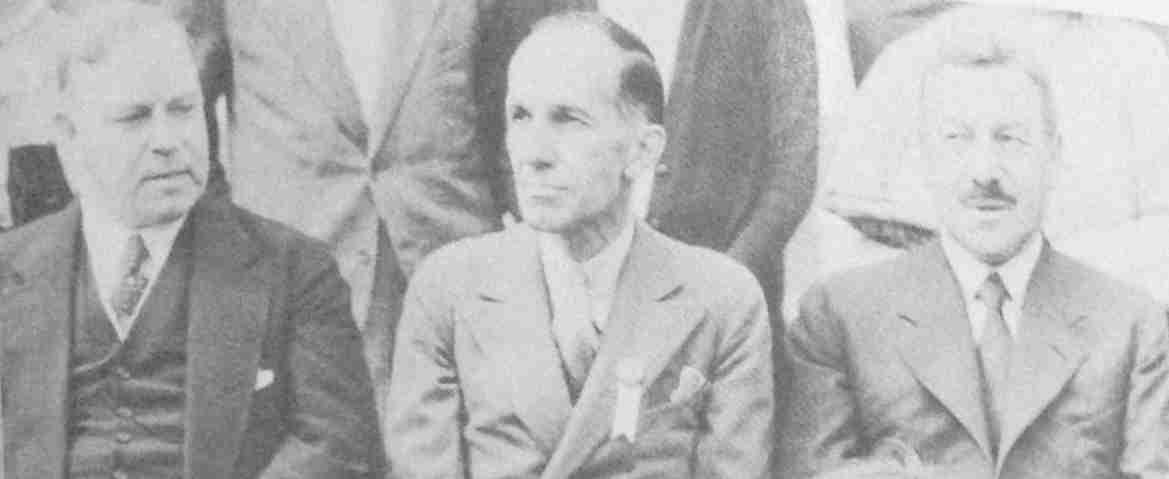
Mackenzie King, the author, and Sir Herbert Samuel at the Liberal Summer Conference, Port Hope, 1933
The members of the conference, however, came from all parts of Canada and included most of the leading figures in the Party. An effort was made to keep the gathering from being narrowly partisan; any liberal-minded person was welcome whatever his or her views. A number of visitors came from Great Britain and the United States: from the former, Sir Herbert Samuel, leader of the Liberal Parliamentary Party in Great Britain, and Professor T. E. Gregory of the University of London; and from the latter, Averell Harriman and Professor Raymond Moley, both of whom had recently joined President Roosevelt’s ‘brains trust’. Not the least active among the members of the conference were a number of able young people who later became well known in Canada, either in politics or in the public service. Included in this group were Madame Pierre Casgrain, Léon Mercier Gouin, Arnold Heeney, Paul Martin, and Norman Rogers. Mackenzie King was very faithful in his attendance at all the meetings for the whole week, but I could not help feeling that he came rather as a headmaster wanting to find out what the young people were up to. I know that I incurred his displeasure by my use of the word ‘planning’, by which I simply meant the importance of thinking ahead, rather than allowing policy to be the result of Gladstonian laissez faire. I did not mean the sort of planning that belongs to socialist philosophy. I recorded my impressions of the conference at the time in an enthusiastic letter to R. M. Barrington-Ward of The Times:
The Liberal Conference here had, I think, an importance out of all relation to the space it occupied in the public press, great though this was. The event exceeded my wildest expectations. The membership was very large with three hundred people from Victoria to Halifax; there was a very high level of intellectual effort on the part of the thirty odd speakers, lecturers and round table leaders, and a very efficient administration. This may sound very complacent but as a happy parent I may be forgiven for telling you about the virtues of an offspring. The really important thing about this conference was that it really did bring together for the first time in Canada the practical politician and the academic expert to discuss national problems on a carefully organized programme. It was extremely interesting and gratifying to see what real objectivity of view prevailed.
[Letter to R. M. Barrington-Ward, October 14, 1933.]
During this period, my public speeches took, inevitably, a political colouring, and led me sometimes into unfamiliar paths. I recall, for instance, an address to the Reform Club in Montreal on central banking (on which subject I did not claim to be an expert). Although on this occasion I spoke of a central bank in a banking community largely opposed to such an innovation, and trade with Russia to an audience strongly anti-communist in feeling, and our dependence on the Canadian West to an Eastern city group, the address was kindly, perhaps I should say mercifully, received. I wrote at the time:
Nothing is more out of place in this country today than the partisan spirit. I wish there were less of it in all political parties. One of my difficulties I may say, between ourselves, is that in my own political speeches I have now and then annoyed some of the more conventional Liberal M.P.’s who feel that in my detachment from strict party orthodoxy I am a dangerous fellow!
[Letter to E. R. Peacock, April 13, 1933.]
Of all of the political speeches I gave at this time—and I must have given scores—none received more publicity nor created a greater stir than the one I gave on March 24, 1933, to an audience in Windsor, Ontario. (I think I must have had this speech in mind in writing as I did in the above quotation.) My diary offers this laconic description: ‘Big meeting . . . in Tech. School. About 1,000 . . . I made pretty good speech—conciliatory towards third party. Think I succeeded in pleasing left and right wing persons present. Well received by audience. . . .’ I was deceived in part of this evaluation. The speech may have pleased the ‘left wing’, but it certainly annoyed the right. A fortnight afterwards my wife referred to it in a letter to Norman Lambert, the secretary of the National Liberal Federation:
The Windsor speech (you know in referring to it I always really think impersonally—after all, we are all working for a cause) has in some quarters created a most interesting response. Such men as Mowat Biggar, Harry Baldwin, Norman Rogers, Collingwood Reade and as I said Lapointe and Hanbury have all written about it, and endless people have spoken about it. Pouliot, as you know, on the other hand, resigned from the N.L.F. because of it. He has now had the full text and wrote a letter saying he wanted to see my husband when next he was in Ottawa. Bowman goes in almost daily putting excerpts of it in the ‘Citizen’ . . . the Lethbridge ‘Herald’ and others have taken it up. So there you are. We must wait and see what we can make it all amount to.
[Letter from Alice Massey to Norman Lambert, April 7, 1933.]
It might be of some interest to record what all the shouting was about. As I reread the text of ‘the Windsor speech’, which was reprinted in its entirety when reported by the local paper, the following passages stand out:
Liberalism stands up to the final and ultimate test which can be applied to any political party or any political creed. . . . It has nothing to do with the traditions of a party, nor what it has done in the past, nor in the great names which may have been associated with its history. The citizen is interested in a political party for only one reason, what it can do and what it is willing to do. Here and now in 1933 the object of all honest men and women engaged in political effort should be to do what lies within their power to make Canada a better place to live in. . . . That is the only test by which a party can honestly be judged.
It is the aim of the new Liberalism to attack the questions of the present hour relentlessly, honestly and thoroughly, and to offer a comprehensive plan of reconstruction . . . I am one of those who would like to see the closest teamwork between members of my party and those men and women in the third party who are prepared to co-operate. . . .
Let us remember that the word ‘radical’ can mean two things. In the English sense, a radical is a man who wishes to get to the root of the matter. In the sense in which the word is used in the United States a radical is a man who wishes to tear things up by the roots. The present day needs radicals in the former and constructive sense of the word. There is a place in the new Liberalism for all such men and women.
[Speech at Windsor, Ontario, March 24, 1933.]
Another of my speeches at which some of my political friends looked askance dealt with national economic policy in view of the recent failure of the World Economic Conference to achieve any of its stated objectives in furthering multilateral trade. It was delivered at the first of a still-continuing series of annual study conferences on public affairs at the Y.M.C.A. camp on Lake Couchiching, near Orillia. ‘W. L. G. [Grant] in the Chair’, my diary records, ‘& Stephen Leacock on the platform. About 400 people. . . .’ I said in part:
The World Economic Conference has shown that international settlements cannot be accomplished by international conferences. President F. D. Roosevelt has shown the only way forward, each nation putting its own house in order. We have underestimated the force of nationalist sentiment; but this does not mean that we will relapse into the old warring nationalism. A new nationalism, achieved by making each nation an efficient member of the society of nations, will still have a place for tariffs which will be conceived in different patterns from those of the past.
[Montreal Gazette, August 9, 1933.]
These, and other observations in a similar vein, provoked a gratifying editorial response—no public speaker is averse to press discussion of his efforts—and a stern and critical memorandum from Norman Lambert, who, I suppose, must have wondered if I had become a convert to the kind of economic nationalism then being preached by the Prime Minister, R. B. Bennett. ‘On the basis of political philosophy,’ he wrote, ‘you and Mr. Keynes are presenting the best case possible for a fascist government for Canada—not necessarily as autocratic as Italy’s, nor as insolent as Bennett’s, but in principle a centralized, more or less arbitrary administration which would perform functions such as the marketing of wheat, the importing of steel, cotton, wool, etc.’ I naturally rejected with some heat the suggestion that I had embraced fascism, involuntarily or otherwise:
I can’t relate some of your observations to my remarks. For one thing, I did not suggest that Canada can indulge in any illusions as to self-sufficiency; in fact I stated the contrary, but we have got to face for the next few years at least a world in which self-sufficiency, as one of the elements in the planned state, will be at least the aim of most nations and we must set our own house in order accordingly. I still feel that the freer international trade is, the better. But the freedom of trade is an unattainable ideal and economic internationalism has been officially abandoned by the contemporary world on the occasion of the recent London Conference. We are going to find a new integration of national units via the new planned nationalism. Ultimately internationalism, at least of a realistic kind, must triumph, but we are not going to arrive at it through international conferences, but through intelligent national planning; in other words the longest way round is the shortest way home.
[Letter to Norman Lambert, August 23, 1933.]
The task of rebuilding the national Liberal Party after its devastating defeat in 1930 became considerably more difficult and more challenging in 1933, when a new third party on the left, the Co-operative Commonwealth Federation, was formed. It made rapid headway and naturally threatened to pre-empt the position of our own party as the instrument of reform and reconstruction that most of us in the National Liberal Federation hoped it would become. ‘The political scene in Canada is at present extremely complicated,’ I wrote privately in April 1933, and went on to say:
On the right wing is, of course, the party at present in power. It is perplexed by its present leadership and somewhat embarrassed. The Government, I think, speaking quite dispassionately, can be said to have lost ground immeasurably in the last three years. In most constituencies on a simple Conservative-Liberal issue without the complications of a third party candidate the Liberal candidate, unless he were a complete dud, would win.
The complication in our politics just now, however, lies in the rapid growth of the new third party movement. It is incoherent and loosely organized and at present takes the form of a series of federated groups—agrarian, labour and radical intellectuals—under the clumsy name of the Co-operative Commonwealth Federation. Its Parliamentary leadership is largely in the hands of Westerners who belonged to the radical wing of the agrarian movement which had its cradle in Alberta in 1921. The movement is largely one of emotional protest against present conditions. It has sincerity and intelligence in its leadership although of a very doctrinaire type and is making very rapid headway, particularly on the prairies, but also in Ontario, both in the country and the towns. In so far as this movement has a policy it is that of state socialism. But I am convinced that when it defines its programme and announces a definite platform of a socialistic type there will be a considerable falling off in its following if such people can find a more moderate movement which can express both their sense of hardship and reformist zeal.
It is extremely unlikely in any event that the new third party at the next general election can form a government. On the other hand there is a very distinct possibility that it will be able to hold the balance of power. This would mean that a group of socialist radicals would have the opportunity of governing this country by dictating policies to the government of the day without the discomfort of being answerable to the electorate for what’s done. It is the task of the Liberal Party to determine whether this will be our fate or not. If it takes a course that shows little to distinguish it from the policies of the Conservative Party then the field is left clear for the formation of a formidable radical party which can point to both the historic parties as belonging equally to a conservative right wing. On the other hand, if organized Liberalism is prepared to move forward and take a fairly advanced position along the lines of rational reform it can carry with it, not only a certain number of disillusioned Conservatives, but also a very important element of the electorate of all parties including the new groups who are desirous of seeing a comprehensive plan for national reconstruction but are unwilling, if it can be avoided, to see this cast in a socialist mould.
In my opinion, a coalition in Canada, whatever its cause, would not discredit our radical party as your National Government has temporarily done in England in the case of the Labour Party, but would only consolidate it. In normal times this would not be so, but under present conditions a coalition would give the new movement in the mind of a sensitive public, the dignity of a popular and idealistic movement against reactionary forces and would lend it new force and power. The choice before a Liberal in that event—I mean the man of liberal mind in all parties—would be reaction on the one hand and anarchy on the other. The Liberal Party, in that event, would probably dwindle to a position similar to that of the English Liberal Party possessing little more than a ‘nuisance value’. It would certainly remain a force but not sufficiently strong to be a constructive force. In fact none of the three parties would be able to govern. . . .
I may say that the body of which I am head—the National Liberal Federation—represents the Liberal rank and file, the non-politicians, the laymen of the party, and it is their view (as distinguished from the rather narrow orthodoxy of some of the politicians) which is counting for more and more in the party’s affairs. I think this letter represents this attitude of mind.
[Letter to E. R. Peacock, April 13, 1933.]
A few months later I wrote:
Politics in Canada at the present moment are—shall I say?—stuffy. They need fresh air, the introduction of a new and better technique and the application of fresh thinking. The party which at present holds office in the federal field seems completely sterile. Our new third party presents a programme combining vaguely expressed ideals and a measure of drastic socialistic experiment. In Canadian Liberalism I honestly believe lies a real hope, but we like all old parties are troubled first by our die-hard element. This we could well afford to slough off, and when we do we will be more likely to retain the more progressively-minded Liberals who are at the moment a bit detached in their thinking. At the moment the government is continuing to lose prestige and I think the socialist groups have less influence now than they had six months ago.
[Letter to Lord Howard of Penrith, October 17, 1933.]
By the autumn of 1934 it became evident that the moment of truth was close at hand. The Bennett government had been in power for over four years; a general election could no longer be postponed. A pending series of by-elections found the Conservatives in considerable disarray and our own forces confident of victory:
Politics here are very active now with five federal by-elections on the 24th of this month. I think we shall carry four of them, possibly five. If we make a clean sweep it is difficult to see how Bennett can carry on, but he is strangely impervious to public feeling, and it is hard to say what he will do. His position is now complicated by a piece of insurgency in his own cabinet. His Minister of Trade and Commerce, Stevens, is exploiting to the limit the findings of a Parliamentary Committee for which he, Stevens, is mainly responsible, to inquire into various industrial abuses [known as the Price Spreads Committee]. The abuses existed without doubt (the present Government having a very large share of responsibility in their perpetuation in the last four years), but Stevens can hardly be acquitted of using the technique of the demagogue in his handling of the problem. The Parliamentary inquiry has the air of a police court case with Stevens himself acting as police constable, judge, jury and executioner. The Parliamentary Committee has now been translated into a Royal Commission with Stevens as its Chairman and presumably the same atmosphere will be perpetuated. [Stevens in the ensuing campaign exploited the inquiry into price spreads and, having resigned from the Cabinet, led a group of candidates known as the Reconstruction Party in the 1935 election.] Bennett, before he went away, showed some desire to repress his recalcitrant Minister, but apparently Stevens is a bit too strong for him and the quarrel between the two will probably continue behind a false façade of unanimity until the general election. In the meantime the issue has greatly weakened the Conservative position in the country.
[Letter to P. J. Noel-Baker[2], September 15, 1934.]
Of the five seats at stake in the September 24 by-elections, four were won by the Liberal Party. Dissolution followed. ‘We are just about to swing into a General Election campaign,’ I wrote to Esme Howard in February 1935:
I shall be delighted when it is all over. Our Prime Minister, as you will have seen, is as versatile as ever, and has now discovered that he has always been an ardent reformer and as a self-appointed St. George is out to slay the dragon of ‘uncontrolled capitalism’, of which until a few months ago he was the leading defender. His démarche has created a diversion in our political scene and temporarily brought comfort to the disordered ranks of the Tories. I have no doubt that when election day comes the voter will leave reform to those who have always believed in it and that there will be a Liberal Government again in Canada. All this may sound very partisan; if so forgive me. We need reform badly enough in Canada. The social programme which Bennett has introduced will bring us just about up to where Great Britain was in 1912, with a great many of the fundamental things untouched. On these we Liberals propose to have something to say before polling day comes round.
[Letter to Lord Howard of Penrith, February 22, 1935.]
|
Later the Rt. Hon. P. J. Noel-Baker, M.P. |
The election campaign of 1935 was a very different affair from the contest of ten years before. The Liberal Party possessed a strong organization and a fighting spirit. The Leader had thrown off his previous listlessness and indecision. Among the candidates were men of experience or promise. I was especially interested in one candidate. C. D. Howe was a new recruit to politics when I first met him. Several times in the months before the election I had been impressed by his ability and by the absence from his speeches of political mannerisms and clichés. He struck me as a man who wanted to get things done with the least amount of talk. (I was delighted when he agreed to run, and even more delighted when, immediately after the results were known, Mackenzie King told me on the telephone that I was responsible for the choice of Howe as a cabinet minister.)
A fortnight before polling day I reported on the progress of the campaign in a letter to Mackenzie King:
The campaign here [I wrote from Toronto] is on the whole going well but we need a more vigorous fighting spirit on the part of the candidates and workers. The existing slackness is due to the long duration of the campaign, secondly to the formidable fight which Bennett is making, and thirdly to the problem of finance, which is pressing heavily on a good many candidates despite the fact that everything is being done to meet the situation.
Our feeling here is that Bennett is very definitely our major enemy. Stevens seems to be losing ground, although in some constituencies his candidates are formidable. We had a meeting of 30-35 candidates here yesterday and impressed on them the necessity of concentrating on three subjects in the concluding days of the campaign: (1) the menace of Bennett and the miserable prospect which five more years of his opportunism and one-man rule would mean; (2) the necessity of answering Tory misrepresentations on the subject of trade and fiscal policies. The tariff seems to have become the major issue in the campaign and the most flagrant mis-statements are being made in Tory propaganda about our attitude to the Empire Trade Agreements, Canadian-Japanese trade, etc. The Tories are using apparently $10. to our $1. in their broadcasting and general publicity campaign in the press and elsewhere. This fact in itself might be used against them. (3) We feel that probably the dominant note in the concluding days should be that the alternatives before the electorate are a Liberal Government or a patchwork of insincere alliances between all the other parties and groups with Bennett, the arch-opportunist, controlling the levers. This idea is incorporated in the slogan ‘King or Chaos’ which we are using widely.
[Letter to Mackenzie King, October 1, 1935.]
‘King or Chaos’, though perhaps not very flattering to the leader, had an element of real truth in it, and I think it played no unimportant part in the campaign. On October 5, 1935, I saw Mackenzie King aboard his private car in order to report to the Leader, as chairman of the party organization, and to receive whatever instructions he cared to give me. I hadn’t seen him for several weeks. My visit that morning was most unwelcome and gave rise to a conversation that was far from pleasant, and the atmosphere was not sweetened by the fact that King’s valet had wakened him on my arrival. I was accused of invading his privacy on numerous occasions, even to the point of affecting his health; of making suggestions which were unacceptable; of being generally wrong in my views and not stressing sufficiently in the campaign publicity his own qualities as leader; of being moved in my work in the campaign by self-interest. After Mackenzie King’s outburst on this occasion, I felt it better that we should not meet again for a while, and I didn’t see him until after the election on October 14.
I was impressed, as I had been ten years earlier, with the far too important part that money plays in our elections. The sums expended by the national parties in advertising in the newspapers and on the hoardings, and in broadcasting from local stations (there could be no payment for time on the national system) were prodigious.
By October 15 it was all over. The Liberal Party had 171 seats; the Conservatives 39; the new C.C.F. and Social Credit parties shared the remainder with various Independents. On October 30, Mackenzie King, Prime Minister once more, offered me the appointment of High Commissioner for Canada in the United Kingdom, which had been cancelled in 1930. I accepted it with satisfaction.
Alice and I left for London in November. We travelled to Quebec in the private car of the Prime Minister, who was going to Quebec to welcome the new Governor-General, Lord Tweedsmuir, and attend his swearing-in. On the way from Ottawa it occurred to someone in the official party that high commissioners had to be sworn in too; so a Bible was produced, and, while the train was rocking from side to side, I took the necessary oath. Afterwards Mackenzie King wrote in the fly-leaf of the book the following verse (II Chronicles, 15:7): ‘Be ye strong therefore, and let not your hands be weak: for your work shall be rewarded.’
It is the duty of anyone holding the post of High Commissioner for Canada in Great Britain to harmonize as best he can two principles. The first of these is that, as the high commissioner is the representative of a nation, it is his duty to promote Canadian interests and protect Canadian rights. He has to stand on his own feet in London. The second is that the function of a Canadian representative must always be performed in the closest possible co-operation with the government of Great Britain. He must never forget that we are members of one family of nations. The key to the operation of Canada House, I felt very strongly, was the reconciliation of these two principles: a task never more difficult than during the period of transition when the Canada House of the relatively simple days grew into the large, highly organized establishment I left behind in 1946.
When I took up my post in London in 1935, I was lucky to find as the two senior members of the staff Georges Vanier and L. B. Pearson—able colleagues and warm friends, both of them. No chief could have been more grateful than I was for what they did. My good luck held all through my time at Canada House—I was fortunate in having a most able staff. Frederic Hudd served for many years as Deputy High Commissioner and gave to his post great loyalty and very special ability. Charles Ritchie and George Ignatieff were, each of them, my personal assistants for some time. The former has a brilliant mind of which I was aware at the beginning; this has been proved in subsequent years. I was often grateful for his gifts as a raconteur. The latter brought to Canada the finest traditions of a great Russian family; he adapted himself perfectly to his Canadian environment and has become, as I have reason to know well, a very distinguished member of our foreign service.
I found much to do. Anyone in such a post as that of high commissioner must inevitably make changes in accordance with his own views, while preserving the broad traditions of the office. Canada House when I took charge of it had grown without much planning from very modest beginnings. The High Commissioner had been, in all essentials, simply the personal representative of the Prime Minister, and the mechanism of the office, even as it became more complicated, bore little resemblance to that of a diplomatic mission. The contacts between Ottawa and the High Commissioner’s Office took the form of personal letters between the High Commissioner and the Prime Minister, so that the office possessed a political atmosphere. R. B. Bennett’s interpretation of the post emphasized its political character. Members of parties other than the party in power could never have felt so free to invoke the good offices of the establishment as those who belonged to that from which the High Commissioner received his appointment. A change of government nearly always meant, as it did in the United States diplomatic service, the automatic submission by the head of the mission of his resignation.
Although I had been involved in politics before my appointment, I felt it my duty to run Canada House as a non-political office, emphasizing this in every possible way and demonstrating as far as I could the essential fact that the High Commissioner, although under the orders of the government of the day, represented the Canadian public as a whole, whose servant he was. I remember that on one occasion Alice and I entertained the leader of the Conservative opposition in our rooms at the Dorchester Hotel while the Prime Minister was occupying quarters of his own at the end of the hall. This, I may say, was entirely in accordance with Mackenzie King’s own views.
When I arrived, four provinces were represented in London by agents-general, two of them being absent. There were two attitudes towards the functions of such officials. One was that they had no duties to perform that could not be better done by the High Commissioner’s office. The other view was that an agent-general could render useful service to persons from his province, and could helpfully promote trade, amplifying what was done by federal officers in co-operation with them. To this latter view I subscribed. Official contacts with the British government had naturally to be in the hands of the High Commissioner’s office. But the relations between the agents-general and the High Commissioner ought to be as close and friendly as possible. I was surprised to be told by the Agent-General for Quebec, after I had arrived in London, that he had never been given any attention from Canada House during the previous régime.
I thought it fitting to have a constable of the Royal Canadian Mounted Police assigned for duty at Canada House. There is, of course, no better symbol of Canada. I achieved this result through a correspondence with Ottawa lasting eighteen months.
After I commenced my work at Canada House I was very conscious of the family feeling that prevailed in London between the dominions, as we called them then, and the United Kingdom. As high commissioners, we were generally preserved from the precision of protocol. Foreign countries approached the Government of the United Kingdom through the Foreign Office. We were at liberty, by tradition, to make contact when it was necessary with any minister of the Crown. When it came to questions of precedence, the position was anomalous. We were supposed to rank after secretaries of state and before other ministers, but the occasions when these formalities were invoked were very rare, and far more important than the question of status was the informal relationship with the United Kingdom that we enjoyed.
In the 1930s thought was given in some quarters to giving high commissioners the designation ‘ambassador’. This would have been regrettable and, in fact, almost impossible, because the Sovereign cannot very well accredit a representative to himself. It would have been regrettable because it would have given the Dominions a status resembling that of a foreign state. This might well have been relished by those whose attitude to the Commonwealth was unsympathetic or even unfriendly. We were, however, preserved from this anomaly. It is important to avoid the apparently innocent changes that serve to break down the distinction between a Commonwealth country and a foreign nation. A case in point was provided by instructions that I received in November 1936, to make joint representations with the American ambassador to the Foreign Secretary, in connection with a treaty. Anthony Eden was, quite rightly, unwilling to receive a Dominion representative and a foreign ambassador together on a formal occasion, and the joint meeting did not take place. We might well have avoided the use of the phrase ‘corps diplomatique’ applied to both foreign nations and Commonwealth countries indiscriminately—the word ‘diplomat’ implies the status of a foreign country. These matters of nomenclature are not to be disregarded—they have their importance in their effect on our thinking.
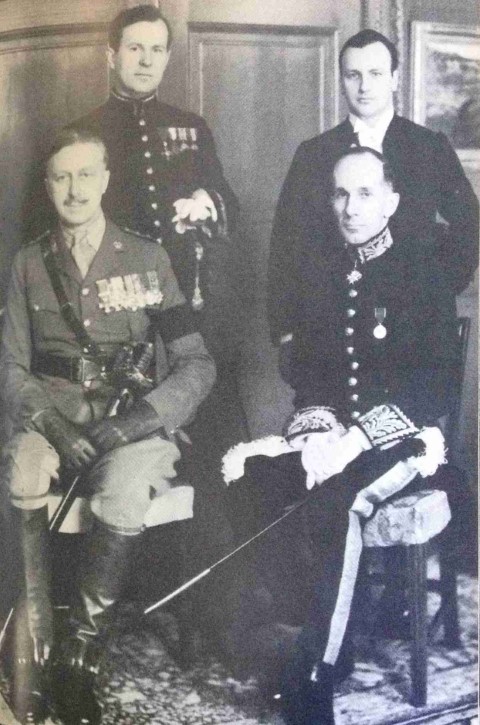
The High Commissioner with senior members of his staff Major-General Georges Vanier, Mr. Lester Pearson and Mr. Ross McLean. London, 1936
Soon after my arrival at Canada House, I recorded in my correspondence some of the difficulties and opportunities that presented themselves. I wrote at once to my Prime Minister:
I am now taking all the time I can to study the operations of Canada House and to get familiar with the personnel and their functions. There is considerable overlapping and adjustments undoubtedly can be made. . . . One of the difficulties inherent in the work of the office is the tendency to exploit its good offices on the part of individuals and organizations. I can see how wary one has to be. As you said so rightly, Canada must stand on her own feet in all things, and one has to be on one’s guard all the time against embarrassing commitments of all kinds.
[Letter to Mackenzie King, November 29, 1935.]
Early in 1936 I wrote:
I am tremendously busy and enormously interested in all the phases of this amazing job. It is great fun to take on a piece of work about which you have speculated in the abstract, and thus put your ideas to a practical test. I could not have taken on the work at a better time for there is a spate of activities of all kinds.
One interesting point is that what might be called the ‘diplomatic’ side of the work in this Office has grown tremendously in the last two months. The Sanctions issue alone is responsible for a great deal of activity of one kind or another; and the Naval Conference, of course, adds its own quota. Fortunately, I have Pearson on my staff now. His duties are almost entirely diplomatic, and he is, as you know, extremely able.
[Letter to Brooke Claxton, January 17, 1936.]
A few weeks later:
I find myself as tremendously busy as I have been ever since I arrived—busier than ever in fact. I cannot complain that my work has no variety: the Naval Conference one minute, and then the problem of wheat marketing the next, endless interviews and correspondence on the operation of Sanctions, the sale of Canadian bacon, publicity for Canada in Great Britain, Customs problems, Trans-Atlantic aviation and Trans-Pacific shipping, as well as individual questions of all kinds, and so on ad infinitum. It is, of course, just the kind of work I love, and I am glad there is lots of it.
[Letter to W. E. Rundle, February 3, 1936.]
To A. J. Glazebrook I wrote in March 1936:
This post has the merit of great flexibility. By that I mean that the High Commissioner of the day is pretty sure in the nature of things to concentrate on that side of the work which seems at the moment most important. The job is much less bound by definite tradition than a purely diplomatic post and this lends great interest to the work. I have endeavoured recently to do something which apparently is more or less an innovation, and that is to get into direct touch with provincial centres. Alice and I paid a visit to South Wales and to Bristol a few weeks ago, which was really intensely interesting. After all, one of the risks of any representational post abroad is that one should be unduly concerned with the capital, and to neglect the immensely important communities which lie outside it.
[Letter to A. J. Glazebrook, March 23, 1936.]
And to a Canadian correspondent in April:
There is a spate of interesting work here all the time. I am always waiting for the lifting of the pressure of activities which belong essentially to the first year so that I can do various things that at present there is not time for, but I have come to the conclusion that the struggle to get time to do things is inherent in the job. One problem is that the office of High Commissioner has an accretion of barnacles which belong to a period through which we have really passed. Various duties and functions which although hardly appropriate to the office still present themselves. However, a job which changes with the development of the Empire itself has its own fascination, and one of the great merits of the post is that it is so flexible.
[Letter to G. M. Smith, April 25, 1936.]
As the foregoing correspondence indicates, the work of the high commissionership in relation to diplomatic and foreign policy came quickly, if unexpectedly, to transcend the rest in urgency and importance. I had not been in London more than six months when Hitler made his fateful decision to enter the Rhineland. I recorded my impressions of the crisis in my diary on March 14:
The influence of France is growing stronger every day. The Foreign Office is placing a narrow & precise interpretation on British obligation which does not seem to be modified by British statesmanship. The letter of the contracts is emphasized to the neglect of the spirit. This is the moment when the point of view of the Dominions is of the greatest importance. Te Water [High Commissioner for South Africa] has received from his government a document [of which he sent me a copy] apparently drafted by Smuts calling for a constructive policy & dissociating S. Africa from the legalistic attitude which may well involve the country in war. We have suffered enough in the past from French vindictiveness against Germany & French pedantry in the interpretation of contracts.
I cabled Ottawa to urge the Government to let me have its views on the crisis, thinking, as I noted at the time, ‘that they too would help to counteract the French influence at present so powerful’. My message read as follows:
I am only now in position to give appreciation of situation here. I feel strongly that there is a tendency here to accept French view that condemnation of Germany is not sufficient and that some further German conciliatory action is necessary as a prelude to negotiations more particularly the withdrawal of German forces in whole or in part from the Rhineland. This tendency has disclosed itself in a disposition on the part of certain Ministers to accept legalistic and French-inspired interpretations of Locarno obligations with all that this implies and in House of Commons by a movement led by Austen Chamberlain, Churchill and Amery, firmly to support French. This development which has, of course, far-reaching and dangerous implications is encouraged to some extent by the traditional view that Great Britain must never default on her obligations; secondly, by a feeling that failure to support France now means end of collective system, and thirdly, by impatience at Germany’s refusal to take any action which would make it easier for Great Britain to bring Germans and French together for negotiations.
I feel strongly that I should be in a position to state to British Ministers the Canadian attitude at this time and that such expression would be most useful as an encouragement to moderate opinion in Cabinet. Do you feel that it would be useful if in answer to a question in our House of Commons a statement giving Canadian view could be made? Do not wish to exaggerate dangers of situation, but I think it would be unwise not to take into account for the present trend of developments.
[Cable to Canadian Secretary of State for External Affairs (Mackenzie King) March 13, 1936.]
For my pains I received the following reply, apparently drafted by King himself:
My colleagues and I very strongly of opinion that any important communication between British Government and Canadian Government should be direct in form of communication from Prime Minister to Prime Minister or between Secretary of State for Dominions and Secretary of State for External Affairs as has been customary in past and should not be through High Commissioner. This is the only way in which we can possibly have opportunity required collectively to consider and state attitude and policy and which will ensure full responsibility of British as well as Canadian Government with respect to any statements of policy or position and avoid all possibility of misunderstanding as to what has been said or meant in any verbal discussions.
Regarding your enquiry whether question in House of Commons eliciting Canadian view might not be useful, such a course would in our opinion only serve to provoke controversy from one end of Canada to the other. Our task in interest alike of Empire and of Canada is to keep Canada united. We believe this can best be done by avoiding insofar as may be possible any premature statement with respect to a situation arising out of the Locarno Treaty.
As Canada definitely declined to become a party to the Locarno Treaty of Mutual Guarantee, we consider it would be inappropriate to seek to advise United Kingdom Government as to interpretation to be made of its provisions under the present circumstances.
[Cable from Secretary of State for External Affairs, March 14, 1936.]
This response vexed me greatly. I wrote in my diary upon receiving it:
Canada seems to have resolved to be silent & await the consequences on the ground that the affair is not hers. But she may be involved just the same in the cataclysm which an unwise policy may lead G.B. into. Obscurantism is an unlovely policy at all times. . . . Who knows that a word said by a Government of a British Dominion with calmness and the perspective lent by distance and relative detachment might not in a crisis like the present when there seems to be an almost even balance between broad and narrow policies . . . tip the scales in favour of the former? The only thing is to obey orders at the present moment & hope for the best.
[Diary entry, March 14, 1936.]
It would be gratifying to be able to record that this episode was an unheroic exception to the usual attitude of the Canadian government in foreign affairs at this period. Unhappily, it was all too typical. Never during these years did our position err on the side of boldness. Canada’s relation to the League of Nations cannot inspire much pride in Canadian breasts. I was one of our delegates to the special assembly of the League which opened at Geneva on June 30, 1936. There could be no more superb setting for such a meeting. The charm of the old city, the lovely lake, the splendour of the mountains that rise behind it—all this gave one a wealth of beauty created by nature and man; in depressing contrast were the frustration and disillusionment generated in the sessions as they went on from day to day. An episode took place at one such meeting at Geneva that served to illustrate the background of tragedy. We heard a shout in the gallery from a young man who was, we heard later, a Czech, and then the crack of a pistol—he had shot himself in a moment of despair.
The main question before the 1936 assembly was the Italian attack on Abyssinia. The Emperor was there himself and spoke with a quiet dignity that was intensely moving. The representatives of nearly all the other nations who were members of the League expressed views on behalf of their governments (and Canada was no exception) that should bring no satisfaction to the persons involved.
My colleague on the Canadian delegation was Philippe Roy, Canadian minister in Paris. I had been told by Ottawa that I would be expected to speak for Canada on this occasion, and that this had been made clear to my colleague, who informed me that he was asked to be senior delegate but that nothing had been said to him as to who should be spokesman. We had apparently received instructions from different persons and were left to settle the matter on the spot. When we wired Ottawa for clarification of this rather confused situation, the reply stated that Philippe Roy was to be the senior delegate but that I should speak in the assembly. The solution of the problem was ingenious—Solomon could not have done better—but it did not simplify the personal relations between us.
My experience as a delegate to the annual assembly of the League of Nations in September 1937 was no more encouraging. The senior members of our delegation were Senator Dandurand and J. L. Ilsley, Minister of National Revenue. The choice of League committees left to me fell between Committee No. 5 (Opium, Child Welfare, etc.) and Committee No. 4 (Budget and League Administration). I chose the latter because I thought it would present a perspective of League activities. So it did, more or less, but the subjects lay well outside my special interests. In the absence of any instructions from Ottawa, I had no contribution whatever to make. These factors doubtless helped to produce the unmistakable note of despondency in my diary entries for the event:
Opening of League Assembly . . . Meeting of British delegation at Carleton Parc Hotel . . . What a difference between the beautifully organized and perfectly briefed delegation from G.B. & our own haphazard arrangements. Our only prevailing idea seems to be to keep out of trouble. . . .
[Diary entry, September 13, 1937.]
. . . I am increasingly conscious of the futility of my existence in Geneva. . . . In fact I cannot help feeling that I might more appropriately hold a visitor’s ticket . . . than a delegate’s. This applies more or less to the delegation as a whole. Dandurand enjoys playing about with European byways but nothing is further from his mind than a serious preoccupation in the work of the League. Ilsley although his presence on the Economic Committee makes possible an occasional word in the debate feels almost as I do about the negative position taken by Canada & the world of make-believe in which we live while here. . . .
The real difficulty is the state of funk in which the Govt. or rather the P.M. lives vis-à-vis international affairs. Here is a good example. Eden asked Dandurand if Canada would take the chairmanship of the Advisory Committee of 23 (1933) which is to be reconvened on the subject of the Sino-Jap. conflict. He cabled Ottawa. The answer was an unequivocal ‘no’. Ottawa also said if our membership could be assigned to Australia or some other state they would have no objection provided Dandurand and Ilsley agreed. . . .
We under the present administration have decided to maintain an absolutely negative attitude in international affairs even when an opportunity offers itself to help in an important piece of international conciliation.
[Diary entry, September 21, 1937.]
. . . In the evening dinner of Canadian delegation . . . a great success—probably our most important contribution to the League this Assembly!
[Diary entry, September 23, 1937.]
We were always quite prepared to accept membership on important committees, but Canadian delegations, under the instructions they received before leaving home, were almost morbidly anxious to avoid ‘commitments’—wicked word—and the effect we had on the deliberations of the League was paltry, even negligible. I cannot help quoting some reflections recorded in 1937 by Hume Wrong of the Department of External Affairs, referring to an international conference at which he represented Canada:
We should not be here at all, as our instructions should be summarised as: say nothing and do nothing unless you can undo something of what was done at Geneva. . . .
Dining alone this evening I developed a plan for the perfect representation of Canada at Conferences. Our delegate would have a name, even a photograph; a distinguished record, even an actual secretary—but he would have no corporeal existence and no one would ever notice that he was not there.
Ottawa found co-operation in the Commonwealth as unpalatable as commitments outside it. I can recall an illustration. In 1938 the United Kingdom government appointed a royal commission to examine and report on problems in the British West Indies (it was known as the West India Royal Commission). As Canada had close relations with these Caribbean colonies, it seemed reasonable that the Commission should include at least one Canadian member. Also such a personal link might encourage Canada to take a greater interest in West Indian problems. I spoke about this to Malcolm MacDonald, who at that time was the Secretary of State for Dominion Affairs, and he warmly agreed with the suggestion and asked me if I could get my government to nominate a Canadian member. I wrote to Ottawa, after which weeks of silence passed. By the time I received a letter from External Affairs suggesting the name of a Canadian member, it was too late for the Dominions Office to act, as the Commission was complete. Perhaps this was just as well, as the person proposed would have been quite unsuitable for the post.
The obvious and most convenient method for the high commissioners of the Dominions to receive information from the British government on the international crisis and, in their turn, to convey to the British government the views of their own governments, was to meet together with the Secretary of State for Dominion Affairs. During the last months of 1935 and throughout 1936 we met very frequently in this manner to discuss the situations arising out of Mussolini’s war in Abyssinia and Hitler’s occupation of the Rhineland. I was not always certain that we were kept as fully informed as we might have been, and this bore out my early reaction to the announcement of the creation of the Dominions Office in 1925, when I had written to Geoffrey Dawson of The Times: ‘. . . one essential step towards better understanding is to bring the Dominion representatives into direct contact with the Foreign Office itself. An intermediate department, however able its staff or well-intentioned its head, will serve only to cause circumlocution, delays and misunderstandings.’ (Letter to Geoffrey Dawson, March 4, 1925.) So, indeed, a decade later, it proved to be. On March 17, 1936, my diary records:
. . . two hour meeting of High Commissioners at D. office. The machinery of the Dominions Office instead of keeping us in close touch with foreign crises at present seems somehow to provide an obstacle or rather delay in getting news which we could get & sometimes do receive informally from F.O. What good purpose does the Dominions Office serve? Could not its functions be better performed by a Dominions Section of the Foreign Office with the Secretary of State [being known as] the Secretary of State for Foreign & Dominions Affairs?
And on April 2: ‘Meeting of H.C.’s at D. Office on Rhineland crisis. (These meetings are too formal & seem too far removed from the actual sources of knowledge.)’ However, many, and perhaps a majority, of our meetings were extremely informative. ‘High Commissioners’ meeting . . . 4-7 p.m.,’ my diary records on October 11, 1936. ‘A most useful session. . . .’
The real obstacle to making the best use of these gatherings was not in London at all, but in Ottawa. I had known, before taking up the High Commissioner’s post, of Mackenzie King’s extreme apprehension lest his representative at London should fall too much under the influence of an ‘imperial’ point of view; during the 1920s he had actually gone so far as to forbid P. C. Larkin, the High Commissioner at that time, to attend any collective meeting of high commissioners, but had instructed him always to visit the Prime Minister, the Foreign Secretary or the Dominions Secretary on his own! I could hardly imagine that these absurd inhibitions would persist as strongly ten years afterwards, but, just to make sure there was no misunderstanding, I took an early opportunity to write to my Prime Minister on the subject:
The other Dominion High Commissioners and I have been invited on two or three occasions to go to the Foreign Office to receive first-hand information on the international situation when matters have become crucial. . . . These conversations at the Foreign Office are of the most informal nature and not in any way organised, and only occur at long and quite irregular intervals. A regular conference of High Commissioners might unconsciously develop characteristics contrary to the spirit of the Commonwealth as it has been accepted and exists. I am always conscious of the principle which you, as a matter of fact, expressed in our last conversation in Canada, that the individual entity of the Dominion must be zealously preserved not only in its extra-Imperial but in its intra-Imperial relations. This truth, I feel, is entirely accepted in official circles here, although one occasionally meets the diehards amongst retired people or in the commercial community whose conception of the Empire is still suggestive of the 19th century.
[Letter to Mackenzie King, January 9, 1936.]
On this foundation I thought the subject might be allowed to rest. But I was in error. Within a few months I was the recipient of an outburst of reproofs and warnings from the East Block alleging, even before the facts had been ascertained, that I had been guilty of participating in ‘consultation’ without authorization. On May 1, 1936, I received a telegram from Ottawa which read in part:
Canadian press cable from London states that Foreign Secretary yesterday met representatives of Dominions in conference dealing with attitude to be adopted towards Sanctions against Italy, Canadian High Commissioner being present. Despatch further refers to Foreign Secretary’s statement regarding consulting the Dominions before British Government announced policy towards League and added it was expected such consultation would be carried out through High Commissioners in London. . . .
Meetings such as referred to in despatch under reference convey disturbing and erroneous impression in Canada and will make it necessary if question is raised in the House for me to state our position clearly. Consultation between Foreign Secretary and all High Commissioners is further liable to implication collective decision. We would not agree to development of an Imperial Council on foreign affairs sitting in London.
This was followed by another telegram which ran as follows:
Please convey to Secretary of State for Dominion Affairs for the information also of Foreign Secretary my cablegram 119 [see above] of this date stating it was sent after consideration Cabinet as a whole . . .
I replied to Ottawa in two telegrams as follows:
Gravely disturbed over your telegram 119 which seems to be based either on a misunderstanding or on a misleading press despatch. Conversation with Foreign Secretary referred to, irrespective of what any Canadian press correspondent might say, possessed no significance beyond a desire on the Foreign Secretary’s part informally to give information to High Commissioners on attitude of his Government towards such matters as questionnaire to German Government, present state of negotiations with Egyptian Government and forthcoming meeting of League Council. Would have cabled report of conversation if anything new or of importance had arisen; for instance, if Foreign Secretary had given information that British Government had decided to propose either raising or retention of sanctions I would have cabled you at once, although information of this kind would also have been cabled direct from Dominions Office. No question was asked on Friday as to Canadian policy in respect of any of above questions or any other matter, and naturally no reference was made by me to Canadian policy. I would also add that Friday’s conversation bore no relation whatever to Foreign Secretary’s statement in House previous day regarding consultation with Dominions. Hope you will agree there is no cause for uneasiness arising out of conversation in question and that important principles on which you rightly lay stress have in no way been prejudiced. . . .
The second telegram reads as follows:
With regard to occasional conversations between High Commissioners and Foreign Secretary I agree very important that such meetings should not be periodic, organized or formal in character and in fact some weeks ago stated my views to this effect. For your information I may say that since New Year six of these meetings have taken place and in each case the meeting was called merely to enable Foreign Secretary to give High Commissioners information on the foreign situation and United Kingdom attitude thereto.
Fully understand views expressed your cablegram 119.
To say, as I had done, that I understood the Prime Minister’s point of view was not to say that I shared it. My private thoughts I confided to my diary:
A rotten day begun by long cables from Ottawa assuming from irresponsible press despatches that I had concurred & participated in ‘consultations’ with F.O. as to foreign policy & condemning me unheard without any effort to ascertain the facts which were contrary to their apprehensions. Ottawa is apparently panic-stricken & seeks to protect itself by an ostrich-like policy of not even wanting to know what is going on. I agree with the principle of Dominion autonomy in all things as much as any other Canadian but not in my experience has there been the slightest risk of its being violated or any intention on the part of responsible people to violate it. Sometimes I feel that Ottawa really wishes its H.C. to express himself by (a) dignified inactivity and (b) an active distrust of British policy.
However, patience and tolerance are important qualities to cultivate in public life.
[Diary entry, May 11, 1936.]
Patience and tolerance I needed in abundance during the conversations I had with Mackenzie King on the work of the High Commissioner in London. During the first of these, in 1936, I was told by the Prime Minister that I was not to attend any meetings in which the high commissioners forgathered informally with the Secretary of State for Dominion Affairs, or, for that matter, with any other minister, for the purpose of receiving confidential information on the important subjects of the moment. I received these instructions with dismay. When I observed that they would limit the amount of information that I could pass on to Ottawa, Mackenzie King said that I could get this by seeing the Secretary of State alone. He referred to such meetings as ‘consultations’ and exhibited his usual morbid fear that by some remote chance Canada might be committed to some course of action which her government alone should determine. I very reluctantly—and, I am afraid, not very amicably—accepted these instructions. Later I explained them confidentially to the Secretary of State for Dominion Affairs (Malcolm MacDonald). On one or two occasions when, according to the orders I had received, I arranged to see him, overworked though he was, separately, to hear from him alone what he had already told my colleagues, I found myself sitting in the ante-room when they came out! This presented a situation either humiliating or amusing, depending on one’s sense of humour. When I was given the Prime Minister’s views on this subject, I was told that if special and unusual circumstances seemed to justify it, I could attend meetings with the Secretary of State and the other high commissioners. Later on, in 1938, when the war-clouds commenced to gather and such sessions became far more frequent, I took full advantage of this and attended all of them. On one occasion I received a cable to the effect that it had been reported in the press that the High Commissioner for Canada had apparently not been present at a meeting at the Dominions Office on a certain date. Was this correct? I replied that I had attended all the meetings for some time. This, I have no doubt, was a matter of some satisfaction to the government, whose point of view had seemingly been reversed in the intervening period, but of this I had not been informed.
What I have just described was a fantastic situation. I was very fortunate in that the Secretary of State for Dominion Affairs at the time was a most understanding man, with whom it was always a pleasure to work. I could explain my problem to Malcolm MacDonald without embarrassment, and he very generously undertook to meet the problem as best he could. He was not, I gathered, unaware of the temperament that at this time presided over Parliament Hill.
In the summer of 1937 I had a second, and much fuller, discussion with Mackenzie King on the nature of my work in London. He had come to my house at 12 Hyde Park Gardens to have a chat before leaving London. As we sat on the sofa in my study, I thought I would take advantage of the chance (such opportunities didn’t occur very frequently) to discuss with the Prime Minister certain aspects of my job in London about which I was troubled. It had already become apparent to me that relations between Canada House and the East Block in Ottawa had for some reason become strained; I felt that I was accordingly not rendering the service that I might otherwise have done—and I was anxious to get to the bottom of it. My diary records our conversation:
I then dealt with certain broad principles relating to my work in London. I was not content, so I told him, to be regarded simply as ‘an official who went to levees & gave dinner parties’. He concurred in this because he knew that the Can. people were a simple democracy that didn’t care for such things. That wasn’t my point & I don’t agree at all with K’s approach to such matters. The entertainment of the 2000 Canadians at 12 Hyde Pk Gardens in May & June 1937 was a constructive part of our job but it is only a secondary part of the job & I told K that. Wasn’t the post in its essential functions ‘ambassadorial’? This was a term he had himself used in this connection. On this occasion he took violent exception to it . . . and accused me of trying to glorify my personal position. . . .
My object in talking about my work this evening was to find out why I was not being used more as a representative of Canada vis-à-vis the U.K. Government as my colleagues the other High Commissioners were. Why the restrictions on my functions? I used the word ‘ambassadorial’ in its right sense. He chose to apply it wrongly and gave me a lecture—quite unnecessarily—on the difference between an ambassador and a H.C. I told him when I could get a word in that I meant simply that if I was Canada’s rep. in London (i.e. his ambassador), why couldn’t I represent him in the fullest sense; why so much direct communication between Ottawa & Whitehall. King said this was necessary because G.B. & Canada were not foreign countries to each other & the relations were such as to make it necessary for him to carry on important negotiations himself. ‘I know this British crowd,’ he said to me, & then went on to point out how in his opinion they wanted watching. His point of view in this matter seemed to reflect an anti-British bias (one of the most powerful factors in his make-up), extreme egoism & a very definite lack of confidence in my own ability to withstand what he would regard as sinister British influences.
[Diary entry, June 17, 1937.]
At length this trying discussion came to an end. As Mackenzie King left the house, he turned to me and said, in an apologetic tone and with a touch of emotion, that I was not to mind what he had said in our talk, and then murmured, ‘God bless you.’ I found it very difficult to know what to make of it all.
This conversation gave me a great deal to think about. There was some melancholy satisfaction in knowing where Mackenzie King stood; although this had been pretty clear ever since I went to London in 1935, he had never expressed himself so definitely. It thus became very tempting to say to the Prime Minister, ‘Your interpretation of this post is so different from mine that I think you need another person as High Commissioner.’ On the other hand, I had to consider whether the restrictions placed on my work left me enough scope to justify my carrying on. On reflection, I felt very sure they did. I decided that Canada could be served and Anglo-Canadian friendship aided in countless ways within whatever limits were imposed on my task. These limits applied only to inter-governmental communications relating to policy. They did not affect the correspondence between Canada House and Ottawa, which involved a vast amount of information and material of all sorts sent out continuously from the High Commissioner’s Office. Nor did they affect to any great degree the work of the High Commissioner in attending to many important aspects of Anglo-Canadian relations. Indeed Mackenzie King’s decision regarding my post left it in effect little changed.
It was at about this time that Mackenzie King was invited by Ribbentrop, the German ambassador in London, to go to Berlin, and be received by Hitler. I was included in the same invitation, but King preferred to go alone.
Commercial policy and trade occupied a good deal of my attention, particularly during the early years of my high commissionership. It was a period during which we had much to sell, and the market in Great Britain was by no means fully exploited. There had been some advertising of Canadian products, but it was spasmodic and unorganized. There was, for instance, an enormous and very expensive electric sign overlooking Trafalgar Square (flanked, I regret to say, by a similar advertisement for ‘Bile Beans’) imploring the English housewife to ‘Buy Canadian’. A similar appeal appeared on the banks of the Mersey to be seen by passengers on incoming ships. I could imagine only with difficulty the feverish notes made by English women before landing reminding them to buy Canadian apples, cheese, and tinned salmon. I cancelled the contracts for these two costly electrical luxuries and summoned to our aid an able advertising firm. It duly produced a coherent, well-considered plan instituted under the slogan of ‘Canada Calling’. The scheme was simple and very effective. It dramatized Canadian trade without loss of dignity. One by one, English and Scottish cities were chosen for a ‘Canada Week’, instituted by a luncheon, presided over by the mayor or provost. I was present when possible, and speeches were made within the context of Anglo-Canadian relations, no great stress being placed upon their commercial aspects. Then in the newspapers, advertising appeared directed to the local householders; shops were induced to stock Canadian products, and it was not long before the figures from Ottawa revealed a striking rise in the sale and consumption of Canadian goods in Great Britain.
The plan, however, did not meet with complete acceptance in Ottawa. The Department of Trade and Commerce and the Department of Agriculture had each ideas of its own, and they were in sharp competition over the marketing of Canadian produce in Great Britain. The Department of Agriculture became very active, for reasons best known to itself, in promoting its own advertising schemes, making any common effort between government departments in this field difficult, if not impossible. Such rivalry between departments in Ottawa was extended to Great Britain, but when their representatives came over from Canada they suddenly found their problems exceeded departmental dimensions, and co-operation between departments was more common abroad than at home.
Canadian credit fell within the scope of my concern at Canada House. I recall a visit of two representatives of the City of Montreal who came to London to make contact with British holders of Montreal bonds and were disturbed by questions pertaining to interest rates. I was able to bring both parties together and better relations were established between the two sides. It was interesting to see how the matter of language can create its own problems. One of the difficulties had arisen through communications written by French-speaking Canadians being translated by the writers into English and not with complete accuracy. I remember one example. A telegram arrived from Montreal which said, ‘I ignore your letter’; the French word ignorer, in this case, of course, meant something both different and completely harmless—not ‘to ignore’ but ‘to have no knowledge of’.
Life in London could hardly have been more crowded: public speaking, travelling, hospitality received and offered, many meetings, interviews, endless correspondence. The group of Empire societies were very active. Their aims and objects could not have been worthier, and countless people from the Commonwealth derived benefits from their efforts, but their affairs were often guided by persons whose views on Empire questions were out-of-date: young people were not attracted to their ranks, and the cause of the Empire was not well served by many who were most ardent in speaking on its behalf. I cannot help thinking of a distinguished member of the House of Lords whom I am afraid I called ‘the Empire builder’ because he appeared to have dropped a brick in every one of the dominions.
At this time, apart from day-to-day activities, there were several important events requiring attention. In July 1936 our National Memorial at Vimy Ridge—one of the greatest of war monuments—was dedicated. I have always felt that it should have been placed somewhere in Canada—ideally on the banks of the St. Lawrence—rather than in an almost inaccessible spot in provincial France, even though it marks the actual scene of one of the finest achievements of the Canadian Army. I saw it for the first time in a blaze of sunshine when King Edward VIII unveiled it. I saw it later in May 1940, shrouded in mist, and a third time in 1944 just after the retreating Germans had passed through when I went to see what damage, if any, had been done; fortunately the monument remained intact. Whatever the circumstances of the visit, the Vimy Memorial can never fail to stir one by its sheer beauty. The two great pylons show how moving loveliness of form can be.
About 7,000 Canadian ex-servicemen and their families came to the dedication ceremony. The company gathered at Vimy for this event was headed by the King and the President of the French Republic. It was important that the King should receive the President, which he could not do on French soil, so the ground surrounding the Vimy monument was deeded to Canada. The Canadian minister, Philippe Roy, gave a dinner in Paris that evening to the official guests—a France-Canada occasion, as no one from Great Britain was on the list of speakers.
The Vimy Pilgrims, as they were called, paid a memorable visit to Great Britain. The King was their host at a garden party, and the Prime Minister, Stanley Baldwin, addressed them in Westminster Hall. I carry in my mind the picture of a sea of berets of different hues filling the great hall, with the Prime Minister standing on the steps at the south end and, with the deep feeling and perfect simplicity that marked him at his best, telling the Canadian visitors about the history of the building in which they stood. Baldwin, before speaking, showed his nervousness and said to me, sotto voce, ‘I could howl like a dog . . . and all I’m going to say is bilge.’ His speech could not have been more moving.
In May of that year Alice and I were invited by Lord Kinnaird to the Palace of Holyroodhouse in Edinburgh, where he and Lady Kinnaird were in residence during his term as High Commissioner to the General Assembly of the Church of Scotland. After arriving on the night train we were driven to Holyroodhouse where breakfast was preceded by prayers. After breakfast we went to the opening of the General Assembly with the Kinnairds, His Grace in the uniform of the Royal Company of Archers, and after a very full day we dined at Holyroodhouse. It was a sombre dinner party because of the court mourning which prevailed at the time—the ladies in black and the men in white tie and tails with black waistcoats. After the toasts to the King and the Church of Scotland had been proposed, four pipers circled the table. Pipes can be overpowering in a confined space, but somehow—perhaps it was the setting—their music that evening had a quality that could move even those with no Scottish blood. Lady Kinnaird asked that one young piper should be sent for to play a cradle song. Its quite lovely melody, and the view through the windows, in the violet twilight, were not to be easily forgotten. After dinner in the room where Prince Charles Stuart (the young Pretender) had given his last great ball, Lord Clydesdale, who not long before had flown over Mount Everest, showed us his pictures of the expedition. His own modesty was an impressive feature of the lecture.
The period 1935 to 1939 was a time of testing and of triumph for the Monarchy. During these few years there occurred a number of events of supreme importance for the Crown, and, indeed, for the entire world: the death of King George V; the accession and abdication of King Edward VIII; the accession and coronation of King George VI; and Their Majesties’ visit to Canada in the early summer of 1939.
Shortly after we arrived in London, King George V died, and the Accession Council of the new King was summoned. On the accession of a sovereign, the members of the Privy Council are called to St. James’s Palace to hear addresses made by the new king or queen. Along with the Privy Counsellors are invited, as a matter of courtesy, certain persons such as the Lord Mayor of London and the high commissioners for the dominions, who may not be members of the Privy Council. All those present sign a document proclaiming the accession of the new sovereign.
After we had received the summons to the Accession Council in January 1936, the South African High Commissioner told me that he was perplexed about the constitutional propriety of his signing the proclamation. He said it would be quite correct to do so as a South African in South Africa, but to be one of those to proclaim the King in a ‘foreign’ country, Great Britain, would, in his opinion, infringe the principles of the Statute of Westminster. We discussed for a few minutes the complexities of our Commonwealth Constitution. I told my colleague that his signature on the proclamation would have no more constitutional significance than the name of a wedding guest inscribed in the register as a witness. I then telephoned to Dulanty, the High Commissioner for the Irish Free State, who said that he thought the South African position was humbug, but that as far as he himself was concerned, his government not only would not let him sign but would not even let him attend the Council, much to his own personal regret.
In the meantime, the South African High Commissioner had a conversation on the telephone with his government, which had decided that the significance of the signatures on the document in question was little more than an ‘identification’ of the new sovereign and that, therefore, the High Commissioner should both attend and sign. This avoided an awkward division among the Dominion representatives. Dulanty’s absence would, of course, occasion no surprise in view of the political relations between the Irish Free State and Great Britain, but two absentees would have been unfortunate.
Two or three days later came the solemnity and splendour of the great funeral procession through London from Westminster to Paddington. The streets were lined with troops, everywhere vast motionless crowds, the silence unbroken save for the music and the sound of marching feet. Not a man anywhere along the road, no matter how far away, could be seen wearing a hat, although the gun-carriage passed long before our part of the procession reached a given point. Nor did I see, in the whole three hours or so of the march, evidence of anyone smoking, although a cigarette might have been lighted here or there through thoughtlessness; deep sadness and universal respect had gripped the millions who watched the cortège pass. In front of the high commissioners walking in the procession was one of the royal coaches with footmen standing behind, swaying slightly with the movement of the carriage, their scarlet cloaks in sharp contrast with the pewter-coloured sky beyond. The blue-jackets who pulled the gun-carriage contrived to combine precision and feeling perfectly—they were, after all, drawing the coffin of ‘the Sailor King’.
There had apparently been a decision that the high commissioners should not march in the King’s funeral procession. I felt this was wrong and took the matter up with my old friend, Sir Alan Lascelles, the King’s private secretary, always wise in his views, and he agreed. He discussed the matter in ‘high quarters’ and we marched.
This understanding action of Tommy Lascelles—to use the name by which his friends know and love him—was not only characteristic of him, but of the House in which he played a leading part for so long. A great deal of nonsense is written about Buckingham Palace, partly through ignorance and partly through prejudice, and also about the members of the Household who staff it and who are not able to defend themselves against mischievous chatter. If efficiency, flexibility, and understanding can be regarded as marking the merits of an institution, I would say from long experience that no organization in London can be regarded as superior to Buckingham Palace itself. Michael Adeane has loyally and consistently maintained these fine traditions.
The abdication crisis which burst upon Britain towards the end of 1936 was of direct concern to the Dominions as well. While the concept of a divisible Crown was not so easily accepted as it is today, it had already come to be generally understood that the Sovereign in the United Kingdom was Sovereign no less to his peoples in the overseas Dominions, on whose governments’ advice he was constitutionally bound to act, and whose respect and affection he was bound to retain. While, therefore, it fell largely upon the British government (and particularly upon the British Prime Minister), being on the scene, to consider how best to advise the King in coming to whatever difficult decision lay ahead, it was a matter of the most urgent practical importance that both advice and decision were accepted by His Majesty’s five governments and peoples beyond the seas. This circumstance placed their representatives in London in a position of extreme delicacy and significance.
I had become aware of the crisis-in-the-making long before it became a matter of public knowledge—even before it was thought good manners to mention it at a luncheon table; Alice and I had met Mrs. Simpson in the company of the Prince of Wales at Lady Cunard’s house. The high commissioners were all kept closely informed of the course of events. My diary first mentions the crisis in an entry for November 23: ‘Geoffrey Dawson with me at 12 H.P. Gardens. Conversation on l’affaire du Roi which is nearing a crisis . . .’ Three days later I was summoned by the Prime Minister, Stanley Baldwin, to Downing Street:
The King is determined to marry Mrs. S. What would Canada think? I told the P.M. that Canada would not like the marriage—that it would make a very bad impression—but I warned the P.M. about the King’s great popularity in Canada which made it necessary that the whole matter should be handled with great delicacy & care if a collision took place on this issue between the King & his Ministers. . . .
The P.M.’s attitude seemed entirely sound except in one particular. He doesn’t seem to attach enough importance to the necessity of using the press as an all-important ally. He hates the press in rather a foolish way & even seemed to blame the newspapers for their (in my opinion) most admirable silence up to date.
[Diary entry, November 26, 1936.]
Two days later, the British Prime Minister sent a cable to Mackenzie King, and to the prime ministers of the other Dominions, setting out the situation as it had developed and requesting their views. Mackenzie King replied on November 29, and on December 1 I called at the Dominions Office ‘to hear the telegram from my P.M. in answer to the wire from Baldwin on the subj. of the King and Mrs. Simpson. It rejected both a regular marriage as well as the proposal for a morganatic union. But pointed out that the King’s popularity in Canada was such that a collision between the King & his Ministers on the issue would have the effect of dividing opinion dangerously.’ (Diary entry, December 1, 1936.) By December 3 the other Dominion prime ministers had all replied: ‘. . . all except N.Z. deplore the possibility of marriage. N.Z. characteristically would not quarrel with anything the King did nor with anything his Govt. in the U.K. did to restrain him. The [Irish Free] State was very detached and casual about the whole thing.’ (Diary entry, December 3, 1936.) It was rather like hearing reports from a sick-room, and I must say that when the crisis reached its conclusion, it was as if a patient had recovered.
After this trying and unhappy affair, I was fortunate to be in London for the Coronation of the King and Queen in June 1937. As one of the high commissioners, I was a member of what was called the Coronation Commission, which met under the chairmanship of the Duke of Norfolk, as Earl Marshal, at Norfolk House in St. James’s Square. We were concerned with such matters as the route of the procession; who was to be admitted to Westminster Abbey; the order of dress on the great occasion; certain particulars with regard to the ceremony. Various changes were discussed that would have brought the Service rather closer to the modern interpretation of the Commonwealth. Some of these were incongruous and were rejected; other efforts to effect changes were resisted and defeated by South Africa for reasons that were thought to be constitutionally sound. (On all these matters unanimity had to prevail.)
Members of the South African diplomatic service wore no uniform, and the representative in London declined to wear the knee-breeches that were worn in the procession in which the high commissioners and others carried the standards of various Commonwealth countries. (The Earl Marshal, who characteristically gave a very liberal and understanding ruling on this subject, made this wise comment: ‘We don’t want to break up the Empire for the sake of a pair of trousers.’) Ordinary evening dress was as far as the High Commissioner would go. It was conveyed to him light-heartedly by his colleagues, all of whom held quite different views from his, that the only appropriate object to be carried in the dress he elected to wear would not be the standard of his country but a tray! I confess that some of our Canadian party also held views that savoured of Jacksonian democracy rather than the tradition we are supposed to have inherited. Our Prime Minister and his colleagues, however, wore civil uniform in the Abbey, and most of our officials wore ordinary Court dress—a black velvet tail-coat and breeches. One very important member of the official party, the Under-Secretary of State for External Affairs, however, refused point-blank to do so.
The Government of Canada sent over a contingent from the Royal Canadian Mounted Police to take part in the Coronation ceremonies. They were received with vast enthusiasm in the great procession. I wanted to pay them a compliment, and it was arranged that they should come one morning to Hyde Park Gardens, mounted, and form up outside my house. The excitement in this little backwater of a street was considerable—no one knew what had happened when forty red-coated horsemen suddenly arrived! After I had received their salute and inspected them, they came into the house in two groups, to drink the King’s health with me.
The contingent presented its own set of problems. Were the horses of the R.C.M.P. to arrive in time to be trained to stand the noise of London streets? Some apprehension was expressed in England as to how the horses would react to the smell of the Guards’ bearskins; the fur of a bear normally frightens them. Official correspondence took place on this subject, and the answer from Ottawa was reassuring and, of course, decorously worded. An unofficial communication came more light-hearted in tone. It ran something like this: ‘Tell them not to worry; we feed the horses bearskins for breakfast every morning.’
During the time of the Coronation, troops from Canada and other Commonwealth countries furnished the King’s Guard in London for a period. It occurred to me that advantage might be taken of the presence of the R.C.M.P. contingent in London to use members of this force to do a tour of duty at the Horse Guards, replacing for this short time the Household Cavalry. This proposal was turned down by the War Office, having reached the highest level, on two grounds—one of which was that the R.C.M.P. was a civil and not a military organization, and, secondly, that their horses, not being trained for the purpose, would be restless on sentry duty. This decision betrayed a want of imagination. The presence of Mounties on this occasion would have given great pleasure not only to the Canadian public but to the British people as well. The first argument, I think, was pedantic; the second could have been overcome by letting the Mounties take over the trained horses of the Household Cavalry for this special occasion.
The Coronation involved Canada House in many problems, large and small. Which Canadians were to receive the Royal Command to attend the Coronation and why? This problem was, before long, placed in my hands by Ottawa, the motive probably being to get rid of a difficult task. Politics, I may say, did not enter into this matter at all and I was left a very free hand. Nearly 5,500 seats on the processional route had to be sold through Canada House—over 500 in our own stand. Over 20,000 letters were received or written on the subject of seating alone. Our press representatives desired a better place than their opposite numbers generally got in Great Britain; arrangements had accordingly to be made. A crisis occurred while the stand was being erected at Canada House when the Timber Commissioner for British Columbia informed us that Baltic timber was being used despite undertakings to the contrary. The offending wood had to be ripped out at the contractors’ expense and replaced by Canadian lumber.
A special department was set up at Canada House to look after the entertainment of as many as possible of the ten or twelve thousand Canadian visitors at functions of all kinds. Twenty-four Canadian choristers were invited to be members of the Coronation Choir—music had to be sent to them so that they could arrive note-perfect in time for the early rehearsals. Canada was further associated with the music of the Coronation by the presence in the Abbey of the Hart House String Quartet in the orchestra assembled for the occasion.
The rehearsals for the Coronation produced their own amusing touches, as for instance the appearance of a duchess wearing a felt hat and short skirt and a peeress’s robe, as one of the four ladies to carry the Queen’s canopy, or a page sitting on the floor playing ball with his mother’s coronet.
On Coronation Day Alice and I got to the Abbey very early, for two reasons—we thought there might be traffic jams and also we wanted to drink to the full the glories of the day. We were not worried about getting hungry or thirsty or tired: we wanted to see all we could, like two eager children. I had to be there early to take my place in the procession of those who carried the standards of the Dominions, England, Scotland, and so on. It was a very cold day and the tiny flask of brandy I took along (like, I think, most people) was very useful. In due course our procession was formed and we went down the nave according to the plan finally adopted in the rehearsal. There had been a difference of opinion between the Earl Marshal and Garter King of Arms as to how the standards should be carried. I forget now which won, but the important point was that we all did the same thing. We handed the standards over at the entrance to the choir, to the Mayors of the Cinque Ports and the other associated towns, and then proceeded to our places. As I turned to the left after passing through the choir, my eye rested on a sight I shall not forget—tiers of seats in the north transept occupied by peeresses wearing as many diamonds as I suppose were ever brought together on one occasion, scintillating in a setting of ermine and crimson.
One of my visitors in London was the naturalist Grey Owl, whose books about beavers acquired, deservedly, great popularity in the thirties. He came to see me at Canada House, dressed in a jacket and trousers of deerskin and wearing moccasins; in his long stiff black hair was inserted a feather at a rakish angle. He gave me the impression of being a bona fide Indian, or at least a half-breed; he had a primitive dignity and a certain vanity which emerged during our conversation. His tour of Great Britain was most successful, and I thought it might be a good idea to suggest that he give one of his illustrated lectures before Princess Elizabeth and Princess Margaret. This was arranged. Alice and I were asked to go, and when we arrived at the Palace we discovered to our surprise that the King and Queen and Queen Mary were to be in the audience. I had been told by one of the household that Grey Owl had made an unusual request, which was granted, that the entire audience, including the King and Queen, should be in their places before he entered. When we were seated in one of the large rooms at the Palace, two footmen opened the doors, through which walked Grey Owl, dressed in complete Indian costume. When he reached the centre of the room, he turned towards the audience, lifted his hand, and spoke a sentence in his Indian tongue, after which he said, turning to the King, ‘Which being interpreted is Peace, Brother.’ The King was vastly amused, being prepared for anything. Then came the lecture and the film—a little long, perhaps, but very well done. I was not a little disturbed when some time later it was discovered that Grey Owl was not an Indian at all, but had acquired Indian characteristics through his having lived in the North with natives during a formative period of his life. The important thing about him, however, is that, whatever his race, he was a gifted naturalist and was able to portray beaver life as few people have ever done.
In October 1938 a large exhibition of Canadian pictures, in number some 200, was opened at the Tate Gallery. Alice and I, with the chairman of the Gallery, received about 1,200 guests at the private view. High quality was hard to maintain in an exhibition of such size, but it showed dramatically the development of Canadian painting from the beginning, which was far earlier than most people realized.
Our life in England was infinitely varied. I recall some incidents from the patchwork of memory. At one moment I might be driving a new locomotive, which had been given a Canadian name, out of St. Pancras Station—carrying a Canadian whistle which very prudently the company had muted for the occasion; or I might be attending the ‘naming’ of the bells for the Cathedral of Victoria, B.C., in a fifteenth-century foundry in Whitechapel—bells that were hung so they could be rung by hammers and were individually named. They were blessed by the Bishop of London and music was provided by the choir of St. Margaret’s, Westminster, the white surplices and the dark smoky air of the old foundry making a dramatic contrast. Or we might be guests at the installation of Lord Willingdon as Lord Warden of the Cinque Ports—an ancient office that has been faithfully preserved; it has lost its power but not its meaning, and the ancient ceremonial and the beauty of the language makes the event a piece of rich symbolism. I shall remember the picture of the Archbishop of Canterbury wearing his mitre, with crozier in hand, at the ‘hallowing’ of the kneeling Willingdon, resplendent in his warden’s uniform. Or I might be paying a visit to a typical men’s club in County Durham, composed of unemployed miners, facing adversity with courage and intelligence. Or again, I might be addressing the Cutlers’ Feast at Sheffield—the annual dinner of an ancient body. Or perhaps making a descent into one of the great coal mines of South Wales. Or we might be attending the opening by the King of the British Empire Exhibition at Glasgow, where Canada had a handsome pavilion. Or spending a week-end at a great country house like Welbeck Abbey, where the late Duke and Duchess of Portland splendidly represented a feudal tradition expressed in modern terms. Welbeck is on the edge of the coal country and the Portlands had for long held the affection of the miners and their families. When my wife was driving with the Duchess through a nearby village a man came up to the car and showed his teeth in an odd grimace. As they moved on Alice said, ‘What did that man mean by what he did?’ Whereupon our hostess said, ‘Oh, that’s a man for whom I bought a new set of teeth the other day and he wanted to show me them.’
Each year on the appropriate date I could see from my window in Canada House a ceremony that never failed to interest me. It could not take place anywhere but in England. A little procession, organized by a body of Jacobite sympathizers called the Royal Martyr’s Church Union, emerged from St. Martin’s Church and proceeded to the equestrian statue of Charles I at the top of Whitehall. It was composed of some pipers, cross-bearers, a small choir, a group of clergy, and others, bearing banners with the word ‘Remember’, followed by a very small party of ordinary citizens; at the head, of course, was a mounted policeman. At the monument a service took place and wreaths were deposited. In 1936 the ceremony was postponed because of the death of King George V. Nothing could have been more illogical because the deceased sovereign was one whom the Jacobites did not recognize.
Alice and I went one year to the annual dinner of the Hulton House Club which was composed of people from the East End. We had asked our hosts about the order of dress. “White tie and tails,’ was the reply; ‘the ladies dressing accordingly. The members like people from the West End to look smart.’ Two different worlds met that evening—each sure of itself. I met many men and women who belonged to the Club, including a group of Billingsgate porters with whom I had a drink and whose conversation I much enjoyed.
In June of 1939 I went to the Encaenia at Oxford and received an honorary D.C.L. The procession of events on such a day at Oxford could not be more brilliant. We had reason to bless the memory of the eighteenth-century Lord Crewe for his benefaction of champagne and peaches, which we enjoyed at Magdalen. The traditional luncheon at All Souls in the beautiful Codrington Library was memorable. The day concluded with a ‘Gaudy’ at Christchurch, where P. G. Wodehouse and I spoke on behalf of those who had received degrees.
In the pages of my diary recording these pleasant and happy memories, one entry stands out like an ugly stain. It is for the date of September 12, 1938, and it reads as follows: ‘It is a ghastly thing that our fate rests in the hands of a demented paperhanger.’ For this was the time of Munich. In my diary during the fortnight to follow I kept a day-by-day account of the tense diplomacy leading to Chamberlain’s confrontation with the Nazi dictator and his return with, as he mistakenly thought, ‘peace in our time’. I can do no better than to reproduce it here:
September 14: . . . To the Dominions Office in the afternoon, with the other High Commissioners, to hear from Malcolm MacDonald that Chamberlain was flying the next day to talk, to Hitler—a very brave thing to do. Felt he couldn’t make matters worse, and might make them better. . . .
September 15: A distinct easing in the tension when London found that the P.M. had left for Germany. I hope to heaven there is some reality in the optimism. . . .
September 16: . . . At the meeting with Malcolm MacDonald in the later afternoon he told us the result of the Cabinet meetings during the day & incorporated in one of the usual telegrams to the Dominion capitals, which was read to us, after which we discussed the draft. The telegrams make unnecessary, as a rule, any direct message between the H.C. here and the Department of External Affairs overseas. Having been asked not to attend conferences when the H.C.s meet Ministers collectively on the subject of External Affairs, I am placed in a difficult position during this crisis.
After two telephone conversations with Skelton the other day—the first two since I came over here in 1935, on government business—Ottawa dislikes the telephone—I told Skelton that I was going to attend the meetings of this kind on that day or the next, having let them know I must use my own judgment. I take reasonable precautions however against getting stupid things said in the press, and I approach MacDonald’s room, if there is a crowd of reporters outside, either by the Home Office corridor or the Clive steps in the quadrangle of the Colonial Office. It all sounds incredibly silly.
September 19: . . . Meeting of H.C.s with Malcolm MacDonald in the early afternoon. Discussion of proposals being made to Czech Government to cede Sudeten territories. The discussion, as usual, prolonged by unnecessary debate between my colleagues, and today Bruce and Te Water had it out on the subject of the Dominions’ responsibility. I remained quiet.
September 22: . . . I had gone to bed and been asleep about an hour when I was wakened . . . Hankinson, the Dominions Secretary’s private secretary, was downstairs to see me. He had a copy of a telegram just sent to the Dominion capitals to the effect that the talks at Godesberg today had not been satisfactory—that the Führer had been in a difficult frame of mind—or to quote it accurately, that ‘his attitude had been unsatisfactory’. This was not a cheerful piece of news, and it took a long time to get to sleep again after receiving it. . . .
September 23: . . . A meeting at the Colonial Office with Malcolm MacDonald at noon to hear about the threatened breakdown of the Godesberg conversations. Hitler’s insistence on moving German troops into the Sudeten area was impossible to accept on the ground that it violates the principle of peaceful negotiation, and, secondly (and this is speculative) it unmasks a man of wider and more dangerous ambitions than he admitted to Chamberlain on his first interview. Thirdly, there is the question of the safety of the minority groups in the Sudeten regions. On the other hand the Prime Minister is apparently prepared to go a considerable distance to compromise. I strongly hope he will. So long as there is no real surrender of principle it is worth taking a very sharp corner to get past this crisis and save civilization as we know it. . . .
At the office all afternoon sending telegrams to Ottawa, dictating letters and making various arrangements for anti-air-raid precautions at Canada House. . . .
During the evening messages arrived from the Dominions Office and from Pearson giving an increasingly gloomy account of the course of events. . . .
September 24: A meeting with the H.C.s and Malcolm MacDonald at the Col. Office. All four of the H.C.s (Jordan of N.Z. is at Geneva) take a view on the basic issue rather different from MacDonald’s emphasis. We are all prepared to pay a higher price for peace than he. The difference is because the Dominions are removed further away from Europe, not because our sense of honour is less acute. Bruce, whose government uses him (unlike mine in relation to their H.C.) feels very strongly that the German proposals can’t be allowed to be a casus belli & says so on behalf of his Govt. Te Water & Dulanty speak with great vehemence as well. I take the same line but of course as an individual.
September 25: . . . Greatly perturbed at the mood of the morning papers on the crisis. Extreme condemnation of German proposals given to Chamberlain at Godesberg. Little or no appeal to calm judgment. ‘Now is the time to remove the menace of Hitler’, ‘It has to come sooner or later’. These mark the growing feeling in the streets. . . . Can we let war break out—universal war with all its appalling consequences—over the method by which the Sudeten territory—already enclosed—is to be actually transferred? It’s unthinkable.
I had an hour’s talk with Geoffrey Dawson at his house & he and I agreed that something must be done. I suggested that he see Halifax & also get Bruce who having been Prime Minister had special influence among the H.C.s in such matters—to do all he could. Dawson saw most of them during the day & on the following morning. Bruce delivered to Chamberlain a helpful message on behalf of his Government—which is a record. I wish mine would act!
. . . I had gone to bed & had got to sleep when Eddie Devonshire[3] telephoned & asked to come up. He did & we had an hour & a half’s talk on the desperate situation. What could be done? The only thing we could think of was an offer of mediation by Roosevelt. . . .
September 26: . . . 10:30 meeting of H.C.s with MacDd. at the Col. Office. Things look worse and worse. All four H.C.s—N.Z. is still absent—feel that the German proposals should not be allowed to wreck peace. . . .
At 7:00 I along with the other H.C.s went to 10 Downing Street to meet the P.M. (Halifax & Malcolm MacDonald, also Amery present.) The P.M. gave us very simply & intimately the story of his efforts in the last ten days. He seemed calm & under full control showing little evidence of fatigue. His bearing however gave no sign of confidence that his efforts would prove successful although he was furiously determined to try to the last moment. I gathered that he had reluctantly come to the conclusion that Hitler’s profession of limited objectives was not sincere & that his ambitions were far wider than the boundaries of Sudetenland.
Chamberlain however is as anxious as any of us not to allow a matter of method to be the cause of a world war but he has an inflexible sense of principle & a principle he feels is now at stake. Is it quite as clear as that? When the P.M. said that ‘he had doubts’ for a time whether the French would fulfil their pledge to Czechoa., I felt like being base enough to replace ‘doubts’ with ‘fears’—knowing what the consequences are.
After we left Downing St. . . . I went home to listen to Hitler’s speech. A grim experience—altho’ he didn’t quite shut the door.
September 27: Things look black still. Had a conference in the morning with the heads of departments regarding measures to be observed on the outbreak of hostilities. . . .
A talk with Te Water at my house in evening—then a H.C.s meeting at Dom. Office with Malcolm MacD.—then after the officials had retired we talked until 2 a.m. on the general subj. of Dominion opinion on the present issue. We all made it clear for ourselves (& some spoke for their Governments) that there might be a dangerous reaction in the Dominions to a decision to plunge the Empire into war on the issue of how Hitler was to take possession of territory already ceded to him in principle. Is Hitler’s memorandum despite its tone & some of its provisions more than a matter of procedure? I don’t think it is & if certain measures can be taken as to guarantees surely the world can’t be plunged into the horrors of universal war for a difference of opinion over a few miles of territory or a few days one way or the other in a time-table! That thank God is I believe Chamberlain’s view and that of his Cabinet. . . .
September 28: A long meeting with Malcolm MacDonald & the other H.C.s in the morning. . . .
In the p.m. heard the P.M.’s statement on the Czech. crisis. The House packed, floor & gallery. . . . Half way through the speech a paper was handed to Sir J. Simon by Dunglass the P.M.’s P.P.S. who held it until the P.M. had spoken for half an hour or so longer & then he plucked his sleeve and gave it to him The P.M. read it and continued. This was the information about the invitation to the Munich Conference about which Chamberlain knew nothing until he saw the message in the House.
This information at the conclusion of the speech drove the House to a frenzy of enthusiasm. When the P.M. sat down the whole House rose . . . & applauded. Even the Diplomatic Gallery broke all the rules & behaved like schoolboys. . . .
September 29: Out to Heston to see the P.M. off to Munich. The whole Cabinet there. . . .
H.C.s meeting with M.M. afterwards. Encouraging news from Munich. . . .
September 30: . . . Meeting of H.C.s in M.M.’s room. A different atmosphere from the last few dreadful weeks. The news which came thro’ during the night from Munich was almost unbelievable: without a miracle war seemed certain & a miracle had happened! We had been only a few hours from a war that would have ended civilization. . . .
. . . out to Heston to see the P.M. arrive triumphant from Munich. Enormous crowd expresses the collective sigh of relief which pervades all London . . . & great welcome to a really great man who rose to the demands of a great moment. . . .
During the night at about 1:30 I was asked if I would accept a call from Montreal. I asked from whom it was and was told the P.M. wanted to speak. The call came through in about an hour. It was really an answer to a message I had tried to send him on the telephone on Wed. after the great news of the Munich meeting had been announced to the House. It was the first direct message I had had from W.L.M.K. since the crisis had commenced—indeed since last Spring. . . .
|
The Duke of Devonshire, Parliamentary Secretary, Dominions Office. |
My own record of these trying days may be usefully supplemented by the more personal impressions of Alice, as set out in a letter to her sister in Canada in October 1938:
. . . In a way I suppose one could say up to about August 30th—except for those who were very close to it—life was normal. Then came the Nuremberg speech, and the definite possibilities of war. In the struggle between doubts and hopes one had the feeling that the perennial joke about A.R.P. could not longer be a joke—the need for it all was becoming too much of a reality. On September 14th came Mr. Chamberlain’s amazing decision to fly to Berchtesgaden—a man of 70 flying for the first time. I can’t tell you what an impression it made, when the news came. Then the hourly waiting for news of what was happening on those distant hills. With V’s constant touch with the Dominions Office, and my personally trying to restrain myself after I knew he had been down there from ringing him up, and then when I did getting such answers as ‘things look very black’, and then the other sort of answer ‘a little bit of blue sky’, we seemed to live on waves of relief and waves of hope, and then were swept down into the depths again. Then came the King’s return to London, the return of Mr. Chamberlain—that calm, quiet face full of purpose and character, no longer the Birmingham business man that one had always thought him. Something great and something very spiritual had somehow altered his whole bearing. Just about that time two candles were lit at the grave of the Unknown Warrior. Places were put to kneel all round it, and all day and all night intercession began. There daily one went, and it was most moving to see old and young at all hours kneeling there . . . to see young men with despatch cases, night workers returning or going to their jobs. . . . The one thing that always was most impressive too was the silent crowds in Downing Street whenever there was a Cabinet meeting. On the Sunday night V. had a call to the Dominions Office—we got there at midnight—and never shall I forget the crowds outside. The French Ministers had been with the Cabinet all day long, and only left at midnight. To see in the artificial light and in pouring rain endless white faces gazing at the departing French delegates reminded me of some of Daumier’s pictures of crowds, there was so much passive hopelessness in their gaze. Daily the feeling grew that war might come any day. For those who had anything to do with it all there was very little sleep—the telephone rang at all hours. One night when things seemed most hopeless one of the Ministers came here at two in the morning just to talk to V. That was the Tuesday night when all hope seemed to have gone, and all those in power felt ‘what can I individually do to help save the situation’. That Tuesday I dashed off into the country to find a house to put the older people we might be responsible for in, and who must be got away from London—Nanny for instance away from Hythe (Nanny, now a pensioner, had observed that Hythe was the ‘doormat of England’), etc. . . . That day driving out of London the roads were crowded with people taking their children to some place out of reach of what was expected to be the first ‘nightmare’ attack on London. . . . It poured rain all day, and really on some of the highways the traffic was as great as on Derby Day. You see by then there had been the Godesberg meeting and the naming of October 1st as Hitler’s time limit. The picture in London was indescribable during those days—in all the parks the digging of trenches and in all buildings the preparation of places of safety. The whole of England suddenly seemed to have stirred—hundreds at work night and day—huge flares at night all over the park while men worked—the crowds standing in the circles of light—the small boys organized to carry drinking water to the men during the day and hot drinks by night—the little heaps of earth which grew into great piles of red soil—then the great guns being placed in position, and great trucks and trailers preparing for the balloon barrage. Sandbags had been put in front of all buildings; great piles of sand had been dumped in Pall Mall, and the unemployed were filling the bags which were immediately carted away for the protection of Government and other buildings, and yet while this was going on all over London there was that extraordinary display of character and calmness—grim faces full of purpose everywhere. The courage amidst this nightmare was simply marvellous. The downpour of rain on that special Tuesday added to the grimness, as did the queues of people, mostly women and children, who stood outside the gas-mask depots. As they were let in the people sat numbly in rows as they were taught how to put on their gas-masks—how to fit them under the chin, draw them over their head and how to breathe. The crowds of young men and women volunteers who all day long gave themselves to this work were amazing, cheering the people who were nervous, trying to be humorous, and pretending it was all a precautionary measure. I can’t tell you what a horrible thing to me a gas-mask is, and to see them being fitted on little children was horrible, and moving beyond words. Every household was responsible for seeing that each one in it had one. You will, of course, have read all about this in the papers—I want to give you some of my personal impressions and experiences. . . . One of the amazing things was the quiet evacuation of people—the blind and deaf children were sent away, and many of the L.C.C. schoolchildren were evacuated. (There were rather pathetic stories of some of the children who had never been in the country before not wanting to come back when the time came for their return.) The Westminster Hospital which holds 400 patients was completely evacuated, and preparations made to receive casualties. For the first three weeks the calculation was that there would be 20,000 at least a day in London . . .
You have read in the papers of that Wednesday in the House of Commons. In the midst of all the work and preparation I managed to be able to take the time to go there. I had a seat in the Speaker’s Gallery, and upon that day happened to be in the second row. In front of me was, in the corner, Mrs. FitzRoy, wife of the Speaker, beside her Queen Mary, next to her Mrs. Chamberlain, and then the Duchess of Kent, then Lady Maud Hoare and Lady Simon. The House was packed to the doors—I have never seen anything like it. The Speaker’s Gallery, as you know, is above the Speaker’s chair. One looked down on this mass of men on the floor of the House, and then across to the Diplomatic Gallery where were all the Ambassadors—in the centre over the clock the Duke of Kent, to his right the Brazilian Ambassador, next to him the French Ambassador, the Belgian Ambassador, etc., etc. To the left of the Duke sat the Archbishop of Canterbury, Lord Halifax and so on, and to the side, the High Commissioners. Chamberlain got up to make his analysis of the situation. This went on for about half an hour—the tenseness of the atmosphere was indescribable—one could hear a pin drop—then I just happened to notice this—I know you have already read about it in the papers—but to me, I watched it with interest: Halifax left the Diplomatic Gallery. Behind Chamberlain sat his Secretary Dunglass [now Lord Home] who also left—in that tense atmosphere one noticed anyone who moved. Then in about fifteen minutes they both came back to their separate places. I happened to notice just below me that Dunglass had a green sheet of paper in his hands. This he handed to Sir Samuel Hoare, Sir Samuel read it and handed it to Sir John Simon. From their sphinx-like faces one could tell nothing—Chamberlain went on with his speech. As he was getting near the end Sir John Simon pulled his coat tail, and handed him the green paper, and then you know the rest. Somehow we all seemed to break as Chamberlain made the announcement [of the invitation to the Munich meeting], and the whole House rose to its feet and cheered. Never I believe has this happened before—the Diplomatic Gallery, the High Commissioners, and on the floor of the House hands waving and voices cheering. In our little Gallery we couldn’t cheer, but tears streamed down the faces of everyone. To see Queen Mary mopping her eyes was a particularly moving sight because she is not in any way outwardly an emotional person.
Early Thursday morning Chamberlain started off again. All his Cabinet were there at Heston to see him off, and the High Commissioners. He was so simple about it all. Vincent tells me that when he saw one Cabinet Minister and then another arrive he couldn’t believe they had all come to see him off. He said in his simple way ‘This is an honour.’ He really is the most extraordinary simple, honest and wonderful person. He and Mrs. Chamberlain have been superb in their simple bearing. All that day preparations were being made at fever heat—it was all a matter of hours before we seemed to be going over the abyss. Then came the news. We, of course, went out to Heston for his return, and never shall I forget watching the aeroplane coming through the sky, circling round the aerodrome, then landing, and Chamberlain’s face as he came out of the door—the whole thing baffles one’s power of description. To be able to breathe again over that week-end seemed almost too good to be true. As a matter of fact, relief came slowly—the nightmare had been so real that one couldn’t grasp that one was out of it, at any rate for the time being.
. . . Now, don’t for one moment imagine that because that release has come we feel release here—we don’t. The one thing the whole country feels is that nothing must be left undone to prepare for the future. The next weeks will tell what the Government have in mind, but the whole country will be behind them if there is a strenuous preparation for what may come, and above all preparation and the strength which will mean Peace.
In Canada House, as in other offices, preparations were active and complicated. A most elaborate scheme for the evacuation of government offices had been formulated. No military operation order could be more detailed or more precise. The Canadian staffs, like those of other government offices, were divided into three categories in the event of evacuation being ordered: a small number who were to remain in London, including the High Commissioner and senior members of the staff; a larger group who were to move to a centre not very far away; and the remainder—the largest group—who were to be sent to the West of England.
Preparations at Canada House, as in all buildings, involved the purchase of equipment and certain structural reinforcements. On May 27, 1938, I sent a dispatch dealing with the measures to be taken to protect the personnel of Canada House against air raids, in view of the fact that the building was an old one and thus very vulnerable. The estimated cost was £3,000. My South African colleague had asked his government to authorize the expenditure of approximately £5,000 for the same purpose, and the Australian High Commissioner had already received authority to spend up to £3,500. I received a letter dated June 10, from Ottawa, to the effect that the Prime Minister ‘realized the necessity of considering whether special precautions of this nature will have to be taken in view of current European developments’. He declined to give authority for the expenditure asked for. In the letter it was said that no similar suggestion had come from our Legation in Paris, nor, indeed, had word reached Ottawa of any structural precautions in government buildings in Whitehall. There was, so I was told, no available surplus in the High Commissioner’s vote, or, indeed, in any other vote, that could be utilized for the purpose in question, and no further supplementary estimate could be introduced unless there was overwhelming evidence of its necessity. On July 15 I sent a dispatch enclosing a communication I had received from the Secretary of State for Dominion Affairs outlining the extensive preparations that were being made in government buildings in Whitehall to protect the staffs, and I asked again if authority could be given me to proceed with the work already described. On September 1 I sent a telegram again requesting authority to proceed with this work. On September 26 a telegram came from Ottawa discussing details of my recommendations and comparing these with the protective measures adopted in government buildings in Whitehall, and asking for an estimate of their cost. On September 28 I sent a telegram to Ottawa (referring to the absence of any authority following urgent requests, the first of which had been sent in May) to the effect that I had given orders on my own responsibility for arrangements (as complete as possible) to be made at once for the protection of personnel and of Canadian government property in Canada House—the amount involved being about £600. On October 11 I was asked by cablegram to give particulars of the action I had taken. On the following day this was provided in detail. This correspondence is a good illustration of the arguments that for ages have marked the relations between headquarters and the ‘field’.
This anxious period had its lighter moments. I was wakened at one a.m. one night towards the end of September by the caretaker at Canada House, to say that an officer and thirty-six men with twelve machine-guns had reported for duty and asked to be shown to the roof of the building. I asked to speak to the officer in command, who made the following statement on the telephone: ‘Second Lieutenant —— Territorial Army, speaking, sir. I have received orders in the event of an emergency to report for duty on the roof of your building, sir. An emergency has arisen and I am here, sir.’ I, of course, gave orders that the detachment was to be admitted to the roof and made comfortable. This young subaltern had a better sense of the gravity of the hour than some persons with whom I was in correspondence.
The chief argument of those who, looking back, remain anxious to defend their advocacy of the Munich settlement, is that it purchased time—time to complete our military preparations, time to unify a Commonwealth that in September of 1938 was far from united. Benefiting from hindsight, it is easy enough to say that we would have done better to challenge Hitler a year before we did. But history is hard enough without indulging in hypothetical history. I am content to relate my own part in these events, knowing that at the time I followed what seemed to me, rightly or wrongly, to be the wisest course.
During the weeks that followed the Munich settlement, it became steadily more apparent that it had brought merely a respite from the threat of war. I recorded my impressions of the post-Munich mood in a series of letters. To my Prime Minister I wrote on October 20:
Conditions here slowly got back to normal, although for some days most people felt as if they had wakened from a nightmare. In one important sense, of course, normality is impossible. Although September’s storm blew over at the last moment there is no prospect of calm water yet. . . .
The clamour for closing the gaps in the defences of this country has increased. The shortage of military equipment has shocked public opinion and the delay in civilian organization to cope with the menace from air raids has caused a wave of criticism from all classes and all parties. There is a demand now for Government leadership, leading to a widespread and fundamental organization of the man-power of the country.
We are likely to pass through some very interesting months. The dictator countries, who are more or less all the time on a war basis, place a Democracy at a grave disadvantage. Can a country under a democratic form of government place itself in peace time on an adequate basis of defence without impairing the principle of individual liberty which is its greatest value? I believe that it is possible to organize this country effectively on a voluntary basis, and that public opinion is ready for it now, but only time will tell how successfully this can be done.
[Letter to Mackenzie King, October 20, 1938.]
To my sister-in-law, Mrs. W. L. Grant:
The slogan ‘Keep calm and dig’ may seem to apply only to the period of tension which ended with the Munich Agreement, but I am not sure that the admonition does not apply to conditions as they exist today. Not that I agree for a moment with the school of pessimism which is so vocal just now. The ‘Keep calm’ indeed should be directed to those people who are clamouring for preventive wars and the mailed fist in the face of dictators, and so on. But the counsel to ‘dig’ applies to this whole community, where there must now be a measure of preparedness which will give British policy the force and potency it needs.
I gather . . . that public opinion in Canada on the subject of Europe is pretty confused, and often misled by voices it hears from abroad. . . . I am satisfied that the great bulk of the population here is behind Chamberlain, although their support is often a silent one. There is great moral indignation over the technique of Berlin, and that is natural. And there is widespread sympathy for those who have suffered from an inevitable alteration of boundaries in Central Europe. A capacity for moral indignation and chivalrous sympathy is probably the finest thing in the English character, but it is dangerous when unaccompanied by constructive thinking. When it takes the practical form of a Mansion House Fund for Czech refugees it performs a meritorious service. When it results in a vague clamour for a preventive war which would have multiplied and intensified the sufferings of the Czechs a thousand times over in the process of destroying civilization, it doesn’t make sense.
[Letter to Mrs. W. L. Grant, November 1, 1938.]
To Mackenzie King:
. . . The anti-Jewish orgy in Germany is not making Chamberlain’s policy of ‘appeasement’ any easier. I am not sure that ‘appeasement’ has ever been a very happy choice of word for what the Government here is endeavouring to do. It becomes increasingly apparent in the light of what has taken place since Munich that real friendship between the Governments of the United Kingdom and Germany is hardly possible. Hitler is impatient over the normal processes of democratic government. The Anglo-Saxon mind cannot accept the excesses which have characterised policy in Berlin for the last few weeks. But friendship with dictator states is one thing and an agreement based on self-interest is another. Despite all that has happened one can only profoundly hope that an agreement can be reached, however detestable may be German internal policy. The only alternative is a growing estrangement, with the probability of war. I am satisfied that Chamberlain will not be deflected from the course which he has set himself to obtain a European settlement. In fact the other day when I had a few minutes conversation with him on the occasion of the Armistice Ceremony he told me that his determination to arrive at a stabilization of Europe was too deep-rooted to be affected by the disappointments of the last few weeks. He said—and I think quite rightly—that it is necessary to take a very long-range view of conditions in Europe and to keep the ultimate goal in mind despite the setbacks which may occur from time to time.
[Letter to Mackenzie King, November 15, 1938.]
To which the Prime Minister replied:
I quite agree that the post-Munich developments have made appeasement difficult and positive friendship for the moment out of the question. That is no reason, however, why the effort should be abandoned to work out a modus vivendi and gain the time which can be used for more permanent stabilization when the dervishes of nationalism and ideology have lost their appeal.
[Letter from Mackenzie King, December 3, 1938.]
As the war approached, the British government became anxious to know what Canada was prepared to do in producing munitions for the use of the United Kingdom forces. I sent a long dispatch on June 28, 1939, pointing out that munitions, service equipment, and essential raw materials for the purpose of defence were in greater demand in Great Britain than probably ever before, and that the United Kingdom would have to look for them more and more abroad, and knew how Canada might help.
Some time before this, an experienced officer, Colonel G. P. Loggie, had been detailed for duty at Canada House, described, rather curiously, as ‘Ordnance Representative of the Department of National Defence’ (the word ‘liaison’ had been rejected). He was not allowed to attend meetings of the Principal Supply Officers’ Committee or other organizations of the Committee on Imperial Defence, unless specially authorized from Ottawa. I said in my dispatch that the restrictions placed on Colonel Loggie’s work made it impossible for him to act in such a way as to enable Canadian industry to co-operate fully in the plans of the United Kingdom for defence. In any case, one man could not cope with the task, and others were needed to deal with matters that lay outside the field of armament in the restricted sense, such as raw materials and food. Ploughshares in modern warfare had become no less important than swords.
I informed Ottawa at this time that in view of delays the War Office had stated that unless definite proposals were received from Canada within thirty days they would have to look elsewhere for the supply of their urgent requirements. I said that immediate steps should be taken to send a party from the Canadian Manufacturers’ Association and the Canadian Chamber of Commerce, with selected technicians capable of assessing requirements, to consult the War Office and visit plants in Great Britain, and thus be in a position to advise our government as to the firms best qualified for the work involved. I asked for an immediate reply. My request was approved and at the beginning of August 1939 a group of about twenty-five arrived in London. I did all that I could in preparation for the visit of this party. At the initial meeting in my room at Canada House, the Duke of Devonshire expressed his government’s welcome to the visiting industrialists; the senior supply officers of the three defence ministries were present and later conferred with the visitors regarding war materials from Canada. The Canadian party had been extremely well chosen and made a very good impression on everyone they met.
On February 24, 1939, on the invitation of Kingsley Wood, Secretary of State for Air, I went to Adastral House, belonging to the Air Ministry, with the other high commissioners, to hear the Chief of the Air Staff, Sir Cyril Newall, describe what was then known as Radio Direction Finding, later as Radar. Radar, it is easy to forget, was a British invention. Nothing could have been more secret than this little meeting, nor anything more important in its bearing on defence than what we were told about. I was asked if I would send the drawings and the material descriptive of R.D.F. to Canada, and find out whether our scientific people would collaborate in the researches and experiments. This I did, taking every conceivable precaution as regards security. London had great respect for our scientists.
Meanwhile, the more these preparations and precautions were put in hand, the greater justification they derived from the course of events in Europe. ‘It is increasingly apparent’, I wrote to Mackenzie King, ‘that if the voice of Democracy is to be heard at the Council table it must have guns behind it.’ (Letter to Mackenzie King, January 18, 1939.) On January 26, I wrote again to the Prime Minister:
You will have received yesterday a very disquieting telegram from the Dominions Office. I confess that although I have been following both the official and newspaper reports from Europe very closely and with increasing depression I was not prepared for the grisly picture of international prospects this Spring which the telegram presented. I feel that we are in the rapids again and the sense of impending crisis which clouded the sky last September is back again in full force. . . .
I can hardly believe some of the most extravagant things which responsible people are saying just now. I cannot, for one, accept the possibility of a bolt from the blue attack from the air which is spoken of in the Dominions Office telegram I mentioned above, but our future, for the time being, is dominated by a madman, and a madman with power at his command . . . and we must be prepared for anything.
Some people are deriving comfort from the reports of internal weakness in Germany. They are, of course, far from right. The economic stress and discontent known to exist in the Reich, far from operating to our advantage, are more likely to lead Hitler into that type of external adventure which the dictator always employs to divert attention from domestic troubles.
I cannot see how we can escape a supreme crisis this Spring; not only does all available evidence point to it but Hitler himself realises that he is now at the peak of his military power in relation to the Democracies, and that time is against him. Whether he is capable of threatening the destruction of ordered society by precipitating a general war no one can say, but he may well create a situation which will lead to one. And the next crisis is not likely to be liquidated by a Munich. In September the Democracies had a bad case on which to fight, and they had no choice but to act as they did. Next time we may well be presented with an ultimatum to which the answer can only be ‘no’.
[Letter to Mackenzie King, January 26, 1939.]
A fortnight later I had come to feel that the authorities in the United Kingdom, whose views I had conveyed to my Prime Minister, were taking an overly alarmist view of events. I sought to correct this earlier impression in another letter to Mackenzie King:
I am afraid that some rather alarming telegrams have gone to you from the Dominions Office in the last two or three weeks. They must have had a disquieting effect on anybody who read them, here or elsewhere. As the days passed and I have been able to learn what I could of the sources of information on which these telegrams have been based, I feel that not only did the tone of these messages give too great a sense of urgency but the atmosphere of alarm which inevitably was diffused by them was unfortunate. It was obviously imperative not to disregard any of the information which was transmitted in these wires. We are living in a mad house and no possibility can be excluded. It is interesting that even in this capital where official secrets are admirably kept, the atmosphere created at important Cabinet meetings sometimes seems to percolate into the public mind. Certainly opinion in the more knowledgeable circles in London became deeply perturbed at about the time the Dominions Office circular telegram No. B-20 of 25 January was despatched. Some of this alarm was based, of course, on independent information received from Germany through journalistic or private sources. Some of the wiser people in the City and the newspaper world, however, remained incredulous and indeed critical of the feeling of acute apprehension which existed in certain circles.
One useful result of the receipt and circulation of this information has been that various defensive measures have obviously been speeded up. But a less happy result of the situation has been the diplomatic communications which have taken place on a fairly extensive scale which, unless kept absolutely secret, may result in having a provocative effect in Berlin and in Rome. Both Hitler and Mussolini have in their immediate entourage persons whose interest it is to paint the intentions of the Democracies in the darkest possible colours and who are trying, as far as we know, to show their leaders that a democratic front is being built up against the Dictatorships with the intention ultimately of overthrowing them. It would be very tempting to such people to advise their leaders to strike while the relative power of the Dictators is at its peak.
[Letter to Mackenzie King, February 9, 1939.]
A week later I noted in my diary: ‘One of my illicit meetings with the other H.C.s with Inskip and Halifax at the D.O. Glad to hear that the tension has slackened a bit. This in my opinion shows that the tension of a few weeks ago was artificial and based on rumour. The war-mongering types of mind in the F.O. and elsewhere are playing a dangerous game however honest their motives may be. . . .’ (Diary entry, February 17, 1939.)
It is easy to see now that we were clutching at straws. In fact, rumours of war proved only too accurate. Within a month Hitler had seized what was left of Czechoslovakia. The British guarantees to Poland and Rumania followed. I wrote to Mackenzie King:
I have just come back from the House, where Chamberlain made his momentous statement giving the promise of assistance to Poland if she were attacked. I don’t believe that any government could remain in power in this country and say less. All classes, all parties and all ages are now united in a grim determination not to allow the liberties of Europe, and indeed of the world, to be further threatened by stark force.
[Letter to Mackenzie King, March 31, 1939.]
In 1939 it was planned that the King and Queen would pay an extensive visit to Canada. The international scene was anything but favourable and there were war-clouds on the horizon. There was a strong division in the Cabinet as to whether Their Majesties should run the risk of a transatlantic journey in the face of the international menace. They were, however, determined to go, and sound counsel encouraged them in their desire to accomplish a visit to which they had for long looked forward, and which Canada was eagerly awaiting. The decision was both courageous and wise, and the tour was crowned with unbelievable success. An English friend of mine, during the war, gave a lift in his car to a Canadian soldier. He asked his passenger what had made him come so far to fight. This was the reply: ‘I saw the Queen when she was in Canada and I said if there is ever a war, I’m going to fight for that little lady.’
Before they left, the King and Queen very graciously consented to dine with Alice and me at 12 Hyde Park Gardens. We had a memorable evening. A few days later we were among those who went to Southampton to see them off to Canada. No two persons in the Commonwealth could have faced the oncoming storm with braver hearts than they.
The war started for me officially on September 10, 1939. Early that morning L. B. (‘Mike’) Pearson, on duty at Canada House, telephoned to say that a telegram had arrived from Ottawa instructing me to hold myself in readiness to place an important communication before the King. The mystery was cleared up a little later by the arrival of another telegram conveying the text of a submission to be presented to the King for his approval. This embodied a formal request by the Prime Minister of Canada for His Majesty’s approval of the issue of a proclamation declaring that a state of war existed between Canada and the German Reich. Pearson, in the meantime, had got in contact with Buckingham Palace, where the King’s private secretary informed him that the King and Queen were leaving shortly for Royal Lodge, Windsor, and that he would receive me there. The matter was of great urgency because it was our Government’s intention to issue the proclamation at one o’clock Ottawa time on the assembly of Parliament. The date of the proclamation was to be September 10, one week after the declaration of war by Great Britain. The difference in dates was due largely to a desire to indicate Canada’s national independence. In effect, of course, we were at war as soon as Great Britain, all war measures being in full operation.
As it happened, Alice and I were then living in a house we had taken for a short time not many miles from Windsor. The document was copied out in longhand by one of my staff who was staying with me and I was driven to Royal Lodge by my son Hart in his tiny sports car. When one thinks of the ordeal to which it was a prelude, the lovely weather that day was almost ironical in its perfection; I was dressed in country clothes, and the whole procedure was as informal as it could have been, considering the weight of the matter in hand.
Royal Lodge is a difficult house to find, but after a conversation with an incredulous lodge-keeper in Windsor Great Park, and a somewhat bewildered passer-by who told me that visitors were not permitted at Royal Lodge, we arrived at the gate. I expected to find plenty of police and probably troops on duty, but a very peaceful-looking bobby emerged, not even wearing a war-time helmet, with one or two colleagues behind him. He asked my business and immediately the gate was opened. These were all the guards we saw anywhere about. I couldn’t help wondering what would have happened in a similar situation in Germany—the road would have been choked with hordes of troops and police.
We drove up to the front of the little George IV house. I was received by a footman and was shown past furniture covered by dust-sheets into the dining-room. I noticed the gas-masks of the King and Queen lying on a chair. In two or three minutes the door opened and in came the King, unattended and wearing the service uniform of a field marshal. He shook hands very cordially. I apologized for my intrusion in his country retreat and showed him the submission, which he read. He then inscribed the word ‘Approved’ and his signature ‘George R. I.’ under it. The momentous words in the document ran as follows:
It is expedient that a Proclamation should be issued in the name of His Majesty, in Canada, declaring that a state of war with the German Reich has existed in Canada as of and from September tenth.
The Prime Minister of Canada, accordingly, humbly submits to His Majesty the petition of The King’s Privy Council for Canada that His Majesty may approve the issuing of such a Proclamation in His name.
We then had a short talk about the War. We mutually deplored the unhappy fate that had turned a madman loose on Europe and discussed for a few minutes the possibility of help from the United States. I then took my leave and drove away with Hart, who had watched us talking and had almost overheard us, sitting in the car just outside the window.
The movement towards war in England had been steady and inexorable. There was a sharp difference between the atmosphere in August 1939 and that in the previous autumn. No more the sense of alarm, the hope that war could be averted; ‘Well, let it come’—that was the prevailing mood; by now everyone knew his job and was quietly preparing for it. On September 1 I gave all the staff at Canada House indefinite leave, except for those of us who were to remain on duty in London; all the purely peace-time functions of the office were suspended and the building was reserved for urgent business; the air-raid-precaution work proceeded apace; billeting parties were sent to the country to make arrangements, anticipating what seemed likely to follow.
Meanwhile we moved down the rapids to within the sound of the falls. The mood of Parliament was grim and determined; the Foreign Office telegrams at the Dominions Office were so far outpaced by events as to be almost useless. Then came Chamberlain’s speech on Sunday morning, September 3, at eleven o’clock—‘It is the evil things that we shall be fighting against . . .’—and once that hour had struck Britain was at war.
The physical transformation of London was immediate. Barrage balloons appeared, studding the bluest of skies with silver; the police were now in steel helmets and carried gas-masks, and the King’s Guard at the palaces wore khaki for the first time in many years; two out of three civilians carried little square boxes, their gas-masks inside; special trailer pumps attached to taxi-cabs stood by; uniformed members of the various women’s services were seen everywhere; air-raid wardens were on duty with new helmets and arm-bands, as were shortly members of a new corps, with improvised weapons and the letters L.D.V. (Local Defence Volunteers), soon to be honourably christened the Home Guard by Churchill; strange letters appeared on motor-cars, unknown to the public. (Hart took the view that a plate with his own initials—‘HPVM Priority’—would probably be respected by police out of ignorance. He may well have been right.) Printed notices appeared in Westminster Abbey referring to the possibility of an ‘alert’: ‘In view of their special A.R.P. duties the Choir will leave the Abbey with all reverent speed and proceed to their posts of duty.’
There have been many accounts of the warning that came from the sirens just after the Prime Minister’s speech and proved to be a false alarm. ‘Well, they haven’t lost much time,’ was a comment one heard. No one knew, of course, what was about to happen; alarming reports had circulated about a sky darkened by enemy aircraft and unbelievable casualties. As far as Canada House was concerned, we had what we were pleased to call an air-raid shelter in the basement—a structure of some fragility—and the plan was that we would move across the square at the sound of the alert and use the shelter at South Africa House, which was more strongly built. On the morning of the third, a few of us followed instructions and found that nothing had been prepared at South Africa House, which meant a return to our own quarters to await events and act as the lecturers on A.R.P. had told us we should. The ‘emergency’ passed before long and our shelter was, I think, never used again.
The reorganization of Canada House was very difficult because of the absence of members of the staff on billeting work and the fact that the files were mostly packed up and prepared for the evacuation that all government offices expected would probably take place. The staff were beyond praise in their attitude and performance. Every one was eager to do what had to be done, from filling sand-bags to deciphering telegrams. In the meantime, interviews and correspondence were pressing.
The fact that Canada was not officially at war in no sense limited our efforts at Canada House. The sinking of the Athenia in the first week of September, with many Canadian survivors, gave the office much to do. Canadian volunteers for service of every kind were almost countless. Their ages ranged from sixteen to seventy; they described themselves in various ways—one of them asked for ‘anything unsafe’. There were toolmakers, actors, kitchen hands, cinema operators, violinists, and insurance agents on the list. One of the volunteers described himself as ‘a non-smoker, abstainer, God-fearing and healthy’. Alice busied herself very effectively with the recruitment of women, Canadians as well as residents of Great Britain, for war work of every kind, and numbers of women mobilized in this way gave excellent service throughout the war in the organizations of their choice. But before voluntary bodies settled down to work efficiently and in reasonable harmony with one another, there was a difficult period of what might be called ‘competitive philanthropy’. Canada House was inevitably involved in the task of co-ordination and, if necessary, peacemaking. I discovered that an incredible amount of heat could be generated between groups of volunteers in their zeal for the Cause—which, alas, seemed sometimes to be slightly overlooked in the scramble.
Alice became chairman of the War Emergency Committee of the Canadian Women’s Club, a body of some importance, whose name suggests its purpose. The activity of this committee aroused the jealousy of the parent body, but the committee knew the job it had to do and did it with drive and skill. So resentful of its success was the parent that a group of five or six ladies from the Canadian Women’s Club descended on Alice’s offices in the next-door building to demand the files. While she telephoned me to ask what she should do, her secretary made a gallant effort to prevent her private papers from being seized. The episode was incredibly childish—rather like a crisis in a girls’ school—but Alice, after three months’ devoted work, could hardly help feeling rather bruised. However, these were the growing pains of the Canadian voluntary work in London, and before many months had passed reasonable co-operation and order prevailed and the work of the Canadian colony and their English friends throughout the War is deserving of the highest praise.
Part of Alice’s work during the War was to receive and distribute money and clothing, which came from numerous bodies and individuals in Canada in generous quantities. It would be invidious to single out organizations or persons, but I must say something of what was done by the Indians of Old Crow in the far north-west corner of the Yukon. Their chief, Peter Moses, had heard about the bombing of London. He and his friends decided to collect some money to be given to boys and girls who had lost parents in the air raids. He raised about $300, tied it up in a handkerchief, and took it to the R.C.M.P. post, from where the money finally found its way to Canada House. It was used to buy clothing, and in due course a ceremony took place in Southwark where forty-seven children from the boroughs of Southwark, Lambeth, and Bermondsey received their presents from Alice and me. An Indian private soldier from a unit in our army was present to remind the children of the source of these gifts.
Guelph, Ontario, was responsible for an initiative that happily was contagious. A group of people in that city asked me what they might usefully send as a gift to war-stricken England. I knew from the Home Office that mobile canteens would be very welcome among firemen, air-raid wardens, rescue squads, and home-guard units, who often worked to the point of exhaustion. After the Guelph canteen was presented, others picked up the idea, and many canteens came from different donors. I liked to make the presentations personally when it was at all possible. Canadian mobile canteens became well known in civilian war work in Great Britain, and a symbol of the feeling of Canadians.
Almost directly after the declaration of war, an institution was established that played no small part in catering to the welfare of Canadian officers. Alice, with great imagination and enterprise, started what came to be known as the Canadian Officers’ Club, having been given quarters in the Canadian National Railway building in Cockspur Street. She borrowed—or I should perhaps say commandeered—the necessary furniture, and the club became a centre for officers of our three services, first in the C.N.R. building, later in the Cunard Line offices near by, and finally in the building across the street occupied by Canadian Military Headquarters. When the Cunard Company’s rooms had to be given up, a letter came from the chairman of Cunard-White Star, from which this is a quotation:
I felt very unhappy at having to withdraw the space before you were ready to move but events external to the Company made this unavoidable.
It would be of great interest to my Board if we were enabled to record in our formal papers some idea of the extent to which their space has assisted ‘Canada in London’. We never forget that it was a Canadian who started us.
[Letter from Sir Percy Bates, September 4, 1945.]
Nearly 30,000 officers used the club during the course of the War, chiefly for lunch, where 100 to 200 were served daily. It was extremely simple and very modest in its equipment. The important thing was the atmosphere of friendliness and warmth that Alice gave it; she was herself at the club at lunch-time nearly every day for the duration of the War. Rank played no part in the club. Officers approached the buffet just as they happened to come—pilot officers, brigadiers, naval lieutenants. J. L. Ralston, Minister of National Defence, in a warm and touching letter he sent us on his return to Canada in 1944, paid this tribute to Alice which I feel I must quote:
To Alice it may be a little thing, but I have told many people about seeing her, the day I left London, in the Officers’ Club serving the boys meals cooked by herself, having a word with each of them and, at the same time, keeping her wits so sharpened as to be able to remember their forbears and where they came from, and to introduce them to somebody who might see their relatives and friends. Other people may be serving soldiers in canteens, but I know and you know, and she knows, that the tough part of it is—not just taking it on once or twice a week or for an afternoon—but being responsible for seeing that the thing goes on every day, and giving herself personally day in and day out to this taxing, although so worthwhile job.
[Letter from J. L. Ralston, January 19, 1944.]
I have already referred to the Canadian Officers’ Convalescent Home at Garnons in Herefordshire. For this the Massey Foundation was financially responsible. Alice and I tried to visit the home when we could and keep in touch with its activities. It was more than simply a centre for convalescents—as an institution it was far broader than that. On week-ends sometimes, after dinner, interesting impromptu talks would take place. On one such occasion in 1942, when Leonard Brockington had come to Garnons with us, my diary for August 3 says:
. . . In the evening we had another session; this time it took the form of a symposium in which the officers—there were about 35 of them—carried on an informal conversation on what they thought of England and Englishmen. Brock and I this time listened rather than talked. It was a very good session, good sense, frankness and broadmindedness prevailing. There is no doubt that they like and admire England and have made many friends among English people. They were all of the opinion that English life moved at a much slower tempo than ours, but that did not necessarily mean inefficiency. They also seemed to be in general agreement that Englishmen were hard to get to know but they were warm hearted and true friends once you got to know them. All their arguments came not from theorising but from personal experience. It was a refreshing and informative evening.
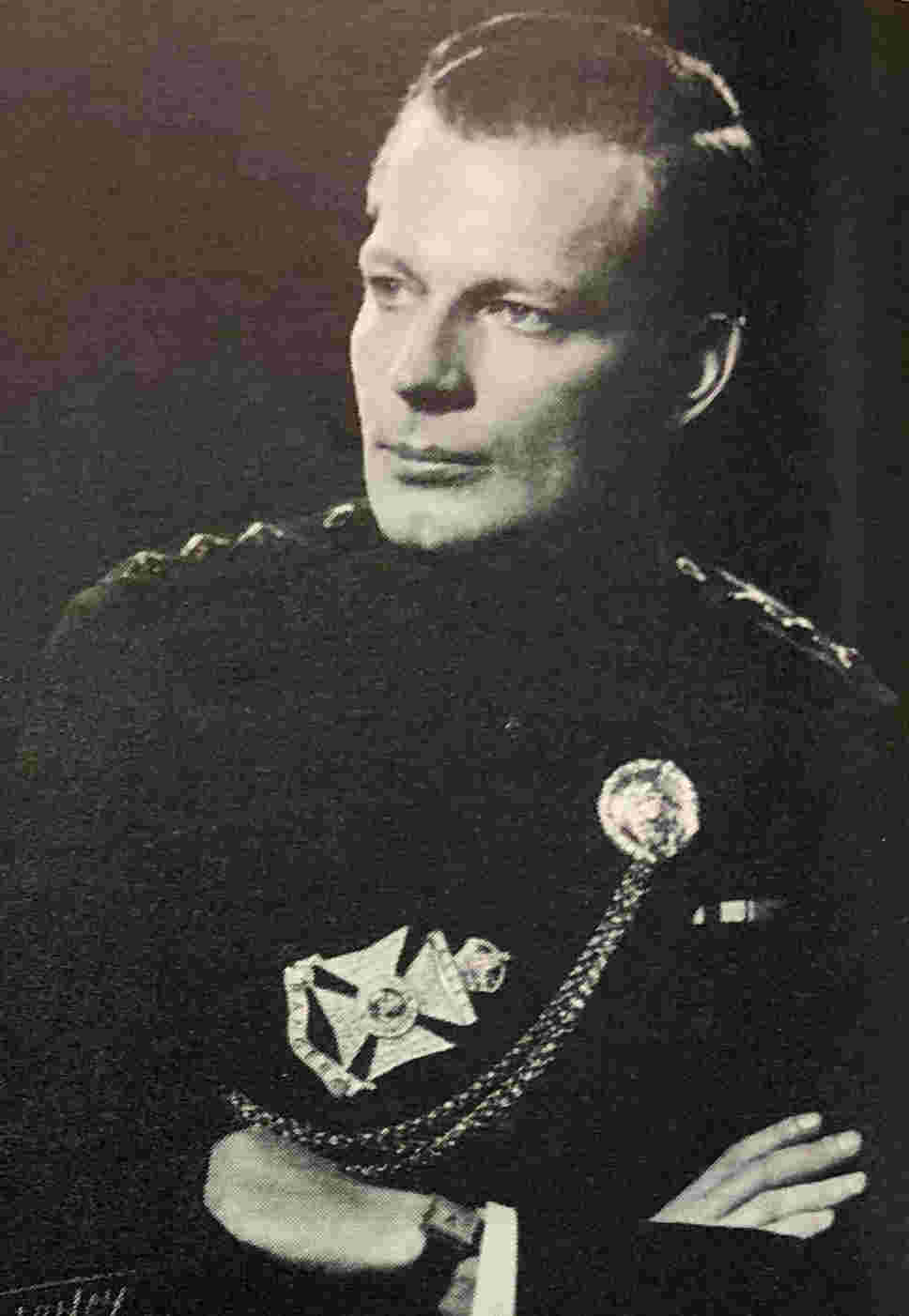
Capt. Lionel Massey, k.r.r.c. (60th Rifles)
I had met Leonard Brockington for the first time on a visit to Calgary many years before and we had become warm friends. With his well-stored mind, natural eloquence, and fine voice, he is justly famous as a speaker, not only in Canada but far beyond our borders. In 1942 he was asked to join the staff of the Ministry of Information in London. There was no precise definition of his duties and he felt rather frustrated. One day I said to Brendan Bracken, the Minister, that Brockington’s talents should be used in interpreting one part of the Empire to another in a series of visits. This came about, and through Brock’s genius the Dominions were given a vivid account of the War effort in Great Britain and vice versa. His tours were immensely successful. Brockington’s appointment was a good example of Brendan Bracken’s imagination. His judgment was very often not only wise but bold. He was a gifted public servant and also a very warm friend, as I had reason to know. It is not difficult to understand why he was the most successful Minister of Information.
On one occasion when we motored down to Garnons, we were asked to lunch en route with Queen Mary at Badminton House (where, just inside the door, was the great hall where the game of badminton was first played). Queen Mary spent most of the War at Badminton, a rather restless guest who disliked being so far removed from centres of major activity. We were greeted at the door by one of the Queen’s household who had in his hand, a telegram telling us that our son Lionel, who had been seriously wounded in Greece when serving with the King’s Royal Rifle Corps (60th Rifles) was a prisoner of war in hospital in Athens. Like countless other parents, we had gone through a period of grinding anxiety.
The Beaver Club was another establishment that served our forces well. It opened as soon as we could find suitable quarters. One day Alice and I were driving down the Mall towards the Admiralty Arch. On the left, in a short street called Spring Gardens, stood a well-built structure, and we both said, almost with one voice, ‘Wouldn’t that be an ideal leave centre for our forces?’ We discovered it belonged to the London County Council. With two or three members of a committee I had formed, I went to the L.C.C. to talk with Herbert Morrison, Leader of the Council, about renting the building. Some keen negotiations took place over the terms of the rental, but we took it for the duration and it became known as the Beaver Club.
The Committee I had set up consisted of Anglo-Canadians; Sir Edward Peacock was among them, and he was an immense help in all such efforts. Indeed, ‘E.R.’—to use the nickname that marked our affection—as the leading member of the Canadian colony in London and a very old friend of mine, was always invaluable as a counsellor. There is no record of the total number of servicemen and women who used the Beaver Club, but in one week it was reported that 20,000 had passed through its doors. It met all their wants on leave except overnight accommodation, and they were always told where they could find that. However dishevelled a serviceman might be on arrival at the club, he would emerge restored to normal respectability and with an enhanced morale. Even the pressing of his trousers was done while he waited, trouserless, in an adjoining room; if he wanted to examine the polish on his boots, the condition of his uniform, the merit of his haircut, there were long mirrors available in which he could see himself complete.
The Home Guard was invited to use the club. In my diary for December 1940 I have a reference to a conversation that one of my staff overheard at my club, Brooks’s, between two elderly members in Home Guard uniform. One said to the other, ‘Where do you dine as a rule?’ ‘Here at Brooks’s.’ ‘Where do you get lunch?’ ‘Oh, at the Beaver Club. Jolly good meals at the Beaver Club!’
As chairman of the Beaver Club Committee, I wrote to every daily newspaper in Canada, of which there were about a hundred, asking them to send copies to the Beaver Club so that wherever men came from in Canada they could find their daily paper there and keep in touch with their home town. There was a large paid staff at the club, but a much larger number of volunteers, consisting of Canadians living in England and Englishwomen who wished to help this Canadian enterprise. The club was entirely independent of any organization serving the troops, but the Y.M.C.A. was a very good friend and a number of the people employed had been Y.M.C.A. officers. The club was open for just over six years, from February 1940 when the King and Queen opened it, showing the most intense interest in the institution, visiting every department—not excluding the barber shop, in which the customers of the moment were deeply embarrassed at being found in the barber’s hands.
The club closed with a substantial surplus resulting from good management and the generous decision of the London County Council not to insist that the building should be restored to its original condition (a great deal of money having been spent to adapt it to the purposes of the club). The surplus was put to good use. Under a committee I formed in Canada, about thirty ex-servicemen were awarded ‘Beaver Club Scholarships’, which gave them two years in an English or Scottish university. The honorary secretary of this enterprise was Peter Macdonnell who, after distinguished service in the R.C.A.F., settled in Edmonton to practise law. His devoted work did much to give the Beaver Club Scholarship scheme its success.
After our arrival in London in 1935, Alice and I had been again confronted with the housing problem. There was no official residence for the High Commissioner then, and, although an allowance was available for the rental of premises, these had to be found. We lived for a year in Portman Square, but we found the house inadequate. It was then that I took the lease of 12 Hyde Park Gardens, a quiet street north of Bayswater Road, overlooking the park; there we lived for about three years. The house, although rather oddly planned, was well adapted to official entertaining, of which we did a great deal. Some attendant fairy must have been on duty when I signed the lease of these premises, because it expired just after war was declared; otherwise it might have been on my hands for the duration, and unoccupied, because no one could live in a house of that size under war-time conditions. We tried, for a few months, the experiment of living outside London in a house near Wentworth, bearing the name Smiley Knowe, which was very remote from the nerve-centre of events. A friend of mine paraphrased the lines of Kipling by saying, ‘. . . what do they know of England who only Smiley Knowe?’ The answer was ‘very little’. By this I meant that however charming the house was, and its garden, living there I was too much out of touch with London, and we decided to move as soon as we could.
Before we left, we were invited to lunch with the Duke of Connaught, who lived at Bagshot not far away. The old gentleman, just about ninety, was very frail, but he made a gallant effort to play the part of host, and age had not robbed him of his wonderful manners. He was wearing service uniform, and he said to Alice that he thought that as the King’s oldest field marshal he ought now to wear uniform all the time—did she not think he was right? It was hard to believe that we were lunching in 1939 with a son of the Prince Consort.
We moved early in 1940 to the Dorchester Hotel, into what amounted to a self-contained apartment. Our hospitality was, needless to say, informal, but it was constant and, as in peace time, the greatest variety of people passed through our rooms. During most of the war period we had a cocktail party every Monday. We found our quarters at the Dorchester Hotel suited us admirably. We slept on the floor in our little entrance-hall on noisy nights during the bombing to get relative quiet and to avoid the danger of flying glass.
When the blitz began, the Dorchester Hotel staff were under a heavy strain as most of them lived a long way from their work. It was clear that some of the guests (I would like to think a minority) showed little consideration for their difficulties, and it seemed only right that something should be done to show the employees that there was an understanding of their problems and at the same time a desire to help in a practical way. Four fellow guests of mine, Duff Cooper, Somerset Maugham, Lord Bearsted, and Sir George Clerk (former British ambassador in Paris), joined me in signing an appeal which was placed in the lobby of the hotel. The management contributed an amount equal to the subscriptions received, and a satisfactory sum was raised which was administered by a committee of the employees on behalf of those who had suffered losses.
The hotel provided air-raid shelters in the basement for those who wished to use them. On one occasion at the beginning of the blitz, Alice and I, and everybody else, were wakened in the early hours of the morning by the staff, and a descent to the shelter was practically mandatory. The scene was memorable. Guests and staff made a strange sight—rather like a fantastic fancy-dress ball organized by some eccentric hostess. I can remember a few of ‘those present’: Lady Oliphant (in a beautiful dressing-gown), Richard Tauber (in something like a mechanic’s overalls, obviously made for air raids), Diana Duff Cooper (on her way home from a real fancy-dress party), André Maurois in uniform, and Sir George Clerk (who had obviously dressed very carefully, even to a pearl tie-pin—which was good for our morale). Alice said I was very unchivalrous about her appearance. She suggested getting a special air-raid dressing-gown—I concurred.
We had as neighbours a noisy but friendly battery of heavy anti-aircraft guns in Hyde Park across the street. During the air attacks of 1940-1, few nights passed without the sound of them in action. Later in the War a new feature was introduced in the park (and probably elsewhere) about which I knew something in advance. One evening when we were having a small dinner party there was a noise across Park Lane like a hundred Niagaras. It had an obvious effect on our guests, however superb was their restraint. I hastened to explain that the roar came from a great battery of rockets fired simultaneously. Their function was aimed less at the German aircraft themselves than at the morale of their crews—for a short time the morale of London was affected!
The original daylight air raids, as those who were there will remember, did not last for long—only an infrequent bomb was dropped over London. On one foggy morning, Alice and I were walking across Waterloo Place and heard the whistle of a bomb that seemed fairly close. We took the normal action, and when we rose from the pavement and brushed off our clothes we found that we were within a few yards of the statue of Florence Nightingale—a comforting symbol.
It was at about this time and near this place that I had a brief conversation with Tommy Lascelles to which he referred years later. This is what he said: ‘Vincent, I remember meeting you in Pall Mall at the beginning of the blitz, and you said, “Tommy, this isn’t the real war—the real war is between us and the Russians.” ’ This wasn’t perhaps a very startling prophecy, but not everybody would have agreed at that time.
It soon became bad form in London to talk of bombs—general bombs or personal bombs; no one was more unpopular than the ‘bomb bore’. However, I cannot refrain from a few brief observations on this subject. My diary for September 15, 1940 (the original Battle of Britain Sunday), reads:
Up on the hotel roof during an air-raid. . . . For a time all was quiet with the occasional drone of planes in the fleecy clouds which dotted the sky. Then we saw a succession of bombs dropped along the river bank across from Battersea—then individual planes appeared against the sky above us—very high and in a moment we saw a fighter (which, I’m sorry to say, as we heard later was one of ours) drop like a stone to the ground across the park (the pilot I’m glad to say had baled out) and then a German bomber circled down in flames—its wings and tail shot off and coming down separately. Incredible things to be seeing over Hyde Park on a quiet Sunday morning.
A few days later we saw the results of such a raid. In my diary for September 22 I wrote:
L. and I and Mike Pearson and Spence of my office made a tour of the East End of London in my car, under the guidance of a motorcycle policeman sent by Sir Philip Game [Commissioner, Metropolitan Police].
It was a heart-breaking experience. The worst place was in East Ham where we saw street after street of little houses—either burnt or shattered by blast. We talked to many of the people we saw. Some of them showed us their houses or what was left of them. Two women told us they were the only people left in their street but they ‘were carrying on!’ Two other women told Alice that they wouldn’t have their husbands know what had happened. Another said, ‘We can take it, sir!’ I talked to a young parson. I pointed to a charred ruin and said, ‘You’ve lost your Church.’ ‘Yes,’ he said, ‘but the vicar’s garage has just been consecrated and we had our first wedding in it this morning!’ One got the impression of a spirit that was unbreakable.
Sometimes bombing could provide us with a text. I was impressed, as I am sure many others were, by the fact that the bomb which fell outside Westminster Hall in the autumn of 1940 and damaged the equestrian statue of Richard I, left his sword sharply bent. I made a comment on this in a piece of undistinguished verse, but I hoped that the four lines would, in their modest way, convey a truth. They read as follows:
So let it stand, a people’s sign and token
Figured in bronze, for all free men to see,
The sword of Lionheart, though bent, not broken,
In this new warfare of God’s chivalry.
The quatrain made a proposal—that the sword should remain bent as a symbol. The lines appeared in the press, and Lord Reith, as Minister of Works, made a public statement to the effect that the sword would remain unaltered; one of his successors gave me similar assurances in a letter, but at the end of the war the sword was straightened when the monument was tidied up. The crooked sword had been regarded in two ways: by some as a mark of German aggression which should be obliterated, by others as a symbol of the strength of democracy. I was sorry that this latter view did not prevail.
Under the title The Sword of Lionheart I published a little volume of war-time broadcasts and speeches, many of which were made as ‘postscripts’ on the B.B.C.’s Sunday-evening programme. You may think that what you say on the air is lost in space; I found that this was not so. In June 1941 I received a letter from a lady (a former Canadian) living in Wilno, Lithuania, who had somehow been able to hear a broadcast of mine on the Canadian service of the B.B.C. She said, in part: ‘I want to thank you for those words of courage which were a real blessing. Tears and pride were intermingled in my heart as I was listening to you. Here in Wilno I lived through many atrocities of war already. They left one strong desire in my heart. God help England and save the King!’
One day in his German Oflag my son Lionel was told by a fellow prisoner of war: ‘Your father is on the air.’ Secreted somewhere on the premises was an illicit receiving set, through which he could hear a broadcast of mine from London. Broadcasting can be very rewarding. Twenty years after the event, I discovered in a year-book of the B.B.C. a generous commendation of one of my broadcast speeches to Canada, which I value very much.
During the War I was asked to pay a visit to Bush House, the centre of the great organization of the B.B.C., which sent broadcasts in nearly all the languages involved, and almost round the clock, to the people of stricken Europe. Too little is known of this effort, or of what it accomplished in helping to break down enemy resistance; there was an army employed as announcers, translators, monitors, and technicians. Perhaps the most moving, and indeed the truest, comment that could be made on this service came from the lips of an old lady in Finland, quoted in the Finnish Diet by a member. She said that she ‘only believed in the Bible and British broadcasts’.
One evening in October 1939, the three other high commissioners and I dined with Mr. Churchill at Admiralty House. The First Lord (as our host then was) we found in excellent form. He talked about the best strategy to be followed while we could attempt no major offensive: to sit tight and lay siege to Germany; time was on our side and we had everything to gain by remaining over the winter on the defensive. After dinner we were taken into the War Room where we saw all the charts with the positions of ships, and then into the ‘catacombs’, a group of rooms deep down under the building, where about 500 people in three shifts were working day and night acting as the nerve-centre of the Navy—plotting convoys, minefields, movement of U-boats and other enemy ships, making use of a constant stream of messages coming in from all over the world—officers, naval ratings, civilian clerks, women typists, all working at high speed. This amazing organization was too complicated to be really understood in one evening.
No less complicated were the headquarters of Fighter Command, where I spent the better part of a day in October 1939 with Air Chief Marshal Dowding, the A.O.C.-in-C. This heart of the air defence of Great Britain was placed far underground and represented an extraordinary piece of improvisation to meet an entirely new situation; and it worked. The central feature was an immense map of Great Britain which formed a table, round which members of the Women’s Auxiliary Air Force sat, equipped like croupiers in a casino, moving pieces on the table representing enemy aircraft, receiving through their earphones information transmitted by radar, from the Observer Corps, and other sources. Numerous officers and other ranks were performing services that would have taken days to describe. This was the organization that enabled the fighter pilot to save Great Britain in the battle that was to come a year or so later.
The approach of war made more important than ever the maintenance of friendly and co-operative relations between Canada House and the Government at Ottawa. During the late 1930s, the reader will recall, these were not all that they might have been, chiefly because of the curious attitude of my Prime Minister. There was also a tendency within the Department of External Affairs itself to avoid consultation with the High Commissioner in London and even to show a certain feeling of jealousy towards the staff of Canada House which it persisted in regarding as over-manned and underworked. I had exchanged some sharp correspondence with Skelton on this subject a few months before war broke out, noting that ‘there seems in this matter to be a widening gulf between the point of view of headquarters and that of the office abroad.’ (Letter to O. D. Skelton, April 21, 1939.) Mike Pearson of my staff visited Ottawa in July, and reported privately to me as follows:
I have found out, if it needed finding out, why so many things are not done that should be done. The Department, in one crude phrase, is in a mess—worse than I had expected. There are lots of people around to do things—but everything, at least everything of importance to us, is done by two or three. That is due to four things. First, the fact that the P.M. is our Minister—with the best departmental organization in the world this would make for confusion & delay. Second, instead of the best, there must be almost the worst departmental organization. A harried and harassed Deputy relies entirely on one or two people. Three, the younger men are, as ever, not being trained to take an increasing share of the work. . . .
As to the more general complaint of Ottawa’s attitude to our office—their reluctance to encourage our growth and usefulness— . . . the Doctor [Skelton] agreed with all I said and I am convinced now that the difficulty is higher up—in a queer ministerial doctrine of direct contact—based partly on theory and partly on personality.
[Letter from L. B. Pearson, July 16, 1939.]
This first-hand account was enlightening though (since it offered no obvious ways of improving things through our own efforts) not very reassuring. Nor was there any dramatic improvement through the urgency of war, at least not in its early stages. On September 29, having spent an unusually long time drafting a telegram to Ottawa on the international situation, I noted in my diary, evidently in some exasperation: ‘I hope they read it! They never give me any feeling that they want any news on foreign affairs. I haven’t heard any word from the Prime Minister since last July. That may be due to lack of interest or a refusal to use my post as a source of information. Probably a little of both.’ (Diary entry, September 29, 1939.) It was also difficult to secure information from Ottawa about Canadian affairs. When, several months after the fall of France, a visiting Cabinet minister told me about the extent of pro-Vichy sentiment in Quebec, I recorded: ‘All that I hear of such things comes from the British H.C. [High Commissioner] in Ottawa via the D.O. [Dominions Office] & the Ministry of Information News Service.’
(Diary entry, November 30, 1940.)
This probably marked the nadir of neglect. Communication between Canada House and Ottawa slowly improved, and with the improvement in communication came better understanding and a greater willingness to make use of our facilities. The frequency of visits from Canadian Cabinet ministers made for a more sympathetic appreciation of the role of the High Commissioner’s Office in time of war. Norman Robertson became permanent head of the Department of External Affairs in 1941, succeeding Skelton (who had died suddenly in that year). He came with the Prime Minister to Britain in the summer of 1941, and I found him (as my diary records) ‘refreshingly objective. I could detect no prejudices. His mind is of course first class. . . .’ (Diary entry, August 25, 1941.) Finally, my main consolation when Mike Pearson was ordered to return from his London posting to Ottawa was that Canada House should now have so able and influential a friend within the Department itself, but I was very sorry to lose him. He possessed all the qualities essential to the difficult job he had been doing: initiative, a first-rate mind, imagination, great tact, and the human characteristics that have always made him a delightful companion.
If Canada House was to play its full part in keeping Anglo-Canadian relations harmonious and productive in time of war, the High Commissioner in London had to work intimately and effectively not only with his own government but with that of the United Kingdom as well. The link provided for this purpose was the Secretary of State for Dominion Affairs. During the international crises preceding the outbreak of war, the high commissioners of the five Dominions met frequently with the Dominions Secretary, both to receive information and to convey through him to the British government the views of their own governments. Although Ottawa had frowned upon my presence at these gatherings, I had taken it upon myself to attend, at least at those times when, as in September 1938, the international scene appeared particularly threatening.
Now that we were at war, these high commissioners’ meetings continued, though their character was greatly altered. It was decided that we should meet daily, sometimes including Sundays, with the Secretary of State for Dominion Affairs, and the Parliamentary and Permanent Under-Secretaries of State, to hear important diplomatic telegrams and the secret reports from the three services. Occasionally the Foreign Secretary would join us to explain something of particular importance, or someone with special experience, like Fitzroy Maclean just back from Yugoslavia, would attend a meeting. We asked that there should be no record made of these sessions, and the secretary with his notebook and pencil was banished. We also decided that in the event of the absence of any one of the high commissioners, no one would be permitted to take his place. They were the kind of meetings in which you could think as you spoke. If we could not commit our governments, we were in a position to say what attitude our countries were likely to take towards issues that arose from time to time. We were encouraged to give our own personal views and often did so.
These meetings at the Dominions Office were an admirable demonstration of the family relationship that existed between the countries of the Commonwealth. No other association of states could, through their representatives, have met regularly in such an informal, intimate, unrecorded, almost cosy atmosphere. Until the War there were five of us—representatives of Canada, Australia, New Zealand, South Africa, and the Irish Free State. Australia’s high commissioner was S. M. Bruce, who had been, some years before, prime minister of his country; New Zealand was represented by W. J. Jordan, who had been in the Legislature at Wellington; South Africa appointed a new high commissioner at the outbreak of war—Lieutenant-Colonel Sydney Waterson, replacing Charles Te Water, who had resigned because of his disagreement with the policy of General Smuts. Our seniority was governed by that of the countries we represented. This meant that since I came from the senior Dominion it fell to me to bring the high commissioners together to consider anything of common interest. (Now that the high commissioners are regarded as members of the diplomatic corps in matters of precedence, this would no longer be so.) After September 3, 1939, the High Commissioner for the Irish Free State, W. J. Dulanty, ceased to be a member of our group because, as a neutral, he could not with any propriety attend our meetings. I do not think he had ever been very happy in these gatherings—however warmly disposed he was personally towards the Commonwealth, his government was not. Dulanty was as witty as he was able. Referring to his attendance at meetings of the Commonwealth high commissioners, he once observed that he felt ‘like a whore at a christening’.
So intimate a group, meeting almost daily on matters of mutual concern, could hardly avoid acquiring a corporate character; nor did its four members seek to avoid acquiring it. We referred to ourselves jokingly as ‘the junior War Cabinet’; but there were occasions, as I shall relate, when this was not a bad description. Our usefulness regarding policy depended, however, not only upon our own willingness to offer advice but upon the willingness and ability of the Secretary of State for Dominion Affairs to give us essential secret information and to relay our suggestions to the highest quarter. (The highest quarter throughout most of the war was, of course, Winston Churchill.) How these duties were performed varied greatly with the incumbent. Our first war-time Dominions Secretary was Anthony Eden; he could not have performed them more admirably, and we were dismayed to learn in May 1940 that he was to be taken from us. ‘. . . talk with Bruce and Waterson’, my diary records, ‘to join with me in a little private protest against the appointment of Caldecote [Lord Caldecote, formerly Sir Thomas Inskip] as Dominions Secretary, not the kind of office to be given as a consolation prize to a retiring politician. Much as we like old Inskip personally he hasn’t the qualities for the Dominions Office at this time of all times. . . .’ (Diary entry. May 15, 1940.) Our fears that Caldecote was not sufficiently close to the centre of the stage to enable the high commissioners to function to the best of their abilities were borne out, and on July 3 I addressed the following letter to Mr. Churchill:
My colleagues, the other High Commissioners, and I have had the great advantage since the commencement of the war of receiving each day from the Secretary for Dominion Affairs information which he has been in a position to give us because of his presence at all meetings of the War Cabinet. We have thus been enabled very often to keep our respective governments informed as to the progress of the war and the policy of the United Kingdom Government in a way which otherwise would have been impossible. Documentary records of such proceedings are inevitably an unsatisfactory substitute for personal contact. Lord Caldecote has told us that he is now to attend only two meetings of the War Cabinet each week, instead of being present at all such meetings. Decisions as to who should attend the meetings of the Cabinet are, of course, no business of ours, but I thought you would not mind my sending you this personal note, which I may say expresses the views of my colleagues as well, to say how much we have appreciated the contact we have had hitherto with the War Cabinet and to express the hope that this can be continued.
[Letter to Winston Churchill, July 3, 1940.]
This representation had some though not all of the desired results. Three days later the high commissioners were invited to the Cabinet War Room where, my diary records, we ‘had a field day’ asking senior officers of the three services about the future strategy of the War; and on July 26 we went with Caldecote to No. 10 Downing Street for an hour’s conversation with the Prime Minister about such wide-ranging matters as war aims, the Far East, the Levant, and the problems posed by Eire’s neutrality. But this was no substitute for the continuous flow of confidential information for which we continued to press and of which we were occasionally deprived.
In October 1940, Caldecote was replaced at the Dominions Office by Lord Cranborne (now Lord Salisbury). ‘An admirable choice for the post,’ I noted in my diary. And so he proved to be. But even the very great ability of ‘Bobbety’ Cranborne could not compensate for his exclusion from the inner circle, as a consequence of which the quality of information at the disposal of the high commissioners continued to suffer. My South African colleague, Waterson, was not informed, for example, about Anthony Eden’s forthcoming visit to Egypt late in 1940: ‘As E. was to meet his P.M. [Smuts] I think he had a good case.’ (Diary entry, October 15, 1940.) And on August 13, 1941, following a high commissioners’ meeting with Cranborne, I noted in my diary: ‘We were rather irked by the fact that the great Churchill-Roosevelt meeting secret had [been] communicated to the editors confidentially before we were officially told—almost a week before! We of course knew it from irregular sources. . . .’
On November 18, 1941, we were told by Cranborne that henceforth he was to be allowed to attend only one of the two weekly meetings of the War Cabinet at which he had hitherto been present.
This [I wrote] is all wrong. Even if other ‘extra people’ were to be eliminated from Cabinet meetings the Dominions Secretary should be invited to attend as the link between the Dominions & the Brit. Govt. The relations between the U.K. and the Dominions is the most important thing in this war & anyone who can’t see that has a serious ‘blind spot’. Under the new plan we have for the information of our governments only half the material formerly available. . . .
[Diary entry, November 18, 1941.]
Once again we remonstrated with Mr. Churchill, and once again remonstrations brought results—of a kind. The new departure was the appointment as Dominions Secretary, for the first time, of a member of his War Cabinet. This was Clement Attlee, who was in addition Deputy Prime Minister. He presided over our meeting on February 20, 1942: ‘Both Cranborne and Attlee there,’ my diary records, ‘the old and the new. Sorry to lose C. but A. as a member of the War Cabinet will give importance to our meetings & to the office of H.C. . . .’ This was not to turn out as we had expected. Lord Attlee’s fine qualities as a statesman need no emphasis in this narrative. I am happy to regard him as a friend. His place in history as one of the principal architects both of modern Britain and of the modern Commonwealth of Nations is sufficiently secure that I may say without any injury to his reputation that as Secretary of State for Dominion Affairs he was unduly reluctant in passing information on to us. His great fault was his reticence, as successive entries in my diary record:
March 23: . . . Particularly dull H.C. meeting. I wish Attlee could be a bit more ‘gossipy’. . . .
May 19: . . . At the H.C. meeting, question arose about information not being furnished to the meeting as fully as before—which is true. . . .
July 27: . . . H.C.’s meeting as usual. I had a word with Attlee afterwards when I tactfully brought to his attention the fact that we were hearing through informal, personal channels of the presence in London of a very important U.S. delegation (Gen. Marshall, Hopkins, Stephen Early, Admiral King) . . . but had not been given official confidential information on the subject which was of considerable interest to our respective governments. Attlee took it very well and said that he should have told us but that of course the matter was intended to be very hush hush. I said that Molotov’s visit was even more hush hush but we were told of that, and that although none of us wished to have any secret or confidential information that we did not need to have in the course of our duties, this, I felt, fell into that category. He admitted quite pleasantly that I had a good case and said that he had only postponed telling us until he could say something more than the mere fact that the Americans had arrived. It is very irksome to have from shopkeepers and taxi-drivers information you should have received officially or to be asked by Cabinet Ministers about a matter on the assumption you have been told when you have been kept in complete ignorance. . . .
While the position of the high commissioners was affected, and sometimes adversely affected, by the personalities of the various Dominions secretaries, the real cause of the problem, as we came gradually to realize, lay elsewhere. To say that it was not Winston Churchill’s fashion willingly to share responsibility for the direction of the war with a large circle of his colleagues is a considerable understatement. If we, the high commissioners, were excluded from the inner circle, so, indeed, were members of the War Cabinet. This we had for some time suspected, but we learned it for a fact when Bruce, while remaining High Commissioner for Australia, became privileged to attend War Cabinet meetings without adding a great deal to his own knowledge of the conduct of the War, or to our own: ‘. . . Bruce, Waterson and I had a little talk about the present malaise in Cabinet circles and among senior members of the Services. To put it briefly the Chiefs of Staff are seeing too much of the P.M. and [of] members of the War Cabinet not enough. . . .’ (Diary entry, September 25, 1942.)
The real centre of strategic decision, in so far as it did not repose in Churchill himself, or in Churchill and Roosevelt together, lay in the Cabinet Defence Committee, a small group consisting of the Service ministers and the Chiefs of Staff, where Churchill could more easily have his way. In retrospect, it was very fortunate for Britain, the Dominions, and for all the fighting Allies that he did have his way—at least it was on most occasions. But at the time, the Prime Minister’s monopoly caused both criticism and malaise, not only among those left outside but also among those having to adjust themselves to his individual methods. It must be recorded that these methods found very little room for the Dominions’ points of view. We were aware of this at the time; on one occasion a senior British official spoke to me in confidence ‘of Churchill’s habit of using the Dominions Office as a Post Office without making use of their experience and knowledge in correspondence with the Dominions’. (Diary entry, October 5, 1942.) We did not know then, however, of the Prime Minister’s directive to the Dominions Office in December 1940, in which he enjoined it ‘not to scatter so much deadly and secret information over this very large circle’, or to ‘get into the habit of running a kind of newspaper full of deadly secrets’. (Winston Churchill, The Second World War, II, Appendix A.)
Our ‘junior War Cabinet’, then, laboured—as indeed did the senior—under considerable handicaps. But the obstacles in the path of constructive initiatives by the high commissioners, though formidable, were by no means insuperable. Our earliest initiative was, without question, the most far-reaching in its results. On September 13, 1939, my diary records, ‘Bruce, Godfrey [an R.A.F. Group Captain] & Heakes [R.C.A.F. attaché at Canada House] & two Australian officers & I sat in my room & discussed air matters—the disparity in force [between ourselves and Germany] & other gloomy features. The information which these officers have is most disquieting.’ Thus primed, we went to ‘a short meeting at the Dominions Office with Eden’ and, still later, to ‘a full dress meeting at the Treasury . . . Bruce and I with Simon, Eden, Halifax, Chatfield & Hankey & many—too many—officials. . . . The meeting developed into defensive statements by Chatfield & Hankey in reply to an expression of some apprehension by Bruce and myself particularly in regard to the air position.’ After this meeting, it occurred to me that Canada might be able to make a decisive contribution to the common war effort by training Commonwealth airmen. I consulted my Australian colleague, who enthusiastically agreed. On September 16 the high commissioners met at the Dominions Office with Anthony Eden and, according to the Dominions Office record of the meeting:
Mr. Massey and Mr. Bruce suggested that consideration should be given to a scheme whereby Canadian, Australian and New Zealand air forces should be trained in Canada on ‘planes to be specially built in Canada or the United States and should then be sent to the front as distinctive Canadian, Australian and New Zealand air forces. The Secretary of State undertook to look into this proposal.
He did so, and, as the result of further consultation with Air Ministry and other officials, a telegram from Neville Chamberlain was sent to each of the Dominion prime ministers on September 26 proposing what was to become the British Commonwealth Air Training Plan.
Before the telegram from Neville Chamberlain was sent to the Dominion prime ministers, their high commissioners were shown the draft, and I thus had an opportunity to edit the message that was to go to Mackenzie King. I knew his thinking so well that I felt I should try to shape the wording so as to give the plan the best chance of acceptance. King had already turned down a proposal for the training of airmen in Canada before the outbreak of hostilities—although, to be fair to him, that was a different plan, involving the training by Britain of British airmen on Canadian soil—and I did not want this one to meet a similar fate. I suggested that a paragraph might be put at the head of Chamberlain’s message, reading as follows:
I am sure that you will agree that the scheme outlined in the following message is of the first importance. For this reason, and because it invites the co-operation of Canada to a very special degree, I want to make a special personal appeal to you about it. I feel that so far-reaching a project will strike your imagination particularly as it concerns an all important field of war activity in which Canada has already made so striking and gallant an individual contribution. May I therefore ask that the matter should receive very urgent attention?
My instinct in suggesting these placatory phrases was not mistaken. The proposal was favourably received when placed before the Canadian Cabinet though Mackenzie King recorded in his diary that ‘there was general regret that it had not been made at the outset so that our war effort would have been framed along these lines instead of having to head so strongly into expeditionary forces at the start.’ (J. W. Pickersgill, The Mackenzie King Record, I, pp. 40-1.) It is hard to know what he meant by ‘at the outset’. The proposal was made little more than a fortnight after Canada had declared war. Had it been made before hostilities had commenced, there would have been a grievance of a different nature, for King had consistently suppressed, as far as he was able, the consideration of war plans before hostilities had begun. The Air Training Plan was indeed advantageous to him in a political sense. When the Canadian war effort was concentrated to a considerable extent on air training, there would be less pressure for a large army and less risk of a demand for conscription to reinforce it.
The pressure of events during these early days of the War was so intense that I had little opportunity to keep a detailed record of them; and, being anxious to preserve an accurate version of the origins of the Air Training Plan, I wrote to Anthony Eden in 1942, asking if he would be good enough to set down the facts as he recalled them. He replied with this letter:
The subject is most interesting, and I agree that we should all contribute our mite of recollection. I am sure that you are right that the suggestion was first put forward at one of our meetings at the Dominions Office. If I recollect aright, the general position was that the High Commissioners, and I think you and Bruce in particular, felt that insufficient use was being made of the special gifts of Canadians and Australians and their initiative for air warfare. As a result of that discussion I have a pretty clear idea that I wrote to Kingsley Wood telling him of the feeling of the meeting and suggesting that we should discuss the matter together. Out of this arose the subsequent contacts with the Air Ministry on the subject . . .
You and Bruce are certainly the joint authors of the plan and our ‘Cabinets’ at the Dominions Office have surely more than proved themselves for this alone.
[Letter from Anthony Eden, October 5, 1942.]
The high commissioners’ part in launching the British Commonwealth Air Training Plan well illustrates their unique position in the machinery for the conduct of the war—not quite ministers but more than diplomats, in fact a kind of combination of the two. This unusual status is evident in more than one of our interventions during the first few months of the conflict. A case in point is the problem of the formulation of allied war aims, forced upon the British government sooner, perhaps, than it might have wished by Hitler’s propaganda about a European ‘New Order’ and his early overtures for ‘peace’. On September 28, 1939, my diary records:
. . . the three other High Commissioners and I went to No. 10 Downing Street to have a talk with the Prime Minister, Halifax, Chatfield, Hankey and Eden. . . . We discussed the dangers of the coming peace offensive and what we are likely to expect from Hitler. The P.M. and Halifax gave us their views as to the situation and the likely conduct of it. I suggested that it might be well to meet the peace offensive by something more definite said in advance about the conditions of peace as we saw it. This might take the wind out of Hitler’s sails and make his peace offer less impressive for his own people. I thought the P.M. and Halifax showed some interest in this point although they made quite clear the obvious danger of becoming too definite.
[Diary entry, September 28, 1939.]
On October 6, Hitler made his expected offer of negotiation, in a speech which, in the words of the official history of the British Foreign Office, ‘as usual, failed entirely to measure the depth of feeling in Great Britain. His argument was that Great Britain and France had gone to war to save Poland. They had not saved Poland. Hence they had no reason to continue fighting.’ (Sir Llewellyn Woodward, British Foreign Policy in the Second World War, p. 8.) The question of whether to take this crass proposal seriously never arose (even though the Foreign Office had evidence that Hitler and his gang really believed that their offer might be accepted). The issue was solely whether it was to be ignored or answered and, if answered, in what terms. The Foreign Office prepared a draft reply, and on October 9 the high commissioners forgathered with Anthony Eden to consider it. ‘Spent an hour and a half in conclave, Bruce and I registered our disapproval of the tone of the statement. Too negative, too smug, and too much in the spirit of shutting the door against all hope of anything coming from Hitler although only a miracle could bring peace, while he is in power.’ (Diary entry, October 9 1939.) The next morning Mike Pearson and I tried our hands at a revision of the Foreign Office draft, and so armed I proceeded to the Dominions Office. ‘We all registered our respective and collective points of view which Eden undertook to convey anonymously to the War Cabinet.’ Later that day we met at the Dominions Office for the second time.
I found to my pleasure and satisfaction that several of my suggestions had been accepted and generally the speech now (according to my way of thinking) has a much better tone. It asks for a further reply from Hitler as the former did not and instead of saying no itself to the hope of peace, it leaves it to Hitler to say no himself if no has to be said. At our request, the statement was postponed from tomorrow until Thursday giving more time to consider the reply and a better opportunity for Dominion Govt. opinion to be conveyed.
[Diary entry, October 10, 1939.]
Within forty-eight hours, all four of the Dominion prime ministers whose governments were at war with Germany had replied to the message from Neville Chamberlain requesting their views. All felt, as I noted at the time, that ‘the draft which had been cabled out was too negative in tone’ (diary entry, October 12, 1939); Smuts’s cable from South Africa was particularly emphatic in stressing that the British Prime Minister in his reply to Hitler should strike a positive and constructive note, while my own Prime Minister went so far as to offer the suggestion that a committee of neutral nations be formed to investigate and report ‘on methods of adjusting the European situation’. With these cables before us, we met with Anthony Eden to consider what should be done next:
Bruce, I and the other two High Commissioners strongly urged that a paragraph along the lines of Smuts’s suggestion should be included. Eden agreed and promised to place our point of view before the P.M. and Halifax, which he did before the War Cabinet met at 11:30. He then went into the meeting having been told that the P.M. would probably see us sometime during the War Cabinet meeting. Shortly before 1:00 we were called over to No. 10 Downing Street where we met Chamberlain, Halifax and Eden in the Cabinet Room. The P.M. told us that the Dominion point of view had been very carefully considered and at great length by the War Cabinet. They felt and felt unanimously that it would be impossible to postpone the P.M.’s statement as there would not be time to consult the French between then and the afternoon when the statement was timed to be made and the French would probably disagree on the subject of the more constructive statement as to our position:—invocation of the good offices of neutrals, general terms of reference of a peace conference, and so on. He also said that to be detailed was only to ask for a greater chance of rejection by Hitler. He went on to say that there would be another time no doubt in which some of the ideas which we had in mind might be expressed. This I myself gravely doubt. At any rate this is the best time at which to make the suggestion. When he had finished I spoke briefly—pointing out that the suggestion which we had in mind had been put forward by four Dominion Govts, without consultation and as individual opinions which in itself was very impressive. I had in mind but did not express the fact that these Governments represented one third of the white population of the Empire at present at war with Germany, and four out of five of the Governments. Therefore their point of view could not be lightly disregarded. As a matter of fact it was not disregarded—it was carefully considered but not accepted. It is hard to know the rights and wrongs of such a question and Chamberlain as much as I admire him has not got much imagination. But on the other hand Halifax who has imagination obviously agreed with Chamberlain’s rejection of the proposal to amplify the constructive parts of the statement. Indeed the War Cabinet was unanimous on the subject. I went away from the Cabinet room still feeling, not because it would be likely to produce constructive results from Hitler—that’s too much to hope for—but because of the effect on neutral opinion, that it would have been well to have given rather a stronger touch in the statement of what we at least expect as a result of the peace treaty which must come at the end of the present war. One should give a hint of the ‘brave new world’ in order to reassure neutral opinion and strengthen our own resolve.
[Diary entry, October 12, 1939.]
The onset of the War gave fresh impetus to those forces, more or less dormant since the Imperial Conference of 1937, favouring a closer co-ordination of Commonwealth policies and more centralized machinery for bringing this about. It was suggested at one time or another throughout the war that Dominion ministers should confer in London with United Kingdom ministers; that there should be a war-time meeting of an Imperial Conference (that is, an Imperial War Conference similar to those convened in 1917 and 1918); and, most far-reaching of all, that there should be reconstituted the Imperial War Cabinet which had played so important a part in directing the Empire’s war effort during 1917-18.
To the first of these suggestions my government took no exception. As early as October 4, 1939, my Prime Minister replied to a proposal of Neville Chamberlain’s that representatives of Dominion Cabinets should proceed to London for informal conferences with each other and members of the United Kingdom government by saying that a member of his Cabinet, T. A. Crerar, would set out shortly for Britain ‘in order to bring back to us his first-hand report of the problems you are facing and the efforts which are being made to meet them, as well as to indicate our own situation and plans’. Crerar arrived later that month. His was one of a series of ministerial visits, by J. G. Gardiner, C. D. Howe, Angus Macdonald, Ian Mackenzie, C. G. Power, J. L. Ralston, Norman Rogers, and the Prime Minister himself.
I thus became something of an authority on ministerial visits. Ministers nearly always made full use of the High Commissioner’s services and gave him adequate information about the objects of their missions. It was generally a pleasure to work with them. It happened occasionally, however, that the co-operation of Canada House was not invited, and that the High Commissioner was kept in ignorance of what ministers were about. I recall a visit by the Minister of Agriculture of the day, J. G. Gardiner, at which he asked if a meeting could be arranged with the Chancellor of the Exchequer in connection with Anglo-Canadian negotiations over the war-time purchase of food by the United Kingdom. An impressive group assembled at the Treasury—the Chancellor himself, Lord Woolton, Minister of Food, Lord Cranborne, and numerous officials. Gardiner read a memorandum that I had not seen—nor had any of my staff—and that seemed to have little or no relation to the purpose of the meeting. The Chancellor suggested, appropriately enough, that Gardiner and Woolton should try to come to an agreement themselves; whereupon the meeting broke up after a useless ten minutes.
It also happened that when ministers from Ottawa arrived in London to discuss problems with their British colleagues they did not display on the spot the strong views and zeal more easily manifested at home. In the New World, people are often influenced, unfavourably or otherwise, far too much by the rank and status of people from the Old. I felt that our government members were generally too inhibited in speaking their minds in London; I often wished that they would be at once more forthright and more forthcoming, for I knew from experience that members of the British government and their officials respected frank talk. Even the outspoken C. D. Howe seemed somehow muted when on these war-time missions; I find in my diary for October 6, 1942, a reference to my disappointment that ‘Howe was reluctant to talk as I hoped he would about the problem of our relation to the direction of the war effort. I wish our Ministers would be more forthcoming in talking about such matters when they meet their opposite numbers here. . . .’ Even when British ministers visited Ottawa, our people seemed reluctant to say to them what might have been said behind their backs. According to my diary:
. . . when Anthony Eden was in Ottawa, none of the Ministers, with the exception of St. Laurent, said a word to him in support of the claim to parity with the Great Powers on the post-war relief organization. . . . They were [apparently] very voluble on the subject before Anthony arrived in talking about it amongst themselves, but when the Foreign Secretary appeared they subsided . . . this was exactly the same experience as I constantly have had here when ministerial visits take place. They won’t stand up to their opposite numbers here and state their views firmly and candidly. When this does happen, as in the case of St. Laurent, the reaction on the British side is always favourable. The danger with this attitude in the past has been that it creates an atmosphere of frustration which is unfortunate and sometimes dangerous. I am convinced that what we need more and more in Canada is a positive sense of our own position in the world and our responsibilities which can only lead to our being more respected provided good feeling and good manners are maintained.
[Diary entry, May 2, 1943.]
Visiting civil servants from Canada were almost always of first-rate ability. I had a sense of confidence and often pride in their handling of whatever problem they were entrusted with.
Official visits, to be most effective, should be a two-way traffic. During the War, and indeed afterwards, this was not as heavy as it should have been. In May 1942, I wrote in my diary: ‘Oliver Lyttelton is about to visit the U.S.A. I told Attlee that he should, without any doubt, visit Canada, no matter how short was his time, and I rubbed it in hard. I know that what I said was in the interest of Anglo-Canadian relations.’ (Diary entry, May 29, 1942.)
This question arose quite often. Some visitors from Great Britain, ministers and other persons in high positions, realized in planning their itineraries that Canada was an important part of the Commonwealth and a link between Great Britain and the United States. Anthony Eden was a conspicuous example of this. On his visits to North America, he always came to Canada, very often before he went to the United States.
To the second proposal—that there should be a war-time meeting of Commonwealth prime ministers or a more extended gathering in the shape of an Imperial War Conference—my Prime Minister remained implacably opposed. He had resisted most strenuously a suggestion by Neville Chamberlain in May 1940 that he should come to London, and had asked Norman Rogers, who was then in the United Kingdom, if he would see Chamberlain to explain to him personally ‘how all important it is for me not to be obliged to leave Canada for any Conference for at least some time to come. I would like you to tell him how very strongly I feel it to be in the interest of Allied Powers for me to be at seat of Government here to deal with situations, both domestic and foreign, as they arise.’ (Telegram from Mackenzie King, May 7, 1940.)
Neville Chamberlain did not press his case. But when, soon afterwards, he was replaced by Winston Churchill, the new Prime Minister lent to the argument the full force and fervour of his personal advocacy. Mackenzie King met his arguments with arguments no less insistent, which in fact prevailed. He wrote to me at length on the subject in May 1941:
. . . I hope you will continue to emphasise with Churchill, Lord Beaverbrook and others, the un-wisdom of attempting anything in the nature of a Prime Ministers’ conference or Cabinet. Were anything of the kind proposed before the time is reached for a discussion of peace terms, I personally, viewing matters as I do, would feel that I would have to be very outspoken against any such step. This war cannot possibly be won without each of the Dominions putting forth its utmost effort. To do this, at all costs, national unity must be maintained. The service each Prime Minister can render to his own Dominion, and to the Commonwealth as a whole is, as I see it, certain to be infinitely greater by staying with his own people in his own country, and meeting each situation as it arises there, than by risking, through absence abroad, any divisions of opinion, either among his own colleagues, or the people at large. In this crisis, what we may be able to prevent is, in many things, equally, if not more, important than much that we may be able to accomplish.
Had I been in England at the time of the collapse of France, as those who were even then advocating Imperial Cabinets thought I should be, I do not know what might have taken place in my absence. Certainly if I had been out of Canada in August last, or at Easter of this year, we would have had neither the Ogdensburg agreement nor the Hyde Park declaration. Except for my relations with the President being what they are, I doubt if the United Kingdom and the United States would today enjoy the understanding and co-operation which they now happily possess.
What possible service could I perform in London which could begin to equal that which it is possible for me to render here, not only as head of the administration directing Canada’s war effort, but also as the one person who, today, perhaps more than any other, can help to influence matters in accord with British policy on the North American continent. If Japan comes into the war, as it seems to me she is almost certain to do in the very near future, or should America enter the war, it will, I think, be increasingly important that I should remain in Canada and be prepared, as the situation demands, to go from coast to coast, and to visit the United States. As I see it, my place, until the war is over, is on this continent, not across the Atlantic or across the Pacific. I hope you will do what you can in impressing this point of view on all with whom you may have occasion to discuss matters of the kind.
[Letter from Mackenzie King, May 3, 1941.]
Six weeks later, on June 16, 1941, I received from my Prime Minister a very lengthy telegram in which he set out his manifold objections to Churchill’s proposal that a Prime Ministers’ Conference should take place in London. I was instructed to deliver the message in person: ‘You, I think, will fully appreciate truth of what I am saying and will be able better than anyone else to explain force of it to Mr. Churchill.’ I saw Mr. Churchill on the morning of June 18 and cabled the following account of the interview to Mackenzie King:
. . . Churchill told me that he had received telegram from Smuts to the effect that he could not come to London this summer for proposed meeting of Prime Ministers. Churchill asked me to let you know that he wishes to take first appropriate opportunity to say that it would not be feasible to hold proposed meeting at present and that circumstances make it impossible for either you or Smuts to come to London this summer. Fraser I believe is returning to New Zealand some time in July. I got the impression that Churchill still had it in mind that it might be possible to hold such a meeting later on, perhaps in the winter.
[Telegram to Mackenzie King, June 18, 1941.]
Despite Mackenzie King’s protestations that his place in time of war was in Canada, it became apparent to him that while public opinion would accept his case against an Imperial War Cabinet, even (for the time being) that against attending a Prime Ministers’ Conference, his insistence that he was too preoccupied to visit the United Kingdom even for a few days was not politically very popular. This was borne in upon him during a trip he made to Western Canada in June and July of 1941, and on July 3 he noted in his diary ‘that it would be wise to plan for a trip [to Britain] shortly after I get back to Ottawa, possibly for some time during August.’ (Quoted in Pickersgill, Mackenzie King Record, I, p. 226.) He arrived in England by air on August 20. I met him at the airport at Prestwick; we spent the day in Glasgow and took the night train to London.
The next evening, August 21, the Prime Minister visited the Ministry of Information, where he held a press conference in the course of which he dealt very fully with his position on the proposed revival of the Imperial War Cabinet. He was reported by The Times as follows:
Mr. Mackenzie King said that they have in existence today in actual practice the most perfect continuous conference of Cabinets that any group of nations could possibly have.
He had been in office for a good many years in Canada, and he had watched carefully the methods of communication between the Canadian Government and the Government of the United Kingdom and the other Dominion Governments. He could not conceive of more effective means of communication than those which existed at present. He was able to receive communications direct from Mr. Churchill and to communicate directly with him. In addition there were communications from the Dominions Office to the Canadian Department of External Affairs. They gave a complete picture of what was taking place in all parts of the world in respect to the war.
Then they had as their representative in the United Kingdom Mr. Vincent Massey, a former colleague and a very old friend, who knew his (Mr. Mackenzie King’s) mind as well as he knew it himself. They understood each other perfectly. Mr. Massey met periodically with the Secretary of State for the Dominions, and was given a personal account of what took place in Cabinet discussions.
On August 22, the British government gave a luncheon in honour of the Canadian Prime Minister at the Savoy Hotel. My diary records:
I was the only non-Minister present, Churchill the host. He & the others were all enthusiastic over W.L.M.K.’s statement on the subj. of an Imperial War Cabinet made the day before, when he showed what an absurd & impracticable thing it was. The controversy on the subject is profitless and dangerous and erratic—an entirely false issue. The idea is really only promoted by those who want to use it as a means to reorganize the War Cabinet here. It’s meant as a ‘can-opener’. . . .
[Diary entry, August 22, 1941.]
On September 4 I went with the Prime Minister to a luncheon given for him by the Lord Mayor at the Mansion House. My diary for the day states:
An enormous and distinguished gathering—pre-war in its magnificence . . . I sat on Churchill’s left. As he sat down he showed me some blank cards and asked ‘Would you like to see my notes?’ I didn’t engage him much in conversation so as to leave him free to collect his thoughts.
My P.M. made an impressive speech with a direct message to the U.S.A., to the effect that to win the war we needed their full participation. He was the only man who could have said it and he said it well and at the right moment.
The Prime Minister left on September 6 and I went north to see him off. I joined him in his saloon attached to the regular train and I find in my diary the following: . . . ‘I lunched with him and had a five hours’ talk with him until we got to Edinburgh and then two hours more in the car en route to Prestwick. We covered a very wide agenda—even touching on the honours question—and I found it a very satisfactory seven hours. . . .’
On the following day I wrote:
Up at 4:15 a.m. Breakfast at 5:00 and over to the Ayr aerodrome by 5:30 when it was still dark. An extraordinary scene—the vast aeroplane warming up its engines which emitted blue flames as they roared at full throttle; black figures moving about in the murk; white-coated figures working at the aircraft, etc. At 6 they took off—just at daybreak, rising like a bird off the tarmac. Breakfast in Ayrshire—dinner in the Gatineau Hills!
[Diary entry, September 7, 1941.]
At the high commissioners’ meeting on January 25, 1942, we had a spirited talk about the proposed Imperial War Cabinet. We thought that if the Australian demand for representation in the Cabinet was met, there should be no general invitations to the other Dominions to send representatives. In other words, the acceptance of the Australian request should be an effort to meet their peculiar difficulty (although doing so would accomplish no practical end) rather than the inauguration of anything that could be called an Imperial War Cabinet. I had this to say in my diary for June 4: ‘Bruce is now Australian representative in War Cabinet. Decision will help status of High Commissioners in London.’ Later on, however, I gathered, as I have said, that the functions of the War Cabinet were less significant than they were sometimes thought to be—important decisions were often arrived at elsewhere.
On December 17, 1939, Anthony Eden, as Secretary of State for Dominion Affairs, and I went to Glasgow to meet the First Canadian Division which was due to arrive in the Clyde in convoy. We motored down to Greenock and were taken, in the Admiral’s barge, to the flagship Warspite, where we were received by the Commander-in-Chief. Over a glass of sherry in his cabin, he expressed his disappointment at having missed the Deutschland in northern waters a few days before. He then took us to the bridge to watch the convoy arrive. My diary describes the scene:
The weather was fine, although very cold. A light mist hung over the Clyde, not enough to obscure the snow-clad hills on the right bank. The river was full of ships at anchor. Hood lay downstream from us, having just returned with the Warspite from having gone out to greet the convoy and escort them in. Barham lay astern of us and other craft of the Navy lay here and there.
We soon saw the tall forms of the troopships emerging from the mist. First the Aquitania steamed slowly in. As she passed the anchored battleships blue-jackets crowded their decks and gave three cheers, which were answered by the khaki clad forms on the decks of the liner. This was repeated as each troopship steamed past. As they came alongside the Warspite her marine band played ‘O Canada’.
With the convoy were the Furious, Resolution, several cruisers and twelve destroyers—the latter made almost a ballet-like movement when they veered off to port and starboard as the convoy came close.
[Diary entry, December 17, 1939.]
As soon as the Aquitania was at anchor, Eden and I were taken over to call on the G.O.C., General McNaughton, and later we went ashore to see the first troops disembark. They were headed by a battalion from New Brunswick which presented an interesting cross-section of Canadian life—men of United Empire Loyalist stock from the Saint John Valley, Acadians from the New Brunswick woods, a handful of Indians, and even a Negro or two.
The Canadian units were quickly incorporated in the forces training in Great Britain. Two Canadian regiments of which the King and Queen were colonels-in-chief respectively, the Royal 22nd and the Toronto Scottish, were given the honour of providing the King’s Guard at the Royal Palaces for a tour of duty. The Guard Commander on each occasion kindly asked me to dine in the Mess at St. James’s Palace. When the Royal 22nd was on duty, the sentry’s orders were printed in both French and English, and French was used at the Mess dinner when the King’s health was proposed by the junior officer—‘Messieurs, le Roi!’ To anybody with any historical feeling, that was very moving. I wondered when French had last been officially used in the precincts of the Palace—certainly not since medieval times. That, of course, was Norman French and here was a link, for the young officer on this occasion, like nearly all French-speaking Canadians, probably had a Norman background.
The arrival of the First Canadian Division brought nearly 16,000 Canadian troops to Britain; by the end of 1940, a year later, Canada’s forces there numbered nearly 60,000; by the end of 1943, nearly a quarter of a million. So large a military establishment so far afield from its home land required inevitably a complicated apparatus of control. It involved three establishments: National Defence Headquarters at Ottawa; Canadian Military Headquarters in London; and Canadian field headquarters, to follow the movement of battle. To avoid confusion and misunderstanding, it was necessary to define as precisely as possible the relationship of Canada House to the two overseas headquarters. My first instructions on these matters arrived by telegram from the Department of External Affairs as early as October 1939; in it I was informed that Brigadier (later General) H. D. G. Crerar was proceeding to the United Kingdom to organize a Canadian Military Headquarters there, and that one of his duties was ‘to be available to the High Commissioner for Canada for consultation’. These instructions were amplified in December 1939, in a memorandum prepared by the Chief of the General Staff in Ottawa and approved by the Minister of National Defence, the terms of which were delivered to General McNaughton (the General Officer Commanding the First Division) on December 7, and to me on December 12. One paragraph of this memorandum read as follows:
6. While High Commissioner will not make decisions on matters of policy, he may, however, desire information on military questions as they arise; it will be one of the duties of Canadian Military Headquarters in Great Britain to inform the High Commissioner in this respect as required.
General Crerar himself, in a further memorandum of February 26, 1940, interpreted this direction as follows:
2. The control of the organization and administration of Canadian Forces overseas, both in Great Britain and in the theatre of operations, will be exercised by the Minister of National Defence. His instructions will be issued through the Chief of the General Staff to Commanders in the Field and in the United Kingdom, the latter including Canadian Military Headquarters. The channel for communications on policy will be through the High Commissioner for Canada in the United Kingdom, who will be advised in military matters by Canadian Military Headquarters as required. Similarly, on matters of policy, the channel of communication between the Minister of National Defence and the G.O.C. 1st Canadian Division is through the High Commissioner. To preserve co-ordination, it has been arranged that copies of all communications on policy questions to and from the Minister of National Defence will be interchanged between 1st Canadian Division and Canadian Military Headquarters.
[Quoted in Colonel C.P. Stacey, Six Years of War, pp. 213-14.]
The official historian of the Canadian Army in the Second World War records that the Chief of the General Staff (at that time Major-General T. V. Anderson) ‘queried some details of this memorandum, and took particular exception to the word “advised”, pointing out that his own memorandum limited the duty of C.M.H.Q. to giving information to the High Commissioner’ (Stacey, Six Years of War, p. 214 n.); a final version of the directive, dated June 1940, restored this earlier interpretation, for C.M.H.Q. was now merely ‘to furnish the High Commissioner for Canada with information on military questions as necessary’.
It has been my experience that in matters of government, personalities count at least as much as pieces of paper, usually a lot more. Notwithstanding the somewhat restrictive definitions of the role of the High Commissioner in military matters which proceeded from Ottawa, I found the senior Canadian officers overseas only too happy to confide their problems and difficulties, and quite ready to turn to the High Commissioner for such counsel and guidance as he might be able to offer. To them I was a sort of governmental nanny. With Harry Crerar, both as senior combatant officer at C.M.H.Q. and later as G.O.C., the First Canadian Corps, my relations were close and friendly; Price Montague (who succeeded General Crerar as senior combatant officer at C.M.H.Q.) and I had the fullest confidence in each other. With General McNaughton it was much the same. However, when he came to see me in January 1940 about arrangements for the King’s visit to inspect the Canadian troops at Aldershot, I noted in my diary that he ‘generally has his mind made up on the matters he wishes to discuss, and co-operation with him is a bit like co-operation with an Act of Parliament’. (Diary entry, January 18, 1940.) Nevertheless, we did manage to collaborate satisfactorily, and the relations between Canada House and Field Headquarters proceeded uneventfully until the crisis over General McNaughton’s command broke out late in 1943.
Three episodes might be mentioned as illustrations of my connection with military or strategic matters during the first three years of the war. One took place in April 1940, and concerned the proposed dispatch of Canadian forces to Norway. Under the procedures that had been worked out, the technically correct course for General McNaughton to have followed, having been asked by the War Office to make his troops available, would have been to seek, through the High Commissioner, the permission of the Cabinet in Ottawa before giving his consent. As it happened he did not do so. Thirty hours elapsed between his commitment of his troops and the receipt at the Department of National Defence of a telegram from the Canadian commander stating that he had designated 1,300 of his men to proceed as part of a British force to attack Trondheim. Mackenzie King was absent from Ottawa on a visit to the United States, and the matter was dealt with by the Acting Prime Minister, Colonel J. L. Ralston, who felt he had no alternative to agreeing to what had been proposed, but he strongly objected to the procedure that had been followed. My own view of this event is recorded in my diary:
A great deal of news and excitement in Canadian military and civilian official circles about the departure yesterday of two Canadian battalions and other details en route to Norway. Some doubt as to whether G.O.C. was within his power to respond to the request for troops without special permission from Ottawa. Ottawa should obviously have been informed by him through this office directly the request was made and replied to. But Ottawa is wrong in thinking that the matter could have waited until the Cabinet deliberated. Military measures must take place with a speed that Cabinets know not.
[Diary entry, April 20, 1940.]
Two years later, Norway figured once more as a projected scene of battle for Canadian forces. In July 1942, the fertile mind of Winston Churchill conceived a plan for seizing the German-controlled aerodromes in northern Norway from which the Luftwaffe was carrying on a crippling campaign against the Anglo-American convoys bound for Murmansk in the Soviet Union. The British Chiefs of Staff thought Operation Jupiter (as the plan was called) much too risky. At the suggestion of Mr. Attlee, McNaughton was invited to make a fresh appraisal of the operation’s feasibility. He reported, none too favourably, to the British Chiefs on August 4. Mr. Churchill thereupon invited McNaughton to Chequers, his country house, argued most strongly in favour of Jupiter, and suggested to McNaughton that it might be helpful if he were to visit Moscow to discuss the plan with the Soviet authorities. McNaughton told me of these highly secret goings-on. ‘I was not happy’, my diary records, ‘about the situation. I felt there was a danger that if McN. accepted Churchill’s proposal Canadian forces would inevitably be employed & there was a chance that considerations other than military might enter into the decision to undertake the operation—or rather that considerations other than military might influence the decision.’ (Diary entry, September 23, 1942.) I helped McNaughton and Price Montague to draft a cable to Ottawa explaining the situation. This had its desired effect, for Mackenzie King advised the British Prime Minister that he considered it improper for General McNaughton to undertake the Moscow mission. Operation Jupiter was thus abandoned, as had been Operation Hammer (the Trondheim plan) before it. Mr. Churchill, however, writing of Jupiter in his history of the war, remained convinced that if it had been tried it would have succeeded.
A month after this episode, I became involved in a third military matter affecting Canada even more directly, and my involvement was correspondingly greater. In October 1942 we learned that the German government was threatening to place in irons the soldiers taken prisoner at Dieppe, as a reprisal against the alleged binding of prisoners’ hands by Canadian and British troops at Dieppe and after a small raid against the island of Sark. Canada was drawn into this matter in two ways: most of the prisoners of war against whom the German threat was directed were Canadian; and most of the German P.O.W.s were held in Canada in Canadian-run camps. The manner in which this issue was dealt with by the British authorities did not sufficiently take these two circumstances into account, as the following extracts from my diary make clear:
October 8: . . . At 1:15 Ralston and I went down to see Attlee at his request about the German threat to place the Dieppe prisoners in irons. . . . Attlee said that the matter had just been considered by the War Cabinet and a decision had been reached to the effect that the Germans should be informed that reprisals in kind would be taken at once on German prisoners in British hands. We both felt that this offered the Germans no face-saving way out and considered that it invited a contest in reprisals which would be most unfortunate and so I suggested that we should suggest to the Germans that the Protecting Power [Switzerland] should be involved as an independent witness and that we should agree to abide by its verdict. Ralston agreed and Attlee promised to speak to the Prime Minister about it. . . .
Before dinner I went down to see Attlee . . . and I had to tell him very firmly that it was most unfortunate that a Cabinet decision which involved the welfare of 2000 Canadian prisoners of war should have been taken without the opportunity of Canada expressing her views, although two Canadian Ministers were in London in addition to the High Commissioner. The situation was made worse by the fact that in all probability the Canadian Government would not find themselves in agreement as I certainly was not myself. Attlee admitted that Canada should have been consulted earlier but pleaded the need for quick action. I could not admit this as an excuse. It is more than probable that Churchill took the matter into his own hands and the Cabinet was not consulted in any true sense, although Attlee as Dominions Secretary should have been given the fullest opportunity of giving his views. . . .
October 10: . . . Saw Attlee shortly before 1:00 and presented him with a letter which conveyed my Government’s dislike of the contest in reprisals here and our desire to find a way out. For this purpose we suggested that the good offices of the Protecting Powers should be invoked. Attlee read me a long telegram to Ottawa which he seemed to think would be most helpful. I had to tell him that I felt it would leave my Government unmoved, as events proved it did. . . .
October 11: I spent all morning wrestling with the reprisal on prisoners of war problem. First of all a long talk with Howe and Ralston in which we were all agreed that in the event of Germany shackling three times the number as threatened, we should decline to follow suit. A new factor was the discovery . . . of a telegram, known to both War Office and Foreign Office, from Berne to the latter, to the effect that the Swiss Government would be glad to intervene if the conflicting powers agreed. There was obvious reluctance to release this message and also one from the I.R.C. [International Red Cross], but we got them both and repeated them to Ottawa. . . .
October 12: Robin Barrington-Ward [editor of The Times] came to see me about the reprisals matter. He feels as we do that a great mistake was made by Churchill in committing the Government here to that course and that a halt should now be made. I told him something of the background and he was quite horrified at the way it had been handled. . . .
During the morning we were informed that a telegram had come from Ottawa, P.M. to P.M., the text of which quoted, almost in extenso, the wording of my telegram of yesterday. It was sent to Churchill on my suggestion as this seemed to be the most effective method of approach. I profoundly hope we now have this anxious business under control.
Unfortunately, we had not. Word arrived from Canada that day that the efforts of the Canadian authorities to shackle German prisoners of war had touched off rioting; shots had been fired by the guard at Camp 30, at Bowmanville, Ontario. After consulting with the War Office, I sent off a cable to Ottawa asking that no further shackling be attempted for the moment, and that the trouble be hushed up as much as possible. (The secret proved a hard one to keep; the newspapers in Canada got wind of the trouble and, as I had feared, it was greatly exaggerated in the press reports.) A lull then ensued. ‘The Government here are clearly not ready to act,’ I recorded on October 26, ‘and are indulging in a dangerous delay.’
A full month passed before the next important development. At the high commissioners’ meeting on October 26,
. . . the shackling question arose—as unsatisfactory as ever. Far from accepting the Canadian proposal for unconditional unshackling if approached by the Swiss, the Government here has apparently simply returned to the old proposal to unshackle our prisoners if the Germans do likewise. That leaves the whole question where it was on October 13th. What actually happened, I gather (chiefly from conversations with Bruce [the Australian High Commissioner who was also a member of the United Kingdom War Cabinet]) was that the Canadian proposal was to have been discussed at the War Cabinet on Monday, November 23rd, but that the P.M. in order to avoid any point of view being expressed, particularly by Bruce but possibly by others, took it off the agenda and brought it up at the Defence Committee later in the afternoon where he could deal with it more simply. . . . The Canadian proposal was apparently not considered at all and all that was done was that the Swiss were asked to prod the Germans for a reply. This, I feel sure, will never be forthcoming. . . .
On December 3, the War Cabinet finally had the shackling issue put before it, and our proposal that Britain and Canada, rather than demeaning themselves further, should unilaterally unshackle prisoners of war in their charge, was accepted. All German prisoners in British or Canadian custody were accordingly unshackled on December 12, 1942. The Germans did not reciprocate—we had hoped that they might but had not really expected that they would—and the Canadian and British prisoners remained shackled until November 1943. It is recorded, however, in the official history of the Canadian Army in the Second World War that ‘after a period of misery . . . the shackling—perhaps under the influence of Allied victories—fortunately tended to become, in the words of one Canadian officer, largely “a farce”.’ (Stacey, Six Years of War, p. 397.)
One service problem of which I was very conscious was the policy of the so-called ‘Canadianization’ of the R.C.A.F. in the United Kingdom. This involved the break-up of mixed air crews in Canadian squadrons in order to get uniformly Canadian personnel. The policy was pushed very hard and the reorganization went very fast. My impression was that many Canadian Air Force officers and N.C.O.s in mixed squadrons resented the change after they had learned to work well together and had developed a strong morale. The whole movement seemed to overlook practical considerations. Some R.C.A.F. officers who strongly disapproved of ‘Canadianization’ removed the ‘Canada’ flashes from their uniforms as a protest. I find the following in my diary for February 10, 1943:
Air Marshal Breadner [Chief of the Air Staff, Canada] to tell me about his pacifying mission at the Air Ministry. Edwards [R.C.A.F. Senior Officer overseas], in his efforts to carry out what he conceived to be his instructions, had obviously overplayed his hand in connection with what is unfortunately known as ‘Canadianization’. Breadner told me that he very nearly had to disown him. However everything is tranquilised and certain arrangements made for consultation which ought to go a long way towards avoiding trouble in the future. The problem, however, is inherently insoluble. One cannot completely harmonise service necessities [in the Air Force] with full Canadian identity and the former, when there is conflict, must of course prevail.
In 1940 numbers of children were evacuated from Great Britain to North America. There were many in England who felt that the children should remain at home. Canada’s war guests, as they were called, were warmly welcomed. The scheme created new personal links between Canada and Britain. The evacuation, however, gave rise to certain stresses and strains. The British Treasury took, in my opinion, a very rigid and narrow view on the question whether any funds might be sent from England to Canada by parents as a contribution towards the maintenance of the children who had come out. The exchange problem was, of course, very difficult, but the Treasury mind is the same the world over, and I am afraid that, much as I admire its fine qualities, it can often reveal a strain of pedantry. The evacuation of children came to an end at the beginning of September 1940, when a ship with many aboard was lost through enemy action.
The willingness of people to entrust their children and important objects of all kinds to the perils of the Atlantic rather than leave them at home shows how real was the fear of invasion. (Among these articles of value was the oldest piece of silver in Cambridge—the Founder’s Cup of Trinity Hall. It was handed to me by the Master and it went to Canada in the diplomatic bag.) I find in my diary that Sir Alan Brooke said to me on September 3, 1940: ‘The threat of attempted invasion, far from receding, is probably greater today than ever.’
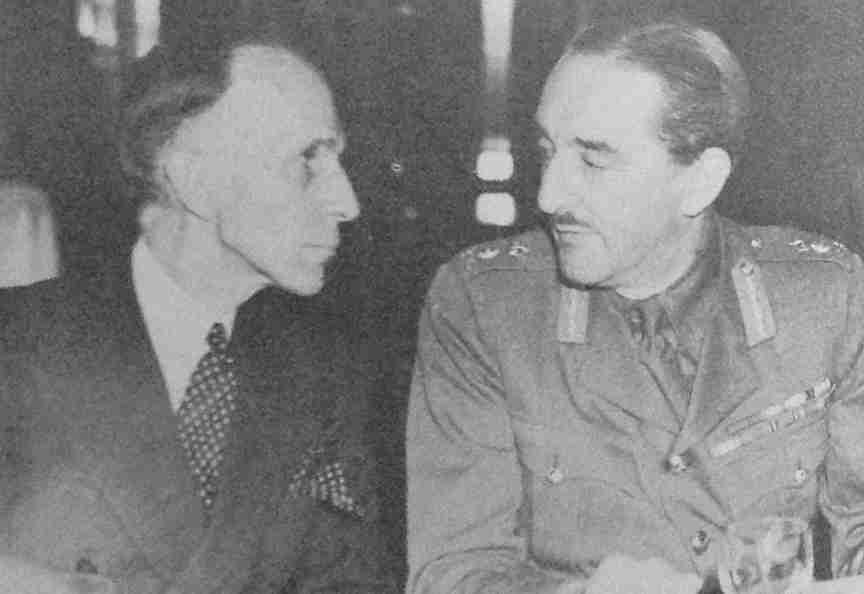
The High Commissioner and General Sir Alan Brooke, 1940
During this period Lord Lee of Fareham came to see Alice and me about the famous collection of medieval and Renaissance objets d’art which he and his wife had assembled over the years. Arthur Lee asked me whether I could arrange for five great cases of these priceless objects to be sent to Canada for safe keeping. At the same time he said that he and his wife Ruth would like to give these to Canada if a proper place could be found for them. Now, known as the Lee Collection, they repose in the Royal Ontario Museum where they give pleasure to countless people.
A Canadian scientist who paid several war-time visits to England was Sir Frederick Banting. He was concerned with medical research in relation to war. When he was in England in January 1940, I took him to see Lord Hankey at the Treasury to discuss biological warfare; he felt that too little research was being carried on in Great Britain on this depressing subject. Hankey told us what was being done but failed to convince Banting that the threat was being faced with sufficient realism. As I listened to him talk, I felt that Canada had rarely produced anyone who combined so many distinguished qualities, including the rarest of all—modesty. We suffered an irreparable loss when he died in an air crash in Newfoundland in 1941.
Lord Tweedsmuir, Governor-General of Canada, died at his post in February 1940. I was one of the many who mourned his loss. John had been a friend of mine for a number of years; he and his wife had stayed with us once or twice in Canada and we with them at Elsfield in Oxfordshire, these visits taking place long before his appointment in Canada. I greatly admired his work as Governor-General and learnt much from it. No one among my predecessors had a clearer insight into Canadian life. He travelled as widely as he could, and with imagination and courage. Because he died in office, copies of his letters to the King were left in the archives of Government House (it is the practice for a Governor-General to send personal letters regularly to the Sovereign), and when I took up residence there I read them with immense interest. They had the fine quality that marked everything John Buchan wrote.
I was asked by the British Broadcasting Corporation to speak about Tweedsmuir in a broadcast to Canada, in which I said the following:
Canada . . . will be grateful always for the presence in her midst of one who understood her so well and so fully won her affection. . . . Canada itself spread before him like a book, and it was his happy faculty to turn the pages, as it were, of that broad volume with eager interest and to give an interpretation of what he saw. . . . He had the gifts of insatiable curiosity and quick insight. He caught the spirit of Canada—the romance of her past and the rich mystery of her future.
I felt it appropriate that after John Tweedsmuir’s death a memorial service should be held in Westminster Abbey, and the Dean gave his full approval. I was informed by Ottawa that no public money could be made available to defray the cost of this service, the reason being that Westminster Abbey belonged to the state church of England and that there was no state church in Canada. The money was, therefore, provided from private sources, and Ottawa was assured that Canada would in no way be responsible for the expenses.
Later I went to Plymouth with John Buchan (the present Lord Tweedsmuir) and another officer to meet the ashes of the late Governor-General. A guard of Marines was drawn up on the quarter-deck of the cruiser that had brought the ashes from Canada. The urn containing them was carried down the ladder into the barge; we followed and left for the quay. There the Admiral, the General Officer Commanding Plymouth, and the Deputy Lord Mayor were waiting, and a guard of honour of blue-jackets was drawn up. The ashes were placed in a railway compartment with drawn blinds; we then entered another compartment, after which our carriage was attached to the London train.
It seemed natural enough that I should be involved in some discussions about John Tweedsmuir’s successor. One distinguished peer came to say that, although his name had been mentioned, he was not eligible for the appointment. Another member of the Upper House suggested his own name as a candidate. In due course, Lord Athlone’s was put forward. Before the matter was settled he came to me and asked if I thought he was too old to go to Canada as Governor-General; I gave him a reassuring reply and expressed the hope that he would be appointed. He had many qualities fitting him for the post. He shared his family’s ability to come down by a sort of instinct on the right side of a public issue. Like his sister, Queen Mary, he had an unbending sense of duty. He possessed an endearing nature and the engaging attributes of warm and personal modesty. He was brilliantly supported by Princess Alice. Government House has rarely had a chatelaine with her perception, imagination, and capacity for friendship—and a trait no less endearing: frankness and candour.
On April 29, 1940, I flew to Paris with Norman Rogers, then our Minister of National Defence, and Harry Crerar. Although Paris was smiling in the spring sunshine, she was not at all herself, rather like a lovely woman greatly distressed in mind. She had lost some of her chic, her lightness and elegance. General Vanier, who was then Canadian Minister to France, was our charming and capable host and guide. Through him we met a number of people, among whom were several senior politicians and generals. These did not impress us. Our objective was Lord Gort’s headquarters near Arras, which we reached by air from Paris. We then motored over the First Corps area and were shown defensive works of all kinds. Our party included two corps commanders, Brooke and Adam. I find the following comment in my diary: ‘. . . a tremendous amount of work seems to have been done, and apparently well done, but to the civilian eye at least a lot remains to be done.’ (Diary entry, April 30, 1940.)
This was made brutally clear ten days later when the German invasion took place, and these works were swiftly overrun. My diary goes on to say:
As I lay in bed at the C.-in-C.’s chateau, just about to drop off to sleep, out of the complete silence came the notes of a nightingale who sang as if his heart would break—a curious thing in the middle of all the war-like tension, the masses of lethal weapons, the thousands of troops, to hear this bird’s song.
[Diary entry, April 30, 1940.]
We left Gort’s headquarters early the next day and motored to Vimy so that Norman Rogers could see the great Canadian monument, which looked most impressive in the morning mist. I remembered that I had said when it was dedicated four years before that the memorials of the last war might well prove the victims of the next. Happily I was wrong.
After our return to London the situation became increasingly grave. It is difficult to reproduce the atmosphere prevailing in May and June of 1940. On May 16, after a busy day, I went to bed early. My diary reads:
At about 10:30 a call from the Dominions Office to say that a special War Cabinet meeting was being held, after which a meeting of the High Commissioners would take place to receive a report. I dressed and told Wallace to bring the car round and drove up to London, Alice coming with me. Drove direct to the Dominions Office. Our meeting started at 12. Caldecote told us that the Prime Minister having received grave news had flown over to France to confer with the French politicians and Generals, and he read us a telegram he had sent to the War Cabinet—a depressing and even terrifying document. He spoke of the ‘mortal gravity’ of the situation and gave us the impression that the fate of the French Army hung in the balance. Even allowing for the emotional colouring of Churchill’s vocabulary the situation looked bad enough in all conscience. It is no use going into military details as they are a matter of public record. Bruce and I urged Caldecote to send a telegram to the Dominions’ Prime Ministers telling them that they should know of the serious situation, and this was done. We took some part in the preliminary drafting of the message.
[Diary entry, May 16, 1940.]
Some things remain with permanent vividness, such as visits, almost daily, to the map room at the War Office where we saw the coloured pins moving relentlessly in the wrong direction—it was hard to keep one’s spirits buoyant. I shall not forget visits to fighter stations during the evacuation of Dunkirk. I went to the R.A.F. station at Biggin Hill to see the 242nd Squadron come back from the battle over France. My diary records:
They arrived at the hour they were expected just at dusk and were a lovely sight circling round the aerodrome with their navigation lights on and in perfect formation—an extraordinary thing the contrast between the hell they had been in over Dunkirk and the quiet Kentish countryside they arrived in, only a few minutes away. The pilots, six or eight in number, most of whom I knew, after they had left their planes and thrown their tackle to the awaiting aircraftsmen, came over to the dispersal hut and I had a talk with them all. They were in grand spirits—gay, full of life, natural, simple and easy as if they had just been out for a day’s pheasant shooting. They looked tired but didn’t show the marks of nervous strain that I expected. Only nine out of the original 23 pilots are now with the squadron.
[Diary entry, May 30, 1940.]
The fall of France was brought vividly home to us when on June 22 we met, at Paddington, a party of twenty-seven Canadians who had been evacuated and had reached England after a harrowing experience at sea. They included our Minister to France, General Vanier, and his wife. Alice and I were happy and relieved to welcome our old friends, Georges and Pauline, after their safe arrival in England.
Among the countless tragedies of those weeks was the plight of loyal Frenchmen looking on at what had happened to their country. When a member of the staff of the French Embassy in London came to say good-bye to us, I said how difficult the last few days must have been for him. He replied, ‘I have no heart left to break.’
The collapse in France quickly threatened to spread to the French colonies in North Africa and elsewhere, where it would confront the remaining Allies with new perils. It seemed to me that something might be done to prevent this disaster, and on June 18 I wrote as follows to the Foreign Secretary:
We can do nothing through the existing French Government, but is it possible that the situation can be stabilised, or pro-allies sentiment aroused, by a backstairs approach to the French colonial governors and military commanders? What I had in mind is an immediate visit by a Minister from here, if possible accompanied by one or two Frenchmen. De Gaulle’s name comes to one’s mind. How would George Lloyd[4] do? He holds the appropriate office and has the sort of temperament for such a mission.
[Letter to Lord Halifax, June 18, 1940.]
Lord Halifax replied:
I expect Caldecote [the Dominions Secretary] told you that we had a long discussion at the Cabinet last night on the proposition to send Lloyd on exactly the kind of mission you describe. This suggestion was at first approved, with particular reference to units of the French Fleet, but later the Prime Minister reconsidered it and brought it to the Cabinet again this morning. There the weight of opinion was against it and, although I still hankered after doing something of the kind, I felt bound after discussion to recognise the force of what had been said on the other side. The main point in this sense was that to send a British mission to possibly hesitating French administrations might easily have precisely the opposite effect to that which we desired, inasmuch as the administrations in question would certainly, having probably been only partially informed about everything that was passing, at once report what we had done to the Bordeaux Government, who would immediately redouble their efforts in the wrong direction.
[Letter from Lord Halifax, June 23, 1940.]
In the event, George Lloyd went to Bordeaux where he saw Marshal Pétain and conveyed a British offer to put transport at the disposal of the French government for evacuation to North Africa. This offer was not enthusiastically received: Pétain told Sir Ronald Campbell, the British Ambassador to France, who had accompanied Lloyd to Bordeaux, that if the British torpedoed a ship taking the French government overseas, he would have no regrets. (Sir Llewellyn Woodward, British Foreign Policy in the Second World War, p. 72 n.)
Pétain’s outlook was not particularly promising. Nevertheless, it seemed to me that the total lack of communication between Britain and Vichy after the fall of France was not helpful to the Allied cause. Perhaps Canada might usefully play some part in opening what Mr. Churchill was to call ‘a window through which they could look at what was happening in France’. I therefore suggested to Edward Halifax, the Foreign Secretary, that he might care to inquire whether Ottawa would be prepared to send Pierre Dupuy (who had been first secretary at our Legation in Paris) to Vichy, ostensibly on Canadian business but actually to get what information he could as to how things stood with Pétain and his government. This suggestion was accepted—with alacrity by London, with reluctance by Ottawa. On November 11, 1940, I recorded in my diary:
Saw Pierre Dupuy who is off to Vichy shortly; little does Ottawa know that his journey to which they reluctantly assented was my idea. I felt that a Can. chargé d’affaires could get information & express a point of view—on behalf of H.M.G. here (but without saying so)—which would be most helpful to the Foreign Office. So now after many visits to the F.O. & the Admiralty he is off, able if he uses his opportunity to do a useful job on behalf of the Empire.
[Diary entry, November 11, 1940.]
Dupuy returned from France the following month—the first of what were to be three missions to Vichy completed. He told me of his adventures. He had seen Pétain on several occasions, and had been very well received. He felt that the Marshal was very much at the head of his administration; that the French fleet and bases would not be willingly surrendered to Germany; and that there was a good prospect of secret collaboration between France and the British Commonwealth, though it might be wise to maintain the present appearance of tension as a sort of ‘smoke screen’. Dupuy ‘has risen to his responsibilities admirably’, I noted in my diary on December 20, ‘& has greatly impressed official London with what he has to say.’ He made a somewhat less favourable impression on his own government. On December 31 I recorded:
Ottawa is getting alarmed about his activities as intermediary between Vichy and H.M.G. here & is sending fussy telegrams. I gave him some guidance. As soon as any representative shows either imagination or initiative he calls down the displeasure of the powers that be in External Affairs. Their ideal diplomat belongs to Mme. Tussaud’s waxworks!
[Diary entry, December 31, 1940.]
And on January 3, 1941:
Dupuy is receiving savage telegrams about a press leakage about his visit to Vichy. Ottawa really resents his having gone at all & is in a thoroughly nasty mood about it. His use by the F.O. would anger them quite apart from . . . the young rep.’s departure from the passive role Canada assigns to her diplomats. I am trying to give Dupuy as wise counsel as possible—both for his own sake & to save a very important link between H.M.G. and Vichy.
[Diary entry, January 3, 1941.]
Whatever petty jealousies may have clouded Ottawa’s appreciation of Dupuy’s fine work, they did not prevail; Mackenzie King noted in his diary on February 13, 1941, that he found Dupuy’s report of his mission ‘an exceedingly interesting and able document. Felt proud that a Canadian could have played so immensely important a part.’ (Quoted in J. W. Pickersgill, The Mackenzie King Record, I, p. 147.) But Dupuy’s contacts with Vichy continued to give the Canadian government concern, chiefly because they depended upon Ottawa’s continuing to receive a Vichy representative in Canada, which greatly offended English-speaking opinion in the Dominion. It was only because Winston Churchill spoke strongly of the value of Dupuy’s role that the Canadian government refrained from breaking off diplomatic relations with the Vichy régime for as long as the summer of 1942. In August of that year the Pétain government sent a message to the Germans, congratulating them on repulsing the Canadian raiders of Dieppe. I wrote to Mackenzie King:
I should think the publication of this must have removed most of the lingering pro-Pétain feeling in Canada. I gather from Fighting French Headquarters here that we are now likely to receive a new representative of their Committee in Ottawa . . . Dupuy is still here but anxious to visit Vichy whenever he receives instructions to do so. The Foreign Office, as you will remember, thought when he was preparing to leave some time ago that it was an inopportune moment.
[Letter to Mackenzie King, August 27, 1942.]
Pétain’s offensive message of congratulation made any further dealings with Vichy out of the question. Its representative at Ottawa was sent packing in November 1942, soon after the Allied invasion of North Africa. On November 9, Dupuy came in to see me about his position in the light of the Allied landings. ‘He still cherished a hope that he might continue his diplomatic connections with Vichy. I disabused him of this illusion.’ (Diary entry, November 9, 1942.) On November 17 I wrote:
Dupuy . . . takes a realistic view about Darlan’s position. I think the situation is best summed up by Waterson [High Commissioner for South Africa] who said, ‘Our selection of Darlan as temporary leader in North Africa has much to be said for it as long as our intentions are strictly dishonourable.’ One has to use any instrument in war-time.
[Diary entry, November 17, 1942.]
In December 1942, I was instructed to let de Gaulle know that he would be a welcome visitor in Canada if he went to the United States, but not to invite him, as that might possibly offend the State Department. My comment on this at the time was as follows: ‘I wish we could take a more independent line on such things.’ (Diary entry, December 21, 1942.)
On February 18, 1941, General de Gaulle came to me to ask whether permission could be given for two of his supporters in the Free French organization to visit Quebec and endeavour to offset the effect of the propaganda that was pouring in from Vichy. I communicated with Ottawa and the Government agreed. The senior member of this party was a naval captain named d’Argenlieu who, in ordinary life, was the head of the Carmelite Order in Paris. He was well received in Quebec and his mission was successful.
At about this time I find in my diary the records of a rather depressing meeting of the high commissioners:
Diplomatic news from everywhere uniformly gloomy. French Government succumbing to Nazis, Japan preparing for aggression southward: Bulgaria being undermined by Germans; Turkey shilly-shallying; Spain ready to collapse into Germany’s arms. Even the U.S.A. wasting time over the current Congressional debate.
[Diary entry, February 6, 1941.]
|
Lord Lloyd, Secretary of State for the Colonies. |
In August 1940 the four high commissioners spent a day on the South coast when General Thorne of the Eleventh Corps was our guide. The old towns of the Cinque Ports, and others, which in peace time were as far removed from the currents of the world’s life as anywhere in England, were now in the front line again. Huge craters showed them to have been the scene of German bombing. Thorne said that fortifications dating from four different periods in English history were now being used by him in the corps area for defence against German invasion: Roman fortifications, castles built by William the Conqueror, forts constructed by Henry VIII, and martello towers built by Sir John Moore to meet the Napoleonic menace.
On January 29, 1941, I had a talk with Mr. Roosevelt’s representative, Harry Hopkins, a quiet, unassuming, shrewd, and sensitive man. I recorded in my diary:
He said that more important than his advertised mission to report on the progress of the war, etc. was the task of helping Roosevelt and Churchill to understand each other’s mind. He felt that they didn’t really understand each other and that there were inherent dangers in this. He was impressed with the similarity between the two leaders in temperament—their sense of history, their imaginative outlook, their feeling for the technique of things—in all of which there are virtues and dangers as well.
J. G. Winant arrived in March to take up his post as American Ambassador. He was not in London long before he won the hearts of the community and, as time passed, became a very much-beloved ambassador, recalling the days of Walter Hines Page during the First World War. Winant was anything but a good speaker—he spoke very shyly, his pace was too fast, and he buried himself in his notes—but his sincerity and sensitivity were so striking that his speeches made a vivid and lasting impression. He had a deep understanding of the British people and was devoted to the cause to which they, and later his own country, were dedicated.
I found myself involved to some extent in the agreement between the United Kingdom and the United States that transferred to the latter control of numerous Atlantic bases in return for the gift of a number of obsolescent destroyers. Canada was interested in this deal because of the inclusion in it of bases in Newfoundland. I find in my diary the following comment referring to the agreement by which the British control of the bases was surrendered inevitably: ‘One can probably hope for a more liberal spirit in practice than in the negotiations’—and that proved to be true. The State Department may have driven a fairly stiff bargain, but the officers whose duty it has been to operate the bases have been, on the whole, co-operative and understanding. I went on to say: ‘. . . after the war the agreement will give rise to a vast deal of friction and misunderstanding unless a reign of peace makes the bases idle.’ (Diary entry, March 27, 1941.) I am glad I was a little too pessimistic.
At the signing of the treaty, Winston Churchill proposed the health of the King and the President of the United States, then he proposed a toast to freedom and added, sotto voce, ‘and to hell with tyranny’. Then he said, ‘Keep that off the record. I am not referring to the sentiments but only to the terms of their expression.’
On April 7, 1941, I have the following passage in my diary:
High Commissioners’ meeting at 4:00. Presence of British troops in Greece at last acknowledged after weeks of silence since we were told the news secretly. However the adventure may turn out I know that the doubts were on the side of the politicians and not the soldiers who were all of them in favour of it. Churchill’s own attitude was one of extreme hesitation until the heads of the Services said it was the right thing to do for military reasons. The noblesse oblige motive didn’t enter into the decision at all.
And later, on April 17, I recorded:
The politicians can be acquitted of having pressed the soldiers to send forces to Greece. Indeed a long telegram from the P.M. to Eden discouraged the idea and invited a negative attitude on the part of the military authorities. The decision to withdraw is equally a military decision.
I had a personal interest in the Greek expedition; my son Lionel held a commission in one of the regiments involved. The 60th Rifles had served at Louisbourg in 1757 and at the taking of Quebec in 1759. It was first called the Royal Americans. In the retreat in Greece, the small British forces, outnumbered by the enemy and possessing no air support, were inevitably overrun. Lionel was among those who were wounded, taken prisoner, and moved to Athens. To quote from my diary of April 23, 1941:
Got a wire from Lionel which concluded: ‘Would love to buy a Rouault if there is a good one.’ This was wonderful coming from where we think he is. It may mean that he wants to tell us all is quiet or he is safe or evacuated. In any case we have extracted the maximum comfort from it without being too sanguine or overconfident.
A meeting of the representatives of the Allied governments-in-exile was held at St. James’s Palace on June 12. While they sat round a table within these ancient English walls, a British Prime Minister spoke words of comfort and hope. What he said made this gathering memorable:
Hitler may turn and trample this way and that through tortured Europe. He may spread his course far and wide, and carry his curse with him: he may break into Africa or into Asia. But it is here, in this island fortress, that he will have to reckon in the end. We shall strive to resist by land and sea. We shall be on his track wherever he goes. Our airpower will continue to teach the German homeland that war is not all loot and triumph.
We shall aid and stir the people of every conquered country to resistance and revolt. We shall break up and derange every effort which Hitler makes to systematise and consolidate his subjugation. He will find no peace, no rest, no halting-place, no parley. And if, driven to desperate hazards, he attempts the invasion of the British Isles as well he may, we shall not flinch from the supreme trial. With the help of God, of which we must all feel daily conscious, we shall continue steadfast in faith and duty till our task is done.
This, then, is the message which we send forth today to all the states and nations bond or free, to all the men in all the lands who care for freedom’s cause, to our allies and well-wishers in Europe, to our American friends and helpers drawing ever closer in their might across the ocean: this is the message—Lift up your hearts. All will come right. Out of the depths of sorrow and sacrifice will be born again the glory of mankind.
[The War Speeches of Winston S. Churchill, I.]
Later that month I had an audience with the King of Norway at the Norwegian Legation. I say in my diary: ‘Found H.M. unexpectedly vivacious and forthcoming, and . . . very simple and democratic. Amused at his defence of Leopold the Belgian King—although he had stayed in his country unlike King Haakon. There is a bit of the trade-union spirit among Kings!’ (Diary entry, June 23, 1941.)
In 1941 I was gazetted a Privy Counsellor, having been recommended for the appointment by Mr. Churchill. Although the initiative in this case was taken in London and not in Ottawa, Ottawa was asked to concur, and did. In due course I was sworn in at Buckingham Palace in a short but impressive ceremony in the presence of the King. There were three or four of us sworn on the same occasion and after the formidable P.C.’s Oath was taken by each in turn, we knelt on the faldstool in front of the King and kissed his hand. The ceremony, solemn, intimate, and human, has been unchanged for centuries. The office of Privy Counsellor, of course, has a very ancient history. The Council, as it exists today, grew out of the body whose members have served as advisers of the monarch since Saxon times.
If a person who holds the rank of Privy Counsellor is given a commission by the Sovereign, such as one appointing him Governor-General, he is referred to in the document as ‘our right trusty and well-beloved Counsellor’. The historical meaning of the Privy Counsellorship is further illustrated by a practice that still prevails. P.C.s who are not peers, if they wish to listen to a debate in the House of Lords, are permitted to sit on the steps of the Throne where in ancient times the King’s advisers were placed. After I had become a Privy Counsellor, I wished to hear a certain debate in the Upper House, but I was rather shy about taking advantage of this historic privilege. I went to the door of the Chamber and asked the attendant if there was any room in the gallery, whereupon he said, ‘But you, sir, can sit on the steps of the Throne,’ and before I knew it that was where I was placed, along with a few others who had arrived before me. How he knew that I was qualified for this I have no idea unless it is the practice of attendants in the House of Lords to memorize the faces of Privy Counsellors when their likenesses appear in the press on the publication of the Honours List.
At this time great efforts were made in Canada to raise money for war purposes through periodic ‘Victory Loans’. I was drawn into the plans for one of these, to my considerable embarrassment. The scheme on this occasion was that an object called ‘The Torch of Victory’ should be sent across Canada and used at public meetings in the principal cities to create an interest in the financial campaign; after its Canadian tour it was to be received by Mr. Churchill in the garden of No. 10 Downing Street. The Canadian minister accompanying the Torch was Ian Mackenzie, Minister of Pensions and National Health, and with him was C. G. Power, our Minister for Air. The former was to present it to the Prime Minister, the remarks of both to be recorded and broadcast. In due course the Torch of Victory arrived. It was quite appalling to contemplate—some five feet high with an imitation flame—battery-fed—and designed according to the worst traditions of early Hollywood. At the appointed hour the Torch was taken to Downing Street by three young Canadian officers. I went down with the visiting minister, full of apprehension. He had read me his speech which I had succeeded—without, I think, offending him—in reducing by about one-half, leaving out the purpler passages. We arrived at No. 10 where Brendan Bracken, the Minister of Information, was awaiting us, and a very small party of official people. Somebody had forgotten to waken the Prime Minister, and he arrived in the garden very sleepy and not greatly pleased. He was reminded by Brendan of what was expected of him, whereupon he asked (pointing to the masses of cables and cameras and lights) what all the apparatus was for. He was told that the broadcast was to be recorded. He replied, in no uncertain terms, that that was not his understanding of the arrangements at all, and a crisis seemed to be developing when I said, sotto voce, to Brendan, ‘Canada is expecting some remarks by the Prime Minister and it will be a catastrophe if nothing comes across—it is up to you to save the situation.’ The Torch of Victory was duly presented by Mackenzie, in a speech that, it seemed, could have been heard without the aid of science in his native Scotland. The Prime Minister replied in a short speech appropriate to the occasion.
Towards the end of September 1941, Alice and I visited the Canadian Forestry Corps scattered about the Highlands and removing for war purposes great areas of Scottish forest. General White, who commanded the corps, had performed similar duties in the First World War. This was a characteristic Canadian contribution to the war effort. Most of the officers and men in the corps—which at peak strength numbered about 7,000 (all ranks)—had, in civilian life, been engaged in forestry operations in Canada. They were divided into units, each with its own sawmill. The work involved was second nature to them, except that the trees were cut not according to our rather wasteful methods in Canada but very close to the ground. Alice and I were put up at the headquarters mess (she being the only lady to have had this privilege) and she was tenderly looked after by the General’s batman. He was both shy and attentive in all his duties, which included bringing Alice’s breakfast to her in the morning. It was a rewarding visit and made us very proud. General White’s men were not only good foresters but good soldiers as well. We left headquarters to the strains of ‘Will Ye No Come Back Again?’
Later I was asked to interest myself in the plans for a war film which ultimately achieved great success, The 49th Parallel. The Treasury reluctantly had underwritten the cost of this film and were surprised and, I think, almost disappointed to find that it was a financial success; they had been proved wrong! I was able to arrange facilities in Canada for the producers, Michael Powell and Emeric Pressburger. I was asked to record a brief prologue at the studio, explaining what the title meant. The film was launched with great éclat at a big luncheon, and Alice and I took H. G. Wells along with us. My diary says:
Wells was in good talking form—said that Great Britain was the only country in the world which could accomplish revolutions without bloodshed. It was her duty to point the way to peaceful change to the U.S. which after this war would have to undergo great changes. I ventured to suggest that the American Constitution made changes difficult.
[Diary entry, October 8, 1941.]
A war-time Christmas in England was hardly a day of tranquillity and rest, as the following quotation from my diary may show:
Christmas Day, 1941: Alice and I after distributing Christmas largesse to the hotel servants went to the Officers’ Club, taking a large—very large—granite ware jug full of rum punch, with an odour which must have laid the car open to suspicion for some time to come. Then we went to the Beaver Club and greeted the volunteers and other workers and then visited all the rooms where the men were having their Christmas dinner. I made short speeches and we shook hands with scores of men. . . .
Then back to the Officers’ Club. About 100 there. Alice and I were host and hostess having provided lunch. The punch was a great success and the place had a perfect Christmas atmosphere. We spent most of the afternoon visiting (a) the Canadian Legion Club (where we heard the King’s speech over the radio), (b) the Red Shield Hostel (Salvation Army), (c) the Victoria League Hostel, and (d) the Y.M.C.A. hostel in Leinster Gardens, where we met numbers of Canadian soldiers.
We had a Christmas dinner party in our rooms, 25 persons sat down to dinner in our little dining-room. . . . After dinner we played childish games and enjoyed them.
It is recorded in Sir Winston Churchill’s incomparable history of the Second World War that his first reaction, when wakened to be told of the Japanese attack on Pearl Harbor, was one of relief and even of exultation: ‘So we had won after all.’ Here was Churchillian exuberance and the long view with a vengeance! Lesser strategists, and those with less buoyancy of spirit, might pardonably wonder whether the belated belligerency of the United States would in time compensate for the steady series of disasters now inflicted like hammer-blows upon the Allied arms. The Japanese thrust through South-east Asia was both swift and unpredicted. Hong Kong had fallen on Christmas Day, with nearly 300 Canadian soldiers killed and 500 wounded; Malaya was lost soon afterwards; Singapore was finally captured on February 15, 1942; the retreat from Burma was begun; and two capital ships of the Royal Navy were sunk in the Java Sea. These were black days. On March 17, 1942, I wrote to Mackenzie King:
One is conscious at the present time of a feeling of frustration which seems to be growing here in all classes of society. The determination to win this war is as strong as ever but there is a growing and general malaise which threatens to impair national unity. The cause of this is not adversity. Of this there has been plenty of late. Adversity, however, has not hitherto impaired morale. On the contrary, everyone knows the renewed resolution and effort which followed the fall of Dunkirk, but the recent reverses—Hong Kong, the loss of the two great warships in the Far East, the escape of the German ships, Singapore—these events have set people thinking. There is now a disposition to criticise which was absent in 1940. The situation is of course very different. The disaster of Dunkirk was largely due to the collapse of an ally. The British public expressed themselves in action—the organization of the Home Guard and the A.R.P. services, the expansion of the fighting services and munitions production. When the bombing followed the Battle of Britain there was a communal pride in standing up to it and manning the Civil Defence units. Now things are different. The organization of the community is all but complete. There is little to distract the mind from the panorama of defeats in the Far East and in the absence of imminent danger the minor hardships and privations of war conditions seem all the more irksome. Public morale is basically as good as it ever was, and people are as willing as ever to bear any burdens and meet any dangers to bring victory closer, but they ask to be told what to do, and they demand vigorous policy in both war strategy and home affairs.
Churchill’s leadership is still unquestioned and his prestige has survived the dangerous wave of criticism in both House and country which threatened it before he yielded and reconstituted the government, but the public are far more watchful than formerly as regards the direction of the war and increasingly conscious of any weaknesses in existing leadership. Should the war continue to go badly with no evidence of aggressive and coordinated allied policy, then the position of the Government will deteriorate rapidly. Speeches without vigorous action will have little effect. . . .
I feel sure that you would not disagree with much of what I have said in this letter if you were here at the present time.
[Letter to Mackenzie King, March 17, 1942.]
A few days later I wrote to the Governor-General of Canada, Lord Athlone, on the same subject, perhaps a little more optimistically:
London, as you may imagine, has not been the most cheerful of places in the last few months. The reverses in the Far East have made unpleasant reading, but the rather sombre atmosphere has not only been due to adversity. There has been a spate of criticism about the conduct of the war both at home and abroad, some of it captious and superficial, some of it sincere and constructive. The reconstitution of the Government recently has had a very salutary effect and since then certain positive things like the appointment of Cripps and Casey, the successful attack on the Renault works at Paris, have gone far to raise the temperature of public feeling. Another thing that has happened that has helped greatly is the tightening of the rationing regulations, the limitation of sport, and generally the imposition of a greater degree of austerity in the life of the community. All this has met with a very satisfactory popular response. People are only too glad to be asked to tighten their belts and pull up their socks if it helps the war effort. I am quite sure that morale here is as fine as it ever was and the British public will assume any burdens, however onerous, if they know why it is necessary and how it will help. Now I think it can fairly be said that this community is off to a new start with renewed determination and deepened confidence.
[Letter to Lord Athlone, March 23, 1942.]
And to Brooke Claxton:
From what one hears of the States the Americans have still a touch here and there of the ‘maginot mind’ despite Roosevelt’s wise guidance. I suppose the great majority of Americans realise that despite the spread of the war into the Pacific, they cannot win the war without Great Britain and that this country is no less important than it was at the beginning as a bastion of freedom. In fact this country and the United States are now linked together by complete mutual dependence. That fact, however, does not necessarily mean that all will be rosy in the garden of Anglo-American relations, and a good deal will obviously have to be done in the interest of mutual understanding.
[Letter to Brooke Claxton, March 20, 1942.]
This last remark was to prove a considerable understatement throughout the three remaining years of war.
One early consequence of the mounting menace in the Far East was the intensification of Australian demands for fuller participation in the formation of grand strategy. The privilege earlier extended to Australia’s High Commissioner in London of attending meetings of the War Cabinet had not fully brought about the desired result, largely because high policy was thrashed out generally not there but in the Cabinet Defence Committee; and it was the Australians, led by their new Prime Minister, John Curtin, who were now reviving most insistently the project of an Imperial War Cabinet so successfully headed off by Mackenzie King the preceding August. In an attempt to placate Australia, there was created in February 1942 what was known as the Pacific Council. Mr. Churchill presided, and Australia, New Zealand, India, the Netherlands, and China sent representatives at one time or another. The Canadian government showed no sign of wanting to be present at these meetings, for their merely ornamental and mollifying functions were recognized in Ottawa from the beginning. I referred in my diary to a conversation with a Dominions Office official ‘over Churchill’s reply to W.L.M.K.’s enquiry about Can. repn. on Pacific Council. Neither Can. nor G.B. wants it and if it took place it would mean “dual repn.” in London from Canada. God forbid!’ (Diary entry, February 12, 1942.)
The Pacific Council thus constituted met in London; and it was without representation from the United States. These features appeared to the Australian government as grave defects, and, at the insistence of Curtin and Herbert Evatt, the Australian Minister for External Affairs, both were remedied. A second Pacific Council (known as the Pacific War Council) was created in Washington, with the United States as a member. There were now two Pacific Councils, and the theory was that they would work very closely together.
With the creation of the Washington Council, the London Council now became potentially important, and the Canadian government accordingly demanded and received membership. On April 2, 1942, I was named Canadian representative, and I attended the first meeting a few days later. ‘Curiously formless meeting,’ I recorded in my diary:
No agenda. No report of meeting of corresponding body [in Washington]. [word illegible] questions asked by members on course of war & yet no question could naturally be asked on operations—immediate—or even on long-term strategy. The only document we were given was at first blush, at least, a strategical division of the Pacific which appeared to the layman to be of extreme rigidity. It emanated from Washington. Perhaps my second impression will be more favourable & after all the Council has been newly organised.
[Diary entry, April 8, 1942.]
My impression of the second meeting of the Pacific Council was, if anything, less favourable. ‘Pacific Council met at 6:00,’ my diary for April 21 records. ‘More futile than last meeting. No agenda & a series of desultory questions asked by a group of men much too busy to have their time wasted. At present the Pacific Council is a piece of make-believe. It should be given something to do or buried.’ I amplified these impressions in a letter to my Prime Minister:
I have sent you two despatches relating to the two meetings of the Pacific Council I have attended as the Canadian representative. As you will have seen, they were disappointing meetings. Something is almost certain to be done about the status and terms of reference of the Council as a result of the general feeling of the members that the present position is not satisfactory. The preservation of a reasonable balance between London and Washington in the conduct of the war is of course a most difficult problem—not really a soluble problem at all—and any arrangement must inevitably be a compromise. I have been very glad to see that recently we have strengthened our representation in various fields in Washington. This will serve to emphasise the fact that the war effort, as far as we are concerned, is represented not by a London-Washington axis alone but by a London-Washington-Ottawa triangle.
[Letter to Mackenzie King, April 29, 1942.]
It was to be no easy task to preserve Canada’s position as an identifiable base to an isosceles triangle of which the larger sides were the United Kingdom and the United States. Early in 1942 I received a disturbing letter from Mike Pearson in Ottawa, recounting some of the difficulties the Government was experiencing in attempting to preserve Canada’s identity in the direction of the War:
We have been more than usually busy since I wrote you last, between dealing with the always increasing general work of the Department; declaring war on states here and there; and attempting to preserve our independent position in the face of the encroachments of our new ally, the United States.
United States-Canadian relations present a very difficult problem indeed in present circumstances. We are finding out that our cherished status is more respected in Downing Street than in Washington, and there are very definite and discernible tendencies in the latter capital to consider us either as a part of the British Empire to be dealt with through a British Empire spokesman from the United Kingdom or as a North American colony. . . . There is no question that the United States did not wish us at [the Rio] Conference. The United States is also not anxious for us to play too big a part in deliberations in Washington. Mr. Churchill’s visit showed that. Their view was that he was quite qualified to speak for the British Empire and that too many voices would complicate matters. I feel certain that if any Allied Council is set up there, we will have to fight hard for our place in it, but so far as the officials of the Department are concerned, we are certainly willing to make that fight.
You will have noted that the Washington Declaration—a badly drafted document, which was sent to us shortly before the ceremony with the injunction we were not to make any changes—does not list all the States in alphabetical order, as has become customary. The Americans insisted on breaking them up into a major league and a minor league. Canada was put in the minor league alongside Costa Rica.
But the really serious difficulties we have had with the United States have been, of course, over St. Pierre. . . . In our view the conduct of the State Department in this matter is entirely inexcusable. We know Moffat [Jay Pierrepont Moffat, U.S. Minister to Canada] well enough here personally to tell him exactly what we think about the way his colleagues handled this matter. I am afraid we are not out of the woods yet, though the earlier and wilder plans of Washington to use us to drive the ‘so called Free French’ (that reference was one of the worst things they did) out has been abandoned. However, there is very little we can do to influence American policy on this matter. I am afraid they do not treat our views with any great deference or respect and I am, also, afraid that we have ourselves partly to blame for this.
[Letter from L. B. Pearson, January 9, 1942.]
I replied:
. . . I was shocked to hear about our difficulties with Washington but I must say not surprised. Ever since I was there I have been very conscious of the contrast between Rotarian goodwill and State Department rigidity. It really is extremely disturbing to think the attitude described . . . could develop notwithstanding the fact that we are the second most important country in the Americas, that we alone among them came into the war at the very beginning and have made a vital contribution to it in every department of the war effort. Still more disturbing is it to think that these things could have happened while the author of the Good Neighbour policy is at the White House, one of the wisest, most tolerant and broadminded men who ever occupied it. What would happen if he were followed by someone of the Lindbergh school.
[Letter to L. B. Pearson, March 4, 1942.]
Lord Attlee has recorded his view that ‘the Canadians weren’t worried about the higher direction of the War in the way the Australians were.’ (Quoted in Francis Williams, A Prime Minister Remembers, p. 54.) In fact, our concern with our exclusion from the making of strategic decisions was great to the point of being obsessive. My diary records my preoccupation with this problem throughout the remainder of the War, as the President and Prime Minister forged their own exclusive bond for the conduct of grand strategy:
May 14, 1942: . . . Short talk with McNaughton in which he talked of lack of information given to Canada on the strategic side of the war and asked ‘Are we a partner or a provider of men and materials only?’ This is a question with which I am very familiar—I mean the question of how to bring Canada into the picture & I haven’t found the answer. While the war is being directed as personally as it is at present in Washington & London I don’t think there is an answer. . . .
May 19, 1942: . . . At the H.C. meeting, question arose about information not being furnished to the meeting as fully as before—which is true. I also mentioned to Attlee informally the annoyance in Ottawa at having the news about Madagascar announced by the Press to the effect that ‘the United Nations having’ &c, &c, when Canada knew nothing about the operation until after the U.S. and Can. Press had been informed. Most of the difficulty is due to Churchill’s technique. . . .
September 30, 1942: . . . Howe is greatly perturbed over the virtual exclusion of Canada from a reasonable participation in the joint war effort. This is far too much an Anglo-American monopoly and in his view British unwillingness to give Canada a place where the measure of our contribution would justify it for reasons of efficiency is pushing us off into very close relations with the United States on a bilateral basis. . . . The real trouble of course is that Churchill and Roosevelt have set up a war machinery in the form of a Washington-London axis and no allowance has been made for the effective representation of members of the United Nations when circumstances demand it. Our contention has nothing whatever to do with dignity or prestige but is based on purely realistic grounds.
A senior British official, recently returned from Canada, supported this view:
October 1, 1942: . . . In the highest quarters here there seems to be a realisation of the long-term effects of this failure to see the problem in its right perspective . . . in the last two years the British Commonwealth and the principles underlying it have been more and more neglected. I certainly am conscious of this in my contacts with the D.O. I am afraid that an unhappy legacy of resentment will be left after the war is over unless something is done to correct the present trend. . . .
July 8, 1943: . . . A crisis on what I might call the ‘prestige front’, not that it has not its importance. Canada quite rightly is exercised over the omission in various proclamations and communiqués of mention of Canadian forces. . . .
July 9, 1943: . . . I went to see Attlee and Ismay . . . about the question of Canadian mention . . . and I am glad to say distinct progress is being made. Canada will be mentioned not only in the communiqués but in the [forthcoming] proclamation [to the Italian people]. However, a suggestion that our P.M.’s name should be associated with Churchill’s and Roosevelt’s did not meet with acceptance. The actual proposal was no doubt inappropriate but viewed in the light of a certain amount of frustration in the last few months it was understandable. The real difficulty lies in the exclusive control of the direction of the war in London and Washington and the failure to recognise a smaller participant like Canada as not only producing men and material but having a voice in the major decisions. It is quite clear, however, that this war will finish without any change in the machinery of direction and one can only do one’s best in the circumstances to attempt to reconcile Canadian pride with existing practice. Sometimes the upper and nether millstones grind rather heavily on the earnest diplomat.
July 26, 1943: . . . Had a talk with Attlee . . . I felt that I should say something about the feeling of frustration in Ottawa of which I have been made increasingly conscious of late. . . . I told him that my P.M.’s annoyance . . . was due not so much to the problem of communiqués and the mention of Canadian forces, as to the fact . . . that the Churchill-Roosevelt proclamation to the Italian people had been drafted without any reference whatever to the participation of Canadian forces and it was only a last minute intervention, both here and in Washington, which led to an amendment. This, I said, was most unfortunate and quite unnecessary if someone conscious of Canadian feeling had drawn attention to the omission in time. It would have been appropriate to have sent the document to Canada House, but someone conscious of the Dominion aspect might well have caught it in Downing Street. I tried to get Attlee to realise what an unfortunate effect episodes of this kind have in Ottawa. I am quite ready to admit that they are sometimes exaggerated but the fact remains that an unhappy atmosphere develops and it is important to do everything possible to prevent it from increasing and to modify it if it can be done. . . .
In July 1943 my Prime Minister asked that the monthly communiqués to be issued by Washington and London on the Atlantic warfare might be broadened to include Canada as a signatory, in view of the part she was playing in this field—a not unreasonable request, but it did not meet with acceptance. Mackenzie King’s comments about the failure to mention Canadian forces in various communiqués was not well received in London, because of the implication that London had been less forthcoming than Washington. A telegram from Whitehall to Canada on this subject made an unfortunate impression on the very few in Ottawa who saw it. Far greater vigilance should have been exercised in connection with the drafting of documents on such delicate subjects. A senior official of the Dominions Office told me, however, that ‘the telegrams to Ottawa were examples of old world courtesy compared to some that have gone to Australia.’ (Diary entry, July 27, 1943.) There was some comfort in this. It is always easy to exaggerate the adverse effects of such things, but they are worrying just the same and they make the interpretative side of the diplomatic job very difficult.
The close and intimate co-operation of Roosevelt and Churchill in the conduct of the War was not, of course, wholly disadvantageous so far as Canada was concerned. While we were often needlessly left out of affairs in which we had a very legitimate interest, we were by the same token largely freed from the traditional dilemma facing Canadian foreign policy-makers: which side to follow when Washington and London disagreed. All the same, disagreements still occasionally arose, and then the old dilemma reappeared. Early in 1942, for example, the United Kingdom and the United States differed sharply over how to respond to a demand from the Soviet government that her war-time allies should recognize her frontiers enlarged by the forcible seizure of the three Baltic states in 1940. The United States opposed recognition. The United Kingdom, reluctantly, in view of the military situation, felt there was no alternative but to accede to the Soviet request. The problem was laid before the Dominion high commissioners by the British government. My diary records our discussions:
February 27: . . . Consideration of difficult problem created by Soviet demands about their frontiers to which Americans are hostile. They say it is not in accord with Atlantic Charter. It’s a clash between Russian realism and American woolly-mindedness with G.B. as usual getting pushed from both sides! . . .
March 17: . . . H.C.s meeting as usual. . . . Disturbed over American attitude to Stalin’s request that his 1940 frontiers should be recognised. If we refuse to do this the Russian suspicions will get out of hand. . . .
March 26: . . . H.C.s meeting. Stalin has rejected Roosevelt’s communication on subt. of recognition of 1940 frontiers. G.B. must now accept the Russian view notwithstanding the U.S. attitude. Otherwise a disaster may take place. . . .
March 31: . . . Brit. Government has decided to recognise frontiers of Russia whatever U.S.A. thinks. Good! . . .
These diverging attitudes of the United Kingdom and the United States on the question of recognizing the Soviet fait accompli may well be said to reflect a fundamental difference in the approach of their two governments at this time to international problems. When newly independent states enter the world arena for the first time, particularly if they enter by the route of revolution, they characteristically believe themselves to be above and beyond its rivalries and quarrels. Not for them the sordid power politics of older nations, the machinations of their diplomatists, the sunderings and reshapings of their spheres of influence. These are thought to be symptoms of a disease from which the ancient and degenerating may suffer but to which the revolutionary young, if they keep their distance and their principles, may remain immune. The United States, for longer than most nations, had postponed the day of reckoning, when the myth of innocence lay shattered by the facts of politics. The American, as he looked across the Atlantic to what remained of the Old Europe, regarded with a distaste tempered with righteous indignation what he thought to be a shameless Realpolitik with which his own people, by every instinct, would have nothing to do. It was not yet generally understood that power politics are an inescapable consequence of world responsibilities and the readiness to shoulder them—although this understanding would come in time. So long as it did not, however—and this was as long as to the end of the war—considerable difficulty and even high tension were created between what ought to have been the closest possible partners.
America’s suspicions of Britain were most marked in two aspects of external policy: the concern, which heightened steadily as the War drew to its close, that the United Kingdom was intent upon reasserting its pre-war influence by every discredited device of the ‘old diplomacy’; and a distrust of the direction and objectives of British colonial policy. When the United Kingdom and the United States fall out, it is often thought to be Canada’s special obligation to bring them together again. But on these fundamental questions we were not the best of peace-makers, being, as we were, divided and ambivalent ourselves. Nevertheless, one had to do what one could. I addressed myself to the first misunderstanding in more than one dispatch to my own Government. An occasion to offer what I called ‘some reflections on the subject of Anglo-American relations as seen from this capital’ presented itself when the U.S. Secretary of State issued, with the full backing of the President, a sharp statement criticizing British policy towards Italy and Greece, and thus touched off a highly-charged transatlantic debate. I prepared one dispatch that read as follows—it could not have been very palatable to External Affairs:
The ordinary Englishman here sincerely appreciates the aid received from the United States while she was neutral and is not inclined to criticise her for not having been a full belligerent sooner, nor for not having shared the hardships and hazards which proximity to Europe has brought to Great Britain. These contrasts, however, make trans-Atlantic criticism less easy to bear. The man in the street, it must be remembered, is not as conscious as perhaps he should be of those differences, constitutional and social, which affect such matters in the United States. . . . My impression is that among educated people, in official circles particularly, there is an attitude of reasonable understanding of the American constitutional system and a willingness to make generous allowances. . . .
Despite, however, the reticence which has prevailed for the most part even in private conversation, the feeling of frustration . . . grew steadily until [the Secretary of State’s] statement implying sharp criticism of British policy in Italy and other European countries, together with a posture of aloofness, produced a feeling of acute resentment which was natural and inevitable. British patience had been overstrained. It could no longer be said by way of extenuation that American criticism was expressed only by irresponsible politicians, nor could it be claimed that it was merely a by-product of the politics of an election year. It was the Government of the United States itself which was now speaking . . . and the mixture of strong disapproval of British policy unaccompanied by any apparent willingness to share the burden of responsibility in troubled areas in Europe had a very disturbing effect on British public opinion in all classes. The United States, while refusing to share the heat and burden of difficult tasks in liberated countries, was prepared with a touch of self-righteousness to criticise the efforts of those who were forced to address themselves to the performance of ungrateful duties. . . .
All countries, Great Britain included, of course, view international affairs in their own historical and geographical setting, but it seemed to the Englishman that the United States, perhaps because of its remoteness and its comparatively recent emergence as a world state, was inclined to apply one set of standards for its own actions and another for those of other nations. . . . The words ‘sphere of influence’, for instance, when applied to Great Britain’s interests in the Mediterranean, or the Indian Ocean, seemed to conjure up sinister implications in the American mind of ‘imperialism’. Thus it was easy for American critics of the British Empire to forget, if indeed they had ever realised, that the possession and maintenance of Malta as a British Crown Colony had been vital to the Allied cause, including the interests of the United States, or that Gibraltar was of vital importance to the American fleet. When, however, one turned to the Caribbean or to South America, American policy was discovered sedulously cultivating a ‘sphere of influence’ with no sense of wrong-doing. Another phrase, ‘power politics’, is lightly tossed about in American political debates where slogans and catchwords play such an important role. . . . It was not of course ‘powerless politics’ which built the Panama Canal and created the conditions for its defence any more than were the politics which have maintained the Suez, which has made a contribution to the cause of freedom certainly no less important. . . .
I have read with much interest the reactions in the Canadian press to this episode. In most of the editorial comments which I have seen there seemed to be a failure to understand or appreciate the British point of view. Canadian papers have chided Great Britain, generally in a friendly manner, for what they regard as undue sensitiveness to minority American criticism, which it would have been magnanimous to overlook. There is a failure, I would suggest, in our press to realise that even between intimate friends and kinsmen there is a time occasionally when plain speaking is needed to set the balance right. In our country, of course, we are every day, automatically, by sheer proximity made aware of the American point of view and sympathetic interpretation of it comes to us constantly through our newspapers, the radio and the film. To understand the outlook and policies of this country requires conscious effort and the use of special facilities. A Canadian who, when an issue occurs between Washington and London, wishes honestly to weigh the respective merits of the point of view of each side and choose accordingly, finds himself handicapped in his efforts to learn directly and from unprejudiced sources what the British attitude really is. For that reason our traditional role of interpreter as between the United States and Great Britain is not easy to play. . . . Interpretation, of course, is a two-way traffic.
[Dispatch to the Secretary of State for External Affairs, March 21, 1945.]
At about the same time I wrote on the subject to our Ambassador in Moscow, whose own interpretation of British policy, set down in one of his dispatches, seemed to me ungenerous and in some respects inaccurate:
I should question the statement that ‘ruling circles’ in the United Kingdom had become so disillusioned over the prospects of enforcing idealism that they have been practising realism with a vengeance. I do not think, in the first place, that there is a sharp divergence between the views on foreign policy of the ‘ruling circles’ and the people. The Labour Party members of the Government have made it quite clear, for example, that British policy on Greece and Poland was determined by the War Cabinet and not solely by the Prime Minister. . . . I think that the Government’s foreign policy at present does represent the views of its people at least to the extent normally required in a healthy democracy. If British policy is ‘blameworthy’, then I think the blame cannot be restricted simply to ‘ruling circles’. . . .
It is in my view quite unjustifiable to say that the United Kingdom Government has abandoned its belief in collective security and reverted to (or adopted) a single policy of strengthening her own selfish interests. . . . Although for reasons of American domestic policy, the United Kingdom has been prepared to let the public believe that most of the initiative in planning a new security organisation has come from the United States, I think that the more energetic inspiration has come really from London. . . .
The charge is also made against Britain that she acted unilaterally to carve out or hold her spheres of influence. Can it fairly be said, however, that this country was primarily responsible for the Teheran policy by which Soviet primary interest in Rumania and British primary interest in Greece with joint interest in Yugoslavia were conceded? . . . I cannot help feeling that these developments were due more to a lack of imagination on the part of both United States and United Kingdom military authorities than to a conscious British policy of carving up Europe into spheres of influence. . . . What purely selfish British ends could be served by unilateral intervention are difficult to define. It is certainly a British interest to have a friendly Greece, but is there anything sinister in such a desire? . . .
The question which must be answered is what other policy the United Kingdom should have followed. Should she have refused to intervene in any way in the internal affairs of liberated countries? Should she have given her full support to bodies like E.A.M., the Yugoslav Partisans, the Lublin Committee, and refused to recognise the claims of any other Greeks, Yugoslavs, or Poles to a voice in their countries’ future? Should she have denounced Dumbarton Oaks and thrown her full weight behind a perfectionist international system which would not have the slightest hope of winning Soviet or United States support?
Although it is not my duty to defend the policy of the United Kingdom Government, I am afraid this will sound like an apologia. I have frankly tried to state the British point of view, because I thought you would be interested in knowing what it was. I do not think that British foreign policy has been entirely without mistakes. That could hardly be expected. Certainly the United Kingdom has been concerned with her own interests. What nation is not? But I cannot accept the view that her policy in the Mediterranean area or elsewhere in Europe—in Greece, Italy, Yugoslavia or the Levant—has been intended to serve national ends incompatible with the interests of the United Nations.
[Letter to L. D. Wilgress, March 29, 1945.]
I was also much concerned at what seemed to me to be misconceptions about British colonial policy. These had always been prevalent in the United States, but one hoped that the war-time partnership might bring about better understanding. Instead, simple ignorance and wilful misconception seemed still to hold the field. To counteract these forces, the British government had resorted to the milder forms of propaganda—principally speeches by distinguished visitors, official and otherwise—but without any noticeable success. I discussed this matter with my old friend from Washington days, Walter Lippmann, early in 1942: ‘He wishes our case could be stated with more robustness and forthrightness for consumption in the United States. We are much too gentlemanly in the way we express our views. I told him that people with a gift for understatement are not very good at propaganda.’ (Diary entry, March 15, 1942.)
In July 1942 I discussed the problem with Edward Halifax who, as British Ambassador in the United States, was principally responsible for helping to solve it: ‘He agreed that an unhappy legend was being created based on prejudice and misunderstanding.’ (Diary entry, July 21, 1942.) About a week afterwards it figured on the agenda of our high commissioners’ meeting.
Discussion took place [my diary records] after the reports on the subject of the American attitude towards the British Colonial Empire. . . . [We were shown] a useful statement on the subject from the Foreign Office. There is no doubt that a legend of British exploitation and incompetence has developed and will become increasingly hard to eradicate unless something is done to remove American illusions and promise co-operation with her in dealing with colonial problems after the war.
[Diary entry, July 29, 1942.]
A fortnight or so later I wrote in a letter:
I have become rather obsessed of late with the way in which the British war effort is under-rated and Britain herself misunderstood in the United States. It is a Canadian instinct to be concerned with such a problem.
As far as the Empire is concerned there have been plenty of mistakes in the past and now and then a good deal of complacency, but my point of view is that on balance British colonial administration has been a fine effort, and I deplore the defeatist attitude which . . . is to be found here and there in England. If we lose belief in our Empire ourselves, we cannot expect others to have much confidence in it. The problem, of course, is . . . that the wrong sort of imperialism, the red on the map kind, has created either reaction against, or indifference to, the right kind. What we must do now is to reaffirm our belief in the Empire for the right reasons and we will find a great deal in the past on which to base that belief.
[Letter to Mrs. James Carruthers (Violet Markham), August 18, 1942.]
It was one thing to ‘deplore’ and ‘view with alarm’, another to do something about the problem. My own government was on this matter not a good agent for the promotion of understanding, partly because the same anti-colonialist prejudice as infected the American State Department was still extant in Ottawa, partly because (as I noted in my diary in another connection) ‘W.L.M.K. hates propaganda.’ (Diary entry, March 19, 1942.) There were always, however, the high commissioners’ meetings, and here I was able to make one or two interventions that I hoped might prove helpful. On November 19, 1942, my diary records, Clement Attlee informed the high commissioners
. . . that Cranborne was to make a statement in the House of Lords on the British Colonial Empire, its past and present and the future line of development. I asked whether this was separate and distinct from the proposed bilateral statement to be issued from London and Washington simultaneously on the future of colonial empires generally. Attlee said they were two different statements but would be related. Bruce pointed out the obvious importance of the Dominions being consulted and emphasized how important it was that they should not be presented with a text too late to be able to make suggestions. We agreed that we should have an opportunity of seeing a draft of these statements as soon as they were ready.
[Diary entry, November 19, 1942.]
This was made available to us on December 11:
Oliver Stanley [Secretary of State for the Colonies] came to the H.C. meeting where we discussed with him the draft of a wire to the Dominions giving an outline of a proposed declaration on colonial policy to be discussed with U.S. Government in the first instance. We spent 1½ hours on the subject. Bruce, Waterson and I all felt that the suggested approach to the United States was psychologically wrong. The Americans, in their suspicious and critical frame of mind about the Empire, would be very quick to suspect, if defence were stressed, that they were being asked to guarantee the British Empire. Also we thought it important that a statement of progressive ideas and intentions should be promised unilaterally by H.M.G. so as not to give the impression that reforms were in any way conditional on what U.S. might do.
[Diary entry, December 11, 1942.]
There were also unofficial avenues that might usefully be explored. In 1942 it was decided, notwithstanding the War, to hold the third unofficial conference of the Institute of Pacific Relations. It was to be convened in Canada, in the seclusion of Mont Tremblant, Quebec. Here was an important forum, at which much good might be done—or harm. I wrote to J. M. Macdonnell:
I greatly hope that our delegation to this Conference will be a good one. I feel quite sure that this meeting, even under the difficulties of war-time conditions, will be of great importance at the present time.
I have in mind the fact that the agenda will inevitably give a generous place to the discussion of the future of the colonial empires, and the Conference will provide a useful forum for the consideration of this important subject. Of late there have been, as you will have noticed, a good many unfortunate things said in the United States about the future of the British Empire. They range from ignorant and prejudicial references to events in Malaya and Burma to entirely well-meaning but ill-considered observations about the ‘end of Imperialism’. Sometimes it would seem that the only colonial empire whose extinction is not forecast is that of the French, despite all that has happened in some of its territories since June 1940. The case for the British colonial empire has unfortunately not been well defended and the facts regarding some of the episodes in the last six months have never been properly told. This is particularly true of what happened in Burma. The story of that episode is really a tribute to the success of British administration in that field. The I.P.R. Conference will present an admirable opportunity for public education in such subjects and I hope that the speeches made by the delegation from here, which is to be headed by Lord Hailey, will dispel some of the unfortunate illusions about British colonial government in the past. Whatever may be the changes in such matters which will be decided on after the war—and they will no doubt be many—it is important that prejudice and ignorance about the British colonial empire should as far as possible be dispelled. It will be then far easier for Great Britain and the United States to agree on those questions in the colonial field which call for their co-operation.
[Letter to J. M. Macdonnell, August 10, 1942.]
For the seventy-fifth anniversary of Canadian Confederation in 1942, it seemed appropriate that a service of commemoration should be held on Dominion Day in Westminster Abbey, with which Canada House was in close touch. The Dean was more than ready to arrange this. Apart from ministers and members of the diplomatic corps, the congregation consisted of Canadian servicemen and civilians. The King and Queen were present; the Archbishop of Canterbury, Dr. Temple, preached; and I was asked by the Dean to read the lesson. It was fitting that the song ‘O Canada’ should have a place in the service, but I was anxious to avoid the quite banal English version where, for lack of fresh ideas, ‘we stand on guard for thee’ repeatedly. The alternative, which was accepted, was that the air should be played on the organ, and so, when the three young servicemen went up to the sanctuary and gave the Canadian ensign to the Dean, who placed it on the altar, the quite lovely music of Lavallée floated down from the organ loft. The lesson, which I read, was from Ecclesiasticus, chapter xliv: ‘Let us now praise famous men. . . .’ If it went well (and the King was kind enough to say it did) it was doubtless because no one could go wrong in reading so fine a passage.
It was important to have a bidding prayer in the service, Canadian in content, and so, with the co-operation of Frederic Hudd, my deputy at Canada House, who is a natural liturgist, the appropriate verses were produced, which follow in part:
Let us offer unto Almighty God our most high praise and hearty thanks for the discoverers of our land, for the pioneers who blazed the trails, for the builders of our institutions, for the upholders of our laws, and for the great company of those who have led our people in all generations:
For the great explorers; for Jacques Cartier, Samuel de Champlain, Captain George Vancouver and Alexander Mackenzie;
For the founders of New France; for Paul de Maisonneuve and the Count of Frontenac;
For Prince Rupert’s Company of Adventurers of England and the settlers who braved the wilderness;
For General James Wolfe and the Marquis de Montcalm who as victor and vanquished gave to Canada the pattern of chivalry;
For the United Empire Loyalists who for their devotion to the Throne endured hardship and built a great tradition;
For John, First Earl of Durham, and all those who laboured to bring about a full measure of self-government;
For the faith and vision of the architects of Confederation and their successors: for John A. Macdonald, George Brown, George Cartier, Charles Tupper, Wilfrid Laurier and Robert Borden:
We praise Thee, O God.
The draft of the bidding prayer met with the approval of the Dean, who suggested no alteration.
No one present could, I think, forget this occasion, nor the sight of the Canadian flag on the flagstaff of the Abbey; it was the most impressive service I had attended since the Coronation itself.
I was permitted by the Dean to give a luncheon party after the service in the Jerusalem Chamber, within the Abbey precincts. This historic room could be used for the purpose because it was part of the original abbot’s house and thus had not been consecrated. I use the word ‘historic’ advisedly; great events had taken place in this apartment, among them the death of Henry IV and the sitting of the commission that gave us the King James version of the Bible. When I visited the Abbey a few days before the luncheon, I found workmen rehanging the very fine tapestries belonging to the Chamber, which had been sent away to the country for safekeeping during the War. The Dean said, in answer to my question, that they had been brought back, on his instructions, to grace this special occasion. The speeches at the luncheon were few and brief. They included some charming remarks by the Dean, who said that in telling of the events that had taken place in the Jerusalem Chamber he would be happy to include the gathering of a number of distinguished people on Dominion Day, 1942.
I could recall many episodes that illustrate the friendliness between Canadian forces and English people. My diary says that in May 1943 we
. . . motored over to South Merstham to see the little church which Canadian sappers had rebuilt after the original had been destroyed by enemy action. The Canadian padre, Captain Wolfendale, and the officer in charge of the working party, Lieutenant Eaton, met us as well as the 82 year old Vicar and the Church Wardens. The little church had been built out of the materials of the old church with great tenderness and feeling and the act had made a great impression in the neighbourhood.
[Diary entry, May 22, 1943.]
On August 20, 1942, two days after the attack on Dieppe, Alice and I visited our Military Hospital at Bramshott, where there were over 200 Canadian casualties from that operation. In my diary I wrote:
We spent two or three hours at the hospital, talked to most of the men who were in a fit condition, and saw the entire place doing its amazing job of healing and restoration, including the operation rooms. Alice and I neither of us, as we said afterwards, thought we could stick it but the atmosphere created by both patients and staff is so fine as to make it possible to see things that would have put one off in an ordinary civilian hospital. There were two German prisoners, one of them a boy of 18 from Sudetenland, with whom we had some talk. He was quite terror stricken and told Alice, as soon as he realised she spoke German, that he was greatly frightened of what might happen to him when he left the hospital. He had been poisoned by his Nazi masters by being told that unspeakable things are done to prisoners. Got back just in time for dinner, physically exhausted but with the sort of elation which any contact with an effort great in spirit always gives one.
We came away from the hospital impressed, as always, by the Canadian nurse. We felt then, and I still feel, that Canada produces the finest nurses in the world, with the qualities that great profession demands: discipline, knowledge, competence, and compassion.
A few weeks later I heard that Colonel Cecil Merritt had been given the Victoria Cross for his gallantry at Dieppe, and was a prisoner of war in Oflag VIIB. I wanted to send him the ribbon and went to Gieves’s, the military outfitter, to buy it. I explained the circumstances to the shop assistant. He produced the ribbon and when I asked the price he said, after a moment’s hesitation, ‘The ribbon, sir, will be “on the house”.’
On September 8, 1942, I have the following item in my diary on a very different subject: ‘At 5:00 Maisky, Woolton and I signed the Canadian-Russian agreement on wheat, the first international agreement to be signed at Canada House. A formidable gathering of newspapermen and photographers—some 40.’ We drank sherry to celebrate the event. Weeks later a clipping from a German newspaper showed a picture with the comment that the glasses of wine consumed on this occasion showed the decadence of the democracies. I may say also that the incident was the subject of an exchange at a Methodist conference somewhere in England in which one member deplored this example of intemperance! A colleague said, ‘How do you know that what they are depicted as drinking was alcoholic?’ He replied, ‘Oh, I know perfectly well it was.’
On October 19, 1942, I recorded a conversation I had with General Smuts in London (he was then seventy-two):
In the afternoon I went to see Smuts and had half an hour’s talk with him. . . . He was in tremendous form—alert, keen, fit, full of ideas and radiating vitality. . . .
We talked about the possibility of his visiting the U.S.A. He said he would like to go but did not see how it could be arranged. In any event what good would such a visit really do. I told him that there was no one apart from the P.M. who would have such a stimulating effect in Washington. He said that when he was last in Washington he had been so warned about what he ought not to say that he was terrified. I told him that conditions were entirely different now and that in any event in my view the Government here was too timid in its relations with the U.S. and generally gave in without question to their views, and that a firmer attitude would be not only wiser in their own interests but would be treated with more respect by the Americans. Smuts said he thought on the whole he agreed.
Smuts said in reference to the war that he had tried to persuade the Government here from the beginning that Africa was a major theatre, that he had not been able to do so and that it was a tragedy that we had lost the Mediterranean route and all that it meant in lengthened communications.
Smuts’ presence here will be of course invaluable but how much effect it will have on the P.M., how much lasting effect that is, it is hard to see.
[Diary entry, October 19, 1942.]
I saw Smuts just a year later on another of his periodical visits to London. He talked very freely about the progress of the War. He did not deny the value of a grand assault across the Channel (‘Overlord’) but he said it was a matter of timing and if launched prematurely would be far from helpful because it would result in a static situation on the western front. He said that he had always attached great importance to the Mediterranean area and that now, after significant victories, we should continue to take full advantage of the existing situation there. In other words, the chapter that commenced with the landings in North Africa and was ending with the advance up the Italian peninsula could have a very important sequel, and that what we might do in the Ægean Sea and the Balkans would have very significant political and military results in this area. He felt, however, that we were now committed to the American attitude at Quebec, which had become a dominating factor in the strategical planning of the War. He thought that Marshall had played a large part in shaping the American point of view.
For December 29, 1942, I find the following entry in my diary:
On leaving the Dominions Office I met Harold Macmillan and learnt from him what we should have been told days before at the High Commissioners’ meeting, that he had been selected to go to North Africa as British representative. He came up to Canada House later and I had an hour’s talk with him about the situation in that troubled region. It is a very confused and rather murky picture. . . . The political situation is . . . very disturbed and produces a very bad background for military operations which at the moment are going none too well. There are all the materials of a situation which may strain Anglo-American relations. Harold M. will have a man-sized job but he has all the qualifications to do it well.
In May of the following year, I find a further reference to this matter:
At 6:30 I saw Harold Macmillan at the Foreign Office. He is here on a flying visit of two or three days. He told me that the union of the two Generals, de Gaulle and Giraud, was now practically a fait accompli. He also said that just as this happy result was achieved a message came from Churchill’s party in Washington to the effect that the American administration were not very happy about the union taking place, an astonishing development due apparently to their rooted suspicion of de Gaulle. The American attitude influenced the Government here to some extent but fortunately things had gone too far to be disturbed and, as Harold put it, the ‘best man’, Catroux, leaves with him tomorrow, to be followed by the bridegroom, de Gaulle, in two or three days, for Algiers where the bride, Giraud, awaits him, and where an indissoluble marriage will take place shortly with great pomp.
[Diary entry, May 25, 1943.]
By early 1943 I had come to know something of a direction in our war effort at home which caused me concern. Before December 1941, co-operation between Canada and the United States had centred mainly if not entirely on the defence problems of the eastern seaboard. Pearl Harbor showed the potential vulnerability of the West Coast, and heightened the importance of Alaska as a United States base. In the words of an official American military history,
A force of U.S. personnel, both military and civilian, poured into north-west Canada to build the logistical facilities needed to support the defense of that quarter of the continent. United States military strength in north-west Canada in late 1942 exceeded 15,000, and in the next year, when some of the troops had been replaced by civilian workers, U.S. civilians alone exceeded that figure. On the 1st June, 1943, the total strength of the American personnel in north-west Canada was over 33,000. [Colonel Stanley W. Dziuban, Military Relations between the United States and Canada, 1939-1945, p. 199.]
This figure would have been disturbing in itself. Coupled with a tendency on the part of our own Government to allow the Americans in our country to come and go pretty much as if it were their own, it presented a disquieting situation. Early in 1943, I talked with a senior officer of the Hudson’s Bay Company about the extent of American penetration:
. . . he gave me a first-hand knowledge of the problems created by the construction of air routes in the Canadian North by the Americans. They have apparently walked in and taken possession in many cases as if Canada were unclaimed territory inhabited by a docile race of aborigines. When Crerar . . . as a Minister of the Crown paid an official visit to the North-West last year . . . [my informant] says he and Malcolm MacDonald were treated with great incivility by one or two American senior officers who looked on them as intruders. Our Government people have obviously been very slack in allowing American exploitation to get out of control. Large numbers of men have been discovered well established in certain parts of the North without Ottawa knowing anything about the matter at all or any permission having been asked or given. It is true the work is all in aid of the war effort but it does not follow from that that Canadian sovereign rights should not be jealously safeguarded. This is particularly necessary in view of the fact that the Americans quite clearly have in mind the use of the air routes for commercial purposes after the war. All they have to do is to repaint their planes and change the clothes of their crews and they will have their civil routes in being directly peace is declared. It is quite obvious that paper guarantees given by the State Department will be of little avail in dealing with the problem after the war, and the only way to safeguard our rights is to build and maintain aerodromes ourselves and not permit such a large share of the construction to be an exclusively American undertaking.
[Diary entry, January 12, 1943.]
On April 29, 1943, I brought the subject to the attention of the high commissioners, by reading to them
. . . a secret memorandum prepared by [a British official] at the invitation of the Canadian Government on conditions as he found them in the North-West created by the U.S. ‘Army of occupation’. A most disturbing picture of American encroachment. Canada has been too preoccupied with her own war effort to cope with the Americans who unfortunately under cover of the needs of the war effort are acting in the North-West as if they owned the country.
[Diary entry, April 29, 1943.]
Three weeks later I had a long talk with a senior member of the Department of External Affairs.
I was interested to see how alive he had become to the danger of American high pressure methods in Canada in connection with the war effort and the implications of this as regards our post-war relations. We have for too long been far too supine vis-à-vis Washington and the only threat to our independence comes from that quarter. This is a danger which External Affairs took a long time to discover, being preoccupied as they were with flogging the dead horse of ‘Downing Street dominations’.
[Diary entry, May 17, 1943.]
On one or two occasions I was brought into touch with the organization known as Combined Operations. Its C.-in-C., Lord Louis Mountbatten, told me about a project then on the top-secret list which has, since the War, been widely described, and had been given the code word ‘Habakkuk’. Canada was essential to this scheme because nowhere else would the weather permit the construction of a vast floating aerodrome partially composed of frozen wood-pulp, carrying equipment for its own propulsion and repair. The idea had excited the C.-in-C. and Mr. Churchill himself; our Canadian scientific people were, on the whole, sceptical, although one of them said, ‘The thing is so damn crazy there must be something in it.’ Habakkuk provides a good illustration of imagination in high places. I can well remember one occasion on which I was asked to join a party to visit frigid subterranean regions in the Smithfield Market where a structure had been built out of the material that was to be used for Habakkuk. We arrived individually, in order not to attract attention, and the service members of the party were all in civilian dress. After we had arrived, Dickie Mountbatten potted away at the structure with a heavy revolver. Habakkuk, however, was still-born. In theory it was possible, but certain practical difficulties proved insurmountable, and with the extension of the range of our land-based aircraft a floating aerodrome was no longer required.
In the latter part of 1943 we were given official warning of the ‘secret weapons’ to which reference had appeared in the German and neutral press. The matter was taken very seriously by the Government, even to the extent of our being told of emergency quarters that might be available if our offices were destroyed by a cross-Channel attack of this nature. Countless people who were in Britain will remember the attacks by Hitler’s weapons which history will record as V-l and V-2. There was a never-ending argument as to which was the more disagreeable. Is it better to encounter a weapon (V-l), the approach of which one can hear and often see, or one (V-2) that can only be heard after it has struck? Most people, I think, found the V-2 more bearable than the V-l. When the attack of the latter had begun, I remember during a staff conference at Canada House asking the scientist who represented our National Research Council to tell us something about the flying bombs. He commenced his statement with a very human remark: ‘I hate them.’
Most situations have their humorous side—even bombing. How often in London, with a menacing sound above, or, what was worse, the ominous silence that followed it, did we try to appear unconscious of it, and pursue our conversation about the last act in a current play or somebody’s speech with our minds only partially on the subject we were dealing with, and our ears well tuned to what was going on—as the Air Force called it—‘upstairs’. It was always of interest to see when the chairman of a meeting decided that it was time to go to the shelter. His delay might have been due to deafness.
The flying bombs inflicted their non-stop attack upon the British public which had endured nearly five years of war. The sinister eccentricities of these weapons were harder to accept than they would have been a few years before. Had the flying bombs been a little faster and rather more numerous, large-scale evacuation from London might well have been necessary. But the defence against this weapon was brilliantly organized. I spent a day on the South Coast to see the defences in operation against the V-l: fighter aircraft, the balloon barrage, and all the anti-aircraft guns of various sizes that could be assembled from all over Great Britain, several hundred in number. Thus the attack was broken. The most important device employed against it was the ‘radio proximity fuse’. The staff officer who was with me said that we were indebted to the Americans for this, and so we were, because the Americans had put this important device into mass production with great speed and efficiency and had made it available on a vast scale. The invention, however, like so many others, was the product of British laboratories, although little was known about its origin—indeed, little or no effort had been made to make such information public.
Early in 1945 an article in the Air Ministry Weekly Intelligence Summary caught my eye. It had to do with the future of the long-range rocket as a strategic weapon. I forwarded a copy of the article to Ottawa with the following comment:
If the conclusions of . . . this paper are scientifically sound, the implications, in relation to world security, are too obvious to require comment. The present use of rockets by the Germans, of which we are definitely aware in Southern England, apparently represents only the preliminary experimental stage in the development of a weapon which may become a major instrument of aggression.
[Letter to Norman Robertson, March 19, 1945.]
There are times when one wishes one’s prophecies might have been confounded.
In 1941, to my surprise and pleasure, I was appointed to the board of trustees of the National Gallery, and from 1943 until my return to Canada I served as its chairman. During most of this time the director of the Gallery was Sir Kenneth Clark—or, as we called him, ‘K’. He is one of the ablest people I know. To work with him was a happy experience and a perpetual stimulus; he is unrivalled in his field. The board had some distinguished members. Among them were Lord Bearsted, Sam Courtauld, Lord Herbert, Maynard Keynes, Lord Lee, and Jasper Ridley, who was also chairman of the Tate Gallery, of which I was a trustee for several years.
When in March 1943 I became chairman of the National Gallery, the responsibilities of the post had increased greatly. Early in the war the pictures had been placed in a slate quarry in Wales and appeared to be as safe as anything could be under war-time conditions, but just before I took over the chairmanship a large piece of slate fell from the roofs. Fortunately the damage was slight and involved only an unimportant picture, but the possibilities were terrifying. There was no alternative place of safety for these treasures; all we could do was to combine the knowledge of the scientific world with the practical experience of slate quarrymen. A very elaborate system of tapping the roof and shoring up doubtful sections of slate was instituted, and no further accidents took place.
In June I paid a visit to Festiniog to see the National Gallery pictures in their hiding-place in the bowels of a sizeable Welsh mountain. The pictures were housed in five or six brick structures some 250 or 300 yards from the entrance. These little buildings were air-conditioned and specially heated so that the canvases were better cared for than in their own home, for in the National Gallery itself such luxuries did not exist. It had taken five weeks to get the pictures into the caves from their places of dispersal in the West Country. The big canvases presented special difficulties—the great Van Dyck ‘Charles I’, for instance, was so large that to get the picture under a railway bridge the road had to be lowered two feet.
My chairmanship of the National Gallery led to another responsibility in the same field. The United Kingdom government decided to set up a committee under the Treasury to inquire into the relations between the three great public collections of pictures in London—the National Gallery, the Tate, and the Victoria and Albert Museum in so far as its pictures were concerned. The committee consisted of the chairman and directors of these institutions. There were many difficult problems to deal with, but we got along well together and made rapid progress, and a number of our recommendations were accepted by the Government. One problem we had to deal with was the status and functions of the Tate Gallery. It had always been subordinate in its operations to the National Gallery. We recommended that it should be made entirely independent under its own trustees, and that it should perform the dual function of serving as a national gallery of modern art and a national gallery of British art.
In May 1944 another committee was set up by the United Kingdom government, with Lord Macmillan as its chairman, its purpose being indicated by its rather formidable title: ‘British Committee on the Preservation and Restoration of Works of Art, Archives and other Material in Enemy Hands’. The committee was regarded by the Foreign Office as advisers to H.M. Government for post-war policy in this special field; it was expected that it would be called upon to act in a consultative capacity. An American body created for the same purpose, known as the Roberts Commission, had been formed in August 1943 and was working effectively. It was a matter of importance that there should be a United Kingdom committee to collaborate with its American counterpart; such a step, indeed, was much desired by the American committee. Its formation had been prompted by a memorial addressed to the Prime Minister on December 14, 1943, signed by the principal trustees of the British Museum, the chairman of the Advisory Council of the Victoria and Albert Museum, and myself as chairman of the National Gallery. On September 8, 1944, the functions of the Macmillan committee were enlarged by the United Kingdom government to cover the preservation of works of art, etc., in enemy hands during the period of hostilities. Although its achievements fell short of the hopes of its members, it did play a useful role. The accomplishments of this body were, however, perhaps not commensurate with the eminence of most of its members, among them the Master of Trinity, Cambridge; Sir Eric Maclagan of the Victoria and Albert; Sir Kenneth Clark of the National Gallery; Sir John Forsdyke of the British Museum; James Mann of the Wallace Collection; and the Duke of Wellington. For most of the time I served as vice-chairman of the committee.
Another committee to which I belonged for most of the war provided rather more diversion. This was the committee of my club, Brooks’s, and it was known by the venerable title of the ‘Managers’. The Club is fortunate in the beautiful house built for it in 1764, haunted by the congenial ghosts of Whig politicians. Its atmosphere has given it an esprit de corps almost like that of a college. It possesses a unique treasure in its betting book, wherein wagers on the date on which General Burgoyne might reach Saratoga, or how long a certain distinguished personage might live, are recorded. In 1940 it occurred to my fellow managers and me that this priceless book and other irreplaceable treasures such as Charles James Fox’s gaming tables should be sent away for safe keeping. The hall porter of Brooks’s, Martin Newman, is a legendary figure. He has won deservedly the warm friendship of its members, and is widely known as the dean of London club hall porters.
On October 28, 1943, we lunched at No. 10 Downing Street with the Prime Minister and Mrs. Churchill. In my diary I wrote:
. . . during most of this time the P.M. was talking at the top of his form, with a real schoolboy exuberance. At one moment, when the question of the length of the war was under discussion, he said very carefully that he thought that at the end of next year—pause—we would be in a position to judge its length, and then looked round the table with a puckish expression to see how that had gone down. Very badly, I must say. He said that the German army would never give in so long as it was ordered to go on fighting, no matter how desperate the odds against it. . . .
He said at one stage in the talk (which almost all of the time was general) that he could have stopped the war in 1934 if he had been listened to, which of course is true, but that ‘British, and American softies’ had their own way at that time and he said that they and the Germans made an explosion inevitable. He said that in the two elements we had the ingredients of real explosive which is composed of wood pulp like the ‘softies’ and nitric acid which represents the Nazi philosophy. . . .
To hear the P.M. talk as he did is an experience. . . . His obiter dicta are really a form of release. He would not act on some of the principles which he rather impishly expressed. They represent the boy in him which in his public work is under the control of a shrewd and wise political mind. But they give to the listener on private and confidential occasions like this some idea of the impulses which seem to give him perennial youth.
[Diary entry, October 28, 1943.]
Later on we were treated to a Churchillian exposition in less formal circumstances:
At 12:15 the High Commissioners had one of their periodic meetings with Churchill this time in his bedroom at Storey’s Gate. Those present were Bruce, Scallan (South Africa), Bobbety and myself. The P.M., clad in canary coloured pyjamas and a marvellous flowered dressing-gown, was ensconced in bed smoking a cigar of prodigious proportions and beaming with cherubic pinkness from among his despatch boxes and papers. He gave us a resumé of the war and emphasised throughout the three-quarters of an hour talk the importance of taking a realistic view of the length of the war, the end of which could hardly now come before next spring. Everything was going well and gains would be made all through the winter. A large-scale German counter-offensive was out of the question but the organized resistance of the enemy could hardly be broken until the weather made possible extensive operations.
[Diary entry, December 1, 1944.]
I also had the opportunity of listening to Britain’s leader in the First World War:
Lunched with Anthony Eden at the Foreign Office, the party being for Gousev, the Soviet Ambassador. Others present were: Lloyd George, Ernest Bevin, Alexander (the First Lord), John Anderson, Bobbety Cranborne, Walter Layton, Camrose, Alec Cadogan, and Bruce. After lunch the conversation became general and L.G. assumed the role of unofficial opposition leader and attacked the Government for their war strategy his principal contention being that we had let the Russians down. He was pretty irresponsible in what he said. His criticisms were very sharp and were answered good humouredly and mildly by the Ministers who were reluctant to be too crushing in their replies to a man of L.G.’s age and prestige. Among other things he claimed that the real reason for the alleged failure of the allies to co-operate adequately with the Russians in opening a second front was the fear of heavy casualties. What impression that observation made on the mind of Gousev, as coming from a former Prime Minister, it is hard to imagine. Ll.G. in his critical comments seemed to fail completely to allow for the differences between this war and the last one. He was repeatedly reminded of the fact that the Channel ports were not now, as they were formerly, in our hands, that France was an occupied country and that no French army existed as it had in 1914-18, and also that the equipment of an Army today presented a problem very much greater than it had 25 years ago. The conversation generally showed not only Ll.G.’s great age and inevitable falling off in mental power, but it also demonstrated qualities that he showed years ago when his vigour was unabated—a capacity for quite irresponsible and mischievous criticism. What Gousev will say about the conversation in his next despatch to the Kremlin, leaves one wondering, because he has not been here long enough to enable him to assess the true significance of such an occasion. Only a very full knowledge of this community would enable one to see such a conversation in its proper perspective and not to misconceive its significance.
[Diary entry, January 13, 1944.]
As the representative of the Canadian government in the United Kingdom, I was drawn inevitably, first as an anxious observer, later as one of the participants, into the poignant and tragic drama in which the G.O.C.-in-C. the Canadian Army relinquished his command. On the afternoon of Dominion Day, 1942, I had a conference in my room on the subject of the control of the Canadian Army under the Visiting Forces Act. With me were Andy McNaughton and a group of senior officers, and Frederic Hudd and David Johnson of my own staff. The importance of the meeting is indicated by the fact that it was held on this special day. I quote from my diary:
McNaughton very apprehensive about encroachments on Canadian autonomy. He is right that we should make clear that this must not take place and safeguard our position in every possible way, but he is wrong in thinking that there is anything like a conspiracy against Canadian control and it will not help to use extreme expression in official communications on the subject. Our position will not be weakened by our being temperate in language.
[Diary entry, July 1, 1942.]
In my diary for December 31, 1942, I wrote:
McNaughton came to see me before the High Commissioners’ meeting (which was uneventful) to discuss his problems. He cannot get a decision from Ralston enabling him to complete the Canadian Army organization and establish the 2nd corps. He feels very upset about it. He and Ralston are like oil and water and apparently they didn’t get on at all well during Ralston’s last visit. McNaughton says he may have to take up the matter with the Prime Minister himself. I was both sympathetic and discreet. McNaughton felt that Ralston was trying to reverse the decision about Canadian army organization. I told him I could not believe that this was the case. The truth probably is—and this I naturally kept to myself—that the policy with regard to army organization was not in the first place very clearly thought out and has been reached without preliminary planning, partly under pressure from our army people themselves, and partly under pressure of public opinion which since the beginning has been inclined to measure our war effort by the number of Divisions in the field, thinking in terms of 1914-18, and quite forgetting that in this war the employment of man-power must be on a broader basis. Having, however, decided on a five Division army overseas the Government would find it difficult to alter this plan although the problem of reinforcements is now giving them great anxiety.
Through private conversations with senior Canadian officers, I had been made aware that General McNaughton had by the summer of 1943 come to show the strain of his grinding responsibility, and that his British colleagues were becoming increasingly uncertain as to his capacity, in that state of health and mind, to lead troops into battle. The subject was referred to by the Chief of the Imperial General Staff, Sir Alan Brooke, in a frank talk with me in July 1943.
[He knew] ‘Andy’, as he called McNaughton, as an old friend, and went on to say that . . . although a genius in connection with applied science and the development of weapons, [he] lacked many qualities of a military leader. I mentioned the exercise ‘Spartan’ in which he had taken part as the leader of one of the two opposing forces. He suggested that McN.’s part in that exercise provided evidence in support of his view. . . . We discussed the future of the Canadian Army. I said that a good many people from what I could gather were worried about McN.’s future in relation to his present command. If the Canadian army does not move abroad as an army McN. will be left without a command. His expectation naturally is that he will command the army in the field. Brooke then said that would mean that he would be an army commander with Canadian forces under him, probably with the addition of British troops. I asked ‘What do you feel about it?’ He, in answering my question, used the word ‘nervous’. He said the problem could be solved by McN. being given another kind of job in which his own very distinguished abilities would have full play. He asked me whether there was anything in Canada. I said that, in my view, definitely no. For one thing his removal from his present post would be a great disappointment and humiliation to him, but quite apart from that it would be a tremendous shock to the Canadian public with whom he has very great prestige. I said that the only sort of job to which he could be moved would be one in the widest possible sphere which would preserve his personal prestige. Brooke agreed. I then told him that Ralston was coming over very shortly and suggested that he should talk to him confidentially about the problem. He asked whether I really thought this would be all right for him to do. I said the importance of the question is so great that I thought he would be quite justified in taking it up very personally and informally with Ralston; that after all there were tremendous issues involved, first of all the lives of the men under his command. Brooke then said ‘also the success of the operations concerned’. Brooke expressed himself as very glad to have had the talk and I am sure it was useful. Brooke although a loyal personal friend of McNaughton was obviously disturbed over the problem.
[Diary entry, July 14, 1943.]
The Minister of National Defence arrived from Ottawa not long after this interview. On August 5 I went to see Ralston in his office at CMHQ.
Had a very satisfactory talk about the employment of the army, its command, etc. He put me fully into the picture telling me that the only other person who knew the full story was Stuart, the C.G.S. The final decision as to the use of our forces would be arrived at at Quebec but it was quite clear that Ralston was quite prepared to see the Canadian forces serving where they can best be used although this would probably mean their being divided. He has no patience with the army fetish. . . . It does not now look as if the Canadian army would take the field as an army formation.
[Diary entry, August 5, 1943.]
During the next few weeks, I sought, on behalf of my Government, to persuade the British authorities to agree to the employment of another Canadian division and corps headquarters in the Mediterranean theatre. I discussed this matter with Mr. Churchill on September 30, and he promised me that, although existing Anglo-American strategic plans made it difficult for the United Kingdom to accede to the Canadian request, he would, as he put it, ‘have another try’. (Diary entry, September 30, 1943.) This proved successful.
On October 8 I was visited by General McNaughton. My diary records:
He has now heard at the W.O. that the request I made on behalf of Ottawa has been successful and that one of our armoured divisions and corps H.Q. with a certain number of corps troops are to be sent to the Mediterranean. This is a heavy blow to him as it means the end of his plan that the Canadian Army should go abroad as a unit under his command. . . . McNaughton’s formal attitude in this matter will be quite correct but he feels very strongly on the subject and is greatly disappointed. I regretted his references to ‘political decision’ but I was careful not to offer any views of my own and indeed to listen rather than to talk.
[Diary entry, October 8, 1943.]
I saw Andy again a fortnight later. He came in to show me two telegrams,
. . . one from Eisenhower’s headquarters in London implying regret at the effect of the arrival of a new Canadian division on arrangements in North Africa and Italy; the other a wire from McNaughton to Ottawa describing the arrangements for the future employment of the three Canadian divisions left in the U.K. These would not be used together. McN. . . . took the line that this was the result he had expected—the destruction of the Canadian army as a fighting unit. I asked him what was the military reason for the division of our forces here. He said something about the difference in training in the case of the divisions but added: ‘that is the plausible reason.’ I asked him what he meant. He said that there was another reason which was the resentment felt by the War Office at the pressing by Canada of her request. I told him that I could hardly believe that. McNaughton asked me whether I thought the Prime Minister really understood the implications of the decision. I replied that the matter had been considered over a long period by the War Committee of the Cabinet, of which the Prime Minister was Chairman, and that the decision was a Cabinet decision and that every member of the War Committee must be thoroughly familiar with the matter in all its aspects.
[Diary entry, October 21, 1943.]
Looking back over these painful discussions, it is clear now that a crisis in connection with General McNaughton’s command could hardly have been avoided. Nevertheless, I was not prepared for the critical situation that now burst upon us.
On November 8, 1943, the Minister of National Defence, J. L. Ralston, came to see me at his request. He wished to discuss the problem of the command of the Canadian Army. ‘I gave him what information I could, including a report of a recent conversation with McNaughton. Ralston is fully aware of the problem and feels that it is his duty to tell the General the feeling of the War Office, which he shares, regarding McN.’s qualifications for command in the field.’ (Diary entry, November 8, 1943.) I saw Ralston the next day:
He read me a memorandum giving an account of his conversation yesterday with McNaughton in which he gave him the disappointing news about the command of the army. Ralston said it was the most unpleasant task he had to perform since taking on his present post. McN. he said took it as a soldier and made little comment. He said that he asked whether it would not be better for the same man to command the forces in preparation as would command in the period of execution. However, at present, unless something unexpectedly arises, McN. will carry on and outwardly there will be no evidence of what has been decided. In fact, unless McN. talks . . . the matter will be kept secret within the limits of a very few people.
[Diary entry, November 9, 1943.]
November 10: . . . After dinner Ralston telephoned to say that something very serious had happened and could he come down to see me. . . . He showed me a telegram which McNaughton had sent to the Prime Minister following the conversation between him and Ralston a day or two before.
This telegram is referred to in The Mackenzie King Record as follows:
. . . a message from McNaughton on November 10 in which McNaughton submitted his resignation and indicated he could not continue to command the Army under any Government of which Ralston was a member. The reason for his taking this position was that he blamed Ralston and not the British Chiefs of Staff for first suggesting that he was no longer able to command troops in actual combat.
[The Mackenzie King Record, Vol. 1, Chapter 21, p. 611.]
My diary for November 10 further records:
We had a brief talk about this disturbing development and it was arranged that I should accompany R. and Stuart to Paget’s headquarters where the two former had arranged to see him. [Gen. Paget, C.-in-C. Home Forces, was McNaughton’s immediate superior.] I did not wish to be present at this conversation, which we agreed would have been improper, but in order to be ready for the subsequent talk with R. I drove out and waited . . . until the conference with Paget was over. This took some time and when we reached Canada House it was after midnight. We then sat down in my room, with a cypher clerk standing by, and I proceeded to assist R. in drafting a telegram to the P.M. It was 3:45 a.m. when we left Canada House. . . .
November 11: . . . went up after dinner to Ralston’s room where he, Stuart, Dyde [a staff officer with Ralston] and I spent a longish time in conclave on l’affaire McNaughton. The conversation as it developed pointed in the direction of a fresh telegram from Ralston to the P.M. redefining the issue and repeating the recommendation that McNaughton’s resignation should be accepted. . . .
November 12: I was called on the trans-Atlantic telephone at 7:30 a.m. by Norman Robertson who gave me a message for Ralston from the P.M. asking him to take no action until he had received a message from the P.M. This I transmitted at once to Ralston in his room.
. . . spent the entire morning with Ralston, chiefly alone, assisting him to draft the wire which had been commenced the evening before, in which the P.M. was told that his hope that Ralston and McNaughton would both report to Ottawa and appear before the War Committee could not be fruitful of results and that the issue was not a quarrel between two men or capable of solution by any process of conciliation. The wire then went on to state very simply the true nature of the issue and to request an immediate acceptance of McNaughton’s resignation. . . .
I dined with Ralston, Stuart and Dyde. . . . No message had arrived from the P.M. all day and no action had been taken. The long wire already referred to was about ready to [be sent] but was held pending further developments from Ottawa. Stuart quite rightly describes it as an ‘all or nothing’ telegram: after it went out it would mean that either Ralston or McNaughton would be out—McNaughton if his resignation were accepted and Ralston if his resignation were refused. It had become clear to me during the day that we were concentrating too much on getting the record straight and too little on the immediate urgent situation. The record, particularly with the addition of the telegram in draft which had not been sent, was a complete condemnation of McNaughton and a vindication of Ralston against the former’s charges. But if Ralston resigned the facts could not be stated until after the war and with his characteristic chivalry and integrity he would slip out quietly with only a few people whose lips were sealed knowing the facts. His resignation in such circumstances would cause a small stir compared to the explosion which would be caused by McNaughton’s resignation and the controversy following it. It was quite clear from the telegrams from the P.M. that he would be profoundly disturbed by the immediate consequences if the issue became public and in our thinking we had to keep this in mind.
November 13: I spent practically all the morning alone with Ralston in his room. . . . What I had ventured the night before rather tentatively to suggest about the P.M.’s obsession with the immediate consequences should the unhappy affair become public was confirmed by wires from him to Ralston and McNaughton. They both referred to ‘appalling controversy’. It became more and more clear that we had to pay more attention to the P.M.’s mind than we had been doing in drafting documents which were likely to be of great value for the record but whose argument would make little appeal at the present moment. Would it be possible for the P.M. to request McNaughton to withdraw the . . . telegram which had commenced the whole affair? This was an entirely new approach to the problem but would, if effective, make it possible for Ralston to carry on with McNaughton as army commander for a while and avert the crisis which the P.M. so greatly feared. I felt increasingly that if matters came to a head, Ralston would be the victim, and indeed as matters were developing this morning I became more and more anxious about the way things were shaping as regards his future.
Stuart came in during the morning and joined our discussion. He told us that he was lunching with Paget and that it might be a good thing if he suggested that McNaughton himself should be sent for by Paget and that there should be a three-cornered talk. It was a natural thing for Paget to do this because there was a serious discrepancy between his account of what he had said in conversation with McNaughton about the latter’s unfitness to command in the field and the contrary interpretation which McNaughton had placed on the same conversation in his own private notes which he had quoted in a letter to Paget. He said that Paget had told him that he would welcome his continuing in command of the Canadian Army both now and later in ‘war’, meaning in the field. Everything was held, no action taken, until Stuart could report his talk with Paget. . . .
. . . Stuart told us that the conversation had been most satisfactory, that McNaughton appeared as quite a different man from the McNaughton of a few days before. . . . Paget had written a short memorandum to the effect that both Brooke, the C.G.I.S., and he, Paget, had come to the definite conclusion that McNaughton was not fit to command an army in the field. The memorandum also said that this opinion had been arrived at independently and that Ralston and Stuart had not taken any initiative in the matter, had not suggested that McNaughton was unfit for such duties, and generally disproved the charge made by him in his original telegram to the P.M. This memorandum, bearing Paget’s signature, was placed before McNaughton at the table and he was asked to read it. Having done so he said that he accepted it. McNaughton then later, when he began to talk, said he was quite prepared to carry on under Ralston and Stuart for the time being as Commander of the Canadian Army, but wished to resign his command as soon as a successor could be found. He said he would wire this to the P.M. and asked Stuart to draft the telegram which Stuart did. McNaughton then withdrew, taking the draft with him, and the group dispersed in a friendly atmosphere.
Stuart had obviously done a very admirable piece of work at this conference, which marked in a practical sense the end of the crisis.
[Diary entry, November 13, 1943.]
So much for my personal connection with an episode that could not be omitted from this narrative. I am sure that history will give Andy McNaughton, whom I am happy to regard as an old friend, a bright place in its pages as a brilliant engineer who lent to applied science the imagination drawn from his Highland background, as a Chief of the General Staff who played a great part in preparing the Canadian Army for what lay ahead, and later, after his return to civilian life, as an able and devoted public servant.
Towards the end of 1943 and early in 1944, I became conscious of the existence of what in my diary I called ‘the Anglo-Canadian problem’. This was caused by a curious reappearance in Ottawa of an attitude towards the United Kingdom that I had hoped the experience of being comrades-in-arms might have ended once and for all. I can best describe the attitude as a compound of suspicion and querulousness, which entered frequently and needlessly into the official relations of the two governments at a time when—the invasion being only a few months off—the utmost patience and understanding were required. To this day I am at a loss how to account for it: possibly the strain of waiting four long years for the Canadian Army to get into action had had its effect; or perhaps those responsible for the conduct of Canada’s war effort had begun to wilt under the relentless pressure to which they had been exposed. At any rate, there it was; and it put those of us attempting to represent Canada in the United Kingdom to a severe test. I well remember a technique to which this state of affairs led me. If I wished to suggest some action which I thought the Canadian government might consider, and I could quote as an example both British and American practice, I would invariably refer to the American precedent because I knew it would better dispose the Prime Minister towards it.
The difficult mood of the Dominion government at this time was reflected in a number of issues, of which three may serve as examples. The first concerned negotiations between London and Ottawa over a request by the Royal Air Force to use the Canadian base at Goose Bay, Labrador, during the post-war years as it had done since the construction of the base by Canada earlier in the War. The negotiations were not going well. ‘We seem to be pedantic, suspicious, legalistic and even uncivil in our approach to the Government here on this subject,’ I wrote in my diary on January 10, 1944. ‘I don’t see what will break the impasse which turns on our unwillingness to allow for the use of the aerodrome by British military aircraft for the duration of the lease, on the ground that the Americans might claim the same privilege.’ All that was in fact required to break the deadlock was the return to reasonableness on the part of the Canadian negotiators; this happily came about before too many precious months were wasted, and an agreement for a ninety-nine-year lease dated October 10, 1944, between the Canadian and United States governments allowed the facilities at Goose Bay to be used both by U.S. and U.K. aircraft ‘for the duration of the war and for such time thereafter as the Governments agree to be necessary or advisable in the interests of common defence’.
A second illustration of Ottawa’s intransigence in Anglo-Canadian affairs arose when the United Kingdom proposed to make available as a gift to the Royal Canadian Navy two cruisers and two destroyers. Never was the mouth of a gift-horse so intently examined! On January 10, 1944, my diary records, I was ‘plunged . . . into despondency’ by the receipt of telegrams from Ottawa conveying the Canadian government’s reaction to the British offer.
The telegrams revealed a suspicion that there were still some strings attaching to the gift and they also interpreted the transaction not as a gift at all but as an effort to relieve the Admiralty of the embarrassment of manning the new vessels. These wires impressed me as being thoroughly mean-spirited communications and I am doing what I can by return telegrams to get the matter viewed with greater intelligence and magnanimity.
[Diary entry, January 10, 1944.]
I was so incensed by the tone of these dispatches that I sat down and composed the following letter to Norman Robertson:
I have just sent you a telegram on the subject of the transfer to Canada by the Admiralty of the four ships referred to in your telegrams 58 and 59 of 9th January.
I cannot think that our standing as a sovereign state will be impaired by our conforming to the ordinary traditions of civility in our reply to the Dominions Secretary, whatever satisfaction we may derive from interpreting the gift as a scheme to rid the Admiralty of an embarrassment. Nor can I bring myself to interpret the First Lord’s generous reference to the future of the Canadian Navy as a cunning formula by means of which the British Government hope to retain effective control of vessels which have nominally passed into our hands.
You will forgive these observations, but there are times when the perennial search for conspiracies against our sovereignty ceases even to be amusing.
I find on my copy of this document the following note: ‘This letter was not written to be sent—simply to relieve feelings!’
I did, however, send off one communication on the subject—a telegram, in which I attempted to persuade the Government to return a more generous-sounding reply to the British offer than their previous communication. I might have saved myself the trouble. Greatly to my surprise, I received in answer to this dispatch a cable from Hume Wrong (who was handling the matter in Norman Robertson’s absence) telling me that my telegram would not be placed before the Prime Minister because it was felt it could not possibly have the desired effect! A few days later I received from Hume the following letter:
I feel that I should give you a further explanation of the reasons which led me to send you my telegram No. 87 of January 13th suggesting that you should not press your view that we ought to return a more generous-sounding answer on the question of the transfer to Canada of the two cruisers and two destroyers.
The question was discussed at considerable length in the War Committee on January 5th and as so often happens it provided an occasion for an exchange of views on broader questions. After the discussion [Arnold] Heeney and I prepared the two telegrams to you, Nos. 58 and 59 of January 9th, in the light of the views expressed by the Ministers in the War Committee and especially by the Prime Minister. These telegrams were sent to Mr. King, who spent a considerable time revising them and finally approved them for despatch with a number of changes. He, incidentally, suggested that our draft sounded too grateful although it survived his revision without any important change. I, therefore, felt sure when your telegram No. 116 of January 12th arrived that Mr. King would not be willing to fall in with your proposal and that it would do no good to anyone concerned if we laid it before him. Heeney quite agreed with this view, and I sent you my personal message with his concurrence. I have now removed from the departmental files your telegram No. 116.
[Letter from Hume Wrong, January 18, 1944.]
Hume added the following postscript:
It is not easy to analyse an atmosphere. . . . There is a feeling here that the U.K. is very prolific with its requests on Canada and much less prolific with its appreciation of what we have done. . . . The prevailing assumption in high quarters in the U.K. that everyone wants closer Commonwealth union acts as an irritant. I’ll try to explain these imponderables at greater length, but they are hard to put on paper and we could get much further if we could talk them over.
This explained; but it hardly excused.
I had, therefore, to deliver to the British government a communication from my own whose tone and argument I disapproved of. When I handed the letter to ‘Bobbety’ Cranborne, the Dominions Secretary, I asked him to do what he could to make sure ‘that it should be seen by as few people as possible. He was very understanding.’ (Diary entry, January 17, 1944.) The sequel to this curious affair was that the Canadian government took possession of the four ships not as gifts of the Admiralty but as what was rather oddly termed ‘reverse mutual aid’. (The two destroyers, Valentine and Vixen, entered service with the R.C.N. in February 1944 as Algonquin and Sioux; the cruiser Uganda in October 1944; while the cruiser Minotaur, renamed Ontario, entered Canadian service in April 1945.)
A third illustration of Ottawa’s sensitivity where matters of Anglo-Canadian relations were concerned was the Government’s reaction to the speech made in Toronto on January 24, 1944, by the British ambassador to the United States. On this occasion Lord Halifax chose—unwisely, as it was to prove—to discourse upon the place of the British Commonwealth in the post-war world. Among much else, he offered the following remarks:
. . . the remedy for the difficulties which I have tried to describe is not that we and you should draw apart, but that we should try to fortify our partnership.
By that I do not mean that we should attempt to retrace our steps along the path that led from the Durham Report to the Statute of Westminster. To do so would be to run counter to the whole course of development in the Commonwealth. But what is, I believe, both desirable and necessary is that in all the common fields—Foreign Policy, Defence, Economic Affairs, Colonial Questions, and Communications—we should leave nothing undone to bring our people into closer unity of thought and action.
[Quoted in Nicholas Mansergh, Documents and Speeches on British Commonwealth Affairs, 1931-1952, I, p. 578.]
Today, most Canadians would, I believe, find these observations almost trite. Uttered, as they were, at that time (when the Canadian government was in its fretful and suspicious mood) and in that place (the home of Tory conservatism), they were bound to stir things up. ‘Edward Halifax has made a speech in Toronto on Empire relationships which I am sure will cause trouble,’ I wrote in my diary on January 25, ‘although what he said was pretty moderate and to my way of thinking pretty sound. Whether it should have been said when it was and by him is another matter. . . .’ My Prime Minister reacted to the speech with what may fairly be described as paranoiac fury. It was, he wrote in his diary,
. . . like a conspiracy on the part of Imperialists to win their own victory in the middle of the war. I could not but feel that Halifax’s work was all part of a plan which had been worked out with Churchill to take advantage of the war to try and bring about this development of centralisation, of makings of policies in London, etc. . . . If Hitler himself wanted to divide the Empire he could not have chosen a more effective way. . . .
[Quoted in J. W. Pickersgill, The Mackenzie King Record, I, pp. 637-8.]
The next day I went to see Cranborne to discuss Halifax’s speech with him:
. . . I told him how easy it was for Canadians to misconceive this address as being a formal statement of British policy designed to influence Canadian opinion direct. This I knew was not the case and no one who knew this country would think it possible, but the circumstances were unfortunate. Halifax is not only British Ambassador in Washington, he is a member of the War Cabinet, and he chose to make a speech on what in Canada is a very controversial subject in the citadel of one of the opposition parties. The very fact that his thesis was applauded by conservative newspapers and given public approval by the Conservative Prime Minister of Ontario, who was present, has served to project the subject of the Empire into the realm of party controversy, which is very unfortunate. There are those who hold the opposite point of view who might welcome this development. If so, what Halifax did was to give them a free gift. Cranborne told me that as far as he knew no one had seen the speech in London before it was delivered. He certainly had not, nor anyone else in the Dominions Office. Although the text was in the Foreign Office two or three days before it was delivered, it had been sent over purely as a routine matter. All this I know to be the case. Two points occur to one: (a) had the British and Canadian Embassies been on closer relations, consultation would have taken place on the subject, and (b), Malcolm MacDonald, or in his absence his locum tenens, would have had an opportunity of saying something about the matter before an official from another country came to Canada to make such an important utterance. The whole thing seems to have been very badly handled, and I am afraid it has raised the temperature in Ottawa considerably. My people are quite right in criticising what has happened but I only hope that they will use a restraining influence on whatever debate is likely to ensue. Of this, I am not too sure.
[Diary entry, January 26, 1944.]
For some time past I had hoped to be able to pay a visit to Canada. I had not been home for seven years, which, even in the exceptional circumstances of war-time, was too long for anyone representing his government to remain away from headquarters. The difficulties in Anglo-Canadian relations that I have just described made a trip to Ottawa seem especially timely. The necessary arrangements were made, and I was due to set out in February.
Before leaving I thought I should see General Montgomery, who already had large numbers of Canadian troops under his command. I saw him in his secret headquarters at St. Paul’s School, Hammersmith, and had an illuminating talk. In my diary I said:
. . . his quality is perhaps best described as sureness of himself, and that self-confidence he is able to transmit to the men under him which is one of the qualities of leadership—so, indeed, is showmanship of which he has full measure, many people think too full. I was struck by the considered and judicious way in which he expressed an opinion. He gives one the impression of having a first-class intellect. . . . Montgomery spoke of Colonel Ralston in the warmest terms . . . he is deeply and sincerely impressed with the qualities of the Canadian troops and is proud to command them.
[Diary entry, January 29, 1944.]
On February 12, I left with George Ignatieff for my visit to Canada, taking the night train to Prestwick before flying. This was the first time I had gone home since 1937, and the prospect was exciting. I was more than sorry that Alice could not go with me.
We flew in a Liberator bomber, our first stop being Reykjavik. From what I saw of Iceland in February weather I would put it a long way down on the list of places where I would like to be posted. The R.A.F. officers told me the local population was as inhospitable as the climate, and regarded the ‘foreign occupation’ with no enthusiasm whatever. We took off between blizzards for Goose Bay, landing there in the middle of the night. After five years of black-out in London, it was an extraordinary experience to see this brilliantly lit community shining out of the black wilderness below us. All the hangars were blazing with light and the snow was glistening for hundreds of yards around them. We then flew to Montreal, and, after a night there, on to Ottawa.
During my first week there I stayed at Government House with Lord Athlone and Princess Alice, and they could not have been kinder. Indeed, I received a heart-warming welcome from everyone, External Affairs included, during the whole of my five weeks’ visit to Canada.
While I was at Government House, C. J. Mackenzie, president of the National Research Council, told me something about a great experiment being carried out in the United States in co-operation with Great Britain and Canada which ultimately resulted in the production of the atomic bomb.
I dined twice with Mackenzie King alone—on February 17 and March 7—and we talked until late about a great variety of things, including, on the first evening, Edward Halifax’s Toronto speech. King now realized that the address was made on Edward’s own initiative, and was his sole responsibility, but he did not minimize the embarrassment it caused. The speech, fortunately, was by then a dead issue.
My diary records other portions of our conversation:
. . . on the subject of civil aviation in relation to the Empire [Mackenzie King] seemed to take a broad view. I raised the question of the clause in the draft international agreement setting up a civil aviation authority, which had been produced in External Affairs and which in relation to [certain matters] puts the British Empire on the same footing as a group of foreign states. He agreed that it was quite wrong to suggest such a thing. This shows how a document can get out of the Department embodying principles which are not acceptable to the responsible leaders who have not a chance to give the papers sufficient examination. In the course of this conversation the P.M. said that ‘Empire’ and ‘Commonwealth’ were to him interchangeable terms. With this I agree.
He raised the subject of future relations between the U.S.A. and Canada and spoke apprehensively of the process of disentanglement which must follow the war when the Americans must withdraw and leave us in full control of our own bases and their war-time installations. The P.M. showed that he had grave doubts as to whether international agreements on this which Canada had secured from the United States provide any practical guarantee against the United States’ claims and pretensions. When I suggested that the Americans, although undoubtedly friendly, did not take us seriously enough as a nation, King said that Canadians were looked upon by Americans as a lot of Eskimos. This was a striking observation made by a man who had been so often accused of being subservient to American policy. When I suggested that a spirited attitude towards Washington was essential he warmly concurred. I mentioned the problem which constantly arises in connection with proposals for meetings of the member states of the British Commonwealth in relation to American opinion and the official views of Washington. When I suggested that we should be free to meet as a family when we wished to do so, King concurred. I mentioned . . . correspondence I had had . . . on the subject of the proposed British Commonwealth Relations Conference next summer in London and [the] feeling that unless American observers were invited to be present it would be regarded as provocative in Washington. King laughed at the idea which he said was ridiculous. I cannot say that the very reassuring attitude that my host took on the subject of the Commonwealth vis-à-vis the United States has invariably been shown in recent years in Canadian policy but it was nevertheless encouraging to hear him speak as he did. I only hope that he will act accordingly.
[Diary entry, February 17, 1944.]
The attitude of Mackenzie King towards the United States and the United Kingdom frequently revealed a contradiction; his intellect led him to one conclusion, emotion to another.
During a week’s stay in Toronto, I addressed the Canadian Club and the Canadian Institute of International Affairs; received much hospitality, public and private; and visited numerous war-time establishments, including an old Massey-Harris factory making wings for Mosquito aircraft. I also visited Research Enterprises Limited, a remarkable plant created from nothing, employing 12,000 persons and making things never made before in Canada, such as optical glass and radar instruments.
While I was in Toronto I called on Sir William Mulock.
I was told he was in his bedroom and expected to find him in bed but discovered him sitting at his bridge table, which was prepared for a game, dressed in a very loud check suit and engaged in extracting a cigar from a box, which he refused to allow me to light for him. He looked much older than when I saw him last but after all he is over 100, really 101. His mind, however, seemed entirely clear. . . .
[Diary entry, February 25, 1944.]
Before I finally left Toronto, I paid a short and nostalgic visit to Batterwood, and inspected the lonely premises.
I spent a few days in New York, staying with Raymond and my new sister-in-law, Dorothy. One evening we dined with Helen Reid (Mrs. Ogden Reid) to meet Wendell Willkie, the Republican candidate in the 1944 election. There were a number of other guests. For part of the time the conversation took the form of a dialogue between Willkie and me. Questions from him included, so my diary says:
. . . one about the relations between the American troops and the public in Great Britain. I told him that relations on the whole were good but that there were not enough [of them]—that the American army was very self-contained as regards recreational equipment and the British public wishes the Americans would respond more than they did to their invitations. I suggested two friction points: one, the negro question which I described and said was more or less under control, and the other the problem of the disparity in pay. I expressed the view that it would be helpful if the American authorities could defer a certain amount of the pay so that the men’s spending money would not be so great, with the inevitable contrast with the pay of the British soldier. Willkie seemed entirely uninterested and simply observed that politically such a thing would be impossible. Throughout the conversation which lasted between two and three hours I got the impression of a very ambitious and wary politician who might for the most part have been addressing a public meeting, and a man with a quite restricted knowledge which did not prevent his making categorical statements on most subjects. He has undoubtedly engaging qualities and is certainly not unfriendly to Great Britain and the British Commonwealth. . . . I thought his references to Roosevelt unworthy of a political leader of front rank, when he said something to the effect that he did not want to say anything disparaging about the President but it must be remembered that he failed in his bar exams. . . . He seemed to me the kind of man who never would be prepared to say on any subject ‘I really don’t know.’ He expressed himself well, however, and certainly has political gifts. . . .
[Diary entry, February 27, 1944.]
On March 2, I went to Washington and spent several full days there, finding a very different Washington from the one I had left fourteen years before. It was crowded and moving at a breathless pace (not always without confusion). I saw a number of old friends and was distressed to find that some of them had become active Anglo-phobes.
I had a talk with the President. Mr. Roosevelt received me with his usual cordiality and charm. He talked in general terms about England—even the unfortunate English way of cooking brussels sprouts! Then the conversation turned to serious subjects. According to my diary:
I ventured . . . to ask him his feeling about the Italian campaign. The President said he had been worried, particularly in the last few days, and disappointed with the progress. I suggested that a good many people regretted that operations elsewhere had robbed us of materials which might have expedited the advance in Italy. I was thinking particularly of landing craft for leap frog tactics along the coast. I suggested that we might have got dividends out of modest investments in the Mediterranean area. The President said we were after all containing a large number of Germans in Italy, even if we were not advancing very quickly and he said that he thought the British were now more reconciled to the general strategical plan than they had been. When it had been suggested to him there should have been landings in the Balkans, he had always asked, when the landings had taken place then where were the troops to go. I did not want to enter into an argument on the subject and didn’t pursue the matter, but one could get a reflection in the President’s talk of pretty earnest arguments which had taken place between the British and American leaders at an earlier stage. Certainly he is convinced of the soundness of the operations ultimately agreed upon.
[Diary entry, March 2, 1944.]
I lunched with Edward and Dorothy Halifax at the British Embassy. They had been for years close friends of mine. Edward proved himself a great ambassador, and once the American people learned to understand him their feeling for him deepened as long as he was in their midst. Dorothy at his side played a part which can hardly be over-praised. As ambassadress her warmth, her perception, her grace, her understanding of her role, won her the affection of the Americans and the pride of her friends. In my diary I refer to my talk with Edward Halifax:
He . . . got on to the subject of his famous speech in Toronto. He told me, what I knew already, that McCarthy [Canadian Ambassador in Washington] had advised him to make the speech and had suggested he should talk about the Empire, an astonishing fact. He asked me about repercussions. I told him there were always people ready to make capital out of such incidents and although they were in a minority they were always dangerous. There was little in the speech to arouse controversy save one or two passages which had given rise to misunderstanding. He asked me which they were. I told him I could only remember one which suggested that the Dominions should go to the rescue of a weakened Great Britain. He agreed that it was not a helpful thing to say. I told him that the controversy over the speech had completely subsided. When I said I hoped he had not worried about it, he replied: ‘My dear Vincent, not at all. I never felt so important in my life.’
[Diary entry, March 4, 1944.]
On my return to Ottawa from Washington I dined the second time with Mackenzie King. In my diary for March 7 I wrote:
I talked about my visit to Washington and the excellent job which Mike Pearson was doing. . . . The P.M. agreed. He suggested that there would be a change of Ambassador before a great while and asked whether I thought Mike would be a good successor to McCarthy. I said I thought he would. . . .
The P.M. talked again about the dangers of American infiltration through the control of facilities in the N.W. and N. of Canada and discussed our relations with the British Commonwealth. He said that Canada, as a small community, must be associated with some larger entity but that this must not be the United States, hence the importance of our relations with Great Britain and other members of the Commonwealth. These were all right unless there was an effort to force the pace, e.g. recent speeches like that of Halifax. On the subject of the latter, K. felt that discussion in the abstract of Imperial relationships was very dangerous. He said that the Tories had been very frightened of an exploitation of the issue raised in Halifax’s speech and that was why they were so moderate in their references to it. (This I greatly doubt. I think the principal motive was their desire not to drag the Empire into an unhelpful controversy.) The P.M. knew that McCarthy had urged Halifax to accept the invitation to speak and had suggested the Empire as the subject.
[Diary entry, March 7, 1944.]
On this second visit to Ottawa I spent most of my time in talks at External Affairs. I returned to Montreal on March 13, staying once more with the Jack McConnells. Among the plants I visited were the Vickers shipyards, where five corvettes were being built; and works at Cartierville where Catalina flying boats were being made—all this an evidence of the mature part we were taking in war-time production; I also visited the Red Cross clinic which dealt with 1,200-1,500 blood donors a week—an amazing institution. I was fortunately able to do something in Montreal about getting a contingent of the St. John Ambulance sent to Great Britain and generally to help to give that organization its proper place in the war effort. Morris Wilson, as chairman of the Red Cross and St. John Committee, was both sympathetic and constructive.
My visit to Canada was a non-stop run of interviews, public speaking, conferences, visits to war establishments, and hospitality of all kinds. At the end I left both exhausted and grateful. We were due to leave Dorval for Prestwick on March 18 at 11:30 a.m., and drove out to the airport expecting to do so, but, as my diary says:
We were flying over Montreal itself on our way east when we were told by the Flight Engineer that an engine was vibrating and we were returning to the airfield. When the engines were being ‘revved up’ I had heard a strange knocking in one engine on the port side. It occurred to me that this meant something was wrong but I dismissed the idea as being silly. This, however, was the offending engine. Other passengers had noticed it too.
We were told that another aircraft, this time one without seats, would be ready in the afternoon. There was no time to return to Montreal so we lunched at the airport and spent the afternoon waiting for the aircraft to be ready. Part of the time we occupied by visiting the meteorological room—that is, three or four of us. It is not usually open to passengers. We were shown the flight chart of our own journey—cold, icing conditions, high flying, alternative landings and other phrases perhaps not calculated to produce the highest passenger morale! I think the meteorological expert rather enjoyed the fun. After tea we assembled for the second take-off, which was attempted at 6 o’clock. This time the engines were short 150 revolutions of the required power and we did not leave the runway. Then there followed a consultation at headquarters between the crew and the airfield officials with telephone conversations with the maintenance people. It was decided that it would be safe to leave in the same aircraft and we took off at 7:30, just about dusk. We flew for two hours and then were told by the Flight Engineer that we were going back, but that it would be four hours before we would land. This estimate was entirely correct and we touched down at 1:30 [a.m.]. The presence of a fire truck on the runway to meet us reminded us of the reason for our delayed landing which was to get rid of sufficient petrol in the tank to make landing safe. We had been fueled for a trans-Atlantic non-stop run. A bus was produced and we were all driven in to Montreal. Jack had been informed by the airfield of the situation and I found the key of the house under the doormat and some hot milk in the library. I got to bed about 3 a.m.
[Diary entry, March 18, 1944.]
At lunch with the McConnells the next day, the only other guest was a Transport Command pilot, the Comte de la Rozière. When I mentioned the delays of the day before in getting off, he observed with Gallic candour that the engines of the Liberators were getting quite old and were beginning to go wrong—a most comforting comment! After lunch, I was driven out to Dorval the second time and, to quote my diary:
On this occasion we were given a third aircraft which was reassuring and after being packed into it sardine fashion, head to feet on the mattresses, we took off with vigour and determination and made a perfect non-stop flight to Prestwick in 14 hours flat. The only other person in the plane I knew was Alexander Korda. . . .
[Diary entry, March 19, 1944.]
Many people crossed the Atlantic in this way—I was glad of the experience but I would not have liked to make a habit of it, although we were in excellent hands and the crew inspired confidence in all of us.
After the high commissioners’ meeting on April 19, 1944, Ernest Bevin met with us to tell us about the plans for demobilization. They were, of course, very comprehensive and impressive, but I was greatly struck by the fact that, in the scheme and in Bevin’s description of it, the problem of the individual was always borne in mind. The men who were to be returned to civilian life were thought of not in a collective sense, not impersonally, not as ‘personnel’, but as human beings. Bevin’s own point of view had a great deal to do with this. The White Paper he presented to us on this occasion was a very human document. I remember a characteristic remark Bevin made on another occasion which became famous. He said his ideal was a world in which you could buy a ticket for anywhere in hell you wanted to go without having a passport.
On May 26, I left on the night train for Stranraer to meet repatriated Canadian sick and wounded prisoners of war, including Lionel, at Belfast. I arrived very early and then paid a hurried visit to Londonderry where I met as many Canadian naval officers and others as possible at that port, motoring on to Belfast in time for the arrival of the Gripsholm with the P.O.W.s. At Belfast, to quote my diary of May 27:
I met the Governor and the Duchess of Abercorn on their arrival at the quay and went with them on to the stand where Brooke [Prime Minister of Northern Ireland], Lady Brooke and the rest of the official party were seated. I sat beside the Duchess who was almost as interested in Lionel’s arrival as if he had been her son. As the ship was being moored I tried to find Lionel among the faces peering down at us through port-holes and along the rail. . . . After a brief speech by Brooke, we went up the gangway and George Magann [External Affairs], who had been in charge of the British [and Canadian] repatriates, dashed down the gangway shouting: ‘I’ve got Lionel for you just by the opening’ and in a second I saw him. After confused greetings and introductions as we stepped aboard the ship I . . . went to see the party of Canadian repatriates who were going to leave the Gripsholm at Belfast. I found [Lionel] looking mercifully untouched by the ordeal he had gone through, except for the fine maturing which the last four years have given him. . . .
The Abercorns had invited Lionel and General Price [Red Cross] and me to dinner and we drove out at about 8 o’clock to Hillsborough, Lionel being more or less absent without leave and very happy to be on British soil again. We were met at the door by Commander Henderson . . . who is the Governor’s Private Secretary. I asked him whether there was any chance of getting a telephone message through to Alice in London. He said he thought it would be very difficult as the Governor himself had been refused permission by the censor in the morning but he would do his best. [D-Day was less than a fortnight away.] In the meantime I gave him a message to be sent by wire about Lionel’s safe arrival. . . .
After dinner when we were all of us sitting in the drawing-room Henderson threw open the door and in a stentorian voice said: ‘Lionel, your mother’s on the telephone.’ Lionel darted to the door like an arrow and I followed. I don’t think either he or Alice quite knew what they were saying. It was a great moment to see him almost crawling through the instrument in his eagerness to talk to his Mother. How Henderson had done it I don’t know. It was a master stroke of the Navy however it was accomplished. Alice, as she told us later when we arrived in London, had gone to the telephone, heard a grim voice saying: ‘Censor speaking, be careful what you say’, then another voice ‘This is the Secretary to the Governor of Northern Ireland’, and a third voice, ‘Hello Mum’.
[Diary entry, May 27, 1944.]
D-day came and went. Everyone felt the tension but hardly anyone knew the facts. In August the high commissioners saw Mr. Churchill, who gave his impression of how the War was going. He was in a very optimistic frame of mind.
Bruce asked him whether the Dominions could be informed as soon as possible about the U.K. views as to the partition of Germany. This touched a button which produced a longish statement about the impossibility of making long-term decisions at this stage. I asked him about the idea of publishing the names of the leading war criminals in Germany. This is an idea he liked but apparently has not been able to ‘sell’ to his two colleagues in Washington and Moscow. He made an amusing remark about post-war arrangements in which he said that although decisions were made by all three Great Powers Britain was in the position of ‘trotting along between two very heavy footed animals’.
[Diary entry, August 3, 1944.]
In the turmoil of not unimportant events in Western Europe, I had not been paying sufficient attention to significant anniversaries at home. On August 6, 1944, I wrote in my diary:
Frederic Hudd came to lunch. When he was in Ottawa it was intimated to him by the P.M.’s P.S. that a message of congratulation from No. 10 would be appreciated on the occasion of W.L.M.K.’s 25th anniversary as leader of the Liberal party, and that Malcolm MacDonald was asked to do what he could about it. A wire arrived yesterday from Robertson to say that nothing had come and that Malcolm was away over the week-end. Could anything be done? He also said that Roosevelt and Hull had sent messages. F.H. made contact with No. 10 and discovered that they were aware of the date and that a message was probably going. It was clear that there was nothing for us to do. F.H. raised the question as to whether I ought to send a message. My feeling is that it would be a definite impropriety, as the occasion is a purely party one and a telegram from me would give rise to complete misunderstanding of the non-partisan nature of this post. I also feel that messages from outsiders in Washington and London are also inappropriate, particularly when the suggestion comes from Ottawa, but that is no business of mine.
[Diary entry, August 6, 1944.]
In September 1944 I paid a visit to northern France. General Stuart, the Chief of the Canadian General Staff, at that time in England, made available to me an able staff officer, Colonel Alex Parker, who was a most agreeable companion on this tour of about a week.
We flew to Paris, which looked lovely in the September sunlight—almost entirely undamaged. Its liberation from the Germans had taken place only a few days before. In my diary I wrote:
The streets were full of people. Some of the women looked characteristically chic. The first wave of rejoicing at liberation had spent itself and there seemed to be an atmosphere of suspense among the people. Satisfaction at the German withdrawal was no doubt mixed with uncertainty as to the future.
[Diary entry, September 12, 1944.]
Transportation difficulties having presented themselves, a civilian car was pressed into service with a driver who looked like an apache, and we made an early start and drove, with a little military pilot car, up through the battle area by way of Evreux, Lisieux, Falaise and Caen. As soon as we approached Lisieux we found the ground strewn with derelict German tanks and motor vehicles, and battle wreckage of all kinds. Lisieux was badly damaged, Falaise more than half destroyed, and Caen almost flat, except for a few patches where houses still stood . . . through the skill of the R.A.F. the two old Norman abbeys were structurally intact although superficially badly damaged.
[Diary entry, September 13, 1944.]
We motored in our decrepit civilian car to Arromanches, where we saw the amazing synthetic harbour there in full operation.
. . . an unbelievable sight. It seemed almost as big as Hyde Park, a great half moon of concrete blocks floated in and sunk together with sunken ships. Six or eight great piers floating on gigantic pontoons ran out into deep water. The harbour was full of ships and convoys rolling in laden with supplies. It must have given the Germans a shock to see this engineering feat carried out under their very noses.
[Diary entry, September 14, 1944.]
We spent the night at Deauville in one of its smart hotels which had become a Canadian leave centre. In the evening Alex and I took a walk down to the beach. The road itself had been badly churned up; there was less pavement than sand. On either side were many signs which read ‘Achtung! Minen!’ with the symbol of the skull and cross-bones, whose sinister meaning was clear. These were not on the road itself and we pursued our way with little thought of mines. However, on our return when we were both engaged in earnest conversation about something that either mattered or didn’t, I found myself stepping from one piece of asphalt to another, avoiding the suspicious intervening patches of sand. I noticed that Alex was doing the same thing; neither of us admitted to the other that he was conscious of mines at all, and then, suddenly our sense of humour came to life and we said ‘This is nonsense; we are both thinking of . . . mines and we are both pirouetting to avoid them.’
We passed through Rouen. We found that the cathedral had been badly knocked about, but Gothic buildings are extremely tough and there had been no general collapse of the structure. We crossed the Seine by one of the innumerable bridges built by the sappers. (I don’t remember crossing an original bridge anywhere in France except in Paris; German communications had certainly been well smashed.) After Rouen, we went to see a little Louis XV château near Dieppe which belonged to two old English ladies, friends of Sibyl Colefax, who were most anxious to know what had happened to their house which they had left in great haste in 1940. They had been friends of Sickert, the painter, and of Henry James and other well-known figures of the day. The little château was structurally intact, but that was all that one could say. In the churchyard near the house, an old French woman was placing flowers on some new-made graves; she told us that they were those of eight young men who had been killed in cold blood by the Germans a few days before. At Abbeville our civilian car broke down.
Alex disappeared in the dusk into the town and after half an hour emerged with a perfectly good army jeep which he had conjured out of a Canadian A.P.M. The driver, a military policeman, was, I gathered, not terribly keen on driving most of the night to Army H.Q. and back, and he expressed his feelings by striking a speed which made our journey a flight rather than a drive. He relied on his skill, which was considerable, to correct miscalculations at the last moment. Fortunately he was successful. To make the drive thoroughly interesting it rained most of the time, the windscreen wiper would not work and how the driver could see the road defeated me.
We missed our way inevitably once or twice and fetched up at a village called St. Pol. There we were given correct directions by some men of the Maquis in a village house, who vied with each other in being helpful. We arrived at Army H.Q. well after midnight and were received by Harry Crerar’s A.D.C. who was waiting for us. We would not have arrived even then if we had not found a staff car which had the same objective.
[Diary entry, September 15, 1944.]
After breakfast the next morning the General told me about impending operations and suggested a flight towards Calais and Boulogne. He sent for his pilot and gave him instructions to ‘just keep away from flak’. I flew in one Auster and Alex in another. My pilot was a Pole, more daring than precise. He was anxious to show me all he could, and this he accomplished by tilting the aircraft in a way in which visibility exceeded comfort. I had a look at the two ports a few miles away, beyond which I could see the white line of the English coast. We then saw a V-1 site that had been discovered despite its almost perfect camouflage, and destroyed by the R.A.F., and the amazing and mysterious concrete structure, supposed to be connected with the V-2, that was perhaps the most heavily-bombed objective in all France—the bombs had made no impression whatever on its concrete dome.
The next day I attended an operational staff conference at Army Headquarters conducted by Brigadier Churchill Mann—fifty or sixty officers attending. A very big day of operations was forecast, including the Canadian attack on Boulogne and the big airborne landings in Holland. After the conference Alex and I flew in the two Austers to Brussels in order to see my air-force son, Hart, who was stationed there. The Belgians were still celebrating their liberation, with Sunday crowds in the villages, the Belgian tricolour in the van. My visit to Hart was entirely unheralded and gave him pleasure and also embarrassment. He was always very shy about being the High Commissioner’s son. He had been for some time the Intelligence Officer of a group in the Tactical Air Force. He was determined to get to France and managed to avoid another appointment which would have given him promotion but would have kept him in England. I saw Paul Davoud, Hart’s C.O., and attended a briefing conference which took place before the afternoon’s operations. We flew back in an Anson plane, arriving at Northolt before dark.
On September 21, 1944, Cardinal Villeneuve called on me at Canada House:
I had a very good talk with the Cardinal who always strikes me as having a good deal of commonsense and reasonable breadth of mind. One thing he said, with which I could not agree more, was that one of the problems in Quebec had been that they had not been told about the real issues of the war. I have always felt that the Dominion Government could have been far more active than they have been in this respect. Villeneuve said that he thought the Bloc Populaire movement had been taken much too seriously. He said also that the returning French-Canadian serving men were having a distinct influence in widening mental horizons in Quebec. He said that had this war been simply a war of conflicting national interests he would have felt very differently about it. He called it a ‘social’ war. I suggested a war between right and wrong, and he concurred in this description.
[Diary entry, September 21, 1944.]
Before the Cardinal left London he told me that he had been ‘deeply impressed with everything he has seen over here. He said that when he went back he was not going to talk anything which could be called propaganda but he was going to tell his people what he had seen and that he knew would move them deeply.’
During the late autumn and winter, the official business between Canada House and Ottawa was seriously affected by the sudden eruption of the crisis over conscription. We were not directly involved in the political earthquake that then rocked the Dominion, but it was impossible to escape wholly from the tremors, as my diary entries at the time record. My first premonition of the trouble that lay ahead occurred in October, when I talked with Ralston, who had just returned from a personal tour of inspection of the fighting in Europe.
He has made up his mind [I wrote], subject to confirmation by the figures he will have prepared in Canada, that the Canadian army cannot be properly reinforced during the winter without using the home defence conscript army for overseas service. Infantry casualties have been much heavier than was expected and the fighting generally is likely to be very severe. For these reasons he has come to the conclusion that he must make a recommendation to the Cabinet that conscription for overseas service should be put into effect. This is a momentous decision. If the recommendation is refused, as would appear to be likely, then he will resign. His resignation might easily be followed by an immediate dissolution of Parliament and an appeal to the country with incalculable effects on the Canadian political scene. Ralston said that he felt very emotional about the problem, that he could not face men in hospitals or in the field and think that they were not likely to get all the support that they deserved. His attitude is, as always, completely disinterested and honest, and high minded. If the course of events is such as I have suggested I feel that he will get a very large measure of support among people, at least English-speaking people, of his own party. It may of course be found when R. gets back that the necessary men can be found without a change of policy. R.’s position is entirely consistent. He has, although reluctantly, agreed to carry on on the present basis and to recommend conscription for service abroad only if necessary. His task will be to make up his mind whether it is necessary and if, as he believes, it is, take the appropriate action.
[Diary entry, October 13, 1944.]
A fortnight later, I heard of Ralston’s resignation—which, as I wrote, ‘didn’t surprise me’—and of the appointment, as his successor, of General McNaughton—which I found ‘astonishing’. (Diary entries, November 2 and 6, 1944.) All through these difficult days Ralston’s handling of his job aroused my admiration and sympathy. His transparent integrity, his compelling sense of duty, his sensitive appreciation of the issues of the moment—all this made him a most impressive character. I was proud to work with him. He had one serious fault, however, which he was the first to admit—his inability to delegate authority to others. He suffered from this more than anyone else, because he so often did work that other people should have done.
My diary again refers to the crisis:
. . . there is pretty widespread criticism of the P.M.’s handling of the business, particularly in relation to Ralston, for whom there is a good deal of sympathy. It may well be that further resignations will take place shortly which would precipitate a general election. Whether this happens or no the effect of the crisis on the Government is already clearly an adverse one . . . much of the trouble was due to the nemesis which follows a long period of passive policy in relation to important issues with little positive leadership. . . .
[Diary entry, November 13, 1944.]
On the following day I recorded: ‘The whole story looks worse the more one hears about it: the P.M.’s talk with McN. while Ralston was still a member of the Cabinet, the latter’s virtual dismissal, etc.’
On November 22 I discussed the crisis with P. J. Grigg, Secretary of State for War in the British government:
I told him that one fear I had, which I hoped was groundless, was . . . criticism of the United Kingdom Government or the War Office if a situation could be interpreted as an Anglo-Canadian issue. I had in mind the possibility of a request being put forward for the movement of the 1st Corps to join the 1st Canadian Army in the Low Countries. The reunion of the Canadian forces would naturally be desirable in service circles as well as popular at home, but there were of course quite obviously great difficulties in the matter of transport. I had no reason to believe that the request would be formally made but if it were I would hope very much that the answer would be ‘yes’, otherwise it would be interpreted . . . in a way which would be very embarrassing to Anglo-Canadian relations. . . .
In relation to the current crisis in Canada Grigg told me a very interesting thing which he said no one in this country knows anything about except [Alan] Brooke and himself. Maurice Pope was sent to Washington to speak to Macready of the Combined Chiefs of Staff Organization about the situation in Canada, and told him that if the Canadian Divisions were kept out of the line in both Italy and Holland for a certain length of time, the problem of reinforcements might be solved. There was no direct request that this should be passed on to London but it was clearly intended that it should be, so Brooke was informed. He consulted Grigg who told him that this was a very unfair proposal to make to a soldier and that if the Government of Canada really intended that this course should be followed in relation to the Canadian forces then the request should be made by the Canadian Prime Minister to Churchill direct. Such a request of course would never be made in that way and Grigg and I both felt that it is unlikely that we shall hear any more of the matter.
[Diary entry, November 22, 1944.]
My last reference to this disquieting affair is on November 25:
. . . the crisis in Ottawa . . . has . . . brought all postponeable activity at External Affairs to a dead standstill. The crisis appears to be growing in extent. The latest development is that the surprising decision to apply compulsion to a few thousand members of the home defence army has now been interpreted by the P.M. and McNaughton as meaning only if necessary. In other words these troops are to be taken to the port and then told that if they don’t volunteer they will be put on board compulsorily. This method of combining yes and no at the same time is intended to please both anti-conscriptionists in Quebec and conscriptionists elsewhere. I don’t think it will work.
[Diary entry, November 25, 1944.]
Early in 1945, Angus Macdonald, our Minister for Naval Affairs, paid a visit to England and dined with us. On January 21, I recorded the following in my diary:
After dinner I had a talk with A.M. alone on various subjects revolving around Ottawa. He is completely disillusioned and wearied and has decided that he cannot remain in the Cabinet any longer so he is not standing at the next election. He has had no easy time in the last few years and the fine job he has done has been under difficulties of which the public knows nothing. He gave me an instance. Recently the decision had to be taken as to Canada’s part in the naval war against Japan after the defeat of Germany. The P.M. stipulated that our Forces were not to serve in the Mediterranean or in the Indian Ocean. This was due to some feeling about Burma and Singapore. A line was drawn across the map west of which Canadian vessels were not to go. As Macdonald quite rightly pointed out this makes nonsense of naval warfare. What is to happen if a submarine pursued by a Canadian destroyer crosses the boundary meridian? He has now an embarrassing time with the Admiralty because we are taking over two aircraft carriers and if their movement is to be thus restricted the Admiralty quite rightly feels some doubt about their becoming units of the R.C.N. This matter will, however, probably be worked out with true naval flexibility on a practical basis which will be satisfactory to both parties. The problem so unnecessarily presented is typical of many with which Macdonald has to deal.
Sitting and talking with Angus that evening, I realized afresh why people of all political persuasions were so often drawn to him. He had all the virtues of the Highlander—a great breed: gentleness, warmth, soft accents, but, behind all that, inflexible convictions and a memory that lets nothing go.
At the high commissioners’ meeting held on February 6, ‘we discussed the Dominion Government’s relation to the agreement with Russia on the subject of British Prisoners of War who are uncovered by their advance. The three southern Dominions had all said they wished to have separate agreements. . . .’ I was, for once at least, able to express on behalf of Canada complete acceptance of United Kingdom policy, and this rather rare event had its humorous side:
I very proudly said that as for Canada we would march in step with the mother-country; where she stood we stood; where she went we went, and so on. This was an unusual experience and I chose to amuse myself by taking dramatic advantage of it. Seriously speaking, we had agreed to let the U.K. authority speak for us and had undertaken to accept their decisions within certain broad limits.
[Diary entry, February 6, 1945.]
On New Year’s Day, 1945, came the savage attack on the Allied airfields in the Low Countries. On the following evening Air Marshal Breadner telephoned to say that Hart was one of the casualties, having been seriously wounded in the head. In two or three days he arrived at Farnborough in an air ambulance with other stretcher cases. Lionel and I met his aircraft. Despite his condition, my diary says that ‘his sense of humour was still in evidence and he said he had not expected such a “reception committee”.’ He was operated on as soon as possible in our Neurological Hospital at Basingstoke (his second brain operation—the first having taken place when he was a child). It was successful and the progress of his recovery complete, though not without moments of disappointment and anxiety.
The War was now entering its climactic stage, and our long-awaited victory was drawing steadily closer. So, too, was the post-war world for which such grave and gallant sacrifices had been made. What sort of world would it be? We had to give this the hardest kind of thought, notwithstanding the day-to-day distractions of the continuing conflict. My own thoughts turned to the post-war nature of the British Commonwealth. In June 1943 I wrote on this subject to Jim Macdonnell:
I could not agree with you more in what you say about the dangers which would follow the weakening of the British Commonwealth. We need it now more than ever as a stabilising, humanising influence in world affairs. It is a curious thing how slow some intelligent people are to see this. They are, of course, put off by the kind of approach to the British Empire which is out-of-date and has an emotional content which many do not share. . . . You and I are among the people who feel deeply about the British connection but our appeal to a great many on this subject has to be made on intellectual grounds, and if it can be proved, as I believe it can, that it is in Canada’s national interest that we should continue as an active partner in an actively functioning British Commonwealth, that belief can be shared by Canadians whatever their racial background and however indifferent they may be to the sentimental and emotional aspect of the question.
[Letter to J. M. Macdonnell, June 1, 1943.]
Late in 1943, a series of public lectures at the Guildhall was arranged, on the subject of the Commonwealth in the post-war world. Cranborne led off, and I followed as the senior of the high commissioners. In my speech on December 15 I said, among other things:
If our association has been so vital in time of war we must not discount its great importance in the coming task of making and maintaining peace. Our group of sister nations has been tried and proved in the ordeal. It will have heavy responsibilities in the confusion and strain of the post-war years. The participation of the Dominions in the war was the act of sovereign states. So will be their collaboration in peace. It has been wisely said that ‘If self-determination can mean an act of separation, it can also mean an act of association.’ The British Commonwealth stands as one tried and successful union of free peoples in a world which must have union between nations or perish. It gives a pattern of partnership. It offers provocation to none but rather invites other freedom-loving communities to co-operate with it in the task of rebuilding when victory is achieved. Our association in the Commonwealth is the nucleus for a wider collaboration. . . .
In May 1944 a meeting of Commonwealth prime ministers, which Mackenzie King had successfully averted during the early stages of the war, was finally convened in London. A month beforehand, I discussed the forthcoming meeting with Cranborne, the Dominions Secretary:
[I] urged him to take W.L.M.K. into his confidence when he came to London and make use of his gift of conciliation in connection with Curtin’s proposals for new Commonwealth machinery. In the event of Curtin pressing his point, K. would be complimented by being asked to advise on this question and it was important that he should not feel that he was being ‘put on the spot’. His mood at present, I assured [C.], was to be helpful.
[Diary entry, April 18, 1944.]
I was disappointed that, in planning for the prime ministers’ meetings, no provision had been made for the high commissioners to attend. Bruce and I took the matter up with Cranborne on May 2, I having already spoken to my Prime Minister who, my diary records, ‘appeared unwilling to do anything’ and who ‘I am not sure was interested’. ‘Bobbety took a rather defeatist view of the problem and didn’t think that Churchill’s views, which were reflected in the arrangement, would be altered.’ (Diary entry, May 2, 1944.) Unhappily for us, this proved correct, and the high commissioners were excluded throughout the proceedings, though perhaps they were as intimately involved in the problems under discussion as some of those attending—‘service representatives’, my diary notes reproachfully, ‘and/or External Affairs experts . . . also British Ministers, some of them with no apparent connection with the problems at all, like the Paymaster General’.
It was not easy to be helpful in these circumstances. Nevertheless, I did what I could. On May 8, my diary records, I had a talk with the Prime Minister’s private secretaries, W. J. Turnbull and Jack Pickersgill, about the speech that Mackenzie King was to make before the Members of Parliament. ‘Was able through them to make certain suggestions which apparently met with favour. The first draft of the speech appeared to me too negative and too much on the defensive on the subject of Commonwealth policy but that is a well-known weakness of the author. . . .’ The speech was delivered three days later. It was, ‘as finally drafted’, I wrote,
a satisfactory effort. It was not marked by any special eloquence nor was the language distinguished and it made no new contribution to the subject, but it was an important statement to be made on behalf of Canada and its merit—and a great one—was that it went a long way towards lifting the British Commonwealth out of controversy both here and in Canada and, indeed, the United States. The tribute to the Empire reassured those who regard W.L.M.K. as lukewarm on the subject. On the other hand people who emphasise the importance of the Empire playing its part in a large collaboration were pleased to see it described as ‘an inclusive and not an exclusive association’. It was undoubtedly an important contribution to the subject and should be helpful.
[Diary entry, May 11, 1944.]
An opportunity to discuss post-war problems systematically with interested people in other parts of the Commonwealth was provided by the convening early in 1945 of the third unofficial British Commonwealth Relations Conference. (Its two predecessors had been held in Toronto in 1933 and in Sydney, Australia, in 1938.) Planning for the conference, which was to meet in London, began many months before it met. Jim Macdonnell suggested to me that it would be a good idea to invite American delegates to the conference as observers. With this I disagreed:
If we think it is impossible to have an informal family gathering of representatives of the various parts of the Commonwealth without arousing suspicions in American bosoms, then it seems to me that we have not only lost confidence in ourselves but we are greatly underrating the intelligence and commonsense of our American friends who will respect us much more if we believe in ourselves and the contribution we can make to the general welfare. I am fully aware of the threat to good relations with the United States which is involved in any British Commonwealth plans which could be regarded as provocative. We must avoid confronting the U.S.A., with cut and dried schemes. But let us avoid implying by timidity and over-cautiousness that the very existence of the British Commonwealth is provocative. Its continuance as an association of sovereign states does surely imply the right of those states to consult together on official and unofficial occasions, and the exercise of this right should be regarded as entirely natural.
[Letter to J. M. Macdonnell, January 10, 1944.]
One beneficial task that I much hoped this conference would perform was the erasing of the erroneous impression, which Edward Halifax’s speech in Toronto had unfortunately encouraged, that the British government was intent upon re-establishing, after the War, those principles of centralized control that in pre-war years had been so decisively repudiated by the governments of Canada and South Africa. I was convinced—indeed I knew—that United Kingdom ministers had nothing of the kind in mind, although there were others not in their position of responsibility who thought and talked differently.
Obsolete ideas about Empire organisation [I wrote to Jim Macdonnell] have been expressed recently by private members of Parliament and have appeared occasionally in some newspapers. These views, however, are not shared by persons in responsible positions nor are they expressed by the representative journals. . . . In my view the Commonwealth is being increasingly considered not in terms of the old ‘common front’ conception or in relation to a new balance of power or as a self-contained block, but rather as a successful association of British nations inviting wider collaboration for the maintenance of world peace. Voices will still occasionally be heard expressing the older conceptions but they belong, I think, to a decreasing minority.
[Letter to J. M. Macdonnell, May 17, 1944.]
I was, therefore, greatly concerned to learn that the British delegation at the British Commonwealth Relations Conference, when it met in London in February 1945, had more than its fair share of members expressing this minority view; and even more concerned to learn that a strong Canadian delegation was visibly upset by the proceedings, believing this to be the point of view of the United Kingdom government. In an attempt to correct this misconception, I arranged a private dinner for the Canadian delegates, to which I invited five members of the British Cabinet (Attlee, Cranborne, Swinton[5], Morrison[6], and Richard Law[7]), as well as the editors of The Times and the Economist. I had done a little advance planning to bring about a frank conversation. Edgar Tarr, one of the Canadians present, said something, at my request, about the significance of the conference. I asked John Holmes, who was following its proceedings closely, to prepare a memorandum afterwards on the ensuing discussion, which follows in part:
The Canadian delegates were worried over the preoccupation of the United Kingdom delegates [at the Conference] with the desirability of integrating the Commonwealth by the establishment of more formal machinery. This attitude was not only contrary to the trend of opinion in Canada but was considered by Canadians to be contrary to the best interests of the Commonwealth and of the world at large. Although the Canadian view was accepted by the United Kingdom delegates it was accepted with regret. The Canadians, on the other hand, did not understand the reasons for regret as they did not consider their views of Commonwealth relations to be second-best. . . .
After most of the Canadians had expressed their views, Mr. Massey asked Lord Cranborne to comment. Lord Cranborne outlined some of the current views on Commonwealth relations. He said that Mr. Lionel Curtis’s advocacy of federation was logical and in some respects attractive but he could not consider it practical politics. He referred to the proposals for central machinery made by Mr. Curtin [the Prime Minister of Australia] and indicated that he rejected this approach also as impracticable. Then he proceeded to outline the present machinery of consultation, which he seemed to consider eminently satisfactory. . . .
Lord Cranborne was followed by Mr. Attlee, who, in a concise and forceful statement, expressed agreement with Lord Cranborne. He emphasized the great value of the present informal relations which were consistent with British constitutional practices. . . . He deplored the approach to Commonwealth relations of those who wished to devise new paper constitutions.
Mr. Law later carried on in the same vein. He said that the Commonwealth was not a mechanism but an organism and he feared the effects of formalization of its relations. Possibly the most forceful support for what might be called the Canadian view came from Lord Swinton. He was highly pleased with his experience of Commonwealth relations [at international conferences] in Chicago and Montreal. There had been constant consultation, but each country acted independently. . . . Mr. Morrison expressed agreement with what had been said by his colleagues. . . .
The convictions expressed by such an influential group of British statesmen had a profound effect on the Canadians present. Mr. Tarr said he was profoundly relieved to know that the views to which they had been exposed [at the Conference] were not necessarily the views of the United Kingdom as a whole.
[Memorandum of February 28, 1945.]
I felt that the evening had not been wasted.
The planning of the post-war world, as distinct from the post-war Commonwealth, was something over which one had rather less control. I was one of those who had urged that the Allied governments should turn their attention to post-war international organization at an early stage of the conflict, not only because the problems involved would require full and prolonged examination but also because such a preoccupation was sound psychological warfare, holding out hope to the captive peoples and inducement to the neutrals. We could not, however, easily enlist the interest and indispensable support of Winston Churchill for this approach. As I wrote to my Prime Minister early in 1942:
Should fortunes improve and victory seem closer there will be an increasing demand that more attention should be paid to the problems of post-war reconstruction which at present are regarded as suffering from neglect. In fact there is a growing criticism of the failure of the present Government to pay adequate attention to the question. This is to be found in all political parties. Churchill’s view, roughly, is that the war must be won before the problem of reconstruction can be tackled. The opposing view is that the only way to rally the nation to its fullest war effort is to give it some idea of the new Britain and the new Europe and the new World for which they are fighting.
There is often an impatient reply given to the question ‘What are we fighting for?’ How can we produce a blue-print of the future with the enemy at our gates? That in a sense is true, but no reasonable person asks for a plan of post-war economics in Britain nor a forecast of international relations in the new Europe. What is demanded perhaps is less a forecast of the new world after the war than the assurance that there will be one.
Churchill has never been, of course, much interested in domestic or social problems. His supreme function in this war is that of a master strategist and that in the broadest sense—as witness his skill in regard to relations with Russia and the United States. But his imagination is so forceful and compelling that if he could be induced to pay some attention to the problems of reconstruction and show that he regards them as having a relation to the war effort, the country’s debt to him as a leader would be greater even than it is today.
[Letter to Mackenzie King, March 17, 1942.]
By 1943 the British government had begun to pay some attention to problems of post-war international organization, particularly those of the so-called ‘functional’ variety, that is to say, problems arising not so much out of the over-all political future of the United Nations Organization as out of specific economic and social matters. One of these, with which Canada had much to do, was international aviation. My diary for March 29, 1943, records that on that day I went to a meeting of the War Cabinet sub committee on post-war air transport.
Nine ministers present who for the most part held divergent views on the problem. They ranged all the way from the toughness of Kingsley Wood and Amery to the moderation of Cripps. The one thing on which we all agreed was that the Americans should be approached first and asked whether they would accept a system of complete internationalism. This committee is a good example of real consultation between the U.K. and the Dominions. We are not being informed at an early date as to what British policy is, we are asked to help to make it. . . .
[Diary entry, March 29, 1943.]
The Canadian government continued to take an active and productive interest in the organization of civil aviation in the post-war world, and it was in part due to its efforts that there was convened at Chicago in November 1944, at the invitation of the United States, an international conference for the purpose of creating an International Civil Aviation Organization. The conference was marred by disagreement between the United States and the United Kingdom. There would seem to have been little to choose between the two conflicting points of view, but that is not so. If the Americans’ contention had been accepted at Chicago, they would have been given a tremendous advantage. The United Kingdom went as far as it possibly could in accepting the so-called ‘fifth freedom’—the right of intermediate traffic on international routes—but to allow the escalator clause to apply to this traffic would have permitted the Americans to dominate most of the routes. In the event, most of the apprehensions of the United Kingdom were realized, as I discovered after I heard the inside story of the Chicago conference. It was not a good story. American propaganda was to be found everywhere—it even affected the chairmanship; about half a dozen of the Latin-American representatives were employees of a great American airline. I asked one or two persons who were present at the conference, ‘if the Canadian delegation, in their efforts to effect a compromise between the U.K. and U.S. points of view, had not inclined in the direction of Washington; in other words, whether their efforts had not been in effect to induce the U.K. delegation to accept very largely the American thesis. . . .’ (Diary entry, January 31, 1945.) I was told this was so, although the peculiar geographical position of Canada was fully understood as inevitably having an effect on our policy in such matters as civilian aviation. My diary continues: ‘I fear, however, although I did not say so, that in our efforts from time to time to bridge the gap between Washington and London, we are inclined to stand at the Washington end of the bridge. Ottawa has not yet learned a true sense of balance in such matters.’ (Diary entry, January 31, 1945.)
Another functional international organization in which Canada was interested was the projected post-war relief and rehabilitation agency (U.N.R.R.A.). By virtue of our resources, and of having come through the War physically unscathed, the Dominion was bound to become an important participant in the work of this body, and it seemed altogether appropriate that we should press our claim for representation on its policy committee. The British government recognized perfectly the justice of the Canadian case, describing our claim to membership as ‘irresistible’, and did what it could to support it. The United States and the Soviet Union, however, opposed Canada’s membership in the policy committee, the former because of the old bugbear of ‘giving the British two votes’, the latter because it saw in the proposed relief and rehabilitation agency the future pattern of post-war international organization and wished to oppose any design that did not assign a dominant position to the Great Powers alone.
I discussed this problem with Sir Eric Machtig, (Permanent Under-Secretary, Dominions Office) on March 30, 1943. ‘Talk . . . about Canada’s relations to post-war organizations,’ I noted in my diary on that date. ‘If we are induced to give up our contention to join, for instance, the post-war relief one, there will be an unfortunate feeling in Canada that we have been sacrificed to appease the larger powers and I hope we remain tough in insisting on our position in American-Canadian relations.’ I had written along these lines to Norman Robertson:
I have been greatly interested in getting various documents from you on the subject of our relation to the post-war relief administration. I am so glad that we are going to be tough about it. We cannot have better grounds on which to make our case for full membership in post-war international organizations. Certainly nothing short of full membership would give us a self-respecting relationship to this particular body. If we surrender this time our position will be gravely prejudiced in the future. On the other hand, if we win on this particular issue, we shall have made a very satisfactory demonstration of the position we propose to occupy in the post-war world. There is a full appreciation in Whitehall of our position in this matter and a sincere desire to help. In fact I heard some annoyance expressed by one senior official here at the attitude of the British Embassy at Washington which at one moment seemed hopeful that we would find ourselves able to accept the compromise and thus put an awkward problem out of the way. The Embassy, of course, as you know, is now taking a very strong line in support of our full claim.
[Letter to Norman Robertson, March 17, 1943.]
Much to my disappointment, the Canadian government did back down in the face of continued American and Russian opposition to its claim for full membership on the policy committee of U.N.R.R.A. I wrote to Norman Robertson expressing my regret at this decision:
Perhaps I might be permitted to say how disappointed I was when I learned that the War Committee of the Cabinet had felt obliged to withdraw their claim to full membership of the post-war relief administration and had accepted the compromise proposal. One could hardly imagine a case offering us sounder grounds for making a claim for full membership of an international body. It was clear, of course, that the American and Russian objections were too strong to be overcome, but I cannot help feeling that we would have been in a better position to secure our rightful place in international bodies in the future if we had carried out our intention of quietly withdrawing altogether from the relief administration if our claims could not be met.
I feel very doubtful whether we can place much reliance on any undertakings which the American Government might give us that this particular decision will not be regarded as a precedent in the future. One of the arguments advanced by the Russians against our full membership of the policy committee of the post-war relief administration was precisely that it might be a precedent for the future. They will presumably attach a similar significance to our non-membership and will use it as an argument on future occasions.
I am not impressed by the value to us of presence on the supplies committee of the four great powers. The membership that will matter is that of the policy committee. In the next few months we shall no doubt move rapidly towards some form of post-war international organization. So far as Canada is concerned, there seem to be two lions in the path. One of these is the ‘big power complex’ which has appeared in this particular issue, and the other is the old objection, so powerful in Washington in 1919-20, to the presence on any body of two or more member states of the British Commonwealth. This latter apprehension, to judge from the correspondence, was not absent from the minds of American officials on this occasion. Unless we can deal effectively with both these obstacles, our way will be a difficult one. The key of the problem is of course representation on a ‘functional basis’ and I feel we should stress this in and out of season. It is a time for toughness.
[Letter to Norman Robertson, April 10, 1943.]
Early in 1944 I again had occasion to discuss the matter of Canada’s membership in post-war international organizations with British authorities. On January 4 I raised the subject with the Dominions Secretary:
Had a talk with ‘Bobbety’ [Cranborne] . . . about Canada’s relation to some of the post-war organizations in Europe. I took occasion to point out, as I have done before, that Canada is in a very different position in this field from any of the lesser powers. The other Dominions have no direct concern with Europe. The contribution of all the other United Nations except the four Great Powers is far less than ours, Canada being the fifth country in terms of war production and with a long gap between us and the sixth. Our war effort, therefore, and our contribution to post-war needs entitle us to a place quite unlike that of any other state, and we hope this will be recognised in concrete form.
[Diary entry, January 4, 1944.]
And again, on January 10:
Had a talk with Cranborne . . . on the subject of Canada’s position in post-war arrangements for Europe. Pointed out our very special claim to participate, although I must say I wish that our willingness to assume obligations in such a field was as strong as our capacity for taking offence when we feel our prestige has been slighted. It would be refreshing if our suspicions could take a more positive form.
[Diary entry, January 10, 1944.]
|
The Rt. Hon. Viscount Swinton, Minister of Civil Aviation. |
|
The Rt. Hon. W. S. Morrison, Minister of Town and Country Planning. |
|
The Rt. Hon. Richard Law, Minister of State. |
On May 8, 1945—V.E. Day—the long struggle against Nazi Germany came to an end. Many of us hoped that this moment we had dreamed of for so long could have been marked by the sustained sounding of the ‘all clear’ on the sirens, which had meant only temporary relief in the years that had passed. The idea was not accepted, but the important thing was that peace had come.
I quote from my diary:
At 3 o’clock we heard Churchill make the formal announcement of the German surrender, partly over the little wireless set in one of the rooms at Canada House and partly over the loud speakers in the Square which was packed with human beings.
Alice and I then went back to the hotel and found both boys in our rooms where we sat for some time in a daze while the streets became fuller and fuller with happy and noisy people.
After hearing the King’s speech at nine o’clock, Hart and I
. . . sallied forth to see the town. We walked down to Buckingham Palace where there was an immense throng waiting for the King and Queen to make their second appearance on the balcony, and then down the Mall into Trafalgar Square, stopping en route at the Beaver Club where I asked the corporal of the Provost Corps on duty whether all was quiet. He said, ‘Not quiet, sir, but under control.’ Trafalgar Square was a sea of human beings. We then went on through Pall Mall where the gas flares of the older clubs were burning merrily, up through St. James’s Street, along Piccadilly and back to the hotel. I could not imagine a happier, noisier, or better behaved crowd than that we saw in the London streets. Very few people could be regarded as drunk. One could see more drunken people in the bar of any West End hotel any night than we saw on this night of all nights. There was even some effort to preserve the tulips on the lawns in front of Buckingham Palace from being trampled.
[Diary entry, May 8, 1945.]
Later came the great Thanksgiving Service at St. Paul’s. We sat not far behind the Prime Minister and Mrs. Churchill. As a friend of mine said of him, according to my diary,
. . . he looked on this occasion rather like a successful owner leading in his horse to the paddock after winning a classic race, with a sense of deep gratitude to his jockey. The service had a perfect combination of great dignity and intimacy, rather like family prayers on a great scale, and in its atmosphere was much more a service than a pageant.
[Diary entry, May 13, 1945.]
We had a demonstration that the War was really over when, on May 17, the National Gallery was reopened, with about fifty of the great masterpieces on view again. Alice and I (as chairman) received the King and Queen, who graced the occasion. I had Arthur Lee with me as Senior Trustee, and I then presented the other trustees and their wives. Most of those who came to this event shared a sense of emotion on seeing the great treasures back again where they belonged.
Among the canvases hanging on the walls on this occasion was a landscape by Richard Wilson. It had been given to the gallery by Eddie Marsh, anonymously, as a tribute to the gallery on its post-war reopening.
In July, two Commonwealth conferences came over the horizon, related to the Commonwealth Air Transport Council and the Commonwealth Telecommunications Council. Ottawa declined to give me any help in the former, but the senior Canadian Air Officer in London—Air Marshal Johnson—said he would be willing to assist, subject to Ottawa’s approval. As far as the second conference was concerned, I was promised no technical aid from Ottawa and my protests were answered by a telegram to the effect that I had only to hold a watching brief. I was told, however, that I was to be the head of this delegation although I knew but little of the subject, which involved political, financial, and technical problems of some magnitude.
In July 1945, Mackenzie King asked me to see G. M. Trevelyan, the distinguished historian, and ask him whether he would let his name be submitted to the King for appointment as Governor-General of Canada. I asked Trevelyan whether I could see him at Trinity, Cambridge, of which college he was Master, but he said he would come to Canada House. After having been told what I wanted to see him about, his first comment was, ‘I’m no John Buchan!’ He then proceeded to say that his experience and interests were quite remote from most of the activities that the post would entail. He made, I think, a convincing case, and his mind was obviously made up.
I had a talk with Field-Marshal Alexander a few days later. He had just seen Tommy Lascelles at the Palace; he had allowed his name to be submitted for appointment as Governor-General, and was looking forward to the job with boyish enthusiasm. Later on I offered Alex rooms at Canada House as a base for himself and an A.D.C., and I was glad to be able to see something of him in the intervening months before he left for Canada to take up his appointment. On November 21, to quote from my diary, ‘The Alexanders dined with Alice and me to talk about Canada. How good they will both be there. He wants a Canadian secretary, quite rightly. [R. B.] Bennett advised him against it . . .’ A Canadian secretary was appointed.
Towards the end of July, I
. . . motored down with Air Marshal Johnson, R.C.A.F., to the East Grinstead Hospital [my third visit] for the dinner of what is called the ‘Guinea Pig Club’. A tremendous occasion and one I would not have missed for anything. About 220 fellows, all of whom had had or were having plastic surgery treatment, forgathered with about 70 or 80 guests. A wonderful atmosphere of gaiety, despite the many injured faces in the room. The real purpose of this annual gathering is to build up morale and help the members in every way before discharge and it certainly seems to achieve its purpose. I was one of the four or five speakers and after the dinner itself was over and a short adjournment, we resumed our places for an entertainment. When Johnson and I left well after midnight the party looked good for another two hours. It was a very rewarding experience.
[Diary entry, July 28, 1945.]
After the War ended it seemed a good idea for Alice and me to go home for a visit. We sailed in the Queen Elizabeth on August 6, 1945. The ship carried 15,000 American troops and a few civilian passengers. Our party included Hart’s cocker spaniel. He was installed in the kennels along with an assortment of dogs, under the butcher’s care. I was interested in an announcement the captain made over the loudspeakers as we sailed, making quite clear that this was a British ship, and giving other information everyone should know. The troops were under rigorous discipline and their behaviour was exemplary. There was almost a twenty-four-hour service of meals.
On the afternoon of the fourteenth, while we were still in New York, I lifted the receiver to make a telephone call. The operator gasped through the telephone, ‘It’s all over!’ She meant, of course, the war with Japan. The scene in the streets that followed the news was chiefly marked by noise and inebriety, but it would be unfair to judge New York by the people who happened to be about. The city to us was a fairyland after six years of austerity, and we revelled in it—theatres, pictures, shops.
We paid short visits to Toronto and also Ottawa, where I saw the Governor-General, lunched with the Prime Minister at Kingsmere, and had one or two talks with External Affairs people.
We settled down at Batterwood for about a month. After our return, our farmer neighbours gave us a touching welcome in the village hall.
In the ten years and more we had been away, the grounds had become overgrown and there was an air of green melancholy about the place. We felt it as we approached the house through a dark, tunnel of verdure. During this period, Alice did all the cooking and a great deal besides. I was a conscientious but inefficient parlour maid. One day Eric and Doris Phillips came down to lunch:
The electric power had failed, cooking was impossible in the house. Alice and I decided the only thing to do was to cook the meal on a wood stove in the gardener’s cottage which was empty. We could not find the key. Smith [an ancient retainer] always resourceful climbed through an upper window. [We] carried the utensils and ingredients down and Alice made a wonderful curry on the wood stove which had to be re-stoked about every ten minutes. The curry was transported back to the house where the Phillips who arrived somewhat prematurely were kept interested in a cocktail until . . . the food came up. A very jolly party it was.
[Diary entry, October 7, 1945.]
We spent the next six weeks in Toronto, Ottawa, Washington, Montreal, and New York, chiefly seeing our friends:
Hugh Scully [our Consul-General in New York] took me down to lunch with the Morgan partners—Tom Lamont, who had kindly come from the country to see me, presided. . . . Had a very interesting talk on Anglo-American relations which went on well after lunch. They were strong on the importance of the emotional element not entering into appeals to the Americans to agree to the projected [Anglo-American] loan. . . .
[Diary entry, October 26, 1945.]
We sailed for England from Halifax in the Queen Elizabeth. This time the ship carried a large number of British servicemen who had been prisoners of war in Japanese hands; they showed the ordeal they had gone through.
On November 9 I attended the annual Lord Mayor’s luncheon at the Mansion House. Attlee, as Prime Minister, made the principal speech, in which he said that when he was in Athens he had discovered only two stable things—the Acropolis and the British soldier!
In the middle of November, I drove to Birmingham for the University Convocation, at which Anthony Eden was to be installed as Chancellor. I took with me George Hall (later Viscount Hall), the Colonial Secretary—we both were to receive honorary degrees. Hall told me something about his early life as a miner in South Wales. He said the only real education he had received was during a period when he was on strike, and the local schoolmaster took a number of young miners and introduced them to history and literature for the first time. Hall is a most attractive person, completely natural, combining both honesty and tolerance. We sometimes forget that in Great Britain, for many generations, it has been possible for men of unpretentious background to rise to positions of great eminence. It is not only in North America that careers are open to the talents.
Early in December . . . Alice and I went to the Mansion House to a luncheon attended by the Princess Royal and representative detachments of the Canadian Scottish and their affiliated regiment, the Royal Scots, and the famous mascot of the former, the St. Bernard ‘Wallace’. After the lunch, Her Royal Highness presented to the Royal Scots a plaque conveying the thanks of the Canadian unit to their Scottish friends for looking after their mascot when they were abroad, and then presented to the Canadian Scottish a portrait of ‘Wallace’ from the Royal Scots. ‘Wallace’ himself was a bored spectator [and went to sleep during the speeches].
[Diary entry, December 6, 1945.]
On January 4, 1946, I had a talk with Lord Addison, the Secretary of State for Dominion Affairs:
Addison raised the question of our membership in the two principal councils in the United Nations Organization. I stated what I believe to be the Canadian point of view but I could not help thinking that our position would be very much stronger if at the same time we were not planning to limit our commitments and, indeed, avoid our obligations in connection with such problems as the occupation of Germany. We are now planning to withdraw our forces this year which is a source of great embarrassment to the U.K. as they indicate very frankly in the wire just sent by Attlee to his opposite number in Ottawa. Our position indeed will be a source of embarrassment to right-thinking Canadians if this drastic course is followed.
In February 1946 I heard for the first time about a matter that became a sensational piece of news—the case of Soviet espionage in which Igor Gouzenko was the leading actor. Nothing, of course, could have been more secret. A member of my staff was, so I was informed, heavily involved in this case in Ottawa and was wanted there for questioning by the R.C.M.P. How to get him out to Canada without his suspecting the reason was the question. After telegraphic exchanges between London and Ottawa, a decoy cable arrived to the effect that Geoffrey Andrew, director of the Wartime Information Board, should report back to Ottawa as soon as possible with the suspect as his assistant, to undertake publicity in aid of food production and conservation. Both of them, unaware of the reason for this action but pleased at the responsible work this involved, were dispatched by plane. At the trial that ensued, the suspect was found guilty and received a sentence of five years.
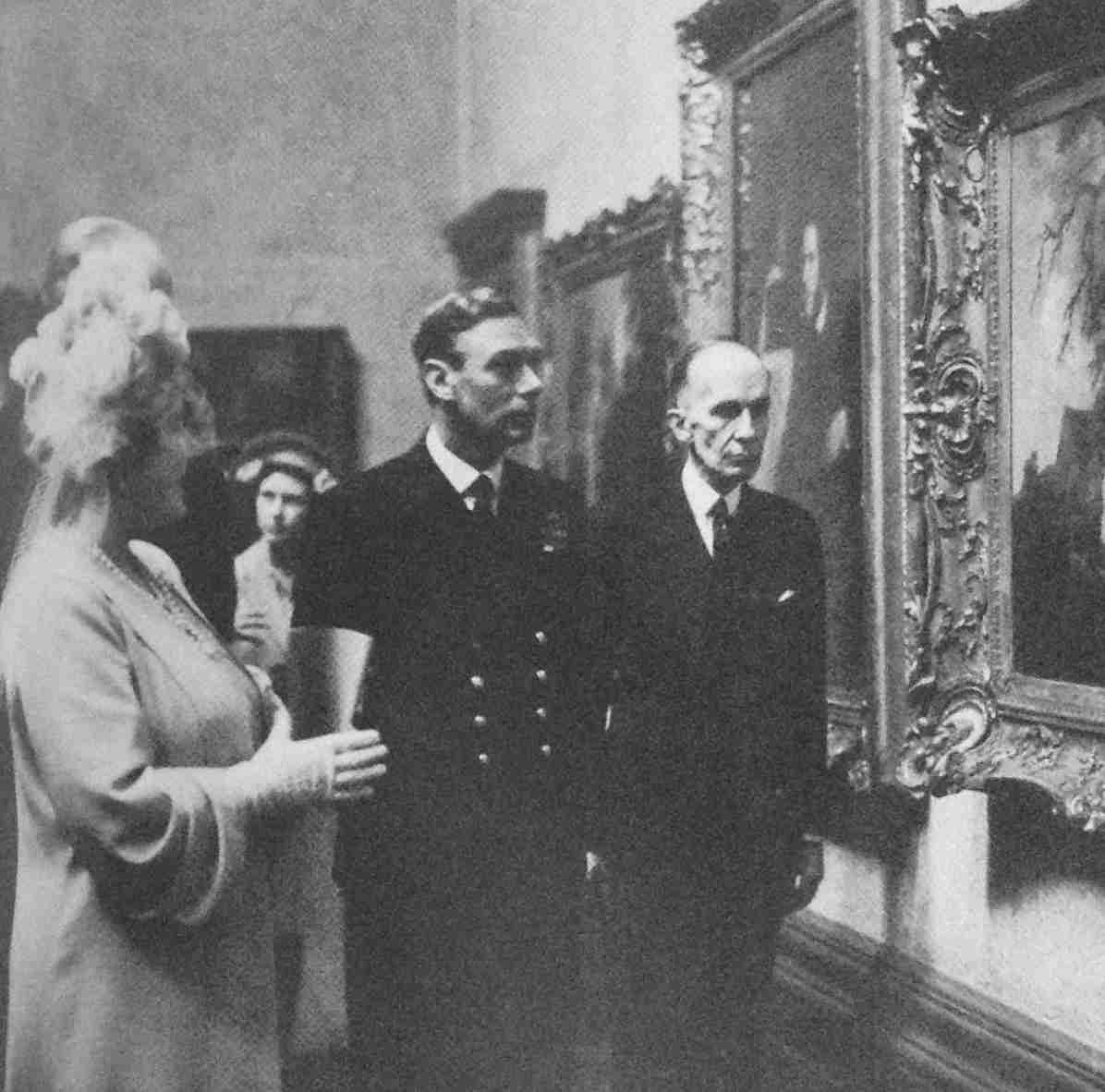
The King and Queen with the High Commissioner at the reopening of the National Gallery, London, 1946
We had the immense privilege during these war years of getting to know Queen Mary, and of being able to appreciate the fine combination of warmth, intelligence, and dignity that made her so dearly loved a figure in the Commonwealth. When the Beaver Club was about to close in February 1946, I was very anxious that she should appear on the final day. She gladly consented. The club was full, and the hundreds of service men and women, probably few of whom had ever seen Queen Mary, greeted her with affection. There were numerous cautionary measures in connection with the visit. No flash-bulbs, no cameras too close, not too long a time in the club. All of this she swept to one side and she entered into the spirit of the occasion with the zest of a girl, conveying by her own subtle means her real pleasure at being where she was. Thus the Beaver Club finished its time with a fitting climax.
Soon after this, Alice and I went to Covent Garden, when the opera house, now in the hands of a trust, was reopened with the ballet Sleeping Beauty. It was important to recreate the atmosphere of the house. The pink silk shades on the sconces all over the building were a feature of its former décor. Rationing made it impossible to get permission to buy the silk, but the opera employees of all ranks defeated this unimaginative decision by giving their clothing coupons for the material and as a result the sconces shone on the great gathering.
Before leaving my post, and returning to Canada, I decided it would be a good thing to see what I could of conditions in Western Europe. Accompanied by a young army officer, I arrived in Brussels by rail, where the G.O.C. Canadian troops in North-west Germany had arranged to have me met at the house of D’Arcy McGreer, who at that time was counsellor at our embassy at Brussels. I was appalled by the size and complexity of the cortège that drew up in front of the McGreers’ house, including a car full of British military police, two motor cyclists, a Canadian Provost car with two or three N.C.O.s and other ranks. The detachment must have numbered at least thirty or forty. General Vokes liked to ‘show the flag’. As we left, I realized at once that we were to provide by our number, speed, and noise a demonstration of Allied dominance. I stopped the convoy at the first opportunity and told the officer in command that I wanted to proceed through Belgium and Holland at a normal pace and with no noise at all—no klaxons, no horns, nothing! His face fell, but he accepted the order, and while we were in the Low Countries it was obeyed. I had told him that once we left The Netherlands and crossed the German border he could do what he liked. He did! We travelled at an alarming pace; all the German vehicles were ordered to the side of the road by motor cyclists a long way ahead of us, and their occupants sat there looking angry and sullen as we passed. I think I was probably quite wrong in permitting this to happen, but I am afraid it was common form at that time on the part of the Allied troops. It certainly made the Herrenvolk realize that they had not won the war. In due course we arrived at the General’s headquarters. We proceeded up the drive and stopped in front of the house with a terrific flourish. The General came down the steps wreathed in smiles, shook my hand, and said, ‘High Commissioner, how do you like the million-dollar treatment?’
I had a pleasant stay with General Vokes, spending several days visiting Canadian military establishments. I also saw some of the camps for displaced persons. When I was introduced to some of these people, I could tell by their faces that they looked upon Canada as the promised land; our country was in their thoughts and dreams. I was then flown to Berlin in an aircraft lent to me by the R.C.A.F. The A.O.C., Air Marshal Johnson, whom I had asked to accompany me, and I stayed with General Pope, Canada’s representative at that time. We were shown what was left of the capital of the ‘thousand-year Reich’:
We saw the Nazi Olympic stadium and Hitler’s badly damaged chancery, both of them, as architecture so often does, illustrating perfectly the mentality of the people who built them. Pretentious, theatrical and repellent in style, with a great deal of ersatz material. There is a brooding ugliness over the Nazi buildings. . . .
We saw the Sieges-allee, ridiculous at all times but more so with some of the opera-singer-like heroes beheaded or knocked off their pedestals.
[Diary entry, March 24, 1946.]
We then flew to Nuremberg where I spent two days watching the trial of the major German war criminals. I had not looked forward to this. I share the view of a friend of mine who said he didn’t like to see even rats caught in a trap. However, the efforts of Lord Justice Lawrence and his associate, Sir Norman Birkett, succeeded in giving the trial almost the atmosphere of an English court of justice. The accused had every conceivable right that they could have asked for. The press, which could have been permitted to exploit the more sensational aspects of the occasion, was not allowed to intrude. In my diary for March 26 I wrote:
Johnson and I lunched with the judges, all eight of them, in their dining-room in the court house. I was struck by the camaraderie which existed between them—even the Russians were on the best of terms with the others. Much of this is due to the efforts of the Birketts and the Lawrences and the result is that Nuremberg is one of the few places, if not the only place, where there is full co-operation between the Russians and their late Allies. . . .
Johnson and I were taken through the gaol by Colonel Anders, the American commandant. We saw the cells where the twenty-one major criminals live and were shown all the precautionary measures to prevent suicide. Neckties are removed from the cells, by which they might hang themselves, although there was nothing to hang themselves on. No prisoner is allowed his glasses after lights out in case he breaks them and cuts his wrists. When they see their counsel they are separated by a very fine mesh to prevent poison phials being passed. They are never out of sight of a sentry, night or day, a man standing outside the cell looking through an aperture. During the night the lights are dimmed to permit sleep. Prisoners are allowed no contact with each other except in the dock. When they go to lunch in the court house without returning to the gaol, they sit four in a room at separate tables facing the walls. I was interested to see that Goering has lunch alone. This is a precaution because of his forceful personality and leadership of the others. I noticed a human touch—one of Goering’s neckties on a tray in the gallery outside the cells with his name on a card.
Despite all these precautions, Goering committed suicide before he could be executed.
On our way home to the airfield at Odiham, we flew down the Rhine Valley and over Cologne, where we could hardly see a roof intact; the Ruhr was a scene of almost complete desolation.
. . . after lunch Alice and I drove down to Windsor to stay overnight at the Castle. We had tea with Tommy and Joan Lascelles in the Winchester Tower and then arrived at our apartments at about 6. We dined at 8:30, assembling in one of the charming drawing-rooms, in which the woodwork had come from Carlton House. In addition to the King and Queen and the Princesses, Queen Mary was there and Lord Athlone and Princess Alice. A large number of the household were also present. The other guests were the Winston Churchills. At dinner I sat on the Queen’s left, with Princess Alice on my left, Alice between the King and Lord Spencer. After dinner I had a longish talk with Queen Mary who was in terrific form. When the royal family had withdrawn and all the ladies had retired, I found myself in the long picture gallery with Churchill and one or two other men. Although he was on his way to bed, the historical portraits started him talking and we walked up and down for an hour or an hour and a half fascinated by his conversation.
Early in May, we stayed for a day or so with Arthur and Ruth Lee at their house, Old Quarries, at Avening in Gloucestershire. Visits to Avening had a highly individual character because the host manipulated the time according to his own fancy. We had a very pleasant evening with the Lees and drove back to London the next day.
We made an early start. Our hour of rising and departure was regulated by Gooch, the butler, who dealt with the problem not by absolute but by relative time, announcing that breakfast would be ‘in one hour’. Otherwise I should probably have done what guests frequently do at Old Quarries and been down two hours too early or too late.
[Diary entry, April 24, 1946.]
When you retire from a post after nearly eleven years the final days are very full and charged with a good deal of emotion. Alice and I had countless friends in London to say good-bye to. The Canada Club gave me a farewell dinner with about 350 guests and a distinguished head table. Alice and one or two other ladies were secreted behind a screen. To quote from my diary:
. . . Anthony Eden was to have supported the Chairman’s toast to me as guest of honour but at the last moment was kept in the House at a debate. . . . He however said on the telephone that he would come at 10 if the party was still going on. . . . Proceedings were therefore spun out a bit in order to meet the situation. I sent [P. T.] Molson [my private secretary] down with my car a little before 10 to bring Eden back. He seems to have run the gauntlet of all the police in the House of Commons . . . successfully, and found himself apparently in the Division Lobby. In any event just as Jowitt [the Lord Chancellor] was finding it increasingly difficult to continue his speech and was getting into a discussion of certain aspects of the work of the Judicial Committee of the Privy Council, in came Anthony led by [Molson], He made a very dramatic entry and a charming speech which made an excellent conclusion to a really first class evening.
[Diary entry, May 7, 1946.]
Shortly before we left, William and Molly Camrose (Lord and Lady Camrose) gave a farewell dinner party for us.
. . . Over 60 guests . . . all of them friends of ours. . . . After dinner William made a brief but charming speech followed by John Anderson who was also very warm and graceful in what he said and finished up by proposing our health and presenting us with a most lovely Queen Anne silver cup, the gift of the Camroses and other friends. I never felt more nervous before a speech in my life but I think I managed to convey our gratitude for the evening, our affection for the Camroses and other friends, and our sorrow at leaving England.
[Diary entry, May 15, 1946.]
The next day Alice and I received the Canada House staff—about ninety-five—in my room. I made a speech of thanks and farewell. After this, a senior member of the staff came forward and presented us with a handsome piece of silver from ‘Friends at Canada House’.
A day later Alice and I went to Marlborough House to take leave of Queen Mary. The Princess Royal was also there. We had a charming talk with Queen Mary, who went with us down the stairs to the door and stood with her daughter waving her hand as we drove away.
Mackenzie King paid a visit to England at this time, to attend the Commonwealth prime ministers’ meeting. He arrived on May 19, and I went to Southampton to meet him, spending the previous night with Bobbety and Betty Cranborne at Cranborne in Dorsetshire. It was delightful as always to see them in the setting of this lovely house built by King John, embellished by Inigo Jones, and modernized by succeeding members of the family. Bobbety I had known in Oxford days, although we belonged to different colleges, and later I saw much of him when he and I had become close colleagues and warm friends. He kept alive in the fullest sense the great traditions of the Cecil family of which he became the head—above all, duty to the state.
I travelled to London with the P.M. by train. The next few days were crowded with good-byes, farewell parties, and final meetings of this and that, but in spite of these I managed to record two broadcasts and to attend two sessions of the prime ministers’ meetings at No. 10.
We were deeply touched by a little event that took place the night before we sailed. Tommy Lascelles had told me very privately that the King wished to make me a Companion of Honour but that this, of course, had to receive the acquiescence of the government in Ottawa. It was not immediately forthcoming. Indeed, on May 21 Tommy Lascelles telephoned to say that the Palace had not yet received Mackenzie King’s approval. The matter, therefore, hung fire. On the day before we left for Southampton, however, Tommy called again to tell me that the C.H., offered through the British Prime Minister, had been approved by my Prime Minister. He said that it might be impossible for the King to award the decoration personally as he was out of London for the day, and unless he returned in time the investiture would, of necessity, take place in Ottawa with the Governor-General officiating. In the late afternoon, however, we were told that the King would be back, and would Alice and I come to the Palace at 9:30 that evening. We appeared in our travelling clothes, as everything else had been packed and sent to the ship, and were received by the King and Queen, who were accompanied by Princess Elizabeth. The King rather shyly gave me the little case with the decoration inside it. The Queen suggested that they should drink our health, the champagne was ready and the toast was drunk—by the King, in tea. The intimacy and charm and warmth of this private investiture moved us both deeply.
We left England with mixed feelings. For eleven years we had lived in that great community which had revealed every mood that the human spirit can express—every mood except fear. We went home because we were Canadians. Canada was where we belonged. Had I waited a few years more before resigning my post, transplanting would have been very hard. So we came home. But we treasured the memory of those precious years and the friendships they gave us. England is the last citadel of the individual; it has the right climate for friendship. I would like, if it were possible, to name all the persons who meant so much to us during our time in London but I have only been able to take a few at random; others have been mentioned earlier in this narrative.
Violet Carruthers (Violet Markham, to use the name under which she wrote) was a great friend of ours, and used often to come for a quiet meal during the War. We called her ‘the lioness’ because she never hesitated to roar when she disapproved of something or some person concerned with the affairs of the moment—and how often she was right! She had the tough common sense and forthrightness that came from her North Country background, and great ability as a writer and public servant. She was one of the few close personal friends of Mackenzie King.
I find the following in my diary for December 8, 1942: ‘Violet Carruthers dined with us, more of a lioness than ever in her robust conversation. She said that although she had always been an internationalist in political thinking, the American criticism of her Empire so enraged her that she felt like having her underclothing made of Union Jacks.’
A Sunday-evening guest over a longish period was Robin Barrington-Ward, when he was editor of The Times. He was one of my oldest friends—we were contemporaries at Balliol—and used to come and dine with us on his way from the country to Printing House Square. We would talk about the affairs of the moment and he would discuss forthcoming leaders in his newspaper. Robin’s policy as editor of The Times was very different from that of his predecessor, Geoffrey Dawson. He was much more independent of government policy and now and then was at variance with the views of Downing Street. This led to displeasure in the ranks of the Conservative Party. I think The Times was definitely in the wrong in its attitude towards the civil war in Greece, and its policy on some other matters was no doubt open to question, but I am sure that, had Barrington-Ward not died prematurely, the criticism his régime in Printing House Square aroused would gradually have faded.
Informal dinner parties took place in which we tried to bring Canadian visitors in touch with English friends. Margot Oxford (the Countess of Oxford and Asquith) used to come occasionally, and when there was a group of Canadian officers who knew something of her political background they were enchanted by her talk. No rival could be present—hers had to be a solo performance—but it was always fascinating. How many people could combine, as she did, vivid recollections of Tennyson and a personal friendship with Noel Coward? She became far warmer and mellower as she grew older, and I have among my papers many little pencilled notes that she wrote in the middle of the night when sleep wouldn’t come, full of affection for Alice and me. Margot asked if we would let her dedicate to us a book on which she was working. She said it was going to be pretty explosive because she wanted to say a number of things that would not go down very well with some people, including disparaging comments on certain eminent men. We were touched by the suggestion, but I thought that on the whole it would be just as well, considering my post, if the idea were dropped. I wrote to Margot accordingly and received a most sympathetic reply—‘You are quite right—my book will cause hell!’ I thought this a very understanding reaction.
Well known in the London of his day was the Duke of Alba—Jimmy as those of us who were his friends called him. In his manners and his way of life he was probably the last great nobleman in Europe. He was Spanish ambassador in London for several years until the inevitable break with Franco. I think that as a Royalist (he was a personal friend of Alfonso XIII) and a grandee of Spain, he hated the Falangists as much as anyone on the political left could have done. I used to spend week-ends with him at his home in Surrey and play golf—he played badly, but I played worse.
One day in March 1940 we were at a luncheon party with Alba and the Winston Churchills. A discussion took place between Churchill and Alba on the subject of Franco’s executions in Spain following the Civil War. Churchill took the natural English view—‘forget the past and start afresh’. Alba, with intense Spanish feeling, said that justice must be done before Spain could start on her new path. He said that his brother had been shot and buried in a trench with 9,000 others. This sort of thing demanded expiation. There was no meeting of minds in this conversation.
During this time in London there were still some houses where the hostesses held what could fairly be called, in the old sense, a ‘salon’. There are always people prepared to criticize a hostess who brings together distinguished people, and the word ‘lion-hunter’ is very easily used. The term could not be applied to Sibyl Colefax—she held her own with her lions; they came to her house because they liked her. In Argyll House in the King’s Road, and later in her house in Lord North Street, Westminster, she gave a very long procession of guests infinite pleasure. Their interests covered a very wide range. Perhaps she was happiest with literary people, and I recall an occasion when I met in her drawing-room Somerset Maugham, Osbert Lancaster, Christopher Sykes, Rosamund Lehmann, Beverley Nichols, Rose Macaulay, and the John Gunthers. Bereavement, ill-health, financial difficulties—all failed to break Sibyl’s spirit, and until the end she carried on with great gallantry. Her ‘ordinaries’ at the Dorchester were famous. She could no longer afford to give large parties, so her guests were happy to respond to the ‘chits’ they got telling them what they owed. She remained a gifted hostess, with an instinct for the choice of people and their placement.
Among our warm friends were John Anderson and his wife Ava (later Viscount and Viscountess Waverley). Their kindness was lavish, as I had reason to know over the years. No two people could have been more different—he with his monumental mind and the capacity for dour concentration on a great variety of tasks, she with her penetrating intelligence, wit, and vivacity; they made a perfect team. Many people will remember their hospitality, in the Royal Box at Covent Garden, of which John was the chairman, as he was of the Port of London Authority, in whose yacht beautifully organized evening parties took place, when some sixty guests dined as they cruised down the river and back.
John Waverley is the subject of a memorable biography by John Wheeler-Bennett. He and his Virginian wife Ruth are among my dearest friends; in recent years my visits to their lovely Elizabethan house, Garsington, near Oxford, have always been a joy. There the affection of host and hostess and the beauty of the setting are irresistibly combined.
There are so many other people I could name—no book would be long enough. I am happy to mention a few of those we got to know and love; there are countless others I recall with affection and gratitude.
We arrived home in May 1946 and settled at Batterwood. Our house showed the effects of our absence of nearly eleven years, and our re-establishment was no easy process. Alice, however, rose to the emergency with great skill and energy, and it is largely due to her that we surmounted the domestic problems we met. Even the full ritual of Christmas at Batterwood was faithfully carried out as always, in Alice’s competent hands. Most men, I suppose, growl about the pre-Yule disorder and then acquire the Christmas spirit at the eleventh hour, when others have done the work, and thoroughly enjoy it. But thinking only of the over-organization of the great festival, I once ventured to express my sentiments in an indecorous couplet when my spirits were at their lowest:
Christmas comes but once a year—
You’d like it twice? No bloody fear!
I was quite happy to be, for a time, without official responsibilities and to be able to revive hobbies. One of these, which Alice and I shared, was painting, either in oil or gouache. It is the most diverting of pastimes and if you want ‘to get away from it all’ there is no better prescription. I have noticed that there is some reluctance among people who ride this particular hobby to talk about it; it seems to be something to be concealed. But amateur painters form a great fraternity, however secret it may be.
Mrs. Hart Massey
One day in October 1946, Mackenzie King called me up on the telephone and offered me the lieutenant-governorship of Ontario. I declined the invitation, saying how much I appreciated the honour. I was quite sincere in this because I felt that the office of lieutenant-governor of a province is of great importance—more, I think, than the public realizes. But I wanted, for a little while at least, to be free of such duties as would have been involved.
Another invitation came my way when the president of the Ontario Liberal Association and a Liberal Member of Parliament asked me whether I would accept the leadership of the Liberal Party of Ontario. I had no desire to re-enter the field of politics, and I declined this offer as well.
At this time, to our delight, we acquired two daughters-in-law. Lionel and Hart married, respectively, Lilias Ahearn and Melodie Willis-O’Connor, both of whom came from families deeply rooted in Ottawa life. Lilias’s father was an old friend of mine, and I remember with gratitude the wise counsel he gave me on certain sections of the report of the royal commission about which I make some comments later. Melodie’s father (also an old friend of mine) for years was a member of the Governor-General’s staff and is remembered gratefully, and with reason, by many people.
In 1947 Alice and I made a comprehensive tour of the Dominion, visiting cities from coast to coast. One object I had in mind was to address Canadian Clubs, and other organizations inured to the visits of itinerant speakers. Perhaps a more important purpose was to give myself a refresher course on the subject of Canada itself. I found it had changed immensely during the course of the war. The result of this tour was the production of a book, On Being Canadian, which, although not a volume of importance, was generously received. In it I was able to make use of some material I had prepared in 1934-5 to appear with the title Canada in the World. I thought it best, however, not to publish the book while representing my country abroad. Perhaps I was being overly discreet.
In 1947 I was elected chancellor of the University of Toronto. Although the office does not give its holder very much power, it does enable him to exert considerable influence on university policy, apart from the ceremonial functions that are very much a part of its traditions. (In one year during my time eleven convocations took place.) Universities in Great Britain and other Commonwealth countries, almost without exception, have as titular head a chancellor, who may be appointed or elected; the administration of the university rests in the hands of the president or principal or vice-chancellor, whose relationship to the chancellor is not unlike that of a prime minister to the Sovereign.
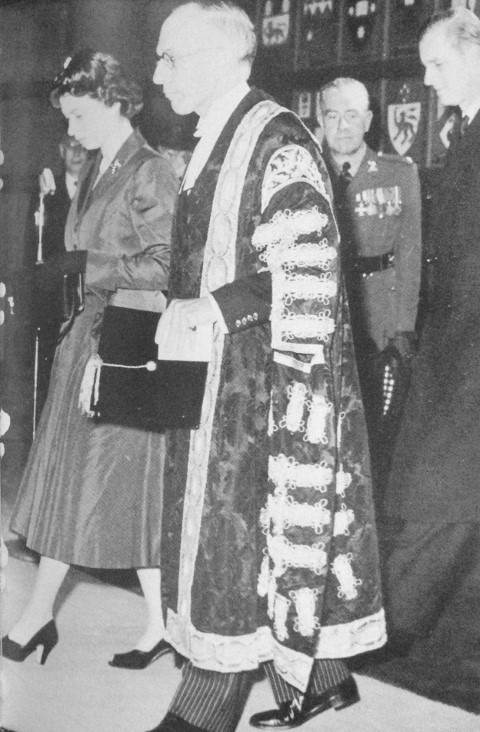
Princess Elizabeth and Prince Philip with the Chancellor of the University of Toronto at Hart House, 1951
In 1951 I had the honour, as chancellor, of receiving at the university Princess Elizabeth and Prince Philip, when they first came to Canada. I met the royal visitors at the door of Hart House, and conducted them past the junior members of the faculty in the quadrangle into the Great Hall where senior dons provided a dazzling array of academic colour. A brief speech of welcome, a charming reply from the Princess, ‘God Save the King’—and the visit was over.
Alice and I went to England in 1948 to see our many friends there and to preserve contacts with a community to which we had become greatly attached.
Early in October we saw Mackenzie King, who was ill in London. He was very depressed but appeared to be glad to see us. He returned to Canada soon after this and before long resigned as Prime Minister. I was never able to see him again.
I knew Mackenzie King probably as well as anyone. I was one of the few people who addressed him by his nickname, ‘Rex’, though how that started I cannot remember. Our relations in the early years were warm and cordial. He and I were working to the same end in a very pleasant association. In the field of politics I found him generally an understanding chief; during my time in Washington, he was appreciative of my efforts as minister. The Legation, indeed, in the early years, owed much to his active support.
Later our paths diverged. What was the cause of this? I first became aware of a strain in our relations during the period when the Liberal Party was in opposition, and I had accepted, at his earnest invitation, the presidency of the new National Liberal Federation. My visits to the leader to report to him and hear his views he quite clearly regarded as intrusions; but I had little doubt that, had I stayed away, he would have complained that he was not being properly consulted. I often failed to receive his complete confidence, and to me he was often quite incomprehensible.
The scope for our misunderstanding was widened when I took over the high commissionership. The London post differed in several respects from that in Washington. For one thing it was farther from Ottawa and whoever occupied it had to act more on his own responsibility, with the risk of collision with headquarters. Again, the High Commissioner was at that time concerned with matters of greater importance than was the Minister at Washington, and his task was more conspicuous. He was, therefore, regarded with a very critical eye. He had always to remember that there could be only one hand on the tiller and that it could not be his. In my correspondence with Mackenzie King I misjudged how some of my suggestions would be received. I did not realize at first the amount of suspicion and the capacity for misinterpretation of one’s ideas that I had to face. I was deeply hurt by Mackenzie King’s use of the word ‘self-aggrandizement’ in one of our more difficult conversations in London, about the conduct of my post. It was not easy to serve as complicated a being as Canadian public life has ever produced.
Our conceptions of the high commissionership, seemingly identical at the time of my appointment, soon came to differ radically. It was in part because our approach to Anglo-Canadian relations could never be reconciled. I tried to carry out my instructions with scrupulous care, however I might disagree with them at times—and however I might regret the tone of communications that it was sometimes my unpleasant duty to convey to the government of the United Kingdom.
My personal relations with Mackenzie King in the last ten years while he was my chief fluctuated surprisingly. They were marked at times by conversations that I can only describe as painful. In these there was not only a sharp repudiation of my views—that a subordinate must often accept—but a wilful misunderstanding of my motives. His mood, however, often changed. When I visited Ottawa in 1944 and dined twice with him alone at Laurier House, we had long and agreeable talks in the friendliest atmosphere. These are the occasions, regrettably rare though they came to be, that I like to remember.
On my visit to England at the end of October 1948, Lord Samuel, who at the time was Visitor of Balliol, asked me whether I would consider election to the mastership of the College. My immediate reply was that I didn’t feel that I was qualified to be Master of Balliol; the head of the College had always been a scholar and I couldn’t claim real scholarship in any field. His answer to that was that they were not looking necessarily for a scholar; they wanted as Master someone who would restore the cohesion and the communal feeling that the College had traditionally possessed but had somehow lost; someone who would establish closer contacts with the undergraduate body. They were kind enough to think that I could do what they had in mind. Naturally, I asked for some time to think the matter over and discuss it with Alice. Had I agreed, my election would doubtless have taken place—otherwise I would not have been approached. After very earnest thought, I decided to decline the proposal, tempting though it was, but it was not easy to say no to the offer of one of the greatest academic posts in the United Kingdom.
I was asked by Tommy Lascelles if I would prepare a draft of the King’s broadcast for Christmas 1948. This was an exciting invitation and I did my best. As it happened, my text was used only in part because it was decided to make the speech different in character. I was glad to make any contribution to this important annual event.
Shortly after I returned to Canada—on January 6, 1949, to be exact—I was asked by the Prime Minister, Mr. St. Laurent, if I would take the chairmanship of a royal commission. This was no ordinary royal commission: the scope of its inquiry was unique. The Government wished, so I was told, to have a survey made of institutions, agencies, and organizations ‘which express national feeling, promote common understanding and add to the variety and richness of Canadian life’. The commission was to examine and take stock of the cultural resources of Canada. There could be no more testing or worthwhile task, and I accepted the invitation.
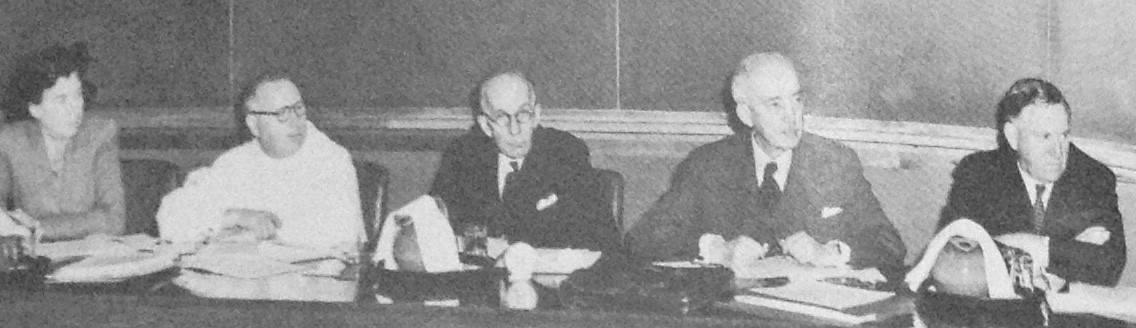
The Royal Commission on the Arts, Letters, and Sciences, 1949-51: Miss Hilda Neatby, the Very Reverend Georges-Henri Lévesque, the Chairman, Mr. Arthur Surveyer, and Dr. N. A. M. MacKenzie
The commission was to have five members, and I was consulted about the appointment of my colleagues. We were to have all the usual powers and privileges of a royal commission. In due course, the staff was assembled and premises allotted, and we commenced a task that abounded in interest and involved a full measure of toil. For me it was practically a full-time job, as it was very nearly for two of my colleagues—Hilda Neatby, professor of history at the University of Saskatchewan, a very eminent figure in Canadian academic life, and Father Georges-Henri Lévesque, a leading member of the Dominican Order and a scholar and humanist of great distinction. Another commissioner was N. A. M. MacKenzie, the able president of the University of British Columbia. The group was completed by Arthur Surveyer, a well-known civil engineer in Montreal. The secretaries were Archibald Day and René Garneau, who were all that secretaries could be.
The commission had a formidable name—‘The Royal Commission on National Development in the Arts, Letters and Sciences’—and a formidable task that grew in magnitude and complexity as the work progressed. We had to examine the work of various federal agencies within our terms of reference, such as our broadcasting corporation, the National Film Board, the National Gallery, the National Research Council, the National Museum, the Public Archives, the Library of Parliament in Ottawa. We were asked to examine the scholarships maintained by federal bodies. We invited various national voluntary organizations to make submissions, and we received briefs from many hundreds of bodies and individuals (over 460 in number), in the presentation of which over 1,200 witnesses appeared before us. We held public hearings in all the principal cities of Canada. I tried to make our sessions as informal as possible without loss of dignity. We made a point, unusual I think in royal commissions, of reading the briefs before the formal submissions took place. This involved an immense amount of ‘homework’, but it greatly speeded up the work of the commission. The witnesses were always surprised and relieved when they were told that they needn’t read their briefs because these had been read already by the commissioners. After nearly two and a half years of stimulating and rewarding work, we submitted our report to the Prime Minister on June 1, 1951.
The initial reception by the public was mixed. In a new country naturally preoccupied with material development, the setting up of a royal commission concerned with the imponderables was a very novel idea. The commission was inevitably called by some of the more light-hearted commentators ‘the culture probe’. At the outset a long and well-attended press conference helped to make clear to the newspaper correspondents in Ottawa the nature of our task. We were threatened with a facetious, even unfriendly, approach to our inquiry by certain organs, but I have nothing but a feeling of deep appreciation for the understanding of our job that the press showed once they grasped its meaning and importance.
‘Culture’ was a word we tried to avoid, but, regrettably, there is no synonym in the English language to employ. Culture in French is a normal term, its meaning perfectly understood; translated into English it produces an uncomfortable self-consciousness. But we had to think of ‘culture’, using the term in its proper sense; we were concerned with what we were doing in Canada to help our nation express itself. We had to ask ourselves how the State can promote the welfare of our cultural resources without creating an artificial, hot-house atmosphere. But aid from the State in such matters is essential and, as we discovered in our inquiry, had been in the past most inadequate.
A basic problem we had to deal with is suggested in two or three sentences in our report:
Canada has a small and scattered population in a vast area; this population is clustered along the rim of another country many times more populous and of far greater economic strength; a majority of Canadians share their mother tongue with that neighbour, which leads to peculiarly close and intimate relations. One or two of these conditions will be found in many modern countries. But Canada alone possesses all three. What is their effect, good or bad, on what we call Canadianism?
The exclusion of cultural influences from abroad is both impossible and undesirable. The answer to the problem, we held, was not negative, but positive—the strengthening of our own resources in the field of the arts and letters, and a deepening of confidence in what we can do for ourselves.
We produced a report, presented simultaneously in both our national languages, of over 500 pages, divided between a stocktaking of our cultural resources and recommendations for their nourishment. It is a source of no small gratification to those of us who worked on this inquiry to realize that before many years had passed after the submission of the report, the great bulk of our recommendations had been accepted and put into effect. This result was most unusual in the history of royal commissions and was hardly to be expected in relation to an inquiry in the controversial field in which we laboured. What we regarded as our most important recommendation was accepted pretty much as it stood. We felt strongly that there should be in Canada a body, adequately financed, that would be concerned with the promotion of endeavours in the field of letters, the arts and sciences. Such a body was given the name in our report of the ‘Canada Council for the Encouragement of the Arts, Letters, Humanities and Social Sciences’. My colleagues agreed with me that this ponderous title, in actual usage, would be reduced to the two words ‘Canada Council’. The simplicity and directness of this title, we felt, would be very helpful as public discussion progressed. This proved true. The individuals and organizations desiring such an institution had only to say ‘We want a “Canada Council” ’, to reinforce the argument and strengthen the case. I had hoped (but, in view of the office that I had assumed by that time, my hopes could not be publicly expressed) that the Canada Council would be established several years before it was. No doubt the Province of Quebec made such a step on the part of the National Government none too easy. The Duplessis régime, with its narrow provincial autonomist outlook and policies, was suspicious of any federal action—not only in the field of formal education, from which Ottawa was constitutionally excluded, but of education in the broadest sense—even through libraries, museums, art galleries, and so on. I wrote to the premier of each of the ten provinces at the beginning of our inquiry to ask whether his province would care to make submissions to the commission when it met in the provincial capital. The premiers of all the provinces—with the exception of Quebec—wrote cordial letters expressing a co-operative spirit. M. Duplessis, although equally courteous, took the view that the establishment of the commission was in itself an infringement of provincial rights and said that he, therefore, could not recognize its existence. The commission, however, met in due course in Quebec City, where we were warmly received, and, with the exception of provincial organizations and officers, we found a very full measure of co-operation.
The Canada Council was subsequently set up through the imagination and initiative of the prime minister of the day. He disagreed with our recommendation in one particular—that it should be dependent on annual parliamentary votes—and to my amazement and delight he said that he proposed to endow the Canada Council with one hundred million dollars, which represented roughly the death duties on the estates of two persons who had recently died and whose wills made no provision for the support of cultural bodies. When this momentous decision was conveyed to me, I found it difficult to remain seated in my chair. The Canada Council, since its creation, has more than fulfilled our hopes.
The most complicated problem the commission had to deal with was that of the Canadian Broadcasting Corporation. It was our view that the importance of the C.B.C. as an instrument for the promotion of Canadian unity and the strengthening of Canadian identity could hardly be overstated. The Corporation seems, however, to be a general object of attack by uninformed people and by those who would gain financially by its mutilation or extinction. There seem to be few who, while they may enjoy its programmes, are prepared to defend it. The National Film Board passed through a stage when it was open to similar attacks and, indeed, as I happen to know through intimate knowledge of the situation, it narrowly escaped a reorganization that would have effectively destroyed its usefulness by limiting its functions to the distribution of films only, without permission to make them.
I personally had been deeply interested in radio broadcasting from the beginning. I had the opportunity of suggesting the names of two members of the royal commission that was appointed in 1928 to examine and report on the question of radio—Sir John Aird and Charles A. Bowman. In the report of the Aird Commission, the principle of broadcasting as a national public service was strongly recommended and in the legislation introduced by the new Government it was established. After the act had been passed I wrote to Mr. Bennett, the Prime Minister:
Now that this most complicated and important matter has reached what in my opinion is a most admirable settlement, I hope you will let me write as an interested observer to tell you how much I appreciate what has been done to preserve this great service as a public utility. You and I may view various public questions from different angles, but on this subject we are in agreement, and it is a great pleasure for me to offer you my sincere congratulations on the legislation which you introduced the other day on the subject of the radio, and if I may say so on the speech with which you presented it.
[Letter to R. B. Bennett, May 23, 1932.]
The Prime Minister replied:
I have not been able, until tonight, to send you a note of thanks and appreciation of your courtesy in sending me the generous letter you did in connection with the action taken by the Government in dealing with radio broadcasting.
I assure you that, if you regard it as a pleasure to offer me your congratulations on the legislation and the speech with which I presented it, I can heartily reciprocate and say it was a real pleasure to receive your commendation.
[Letter from R. B. Bennett, June 4, 1932.]
Even now, however, thirty years later, the problem of broadcasting in Canada is far from being solved, and the C.B.C. is subjected to an unrelenting barrage by those who misunderstand the great conception it embodies or simply wish it ill.
On December 20, 1949, I was asked by the Prime Minister whether the royal commission of which I was chairman would present a report to the Government on the question of honours and awards in Canada. This subject lay, of course, well outside our terms of reference, but it was clearly a matter that deserved attention, and I told the Prime Minister that I would speak to my colleagues about his request and that I was sure they would agree to meet his wishes. They did so and we approached our task with great care. On August 9, 1951, I presented our report to the Prime Minister. We recommended the institution of a new, non-titular order of merit, through which the services of Canadians could be recognized by their own country.
In February 1950, Lester Pearson told me that the Prime Minister had asked him to inquire of me whether I would consider the offer of the appointment of Governor-General of Canada. I replied that I would consider it very sympathetically. Pearson said that the Government had no one else in mind for the post, and that I would certainly be formally offered it if I was prepared to accept. He did not know how long the then Governor-General was likely to remain in office.
As soon as I returned to Batterwood I told Alice about the new prospect. She was, as far as we knew then, quite well. No one could have been more fitted for the role of chatelaine of Government House than she, with her warmth and dignity and elegance, and it was a source of great happiness to me to think of her being there. She herself looked forward eagerly to this new task. But it was not to be. As 1950 wore on, her health failed rapidly, and in July I was left alone. The messages I received gave eloquent proof of the affection and admiration of her countless friends. One letter, in quoting a line from Hartley Coleridge, expressed what many felt: ‘A smile of hers was like an act of grace.’
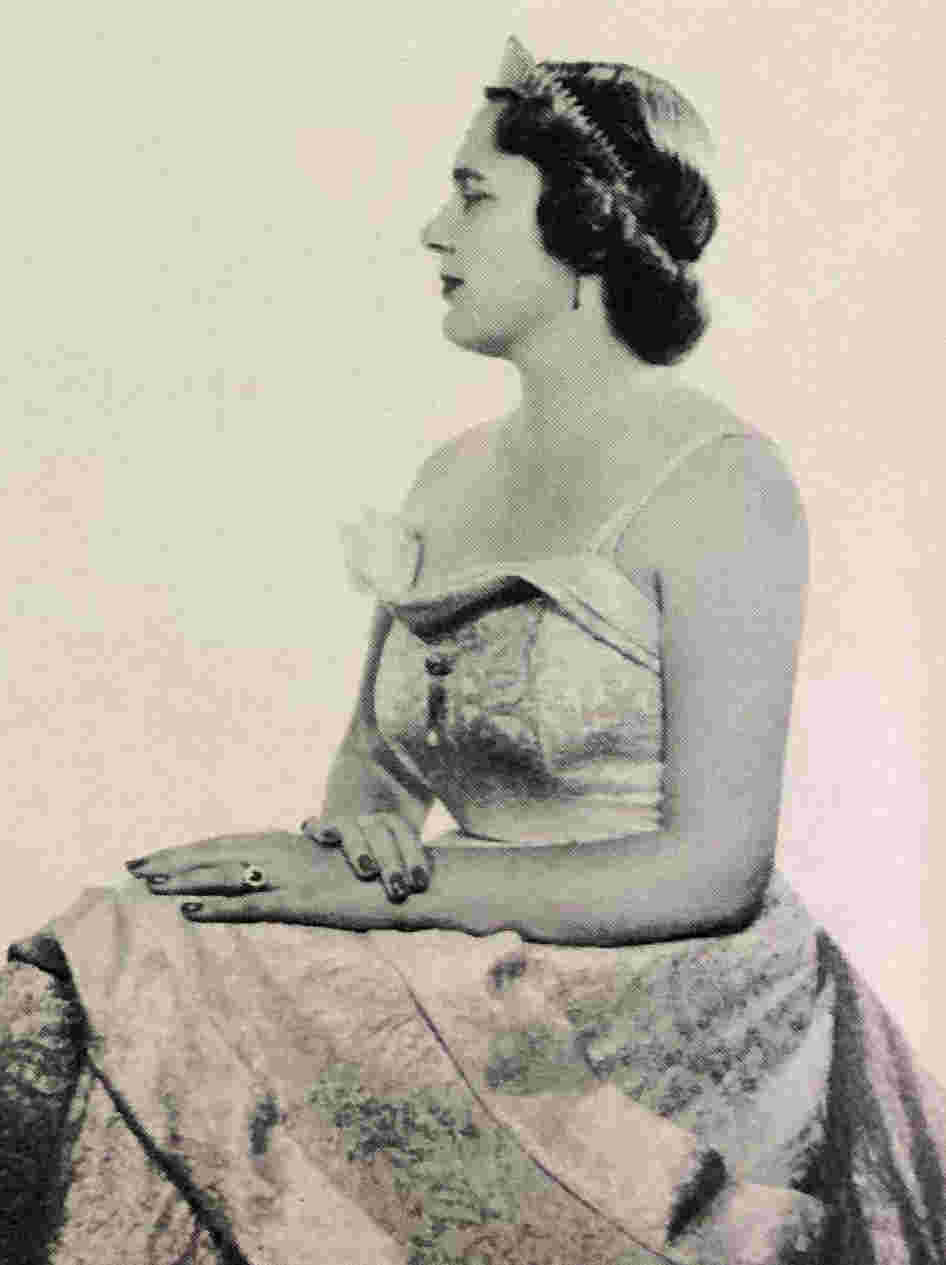
Mrs. Lionel Massey
After my conversation with Pearson, I had received no communication about the governor-generalship for some time. However, in the autumn I was told by a senior official of the government, acting for the Prime Minister, that Alexander’s term of office was to be extended one year. Later I saw the Prime Minister in order to clarify my position. What had happened in the summer had raised a question in my own mind about the possibility of my being able to carry on by myself—and apparently the Government also had doubts. The situation was far from clear, but the extension of the term of office of the Governor-General of the day meant that no decision need or would be arrived at for some months. After the most careful thought, I came to the conclusion that I would be able to handle the task alone if asked. I was strengthened in this decision by the fact that my son Lionel had told me that he had decided to leave his employment at that time in any event and that if I wished him to take the post of secretary to the Governor-General, he would come. I would, therefore, have Lionel and his family living in the secretary’s house, Rideau Cottage, in the grounds of Government House, and, of course, his invaluable help as a very able chief of staff.
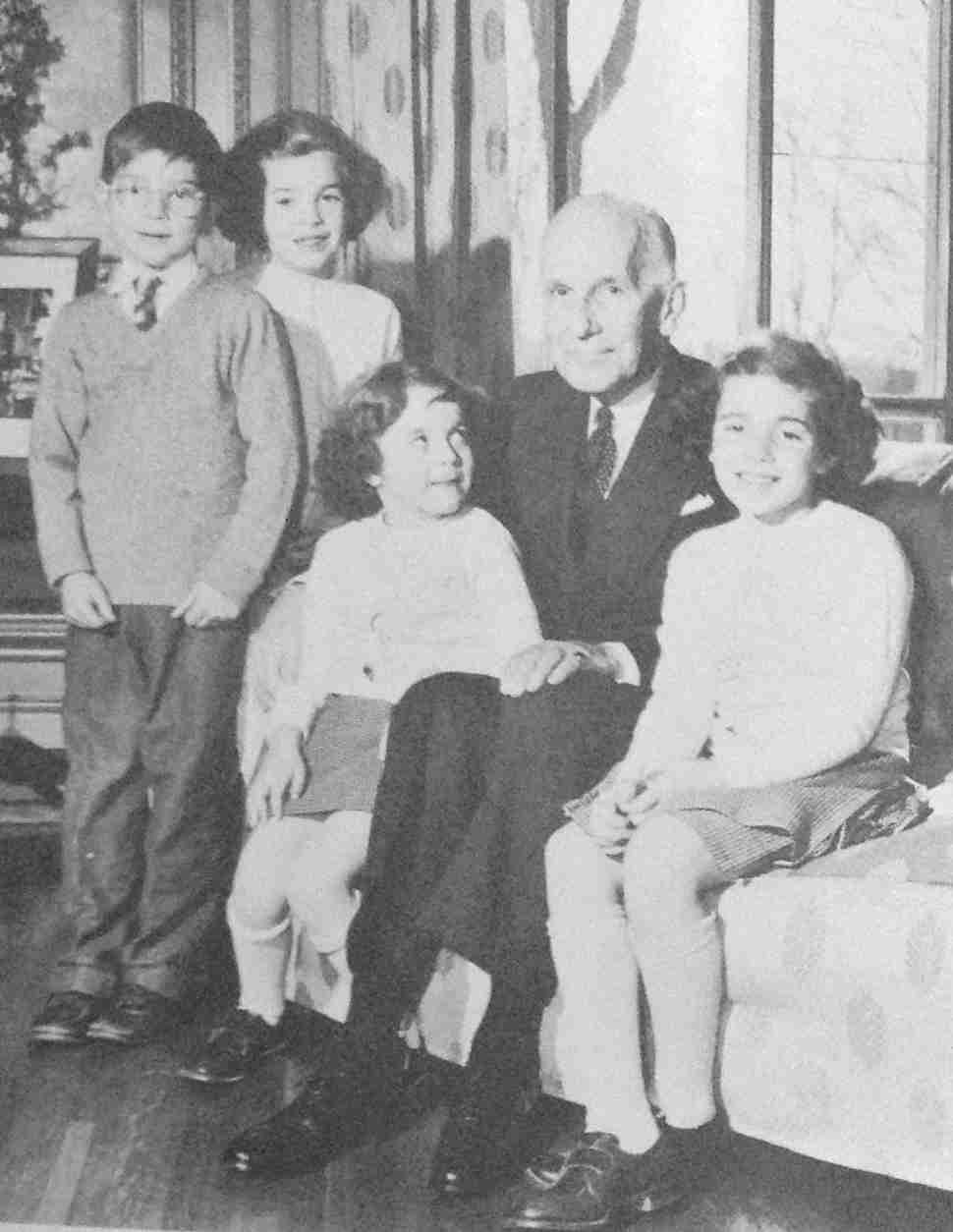
Jonathan, Jane, Susan, and Evva with their grandfather
With him and my daughter-in-law Lilias would be my three granddaughters, then very young and with the gift of liveliness and fun. They and their cousins, Hart’s children, whose home is in Ottawa, have always called me ‘Gaudy’. This came about through a fortunate inability on the part of one of them, Jane, to pronounce the formidable word ‘grandfather’—so Gaudy it was for all of them, with its pleasant overtone of gaiety and friendliness.
I visited England during the spring of 1951 and had a very happy interlude during the Easter week-end which I had the honour to spend with the King and Queen at Windsor. It was a small party—family, a few close friends, and some members of the household, but no official guests. The King and Queen, through their own personal magic, gave this vast palace-fortress a warm, domestic feeling.
Before dinner on my first evening, I happened to meet the King in the great curving corridor in which are placed the cases containing the royal collection of orders and medals. The King showed me the contents and pointed out the many orders of chivalry that had become obsolete—a mark of the changing world in which we live. I noticed the ill-fated Canada Medal in this collection. On the following afternoon, the King and Queen and their guests went for a walk in Windsor Great Park to Frogmore House. The King, who had only recently recovered from the serious operation on his leg, drove an electric invalid chair for much of the time, but managed to walk for short periods—surprisingly well, but probably feeling less comfortable than he looked.
The following afternoon we had another walk. This time the King did not use his chair at all and insisted on walking all the way. One of my fellow guests and I drove the chair alternately. As we approached the castle, I found myself seated in the vehicle the King walking beside me. I thought this inappropriate and suggested to the King that he should drive for the last lap. I said, ‘There may be people on the terrace looking down on us who will see you walking, sir, and one of your guests seated. This would look very odd.’ He laughed and continued to walk, quite pleased with the accomplishment.
In November 1951 I went to England again. I was glad to get away from the rumours and speculation about the Governor-Generalship and my possible appointment to the office. I found a very agreeable and most hospitable pied-à-terre in the little house in Kensington that had been taken by my architect son Hart and my daughter-in-law Melodie. Hart was for the time being working with a London firm.
On January 14, 1952, I received a formal request from the Prime Minister on the transatlantic telephone, to allow my name to be submitted to the King for appointment as Governor-General. I was now able definitely to say yes. I must say the inefficiency of the telephonic transmission on this occasion gave me some apprehension as to whether I had heard the Prime Minister correctly. Fortunately I had.
On January 25, the announcement of my appointment appeared in the morning papers. That evening, at the King’s invitation, I drove to Sandringham to dine and spend the night. Princess Margaret was with her father and mother, and Princess Elizabeth and Prince Philip were about to leave for their African visit when I arrived at the house. After tea I had a talk with the King in his study. He asked very earnestly how I thought he looked and I told him that he seemed much better than he had in the early spring, which was true. The conversation naturally turned largely on my appointment as his representative in Canada. In the course of our talk I said that one of the disadvantages of the post would be that I would be able to come to England less often than I had been doing. He said, with great emphasis, that I should come to England just as often while Governor-General as I had done before. ‘It’s the only way you will ever get a holiday!’ I carried away from this little talk a vivid picture of a very endearing person, his unbreakable courage, his abiding sense of duty and utter honesty of mind. I was only one of many people who sensed what can only be described as his ‘goodness’.
The Duchess of Beaufort, who happened to be staying at Sandringham, asked me if I had enough ornamental plate for the dinner table at Government House. I said, very truthfully, ‘No’. She said that she had lent some pieces to the Alexanders which she would like me to have for my term, if I would care to use them, but that I had better warn Ottawa at once because they might be sending them back at any time. This act of thoughtfulness and kindness on the part of Mary Beaufort was characteristic of my friends generally in England. Whatever they may have thought about the break in tradition in the appointment of Governors-General, they personally were kindness itself.
The King died on February 6. I must have been one of the last people to see him. The Accession Council took place at St. James’s Palace directly the Queen returned from Africa. This I attended as a Privy Counsellor. It was a very moving occasion—the Queen, a slight figure dressed in deep mourning, entered the great room alone and, with strong but perfectly controlled emotion, went through the exacting tasks the Constitution prescribes. Her speeches were perfectly delivered. After this, Prince Philip, who was in the room as a Privy Counsellor, stepped forward quietly and went out of the door with her.
On February 14, I was in Westminster Hall when the King’s funeral procession arrived, and the coffin was placed on the bier, and the lying in state began. Only a people with a genius for ceremonial could achieve what one witnessed on that day. Officers in succession took their places round the catafalque, moving with a precision that was almost unbelievable. Perhaps the detail that remains most vividly with any spectator was the soft scintillation of the diamonds in the Imperial Crown which surmounted the coffin—all the more striking because of the sombre setting of the ancient hall. The silence was absolute.
I attended the funeral service at St. George’s Chapel, Windsor. It had both splendour and intimacy. When the service was over and the coffin lay in the chancel before being lowered into the crypt, the Royal Family left the chapel through the sanctuary. When the Queen reached the bier, she turned and curtsied, all the royal ladies following her.
I flew to Canada on February 16, 1952, in an R.C.A.F. aircraft—a hybrid plane that had been for some years specially employed and was known as the C.5; I was to travel many thousands of miles in it later on. I landed at Trenton in a heavy snowstorm, but the landscape was hardly more obscure than was my future in the post to which I was going! I was met by a group that included my son Lionel, my daughter-in-law Lilias, and Paul Martin, an old friend, representing the government, and was driven home to Batterwood some fifty miles away.
There followed some crowded days of preparation for my arrival in Ottawa. New procedures had to be employed for the first Governor-General normally resident in Canada, and by February 28 there was an assembly of some magnitude at my house—family, ministers, staff, officials. Most of these travelled with me to Ottawa in the special train the government had provided. The ceremonial on my arrival had been carefully planned. I was met by the Prime Minister and the members of the Cabinet, a representative of the City, and other officials. The Governor-General’s Foot Guards provided a full guard of honour with the regimental band.
After I left the station, I began one of the most exciting and exhausting days I can remember. First came the swearing-in ceremony in the Senate Chamber on Parliament Hill. An address of welcome was given by the Prime Minister, to which I replied, both speeches being delivered in English and French. The whole ceremony was bilingual. On this occasion I wore morning dress and not uniform, as was customary. But as my predecessor had never worn civil uniform even at the Opening of Parliament, I thought my revival of its use had better be accomplished by easy stages. As I was about to leave the ante-room and proceed to my car, Madame Rinfret, the wife of the Chief Justice, rushed up and said, ‘I want to be the first to curtsy to the new Governor-General!’
Then to Government House. On my arrival, Mark Milbank, Lord Alexander’s comptroller, who had been good enough to stay on as mine over the transition, took me into the ballroom where the various staffs were formed in a great circle. I went slowly round the room as everyone was presented. It was a strange sensation to find myself installed at Government House, where so often I had been a guest in previous régimes. To think of how the great house could be used as an instrument for Canada was very exciting. I longed to get started. The getting started was somewhat delayed because of the need to acquire an almost entirely new staff. Having arrived when the Ottawa season was in full spate, I found it necessary to get the machinery going as soon as possible. The social programme, however, was muted and hospitality modified because Government House, for the prescribed period, observed state mourning for the late King. Nevertheless it was a period of great activity.
In the afternoon on the day of my arrival I opened Parliament. I tried to restore the traditional ceremonial in so far as mourning permitted. I wore the full dress uniform of a Governor-General, which had been very kindly given me by Susan Tweedsmuir, John Tweedsmuir’s widow. (It fitted me so perfectly that my tailor told me in London that not a single stitch had to be altered.) All the ladies present in the crowded Senate Chamber were in black, which gave the occasion a sombre aspect.
After the ceremony, I went back to Government House and discovered a team of photographers and reporters from Life magazine, who had been given the entrée without my knowledge, and were busy making records of people and things. I must say that no one could take exception to what they did when the results were seen.
The next day I ‘inspected the premises’. Government House as a piece of architecture might be regarded as possessing a certain lovable eccentricity. It is built in no particular style but rather in a progression of styles, from which is derived its present form. Perhaps the fact that it was originally a private house gave it the basic character of a home which it has never lost. How important it is that a house performing such a purpose should be spared an impersonal character. The old house possesses a welcoming atmosphere and is not only pleasant to live in but is admirable for entertaining. This is probably due more to good luck than to professional calculation. I can certainly say from experience that, were Government House to disappear, I should hate to see it rebuilt on a different plan.
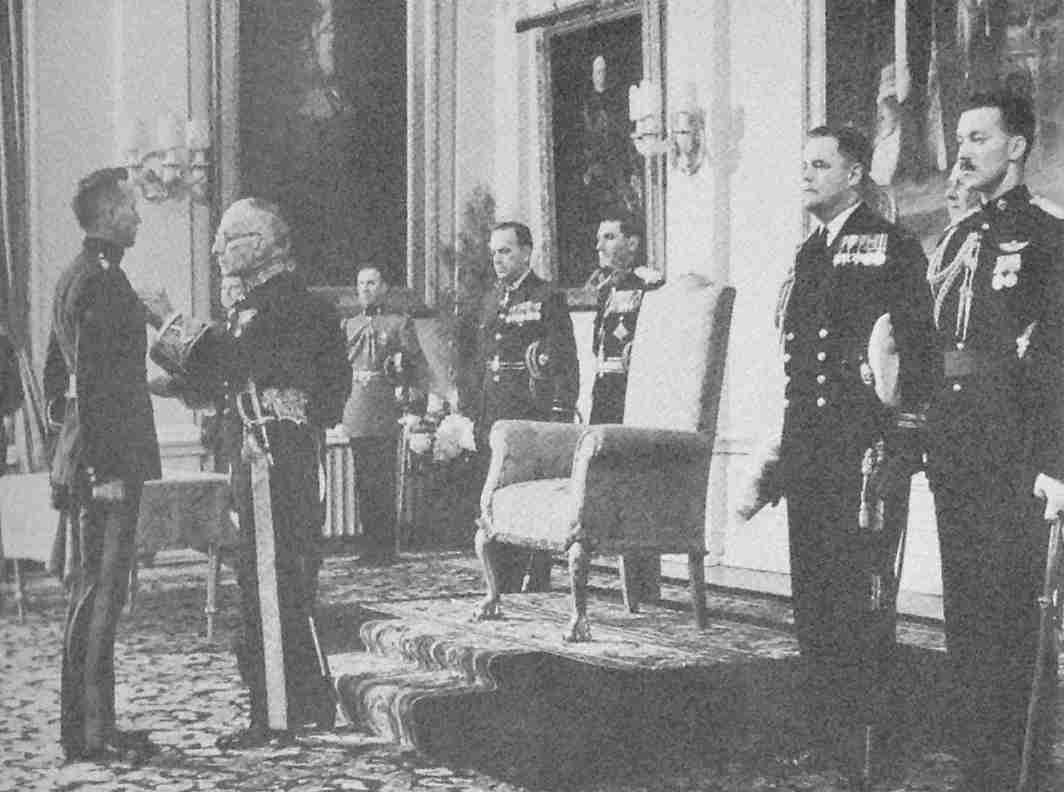
An investiture at Government House
I discovered on this first day’s tour some of the most regrettable pieces of furniture that I have ever seen. Why I had not been conscious of them on the occasions when I had stayed in the house I cannot think. A host’s approach to such matters is perhaps more sensitive than that of a guest. There was need for redecoration and refurnishing all over the house. That this had not been done is no reflection in any way on my predecessors. They had all come from Great Britain and naturally regarded themselves as the guests of Canada. It was very much easier for a Canadian Governor-General, familiar with the official machinery of Ottawa, belonging to the country, and with none of the reticence of a stranger, to ask for things that his predecessors from abroad would have hesitated to mention. The Department of Public Works I found most co-operative, and each year while I was in office an agreed programme of rehabilitation was continued, greatly to the improvement of the old building. Indeed, occasionally the ideas of the Department were in excess of what I thought to be reasonable requirements. In 1954 I discovered that the draft estimates for Public Works included an item of $30,000 for a new greenhouse at Government House. Of this I had heard nothing. I found that it had proceeded through the various stages until it had reached quite a high level of authorization. I sent word through my comptroller that this, in my view, was an entirely unjustifiable expenditure—that a new greenhouse was not required—and I thought the matter was closed. Not so. It appeared again in the estimates, but after I had a word with the very understanding minister, it was struck out.
More important than the house was my staff. Some persons belonging to the previous régime stayed on, others remained for a while, but before many weeks had passed I had my household organized. The new aides-de-camp, as always, represented the three Canadian services. Little is known about the work that members of the Governor-General’s staff perform. It sounds very attractive, not particularly onerous, and pleasantly balanced with entertainment and hospitality. The young Lady Dufferin wrote in 1872, ‘I think an A.D.C. is a charming institution.’ Her reference was to a very early period, and the charm in modern days has had to survive hard work.
I must say a word about the Governor-General’s honorary A.D.C.s. There were some seventy of them in my time, living in cities and towns all over the country. When the Governor-General visited their area they swung into action and were invaluable through the knowledge they had of their locality, and the time they gave to their chief ‘in attendance’. The preparation for a tour is more complicated than anyone would believe. Even a journey of a week or ten days would involve an immense amount of correspondence and a schedule that had to be absolutely precise. The file would grow to almost alarming proportions, but such things as errors in timing and mistakes in seating plans in cars were unthinkable.
I devised a necktie that present and past members of the Governor-General’s household staff, both permanent and honorary (about 300 in number), were entitled to wear. The ties are of dark blue silk with a pattern of crowns surmounting gold maple leaves. As a royal crown appears in the design, the Queen’s informal approval had to be obtained. Perhaps the most eminent person qualified to wear the tie is the present Prime Minister of the United Kingdom.
During my time Government House had to operate without a chatelaine, which meant that the comptroller had certain duties that otherwise he would not have had; I, too, assumed some responsibilities that normally would not be those of the Governor-General himself. For instance, every day Jean Zonda, my chef, the products of whose kitchen my guests were kind enough to approve, came to see me for a few minutes before I started my morning’s work to discuss the menus for the day. The arrangement of flowers, no small task at Government House and normally the duty of the lady-in-waiting to the Governor-General’s wife, was in the skilful hands of the head gardener.
I had not been at Government House very long before I was brought face to face with the problem of finance. I found it quite impossible to meet the expenses of the post from the money provided. The salary had been fixed by statute long ago and the allowances had been little altered for many years; in the intervening period the cost of everything had increased. I spoke to the Prime Minister about my problem; he was sympathetic, and, as a result of his decision, the House of Commons passed a vote, I am happy to say without a dissenting voice, increasing the Governor-General’s allowance to a figure that, for the time at least, eased the financial difficulties.
I always had had a sense of the importance of the post of Governor-General. This feeling increased greatly with the experience I gained. The appointment of a Canadian Governor-General did not meet with unbroken approval by any means. There was great respect for the office everywhere. As it was commonly looked on as an important link between Canada and Great Britain, the break in the tradition of appointing persons from the United Kingdom was a source of honest disturbance in many minds. At one time I had held this view myself. But over the years it became clear to me that so long as Canadians were excluded in practice from the office of Governor-General, so long as representatives of the Sovereign invariably came from abroad, we were encouraged to regard the monarchy as external to Canada, as not really belonging to us. The appointment of a Canadian to the post makes it far easier to look on the Crown as our own and on the Sovereign as King or Queen of Canada. There is another great advantage as well. Americans, who for the most part do not understand our constitution, are inclined to think of the Governor-General as an administrator who actually governs, like one of their own state governors. When the Governor-General comes from the United Kingdom it can only strengthen the belief that we are governed by Great Britain—an illusion that has taken a long time to die, if indeed it has even now entirely disappeared.
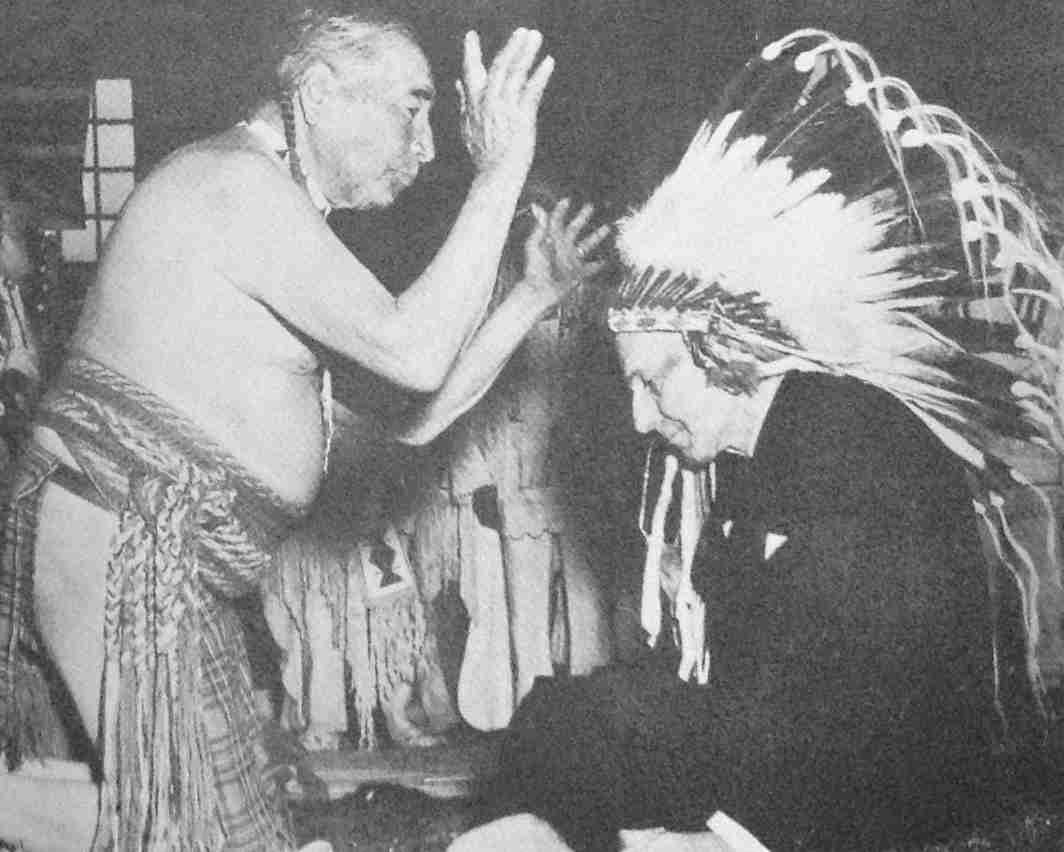
The Governor-General becoming Chief Running Antelope of the Blood Indians
When I was appointed, many people in Canada regretted the break in tradition, but the objections never took a personal form. Most people in Canada understood that the Governor-General, whoever he is and wherever he comes from, is the representative of the Crown, and should be treated as such. In Canada, we are not without political maturity in such matters. In Australia years ago an appointment was made of a Governor-General who was at the time in active politics, and members of the opposition party were inclined to boycott Government House as a protest. That, I think, could not happen here. (I may say that the controversial appointee in Australia, Sir William McKell, behaved in office with the strictest propriety and was regarded on all sides as a successful Governor-General.)
The public in Canada are often unaware of the extent of the Governor-General’s activities. There have been times in our recent history when it has been said by some that the governor-generalship was redundant and that the Chief Justice might perform whatever duties were worth retaining. I am not aware that any Chief Justice was ever asked for his views. The answer would probably have been, ‘One job is enough!’
We were reminded in 1957 of the place of the Crown in Canada when the Queen opened Parliament. Yet the full authority of the Crown is always demonstrated on such an occasion because, in the absence of the Sovereign, the duties, rights, and privileges of the Crown are exercised by the Governor-General. Indeed, without it Parliament itself cannot constitutionally exist, for Parliament consists of three essential elements—the Crown, the Senate, and the House of Commons. It has been well said that ‘with all three present and carrying out their duties, the entire sovereignty of the nation is vested in them jointly’. In a famous passage, Walter Bagehot has defined the rights of the Sovereign under our constitutional monarchy. They are ‘the right to be consulted, the right to encourage, the right to warn’. These rights belong to the Crown; they belong equally to the Crown’s representative.
There are some matters, of course, on which the opinions of constitutional lawyers differ. In 1926 there was a sharp difference of opinion between the Governor-General and the Prime Minister as to the right of a government to obtain dissolution of Parliament in certain circumstances. I think it is probably fair to say that a Governor-General’s particular nightmare would be a request for dissolution from the government of the day on doubtful grounds. When I seemed likely to be asked to dissolve Parliament in 1958, some voices were raised to the effect that unless a government was defeated in the House it had no right to ask for dissolution. I took the view that, although the Government had not been defeated, the situation in the House of Commons was such as to make the conduct of government business very nearly impossible, and so, when the time came, I did not hesitate to sign the instrument of dissolution. This, as it happened, took place at the Citadel in Quebec where the Prime Minister and one or two of his colleagues had come to see me. This is the first time, I think, that the Citadel had been the scene of so important a matter of state business.
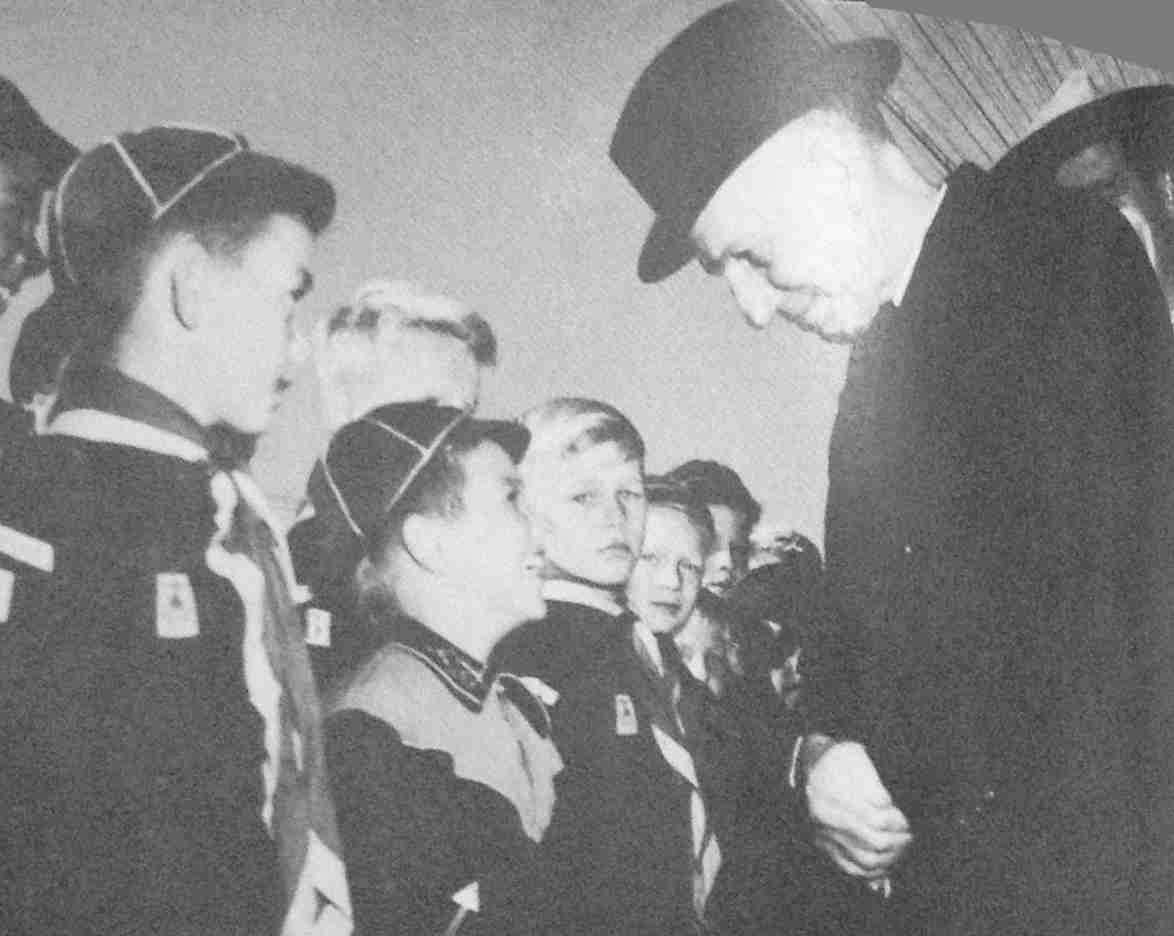
On tour
The relations between the Governor-General and the Prime Minister are governed by a long tradition and must be shaped by the good sense of both. Disputes between them in past generations have often been treated without reasonable objectivity by historians, and the dice have frequently been loaded against the Governor-General. In some cases it would seem that the Prime Minister has not been content with the system under which we live and work which gives the Governor-General a position similar to that of the Sovereign, with the political power resting—as it should—in the hands of the Prime Minister and the government. In The Mackenzie King Record (Vol. I, p. 146) King is quoted as follows: ‘I feel, too, it is an absurdity for a Prime Minister of a country to have second place in the public eye to any one in official position not belonging to one’s own country and in fact appointed by the Government of the country itself.’
If this was more than a passing thought, the implications are far-reaching. If the person possessing the political power became the head of the state, the office of Governor-General would, of course, disappear and with it a constitutional system that has served us well. We would no longer have as head of state someone above politics and controversy. He would be replaced by a person combining the offices of Governor-General and Prime Minister—in other words, a president, presumably on the American model; we would be a republic. It is well to ponder what Mr. Churchill said when he was in Ottawa in 1952: ‘No absolute rules can be laid down about the Crown. But on the whole it is wise in human affairs, and in the government of men, to separate pomp from power.’
If a schoolboy asked, ‘What does the Governor-General do?’, the simple answer would be, I think, that the Governor-General does two major things. It is his function to help our scattered population to gain the unity a country ought to possess, and also bring home the meaning of the Crown to the Canadian people to whom it belongs. These two objects are interwoven—they merge—because the Crown, as we have learned to realize in recent years, greatly strengthens our unity. It is not something reposing in the Tower of London but the very symbol of our own nationality, which helps to give us our individual character and draws all parts of Canada together. I cannot believe that we could remain an independent country without the Crown as a great and distinguishing feature of our life.
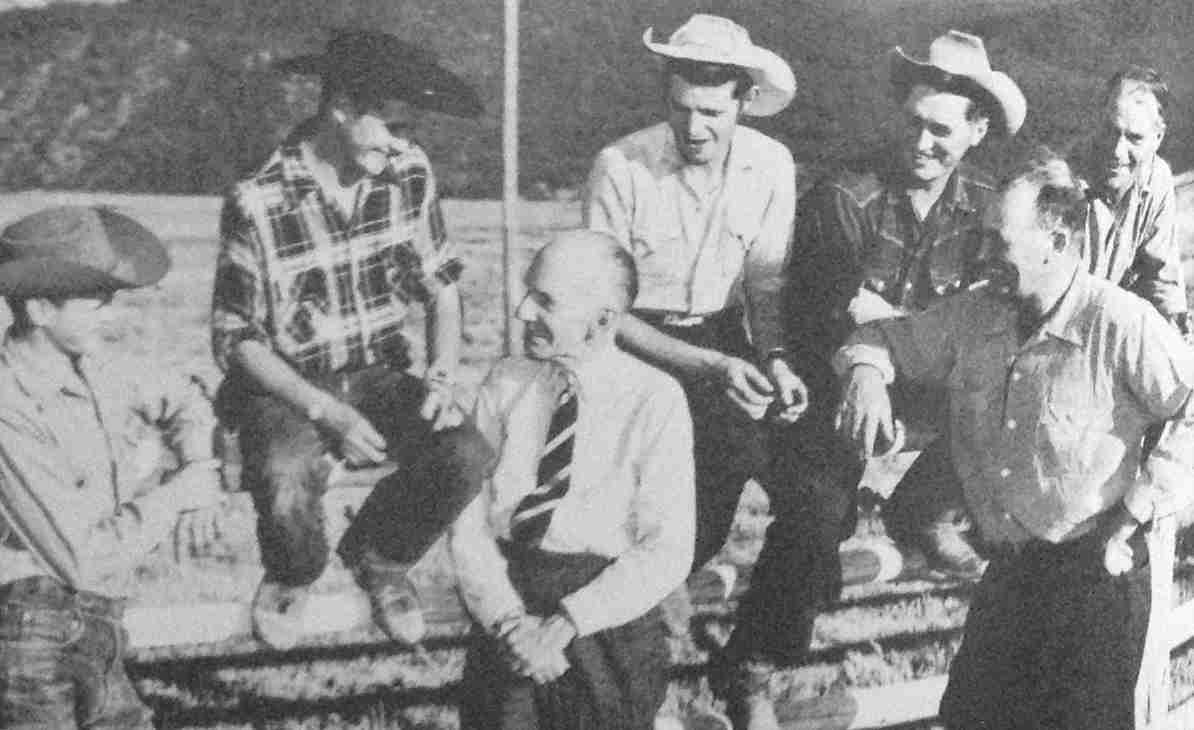
On tour
The actual powers of the Governor-General of Canada have been altered from time to time. They were most recently defined in the letters patent issued on October 1, 1947. This superseded all the documents dealing with the subject previously issued, and greatly extended the powers of the Governor-General. Its essential passage reads as follows:
. . . the Governor-General is authorized to exercise, on the advice of Canadian Ministers, all of His Majesty’s powers and authorities in respect of Canada. This does not limit the King’s prerogatives. Nor does it necessitate any change in the present practice under which certain matters are submitted by the Canadian Government to the King personally. However, when the new Letters Patent come into force, it will be legally possible for the Governor-General, on the advice of Canadian Ministers, to exercise any of the powers and authorities of the Crown in respect of Canada, without the necessity of a submission being made to His Majesty. (The new powers and authorities conferred by this general clause include, among others, Royal Full Powers for the signing of treaties, Ratifications of treaties, and the issuance of Letters of Credence for Ambassadors.) There will be no legal necessity to alter existing practices. However, the Government of Canada will be in a position to determine, in any prerogative matter affecting Canada, whether the submission should go to His Majesty or to the Governor-General.
There is an important sentence in these letters patent: ‘There will be no legal necessity to alter existing practices.’ The permission thus implied has led to the continuance of the custom by which the letters of credence of Canadian diplomatic representatives are still signed by the Sovereign and not by the Governor-General. Similarly, letters of credence and recall presented by diplomatic representatives accredited to Canada are addressed not to the Governor-General but to the Sovereign. It is very important that the Sovereign should continue to be directly identified with these matters.
As the first Governor-General to be appointed after the new letters patent were issued, I was very pleased that this was so. During my time in Ottawa everything possible was done to bring home the position of the Sovereign in our national life. The Queen’s visit in 1957 gave this reality. When she opened Parliament, she was acting, in the fullest sense, as the Queen of Canada. At this time she presided over a meeting of her Canadian Privy Council and in her capacity as Sovereign approved an order-in-council. The one chosen on this occasion authorized the Minister of Finance to sign, on behalf of Canada, an agreement with the Belgian government on certain fiscal matters.
I cannot claim any personal credit for these arrangements because they were the result of government decisions, but within the limits of my post I was happy to give them the fullest encouragement. I may say this: both the governments that were successively in office during my time were at one in their desire that we should demonstrate in every possible way the fact that the Queen is Queen of Canada. There was never the slightest shadow of disagreement on this vital principle.
When one thinks of Canadian unity, one’s mind immediately turns to the importance of understanding between the two races that are the pillars of our national life. I had had some experience on this subject when I was High Commissioner in London, as these two passages from my diary of that period will show:
Major——[an officer in a French-speaking regiment] came to say good-bye. He feels that the relations between French and English in our Army are very unsatisfactory. In fact there are no relations except those of a purely professional nature. He said that French-Canadian soldiers in his experience were full of appreciation of their reception in Great Britain and only wished that their fellow-Canadians would treat them as well as the British public.
[Diary entry, September 24, 1943.]
Colonel—— . . . called . . . . He seemed a nice, intelligent, well disposed fellow but he is going back to Canada very bitter about the treatment of French-Canadians in the Army. He gave me instances of French-Canadian officers and other ranks being told that they were not to speak French. I am afraid there are grounds for his complaint.
[Diary entry, August 11, 1944.]
Unfortunately, these examples represent a situation that has prevailed too often. In this field, the Governor-General can be very helpful. Lord Dufferin, when he held the post, showed great imagination when he turned a part of the old fortress we call the Citadel at Quebec into a second viceregal residence. Most of his successors used it, until it fell into disrepair and had to be restored under the stimulating guidance of Lady Willingdon. The Citadel is often referred to as a summer residence, which conjures up a picture of an indolent form lying in a hammock, a drink at hand, lazily turning the pages of a current novel. That is not my experience of the Citadel. As busy a social and official programme was carried on there each September as took place at other times at Government House in Ottawa. One month each year was, indeed, far too short for what had to be done. The Citadel gives the Governor-General of the day a house in the ancient capital of Canada, at the very heart of French-Canadian life. It is welcomed by the people of that great region. The Governor-General’s quarters are as unique as the great fortress of which they are a part. Many other houses in America and Europe have an historical background and also are placed in a setting of great beauty, but the Citadel—I am speaking now of the viceregal quarters—has both these qualities and something else; it has life going on inside it. It is no museum. Few guests in my recollection have not been moved by the charm of the old house, by the majestic view of the St. Lawrence towards the Island of Orleans, by the ceremony of ‘retreat’ on the King’s Bastion, when the flag is lowered at sunset, the old bugle-call is heard, and the bells of the churches down the river ring out the angelus.
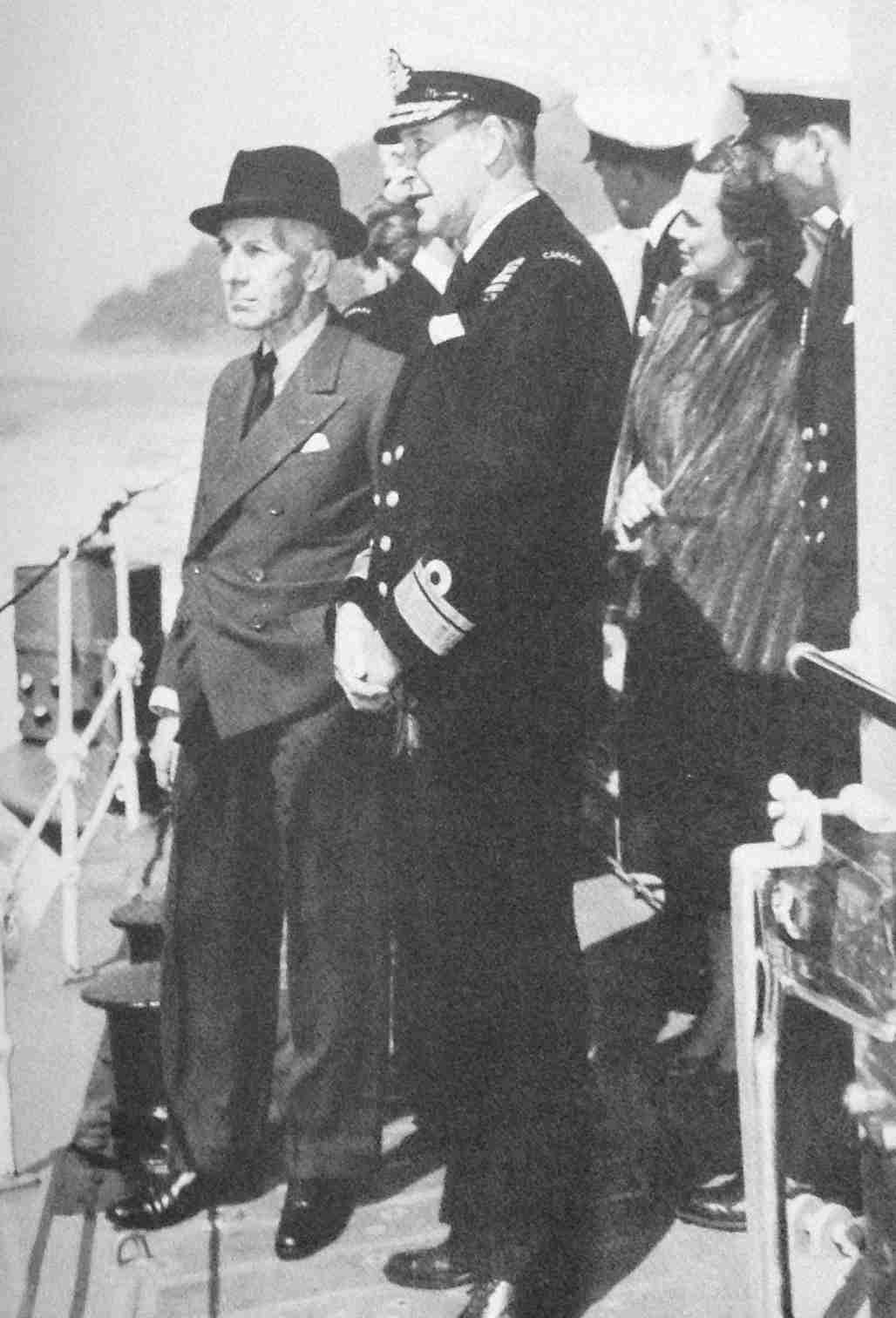
Aboard H.M.C.S. ‘Cayuga’—Rear-Admiral J. C. Hibbard and Mrs. Lionel Massey
In no place is the Governor-General made to feel more welcome than in Quebec. I enjoyed strolling informally through the streets of the old city and found myself greeted with great courtesy by people I met. I was often a guest at the Garrison Club. This is a venerable institution and, as the principal social club in Quebec, it naturally has a bilingual atmosphere. One of its traditions is the reservation of one room for English-speaking members and another for French-speaking members, with a communicating door between the two which is always opened on New Year’s Eve; the rest of the club is, of course, common to all its membership. The arrangement of rooms illustrates the important principle that there are natural differences between French- and English-speaking Canadians which should be recognized and harmonized.
I might mention a sortie I made from Quebec to Grosse-Ile in the Lower St. Lawrence. Over a century ago Grosse-Ile, as a quarantine station, had been the scene of an appalling disaster when more than 5,000 immigrants were victims of a typhus epidemic and were buried on the island. The purpose of my visit was to meet a group of government scientists who were engaged in important work. Before lunch in their little mess, to my surprise, I was asked by one of my hosts if I would read the Balliol College grace which he produced, either in Latin or English. I opted for Latin and as I complied with the request, I remember thinking what an extraordinary experience I was sharing. To me the tragedy of this isolated island wilderness, together with the ultra-modern experiments being carried on within its bounds, the text of a medieval Latin grace somehow emerging, made the occasion unique.
The Governor-General has certain privileges in French Canada unknown to the general public—indeed unknown to me until I assumed the viceregal post. They cannot but interest people with a sense of history. During the French régime, the Governor had the right to visit cloistered communities. After the conquest, the heads of these houses asked the British governors to continue to exercise this historic privilege and, ever since, the Governor-General of the day has done so. By custom, he is permitted to take members of his staff and family but no one else. When I paid a visit to the Trappist monastery at Mistassini, a number of friends had motored over from Roberval to be present. When the abbot, in his little speech of welcome, said that he was going to take me into the cloistered part of the abbey, and that my party would accompany me, he observed with a charming smile: ‘This will mean that the lady who will come with us will be the only Protestant lady in this room’—meaning my daughter-in-law Lilias.
Among the numerous schools I visited as Governor-General were many run by Roman Catholic sisters in French Canada. I was always struck by the beautiful manners of the girls in their charge; it is hard for other schools to measure up to this standard.
I paid a visit to the Hôtel Dieu, the great hospital in Quebec, the earliest buildings of which date from 1635, where the patients are looked after by some 300 nuns. After I returned to the Citadel I was informed, rather belatedly, that it would have been my privilege—and was, indeed, quite obviously my duty—to ask that the religieuses should be given a congé royal de trois jours. I was dismayed that this opportunity had been missed, but a note was sent to the Mother Superior at once by hand, asking whether the holiday could still take place, and in a charming note she said she would put it into effect at once.
In several of the monastic orders the Governor-General has the privilege when he is at a meal with the fathers of asking the prior to waive the rule of silence. The book they would have had read to them during the meal is then put away, and ordinary conversation ensues. I was told of this by a friend of mine—a Dominican father at whose monastery I was about to lunch. I asked what my ‘cue’ would be. He said, ‘You will be welcomed by the prior in a short speech, to which you will, of course, reply, and at the end of that you should quote two words which will convey to the fathers what you wish; these are deo gratias.’ It worked exactly as I was told it would—directly I uttered the phrase there was a hum of conversation which went on all through lunch.
I would put travel very high on the list of viceregal duties in Canada. Wisely planned itineraries have a unifying influence upon a country occupying more than half a continent, and with a widely dispersed population of not much more than eighteen million people. A member of my staff with a flair for statistics told me that when I left the post I had travelled about 200,000 miles in and over Canada and along her coasts. I managed to visit all ten provinces within a few months of the beginning of my régime; the only period when I was not then in motion was a month in Quebec which, being my first sojourn there, was unusually crowded.
For most of these journeys I and my staff travelled in the two venerable but homelike railway cars that were called, in a grandiose and inaccurate phrase, the ‘Governor-General’s train’; they were almost always attached to scheduled trains. Each had survived about thirty years of use, and, as it happened, the two men who were in charge of them had been employed for the same period. My first trans-Canada journey was accomplished at a pace too fast to be maintained. I was amused to hear that one of the attendants aboard my cars was asked in Vancouver about the current tour and its significance, and replied, very discreetly but most incorrectly, ‘Routine—just routine.’ This aroused mixed feelings on the part of my exhausted staff! With regard to the cars themselves, one of my A.D.C.s declared that the wheels were not round but square, although after each overhaul they were so greatly improved that they became merely octagonal!
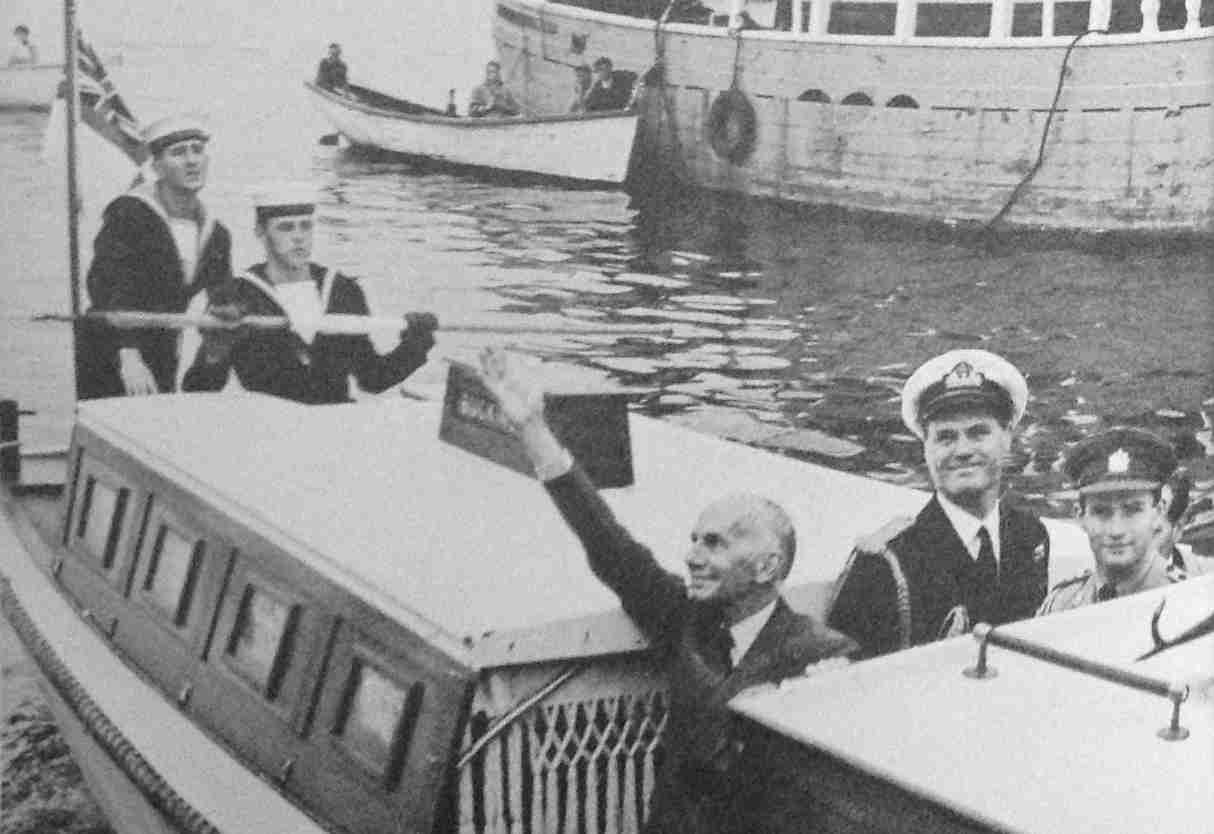
In the ‘Saucy Sally’ from H.M.C.S. ‘Buckingham’
The modes of travel varied considerably. Most of my mileage was by rail or by air; occasionally I travelled by motor-car and for short distances even by dog team or canoe. The navy made available ships of various sizes and types for journeys along the coast and in the St. Lawrence. One of these was the little craft in which I and my party covered a considerable distance on a visit to the Magdalen Islands in the Gulf of St. Lawrence. She was the cutter of the frigate H.M.C.S. Buckingham which had been lent to me and which had to anchor a longish way from shore because of shallow water. I christened the cutter Saucy Sally and wrote a piece of doggerel about her which I imposed on the officers in the wardroom:
On board the frigate ‘Buckingham’ there hung a little craft
As nimble as a kayak, as buoyant as a raft;
The passengers admired her; travelled in her at each stop,
And called her ‘Saucy Sally’—with the fringe on top.
For she carried very proudly a magnificent décor:
A fringe she had amidships, and also aft and fore.
The passengers adored it—what the actors call a ‘prop’,
And they loved the ‘Saucy Sally’—with the fringe on top.
When we called at Entry Island the wind grew even stronger,
And our journey to the jetty seemed long and getting longer;
We whispered soft as seas grew high and spirits took a drop
What about it, ‘Saucy Sally’—with the fringe on top?
But she did her duty nobly, and never let us down,
Returned us to the ‘Buckingham’, and how she went to town!
The waves she scorned superbly, with a jump and skip and hop,
So thank you, ‘Saucy Sally’—with the fringe on top.
It was always very tempting to ‘take the controls’ when this was possible. The captain of the ferry at Kelowna in British Columbia invited me to take the wheel when we were crossing the lake. As we approached the dock, I attempted to withdraw, and he said, ‘No, take her in.’ That was a challenge; I am afraid our landing in the slip was rather like the movement of a billiard ball against the cushions! When on a northern flight we neared Norman Wells in our Dakota, the pilot asked me if I would like to take over. I rather reluctantly did so, after a few minutes of instruction. I don’t think that I was permitted much freedom of action even so, but I know that when the pilot went back into the rear part of the plane the members of my staff were very definitely alarmed at the thought that I was temporarily in charge; they didn’t realize that the co-pilot was in the cockpit too, and when the aircraft circled to make a landing and I had not returned, fear spread through the party.
Nothing is more satisfying than sitting at the throttle of a steam locomotive, as I did for a couple of hours on the C.P.R. main line through the Fraser Valley. Few things give you a greater sense of power than the vast shape of a locomotive swinging and quivering over the rails. It was even a pleasure to sit in an engine cab of the little narrow-gauge railway in Newfoundland. I impressed the engineer by showing him that I knew the signals to sound on the whistle—that was all I did know! The permanent way was a little rough and the curves fairly sharp. I asked occasionally whether I shouldn’t slow down. The reply was, ‘Oh, she’s all right for thirty.’ Diesels are soulless things—I got no pleasure out of my short time in a diesel cab. I came to the conclusion that I was definitely ‘a steam man’—though that of course suggests obsolescence.
Visits to cities and towns in Canada impress one with the fact that too often the superb countryside has not been embellished by what we have built on it. The tangle of wires and equipment that overhangs our streets, the large-scale, garish outdoor advertising, the needless loss of trees: all this is something of which we cannot be proud. There is a regrettable tendency, fairly common along the highways of our country, to try to lure the American visitor by displaying his flag. He is not likely to be profoundly moved by this frankly commercial use of his national emblem. In some cases hotels bearing historic Canadian names have been rechristened by non-Canadian owners who have acquired them. The General Brock Hotel in Niagara Falls, Ontario, commemorated the career of Sir Isaac Brock, who because of his gallantry and brilliant campaigning in the War of 1812 is rightly called the ‘Hero of Upper Canada’. Indeed, he more than anyone else was responsible for this great region’s remaining under the British Crown. The hotel, under new ownership, was renamed without apparently any murmur of protest from the local community. I longed to make a deliberate mistake in some speech in the region of Niagara and speak in moving terms of that great soldier, Major-General Sir Sheraton Brock, to see what the reaction would be.
A happy exception to these melancholy observations is provided by the city of Ottawa—particularly because of the work of the National Capital Commission. Under various names, this organization has been entrusted with the beautification of the city and given federal funds for the purpose. Its work has now won widespread approval but in the early years met with some opposition. One man deserves most of the credit for the imagination and initiative that led to the inauguration of this great project. Mackenzie King, from the beginning and, indeed, throughout his life, was obsessed with the importance of this task, and although some of his fellow citizens were indifferent or unfriendly to his ideas and plans, they should have been at one in applauding what he did for the capital of their country. I remember a nocturnal drive in 1928 when he showed me as much as we could see in the dark of the work being done for a finer Ottawa.
I tried to visit as many small places as I could, along with the bigger ones—outports in Newfoundland, hamlets on the prairies, mountain villages on the West Coast, island communities in the Gulf of St. Lawrence. Very often, they had never had an official visit from anyone. On several trips, it was arranged that I would meet the local authorities and the school children during the scheduled stops that the train made. These little communities were delighted, and I was told often that they were so accustomed to having the through trains pause for a few minutes and dash on, that to be visited, actually visited, by the Queen’s representative was something that not only surprised but pleased them greatly. Often on my journeys crowds would gather unexpectedly at a station, and the A.D.C. on duty would receive a warning by a signal on the whistle so that I could get to the back platform in time. How important this was.
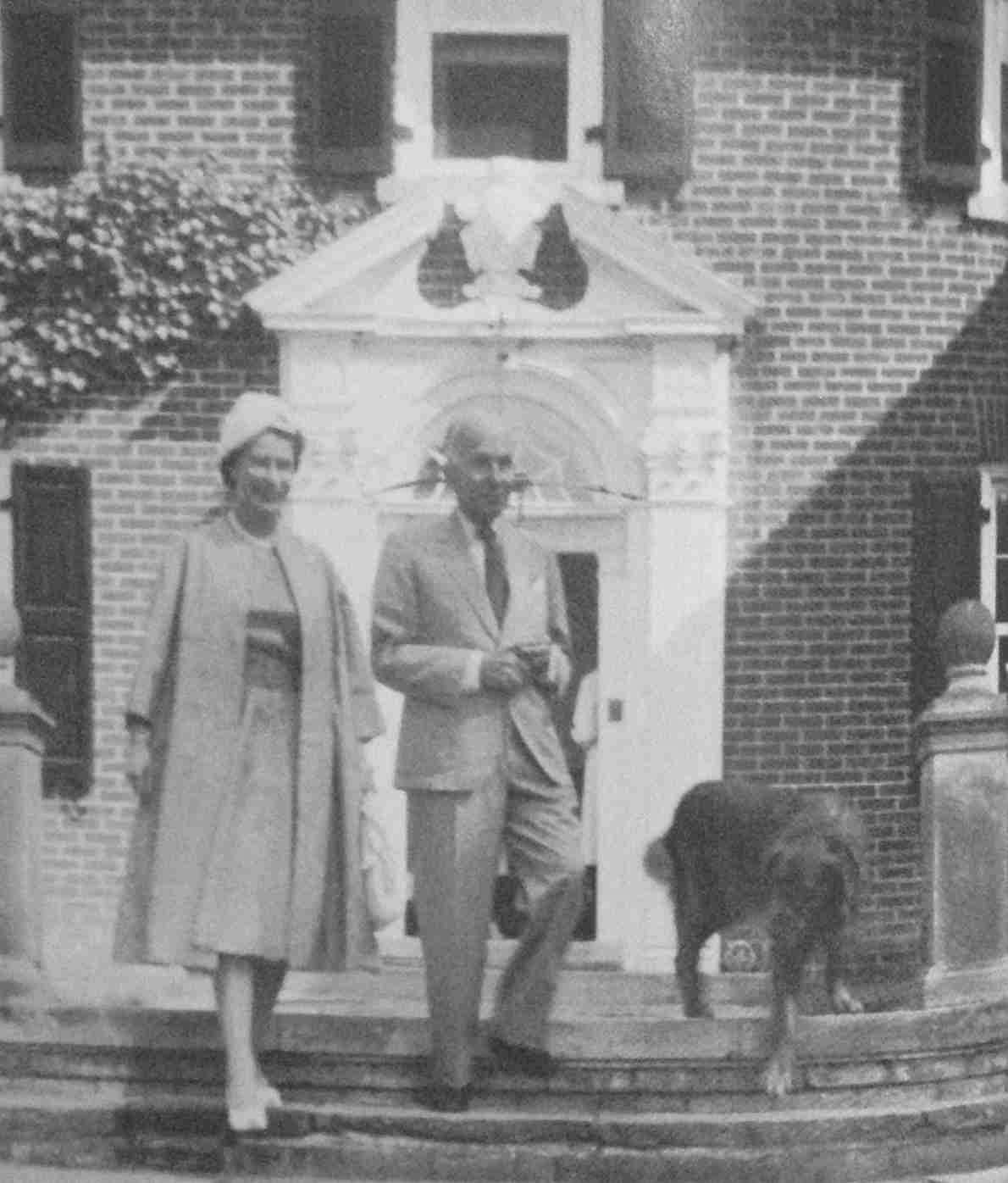
The Queen and the Governor-General at Batterwood House, 1959
Children played a large part in these journeys. Everywhere I went the mayor or reeve or whoever was in charge would be told in advance that I would like to meet the children of the community. This was arranged in countless ways. Sometimes, through a superb achievement in logistics, they would be assembled in the local hockey arena—several times there were 5,000 of them, once or twice 7,000. Sometimes I would see the children lined up in front of their schools. Somehow, almost without fail, I always met them. To talk to several thousand children gathered in one assembly is dangerously intoxicating. On these occasions you had to remember you had hundreds and perhaps thousands of flairs of little eyes fastened on you, wondering what on earth the old boy was going to say, and not with any indication of joy. However, the obvious thing was to make them laugh in your opening remarks and to show them that you didn’t take yourself too seriously. Then, after a few words about Canada, came the inevitable reference to a special holiday. It was always tempting to tease them about this and refer to a Governor-General’s holiday as something that used to happen about which they could read in their history books. At that point faces would become very long, almost tearful, and then of course came the glad news that I would ask that a holiday should be given them which they were earnestly asked to remember as ‘the Queen’s holiday’. The only part of Canada where holidays were not welcomed by the children was in the Arctic, because home there—a draughty hut or igloo—was less comfortable than school.
These special holidays, strangely enough, occasionally involved an element of controversy. In some places—happily few—the school boards asked themselves, ‘What will the Department of Education say? Will an extra holiday affect our annual grant?’ Officials not endowed with imagination were perturbed at the loss to the children of the time involved. But they would not, in the normal course of events, lose more than two days in their entire school life, because it was most unlikely that more than two governors-general would visit them during the period. Twelve hours of holiday out of about twelve years of school could hardly have a devastating effect on the education of a child. What is there to be said on the other side? After a boy or girl has a holiday at the request of the Queen’s representative, that day will not be forgotten. It will bring the Crown home to the child and, indeed, very often to the child’s parents, who, if they should happen to be newly-arrived Canadians, will learn something about the system of government under which we live.
Talking to the children was the pleasantest form of public speaking I engaged in. I was always impressed by the warmth, the alertness, and the good manners of the children I met. In a western city I visited a school and said a few words to the children and then went on to another school. On this short drive I noticed there were seven boys on bicycles (their average age was perhaps thirteen) who seemed to be closely attached to my car. We had a short conversation en route. When I left the second school the same boys appeared. I asked them how far they were going to go. They said, ‘We are going to the station, sir.’ I said, ‘That’s very nice of you—you are my escort.’ That seemed to please them. We arrived at the station, and when I shook hands with them and said good-bye I received the inevitable request for my autograph on pieces of paper they had somehow acquired. I complied, of course. A few minutes later I was told that the boys were back again and wanted to see me. I went to the door and there they were, all seven of them. The leader handed me a piece of paper on which were written the names of them all with the word ‘escort’ underneath, followed by ‘Good luck!’ A little incident, perhaps, but moving to me.
It generally happened when I visited a town or city that I had the opportunity of meeting representative groups from various organizations. In one city the mayor, with imagination, had included in the reception persons who were new Canadians from a number of different countries. It made them, and those whom they represented, feel that they belonged to their new homeland. That, I am sure, is often more important even than the economic aspect of their problems.
As I visited communities in Canada, I was aware of a practice sometimes ‘more honoured in the breach than the observance’. I refer to the wearing of chains of office by the mayor. In some cases this tradition has been abandoned, in others chains have been recently acquired and are worn very proudly. The attitude towards such insignia reflects either a respect for a deeply rooted Canadian tradition or a point of view that has developed in the Americas that looks upon such things as mere flummery. In a western city, whose mayor was happy to wear his chain, someone said to me, ‘Such a thing is not unimportant. When a man is elected mayor there is often too little respect for the office he holds—he is just “Bill”, who has got the job of mayor.’ If he appears in public wearing his insignia, perhaps the simplest of chains, the public tend to look upon him as ‘Mr. Mayor’ and are encouraged to hold respect for his office.
I have probably met as many mayors as anyone in Canada and I have received much kindness and courtesy from them. The ceremonies of welcome in cities and towns have been diverse in character but uniform in their warmth. I remember a reception in the park of a western town. No organization seemed to have been left out. The Brownies were there, of course. It was a very hot day and someone had carried a pail of water and a dipper to slake the thirst of the little girls, although it was true they were on duty. Their formation wavered and I heard the very stern officer in command of the whole parade shout, in tones reminiscent of Wellington Barracks, ‘Steady, the Brownies!’ Among the groups formed up were a number of men from an institution for the blind. I shook hands with them all until I came to a bearded figure, seated, who obviously was slightly deaf and was unaware of what was going on. The young man in charge leant over and whispered something to him. He didn’t catch it, and then I heard the words ‘Governor-General’, whereupon he shouted ‘Jesus Christ!’ and sprang to his feet; I grasped his hand.
At some places I was surprised by my reception. When I arrived at Fort Smith in the North West Territories on a bitter winter day with a very low temperature and a piercing wind, I discovered a sizeable party of Boy Scouts and Girl Guides drawn up to meet my aircraft. They were dressed in summer clothes—bare hands and arms, light cotton shirts or blouses, and so on. I was dressed, as I thought, appropriately—in furs. I wondered whether the inevitable photographs would demonstrate the frailty of the Governor-General or the toughness of northern youth. I heard afterwards, however, that they had cheated a bit, because they wore a certain amount of wool concealed from view.
Visits to hospitals nearly always had an important place in the programme of my tours. Many incidents were charged with pathos or humour. In one hospital a little boy had lost an eye, and his good eye, which they hoped to save, was bandaged. When I reached his bed, I grasped his outstretched hand. He said to his mother, sitting beside him, ‘What was he like, Mum—he sounded O.K.’ In a different category was an exchange with a patient who had an accent a little hard to identify. I said, ‘Are you Scottish?’ He said, ‘No, I’ve just got a new set of teeth.’
My travels involved two official journeys outside Canada—one to the United States, and the other to a tiny community, almost forgotten at that time, off the shores of Newfoundland: the French islands of St. Pierre and Miquelon. They had never been visited by a Governor-General.
I was invited to Washington in return for a state visit paid to Canada by the President of the United States and Mrs. Eisenhower. The procedure for such an occasion had become a settled matter since the days in the late twenties when the Willingdons paid the first official visit of a Governor-General to Washington, when I was at the ‘receiving end’; of this I have spoken in an earlier chapter. I was welcomed with the honours normally accorded a visiting head of state. There was nothing the United States authorities could have done that they did not do to greet the representative of Canada with neighbourly warmth. Although Washington was resplendent in service uniforms, I had been requested to wear informal clothes. There were, I understand, six or seven thousand troops lining the route from the airport to the White House, with eighteen military bands. The streets were lavishly decorated. Thousands of Canadian flags had been made in Washington for the occasion. The skies were very threatening, and before we arrived at the White House the inevitable cloudburst took place; we got to our destination in a semi-drowned condition.
I had with me, in addition to my personal party, the Acting Secretary of State for External Affairs, Brooke Claxton, the American Ambassador to Canada, Douglas Stuart, and their ladies. I and some of my staff stayed at the White House for the first part of the visit. I, incidentally, occupied the bed that had been made for and used by Mr. Lincoln—it was longer than it needed to be for most visitors. The President and Mrs. Eisenhower, who had given me a most warm-hearted welcome on the steps of the White House, showed us round the reconstructed building, including the two rooms where the President relaxes—his private kitchen and his studio. The state dinner at the White House was a distinguished event and was given an agreeable personal atmosphere.
During the second part of my visit to Washington, I stayed at the Canadian Embassy, which was presided over with great distinction by the Arnold Heeneys. I was the nominal host at a dinner party there in return for the state dinner at the White House. It was apparent on this visit how handicapped, as I think, our representatives are in Washington by the inadequacy of their quarters. They have a most agreeable house in a charming setting, very pleasant as the residence of a private citizen, but without the formal dignity or size that the embassy of an important country should possess.
I was offered the unusual privilege of addressing both Houses of Congress. I prepared my speech with the greatest care and tried to say something omitted generally from such occasions, on which it is customary to emphasize the similarities between the two countries and to leave out any reference to the differences that mark them and justify their separate existence. The members of the Supreme Court were present on this occasion, in their robes; the chiefs of staff, the members of the Cabinet, and members of the diplomatic corps. I was told that even Senator McCarthy’s committee had adjourned to allow its members to attend. The visit to Washington was heart-warming and, to me, quite memorable.
My visit to St. Pierre and Miquelon was a little piece of romance. The islands, with a tiny population of some 5,000, had never had a visit from a Canadian Governor-General. I travelled aboard H.M.C.S. Outremont and took with me the French Ambassador to Canada, Francis Lacoste. No one in his post had ever visited this remote community. The Ambassador managed to arrange for the presence on this occasion of a French frigate, as a result of which the salutes fired by both ships to each other and to the Governor ashore created a din that was probably unique in the long history of the islands. The Administrator of the territory, M. Pierre Sicaud, a distinguished young Frenchman, and his English wife, could not have been more charming in their welcome, which was shared by the public, who were touched by the compliment from Canada my visit implied. There was a little guard of honour at the jetty composed of gendarmes from the French metropolitan force, and very smart they were.
The dinner in my honour at the Governor’s residence was up to the best traditions of France. In the house I was shown a room in which there was some very fine panelling, designed by the Governor himself and made by local craftsmen. We spent a full day being shown round St. Pierre—French rather than French-Canadian in atmosphere. There were many receptions and vins d’honneur—I don’t remember having drunk champagne more often on any visit! Although the islands are wind-swept and bleak, we were blessed with fine weather; I was told it was very unusual.
The next day I visited Miquelon and on the invitation of the captain of the French frigate L’Aventure made the two-and-a-half-hour journey aboard her. Miquelon is a tiny fishing village, isolated and pretty grim, with three or four hundred inhabitants—all fishermen except the doctor and his wife and the priest. The doctor’s wife was so versatile as to be both a successful mink farmer and, working with her husband, the obstetrician and anaesthetist of the community. My short visit came to an end with a reception in the tiny town hall.
I was much interested in the work of the Council of the North West Territories which administers a vast area reaching to the Arctic Ocean and is, in itself, a legislature in the making. The members of the Council—some of them appointed and some elected—were generally received at Government House during their half-yearly meetings in Ottawa. The Council was conscientiously and proudly carrying on the constitutional traditions of a legislative body under our system of government. It seemed to me that, as such, it was qualified to have a mace according to our practice in the Commonwealth. ‘Did they possess one?’ I asked. No, they didn’t, and it was obvious that the gift of one would be greatly appreciated and would add to the prestige of the Council. So I arranged to have a mace made by a group of Eskimoes at Cape Dorset on Baffin Island, representing in its material and design life in the Canadian North. In this undertaking I had the invaluable help of James Houston, who is probably best known in Canada for his distinguished work in connection with Eskimo carving.
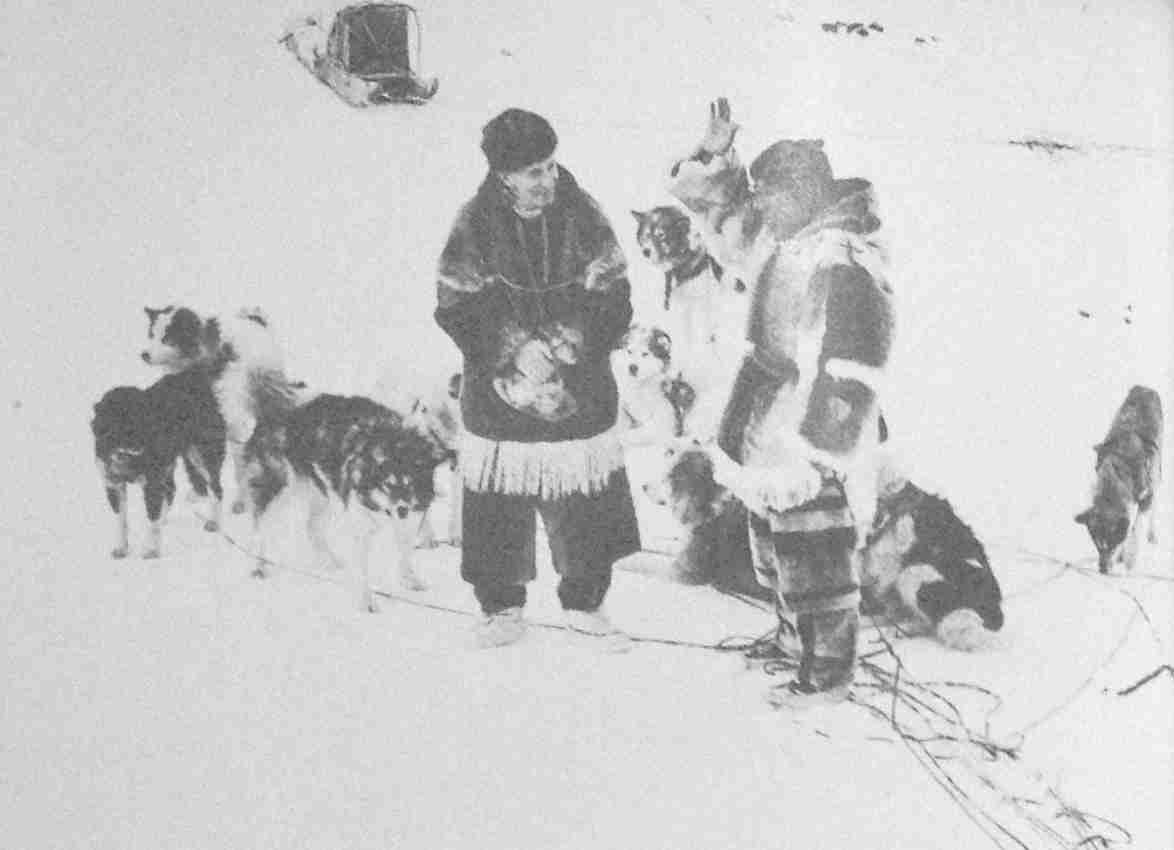
With the Eskimoes on Baffin Island
The mace has as its shaft a narwhal tusk; ringed round it are carvings of whalebone depicting Eskimo life; the Indians in the Arctic are represented by a band of quill-work; the white man’s historic exploits in the North are commemorated by some wood from H.M.S. Fury, wrecked in 1825. The mace, like nearly all such objects in the Commonwealth, is surmounted by a crown. This was fashioned from a block of free copper found in the Arctic and given its shape with great skill by the Eskimoes, who had only a picture to work from. They ran out of copper before the task was finished. A young Eskimo woman said that she had inherited a copper kettle left by Lapland reindeer-herders and that she would be glad to have it used. This precious article was melted down and made possible the completion of the crown. (I was glad to have been told about this, and in due course the Air Force on one of its northern flights dropped another copper kettle in the settlement, with my thanks to the donor of the one that had been used.) The Eskimoes produced the mace, possessing great beauty and romance, with no real knowledge of what it was for; but they knew that it had something to do with the Queen, and that was enough.
The making of the mace gave me an even deeper interest in the Far North. I was most anxious to visit it, and it was decided that the journey should take place early in 1956. I wished to go for three reasons: first, to visit the natives, chiefly Eskimoes, living in that area and those who were serving them—the missionaries, the R.C.M.P., Hudson’s Bay Company officials, and officers of the government departments concerned with the North; secondly, to direct the attention of the Canadian public to the Canadian North, which called for increasing efforts to improve the lot of the natives, and to exploit the area economically; thirdly, ‘to show the flag’. It was very important to make it clear that this great region was the sovereign territory of Canada and not part of the land of those from south of our border who were engaged in projects for North American defence.
The journey took months of preparation, including a dry run over the route, in advance. On March 20, 1956, we flew from Ottawa in an R.C.A.F. North Star—the familiar C.5 could not stand up to arctic weather. A few years earlier it would not have been possible for an aircraft to take this actual route, which involved crossing from one coast to the other in the high Arctic. My party numbered about thirty and included Lionel and other members of my household and two or three experts on the North whose presence was invaluable. My daughter-in-law Lilias, an intrepid and enthusiastic traveller, was the only woman aboard. There was a crew of thirteen, especially chosen for this unusual flight, under the command of Wing Commander W. G. Miller. There were eight members of the press, whose presence was essential if one of the purposes of the flight was to be achieved—to make the public more aware of the North. I discovered after we had returned to Ottawa that we had carried two tons of what is called, rather ominously, ‘survival equipment’! We flew altogether about 10,000 miles, and despite the severity and, indeed, the eccentricity of the weather, we were never late arriving or taking off except once, when we had a difficult landing. Some picturesque things happened on the trip. Among these, I might mention the wireless messages exchanged at one stage of the flight between myself and tiny meteorological stations—one of them, Alert, being the most northerly inhabited place in Canada, only some 500 miles from the Pole.
The first day’s flight took us from Ottawa to Baffin Island where we spent two days at Frobisher Bay. One of the short journeys taken there was by dog sled. Being pulled by a team of dogs at full speed, seated on an uncushioned plank, over rough sea ice where at any moment the sled might drop six inches or more, made you feel that your spine and cranium were like a toothpick penetrating an orange. Except for Great Whale River where we had stopped en route, I had my first contact with Eskimo life at Frobisher. To visit Eskimoes in their huts or igloos was always a pleasant experience—they are delightful people, as all who know the North seem to agree, and the children have charming manners. The accommodation for a party of thirty in these tiny arctic settlements presented a problem which had to be solved in advance, but hospitality is as true of the North as are ice and snow. R.C.M.P. officers or N.C.O.s, Hudson’s Bay post managers (the historic title ‘factor’ seems, alas, to have disappeared), an R.C.A.F. detachment in some places, all played their part, and I visited also several hospitable camps working on the construction of the radio warning system. These were under American direction, and I am told that there was great scurrying round to get a Canadian flag before I arrived. Canada and the United States look very much alike—in the Arctic.
A characteristic feature of northern life is the absence of sanitation—indeed of all plumbing—in the houses. This is due to what is known as perma-frost. Even in the middle of the short summer, at a depth of a few feet you encounter perpetually frozen ground. The buildings I was in, like those in the Far North almost everywhere, were generally overheated. I can understand what I was told by an acquaintance, of his experience in the North: that a quarter of the time he was too cold and three-quarters of the time too hot.
Resolute, on Cornwallis Island, was the most northerly place at which we stopped. It was primarily a station of the R.C.A.F. Attached to this establishment was a scientific post run by a group of bearded ‘boffins’ engaged in researches incomprehensible to the layman, connected with the ionosphere, cosmic rays, terrestrial magnetism, seismology, and, of course, as in so many places, meteorological services. The contrast between these scientific activities and the primitive Eskimo life in the native settlements near at hand was dramatic. At Resolute there was a constable of the R.C.M.P. who seemed to be a living embodiment of the versatility of his force. In addition to his police duties, and much more important, were his representation of several government departments and his functions as an unofficial but efficient midwife in the Eskimo settlement and a teacher of Eskimo children. When some Eskimoes, who were not prospering in a distant settlement, had to be moved to Resolute, this constable brought them over the ice.
In the aircraft over the North Pole
From Resolute we flew over the North Pole. I had been told that this would be possible and would I like to do it? Could anyone refuse? The North Pole lives in our imagination as something remote, inaccessible, and awe-inspiring—to think of flying over it and looking down on it was more than one could resist. So we went. The journey to the Pole and back was one of two thousand miles and we accomplished it in about ten hours. The Air Force had provided me with a canister in which were put the obvious documents about the expedition and one of the little blue Governor-General’s flags. This container had the essential facts inscribed on it in several languages and was dropped over the Pole. Attached to it was a little parachute to ease its way down and prevent its being broken on the ice. When the moment arrived and we were told we were nearing the Pole, there was a great stir in the aircraft. Our pilot dropped down to a thousand feet of altitude and circled over the spot two or three times. I had asked how close to the Pole we could get by arctic navigation. I was told within two or three miles—incredible to hear. So when the moment came I pulled a cord that released the canister. Inside there were instructions asking whoever found it, if it were ever found, to communicate with Ottawa. I was assured that there was a remote possibility, after a very long time, of its reaching the coast of Greenland or Spitsbergen, through the movement of the polar ice. I think, however, the chance of a message being sent to Ottawa reporting the discovery of the canister most unlikely. We were all excited as we reached the Pole, although we could see nothing, of course, for miles but an infinity of white, broken here and there by black stretches of open water.
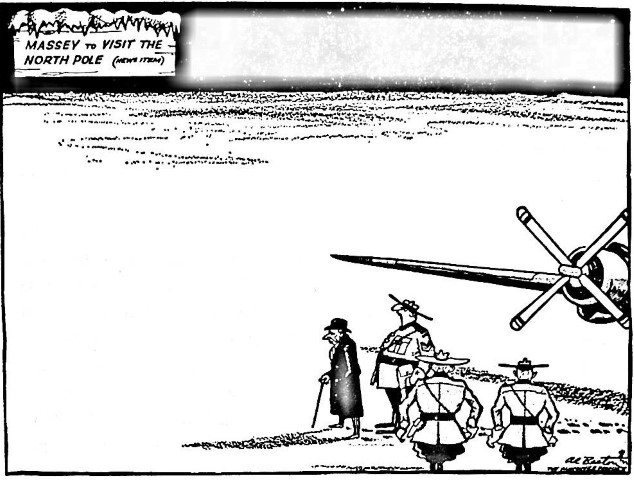
‘Was there anything in particular you wished to see, sir?’
We flew back to Resolute on a more easterly line than our route to the Pole, which took us over Axel Heiberg Island where there were mountains of seven or eight thousand feet in altitude; we were given a ravishing view of the mountains of Ellesmere Island, which were even higher. They showed all the shades and colours that belong to the time of sunset, because the days were still very short.
Cambridge Bay came next on the flight. Here I was received at the Roman Catholic mission by one of the devoted members of the Oblate Order, Father Lemaire, a Belgian priest who somehow had contrived to be so hospitable and enterprising as to give us a vin d’honneur! A drum dance took place here in a large Eskimo snow house, built for the occasion. This could accommodate over a hundred people and in architecture closely resembled a Byzantine church, with a central dome and bays, all made out of blocks of frozen snow—a piece of highly skilled engineering. The structural problems of those domed churches in Europe and those of the Eskimo snow house had been solved in the same way.
Tuktoyaktuk was a short flight further on. On the way we saw the first trees we had seen since the beginning of the journey. The tree-line that crosses the continent from south-east to north-west touches the Arctic close to this settlement. There we landed, as we had everywhere, on the ice, which in the late winter is about seven or eight feet thick. Here I met Eskimo Cubs and Brownies (there is no pack farther north in the world than the one at Tuktoyaktuk) and heard them sing ‘God Save the Queen’ and ‘O Canada’—the only English they knew.
We left for Aklavik in two Dakota aircraft—the North Star being too big to land on the frozen Mackenzie River. We carried an extra passenger in the person of an Eskimo Anglican clergyman on his way to Aklavik for the Easter service. The visit here included Mass on Good Friday at the Roman Catholic mission. On Easter Sunday I went to the morning service at the Anglican Cathedral where the lesson was read in the Loucheux language by an Indian clergyman, in Eskimo by our passenger of two days before, and in English by myself.
Norman Wells, as its name implies, is largely concerned with oil. The company gave a reception which I was glad to hear included everybody in the place. I remember one of the guests, an Indian woman with charming manners, the mother of fifteen children, who had a few days before gone out alone with her dog team, killed and skinned a moose by herself, and brought the carcass home—an example of the vigour of the community.
By the time we had reached Whitehorse, we had come out of the North; it was an overcoat and not a parka town and the stay there took very much the form of a visit to any other Canadian city of the size. The same applied to The Pas where we stopped on the way back to Ottawa. I was very glad to see both places, each of them being full of interest.
Travels in Canada involved a great deal of public speaking. I blush to say that during my term I made over 580 prepared speeches, long or short. I have no record of the impromptu talks. Before taking up my post, I was keenly aware of the fact that a Governor-General, in office, treads on very thin ice—the nature of his post imposes severe limitations on what he can talk about and what he can say. That, as I expected, was true, but I discovered that there was very much greater latitude, in practice, in viceregal speeches than I had thought existed. In other words, the public does not want to hear platitudes from anybody and if the Governor-General has something to say, they want to hear it. There are some subjects, of course, that are obviously barred, but there are controversial matters—it may be in the realm of education or medicine or town planning—on which there is a variety of opinions, and what a Governor-General wishes to say is listened to quite naturally as a comment on the subject. I published a collection of my speeches—ignoring the warning made in an observation by someone that ‘speeches don’t keep any better than fish’. But, although the galleys and the page proofs of Speaking of Canada did add to the complexities of life in my last year at Government House, they were a minor task compared with the writing of the book in which my long-suffering reader is for the moment involved.
The main function of Government House is to dispense hospitality. As everyone familiar with a great official residence well knows, it must combine two elements—dignity and warmth. This applies to all hospitality—a ball or an official dinner, a small gathering or a garden party; each must be personal in character and yet always the traditional pattern that belongs to such a house must be observed. I may say here that the garden party, which includes some three or four thousand guests, is an annual event to which everyone is invited who has signed the Governor-General’s book at Government House during the preceding year, in addition to those on the usual official list. My practice at garden parties was not to remain in one place but to circulate among my guests, speaking to as many as I could. On all other occasions, I made a point of shaking hands with everybody. At dinners, after the party had assembled, I entered the drawing room alone, preceded by an aide-de-camp. My daughter-in-law, Lilias, was available to sit opposite to me as the hostess of a luncheon or dinner party, and she performed these duties admirably, with warmth and naturalness.
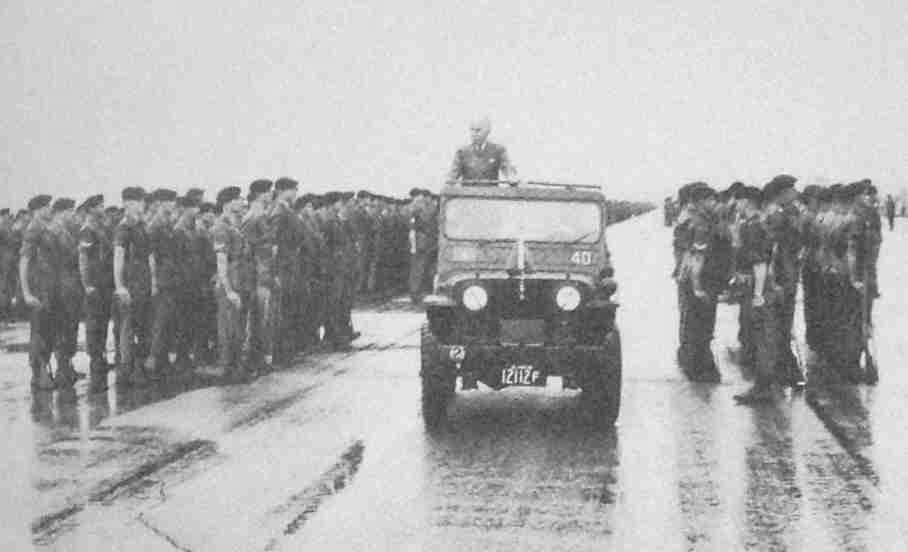
Review of 1st Canadian Infantry Division, Gagetown, New Brunswick, July 1, 1956
No one with any experience of formal hospitality will disagree about the importance of the placing of one’s guests at a dinner or luncheon table—it is very nearly as important as their selection. In Washington, London, and Ottawa, official precedence could never be ignored, but neither could it be rigidly or pedantically applied. The important thing was as far as possible to have guests side by side who had common interests, and it was wise occasionally to cheat a little in applying the rules. Protocol should always be tempered by common sense.
It has been of obvious importance to each Governor-General to meet at Government House, as his guests, the members of both Houses of Parliament. This objective has been approached in different ways over the years. I found the most satisfactory plan for receiving Senators and Members of Parliament was to invite them to come to Government House at the end of the day, in groups of about twenty from both Houses, representing all parties, both languages, and different regions of Canada. These occasions were completely informal, and I received my guests in the personal atmosphere of my study. I was very happy to be able to meet in this way most of the members of both Houses while I was in Ottawa.
Government House is the Sovereign’s residence in Canada, and I must mention a party of which the Queen herself was hostess. The Royal visit to Ottawa in 1959 was very short, but there was one free evening, on July 1, Dominion Day. What could be the form that the dinner that evening should take? It seemed right that a conventional dinner, of which there had been many on the tour, with the obvious ex officio guests, should be replaced on this occasion by something quite different. So, with the Queen’s approval, a list was prepared of entirely unofficial people (with the exception of the Prime Minister and the Leader of the Opposition and their ladies) who represented Canadian life in many fields, together, of course, with their wives. These included a farmer from the West, a Roman Catholic missionary from the Arctic, the Anglican Bishop of the Yukon, the leading trade unionist in Canada, two important industrialists, the proprietress of a fishing-fleet in Newfoundland, a professional hockey player from Montreal (the idol of Quebec), a young ‘new Canadian’ from Central Europe, representatives of painting, music, ballet, the press, the academic world, and so on. The order of dress for this party had to be carefully considered. The informality of ‘black tie’ would have reduced the importance of the evening, particularly in the eyes of guests who had come thousands of miles to dine with the Queen, so the invitations called for white tie and decorations, and the Queen wore a tiara and the ribbon of the Garter, thus appearing as her guests wished and would expect to see her.
Another event was called, in the annals of the House, ‘the writers’ week-end’. It had occurred to me that it would be a good plan if I gathered together as many men as could be accommodated, through whose writings public opinion was influenced. And so, in due course, a party assembled at Government House for a week-end from all over Canada, joined by a certain number living in Ottawa, the ‘day boys’ of the occasion. They represented every shade of opinion, all schools of thought (Conservative, Liberal, socialist, Social Credit, independent, French-Canadian nationalist, and so on)—editors, professors, free-lance journalists, men of letters. Here are their names: Ralph Allen, Maclean’s Magazine; Michael Barkway, the Financial Post; D. G. Creighton, University of Toronto; Robertson Davies, Peterborough; G. V. Ferguson, the Montreal Star; Gérard Filion, Le Devoir, Montreal; Blair Fraser, Maclean’s Magazine; George Grant, Dalhousie University; Jean Louis Gagnon, radio broadcaster, Montreal; Bruce Hutchison, Victoria Daily Times; Tom Kent, the Winnipeg Free Press; Maurice Lamontagne, Ottawa; the Very Reverend Georges-Henri Lévesque, Dominican Order, Quebec; A. R. M. Lower, Queen’s University; Camille L’Heureux, Le Droit, Ottawa; Hugh MacLennan, Montreal; Grattan O’Leary, the Ottawa Journal; I. Norman Smith, the Ottawa Journal; F. H. Underhill, Ottawa; Marshall Yarrow, the Ottawa Citizen. At two large dinner parties the members of the Cabinet and representatives of the various opposition groups in Parliament were given the opportunity to meet my week-end guests. No publicity was given to the occasion and the arrangements were as informal as possible. Unusual groupings of people could be seen after dinner, taking Canada to pieces and putting it together again, well into the small hours of the morning; in various rooms, the discussions went on unabated. It was the kind of party that could take place only in a house that—and this is one of the greatest merits of Government House—is entirely neutral ground.
There had been a Christmas party for children in the annual programme of Government House, but those who came were for the most part well provided with Christmas cheer at home. I thought it would be an appropriate thing if a group of boys could be found who were less fortunate than the others. So the Boys’ Club of Ottawa produced each year some two hundred boys who were brought to Government House to enjoy a Christmas party and the films that followed. We all joined in giving them a welcome and making them happy. Each boy had received one of the big, formal, engraved cards of invitation from the Governor-General—half of them came grasping the cards in their hands. They were all full of life and high spirits but had excellent manners—a great credit to the club and the devoted people who ran it.
To avoid any comment to the effect that parties at Government House were too official in character, dinner dances were held from time to time for about a hundred younger people, when the maximum informality was maintained. The guests sat at tables of eight on three sides of the ballroom. The courses were alternated with ten minutes of dancing until after the middle of the evening, when the latter prevailed.
Government House (or, occasionally, the Citadel) always provides hospitality for visiting chiefs of state and members of our own Royal Family; the Governor-General is the nation’s host. The phrase ‘Government House’ sometimes gives rise to misunderstanding. It is not a department of government. It is maintained and partially staffed by the government, but its operation rests at the discretion of the Governor-General, who meets certain expenses from the salary and allowances he receives.
During my time I was privileged to entertain the Queen and Prince Philip on two occasions, as I have mentioned. This gave one a chance to see the Queen in very different circumstances; either in the family atmosphere of Government House where she showed her gaiety and sense of fun, or in Parliament where we saw the grace and dignity of a Sovereign. At other times, Queen Elizabeth the Queen Mother, Princess Margaret, and the Princess Royal were my guests in Ottawa. The Queen Mother stayed for five days or so at Government House in 1954. As always, she enchanted the crowds who saw her, and when she left it seemed as if the lights had dimmed. In 1956 the Duchess of Kent and Princess Alexandra came to the Citadel. They both gave everyone much pleasure. Princess Alexandra was little more than a schoolgirl at the time but showed promise then of her unusual gifts. The Princess Royal came later, both to the Citadel and to Government House. An incident took place that showed the impression she had made on Quebec. The Prime Minister of the province, when he heard that she was not going to his town, Three Rivers, said that if this was so Three Rivers would go to her. He got to work on the telephone and the result was that during the short stop of her train in that station thousands of people came to greet her. Princess Margaret’s visit to Ottawa in 1958 was very short, but on the one evening available I arranged a dinner dance of young people as near as possible to her own age; some of my guests came from great distances to be present on this happy occasion.
Royal visits did not consist entirely of ceremonial; there were lighter moments. When the Queen was at Government House in 1957, a telegram came from Halifax that a trawler had caught a very large sturgeon. The owners, who understood, correctly, that sturgeons by tradition belong to the Crown, asked in their message whether they might send it on to Her Majesty. The answer was yes, and this 350-pound monster was brought by air from Nova Scotia. An A.D.C. came into the drawing-room to say that the sturgeon had arrived, and the Queen said she would like to see it; so she, Prince Philip, and I and some others went downstairs through the kitchens, where an astonished staff looked on, to the service entrance where the ugly brute lay in the crate in which he had travelled.
During my time in office a good many heads of state stayed at Government House, and nearly all the prime ministers of Commonwealth countries. Among the former were the President of the United States, who, as I have said, paid a state visit to Ottawa with Mrs. Eisenhower in 1953. When this was being planned the question of security arrangements arose. On previous occasions, when an American President had come to Ottawa, his safety was very largely in the hands of the United States Secret Service, one of whose members always sat beside the chauffeur in the President’s car. This is in accordance with American law, which, of course, does not apply to a foreign country. I felt very strongly that the President, like any other visitor to Canada, should be under the protection of the Canadian organization in charge of security matters, and that an officer of the R.C.M.P. should drive in the President’s car. Much correspondence took place on this subject, reaching very high levels, and finally our proposal was accepted by the United States authorities. When I drove the Eisenhowers away from the station, with an R.C.M.P. inspector in scarlet uniform sitting in the front, I felt that something had been achieved.
On the evening of the state dinner for the President, he and his wife were brought into my study, according to the usual procedure on such occasions, before I took them to meet the other guests. I noticed that the President was wearing the Order of Merit. I commented on the fact and he said that he wanted to wear it rather than any other British decoration because it had been given him personally by the King. I was glad to have the Eisenhowers at Government House again in 1958, when they came to Ottawa on an informal visit.
The Emperor of Ethiopia was one of my guests, and a very welcome one. Everyone knows about his courage and patience over a terrible period in the history of his country; he, as a person, is most impressive. He has a dignity that befits his ancient kingdom, and at the same time an entirely natural bearing. He combines a deep sense of the traditions of his country with a determination to modernize its institutions. The Emperor is not without a sense of humour. I asked where he had stayed when he was in London during the war. He said, ‘At Brown’s Hotel.’ I asked him why this choice and he said, ‘Because Brown’s was the one hotel in London which didn’t employ Italians!’
Among the other heads of state who were my guests at Government House were Queen Juliana of The Netherlands and Prince Bernhard; the President of the Federal Republic of Germany; the President of the Indonesian Republic; and the President of Haiti. In this connection, although he doesn’t fit into the category, I might mention Prince Akihito, the Crown Prince of Japan, who came to Government House on his visit to Canada, which was the first time he had travelled from his own country. Other official guests are far too numerous to mention.
When I first went to Government House, the question arose in the minds of some whether I would abolish some of the existing practices. Why this question was asked I cannot say, except that some people thought that as a Canadian I would introduce, to use a sadly abused word, a more ‘democratic’ atmosphere. The matter went further than mere gossip. I was under strong pressure from some persons in high places to abolish the practice that ladies have always followed of curtsying to the Governor-General. This, I felt, was a matter I had to settle for myself; curtsying, of course, as so many people know, is simply a survival of a practice followed by ladies until very late in the nineteenth century—a form of salutation to anyone, as natural and normal as that of the lifting of a man’s hat. It survives in relation to the Sovereign, members of his or her family, and the Sovereign’s representatives, and is comparable to the bow that marks a man’s respect for these offices. I decided without any hesitation to let matters take their course, and the curtsy remained unchanged. It was quite obvious that the ladies preferred to have it so. When an inquiry was made about the matter, which didn’t happen often, the answer given from Government House was that it is customary to curtsy but not obligatory.
The office of Governor-General must be concerned with ceremonial. If a process of erosion were allowed to set in, the colour would fade, and the functions of Government House would become drab and would lose interest. Some traditional ceremonial that had fallen into disuse during the war and the period after it I was able to revive. There is wisdom in the remark attributed to Gladstone: ‘I hate luxury but I love splendour.’ An example of this is the state dinner on the eve of the Opening of Parliament, attended by those men (about one hundred) who represent the official hierarchy of Ottawa. Other state dinners were held on the occasion of Royal visits and that of the President of the United States. The dinner for Queen Elizabeth the Queen Mother was given a Scottish flavour by the presence of the Pipe Major and two other pipers from the Black Watch of Montreal, of which she is Colonel-in-Chief. A little incident in connection with this is worth recording. With Her Majesty’s permission, I proposed her health, after the toast to the Queen, and the military band, without instruction, played ‘God Save the Queen’ again. At that moment, however, the pipers had been told to come into the ballroom playing their pipes while they approached the head table to get their ‘quaichs’ from me. They proceeded according to orders—nothing human would have stopped them! So the band and the pipes were heard at the same time. I turned to Her Majesty and said, ‘I’m afraid, Ma’am, there has been a slip in the staff work.’ She smiled at me and, like a good Scotswoman, observed that the pipes were winning—and they were!
The reception of ambassadors when they came to present their letters had been, I thought, too informal and lacking in dignity. It was changed to resemble, in a modified form, the procedure and dress prevailing in many capitals. (High commissioners, when they arrived from Commonwealth countries, were not received formally as ambassadors were, because they ‘belonged to the family’. I found that that was in accord with their own wishes.) I declined, however, to revive the function that was known as the ‘Drawing-Room’, similar to the Courts in London—which later were discontinued—at which debutantes were presented annually. This favoured the girl whose father had the longest purse or who had the good fortune to live in or near Ottawa; also, it must be said that such an event is not without a certain element of snobbery.
The levee on New Year’s Day plays an important part in the annual programme of the Governor-General. Its roots are deep in French Canada, and the levee embodies the important principle that everyone, whatever his position or status may be, has access to the representative of the Crown. The men who attend (about a thousand in number) file past and exchange New Year’s greetings with the Governor-General. I used the Senate Chamber for this purpose and had a military band playing ‘off stage’; refreshments were served in another part of the building.
I must mention the revival of a practice that met with general approval. One day shortly after I arrived in Ottawa, I was walking with my brother Raymond through various buildings in the grounds of Government House. In one of these was stored the state carriage, and in an adjoining room were the harness for the four horses and the liveries for the postilions and footmen. This equipment was in the care of a retired coachman who had been for many years a pensioner. He showed us these things with immense pride. The carriage had been built in Melbourne by Lord Hopetoun, as he then was, the first Governor-General of Australia, and had been acquired from him by Lord Grey when he was in office in Ottawa. When we walked away from the coach-house Raymond said to me, ‘Could anything be sadder than to see a faithful old servant caring faithfully for equipment which will never again be used?’ I thought at the time that the carriage would never be used again, but happily it was not so. In 1953, when the Queen’s Coronation was to be celebrated in Ottawa, I decided that the carriage should be brought back into use. This was made possible by horses provided by the R.C.M.P., who also made available the men who acted as postilions and the footmen who sat in the rear of the carriage. (Members of my own staff were not available for these duties.) The liveries that had been worn by the footmen were scarlet, a colour reserved for the Royal households. I discovered, however, that the successors to the Duke of Connaught (who was entitled to the royal scarlet and had used it) had been given special permission by King George V to continue the practice. I used the state carriage to drive to the Opening of Parliament and to bring ambassadors to Government House when they presented their Letters.
Ceremonial tradition is to be found in other places than Ottawa. The Art Gallery of Toronto possesses wine glasses that had belonged to Colonel Simcoe, the first Lieutenant-Governor of Upper Canada. On the occasion of the first visit of the Governor-General to the Gallery, he is asked to drink the Sovereign’s health in one of these glasses, and that tradition is very faithfully observed by those responsible.
Governors-General were asked to remain at their posts at the time of the Coronation and preside over the local celebrations. I was very fortunate in that Brooke Claxton at the time was Acting Prime Minister and also held the post of Minister of National Defence. Combining these two offices, he could pretty well order what was necessary, and he and I collaborated over the ceremonial with great enjoyment and satisfaction. An elaborate committee had been set up, but Brooke saw that they got instruction as to what to do—an admirable way to handle committees! The ceremonial on Parliament Hill was deeply moving and at the same time brief. Brevity and impressiveness on such occasions can well go hand in hand. I drove to the Hill in the carriage with three members of my staff and a mounted escort of the R.C.M.P. The ceremony was witnessed by some twenty or thirty thousand people, including some eight or ten thousand from the three services. There were no speeches, except my very short address, in French and English. After this, the Governor-General’s blue flag, which had been hoisted on my arrival, was hauled down, trumpeters on the roof of the Parliament buildings sounded a fanfare, the Royal Standard was raised, and when it reached the top of the mast I said, at a signal that came straight through from London, ‘Her Majesty the Queen’. In a few seconds her voice was heard making the speech at nine p.m. London time. It was, electrically, a very tricky affair, but fortunately there was no hitch and one could almost feel the actual presence of the Queen on Parliament Hill that afternoon.
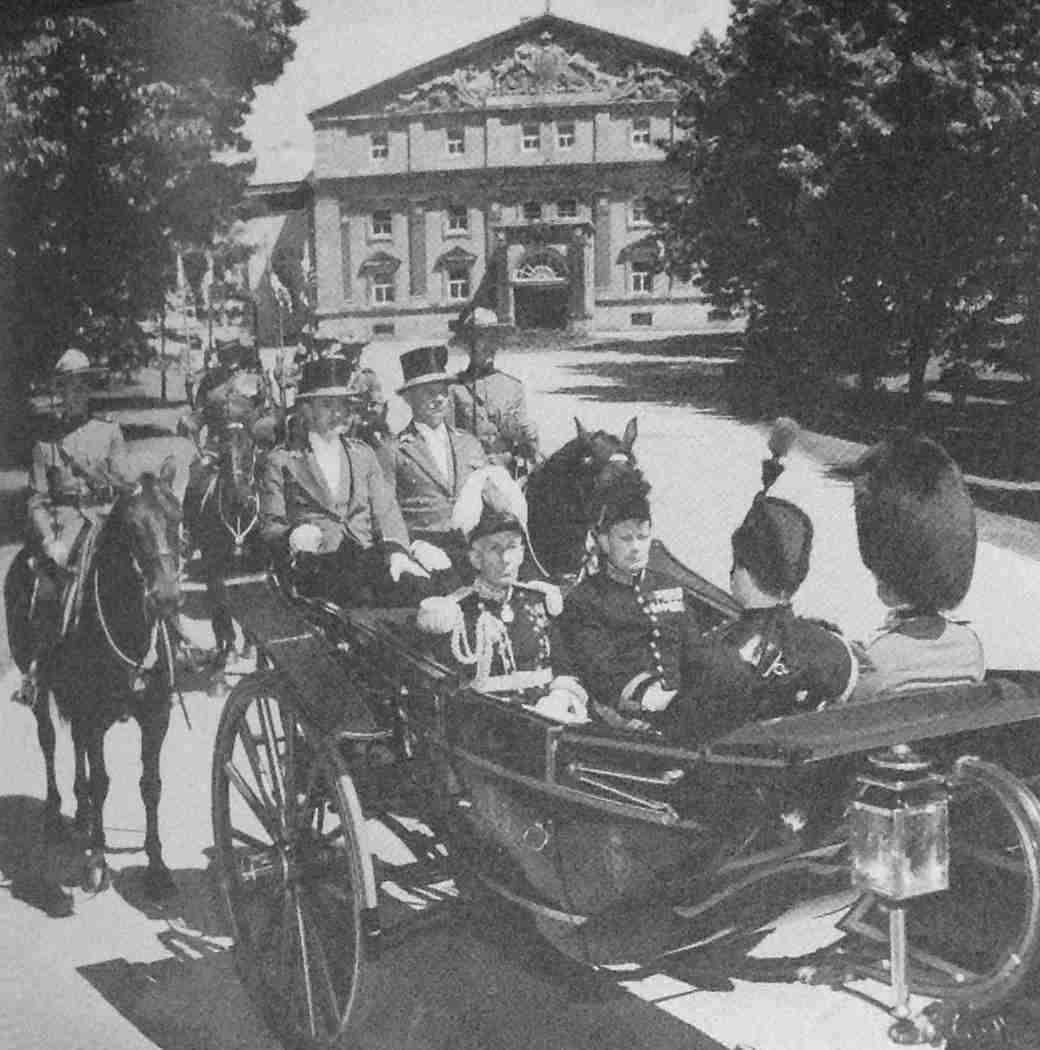
In the State carriage on Coronation Day, 1953
It occurred to me that it would be appropriate to give to every child born in Canada on Coronation Day, 1953, a silver spoon to commemorate the event. With the help of the government departments concerned, the necessary names and addresses were obtained and the spoons sent out as soon as possible.
The Opening of Parliament in Ottawa is a ceremony of which Canadians might well be proud. It follows closely the traditions at Westminster, with some simplifications. In one sense it is less simple because, for obvious reasons, it must be a bilingual ceremony, and the Speech from the Throne must be read in both languages. The two versions together, as I remember, have sometimes taken forty minutes to read. It would be well if the speech could be shorter and certain matters of minor importance omitted, but no minister, apparently, wishes references to the work of his own department to be left out. The French version never represents a very elegant piece of French prose, because it is too often, or at least most of it, a literal translation of the English, which to begin with resembles the language of a blue-book.
During my time, the traditional pageantry of the Opening was gradually restored. Ladies attending again wore evening dress, this practice having been revived by the Prime Minister in 1957. Early in my time I was asked whether I approved the proposal that the ceremony should be televised. I did more than approve—I was very anxious that this should be done and that the doubts and even objections on the part of some of the people involved should not be allowed to influence the decision. Nearly everything that is done ceremonially at the Opening of Parliament has an historical meaning, and school children can learn more about our system of government by seeing the ceremony on the television screen and hearing the commentary than they could from hours of teaching in the classroom.
As with anyone in such an office, my relations with the armed forces were very close. The words ‘Commander-in-Chief’, which still apply to the post and involve, of course, no powers or authority are, even now, not quite devoid of meaning. The Governor-General is Honorary Colonel of three regiments (the Governor-General’s Horse Guards, the Governor-General’s Foot Guards, and the Canadian Grenadier Guards). He is often consulted on matters connected with their affairs. He frequently inspects service establishments, spends considerable ‘sea time’ with the navy, and often travels in aircraft of the R.C.A.F. My contacts with the services extended from such informality as a drink in the petty officers’ mess in a frigate to a review in Gagetown of a division of ten thousand troops. My travels brought me into a very happy relation with the armed forces.
I may mention one practice at mess dinners that I thought required reconsideration. When American officers, however junior, are present on such occasions, the practice often is to drink the health of the President of the United States after the toast to our Sovereign. This means that frequently both toasts are proposed, which seems to whittle down our own traditions. The compliment involved should be reserved for occasions when very senior American officers, or public officials, are present.
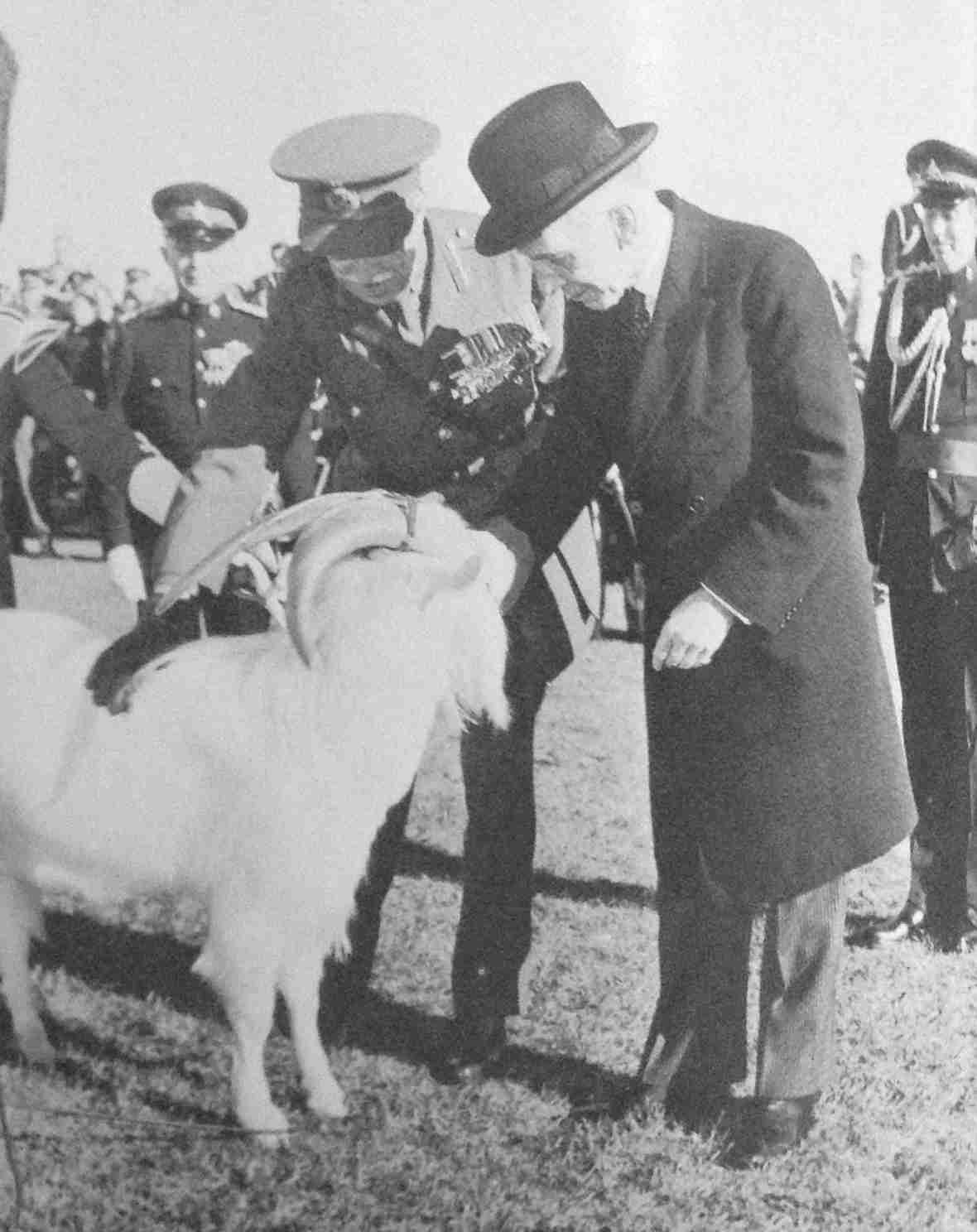
Presentation of mascot, ‘Batisse’, to Royal 22e Régiment
With the famous Royal 22nd Regiment I had no official connection, but we got to know each other well because they and I both occupied quarters in the Citadel in Quebec. I gave them a goat as mascot. He is a descendant of a pair that were given to Queen Victoria by the Shah of Persia, and a noble animal he is. ‘Batisse’, as he is called by the Regiment, was formally presented by me to the Honorary Colonel (who later became my successor as Governor-General) in a picturesque ceremony on the Plains of Abraham. Two battalions of the regiment were formed up and the important moment came when I handed Batisse’s lead, his pay book, and attestation papers to General Vanier. At that instant, Batisse, who had been fed carrots by me on several occasions before this ceremony, must have recognized me as a benefactor. He reared up on his hind legs, put his hooves on my shoulders, and looked down on me benevolently, saying to himself no doubt ‘This is the chap who gave me carrots—has he got any more?’ That was an unrehearsed but delightful episode in the ceremony. Batisse is well trained. When ‘God Save the Queen’ is played, he drops onto his knees. I regret to say that if the surface is that of a lawn, a little surreptitious nibbling of grass goes on, but he behaves well, always parading with the Regiment and doing them credit. He is a vivid example of the effect an animal can have on the morale of a body of men.
The most moving events that brought me into touch with members of the services were the investitures that took place during the first years of my time at Government House. The award on a suitable occasion of a symbol of recognition to persons whose services merit it is always impressive. Among these events were investitures of the Order of St. John of Jerusalem and the Canadian Boy Scouts. In the case of the latter, it sometimes happened that a posthumous decoration for gallantry was given the parents of a Cub of perhaps no more than nine or ten years, who had lost his life in an effort to save someone else’s. Nothing could be more touching. I always arranged to give such investitures all possible colour and dignity. Uniforms were worn, a band was present, and everything was done to make the occasion impressive.
Investitures for members of the services came to an end as the Korean War receded, and now, apart from two or three decorations of a special character which are rarely awarded, no honours in Canada are given for any reason at all. This opens up a subject that I cannot overlook, although I do not wish to enlarge on it unduly. The story of honours in Canada since the sweeping resolution in the House of Commons in 1919 abolishing in effect all decorations of every description makes fantastic reading. The narrative is not confidential or secret, because anyone who takes the trouble to study Hansard and the official announcements that appeared from time to time in the press can make himself familiar with the whole matter. It does not read like the record of the mature country that we believe we are. The principal actor on this stage was Mackenzie King, whose attitude on such matters during his long period in office seemed to be nothing less than pathological. I recall a task he asked me to perform when I was at Canada House in London. This was to ask that he should be relieved, by the King’s permission, of the obligation to wear the badge of the C.M.G., which he had received many years before as a civil servant in Ottawa.
The honours question passed through many phases, but always it was evident from the documents that the Prime Minister of the day was determined to bury the question as deep as he could. (I hope I will be forgiven if I mention the fact that after years of effort to eliminate honours from Canadian life, he was prepared to accept the Order of Merit from the late King and the highest decorations of a number of Allied powers at the end of the Second World War.)
The subject of honours and awards is one that most people try to avoid. There is always a suspicion that a person writing about this is thinking of himself, but honest, objective comment on this subject is not without its importance in the life of a country such as ours. I would like to offer one or two observations. Nearly every country in the world today has a system that enables it to recognize services to the community in all degrees of importance. During the Second World War, Canada was forced by circumstances to follow this practice to a certain extent. I find an entry in my diary for May 17, 1940, on this subject:
In the afternoon saw Alex. Hardinge at the Palace and handed him a submission to the King on the subject of orders and decorations to the Canadian Forces. The Canadian Government has not gone very far in making the concession, but I feel that the war will crack open the whole subject of honours, and I hope that a more rational solution will be reached than the one which has prevailed in the last few years. I feel quite sure that the Canadian public wish to see public service of all sorts decently recognised . . .
Since the Second World War, with the exceptions already mentioned, we have reverted pretty largely to the practice followed in previous years.
For some time after the War, the ban on honours was extended to those from foreign countries; no Canadian was permitted to receive such decorations. It has apparently been found impossible to hold this dike, and in recent years some Canadians have received honours from foreign states, including the Vatican. This means, of course, that the only honours that Canadians cannot receive are those from our own Sovereign. Nor is Canada in a position to reciprocate the honours our citizens are awarded from time to time by other countries. But far more important is the fact that we are unable to recognize the services of our own people, whether these are in the field of public administration, in the intellectual life of the nation, in the arts, or in any other sphere of activity where recognition would be appropriate. If the word ‘democracy’ is invoked in relation to the question of honours, an effective answer can be found in the honours list that appears twice a year in London with the names of many hundreds of persons whose services had been of the humblest nature. Those who are given publicity are generally recipients of high honours, but the ‘little man’ represents the vast majority of those who are thus recognized.
What we require in Canada, as a normal piece of national equipment, is a non-titular honours system of our own, the awards being bestowed by the Sovereign on the advice of the government of Canada. This would fill a gap in Canadian life and would, without doubt, help to unify the community as a whole. We need the occasional ‘thank you’ from official sources offered to Canadians whose services deserve it.
I was interested in a remark that I heard General Hertzog, the South African Prime Minister, make to the effect that he didn’t think a civil service could be built up without some form of honorific awards. In view of the fact that Hertzog was probably a republican in sentiment, the remark had some significance.
In 1942 a special committee of the House of Commons had presented a significant report recommending: ‘That His Majesty’s Government in Canada consider a submission to His Majesty the King, of proposals for the establishment of an Order limited in number but not involving a title, for which His Majesty’s subjects domiciled or ordinarily resident in Canada shall alone be eligible.’ The House of Commons accepted the committee’s report, but no action was taken. In the following year, the institution of the ‘Canada Medal’ was announced. It had been approved by the Sovereign, pictures of it appeared in the press, but it has never been awarded.
It may well be asked how any system of honours can be protected from political influences, how the Prime Minister can escape the pressure brought to bear on him to give honours to faithful party followers. The answer, I think, is simple. There should be an honours committee, with no political members, presided over by a high court judge, and composed of officials, through which all proposals for the award of honours should be channelled. The government would be unable to make any award that did not meet with the approval of the committee, but, of course, would be empowered to reject its recommendations if it saw fit. We should take seriously the proposal of the House of Commons committee that was presented to the House in 1942 and establish a non-titular Canadian order, with the usual gradations representing various forms of service, and with an appropriate name.
As everyone knows, over the years a few Canadians have been honoured by appointment to the Privy Council of the United Kingdom, bearing the prefix ‘Right Honourable’. On a certain occasion many years ago, a request was made from Ottawa that certain Canadians in public life should receive this honour. The request did not meet with approval in London, the view being that if Canada did not want titles, why should she ask for one of the best ones?
The Governor-General’s stock-in-trade is impartiality. The public respects this, in my experience, with very rare exceptions. Of course it is important not only to be impartial but also to appear impartial. When Mr. St. Laurent was in the middle of an election campaign and I had been committed to a tour, it was discovered that the Prime Minister’s private car and mine were going to find themselves on adjacent sidings in a railway station in Nova Scotia. I had an instant picture in my mind of a great throng of party supporters coming to greet the Prime Minister, he and I catching each other’s eye as I emerged from my car, and shaking hands, the press photographs suggesting to a somewhat astonished public that I was involved in the welcome the P.M. received as party leader. So my car was transferred to another station until the Prime Minister and his party had left. Later on, a similar episode happened with his successor, Mr. Diefenbaker. I had an engagement in an hotel in Montreal and so, apparently, had he. This also was in the middle of an election campaign and we missed meeting each other by a narrow margin.
My term of office was extended by two governments of different political complexions, which served to demonstrate its non-partisan nature. I was very fortunate in my personal contacts with both the Prime Ministers who were in office during my time. In both cases we discussed affairs of state privately, informally, and agreeably, with the utmost freedom; we met in both régimes frequently and very happily; my advice was often sought and not infrequently offered.
The Governor-General’s impartiality should extend beyond the political sphere, and relate to both Church and State. No one would expect anyone in this post to neglect the religious body to which he belongs, but his office is concerned with Canadians of all creeds and schools of thought. My predecessors had all been of the Protestant faith, and only once or twice, as far as I know, did any Governor-General attend a service in a Roman Catholic church. I took the first opportunity to do so when I went to Mass at the Basilica in Ottawa, which was attended by members of the Order of St. John of Jerusalem. (In the same morning I went to the corresponding Protestant service in St. John’s Anglican Church.) When Mass was concluded at the Basilica, one of the clergy delivered a short address of welcome in both French and English to the St. John members and to myself as the new Governor-General. He said something to this effect: ‘We are happy to welcome you, sir, to your Excellency’s Catholic Church.’ This was not only moving, but represented a broad truth.
A grisly task of the Governor-General is signing the orders in council demanding that the ‘law should take its course’ in the cases of those sentenced to death. This he does only on the recommendation of the Cabinet. He is, however, at liberty to ask for whatever information he may wish to have with regard to the case in question. He may send for the Minister of Justice or whoever is in charge of the matter, and he could even request the government to reconsider the case. But the decision is the government’s; although no one expects the Governor-General to act merely as a rubber stamp, in the last analysis he must act on the ‘advice’ he receives. This, curiously enough, is not so well understood by the public as it should be, and when a sentence had been passed and the day of execution drew near, Government House was often bombarded by telegrams and telephone messages asking for royal clemency for the convicted person, although the Governor-General had lost this right many years ago.
Like similar posts elsewhere, the office of Governor-General involves the honorary headship of almost countless voluntary groups. I found this, in cases of important organizations, no pro forma matter. The Boy Scouts, the St. John Ambulance, the Canadian Legion, the Red Cross, the Victorian Order of Nurses, the Association of Canadian Clubs, the Dominion Drama Festival—all these and other bodies make considerable demands on the time and activity of their honorary leader. The membership of such institutions includes a very great number of Canadians—indeed there are not many who have not some connection with one or more of them.
Someone has said that a Governor-General should be the best-informed person in the country because people of all schools of thought talk to him very freely, knowing that he is entirely objective himself and also that what they say will never go further. From my experience, this observation is not untrue. People who came to see me over the years always spoke with the greatest freedom and I learned much that no politician could have learned simply by reason of the fact that my post lay outside the realm of controversy. Thus anyone holding the office of Governor-General can exercise considerable influence, provided he uses with discretion the information he possesses.
I have vivid memories of certain routine duties of the post, such as the signing of innumerable documents. These included stacks of bills that had to receive my signature at each parliamentary session. Most of these were bills ‘for the relief of “X” or “Y” ’—in other words, divorce bills, having gone through the parliamentary mill from the two provinces that have no divorce courts. How long this practice will continue no one can say, but there is one person who will breathe a sigh of relief if and when it ceases, and that is the representative of the Crown, who has to sign the bills—now about six hundred in each language. My signature was required elsewhere, on orders in council, Boy Scout certificates, documents for the Order of St. John of Jerusalem, remissions of sentence, and most frequently on commissions for officers in the three services. There were over four thousand of these each year. I used to wonder where all the officers went, as our forces are not big enough to absorb them, but there were technical reasons for this large number of documents. The commissions were signed with what is known as the Privy Seal, which had always over the years been the personal seal of the Governor-General, the design of which incorporates his own coat-of-arms. During my time, some officials with a bureaucratic outlook thought it would simplify procedure if we adopted the American practice of having a seal for the Governor-General’s use that was entirely impersonal and would never change—like the Presidential seal in Washington. I took strong objection to this. It was completely contrary to the personal tradition that had grown up around the office of Governor-General and there seemed to be no reason why we should abandon the practice that makes his own Privy Seal privy. It can incorporate a monogram, armorial bearings or anything that is personal to the holder of the office at the time.
A nation’s reputation can be needlessly damaged if its postage stamps and currency are of inferior design. On one occasion in my time in Ottawa I received representatives of the Bank of Canada and of a company that produces bank notes. Their object was to show me the design of a new issue. Did I like it? I asked how far the matter had gone. They said, ‘It is completed and the notes will be issued in a few days.’ There was nothing to be done, and my comment was marked more by politeness than candour. I will now confess that I really thought the designs were regrettable. I am indeed afraid that when it comes to stamps and bank notes, our standards have not been such as to place us, internationally, at the head of the procession.
During my time at Government House it occurred to me that Ottawa would be an excellent place in which to hold a festival of the arts, if possible on an annual basis. Ottawa shares a good many qualities with Edinburgh, where such an event has now taken place successfully for a good many years. Ottawa is very young and Edinburgh is very old, but they both have natural beauty, neither is an industrial city, and each is a tourist centre of importance. I formed a committee of representative persons that met privately at Government House under the able chairmanship of Duncan MacTavish to consider the idea, which they approached with enthusiasm. The possibilities were examined thoroughly, and to get an outside opinion we brought to Ottawa Ian Hunter, who had been the artistic director of the Edinburgh Festival. His report, based on a searching examination of the resources of Ottawa, and useful information derived from a journey across Canada, told us that, in his view, Ottawa was an admirable centre for such a festival as we had in mind, but that a first-class event of the kind could not be held without a concert hall and theatre, neither of which Ottawa possessed, and there the matter was left. It is a strange and unfortunate thing that, almost alone among the principal cities of Canada, the national capital is without a home for music and drama.
No account of a public office is complete without reference to the press. There should always be a close alliance between the official world and the world of the newspaper. Too often there is a cold war between them—to the disadvantage of both. I could not have been happier in my contacts with the press. I have seldom been so touched as I was when I was made an honorary life member of the Parliamentary Press Gallery and joined a very small group of three.
The Governor-General has to face an annual ordeal when he addresses the Press Gallery’s yearly dinner. After the programme is over, and three or four guests have spoken, he winds up the evening with the final speech, to which he has looked forward with anxiety and trepidation, probably for weeks. The audience is experienced, for they listen to a surfeit of speeches in their profession, and their sense of criticism is keen, but I always found them friendly and warm.
I started my time at Government House with too little attention to the media that can let the public know what the post of Governor-General means and what goes on in Government House. Failure to make available such information is probably one of the reasons why four provincial Government Houses in Canada were abandoned. My aim was to give Canadians the feeling that Government House was not a remote isolated centre of privilege and exclusiveness, but that it was their Government House—something of which all citizens could be proud. The grounds, of course, have always been open to the public in the summer and many people come to see them. The parties of schoolchildren who come all through the year, often from great distances, to visit Ottawa, put Government House very high on the list of things to be seen.
Television has made it possible to let the public know more about the functions of Government House. There are limits, of course, in such matters. Nothing must be done that would cheapen ceremonial, or invade the privacy of certain forms of hospitality, but I found it fitting to televise investitures; to permit the press to photograph balls and also, under certain restrictions, state dinners, which always took place in the ballroom. The press has never been allowed greater freedom at Government House than during the Queen’s visits, and the privileges involved on these occasions (or, indeed, on any other) were not abused.
The outstanding event while I was at Government House was the visit of the Queen in 1959. My appointment had been extended by the government to a date that made it possible for me to be in office at the time. The Queen was originally invited to come to Canada for the purpose of opening the St. Lawrence Seaway. That event gave us a piece of impressive symbolism. After the Queen had completed her six weeks’ tour of Canada, so brilliantly successful in every way, she and Prince Philip flew back to England from Dartmouth, Nova Scotia, following a governmental dinner in Halifax at which she said good-bye to Canada through the medium of television. Normally a Governor-General never appears in public when the Sovereign is present, but this event provided an exception to the usual practice. The royal aircraft took off on a foggy, cold, and windy night. When the Queen and Prince Philip arrived on the tarmac, two long lines of persons flanked the ramp—on one side ministers and senior officials and on the other members of the press, many of whom had travelled with the royal party across Canada and were there not only as newspapermen but as friends. The Queen and Prince Philip went slowly down both lines shaking hands with everyone. As her representative I was, of course, the last to say good-bye.
An interlude in the official programme of the Queen and Prince Philip in Canada was a week-end in which they stayed privately at my own house at Batterwood, over which, for three days, the Royal Standard flew. This provided a time of rest for the royal visitors, with no interruptions, no duties. The only break in the quiet domestic week-end was morning service at our parish church where I took the Queen and Prince Philip. That event, which will be memorable in the story of St. Mark’s at Port Hope, is now commemorated by the red cassocks the clergy and choir wear, with the Queen’s approval, thus reviving the old custom according to which the royal scarlet could be worn in any church in which the Sovereign had attended a service. The practice had been discontinued, but an exception in this case was made because of the unusual fact that the Queen had attended the church accompanied by her representative. This had never happened before.
It was agreed that the extension of my term of office should end in the middle of September 1959. This seemed to me the right time to leave and I asked that I might be relieved of my duties then. I had done practically all the new things I wanted to do in a fairly long list, and I thought the time had come for a new face at Government House. The one disappointment was that a tour that had been arranged in the Far North-west, to which I had looked forward eagerly, had to be cancelled on the advice of my doctor, Peter Burton. This was a self-denying decision on his part, because he was to have gone with me.
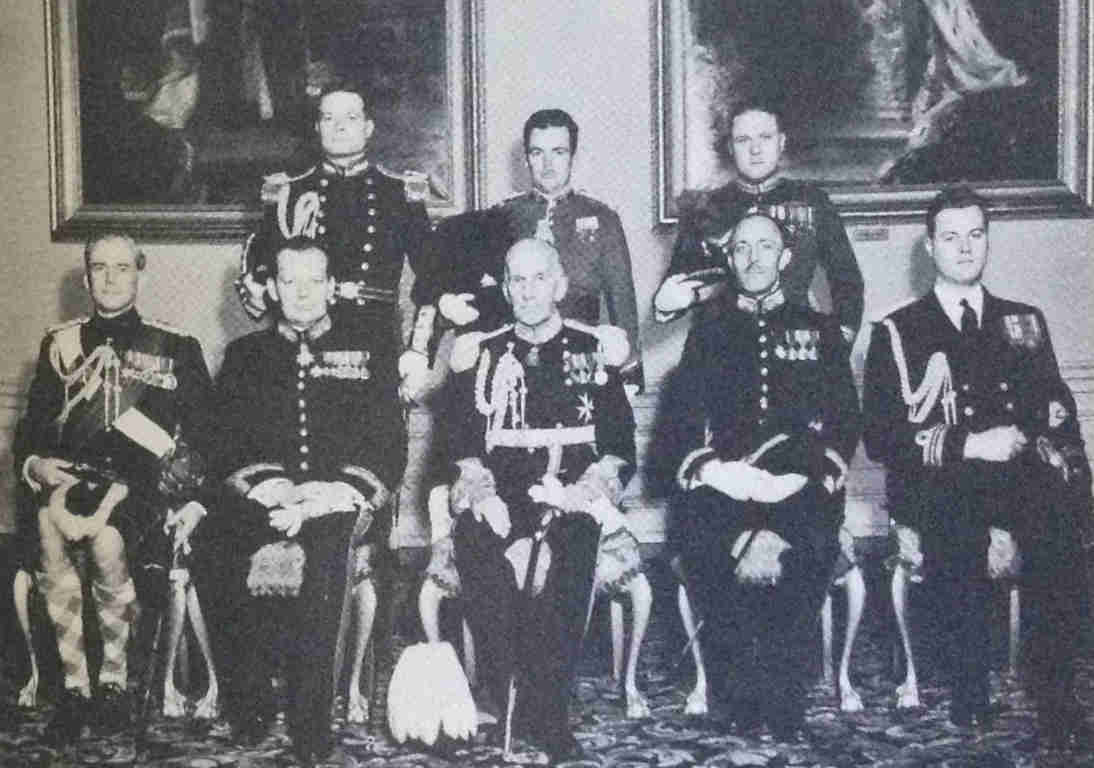
The Governor-General and his personal staff, 1956: (back row) Lieut. H. Bridgman, r.c.n., a.d.c., Capt. G. Robillard, a.d.c., F/L I. Macmillan, a.d.c., (front row) Col. L. Malkin, Comptroller, Mr. L. Massey, Secretary to the Governor-General, Mr. J. F. Delaute, Assistant Secretary, Lt-Cmdr. E. Butler, assistant to the Secretary
It was no easier to leave Ottawa than it had been to leave Washington and London—indeed less so; after all, Ottawa was in my own country. Even within the confines of Government House one strikes roots very deep in a community with so much friendliness and warmth. I had grown very fond of Ottawa, and when the time for my departure approached, I was greatly touched when I was told that a group of my personal friends wanted to give me a present to mark their affection—a superb set of crystal goblets, on which were engravings of the Queen’s Beasts, which had become famous at the Coronation in 1953. The diplomatic corps gave me a charming farewell. I met all the heads of missions at the French Embassy (the French Ambassador was the doyen) and they gave me a heart-warming good-bye, symbolized by the gift of a fine piece of silver. Later I was given an informal dinner party at the Prime Minister’s house by Mr. and Mrs. Diefenbaker.
The last public event in my régime was my presentation of new Colours to the Governor-General’s Foot Guards. This took place in the grounds of Government House. In addition to the Regiment there were present detachments from the Grenadier Guards of Montreal and the Canadian Guards from Petawawa. There were some three thousand spectators. The ceremonial was carried out superbly and when the old Colours were marched off at the slow march to the air of ‘Auld Lang Syne’, its sentiment took charge of me and, I think, of most of those present, giving a very special meaning to the occasion.
Later that day I gave a reception to members of the press, with whom I had such happy relations for seven years and more. The following morning was entirely devoted to official leave-takings, about 150 of them: those involved came to see me in various capacities, but our farewells were as between individuals who had become friends. In the evening the dinner given by the government took place at the Country Club; about 100 guests were present. The Prime Minister spoke very warmly; his speech and mine were broadcast. After expressing my sincere thanks to the members of my staff for their devotion to their work, I said that I wanted to say a word about my chief of staff. I would not, I said,
allow the fact that he [my son Lionel] and I are closely related to keep me from mentioning his services during my term of office. The Secretary to the Governor-General holds a position about which most people know little. It involves very exacting and important administrative duties. These have been carried out by him during my time with great skill, tact and devotion, and I would like to express to him my deepest gratitude.
The change-over from myself to my successor had to be carefully arranged. As we finally managed it, I left Ottawa by a special train on September 15 at 10:00 a.m. and the new Governor-General arrived an hour later to be sworn in. He would have been a very tough character who would not have been moved by the scene I found that morning at the station, which was packed with people who had come for the occasion. There was a guard of honour, of course—from the Canadian Guards—with their band; but what was more personal, more moving, was the presence of nearly all the ministers, many officials, and, above all, the members of my own staff and family. It was not very easy, in many cases, for them to say what they wanted to say or, indeed, to say anything at all.
As the train rolled through the countryside, I looked back over another road—the one I had travelled in the previous seven years and a half. The end of the journey had come quite naturally. I felt that the time had come to go. I had tried to keep intact the traditions of the office and to build on them as best I could. The task had given me great happiness; I had loved my job. It had been a tremendous privilege, in this great post, to serve the Crown. If I had done anything to make its reality vivid to the people of Canada, as something that was important to them and that belonged to them, I was content. Nothing touched me quite so much as this comment in a Canadian newspaper: ‘He made the Crown Canadian.’ It was too generous a tribute; but that was what I had tried to do.
The transition from viceregal office to the status of a private citizen is usually sharp and often dramatic. You must adjust yourself very quickly to many changes. You carry money in your pocket for the first time in years; you now make purchases yourself; you are no longer insulated from the telephone and importunate correspondents by secretaries and aides-de-camp; you have to ‘roll your own’. But all this is of no importance at all compared to one major problem—what are you going to do? The thought of being idle was pure misery to me. I claim no virtue for this; to have something worth while to occupy your time, something of interest from day to day, is a form of self-indulgence, and you deserve no credit for it at all.
There is one thing that is certain. If a Governor-General in the conduct of his duties remains entirely clear of politics, as he must, the same is true of an ex-Governor-General. If he betrayed any personal bias in political issues, his impartiality while he had been in office would be questioned. Once having ‘taken the veil’ he must never renounce it. I must say that, from my experience, this was very generally understood, and I have not been expected to discuss political matters.
At Batterwood I have been more than fortunate to have a staff who are very few in number but whose loyalty to me and devotion to their work have been beyond praise. Of these I must mention three—Miroslav Stojanovich, his wife Anna, and my gardener Ernest Busby. ‘Mircha’—to use the diminutive by which he is known—before he left his native Yugoslavia, was a captain of artillery in the Royal Yugoslav Army, and Anna is an Austrian from Salzburg. I would be a very ungrateful person indeed if I didn’t acknowledge warmly all that they have done since they came to Batterwood in 1949. My gardener has been with me for seventeen years; his skill wins praises from my guests, but it extends far beyond the garden.
One of the pleasures of living in the country is the entertainment of one’s friends—their company can be enjoyed without the distractions of the city, and over these years I was happy to welcome many people. The visitors’ book at Batterwood covers a span of forty years, with guests from many parts of Canada, and England and the United States. It includes numerous friends, personal and official, who have touched my life and that of my family and who, in many cases, have shared with me moments of pleasure, moments of disappointment, and moments of quiet contentment. How much I valued the good talk that marked their visits. To list all my guests would be impossible, to mention a few would be invidious, but to say that I have cherished their friendship would be more than true.
I had hardly arrived at Batterwood before a chicken came home to roost. I had committed myself months before to a television broadcast for the National Film Board about my régime, and indeed about a great deal besides: it was to take a full hour. I was doubtful about this commitment because I had decided that I would make no speeches or public appearances until my successor had been in office for at least a year, giving him a full opportunity to get settled in the saddle; this I think is good normal practice. However, the broadcast was an engagement that I couldn’t cancel.
Dogs have played their part in my story—dogs of many shapes and sizes. I cannot understand how people can dislike dogs or even be indifferent to them. I have always found it difficult to comprehend how a visitor could be unaware of the presence of the dog of the day or, what is almost worse, pat him perfunctorily on the head with some well-worn cliché.
For a time we bred West Highland terriers at Batterwood. Two young ones went with us to England when I took up my post there, but these pleasant little animals were so demoralized by the six months’ quarantine that we couldn’t keep them.
I gave a red cocker spaniel puppy to my son Hart when he was in the R.C.A.F. in England, and as he was attached to a Spitfire Squadron the dog was inevitably known as ‘Spit’. Life in the Air Force involved much movement, and ‘Spit’ was never long in one place, but he was definitely an Air Force dog; when we took him for a walk and there was a sound of aircraft, he would look for them in the sky—I don’t think many dogs would do so. Later I got another cocker from the same kennel and brought him to Canada—his name was ‘Rufus’, and he suffered from schizophrenia, having very definitely a spirit that was nine-tenths affection and one-tenth wickedness. There were few of us in my household whom he didn’t bite, but somehow this regrettable tendency did not diminish our affection for him, just as the bad boy in the family is often the most loved. He was a very elegant little creature and never lost his figure.
The most celebrated dog I have had was a golden retriever called ‘Dufferin’, after my predecessor—‘Duff’ for short. He was the successor of ‘George’, another dog just like him who lies in the little dog-cemetery at Government House with the companions of several Governors-General. ‘Duff’ played a very useful role at Government House because he was socially inclined and adored parties. He was also very fond of photography and never missed a chance to pose in front of a camera. His great moment came during the Queen’s visit in 1957, when he took part in a film that may be remembered. When the Queen and Prince Philip and I were photographed strolling through the garden at Government House, ‘Duff’ came up to the Queen, very deftly seized her handbag, and carried it in front of her, proudly waving his tail.
One dog has adopted me—a black and white springer spaniel with a dash of something else. He lived in the nearby village until his family disappeared, when he decided to reside at Batterwood. He still pays daily visits to his former home to see whether the children have come back, and returns with a saddened countenance.
My granddaughters possess a poodle, ‘Michel’, and bring him occasionally to Batterwood. At first I was inclined to make a sharp distinction between poodles and dogs, but I now admit them to the dog family; they have their own individual merit, especially a sense of humour. But that is only one of very many virtues inherent in dogs—how long a list it is: courage, loyalty, manners, patience, persistence, affection, chivalry, dignity.
Soon after I returned home an important activity came my way. Prince Philip had been the moving spirit of a conference in Oxford in 1956, composed of persons from all over the Commonwealth engaged in industry, representing either management or labour. Its purpose was to consider the human problems of industrial communities. The Canadian contingent at this gathering returned deeply impressed with what they had seen and heard, and they came to the conclusion that a similar conference could and should be held in Canada. Later, informal gatherings took place, generally at Government House, to consider the matter. On his visit to Canada in 1958, Prince Philip met a representative group and the idea of a conference made progress. By the following year a provisional committee had been formed to be responsible for such an event and I was asked to be its chairman. On June 25, 1959, aboard the Royal Yacht Britannia in Montreal, Prince Philip received a large number of persons from Canadian industry, representing management and trade unions. They made a decision to hold a conference in 1962, and Prince Philip accepted their invitation to be its president. Later, when he was staying with me at Batterwood, he urged me to accept the chairmanship, which I had already been asked to take.
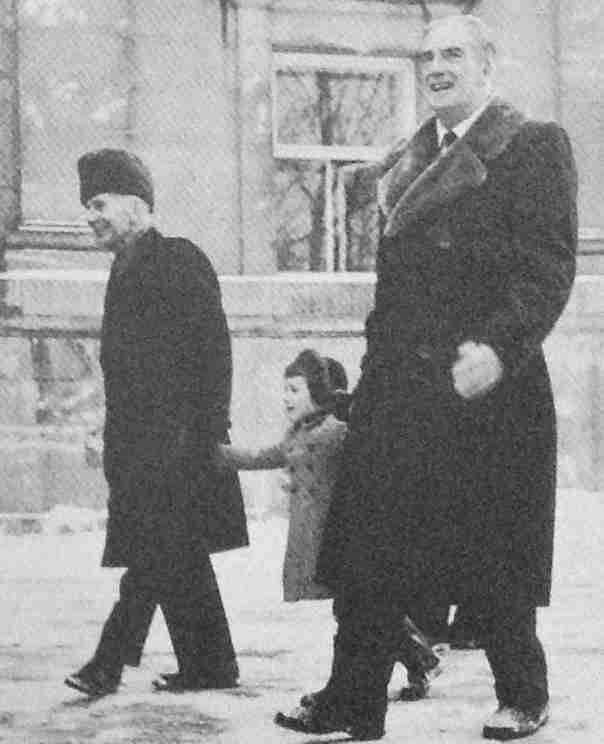
With Sir Anthony Eden and his goddaughter Susan at Government House, Ottawa, 1956
The conference took about three years to organize. I was very fortunate in my vice-chairman, Vacy Ash, who was not only an able and energetic colleague but a most agreeable companion. The conference had the sponsorship of a council, consisting of about ninety persons fully representative of industry; policy was in the hands of a small body known as the Steering Committee, of which I was chairman.
The purpose of the conference—so much more important than its machinery—is expressed by what I am afraid is a pretty ponderous phrase. It was intended to consider ‘the human consequences of the changing industrial environment in the Commonwealth and Empire’. The conference was not concerned with the relations between management and labour; its object was to study the effect on the individual and his community of the far-reaching changes in industry. It directed its attention to the worker as a citizen—how he and his family live; how they are housed, how they are educated, how they amuse themselves.
There were about three hundred delegates—or members, as we preferred to call them—including a small number of women, coming from thirty-seven countries and territories in the Commonwealth. They were carefully selected. Most of the members were under forty-five years of age, persons still to assume the fullest measure of responsibility in industry, and so likely to be more receptive of new ideas. The programme of the conference embodied a complicated plan. At the outset the membership was divided into twenty groups of about fifteen persons, with a Canadian chairman and secretary, on each of which was represented the greatest variety of race, occupation, and country. These groups developed a striking esprit de corps from the beginning. All through the three weeks of the conference there was a lively competition between them. Each of the groups was assigned an industrial centre to visit and report on, in what was called in the language of the conference ‘a study tour’. The logistics involved were formidable, but the machinery moved smoothly, under the very able direction of Gordon Hawkins, its executive director.
It was found necessary for practical reasons to confine the study tours for the most part to the East of Canada. In the selection of the places to be visited, we were careful to include some which couldn’t be regarded as ‘show-pieces’—an honest portrait must not omit the warts. The conference moved westward from Toronto in two separate trains. A very rewarding day was spent in Saskatchewan when all the members were entertained in small groups in prairie farm houses. The mechanization of agriculture was very much within the terms of reference, as was the great oil industry in Alberta, which was included in the programme.
There were plenary sessions in several cities. The conference opened in Montreal, paused for two or three days in Toronto, spent a day in Winnipeg, and wound up in Vancouver. Formal speeches were reduced to the minimum and as the conference moved across the country no ‘addresses of welcome’ delayed its work. The programme allowed for much discussion. If there was any doubt about the willingness of the members to take part, this was removed directly we got going. They showed keen observation, great intelligence, and happily, a lively humour. It was very moving to see the members assembled for the first time in Montreal. In addition to the larger units of the Commonwealth, the smallest territories were represented, such as Fiji, Bermuda, Malta, Mauritius, and Sarawak. African members made a gay contribution to the conference with the brilliant colours of their robes and their engaging sense of fun. In Vancouver in the last few days of the conference there was a summing up of what had been done, and one full day was devoted to a series of reports from the twenty groups. Candour prevailed, and those of us who belonged to Canada learned a good deal from these keen observers. It was extremely revealing, for instance, to hear objective observations from an African member on the relations between French- and English-speaking Canada.
Those who watched the conference with friendly interest often asked what it was intended to accomplish. The answer, of course, was that collectively the conference would do nothing at all; but it was equally certain that the experiment would have an important effect on industry in the Commonwealth through the thought and action of individuals after the conference was over. If members were impressed by what they had seen and heard—and there is every reason to believe they were—their work in their own communities would be influenced by what they had gained.
In a geographical sense, Prince Philip’s Second Study Conference was probably the most representative Commonwealth gathering that has ever taken place for any purpose. It achieved its end because it was a Commonwealth meeting. It would have been, I think, quite impossible to assemble representatives of so many countries and territories whose relations were those of foreign states, in a gathering as intimate and informal as this one.
The debt we owed Prince Philip cannot, of course, be measured. Without him the conference would never have taken place; without his presence during its sessions, his wise guidance, and the infection of his enthusiasm and confidence, it would have been a far less successful affair. His personal leadership was attested by the affection and admiration he deservedly won from all the members. It was, in the fullest sense, ‘Prince Philip’s Conference’—our president was our founder.
After I left Government House I was freer than before to travel outside Canada. I paid three extended visits to England—two of them in 1960 and one in the next year. It was a delight to renew old friendships. George and Fiorenza Drew were, as always, infinitely kind, and I much enjoyed seeing them on these occasions. I stayed most happily two or three times with John and Ruth Wheeler-Bennett; and spent a week-end with the ‘Rab’ Butlers at their place in Essex, which had so many pleasant memories for me; and I was delighted to drop in on Anthony and Clarissa Eden in Wiltshire and find my former colleague of the ‘Junior War Cabinet’ looking better than he had for a long time. My close friendship with ‘Rab’ (the Rt. Hon. R.A.) Butler and Anthony Eden (now the Earl of Avon) dates from my arrival in England in 1935 and has meant much to me over the years.
I found life in London had recovered something of its pre-war atmosphere, and there were a number of special social occasions that led me to relive my far-distant youth. A fellow member of Brooks’s, commenting on the balls I had attended and the hour at which I had left them, said, ‘It’s quite evident that you are going to be elected the “debutante of the year”.’ Balls had long since ceased to be a part of my normal programme, but at this time there were a few that I decided not to miss. One of these was the party at the American Embassy that was given as a farewell to London by the Ambassador and his wife. The Whitneys were perfect hosts, and their great ball in June 1960 will be recalled in many books of memoirs. The Embassy in Regent’s Park is not a very distinguished house, but with the host’s superb collection of French impressionists on the walls and the most exquisite arrangement of flowers I have ever seen, and the huge ballroom built for the occasion, the setting could not have been more brilliant. The garden was lit by great flares which were reflected in lily pools. It was interesting to see next day that there was no reference whatsoever to this unique event in the London press. There had been no photographers and no newspapermen at the party, at least in their professional capacity; so as a result of the wishes of the host and hostess, reticence and good taste were combined with elegance.
Another party that I must mention was the ball at Wilton House given by my very old friends Sidney and Mary Pembroke to mark the coming of age of their son. They and their two children had been guests at Batterwood many years before, when Alice and I tried to show them something of Canada. Wilton provides a perfect frame for a grand party. To see the famous state rooms, for the most part the creation of Inigo Jones, filled with guests that evening gave one a glimpse of an England that I won’t say is no more, but that is reflected only infrequently in life today.
One day Michael Adeane, the Queen’s private secretary, came to my flat and said that Her Majesty wished to give me the Royal Victorian Chain, and asked if I would come to Buckingham Palace to receive it on the following day. The Royal Victorian Chain is a decoration instituted by King Edward VII in 1902, and is awarded, to quote from the official regulation, ‘as a preeminent mark of the Sovereign’s esteem and affection towards such persons as His [Her] Majesty specially desired to honour’. At the appointed hour I arrived at the Palace, and was received by the Queen in a small drawing-room. She gave me the Chain, with a very charming reference to my time at Government House as her representative. I was deeply moved and told her how much this honour meant to me.
On my last visit to England I delivered the Romanes Lecture at Oxford. The invitation from the vice-chancellor to give this lecture was a great compliment and a formidable challenge. The lectureship had been founded in 1892. The first speaker was Mr. Gladstone, and as I looked over the list of his distinguished successors, my sense of apprehension grew. Nevertheless I accepted the invitation; my subject was ‘Canadians and Their Commonwealth’.
Another honour came my way on this visit. I was given an honorary fellowship in the Royal College of Obstetricians and Gynaecologists. Laymen are occasionally admitted as fellows, but the invitation was a source of surprise to me, gave some amusement to my friends, and was an honour that I much appreciated. I promised not to practise.
Far removed from the academic atmosphere was an enchanting yachting holiday. When my dear friends Aird and Honor Nesbitt, from Montreal, asked me early in the year whether I would join a group to charter a Greek boat for a three weeks’ cruise in the Ægean and Adriatic, I accepted with no hesitation. It was a faultless holiday. We assembled in Athens and sailed from Piraeus. The vessel was a converted ‘Fairmile’—we rejected the term ‘yacht’ as too lush a description of Daphne, as our boat was called. She was comfortable but not luxurious; her captain and crew were Greek. The party consisted, in addition to the Nesbitts, of my old friends Jim and Trini Duncan, formerly of Toronto, Anson and Joan McKim from Montreal, and one non-Canadian, Alexandra Metcalfe from London. I was the only person who knew all the members of the party, so I had a certain responsibility for our getting on well; that doesn’t always happen when a small number of people spend several weeks together in a restricted space, but ours proved to be a very happy party.
In the years since I left Government House, I have had a varied programme, but each year there has been one period marked in a very special way—the month that I spend, through the kindness of my old friends Ronnie and Marietta Tree, at their house in Barbados. There is nothing like it, I am quite sure, anywhere—a Caribbean paradise. It combines architectural beauty and subtropical nature at its loveliest. The house is a splendid example of the Palladian style, built in honey-coloured coral stone; the gardens, laid out and kept with knowledge and skill, could not be finer. But what is most important is the kindness of a gifted host and hostess and the presence always of congenial fellow guests.
Just over a year after I left Government House, I was asked by my old friends Georges and Pauline Vanier if I would spend a week-end there and attend the state dinner, traditionally held at the time of the Opening of Parliament. I had not been in Ottawa, except clandestinely, for over a year since I had left my post, and I thought I could now appropriately accept this invitation. I did so with the keenest pleasure. I felt as if I were coming home. That was not due only to the familiarity of the surroundings, but to the warmth and affection of Their Excellencies and the attitude of their whole staff. I was thoroughly spoiled. My hostess said, ‘It must be very trying for you to see Government House in other people’s hands.’ I replied, with complete sincerity, that I felt as if a daughter of mine had married and I had found her completely happy in her new setting.
As my time in Ottawa was drawing to a close, the Massey Foundation embarked on a project of absorbing interest. The Foundation had engaged in no major enterprise for some time, and I was anxious, as indeed were all the trustees, to decide on something of importance. We are a body with sturdy individual points of view, and agreement on nothing comes automatically. We are six in number, my brother and I, my two sons, Lionel and Hart, my nephew Geoffrey, and Wilmot Broughall of the National Trust Company, who brings special experience to our deliberations. Many informal discussions took place as to what we might do. I remember several talks with Lionel at Batterwood when he expressed agreement with the thought that the project, whatever it was, should be within the general field of education. By the spring of 1959, the ideas of the trustees had taken shape, and we agreed that we should offer to the University of Toronto a hall of residence for graduate students. There had been informal conversations between some of us and the chairman of the university Board of Governors, Eric Phillips, and Claude Bissell, the president, in which they spoke warmly of such a gift. On December 14, 1959, I wrote a formal letter on behalf of the Foundation, in which I described our proposal as follows:
The project we have in mind is prompted by the growing importance of the body of graduate students of the University, and we have been considering what might be done to give them fitting living accommodation and a sense of their common purpose and the responsibilities which, by reason of their advanced work, will rest upon them. We have come to the conclusion that our object can best be achieved by the establishment of an institution whose membership would be drawn from those graduate students of special promise, and that its organization—we would call it a college—should be such as to minister to the life of its members in every way. The number of students housed would necessarily be limited and we are of the view that the institution should be for men. We are encouraged by the distinguished part which has been played by certain collegiate establishments for graduate students in English and American universities, and we are convinced that the influence of an institution such as we have in mind would be highly beneficial in the University of Toronto. This has been confirmed by the views which have been expressed to us privately by some of those who are responsible for the direction of the University itself.
[Letter to Eric Phillips, December 14, 1959.]
I told the chairman that, in our view, the college should be a corporation known as Massey College, the members of which would be the master and fellows; that the property would be vested in them; and that they should have control of the admission of students to be known as ‘junior fellows’. The letter made it clear that the college would be an independent institution, although closely allied to the University. The letter concluded:
. . . the object of the Foundation, in proposing to erect the building, is to provide an institution for graduate students of the greatest promise, and that the College as a whole should represent quality in every aspect. The purpose of the institution would not be simply to house a group of graduate students, but to select the best men available and to form a distinguished collegiate community.
My letter was warmly received and the terms accepted. Later these were the subject of a formal agreement between the Foundation and the University, and an Act of the Ontario Legislature.
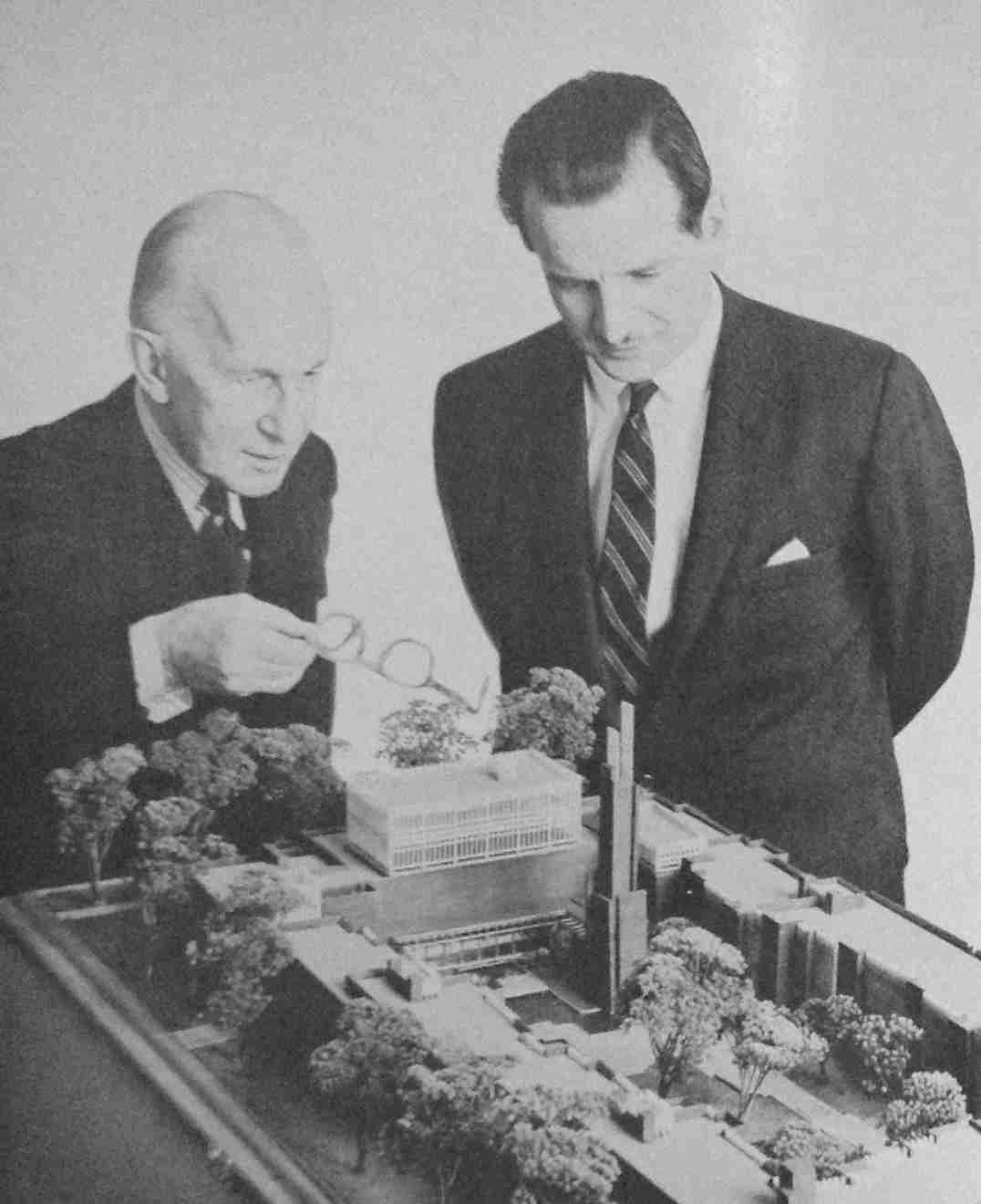
The President of the University of Toronto and the author with model of Massey College
Next came the plans for the building of the College on the site the University had made available. This may sound simple, but it was not. The Foundation has among its trustees two architect members—Hart Massey and Geoffrey Massey; it didn’t take long to find that these professionals had a point of view quite different from that of the rest of us. It was quite impossible for the six trustees to agree on the choice of an architect; the best plan seemed to be to select a small group of architects and invite them to submit designs and models, from which we would make a choice. One of the problems connected with this project was to give the architects who were invited to submit designs an idea of what we had in mind. None of them had any experience of collegiate life, and it was obviously necessary to convey to these young men what a college really was. Without understanding the conception, they could hardly be expected to prepare a building in which the college would be housed. We stipulated that it should be in the form of a quadrangle; that it should be turned inwards, not outwards, excluding the turmoil and clamour of the modern city, and giving its residents the quiet and peace in which an academic community should appropriately live. In due course their submissions were received and examined; the models stood on the terrace at Batterwood, while the trustees roamed about discussing their virtues and faults. A tape recording of the discussions over these two days would have been interesting to preserve. With the two professionals so often on one side of the debate and the amateurs on the other, I couldn’t help making a flippant observation—that in the language of English cricket, this was an example of ‘gentlemen v. players’! The trustees finally agreed to commission Ronald Thom of Vancouver, and we have been confirmed in the wisdom of our choice of this gifted young architect.
The corporation of the College, under its constitution, will be responsible in the future for the election of both master and fellows. In the first instance, however, it was agreed that the master and the first group of fellows should be appointed jointly by the University and the Foundation. The selection of the master was, of course, of vital importance, and I was deeply gratified that when I approached Robertson Davies, he told me he would favourably consider the appointment. We could not have found anyone better qualified for this post, with the scholarship, the administrative skill, and the dignity that it requires. In a college where the master is in residence, as he will be in this case, the master’s wife can play an important part in the life of the institution, and here again we could not have been more fortunate.
We took advantage of the presence of Prince Philip in Toronto in May 1962 as president of his conference to invite him to lay the foundation-stone of the College, which he very kindly did. The members of the conference were present as guests. At the appointed hour a small procession proceeded from Hart House to the site of the College, where the fellows were presented to Prince Philip. I spoke briefly and invited him to officiate. As the stone was laid, four trumpeters sounded a fanfare, then Prince Philip spoke for a few moments, after him the Master, and the ceremony was over, having lasted eleven minutes—which I consider a triumph.
I tried to express what we had in mind in the creation of the College, and the words appear on one of its walls:
This House was built by the Massey Foundation in 1962. It was the intention of the Founders to bring into being a College to serve a body of graduates limited in numbers but of high promise in scholarship and qualified to make of worth the fellowship to which they belong. It is the Founders’ prayer that through the fullness of its corporate life and the efforts of its members, the College will nourish learning and serve the public good.
In the tower of the College hangs a great bell—a symbol of the life that goes on around it. The bell bears the name of St. Catharine, a patron saint of learning and the patroness (may it be whispered!) of Balliol College, to which the Visitor and the Master and several of the fellows belong. Engraved on the metal are the ancient words:
VIVOS VOCO: MORTUOS PLANGO:
EXCITO LENTOS: PACO CRUENTOS.
[I summon the living: I mourn the dead:
I rouse the sluggards: I calm the turbulent.]
The College means a great deal to me. My roots are deep in academic soil and some of the happiest times in my life have been passed within the precincts of a university. I was deeply touched when the fellows of the College, at one of their first meetings, elected me Visitor. If I was involved in academic affairs over the years, it has so happened that, as an amateur, I have been frequently concerned as well with building. It was always an excitement to me to see rising the walls of a structure with which I was connected. Indeed, I think in another incarnation I would like to be an architect myself. The idea of the College was a source of deep satisfaction to me for these two reasons. Again, it was my hope that through the work of the men who would pass through it, the College would play some part in the public life of our country, as I myself have been privileged to do. And so Massey College embodies ideas that have been with me, and experiences that have meant much to me, from the beginning. Here, as in so many things, ‘What’s past is prologue’.
Abercorn, 3rd Duke of, 404
Addison, Christopher, 1st Viscount, 433
Ahearn, Lilias, see Massey, Lilias
Aird, Sir John, 454
Aklavik, 489
Alanbrooke, Field-Marshal Alan Brooke, 1st Viscount, 327, 330, 381-382, 387, 413
Alba, Duke of, 443
Alexander of Tunis, Field-Marshal Harold, 1st Earl, 430, 457
Alexandra, Princess, Mrs. Angus Ogilvy, 495
Alice, Princess, Countess of Athlone, 330, 395, 438
American University, 60
Amery, Rt. Hon. L. S., 112, 180, 230, 260, 423
Anderson, Sir John, see Waverley, Viscount
Anderson, Maj.-Gen. T. V., 320
Anson, Sir William, 31
Arbor, magazine, 19
Arts and Letters Club, 45
Ash, W. V. M., 521
Asquith, Cyril (later 1st Baron Asquith of Bishopstone), 29
Asquith, Margot, see Oxford and Asquith, Countess of
Astor, Nancy, Viscountess, 114
Athlone, Alexander, 1st Earl of, 330, 395, 438
Attlee, Clement, 1st Earl, 301-302, 312, 322, 323-324, 351, 352, 353-354, 362, 420, 421, 432-433
Baldwin, Stanley, 1st Earl Baldwin of Bewdley, 111, 199, 246, 250
Balfour, Arthur James Balfour, 1st Earl of, 113
Balliol College, 17, 23-24, 25-34, 58, 449, 530
Balliol Society, 34
Banting, Sir Frederick, 152, 328
Barrington-Ward, R. M., 29, 180, 212, 324, 442
Baruch, Bernard, 153
Batterwood, 178-179, 431-432, 445
Beaudry, Laurent, 138
Beaufort, Duchess of, 459
Beaver Club, 286-288, 344, 428, 434-435
Bell, Kenneth, 41
Bennett, R. B. (later Viscount Bennett), 131-132, 158, 171-178, 198, 199, 216, 219-220, 221, 225, 430, 454-455
Bessborough, Vere Ponsonby, 9th Earl of, 197
Bevin, Rt. Hon. Ernest, 379, 403
Bickersteth, Burgon, 57
Bissell, Claude, 527
Blake, Nell, see Mackenzie, Mrs. Philip
Blake, W. H., 22
Blue Book, The, magazine, 31
Borah, William E., 157
Bourassa, Henri, 105
Bowen, Fred, 99
Bracken, Brendan, 1st Viscount, 286, 342-343
Bramshott Military Hospital, 366-367
Brandeis, Justice Louis, 154
Breadner, Air Marshal L. S., 326-327, 416
Bridle, Augustus, 45
British Commonwealth Air Training Plan, 304-306
British Commonwealth Relations Conference (1933), 201-203, 206-207
British Commonwealth Relations Conference (1945), 419-422
Brooke, Sir Alan, see Alanbrooke, Viscount
Brooks’s Club, 377
Broughall, W. H., 527
Bruce, S. M. (later 1st Viscount Bruce of Melbourne), 258, 259, 260, 267, 298, 299, 302, 303-304, 305, 306, 307, 308, 317, 325, 331, 362-363, 378, 379, 406, 418
Burton, Dr. P. M., 514
Busby, Ernest, 518
Butler, Rt. Hon. R. A., 523-524
Byas, Hugh, 196
Byng of Vimy, Field-Marshal Julian, 1st Viscount, 103, 105, 106, 113
Cadogan, Rt. Hon. Sir Alexander, 379
Caldecote, Thomas Inskip, 1st Viscount, 276, 299-300, 331-332, 333
Campbell, Mrs. Archibald, 23
Campbell, Sir Ronald, 334
Camrose, William Berry, 1st Viscount, 379, 439
Canada House, London, 259, 267-269, 281
Canada in the World, 447
Canadian Bank of Commerce, 79-80, 94
Canadian Broadcasting Corporation, 454-455
Canadian Chamber of Commerce, 272-273
Canadian Forestry Corps, 343
Canadian Institute of International Affairs, 57, 397
Canadian Manufacturers’ Association, 272-273
Canadian Officers’ Club, 284-285, 344
Cape Dorset, 484
Carr, Emily, 87
Carruthers, Mrs. James (Violet Markham), 441-442
Casgrain, Mme Pierre, 212
Castle, W. R., 145
Cecil, Robert, 1st Viscount Cecil of Chelwood, 113
Century Club, The, New York, 154-155
Chamberlain, Sir Austen, 111, 113, 230
Chamberlain, Rt. Hon. Neville, 257-263, 265-266, 270, 271, 276, 280, 304, 306, 308-309, 310, 312
Chatfield, Admiral of the Fleet A.E.M., 1st Baron, 303, 306
Chatsworth, 115
Chiang Kai-Shek, Generalissimo, 193-194
Christie, Loring, 44
Churchill, Sir Winston, 230, 293-294, 298, 299, 300, 301, 302-303, 312-316, 322-323, 324-325, 331, 333, 336, 339, 341, 342-343, 345, 346, 348, 350, 352-354, 370, 372, 377-378, 383, 406, 422-423, 428, 429, 438, 443, 468
Claxton, Hon. Brooke, 481, 500
Cliveden, 114
Commonwealth Air Transport Council, 429
Commonwealth Telecommunications Council, 429-430
Compton, Lord Spencer, 29-30, 32
Connaught, Field-Marshal Duke of, 30, 289, 500
Coolidge, Calvin, 121, 122-123, 124, 142-143, 145, 146
Co-operative Commonwealth Federation, 216-217, 223
Cosgrave, W. T., 151
Council of the North West Territories, 483-484
‘Cousin Kate’ (Mrs. James Warnock), 11
Cranborne, Viscount, see Salisbury, 5th Marquess of
Crerar, Gen. H. D. G., 319-321, 330
Crerar, Hon. T. A., 101, 310, 371
Cripps, Sir Stafford, 347, 423
Curtin, Rt. Hon. John, 348, 417, 421
Curtis, Lionel, 34-38, 40-41, 50, 202, 421
Cushing, Harvey, 152
Dafoe, John W., 101
Dalhousie University, 181
Dandurand, Hon. Raoul, 233-234
Davidson, Randall, Archbishop of Canterbury, 117
Davis, H. W. C., 28
Davoud, Group Captain Paul, 410
Dawes, Brig.-Gen. C. G., 152-153
Dawson, Geoffrey, 180, 196, 236, 249, 260, 442
Day, Archibald, 450
de Champ, St. Elme, 20
de Gaulle, General Charles, 333, 337, 370
de la Rozière, Comte, 402
De Lury, Alfred, 20
de Marchienne, Baron de Cartier, 129
Devonshire, Edward Cavendish, 10th Duke of, 260, 278
Devonshire, V. C. W. Cavendish, 9th Duke of, 28, 115
Diefenbaker, Rt. Hon. John G., 507, 514, 515
Dominion Drama Festival, 197
Dowding, Air Chief Marshal H. C. T. (later 1st Baron), 294
Draper, Ruth, 65
Drew, Hon. George, 523
Dulanty, W. J., 247-248, 260, 298
Duncan, Mrs. J. S., 526
Dunglass, A. F. Douglas-Home, Lord (later Earl of Home), 261, 266
Dunning, Hon. Charles, 101
Duplessis, Hon. Maurice, 453
Early, Stephen, 301
Eden, Sir Anthony (later Earl of Avon), 227, 234, 299, 300, 303-304, 305-306, 307, 308, 311, 312, 317-318, 339, 379, 433, 439, 523-524
Edinburgh, Prince Philip, Duke of, 447, 459, 460, 495, 496, 513, 519, 520-521, 523, 529-530
Edward VIII, King, 115-116, 245-246, 247, 249-250
Edwards, Air Marshal Harold, 326-327
Eisenhower, Gen. Dwight D., 383, 481, 496
Elizabeth, Queen, the Queen Mother, 247, 251, 255, 276-277, 278, 288, 318, 364, 428, 429, 438, 441, 457-458, 495, 498
Elizabeth II, Queen, 140, 254, 438, 441, 447, 459-460, 466, 469, 492-493, 495, 496, 501, 512-513, 519, 525
Ervine, St. John, 113
Evatt, Rt. Hon. Herbert, 348
Feiling, Keith, 41
Ferguson, Hon. G. Howard, 178, 208
Fielding, Hon. W. S., 132
First Canadian Division, 317-319
Fisk, Haley, 158
Fitzgerald, Desmond, 151
Fleming, Peter, 190
Foch, Marshal Ferdinand, 116
Ford, Henry, 168
Fort Smith, 480
Fort William, Ont., 197
49th Parallel, The, film, 343-344
Frankfurter, Justice Felix, 44
Gardiner, Rt. Hon. J. G., 310
Garneau, René, 450
Genoa Conference on World Trade (1922), 67-70
George V, King, 116-117, 146, 160, 167, 179, 247-248, 257, 500
George VI, King, 247, 251, 255, 256, 263, 276-277, 278-280, 288, 318, 341, 364, 428, 429, 438, 440-441, 457-458, 459-460
Gill, Robert, director of Hart House Theatre, 61
Gill, Robert, Liberal candidate for Durham, 95
Giraud, General, 370
Gordon, Sir Charles, 69
Gouin, Hon. Léon Mercier, 212
Gouzenko, Igor, 434
Government House, Ottawa, 461, 462-463
Graham, Sir George, 184
Grant, W. L., 14, 118-119, 215
Green, Mrs. John Richard, 33
Gregory, T. E., 212
Grey, Albert, 4th Earl, 25, 499
Guelph, 283
Gundy, J. Harry, 118
Haakon, King, 341
Haldenby, Eric, 143
Halifax, Dorothy, Dowager Countess of, 400
Halifax, Edward Wood, 1st Earl of, 86, 260, 265, 266, 276, 303, 306, 308, 309, 333-334, 361, 392-394, 396, 400-401, 420
Hall, George (later Viscount), 433
Hankey, Maurice, 1st Baron, 303, 306, 328
Harriman, Averell, 212
Harris, Lawren, 87
Hart House, 24-25, 55-57, 60, 163, 447, 530
Hart House String Quartet, 57-58, 253
Hart House Theatre, 12, 60-61, 113, 114
Hawkins, Gordon, 521
Heaps, A. A., 102
Heeney, A. D. P., 212, 391, 482
Herridge, Hon. W. D., 178
Hertzog, Gen. J. B. M., 506
Hoare, Sir Samuel (later Viscount Templewood), 266
Holmes, Justice O. W., 153-154
Houston, James, 484
Howard, Sir Esme (later Lord Howard of Penrith), 121, 122, 124-125, 127-129, 148, 156, 157, 167, 182
Howard, Lady Isabella, 121, 125, 182
Howe, Rt. Hon. C. D., 221, 310, 311, 324, 352
Hoyos, Marqués de, 187
Hu Shih, 194
Hudd, Frederic, 224, 365, 380, 407
Hughes, Sir Sam, 47
Hunter, Ian, 511
Ilsley, Rt. Hon. J. L., 233-234
Imperial Conference (1926), 111-113
Imperial Economic Conference (1932), 198-201
Inskip, Sir Thomas, see Caldecote, Viscount
Institute of Pacific Relations, 188
International Civil Aviation Organization, 423-424
Irwin, Lord, see Halifax, Earl of,
Ismay, Gen. Hastings, 1st Baron, 353
Jackson, A. Y., 87
Japan, 188, 189, 194, 195-196, 203, 204-208, 337, 345, 415, 431
Jarvis St. Collegiate Institute, 14
Johnson, David, 380
Johnson, Air Marshal G. O., 429, 430, 436, 437
Johnston, Sir Reginald, 192
Jones, Tom, 151
Kenny, Air Commodore W. R., 138
Kent, Princess Marina, Duchess of, 265, 495
Kerr, Philip, see Lothian, Marquess of,
King, Rt. Hon. W. L. M., 18, 59, 69, 80-81, 82, 92-93, 99-100, 102, 103-105, 106-108, 109-111, 112, 113, 115, 122, 135, 140, 167, 168, 171, 174, 209-212, 221, 222, 223, 231, 236-237, 240-243, 250, 251, 262, 271-272, 273-276, 278, 279, 296, 304-305, 308, 310, 312-316, 321, 322, 325, 335-336, 348, 354, 383-384, 385-388, 391, 393, 396-397, 400-401, 407, 413-414, 415, 417-419, 430, 431, 440, 441, 446, 447-449, 467, 476, 504
Kinnaird, Kenneth FitzGerald Kinnaird, 12th Baron, 246
Kylie, Edward, 41
Lacoste, Francis, 482
Lambert, Hon. Norman, 211, 214, 216
Lampson, Sir Miles (later 1st Baron Killearn), 191-192, 193
Lapointe, Hon. Ernest, 82, 102, 152, 214
Larkin, Hon. P. C., 236
Lascelles, Sir Alan, 248-249, 291, 430, 438, 440, 449
Laurier, Sir Wilfrid, 48, 49, 92, 97
Law, Rt. Hon. Richard, 420, 421
Leacock, Stephen, 215
League of Nations, 203-205, 232-234
Lee of Fareham, Arthur, 1st Viscount, 327-328, 375, 429, 438
Lemaire, Father, 488
Leningrad, 75
Lévesque, Very Rev. Georges-Henri, 450, 493
Lewis, Willmott, 155
Liberal Party, 48-50, 94-95, 99-100, 208-209, 211, 216-220, 221-223, 448
Liberal Summer Conference, 211-213
Lloyd, George, 1st Baron, 333-334
Lloyd George of Dwyfor, David, 1st Earl, 379
Loch, Margaret, Dowager Lady, 30
Locke, George H., 54
Loggie, Col. G. P., 272
Lothian, Philip Kerr, 11th Marquess of, 134, 157-158, 164, 207-208
Lyttelton, Oliver, 1st Viscount Chandos, 312
McCarthy, Hon. Leighton, 400, 401
Macdonald, Hon. Angus, 310, 414-415
MacDonald, Rt. Hon. Malcolm, 235, 240-241, 258-262, 371, 407
Macdonnell, Hon. J. M., 363-364, 416-417, 419
Macdonnell, Peter, 288
McGreer, D’Arcy, 435
Machtig, Sir Eric, 425
Mackenzie, C. J., 396
Mackenzie, Hon. Ian, 310, 342, 343
MacKenzie, N. A. M., 450
Mackenzie, Mrs. Philip, 22
McKim, Anson and Joan, 526
Macmillan, Rt. Hon. Harold, 28, 34, 369-370
McNaughton, Gen. A. G. L., 318, 319, 321, 322, 352, 380-388, 412, 413-414
McNeil, Most Rev. Neil, 61
MacTavish, Duncan, 511
Magann, George, 404
Mahoney, Merchant, 123, 138-139
Mann, Brig. Churchill, 410
Margaret, Princess, Countess of Snowdon, 254, 438, 459, 495
Markham, Violet, see Carruthers, Mrs. James
Marler, Sir Herbert, 137
Marshall, Gen. George, 301, 369
Mary, Princess Royal, Dowager Countess of Harewood, 433, 440, 495
Mary, Queen, 255, 265, 266, 286, 434-435, 438, 440
Massey, Alice Vincent, 45-46, 55, 56, 59, 63-65, 66, 70-76, 86-91, 113, 117, 120, 121, 130-131, 144, 146, 150, 158-159, 167, 168, 179, 182-197, 214, 223, 225, 253-254, 255, 256, 257, 262-267, 279, 282-285, 290-291, 343-344, 366-367, 395, 404-405, 431-432, 438, 439, 440, 441, 445, 446, 447, 456
Massey, Chester D., 3-7, 53, 54
Massey, Geoffrey (1591-1676), 3, 117
Massey, Hart A., 2, 52, 53, 60, 97
Massey, Hart P. V., 34, 59, 144, 152, 279, 280, 281, 410, 416, 428, 446, 457, 458, 519, 527, 528
Massey, Lilias (Mrs. Lionel Massey), 446, 457, 460, 472, 485, 491
Massey, Lionel C. V., 59, 144, 286, 293, 339-340, 403-405, 416, 446, 457, 460, 485, 515, 527
Massey, Melodie (Mrs. Hart Massey), 446, 458
Massey, Raymond, 11-12, 46, 47, 187-188, 398, 499, 527
Massey, Rt. Hon. Vincent, views on:
Anglo-Canadian relations, 38-41;
Commonwealth relations, 126-127, 416-422;
Canadian-U.S. relations, 168-170, 370-372;
Canadian role in U.K.-U.S. relations, 207-208, 355-359, 361-364;
the office of Governor-General, 465-469;
the office of Canadian High Commissioner in the U.K., 173-175, 224-227;
the functions of academic institutions, 26, 27, 42-43, 55, 56-57, 527-531;
Massey, Walter, 6
Massey Foundation, 53-54, 57-62, 86, 118, 285, 527-528, 530
Massey Medals for Architecture, 60
Massey Room, Balliol, 58
Massey-Harris Co., 66-69, 70, 76-80, 82-85, 93, 97-98, 118-121, 172, 397
Matthews, Donald, 139
Meighen, Rt. Hon. Arthur, 84, 97-99, 102, 103, 105, 172
Merritt, Col. Cecil, 367
Metcalfe, Lady Alexandra, 526
Metropolitan Life Insurance Co., 158
Milbank, Maj. Mark, 461
Miller, Wing Commander W. G., 485
Milner, W. S., 20
Moffat, Jay Pierrepont, 351
Moley, Raymond, 212
Molson, P. T., 439
Monckton of Brenchley, Walter, 1st Viscount, 29
Montague, Lt.-Gen. P. J., 320-321, 322
Montgomery of Alamein, Field-Marshal Bernard, 1st Viscount, 394-395
Morgan, J. P., 154
Morrison, Rt. Hon. Herbert, 286
Morrison, Rt. Hon. W. S., 420, 422
Moses, Peter, 283
Mountbatten of Burma, Admiral of the Fleet Louis, 1st Earl, 372-373
Mulock, Sir William, 98, 397-398
Munich crisis, 257-267, 269, 271
Mussolini, Benito, 182-183, 235, 275
National Council of Education, 85-86
National Gallery, London, 374-375, 376, 377, 429
National Gallery, Ottawa, 91
National Liberal Federation, 210-211, 217-218, 448
Neatby, Professor Hilda, 450
Nesbitt, Aird and Honor, 525
Newall, Marshal of the Royal Air Force Cyril, 1st Baron, 273
Newman, Martin, 377
Norfolk, Bernard FitzAlan-Howard, 16th Duke of, 251
On Being Canadian, 446
Ontario Liberal Association, 446
Osborne, Henry, 197
Oxford and Asquith, Margot, Countess of, 442-443
Paget, Gen. Sir Bernard, 385, 387-388
Pan-American Union, 146, 165-166
Parkin, Alice, see Massey, Alice Vincent
Pearson, Rt. Hon. Lester B., 60, 224, 259, 278, 291, 295, 296, 307, 350-351, 400, 456
Pembroke, Sidney, 16th Earl of, 524
Percy of Newcastle, Eustace, 1st Baron, 44-45, 81
Pétain, Marshal Henri, 334-336
Pickersgill, Hon. J. W., 418
Plumptre, Wynne, 60
Plunkett, Sir Horace, 33
Pope, Lt.-Gen. Maurice, 413-414, 436
Porter, Thomas, 14
Portland, 6th Duke of and Duchess of, 256
Price, Maj.-Gen. Basil, 404
Provincial Model School, 12-14
Queen’s Own Rifles of Canada, 47
Rae, Saul, 60
Ralston, Hon. J. L., 138, 142, 284-285, 310, 321, 323, 324, 380, 382, 384-388, 395, 411-413
Randell, John T., 128
Reid, Mrs. Ogden (Helen), 398
Reid, Mrs. Whitelaw, 161
Resolute, 487
Ritchie, C. S. A., 225
Robb, Hon. J. A., 82
Robertson, Professor J. C., 54
Robertson, N. A., 296, 385, 390, 391, 407, 425
Rogers, Hon. Norman, 212, 214, 310, 312, 330, 331
Roosevelt, Franklin D., 153, 162, 215, 260, 302, 347, 351-354, 357, 398-399, 407
Round Table, The, magazine, 29, 39, 40
Round Table Movement, 34-36, 38-41
Royal Canadian Mounted Police, 226, 252-253
Royal Commission on National Development in the Arts, Letters, and Sciences, The, 450-455
Russell, George (‘Æ’), 33
Russia, 67-69, 70-76, 322, 355, 415, 425
St Andrew’s College, 14, 15, 16
St. Laurent, Rt. Hon. Louis, 311, 450, 453-454, 456, 457, 458, 461, 464, 467, 507
St. Pierre and Miquelon, 351, 481
Salisbury, Robert Cecil, 5th Marquess of, 300-301, 310, 362, 378, 379, 392, 393-394, 417-418, 420, 421, 427, 440
Samuel, Herbert, 1st Viscount, 212, 449
Savoy, Eddy, 121
Scallan, E. K., 378
Scully, Hugh, 432
Second Commonwealth Study Conference, 520-523
Shepardson, Whitney, 29
Sicaud, Pierre, 482
Siegfried, André, 152, 169-170
Simon, John, 1st Viscount, 206-207, 261, 266, 303
Simpson, Mrs. Wallis, see Windsor, Duchess of
Skelton, O. D., 126-127, 130, 132-135, 135-137, 139, 172, 175, 258, 295, 296
Smith, A. L., 27
Smuts, Field-Marshal Jan, 151, 230, 298, 300, 308, 314, 368-369
Smyth, Rev. James, 54
Spencer, H. E., 102
Stanley, Rt. Hon. Oliver, 363
Stevens, Hon. H. H., 219-220, 221
Stewart, Hon. Charles, 82
Stojanovich, Miroslav and Anna, 518
Stone, T. A., 60, 123, 125, 138, 147, 158
Strachan-Davidson, J. L., 26-27
Stratford Shakespearean Festival, 62, 198
Stuart Douglas, 481
Stuart, Gen. Kenneth, 382, 385, 386, 387-388, 407
Surveyer, Arthur, 450
Swinton, Philip Cunliffe-Lister, 1st Earl of, 420, 422
Talbot, Rt. Rev. Neville, 28
Temiskaming North, riding, 106-108
Temple, William (Archbishop of Canterbury), 364
Te Water, Charles, 230, 258, 260, 261, 267, 298
The Pas, 490
Thom, Ronald, 529
Thomas, Rt. Hon. J. H., 180
Thomson, Tom, 86
Thorne, Gen. Sir Andrew, 337
Toronto Scottish Regiment, 318
Tree, Sir Herbert Beerbohm, 5
Tree, Ronald and Marietta, 526
Trevelyan, G. M., 430
Turnbull, W. J., 418
Tweedsmuir, John Buchan, 1st Baron, 223, 328-329, 462
Tweedsmuir, John Buchan, 2nd Baron, 329
Tyrrell, Sir William, 112, 113
United Nations Relief and Rehabilitation Agency, 425-427
University College, 16, 17, 18
University of Toronto, 16, 20, 24, 46, 57, 60, 162, 181, 447, 527
Upper Canada College, 7, 14, 46, 57
Vanderbilt, Mrs. Cornelius, 161
VanderSmissen, Dr. W. H., 20
Vanier, Maj.-Gen. Georges, 224, 330, 332, 503, 526
Victoria College, 41-42, 46, 52
Villeneuve, Cardinal, 411
Vimy Ridge, National War Memorial at, 245, 331
Vincent, Anna, see Massey, Anna
Vokes, Maj.-Gen. Christopher, 435-436
Walker, Sir Edmund, 80
Wallace, Malcolm, 20
Waterson, Lt.-Col. Sydney, 298, 299, 300, 302, 336, 363
Waverley, John Anderson, 1st Viscount, 379, 439, 444
Wells, H. G., 344
Wheeler-Bennett, Sir John, 444, 523
White, Maj.-Gen. J. B., 343
Willan, Healey, 45
Willingdon, Freeman Freeman-Thomas, 1st Marquess of, 135-137, 144-147, 180, 256
Willis-O’Connor, Melodie, see Massey, Melodie
Wilson, J. Tuzo, 60
Wilson, Morris, 401
Winant, J. G., 338
Wood, Sir Kingsley, 273, 306, 423
Woodsworth, J. S., 102
Wright, Sir Michael, 125
Wrong, Hume, 138, 139-140, 234-235, 391-392
Wrong, Murray, 17
Zonda, Jean, 464
Misspelled words and printer errors have been corrected. Where multiple spellings occur, majority use has been employed.
Punctuation has been maintained except where obvious printer errors occur.
Some photographs have been digitally enhanced for improved image quality.
Footnotes have been renumbered sequentially throughout the ebook.
Illustrations have been relocated from the centre of the printed edition to places throughout the text.
Index page references refer to the book’s original page order. Actual placement of the reference may be offset depending on the page and/or font size of your eBook reader.
[End of What’s Past Is Prologue, by Vincent Massey]