* A Distributed Proofreaders Canada eBook *
This eBook is made available at no cost and with very few restrictions. These restrictions apply only if (1) you make a change in the eBook (other than alteration for different display devices), or (2) you are making commercial use of the eBook. If either of these conditions applies, please contact a https://www.fadedpage.com administrator before proceeding. Thousands more FREE eBooks are available at https://www.fadedpage.com.
This work is in the Canadian public domain, but may be under copyright in some countries. If you live outside Canada, check your country's copyright laws. IF THE BOOK IS UNDER COPYRIGHT IN YOUR COUNTRY, DO NOT DOWNLOAD OR REDISTRIBUTE THIS FILE.
Title: The Long Traverse
Date of first publication: 1920
Author: Kathrene Pinkerton (1887-1967)
Author: Robert E. Pinkerton (1882-1970)
Illustrator: Ralph Pallen Coleman (1892-1968)
Date first posted: July 20, 2025
Date last updated: July 20, 2025
Faded Page eBook #20250730
This eBook was produced by: Mardi Desjardins, John Routh, Al Haines & the online Distributed Proofreaders Canada team at https://www.pgdpcanada.net
This file was produced from images generously made available by HathiTrust.
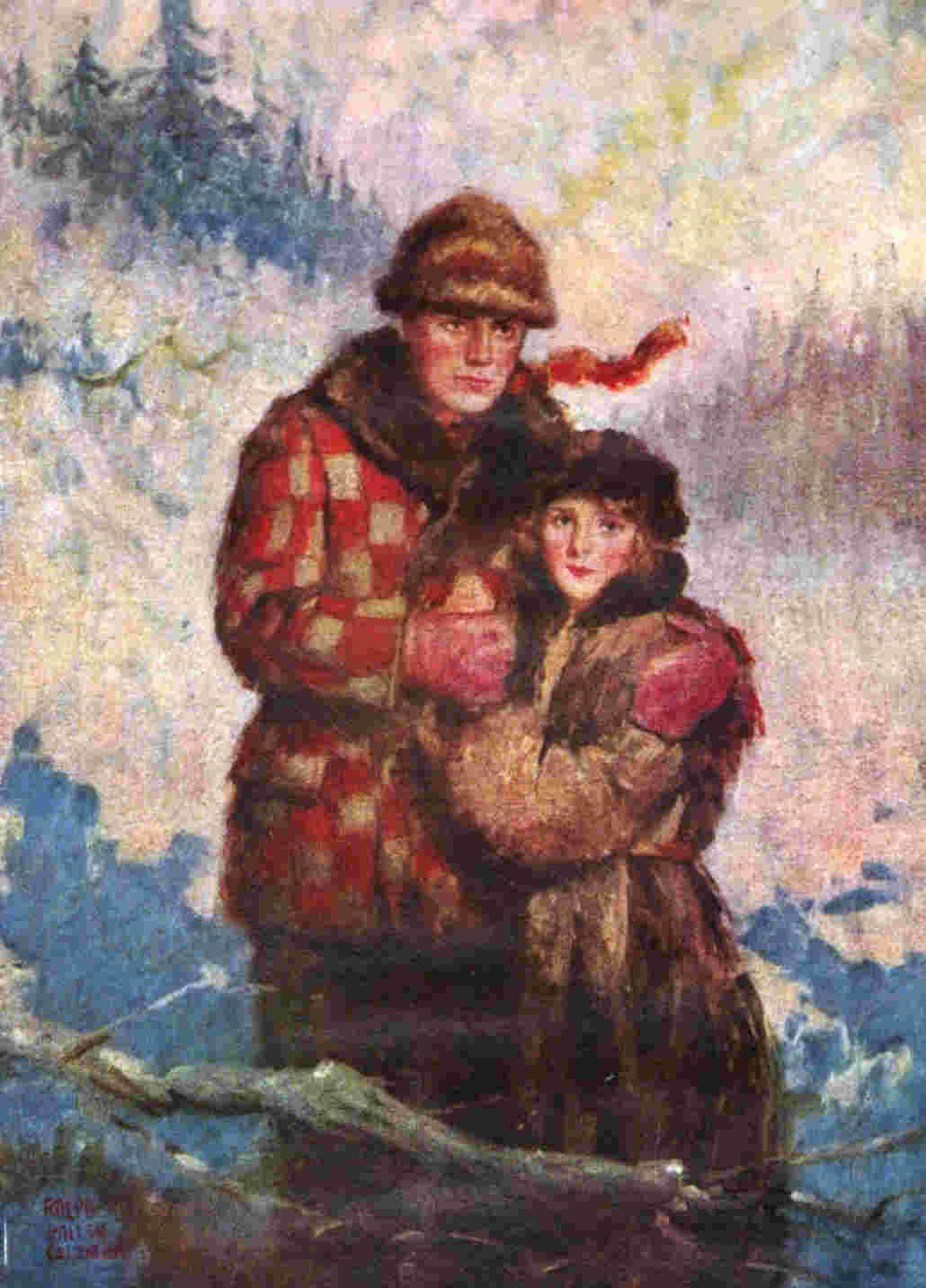
“He forgot in that instant that Evelyn was clinging to him so closely . . . .”
COPYRIGHT, 1920, BY
DOUBLEDAY, PAGE & COMPANY
ALL RIGHTS RESERVED, INCLUDING THAT OF
TRANSLATION INTO FOREIGN LANGUAGES,
INCLUDING THE SCANDINAVIAN
COPYRIGHT, 1919, BY STREET AND SMITH CORPORATION
| CONTENTS | |
| I. | The Vow |
| II. | Fort Mystery |
| III. | Accepted |
| IV. | The Trap |
| V. | Questioning Good Fortune |
| VI. | Ash-wan-a-mak Tells a Secret |
| VII. | The Voice in the Kitchen |
| VIII. | Warning Spirits |
| IX. | Accepting the Challenge |
| X. | An Arrival |
| XI. | The Discovery |
| XII. | Defeat in Victory |
| XIII. | Chained to the Past |
| XIV. | La Longue Traverse |
| XV. | The Devil Machine |
| XVI. | The Whirlwind |
| XVII. | The Courage of Herbert Morley |
| XVIII. | Logic and Love |
The Long Traverse
David Pattison, surrounded by steam pipes, watched with a certain perverse complacency the hunched, hurrying people who passed his office window. In all Winnipeg he was probably the only man who was not grumbling because of the extreme cold, who found in it a reason for satisfaction.
“Shiver!” he grinned at them. “Shiver! The lower she goes the better the fur.”
That morning Mr. Pattison had been handed the annual report of the fur trading company of which he was director and sole owner. He had known that the previous year had been successful but in the written figures he found confirmation of his highest hopes.
He had received, that same morning, reports from the half-dozen posts he operated, all sent down from the headquarters post. None was less than five months old, but that is recent news in fur land. In each brief statement he read of added conquests, more hunters weaned from the Hudson’s Bay Company, new outposts established, fresh territory gained.
Mr. Pattison twisted his chair away from the window and abandoned himself to that grim ecstasy known only to the fighting man in his retrospective moments. For the first time in his strenuous life he paused to look back. The reports had suggested, in a way, that he was at the top, that he had won, and he found himself luxuriating in the sensations victory induced.
It had been a long fight since that day when he had first gone into the bush with a pack on his back to trade with the Indians. He had met disappointments and failures, even disasters. Twice he had been forced to begin again at the bottom. Each time, grimly, patiently, cunningly, he had built anew.
But he had built well in the end. No other man in fur land could point to such an individual achievement. It had been a long trail of toil, of hardship, of grim combat, but he had travelled it alone. Now he was David Pattison, sole owner of a company which boasted six flourishing posts in a large territory that once had been the exclusive domain of the Hudson’s Bay Company, and he faced a year which promised to be even more successful than the last.
There was something disquieting in this thought. It would be a successful year, but it would be equally successful were he to do nothing, were he to have no part in the work. It would be a machine he had built, not he himself, that would maintain the success. His work was done.
His elation vanished. Suddenly he felt very old and very tired. The stimulation of battle was gone and he, like so many men who do not know they are fighting for the fight’s sake, found himself groping in a great emptiness. He might start an entirely new campaign elsewhere, but he knew that physically he was disqualified. The North had taken not only his youth but his prime mid-life. He was fit only for victory, not for the fighting.
“Mr. Pattison, someone wishes to see you,” a clerk interrupted.
“What business?”
“Fur, he says.”
“Name?”
“Rochette.”
“Sounds like a job. Can’t see him.”
“I don’t think it is a job he wants, sir.”
David Pattison nodded and the clerk withdrew. A moment later a young man entered the private office.
He was not more than twenty-six years old. He was of medium height, well built, well dressed, heavily tanned and, in a perplexing fashion, good looking. His features were regular and of that vague quality which, in an attempt to describe those fortunate people whom all men instinctively like, we call attractive. Only the liking which his eyes compelled would be chilled somewhat by the puritanical expression of his jaw and mouth. It was as though a spirit foreign to his nature had been born and fostered through some unforgettable experience. This spirit was in command as he strode into the office.
“Whetting up a tomahawk, all right,” was Pattison’s first thought.
Then he saw the young man’s eyes. They were distinctly Latin, dark, brilliant, apparently capable of speech. There was a laugh in them, a laugh that might easily become a threat. But the most striking quality about them was their direct contradiction of the lower part of his face.
“I am Bruce Rochette,” he said as he stopped across the desk from Pattison.
“Bruce Rochette!” repeated the fur trader.
The exclamation had been unconscious. The linking of a name so distinctively Scotch with one so manifestly French was like a repetition of the baffling combination of the eyes and the mouth.
“That’s a queer mixture,” Pattison added in an effort to explain his surprise.
“Then you don’t remember me?”
“I’ve known several Rochettes but none called Bruce.”
“My father was Jean Rochette. My mother was from the States. I was named for my grandfather, Bruce Hamilton, who was born, and always lived, in the States.”
“Yes?” said Pattison with a rising inflection that asked plainly what that might have to do with him.
“Then you don’t remember me?” repeated Rochette.
“I remember a Jean Rochette back east.”
“And his son?”
“You’re not the lad I sent out to the States?” asked Pattison in amazement. “Well, well! Time flies. That was twelve years ago. At Whitefish Lake.”
“I have never forgotten what you did for me then!” exclaimed the young man. “I was alone in the world, didn’t know anything except the bush, hardly knew where to find my grandfather. And you took care of me for a month and wrote to my grandfather about me and then sent me out to him.”
“So I did! So I did! I recall it all now. You’re the French boy with the Scotch name.”
“That’s one reason I have come,” continued Rochette. “I have always wanted to thank you for what you did. As I remember it, I was too embarrassed to say anything at the time.”
“It was nothing at all.”
“It meant a great deal to me and I want you to know that I appreciate it.”
“Forget about it. It was nothing at all. Any one would have done the same. I am glad you dropped in.”
There was a moment of awkward silence. Pattison frankly waited for the visitor to state his errand, for it had been apparent from the first that there was something more than a desire to express appreciation of a past kindness.
“That is not all I came for,” continued Rochette. “I want to know if there is a place open in any of your posts.”
“Sorry, but there is nothing, absolutely nothing.”
There was a finality in his tone which was unmistakable.
“I am perfectly willing to work up, to start at anything.”
“My staff is full,” and Pattison no longer made any attempt to conceal his impatience at the insistence of the other.
“And I have had experience.”
Pattison looked Rochette over curiously. The young man did not appear to be in desperate straits. Nor did he seem to be the sort that would trade on past friendship in seeking employment. Pattison felt rather that behind his burning eyes and his tense mouth there was some undercurrent of feeling which was driving him on to a humiliation which he could not otherwise have endured. An interest in this hidden emotion induced the next remark:
“You don’t look like a fur trader.”
“But I know fur. Last winter I bought thirty-six thousand dollars’ worth and cleared eight thousand for Andrews in British Columbia. I’ve been back at Whitefish Lake two years, and I was with Revillion’s at Umbabika.”
“Why didn’t you stay with them?”
“For two reasons. I wanted a varied experience, but I didn’t have the opportunities there I wished. That’s why I came to you.”
“What sort of opportunities are you looking for?”
Pattison shot the question at him. There was suspicion and a challenge in his tone that could not be ignored. The young man started in amazement, began to speak, then hesitated as though choosing his words.
It was enough. The suspicions of the older man had been confirmed. Rising from his chair he pointed toward the door.
“Go back to the Hudson’s Bay, young man,” he snarled, “and tell them that that trick doesn’t work with me. There is no room in my company for spies.”
One leap and Rochette was leaning across the desk.
“You are making a mistake!” he cried. “There is nothing in the world that I hate as I hate the Hudson’s Bay. Do you want me to tell why I came to you, why I offered to work at anything?”
“No,” sneered Pattison, “because I know what you will say. I suppose you think some pretty story about wanting revenge will pull the wool over my eyes. I haven’t time even to listen to it.”
He sat down at his desk and busied himself with some papers. Rochette started toward the door. Then he wheeled suddenly.
“Some day,” he said, evenly, “the Hudson’s Bay will come to me with the white flag flying. That is why I am here. You have accomplished a little. I was going to help you to do more.”
Pattison sneered openly and picked up his pen to sign a letter. Rochette turned and went out.
As the door closed behind his visitor Pattison laughed triumphantly. It needed only this tribute from the great company to fill his cup to overflowing. Success must indeed be certain when it would take such a step. The Hudson’s Bay Company had been after him for years, had tried in countless ways to block him. And to-day the six posts and the auspicious reports stood as monuments to the fact that he had beaten it.
His anger had vanished with his visitor, for it had been only for the individual, not for the company. He had not resented the effort to place a spy in his organization. He was thoroughly familiar with fur land’s ethics, knew that trickery and stealth were part of the game. More than two centuries of precedent had established a code peculiar to it. And no one subscribed to it more whole-heartedly than David Pattison, believed more intensely that to get the fur was paramount, and that results justified any means.
His anger had been due to the fact that Rochette had judged his intelligence so lightly, had hoped to dupe him with such a flimsy pretence. The Hudson’s Bay Company did not usually work so crudely.
This thought brought a sudden realization that he might have made a mistake. There had been, too, a light in the young man’s eyes that could not easily have been feigned.
There flashed over him a memory of Jean Rochette, a French-Canadian trader at Whitefish Lake. Rochette had been a worker but he had lacked that imagination, that intuitive knowledge of his competitor’s ways, so necessary in fur land. The Hudson’s Bay Company had ruined him, had driven him out. He had died fighting it, hating it.
The young man who had just left the office was passing the window. Pattison leaned forward, staring at his face.
Something recalled to the old free trader the thoughts which Rochette’s arrival had interrupted. He was past the fighting age but here was someone he might hire to fight for him, the very man he would select if he could be certain he were honest. Suddenly he sprang from his chair and tapped on the pane.
“Come back!” he called when Rochette looked up.
Pattison did not make any explanations when the young man again entered the office.
“Why do you hate the Hudson’s Bay?” he asked, bluntly.
Rochette looked at him in silence for a moment. Pattison felt that he wished to refuse to answer, that he would repay in kind the indignity of the moment before. Then the hidden force to which his own self seemed subservient conquered.
“You knew my father?” he asked in a low, tense voice. “What happened to him?”
“Yes, I remember him well. He worked hard but the Hudson’s Bay was too much for him. He couldn’t buck it.”
The words electrified the young man and he sprang forward.
“Buck it!” he cried. “Why should he have had to buck it? Does the Hudson’s Bay own this country? Has it the power of life and death over people? Should it be able to refuse a man the right to live? That is all my father wished, that right.
“He was a fur buyer, honest, hard-working. All he knew was the business of buying fur. At that business he could have supported his family happily and comfortably. Only the Hudson’s Bay wouldn’t let him alone. That great, greedy company couldn’t spare the tiny part of the great fur land that my parents occupied. So, for the sake of a few miserable pelts, it crushed him, drove him out of the country that was really his because he had made it so, and started him out to build all over again.”
Overcome by his emotion, Rochette stopped. Pattison, who had been watching coldly, appraisingly, apparently unmoved by the youth’s fire, started to speak. But Rochette had not finished.
“Had my father been alone,” he continued, “it might not have been so despicable. But think what it meant to my mother! They were young and in love, full of dreams and ambitions. My father had taken her away from everything she had known and cared for, but she had followed him gladly. He was fighting to win her a home in a land where only strong men can survive. Left alone, they would have created for themselves a paradise in the barren north. It was an act of courage any one should have admired and respected. But it meant nothing to the Hudson’s Bay Company.
“Twice it wrecked him financially. It was not that he forced the competition. He tried to avoid it. He would go off alone, select a site for a post far from any of the Hudson’s Bay, then in a few months or a year it would be the same. The company would hear of his operations, grudge him his small success, establish an outpost so near that you could toss a stone from one building to another, bring all its resources to crush him.”
“But that is the fur business as it always has been and must always be,” interrupted Pattison, calmly.
“Fur business!” cried Rochette. “Is it the fur business to kill a woman, to wreck a man, and to destroy the home of a child?”
“Kill!” repeated Pattison.
“Yes, kill! Perhaps they could not be convicted of it in court but the effect was the same. I tell you, the Hudson’s Bay, with its greed and its cunning and its cruelty, murdered my mother, and it shall pay if I must spend my life at the task.”
“That’s a big job, young man.”
There was a challenge in Pattison’s voice and he was no longer coldly indifferent. Before he had called Rochette from the street he had thought of a plan, determined how best to use this unexpected ally for his own ends. Now his entire attention was focussed upon it. But first of all he must convince himself of Rochette’s sincerity and ability.
“It is a big job,” answered Rochette. “But I shall spend my life at it. And I shall accomplish it. No one knows better than you what hurts the Hudson’s Bay. That is the way I shall make it suffer, make it pay. I shall get the fur, win its hunters, cut into the profits of its posts. I know other men have tried it and that many have failed. But they were after only business results. With me it is different. It is a vow. It has been the biggest force in my life ever since my mother’s death.”
“I don’t think I ever knew your mother,” said Pattison.
He wanted to learn more, to probe to the bottom this young man’s emotion, to judge for himself how far it would take him. He felt that Rochette was about to stop, to shut a stranger from the event which had shaped his life. It needed only a question, a little sympathy, to make him again take up the thread of his narrative. He was successful, for Bruce Rochette, after struggling to regain his self-control, went on more quietly:
“It was east of Whitefish Lake. It was the third start of my parents. They had been there two years and were doing well. They believed that their troubles were over, that success had come at last.
“The Hudson’s Bay had never been in there. Then the old story was repeated. An outpost was started with a half-breed in charge. For a time my father more than held his own. My mother worked with him among the hunters and their families. The Indians worshipped her.
“Then all turned against them overnight. The Hudson’s Bay must have the fur. It mattered nothing to it what methods it used. It was some work of the half-breed’s, using the Indians’ superstitions. Perhaps the man did not intend that it should go so far. Perhaps the Indians got beyond him. But we heard that they were going to attack us, drive us out, and we left in the middle of the winter.
“We should never have started. My mother was too ill to be moved. Then it seemed the only thing to do. I shall never forget my mother’s face when she turned for her last look at her home.
“We were not prepared for the journey. There was no time to prepare. Our supplies were low and there was little dog food. The dogs became weak. I helped them pull and my father broke trail. My mother grew worse. At first we had believed she would recover. Always she had been so full of courage and resourcefulness. Neither of us could imagine life without her.
“Finally my father realized that he must obtain shelter for her at once. There was a wigwam of friendly Indians far ahead. He left me to care for her and went to get help.
“I did my best. All night I gathered firewood to keep her warm. I tried to sustain her strength with soup I made of the little food we had. It turned very cold. The second night, worn out, I fell asleep beside her.”
He stopped for a moment and the horror in his eyes told the older man more than any words he could have used what the experience had done to him.
“When I awakened she was lying there, close to me, dead,” he said at last in a whisper. “She had died in the night, alone, without shelter, without warmth. All that day I sat by her body. It was then that I heard a long, low, mocking laugh in the spruce back of me. I have always believed that it was the mocking spirit of the Hudson’s Bay laughing at love, at youth, at devotion. It was then that I made my vow.”
“You have been a long time getting at it, young man.”
“No, I have been preparing for it always. My father shared my resolution. But as a result of that winter’s journey he lost something. It didn’t kill his spirit. I never saw a man who could hate as he hated. But he was wrecked physically. You saw him when he died.”
Pattison had a sudden impulse to tell the story as he had once heard it. He checked himself with the thought that he held no brief for the Hudson’s Bay Company and also because he saw in Rochette’s emotion something he could capitalize. He might have explained that the story of the Indian uprising was a hoax, that the half-breed had cleverly planted the report, and that the Hudson’s Bay Company was not in the habit of thus tampering with the uncertain passions of the Indians.
In Rochette’s fervid recital he had not at first recognized a humorous story a Hudson’s Bay man had once told him of the same incident. It had been humorous in the telling then because the Hudson’s Bay man had known nothing of the death of Mrs. Rochette. Perhaps it would be only fair that the young man be set right now, but Pattison ignored the point. A man in the fur trade always accepts any advantage that is offered, and so he only said:
“And then I sent you to your grandfather in the States.”
“Yes. I knew it was best to go, though I knew I would come back. My grandfather had money, was willing to do anything for me. He engaged special teachers to fill in the gaps and sent me through college. I thought it better to prepare myself in every way. When I finished school I started North at once. For four years I have been learning the fur business. I think now that I am ready.”
“Why do you want to work for me?”
“Because you have been so successful in your opposition to the Hudson’s Bay. Your company offers me the best opportunity to strike back.”
Pattison looked at Rochette coldly, frankly studying him, weighing him. The passion in the young man’s eyes had died, his mouth was straight and hard.
“I said that I had no opening for you,” Pattison began, slowly. “I haven’t. But there is a chance for you to make an opening for yourself. Did you ever hear of Fort Mystery?”
Rochette shook his head.
“It’s between here and the bay, northeast. It’s Round Lake Post officially, though most everyone calls it Fort Mystery. I doubt if the Hudson’s Bay has a richer post anywhere. The fur is of the finest quality and there is an enormous amount of it. There are more than six hundred Indians, and there is no opposition.”
“Why aren’t you there?” asked Rochette in amazement.
“That’s the point. That’s why it is Fort Mystery. Why isn’t any one there? Why is the Hudson’s Bay alone in the best district in the North country? To my knowledge two different companies or individuals have tried it besides myself in the last fifteen years. I have tried it twice. Every attempt any one has made has been a flat failure.”
“Is it the manager?”
“I don’t know. I don’t believe it is. He’s an Englishman, Herbert Morley. I’ve seen him. So far as I can make out, he is one of those pompous Englishmen. I don’t really believe he understands the fur business. It’s what everyone thinks. And yet if you try to get in there you are up against a stone wall. You can’t get a pelt. It must be Morley. You think he is a fool, but he may be wearing a mask. I do know this: He has been manager at Fort Mystery for fifteen years and I am confident the Hudson’s Bay has had every pelt taken in the district.”
“And you want to start there again?” asked Rochette.
He spoke eagerly, for he had detected the envy in Pattison’s tone, had seen that the free trader wanted a share in that district, that he did not like being baffled. And it was a chance Rochette had never hoped for. To strike the Hudson’s Bay Company through its prize post, to humble it where it considered itself invincible!
“Not yet,” Pattison answered. “Any man is a fool who tries to start opposition at Fort Mystery until he knows the secret of Morley’s power. Most free traders believe there is something supernatural in it. They don’t think any man can hold Indians as Morley has held his.
“They tell a story about it. I’ve never believed it. If you know the North country you know how these queer stories come out of nothing. But you can take it for what you think it is worth.
“The Indians call Fort Mystery ‘The Post at the Camp of the Dead.’ They say that years ago a party of hunters became dissatisfied with the Hudson’s Bay and decided to take their fur to the post of a free trader. The night before they started they camped together. Later their camp was found by the others. All the hunters were dead. There was no sign of violence, nothing to explain the mystery. No man has ever known what killed them. So the fort has been called ‘The Post at the Camp of the Dead.’ ”
“Isn’t that the secret?” asked Rochette, eagerly. “Doesn’t the manager trade on this? Can’t we show them that they have been fooled?”
“Did you ever try to run down such a story?” Pattison countered. “I tried it there and I don’t believe there is any foundation for the tale. I don’t think even the Indians do because none of them will talk about it. I don’t think the legend will help you, because every free trader who has gone in there has known of it and has failed. There is some simple reason for Morley’s success that none of us has guessed. It is there for the man who can find it.”
“And if I should?” asked Rochette, quietly.
“I think you can,” answered Pattison. “Hate is a strong motive. And I believe in it enough to advance the expenses where I said I would not try again. You can have what you need. And your salary begins from the time you start. All I ask is that you find out the real reason. You need write to me only once. That is when you have the secret. I’ll have a trading outfit there as quickly as possible and you’ll have the post.”
“Do you want to know my plans?”
“I want to know only one thing. That is that you have succeeded. I don’t care how you get in there or how you go about it. I am paying you to use your own head and your own ingenuity. And when you find out, you’ll have charge of the richest post in my company.”
Joe Snowbird was ahead breaking trail and Bruce Rochette was following the toboggan when they turned a point on Round Lake and had their first glimpse of Fort Mystery, “The Post at the Camp of the Dead.”
Since his interview with David Pattison six weeks before, Bruce’s thoughts had been centred constantly on this post. Now it stood before him, the enigma of fur land, the mystery which had remained unsolved despite the repeated attempts of free traders to gain a foothold in the district.
From the moment he had left Pattison’s office he had been fired by his determination to discover the secret of the Hudson’s Bay Company’s mysterious power. He had never expected to have the opportunity to strike so deeply and so soon. Fort Mystery was the company’s pride and boast. Here where it reigned so arrogantly and so challengingly he had been accorded the privilege of beginning to exact his revenge.
He thrilled at the thought of it and ignored completely the possibility of defeat. For half his life he had dreamed and planned and worked with the one object. His cause was too holy, too sacred, his desire too great, his purpose too intent, to permit even the thought of failure.
Bruce may have been swayed by his French ancestry in this, but he was equally of New England. His fancy, his desires, and his enthusiasms might have free range, but there was a firm foundation of Yankee shrewdness and forethought. The heritage of his mother’s people was coolly calculating. After it had done its work, had laid the foundation, those qualities which marked his father’s race stepped in with their verve and absorption, their whole-hearted devotion, to accomplish the task itself.
Bruce’s faith in his ultimate success was not based upon sheer hope and enthusiasm. He had been born and bred in fur land. His years in the States had divorced only his body from it. His four years after leaving college had been an intensive course of training, for he knew that he must master the business before he could hope to win against the great company. When he had left David Pattison’s office he knew everything the free trader could tell about Fort Mystery. Discreet inquiries in Winnipeg had added a little to this knowledge. Briefly it was this:
“The Post at the Camp of the Dead” had been in charge of Herbert Morley for fifteen years. Twice Pattison had attempted to break in and two other free traders also had sought a foothold. Each of these four attempts had been made in the customary way. Buildings had been erected, goods installed, the usual efforts made to wean the Indians.
Ordinarily a free trader making such an effort to get fur has some degree of success. He may lose money in the end, fail to get enough business to make his establishment pay. But he gets some fur, finds some dissatisfied Indians who will bring their pelts to him because of a grievance, fancied or otherwise, against the Hudson’s Bay Company.
But at Fort Mystery neither Pattison nor the two others had obtained a single pelt. Not an Indian had visited their posts. When, according to fur land custom, trippers had been sent out among the Indians to offer tempting prices for fur and show goods at a ridiculous cost, they had met with the same baffling lack of success. Held by invisible and inexplicable bonds, the hunters had silently shaken their heads and carried their fur to the great company.
Never in all the history of fur wars had such a condition prevailed. Against this mysterious force the free traders were powerless. Defeated, they had withdrawn, but they had carried with them the fixed belief that they had battled with the supernatural.
For there was nothing about Herbert Morley to explain the great company’s power. Like all Hudson’s Bay Company’s men, he was a zealot in his allegiance, a firm believer in the right and the might of his organization, ready to go to any lengths to drive out opposition. But apparently he had done nothing to defeat them, had never taken up the gage of battle, because he had seemed unaware that a battle was being waged.
To all he had seemed the same, an Englishman who combined, as only an Englishman can, that strange mixture of irascibility and good nature. His years as undisputed ruler in his tiny kingdom had made him a bit pompous and self-assured. The trait might have been expected in a man who had himself built up a successful barricade against all invasion. But all the free traders who had made a study of the man and his methods united in declaring that Herbert Morley was ignorant even of that fundamental of the fur trade, a knowledge of the character of the Indians with whom he had to deal.
There have been such managers in the Hudson’s Bay Company’s service, men who have gone through a lifetime of intercourse with the Indians without gaining any conception of Indian character and yet who have been considered fairly successful. In reality it has been only that they were backed by the prestige of the Hudson’s Bay Company, had been saved from failure by the traditions of one of the oldest companies in the world. Morley, it was generally reported, was one of these.
Strange stories were told of him and of the feudal state he had built up. The discomfited opposition enjoyed describing his idiosyncrasies, his personal vanities. None believed, however, that these qualities had any bearing on the business of the post. They united in declaring:
“Morley’s no fur trader.”
When reminded of the extraordinary history of the post which for fifteen years had withstood all attempts of the opposition, they still shook their heads and said simply:
“It’s something else. It’s not Morley who did it.”
This was not due alone to the pique of the defeated nor to any wish to deny credit to the manager for remarkable success. The history of fur land and of fur wars is filled with stories of its heroes. But always they have been of its fighters, men who welcomed the coming of the opposition, who gloried in the battle for fur. All fur land loves them and tells over and over the ruse or the wit or the force with which they brought defeat to their foes.
But none of these stories could be told of Herbert Morley. So, mystified, defeated, but unadmiring, the opposition shook their heads and hinted vaguely at the supernatural.
Bruce had gathered all the available information and put it through the sieve of intelligent reasoning. In none of it could he find the slightest proof of Morley’s power. But he had determined not to make the mistake of underestimating his adversary. He would grant that the man might be playing a clever rôle and that back of his success lay some simple explanation. The others had attacked from without. He would attack from within. His plan was clever and he was confident of success.
In addition to his desire for revenge his task appealed to him. He did not altogether escape the influence that “The Post at the Camp of the Dead” had upon the North. Its mystery challenged him, stimulated his imagination. He was dazzled by the thought of succeeding where others had failed, of conquering this stronghold of a land where all means of war are fair and where condemnation comes only to him who fails.
At his first sight of the place he halted for a moment. As he looked across the ice and snow at the distant buildings he realized more vividly than ever that the work for which he had planned and hoped had at last begun. Before him lay Fort Mystery, impregnable redoubt of the great company. In front of it, a speck on the ice, he stood, a David facing a commercial giant. His heart leaped at the thought that at last the battle had begun, that henceforth his every effort was to accomplish an irritation, an affront and an injury to the Hudson’s Bay Company. From now on he was to see it writhe, see it pay.
As the dogs galloped closer Bruce could distinguish the buildings. He watched eagerly, for he had expected something different, perhaps imposing, perhaps sinister. He saw, however, only a fur post that differed in no essential from a hundred others.
With a few exceptions the establishments of the Hudson’s Bay Company are desolate places in winter. No matter with what romance the company and its land have been clothed, the appearance of its forts remains completely uninviting. Always on the edge of lake or river, a few low, whitewashed buildings stand as pitiful monuments to the might of the great company.
Having been there for a hundred years or more, firewood has been swept clean within a quarter or half a mile. The great, snow-filled clearing sweeps back to the low, black border of the spruce behind. In front the monotonous expanse of ice stretches away, often to the horizon. Any breeze that blows, any blizzard on its ceaseless patrol of the North, finds the post perched upon this bleak, vulnerable, forlorn spot.
Generally one description answers for most inland posts. A dwelling house, a trading shop, a warehouse, the servants’ cabins, a bare flagpole, the fish house, the old fur press—that is all. The principal buildings are of hewn logs covered with whipsawed siding. Every three years, as a rule, whitewash is applied to all. A picket fence, probably with a high, timbered, rudely ornamental gate, surrounds all except the servants’ cabins and the Indian house.
There is none of the coziness of a forest home, of a cabin sheltered by pines and spruce. There is none of the majesty of the great company in these, its outposts in the wilderness. Bleak and barren as the land itself, as desolate and as forlorn, there is about them, however, an indescribable attraction. Perhaps it is the romance of the fur trade, the romance of the North, the knowledge that those posts have stood for two hundred years, will continue to stand so long as fur is to be gathered.
Joe Snowbird led the dogs up from the ice and across the hundred yards of clearing between the lake and the trading shop. There he stopped while Bruce, after kicking off his snowshoes, walked to the door. It was unlocked and he went in. A half-breed stood behind the counter.
“Is the manager here?” Bruce asked.
“Yes.”
That was all. The half-breed studied him openly, frankly awaited a statement of his errand.
Bruce had expected this. None knew better than he the ready suspicion that attaches itself to any newcomer in the North country, the land in which fur is the sole business. Because he was a fur man, had intimate knowledge of the ethics of a business which is unlike any other in the world, he felt no resentment. It simply was the logical weapon against the unusual commercial methods which are accepted, even admired, in fur land.
The buying of fur differs from the traffic in any other commodity. It depends not alone upon a fair price and the exchange of articles of good quality but also upon a discreet treatment of a race the vagaries of which are as illogical and as unforeseen as those of children. Because this is so success can come to the new trader only after he has spied upon the established post, learned the methods which have brought success in that district, and has acquired the names of the hunters who are industrious and influential.
With the employment of such methods of commercial warfare must come protection against them, and Bruce had expected to encounter doubt, suspicion, and a frank challenge of his credentials.
He had prepared himself. He knew the danger of over-eagerness, even of innocent curiosity. So he merely nodded his head toward the open door in the rear and asked:
“In the office?”
“No.”
“Can I see him?”
“No. He do no business this afternoon. This Thursday.”
“You mean no trading?”
“No business any kind on Thursday ever.”
“Will you ask him if he will see me?”
“No bother him on Thursday. Mrs. Morley she receive to-day.”
“What?”
“Mrs. Morley she receive to-day. Always every Thursday. One hunter come, ten hunters, all the same. Mr. Morley he no do any business.”
“Oh, I see,” and Bruce glanced out of the window at the dwelling house. “I didn’t know there was a mission or any other white person on Round Lake.”
“There no mission here, nobody. Just Mr. Morley he go every Thursday. Ten years I know he never miss.”
“Then I can’t see him to-day?”
“Not till everything all over. After dark he be through. Maybe he see you then.”
The front door of the trading shop opened and an Indian woman entered. She began at once to speak to the half-breed in Ojibwa. Bruce had expected her, for he knew the value of the kitchen secret service, knew the means employed at every post to keep the manager informed. Indeed, he had hardly hoped to see the manager until the facts regarding his personal appearance and stated errand had been reported.
Now he turned away and began to look at the goods on the shelves as though he did not understand what the woman said. He was careful to allow no expression to cross his face for he knew that one of his most valuable weapons would be to feign a lack of knowledge of the Ojibwa language. But he was not prepared for the woman’s statement.
“She said to find out who he is. If he is white man she may ask him to come to the dwelling house.”
The half-breed looked at Bruce uncertainly. It was clear that he did not approve of thus admitting the stranger so quickly. But after considerable discussion with the woman he asked bluntly in English what the visitor’s name and business might be.
“Why do you want to know?” Bruce asked as if in surprise.
“Mrs. Morley she want to know.”
“Oh, I see. Well, you can send word that I am from the States and that I am here on a scientific mission, meteorological research, in fact.”
The half-breed continued to look at Bruce suspiciously.
“I’m studying the weather,” Bruce added. “I write down the temperatures. I want to find out how cold it gets here. Understand?”
“Oh, it get pretty cold here this winter,” and the half-breed turned to the woman and spoke at some length in Ojibwa.
When she had asked several questions and the subject had been thoroughly discussed she departed.
In two minutes she was back again. Another long discussion with the half-breed ensued. At last the man turned to Bruce uncertainly.
“You got any playing cards?” he asked. “Mrs. Morley she want some.”
“Playing cards! No, I haven’t any.”
“She say you send some. Then you can go over to dwelling house and have some tea, too.”
Bruce stared in amazement. Was he being asked to buy his place at Mrs. Morley’s tea table with a deck of cards?
“Do Mr. and Mrs. Morley play cards?” he asked.
“Not when she receives. Nights they play.”
The Indian woman broke in with something in Ojibwa and the half-breed said:
“She say she want only one card.”
“Oh, I understand!” exclaimed Bruce with a smile. “Let me have a pencil and a piece of paper,” and he motioned toward the desk.
The half-breed set out the articles desired and on a sheet of paper Bruce printed carefully:
MR. BRUCE HAMILTON ROCHETTE
WASHINGTON D.C., U.S.A.
NATIONAL GEOGRAPHICAL SOCIETY.
“Send that to Mrs. Morley,” he said to the half-breed. “I think that is what she wants.”
The Indian woman departed in wonder and Bruce waited. After a moment she returned and the following message was translated to him, though it seemed to be a brief rendition of the lengthy, wandering explanation that went with it:
“Mrs. Morley she feeling pretty happy to-day and may be you go over and get cup of tea.”
“Please convey my appreciation, my thanks, to Mrs. Morley, and tell her that I shall be delighted,” answered Bruce, his eyes twinkling.
He had heard there was a Mrs. Morley but he had learned little of her. Evidently the lady was to furnish the comedy in the play that was about to begin.
There was much more Ojibwa and at last the Indian woman led Bruce outside. As she passed Joe Snowbird she spoke to him and he took his team to the dog yard.
Bruce was conducted to the front door of the dwelling house and into the dark, narrow hall common to these homes of the company’s servants. The woman pulled aside a curtain on the right and Bruce stepped forward, only to halt in amazement.
He had expected the usual home of a fur trader, comfortable but plain, the furniture “country made,” the big, knock-down stove with the company’s seal. He found himself in a room as attractive as he had ever seen.
There was no time to wonder how the effect had been attained in this isolated spot—because of fresh grounds for surprise. Approaching him, his right hand outstretched in cordial welcome, was a large, robust man in a frock coat, fancy waistcoat, and high linen collar. His ruddy cheeks and sandy, drooping moustache proclaimed him unmistakably British, and he was attired as he would be at an afternoon function in England. In that room, however, there seemed to be nothing unusual about his costume. He conformed absolutely.
“I am Herbert Morley,” he said as he shook hands. “I am glad to welcome you to Round Lake, Mr. Rochette. My dear,” and he turned to a woman who had risen from a chair behind a tea table, “permit me to present Mr. Bruce Rochette, of Washington, D.C.” To Bruce: “Mrs. Morley.”
Bruce found himself bowing before a middle-aged woman. She was even more surprising than had been the room or Mr. Morley. His grandmother in New England had been something like her, but he was reminded more of English plays he had seen when in college.
“You are just in time for tea, Mr. Rochette,” said Mrs. Morley. “Please sit here.”
Bruce hesitated. A man who has just completed a winter journey in the North and has done his share of the work is not attractive. There is no opportunity to wash when in camp. The cheeks, chin, and nose are cracked and peeling from frost bite, there is a stubble of a beard, and over face, hands, neck, and clothing is a generous smear of soot from many campfires.
“Come! Come!” exclaimed Morley, heartily. “We know what the trail is, Mr. Rochette. Don’t hesitate. Sit down and have some tea and afterward we will give you an opportunity to wash up.”
Mrs. Morley rang a little bell and Bruce took the seat indicated.
“Your arrival is most opportune,” said his hostess, as an Indian girl dressed in black and with white cap and diminutive white apron entered the room. “The tea, Lucille. I receive every Thursday, you know. It is cold, is it not? The winter has been unusually severe, it seems.
“Herbert and I were just discussing Sir Henry Irving’s interpretation of Hamlet, and Herbert said he would have liked it better if Sullivan had been permitted to set the play to music. Herbert is a confirmed follower of Gilbert and Sullivan. I believe he would break any engagement rather than miss a performance of the Mikado, and as between that and Shakespeare there is absolutely no choice. The theatre is for our lighter moments Herbert maintains.”
“Of course! Of course!” interrupted Mr. Morley. “You can sit at home any evening and read Shakespeare. You can’t hear Sullivan except at the theatre. Deuced clever chap, I say, who can stretch a row of black dots on five lines and make all England tingle.”
“And a master mind, the soul of a genius, who can keep all the world enthralled for centuries,” declared Mrs. Morley with a trace of severity. “But Herbert and I have never agreed there. It is not unusual, in fact, for Herbert to drop me at the Lyceum while he goes on to the Savoy.”
“I can sleep at home much more comfortably than in those stiff chairs at the Lyceum,” said Morley with a prodigious wink at Bruce. “I’ve never been in a hospital, but if the saw-bones ever do insist on carving me up they will never have to use chloroform. They’d only have to read that silly Hamlet and, upon my soul, I would go to sleep if they were cutting off my leg.”
He laughed uproariously and slapped Bruce’s knee.
“Herbert,” said Mrs. Morley, severely, “you must not advertise your plebeian tastes even if you insist upon having them. But he is not altogether hopeless, Mr. Rochette, and I’ll warn you now that before twenty-four hours have passed he will be talking Spenser to you. He can quote him by the page, and he’ll bore you to desperation.”
The conversation continued without Bruce being able to contribute more than a serious expression when Mrs. Morley spoke or a smile when Morley attempted his rather heavy witticisms. Because he had long prepared for it, had often rehearsed it, he was anxious to make his explanations, lay the foundation for his work. But not once was there an opening, and he saw that only by force could he break in and tell them what he wished. After a time he abandoned the thought of attempting it and merely listened.
As the conversation continued Bruce noticed that not once did either Morley or his wife mention fur land or anything connected with it. They seemed rather intent upon establishing an atmosphere entirely foreign to it. They spoke of the theatre, of minor social affairs, of London streets and shops and restaurants, as though each were a part of their daily lives. Mrs. Morley, in returning to a discussion of Irving, always spoke as if he were still living, as if she expected to see him again. There not only seemed to be an assumption on the part of these two that they were in London but also that the time was fifteen or twenty years earlier.
Every moment deepened Bruce’s mystification. He had heard that the Morleys were eccentric, had, indeed, expected a certain amount of formality. But he was not at all prepared for the situation into which he had been thrown. He knew that a year often passed without the Morleys seeing a strange white man at Round Lake. He had entered wilderness homes before, knew the voracity with which their owners demanded the latest bits of news from the world outside. The Morleys did none of these things. Instead, they accepted his presence as casually as though he had only dropped in for a cup of tea.
At first Bruce believed this to be a pose, a play for their lighter moments. Then, as he listened and studied their faces, he began to sense a seriousness in it all, an earnestness which was baffling. He even gained the definite impression that the conversation would not have been different had he not arrived. These two were really living the life they talked. The illusion became so real that Bruce found himself glancing through the window at the empty world without to be assured that he was at Fort Mystery.
The affair ended abruptly when Mr. Morley suddenly arose.
“I have several matters to attend to before dinner,” he said, “and I must show Mr. Rochette to his room. He has had a long journey and should be given an opportunity to rest.”
“By all means,” agreed Mrs. Morley as she arose. “Dinner is at seven, Mr. Rochette. I am so glad you could be here this afternoon.”
“It has been a pleasure, I am sure,” answered Bruce. “I consider myself most fortunate to have arrived on Thursday and to have been present upon this most delightful occasion.”
Bruce purposely made this speech as formal and yet as natural as possible. He felt vaguely that any expression of surprise at this unusual custom would be both out of place and displeasing. He was assured that he had played his cards correctly by the quick expression of delight in Mrs. Morley’s eyes. Outwardly she had accepted his speech as a mere social commonplace. But her pleasure at again having someone with whom to play the game that seemed life itself to her could not be hidden entirely. A little air of excitement proclaimed itself in her quick gestures and in a new light in her eyes.
“Come, Mr. Rochette,” said Morley, and Bruce followed him into the hall.
He was led upstairs to a low bedchamber above the dining room at a rear corner. In it he found his baggage from the toboggan, and a cloud of steam arose from a kettle of hot water on the floor beside the washstand.
Morley followed Bruce into the room and then closed the door. The young man believed that his host did so that he might offer some explanation of the extraordinary customs of the household, perhaps confirm a growing suspicion of some mental trouble to which Mrs. Morley was subject, and enlist his support in the game of humouring and shielding her. He was entirely unprepared for his host’s question.
“I don’t suppose you brought your evening clothes?” Morley whispered.
“No,” Bruce answered in amazement. “It never occurred to me, up here in Canada, so far from——”
“I didn’t expect that you had. I asked because the wife is so insistent, you know. Dinner is quite a formal affair here and we always dress for it.”
“But I never imagined——” Bruce began.
“Tut, tut, my boy! Not another word. I understand perfectly. And everything will be all right. I have an extra suit. Expected such an emergency sometime. Not my own. Had one made for a medium build. Fit you, I’m sure. An entire outfit will be brought up immediately and it will be yours so long as you stay.”
“That’s mighty fine of you, Mr. Morley!” exclaimed Bruce. “And as to my staying, that is a matter I wish to talk over. I haven’t even explained who I am or why I am here.”
“Let it wait! Let it wait! To-morrow will be plenty of time. In the meanwhile, you are our guest, a welcome guest. Now if you wish anything, more water, pull that cord and a maid will bring it. I have no man here. Can’t train the red beggars somehow. The wife does better with the maids but they’re uncertain enough. Always wanting to get married and leave a warm house for a wigwam. Hard to understand them. Peculiar lot, Indians. Now I’ll leave you. Lie down and have a nap if you wish. It’s two hours to dinner. Au revoir.”
Without a word of explanation of his remarkable household he went out and left Bruce alone.
Any one who has ever attempted to prepare himself for dress clothes after a winter journey in the North will understand what a task lay before Bruce Rochette. Shaving was a tedious and painful ordeal. The grime of campfires seemed ineradicably imbedded. The fine tracery of soot and blackened nails still remained after the most vigorous scrubbing and careful manicuring. The trimming of his hair he could not attempt. He did the best he could and then went downstairs.
Mr. Morley was in the room where tea had been served, and the Hudson’s Bay post manager sprang to his feet to greet his guest.
“Sit down by the fire,” he said. “It’s going to be a cold night. Been that way for a week now. Don’t remember that I ever knew it to be worse.”
Bruce took the seat indicated. While he had been dressing, his thoughts were occupied as much with the problem of his gaining a firm foothold in the post as with the extraordinary tea at which he had been present and the strange comportment of the people of the post. Because he believed Mrs. Morley responsible for the assumption that they were not a part of fur land, and because it was with Mr. Morley that he must make terms, Bruce at once brought up the subject of his visit to the “Post at the Camp of the Dead.”
“You know from the only card I could send in from the trading shop that I am here as a representative of the National Geographical Society,” he began. “That corresponds, in the United States, to the Royal Geographical Society in England.”
“Quite so. Quite so,” answered Morley, quickly. “I have had the honour of contributing some data to the Royal Society. I kept a record of the weather here for a year and sent the stuff off to them.”
“You did!” exclaimed Bruce with unfeigned pleasure. “That’s fine! Now you’ll understand why I have been sent here. Our society wants some meteorological data from this and the surrounding country and has sent me to get it.”
“I don’t envy you your task, not a bit. Blasted nuisance, I found it, running out to that thermometer every little while and writing it down in a book. Half the time I forgot it, but my records were complete when I sent them off to London,” and he laughed and slapped Bruce on the knee.
“They didn’t treat you fairly,” said the young man. “I don’t have to visit the instruments but once a day, or once a week, if I wish. I have a machine which records the temperature throughout the twenty-four hours, maximum and minimum and all in between. Draws it out on a chart with red ink.”
“Your ink will freeze here before it draws any pictures. You don’t know what Round Lake can do.”
“Nevertheless, I am sure you will be interested in my instrument, and the wind instrument and barometer, too,” laughed Bruce. “I’ll show them to you in the morning, and I’ll guarantee that nothing you have will put the thermometrograph out of commission. But what I want to know is this: Our society is particularly interested in this strip of country. You know Round Lake is on the height of land. Water flows both east and west from here, though it all finally reaches Hudson’s Bay. We want a complete record of the weather at this post for a year, and also comparative figures from a point one hundred miles west and another as far east. The idea is to leave the recording instrument here, journey to the other two spots by dog team and take records for a few days, comparing them with the thermometrograph after my return.”
“But we did about that same thing for the Canadian government,” interrupted Mr. Morley. “All the post managers for the company kept records. I did it here after sending in the figures for the Royal Society.”
“But you have just confessed how accurate they might have been,” laughed Bruce.
“I see. You don’t trust us,” and Morley indulged in another of his loud bursts of mirth.
“Not at all. It is that we want more complete figures than we could get with non-recording instruments. Then, too, the society wants other facts that only trained observers can get.
“But first of all, I want to ask you about my staying here. Will you take me as a boarder, or let me have a cabin, or put me up in some way, while I do this work? The society, of course, expects——”
“Not another word, my boy! Not another word! You are to consider yourself my guest as long as your task detains you in this district. My guest, you understand, and I shall be only too glad to do anything I can do to further your work and to make it easy for you.”
“That’s mighty fine of you, but you know the society has provided for my expenses, and——”
“Not another word, my boy!” interrupted Morley. “You are here as my guest. The Hudson’s Bay Company is a fur trading concern. It doesn’t operate boarding houses. Please don’t mention it again.”
“It is rather embarrassing——” Bruce began.
“But think how embarrassing it would be for me to become a silly landlord. I’m a fur trader, sir, a servant of the Hudson’s Bay Company, and I will not operate an inn. We’ll speak no more about it.”
Morley sprang to his feet and bowed elaborately. Bruce arose quickly to find Mrs. Morley standing in the doorway. He was more astonished than in the afternoon. Even his own dress clothing and Morley’s had not prepared him for the evening costume of his hostess.
Mrs. Morley presented a stunning picture as she held the curtain aside and acknowledged their greeting. Perhaps it was Bruce’s vivid realization that he was in fur land that brought her into such sharp relief. She wore an evening gown of black satin, cut low, sleeveless, and with a train. Her hair, black as her gown, except where it was streaked with gray, was done high on her head. Around her neck was a string of pearls. Dainty pumps of patent leather peeked out from beneath the skirt.
She was, too, as Bruce recognized for the first time, a distinctly handsome woman. Her carriage and her figure failed utterly to indicate that she was past forty-five. There was only a slight trace of her age in the lines of her face. In the afternoon her eyes might have shown it, but now they were lighted with the expression of a girl at her first ball.
Bruce had completed his journey too recently to accept her as he saw her, however. Behind him, stretching to Winnipeg, were six hundred weary, bleak, toiling, desolate miles of wilderness. Except for widely separated fur posts, no traces of civilization lay between. It was with such a background that Bruce saw Mrs. Morley, saw the white arms and shoulders against the blackness of the spruce and the bleakness of the snow wastes.
In the afternoon, when he drank tea with her, and later while he dressed, he had suspected that she might not be sound mentally. Her conversation, her strange assumption that she was not in a wilderness, her custom of receiving every Thursday when there was no one to receive, had added to his suspicions.
Now he found himself suddenly pitying her. He saw her as a poor, lonesome woman, isolated for years from people of her own race and tastes, vainly striving to bring to this rude, lonely trading post the atmosphere of a distant civilization.
It must not be thought that this led Bruce to seek excuses or caused him to feel any contrition because he had entered this household as he had. He was in fur land, playing fur land’s game, and the ethics of the North governed his actions as it governs those of all seekers of pelts.
Fur land is more than a century behind the times. Fur land was a mighty empire when New York was a village. Fur land to-day, on the same continent with the world’s greatest republic, is isolated, alone, a relic of feudalism, a heritage of those days of suspicion and passion and greed when nations struggled for the riches of the new world.
Kings granted monopolies in fur land. Armies fought elsewhere for it. A race would establish itself and a treaty made in Europe would leave it stranded, settled in the country but without privileges. Injustice was done. Rights could be gained only by stealth.
Through it all, founded on what was believed to be the divine right of a king, clinging like a zealot to what was gained, the Hudson’s Bay Company emerged as the most unique example of the strangest business in the world. And yet the Hudson’s Bay Company is not in itself responsible for fur land’s ethics. A century and a quarter ago conditions in Wisconsin, Minnesota, Michigan, and Illinois did not differ in any respect from those in the North to-day. Then, as now, there was the one rule of conduct—“Get the fur.”
Bruce Rochette understood fur land. He had been born in it. His father had been a part of it. From infancy he had absorbed its viewpoint. He had heard countless stories of fur land ways, and the heroes of such stories had always been men who, by trick and stealth, had gotten the fur. He had heard his father, whom he knew to have been honourable and just, chuckle appreciatively over a story of conquest by deceit. He had heard men tell how they themselves had been worsted, and laugh because of their opponent’s cleverness. Ill-will was lacking. There had always been the strange anomaly of a fight being considered fair no matter what the weapons. It was simply the primitive rule that anything is fair.
Bruce had never questioned fur land’s ethics. He had only accepted them. Had he analyzed them he might have found inconsistencies in his own attitude toward the Hudson’s Bay Company. He did hold ill-will, though he would undoubtedly have explained it by taking the stand that a war on women was another matter, that the death of his mother was the result of a violation of all codes. He hated bitterly, but he played the game in a way that fur land could only commend.
Now for the first time, however, as Bruce stood silently before this spectacle of a woman who had attempted to drag her former world so far into the wilderness and had built up only a pitiful mockery, he realized that his hatred of the Hudson’s Bay Company had been a hatred of a thing, of an institution, of something inanimate. Here he was confronted by the human representatives of this institution, by the knowledge that whatever he did would injure them.
The thought remained even when the white-capped Indian maid shuffled into the room and announced blatantly:
“Dinner she served now.”
It remained in the face of the unconscious burlesque that followed, remained until Morley himself repledged the young man to his task. Bruce had not worn evening clothes since he had left college, and he felt, especially when he looked at Mr. and Mrs. Morley, that he was about to attend a banquet.
The table itself was not bad. There was good silver and good china. The conversation was as formal and dignified as it had been in the afternoon.
But the dinner! First there was a meat broth. The Indian maid served it creditably, though Bruce fancied that he caught an expression of wondering incomprehension in her eyes, while her mouth was unnaturally straightened and her brow wrinkled in what seemed to be a studious effort to conform to a ritual which was even stranger than the white man’s religion.
After the soup a large roast of caribou was brought in on a huge platter. As Morley began to carve, the maid returned with a plate of bannock. And that was all. There were no vegetables, no salad, no butter, no cream for the tea. For dessert a bit of marmalade was served to each person, and this was spread over the soggy bannock.
Neither Morley nor his wife admitted by word or attitude that the dinner failed so utterly to conform with the occasion which they made of it. There did not seem to be any conscious effort to hide anything. The lack of things was simply ignored. Mrs. Morley talked incessantly, the type of studied, manufactured conversation found at most dinner tables in cities. Morley carved and served as elaborately and graciously and painstakingly as though the table creaked beneath a load of varied foods.
Bruce understood perfectly why the menu was so restricted. He knew that many dinners at the table must have been exclusively of boiled whitefish without sauce or relish and that breakfast and luncheon had not differed from dinner for weeks on end. It is the inevitable result of the great distances and the rugged roadways of fur land.
But to make a pretence of it, to adorn a roast of caribou with the accoutrements and usages of a banquet in civilization, seemed to him at first to be only a laughable farce. That, however, faded instantly in his realization of the tragedy it expressed. For him there could be no humour in this pitiful effort of a woman to establish a world of her own in the wilderness.
Bruce knew too well the inexorable conditions in distant fur posts, had seen too many women starving for the companionship of other women, for the softer world which seemed theirs by right, not to respect the courage and the persistence necessary to build and maintain this social pretence through the long and dreary years. How far this thought might have carried him, whether he might have compared the life of this woman with that of his mother, could not be determined because he not only pitied but he was curious, and his curiosity resulted in a hardening of his heart that was to endure.
At his first opportunity he turned the conversation to fur land. He pretended, of course, an ignorance of it and an interest in it, and he asked how long the Morleys had been at Round Lake. When he was told that Morley had been in charge for fifteen years and that his wife had always been with him he took his first step in the attempt to uncover the secret of the post.
“I had always supposed from what I had heard in the States and from the year I spent in British Columbia for the society,” Bruce said, “that wherever there was a Hudson’s Bay post there was usually a mission and always what they call a ‘free trader.’ You people here seem to be all alone. Don’t you become lone——?”
He was not permitted to finish. His first question had converted his host from the jovial, hospitable Englishman he had known to the arrogant servant of the Hudson’s Bay Company.
“Why shouldn’t we be alone?” demanded Morley, belligerently. “The Hudson’s Bay was in this country nearly two centuries before the others. It discovered it, built it up. What would the Indians be if it were not for the Hudson’s Bay? Savages with skin clothing and stone knives! It was the Hudson’s Bay that first dared to send ships to this country, that gave the Indian his first lesson in docility, that made of him a hunter who can earn his living, buy his family food and clothing. Who has a greater right here than we?”
“I am afraid,” said Mrs. Morley with a reproving glance at her husband, “that you have introduced an unfortunate topic, Mr. Rochette. And my husband has forgotten for the moment that you are a man of science and not one of the free traders who so arouse his anger.”
Bruce said nothing and tried to smile at his hostess with understanding. But Morley’s words, which so typified that spirit which he held responsible for the death of his mother, hardened his determination, killed in him even the beginning of regret that his revenge was to be visited upon the “Post at the Camp of the Dead” and its people.
After dinner Bruce drew from a pocket a letter of introduction. He did not believe it was necessary as Morley had accepted him so completely, but he had gone to considerable trouble to prepare the fictitious document and he knew it was convincing.
“You didn’t need it at all,” said Morley as he glanced at the typewritten words beneath the heading of the National Geographical Society.
He was about to return the letter when Mrs. Morley reached for it.
“I am sure we both welcome you,” she said after a hurried reading. “We have always believed that any work of a scientific nature in this country cannot but be valuable, and it gives us pleasure to be of any assistance we can.”
Mrs. Morley then took charge of the conversation as she had in the afternoon and it was some time before Bruce could excuse himself to see his guide. Mr. Morley had ordered that he be quartered in the Indian house but later had announced that an empty employee’s cabin would be placed at his disposal during his stay.
Joe Snowbird had been selected by David Pattison to accompany Bruce. He had been in Pattison’s employ for ten years and had been recommended as a man who was not only thoroughly familiar with the fur business but one who could be depended upon to gather valuable information from the servants and hunters at the “Post at the Camp of the Dead” and to do it in a manner which would not arouse suspicion.
Bruce had discussed his plans with Joe to the extent he believed advisable and had also instructed him in what he might do. When he went to him that first night, however, he had not expected to do more than tell the man that they had gained entrance to the post and would remain throughout the winter and as much longer as was necessary. He was not prepared for a report from his subordinate so early.
“That fine,” said Joe when Bruce had finished speaking. “It going to be easy. Just right time. Hunters they don’t like Hudson’s Bay.”
“Don’t like it!” repeated Bruce after a quick glance at the door and windows of the little cabin in which Joe was housed. “What do you mean?”
“In the Indian house this afternoon five hunters there when I come in. At first they don’t talk much. After while I lay down like I go to sleep. Then they talk fur.
“One man named Pta-ban. He awful mad. Say Morley not pay enough for fur. He say he not sell. In spring he go out and find somebody else to buy his fur.”
“Pta-ban, eh?” said Bruce. “We must remember that name. What did the others say?”
“They not say one thing. Just keep still. But I think some them mad, too. They just scared. After one sell fur to someone else and see it all right, then others will.”
“Scared!” exclaimed Bruce in relief. “That will be easy to fix. Is that the reason they didn’t trade at the four posts that have been started here?”
“They don’t talk about that.”
“Do you know what they are scared of? It’s what holds them to the Hudson’s Bay.”
“They not be held any more,” answered Joe, positively. “That Pta-ban, he mad. You see to-morrow. Morley he be surprised. Pta-ban going to leave with his fur.”
Joe’s report of the threatened mutiny of Pta-ban did much in getting Bruce out of bed early in the morning. He found the manager up but Mrs. Morley did not appear at breakfast.
“I’m mighty glad you are here,” said Morley as he and Bruce sat down. “I’ll have company at the morning meal now unless that self-acting thermometer of yours lets you develop the wife’s rising habits.”
“I imagine I’ll be up,” answered Bruce. “I see you don’t take advantage of your isolation and lie abed.”
“I’d like to well enough, but I must keep things going here, you know. Then I have certain hours when I see the hunters in the trading shop. You’ve never been in a trading post, I take it?”
“Only for a short time,” answered Bruce. “I saw several when I was in British Columbia last year, though only one was a Hudson’s Bay Company place.”
“Then you’d better come over to the shop this morning and see how we buy fur. There are several hunters in and they will want to get away early.”
It was an invitation Bruce had hoped for, especially as Pta-ban would trade that morning, or refuse to trade. But he knew the value of a complete lack of eagerness, of anything more than a polite interest. Tests similar to this had been the undoing of fur men before. So he hesitated.
“I really should get my instruments out and start work,” he said.
“Tut! Tut! There’ll be time enough for that. Over-application will make an old man of you. A journey like that you have just finished entitles you to a holiday. Come, we’ll get over to the shop.”
There was no doubting the sincerity of his insistence and Bruce accompanied him. When they entered the trading shop the half-breed whom Bruce had found behind the counter the day before was speaking to several Indians. As the door opened they faced about, but Morley did not seem to see them. He went to the rear, where he had his office in a small room, and after a few minutes appeared with his two-fingered mittens on his hands. He walked forward to a desk at the front end of the counter and looked through some papers.
Then, as if he were seeing them for the first time, he looked up at the Indians.
“What cheer! What cheer!” he greeted, his manner and tone both dignified and paternal.
He pulled the mitten from his right hand and extended it across the counter. The Indians stepped forward quickly, with a certain eagerness and much diffidence. They seemed to look upon Morley with something of awe, and they were undoubtedly proud of the opportunity to shake his hand.
Morley did not speak to them beyond saying “What cheer!” He did not even corrupt this greeting which the Crees had adopted from that of the sailors who had come to Hudson’s Bay more than two centuries before and say “Wotcher.” Bruce soon saw to his surprise that the manager did not even understand the language of the people with whom he traded but depended solely upon the half-breed to interpret.
Morley did know the hunters’ names and after they had withdrawn from the handshaking, each with his gratuity, a plug of tobacco, he called the oldest forward. The man laid his fur on the counter and was graded. The total only was announced and a number of lead trade gun balls were counted out to the Indian.
There was no discussion of the price. Bruce, though he pretended half the time to be studying the goods on the shelves, understood every word that was said. He knew that the hunters accepted Morley’s judgment without comment, merely counting the balls. After the first four had disposed of their fur, Morley turned to the last.
“Pta-ban,” he called.
It was the time for which Bruce had waited. He moved closer to watch the young hunter in his rebellion.
But Pta-ban stepped forward quickly when his name was called and laid his fur on the counter. Morley ran through the pelts, laying the various grades and sizes in piles and at last announced the total in “made beaver.”
Bruce waited for a word of protest or complaint. But none came. Pta-ban picked up the balls which were counted out for him with the same stolid acquiescence as the others and stepped back. Bruce, watching closely, could not detect satisfaction or rebellion. It was merely that he accepted a bargain that had to be. Immediately the first hunter came forward to spend his fur land currency.
The other hunters gathered in a group and talked, Pta-ban among them. Bruce, who had estimated roughly the price of the fur as it had been graded, realized that the appraisement had been fair. Morley had set upon each piece the real value. He had not, as is so often the case, sought to please the Indian with an unusually high price on some pieces and then made up the difference on others.
Bruce listened to the hunters to see how this method of buying succeeded but he was unable to learn anything. There was neither discontent nor rejoicing. The Indians were planning their purchases, comparing their wealth. Apparently they had accepted the financial transaction with the same fatalism with which they accepted so many of the conditions of their life.
Bruce turned to Morley with new interest and an added respect. He knew the manager had not left the dwelling house the night before and that there had been no communication between the white people of the post and the hunters in the Indian house. Morley could not even have been aware of the dissatisfaction of Pta-ban. Nor, if he had been, did he meet it with an unexpectedly good price for the fur, as the hunters had shown no surprise at the amount paid.
Yet Pta-ban had mysteriously changed his mind. He had accepted Morley’s valuation without question. Some hidden coercion had changed him overnight from a rebellious hunter to a docile ally of the Hudson’s Bay Company.
This, Bruce knew, must be the same mysterious force which lay back of the remarkable history of the fort. It was the deterrent which had kept the hunters from even visiting the rival traders. It was the thing he had come to learn. He need only discover what it was, how it operated, how to combat it successfully, to make the great company suffer.
Though he had gained no hint from what had happened in the store, Bruce was not discouraged. Rather, he was elated, for within twenty-four hours after his arrival at Fort Mystery he had discovered that some hidden power was used to hold the Indians in an allegiance to the Hudson’s Bay Company never before known. That in itself was a long step forward, and he felt confident that he would eventually learn what this power was. Then he would be in a position to seek his revenge, to humble the Hudson’s Bay Company where it had been impregnable.
He could not quite determine Morley’s influence in the matter. As the only representative of the company which profited by this mysterious power he should be given credit for its creation. Yet Bruce could not be certain whether the man was the pompous fool the discomfited free traders had described or whether he was masking unusual cleverness with a pose.
Bruce had planned his expedition to Fort Mystery too well to rearrange his schedule because of anything he had discovered so soon. Whatever happened, the main points of his programme must be carried out. He must first lay a foundation for the work of obtaining the desired information by establishing himself firmly, by removing any doubts or suspicions that Morley might hide behind his effusive hospitality. Like all men in fur land, Bruce suspected everything and everyone, and he knew an equal suspicion would be attached to him.
He had determined that, as a first step, he would throw himself enthusiastically into his fictitious mission. He would seem to be absorbed in the preparations for his meteorological work, would display only a polite interest in the life and the people of the post, compel, in short, the belief that he was what he represented himself to be.
In that strange combination of his father’s and his mother’s racial traits, which had mingled but never had merged in the son, there was a distinct theatrical tendency transmitted entire from Jean Rochette. It was more than a tendency. It was an ability to simulate, even to transform himself, and Bruce found that he was playing his rôle naturally and without effort.
His first task was to select a place for the installation of the thermometrograph. He was proud of this instrument, not only because it figured so prominently in his well-laid plans, but because he had developed an interest in meteorology through his efforts to gain possession of it.
The veranda of the dwelling house extended across the east front, which faced the lake, and around the north side, which was toward the trading shop. On this side, Bruce decided, his instrument would be sheltered from falling snow and from the sun and could be easily reached each day.
He had also brought an ombrometer and a simple anemometer for measuring rainfall and wind velocity, and a rather ancient hygrometer, the operation of which was not exactly certain or clear to him. The anemometer, he decided, should be placed on a post on the lake shore some distance from the nearest building. The forest was too far away to affect the wind, and there was no high ground.
When Bruce had completed his survey he saw Mr. Morley coming out of the trading shop and immediately made known his plans and asked permission to install the instruments. It was granted without question and the half-breed was summoned from the shop to erect a small shelf on the wall of the dwelling house as a support for the thermometrograph. While this was being done Bruce went to his room and placed the instrument in order, but before he had finished he was called to luncheon.
In the living room he saw Mrs. Morley for the first time that day. She greeted him graciously, yet formally, and Mr. Morley arriving immediately afterward, she led the way at once to the dining room.
The conversation continued, under her guidance, to be formal and obviously manufactured. Mrs. Morley had regained that poise which Bruce had noted upon his arrival. There was no longer a trace of the pleasurable excitement his commonplace speech had caused. Watching her, noting the change, he suddenly realized how great an event his coming into her world had been. He had broken into an endless cycle of lonely, monotonous weeks and months and he marvelled at her successful concealment of the fact, at her clever portrayal of a hostess whose table was frequently enlarged for an unexpected guest.
As Mrs. Morley adroitly maintained control of the conversation she drew both Bruce and her husband into it. But the topics were always of the world outside. Not once, even indirectly, was there any reference to the land in which she lived. Fur, Indians, even the abnormal weather conditions, all were ignored completely. She seemed to have shut herself off from the North and all its affairs, to have rendered herself unconscious even of its physical aspects.
Bruce, as he followed her leads and accepted her conversational cues, found himself more and more baffled by this woman who had conquered her inexorable environment with a silken tissue of make-believe. At last he became possessed by an almost uncontrollable desire to know what she really believed, to learn what loathing and hatred of the North had made necessary a subterfuge that could be only pitiful.
It was a relief when she turned the conversation to the subject of the theatre and asked Bruce several questions relating to American playhouses. There, at least, they were dealing with tangible things.
When in college Bruce had been interested in the theatre, but his four years’ in the North had weaned him from it. Fortunately, when in Winnipeg, he had read a magazine article devoted to dramatic developments of the previous New York season and though he was not afraid that his information was antiquated in view of what he had heard the previous evening, the article had freshened his memory and had also provided the phrases of an academic reviewer.
As a result Bruce rather surprised himself and he thoroughly delighted both Mrs. Morley and her husband. He also remembered particularly some English plays and English actors that he had seen several years before and, while Mrs. Morley hardly approved of anything modern, at least she was stimulated by Bruce’s defence of Pinero.
The meal passed quickly. Mrs. Morley retired to her room and Morley returned to the trading shop, leaving Bruce to complete the installation of his apparatus. This was not done before the early darkness. It was bitterly cold work and, after the anemometer had been set up on the lake shore, Bruce, on returning to the dwelling house, struck a match and looked at the thermometrograph. It registered forty-one degrees below zero and the red line was being drawn almost perpendicularly.
In the living room he found Morley at the table busy with the accounts of Fort Mystery.
“By George, it’s cold!” exclaimed the manager. “I couldn’t stand it in the office, so I brought my work over here.”
“Why don’t you have a stove over there?” asked Bruce, pretending an ignorance of one of fur land’s inviolable rules.
“A fire in the trading shop!” protested Morley. “It’s never done. Don’t even allow smoking. Didn’t you see the sign up there in both Ojibwa and English? The lives of all of us depend upon the supplies in these buildings, not only the people here but the hunters as well. If that trading shop and warehouse should burn, all the supplies would go with them, food, ammunition, which is food in another form, and clothing—everything. That’s a rule never broken in the Hudson’s Bay service.”
“It must be mighty uncomfortable.”
“Oh, we become accustomed to it. Perhaps you saw the mittens we use, one finger gloved so that we can handle things. It’s just one of the little discomforts endured for the greater good. You know, it’s one of the Hudson’s Bay’s proudest boasts that it never failed its hunters. Always when they have come in for their goods they have found them. Sickness, death, unusual weather, even shipwreck, have never been allowed to interfere.
“The free traders may be fly-by-nights, here to-day, gone to-morrow, interested only in the fur they can get. They have no traditions to maintain, no interest in the people. But the Hudson’s Bay has been here for two centuries, will be here so long as there is fur to buy and hunters to trade.
“So at distant posts, where travel is precarious, an outfit for one year is always kept on hand. Every possible precaution is taken to insure the winter’s supplies. That is why we have a rule about fires. When we are moving about in the shop it isn’t so bad. And when it is too cold and I must work on the books I bring them over here. Blasted things! Life would be perfect without them.”
“I imagine you will work here to-morrow,” laughed Bruce. “The red line is going straight down to-night.”
“It seems colder. Most extraordinary weather. Most extraordinary. By the way. We always have tea at five o’clock. You’ll be expected. I’ll be getting ready now.”
Bruce had brought with him the business suit he had worn in Winnipeg. It was too light for his work out of doors but he put it on now as there would be no occasion for going outside again. When he returned to the living room he found the Morleys awaiting him and a moment later tea was served. As at luncheon, Mrs. Morley swung the conversation to the theatre and Bruce proved so interesting that it was late when at last they arose to dress for dinner.
Bruce changed quickly to his evening clothes. It was the third time he had dressed that day but he was amused rather than irritated. He knew also that it was something with which he not only must conform so long as he remained but that it really helped him in the rôle he must play.
Dressing for dinner each night in the wilderness was by no means something new. There had been instances of it before in the service of the Hudson’s Bay Company, but always at district headquarters where several white people were gathered and a district manager’s wife sought to establish a social kingdom over which she might rule as completely as her husband ruled the land of fur.
But for a lonely man and his wife in a distant post to adopt such a custom was unheard of. There was no one to impress. There was not even a young apprentice clerk, though the business of the post, and especially Morley’s manner of conducting it, demanded one. Except for the rare visits of the district manager or an inspector, the Morleys were the only white people within one hundred and fifty miles from year’s end to year’s end.
When Bruce descended to the living room he found both Morley and his wife there, though neither had yet dressed for dinner. The half-breed from the trading shop was standing in the doorway.
“All right,” said the manager as Bruce entered. “Get a tripper ready with an outfit to-night and start him early in the morning. We can’t let the beggars starve. It’s strange, too. He was a good hunter until this year.
“Only another instance of the unreliability of the Indian as a hunter, my boy,” he explained as he turned to Bruce. “John here has just come to tell me that a man named Ash-wan-a-mak and his family are starving one hundred miles east of here. Can’t understand it. He was a good hunter, one of the best. But this year he has simply quit. Nobody knows why. And now we’ve got to send him grub and cheer him up and start him off again. I’d as soon have a bunch of children on my hands.”
Mrs. Morley had been sitting near the table reading. When Bruce entered she arose and, after the departure of the half-breed, accompanied Mr. Morley to their room. Bruce saw the door across the hall close behind them and then turned to the table.
On it were the books upon which Morley had been working. Bruce glanced about the room. The shades at the windows were drawn. He could hear the Morleys talking in their bedroom across the hall. The maid and the cook were chattering in the kitchen.
He took a step toward the table. The ledger was marked plainly, as was the fur book of the current year. But beside it lay the Indian book, the most important volume in any post.
No other business has a record like it. It contains not only the detailed accounts of the hunters and the amount of debt which may safely be advanced to each, but various bits of family gossip, notes on personal characteristics, a history of a man’s acts in the past and suggestions as to the number of gratuities necessary to keep him happy and industrious. A new manager coming to a post can know each hunter by reference to this book.
To Bruce it was most important. It was a directory of the district. Not only would it tell him everything a trader need know but there was a possibility that in it he might find the key to the mystery, might discover the powerful force which kept the hunters of Fort Mystery loyal, which had changed Pta-ban’s decision overnight. Before his arrival Bruce had resolved that sometime, somehow, he would see this book. Now it lay before him unguarded.
Another step took him to the table. He knew he had at least fifteen minutes before the Morleys would return. In that time he could learn much. The opportunity had an intoxicating effect and Bruce reached out his hand. Then his coldly planned caution reasserted itself. Not only must he be quick to take advantage of any opening but he must also be wary. One false step, one suspicious act, and all that he had gained would be lost to him. Not even to gain the information quickly could he afford to lose his welcome at the post. The very ease with which he could read the book had put him on his guard.
Bruce leaned over and examined the books closely. They lay on a large white blotter. He bent lower, searched the edges of the Indian book. Along two sides he saw the faint tracing of a pencil on the blotter.
He smiled at the childishness of the trap. He might not only examine the book but he could also strengthen their faith in him. Forewarned, he need only replace the volume in the exact spot from which he had taken it. The manager, finding it so, would believe his visitor had passed the test he had set for him.
Bruce leaned over the table again to assure himself that this was all. On top of the Indian book lay a small sheet of paper. There was nothing to indicate that it had not been dropped carelessly. And then a close scrutiny revealed a series of tiny pencil marks, mere dots on the paper where it crossed the edges of the book.
Bruce drew away from the table and sat down. This was no childish trap, after all. For a moment he was frightened. His escape had been so narrow that he glanced apprehensively about the room. It seemed almost as if the walls had watching eyes. After his first panic had passed, however, he reviewed the situation more calmly, began to see the advantages he had gained.
First, he had learned that he was not trusted. Back of that easy hospitality, that warm welcome, lay all the suspicion and distrust that are to be found in every fur post. At Fort Mystery it was only that Morley was more clever, had learned to lead his victim on by simulating an almost childish trust. Bruce, warned in time, need only be as cautious as Morley was clever.
Then, too, he had passed the test. If Morley’s trick were the result of the caution of a trader who guards his secrets rather than a suspicion of him as an individual, then he possibly had won for himself a real trust. If, on the other hand, he himself were the object of suspicion, if his story of scientific research had not been convincing, then he must have done much to overcome it. He waited impatiently for the Morleys to return as he was curious to see how the post manager would act upon finding his trap empty.
They entered at last, Mrs. Morley in advance. She walked across the room quickly, straight to the table. Bruce’s heart stood still. Was she the one who suspected?
But she did not stop at the table. She went past it and a fold of her evening gown caught a corner of the sheet of paper that lay on the Indian book and pulled it from the table.
Bruce had taken a position from which he could watch Morley closely, but the manager was not even looking at the table. Mrs. Morley evidently had not seen the paper she had displaced.
Two things were clear: Mrs. Morley had proven her complete lack of interest in the affairs of the post. Apparently she had not even known of the trap. Mr. Morley had not betrayed by a glance or expression any knowledge of or interest in it. Yet someone had marked the blotter and the sheet of paper. As Bruce speculated on this Morley arose and crossed to the table.
“I remember now,” he said, “that I read something on this man Pinero in one of these magazines. It’s here somewhere.”
With his usual impatient movements he sat down at the table and cleared the books from the blotter with a sweep of his arm. Bruce was watching him closely and was confident that the man had never glanced at the blotter to see whether the Indian book had been displaced. He picked up a magazine and began to search the pages. Bruce’s eyes twinkled. He was getting on.
The next morning Bruce was up early to look at his thermometrograph.
“Fifty-nine below zero,” he told Morley at breakfast.
“ ’Pon my soul! You don’t say so! That’s the coldest I’ve ever known here. I got fifty-six once with the Royal Society’s thermometer. But it never hangs on this way. We’ve had more than a week of it now and there’s no sign of a change.”
“I think I should make a trip to one of the substations I must establish,” said Bruce. “It is such a thing as this that my society is particularly anxious to investigate. With the thermometrograph on the job here I can get a week’s readings one hundred miles east or west and then come back and make the comparisons.”
“But in this weather!” exclaimed Morley. “Why punish yourself? Wait until it lets up.”
“A man who studies the weather should not be afraid of it,” laughed Bruce.
“But we are just getting nicely acquainted.”
“Oh, I’ll be a nuisance before I leave. Besides, this work must be done.”
“Well, if you insist. But go east. The runner started several hours ago with supplies for Ash-wan-a-mak and his starving family. You’ll have a trail as far as you wish to go.”
“That’s a good idea,” said Bruce. “I can’t object to having my work made easy. I’ll get ready and start at noon.”
Immediately after breakfast he gave orders to Joe Snowbird to prepare for the journey.
“East?” repeated the half-breed quickly. “That where the runner go with the outfit for the Indians that be starving.”
“Sure, and we’ll have a trail broken for us.”
“Yes,” and Joe’s excitement, while suppressed, was unusual, “but that the way to Ash-wan-a-mak’s camp. Everybody here talk about him. He good hunter. Then he lose his charm. Now he and his family starving. No get fur without charm.”
Bruce stared at the half-breed.
“Charm!” he whispered in amazement. “What charm?”
“All the hunters here got charms.”
“You’re sure of that?”
“Sure. Everybody say so. Ash-wan-a-mak lose his charm. Now he starve.”
“And if we go to Ash-wan-a-mak’s camp you can listen and find out all about these charms?”
“Sure. I listen all the time. Don’t hear much here. All Indians too scared to talk much.”
But Bruce had turned away toward the trading shop. Events were shaping themselves with startling rapidity. He wondered if they were not too rapid to be the result of mere chance.
This use of charms, something of which he had never before heard in such a connection, was without doubt the secret of the Indians’ allegiance to the Hudson’s Bay Company, the very thing he had come to learn. Probably a day in the man’s wigwam would give him the details of what had so long been a mystery.
But, and Bruce’s suspicions were again aroused, it was at Morley’s own suggestion that he was going to Ash-wan-a-mak’s camp. The incident of the books had made him cautious. He could not proceed too carefully. He must sound Morley out.
He found the post manager in the trading shop.
“It is cold for travelling,” he said as he shut the door behind him.
“Now look here,” and Morley leaned across the counter. “You take things too seriously, my boy. Just put those blasted thermometers out of your mind and settle down here with us for a while. May be we are a little out of date, after fifteen years in this one place, but we enjoy having you. We enjoy it, and we don’t want to lose you before we fairly get hold of you.
“And there’s another thing: I wish you would stay for the wife’s sake. She’s brightened up wonderfully since you came. Your talk of theatres has interested her immensely. It’s a lonesome hole for a woman, such a place as this, and you’ve done her a world of good. I’ve been thinking about it a lot since breakfast and I wish you would stay.”
It decided Bruce. There could be no mistaking the man’s sincerity. Yet was it not a clever ruse because it was so simple and sincere? Fort Mystery was an unusual post. An unusual method of holding the Indians was employed. The whole situation proclaimed an unusual mentality and he must expect to meet it, must be able to cope with it. Now, he wondered, was not Morley protesting too much?
“There’s that broken trail,” he said.
“I’ll have one broken for you later,” Morley declared. “Any time you say. Lots of the beggars lying around without anything to do.”
“But that’s too much, just to save me a little cold travelling,” protested Bruce. “You’ll be encouraging me to make a nuisance of myself.”
“No danger at all, my boy. No danger at all. Besides, I know a way to kill two birds with one stone. You can stay in during this cold spell and I’ll give you a good trail later. And if that worries you, you can square things by helping me a lot. Do you know anything about bookkeeping?”
“A little,” admitted Bruce.
“Fine! You’re just the man I’m looking for. I’m in a mess with the blasted books. I’ve spent my days chasing figures round and round until I’m dizzy. Need a new head to tell me where I’m at. No sense in this new system, anyway. We never used to have so much trouble. Just told how much fur we took in and what we sold and subtracted the smaller from the larger. Now we have double entry and all that rot. I can’t make head nor tail of it half the time.”
For a moment Bruce was dazed by the thought of what it meant if Morley were sincere. To work on the books of Fort Mystery! To have access to all the records of the post! To have all that he had hoped for, what he had expected to gain only by scheming, listening, and deducting, handed to him without effort on his part! To be placed in a position where he could strike, could win the hunters from their strange allegiance. It was too good to be true. Reason raised his guard.
In an instant he saw his course. He must do as he had planned, must appear to be exactly what he had represented himself to be. He must be engrossed in his work, uninterested in the business of the post. If he pursued this course closely, did not go out of his way to learn the secret of Morley’s power, he would gradually remove any possible suspicion and establish himself. It would be worth the delay.
“I am sorry, Mr. Morley,” he said, “that I cannot do as you suggest. You and Mrs. Morley have been very kind to me and I appreciate it. But I must do my work. I’ll make this trip now and later things will let up. I’ll be here too long before you finally get rid of me, and later I’ll gladly help you with the books if I can.”
When Bruce had entered the trading shop he had been surprised to see Pta-ban still there. He had believed the Indian had left the day before after completing his trading. It gave him an idea.
“You don’t know where I could get a man to help me on this trip, do you?” he asked. “I’d like to make some speed and my driver isn’t inclined to extend himself.”
“There’s your man right there,” and Morley pointed to Pta-ban. “He’s young and he’s a good worker, a trustworthy man. He doesn’t understand English, though.”
“Joe can make him understand for me.”
Morley, speaking through the half-breed interpreter, quickly came to an agreement with Pta-ban. The young hunter’s camp was toward the east, near the place to which Bruce wished to go, and for a small consideration he agreed to accompany the white man.
Yet when Bruce and his two men departed after an early lunch the young man could not determine whether he were playing in wonderful luck or into Morley’s hands. Whenever he talked to the post manager he was convinced that the Englishman was exactly the type Pattison had described. Now, when everything he had wished for was happening, Bruce was suspicious because his fortune was too great.
He had planned his trips east and west to points one hundred miles from the post because they would take him into the hunters’ own country, give him an opportunity to visit their camps, to listen to them, perhaps gain from the Indians themselves the secret of Morley’s success. His excuse for the journeys was perfectly reasonable. His thorough knowledge of Ojibwa was not known even to Joe Snowbird.
Now he was making the journey not only as he had planned but to the camp of a starving Indian who might prove the key to the whole puzzle and in the company of a hunter who was frankly dissatisfied with the Hudson’s Bay Company and yet who dared not take his fur elsewhere. It was either monumental luck or a super-clever plan to entrap him. Bruce followed on at the tail of the toboggan, wondering, trying vainly to determine which it might be.
Pta-ban’s journey to the post with his fur and the flying trip of the post runner with relief supplies for Ash-wan-a-mak afforded easy travel for Bruce and his men. The trail was not only broken but the intense cold had hardened it so that snowshoes were unnecessary. One ahead of the dogs, the other two behind, they ran all afternoon and camped that night twenty-five miles from the fort. The next day they made fifty miles with little exertion.
In this day and a half, though they were passing through the territory of Fort Mystery’s hunters, though they occasionally crossed snowshoe trails, they saw no one. Even the fine tracery of the webbed imprints in the snow had been dulled by time. In the spruce swamps, along streams, and on the shores of lakes they frequently saw the tracks of fur-bearing and other forest animals. But like the snowshoe imprints of the hunters, all were old. Not once did they see a sign of anything having moved within a week.
When they camped at noon a wiskedjak or two would float silently to a bough above their heads and wait patiently for the crumbs. Otherwise they saw nothing, heard nothing. All the forest people were shivering about their fires or curled in their lairs. The Indians would have hunted but it would have been useless. When nothing moves there is no fur in the traps.
The second night Bruce and his men met the post runner on his return trip to the fort and camped with him. He was a half-breed, brought up in the company’s service, proud of his position, a silent, competent man of the trail.
It was a pitiful story that he told of the starving Ash-wan-a-mak and his family. They had boiled and eaten most of the leather about camp, even their spare moccasins. When he reached them they were sitting in their wigwam weak from hunger, awaiting the end.
He told it simply and without comment. To him it was only one of many tragedies of the North country, where starvation ever hovers over the little camp in which each hunter makes his isolated fight for existence.
Bruce listened closely, though pretending to be busy with his instruments and records as the post runner spoke in Ojibwa. From what Joe Snowbird had learned at the fort it was the loss of a charm and not the unusual cold that had caused Ash-wan-a-mak to cease hunting. And that charm, Bruce knew, and the others like it possessed by all the hunters of Fort Mystery, was the key to the secret he must uncover. Not once, however, did the post runner or Pta-ban refer to such a thing.
It was tantalizing to know that these two men sitting beside him could tell even to the last detail the story he had come to Fort Mystery to learn. He wanted to demand it of them, to force its telling. It was with such difficulty that he continued to simulate a complete ignorance of their conversation that he was relieved when the post runner rolled himself in his robe and went to sleep.
Before noon the next day Bruce and his men reached Ash-wan-a-mak’s wigwam. Not only the faces of the children but those of the hunter and his wife were wreathed in smiles. The presence of a strange white man, a novelty to them, did not have the usual effect of drawing an inscrutable mask across their features. They were too exalted, too happy. Nothing could repress their spirits.
Ash-wan-a-mak himself was almost hysterical. He shook hands often, not only with Joe and Pta-ban but with Bruce. He talked continually, and with characteristic prodigality he insisted upon all three entering the wigwam and partaking of the feast which had proceeded without interruption since the arrival of the post runner the day before.
Feigning ignorance, staring from one to the other as if he were trying to understand what they said, Bruce acted his part. He knew now that he need only wait patiently for the details, that Ash-wan-a-mak’s joy would loosen his tongue.
As the Indians talked Bruce saw that Ash-wan-a-mak’s right hand was lifted frequently to his chest and that he pressed something inside his shirt. All Indians, Bruce knew, carried a pind-ji-gos-san tied about their necks. It is a small leather sack, known among white men as a medicine bag, in which the owner carried whatever charms he considers necessary.
These charms are obtained in various ways. Sometimes in the fasting period of his youth an Indian will dream of some small animal and thenceforth its skin will always be in his pind-ji-gos-san. If an Indian is ill he will visit a wabeno, a man who practises medical magic, and obtain certain charms which will cure him. He may even make some medicine of his own, and in these little leather bags queer assortments of things are to be found. There may be pebbles to ward off stomach trouble, a feather to brush away headaches, a bear’s claw to scratch out rheumatic pains.
Bruce was well acquainted with the Indians’ belief in the matter of such charms, but he knew that in the particular hunting charms used by the hunters of Fort Mystery was something different, something that bore far more weight than the charms furnished by a wabeno. Often a hunter carried in his pind-ji-gos-san what might be called a good luck piece, but never had Bruce known of an entire band being so influenced by such amulets.
Though he waited patiently, and though Ash-wan-a-mak and Pta-ban talked a great deal, there was no reference to Ash-wan-a-mak’s troubles. Bruce sensed at last that the presence of Joe Snowbird might have something to do with this. Indians are usually as reticent before strangers of their own race as before white men. In addition, Joe worked for a white man, spoke English, came from a distant place, was, in fact, part white man himself. When the opportunity arose Bruce sent his guide to make camp, saying that he would remain several days and take readings. He would avail himself of the warmth of the wigwam and prepare his instruments until his own camp was ready.
The effect was instantaneous. With the first sound of Joe’s axe biting into a spruce, Ash-wan-a-mak turned to Pta-ban.
“Does the white man speak Ojibwa?” he asked.
“He knows nothing of it,” was the answer.
“Then listen!” exclaimed Ash-wan-a-mak, excitedly. “I can hunt now. I no longer need sit in the wigwam and starve.”
“But when this food is gone?” and Pta-ban nodded toward the supplies that had been sent out from the post.
“When it is gone I will be hunting,” was the confident reply. “I will get fur and I will get meat. I can hunt now. My hunting charm is again in my pind-ji-gos-san,” and he tapped his chest significantly.
“But how was it returned to you?” demanded Pta-ban in amazement. “You have not left the wigwam.”
“It was sent to me by the post runner. Nee-da-boy sent it. It is the very one I had before, only now I will never lose it again.”
“How was it lost?”
“It ate a hole in the pind-ji-gos-san, ate its way out last summer when I was at the fort. One night it was there. The next morning it was gone.”
“Have you a stronger pind-ji-gos-san?” asked Pta-ban, solicitously.
“No. Nee-da-boy says that no pind-ji-gos-san is strong enough to hold a charm if the hunter does not treat it well. He says it will eat a hole through anything as soon as it is mistreated.”
“But”—and Pta-ban leaned forward breathlessly, while Bruce kept his eyes on a thermometer with difficulty—“what did you do that the charm wished to leave you?”
“I did not know,” answered Ash-wan-a-mak. “I believed I had treated it well and I told Nee-da-boy so. But he said I had not, and when I asked him for another he would not sell it to me. He said it was no use as I did not know how to treat a charm properly. I waited all summer and he would not sell me one. Then in the fall I came to my camp, though I knew it was hopeless. When the winter came I did not set a trap. What was the use without a hunting charm? My wife caught some rabbits and ptarmigan and she shot a caribou and caught fish. She could hunt those things, but it would have been useless for me to try. At last she could get nothing more and we would have starved.”
“But if your charm is again in your pind-ji-gos-san, and if Nee-da-boy sent it, you must know how to treat one properly,” insisted Pta-ban. “What must you do?”
“I must not think or speak any more of taking my fur to the trader far to the south of whom we have heard,” answered Ash-wan-a-mak, impressively.
“I must take it in the summer to the Hudson’s Bay and I must have no more evil thoughts of going elsewhere. For the great company is a friend of the spirit which sends the hunting charms and my talk made it very angry.”
Pta-ban clutched his pind-ji-gos-san convulsively and glanced quickly about the wigwam.
“But did you say that, did you have such thoughts?” he asked with a trace of terror in his voice.
“Only a little,” was the reply. “It was last summer when we went to the fort. I had many skins and I had heard of the trader far to the south who gave much in return. I don’t know whether I would have gone. I spoke of it only over a few campfires. Then I wakened one morning to find a hole in my pind-ji-gos-san. The charm was not in it.”
The conversation ceased so far as Pta-ban was concerned. He no longer spoke but stared into the fire, his right hand clutching his pind-ji-gos-san. Ash-wan-a-mak rattled on, mainly in repetitions, but Pta-ban did not seem to hear.
Bruce arose and went out of the wigwam. He felt that he could no longer remain in the low, cramped place. He required the open, the sky above him, the sun in his face. He wanted to yell, to run and shout, to shriek the joy of the moment. Instead, because he knew the small black eyes of Ash-wan-a-mak’s children were upon him, he walked slowly to where Joe Snowbird was at work.
“Have you heard of an Indian named Nee-da-boy?” he asked.
“Yes,” the half-breed answered. “He is an old man who lives at the fort in that little cabin back of the Indian house.”
“What is he, a wabeno?”
“No, nor even a jes-sak-kid. He is a medewiwin of the fourth degree. There can be no medicine man more powerful.”
“That’s it,” said Bruce, and he turned away that Joe might not see his excitement.
His hands clasped behind him, his head bowed, he walked slowly along the trail by which they had come to Ash-wan-a-mak’s wigwam. Once around a bend he lifted his face to the sky.
“Mother!” he whispered. “Mother! You are to be avenged!”
For to Bruce had come victory, the victory for which he had planned so long. In his hands lay the means of wrecking the Hudson’s Bay Company so far as its power at Fort Mystery was concerned, of humbling the great company in the only way it could be humbled—by getting the fur in the district of which it was most proud.
In that brief period in Ash-wan-a-mak’s wigwam Bruce Rochette had uncovered the secret of Morley’s power at “The Post at the Camp of the Dead.” And this power was such that it could be turned against the Hudson’s Bay Company. He could use it as a means of overthrowing its originator.
The whole thing was as startlingly simple as Bruce had expected it might be. Morley had subsidized a medicine man named Nee-da-boy, perhaps had aided him in various ways to gain power over the hunters. The Indians had been worked up to the belief that it was useless to hunt without the charms which Nee-da-boy dispensed. And Nee-da-boy withheld the charm from any Indian who so much as breathed mutiny or who let slip any hint that he might take his fur elsewhere.
In the light of this knowledge Bruce saw how Morley had been so uniformly successful, how it had been possible for him to run out Pattison and the two other free traders without apparent effort, why the free traders had left without obtaining a single pelt.
It was not the first time in the history of fur land that medicine men and their conjury had played a part in the business of gathering fur. Post managers who knew the powerful force of superstition among the Indians had used it to keep hunters in line. But Bruce had never known of it being used to build up a structure so enduring, so compelling in its results.
Yet there was no good reason why a cleverly arranged plan could not be carried through successfully even though it rested upon nothing except the superstitions and illogical beliefs of the Indian himself. Bruce understood Indians, knew well the terror conjury inspired, realized that in the very faith of the Indian itself lay the key to the success Morley had achieved.
The method, he knew, had been simple. A few deductions and predictions had been made, clever little schemes by which the medicine man first attracts attention, and in which, in this case, he had undoubtedly been aided by the clever brain of a white man. Then the charms had been sprung upon the hunters. Perhaps one had been given to a man who had been ill and therefore unsuccessful. A good year would follow, with higher prices for his fur perhaps, and henceforth the Indian would believe implicitly in the efficacy of the charm.
Then the reverse would be used. A successful hunter showing signs of illness, his charm would be taken from him. He would not be able to hunt and would believe the absence of the amulet responsible. Once that belief were fixed in his mind, he would not hunt even if he were well. He and his family would starve, and the medicine man’s power would become unbounded.
That, Bruce knew, must have been the means employed to hold the hunters to the Hudson’s Bay Company at Fort Mystery. It was the force he must combat but he knew also the weapon he could use to win. He knew that there are some medicine men who believe in their own powers but that all clever medicine men are frauds, Indians of superior intelligence who play upon the ignorance of their fellows by means of simple juggling tricks and wise deductions. Thus they gain an easy living and considerable power. Nee-da-boy, shown the possibilities of selling charms to the hunters, rewarded in addition for keeping their allegiance firm, had been enabled to live upon the credulity of the Indians of Fort Mystery.
But any Indian is greedy. A conjuror who has learned to gain riches without effort becomes increasingly rapacious. This would insure Bruce’s success. He had only to show the medicine man the possibilities of making more. A few presents, magnificent from the Indian’s standpoint, and Nee-da-boy would become the Pied Piper who would lead the entire band of Fort Mystery hunters from the Hudson’s Bay Company to the post which Bruce would build close by.
Morley, over-confident, softened by continued success, dependent upon one weapon, would be helpless. The business of the post would be ruined.
Bruce did not believe that his work was ended by the discovery of the hunting charms peddled by Nee-da-boy. He merely had the central theme. The details were yet to be gathered. Nor was there reason to hurry. Before the ice went out he must send word to Pattison. Until then he could make certain of several minor points, gain a clear understanding of the entire situation, perhaps get at the books, and gather as much as possible of the gossip of the post.
To do this his original plan was best. He must appear to be absorbed in his meteorological work, play his part perfectly, rob Morley of whatever suspicion is naturally attached to any stranger in fur land. For the present he could do nothing better than to remain where he was for several days. He might not only convince Morley that he was a meteorologist but he would gain much information from Ash-wan-a-mak and Pta-ban. He would appear to be engrossed in his instruments, recording temperatures, studying the weather, confident that the mysterious woods telegraph would quickly carry the story of his activities to the fort.
He visited Ash-wan-a-mak’s wigwam often, was as frequently host of the Indians. The hunters were gradually overcoming their natural reticence in the strange half-breed’s presence and talking more freely. To all their gossip Bruce listened attentively, for the information was invaluable to him as a future post manager.
The Fort Mystery hunters, he discovered, were interested in free traders, perhaps curious more than anything else. He could not discover any marked dissatisfaction with the Hudson’s Bay Company. Rather there was a natural interest in anything that promised a change.
Their expression of this fact was guarded because of the influence of Nee-da-boy, who had brought to them powers of conjury and magic which they had never dreamed possible. Nee-da-boy, Bruce gathered, was not of their band.
There was no dislike of Morley or any unusual fear of him. The two men always referred to the Hudson’s Bay Company in the manner of northern Indians—“that to which we owe thanks.” Morley was its representative, hardly different than others they had known or heard of, reasonably just, reasonably generous, but a man who held himself above the Indians, and whose relations with them were largely of a paternal nature. Bruce detected a certain awe of the man due somewhat to the prestige of the company but also to his manner. Secretly, he could see, they sought his favour.
Mrs. Morley was rarely mentioned. There was always a significant shrug of the shoulders, a lifting of the eyebrows, when she was referred to. Bruce saw that the Indians did not dislike her but that they failed to understand her and, because they failed, and because, through the kitchen, they were familiar with her mode of life, they were mystified and yet inclined to ridicule.
Bruce could not detect even a suggestion that they suspected that the Hudson’s Bay Company was behind Nee-da-boy. Their faith in the conjuror was complete. They believed that the Great Spirit which brought them their fur was a friend of the company and must not be antagonized by any failure in their own allegiance. Bruce, however, did not doubt for an instant but that this attitude on the part of Nee-da-boy had been brought about by material advantage to the medicine man. He need learn only the manner in which he had been subsidized. This would be shown in the books, for all gratuities are recorded there.
Nor did he doubt that he would be able to win over the conjuror. He would double the gifts of the Hudson’s Bay Company, dazzle the man with his generosity, buy the business of a rich post by the expenditure of a few blankets, strouds, some ammunition, tea, flour, sugar, and tobacco.
Ten days after he had left Fort Mystery Bruce and Joe Snowbird returned. Pta-ban, greatly perturbed, had gone to his own wigwam and Ash-wan-a-mak was busy with his long-forgotten traps despite the temperature. The weather had continued to be intensely cold. Twice Bruce had registered sixty below in his open camp in the spruce, and when he returned the record of his thermometrograph showed that three times it had gone a degree or two lower at the fort.
“By George, I never saw anything like it!” exclaimed the manager when Bruce found him in the trading shop. “It hangs on like a leech. And it’s raising hob. Nothing moves in the bush. It’s useless to hunt. The Indians are having hard work snaring enough rabbits to keep themselves alive. The tripper’s been busy ever since you left, carrying supplies to families that are reported starving. Three families have come in to the fort because they said they couldn’t get enough to eat in the bush. If most of them weren’t so far away they’d all be here.”
He seemed to be genuinely worried and compassionate but Bruce had hardly more than noted this than Morley burst out laughing.
“And what do you think?” he asked as he slapped Bruce on the back. “The red beggars have seen that machine of yours over on the veranda and they think it has something to do with the weather. They think you’re making it so cold. Look! There’s a hunter out there now, gaping at it as if it were the devil’s own.”
To Bruce this was an opportunity. He looked at the Indian as Morley directed and then turned to the manager.
“I don’t suppose you can blame them for thinking that,” he said. “They must be a superstitious lot, aren’t they? I’ve read things to that effect.”
“Superstitious! ’Pon my word, there’s no end to what they’ll believe. Sickening to think humans can be fooled so.”
“It must be interesting, getting at the basis of it all. I imagine you have gathered a fund of information about their beliefs and thinking habits in your long association with them.”
“My boy, I’ve spent nearly thirty years among them and all I can tell you is this: They have a brown, dirty skin. They don’t work except when they have to. They are absolutely without morals. They never steal and seldom lie. They like nothing better than to get something from the company gratis.”
“But I should think you would be interested in studying them and their language and their legends and beliefs. There is no mission here and they must be most primitive.”
“Perhaps. I’ve never bothered my head about them except to get their fur and see that they spend their earnings properly and don’t abuse the privileges of the debt. Act like a father to them, in fact.”
“It seems too bad,” said Bruce.
Without the knowledge he had gained on his trip he could not have determined whether Morley were speaking the truth or merely misleading him. He knew that it was not uncommon for a Hudson’s Bay Company’s man to spend his life among the Indians and know no more about them than Morley professed to know. But to build up the power of Nee-da-boy at the same time that he gave every appearance of knowing nothing about Indians and their beliefs was a clever stroke. It probably had been this attitude that had saved him from being discovered by the other traders. The need of knowing Morley’s real capabilities made Bruce press the matter.
“There are fellows down in Washington who would be tickled to death to have your opportunities,” he continued. “I know one in the Smithsonian Institute who has spent years trying to get at the bottom of this medicine-man business among the Indians.”
It was a bold stroke. But as Bruce watched Morley’s face he gained no idea that the post manager suspected the thought that had been back of it.
“And he never will if he goes at it the way I imagine he does,” answered Morley with some heat. “They try to learn what the medicine man believes and how his belief—you can’t call it a religion—was handed down to him, and just what the medicine man does. And they ask a lot of questions and put a lot of ideas into an Indian’s head and the Indian answers ‘yes’ to all of them.
“But I could tell him. I’ve got one of the beggars here, an old fellow named Nee-da-boy. He’s a beggar and a grafter and a sleight-of-hand performer, a plain, cheap montebank, and that’s all any of them are. Of course I keep an eye on him. Have to curb him a bit at times. I’d run him out of the country altogether only the hunters wouldn’t like it. I let him hang around, give him an old cabin, and feed him just because it satisfies the others. But it’s tea time and the wife will be waiting for us.”
Bruce was dumbfounded. Morley had introduced the very matter that was the key to his success at Fort Mystery, had belittled Nee-da-boy and his influence, and he had done it in a manner which convinced Bruce that he was telling the truth.
As Bruce followed him to the dwelling house he was more in doubt than ever. The man’s manner compelled belief in his sincerity. Yet there was a fear that it was all a play staged for his benefit, that this pompous, sometimes arrogant, Englishman was the most clever of actors and that he himself was being made a dupe, a pawn in the game which had saved Fort Mystery to the Hudson’s Bay Company.
Mrs. Morley seemed to be glad to see Bruce, in so far as her manner or pose permitted her to be genuine in that young man’s eyes. She shook hands cordially, made a polite inquiry as to the success of his expedition and then, as she rang for tea, cleverly switched the conversation from something which came so close to the wilderness she ignored.
In answer to the ring a fat, middle-aged Indian woman shuffling in her moccasins, misshaped as a bag of meal in her plain print dress, appeared at the doorway.
“I rang for Marie!” said Mrs. Morley, sharply.
“Marie she gone,” was the answer. “That Na-now-a-kee-sick who have his wigwam at the point—he come to the post three days ago you know—that Na-now-a-kee-sick he Marie’s father’s cousin, you know.”
“But why did Marie leave?” interrupted Mrs. Morley. “And without permission?”
“That Na-now-a-kee-sick he come and say his baby sick and want somebody go wigwam quick because his wife she sick, too. Marie she go because Na-now-a-kee-sick he Marie’s father’s cousin.”
“Then bring in the tea yourself, Clara,” and Mrs. Morley turned away, trying to hide her irritation.
But Clara did not move.
“That Na-now-a-kee-sick he out in the kitchen yet,” she said.
“Well?”
“He say he want some white man’s medicine for his baby.”
“I can’t be bothered now, Clara,” Mrs. Morley announced with a tone of finality that had its effect even upon the stolid squaw.
“But, my dear!” exclaimed Morley. “We can’t let the little beggar die for want of——”
“You know very well, Herbert, that nothing we can do will have any effect on the physical condition of this man’s infant,” his wife interrupted. “They can’t be trusted to handle even the simplest medicines, and even when drugs are given under a white person’s supervision they are also administering huge doses of something their shamans have concocted or are lying naked in a tiny tent and having the most sacrilegious prayers said for their alleged benefit.”
“But it’s a little kiddie that’s sick, even if it is a red one,” protested Morley, “and I’m not going to sit here while it needs help. It is my business and my duty to attend to such things where I can and——”
He had risen from his chair, but he quickly sat down again as his wife wheeled upon him, her eyes blazing with anger.
“You will persist in your foolish attempts to help these people when there is no help for them!” she cried. “Clara, serve the tea immediately.”
Mrs. Morley immediately changed the subject. In tone, manner, and attitude she had dismissed the incident. She was again the lady of the post, again the hostess at her tea table, wholly unmindful of the little world about her, a world crammed with tragedy and passion and human interest, a world in which no one should be lonely or idle, in which there was no need for the silly, futile pretence that governed Fort Mystery.
Bruce found himself boiling with rage. He remained silent with difficulty. He could not force himself to be agreeable. As Mrs. Morley rattled on with her silly talk of London he pictured his own mother under such circumstances. He recalled her complete absorption in the world in which she lived, her busy days and nights, her self-sacrifice, her steady battle against the race barrier which hides even the humanness of the Indian.
She had not been forced to a vain deception to fill her life. She had never been irritated by a request for aid whether from an innocent infant or a senile old man. And the Indians had loved her in their own peculiar way. The women had worshipped her. She had created a world of her own in the wilderness as effectively as this cold, vain creature had built up a laughable pretence, and to what far greater benefit to herself as well as to others!
The room stifled Bruce. He was still dressed for the trail and he made this an excuse for an early departure to his room above. He closed the door with a bang and began to remove his clothes. Then he saw the empty kettle and knew that he needed hot water.
He swung the door open and started down the stairs. Even to ring for the cook was a reminder of the false atmosphere that dominated the place. As he took his first step he heard a woman’s voice in fluent Ojibwa. It startled him, for he had not heard the language used in the dwelling house, had believed that Mrs. Morley had forbidden it in her effort to banish all suggestions of the wilderness.
The voice came from the kitchen. The door was closed below and he could not determine who was speaking. His first thought was that it was Mrs. Morley. But as he listened he knew that it was a voice softer, fuller, and more gentle than the cold, studied tones to which he had become accustomed.
Then the kitchen door swung open and he heard the words plainly. They were to the effect that Nee-da-boy was to take something and hurry to Na-now-a-kee-sick’s wigwam, and that warm food was to be dispatched by someone else. Then the door was closed. After a moment Bruce descended to the kitchen. Clara was busy. Marie was still absent.
Bruce filled his kettle at the stove and started back. He was still baffled by the voice he had heard a moment before. He did not believe it had been Mrs. Morley speaking and yet his first impression had been that it was she. He was still angry, too, because of what he had heard at the tea table, and suddenly he found himself risking everything to make certain. Before he was conscious of having wished to speak he was asking:
“Was Mrs. Morley in the kitchen a moment ago?”
Clara turned slowly toward him, staring straight into his eyes, as undemonstrative as when she had told the story of the sick child.
“No,” she answered, “Mrs. Morley she never come to the kitchen.”
Bruce carried with him through dinner that evening a vague sense of a strange undercurrent of life at Fort Mystery. It was nothing he could define or even attribute to any one factor. It was rather a mingling of all the contradictory bits of evidence gathered since his arrival which gave him a baffled feeling of having been allowed to see only the surface of life at the fort.
When he had returned from the camp of Ash-wan-a-mak he had felt assured that he was far into a solution of the riddle of the most prosperous post in the North country and that he had in Morley an adversary so clever that he masked his own cleverness. When again in Morley’s presence he found himself doubting his own opinion of the manager. He seemed to be only the likable, inefficient man he had first believed.
The strange voice which spoke Ojibwa in a household in which he had heard only English also troubled him. He had had an impression when he questioned Clara that behind the impassive countenance lay knowledge which he would give a great deal to possess. Had it been possible that Morley, seemingly acquiescent in his wife’s selfishness, had secretly overruled her and sent aid through the cook? He tried to determine who the messenger to Nee-da-boy had been. He felt certain it was someone from the dwelling house because he had not heard an outer door closed.
Even the atmosphere of Mrs. Morley’s dinner table quickened an impression of hidden forces. Bruce knew that this might be due to the strange contrast to the life about them. Yet in the presence of Mrs. Morley, with her complete disregard for fur land, her refusal to recognize that it was there, he could only mark time. He could not obtain any information. He could not even deduce anything of value in the presence of such unreality.
The basis for this false atmosphere furnished one bit of truth for Bruce, however. Any suspicion he might have had as to Mrs. Morley having been the person who spoke Ojibwa in the kitchen was banished at dinner. In the woman’s presence Bruce found himself again repelled by what she had done at the tea table. While he was dressing he had made the excuse for her that she may have believed there was no use in attempting to help the Indians. Many men wise in the ways of the forest people had come to the same conclusion.
But as he watched her at dinner he became convinced that she neither knew nor cared to know the people about her, that designedly and systematically she had erected a barrier between herself and the world in which she lived, that she had come into fur land abhorring it and scorning it, refusing to recognize it even in its appeal to that instinct which should be in every woman.
Bruce was forced to admit that she had succeeded wonderfully, that she had established in the wilderness an atmosphere that was completely foreign. Despite a nervous manner, a stilted phraseology, a certain affectedness, she could make herself entertaining, and she possessed a fine skill in directing the conversation. The young man knew, too, that only unusual effort and planning could have brought to the lonely fur post the various little things which gave to the dwelling house the touches necessary to transform it and impart so completely the impression she sought.
It was the futility of it all, the blindness and the selfishness, that Bruce found repugnant. All around the woman were infinite possibilities. Let her have her tea every afternoon. Let her receive each Thursday. Let her dress for dinner. Such things, in reality, had a strengthening influence upon the character, served to thwart the disintegrating influences of isolation.
But why, with six hundred people about her, six hundred people who were as human as though their skins were clean and white, should this woman occupy herself with empty, vain, silly illusions? Why should she manufacture an interest when a real, live, pulsing diversion was ready at hand? It presaged one of two things, either of which was repellent to Bruce. Mrs. Morley was an empty, vain, thoughtless woman, or she was cold, heartless, selfish, concerned in nothing outside herself.
Despite his repugnance, Bruce must have hidden it well, for it was clear that Mrs. Morley liked him and that she welcomed him to her little world. She made an effort to please him, in a way, and, he was forced to admit, she often succeeded, though in a way that mystified him but would have been perfectly clear to a woman.
That evening, too, introduced a diversion that not only elated Mrs. Morley but aroused the absorbing interest of her husband. She had suggested a game of three-handed whist and when Bruce had asked if they played bridge, both were at once eager to learn. They had known of it, they said, but had been compelled to play only those games possible for two persons. Bruce immediately explained the principles and the rules of auction bridge and the game was on.
The advantage Bruce had because of his knowledge of the game was short-lived. He soon found the Morleys contesting upon even terms, and the card sense of each surprised him. They were delighted, too, and it was midnight before they retired.
As usual Bruce and Morley breakfasted alone the next morning.
“You are not going out on another of your trips right away?” asked the post manager.
“As low temperatures are continuing, I should get some readings at the western station,” Bruce answered. “That will give me a two-hundred-mile base, you know.”
“Oh, hang the temperatures! What difference does it make to any one if it’s a degree or two colder in the middle of a spruce swamp over there than it is here? Besides, I’m counting on what you promised about the books. I’m in an awful muddle. Four months behind, and I must send out my reports by the winter express.”
For a moment Bruce was silent. This was what he had hoped for ever since his return from Ash-wan-a-mak’s camp. It meant two things: Not only would he see the books but the renewal of the request could mean only a complete lack of suspicion on Morley’s part. He had construed the first suggestion as a possible trap and had concealed his eagerness. Now he could see no possible advantage to Morley in this second request for aid. Apparently the suspicion which had actuated the trap of the fur books in the living room had been completely disarmed by Bruce’s acting. He was certain now that he was accepted, and he thrilled with the sense of power it gave him.
When Bruce had come to Fort Mystery he had expected to remain through the following spring. He had planned to spend at least two months in convincing the manager that he was a meteorologist, in winning his confidence. He had expected to get his information only by constant watching and listening, by piecing together countless bits of evidence.
Instead success, quick and sure, was even now in his grasp. Morley, apparently unsuspicious, was asking, was thrusting upon him, that which would make his knowledge complete. Only a fool would doubt his good fortune longer.
Unconscious of the anxious face of the manager as he watched him, Bruce made his plans. With the books open to him, not more than two weeks would be necessary to learn all that he had wished to know about each individual hunter, the volume of business of the post, everything essential as a basis for successful opposition. Then he had only to announce that he was going one hundred miles west to record temperatures. It would be the last the Morleys would see of him until in mid-summer he would return with a large outfit, build a post and, with Nee-da-boy as a dummy, lead the hunters away from the Hudson’s Bay Company.
Morley evidently mistook Bruce’s hesitancy as a sign of refusal.
“I wish you would,” he said, almost pleadingly. “I can’t make head or tail of the blasted mess the books are in. Some silly fool in the commissioner’s office got the idea that double-entry bookkeeping should be installed in each post and the commissioner told him to go ahead.
“It’s an outrage, sir, an outrage!” And Morley struck the table with his fist. “I’m not a silly clerk, a bookkeeper. I didn’t come here to push a quill from morning to night. I’m manager of this post. I’m in charge of this district for the Hudson’s Bay Company. It is my business to see that the company gets the fur, that the Indians are contented and industrious, that the opposition is kept out, that the post is prosperous, a going concern. I can’t waste my time writing and copying long lines of figures.
“I tell you, sir, the good old days are gone. Once we were fur traders, men who would fight for the Hudson’s Bay, win for it, die for it if need be. Now after this, the most unusual service in the world, what does the company ask of us? To become clerks and bookkeepers. Better to have the books balance than the fur loft full. That’s the new idea.”
He stopped, his moustache bristling, his cheeks purple. And Bruce, who understood and thrilled to the romance of fur land and its ways, who knew the manner of men who had gone out from Scotland and England to wage its adventurous battle, found himself not lacking in sympathy. They had been daring soldiers of fortune, those men. They had ruled in their districts, were quick to resent any interference from headquarters and quicker still to take up the battle for their company. Their company had loved them, had understood them, and, most of all, had humoured them.
But he was not deceived by Morley’s outburst. He knew that the old-timers blustered and roared because of the new business methods, denounced the clerical work now asked of them, and longed openly for the old days. But he knew, too, that any one of them would fight instantly at the least suggestion from an outsider that the Hudson’s Bay Company was not perfect in all things.
“I understood that all the posts had clerks,” said Bruce.
The absence of a clerk had mystified him and he had wondered if Morley’s shouldering everything were not in some way connected with the secret of his power. He was not prepared, however, for the quick change in the manager. His arrogance vanished and he was slightly apologetic when he spoke.
“I would have a clerk if it weren’t for the wife,” he said. “I’ve had two, but—well, to tell the truth, they don’t measure up socially in the wife’s estimation. They’re devils, these young apprentices. No respect for their elders. The first one absolutely refused to dress for dinner and I had to send him packing. The last one, an impudent young Scotchman, actually mimicked Mrs. Morley, right to her back. I caught him at it and gave him the thrashing of his life and sent him to the district headquarters at once.”
“Are the books so difficult?” asked Bruce, who sought clues in new bursts of temper.
“It isn’t the books so much. I can make the entries and all that. But I’m not a bookkeeper. It’s a silly lot of rot and the worst of it is that I have to make out a report each month, balance everything, even show stock on hand, fur on hand, condition of buildings, and all the rest of it. Can you imagine anything more absurd? Each month I fill out that long sheet, after balancing the books, and then I file it away and no one sees it for half a year.
“By gad, sir! They’re making a monkey of me there at district headquarters, me, the manager of the only post in the district that has no opposition, that turns in more fur each summer than any two other posts.”
Morley’s rage and injured pride were sincere and unmistakable. The man was troubled and he was frank in stating his attitude. If he kept on he might tell something important.
“But why worry about the reports if you only file them away?” asked Bruce.
“That’s the point. I’m supposed to file them away until the winter express goes out to headquarters and then they must all go. I have two weeks left and I haven’t a report to send since October. If they are not off the district manager will be jumping down my throat for them.”
“I should think the fact that you are so successful in keeping out opposition, as you call it, would count as an excuse,” suggested Bruce, boldly.
“It should, and it would if fur men were running the business. But it’s in charge of accountants, quill-pushers, and the only results they want are monthly statements that balance to a penny. Bah!”
Bruce became bolder. He saw that Morley was in a genuine temper. He believed he was safe.
“It’s a shame that your record does not count,” he said. “It must mean a great deal to have a rich post the sole enterprise in a district. And it proves that you are a valuable man to the company. How do you do it?”
With his question Bruce braced himself. He had taken a chance. He had made one last test of Morley’s faith in him. If there were no traces of suspicion he could go ahead with the books, gather his data and leave. If he were suspected it would be better to play safe, to remain several months if necessary and firmly establish himself.
“Any man could keep out opposition if he wished!” Morley fairly snorted. “We did it in the old days. The old-timers didn’t stand for interference from free traders. Now, with clerks and bookkeepers running the posts, the company is going to ruin. The riff-raff and the rabble will come and in a few years there will be no fur trade.
“Why, man,” and he faced squarely toward Bruce and struck the table with his fist, “it is easy to keep out the opposition if you only go about it right. This post has been here for two hundred years. The company has always treated the Indians well, has made them industrious, according to their nature, and has provided for them in lean years and guided them in rich years. The company has earned its right here, it has won to a power over the Indians that is for the good of the beggars themselves. All that is necessary is to keep a firm hand on them, turn down the screws when they become unruly, never let them forget that you are their master. That’s all. That’s all I have done. When a free trader has appeared I have simply issued an order that the hunters are to keep away from him. And I have always been obeyed.
“I tell you, I’ve put the fear of the Almighty in their hearts like we did in the old days. It’s not only the Indians but the opposition, too. Who are these free traders? Interlopers. Men who have no right in the country, cheap, petty traders, small shop people. Bah! A man can rout them if he only asserts himself. Tricks, or bluff, as you call it in the States, it’s all the same. I offer one front and for fifteen years I’ve gotten the fur. That’s what counts. Get the fur! How can you get the fur with silly books? How does a monthly statement keep out opposition?”
As he talked he seemed so much the forceful, blustering manager of a successful fur post who would brook no opposition that Bruce found himself believing in the very qualities that he had never believed Morley possessed. But the post manager had spent his wrath and was plainly awaiting Bruce’s answer to his request.
“I had no idea that you were in such a muddle,” Bruce said in a tone in which he tried to display only a friendly interest. “I’m not a bookkeeper, and you may not find me much help. But I’ve had some experience and I’ll let the weather go. Between us we ought to be able to get the reports out in time.”
Morley sprang to his feet, his face beaming.
“By jove, my boy!” he cried, excitedly. “Do that for me and there’s no end to what I’ll do for you. You can have anything in the post—anything.”
He was sincerely delighted, Bruce was confident. There could be no deception in his request nor in his appreciation of assistance. He was telling the truth. Whatever he might suspect, whatever might be the secret of his real power at Fort Mystery, there could be no doubt but that he wished to have Bruce help him and was glad to have assistance.
Morley led the way to the trading shop at once.
“I’m going to start you at it before you have a chance to change your mind,” he laughed as they went out the front door.
An old Indian stood at the counter talking to the half-breed as they entered the trading shop. Morley was about to pass on through to his office at the rear when the half-breed spoke.
“Nee-da-boy he say he want some more sugar and tea and a blanket,” he announced.
Morley whirled and faced the old Indian. Bruce looked at him curiously. For the first time he saw the key to the mystery, the man he was to use in winning the first step in his long journey of revenge.
“Tell Nee-da-boy he can’t have it!” the manager exclaimed.
Nee-da-boy turned slowly and faced Morley. His eyes were unafraid as they met the angry eyes of the manager. Almost with insolence he stared back. Then, as if Morley could understand, he spoke in Ojibwa.
“It has always been given to me before when I asked. I would not ask if I did not need it.”
“The old beggar always says that!” exploded Morley when this had been translated. “Tell him he can’t have it and not to bother me again. I’ve fed him as long as I’m going to.”
He turned and went on to his office. Bruce followed but so slowly he could hear the half-breed translate the manager’s ultimatum.
The half-breed was a good interpreter. He translated literally, without comment or suggestion, sympathy or reproof. He was a machine, for all Bruce could see, painstakingly literal, apparently unmoved by any phases of the drama that was acted continually on the other side of the counter. As Bruce went into the office Nee-da-boy walked out of the trading shop.
Morley drew his books from a shelf and began to explain them to Bruce. He showed the monthly report blanks and how they were to be filled out. He described the system of accounts and then showed how far behind he had become. He had not finished when the half-breed came to the door.
“Your man Joe he want to talk to you,” he said to Bruce.
Impatiently Bruce went out to find Joe Snowbird at the front door of the trading shop. As Bruce appeared Joe turned and went out, indicating that his communication was not for other ears.
“What the devil’s the matter?” his employer demanded when the door was closed behind them.
“Me going out to-day,” was the answer.
“Out! To Winnipeg?”
“Winnipeg,” Joe answered, stolidly. “Me going now. All the time bad medicine here.”
For a moment Bruce stared at his dog driver in amazement. It was the first reverse he had suffered and the more embarrassing because he had not prepared for such an emergency. To be left alone at Fort Mystery with no means of getting out when the time came was unthinkable. Yet it was exactly what Joe’s announcement promised.
“Nonsense!” he exclaimed, sharply. “You agreed to stay here until I left unless I sent you out with a message. You can’t go.”
“Me going to-day,” was the calm answer.
“Well, you’re not, Joe, so put the idea out of your head. You have an understanding with me and you’ve got to carry it out.”
He looked at Joe belligerently but the half-breed continued to stare straight ahead, apparently oblivious of his employer’s remarks.
“You want to remember this,” added Bruce. “If you leave me you won’t be paid and you’ll pull your own grub and blankets. You can’t have my dog team.”
“Me going out.”
In his dilemma Bruce suddenly thought of a compromise. He had uncovered the secret of Fort Mystery. He needed only a short time on the books to obtain what information he required. That would end his work.
“All right, Joe,” he said, his manner again friendly. “I have an idea. I am almost ready to go myself. You stay a few days longer. Then we will go together and you’ll get your pay.”
Joe only shook his head.
“Me going to-day.”
There was no great emphasis in the simple statement nor any display of stubbornness. But Bruce recognized its finality.
“All right!” he snapped. “Go! But remember! It’s your own fault if you don’t get your pay. You’re a fool not to wait a few days.”
Bruce knew Indians too well to think of wasting time in argument. The man had made up his mind and nothing could influence him. It was the Indian way and no matter how much white blood may be mixed with the red, a half-breed is still an Indian in his mental habits. Joe had thought it all over and decided to go. He had simply waited until his mind was made up and then announced his decision. Bruce neither knew nor cared for the reason back of it. Too much leisure had undoubtedly given the man time to manufacture grievances.
“You better come, too,” Joe said, quietly, as Bruce was about to reënter the trading shop.
There was something so ominous in the tone that Bruce swung around.
“What do you mean?”
“You better come, too.”
Joe’s voice was still quiet but there was a warning in his expression that could not be ignored.
“Tell me what you know,” commanded Bruce. “You haven’t told me everything you have heard around here.”
“I not know anything,” insisted Joe. “Nobody tell me anything. But me Indian. Indian know about things white man never know. I told you Indians all afraid here. Bad medicine all the time. Me go to-day. You better come, too.”
At the words Bruce laughed. An Indian is always timid among strange bands. Any unusual occurrence, the slightest display of anger, and he gives way to hysterical fears. Every traveller in the North country has been inconvenienced by it, for it is the inevitable result of the distorted stories of previous wars and the Indian’s vague fears of people whose ways are unknown to him. This, added to the strong influence of conjury at the fort, had completely terrified the Indian in Joe, had made him forget all his white man’s ambitions and responsibilities.
“Thought you were a white man, Joe,” Bruce taunted. “And now you’ve let old Nee-da-boy and his graft scare you out.”
Bruce hardly hoped to flick Joe’s courage up to the point of remaining but he believed it worth the attempt. Joe only stared moodily.
“It not Nee-da-boy,” he said at last. “All the Indians they mad. They say you make the weather with your machines. And they all starve. They come into post every day. Tripper he busy all the time going out to camps with food. So cold nothing moving. No rabbits to eat. Too cold to fish with nets. Hunting charms no good. Indians all mad.”
He glanced apprehensively at the thermometrograph on the veranda of the dwelling house as he spoke, and Bruce knew the futility of further argument. He had not been surprised at the Indians’ interpretation of his activities, but he had not expected it would have this effect on his driver.
“Of course they talk,” Bruce said. “But they never do anything. And when it gets warmer they’ll forget all about it.”
“Nee-da-boy say his hunting charms no good while machine is working,” insisted Joe. “You better come, too. All the Indians they mad at the devil machine.”
There was a certain anxiety in his eyes, a fear for the man who employed him.
“I’m not afraid,” laughed Bruce.
It was impossible for him to remain angry with this poor victim of his own fear, even though he realized what his abrupt departure would mean. Then a daring idea came to him. He would have the necessary information in less than two weeks. He had expected to dispatch a message so that David Pattison might send in the trading outfit as early in the summer as possible. Why not anticipate his success a little? He had the secret. In another week he would have the details.
“Joe,” he said, “you can take the dogs. And you’ll get your pay, too, if you do something for me. I want you to take a message out to Pattison. I’ll tell him to pay you when you deliver it. And you can start at once. Get the team and I’ll write the message.”
“All right,” agreed Joe.
He hesitated a moment, seemed to be trying to express himself. Then he added, anxiously:
“You better come, too.”
With this insistence Bruce found himself vaguely apprehensive. He could not have attributed it to any one thing. The frightened Indian at his side, the bleak, bare north stretching before him without sign of life except at this post of the great company which he was fighting, and the words of warning, all contributed. And he could play safe. He knew the secret of the post, had learned the source of its power. With that he could go to Pattison, obtain a trading outfit, and come back to victory.
Then the thought of the books, that storehouse of information which might be his and upon which he could build an even greater success, tempted him. In the face of such a reward it would be cowardly to run away. Disgusted with himself for entertaining the thought, he closed the interview.
“Yes, I’ll stay,” he snapped and hurried away to the dwelling house.
When he was alone in his room the elation of his task silenced the last doubt as to the wisdom of his course. He could send out the message which would bring to him the richest post in David Pattison’s company. And while the outfit was coming in he could be adding to his information, laying the foundation for a complete victory. The very writing of the words which would signify his triumph made it seem more real than ever before. Drawing a sheet of paper before him, he began to write:
My dear Mr. Pattison: I’ve taken the mystery out of Fort Mystery. And I can use their own trick to beat them. Wonderful luck. Have been accepted completely by the Morleys. Am at work now helping Morley with his books! If it were possible to get an outfit in here by spring I could take in three quarters of the fur. But we can’t, though next year we will watch the old H. B. C. squirm.
Haven’t time to go into details. Joe Snowbird is leaving at once. Case of Indian nerves. But I have told him you will pay him what is due when he brings you this message. It was easy. All the work was done through an old medicine man. And I know how to buy him out.
I will plan upon a post here in the summer and will have preparations completed and men engaged when you get an outfit in. Send full stock of usual trade goods.
Yours very truly,
Bruce H. Rochette.
Bruce carefully rewrote this in an intricate cipher he had devised and explained to Pattison in Winnipeg. He did not expect that his message would be intercepted, but he could not risk the chance.
This done, he placed the sheet of paper in an envelope and addressed it to Pattison in Winnipeg. He enclosed this in a larger envelope he had provided for such an occasion and addressed it to “The National Geographical Society, Washington, D.C., U.S.A.”
With this in his hand he returned to the trading shop. Morley was waiting for him in the office.
“My man has quit on me,” Bruce announced as he laid the envelope on the desk in plain view while he filled and lighted a pipe.
“Going out, you mean?” asked the manager.
“Yes. Homesick, I guess. Can’t you argue with them at all?”
“Not a bit. You might as well attempt to influence a block of ice. If one of the beggars makes up his mind, that’s the end of it. But he’ll have a hard journey without dogs.”
“Oh, that’s his own team. I hired him and his dogs.”
“Well, let him go. You would only have to pay him while he lays around doing nothing, and if you want to make any more trips this winter you can always get a team and a driver from me. Don’t worry your head about the beggar. Now, here’s where we’ve got to start with these books.”
For another half hour Morley was busy explaining the work. He was hopelessly muddled Bruce saw at a glance, and ten days’ work would be necessary to straighten out the tangle into which the post manager’s procrastination and ignorance of bookkeeping had brought him. In his irritation, his halting explanations, his loose grasp of the system, Morley clearly showed that he had reached a point from which his own efforts never would have freed him. He was interrupted at last by the half-breed interpreter’s announcement that Joe Snowbird was ready to leave and wished to see Bruce.
“Take him this letter,” said Bruce as he pushed it across the desk in such a way that Morley could not escape seeing the address.
The interpreter picked it up and went out. Bruce listened until he heard Joe acknowledge its receipt. Then he turned to Morley.
“It certainly is a mess,” he said. “But I think I can do it. It will take two weeks at least.”
Morley leaped to his feet and grasped Bruce by the shoulders and shook him.
“My boy!” he cried. “I’m everlastingly in your debt. This post is yours. Only command it. The last time I sent out reports—it was the first under this new system—the district manager sent them all back. Now he can’t say a thing. Come over to the house. I have one bottle left from last summer. I must pledge your health immediately.”
There could be no mistaking the man’s sincerity. The books had shown the tangle he was in. His face and manner were irrefutable evidence of his relief in obtaining assistance.
As they left the trading shop Joe Snowbird was driving his team down to the ice. He turned, saw Bruce, nodded, and went on. Bruce forgot him instantly as he followed Morley. He was alone but he did not care. Success such as he had never dreamed of, had never hoped for, was his. Even when Morley had first asked his aid he had not been able to believe that he would actually see the books. Now they had been placed in his hands by the manager himself.
Bruce’s last doubt of Morley’s sincerity had vanished. He had won complete acceptance at Fort Mystery. He had already learned the secret. In another two weeks not a detail necessary for his successful assault on this powerful post would be lacking. Morley had been clever in his treatment of the Indians but Bruce had outstripped him in cleverness. The thrill of victory was his, and he was grateful that the manager’s elation afforded a cover for his own exhilaration.
For an hour Morley’s good humour kept them in the living room. Bruce, anxious to accomplish his task, exultant over his success, made the suggestion that the reports would be completed more quickly if they went to work. But the post manager scorned it.
“It’s the first time in a year I’ve had a chance to celebrate anything!” he exclaimed. “Hang the books! They’ve caused me enough worry already. Let’s forget them for another hour.”
There was no doubt but that the man could make himself agreeable. He might be pompous and arrogant where the affairs of the Hudson’s Bay Company were concerned, a little simple, sometimes a little slow and ponderous. But usually he was a good-natured, jovial person, kind, considerate, hospitable to an extreme. Despite his suspicions and his fears and his desire for revenge, Bruce had been attracted by the manager personally. For Mrs. Morley he was developing an aversion, but for Morley himself he was beginning to have a real affection.
They were interrupted at last by one of the employees coming to the door and telling Morley that he had gone over the stock in the fish house and wished to have the manager decide how much should be kept for the dogs and how much diverted to the hungry Indians who were gathering about the post.
“I’ll have to look into this,” said Morley as he arose. “With this extraordinary cold, the question of food is going to be serious before spring comes.”
Bruce followed him outside and went to the trading shop to begin his work on the books. He entered to find Nee-da-boy standing at the counter. The half-breed was wrapping up some sugar, tea, and tobacco and on the counter was a large, white, four-point Hudson’s Bay blanket. The medicine man was watching with something more than satisfaction. Only an Indian who is receiving a gift he has demanded could present such a picture of insolent triumph. Nee-da-boy was getting the things he had asked for.
Bruce leaned back against the door. For an instant panic seized him. He glanced about the shop as if looking for a means of escape. There had come to him a fleeting sensation that he was in a trap, in a prison. For the first time in his life he who had dealt in the barter for pelts realized how an animal must feel when the trap snaps upon a leg.
Quickly he turned and went out. He not only felt that he must be in the open, must throw off the sense of being trapped, but that he must recall Joe Snowbird. He walked toward the lake. Far down the ice, a pin-point of black on the great white expanse, he saw the half-breed and his dogs. As he watched they disappeared behind a snowy point. The ice was empty. He was alone, helpless.
In one flash the entire situation had come to him as he saw Nee-da-boy receiving the goods at the counter. As quickly he had realized the peril of his position, knew that he was completely at the mercy of the great company that knew no mercy, that he was another pawn about to be swept from the board in fur land’s game.
Morley, he saw, was not only a wonderful actor but as clever a man as ever graded a pelt. Behind his mask of pompousness and arrogance and aloofness from the country in which he lived, behind his geniality and hospitality and frank friendliness, he was playing the great game of fur land as few had brains to play it.
It was all clear to Bruce now. He had been suspected from the first moment. He had been shown things, had been led to things, had seen plays staged for his benefit when he had believed he was looking upon actualities. Everything since his arrival had been arranged to lead him on. He even saw the possibility of Mrs. Morley’s actions being only a sham, another bit of scenery with which Morley screened his operations. The crowning thing of all had been the manager’s refusal to give Nee-da-boy what he had asked for. It had been a bit of acting pure and simple.
As Bruce looked back he saw where Morley had been behind everything. Undoubtedly the manager himself had aroused the Indians against the thermometrograph, had, by this and other means, frightened out Joe Snowbird, thereby leaving Bruce at his mercy.
It was the quality of this mercy that drove the fear into Bruce’s heart. He knew the fur trade, knew all its tricks and ways, knew what he must now expect. There had been other schemes in the past to wipe out opposition. The North murmured these stories endlessly, behind closed doors, in frightened whispers. The stories were legion, and the methods infinite. There was only one rule—“Get the fur.”
Of all these stories and legends, these whispered rumours and weird, gruesome tales, that of la longue traverse had won to a prominence all its own. For more than a century the whispered echoes of it had been imprisoned in the thick ranks of the great spruce forests of the North country. It was as unsubstantial as an echo, this tradition that hinted at the fate of those who had dared the might of the great company in the far, lonely places. No one could cite an instance. No one could give a name or a place or a date. No one could be found who had ever made the mysterious journey. No sagas were sung of those who had lost or of those who had won through. Ask any Hudson’s Bay man about it and he looks at you in wonder.
“Never heard of such a thing, never,” he declares.
The deepest mystery of the ever-mysterious North has enshrouded the legend as fog veils an island, lifting, swaying, uncovering this bit and that, never disclosing the whole, never showing the foundation, leaving always the greater part to conjecture and rumour, to vague details as unsubstantial as wisps of the vapour itself.
No matter how varied the details, one part of the grim legend was always the same. When a free trader was caught in the company’s territory in that dim past he was taken to the post and there given his freedom. Nothing was done to him. But, and therein lay the deadliness of la longue traverse, nothing was done for him. If it were summer a canoe was provided. If winter, snowshoes. That was all.
Stretching away in every direction, one hundred miles of emptiness following another without end, lay the great, desolate North. Into it went the victim, without food, without means of getting food. Before him, travelling on those mysterious wings of forest communication, the word would spread swiftly that he was taboo. Weak, exhausted, starving though he might be, no Indian, no trader, dared give him assistance. He could only go on until, his strength completely gone, he lay down to die. There could be no hope in such a situation. A hangman’s noose could not be more certain.
As the legend embellished the horror of la longue traverse, so it enlarged upon the smug safety of the executioner, should he, by any chance, be accused.
“Chap named La Gard, eh? Oh, yes, I remember him. Passed by here last summer. Tall, handsome fellow. Yes, yes. Stopped only a day. Going south, I believe he said. Buying fur? He didn’t speak of it. Quite naturally he would not. And he never returned, eh? Well, the bush is wide and the bush is deep. A man must know what he is about when he ventures into it. It is no place for children.”
Such is the legend of la longue traverse, the legend that still haunts the wide, silent places of the North, the legend that must always remain a legend, that can be true only as dreams are true. Bruce had heard it since infancy, and because his father had fought the Hudson’s Bay Company he had believed it. Something about it had appealed to the emotional and the romantic in his dual nature, and nothing except the death of his mother had left so lasting an impression.
He knew there were other methods of ridding the country of a free trader, methods as varied as men’s minds. He had never heard or known of an instance of la longue traverse, had never known of a free trader losing his life through opposition to the Hudson’s Bay Company. The death of his mother he had charged to the company and its greed for fur, but beyond that he could not go in a search for facts.
With Bruce it was not necessary to go further. The horror of that night alone in the forest, the stories and legends of a boyhood in the North, these gave him the basis for any supposition, for any conjecture, and now they flooded over him as they never had before.
Only a glance across the great, white, barren surface of the lake and at the solid, black, endless spruce was necessary to tell him what he faced. There was not a trading post, except those of the Hudson’s Bay Company, within two hundred and fifty miles. The cold was intense. It was the lean year for rabbits. Fifty miles without food or means of getting food would bring the beginning of a quick end. One hundred miles would be the limit.
It was not necessary, Bruce knew, that la longue traverse as legend had painted it be adhered to. Morley need say no more than “Good-bye.” Morley need do no more than pass the word to a debt-burdened hunter. Morley need only lend him a team and a man for his journey to his fictitious “Western station” and issue a secret order that the white man be left in the forest. There were countless ways open to Morley, and through none could even a suggestion of guilt be traced.
Bruce, too, believed Morley capable. He knew Hudson’s Bay Company men, knew that fanatical allegiance, that loyalty that could be likened only to the faith of a religious zealot. Nothing counted with them except the company, nothing except the fur. Constantly they sought an end. The means must be only effective.
And he was Morley’s victim, the fifth to fail in an attempt to probe the secret of Fort Mystery, “The Post at the Camp of the Dead.” The man had been too much for him, too clever. He had matched his defence to the attack, and he had won.
Again Bruce looked out over the lake. Joe Snowbird, travelling swiftly, would be twenty-five miles away when he camped that night. If he waited until dark and then slipped away, Bruce, by running all night, could overtake the half-breed. His absence would not be suspected until morning. A plea of illness could send him to his room. There was a chance to foil Morley yet.
As he turned toward the trading shop, the plan taking shape in his mind, he suddenly asked himself why he should do this. That morning he had decided to stay, to accept the risk for the reward it promised. Now the danger he had only suspected had become a reality. He had dedicated his life to the struggle with the great company. Why should he run from the first combat? There was still a fighting chance for him. In this, his first trial, he had as his opponent the best the Hudson’s Bay Company could offer. And his adversary had laughed at him, had shown a contempt for his powers, had sent him out to a hunter’s camp where he might learn the secret, had staged little plays for his benefit, had confidently opened the books to him. Now he believed he had him alone, helpless.
But Bruce was not beaten. Two advantages were his. Morley really needed his help on the books. So long as he could give aid he would be spared. And Morley did not suspect that Bruce knew of his designs. He probably thought of him only as the pitiful dupe of his cleverness.
Bruce resolved to continue in his rôle. He would strip from the books every detail of value. He would be ready for any move Morley should make when he was through with his services.
The first thing to do was to start work. That was the valuable part of the pretence. He would be a better actor than Morley.
Bruce’s rôle, though outwardly the same, was now of different purpose. He must still keep up the pretence of being a meteorologist absorbed in his work. He would not do this with the hope of deceiving Morley. Rather he must play the part of the unsuspecting victim. He must hide the knowledge that he was no longer misleading his opponent. A show of confidence, possibly an indiscreet question occasionally, would help.
The books, too, might be counted on. He could spend several hours a day with them, but most of all Bruce depended upon Mrs. Morley. In her presence he could relax, could feel safe that no topic that would involve him in a delicate situation would be brought up.
Until now the lady of the house had become in his mind a thing apart. She was always gracious, considerate, an admirable hostess despite her mannerisms and eccentricities, though nothing could efface from Bruce’s memory that night she had refused, because it was tea time, to offer assistance to a sick Indian child.
Because he knew that he must please her, must play up to the part she had assigned to him, he buried his resentment. He even began to study her in his effort to maintain the relations which had existed.
Among other things he learned that she had a personal maid as well as the white-capped Indian girl who served the meals. She arose late in the forenoon and not until after breakfast had been served in her bed. Her room, of which Bruce had obtained a glimpse from the hall on several occasions, was even better furnished than the living room. The rough walls were covered with draperies, the North country that pressed so closely to her windows was shut out by heavy curtains, and her dressing table, though “country made,” seemed to have all the accessories of the toilet.
She was always well gowned and well groomed. Even in the bitter weather, when the dwelling house could not be kept entirely comfortable, she wore only silk hose and pumps. She had three evening costumes, wearing them alternately and in regular order. “The Fort Mystery Calendar,” Bruce called them, for he had come to name the evenings after them.
While her life was wholly idle, though it was the existence of a woman devoted to society but without the society, Bruce admitted readily that Mrs. Morley was not only well informed but that she could be most entertaining. Here he was unable to fathom her, however. He knew that she read a great deal. There were many books at Fort Mystery and quantities of English periodicals. But in one moment the woman would be displaying petty irritation because the Indian maid had not conformed entirely to the sacred ritual of serving tea, while in the next she would easily rout both Morley and Bruce in a battle of wits.
Morley, too, had read much and he talked well. Evidently there had been a studied effort on the part of these two lonely people to hold themselves up, to fight that deteriorating influence always present when the white man is alone among an alien people and is without any restraint except that of his own character.
That the fight had been difficult despite the evidences of success, that they were weary of it, was shown immediately after Bruce had introduced auction bridge in “The Post at the Camp of the Dead.” The Morleys sprang upon it like starved sledge dogs upon frozen fish. The first night they played late. The second day, when Joe Snowbird left, when Bruce had started work upon the books and his new struggle had shaped itself, he and Morley were summoned from the office at three o’clock. Tea was served while they played. Dinner was late because they were loath to stop to dress, and it was after twelve when at last Bruce got away to his room.
When he had introduced bridge he had not realized how it would help him in his increasingly difficult rôle. It proved, however, to be as strong a barrier between him and fur land topics as Mrs. Morley’s attitude. During meal times the conversation was of nothing except bridge. After breakfast Bruce and Morley hurried to work that they might be through in time to play. At three o’clock the maid appeared in the trading shop with a summons from Mrs. Morley.
Morley was as anxious to play as his wife. Even the trouble with the books was forgotten in his interest in the game. Each afternoon he became impatient as three o’clock approached. When the maid appeared he arose with alacrity to go to the card table.
Almost at once the Morleys surpassed their instructor. They were not only wrapped up in the game, devoting themselves to it completely, but each had an excellent card sense and a good card memory.
Bruce was thankful for this absorption in something else. There need be no fencing in conversation, no strain or suspense. His mind was left free to gather the necessary information and to plan on how, when the time came, he could escape from the fort.
The second day after Joe Snowbird left Fort Mystery there came the first deviation from a daily routine that had been so quickly established. As Bruce and Morley were returning from the office for the afternoon game the young man stopped to look at his thermometrograph. It had not been registering for more than an hour. He took it down from the shelf after covering it tightly with a rubber hood he had provided and carried it into the living room.
“It will be several hours before I can do anything with it,” he said to Morley. “It must be thoroughly warmed before the metal can be uncovered indoors. It would soon be a mass of ice if I took the rubber off now.”
He went to his room for two self-registering thermometers and placed them on the veranda.
“They’ll do for to-night, and to-morrow I’ll fix the thermometrograph,” he said as he took his place at the card table.
It was after twelve o’clock that night when the Morleys at last quit the game.
“You will have to fix the fire for the night, Herbert,” Mrs. Morley said. “The servants are all in bed.”
“Bless me if the thing isn’t out!” exclaimed the post manager in amazement as he opened the stove door. “And we’ve been sitting here without a fire in the room!”
Bruce dashed out of doors to his thermometers.
“It’s above zero!” he cried when he returned. “The sky is clouded over and there’s a breeze that’s actually hot!”
“Thank God!” was Morley’s reverent exclamation. “It’s time! There would have been much suffering at Fort Mystery by spring if this infernal cold had kept up.”
After the long period of uninterrupted abnormal weather the higher temperature came as a great relief. There is something about intense cold that affects the mind as much as it does the body, acting as a strong depressant. Yet Mrs. Morley went off to bed without any comment, without any display of interest in the subject.
Bruce went down to breakfast the next morning to find the frost entirely melted from the window-panes for the first time since his arrival. Morley was in excellent humour because of the change.
“I’ll be busy in the trading shop this morning,” he said. “I’ll have to outfit these men who came in with their families and get them out to their hunting grounds at once. This weather has played hob with the fur receipts already. The beggars would stick around until spring if I didn’t drive them out.”
Bruce began work at once on the thermometrograph. The clock had stopped and refused to be started again. He examined it carefully but could not find anything wrong. Again and again he went over it part by part. He satisfied himself that no oil had been present to congeal and impede it. At luncheon time he was still at work and nothing had been done with the books.
Morley came in from the trading shop laughing heartily.
“Those beggars are certain now that you made the cold weather with your infernal machine!” he cried. “They knew last night that it was gone and they say it began to get warmer from the moment you took it into the house. It’s snowing now and the cold spell’s broken. Did you get it fixed?”
Bruce, though he saw nothing except mockery in Morley’s mirth, though he felt more than ever that he was in a trap, not only kept his self-control but was able to simulate anxiety.
“I can’t find a thing the matter with it, and yet it won’t run,” he said. “It simply means that I’ll have to use the other thermometers and record temperatures every hour through the day. The nights will have to take care of themselves, though I can always be sure of the maximums and the minimums.”
After luncheon he returned to the thermometrograph but when Mrs. Morley got out the cards at three o’clock the wheels were still motionless. Reluctantly he set the instrument aside and began the game. He did not look forward to the prospect of hourly readings with any pleasure. Yet he did not dare to risk not taking them as the situation presented an excellent opportunity to pretend an absorption in his research.
As a consequence bridge was not entirely a success that day. Each hour Bruce arose, sometimes in the middle of a hand, and rushed out. When he returned he busied himself with a book for a minute or two and then, with a muttered apology, went back to the cards.
The next morning he again worked upon the thermometrograph. He had never taken the mechanism apart and hesitated to do so. Now there was no alternative, but he was rewarded in an hour by finding a metal chip wedged between two teeth in a train of gears. It had successfully prevented the turning of the wheels.
Immediately a greater problem presented itself. He had to reassemble the machine, and it was late that afternoon before he finally succeeded. He even dared to delay the beginning of the game until four o’clock and he did not have to pretend an interest in his work. His elation because of his ultimate success was so real that he was only amused by Mrs. Morley’s most evident irritation.
“I am glad the machine is fixed at last,” she said, coldly, after Bruce had returned from placing the thermometrograph on the veranda. “At least we can now play without interruption.”
The next morning Bruce went down to breakfast to find Morley heaping wood in the stove. The dining room was uncomfortably cold.
“I believe the red beggars are right about that machine of yours,” the post manager grumbled irritably. “It’s as cold as ever again. The minute you put it out on the veranda the temperature began to drop.”
“Science has demonstrated that nothing man can do will in any way affect meteorological conditions,” said Bruce, stiffly, and with a show of resentment. “The superstitious always hold up coincidences as proofs of their silly contentions. Can’t you tell these Indians that the thermometrograph has no effect whatever upon the weather, that it only records it?”
“I would as soon attempt to explain to them the idea of the fourth dimension, even if I understood it myself,” answered Morley. “I’ve lived among them long enough to know that you can argue more successfully with the wind.”
“But even if they do believe it they won’t do anything more than talk, will they?” Bruce asked with what he felt was a well-simulated trace of apprehension.
“Not so long as I am in charge of Fort Mystery,” Morley declared. “Don’t let anything like that frighten you. If I see a sign that there is more than mere talk I’ll show them who is master here. Argument may not touch them, but an iron rule does. I’ve been looking for an excuse to crack the whip about the heads of some of them.”
They went to the office immediately after breakfast and Bruce resumed his work on the books. He had already begun to copy what information he desired. He felt that at any time Morley might act. The sudden rise of temperature coincident with the disappearance of the thermometrograph from the veranda and the immediate return to abnormal conditions when it was replaced would serve to give the manager the opportunity he undoubtedly was waiting for. It could be construed as incontestible proof, in the Indians’ minds, that the machine did make cold weather and bring starvation. There would be no difficulty in arousing them to violence.
In every word and action of the manager Bruce had come to see fresh proof of the man’s intent and also of his ability as an actor. He felt that his time at Fort Mystery was short, but so long as he stood on his two feet he was determined to fight. He was determined not only to fight for his life but also to continue his fight against the great company. He would strip the books of that which he wished. When Morley struck he would be ready.
The unusually large number of Indians who had been driven to the fort by lack of food helped Bruce indirectly. The manager was frequently called into the trading shop to deal with them. At each departure Bruce quickly changed work and copied facts from the Indian book. In a few more days he would have his lists completed. Then he would know not only the names of the dependable hunters and the amount of debt that could safely be advanced to each, but also the number of gratuities they would expect. Every fact necessary for successful opposition would be known to him. He even had copied for several years back the list of gratuities received by Nee-da-boy, had learned exactly the amount that had been expended to keep him busy in the company’s interest.
Several times Morley had suggested that Bruce work in the living room, but he had always protested that it was not too cold in the office. In the living room, he knew, there was the danger of interruption. In the office he could be alone and could keep track of Morley each moment. His fingers became stiff with cold very often, but he shook the blood into them and kept on.
The morning after the thermometrograph had been repaired there were half-a-dozen hunters in the shop when Bruce entered. He had often listened as he worked and by so doing had picked up a great deal of valuable information as to the individual peculiarities of the various Indians. But this morning there was an unmistakable spirit of dissatisfaction among them and Bruce made an excuse of the fact that the manager was staying in the shop during the absence of the half-breed to remain with him.
Because of the lack of an interpreter Morley was not attempting to trade and the hunters were gathered in a little group. After he had learned Morley’s game Bruce did not believe that the manager was ignorant of Ojibwa. He knew that it was not uncommon for a Hudson’s Bay Company’s man to spend a lifetime in the service and never learn to speak an Indian language. But he did not consider it possible that a man of Morley’s cleverness had overlooked so important a tool of the fur trade. He believed it far more likely that he had not only learned it but that he had gone farther and borrowed a trick from the Indians by pretending an ignorance of it. Bruce had heard of a Hudson’s Bay Company’s man who had kept in intimate touch with the life about him by such a ruse.
Therefore he watched Morley as the hunters muttered complaints about conditions at the post. One Indian openly denounced the manager for harbouring the white man who had brought such bad medicine. Another murmured that Nee-da-boy had said his hunting charms were powerless so long as the machine was on the veranda. Another, more courageous suggested that they write to the “Big Trader,” their name for the district manager, and which, curiously, is also their name for the king of England, and tell him of the trouble and hardship Morley had permitted to come to them. The speaker found supporters and the discussion became animated. Several things Morley had done in the past, and which were not to their liking, were recollected. Bruce was amused to learn that what angered them most was the manager’s rule never to trade during the afternoon tea hour.
And all the while they talked Morley stood across the counter. Bruce’s closest scrutiny could not detect the slightest shade of expression on his face. At last Bruce went into the office and began work.
He was too puzzled and baffled, however, by what he had just witnessed to give much thought to the books. He longed to end the farce, to bring the fight into open hostility. It was with difficulty that he restrained himself from telling Morley that he had heard everything that had been said, from accusing him of stirring up the Indians. But such a course would only bring quick and sure ruin and he forced himself to silence.
For Bruce this watchful inactivity was becoming increasingly difficult. To sit passively, apparently without suspicion, while the trap was being sprung upon him was almost more than he could endure. It was a relief when the call to the bridge table brought someone between him and Morley.
They had played two rubbers and tea was being served when the merry jingle of dog bells came from in front of the trading shop. Excited cries of drivers followed and then bedlam broke loose in the dog yard.
“Andrew has made a quick trip of it,” said Morley as they listened.
“I believe more than one team came up,” Bruce offered.
“Some of the Indians have a few dogs. It’s probably one of them.”
They heard the murmur of voices in front of the trading shop and shouted directions.
“I believe, Herbert,” said Mrs. Morley, “that someone has arrived. It must be Macleod, the district manager.”
As she spoke their ears caught the soft padding of moccasins on the veranda. Bruce glanced quickly at the door. Mrs. Morley was right. The district manager had come. He would find Bruce working on the books, learn all that had happened, and then——
With an effort Bruce braced himself. The little drama was over. Morley could no longer play with his mouse. The trap was closed. In an hour his fate would be decided.
Morley had risen quickly to go to the door. Before he reached it the cold air swept in and the next instant the curtains in the hall door parted.
Standing there between them, her eyes laughing, her body tense with excitement, stood a young woman.
“Father! Mother!” she cried. “Don’t you know me?”
Morley had stopped in the centre of the room. He staggered backward and something between a moan and a cry escaped his lips. Then with a roar he sprang forward and swept the girl into his arms.
“Evelyn!” he cried. “Evelyn! My little girl! My little girl!”
Bruce stared in astonishment. He had never dreamed that the Morleys had a child. They had never mentioned her. Then, as Morley continued to hold his daughter in a bear’s embrace, Bruce thought of the mother. He wheeled, expecting to find the same lack of emotion, the same coldness, that had characterized her since his arrival at Fort Mystery.
Mrs. Morley had not risen from her chair. Her body had slipped down, her chin was on her breast, and her face was deathly white. She had fainted.
Even as he dashed toward the kitchen to get some cold water, and though he was in the grip of a fear that the deathly pallor of Mrs. Morley’s face might mean something more than swooning, Bruce found himself recalling the vision he had seen in the doorway.
It had been a vision. He had set himself for the entrance of a high official of the Hudson’s Bay Company, for the end of his hopes and ambitions. But instead of the hard, grim face of a zealous and relentless Scotch district manager he had looked into that of a young woman whose natural beauty was enhanced by her costume and glorified by the ecstasy of the moment.
Bruce could not recall that her hair, a deep golden, was peeping out from the circle of black otter skin which fringed the hood of her caribou coat. He could not recall that her cheeks were rosy from the cold, her lips carmine and parted over ivory teeth, her eyes blue as a Northern lake and lighted with the flames of the most brilliant aurora borealis. He did not even know that she wore the skin coat of the white man in the North and leggings of fringed caribou hide, that her great, gauntleted mittens were fastened about her neck by a red cord, and that the universal badge of the North country, a vivid, variegated assumption belt, was wound about her waist.
He only knew that the picture had been colourful, startlingly aglow, gloriously unforgettable. Later he was to get the details, was to learn for the first time why there is a trade in fur, why men suffer and toil, why he himself hated and sacrificed everything for his revenge. When he returned with the water Evelyn Morley looked up from her mother’s side. He saw it then, the beautiful face and the splendid hair circled by the rich, dark, lustrous otter skin. Nature was enriching herself, taking from a distant storehouse to add to her treasures in places where men might see and marvel; robbing the desolate corners of the earth to add to the glory of her most glorious product, a beautiful woman.
The Latin in Bruce Rochette surged to the top. He forgot his own fear of the moment before, forgot how it had happened that he was present there in the dwelling house of Fort Mystery, forgot his suspicions, his fear, his plans and his hopes. The artist in him was exulting, stripping the fur trade of its sordidness, its strife and its hatreds, clothing it with the glory of its ultimate achievement, the enhancement of woman’s beauty.
He marvelled that it had never occurred to him before. He had bought and handled countless pelts, rich, wonderful, gorgeous. He had seen them pass through fur land in endless bales, and to him they had been only articles of commerce, checks in the game. Now he knew why men were willing to penetrate the far places, why they would endure cold and hunger, dare death. One black fox skin about the neck of Evelyn Morley, he believed, would compensate for all that men suffered in the North.
All this had flashed through Bruce’s mind as he stood looking at the girl. Then she reached for the water, her eyes told of her impatience, and he sprang forward.
With the first dampening of her cheeks and forehead Mrs. Morley opened her eyes. She stared without comprehension for a moment and then with a cry that could come only from a starved, lonely, aching heart, she drew her daughter’s head to her breast and began to sob.
Bruce, acutely embarrassed, turned to Morley. The post manager was standing in the centre of the room looking at the women. Great tears were running down his red cheeks but his eyes were shining through them in an expression of happiness Bruce had not dreamed could come to a man. He felt suddenly that his presence in the room was a monstrous intrusion. There was something deeper here than the mere reunion of a family. He slipped into the hall and up to his room, but no one knew that he had gone.
The two hours that remained before dinner might have been profitably spent by the young man on the second floor. He might have realized many things, should have made plans to grasp the opportunity that had come to him. The arrival of their daughter clearly had been an overwhelming surprise to the Morleys. They had been so moved by her sudden appearance that the shock of it would last for a day or two, perhaps longer. Nothing else would be thought of, nothing done. Bruce could take what information he had, and it would suffice for his purposes, and slip away, perhaps on the pretext that he was going to his “western station” for a week’s readings.
It would have been simple. A toboggan, man-drawn, loaded with food and a robe, could have been prepared. Before his real purpose was suspected he could have been far away. He should have started that night.
But Bruce did not think once of these things. The cool, calculating side of his character lay dormant. The emotionalism, the romance, and the love of beauty of his father’s people were aroused, and, unknown to him, a new factor had entered the situation, a new experience had come to him.
For it was only of that picture framed by the doorway that Bruce thought as he sat on the edge of his bed. No actress with all the secrets of the make-up box could have produced the facial colouring that abounding health and the cold had wrought. No professional beauty with an infinite choice of settings and costumes could have created the effect of that encircling hood of otter skin. No simulation could ever bring to any eyes the light on the girl’s as she had looked at her father and mother. No perfumer could ever attempt that fresh, clean, cold odour of the out-of-doors with which she had flooded the room.
It was this cleanliness and wholesomeness, this abounding health, this youth and love of home, a complete absence of anything exotic or affected, the very naturalness of it, that made the greatest, though a subtle, appeal to a youth whose single thought of women had been confined to the memory of his mother. Bruce did not know it then, but he was never again to see an otter skin without a vivid recollection of the face of Evelyn Morley as he had first seen it.
He did not begin to dress for dinner until late, and then it was slowly, absently. When at last he did go downstairs he believed he would be early. Such an event as he had witnessed would upset even Mrs. Morley’s nicely calculated domestic mechanism. The others would have forgotten dinner.
His belief was confirmed as he stopped at the living-room door. He could not hear any one inside, while Mr. and Mrs. Morley were talking in their bedroom behind him. He thrust the curtains aside and strode in, only to stop in confusion and amazement. Evelyn Morley was sitting at the table looking at him, and in her eyes he had surprised a look of amusement. Involuntarily he glanced down at his clothing.
“This is Mr. Rochette,” said the girl as she arose and extended her hand. “Father and mother told me of you. My arrival was so unexpected that I don’t think it ever occurred to them to introduce us.”
Bruce took the hand she offered, but even as she spoke he saw a twinkle in her eyes and felt uncomfortable.
“They were overwhelmed,” he said, “and so was I. I did not even know they had a daughter.”
“I am afraid they had forgotten it,” she answered, wistfully. “I can remember having seen them only once. That was eight years ago, when I was thirteen.”
“They surely could not have forgotten you!” protested Bruce. “I never knew joy could have the effect on any one it had on them this afternoon. Has your mother entirely recovered?”
“Yes, poor lady. I shouldn’t have said they had forgotten me. They believed that, for my own good, I should remain in England. They left me there, when I was a child, with father’s brother and his wife. They did not want me to come to Canada, never wanted me to see it. Father, of course, was in the Hudson’s Bay service, and mother felt that she must be with him.”
“I imagine yours is not an exceptional case in this country,” he suggested.
“No, it is not. Other Hudson’s Bay men send their children to England and see them only on the rare occasions when they visit the old country. But I think it is horrible. No one has a right to rob a child of its parents, or parents of a child. I have wanted to come, have asked them to let me, but they have always refused. I think they believed the North country was too rough for their daughter. But I have loved it every step of the journey. The post managers have been wonderful. They have sent me from post to post with their best teams and most dependable drivers. Never in England have I been so pampered.”
“Perhaps that is just the outside of it,” suggested Bruce with a smile.
“There are no two sides to a country like this,” declared the girl, vehemently. “And that is why I love it. I am a fur trader’s daughter, and I think they are the most wonderful men in the world. They couldn’t be otherwise in such a country. With its dangers and its distances it builds differently than the cities. Only the strong and the brave and the good could survive.”
“And you weren’t afraid to take the journey all alone?”
“I never even thought of being afraid. I was shielded from all physical dangers. And there are no others in such a country. I think that is why I love it so. It is so wide and free and clean. No one in it could be otherwise. Isn’t it wonderful to live in a land in which you can take everyone on faith?”
It was a dash of cold water in Bruce’s face, and for the first time since the girl’s arrival he thought of his own position at Fort Mystery. He wondered, too, if she would always be shielded from a knowledge of the real fur land by those who loved her. He felt, somehow, that no game of make-believe would protect her as it had her mother. She was too clear-eyed. Her sort probed always to the realities. He wished intensely to get the conversation back to safer grounds.
“In spite of what you say,” he insisted, “I do think it daring of you to come all this way alone. I’ve travelled in the North and I know what it means. And I imagine that in the joy of your presence both your father and mother will forgive your mutiny.”
“But I knew that that was the only way I could come. I’ve asked them for years to allow it. And I should have come long ago despite them if I had had the means. Then my uncle and aunt died last spring. They left what they had to me. I was of age and I was independent. I didn’t think father and mother were right in their stand. I just packed up and came without telling them.
“And I am so glad, Mr. Rochette, that I did. They wanted me. You could see that when I came into the room. But they didn’t think I should come and they’ve been starving themselves all their lives. It has been terrible, but now it is all over and I’ll never leave them again.”
The door of the Morleys’ room opened and the manager and his wife entered. Bruce, who was watching Evelyn, caught the same expression in her eyes as when he had entered. Now there was more amazement than humour, however, and then with a little cry the girl ran to her parents.
“I see!” she exclaimed. “It is for me! In my honour! When Mr. Rochette came down in evening clothes I wanted to laugh. It struck me as being only ridiculous, dressing for dinner up here in this wilderness. I knew it couldn’t be done regularly, that no one could be so foolish. But now I see. You have done it to-night just for me.”
Bruce, his eyes twinkling, glanced quickly at the Morleys. The post manager coughed, stammered, became a complete victim of his confusion. Mrs. Morley, for the first time since Bruce had come to Fort Mystery, lost her poise entirely. She blushed, started to speak, and then with a convulsive movement she drew her daughter toward her and held her tightly.
“It is a regular, nightly occurrence, my dear,” she said. “We have always done it, and we always will. It is as necessary to us as food, as a house to live in. Even though our world is five thousand miles away we must continue to meet its requirements in the little things. It is the little things that count most here. We are alone, unsupported, and we must surround ourselves with all the small props to hold us upright. It is difficult to keep up when there is no one to watch. Few could survive such a test. So your father and I have changed nothing in our way of living. It is the little things that support the big things and we could not slump. We had to keep ourselves worthy of you.”
Evelyn reached out and drew her father to them.
“You poor dears!” she cried as she held them close. “And for a lifetime! Oh, it has been horrible, horrible! But,” and she broke away and, holding a hand of each, laughed at them through her tears, “it is all over now. I am here and I won’t leave you, ever, and I won’t let you slump. I’ll be the little things, all of them, and—and we’re a family now, all of us, for the first time in our lives.”
“Dinner she served now,” announced the white-capped Indian girl from the dining-room doorway.
For a few minutes Evelyn remained under the influence of the revelations that had preceded dinner. But her high spirits could not be long suppressed and, to Bruce’s amusement, her eyes began to wander about the table. He sat across from her, knew what she was thinking, and finally she burst forth.
“You poor dears!” she exclaimed. “You have been very brave, but I am afraid you have been too serious. There was one ‘little thing’ that you overlooked, and that was a sense of humour. But I will supply that and then your lives will be perfect.”
“I am sure your mother has a sense of humour,” declared Morley defensively.
“Oh, no, she hasn’t!” laughed Evelyn. “Nor you either, dad. You couldn’t have and sit here and not laugh.”
“I’m afraid, Evelyn——” her mother began.
“I’m sorry!” exclaimed the girl, though she laughed as she spoke. “I know what you mean, what you feel. You’ve been wonderful, splendid, both of you, but I’ll leave it to Mr. Rochette. Isn’t it funny, you people sitting here in your fine clothes and with all this silver and china and nothing to eat except that big roast?”
“There will be a time soon when we won’t have even the roast,” said her father, “when whitefish, boiled, will be the sole food three times a day for weeks on end.”
Again the girl was serious, completely sympathetic, and Mrs. Morley took advantage of it and changed the subject.
It was only on rare occasions that the mother was able thus to become the dominant factor in the Fort Mystery dwelling house, however. In the first few days after her arrival Evelyn not only ruled it completely but she upset every activity at the post. Morley seldom left the dwelling house. The business of the post was forgotten. Mrs. Morley was dragged out of doors. Bruce was taken on snowshoe tramps. The trippers were inveigled into hitching up the dogs each day for a dash down the lake, Evelyn, of course, wrapped snugly in the cariole. The half-breed in the store was forced to expend his ingenuity in explaining why the manager did not appear when a hunter wished to trade.
None of the employees escaped the influence of this dynamic young woman, not even the families of the hunters who had come to the post because of the fear of starvation. She was in the kitchen playing with the cook’s baby, asking the names of various foods and articles in the Ojibwa language. She entered the wigwams, romped with the children, set the squaws to laughing with her antics, forced the grim eyes of the hunters to lighten.
It was as if a ray of sunshine had penetrated to a dark dungeon, as if the snowy clearing about the post had suddenly burst forth in a riot of gaily-coloured flowers. Order and precedent had been so firmly established, yesterday had ruled for so long, an earthquake could not have had a greater effect.
Bruce Rochette was as completely a victim of Evelyn’s presence as any one. He forgot everything. The shadow which had hung over him, the doubts and the suspicions and the fears, all were dissipated in her presence. At times he forgot even why he had come, what he had come for, how he must get out.
In those days Bruce did not realize what it meant. He had known little of girls. He had seen them not only in high school when he had lived with his grandfather but in college. But it was only the natural intercourse of normal young people at social events which had been as much a part of his school life as sports. In those days his ambition had been his sole serious thought.
In the four years that had followed college he had been in lonely, distant posts. From the day he had left New York until Evelyn Morley had arrived at Fort Morley he had not spoken more than three times to a young woman. It was not that he had avoided them. It was simply because there were no young women in the places where he had been. They had not been a part of his life and, in his absorption, he had not missed them. For Bruce only one thing had existed in the world—the humbling of the great Hudson’s Bay Company.
The theory is held by some that if a man does not drink until he is thirty he is doomed. Those who believe this can cite many instances of men who, after half a lifetime of abstinence, have been swept off their feet by an abnormal craving that follows the first drink. Bruce was not yet thirty, but he had never known the influence of the opposite sex, had not suffered those first minor attacks which, if they do not build up a power of resistance, at least give the victim an inkling of what is happening. He was engulfed, but without his knowledge.
He knew, of course, that he admired Evelyn very much. He would have been shocked at the suggestion that any one would not like her. She was not only beautiful but there was something about her so fresh, so stimulating, so wholesome, her appeal was unbounded. He knew he liked to be with her, that he was restless when she was absent, that he looked forward to their long walks on snowshoes, even to the times when he shared her with her parents.
Bruce realized that her vivid personality had wrought a complete change in the atmosphere of the dwelling house at Fort Mystery. She had made it human. Tea was still served every afternoon, the formality at dinner was still maintained. Never since that first night had Evelyn suggested that this routine was mirth-provoking in its seriousness.
But the very manner in which she participated made of each a natural, pleasant, family custom and robbed it of its coldness. By some mysterious magic the dwelling house was no longer a warped and distorted thing grown out of hate and rebellion but had become a home, natural, joyous, served by a people who loved it and were loyal to it.
Even Mrs. Morley had never returned to her former conduct. Outwardly, she did the same things at the same time, was waited upon in the same way. But she was softened and subdued, was without her former smugness and stiffness. It was as though her love for her daughter had brought life to her, had changed her from a dead creature moving through the world without emotion into a mother and a woman.
Morley was the first to recover from the orgy of happiness into which the people of the dwelling house had been hurled. This was due perhaps to his sudden realization that the winter express must leave soon if it were to be a winter express. The reports were still to be made out, and not a book had been opened since Evelyn’s arrival. He became anxious, appealed to Bruce, and work was resumed.
For five hours each day Bruce toiled steadily. The rest of the time was devoted to his thermometers and to Evelyn. Each afternoon they went for a walk on snowshoes, now back into the spruce, now up or down the lake, sometimes straight out from the shore for several miles until they could distinguish the post only by the tall, straight columns of smoke that hung in the air above it.
Always, no matter of what they talked, the girl returned at some time to the North country. It had snared her quickly, completely. Because she felt the spell of all that was beautiful and stimulating in its wide spaces, in its austerity and its challenge, Bruce, too, began to see it through her eyes. His experience had always been with its grim realities, its relentlessness and its cruelty, and he knew now that it was only an illusion that they cherished.
But he gloried in the illusion. It was as though, when he shut the books at Fort Mystery and joined Evelyn, he entered a magic world in which they played together as happy children, shutting out from their consciousness all that was ugly and all that was disturbing.
Perhaps under normal circumstances Bruce might have grasped the significance of this and have realized that it was love that was colouring the world for him. But neither did he know this nor anything else except the moment. Since boyhood he had been obsessed with one idea, had done everything with one object in view. Nothing in his life had been normal. Youth’s lightness and carelessness, its innate desire for happiness and pleasure, its refusal to be serious, all this had been denied him.
If Evelyn Morley had been starving for the love of her parents, Bruce Rochette had been suffering from the want of those things which youth demands. Now, thrown into an atmosphere new to him, but for which he had unconsciously craved, he abandoned himself to the joy of it. He was intoxicated, and that dual nature which had been the heritage of the widely divergent personalities of his father and his mother permitted him to continue his former life and yet revel in the new.
When he was with Evelyn he entered her world completely, laughed with her, played with her, romped with her. When he joined Morley in the office he became again the watchful, cautious, determined enemy of the great company. The change was automatic, instinctive. Not once did it bring doubts. Bruce would plunge into the books, working as quickly and surely as an adding machine. When Morley left the office to attend to other things Bruce mechanically opened the Indian book and copied the hunters’ names and histories.
Then one day he returned to the office in the afternoon for a half hour. Only a few things remained to be done. He glanced at the reports and the books, compared certain figures, made certain calculations. Then he slipped into an inner pocket the last of the hunters’ list. His work was complete. Not only did Morley’s books balance to a cent, not only were all the monthly sheets made out to date, ready for the manager to copy in his own handwriting, but in his pocket and hidden safely in his room was a complete report of the business of Fort Mystery, a report that would enable any free trader to step in and, with Nee-da-boy’s assistance, get the cream of the fur.
He had learned the secret that had baffled all fur land. He had stripped the books of every detail that would help him in his fight for the trade of the district. He had gained the first point in his struggle with the Hudson’s Bay Company. And he was determined to win the second. Where Morley would expect to find an unsuspecting victim he would find a man, a man who had dared danger and was prepared for battle. Somehow, some way, he would fight his way out with the precious notes.
Stimulated, every nerve singing, he strode through the trading shop and turned toward the dwelling house. He anticipated a certain grim satisfaction in telling Morley that his reports were ready. That announcement, he knew, would be the challenge to an open fight. Only where Morley would expect to find him defenceless he would be prepared.
When he was halfway to the dwelling house a shout of laughter drew his attention to the lake shore. Climbing the bank with a freighting toboggan and followed by half-a-dozen laughing, excited Indian children was Evelyn. They sat behind her and with a whoop they disappeared down the slide.
The lists in his pocket, Evelyn there before him, every nerve alive with the joy of victory he was a ready victim to the devastating revelation which swept over him. Suddenly he knew that nothing in the world counted except Evelyn, that his happiness, his future, everything, depended upon her and her opinion of him. His love for her belittled all else. In that moment he forgot the death of his mother, his vow of vengeance, the debt of hate he had to pay.
Before the idea had more than taken possession of Bruce’s mind the front door of the dwelling house opened and Morley came out.
“How are the reports?” he asked, anxiously.
“They have been finished,” was the answer. “Everything balances to a cent. If you copy them this afternoon you can get them off to-morrow morning.”
“Done!” cried the manager. “So soon! My boy, I’m eternally in your debt. I wish—— I wish—— It’s absurd, but——”
Bruce could only stare and brace himself for he knew not what.
“Oh, hang it, old chap!” Morley continued. “I was going to make a fool of myself by saying that I wish you were in the service, a servant of the company.”
He threw an arm across Bruce’s shoulders.
“You’ll pardon my saying it, my boy,” he said, “but I was wishing you were a clerk and stationed here at Fort Mystery. I can’t tell you how I’ve enjoyed having you here, even were it not for helping me out of that beastly hole with the books. But most of all you cheered the wife up so before Evelyn came. She became a different woman, entirely different. It was mighty lonesome here, you know, never seeing any one, never having anything to do, and you were so decent about fitting in.”
“I hope that is true,” answered Bruce, slowly. “It will serve, in a small way, to repay your kindness to me.”
“Don’t mention such a thing,” said Morley with a final affectionate thump. “But now I’ll get those reports copied.”
“They are on your desk. I’ve checked and rechecked and I am sure they are right.”
Bruce turned and hurried to his room. He placed the last of the list of hunters with what he had written before and tucked them all away in their hiding place inside the lining of a leather case he had brought to hold his meteorological records. Then he sat down on the edge of his bed and tried to determine what had happened, what was going to happen, what he really desired would come of the apparently inextricable tangle in which he found himself.
It was a crisis, he realized for the first time. That which he had planned and that of which he had been unconscious had been moving forward side by side. Suddenly they had come together, had merged.
At first he could consider only one thing, the love which had come to him. He was surprised to find that he felt no elation over the completion of his work, that he could not exult that he had solved the mystery of “The Post at the Camp of the Dead” and need only fight his way out to make good his victory. He began to wonder if he wanted victory, for he had come to see how his fight against her father would affect Evelyn. In reality, he was fighting her.
Then Morley’s last speech occurred to him as another puzzling factor. It was impossible to doubt but that the post manager had been genuine. Bruce felt that his words of gratitude, of actual affection, could not have been simulated.
If that were true it followed inevitably that the manager was not what Bruce believed him to be, that he had neither entrapped nor deceived him, that he was, instead, the unsuspecting victim of Bruce’s activities.
He recalled every look, every word, that the manager had employed in the expression of his ingenuous wish. Against that he placed all the mysterious occurrences since he had come to the post. There was the conjury, the fear of the Indians, the use of the hunting charms, the decision of Joe Snowbird to leave him, the anger of the Indians against him, the pretence of the manager to refuse Nee-da-boy his presents and the subsequent gift, even the long list of gratuities he had copied. It all dovetailed together. Yet against Herbert Morley’s genuine expression of affection it failed to convince.
Then the explanation of it suddenly rushed upon him. Both sides of the enigma were true. Only the impelling force behind Morley’s expression of affection was regret, regret that fur land necessity was about to cause the manager of Fort Mystery to take a step that Herbert Morley did not wish to take. It was the first time that Bruce had ever thought of Morley as an individual with affections, failings, and duties. Always he had been merely the living representative of the Hudson’s Bay Company, the medium through which he must exact his revenge. Now Bruce realized that he might have liked this man, that, had they met other than as fur land opponents, a warm regard might have grown up between them.
Then another thought sent Bruce to his feet and to pacing up and down the room. That expression of regret meant another thing. It meant, too, an inexorable decision soon to be carried out. The work on the books was finished. Morley no longer needed his services. The play was over and the manager’s duty to the company meant that he must crush Bruce, put him out of the way.
Someone knocked at his door and he opened it to find the Indian maid standing in the hall.
“That girl she say she want you to go down the lake to get a walk,” was the message.
“Tell Miss Morley I’ll be ready in ten minutes,” replied Bruce.
As he changed to his trail clothes he resolutely put his problem out of his mind and then hurried downstairs.
“I didn’t tear you away from your work?” asked Evelyn when he joined her.
“Of course not. I haven’t much work of my own, and I have been busy lately only because I have been helping your father with his books. That is finished now.”
“And I know what it has meant to him. He has spoken of it so often. He thinks he would have given up in despair if you had not come to his rescue.”
For more than a mile they did not speak again. Evelyn seemed only to have aroused her abundant physical energy by coasting with the Indian children. She strode forward, the fine, dry snow rising in a cloud from her snowshoes, setting a pace which Bruce found equal to his own.
“There!” she exclaimed at last as she slowed down and turned a laughing face to her companion. “Isn’t it fun to make the snow fly? But I’ll go slowly now. I want to talk with you.”
Bruce’s heart quickened. There had been something confidential, a note of appeal, in that last sentence.
“It is about mother,” she continued. “I’m worried. I don’t like to say anything to father, but you have seen more of her than I and perhaps you can help me. You will, won’t you?”
“Why, most certainly!” he answered in amazement, “though I can’t for the life of me understand why you should worry about Mrs. Morley.”
“Perhaps that is it. If I knew what to worry about I would feel better. But I can’t put my finger on it. I can’t explain exactly what I mean.”
“It can’t be her health,” suggested Bruce.
“No, she is well enough physically. And it isn’t—well, it isn’t mental. Perhaps it is what you might call temperamental.”
She walked on in silence for a few moments. Her expression of deep concern convinced Bruce more than her words that it was a real anxiety which she felt. He believed, too, that he knew what it was about. He had suspected that Evelyn’s interest in the hunters and their families was not without a hidden purpose. Often at the dinner table, in the tea hour, and at night she had talked of them. There was not one she did not know by name. Already they had begun to go to her with their troubles.
All this, with its queer mixture of humour and pitifulness, she had told to her family. It would have seemed impossible that any one could have heard her, could have been led so deeply into the Indians’ lives, and not have thought of them as human beings. But through it all Mrs. Morley had sat unmoved and apparently uninterested.
Because Bruce had been so repelled by this very quality in Mrs. Morley he dreaded the interview that was impending. He knew of no truthful excuse he might offer in her defence that would bring comfort to the daughter.
“You heard what she said about keeping up in the ‘little things,’ as she put it, that first night,” Evelyn continued. “She said she must keep up in the world she had left, that she must not allow herself to slump in any way. I think that is wonderful. It has taken courage to do it. But, do you know, I am afraid she has overdone it, that she has reached the point where her ‘little things’ have become the big things, the only things.
“She has blinded herself by her world of make-believe and thereby she has lost the big world up here she might have had. I have tried to bring her out of it, to show her that there is a life up here for her and that her part might be much more interesting and far more important than the one she has.
“There are the hunters and their families. They are not only interesting but they need help, a great deal of it. I found a sick woman lying in a cold wigwam yesterday and tried to get mother to go with me to help her. But she wouldn’t. She said it was useless to do anything for them and that real charity lay in leaving them alone.”
Again she was silent, and Bruce, because he had seen and felt the same thing, could find nothing comforting to say.
“Perhaps it is horrid of me,” she said at last, “talking this way about my mother. But it is because I love her, and because I always want to love her and admire her as I did when she was away from me, that I want to find a way out.”
“You must remember that her life has not been a natural one,” Bruce suggested as encouragingly as he could. “She has been in this post so long, has seen so few people, it is quite inevitable that she should have acquired certain mannerisms.”
“It isn’t her mannerisms,” interrupted Evelyn. “It is her viewpoint. She loves me, she does everything for me. I know that she stinted herself that I might have clothes and things in England. And the letters she wrote to me were truly wonderful. I still have every one of them and they gave me an entirely different idea of her than I have gained since I came.”
“And you should keep that first idea,” Bruce declared, quickly. “That is where you have been wrong. Her letters were her real self. She was writing to her daughter. She loved you. She was lonely for you. There was no reason for pretence. I can see how she would open her heart to you in what she wrote.”
“But she isn’t like that now.”
“She is, only she has built a shell about herself which you must break. Fifteen years established certain habits which cannot be discarded instantly. And her loneliness could not result in anything except a certain reserve. I think you have been too quick to judge her.”
Bruce did not believe this. It had occurred to him only as a possible explanation, one that might remove the expression of anxiety from Evelyn’s face. He had expected to argue further but evidently he had said enough.
“I know I have been horrid!” the girl cried. “But I hope you don’t think me so. It was because I love her and want her to love me and want to have a happy family after all these years.”
“You will have a happy family,” declared Bruce. “It could not be otherwise, now.”
Evelyn stopped and faced him. There was a certain hesitation in her manner, a certain appeal, that caused Bruce’s heart to leap, while his entire body seemed to be subject to quick, alternate flushes and chills.
“You must not think me the sort that airs all her little troubles to everyone,” she said, quickly. “This hasn’t been a little thing to me, and you—you aren’t ‘everyone’. I knew you would understand, and I knew you would help me.”
Bruce never knew whether it was his hand that was lifted first or Evelyn’s. He was not conscious of anything until he felt, through two heavy mittens, the quick pressure of her fingers. Then his brain whirled again in a delicious gyration that ceased only when he found that he was walking on beside her and that their hands were still clasped.
Had Bruce been alone in his room he might have reasoned things out, might have seen that, until his status at Fort Mystery had been changed, nothing like this should have occurred and could not go on. Had he walked on for five minutes more the full situation might have spread itself before him.
But in that moment he was beyond reason and beyond comprehension of anything except the fact that Evelyn had instinctively come to him with her problem. The language and symbols and portents of love are inherent and universal. Bruce had never considered that such a thing might come to him. Yet now he understood the significance of that handclasp, and with the understanding there rolled over him a fresh flood of that delirious enchantment men know only once. It was broken when Evelyn stopped and withdrew her hand.
“We’ll be late for tea!” she cried. “And what a long way we have come!”
They were far down the lake, out of sight of the fort, around a great bend in the shore line. Bruce swung out one snowshoe to turn when Evelyn suddenly stepped closer.
“Bruce! Bruce!” she cried, and she clung to him desperately.
He knew only that she was in terror and instinctively he held her tightly. His mystification deepened with her next words.
“What will we do? We haven’t even a club!”
“Club!” he exclaimed. “What——?”
She had lifted her head and was looking behind him. He twisted his body, for Evelyn’s snowshoes rested on his so that he could not move, and saw three timber wolves on the ice at the tip of a point before which they had stopped.
For an instant his body stiffened and he glanced toward the nearest trees on the shore.
Always the wolf has been the world’s chief ogre. The legend of the werewolf is common with most primitive people. No matter what the facts, the animal has ever inspired terror and panic. None seem to escape it. Bruce had once heard an old white trapper speak of wolves.
“It don’t make no difference what you know about them,” he had said. “You are as certain as can be that they won’t hurt you, that they won’t come near you. You know all the fool stories about wolves ain’t true and you know you are as safe in the bush as any place on earth. But just as sure as one starts howling around your camp after dark the hair on the back of your neck begins to creep.”
In his first glance Bruce had that feeling. The three gaunt, open-jawed brutes stood there looking at him, not more than one hundred yards away. He forgot in that instant that Evelyn was clinging to him so closely, that his arms were about her. Then the panic passed.
“Get out of this!” he shouted.
He swung one arm free and the wolves retreated around the point, leaping over one another in their effort to get away.
Bruce turned back to find Evelyn’s face within a few inches of his. She was still frightened, still trembling, her arms were still holding him tightly. It was something no man could withstand. Bruce drew her closer and kissed the lips that were so near his own. Terror was swept from her eyes and a light something like that which Bruce had seen in them that first time, as she had stood in the doorway of the dwelling house, came in its place.
Then Evelyn slowly drew away. Bruce let her go. It suddenly flashed over him that he could do nothing else. This was not the moment to tell her the truth. And he could not, must not, go on until he had. Yet he felt that he could not allow her to withdraw from his life. He opened his lips to speak, to ask her to wait, to believe in him until he could explain. But Evelyn interrupted.
“Wait, Bruce,” she said, quietly. “There is something we both forgot.”
He stared at her in amazement. The thought came to him that she might know, that her father might have told her.
“Don’t think I blame you,” she said as she smiled up at him. “Such things just happen. But we must not go on now. Think what it would mean to father and mother! They have just found me. And this would make them feel that they had lost me. We must wait. Don’t you see?”
For answer Bruce only stared. He could not have spoken. The emotion of the moment, the relief, the assurance, these stunned him. Evelyn’s words had been both a request and a promise. Although she had asked him to wait she had virtually said that she loved him. He wanted more than he had ever wanted anything in his life to go on, to claim her while he could. Yet he knew that that would be cowardly, that she must first know everything. Evelyn, mistaking the reason for his silence, gave his hand a reassuring pressure before she dropped it.
“Don’t you see?” she said. “It would be cruel to tell such a thing now. You say that mother is different since I came. She must feel that her daughter is her own wholly until she has been brought out of her shell.”
With a laughing challenge over her shoulder and a swirl of snow, she was off. Bruce raced after her and they became again the laughing, happy children they had been. At least they became so outwardly. Inwardly each was living over again that intoxicating moment of the avowal of their love. The snowshoes seemed to have a buoying quality. The lake seemed to stretch interminably and yet blissfully before them. Bruce stood still in surprise when he found the post buildings directly in their path.
Mr. and Mrs. Morley were waiting at the tea table and they sat down without changing from their out-of-door clothing. The post manager was jubilant because of the completion of the work on his books.
“I have copied all the monthly reports except the last two, and I’ll do those the first thing in the morning so that the express can start before noon,” he said. “By jove, but this is the first time I’ve felt free in months!”
His exuberance was infectious so far as Mrs. Morley was concerned, while for Bruce and Evelyn it served as a safety valve. Never had dinner been so merry, and even two rubbers of bridge failed to affect their spirits. Often across the card table Bruce caught Evelyn’s eye and always there flashed a message which, as yet, had not passed their lips. It was not until Bruce had gone to his room for the night and was away from Evelyn that he could review the situation. Then he sat down on the edge of his bed and considered it as soberly as he could.
Each effort to reach a solution of his problem started from a dual base—Evelyn loved him, and she did not suspect the real reason for his presence at Fort Mystery. From this centre radiated several possibilities. He followed each to the end, but none proved satisfactory.
Not once did guilt tinge Bruce’s view of the matter. He had played fur land’s game according to fur land’s rules. It was not that which troubled him. He thought only of the effect upon Evelyn of what he had done as it would be felt through the defeat of her father. If he continued he must fight Morley openly. If he won, Evelyn would turn against him. If he abandoned his attempt to undermine the Hudson’s Bay Company at Fort Mystery he would be untrue to what had become, to him, a sacred mission, and he would not keep faith with the man who had employed him.
Bruce, though he tried to think calmly, was hardly rational. No young man is entirely sane in the hours or days following such an experience as he had passed through out there on the ice. There is an exaltation that incites and compels. Under its influence Bruce felt a sudden desire to destroy the list of hunters, to do nothing more that would affect Evelyn’s happiness. Then the memory of his mother’s death, his father’s unfulfilled vow, of his own debt of hate and his obligation to the man who had employed him arose to remind him of his duty.
In such a storm of conflicting emotions he realized that he could not decide anything rationally. He felt helpless, afraid, and then out of the confusion came one clear thought. Until he had decided, until he knew what he would do, the one bit of evidence against him, the list of hunters, must be safe. It must be on his person night and day. Without it Morley could not prove anything. In a panic he opened the case and reached into the secret compartment.
It was empty! Instinctively Bruce glanced at the closed door and around the room. Then he plunged into the case, turning out all the papers, his false weather notes, the blank sheets brought for recording his observations. The list of hunters was not among them.
He searched again, then a third time. Still unwilling to admit the truth, although convinced that he would find nothing, he searched the entire room. After ten minutes he sat down and faced the facts.
He had been duped, had been Morley’s plaything, had been given so much rope that he had wound himself inextricably in its toils. His room had become a prison, he himself another victim of the great company. And Evelyn, too! She must be sacrificed in a fur land war.
The thought aroused his fighting spirit. He resolved that he would meet his foe in the open, would fight the Hudson’s Bay Company and Morley, even would batter down any obstacles that lay between himself and Evelyn. She had been enamoured by the North, by its wide, free spaces, by the men it nurtured. He would show her what sort of men the North did fashion, and how they gained their ends.
Bruce had no intention of shirking a meeting with Morley at the breakfast table the next morning. Rather, he was anxious to bring the issue into the open, to begin the fight he knew he must make.
But he had not slept until after two o’clock and he awakened to hear Evelyn and her father at the morning meal beneath him. He dressed quickly, but when he went downstairs the dining room was empty.
Bruce ate little and he arose from the table with the intention of going immediately to the trading shop, where he knew Morley would be. As he strode across the living room he met Mrs. Morley coming from the hall.
He had never seen her up so early, seldom before noon, but it was not this that startled him. It was another woman who smiled a greeting from the doorway, a woman he had never seen before. Everything about her was altered, not only her face, her eyes, her carriage, and her manner, but the impression she had always conveyed was entirely different. For the first time he found her likable, saw a touch of real woman in her.
“Bruce,” she said in a voice that seemed even softer because it was so unlike the rather affected tone to which he had become accustomed, “I want to talk with you if you have time. I—I need your help.”
It was the first time she had ever called him by that name. To Bruce it meant only that Evelyn had told her mother something of what had happened the previous afternoon.
“Certainly!” he exclaimed, and he blushed as he spoke.
“Then come in here, please,” and she led the way into her own room across the hall.
She indicated a chair, closed the door, and then walked across to her dressing table and opened a drawer. From it she drew a thin packet of papers. As she turned he recognized them instantly. They were his lost notes.
“Bruce,” she said, “what are you going to do with these?”
She did not accuse him. Rather there was a plea in the question so evident that it made itself felt despite his overwhelming surprise. He stared at her wonderingly, without comprehension, and before he could speak Mrs. Morley continued:
“My boy, we have gotten ourselves into a pretty mess, you and I. How are we going to get out of it?”
“You and I!” he repeated as he stared at her.
“You and I, Bruce. No one else knows. But the happiness of four of us depends on our action now.”
“Do you mean——” he began, and then stopped.
“You never suspected me?” she asked quickly.
He could only shake his head for he was trying to adjust himself to something he considered nothing less than miraculous.
“I must tell you a story first, my story, so that you will understand,” she said. “It is a story I have never told before.”
She sat down and plunged into it at once, speaking quickly, as if the words were something of which she wished to free herself.
“Herbert Morley and I were married twenty-four years ago,” she began. “He had entered the service of the Hudson’s Bay Company when a boy and was home in England on his first leave. I came to Canada with him. I think I was much as Evelyn has been since she arrived. The North was a wonderful place to me. I thrilled to the romance of the fur trade, to the picturesqueness of the land and its people. I loved it all, and I was happy.
“Herbert was in charge of a good post. He succeeded the first year. There was no opposition. He was a loyal, enthusiastic servant of the company. He, too, felt the romantic allurement of the Northland. We were both very happy.
“In that year I interested myself in the hunters and their families. For several years I worked among them, always hopefully, always sincerely, always with a desire to help them. You know Indians and you know how slight was my reward, how little I accomplished.
“The third year a free trader came in. He got much of the fur. The following summer Herbert was sent to another post. The same thing happened. The opposition got its share and more. At first I resented it bitterly. Herbert was my idol, a fur trader, a servant of the Hudson’s Bay Company. It was due to ill-luck only that he failed. I was sure of it at first.
“He was moved again, and again the next year. When he took a post the fur receipts began to dwindle. It was not that he did not work, did not make an effort. And it was not until we were moved a fourth time that I began to see, that I had to see. It was then that I knew Herbert was not a fur trader, that he did not understand Indians or the fundamentals of the business. He was simply a loyal, industrious and—God forgive me—a blundering, hopeless square peg in a round hole. He is to-day, after thirty years in the business.”
“To-day!” cried Bruce. “You mean——?”
“Wait,” said Mrs. Morley. “It is better for me to tell my story. Then you will understand.”
But there were tears in her eyes and it was a minute before she went on, a minute in which Bruce tried to connect what he had heard with all that had happened since he came to Fort Mystery.
“In the meantime, Evelyn had been born,” she continued at last. “I had gone back to England and I had left her there. I could not keep her, I could not have anything that would hinder me in the work I was to do. For I saw that not only must I make Herbert a success if we were to be happy but that I must save him from his own shortcomings and their inevitable result. He was wrapped up in the fur trade. He believed the Hudson’s Bay Company was little less than divine. If he became a failure his spirit would be broken, his life ruined. I had tried to show him where he was wrong but he failed to understand. I had to do it myself.
“Don’t misunderstand me, Bruce,” and she leaned forward in quick appeal. “Herbert has been a perfect husband, a wonderfully fine man, a lovable man. You could not have missed these qualities in him since you have been here. Only he was not a fur trader and it would have broken his heart to have discovered it. I had to shield him from that.
“I had learned the Cree and Ojibwa languages thoroughly, though Herbert gave them up after a short time. He knows nothing of them now. I had also become deeply interested in the mind of the Indian, in his beliefs, his mental processes, his superstitions. I gathered books on the Algonquin peoples and I made myself thoroughly familiar with their legends and what is called their religion. I schemed and planned and finally, when Herbert was transferred here to Round Lake, I put my plan into execution.
“Something told me that if Herbert failed here it would be the end for him. He had been transferred so often, he had failed so consistently, he could not escape the significance of it longer. It was my last chance.
“The Indians here are most primitive, the most northern of the Ojibwas, an isolated, lonely people, seeing little of each other except in the short summer. The cultural development of the southern Ojibwa was lacking. They had forgotten many of their myths. I learned this before I came.
“They were unusually superstitious, too. This was due in large measure, I believe, to a legend of which you must have heard. The Indians believe it and it has made my work easier than otherwise it might have been. The story is that a party of hunters once decided to take their fur to a free trader far to the south. I think it must have been in the old North-West Company days.
“The post buildings were then down the lake several miles and the first night, after a late start, these hunters camped on a little lake near here. Weeks afterward the camp was found by their own people. In it were the bodies of all the hunters. ‘The Camp of the Dead’ it has been called ever since.
“There were no signs of violence but they found a birchbark kettle into which hot stones had been dropped. This is the primitive method of boiling, you know. Bones showed that they had eaten boiled fish. And so the legend grew that some powerful spirit had been angered by their decision to leave the Hudson’s Bay and had poisoned the fish in the lake. No Indian has eaten fish from it since.
“I had heard of this legend and I came to Round Lake, or Fort Mystery, as it has become, prepared to make use of it and its effect, though it was long after before I learned that the explanation of the deaths of the Indians was simple. The rocks which surround the ‘Lake of the Camp of the Dead’ contain certain minerals, or chemicals, which, when heated, become soluble. They had unwittingly poisoned themselves.
“To gain what I wished I brought with me, as a servant at first, an Indian from another post named Nee-da-boy. He was a clever person, in a small way, and I knew I could handle him. Before coming to Round Lake I had instructed him thoroughly in what he was to do.
“There is a religious sect, a Masonic order, or whatever it may be called, among the Ojibwa. It is named the medewiwin and it is really a sort of priesthood with four degrees. An investigator named Hoffman, working for the United States Government, had obtained all the secrets, rites, methods of initiation, all the facts, regarding this order, and I had a copy of his report. I spent long hours instructing Nee-da-boy and finally was satisfied that he could pass as a fourth degree medewiwin. There is no higher medicine man among the Ojibwas.
“I had learned, too, that the Ojibwas of Round Lake had one medicine man who had taken the first degree, but that was all. They knew of the order, but their mode of life and their isolation had prevented their keeping in close touch with it or with people among whom it was common. Consequently, when Nee-da-boy came among them, clearly demonstrating that he was a fourth degree mede, I was instantly successful. In that first summer I was able to exert a power that drove out the opposition in the following year.
“You know enough of Indians to understand how this could be done. Forecasting certain events, such as a rise or fall in the price of fur or the lean year for rabbits, possibly an eclipse, all counted. Then there were the more common things, such as making deductions from gossip, converting an ordinary occurrence into one that appeared to be supernatural. Indian medicine men are clever at such things but the brain of the average white person is far better.
“Of course, I kept in the background. Everything was done through Nee-da-boy. I have even dispensed all medicine through him, thereby adding to his power. Through him I introduced the use of hunting charms. If I saw that a hunter was ill I had Nee-da-boy refuse to sell him a charm, perhaps steal it if he had one. The man would become too weak to hunt and it was believed that the charm was responsible. The psychology of the Indian himself helped me in this. You know, of course, enough about them to understand that, once convinced of the value of the charms, they grew to be absolutely dependent upon them. Without them they became the victims of their own despondency and lack of faith in themselves.
“My treatment of Nee-da-boy was simple. I described to him the making of the charms. At my suggestion he has surrounded their manufacture with many rites and mysteries. Sometimes, I think, he believes in them himself. At least he has recognized their value because the sale of them has brought him a fair income. In addition it has been necessary to keep him satisfied with gratuities. I have asked this of my husband. He has believed that I was justified in my request because I brought Nee-da-boy to the post and he has acted as a servant. Now that he is old it is in the form of a pension. Occasionally Mr. Morley has felt that Nee-da-boy demanded too much. But an added appeal from me has always obtained for him what he wished.
“It was possible for me to do this only so long as the hunters did not suspect my hand in it. For that reason I have adopted the customs you have seen since coming to Round Lake. I appeared to be eccentric, living in a world of my own, wholly oblivious of what was going on about me. The curiosity and gossip inherent in the Indian did the rest.
“This pretence has been necessary, too, with Mr. Morley. If he should ever have suspected that my efforts and not his had built up his success at Fort Mystery his spirit would have received a blow from which it would not have recovered. My work of years would have been undone. So I have pretended to care and know nothing of the life about us. He thinks I have come to dislike the North country and everything that pertains to the business of fur and that I am able to obtain pleasure only through an interest in the world outside.
“I had other reasons also. It gave me an excuse for insisting that Herbert have regular hours in the trading shop. He has kept them always, at first to please me, now because it is a habit. But in those hours I see Nee-da-boy each day. It has been a constant, fascinating game for me. By suggestion, by dropping hints here and there, by keeping close watch on the post life through listening to the employees, by building upon the gossip of which the Indian is so fond, I controlled the very mind of Nee-da-boy. Through him I participated in the life about me, directed it as I wished.
“Four attempts have been made by free traders to establish posts at Round Lake since the disappearance of the first. Each one failed so quickly and so completely that the post has become known as Fort Mystery. Herbert has attained a wonderful success as a trader, enjoys the confidence and respect of his superiors, and Fort Mystery is to-day the most profitable post of the Hudson’s Bay Company and its hunters are the most happy and contented.”
She had spoken quietly and rapidly. Except when she had told of Morley’s first failures and of leaving Evelyn in England, she had spoken without emotion. There had been no elation, no glorying in her achievement, although Bruce knew she had originated and put into successful execution a plan of which few men would have been capable.
As for himself, he had not sufficiently recovered from his amazement to comment. He could only stare at this woman who had deceived him so completely.
“You can see now,” she said at last, “why I want to talk with you, why I need your help.”
Had this come from any other woman Bruce would have considered it an appeal. But he had sensed the fighter in her and he knew that she was not asking for quarter. He remembered, too, the only other woman he had known in fur land, and how she had died.
“I can’t stop!” he cried. “I must go on!”
She was startled by the fire in his eyes and the vehemence of his declaration, and she was mystified.
“When you know what it means?” she whispered.
“You think this is just business opposition,” he replied, quickly. “You don’t know what it means to me, or what I must do.”
He hesitated a moment and then continued:
“You have been fair and frank. You thought I came here to get the fur. But the fur was only a means to an end and it is only right that I should tell my story, too. Then you’ll understand why I must go on.”
He plunged into it at once, beginning with the marriage of his New England mother and his French-Canadian father. He told of his boyhood, of the life he and his parents had led, briefly but vividly, with passion, but with an understanding that illuminated the tale of their struggle and the happiness of the little family in the wilderness.
He arrived quickly at the point where he and his father had left for the outside with his mother ill upon the toboggan, and there his tone and manner changed. In the telling he lived over again those cold, hard, bitter days. It was twelve years since that night when his mother had died, since he had wakened from a sleep of exhaustion and had found her body stiff and cold beside him, and yet every detail was so sharply defined in his memory that it seemed to him it had happened only the night before.
In those twelve years he had told the story only once, in David Pattison’s office. The telling had fired him then, but always there had been the cold eyes of the fur trader upon him. Now he was telling the story to a woman, a woman whose eyes became moist, whose mouth twitched in her compassion, and he was transported by the telling.
“That is why I am here,” he concluded. “That is why I came to get the fur. Don’t you see? I must go on. So long as I live I can never forget what the Hudson’s Bay did to my mother. It murdered her, and it is going to pay. It must pay! I can make it pay here, and I will!”
“But, Bruce——”
“No, I can’t forget that. I can’t! But even if none of that were true, if I had no such motive, I should be compelled to go on. I have entered into a contract with a man. I have accepted his money with the understanding that I do this. I can’t go back on my word.”
“Bruce——” Mrs. Morley interrupted again.
“You know what a fight for fur must be,” he rushed on. “You have put others out of business, driven them out of the country. Now you must not——”
“Bruce!”
She spoke so sternly that he paused.
But she had spoken sternly only to stop him, for when she spoke her voice was again gentle.
“Bruce,” she said, “you must not misunderstand me. You must not think I have come to you with my story with the expectation that you would take pity on me because I am a woman, that I should use a woman’s weapons to defeat you. It isn’t that, and there is more I must tell.
“I know what your mother’s death has meant to you. I know that the spirit which is driving you on is bigger than a petty hatred. And I will not insult it now by trying to argue you out of it. It is only fair to you and to the Hudson’s Bay, however, to say that the company does not war on women. There is not a man in the company’s service who would deliberately do such a thing. It was only a case of the half-breed using a tool which he could not control. It got away from him and, between that and your parent’s panic, it worked a terrible injury.”
“But the thought back of it!” Bruce exclaimed. “The attitude of a company which would allow such tools to be used!”
“It is the same attitude which you and I have displayed, is that of all fur land, and will be so long as success depends upon holding a people whose mental capacity is that of the average Indian hunter.”
She spoke quietly, but Bruce was silenced. The logic of her reply was too clear not to make him see the lack of it in his own. But Mrs. Morley had more to say.
“I do not expect to change your viewpoint,” she continued. “Emotions are never governed by logic. Nor do I wish my own story to influence you. I do not even want you to think I have been entirely unselfish in what I have done for Herbert at Fort Mystery. It has also worked a great good for me.
“The North is no place for women. Few can survive its dreariness and its monotony. There are some whose spirit of service is so strong that they can go on nursing and serving the Indian long after they realize the futility, the waste of their effort. Those women are fortunate, for it enables them to keep their sanity. But for the woman who has once questioned and answered the value of such services there is nothing left to save her.
“Fur land is the place for men. To them it offers opportunity, something to strive for. The women have nothing. In the end they go to pieces. I have seen women who have become nervous wrecks after a few years. Perhaps I would have been like that had it not been for the work I had to do. But it gave me the joy and the pleasure of real work, of real accomplishment.
“And, Bruce, I have played that game as a man would, willing to take chances of success or failure. I have played it, too, according to the code of the North country, and I have enjoyed the playing. I welcomed your coming. I suspected from the first what you were. People in fur land always know. Little things, expressions backed by the suspicions of fur land people, told me instantly. For instance, you always said ‘Hudson’s Bay,’ never ‘Hudson Bay.’ That is a certain mark of a fur man. The idea of the National Geographical Society sending any one here for data which had already been gathered was not quite convincing to me. Then, too, there was your knowledge of the country, which you displayed in a hundred little ways that a woman would see but a man would not.
“To confirm my suspicions I set the trap of the fur books. But I saw the moment I entered the room that you knew, that you were watching Herbert. Your eyes told it. So I tried to confuse you by hastily brushing past the paper. But the fact that you knew of the trap told me what I wanted to know. You had tried to examine the books.
“I welcomed the confirmation of my suspicions. You were going at it in a new way, you were using real cleverness, and it was like wine to me. Even when Herbert asked you to help him with the books I did not object. It only made the game the faster, and I knew I could win in the end.
“But don’t you see what it means, my boy? Don’t you see how things are going? You came in here as a—well, playing a rôle, trying to undermine Herbert’s success——”
“The Hudson’s Bay would do the same,” Bruce interrupted. “It is the code, always has been. Anything is fair, just so you get the fur.”
“I know the code, Bruce,” she said, quickly. “I have played the game and I know all the rules. I have not thought any the less of you because of the manner in which you entered this household. I have understood. But Bruce! Evelyn never will understand. That is why I am talking to you now. That is why I want your help. How are we going to get out of this?”
For a moment Bruce stared without comprehension.
“Won’t understand!” he exclaimed. “Why, we can tell her—I can. Explain how things are done in fur land, what is considered fair.”
Mrs. Morley shook her head slowly.
“Evelyn could never see it as we do, Bruce,” she said. “You were born in fur land and brought up in it. I have lived here long enough to get its viewpoint, and I have played its game. But Evelyn! You have heard her talk of this country and of how it must make strong, fine men. What is she going to think when she learns what you are doing and of how you are doing it? How will she decide when she compares the standards of fur land with those she has always known, those which her youth and her innocence tell her must be right?
“Oh, Bruce,” and she arose and stood beside him and stroked his hair with a gesture that was instinctive and motherly, “we must save her from it! We must not offer another sacrifice to fur land! That is what has made me come to you this morning. Until last night I was ruthless. I would have fought you and have beaten you without a qualm. I took your notes while you were out, as soon as I knew you had completed them. Then when you two came in for tea, I knew. I had been blind, wrapped up in our fight for fur. But your faces, the look in your eyes, told me. It was then that I saw what we two had done.
“And, Bruce, it can’t be! It can’t! She must not know, must not have unhappiness brought to her. She has had a lonely life, a starved life. I had thought that only Herbert and I were starved until she came and I saw how she had longed for us. And then you entered her life and I cannot bear to think that, after this brief bit of happiness, another sorrow shall come to her. Don’t you see, Bruce?”
He did not answer, did not look up. He knew that Mrs. Morley spoke the truth, saw that Evelyn never could understand the accepted ethics of fur land, never could understand how he would be able to come into a home and try to undermine it.
Opposed to this was his life resolve, the memory of that only other woman he had known, of a cold, stiff body lying beside him in the camp in the spruce.
“There is another thing that you must know,” Mrs. Morley broke in upon his thoughts. “You were beaten, Bruce, beaten by the twisted ways of fur land. And I did it while you were still only a clever enemy of Fort Mystery. Now that you love my daughter and she loves you I must tell you, warn you. Through me no unhappiness must come to her.
“Not only had I taken your notes but I had brought danger to you. You must act and act quickly to save yourself. It is I who stirred up the Indians against you. Through Nee-da-boy I have convinced them that you and your weather machines were responsible for their suffering and hardship. They are sullen and angry, these Indians, and primitive in their passions. I do not know what they are planning, but Nee-da-boy is an ingenious medewiwin and he is greedy for power.”
“But Evelyn!” Bruce cried, ignoring her warning completely. “Surely she will understand when we tell her that it is fur land’s way, that you, that I, that any one who succeeds, must fight according to the code.”
“I am her mother and I know she will not.”
“But if she does?”
For answer Mrs. Morley extended the papers she had held in her hand throughout the interview.
“You do play the game,” he whispered with an effort to smile. “But you have beaten me there, beaten me all along. I—what can we do?”
“I don’t know, Bruce. That is why I wished to talk it over with you. I didn’t see a way out.”
“I am going to learn what Evelyn thinks!” he cried as he sprang to his feet. “I won’t let her know,” as he saw the consternation in Mrs. Morley’s eyes. “There are other ways. But until I know I can’t plan, can’t think of anything else.”
Bruce went at once to his room. A situation undreamed of, a revelation that was dumbfounding, a choice between what he had believed to be his life work and what he now knew to be his life’s happiness, these had not only brought confusion but a lack of confidence, even fear. He could not trust himself to see any one.
But as he sat down on the edge of his bed, determined to go over the situation calmly, he found that his mind had grasped one thought only and would not let it go for the consideration of anything else.
He could not even marvel at the real character of Mrs. Morley as it had been revealed to him. He could not feel chagrin that she had beaten him so decisively. He found that he did not even hate the Hudson’s Bay Company, that the past was the past and that only one thing counted—Evelyn Morley’s opinion of him.
For the first time in his life Bruce tried to look at the fur trade from the standpoint of an outsider. He had been born in the North country, had been brought up in a fur post. His father had been a clean, honourable man, and he would have approved of what Bruce had done. Fur land said that it was not only right but commendable.
Bruce had acted as he did without a suggestion from his conscience that it might be wrong. Even now he did not question something he had believed to be right since infancy. He only wondered if Evelyn would question it, if she would fail to see it as he did, as her mother did, as Morley surely must see it.
As he tried to see it from her standpoint it suddenly flashed over him that he himself had two standards, two codes, one for fur land and one for the life he had known in the States. There he would have considered it burglary, or worse, to enter another man’s house as he had entered this house. And Evelyn came from that world, brought that world’s viewpoint into fur land. Would she change it? Would she see things as he and her mother did?
Bruce sprang to his feet. He must find out. Nothing counted now except Evelyn and what she would think, what she would do. She had come to Fort Mystery determined to have happiness. It was her due, and yet if she looked upon Bruce as a spy she would be robbed of it.
Bruce ran downstairs. He had no plan, only a consuming desire to learn what Evelyn might think. When he went out the front door of the dwelling house he saw her and her father standing in front of the trading shop. A half-breed was driving a team of dogs down on to the lake. Morley turned back into the shop and Evelyn waved to Bruce excitedly.
“It’s off!” she cried, jubilantly, as he approached. “And father is so happy. He says you made it possible. Now the reports are on their way to headquarters.”
Bruce did not trust himself to speak but turned and watched the dog team breaking into a gallop on the trail that led across the lake.
“I have been helping father,” Evelyn continued with her usual enthusiasm. “I wish you could have seen the reports. They were fairly covered with sealing wax and the company’s seal. Looked like state papers. And do you know the reason?”
Bruce shook his head.
“Father says that you can’t trust the men of this country, that the opposition would give anything to see those reports,” she explained. “He says that even with his own men there is a possibility of a free trader stopping them and getting them intoxicated and then going through the papers. Don’t you think that is dishonourable?”
“I don’t know. Perhaps all the men in the fur trade do it.”
Bruce had tried to answer her question lightly, but in spite of himself his voice shook from his earnestness. Evelyn was too intent on her own thoughts, however, to notice his perturbation.
“That is exactly what father said!” she cried in surprise. “He said it was only a trick in fur land. And he tried to prove it by going on to tell me a lot more about the way they scheme and pretend and steal and even lie about each other to the Indians.”
“Then you have learned that the North does not breed the pure, clean men you have believed?”
“Don’t, Bruce!” she cried as she put out her hand to stop him. “Don’t make a joke of it. It hurt, hurt to find out such things where I had believed all was so clean and so honourable. And father pretending not to object to such things, pretending that he believed they were all right, even saying that he would do such things himself to win—that hurt me, too. Of course, I know he said it just to bother me because he saw I was stirred up. I know he wouldn’t. I know that the North does breed cleanliness in some men. Only, Bruce,” and she laid a hand on his arm, “I am so glad that you are not a fur trader.”
The lake began to swing before Bruce’s eyes. The dogs, now a thin black line against the snow, the driver an exclamation point at the end, vanished as if in a haze. Bruce felt everything slipping, whirling, and then the confusing motion suddenly ceased and he knew only an insufferable weight that clung to him and dragged him down.
He did not stop to think that fur land itself was responsible, that centuries and generations of thought and action had created the tragedy upon the brink of which Evelyn Morley’s fresh young soul was standing. He blamed only himself. He had come to Fort Mystery to learn its fur secrets, to undermine the success of the great company. In reality he had, by deceit and trickery, built for himself a place in the heart of this glorious creature that in the end it might be blasted.
Only the supreme tragedy of it filled his mind. He saw only the starved life of a girl who longed to be with her family, saw only the happiness which had been her portion since her arrival, saw only the disillusionment and grief which would now come to her at his hands.
In the face of this and of what Mrs. Morley had told him there was no room for his resolution of the night before. These were not obstacles he could batter down. A show of might, of sheer strength, even if it be of a man of the North, would not influence a girl whose stand had been taken on what she believed to be right.
Bruce did not even think of this plan, nor was there room in his mind for his own ruined hopes. He simply had passed sentence upon himself and desired only that he atone. He did not know how he might do it, did not see any way by which he could alleviate the sorrow he had brought to the one person whom he would wish to shield from all sorrow. The emotional nature of his father’s people swayed him. Under its influence there was no self-abasement he would shirk.
Evelyn, who had told him what he had come to learn without any prompting, withdrew her hand from his arm. He winced.
“Why, Bruce!” she exclaimed. “How nervous you are!”
“I was watching the dogs,” he said.
“I love to watch them, too, and to ride behind them.”
“And the reports were a bit stiff,” he continued. “I didn’t realize until I had finished how stiff they had been.”
“You must have worked so hard. Father is still marvelling to think that they are actually on their way. But there is a diversion for you. Father and I start immediately after luncheon for the Crooked Lake outpost and you are to go with us. It’s his winter inspection trip and we’ll have the jolliest time. I do love to travel, riding all day and sleeping in a rabbit-skin robe at night.”
“I am sorry,” said Bruce, “but I’m afraid I can’t do it. I really have neglected my own work and must get it in shape.”
The fact that Evelyn would be absent from the fort, even if for only a day or two, had brought an elation that made it easy for him to be natural again, to trust himself to turn when he spoke to her.
“I’m so sorry!” she exclaimed. “And father counted on your going, too. It would be jolly, taking a trip together, you and I. It is only sixty miles, the trail is broken, and we’ll be there to-morrow noon.”
“There is nothing I would like better than to go with you, but I must catch up with my work,” he answered. “I have planned on a trip east ever since I came and I should make it now.”
Morley came out of the trading shop, more jovial than Bruce had ever known him, and the three walked over to the dwelling house, where luncheon was ready.
Bruce had mastered himself by this time, though he was quiet during the meal. Evelyn and her father were sufficiently elated to fail to notice the silence of the other two, however, and they hurried to don trail clothing and depart for Crooked Lake outpost. Bruce followed them down to the lake to say good-bye, watched them until they were out of sight, and then went back to the dwelling house.
Mrs. Morley was not in the living room and he passed through the hall and up the stairs. He wanted to be alone. He wanted to think. He felt that the whole problem was now up to him and that he alone could find the solution.
Two things were uppermost in his mind: First, there was no explanation that would suffice, that would clear him in Evelyn’s eyes. Second, whatever he did he must guard the secret Mrs. Morley had imparted to him, not only for Evelyn’s sake but because he could never do anything that would betray Mrs. Morley’s work to her husband. Her sacrifice and devotion through so many years had rendered her action inviolably sacred in Bruce’s eyes.
As he recalled all she had done he began to see her and her life from a new angle. When she had told her story he had been dumbfounded by the revelation, by the knowledge that a woman, alone and in secret, had built up so powerful a machine. Now he understood what had actuated her, saw that love for her husband had driven her to exile and abnegation.
That thought cleared Bruce’s vision. He had been wandering down blind alleys of reasoning. Never had he seen the question as a whole or gone back to the beginnings of things. Now it all came to him in one illuminating flash. Because it had come thus he knew instinctively that it was right.
Mrs. Morley had been actuated only by love, had built with love as a foundation. But he had been twisted and warped since the beginning by hatred; had, through bitterness, sought only to tear down. That was what the memory of his mother had done for him. It has been his legacy from her, but only because he had made it so.
That gentle woman, he knew now, never would have bequeathed such a thing to him. She never would have desired it, never would have permitted it. Love and sacrifice had always actuated her, and to her love he had erected a monument of hatred and bitterness. At its base he would have cast the hearts of others, of people she had never known, the hearts of women like herself. Bruce shuddered at the thought of what he might have done had he gone on.
It was not that he forgave the Hudson’s Bay Company for what he believed it had done to his mother. That was something he could never forgive nor forget. But the revenge he had sought, he now saw for the first time, must always come at the expense of other individuals. Already he had inflicted one mortal wound.
Suddenly he leaped to his feet. There was one thing that he could do now. So far as he was able he would nullify the effects of his winter’s work. He did not hope thereby to rehabilitate himself with Evelyn. In her eyes, he knew, no future actions could wipe out what he had done and had intended to do. But he could prevent harm coming to those Evelyn would still love.
Such a course meant only one thing: He must start at once for Winnipeg. He must go to David Pattison and he must tell him that he could not go on. He must refund all expense money that had been advanced. He must even admit that he had failed, that his first note had been premature, that the Hudson’s Bay Company was so strongly entrenched and so skillfully guided at Fort Mystery that his own clever scheme had been unmasked.
Bruce realized the humiliation of that interview, knew what he must tell, how he must renounce everything, but he did not hesitate. He began at once to plan his journey. First of all, haste was imperative. He must reach Winnipeg before Pattison set in motion the machinery which would start a trading outfit to Round Lake. He had asked Pattison to send it and Pattison would continue to depend upon him. Whatever wrong he had done, he could not escape his obligation to the man who had trusted him and was still trusting him.
In the wreck of the structure which had come tumbling down upon him, Bruce saw in this obligation to Pattison the one stable thing to which he could cling. That, at least, was a compact by which he was morally bound until he had obtained a release.
He hurried downstairs. The living room was still empty and he went out and across to the trading shop. From the wondering half-breed he obtained a small hand toboggan, such as Indians use on their winter journeys, and enough food for two weeks. This, with his rabbit-skin robe, he lashed upon the little sledge and then returned to the dwelling house.
In the living room he found Mrs. Morley’s maid and learned that her mistress was sleeping. Bruce hesitated a moment and then went upstairs to his room. It was just as well, he decided. A note would suffice, and he did not wish to discuss anything then. After several attempts he finally wrote the following:
Dear Mrs. Morley:
Evelyn told me, quite unconsciously, exactly what she thinks of fur land’s code. I can’t hope to win even forbearance. In her eyes I have committed a crime, and there is only one thing left for me to do and that is to set things right in so far as it is within my power.
Accordingly I am starting at once for Winnipeg. I will see Pattison, obtain a release from my agreement, and return what money he has spent. I dare not delay, for I wish to prevent his sending in the trading outfit which I have ordered.
After I have done this I will come back. I do not wish to see Evelyn until I have accomplished this task.
He signed his name and then re-read the letter. The written word made vivid what thought alone had failed to.
“I can’t hope to win even forbearance.”
Bruce had never really given up hope, although in the indignation and revulsion of Evelyn’s words and attitude when she had expressed herself upon fur land ways he had failed to find even a shred of it. Despair overwhelmed him, and then its very completeness acted as a spur. He picked up his pen and wrote a postscript:
Because you are of fur land you know the legend of la longue traverse. Perhaps this will be my longue traverse in love, the journey that has only one end. But in the old days I believe that men sometimes won through. They must have won, and I am going to win. I must.
The early darkness had come before Bruce finished. He went downstairs and started toward the trading shop. On the veranda he met Clara returning with food for the evening meal.
“Please give this note to Mrs. Morley when she wakens,” he said as he handed her the letter.
The Indian woman took it but did not speak. Bruce went on, and she stood there watching him as he entered the trading shop. She saw him come out with his little toboggan, saw him strap his snowshoes upon the top of the load and start down to the lake.
He did not turn to look back, did not see her still standing there, even when he was far out on the ice. At last she turned. Behind her, ticking steadily, was the thermometrograph. Instinctively she sprang backward, frightened by the purr of this devil machine that had brought hunger and cold to her people.
She stared at it a moment, glanced again out over the lake, and then turned into the house, her eyes glittering with the fear-inspired hatred of her race.
For fifteen miles Bruce ran swiftly on the high, hard trail across Round Lake. It was easy going. The path was as solid and smooth as cement. Nothing interfered with that even shuffling, seemingly effortless dog trot which all fur land knows. The little toboggan followed on slack traces. Snowshoes were unnecessary. The moccasined feet seemed hardly to touch the trail. There was an exhilaration in the consciousness of miles slipping so surely backward.
Not only had Bruce been accustomed nearly all his life to winter travel in the North but he was borne upward and forward by a consuming eagerness to reach Winnipeg and free himself from his obligation to Pattison at the earliest possible moment. The first stage of his journey, that to Pattison’s nearest post, was two hundred and fifty miles, and so great was his impatience that he had determined to travel all the first night and the next day. He was fresh, the going was easy for a time, and he even welcomed the thought of punishing himself through physical exertion.
As he crossed the great expanse of ice the postscript he had so hurriedly added to his letter to Mrs. Morley recurred to him. More than before he was struck by the similarity of his journey with that of free traders who had been sent upon la longue traverse. He had come to defeat the great company. He had been detected, confronted with his act, and now was beginning the journey. Behind him lay the post, before him the wilderness, empty and hostile.
Only to Bruce the wilderness was the seemingly insurmountable barrier he had erected between himself and Evelyn. His one chance, he felt, was to speed on to Winnipeg, undo as much of the wrong as possible, and then return with his story. Beyond that he could do nothing.
As Bruce ran on, the last thought persisted. He could do only so much. He could right whatever wrong he had done, but he could not wipe out the fact that he had done it. In her eyes the principle would remain, and Bruce suddenly found himself cursing fur land because of the thing it had done to him and to her.
The end of the broken trail and the easy going did not lessen his determination to press on. When the smooth path turned at the end of the lake toward the district headquarters of the Hudson’s Bay Company far to the westward he was forced to the south, into the forest and the soft snow. He had come that way, and by the same trail Joe Snowbird had gone out. But wind and a light fall of snow had partly filled the trench that twisted among the spruce. Snowshoes were necessary and the pace was cut in half.
He kept on until midnight, when he stopped, cooked a meal, and rested for an hour. He stopped again at daylight for more food but after one pipe he was off. By travelling until dark he believed that he could put more than fifty miles between himself and Fort Mystery, be that much nearer Winnipeg and Pattison.
The physical features of his journey occupied little space in Bruce’s thoughts. His toboggan was light, the trail could be followed easily unless a big snowstorm should come, and he was travelling in the easiest, fastest manner possible for one man. Dogs would have been a nuisance, a source of delay. Each morning his toboggan would be lighter by several pounds. Each night he had only to cook himself a meal and roll into his robe.
The day wore on, the trail held fair, and Bruce, after the noon meal, did not halt again until darkness had come. He was tired but he was elated by the distance covered, and as he smoked his after-supper pipe he prepared food for the next day. When at last he did lie down, sleep came instantly.
He was more weary than he knew. Emotion had been spurring him on. So deep was his slumber that the firelight danced in front of his eyes for half an hour before one lid lifted slightly. Then both eyes popped open. The fire had been dying when he went to sleep. Now it was burning brightly.
With a convulsive movement Bruce sat up. Across the blaze and on either side of him squatted ten Indians in a half-circle. Some held trade guns pointed at his breast. The great, clumsy hammers were drawn back and fingers crooked threateningly at the triggers. In the men’s faces and in their attitudes was something far more menacing than the ready weapons. A few were strangers, but in his first quick glance Bruce recognized many of the hunters who had come to Fort Mystery despairing and vengeful because of the cold and its threat of starvation.
Bruce tried to read their purpose in their eyes. At his look of inquiry their glances shifted back to the fire, but in the quick interchange he was able to catch a baffling mixture of fear, hatred, and unshakable determination. He studied the faces for a moment before he spoke.
“What do you want?” he demanded.
He used Ojibwa because there was no need of hiding his knowledge of the language and these men knew no English. But no one answered. Several glanced at a little man sitting across the fire from Bruce. Evidently he was the leader and Bruce turned to him and repeated the question:
“What do you want?”
The little man looked up. There was hatred unmixed with awe or fear in his glance and his words hissed and snapped, lacked entirely the guttural characteristic.
“You are going back to Fort Mystery with us,” he said. “You are going to take that devil machine away and destroy it. And after you have destroyed it we will kill you.”
Bruce had suspected something like this. Morley had told him what the Indians were thinking and saying, Joe Snowbird had been frightened away by them and Mrs. Morley had warned him of his danger. But at first he had not feared it and later he had been too concerned with his great problem to give heed to it.
He did not fear the Indians now but he did not wish to go back to Fort Mystery. He could not. His plan demanded that he reach Winnipeg as quickly as possible. These men would add a hundred miles to his journey.
“You are fools!” he cried, angrily. “That fraud Nee-da-boy has been leading you around by the nose. My machine has nothing to do with the weather. It cannot make it either hot or cold. If I had never come among you the winter would have been the same. No man can make weather good or bad. It comes, cold or warm, and we have to take it as it comes.
“Go back to the fort. Take the machine off the veranda if you wish. Take it out and drop it through the water hole in the lake, or build a big fire and drop it in, or smash it with an axe. Do anything you wish with it. But leave me alone.”
No one answered. No one looked up from the fire except the three who held their trade guns ready and whose eyes never were turned from Bruce’s face. In the faces of these three was reflected only that maddening calmness that Bruce’s experience should have taught him to expect.
“I won’t go back with you!” he declared. “I am not going back to Fort Mystery.”
“You will go back!” cried the little man, fiercely. “You came into our country to bring everlasting winter. You brought a machine that makes cold and ice and snow, that keeps the sun far down in the south and never lets it get high enough to drive the winter away.
“We know your medicine. We know the white man can make stronger medicine than the Indian. We know the white man can do anything he wishes. We know there are white men far to the south where you come from who wish to drive all the Indians out of this land that they may have it. We have heard of such things and we know that is why you came to Fort Mystery.
“But your medicine is powerless now. Three guns point at your breast and no white man has ever been able to make medicine that saves him from bullets. If you try to make medicine against us now you will die before you can make it. Until you take down the devil machine and destroy it, these guns will always be pointing at you. If we see you start to make medicine we will shoot.”
Bruce understood the Indian’s viewpoint in the intricate matter of making medicine. He knew the Indian believes firmly that an Indian’s medicine cannot touch a white man and that a white man’s medicine is far more powerful than anything an Indian can do.
But, the Indian believes, there are certain rites necessary in making medicine. A man, no matter how powerful, cannot sit still and conjure an enemy or summon spirits to do his bidding. Spirits must be induced, pleaded with, worked over. Shouting and drum-beating and exhortation and jugglery and the arts of the contortionist must come first.
That was the belief the Indians held. That was why the guns were always held ready. At the first sign that Bruce was making medicine the triggers would be pulled. The fear of these superstitious men of what they believed he had done and might still do meant quick murder.
It did not prevent his speaking, however, though his knowledge of Indian character told its futility. He could talk until doomsday, be as logical and as convincing as humanly possible, be so clear that the simplest mind would understand, but without avail. He had to battle with superstition and hatred and suspicion, with faith in absurd, illogical things. A white man, if he knows Indians and is forceful and a good talker, can batter down the resolution of a single person. But against two or three, or, as in this case, against ten, he is powerless.
Nevertheless, Bruce talked. He talked of many things pertaining to Indian beliefs, pointed out their absurdity, adopted a course he would have scorned at any other time. In the end he had only exhausted his ideas without having raised an eye from the fire, changed an expression, or brought forth a word.
When at last he stopped the little Indian told the three men with the trade guns to maintain a careful watch. The others immediately spread their rabbit-skin robes and went to sleep.
For a time Bruce watched his guards while his mind was active in an effort to find a way out. Always, no matter which way he turned, he found before him the unyielding wall of Indian tenacity and at last, because he was very tired, he, too, lay down to sleep.
He was wakened by the low voices of the hunters and saw them preparing a meal before starting back to the post. Daylight was not far off and there was a certain eagerness in the Indians’ movements. When breakfast was ready they offered him some and he did not refuse. After they had finished the men arose, Bruce was placed in the middle of the line, and the return journey began.
The Indian does not travel so swiftly as the white man or half-breed and these men were tired from their long pursuit. Bruce had no difficulty in maintaining their regular pace. There was no conversation except the usual brief comments on the tracks of any animal that had crossed the trail. An Indian, though he has spent his life in hunting, never fails to become excited when he sees signs of game.
There were frequent pauses for rest and a pipe, according to the Indian custom, and at noon there was another meal. Bruce had been busy devising a plan of escape. He no longer tried to argue, even when the rest periods gave him the opportunity, but looked instead for some opening in the watchfulness of his guards. With the armed hunters in front and behind, and the deep snow on either side, however, he knew that he was as helpless as though bound hand and foot.
In the noon stop, while two Indians cooked and the others rested, the entire party was suddenly brought to its feet. Bruce, too, had heard the sound of a toboggan creaking on the frozen trail, but his elation vanished as quickly as it had come. Had it been a white man with a dog team he would have heard a sleighbell. It could only be another Indian.
As everyone watched the trail ahead a man came around a bend. His head was down, for he was tugging at the traces of a small toboggan.
“Nee-da-boy!” exclaimed several hunters, and immediately the camp was all excitement.
Then a glimpse of the loaded toboggan brought a partial explanation.
“The devil machine!” an Indian cried. “Nee-da-boy is bringing the devil machine with him!”
Half in terror, half in wonder, the hunters awaited the approach of the old medewiwin. Bruce, sensing his opportunity, edged slowly toward the rear of the group but stopped when he felt the muzzle of a trade gun thrust against his back and a whispered threat from its owner:
“Do not run.”
Then the group parted and Nee-da-boy, his eyes still on the trail, walked into the centre and halted. He glanced up, saw Bruce, and then said:
“I am hungry.”
The dramatic instinct is often strong in the Indian, usually highly developed in the medicine man. Nee-da-boy knew his trade and all its tricks. He knew the value of suspense and curiosity, understood how to whet desire. While food was being prepared and while he ate he did not speak, though each hunter was bursting with questions.
The old man did not touch the thermometrograph, which remained on the little toboggan, and no Indian dared go near it. But every eye was upon it constantly.
Nee-da-boy carefully filled his pipe after eating and made himself comfortable beside the fire. He smoked in silence until he could sense the tension of those about him. Then, when he knew the moment had arrived, he spoke:
“After you had left the fort, just a little while, Kar-ke-ka-i-ni-ni arrived. He said that Asso-way-gaa-bow, father of Na-now-a-kee-sik here,” and he indicated the little Indian who led the hunters, “and his family have perished of cold and hunger.”
A low exclamation of horror burst from the Indians and the little man drew his knife and leaped at Bruce.
“Stop!” commanded Nee-da-boy, sternly, and he thrust out a foot and tripped the would-be assassin, sending him plunging into the snow. “Would Na-now-a-kee-sik bring everlasting winter upon all his people? Can Na-now-a-kee-sik stop the devil machine from making it cold? Listen to it now, keeping the sun low in the heavens.”
The clock in the thermometrograph had not been running when Nee-da-boy had brought the machine into camp, but Na-now-a-kee-sik, when tripped, had struck the hood of the toboggan with one foot and a growling whirr had come from the jarred machine. Every Indian except Nee-da-boy leaped away from it, and Na-now-a-kee-sik forgot, for the moment, his murderous impulse.
“Listen!” said the medewiwin. “The devil machine was still running, there at the dwelling house, still making the weather colder than we have ever known. When I heard of what had happened to Asso-way-gaa-bow and his family I knew what I must do. I knew I must take it from its place and bring it with me in search of you and the evil white man. I knew it must be destroyed at once by him who owns it if our people are to be saved from the terrible winter.”
He paused a moment and then looked up at Bruce.
“White man,” he said, “will you destroy this machine? Will you put an end to this cold that is killing our people?”
Bruce did not answer immediately. The Indians, he knew, were terrified by the machine. He could not determine, however, whether Nee-da-boy were bluffing and, down in his heart, felt the same fear. If he did there was a way open to freedom. Bruce would offer to trade the destruction of the machine for his liberty. It was a long chance, for he could not be certain of the Indians. Would their relief be sufficiently great to overcome their vengeful hate because of past sufferings? He decided to try the experiment.
“If I do this that you have demanded of me,” he asked Nee-da-boy, “will your people allow me to go? There is everything for them to gain and nothing to lose. If the machine is destroyed they need fear my medicine no longer. If they kill me while it is still going, then summer may never come to this country again.”
The triumphant light that flashed in the crafty eyes of Nee-da-boy told Bruce his mistake instantly. He had fallen into the trap. He had said exactly what Nee-da-boy had wished him to say. He had asked for terms. He had admitted that the machine was the cause of their suffering and he had given Nee-da-boy an opportunity to become the saviour of his people. The medicine man turned to the hunters.
“Listen!” exclaimed the old man, dramatically. “You have seen me bring this devil machine from the fort, a journey for me of a day and a half. You have heard what the white man said, that it is the cause of your suffering, and that he will not release you from it unless he be saved from his own punishment.
“But you know that I am a medewiwin, of the fourth and highest degree. You know what my medicine has done since I came among you fifteen years ago. You know that it has never failed. And I tell you now that I can destroy this devil machine and that when I have done so summer will come again. All that I will ask of you is that he shall die when I have shown my power.”
There was a murmur of assent among the hunters and the medicine man glanced out of the corner of an eye at the sky. Brace looked up quickly. In the southeast was a thick bank of clouds. The tree-tops bent ever so slightly before a rising breeze from that direction.
Instantly Bruce saw the cleverness of the old man’s scheme. He had set the stage well for the greatest moment of his life. He had brought the thermometrograph from the post that he might be undisturbed by the presence of other white men. He had led Bruce to a speech which seemed to leave the Indians only Nee-da-boy as their saviour. He had timed the moment of achievement so that a change of weather would assure success.
Those clouds and that breeze meant only one thing—a quick rise in temperature and snow. They meant the end of a long period of intense cold. They would bring a triumph such as Nee-da-boy had never known.
In the flush of that triumph he would demand Bruce’s death. Not only would this satisfy the primitive passions which excitement had aroused in the medewiwin but it would serve to clinch his power as nothing else could. It would be the expression of an authority to which no medicine man had ever dared aspire so openly. It would make him a god among his people.
With that position assured, Nee-da-boy believed he was safe. His power would be sufficient to seal forever the mouths of the witnesses. Morley could never learn of it. Mrs. Morley had suggested, even commanded, it, and would never embarrass him with inquiries. The medicine man was confident that not only was there no chance of failure but that there was no risk.
Nee-da-boy was not in a hurry. The first warm breath preceding the snowstorm must be at hand before he used his axe on the “devil machine.” He waited calmly, with an unmistakable air of confidence that had its effect upon the overwrought hunters. As the minutes slipped by his assurance was communicated to them. Their excitement died and they recalled all that Nee-da-boy had done since they had known him. He had never failed and they had never seen him so confident. And that confidence was unshaken by the presence of the highly dangerous white man.
Bruce, in the meantime, could only prepare himself for what he saw was inevitable. He knew the absolute futility of anything he could do or say. Something of the fatalism that the North instils also possessed him. He saw that he had played a dangerous game and that it had turned against him.
Any man who fights the North must accept the chances of the North. He must always be ready for the unexpected. He must accept it as part of the game if the blizzard catches him unprotected, if the thin ice gives way, if the rapids get their white fingers upon him. There is always danger in the North and more often it is in death that the real test of a man comes. He can prove himself only in the end.
So Bruce waited. He tried to be as calm as the medewiwin but he could not down a picture of what was to ensue, of the sorrow that was to follow his death. Evelyn, her mother, Morley himself, all were wrapped up in it, all were to suffer. He had known that he could not save Evelyn’s faith in him and the consequent blight of her love. But he had hoped that she might retain her faith in her mother. Now even that would be denied her for her mother would never be able to remain silent after this quick end of her campaign in fur land. She would tell all, and everything would be carried down with the telling, her work of years, Morley’s faith in himself, Evelyn’s faith in her mother.
Bruce could not even have the small solace of knowing that he had done what he could to remedy the wrong he had caused. He would go out of Evelyn’s life the enemy of her parents, the spy of the opposition. The thought maddened him, threw him into a frenzy which was only increased by his knowledge of the futility of it. It was unthinkable that, after he had won through to a knowledge of what he must do, he should be stopped in his task by the superstitions of this handful of savages.
His thoughts were interrupted by a sound in the swamp behind him. The Indians sprang to their feet. All had caught the sharp “march-on” of a dog driver and the tinkling of sleighbells.
The Indians were too dumbfounded to do more than stare at the trail. Even Nee-da-boy was startled from his imperturbability and glanced up uneasily. Then before he could act a team of dogs drawing a cariole dashed around a bend. Behind them ran the half-breed who assisted Morley in the trading shop.
“Whoa!” he called, and the cariole stopped in the centre of the group.
The canvas cover was thrown off and from the warm blankets appeared the head of Mrs. Morley.
“Bruce!” she cried as she looked about anxiously. “Oh! You are safe! I am in time!”
She scrambled out of the cariole and started toward him, her arms outstretched. Even her relief could not efface the lines dread had engraved during the journey from the fort.
“Thank God!” she exclaimed. “They told me you had gone. I was so afraid, Bruce, for I would have been responsible——”
Nee-da-boy suddenly arose and stepped in her way.
“Stop!” he commanded, sternly, in Ojibwa. “This man has brought ruin to our people.”
Mrs. Morley halted in amazement and looked at the old Indian. Then she put out her hand to push him aside and said in a low voice:
“Don’t be foolish, Nee-da-boy. There are things you had best remember.”
But the old medicine man stood like a rock, his feet braced, and he glared back fearlessly.
“You cannot stop me now,” he declared.
Mrs. Morley returned his stare. For fifteen years she had ruled this man and, through him, had ruled the Indians of Fort Mystery. She knew him as few people ever come to know an Indian, understood each twist and turn of his mind, knew the route over which each thought travelled. She had guided those thoughts, had subtly suggested his every action, had made of him, in fact, a second self.
Now in the man before her she saw something she had never seen before. She did not understand it, did not comprehend, and she could not conceive that she had lost her grip upon him.
“Remember, Nee-da-boy,” she whispered, angrily. “I have only to say the word.”
He laughed defiantly, confidently, and his glance swung gloatingly to Bruce.
“I, Nee-da-boy, can make stronger medicine than ever was known before,” he shouted in Ojibwa. “I, Nee-da-boy, have powers no man has ever held. I can stop the work of the devil machine, and I can will the death of the man who has brought ruin to my people. This is what they shall always remember, what they will talk of around their campfires through the long evenings, how Nee-da-boy and his medicine saved them. My power is greater than that of the Hudson’s Bay. Who are you, a woman, to stand in my way?”
As he finished he glanced quickly at the sky, where the clouds were drawing nearer. Only Bruce saw this, and only Bruce felt the first breath of the wind down below the tree-tops. The crafty old man was playing his cards to the second.
But Bruce saw something else, something Mrs. Morley did not see, could not have believed possible. The only effect of the medewiwin’s tirade upon her had been to bring coolness and resolution.
“Very well, Nee-da-boy,” she said, calmly. “If you will it, so be it. I will give these men a bit of your history.”
She turned to the hunters, studying their faces, arranging in her mind the facts she was about to present, weighing her story to see wherein lay its greatest strength. As she did so Nee-da-boy, careless, insolent, turned his back upon her with the unmistakable suggestion that nothing she might do or say could in any way affect him or his plans.
But Mrs. Morley did not understand this. For years she had governed Nee-da-boy, had guided his thoughts and actions. She recognized nothing now except a minor tantrum, a slight assumption of power which she could easily handle.
“Hunters of Fort Mystery,” she began, slowly, “do you believe what Nee-da-boy has told you, what he has said to me, what he claims he can do?”
There was an exclamation of surprise from the Indians. She had spoken to Nee-da-boy in Ojibwa but it had been in whispers, and the hunters had been too excited to realize what language she had used. Now when she spoke to them directly in their own tongue it seemed little short of a miracle. Mrs. Morley saw the effect of this upon them and was quick to make use of it.
“You are surprised that I speak your language,” she continued. “But that is only one of the many things you have not known. For fifteen years I have known your language and understood your hearts and your minds. You have thought that I lived in another world, have called me ‘the woman whose thoughts are far off.’ But that was only what I did to fool you. Now I shall tell you the truth about myself, about Nee-da-boy and his medicine.”
“Stop!” cried Bruce in English. “Stop! You will spoil the work of years, ruin your life and that of your husband. You will destroy Evelyn’s faith in you as it has been destroyed in me.”
Mrs. Morley turned to Bruce. In her eyes he recognized her determination.
“Only the truth will do now,” she said, gently. “I can’t have your blood on my hands.”
“You must not go on!” he protested. “Think what it means! You will tear down all you have built up. You will leave nothing for Evelyn to believe in, nothing for her to cling to. Please go away and forget that you have ever been here. I brought this thing on my head and I can meet it alone. I came to injure the Hudson’s Bay, not individuals. Instead I have struck a blow at the one I would have wished most to spare. Go away before you have done something you will regret. I’m not done for. I can escape.”
“No, Bruce,” replied Mrs. Morley, quietly. “It is your life which I must save for Evelyn. It is I, not you, who have done this. Without knowing, without caring, I turned the Indians against you. I had thought that any tool I might use was justifiable. Now I see my mistake. If anything happens to you through me it is I who will have brought unhappiness to Evelyn.”
“But don’t you see it is useless?” Bruce insisted. “This man is drunk with power. He has gone beyond you. He sees an opportunity to break away and he is going to do it. Look at the sky! The cold spell is broken. He sees the change coming. The others are too excited to notice. He will smash the machine. He has declared that his medicine is the strongest. The temperature will rise. And when it does nothing can hold him. You simply can’t make them believe the truth, even now. Look at him! See! He is watching the weather. He must do something quickly and you can’t stop him.”
Mrs. Morley understood Indians perhaps better than Bruce, and she comprehended instantly. But rather than being dismayed she was driven to fresh effort.
“Nee-da-boy!” she cried, angrily, in Ojibwa, and she grasped his shoulder and swung him around so that he faced her. “You are a cheat, a fraud, and a liar. You know it and I am going to tell these men what you are unless you tell them to let the white man go. I know your trick now. I know all your tricks. If you make one move I will tell them.”
The medicine man laughed scornfully and roughly pushed her aside. Then with a wild yell he leaped forward, picked up an axe, and with one blow crushed in one side of the thermometrograph.
The Indians drew back in fright and wheeled to face Bruce. Whatever their faith in Nee-da-boy, there was still implanted in them the fear of the white man’s medicine.
But Nee-da-boy was not through. With another yell he leaped in front of them and began to wave his arms toward the sky, chanting a shrill appeal to his own special spirits. Madder and madder became his dance and song. His leapings, his contortions, and his shrill screams gathered momentum until at last, in a final maniacal outburst, he fell in a heap at the feet of the awe-inspired Indians.
Bruce, who had been waiting for this moment, immediately stepped forward. It was his one chance to save Mrs. Morley from exposing herself.
“Your medewiwin has failed,” he said, coldly. “That machine did not make the weather. I used it only to fool you, to keep you from knowing the real machine. I have medicine far stronger. I have kept it to save myself from you. Now I shall use it.”
He drew from his pocket his metal waterproof match box. Holding it aloft he cried:
“With this I can send cold upon you, cold which will freeze you as you stand. Go, before I use it. Go, while you can still return to your wives and children.”
The Indians, worked up to an unreasoning hysteria by Nee-da-boy, wavered, fell back, and then whirled as though to flee. In an instant Nee-da-boy was on his feet.
“He lies!” he screamed. “He lies! He is deceiving you. I have smashed the devil machine. Look! Hold your faces to the south! Have I not brought the end of the great cold?”
The Indians stopped and turned. Roaring through the tops of the trees, reaching down to the trail in the little opening in which they were, the south wind came. After the intense cold to which they had been accustomed for so long it was like the warm air from a furnace.
For fifteen minutes the temperature had been rising rapidly but they had been too excited to notice it. Nee-da-boy, crafty, certain, whose thunder Bruce had almost stolen, raised both arms to the sky.
“See!” he cried. “See what I, Nee-da-boy, have done. I have broken the white man’s medicine. I have ended the devil winter. I have brought spring to my people.”
The effect was electrical. With the smashed thermometrograph before them, with the warm air in their faces, nothing man might devise could change the belief of the hunters.
They halted, turned, and then, with black eyes flashing, lips snarling, they started toward Bruce.
Mrs. Morley, her eyes wide with terror, stared, screamed, then ran quickly to where Bruce stood. She whirled in front of him and, reaching backward, held him close to her and faced the Indians.
“Go back!” she commanded in Ojibwa. “You can’t kill this man! You have been fooled, fooled for years. Nee-da-boy never was a medewiwin. I taught him all his tricks, told him how to deceive you. His medicine is not true medicine. It was all a plan to fool you. It did fool you. It is fooling you now. Kill this man and the police will come in and take you all away and hang you.”
Rifles had been raised to Bruce’s breast and he struggled to free himself from Mrs. Morley. He wrenched himself loose but she whirled, threw her arms around his neck, and turning her head, again addressed the Indians.
Nee-da-boy, drunk with the power he knew he had gained, crazed by excitement and his mad “medicine making,” leaped forward and tore Mrs. Morley from Bruce and hurled her to one side into the deep snow.
“Now, white man!” he shrieked in Bruce’s face. “Your medicine making is over. It is only a fool who thinks he can make stronger medicine than Nee-da-boy. Ask these men who is the most powerful.”
He motioned back the Indians who crowded behind him, but they would not obey. The madness of hate and of superstition, of revenge and of prejudice, the smell of blood in savage nostrils, these alone swayed them. They were beyond Nee-da-boy now, and the hoarse growl with which they had rushed forward had risen to a shrill scream of frenzy. Even the tired sledge dogs lying beside the trail took it up and the spruce forest rang and echoed with the uproar.
Black hands were reaching for Bruce, thrusting Nee-da-boy aside. Capote-clad bodies were packed in the charge upon the victim. Mrs. Morley scrambled to her feet and ran forward, only to be knocked aside by the rush.
In that same instant a roaring, bull-like figure threw itself into the rear of the compact group of screaming hunters. Two great arms hurled them aside. Two great legs kicked and shoved. Two great shoulders wedged themselves into the mass and then seemed to explode and scatter bodies into the snow. And all the time a great voice was crying:
“Lillian! Bruce! What are these devils doing? Out of the way, you black beggars! Out, or I’ll crack all your heads together!”
In a final plunge Morley split the last of the group and stood face to face with his wife and Bruce.
“Herbert!” cried Mrs. Morley as she clung to her husband, her courage gone now that there was no longer need of it. “I knew you would come! I knew you would! Only I was afraid, afraid it would be too late.”
“There, there,” soothed the post manager as he held his wife and glared over her head at the hunters, who had gathered in a group near the now dead campfire. “Of course you’re all right. And I came just as soon as I heard you were gone. Clara came to meet us and told me that Bruce had disappeared and that you had gone after him. Evelyn and I raced on without ever stopping at the fort. But what is the row about? Nee-da-boy and that weather machine of Bruce’s, I bet.”
“No! No! Don’t blame him!” cried Mrs. Morley. “It has not been Nee-da-boy’s fault. It has been mine. All of it. I’ll tell you, from the begin——”
“Mr. Morley,” interrupted Bruce, “there is only one thing to be explained here and no one except I can explain it. Mrs. Morley is overwrought. These men tried to kill me. She left the seclusion and safety of the post, to which she had always been accustomed, dared these Indians whom she doesn’t know or understand, took this long journey and endangered her life because she feared for my safety.”
Mrs. Morley turned impatiently. She was still suffering from the reaction and Bruce resolved fiercely that she would not betray herself to her husband. He found himself suddenly filled with a great and unaccountable affection for these two people. He wished them only happiness, and the fact that he had gone so far in an effort to disrupt that happiness brought a bitterness against himself, a fierceness of resolve that was evidenced in his manner and caused Morley to look at him in perplexity.
“But, Herbert,” Mrs. Morley protested, “that is not all! It is my fault, my——”
Morley himself postponed the confession that would have everlastingly ruined his faith in himself.
“Here’s Evelyn!” he cried.
The Indians had turned at the sound of sleighbells and a second team came around a bend in the trail, the dogs weary and weak but galloping gamely, responding as do no other work animals to the urging of their driver.
As the cariole stopped, a fur-encircled face appeared and the next instant Evelyn was throwing aside the blankets and scrambling to her feet. Her eyes were wide and fearful as she stared at the group of sullen hunters, and then they lighted radiantly as she saw the three standing beyond.
“Bruce! Mother!” she cried. “You’re safe! Both of you!”
She ran toward them and her beauty, heightened by the cold and glorified by relief and joy, was even more striking than when Bruce had first seen her that night she had entered the living room at Fort Mystery.
Before that happiness, that love which he saw was for him as well as for the other two, Bruce took a step backward. Every ounce of strength left him. A sob escaped from his strangling throat and then he saw what he must do.
“Wait!” he commanded.
He held out a hand, palm toward Evelyn, and something in his voice caused her to halt. Then turning so that he faced both the girl and her father he said:
“Before anything more is said or done I must tell something, must explain what has happened here.”
“But, Bruce!” protested Evelyn.
“Wait!” he commanded, sternly. “Please do not interrupt until I have finished. I must tell this, tell it now.”
He paused a moment and turned slightly so that he could look squarely into Morley’s eyes.
“I am not a meteorologist,” he began. “My credentials from the National Geographical Society were forged. I am a free trader, employed by a free trading company, and I came to Fort Mystery to learn the secret of its success, to gain an opening on Round Lake for my employer.”
He paused for an instant. He realized the delicate nature of the ground before him. He must make a clean breast of it, of all that he had done, but he must do so without in any way bringing Mrs. Morley or her part in his failure into the confession.
Then as he was about to go on he heard a slight moan and looked at Evelyn. She was staring at him, wide-eyed, in an agony of reluctant comprehension. Her lips moved, though no sound came, but her eyes asked the question.
Bruce found himself making a superhuman effort to speak. Then he said in what was no more than a whisper:
“That is the truth.”
“Oh!” she cried with horror and loathing. “A spy! A spy in my father’s house. And you——”
She wheeled suddenly and walked away past the hunters and back to her cariole. Bruce knew that she was walking out of his life, and only his own complete abasement prevented his running after her. Instead, with the dull calmness of despair, he turned to the wondering Morley.
“I came to Fort Mystery,” he continued, “to learn its secrets, to learn how you held the hunters. When I worked on your books I copied all the information I desired, gathered all the facts about the business of the post. When my man Joe Snowbird went out I sent a letter to the effect that I was confident that I could succeed at Round Lake with an opposition post, and an outfit will arrive this summer.”
Morley, as soon as Bruce had begun to speak, had drawn himself up stiffly. His usually red face became dark with anger. His fists were clenched at his sides, and his cheeks puffed out and caused his long, tawny moustache to bristle.
Bruce returned his stare unflinchingly. He felt that nothing could hurt him now. And then just as it seemed that Morley must explode he suddenly relaxed. His head went back and from his wide-open mouth came a roar of laughter that seemed to shake the swamp.
He laughed and he laughed. The tears ran down his face. Twice he attempted to speak, only to make the spruce reëcho with his mirth. At last he controlled himself and, still gasping, he said:
“What a joke on me! What a joke on the Hudson’s Bay! Oh, I’ll never get over this, or hear the end of it either, I imagine. Bruce, you young scamp! I must give you the credit. You fooled me, fooled me completely. The fur trade is full of tricks, always has been and always will be, but you have added to the bag. You’ve taught us something new and I’m sport enough to admit that I’m beaten.”
Again he gave himself unrestrainedly to mirth and Bruce, seeing in this attitude on the part of the post manager a gleam of hope for himself, turned to look at Evelyn. She was sitting in the cariole staring straight ahead. But as he searched her face for one trace of understanding he saw that the Bruce she had known was dead in her heart. He turned dully to Morley.
“I have told you this,” he said, quietly, “so that you might deal with me as you wished. I could not prevent your saving me. Your coming accomplished that. But I do not want you to go on without knowing my real purpose.”
“Tut, tut, my boy!” and the manager slapped Bruce’s shoulder. “We’ll forget that now. It’s been a fair fight, and you haven’t won yet.”
In the excitement of Bruce’s confession all had forgotten the Indians, who had been scattered by Mr. Morley’s bull-like charge. If they had thought of the hunters at all it was to suppose that they had been thoroughly subdued. But they had reckoned again without a knowledge of the change that had come to Nee-da-boy.
The medicine man was still drunk with the power he believed he had won. He had given way before the suddenness of Morley’s rush, but it had instilled no respect within him. He had known for fifteen years what had built up the manager’s success. He had planned this coup. Long ago he had seen in Mrs. Morley’s suggestion that the thermometrograph was a devil machine a means to free himself from her dominance.
Now he might establish himself in a position to which no medewiwin had ever dared to aspire. He had proven his medicine, had smashed the machine and broken the winter. He had only to clinch his power by exercising it.
He knew, too, the highly inflammable fuel which lay at hand in the minds of the hunters. It was ready for his cunning ignition. Behind their superstitious fear, behind their false beliefs, behind an allegiance to the Hudson’s Bay Company which had been strong even without Mrs. Morley’s influence, there was, deep in their hearts, a hatred of all white men.
It is true of all Indians of the North. More than two centuries of paternal guidance at the hands of the great company has failed to wipe it out. Many men spend a lifetime in fur land and fail to sense it. But always, no matter what they may do or say, no matter what may be done for them by this corporation which, so far as they know, is as old as themselves, at the bottom of each and every Indian’s heart is a little corner crammed with latent hatred of the white race.
It was aroused now and, as one man, the ten hunters swept forward upon the three white people.
Bruce, numbed, broken in spirit, welcomed the attack. In it he might at least find relief. There would be a degree of consolation if, instead of lying helpless, a victim of unalterable fate, he could strike and tear and destroy even though this bitter joy be at the expense of the foolish, fear-maddened creatures before him. He sprang forward but with his first step one of Morley’s huge arms hurled him backward.
“Stay out of this, Bruce!” came the sharp command. “These are my Indians and I know how to handle them. They know me and they know the Hudson’s Bay, and I’ve been looking for a chance to put this faking beggar where he belongs.”
He leaped forward as he spoke and, grasping Nee-da-boy by the shoulders, swung him clear off the ground and hurled him into the faces of the close-pressing hunters. Then, picking up a long snowshoe that lay before him, he charged, swinging it like a flail.
Instantly the Indians gave ground and as quickly Morley stopped. The manager had not expected to fight, to use physical force. He had sought only to stem the rush, to clear a space, to halt the charge. Then, shaking with fury, he addressed the Indians.
“You miserable beggars, get back to your wigwams!” he cried. “This nonsense has gone far enough. This old fraud has made fools of you for the last time. I’m through with it. The Hudson’s Bay is through with it. The Hudson’s Bay never has stood for this nonsense and it is not going to now. Get out of here! Go back to your hunting districts and get some fur. That’s all you’re good for. That’s the only thing you can do. That’s an Indian’s work. Get out and leave the white people to handle their own affairs.”
Morley spoke in English, the only language he knew. Not an Indian understood anything except the words “Hudson’s Bay.” They were, too, still under the influence of suddenly released passions, fears, hatreds, and superstitious faith. In their eyes Nee-da-boy had proven himself more powerful than white men could be, had beaten back the most virulent medicine they had ever known. With such a man to lead them why should they fear anything the white man could do?
They returned Morley’s belligerent scowl and attitude. They saw him stand alone while their own bodies pressed reassuringly together. They gripped rifles confidently, and the post manager held a snowshoe by the tail. They had been awed by his sudden charge, but as Nee-da-boy, his mouth bubbling foam, arose to his feet and dashed at Morley they followed as one man.
Morley poked the medicine man in the stomach with the toe of the snowshoe and sent him sprawling into a snowbank. There was something casual about it and about the manner in which he swung his weapon. He was no longer angry. A dog driver would have been as unperturbed in his nightly task of beating back his team at feeding time.
“Look here, you fools,” Morley said, coldly. “I’ve stood all the nonsense I’m going to. Get out of this! Get back to your wigwams! Don’t you see what you are doing? Don’t you see that you’re sticking your heads into a noose? Have you lost your sense entirely?”
The mob wavered, slowed down, stopped close to the post manager. Immediately he stepped nearer until his face was near the black, hate-distorted faces of the hunters.
“Kee-bay-ga-bow, who kept your family from starving when you and your wife were sick ten years ago, over on Kagianagami?” Morley demanded. “Es-quan-dem, who gave you a big debt five years ago after you had cut your foot with an axe and couldn’t hunt all one winter? Kash-kish, who paid your old father a pension for nine years when he became too old to hunt and would have starved up there on Esnagami? Ma-no-tis, who has been given the honour of being chief guide of the brigade since I have been at Round Lake?”
He went on through the list, recalling some service or aid each of the hunters had received, naming each and speaking to him directly.
“Who,” he suddenly thundered at the end, “who did this for you? The Hudson’s Bay! Who has been caring for you like children for two hundred years? The Hudson’s Bay! Who has brought you only the best of goods, the warmest clothing? Who has kept you from whiskey and the death it brings? Who cares for you in your old age when your own people will have nothing more to do with you? Who gives you work through the summer that you may go to the hunt in the fall without too great a burden of debt?
“You know who it is. The Hudson’s Bay! The Hudson’s Bay has been here longer than your great-great-grandfathers can remember and it will be here when your great-great-grandchildren are dead. Hunters come and go. Managers of the posts fall like the leaves from the trees. Medicine men fool you with their little tricks and die. You yourselves are born and grow old and pass away. The forest springs up and is burned or blown down. Free traders come with tricks and cheap goods and lies, and fool and rob you for a time. Each night the sun goes down and leaves you. Each winter, each summer, has an end.
“But what is here always, always watching out for your welfare and your good? What furnishes the cloth to line your moss bags, the little capotes when you begin to walk, the tea and sugar you loved as children? What gives you the best blankets man can make, trade guns that can shoot caribou or ptarmigan, knives and axes and kettles and the many other things of which you never knew before it came? What is it that gives you clothing and food and all the things you need each fall when you have no fur and would perish were it not for its faith in you?”
Morley paused, looked each hunter in the eye, and then thundered:
“The Hudson’s Bay! ‘That to which you owe thanks!’ The Hudson’s Bay. That without which you would be no better than the beasts you hunt. It is the Hudson’s Bay! The Hudson’s Bay which has cared for you and all the other hunters in Canada, which has looked after your interests, kept you happy and contented, given you the opportunity to lead the lives you know best and love best.
“It is the Hudson’s Bay that has been the great father, the great spirit. Nee-da-boy and other cheats like him try to tell you of false spirits but down in the bottoms of your hearts you know there is only one good spirit that helps you and that it is the Hudson’s Bay.
“And now what are you doing? You come here with your eyes closed and your ears stopped up by this silly fool of a Nee-da-boy. You forget all that the Hudson’s Bay has done for you. You forget that it brought those very guns and knives to you, those warm capotes on your backs, and the warm strouds in your leggings. You forget that, but beware that the Hudson’s Bay does not forget you, forget that you need all these things, that you must have debt in the fall if you are to hunt, forget that you like tea and tobacco and sugar.
“The Hudson’s Bay forgets many things that you do. It knows you are only children, that you have not always the minds of men. But there are some things it cannot forget. Now, go! Go! Get away from this place! Don’t stop until you are again in your wigwams, until you have put all these thoughts out of your minds. Go now while there is time, before I forget, before the Hudson’s Bay forgets.”
He stood there, glaring down at the Indians, staring directly into the eyes of each cringing hunter. By the very force of his personality he beat down the last flickering bit of resistance.
Bruce, who had been equally spellbound by the courage and the magnetism of the man, heard a smothered exclamation behind him. He turned to see Mrs. Morley, her eyes shining with ineffable pride and joy, her hands unconsciously extended, her lips forming the words:
“Herbert! My man! Standing alone!”
The Indians glanced around, sheepishly and uncertainly. Then one turned away and began to roll up his rabbit-skin robe. Another followed, and in a moment all ten were in a scramble to gather their few belongings and get away.
To Bruce this was an astounding revelation. He knew Indians, knew their passions, their capabilities, knew to what lengths blind superstition and blinder hate would carry them. But never before had he been given such a glimpse of the Hudson’s Bay Company. He saw how it had entered the very souls of these Indians, how two centuries of paternal sovereignty had gripped them more tightly than their own passions and superstitions and beliefs, how it had exceeded all else in their lives.
Morley, steeped in the traditions and confident in the power of the great company, had calmly faced these men who were insane with the most primitive of passions. He had talked to them in an unknown tongue, and yet because he was the incarnation of the great company, because he represented to them its might and its mercy, because his tone embodied the wrath they knew would come, they cowered before him when the pressure of a finger might have ended his life.
As the last of the Indians walked away Morley turned.
“That’s the way to handle the silly beggars,” he grinned. “Why, Lillian! What’s the matter? There’s nothing to cry about now.”
Mrs. Morley had thrown herself, sobbing, into his arms. Her husband patted and soothed her and looked in bewilderment at Bruce. And Bruce, as he looked, understood. He understood what Mrs. Morley felt, knew that out of all the trouble he had caused there had come to this woman that which she desired most in the world—pride and confidence in her husband. Never again need she employ trickery and stealth to bolster him up, to sustain his confidence in himself.
In that instant Nee-da-boy charged. Maddened by his quick and unexpected defeat even more than he had been made drunk by the power he felt he had gained, Morley’s broad back alone loomed out of the red mists of his vision. With a knife upraised he dashed across the twenty feet of intervening space, shrieking like a maniac.
Weaponless, Bruce sprang to meet him. He had time only to raise his right arm. Then the medewiwin’s knife descended, the point entered beneath Bruce’s shoulder and passed through to the broad bone behind.
Morley only sensed what had happened. He hurled his wife from him and turned as the crimson knife was descending again. He caught the black wrist with his left hand and with his right grasped Nee-da-boy’s throat.
The Indian struggled with the ferocity and unnatural strength of a maniac, testing even Morley’s great muscles. The knife, still gripped in his right hand, hung between them, the point turned first toward Morley then toward Nee-da-boy. Each tried to drive it toward the breast of the other.
Then so suddenly that Morley could not lessen the force he was exerting, the Indian’s muscles relaxed. In the same instant the knife plunged downward into his breast. With an exclamation of disgust Morley hurled the body away from him and dropped to his knees beside Bruce.
Bruce opened his eyes to find himself in the dwelling house at Fort Mystery. It was not his first conscious moment since he had fallen at Morley’s feet after Nee-da-boy’s last effort to establish his power, though his recollections were dim, indistinguishable from nightmares.
As his eyes half opened he did not see any one and believed he was alone. Then a familiar sound, the deep breathing of a sleeping man, came from the side of the bed. He turned his head slowly and saw Morley slumped down in a chair, his head on his breast.
Instantly Bruce closed his eyes. Even the thought of being spoken to was tiring. He felt a great weight on his body, his legs and his arms. Something pinned him tightly to the bed, while his brain seemed to be oppressed in the same manner. As he wrestled ineffectually with the thought that he could not think he dropped off to sleep.
When he wakened again it was still daylight. As he listened no sound of heavy breathing came to him. Slowly he turned his head, expecting to see Morley. Instead he found himself looking straight into Evelyn’s eyes. For a long time he stared, not searchingly or hopefully but apathetically. In reality he did not have the strength to turn his head away again, and it was Evelyn’s eyes that closed first. Then she arose quickly to her feet and stepped closer to the bed.
“Do you feel better?” she asked.
Her voice was low, even gentle, but it seemed to come only from the surface and completely lacked the old warmth that had thrilled him. He whispered “yes,” and closed his eyes.
“Is there anything I can do for you?”
“No,” he answered, and with an effort he turned his head away.
“You should eat something,” she insisted. “You are very weak from loss of blood.”
There was a faint catch in her voice with the last word and Bruce’s eyes opened quickly. She was staring past him.
“Is—is everyone else all right?” he asked.
“No one else was hurt, though father and mother are exhausted. We had all travelled a long way without sleep when we reached you, and three days were necessary to get back to the fort. There were only two carioles and teams.”
“I—I am more sorry than I can tell for all the trouble I have caused,” he said, at the same time cursing himself for the inanity of the remark.
“Oh, Bruce!” cried Evelyn as she sat down suddenly in her chair and tears came to her eyes. “It isn’t that! We would do anything to get you here, to get you to a place where you could have care and recover. It isn’t that. But why, why did you add to all the rest by running away, by leaving without a word? It made the other so much blacker, Bruce, so unthinkable, so unforgivable! Don’t you see? If you had only remained here and, while there was still time to make amends, if you had only said what you said out there when you faced death! Then I might have tried to forgive or to understand. But to leave, to steal away! Oh, Bruce! I can never forget that!”
She arose hurriedly and started toward the door.
“Evelyn!” he cried.
She stopped in the doorway and looked at him, not as though she expected anything or hoped for anything, but rather with an air of impartiality, a desire not to be unjust.
As she waited Bruce suddenly realized the impossibility of the whole situation. He might tell her what he had tried to do, how he had desired to go to Winnipeg to obtain his release before the trading outfit would be sent in to him. But the very statement brought him up against the results of his own failure. The trading outfit was coming to him. He was still the representative of the other company. When it came he must receive it, do his best with it, discharge the duties from which he had not obtained a release.
The very cleverness of his former plotting had ruined him. The pose which had won him success, the instruments with which he had concealed his real mission from Morley, had defeated him with the fear they had aroused. He alone must bear the responsibility. Any explanation of the manner in which the meteorological instruments had been used against him would involve Mrs. Morley’s secret. If he bared that he would only topple another of Evelyn’s idols, shatter the girl’s faith in her mother and her pride in her father, leave nothing for her after a lifetime of loneliness.
The oppression of the whole hopeless situation weighted mind and body. His head sank back, his eyes closed, and Evelyn went out of the door and down the stairs. When Bruce opened his eyes again darkness had come and he was alone.
The days followed, slowly and interminably, it seemed to Bruce. Mrs. Morley, entirely recovered from the physical effects of her days and nights on the trail and in camp, spent much time in his room. Morley himself was there often, jovial, high-spirited, insistent that he do something for Bruce’s comfort, leaving only when his wife demanded quiet for her patient.
“The hatchet’s buried until you are ready to dig it up again, old chap,” the manager said one day. “That crazy old man’s knife would have been sticking in my heart if you hadn’t caught it in the shoulder, you know. The post is yours, and everything I own, and as soon as you feel fit again we’ll go after the fur, what? That’s the beauty of the fur trade. We can fight as we wish and still be the best of friends. But I warn you, my boy. You are going to lose. No one ever beat the Hudson’s Bay for long, and no one ever got in here at Fort Mystery.”
He laughed uproariously and went downstairs. His confidence in himself and his open friendliness were acting as a subtle tonic upon Bruce, but a week went by before the post manager became aware that his daughter never visited the room of the injured man. Then, his face almost comical in its expression of bewilderment, he went straight to Bruce.
“But why?” he demanded when the young man was forced to admit that he had not seen Evelyn since the day of their arrival. “It isn’t because you are a free trader?”
“Partly,” explained Bruce, readily, for he saw that Morley was insistent. “It is really because she thinks I am crooked, a spy, that I used dishonourable methods and planned to ruin you while I was a guest in your house.”
“But you did nothing dishonourable!” cried Morley. “You only did what hundreds of men would do if they had the brains and the nerve. You played fur land’s game in a mighty clever manner, only you didn’t quite win. I’d trust you, or take your word on anything. Wait. I’ll make her understand.”
He went downstairs and was gone for some time. When he returned his expression of astonishment told of his complete defeat.
“The little vixen!” he exclaimed as he sat down beside Bruce. “I don’t feel as if I were all together, somehow. Why, Bruce, she is unreasonable! I had to tell her that she couldn’t say such things about a guest in my house. I tried to show her that you did only what any fur man would do, what I’d do myself. But she wouldn’t believe me. Why, she’s put me on a pedestal and she says I’ve got to stay there.”
Bruce tried to smile at Morley’s dismay in reporting the interview. He realized that the father could be of little use in pleading his case because he knew so little of the real situation. Nor could he tell him without involving all in the disclosure. He tried thereafter to keep away from the subject during Morley’s visits. But the older man’s thoughtfulness, his complete lack of the old, jovial manner, told Bruce that he was still worrying.
“Why, she is only a child, hasn’t been in the country a month,” he would mutter. “And now she is setting herself up as a judge of the fur business.”
As Bruce gained strength and his wound healed without giving trouble he found that the dead weight which had settled upon him in his first weakness was not leaving. He discovered that he was very old and very tired. The young man who had started out so full of fire and enthusiasm to avenge himself on the Hudson’s Bay Company was no more. His body was still there, his features were the same, but a new personality had taken up its abode within.
As he looked back upon the events of the winter he found his old self rather difficult of comprehension. He could not understand the spirit of hatred which he had permitted to dominate and twist his life. Why, when the world had been good, when happiness had been possible for everyone, had he allowed this dark and vengeful thing to blacken everything for him? He suddenly felt old and dead, burned out. It was as though he had spent the richness and witchery of life, all the romanticism and the emotionalism that had been his, upon a futile task. Now he sat among the ruins.
The biggest thing in his life had gone from him and there was nothing to take its place. Because he had been so warped, so twisted, so unbalanced, he had robbed not only himself but another of the happiness which was her due. He had hoped once in the spirit of youth to conquer the obstacle and by sheer strength to rearrange the pieces and build a life full of happiness for both Evelyn and himself. Now in his weakness he felt that he never could.
Through those days he came more and more to lean upon Mrs. Morley, to find in her a source, not of hope, perhaps, but of reality and sanity. Not only her mind, the power of which had been his undoing, but the womanliness and the motherliness of her, those things which he had believed were entirely lacking, all were unfolded in the long hours she spent by his bedside.
She talked of many things, often in a way that caused Bruce to marvel that she could have so kept pace with the distant world. She led him to talk of his boyhood, of his mother, of his days in the States, and in a way that brought smiles rather than tears, that showed him his life had not always been burdened by hate.
Sometimes the talk turned to the life about them. She no longer kept up the old pretence of living in a world outside, though rarely did she speak of Evelyn or of anything that bordered upon their own problem. One day, however, the subject had come close and Bruce asked the question he had wanted to ask ever since he had wakened at the post. He believed he knew its answer. A new poise, a happy, confident bearing, had indicated it. But he wanted to hear from her lips a confirmation of his hope that he had not wrecked the careful work of years.
“Is everything all right?” he asked, suddenly. “Will Mr. Morley ever know what you told that day to the Indians?”
“It has all come out better than I thought it ever could, dear boy,” she answered, gently. “The Herbert I had always wanted, the man I had felt was there, emerged in that crisis. You saw him, how he cowed the Indians, how he asserted himself. He is stronger than I could ever be. The Indians worship him, regard him in an entirely new light. And he feels the stimulation of his own success. He makes all my petty little props ridiculous. I can’t tell you——”
Her voice broke and Bruce, looking into her eyes, saw the light and the love and the joy of giving that usually comes only once to a woman.
“The Indians forgot what I said,” she continued. “Or else they never understood. Now I must only break away carefully from the old routine and the old pretence. Evelyn makes that easy. She thinks she is reclaiming me.”
“But your taking that trip to save me!” persisted Bruce.
“He is so proud of me that it makes me ashamed,” answered Mrs. Morley with a mist in her eyes. “He thinks I took his place, that in his absence I recognized his duty to any one in distress in the district over which he has charge, that I acted the part of a Hudson’s Bay servant as tradition demands that he act.”
She stopped for a moment and then went on impulsively:
“But, Bruce! Was it necessary? Did you think what you were doing? Did you really decide that your work, getting your information out, was more important than your love for Evelyn? Could you not have waited, have tried to tell her, before you ran away?”
“Didn’t you get my note?” he cried.
He had not wanted to tell Evelyn but he had believed that Mrs. Morley knew he had tried to make amends. Her bewilderment answered his question and he went on quickly:
“I wrote to you the night I left and gave the note to Clara. I told you that I was going out to Winnipeg and that I dared not delay a minute because I wanted to obtain my release and keep the trading outfit from coming in. I wanted to straighten it all out as much as I could.”
“And I thought you had put your work first!” cried Mrs. Morley. “I thought you wanted to go on, no matter what the cost to you or to Evelyn. Now it is I who have ruined you! It was my plot that stopped you. Oh, Bruce, can you and Evelyn ever forgive me?”
“The fault is mine because I began it all,” he answered. “But I wanted to straighten it out. If I had I could have gone to Evelyn. Now the outfit is coming and I must stay and see it through.”
“But you tried to give it up,” said Mrs. Morley. “When you couldn’t you remained true to your agreement. That means everything.”
He looked up gratefully. Suddenly he realized that between this woman and himself existed a firm tie of sympathy and understanding. Both had met and conquered the North and in turn had been conquered by it. Both had dared the impossible, and they had learned the danger and futility of meddling in the affairs of humans. Only she had won through to a happiness he could never know. But even that thought contained no bitterness for him.
They were silent for a time. Then Mrs. Morley spoke.
“Bruce,” she said, gently, and unconsciously repeating the words with which she had opened that first startling interview, “we seem to have gotten ourselves into a pretty mess, you and I. But don’t worry, boy. Don’t despair. There is always a way out of everything, just as there is a way in.”
She smiled down at him, tucked in the blankets, and went out of the room.
Bruce was never to know the fight that had been settled in the brief silence there beside the bed, a fight that had been waged ever since his return to Fort Mystery. He did not know that again the North was testing that one quality which it demands of its women, the spirit of sacrifice.
Downstairs Mrs. Morley went at once to the kitchen.
“Where is the note Mr. Rochette gave you the night he left the post?” she asked of Clara.
She suspected her cook’s reasons for having withheld it but that was of the past and trivial now. Clara, her face expressionless, went to her room in the rear.
When she returned with the note Mrs. Morley read it and then went at once to Evelyn’s room, where the girl had spent so much of her time since their return to the fort. Without preliminaries, without explanations, she told the entire story of her life at Fort Mystery, told it much as she had told it to Bruce.
Then without pausing she told Bruce’s story as he had told it to her, supplying those touches which he had omitted but which her own imagination and experiences told her were true. She paused at the end and looked at Evelyn, whose eyes, wide and staring, had not left her mother’s face. Then she arose.
“Because you are not of fur land, have never fought its battles,” the mother said, “I do not hope to make you understand its code. That can come only to the woman who fights as I have fought.
“Fur land is fur land and the business of gathering pelts must be as it is so long as success depends on the favour of the Indian hunter. That cannot be won alone by a high price for fur nor even by the quality of the goods exchanged. It must be won by all the little tricks and petty deceits that are necessary to hold the attention of children. You might as logically judge a mother by the quality of the rattle she jingles before the eyes of a fretful babe.
“Fur land, too, is ancient, founded upon feudalism and upon prejudices and suspicions. It has never changed since the days when kings granted unfair monopolies and licenses and men could win their rights only by stealth. It was when the French and English fought for a continent that fur land’s code was written, and because fur land has not changed in any particular in the last two centuries its ethics remain the same.
“That is why any method is legitimate in fur land. That is why honourable men can do what you consider dishonourable things without smirching their own souls. Fur and the trade in fur must forever be divorced from matters of personal honour. A woman who cannot believe this, who cannot learn it or take it on faith, makes only unhappiness for herself when she loves a fur trader.
“And back of the fur trade, back of the fight for fur and the profit of it, after all lies woman. It is for woman and her personal adornment and vanity that men engaged in it. It is because of woman and her desire for silkiness and softness that other women have been made victims of the fur trade.
“There is in this,” and she tapped Bruce’s note, “a reference to a legend of fur land. I want you to understand that to those who know this country it is very real, that there is la longue traverse. It waits for everyone who comes into the North. We must all make it, sometime, somehow. It is through it that we are adjusted to life. You have already started on yours and I hope, my dear, that you are nearing the end of it.”
She paused a moment and then went on evenly:
“There is one thing that I have tried to show you and that is that the heart of Bruce Rochette is without evil or the capacity for evil. I have degraded myself in your eyes to do so, have broken your faith in your father. But I have done so because a woman’s life is not that which she lives with her parents but with her mate, because her greatest happiness depends upon the man she loves so much more than upon her father or mother.
“Fur land is a monster. It takes and it takes and it takes, and it never gives. Don’t, oh, don’t, my dear, let it rob you of the happiness which is your right!”
She handed Bruce’s note to Evelyn and left the room. A half hour later there was a gentle tap at the wounded man’s door. It opened in response to his call and the next instant a golden head was buried in the pillow at his shoulder.
“Bruce!” Evelyn cried. “You must forgive me! You must! I’ve been a little prig, a brute! I have set myself up to judge things of which I know nothing. I have accused you unjustly.”
The strength of the wounded lover, Evelyn discovered, was amazing, as amazing as his words were incoherent. But such situations are always deliciously incoherent and it was some time before Evelyn herself wished to draw away and speak connected sentences.
“And now it’s all over, dear!” she cried. “Everything is forgotten, there never was anything to be forgiven except my own priggishness, and you’ll soon be well. Father is never to know the wonderful thing mother has done for him and he’ll have his post and we’ll have each other. Oh, Bruce! I’m just too happy!”
The arms about her relaxed and she glanced up quickly to see fresh misery in his eyes.
“Bruce!” she cried in alarm. “You don’t mean——! You can’t mean that you are going to carry on this fight for fur!”
“I do,” he answered, huskily. “I can’t quit now. I must go on.”
Evelyn sprang to her feet.
“If you do——” she began.
“Listen!” he commanded. “You shook my faith in something I had always believed to be right. You upset even my faith in myself. But out of it all there is one thing that stands, that is right, that I can cling to, and that is my obligation to the man who employed me, who trusted me, who pays me a salary.
“I tried to get out, tried to go to him and tell him that I would not go on. But the Indians stopped me, I failed to reach him, and he is still down there in Winnipeg trusting me, still believing that I will do what I agreed to do.
“Don’t you see? You cannot say that obligation is outside your moral code. If I am to keep a shred of self-respect, if I am to have anything to hang to, it must be that, that until I am released.”
She stared at him with growing horror for a moment and then burst forth:
“After all you know, after all that has happened, you would go on! Don’t you see what it means? With Nee-da-boy dead, mother’s influence is gone, can’t be built up again. Father can’t play the other game, even if mother does believe he has proven himself. Now he is safe. The free traders are afraid to come. If you open the way it means his ruin. Why, it is unthinkable! Horrible!”
She turned and ran down the stairs.
The days passed. Bruce should have been on his feet but the old weight was upon his limbs and his mind. Mrs. Morley soothed and wondered. Morley fretted and exploded at intervals. Evelyn developed a sudden and consuming interest in welfare work among the few Indians around the fort.
Then the express arrived, and for two days the Morleys were busy with the first mail in many months. There were papers and periodicals, too, which they heaped upon Bruce’s bed.
“I got two bits of good news,” Morley said the second evening as he sat down beside Bruce, and for the first time since the day he had talked with Evelyn he laughed heartily. “In the first place, the district manager wrote that my reports were in perfect shape. Complimented me quite highly, just as if he were speaking to a silly clerk. The fur trade is not what it used to be when a neat handwriting is the only qualification they seek. What would the beggar say if he knew how those reports were made out?” and Morley went off into a gale of laughter.
“What is the other bit of news?” Bruce asked.
“That has something to do with the good old days,” was the answer. “An old-time free trader has quit the game but the Hudson’s Bay can’t claim the credit of driving him out. He certainly gouged us, and now he’s given a gouge to the opposition and gone back to Scotland to spend his old age.”
“Sold out to the other company, eh?” asked Bruce. “Who was he?”
“Pattison, old David Pattison, the man who came into the bush with a pack on his back and left a string of six posts that did more harm to the Hudson’s Bay than anything since the days of the old North-West Company.”
“Pattison!” cried Bruce, raising himself in bed. “Pattison! David Pattison quit! How do you know?”
“Friend of mine in the commissioner’s office in Winnipeg wrote me all about it. Seems to be quite the joke down there. Whole town’s talking about the old rascal. He had six mighty strong posts and the opposition thought they would make a good wedge in this district. So they made an offer and he took them up. Among other things in the agreement he was to explain the secret of his success. But he got the money in the bank, their check cashed and safe, before they discovered he hadn’t turned over his secret. He said he’d overlooked it but would mail it from Montreal before he sailed for the old country. And what do you think he told them?”
Bruce, wide-eyed, hardly comprehending what Morley was saying, only shook his head, while the post manager burst into another gale of laughter.
“Here’s what he wrote,” he said at last, and he read from a letter he had brought upstairs. “ ‘Fight, scheme, fight, work, fight, steal if necessary, but fight and keep on fighting, in the open or in secret, anyhow, anywhere, just so you get the fur. And do the fighting yourself. There’s no fun or success in hiring men to fight for you. I’ve sold you my six posts. That’s the only secret I have. The bargain’s closed.’
“And the money is in a Scotch bank and all they have is six groups of log buildings that any one could build. Oh, that man Pattison was a good one. We’ll miss him. But,” and Morley drew himself up stiffly, “he failed here, failed twice. His fight and scheme and fight didn’t get him the fur here. What’s the matter, Bruce, my boy?”
“Nothing,” Bruce smiled, weakly. “Only I was working for Pattison, fighting for him. I was! Now, you see, I am free.”
Three days later Bruce was able to get downstairs. The snow was going fast and the white lake had turned black. In six weeks he would be able to paddle away, away from Fort Mystery, out of the North. He said something of this to Morley.
“But where are you going?” asked the manager, anxiously.
“Back to the States,” was the answer. “My grandfather has always wanted me to take up his business. He hasn’t any other heir and he never could understand why I wished to return to the North. But now I’m through, through with the fur trade.”
“I wish I were, Bruce,” Morley whispered. “I wish I were out of it. I like it. But, Bruce, it’s no place for a woman. I feel like a criminal for having kept the wife here all these years, away from everything she knew and cared for, shut up in this hole with nothing to do. What I will do is send her out with Evelyn. I’ve saved up enough for two of us but I’ll have to hang on for the girl’s sake. Only ten years more and I’ll have a pension. That is what I’ll wait for.”
Bruce went back to bed before dinner was served and that evening he again heard a timid knock at his door. As before, the rosy, penitent face of Evelyn Morley was buried in the pillow beside his own black head.
“Bruce, why didn’t you tell me about your employer?” she demanded when her sobs ceased. “Why didn’t you tell me you weren’t going to fight father any longer?”
“Tell you!” he exclaimed in amazement. “I didn’t think it would make any difference. I didn’t change any. My attitude is the same.”
“Yes—yes, but it isn’t, though. You don’t cause him any more trouble, you will leave him to rule this district, never let him suspect what has given him his place.”
“But, Evelyn!” Bruce protested. “Don’t you see that I didn’t change, that I have done nothing? It was mere chance that Pattison down there in Winnipeg decided to——”
“You goose!” she interrupted. “You know the rules in the fur game, but don’t you see that the code in—in—well, in our game, Bruce, is just the same? Don’t you see? Nothing counts but results. That ‘all’s fair’ rule is a million years older than fur land.”
THE END
THE COUNTRY LIFE PRESS
GARDEN CITY, N. Y.
Misspelled words and printer errors have been corrected. Where multiple spellings occur, majority use has been employed.
Punctuation has been maintained except where obvious printer errors occur.
[The end of The Long Traverse by Kathrene Pinkerton and Robert E. Pinkerton]