* A Distributed Proofreaders Canada eBook *
This eBook is made available at no cost and with very few restrictions. These restrictions apply only if (1) you make a change in the eBook (other than alteration for different display devices), or (2) you are making commercial use of the eBook. If either of these conditions applies, please contact a https://www.fadedpage.com administrator before proceeding. Thousands more FREE eBooks are available at https://www.fadedpage.com.
This work is in the Canadian public domain, but may be under copyright in some countries. If you live outside Canada, check your country's copyright laws. IF THE BOOK IS UNDER COPYRIGHT IN YOUR COUNTRY, DO NOT DOWNLOAD OR REDISTRIBUTE THIS FILE.
Title: Canada and its Provinces Vol 14 of 23
Date of first publication: 1914
Author: Adam Shortt (1859-1931) and Arthur G. Doughty (1860-1936) (editors)
Date first posted: July 15, 2025
Date last updated: July 15, 2025
Faded Page eBook #20250722
This eBook was produced by: John Routh, Howard Ross & the online Distributed Proofreaders Canada team at https://www.pgdpcanada.net
This file was produced from images generously made available by Internet Archive.
Archives Edition
CANADA AND ITS PROVINCES
IN TWENTY-TWO VOLUMES AND INDEX
| (Vols. 1 and 2) | (Vols. 13 and 14) |
| SECTION I | SECTION VII |
| NEW FRANCE, 1534-1760 | THE ATLANTIC PROVINCES |
| (Vols. 3 and 4) | (Vols. 15 and 16) |
| SECTION II | SECTION VIII |
| BRITISH DOMINION, 1760-1840 | THE PROVINCE OF QUEBEC |
| (Vol. 5) | (Vols. 17 and 18) |
| SECTION III | SECTION IX |
| UNITED CANADA, 1840-1867 | THE PROVINCE OF ONTARIO |
| (Vols. 6, 7, and 8) | (Vols. 19 and 20) |
| SECTION IV | SECTION X |
| THE DOMINION: POLITICAL EVOLUTION | THE PRAIRIE PROVINCES |
| (Vols. 9 and 10) | (Vols. 21 and 22) |
| SECTION V | SECTION XI |
| THE DOMINION: INDUSTRIAL EXPANSION | THE PACIFIC PROVINCE |
| (Vols. 11 and 12) | (Vol. 23) |
| SECTION VI | SECTION XII |
| THE DOMINION: MISSIONS; ARTS AND LETTERS | DOCUMENTARY NOTES GENERAL INDEX |
GENERAL EDITORS
ADAM SHORTT
ARTHUR G. DOUGHTY
ASSOCIATE EDITORS
| Thomas Chapais | Alfred D. DeCelles | |
| F. P. Walton | George M. Wrong | |
| William L. Grant | Andrew Macphail | |
| James Bonar | A. H. U. Colquhoun | |
| D. M. Duncan | Robert Kilpatrick | |
| Thomas Guthrie Marquis | ||
VOL. 14
SECTION VII
THE ATLANTIC
PROVINCES
PART II
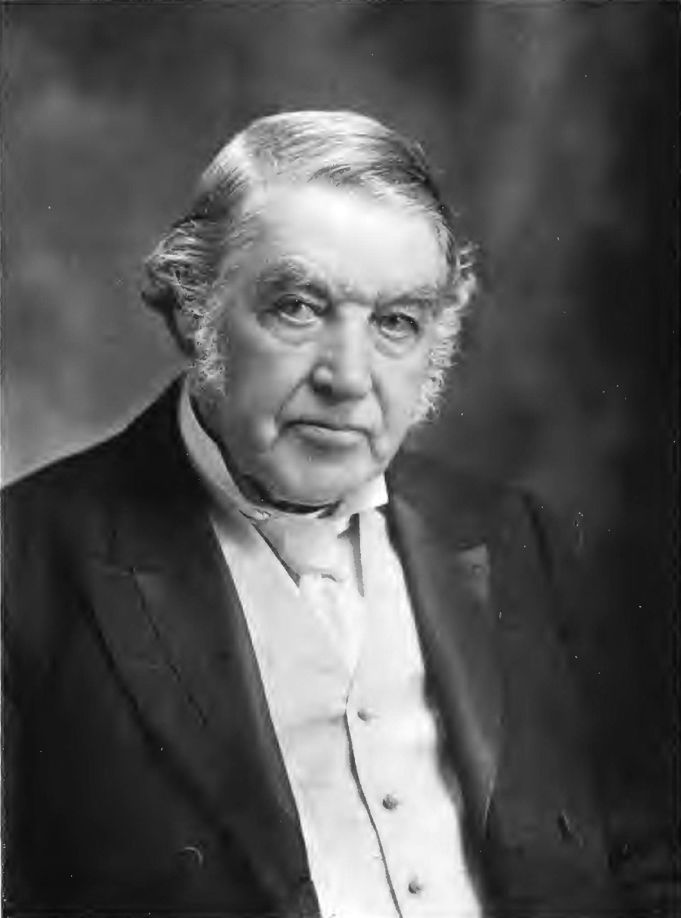
SIR CHARLES TUPPER, Bart.
From a photograph by Elliott and Fry, London
Copyright in all countries subscribing to the Berne Convention
| PAGE | |||
| NOVA SCOTIA: POLITICAL HISTORY, 1867-1912. By Archibald MacMechan | |||
| CONFEDERATION UNPOPULAR | 379 | ||
| THE CLOSING YEARS OF JOSEPH HOWE | 381 | ||
| HOWE'S CHARACTER | 383 | ||
| THE AFTERMATH OF CONFEDERATION | 384 | ||
| SIR WILLIAM FENWICK WILLIAMS | 388 | ||
| PARTIES AND POLITICS | 389 | ||
| RESOURCES AND INDUSTRY | 393 | ||
| NOVA SCOTIA AND THE GREAT BOER WAR | 396 | ||
| NEW BRUNSWICK: POLITICAL HISTORY, 1867-1912. By W. O. Raymond | |||
| THE EVE OF CONFEDERATION | 403 | ||
| AGITATION FOR RAILWAYS | 406 | ||
| THE CONFEDERATION CAMPAIGN | 410 | ||
| IN THE DOMINION | 418 | ||
| THE STRUGGLE FOR FREE SCHOOLS | 419 | ||
| MUNICIPAL GOVERNMENT | 424 | ||
| A DISASTROUS CONFLAGRATION | 425 | ||
| SIR LEONARD TILLEY | 427 | ||
| A PROSPEROUS CITY | 428 | ||
| RECENT POLITICAL EVENTS | 431 | ||
| PROVINCIAL AND LOCAL GOVERNMENT. By Charles Morse | |||
| I. | NOVA SCOTIA | 435 | |
| Beginning of Representative Government—The Office of Lieutenant-Governor—The Executive Council—The Legislature—The Public Departments of Government—The Judicial System and Courts of the Province—The Provincial Revenue—Municipal Institutions in the Province | |||
| II. | NEW BRUNSWICK | 480 | |
| The Provincial Government—The Provincial Revenue | |||
| III. | PRINCE EDWARD ISLAND | 495 | |
| The Lieutenant-Governor—The Executive Council—The Legislature—The Public Departments of Government—The Judicial System and Courts—The Provincial Revenue—Municipal Institutions | |||
| HISTORY OF EDUCATION IN NOVA SCOTIA AND PRINCE EDWARD ISLAND. By A. H. MacKay | |||
| I. | EDUCATION IN NOVA SCOTIA | 511 | |
| Educational Beginnings—The Rise of the Colleges—University Statistics, 1911—Other Independent Colleges and Schools—The Public Schools and Government Institutions—Conspectus of Public School Statistics in Nova Scotia—Conspectus of Education Statistics in Nova Scotia—The Teachers—Salaries of Teachers—Devotional (Religious) Exercises—Classification of Public School Pupils according to Sex and Grade, 1911 | |||
| II. | EDUCATION IN PRINCE EDWARD ISLAND | 537 | |
| HISTORY OF EDUCATION IN NEW BRUNSWICK. By G. U. Hay | |||
| EDUCATION IN PIONEER DAYS | 545 | ||
| THE MADRAS SCHOOLS | 548 | ||
| ESTABLISHMENT OF COMMON SCHOOLS | 550 | ||
| THE FREE SCHOOL SYSTEM | 552 | ||
| HIGHER EDUCATION | 557 | ||
| THE ATLANTIC FISHERIES OF CANADA. By John J. Cowie | |||
| THE FISHING GROUNDS | 561 | ||
| THE PIONEER FISHERMEN | 562 | ||
| BEGINNINGS OF CANADIAN FISHERY | 563 | ||
| EARLY DEVELOPMENTS | 565 | ||
| THE INSHORE FISHERY | 567 | ||
| THE DEEP-SEA FISHERY | 568 | ||
| GROWTH OF THE FISHERIES | 569 | ||
| THE COD FISHERY | 570 | ||
| THE HADDOCK, HAKE, AND POLLOCK FISHERIES | 572 | ||
| THE HALIBUT FISHERY | 573 | ||
| THE HERRING FISHERY | 574 | ||
| THE SARDINE FISHERY | 576 | ||
| THE GASPEREAUX FISHERY | 578 | ||
| THE SHAD FISHERY | 578 | ||
| THE SMELT FISHERY | 578 | ||
| THE MACKEREL FISHERY | 579 | ||
| THE SALMON FISHERY | 581 | ||
| THE LOBSTER FISHERY | 582 | ||
| THE OYSTER FISHERY | 585 | ||
| CLAMS | 588 | ||
| OTHER FISH | 588 | ||
| SEAL HUNTING | 589 | ||
| RECENT DEVELOPMENTS | 589 | ||
| STEAM-TRAWLING | 591 | ||
| FOREST RESOURCES OF THE MARITIME PROVINCES. By R. B. Miller | |||
| I. | NEW BRUNSWICK | 597 | |
| Character of the Forests—History and Progress of the Timber Trade—Lumbering Operations—Forest Conservation | |||
| II. | NOVA SCOTIA FOREST SURVEY | 621 | |
| III. | THE CHIEF COMMERCIAL SPECIES | 624 | |
| Conifers—Hardwoods | |||
| IV. | MINOR FOREST INDUSTRIES | 630 | |
| AGRICULTURE IN THE MARITIME PROVINCES. By M. Cumming | |||
| I. | CLIMATE AND SOIL | 637 | |
| Geographical Situation—Topographical and Geological Features—Geology of Nova Scotia—Geology of New Brunswick—Geology of Prince Edward Island | |||
| II. | AGRICULTURE IN NOVA SCOTIA | 644 | |
| Types of Farming | |||
| III. | AGRICULTURE IN PRINCE EDWARD ISLAND | 657 | |
| History of Agriculture in Prince Edward Island—Types of Farming—Fruit-growing | |||
| IV. | AGRICULTURE IN NEW BRUNSWICK | 663 | |
| History of Agriculture in New Brunswick—Types of Farming—Crops—Fruit-growing in New Brunswick | |||
| MINES AND MINING IN THE MARITIME PROVINCES. By F. H. Sexton | |||
| EARLY DISCOVERIES | 671 | ||
| A PROVINCE WITHOUT MINES | 673 | ||
| COAL-MINING IN NOVA SCOTIA | 673 | ||
| COAL-MINING IN NEW BRUNSWICK | 683 | ||
| IRON AND STEEL INDUSTRY IN NOVA SCOTIA | 685 | ||
| IRON AND STEEL INDUSTRY IN NEW BRUNSWICK | 689 | ||
| GOLD-MINING IN THE MARITIME PROVINCES | 691 | ||
| GYPSUM DEPOSITS | 694 | ||
| MISCELLANEOUS MINERALS | 696 | ||
| SIR CHARLES TUPPER, Bart. | Frontispiece | ||
| From a photograph by Elliott and Fry, London | |||
| OLD WHARVES AT HALIFAX | Facing page | 398 | |
| (1) MILLER'S DOCK AND MORAN'S WHARF | |||
| (2) OLD WHARF ON THE HARBOUR FRONT | |||
| (3) OLD WHARF AT THE FOOT OF SLATER STREET | |||
| From original etchings by Leo Hunter in the John Ross Robertson Collection, Toronto Public Library | |||
| THEODORE HARDING RAND | Facing page„ | 420 | |
| From a photograph | |||
| FISHERMEN AT ISLE PERCÉ AT THE MOUTH OF THE ST LAWRENCE | Facing page„ | 566 | |
| From original paintings by John A. Fraser | |||
| COD-FISHING IN NOVA SCOTIA | Facing page„ | 570 | |
| LUMBERING IN NEW BRUNSWICK | Facing page„ | 602 | |
| (1) A 'JAM' AT GRAND FALLS ON THE ST JOHN RIVER | |||
| (2) A SNOW-COVERED YARD | |||
| LUMBERING IN NEW BRUNSWICK | Facing page„ | 606 | |
| (1) A TYPICAL SHANTY | |||
| (2) A DRIVING SCENE | |||
| LUMBERING IN NEW BRUNSWICK | Facing page„ | 608 | |
| (1) UNLOADING AT THE LANDING | |||
| (2) LOG-DRIVING | |||
| LUMBERING IN NEW BRUNSWICK | Facing page„ | 614 | |
| (1) A LOG-JAM ON A SMALL STREAM | |||
| (2) LOGS ON THE BANK OF A STREAM READY FOR THE SPRING FRESHET | |||
| FARMING NEAR CHARLOTTETOWN, PRINCE EDWARD ISLAND | Facing page„ | 642 | |
| COAL PRODUCTION IN NOVA SCOTIA, 1785-1825 | Facing page„ | 674 | |
| COAL PRODUCTION IN NOVA SCOTIA, 1826-1892 | Facing page„ | 678 | |
| COAL PRODUCTION IN NOVA SCOTIA, 1893-1912 | Facing page„ | 680 | |
| GOLD PRODUCTION IN NOVA SCOTIA | Facing page„ | 690 | |
| IRON AND GYPSUM PRODUCTION IN NOVA SCOTIA | Facing page„ | 694 | |
NOVA SCOTIA: POLITICAL
HISTORY, 1867-1912
'Not Confederation itself, but the way it was brought about,' say Nova Scotians, 'was our reason for fighting Confederation.' How real their objection, how strong their opposition, is manifest from what took place immediately after the dissolution of the assembly. On July 1, 1867, by the fiat of the imperial parliament, the union of four scattered colonies was consummated; a new nation had come into being; and new elective bodies must be chosen to carry out the new constitution. Nova Scotia had ceased to be a quasi-independent state. Against the will of its people it had been forced into a new political combination, to which public feeling was actively hostile. On such a momentous question as a complete change of status the people directly affected should surely have been consulted; the consent of the governed should have been obtained; but in his brief span of power a strong-willed man carried this radical measure by the weight of his majority in the local parliament. Even if he be credited with broader patriotism, wiser statesmanship and deeper vision than his opponents, still, to overturn the whole constitution of a quasi-independent state and alter all its relations without a mandate from the people was dead in the teeth of every principle of free self-government. It provided one political party with a grievance that lasted for thirty years.
Nothing could be more free from doubt or ambiguity than the pronouncement of Nova Scotia on the question as soon as she could make her voice heard. In the first Dominion elections the only Confederate returned was Dr Tupper himself. For the assembly only two Confederates were elected: of these one was immediately unseated and an anti-Confederate elected in his place. In the first Dominion parliament Howe headed a solid party of seventeen opposed to Confederation, while his friend Annand became premier of the local house of thirty-eight members with just one lonely Confederate for the entire opposition.
In winning such a victory Howe had, of course, the prime part. His 'Letters to the People of Nova Scotia,' which constitute his apologia, tell of his labours through that strenuous campaign. The battle with Tupper in the joint debate at Truro was the talk of the province. It was a war of giants. But Howe was not alone, and to attribute the liberal triumph solely to his eloquence and energy is a grave error. The consistent opposition of W. Garvie, an able writer, in the Citizen must be reckoned with. Annand of the Chronicle was only one of a number of irreconcilables who never accepted the new order, and worked tooth and nail against it long after their efforts were plainly hopeless. The agitation and discussion in the newspapers from 1864 to 1867 convinced the people of Nova Scotia that the contemplated change was undesirable and had effected a complete cleavage between them and the majority in the assembly. It is also an error to attribute the result to mere faction and the wiles of the demagogue. Subsequent events showed solid grounds for objection, and Nova Scotians are not the sort of people to be stampeded by an empty cry.
Steps were at once taken to induce the British government to reconsider its action so far as to permit Nova Scotia to recover her ancient status and relation to the Empire. Howe, Annand and Hugh McDonald formed another delegation to England. These men left no stone unturned to effect their purpose. But the great public was indifferent, the House of Lords could not be interested, and Bright's motion for mere inquiry in the Commons was defeated. Britain had her own difficulties. Her relations with the United States were strained. An American politician actually demanded the whole of British North America in settlement of the Alabama claims. To disrupt the newly formed Dominion as soon as it was formed looked like an act of folly. The delegates could not even obtain a hearing, and, sick at heart, they came back to the province.
On the return of the disappointed men an anti-Confederate council of war was held in Halifax. It consisted of the members of the Dominion and of the local house. All sorts of wild schemes were suggested—blocking the wheels of the constitution by wholesale resignation, armed resistance, even the intervention of the United States and annexation. Howe pointed out the hopelessness of fighting. 'There are the British bayonets,' he said. But it was no mere flourish when he talked of dying with his boys on Tantramar marsh. As for calling the United States to aid, it was unthinkable to a patriot like Howe. He would none of it. Resignation in a body meant the loss of place and salary, and for such a sacrifice the office-holders were not prepared. This conference justified the proverb that a council of war never fights, and it broke up without any concerted plan of action.
At the very same time Sir John A. Macdonald and Sir G. É. Cartier came to Halifax to listen to complaints, to hear both sides, and, if possible, to placate the party of disruption. Howe had to write a chivalrous letter to the Chronicle bespeaking a courteous reception for the Canadians. The party lodged at Government House and conferred with all who would do so. Irreconcilables like Annand refused to meet them at dinner. But 'Old To-morrow' employed all his well-known powers of diplomacy and persuasion. With Howe, as the acknowledged leader of the anti-Confederates, he discussed the whole question. He was willing to do anything in reason to win over his opponents, to conciliate local feeling and to preserve the Union. He succeeded in winning over Howe, who was already convinced of the futility of further opposition, and at a heavy price devoted himself to obtaining 'better terms.' In a conference at Portland with Sir John Rose, the finance minister, the final details were arranged. On his return to Halifax the whisper ran round that Howe was a 'traitor,' that he had been 'bought.' In January 1869 he was appointed president of the council in the Macdonald government. Sir John had invited him to assist in working out the plan of 'better terms,' for he needed a man of Howe's ability to overcome the opposition of the other provinces to further money grants to Nova Scotia. The 'better terms' meant a further subsidy of $80,000 for a period of ten years and the assumption of a million more of the provincial debt.
It is difficult to see what else Howe could have done. Repeal was hopeless. The only course that remained open was to make the best of what he regarded as a bad bargain. Howe's action benefited Nova Scotia, but it cost him almost every friend he had left. After more than thirty years of comradeship Annand turned against him and filled the Chronicle with venomous attacks upon his old chief. The hatred of the anti-Confederates for their leader's defection was shown in his next political campaign. That same winter Howe had to contest Hants County with Monson Goudge, the president of the legislative council. It was the old lion's last fight and his hardest. The anti-Confederates put forth every effort to defeat him. He won, but he was never the same man again. The Hants election killed him. At a joint meeting in the schoolhouse at Nine Mile River his physical agony made it impossible for him to stand. He lay on the floor of the platform, wrapped in his cloak, while his adversary, nicknamed 'Roaring Billows,' stood over his prostrate form 'bellowing like a bull of Bashan.' That night he took to his bed and did not stir out again for a month, but he could still command the support of loyal friends who carried the canvass through and won the seat for him.
Howe's career was over. An old and broken man, he sat in the Macdonald cabinet as secretary of state for the Provinces for some three years, and then, in May 1873, the dying man was paid the compliment of being placed at the head of the province he loved so well and had served so loyally and long. He was sworn in as lieutenant-governor on May 10, but he enjoyed the honour less than a month. On June 1 he was dead. It was fitting that he should die in Government House, and it was characteristic that he should die on his feet. The night before his death he was in great pain and unable to sleep: he spent it in his study, sitting in his chair, or restlessly pacing the floor. Towards dawn he was induced to go to his bedroom. As he neared the bed he staggered and fell into his son's arms. In ten minutes he was gone.
Over his grave the parties made a truce. Even his bitterest foes paid tribute to his greatness. As the years go by the figure of Howe will detach itself more and more from the clouds of detraction and party enmity and reveal its towering height and massive strength, for the generations to come will learn to know him from the printed record of his own words, and they retain their vital heat. It is impossible to read Howe's state papers, his public letters, his speeches, and refuse him the epithet 'great.' For breadth of view, for piercing insight, for firmness of grasp, for raciness and energy of style, they stand absolutely alone. Howe served his country well. He attacked and defeated single-handed the banded respectabilities of his time; he gave his province a new constitution; he fostered her material progress in every way; he educated British statesmen in the principles of popular government; he was the first of Canadian leaders to think imperially; he lived in the constant close companionship of great ideas; he had strange power of speech to move the hearts of men as the wind sways the fields of wheat; he embodied and intensified the strong local feeling that glorified the province of his birth. His story is fascinating, enigmatic, tragic. It offers the solitary case of hero-worship in Canadian history. Men remember his words, his characteristic gestures, his grey suit, his white hat, his jaunty walk, the way he would open and throw back his coat as he took the platform. The province is full of anecdotes about him. Even now, men take sides and dispute regarding his motives and his actions. Faults he had not a few. He was egotistic, he was careless about money, his debts mined his independence; he was not the kind of politician that fattens on politics; he could shock the prudes; at the great crisis of his life he was weak, jealous, untrue to himself. But he had puissant and splendid excellences to put on the other scale: his courage was above proof, he was unselfish, he was chivalrous even in his hardest fights, he gave without reserve his whole marvellous strength to the public service; he was a true patriot—Nova Scotia's faulty, generous, great-hearted tribune of the plebs. His monument stands beside the Province Building which so often rang to his eloquence. The bronze effigy seems alive. It will be level with the dust before Nova Scotia can forget her favourite son.
The aftermath of Confederation in Nova Scotia is now to be considered. The strife of parties was the fiercest, the question at issue was the most important, the leaders were the ablest and best matched, in all the provincial history. Men's strongest passions were aroused. The very children shared their fathers' animosities and fought, Confederates and anti-Confederates. The intensity of the struggle is seen in the fact that less than twenty years later it was possible to raise once more the cry of 'Repeal' and carry the country on it. To pretend that the battle of 1867 was the ordinary party sham-fight of the ins and the outs is to misread history and human nature.
If Confederation was not an immediate and dazzling success the student of history will not be surprised. It was a daring experiment. Howe's keen criticism of the 'Botheration Scheme' read forty years later brings out a truth he did not intend—the brilliant audacity of the men who tried to form a new nation out of such disparate elements as the four original provinces. More clearly than any one Howe points out the dangers and difficulties. Now Canadians forget that they existed. For a generation the Canadian union was in the experimental stage. It might succeed, or it might fail. Now that the experiment has succeeded, to the admiration of the world, no one remembers by what toil success was guaranteed and with what tremors its progress was watched. There was friction still between French Catholic Quebec and English Protestant Ontario. Nova Scotia came in with a deep sense of injury. Her autonomy had been roughly disregarded. Between the seaboard provinces and the inland centres of population there was a wilderness to be crossed, and between the English-speaking provinces stood the solid French wedge. A statesman might well have doubted if such an experiment in nation-building would come to aught.
Once more in the history of Nova Scotia a completely new orientation was necessary. Now, instead of England with her stately past, the eyes of the province must be turned to 'Canada,' which had only a future. Ottawa unknown, in the making, somewhere in the inaccessible interior, had nothing to compare with London's thousand years of vivid, varied, historic interest. London was much nearer to Halifax than Bytown was. There was a feeling, too, that Nova Scotia 'belonged' to Canada, a country known only for rebellion, deadlocks and debt, and did not 'belong' any more to Britain. The ancient, deep-rooted loyalty to the mother country protested against the sudden, forcible transfer of allegiance. The new national ideal was neither well defined nor specially attractive, and Nova Scotia was slow in responding to the appeal. To this day the Canadian tourist in Nova Scotia is astonished at being asked if he comes 'from Canada.' The question is an unconscious indication of the old separatist feeling.
At the same time, it must be remembered that the whole influence of the conservative party in the province has been given steadily and loyally to the support of the national idea. That party, however, has only held power for four years out of forty-five.
Confederation did not make any province suddenly rich, and it was considered a failure in Nova Scotia for several post hoc, propter hoc reasons. Hard times set in. The Reciprocity Treaty with the United States expired, after it had been renewed through Howe's Detroit speech. At first it was rather resented in Nova Scotia, and its benefits to the province were slight. When the American Civil War broke out, however, the States offered an eager market for every bushel of provincial produce. Water carriage was cheap and easy; the natural line of trade was open once more for the first time since 1775. Halifax, as ever, profited greatly by war. Before the blockade of the Confederate ports became effective, the Halifax merchants sent in cargoes of fish and lumber and brought back cotton. When the Federal cruisers shut the South from the sea, Halifax harbour was thick with blockade-runners, low-built, speedy, mouse-coloured iron steamers with collapsible funnels. They would load in Halifax and sail out boldly under the British flag to Nassau. All goods were paid for in gold. There were no accounts and no bad debts. If they succeeded in slipping past the Federal cruisers into Wilmington, they would buy cotton at sixpence a pound, contract price, which sold in England for three and sixpence. The captains, naval officers under assumed names, got a thousand pounds a trip, in and out, and the privilege of bringing out, on their own account, ten bales of highly compressed cotton. But the war came to an end, blockade-running ceased, war prices returned to normal, and, with the expiry of the Reciprocity Treaty in 1867, the trade of Nova Scotia with its natural market stopped abruptly.
Another pinch was the ruin of a staple crop. About 1860 the weevil came to Nova Scotia and attacked the wheat. It was impossible to stop the plague, and 'bread corn' ceased to be cultivated. Some years ago an artist in Nova Scotia, wishing to paint mural decorations representing the four seasons, was hard pressed to find a wheat-field as his model in his autumn scene. On the rich intervale land of Pictou wheat had been grown for two generations, often with a yield of forty bushels to the acre. That phase of farming passed away definitely. The loss to the farmers and millers may be readily understood.
Another reason for the unpopularity of Confederation in Nova Scotia was the decay of wooden shipbuilding. That indecisive fight in Hampton Roads between the Merrimac and the Monitor decided one thing—warships and merchant ships should henceforth be of iron. Now the tramp steamer has driven sails from the sea. Nova Scotia had a huge capital invested in ships, and owners were slow to realize the revolution that had come about in the carrying trade. Only the irresistible logic of dwindling profits and dead losses forced them out of the business. The marked decay set in about 1874, and in thirty years Nova Scotia's chief industry was dead. This was the heaviest blow ever dealt to provincial prosperity. It speaks volumes for the recuperative power of the province that it is recovering from such a blow.
One direct effect of Confederation that distinctly injured the business of the capital was the building of the Intercolonial Railway. This was really a violent attempt to overcome nature and geography by establishing a new trade route. As a maritime province the trade of Nova Scotia had been from the first water-borne to England, to the West Indies and to the nearest American colonies. Now the nation-builders of Canada, confident of her future and greatly daring, ran an iron road through a wilderness and linked Halifax with Quebec. This ready means of communication had an unforeseen effect upon the trade of the province. The wholesale merchants of Toronto and Montreal sent their travellers in and secured a large part of the trade that had so long been the monopoly of the wholesale merchants of Halifax. It was a reversal of the ancient order of things. In the good old days the retail merchant came from the country to the city. He approached the wholesale magnate humbly, and after a glass of wine in the office and a chat on general topics, he would request permission to see the goods he might order. To go after business, to drum it up, to employ ambassadors of commerce to visit the country merchants and solicit orders for goods was a most unheard-of, undignified proceeding, and the indignation of the old-fashioned Halifax merchants at 'those Canadians' poaching on their preserves was extreme. Halifax lost her pre-eminence, but the country towns profited. They began to import for themselves, and so became independent of the capital.
All these things came together after Confederation, and for them, illogically enough, Confederation was held to blame. There were other changes, inevitable but none the less to be regretted, which arose from the changed status of the province. The battle over Confederation is the fiery climax of Nova Scotia's one hundred and ten years of independent political life and of her unrelaxing efforts to govern herself. The final struggle left the province exhausted. Death claimed Johnston and Howe. Tupper found scope for his ambition in the wider field of Dominion politics. These men left no successors to their strength or their policies. The provincial arena was so shrunken, the interests involved were so narrow, that inevitably the men of outstanding ability were drained off into national politics. Tupper, Fielding, Thompson, Borden are examples of the strong drag towards the centre. The general assembly, with its ancient and worthy tradition of great principles and great debating, can never be what it once was. Henceforward its activity must be limited to the bounds of a county council, labouring over the honest disposal of the provincial revenue, and meticulous details of expenditure for roads and bridges, for education and public charities.
And with the glamour of the Province Building has passed the glory of Government House. It is in thorough accord with every democratic theory and tendency that the office of lieutenant-governor should be filled by the native-born. But in practice it is difficult to find the combination of qualities that are desirable in the official head of the province. Little remains to the modern lieutenant-governor but to maintain the dignity of his province on public occasions and to act as a social centre. The constitution leaves him very narrow range of action. The choice in candidates is limited. When the lieutenant-governors were really intended to govern, men of distinction were selected for the office. The old order was doomed, but the lover of the picturesque may be permitted a sigh for the days of Wentworth and Sherbrooke, Dalhousie and Kempt.
One of the last and not the least distinguished 'royal governors' was a native of Nova Scotia. Sir William Fenwick Williams was born at Annapolis Royal in 1800. He entered Woolwich in 1815 just as the long peace began. The Crimean War found him a middle-aged officer of the Royal Artillery, who had spent fourteen years in assisting the organization of the Turkish army. His opportunity came late in life, like Havelock's, when he was shut up in Kars, a city on the eastern border between Turkey and Russia, by a greatly superior Russian army under Mouravieff. By sheer skill, courage and sagacity he held the Russians at bay for six terrible months. In one desperate battle outside the city walls his Turks accounted for six thousand of the enemy, killed and wounded. Cholera and starvation decimated the garrison; the soldiers shared their scanty rations with the famishing townspeople. At last, when word came that the relieving force could not reach him, Williams thought of surrender. He stipulated for the honours of war; otherwise he would burst every gun, destroy every standard and trophy, and allow Mouravieff to wreak his will on the garrison. The chivalrous Russian accorded the most honourable terms. The defence of Kars was the most brilliant episode of the Crimean War, the admiration of all professional soldiers. England showered distinctions on the hero—a baronetcy, a pension of a thousand pounds a year for life, the freedom of the city of London, a sword of honour, and the degree that Oxford reserves for men of mark. His native province also voted him a sword of honour, the last time that knightly compliment was paid. He was appointed lieutenant-governor in 1865 and valued the honour highly. His portrait hangs in the council-chamber of the Province Building to remind coming generations what Nova Scotians have achieved.
Another notable son of the province to be named for this office after Howe's death was Johnston. He was travelling for his health in the south of France at the time of his appointment, but he died before he could reach home and is buried in Cheltenham. It was only fitting that both these ancient rivals should be paid the high compliment of being placed at the head of the province they had done so much to distinguish. Such memories cling to the time-stained walls of Government House.
After the Heroes, the Epigoni! A smaller race of provincial politicians succeeded. Annand died still unreconciled, and was followed by the government of P. C. Hill, which was turned out by the one conservative administration that has governed the province in forty-five years. The leader was Simon Holmes, a native of Pictou County, editor of the Colonial Standard. He had for second-in-command a young Catholic lawyer, John Sparrow Thompson, whose father had been Queen's Printer. He was destined to become prime minister of Canada and to find death in Windsor Castle. The Holmes-Thompson government was noted for its careful, economical use of the provincial revenue, by which it was able to reduce the outstanding debt and to increase the efficiency of the school system by enlarged grants. Owing to ill-health Holmes was obliged to retire from politics in 1882, and Thompson was soon after raised to the bench. This solitary instance of the conservative party obtaining power since Confederation is a remarkable political fact. Majorities in Canada are strangely permanent. The Canadian people are not lightly given to change; but four years out of forty-five is entirely disproportionate. There is the fact, interpret it who may.
To the Holmes-Thompson government succeeded that of W. T. Pipes and W. S. Fielding, who entered political life almost by accident as a compromise candidate by way of the Chronicle office. As provincial secretary Fielding reigned without intermission from 1884 until the liberal victory of 1896, when he became minister of Finance in the Laurier government. His long term of office is noteworthy for two measures, which diversify the monotonous record of parish legislation.
On May 10, 1886, just before the provincial elections, W. S. Fielding, from his place as provincial secretary, moved a remarkable series of resolutions, which form a sort of epilogue to the struggle of 1867. These contrasted the state of the province before and after Confederation. Before, 'the Province of Nova Scotia was in a most healthy financial condition.' 'Nova Scotia, previous to the Union, had the lowest tariff and was, notwithstanding, in the best financial condition of any of the Provinces entering the Union.' Now, 'the commercial as well as the financial condition of Nova Scotia is in an unsatisfactory and depressed condition.'
The resolutions assigned the reasons for the 'unsatisfactory and depressed condition.' By the terms of the Union the chief sources of revenue were transferred to the federal government. Further, they pointed out that the promises contained in Sir John Macdonald's letter to Howe, dated October 6, 1868, had never been fulfilled. They also asserted roundly and without any qualification that 'the objections which were urged against the terms of Union at first apply with still greater force now than in the first year of the Union.' Taken all together, they form a severe arraignment of Confederation, and justify every criticism Howe made of the pact. After giving the new idea a trial of nineteen years, those in charge of the provincial affairs declared deliberately, in their official capacity, as representatives of the people, that the experiment had failed so far as Nova Scotia was concerned.
The remedy proposed was the old object of the Charlottetown conference—Maritime union, the peaceful detachment of the three Atlantic provinces from the Dominion; in other words, a reversion to the old boundaries of Acadie, prior to 1784. If Maritime union is not possible, the government of Nova Scotia 'deems it absolutely necessary' to 'ask permission from the Imperial Parliament to withdraw from the Union with Canada and return to the status of a Province of Great Britain, with full control over all fiscal laws and tariff regulations within the Province, such as prevailed previous to Confederation.'
The final resolution runs: 'That this House thus declares its opinion and belief, in order that candidates for the suffrages of the people at the approaching elections may be enabled to place this vital and important question of separation from Canada before them for decision at the polls.' The English might easily be improved by the pen of Howe, but the intention is unmistakable. After debate the repeal resolutions were carried by a vote of fifteen to seven.
Outside the house the resolutions were bitterly assailed. The liberals were accused of insincerity, of sectionalism, of making merely a party move. Elsewhere in Canada the cry of Repeal aroused something like consternation. In Ontario the new national idea was so completely accepted that the outspoken protest from the Atlantic was regarded as a piece of incomprehensible ingratitude. That any province could possibly object to its rôle in Confederation was a novel and unwelcome idea to the generation of Canadians growing to manhood since 1867 and knowing nothing but one country stretching from the centre to the sea. And yet Nova Scotia was declared in unmistakable official terms to be discontented.
The decision of the people at the polls in regard to the 'vital and important question' was free from any doubt. Fielding was returned to power with a large majority. Nova Scotia had given him what he asked, a mandate to take his province out of the Union, and his natural course would have been to petition the British government and head delegations to England as Howe did in 1866 and 1868. It is quite conceivable that Nova Scotia, a quasi-island with its own tariff, might flourish as does Newfoundland in its old status as a colony. Its natural resources are very much greater, and its power is much more evenly diffused. It is also conceivable that, however pained and grieved by the defection, the rest of Canada would never think of opposing separation by force, though it would pay handsomely to preserve the Dominion ring-fence intact. But Fielding did nothing. Two of his party, W. T. Pipes and T. R. Black, frankly refused to contest their seats on the separation cry. Pipes retired from politics altogether, and Black was returned at the head of the poll. On his return to office, in 1887, Fielding passed other resolutions alleging further action impossible in view of the fact that in the Dominion elections, held at the same time, a majority of conservatives had been elected. Nothing was done further to obtain repeal, but the agitation had one material result. Once more Nova Scotia obtained an increase to the subsidy from the Dominion. His political opponents held that Fielding had stultified himself.
Those repeal resolutions remain on record for the instruction of students of Canadian history, and for the warning of Canadian statesmen. They testify to Howe's foresight. What he predicted came to pass. The modern vulgar reverence for the merely big, megalomania, and the vulgar admiration of mere wealth have led the larger states of Canada to look on the smaller, poorer states with something akin to contempt. Such phrases as 'the shreds and patches of Confederation' and 'Ontario the milch-cow of the Dominion' are straws that show the direction of a steady wind of political opinion. The popular conception of Nova Scotia approaching Ottawa for an increased subsidy is a mendicant holding out his hand for alms. The true conception is of a partner in a going joint concern demanding his lawful share of profits. As Andrew Macphail truly says: 'The Fathers of Confederation never intended that the Dominion should be rich and the provinces poor.' No matter which party has held the purse-strings at Ottawa, the Dominion government has never erred on the side of liberality to the member of the Confederacy that sacrificed most for the ideal of national unity.
A striking physical feature of Nova Scotia is its mineral wealth. Within its borders almost every species of ore is found—gold, iron and coal—but the chief of these is coal, the indispensable basis for the age of steam. Coal is found in many parts of the province—in Cumberland, in Pictou, and, above all, in Cape Breton. In Cape Breton some four hundred square miles of desolate country are underlain by seam below seam of rich bituminous coal. The exploitation of this vast wealth began in a feeble way as early as the seventeenth century. Denys mentioned the coal of Cape Breton in his Description and Natural History of Acadia of 1672, and five years later was authorized by the French government to collect a tax of twenty sous per ton on all coal exported from the island. The ships at first were loaded from the cliffs. When the French began to fortify Louisbourg in 1720, the first attempt at mining was made on the north side of the island, to meet the needs of the workmen engaged. The first mining after the English occupation dates from 1766, when four Halifax merchants—Gerrish, Lloyd, Armstrong and Bard—for the sum of £400 paid to the government were granted the privilege of mining three thousand chaldrons, on condition of their sending half the quantity to Halifax and not charging more than twenty-six shillings per chaldron. These enterprising men began mining at Spanish River, now Sydney. Very little was done to follow up the work. In 1826 the total average annual yield of all Cape Breton was only 7500 tons. In 1872 it was 383,000 tons; in the same year Pictou produced 5000 tons more. This was a considerable advance in forty-six years, but still it was only scratching the surface of these enormous deposits. Small companies, feebly capitalized, with antiquated machinery, were competing with one another, and far from prosperous. This was the situation of coal-mining in Nova Scotia up to the year 1893.
By very ancient English law all minerals are deemed to be the personal possession of the crown, and this law was embodied in the constitution of Nova Scotia. That is the reason that Gerrish and his partners had to pay so handsomely for the privilege of digging the Spanish River coals, now the favourite 'Old Sydney.' George IV took the law literally and transferred the coal-mines of Nova Scotia to his brother the Duke of York to pay his debts. The duke in turn made them over to the once well-known London firm of jewellers, Rundell, Bridge and Rundell. For some time they worked the mines and held Nova Scotia in tribute. It is one of Johnston's great public services that he recovered, by his legal knowledge and diplomacy, Nova Scotia's rights to her own coal-mines. The coal areas were never sold outright, but were leased for a term of thirty years, and the lessees paid the government a royalty of seven and a half cents for every ton raised, and the proviso of this ancient law had far-reaching results.
About the year 1889 it occurred to B. F. Pearson, a lawyer of Halifax, that this situation might be improved. Pearson came from Colchester, and he had already promoted considerable local enterprises. His project was to combine and work the coal-mines of Cape Breton on an entirely modern business plan. It was a large conception. He was able to interest H. M. Whitney, a prominent capitalist of Boston, and, working with him, bought out nine Cape Breton collieries. The result was the formation of the Dominion Coal Company. In the necessary legislation passed at a special session in January 1893 important modifications were made in the old law: the term of the lease was increased from thirty to ninety-nine years, and the royalty from seven and a half to twelve and a half cents per ton. This increase brought in 1912 the total amount of coal royalties up to $800,000. Thanks to this law and the enterprise that consolidated the coal industry, the province is sure of a yearly revenue, which must steadily grow.
Another important result was the formation of a sister industry, the Dominion Iron and Steel Company, in order to find a steady customer for the huge quantities of coal that would be raised by improved modern methods and management. Again H. M. Whitney supplied the money and floated the company. Sydney, des Barres' old capital, was selected as the site of the huge complex of buildings, wharves and roads necessary for the production of steel on an enormous scale. Millions were spent in the necessary first outlay, and a great deal of it was wasted. As soon as the furnaces began to produce the first billets, Dominion Steel stock rose on the market. Every one bought; the value of the stock steadily mounted; and then came a drop, and hundreds of Nova Scotians lost heavily. The truth is that the company was used for the purpose of speculation and was nearly brought to ruin. Strikes and an expensive lawsuit hampered its development, and 'American enterprise' nearly wrecked it. Under Canadian management it is gradually coming back to a sound financial basis.
Another great concern with an entirely different origin and history is the Nova Scotia Steel and Coal Company of New Glasgow. In 1872 it began in a small way as the Hope Iron Works, with a capital of four thousand dollars. In thirty years it had grown to a corporation with a capitalization of fourteen millions and six thousand persons on its payrolls. In Cape Breton it acquired from the General Mining Association fourteen square miles of coal areas at the mouth of Sydney Harbour. It draws its ore from Bell Island, Newfoundland, which consists almost entirely of red hematite, part of which it sold to the Dominion Steel Company for a million dollars. This native company has made haste slowly, but its progress has been sure. No one can examine these two industries, or survey even what strikes the eye, without being convinced that the future of Nova Scotia is industrial. Great as are her fisheries, her forests and her orchards, their yield is even now insignificant compared with the actual output of coal and steel. Around the 'plants' at Sydney and New Glasgow ancillary and derivative manufactories are springing up. It seems impossible that they shall not grow and add immensely to the wealth of the province.
In 1896 W. S. Fielding was one of the provincial premiers called to form the Laurier cabinet. He resigned his office as provincial secretary and stood for the constituency of Shelburne and Queens. He was elected and became minister of Finance. His first budget speech, in 1897, made him famous for the significant clause according a preference to English manufactures coming into Canada. This measure was regarded in England as a sign of the growing feeling of unity among the scattered members of the Empire, and it had a result probably unique in the history of budget speeches—it produced a poem, much misunderstood by Canadian journalists, 'Our Lady of the Snows.' Fielding's successor in the assembly was a young lawyer from North Sydney, named George Murray. He has remained in control ever since, with hardly sufficient opposition, until recently, to ensure competent criticism of government measures. The Murray administration has been noted for its honesty and economy. It has also the honour of extending a broad scheme of industrial education which must greatly increase the efficiency of the working classes.
One line of Kipling's glowing and prophetic characterization of Canada ran, 'I, I am first in the battle,' and this event was soon to prove true. Two years later the Boer War broke out, and in October 1899 Canada sent her first force of a thousand men to the war. Nova Scotia did her part and soon recruited the number of men required to fill a company, which was designated 'H' in the second battalion of the Royal Canadian Regiment. The captain chosen was a young graduate of Dalhousie, H. B. Stairs, a lawyer and an officer in a local volunteer regiment. He belonged to a Halifax family that had been firmly established in the city for more than a century. His grandfather, a fine type of the old-fashioned merchant, was the lifelong friend of Howe and the first opponent of Confederation. His cousin, John F. Stairs, represented the city in the Dominion House for years. His brother, Captain W. G. Stairs, was Stanley's right-hand man in the Emin Pasha expedition.
Canadians did not expect very much of the 'First Contingent,' as it was commonly called. They would be put on garrison duty, it was supposed, in order to set the regular British regiments free for the front. The First Contingent themselves entertained other views. They were jealous of their honour and they would have hotly resented any difference in treatment from that meted out to the most famous battalion in the whole Army List. There was no difference in their treatment. They were rushed to the front, they were worked hard, they made forced marches on quarter-rations, and, to their joy, they found that they were depended on. They were tested under fire over and over again, and they stood the test like veterans. Their great opportunity came in the night attack on Cronje's camp at Paardeberg.
A long-strung-out line of Canadians moved forward silently from their trenches in the darkness of February 27, 1900, to assail a position of unknown strength; Shropshires and Gordons were in support. The Canadians were at right angles to the river, and H company was at the very right of the line and next to the stream. Their orders were to advance until fired on and then to entrench. They did so. After some firing an unknown person shouted 'in an authoritative tone': 'Retire, and bring back your wounded.' The whole battalion fell back for some distance, with the exception of H company and part of G company which was next to it. The fusillade continued until dawn revealed the situation. When Brigadier Smith-Dorrien crawled into the donga which the two Canadian companies and some Royal Engineers who accompanied them had improved into a rude trench, he found it was parallel to the T trench at the end of Cronje's long main trench following the bank of the Modder. From their position, sixty measured paces from the T trench, H company was able to enfilade the main trench, and for two hours they took their revenge for what they had suffered in the night. Then the white flag was raised over Cronje's camp and the bugles sounded 'Cease firing.'
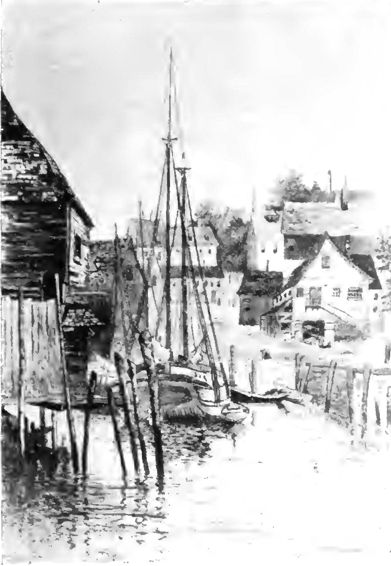
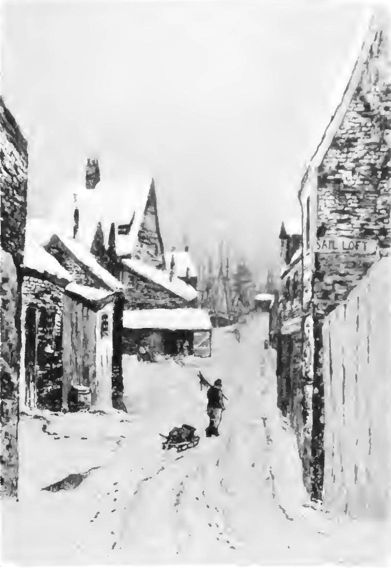
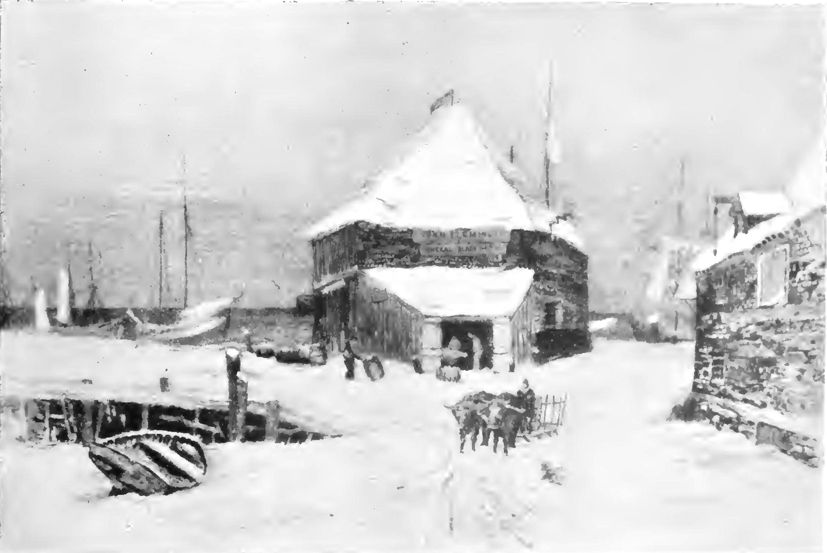
OLD WHARVES AT HALIFAX
1) MILLER'S DOCK AND MORAN'S WHARF
2) OLD WHARF ON THE HARBOUR FRONT
3) OLD WHARF AT THE FOOT OF SLATER STREET
From original etchings by Leo Hunter in the John Ross Robertson Collection, Toronto Public Library
For his steadfastness Captain Stairs was mentioned in dispatches and awarded the Distinguished Service Order, and on the old Lower Parade of Halifax, north of the Province Building, stands a monument to the dead of H company. It is a bronze soldier, in the uniform and equipment of the First Contingent, signalling with his rifle the approach of the enemy. The soldier balances the figure of Howe on the other side, who once said: 'A wise nation preserves its records, gathers up its muniments, decorates the tombs of its illustrious dead, repairs its great public structures and fosters national pride and love of country by perpetual references to the sacrifices and glories of the past.'
The history of that territorial division of North America known as Acadie or Nova Scotia according to the European nation that owned it covers three eventful centuries. At first the haunt of the romantic explorer, seeking riches, trading in furs, striving to transplant the feudal system to the New World, the province was bandied to and fro for a century between the soldiers and diplomats of two great European powers. At last one held tenaciously to what she had gained by the sword, and gradually broke and drove her rival from the field. Then, from the opening of the eighteenth century, the population began to expand naturally and to take possession of the soil. English occupation ensured an outline sketch of free government, which was later more clearly defined and completely filled in. Colonized effectively by two immigrations from the sister American colonies, Nova Scotia developed a strong individual life and marked local patriotism. At the same time the double pressure of war and exile strengthened the feeling of loyalty and affection to the motherland. In many ways and in many places that sentiment has shown itself, from the bloody deck of the Shannon to the snow-bound trenches of Sebastopol and the bullet-swept plains of Paardeberg. At one time of stress the province was split in two, a fission that the logic of time has proved to have been a political blunder. Although the ancient paternal system of government lasted far into the nineteenth century, the long familiarity of a law-abiding people with constitutional methods enabled a native leader of genius to work out by peaceful means the problem of a modern, democratic, self-governing state. Geographical conditions produced the industries of lumbering, fishing and seafaring; and these industries have reacted on the character of the people. When the time came for merging the province in a larger national unity, the great change was attended by friction, which all must regret; but the strife of that time has become merely a picturesque memory. In the new orientation there was loss and there was gain, but no one would now think seriously of returning to the old status. World-wide economic changes injured the province severely. One great industry, shipbuilding, was wiped out altogether by the discovery that an iron ship was better than a wooden ship and that steam was better than sails. But Nova Scotia has shown extraordinary recuperative power. The steel plants at Sydney and New Glasgow point out the way of future industrial progress. To the life of the new nation Canada, Nova Scotia brought her valuable contribution of a strong, well-defined individuality. The influence of politicians from the province in the central parliament has been out of all proportion to its mere size and population. Three have been premiers, while a fourth, the same leader who advocated taking his province out of the Union, had the honour of giving the mother country preferential treatment in her commerce with Canada. Time was needed for Nova Scotia to adjust herself to new political conditions, but that adjustment is now complete. Adjustment to new industrial conditions will follow. At the opening of the twentieth century Nova Scotia, while mindful of her distinguished and honourable past, looks forward to the part she is to play in the future of Canada with confidence and hope.
NEW BRUNSWICK: POLITICAL
HISTORY, 1867-1912
A glance at the conditions existing in New Brunswick on the eve of Confederation will serve as an introduction to the period we are here to consider. It was not until 1855 that a full measure of responsible government, as we now understand it, prevailed in the province. This was somewhat later than was the case in the sister provinces, but there was ample compensation in the fact that in New Brunswick the struggle over this burning question was attended by little of the turmoil that prevailed in other parts of Canada.
The agitation for responsible government did not begin in good earnest until 1840. From that time it was continued under the leadership of Lemuel Allan Wilmot, Charles Fisher, William J. Ritchie and their associates until 1854, when the reins of power were wrested from the grasp of the Family Compact, which had retained control for seventy years. Under the new system the members of the executive government no longer held office during pleasure or good behaviour, but only so long as they retained the confidence of a majority of the representatives of the people in the house of assembly, the criterion of their fitness for office being their performances as advisers of the lieutenant-governor and originators of sound measures for the betterment of the country. Many of the men who were destined to play an important part in the promotion of Confederation were trained for leadership in the struggle for responsible government.
The decade that preceded Confederation was one in which New Brunswick made rapid progress in wealth and population. Immigration reached its largest proportions in the forties and then began to decline, but new settlements continued to spring up in various parts of the province. Irish navvies came to work upon the railways that were in course of construction, and many of them became settlers. More than seventy per cent of the total immigration to New Brunswick came from Ireland.
To stimulate the settlement of the waste places the government passed a Labour Act, under which settlers were to pay for the lands on which they settled by labour on the roads in and near their settlements. Most of the settlements from 1850 to 1872—whether of immigrants or natives of the province—were made under the provisions of the Labour Act. A large number of the settlements were on the upper St John in the counties of Victoria and Carleton. Several tracts were laid out for companies of settlers organized upon a religious basis. An association of Scottish Presbyterians, under the leadership of the Rev. Charles Gordon Glass, settled Glassville; a Baptist association, led by the Rev. Charles Knowles, settled Knowlesville; and a Roman Catholic association, of which the Right Rev. John Sweeney, Bishop of St John, was patron, settled Johnville. All these settlements are in the county of Carleton.[1] This fine county is a highly developed farming region, sometimes termed the Garden of New Brunswick.
In recent years the men born in the province have continued to establish new settlements and to consolidate and expand those already existing. In this way the valley of the Tobique and many other places in the province have been occupied by an almost purely native population, as fine a body of people as any part of the Dominion can boast of.
Another very important native expansion is that of the Acadians. In Madawaska the first settlements on the banks of the St John have been extended to the back lands. In Westmorland the Acadians have greatly extended their early settlements, especially in the vicinity of Cape Pelee. In Kent County they have filled up the back lands and made new settlements along the coast. They have formed large communities at Rogersville and other places in the county of Northumberland. In the county of Gloucester, which is almost entirely French, their expansion has been even more remarkable, for in the census of 1911 this county stands third in the number of its inhabitants, whereas at the time of Confederation it stood ninth. In some parts of Eastern and Northern New Brunswick the Acadians are gradually superseding the English-speaking people, occupying the ungranted lots in the English settlements and taking up the farms of those who remove to the Canadian West. This process is going on extensively in the counties of Gloucester, Kent, Restigouche and Madawaska.
In 1872 the provincial government, under the influence of the lessening immigration and the increasing exodus, passed a Free Grants Act whereby lands were offered free of cost to companies of actual settlers. Under this act some sixty settlements have been established. With the exception of the Danish and Scottish colonies in Victoria County, these new settlements have been effected almost entirely by native-born people. This was not the intention of the promoters of the Free Grants Act, which was passed with the view of inducing a large number of immigrants from the United Kingdom to settle in New Brunswick. Unfortunately for the success of the experiment, the lure of Western Canada has prevailed, not only with the English immigrant, but with the home-born. Experience has shown that those best fitted for pioneer work in a forest country are the native-born—men who can wield an axe and understand the conditions of life that exist. The provincial government is now wisely attempting to place well-to-do British immigrants on cultivated farms.
The ungranted crown lands are administered by the provincial Crown Lands department. They comprise about seven million acres, or one-quarter of the entire area of the province. The crown lands are chiefly in the central and northern parts of New Brunswick. They are now being explored and examined with the view of selecting suitable tracts for settlement. The policy of concentrating settlers on good farming lands at different points instead of permitting them to locate indiscriminately is having a beneficial effect. It enables the settlers to assist one another and minimizes the danger from forest fires.
The railway from Campbellton to St Leonards, completed in 1910, has opened for settlement some of the very best farming land in the province. The National Transcontinental Railway from Moncton to the Quebec border also passes through a tract of country suitable for farming, and much of it is unsettled.
|
Most of the early settlements in Carleton County have become towns and villages, and the word 'settlement' in many instances has been altered to 'ville.' In addition to Glassville, Knowlesville and Johnville, mentioned above, we find in this county: Chapmanville, Gordonville, Jacksonville, Bellville, Somerville, Speerville, Grenville, Florenceville, Centreville, Waterville, Lakeville, Ferryville, etc. |
At the period when Confederation became an issue the government of New Brunswick was engrossed in railway construction. It is claimed that this comparatively small province has more miles of railway in proportion to its population than any other country in the world. It certainly was early in the field. Ten years after the first railway was in operation in England there was an agitation for the construction of a railway in New Brunswick. The agitation had its birth at a meeting held in St Andrews, on October 5, 1835, to discuss the construction of a railway to Quebec.[1] The road was surveyed in 1836 by Captain Yule of the Royal Engineers, who estimated the cost at £10,000,000 sterling. This evidently frightened the promoters, and nothing further was done until 1850. In that year a great international railway convention was held in Portland, Maine. The oratorical honours of the convention were carried off by a son of New Brunswick, the Hon. L. A. Wilmot, who in an eloquent and memorable address referred to his native province as a country hardly known beyond its borders, but whose people would not rest until they had by railway construction brought themselves into connection with the outside world. As the outcome of its early ambition New Brunswick has to-day two thousand miles of railway.
After many vicissitudes the St Andrews and Quebec Railway was pushed as far north as Canterbury—sixty-four miles—in 1858, and to its temporary terminus at Richmond—twenty-three miles farther—in 1862. Connection was made with St Stephen in 1866 and with Woodstock in 1868.
Appeals had meanwhile been made to the mother country for assistance in the construction of a railway, through New Brunswick, from Halifax to Quebec. Captain Pipon and Lieutenant Henderson of the Royal Engineers were appointed by William Ewart Gladstone, secretary of state for the Colonies, to survey the route, but the home government was not prepared to give any definite assurance of assistance. A correspondence ensued—and it became voluminous in the course of years—but the project remained in abeyance until the time of Confederation.
New Brunswick devoted its energies to building a railway from St John to Shediac on the Straits of Northumberland. The turning of the first sod of the railway on September 14, 1853, by Lady Head, was an event long remembered in the province. Railways and Confederation were even at this early period inseparably associated in the minds of thinking people. The address presented to Sir Edmund W. Head, lieutenant-governor of the province, by the directors of the railway company contained the following passage: 'Our sister colonies and ourselves, though under the same flag and enjoying the same free institutions, are comparatively strangers to each other, our interests disunited, our feelings estranged, our objects divided. From this work, from this time, a more intimate union, a more lasting intercourse must arise and the British Provinces become a powerful and united portion of the British Empire.' His Excellency in his reply cordially endorsed this sentiment, and expressed the hope that the people of Canada, Nova Scotia, New Brunswick and Prince Edward Island would speedily realize that their interests were identical and be inspired with a unity of purpose and of action such as had not yet existed. He added: 'If these sentiments prevail, I have no fear for the future greatness of British North America.' The triumphal procession through the streets of St John on this occasion was a remarkable demonstration for a comparatively small community. In it there marched ten hundred and ninety shipwrights, representing seventeen shipyards. At least a dozen other trades were splendidly represented. Firemen, millmen, patriotic societies, public officials, bands, etc., helped to form a procession two miles in length which occupied a full hour in passing a given point. The presence of more than a thousand stalwart shipwrights, representatives of seventeen shipyards, was a feature which it would be impossible to reproduce in a trades procession in Canada to-day.
The new railway was called the European and North American Railway. Its construction was part of a plan to connect the great cities of the United States with an eastern port in the Atlantic provinces in order to shorten the voyage to Europe. The steamships of those days made slow passages in comparison with the modern greyhounds of the Atlantic. The European and North American Railway was not finished until 1860. Later it was continued from St John westward, connecting with Fredericton and McAdam in 1869. On October 19, 1871, the 'last spike,' making connection with the United States railway system, was driven at Vanceboro. The event was deemed of international importance and the ceremony was honoured by the attendance of General Grant, who was then president of the United States, and Hannibal Hamlin, the vice-president. The short line to Montreal was not opened for traffic by the Canadian Pacific Railway Company until 1889.
During the years that preceded Confederation the principal policy of the government of New Brunswick was always a railway policy, and it was largely the desire for the speedy construction of an intercolonial railway that led the Atlantic provinces to consider the question of federal union. Meanwhile the railroad promoter was abroad in the land. At every session of the legislature charters were applied for and were granted. Some of the roads were built, but fortunately for the finances of the province a good many projects did not materialize. At one time the government sought relief from its tormentors by the introduction of a bill providing $10,000 a mile for the construction of seven different lines of railway. As the proposed lines extended to all parts of the province few members of the house dared to oppose the bill. The act was facetiously called the 'Lobster Act.' The railways proposed penetrated every county save three, and, as a consequence, the legislature found itself in the grasp of the claws of the lobster. Several of the railways were built under the provisions of this act and others have since been constructed under less liberal subsidy acts.
In 1861 delegates from Canada, New Brunswick and Nova Scotia went to England to press upon the imperial authorities the importance of aiding in the construction of an intercolonial railway. While they were in England news of the Trent affair reached that country. Messrs Mason and Slidell, two representatives of the Southern Confederacy, were forcibly taken from on board the British mail-steamer Trent by the captain of a United States warship. This incident seemed likely to lead to war between Great Britain and the United States, and there was intense excitement both in England and America. British soldiers were sent in haste to Canada. Winter was at hand and most of the troops had to proceed through New Brunswick overland to Quebec. The winter was cold and stormy, rendering their progress somewhat arduous and difficult. The troops were among the best in the British army—Grenadier Guards, Scots Fusiliers, London Rifles, Royal Artillery and Transport Corps. They were warmly clad and were forwarded to their destination in comfortable sleds provided by the farmers of the country. Every village and town along the route thrilled with excitement as day after day the bugle notes were heard on the frosty air announcing the approach of a procession of from fifty to one hundred sleds, filled with soldiers of the imperial army. They made the journey with little discomfort, many of them wearing sheepskin coats and fur caps.[2] The difficulty and delay attending such a mode of transportation served as an object-lesson to British statesmen on both sides of the Atlantic, and led the home government to consider more seriously the construction of an intercolonial railway for military reasons. But there was to be further delay. Canada hesitated to embark on so costly an undertaking, and the English government continued to temporize in the matter.
|
See 'National Highways Overland' in section V. |
|
One or two transport ships were able to land at Rimouski, on the lower St Lawrence, but the greater number of the troops were sent to Quebec by way of the St John River. The following corps proceeded from St John via Fredericton to Rivière du Loup, en route to Quebec, between January 9 and March 15:
In addition to the above, about 1250 officers and men of the 62nd Regiment and of the Royal Artillery were landed at St Andrews with some Armstrong guns, ammunition and stores. These were sent to Woodstock by the railway and thence in sleds to Quebec. The troops were fortunate in escaping the intense rigour of February 8 of the previous winter, a day of unparalleled severity, still spoken of in New Brunswick as 'The Cold Friday,' but they encountered cold weather and snow-storms. |
The Atlantic provinces now began to consider the idea of a Maritime union, and their proceedings were watched with interest by the statesmen of Canada. It seemed but natural that colonies of similar origin, owning the same allegiance and with many interests in common, should dream of political union.
A leading New Brunswick historian makes the statement that the British government was to be blamed for doing little or nothing to promote the union of the colonies until compelled to move in the matter by the logic of events. But it is questionable whether Great Britain would have been wise in bringing any pressure to bear upon the colonies. Anything in the nature of compulsion would have been resented. In Nova Scotia the people were committed to the details of the scheme by their own leaders before the question had been submitted to popular approval. The dissatisfaction and turmoil that followed there are a very good indication of what might have occurred everywhere if the mother country had attempted to force Confederation as an issue in British America. The fact, however, remains that the colonial office did not at the outset display much enthusiasm over the proposed union.
In New Brunswick the people were not of one mind as to the desirability of Confederation. In every community there are persons who see in any new movement a host of difficulties. It is their nature to cling to old systems and to look for precedents for any step of a political character, forgetting that precedents must be created some time or another, and that the century in which they live has as good a right to create a precedent as any of its predecessors. We need not, however, doubt the honesty or loyalty of those who were the anti-Confederates, or consider that they were opposed to British connection or to the building up of the Empire.
The discussion of the union of the provinces had been heard at intervals during the American Civil War, and most people who gave any attention to the subject approved of it. It was when the matter came up in a practical form that opposition was manifested.
At the time when the Atlantic provinces began to discuss Maritime union the people of Canada and the people of New Brunswick, owing to the lack of the means of intercourse, were almost unknown to each other. In fact, the people of New Brunswick knew much more of their United States neighbours than they did of their fellow-subjects in Canada.
The New Brunswick legislature in 1864 agreed to negotiate with Nova Scotia and Prince Edward Island as to the best means of effecting a Maritime union. A convention was held at Charlottetown in September. The New Brunswick delegates were Samuel L. Tilley, W. H. Steeves, J. M. Johnson, E. B. Chandler and John H. Gray. The first three were members of the government, while Chandler and Gray were members of the opposition. A delegation of the leading statesmen of Canada sought admission to this convention to discuss with the Maritime Province men the question of a federation of all the British provinces in North America. The story of the conference at Charlottetown and of the subsequent conference at Quebec is told elsewhere in these volumes.[1] At the Quebec conference the New Brunswick delegates were the same as at Charlottetown, with the addition of the Hon. Charles Fisher and the Hon. Peter Mitchell.
No strong feeling was at first evinced in New Brunswick against Confederation, but when the details were submitted to the people their interest grew amazingly until the question was debated in every village store and blacksmith's shop throughout the country. Many honest-minded men opposed Confederation because they feared it would alter the relations existing with the mother country. 'Let well enough alone,' was the cry. Others there were who felt that they were not sufficiently informed upon the question to vote in its favour. Professional politicians embraced the opportunity to advance their own ends and helped in fomenting the opposition. There was, too, an element, not large but of some influence, that regarded political union with the United States as the destiny of New Brunswick, and opposed union with Canada as likely to defeat their wishes.
It had been agreed at the Quebec conference that the first trial of the Confederation scheme should be made in the Province of New Brunswick, the legislature of which was about to expire. Accordingly the question was submitted to the people and the elections were held in March 1865. The time for consideration was short, and the votes of the electors were cast in accordance with prejudices and misconceptions which the advocates of the measure had not sufficient opportunity to dispel. Increased taxation was perhaps the greatest deterrent.
The result of the election was that the friends of Confederation went down to the most overwhelming defeat that till then had been suffered by any political party in New Brunswick. In the new house of assembly their supporters numbered only six in a house of forty-one members. Tilley and all his colleagues in the government but one shared in the defeat. The entire block of counties on the River St John, with the exception of Carleton, proved hostile to Confederation. The rest of the province was equally emphatic in its condemnation, only the outlying counties of Restigouche and Albert returning members who favoured the scheme. Not only this, but in many of the counties the majorities were so large as to make it appear hopeless to expect any change in the general verdict.
And yet it was only fifteen months later when the anti-Confederates were as badly beaten as the advocates of Confederation had been in the previous election. The effecting of such a revulsion of political sentiment in so short a time was undoubtedly the greatest personal triumph of Sir Leonard Tilley's career. Immediately after the defeat of his party in March 1865 he began a campaign for the purpose of educating the people on the merits of the question. Being free from official duty and having plenty of time on his hands, he was able to devote himself to the task of explaining the advantages of the proposed union throughout the province, and during 1865 and the early part of the year following he spoke in almost every county. He was then in the prime of manhood, his appearance on the platform attractive, his manner dignified and impressive and his voice clear and ringing. As he spoke his evident sincerity, the logic of his reasoning and his enthusiasm were so convincing that the current of public opinion soon began to set in favour of Confederation. It is quite safe to assert that Confederation would not have been carried in New Brunswick at so early a day had it not been for Tilley's personal efforts. As leader of the government that had approved the Quebec scheme he was very properly regarded as the chief of his party, and in his native province his name will go down to future generations identified with this great achievement of colonial statesmanship.
While the Dominion was struggling to its birth, influences from without combined to render their unwilling aid. The United States government gave the provinces notice of its intention to terminate the reciprocity treaty. It was hoped by some that for the sake of free trade the Maritime Provinces would ere long consent to political union with their neighbours to the south. Congress even went so far as to pass a bill providing for the admission of the provinces on the most favourable terms as states of the American Union. This only served to draw the provinces closer together. The threatened Fenian invasion had a like effect. It was noticed that all who were disposed to talk lightly of British connection seemed to have got into the anti-Confederate camp. This helped to strengthen the hands of the friends of Confederation.
In 1861 Sir Arthur Hamilton Gordon, a son of the Earl of Aberdeen, had succeeded Manners-Sutton as lieutenant-governor. Gordon was at first a strong advocate of the union of the Maritime Provinces. After his advisers had decided at the Charlottetown conference in favour of the larger union of all the British provinces, he seems to have hesitated as to his course. He repaired to England, and after consultation with the home authorities returned convinced of the propriety of doing all in his power to promote the general union of the provinces.
The administration of Lieutenant-Governor Gordon is noteworthy for the great improvement in the organization and efficiency of the militia. Stimulated by the Trent affair and the prospective Fenian raid, the provincial government made a large appropriation for military purposes. This enabled the lieutenant-governor to arrange for a camp of instruction at Fredericton in July 1865, at which nine hundred men were in attendance for twenty-six days. They were formed into two battalions, the first under command of the Hon. L. A. Wilmot and the second under Lieutenant-Colonel W. T. Baird. The men received a very thorough course of military training under the drill-sergeants chosen from the 15th Regiment. Many who attended the camps were officers of the rural militia. A similar camp of instruction was held at Torryburn, near St John, the next year. The county militia meanwhile was everywhere reorganized and rifle clubs were formed in various parts of the province. Sir Georges É. Cartier, the first Dominion minister of Militia, in his speech before parliament in 1868, characterized the New Brunswick militia system as the best in Canada at that time.
Not long after Lieutenant-Governor Gordon's arrival in New Brunswick, when the St Andrews Railway had been built as far as Richmond, several hundred navvies, who had failed to receive their wages from the company, seized the rolling stock and plant and threatened violence to any persons attempting to take possession. The lieutenant-governor proceeded to Woodstock by steamer, with several companies of soldiers, and at once arranged for a personal interview with the strikers, the troops and volunteers meanwhile remaining at Woodstock. He was able to make a satisfactory arrangement with the men, by which he was himself considerably out of pocket, but which was infinitely more to his credit than the interposition of an armed force, which would in all probability have resulted in bloodshed.
The political situation in New Brunswick at the close of the year 1865 was such as to arouse intense interest. The government that had been formed in opposition to Confederation had trouble in its ranks, and when the appointment of the Hon. John C. Allen to the bench necessitated an election in the county of York, to the great surprise of the province the Hon. Charles Fisher was elected by a very large majority. Fisher only a few months before had been defeated by six hundred votes. In consequence of constitutional difficulties with the lieutenant-governor the government tendered its resignation in April 1866. A new cabinet was formed with Peter Mitchell, president of council; S. L. Tilley, provincial secretary; Charles Fisher, attorney-general; Edward Williston, solicitor-general; John McMillan, postmaster-general; A. R. McClelan, chief commissioner of Public Works; R. D. Wilmot and Charles Connell, members without office. Connell afterwards became surveyor-general.
While the new cabinet was being formed Fenians were gathering on the border to invade the province. Their force numbered four or five hundred and was chiefly composed of men who had fought in the late American Civil War. They were recruited in New York and arrived at Eastport about April 10. A schooner with arms and ammunition arrived shortly afterwards. The Fenians cherished the delusion that they would find many friends and sympathizers in the province, but their presence on the border stirred the people of New Brunswick as they had not been stirred for many a day. The call to arms was everywhere responded to. About one thousand men were assembled and marched to the frontier. The troops embodied included three batteries of volunteer artillery, seven companies of the St John volunteer battalion, one company of the first York County battalion and four companies of the Charlotte County militia. They remained on duty for nearly three months. In Carleton County the Woodstock Rifles were held in readiness for service, and two efficient infantry battalions of 'Home Guards' were organized, drilled and armed. They provided their own uniforms and showed commendable zeal. The proposed invasion proved a fiasco, largely owing to the fact that the arms intended for the use of the Fenians were seized by the United States authorities. But, in any event, the frontier was too well guarded by British soldiers and by the militia, and the River St Croix and Passamaquoddy waters too thoroughly patrolled by British warships, to make it possible for the Fenians to accomplish anything, and after a while they dispersed.
The projected raid undoubtedly helped the cause of Confederation. At a meeting held by the Fenian leaders in Calais, just across the border, on April 16, one of the Fenian leaders named Killian asserted that England was endeavouring to bring about a union of Canada and the Maritime Provinces in order to have an empire in America, and maintained that the people of the United States should be more opposed to an empire there than in Mexico. The Fenians, he affirmed, were ready to aid the people of the provinces in their resistance of any attempt to force Confederation on them.
The Fenian leaders seem to have actually believed that the people of New Brunswick were in a state of oppression and were anxious to be liberated. They learned very speedily that the bond that united the provinces to the British Empire, so far from being unwelcome, was a bond of loyalty and love. Nothing could have done more to turn the thoughts of the people of British North America in the direction of mutual co-operation than the appearance of the Fenians upon their borders. The threatened Fenian invasion cost the province about $150,000, but there was no voice raised in criticism of the outlay. Patriotism has been, from the first, a marked characteristic of the people of New Brunswick. It could not be otherwise. Their loyalist ancestors in their generation fought for a United Empire and their sons imbibed the spirit of constant and unwavering loyalty to the British crown. The famous snow-shoe march of the 104th New Brunswick Regiment to Quebec through the blinding storm and bitter cold of the winter of 1813, the promptitude with which the volunteers gathered at the front at the time of the Fenian raids, the eagerness displayed to volunteer for service in the Riel Rebellion, the proud record obtained by the men of New Brunswick in the South African War at Paardeberg and other battles, the fervid demonstrations over the success of British arms on various occasions witnessed all over the province, sufficiently attest the strength and fervour of the devotion that binds the people to the land from which their forefathers sprang.
The general elections that were to decide the Confederation issue were held in the months of May and June 1866. The result was almost everywhere the triumphant return of the candidates who favoured it. Westmorland, Kent and Gloucester alone were opposed to the measure. The total vote in the province was 55,665 in favour of Confederation and 33,767 against it. Tilley had the satisfaction of being elected for the city of St John by a majority of more than seven hundred. It was a curious circumstance that news of the invasion of Canada and the battle of Ridgeway arrived at the very moment when a prominent anti-Confederate was declaring on the St John hustings that there was no danger at all of a Fenian invasion, and that the whole affair was got up by their opponents for the purpose of passing Confederation. The monument to the men of Toronto killed at Ridgeway sufficiently answers this statement.
No time was lost in summoning the house of assembly, and delegates were at once appointed who were instructed 'to unite with the delegates of the other provinces in arranging with the Imperial Government for the union of British North America upon such terms as will secure the just rights and interests of New Brunswick, accompanied with provision for the immediate construction of the Intercolonial Railway.'
In the organization of the Dominion Leonard Tilley was one of the chiefs. He failed to secure the construction of the Intercolonial Railway by the St John River route, or by the Central route (since followed by the Grand Trunk Pacific Railway), and for this failure St John was tardy in forgiving him. But the odds against him proved too great. Eastern New Brunswick and Nova Scotia were against him. In the Dominion cabinet he was opposed by a majority of his colleagues. To crown all, the imperial government, for military reasons, strongly favoured the North Shore route.
|
See section III. |
In the imperial parliament the British North America Act was passed without amendment and signed by the queen on March 29, 1867. Its coming into effect on the first day of July was joyfully observed in many parts of New Brunswick.
The personnel of the provincial legislature was vastly changed in consequence of Confederation. The twelve Canadian senators assigned to New Brunswick were mainly selected from the legislative council, which was thus depleted of its leading members. Of the forty-one members of the assembly sixteen of the most prominent resigned their seats to become members of the Dominion House of Commons or to accept office. The provincial government was of necessity reorganized, with John A. Beckwith as provincial secretary. It had been feared by many people that there would be difficulty in filling the places of the men who were translated from the field of provincial politics to the larger arena of the Dominion, but it was soon discovered that there was plenty of talent in the country available for both assemblies.
Under the British North America Act the appointment of the lieutenant-governor passed into the hands of the Dominion government, and on July 23, 1868, the position was for the first time filled by a native of the province. The choice very properly fell on Lemuel Allan Wilmot, who in his early manhood had contended successfully for the reform of the constitution and for popular rights, and had lived to see the principles for which he had striven so firmly established that they are never likely to be disturbed.
Soon after this Attorney-General Wetmore was promoted to the bench as a judge of the Supreme Court. His place in the government was filled by George E. King, a young St John lawyer, who after an eventful political career became a judge of the Supreme Court of New Brunswick and later a judge of the Supreme Court of Canada.
The New Brunswick legislature continued to be concerned with railway construction. So much dissatisfaction had been created on the St John River by the selection of the North Shore route for the Intercolonial Railway that a company was chartered to build a railway up the river from Fredericton to Edmundston to connect with a line from Edmundston to Rivière du Loup. To ensure the construction of the road the provincial government made a grant of 10,000 acres of land per mile.
The value of the crown lands was not appreciated at the time, or an act that locked up 1,647,772 acres would hardly have been passed without opposition in both branches of the legislature. These lands include more than half of the total area of the counties of Carleton, Victoria and Madawaska, and in their present wilderness condition are worth at least three dollars per acre. The railway company has found it profitable to keep the tract in a wilderness state, deriving its revenues from the sale of timber. As the tract contains some of the best farming land in the province, dissatisfaction is often expressed at the short-sightedness of the legislature in making a grant that hinders the settlement of so valuable a region. The total expenditure of the province in railway construction from 1850 to the present time, in money and land, is reckoned at about $15,904,670.
An important epoch from the educational as well as the political point of view now opened in New Brunswick. Lieutenant-Governor Wilmot experienced a peculiar pleasure in reading the speech from the throne at the opening of the session of the legislature in 1871. The principal topic of the speech was that of providing the province with a better system of common school education. The lieutenant-governor had expressed his views on this question in the halls of the legislature twenty-five years before. At the opening of the first provincial exhibition in 1852 he had spoken even more emphatically. He then said:
It is unpardonable that any child should grow up in our country without the benefit of at least a common school education. It is the right of the child. It is the duty not only of the parent but of the people. The property of the country should educate the country. Though God has given me no child of my own to educate, I feel concerned for the education of the children of those who do possess them. I want to hear the tax collector for schools calling at my door. I want the children of the poor in the remote settlements to receive the advantages now almost confined to their more fortunate brethren and sisters of the towns.
It was quite in accord with the sentiment of his earlier years that the lieutenant-governor should now say in his speech from the throne: 'The children of the poorest in the land should have free access to schools where they will receive at least the rudiments of an education, which will qualify them for an intelligent performance of their duties as citizens.'
The struggle for free schools rivalled the Confederation campaign in the excitement it created. Attorney-General King was the champion under whose leadership it was conducted. In view of the fact that up to this time public opinion in New Brunswick had been adverse to free schools, it is quite remarkable how little opposition the measure encountered in the legislature. The most important division in the assembly was that which added to the bill a section providing that all schools conducted under its provisions should be non-sectarian. This was carried by a vote of twenty-five to ten. After the act had been passed the difficulties that had to be faced in working out the system were great. Many were from selfish motives strongly opposed to free schools and contended that the cost of the education of the youth of the land should be borne by their parents. The Roman Catholics, led by their clergy, were hostile to non-sectarian schools, and an influential element in the Anglican Church was opposed to the exclusion of religious instruction from the school curriculum. With most of the Protestant denominations, however, the free school system was popular. They were willing that their children should receive merely their secular education in the public schools and should look to their homes and their Sunday schools for religious instruction. It was not until the new school bill had become law that the struggle over non-sectarian schools became acute.
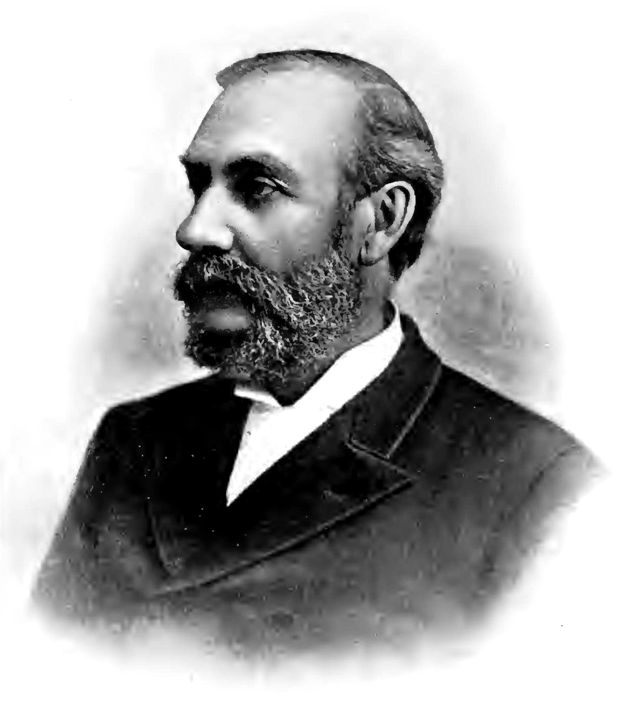
THEODORE HARDING RAND
From a photograph
The School Act was the work of Attorney-General King, but the system under which it came into being was the creation of Dr Theodore H. Rand, the chief superintendent of Education. Dr Rand performed the duties of his office with marked ability. The system he evolved not only placed within the reach of every child the opportunity of acquiring a good common school education, but also enabled both boys and girls to pass through all the grades up to the highest, and even to pass the matriculation examination preparatory to a course at the university.[1] The free school law came into operation on January 1, 1872, but several years elapsed before it was accepted in all sections of the province. Meanwhile strenuous efforts were made at the hustings and in the courts to have it nullified.
At the general elections held in June 1874 the only issue was the School Act, and in many of the constituencies it was fiercely debated. The endeavours of the Roman Catholics to uphold the principle of separate schools had the effect of driving the Protestant electors into the opposite camp, and the question became, for the most part, one of religion. The struggle that ensued was bitter—for, unfortunately, the element of bitterness in its most intense form is characteristic of religious strife. The result of the election was that out of a house of forty-one members only five candidates were returned who favoured separate schools. These represented the Acadian counties of Gloucester, Kent and Madawaska.
It is a curious fact that in none of the counties of the province has the introduction of free school education been of such manifest advantage in dispelling illiteracy as in these three counties. In Gloucester the census showed that in 1871 more than one-half of the people of adult age were unable to write. In the parish of Saumarez, with 2162 inhabitants, there was only one school with an average daily attendance of sixteen pupils. In the parish of Shippegan, with 2015 inhabitants, there were two schools with an average daily attendance of twenty-five. In the parish of Caraquet, with 3111 inhabitants, there were three schools with a total average attendance of thirty-six. In the whole county of Gloucester there were only twenty-eight schools for a population of 18,810. In the course of forty years the population of the county increased from 18,810 to 32,662, and in the same period the number of schools increased from twenty-eight to one hundred and twenty-nine, and the pupils in attendance increased sevenfold. A corresponding advance is found in the counties of Kent and Madawaska. This means that a new generation of French Acadians has arisen who are well educated, intelligent and enterprising, and who are now represented in the legislature and in the government by members of the same race origin as themselves. Nevertheless, it was in the county of Gloucester that hostility to the School Act was most intense. In January 1875 a serious riot occurred at Caraquet involving loss of life and making it necessary to send a military force to protect life and property.
Free schools have now been forty years in operation, and while it cannot be claimed that the new system is perfect, it cannot be denied that through its instrumentality illiteracy has been banished to a great extent from the rural districts. Schools are now almost universal throughout the province, and the attendance of pupils has increased from 29,837 in 1871 to 62,994 in 1910. Making due allowance for the increase of population in the same period, it will be found that there has been an increase of more than seventy-two per cent in school attendance, and at the same time there has been a vast improvement in the quality of the teaching.
The religious question continued to be a burning one for some years. The School Act was even brought up in the Dominion parliament with the view of obtaining remedial legislation, and the influence of the Quebec members was such that the House of Commons, by a majority vote, requested the governor-general to disallow the Act of Assessment for school purposes passed in the New Brunswick legislature. The governor-general declined to comply, and referred the matter to the home authorities, by whom he was advised that the act was within the powers of the provincial legislature. The matter was eventually referred to the Judicial Committee of the Privy Council and the validity of the School Act was sustained. The Roman Catholics expressed a determination to maintain their own schools and very emphatically protested against being obliged to pay in addition the taxes levied for the common schools. The problem called loudly for solution, and in 1875 the King administration came to an agreement with the leading Roman Catholic members of the house of assembly that put an end to an agitation that had seriously disturbed public tranquillity. Under this arrangement members of religious orders were considered to be eligible for licences as school teachers on taking prescribed examinations; buildings, the property of such orders or of the Roman Catholic Church, might be rented for school purposes by civic school boards; and religious instruction might be given to Roman Catholic children after school hours. Some twenty years later a case growing out of difficulties that had arisen at Bathurst came before the Equity Court. The court decided that it is not a violation of the Common Schools Act of New Brunswick to employ as teachers sisters of a religious order of the Roman Catholic Church and to permit them while teaching to wear the garb of their order. Nor does the holding, before or after school hours, of religious exercises, for the benefit of the Roman Catholic scholars, by a teacher who is a sister of one of the religious orders of the Roman Catholic Church, render a school sectarian. It cannot be claimed that the School Act is yet entirely satisfactory to all classes, but the modifications in its administration have served to allay much of the irritation that prevailed, and few are now found to deny that free schools have proved a very great boon.
|
Dr Rand was present at a very enthusiastic meeting held on May 29, 1900, in the Parliament House at Fredericton, in connection with the celebration of the one hundredth anniversary of the founding of the University of New Brunswick. Shortly after he had entered the Assembly Hall he fell to the floor unconscious and a few moments later breathed his last. The Hon. George E. Foster, one of the distinguished graduates of the university, at the request of Chancellor Harrison, paid an eloquent and spontaneous tribute to the worth of Dr Rand. As reported in the daily press his opening words were: 'Mr Chancellor, this is a heavy task you have imposed upon me. A sudden cloud has darkened the exceeding brightness of our Centennial Day. Yet as the fulness of life underlies both joy and sorrow, so beyond shadow and cloud burns the eternal sun. 'A strong man has passed from our very midst, within the sound of our voices, within the reach of our hands. And yet, though all wished it, none could hinder his sudden going. In one respect the time and place of his death are singularly appropriate. On the very threshold of a new century his spirit has walked forth unhindered by material clogs to the glorious spaces where time is uncounted and where centuries pass unmarked. And he laid down his mortal tenement here in the very shadow of the place where he did his best life work. Do we ask for his monument? Behold, we dwell about it. And our children and our children's children to far distant generations shall daily enter and worship in the temples of education reared on the architectural lines which the master builder laid down.' |
To the administration of Attorney-General King New Brunswick is indebted for the Municipalities Act of 1877. In view of the fact that St John was incorporated in 1785, nearly fifty years before the date of incorporation of any other Canadian city, it is surprising that the province should have been so tardy in extending the principle of municipal government to other communities within its borders. Fredericton, the capital city, was not incorporated until 1848. But Fredericton has the unique distinction, on this side of the Atlantic at least, of having been constituted a cathedral city by the queen's letters patent on April 25, 1845.[1]
It was not until 1851 that John Ambrose Street, attorney-general, introduced a bill looking to the establishing of municipal institutions in New Brunswick. The speeches of the attorney-general and of those who supported the bill were curiously apologetic in tone. Each speaker emphasized the fact that the act was permissive, and that it was quite optional for any county to accept it or not. Carleton County was foremost in urging the legislation and elected its first municipal council the next year. York County came in under the act in 1855 and Sunbury in 1856. Woodstock, the shire-town of Carleton, was incorporated in 1856. There was then a period of nearly twenty years without any further change, but in the course of time the people gradually grew tired of the system of county government by the Sessions of the Peace. In 1875 Northumberland and Gloucester were created municipalities and Moncton was incorporated as a town. This was the beginning of a movement that culminated in the adoption of the municipal system in every county under the general act of 1877. The principle was soon extended to smaller communities, so that all towns of consequence are now incorporated and the administration of affairs brought under the direct control of the people.
That New Brunswick should have been so dilatory in the adoption of the municipal system may have been partly due to the desire of the magistrates to retain the honour and dignity of presiding over public affairs at the Quarter Sessions. Many of these gentlemen were men of probity and ability, though rather antiquated in their ideas of civic administration and jealous of innovation. But the chief reasons why the province was tardy seem to have been the apathy of the people and the indifference of the legislature. It was not the fault of the lieutenant-governors, since several of them recommended the establishment of municipal government.
|
The letters patent, or royal commission, issued to the Right Reverend John Medley, first Bishop of Fredericton, contained the following clause: 'And we do further by these presents Ordain and Constitute the Town of Fredericton, within the said Province of New Brunswick, to be a Bishop's see and the seat of the said Bishop, and do ordain that the said Town of Fredericton shall henceforth be a City, and be called the City of Fredericton.' It may be of interest to mention that the cathedral at Fredericton was the first Anglican cathedral (built as such from the foundation) erected outside the British Isles. |
At the expiration of his term of office Wilmot was succeeded as lieutenant-governor by another distinguished son of New Brunswick, the Hon. S. L. Tilley. The period of Tilley's term of office was marked by hard times throughout Canada, commercial depression, lack of enterprise, scarcity of money and dulness of trade. The situation was rendered more serious by the great St John fire of June 20, 1877. This disastrous conflagration destroyed the entire business part of the city and brought financial ruin to hundreds of families. Lives were lost and 15,000 people rendered homeless. The property destroyed included 1612 houses and extended over ten miles of streets. The loss was estimated at $27,000,000. The whole water front on the east side of the harbour was laid waste. Many vessels were burned at the wharves. Nearly every store and warehouse was destroyed, leaving the city without even a sufficiency of food. Every bank and newspaper office, almost every professional office and nearly all the public buildings, hotels and churches were burned. In fact, the destruction could hardly have been more complete. The greatness of the calamity appealed to the world and relief came pouring in from every quarter, not only from neighbouring towns, but from remote places in Canada, from the mother country and from the United States. The cities of Boston and Chicago, which had been similarly afflicted not many years before, were especially prompt in responding to the cry of distress. Halifax, Montreal and Toronto were most generous.
Nothing could be more admirable than the spirit with which the people of St John set to work to repair their shattered fortunes. The ashes were hardly cold before they began to rebuild, and before the season had passed the city commenced to rise from its ruins. The loyalists who founded St John in 1783 had chosen as their motto, O fortunati quorum jam mœnia surgunt. The motto served to inspire their descendants with fortitude and courage as they began to build once more upon the naked rock.
As it was clear that the magnitude of the calamity was chiefly due to the imperfect manner in which St John had been built, and especially to the existence of so many houses with shingled roofs, the need of legislation to control the rebuilding of the city was recognized. A special session of the legislature was immediately summoned for the purpose. For two years after the fire St John was a very busy place and workmen came from all parts of America to assist in the rebuilding. The fire retarded the growth of the city, and only in recent years have its effects been overcome, but the new St John is a better and much handsomer city than the old.
Other towns in the province have suffered severely by fire. Only a few months after the great St John fire a large part of the adjoining town of Portland was destroyed. Woodstock, the shire-town of Carleton County, was almost totally destroyed by fire on April 16, 1860, and again on May 17, 1877. More recently, on July 11, 1910, the thriving town of Campbellton was practically wiped out of existence by a like calamity.
In 1878 Tilley re-entered the field of Canadian politics as minister of Finance in the second administration of Sir John A. Macdonald, and in his first budget speech submitted to parliament the now famous National Policy.[1] For the next seven years he was constantly in the public eye and proved a tower of strength to his party. His health then began to fail, and on October 31, 1885, he was again appointed lieutenant-governor of New Brunswick, holding the position for nearly eight years. In the course of his second term the old Government House at Fredericton was abandoned as the official residence of the lieutenant-governor and Sir Leonard Tilley thenceforth lived in St John.[2] During the closing years of his life this gifted statesman enjoyed the affectionate regard of men of all classes and conditions. He was always interested in the moral welfare of the community, and throughout his long political career his integrity was never questioned. The statue that stands in King Square in St John, near the spot where he so often addressed the electors, is by no means his only memorial. The province is largely indebted to his philanthropy and to the kindly efforts of his wife and sons for a number of benevolent institutions, including the Victoria Hospital in Fredericton, the Chipman Hospital in St Stephen, and in St John the Boys' Industrial School, the Nurses' Home, the Seamen's Institute and the fine building of the Young Men's Christian Association.
Of the eight lieutenant-governors who succeeded Sir Leonard Tilley four died in office, namely, E. B. Chandler, John Boyd, J. J. Fraser and J. B. Snowball. The others were R. D. Wilmot, A. R. McClelan, L. J. Tweedie and Josiah Wood. All were men of ability, who had rendered essential service in their respective spheres, and each in turn presided with dignity and impartiality over the affairs of the province.
The political party that carried Confederation remained in power for seventeen years. During this long term it had as premiers A. R. Wetmore, George E. King, J. J. Fraser and D. L. Hanington, all of whom in due course were appointed judges of the Supreme Court of New Brunswick. The next administration had as its first premier A. G. Blair, a man of much ability and force of character. Its tenure of office saw even longer than that of the previous administration, extending over a quarter of a century. It came into power on March 3, 1883, and on the same day of the same month, twenty-five years later, it was defeated, after many changes of personnel and five changes of premiers. A. G. Blair retired from local politics in July 1896, to enter the Dominion cabinet as minister of Railways. During his administration of provincial affairs two important constitutional measures were adopted. One of these was the passing, in 1889, of an act that abolished the property qualification hitherto required of members of the assembly, and gave a vote, based practically on manhood suffrage, to every one who had resided in a constituency for a year. A subsequent amendment established the principle of 'one man one vote' by declaring that electors should henceforth vote only in the place where they resided. A further amendment in 1908 ensured the secrecy of the ballot. The other important measure referred to was the abolition of the legislative council, which was effected by Blair in 1891.
|
Sir Leonard Tilley was a sincerely religious man, and it was his habit before the delivery of his budget speeches in parliament to spend half an hour in private devotion. He was not ostentatious in his religion. |
|
This step was taken in consequence of the decision of the legislature no longer to provide an official residence for the lieutenant-governor. |
The union of St John and Portland in 1889 was an important measure. It had the effect not only of uniting the two cities under one government, but of putting an end to the anomalous situation that existed between West St John, or Carleton, and the city proper. The affairs of these two divisions of the city had been conducted on such independent lines that it was said that the only bond of union between them was that they were presided over by the same mayor and crossed the harbour in the same ferry-boat. Since the union the city has entered upon a notable period of development. It had already got into touch with the outside world. Connection had been made with the United States railway system in 1871, with Halifax in 1873, with Quebec in 1876 and with Montreal in 1889, and a missing link had been supplied by the construction of a fine cantilever bridge over the falls at the mouth of the St John River in 1885.
For years St John has aspired to be the 'Liverpool of America.' In 1871 the city ranked fourth as a shipowning port in the British Empire, having 808 vessels with a tonnage of 263,140 tons, or double that of any other Canadian port. Wooden shipbuilding since then has steadily declined, and this important industry is now a thing of the past. It is probable that ere long St John will again have its shipyards, but the vessels will be built of steel.
Up to 1897 Portland in Maine continued to be the terminus of the Canadian mail-boats. This port had been adopted and equipped many years before by the Grand Trunk Railway as their port of shipment. This stirred up the pride and sensitiveness of the people of St John, who proceeded to expend upwards of a quarter of a million dollars on terminal facilities for the Canadian Pacific Railway. Late in the summer of 1895 a proposal was made to the mayor of St John by the manager of the Beaver Line of steamers, sailing out of Montreal in the summer and from Portland in the winter, to adopt St John as their winter port if a subsidy were provided. Through the efforts of the St John members of parliament the Dominion government was induced, by way of experiment, to grant a subsidy of $25,000, and the Beaver Line established a weekly service between St John and Liverpool. The Canadian Pacific Railway immediately set to work to secure freight for the steamers. The first season so thoroughly demonstrated that the transatlantic business of Canada could be done through a Canadian port that St John went on with her wharf-building and plans of development. The city spent at least a million and a half dollars in improvements and the Dominion government much more. The Canadian Pacific Railway and the Intercolonial Railway also made large expenditures for wharves and grain elevators. The result is that there is now ample accommodation for the simultaneous loading or discharge of thirteen or fourteen steamships. At the outset it was found necessary to remove some misconceptions as to the supposed dangers attending the navigation of the Bay of Fundy. The publications of the St John Board of Trade did much to dispel the false impressions which existed, and experience has shown that it is not more dangerous to navigate the Bay of Fundy than the open ocean.
That St John had faith in its future is seen in the fact that in order to start the movement for the development of the port the debt of the city was increased by more than a million dollars. The growth of the winter trade has been rapid and steady. In the first year there was but one line of transatlantic steamers, now there are ten, and the value of the exports has increased from about seven millions to more than thirty millions. No port in Canada has experienced anything like the growth of trade witnessed in St John during the last ten years. In fact, the development of the export trade through the port is one of the most remarkable economic changes that have taken place in the Dominion in the past quarter of a century. Doubtless a considerable part of the trade is new, but some of it has unquestionably been deflected from United States ports. The direct and indirect benefits of the winter port business to St John—not only to its merchants and tradesmen, but to the small army of able-bodied men employed about the wharves in loading and discharging and in the railway yards and grain elevators—are manifest. The dredging and wharf-building at West St John will soon be overshadowed by that at East St John, where the construction of a dry dock and the dredging of Courtenay Bay are now in progress. The wharves and piers to be built here will at least double the capacity of the port. The terminus of the National Transcontinental Railway will be at East St John.
The popularity of the commission form of government, which has been recently adopted by a large number of cities in the United States, led to a study of its merits and eventually to its adoption in St John. While it is yet too soon to speak decidedly as to the advantages or disadvantages of this form of municipal administration, the results are so far highly satisfactory. The citizens are encouraged in their faith in its merits not only by their own experience, but by the fact that in the United States not one of the two hundred and five cities now under the commission form of government has reverted to the old system. Commission government is both plastic and effective, one of its chief advantages being that it avoids divided responsibility and enables the community to see that the work to be done is accomplished without any waste of energy or obstruction by departmental technicalities. The fight against the new rule has been taken up chiefly by the professional politician class, the element that thrives on municipal spoils. It is not unfitting that the first incorporated city in Canada should be the first to make trial of the commission form of government.
A brief résumé of recent political events is now in order. After A. G. Blair entered the larger field of Dominion politics he was succeeded as premier by James Mitchell, who died soon after. In the next fourteen years there were six premiers: H. R. Emmerson, L. J. Tweedie, Wm. Pugsley, C. W. Robinson, J. Douglas Hazen and J. K. Flemming. Of these Emmerson, Pugsley and Hazen resigned leadership in the provincial government to accept office in the Dominion cabinet, and Tweedie to become lieutenant-governor. The present administration (1913) came into power under Hazen's leadership in 1908.
Premier Flemming, of Carleton County, met with astonishing success in the elections of 1912, in which, in a house of forty-seven members, only two candidates were elected in opposition to his policy. The legislation of the last ten years has continued to be concerned with railway construction. With the completion of the St John Valley Railway only about a dozen parishes in New Brunswick, out of a total of one hundred and forty-six, will be left untouched by a railway. The problem of transportation, which so vexed the pioneers, has found its solution.
PROVINCIAL AND LOCAL
GOVERNMENT
The history of representative government in the Atlantic provinces begins with the commission of Governor Cornwallis in 1749, by which he was empowered to convene a general assembly of the freeholders and planters resident in the colony of Nova Scotia. The territory which afterwards became the Province of New Brunswick was then a part of Nova Scotia, and remained so for more than a quarter of a century after the first parliament met at Halifax. Prince Edward Island was not given a separate constitution until 1773. Hence, as early political institutions—discharging the executive, legislative and judicial functions of government—in the other two Atlantic provinces were only replicas of those established in Nova Scotia, and as there was but slight difference in the fabric of such institutions in all of these provinces down to the time of Confederation, our examination of them as they appear in the annals of New Brunswick and Prince Edward Island can be made with greater brevity than is possible in tracing their character and history at first hand as we find them in the older province.
Representative government in the Province of Nova Scotia did not have its origin in some single and determinate statutory grant by the imperial parliament. There was nothing like the Constitutional Act of 1791 (31 Geo. III (Imp.), cap. 31), which guaranteed representative assemblies in Upper and Lower Canada. On the contrary, popular institutions in Nova Scotia, the oldest of the colonies out of which the Dominion of Canada was formed, were primarily the creation of the crown in the exercise of its prerogative.
The claim has been made that the territory called Acadie, colonized by the French in the first quarter of the seventeenth century, actually belonged to England at the time of such colonization by right of discovery by the Cabots in the reign of the first Tudor.[1] Indeed, it was solemnly declared by the assembly of the province in the preamble to one of its first enactments, that 'this Province of Nova Scotia, or Acadie, and the property thereof, did always of right belong to the Crown of England both by priority of discovery and ancient possession.' This claim, however, rests upon an insubstantial foundation. History, it is true, records the attempted exercise of an act of ownership by the crown of England in 1621, when James I made a grant of lands in the colony to his secretary, Sir William Alexander. But at that time the inchoate title of England derivable from discovery had not become ripened by occupancy, for there was no real settlement of the country by the English before the coming of the French. Nor was there any English colonization worthy of the name after Cromwell's fleet conquered the French in 1654; and the country was again passed over to the French king by the Treaty of Breda, in 1667. Moreover, while the colony of Massachusetts sent over an expedition under Sir William Phips, in 1690, which captured the French forts in Acadie and declared the country to be annexed to Massachusetts, the French settlers were allowed to remain on their lands. Seven years afterwards, by the Treaty of Ryswick, the colony was again formally restored to France. Hence, the proprietary rights of Great Britain in Nova Scotia—such, at least, as would be recognized by international law—are not other, nor older, than those conveyed by the Treaty of Utrecht in 1713, by which 'Nova Scotia, or Acadia, with its ancient boundaries' was unreservedly and finally ceded by France to the crown of England. These 'ancient boundaries' comprised not only the territory now known as the Province of Nova Scotia (excluding Cape Breton, which, along with Prince Edward Island, was not ceded to England until 1763), but also the Province of New Brunswick, as well as a part of what is now the State of Maine.
From the date of the Treaty of Utrecht down to that of the first real attempt by the British to colonize the territory, namely, the founding of the city of Halifax in 1749, civil government of a crude sort was administered at Annapolis by the commander of the forces stationed there, who acted as governor and was assisted by his senior officers as councillors. In the latter year the Hon. Edward Cornwallis was made governor, and was authorized by his commission to set up a general system of public order and government in the colony. The commission of Governor Cornwallis is one of the most important documents in the history of imperial politics. Some of its provisions help so much towards a clear understanding of the development of representative government in Nova Scotia and the other Atlantic provinces that they deserve quotation at length in this place. In the third paragraph of the commission we find the following directions to the governor as to the choosing of his council:
And for the better administration of justice, and the management of the public affairs of our said Province, we hereby give and grant unto you, the said Edward Cornwallis, full power and authority to choose, nominate and appoint such fitting and discreet persons as you shall either find there or carry along with you not exceeding the number of twelve, to be of our Council in our said Province. And also to nominate and appoint by warrant under your hand and seal all such other officers and ministers as you shall judge proper and necessary for our service and the good of the people whom we shall settle in our said Province until our further will and pleasure shall be known.
Paragraphs 6, 7 and 27 relate to the same conciliar body, and read, in part, as follows:
And if it shall at any time happen that by the death, departure out of our said Province, suspension of any of our said Councillors, or otherwise, there shall be a vacancy in our said Council (any five whereof we do hereby appoint to be a quorum) our will and pleasure is that you signify the same unto us by the first opportunity that we may under our signet and sign manual constitute and appoint others in their stead.
But that our affairs at that distance may not suffer for want of a due number of Councillors, if ever it shall happen that there shall be less than nine of them residing in our said Province, we hereby give and grant unto you the said Edward Cornwallis full power and authority to choose as many persons out of the principal freeholders inhabitants thereof as will make up the full number of our said Council to be nine and no more; which persons so chosen and appointed by you shall be to all intents and purposes Councillors in our said Province until either they shall be confirmed by us, or that by the nomination of others by us under our sign manual or signet our said Council shall have nine or more persons in it.
And our further will and pleasure is that all public money raised, or which shall be raised by any Act hereafter to be made within our said Province be issued out by Warrant from you by and with the advice and consent of the Council and disposed of by you for the support of the Government, and not otherwise.
By far the most important directions in the commission, however, are those contained in paragraphs 8 to 15 inclusive. They relate to the creation of a legislative assembly for the province.
And we do hereby give and grant unto you full power and authority, with the advice and consent of our said Council, from time to time as need shall require, to summon and call General Assemblies of the Freeholders and Planters within your government according to the usage of the rest of our Colonies and Plantations in America. ...
And that you the said Edward Cornwallis with the advice and consent of our said Council and Assembly, or the major part of them respectively, shall have full power and authority to make, constitute, and ordain Laws, Statutes and Ordinances for the Public peace, welfare and good government of our said Province and of the people and inhabitants thereof and such others as shall resort thereto and for the benefit of us, our heirs and successors, which said Laws, Statutes, and Ordinances are not to be repugnant, but as near as may be agreeable, to the Laws and Statutes of this our Kingdom of Great Britain.
Provided that all such Laws, Statutes and Ordinances, of what nature or duration so ever be within three months or sooner after the making thereof transmitted to us under our Seal of Nova Scotia for our approbation or disallowance thereof, as also duplicates by the next conveyance.
And in case any or all of the said Laws, Statutes and Ordinances not before confirmed by us shall at any time be disallowed, and not approved and so signified by us our Heirs or Successors under our or their sign manual and signet, or by order of our or their Privy Council unto you the said Edward Cornwallis, or to the Commander-in-Chief of our said Province for the time being, then such and so many of the said Laws, Statutes and Ordinances as shall be so disallowed and not approved shall from thenceforth cease, determine and become utterly void and of none effect, anything to the contrary thereof notwithstanding.
And to the end that nothing may be passed or done by our said Council or Assembly to the prejudice of us our Heirs and Successors, we will and ordain that you the said Edward Cornwallis shall have and enjoy a negative voice in the making and passing of all Laws, Statutes and Ordinances as aforesaid.
The power to erect courts of justice by the exercise of the royal prerogative, and to appoint judges thereto, is delegated as follows:
And we do by these presents give and grant unto you the said Edward Cornwallis full power and authority, with advice and consent of our said Council, to erect, constitute and establish such and so many Courts of Judicature and Public Justice within our said Province and Dominion as you and they shall think fit and necessary for the hearing and determining all causes as well Criminal as Civil according to law and equity, and for awarding of execution thereupon with all reasonable and necessary powers, authorities, fees and privileges belonging thereunto, as also to appoint and commissionate fit persons in the several parts of your Government to administer the oaths mentioned in the aforesaid Act, entitled 'An Act for the further security of His Majesty's Person and Government and the Succession of the Crown in the heirs of the late Princess Sophia being Protestants, and for extinguishing the hopes of the pretended Prince of Wales and his open and secret abettors'; as also to administer the aforesaid declaration unto such persons belonging to the said Courts as shall be obliged to take the same.
And we do hereby authorize and impower you to constitute and appoint Judges and in cases requisite Commissioners of Oyer and Terminer, Justices of the Peace, and other necessary officers and ministers in our said Province for the better administration of justice and putting the laws in execution, and to administer or cause to be administered unto them such oath or oaths as are usually given for the due execution and performance of offices and places and for the clearing of truth in judicial causes.
But Cornwallis, after the manner of the proconsuls of his day and generation, looked askance at the project of popular government. He was persuaded that democratic aspirations in the colony were best checked by confining the exercise of his powers to passing ordinances in his council for the regulation of peace and order, and by erecting courts of justice. This policy of abstention from summoning an assembly, continued by Hopson, who succeeded Cornwallis in 1752, enabled the governor and his council to retain both the executive and legislative functions of government in their hands. It was maintained for a period of nine years. In the year 1758, largely through the efforts of the Hon. Jonathan Belcher, a native of Massachusetts, who had been appointed chief justice of the colony, Governor Lawrence was instructed to cause representatives of the people to be elected, and the first general assembly was summoned on October 2 of that year at Halifax. This was the first elected legislative body in British North America. The several legislatures of Nova Scotia, New Brunswick and Prince Edward Island, as they exist to-day, find a common parentage in this, the first parliament convened in the Maritime Provinces at a date antecedent by thirty-four years to that of the earliest meeting of any similar body in the Canadas. And it is worthy of note that the project of establishing a settlement at Halifax was first suggested to the imperial authorities by the legislature of Massachusetts, and that the settlers from that colony, under the leadership of Chief Justice Belcher, played the largest part in achieving the beginnings of political liberty in the land of their adoption.
It was after the manner above set forth that the foundations of self-government were laid in the colony; and by means of further concessions of autonomy by the crown a complete fabric of popular institutions was subsequently built up. So successfully had the provincial constitution been planned and worked years before the confederation of the provinces in 1867 that the British North America Act continued it in force in its integrity, and it has not since been altered. The Hon. A. G. Archibald, sometime lieutenant-governor of Nova Scotia, spoke with force and exactness when he said:
No formal charter or constitution ever was conferred, either on the province of Nova Scotia or upon Cape Breton while that island was a separate province. The constitution of Nova Scotia has always been considered as derived from the terms of the Royal commissions to the Governors and Lieutenant-Governors, and from the 'instructions' which accompanied the same, moulded from time to time by despatches from Secretaries of State, conveying the will of the Sovereign, and by Acts of the local legislature, assented to by the Crown; the whole to some extent interpreted by uniform usage and custom in the colony.
And what was thus predicated of Nova Scotia is equally applicable to the constitution of the other Atlantic provinces, since the one was made a type for the others.
His Royal Highness the Duke of Connaught, on the occasion of his dedicating the Memorial Tower to representative government in the British colonies, at Halifax, in August 1912, very justly observed:
This tower will form an enduring monument to the British colonial policy which has always been followed since; namely, the granting of representative government to colonies as soon as they proved themselves fit for that privilege, and the wisdom of this policy was most certainly confirmed by the subsequent history of Nova Scotia.
Indeed, the emergence of representative government in these provinces from the uncongenial domain of the prerogative in the middle of the eighteenth century, and its subsequent evolution to the highest stage of autonomy commensurate with their position as dependencies, speak volumes for the tact and prevision of native statesmen, and is a matter of significance to those who follow the democratic genius of the British people along the paths of history.
Having ventured to make this more or less general historical survey of the provincial constitution in its incipient stages, we shall next proceed to consider the organization and functions of its executive, legislative and judicial branches in the following order:
(a) The office of lieutenant-governor.
(b) The executive council.
(c) The legislature, consisting of an upper chamber known as the legislative council, and a lower house described as the legislative assembly.
(d) The public departments of government.
(e) The judicial system and courts of the province.
|
See Forsyth, Cases and Opinions on Constitutional Law, p. 26. |
In the early days of British colonial government in America the imperial authorities authorized some one, usually a military officer of high rank, either resident in the colony or sent there for the purpose, to represent the crown under the title of 'governor,' or some equivalent, subject to such instructions as might be sent him from time to time for the establishment of law and order among the settlers. The governors of Nova Scotia were first styled in their commissions 'captains-general and commanders in chief.' Provision was usually made in the commissions for the appointment of a lieutenant-governor, to act in the absence of the governor; and when both were absent the senior member of the council was empowered to act in their stead. In 1792, for some reason better known to the Board of Trade and Plantations than to the present-day student of constitutional documents, the title of the representative of the crown in Nova Scotia was changed to 'lieutenant-governor and commander-in-chief,' although the powers and authority of the office remained unchanged.
Originally the governor was commissioned to act in the capacity of vice-admiral, so that, in virtue of his joint offices as captain-general and vice-admiral, he controlled the forces by land and sea within the province. Having the custody of the public seal of the colony, according to the usual practice in the case of colonial governors, he was empowered by his commission and instructions to act as chancellor with jurisdiction in such capacity in all cases involving chancery law and procedure. This jurisdiction had been a matter of universal complaint in the American colonies, the settlers protesting that its exercise required the services of a trained lawyer. But it was not until 1826 that the king appointed for the province a master of the rolls, whose court gradually absorbed the entire chancery jurisdiction in litigated cases, although the governor's signature as chancellor was long required to give validity to an order or decree of the master of the rolls. The governor acted as Ordinary during the short time the Church of England was established in the province, and as such had certain privileges in the appointment of the clergy to their missions. He also issued warrants for commissions to privateers, and as commander-in-chief had the appointment of all militia officers. Some of these powers had either fallen into desuetude or become abolished long before Confederation. But at that date the governor was the head of the executive government of the province, and was a constituent part of its legislature, exercising all the prerogative rights of the crown necessary for the safety and protection of the people, the due administration of the law, and the conduct of public affairs. He had the power of convening, adjourning and dissolving the provincial parliament, and his assent was necessary before any bill passed by the council and assembly became law.
It is hardly necessary to say that, under the provincial constitution as settled by the British North America Act, the lieutenant-governor is as much a constituent part of the legislature as he was before the Union. It could not be otherwise under a system of British constitutional government, wherein the king, for the purpose of protecting the royal executive authority, has always a share in legislation to the extent of his assent being necessary before an act of the legislature becomes law. This is in the nature of a check upon legislation for the preservation of the prerogative, rather than a power of legislation; and its raison d'être is disclosed in the following excerpt from the commission of Governor Cornwallis: 'And to the end that nothing may be passed or done by our said Council or Assembly to the prejudice of us, our heirs and successors, we will and ordain that you ... shall have and enjoy a negative voice in the making and passing of all Laws, Statutes and Ordinances.'
The lieutenant-governor, under the pre-Confederation constitution, also appointed his executive council, the members of the legislative council, the judges, the law-officers, the civil servants, sheriffs and justices of the peace. He had control of the hereditary revenues and lands of the crown within the province. All moneys drawn out of the treasury could be paid only on a warrant under his hand. He exercised the right to pardon any person convicted under the criminal law and to suspend execution in capital cases. For any official acts within his competence he was not amenable to any civil or criminal tribunal in the province, for the reason that liability to imprisonment in a civil suit or under indictment would be incompatible with his character as a representative of the sovereignty and dignity of the crown. But for any acts done in his private capacity, or in excess of his official powers, he was liable in the local courts. Although the question is not beyond doubt, there is strong authority for the view that a colonial governor was always amenable in the local courts for crimes committed in the colony, whether they were or were not connected with his official position.
In the exercise and enjoyment of the various powers and privileges accorded him previously the lieutenant-governor was maintained by the provisions of the British North America Act, except in so far as the transference of certain matters from the provincial to the federal authority by the provisions of that statute vested the prerogative rights appertaining to them in the governor-general. It may be added that the British North America Act, 1867, provides that the lieutenant-governor of each province shall be appointed by the governor-general in council by instrument under the Great Seal of Canada, that he shall hold office during the pleasure of the governor-general, and that his salary shall be fixed and provided by the parliament of Canada. But it is a mistake to predicate upon these provisions, as one constitutional writer[1] has done, that the lieutenant-governor 'is an officer of the Dominion.' There is the support of the highest authority for the proposition that the lieutenant-governor is wholly independent of federal control within the ambit of his jurisdiction, and that he is as much the representative of the crown for all the purposes of provincial government as the governor-general is for all purposes of Dominion government.
As regards the office of the lieutenant-governor the British North America Act prevents any alteration of the constitution respecting it by the provincial legislature, and while a strict construction of subsection 29 of section 91 would seem to enable the parliament of Canada to alter it, the matter is one, in the opinion of eminent constitutional authority, to be left to the imperial parliament.
It remains to be said that the provincial legislature in 1896 passed an act purporting to give the lieutenant-governor the power of commuting and remitting sentences for offences against the laws of the province. The pardoning power in respect of offences against the criminal law of Canada committed within the province is exercised only by the governor-general.
|
Bourinot, How Canada is Governed, p. 147. |
As will be seen by the royal commission issued to Governor Cornwallis in 1749, he was empowered to appoint, 'for the better administration of justice, and the management of the public affairs' of the province, 'such fitting and discreet persons as you shall either find there, or carry along with you, not exceeding the number of twelve, to be of our Council in our said province.'
The body so authorized to be brought into being became a miniature copy of the Curia Regis of early Norman times in England. As presided over by the governor, it was, at the outset, a complete organ of government exercising executive, legislative and judicial functions within the colony. After representatives of the people were summoned to parliament the executive council sat as the upper chamber of the legislature. While it is said to have been the practice in some of the older American colonies for the governor to be present at the legislative deliberations of the council, acting as its chairman or president and taking part in its discussions, this was not the case in Nova Scotia, at least since 1763, when it is on record that the chief justice of the Supreme Court held the position of president, the chair in his absence being taken by the senior member of the council.
Although it would appear from the terms of the commission of Governor Cornwallis that he enjoyed the exclusive right to appoint members of the executive council, yet some were originally appointed by the crown in England, a writ of mandamus being directed to the governor to fix their rank and precedence. The council consisted of twelve members. It included among its members the bishop of the province and the chief justice, or some other of the judges, but they were not members ex officio. Belonging either to the salaried official class or the more wealthy of the settlers, its members were not requited for their services except in so far as reward lay in the right to be called 'Honourable'—a tag that the crown has not yet ceased to conjure with, and an epithet still connoting value, in the colonial democracy. As will be seen hereafter, it was not until Joseph Howe succeeded in carrying through the house of assembly his famous Twelve Resolutions for reforming the constitution and methods of the upper chamber that members of the Anglican episcopate and of the judiciary, as such, ceased to be called to the council.
Speaking generally, the executive council was the crown's Privy Council within the province. The members were obliged to attend upon the governor whenever he summoned them for advice. They were also empowered to sit, under the presidency of the governor, as a Court of Error or appeal in civil cases from the courts of common law. Each member had the authority of a justice of the peace, with jurisdiction as such throughout the province. Their office, nominally held at the crown's pleasure, came to be treated as a life tenure; but absence from the province without leave for a year was regarded as tantamount to resignation.
From the year 1758 down to the advent of that sturdy tribune of the people, Joseph Howe, upon the political stage, 'His Majesty's council'—a designation that the members of the conciliar body, lacking the saving grace of humour, were beyond measure pleased with—controlled the affairs of the province despite the remonstrances of the popular branch of the legislature. Sitting with closed doors, they decided the fate of legislation sent up from the lower house. They could even decline concurrence in revenue bills. True, the members of the popular chamber could refuse supplies, but to exploit this constitutional check on the prerogative would have been only to launch a brutum fulmen, as the salaries of the high officials sitting in the council were fixed by statute, and the other government expenditures were payable out of casual and territorial revenue disbursed under the governor's warrant on the advice of the council. Thus the province found that the invitation it had received to sit at the lordly table of political freedom meant only to partake of a Barmecide's feast. Possessing a charter of representative government, it was ruled by an oligarchy.
To banish this constitutional travesty, and to make representative government in theory spell responsible government in practice, was the achievement to which Howe addressed himself when he became a member of the assembly in the year 1836. Providence cast him as protagonist in a drama of reform where the temper of a freedom-loving people, tried to the breaking-point by reactionary officialdom, only stopped short of a revolutionary dénouement. Relentless in his hostility to those who were misgoverning his country, he was magnificently loyal to the crown. What Lord Rosebery has said of Gladstone could be said with greater truth of Howe in the pursuit of the cause he had espoused: 'He swept on with the passion of a tempest, and the persistence of some puissant machine.' The totality of the reforms accomplished by purely constitutional methods in little more than a decade, as the result of labours begun by him immediately upon his being sworn a member of the house, meant responsible government for his native province in the most affluent sense of the term.
The answer of His Majesty King William IV to the address of the house of assembly, based upon Howe's Twelve Resolutions of February 1837, was to the effect that the sovereign's 'cheerful assent' was given to the greater part of the measures that Howe had suggested, and that His Majesty was 'convinced that they would be conducive alike to the honour of the Crown and to the welfare of his faithful subjects.' Measures of reform were undertaken almost immediately by the colonial office. In 1838 a new legislative council, consisting of nineteen members, appointed by the lieutenant-governor, was constituted as the upper chamber of the legislature, whose deliberations, instead of being conducted behind closed doors, were open to the public. The old Council of Twelve was continued as the executive council, but four of its members were appointed from the house of assembly. In 1840 Howe accepted a seat there at the request of Lord Falkland. But while this was reform of a kind, the reformers were not content with an amorphous executive body embracing representatives of both parties while political strife ran high in the province. Howe did not long retain his seat there. He resigned it in 1843, feeling that to remain longer would imperil his influence in the assembly. In the general election of 1847 he was returned to parliament with a large majority of reformers at his back. On June 26, 1848, upon a motion of want of confidence, the government, led by the Hon. J. W. Johnston, was defeated in the lower house by a majority of seven votes. Two days afterwards the members of the executive council resigned, and James B. Uniacke, one of Howe's staunchest adherents, was asked by the lieutenant-governor, Sir John Harvey, to form an administration, and to submit the names of its members in accordance with the practice prevailing in the mother country. Uniacke accepted this responsibility, and in a very short time succeeded in reporting to the lieutenant-governor the personnel of the first cabinet council called into being in the history of the province. Since then no administration has ventured to hold office without possessing the confidence of the popular branch of the legislature.
By the statutes of the province the executive council now consists of nine members appointed by the lieutenant-governor. From among such members he appoints, under the great seal of the province, persons to hold, during pleasure, the offices of provincial secretary, attorney-general, and commissioner of Public Works and Mines. The premier may hold any one of these offices. The duties of the provincial ministry in respect of the several departments over which its members preside, and of the subordinate officers of such departments, are prescribed by order of the lieutenant-governor in council.
In the same year that witnessed the passing of the old executive council the house of assembly secured from the colonial office the control and distribution of the casual and territorial revenues of the province, whether consisting of fees of office, sales of lands, royalty of mines, or the old crown duties, which were formerly controlled by the governor and council.
1. The Legislative Council.—As has been shown above, it was not until the year 1838 that Nova Scotia had a properly constituted legislative council. In the address of the house of assembly to the king, in the preceding year, the urgent necessity for the separation of the executive council from the body sitting as the upper chamber of the provincial legislature was set forth with such cogency of argument that the appeal could not be denied. On February 3, 1838, instructions were forwarded from England to Lord Durham, as captain-general and governor-in-chief of Nova Scotia, declaring it to be the pleasure of Her Majesty that there should be 'within our said Province of Nova Scotia two distinct and separate councils, to be respectively called the Legislative Council and the Executive Council of our said Province.' But the prayer of the assembly was not wholly granted. It was asked that the legislative council should be made an elective body, but instead of this the selection of its members was left to the pleasure of the lieutenant-governor in council, a system that still prevails.
In the beginning this council was limited to fifteen members; but in the year 1862, by his commission, Lord Monck was empowered to increase the number of members to twenty-one. This was not altered at the time of Confederation, nor since. Authority is, however, given to the provincial legislature by section 88 of the British North America Act to amend at any time the constitution of the council.
By the provincial laws it is declared that no member of the Senate or House of Commons of Canada shall be capable of being appointed to the legislative council, and that if a member of that body accepts a seat in the Senate, or is elected a member of the House of Commons, or is nominated as a candidate for the representation of any electoral district in the House of Commons, his seat in the council shall become vacant. Absence from the council for two consecutive sessions without the consent of the lieutenant-governor in council will render any member's place in the council vacant. Any one who is disqualified by a judgment of the courts from sitting in the House of Commons is ineligible for appointment to the council. In the Powers and Privileges Act (R. S., 1900, cap. 2) will be found a lengthy list of holders of public offices who are disqualified for appointment to the legislative council, including the judges of the higher courts of justice, certain deputies of the provincial ministers, and postmasters and their deputies.
Under the above-mentioned enactment the legislative council and its committees and members are entitled to the like privileges, immunities and powers as those appertaining to the Senate of Canada, its committees and members. Further powers and privileges appertaining to the legislative council are set forth in this act, but, as they are shared by the house of assembly, more extended reference to them will be reserved until that branch of the provincial legislature is discussed.
The president of the legislative council is appointed by the lieutenant-governor in council, and holds office during pleasure. It is his duty to occupy the chair in all the deliberations of the chamber, and to take the votes of the members. There is also a clerk of the council, whose duty is to register the proceedings of the chamber, and to see to the communication of the ordinary messages of intercourse, whether written or verbal, with the lower house of the legislature.
The legislative council has authority to initiate or amend all matters of legislation, with the exception of money or revenue bills. While it may refuse concurrence in such bills, it is not within its competence to amend them.
The rules of procedure in the legislative council are those ordinarily observed in British parliamentary bodies.
2. The Legislative Assembly.—A reference to the terms of the commission to Governor Cornwallis will show that the function of the general assembly was intended to be legislative only, and that it lacked any authority to interfere with the executive government as vested in the governor and council. But the authority of the assembly was plenary in its sphere, for by the grant of legislative power to the colony the competence of the crown in the exercise of its prerogative to make laws for its internal government had passed away. Yet the crown, as represented by the governor, was a constituent branch of the legislature. Hence, as it was declared in the commission to Cornwallis that the public revenues (derivable from the sale of public lands within the colony, royalties from mines, and customs duties, together with certain grants provided in the imperial budget for civil establishment) should be disbursed by the governor's warrant, it can be readily understood that the members of the assembly lacked that thaumaturgic influence over the executive that subsists in the right of the popular branch of parliament to withhold supplies. Moreover, the right of the governor to veto legislation was another check upon the freedom of action of the assembly in its early stages; although, it is true, this right was seldom, if ever, put into practice, the governors preferring to let doubtful enactments be submitted for confirmation or disallowance by the crown instead of exercising their own power to negative the same. But the most insuperable obstacle to popular control of the executive was not removed, as we have seen above, until the year 1848, when the legislative assembly obtained full control over all the public revenues.
The rights and privileges of the assembly, while commensurate with the requirements of a representative institution moulded upon English lines, were not coextensive with those obtaining under the lex et consuetudo parliamenti. Chalmers (1 Col. Op. 265) publishes an opinion of Attorney-General Pratt to the effect that colonial assemblies were governed by the terms of their charters, the principles of the common law and colonial usages, and that the peculiar law of the British House of Commons did not apply to them. This view was affirmed by the Judicial Committee of the Privy Council in the somewhat recent case of Fielding v. Thomas ((1906) A. C. 600), where it was held that in the absence of express authority from the imperial parliament a colonial legislature could not confer on itself the privileges of the British House of Commons, or the power to punish the breach of those privileges by imprisonment or committal for contempt.
Formerly it was necessary for members of both chambers in the provincial legislature, before taking their seats, to make and subscribe the declarations against transubstantiation, the invocation of saints and the sacrifice of the mass, as practised in the Church of Rome; but this was expressly remitted by the king in the case of a member from Cape Breton elected after the final annexation of that island to the province in 1820, and in 1830 such declarations were wholly abolished by an act of the legislature.
The above reference to Cape Breton makes it apposite to state here that in 1784 the island was given a separate constitution, consisting of a lieutenant-governor and council. This was not carrying out to the full the constitution contemplated by the commission issued in that year to the Governor-General of Nova Scotia, Cape Breton and St John's (now Prince Edward) Island, which provided for a general assembly in each of the provinces. It is said that this was intended as a temporary expedient of government so far as Cape Breton was concerned, and that the governor-general (John Parr) was privately instructed not to have an assembly called in that island. Be that as it may, no assembly was ever called in the Island of Cape Breton so long as it remained detached from Nova Scotia; and the next thing we find in its constitutional history is Lord Bathurst instructing Sir James Kempt, Lieutenant-Governor of Nova Scotia, by letter from Downing Street on August 15, 1820, to the following effect:
I had the honour of intimating to you, previous to your departure from this country, the decision to which His Majesty had come of re-annexing the island of Cape Breton to the government of Nova Scotia; and you must have observed the alteration which had, in consequence, been made in your commission and instructions.
His Majesty considers it most desirable that this arrangement should be no longer delayed, and has commanded me to instruct you to take into your immediate consideration the measures which may be necessary to give effect to His Majesty's instructions.
Following upon this we have a proclamation by Sir James Kempt, dated October 9, 1820, making the necessary regulations for carrying into effect the re-annexation of Cape Breton to Nova Scotia, and for dissolving the separate constitution of the island then existing. By an act of the legislature of Nova Scotia, dated December 22, 1820, civil government and the administration of justice in Cape Breton were made to conform to the usage and practice of Nova Scotia.
In this connection a case of some interest to the student of constitutional history will be found in the fifth volume of Moore's Privy Council Reports (p. 259), showing that certain of the inhabitants of the Island of Cape Breton took their re-annexation with very bad grace, and went to the length of petitioning the crown in the matter. They asserted that the attempt to effect such re-annexation by an act of the prerogative was invalid because the crown had given to the inhabitants, in 1784, the right to a local legislature, and that by such grant the crown had for ever emptied itself of the power to legislate for the island. The petitioners further claimed that they were entitled to a legislature under the commission to the governor of Nova Scotia in 1784. Their lordships of the Judicial Committee did not deliver any reasons for their judgment, but curtly reported that in their opinion the inhabitants of Cape Breton were not entitled to the constitution purporting to be granted to them by the commission to Governor Parr. Thus it was that the separation and ultimate annexation of the two colonies were effected by the crown in the exercise of its prerogative, and without the intervention of the imperial parliament.
It is proper to remark here that, from the inception of representative government in the province down to the time of the formation of the Dominion of Canada, the imperial parliament never attempted to legislate for the purely internal concerns of the province. But it must not be forgotten that it was not until the passage of the famous Renunciation Act of 1778 that Great Britain waived her claim to the right at large of levying tribute on the colonies in the shape of duties and taxes; and that the Renunciation Act itself saves the right of the king and parliament to impose duties upon the colonies for the regulation of commerce—directing, however, that the net produce of such duties should be paid and applied to and for the use of the colony in which they were levied. This, and earlier imperial enactments respecting colonial taxation, must be taken to assert the supreme authority of the imperial parliament over the colonies, notwithstanding any grant of the power of self-government having been made to them. But, in practice, this supreme authority is never asserted except when imperial interests are at stake.
In 1846 Nova Scotia, along with the other British possessions in America, was given legislative power to reduce or repeal any of the duties of customs imposed by imperial legislation on foreign goods imported into the province from foreign countries. By the Imperial Customs Act of 1857 British possessions abroad were empowered to regulate generally their customs, trade and navigation, subject only to certain limitations relating to discriminating duties against British goods and to the observance of treaty obligations. In 1849 the colonies acquired from the imperial parliament the right to regulate their own postal system and to control the revenue therefrom. So that before Confederation Nova Scotia enjoyed the very largest measure of autonomy over her revenues consistent with her position as a dependency of the British crown.
The house of assembly is composed of thirty-eight members, three being elected by each of the counties of Halifax and Pictou, and two by each of the other counties in the province.
The chief safeguards of the privileges of the assembly are: (a) freedom of speech on the part of its members in their deliberations; (b) freedom of its members from arrest on ordinary civil process while attending its sessions; (c) control of the qualification and election of its members; and (d) the right to initiate money grants and revenue bills.
Freedom of speech is the basic privilege of British deliberative assemblies at home as well as overseas. As to the freedom from arrest of members of either house of the provincial parliament, the Powers and Privileges Act (R. S., 1900, cap. 2) provides that no member is liable to any civil action, or to prosecution, arrest, imprisonment or damages by reason of any matter or thing brought by him by petition, bill, resolution, motion, or otherwise, or said by him, before the house of which he is a member. He is also exempt from arrest for debt during any session of the legislature and during a period of fifteen days immediately preceding and immediately following such session. On the other hand, a member of either house is liable to punishment by imprisonment, on the judgment of the house of which he is a member, for certain offences specified in the above-mentioned act.
Adverting to the qualification of members of the assembly, all that the provincial law exacts in this behalf is that a candidate for a seat in the house of assembly shall be a male British subject of the age of twenty-one years or upwards. Members of the Senate or House of Commons of Canada are ineligible for election to the house of assembly. Acceptance of a seat in the Senate, or being elected as a member of the House of Commons, as well as accepting a nomination for a seat in the House of Commons, will render the seat of a member of the assembly vacant. Judges of the higher courts of justice, postmasters, certain deputies of the provincial ministers, and other office-holders mentioned in the Powers and Privileges Act, are not eligible for election to the house of assembly.
The law relating to the election of members of the house of assembly cannot be adequately epitomized in the space available here. Suffice it to say that the franchise granted by it is confined to male British subjects of the full age of twenty-one years, whose names are found registered on the voters' lists for their respective polling districts on the day of the election. The qualifications for registry on the voters' lists, in addition to the above-mentioned requirements as to sex, nationality and age, are: (a) that the person seeking to vote shall not have received aid as a pauper under any law of the province since the last revision of the voters' lists; (b) that he is then assessed in respect of real property to the value of one hundred and fifty dollars, or in respect of personal property, or of personal and real property together, of the value of three hundred dollars; or (c) that at the time of the last assessment he was in possession of real or personal property, or of real and personal property together, of the respective values above mentioned; or (d) that he was at the time of the last assessment a bona fide yearly tenant of real property, assessed in the name of the owner, of the value of one hundred and fifty dollars, or in possession of personal property the assessed value of which, combined with that of the real property occupied by him as tenant, was three hundred dollars, or upwards. The franchise is also extended, subject to certain restrictions, to sons of persons qualified to vote living with their fathers, or, in the case of the death of their fathers, living with their mothers in the possession of real property qualifying any male owner or occupant thereof to be registered, for one year next before the application to be placed on the list of voters. Males assessed in respect of income to the amount of two hundred and fifty dollars, or deriving an income to that amount from their earnings while resident within the county where they seek registration, are entitled to be registered. The owner of fishing gear, within the county where he seeks registration, of the value of one hundred and fifty dollars, is also entitled to be registered.
Judges of the Supreme Court and the returning officers (except where there is an equality of votes, when the latter may give a casting vote) are disqualified from voting at elections for the house of assembly. Women are also disqualified from exercising the ballot at such elections, although they may vote at municipal elections, under certain conditions, as will appear hereafter.
Secret balloting prevails at elections for the assembly, and adequate means for effecting this secrecy are prescribed by the law.
As has been pointed out in dealing with the legislative council, the assembly alone has the right to initiate or amend bills for the appropriation of the public revenue and the imposition of taxes. Section 90 of the British North America Act expressly applies the provisions of that act respecting appropriation and tax bills, and the recommendation of money votes in the parliament of Canada, to the legislatures of the several provinces. Thus the assembly cannot adopt or pass any vote, resolution, address or bill for the appropriation of any part of the public revenue, or of any tax or impost, to any purpose that has not been first recommended to the house by message of the lieutenant-governor. As this is a provision of the British North America Act, it applies to all the provinces.
The house entrusts to its committees of supply and of ways and means the business of providing for the public expenditures. These committees are appointed as soon as the address to the so-called 'Speech from the Throne' has passed the house. As the procedure of the assembly in passing the public and private acts is practically the same as that prevailing in the Dominion House of Commons, so is the procedure of its committees.
The house of assembly is presided over by the speaker, who is a member of the house and has been elected to the chair by a majority of votes. When the speaker has been declared elected by the clerk of the house, he is conducted to the chair; but before he acts further in that capacity, he is presented to the lieutenant-governor, and, having been approved by him, enters upon the duties of his office. In the early history of the assembly Lieutenant-Governor Wentworth refused his approbation of Richard Peter Tonge, who had been elected as speaker, and the house was so complaisant as to elect another—differing in this respect from the conduct of the assembly of Lower Canada during Lord Dalhousie's administration, which persisted in re-electing Louis Joseph Papineau after his rejection by the governor, and proceeding with the business of the house without further ceremony.
The speaker while in the chair conducts the business of the house and maintains decorum according to established rules of procedure, which do not differ materially from those governing the Dominion parliament. While in the chair he takes no part in any discussion; nor does he vote except when the members present are equally divided, and then he may give a casting vote.
Another important officer of the house of assembly is the clerk, who is appointed by the lieutenant-governor in council. He has the care and custody of all bills, journals and records originating in, and belonging to, the assembly. On the first day of the opening of a new assembly for the dispatch of business he must attend the house for the purpose of swearing in the members-elect. There is also an officer of the assembly called the sergeant-at-arms, whose general duty is to execute the orders of the house. He must prevent the ingress of strangers not having the permission of the house to enter the same, and must preserve order and decorum in the galleries and lobbies.
By section 92 of the British North America Act the provincial legislatures are authorized exclusively to make laws in relation to matters coming within the following classes of subjects:
1. The amendment of the constitution of the province, except as regards the office of lieutenant-governor.
2. Direct taxation within the province for provincial revenue.
3. Borrowing money on the sole credit of the province.
4. The establishment and tenure of provincial offices and the appointment and payment of provincial officers.
5. The management and sale of the provincial public lands, and the timber and wood thereon.
6. The establishment, maintenance and management of public and reformatory prisons in and for the province.
7. The establishment, maintenance and management of hospitals, asylums, charities, and eleemosynary institutions in and for the province, other than marine hospitals.
8. Municipal institutions in the province.
9. Shop, saloon, tavern, auctioneer, and other licences in order to the raising of a revenue for provincial, local or municipal purposes.
10. Local works and undertakings other than such as are of the following classes:
(a) Lines of steam or other ships, railways, canals, telegraphs and other works and undertakings connecting the province with any other, or others, of the provinces, or extending beyond the limits of the province;
(b) Lines of steamships between the province and any British or foreign country;
(c) Such works as, although wholly situate within the province, are before or after their execution declared by the parliament of Canada to be for the general advantage of Canada, or for the advantage of two or more of the provinces.
11. The incorporation of companies with provincial objects.
12. The solemnization of marriage in the province.
13. Property and civil rights in the province.
14. The administration of justice in the province, including the constitution, maintenance, and organization of provincial courts, both of civil and of criminal jurisdiction, and including procedure in civil matters in those courts.
15. The imposition of punishment by fine, penalty, or imprisonment for enforcing any law of the province made in relation to any matter coming within any of the classes of subjects above enumerated.
16. Generally all matters of a merely local or private nature in the province.
It may not be out of place to observe here that upon a comparison of the above list of subjects—declared to fall exclusively within the ambit of provincial legislation—with the category of exclusively federal subjects contained in section 91 of the act, one does not need the trained eye of the constitutional lawyer to discern at once an overlapping—and a resultant conflict—of legislative jurisdiction. Hence it is not surprising to find the courts constantly exercised over nice questions of constitutional interpretation. In the early days of the Supreme Court of Canada some of the judges addicted themselves to a general policy of federalism, subordinating provincial interests to those of the Dominion, presumably on the theory that to restrict the legislative sphere of its several units was the best possible way to assist the federal aggregate in achieving nationhood. This policy of construction was not adopted by the Judicial Committee of the Privy Council, that tribunal seeming to scent therein the danger of persistent encroachment upon provincial rights by the federal authority. What has been said has reference entirely to the earlier cases involving interpretation of the act, and they are not always in harmony with the more recent pronouncements of the supreme appellate authority. Moreover, these observations are confined to a general policy of interpretation. But as regards the particular question of supremacy in matters in respect of which the two legislative jurisdictions clearly overlap, the Judicial Committee in the case of the Grand Trunk Railway Company v. the Attorney-General of Canada ((1907) A. C. 65) distinctly formulated these two canons of construction: 'First, there can be a domain in which provincial and Dominion legislation may overlap, in which case neither legislation will be ultra vires, if the field is clear; and, secondly, if the field is not clear, and in such a domain the two legislations meet, then the Dominion legislation must prevail.'
It is a truism that with a rigid constitution there is always room for diversity of interpretation. No country on earth has ever had the felicity of possessing a written constitution phrased with absolute clarity. It is a mistake to expect such until the millennium comes to pass.
The administration of the public affairs of the province is conducted by means of the following departments:
The department of the Attorney-General.
The department of Crown Lands.
The department of the Provincial Secretary.
The department of the Provincial Treasurer.
The department of Public Works and Mines.
The department of Education.
The department of Agriculture.
The attorney-general is the law-officer of the crown within the province. He is the legal member of the executive council, and the official legal adviser of the lieutenant-governor and of the heads of the other departments. He sees that the administration of public affairs is in accordance with law, and has superintendence of all matters connected with the administration of justice in the province not within the jurisdiction of the Dominion government. All instruments issued under the great seal of the province are subject to his approval. He is also charged with the conduct of all litigation for and against the crown, or any public department, in respect to any subject within the authority or jurisdiction of the government of the province. The attorney-general presides over the department of Crown Lands, his duties as commissioner of Crown Lands being set forth in the Crown Lands Consolidation Act, Cap. 4 of the Statutes of Nova Scotia, 1910. There is a deputy commissioner of Crown Lands, appointed by the lieutenant-governor in council. There is also an officer of the attorney-general's department called the deputy attorney-general, similarly appointed. Provision was likewise made by the statutes of 1911 for the appointment of an officer of the attorney-general's department to be known as the superintendent of neglected and dependent children, a title sufficiently explanatory of such officer's duties.
The provincial secretary is the keeper of the great seal of the province, and issues all letters patent, commissions and documents bearing the same. He has the conduct and custody of the government correspondence. He is also the keeper of all the archives, registers and records of the government and province that do not belong peculiarly to any other department. As treasurer, the provincial secretary has the supervision and control of all matters relating to the financial affairs and public accounts of the province, its revenue and expenditure, that are not specifically assigned to some other department. There are a deputy provincial secretary and a cashier, appointed by the lieutenant-governor in council, to assist the provincial secretary in respect of the duties of his office. The deputy provincial secretary also acts as registrar of Joint Stock Companies. The secretary of Industries and Immigration is also an officer of the provincial secretary's department.
The commissioner of Public Works and Mines has the superintendence and management of all buildings and property belonging to the provincial government. He is charged with oversight of the construction and maintenance of all public buildings, bridges, roads and other public works constructed or maintained at the expense of the province. All railways within the province built or operated in virtue of any provincial law are under his supervision. His duties in respect of mines are legion, as will appear by reference to the Mines Act (R. S., 1900, cap. 18). The commissioner of Public Works and Mines is also the king's printer for the province. In respect of this office he has the assistance of the deputy king's printer, appointed by the lieutenant-governor in council, in the publication and distribution of the Royal Gazette, the statutes of the province, and the journals of both houses of the legislature. Another public official attached to the department of Public Works and Mines is the provincial engineer. Nor does this exhaust the list of officers connected with the department. The deputy king's printer acts as secretary to the commissioner in respect of the duties imposed on him by the Public Charities Act.
The department of Education is under the control of the Council of Public Instruction, which consists of the whole executive council, five of whom constitute a quorum for this purpose. The Council of Public Instruction has control of the expenditure of the money appropriated by the legislature for educational purposes, and generally has the regulation and control of educational matters within the province. It appoints the inspectors of schools, and fixes their salaries. It also appoints the principal and assistant teachers of the normal and model schools, and fixes their salaries. It establishes school districts, and appoints commissioners therein. It regulates the classification and licensing of teachers in the public schools. It makes regulations for constructing, locating and controlling county academies, and authorizes the payment of provincial grants to the same. It also prescribes text-books, courses of study and apparatus for all public schools. It may grant moneys in special aid of poor sections.
The chief executive officer of the department of Education is appointed by the lieutenant-governor in council and is styled the superintendent of Education. This officer acts as secretary to the Council of Public Instruction.
The department of Agriculture is presided over by the provincial secretary, but by chapter 3 of the Nova Scotia Statutes of 1908, section 1, it is declared that the lieutenant-governor in council shall administer the agricultural affairs of the province and legislative grants for the management of agriculture. Under section 2 of that act provision is made for the appointment of a secretary for Agriculture. This officer is appointed by the lieutenant-governor in council and performs all such duties as are assigned to him by that authority. By section 4 of the act the lieutenant-governor in council may also appoint a superintendent of Agricultural Associations, whose chief duty is to take measures for the organization of agricultural societies throughout the province, and for maintaining their efficiency.
The executive and legislative branches of the provincial constitution having been examined, the next subject for our consideration is the judicial branch, operating through the superior and inferior courts of law and equity. But before proceeding to investigate the jurisdiction and procedure of these courts, it is important that we should have some idea of the system of law administered by them.
'In a place occupied by the King's troops,' said Lord Ellenborough, C.J., in Rex v. Inhabitants of Brampton (10 East. 288), 'the subjects of England would impliedly carry the laws of England with them.' But this is a postulate that cannot be unreservedly accepted. It is more correct to say that English colonists carry only so much of the common and statute law of England with them as are applicable to social conditions in the colony, which differ, of necessity, from those prevailing at the time in the motherland. The latter opinion has been so long concurred in by judges and jurists in England and the colonies that it may now be regarded as an axiom. In his admirably considered judgment in Uniacke v. Dickson ((1848) 2 N.S.R. 287) Chief Justice Halliburton distinguishes between the common law proper (i.e. the unwritten law administered by the king's courts) and the statute law of England in so far as they are to be regarded as constituents of the jurisprudence administered by the courts of Nova Scotia. Down to his time, he says, in effect, the colonists had been disposed to adopt, as a code, the greater part of the former—any exclusion of its rules being expressly made; whilst as to the statute law only a limited portion of it could be said to be in force in the province—certainly no more than what was obviously applicable and necessary. This, in his opinion, is the correct theory of the foundation of the provincial jurisprudence; and the case of Uniacke v. Dickson has since been followed as an authority by the courts of Nova Scotia. Consequently, we find those courts deciding sometimes in favour of the applicability of imperial statutes and at other times negativing such applicability. Thus, we have decisions to the effect that Magna Charta and certain charters of Henry III were operative within the province to prevent the crown from granting a general right of fishery; also that certain statutes of Henry VIII, requiring an inquest of office to be had before a new grant from the crown could be made of lands where a former grant had become void, applied; item, as to the Statutes of Uses and the acts of Henry VIII allowing partition between joint tenants and tenants in common. On the other hand, we see that imperial legislation (28 Edw. III, cap. 13) giving aliens the right to a jury de medietate linguae and (13 Geo. II, cap. 19) against gaming have been treated as having no force in the province.
On the whole, it may be said that the policy of the Nova Scotia courts has inclined to the exclusion of imperial legislation rather than in the direction of its applicability; and a close examination of the decisions will disclose that such of the statutes of the motherland as have been held to be operative in the province are limited to those remedial of the rigidity of the common law and those in limitation of the prerogative, or correlative acts augmenting the liberty of the subject. It will, moreover, be observed that these courts, to a much greater extent than the courts of New Brunswick and of Ontario, have left the introduction of imperial statute law to the provincial legislature, no doubt being guided in this respect by Chief Justice Halliburton's observation in the Uniacke v. Dickson case that 'it is the province of the Courts to declare what is the law, and of the legislature to decide what it shall be.'
The system of jurisprudence administered by the courts of Nova Scotia is, therefore, composed of so much of the law of England existing at the time of the establishment of the provincial judicature as was consistent with colonial social conditions, together with the statutes passed by the provincial legislature since the year 1758 and such imperial statutes thereafter passed as extend to the colony by express enactment or necessary intendment. In addition to this body of law the provincial courts administer the criminal law as enacted by the Dominion parliament under the federal constitution, and such other matters of judicature as are validly assigned to them by that authority. In this way these courts have obtained jurisdiction to try Dominion controverted election petitions, and to hear and determine cases arising under the Canada Temperance Act.
While it is true that the jurisprudence of the province is essentially English, it is important not to overlook the fact that the civil law of Rome has a greater share in its composition than it has in the system of law prevailing in the motherland. For instance, the Nova Scotia law of succession to intestate persons is modelled on the rules of the civil law as distinguished from those of the common law. It is not to our purpose to enlarge upon this subject, but we may say generally that of the seven cardinal rules of the English law of descent only one (referring to the perpetuity of representation of the ancestor by lineal descendants) harmonizes with the tenor of the provincial rules. In this respect Nova Scotia was guided by the example of Massachusetts and some other of the older colonies in America, to the framers of whose laws the English rule of primogeniture, and the feudal system of inheritance generally, were repugnant.[1]
During the first half-dozen years following upon the foundation of the city of Halifax, a general jurisdiction over criminal causes was exercised by the governor and council, sitting under the name of the General Court. The General Court also exercised an appellate jurisdiction in respect of civil suits begun in the County Court (afterwards the Inferior Court of Common Pleas), the earliest inferior tribunal set up in the province, its creation synchronizing with the foundation of Halifax. In the year 1754, however, a more regular system of judicature was initiated by the erection of a common law court of record, having general jurisdiction in matters civil and criminal, under the title of the Supreme Court. This was done under the authority of a commission from the governor, the court so established being clothed with the jurisdiction then exercised by the three superior courts of common law in England, namely, the King's Bench, the Common Pleas and the Exchequer.
As has been above pointed out, chancery jurisdiction in the early days of the colony was vested in the lieutenant-governor, being passed on later to the master of the rolls.
The Supreme Court, as originally constituted, consisted of a chief justice, appointed by the king, and four other members (three assistant judges and one associate judge) appointed by the lieutenant-governor. The Hon. Jonathan Belcher was the first chief justice of the court. The chief justice's salary was for a long time paid out of the grant to the colony annually provided for in the imperial budget, while the assistant and associate judges were paid out of the provincial treasury. In addition to their fixed salaries the judges were allowed to take certain fees, a practice highly objectionable from the standpoint of the independence of the judiciary, but not abolished until Joseph Howe's besom of reform had swept clean the house of officialdom.
The bench of the Supreme Court consists of a chief justice and six other judges. No person may be appointed a judge of this court unless he has been a resident barrister of the province for ten years and has been practising as such for five years before his appointment, or has held office as a county court judge in the province. The judges of the Supreme Court can hold no other offices under government except those of local judge in admiralty of the Exchequer Court and the judge ordinary of the Court for Divorce and Matrimonial Causes. The chief executive or ministerial officers of the court are the prothonotary, or clerk of the court, and the sheriff. There is also a taxing master at Halifax, appointed by the lieutenant-governor in council, whose duty is to tax bills of cost in Supreme Court cases and in cases arising in the Halifax county court.
The Supreme Court exercises both original and appellate jurisdiction in matters civil and criminal within the province. It is clothed with the same powers within the province as were formerly exercised by the Courts of King's Bench, Common Pleas and Chancery in England, and also such powers as were, on October 1, 1884, exercised in England by the Court of Appeal and by the High Court of Justice, except those appertaining to the Probate, Divorce, and Admiralty Division. Under the Statutes of Canada the Supreme Court has jurisdiction, both original and appellate, in the trial of Dominion election petitions. Similar jurisdiction is vested in the court by the provincial statutes as regards elections for the house of assembly. The general procedure and practice of the court are modelled upon those prevailing in England under the Judicature Acts, but in criminal cases the procedure enactments of the Criminal Code of Canada are, of course, followed. There are two regular civil sittings of the court for the trial of causes at Halifax in each year, one commencing on the third Tuesday of April and the other on the fourth Tuesday of October. There are also two criminal sittings there, beginning respectively on the third Tuesday of March and on the first Tuesday of October. Such sittings are attended by the grand jury and by all other persons whose duty it is to attend.
Besides the sittings at Halifax there are spring and autumn sittings of the court in every county during the year. For this purpose the province is divided into five circuits. Legal and equitable issues in civil causes are tried by the judges on circuit and are heard, with or without a jury, in the same way as the Halifax sittings. Special civil sittings of the court, presided over by a single judge, may be held at Halifax; and a midsummer circuit may be held in any of the circuits where the causes on the docket at the spring circuit have not been disposed of.
Criminal causes are heard on circuit by the presiding judge with a petit jury of twelve. The grand jury must first find a true bill before a person is arraigned and his trial proceeded with. It is worthy of note here that by the provincial law the panel of grand jurors is twelve, and by the Criminal Code of Canada, where the panel in any province is not more than thirteen, seven of the panel will suffice to find a true bill.
For the hearing of appeals from the judgments of the trial judges at Halifax and on circuit, from the Probate Court, the Divorce Court, and the County Court, the Supreme Court sits at Halifax. The Appeal Court is composed of all the judges of the Supreme Court, but four constitute a quorum. The sittings in appeal begin on the second Tuesday in November and last until the Saturday before the third Tuesday in April, with a fortnight's vacation at Christmas and an intermission of about ten days in March. An additional session is held in July, if necessary, to hear cases not disposed of at the regular sittings.
As we have seen, equity jurisdiction within the province was administered in the early days of its history by the Court of Chancery, presided over by the governor under his royal commission and instructions. After the appointment of a master of the rolls in 1826 equity business came to be largely administered by him. The practice prevailing in the English Court of Chancery was adopted so far as applicable, and the machinery of the court perfected by the appointment of a registrar and masters to whom references were made in matters of account. The chancellor sat only on a day appointed for the hearing of a cause or matter at the instance of one of the parties. The master of the rolls held weekly courts. The subjects of exclusive equity jurisdiction within the province were practically coextensive with those of the Court of Chancery in England and the court was from the first viewed with disfavour by reason of the great expense attending its proceedings. It was argued that there was no justification for perpetuating in a colony a system that had proved itself burdensome and inconvenient in the mother country. To maintain two repugnant judicial systems for administering justice was held to be absurd, and it was claimed that the rules of equity should be treated as forming part of the same code with the rules of law, and be dispensed in every case. Hence it does not occasion surprise to find the office of master of the rolls abolished in 1855, and equity jurisdiction transferred to the Supreme Court. Thus, Nova Scotia forestalled the mother country by some eighteen years in the fusion of equity and common law jurisdictions.
The Supreme Court of Canada exercises an appellate jurisdiction over the Supreme Court of Nova Scotia. Appeals may be taken in certain cases from the judgment of the Supreme Court of Nova Scotia to His Majesty's Privy Council in England.
A Court of Marriage and Divorce always existed in the province. It began with the governor and council, who possessed all the authority then exercised in England by the ecclesiastical courts in matrimonial causes, and had even wider powers under provincial statutes. The court so constituted entertained suits for the jactitation of marriage, for the restitution of conjugal rights, for divorce, and for alimony. The provincial act of 1758 permitted a decree against a husband for divorce for wilful desertion and non-support. This was repugnant to the law of England, and was repealed in 1761. In 1841 the provincial legislature passed an act declaring that 'inasmuch as the arduous affairs of government may render it inconvenient' for the lieutenant-governor to preside in the Court of Marriage and Divorce, it should be lawful for him by warrant under his hand and seal to appoint the chief justice, the master of the rolls, or any one of the justices of the Supreme Court, to be vice-president of the court, to sit as a member of the court with the lieutenant-governor, and to preside therein in the place of the lieutenant-governor when necessary. The constitution of the court remained otherwise as it was. In 1866 (by 29 Vict., cap. 13) the whole constitution of the court was amended. The style of the court was changed to the 'Court for Divorce and Matrimonial Causes,' and the then vice-president was declared to compose the court, and was empowered to exercise the powers thereof under the title of Judge Ordinary of the Court for Divorce and Matrimonial Causes. It was further enacted that when a vacancy should occur in the office of judge, the judge in equity for the time being should be the judge ordinary of the court. The court was declared to have jurisdiction over all matters relating to prohibited marriages and divorces; and might declare any marriage null and void for impotence, adultery, cruelty, or kindred within the degrees prohibited in an act made in the thirty-second year of King Henry VIII entitled an 'Act concerning Pre-Contracts and touching degrees of Consanguinity.' Furthermore, it was declared that whenever a sentence of divorce should be given, the court might pronounce such determination as it should think fit on the rights of the parties, or either of them, to curtesy or dower. Since Confederation the parliament of Canada has not exercised its legislative jurisdiction over the subjects of marriage and divorce so far as this court is concerned.
The present system of county courts was adopted in the province in 1874. There was a court of this name erected in Halifax by Governor Cornwallis in 1749 to relieve the Supreme Court of minor business; but as it was found necessary to have similar courts in the outlying settled districts to dispose of cases between the dates of the circuit sittings of the Supreme Court in such places, in the year 1752 a general system of courts was established for the province as a whole under the name of the Inferior Court of Common Pleas. This court had concurrent jurisdiction in civil cases with the Supreme Court. As members of the bar were few outside of Halifax, the bench of the Inferior Court of Common Pleas had to be composed largely of laymen. Cases in these courts were liable to be removed into the Supreme Court by certiorari; and to prevent conflict of jurisdictions a provincial act of 1795 provided that writs of mesne process issuing from any inferior court should only be directed to the sheriff of the county or district where such court had jurisdiction, and that no person should be sued in such court unless actually resident within the county or district. Shortly after the re-annexation of the Island of Cape Breton to the province an act of the provincial legislature (1823) was passed providing for the appointment of a barrister of five years' standing as chief justice of the Inferior Court of Common Pleas for the county of Cape Breton—then comprising the whole island. The Inferior Court of Common Pleas was abolished in 1841 by chapter 3 of the provincial statutes of that year, as the court was exercising concurrent jurisdiction with the Supreme Court and had outlived its usefulness.
As above stated, the present county court system was established in the year 1874. For the purposes of this system, by legislation passed in that and subsequent years, the province is divided into seven districts, and a court of law and of record, to be known as the county court, erected in each. The law regulating the county courts will now be found in chapter 156 of the Revised Statutes of 1900, with some amendments passed in the years 1901, 1904 and 1907. There is one judge for each court, who must be a barrister of the Supreme Court of the province of not less than seven years' standing. He cannot practise his profession while he is a judge. He holds office during good behaviour, and must reside in his district. Regular sittings of the courts are fixed under the statutes. The chief executive officers of the county court are the clerk, who issues the process of the court and keeps its records, and the sheriffs throughout the province, who execute its process. The county court may not take cognizance of any action: (a) where the title to land is brought in question; (b) in which the validity of any devise, bequest or limitation is disputed; (c) for criminal conversation or seduction; or (d) for breach of promise of marriage. But these limitations are subject to the right of parties to consent to an action brought in the Supreme Court being transferred to the county court, jurisdiction in that court emerging from such consent even if it were otherwise lacking. Subject to the above exceptions, and the further exception of cases of debt, or liquidated demand in money, under twenty dollars, the county court has original jurisdiction in all personal actions in contract or tort, where the debt or damages claimed do not exceed four hundred dollars; in all actions on bail bonds to the sheriff given in any case in a county court, irrespective of the amount of the penalty sought to be recovered; in all actions against a sheriff, or officer of a county court, for any nonfeasance or malfeasance in connection with any matter in the court; and in all actions of replevin where the value of the goods claimed does not exceed four hundred dollars. Every judge of the court within his district has the same jurisdiction as the Supreme Court, under the Liberty of the Subject Act, in respect of persons imprisoned under civil process issued out of justices' courts or out of any county court.
The practice and procedure of the county court in civil cases are practically the same as those prevailing in the Supreme Court. An appeal lies from the judgment or order of any county court, or a judge thereof, made in court or in chambers, except in the exercise of a discretion conferred by law, to the Supreme Court of the province sitting in banco. An appeal lies to the county court, sitting in the county in which the matter appealed from was originally tried or determined, from all judgments and convictions of justices of the peace, stipendiary magistrates, and of city and municipal courts.
In 1889 the provincial legislature constituted the judge of every county court a court of record for the trial of any person committed to gaol, on a charge for which the person consents to be tried without a jury. The court so constituted is called 'The County Court Judge's Criminal Court' of the district where it is held, and exercises the powers and duties that part LIV of the Criminal Code purports to confer or require, so far as the legislature of the province can confer or require the same.
The Probate Court, established very early in the history of the province, has jurisdiction to grant probate of wills and letters of administration of estates of deceased persons; to revoke or cancel the same; to appoint guardians to minors; and to pass the accounts of executors, administrators and guardians. An appeal lies to the Supreme Court from all decrees or orders of the Probate Court.
In 1897 an act was passed by the provincial legislature providing that when any vacancy should thereafter occur in the office of judge of Probate, such office should not be filled, but should be abolished, and the duties of the office thereafter be discharged by the judge of the county court for the district. The registrar of the court has duties both of a judicial and ministerial character.
Two other courts remaining to be noticed are the municipal courts and the justices' courts. The municipal courts were created by the provincial legislature in 1895, and exist in every incorporated town. The municipal court is presided over by the stipendiary magistrate, or his deputy, or by the mayor, or by a town councillor appointed by the stipendiary magistrate where there is no deputy stipendiary magistrate. The town clerk acts as clerk of the court. The process is served and executed by constables or police-officers. The court has jurisdiction in civil actions upon contract in which the amount sought to be recovered does not exceed eighty dollars. It also has jurisdiction in all actions brought by the town for the recovery of rates and taxes of whatever amount. Appeal lies from its judgments to the county court for the county where the action in which the judgment appealed from was tried.
Besides the jurisdiction conferred upon justices of the peace and stipendiary magistrates by the Criminal Code of Canada and the Nova Scotia Summary Convictions Act, civil jurisdiction is conferred upon such justices and magistrates by the provincial law in actions for debt as follows: Where the whole dealing or cause of action does not exceed twenty dollars, one justice for the county where the defendant resides has jurisdiction to try the same; where the whole dealing or cause of action is more than twenty dollars, but does not exceed eighty dollars, two justices for the county where the defendant resides have jurisdiction. Every stipendiary magistrate has within his jurisdiction all the powers and jurisdiction conferred by law on one or two justices in civil cases as above set forth.
Justices of the peace and stipendiary magistrates have also the power, in cases of debt where the amount claimed is not less than four dollars or more than eighty dollars, to issue a writ of capias against a defendant about to leave the county.
It is proper to mention here that the provincial legislature has given to the Supreme Court of Canada and the Exchequer Court of Canada jurisdiction in controversies between the Dominion of Canada and the province, and in controversies between the province and any other province of the Dominion that has passed an act similar to the act of the Nova Scotia legislature conferring such jurisdiction upon the federal courts. In any action in which the parties have raised by their pleadings the question of the validity of an act of the parliament of Canada, or an act of the legislature of Nova Scotia, and the question, in the opinion of the judge of the court where such action is pending, is material, such judge may order the case to be removed to the Supreme Court of Canada for its decision on the question. Similar legislation has been passed in New Brunswick.[2]
|
Cf. Chief Justice Belcher's note to Chapter xi of the Acts of 1758, 1 St. at Large, by Uniacke, p. 12. |
|
See Cons. St. N.B., 1903, cap. 110. |
By the British North America Act, 1867, all lands, mines, minerals and royalties belonging to the several provinces of Canada, Nova Scotia and New Brunswick at the Union were declared to belong to the several provinces of Ontario, Quebec, Nova Scotia and New Brunswick in which the same are situate or arise, subject to any trusts existing in respect thereof, and to any interest other than that of the province in the same. Moneys arising from these, together with the annual subsidies granted to the provinces by the Dominion, and the moneys arising from succession duties, the sale of marriage licences, and the payment of fees by joint stock companies incorporated under provincial law, constitute the chief sources of the provincial revenue. The crown lands are sold at fifty cents per acre, but no grant may issue for a less sum than twenty dollars. Persons who have been in occupation of not less than three acres for a period of five years, and have improved the same, may obtain a grant at the rate of twenty cents per acre. Timber leases are issued in respect of the crown lands, for a term not exceeding twenty years, at the price of forty cents per acre.
In respect of royalties from mines, the government exacts a royalty of twenty per cent on the gross value of gold and silver ores mined; ten cents on every long ton of coal sold from the mine or used in the manufacture of coke; four cents on every unit of copper in every ton of copper ore sold or smelted; two cents on every unit of lead in every ton of lead ore sold or smelted; five cents on every ton of iron ore sold or smelted; and five per cent on the value of tin, precious stones, and other minerals reserved to the crown. In the year 1910 the mineral production of Nova Scotia was approximately valued at $12,504,810.
With respect to the annual subsidies granted by the parliament of Canada to the province, it may be said that during the debates on the scheme of Confederation at the Quebec Convention in 1864 the question of the revenues of the provinces was most fruitful of difficulty. In Nova Scotia, and the same was true of New Brunswick and Prince Edward Island, there was no regular system of municipal government such as that then existing in Ontario, but local government expenditures were met by annual grants from the legislature of the province.
It was felt that with the large revenues theretofore derived by the provincial treasury from customs and excise and the post office—matters to be transferred to the federal government—the province would have to depend wholly upon direct taxation for the purpose of raising a revenue, and the delegates to the convention were not satisfied as to the success of such a policy. The difficulty was eventually solved by an arrangement whereby the federal authority should grant annual subsidies to each of the provinces for the support of their governments and legislatures. Nova Scotia by this arrangement was to receive $60,000 per annum with an additional annual grant equal to eighty cents per head of the population, as ascertained by the census of 1861 and by each subsequent decennial census, until the population of the province should amount to four hundred thousand. This arrangement was incorporated in the British North America Act, 1867, but by the 'Better Terms' arrangement between the Dominion and Nova Scotia in 1869 the province obtained the right to receive from the Dominion the sum of $82,698 per annum for a period of ten years from July 1, 1867, in addition to all other sums payable to the province by the Dominion under the British North America Act. Further statutory adjustments of this subsidy have since been made. By the report of the auditor-general of Canada it appears that the province received in this way a sum of $610,460 for the fiscal year 1910-11.
By the Succession Duty Act there is a duty of $2.50 for every $100 of value on all property situate within the province (except property less than $5000 in value after payment of debts and administrative expenses, and property passing by will or intestacy to near relations of deceased not exceeding $25,000 in value after debts and expenses are paid) transferred in contemplation of death of the vendor or donor, or transferred under instrument not effective until after such death, and joint property passing by survivorship, that, after payment of debts and expenses, exceeds $25,000 in value. If the value thereof exceeds $100,000, the whole property passing is subject to a duty of $5 for every $100 of value. When the value of the property bequeathed, after debts and expenses are paid, exceeds $5000, so much as passes to any lineal ancestors, except father and mother of the deceased, or to certain other persons in consanguinity with deceased as mentioned in the act, is subject to a duty of $5 for every $100 of value. When the value exceeds $5000, and the property passes to strangers, it is subject to a duty of $10 for every $100 of value. These duties are payable to the provincial treasurer within eighteen months after the death of the deceased.
On every marriage licence issued under the hand and seal of the lieutenant-governor a fee of four dollars is payable. This amount, less the sum of fifty cents payable to the deputy issuer of marriage licences, and a further sum of twenty-five cents payable to the clergyman returning the marriage register, is remitted to the provincial treasurer by the deputy issuing the licence.
The fees payable to the registrar of joint stock companies on registration of such companies vary, according to the amount of capital, from $20 to $70. They also pay an annual fee fixed upon a similar scale. Companies not having a capital divided into shares pay a registration fee of $10 where the number of members does not exceed twenty, $25 where such number exceeds twenty but is less than one hundred, and $100 where the number of members is stated in the articles of association to be unlimited.
By provincial legislation it is declared that all revenue over which the legislature has the power of appropriation, except special funds set apart by law for special purposes, shall form one consolidated revenue fund, to be appropriated for the public service of the province. The expenses incident to the collection and management of the revenue are payable out of the provincial treasury and constitute a permanent charge upon the treasury funds. All provincial loans and other debts, and the interest thereon, together with the sinking funds established for their extinction, are also a charge upon the moneys and funds of the provincial treasury.
In the year 1910 the total revenue of the province was $1,592,363.24 and the expenditure $1,725,914.
Every payment of public money must be authorized by warrant of the lieutenant-governor, represented in that behalf by the provincial secretary, or his deputy, directed to the cashier, and be made by cheque upon a bank, signed by the cashier and countersigned by the provincial secretary or his deputy.
Municipal institutions in the province of Nova Scotia had their origin in the grand jury and the quarter sessions of the peace.
Local self-government was not obtained even by the capital city until nearly a century after its foundation, the intervening period being referred to by one of the provincial historians as involving 'a most pernicious and long-continued system of misrule.' Although we find so far back as 1790 a resolution of the assembly to the effect that an address should be presented to the lieutenant-governor requesting him 'to grant a charter to the town of Halifax for incorporating the same, and enabling the inhabitants thereof to make such by-laws as shall be sufficient to regulate the police of the town,' yet incorporation was not secured until 1841, and then it came by means of an act of the legislature.
Soon after the arrival of Governor Cornwallis in the colony, he proceeded to issue commissions of the peace to influential persons among the settlers; and by the year 1765 commissions of the peace were general throughout the settled portions of the province. In that year the legislature passed an act to reform the then existing method of appointing town officers. In the preamble it is stated that 'the method of nominating the respective town officers hereinafter mentioned by the grand jurors for the several counties, as directed by the laws of this province, is found inconvenient.' The act then proceeds to limit the nomination of the following officers, namely, township surveyors, overseers of the poor, town clerks, constables, highway surveyors, fence viewers, market clerks, cullers and surveyors of fish, surveyors of lumber, scalers of leather, gaugers, and hogreaves, to the grand juries of the several counties, and to confer on the Court of General Sessions of the Peace in such counties the power of appointing the officers mentioned.
Interspersed throughout the provincial statutes down to the last quarter of the nineteenth century will be found enactments for carrying on the business of local finance and police in the counties and towns through the clumsy machinery of the grand jury and sessions. It was not until the year 1879 that the government took measures for a radical reform of municipal affairs in the province. Then a County Incorporation Act was passed, which provided for the government of counties by wardens and councillors. Councillors were to be elected by the people, and the wardens chosen by the councillors. By-laws regulating local finance and police were authorized to be made by the county council, and it also had the power to appoint all officers necessary to the successful working of the new order of municipal government.
Although certain of the larger towns had secured incorporation by special legislation before the year 1888, it was not until then that a general Towns' Incorporation Act was passed, enabling the ratepayers of any town, by means of an election at the polls, to bring such town under the provisions of the act for the purposes of incorporation. Local government thereunder was to be carried on by means of a mayor and council. The present law governing the incorporation of counties, or municipalities, as they are called, will be found in chapter 70 of the last Revised Statutes of the province. The law relating to town incorporation is embodied in chapter 71 of the Revised Statutes. This was extensively amended in 1910 by chapter 26 of the statutes of that year. In the provisions of these statutes, which apply to all incorporated towns (unless it is otherwise provided in an act relating especially to such town), will be found an excellent system of finance and police, with popular control secured by means of the ballot based upon a franchise regulated by the provincial Franchise Act. Under the provisions of that act women are entitled to be registered on the voters' list for the election of mayors, and municipal and town councillors, provided they are twenty-one years of age, are British subjects, are assessed in respect of real property of the value of $150, or in respect of personal property or real and personal property together of the value of $300. There is, however, a fly in the ointment of woman suffrage, inasmuch as no woman can vote at such elections whose husband is entitled to vote thereat.
In every incorporated town there is a court of law and of record called the municipal court. The constitution of this court will be found described in our observations upon the judicial system of the province.
At the present time government in the province of New Brunswick is administered by means of the following machinery:
1. A lieutenant-governor, appointed by the governor-general in council under the provisions of the British North America Act.
2. An executive council responsible to the representatives of the people in the provincial legislature.
3. A legislature, consisting of a single house, called the Legislative Assembly, whose members are elected by the people.
4. Certain public departments of government.
5. A judiciary, consisting of the courts of superior and inferior jurisdiction within the province.
6. Municipal institutions.
1. The Lieutenant-Governor.—With reference to the powers and status of the lieutenant-governor, it answers our purpose sufficiently to say that they are coextensive with those appertaining to the lieutenant-governor of Nova Scotia, which have been fully discussed above.
2. The Executive Council.—As it exists to-day, the executive council is the provincial cabinet; and its nature is best understood by Bagehot's definition of its English prototype: 'By that new word we mean a committee of the legislative body selected to be the executive body. The legislature has many committees, but this is its greatest.' This executive council consists of persons appointed thereto by the lieutenant-governor; amongst them must be included the persons holding the following offices during pleasure: provincial secretary, attorney-general, surveyor-general, chief commissioner of Public Works, commissioner for Agriculture, solicitor-general. There are now eight members of the executive council.
By the provincial law any head of a public department of government may be appointed acting head of another department during the absence or illness of the regular head. During the illness or absence of the attorney-general, the solicitor-general or any member of the executive council may, under the authority of an order of the lieutenant-governor in council, as acting attorney-general, make all fiats, certificates and orders that by law the attorney-general is authorized or required to make.
The heads of the public departments are paid fixed salaries. When they are away from home on the business of the government they are allowed their travelling expenses. In addition to their travelling expenses members of the executive council who are not heads of departments receive a per diem allowance while they are absent from home on government business.
The executive council was separated from the legislative council in the year 1833, but did not take upon itself the semblance of a cabinet until 1848, a matter that will be more fully referred to in our description of the legislature of the province.
3. The Legislature.—Representative government was obtained by Nova Scotia while New Brunswick was a portion of the older colony.
During the year 1783 the loyalists from the United States had arrived in considerable numbers at St John (then Parrtown), and it was chiefly at their instigation that the imperial authorities determined to sever the territory now known as New Brunswick from Nova Scotia and erect it into a new province. A royal commission was issued on August 16, 1784, to Thomas Carleton, a brother of Lord Dorchester, empowering him, by and with the consent of his council, to carry into effect the project of forming the new province. His instructions as to setting up a constitution for the province were almost identical with those given to Governor Cornwallis of Nova Scotia in the year 1749. The first meeting of Carleton's council was held at Parrtown in November 1784. In the following year regulations were published for the establishment of law and order in the province. In October of the same year writs were issued to the sheriffs of the several counties organized within the province for the election of members to a general assembly. The first session of the legislature, consisting of an executive council and a house of assembly, was convened in St John on January 9, 1786.
At the outset of their struggle for responsible government the public men of Nova Scotia had little assistance from the political leaders of the neighbouring province. As an illustration of this, we find some stiff criticism of the policy of the Nova Scotian reformers in a set of resolutions passed by the assembly of New Brunswick in 1837 calling the attention of the king to the grievances that province was labouring under at the hands of the lieutenant-governor and his council. Although the members of the assembly assert that 'the executive council should be composed of persons possessing the confidence of the country at large, and that the cordial sympathy and co-operation of that body are absolutely indispensable to the existence of any system of administration,' they desire it to be understood that they would 'repudiate the claim set up by another colony that the executive council ought at all times to be subject to removal on address for that purpose from the popular branch of the government.' Commenting on this, William Annand, in his Speeches and Public Letters of Joseph Howe (vol. i. p. 143), says: 'They were content to ask for and accept such modifications and changes as might meet the requirements of the hour, but did not perceive that without the establishment of modes of redress and reformation applicable to all times to come, there was no security for the wise administration of public affairs.' However, the constitutional history of the province shows that a sounder and more intrepid stand for popular rights than that appearing upon the face of the resolutions above mentioned was made in the assembly by Lemuel A. Wilmot and Charles Fisher.
It is important to remember that the separation of the executive and legislative councils took place in New Brunswick so early as 1833—five years before a like reform was accomplished in Nova Scotia. But although the executive council was thus given a distinctive place in the constitution, it was not made amenable to the control of the popular branch of the legislature. Wilmot was elected to the legislature in 1835, being then only in his twenty-sixth year. Early in the session of that year the lieutenant-governor, Sir Archibald Campbell, informed the house that the imperial authorities had decided to resume the collection of the quitrents. Wilmot addressed the house with remarkable ability in opposition to this reactionary measure. Before the close of the session a deadlock occurred between the two chambers of the legislature, due to a resolution of the assembly for the payment of its members not including any indemnity for the members of the legislative council. The council refused concurrence on the ground that the imperial government had recommended that indemnity for their attendance and services should be allowed to its members similar to that allowed to the members of the lower house. The house of assembly thereupon attempted to conciliate the council by including pay for its members in the general Appropriation Bill. But the council was wroth over the first slight, and rejected the bill, thus not only holding up the pay of the members of the assembly, but leaving the province without means to defray the public expenses. Public opinion waxed high against the council, and the lieutenant-governor convened a special session of the legislature to restore harmony between its two branches. As a result, the members of the legislative council receded from their claim to indemnity; but the people, aroused to a sense of misgovernment, demanded redress in a radical way. L. A. Wilmot and William Crane were sent as a delegation to London to lay the people's grievances before the colonial office. They were well received, and obtained the consent of the home authorities to a scheme whereby the casual and territorial revenues, amounting to £150,000 sterling, were to be transferred to the province in return for an annual civil list, to be provided by the legislature, of £14,500 currency, for the payment of certain official salaries, including that of the lieutenant-governor at £3500, and that of the chief justice at £950.
This arrangement gave dire offence to Sir Archibald Campbell, the lieutenant-governor at the time, and he set his back against the door of the treasury, the key of which was now in the custody of the people. Wilmot and Crane were then sent to England a second time, and Sir Archibald Campbell resigned. Sir John Harvey, a man whose breadth of view and sagacity well fitted him for the post at the time, succeeded Campbell. In the year 1838 a civil list bill passed the legislature and received the royal assent, and the people obtained control of the revenues theretofore held tight in the grasp of the provincial executive. Here, again, the Province of New Brunswick outstripped the older Province of Nova Scotia in the race for the ultimate criteria of responsible government, as the latter did not obtain a similar concession until 1848. Still, it was not until the British parliament granted the colonies the control of their postal systems and revenues (1849) and the right to regulate their customs duties (1857) that it could be said that responsible government was absolutely entrenched in any of the Maritime Provinces.
In the attainment of the full measure of responsible government for New Brunswick, Lemuel A. Wilmot and his colleague, Charles Fisher, played a very conspicuous part. But they had a much easier task than had Joseph Howe in the neighbouring province. It is no disparagement of these two able men to say that neither of them was the peer of Howe as a reformer. They were politicians, responsive to the splendid spur of patriotism, who achieved much for their country in a time of constitutional stress; but, lacking his extraordinary mental powers, they had not the temperament that swept Howe on to that stage of consecration to public endeavour where patriotism becomes a religion and its devotee a statesman.
At the time of Confederation, New Brunswick, in common with the other Atlantic provinces, possessed a bicameral legislature. The legislative council was, however, abolished in New Brunswick in 1892. This was effected by a policy of self-destruction, namely, by allowing membership in the council to diminish by death or retirement, until it became possible for a majority of newly appointed members, pledged to the project, to vote the body out of existence.
Election to the legislative assembly is regulated by chapter 3 of the Consolidated Statutes of New Brunswick, 1903, and amendments. The term of the provincial parliament is for five years and two months from the date of the issue of writs for the general election. It may, however, be dissolved at any time by the lieutenant-governor. If the legislature is in session at the time of its dissolution by the lieutenant-governor, it continues until prorogued by him and for forty days thereafter.
Candidates for election to the legislative assembly do not require other qualification than that of being male British subjects, by birth or naturalization, of the age of twenty-one years. Clergymen of all denominations are disqualified for election. Members of the Canadian Senate and privy councillors of Canada who are members of the House of Commons are also ineligible. Acceptance of a nomination as a candidate for a seat in the House of Commons will vacate the seat of a member of the legislative assembly. The holders of certain provincial offices are also disqualified, and so are persons holding any office, commission or appointment in the Dominion government service, with a salary or emoluments directly or indirectly attached thereto. Public contractors and their sureties are also ineligible for election to the legislative assembly.
The provincial franchise is extended to every male British subject of twenty-one years of age whose name is on the voters' list, provided he has been a resident of the province for twelve calendar months next preceding the first day of May of the year in which the voters' list is made up, and was at the time such list was made up a bona fide resident of, and domiciled in, the electoral district on the list of which he is registered. At the time of tendering his vote he must also be a resident of, and be domiciled in, such district. To be entitled to registration on the voters' list a person must: (a) hold in his own right real estate to the value of $100, or personal property, or real and personal together, of the value of $400; or (b) be assessed upon income to the amount of $400; or (c) be a priest or other Christian minister or teacher in charge of a congregation in the electoral district; or (d) be a licensed teacher or professor employed or teaching in any school or college within the electoral district. Male British subjects of twenty-one years of age, resident and domiciled in any of the electoral districts in the province for twelve calendar months next preceding the first day of May of the year in which the voters' list is made up, are entitled to be registered on the list for such district, on a manhood suffrage basis. Male students of twenty-one years of age attending a school or university in any electoral district may be registered on the voters' list for such district, unless they have another place of residence where they are entitled to vote. Judges of the Supreme Court of the province are disfranchised; and sheriffs in elections held in the counties in which they hold office are not permitted to vote except in the case of a tie, when they have the privilege of a casting vote.
Except in cases specially provided for by provincial statutes, the privileges, immunities and powers of the legislative assembly are the same as those enjoyed by the House of Commons of Canada. The officers of the legislative assembly consist of a speaker, a clerk, a clerk assistant, a chaplain and a sergeant-at-arms. In the absence of the speaker the chairman of the Committee of Supply acts as deputy speaker.
The legislative assembly consists of forty-six members.
The provincial legislature has exclusive jurisdiction over the classes of subjects set forth in section 92 of the British North America Act, 1867. These were enumerated above in dealing with the powers of the Nova Scotia legislature.
4. The Public Departments of Government.—The public departments of the provincial government comprise:
The department of the Provincial Secretary.
The Board of Public Works.
The department of Agriculture.
The Board of Education.
The department of the Surveyor-General.
The provincial secretary, besides discharging the duties of his office as such, is also charged with the duties of receiver-general of the province. As receiver-general there are paid to him all public moneys belonging to the province, or over which the province has the power of appropriation. These form the Consolidated Revenue Fund. It is the duty of the receiver-general to deposit all public moneys received by him into such bank as the lieutenant-governor in council directs. The provincial secretary is also registrar-general for the province.
There is an auditor-general, whose duty is to examine and report on the public accounts on or before November 15 in each year. The fiscal year ends on October 31.
There is a deputy provincial secretary, who also holds the offices of deputy registrar-general and king's printer for the province. There is also a deputy receiver-general.
The Board of Public Works consists of the chief commissioner of Public Works and two other members of the executive council. This board has the control and management of all great roads and bridges and of all public works connected with the improvement of the province, and of the moneys expended thereon. The chief commissioner of Public Works is empowered to expropriate lands for public purposes in the province.
The department of Agriculture is presided over by the commissioner of Agriculture. The commissioner decides all matters of dispute under the Agricultural Act (C. S. N. B., 1903, cap. 11), and from his decision an appeal lies to the lieutenant-governor in council. The objects and methods of this department are similar to those of the department of Agriculture in the Province of Nova Scotia.
The Board of Education consists of the lieutenant-governor, the members of the executive council, the chancellor of the University of New Brunswick, and the chief superintendent of Education. The last named also holds the office of president of the senate of the University of New Brunswick, and is, ex officio, secretary of the Board of Education. This board has practically the same powers and duties as those appertaining to the Council of Public Instruction in Nova Scotia.
The crown lands and mines are controlled by the lieutenant-governor in council, but the surveyor-general has very large powers in respect of their management, and disposal by lease or otherwise. The surveyor-general and three other persons appointed by the lieutenant-governor in council constitute a board of examiners for land surveyors in the province.
5. The Judicial System and Courts of the Province.—As regards the general system of jurisprudence administered by the courts of the province, what has been said concerning the basis of the system prevailing in the Nova Scotia courts applies for the most part to the courts of New Brunswick. By the commission of King George III issued on November 28, 1784, to the Hon. George Duncan Ludlow, the first chief justice of the Supreme Court of the province, he was empowered to hear, try and determine 'all pleas whatever, criminal and mixed, according to the laws, statutes and customs of that part of Our Kingdom of Great Britain called England, and the laws of Our said Province of New Brunswick, not being repugnant thereto.'
With respect to the statute law of England in existence in 1784, when the province was established, it is important to state that the New Brunswick courts, on the whole, have gone further in the direction of adopting that law than the Nova Scotia courts, the latter being disposed to leave its introduction to the will of the legislature.
Equity jurisdiction in the province is an offshoot from the judicial powers conferred upon Governor Carleton by his commission, and its history is much the same as that of equity jurisdiction in Nova Scotia. In 1838 an act was passed by the provincial legislature for the appointment of a master of the rolls by the lieutenant-governor in council. The authority was duly carried out by the appointment of the Hon. Neville Parker, a lawyer of first-rate ability, to the office. Downing Street was offended in some way by this action, and neither the act nor the appointment was approved by the colonial secretary. At the next session of the legislature the act was amended, and the right of appointment vested in Her Majesty. Thereupon Parker received an appointment from the crown. From the master of the rolls an appeal lay to the lieutenant-governor in council. This was obviously unsatisfactory, and in 1854 the chancery jurisdiction was transferred to the Supreme Court, the master of the rolls being made a judge thereof, and each judge of the court empowered to exercise equity jurisdiction. In 1879 the policy of having a distinct equity judge was tried again, only to be abolished in 1890.
The Supreme Court of New Brunswick consists of a chief justice and five puisne judges. In the year 1909 the legislature passed a judicature act which came into force on May 1, 1910. By this act the rules of law in force in the court are made to conform so far as possible to the English Judicature Rules of 1883, while the practice rules are modelled upon those of the Supreme Court of Judicature for Ontario made in 1897. The act provides that 'the Supreme Court of New Brunswick, as constituted before this Act, a Court of Common Law and Equity and possessing original and appellate jurisdiction in civil and criminal cases, shall continue under the aforesaid name to constitute a Supreme Court of Judicature for New Brunswick.' There are two divisions of the court, the Chancery Division and the King's Bench Division. Two judges sit in the Chancery Division, being assigned thereto from time to time by the chief justice. The other judges sit in the King's Bench Division. The court holds in each year in the city of Fredericton five sessions en banc for the hearing of appeals from the judges sitting in either of the two divisions of the court, from judges of either division of the court sitting on circuit or in chambers, from the county courts, from the Court of Divorce and Matrimonial Causes, or from the Probate Court. But no judge may sit on the hearing of an appeal from any judgment or order made by himself. Equity causes or matters are assigned for hearing to the Chancery Division, and Common Law causes or matters to the King's Bench Division. Stated sittings are held by a judge of the Chancery Division at Fredericton, St John and Dorchester in every year. There are also sittings for the county of York and circuit courts for every county in the province, at which a judge of the court assigned to the King's Bench Division presides for the trial of all causes both civil and criminal. Special sittings for the trial of civil causes may be held by any judge of the King's Bench Division in any county that he may direct. Special courts of Oyer and Terminer and General Gaol Delivery may be held in any county under a commission for the purpose issued by the lieutenant-governor. A judge assigned to either division of the court, sitting in chambers, may dispose of all business not of an appellate nature, or not specially appointed by rule or order to be heard by the full court. The judge so sitting in chambers may also hear cases on review from inferior courts. Chambers in both divisions of the court are held at certain times in Fredericton, St John and Moncton.
An appeal lies from the judgment of the Supreme Court en banc to the Supreme Court of Canada, and in certain cases to His Majesty's Privy Council in England.
There is a Court of Divorce and Matrimonial Causes in the province exercising jurisdiction similar to the court of the like name in Nova Scotia. This court is presided over by a single judge. From his decision an appeal lies to the Supreme Court en banc.
The system of county courts within the province is also similar in constitution to that of the county courts in the Province of Nova Scotia. These courts have jurisdiction (except in cases where title to land is brought in question, or in which the validity of any devise, bequest or limitation by will is disputed) in all actions of debt, covenant and assumpsit where the debt or damages do not exceed $400, and in all actions of tort where the damages claimed do not exceed $200. These courts also have jurisdiction in actions on bonds given in cases in any county court, whatever the amount of the penalty. But the county court for the city and county of St John cannot exercise jurisdiction in any case where the city court of St John has jurisdiction. There is a county judge's criminal court exercising jurisdiction under the speedy trials clauses of the Criminal Code of Canada. The judges of the county courts must be barristers of not less than seven years' standing. They cannot practise their profession while holding office as judge.
There are Courts of Probate in the province, which possess much the same constitution and procedure as the courts of Probate in Nova Scotia. Justice—the blind goddess—has many temples in New Brunswick. In addition to those above mentioned there are several courts of inferior civil jurisdiction. These are the stipendiary magistrates' courts, in certain towns and parishes, the civil courts specially created for certain cities and important towns, the parish courts and the justices' civil courts. In all these courts the procedure is simple, and an expeditious review of their judgments may be had before a judge of the Supreme Court or a county court judge. The decision of any judge on review is final.
6. Municipal Institutions.—Prior to the year 1898, in the Province of New Brunswick, incorporation of a county might be obtained by petitioning the sheriff to convene a public meeting to consider the expediency of such incorporation. If at such meeting not less than one hundred householders were present, and if two-thirds of these were in favour of incorporation, then, upon this fact being certified by the sheriff to the lieutenant-governor in council, a charter of incorporation could issue. Councillors were elected by the ratepayers and the warden was chosen by the council. The county council had power to appoint a secretary-treasurer and certain other officers for the administration of the municipal government, such as assessors, collectors of taxes and others. The council also had power to make by-laws for the general regulation of affairs in the municipality. In the year 1898 the law relating to the incorporation of counties was consolidated, and many improvements on the previous law introduced. Two years before (1896) the Towns Incorporation Act was passed, which enables any town to become incorporated under its provisions by a majority of the ratepayers voting therefor in an election held for that purpose. In a town so incorporated it is declared by the act that the 'administration of the fiscal, prudential and municipal affairs, and the whole legislative power and government' of the town shall be vested in the mayor and aldermen.
A number of the cities and towns of the province enjoy special charters of incorporation. The city of St John is now governed by an elective commission, under the provisions of 2 Geo. V, cap. 42 (1912). The civic government and the administration of the fiscal, prudential and municipal affairs of the city continue to be vested in the common council as heretofore, but the composition of the council is limited to the mayor and four aldermen, each of whom is a commissioner. For the administration of public affairs the common council is empowered by the act to organize the following commissionerships: (1) Finance and Public Affairs; (2) Public Safety, including Fire, Police, Lights, Market and Public Buildings; (3) Public Works, including Streets, Highways, Squares, Parks, Playgrounds and Public Recreation Grounds; (4) Water and Sewage; (5) Harbours and Ferries and Public Lands. This enactment is well abreast of the times in that we find in it the machinery of the 'Recall' as applied to the removal of the mayor or any commissioner, and the 'Initiative' and 'Referendum,' as they relate to the right of initiative or approval by the electors of any new ordinance or by-law. The common council is charged with the duty of establishing a merit system respecting civic employees.
The revenue of New Brunswick is derived from much the same sources as that of Nova Scotia, that is to say, from Dominion subsidies, moneys arising from sales and timber leases of crown lands, royalties from mines, succession duties, certain licences issued by public authority, and taxes on certain incorporated companies, trades and callings that by law are payable into the provincial treasury instead of to the municipalities.
The total amount of Dominion subsidies received by the province from the date of Confederation down to the year 1910 was $20,097,806. For the fiscal year ending March 31, 1911, the province received on subsidy account the sum of $621,360.96. The crown lands are sold, under certain conditions as to residence and improvements by the settlers, in lots of one hundred acres for the sum of $20. Timber areas on the crown lands may be leased for a term of nine hundred and ninety-nine years at a rental of $2 per acre, or $1280 per square mile. Stumpage dues must also be paid. On all leases of gold mines, and gold and silver mines, there is a royalty reserved of 2½ per cent upon the gross amount of gold and silver mined. On prospecting licences for gold and silver the applicant must pay a fee of fifty cents per area up to ten areas, and of twenty-five cents for every additional area. Royalties, of varying amounts, are payable on the mining of coal, bituminous shale, albertite, copper, lead, iron, tin, precious stones and salt, and on the output of mineral oil wells and natural gas wells. Succession duties are payable upon the property of deceased persons of the value of $5000 and upwards, under the provisions of chapter 17 of the Consolidated Statutes of New Brunswick, 1903. These duties must be paid to the receiver-general of the province within twelve months from the death of the deceased. A certain portion of moneys received for liquor licences is returnable into the provincial treasury. The lieutenant-governor in council regulates the fees payable by joint stock companies, created under the provincial laws, on the issue of letters patent for their incorporation, and such fees go into the treasury of the province. Railway companies incorporated and operating their lines under provincial laws are liable to the payment of a rate, not exceeding ten dollars per mile of their lines in use, to the receiver-general for the purposes of the Railway Inspection Fund. Fire insurance companies pay a tax into the provincial treasury of one per cent of the net premiums received by them. In addition to this foreign fire companies have to pay an annual tax of $100. Life insurance companies organized and having their principal office within the province pay an annual tax of $100; foreign life companies pay $250 per annum. Accident or guarantee insurance companies pay an annual tax of $25, with an additional tax of one-half of one per cent of premiums actually received by them. There are also special taxes payable to the receiver-general by express companies, street railway companies, telephone and telegraph companies, trust and loan companies, and banks.
The total revenue of the province, including Dominion subsidy, for the year 1910, was $1,324,440; the total expenditure for that year amounted to $1,317,876.
The expenditure of the public moneys of the province is made by means of the cheque or warrant of the lieutenant-governor, drawn on some bank where such moneys are deposited, signed by the receiver-general and countersigned by the auditor-general of the province.
Prince Edward Island, or, as it was then called, the Island of St John, was ceded to England by the Treaty of Paris in 1763, and placed under the government of Nova Scotia. In December of that year the Earl of Egmont, then First Lord of the Admiralty, presented a memorial to the king praying for a grant of the whole island, to hold the same in fee of the crown for ever. His scheme, although reminding present-day readers of Gilbertian opera, was a most ingeniously drafted system of feudal tenures, whereby the earl was to be lord paramount of the whole island, having under him as tenants 'forty Capital Lords of forty Hundreds, four hundred Lords of Manors, and eight hundred freeholders.' The lord paramount was to be allotted ten hundreds for his own demesne, and there was to be erected thereon 'a strong castle, mounted with ten pieces of cannon, each carrying a ball of four pounds, with a circuit round the castle of three miles every way.' The lord of each hundred in his turn was to erect a castle 'or block-house' as the capital seat of his property, 'and as a place of retreat and rendezvous for the settlers.... A cannon fired at one of the castles would be heard at the next, and thus the firing would proceed in regular order from castle to castle, and be the means of putting every inhabitant of the whole island under arms and in motion in the space of one-quarter of an hour.' And all this feudal revival and panoply of war was designed for an insular territory of twenty-one hundred square miles, inhabited at the time by some thirty peaceful Acadian families and a handful of aborigines, whose camps were already paling their uneffectual fires. The noble earl's memorial was referred by the king to the Board of Trade and Plantations. The board reported firmly against it as involving a scheme 'that seemed totally and fundamentally adverse in its principles to that system of settlement and tenure which had of late years been adopted in the colonies, with so much advantage to the interests of the kingdom.' But while Lord Egmont's scheme of settlement was thus rejected, the government adopted a policy of dividing the island among persons who had claims for military or other public services. The allotment was by ballot, and the balloting took place on July 23, 1767, in London, under the superintendence of the Board of Trade. The whole territory of the island, with the exception of a crown reserve of certain lots and three small reservations as sites for county towns, was thus granted in township lots to individual proprietors, most of them absentees. Quitrents were reserved in the grants, and stipulations were made as to settlement. In the following year a petition was presented to the king praying for the excision of the island from Nova Scotia and the establishment of a separate government. The petition also asked that half of the quitrents payable by the proprietors should become payable in five years from May 1, 1769, and that the balance should not become payable until the expiration of a period of twenty years. The imperial authorities acceded to these demands: the island was set off as a separate province, and Captain Walter Patterson, one of the proprietors, was appointed governor under a commission similar to that issued to Governor Cornwallis of Nova Scotia in 1749.
We shall now proceed to discuss briefly: (1) the office of the lieutenant-governor; (2) the executive council; (3) the legislature; (4) the public departments of government; (5) the judiciary; (6) municipal institutions.
A good deal of friction characterized the relations between some of the early governors and the people. Lieutenant-Governor Patterson from the outset of his administration was confronted with lack of funds to pay the official salaries. The colonial office estimated that the quitrents would bring in a revenue of some £1470 sterling, and the governor was instructed to pay out of that fund the following annual salaries: to himself, £500; to the provincial secretary and registrar-general, £150; to the chief justice, £200; to the attorney-general, £100; to the clerk of the crown and coroner, £80; to the provost-marshal, £50; and to a minister of the Church of England, £100. This arrangement was to continue for ten years, and if the quitrents fell short of the estimate these salaries were to abate proportionately. The quitrents did not begin to respond to the demands thus placed upon them. Patterson thereupon was unwise enough to divert an appropriation by the provincial legislature of £3000 for the erection of public buildings in the island to paying the shortages in his own and other official salaries. The governor went to England in 1775 and remained there for five years. In the meanwhile his duties were discharged by administrators resident in the island. In 1776 the imperial authorities directed that legal proceedings should be taken against the delinquent proprietors for the recovery of quitrents, and that the sum so obtained should be used to refund the amount of the public funds diverted by Lieutenant-Governor Patterson. The proprietors had previously petitioned the colonial office that the funds required for civil establishment in the province should be provided for in the imperial budget as in the case of the other Atlantic colonies. In 1773 the provincial legislature had passed an act authorizing the collection of quitrents due in a certain portion of the province by process of law, and when Patterson returned to the island in 1780 he determined to carry out the powers conferred by this statute and the direction of the imperial authorities of 1776. The sale of a number of townships for arrears of quitrents was thereupon effected, and this brought forth further memorials to the home government from the proprietors. The proprietors also prevailed upon the executive council to draft a bill for submission to the assembly for the purpose of avoiding the sales upon payment of the purchase-moneys, interest and compensation for interim improvements made by the purchasers. Lieutenant-Governor Patterson had been a purchaser at the sales, and he took upon himself the responsibility of withholding this bill from the assembly. As a result he was dismissed from office by the imperial authorities in 1787. The quitrent difficulty and its concomitant evil, absentee landlordism, vexed the peace of the province for upwards of a century. It was not until 1875 that the Land Purchase Act was passed, enabling the people to obtain control of the land. During all that time the tenure of the governorship of the island was not by any means a bed of roses.
The lieutenant-governor is appointed by the governor-general in council. His term of office is during pleasure, but is conventionally limited to a period of five years.
The executive council was originally formed by Lieutenant-Governor Patterson upon the basis of those existing at that time in Nova Scotia and New Brunswick, and it repeated to a very large extent the history of those constitutional bodies. Up to the time of responsible government being secured, the executive council chiefly exercised itself in supporting the governors in their arbitrary resistance to the will of the people. In 1839 the executive council was separated from the legislative council; but the former was not made amenable to the control of the popular branch of the legislature until a much later date.
The executive council consists of eight members, including the attorney-general, the provincial secretary-treasurer, the commissioner of Agriculture, and the commissioner of Public Works.
Lieutenant-Governor Patterson convened the first assembly of the province in the year 1773. The assembly busied itself in its first session with the quitrent abuses, authorizing the sale of lands in certain townships where the proprietors were in arrears. In 1781 an act was passed authorizing the sale of all lands in respect of which quitrents were due. This never received the royal assent, but Patterson carried out the first enactment, as we have stated. In 1784 we find a change in the collective mind of the assembly as to the desirability of these forced sales. The assembly then resolved to complain to the king against the lieutenant-governor's conduct in so hastily disposing of the lands. While they were debating this resolution the lieutenant-governor dissolved the legislature. Securing the return of a majority of representatives pledged to support him, at the second session (1786) of the new assembly he forced the passage of an act ratifying his conduct and validating the sales that had been conducted under his orders. This act was disallowed by His Majesty, a circumstance speaking eloquently for the influence of the proprietors on the colonial office. We know that the land question was a thorn in the side of the assembly until the passage of the Land Purchase Act of 1875; but it is important to remember that the achievement of responsible government was happily not dependent upon the issue of that question, but was so far detached from it as to become fait accompli in 1851.
As to the land question, we must leave it without further remark than that although Lord Durham, in 1836, denounced the grants of 1767 as having been made with 'extreme improvidence' and 'reckless profusion,' and the Land Commission of 1860 reported that it was imperative to the welfare of the province that the leasehold tenure of the occupants of the lands should be immediately converted into freehold, it was not until the province became part of the Dominion of Canada that the question was settled, and then only by means of a grant of money from the Dominion parliament. As one of the terms of Confederation it was agreed between the Dominion and the province that the Dominion should appropriate a sum of $800,000 for the purpose of purchasing the land from the proprietors. Fortified with this grant, the provincial legislature in 1875 passed the Land Purchase Act, which was assented to by the administrator of the government of Canada on June 15 of that year. By its terms the proprietors of large estates were obliged to accept for them an equitable price fixed by arbitrators, one of whom was chosen by the landlords, another by the provincial government and a third by the tenants. After the lands had so passed into the control of the government they were resold to the people at cost, the purchasers being allowed to pay for them in instalments extending over a series of years. Thus the major portion of the lands once held as estates by absentee landlords passed into the hands of residents of the island to be held by freehold tenure; and the land question was settled.
Responsible government was not granted to Prince Edward Island until 1851. In 1849 Earl Grey transmitted a dispatch to the lieutenant-governor stating reasons why the imperial government had not thought fit to introduce responsible government in the island although it had been conceded to the other British American provinces. It was not granted to those provinces, he said, until the gradual increase of their communities in wealth, numbers and importance rendered it justifiable. Prince Edward Island, although its people were distinguished by all the qualities that were necessary for the exercise of plenary political liberty, was small in extent and population and its influential classes were resident almost wholly in a single town. For these reasons Earl Grey expressed concurrence in the view of his predecessor in office, William E. Gladstone, that the time for a grant of responsible government had not arrived. This, as might be expected, was not instruction of the sort that goes hand in hand with pleasure. Hence, when it was followed by a declaration of the colonial secretary that the time was ripe for the assembly to undertake to provide for the civil list, the members laid down as their terms for such an undertaking that the permanent revenues of the colony should be surrendered into their control, all claims to quitrents and crown lands abandoned, and a system of responsible government conceded. The home government replied that while it was prepared to comply in the main with these demands, it could not concede responsible government—a futile reservation, it would seem, if the province obtained full control of supplies. In the face of this impasse the lieutenant-governor, Sir Donald Campbell, decided to dissolve the house and convene a new one. The new house met on March 5, 1850. In its reply to the governor's speech the assembly declared its want of confidence in the executive council. A resolution also was moved in the house refusing to grant supplies until responsible government was conceded. The governor then undertook on his own responsibility to admit into the executive three persons acceptable to the house in the place of three other members. Thereupon all the executive resigned. The house was prorogued on March 26. Being summoned again, on April 25, it granted only limited supplies, leaving certain necessary expenditure unprovided for. The following year Sir Donald Campbell died, and in 1851 Sir Alexander Bannerman was appointed lieutenant-governor. The legislature having assembled on March 25 of that year, the governor informed the house that responsible government would be granted on condition that compensation should be made to certain retiring officers. This condition met with the approval of the house, and a new government, possessing the confidence of a majority of the assembly, was formed. With responsible government thus established in the island the legislature proceeded to pass an act to commute the crown revenues, to provide for a civil list, and to pension certain crown officers desirous of resigning their positions. Three years afterwards the governor was able, in his speech at the opening of the legislature, to congratulate the province on the prosperous state of the revenue. In 1850 the colonial debt was £28,000; in 1854 it was reduced to £3000. In a period of three years the revenue had increased from £22,000 to £35,000, although the duty on tea had been reduced and a large expenditure incurred in reforming the educational system of the province.
By an act of the legislature passed in the year 1862 and assented to by Her Majesty on November 1 of that year, a change, betokening the progress of democratic sentiment in the island, was made in the provincial constitution. The legislative council became an elective body, and its membership was limited to thirteen. In 1893 the two houses were merged into one. The provincial legislature, therefore, consists of a single elective chamber, called the legislative assembly. It is composed of thirty members, fifteen of them being styled councillors and fifteen styled assemblymen. Elections for this body are regulated by 8 Edw. VII, cap. 1 (1908). Any male British subject of the age of twenty-one years, who is not expressly disqualified by the act, is eligible for election to the assembly. Absence for one entire session without leave vacates an assemblyman's seat. Members of the Senate and House of Commons of Canada, and salaried officers of the Dominion and provincial governments (except postmasters whose emoluments do not exceed $100 per annum, trustees of the Prince Edward Island Hospital for the Insane, officers of His Majesty's army and navy, and officers of the militia not being salaried staff officers) are disqualified. Mayors and city councillors, commissioners of sewers and water supply in any incorporated city or town, contractors with the provincial government and clergymen are also disqualified. The qualifications for voting in the election of councillors to the assembly are that the voter shall be a male British subject of the age of twenty-one years, shall hold real estate in freehold or leasehold of the value of $325, or own land partly freehold and partly leasehold of the value of $325, for six months previous to the test of the writ of election. The qualifications for voting in the election of assemblymen are, in addition to the above requirements as to sex and age, that the voter for six months previous to the tests of the election writ was owner of a freehold estate of $100 in value or the clear yearly value of six dollars, or was in the bona fide use and occupation of such estate. Before they are allowed to vote, voters for assemblymen are also required to produce vouchers that they have paid certain provincial taxes. A returning officer can only give a casting vote in the case of an equality of votes.
There is a speaker, who presides at the meetings of the assembly, and in his absence the house may elect one of its members to act as deputy speaker. The other officers of the assembly are the clerk of the house, the law clerks and the sergeant-at-arms.
The term of the assembly is four years from the day of the return of the writs for a general election. There must be a session of the legislature once in every year.
The departments of the provincial public service are presided over by the following: the provincial secretary-treasurer and commissioner of Agriculture; the commissioner of Public Works; the attorney-general; the auditor-general; the registrar of Deeds and commissioner of Public Lands; and the chief superintendent of Education. The nature of their respective duties is sufficiently indicated by their official titles and designations. There are also an assistant provincial secretary-treasurer, who is charged with the duties of clerk of the executive council, and a secretary of Public Works.
With reference to educational administration it is important to note that the central control is vested in a Board of Education, appointed by the lieutenant-governor in council. The chief superintendent has the general management of the school system of the province, subject to the direction of the board.
The chief courts of justice in the Province of Prince Edward Island are the Supreme Court of Judicature and the Court of Chancery. The county courts and the surrogate and probate courts, although exercising an inferior jurisdiction, are courts of importance.
The Supreme Court of Judicature was established by Lieutenant-Governor Patterson, under the authority of his commission, in 1770. At this time the population of the whole island only comprised one hundred and fifty families, and it was quite within the capabilities of one judge to dispose of all the business coming before the court. John Duport was appointed to the court with the title of chief justice. A census of the island taken in the year 1798 shows the total number of inhabitants to have been only 4372 at that time, but twenty years before two assistant judges had been appointed to the Supreme Court. At the outset this court administered so much of the English common and statute law as was considered to be applicable to the social conditions of the colony, together with the laws passed by the local legislature. In this way a general system of jurisprudence has been built up in the province. In addition to this, the Supreme Court, in common with the supreme courts of Nova Scotia and New Brunswick, now administers certain jurisdiction conferred upon it by Dominion legislation, such as the criminal law and the law appertaining to controverted elections for the House of Commons. Prior to January 1, 1874, the practice of the Supreme Court was the old English common law practice. The imperial parliament in 1873 had introduced radical reforms in practice and procedure under what are known as the Judicature Acts, but the legislature of Prince Edward Island, as appears by chapter 22 of the Acts of 1873, was content with so much reform in the ancient practice as was embodied in the imperial Common Law Procedure Act of 1852. The modern English practice has not yet been adopted in Prince Edward Island, although it has been introduced into the two other Atlantic provinces—into Nova Scotia in 1884, and into New Brunswick in 1910. The Supreme Court has jurisdiction in all common law actions in contract and tort, but no action for debt can be instituted where the amount is under thirty-two dollars. By the provincial statute of Limitations actions of trespass, trover, replevin and debt must be brought within six years after the cause of action arose; assault and battery within one year; defamation within six months; actions for the recovery of lands, for moneys secured by mortgage, judgment or lien, or otherwise chargeable upon any land, and actions upon any deed, covenant or instrument under seal, within twenty years. The Supreme Court exercises an appellate jurisdiction over the county courts. The Supreme Court now consists of a chief justice and two assistant or puisne judges.
The origin of chancery jurisdiction in Prince Edward Island is found in the judicial powers conferred by royal commission upon Lieutenant-Governor Patterson and his executive council. As in the other Atlantic provinces, at the beginning of judicial history the lieutenant-governor was, in theory and practice, the chancellor. In 1848 the office of master of the rolls was created by provincial enactment, and the incumbent of such office was given 'the like powers and authority in respect to the Court of Chancery in this island, so far as the common and statute laws in force in this island extend, that the Master of the Rolls in England has in respect of the like Court in that country' (Laws of P. E. Island, vol. i. p. 525). He was made 'the responsible adviser and Judge of the said Court [Chancery]' except in appeals from his decisions to the chancellor. He was also made by the same statute an assistant or puisne judge of the Supreme Court of Judicature, exercising as such the same powers and authority as those of a judge of the Court of Queen's Bench in England at that time. In 1869 a vice-chancellor of the Court of Chancery was appointed having the same equity jurisdiction as the master of the rolls; and in addition to this he was made an assistant judge of the Supreme Court. From that time on the court has been composed of a master of the rolls and a vice-chancellor. Chancery procedure is based on that prevailing in England prior to the Judicature Acts.
The Court of Appeal in Equity consists of the chief justice of the Supreme Court, the master of the rolls and the vice-chancellor.
The system of county courts now existing was established in 1873. There are three judges, one each for Kings, Queens and Prince counties. The counties are divided into county court circuits, where sittings of the courts are periodically held. The county courts have jurisdiction in cases of debt or damage up to $150. They cannot entertain actions where the title to land comes in question or actions involving dispute as to the validity of any bequest or devise, or actions for criminal conversation, seduction, or breach of promise of marriage. The county courts exercise appellate jurisdiction over small debt courts in the city of Charlottetown and town of Summerside, and from the decisions of magistrates in civil cases throughout the province. An appeal lies from the county courts to the Supreme Court of Judicature.
The office of surrogate and judge of probate of wills for the province was established at the time of the organization of the province. In 1838 an act of the legislature was passed to enable the surrogate and judge of Probate to issue process of contempt against any person disobeying a citation, monition, precept or order made by the court. This court has jurisdiction throughout the province over the estates of deceased persons, and is empowered under the existing law to grant letters testamentary and letters of administration. But the jurisdiction of this court does not dislodge the inherent powers of the Court of Chancery in respect of the administration of the estates of deceased persons. A single judge constitutes this court and his jurisdiction extends over the whole island.
There are courts of inferior civil jurisdiction, presided over by stipendiary magistrates in the city of Charlottetown and town of Summerside. The stipendiary magistrates of Charlottetown and Summerside also exercise summary criminal jurisdiction; and a like jurisdiction is exercised by a stipendiary magistrate for each of the three counties in the province.
When Prince Edward Island became part of the Dominion of Canada in virtue of Her Majesty's order-in-council of June 26, 1873, the province became entitled by the terms of Confederation to incur a debt of $4,701,050. Until the provincial debt should amount to that sum the Dominion undertook to pay interest in advance at the rate of five per cent per annum on the difference from time to time between the actual amount of such debt and the amount of indebtedness so authorized. The Dominion also undertook to pay $45,000 per annum, less interest at five per cent, upon any sum not exceeding $800,000 to be advanced to the provincial government for the purchase of the lands held by the large proprietors. It was also agreed that the Dominion should pay to the province, for the support of its government and legislature, the yearly sum of $30,000, together with an annual grant equal to eighty cents per head of the then population of the province, to be augmented in proportion to the increase of population of the island as shown by each subsequent decennial census, until the population should amount to four hundred thousand, at which rate such annual grant should remain fixed. For the fiscal year ending March 31, 1911, the province received from the Dominion government a net subsidy amounting to $281,931.88. In addition to this revenue the provincial treasury is supplied by a general system of taxation throughout the province, consisting of succession duties on estates of deceased persons, assessments on real property (not being within the city of Charlottetown or the town of Summerside), road taxes and income taxes. Besides these sources of revenue the public treasury receives fees for marriage licences, and tolls and imposts upon certain corporations, trades and callings. Fines prescribed for breaches of the provincial laws also go to the provincial exchequer. The public lands of the province are of so limited an area that the revenue therefrom is insignificant.
In 1911 the provincial legislature voted supplies to the government amounting to $424,461. Of this a sum of $391,361 was for ordinary expenditure and $33,100 for capital account. The largest item of expenditure was for education, namely, $127,980.
For the payment of moneys out of the provincial treasury there are similar safeguards to those existing in the other Atlantic provinces.
There is no general system of municipal government in the province. Owing to the circumscribed area of the island and the smallness of its population the legislature finds it convenient to attend to all matters of local self-government outside the capital city of Charlottetown and the town of Summerside, which enjoy special charters of incorporation. However, by an act of the legislature passed in the year 1870, it is provided that the residents of any town or village desiring incorporation may present a memorial to the lieutenant-governor in council for such purpose. A justice of the peace may then be appointed to define the boundaries of the proposed municipality, and to call a public meeting of the householders resident in such town or village. A majority of two-thirds of the householders present at such meeting is required to sanction the project of incorporation; and upon a report to the lieutenant-governor of such majority having been obtained, he may issue a precept to any justice of the peace directing the election of three or more wardens. The wardens have power to appoint necessary municipal officers, and to pass by-laws, subject to the approval of the lieutenant-governor in council, for the administration of matters of finance and police within the municipal boundaries.
HISTORY OF EDUCATION IN
NOVA SCOTIA AND PRINCE
EDWARD ISLAND
The first school-teachers came from France to the western part of Nova Scotia; and as early as 1737 a school is said to have been established by the Sisters of the Congregation at Louisbourg in the extreme east of the province.
There is evidence that attention was early given by the British to the problem of public education, for on September 11, 1732, Lieutenant-Governor Armstrong gave the following instructions to Major Paul Mascarene:
That a town lot and a sufficient quantity of land shall be set apart within the said parish or district for the minister, as also for the schoolmaster and their successors in office.
That for the encouragement of the first minister and schoolmaster, grants in fee simple shall be made to each of them for lots as aforesaid to the other inhabitants for them and their heirs for ever.
The influence of great European educationists—Comenius, Locke, Milton, the Jesuits, and the schoolmasters of Port Royal in France—was then beginning to make itself felt on public men responsible for the administration of public affairs. Before these educational reformers arose the clergy had been the promoters and patrons of general education. The schoolmaster thus became, very naturally, the assistant of the clergy, and his methods and work were, accordingly, predominatingly determined by the religious, or rather the denominational, conditions of his environment.
In April 1746 the Society for the Propagation of the Gospel in Foreign Parts, on the application of the 'Lords Commissioners for Trade and Plantations,' who were vigorously pushing colonial enterprises, unanimously concurred in the following resolutions:
That six clergymen and six schoolmasters of the Church of England shall be provided by the Society, and sent to Nova Scotia as the settlements are made, and the occasions of the colony require. That the salary to each Missionary be 70 Pounds a year, which is the highest salary allowed to any missionary employed by the Society, and that 50 Pounds be given to each missionary as a gratuity to facilitate the first settlement, which is more than has ever been given by the Society upon any such occasion.
That the salary to each schoolmaster be 15 Pounds per annum, which is the highest salary allowed to any schoolmaster employed by the Society, and that 10 Pounds be given to each schoolmaster as a gratuity to facilitate the first settlement, which is the greatest sum ever given by the Society to any schoolmaster upon any occasion....
The Society will use their best endeavours to appoint some missionaries and schoolmasters who can speak the French language.
Governor Cornwallis landed at Chebucto on June 21, 1749, and founded the city of Halifax, which henceforth became the centre of the provincial administration. In 1751 there appears to have been a population of about six thousand in the settlement. A school building for orphan children and a public hospital were provided. In 1753 fifty poor children were being instructed in the orphan school by a discharged soldier.
On October 2, 1758, the first provincial parliament of Nova Scotia met, and in 1766 'An Act concerning schools and schoolmasters' was passed. The first section of this act deals with the 'grammar school' teacher, and then with the common school teacher, as follows:
Be it enacted by the Commander-in-Chief, Council, and Assembly, that no person hereafter shall set up or keep a grammar school within this province, till he shall first have been examined by the minister of such town wherein he proposes to keep such grammar school, as to the qualifications for the instruction of children in such schools; and where no minister shall be settled, such examination shall be made by two Justices of the Peace for the county, together with a certificate from at least six of the inhabitants of such town, of the morals and good conduct of such schoolmaster, which shall be transmitted to the Governor, Lieutenant-Governor, or Commander-in-Chief, for the time being, for obtaining a licence as by His Majesty's royal instruction is directed;
And that no person shall set up or keep a school for the instruction of youth in reading, writing, or arithmetic, within the township of Halifax, without such examination, certificate, and licence, or in any other manner than is before directed; and every such schoolmaster who shall set up or keep a school contrary to this Act, shall for every offence, forfeit the sum of three Pounds, upon conviction before two Justices of the Peace of the county where such person shall so offend, to be levied by warrant of distress, and applied for the use of the school of the town where such offence shall be committed.
The second section of this act reflects the sentiment of the times with reference to religious instruction, a heritage brought from the homeland. It is as follows:
Provided, that no person shall presume to enter upon the said office of schoolmaster, until he shall have taken the oaths appointed to be taken instead of the oath of allegiance and supremacy, and subscribed the declaration openly in some one of His Majesty's courts, or as shall be directed by the Governor, Lieutenant-Governor, or Commander-in-Chief for the time being, and if any popish recusant, papist or person professing the popish religion, shall be so presumptive as to set up any school within this province, and be detected therein, such offender shall, for every such offence, suffer three months' imprisonment without bail or mainprize, and shall pay a fine to the King of ten pounds; and if any one shall refuse to take the said oaths and subscribe the declaration, he shall be deemed and be taken to be a popish recusant for the purposes so before mentioned.
In 1786 this second section was repealed, but the following section of the act was still left in force for a few years:
Provided also, and it is hereby enacted and declared, That nothing in this Act contained shall extend, or be construed to extend, to the permitting any popish person, priest or schoolmaster, taking on themselves the education or government, or boarding youth, within this Province, to admit into their schools any youth under the age of fourteen years, who shall have been brought up and educated in the protestant religion.
The third and last section of the Act of 1766 reads:
And whereas His Majesty has been pleased to order that four hundred acres of land in each township, shall be granted to and for the use and support of schools, be it enacted, That the said quantity of lands shall be vested in trustees for the said purpose, and such trustees shall be and are hereby enabled to sue and defend for and on behalf of such schools, and to improve all such lands as shall be most for the advantage and benefit thereof.
Some years were to pass before the government ventured to take any new step in aid of education. On October 23, 1780, it was moved in the legislature 'that the House do take into consideration the establishing a public school, in such part of the Province as shall be thought most proper.' A committee of seven was appointed to consider the question and report. James Brenton, the attorney-general, reported three days later:
That a sum not exceeding 1500 Pounds be granted to defray the expense of erecting a proper and convenient building in the town of Halifax for that purpose, the said sum to be raised in manner as shall be directed by the General Assembly; that a sum not exceeding 100 Pounds be annually granted in the estimates of expenses of government for the support of a schoolmaster, and when the number of scholars shall exceed forty, a further allowance of 50 Pounds per annum be added in the said estimates for the support of an usher or assistant; that there be annually appointed by the governor, lieutenant-governor, or commander-in-chief, five persons as trustees and directors of the said school, who are to be empowered to make bye-laws and regulations for the same, and be incorporated for that purpose.
The house agreed to the resolution and passed a bill for raising by a lottery the £1500 for building purposes.
On March 8, 1783, the clergymen of the Church of England in New York formulated a 'Plan of Religious and Literary Institutions for the Province of Nova Scotia.' In accordance therewith in 1788 an academy was established at Windsor by the legislature. In 1789 a grammar school was established in Halifax, the capital; and simultaneously an act, incorporating King's College at Windsor was passed. In the following year £500 was voted for the site of the college and £400 a year for its maintenance. In 1802 it received a royal charter from England and an annual grant of £1000. One of its statutes contained the following clause:
No member of the university shall frequent the Romish Mass or the meeting-houses of Presbyterians, Baptists, or Methodists, or the Conventicles or places of worship of any other dissenters from the Church of England, or where Divine Service shall not be performed according to the liturgy of the Church of England.
As three-fourths of the population came thus under the category of 'dissenters,' it is not surprising that a movement was set on foot for the removal of the denominational test, or the founding of an undenominational college. In Pictou as early as 1805 the Rev. Dr Thomas McCulloch began the agitation in the northern part of the province. The Education Act of 1811, which established grammar schools in each of the ten most important districts of Nova Scotia with an allowance of £100 for the headmaster and £50 for an assistant when the pupils numbered over thirty, enabled the people of Pictou to make their influence felt so effectively that in 1816 an act of incorporation for an academy on the plan of a Scottish university was obtained. An annual grant of £400 was obtained for the Pictou Academy for a few years; but, although several of its graduates won by examination the degree of A.M. from the University of Glasgow, the government refused to give degree-conferring powers to the institution. Finally, even the annual grant was stopped, although the house of assembly, representing the people, four-fifths of whom were now disqualified from obtaining a university degree within the province, voted unanimously in favour of the grant. In 1832 the academy was forced to take its place among the secondary schools, and in the same year King's College was informed of the cessation of the imperial grant of £1000. The conflict between the house of assembly and the irresponsible executive council on this question largely contributed to the movement that in 1848 resulted in making the government responsible to the house of assembly.
During the War of 1812 an expedition sailing from Halifax captured and held the town of Castine in the State of Maine. The sum of £9750, a portion of the revenue collected at this place, was appropriated to the founding in 1818 of a provincial university modelled after the Scottish universities. The corner-stone was laid in Halifax by the lieutenant-governor, the Earl of Dalhousie, in 1820. The founding of this institution was undoubtedly a silent influence in the conflict determining the fall of the Pictou Academy to the plane of a secondary school. In 1838 Dalhousie College was opened under the principalship of Dr McCulloch of the Pictou Academy. Two years after the death of Dr McCulloch, in 1843, the college was closed to allow the funds to accumulate.
In 1863, under a new act, the university was reopened, in its original home on the spot where the City Hall now stands. In 1887 the corner-stone of the university building in the centre of the city was laid. In 1910 more extensive grounds near by, between the present site and the North-West Arm, were purchased, and in 1912 preparations were made for the laying out of a commodious campus and the erection of several university buildings. The university is entirely undenominational, its governors being appointed by the lieutenant-governor in council.
In 1837, when Dalhousie College was being organized in Halifax, the Rev. Dr E. A. Crawley, a highly accomplished educationist of the Baptist denomination, applied for a position on the staff. Dr Crawley was not appointed, we learn on good authority,[1] because he did not desire the professorship which at the time was vacant. Before the bar of the house of assembly, Michael Wallace, provincial treasurer, one of the governors, was asked by Joseph Howe: 'Do I now understand distinctly that the Rev. Mr Crawley was not rejected because he is a Baptist?' To which Wallace replied: 'He certainly was not rejected on that account. I say that decidedly for His Excellency and myself.'
The Baptists, however, were not represented on the staff of the provincial university, and in 1838, in the interests of their denomination, founded Acadia College at Wolfville. The institution was soon surrounded by a boys' school, Horton Academy, and a girls' school, Acadia Seminary. With splendid enthusiasm money was raised, eminent scholars were appointed to professorships, and capable students poured in. A science building was erected in 1910, and efficiently equipped on the tree-adorned campus surrounding the central university building.
The Presbyterian College originated in affiliation with the Pictou Academy about 1820. It was reorganized at West River, Pictou County, in 1848, and migrated to Truro in 1858, thence to Gerrish Street, Halifax, in 1860, and finally in 1878 to Pine Hill on the North-West Arm near Halifax.
St Francis Xavier College was founded in 1854 at Antigonish and is now the leading Roman Catholic university for the Atlantic provinces of Canada. In 1911 a well-equipped science building was opened near the main university building.
St Mary's College was opened in the city of Halifax in the year 1860 as a Roman Catholic college; but since the withdrawal of provincial grants from the universities in 1881 it did but little work beyond the secondary grade until 1903.
Mount Allison College University was established by the Methodists in 1862 within the province of New Brunswick just beyond the Nova Scotian boundary. As it supplied the needs of the Methodists of Nova Scotia, however, it drew, up to 1881, an annual provincial grant equal to that of Acadia College—$2400.
The University of Halifax was incorporated by the legislature on the model of the University of London, all the older universities being represented on the board of governors and senate. This was the second and last attempt to unify the university systems of the province. It received for a few years an annual grant of $2000, while King's and Dalhousie were in receipt of $3000 each; Acadia and Mount Allison, $2400 each; St Francis Xavier and St Mary's, $1500 each. After a change of government the teaching universities were asked if, on condition of being allowed to retain their provincial grants, they would be willing to surrender their degree-conferring powers to the University of Halifax. As some of them declined, the provincial grants were withdrawn in 1881 from all the universities, and from that date the University of Halifax ceased to function.
College Ste Anne was founded in 1890 by the Eudists from France, at Church Point, Digby County, for the benefit of the French Roman Catholics. It was incorporated with university powers by the legislature in 1892.
The Seminary of the Holy Heart, founded by the Eudists in the city of Halifax in 1895, is another French Roman Catholic College with university powers.
|
See 'Occasional's Letter,' Acadian Recorder, Halifax, December 9, 1911. |
The standing of the Nova Scotian independent colleges with university or degree-conferring powers, as reported for the academic year ended June 1911, is briefly and comparatively shown in the following table:
[Transcriber's note: Column names have been shortened to narrow the table. A legend follows the table.]
| Students | |||||||||||
| Name | When | Loc | Aff | P | L | AS | M | Law | Th | Ttl | TG |
| King's | 1790 | Windsor | Church of England | 9 | 3 | 43 | ... | (5)* | (13)* | 43 | 651 |
| Dalhousie | 1818 | Halifax | Undenominational | 20 | 41 | 284 | 61 | 62 | ... | 407 | 1768 |
| Presbyterian | 1820 | Halifax„ | Presbyterian | 4 | 1 | ... | ... | ... | 43 | 43 | 448 |
| Acadia | 1838 | Wolfville | Baptist | 13 | 6 | 230 | ... | ... | (22)* | 230 | 916 |
| St Francis Xavier | 1854 | Antigonish | Catholic | 14 | 4 | 132 | ... | ... | ... | 132 | ... |
| St Mary's | 1860 | Halifax | Catholic | 5 | ... | 7 | ... | ... | ... | 7 | ... |
| Ste Anne | 1890 | Church Point | Catholic | 17 | 3 | 51 | ... | ... | ... | 51 | 60 |
| Holy Heart | 1895 | Halifax | Catholic | 7 | ... | ... | ... | ... | 46 | 46 | ... |
| Royal Naval College of Canada | 1910 | Halifax | Dominion of Canada | 6 | 3 | ... | ... | ... | ... | 20 | ... |
| Totals | 95 | 61 | 747 | 61 | 67 | 124 | 979 | ||||
* These students are included in the 'arts' totals.
| Table legend | |||
| Name: | Name | AS: | Arts and Sciences |
| When: | When established | M: | Medicine |
| Loc: | Location | Law: | Law |
| Aff: | Affiliation | Th: | Theology |
| P: | Professors | Ttl: | Total |
| L: | Lecturers | TG: | Total Graduates up to 1911 |
| Pupils | Average | |||||||
| Name | Location | Teachers | Male | Female | Total | Attendance | ||
| Maritime Business College | Halifax | 12 | 161 | 181 | 342 | 135 | ||
| Halifax Ladies' College | Halifax„ | 13 | 17 | 154 | 171 | 160 | ||
| Halifax Conservatory of Music | Halifax„ | 20 | 40 | 270 | 310 | ... | ||
| Sacred Heart Academy | Halifax„ | 18 | ... | 115 | 115 | ... | ||
| Mount St Vincent Academy | Rockingham | 33 | ... | 137 | 137 | 130 | ||
| Collegiate School | Windsor | 5 | 60 | ... | 60 | ... | ||
| Church School for Girls | Windsor„ | 12 | ... | 80 | 80 | 80 | ||
| Horton Collegiate Academy | Wolfville | 9 | 136 | 22 | 158 | 138 | ||
| Acadia Seminary | Wolfville„ | 21 | ... | 200 | 200 | ... | ||
| Acacia Villa School | Hortonville | 6 | 47 | 3 | 50 | 45 | ||
| Our Lady of Lourdes | Lourdes | 3 | 84 | 81 | 165 | 115 | ||
| Totals | 152 | 545 | 1243 | 1788 | ||||
All the important convent schools not included above are affiliated with the common or high school public system in their respective localities.
We shall now attempt to outline the evolution of government-directed education, commencing with the primary and secondary schools. The acts of 1766, 1780 and 1786 have already been alluded to. The act of 1794 opens with the preamble: 'Whereas no particular fund is appropriated for the support of the Halifax Grammar School, and as it is also expedient that some provision should be made for the support of schools in other parts of the Province ...' Then follows the first section, by which, for the support of schools, an additional duty of threepence a gallon was placed on wine imported. The second section specified that if more than £150 were raised in Halifax from this source (£150 was the grant to the Halifax Grammar School) the remainder would be applied to the use of the poor of the city. The third section provided that if the amount thus raised should fall short of £150, the deficiency must be made up from the duty on licensed houses in the city. Section four indicated how the drawback of duties on wine exported to any other part of the province should be dealt with. Section five applied to the province outside the city, and reads:
And be it further enacted by the authority aforesaid, that all the sums of money, as shall be collected as aforesaid, by virtue of this Act, in each and every of the outports, harbours and creeks of this Province, and paid into the county treasury as aforesaid, shall be used and applied for the purpose of public schools, or such other beneficial purposes, as the Justices of the Peace, in their General Sessions, shall think most expedient and useful, the same to be drawn for by the warrant on the County Treasurer, signed by a majority of the Justices present, at such General Sessions of the Peace as aforesaid.
A special tax on wine for the general aid of education and the lottery device of fourteen years before appear very strange at the present day. The sixth and last section was repeated in some form or other for many years. It was 'to continue in force for one year, and thence to the end of the next General Assembly and no longer.'
The act of 1811 'For encouraging the establishment of schools throughout the Province' was to continue in force for three years, and the 'Act to establish Grammar Schools in several Counties and Districts of the Province' for seven years. However, until 1826 they were from time to time renewed with little alteration.
For the grammar schools, since designated 'High Schools,' three trustees were appointed by the lieutenant-governor in council in each of the counties of Halifax, Sydney, Cumberland, Kings, Queens, Lunenburg, Annapolis and Shelburne, and in the districts of Colchester, Pictou and Yarmouth. Annually £150 were to be given to each under conditions of which the most essential was that the 'scholar shall be taught English Grammar, the Latin and Greek languages, Orthography, the use of the Globes, and the practical branches of the Mathematicks or such learning as may be judged necessary.' A grant of £100 was to be made for the payment of the salary of the master, and if more than thirty scholars should be in attendance, £50 to the usher or second teacher. The trustees were to nominate not more than eight free scholars—orphans or boys whose parents were too poor to pay for their education. This was the origin of the present county academy system of Nova Scotia.
The common school system was developed in the act of 1811 by constituting townships, districts and settlements as virtual corporations for school purposes, provided they contained thirty families or householders. Freehold or income of at least forty shillings a year was the qualification for voting. The first Monday in April or November was the date of the annual meeting. Six fit and proper persons, being freeholders, were to be elected, from whom the Court of General Sessions of the Peace for the county would select three to be trustees during good behaviour and residence in the settlement.
It was not until 1826, however, that the justices of the peace at general or quarter sessions were required to subdivide the county into school 'districts' about four miles in diameter. These are now known as 'school sections.' It was next made their duty to refer the boundaries of these 'districts' to a new board of three created for the general supervision of education. In 1828 this board was granted two additional members.
These boards of school commissioners were appointed by the lieutenant-governor in council for definite 'districts' of the province. There are now thirty-three of these districts, each about half the size of the average county. The members of these boards took the place of the local clergy and justices of the peace in examining and licensing teachers, inspecting schools and school returns, and changing the boundaries of school sections—the latter function about the only duty which has not been since transferred to the Council of Public Instruction. The clerks of these boards were at first allowed £10, and a fee of half a crown for each licence granted. In the act of 1832 they were allowed five per cent of the provincial grant paid out by them to the teachers. This office has since 1864 been absorbed in that of the inspector.
The principle of assessment for raising local funds for school purposes was recommended in the act of 1811. Section seven provides that when a school so established 'shall be in part provided by assessment, the scholars shall be taught free from all expense whatever, other than their own books and stationery, and individual proportion of fuel.' Section eighteen of the act of 1826 directs that all school expenses should be raised by assessment. But section twenty makes it unnecessary to resort to assessment if the amount should be raised voluntarily by subscription.
On March 25, 1825, there was a great field-day in the house of assembly over the report of the committee on Education, which recommended the passing of a universal compulsory assessment law, but the report was rejected. The fight was repeated the following year, but without success. In 1832 there was a retreat, when it was enacted that assessment was not to be authorized without a two-thirds majority and the approval of the General Sessions of the Peace.
In 1841 the lieutenant-governor, Lord Falkland, opened parliament with a long speech in which he strongly pressed the adoption of a general assessment law; but the legislature could not venture to take the step, so hostile was popular sentiment to anything like compulsory contribution.
In 1850 John William (afterwards Sir William) Dawson was appointed provincial superintendent of Education. This distinguished educationist was later chosen principal of McGill University. During his short term of three years there was a rapid advance in the enlightenment of both the legislature and the people. Improved school buildings and teaching methods were beginning to be understood as worth their greater cost. The system of local assessment was found to be fair and eminently convenient. It thus became possible to have a provincial Normal School opened in 1855 at Truro, the geographical centre of the province. Under its first principal, the Rev. Dr Alexander Forrester, the second provincial superintendent of Education, the lecture-room, the public platform and the press combined to prepare the public for the establishment of the free school system which was achieved in 1864.
Dr Charles (afterwards Sir Charles) Tupper, who was leader of the government at that time, tactfully introduced the bill establishing free schools, and ultimately secured the concurrence of the leader of the opposition, Sir Adams G. Archibald. Without serious opposition the measure finally became law. But in every school section throughout the land there were at least three or four families whose education had been completed under the old conditions. These were now about to be taxed for the education of families of many who had never contributed anything to the support of the local school. Many, too, and among them some of the most influential individuals in the section, had no children to send to school. To these the new act was considered unjust beyond experience or tradition. But as the leading representatives of both political parties were committed to the principle of assessment, which had for a generation been glorified as the unapproachable ideal, it was not allowed to become a party question. Yet at the first election under Confederation the electors swept away every candidate of the old government except Dr Tupper. A year or two later ratepayers beyond sixty years of age were exempted from assessment until the system was naturalized. Had this temporary provision been in the original act there would have been less of this hostile sentiment developed.
Although during these years a general interest in education had been increasing, the census of 1861 showed that, out of a population of some 300,000 over the age of five years, there were 81,000 who could not read. It was estimated that in 1863, while some 37,000 were enrolled as attending school during the year, there were more who never attended school at all—about 50,000, according to careful estimates. The table on opposite page gives at a glance the principal statistical elements of the growth of public elementary education up to the inauguration of the free school system.
The Free School Act of 1864 provided for the division of the province into school sections approximating four miles in diameter, so that pupils might not have to travel much beyond two miles to the school near the centre of the territory. Towns and cities also were designated school sections.
The schools in each rural section were placed under the control of an elective board of three trustees. In towns and cities the boards are now constituted of members from the town or city council and others appointed by the lieutenant-governor in council.
The schools, both elementary and secondary, were to be free to all of school age in the section; and an extra grant (academic) was given to the high school in the county, which was to be open as the county academy, free to all qualified pupils of the county who could pass the provincial standard 'Academy Entrance' examination.
(A) Before the Free School System
[Transcriber's note: Column names have been shortened to narrow the table. A legend follows the table.]
| Year | T | P | Local | Prov | Total | Ann | Remarks |
| $ | $ | $ | $ | ||||
| 1820 | ... | ... | ... | ... | 34,720 | ... | } |
| 1824 | 217 | 5,514 | ... | ... | ... | ... | } |
| 1828 | ... | 6,639 | ... | ... | ... | ... | } |
| 1829 | ... | 12,000 | ... | ... | ... | ... | } |
| 1831 | 375 | 12,941 | 48,792 | ... | ... | ... | } Common |
| 1832 | 423 | 11,771 | 31,367 | 7,338 | 38,705 | 3.29 | } Schools only |
| 1833 | 457 | 13,161 | 57,602 | 16,628 | 74,230 | 5.64 | } |
| 1834 | 444 | 12,573 | 37,468 | 17,865 | 55,333 | 4.40 | } |
| 1835 | 530 | 15,292 | 49,813 | 27,323 | 77,136 | 5.04 | } |
| 1836 | 550 | 16,000 | 60,000 | 28,000 | 78,000 | 4.88 | } |
| 1841 | 648 | 20,910 | ... | ... | ... | ... | |
| 1842 | 854 | 29,382 | 83,973 | 36,112 | 120,095 | 4.09 | } |
| 1843 | 939 | 29,723 | 92,272 | 34,396 | 126,668 | 4.26 | } |
| 1844 | 935 | 30,979 | 88,190 | 36,255 | 124,445 | 4.02 | } Common and |
| 1846 | 1001 | 33,960 | 79,828 | 37,712 | 117,540 | 3.46 | } High Schools |
| 1847 | 1041 | 34,729 | 93,172 | 43,394 | 136,566 | 3.93 | } |
| 1850 | 896 | 25,328 | 100,556 | 42,368 | 142,924 | 5.64 | J. W. Dawson |
| 1851 | 878 | 20,579 | 93,611 | 42,675 | 136,286 | 4.61 | J. W. Dawson„ |
| 1852 | 967 | 32,762 | 107,107 | 47,982 | 155,389 | 4.74 | J. W. Dawson„ |
| ... | ... | ... | ... | ... | ... | ... | |
| 1854 | 907 | 31,010 | 103,608 | 46,642 | 150,250 | 4.85 | M. & R. |
| ... | ... | ... | ... | ... | ... | ... | |
| 1856 | ... | 31,307 | 104,407 | 42,355 | 146,402 | 4.68 | A. Forrester |
| 1857 | 1002 | 34,356 | 128,222 | 53,519 | 181,741 | 5.29 | A. Forrester„ |
| 1858 | 1127 | 33,742 | 129,672 | 53,319 | 182,991 | 5.42 | A. Forrester„ |
| 1859 | 1061 | 35,581 | 135,041 | 46,891 | 181,932 | 5.11 | A. Forrester„ |
| 1860 | 1059 | 35,293 | 121,873 | 45,742 | 167,615 | 4.75 | A. Forrester„ |
| 1861 | 1043 | 33,652 | 129,775 | 46,833 | 176,608 | 5.25 | A. Forrester„ |
| 1862 | 1092 | 36,087 | 129,999 | 47,888 | 177,887 | 4.93 | A. Forrester„ |
| 1863 | 1072 | 37,483 | 130,664 | 45,472 | 176,136 | 4.70 | A. Forrester„ |
| 1864 | 1112 | 35,405 | 115,226 | 47,930 | 163,156 | 4.61 | T. H. Rand |
| Table legend | |||
| Year: | Year | Prov: | Provincial Grants, $4 = £1 |
| T: | Average Number of Teachers, Winter and Summer | Total: | Total Cost of Schools |
| P: | Average Number of Pupils enrolled, Winter and Summer | Ann: | Annual Cost per Pupil enrolled |
| Local: | Local Funds, $4 = £1 | Remarks: | Remarks |
The public school programme first formulated from 1880 to 1885 consists of (1) the common school course of eight years (eight grades) and (2) the high school courses of four years (four grades), the whole forming a twelve years' course articulating with the universities, the Normal College and teaching profession, and other special schools and institutions. A high school certificate of grades IX, X, XI or XII, showing the proficiency of the candidate in each subject, is granted all who pass the provincial examinations at the end of each school year.
The Nova Scotian common schools lead up directly to the high schools, which are now simply the public schools from grade IX to grade XII. The high school programme allows of numerous options.
The schools are supported by funds from three sources, namely:
Sectional Assessment.
Grants from the Municipal (County) School Fund.
The Provincial Aid.
Sectional assessment is the main support of the schools. At the annual meeting the school trustees present their estimates for the coming year (which begins about the end of August after the summer vacation) to the assembled ratepayers, who vote the amount to be levied on the section for all school purposes, elect the new trustee, etc. In 1911 the property thus assessed in the province amounted to $104,033,312. The value of the school property itself was $2,756,544. The total vote levied and collected was $804,125, of which $693,429 was for salaries and $110,696 for building and repairs.
The Municipal Fund was determined in each of the twenty-four rural municipalities of the province by levying thirty cents (now thirty-five cents) on the municipality for each unit of the population according to the latest census. The amount is then levied on the assessable property and collected with the other municipal rates. The fund is paid out to school boards on the order of the superintendent at the end of the school year as follows: (1) twenty-five dollars for each teacher employed; (2) the balance (except one hundred dollars for every pupil from the municipality in the Institution for the Deaf and Dumb and in the School for the Blind) to be distributed in proportion to the attendance of pupils in each school section. For 1911 these amounts were respectively (1) on account of teachers $61,024, (2) on account of attendance $73,237, (3) on account of the deaf $5780, and (4) on account of the blind $6780. The total fund in 1911 was $146,821.
The provincial aid was originally paid only to the teachers of the third, second and first classes at the rate of $60, $90 and $120 per annum. Now there are five classes of teachers based on professional training and five grades of scholarship. These grants are payable only to the teachers employed in legal schools.
| Licence | Class | 'D,' | Scholarship, | Grade | IX, | Grant | $60 |
| Licence„ | Class„ | 'C,' | Scholarship„ | Grade„ | X, | Grant„ | $90 |
| Licence„ | Class„ | 'B,' | Scholarship„ | Grade„ | XI, | Grant„ | $120 |
| Licence„ | Class„ | 'A,' | Scholarship„ | Grade„ | XII, | Grant„ | $150 |
| Licence Class Academic, Scholarship, University degree, etc., $180 to $210. | |||||||
To those who hold a rural science licence and are teaching an approved course in a rural school with school garden equipment, $15, $30, $60 or $90 additional is paid, according to character of qualifications and work. In 1911 the whole amount of the provincial aid was $226,389. Kindergarten teachers can qualify for any except the academic grants.
The manual training schools since 1900 are of two kinds: (1) mechanic science (attended chiefly by boys), maximum provincial grant for school, $600; (2) domestic science (attended chiefly by girls), maximum grant $300 per annum per school. Total grants for 1911: mechanic science $12,646, domestic science $9691. The technical and mining schools are of still later origin, and will be referred to later.
The general growth of the system from 1864 to 1911 is statistically shown from year to year in the following tables. The first covers the period having summer and winter terms—twenty-eight years up to 1892; the second covers the period of annual school terms, from 1893 to 1911. The population of the province at the end of each decade from 1851 was as follows:
| 1851 | 276,117 | 1881 | 440,572 |
| 1861 | 330,857 | 1891 | 450,396 |
| 1871 | 387,800 | 1901 | 459,574 |
| 1911 | 493,889 |
(B) Semi-Annual Terms under the Free School System
[Transcriber's note: The table has been partitioned and the column names have been shortened to narrow the table. A legend follows the table.]
| Year | T | E | D | P |
| 1865 | 916 | 39,461 | 23,572 | 60.0 |
| 1866 | 1059 | 50,574 | 29,239 | 57.8 |
| 1867 | 1310 | 65,896 | 36,943 | 56.1 |
| 1868 | 1390 | 68,612 | 39,781 | 58.2 |
| 1869 | 1515 | 74,130 | 43,078 | 58.1 |
| 1870 | 1569 | 75,279 | 42,177 | 56.0 |
| 1871 | 1620 | 75,995 | 43,612 | 57.4 |
| 1872 | 1592 | 73,638 | 40,806 | 55.4 |
| 1873 | 1624 | 74,297 | 41,392 | 55.3 |
| 1874 | 1658 | 76,277 | 44,143 | 55.0 |
| 1875 | 1775 | 79,123 | 44,229 | 55.3 |
| 1876 | 1810 | 79,813 | 45,373 | 56.3 |
| 1877 | 1888 | 82,364 | 46,690 | 56.8 |
| 1878 | 1954 | 82,846 | 48,951 | 59.0 |
| 1879 | 1985 | 82,998 | 45,857 | 55.4 |
| 1880 | 1809 | 76,393 | 42,580 | 55.7 |
| 1881 | 1881 | 78,828 | 43,461 | 55.1 |
| 1882 | 1932 | 79,042 | 43,746 | 55.3 |
| 1883 | 1961 | 80,477 | 45,650 | 56.7 |
| 1884 | 2014 | 82,153 | 47,280 | 57.5 |
| 1885 | 2054 | 84,025 | 48,298 | 57.8 |
| 1886 | 2111 | 85,714 | 51,142 | 59.6 |
| 1887 | 2143 | 85,474 | 50,055 | 58.5 |
| 1888 | 2153 | 84,534 | 48,707 | 57.6 |
| 1889 | 2182 | 84,429 | 50,038 | 59.2 |
| 1890 | 2214 | 85,482 | 49,620 | 58.0 |
| 1891 | 2229 | 83,548 | 49,347 | 59.0 |
| 1892 | 2268 | 85,077 | 50,975 | 59.8 |
table continued:
| Year | SSA | MA | PG | TC | AC | Super |
| $ | $ | $ | $ | $ | ||
| 1865 | 124,673 | ... | 93,263 | 217,936 | 9.25 | Rand |
| 1866 | 176,252 | 55,462 | 136,821 | 368,535 | 12.60 | Rand„ |
| 1867 | 262,913 | 91,477 | 162,000 | 516,390 | 13.98 | Rand„ |
| 1868 | 298,659 | 91,958 | 164,750 | 555,367 | 13.98 | Rand„ |
| 1869 | 286,754 | 91,760 | 167,387 | 545,901 | 12.67 | Rand„ |
| 1870 | 266,160 | 91,762 | 174,602 | 532,524 | 12.62 | Hunt |
| 1871 | 247,209 | 91,762 | 176,174 | 515,145 | 11.81 | Hunt„ |
| 1872 | 245,759 | 95,461 | 171,395 | 512,615 | 12.56 | Hunt„ |
| 1873 | 265,274 | 105,029 | 165,562 | 535,865 | 12.94 | Hunt„ |
| 1874 | 287,349 | 107,301 | 175,013 | 569,663 | 12.90 | Hunt„ |
| 1875 | 320,130 | 107,396 | 185,565 | 613,091 | 13.86 | Hunt„ |
| 1876 | 338,838 | 106,781 | 194,605 | 640,224 | 14.11 | Hunt„ |
| 1877 | 324,550 | 106,833 | 204,266 | 635,649 | 13.61 | Allison |
| 1878 | 368,282 | 106,920 | 208,115 | 688,317 | 13.96 | Allison„ |
| 1879 | ... | 107,181 | 205,575 | ... | ... | Allison„ |
| 1880 | 281,561 | 107,181 | 196,217 | 584,959 | 13.74 | Allison„ |
| 1881 | 286,086 | 106,695 | 185,519 | 578,300 | 13.36 | Allison„ |
| 1882 | 290,564 | 106,949 | 184,627 | 582,140 | 13.31 | Allison„ |
| 1883 | 316,477 | 120,340 | 186,088 | 622,905 | 13.65 | Allison„ |
| 1884 | 314,172 | 120,345 | 191,124 | 625,641 | 13.23 | Allison„ |
| 1885 | 334,044 | 120,328 | 199,188 | 653,560 | 13.50 | Allison„ |
| 1886 | 321,954 | 120,377 | 209,834 | 652,165 | 12.75 | Allison„ |
| 1887 | 337,216 | 119,047 | 216,085 | 672,348 | 13.43 | Allison„ |
| 1888 | 346,314 | 118,485 | 211,196 | 675,995 | 13.88 | Allison„ |
| 1889 | 341,716 | 118,281 | 212,922 | 672,919 | 13.45 | Allison„ |
| 1890 | 377,529 | 118,349 | 213,434 | 709,312 | 14.29 | Allison„ |
| 1891 | 393,077 | 118,301 | 213,906 | 725,284 | 14.69 | Mackay |
| 1892 | 410,017 | 120,127 | 216,430 | 746,574 | 14.65 | Mackay„ |
| Table legend | |||
| Year: | Years | MA: | Municipal Assessment |
| T: | Average Number Teachers, Winter and Summer Terms | PG: | Provincial Grants |
| E: | Average Enrolment of Winter and Summer Terms | TC: | Total Cost of Public Education |
| D: | Daily present on an average | AC: | Annual Cost per Pupil in Daily Attendance |
| P: | Average Percentage of Enrolments in Daily Attendance | Super: | Superintendents |
| SSA: | School Section Assessments | ||
(C) Annual Terms under the Free School System
[Transcriber's note: The table has been partitioned and the column names have been shortened to narrow the table. A legend follows the table.]
| Year | T | P | D | % |
| 1893 | 2319 | 94,899 | 50,103 | 52.8 |
| 1894 | 2351 | 98,710 | 51,152 | 51.8 |
| 1895 | 2399 | 100,555 | 54,006 | 53.7 |
| 1896 | 2438 | 101,032 | 54,015 | 53.4 |
| 1897 | 2485 | 100,847 | 54,922 | 54.4 |
| 1898 | 2510 | 101,203 | 57,771 | 57.0 |
| 1899 | 2494 | 100,617 | 55,919 | 55.5 |
| 1900 | 2557 | 100,129 | 56,224 | 56.1 |
| 1901 | 2492 | 98,410 | 53,643 | 54.5 |
| 1902 | 2492 | 99,059 | 55,438 | 55.9 |
| 1903 | 2494 | 98,768 | 55,213 | 55.9 |
| 1904 | 2441 | 96,886 | 54,000 | 55.8 |
| 1905 | 2566 | 100,252 | 56,342 | 56.3 |
| 1906 | 2578 | 100,332 | 59,165 | 58.9 |
| 1907 | 2626 | 100,007 | 57,173 | 57.1 |
| 1908 | 2664 | 100,105 | 58,343 | 58.2 |
| 1909 | 2694 | 101,680 | 61,787 | 60.7 |
| 1910 | 2723 | 102,035 | 65,630 | 64.3 |
| 1911 | 2799 | 102,910 | 61,250 | 59.5 |
table continued:
| Year | SA | MF | PG | Total | CP |
| $ | $ | $ | $ | $ | |
| 1893 | 413,448 | 89,623 | 166,040 | 669,111 | 13.35* |
| 1894 | 454,200 | 120,507 | 220,436 | 795,143 | 15.54 |
| 1895 | 453,144 | 119,900 | 238,760 | 811,804 | 15.03 |
| 1896 | 450,972 | 120,018 | 242,345 | 813,335 | 15.05 |
| 1897 | 448,263 | 119,602 | 242,811 | 810,676 | 14.76 |
| 1898 | 473,104 | 119,869 | 245,837 | 838,810 | 14.52 |
| 1899 | 447,906 | 120,082 | 246,462 | 814,450 | 14.56 |
| 1900 | 519,620 | 119,923 | 248,309 | 887,852 | 15.79 |
| 1901 | 470,108 | 119,876 | 254,778 | 844,762 | 15.75 |
| 1902 | 538,851 | 117,376 | 257,616 | 913,843 | 16.48 |
| 1903 | 552,350 | 121,016 | 263,092 | 936,458 | 16.94 |
| 1904 | 569,745 | 146,382 | 268,904 | 985,031 | 18.24 |
| 1905 | 576,560 | 145,627 | 271,657 | 993,844 | 17.64 |
| 1906 | 655,705 | 147,088 | 270,925 | 1,073,720 | 18.15 |
| 1907 | 616,430 | 146,958 | 277,415 | 1,040,805 | 18.20 |
| 1908 | 666,590 | 147,129 | 335,584 | 1,149,304 | 19.69 |
| 1909 | 711,428 | 147,400 | 341,058 | 1,199,886 | 19.42 |
| 1910 | 761,013 | 146,936 | 357,282 | 1,265,233 | 19.28 |
| 1911 | 804,125 | 146,821 | 381,314 | 1,332,260 | 21.70† |
* In 1893 the transition was made from the school year of two terms ending on October 31 to the school year of one term ending on July 31. This school year, therefore, consisted of the nine calendar months from November 1 to July 31, 1893.
† These figures include the current provincial expenditure on technical education, but not the current provincial expenditure on agricultural education, and grants to the Victoria School of Art and Design, the Medical College, etc.
| Table legend | |||
| Year: | Year | SA: | Sectional Assessment |
| T: | Teachers employed | MF: | Municipal Fund |
| P: | Pupils enrolled | PG: | Provincial Grants |
| D: | Daily present on an average | Total: | Total Cost of Public Education |
| %: | Percentage | CP: | Cost per pupil in Daily Attendance |
The committee on Education of the house of assembly presented its report on March 22, 1838. It expressed itself in favour of a uniform provincial system and compulsory assessment. The population was estimated at 180,000 and the children of school age—from 5 to 12 or from 7 to 14 years—as numbering 26,000, for which 886 teachers were estimated to be necessary. Among the recommendations was (1) 'the introduction of itinerating school masters in scattered settlements' and (2) 'the admission of female teachers, who are often the most valuable that can be obtained, to some participation in the benefits of the law.' But until 1865 the number of male teachers greatly exceeded the number of female teachers. The following table shows at a glance the phenomenal increase of the number of female teachers between 1865 and 1911:
| Year | Male | Female | Total | Normal-trained | |
| 1865 | 520 | 397 | 917 | .. | |
| 1870 | 767 | 798 | 1565 | .. | |
| 1880 | 720 | 1089 | 1809 | .. | |
| 1884 | 635 | 1379 | 2014 | .. | |
| 1890 | 580 | 1635 | 2215 | 433 | |
| 1894 | 541 | 1810 | 2351 | 499 | |
| 1900 | 616 | 1941 | 2557 | 887 | |
| 1902 | 485 | 2007 | 2492 | 1044 | |
| 1904 | 388 | 2053 | 2441 | 1054 | |
| 1906 | 366 | 2212 | 2578 | 1032 | |
| 1910 | 339 | 2384 | 2723 | 1097 | |
| 1911 | 331 | 2468 | 2799 | 1215 | |
In 1746 the salary of a teacher was estimated by the Society for the Propagation of the Gospel at £15. In the act of 1811 the minimum was specified at £50. In 1832 the minimum was reduced to £40 for a school with over thirty pupils, and to £25 for a smaller school. But for a class of superior schools the minimum of from £100 to £120 was necessary to qualify for the provincial grant.
Average Annual Salaries of Teachers
[Transcriber's note: M: Male; F: Female.]
| Year | Class A | Class B | Class C | Class D | ||||
| M | F | M | F | M | F | M | F | |
| $ | $ | $ | $ | $ | $ | $ | $ | |
| 1879 to 1885 | ... | ... | 407 | 302 | 278 | 229 | 202 | 165 |
| 1886 to 1892 | ... | ... | 447 | 298 | 261 | 228 | 186 | 162 |
| 1894 to 1900 | 774 | 559 | 407 | 304 | 278 | 229 | 184 | 163 |
| 1901 to 1907 | 846 | 493 | 449 | 308 | 271 | 240 | 183 | 175 |
| 1909 to 1911 | 989 | 629 | 546 | 360 | 346 | 275 | 221 | 199 |
| 1911 | 1054 | 652 | 569 | 360 | 336 | 285 | 235 | 207 |
| Highest Salaries 1911 | 1800 | 1100 | 1300 | 900 | 800 | 800 | 530 | 350 |
The salaries of male teachers who instruct cadet corps are supplemented by an allowance from the Dominion department of Militia and Defence. Since 1908 all applicants for teachers' certificates, both male and female (except the lowest class), have been required to qualify under expert officers of the Militia department as instructors of physical training in the public schools (common and high) before they are licensed to teach. The system is a slight modification of the British system, and familiarizes pupils in the cadet corps with the words of command used in the militia. The system has already been put into operation in the Provinces of New Brunswick and Prince Edward Island, and, indeed, in all the other provinces of Canada.
The Teachers' Annuity System enables a teacher who has served thirty-five years, or thirty years if the age of sixty is attained, to retire with the continuation of the provincial aid as if regularly employed. Total disability after twenty years' service qualifies a teacher similarly. The provincial aid is merely the government's contribution; and school sections are empowered to supplement such annuities—which in the city of Halifax is done by a system of contributions from the teachers. The simplest method recommended is an annual or semi-annual grant from the school board to supplement the provincial annuity.
The inspectors, of which there are at present (1913) twelve, in charge of the twelve inspectorial divisions of the province, have on an average a little over two hundred school departments to inspect and direct. They are appointed by the Council of Public Instruction on the recommendation of the superintendent, to whom they report monthly and annually. They also receive, approve, correct and tabulate the school returns for each division, make out the pay-sheets for the endorsement of the superintendent, and pay the amounts to each teacher and each school board. They form, practically, twelve local branches of the central Education office, reporting promptly any cases which they cannot themselves satisfactorily deal with. They may have much administrative authority under the law, and are secretaries ex officio of the two or three district boards within the inspectorial division.
The district boards are thirty-three in number. The origin and present powers of the district school commissioners have already been briefly sketched.
The superintendent of Education is appointed by the lieutenant-governor in council, and is also secretary of the Council of Public Instruction. His general duties correspond somewhat to those of a deputy minister, the provincial secretary being the actual minister of Education. Dr Theodore Harding Rand was appointed superintendent of Education in 1864; the Rev. Dr A. S. Hunt in 1870; Dr David Allison in 1877; and Dr A. H. Mackay in 1891.
The Council of Public Instruction is the supreme authority under the legislature, and consists of the members of the executive of the provincial government, five of whom form a quorum. The council makes regulations for the expenditure of the funds appropriated for education by the legislature, for the classification of teachers, the prescription of school books and programmes of study, the management of the Normal and Technical Colleges, academies and schools, inspectors, examiners, district school commissioners, and education matters generally.
Since 1908 the council has been assisted by an advisory board of Education, five members being appointed by the government and two elected every two years by the teachers of the Provincial Educational Association.
The director of Technical Education, who is also principal of the Nova Scotia Technical College, erected in Halifax, is appointed by the lieutenant-governor in council under the original act of 1907, and is under the direction of the Council of Public Instruction as a section of the Education department. Frederick H. Sexton, the director, is assisted in the college by the college staff, and in supervising the local technical schools by a special inspector.
The college is affiliated with the various universities in the province and in New Brunswick and is thus enabled to devote its energies to only third and fourth year classes. The universities have adopted the prescribed standards of admission and of study for the first and second years of the courses. The Technical College thus becomes a centre of co-ordination and affiliation influences among the universities. The college equipment has cost to date $207,394. The ordinary running expenses for 1910 were $53,998. The statistics for 1911 show: Graduated from the college in long courses, 11; in short courses, 5; undergraduates, 39; attending mining and engineering schools, 535; attending the various evening technical schools, 1036.
University co-operation is further stimulated by the new 'University Graduates' Testing Examination' established by the Council of Public Instruction as the scholarship basis of the highest (academic) class of teacher's licence. Graduates of universities that require a four years' course after a matriculation standard approximating a pass on grade XII of the public schools (fourth year of the high school) are eligible for presentation at this examination on six of the more essential university subjects. The passes in the university are accepted for the other necessary subjects. An effort is thus being made to avoid the waste of high schools overlapping the work of the too numerous and unequally equipped institutions with university privileges.
The Normal College was opened in Truro as the provincial normal school on November 14, 1855, under the principalship of the Rev. Alexander Forrester, D.D., who was also superintendent of Education. This institution was, until 1893, simply a normal school in competition with the high schools, academies, and colleges whose courses were also adapted to enable teachers to pass the examinations, which was all that was then required to obtain a teacher's licence. After this date normal training became in a general way the equivalent of at least one year of additional scholarship in qualifying for a licence. Henceforward the scholarship of candidates for the Normal College has to be obtained in the high schools or colleges before admission; and the institution became a professional training school—a technical college. A course of mechanic science for the males, or of domestic science for the females, is imperative on all its graduates. John Burgess Calkin, LL.D., became principal on the death of Dr Forrester in 1869. In 1900 Dr Calkin retired and was succeeded by David Soloan, LL.D.
The College of Agriculture was opened in Truro in 1885 as the provincial school of agriculture in affiliation with the provincial normal school, in order to develop the industrial side of the teacher's training. In 1898 the college building was destroyed by fire. The present College of Agriculture absorbed the School of Horticulture established at Wolfville in 1893, and vastly extended the range of work previously attempted. In 1905, under the principalship of Melville Cumming, it opened its regular courses of study. Agricultural education generally belongs to the department of Agriculture under the same provincial minister as the department of Education.
Since 1908 the Rural Science School has been conducted annually for six weeks in July and August, under the joint administration of the two colleges, with the object of developing a kind of instruction more suitable to rural conditions. Being a vacation school, teachers can attend without interrupting their regular employment.
The Halifax Institution for the Deaf was founded in 1851 by private benevolence, and is governed by its own directors. But the provincial government soon began to aid it, and now provides in it free education for all the deaf and dumb within the province. The building now occupied was completed in 1895. The principals were J. Scott Hutton, 1857; Mr Woodbridge, 1878; J. Scott Hutton, 1882; James Fearon, 1891. In 1911 there were 103 pupils in attendance—seventy-one from Nova Scotia, thirteen from Prince Edward Island, ten from Newfoundland and nine from New Brunswick.
The Halifax School for the Blind was established in 1867 and opened with four pupils in 1871 under the present principal, C. F. Fraser, LL.D. It is similarly related to the provincial government and Education department as the institution for the deaf. It provides for the education of the blind in the province of Nova Scotia, New Brunswick, Prince Edward Island and Newfoundland, from which there were in attendance respectively, 87, 28, 4 and 15, with 1 from the Bahamas, making 135 in all.
There are a reformatory and an industrial school in the city of Halifax, and arrangements have been made for the admission of incorrigibles from any part of the province.
The establishment of a special institution for the education and care of other defectives is (1913) under consideration.
The Victoria School of Art and Design was established in Halifax on the fiftieth anniversary of the accession of Her Majesty Queen Victoria (1887). It has been subsidized by the provincial government, and to a small extent by the city. The attendance in 1911 was forty-eight.
The Summer School of Science for the Atlantic provinces of Canada originated in 1887. It is conducted in a different locality each year, so as to give an opportunity to study new grounds. The course of study lasts about three weeks and the session is held during the midsummer vacation. It is self-governed, but is in receipt of a small annual grant from the Education department.
Teachers' Institutes are held in the different inspectorial divisions of the province on alternate years with the Provincial Educational Association, which meets every two years. The Dominion Educational Association, which generally meets once in three years, has always been subsidized by, and attended by representatives from, the province. The official Imperial Educational Conferences—the first in 1907 and the second in 1911, in London, England—have been actively supported by Nova Scotia.
The Nova Scotia Institute of Science, the Nova Scotia Mining Society, and the Nova Scotia Historical Society receive grants from the province, and submit brief annual reports to the Education department.
Under regulation 28 local school boards can allow devotional exercises to be conducted within school hours, if no formal objection is made; otherwise, immediately after the close of the school for those desiring to remain. Regulation 29 prevents any local arrangement to secure unanimity for devotional exercises which would prevent the fullest grading of the schools possible, and shows how separate devotional exercises may be arranged for without separate schools.
| Nova Scotian Grades | Boys | Girls | Totals, year 1910-11 | |
| Kindergarten | 437 | 539 | 976 | |
| Grade I | 13,768 | 12,399 | 26,167 | |
| Grade„ II | 6,125 | 5,642 | 11,767 | |
| Grade„ III | 6,056 | 5,718 | 11,774 | |
| Grade„ IV | 5,893 | 5,853 | 11,746 | |
| Grade„ V | 5,385 | 5,275 | 10,660 | |
| Grade„ VI | 4,485 | 4,451 | 8,936 | |
| Grade„ VII | 3,220 | 3,693 | 6,913 | |
| Grade„ VIII | 2,456 | 2,839 | 5,295 | |
| Common School | 47,825 | 46,409 | 94,234 | |
| Grade IX | 1,825 | 2,892 | 4,717 | |
| Grade„ X | 867 | 1,683 | 2,550 | |
| Grade„ XI | 424 | 799 | 1,223 | |
| Grade„ XII | 95 | 91 | 186 | |
| High School | 3,211 | 5,465 | 8,676 | |
| Total, Public Schools | 51,036 | 51,874 | 102,910 | |
| Attending Normal College | 268 |
| Attending„ Rural Science School | 134 |
| Attending„ Technical College | 39 |
| Attending„ Mining and Engineering Schools | 535 |
| Attending„ Evening Technical Schools | 1036 |
| Attending„ Agricultural College (Reg.) | 77 |
| Attending„ Agricultural College„ (Short Courses) | 342 |
| ‒‒‒‒ | |
| 2431 | |
| ‒‒‒‒ | |
| Number of School Libraries | 317 |
| Value of School Libraries | $37,295 |
In 1767, when lands were being granted in Prince Edward Island, for every hundred acres provided for a church and glebe thirty acres in each township were reserved for a schoolmaster. It was not until 1821, however, that a national school was opened in the capital, Charlottetown.
In 1825 the first Education Act was passed, authorizing the government to pay for four years one-sixth of the teachers' salaries, and £50 to each of the three counties as salaries for masters of grammar schools. The act was renewed and amended several times, and in 1837 John McNeil was appointed the first superintendent of Education. In 1848 the general superintendent was displaced by county superintendents.
The Free Education Act was passed in 1852, and provided for the payment of nearly the whole of the teachers' salaries from the provincial treasury. In 1853 the general superintendency for the island was re-established. In 1856 the Normal School was opened in the capital and in 1860 Prince of Wales College was established. In 1862 Alexander Anderson of Aberdeen was appointed to the second professorship of the college and became principal in 1868. In 1874 Donald Montgomery became principal of the Normal School. The Public Schools Act was passed in 1877 and forms the basis of the existing system.
The following table shows in a general way the educational and material growth of the country from 1837 to 1912:
| Year | Schools | Pupils | Population |
| 1837 | 51 | 1553 | 35,000 |
| 1841 | 121 | 4356 | 47,034 |
| 1851 | 135 | 5,366 | 66,457 |
| 1861 | 302 | 12,102 | 81,000 |
| 1871 | 381 | 15,795 | 94,021 |
| 1881 | 486 | 21,601 | 108,981 |
| 1891 | 531 | 22,330 | 109,078 |
| 1901 | 589 | 20,779 | 103,259 |
| 1911 | 591 | 17,397 | 93,722 |
The Board of Education is the supreme authority. It consists of the members of the executive council of the province, the chief superintendent of Education, who also acts as secretary, and the principal of Prince of Wales College and Normal School, who is appointed by the lieutenant-governor in council.
The board divides the province into inspectorial districts (three up to 1912—one for each county and lately an inspector for French in the bilingual schools) and into school districts, each of which shall include a whole city or town, or in rural communities into districts containing at least forty resident children from five to fifteen years of age, provided that the areas are less than four square miles. The board makes general regulations, determines appeals from the inspectors and changes the boundaries of school districts.
The chief superintendent, subject to the Board of Education, has the general supervision and direction of inspectors and schools—in a word, is the general administrator of the educational law. Edward Manning was appointed superintendent of Education in 1877. In 1879 Prince of Wales College was opened to ladies and was amalgamated with the Normal School. Donald Montgomery was the same year appointed chief superintendent of Education, which department he vigorously administered for the next ten years. The succeeding superintendents have been: J. A. Nicholson, appointed in 1890; D. J. MacLeod, in 1891; Dr Alexander Anderson, principal of Prince of Wales College, in 1901; and R. H. Campbell in 1912. Dr S. N. Robertson followed Dr Anderson as principal of the College and Normal School, which in 1911 reached its maximum annual enrolment of 278 students.
The inspectors, the number of whom an act introduced into the legislature in 1912 proposes to increase to six, are to visit each school at least semi-annually, direct teachers and trustees, and co-operate with the chief superintendent in the general administration of the schools.
The teachers are paid mainly from the provincial treasury. The statutory yearly allowance is: male teachers—first class $300, second class $225, third class $180; female teachers—first class $230, second class $180, third class $130. The payments are made quarterly. After five years' service a bonus of from ten to forty dollars, according to efficiency, may be granted. However, deductions are made when the average daily attendance of pupils falls below fifty per cent.
It is recommended that these salaries be supplemented from the funds of the local school boards derived from the assessment of the amount voted by the ratepayers, at the annual meeting of the district, for the general support of the school. The local supplement as a rule is small in the majority of the rural districts. The following table of maximum, average and minimum salaries for 1911 gives a general idea of the actual salaries as compared with the provincial grant standard:
| Class of Licence | Sex | Number | Provincial Standard | Highest | Average | Lowest |
| $ | $ | $ | $ | |||
| First | Men | 32 | 300.00 | 1,000.00 | 414.42 | 240.00 |
| First„ | Women | 65 | 230.00 | 450.00 | 259.93 | 130.00 |
| Second | Men | 96 | 225.00 | 300.00 | 256.46 | 225.00 |
| Second„ | Women | 208 | 180.00 | 450.00 | 204.13 | 130.00 |
| Third | Men | 45 | 180.00 | 220.00 | 200.61 | 180.00 |
| Third„ | Women | 133 | 130.00 | 276.00 | 196.77 | 130.00 |
Since the Dominion census of 1891 was taken there has been a marked falling off in the population of Prince Edward Island. However, there has been an appreciable increase in the number of teachers employed, and while the number of pupils enrolled in the schools has dropped from 22,330 in 1891 to 17,397 in 1911, the total expenditure for education has grown from $120,826 to $150,006.
In the following table a complete conspectus of the statistical development of education in Prince Edward Island for over thirty years is given:
[Transcriber's note: Column names have been shortened to narrow the table. A legend follows the table.]
| Year | T | P | ADA | % | Local | Gov | P&S |
| $ | $ | ||||||
| 1877 | ... | 16,109 | ... | ... | ... | ... | Manning |
| 1878 | ... | 19,240 | ... | ... | ... | ... | |
| 1879 | ... | 19,904 | ... | ... | ... | ... | Montgomery |
| 1880 | ... | 21,054 | ... | ... | 11,655 | ... | |
| 1881 | ... | 21,501 | ... | ... | 12,075 | ... | 108,981 |
| 1882 | ... | 21,269 | ... | ... | 12,247 | ... | |
| 1883 | ... | 21,495 | ... | ... | 12,515 | ... | |
| 1884 | ... | 21,843 | ... | ... | 12,685 | ... | |
| 1885 | 494 | 21,983 | 12,166 | 55.34 | 12,227 | 109,316 | |
| 1886 | 498 | 22,414 | 12,612 | 56.27 | 11,241 | 111,992 | |
| 1887 | 505 | 22,460 | 12,325 | 54.87 | 9,610 | 110,484 | |
| 1888 | 509 | 22,478 | 12,248 | 54.89 | 9,546 | 108,345 | |
| 1889 | 518 | 23,045 | 13,159 | 57.10 | 8,424 | 108,091 | |
| 1890 | 529 | 22,530 | 12,490 | 55.43 | 9,347 | 113,626 | Nicholson |
| 1891 | 531 | 22,330 | 12,898 | 57.75 | 9,672 | 111,154 | 109,078 |
| 1892 | 538 | 22,169 | 12,986 | 58.58 | 9,408 | 114,570 | MacLeod |
| 1893 | 543 | 22,292 | 12,960 | 58.13 | 9,504 | 118,106 | |
| 1894 | 553 | 22,212 | 12,849 | 58.00 | 9,369 | 122,077 | |
| 1895 | 559 | 22,250 | 13,250 | 59.56 | 9,792 | 121,781 | |
| 1896 | 569 | 22,138 | 13,412 | 60.58 | 9,310 | 124,084 | |
| 1897 | 579 | 21,845 | 12,978 | 59.44 | 8,535 | 128,662 | |
| 1898 | 581 | 21,852 | 13,377 | 61.58 | 8,478 | 129,817 | |
| 1899 | 582 | 21,550 | 12,941 | 60.05 | 8,406 | 125,530 | |
| 1900 | 586 | 21,289 | 13,167 | 61.86 | 7,804 | 129,112 | |
| 1901 | 589 | 20,779 | 12,330 | 59.34 | 7,975 | 128,228 | 103,259 |
| 1902 | 588 | 20,803 | 12,884 | 61.93 | 9,038 | 127,494 | Anderson |
| 1903 | 572 | 19,956 | 12,112 | 60.69 | 11,120 | 123,918 | |
| 1904 | 562 | 19,031 | 11,722 | 61.59 | 15,725 | 121,695 | |
| 1905 | 570 | 19,272 | 11,627 | 60.33 | 17,066 | 122,897 | |
| 1906 | 573 | 18,986 | 11,903 | 62.69 | 19,459 | 91,746* | |
| 1907 | 572 | 19,036 | 11,543 | 60.63 | 20,298 | 123,897 | |
| 1908 | 580 | 18,012 | 11,647 | 64.66 | 21,085 | 127,091 | |
| 1909 | 595 | 18,073 | 11,543 | 63.86 | 23,474 | 129,178 | |
| 1910 | 591 | 17,932 | 11,632 | 64.86 | 23,792 | 127,547 | |
| 1911 | 591 | 17,397 | 10,511 | 60.41 | 24,568 | 126,438 | 93,722 |
| 1912 | ... | ... | ... | ... | ... | ... | Campbell |
| Table legend | |||
| Year: | Year | %: | Percentage of Attendance |
| T: | Number of Teachers | Local: | Local Supplement |
| P: | Number of Pupils enrolled | Gov: | Government Expenditure |
| ADA: | Average Daily Attendance | P&S: | Population and Superintendents |
The Annual School Meeting is held in every district on the third Tuesday in June, when moneys are voted for all local school purposes, and a trustee is elected in place of the retiring member of the board of three. The money voted is levied partly as a poll-tax of $1, and the remainder is assessed on the property of the ratepayers. The school year consists of two teaching terms, one ending on June 30, the other on December 31. The vacations are three weeks in May and three weeks in October, as well as the first week in July or the last week in December. Charlottetown and Summerside arrange for their own times of vacation with the approval of the board. A majority vote at an annual meeting empowers trustees to take July and August as the vacation period.
The course of study in the schools is determined by the board. The following statistics for 1911 give an idea of its scope:
| Pupils enrolled | 17,397 | Composition | 9,508 | |
| Boys | 9,152 | Book-keeping | 24 | |
| Girls | 8,245 | Music (vocal) | 4,600 | |
| Daily Average Attendance | 10,511 | Drawing | 7,831 | |
| Primer and Book I | 5,790 | Scientific Temperance | 4,148 | |
| Books II and III | 6,563 | Latin | 1,720 | |
| Book IV | 5,044 | French | 3,399 | |
| Books V and VI | ? | Algebra | 1,398 | |
| Writing on paper | 16,268 | Geometry | 1,292 | |
| Arithmetic | 16,397 | Botany | 2,470 | |
| Grammar | 9,443 | Agriculture | 1,410 | |
| History | 6,867 | Manual Training | 292 | |
| Geography | 9,648 | Nature Study | 110 | |
| Orthography | 13,525 | Domestic Science | 37 | |
| Physical Culture | 1,076 |
There is a compulsory attendance law, but it is seldom rigorously enforced. The deaf are provided for in the institution at Halifax, N.S., where thirteen were enrolled in 1911. The blind are also provided for in the school at Halifax, where four were in attendance in 1911. Manual training and kindergartens are provided in Charlottetown and Summerside.
In addition there are a few institutions independent of the public system, chief among which are Saint Dunstan's College near Charlottetown, two convent schools within the city, and a few in other parts of the island under the direction of the Roman Catholics; and St Peter's School under the direction of the Church of England.
That the school system of Prince Edward Island is efficient is shown by the number of scholars from the province who have won distinction in other parts of Canada, and indeed in other countries, particularly the United States. Effort is now being put forth to train the young in such a way that they will be induced to remain at home and assist in developing the resources and industries of the province.
HISTORY OF EDUCATION IN
NEW BRUNSWICK
The history of education in New Brunswick has been very similar to that of the other British provinces in North America. At first the struggle for subsistence in the wilderness left the early settlers little opportunity to cultivate the social side of life or to provide their children with education other than that which would fit them to overcome the difficulties of their hard environment. As the strain of this rigorous life became somewhat relaxed schools were established. These were at first most primitive in character; afterwards, with support from the mother country and by the aid of trained teachers, something like system was gradually evolved. This was achieved mainly through the efforts of the Society for the Propagation of the Gospel. As the population increased and towns and cities were founded, the desire for better education grew with the increase of wealth, until there has grown up an elaborate system of elementary and secondary free schools with the University of New Brunswick at the head.
Following the Treaty of Paris (1763), which gave the British possession of what is now New Brunswick and the colonies adjoining, a few settlers established themselves in the southern portions of the province, chiefly about Sackville and on the lower St John. These settlers, having had the advantages of schools in their early homes, felt the importance of providing for the education of their children. Many of the first schools established were in private houses and were conducted for only a few months each year. The teachers were chiefly of the itinerant type, many of them discharged soldiers and not always of good moral character. The meagre pittance they received as compensation obliged them to depend in part on other occupations for a living. The parents supplemented, so far as they were able, this scanty training by instructing their children at home during the long winter evenings.
The first act (6 Geo. III, cap. 7) relating to education that was passed by the Nova Scotia legislature defined the duties and qualifications of schoolmasters and set apart four hundred acres of land in each township for the use of schools. Few accounts are preserved, except by tradition, of these early schools where the youth of New Brunswick a century and a half ago received the scanty rudiments of an education. School books were few and costly. The first schoolhouses were built of logs, the crevices stuffed with moss. These rude buildings were warmed by the generous fire that blazed in each from the old-fashioned fireplace. Bright and picturesque these interiors certainly were on a cold stormy winter's day, and well ventilated, which is more than can be said of many a modern schoolroom.
Among the loyalists who came to New Brunswick in 1783 were men of ability and culture. Many of these had received a liberal education and saw the importance of providing schools and a college in which their children might enjoy similar advantages. To provide in a measure for the higher education, the College of New Brunswick was established in 1800 at Fredericton. This was known afterwards as King's College and has since developed into the University of New Brunswick. At first the modest sum of £100 a year was granted by the legislature for its support, and crown lands in the vicinity of Fredericton were set apart as an endowment.
Occasionally there were schools taught by women, but these were rare, for it was difficult to get a qualified woman teacher. The proportion of female teachers to male teachers in New Brunswick is now nearly eight to one.
In 1805 the first grammar school was established in St John, and in 1816 an act was passed in the legislature authorizing one for each county of the province. The course of study embraced English grammar, Latin and Greek, orthography, the use of the globes, and mathematics. These schools exercised an excellent influence on the education of the youth of the province.
The province owes a debt of gratitude to the labours of the missionaries of the Church of England, sent out by the Society for the Propagation of the Gospel. Though the work done by these teachers was of the most rudimentary character, it was sufficient to keep alive a taste for learning among the people and to give the youth the advantages of religious instruction. The supervision exercised by the Church of England in education was not confined to the work of the missionaries scattered through the sparsely settled districts of the province. The teachers in the college at Fredericton and in the grammar schools were members of that church, and frequently the teacher was a man in holy orders, who combined the double duty of pastor and instructor. As would naturally be expected, the religious instruction given was in accordance with the principles and practice of the Church of England. As time went on, the infusion of large numbers of other denominations into the population, such as Roman Catholics, Presbyterians, Methodists and Baptists, necessitated a change, and eventually led to the establishment of a free non-sectarian system of education. But a half-century was to elapse before this was brought about.
In 1816 an act was passed which was the germ of the free school system. This act provided for the appointment of town or parish school trustees by the general sessions and gave them the power to assess the inhabitants for a sum not less than £30 and not more than £90 a year for the establishment and maintenance of schools in each parish or town. But this power to assess appears to have been considered too dangerous a prerogative for certain citizens to exercise over others, and it was withdrawn in 1818. The legislature authorized a grant of £100 from the provincial treasury for each parish, of which not more than £20 a year could be given to any one school. By the act of 1816 provisions were made for the better support of grammar schools in each county, and an annual grant of £150 was given to maintain an English department at the college at Fredericton.
In 1820 the Madras system of schools, which had proved so popular in England, was introduced into New Brunswick. The system was a comparatively inexpensive one, for while there was an efficient teacher in charge of each school, the older scholars were employed to act as instructors to the younger. In a new and sparsely settled province like New Brunswick there was little opportunity outside the towns of procuring trained teachers, upon whom the success of the system chiefly depended, but under the Madras system many effective schools were established in the chief towns of the province. These, conducted for a decade or so, proved so superior to the primitive methods hitherto in vogue that they became very popular. Their inexpensiveness no doubt added to their popularity. In the year 1824 there were 39 Madras schools in the province attended by 4736 pupils, of whom nearly one-third were present at the Central School at St John, conducted by Anthony R. Truro, while the girls' department was conducted by his wife.
An interesting account[1] is preserved—derived from memoirs and accounts of those who attended the Central School at St John—of the daily routine, which is of sufficient interest to be reproduced:
There were generally some two hundred boys in attendance who were taught by about a dozen teachers chosen from their own ranks by the master as being the most promising and intelligent pupils. Over the teachers an usher was placed, also appointed by the master, whose duties were analogous to those of a sergeant-major in the army—namely, to exercise general supervision under direction of his superior. Truro was a grand disciplinarian; everything connected with the school moved like clockwork and in strict accord with the rules of the Madras system. In his conduct towards his pupils he was prompt and impartial in all his decisions, giving due credit for merit, at the same time fairly severe in the punishment of any breach of discipline. The duties of the pupils were always clearly defined. The boys themselves swept and dusted the room, being named for that duty in regular order by the master. The school hours were from nine to twelve in the morning, and from one to three in the afternoon. Promptly at the hour for opening, the usher mounted the platform. In the absence of the more modern school bell, a stamp of his foot commanded silence and the attention of the school. A moment later his hand was raised as the signal for prayers; the boys knelt with hands folded whilst the usher repeated sentence by sentence the words of the Lord's Prayer, the boys all repeating each sentence after he had pronounced it.
School having been opened, there followed next the reciting of the Church catechism. In this, as in other subjects, the principle of mutual tuition was adhered to, the boys propounding to one another the questions, 'What is your name?' 'Who gave you this name?' and so on. As the school was attended by all denominations of Christians, the response to the second question, 'My god-fathers and my god-mothers in my baptism,' etc., was in many cases characterized by a curious unreality. But it was made unhesitatingly and with equal promptitude both by those who had and those who had not god-fathers and god-mothers.
The catechising being ended the morning session proceeded with reading, spelling and writing. The afternoon was devoted principally to arithmetic, or 'ciphering,' as it was then called. The classes always stood to recite. Chalk lines were drawn on the floor by the boys appointed to keep the school room in order, and the pupils were made to 'toe the mark' with all the steadiness of military discipline.... So thoroughly was the system of discipline inculcated that it was not an uncommon thing for the master to be absent from the room for half an hour at a time on business 'down town,' during which time the school went on in as orderly and quiet a manner as if he were present. There was no recess during the morning or afternoon sessions of the school, the drill and exercises being considered sufficient to relieve the monotony of study. In leaving the school room the boys were accustomed to salute the master in military fashion. Children were admitted into the school at the age of four or five years, and passed thence to the grammar school. The Annual Examination was quite an event and was carefully prepared for.... The boys who excelled at this examination were exempt from tuition fees if they attended the grammar school, and received medals and other rewards in abundance. The boy whose general standing at the close of the year was highest received a handsome silver medal from the Madras Board.
The course of instruction pursued at the Madras school in addition to primary work included such subjects as the history of England, Rome and Greece, the use of the globes and geography.... Major-General Smyth (the lieutenant-governor of New Brunswick), who was a talented musician, often instructed the boys in singing, and when present at the opening of the school (St John) presided at the organ.
There is no doubt that the Madras schools were greatly superior to any system hitherto adopted in the province; but the benefits were more apparent in the cities and towns than in the country districts, where the scant population and lack of enthusiasm, and of numbers from which to draw capable student-teachers, prevented them from securing the best results. There was considerable opposition to the schools among Roman Catholics, Presbyterians and adherents of other denominations, who were prejudiced on account of the character of the religious instruction given to the pupils. In spite of the rapid increase of the Madras schools, it was found that in the year 1824 only about one-third of the children of school age in the province were in attendance at school, and of these only one-third were present daily on an average.
|
'New Brunswick Schools of the Olden Time,' by W. O. Raymond, Educational Review, vol. viii. pp. 51-2. |
In 1845 a valuable report on the condition of education was submitted to the legislature of New Brunswick by a commission which had been appointed the previous year. It appeared from this report that there were five hundred schools in the province in 1844-45 with an enrolled attendance of 15,924 pupils, which shows that people were availing themselves of the educational opportunities that were afforded to the extent at least that one out of every twelve of the population was at school. Out of this report grew an act, passed by the legislature in 1847, for the better organization of the educational system. A board of education was formed consisting of the governor and members of the executive council, who were empowered to establish normal and model schools, appoint two inspectors of schools for the province, and to create agencies for the sale of school books. To secure a uniform system of teaching it was necessary to train and license a body of teachers, and a normal and model school was opened at Fredericton with J. Marshall d'Avray as principal, another at St John under the principalship of Edmund Hillyer Duval, and, later, one at Chatham with William Crocket as principal. Boards of examiners were appointed, and on the favourable reports of these and of the principals of the normal schools licences to teach were granted. A duly trained licensed teacher of the first class received an allowance from the government of £50 a year; a second class teacher received £22; and a third class teacher £18. An allowance for board and travelling expenses was made to each student-teacher attending the normal school; but in the more remote districts the services of untrained teachers were retained, and this practice was continued for many years, gradually growing less as the superior efficiency of trained teachers was demonstrated.
A little more than half a century had witnessed a considerable development in the educational progress of the province. Under the Society for the Propagation of the Gospel teachers were licensed by the Bishop of London; in 1847 the province was training and licensing its own teachers; it was also supporting a system of education, the Church of England Society having withdrawn its aid in the year 1836. Meanwhile, as the population increased and the province became more prosperous, the need was felt of a more liberal educational policy. This was realized a few years later in the passing of an act securing a free undenominational system of education.
In 1815, thirty-one years after New Brunswick had become a separate province, there were few schools. The annual government grant for the support of parish schools was then only £375. There were not more than forty schools outside the city of St John. During the next fifteen years a very considerable improvement was made by the liberal provisions of the act of 1816, already referred to, by which the government voted about £3000 for the support of schools, a notable advance on £375. An era of schoolhouse building began and extended over the province, the government granting aid to the movement. Two lieutenant-governors, at least, Major-General George Stracey Smyth and Sir Howard Douglas, used their influence to advance education. The Madras system gave a great stimulus in favour of common schools. Better system was secured by the division of parishes into districts. The establishment of a normal school for the training of teachers, the appointment of inspectors to secure better results for money expended and more efficient teaching, and of a chief superintendent as a responsible executive head, introduced order and system in the management of educational affairs.
The first superintendent of Education was the Rev. James Porter, who was appointed in 1852 and who resigned towards the close of the following year. His successor was J. Marshall d'Avray, the principal of the normal school, who held the office until 1858, when Henry Fisher was appointed. Fisher, after a brief but efficient service of less than two years, died and was succeeded by Dr John Bennet. A normal school for the whole province was continued at Fredericton under the principalship of William Crocket, the normal schools at St John and Chatham having been closed in 1870.
A new era in the educational progress of the province began in 1871, when an act providing for a free non-sectarian system of schools was passed in the legislature, and became operative on January 1 of the following year. The purpose of this act was to establish a well-equipped system of schools with a quality of instruction that should serve for the children of the rich and poor alike, the cost to be borne by a continuation of the government grant to teachers, a county assessment at a fixed rate by which the more prosperous districts aided in supporting the schools in the poorer districts, and an assessment on the inhabitants of each district according to its needs. Lands, schoolhouses and apparatus were to be provided by each district, and trustees were authorized to raise money by debentures for school purposes. The general supervision and administrative control of the schools, the framing of courses of instruction and the choice of text-books lay with the provincial authorities. A government inspector was appointed for each of the fourteen counties; later this number was reduced to eight. Trustees in the country districts were appointed by the ratepayers, and in the cities and incorporated towns partly by the lieutenant-governor in council and partly by the city or town council.
The Free School Act was largely due to the efforts of the Hon. George E. King (afterwards Justice King of the Supreme Court of Canada), attorney-general of New Brunswick, and later the premier. Although districts had been empowered by the Parish School Act of 1852 to assess themselves for the support of schools, not a single county or parish had availed itself of the provisions of the act, and only here and there a district had ventured to do so; and when they did, it too often resulted in complications and ill-feeling, and developed either an active opposition or a general lukewarmness in regard to the principle of assessment. Many people of means opposed assessment because their families were grown up, and they, as they said, would not receive any benefit from the law. Many adherents of the Church of England, which in the early history of the province had the control of education, objected to the non-sectarian clause. But the most strenuous opposition came from the Roman Catholics, who claimed a share of the public money for the support of their separate schools. Several attempts were made to deny the validity of the law both before the Dominion House of Commons and the Privy Council of England, but these bodies refused to interfere in a matter which was the concern of provincial legislation.
In the working out of the provisions of the Free School Act in local circles the exercise of tact and the spirit of fair play prevailed. An arrangement was gradually reached in the cities and towns by which the children of Roman Catholic parents received religious instruction from their own teachers in the schoolrooms after hours; the school trustees rented for school purposes the buildings owned by the Catholics; and the Sisters of Charity were allowed to appear in their own garb in certain schools in which the daughters of Catholic parents were taught.
Theodore H. Rand[1] was appointed chief superintendent of Education when the new law went into force. He had held the same position in Nova Scotia during the first years of the free school law in that province. Dr Rand was an excellent organizer, and his activity, executive ability and experience proved very effective in fostering the system of free schools, which has been a great stimulus to education in the province. Dr William Crocket, who succeeded Dr Rand, proved a careful and judicious administrator. His knowledge of educational conditions joined to his long experience as a successful teacher enabled him to render valuable service while the free school system was yet in its infancy.
Dr J. R. Inch, president of Mount Allison University, became chief superintendent on Dr Crocket's retirement in 1891 and held the office for eighteen years. During these years some notable advances marked the educational history of the province. Secondary education, which like elementary education is free, was improved and extended. A more modern and practical turn has been given to education by the establishment of consolidated schools and the introduction of manual training, domestic science and school gardening. These improved conditions have been made possible through the generosity of Sir William Macdonald of Montreal and his organizing officer, Professor J. W. Robertson, by whose means a manual training department was established in the provincial normal school in 1900. Following this movement for the instruction of the student-teachers, manual training, domestic science and school gardening have been introduced into many schools, chiefly in the consolidated schools and in cities and towns. There are also several well-conducted schools in rural sections in which manual training and school gardening are features, to the manifest improvement of the communities in which they exist.
The first consolidated school in New Brunswick was formed at Kingston, Kings County, by the union of six rural districts. It was maintained for three years by Sir William Macdonald, and the entire conduct of the school was supervised by Professor Robertson. Children living at a distance were conveyed to school in vans, half the cost being borne by government. Manual training, domestic science, school gardening, in addition to the usual subjects of instruction, were taught. Specially trained teachers, or those who had special gifts for teaching, were secured, and the school and its work soon became an object-lesson, which attracted visitors from other portions of the province and elsewhere. Liberal grants have been made by the government for the continuation of the school at Kingston and for the other consolidated schools that have been established—at Florenceville, Riverside and Hampton. The local boards have made very generous provision for the support of these schools, and in one instance—for the school at Riverside—a contribution of $5000 was made by the Hon. A. R. McClelan towards building the schoolhouse.
In 1909 Dr W. S. Carter became chief superintendent of Education on the retirement of Dr Inch. A notable advance has since been made in providing for what no doubt is the most liberal pension scheme for teachers of any province in Canada. The act of the legislature of 1910 provides for those who have taught for thirty-five years a pension equal to half their annual salary for the last five years of their teaching, the pension not to exceed in any case four hundred dollars a year. In the same year the legislature made provision for a system of physical training in schools. Drill instruction is given to student-teachers in the normal school, and for other teachers at various centres. To aid in this movement, which has for its object the moral and physical betterment of the future men and women of Canada, Lord Strathcona, the Dominion high commissioner in London, has contributed $500,000 to form 'The Strathcona Trust Fund' to encourage physical drill in schools of the Dominion by giving prizes for excellence, and to aid in the formation and training of cadet companies wherever possible.
Since the introduction of free schools the Educational Statistics show an increase of teachers from 872 in 1871 to 1984 in 1910; of pupils enrolled from 32,025 to 62,994; of provincial expenditure from $90,933.67 to $251,790.97. During this period nearly 10,000 student-teachers graduated from the normal school.
Previous to 1870 the normal school of the province had been in three divisions—the main division at St John with branches at Fredericton and Chatham. In that year Fredericton was chosen as the location of the provincial normal school, of which William Crocket was appointed principal. The old Stone Barracks, which had served for the accommodation of the school in previous years, proved entirely inadequate, and a new building was erected and opened in 1877. Since that time the attendance has gradually increased until now it is between three hundred and fifty and four hundred a year. There is in each year one session of nearly nine months' duration. In 1883 Dr Crocket resigned the principalship to become chief superintendent of Education, and Eldon Mullin was appointed his successor and held the position for eighteen years, resigning to accept an educational appointment in South Africa. Dr Crocket again assumed the principalship on the resignation of Eldon Mullin, having, during the years following his retirement from the office of chief superintendent of Education, held the position of professor of classical languages in Morrin College, Quebec. In 1906 Dr Crocket retired on account of advancing years, his long and faithful services in education being rewarded by a pension from government. Dr Crocket's place as principal of the normal school was filled by the appointment of H. V. B. Bridges.
The provincial university—the University of New Brunswick—has grown out of the college founded at Fredericton in 1800 and incorporated as the 'College of New Brunswick.' This served for some years as the grammar school for the county of York, but in 1820 a course of study was arranged leading to the degree of Bachelor of Arts, and the Rev. James Somerville, the preceptor of the grammar school, was appointed president. The degree of B.A. was conferred on two students, its first graduates, in 1828.
Under the capable administration of Governor Sir Howard Douglas the college took on new life. Chiefly through Douglas's exertions the sum of £6000 was secured from the royal revenues for the erection of a suitable building to accommodate the professors and students, and an annual sum of £2200 ($8800) was granted by the provincial government for maintenance. The fine stone building, opened for the first convocation in 1828, occupies a beautiful and commanding position overlooking the city of Fredericton and the surrounding country, and still serves the purpose of a main building for the university. Much needed accommodation was provided by the erection of a science building in 1900. In 1907 the grant of $8800, which has remained stationary for eighty years, was enlarged by the addition of $5000. The annual grant is now fixed at $17,000—a modest revenue when the expanded work of the university is considered.
By the royal charter of 1829 the name of King's College was given to the institution. The Church of England still exercised the controlling influence, as it had done since the foundation of the college and continued to do up to the year 1860, when a more liberal policy was initiated. The college then became undenominational and the name was changed to the University of New Brunswick. Dr Edwin Jacob was president of the institution during its entire lifetime as King's College, in which it graduated about one hundred men whose influence was profoundly felt in the business and professional life of the country.
During the years that have elapsed since 1860 the scope and usefulness of the university have been gradually enlarged under successive presidents—Dr W. Brydone Jack, Dr Thomas Harrison and the present incumbent, Dr Cecil C. Jones, now called the chancellor. The office of president is now vested in the chief superintendent of Education, a fact that shows the closeness of the connection in recent years between the university and the school system of the province. Many of the public school teachers are graduates of the university, and there is a growing desire among those entering the teaching profession to avail themselves of the advantages which its training affords. New courses have been established, meeting fresh needs in the industrial and professional life. In addition to the course in arts, there are the following courses in applied science: civil engineering, electrical engineering and forestry, all leading to degrees and with a generous range of electives. The departments of physics and chemistry have been greatly improved, likewise the departments of English language and literature and modern languages. With a more liberal endowment and a fuller appreciation of the requirements of a community in the making, like New Brunswick, the university may prove a larger factor in its culture and the development of its resources.
The control exercised by the Church of England over King's College at Fredericton led to the establishment of denominational colleges throughout the Maritime Provinces. In 1838 the Baptists founded Acadia College at Wolfville; in 1841 the Methodists laid the foundations of the Mount Allison institutions at Sackville, and in 1864 St Joseph's College, Memramcook, was founded for the higher education of the French Acadians and other Roman Catholics. These were supported in part by the fees of students, but chiefly by the benefactions of generous givers. One of these colleges received a small provincial grant, but this was withdrawn on the passage of the Free School Act in 1871.
THE ATLANTIC FISHERIES
OF CANADA
It may justly be claimed that no fishing grounds in the world are so favourably situated, or so well adapted for the maintenance of the most valuable varieties of commercial fishes, as those adjacent to the shores of Nova Scotia, New Brunswick, Prince Edward Island and Quebec. This claim will doubtless be conceded by any one who cares to study the geographical position and the configuration of the seaboard of the provinces named. The cold Arctic currents, which flow over the many submarine plateaus situated in the North Atlantic within easy distance of these shores, bring with them vast quantities of the finest fish-food, and produce a temperature most suitable for the life and growth of the great commercial fishes; while the enormous number of sheltered bays and large inlets—veritable breeding places—into many of which flow great rivers full of anadromous fish life, contain abundant supplies of food for the attraction and sustenance of all kinds of salt-water fishes.
The coast-line of Eastern Canada bordering on these fishing areas is of great length. Without taking into account the lesser bays and indentations, it measures, from the international boundary-line at the mouth of the Bay of Fundy to the Labrador boundary, more than 5000 miles. Along this great stretch are to be found innumerable natural harbours and coves, perfectly sheltered and in close proximity to one another, affording incomparable facilities for the formation of fishing settlements and for the carrying on of fishing operations with the least possible expense, risk and exposure.
From whatever point of view the magnificent fishing waters of Eastern Canada are regarded, whether as a means of providing and maintaining a distinct industry, such as breeds hardy, skilful seamen, or as a means of supplementing the earnings of those dwellers by the seashore who engage in the necessarily limited cultivation of the soil, they present themselves as a splendid asset, which forms one of Canada's finest natural resources.
The fishery was the chief means of first drawing Europeans to the entrance to the Gulf of St Lawrence, thus leading ultimately to the discovery of the great river and the fertile lands through which it flows. Information of the extraordinary abundance of cod on the 'Grand Banks,' which lie southward of Newfoundland and eastward of Nova Scotia, was, no doubt, first brought to Europe by the Basque sailors, who, it is evident, crossed the stormy Atlantic and fished amid the ice and fog of its western side long before Cartier navigated the St Lawrence River. The earliest and finest description of the cod fishery as prosecuted by the fishermen of Northern France on the 'Grand Banks,' and of the first efforts towards the establishment of a sedentary fishery on the shores of Acadia, is given to us by Nicolas Denys in his Description and Natural History of the Coasts of North America (1672). In these early days fishermen from Normandy and Brittany, manning from 200 to 250 vessels, with crews of from fifteen to eighteen men, engaged yearly in the 'bank' fishery for cod. On being equipped with six months' provisions and loaded up with salt at their home port, the vessels, in the words of Denys, 'set sail, and went by the grace of God to find the "Grand Bank."' The desired bank having been found, the vessels were allowed to drift with the wind and tide, while each fisherman, standing in a barrel fixed to the outside of the bulwarks, worked two hand-lines. Cod was, of course, the fish sought for.
Some vessels completed loading in a month or six weeks, while others took three, four or five months. Each vessel, as it finished loading, proceeded to France with the split and salted fish, which was known as 'green cod.' The catch of a vessel in a season usually ran from thirty to fifty thousand fish, according to the number of its crew.
When a fisherman in those days made from thirty-six to forty-eight dollars in a voyage of five or six months' duration, including time of loading and discharging, it was considered not at all bad. Looking backwards from the big-earning days of the present, one wonders how men could be found to face such hardships as a fishing voyage from Europe to the 'Grand Banks' entailed, for such slight remuneration.
At first the cod fishery was prosecuted as an off-shore fishery entirely. By and by, however, when to some extent the coasts of New France had been explored, it was realized that every creek and cove of the shore was just as abundantly stocked with cod as the 'Grand Bank' itself, and so it came about that many of the fishing vessels from France, instead of remaining on the banks in the open Atlantic, sought some sheltered harbour, where they were moored and stripped of their sails.
The crews lived on shore in a building whose walls were constructed of fir branches interlaced with stakes four or five feet in height, and whose roof consisted of one of the ship's sails. Notwithstanding the rudeness of such a structure, it no doubt was to the crew a welcome change from the cramped accommodation of the fishing craft of that early day.
Fishing operations were carried on from the shore in boats brought out in sections from France—the vessels that brought them being used in the meantime as store-ships for provisions and salt. These boats went out from the harbour or creek at dawn, anchored where cod were found plentiful, and returned in the evening, when the day's catch was split and salted. The fish were dried, and at the end of the season placed on board the vessels, which then set sail for France, taking all hands back with them.
This method of conducting the fishery was much more expensive than that of fishing on the banks, owing to the fact that the vessels required to bring out double crews, one to man the boats and perform the actual work of catching the fish, and the other to split, salt and attend to the drying of it on shore.
In the course of time many of the fishermen took native women as wives, and remained on the western side of the Atlantic during winter instead of returning to Europe in the vessels. Thus began the growth of many of those fishing villages that now dot the shores of Eastern Canada.
Nicolas Denys was the first of those pioneer Frenchmen to realize the possibilities underlying a proper prosecution of the shore fisheries of New France by the establishment of a sedentary or fixed fishery; and, in spite of misfortune and obstacles that would have driven most men to abandon all hope of forming such a fishery, he persisted in his efforts until at last he did successfully establish stations at several points along the Gulf shore.
Denys's first attempt to create a sedentary fishery was made in the year 1633 at Port Rossignol, now known as Liverpool Bay, Nova Scotia. The fishery was so successful that in the following year he and de Razilly, the commander-in-chief of the French forces in Acadia, who was a partner in the venture, bought a 200-ton ship in France, and had her equipped for the fishery and brought to them at Port Rossignol. The fishery was again successful, and the new ship, loaded with the dried product, was sent to Oporto in Portugal, where the cargo was sold to advantage. For some reason the Portuguese authorities seized the vessel together with the proceeds of the sale of the cargo—an action for which Denys failed to obtain satisfaction. Thus ended his first efforts.
Being quite undaunted by this disaster, he later bought from the Company of New France, chiefly for fishery purposes, a grant of the coasts and islands in the Gulf of St Lawrence from Cape Canso to Cape Rosier, including Cape Breton, Prince Edward Island and the Magdalen Islands. In the year 1654 the king of France made Denys governor and lieutenant-general over that great territory, with the monopoly of the establishment of a sedentary fishery; and so we next find him with headquarters at Chedabucto (Guysboro Harbour, N.S.), then later at St Peters in Cape Breton, where his buildings were destroyed by fire, and finally at Nipisiguit (Bathurst, N.B.), putting into effect his ideas as to the most profitable manner of prosecuting the fishery, and laying the foundation of an extensive sedentary shore fishery.
During the struggle between France and Great Britain for mastery in the New World, fishing establishments were so frequently seized and destroyed that development was retarded, and the industry reduced to a most uncertain and unprofitable business.
Immediately after the final conquest and settlement in 1760, the attention of an enterprising merchant of the Island of Jersey was directed to the cod fishery of the new country in the west, with the result that he embarked on the business, and soon established fishing and curing centres on various parts of Cape Breton and the Gulf coasts. His enterprise and success, giving to the industry the necessary impetus and direction, drew into it other adventurers from the Channel Islands, who, by their admirable system of conducting the operations of catching and curing the fish, rapidly amassed considerable fortunes. With the advent of these Jersey merchants the fishery began to expand, and to assume for the first time something of real importance. It has to be noted, however, that the attention of the Jersey firms was devoted entirely to the cod fishery. In fact it is recorded that they discouraged the catching and curing of any other kind of fish, and even refused to supply salt to fishermen who attempted to do so. For this reason the herring and mackerel fisheries in many parts of the Gulf of St Lawrence remained entirely neglected for many years.
The coming of the loyalists from the United States at the close of the War of Independence greatly increased the meagre population of Eastern Canada. These people settled mainly along the coast, and no doubt intended following agriculture as a means of obtaining a livelihood; but finding, on the one hand, such a wealth of fish at their very doors, and, on the other, that the climatic conditions of their new homes in the north were not so conducive to easy farming as were those of their old homes in the south, most of them soon gave up all thought of cultivating the soil, and took to fishing as the surest and simplest means of supplying their immediate wants. Thus many fishing villages sprang into being on all parts of the coast, each adding to the importance of the now rapidly growing industry. Independent boat fishing soon became common, and in the fulness of time, with the increase of population, all kinds of fish were being taken and marketed.
For nearly a hundred years following the arrival of the loyalists, fishermen resident in Canada, owing to the abundance of fish in the coastal waters, practically confined their operations to inshore fishing. Lunenburg, for example, which to-day is the chief seat of the Canadian deep-sea or bank fishery, had in the year 1850 a fleet of ten vessels fishing on the Labrador coast—which, though far from the home port, was after all only an inshore fishery. But previous to the year 1873 it had not a single vessel engaged in the deep-sea fishery. In this year, out of a fleet of fifteen vessels, five sailed for the bank fishery for the first time. The venture was not originally crowned with general success; but by dint of perseverance and the inspiration of individual successes, the fishery gradually increased, until it is now prosecuted with remarkable vigour and success in a great fleet of beautiful, yacht-like vessels, mostly built and owned in Lunenburg. Thus the fisheries of Eastern Canada, at the present time, fall into two distinct divisions: the deep-sea and the inshore or coastal fisheries.
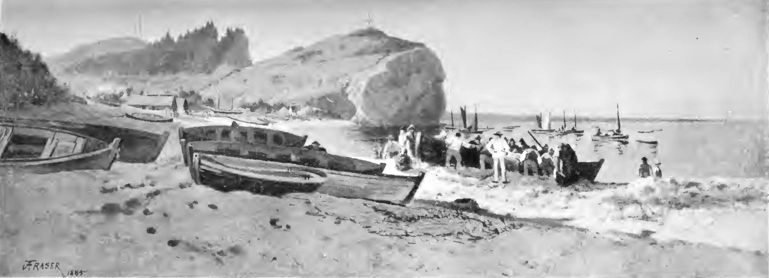
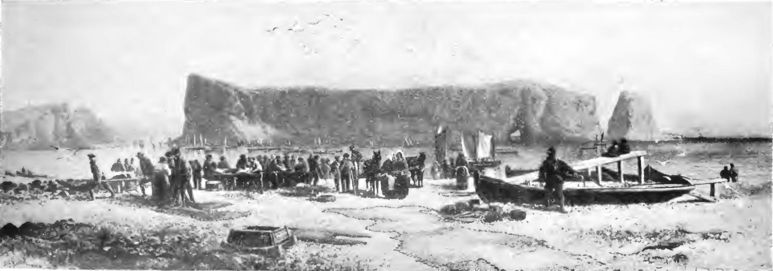
FISHERMEN AT ISLE PERCÉ AT THE MOUTH OF THE ST LAWRENCE
From original paintings by John A. Fraser
The inshore fishery is by far the more important of the two, inasmuch as it employs about eight men for one that is employed in the deep-sea fishery. Many of the inshore fishermen, however, divide their time and attention between farming and fishing. This is rendered possible by the extreme abundance of all kinds of fish in the waters that wash the shores of the numerous finely sheltered harbours and bays around which the fishing and farming settlements straggle.
The inshore fishery is carried on at a distance of from one to five miles from the shore, in boats carrying two and sometimes three men. A small class of vessels, with crews of from four to seven men, is also used on the nearer banks which lie twelve to fifteen miles out; while many fixed fishing contrivances, such as traps, drag-seines and weirs, are operated from the shore. The methods of capture practised by boat fishermen and small-vessel fishermen are hand-lining, trawling, and gill-net fishing.
The hand-line is the most common kind of gear used inshore for the capture of cod and like fish. It consists of a single line with a lead sinker and one or more hooks, which are baited and thrown over the side of the vessel or boat. So soon as a fish is felt tugging at the line it is hauled in. One man attends to two or three lines at the same time. A trawl consists of a line of any desired length, to which are attached, at intervals of about a fathom, short lengths of line called snoods, on the end of each of which is a hook. When baited and set in the water, the trawl is buoyed, and anchored at both ends. Although many of the smaller vessels carry one or two gill-nets for the purpose of catching their own bait, as a general rule gill-nets are anchored near the shore and operated by boat fishermen. Boats engaged in the line fishery leave harbour about daybreak and return in the course of the afternoon; while vessels of the small class remain two days and sometimes a week on the fishing grounds before returning to harbour.
The kinds of fish taken from the inshore waters are cod, hake, haddock, pollock, halibut, herring, mackerel, shad, alewives, smelts, flounders, swordfish, sardines, salmon, lobsters, oysters and clams. Herring is the chief bait, but when these are scarce clams are largely used as a substitute. Squid, a kind of cuttle-fish, when obtainable, is a favourite bait.
The deep-sea or bank fishery is pursued in substantial fore-and-aft rigged sailing vessels of from sixty to one hundred tons, carrying crews of from twelve to twenty men. These vessels operate on the many shallow stretches known as banks that lie between the outer edge of the inshore area and the deeper waters of the Atlantic, ranging from the 'Grand Banks' lying southward of Newfoundland to Brown's Bank off the western end of Nova Scotia; and also on the many banks in the Gulf of St Lawrence, around the Magdalen Islands, and between Cape Breton and Newfoundland.
Trawls are used almost entirely in the deep-sea fishery. Each vessel, according to the size and number of her crew, carries from six to ten flat-bottomed small boats called 'dories,' from which the lines are set and hauled. Owing to their peculiar build, the dories are singularly safe in a rough sea. When a vessel has reached the desired fishing locality the anchor is let down, lines are baited and dories launched. Each dory carries two men, who proceed to set their length of line. Half the complement of dories run out on one side of the vessel and half on the other; and in this way a considerable part of the fishing bank is covered with baited hooks. After a short interval the lines are overhauled by the men in the dories, and the fish removed from the hooks and taken to the vessel, where they are split, washed and salted down in the hold. This procedure continues day after day till the vessel's hold is full of salted fish, or the supply of salt gives out, when she returns to land and disposes of her take. A supply of herring or squid bait sufficient to last to the end of the voyage, if such a quantity can be had, is taken on board before leaving port. If the supply is short and gives out, the vessel is compelled to weigh anchor and proceed to land for a new supply, which in the summer time is often exceedingly hard to get. Many a vessel's crew loses two or three weeks of the finest fishing weather sailing from port to port searching for bait. The kinds of fish taken by vessels on the off-shore grounds are cod, haddock, hake and halibut.
In giving figures to show the growth of the fisheries of Eastern Canada, the writer has deemed it unsafe to go back beyond the year 1870: since that date fairly reliable statistics have been collected annually by Dominion officers. In the course of the fifteen years from 1870 to 1885 a steady advance was maintained in the value and importance of the fisheries of the four eastern provinces. The value of all kinds of fish caught by the fishermen of those provinces during the former year amounted to the sum of $6,312,409, while in the latter year the value rose to no less a sum than $15,302,243. This increase, however, must be largely accredited to the Provinces of Nova Scotia and New Brunswick: the value of the catch in the former province advanced from $4,019,425 in 1870 to $8,283,922 in 1885, while that of the catch in the latter province advanced from $1,131,433 in 1870 to $4,005,431 in 1885. The fisheries of the Province of Quebec were valued at $1,161,551 in the year 1870, but in the year 1885 the production only advanced to $1,719,460. No reliable returns were made of the fisheries of Prince Edward Island previous to the year 1873. The value in that year was $207,595, but in 1885 it rose to $1,293,430. In the four provinces there were employed during the year 1870 on board of vessels and boats 27,385 fishermen, while at the end of the fifteen-year period in 1885 there were 9362 fishermen on board of vessels and 42,136 fishermen in boats.
In studying the results of the fisheries of the same four provinces during the period from 1885 to 1910, the discovery is made that little or no progress took place during these twenty-five years. The aggregate value of all kinds of fish landed in the last year of the twenty-five-year period was $15,763,418, which shows an increase of only $461,175 over the value of the year 1885. In the year 1910 there were 6263 fishermen on board of vessels and 45,918 fishermen in boats, making an aggregate increase of only 683 men engaged in the fisheries in the course of a quarter of a century.
These figures bring to light a rather serious state of stagnation, some of the causes of which are discussed in another part of this article. Before proceeding further, however, it may be mentioned that there are now numerous indications of further advancement by the introduction of improved methods of preparing the fish for market, and by the opening of new outlets, especially for fresh fish.
Of all branches of the fisheries of Eastern Canada the most important is the cod fishery. Apart from the large number of men employed in the actual catching of the fish, it furnishes employment to thousands of people of both sexes in preparing and marketing the product, and so far as money value is concerned remains the leading industry of the Atlantic coast. The cod-fishing season is of varying length, being longest in the Bay of Fundy district and on the south coast of Nova Scotia, where the climate is not quite so severe as in the Gulf of St Lawrence. Its average duration may be said to extend from about the middle of April to the middle of November.
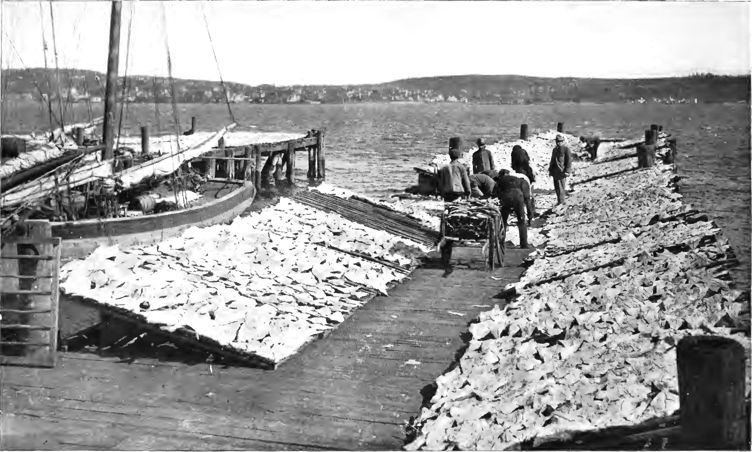
COD-FISHING IN NOVA SCOTIA
The inshore waters of every mile of Canada's Atlantic coast-line abound with cod, and from these waters fishermen in boats and small vessels take at least two-thirds of the whole of Canada's cod-fish production. The counties along the south shore of Nova Scotia produce the largest quantities of this fish. The majority of the fishermen of these counties give their whole time and attention to fishing, and are in possession of a fine type of fishing boat. These facts account for their success in this as in other branches of the industry. Of all the cod-fishing waters of Eastern Canada, probably the most prolific are those of the Gulf of St Lawrence, around the Magdalen Islands, on the north and east coasts of Prince Edward Island and the north coast of Cape Breton, and in Chaleur Bay. In addition to this the shores of the Gulf are rendered exceptionally advantageous for fish-drying, owing to their immunity from the fogs that sweep in upon the southern or Atlantic coast of Nova Scotia; and there can be no doubt that but for the inferior type of boat used, and the fact that many of the fishermen around the shores of the Gulf cease operations during the very height of the season to attend to the work of the farm, the value of the cod fishery of that part of Eastern Canada could be enormously increased.
The catches of both the inshore boat fishermen and the off-shore vessel fishermen are almost all split and salted for drying purposes. There is a vast difference, however, between the dried products of the two modes of fishing. Cod that is split and salted on board of a deep-sea fishing vessel is heavily salted, in order to preserve it during the fishing voyage, which sometimes lasts a couple of months; and being so thoroughly impregnated with salt, it does not make good dried fish, and is apt to become slimy when transported to hot climates. On the other hand, inshore or boat fish is brought to land daily, split, and placed under salt for a short time only, after which it undergoes the process of drying in the open. The curing is, therefore, due less to the salt than to the action of the sun and air. Fish cured in this manner may be safely exported to hot climates and stored there without deteriorating. For the proper drying of cod, fine, dry weather is an indispensable factor. On the shores of the Bay of Fundy and on the southern coast of Nova Scotia, owing to the frequency of fog considerable difficulty is experienced at times in getting fish quickly and thoroughly dried. This difficulty was largely overcome some years ago by the invention, by a Nova Scotia fish merchant, of an artificial fish-drier. The advantage of the artificial system lies in the fact that fish can be cured to any hardness in a very short time. The sun and air process occupies about three weeks, while artificial drying can be accomplished in forty-eight hours. An artificial drier consists of a system of steam or hot-water piping, over which are laid trays containing the fish. The fish are submitted to a temperature of from 90° to 95° Fahrenheit for a few hours, and when thoroughly warmed, alternate currents of cool and warm air are forced over and under them, the moisture being carried off in the meantime by suitable ventilators.
The chief markets for the dried product are found in Italy, Spain, Portugal, Brazil, the West Indies and the United States. The largest and best fish are sent to Europe and Brazil, and the inferior kinds to the West Indies. In recent years a large and widening outlet has been found both at home and abroad for the dried article in the form of small briquettes, minus bones and skin, which are known as boneless cod. An increasing quantity of cod pickled but not dried is shipped to Quebec and Montreal for consumption there in that condition. A considerable quantity is consumed fresh, not only in the coast towns, but in many of the inland towns and cities as well; and with improved transportation facilities this quantity could be greatly increased.
The total value of cod taken by the fishermen of Eastern Canada during the year 1910 amounted to $3,847,844. To that total Nova Scotia contributed $2,599,349; New Brunswick, $337,692; Prince Edward Island, $98,281; and Quebec, $812,522.
These fish are taken largely by the inshore fishermen while fishing for cod. Haddock are found abundantly in the Bay of Fundy, in the waters along the whole of the Atlantic coast of Nova Scotia, and in the southern portions of the Gulf of St Lawrence; but they do not frequent the northern shore of the Gulf. Considerable quantities are taken throughout the spring and summer by the cod boats; but it is in the latter part of the year that the chief haddock fishery takes place. At this time the fish swarm into the bays and harbours of Nova Scotia and New Brunswick, and great catches are made by boat fishermen. During the spring and summer months haddock are, for the most part, split and dried in the same manner as cod, and are marketed chiefly in the West Indies. In the fall of the year and in early winter they are nearly all shipped in a fresh state, or smoked, as 'finnan haddies,' to the inland towns and cities of Canada. The total catch of haddock in Eastern Canada during the year 1910 produced 111,705 cwts of dried and 25,839 cwts of 'finnan haddies,' while 109,734 cwts were shipped inland in a fresh state, the aggregate value of all these amounting to $829,553. The greater part of this haddock value was produced by Nova Scotia. Its share amounted to no less than $728,139, while New Brunswick produced $90,512 worth, and Prince Edward Island and Quebec $4911 and $5991 respectively.
Hake also abound in all the coastal waters of Nova Scotia, New Brunswick and Prince Edward Island, and are taken on the lines of the cod fisherman while fishing for cod. They are split, salted and dried, and, being an inferior class of fish, are shipped almost entirely to the cheaper markets of the West Indies. Hake to the value of $367,438 were caught by the fishermen of Eastern Canada during 1910, Nova Scotia contributing $272,127, New Brunswick $61,646, Prince Edward Island $32,415 and Quebec $1250.
Pollock are abundant only in the waters along the Atlantic coast of Nova Scotia and in the Bay of Fundy, especially near Grand Manan and the other islands of the bay. Like hake, they are split and dried, and marketed in the West Indies. The value of pollock taken during 1910 amounted to $325,533, to which total Nova Scotia contributed no less than $259,458.
Halibut are usually found wherever cod are met with. The fishery is not prosecuted as a distinct one, the fish being taken in considerable quantities by the cod fishermen. They generally inhabit deep gullies near the shore or between the banks. The total annual catch of this fish has not increased in the course of the last twenty-five years; but being a fish that is consumed fresh, its value has in recent years been enhanced considerably by means of improved facilities for transporting it to the inland centres of population. It is interesting to note that forty years ago halibut were taken in large quantities, usually when the fishermen were anxiously fishing for cod, and as only the fins were made use of, the fish itself was considered a pest. Now it is commonly worth eight or ten cents a pound as it comes from the water. During the year 1910 the total catch of halibut by the fishermen of Eastern Canada amounted to 14,970 cwts, valued at $153,400. About six-sevenths of this catch was taken by Nova Scotia fishermen. Halibut are shipped in a fresh state to all the towns and cities of Canada, and to the United States.
This fishery, although it falls below some others in money value, is in some respects the most important of all the fisheries of Eastern Canada. Apart from the commercial value of the herring as a food, the success or failure of the great cod fishery, and of the haddock, pollock and hake fisheries, depends to a great extent on the abundance or scarcity of the supply of herring for bait. On all parts of the coast of Eastern Canada herring are extremely abundant. In the spring of each year, without fail, large masses move close in to the shore, and are literally washed on to the beaches, in many parts of the Gulf of St Lawrence especially.
Trap-nets and fixed gill-nets set within a mile from the shore are the means of capture put into use, and so long as the mass of herring remains inshore, large quantities are captured by these means. The spring herring, being thin and without flavour, are not much used as a food, either in a fresh or cured state. The spring catch provides an abundant supply of fresh bait for the cod-fishing fleet in its first voyage to the banks, while much of it is salted and stored for the baiting of lobster traps throughout the lobster-fishing season. A small proportion of it is cured in pickle and smoked. About the end of May this body of herring, having deposited its spawn, moves off into deeper water, where the fish feed and fatten, returning in summer and autumn in excellent condition for food purposes. They do not, however, come so near the shore as they do in spring.
The same means of capture are put into use during the summer and autumn, and as a consequence the catch is comparatively small. Indeed, the summer fishery is frequently a failure, owing to the schools not coming in contact with the fixed fishing gear. Thus not only are the operations of the great cod-fishing fleet seriously hampered for want of a steady supply of fresh bait when most needed, but an insignificant quantity only of this summer herring of unsurpassed quality is prepared for consumption as food.
It has been demonstrated that by the use of what are known as drift-nets, set ten, twenty or thirty miles from shore, abundant supplies can be secured all through the summer months. During the summer of 1907 a steam vessel fitted with drift-nets for herring fishing was operated as an experiment in the Gulf of St Lawrence by the Dominion government, under the personal supervision of the writer, and from May 16 to September 12 landed daily catches of from ten to seventy barrels of herring of excellent quality. Operations were not confined to any one part of the Gulf, but included the waters of the eastern end of Prince Edward Island, the waters around the Magdalen Islands, Chaleur Bay, and the waters of the Gulf at the mouth of that bay. By the general adoption of similar methods a vast increase in the value of this fishery would be ensured.
The total value of the herring fishery of Eastern Canada for the year 1910 amounted to $1,702,493. To that sum Nova Scotia contributed $773,174; New Brunswick—the Gulf shore chiefly—$820,132; Prince Edward Island, $54,249; and Quebec, including the Magdalen Islands, $54,938. It has to be recorded, however, that twenty-five years earlier, in 1885, the value obtained from this fishery by the four eastern provinces amounted to $2,016,019.
In the light of the extreme abundance of herring on the Atlantic coasts of Canada, it is to be deplored that this branch of the fisheries is as yet practically undeveloped. Of the comparatively small proportion of the annual herring catch that is smoked and cured in pickle, part is consumed in Canada and part exported to the United States and the West Indies; but, owing to careless packing and badly made barrels, the price obtained is not such as to induce those engaged in the business to increase the output. With particular regard to the preparation of this fish as a food in the form of salted herring, there are opportunities for greatly increasing the trade by raising the standard of curing and packing, and introducing a more substantial barrel for transporting the cured article to market.
Allied to the herring fishery is the sardine fishery. This fishery is carried on in Passamaquoddy Bay, New Brunswick, in the waters around the islands of Grand Manan and Campobello and at the West Isles at the mouth of the Bay of Fundy, and is the only one of its kind in Canada. As a matter of fact, strictly speaking, the fish is not a sardine at all, but simply a young herring. It is an established fact that the true sardine is the young of the pilchard, and the pilchard is not found in the waters of Eastern Canada.
In the course of the last thirty years this fishery has been the means of building up a notable canning industry. Of so much importance is the fishery, and in such enormous armies do the fish appear, that the fishermen who prosecute their calling amongst the islands of the Bay of Fundy depend largely on it as a means of obtaining a livelihood.
The fish are captured in what is known as a weir, which consists of a wall or leader running out from the shore and terminating seawards in a pocket or trap. The leader is made by driving wooden posts into the sand or mud, from six to seven feet apart, and connecting them by stringers along which are secured wattled twigs or brush. The trap, usually circular in formation, is constructed of the same materials as the leader. As the fish move along the shore, they are guided by the leader through a narrow opening into the trap, and their return is prevented by projecting partitions. The weir, therefore, is a self-fishing device, and except for a few repairs requires little attention. The fish enter with the flood tide, and it is a notable fact that, once they are in the trap, little attempt is made to escape, notwithstanding that the spaces in the wickerwork would permit many of the smaller fish to go free. When the tide has ebbed sufficiently, the fishermen row out to the trap and proceed to remove the imprisoned fish. One end of a small seine is made fast to a post in the deepest part of the trap, and the other end is carefully carried round the mass of fish until both ends meet. The encircled fish are then scooped into the boat with dip-nets.
Some weirs, favourably situated in narrow channels, not uncommonly secure catches worth $700 or $800 at a single tide. One weir at Grand Manan Island is reported to have secured as many as 2000 barrels at one tide; but such good fortune is, of course, exceptional. The fish are bought up for canning purposes, as they are taken from the weirs, at an average price of from $1.50 to $2 per barrel. Weir-fishing is permitted only under licence from the department of Marine and Fisheries.
When the canning of these fish as sardines commenced nearly thirty years ago, considerable quantities were canned in establishments on Canadian soil; but as the United States was the chief market for the canned sardine, the government of that country, by placing a prohibitive duty on the manufactured article while granting free admission to the raw material, transferred the canning industry from Canada to the near-by towns of Eastport and Lubec in the State of Maine; and so now the fish are supplied by Canadian fishermen from Canadian waters and canned on United States soil. The value of sardines taken during the year 1910 by Canadian fishermen belonging to this small section of the coast amounted to no less than $551,204.
Besides sardines, there are at times considerable quantities of large herring taken in the weirs. Most of these are smoked round and exported in neat boxes to the West Indies, while some are smoked in the form of kippers, and others are cured in pickle for consumption in the home markets.
The gaspereaux (commonly called alewife), which belongs to the herring family, is distinguished from the true herring by the fact that it ascends rivers to deposit its spawn in fresh water. It is found in the Bay of Fundy, on the Atlantic coast of Nova Scotia, and along the south shore of the Gulf of St Lawrence as far as Miramichi Bay. It is not met with on any part of the Quebec coast. It is probably most plentiful in the Bay of Fundy. While considerable quantities of this fish are salted for consumption as food, it is more generally used as a bait fish. The quantity taken in eastern Canadian waters during 1910 amounted to 25,830 barrels, the value of which was placed at $100,086.
The shad also belongs to the herring family, but deposits its spawn in fresh water. A full-grown fish, however, attains double the size of the largest of the true herring. Like the gaspereaux it is found in the Bay of Fundy, along the Atlantic coast of Nova Scotia and the southern shore of the Gulf of St Lawrence. It is taken in greatest numbers in the Bay of Fundy and along the Gulf shore of New Brunswick. The catch taken along the Atlantic coast of Nova Scotia is insignificant.
During the season of 1910, 5343 barrels of this fish were taken, amounting in value to $57,039. The records for the year 1870 show that 11,497 barrels were taken in that year; from that date down to the present there seems to have been a gradual decrease in the quantity taken annually. A special commission recently investigated the conditions affecting this fishery, and it is expected that the action taken on the strength of its recommendations will result in arresting the further decline of the fishery.
The smelt, like the gaspereaux and shad, ascends rivers for the purpose of spawning. It furnishes a most important fishery, and is common on all parts of the coast of Eastern Canada. The fishery is at its height in the last part of the year. When the rivers freeze over, holes are cut in the ice, through which nets are let down. Enormous hauls are sometimes made in this way. In the year 1910 no less than 91,081 cwts of this fish were taken, amounting in value to the very considerable sum of $849,872. It is caught in great numbers on the Gulf shore of the Province of New Brunswick. That small section of the coast alone in the year 1910 produced 72,387 cwts, valued at $723,870. The home markets absorb a large quantity of smelts, but the bulk of the catch is shipped in a frozen condition to the United States.
This fishery is a very important one on all parts of the seaboard of Eastern Canada. Little of an accurate nature is known concerning the annual appearance and disappearance of mackerel. On the one hand, it is held that they migrate from south to north, appearing first in March or April off Cape Hatteras in the United States, and working northwards reach the Gulf of St Lawrence about the beginning of June, whence, after a stay of three or four months, they return southwards and finally disappear for the winter. On the other hand, it is maintained that this south and north movement is apparent only, and that in reality the fish move in successive schools from the deep, cold water to the shallower and warmer water near the shore, which they strike at different times as the temperature becomes favourable.
In any case, it is well known that mackerel make their appearance off the entrance to the Bay of Fundy about the middle of May, and at various points on the coast of Nova Scotia as the season advances, until in June they swarm into the Gulf. From that time they are found more or less abundantly until the early part of November, when they disappear entirely from Canadian waters. While all the bays and harbours of the Atlantic coast of Nova Scotia provide excellent haunts for this valuable fish, the Gulf of St Lawrence furnishes perhaps the most favourable conditions under which mackerel exist—smooth water and an exceedingly plentiful supply of food. In the spring the fish are full of spawn and in poor condition. When spawning has taken place, which usually happens early in July, they begin to improve, and from August to the end of October are large, fat, and in the best condition for consumption, either in a fresh state or split and salted.
The methods of capture put into use by the fishermen of Eastern Canada are traps, set gill-nets, haul-seines, and hooks and lines. Traps consist of a leader of netting run out from the shore, with a pound or enclosure at the seaward end, in which the fish are imprisoned. Gill-nets are anchored by one end near the shore. The heads of the fish enter the meshes, and the gill-covers becoming fixed to the twine, their withdrawal is prevented: hence the name gill-net. Haul-seines are operated by fishermen from the shore. When a school of mackerel comes in close enough, the net is thrown around it and hauled to the strand. Hook-and-line fishing, although at one time common on all parts of the coast, is now largely confined to the Magdalen Islands. The hook is usually baited with the white part of the skin of a mackerel. Vessels and boats fitted out for hook-and-line fishing invariably carry a supply of herring, which, when mackerel are met with, is ground up and strewn on the water. This has the effect of keeping the schools near to the vessel and within reach of the hooks.
Three-fourths of the mackerel catch of Eastern Canada is cured in pickle, the balance being consumed in a fresh state. Curing is performed by splitting the fish open down the back immediately after capture, thoroughly washing in several changes of water, and packing in layers in perfectly tight barrels, each layer being covered with a sufficient quantity of salt. The chief market for the cured product is in the United States, where it sells at from ten to twenty dollars per barrel, according to the quality and size of the fish. The United States is likewise the chief market for mackerel shipped in a fresh state.
Notwithstanding the abundance of this fish in Canadian waters, and with all due allowance for its erratic movements, it has to be admitted that this fishery is prosecuted at the present day in only a half-hearted manner, and that no advance whatever has been made for many years. Twenty years ago it produced a value of $1,969,571, while during the last ten years the value has risen and fallen between $800,000 and $1,600,000. During the year 1910, 43,427 barrels were cured on the Atlantic coast of Canada, while 33,910 cwts were shipped to market fresh, realizing an aggregate value of $947,381, to which Nova Scotia contributed $773,174, New Brunswick $49,554, Prince Edward Island $24,918, and Quebec (Magdalen Islands entirely) $99,735.
This fishery, like the summer herring fishery, is retarded by the method in general use of fixing fishing gear close to the shore and waiting for the fish to meander towards the stationary nets. By the adoption of the method known as drift-net fishing, the schools in their erratic movements could be followed to any distance from the land. If the causes that affect the movements of mackerel incline them towards the shore, all is well; but when their movements are more in a seaward direction, then, owing to the lack of any means of tracing their whereabouts, the season is written down a failure. There is also much room for development and improvement by the exercise of judicious care in curing the fish, and by packing them in strong, well-made barrels.
The salmon fishery of Eastern Canada is of very great importance. The fish is exactly similar, both in kind and quality, to the salmon of the European side of the Atlantic. The many large, well-stocked rivers emptying into the Bay of Fundy, the Atlantic and the Gulf of St Lawrence are the means of drawing each season, to the various districts through which they flow, large numbers of sportsmen, who invariably find sport to their hearts' content. In addition to the extensive hook-and-line fishery on the various rivers, there is carried on, during the open season, along the whole coast-line from the Bay of Fundy to the north shore of Quebec in the Gulf of St Lawrence, a very considerable net-fishery.
Of the counties bordering on the Bay of Fundy, St John produces the greatest quantity, which during the season of 1910 amounted to 2210 cwts. On the Atlantic coast of Nova Scotia, Halifax and Guysboro are the chief salmon counties, each of them producing over 600 cwts in 1910. During the same year the county of Inverness, bordering on the Gulf of St Lawrence, gave 1000 cwts.
The best salmon-producing counties in Eastern Canada, however, are those situated farthest up the Gulf. Of the New Brunswick counties which border on the Gulf, Kent produced 1100 cwts, Northumberland 3900 cwts, Gloucester 4470 cwts, and Restigouche 3780 cwts in the season of 1910. During the same season the Quebec counties bordering on the Gulf produced the following quantities: Bonaventure 2500 cwts, Gaspe 1140 cwts, and Saguenay 5650 cwts. It will be observed that the last named is the best salmon-producing county in the whole of Eastern Canada. The total catch of salmon in the four provinces during the season of 1910, both by hook-and-line fishing on the rivers and by net-fishing on the coast, amounted to 31,066 cwts, valued at $413,485.
Along the shores of Eastern Canada there are, perhaps, the most remarkable grounds for lobster fishing in the world. Their extent and the enormous supplies that have been annually produced from them in the course of the past forty years have no parallel anywhere else. From the island of Grand Manan, along both sides of the Bay of Fundy, and, following the sinuosities of the coast-line, on to the Labrador boundary, lobsters abound in such numbers that the taking and marketing of them form one of the most important branches of the fishing industry. The total money value of this branch is second only to the cod fishery. In addition to furnishing employment to most of the regular fishermen of Eastern Canada during the course of the season when lobster fishing is allowed, it—being wholly an inshore fishery—enables many farmers, who till the usually unresponsive soil near the seashore, to add considerably to their earnings by engaging in it.
Not so very many years ago, however, this fishery was of no account, and the finest lobsters were bought and sold as low as at fifty cents per hundred. In Chaleur Bay, before the advent of the preserving cannery, they occurred in such numbers that farmers used them by thousands to manure the land. At Shippegan and Caraquet carts were sometimes driven down to the beaches and filled with lobsters left in the pools by the outgoing tide. One or two individuals here and there on those parts of the coast where the crustacean was most abundant, becoming impressed with the industrial possibilities of preserving the meat of the lobster in tins, were the means, about the year 1870, of bringing into being three establishments for that purpose. These constituted the total number of such canneries in Eastern Canada at that time. Forty years later, in 1910, the industry had grown to such a degree that no fewer than 677 canneries were kept busy in the four eastern provinces, during the lobster-fishing season, preserving the enormous quantities that were being brought to land daily.
These canneries, being operated under licence issued by the department of Marine and Fisheries at Ottawa, are required to conform strictly to a standard set by the department, with regard to such matters as the construction of sanitary buildings, cleanliness in the handling of the meat, etc., and this secures for the product an invariably high quality. A one-pound can is most commonly used; forty-eight of these, when filled, make what is known as a case. The value of such a case runs from fourteen to eighteen dollars, according to the reputation of the packer and the extent of the supply and the demand. The United States, Great Britain, France and Germany provide the chief markets for the canned product, and the supply is, as a rule, not equal to the demand.
In addition to the great canning industry, there is carried on a flourishing and extremely remunerative business in the export of live lobsters to the United States for consumption in a fresh condition. This business is largely confined to the counties surrounding the Bay of Fundy, and those along the west and south coasts of Nova Scotia as far as Halifax. The geographical position of that part of the Atlantic provinces, together with good steamship service, makes such a business possible and profitable. With better facilities for transportation, this lucrative trade could be extended to the counties lying to the eastward of Halifax.
The figures that follow show how the lobster industry advanced during the period of twenty years from 1870 to 1890. In the former year there were 591,500 one-pound cans of lobsters preserved, the value of which amounted to $92,575. From that date a gradual increase was maintained till in the latter year the output of the preserved article had reached the great total of 11,559,984 cans, while the quantity shipped to market in the shell amounted to 104,940 cwts, the whole producing a value in 1890 of $1,648,344.
In the course of the next twenty years, which ended with 1910, we find—after allowing for fluctuations due to weather conditions—that the quantity of lobsters taken from the water has remained almost stationary, while the value has increased considerably. The total output of all the canneries in Eastern Canada during the season of 1910 was 9,071,600 cans, and the total shipment of lobsters in the shell 103,907 cwts, while the aggregate value of the product of the lobster industry was $3,657,146. During the previous season (1909) the figures were 10,911,497 cans preserved, and 98,373 cwts shipped in the shell, the whole valued at $4,200,279.
For many years fears have been expressed that this enormous annual draining of the lobster-producing areas will some day result in the extinction of the industry. The fact, as already shown, that for twenty years, despite greatly increased catching power, there has been little or no increase in the quantity taken would seem to indicate the possibility of such a calamity occurring.
Ever since the time this fishery began to assume real importance the department of Marine and Fisheries has been constantly devising laws and regulations looking to the permanent preservation of an industry that is of such vital importance to a large proportion of the population of Eastern Canada. The season during which fishing may be carried on has been reduced to a minimum consistent with the necessities of the trade; the landing of lobsters measuring less than a specified size is prohibited; lobsters carrying spawn or 'berries' are protected, while hatcheries for propagating and artificially increasing the supply in the surrounding waters have been established. It is confidently believed that by the strict enforcement of the prohibitory regulations, and with the assistance of the hatcheries, the permanence of the industry will be assured.
The area of natural oyster-beds along the eastern seaboard of Canada is very extensive. Moreover, the beds are situated in localities possessing all the requirements of shelter, absence of excessive tide, suitable bottom, and the proper degree of salinity necessary for the growth and nutrition of this succulent bivalve. In addition to having its habitat on favourably situated areas, the oyster of Eastern Canada has the advantage of being extremely fecund.
In a special report by Professor Prince, commissioner of Fisheries for Canada, entitled Peculiarities in the Breeding of Oysters, published in the annual report of the department of Marine and Fisheries, 1895, we are informed that whereas the European oyster produces not more than one to two million eggs, the Canadian oyster produces from fifty to one hundred and fifty million. He summarizes the chief differences between the two as follows:
Canadian Oyster
Sexes separate.
Unfertilized eggs shed by parent.
Eggs and sperm meet in the open sea and fertilization is accomplished.
The swimming embryo is naked, and has, for a time, no shell.
Number of eggs enormous, probably fifty to one hundred and fifty million produced by each female oyster.
European Oyster
Sexes combined in the same individual.
Eggs never shed before fertilization.
Eggs fertilized and retained within the mother oyster's shell.
Embryos protected by a thin shell and emitted as 'black spat.'
Eggs do not exceed one to two million, i.e. one egg for every hundred eggs produced by Canadian oyster.
In Eastern Canada oysters are found at the head of Caraquette Harbour on the south side of Chaleur Bay; all along the Gulf shores of New Brunswick and Nova Scotia, notably at such places as Miramichi Bay, Bay du Vin, Richibucto, Buctouche, Shediac, Baie-Verte, Pugwash, Tatamagouche, Pictou and Tracadie; nearly everywhere in the Bras d'Or Lakes of Cape Breton, and down the Atlantic coast of Nova Scotia as far as Jeddore Head, near Halifax. Around the whole coast of Prince Edward Island there exist natural beds on which oysters grow, such, for instance, as the famed 'Malpeque,' which for delicacy of flavour are unexcelled.
Notwithstanding this very lavish bestowal of natural oyster-producing areas, and the extreme fecundity of the Canadian variety, the annual output of the fishery is not more than a miserable fraction of what it should and could be. As a matter of fact, the quantity produced annually since 1882, in which year the production amounted to 64,646 barrels of about three bushels each, valued at $193,938, has been diminishing gradually, in the year 1910 only amounting to 34,575 barrels. With the decline in quantity, however, the price per barrel rose, until in the latter year it rather more than doubled that of the former year, and gave a total value which amounted to $220,969.
Rude modes of fishing, reckless destruction of the beds by farmers in digging for mud to fertilize their lands, fishing through the ice during the winter months, and the leaving of immature oysters on the ice, where they perish through the severity of the weather, have combined to reduce the annual yield of the natural beds. With improved railway transportation there has come an ever-increasing demand, to supply which fishermen have had to resort to indiscriminate overfishing to such an extent that on many beds the stock left for breeding purposes has not been sufficient to maintain the great annual drain.
Within recent years regulations have from time to time been made by the department of Marine and Fisheries, with a view to preventing the extinction of this fishery. These prohibit the taking of oysters except under licence from the minister of Marine and Fisheries; the taking of oysters during a close season, which runs from April to September; the taking of oysters through the ice; the taking of oysters of less than a specified size; and the digging for mud within two hundred yards of any live oyster-bed. Areas have been set apart from time to time and allowed to recuperate for various periods. The regulations provide that nothing but the least destructive fishing apparatus shall be used for taking the oysters from the beds. But, even with these preservative laws in force, it has become plainly evident that the oyster fishery of Eastern Canada under existing conditions cannot attain the importance and the development of which it is capable. The experience of other countries goes to show that nothing short of private or artificial cultivation of oysters upon reserved areas will produce the desired results.
Up to the present time little attention has been devoted to artificial culture in Canada, by reason of the uncertainty caused by the ambiguous decision of the imperial Privy Council in the Fisheries Reference of 1898 as to whether the right to grant leases lay with the federal or provincial government. At this writing (1913), however, a 'modus vivendi' has been arranged by which the provincial governments concerned are empowered to grant and guarantee exclusive rights to any one desiring to lease areas for artificial cultivation; and there can be no doubt that, with such security, capital will be attracted, and the business before many years raised to its due status.
Clams of various kinds are taken on all parts of the Atlantic coasts of Canada. They are obtained by digging on the mud flats at low water, and are used largely for bait when herring are scarce. A considerable proportion of the annual take of this mollusc is, however, used as food, either in its fresh state or preserved in cans. The value of clams taken during 1910 amounted to no less than $326,262, to which the Gulf shore of New Brunswick contributed the largest share.
Besides the various kinds of fish that have been herein dealt with, there are several less important kinds, such as tom-cod, flounders, eels and bass, which in the aggregate add appreciably to the annual value of the fisheries of the eastern provinces. For example, in the year 1910 the value of tom-cod, derived chiefly from the Gulf shore of New Brunswick, amounted to $44,586; that of flounders, mostly from Nova Scotia, to $19,692; that of bass, principally from the Gulf shore of New Brunswick, to $28,280; and that of eels, of which Nova Scotia and New Brunswick contributed seven-eighths in about equal shares, to $68,939. Nearly all these fish are consumed in Canada.
Fishermen on the Atlantic coast of Nova Scotia have lately paid some attention to the taking of swordfish. The mode of capture is by harpooning, the striker standing on a platform erected in the bow of the boat. The fish weigh, on an average, about 300 lbs, and realize to fishermen about ten cents per pound. The year 1910 was the first in which the catch on the Nova Scotia coast was officially recorded. In that year swordfish to the value of $13,695 were taken. The United States provides the principal market for this fish.
Squid and capelin, perhaps the most valuable of all baits for cod, are found in abundance near the shores of Eastern Canada. The former especially is obtained in large quantities towards the end of the year, and preserved in cold storage for use during the early voyages of the cod-fishing fleet in the following spring. During the year 1910 there were taken from the inshore waters 12,321 barrels of squid, the value of which was placed at $43,333.
The livers of fish, such as cod, pollock and hake, taken by Eastern Canadian fishermen, produce in an average year upwards of 460,000 gallons of oil, valued at about $140,000.
In the Gulf of St Lawrence, chiefly around the shores of the Magdalen Islands, there is an important annual seal hunt made on the ice in the spring. This hunt is entirely conducted from the shore, the hunters going off on the ice to meet the seals. When these come close in to the shore, men, women and children participate in the hunt, and in a good sealing year as many as 40,000 seals are killed and landed at the islands. At the rate of one dollar per skin, this would bring to these isolated fishermen and their families a considerable sum of money at a time when it is impossible to engage in the regular occupation of fishing.
At one time a considerable fleet of small schooners was engaged in this spring sealing business. These vessels, as they became worn out or were lost, were not replaced, and now the method is no longer prosecuted.
Notwithstanding the fact mentioned on a previous page that little or no increase has taken place in the aggregate annual value of the fisheries of Eastern Canada during the last twenty-five years, it seems clear that an era of development and expansion is about to commence. The long-existing stagnation is due to the fact that the fish trade of the Atlantic coast has remained largely a salt-fish one, which, in spite of recent improvements in the style of placing the dried product on the market in small, neat packages of boneless and shredded fish, practically reached its limit long ago.
That a change is taking place in the character of the industry on many parts of the Atlantic coast, and that herein lies the hope of re-animation, is obvious to all close observers. There is an ever-increasing quantity of fish being disposed of in the home markets in a fresh or smoked condition. The official records show that in the year 1900 the quantity of cod so disposed of was nil. Five years later it amounted to 12,389 cwts, while at the end of another five years (1910) it advanced to the considerable figure of 43,548 cwts. The quantity of haddock, fresh and smoked, consumed increased from 75,606 cwts in 1900 to 98,757 cwts in 1904, and to 135,574 cwts in 1910.
One great hindrance to the advancement of the fresh-fish trade, that of the slow transportation over the long distances separating the centres of population in Canada from the sea, has been largely removed by the action of the department of Marine and Fisheries, in 1907, in assisting shippers of Canadian fresh fish to take advantage of fast railway services by paying part of the heavy express charges on their shipments, thus enabling them to compete successfully with United States shippers, who, previous to that time, practically supplied the larger towns and cities of Central Canada, owing to the much shorter railway journey from Gloucester and Boston. Since the inauguration of this system the quantity of fresh fish annually brought into Canada from United States ports has been strikingly reduced, while that shipped inland from Canadian Atlantic ports has been correspondingly increased; and there can be no doubt that the energy and enterprise of fishermen and fish merchants will enable them soon to supply the present home demand entirely from Canadian sources.
Boat fishermen have become alive to the fact that in order to meet the demands of the rapidly increasing fresh-fish trade they must be able to reach port from the fishing grounds with their perishable cargo in the shortest possible time; and so we find that during the season of 1910 no fewer than 2304 boats belonging to the fishing fleet of Eastern Canada were fitted with gasoline engines, being thus enabled to make speed when head-winds or calms prevailed.
Since 1908 steam-trawling, the latest and most successful mode of capturing large quantities of fish, has been tried in a small way on the coast of Nova Scotia, and the results have proved beyond a doubt that by this means of fishing much larger hauls can be got in Canadian waters than in most waters on the European side of the Atlantic. Steam-trawling consists in the dragging of a strong, bag-shaped net over the sea-bottom by a steam vessel, for the capture of all kinds of fish. There are some serious obstacles to be overcome, however, before this method of fishing finds a firm establishment in Canada.
It is a fact that, wherever this style of fishing has been introduced, it has been, rightly or wrongly, denounced in the most decided manner by fishermen who use hooks and lines. They not unnaturally fear the effects on the fresh-fish markets of the greater catching power of the trawler, and also the depletion of the inshore fishing areas by overfishing and the possible destruction of their fishing gear by the sweep of the trawler's net. It is not surprising, then, to find that on the appearance of the first steam-trawler in Canadian waters, the line fishermen urgently requested the government to prohibit such a style of fishing. Total prohibition was, of course, out of the question, as, owing to the fact that foreign trawlers, working beyond three miles from the shore, would be unaffected, such a step would constitute an unfair discrimination against such Canadians as desired to operate trawlers. The government, however, went as far as it could go, and passed a law prohibiting all steam-trawlers from operating within the three-mile limit and in the bays and harbours of Canada.
In spite of a great abundance of fish, it is doubtful if steam-trawling will become in any degree common in Canada for very many years. Trawling is an expensive style of fishing, and requires a large outlet, at good prices, for all classes of fish in their fresh condition, the price of salt fish being generally too low to permit of profitable working for that trade. There is, therefore, some reason for the fears of the line fishermen that a rapid development of this mode of fishing might so continually over-supply the as yet limited, but growing, fresh-fish markets of Canada as to render both line- and trawl-fishing unremunerative.
It is probable that steam-trawling has come to stay, and although its development will, of necessity, be slow, nevertheless, looking to the time when Canada will have many more millions of people within her borders than she now has, when railway rates will have been reduced and the distributing facilities will have been increased to keep pace with the expanding trade, there will assuredly be seen a fleet of steam-trawlers running in from the Atlantic fishing grounds with daily supplies of wholesome fresh food-fish.
With the increasing application of modern methods arises the question: Will the vaunted abundance of fish in Canadian waters remain unaffected? This question can only be answered by turning to the records of the fisheries of European waters, where steam-trawling has been practised for many years, and where the fleets are large. There, in the comparatively narrow North Sea, what would in Canada be called excessive fishing to a superlative degree continues from January to December, year in, year out, by an immense fleet of trawling and other steam vessels, yet the North Sea remains a prolific fishing area.
Climatic conditions in Canadian waters, and even on the 'Grand Banks,' provide a natural protection against depletion. For three or four months in each year there is an enforced close time during which little or no fishing takes place, and during which, owing to the severity of the weather, even the operations of steam-trawlers would be practically stopped. Indeed, the Gulf of St Lawrence, that immense fish-breeding area, is virtually closed to fishing from December to May, which period, be it remembered, covers the spawning season for cod, haddock and such fish. These fishing grounds, therefore, even if excessively worked during the open season, would, owing to the long rest, soon become replenished. It is inconceivable, then, that the catching power can develop to such a degree in Eastern Canada as to ever appreciably diminish the extraordinary abundance of fish; and we may rest assured that these fisheries will remain a splendid heritage for all time.
The foregoing description of the fishing areas, fishing methods and fish products of Eastern Canada will convey some idea of the vast importance of the fisheries, which constitute not only an unfailing source of food supply for the Canadian people, but also furnish the material for a valuable and constantly growing trade with other countries, and in the prosecution of which a valuable national asset in the shape of a hardy and skilful seafaring population is being maintained.
FOREST RESOURCES OF THE
MARITIME PROVINCES
The forest products of New Brunswick rank next in value to the products of the farm, and a very large portion of the land is better adapted to lumbering than to agriculture. Definite information of a reliable and scientific character is lacking as to the extent and value of the forests of the province, the proportion of agricultural and forest land, the area of the different forest types, or the relation of those types to the geological structures. It is encouraging to note, however, that this lamentable ignorance may soon be remedied by the carrying out of a forest survey, at least of the crown lands, on a comprehensive scale.
Topographically the province is rough and uneven, and the valleys are intersected by many fine streams. Such diversity in elevation gives rise to forest types resembling those in the Adirondack region, and the province might well be regarded as a continuation of the spruce region of New England. The forest as a whole, if white pine and larch be excepted, is composed of tolerant, rapidly growing species with great reproductive capacity, and it is this last characteristic that most impresses the forester and increases the chances for profitable investment in forest land.
In the swamps the leading species are tamarac or larch, slow-growing black spruce, northern white cedar, balsam fir, with red spruce, black ash, and maples. There are a million acres of barren and swamp lands in the province, caused either by excessive or deficient drainage. These lands are covered with blueberry bushes and stunted trees such as larch, black spruce, poplar and birch. On the gravels and sands, spruce, white and red pine, and fir often mixed in second growth are found. The burned lands yield grey, paper and yellow birch, the conifers gradually superseding the hardwoods. On the higher ridges there are magnificent hardwood forests of beech, birch and maple, either pure or mixed with hemlock and spruce. The spruce is tall, straight and well-pruned, making fine lumber, free from knots. The spruce flats and swamps yield more spruce and fir per acre, and in their lower parts may contain considerable cedar which is very apt to show a high degree of rot.
The timber trade in New Brunswick seems to have followed certain definite lines of development, which will be treated briefly in the following order: (1) the 'masting' industry, when masts and spars were secured for the French, and, subsequently, for the English navy; (2) the export of square timber, largely white pine; or hardwoods intended for shipbuilding; (3) increased activity in producing for the market both square and sawn timber, due to shipbuilding being added to the industries of the province; (4) the sawing and export of deals, largely spruce and fir, which may be considered at present the main phase of the trade. If we were allowed to forecast the next stage in development, we should designate it as the production of other kinds of lumber besides deals or plank and the intensive development of the hardwood lumber industry. Accompanying this there must be closer utilization of waste products such as slabs, edgings, and saw-dust, by the finding of new uses and markets for the products of wood-distillation, pulp-making, etc., which processes will be a necessary and profitable adjunct to the saw-mill.
The 'Masting' Industry.—Masts were first cut for the French navy, on the St John River, in the reign of Louis XIV. In October 1700 the French man-of-war, Avenant, which had discharged supplies for Villebon's fort at the mouth of the Nashwaak near the present site of Marysville, took back to France a number of fine masts.
The discovery of a black spruce fit for yards and top-masts was of great importance to New Brunswick, and marked the beginning of the mast industry for the British navy. Several enterprising pioneers in the province contracted with the British government to supply masts. The earliest to engage in the business was William Davidson, who began operations on the St John River about the year 1779. The first cargo of masts arrived at Halifax on November 22, 1780, in one of the navy transports. We learn that in 1790 Davidson shipped three cargoes of masts and spars from the Miramichi, and that after his death the mast contract in that region was taken by Fraser and Thom, a firm which a short time previously had established its headquarters on Beaubair's Island. So important was the mast industry considered at this time that special efforts were made to conciliate the Indians by presents so that they should not molest the mast-makers.
It was not unnatural, considering the splendid opportunities for securing fine masts, that other firms, such as that of Francklin, Hazen and White, should take up the work. Considerable rivalry, resulting at times in sharp words and sharper practices, developed between the rival firms. Samuel Peabody, an expert woodsman and surveyor, was employed to look after the operations for the firm of Francklin, Hazen and White, and it is from his letters to his employers that we learn much of the particulars and difficulties of the business.
Masts were hewed in the woods 'four square' and 'bowsed' down to the river during the winter by means of oxen and a block and tackle. Here they were inspected by the king's surveyor, who corresponded to our modern lumber surveyor, and then rafted to Fort Howe and stored in the 'mast pond' at Portland Point, St John, before being sent to Halifax. After being certified to, the holder of the mast contract could secure supplies necessary for the continuance of the work. The extent of the industry and size of the timber can be gathered from the early records.
On April 30, 1781, Sir Richard Hughes, the administrator of Nova Scotia, writing to Lord Germain, speaks of upwards of '200 sticks for masts, yards, and bowsprits, which had been approved on the St John and were being loaded for Halifax.' The certificate of the naval storekeeper shows that on July 6, 1782, Francklin, Hazen and White had delivered at Fort Howe, according to their contract:[1]
| £ | s | d | ||
| 37 | masts, valued at | 1096 | 16 | 3 |
| 65 | yards, valued at„ | 1502 | 13 | 4 |
| 8 | bowsprits valued at„ | 181 | 2 | 0 |
| 20 | M ft B.M. of white ash oar rafters | 5 | 0 | 0 |
In the fall of 1783 Captain John Munro submitted a report to General Frederick Haldimand, Governor of Canada, in which he says: 'On the River St John are the finest Masts and Spars that I have ever seen. I saw at Fort Howe about 6000 pounds worth. Two ships were loading when I left that place and there were masts sufficient to load ten ships. The proprietors of the lands sell the Pines standing for $8.00 each tree.'
Some of these sticks were of great size and length, judged by present standards, and show the magnificence of the early forests. Samuel Peabody, writing to Hazen and White, mentions masts, some of which were 35 inches in diameter and 91½ feet long, and a yard 26 inches in diameter and 108 feet in length, for which the price demanded was £100 and £80 respectively. If these diameters were taken at one-third the distance from the butt, as some statements imply, the masts must have been hewed from very large trees. The prices paid depended on the diameter and length of the pieces, and were about as follows:
| Diameter | Length | Price paid | |||
| (Inches) | (Yards) | £ | |||
| Yards | 14-25 | 22-35 | 4 to 52 | ||
| Bowsprits | 25-38 | 17-25 | 10 to 42 | ||
| Masts | 18-36 | 23-36 | 10 to 130 | ||
Export of Square Timber.—Two cargoes of the first square timber ever exported from the Miramichi were shipped by Fraser and Thom in 1792, and until the introduction of saw-mills this was the favourite form of export for pine, because of the small capital required to hew trees in the woods. The saving in weight was attended with great loss of valuable material. In Northumberland County there was a gradual increase in the quantity of square timber exported, which amounted in 1824 to a total of 180,298 tons, or 36,336 tons more than from the rest of the province. White pine timber was quoted at this time at ten, and red pine at twelve, shillings per ton respectively. The gradual increase in the exportation of square timber from St John and its final falling-off, as spruce deals increased in importance, is shown by the following figures:
| (Pine) | |||
| Year | Square timber | Spruce deals | |
| 1821 | 247,394 tons | ||
| 1822 | 266,450 tons„ | 100,000 | board feet |
| 1824 | 321,211 tons„ | ||
| 1835 | 291,817 tons„ | ||
| 1839 | 277,998 tons„ | ||
| 1840 | 261,118 tons„ | 79,385,000 | board„ feet„ |
| 1845 | 257,451 tons„ | ||
| 1860 | 39,290 tons„ | 240,000,000 | board„ feet„ |
| 1900 | 20 tons„ | 159,785 | standards |
Timber used in Shipbuilding.—About the year 1815 Great Britain turned to her North American colonies for timber for naval purposes, and, by special act of parliament, it was admitted free of duty. Many persons embarked in the trade, and on the Miramichi alone, according to Robert Cooney, there was invested in lumbering operations the sum of £1,000,000 sterling.[2] Thus did the timber trade 'owe its origin, as well as its subsequent progress and development, to the pressing exigencies of the British nation.' Besides birch and maple for keels, further mention of which is made under the hardwood lumber industry, the products demanded were planking, ship's knees, mostly of spruce or larch, oars and oar rafters made of ash, handspikes, masts, spars, bowsprits, etc.
The Saw-mills of New Brunswick.—The introduction and early history of the saw-mill in New Brunswick is a subject of great interest and deserves special treatment. According to W. O. Raymond's History of the St John River, the pioneer of the milling industry in New Brunswick was a primitive mill situated at the mouth of the Nachouac (Nashwaak) River, erected by the Sieur de Chauffours and his brother, the Sieur de Freneuse, in 1695. This mill may be considered the predecessor of the Alexander Gibson Company's mills, recently acquired by the Consolidated Pulp and Paper Company.
The first saw-mill in St John was built by the firm of Simonds and White, in 1767, and its site was near that of the present Union Railway depot. It was a tide mill erected to saw lumber for a lime warehouse and other buildings of the firm. By 1812 it had fallen into total ruin.
In 1768 Captain John Glasier built a saw-mill at the mouth of the Nashwaak River. In the following year he constructed a second mill. The cost of the two mills and the dam was £200 sterling and the capacity of each was 8000 feet a day. The Glasiers were pioneers in the lumber business, and Senator Glasier, known as the 'main John Glasier,' was the first lumberman to bring a drive over the Grand Falls.
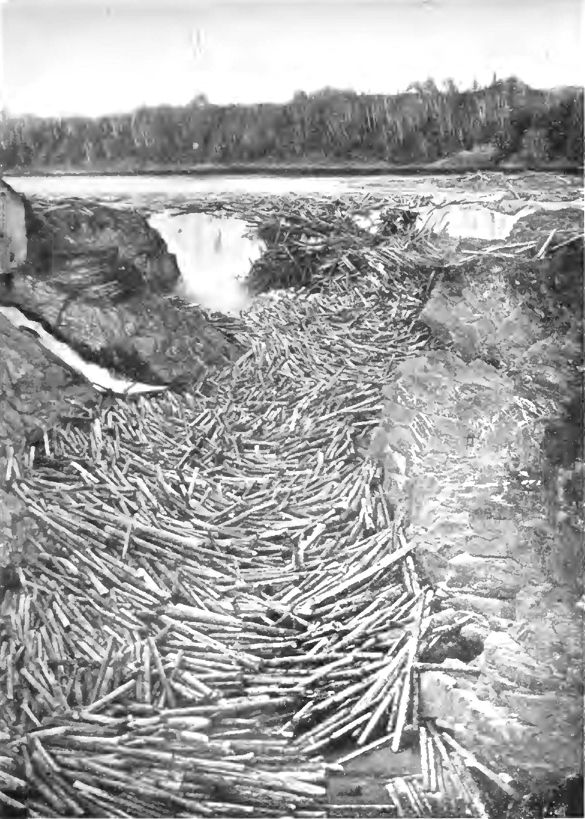
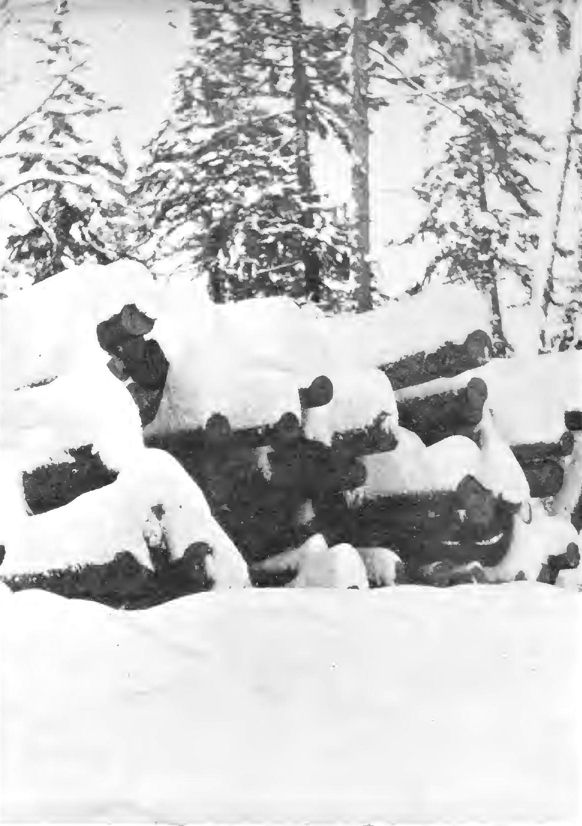
LUMBERING IN NEW BRUNSWICK
(1) A 'JAM' AT GRAND FALLS ON THE ST JOHN RIVER
(2) A SNOW-COVERED YARD
James Woodman also had a mill, on a stream known as Numcheal Creek, opposite Middle Island, in Maugerville, and as early as 1783 sawed lumber there for the loyalists. Samuel Peabody was likewise one of the first mill-owners on the St John, the centre of his operations being the Oromocto, the timber of which he had doubtless become familiar with while engaged in 'masting.'
In 1786 William Davidson commenced operating two saw-mills erected by him on the tributaries of the North-West Miramichi. This marked the beginning of milling in that region. In 1830 there were two saw-mills near the head of the tide on the Buctouche River; and in 1832, according to counties, Northumberland had eighteen saw-mills, Kent nine, and Gloucester six. The increase in the number of mills, of persons employed and of the capital invested in the province, from the year 1831 to 1845 at five-year intervals, is shown by the following table:
| Year | Number of Mills | Persons employed | Value | |||
| 1830 | 229 | 3798 | $320,000 | |||
| 1835 | 320 | 4200 | 420,000 | |||
| 1840 | 574 | 7400 | 740,000 | |||
| 1845 | 640 | 8400 | 900,000 | |||
The first deal was sawn in 1819 and the first shipment of 100,000 feet was sent to England in 1822. From that time until the present, spruce and fir deals have constituted the main part of the shipments to Europe and the United States. The deal is a plank three inches thick and of varying width according to the size of the log from which it is obtained. With the scarcity of spruce and the corresponding rise in stumpage prices, there is an ever-increasing amount of the narrower widths and a larger proportion of fir allowed in deal shipments. All logs over nine inches at the top end are scaled as deal, and those from seven to nine inches at the top, inside the bark, are classed as 'batten' spruce. Spruce logs suitable for deal usually sell at from thirteen to fifteen dollars per thousand board feet at the booms, with batten spruce commanding a much lower figure. The early stationary mills, cutting eight thousand feet a day and driven by water power, are things of the past; they have been superseded by the modern gang and band mills, in which the machines are directly driven by motors, and have a capacity of from 100,000 to 200,000 board feet daily. These modern mills employ large numbers of men and involve millions of dollars in invested capital.
|
Mast Contract Contracted and agreed on the 9th day o£ August 1781, with Sir Andrew Snape Hammond, Commissioner of His Majesty's Navy, resident at Halifax, by us, Michael Francklin, Esq., of Windsor, and Wm. Hazen and James White, of the River St John, in the province of Nova Scotia, and we do hereby covenant and agree to deliver, free of all charges to His Majesty at the mouth of the River St John, the undermentioned North American Whitepine masts, Yards and bowsprits, ash rafters, elm timber, oak timber, Anchor stocks, of white oak, and Crooked or Compass timber (Ship Knees) in the quantities and of the dimension and the prices expressed against each size to be brought to the mouth of the River St John by or before the first day of July 1782, and there to remain at our risque until they shall be embarked on board such ships or vessels as shall transport them to England, Halifax, or elsewhere. It is further agreed by Sir Andrew Snape Hammond for the encouragement of the said contractors, that in case the enemy should make a descent on the Port of St John in order to destroy the masts lying there, that the damages sustained thereby should fall on the Government and not upon the contractors, provided that it shall appear that all proper endeavours on the part of the contractors were used to save the masts. |
|
Robert Cooney, History of the Northern Part of New Brunswick and District of Gaspe. |
The logging camps in New Brunswick vary in size from those of the small contractor or jobber, who lives in the woods with his family and employs but a few men, to the depot camps of the larger operators, with their extensive equipment. In permanence they vary from rude but usually comfortable shelters for men and horses, intended to last one year only, to those of more careful construction, intended to serve as headquarters for two or three years while given blocks or certain watersheds are being logged.
The contractor's camp is built of logs and divided into two compartments: one serving as a living-room for the contractor and his wife, and dining-room for the men; and opening out from this is the camp proper, with its big stove and two or three tiers of bunks. The entire cost of such a camp is not over fifty dollars. In the second or third season, it will usually be found that the porcupines have badly undermined its rotting timbers and the weight of snow has almost crushed it, so that it barely stands out as a snow-clad ruin against the background of spruce and fir—a few scattered trees of bird-cherry alone telling of its existence. A separate rude building, or 'hovel,' constructed also of logs with cracks stuffed with hay, serves as a stable for the few horses necessary for yarding the logs and hauling them to the landing.
On the other hand, the depot, or main supply camp of the large company, consists of a comfortable bunk-house and cook-house, separated by a small entry-way, a store-house for meats and vegetables, a smithy, and often a small log camp, called the 'beaver house,' which serves as a woods office for the camp boss and the scaler. There is a large stable for several pairs of horses, and a granary for storing oats and hay. The cost of such a camp ranges from five hundred to seven hundred dollars according to the length of time it is to be occupied.
Scattered over the block to be logged are several outlying camps, connected with the depot or main camp by 'tote' roads over which daily trips are made for the conveyance of provisions, equipment and mail, and between which the scaler must make frequent trips to get an account of the logs yarded and landed by the different contractors. The small chest or 'wanagan,' in which shoe-packs, tobacco and woollen socks were kept, has evolved into the small store where wearing apparel, tobacco and other necessities are sold to the men at a small profit. To-day the average camp-buildings are more cleanly and comfortable than the average hotel in a country town. The sanitary conditions and the food have been greatly improved since labour has become so scarce that logging operators can only retain the services of their men by making the conditions satisfactory. Fresh meat, vegetables and all kinds of pastry form a part of the menu of the present-day logging camp, instead of the 'salt-horse,' pea-soup and 'hard tack' of the old days. To-day the lumber-jack in New Brunswick has the best of food, reasonable hours of labour, sleeps in clean bunks, and receives good wages. As a recent forestry graduate writes of the conditions in New Brunswick, 'Camp life has improved everywhere; the old life of filth, firewater and fighting has given way to wholesome cleanliness, intelligence and decency.'
The evolution of the modern lumber camp is not easy to trace. The first camps in the pine forests of New Brunswick were probably only one or two logs high, the roofs being formed of spruce poles from sixteen to twenty feet long, meeting to form the gables, like ordinary rafters. Poles were laid across these and fastened by strips of bark. Then came a layer of spruce or hemlock boughs, which to some extent kept out the snow and rain. Large openings were left in each gable and a great fire burned in the centre of the camp, the smoke escaping through a hole in the roof. Lengthwise of the camp, on either side, ran the common bunk made of poles supported some distance from the ground, covered with spruce or fir boughs, with blankets sewn together for sheets. The lumber-jack's dunnage bag or 'turkey' served for a pillow, and the best position for sleeping was in the centre of the row opposite the fire. The food, while coarse, was wholesome, and hard work made hearty appetites.
The side walls of the present-day camp are built up to the height of a man's head, of peeled balsam or spruce logs, with the cracks well 'stogged' with moss; or even made of spruce boards covered with layers of tarred paper, so that they resemble the camps of the railroad contractor. The roofs are covered with tarred paper, and in some cases cedar 'shakes' or cheap shingles. Bunks are built in two or three tiers, covered with balsam boughs or, in some cases, straw mattresses. Camps are well lighted with windows of glass instead of oiled paper; and the crude fireplaces have been superseded by upright, cast-iron stoves, flanked by that famous institution, the 'Deacon Seat,' from which have emanated, amidst clouds of fragrant tobacco smoke and the less fragrant aroma of drying larrigans, those thrilling and humorous stories and rollicking chansons of the Canadian lumber-jack.
Before the establishment of the camp, which may require the services of a crew for two or three weeks to build under the direction of the woods foreman, a preliminary inspection of the ground must be made, so that all camps may be located advantageously to the streams, coupled with a 'cruise' or estimate of the timber. Formerly, before the prevailing high prices of stumpage and lumber, this was done in two or three days by a cruiser, who went over the ground rapidly with a pack on his back, stopping wherever he found himself at nightfall, and making a hasty camp of boughs. Now, this work is given greater attention, and more careful surveys and estimates are made of the timber preparatory to logging, the whole operation often being laid down on topographic maps in the head office of the company, and logging roads, camps, etc., carefully planned, so that the entire work can be done as expeditiously and economically as possible.
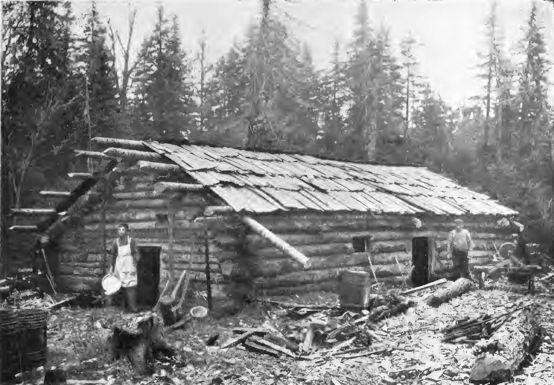
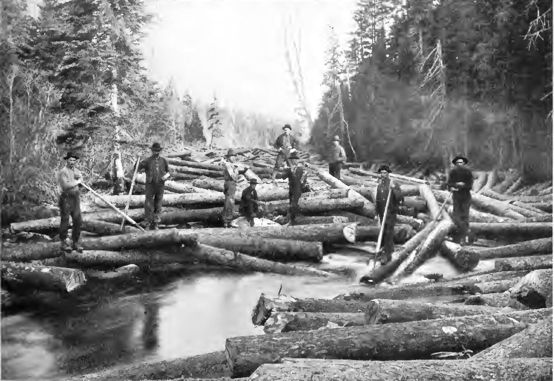
LUMBERING IN NEW BRUNSWICK
(1) A TYPICAL SHANTY
(2) A DRIVING SCENE
By far the greater part of the timber land of the province—about ten thousand square miles—is crown land under licence, and is obtained by the operator on a lease from the Crown Land department, the lessee paying mileage and stumpage on the timber cut, so that an accurate estimate is very essential. The operator, after cruising, makes application for a lease of the land he wishes to lumber, and deposits with the department the upset price of twenty dollars per square mile. After being advertised, the tract in question is sold at auction to the highest bidder, the deposit of the applicant being applied on the purchase price, if his bid is accepted, or refunded if some one bids higher. After this the lessee must pay eight dollars per square mile a year for the renewal of his lease, and a stumpage charge of $1.25 per thousand superficial feet for pine, spruce and cedar, 40 cents per thousand feet for hemlock, 80 cents per cord for hemlock bark, and $1 per ton for hardwood timber. All logs cut are scaled at the landings along the streams by the government scalers, while each company usually has its own scalers on private and crown lands, rendering weekly or monthly reports of all logs cut.
The woods operations may be briefly summarized as felling, yarding, hauling to landings, driving, rafting and towing. The felling of the trees begins early in the autumn. Care is taken that stumps are not left too high. Yarding starts in October, and continues until prevented by the depth of the snow. Two fellers usually work together, and after the tree has been sawn into logs, the logs are 'twitched,' with single horses usually, up to the skidways or 'yards' by means of log hooks or grabs. A yarding crew consists in most instances, of seven men—two fellers or choppers, one knotter, who limbs and knots the tree and makes the notches for the grips, two swampers, who cut the paths for the teamsters and clear away brush, etc., one teamster, and one yard tender, who, with a peavy, places the logs on the roll-way.
The yard or skidway is usually built up from the ground on skids, from nine to thirteen inches in diameter, placed on blocks, and is very often located on a side hill. The logs are placed on it in tiers, each tier separated by smaller skids. Yards may be from ten to fifteen tiers high and may contain from 150 to 500 logs, depending upon conditions. Logs are rolled up on the yards by a special arrangement called a 'parbuckle,' with which every woodsman is familiar. Two inclined skids are placed at each end of the yard; to these is fastened a chain, which goes around the log on the under side. The loop of this chain is then hooked to a rope which runs across and to the back of the yard through a pulley on a spar-tree, then down through another block at its feet and across in front of the yard. When the rope is hooked to the chain and the horse started, the log is slowly rolled up and is placed in position on top of the pile by the yard tender, who also pulls back the parbuckle and cuts the skids. He then paints the end of each log with the initial of the owner or company, so that the logs can later be identified when they reach the main river. Hack marks are also used and are a more valuable means of identification, since the paint marks may be obliterated in driving. The wages of the yarding crew run from twenty-six to thirty-two dollars per month, according to the skill and experience of the men. From 8000 to 10,000 feet of logs can be placed on the yard in a day by an active crew, at a cost of from $2 to $2.50 per thousand feet.
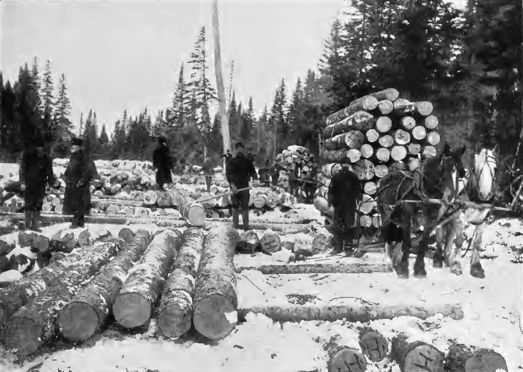
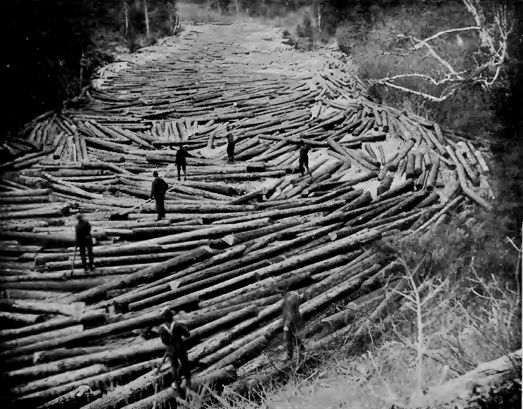
LUMBERING IN NEW BRUNSWICK
(1) UNLOADING AT THE LANDING
(2) LOG-DRIVING
The hauling of the logs to the landing begins as soon as enough snow has fallen to make good roads, and continues until operations are checked by spring thaws, which usually occur about the middle of March. Logs are hauled on bob-sleds, which consist of two units fastened together by lead chains. Sometimes, in place of one 'bunk' being used on the front or 'wagon sled,' a heavy beam from six to eight feet long, to give more loading space, is fastened to the 'bunk' by a bolt through the centre, and is called a 'rocker.' The rocker makes binding of the logs easier and renders the load more pliant, and thus it is preferred by some teamsters. The amount of logs hauled from a given yard in a day depends upon the character and length of the hauling-road. A road on which one round trip a day can be made is called a 'one turn' road, and roads may have as many as six turns, according to the distances from yard to landing. A load of logs, as hauled on bob-sleds, averages from 1500 to 2000 board feet, and may run as high as 4000 board feet in exceptional cases. A fair price for hauling off the yards would be $1.50 per thousand feet, or $4 to $4.50 from stump to landing.
The making of good hauling-roads is the chief concern of the successful woods foreman, since logs left on the yards until the next year might be rendered almost worthless on account of borers working in them. After he has selected the site for his main hauling-road, avoiding places that might drift too easily or swamps that might thaw too quickly in spring, the road is ploughed out with a big snow-plough made of two spruce timbers placed with the apex pointing forward and drawn by a four-horse team. Then the sprinkler comes into operation. This is a rectangular tank holding several barrels of water loaded on an ordinary sled. Each side of the track is then sprinkled, and, with clear cold weather, a few trips over the road each day makes an ideal hauling-road, requiring little power to move heavy loads. Oftentimes it is the steep downhill grade that requires the greatest attention, as there is a danger of the sleds running over the horses, and, as the New Brunswick lumbermen do not use the 'snub line' as in Maine, gravel, sand, rotten wood, and straw are used on the hills to prevent catastrophe to men and horses. Severe thaws are the bane of ice-roads. In a winter of frequent thaws the boss heaves a long sigh of relief when the last of the logs are landed safely on the banks, or in the bed, of the stream, to await the spring freshet which is to bear them to the mills.
In some parts where the haul is long and level and there is a large quantity of logs to be moved to the landings, the steam log-hauler has been introduced with considerable economy. This log-hauler consists of a boiler and engine mounted upon sleds and easily steered from the front sled. The advantage of the machine is that no iced roads are required, for it makes its own road, the power being obtained by a wide, jointed belt running over sprocket wheels and giving a very wide bearing on the snow. The roads are much wider than the ordinary sled-roads, and the logs are loaded upon much larger sleds, so that an entire train of logs may be hauled with very little trouble. Such a log-hauler may be operated both night and day, and will do the work of twenty pairs of horses. The cost of the engine and other equipment for hauling is about $10,000. Three of these machines are already in use at the head-waters of the St John River.
Some of the work preliminary to driving is done in the fall at the time of camp-building, when brooks are cleaned out, channels widened or straightened, leaning trees, called 'sweeps,' cut out, and in some cases splash dams constructed, the gates of which when opened will release a head of water sufficient to sweep the logs over flats otherwise impassable. With the first spring thaws in May begins a busy life for the rivermen, and they are dispatched in crowds to the head-waters of the streams to begin the drive. With the spring freshet some are set to work breaking down the brows or landings, others are stationed along the stream at dangerous places to keep the logs in motion. Often an immense jam forms which must be broken. This is sometimes done by a lumber-jack risking life and limb on the heaped-up logs; more often by the use of dynamite to disengage the 'key log' and set the entire mass free. If the brook connects with a lake or series of lakes the logs must be pushed through with poles, or groups of them surrounded with a light ring boom and drawn through with a windlass. Sometimes the main camp can be utilized for the drive, but more often temporary camps are established along the stream, and the life of the rivermen, while interesting, becomes one of hardship and peril. The cost of driving varies so much with the character of the stream and season that it is hard to give general figures. The cost, unless the conditions are exceptional, should not be much over $1 to $1.50 per thousand feet; otherwise the lumbermen must resort to some other method of logging. After the main drive has gone through, other crews of men follow up to rescue stranded logs, and to look out for forest fires, of which stream-driving is said to be a prolific source.
Where several lumbermen drove large quantities of logs down a large river it was soon found mutually profitable to discontinue their separate drives and organize what is known as a log-driving company, such as we now find on the St John, Tobique, and other rivers in the province. A company is organized and incorporated under a charter from the provincial government. Every lumberman having a certain amount of logs to be driven within definite limits of the river can become a member upon application, and the officers elected by the company are empowered by the members to organize the whole system of booms and gaps, engage a large force of men, fix tolls and other charges, in short, transact all the business connected with log-driving on that river. The expense of driving and maintaining the officers of the company is borne proportionately to the amount of logs owned by and driven for each member every year. Before becoming a member, the applicant must submit to the secretary of the company a statement of his logs, his driving limits, and a list of the marks used on his logs. These marks are also recorded at Ottawa.
The booms of such company are of three main types as far as their object is concerned—sorting gaps, where logs are simply sorted out for their different owners; sorting and rafting booms, where logs are in addition rafted; and storage gaps, where millions of feet of logs are kept in storage until the latter part of the summer. The gap at Van Buren, Maine, on the St John River, is a sorting gap only, logs being sheared to the American or Canadian side, according to ownership; the Douglas and Mitchell booms at Fredericton are used for both sorting and rafting; while the Sugar Island boom is of the storage type and has a capacity of 150,000,000 feet of logs.
The scene of the rafting operations at one of these booms, such as Douglas on the St John near Fredericton, is a busy one during the spring and summer. As soon as the river is free from ice, booms are swung into position and preparations made for the season's work. As the logs come through narrow gaps, the 'catch mark' men put on each a mark of identification, the men with 'ratlines' just below fasten those of one owner together with a small rope locked at regular intervals around pegs that are driven into the logs, and in this condition they pass to the 'bottom makers,' who boom together with poles and wooden pins from twenty to thirty logs, this constituting the bottom of one unit, which is known as a 'joint,' and which contains about 2000 board feet of logs. After the bottoms are made, logs called 'floaters' are swung over on top by means of chains operated by an overhead cable, and the 'joint,' now completed, passes down to two scalers, who call out to the tallyman the number of board feet in each log according to its length and diameter, which record is kept by him and entered upon the books of the company. Some of the lumber companies may have their own tugs in waiting to convey an assemblage of from six hundred to seven hundred joints, called a raft, to their mills, or this work may be done on contract by a freighting company. Usually the responsibility of the driving corporation ceases with the scaling of the logs.
While there has been great change in camps and camp equipment in New Brunswick, it may be said that, except for the use in some cases of the steam log-hauler, lumbermen log as their grandfathers logged. The heavy snows which come in November or later make the conditions ideal for logging after the old methods, and the rough topography and many streams, the lightness of spruce, pine, larch, fir and cedar, and the improvement in the technical properties of these woods due to long immersion in water, have continued to make driving the best and cheapest method of transportation. Driving has also caused the lumber companies to neglect to some extent the exploitation of valuable hardwoods, such as birch and sugar maple, in which the next few years will probably see vast development.
But the time is approaching when the increasing distance of the best timber from streams, the uncertainty of high water, the difficulty, already felt, of getting sufficient men to go to the woods, the soaring price of lumber with increased scarcity, increased population and the great competition with southern pine and other imported woods, are bound to bring the lumbermen face to face with a demand for new methods. In short, the time will come when logging by machinery and by railroad will alone solve the difficulties mentioned. The trend of the times points to the fact that the steam skidder, either of the cableway variety for logging in rough ground, or the slack-rope system for logging in swamps, where the stand runs high enough, will be found to be applicable to New Brunswick conditions; and the lumbermen, in place of being at the mercy of snow and water, will be able to log to advantage throughout the entire year. Where the steam skidder cannot be used economically, spurs of logging railroads are pushed up the streams to timber which will not now pay for driving, and logs are landed along the tracks and loaded on cars, either by means of animals or of a steam log-loader. The penetration of so much of the timber lands by railroads makes the construction of spurs connecting with the main lines of transportation entirely feasible by large companies, and even now the method is being used on a small scale for hardwoods which are of so high specific gravity that they cannot be driven. By cheapening the cost of transportation and loading on cars, by the introduction of machine logging, and by more efficient management the New Brunswick lumbermen can alone stem the incoming tide of southern pine, and Douglas fir from the West.
That the cost of lumbering has not greatly changed since 1825 and that there was little profit then in the business was shown by a statement by Charles Fisher that the cost of getting out one thousand tons of timber on the Wabskahagan, a branch of the Tobique, amounted to about £1116 sterling, to which was added the expense and risk of transportation to St John. If this is taken to mean pine lumber, since a thousand board feet of pine weighs about 2200 pounds, it would make the cost at the stream about six dollars per thousand feet. He points out from this that a more prudent system of lumbering was demanded and that the timber trade should go hand in hand with the cultivation of the soil and the general improvement of the country.
In its hardwood timber New Brunswick has an asset whose value is just beginning to be appreciated. Some of the best spruce is found in mixture with beech, birch and sugar maple, but it has been the custom to cut the spruce and leave the hardwoods, which in this ridge or slope type are straight, tall and well-pruned, and yield a large proportion of clear lumber. In naval architecture the rock maple furnished, next to white oak, the best material for the keels of ships, so that in the early days it was largely exported by the ton for that purpose. T. Cotterel, who prior to 1876 had been for some twenty-five years in the business of furnishing ship timber for export and home consumption, said that the most economical method of obtaining the frame of a ship was to mould the timber in the woods from October to December when the roots could be easily removed. For the frame of a ship 1000 tons and upwards, the cost was six dollars per thousand feet board measure; for a frame of 300 tons or under, eight dollars per thousand feet, the expense of cutting down, hewing and moulding varying with the size of the timber and the tonnage of the vessel.
The following figures compiled from the statistics of the Forestry branch, Ottawa, will give some idea of the value of lumber, lath and shingles produced by the Maritime Provinces in 1910:
| Lumber (M feet B.M.) | Value of Lumber | Average price per M feet | Combined Value | |||
| $ | $ | $ | ||||
| New Brunswick | 419,233 | 5,560,780 | 13.26 | 6,446,458 | ||
| Nova Scotia | 260,871 | 3,344,000 | 12.60 | 3,491,429 | ||
| Prince Edward Island | 5,273 | 71,056 | 13.48 | 83,156 | ||
As all mills did not report to the Forestry branch the amounts of lumber cut, and exact statistics are lacking regarding pulpwood, it is safe to say that the total value of forest products yearly for New Brunswick would be about $7,000,000, of Nova Scotia about $5,000,000, and of Prince Edward Island at least $100,000, or a total of considerably over $12,000,000 for the three combined.
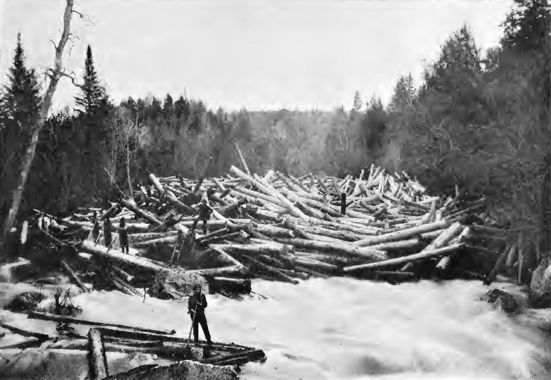
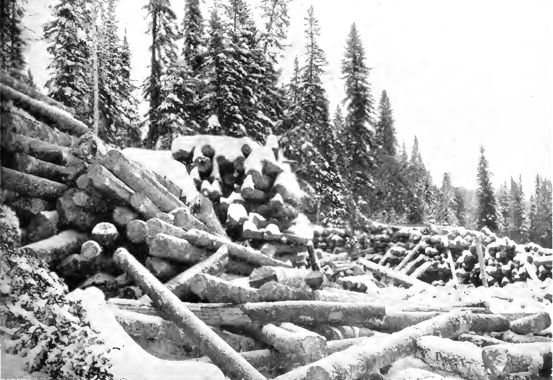
LUMBERING IN NEW BRUNSWICK
(1) A LOG-JAM ON A SMALL STREAM
(2) LOGS ON THE BANK OF A STREAM READY FOR THE SPRING FRESHET
The different species of lumber and the number of board feet contributed by each province was according to the same statistics as follows:
| New Brunswick (M feet B.M.) | Nova Scotia (M feet B.M.) | Prince Edward Island (M feet B.M.) | ||||
| Spruce | 341,577 | 161,998 | 2,117 | |||
| White pine | 25,672 | 25,432 | 58 | |||
| Hemlock | 18,748 | 52,211 | 275 | |||
| Cedar | 7,120 | .. | .. | |||
| Red pine | 1,363 | 2,843 | 133 | |||
| Tamarac | 5 | .. | .. | |||
| Balsam fir | 15,256 | 4,938 | 1,126 | |||
| Birch | 6,646 | 8,110 | 609 | |||
| Maple | 787 | 598 | 338 | |||
| Basswood | 10 | .. | .. | |||
| Elm | 79 | 30 | 11 | |||
| Jack pine | 816 | 1,040 | .. | |||
| Beech | 788 | 1,850 | 420 | |||
| Ash | 25 | 252 | 2 | |||
| Oak | 25 | 490 | 22 | |||
| Poplar | 46 | 196 | 49 | |||
That the true spirit of forest conservation is making progress in New Brunswick, with reference to the handling of both crown and private lands, is indicated in several ways. The passage of more stringent forest laws, the increased expenditure for fire protection, the seeking of better methods for reducing the fire danger and the waste in logging, and the establishment of forestry education in the provincial university in 1908, all point in that direction. The general interest in forestry conventions and all other means for the stimulation and spreading of public sentiment on the forestry issue is keen and appreciative. It can be shown, however, by citations from some of the early historians, that the modern conception of conservation of the forests is by no means a new one.
Fisher, in 1825, called attention to the fact that timber was the chief export of the province, in return for which many indispensable articles were received from the mother country, and that strict attention should be paid to the preservation of such an important asset. In his estimation there was no article of greater value than the pine, since every settler who had an ax could get out squared timber. After attending to his farm in the summer, he could work in the forest during the winter months for the support of his family. Thus the very fact that the forest could be so readily exploited became a factor in its rapid destruction.
Fisher said: 'The evils that must arise to the province by allowing the timber to be monopolized and hastily cut off, are many. The timber standing in the country, particularly on the crown lands, may be considered so much capital stock to secure a permanent trade, and promote the solid improvement of the country.' This idea is almost identical with the best principles of forest management to-day—that the forest is so much capital, the annual growth so much interest on that capital. He further points out that a settler with a lot of two or three hundred acres might choose the most suitable land for tillage, reserving his pine on non-agricultural land to be cut at his leisure, thus rendering it an inexhaustible resource. Such an expression savours much of the idea of sustained yield advocated by the forester, and the modern plans advocated for the successful handling of the farmer's wood lot.
Robert Cooney, in his History of New Brunswick, published in Halifax in 1832, seems also to have grasped the idea that too much attention to lumbering and too little to agricultural pursuits threatened the real prosperity of the country. He gives this sage advice: 'Lumber moderately, fish vigorously, and farm steadily. We have too long wasted our energies by exclusively prosecuting the timber trade; but it is high time to reflect that the forest is a perishable resource, and that ultimate exhaustion is absolutely inevitable.'
The scarcity of timber suitable for masts for the royal navy was a source of solicitude to the early governors of the colonies. Surveyor-General Morris, of Nova Scotia, in a report to Governor Legge in 1774, stated that in Nova Scotia, between the Bay of Fundy and the ocean, on account of 'shakes,' no pines fit for masts could be found. He then recommended that all the lands on the St John River above the settlements, back for a distance of at least twenty-five miles on each side, should be reserved for such purpose, since the river was navigable for boats and the rafting of masts throughout its entire course.
If we examine the early land grants we find that certain restrictions prevailed as to the use of wood and timber. We read of 'Colonel' Alexander MacNutt taking some exception to the requirement that all pine trees twenty-four inches in diameter and upwards at twelve inches above the earth must be marked with an arrow and reserved for the use of the royal navy. The objectionable clause was, however, still retained in the grants, with the additional provision, that if any such trees were cut without a permit, the lot in question should be forfeited and the lands revert to the king. As early as 1784 one section of the royal instructions to Lieutenant-Governor Thomas Carleton set forth that no grants of any land whatever should be made until the surveyor-general of woods, or his deputy, had inspected and marked out to be reserved any growth suitable for masts or other timber fit for the use of the navy, and more especially upon the Rivers St Croix, St John and others convenient for transportation.
Aside from these regulations, which were more in the nature of reservation than of conservation, there must have been not only great carelessness but wanton destruction of the forest. The forest was commonly considered inexhaustible and the generous grants frequently overlapped, due both to great prodigality in bestowing timber lands and inaccurate methods of mapping and recording grants. When to all this was added the waste caused by hewing timber in the woods, the cutting of high stumps, and the leaving to decay of the most valuable parts of the tree, the combined result must have been appalling. In time there arose a more careful régime, culminating in the Stumpage Act and more careful methods of administering and conserving the crown lands.
The crown lands are administered by the Crown Land department under the direction of the surveyor-general, with a deputy, a chief of scalers and a force of scalers, and fire and game wardens. Their importance can be judged by the fact that their operations furnish a very large part of the revenue of the province, without which appropriations for public works and education would be cut down and general progress greatly impeded.
A tabulated statement of the amount of lumber upon which stumpage was collected on crown lands, together with the transatlantic shipments, for the years 1906-11, furnished by the provincial secretary, is as follows:
| Year | Stumpage (superficial feet) | Transatlantic Shipments (superficial feet) | ||
| 1906 | 141,000,000 | 420,000,000 | ||
| 1907 | 149,000,000 | 355,000,000 | ||
| 1908 | 151,000,000 | 324,000,000 | ||
| 1909 | 204,500,000 | 325,000,000 | ||
| 1910 | 280,500,000 | 327,000,000 | ||
| 1911 | 310,000,000 | 285,000,000 | ||
During the year 1911, according to the Crown Land report of the province, the stumpage collections amounted to the sum of $367,679.14, and a conservative estimate of the entire lumber cut of the province, on both private and crown lands, during the year 1911 would be somewhere near 450,000,000 superficial feet.
The two gravest dangers that menace the perpetuity of the crown lands, as well as private lands, are fire and over-cutting. More attention is being paid to fire protection, and a large sum is annually expended for that purpose. According to the last report (1911) of the surveyor-general, it is the intention of the department to call a meeting of the lumbermen of the province to take into consideration the question of fire protection, as well as the disposal of brush, on the crown lands.
The Miramichi fire in the year 1825 laid waste a forest area of six thousand square miles. Great business depression resulted, especially in the county of Northumberland, and a great falling-off in the export of lumber took place, due not so much to the actual timber destroyed as to the financial panic which followed the fire. The original forest of pine and spruce was succeeded by an inferior growth of white and grey birch, larch, poplar and bird-cherry, beneath which slowly fought their way through the former ruling coniferous species. In 1866, according to Professor J. W. Dawson, some of the larch trees were large enough to be used in shipbuilding. Since 1866 the forest has been cut over several times. In some places vast barrens have resulted, the feeding ground of moose and caribou, scattered over which are burned and blackened rampikes, the silent sentinels of the forest primeval. Vast areas are also covered with a thick growth of jack pine, which is rapidly becoming merchantable. The student of succession in forest types resulting from fire will find in the Miramichi country an interesting and unending field of investigation.
While the ordinary person is more apt to dwell at length upon the great loss by fire to standing and young timber, the forester sees, besides this, other effects of repeated burning. Among these may be mentioned the baking of the soil, preventing the germination of seeds, the killing of existing reproduction, the burning out of the organic soil constituents, impoverishing it and encouraging the growth of inferior species. In many cases the soil is completely burned, requiring in extreme cases a hundred years or more for the complete restoration of forest conditions. Thus it is not alone the present but future crops that are damaged, and great and permanent loss to the commonwealth results.
It is now conceded, and has been actually demonstrated in many districts in the United States, that forest fires can to some extent be controlled and prevented by scientific methods. In fact, at times the first work that foresters are called on to do is to organize a system of fire protection, by a better disposal of waste inflammable material after logging, an efficient patrol by competent wardens, the establishment of look-out stations connected by telephone for rapid location and communication, the constructing of good trails and fire-guards, and the building at convenient places in the forests of caches for tools necessary for fire-fighting.
Rules for the disposal of brush and slash could be best made by a forestry commission similar to those in many parts of the United States, with some or a majority of the members practical lumbermen with the good of the province and the future of the lumbering industry at heart. Such a commission, through its chairman and executive officer, the surveyor-general, should have the power of making and enforcing all regulations that it deems wise for cutting timber on crown lands.
This forestry commission, receiving on the one hand expert and theoretical advice from some of its members and practical suggestions from these lumbermen who have made a life-study of the woods, could, if backed by public opinion, progress gradually to the accomplishment of its designs. The very fact that it was administering the forests, not for the prestige of a political party, but as held in trust for the people, would ensure careful deliberation and cautious procedure before any important regulations were made.
Apart from fire, the principal cause of forest destruction is unwise and improvident cutting. This danger of over-cutting the crown lands is mentioned by J. K. Flemming, premier and surveyor-general of New Brunswick, in his report of 1911, where he says: 'There is an opinion prevailing that we are cutting very nearly up to the annual growth; indeed, in some localities, it is claimed that we have been exceeding it for many years. That this is a serious situation is at once apparent.' The exaction of double stumpage on undersized trees will do something to counteract the tendency; and there is need of a careful estimate of the timber on crown lands and of scientific study of the rate of growth. There is now on the statute-books of New Brunswick the Public Domain Act of 1906, which provides for a survey of the crown lands upon a much more comprehensive scale than that carried out by Nova Scotia. It is estimated that such a survey would cost about fifty dollars per square mile, or about half a million dollars for the crown lands now under licence. Accompanying the topographical map information might be given as to the areas in various forest types, the composition of the forest, the suitability of the soil for farming or lumbering, and an estimate of the standing timber. Such a thorough stock-taking would justify a very large expenditure and would supply definite information, instead of the present haphazard methods of estimating the present stand and the future growth on the crown lands.
Nova Scotia is the only province that can as yet boast of a forest survey, or, more properly, reconnaissance. During the summers of 1909 and 1910 such a survey was carried out by Dr B. E. Fernow, Dean of Forestry in the University of Toronto, with the assistance of two members of his staff, Dr C. D. Howe and J. H. White. The survey, which covered an area of 21,000 square miles at a cost of about $6000, was brought about largely through the efforts of the Western Nova Scotia Lumbermen's Association. Its purpose was to secure and plot upon the present crown lands sheets to an approximate scale of two inches to the mile accurate information regarding the timber lands of the province, with a view to formulating a forest policy for the future, both for crown and private lands. 'When it is realized,' says Dr Fernow, 'that fully two-thirds of the province is non-agricultural land covered with forest growth or not fit for any other use than timber-growing, and that this forest resource, which furnishes not less than four to five million dollars annually, is in danger of exhaustion within the next two decades, the importance and propriety of the inquiry into the character and possibility of continuing it can hardly be questioned.' The report of this survey was published by the Commission of Conservation at Ottawa. The following is a brief summary.
Physiographically the Province of Nova Scotia is a continuation of the Appalachian or Acadian mountain system, and may be divided into four distinct regions, namely, the southern or Atlantic and the northern slope of the mainland, and the northern and southern sections of Cape Breton Island. Œcologically, the whole province is, however, to be assigned to the Appalachian or Acadian forest type, namely a maple-birch-beech formation with coniferous admixture, exhibiting, of course, such regional or local variations as soil conditions naturally produce.
It is unnecessary to give in detail the geological structure of the four regions mentioned, or to show how the rock and soils of each determine the type of forest growing thereon, all of which is admirably set forth in the report just mentioned. It is sufficient for our purpose to say that on the northern slope the richer and more diversified soils, coming from the decay of its more readily soluble rocks, have given rise to pure, luxuriant hardwoods, which occupy large areas. The southern slope is characterized by granites, quartzites, slates and glacial deposits. The central granite plateau which separates the two slopes, especially well developed in the western peninsula, gives rise to absolute forest soils; the thin soil of the ridges being covered with a stunted coniferous growth, largely fir; the gentler slopes and coves with spruce and hemlock, and originally pine, among a rather poor hardwood growth.
Adjoining the granite area, a quartzite formation, harder and less easily disintegrated, gives rise frequently to rock barrens and poor growth. This formation is especially developed in the eastern half of the peninsula, which is, in consequence, more poorly wooded. The lumbering industry, therefore, at the present, is largely confined to the western counties.
The slate formation and the glacial deposits as a rule support the better forest growth where the land has not been cleared for farming purposes. But even the glacial deposits, where they are coarse and hence overdrained, may give rise to barrens, and, where underdrained, to swamps.
Cape Breton Island divides itself topographically into the southern section, an undulating plain, and the northern section, a high plateau (Victoria and Inverness Counties), with very little topographic differentiation. Coniferous growth prevails in both, and the latter section is especially of interest on account of the extensive balsam-fir forest which covers it. The slopes of the plateau are stocked with hardwoods, but the plateau itself bears a fir forest in which hardly over fifteen per cent of spruce and only a small per cent of paper birch occur, except in the northern topographically diversified portion, where spruce and occasionally white pine become prominent. On the crest of the plateau a series of moss barrens gives rise to the many short streams that find their way over falls into the sea.
There are on the mainland, according to the areas shown on the maps, 5,053,000 acres of green forest and 352,000 acres, recently burned, which may recuperate. Of the green area, 10.8 per cent is coniferous growth in pure stands, 3.4 per cent pure hardwoods, and the balance mixed forest. The actual and potential forest area is about 6,700,000 acres, or about 70 per cent of the entire province. Of this forest area 25 per cent has been destroyed by fire; 45 per cent is young growth, or so severely culled that not much timber is left; and the remaining 30 per cent, say 1,400,000 acres of virgin, semi-virgin and moderately culled forest, must furnish the larger part of the present lumber supply.
The present lumber cut of the province is about three hundred million feet B.M., two-thirds of which is spruce, and the estimated timber standing on the available area totals about five billion board feet. Adding to this what lumber may be secured from the severely culled and the second growth forests, the supply of available timber can hardly be swelled to nine billion board feet, indicating a life for the industry, as at present developed, of not more than from twenty to thirty years. The timber of Cape Breton is a negligible quantity in this rough calculation. Although with 1,535,000 acres the per cent of forest land is larger than on the mainland, the southern section is cut over and growing up mainly in balsam fir; the northern section is largely covered with the same species, fit only for mine-props and pulpwood. Of such material some 12,000,000 cords may be found on the island and another 10,000,000 cords of pulpwood on the mainland. At least eighty per cent of the lumber cut of Nova Scotia is exported—the principal markets being South America and the West Indies.
According to Dr Fernow, the idea held by most Nova Scotians that the rate of the growth of spruce is very rapid is erroneous, and is based on the very rapid growth made by the white spruce in pastures and not on the forest-grown red spruce. While no detailed studies of growth were made, Dr Fernow places the diameter growth for the younger age classes of red spruce at one inch in seven years and of older trees at one inch in ten to twelve years—a rate which may be assumed as the average for northern species and climates.
Until 1899 the province disposed of its timber lands at so much an acre, so that now only about 1,500,000 acres remain to the crown, and this is mostly barren or of inferior character. Since the methods of surveying were inaccurate, it is probable that much less land than this is actually crown land. More than half of the forest area is in small holdings, rarely exceeding one thousand acres, and the owners are pursuing a more conservative policy in handling their wood lots than the owners of tracts of larger extent.
Dr Fernow, in addition to prescribing the usual means for securing a more efficient fire protection, in which the province has already made such progress, recommends the appointment of a technically trained provincial forester whose duties would be similar to those of the state foresters in the United States. Such a man could carry on a campaign of education, perfect the organization of the fire-fighting force, and give advice and assistance to private owners and corporations in regard to planting and improvement work. It is hoped that the stock-taking by the survey referred to will enable the province to rightly value and appreciate the importance of its forest resources and will lead to definite action regarding the perpetuation of such a valuable asset.
An account will now be given of the main commercial tree species of New Brunswick, with their properties and economic uses; in the case of some of these species, a few notes will be added from Robert Cooney's account of the same subject in 1825, when some interesting fact in technology or in regard to economic uses is brought to light by his study.
White Pine (Pinus strobus).—The sap wood is nearly white, the heart wood in old trees of a pronounced reddish colour, giving rise to the old name of 'pumpkin pine.' The wood is uniform in weight; it shrinks and warps but little in seasoning, is fairly durable and will carry 7000 pounds per square inch in compression. Its chief uses are for pattern-making, house-building, shingles, boxes, crates and excelsior. It was formerly the chief wood for spars and masts. No wood can take its place and be so satisfactory for many purposes.
Red Pine, Norway Pine (Pinus resinosa).—The wood is intermediate between the soft or white pines and the hard pines. It is easy to work, straight-grained and used as a substitute for white pine. It will stand a strain in compression of 8200 pounds per square inch. It is cut into square timbers, boards and planks, and is used also for railroad ties and boom poles.
Prince's Pine, Banksian or Jack Pine (Pinus divaricata).—The wood of this pine resembles in some respects that of a slow-growing black spruce, and in certain parts of the province it is very common on burned land. Dr Bailey says that 'on the South-west Miramichi after the fire of 1825, this species has come up so thickly that it is almost impossible to press one's way through them.' It is a small tree, but may become large enough for railway ties and mine-props.
Red Spruce (Picea rubens).—The wood of this species and that of Black Spruce (Picea mariana) cannot be distinguished, and both are classed together by the lumberman as 'black spruce'; but they are two distinct species. The wood of the red spruce is lightly tinged with red in old timber. It is distinguishable from white or 'cat' spruce by the finer grain, fewer and narrower pith rays, finer texture, and the absence of colour in the latter. Next to the white pine, red spruce is the most valuable tree in the province and is taking its place for purposes of general construction. The fibre is very soft and long, making it an excellent pulpwood. It is also very resonant and is used for the sounding boards of pianos. It is sawn largely into deals and battens and was formerly used for ship's knees.
White Spruce (Picea Canadensis).—The original name was Picea alba or single spruce. It is a more rapidly growing species than red, while the black is still slower in growth. J. A. McCallum, deputy-surveyor in 1873, cut down a tree of this species which made a log measuring 14 inches at the butt, 10 inches at the top and was 64 feet long. They have been cut 80 feet long, measuring 25 inches in diameter at the butt and 18 inches at the top.
Eastern Larch, Tamarac, Hackmatac (Larix Americana).—This wood is dense, heavy and hard, and very durable in the soil. The heart wood is a light brown. It is very slow-growing and usually forms almost pure stands in sphagnum swamps. It is cut into lumber, but is chiefly used for ties, poles and posts. According to Cooney, it was formerly used for treenails, ship beams and stanchions, also for planking under water, and by some was considered as good as English oak. It also makes excellent ship's knees.
Balsam Fir (Abies balsamea).—Balsam fir or 'var,' as it is sometimes called, is coming into use as a substitute for spruce and pine, being mixed with spruce both in manufactured lumber and in pulp. It is taking the place of spruce for cross arms for telephone poles. Resin blisters or vesicles, the source of Canada balsam, are found in the bark. While formerly considered worthless, it is rapidly becoming a valuable species. When peeled it is a durable wood for the construction of camps. 'In the spring, it has a small, delicate, yellow bud, which, when gently pressed, exhales an odour not unlike that of the pine-apple.'[1]
Eastern Hemlock (Tsuga Canadensis).—The wood is stiff, harsh, splintery, brittle and of coarse texture, rarely straight-grained, and hard to work and plane. The lumber is subject to loose knots and ring shakes. Its bark is used in the tanning industry. It makes a good lathwood, and being durable under water is admirably adapted for wharves. The slabs are now used in the manufacture of soda pulp.
Northern White Cedar, Arbor Vitae (Thuya occidentalis).—The heart wood of this species is a pale, yellow brown, very fragrant, light and durable. It is usually of very fine grain and texture, with inconspicuous pith rays. The wood works easily and splits readily, and as a consequence it was formerly much used for split shingles or 'shakes.' Its firmness, lightness and great durability make it an excellent wood for this purpose. It is also used for fence posts, ties, telegraph poles, canoes and boats. 'The branches invariably grow on the south side of the tree, a peculiarity which serves the Indians for a compass.'[2]
|
Robert Cooney, History of the Northern Part of New Brunswick and District of Gaspe. |
|
Robert Cooney, History of the Northern Part of New Brunswick and District of Gaspe. |
Sweet Birch, Cherry Birch, Black Birch (Betula lenta).—This makes the heaviest, hardest and best lumber of all the birches on account of its deep colour and thin sap wood. The wood is fine in grain and texture, takes a fine polish, and when stained resembles mahogany. It was formerly employed in shipbuilding for keels and planking, and is now extensively used for furniture, cabinet work and hub stock. From its bark, by steam distillation, is made a substitute for wintergreen oil.
Yellow Birch (Betula lutea).—This species is found associated very commonly with sugar maple and beech. The heart wood of this tree is sometimes called 'black birch.' It is extensively used for lumber, hardwood flooring, and in turnery. It makes an excellent fuel wood, and has been tried for pulp, but the bleaching of it is an expensive operation.
Paper Birch, Canoe Birch (Betula papyrifera).—The wood of this species is only moderately hard and heavy, strong and tough, and it lacks durability. The heart wood is light red or reddish brown, the sap wood very white and with a peculiar odour. It is used largely as a spoolwood, also for shoe-pegs, shoe-shanks, lasts, novelties, fuel and pulp. It is said to yield an excellent charcoal, but is no longer used for that purpose.
White Ash (Fraxinus Americana).—This wood is remarkable for its straight grain and great flexibility. It is usually coarse-grained but of fine texture, much heavier than the black ash, and whiter in colour. It is used mainly for car sills, vehicles, implements, handles, wagon and carriage stock, bent woodwork and sporting goods. For the manufacture of oars it is preferred to all other woods.
Black Ash, Hoop Ash (Fraxinus nigra).—The wood is soft and weak, but durable in the soil. 'Ring shake' is very common in black ash, a fact that has caused it to be extensively used by the Indians for baskets. It is important in the making of school furniture, cabinet work, and cooperage, being used for staves, heading and hoops for butter tubs.
Poplars (Populus tremuloides and Populus grandidentata).—It is impossible to separate the wood of these two species. Both are found on lands that have been laid waste by fire. They were used by the old settlers for plates, dishes and other forms of wooden ware, but are now used chiefly for flooring, lumber, and in turnery and cooperage. The fibre is long and tough and very white, and they are being used more extensively every year in the manufacture of pulp. They are useful in affording a shelter for valuable conifers which burst from the soil with vigorous life beneath their shade.
Balsam Poplar (Populus balsamifera).—In the character of bark and foliage and of its wood the balsam poplar resembles closely the other poplars, the uses being identical. Cooney says: 'From its buds, there is extracted by boiling, a viscous, or gluey substance, which, incorporated with mutton suet, makes an excellent salve, and when mixed with hog's lard, furnishes a rich pomatum. It also makes agreeable bitters when saturated with dilute spirits.'
American Beech (Fagus Americana).—The wood of the beech is hard, heavy and tough, with an unpleasant odour when wet, and is very perishable in the soil. Young timber is cross-grained and hard to split, and old timber is often called red beech, the red colour indicating incipient decay. It is largely used for fuel, lumber, plane stock, veneers for baskets, etc., and for the manufacture of wood alcohol and charcoal. 'The kernel of the nut,' according to Cooney, 'when boiled, becomes farinaceous and makes tolerably good bread.'
Sugar Maple, Rock Maple (Acer saccharum).—This is one of the most important of the maples. The uses of maple are many and varied. It makes excellent fuel, and has no superior for flooring, interior finish of railway cars, the keels of boats and ships, implements, handles, saddle-trees, school furniture, etc. It is a fine charcoal wood, and from it acetic acid is manufactured. Its ashes are used for the manufacture of soft soap. Bird's-eye maple is of this species, and when converted into sawed veneers becomes very valuable as a furniture and cabinet wood.
Butternut (Juglans cinerea).—This tree was originally very common on rich bottom land and sloping hillsides, but is now scarce. The wood is light, soft and weak, and works with ease. The heart wood is a lighter brown than that of black walnut, but darkens with age. It is used largely for cabinets and coffins, and the inferior grades for heading. As it is very durable, it is found serviceable for posts and ties.
The main points of difference between the species of New Brunswick and Nova Scotia consist in the absence of basswood from the hardwood list and of the cedar among conifers in the latter province. Red spruce forms the bulk of the coniferous timber, while white spruce and balsam fir have taken possession of the abandoned pastures. According to the recent forest survey, spruce forms about sixty per cent, hemlock about thirty per cent, and white pine ten per cent of the coniferous cut, the proportions however varying considerably in different localities. The species seem to be localized. Thus Shelburne and Queens Counties contain the most white pine; spruce predominates along the western coast; hemlock is prominent in the central portion; and Cape Breton Island is a veritable fir country.
While some twenty-five broad-leaved species might be enumerated, most of them occur only sporadically. The three main species, forming the hardwood type, named in sequence of their numerical occurrence, are beech, maple and yellow birch. Paper birch is found throughout the province, but is especially abundant in the eastern part. Grey or white birch (Betula populifolia), together with the aspens, covers large areas of burned land and is used locally for barrel hoops. The only oak—the red oak (Quercus rubra)—is rarely found as a lumber tree, but produces an inferior growth on rocky and gravelly ridges.
The Maple Sugar Industry.—The making of maple sugar from the sap of the rock and white maples was first carried on by the Indians. At an early date some of the islands along the Restigouche River in the county of Gloucester were occupied as 'sugaries' by the Indians. Dr L. W. Bailey refers to the industry being carried on by the French in Madawaska County, and says that in 1876 there was but little other sugar used there. The trees were tapped with an ax about April 1, and the sap was received in bark dishes. It was then boiled into a clear syrup, strained through flannel and reboiled to the consistency of sugar. When put into large bark or wooden moulds to cool, it acquired a hardness and transparency something like the English refined sugar. From this humble beginning has been evolved an industry of some magnitude. Recent census authorities place the yearly output for the Maritime Provinces at half a million pounds, with an average selling price, during a sixty-year period, of about ten cents per pound. Steel spiles are now used instead of wooden spouts; the auger replaces the ax as a tapping instrument; covered buckets, the old-time wooden trough hewed from logs; and the modern evaporator, the old-fashioned large iron kettles. The improved methods of manufacturing now in vogue give an increased amount of pure, clean sap, and in the end a finer commercial product.
Naval Stores.—The term 'naval stores' comprises all the resinous products obtained from coniferous trees, and was applied to these substances because some of them were used in pitching ships and boats. The term includes resin or crude turpentine, oil or spirits of turpentine, resin or colophony, brewer's pitch, wood tar and oil of tar. In the list of exports from the port of St Andrews for the year 1825 we find mention of '234 barrels of naval stores.' Just which of the above derivatives was meant the record does not show, nor is the price given. That it might have been tar is easily assumed from a reference found in a history of Nova Scotia, where there is mention of pine trees being cut down, put into kilns, and enough pitch obtained for paying the seams of boats. The product was probably not resin, since the modern turpentine was still unknown in that locality. At the present time turpentine and Stockholm tar are being made in New Brunswick by distillation from the stumps of the Norway pine (Pinus resinosa), which contains a large amount of resin. The turpentine so made has a slightly different odour from the 'orchard turpentine' of the south, and does not command as high a price in the market.
Pulpwood.—The main requisites of a good pulpwood are that the wood fibres or tracheids, as the case may be, should be long, tough and resistant; that it should have a maximum of fibres and a minimum of wood parenchyma; should be as colourless as possible so as not to require too much bleaching; and should be straight-grained, free from knots and defects, as well as from tannin, resins and gums. Spruce is the wood that pre-eminently meets all of the above requirements, and those next in order of importance are balsam fir, hemlock and poplar. The importance of balsam as a pulpwood is increasing; this is also the case with hemlock, slabs of which are now being used in New Brunswick for the production of soda pulp. In 1909 New Brunswick produced 88,450 cords of pulpwood at an average of $4.69 a cord. Nova Scotia produced 25,076 cords, for which the price received was $4.07 a cord. According to Charles E. Oak, 31,500 cords of rossed wood were shipped from the Miramichi alone in 1909. The average value of pulp as given for the whole Dominion in the year 1909 was $14.67 per ton for mechanical, and $36.35 for chemical, pulp.
The law enacted by the legislature of the Province of New Brunswick prohibiting the exportation of pulpwood from crown lands took effect in August 1912. The object of this law was not only to prevent the cutting of small material for pulpwood on crown lands, but also to encourage the manufacture of pulp within the province.
Spoolwood.—The spool industry is dependent very largely upon the paper birch (Betula papyrifera), this species being almost the only one used for spools, as well as for shoe-pegs, shoe-shanks and toothpicks. For spool manufacture the wood must be sound and free from red heart, coarse knots, blue stains or pith flecks. This means, of course, that only the best of the birch can be utilized, and there is a very large amount of waste due to these defects. Yellow birch and grey birch have been found a little too hard for spools, but can be used. The logs are sawed, usually in the woods by small portable mills, into spool bars or 'squares,' about four feet long and square in cross section, of various sizes according to the size of spool desired. With good clear birch, two cords of logs will yield a thousand board feet of spool bars, there being a very large waste due to saw-kerf. Scotland is probably the heaviest consumer of birch for spools, and two million feet of spoolwood were shipped there from the Miramichi alone in 1909.
Shingles.—The northern white cedar (Thuya occidentalis), being light and very durable, is the main shingle wood of the Maritime Provinces. Cedar logs are driven to the mills along with other species used for lumber, and a thousand board feet of cedar will produce about eight thousand shingles. Logs are cut up into bolts about sixteen inches long, and passed to a rossing machine where the bark is removed by revolving knives. They are then sent to the shingle machine, which has a capacity of about thirteen thousand shingles a day. The shingles are then packed into bunches and graded according to defects. The prices of shingles are: Extra, $3 per thousand; Clear, $2.50; Second clear, $2; Extra No. 1, $1.25; No. 1, $1. The following statistics were compiled by the Forestry branch in 1910 on the shingle industry of the three provinces:
| Mills reporting | Shingles (thousand) | Total Value | Average per M feet | |||||
| $ | $ | |||||||
| New Brunswick | 121 | 209,446 | 398,109 | 1.93 | ||||
| Nova Scotia | 248 | 23,378 | 23,378 | 1.66 | ||||
| Prince Edward Island | 26 | 7,547 | 10,013 | 1.16 | ||||
Lath.—Spruce and white pine are the two most important species used for lath, together forming nearly seventy per cent of the output. Many other species are used, and they are either cut by small portable mills or made from slabs in connection with large mills. According to the Forestry branch in 1910, New Brunswick, by cutting 62,597,000 more lath than in the year previous, increased its proportion of the total for Canada from one-fifth to one-quarter. The figures for the three provinces were:
| Lath (M) | Total Value | Value per M | ||||
| $ | $ | |||||
| New Brunswick | 227,732 | 487,596 | 2.14 | |||
| Nova Scotia | 47,712 | 111,421 | 2.35 | |||
| Prince Edward Island | 783 | 2,087 | 2.67 | |||
The Cooperage Industry.—The burning of limestone was one of the important branches of business carried on about the year 1770 by the firm of Simonds and White at St John. According to early accounts, one of the greatest difficulties experienced by this firm was the procuring of casks for lime shipment. To overcome this the firm established their own cooper shop at Portland Point, but with hand labour they were only able to turn out a few casks each day. The work of procuring staves for tight barrels and casks must have grown immensely with the expansion of the fishery trade, because oak, ash and spruce staves and hogshead shooks began to be listed in considerable quantities among the exports. In 1821 there were shipped from the port of St John almost six million staves, worth sixty shillings per thousand. With the shipment of lime, apples and potatoes, both in New Brunswick and Nova Scotia, there has been a great development of the slack cooperage industry, and many barrels, as well as staves, heading and hoops, are shipped in from Ontario to supply the demand.
Tan Bark and Tanning Extracts.—The bark of the eastern hemlock (Tsuga Canadensis) contains from eight to fifteen per cent of tannin, but the quantity used is steadily decreasing. At the present time the tendency is towards the use of extracts, which are made by grinding the bark, subjecting the chips to the action of hot water or steam, and concentrating the infusion obtained by evaporation in retorts. A cord of hemlock bark, weighing 2240 pounds, yields about fifty gallons of extract, which weighs 550 pounds. Hemlock bark extract containing as high as thirty-three per cent of tannin is now being manufactured by a plant at Millerton, New Brunswick. This plant turns out 150 tons a week and consumes from eight to ten thousand cords of hemlock bark a year in the manufacture of extracts for tanning leather.
Canada Balsam.—The earliest mention of this product is in Cooney's History of New Brunswick, where it is described as a 'glutinous matter within the outside bark of Balsam Fir (Abies balsamea), which, when compounded with the yolk of fresh eggs, makes an excellent salve for green wounds.' Canada balsam or 'Canadian balsam,' as Cooney calls it, is obtained by piercing with a sharp-pointed instrument the resin vesicles or blisters found in the bark of this tree. It is used largely by opticians in the cementing of lenses, and by histologists for the mounting of microscopic objects.
AGRICULTURE IN THE
MARITIME PROVINCES
The Maritime Provinces are situated in the same latitude as Southern France and Northern Italy. The south-west part of Nova Scotia reaches latitude 43° 30' and the north-west part of New Brunswick latitude 48°. The natural advantages of the latitude are somewhat modified by cool Arctic currents. The influence of these currents, however, is partly offset in Southern Nova Scotia by the warm waters of the Gulf Stream, which approach very nearly to the shore of the province.
On account of their latitude and the effect of surrounding waters, the climate of the Maritime Provinces is free from the extremes of heat and cold which prevail in the inland parts of America. Owing to the retarding influences of the Arctic currents, spring usually opens from ten to fifteen days later than in the peninsula of Ontario, but, to offset this, the autumn season is more prolonged. The highest temperatures of summer are from six to ten degrees below those of Ontario, and, except in Northern New Brunswick, the lowest winter temperatures are equally higher. Along the southern shore of Nova Scotia the winter climate is still more moderate. The average summer temperature for the whole area is between 60° and 65° F., and the corresponding winter average is from 15° to 25°. During the months of July and August there are occasional days when the temperature rises to between 90° and 100°, and there are days in January and February when the temperature falls to from 15° to 25° below zero. These are the extremes.
The average precipitation is between thirty-five and forty-five inches, except along the southern coast of Nova Scotia, where it is about ten inches greater. This precipitation is fairly evenly distributed throughout the season, although there are occasional summers when a moderate drought, lasting from two to four weeks, may prevail during the months of July and August.
Topographically the Maritime Provinces consist of contrasting lowland and upland areas. Except in Prince Edward Island, where conditions are much more uniform than on the mainland, the larger areas of fertile soil are almost entirely confined to the lowland areas. Such fertile soils as exist in the upland areas lie mainly in the river valleys or in comparatively small pockets on the higher levels.
In few parts of the world is the direct connection existing between the character of the underlying strata and that of the soil better exemplified. A knowledge of the geological features is therefore of great advantage to the student who would become familiar with the soil characteristics of the Maritime Provinces. There has been considerable glaciation and water transportation of soil. Still, these forces have not acted as extensively as elsewhere, the transportation in most cases being not for greater distances than a few miles. Hence the character of the various soils has been largely determined by the rocks on which they rest or by rocks which occur in close proximity.
To illustrate this conformity between the geological strata and the character of the soil, the following particulars may be noted: In Prince Edward Island and adjacent lowland areas on the mainland, the Red Carboniferous and Permo-Carboniferous strata have yielded a red soil. The sandy measures, so extensively developed in the Carboniferous areas in the south-east of New Brunswick, have furnished sandy and comparatively infertile soils. The pre-Cambrian and intrusive volcanic measures of Southern Nova Scotia and Central New Brunswick have furnished very little arable land, such as there is being confined to scattered pockets on the higher levels and to intervale soils in the valleys. Over seventy-five per cent of the fertile arable lands overlie Carboniferous, Permo-Carboniferous, Triassic, and, in Northern New Brunswick, Upper Silurian strata.
With a single exception—the Triassic measures bordering the Basin of Minas and the eastern shores of the Bay of Fundy—the strata of the Maritime Provinces are of Palæozoic and pre-Cambrian age, with associated granite and volcanic measures of different ages. The lowland areas are, in the main, underlain by Carboniferous, Permo-Carboniferous and Triassic measures, and these are predominantly shales, sandstones and conglomerates. The uplands are, for the most part, underlain by Permo-Carboniferous, Palæozoic and pre-Cambrian measures, with associated volcanic and granitic rocks of different ages that, in certain districts, occupy large areas. The Permo-Carboniferous measures also include shales, sandstones, conglomerates, limestones and other calcareous rocks.
From an agricultural standpoint there are three leading geological districts in Nova Scotia:
1. The soils of the Atlantic seaboard—pre-Cambrian.
2. The soils of the inland hills—Silurian, Devonian and older rocks.
3. The soils to the northern part of the province—Carboniferous, Permo-Carboniferous, Triassic, or New Red Sandstone.
A fourth general group may be added, namely, the marine and river alluvia, or marsh and intervale soils, which exist in all the geological districts.
1. The Atlantic seaboard, consisting of the whole south shore and extending inland for from thirty to fifty miles, is underlain by one of the oldest rock formations on the continent—the pre-Cambrian or gold-bearing rock series cut by granite intrusions of much younger age. The agriculture of this area is largely confined to pockets of land that have accumulated along the banks of the numerous rivers or occasionally on higher levels. The greater part of this area is so encumbered with stones and rocks as to be absolutely uncultivable. Two classes of soil exist: (a) Coarse, sandy soils, often covered with black vegetable mould, derived from decomposed granite, gneiss and mica slate; (b) Soils derived from slate, which are generally stiff clays, though sometimes light and shingly. These latter soils predominate, and, when arable, are unexcelled for fertility.
2. North of this area are the inland hills, including the South Mountain and the Cobequid Mountains running east and west on the mainland, and constituting the larger part of the hills of Cape Breton. This area is composed mostly of Silurian and Devonian rocks. There is little continuous agricultural land, but where soils have accumulated to any depth, as in the river valleys and on the mountain slopes, such as at New Annan, Lochaber and Northern Cape Breton, they are very fertile.
3. The greater part of the farming lands of the province are to be found to the north of these hills, and consist of Carboniferous, Permo-Carboniferous and Triassic areas, bordering the shores of the Gulf of St Lawrence and extending westward along the shores of the Basin of Minas and including the whole Annapolis Valley. This district includes a great variety of soils, which may be generally divided as follows: (a) Loamy soils of the Carboniferous and Permo-Carboniferous districts, extending all the way from Mabou in Cape Breton to Windsor in Hants County and to Chignecto in Cumberland County. The prevailing soil is a sandy or clay loam, usually of a reddish colour, and is equal to the best upland of any country. (b) Clays, sands and stony grounds of the Carboniferous districts scattered irregularly throughout the whole area. The heavier soils, when drained, are strong and productive, but the lighter soils are usually very poor. (c) Loams and sands of the Triassic or New Red Sandstone area. These are to be found mostly along the head-waters of the Bay of Fundy, and are well typified at Truro. They are generally of a bright-red colour and are among the earliest soils of the province. They extend into the Annapolis Valley, in parts of which, however, they are commingled with clays and sands deported by glacial and river action. From Cape Blomidon to Digby extending inland for some four or five miles is a trap rock district of the Triassic age, consisting of slate rock. This section is called the North Mountain, and shelters the Annapolis Valley from the winds of the Bay of Fundy. The soil varies from a loam to a clay, and when properly farmed, except where it is shallow, is very productive.
4. Alluvial soils constitute a large proportion of the most fertile parts both of Nova Scotia and the other Maritime Provinces. In Nova Scotia they are divided into: (1) Intervale soils or fresh-water alluvia, which occur along most of the rivers in variable quantities—these soils are nearly all productive, but in many parts are greatly depleted by exhaustive systems of cropping; (2) Marsh-lands or salt-water alluvia, which consist of soils swept up from every exposed bank and cliff by the great tides of the Bay of Fundy, and deposited at high tides in mud flats, which have gradually been added to until it was possible to dike them and keep back the waters of the sea.
The marsh-lands vary in texture from light loams to heavy clays. They compose an area of over 50,000 acres in Nova Scotia and a like amount in the adjoining parts of New Brunswick. They are extremely fertile, having been known in some cases to produce, for over a century, enormous crops of hay without the use of manures or fertilizers. These lands are, for the most part, used for the production of hay, although considerable grain and sometimes even roots are grown upon them.
There are four well-defined geological areas in the province of New Brunswick:
1. From Cape Tormentine, at the south-eastern extremity of the province, as an apex, there extends a large triangular area, embracing about one-third of the province, belonging to Middle and Lower Carboniferous formations. This area is continuous with the Carboniferous and Permo-Carboniferous areas of Nova Scotia. A line from Cape Tormentine along the Gulf of St Lawrence to Bathurst, on Chaleur Bay, is the eastern boundary of this formation; a diagonal line from Bathurst to Oromocto Lake (about fifty miles south-west of Fredericton) is the north-western boundary; and a line from Oromocto Lake to Cape Tormentine is the southern boundary. This formation contains large deposits of coal and is attracting much attention at the present time on account of the oil-shales of Albert County. Agriculturally, that land which overlies the red sandstone rock, as at Bathurst in the north, the valley of the Kennebecasis River and other parts between Albert and Westmorland Counties in the south, is very fertile. A large part of this area, however, where the rocks are greyish and sandy, is covered with a light, hungry soil that is usually unproductive.
2. To the south of this Carboniferous district is a triangular area bordering on the Bay of Fundy, including the lands around St John, and continuing eastward. This area consists of granite intrusions, flanked with pre-Cambrian and Palæozoic strata of limestone, slate and sandstone, with here and there intrusions of Huronian and Devonian rock. There are also along the shores of the Bay of Fundy small patches of Triassic trap rock, corresponding to those of the North Mountain in Nova Scotia. This area is very broken and hilly, but there are river valleys and coast indentations where the accumulated soils are very fertile.
3. The most striking feature of the geological formations of New Brunswick is a sort of axis of granite rock running diagonally from the south-western boundary (at the State of Maine line) to Bathurst on Chaleur Bay. This granite rock is flanked on either side by slates and granites of the Cambrian and pre-Cambrian periods. The whole belt ranges in width from three to twelve miles, and is largely metalliferous, containing the iron deposits of Gloucester County, as well as other valuable minerals. There is very little agriculture in this district.
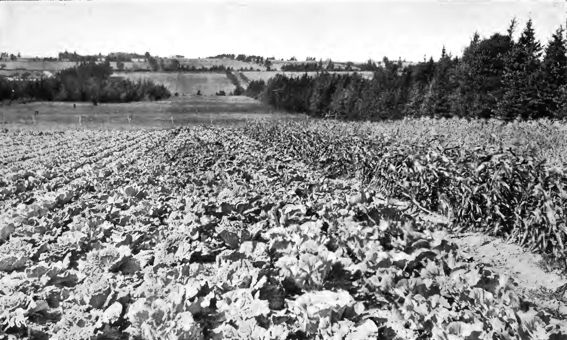
FARMING NEAR CHARLOTTETOWN, PRINCE EDWARD ISLAND
4. North of this belt, occupying the greater part of the rest of the province and extending into Quebec, is an area largely underlain by Upper Silurian rocks. This formation occupies the entire country along the St John River above Woodstock and extends across the Restigouche River into Quebec. It also includes the greater part of the valley of the Tobique, where, however, it is to some extent overlapped by Lower Carboniferous sediments. Probably the most fertile soils in New Brunswick are to be found in this area. The greater part, however, is still occupied by dense forests and awaits the ax of the settler before it can be farmed.
As in Nova Scotia, a large proportion of the most fertile soils of New Brunswick is the so-called intervale and marsh soils. The marsh soils bordering on the Bay of Fundy are continuous with, and about equally extensive with, those of Nova Scotia. Intervale soils are to be found along the banks of nearly all the numerous rivers, the most extensive and fertile being those in the valleys of the Rivers St John, Tobique and Kennebecasis.
The rock strata of Prince Edward Island are now classed by geologists as belonging entirely to the Permo-Carboniferous period, and the soils are composed of the disintegrated rocks of this formation, mixed with boulder clay which was spread to various depths during the Glacial period.
The surface is gently undulating. A range of low hills crosses the island from New London to Bonshaw and eastward to Wiltshire and Rustico. Small ranges of hills extend from Belfast, through Caledonia, to Montague, and from Souris to East Point. Unlike the mainland, the arable soils of Prince Edward Island are continuous and not broken up, and agriculture, therefore, occupies a relatively more prominent position than in either of the other provinces.
The rocks consist principally of red, brown and grey sandstone and red clay shale, with layers of coarse, concretionary limestone. The soil is generally a fine, red, sandy loam, rich and easily cultivated. Several varieties occur, corresponding with the rock formations. Clay or clay loam soils are found in the western part of the island, extending as far east as Summerside, and about Charlottetown, Pownall, Orwell, Vernon River and Nine Mile Creek. These are the product of great shale beds mixed with boulder clays.
Light, sandy, or sandy loam soils are found in Bedeque, Freetown, Emerald and other parts of Prince County, and in nearly all the southern part of Kings County and the eastern part of Queens County, having been formed from the stratified sands of the Lower Permian, mixed with small quantities of boulder clay. Unless carefully cultivated, they are easily exhausted of their fertility.
The best and most extensively distributed soil is formed by the boulder clay formation overlying the sandstone tracks of the Lower Permian. It is a fine, sandy loam, friable and easily tilled. In some places it has accumulated in moraines, as at Dunstaffnage and in Victoria Park at Charlottetown.
The Province of Nova Scotia, including Cape Breton, has a length of about 350 miles and a width varying from 50 to 100 miles. The total land area is 13,483,681 acres. The surface is of a varied character, being intersected by ranges of hills and mountains, between which lie fertile valleys. The Atlantic seaboard consists of rocky highlands, north of which lie the inland hills. This whole area is covered with a network of lakes which find their outlets to the sea by numerous rivers, along the banks of which are many fertile, though somewhat isolated, areas of cultivated land. Here and there, as in North Queens County, are fairly extensive upland areas, free enough from stones to be capable of cultivation, which support a prosperous agriculture. The larger agricultural areas are found in the northern half of the province and consist of river valleys, such as the famed Annapolis and Cornwallis Valleys, and of extensive undulating areas gradually sloping towards the northern shores.
In so far as agriculture is concerned, there have been four principal lines of settlement in Nova Scotia:
1. The French colonization, beginning at Port Royal (Annapolis) in 1605 and extending along the Bay of Fundy from Yarmouth County in the west to Cumberland in the east, and northwards into South-Eastern New Brunswick. A little later, French settlements were established in parts of Cape Breton, in the vicinity of the fortress at Louisbourg.
2. The German colonization of Lunenburg, 1751-53.
3. The colonization by settlers from what is now known as the New England States, beginning about 1760 and largely augmented by the loyalists in 1775-83. These immigrants settled for the most part in the areas originally occupied by the French on the lands adjoining the Bay of Fundy and the neighbouring rivers. A smaller proportion settled in the east, mainly near Pictou on the mainland and Sydney in Cape Breton Island.
4. The colonization from Great Britain, consisting mostly of immigrants from Scotland, who settled the larger part of the country from Colchester County eastwards. This flow of immigration began about 1773 and large numbers continued to come until 1828. Since that time the immigration from Great Britain and other parts of Europe has been more desultory.
It will be seen that Halifax, settled in 1749, has not been included in the above. This settlement was made more as a military headquarters than for economic purposes. There is little arable land near Halifax, and for years the settlement depended almost wholly on English guineas for its support. Its main value, from an agricultural standpoint, rested on the fact that it constituted a market for the produce of the farm and developed into the leading shipping port of the province.
The first settlement to leave its permanent impress on Nova Scotia was that made by the French at Port Royal in 1605. In this year and at this spot was grown the first wheat ever raised in America, and here in the same year was erected the first water-wheel to turn a millstone for the grinding of wheat on the North American continent. From this time, until 1755, the French population was practically the only European population in Nova Scotia. It is noteworthy that these French people selected lands that are to-day the highest priced in the Maritime Provinces, such, for example, as the Annapolis Valley and the marsh-land areas along the head-waters of the Bay of Fundy. They were not, like the later British settlers, ready to win farms from the forest, but preferred to utilize these marsh-lands which they could wrest from the sea by means of dikes similar to those their forefathers had learned to construct on the Bay of Biscay. With the exception of a few cattle landed on Sable Island in 1518 and others brought out by Cartier in 1541, which were subsequently destroyed, the first permanent introduction of domestic cattle into what are now British dominions on this continent was at Port Royal, where, in 1606, Poutrincourt brought some cows. By the middle of the eighteenth century the early French settlers had gathered together many thousands of cows, oxen, sheep and hogs.
The Acadians, whose story is related in another part of this work, were expelled from Nova Scotia in 1755.[1] During their occupancy of the province they established good farms, comfortable homes and beautiful gardens. Their principal legacies to future generations were the diking of the great marsh areas and the planting of fruit-trees that formed the foundation of what is now one of the most extensive industries in the province. A few of the Acadians escaped the Expulsion, and were afterwards joined by some of the exiles who found their way back to Nova Scotia, and these established settlements, which are still in existence, in Yarmouth, Digby and parts of Cape Breton.
From 1755 to 1760 the fields which had been occupied by the Acadians lay idle. With a view to their settlement Governor Lawrence issued a proclamation in 1758, inviting settlers in the region now known as the New England States to move over to these lands. The following is part of his proclamation:
One hundred thousand acres on which the country has produced wheat, rye, barley, oats, hemp, flax, etc., without failure for the last century; and another one hundred thousand acres has been cleared and stocked with English grass, planted with orchards and embellished with gardens, the whole so intermixed that every individual farmer might have a proportionate quantity of plowed land, grass land, and wood land.
In 1760 and succeeding years a considerable number of New Englanders moved to Nova Scotia and received grants of these lands. This population was greatly increased between 1775 and 1783 by the arrival from the United States of the loyalists. The descendants of these settlers constitute a large proportion of the Anglo-Saxon population of the western counties of Nova Scotia as well as part of the east. Those who settled in the Bay of Fundy country found the dikes very much dilapidated and most of the meadows under water. They were ignorant of the manner of building dikes, but were finally assisted by Acadians in the vicinity who had escaped the Expulsion. It was not, however, until the year 1810 that the Grand Pré marsh was encircled by a substantial dike.
Shortly after the founding of Halifax, in 1749, steps were taken to secure settlers for Nova Scotia from Germany, and between 1751 and 1753 about 1615 German and Swiss emigrants landed at Halifax and were subsequently moved to Lunenburg, where, after enduring much hardship, they established communities. Their successors still occupy what is known as the county of Lunenburg, the only part of the Maritime Provinces where the German language is extensively spoken. Many of the Germans have taken to the fisheries, but even these have beautiful gardens, and a very considerable number are engaged in farming. They still preserve many of the traditions of their native country. Lunenburg, for example, is the home of the cabbage in Nova Scotia, and every year hundreds of barrels of sauerkraut are prepared for use. The cereals—barley and rye—also occupy a more important place in this county than elsewhere. The inhabitants take much pride in their oxen, and nowhere are finer specimens to be seen.
Eastern Nova Scotia, including Cape Breton, was partially settled by pioneers from the New England States, but by far the greater number of the settlers of these lands came from Great Britain, the majority from the Highlands of Scotland. The earliest of these were soldiers of disbanded Highland regiments, who received grants of these lands about 1760, and whose favourable reports brought a further large influx of their countrymen. This immigration continued very steadily until about 1828, after which it began to decline. Most of the present occupants of these lands are descendants of these Scottish immigrants. As a result of this immigration, Eastern Nova Scotia is largely Celtic. This is particularly true of Cape Breton. The inhabitants still preserve the Gaelic speech of their ancestors. They have contributed many influential public and business men to Canada; but, while there were noticeable exceptions, these Highland people did not take kindly to peaceful, pastoral pursuits, and did not develop as high a type of agriculture as the country was capable of producing.
By the beginning of the nineteenth century the main lines of settlement in Nova Scotia were established. The population was somewhat heterogeneous, although predominantly of English and Scottish extraction. Many of the settlers were disbanded soldiers, and others sought the country as a place to exploit rather than as a home in which to make a peaceful living. With the exception of Halifax, markets were very small, for as yet neither mining nor manufacturing had begun. Prices for farm produce were therefore low, and it is not to be wondered at that, in the beginning of the nineteenth century, agriculture was in a backward condition. Just at this juncture a man arrived in Halifax who was to wield a wonderful influence on the country of his adoption. This man was a Scotsman, John Young, better known as 'Agricola.'
In the year 1818 a series of letters, published in the Acadian Recorder, a Halifax newspaper, over the signature of 'Agricola,' at once caught the eye of the public. There were thirty-eight of these letters, and they dealt with almost every phase of agricultural practice followed at that time in the most advanced European countries. These letters were subsequently bound into a book entitled The Letters of Agricola. The book is now difficult to obtain, but for its style alone, aside from the information contained, is well worth the reading. During the time the letters were being published 'Agricola' did not divulge his name. Nevertheless, he corresponded extensively with the leading farmers of the country and altogether aroused a great curiosity as to his identity. He started a movement for the improvement of agriculture in Nova Scotia, which was profound in its influence. One of the first-fruits of his writings was the organization, on December 15, 1818, of the Central Agricultural Society of Nova Scotia, with headquarters in Halifax, but representing every part of the province. At the organization 'Agricola' was made secretary, although those attending the meeting at which the society was formed had no idea which of its members was being elected to that office. A few days afterwards 'Agricola' came forward and declared himself as John Young.
Twenty-five agricultural societies were organized in the province during the next two years. It is interesting, however, to note that the Kings County Agricultural Society, which is still in existence, was organized thirty years earlier, in 1789, and there is a record of an agricultural society in Windsor, which held a fair on May 21, 1765.
Since the time of 'Agricola' agricultural societies have always been a prominent feature of the organization of Nova Scotia. At first under the control of the Central Agricultural Society, they were, in 1864, put under the control of a board of Agriculture, and in 1884 under the office of secretary for Agriculture which was created in that year.
In 1885 a Chair of Agriculture was established in connection with the Provincial Normal School, and in 1888 the nucleus of the present Agricultural College Farm was bought and the Nova Scotia School of Agriculture erected on this property. These two institutions worked together in affiliation, and still continue to do so.
In 1893 a School of Horticulture was established in Wolfville, and this institution and the School of Agriculture were continued separately until 1905, when they were united and the present College of Agriculture at Truro established. This College of Agriculture was located at Truro partly because that town was central, but mainly because it was thought desirable to have the institution affiliated with the Normal School, so as to give a scientific and industrial training to the teachers who attended the latter institution.
In 1908 a Rural Science School, held in the months of July and August, was established under the auspices of the affiliated institutions, for the benefit of teachers employed during the regular school year. Teachers who complete the course prescribed receive a Rural Science diploma, which qualifies a teacher who conducts a school garden and does scientific work in the schools to draw an extra grant from the provincial treasury, while the trustees draw an extra grant from the Municipal Fund.
Nova Scotia Agricultural College.—A statement of the various organizations that at present exist for the promotion of Agriculture in Nova Scotia is given later in this article,[2] and from this statement it will be seen that the province is well organized. The whole organization centres around the Agricultural College, which on its present basis was established in Truro in February 1905. This institution not only provides several different courses suitable for various classes of students who come within its halls, but also conducts a large farm, stocked with some of the finest specimens of beef and dairy cattle, horses, swine and poultry which can be found at any similar institution in Canada. Four important courses are conducted: (1) the regular two years' course leading to the Associate Diploma of the College, terms from November 1 to April 15; (2) short course for men—first two weeks of January of each year; (3) short course for women—first two weeks of January of each year; (4) a Rural Science School for teachers—July and August of each year.
The total attendance in the first three courses during the first year in which the college was in existence was eighty-five. At the end of the seventh year of its organization this number had increased to 420. The largest attendance in the Rural Science School was 176. When it is considered that the constituency is relatively a small one, the reader must realize that few institutions of this sort are more appreciated by, or are supported better by, the farmers of the country.
Recent Agricultural Immigration to Nova Scotia.—Nova Scotia had received the greater proportion of its settlers by the year 1828. From that time, until within the past few years, immigration had been of a rather desultory character. But in 1907 the Nova Scotia government organized a department of Industries and Immigration, with A. S. Barnstead of Halifax as secretary, and as a result of the co-operation of this department with the federal department a more systematic method of settlement has been organized. The result has been a larger immigration during the past few years than for many years in the history of the province, and, although this is partially offset by an emigration to the West, farming was never in as flourishing a condition as at the present time.
Extent of Cultivable Land.—Out of a total land area of 13,483,681 acres, 5,457,000 acres are owned by farmers, 5,750,000 acres are in forests and about 2,276,000 acres are more or less barren lands. Of the total acreage owned by farmers, 1,857,000 are regularly under the plough, 1,600,000 acres are in pasture lands, and 2,000,000 are in wood lots. From these statements the reader will readily perceive that a small area of Nova Scotia is actually under cultivation, and will understand how the visitor who goes through the province by the ordinary railway routes sees so little of actual farming. It is estimated that fully three-fourths of the land of Nova Scotia can be either cultivated or grazed. The possibilities, therefore, for extending the agriculture of the province are great. The facts are, however, that even the area under the plough is not as well cultivated as it should be, and that, so far as the province is concerned, there is a greater demand for more intensive cultivation of the lands already cleared than for an extension of the cultivated area.
The cultivated lands of the province may be divided into uplands, intervale lands and diked marsh-lands. By far the greater area of fertile land is to be found in the latter classes. Nova Scotian farmers, however, have been inclined to depend too much upon these fresh- and salt-water alluvial soils and have not given the uplands the attention they deserve. Only in one part of the province can it be said that the uplands are superior to the lowlands, and that is in the south shore counties, where the soil is composed, for the most part, of the decomposed slate rocks of the pre-Cambrian period.
The intervale lands are to be found along the rivers and small streams which are so abundant in the province. There are no more famous intervales in the world than those of the Annapolis and Cornwallis Rivers, which constitute the so-called Annapolis Valley, celebrated the world over for the choicest of apples and other fruits.
Diked marsh-lands are those tracts of fertile lands found along the head-waters of the Bay of Fundy, and spreading inland up its river tributaries, which, in earlier or later times, have been reclaimed from the sea. Every incoming tide of the Bay of Fundy washes up the so-called marsh mud, which is gradually deposited in wide flats and subsequently diked, constituting a most fertile soil. Altogether there are in Nova Scotia over 50,000 acres of this marsh-land, which for years have been yielding from two to three tons of hay per acre annually, without any application of manure or fertilizer, and have, in addition, afforded fall pasturage for large herds of cattle. Cereal crops and even hoed crops to a limited extent are grown on these lands, but the main crop is hay. Those farmers whose upland fields adjoin marsh areas haul large quantities of the marsh mud on to their upland fields, and find it a very valuable fertilizer.
|
See p. 89 et seq. |
The most prevalent types of farming in Nova Scotia are general farming and fruit farming. Fruit farming is, for the most part, confined to the valleys referred to above, and adjoining areas—to be specific, Hants, Kings, Annapolis and Digby Counties. It is followed to a lesser extent in the south shore counties of Lunenburg and Queens. There are other parts of the province where fruit-growing is practised, but not to the same degree as in these areas.
Even in the so-called fruit-growing counties general farming is followed to a considerable extent, but in the remaining counties of the province it is the prevalent type. Under the term 'general farming' are included those types of farming in which cattle take a primary place and those in which they take a secondary place, for it unfortunately happens that many of the general farmers keep a minimum of stock and sell too much hay, grain, etc., for the good of their farms. The more prosperous farmers keep a larger proportion of live stock, and the well-wishers of the province look to the day when their example will be followed by farmers all over the country.
Of the various types of live-stock farming, dairying stands easily first. Beef-raising, except in special areas, is not as profitable. The country is well adapted to sheep, and, more especially in the eastern counties of the province, this industry ought to be largely increased. Hog-raising is capable of expansion in proportion to the amount of dairying done. Horse-raising is profitable; and poultry may be depended upon to give good returns.
Crops.—There is fifty per cent more land under hay in the province of Nova Scotia than under all the other crops put together. Oats are next in importance, followed by potatoes, and then turnips. Wheat is grown to a considerable extent, as are the other cereals—barley, rye, buckwheat, etc. Much of the land which is now yielding hay should be producing cereals and hoed crops. The unfortunate practice of leaving land down to hay for four or five, and sometimes ten and twelve years or more, is responsible for a large number of poor farms and for badly run out fields. Where a proper rotation of crops is followed, the yields of the standard crops will compare favourably with those in any other part of Canada. The following table will give a general idea of the average yield per acre throughout the whole province, and the average yield on well-cultivated farms:
| Crop | Average yield per acre for whole province | Average yield per acre on well-tilled farms | ||
| Hay | 1.5 tons | 2.5 | to 3.5 tons | |
| Oats | 30 bush. | 40 | to 70 bush. | |
| Barley | 24 bush. | 35 | to 45 bush. | |
| Wheat | 20 bush. | 25 | to 30 bush. | |
| Buckwheat | 20 bush. | 25 | to 30 bush. | |
| Potatoes | 175 bush. | 200 | to 400 bush. | |
| Mangels | 600 bush. | 700 | to 900 bush. | |
| Turnips | 600 bush. | 800 | to 1100 bush. | |
Market Gardening.—Market gardening holds forth splendid inducements to Nova Scotia farmers. The markets afforded by the mining and manufacturing towns are good, but up to the present time they have had to rely upon imported products. With the aid of hotbeds, cold frames and glass houses any kind of vegetable that can be grown in the temperate climates of the world can be grown to advantage in this province.
Fruit Farming.—Fruit farming in Nova Scotia is in a flourishing condition. The industry is an old one, but did not begin to make rapid strides until within the past thirty years. In 1880 the province exported some 20,000 barrels of apples to Great Britain. In 1911 the export to the various markets of the world was over 1,500,000 barrels. The standard fruit grown is the apple. Plums, cherries, the hardier varieties of pears, strawberries and the various other small fruits thrive equally well. Peaches and grapes are grown only to a limited extent, in specially favoured spots, the climate being scarcely warm enough for the production of these more tender fruits on an extensive scale. The industry dates back to the fruit gardens of the Acadians, which were set out in Annapolis and Kings Counties long before the time of the Expulsion. Some of the old French trees still remain.
Following the Expulsion of the Acadians in 1755 the country was left vacant and the old gardens grew wild. The fruit falling to the ground and carried into the bushes by birds and squirrels threw up seedlings everywhere, so that the English settlers who came from the United States in 1760 and later had only to select from these natural nurseries. Many years after, these seedlings were grafted to better sorts, and some of these old trees still exist. Among the first to commence grafting was Colonel John Burbidge, an Englishman, who settled at Town Plot in Cornwallis in 1764. He imported scions of several varieties of apples from his home in England, among them the Nonpareil.
Bishop Inglis (the first Bishop of Nova Scotia) received a grant of land near Aylesford in 1790 and at once commenced setting out orchards. He imported the Yellow Bellfleur, which received the name of Bishop Pippin, one of the favourite varieties in Nova Scotia at the present time.
A number of other names might be associated with introduction of standard varieties of fruit in Nova Scotia, but Charles R. Prescott, Starr's Point, Kings County, should be mentioned. It was he who introduced the Ribston Pippin and the Blenheim Pippin, but he is especially remembered as being the first to graft sections of the Gravenstein, that luscious apple which grows to great perfection in Nova Scotia. The first Gravenstein scions were received from London in 1835.
The great development of fruit-growing has been since 1880 when an export market was established. The industry is carried on as a commercial venture in the counties of Hants, Kings, Annapolis, Digby, and to a lesser extent in Lunenburg and Queens. There are also parts of Yarmouth County and the northern part of Cumberland, Colchester and Pictou Counties bordering on Northumberland Strait where considerable fruit-growing has been commenced, and where there is room for a much larger expansion. The government of Nova Scotia has established in every county of the province—with the exception of Kings, the largest fruit-growing county in the province—demonstration orchards, each from one to two acres in extent, which in the course of another few years will clearly demonstrate methods of cultivation and varieties of fruit adaptable to every part. The federal government has also established at Kentville, in Kings County, a large fruit-experiment station.
Advantages of Fruit-growing in Nova Scotia.—Fruit-growers of Nova Scotia consider that the province has a number of distinct advantages as a fruit-producing country, and these advantages are all shared, to a greater or less extent, by the fruit-growing sections of the other Maritime Provinces, to which reference is made in subsequent pages.
1. The province is nearer the British and other European markets than any other part of the continent.
2. The quality of the apple in particular, and of other fruits in general, is unsurpassed for crispness, flavour and keeping properties.
3. The varieties of apples grown are practically all the standard sorts which command the highest price in English and other European markets, such as Ribston Pippin, Blenheim Pippin, Gravenstein, etc.
4. The life of an apple-tree in Nova Scotia is from sixty to over one hundred years, in comparison with some more trying climates where from twenty to thirty years is about the life limit of a tree.
5. The various small fruits, such as strawberries, plums, etc., are ready for market when the United States supply has become exhausted, and thus command a high price.
It is estimated that at the present time not more than one-tenth of the land capable of bearing trees in the fruit-producing counties has been planted, and when in addition it is remembered that there are many other parts of the province where fruit-growing can be carried on, it becomes apparent that the ultimate production must be many times the present large output.
The most striking development in fruit-growing in Nova Scotia of late years has been the organization of some forty co-operative fruit-shippers' associations, which are spread all over the Annapolis Valley, and last year handled about sixty per cent of the whole crop. The organization has been more fully perfected by the formation of the Central Co-operative Fruit-Shippers' Association, which last year bought and sold for a considerable number of the individual associations, and promises to do a much larger share of the business in future years. When this organization is completed, it will constitute one of the largest co-operative farmers' organizations in the world.
The recent establishment by the Dominion government of a fruit experiment station at Kentville, Kings County, where various problems in connection with fruit-growing can be scientifically studied, is a valuable asset to the country, for with the expansion of the industry new problems will constantly come up which will require the most careful investigation for their solution.
From this general summary it will be seen that Nova Scotia is a country where agriculture in all its branches is fairly well established, but where, nevertheless, the industry, in comparison with its possibilities, is in its merest infancy.
The following organizations exist for the purpose of encouraging and developing agriculture in Nova Scotia:
Department of Agriculture, Nova Scotia Farmers' Association, Nova Scotia Fruit-Growers' Association, Agricultural College, Agricultural Societies (approximately 200), County Farmers' Associations (twelve counties organized), Nova Scotia Creameries and Cheese Factories, Fruit Experiment Station, Dominion Experimental Farm, Maritime Stock-Breeders' Association.
Prince Edward Island is situated in the Gulf of St Lawrence, off the coast of Nova Scotia and New Brunswick, from which it is separated by the Strait of Northumberland, having a width of about eight miles at its narrowest place. As might be inferred from its proximity, the climatic conditions are practically identical with those prevailing along the shores of the mainland, and the crops are not different.
The total area is 1,397,991 acres, of which 1,194,508 acres are occupied and 726,285 are improved or under cultivation. The unimproved land consists of 350,366 acres in forest, 2000 acres in peat bog, and 115,857 in swamp, marsh, or waste land. It will therefore be seen that a much larger proportion of the land is cultivated than in the other Maritime Provinces.
The highest land has an elevation of about 300 feet, and the slopes are for the most part very gentle. The soil is largely free from rocks, and the island resembles a continuous farm. A climate, temperate, like that of the other Maritime Provinces, and a rainfall regular and abundant, result in almost ideal conditions for the growth of crops.
There are three principal epochs in the history of agriculture in Prince Edward Island: (1) the period of French settlement from about 1663 to 1759; (2) the period of proprietors, lasting from the time at which the island passed under British rule till 1875; (3) the period of freehold ownership, beginning with 1875.
The earliest settlements were made for the purpose of carrying on the fisheries. No settlement for the purpose of cultivation was made until after the Peace of Utrecht, 1713, after which French immigrants came directly from their European home and from Acadie. The French regarded the island of strategic value as a basis of food supply for their powerful fortress at Louisbourg in Cape Breton, and the garrison was fed in part with produce from Prince Edward Island.
Captain Holland, who surveyed the island in 1764, gave a favourable report of the condition of its agriculture, but his statement that the number of cattle owned at the time was inconsiderable shows that these early French settlers, unlike their brothers in Acadie, confined themselves largely to growing crops without restoring manure to the land.
While landlordism[1] held sway the farmers had little incentive to improve their land, belonging as it did to landlords living in England, who had no interest in their properties except the collecting of rents through their agents. The land was roughly cultivated and large quantities of such crude products of the farm as hay and oats, in addition to potatoes and horses and cattle, were sold to the United States and elsewhere. The result was that fertile farms became so impoverished that many of them have not yet, even under better systems of management, recovered their native fertility.
When the land was sold to tenants at a reasonable rate, a new interest sprang up in agriculture. Herds of stock were added to; horses, for which the island had long been famous, were improved; and the number of sheep, swine and poultry increased. However, during the tenant period, the farmers had formed the habit of selling crude products from their farms, more especially oats, which grew uncommonly well, and it was difficult for them to change their methods, even under the new régime. In fact, for a time the conditions became aggravated, for the farmers proceeded to clear the higher and naturally less fertile parts of their farms, and upon these uplands grew oats, which they exported. Many of these higher parts might to advantage have been left in virgin forest.
About this time farmers began applying to their soil mussel mud, a deposit found at various parts of the seashore, which is mud in which has accumulated the remains of mussel, oyster and other shell-fish. This mussel mud gave wonderful results at first, but second and third applications proved less effectual. Chemical analyses have shown that mussel mud contains little of agricultural value except lime, which, as is well known, acts as an indirect fertilizer or stimulant rather than as a direct fertilizer. It is still used to a large extent throughout the island, and is often transported by the railways to inland farms. Farmers are fortunately learning its character, and by growing more clover and adopting shorter rotations are obtaining more permanent results from the application of this marine deposit.
At first mussel mud was handled by individual farmers who used spades and carts. Soon, however, scows and a device known as a mud-digger were constructed to lift large quantities of this mud in the summer. Later, much of this digging has been done by means of mud-diggers placed on the ice.
The growing and selling of crops in their crude form, combined with the injudicious use of mussel mud, led to a serious depletion of the fertility of the farms. Fortunately better methods have begun to prevail. The new régime came about with the establishment of cheese and butter factories, which led to the keeping of more live stock on the farms and the selling of manufactured products like butter and cheese, pork and poultry. In 1891 Dr James W. Robertson, then dairy commissioner for the Dominion of Canada, induced the federal government to supervise the planning and direction of cheese and butter factories. He persuaded the people to co-operate, and started eleven factories in the island. Prior to this time one cheese factory had been established in 1883 and a creamery in 1887, but the movement made little progress until it was vitalized by the touch of Dr Robertson's hand. As a result of the work inaugurated by him the co-operative idea spread, and dairying became a staple industry of the province, and through it much has been done to restore the fertility of farms. In 1910 forty-five cheese and butter factories dealt with 49,738,910 pounds of milk. Besides, cow-testing associations have been formed; a greater interest has been taken in purebred and improved grade stock, and dairy cows and beef cattle, sheep, swine and horses have of late years received something of the attention they deserve.
The government of Prince Edward Island has from time to time contributed largely towards assisting the farmers to procure improved live stock. In 1865 £1000 was granted the secretary for the Colonies for the importation of stock, and in the following year the government purchased a stock farm, which was continued as a source of improved stock of various kinds until 1909, when it was disposed of. The first exhibition was held in 1844, and shortly after this commissioners were appointed to conduct exhibitions in each of the three counties. The Provincial Exhibition, which is held annually, was established in Charlottetown in 1900. Seed fairs are held every winter. The first annual Provincial Seed Fair was held in Charlottetown in 1903, but in 1907 the place of meeting was changed to Summerside, where for several successive years seed fairs unexcelled in the Dominion of Canada have been held. Latterly, Charlottetown has taken a renewed interest in this matter, and it remains for an organization to be effected which will lead to one outstanding seed fair. This is especially desirable, for Prince Edward Island stands first in the Dominion of Canada in the raising of seed of oats and other cereals, as well as potatoes.
Prior to 1901 there was not a separate department of Agriculture, but in that year a department was organized, and as a result much more educational work has been carried on. Farmers' institutes were first organized in 1902. There are now forty-eight in active operation.
There is not a separate college of agriculture in Prince Edward Island, but lectures on agriculture and allied subjects are given by the secretary for Agriculture and his assistants in Prince of Wales College, Charlottetown. In addition to this the government renders assistance to students from Prince Edward Island attending the Nova Scotia Agricultural College at Truro. Over ninety attended the short courses at this college in 1912. In the following year the course was given in Charlottetown, when five hundred persons attended.
|
See p. 337 et seq. |
The proportion of cultivable land in Prince Edward Island is very much larger than in the other Maritime Provinces. The soil is less variable in character, and agricultural conditions are much more uniform. There is not the same distinction between intervale and upland soils that exists in Nova Scotia. At the same time, the inland hills are not as fertile as the lower and more level areas. The island is especially adapted to stock-raising. General farming, with some kind of stock as the most prominent feature, is therefore the prevalent type of farming. Despite the modern movement towards dairying, sheep-raising, etc., grain farming is still carried on to some extent. Nevertheless, the good farmers of the province have learned that live stock is the mainstay of their farms. The pastures are excellent, and the conditions ideal for the production of large crops of hay, roots and grain. The earlier maturing varieties of corn can be grown for ensilage purposes.
Perhaps the island has won its greatest reputation for the quality of its horses, for the production of which it occupies easily the premier position in Eastern Canada. But stock of all kinds thrive, the conditions being extremely favourable for dairy cattle and swine. The near-by settlements in Cape Breton, Newfoundland and other islands of the Gulf of St Lawrence provide a large market for garden as well as ordinary farm produce, and market gardening is accordingly a common feature, especially near the harbours.
Leading authorities have stated that nearly the whole of Prince Edward Island is adapted to fruit-growing—more especially apples, plums and small fruits. Nevertheless, it is only recently that the industry has attracted any considerable attention. The early French settlers planted a few trees. The subsequent English settlers set out some orchards, but the varieties were not generally suitable to the soil and climate. During the latter half of the nineteenth century some ten or more men set out orchards which have given a good account of themselves, and which by their success have paved the way for a much larger development of the industry. The Prince Edward Island Fruit-Growers' Association was formed in 1896 and has accomplished a good deal towards the development of fruit-growing. This association recommends the following varieties of apples as best suited to the province: Wealthy, Ben Davis, Stark, Alexander, MacIntosh, Red, Wagner, and Ribston Pippin. Perhaps the most serious difficulty which growers are experiencing arises from the fact that the orchards are small and the amount of fruit produced in any one district is not sufficient to attract buyers. The organization, however, of the Co-operative Fruit Company and the appointment of an inspector and horticultural superintendent will largely help to overcome this obstacle.
The following organizations exist for the purpose of encouraging and developing agriculture in Prince Edward Island: Department of Agriculture, Prince Edward Island Dairymen's Association, the Farmers' Central Institute, Prince Edward Island Poultry Association, Fruit-Growers' Association, Dominion Experimental Farm, Maritime Stock-Breeders' Association.
The total area of New Brunswick is 17,910,000 acres, of which about 5,000,000 acres are occupied, 5,000,000 acres held as private timber limits, and the balance held by the crown. Of the total land occupied, about 1,474,000 acres, or less than one-tenth, is cleared from the forest, and 982,000 acres, exclusive of pasture, are bearing crops. The general surface of the country presents a series of bold undulations, sometimes rising into mountainous or continuous ridges of high land. The best of the agricultural land is to be found along the river valleys and the diked marsh areas. The climate is very similar to that of the other Maritime Provinces, although the northern half is more subject to extremes of cold.
By the year 1804 it was reported that the various counties were growing enough wheat to supply the inhabitants with flour, and that several hundred barrels from each were for sale. Live stock was also kept. But, as so many of the settlers had never had any previous agricultural experience, their progress was greatly handicapped. Then, as in all the years since, lumbering was the great business of the province, and diverted the attention of the people from their farms.
There was some immigration to the province during the nineteenth century—notably of Irish, after the disastrous potato famine in Ireland; but, in the main, the growth of population has been from the increase of the original stock. Of recent years more attention has been given to the organization of immigration; and this, coupled with a more aggressive agricultural policy and the development of the fruit-growing industry, has led to a considerable influx of settlers during the past year or two.
The first agricultural society in the province was organized in St John in 1790. Its scope was provincial. In 1825 an agricultural and immigration society was formed at Fredericton, and in 1826 it made an importation of purebred stock from Great Britain.
Following an agitation for some systematic provincial agricultural work in 1849, Professor J. F. W. Johnston was invited from England to visit and examine the province and to report upon it from an agricultural standpoint. His experience, in comparison with similar experiences in New England, New York and elsewhere, indicated that New Brunswick compared favourably with other parts of the world. Following Professor Johnston's advice a New Brunswick agricultural society was formed in 1851 and the first Provincial Exhibition was held in 1853. Previous to this the Mechanics' Institute of St John had held an exhibition, but it was not provincial in extent.
In 1855 a provincial board of Agriculture took over the work of this society as well as other agricultural work, continuing in existence until 1875, when it was abolished. In 1876 the leading farmers of the province organized a provincial farmers' association, which has held meetings ever since and is now looked upon as the official gathering for representatives of the various agricultural societies throughout the province.
In 1880 a board of Agriculture was again called into existence by the legislature, six of its members being appointed by the government and six nominated by agricultural societies. This board was abolished in 1888 and its duties were transferred to the secretary for Agriculture appointed by the government. The portfolio of commissioner of Agriculture was created in 1898.
Under these various bodies agricultural societies, whose function it was to keep improved live stock, foster educational meetings, and generally promote agriculture in their own districts, were organized throughout the province. Of recent years the number of these societies has largely increased, and in 1911 there were ninety-eight fully organized, all of which receive very considerable appropriations of money from the government.
In 1891 a campaign for co-operative dairying was inaugurated, and during the next fifteen years a large number of creameries and cheese factories were established. Some of these are to-day among the most prosperous creameries in the Maritime Provinces. A few, however, organized under the enthusiasm of the movement, have not been so successful.
New Brunswick has no agricultural college, but the government pays the railway fares of students who attend any of the courses at the Nova Scotia Agricultural College, Truro, or any of the other agricultural colleges in Quebec or Ontario. During 1912 over seventy New Brunswick farmers and farmers' sons availed themselves of the opportunities offered at the Truro institution.
The prevalent type of farming is general farming. There are, however, considerable areas, especially in Carleton County along the St John River, where potato farming is made a specialty and where the fertility of the land is kept up by means of commercial fertilizer rather than live stock. Fruit farming, too, is becoming more prevalent and promises to become a leading industry.
Many of the general farmers, especially along the diked marsh areas, sell large quantities of hay instead of feeding it to live stock and thus building up their farms. In general, however, live stock occupies a prominent position in the farm economy; and no more hopeful symptom in regard to the future development of agriculture in the province can be given than the increasing interest which is being manifested in improved live stock of all kinds. Dairy cattle stand easily first in importance, occupying about the same position as in Nova Scotia. Beef cattle are relatively a little more numerous than in Nova Scotia, owing possibly to the fact that there are not as many large mining towns in New Brunswick as in Nova Scotia, demanding butter, milk and other dairy produce. Conditions for sheep-raising in many parts of the province are almost ideal, and there is room for a large development in the raising of horses, swine and poultry.
In Carleton County and adjoining areas the profitableness of the potato industry has led many farmers to confine themselves almost entirely to the growing of potatoes, hay and a small amount of grain. The quality of New Brunswick potatoes is well established and a large market is available in the West Indies and in the cities of Quebec and Ontario. Under this system live stock occupies a very secondary place, but, nevertheless, as long as the potato trade continues good and the farmers follow a good rotation of crops in which clover occupies a prominent place, this type of farming will prove profitable. It is not, however, as safe a type of farming as live-stock farming.
All those crops grown in temperate climates which have already been discussed in connection with the agriculture of Nova Scotia and Prince Edward Island can be grown in New Brunswick. The yields vary with the quality of farming that is done. The average yields for the past thirteen years have been:
| Crop | Yield per acre |
| Wheat | 18.4 bush. |
| Oats | 29.1 bush. |
| Buckwheat | 22.1 bush. |
| Potatoes | 134.9 bush. |
| Turnips | 434.6 bush. |
The average yield on the best farms is nearly double the above figures.
Fruit-growing in New Brunswick has never been exploited to the extent it has been in Nova Scotia; but of recent years the people of this province have come to a realization that their country is capable of sustaining a large acreage of productive orchard trees. The fact was perhaps best advertised to the world by a provincial horticultural show held in St John in 1910 under the Fruit-Growers' Association, but financed by the department of Agriculture. While the present movement is very recent indeed, the history of fruit-growing in New Brunswick dates back to the year 1844, when Francis Peabody Sharp, a native of Carleton County, New Brunswick, set out an orchard of over one hundred trees at Woodstock. Subsequently he set out several orchard nurseries in various parts of Carleton County, and in 1891 Franklin Sharp, a son, was superintending a nursery of 900,000 apple-trees, 60,000 plum-trees, besides large bearing orchards. The death of both father and son unfortunately led to the enterprise being neglected, and the orchards fell into decay. Sharp's example was followed by many farmers, but, for the most part, they planted too close, set out early and non-standard varieties, and did not have any proper organization for the exportation of fruit, which led to glutted local markets.
The following organizations exist for the purpose of developing and encouraging agriculture in New Brunswick: Department of Agriculture, Farmers and Dairymen's Association, Fruit-Growers' Association of New Brunswick, Maritime Stock-Breeders' Association, New Brunswick Creamery and Cheese Factories, New Brunswick Dairy School.
MINES AND MINING IN THE
MARITIME PROVINCES
Mining is one of the principal industries of Nova Scotia. It occupies, however, only a secondary place in the industrial life of New Brunswick and exists not at all in Prince Edward Island. The principal mineral wealth of the Maritime Provinces lies in the deposits of coal, iron and gypsum, although a large number of occurrences of other minerals have been discovered within their boundaries. Nova Scotia has the only large deposits of coal in America that are situated directly on tidewater. The exploitation of these coal seams is progressing at a rapid rate and furnishes a constantly increasing source of revenue to the people of the province. Very early in the history of the continent the reports of mineral deposits in Nova Scotia appear, and a vast amount of material confronts the historian who would faithfully tell the tale of mining exploitation in the Maritime Provinces.
One of the chief desires of the first adventurous voyagers from Europe to America was to discover mineral wealth in the new land. Although Nova Scotia was visited in 1498 by Sebastian Cabot and by many explorers later, no mineral discovery is recorded until the beginning of the seventeenth century. With the French colonizing expedition under de Monts were the famous Samuel Champlain and a mining engineer, Master Simon, who in the year 1604 discovered iron and silver in St Mary's Bay, native copper at Cape d'Or, amethysts on the eastern shore of the Bay of Fundy, and copper ore at Port Mouton.[1]
The coal seams near Sydney, Cape Breton, which were easily visible in the cliffs, were not reported by that intelligent and accurate observer, Champlain, who made a survey of Cape Breton Island in 1607. These coal deposits, however, were probably known about this time, because in 1672[2] Denys mentions them in a matter-of-fact way. He says: 'There are mines of coal within the limits of my concession and upon the border of the sea; this is found to be as good as that of Scotland, according to the tests I have made of it upon the spot as well as in France.' He also mentions gypsum or 'plaister' on the Antigonish River, on the Bras d'Or Lakes, at St Ann's Bay and at Mabou. On August 21, 1677, Denys was given the right to exact a duty of thirty sous per ton on 'plaister' and twenty sous per ton on coal.
This statement of Denys is the first mention of coal on the continent of North America. It was not until 1698 that the existence of coal on the Illinois River was first made known by Father Hennepin. Coal in Indiana was not recorded until 1768, and the first mention of the Pittsburg seams was about 1770.
In 1720 or 1721 Paul Mascarene reported that there was copper on the shore of the Bay of Fundy, and that there were coal deposits and quarries of freestone, as well as plenty of white marble which burned to a very good lime, along the St John River.[3]
At the beginning of the eighteenth century it was well recognized in both England and France that Acadia possessed mineral wealth in coal, iron, gypsum and limestone.
The early explorers to Acadia failed to find among the natives any ornaments or utensils of silver or gold such as the Spaniards found in Mexico and Peru. The first colonists were so fully engaged in carrying on the fisheries and fur trade, and in making war upon each other, that they took no time to explore or exploit the mineral wealth. England was developing a considerable export trade in coal and did not wish to see any vigorous competition develop in the colonies under her control. The title to the principal minerals was vested in the crown, and usually the reservation of these minerals was specifically mentioned in the land grants.
|
Marc Lescarbot, History of New France, translation by Grant and Biggar, Champlain Society Publication, vol. ii. pp. 232, 235, 237, 362. |
|
Nicolas Denys, Description and Natural History of Acadia, translation by W. F. Ganong, Champlain Society Publication, pp. 180, 182. |
|
Beamish Murdoch, History of Nova Scotia, 1865, vol. i. p. 159. |
Before proceeding further, it seems best to record in a few words the simple facts concerning the mining history of Prince Edward Island. A few small copper-bearing deposits have been discovered and occurrences of some unimportant beds of limestone have been reported. In 1909, under the direction of the Geological Survey of Canada, several holes were bored to a depth of about 2000 feet. This was done with a view to testing the opinion that the productive coal measures which exist in Nova Scotia underlay the red sandstone of Prince Edward Island at such a shallow depth that mines might be successfully opened. None of the holes bored showed any coal seams. The only kind of mining practised on the island is the digging of the calcareous earth of the oyster-beds through the ice in the winter for use as a land fertilizer.
Early in the eighteenth century the New England colonists and the French crews who came to Cape Breton to fish broke coal out of the cliffs and carried it away. After the establishment of Halifax in 1749 about three thousand tons were mined annually for the use of the garrisons there and at Louisbourg, and a small coal trade was carried on with New England. The mines were fortified and a military detachment stationed at them.
It is well to remember that up to 1758, except for the period 1745 to 1749, Cape Breton belonged to the French. It was a part of the colony of Nova Scotia from 1758 to 1784, when it was made a separate colony, but was again annexed in 1820.
After the Treaty of Paris in 1763 orders were given that no grants of land should be made in Cape Breton until a survey should be made, a task that took four years. Several prominent English officers and others applied to the king or the Lords of Trade for leases or grants in the coal districts, offering to pay royalties of from two and a half to five shillings per ton on all coal sold, but were all refused, even in the face of the recommendation of the governor that some leases be granted. Contrary to orders, Governor Campbell in 1766 granted the right to mine a certain quantity of coal for a limited time and was reprimanded by the secretary of state. A good deal of coal was stolen from the outcrops, and it was necessary to station troops at the mines there to prevent pilfering. During the American Revolution troops were engaged to dig coal for the use of the garrison at Halifax.
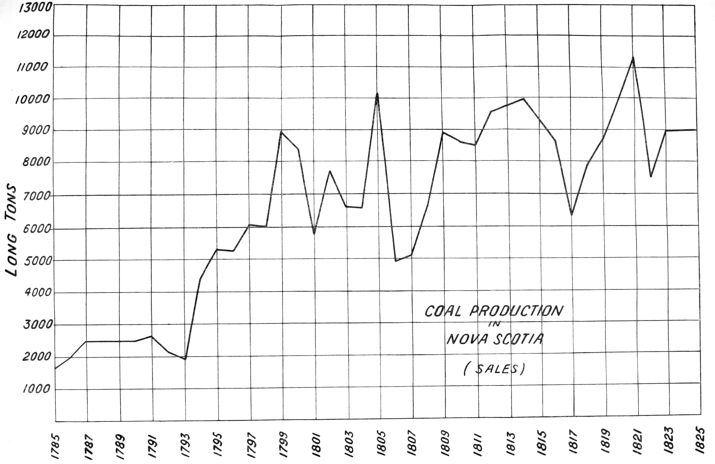
COAL PRODUCTION IN NOVA SCOTIA, 1785-1825
In 1784 Cape Breton was established as a separate colony, and until 1792 the lieutenant-governor was allowed a royalty of three shillings and sixpence per ton on coal mined, as a perquisite of his office. From this date until 1826 the coal-mines were worked at times by the government itself and at times by private operators. The operators were called upon to pay heavy royalties of from three shillings to four shillings and threepence per ton at a time when the selling price in Halifax was fixed by law at from ten shillings and threepence to thirteen shillings and twopence per ton.
Up to 1826 the means of extracting coal had been of the crudest kind. A good deal had been quarried from the outcrops and the underground workings had not been carried below the water-level. The coal was cut from the face of the seams with picks, loaded into two-bushel tubs and hauled on sleds to the pit bottom over corduroy roadways. It was hoisted and loaded into rude carts and taken over rough roads to the wharf, to be again loaded into small vessels or dumped on stock piles. No attention was paid to picking, screening or cleaning the coal. The miners lived in vermin-infested shacks; there was only one pay-day a year; much drunkenness and brawling prevailed; no school existed in the community, and there was no place of worship except a small Roman Catholic chapel near by, where a priest officiated once or twice a year. The mines were conducted in such a desultory manner that much coal was lost by the crushing of the inadequate pillars.[1] The coal had a bad reputation in New England, where it came into competition with the carefully cleaned coal of Great Britain.
In 1798 coal was first discovered in Pictou County, and in 1807 John McKay, a collier, obtained a licence to dig coal for the inhabitants, and later to export. In 1818 leases of twenty-five years' duration were granted covering a large tract of ground on the east side of the East River.[2]
From the year 1826 to 1858 the mining industry of Nova Scotia, with the exception of a few enterprises, was associated with the General Mining Association. In 1825 King George IV granted to his brother, the Duke of York, for sixty years all the reserved mines and minerals in Nova Scotia. The duke transferred these rights to one of his largest creditors in London, Rundell, Bridge and Rundell, a firm of jewellers. This was a time of speculation in American mines, and this firm, which also had investments in South America, formed the General Mining Association to exploit the minerals of Nova Scotia, a province reputed to be rich in copper. Mr Backwell, an eminent Cornish mining engineer, was sent out to examine all the known copper deposits in the province. On his return he reported against the opening up of the copper prospects, but advised his clients to work the rich coal seams. Accordingly in 1826 they sent out a young coal-mining expert, Richard Brown, who reported favourably on the exploitation of the coal deposits in Cape Breton and in Pictou County. The association worked the mines in the former district during that year, finishing an uncompleted lease, and acquired the leases in the latter area. Thus in 1827 the association came into possession of all the reserved mines and minerals in the province. For the Pictou leases for fifty-eight years the price paid was a fixed rental of £3000 sterling and a royalty of one shilling and sevenpence on every chaldron exceeding 20,000 per year sold in Nova Scotia.
The General Mining Association opened and operated the coal deposits in Sydney and Pictou according to the best English practice of that time. New shafts were sunk; railways were built; shipping piers, warehouses, workshops, and dwelling-houses were constructed; steam engines for hoisting and pumping were installed; skilled mechanics and colliers were brought out from England; and no expense was spared to conduct the whole enterprise in the most approved fashion. The first stationary steam engine was started in December 1827 and the first steam railroad in Canada was constructed from the East River to the loading ground at Albion Mines, Pictou County, a distance of six miles. The road began operations in 1839. The work in Sydney was under the direction of Richard Brown, who proved himself to be an engineer of the highest order and a geologist of such insight and accuracy that his early geological work, performed often under the greatest difficulties, has never been seriously controverted.
The association also explored other coal and ore deposits in all parts of the province. An experimental furnace was erected at Albion Mines, and in 1829 smelting tests were made on the clay-ironstone, limonite and hematite found in the vicinity.[3] The principal concern, however, was to furnish a high grade of carefully picked lump coal and to develop a large trade with the United States.
The advent of a strong company to develop the mineral resources of the province was at first hailed with great satisfaction, but, soon after the association had become firmly established, the people became alarmed and severely criticized it as a monopoly. An early historian in 1829 declared:
The impolitic reservation to the Crown of the most valuable minerals in the grants of land made to the people of this Province has diminished the interest of the owners of the soil to seek for what they could not enjoy; and the exclusive right invested in the persons in England, claiming under His Royal Highness the Duke of York, to all the mines and minerals in Nova Scotia, not only renders them indifferent about the discovery of minerals, but prevents them from communicating any information they may possess.[4]
Popular resentment against the company increased. It was declared in the provincial assembly that the reservation of the mines and minerals to the crown and the subsequent lease to the Duke of York were improvident and unconstitutional. In 1845 the opinion of eminent counsel in England was taken as to the legality of the title of the General Mining Association, but the British lawyers confirmed this title. In 1849 the crown transferred all its interest in the mines of Nova Scotia to the provincial government. The house of assembly passed resolutions authorizing the lieutenant-governor and council to negotiate with the General Mining Association with a view to getting it to relinquish its rights, and in 1853 also enacted legislation requiring it to forfeit its right to a mineral deposit if it did not work this deposit within a year after some other person had applied for the right to exploit it. This whole vexed controversy was brought to a focus in 1857 when the provincial assembly appointed two eminent members, representing diverse views on this question, who were authorized to proceed to London to negotiate with the General Mining Association. After much discussion a satisfactory agreement was consummated and ratified by the assembly in 1858. The association was given the right to mine coal in thirty-four square miles in Cape Breton, four square miles in Pictou County and four square miles each at Springhill and Joggins Mines in Cumberland County, while all the mines and minerals not otherwise granted passed to the provincial government. The first mining act was forthwith passed (1858). This act embodied the principle that the important minerals were for ever vested in the people of the province, and that by the payment of certain sums licences to explore over definite areas could be secured, and that leases could be obtained to work certain mines upon the payment of stipulated royalties to the provincial treasury.
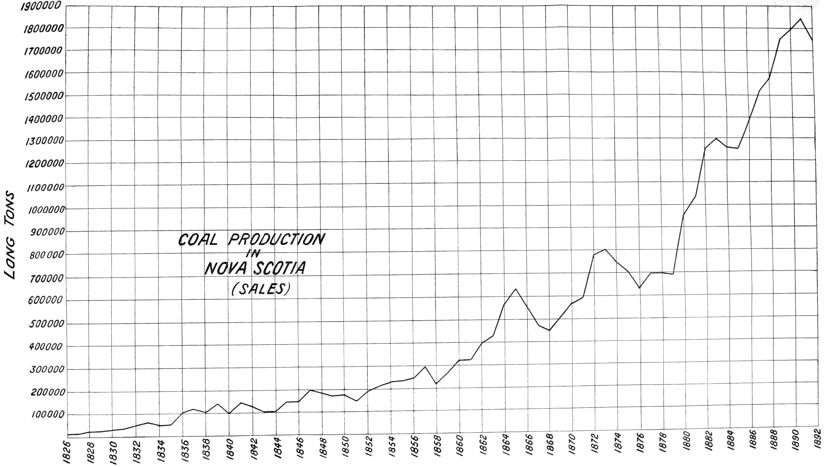
COAL PRODUCTION IN NOVA SCOTIA, 1826-1892
Under these generous conditions many people took up mining areas, chiefly in the coal-fields, some with a view to selling their rights to future operators and others with a view to working the seams themselves. There was a great stimulus at this time for production, because coal was admitted to the United States free of duty under the Reciprocity Treaty which was then in effect. The next twenty-five years was an era of unrestricted individual competition among the coal-mines of Nova Scotia. The General Mining Association, on account of its strong financial backing and its superior facilities for mining, screening and shipping coal, was in a better position than its smaller competitors. It cannot be recorded that money invested in the coal-mines as a whole paid an adequate return. Coal was sold at ruinously low prices in the face of the fierce competition, and in many cases the mines were worked with an eye to temporary profits rather than with the idea of extracting the largest possible percentage of the deposit. During the Civil War there was a great demand for coal in the United States, but with the abrogation of the Reciprocity Treaty in 1866 and the imposition of a considerable duty on coal, the Nova Scotian trade sharply declined. To offset the limitation of the American market, the sales in the Maritime Provinces and Quebec expanded.
The General Mining Association gradually decreased its holdings in the province. In 1871 it sold its area at Joggins Mines to two separate companies and in 1872 disposed of its leases in Springhill, which centre afterwards developed into an important producer. It continued to operate its mines in Pictou until 1872, when its rights to this district were transferred to a new company, known as the Halifax Company. This latter coal earned a high reputation for blacksmiths' purposes and was used extensively in the manufacture of iron in New England. In 1886 two other mines, the Acadia and the Vale, were combined with those of the Halifax Company to form the basis of the Acadia Coal Company, which controls most of the coal in the Pictou basin. One of these seams, known as the Ford, attains a thickness of from thirty to thirty-five feet of clean coal, thus claiming distinction as one of the thickest seams in the world. The seams in this basin are more highly inclined, more irregular and more gaseous than those in the Sydney coal-field, so that the operators in Pictou have had much more trouble from fires, crushes, etc., than have the operators in Cape Breton.
Coal-mines have been opened in other parts of the province. In Richmond County a company attempted to develop a mine in 1865 and other serious efforts at operation have followed, but up to 1913 there has been only a succession of failures in this district. The Port Hood Colliery was first opened in 1865 and has been worked intermittently since then, but the workings were drowned by an inundation of salt water in June 1911. In 1866 an attempt was made to open a mine at Mabou, Inverness County, but it was worked only in a small way. During recent years the Mabou mine was developed extensively by an American company, but it was flooded by an inrush of salt water on January 17, 1909. In 1866 an attempt was made to organize a coal company to open the seams at Broad Cove (now Inverness) in Inverness County, but little development was done until William Hussey started active operations in 1895. In 1899 Mackenzie and Mann assumed control and began to establish a colliery at this place, which has since become an important producer. The history of the vicissitudes of many other collieries cannot be chronicled in this summary of events.
Under the stress of keen competition many coal-mines that were opened with a flourish closed down with a thud after a more or less prolonged struggle. The larger producers must have co-operated to some extent, but how far this was true is difficult to state. As early as September 1874[5] representatives of most of the coal companies met at Stellarton and discussed ways and means of promoting their interests by limiting the output, the engaging of only one common sales agent in each market, and several other considerations which might promote their common welfare.
The legislation affecting coal-mining was continually advanced, following the English laws in this respect more closely than other models, until it was on a highly efficient basis. In 1881 it was required that colliery officials should hold certificates of competency from a government examining board, and in 1882 the first examinations were held. In 1889 the government established evening technical schools for coal-miners, so that any ambitious man could obtain the education necessary to secure a certificate. In 1893 hoisting engineers were required to possess certificates, and technical classes were provided for them in 1897.
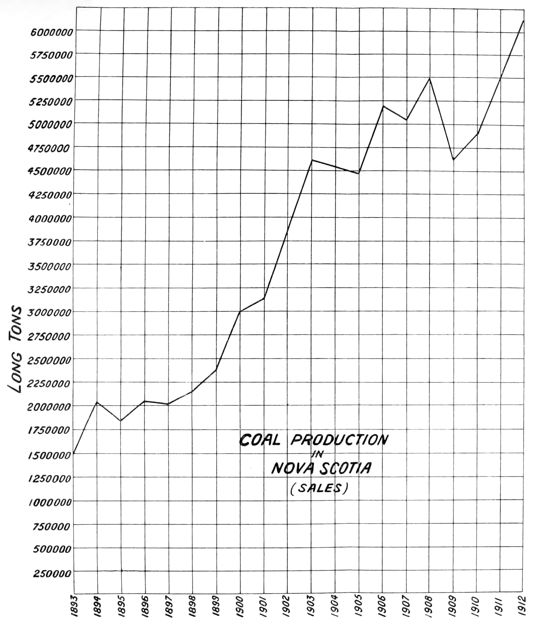
COAL PRODUCTION IN NOVA SCOTIA, 1893-1912
The advantages of a merger of a number of the producing mines were so evident that the Hon. B. F. Pearson in 1892 induced American capital to form the Dominion Coal Company, which took over practically all the going mines in the Sydney district except those of the General Mining Association. This company secured from the provincial government a special lease for a term of ninety-nine years, in return for which it agreed to pay twelve and a half cents royalty per ton on coal sold instead of the regular tax of ten cents. In 1893 the charter of this company was granted by the house of assembly. The original lease covered about seventy-eight square miles of territory, which has been largely added to since, especially in regard to submarine areas.
The Dominion Coal Company at once began to develop its extensive coal property in a most vigorous manner and brought the industry under its control to a high state of efficiency. Miners' wages have been largely increased. Large amounts of coal were mined and placed in stock piles during the winter months, so that the men engaged in and about the mines should have practically continuous employment all the year round. The housing conditions of the employees have been raised to a much higher standard. The yearly output of coal has been increased enormously. The equipment for mining, hoisting, screening, transporting, loading and shipping coal now represents the most modern practice.
A few years after the Dominion Coal Company was formed some of its leading shareholders conceived the idea of establishing large steel works in the vicinity of Sydney. This conception was based on two main ideas, viz. to provide a plant for the manufacture of steel products for which there was a rapidly growing demand in the new railways and industries in Canada, and also to provide in the neighbourhood of the mines a consumer of large quantities of fine or slack coal. Accordingly, in March 1899, the Dominion Iron and Steel Company was formed and incorporated under the laws of Nova Scotia. A very large plant was constructed on tidewater at Sydney Harbour on an ideal site. The iron ore was procured from the large deposits on Bell Island, Newfoundland, and the limestone and dolomite came from Marble Mountain and George River in close proximity to the steel plant. This company entered into a long term contract (October 20, 1903) with the Dominion Coal Company whereby the latter was to supply it with coal, a portion of which was to be freshly mined from the Phalen seam, suitable for metallurgical purposes and reasonably free from stone and shale. The price of coal was to be adjusted every five years. After a few years, however, there ensued a legal battle in which the steel company brought suit for large damages against the coal company for alleged breach of contract. The case was taken to the Privy Council and the verdict awarded to the plaintiff. The interests of the two companies were so nearly identical and the damages so heavy that the steel company acquired control of the coal company and merged the two into the Dominion Steel Corporation. In 1911 this company leased the properties of the Cumberland Coal and Railway Company in Springhill, so that at the present time it possesses under lease by far the greater portion of the coal resources of Nova Scotia.
The Dominion Steel Corporation is one of the largest industrial concerns in Canada. It has over twenty coal-mines opened and is increasing its production very rapidly. It has extensive piers and facilities for bunkering at Sydney, Louisbourg, Halifax, Parrsboro, St John, Quebec and Montreal. Its colliery, Dominion No. 2, is one of the largest and most completely equipped in the world. In 1912 it had over ten thousand men on its pay-roll in and about the mines in Cape Breton alone. It owns and operates the Black Diamond Steamship Company. It possesses part of the immense iron deposits at Bell Island, Newfoundland, and limestone deposits at Port-au-port, Newfoundland, and Marble Mountain on the Bras d'Or Lakes, besides its own dolomite quarries in the vicinity of Sydney. The steel plant is one of the largest individual steel works in the world, and employs over four thousand men. It has six modern blast furnaces, three 15-ton Bessemer converters, ten Campbell 50-ton tilting open-hearth furnaces, rail mill, wire-rod mill, wire and nail mill, coal washer, and full complement of modern by-product coke ovens. It has developed an individual duplex Bessemer open-hearth process which is a high metallurgical achievement. This corporation and the Nova Scotia Steel and Coal Company dominate the great industrial life that has so rapidly developed in Cape Breton within the last few years.
The General Mining Association continued to operate its mines at Sydney Mines until the year 1900, when it sold its entire rights in the province to the Nova Scotia Steel and Coal Company, and thus, after a long and honourable career, passed out of the annals of the industrial history of Nova Scotia.
In 1910 Belgian capital to the extent of $2,000,000 was introduced into the Acadia Coal Company in Pictou, which is expanding its operations accordingly.
The day of the small coal-mine, because of the larger capitalization necessary for economical operation, has passed in the mining history of Nova Scotia. As elsewhere in modern business, coal-mining is now securely in the control of a few large corporations, and the advantage of this condition from an operating standpoint is seldom questioned.
Nova Scotia has been comparatively free from disastrous mine explosions. Three of these stand out in the industrial history of the province. On May 13, 1873, an explosion occurred in the Drummond Colliery of the Intercolonial Coal Mining Company at Westville, in which sixty lives were lost. An explosion of fire-damp occurred in the Ford Pit of the Halifax Company on November 12, 1880, through which forty-four persons were killed. On February 21, 1891, a severe explosion took place in the Springhill Mines which resulted in the death of one hundred and twenty-five persons. The total fatalities in the coal-mines in comparison with the number of people employed is much lower than in the coal-mines of Western Canada and compares favourably with British statistics.
The serious clashes of the employers and operatives in the Nova Scotian coal-mines have been comparatively few. The Cumberland Coal and Railway Company at Springhill had a very stormy history in this regard for nearly twenty years, but in the rest of the province the relations of labour and capital have been generally peaceful. For many years the mine workers have had their own organization, the Provincial Workmen's Association, which has been successful in gaining its ends with but few real strikes. In 1908 the United Mine Workers of the United States entered the province and tried to win over the local coal-miners as members of their organization. A bitter strike on a large scale was conducted by this union against the Dominion Coal Company for a new wages schedule. The members of the Provincial Workmen's Association stood by the coal company and were successful.[6] Riot and disorder of a magnitude unknown in this peaceful province were rampant during the strike, and the Canadian troops had to be called in to preserve order.
|
Richard Brown, The Coal Fields and Coal Trade in the Island of Cape Breton, 1871, p. 71. |
|
Dr Patterson, 'The Early History of Mining in Pictou County,' Transactions of the Mining Society of Nova Scotia, 1893-94, vol. ii. part ii. pp. 57-62. |
|
H. S. Poole, 'Iron Making in Nova Scotia early in the Century,' Transactions of the Mining Society of Nova Scotia, 1893-94, vol. ii. part iv. pp. 144-52. |
|
T. C. Haliburton, An Historical and Statistical Account of Nova Scotia, 1829, p. 309. |
|
Report of Department of Mines of Nova Scotia, 1875, p. 14. |
|
See 'The Labour Movement in Canada' in section V. |
The natural resources and trade in coal of New Brunswick are small in comparison with Nova Scotia. The first discoveries of bituminous coal were made in the vicinity of Grand Lake, Queens County, and small quantities were obtained from that region in 1782.[1] The full importance of this and the other coal-fields of the province was not recognized until Dr A. Gesner, in 1839-41, made the first geological survey of the province. He overestimated[2] the area in which productive coal seams might be found, but this was very pardonable in the light of the natural difficulties under which his investigation was made. The most important coal deposits are in the vicinity of the north-eastern end of Grand Lake, a navigable branch of the St John River, twenty-five miles long and four miles wide. The country is flat and the thickness of productive carboniferous strata is only about two hundred feet. The principal seam of coal is about two feet thick and comparatively near the surface. The glacial drift is from two to forty feet thick, but a good deal of coal has been quarried after stripping the surface.
For many years the coal was removed in a most desultory manner. Each farmer on whose land coal was exposed devoted a portion of his leisure time in the winter to extracting a few tons for himself and sometimes hauling a few loads over the snow and ice to Fredericton. The market in St John was supplied for the most part by Nova Scotian coal. A company was formed in 1837 to test the Grand Lake coal-field by boring, and proved that the two-feet seam was the only one of economic importance. This fact was corroborated by subsequent borings in 1866 and 1870, and further by extensive bore-holes undertaken in 1873 by the Geological Survey of Canada and the New Brunswick government.
The output of the small mines about Grand Lake was about three thousand chaldrons, and even down to 1900 averaged only about four thousand chaldrons a year. Most of the coal was consumed in Fredericton and St John. In 1891 and 1893 experiments showed that a satisfactory quality of coke could be manufactured from this coal. With the advent of a railway from the coal-field to Norton on the Intercolonial Railway about ten years ago, the industry took on a new lease of life. Several of the mines were equipped with modern power plants and apparatus for handling and screening the coal, and the output was largely increased. In 1911 about forty-five thousand tons were shipped from this district.
In 1903 the Imperial Coal Company was formed to work the coal deposits at Beersville in Kent County. A railroad was built to Adamsville on the Intercolonial Railway, and in 1911 about six thousand tons of coal were produced from a twenty-inch seam.
At the present time (1913) the future development of the Grand Lake coal-fields looks very promising. The Fredericton and Grand Lake Coal Company is building a railway from Gibson on the Intercolonial Railway to Minto. When completed the whole line from Gibson to Norton is to be leased to the Canadian Pacific Railway for 999 years, and more extensive exploitation of the coal seam is to be prosecuted.
A large deposit of a unique mineral, albertite, was discovered in 1850[3] by the bursting of a mill dam and the simultaneous erosion of the banks of Frederick Brook at Hillsborough, Albert County. Albertite closely resembles asphaltum, having a specific gravity of 1.08 to 1.11, a hardness of nearly 3 on Moh's scale, and an amorphous structure. The main vein was sixteen feet thick at the outcrop and a company was formed immediately to work it. The albertite was used principally in the United States to enrich illuminating gas and in the manufacture of petroleum products. It yielded about one hundred gallons of oil per ton or 14,500 cubic feet of gas and was worth about twenty dollars a ton. The mining rights caused a protracted and bitter struggle in the courts as to whether albertite was a coal and thus reserved to the crown, or a carbonaceous material which belonged to the owner of the soil.[4] The deposit was mined to its limit at a depth of about thirteen hundred feet, and over 230,000 tons were extracted in the thirty years during which it was worked. Other occurrences of albertite were discovered, but none of them of sufficient magnitude to warrant mining operations.
|
W. O. Raymond, Proceedings of the Historical Society of St John, 1897. |
|
A. Gesner, New Brunswick, 1847, p. 347 et seq. |
|
W. C. Milner, 'History of Albertite,' Journal of the Mining Society of Nova Scotia, 1912-13, vol. xvii. p. 62 et seq. |
|
Geological Survey of Canada, Report of Progress, 1876-77, pp. 351-401. |
Annapolis County.—The existence of large beds of iron ore near Nictaux and Torbrook was known early in the nineteenth century. In 1825 some ore from these deposits was extracted and used in the furnace at Clementsport. A small Catalan forge was erected at Nictaux Falls during the first decade, and a few tons of bar iron were made. About 1850 the Acadian Iron Mining Association built a charcoal furnace at Nictaux Falls. Limestone for a flux was brought from St John and the works were operated spasmodically until 1860. In 1870 the firm of Page and Stearns acquired mining leases covering a good deal of the territory in which beds of iron ore were known to exist, and began to build a railway across the province to the Atlantic shore. Their scheme failed, however, and iron-mining in this section lapsed again into desuetude. In 1890 Major R. G. E. Leckie acquired royalty options upon certain iron ore beds in the eastern part of the district, and commenced active mining operations, the ore being shipped to the furnaces at Londonderry and Ferrona. In 1896 the mines became idle, because the furnace at the former place was shut down. In 1903 the Leckie Mine was reopened after the reorganization of the Steel Company of Canada into the Londonderry Iron and Mining Company and worked until the summer of 1906, when this part of the deposit was exhausted. At the same time other parts of the iron ore beds were prospected and developed. The options of the Londonderry Company expired about the end of 1906 and the Annapolis Iron Company was formed by capitalists interested in the former company to mine the iron ore in the Annapolis County deposits. In 1909 the Canada Iron Corporation purchased extensive mining rights, built a large pier and later a modern concentrating mill, and are shipping large quantities of this ore to foreign markets.
One of the early attempts to mine and smelt iron ore was made at Clementsport on the eastern bank of the Moose River. At this place the Annapolis Iron Company erected a charcoal blast furnace in 1825 for smelting the local ore. Operations were continued for only a few years and then shut down, to be resumed again in 1861 for a year or two. In 1872 and 1873 the furnace was run for ten and six weeks respectively, but since that time no ore has been smelted at this place.
Colchester County.—The Acadia Charcoal Iron Works commenced mining on the deposits of hematite, ankerite, etc., near Londonderry in 1849. The existence of iron deposits here seems to have been known ever since the date of the grants of land from the crown, by which the iron included in these grants was given to the owner of the soil. Six Catalan forges, a puddling furnace, a steam helve-hammer, a blower, and a set of crushing rolls constituted the first equipment. In 1852 a charcoal blast furnace was erected and continued in blast intermittently until 1875. In 1870 a full equipment for the manufacture of steel was installed and the Catalan forges abandoned. In 1874 or 1875 Dr Siemens made the first commercial experiments here for the direct process of making iron in rotating furnaces. In 1877 the manufacture of steel was abandoned and additional mills erected for the rolling of iron. The first coke ovens were built in 1873 at the Albion Mines, Pictou County, and the coke successfully used in the furnace at Londonderry. In 1896 the property was purchased from the Steel Company of Canada and the Londonderry Iron and Mining Company assumed control. The blast furnace was remodelled and kept in blast for several years. In 1909 the Canada Iron Corporation acquired the property, since which time there has been practically no mining done in this district. A small open-hearth furnace was erected for the purpose of manufacturing steel castings, but the blast furnace has not been put in operation.
Pictou County.—Various deposits of iron ore were discovered in proximity to the coal seams at Albion Mines and on the East River soon after the General Mining Association entered the province (1825). In 1828 it built an experimental furnace and made a few runs, but did nothing further in this direction.
In 1872 the Hope Iron Works started at New Glasgow with a capital of four thousand dollars in the manufacture of marine and railway forgings. In 1878 the name was changed to the Nova Scotia Forge Company and the plant was moved to the site now known as Trenton. In 1882 the same capitalists who were supporting the forge company established the Nova Scotia Steel Company to manufacture steel from imported pig-iron and scrap by the open-hearth process. In 1883 the Nova Scotia Steel Company produced the first steel ingots manufactured in Canada. In 1889 the interests of these two companies were merged in the Nova Scotia Steel and Forge Company. In 1890 some of the leading shareholders of the last-named corporation organized the New Glasgow Iron, Coal and Railway Company, which purchased extensive iron ore deposits on the East River and built a railway from Ferrona Junction on the Intercolonial Railway to Sunny Brae. It also erected a coke blast furnace at Ferrona, with a capacity of one hundred tons a day, in accordance with the best metallurgical practice at that time, and also built the first commercial coke-washing plant and retort coke ovens on this continent. The furnace was blown in during 1892 and continued in blast for a number of years.[1] The plant used ore from Torbrook, Annapolis County, and from the Brookfield Mines, Colchester County, as well as their own local ores. In 1894 this company purchased the enormous iron deposits on Bell Island, Newfoundland, and thenceforth used this as its main ore supply. In 1895 the Nova Scotia Steel and Forge Company and the New Glasgow Iron, Coal and Railway Company were amalgamated, under the name of the Nova Scotia Steel Company. In order to make itself as self-contained as possible this new company organized the Nova Scotia Steel and Coal Company and in 1900 purchased all the mines and mining rights of the General Mining Association at Sydney Mines. It then proceeded to erect a new blast furnace and four open-hearth furnaces, washing plant, retort coke ovens, etc., at the base of its coal supply at Sydney Mines, and to build extensive piers at North Sydney for coal and iron ore. As soon as these were in operation the plant at Ferrona and the mines on the East River were abandoned. The company has expanded rapidly in all its branches of mining coal, mining iron ore and making steel. It has become second only to the Dominion Steel Corporation as a steel producer in Canada and a coal producer in Nova Scotia. It exports vast quantities of iron ore from Bell Island to Europe and to the United States.
The Pictou Charcoal Iron Company began in Bridgeville in 1891 to mine and smelt charcoal pig-iron from local ores. The furnace was started in the autumn of 1892 and continued in active operation for a number of years.[2] The demand for charcoal iron, however, soon diminished in Canada, and the company was forced to shut down the furnace, but it continued for some time to sell ore to the coke blast furnace at Ferrona. In 1899 the furnace was run for a short time by the Mineral Products Company of New Brunswick on manganese ore from Dawson Settlement, New Brunswick, in the manufacture of ferromanganese. There has been no smelting at Bridgeville since that date.
There are a number of other iron-bearing deposits in the province and a great deal of prospecting and development work has been done upon them, but with the vast quantity of easily accessible iron ore at Wabana, Bell Island, Newfoundland, it does not seem probable that the native ores will play any considerable part in the iron and steel industry of Nova Scotia for a long time to come.
|
Walter Stein, 'The New Works of the New Glasgow Iron, Coal and Railway Company at Ferrona, N.S.,' Transactions of the Mining Society of Nova Scotia, 1893-94, vol. ii. pp. 75-82. |
|
E. Sjostedt, 'Notes on the Ores and Blast Furnace Plant of the Pictou Charcoal Iron Co. Ltd., Bridgeville, N.S.,' Transactions of the Mining Society of Nova Scotia, 1892-93, vol. i. part iv. pp. 8-14. |
The manufacture of iron and steel has never been an important industry in New Brunswick, although the existence of extensive deposits of iron ore in the province has long been known. One of the most important occurrences of iron ore was reported near Woodstock, Carleton County, as early as 1820.[1] These deposits were brought to wide public notice in 1836 by Dr C. T. Jackson in a geological survey of portions of the State of Maine. In 1848 a charcoal iron blast furnace was erected by the Woodstock Charcoal Iron Company upon the St John River a short distance above Upper Woodstock. The ore was quarried, and in smelting it about three tons of ore were required for each ton of pig-iron produced.[2] The furnace had a capacity of about seven tons a day. The manufactured pig-iron cost from twenty to twenty-two dollars per ton.[3] Another charcoal furnace with a capacity of five and a half tons a day was erected in 1868. The pig-iron is reported to have contained a high percentage of phosphorus, although some of it was successfully used in the manufacture of armour plates in England. The works were operated only spasmodically for a few years. During the latter period of the operations at Woodstock, bog iron ores from Sunbury were mixed with the Woodstock ores to improve the grade of pig-iron.
The largest iron deposits in the province are situated on the Nipisiguit River about twenty-two miles south-west of Bathurst in Gloucester County. The ore was discovered in 1898 by a trapper named William Hussey. In 1904 the Dominion Iron and Steel Company did some prospecting in this locality and then abandoned the work. In 1905 the Mines Branch of the Canadian Geological Survey sent an experienced man to make a magnetic survey with a view to thoroughly testing the property. In the vicinity of the original discovery he located two large bodies of ore that were further tested by the government of New Brunswick by a series of diamond drill holes. The property was purchased by the Drummond Mines Company in 1907 and a small amount of development work was carried out in that year and in 1908. In 1909 the Canada Iron Corporation assumed control of the property, and the exploitation of the deposits commenced on an extensive scale. A branch railway was built from the mines to the Intercolonial Railway at Nipisiguit Junction. In 1911 a large concentrating mill was erected and began operations in the following year. About 150,000 tons of high-grade ore have been mined and shipped, most of it going to the United States. About $500,000 have been spent on the property up to the present time and about 40,000,000 tons are said to be available in a depth of five hundred feet in the three masses of ore developed. Other occurrences of iron ore that have attracted attention from time to time have been reported from various parts of the province, but none of them have yet led to active mining operations.
|
A. Gesner, New Brunswick, 1847. |
|
L. W. Bailey, 'Mineral Resources of New Brunswick,' Annual Report of Geological Survey of Canada, 1897, vol. x. p. 157. |
|
Geological Survey of Canada, Report of Progress, 1873-74, p. 252. |
New Brunswick.—Gold-mining in New Brunswick holds no greater place in the industrial life of the province than do snakes in the natural history of Ireland. Alluvial gold was reported by Professor H. Y. Hind in a geological survey made in 1865, as having been washed from the sand of several streams in the province, but no economic deposits of gold ore have ever been found.
Nova Scotia.—The earliest important discovery of gold was made in the summer of 1860 by one John Pulsifer at a spot about twelve miles north of the head of Tangier Harbour on the north-east branch of the Tangier River.[1]
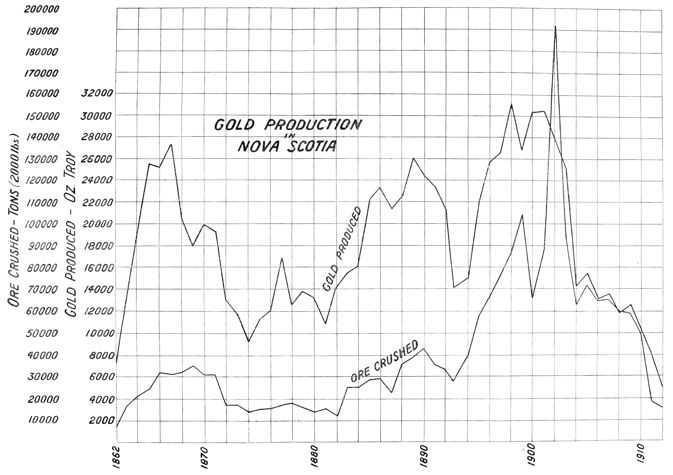
GOLD PRODUCTION IN NOVA SCOTIA
This discovery caused great excitement throughout the province and stimulated many men in all walks of life to prospect for the precious metal. Over six hundred prospectors immediately flocked to the spot. There was no great rush of people from other parts of the world as had been the case in California and Australia, because there were no reports of rich extensive alluvial deposits in Nova Scotia. All the placer deposits, with one or two exceptions, had been swept away into the sea by glacial action. During the height of prospecting excitement, not more than one-fifth of the men employed came from outside the province. The next discovery was reported at Wine Harbour in July 1860, and over two hundred men were prospecting here before the end of September. During the next year other discoveries of gold ore were made at Sherbrooke, Isaac's Harbour, Country Harbour, Lunenburg, Waverley, Renfrew, Oldham, Lawrencetown and several other places. It was not long before it became well known that practically one-half of the eastern portion of the mainland of Nova Scotia, from Canso to Yarmouth, was occupied by the gold-bearing slates and sandstones. This area includes about 8500 square miles, of which approximately 3500 square miles are occupied by granite. The gold occurs in quartz veins in a notable state of purity, being usually about 950 fine. The veins are found in a series of anticlinal domes and are usually comparatively narrow, the average lead being four to six inches thick. The veins are mostly of the interbedded type and are exceedingly numerous. Not all of the veins or all portions of any one vein contain enough gold to pay for exploitation. The pay-chutes in the quartz lodes are usually of comparatively small dimensions, although some notable exceptions have been proved.
The popular excitement concerning the gold deposits did not last long, because none of the people engaged in this occupation made vast fortunes. Two years after the first discovery the general attitude toward gold-mining became reasonable. It was recognized that perseverance, intelligence and economy had to be practised in the search for and the extraction of the metal, and that very often the reward was amply worth the effort. It is a pleasure to record that law and order prevailed in the early mining camps to quite the same extent as in the rural villages of the province. There have been special periods of accelerated interest in speculation and investment in the gold-bearing deposits, at times when some new rich find was reported, or a number of properties were amalgamated for the purpose of extensive mining operations, but the gold mines have preserved an even tenor up to recent years which has not characterized the gold-mining areas of many other countries. Many of the hardy people of the province became intelligent miners, but a large number of these have emigrated to the western portions of the United States and Canada during the recent decline in gold-mining in Nova Scotia. These men have always been held in high regard for their general ability in the mining camps to which they have gone.
About sixty gold districts have been proclaimed in Nova Scotia and a great deal of work has been carried on to shallow and moderate depths. Two mines have continued working to vertical depths of over one thousand feet. Many of these gold-mining centres, with their numerous prospecting pits surrounded by small piles of rock, remind one of a colony of gophers. Expensive plants and stamp-mills have been erected for mining and treating the gold-bearing rock on a large scale, but the exploitation of large low-grade deposits has not yet proved a commercial success. There is still ample opportunity and reasonable chance for generous reward for the intelligent and economical operator who follows the pay-chutes of many of the gold-bearing veins in the province, with a modest equipment and a ten or twenty stamp mill.
The mining areas as first laid out were fifty feet along the vein and twenty feet wide with vertical boundaries. It was supposed that this small unit would be of advantage to the individual prospector or miner, but this size was soon changed to an area of 250 by 150 feet. A man may secure for a reasonable sum a licence to search or prospect over a much larger area for a certain time, and when he locates his working area with a view to mining the gold, he may select a certain number of areas of the size mentioned. For these areas he pays a rent of fifty cents a year each in addition to the two per cent royalty on the gold extracted.
About ten years after the discovery of gold there was a change in the working methods. There arose a tendency on the part of the companies controlling the mining rights on certain areas to contract with a group of practical miners who should carry on the actual mining work. This is known as the tribute system. For the right to extract gold ore the miners pay to the company a certain portion of the gold won. In many cases this system has yielded profits where the company itself has failed. The miners, however, are apt to do their work with a view to gaining temporary profits, which method usually causes the mine to be left in very bad shape for future operations. The gold ore which has been crushed in the mills during the whole period since the first discovery has been comparatively rich, the average of all quartz crushed being nearly a half-ounce per ton.
|
Report of the Chief Gold Commissioner of the Province of Nova Scotia, 1862, p. 5. |
There are in both Nova Scotia and New Brunswick enormous deposits of high-grade gypsum, which have been the basis of an important industry for over half a century. Most of the gypsum has been exported from the provinces in the crude form and the principal market has been the United States. The industry has suffered many vicissitudes on account of varying tariffs and the keenest kind of competition, but it is now in a prosperous condition and seems destined to progressive expansion in the future.
New Brunswick.—The largest, purest and most extensive deposits of gypsum occur near Hillsborough in Albert County. There are no accurate records of the first discovery and early exploitation of these beds, but it is known that for a few years prior to the year 1854 the Fowler Bros. of Lubec, Maine, quarried from two to three thousand tons annually, and during this same period small amounts were removed by local farmers for land fertilizer. In 1854 the Albert Manufacturing Company was organized by Calvin Tompkins, who coincidently built a mill in Newark, N.J., for the manufacture of plaster of Paris. This company opened quarries, and also built railways and shipping piers for the extensive development of this property. A large amount of crude gypsum was exported to the United States. In 1861 a mill for grinding and calcining the plaster was erected on the Petitcodiac River. For some years the company could not market its products in Canada because of the prohibitive cost of transportation, but with the opening up of the Intercolonial Railway a foothold was gained in the business of the central provinces. This market largely increased with the establishment of a Canadian protective tariff and has been continually expanding ever since. On account of the high reputation of the products of this company it has been able to secure a certain amount of trade with the United States even in the face of an adverse tariff.
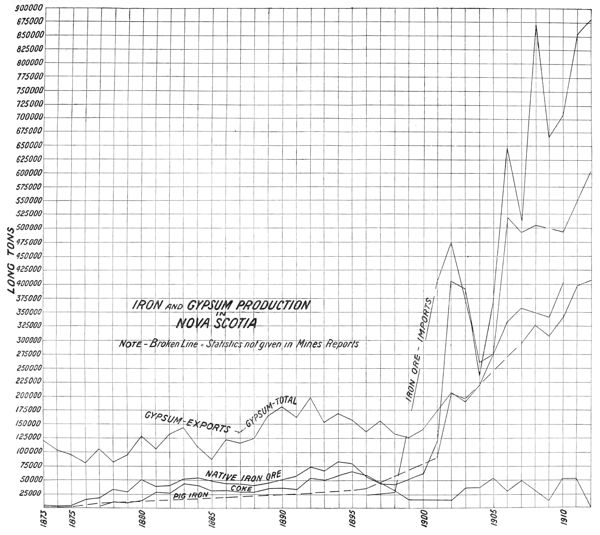
IRON AND GYPSUM PRODUCTION IN NOVA SCOTIA
Other deposits in the province have been worked spasmodically. The more impure beds on the Tobique River in Victoria County have been exploited for the purpose of making land fertilizer. A branch line of the Canadian Pacific Railway, twenty-eight miles long, was built into this district, and in 1893 the Tobique Valley Gypsum Mining and Manufacturing Company erected a plant for making 'land plaster,' but the work here since then has been neither energetic nor continuous.
A number of excellent deposits have been opened up more recently in Albert County and worked to a limited extent.
Nova Scotia.—The mention of gypsum by Denys in 1672 has been recorded previously in this article. There is no authentic history of the operations previous to 1779, and from this date to 1833 there are no records available to show the amount extracted. In the early days the farmers quarried the rock and hauled it to the point of shipment, usually on sleds in the winter. Here they would sell it to local traders or charter a small vessel and ship it to the United States. The principal market in the middle of the nineteenth century for Nova Scotian gypsum was at Lubec, Maine.
From 1860 onward the operations were conducted on a much better business basis. Some attempts were made to calcine the rock to plaster of Paris, but these were commercially unsuccessful, because a prohibitive duty was placed on the manufactured article in the United States as soon as the Nova Scotian industry attained important proportions. At the present time there is a small mill at Windsor and another large one at Cheticamp which are turning out the finished plaster of Paris for the Canadian markets.
Between 1861 and 1867 there were twenty-five ports in the province which were shipping gypsum. In 1908 the rock was being exported from only six points in three counties. The industry is practically controlled by the American capital that owns the mills in the United States. The provincial shipping interests do practically none of the carrying trade. Although the production is to-day more than double that of twenty years ago, nearly ninety per cent of it is controlled by one firm. Thus gypsum is much more completely under monopolistic control than the coal production, and the monopoly is a foreign one. The industry has been conducted with great economy, but has only lately seen the introduction of modern labour-saving devices. The pod auger has been replaced by the hand-machine auger, and in 1909 the steam shovel was employed at one large quarry for the stripping of the surface. The men employed at present are descended from fathers and grandfathers who worked in the quarries and have developed a highly specialized skill in this work. The principal quarries are situated near Windsor in Hants County, at Cheticamp, Inverness County, at Nappan, Cumberland County, and in St Ann's Bay, Victoria County. The deposits occur in the Lower Carboniferous measures.
It is impossible to more than mention the major efforts that have been made to prospect and work the various other mineral deposits that have been discovered in Nova Scotia and New Brunswick.
Antimony.—About 1863 a deposit of stibnite was discovered in Prince William, York County, New Brunswick. The Lake George Mining and Smelting Company exploited the vein to a considerable extent, erected an extensive concentrating plant and smelter, and evolved an individual metallurgical practice.[1] In 1890 this company discontinued operations, which were resumed for a short time in 1907 by the Canadian Antimony Company.
In 1880 a deposit of antimony ore was discovered at West Gore, Hants County, Nova Scotia, by John McDougall, John T. Wallace and Joshua Brison and was worked intermittently until 1900, when it was acquired by the Dominion Antimony Company. The American Metal Company of New York became interested in the mine and erected a modern concentrating mill to treat the lower grades of ore. The stibnite was auriferous and the company held leases from the government to work the mine for gold, believing that the antimony belonged to the owners of the soil. In 1908 the Nova Scotia Development Company applied for and received the right to work the same areas for antimony, and involved the mine in litigation which resulted in active operations being discontinued.
Copper.—In both New Brunswick and Nova Scotia large sums of money have been spent in quest of copper ore. Up to the present time no mine that has become a producer of copper ore for any great length of time has been developed.
In New Brunswick there was a sudden wave of energy in prospecting for copper in the early sixties. On Passamaquoddy Bay in the southern part of the province considerable development was carried out at this time on Adams Island, Simpson Island, on the mainland at La Tête Passage, and on the Vernon Mine at Goose Creek, St John County. In 1859 or 1860 two unsuccessful attempts were made to locate copper-mines near Bathurst, one being situated at the falls of the Tetagouche River and the other near the mouth of the Nipisiguit River. In 1882-83 heavy expenditures were incurred by one American company that ventured to develop a mine in the sandstones near Dorchester, and about 1900 by another company that endeavoured to extract the copper by leaching and electrolysis.
In Nova Scotia copper was first discovered at Cape d'Or in 1604. It was the reputation of possessing extensive copper deposits that in 1825 induced the General Mining Association to enter the province as a promising field for investment. Many attempts have been made to exploit the native copper at Cape d'Or, but all were unsuccessful, even the venture in 1900 of the Colonial Copper Company, which conducted its operations on a large scale. In 1863 and 1864 a company prospected in the vicinity of Cheticamp, and in 1903 another company made an unsuccessful attempt to develop a mine in the schists of this region. In 1875 a large vein of cupriferous pyrite was discovered near Polson's Lake, Antigonish County, but subsequent explorations have failed to establish a working mine. At Coxheath, Cape Breton County, since 1881 more extensive development has been prosecuted than on any other copper deposit in the province, but since 1902 it has been practically idle. In 1898 the Crown Copper Company started to develop promising prospects in Pictou and Cumberland Counties. It erected a smelter at Pictou and spent a great deal of money, but ended its operations abruptly in a few years.
Lead and Silver.—In New Brunswick the deposits of lead and silver which have been discovered have been of such small magnitude that they do not deserve mention here.
In Nova Scotia a deposit of argentiferous galena was found in 1897 on the L'Abîme Brook, Inverness County, while the Cheticamp Gold Mining Company was prospecting the Cheticamp River for gold. Later a concentrating mill was erected and considerable mining development accomplished, but the venture was a failure. Other promising deposits of galena have been developed at Smithfield, Colchester County, and at Musquodoboit Harbour, Halifax County.
Manganese.—Manganese mining was at one time an industry of some consequence in New Brunswick. The most important mine was opened in 1864 at Markhamville, Kings County, by G. F. Matthew. The deposits were worked up to 1894 and produced 25,000 tons of high-grade ore. Work began at the Jordan Mountain Mine near Sussex in 1882, but only a small quantity of ore was produced. The Quaco Head Mine was worked intermittently up to 1889 and produced several hundred tons of ore. The Hopewell Manganese Mines, situated at Shepody Mountain, Albert County, were opened in 1860 and produced about five hundred tons of high-grade ore. About 1895 the Mineral Products Company developed large deposits of bog manganese ore at Dawson Settlement, Albert County. The company erected an extensive plant for washing and briquetting the ore and shipped some to Bridgeville, Nova Scotia, where ferromanganese was smelted in the charcoal blast furnace. The company failed shortly after 1900.
In Nova Scotia the most important deposits of this ore were discovered at Tenny Cape in 1861 by Nicholas Mosher, Junior. Shipments of very high grade ore were continued intermittently up to a few years ago. Manganese ore has also been worked at Walton, Cheverie and Pembroke in the vicinity of Tenny Cape, and also at Onslow, Colchester County. A few years ago an important vein of pyrolusite was discovered by Ernest Turner at New Ross, Lunenburg County. This is evidently a fissure vein in granite and is quite different from the other deposits, which were distinct lenses in limestone. It has been vigorously developed by the Nova Scotia Manganese Company and is expected to become an important producer.
Barytes.—The principal deposits of this mineral in Nova Scotia occur at Five Islands, Colchester County, and at Cape Rouge and Lake Ainslie, Inverness County. The last-mentioned deposit is at present being vigorously developed and a large amount of barytes is being mined, bleached, ground and shipped to Canadian and foreign markets.
Tungsten.—An important deposit of scheelite was discovered in 1908 near Moose River, Halifax County, Nova Scotia, by Thomas and Silver Curry and John Reynolds. The property has been extensively prospected: a concentrating mill was erected in 1911 and several shipments of high-grade concentrates have already been made. In 1911 tungsten was also found in the northern part of York County, New Brunswick, near the Miramichi River.
Petroleum and Gas.—No producing wells have yet been located in Nova Scotia, although bore-holes were put down to a depth of about two thousand feet near Cheverie, Hants County, several years ago, and boring operations have been extensively carried on and are still in progress near Lake Ainslie, Inverness County. In several portions of the province there are extensive deposits of oil-shale, but the exploitation of these has not yet passed the initial stages.
In New Brunswick there are very large deposits of rich oil-shales awaiting development. Certain amounts of albertite were used in making gas and oil in the prosperous days of the mine at Hillsborough. The Maritime Oilfields, Limited, has recently bored a large number of holes to a depth of over two thousand feet at Stoney Creek, Albert County, New Brunswick. Several oil-wells with a comparatively small capacity have been found, and enormous quantities of natural gas at pressures ranging from 175 to 550 pounds per square inch have been encountered. In 1911 the company piped the gas to the nearest industrial centre, Moncton, where it is used for power, light and heating purposes, and also for charging the gas-tanks on the cars of the Intercolonial Railway.
|
Carl Schnabel, Handbook of Metallurgy, translated by H. Louis, 2nd edition, 1907, pp. 569, 575. |
Printed by T. and A. Constable, Printers to His Majesty
at the Edinburgh University Press
To accommodate several very wide tables their column titles have been abbreviated, with a legend provided below the table. In some instances it was necessary also to partition the table and to provide the right-hand block of columns as a second table below the first, which contained the left-hand block.
The footnotes have been renumbered sequentially within each chapter, or subsection.
Minor changes were made to hyphenation to achieve consistency.
[End of Canada and Its Provinces vol. 14 by Adam Shortt & Arthur G. Doughty (eds.)]